<?xml version="1.0" encoding="UTF-8"?>
<!DOCTYPE article PUBLIC "-//NLM//DTD Journal Publishing DTD v2.3 20070202//EN" "journalpublishing.dtd">
<article xmlns:mml="http://www.w3.org/1998/Math/MathML" xmlns:xlink="http://www.w3.org/1999/xlink" xml:lang="en" article-type="research-article">
<front>
<journal-meta>
<journal-id journal-id-type="publisher-id">ijms</journal-id>
<journal-title>International Journal of Molecular Sciences</journal-title>
<abbrev-journal-title>Int. J. Mol. Sci.</abbrev-journal-title>
<issn pub-type="epub">1422-0067</issn>
<publisher>
<publisher-name>Molecular Diversity Preservation International (MDPI)</publisher-name></publisher></journal-meta>
<article-meta>
<article-id pub-id-type="doi">10.3390/ijms13045230</article-id>
<article-id pub-id-type="publisher-id">ijms-13-05230</article-id>
<article-categories>
<subj-group>
<subject>Article</subject></subj-group></article-categories>
<title-group>
<article-title>Enhanced Production of a Novel Cyclic Hexapeptide Antibiotic (NW-G01) by <italic>Streptomyces alboflavus</italic> 313 Using Response Surface Methodology</article-title></title-group>
<contrib-group>
<contrib contrib-type="author">
<name><surname>Guo</surname><given-names>Zhengyan</given-names></name><xref ref-type="aff" rid="af1-ijms-13-05230">1</xref><xref ref-type="aff" rid="af2-ijms-13-05230">2</xref><xref ref-type="corresp" rid="c1-ijms-13-05230">*</xref></contrib>
<contrib contrib-type="author">
<name><surname>Shen</surname><given-names>Ling</given-names></name><xref ref-type="aff" rid="af3-ijms-13-05230">3</xref></contrib>
<contrib contrib-type="author">
<name><surname>Ji</surname><given-names>Zhiqin</given-names></name><xref ref-type="aff" rid="af1-ijms-13-05230">1</xref><xref ref-type="aff" rid="af4-ijms-13-05230">4</xref><xref ref-type="aff" rid="af5-ijms-13-05230">5</xref></contrib>
<contrib contrib-type="author">
<name><surname>Wu</surname><given-names>Wenjun</given-names></name><xref ref-type="aff" rid="af1-ijms-13-05230">1</xref><xref ref-type="aff" rid="af4-ijms-13-05230">4</xref><xref ref-type="aff" rid="af5-ijms-13-05230">5</xref><xref ref-type="corresp" rid="c1-ijms-13-05230">*</xref></contrib></contrib-group>
<aff id="af1-ijms-13-05230">
<label>1</label>State Key Laboratory of Crop Stress Biology in Arid Areas, Northwest A &amp; F University, Yangling 712100, China; E-Mail: <email>jizhiqin@nwsuaf.edu.cn</email></aff>
<aff id="af2-ijms-13-05230">
<label>2</label>Anhui provincial laboratory of Agro-Food safety, Resources &amp; Environment College, Anhui Agricultural University, Hefei 230036, China</aff>
<aff id="af3-ijms-13-05230">
<label>3</label>School of Life Sciences, Anhui Agricultural University, Hefei 230036, China; E-Mail: <email>shenling@ahau.edu.cn</email></aff>
<aff id="af4-ijms-13-05230">
<label>4</label>Shaanxi Province Key Laboratory Research &amp; Development on Botanical Pesticide, Northwest A &amp; F University, Yangling 712100, China</aff>
<aff id="af5-ijms-13-05230">
<label>5</label>Key Laboratory of Plant Protection Resources and Pest Integrated Management, Ministry of Education, College of Plant Protection, Northwest A &amp; F University, Yangling 712100, China</aff>
<author-notes>
<corresp id="c1-ijms-13-05230">
<label>*</label>Authors to whom correspondence should be addressed; E-Mails: <email>gzhengyan@hotmail.com</email> (Z.G.); <email>wuwenjun@nwsuaf.edu.cn</email> (W.W.); Tel.: +86-29-87092191 (Z.G.); Fax: +86-29-87093987 (Z.G.); Tel./Fax: +86-29-87093987 (W.W.).</corresp></author-notes>
<pub-date pub-type="collection">
<year>2012</year></pub-date>
<pub-date pub-type="epub">
<day>24</day>
<month>4</month>
<year>2012</year></pub-date>
<volume>13</volume>
<issue>4</issue>
<fpage>5230</fpage>
<lpage>5241</lpage>
<history>
<date date-type="received">
<day>06</day>
<month>1</month>
<year>2012</year></date>
<date date-type="rev-recd">
<day>16</day>
<month>4</month>
<year>2012</year></date>
<date date-type="accepted">
<day>17</day>
<month>4</month>
<year>2012</year></date></history>
<permissions>
<copyright-statement>© 2012 by the authors; licensee Molecular Diversity Preservation International, Basel, Switzerland.</copyright-statement>
<copyright-year>2012</copyright-year>
<license license-type="open-access" xlink:href="http://creativecommons.org/licenses/by/3.0">
<p>This article is an open-access article distributed under the terms and conditions of the Creative Commons Attribution license (http://creativecommons.org/licenses/by/3.0/).</p></license></permissions>
<abstract>
<p>NW-G01, produced by <italic>Streptomyces alboflavus</italic> 313, is a novel cyclic hexapeptide antibiotic with many potential applications, including antimicrobial activity and antitumor agents. This study developed a system for optimizing medium components in order to enhance NW-G01 production. In this study, Plackett-Burman design (PBD) was used to find the key ingredients of medium components, and then response surface methodology (RSM) was implemented to determine their optimal concentrations. The results of PBD revealed that the crucial ingredients related to the production of NW-G01 were (NH<sub>4</sub>)<sub>2</sub>SO<sub>4</sub>, peptone and CaCO<sub>3</sub>. A prediction model has been built in the experiments of central composite design and response surface methodology, and its validation has been further verified. The optimal medium composition was determined (g/L): corn starch 15, glucose 15, peptone 3.80, (NH<sub>4</sub>)<sub>2</sub>SO<sub>4</sub> 0.06, NaCl 1.5, CaCO<sub>3</sub> 1.30, MgSO<sub>4</sub>·7H<sub>2</sub>O 0.015, K<sub>2</sub>HPO<sub>4</sub>·3H<sub>2</sub>O 0.015, MnCl<sub>2</sub>·4H<sub>2</sub>O 0.015, FeSO<sub>4</sub>·7H<sub>2</sub>O 0.015, and ZnSO<sub>4</sub>·7H<sub>2</sub>O 0.015. Compared with NW-G01 production (5.707 mg/L) in non-optimized fermentation medium, the production of NW-G01 (15.564 mg/L) in optimized fermentation medium had a 2.73-fold increase.</p></abstract>
<kwd-group>
<kwd>NW-G01</kwd>
<kwd>medium optimization</kwd>
<kwd><italic>Streptomyces alboflavus</italic> 313</kwd>
<kwd>Plackett-Burman design</kwd>
<kwd>response surface methodology</kwd></kwd-group></article-meta></front>
<body>
<sec sec-type="intro">
<title>1. Introduction</title>
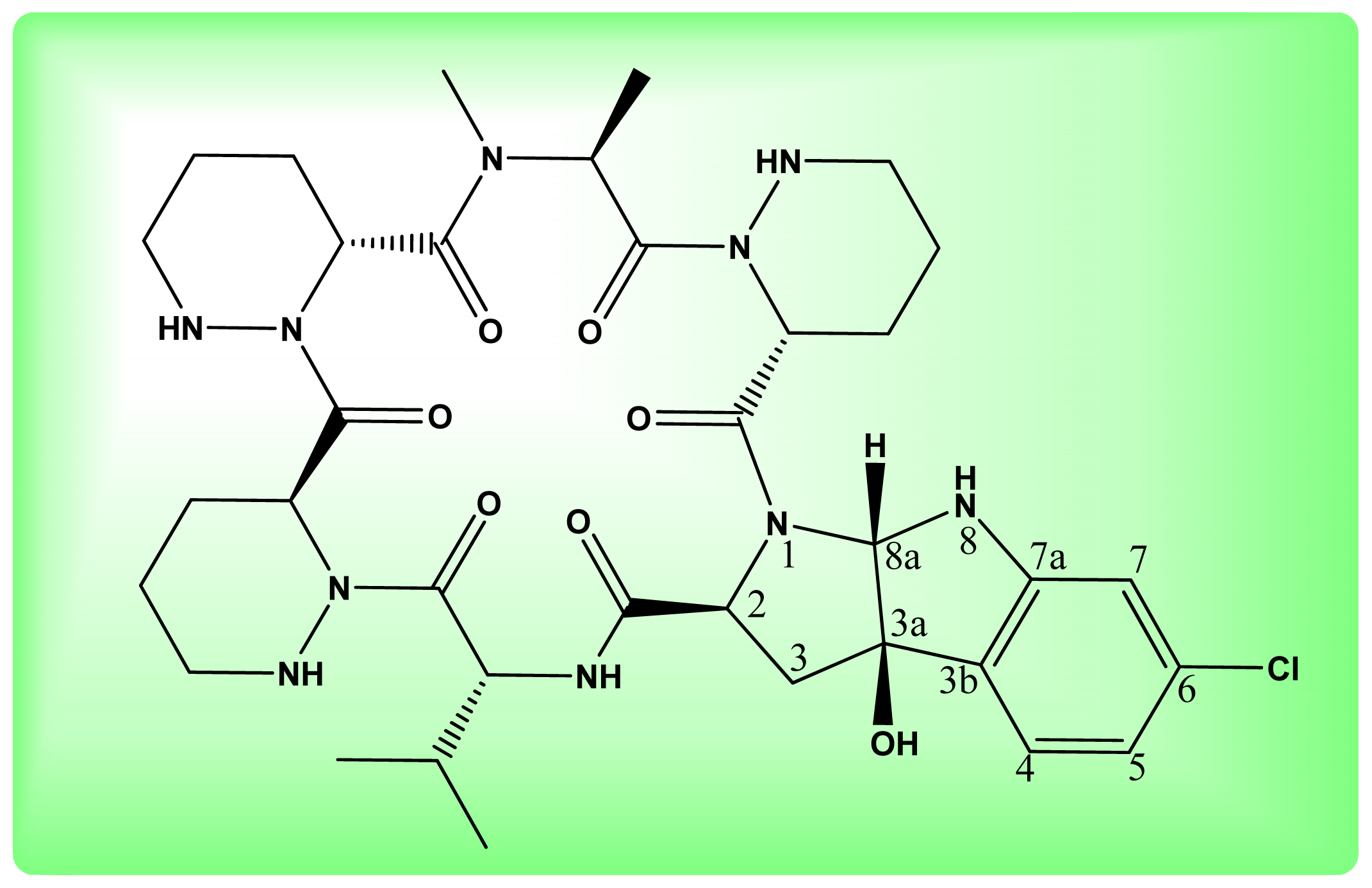
<p>Agricultural antibiotic produced by different species of actinomyces is a biological product from a natural resource. Agricultural antibiotics have been attracting growing interest with the development of environmentally friendly and safe integrated crop management. In our ongoing screening for new bioactive microbial compounds, a novel hexapeptide antibiotic NW-G01 (<xref ref-type="fig" rid="f1-ijms-13-05230">Figure 1</xref>) was obtained by <italic>Streptomyces alboflavus</italic> 313 which is isolated from a soil sample collected from Shaanxi province of China. Absolute structure was determined using a combination of single crystal X-ray diffraction and Marfey’s method finally. The antibiotic incorporated one molecule of valine, <italic>N</italic>-methyl-alanine, chlorinated pyrroloindoline derivative, and three molecules of piperazic acids [<xref ref-type="bibr" rid="b1-ijms-13-05230">1</xref>,<xref ref-type="bibr" rid="b2-ijms-13-05230">2</xref>]. Interestingly, NW-G01 exhibited strong antibacterial activity against several species of gram-positive bacteria, such as <italic>Bacillus subtilis</italic>, <italic>Bacillus cereus</italic>, and <italic>Staphyloccocus aureus</italic> [<xref ref-type="bibr" rid="b3-ijms-13-05230">3</xref>]. In addition, it had strong <italic>in vitro</italic> fungistatic activity against some plant pathogen, such as <italic>Sclerotinia sclerotiorum</italic>, <italic>Botrytis cinerea</italic>, <italic>Coniothyrium diplodiella</italic> and <italic>Exserohlum turcium</italic> [<xref ref-type="bibr" rid="b4-ijms-13-05230">4</xref>]. These consequences imply that NW-G01 has the potential to be developed into anti-infection agents or agro-fungicides.</p>
<p>An appropriate fermentation medium is one of the crucial factors in the antibiotic industry, because the medium composition could significantly affect secondary metabolic yield from microorganisms [<xref ref-type="bibr" rid="b5-ijms-13-05230">5</xref>]. The conventional method for medium optimization is the “one-factor-at-a-time” approach, which is time consuming, labor expensive, and does not take into consideration the interactions between multiple factors involved when a large number of variables have to be investigated. The main advantage of optimizing the parameters by statistical experimental design is to eliminate these limitations of single factor optimization process [<xref ref-type="bibr" rid="b6-ijms-13-05230">6</xref>]. Plackett–Burman is widely used in the statistical designs for the selection of the medium components, which can screen the important variables as well as their significance levels [<xref ref-type="bibr" rid="b7-ijms-13-05230">7</xref>]. Following this, factorial design and response surface analysis are used to determine the optimum values of the factors studied based on the initial screening. In the present biotechnology study, several researchers have applied these techniques for the optimization of culture conditions, determination of optimal values of processing parameters and feeding rates [<xref ref-type="bibr" rid="b8-ijms-13-05230">8</xref>–<xref ref-type="bibr" rid="b11-ijms-13-05230">11</xref>]. Furthermore, these techniques also have been successfully applied to the optimization of medium components and cultivation conditions for metabolic production by <italic>Streptomyces</italic> [<xref ref-type="bibr" rid="b12-ijms-13-05230">12</xref>–<xref ref-type="bibr" rid="b17-ijms-13-05230">17</xref>] and other microorganisms [<xref ref-type="bibr" rid="b18-ijms-13-05230">18</xref>–<xref ref-type="bibr" rid="b21-ijms-13-05230">21</xref>]. Response Surface Methodology (RSM) has eased process development and has been of significant use at industrial level, among which central composite design methodology considers the interaction effects among the variables [<xref ref-type="bibr" rid="b22-ijms-13-05230">22</xref>].</p>
<p>To the best of our knowledge, the medium requirements for <italic>S. alboflavus</italic> 313 in liquid fermentation have not been demonstrated. Moreover, it is necessary and important to decrease production cost and to enhance productivity. This paper explores the feasibility of production of NW-G01 in liquid fermentation by <italic>S. alboflavus</italic> 313 and its optimization by RSM. Initially, effects of various carbon sources, nitrogen sources and inorganic salts were investigated by a Plackett-Burman design, and subsequently by RSM. Finally, the production of NW-G01 was validated using the optimized condition.</p></sec>
<sec sec-type="results|discussion">
<title>2. Results and Discussion</title>
<sec sec-type="methods">
<title>2.1. Optimization by Plackett-Burman Design (PBD)</title>
<p>The importance of the eleven components, corn starch, glucose, (NH<sub>4</sub>)<sub>2</sub>SO<sub>4</sub>, peptone, NaCl, CaCO<sub>3</sub>, MgSO<sub>4</sub>·7H<sub>2</sub>O, K<sub>2</sub>HPO<sub>4</sub>·3H<sub>2</sub>O, MnCl<sub>2</sub>·4H<sub>2</sub>O, FeSO<sub>4</sub>·7H<sub>2</sub>O and ZnSO<sub>4</sub>·7H<sub>2</sub>O for NW-G01 production was investigated by PBD. The results showed the effects of these components on the response and significant levels in <xref ref-type="table" rid="t1-ijms-13-05230">Tables 1</xref> and <xref ref-type="table" rid="t2-ijms-13-05230">2</xref>.</p>
<p>According to statistical analysis of the data by Design expert software, the results showed that only (NH<sub>4</sub>)<sub>2</sub>SO<sub>4</sub>, peptone and CaCO<sub>3</sub> had confidence levels above 95% (<italic>p</italic> &lt; 0.05) and were considered to influence NW-G01 production significantly. The others had confidence levels below 95% and hence were considered insignificant. In these results, <italic>R</italic><sup>2</sup> = 0.9285 indicated that 92.85% of the variability in the response could be explained in the model.</p>
<p>PBD results indicated that the effect of (NH<sub>4</sub>)<sub>2</sub>SO<sub>4</sub>, peptone and CaCO<sub>3</sub> were negative. Decreasing the three components concentration might result in higher production of antibiotic NW-G01. Thus, the three variables (NH<sub>4</sub>)<sub>2</sub>SO<sub>4</sub> (<italic>x</italic><sub>3</sub>), peptone (<italic>x</italic><sub>4</sub>) and CaCO<sub>3</sub> (<italic>x</italic><sub>6</sub>) were selected and their optimal levels were identified further using response surface methodology.</p></sec>
<sec>
<title>2.2. Optimization by Response Surface Methodology</title>
<p>RSM using central composite design (CCD) was applied to determine the optimal levels of the three selected variables that affected the production of NW-G01. The respective low and high levels (g/L) with the coded levels for the factors are defined in <xref ref-type="table" rid="t3-ijms-13-05230">Table 3</xref>.</p>
<p>The concentrations of the other factors were fixed at zero level as shown in <xref ref-type="table" rid="t1-ijms-13-05230">Table 1</xref>. Experimental design and results are shown in <xref ref-type="table" rid="t4-ijms-13-05230">Table 4</xref>.</p>
<p>The experimental results were fitted with the second-order polynomial (<xref rid="FD1" ref-type="disp-formula">Equation (1)</xref>):</p>
<disp-formula id="FD1">
<label>(1)</label>
<mml:math id="mm1" display="block">
<mml:semantics id="sm1">
<mml:mtable columnalign="left">
<mml:mtr>
<mml:mtd>
<mml:mi>Y</mml:mi>
<mml:mo>=</mml:mo>
<mml:mn>13.57</mml:mn>
<mml:mo>-</mml:mo>
<mml:mn>3.46</mml:mn>
<mml:msub>
<mml:mrow>
<mml:mi>x</mml:mi></mml:mrow>
<mml:mn>3</mml:mn></mml:msub>
<mml:mo>-</mml:mo>
<mml:mn>0.17</mml:mn>
<mml:msub>
<mml:mrow>
<mml:mi>x</mml:mi></mml:mrow>
<mml:mn>4</mml:mn></mml:msub>
<mml:mo>-</mml:mo>
<mml:mn>2.77</mml:mn>
<mml:msub>
<mml:mrow>
<mml:mi>x</mml:mi></mml:mrow>
<mml:mn>6</mml:mn></mml:msub>
<mml:mo>-</mml:mo>
<mml:mn>0.75</mml:mn>
<mml:msub>
<mml:mrow>
<mml:mi>x</mml:mi></mml:mrow>
<mml:mn>3</mml:mn></mml:msub>
<mml:msub>
<mml:mrow>
<mml:mi>x</mml:mi></mml:mrow>
<mml:mn>4</mml:mn></mml:msub>
<mml:mo>-</mml:mo></mml:mtd></mml:mtr>
<mml:mtr>
<mml:mtd>
<mml:mn>0.51</mml:mn>
<mml:msub>
<mml:mrow>
<mml:mi>x</mml:mi></mml:mrow>
<mml:mn>3</mml:mn></mml:msub>
<mml:msub>
<mml:mrow>
<mml:mi>x</mml:mi></mml:mrow>
<mml:mn>6</mml:mn></mml:msub>
<mml:mo>+</mml:mo>
<mml:mn>1.09</mml:mn>
<mml:msub>
<mml:mrow>
<mml:mi>x</mml:mi></mml:mrow>
<mml:mn>4</mml:mn></mml:msub>
<mml:msub>
<mml:mrow>
<mml:mi>x</mml:mi></mml:mrow>
<mml:mn>6</mml:mn></mml:msub>
<mml:mo>-</mml:mo>
<mml:mn>1.32</mml:mn>
<mml:msup>
<mml:mrow>
<mml:msub>
<mml:mrow>
<mml:mi>x</mml:mi></mml:mrow>
<mml:mn>3</mml:mn></mml:msub></mml:mrow>
<mml:mn>2</mml:mn></mml:msup>
<mml:mo>-</mml:mo>
<mml:mn>1.18</mml:mn>
<mml:msup>
<mml:mrow>
<mml:msub>
<mml:mrow>
<mml:mi>x</mml:mi></mml:mrow>
<mml:mn>4</mml:mn></mml:msub></mml:mrow>
<mml:mn>2</mml:mn></mml:msup>
<mml:mo>+</mml:mo>
<mml:mn>0.70</mml:mn>
<mml:msup>
<mml:mrow>
<mml:msub>
<mml:mrow>
<mml:mi>x</mml:mi></mml:mrow>
<mml:mn>6</mml:mn></mml:msub></mml:mrow>
<mml:mn>2</mml:mn></mml:msup></mml:mtd></mml:mtr></mml:mtable></mml:semantics></mml:math></disp-formula>
<p>where <italic>Y</italic> was the predicted response, <italic>x</italic><sub>3</sub>, <italic>x</italic><sub>4</sub> and <italic>x</italic><sub>6</sub> were coded values of (NH<sub>4</sub>)<sub>2</sub>SO<sub>4</sub>, peptone and CaCO<sub>3</sub> concentration, respectively.</p>
<p>The statistical significance of <xref rid="FD1" ref-type="disp-formula">Equation (1)</xref> was checked by <italic>F</italic>-test, and the ANOVA for response surface quadratic model is summarized in <xref ref-type="table" rid="t5-ijms-13-05230">Table 5</xref>. The model <italic>F</italic>-value of 222.43 implied the model was significant, the <italic>P</italic>-value was also very low (&lt;0.0001) indicating that there was only a 0.01% chance that a “Model <italic>F</italic>-Value” this large could occur due to noise. The success of the model could be checked by the determination coefficient <italic>R</italic><sup>2</sup>, which was calculated to be 0.9850, indicating that 98.50% of the variability in the response could be explained by the model. Normally, a regression model, having an <italic>R</italic><sup>2</sup>-value higher than 0.9, was considered as a high correlation [<xref ref-type="bibr" rid="b23-ijms-13-05230">23</xref>]. The present <italic>R</italic><sup>2</sup>-value, therefore, reflected a very good fit between the observed and predicted responses, and it was considered reasonable to use the regression model to analyze trends of the responses. A lower value of coefficient variation (CV = 3.33%) showed the experiments conducted were precise and reliable [<xref ref-type="bibr" rid="b24-ijms-13-05230">24</xref>]. The Lack of fit <italic>P</italic>-value of 0.1095 implied the “Lack of Fit” is not significant relative to the pure error and no-significant lack of fit indicated the model is good.</p>
<p>The significance of the regression coefficients was tested by a <italic>t</italic>-test. The regression coeffiecients and corresponding <italic>p</italic>-values for the model presented in <xref ref-type="table" rid="t6-ijms-13-05230">Table 6</xref>. Values of “Prob &gt; <italic>F</italic>” less than 0.05 indicate that model terms are significant while values greater than 0.1 indicate that the model terms are not significant [<xref ref-type="bibr" rid="b25-ijms-13-05230">25</xref>]. Therefore, among the model terms in the present study, (NH<sub>4</sub>)<sub>2</sub>SO<sub>4</sub> (<italic>x</italic><sub>3</sub>) and CaCO<sub>3</sub> (<italic>x</italic><italic><sub>6</sub></italic>) were very significant with probability of over 99% while peptone (<italic>x</italic><sub>4</sub>) was not significant with a probability of over 84%. In <xref ref-type="table" rid="t6-ijms-13-05230">Table 6</xref>, the results also indicated that the mutual interaction between <italic>x</italic><sub>3</sub> and <italic>x</italic><sub>3</sub>, <italic>x</italic><sub>4</sub> and <italic>x</italic><sub>4</sub>, <italic>x</italic><sub>6</sub> and <italic>x</italic><sub>6</sub>, <italic>x</italic><sub>3</sub> and <italic>x</italic><sub>4</sub>, <italic>x</italic><sub>3</sub> and <italic>x</italic><sub>6</sub>, <italic>x</italic><sub>4</sub> and <italic>x</italic><sub>6</sub>, had a very significant influence on antibiotics NW-G01 production.</p>
<p>The final results showed that among the independent factors, <italic>x</italic><sub>3</sub>((NH<sub>4</sub>)<sub>2</sub>SO<sub>4</sub>) and <italic>x</italic><sub>6</sub>(CaCO<sub>3</sub>) had significant effects on antibiotic NW-G01 production and the negative coefficient of them showed a linear effect to decrease antibiotics NW-G01 production. The quadratic term of the three factors and the interaction between <italic>x</italic><sub>3</sub>((NH<sub>4</sub>)<sub>2</sub>SO<sub>4</sub>), <italic>x</italic><sub>4</sub>(peptone) and <italic>x</italic><sub>6</sub>(CaCO<sub>3</sub>) also had a significant effect.</p>
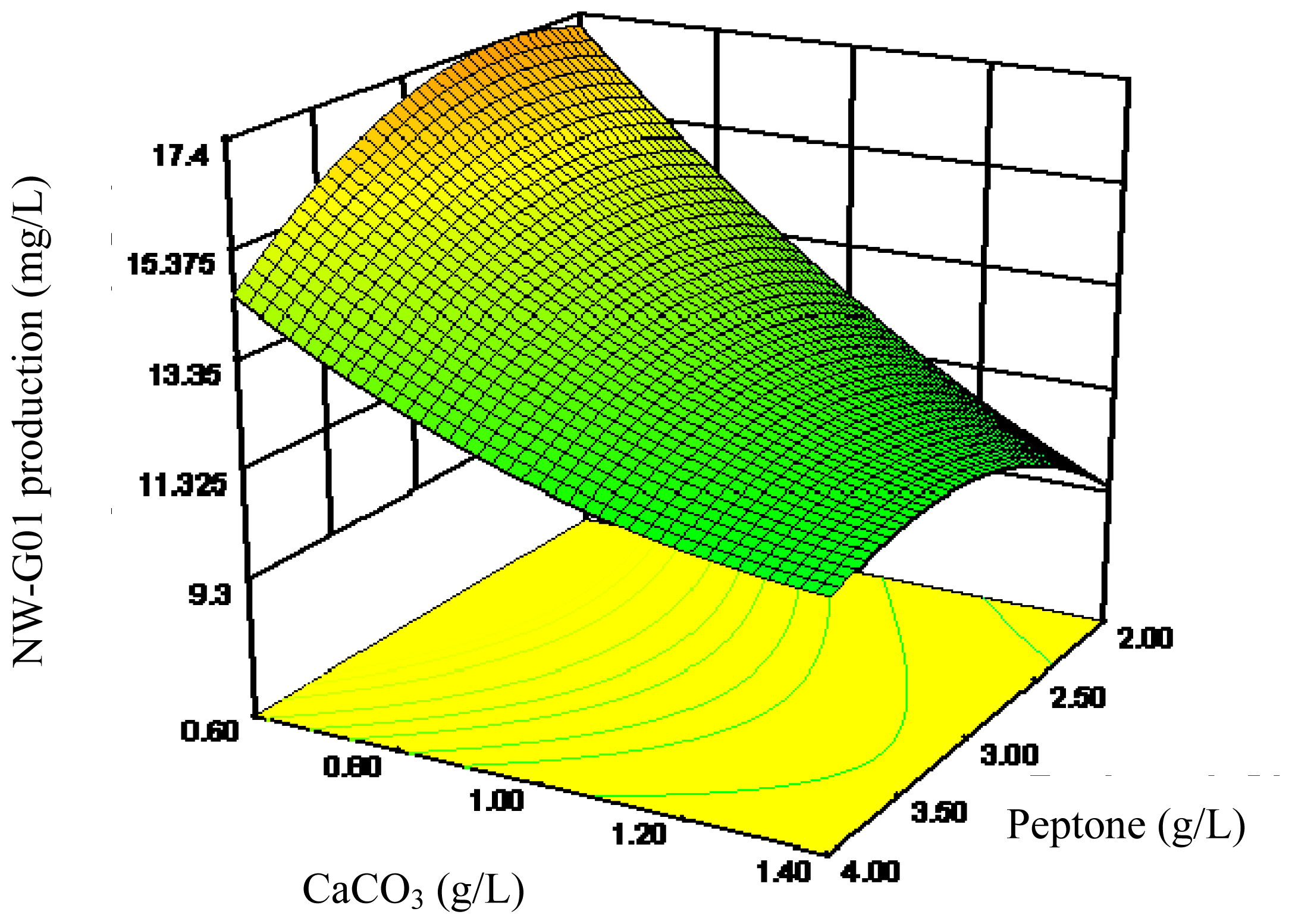
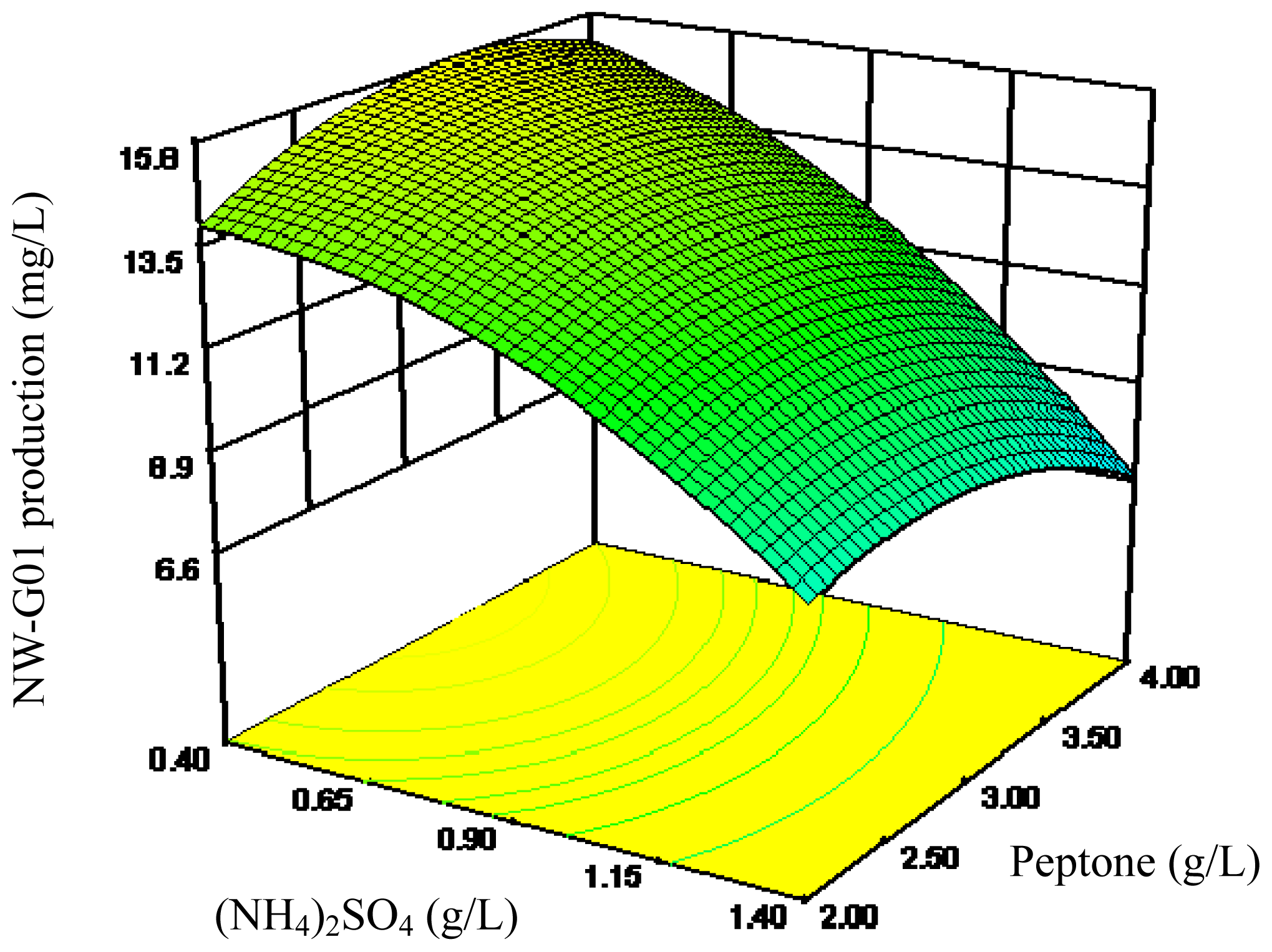
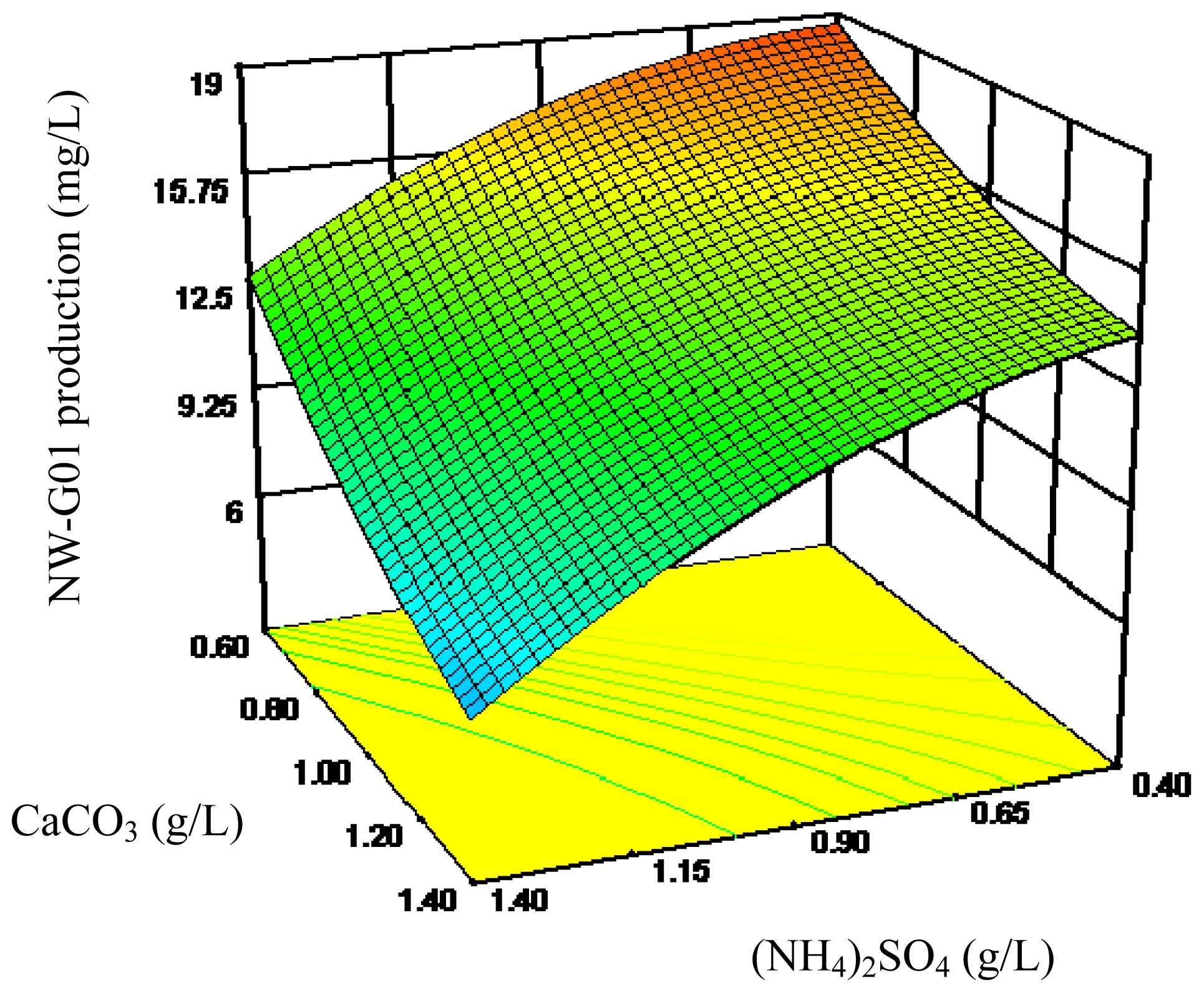
<p>The 3D response surface curves were then plotted to explain the interactions of medium components and the optimum concentration of each component required for the NW-G01 production (<xref ref-type="fig" rid="f2-ijms-13-05230">Figures 2</xref>–<xref ref-type="fig" rid="f4-ijms-13-05230">4</xref>). Each figure presents the effect of two factors while the other factor was held at zero level. These 3D plots and their respective contour plots provided a visual interpretation of the interaction between two factors and facilitate the location of optimum experimental conditions.</p></sec>
<sec>
<title>2.3. Validation of the Optimized Condition</title>
<p>On the basis of medium optimization, the quadratic model predicted that the maximum production of NW-G01 was 15.387 mg/L, when the model predicted the optimal values of test factors in the coded units were <italic>x</italic><sub>3</sub> = −1.68, <italic>x</italic><sub>4</sub> = 0.80 and <italic>x</italic><sub>6</sub> = 0.74, which were 0.06 g/L (NH<sub>4</sub>)<sub>2</sub>SO<sub>4</sub>, 3.80 g/L peptone and 1.30 g/L CaCO<sub>3</sub>, respectively. To verify the predicted results, validation experiments in shake flasks were performed in triplicate testes. Under the optimized medium, the observed experimental value of average NW-G01 concentration was 15.564 mg/L, suggesting that experimental and predicted values (15.387 mg/L) of NW-G01 yield were in good agreement. The concentration was 5.707 mg/L in non-optimized medium, 2.73-fold increase had been obtained, while the growth of the strain in the two media was comparable. This result therefore corroborated the predicted values and the effectiveness of the model, indicating that the optimized medium favors the production of NW-G01.</p></sec></sec>
<sec>
<title>3. Experimental Section</title>
<sec>
<title>3.1. Microorganism</title>
<p>The strain 313 was isolated from the soil samples from the northeast of China, which was identified as <italic>S. alboflavus</italic> 313 based on morphological, physiological characteristics and analysis of the 16S rDNA sequence. The culture was maintained at 4 °C on modified Humic acid-Vitamins (HV) agar slants. The strain was stored in glycerol suspension (30%, v/v) at −20 °C.</p></sec>
<sec>
<title>3.2. Medium and Culture Conditions</title>
<p>Fermentation was performed in two stages: seed growth and antibiotics NW-G01 production. For the seed growth stage, medium from a plate culture was inoculated into 100 mL of seed medium (glucose 20 g/L, peptone 6 g/L, NaCl 2.5 g/L, CaCO<sub>3</sub> 1 g/L. pH 7.0) in a 500-mL Erlenmeyer flask and grown at 28 °C with 180 rpm on a rotary shaker (ShangHai Fuma Test Equipment Co., Ltd.) for 16 h. Then, 10% (v/v) seed cultures were inoculated into 50-mL production medium in a 250-mL Erlenmeyer flask. The strain was incubated at 28 °C with 180 rpm on a rotary shaker for 108 h. Triplicate experiments were carried out and the mean value was calculated.</p>
<p>In our preliminary experiments, various carbon and nitrogen sources, and inorganic salts were evaluated for the suitability to sustain good NW-G01 production by <italic>S. alboflavus</italic> 313. The results revealed that the major variable affecting the performance of the medium in terms of NW-G01 yield were corn starch, glucose, peptone, (NH<sub>4</sub>)<sub>2</sub>SO<sub>4</sub>, NaCl, CaCO<sub>3</sub>, MgSO<sub>4</sub>·7H<sub>2</sub>O, K<sub>2</sub>HPO<sub>4</sub>·3H<sub>2</sub>O, MnCl<sub>2</sub>·4H<sub>2</sub>O, FeSO<sub>4</sub>·7H<sub>2</sub>O, and ZnSO<sub>4</sub>·7H<sub>2</sub>O. Components were chosen for further optimization. The amount of every component was changed in different experimental processes and the pH of production medium was 7.0.</p></sec>
<sec>
<title>3.3. Analytical Method</title>
<p>After centrifuging the fermentation broth (3000 rpm, 10 min), 1 mL supernatants were filtered (0.45 μm) and analyzed by high performance liquid chromatography (HPLC, Shimadzu 6AD, Kyoto, Japan) using a Sinochrom ODS-BP (5 μm, 4.6 mm × 250 mm) reverse phase column, methanol-water (75/25, v/v) as the mobile phase, flow rate of 1.0 mL/min, monitored by UV detector at 210 nm [<xref ref-type="bibr" rid="b1-ijms-13-05230">1</xref>].</p></sec>
<sec sec-type="methods">
<title>3.4. Experimental Design and Data Analysis</title>
<sec sec-type="methods">
<title>3.4.1. Plackett-Burman Design (PBD)</title>
<p>PBD was employed for screening the most significant fermentation parameters affecting NW-G01 production with <italic>S. alboflavus</italic> 313. Each independent variable was tested at high and low levels, which are denoted by (+) and (−), respectively. The experimental design with the name, symbol code, and actual levels of the variables is shown in <xref ref-type="table" rid="t1-ijms-13-05230">Table 1</xref>, whereas <xref ref-type="table" rid="t2-ijms-13-05230">Table 2</xref> shows the detail of the design.</p></sec>
<sec sec-type="methods">
<title>3.4.2. Central Composite Design (CCD) and Response Surface Methodology (RSM)</title>
<p>Central composite design (CCD) and response surface methodology (RSM) were employed to optimize the three most significant factors ((NH<sub>4</sub>)<sub>2</sub>SO<sub>4</sub>, peptone, CaCO<sub>3</sub>) for enhancing NW-G01 production. The three independent variables were studied at five different levels (−1.682, −1, 0, 1, 1.682) (<xref ref-type="table" rid="t3-ijms-13-05230">Table 3</xref>) and a set of 20 experiments were carried out (<xref ref-type="table" rid="t4-ijms-13-05230">Table 4</xref>).</p>
<p>The factors were coded according to the following equation:</p>
<disp-formula id="FD2">
<label>(2)</label>
<mml:math id="mm2" display="block">
<mml:semantics id="sm2">
<mml:mrow>
<mml:msub>
<mml:mrow>
<mml:mi>x</mml:mi></mml:mrow>
<mml:mi>i</mml:mi></mml:msub>
<mml:mo>=</mml:mo>
<mml:mfrac>
<mml:mrow>
<mml:mo>∑</mml:mo>
<mml:mrow>
<mml:mo stretchy="false">(</mml:mo>
<mml:msub>
<mml:mrow>
<mml:mi>X</mml:mi></mml:mrow>
<mml:mi>i</mml:mi></mml:msub>
<mml:mrow>
<mml:mo>-</mml:mo></mml:mrow>
<mml:msub>
<mml:mrow>
<mml:mi>X</mml:mi></mml:mrow>
<mml:mn>0</mml:mn></mml:msub>
<mml:mo stretchy="false">)</mml:mo></mml:mrow></mml:mrow>
<mml:mrow>
<mml:mi mathvariant="normal">Δ</mml:mi>
<mml:mi>X</mml:mi></mml:mrow></mml:mfrac>
<mml:mo>,</mml:mo>
<mml:mi> </mml:mi>
<mml:mi>i</mml:mi>
<mml:mo>=</mml:mo>
<mml:mn>1</mml:mn>
<mml:mo>,</mml:mo>
<mml:mn>2</mml:mn>
<mml:mo>,</mml:mo>
<mml:mn>3</mml:mn>
<mml:mo>,</mml:mo>
<mml:mo>…</mml:mo>
<mml:mo>,</mml:mo>
<mml:mi>k</mml:mi></mml:mrow></mml:semantics></mml:math></disp-formula>
<p>where <italic>x</italic><italic><sub>i</sub></italic> was the coded independent factor, <italic>X</italic><italic><sub>i</sub></italic> was the real independent factor, <italic>X</italic><italic><sub>0</sub></italic> was the value of <italic>X</italic><italic><sub>i</sub></italic> at the center point and <italic>ΔX</italic> was the step change value.</p>
<p>The response variable (antibiotic production) was explained by the following second-order polynomial equation:</p>
<disp-formula id="FD3">
<label>(3)</label>
<mml:math id="mm3" display="block">
<mml:semantics id="sm3">
<mml:mrow>
<mml:mi>Y</mml:mi>
<mml:mo>=</mml:mo>
<mml:msub>
<mml:mrow>
<mml:mi>β</mml:mi></mml:mrow>
<mml:mn>0</mml:mn></mml:msub>
<mml:mo>+</mml:mo>
<mml:mo>∑</mml:mo>
<mml:mrow>
<mml:msub>
<mml:mrow>
<mml:mi>β</mml:mi></mml:mrow>
<mml:mi>i</mml:mi></mml:msub>
<mml:msub>
<mml:mrow>
<mml:mi>x</mml:mi></mml:mrow>
<mml:mi>i</mml:mi></mml:msub>
<mml:mo>+</mml:mo>
<mml:msub>
<mml:mrow>
<mml:mi>β</mml:mi></mml:mrow>
<mml:mrow>
<mml:mi>i</mml:mi>
<mml:mi>i</mml:mi></mml:mrow></mml:msub>
<mml:msubsup>
<mml:mrow>
<mml:mi>x</mml:mi></mml:mrow>
<mml:mi>i</mml:mi>
<mml:mn>2</mml:mn></mml:msubsup>
<mml:mo>+</mml:mo>
<mml:msub>
<mml:mrow>
<mml:mi>β</mml:mi></mml:mrow>
<mml:mrow>
<mml:mi>i</mml:mi>
<mml:mi>j</mml:mi></mml:mrow></mml:msub>
<mml:msub>
<mml:mrow>
<mml:mi>x</mml:mi></mml:mrow>
<mml:mi>i</mml:mi></mml:msub>
<mml:msub>
<mml:mrow>
<mml:mi>x</mml:mi></mml:mrow>
<mml:mi>j</mml:mi></mml:msub>
<mml:mo>,</mml:mo>
<mml:mi> </mml:mi>
<mml:mi>i</mml:mi>
<mml:mo>=</mml:mo>
<mml:mn>1</mml:mn>
<mml:mo>,</mml:mo>
<mml:mn>2</mml:mn>
<mml:mo>,</mml:mo>
<mml:mn>3</mml:mn>
<mml:mo>,</mml:mo>
<mml:mo>…</mml:mo>
<mml:mo>,</mml:mo>
<mml:mi>k</mml:mi></mml:mrow></mml:mrow></mml:semantics></mml:math></disp-formula>
<p>where <italic>Y</italic> was the predicted response, <italic>β</italic><sub>0</sub> was the intercept, <italic>x</italic><sub>i</sub> and <italic>x</italic><sub>j</sub> were the coded independent factors, <italic>β</italic><sub>i</sub> was the linear coefficient, <italic>β</italic><sub>ii</sub> was the quadratic coefficient and <italic>β</italic><sub>ij</sub> was the interaction coefficient.</p></sec>
<sec sec-type="methods">
<title>3.4.3. Statistical Analysis</title>
<p>Design Expert Version 7.1 (Stat-Ease Inc.: Minneapolis, MN, USA, 2007) was used for the experimental designs and regression analysis of the experimental data. Statistical analysis of the model was performed to evaluate the analysis of variance (ANOVA). The quality of the polynomial model equation was judged statistically by the coefficient of determination <italic>R</italic><sup>2</sup>, and its statistical significance was determined by an <italic>F</italic>-test. The significance of the regression coefficients was tested by a <italic>t</italic>-test.</p></sec>
<sec>
<title>3.4.4. Experimental Validation of the Optimized Medium</title>
<p>In order to validate the optimization of medium composition, three tests were carried out using the optimized condition, to confirm the result from the analysis of the response surface.</p></sec></sec></sec>
<sec>
<title>4. Conclusion</title>
<p>Plackett–Burman design and response surface methodology had been proved to be effective on optimization for enhancing NW-G01 production with <italic>S. alboflavus</italic> 313. The final medium composition optimized was (g/L): corn starch 15, glucose 15, peptone 3.80, (NH<sub>4</sub>)<sub>2</sub>SO<sub>4</sub> 0.06, NaCl 1.5, CaCO<sub>3</sub> 1.30, MgSO<sub>4</sub>·7H<sub>2</sub>O 0.015, K<sub>2</sub>HPO<sub>4</sub>·3H<sub>2</sub>O 0.015, MnCl<sub>2</sub>·4H<sub>2</sub>O 0.015, FeSO<sub>4</sub>·7H<sub>2</sub>O 0.015, and ZnSO<sub>4</sub>·7H<sub>2</sub>O 0.015, which resulted in an overall 2.73-fold increase compared with that using the non-optimized medium. Validation experiments were also carried out to verify the adequacy and the accuracy of the model, and the results showed that the predicted value agreed with the experimental values well. The optimum culture medium obtained in this experiment laid a foundation for further study with large scale batch fermentation in a fermenter for NW-G01 production from <italic>S. alboflavus</italic> 313.</p></sec></body>
<back>
<ack>
<title>Acknowledgments</title>
<p>This study was supported by the grant of The National Key Basic Research Program (973 Program, Project No. 2010CB126100) from Science and Technology Ministry of China and the foundation of National Science Program of China (Project No. 31101468).</p></ack>
<ref-list>
<title>References</title>
<ref id="b1-ijms-13-05230"><label>1</label><citation citation-type="journal"><person-group person-group-type="author"><name><surname>Guo</surname><given-names>Z.Y.</given-names></name><name><surname>Ji</surname><given-names>Z.Q.</given-names></name><name><surname>Zhang</surname><given-names>J.W.</given-names></name><name><surname>Deng</surname><given-names>J.</given-names></name><name><surname>Shen</surname><given-names>L.</given-names></name><name><surname>Liu</surname><given-names>W.</given-names></name><name><surname>Wu</surname><given-names>W.J.</given-names></name></person-group><article-title>NW-G01, a novel cyclic hexapeptide antibiotic, produced by <italic>Streptomyces alboflavus</italic> 313: II. Structural Elucidation</article-title><source>J. Antibiot</source><year>2010</year><volume>63</volume><fpage>231</fpage><lpage>235</lpage><pub-id pub-id-type="doi">10.1038/ja.2010.24</pub-id><pub-id pub-id-type="pmid">20379216</pub-id></citation></ref>
<ref id="b2-ijms-13-05230"><label>2</label><citation citation-type="journal"><person-group person-group-type="author"><name><surname>Guo</surname><given-names>Z.Y.</given-names></name><name><surname>Ji</surname><given-names>Z.Q.</given-names></name><name><surname>Zhang</surname><given-names>J.W.</given-names></name><name><surname>Deng</surname><given-names>J.</given-names></name><name><surname>Shen</surname><given-names>L.</given-names></name><name><surname>Liu</surname><given-names>W.</given-names></name><name><surname>Wu</surname><given-names>W.J.</given-names></name></person-group><article-title>Corrigendum: NW-G01, a novel cyclic hexapeptide antibiotic, produced by <italic>Streptomyces alboflavus</italic> 313: II. Structural Elucidation</article-title><source>J. Antibiot</source><year>2010</year><volume>63</volume><pub-id pub-id-type="doi">10.1038/ja.2010.116</pub-id></citation></ref>
<ref id="b3-ijms-13-05230"><label>3</label><citation citation-type="journal"><person-group person-group-type="author"><name><surname>Guo</surname><given-names>Z.Y.</given-names></name><name><surname>Shen</surname><given-names>L.</given-names></name><name><surname>Ji</surname><given-names>Z.Q.</given-names></name><name><surname>Zhang</surname><given-names>J.W.</given-names></name><name><surname>Huang</surname><given-names>L.Z.</given-names></name><name><surname>Wu</surname><given-names>W.J.</given-names></name></person-group><article-title>NW-G01, a novel cyclic hexapeptide antibiotic, produced by <italic>Streptomyces alboflavus</italic> 313: I. Taxonomy, fermentation, isolation, physicochemical properties and antibacterial activities</article-title><source>J. Antibiot</source><year>2009</year><volume>62</volume><fpage>201</fpage><lpage>205</lpage><pub-id pub-id-type="doi">10.1038/ja.2009.15</pub-id><pub-id pub-id-type="pmid">19265870</pub-id></citation></ref>
<ref id="b4-ijms-13-05230"><label>4</label><citation citation-type="thesis"><person-group person-group-type="author"><name><surname>Guo</surname><given-names>Z.Y.</given-names></name></person-group><article-title>Studies on Antimicrobial Components from Fermentation Broth of <italic>Streptomyces alboflavus</italic> 313 (In Chinese)</article-title><source>Ph.D. Dissertation</source><publisher-name>Northwest A &amp; F University</publisher-name><publisher-loc>Yangling, China</publisher-loc><year>2009</year></citation></ref>
<ref id="b5-ijms-13-05230"><label>5</label><citation citation-type="journal"><person-group person-group-type="author"><name><surname>Gao</surname><given-names>H.</given-names></name><name><surname>Liu</surname><given-names>M.</given-names></name><name><surname>Liu</surname><given-names>J.</given-names></name><name><surname>Dai</surname><given-names>H.Q.</given-names></name><name><surname>Zhou</surname><given-names>X.L.</given-names></name><name><surname>Liu</surname><given-names>X.Y.</given-names></name><name><surname>Zhuo</surname><given-names>Y.</given-names></name><name><surname>Zhang</surname><given-names>W.Q.</given-names></name><name><surname>Zhang</surname><given-names>L.X.</given-names></name></person-group><article-title>Medium optimization for the production of avermectin B1a by <italic>Streptomyces avermitilis</italic> 14-12A using response surface methodology</article-title><source>Bioresour. Technol</source><year>2009</year><volume>100</volume><fpage>4012</fpage><lpage>4016</lpage><pub-id pub-id-type="doi">10.1016/j.biortech.2009.03.013</pub-id><pub-id pub-id-type="pmid">19356927</pub-id></citation></ref>
<ref id="b6-ijms-13-05230"><label>6</label><citation citation-type="journal"><person-group person-group-type="author"><name><surname>Zhang</surname><given-names>C.H.</given-names></name><name><surname>Ma</surname><given-names>Y.J.</given-names></name><name><surname>Yang</surname><given-names>F.X.</given-names></name><name><surname>Liu</surname><given-names>W.</given-names></name><name><surname>Zhang</surname><given-names>Y.D.</given-names></name></person-group><article-title>Optimization of medium composition for butyric acid production by <italic>Clostridium thermobutyricum</italic> using response surface methodology</article-title><source>Bioresour. Technol</source><year>2009</year><volume>100</volume><fpage>4284</fpage><lpage>4288</lpage><pub-id pub-id-type="doi">10.1016/j.biortech.2009.03.022</pub-id><pub-id pub-id-type="pmid">19403305</pub-id></citation></ref>
<ref id="b7-ijms-13-05230"><label>7</label><citation citation-type="journal"><person-group person-group-type="author"><name><surname>Plackett</surname><given-names>R.L.</given-names></name><name><surname>Burman</surname><given-names>J.P.</given-names></name></person-group><article-title>The design of optimum multifactorial experiments</article-title><source>Biometrica</source><year>1946</year><volume>33</volume><fpage>305</fpage><lpage>325</lpage><pub-id pub-id-type="doi">10.1093/biomet/33.4.305</pub-id></citation></ref>
<ref id="b8-ijms-13-05230"><label>8</label><citation citation-type="journal"><person-group person-group-type="author"><name><surname>Kalil</surname><given-names>S.J.</given-names></name><name><surname>Maugeri</surname><given-names>F.</given-names></name><name><surname>Rodrigues</surname><given-names>M.I.</given-names></name></person-group><article-title>Response surface analysis and stimulation as a tool for bioprocess design and optimization</article-title><source>Process Biochem</source><year>2000</year><volume>35</volume><fpage>539</fpage><lpage>550</lpage><pub-id pub-id-type="doi">10.1016/S0032-9592(99)00101-6</pub-id></citation></ref>
<ref id="b9-ijms-13-05230"><label>9</label><citation citation-type="journal"><person-group person-group-type="author"><name><surname>Liu</surname><given-names>G.Q.</given-names></name><name><surname>Wang</surname><given-names>X.L.</given-names></name></person-group><article-title>Optimization of critical medium components using response surface methodology for biomass and extracellular polysaccharide production by <italic>Agaricus blazei</italic></article-title><source>Appl. Microbiol. Biotechnol</source><year>2007</year><volume>74</volume><fpage>78</fpage><lpage>83</lpage><pub-id pub-id-type="doi">10.1007/s00253-006-0661-6</pub-id><pub-id pub-id-type="pmid">17086412</pub-id></citation></ref>
<ref id="b10-ijms-13-05230"><label>10</label><citation citation-type="journal"><person-group person-group-type="author"><name><surname>Sunitha</surname><given-names>K.</given-names></name><name><surname>Kim</surname><given-names>Y.O.</given-names></name><name><surname>Lee</surname><given-names>J.K.</given-names></name><name><surname>Oh</surname><given-names>T.K.</given-names></name></person-group><article-title>Statistical optimization of seed and induction conditions to enhance phytase production by recombinant <italic>Escherichia coli</italic></article-title><source>Biochem. Eng. J</source><year>2010</year><volume>5</volume><fpage>51</fpage><lpage>56</lpage></citation></ref>
<ref id="b11-ijms-13-05230"><label>11</label><citation citation-type="journal"><person-group person-group-type="author"><name><surname>Vohara</surname><given-names>A.</given-names></name><name><surname>Satyanarayana</surname><given-names>T.</given-names></name></person-group><article-title>A cost effective molasses medium for enhanced cell bound phytase production by <italic>Pichia anomala</italic></article-title><source>J. Appl. Microbiol</source><year>2004</year><volume>97</volume><fpage>471</fpage><lpage>476</lpage><pub-id pub-id-type="doi">10.1111/j.1365-2672.2004.02327.x</pub-id><pub-id pub-id-type="pmid">15281926</pub-id></citation></ref>
<ref id="b12-ijms-13-05230"><label>12</label><citation citation-type="journal"><person-group person-group-type="author"><name><surname>Jia</surname><given-names>B.</given-names></name><name><surname>Jin</surname><given-names>Z.H.</given-names></name><name><surname>Mei</surname><given-names>L.H.</given-names></name></person-group><article-title>Medium optimization based on statistical methodologies for pristinamycins production by <italic>Streptomyces pristinaespiralis</italic></article-title><source>Appl. Biochem. Biotechnol</source><year>2008</year><volume>144</volume><fpage>133</fpage><lpage>143</lpage><pub-id pub-id-type="doi">10.1007/s12010-007-8012-3</pub-id><pub-id pub-id-type="pmid">18456945</pub-id></citation></ref>
<ref id="b13-ijms-13-05230"><label>13</label><citation citation-type="journal"><person-group person-group-type="author"><name><surname>Niladevi</surname><given-names>K.N.</given-names></name><name><surname>Sukumaran</surname><given-names>R.K.</given-names></name><name><surname>Jacob</surname><given-names>N.</given-names></name><name><surname>Anisha</surname><given-names>G.S.</given-names></name><name><surname>Prema</surname><given-names>P.</given-names></name></person-group><article-title>Optimization of lactase production from a novel strain <italic>Streptomyces psammoticus</italic> using response surface methodology</article-title><source>Microbiol. Res</source><year>2009</year><volume>164</volume><fpage>105</fpage><lpage>113</lpage><pub-id pub-id-type="doi">10.1016/j.micres.2006.10.006</pub-id><pub-id pub-id-type="pmid">17207981</pub-id></citation></ref>
<ref id="b14-ijms-13-05230"><label>14</label><citation citation-type="journal"><person-group person-group-type="author"><name><surname>Suutari</surname><given-names>M.</given-names></name><name><surname>Lignell</surname><given-names>U.</given-names></name><name><surname>Hyvarinen</surname><given-names>A.</given-names></name><name><surname>Nevalainen</surname><given-names>A.</given-names></name></person-group><article-title>Media for cultivation of indoor <italic>Streptomycetes</italic></article-title><source>J. Microbiol. Methods</source><year>2002</year><volume>51</volume><fpage>411</fpage><lpage>416</lpage><pub-id pub-id-type="doi">10.1016/S0167-7012(02)00100-8</pub-id><pub-id pub-id-type="pmid">12223303</pub-id></citation></ref>
<ref id="b15-ijms-13-05230"><label>15</label><citation citation-type="journal"><person-group person-group-type="author"><name><surname>Tuncer</surname><given-names>M.</given-names></name><name><surname>Kuru</surname><given-names>A.</given-names></name><name><surname>Isikli</surname><given-names>M.</given-names></name><name><surname>Sahin</surname><given-names>N.</given-names></name><name><surname>Celenk</surname><given-names>F.G.</given-names></name></person-group><article-title>Optimization of extracellular endoxylanase, endoglucanase and peroxidase production by <italic>Streptomyces</italic> sp. F2621 isolated in Turkey</article-title><source>J. Appl. Microbiol</source><year>2004</year><volume>97</volume><fpage>783</fpage><lpage>791</lpage><pub-id pub-id-type="doi">10.1111/j.1365-2672.2004.02361.x</pub-id><pub-id pub-id-type="pmid">15357728</pub-id></citation></ref>
<ref id="b16-ijms-13-05230"><label>16</label><citation citation-type="journal"><person-group person-group-type="author"><name><surname>Xiong</surname><given-names>Z.Q.</given-names></name><name><surname>Tu</surname><given-names>X.R.</given-names></name><name><surname>Tu</surname><given-names>G.Q.</given-names></name></person-group><article-title>Optimization of medium composition for actinomycin X2 production by <italic>Streptomyces</italic> spp. JAU4234 using response surface methodology</article-title><source>J. Ind. Microbiol. Biotechnol</source><year>2008</year><volume>35</volume><fpage>729</fpage><lpage>734</lpage><pub-id pub-id-type="doi">10.1007/s10295-008-0339-4</pub-id><pub-id pub-id-type="pmid">18347826</pub-id></citation></ref>
<ref id="b17-ijms-13-05230"><label>17</label><citation citation-type="journal"><person-group person-group-type="author"><name><surname>Yu</surname><given-names>J.C.</given-names></name><name><surname>Liu</surname><given-names>Q.</given-names></name><name><surname>Liu</surname><given-names>Q.</given-names></name><name><surname>Liu</surname><given-names>X.D.</given-names></name><name><surname>Sun</surname><given-names>Q.</given-names></name><name><surname>Yan</surname><given-names>J.F.</given-names></name><name><surname>Qi</surname><given-names>X.H.</given-names></name><name><surname>Fan</surname><given-names>S.D.</given-names></name></person-group><article-title>Effect of liquid culture requirements on antifungal antibiotic production by <italic>Streptomyces rimosus</italic> MY02</article-title><source>Bioresour. Technol</source><year>2008</year><volume>99</volume><fpage>2087</fpage><lpage>2091</lpage><pub-id pub-id-type="doi">10.1016/j.biortech.2007.03.023</pub-id><pub-id pub-id-type="pmid">17475481</pub-id></citation></ref>
<ref id="b18-ijms-13-05230"><label>18</label><citation citation-type="journal"><person-group person-group-type="author"><name><surname>Khanna</surname><given-names>S.</given-names></name><name><surname>Srivastava</surname><given-names>A.K.</given-names></name></person-group><article-title>Statistical media optimization studies for growth and PHB production by <italic>Ralstonia eutropha</italic></article-title><source>Process Biochem</source><year>2005</year><volume>40</volume><fpage>2173</fpage><lpage>2182</lpage><pub-id pub-id-type="doi">10.1016/j.procbio.2004.08.011</pub-id></citation></ref>
<ref id="b19-ijms-13-05230"><label>19</label><citation citation-type="journal"><person-group person-group-type="author"><name><surname>Kim</surname><given-names>P.</given-names></name><name><surname>Kim</surname><given-names>J.H.</given-names></name><name><surname>Oh</surname><given-names>D.K.</given-names></name></person-group><article-title>Improvement in cell yield of <italic>Methylobacterium</italic> sp. reducing the inhibition of medium components for poly-β-hydroxybutyrate production</article-title><source>World J. Microbiol. Biotechnol</source><year>2003</year><volume>19</volume><fpage>357</fpage><lpage>361</lpage><pub-id pub-id-type="doi">10.1023/A:1023969629568</pub-id></citation></ref>
<ref id="b20-ijms-13-05230"><label>20</label><citation citation-type="journal"><person-group person-group-type="author"><name><surname>Mu</surname><given-names>W.</given-names></name><name><surname>Chen</surname><given-names>C.</given-names></name><name><surname>Li</surname><given-names>X.</given-names></name><name><surname>Zhang</surname><given-names>T.</given-names></name><name><surname>Jiang</surname><given-names>B.</given-names></name></person-group><article-title>Optimization of culture medium for the production of phenyllactic acid by <italic>Lactobacillus</italic> sp. SK007</article-title><source>Bioresour. Technol</source><year>2009</year><volume>100</volume><fpage>1366</fpage><lpage>1370</lpage><pub-id pub-id-type="doi">10.1016/j.biortech.2008.08.010</pub-id><pub-id pub-id-type="pmid">18793844</pub-id></citation></ref>
<ref id="b21-ijms-13-05230"><label>21</label><citation citation-type="journal"><person-group person-group-type="author"><name><surname>Yuan</surname><given-names>L.L.</given-names></name><name><surname>Li</surname><given-names>Y.Q.</given-names></name><name><surname>Wang</surname><given-names>Y.</given-names></name><name><surname>Zhang</surname><given-names>X.H.</given-names></name><name><surname>Xu</surname><given-names>Y.Q.</given-names></name></person-group><article-title>Optimization of critical medium components using response surface methodology for phenazine-l-carboxylic acid production by <italic>Pseudomonas</italic> sp. M-18Q</article-title><source>J. Biosci. Bioeng</source><year>2008</year><volume>105</volume><fpage>232</fpage><lpage>237</lpage><pub-id pub-id-type="doi">10.1263/jbb.105.232</pub-id><pub-id pub-id-type="pmid">18397774</pub-id></citation></ref>
<ref id="b22-ijms-13-05230"><label>22</label><citation citation-type="journal"><person-group person-group-type="author"><name><surname>Han</surname><given-names>Y.</given-names></name><name><surname>Li</surname><given-names>Z.Y.</given-names></name><name><surname>Miao</surname><given-names>X.L.</given-names></name><name><surname>Zhang</surname><given-names>F.L.</given-names></name></person-group><article-title>Statistical optimization of medium components to improve the chitinase activity of <italic>Streptomyces</italic> sp. Da11 associated with the South China Sea sponge <italic>Craniella australiensis</italic></article-title><source>Process Biochem</source><year>2008</year><volume>43</volume><fpage>1088</fpage><lpage>1093</lpage><pub-id pub-id-type="doi">10.1016/j.procbio.2008.05.014</pub-id></citation></ref>
<ref id="b23-ijms-13-05230"><label>23</label><citation citation-type="journal"><person-group person-group-type="author"><name><surname>Chen</surname><given-names>X.C.</given-names></name><name><surname>Bai</surname><given-names>J.X.</given-names></name><name><surname>Cao</surname><given-names>J.M.</given-names></name></person-group><article-title>Medium optimization for the production of cyclic adenosine 3′,5′-monophosphate by <italic>Microbacterium</italic> sp. No. 205 using response surface methodology</article-title><source>Bioresour. Technol</source><year>2009</year><volume>100</volume><fpage>919</fpage><lpage>924</lpage><pub-id pub-id-type="doi">10.1016/j.biortech.2008.07.062</pub-id><pub-id pub-id-type="pmid">18778935</pub-id></citation></ref>
<ref id="b24-ijms-13-05230"><label>24</label><citation citation-type="book"><person-group person-group-type="author"><name><surname>Box</surname><given-names>G.E.P.</given-names></name><name><surname>Hunter</surname><given-names>W.G.</given-names></name><name><surname>Hunter</surname><given-names>J.S.</given-names></name></person-group><source>Statistics for Experimenters: An Introduction to Design, Data Analysis and Model Building</source><publisher-name>John Wiley</publisher-name><publisher-loc>New York, NY, USA</publisher-loc><year>1978</year><fpage>291</fpage><lpage>334</lpage></citation></ref>
<ref id="b25-ijms-13-05230"><label>25</label><citation citation-type="journal"><person-group person-group-type="author"><name><surname>Li</surname><given-names>X.Y.</given-names></name><name><surname>Liu</surname><given-names>Z.Q.</given-names></name><name><surname>Chi</surname><given-names>Z.M.</given-names></name></person-group><article-title>Production of phytase by a marine yeast <italic>Kodamaea ohmeri</italic> BG3 in an oats medium: Optimization by response surface methodology</article-title><source>Bioresour. Technol</source><year>2008</year><volume>99</volume><fpage>6386</fpage><lpage>6390</lpage><pub-id pub-id-type="doi">10.1016/j.biortech.2007.11.065</pub-id><pub-id pub-id-type="pmid">18180156</pub-id></citation></ref></ref-list>
<sec sec-type="display-objects">
<title>Figures and Tables</title>
<fig id="f1-ijms-13-05230" position="float">
<label>Figure 1</label>
<caption>
<p>The molecular structure of Novel Cyclic Hexapeptide Antibiotic (NW-G01).</p></caption>
<graphic xlink:href="ijms-13-05230f1.gif"/></fig>
<fig id="f2-ijms-13-05230" position="float">
<label>Figure 2</label>
<caption>
<p>Response surface curve for NW-G01 production by <italic>Streptomyces alboflavus</italic> 313 as a function of (NH<sub>4</sub>)<sub>2</sub>SO<sub>4</sub> and peptone concentrations, when CaCO<sub>3</sub> concentration was maintained at 1.00 g/L.</p></caption>
<graphic xlink:href="ijms-13-05230f2.gif"/></fig>
<fig id="f3-ijms-13-05230" position="float">
<label>Figure 3</label>
<caption>
<p>Response surface curve for NW-G01 production by <italic>Streptomyces alboflavus</italic> 313 as a function of (NH<sub>4</sub>)<sub>2</sub>SO<sub>4</sub> and CaCO<sub>3</sub> concentrations, when peptone concentration was maintained at 3.00 g/L.</p></caption>
<graphic xlink:href="ijms-13-05230f3.gif"/></fig>
<fig id="f4-ijms-13-05230" position="float">
<label>Figure 4</label>
<caption>
<p>Response surface curve for NW-G01 production by <italic>Streptomyces alboflavus</italic> 313 as a function of peptone and CaCO<sub>3</sub> concentrations, when (NH<sub>4</sub>)<sub>2</sub>SO<sub>4</sub> concentration was maintained at 0.90 g/L.</p></caption>
<graphic xlink:href="ijms-13-05230f4.gif"/></fig>
<table-wrap id="t1-ijms-13-05230" position="float">
<label>Table 1</label>
<caption>
<p>The Plackett-Burman design for screening variables in NW-G01 production.</p></caption>
<table frame="hsides" rules="groups">
<thead>
<tr>
<th align="left" valign="middle" rowspan="2">Factors(g/L)</th>
<th align="center" valign="middle" rowspan="2">Code</th>
<th align="center" valign="bottom">Low</th>
<th align="center" valign="bottom">High</th>
<th align="center" valign="middle" rowspan="2">Effect</th>
<th align="center" valign="middle" rowspan="2">Coefficient</th>
<th colspan="2" align="center" valign="bottom">NW-G01 Production
<hr/></th></tr>
<tr>
<th align="center" valign="bottom">Level (−)</th>
<th align="center" valign="bottom">Level (+)</th>
<th align="center" valign="bottom"><italic>t-</italic>Value</th>
<th align="center" valign="bottom"><italic>P</italic>-Value</th></tr></thead>
<tbody>
<tr>
<td align="left" valign="top">Intercept</td>
<td align="center" valign="top"/>
<td align="center" valign="top">3.18</td>
<td align="center" valign="top">22.73</td>
<td align="center" valign="top">0.0004 <xref ref-type="table-fn" rid="tfn2-ijms-13-05230">a</xref></td></tr>
<tr>
<td align="left" valign="top">Corn starch</td>
<td align="center" valign="top"><italic>x</italic><sub>1</sub></td>
<td align="center" valign="top">10</td>
<td align="center" valign="top">20</td>
<td align="center" valign="top">0.41</td>
<td align="center" valign="top">0.2</td>
<td align="center" valign="top">1.37</td>
<td align="center" valign="top">0.3046</td></tr>
<tr>
<td align="left" valign="top">Glucose</td>
<td align="center" valign="top"><italic>x</italic><sub>2</sub></td>
<td align="center" valign="top">10</td>
<td align="center" valign="top">20</td>
<td align="center" valign="top">0.84</td>
<td align="center" valign="top">0.42</td>
<td align="center" valign="top">1.90</td>
<td align="center" valign="top">0.1163</td></tr>
<tr>
<td align="left" valign="top">(NH<sub>4</sub>)<sub>2</sub>SO<sub>4</sub></td>
<td align="center" valign="top"><italic>x</italic><sub>3</sub></td>
<td align="center" valign="top">2</td>
<td align="center" valign="top">4</td>
<td align="center" valign="top">−4.83</td>
<td align="center" valign="top">−2.41</td>
<td align="center" valign="top">65.93</td>
<td align="center" valign="top">&lt;0.0001<xref ref-type="table-fn" rid="tfn2-ijms-13-05230">a</xref></td></tr>
<tr>
<td align="left" valign="top">Peptone</td>
<td align="center" valign="top"><italic>x</italic><sub>4</sub></td>
<td align="center" valign="top">3</td>
<td align="center" valign="top">6</td>
<td align="center" valign="top">−1.67</td>
<td align="center" valign="top">−0.83</td>
<td align="center" valign="top">7.89</td>
<td align="center" valign="top">0.0262 <xref ref-type="table-fn" rid="tfn2-ijms-13-05230">a</xref></td></tr>
<tr>
<td align="left" valign="top">NaCl</td>
<td align="center" valign="top"><italic>x</italic><sub>5</sub></td>
<td align="center" valign="top">1</td>
<td align="center" valign="top">2</td>
<td align="center" valign="top">0.28</td>
<td align="center" valign="top">0.14</td>
<td align="center" valign="top">0.15</td>
<td align="center" valign="top">0.1000</td></tr>
<tr>
<td align="left" valign="top">CaCO<sub>3</sub></td>
<td align="center" valign="top"><italic>x</italic><sub>6</sub></td>
<td align="center" valign="top">1</td>
<td align="center" valign="top">2</td>
<td align="center" valign="top">−2.15</td>
<td align="center" valign="top">−1.07</td>
<td align="center" valign="top">13.08</td>
<td align="center" valign="top">0.0085 <xref ref-type="table-fn" rid="tfn2-ijms-13-05230">a</xref></td></tr>
<tr>
<td align="left" valign="top">MgSO<sub>4</sub>·7H<sub>2</sub>O</td>
<td align="center" valign="top"><italic>x</italic><sub>7</sub></td>
<td align="center" valign="top">0.01</td>
<td align="center" valign="top">0.02</td>
<td align="center" valign="top">0.57</td>
<td align="center" valign="top">0.29</td>
<td align="center" valign="top">1.40</td>
<td align="center" valign="top">0.2341</td></tr>
<tr>
<td align="left" valign="top">K<sub>2</sub>HPO<sub>4</sub>·3H<sub>2</sub>O</td>
<td align="center" valign="top"><italic>x</italic><sub>8</sub></td>
<td align="center" valign="top">0.01</td>
<td align="center" valign="top">0.02</td>
<td align="center" valign="top">1.19</td>
<td align="center" valign="top">0.59</td>
<td align="center" valign="top">4..01</td>
<td align="center" valign="top">0.0854</td></tr>
<tr>
<td align="left" valign="top">MnCl<sub>2</sub>·4H<sub>2</sub>O</td>
<td align="center" valign="top"><italic>x</italic><sub>9</sub></td>
<td align="center" valign="top">0.01</td>
<td align="center" valign="top">0.02</td>
<td align="center" valign="top">−0.31</td>
<td align="center" valign="top">−0.16</td>
<td align="center" valign="top">−1.12</td>
<td align="center" valign="top">0.4643</td></tr>
<tr>
<td align="left" valign="top">FeSO<sub>4</sub>·7H<sub>2</sub>O</td>
<td align="center" valign="top"><italic>x</italic><sub>10</sub></td>
<td align="center" valign="top">0.01</td>
<td align="center" valign="top">0.02</td>
<td align="center" valign="top">−0.88</td>
<td align="center" valign="top">−0.44</td>
<td align="center" valign="top">−1.65</td>
<td align="center" valign="top">0.1493</td></tr>
<tr>
<td align="left" valign="top">ZnSO<sub>4</sub>·7H<sub>2</sub>O</td>
<td align="center" valign="top"><italic>x</italic><sub>11</sub></td>
<td align="center" valign="top">0.01</td>
<td align="center" valign="top">0.02</td>
<td align="center" valign="top">−0.57</td>
<td align="center" valign="top">−0.28</td>
<td align="center" valign="top">−1.68</td>
<td align="center" valign="top">0.1919</td></tr></tbody></table>
<table-wrap-foot><fn id="tfn1-ijms-13-05230">
<p><italic>R</italic><sup>2</sup> = 92.85%, <italic>R</italic><sup>2</sup><sub>adj</sub> = 88.77%;</p></fn><fn id="tfn2-ijms-13-05230">
<label>a</label>
<p>Statistically significant at 95% of confidence level.</p></fn></table-wrap-foot></table-wrap>
<table-wrap id="t2-ijms-13-05230" position="float">
<label>Table 2</label>
<caption>
<p>The Plackett-Burman design variables (in coded levels) with NW-G01 production as response.</p></caption>
<table frame="hsides" rules="groups">
<thead>
<tr>
<th align="center" valign="middle" rowspan="3">Run</th>
<th colspan="11" align="center" valign="bottom">Variable Level</th>
<th align="center" valign="middle" rowspan="3">NW-G01 (mg/L)</th></tr>
<tr>
<th colspan="11" align="left" valign="bottom">
<hr/></th></tr>
<tr>
<th align="center" valign="bottom"><italic>x</italic><sub>1</sub></th>
<th align="center" valign="bottom"><italic>x</italic><sub>2</sub></th>
<th align="center" valign="bottom"><italic>x</italic><sub>3</sub></th>
<th align="center" valign="bottom"><italic>x</italic><sub>4</sub></th>
<th align="center" valign="bottom"><italic>x</italic><sub>5</sub></th>
<th align="center" valign="bottom"><italic>x</italic><sub>6</sub></th>
<th align="center" valign="bottom"><italic>x</italic><sub>7</sub></th>
<th align="center" valign="bottom"><italic>x</italic><sub>8</sub></th>
<th align="center" valign="bottom"><italic>x</italic><sub>9</sub></th>
<th align="center" valign="bottom"><italic>x</italic><sub>10</sub></th>
<th align="center" valign="bottom"><italic>x</italic><sub>11</sub></th></tr></thead>
<tbody>
<tr>
<td align="center" valign="top">1</td>
<td align="center" valign="top">−1</td>
<td align="center" valign="top">1</td>
<td align="center" valign="top">−1</td>
<td align="center" valign="top">1</td>
<td align="center" valign="top">−1</td>
<td align="center" valign="top">1</td>
<td align="center" valign="top">−1</td>
<td align="center" valign="top">7.64</td></tr>
<tr>
<td align="center" valign="top">2</td>
<td align="center" valign="top">−1</td>
<td align="center" valign="top">1</td>
<td align="center" valign="top">−1</td>
<td align="center" valign="top">1</td>
<td align="center" valign="top">−1</td>
<td align="center" valign="top">1</td>
<td align="center" valign="top">1.73</td></tr>
<tr>
<td align="center" valign="top">3</td>
<td align="center" valign="top">−1</td>
<td align="center" valign="top">1</td>
<td align="center" valign="top">−1</td>
<td align="center" valign="top">1</td>
<td align="center" valign="top">−1</td>
<td align="center" valign="top">1</td>
<td align="center" valign="top">0.89</td></tr>
<tr>
<td align="center" valign="top">4</td>
<td align="center" valign="top">1</td>
<td align="center" valign="top">−1</td>
<td align="center" valign="top">1</td>
<td align="center" valign="top">−1</td>
<td align="center" valign="top">1</td>
<td align="center" valign="top">−1</td>
<td align="center" valign="top">1</td>
<td align="center" valign="top">6.15</td></tr>
<tr>
<td align="center" valign="top">5</td>
<td align="center" valign="top">1</td>
<td align="center" valign="top">−1</td>
<td align="center" valign="top">1</td>
<td align="center" valign="top">−1</td>
<td align="center" valign="top">1</td>
<td align="center" valign="top">−1</td>
<td align="center" valign="top">1</td>
<td align="center" valign="top">0.05</td></tr>
<tr>
<td align="center" valign="top">6</td>
<td align="center" valign="top">−1</td>
<td align="center" valign="top">1</td>
<td align="center" valign="top">−1</td>
<td align="center" valign="top">1</td>
<td align="center" valign="top">−1</td>
<td align="center" valign="top">1</td>
<td align="center" valign="top">−1</td>
<td align="center" valign="top">0.04</td></tr>
<tr>
<td align="center" valign="top">7</td>
<td align="center" valign="top">1</td>
<td align="center" valign="top">−1</td>
<td align="center" valign="top">1</td>
<td align="center" valign="top">−1</td>
<td align="center" valign="top">1</td>
<td align="center" valign="top">−1</td>
<td align="center" valign="top">3.57</td></tr>
<tr>
<td align="center" valign="top">8</td>
<td align="center" valign="top">1</td>
<td align="center" valign="top">−1</td>
<td align="center" valign="top">1</td>
<td align="center" valign="top">−1</td>
<td align="center" valign="top">1</td>
<td align="center" valign="top">−1</td>
<td align="center" valign="top">0.26</td></tr>
<tr>
<td align="center" valign="top">9</td>
<td align="center" valign="top">−1</td>
<td align="center" valign="top">1</td>
<td align="center" valign="top">−1</td>
<td align="center" valign="top">1</td>
<td align="center" valign="top">−1</td>
<td align="center" valign="top">1</td>
<td align="center" valign="top">0.83</td></tr>
<tr>
<td align="center" valign="top">10</td>
<td align="center" valign="top">1</td>
<td align="center" valign="top">−1</td>
<td align="center" valign="top">1</td>
<td align="center" valign="top">−1</td>
<td align="center" valign="top">1</td>
<td align="center" valign="top">−1</td>
<td align="center" valign="top">2.54</td></tr>
<tr>
<td align="center" valign="top">11</td>
<td align="center" valign="top">−1</td>
<td align="center" valign="top">6.74</td></tr>
<tr>
<td align="center" valign="top">12</td>
<td align="center" valign="top">1</td>
<td align="center" valign="top">−1</td>
<td align="center" valign="top">1</td>
<td align="center" valign="top">−1</td>
<td align="center" valign="top">1</td>
<td align="center" valign="top">−1</td>
<td align="center" valign="top">1</td>
<td align="center" valign="top">7.74</td></tr></tbody></table></table-wrap>
<table-wrap id="t3-ijms-13-05230" position="float">
<label>Table 3</label>
<caption>
<p>Levels of the factors tested in the central composite design (CCD).</p></caption>
<table frame="hsides" rules="groups">
<thead>
<tr>
<th align="center" valign="middle" rowspan="3">Variables</th>
<th align="center" valign="middle" rowspan="3">Units</th>
<th align="center" valign="middle" rowspan="3">Symbol Code</th>
<th colspan="5" align="center" valign="bottom">Level</th></tr>
<tr>
<th colspan="5" align="left" valign="bottom">
<hr/></th></tr>
<tr>
<th align="center" valign="bottom">−1.682</th>
<th align="center" valign="bottom">−1</th>
<th align="center" valign="bottom">0</th>
<th align="center" valign="bottom">1</th>
<th align="center" valign="bottom">1.682</th></tr></thead>
<tbody>
<tr>
<td align="center" valign="top">(NH<sub>4</sub>)<sub>2</sub>SO<sub>4</sub></td>
<td align="center" valign="top">g/L</td>
<td align="center" valign="top"><italic>x</italic><sub>3</sub></td>
<td align="center" valign="top">0.06</td>
<td align="center" valign="top">0.4</td>
<td align="center" valign="top">0.9</td>
<td align="center" valign="top">1.4</td>
<td align="center" valign="top">1.74</td></tr>
<tr>
<td align="center" valign="top">Peptone</td>
<td align="center" valign="top">g/L</td>
<td align="center" valign="top"><italic>x</italic><sub>4</sub></td>
<td align="center" valign="top">1.32</td>
<td align="center" valign="top">2</td>
<td align="center" valign="top">3</td>
<td align="center" valign="top">4</td>
<td align="center" valign="top">4.68</td></tr>
<tr>
<td align="center" valign="top">CaCO<sub>3</sub></td>
<td align="center" valign="top">g/L</td>
<td align="center" valign="top"><italic>x</italic><sub>6</sub></td>
<td align="center" valign="top">0.33</td>
<td align="center" valign="top">0.6</td>
<td align="center" valign="top">1</td>
<td align="center" valign="top">1.4</td>
<td align="center" valign="top">1.67</td></tr></tbody></table></table-wrap>
<table-wrap id="t4-ijms-13-05230" position="float">
<label>Table 4</label>
<caption>
<p>Central composite design matrix for the experimental design and predicted responses for NW-G01 production.</p></caption>
<table frame="hsides" rules="groups">
<thead>
<tr>
<th align="center" valign="middle" rowspan="3">Run</th>
<th colspan="3" align="center" valign="bottom">Coded Level</th>
<th colspan="2" align="center" valign="bottom">NW-G01 Production(mg/L)</th></tr>
<tr>
<th colspan="5" align="left" valign="bottom">
<hr/></th></tr>
<tr>
<th align="center" valign="bottom"><italic>x</italic><sub>3</sub></th>
<th align="center" valign="bottom"><italic>x</italic><sub>4</sub></th>
<th align="center" valign="bottom"><italic>x</italic><sub>6</sub></th>
<th align="center" valign="bottom">Observed</th>
<th align="center" valign="bottom">Predicted</th></tr></thead>
<tbody>
<tr>
<td align="center" valign="top">1</td>
<td align="center" valign="top">0</td>
<td align="center" valign="top">13.33</td>
<td align="center" valign="top">13.57</td></tr>
<tr>
<td align="center" valign="top">2</td>
<td align="center" valign="top">−1</td>
<td align="center" valign="top">1</td>
<td align="center" valign="top">11.61</td>
<td align="center" valign="top">11.29</td></tr>
<tr>
<td align="center" valign="top">3</td>
<td align="center" valign="top">1.682</td>
<td align="center" valign="top">0</td>
<td align="center" valign="top">3.54</td>
<td align="center" valign="top">4.02</td></tr>
<tr>
<td align="center" valign="top">4</td>
<td align="center" valign="top">0</td>
<td align="center" valign="top">−1.682</td>
<td align="center" valign="top">0</td>
<td align="center" valign="top">10.15</td>
<td align="center" valign="top">10.50</td></tr>
<tr>
<td align="center" valign="top">5</td>
<td align="center" valign="top">0</td>
<td align="center" valign="top">−1.682</td>
<td align="center" valign="top">19.94</td>
<td align="center" valign="top">20.22</td></tr>
<tr>
<td align="center" valign="top">6</td>
<td align="center" valign="top">0</td>
<td align="center" valign="top">13.25</td>
<td align="center" valign="top">13.57</td></tr>
<tr>
<td align="center" valign="top">7</td>
<td align="center" valign="top">−1.682</td>
<td align="center" valign="top">0</td>
<td align="center" valign="top">15.46</td>
<td align="center" valign="top">15.65</td></tr>
<tr>
<td align="center" valign="top">8</td>
<td align="center" valign="top">0</td>
<td align="center" valign="top">13.47</td>
<td align="center" valign="top">13.57</td></tr>
<tr>
<td align="center" valign="top">9</td>
<td align="center" valign="top">0</td>
<td align="center" valign="top">13.72</td>
<td align="center" valign="top">13.57</td></tr>
<tr>
<td align="center" valign="top">10</td>
<td align="center" valign="top">1</td>
<td align="center" valign="top">−1</td>
<td align="center" valign="top">1</td>
<td align="center" valign="top">5.07</td>
<td align="center" valign="top">4.85</td></tr>
<tr>
<td align="center" valign="top">11</td>
<td align="center" valign="top">0</td>
<td align="center" valign="top">13.96</td>
<td align="center" valign="top">13.57</td></tr>
<tr>
<td align="center" valign="top">12</td>
<td align="center" valign="top">1</td>
<td align="center" valign="top">−1</td>
<td align="center" valign="top">9.74</td>
<td align="center" valign="top">9.58</td></tr>
<tr>
<td align="center" valign="top">13</td>
<td align="center" valign="top">−1</td>
<td align="center" valign="top">1</td>
<td align="center" valign="top">−1</td>
<td align="center" valign="top">17.22</td>
<td align="center" valign="top">14.64</td></tr>
<tr>
<td align="center" valign="top">14</td>
<td align="center" valign="top">−1</td>
<td align="center" valign="top">1</td>
<td align="center" valign="top">14.72</td>
<td align="center" valign="top">5.19</td></tr>
<tr>
<td align="center" valign="top">15</td>
<td align="center" valign="top">1</td>
<td align="center" valign="top">5.62</td>
<td align="center" valign="top">13.60</td></tr>
<tr>
<td align="center" valign="top">16</td>
<td align="center" valign="top">1</td>
<td align="center" valign="top">−1</td>
<td align="center" valign="top">13.99</td>
<td align="center" valign="top">16.97</td></tr>
<tr>
<td align="center" valign="top">17</td>
<td align="center" valign="top">0</td>
<td align="center" valign="top">1.682</td>
<td align="center" valign="top">0</td>
<td align="center" valign="top">9.62</td>
<td align="center" valign="top">9.93</td></tr>
<tr>
<td align="center" valign="top">18</td>
<td align="center" valign="top">0</td>
<td align="center" valign="top">1.682</td>
<td align="center" valign="top">10.49</td>
<td align="center" valign="top">10.89</td></tr>
<tr>
<td align="center" valign="top">19</td>
<td align="center" valign="top">−1</td>
<td align="center" valign="top">18.04</td>
<td align="center" valign="top">17.99</td></tr>
<tr>
<td align="center" valign="top">20</td>
<td align="center" valign="top">0</td>
<td align="center" valign="top">13.80</td>
<td align="center" valign="top">13.57</td></tr></tbody></table></table-wrap>
<table-wrap id="t5-ijms-13-05230" position="float">
<label>Table 5</label>
<caption>
<p>Analysis of variance (ANOVA) for the second-order polynomial model.</p></caption>
<table frame="hsides" rules="groups">
<thead>
<tr>
<th align="left" valign="bottom">Source</th>
<th align="center" valign="bottom">SS</th>
<th align="center" valign="bottom">DF</th>
<th align="center" valign="bottom">MS</th>
<th align="center" valign="bottom"><italic>F</italic>-Value</th>
<th align="center" valign="bottom">Prob &gt; <italic>F</italic></th></tr></thead>
<tbody>
<tr>
<td align="left" valign="top">Model</td>
<td align="center" valign="top">338.6167</td>
<td align="center" valign="top">9</td>
<td align="center" valign="top">37.6241</td>
<td align="center" valign="top">222.43</td>
<td align="center" valign="top">&lt;0.0001</td></tr>
<tr>
<td align="left" valign="top">Residual</td>
<td align="center" valign="top">1.6915</td>
<td align="center" valign="top">10</td>
<td align="center" valign="top">0.1692</td>
<td align="center" valign="top"/>
<td align="center" valign="top"/></tr>
<tr>
<td align="left" valign="top">Lack of Fit</td>
<td align="center" valign="top">1.2958</td>
<td align="center" valign="top">5</td>
<td align="center" valign="top">0.2592</td>
<td align="center" valign="top">3.27</td>
<td align="center" valign="top">0.1095</td></tr>
<tr>
<td align="left" valign="top">Pure Error</td>
<td align="center" valign="top">0.3957</td>
<td align="center" valign="top">5</td>
<td align="center" valign="top">0.0791</td>
<td align="center" valign="top"/>
<td align="center" valign="top"/></tr>
<tr>
<td align="left" valign="top">Cor Total</td>
<td align="center" valign="top">340.3083</td>
<td align="center" valign="top">19</td>
<td align="center" valign="top"/>
<td align="center" valign="top"/></tr></tbody></table>
<table-wrap-foot><fn id="tfn3-ijms-13-05230">
<p>SS, sum of squares; DF, Degree of freedom; MS, mean square. <italic>R</italic><sup>2</sup> = 0.9850, <italic>R</italic><sup>2</sup><sub>adj</sub> = 0.9706, <italic>R</italic><sup>2</sup><sub>pred</sub> = 0.9591, CV = 3.33%, PRESS = 10.51.</p></fn></table-wrap-foot></table-wrap>
<table-wrap id="t6-ijms-13-05230" position="float">
<label>Table 6</label>
<caption>
<p>Regression results of the central composite design.</p></caption>
<table frame="hsides" rules="groups">
<thead>
<tr>
<th align="center" valign="bottom">Factor</th>
<th align="center" valign="bottom">Coefficient</th>
<th align="center" valign="bottom"><italic>P</italic>-Value</th></tr></thead>
<tbody>
<tr>
<td align="center" valign="top">Intercept</td>
<td align="center" valign="top">13.57</td>
<td align="center" valign="top"/></tr>
<tr>
<td align="center" valign="top"><italic>x</italic><sub>3</sub></td>
<td align="center" valign="top">−3.46</td>
<td align="center" valign="top">&lt;0.0001 <xref ref-type="table-fn" rid="tfn4-ijms-13-05230">a</xref></td></tr>
<tr>
<td align="center" valign="top"><italic>x</italic><sub>4</sub></td>
<td align="center" valign="top">−0.17</td>
<td align="center" valign="top">0.1617</td></tr>
<tr>
<td align="center" valign="top"><italic>x</italic><sub>6</sub></td>
<td align="center" valign="top">−2.77</td>
<td align="center" valign="top">&lt;0.0001 <xref ref-type="table-fn" rid="tfn4-ijms-13-05230">a</xref></td></tr>
<tr>
<td align="center" valign="top"><italic>x</italic><sub>3</sub><italic>x</italic><sub>4</sub></td>
<td align="center" valign="top">−0.75</td>
<td align="center" valign="top">0.0004 <xref ref-type="table-fn" rid="tfn4-ijms-13-05230">a</xref></td></tr>
<tr>
<td align="center" valign="top"><italic>x</italic><sub>3</sub><italic>x</italic><sub>6</sub></td>
<td align="center" valign="top">−0.51</td>
<td align="center" valign="top">0.0055 <xref ref-type="table-fn" rid="tfn4-ijms-13-05230">a</xref></td></tr>
<tr>
<td align="center" valign="top"><italic>x</italic><sub>4</sub><italic>x</italic><sub>6</sub></td>
<td align="center" valign="top">1.09</td>
<td align="center" valign="top">&lt;0.0001 <xref ref-type="table-fn" rid="tfn4-ijms-13-05230">a</xref></td></tr>
<tr>
<td align="center" valign="top"><italic>x</italic><sub>3</sub><sup>2</sup></td>
<td align="center" valign="top">−1.32</td>
<td align="center" valign="top">&lt;0.0001 <xref ref-type="table-fn" rid="tfn4-ijms-13-05230">a</xref></td></tr>
<tr>
<td align="center" valign="top"><italic>x</italic><sub>4</sub><sup>2</sup></td>
<td align="center" valign="top">−1.18</td>
<td align="center" valign="top">&lt;0.0001 <xref ref-type="table-fn" rid="tfn4-ijms-13-05230">a</xref></td></tr>
<tr>
<td align="center" valign="top"><italic>x</italic><sub>6</sub><sup>2</sup></td>
<td align="center" valign="top">0.70</td>
<td align="center" valign="top">&lt;0.0001 <xref ref-type="table-fn" rid="tfn4-ijms-13-05230">a</xref></td></tr></tbody></table>
<table-wrap-foot><fn id="tfn4-ijms-13-05230">
<label>a</label>
<p>Statistically significant at 95% of confidence level.</p></fn></table-wrap-foot></table-wrap></sec></back></article>