<?xml version="1.0" encoding="UTF-8"?>
<!DOCTYPE article PUBLIC "-//NLM//DTD Journal Publishing DTD v2.3 20070202//EN" "journalpublishing.dtd">
<article xmlns:mml="http://www.w3.org/1998/Math/MathML" xmlns:xlink="http://www.w3.org/1999/xlink" xml:lang="en" article-type="research-article">
<front>
<journal-meta>
<journal-id journal-id-type="publisher-id">ijms</journal-id>
<journal-title>International Journal of Molecular Sciences</journal-title>
<abbrev-journal-title>Int. J. Mol. Sci.</abbrev-journal-title>
<issn pub-type="epub">1422-0067</issn>
<publisher>
<publisher-name>Molecular Diversity Preservation International (MDPI)</publisher-name></publisher></journal-meta>
<article-meta>
<article-id pub-id-type="doi">10.3390/ijms13021658</article-id>
<article-id pub-id-type="publisher-id">ijms-13-01658</article-id>
<article-categories>
<subj-group>
<subject>Article</subject></subj-group></article-categories>
<title-group>
<article-title>Preparation of TiO<sub>2</sub> Nanocrystallite Powders Coated with 9 mol% ZnO for Cosmetic Applications in Sunscreens</article-title></title-group>
<contrib-group>
<contrib contrib-type="author">
<name><surname>Ko</surname><given-names>Horng-Huey</given-names></name><xref ref-type="aff" rid="af1-ijms-13-01658">1</xref></contrib>
<contrib contrib-type="author">
<name><surname>Chen</surname><given-names>Hui-Ting</given-names></name><xref ref-type="aff" rid="af1-ijms-13-01658">1</xref></contrib>
<contrib contrib-type="author">
<name><surname>Yen</surname><given-names>Feng-Ling</given-names></name><xref ref-type="aff" rid="af1-ijms-13-01658">1</xref></contrib>
<contrib contrib-type="author">
<name><surname>Lu</surname><given-names>Wan-Chen</given-names></name><xref ref-type="aff" rid="af1-ijms-13-01658">1</xref></contrib>
<contrib contrib-type="author">
<name><surname>Kuo</surname><given-names>Chih-Wei</given-names></name><xref ref-type="aff" rid="af2-ijms-13-01658">2</xref></contrib>
<contrib contrib-type="author">
<name><surname>Wang</surname><given-names>Moo-Chin</given-names></name><xref ref-type="aff" rid="af1-ijms-13-01658">1</xref><xref ref-type="corresp" rid="c1-ijms-13-01658">*</xref></contrib></contrib-group>
<aff id="af1-ijms-13-01658">
<label>1</label>Department of Fragrance and Cosmetic Science, Kaohsiung Medical University, 100 Shih-Chuan 1st Road, Kaohsiung 80708, Taiwan; E-Mails: <email>hhko@kmu.edu.tw</email> (H.-H.K.); <email>htchen@kmu.edu.tw</email> (H.-T.C.); <email>flyen@kmu.edu.tw</email> (F.-L.Y.); <email>wclu@kmu.edu.tw</email> (W.-C.L.)</aff>
<aff id="af2-ijms-13-01658">
<label>2</label>Department of Resources Engineering, National Chen Kung University, 1 Ta-Hsueh Road, Tainan 70101, Taiwan; E-Mail: <email>jeffreykuo@passivecomponent.com</email></aff>
<author-notes>
<corresp id="c1-ijms-13-01658">
<label>*</label>Author to whom correspondence should be addressed; E-Mail: <email>mcwang@kmu.edu.tw</email>; Tel.: +886-7-3121101 (ext. 2366); Fax: +886-7-3210683.</corresp></author-notes>
<pub-date pub-type="collection">
<year>2012</year></pub-date>
<pub-date pub-type="epub">
<day>03</day>
<month>2</month>
<year>2012</year></pub-date>
<volume>13</volume>
<issue>2</issue>
<fpage>1658</fpage>
<lpage>1669</lpage>
<history>
<date date-type="received">
<day>05</day>
<month>1</month>
<year>2012</year></date>
<date date-type="rev-recd">
<day>18</day>
<month>1</month>
<year>2012</year></date>
<date date-type="accepted">
<day>18</day>
<month>1</month>
<year>2012</year></date></history>
<permissions>
<copyright-statement>© 2012 by the authors; licensee Molecular Diversity Preservation International, Basel, Switzerland.</copyright-statement>
<copyright-year>2012</copyright-year>
<license license-type="open-access" xlink:href="http://creativecommons.org/licenses/by/3.0">
<p>This article is an open-access article distributed under the terms and conditions of the Creative Commons Attribution license (http://creativecommons.org/licenses/by/3.0/).</p></license></permissions>
<abstract>
<p>The preparation of TiO<sub>2</sub> nanocrystallite powders coated with and without 9 mol% ZnO has been studied for cosmetic applications in sunscreens by a co-precipitation process using TiCl<sub>4</sub> and Zn(NO<sub>3</sub>)<sub>2</sub>·6H<sub>2</sub>O as starting materials. XRD results show that the phases of anatase TiO<sub>2</sub> and rutile TiO<sub>2</sub> coexist for precursor powders without added ZnO (T-0Z) and calcined at 523 to 973 K for 2 h. When the T-0Z precursor powders are calcined at 1273 K for 2 h, only the rutile TiO<sub>2</sub> appears. In addition, when the TiO<sub>2</sub> precursor powders contain 9 mol% ZnO (T-9Z) are calcined at 873 to 973 K for 2 h, the crystallized samples are composed of the major phase of rutile TiO<sub>2</sub> and the minor phases of anatase TiO<sub>2</sub> and Zn<sub>2</sub>Ti<sub>3</sub>O<sub>8</sub>. The analyses of UV/VIS/NIR spectra reveal that the absorption of the T-9Z precursor powders after being calcined has a red-shift effect in the UV range with increasing calcination temperature. Therefore, the TiO<sub>2</sub> nanocrystallite powders coated with 9 mol% ZnO can be used as the attenuate agent in the UV-A region for cosmetic applications in sunscreens.</p></abstract>
<kwd-group>
<kwd>anatase</kwd>
<kwd>rutile</kwd>
<kwd>surface modification with 9 mol% TiO<sub>2</sub></kwd>
<kwd>sunscreens cosmetic application</kwd>
<kwd>co-precipitation process</kwd></kwd-group></article-meta></front>
<body>
<sec sec-type="intro">
<title>1. Introduction</title>
<p>Fine particles of various metal oxides, such as titanium oxide (TiO<sub>2</sub>) and zinc oxide (ZnO) are extensively used as agents to attenuate (absorb and/or scatter) ultraviolet (UV) radiation, and have many describable characteristics, such as a long history of topical use, broad spectrum absorption, high photostability and low irritancy [<xref ref-type="bibr" rid="b1-ijms-13-01658">1</xref>]. Nohynek <italic>et al.</italic> [<xref ref-type="bibr" rid="b2-ijms-13-01658">2</xref>] have reported that modern sunscreens contain insoluble TiO<sub>2</sub> or ZnO nanoparticles due to those are colorless and reflect/scatter UV light more efficiently than larger particles. The crystal structure of TiO<sub>2</sub> has three different polymorphic forms: brookite (orthorhombic), anatase (tetragonal) and rutile (tetragonal). The UV-attenuating effect of TiO<sub>2</sub> is dependent on the crystal structure, surface area, size distribution, porosity, surface hydroxyl density, <italic>etc.</italic>, as reported by Lee <italic>et al.</italic> [<xref ref-type="bibr" rid="b3-ijms-13-01658">3</xref>]. However, TiO<sub>2</sub> powders attenuate UV radiation more effectively only in the UVB region.</p>
<p>To increase the transparency and attenuate the UV radiation more effectively with a lower content of metal oxide particles, nano-sized primary single particles must be dispersed homogeneously into the medium [<xref ref-type="bibr" rid="b4-ijms-13-01658">4</xref>]. In addition, the surface passivation of metal oxide nanoparticles with a layer of inorganic, organic, or bioactive materials to form the core-shell nanoparticles has attracted considerable attention [<xref ref-type="bibr" rid="b5-ijms-13-01658">5</xref>]. A surface coating can be added to nanosized TiO<sub>2</sub> to enhance its UV absorption by the diffraction mechanism of different light. The TiO<sub>2</sub> surface coating with silica enhances UV-B absorption, but not UV-A absorption, as reported by Jaroenworaluck <italic>et al.</italic> [<xref ref-type="bibr" rid="b6-ijms-13-01658">6</xref>]. Liao <italic>et al.</italic> [<xref ref-type="bibr" rid="b7-ijms-13-01658">7</xref>] pointed out that the absorbance of amorphous TiO<sub>2</sub>-coated ZnO nanoparticles at 375 nm gradually decreased with an increase in the molar ratio of Ti/Zn and time for the TiO<sub>2</sub> coating, and that the emission intensity of ZnO cores could be significantly enhanced by the amorphous TiO<sub>2</sub> shell. However, the studies of the TiO<sub>2</sub> nanocrystallite powders coated with ZnO for sunscreens cosmetic applications have not been discussed in detail.</p>
<p>In order to promote the absorption of TiO<sub>2</sub> nanocrystallite powders to UV-A region, the surface of TiO<sub>2</sub> nanocrystallite powders must be modified. In the present work, an effort on the surface modification of TiO<sub>2</sub> nanocrystallite powders coated with 9 mol% ZnO for cosmetic applications in sunscreens was studied using X-ray diffraction (XRD), transmission electron microscopy (TEM), selected area electron diffraction (SAED), and UV-vis absorption spectra. The aims of this paper are: (i) to study the phase transformation of TiO<sub>2</sub> precursor powders with and without 9 mol% ZnO; (ii) to observe the microstructure of TiO<sub>2</sub> nanocrystallite powders with 9 mol% ZnO; and (iii) to evaluate the UV absorption at 200–700 nm.</p></sec>
<sec sec-type="results|discussion">
<title>2. Results and Discussion</title>
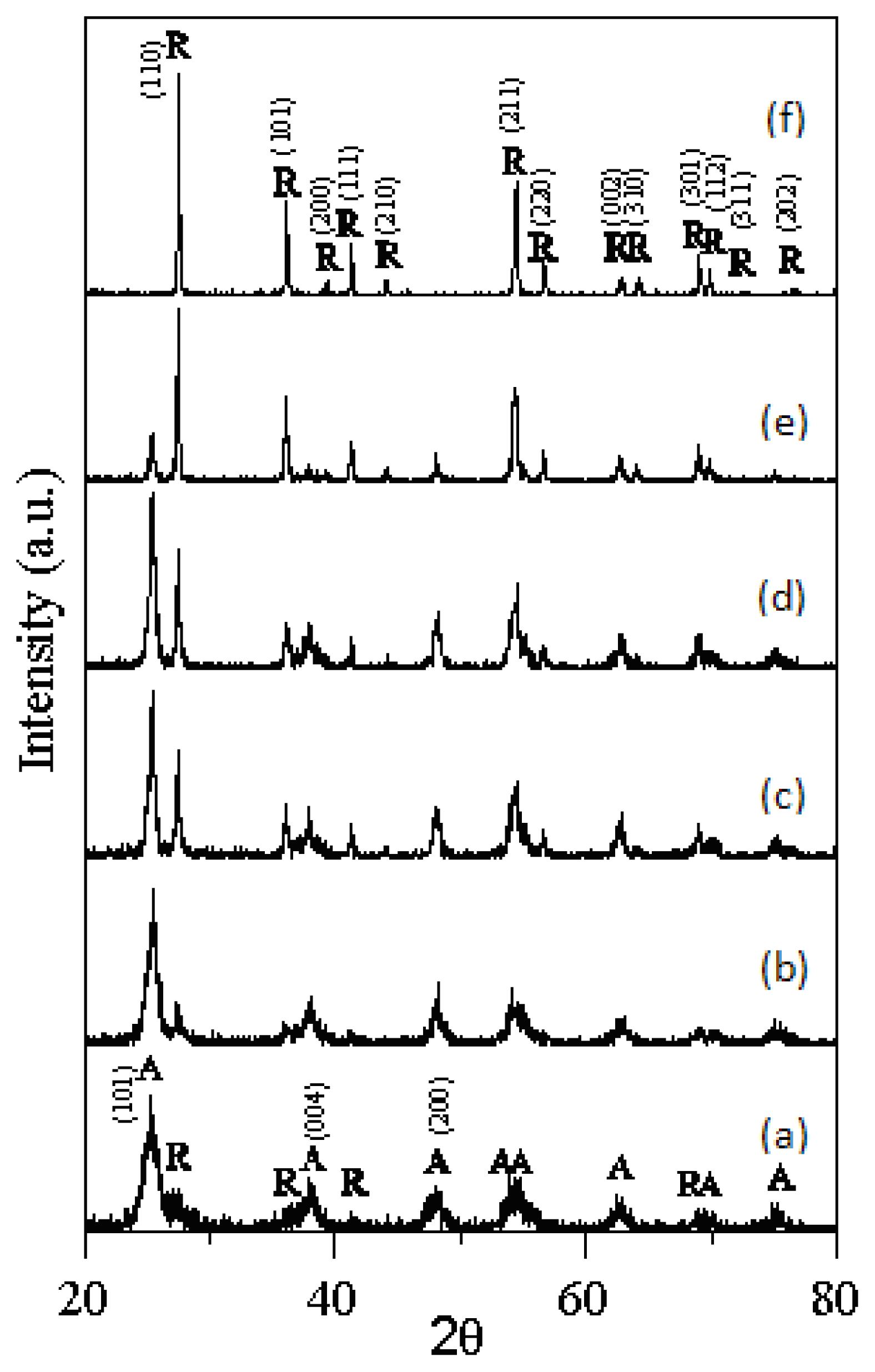
<p><xref ref-type="fig" rid="f1-ijms-13-01658">Figure 1</xref> shows the XRD patterns of the T-0Z freeze dried precursor powders are calcined at various temperatures for 2 h. <xref ref-type="fig" rid="f1-ijms-13-01658">Figure 1a</xref> shows the T-0Z precursor powders are calcined at 523K for 2 h, and reveals that the crystalline phases of the powders were composed of the anatase and rutile TiO<sub>2</sub>, but the crystallinity of rutile TiO<sub>2</sub> was very poor. The crystallinity of rutile increased while the anatase decreased as the calcination temperature rose from 673 to 973 K (<xref ref-type="fig" rid="f1-ijms-13-01658">Figure 1b–d</xref>). When calcined at 1273 K for 2 h, XRD result (<xref ref-type="fig" rid="f1-ijms-13-01658">Figure 1f</xref>) shows that only rutile TiO<sub>2</sub> appeared.</p>
<p>In the present study, the rutile TiO<sub>2</sub> in T-0Z freeze dried precursor powders began to form at 523 K, and was the dominant phase when calcined at 973 K, and saw further increases as the calcination temperature rose. The anatase to rutile TiO<sub>2</sub> transformation is affected by crystallite size, dopant type and concentration, as well as the titanium oxide precursor in solution chemical synthesis, as reported by Zhang and Banifield [<xref ref-type="bibr" rid="b8-ijms-13-01658">8</xref>]. In fact, the phase transformation of anatase to rutile TiO<sub>2</sub> is nucleated at anatase {112} twin boundaries, and the rutile nucleation involves the displacement of only half the titanium cations in the twin slab [<xref ref-type="bibr" rid="b9-ijms-13-01658">9</xref>]. When the transformation is occurs continuously, slabs of anatase octahedral are destabilized, which results in a rapid progression of anatase into rutile TiO<sub>2</sub>.</p>
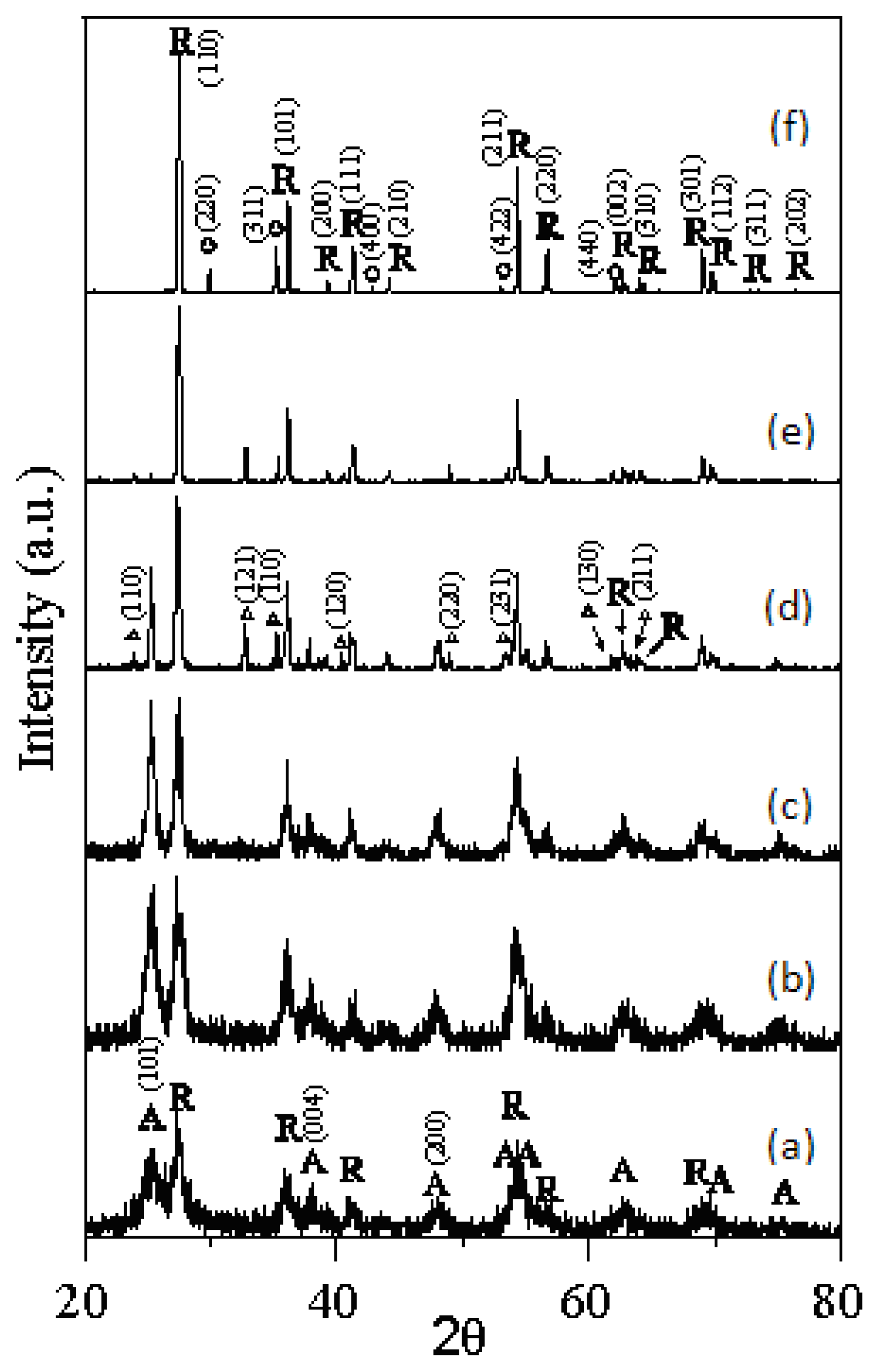
<p><xref ref-type="fig" rid="f2-ijms-13-01658">Figure 2</xref> shows the XRD patterns of the T-9Z freeze dried precursor powders are calcined at various temperatures for 2 h. <xref ref-type="fig" rid="f2-ijms-13-01658">Figure 2a</xref> shows the XRD pattern of the T-9Z freeze dried precursor powders are calcined at 523 K for 2 h, and reveals that the crystallites are the coexisting phases of anatase and rutile TiO<sub>2</sub>. It can also be seen in <xref ref-type="fig" rid="f2-ijms-13-01658">Figure 2b–f</xref> that the crystallinity of the rutile phase improved with the calcination temperature increase. However, the crystallinity of the anatase phase decreased with the rising calcination temperature. When calcined at 1273 K for 2 h (<xref ref-type="fig" rid="f2-ijms-13-01658">Figure 2f</xref>), the anatase TiO<sub>2</sub> phase disappeared, but the rutile TiO<sub>2</sub> still appeared. In addition, when the T-9Z freeze dried precursor powders are calcined at 873 K for 2 h, the minor phase of Zn<sub>2</sub>Ti<sub>3</sub>O<sub>8</sub> first appeared (<xref ref-type="fig" rid="f2-ijms-13-01658">Figure 2d</xref>). Moreover, the Zn<sub>2</sub>Ti<sub>3</sub>O<sub>8</sub> transformed to Zn<sub>2</sub>TiO<sub>4</sub> when the T-9Z freeze dried precursor powders are calcined at 1273 K for 2 h (<xref ref-type="fig" rid="f2-ijms-13-01658">Figure 2f</xref>).</p>
<p>In addition, although zinc oxide is not identified in the XRD patterns for the present study, <xref ref-type="fig" rid="f2-ijms-13-01658">Figure 2e</xref> indicates that the phases of Zn<sub>2</sub>Ti<sub>3</sub>O<sub>8</sub> and Zn<sub>2</sub>TiO<sub>4</sub> were formed when T-9Z freeze dried precursor powders were calcinaed between 773 K and 1273 K for 2 h, respectively. The ionic radius of Ti<sup>4+</sup> and Zn<sup>2+</sup> are 0.68 Å and 0.74 Å, respectively. Since these values are almost equal, it can be inferred that the zinc ions did not insert into the structure of titanium, and instead were located at interstices or absorbed on the surface of TiO<sub>2</sub>, thus forming the zinc-titanium solid solution [<xref ref-type="bibr" rid="b10-ijms-13-01658">10</xref>].</p>
<p>The average crystallite size of the T-0Z and T-9Z freeze dried precursor powders calcination at various temperatures for 2 h is determined by Scherrer’s formula [<xref ref-type="bibr" rid="b11-ijms-13-01658">11</xref>]:</p>
<disp-formula id="FD1">
<label>(1)</label>
<mml:math id="mm1" display="block">
<mml:semantics id="sm1">
<mml:mrow>
<mml:mtext>D</mml:mtext>
<mml:mo>=</mml:mo>
<mml:mfrac>
<mml:mrow>
<mml:mn>0.9</mml:mn>
<mml:mi>λ</mml:mi></mml:mrow>
<mml:mrow>
<mml:mi>β</mml:mi>
<mml:mi>c</mml:mi>
<mml:mi>o</mml:mi>
<mml:mi>s</mml:mi>
<mml:mi>θ</mml:mi></mml:mrow></mml:mfrac></mml:mrow></mml:semantics></mml:math></disp-formula>
<p>where D is the average crystallite size of the anatase and rutile TiO<sub>2</sub>, λ = 0.154 nm is the X-ray wavelength of CuKα, β is the full width of the peak measured at half maximum intensity and θ is the Bragg’s angle of the peak.</p>
<p>The average crystallite size of the anatase and rutile phases TiO<sub>2</sub> after it has been calcined at various temperatures for 2 h is obtained and listed in <xref ref-type="table" rid="t1-ijms-13-01658">Table 1</xref>. It can be seen that the average crystallites of anatase and rutile TiO<sub>2</sub> increase with calcination temperature increased but all sizes are smaller than 100 nm. These results reveal all crystallite sizes of anatase and rutile TiO<sub>2</sub> in the nano-scale. Moreover, the crystallite size of rutile TiO<sub>2</sub> in T-0Z is smaller than that in T-9Z when the freeze dried precursor powders are calcined at 1273 K for 2 h.</p>
<p>It is well known that the polymorphic transformation of ceramic materials generally depends on the nature of the dopant, amount of the dopant and the processing route. The additions of Cr<sub>2</sub>O<sub>3</sub> [<xref ref-type="bibr" rid="b12-ijms-13-01658">12</xref>], SiO<sub>2</sub> [<xref ref-type="bibr" rid="b13-ijms-13-01658">13</xref>], and CeO<sub>2</sub> [<xref ref-type="bibr" rid="b14-ijms-13-01658">14</xref>,<xref ref-type="bibr" rid="b15-ijms-13-01658">15</xref>] have been found to retard the anatase to rutile TiO<sub>2</sub> transformation. Furthermore, the additions of Fe<sub>2</sub>O<sub>3</sub> [<xref ref-type="bibr" rid="b16-ijms-13-01658">16</xref>] and AlCl<sub>3</sub> [<xref ref-type="bibr" rid="b17-ijms-13-01658">17</xref>] have been shown to enhance the anatase to rutile TiO<sub>2</sub> transformation. In the present study, for the samples of T-0Z and T-9Z, the diffraction peaks show the anatase and rutile phases of TiO<sub>2</sub> were simultaneously present from 523 to 973 K, but when calcined at 973 K for 2 h, the (110) intensity of rutile TiO<sub>2</sub> was greater than the (101) intensity of anatase TiO<sub>2</sub> for the T-0Z sample. In addition, when the T-9Z sample are calcined of 973 K for 2 h, the (101) intensity of anatase TiO<sub>2</sub> was only residual, and thus insignificant. Comparing <xref ref-type="fig" rid="f1-ijms-13-01658">Figures 1a</xref> and <xref ref-type="fig" rid="f2-ijms-13-01658">2a</xref>, it can be observed that the (110) intensity of anatase is greater than the (110) intensity of rutile TiO<sub>2</sub> in <xref ref-type="fig" rid="f1-ijms-13-01658">Figure 1a</xref>, but the results are different in <xref ref-type="fig" rid="f2-ijms-13-01658">Figure 2a</xref>. These results prove that doping ZnO into TiO<sub>2</sub> can enhance the anatase to rutile TiO<sub>2</sub> transformation and shift the transformation to a lower temperature. This phenomenon occurs because the zinc oxide leading to the surface nucleation occurred on this polymorth [<xref ref-type="bibr" rid="b18-ijms-13-01658">18</xref>].</p>
<p>The influence of the dopant ZnO on the structure of the T-9Z samples can be explained based on the changes caused by the dopant on the TiO<sub>2</sub> surface [<xref ref-type="bibr" rid="b14-ijms-13-01658">14</xref>]. Because the ionic radius of Zn<sup>2+</sup> (0.74 Å) is greater than that of Ti<sup>4+</sup> (0.68 Å), but smaller than that of oxygen (1.32 Å), the zinc ions were not introduced into the structure of titanium oxide matrix [<xref ref-type="bibr" rid="b10-ijms-13-01658">10</xref>]. Therefore, the same deformation of the lattice structure and deformation energy produced by the zinc ions did not occur, and the zinc ions absorbed on the surface of titanium oxide created the nucleation sites and enhanced an unstable anatase phase transition to rutile. The anatase to rutile TiO<sub>2</sub> transformation was nearly complete at 973 K, as the surface nucleation is favored for the dopant.</p>
<p>Moreover, although the concentration was only 9.0 mol% ZnO, the segregation of dopant on the surface of titanium oxide matrix promoted the Zn<sub>2</sub>Ti<sub>3</sub>O<sub>8</sub> formation at 873 K in the ZnO-TiO<sub>2</sub> system. Chang <italic>et al.</italic> [<xref ref-type="bibr" rid="b19-ijms-13-01658">19</xref>] synthesized zinc titanate nanocrystal powder using a sol-gel process, and noted that the phase of the low temperature form of ZnTiO<sub>3</sub> (<italic>i.e.</italic>, Zn<sub>2</sub>Ti<sub>3</sub>O<sub>8</sub>) first formed at 773 K, but had poor crystallinity. At 873 K, the crystalline phase of ZnTiO<sub>3</sub> was identified, but traces of Zn<sub>2</sub>TiO<sub>4</sub> and rutile also appeared. Wang <italic>et al.</italic> [<xref ref-type="bibr" rid="b20-ijms-13-01658">20</xref>] using hydrothermal process prepared the Zn<sub>2</sub>Ti<sub>3</sub>O<sub>8</sub> powders for cosmetic applications have reported that the zinc titanium powders was obtained from the TiCl<sub>4</sub>, Zn(NO<sub>3</sub>)<sub>2</sub>·6H<sub>2</sub>O and NH<sub>4</sub>OH solutions put in a thermostatic autoclave at 423 K for 1 h. When the zinc titanate powders are calcined at 873 K for 1 h, the Zn<sub>2</sub>Ti<sub>3</sub>O<sub>8</sub>, ZnO and anatase TiO<sub>2</sub> coexisted. Dulin and Rase [<xref ref-type="bibr" rid="b10-ijms-13-01658">10</xref>] have pointed out that when the ZnO content is less than 50 mol% and the temperature below 1218 K, only the phases of Zn<sub>2</sub>Ti<sub>3</sub>O<sub>8</sub> and rutile TiO<sub>2</sub> are present. In addition, the Zn<sub>2</sub>TiO<sub>4</sub> and rutile TiO<sub>2</sub> appeared when the temperature was between 1218 and 1691 K. The results of the present study are in agreement with those of Dulin and Rase [<xref ref-type="bibr" rid="b10-ijms-13-01658">10</xref>], and Chang <italic>et al.</italic> [<xref ref-type="bibr" rid="b19-ijms-13-01658">19</xref>].</p>
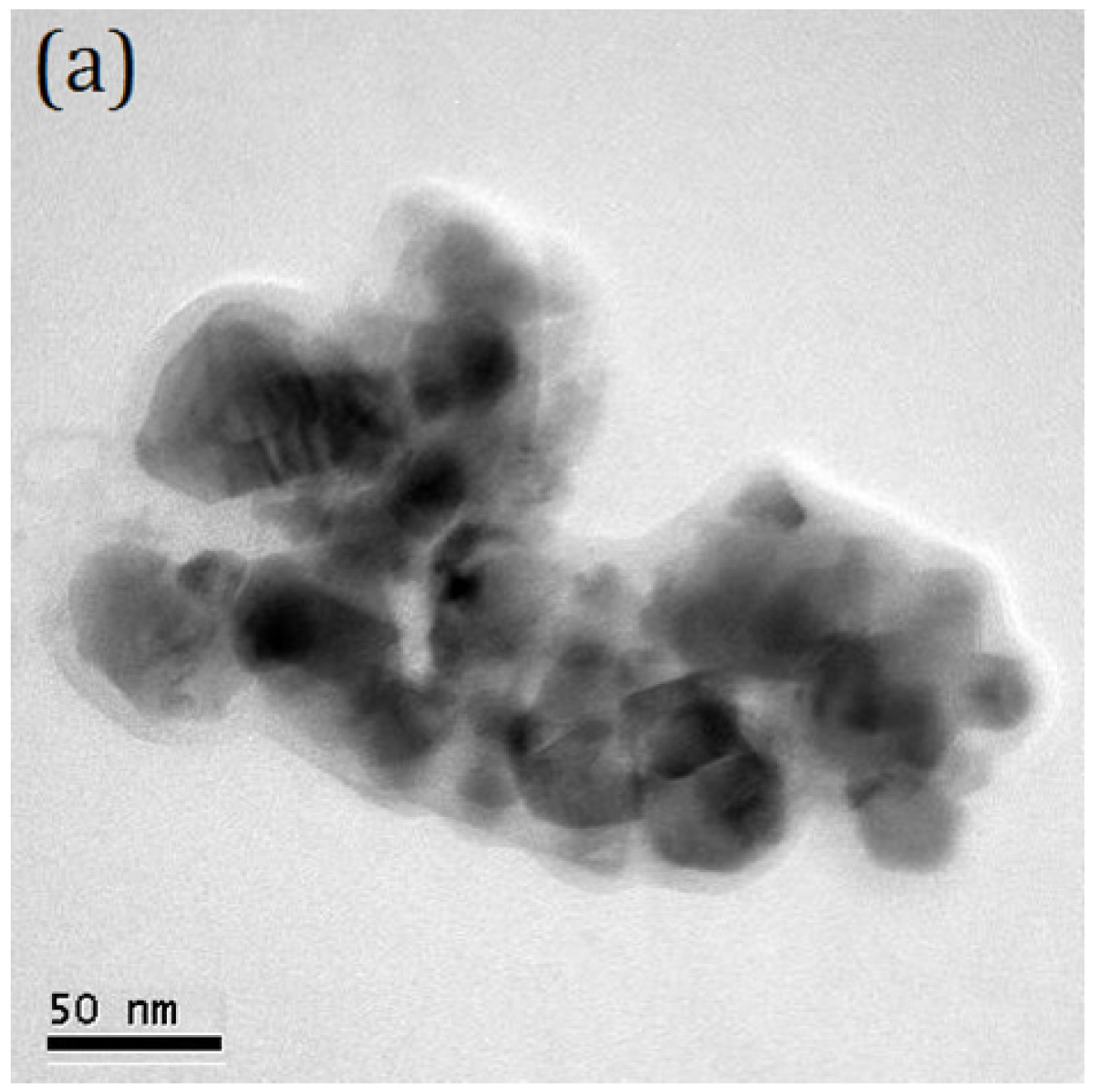
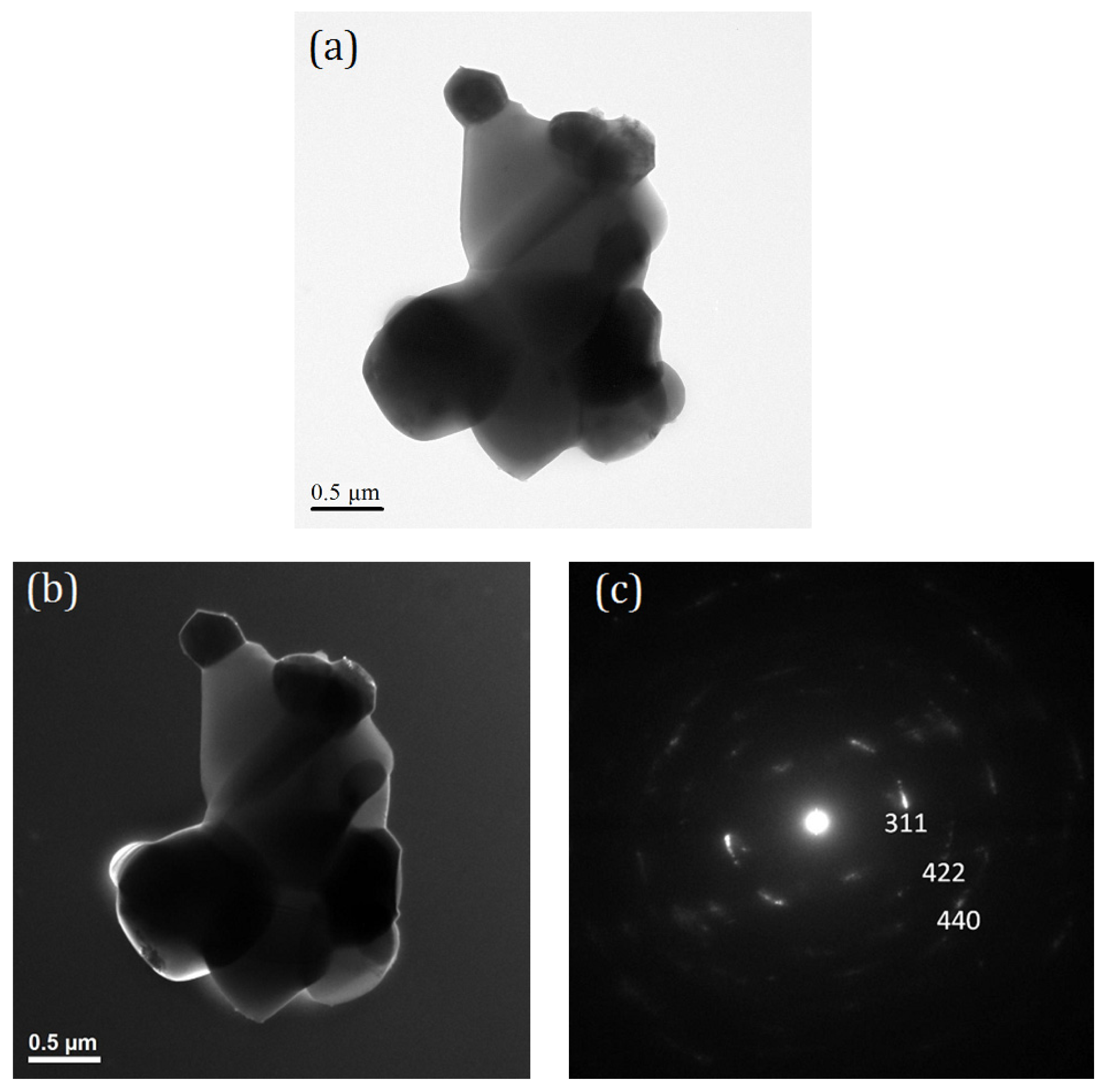
<p><xref ref-type="fig" rid="f3-ijms-13-01658">Figure 3</xref> shows the bright field (BF) and dark field (DF) images, and selected area electron diffraction (SAED) pattern of T-0Z freeze dried precursor powders are calcined at 1273 K for 2 h. <xref ref-type="fig" rid="f3-ijms-13-01658">Figure 3a</xref> shows the BF image of the irregular crystallites morphology with a size of about 60 nm. In addition, <xref ref-type="fig" rid="f3-ijms-13-01658">Figure 3b</xref> shows the DF image of the <xref ref-type="fig" rid="f3-ijms-13-01658">Figure 3a</xref>. <xref ref-type="fig" rid="f3-ijms-13-01658">Figure 3c</xref> reveals the SAED pattern corresponding to the rutile TiO<sub>2</sub> with zone axes (ZA) of [11̄0]. The SAED pattern also provides the evidence of the presence of the rutile TiO<sub>2</sub> in T-0Z powders when calcined at 1273 K for 2 h. Moreover, the crystallite sizes in <xref ref-type="fig" rid="f3-ijms-13-01658">Figure 3a</xref> also correspond to the results of <xref ref-type="table" rid="t1-ijms-13-01658">Table 1</xref>.</p>
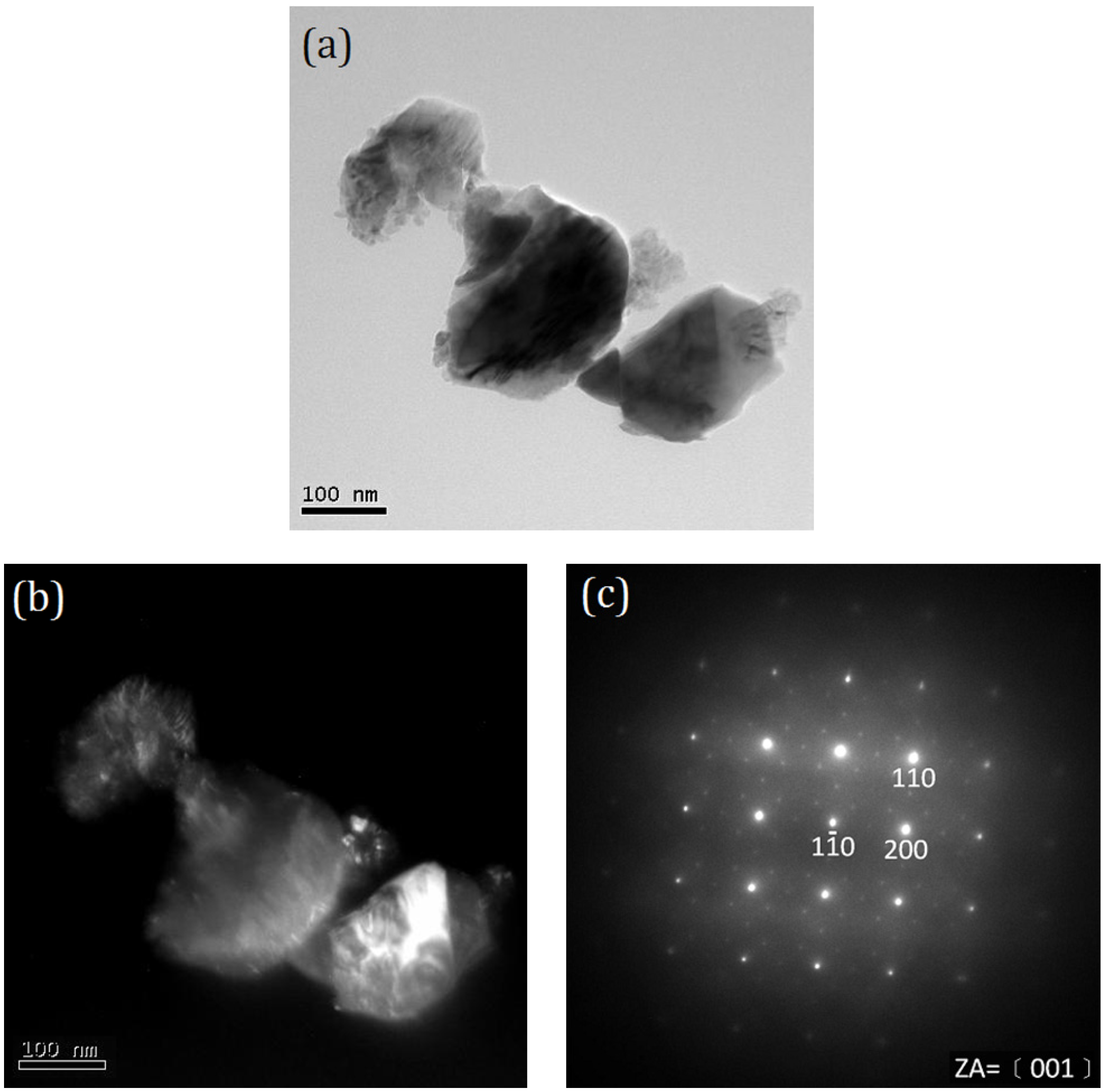
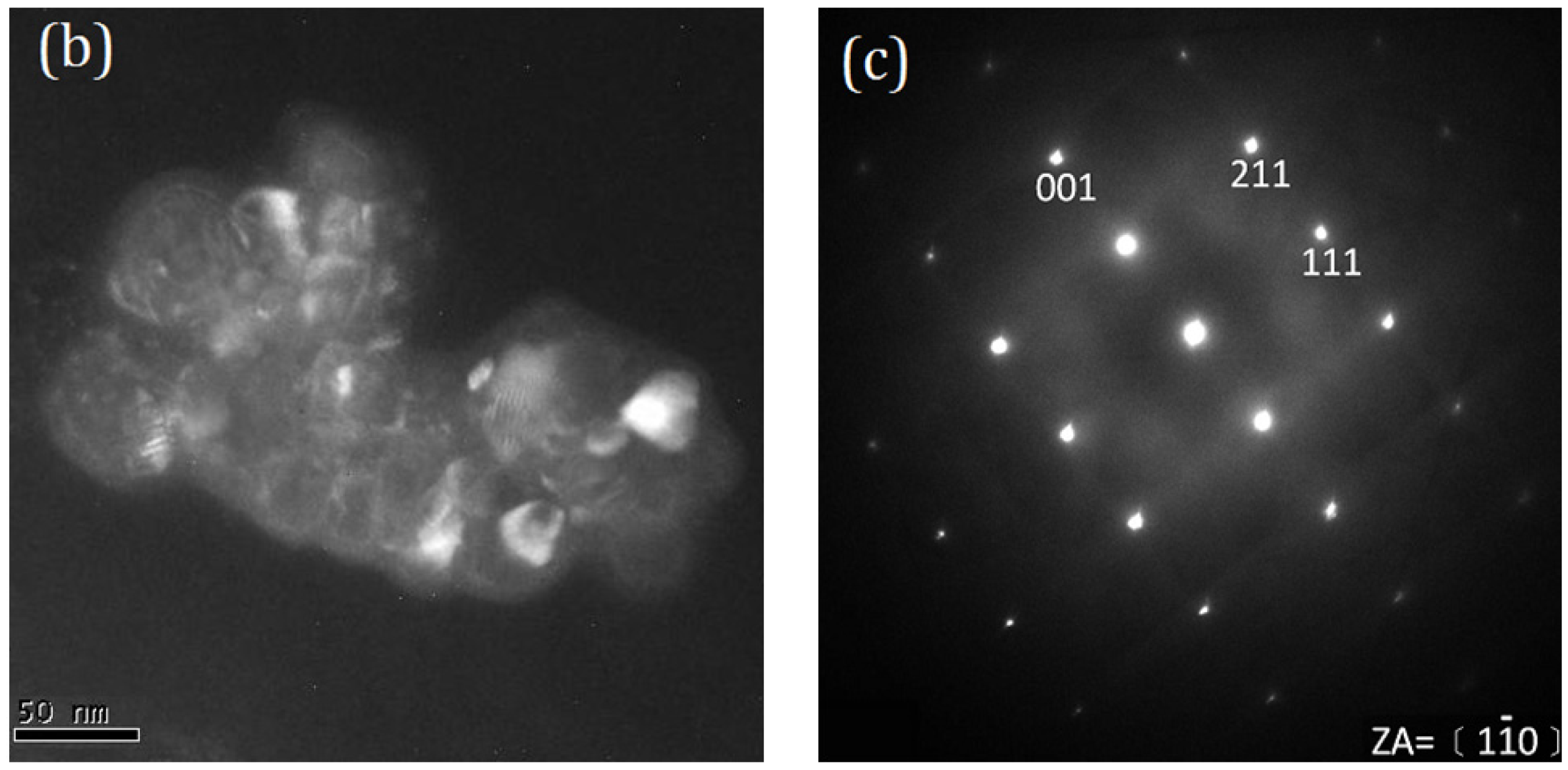
<p>When the T-9Z freeze dried precursor powders are calcined at 1273 K for 2 h, the TEM microstructure and SAED pattern are shown in <xref ref-type="fig" rid="f4-ijms-13-01658">Figure 4</xref>. <xref ref-type="fig" rid="f4-ijms-13-01658">Figure 4a,b</xref> shows the BF and DF images, respectively. The crystallite sizes are observed to be about 80 nm. <xref ref-type="fig" rid="f4-ijms-13-01658">Figure 4c</xref> shows the SAED pattern of <xref ref-type="fig" rid="f4-ijms-13-01658">Figure 4b</xref>. The SAED pattern corresponds to the rutile TiO<sub>2</sub> with ZA = [001].</p>
<p><xref ref-type="fig" rid="f5-ijms-13-01658">Figure 5a</xref> shows the BF image of the aggregate rutile crystallites in the irregular larger particle. Furthermore, the <xref ref-type="fig" rid="f5-ijms-13-01658">Figure 5b</xref> shows the fringe of the aggregate rutile TiO<sub>2</sub>. <xref ref-type="fig" rid="f5-ijms-13-01658">Figure 5c</xref> shows the SAED pattern of the fringe in <xref ref-type="fig" rid="f5-ijms-13-01658">Figure 5b</xref>. The SAED pattern corresponds to the Zn<sub>2</sub>TiO<sub>4</sub>. The results from <xref ref-type="fig" rid="f4-ijms-13-01658">Figures 4c</xref> and <xref ref-type="fig" rid="f5-ijms-13-01658">5c</xref> correspond to those of <xref ref-type="fig" rid="f2-ijms-13-01658">Figure 2f</xref>.</p>
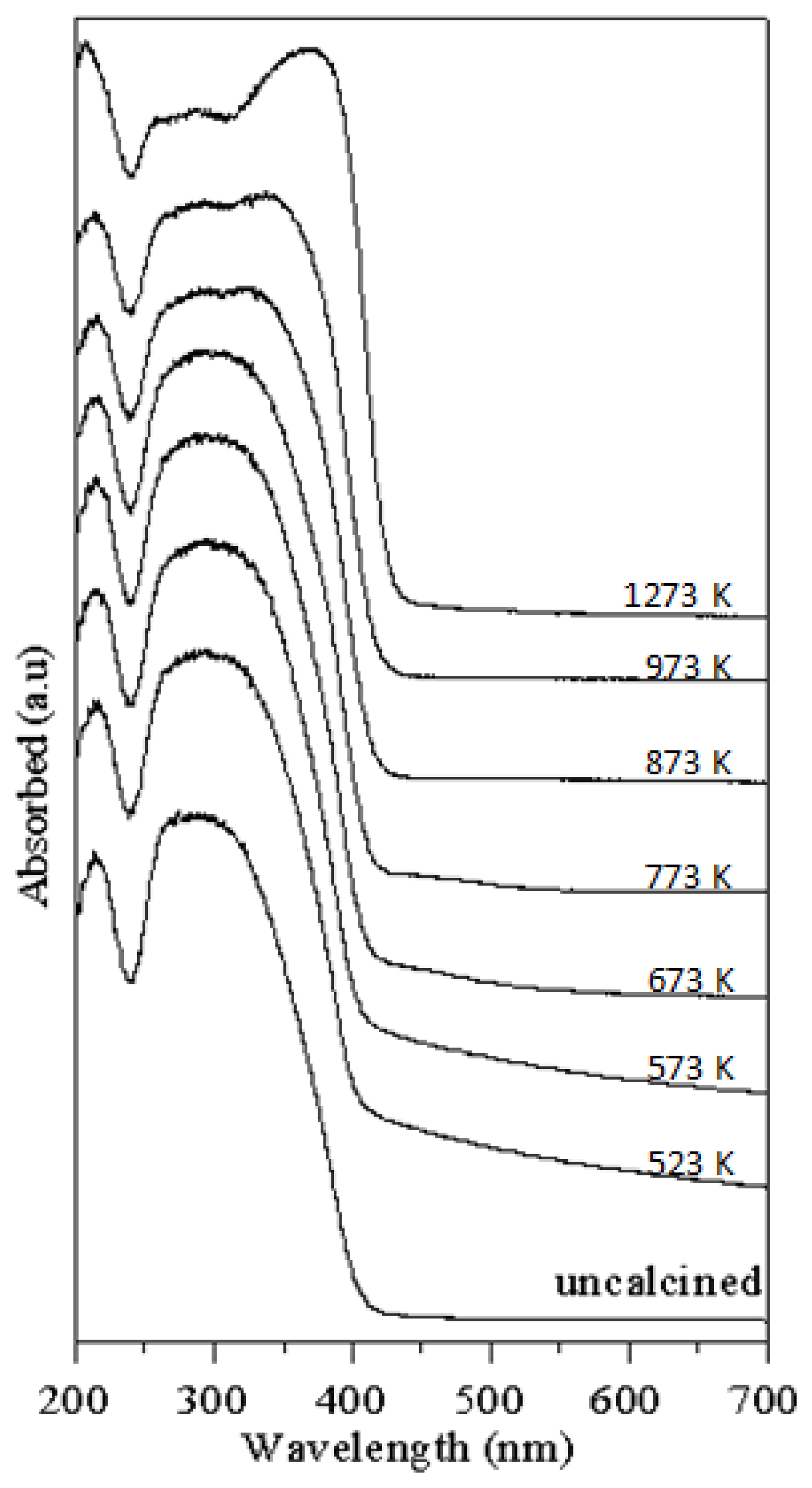
<p>The relation of absorption and wavelength range between 200 and 700 nm for T-9Z freeze dried precursor powders calcined at various temperatures for 2 h are shown in <xref ref-type="fig" rid="f6-ijms-13-01658">Figure 6</xref>. It is found that the absorption of T-9Z powders in the UV range had a red-shift effect as the calciantion temperature increased. This is because the quantity of photons reaching the core of a particle depends of the size and the optical properties of the TiO<sub>2</sub> crystals. Maris <italic>et al.</italic> [<xref ref-type="bibr" rid="b21-ijms-13-01658">21</xref>] also found that the penetration of light into a particle is influenced by the superficial morphology of the particles. Particles formed from larger TiO<sub>2</sub> crystals have a smoother surface than those made from small crystals. On a smooth surface, the incident photons are scattered and mostly lost by reflection. In contrast, a rough surface allows a greater number of scattered photons to penetrate into the particle [<xref ref-type="bibr" rid="b15-ijms-13-01658">15</xref>]. Moreover, the red-shift effect of the TiO<sub>2</sub> nanocrystallite powders with surface modified by 9 mol% ZnO and calcined at 1273 K for 2 h indicates that they can be used as an UV-A attenuating agents for cosmetic applications in sunscreens.</p>
<p>Most of the UV absorbers used in sunscreens are oil-soluble or even oil-miscible and consequently are incorporated into the oil phase of sunscreen emulsions [<xref ref-type="bibr" rid="b22-ijms-13-01658">22</xref>]. Moreover, Herzog <italic>et al.</italic> [<xref ref-type="bibr" rid="b22-ijms-13-01658">22</xref>] also pointed out that the UV-attenating efficiency increased with decreasing particle size up to a maximum particle size of 80 nm. With smaller particles, the extinction started to decrease again. Moreover, for the inorganic TiO<sub>2</sub> used as absorber at a particle size of 100 nm, the scattering that contributes to about 50% to the overall extinction in the range of the extinction maximum of the spectrum has been reported by Robb <italic>et al.</italic> [<xref ref-type="bibr" rid="b23-ijms-13-01658">23</xref>]. On the other hand, Popov <italic>et al.</italic> [<xref ref-type="bibr" rid="b24-ijms-13-01658">24</xref>] pointed out that the TiO<sub>2</sub> fine particles are embedded with sunscreens into the skin to effectively attenuate UV-B radiation. Moreover, TiO<sub>2</sub> particles with a size of 62 nm are found to be the most effective in protecting skin against UV-B radiation. As mentioned above, the results of the present study show a red-shift effect in the UV range. Therefore, the TiO<sub>2</sub> nanocrystallite powders with surface modified by 9 mol% ZnO and calcined at 1273 K for 2 h can be used as an UV-A light attenuating agent for cosmetic applications in sunscreens.</p></sec>
<sec>
<title>3. Experimental Procedure</title>
<sec>
<title>3.1. Sample Preparation</title>
<p>The starting materials were reagent-grade TiCl<sub>4</sub> solution (purity ≥ 98.0%, supplied by Fluka, France), Zn(NO<sub>3</sub>)<sub>2</sub>·6H<sub>2</sub>O (purity ≥ 98%, supplied by Alfa Aersor, USA), 25 vol% ammonia solution (NH<sub>4</sub>OH, supplied by Riedel-de Haën, Germany) and polyethylene glycol (PEG, supplied by Nippon Shiyaku Kogyo K.K., Japan). A TiCl<sub>4</sub> solution of 0.5 M was prepared from 1 mol TiCl<sub>4</sub> solution dissolved in 2 L deionized water. The TiCl<sub>4</sub> aqueous solution was then supplemented with 1 wt% of PEG as a dispersant. The mixed solution was stirred and heated to 333 K for 6 h (denoted as solution I). NH<sub>4</sub>OH was then added to solution I until pH = 9. The mixed solution was then stirred at room temperature for 24 h to obtain white precipitates (denoted as T-0Z).</p>
<p>An aqueous solution of 9 mol% ZnO was prepared from the Zn(NO<sub>3</sub>)<sub>2</sub>·6H<sub>2</sub>O dissolved in deionized water and stirred at 273 K for 2 h (denoted as solution II). Solution II was then added slowly at a rate of 0.05 cm<sup>3</sup>·min<sup>−1</sup> with vigorous agitation in solution I at room temperature. At the end of titration, a syringe was used to minimize the size of falling drops and reduce the local reaction effect. During the whole process, the pH value was kept at 9 by adjusting the amount of NH4OH. The mixed solution was then stirred at room temperature for 24 h to obtain white precipitates (denoted as T-9Z).</p>
<p>After precipitation, the precipitates were washed thoroughly two times with a large amount of ethanol (purity ≥ 99.85%, supplied by J.T.Baker, USA) to remove NH<sub>4</sub>NO<sub>3</sub> [<xref ref-type="bibr" rid="b25-ijms-13-01658">25</xref>]. Subsequently, the precipitates were freeze dried at 218 K in a vacuum.</p></sec>
<sec>
<title>3.2. Sample Characterization</title>
<p>The crystalline phase was identified using an X-ray diffractometer (XRD, model Rad IIA, Rigaku Co., Tokyo, Japan) with Cu Kα radiation and a Ni filter, operated at 30 kV, 20 mA and a scanning rate (2θ) of 0.25°·min<sup>−1</sup>. The microstructure of the powders before and after calcination was observed by transmission electron microscopy (TEM, model HF-2000, Hitachi Ltd., Tokyo, Japan), operating at 200 kV. The selected area electron diffraction (SAED) examination was conducted on the calcined samples. The UV-shielding was measured with a UV-vis spectrometer (Optometrics, SPF-290, Ayer, MA, USA).</p></sec></sec>
<sec sec-type="conclusions">
<title>4. Conclusions</title>
<list list-type="order">
<list-item>
<p>The rutile TiO<sub>2</sub> began to form at 523 K of T-0Z freeze dried precursor powders, and was the dominant phase when calcined at 973 K for 2 h.</p></list-item>
<list-item>
<p>The anatase and rutile TiO<sub>2</sub> phases coexist in T-9Z powders when the calcination temperature is below 973 K. When calcined at 1273 K for 2 h, the anatase phase disappears. In addition, the Zn<sub>2</sub>Ti<sub>3</sub>O<sub>8</sub> first forms when T-9Z freeze dried precursor powders are calcined at 973 K for 2 h. When the T-9Z precursor powders are calcined at 1273 K for 2 h, the Zn<sub>2</sub>TiO<sub>4</sub> forms and the Zn<sub>2</sub>Ti<sub>3</sub>O<sub>8</sub> disappears.</p></list-item>
<list-item>
<p>The average crystallite sizes of anatase and rutile TiO<sub>2</sub> increase with increasing the calcination temperature, but all average crystallite sizes of anatase and rutile TiO<sub>2</sub> are smaller than 100 nm for T-0Z and T-9Z freeze dried precursor powders as calcined between 523 and 1275 K for 2 h. In addition, the crystallite size of rutile TiO<sub>2</sub> in T-0Z is smaller than that in T-9Z when the freeze dried precursor powders are calcined at 1273 K for 2 h.</p></list-item>
<list-item>
<p>The absorption of T-9Z powders in the UV range has a red-shift effect as the calcination temperature increases. This result shows that TiO<sub>2</sub> nanocrystallite powders added with 9 mol% ZnO and calcined at 1273 K for 2 h can be used as an UV-A attenuating agent for cosmetic applications in sunscreens.</p></list-item></list></sec></body>
<back>
<ack>
<title>Acknowledgments</title>
<p>This work was supported by the National Science Council, Taiwan, the Republic of China under Contract No. NSC 100-2221-E-037-001 and NSC 99-2313-B-037-001-MY3, which is gratefully acknowledged. The authors sincerely thank M.H. Hom for advices on the manuscript and preparation.</p></ack>
<ref-list>
<title>References</title>
<ref id="b1-ijms-13-01658"><label>1</label><citation citation-type="journal"><person-group person-group-type="author"><name><surname>Al-Hilli</surname><given-names>S.M.</given-names></name><name><surname>Willander</surname><given-names>M.</given-names></name></person-group><article-title>Optical properties of zinc oxide nano-particle embedded in dielectric medium for UV region: Numerical simulation</article-title><source>J. Nanoparticle Res</source><year>2006</year><volume>8</volume><fpage>79</fpage><lpage>97</lpage><pub-id pub-id-type="doi">10.1007/s11051-005-8024-2</pub-id></citation></ref>
<ref id="b2-ijms-13-01658"><label>2</label><citation citation-type="journal"><person-group person-group-type="author"><name><surname>Nohynek</surname><given-names>G.J.</given-names></name><name><surname>Lademann</surname><given-names>J.</given-names></name><name><surname>Ribaud</surname><given-names>C.</given-names></name><name><surname>Roberts</surname><given-names>M.S.</given-names></name></person-group><article-title>Grey goo on the skin? Nanotechnology, cosmetic and sunscreen safety</article-title><source>Crit. Rev. Toxicol</source><year>2007</year><volume>37</volume><fpage>251</fpage><lpage>277</lpage><pub-id pub-id-type="doi">10.1080/10408440601177780</pub-id><pub-id pub-id-type="pmid">17453934</pub-id></citation></ref>
<ref id="b3-ijms-13-01658"><label>3</label><citation citation-type="journal"><person-group person-group-type="author"><name><surname>Lee</surname><given-names>W.</given-names></name><name><surname>Shen</surname><given-names>H.S.</given-names></name><name><surname>Dwight</surname><given-names>K.</given-names></name><name><surname>Wold</surname><given-names>A.</given-names></name></person-group><article-title>Effect of silver on the photocatalytic activity of TiO<sub>2</sub></article-title><source>J. Solid State Chem</source><year>1998</year><volume>106</volume><fpage>288</fpage><lpage>294</lpage></citation></ref>
<ref id="b4-ijms-13-01658"><label>4</label><citation citation-type="book"><person-group person-group-type="author"><name><surname>Fairhurst</surname><given-names>D.</given-names></name><name><surname>Mitchnick</surname><given-names>M.A.</given-names></name></person-group><source>Sunscreen-Development, Evaluation and Regulatory Aspects</source><edition>2nd ed</edition><person-group person-group-type="editor"><name><surname>Lowe</surname><given-names>N.J.</given-names></name><name><surname>Shaath</surname><given-names>N.A.</given-names></name><name><surname>Pathak</surname><given-names>M.A.</given-names></name></person-group><publisher-name>Marcel Dekker</publisher-name><publisher-loc>New York, NY, USA</publisher-loc><year>1997</year><fpage>3</fpage><lpage>33</lpage></citation></ref>
<ref id="b5-ijms-13-01658"><label>5</label><citation citation-type="journal"><person-group person-group-type="author"><name><surname>Zhong</surname><given-names>C.J.</given-names></name><name><surname>Maye</surname><given-names>M.M.</given-names></name></person-group><article-title>Core-shell assembled nanoparticles as catalysis</article-title><source>Adv. Mater</source><year>2001</year><volume>13</volume><fpage>1507</fpage><lpage>1511</lpage><pub-id pub-id-type="doi">10.1002/1521-4095(200110)13:19&lt;1507::AID-ADMA1507&gt;3.0.CO;2-#</pub-id></citation></ref>
<ref id="b6-ijms-13-01658"><label>6</label><citation citation-type="journal"><person-group person-group-type="author"><name><surname>Jaroenworaluck</surname><given-names>A.</given-names></name><name><surname>Sunsaneeyamethe</surname><given-names>W.</given-names></name><name><surname>Kosachan</surname><given-names>N.</given-names></name><name><surname>Stevens</surname><given-names>R.</given-names></name></person-group><article-title>Characteristics of silica-coated TiO<sub>2</sub> and its UV absorption for sunscreen cosmetic applications</article-title><source>Surf. Interface Anal</source><year>2006</year><volume>38</volume><fpage>473</fpage><lpage>477</lpage><pub-id pub-id-type="doi">10.1002/sia.2313</pub-id></citation></ref>
<ref id="b7-ijms-13-01658"><label>7</label><citation citation-type="journal"><person-group person-group-type="author"><name><surname>Liao</surname><given-names>M.H.</given-names></name><name><surname>Hsu</surname><given-names>C.H.</given-names></name><name><surname>Chen</surname><given-names>D.H.</given-names></name></person-group><article-title>Preparation and properties of amorphous titania-coated zinc oxide nanoparticles</article-title><source>J. Solid State Chem</source><year>2006</year><volume>179</volume><fpage>2020</fpage><lpage>2026</lpage><pub-id pub-id-type="doi">10.1016/j.jssc.2006.03.042</pub-id></citation></ref>
<ref id="b8-ijms-13-01658"><label>8</label><citation citation-type="journal"><person-group person-group-type="author"><name><surname>Zhang</surname><given-names>H.</given-names></name><name><surname>Banfield</surname><given-names>J.F.</given-names></name></person-group><article-title>Phase transformation of nanocrystalline anatase-to-rutile via combined interface and surface nucleation</article-title><source>J. Mater. Res</source><year>2000</year><volume>15</volume><fpage>437</fpage><lpage>448</lpage><pub-id pub-id-type="doi">10.1557/JMR.2000.0067</pub-id></citation></ref>
<ref id="b9-ijms-13-01658"><label>9</label><citation citation-type="journal"><person-group person-group-type="author"><name><surname>Li</surname><given-names>G.</given-names></name><name><surname>Li</surname><given-names>L.</given-names></name><name><surname>Boerio-Goates</surname><given-names>J.</given-names></name><name><surname>Woodfield</surname><given-names>B.F.</given-names></name></person-group><article-title>High purity anatase nanocrystals: Near room temperature synthesis, grain growth kinetics, and surface hydration chemistry</article-title><source>J. Am. Chem. Soc</source><year>2005</year><volume>127</volume><fpage>8659</fpage><lpage>8666</lpage><pub-id pub-id-type="doi">10.1021/ja050517g</pub-id><pub-id pub-id-type="pmid">15954771</pub-id></citation></ref>
<ref id="b10-ijms-13-01658"><label>10</label><citation citation-type="journal"><person-group person-group-type="author"><name><surname>Dulin</surname><given-names>P.H.</given-names></name><name><surname>Rase</surname><given-names>D.E.</given-names></name></person-group><article-title>Phase equilibria in the system ZnO-TiO<sub>2</sub></article-title><source>J. Am. Ceram. Soc</source><year>1960</year><volume>43</volume><fpage>125</fpage><lpage>131</lpage><pub-id pub-id-type="doi">10.1111/j.1151-2916.1960.tb14326.x</pub-id></citation></ref>
<ref id="b11-ijms-13-01658"><label>11</label><citation citation-type="book"><person-group person-group-type="author"><name><surname>Cullity</surname><given-names>B.D.</given-names></name></person-group><source>Elements of X-ray Diffraction</source><edition>2nd ed</edition><publisher-name>Addison-Wesley Publishing Company</publisher-name><publisher-loc>Reading, MA, USA</publisher-loc><year>1978</year><fpage>87</fpage></citation></ref>
<ref id="b12-ijms-13-01658"><label>12</label><citation citation-type="journal"><person-group person-group-type="author"><name><surname>Wilke</surname><given-names>K.</given-names></name><name><surname>Breuer</surname><given-names>H.D.</given-names></name></person-group><article-title>The influence of transition metal doping on the physical and photocatalytic properties of titania</article-title><source>J. Photochem. Photobiol. A</source><year>1999</year><volume>121</volume><fpage>49</fpage><lpage>53</lpage><pub-id pub-id-type="doi">10.1016/S1010-6030(98)00452-3</pub-id></citation></ref>
<ref id="b13-ijms-13-01658"><label>13</label><citation citation-type="journal"><person-group person-group-type="author"><name><surname>Zhou</surname><given-names>Y.S.</given-names></name><name><surname>Fan</surname><given-names>X.H.</given-names></name></person-group><article-title>Preparation and properties of the nanometer composite oxide TiO<sub>2</sub>-SiO<sub>2</sub></article-title><source>Chem. J. Chin. Univ</source><year>2003</year><volume>7</volume><fpage>1266</fpage><lpage>1270</lpage></citation></ref>
<ref id="b14-ijms-13-01658"><label>14</label><citation citation-type="journal"><person-group person-group-type="author"><name><surname>Jing</surname><given-names>L.</given-names></name><name><surname>Sun</surname><given-names>X.</given-names></name><name><surname>Cai</surname><given-names>W.</given-names></name><name><surname>Li</surname><given-names>X.</given-names></name><name><surname>Fu</surname><given-names>H.</given-names></name><name><surname>Hou</surname><given-names>H.</given-names></name><name><surname>Fan</surname><given-names>N.</given-names></name></person-group><article-title>Photoluminescence of Ce doped TiO<sub>2</sub> nanoparticles and their photocatalytic activity</article-title><source>Acta Chim. Sin</source><year>2003</year><volume>61</volume><fpage>1241</fpage><lpage>1245</lpage></citation></ref>
<ref id="b15-ijms-13-01658"><label>15</label><citation citation-type="journal"><person-group person-group-type="author"><name><surname>Yan</surname><given-names>Q.Z.</given-names></name><name><surname>Su</surname><given-names>X.T.</given-names></name><name><surname>Huang</surname><given-names>Z.Y.</given-names></name><name><surname>Ge</surname><given-names>C.C.</given-names></name></person-group><article-title>Sol-gel auto-igniting synthesis and structural property of cerium-doped titanium dioxide nanosized powders</article-title><source>J. Eur. Ceram. Soc</source><year>2006</year><volume>2b</volume><fpage>915</fpage><lpage>921</lpage></citation></ref>
<ref id="b16-ijms-13-01658"><label>16</label><citation citation-type="journal"><person-group person-group-type="author"><name><surname>Hirano</surname><given-names>M.</given-names></name><name><surname>Joji</surname><given-names>T.</given-names></name><name><surname>Inagaki</surname><given-names>M.</given-names></name></person-group><article-title>Direct formation of iron (III)-doped titanium oxide (anatase) by thermal hydrolysis and its structure property</article-title><source>J. Am. Ceram. Soc</source><year>2004</year><volume>87</volume><fpage>35</fpage><lpage>41</lpage><pub-id pub-id-type="doi">10.1111/j.1151-2916.2004.tb19941.x</pub-id></citation></ref>
<ref id="b17-ijms-13-01658"><label>17</label><citation citation-type="journal"><person-group person-group-type="author"><name><surname>Gesenhues</surname><given-names>U.</given-names></name><name><surname>Rentschler</surname><given-names>T.</given-names></name></person-group><article-title>Crystal growth and defect structure of Al<sup>3+</sup>-doped rutile</article-title><source>J. Solid. State Chem</source><year>1999</year><volume>143</volume><fpage>210</fpage><lpage>218</lpage><pub-id pub-id-type="doi">10.1006/jssc.1998.8088</pub-id></citation></ref>
<ref id="b18-ijms-13-01658"><label>18</label><citation citation-type="journal"><person-group person-group-type="author"><name><surname>Inagaki</surname><given-names>M.</given-names></name><name><surname>Nakazawa</surname><given-names>Y.</given-names></name><name><surname>Hirano</surname><given-names>M.</given-names></name><name><surname>Kobayashi</surname><given-names>Y.</given-names></name><name><surname>Toyoda</surname><given-names>M.</given-names></name></person-group><article-title>Preparation of stable anatase-type TiO<sub>2</sub> and its photocatalytic performance</article-title><source>Int. J. Inorg. Mater</source><year>2001</year><volume>3</volume><fpage>809</fpage><lpage>811</lpage><pub-id pub-id-type="doi">10.1016/S1466-6049(01)00176-3</pub-id></citation></ref>
<ref id="b19-ijms-13-01658"><label>19</label><citation citation-type="journal"><person-group person-group-type="author"><name><surname>Chang</surname><given-names>Y.S.</given-names></name><name><surname>Chang</surname><given-names>Y.H.</given-names></name><name><surname>Chen</surname><given-names>I.G.</given-names></name><name><surname>Chen</surname><given-names>G.J.</given-names></name><name><surname>Chai</surname><given-names>Y.L.</given-names></name></person-group><article-title>Synthesis and characterization of zinc titanate nano-crystal powders by sol-gel technique</article-title><source>J. Cryst. Growth</source><year>2006</year><volume>243</volume><fpage>319</fpage><lpage>326</lpage></citation></ref>
<ref id="b20-ijms-13-01658"><label>20</label><citation citation-type="journal"><person-group person-group-type="author"><name><surname>Wang</surname><given-names>C.L.</given-names></name><name><surname>Hwang</surname><given-names>W.S.</given-names></name><name><surname>Chang</surname><given-names>K.M.</given-names></name><name><surname>Ko</surname><given-names>H.K.</given-names></name><name><surname>Hsi</surname><given-names>C.S.</given-names></name><name><surname>Huang</surname><given-names>H.H.</given-names></name><name><surname>Wang</surname><given-names>M.C.</given-names></name></person-group><article-title>Formation and morphology of Zn<sub>2</sub>Ti<sub>3</sub>O<sub>8</sub> powders using hydrothermal process without dispersant agent or mineralizer</article-title><source>Int. J. Mol. Sci</source><year>2011</year><volume>12</volume><fpage>935</fpage><lpage>945</lpage><pub-id pub-id-type="doi">10.3390/ijms12020935</pub-id><pub-id pub-id-type="pmid">21541035</pub-id></citation></ref>
<ref id="b21-ijms-13-01658"><label>21</label><citation citation-type="journal"><person-group person-group-type="author"><name><surname>Maria</surname><given-names>A.J.</given-names></name><name><surname>Yeung</surname><given-names>K.L.</given-names></name><name><surname>Lee</surname><given-names>C.Y.</given-names></name><name><surname>Yue</surname><given-names>P.L.</given-names></name><name><surname>Chan</surname><given-names>C.K.</given-names></name></person-group><article-title>Size effect in gas-phase photo-oxidation of trichloroethylene using nanometer-sized TiO<sub>2</sub> catalysts</article-title><source>J. Catal</source><year>2000</year><volume>192</volume><fpage>185</fpage><lpage>196</lpage><pub-id pub-id-type="doi">10.1006/jcat.2000.2838</pub-id></citation></ref>
<ref id="b22-ijms-13-01658"><label>22</label><citation citation-type="journal"><person-group person-group-type="author"><name><surname>Herzog</surname><given-names>B.</given-names></name><name><surname>Quass</surname><given-names>K.</given-names></name><name><surname>Schmidt</surname><given-names>E.</given-names></name><name><surname>Mller</surname><given-names>S.</given-names></name><name><surname>Luther</surname><given-names>H.</given-names></name></person-group><article-title>Physical properties of organic particulate UV absorbers used in sunscreens II. UV-attenuating efficiency as function of particle size</article-title><source>J. Colloid Interface Sci</source><year>2004</year><volume>276</volume><fpage>354</fpage><lpage>363</lpage><pub-id pub-id-type="doi">10.1016/j.jcis.2004.04.009</pub-id><pub-id pub-id-type="pmid">15271563</pub-id></citation></ref>
<ref id="b23-ijms-13-01658"><label>23</label><citation citation-type="journal"><person-group person-group-type="author"><name><surname>Robb</surname><given-names>J.L.</given-names></name><name><surname>Simpson</surname><given-names>L.H.</given-names></name><name><surname>Tunstall</surname><given-names>D.F.</given-names></name></person-group><article-title>Scattering &amp; absorption of UV radiation by sunscreens containing fine particle &amp; pigmentary titanium dioxide</article-title><source>Drug Cosmet. Ind</source><year>1994</year><volume>154</volume><fpage>32</fpage><lpage>39</lpage></citation></ref>
<ref id="b24-ijms-13-01658"><label>24</label><citation citation-type="journal"><person-group person-group-type="author"><name><surname>Popov</surname><given-names>A.P.</given-names></name><name><surname>Priezzhev</surname><given-names>A.V.</given-names></name><name><surname>Lademann</surname><given-names>J.</given-names></name><name><surname>Myllyla</surname><given-names>R.</given-names></name></person-group><article-title>TiO<sub>2</sub> nanoparticles as an effective UV-B radiation skin-protective compound in sunscreens</article-title><source>J. Phys. D</source><year>2005</year><volume>38</volume><fpage>2564</fpage><lpage>2570</lpage><pub-id pub-id-type="doi">10.1088/0022-3727/38/15/006</pub-id></citation></ref>
<ref id="b25-ijms-13-01658"><label>25</label><citation citation-type="journal"><person-group person-group-type="author"><name><surname>Kuo</surname><given-names>C.L.</given-names></name><name><surname>Wang</surname><given-names>C.L.</given-names></name><name><surname>Ko</surname><given-names>H.H.</given-names></name><name><surname>Hwang</surname><given-names>W.S.</given-names></name><name><surname>Chang</surname><given-names>K.M.</given-names></name><name><surname>Li</surname><given-names>W.L.</given-names></name><name><surname>Huang</surname><given-names>H.H.</given-names></name><name><surname>Chang</surname><given-names>Y.H.</given-names></name><name><surname>Wang</surname><given-names>M.C.</given-names></name></person-group><article-title>Synthesis of zinc oxide nanocrystalline powders for cosmetic applications</article-title><source>Ceram. Int</source><year>2010</year><volume>36</volume><fpage>693</fpage><lpage>698</lpage><pub-id pub-id-type="doi">10.1016/j.ceramint.2009.10.011</pub-id></citation></ref></ref-list>
<sec sec-type="display-objects">
<title>Figures and Table</title>
<fig id="f1-ijms-13-01658" position="float">
<label>Figure 1</label>
<caption>
<p>X-ray diffraction (XRD) patterns of the T-0Z freeze dried precursor powders are calcined at various temperatures for 2 h: (<bold>a</bold>) 523 K; (<bold>b</bold>) 673 K; (<bold>c</bold>) 773 K; (<bold>d</bold>) 873 K; (<bold>e</bold>) 973 K and (<bold>f</bold>) 1273 K (A: anatase, R: rutile).</p></caption>
<graphic xlink:href="ijms-13-01658f1.gif"/></fig>
<fig id="f2-ijms-13-01658" position="float">
<label>Figure 2</label>
<caption>
<p>XRD patterns of the T-9Z freeze dried precursor powders are calcined at various temperatures for 2 h: (<bold>a</bold>) 523 K; (<bold>b</bold>) 673 K; (<bold>c</bold>) 773 K; (<bold>d</bold>) 873 K; (<bold>e</bold>) 973 K and (<bold>f</bold>) 1273 K (A: anatase; R: rutile; Δ: Zn<sub>2</sub>Ti<sub>3</sub>O<sub>8</sub>; ○: Zn<sub>2</sub>TiO<sub>4</sub>).</p></caption>
<graphic xlink:href="ijms-13-01658f2.gif"/></fig>
<fig id="f3-ijms-13-01658" position="float">
<label>Figure 3</label>
<caption>
<p>Transmission electron microscopy (TEM) microstructure and selected area electron diffraction (SAED) pattern of the T-0Z freeze precursor powders are calcined at 1273 K for 2 h: (<bold>a</bold>) bright field (BF) image; (<bold>b</bold>) dark field (DF) image and (<bold>c</bold>) SAED pattern. The SAED pattern corresponding to the rutile TiO<sub>2</sub> with ZA = [11̄0].</p></caption>
<graphic xlink:href="ijms-13-01658f3a.gif"/>
<graphic xlink:href="ijms-13-01658f3b.gif"/></fig>
<fig id="f4-ijms-13-01658" position="float">
<label>Figure 4</label>
<caption>
<p>TEM microstructure and SAED pattern of the T-9Z freeze dried precursor powders calcined at 1273 K for 2 h: (<bold>a</bold>) BF image; (<bold>b</bold>) DF image and (<bold>c</bold>) SAED pattern. The SAED pattern corresponding to the rutile TiO<sub>2</sub> with ZA = [001].</p></caption>
<graphic xlink:href="ijms-13-01658f4.gif"/></fig>
<fig id="f5-ijms-13-01658" position="float">
<label>Figure 5</label>
<caption>
<p>TEM microstructure and SAED pattern of the T-9Z freeze dried precursor powders are calcined at 1273 K for 2 h: (<bold>a</bold>) BF image; (<bold>b</bold>) DF image; and (<bold>c</bold>) SAED pattern of fringe on (<bold>b</bold>). The SAED pattern corresponding to the Zn<sub>2</sub>TiO<sub>4</sub>.</p></caption>
<graphic xlink:href="ijms-13-01658f5.gif"/></fig>
<fig id="f6-ijms-13-01658" position="float">
<label>Figure 6</label>
<caption>
<p>Relation of the absorbed and wavelength range between 200 and 700 nm of the T-9Z freeze dried precursor powders calcined at various temperatures for 2 h.</p></caption>
<graphic xlink:href="ijms-13-01658f6.gif"/></fig>
<table-wrap id="t1-ijms-13-01658" position="float">
<label>Table 1</label>
<caption>
<p>The average crystallite size of anatase and rutile TiO<sub>2</sub> when T-0Z and T-9Z freeze dried precursor powders are calcined at various temperatures for 2 h.</p></caption>
<table frame="hsides" rules="groups">
<thead>
<tr>
<th align="center" valign="top" rowspan="3">Calcination Temperature (K)</th>
<th colspan="2" align="center" valign="bottom">Crystallite Size T-0Z (nm)</th>
<th colspan="2" align="center" valign="bottom">Crystallite Size T-9Z (nm)</th></tr>
<tr>
<th colspan="4" align="left" valign="top">
<hr/></th></tr>
<tr>
<th align="center" valign="bottom">Anatase</th>
<th align="center" valign="bottom">Rutile</th>
<th align="center" valign="bottom">Anatase</th>
<th align="center" valign="bottom">Rutile</th></tr></thead>
<tbody>
<tr>
<td align="center" valign="top">523</td>
<td align="center" valign="top">6.5 ± 0.2</td>
<td align="center" valign="top">-</td>
<td align="center" valign="top">5.0 ± 0.2</td>
<td align="center" valign="top">5.7 ± 0.2</td></tr>
<tr>
<td align="center" valign="top">673</td>
<td align="center" valign="top">9.8 ± 0.3</td>
<td align="center" valign="top">13.2 ± 0.2</td>
<td align="center" valign="top">8.6 ± 0.2</td>
<td align="center" valign="top">10.0 ± 0.2</td></tr>
<tr>
<td align="center" valign="top">773</td>
<td align="center" valign="top">15.5 ± 0.3</td>
<td align="center" valign="top">21.0 ± 0.4</td>
<td align="center" valign="top">12.9 ± 0.2</td>
<td align="center" valign="top">15.7 ± 0.2</td></tr>
<tr>
<td align="center" valign="top">873</td>
<td align="center" valign="top">16.5 ± 0.3</td>
<td align="center" valign="top">28.9 ± 0.4</td>
<td align="center" valign="top">31.4 ± 0.4</td>
<td align="center" valign="top">34.0 ± 0.4</td></tr>
<tr>
<td align="center" valign="top">973</td>
<td align="center" valign="top">20.4 ± 0.4</td>
<td align="center" valign="top">37.4 ± 0.5</td>
<td align="center" valign="top">-</td>
<td align="center" valign="top">48.6 ± 0.4</td></tr>
<tr>
<td align="center" valign="top">1273</td>
<td align="center" valign="top">-</td>
<td align="center" valign="top">57.7 ± 0.6</td>
<td align="center" valign="top">-</td>
<td align="center" valign="top">78.8 ± 0.6</td></tr></tbody></table>
<table-wrap-foot><fn id="tfn1-ijms-13-01658">
<p>“-” denotes the phase disappeared.</p></fn></table-wrap-foot></table-wrap></sec></back></article>