
<?xml version="1.0" encoding="UTF-8"?>
<!DOCTYPE article PUBLIC "-//NLM//DTD Journal Publishing DTD v2.3 20070202//EN" "journalpublishing.dtd">
<article xmlns:xlink="http://www.w3.org/1999/xlink" xml:lang="en" article-type="review-article">
<front>
<journal-meta>
<journal-id journal-id-type="publisher-id">ijms</journal-id>
<journal-title>International Journal of Molecular Sciences</journal-title>
<abbrev-journal-title>Int. J. Mol. Sci.</abbrev-journal-title>
<issn pub-type="epub">1422-0067</issn>
<publisher>
<publisher-name>Molecular Diversity Preservation International (MDPI)</publisher-name></publisher></journal-meta>
<article-meta>
<article-id pub-id-type="doi">10.3390/ijms131217210</article-id>
<article-id pub-id-type="publisher-id">ijms-13-17210</article-id>
<article-categories>
<subj-group>
<subject>Review</subject></subj-group></article-categories>
<title-group>
<article-title>X-Ray Repair Cross Complementing Protein 1 in Base Excision Repair</article-title></title-group>
<contrib-group>
<contrib contrib-type="author">
<name><surname>Hanssen-Bauer</surname><given-names>Audun</given-names></name><xref ref-type="aff" rid="af1-ijms-13-17210">1</xref></contrib>
<contrib contrib-type="author">
<name><surname>Solvang-Garten</surname><given-names>Karin</given-names></name><xref ref-type="aff" rid="af1-ijms-13-17210">1</xref></contrib>
<contrib contrib-type="author">
<name><surname>Akbari</surname><given-names>Mansour</given-names></name><xref ref-type="aff" rid="af2-ijms-13-17210">2</xref></contrib>
<contrib contrib-type="author">
<name><surname>Otterlei</surname><given-names>Marit</given-names></name><xref ref-type="aff" rid="af1-ijms-13-17210">1</xref><xref ref-type="corresp" rid="c1-ijms-13-17210">*</xref></contrib></contrib-group>
<aff id="af1-ijms-13-17210">
<label>1</label>Department of Cancer Research and Molecular Medicine, Faculty of Medicine, Norwegian University of Science and Technology, N-7489 Trondheim, Norway; E-Mails: <email>audunhb@gmail.com</email> (A.H.-B.); <email>karin.solvang-garten@ntnu.no</email> (K.S.-G.)</aff>
<aff id="af2-ijms-13-17210">
<label>2</label>Department of Cellular and Molecular Medicine, Faculty of Health and Medical Sciences, University of Copenhagen, Blegdamsvej 3B, 2200 N, Denmark; E-Mail: <email>akbari@sund.ku.dk</email></aff>
<author-notes>
<corresp id="c1-ijms-13-17210">
<label>*</label>Author to whom correspondence should be addressed; E-Mail: <email>marit.otterlei@ntnu.no</email>; Tel.: +47-72573075; Fax: +47-72576400.</corresp></author-notes>
<pub-date pub-type="collection">
<year>2012</year></pub-date>
<pub-date pub-type="epub">
<day>17</day>
<month>12</month>
<year>2012</year></pub-date>
<volume>13</volume>
<issue>12</issue>
<fpage>17210</fpage>
<lpage>17229</lpage>
<history>
<date date-type="received">
<day>09</day>
<month>11</month>
<year>2012</year></date>
<date date-type="rev-recd">
<day>06</day>
<month>12</month>
<year>2012</year></date>
<date date-type="accepted">
<day>07</day>
<month>12</month>
<year>2012</year></date></history>
<permissions>
<copyright-statement>© 2012 by the authors; licensee Molecular Diversity Preservation International, Basel, Switzerland.</copyright-statement>
<copyright-year>2012</copyright-year>
<license license-type="open-access" xlink:href="http://creativecommons.org/licenses/by/3.0">
<p>This article is an open-access article distributed under the terms and conditions of the Creative Commons Attribution license (http://creativecommons.org/licenses/by/3.0/).</p></license></permissions>
<abstract>
<p>X-ray Repair Cross Complementing protein 1 (XRCC1) acts as a scaffolding protein in the converging base excision repair (BER) and single strand break repair (SSBR) pathways. XRCC1 also interacts with itself and rapidly accumulates at sites of DNA damage. XRCC1 can thus mediate the assembly of large multiprotein DNA repair complexes as well as facilitate the recruitment of DNA repair proteins to sites of DNA damage. Moreover, XRCC1 is present in constitutive DNA repair complexes, some of which associate with the replication machinery. Because of the critical role of XRCC1 in DNA repair, its common variants Arg194Trp, Arg280His and Arg399Gln have been extensively studied. However, the prevalence of these variants varies strongly in different populations, and their functional influence on DNA repair and disease remains elusive. Here we present the current knowledge about the role of XRCC1 and its variants in BER and human disease/cancer.</p></abstract>
<kwd-group>
<kwd>BER</kwd>
<kwd>XRCC1</kwd>
<kwd>disease</kwd>
<kwd>DNA damage</kwd>
<kwd>polymorphisms</kwd>
<kwd>recruitment</kwd>
<kwd>repair complex</kwd>
<kwd>scaffold</kwd></kwd-group></article-meta></front>
<body>
<sec>
<title>1. X-Ray Repair Cross Complementing Protein 1 (XRCC1)</title>
<p>XRCC1 was identified as a single strand break repair (SSBR) factor because transgene expression of human XRCC1 in the <italic>Xrcc1</italic> deficient Chinese hamster ovary (CHO) cell line EM9 restored its SSBR capacity [<xref ref-type="bibr" rid="b1-ijms-13-17210">1</xref>]. The reduced SSBR capacity of EM9 CHO is associated with a tenfold increase in sensitivity to mono-functional alkylating agents, increased sensitivity to X-ray and ultraviolet (UV) irradiation, and increased sister chromatid exchange (SCE). Although XRCC1-deficient cancer cell lines are viable, XRCC1-deficiency in mice is embryonically lethal [<xref ref-type="bibr" rid="b2-ijms-13-17210">2</xref>]. The exact physiological role of XRCC1 during foetal development is difficult to determine because XRCC1-deficient embryos die at around the seventh day, but the arrested embryos resemble those from AP-endonuclase 1 (APE1) deficient mice and die at approximately the same stage as DNA ligase 3 (LIG3) deficient mice embryos [<xref ref-type="bibr" rid="b3-ijms-13-17210">3</xref>–<xref ref-type="bibr" rid="b5-ijms-13-17210">5</xref>]. However, in addition to BER, XRCC1 has also been linked to non-homologous end joining (NHEJ) and possibly nucleotide excision repair (NER), indicating that the underlying causes for the observed embryonic lethality might be complex [<xref ref-type="bibr" rid="b6-ijms-13-17210">6</xref>,<xref ref-type="bibr" rid="b7-ijms-13-17210">7</xref>]. While full body <italic>Xrcc1</italic> disruption in mice is lethal, Nes-cre conditional <italic>Xrcc1</italic> neuron disruption produces viable offspring. However, the <italic>Xrcc1</italic><italic><sup>Nes–cre</sup></italic> mice do not survive longer than 4 months, and while they accumulate DNA strand breaks in neurons none developed cancer within their short lifespan. <italic>Xrcc1</italic><italic><sup>Nes–cre</sup></italic> mice are characterized by delayed growth, smaller brain size, loss of cerebellar interneurons, abnormal hippocampal function, and develop mild ataxia accompanied by episodic seizures [<xref ref-type="bibr" rid="b8-ijms-13-17210">8</xref>]. Similar to the XRCC1-deficient CHO cells, cells from XRCC1 deficient mice embryos and <italic>Xrcc1</italic><italic><sup>Nes–cre</sup></italic> mice neurons show hypersensitivity to mutagens [<xref ref-type="bibr" rid="b2-ijms-13-17210">2</xref>,<xref ref-type="bibr" rid="b8-ijms-13-17210">8</xref>]. Transgene complementation in <italic>Xrcc1</italic><sup>−/−</sup> mice expressing less than 10% of the normal level of XRCC1 is sufficient to rescue the embryonic development and produce healthy fertile adults [<xref ref-type="bibr" rid="b9-ijms-13-17210">9</xref>]. However, heterozygous <italic>Xrcc1</italic><sup>+/−</sup> mice, expressing 50% of the normal level of XRCC1, show increased precancerous lesions in the colon and liver toxicity upon ingestion of alkylating agents [<xref ref-type="bibr" rid="b10-ijms-13-17210">10</xref>]. This suggests that the cellular concentration of XRCC1 and likely the regulation of associated multiprotein complexes are important for genomic maintenance.</p></sec>
<sec>
<title>2. Base Excision Repair (BER)</title>
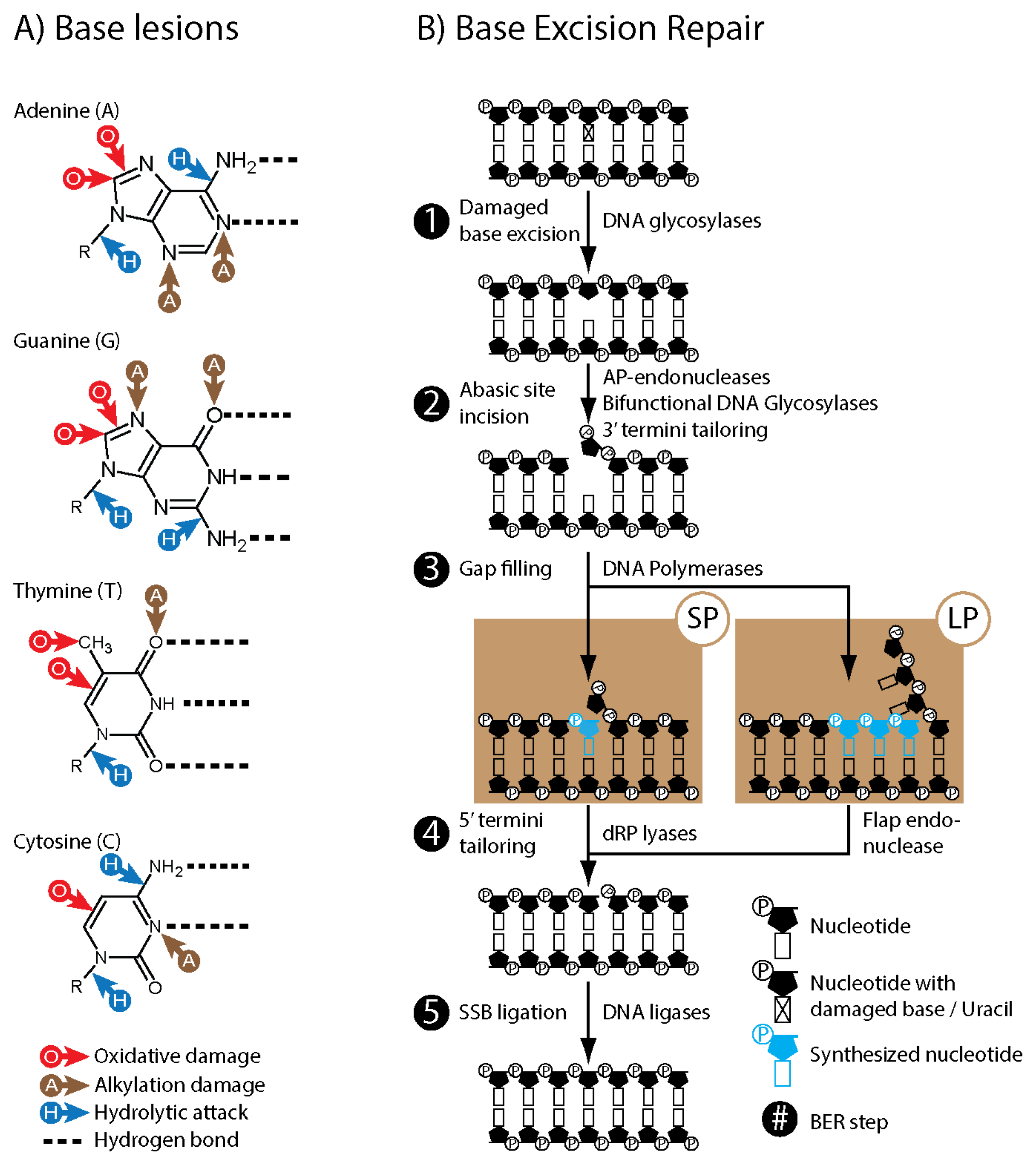
<p>DNA base degradation occurs spontaneously through hydrolysis as well as through interaction with reactive molecules. Endogenous alkylating agents such as <italic>S</italic>-Adenosyl methionine and exogenous agents such as chemotherapeutic agents and cigarette smoke metabolites add methyl groups to the nitrogens and oxygens of purines and pyrimidines (<xref ref-type="fig" rid="f1-ijms-13-17210">Figure 1</xref>; panel A). Reactive oxygen species (ROS) generated, e.g., endogenously by the electron transport chain in mitochondria, or by ionizing and UV irradiation, typically add hydroxyl groups to double bonded carbons within purines and pyrimidines, as well as the sugar-phosphate DNA backbone causing strand breaks (<xref ref-type="fig" rid="f1-ijms-13-17210">Figure 1</xref>; panel A). Loss of bases and base lesions that alter base pairing properties of DNA are potentially mutagenic and toxic, and merely spontaneous hydrolysis of bases in DNA is estimated to happen more than 18,000 times per cell per day [<xref ref-type="bibr" rid="b11-ijms-13-17210">11</xref>]. Despite this high number of DNA damage, the rate of somatic mutations in humans has been estimated to be 10<sup>−6</sup> per cell division [<xref ref-type="bibr" rid="b12-ijms-13-17210">12</xref>]. The majority of the damaged bases are removed and replaced through BER. Although BER comprises several sub-pathways, it can be generally summarized as five enzymatic steps (<xref ref-type="fig" rid="f1-ijms-13-17210">Figure 1</xref>; panel B). First the <italic>N</italic>-glycosidic bond of the damaged base is cleaved by a DNA glycosylase leaving an abasic site in the DNA. The sugar-phosphate backbone of the abasic site is then cleaved by a bi-functional glycosylase and/or an AP-endonuclease. If necessary the 3’ strand break end is converted to hydroxyl allowing DNA polymerases to reinsert new bases. Synthesis of a single base is referred to as short patch (SP) BER and synthesis of several bases is referred to as long patch (LP) BER. The 5’ single strand end of the single strand break intermediate is then processed to allow for ligation by DNA ligases. In addition to base damage, the BER pathway is also involved in the repair of abasic sites and single strand breaks that are generated independently of glycosylases and/or AP-endonucleases, such as DNA sugar-phosphate backbone cleavage by ROS or spontaneous hydrolysis of the <italic>N</italic>-glycosidic bond.</p></sec>
<sec>
<title>3. XRCC1 Structure and Protein Interacting Regions</title>
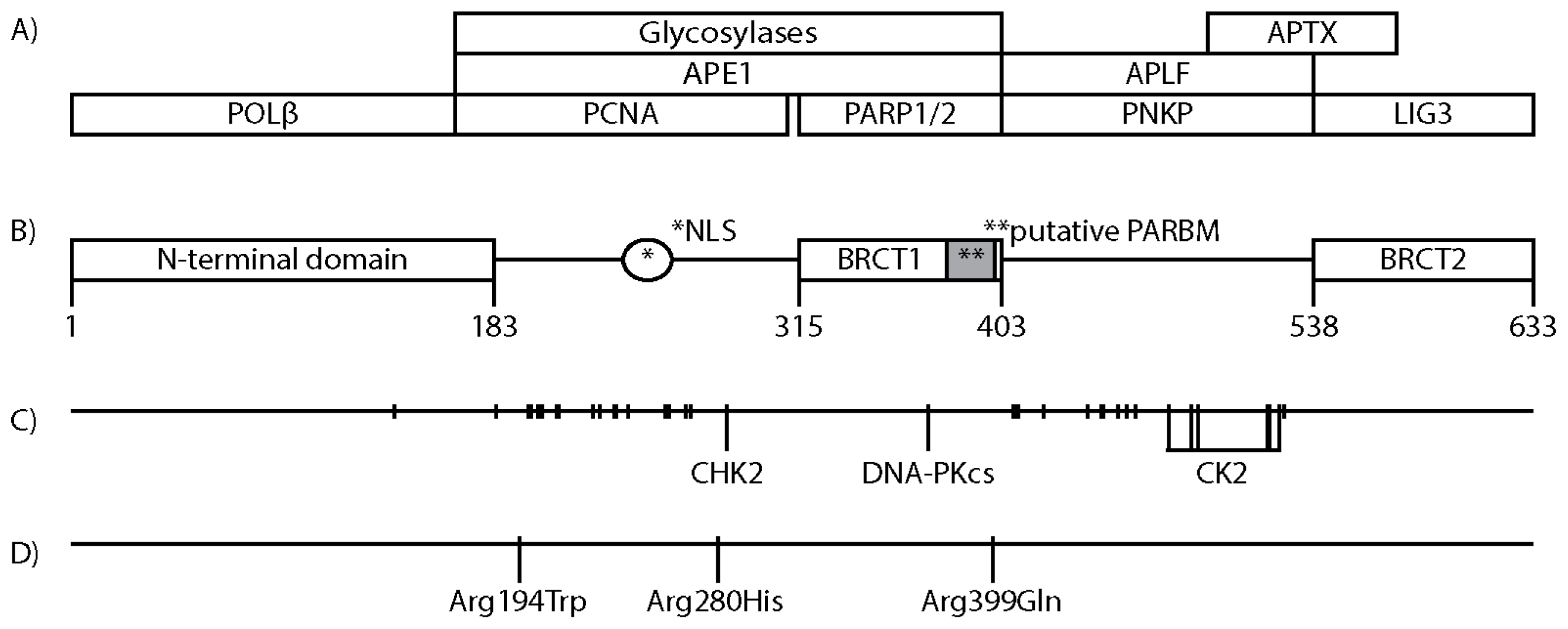
<p>The human <italic>Xrcc1</italic> gene is 33 kilobases long and located on chromosome 19q13.3–13.3 (Ensembl ID: ENSG00000073050). Its product XRCC1 is a 633 amino acid (aa) long protein of approximately 70 kDa (Uniprot ID: p18887) that is translocated to the nucleus by a nuclear localisation signal (NLS) located between aa 239 and aa 266 (<xref ref-type="fig" rid="f2-ijms-13-17210">Figure 2</xref>; panel B) [<xref ref-type="bibr" rid="b13-ijms-13-17210">13</xref>]. XRCC1 is partially excluded from nucleolus and accumulate into discrete foci depending on cell cycle phase and cellular stress [<xref ref-type="bibr" rid="b14-ijms-13-17210">14</xref>–<xref ref-type="bibr" rid="b16-ijms-13-17210">16</xref>].</p>
<p>The region spanning from aa 1 to aa 183, commonly referred to as <italic>N</italic>-terminal domain (NTD), binds DNA polymerase beta (POL<italic>β</italic>) with high affinity (<xref ref-type="fig" rid="f2-ijms-13-17210">Figure 2</xref>; panels A and B) [<xref ref-type="bibr" rid="b17-ijms-13-17210">17</xref>,<xref ref-type="bibr" rid="b18-ijms-13-17210">18</xref>]. Nuclear magnetic resonance (NMR) crystallography of the NTD and POL<italic>β</italic> has indicated that they form a sandwich like structure that surrounds gapped DNA, suggesting that the NTD might tether XRCC1 to, and protect BER intermediates [<xref ref-type="bibr" rid="b19-ijms-13-17210">19</xref>,<xref ref-type="bibr" rid="b20-ijms-13-17210">20</xref>]. However, recent NMR studies suggests that POL<italic>β</italic> interacts with an oxidized form of NTD in a manner that excludes XRCC1 interaction with gapped DNA [<xref ref-type="bibr" rid="b21-ijms-13-17210">21</xref>]. The interaction with XRCC1 stabilizes POL<italic>β</italic> by protecting POL<italic>β</italic> from degradation, and is required for POL<italic>β</italic> recruitment to DNA damage [<xref ref-type="bibr" rid="b16-ijms-13-17210">16</xref>,<xref ref-type="bibr" rid="b22-ijms-13-17210">22</xref>].</p>
<p>XRCC1 lacks proliferating cell nuclear antigen (PCNA) interaction motifs such as the PCNA interacting peptide box or AlkB homologue 2 PCNA-interacting motif [<xref ref-type="bibr" rid="b23-ijms-13-17210">23</xref>,<xref ref-type="bibr" rid="b24-ijms-13-17210">24</xref>]. However, the region spanning from aa 166 to aa 310 of purified recombinant XRCC1 has been demonstrated to interact with purified recombinant PCNA (<xref ref-type="fig" rid="f2-ijms-13-17210">Figure 2</xref>; panels A and B) [<xref ref-type="bibr" rid="b14-ijms-13-17210">14</xref>].</p>
<p>The aa 166 to aa 403 region of XRCC1 interacts with nei endonuclease VIII-like 2 (NIEL2), nth endonuclease III-like 1 (NTH1), 8-oxoguanine DNA glycosylase (OGG1), and Uracil-DNA glycosylase 2 (UNG2) [<xref ref-type="bibr" rid="b15-ijms-13-17210">15</xref>,<xref ref-type="bibr" rid="b25-ijms-13-17210">25</xref>,<xref ref-type="bibr" rid="b26-ijms-13-17210">26</xref>]. Furthermore repair activity assays indicate that N-methylpurine DNA glycosylase (MPG) binds within the aa 1 to aa 406 region of XRCC1, although this was not confirmed by immunoblotting [<xref ref-type="bibr" rid="b26-ijms-13-17210">26</xref>]. Together, these results indicate that the aa 166 to aa 403 is a central DNA glycosylase interacting region of XRCC1 (<xref ref-type="fig" rid="f2-ijms-13-17210">Figure 2</xref>; panels A and B). In addition, the aa 166 to aa 403 region of XRCC1 appears to interact with APE1 [<xref ref-type="bibr" rid="b25-ijms-13-17210">25</xref>,<xref ref-type="bibr" rid="b27-ijms-13-17210">27</xref>]. XRCC1 stimulates the activities of recombinant NTH1, OGG1, MPG and APE1 [<xref ref-type="bibr" rid="b25-ijms-13-17210">25</xref>–<xref ref-type="bibr" rid="b27-ijms-13-17210">27</xref>].</p>
<p>The XRCC1 protein sequence includes two BRCA 1 <italic>C</italic> terminus (BRCT) domains. One is located centrally, BRCT1 aa 315 to aa 403, and one <italic>C</italic>-terminally, BRCT2 aa 538 to aa 633 (<xref ref-type="fig" rid="f2-ijms-13-17210">Figure 2</xref>; panel B). BRCT domains are predominantly found among proteins involved in DNA damage response (DDR), and appears to act as phosphorylation dependent protein interaction domains [<xref ref-type="bibr" rid="b28-ijms-13-17210">28</xref>]. Of the two XRCC1 BRCT domains, BRCT1 is the most evolutionary conserved and is required for efficient DNA repair and proliferation after DNA methylation damage [<xref ref-type="bibr" rid="b29-ijms-13-17210">29</xref>,<xref ref-type="bibr" rid="b30-ijms-13-17210">30</xref>]. Merely the NLS and BRCT1 domain (aa 166 to 436) is sufficient to improve the repair proficiency of methylation induced damage of XRCC1 deficient EM9 CHO [<xref ref-type="bibr" rid="b31-ijms-13-17210">31</xref>]. XRCC1 BRCT1 interacts with the BRCT domain of Poly(ADP-ribosyl) polymerase 1 (PARP1), with Poly(ADP-ribosyl) polymerase 2 (PARP2), and encompasses a putative Poly(ADP-ribose) binding motif (PARBM: aa 379 to aa 400) (<xref ref-type="fig" rid="f2-ijms-13-17210">Figure 2</xref>; panels A and B) [<xref ref-type="bibr" rid="b13-ijms-13-17210">13</xref>,<xref ref-type="bibr" rid="b32-ijms-13-17210">32</xref>,<xref ref-type="bibr" rid="b33-ijms-13-17210">33</xref>]. The BRCT2 domain of XRCC1 binds the BRCT domain of Ligase 3 (LIG3) [<xref ref-type="bibr" rid="b34-ijms-13-17210">34</xref>,<xref ref-type="bibr" rid="b35-ijms-13-17210">35</xref>] and, similar to XRCC1 interaction with POL<italic>β</italic>, this interaction stabilizes the expression levels of LIG3 (<xref ref-type="fig" rid="f2-ijms-13-17210">Figure 2</xref>; panels A and B) [<xref ref-type="bibr" rid="b36-ijms-13-17210">36</xref>]. The XRCC1 BRCT domains also serve as inter-XRCC1 interaction modules, although their respective contribution is still somewhat unclear. Beernink <italic>et al.</italic> reported in 2005 that XRCC1 BRCT1 domains could form a heterotetrameric interaction with PARP1, while BRCT2 domains could dimerize directly [<xref ref-type="bibr" rid="b37-ijms-13-17210">37</xref>]. In 2006, Lévy <italic>et al.</italic> reported that XRCC1 dimerization was formed through BRCT1 domains and not BRCT2 [<xref ref-type="bibr" rid="b38-ijms-13-17210">38</xref>]. In 2011, Cuneo <italic>et al.</italic> reported a crystallographically resolved structure of a XRCC1/LIG3 tetramer with interaction between the XRCC1 BRCT2 domains [<xref ref-type="bibr" rid="b39-ijms-13-17210">39</xref>]. Although the details on how XRCC1 forms multimers are diverging, interaction between XRCC1 deletion mutants containing only BRCT1 as well as both BRCT domains have been confirmed <italic>in vivo</italic> by fluorescence resonsance energy transfer (FRET) [<xref ref-type="bibr" rid="b14-ijms-13-17210">14</xref>,<xref ref-type="bibr" rid="b31-ijms-13-17210">31</xref>].</p>
<p>The region between the two XRCC1 BRCT domains (aa 403 to aa 538) interacts with the forkhead-associated (FHA) domains of aprataxin (APTX), polynucleotide kinase/phosphatase (PNKP), and aprataxin and PNKP like factor (APLF) (<xref ref-type="fig" rid="f2-ijms-13-17210">Figure 2</xref>; panels A and B) [<xref ref-type="bibr" rid="b40-ijms-13-17210">40</xref>–<xref ref-type="bibr" rid="b45-ijms-13-17210">45</xref>]. FHA domains are involved in protein/protein interactions through phospho-threonine binding, and are found in more than 700 eukaryotic proteins such as kinases, phosphatases, kinesins, transcription factors, RNA binding proteins and metabolic enzymes [<xref ref-type="bibr" rid="b46-ijms-13-17210">46</xref>]. Interaction with XRCC1 stimulates both the phosphatase and kinase activities of recombinant PNKP [<xref ref-type="bibr" rid="b47-ijms-13-17210">47</xref>].</p></sec>
<sec>
<title>4. Posttranslational Modifications of XRCC1</title>
<p>The most prominent posttranslational modifications (PTM) of XRCC1, and BER proteins in general, known to date are phosphorylations [<xref ref-type="bibr" rid="b48-ijms-13-17210">48</xref>]. XRCC1 is a heavily phosphorylated protein with more than 30 phosphorylated Ser/Thr residues (PhosphoSitePlus database, search term “XRCC1”; p18887. Last accessed 31th October 2012. <ext-link xlink:href="http://www.phosphosite.org" ext-link-type="uri">http://www.phosphosite.org</ext-link>) (<xref ref-type="fig" rid="f2-ijms-13-17210">Figure 2</xref>; panel C). Ser371 within BRCT1 has been shown to be phosphorylated <italic>in vivo</italic> by DNA-PKcs upon ionizing irradiation induced DNA damage, and to cause XRCC1 dimer dissociation <italic>in vitro</italic>[<xref ref-type="bibr" rid="b38-ijms-13-17210">38</xref>]. However, all other verified phosphorylations of XRCC1 cluster outside of the BRCT domains, mainly within the regions between the NTD and BRCT1 (aa 183 to aa 315), and in the inter BRCT region (aa 403 to aa 538). Checkpoint kinase 2 (CHK2) complexes with XRCC1 and phosphorylates Thr284. XRCC1 mutated at Thr284 was suggested to be linked to accumulation of BER intermediates possibly through modification of XRCC1s interaction with DNA glycosylases [<xref ref-type="bibr" rid="b49-ijms-13-17210">49</xref>]. Of the known kinase interactions with XRCC1, casein kinase 2 (CK2) is the most extensively documented. CK2 is a pleiotropic, ubiquitous, and constitutively active kinase. CK2 phosphorylates hundreds of different substrates and among them several factors known to be associated with cellular stress responses, cell proliferation, and cancerogenesis, such as nuclear factor kappa light chain enhancer of activated B cells (NF-kappaB). CK2 expression is up regulated in a wide variety of human cancers and has become an interesting target for drug design [<xref ref-type="bibr" rid="b50-ijms-13-17210">50</xref>]. The region between the BRCT domains of XRCC1 encompasses eight primary and five atypical consensus sites for CK2, and they are readily phosphorylated by CK2 <italic>in vitro</italic>[<xref ref-type="bibr" rid="b42-ijms-13-17210">42</xref>]. Nine of the Ser/Thr residues were observed to be phosphorylated <italic>in vivo</italic>, and among them six residues close to BRCT2 showed reduced phosphorylation when CK2 was knocked down (<xref ref-type="fig" rid="f2-ijms-13-17210">Figure 2</xref>; panel C) [<xref ref-type="bibr" rid="b42-ijms-13-17210">42</xref>,<xref ref-type="bibr" rid="b43-ijms-13-17210">43</xref>]. Phosphorylations of residues in the inter BRCT region stimulate binding of XRCC1 to the FHA domains of APTX, PNKP, APLF [<xref ref-type="bibr" rid="b40-ijms-13-17210">40</xref>–<xref ref-type="bibr" rid="b45-ijms-13-17210">45</xref>].</p></sec>
<sec>
<title>5. XRCC1 Multiprotein Complexes</title>
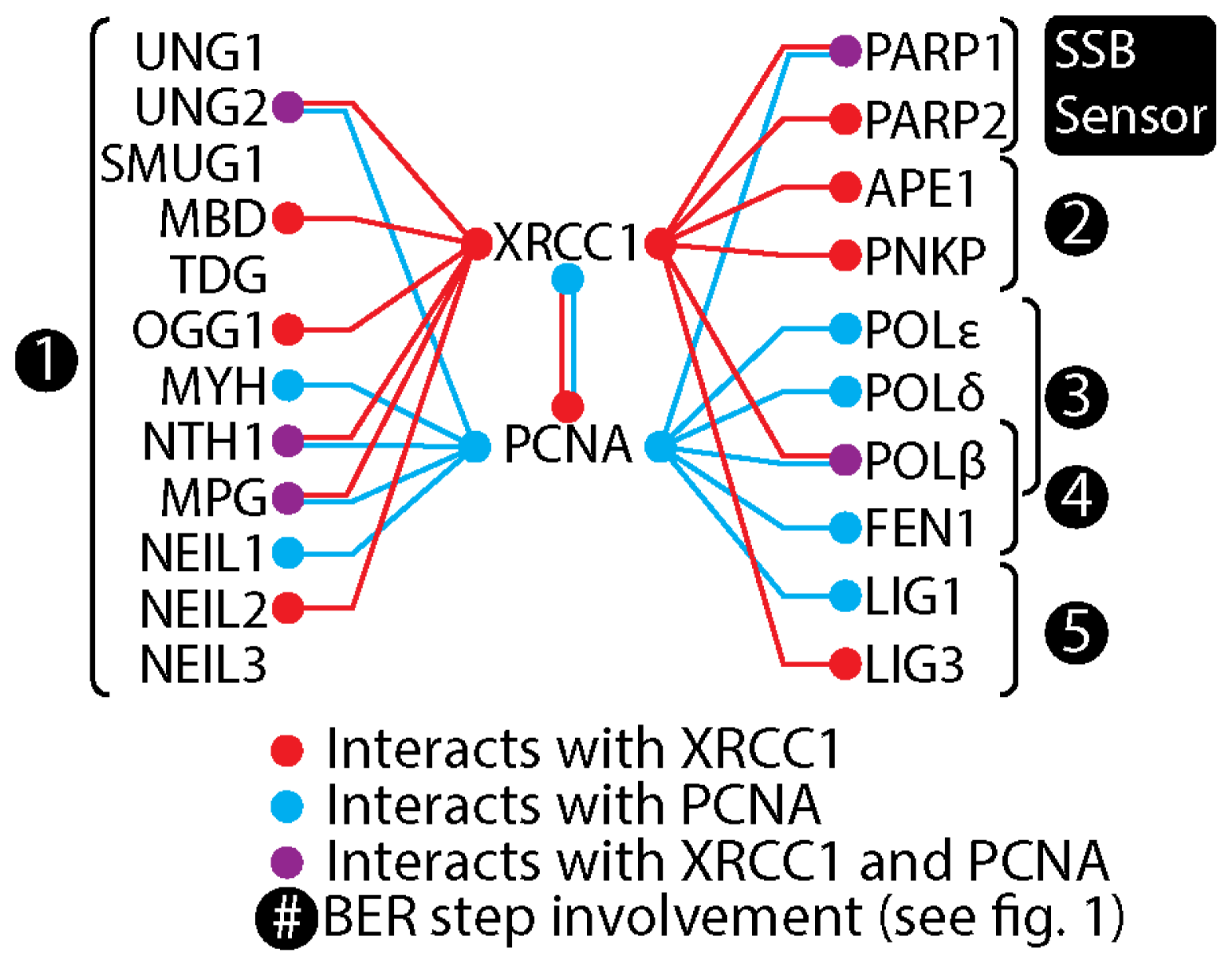
<p>With the exception of POL<italic>β</italic> and LIG3, the remaining XRCC1 binding proteins show extensive overlap in their binding epitopes. Furthermore, only the POL<italic>β</italic> and LIG3 interactions are considered strong. This has lead to the notion that XRCC1 contributes to BER as a co-factor or temporary docking platform through a succession of interactions and enzymatic events. However, the dimeric interactions between XRCC1 BRCT domains and heterotetrameric assembly of XRCC1 with either PARP1 or LIG3 observed <italic>in vitro</italic> as well as by FRET suggest that XRCC1 complexes may be able to contain many factors [<xref ref-type="bibr" rid="b14-ijms-13-17210">14</xref>,<xref ref-type="bibr" rid="b37-ijms-13-17210">37</xref>–<xref ref-type="bibr" rid="b39-ijms-13-17210">39</xref>]. The assembly of large multiprotein complexes is plausible because many of the XRCC1 interacting proteins have been shown to interact among themselves (reviewed in [<xref ref-type="bibr" rid="b48-ijms-13-17210">48</xref>]). In addition, XRCC1 interacts with PCNA, a well-known scaffolding protein (<xref ref-type="fig" rid="f3-ijms-13-17210">Figure 3</xref>).</p>
<p>In 2004 results from our group indicated the presence of large BER proficient multiprotein complexes as UNG2 co-immunoprecipitated with PCNA, XRCC1, and other proteins that bind both XRCC1 and PCNA [<xref ref-type="bibr" rid="b51-ijms-13-17210">51</xref>]. Similarly Heale <italic>et al.</italic>, and Parlanti <italic>et al.</italic> detected XRCC1 in multiprotein complexes associated with Condensin 1 and Cyclin A, in addition to proteins that are not known to interact directly with XRCC1, (e.g., POL<italic>δ</italic>, POL<italic>ε</italic>, and FEN1) [<xref ref-type="bibr" rid="b52-ijms-13-17210">52</xref>,<xref ref-type="bibr" rid="b53-ijms-13-17210">53</xref>]. However, co-immunoprecipitation results only suggest the presence of multiprotein complexes as protein interactions may form after cell lysis. The presence of XRCC1 associated multiprotein complexes containing proteins that have overlapping interaction regions within XRCC1 (PCNA and PARP1 <italic>vs</italic>. UNG2 and APE1) were confirmed by mild <italic>in vivo</italic> formaldehyde crosslinking prior to co-immunoprecipitation studies. Furthermore, proteins with no known interaction with XRCC1 (POL<italic>δ</italic> and FEN1) were also found in these complexes [<xref ref-type="bibr" rid="b15-ijms-13-17210">15</xref>]. Gel fractionation of cell extracts confirmed the presence of large XRCC1 complexes of various compositions and sizes ranging from 150 to 1500 kDa. The highest BER activity was found in complexes isolated from fractionated extracts ranging in size from 350 to 700 kDa [<xref ref-type="bibr" rid="b16-ijms-13-17210">16</xref>]. <italic>In vitro</italic> studies of interactions between BER enzymes and their DNA substrates indicate that the enzymes stay bound to their product, preventing genotoxic and mutagenic effects of repair intermediates before handing them over to the next enzyme [<xref ref-type="bibr" rid="b54-ijms-13-17210">54</xref>]. Multiprotein BER complexes could contribute to tethering of factors to the lesions and repair intermediates and thus provide a platform for coordinated progression of repair, and also increase the rate of repair.</p></sec>
<sec>
<title>6. The Composition of XRCC1 Associated Multiprotein Complexes</title>
<p>The involvement of replication factors such as POL<italic>δ</italic>, POL<italic>ε</italic>, FEN1, and PCNA in LP BER, and the deleterious effects of replication past SSBs and certain base lesions have long suggested the presence of replication-coupled BER/SSBR [<xref ref-type="bibr" rid="b17-ijms-13-17210">17</xref>,<xref ref-type="bibr" rid="b55-ijms-13-17210">55</xref>,<xref ref-type="bibr" rid="b56-ijms-13-17210">56</xref>]. The presence of XRCC1 in replication foci and its co-immunoprecipitation with Cyclin A associated proteins further suggest a role for XRCC1 in replication associated repair [<xref ref-type="bibr" rid="b14-ijms-13-17210">14</xref>,<xref ref-type="bibr" rid="b53-ijms-13-17210">53</xref>]. More recent co-immunoprecipitation data from XRCC1 associated and UNG2 associated complexes isolated from S-phase enriched cells, demonstrated that these complexes contained both common and separate factors. Colocalization studies showed that XRCC1, PNKP and POl<italic>β</italic> were found both within and outside of replication foci, while UNG2 was only found in association with the replication machinery. Additionally, the different complexes showed different BER proficiencies. XRCC1-associated complexes were far more efficient in BER than UNG2-associated complexes, indicating the presence of distinct BER complexes during S-phase [<xref ref-type="bibr" rid="b15-ijms-13-17210">15</xref>,<xref ref-type="bibr" rid="b16-ijms-13-17210">16</xref>].</p>
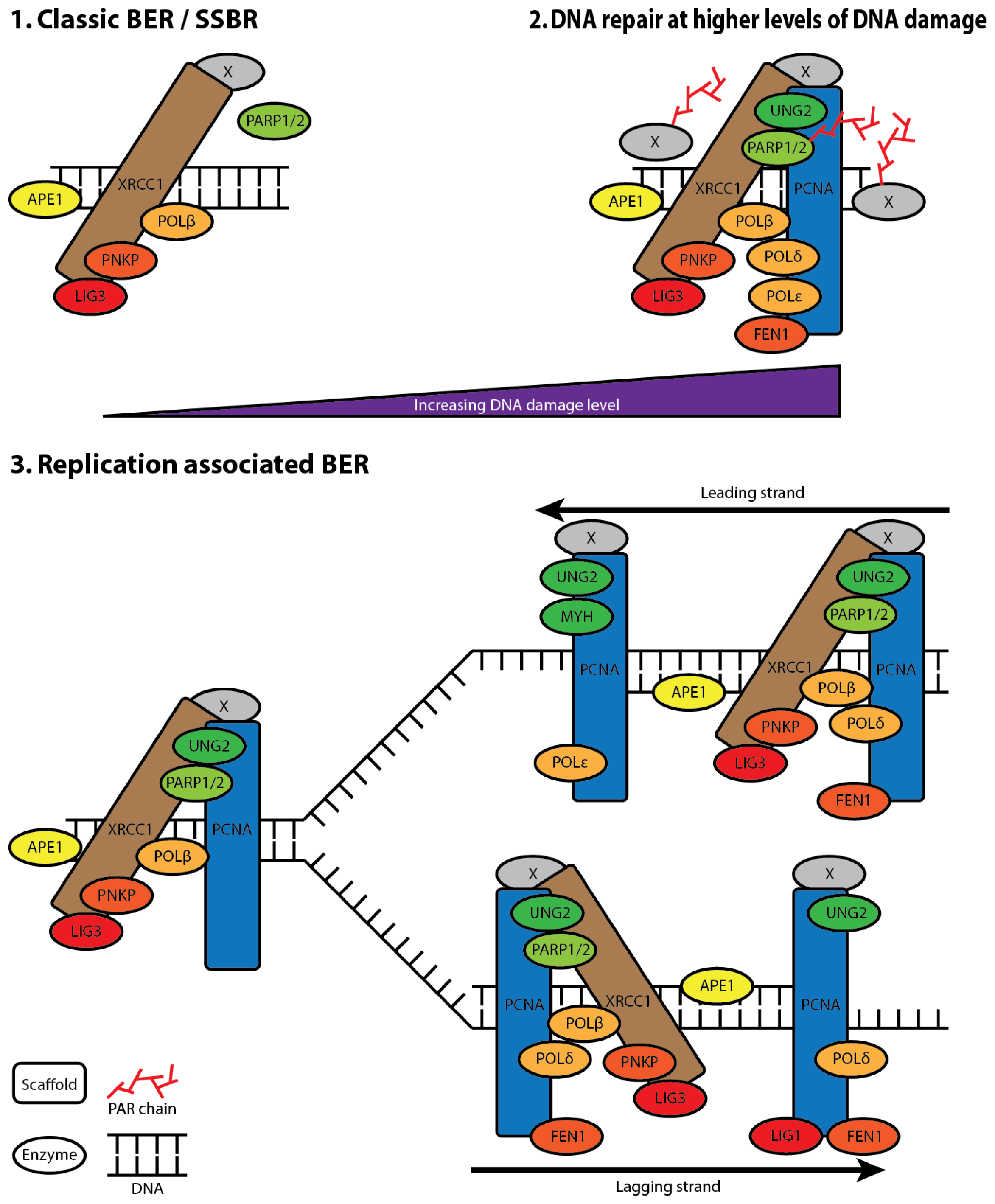
<p>We have found that the repertoire of proteins recruited to near-UVA (405 nm) induced DNA damage is highly dependent on the radiation dose. Low doses result in recruitment of BER factors that are also observed in foci independent of exogenously induced DNA damage, e.g., PNKP, and POL<italic>β</italic>, while high doses in addition resulted in the recruitment of PCNA and FEN1 [<xref ref-type="bibr" rid="b16-ijms-13-17210">16</xref>]. In sum, these observations suggest the presence of a “XRCC1 core complex” associated with the replication machinery as well as sites of endogenously and exogenously induced DNA damage (<xref ref-type="fig" rid="f4-ijms-13-17210">Figure 4</xref>).</p>
<p>The strong interaction between XRCC1 and LIG3 and the observed AP-endonuclease activity of low mass XRCC1 associated complexes indicate that the core complex in addition to PNKP and POL<italic>β</italic> also contains LIG3 and APE1 [<xref ref-type="bibr" rid="b15-ijms-13-17210">15</xref>,<xref ref-type="bibr" rid="b16-ijms-13-17210">16</xref>,<xref ref-type="bibr" rid="b57-ijms-13-17210">57</xref>,<xref ref-type="bibr" rid="b58-ijms-13-17210">58</xref>]. The core complex is extended to include proteins involved in replication, LP BER, and other repair pathways when levels of damage reach a certain threshold. However, while the presence of XRCC1 reduces the near-UVA micro-irradiation doses required for PCNA recruitment, PCNA is recruited to DNA damage in XRCC1 deficient EM9 CHO cells, indicating the involvement of PCNA in DDRs that are independent of XRCC1 [<xref ref-type="bibr" rid="b16-ijms-13-17210">16</xref>,<xref ref-type="bibr" rid="b31-ijms-13-17210">31</xref>].</p>
<p>PCNA is a central scaffolding protein in the replication machinery as well as in LP BER, and several BER proteins have been demonstrated to co-immunoprecipitate with PCNA (<xref ref-type="fig" rid="f3-ijms-13-17210">Figure 3</xref>) [<xref ref-type="bibr" rid="b14-ijms-13-17210">14</xref>,<xref ref-type="bibr" rid="b56-ijms-13-17210">56</xref>,<xref ref-type="bibr" rid="b59-ijms-13-17210">59</xref>–<xref ref-type="bibr" rid="b69-ijms-13-17210">69</xref>]. Interestingly, while the aa 166 to aa 310 region of XRCC1 is required for co-immunoprecipitation of XRCC1 and PCNA, it is not required for colocalization of XRCC1 with PCNA in replication foci during S-phase. The colocalization with PCNA in replication foci requires the aa 310 to aa 436 region, which includes the BRCT1 domain, suggesting that XRCC1 may be recruited to the replication foci via interaction with proteins other than PCNA [<xref ref-type="bibr" rid="b14-ijms-13-17210">14</xref>,<xref ref-type="bibr" rid="b31-ijms-13-17210">31</xref>]. PARP1, MPG, and UNG2 are all found in replication foci, interact with PCNA, and within or partially with the aa 310 to aa 436 region of XRCC1 [<xref ref-type="bibr" rid="b13-ijms-13-17210">13</xref>,<xref ref-type="bibr" rid="b15-ijms-13-17210">15</xref>,<xref ref-type="bibr" rid="b26-ijms-13-17210">26</xref>,<xref ref-type="bibr" rid="b56-ijms-13-17210">56</xref>,<xref ref-type="bibr" rid="b66-ijms-13-17210">66</xref>,<xref ref-type="bibr" rid="b70-ijms-13-17210">70</xref>].</p></sec>
<sec>
<title>7. XRCC1 Recruitment to DNA Damage</title>
<p>To date, eleven DNA glycosylases have been identified in humans [<xref ref-type="bibr" rid="b71-ijms-13-17210">71</xref>] (The URL cited in this article is erroneous. An updated table based on this article is available at the following URL, last accessed 18th October 2012. <ext-link xlink:href="http://sciencepark.mdanderson.org/labs/wood/DNARepairGenes.html#HumanDNARepairGenes" ext-link-type="uri">http://sciencepark.mdanderson.org/labs/wood/DNARepairGenes.html#HumanDNARepairGenes</ext-link>). Although the overall folding architectures of DNA glycosylases are similar, their substrate specificities are generally different. How DNA glycosylases are able to detect or get recruited to the plethora of different damaged bases buried within the DNA double helix and chromatin remains elusive, but it involves association to replication, and possibly transcription [<xref ref-type="bibr" rid="b72-ijms-13-17210">72</xref>]. We have not been able to induce intracellular re-location of UNG2, MPG or OGG1 to near-UVA micro-irradiated regions, or detect their presence in constitutively present XRCC1 foci, suggesting that these glycosylases are not recruited together with XRCC1. However, this is difficult to assess as most methods for generation of base lesion produce a variety of different lesions that are substrates to different DNA glycosylases, as well as strand breaks that are sensed by PARPs.</p>
<p>Recruitment of XRCC1 to near-UVA micro-irradiated regions of the nucleus is strongly influenced by the aa 166 to aa 310 region and depends on the presence of the BRCT1 domain (aa 315 to aa 403) [<xref ref-type="bibr" rid="b31-ijms-13-17210">31</xref>]. While DNA glycosylases interact with both regions, PARP1 and PARP2 interact with XRCC1 within the BRCT1 domain [<xref ref-type="bibr" rid="b13-ijms-13-17210">13</xref>,<xref ref-type="bibr" rid="b33-ijms-13-17210">33</xref>]. PARP1 and PARP2 bind to and get activated by SSBs [<xref ref-type="bibr" rid="b73-ijms-13-17210">73</xref>,<xref ref-type="bibr" rid="b74-ijms-13-17210">74</xref>]. Upon activation, PARP1 and PARP2 synthesize branched chains of up to 200 ADP-ribose moieties on themselves and many other target proteins. Poly(ADP)ribose (PAR) chains are rapidly disassembled by PAR glycohydrolase, making PARylation a transient event that last only minutes [<xref ref-type="bibr" rid="b75-ijms-13-17210">75</xref>]. The ADP-ribose units are negatively charged and PAR chains thus potentially cause both steric and charge interactions with other molecules [<xref ref-type="bibr" rid="b76-ijms-13-17210">76</xref>]. PARylation of histones in response to DNA damage contributes to chromatin reorganization, and PAR chains mediate signalling of the genomic state and serves as recruitment platforms for other proteins [<xref ref-type="bibr" rid="b77-ijms-13-17210">77</xref>]. Three PAR association motifs have been described: a macrodomain, a PAR-binding Zinc finger motif, and a cluster of eight amino acids rich in acidic and hydrophobic residues (PARBM). Together these PAR association domains interact with more than 300 proteins, among which DDR proteins are overrepresented in addition to many DNA replication and transcription factors [<xref ref-type="bibr" rid="b78-ijms-13-17210">78</xref>]. In addition to the reported PARP1 and PARP2 interaction, a putative PARBM have been identified within the XRCC1 BRCT1 domain, making both PARP1 and PARP2, and PAR chains plausible candidates as initiators of XRCC1 complex recruitment to SSB [<xref ref-type="bibr" rid="b13-ijms-13-17210">13</xref>,<xref ref-type="bibr" rid="b32-ijms-13-17210">32</xref>]. In 2003 El-Khamisy <italic>et al.</italic> reported abrogation of XRCC1 foci formation by inhibition of PARylation, and foci reduction by point mutation within the putative PARBM in BRCT1, suggesting that XRCC1 recruitment to SSB is primarily mediated through interaction with PAR chains rather than PARP1 [<xref ref-type="bibr" rid="b79-ijms-13-17210">79</xref>]. This was later supported by Mortusewicz <italic>et al.</italic> and Godon <italic>et al.</italic> who observed strong reduction of XRCC1 recruitment and increased PARP1 accumulation in near-UVA microirradiation induced foci by inactivation of PARP1s PARylation domain or by use of PARylation inhibitor 4-AN (4-amino-1, 8-naphtalimide; CAS: 1742-95-6 ) [<xref ref-type="bibr" rid="b80-ijms-13-17210">80</xref>,<xref ref-type="bibr" rid="b81-ijms-13-17210">81</xref>]. However, in our hands treatment with 4-AN or the structurally unrelated PARylation inhibitor PJ34 (CAS: 344458-15-7) caused only minor reduction in XRCC1 recruitment to low dose near-UVA micro-irradiated regions of the nucleus [<xref ref-type="bibr" rid="b16-ijms-13-17210">16</xref>]. While XRCC1 accumulation did not coencide with increased accumulation of non-PARylated PARP1, confirming that XRCC1 recruitment is independent of direct interaction with non-PARylated PARP1, they do not support the notion that PARylation activity or PAR chains are required for XRCC1 recruitment to SSBs. The slight reduction of XRCC1 recruitment upon 4-AN and PJ34 treatment might rather be mediated by indirect mechanisms such as PARylation mediated chromatin reorganization.</p></sec>
<sec>
<title>8. XRCC1 Variants</title>
<p>XRCC1’s role as a scaffolding protein in BER and its observed effect on the activity of certain BER factors have prompted a number of studies assessing the influence of the three most prevalent XRCC1 polymorphisms Arg194Trp (rs1799782), Arg280His (rs25489), and Arg399Gln (rs25487) on genomic stability (<xref ref-type="fig" rid="f2-ijms-13-17210">Figure 2</xref>; panel D) (summary available in [<xref ref-type="bibr" rid="b82-ijms-13-17210">82</xref>]). Studies of primary cells from individuals carrying XRCC1 polymorphisms commonly involve DNA damage induction in heterozygous lymphocytes by alkylating-, oxidizing-, strand break inducing- agents or by ionizing radiation followed by measurement of markers of genome instability such as SCE and micronuclei formation. These studies are limited by sample sizes, and therefore difficult to interpret. Most agents used to induce base lesions also produce lesions or lesion clusters that involve other DNA repair pathways such as NER, trans-lesion synthesis, and double strand break repair (DSBR). Furthermore, dysregulation of any DNA repair mechanism that resolve or intermediately produce strand breaks can be associated with genomic fragmentation and thus influence the studied markers of genomic instability. However, the studies in sum suggest that the Arg194Trp variant is associated with increased genomic stability in response to DNA damaging agents, whereas the Arg280His and Arg399Gln variants are associated with reduced genomic stability (details are available in <xref ref-type="table" rid="t1-ijms-13-17210">Table 1</xref> of [<xref ref-type="bibr" rid="b82-ijms-13-17210">82</xref>]). Altered BER efficiency caused by XRCC1 polymorphisms might be mediated by changes in protein-protein interactions, XRCC1 recruitment, or XRCC1 influence on BER enzyme activities. <italic>In vivo</italic> studies of XCC1 deficient EM9 CHO expressing polymorphic XRCC1 constructs demonstrated that Arg280His and Arg399Gln XRCC1, respectively accumulate less into and dissociates faster from near-UVA micro-irradiation induced DNA damage. Single cell gel electrophoresis indicated that these variants had subtle differences in their repair profiles of oxidative damage induced by hydrogen peroxide, supporting that small changes in the scaffolding properties of XRCC1 may affect DNA repair and thus genomic stability [<xref ref-type="bibr" rid="b31-ijms-13-17210">31</xref>,<xref ref-type="bibr" rid="b83-ijms-13-17210">83</xref>].</p></sec>
<sec>
<title>9. XRCC1 and Disease</title>
<p>Base lesions, abasic sites and single strand breaks are relatively common DNA lesions because they are generated continuously by endogenous reactive agents, erroneous DNA processing/synthesis, as well as spontaneously. Minor changes in BER efficiency that alter genomic stability can potentially have a big impact on cancer risk. The Arg194Trp, Arg280His, and Arg399Gln XRCC1 variants have been extensively studied in relation to cancer. However, metastudies of the epidemiological datasets have so far not yielded any unambiguous relationships to cancer prevalence [<xref ref-type="bibr" rid="b84-ijms-13-17210">84</xref>–<xref ref-type="bibr" rid="b87-ijms-13-17210">87</xref>]. This is probably a result of both the size of populations included in the specific epidemiological studies and significant differences in the genomic single nucleotide polymorphism (SNP) distribution between studied populations (<xref ref-type="table" rid="t1-ijms-13-17210">Table 1</xref>). For example, homozygous Arg280His has been observed to be associated with breast cancer in Asians, but not in Caucasians [<xref ref-type="bibr" rid="b88-ijms-13-17210">88</xref>]. Homozygous Arg194Trp increases risk of lung cancer in Asians, whereas heterozygous Arg194Trp in Caucasians reduces the risk [<xref ref-type="bibr" rid="b89-ijms-13-17210">89</xref>]. However, more data regarding XRCC1 and cancer susceptibility is published weekly, and in a recent meta-analysis the Arg399Gln variant was found to be associated with increased risk of developing breast cancer [<xref ref-type="bibr" rid="b90-ijms-13-17210">90</xref>].</p>
<p>DNA synthesis and ligation require 3’ hydroxyl and 5’ phosphate ends. The repair of SSB and BER intermediates typically involve DNA-end processing enzymes, and many have been demonstrated to interact directly or indirectly with XRCC1; e.g., APTX and TDP1, respectively involved in processing 5’ ends produced by abortive ligation, and 3’ ends produced by abortive double stranded unwinding by Topoisomerase 1 [<xref ref-type="bibr" rid="b45-ijms-13-17210">45</xref>,<xref ref-type="bibr" rid="b91-ijms-13-17210">91</xref>,<xref ref-type="bibr" rid="b92-ijms-13-17210">92</xref>]. Mutations in the catalytic domains of TDP1 and APTX are associated with subtypes of the neurodegenerative disease spinocerebellar ataxia [<xref ref-type="bibr" rid="b91-ijms-13-17210">91</xref>,<xref ref-type="bibr" rid="b93-ijms-13-17210">93</xref>,<xref ref-type="bibr" rid="b94-ijms-13-17210">94</xref>]. As previously mentioned, the phosophorylation status of the inter BRCT domain region of XRCC1 (aa 403 to 538) influences the interaction with the FHA domains of PNKP, APTX and APLF. Additionally, PNKP is functionally stimulated by interaction with XRCC1 [<xref ref-type="bibr" rid="b47-ijms-13-17210">47</xref>]. XRCC1 thus influences SSB end processing both as an enzymatic co-factor and through its scaffolding properties, and functional changes of XRCC1 could therefore potentially contribute to disease. The observation that conditional neuron disruption of <italic>Xrcc1</italic> in mice influences neuronal development and causes accumulation of DNA strand breaks makes it plausible that XRCC1 variants might contribute to neurodegenerative diseases and influence glioma risk [<xref ref-type="bibr" rid="b8-ijms-13-17210">8</xref>]. Recent epidemiological studies suggest that Arg399Gln XRCC1 is associated with Parkinson’s disease, sporadic amyotrophic lateral sclerosis, and increased glioma risk [<xref ref-type="bibr" rid="b95-ijms-13-17210">95</xref>–<xref ref-type="bibr" rid="b98-ijms-13-17210">98</xref>]. Furthermore, consistent with the general observations, the Arg194Trp variant has been found to be associated with a reduced glioma risk [<xref ref-type="bibr" rid="b99-ijms-13-17210">99</xref>]. While XRCC1 polymorphisms probably influence BER/SSBR efficiency, it is important to notice that XRCC1 participation in DNA repair is not limited to BER/SSBR. XRCC1 and XRCC1 interacting factors have been shown to be involved in NHEJ and to be recruited to UVC induced DNA damage during NER [<xref ref-type="bibr" rid="b6-ijms-13-17210">6</xref>,<xref ref-type="bibr" rid="b7-ijms-13-17210">7</xref>,<xref ref-type="bibr" rid="b100-ijms-13-17210">100</xref>]. Whether and how different XRCC1 variants affect NHEJ or NER is not known. XRCC1’s contribution to repair of UV induced DNA damage might be affected by the diverging recruitment kinetics of the XRCC1 variants, and this could influence the risk of skin cancer. In accordance with this hypothesis epidemiological studies of XRCC1 variants have associated Arg399Gln and Arg280His with an increased risk of developing melanoma and Arg399Gln and Arg194Trp with an increased risk of developing squamous cell carcinoma [<xref ref-type="bibr" rid="b101-ijms-13-17210">101</xref>,<xref ref-type="bibr" rid="b102-ijms-13-17210">102</xref>]. However, as noted by Santonocito <italic>et al.</italic> in 2012, concerning both XRCC1 and OGG1 variants, <italic>“all previous papers seemed to exclude possible association between the (non-synonymous) SNPs considered in our study and (malignant melanoma)”</italic>[<xref ref-type="bibr" rid="b102-ijms-13-17210">102</xref>]. Thus larger mulitcenter studies are required.</p>
<p>In sum, because XRCC1 variants may alter XRCC1’s capacity to form multiprotein complexes, influence the enzymatic activity of protein partners and alter the recruitment to DNA damage, they may influence the risk of disease. However, as XRCC1 is an essential protein during foetal development, a strong negative selection against any prominent functional changes of XRCC1 is likely.</p></sec></body>
<back>
<ack>
<title>Acknowledgements</title>
<p>This work is supported by The National Program for Research in Functional Genomics in Norway (FUGE) from The Research Council of Norway, The Cancer Fund at St. Olav’s Hospital, Trondheim, Norway, The Norwegian Cancer Society and The Liaison Committee between the Central Norway Regional Health Authority (RHA) and the Norwegian University of Science and Technology, Norway</p></ack>
<fn-group><fn id="fn1-ijms-13-17210">
<p><bold>Conflict of Interest</bold></p>
<p>The authors declare no conflict of interest.</p></fn></fn-group>
<ref-list>
<title>References</title>
<ref id="b1-ijms-13-17210"><label>1</label><citation citation-type="journal"><person-group person-group-type="author"><name><surname>Thompson</surname><given-names>L.H.</given-names></name><name><surname>Brookman</surname><given-names>K.W.</given-names></name><name><surname>Jones</surname><given-names>N.J.</given-names></name><name><surname>Allen</surname><given-names>S.A.</given-names></name><name><surname>Carrano</surname><given-names>A.V.</given-names></name></person-group><article-title>Molecular cloning of the human XRCC1 gene, which corrects defective DNA strand break repair and sister chromatid exchange</article-title><source>Mol. Cell Biol</source><year>1990</year><volume>10</volume><fpage>6160</fpage><lpage>6171</lpage><pub-id pub-id-type="pmid">2247054</pub-id></citation></ref>
<ref id="b2-ijms-13-17210"><label>2</label><citation citation-type="journal"><person-group person-group-type="author"><name><surname>Tebbs</surname><given-names>R.S.</given-names></name><name><surname>Flannery</surname><given-names>M.L.</given-names></name><name><surname>Meneses</surname><given-names>J.J.</given-names></name><name><surname>Hartmann</surname><given-names>A.</given-names></name><name><surname>Tucker</surname><given-names>J.D.</given-names></name><name><surname>Thompson</surname><given-names>L.H.</given-names></name><name><surname>Cleaver</surname><given-names>J.E.</given-names></name><name><surname>Pedersen</surname><given-names>R.A.</given-names></name></person-group><article-title>Requirement for the Xrcc1 DNA base excision repair gene during early mouse development</article-title><source>Dev. Biol</source><year>1999</year><volume>208</volume><fpage>513</fpage><lpage>529</lpage><pub-id pub-id-type="doi">10.1006/dbio.1999.9232</pub-id><pub-id pub-id-type="pmid">10191063</pub-id></citation></ref>
<ref id="b3-ijms-13-17210"><label>3</label><citation citation-type="journal"><person-group person-group-type="author"><name><surname>Xanthoudakis</surname><given-names>S.</given-names></name><name><surname>Smeyne</surname><given-names>R.J.</given-names></name><name><surname>Wallace</surname><given-names>J.D.</given-names></name><name><surname>Curran</surname><given-names>T.</given-names></name></person-group><article-title>The redox/DNA repair protein, Ref-1, is essential for early embryonic development in mice</article-title><source>Proc. Natl. Acad. Sci. USA</source><year>1996</year><volume>93</volume><fpage>8919</fpage><lpage>8923</lpage><pub-id pub-id-type="doi">10.1073/pnas.93.17.8919</pub-id><pub-id pub-id-type="pmid">8799128</pub-id></citation></ref>
<ref id="b4-ijms-13-17210"><label>4</label><citation citation-type="journal"><person-group person-group-type="author"><name><surname>Stucki</surname><given-names>M.</given-names></name><name><surname>Pascucci</surname><given-names>B.</given-names></name><name><surname>Parlanti</surname><given-names>E.</given-names></name><name><surname>Fortini</surname><given-names>P.</given-names></name><name><surname>Wilson</surname><given-names>S.H.</given-names></name><name><surname>Hubscher</surname><given-names>U.</given-names></name><name><surname>Dogliotti</surname><given-names>E.</given-names></name></person-group><article-title>Mammalian base excision repair by DNA polymerases delta and epsilon</article-title><source>Oncogene</source><year>1998</year><volume>17</volume><fpage>835</fpage><lpage>843</lpage><pub-id pub-id-type="doi">10.1038/sj.onc.1202001</pub-id><pub-id pub-id-type="pmid">9780000</pub-id></citation></ref>
<ref id="b5-ijms-13-17210"><label>5</label><citation citation-type="journal"><person-group person-group-type="author"><name><surname>Puebla-Osorio</surname><given-names>N.</given-names></name><name><surname>Lacey</surname><given-names>D.B.</given-names></name><name><surname>Alt</surname><given-names>F.W.</given-names></name><name><surname>Zhu</surname><given-names>C.</given-names></name></person-group><article-title>Early embryonic lethality due to targeted inactivation of DNA ligase III</article-title><source>Mol. Cell Biol</source><year>2006</year><volume>26</volume><fpage>3935</fpage><lpage>3941</lpage><pub-id pub-id-type="doi">10.1128/MCB.26.10.3935-3941.2006</pub-id><pub-id pub-id-type="pmid">16648486</pub-id></citation></ref>
<ref id="b6-ijms-13-17210"><label>6</label><citation citation-type="journal"><person-group person-group-type="author"><name><surname>Audebert</surname><given-names>M.</given-names></name><name><surname>Salles</surname><given-names>B.</given-names></name><name><surname>Calsou</surname><given-names>P.</given-names></name></person-group><article-title>Involvement of poly(ADP-ribose) polymerase-1 and XRCC1/DNA ligase III in an alternative route for DNA double-strand breaks rejoining</article-title><source>J. Biol. Chem</source><year>2004</year><volume>279</volume><fpage>55117</fpage><lpage>55126</lpage><pub-id pub-id-type="doi">10.1074/jbc.M404524200</pub-id><pub-id pub-id-type="pmid">15498778</pub-id></citation></ref>
<ref id="b7-ijms-13-17210"><label>7</label><citation citation-type="journal"><person-group person-group-type="author"><name><surname>Moser</surname><given-names>J.</given-names></name><name><surname>Kool</surname><given-names>H.</given-names></name><name><surname>Giakzidis</surname><given-names>I.</given-names></name><name><surname>Caldecott</surname><given-names>K.</given-names></name><name><surname>Mullenders</surname><given-names>L.H.</given-names></name><name><surname>Fousteri</surname><given-names>M.I.</given-names></name></person-group><article-title>Sealing of chromosomal DNA nicks during nucleotide excision repair requires XRCC1 and DNA ligase III alpha in a cell-cycle-specific manner</article-title><source>Mol. Cell</source><year>2007</year><volume>27</volume><fpage>311</fpage><lpage>323</lpage><pub-id pub-id-type="doi">10.1016/j.molcel.2007.06.014</pub-id><pub-id pub-id-type="pmid">17643379</pub-id></citation></ref>
<ref id="b8-ijms-13-17210"><label>8</label><citation citation-type="journal"><person-group person-group-type="author"><name><surname>Lee</surname><given-names>Y.</given-names></name><name><surname>Katyal</surname><given-names>S.</given-names></name><name><surname>Li</surname><given-names>Y.</given-names></name><name><surname>El-Khamisy</surname><given-names>S.F.</given-names></name><name><surname>Russell</surname><given-names>H.R.</given-names></name><name><surname>Caldecott</surname><given-names>K.W.</given-names></name><name><surname>McKinnon</surname><given-names>P.J.</given-names></name></person-group><article-title>The genesis of cerebellar interneurons and the prevention of neural DNA damage require XRCC1</article-title><source>Nat. Neurosci</source><year>2009</year><volume>12</volume><fpage>973</fpage><lpage>980</lpage><pub-id pub-id-type="doi">10.1038/nn.2375</pub-id><pub-id pub-id-type="pmid">19633665</pub-id></citation></ref>
<ref id="b9-ijms-13-17210"><label>9</label><citation citation-type="journal"><person-group person-group-type="author"><name><surname>Tebbs</surname><given-names>R.S.</given-names></name><name><surname>Thompson</surname><given-names>L.H.</given-names></name><name><surname>Cleaver</surname><given-names>J.E.</given-names></name></person-group><article-title>Rescue of Xrcc1 knockout mouse embryo lethality by transgene-complementation</article-title><source>DNA Repair (Amst.)</source><year>2003</year><volume>2</volume><fpage>1405</fpage><lpage>1417</lpage><pub-id pub-id-type="doi">10.1016/j.dnarep.2003.08.007</pub-id></citation></ref>
<ref id="b10-ijms-13-17210"><label>10</label><citation citation-type="journal"><person-group person-group-type="author"><name><surname>McNeill</surname><given-names>D.R.</given-names></name><name><surname>Lin</surname><given-names>P.C.</given-names></name><name><surname>Miller</surname><given-names>M.G.</given-names></name><name><surname>Pistell</surname><given-names>P.J.</given-names></name><name><surname>de Souza-Pinto</surname><given-names>N.C.</given-names></name><name><surname>Fishbein</surname><given-names>K.W.</given-names></name><name><surname>Spencer</surname><given-names>R.G.</given-names></name><name><surname>Liu</surname><given-names>Y.</given-names></name><name><surname>Pettan-Brewer</surname><given-names>C.</given-names></name><name><surname>Ladiges</surname><given-names>W.C.</given-names></name><etal/></person-group><article-title>XRCC1 haploinsufficiency in mice has little effect on aging, but adversely modifies exposure-dependent susceptibility</article-title><source>Nucleic Acids Res</source><year>2011</year><volume>39</volume><fpage>7992</fpage><lpage>8004</lpage><pub-id pub-id-type="doi">10.1093/nar/gkr280</pub-id><pub-id pub-id-type="pmid">21737425</pub-id></citation></ref>
<ref id="b11-ijms-13-17210"><label>11</label><citation citation-type="journal"><person-group person-group-type="author"><name><surname>Lindahl</surname><given-names>T.</given-names></name><name><surname>Barnes</surname><given-names>D.E.</given-names></name></person-group><article-title>Repair of endogenous DNA damage</article-title><source>Cold Spring Harb. Symp. Quant. Biol</source><year>2000</year><volume>65</volume><fpage>127</fpage><lpage>133</lpage><pub-id pub-id-type="doi">10.1101/sqb.2000.65.127</pub-id><pub-id pub-id-type="pmid">12760027</pub-id></citation></ref>
<ref id="b12-ijms-13-17210"><label>12</label><citation citation-type="journal"><person-group person-group-type="author"><name><surname>Araten</surname><given-names>D.J.</given-names></name><name><surname>Golde</surname><given-names>D.W.</given-names></name><name><surname>Zhang</surname><given-names>R.H.</given-names></name><name><surname>Thaler</surname><given-names>H.T.</given-names></name><name><surname>Gargiulo</surname><given-names>L.</given-names></name><name><surname>Notaro</surname><given-names>R.</given-names></name><name><surname>Luzzatto</surname><given-names>L.</given-names></name></person-group><article-title>A quantitative measurement of the human somatic mutation rate</article-title><source>Cancer Res</source><year>2005</year><volume>65</volume><fpage>8111</fpage><lpage>8117</lpage><pub-id pub-id-type="doi">10.1158/0008-5472.CAN-04-1198</pub-id><pub-id pub-id-type="pmid">16166284</pub-id></citation></ref>
<ref id="b13-ijms-13-17210"><label>13</label><citation citation-type="journal"><person-group person-group-type="author"><name><surname>Masson</surname><given-names>M.</given-names></name><name><surname>Niedergang</surname><given-names>C.</given-names></name><name><surname>Schreiber</surname><given-names>V.</given-names></name><name><surname>Muller</surname><given-names>S.</given-names></name><name><surname>Menissier-de Murcia</surname><given-names>J.</given-names></name><name><surname>de Murcia</surname><given-names>G.</given-names></name></person-group><article-title>XRCC1 is specifically associated with poly(ADP-ribose) polymerase and negatively regulates its activity following DNA damage</article-title><source>Mol. Cell Biol</source><year>1998</year><volume>18</volume><fpage>3563</fpage><lpage>3571</lpage><pub-id pub-id-type="pmid">9584196</pub-id></citation></ref>
<ref id="b14-ijms-13-17210"><label>14</label><citation citation-type="journal"><person-group person-group-type="author"><name><surname>Fan</surname><given-names>J.</given-names></name><name><surname>Otterlei</surname><given-names>M.</given-names></name><name><surname>Wong</surname><given-names>H.K.</given-names></name><name><surname>Tomkinson</surname><given-names>A.E.</given-names></name><name><surname>Wilson</surname><given-names>D.M.</given-names><suffix>Jr</suffix></name></person-group><article-title>XRCC1 co-localizes and physically interacts with PCNA</article-title><source>Nucleic Acids Res.</source><year>2004</year><volume>32</volume><fpage>2193</fpage><lpage>2201</lpage><pub-id pub-id-type="doi">10.1093/nar/gkh556</pub-id><pub-id pub-id-type="pmid">15107487</pub-id></citation></ref>
<ref id="b15-ijms-13-17210"><label>15</label><citation citation-type="journal"><person-group person-group-type="author"><name><surname>Akbari</surname><given-names>M.</given-names></name><name><surname>Solvang-Garten</surname><given-names>K.</given-names></name><name><surname>Hanssen-Bauer</surname><given-names>A.</given-names></name><name><surname>Lieske</surname><given-names>N.V.</given-names></name><name><surname>Pettersen</surname><given-names>H.S.</given-names></name><name><surname>Pettersen</surname><given-names>G.K.</given-names></name><name><surname>Wilson</surname><given-names>D.M.</given-names><suffix>Jr</suffix></name><name><surname>Krokan</surname><given-names>H.E.</given-names></name><name><surname>Otterlei</surname><given-names>M.</given-names></name></person-group><article-title>Direct interaction between XRCC1 and UNG2 facilitates rapid repair of uracil in DNA by XRCC1 complexes</article-title><source>DNA Repair (Amst.)</source><year>2010</year><volume>9</volume><fpage>785</fpage><lpage>795</lpage><pub-id pub-id-type="doi">10.1016/j.dnarep.2010.04.002</pub-id></citation></ref>
<ref id="b16-ijms-13-17210"><label>16</label><citation citation-type="journal"><person-group person-group-type="author"><name><surname>Hanssen-Bauer</surname><given-names>A.</given-names></name><name><surname>Solvang-Garten</surname><given-names>K.</given-names></name><name><surname>Sundheim</surname><given-names>O.</given-names></name><name><surname>Pena-Diaz</surname><given-names>J.</given-names></name><name><surname>Andersen</surname><given-names>S.</given-names></name><name><surname>Slupphaug</surname><given-names>G.</given-names></name><name><surname>Krokan</surname><given-names>H.E.</given-names></name><name><surname>Wilson</surname><given-names>D.M.</given-names><suffix>Jr</suffix></name><name><surname>Akbari</surname><given-names>M.</given-names></name><name><surname>Otterlei</surname><given-names>M.</given-names></name></person-group><article-title>XRCC1 coordinates disparate responses and multiprotein repair complexes depending on the nature and context of the DNA damage</article-title><source>Environ. Mol. Mutagen.</source><year>2011</year><volume>52</volume><fpage>623</fpage><lpage>635</lpage><pub-id pub-id-type="doi">10.1002/em.20663</pub-id><pub-id pub-id-type="pmid">21786338</pub-id></citation></ref>
<ref id="b17-ijms-13-17210"><label>17</label><citation citation-type="journal"><person-group person-group-type="author"><name><surname>Kubota</surname><given-names>Y.</given-names></name><name><surname>Nash</surname><given-names>R.A.</given-names></name><name><surname>Klungland</surname><given-names>A.</given-names></name><name><surname>Schar</surname><given-names>P.</given-names></name><name><surname>Barnes</surname><given-names>D.E.</given-names></name><name><surname>Lindahl</surname><given-names>T.</given-names></name></person-group><article-title>Reconstitution of DNA base excision-repair with purified human proteins: interaction between DNA polymerase beta and the XRCC1 protein</article-title><source>EMBO J</source><year>1996</year><volume>15</volume><fpage>6662</fpage><lpage>6670</lpage><pub-id pub-id-type="pmid">8978692</pub-id></citation></ref>
<ref id="b18-ijms-13-17210"><label>18</label><citation citation-type="journal"><person-group person-group-type="author"><name><surname>Caldecott</surname><given-names>K.W.</given-names></name><name><surname>Aoufouchi</surname><given-names>S.</given-names></name><name><surname>Johnson</surname><given-names>P.</given-names></name><name><surname>Shall</surname><given-names>S.</given-names></name></person-group><article-title>XRCC1 polypeptide interacts with DNA polymerase beta and possibly poly (ADP-ribose) polymerase, and DNA ligase III is a novel molecular “nick-sensor” <italic>in vitro</italic></article-title><source>Nucleic Acids Res</source><year>1996</year><volume>24</volume><fpage>4387</fpage><lpage>4394</lpage><pub-id pub-id-type="doi">10.1093/nar/24.22.4387</pub-id><pub-id pub-id-type="pmid">8948628</pub-id></citation></ref>
<ref id="b19-ijms-13-17210"><label>19</label><citation citation-type="journal"><person-group person-group-type="author"><name><surname>Marintchev</surname><given-names>A.</given-names></name><name><surname>Mullen</surname><given-names>M.A.</given-names></name><name><surname>Maciejewski</surname><given-names>M.W.</given-names></name><name><surname>Pan</surname><given-names>B.</given-names></name><name><surname>Gryk</surname><given-names>M.R.</given-names></name><name><surname>Mullen</surname><given-names>G.P.</given-names></name></person-group><article-title>Solution structure of the single-strand break repair protein XRCC1 N-terminal domain</article-title><source>Nat. Struct. Biol</source><year>1999</year><volume>6</volume><fpage>884</fpage><lpage>893</lpage><pub-id pub-id-type="doi">10.1038/12347</pub-id><pub-id pub-id-type="pmid">10467102</pub-id></citation></ref>
<ref id="b20-ijms-13-17210"><label>20</label><citation citation-type="journal"><person-group person-group-type="author"><name><surname>Mani</surname><given-names>R.S.</given-names></name><name><surname>Karimi-Busheri</surname><given-names>F.</given-names></name><name><surname>Fanta</surname><given-names>M.</given-names></name><name><surname>Caldecott</surname><given-names>K.W.</given-names></name><name><surname>Cass</surname><given-names>C.E.</given-names></name><name><surname>Weinfeld</surname><given-names>M.</given-names></name></person-group><article-title>Biophysical characterization of human XRCC1 and its binding to damaged and undamaged DNA</article-title><source>Biochemistry</source><year>2004</year><volume>43</volume><fpage>16505</fpage><lpage>16514</lpage><pub-id pub-id-type="doi">10.1021/bi048615m</pub-id><pub-id pub-id-type="pmid">15610045</pub-id></citation></ref>
<ref id="b21-ijms-13-17210"><label>21</label><citation citation-type="journal"><person-group person-group-type="author"><name><surname>Cuneo</surname><given-names>M.J.</given-names></name><name><surname>London</surname><given-names>R.E.</given-names></name></person-group><article-title>Oxidation state of the XRCC1 N-terminal domain regulates DNA polymerase beta binding affinity</article-title><source>Proc. Natl. Acad. Sci. USA</source><year>2010</year><volume>107</volume><fpage>6805</fpage><lpage>6810</lpage><pub-id pub-id-type="doi">10.1073/pnas.0914077107</pub-id><pub-id pub-id-type="pmid">20351257</pub-id></citation></ref>
<ref id="b22-ijms-13-17210"><label>22</label><citation citation-type="journal"><person-group person-group-type="author"><name><surname>Parsons</surname><given-names>J.L.</given-names></name><name><surname>Tait</surname><given-names>P.S.</given-names></name><name><surname>Finch</surname><given-names>D.</given-names></name><name><surname>Dianova</surname><given-names>I.</given-names></name><name><surname>Allinson</surname><given-names>S.L.</given-names></name><name><surname>Dianov</surname><given-names>G.L.</given-names></name></person-group><article-title>CHIP-mediated degradation and DNA damage-dependent stabilization regulate base excision repair proteins</article-title><source>Mol. Cell</source><year>2008</year><volume>29</volume><fpage>477</fpage><lpage>487</lpage><pub-id pub-id-type="doi">10.1016/j.molcel.2007.12.027</pub-id><pub-id pub-id-type="pmid">18313385</pub-id></citation></ref>
<ref id="b23-ijms-13-17210"><label>23</label><citation citation-type="journal"><person-group person-group-type="author"><name><surname>Gilljam</surname><given-names>K.M.</given-names></name><name><surname>Feyzi</surname><given-names>E.</given-names></name><name><surname>Aas</surname><given-names>P.A.</given-names></name><name><surname>Sousa</surname><given-names>M.M.</given-names></name><name><surname>Muller</surname><given-names>R.</given-names></name><name><surname>Vagbo</surname><given-names>C.B.</given-names></name><name><surname>Catterall</surname><given-names>T.C.</given-names></name><name><surname>Liabakk</surname><given-names>N.B.</given-names></name><name><surname>Slupphaug</surname><given-names>G.</given-names></name><name><surname>Drablos</surname><given-names>F.</given-names></name><etal/></person-group><article-title>Identification of a novel, widespread, and functionally important PCNA-binding motif</article-title><source>J. Cell Biol</source><year>2009</year><volume>186</volume><fpage>645</fpage><lpage>654</lpage><pub-id pub-id-type="doi">10.1083/jcb.200903138</pub-id><pub-id pub-id-type="pmid">19736315</pub-id></citation></ref>
<ref id="b24-ijms-13-17210"><label>24</label><citation citation-type="journal"><person-group person-group-type="author"><name><surname>Warbrick</surname><given-names>E.</given-names></name></person-group><article-title>The puzzle of PCNA’s many partners</article-title><source>Bioessays</source><year>2000</year><volume>22</volume><fpage>997</fpage><lpage>1006</lpage><pub-id pub-id-type="doi">10.1002/1521-1878(200011)22:11&lt;997::AID-BIES6&gt;3.0.CO;2-#</pub-id><pub-id pub-id-type="pmid">11056476</pub-id></citation></ref>
<ref id="b25-ijms-13-17210"><label>25</label><citation citation-type="journal"><person-group person-group-type="author"><name><surname>Marsin</surname><given-names>S.</given-names></name><name><surname>Vidal</surname><given-names>A.E.</given-names></name><name><surname>Sossou</surname><given-names>M.</given-names></name><name><surname>Menissier-de Murcia</surname><given-names>J.</given-names></name><name><surname>Le Page</surname><given-names>F.</given-names></name><name><surname>Boiteux</surname><given-names>S.</given-names></name><name><surname>de Murcia</surname><given-names>G.</given-names></name><name><surname>Radicella</surname><given-names>J.P.</given-names></name></person-group><article-title>Role of XRCC1 in the coordination and stimulation of oxidative DNA damage repair initiated by the DNA glycosylase hOGG1</article-title><source>J. Biol. Chem</source><year>2003</year><volume>278</volume><fpage>44068</fpage><lpage>44074</lpage><pub-id pub-id-type="doi">10.1074/jbc.M306160200</pub-id><pub-id pub-id-type="pmid">12933815</pub-id></citation></ref>
<ref id="b26-ijms-13-17210"><label>26</label><citation citation-type="journal"><person-group person-group-type="author"><name><surname>Campalans</surname><given-names>A.</given-names></name><name><surname>Marsin</surname><given-names>S.</given-names></name><name><surname>Nakabeppu</surname><given-names>Y.</given-names></name><name><surname>O’Connor</surname><given-names>T.R.</given-names></name><name><surname>Boiteux</surname><given-names>S.</given-names></name><name><surname>Radicella</surname><given-names>J.P.</given-names></name></person-group><article-title>XRCC1 interactions with multiple DNA glycosylases: A model for its recruitment to base excision repair</article-title><source>DNA Repair (Amst.)</source><year>2005</year><volume>4</volume><fpage>826</fpage><lpage>835</lpage><pub-id pub-id-type="doi">10.1016/j.dnarep.2005.04.014</pub-id></citation></ref>
<ref id="b27-ijms-13-17210"><label>27</label><citation citation-type="journal"><person-group person-group-type="author"><name><surname>Vidal</surname><given-names>A.E.</given-names></name><name><surname>Boiteux</surname><given-names>S.</given-names></name><name><surname>Hickson</surname><given-names>I.D.</given-names></name><name><surname>Radicella</surname><given-names>J.P.</given-names></name></person-group><article-title>XRCC1 coordinates the initial and late stages of DNA abasic site repair through protein-protein interactions</article-title><source>EMBO J</source><year>2001</year><volume>20</volume><fpage>6530</fpage><lpage>6539</lpage><pub-id pub-id-type="doi">10.1093/emboj/20.22.6530</pub-id><pub-id pub-id-type="pmid">11707423</pub-id></citation></ref>
<ref id="b28-ijms-13-17210"><label>28</label><citation citation-type="journal"><person-group person-group-type="author"><name><surname>Bork</surname><given-names>P.</given-names></name><name><surname>Hofmann</surname><given-names>K.</given-names></name><name><surname>Bucher</surname><given-names>P.</given-names></name><name><surname>Neuwald</surname><given-names>A.F.</given-names></name><name><surname>Altschul</surname><given-names>S.F.</given-names></name><name><surname>Koonin</surname><given-names>E.V.</given-names></name></person-group><article-title>A superfamily of conserved domains in DNA damage-responsive cell cycle checkpoint proteins</article-title><source>FASEB J</source><year>1997</year><volume>11</volume><fpage>68</fpage><lpage>76</lpage><pub-id pub-id-type="pmid">9034168</pub-id></citation></ref>
<ref id="b29-ijms-13-17210"><label>29</label><citation citation-type="journal"><person-group person-group-type="author"><name><surname>Taylor</surname><given-names>R.M.</given-names></name><name><surname>Thistlethwaite</surname><given-names>A.</given-names></name><name><surname>Caldecott</surname><given-names>K.W.</given-names></name></person-group><article-title>Central role for the XRCC1 BRCT I domain in mammalian DNA single-strand break repair</article-title><source>Mol. Cell Biol</source><year>2002</year><volume>22</volume><fpage>2556</fpage><lpage>2563</lpage><pub-id pub-id-type="doi">10.1128/MCB.22.8.2556-2563.2002</pub-id><pub-id pub-id-type="pmid">11909950</pub-id></citation></ref>
<ref id="b30-ijms-13-17210"><label>30</label><citation citation-type="journal"><person-group person-group-type="author"><name><surname>Kubota</surname><given-names>Y.</given-names></name><name><surname>Horiuchi</surname><given-names>S.</given-names></name></person-group><article-title>Independent roles of XRCC1’s two BRCT motifs in recovery from methylation damage</article-title><source>DNA Repair (Amst.)</source><year>2003</year><volume>2</volume><fpage>407</fpage><lpage>415</lpage><pub-id pub-id-type="doi">10.1016/S1568-7864(02)00242-2</pub-id></citation></ref>
<ref id="b31-ijms-13-17210"><label>31</label><citation citation-type="journal"><person-group person-group-type="author"><name><surname>Hanssen-Bauer</surname><given-names>A.</given-names></name><name><surname>Solvang-Garten</surname><given-names>K.</given-names></name><name><surname>Gilljam</surname><given-names>K.M.</given-names></name><name><surname>Torseth</surname><given-names>K.</given-names></name><name><surname>Wilson</surname><given-names>D.M.</given-names><suffix>Jr</suffix></name><name><surname>Akbari</surname><given-names>M.</given-names></name><name><surname>Otterlei</surname><given-names>M.</given-names></name></person-group><article-title>The region of XRCC1 which harbours the three most common nonsynonymous polymorphic variants, is essential for the scaffolding function of XRCC1</article-title><source>DNA Repair (Amst.)</source><year>2012</year><volume>11</volume><fpage>357</fpage><lpage>366</lpage><pub-id pub-id-type="doi">10.1016/j.dnarep.2012.01.001</pub-id></citation></ref>
<ref id="b32-ijms-13-17210"><label>32</label><citation citation-type="journal"><person-group person-group-type="author"><name><surname>Pleschke</surname><given-names>J.M.</given-names></name><name><surname>Kleczkowska</surname><given-names>H.E.</given-names></name><name><surname>Strohm</surname><given-names>M.</given-names></name><name><surname>Althaus</surname><given-names>F.R.</given-names></name></person-group><article-title>Poly(ADP-ribose) binds to specific domains in DNA damage checkpoint proteins</article-title><source>J. Biol. Chem</source><year>2000</year><volume>275</volume><fpage>40974</fpage><lpage>40980</lpage><pub-id pub-id-type="doi">10.1074/jbc.M006520200</pub-id><pub-id pub-id-type="pmid">11016934</pub-id></citation></ref>
<ref id="b33-ijms-13-17210"><label>33</label><citation citation-type="journal"><person-group person-group-type="author"><name><surname>Schreiber</surname><given-names>V.</given-names></name><name><surname>Ame</surname><given-names>J.C.</given-names></name><name><surname>Dolle</surname><given-names>P.</given-names></name><name><surname>Schultz</surname><given-names>I.</given-names></name><name><surname>Rinaldi</surname><given-names>B.</given-names></name><name><surname>Fraulob</surname><given-names>V.</given-names></name><name><surname>Menissier-de Murcia</surname><given-names>J.</given-names></name><name><surname>de Murcia</surname><given-names>G.</given-names></name></person-group><article-title>Poly(ADP-ribose) polymerase-2 (PARP-2) is required for efficient base excision DNA repair in association with PARP-1 and XRCC1</article-title><source>J. Biol. Chem</source><year>2002</year><volume>277</volume><fpage>23028</fpage><lpage>23036</lpage><pub-id pub-id-type="doi">10.1074/jbc.M202390200</pub-id><pub-id pub-id-type="pmid">11948190</pub-id></citation></ref>
<ref id="b34-ijms-13-17210"><label>34</label><citation citation-type="journal"><person-group person-group-type="author"><name><surname>Nash</surname><given-names>R.A.</given-names></name><name><surname>Caldecott</surname><given-names>K.W.</given-names></name><name><surname>Barnes</surname><given-names>D.E.</given-names></name><name><surname>Lindahl</surname><given-names>T.</given-names></name></person-group><article-title>XRCC1 protein interacts with one of two distinct forms of DNA ligase III</article-title><source>Biochemistry</source><year>1997</year><volume>36</volume><fpage>5207</fpage><lpage>5211</lpage><pub-id pub-id-type="doi">10.1021/bi962281m</pub-id><pub-id pub-id-type="pmid">9136882</pub-id></citation></ref>
<ref id="b35-ijms-13-17210"><label>35</label><citation citation-type="journal"><person-group person-group-type="author"><name><surname>Taylor</surname><given-names>R.M.</given-names></name><name><surname>Wickstead</surname><given-names>B.</given-names></name><name><surname>Cronin</surname><given-names>S.</given-names></name><name><surname>Caldecott</surname><given-names>K.W.</given-names></name></person-group><article-title>Role of a BRCT domain in the interaction of DNA ligase III-alpha with the DNA repair protein XRCC1</article-title><source>Curr. Biol</source><year>1998</year><volume>8</volume><fpage>877</fpage><lpage>880</lpage><pub-id pub-id-type="doi">10.1016/S0960-9822(07)00350-8</pub-id><pub-id pub-id-type="pmid">9705932</pub-id></citation></ref>
<ref id="b36-ijms-13-17210"><label>36</label><citation citation-type="journal"><person-group person-group-type="author"><name><surname>Caldecott</surname><given-names>K.W.</given-names></name><name><surname>Tucker</surname><given-names>J.D.</given-names></name><name><surname>Stanker</surname><given-names>L.H.</given-names></name><name><surname>Thompson</surname><given-names>L.H.</given-names></name></person-group><article-title>Characterization of the XRCC1-DNA ligase III complex in vitro and its absence from mutant hamster cells</article-title><source>Nucleic Acids Res</source><year>1995</year><volume>23</volume><fpage>4836</fpage><lpage>4843</lpage><pub-id pub-id-type="doi">10.1093/nar/23.23.4836</pub-id><pub-id pub-id-type="pmid">8532526</pub-id></citation></ref>
<ref id="b37-ijms-13-17210"><label>37</label><citation citation-type="journal"><person-group person-group-type="author"><name><surname>Beernink</surname><given-names>P.T.</given-names></name><name><surname>Hwang</surname><given-names>M.</given-names></name><name><surname>Ramirez</surname><given-names>M.</given-names></name><name><surname>Murphy</surname><given-names>M.B.</given-names></name><name><surname>Doyle</surname><given-names>S.A.</given-names></name><name><surname>Thelen</surname><given-names>M.P.</given-names></name></person-group><article-title>Specificity of protein interactions mediated by BRCT domains of the XRCC1 DNA repair protein</article-title><source>J. Biol. Chem</source><year>2005</year><volume>280</volume><fpage>30206</fpage><lpage>30213</lpage><pub-id pub-id-type="doi">10.1074/jbc.M502155200</pub-id><pub-id pub-id-type="pmid">15987676</pub-id></citation></ref>
<ref id="b38-ijms-13-17210"><label>38</label><citation citation-type="journal"><person-group person-group-type="author"><name><surname>Levy</surname><given-names>N.</given-names></name><name><surname>Martz</surname><given-names>A.</given-names></name><name><surname>Bresson</surname><given-names>A.</given-names></name><name><surname>Spenlehauer</surname><given-names>C.</given-names></name><name><surname>de Murcia</surname><given-names>G.</given-names></name><name><surname>Menissier-de Murcia</surname><given-names>J.</given-names></name></person-group><article-title>XRCC1 is phosphorylated by DNA-dependent protein kinase in response to DNA damage</article-title><source>Nucleic Acids Res</source><year>2006</year><volume>34</volume><fpage>32</fpage><lpage>41</lpage><pub-id pub-id-type="doi">10.1093/nar/gkj409</pub-id><pub-id pub-id-type="pmid">16397295</pub-id></citation></ref>
<ref id="b39-ijms-13-17210"><label>39</label><citation citation-type="journal"><person-group person-group-type="author"><name><surname>Cuneo</surname><given-names>M.J.</given-names></name><name><surname>Gabel</surname><given-names>S.A.</given-names></name><name><surname>Krahn</surname><given-names>J.M.</given-names></name><name><surname>Ricker</surname><given-names>M.A.</given-names></name><name><surname>London</surname><given-names>R.E.</given-names></name></person-group><article-title>The structural basis for partitioning of the XRCC1/DNA ligase III-alpha BRCT-mediated dimer complexes</article-title><source>Nucleic Acids Res.</source><year>2011</year><pub-id pub-id-type="doi">10.1093/nar/gkr419</pub-id></citation></ref>
<ref id="b40-ijms-13-17210"><label>40</label><citation citation-type="journal"><person-group person-group-type="author"><name><surname>Bekker-Jensen</surname><given-names>S.</given-names></name><name><surname>Fugger</surname><given-names>K.</given-names></name><name><surname>Danielsen</surname><given-names>J.R.</given-names></name><name><surname>Gromova</surname><given-names>I.</given-names></name><name><surname>Sehested</surname><given-names>M.</given-names></name><name><surname>Celis</surname><given-names>J.</given-names></name><name><surname>Bartek</surname><given-names>J.</given-names></name><name><surname>Lukas</surname><given-names>J.</given-names></name><name><surname>Mailand</surname><given-names>N.</given-names></name></person-group><article-title>Human Xip1 (C2orf13) is a novel regulator of cellular responses to DNA strand breaks</article-title><source>J. Biol. Chem</source><year>2007</year><volume>282</volume><fpage>19638</fpage><lpage>19643</lpage><pub-id pub-id-type="doi">10.1074/jbc.C700060200</pub-id><pub-id pub-id-type="pmid">17507382</pub-id></citation></ref>
<ref id="b41-ijms-13-17210"><label>41</label><citation citation-type="journal"><person-group person-group-type="author"><name><surname>Iles</surname><given-names>N.</given-names></name><name><surname>Rulten</surname><given-names>S.</given-names></name><name><surname>El-Khamisy</surname><given-names>S.F.</given-names></name><name><surname>Caldecott</surname><given-names>K.W.</given-names></name></person-group><article-title>APLF (C2orf13) is a novel human protein involved in the cellular response to chromosomal DNA strand breaks</article-title><source>Mol. Cell Biol</source><year>2007</year><volume>27</volume><fpage>3793</fpage><lpage>3803</lpage><pub-id pub-id-type="doi">10.1128/MCB.02269-06</pub-id><pub-id pub-id-type="pmid">17353262</pub-id></citation></ref>
<ref id="b42-ijms-13-17210"><label>42</label><citation citation-type="journal"><person-group person-group-type="author"><name><surname>Loizou</surname><given-names>J.I.</given-names></name><name><surname>El-Khamisy</surname><given-names>S.F.</given-names></name><name><surname>Zlatanou</surname><given-names>A.</given-names></name><name><surname>Moore</surname><given-names>D.J.</given-names></name><name><surname>Chan</surname><given-names>D.W.</given-names></name><name><surname>Qin</surname><given-names>J.</given-names></name><name><surname>Sarno</surname><given-names>S.</given-names></name><name><surname>Meggio</surname><given-names>F.</given-names></name><name><surname>Pinna</surname><given-names>L.A.</given-names></name><name><surname>Caldecott</surname><given-names>K.W.</given-names></name></person-group><article-title>The protein kinase CK2 facilitates repair of chromosomal DNA single-strand breaks</article-title><source>Cell</source><year>2004</year><volume>117</volume><fpage>17</fpage><lpage>28</lpage><pub-id pub-id-type="doi">10.1016/S0092-8674(04)00206-5</pub-id><pub-id pub-id-type="pmid">15066279</pub-id></citation></ref>
<ref id="b43-ijms-13-17210"><label>43</label><citation citation-type="journal"><person-group person-group-type="author"><name><surname>Luo</surname><given-names>H.</given-names></name><name><surname>Chan</surname><given-names>D.W.</given-names></name><name><surname>Yang</surname><given-names>T.</given-names></name><name><surname>Rodriguez</surname><given-names>M.</given-names></name><name><surname>Chen</surname><given-names>B.P.</given-names></name><name><surname>Leng</surname><given-names>M.</given-names></name><name><surname>Mu</surname><given-names>J.J.</given-names></name><name><surname>Chen</surname><given-names>D.</given-names></name><name><surname>Songyang</surname><given-names>Z.</given-names></name><name><surname>Wang</surname><given-names>Y.</given-names></name><name><surname>Qin</surname><given-names>J.</given-names></name></person-group><article-title>A new XRCC1-containing complex and its role in cellular survival of methyl methanesulfonate treatment</article-title><source>Mol. Cell Biol</source><year>2004</year><volume>24</volume><fpage>8356</fpage><lpage>8365</lpage><pub-id pub-id-type="doi">10.1128/MCB.24.19.8356-8365.2004</pub-id><pub-id pub-id-type="pmid">15367657</pub-id></citation></ref>
<ref id="b44-ijms-13-17210"><label>44</label><citation citation-type="journal"><person-group person-group-type="author"><name><surname>Kanno</surname><given-names>S.</given-names></name><name><surname>Kuzuoka</surname><given-names>H.</given-names></name><name><surname>Sasao</surname><given-names>S.</given-names></name><name><surname>Hong</surname><given-names>Z.</given-names></name><name><surname>Lan</surname><given-names>L.</given-names></name><name><surname>Nakajima</surname><given-names>S.</given-names></name><name><surname>Yasui</surname><given-names>A.</given-names></name></person-group><article-title>A novel human AP endonuclease with conserved zinc-finger-like motifs involved in DNA strand break responses</article-title><source>EMBO J</source><year>2007</year><volume>26</volume><fpage>2094</fpage><lpage>2103</lpage><pub-id pub-id-type="doi">10.1038/sj.emboj.7601663</pub-id><pub-id pub-id-type="pmid">17396150</pub-id></citation></ref>
<ref id="b45-ijms-13-17210"><label>45</label><citation citation-type="journal"><person-group person-group-type="author"><name><surname>Date</surname><given-names>H.</given-names></name><name><surname>Igarashi</surname><given-names>S.</given-names></name><name><surname>Sano</surname><given-names>Y.</given-names></name><name><surname>Takahashi</surname><given-names>T.</given-names></name><name><surname>Takano</surname><given-names>H.</given-names></name><name><surname>Tsuji</surname><given-names>S.</given-names></name><name><surname>Nishizawa</surname><given-names>M.</given-names></name><name><surname>Onodera</surname><given-names>O.</given-names></name></person-group><article-title>The FHA domain of aprataxin interacts with the <italic>C</italic>-terminal region of XRCC1</article-title><source>Biochem. Biophys. Res. Commun</source><year>2004</year><volume>325</volume><fpage>1279</fpage><lpage>1285</lpage><pub-id pub-id-type="doi">10.1016/j.bbrc.2004.10.162</pub-id><pub-id pub-id-type="pmid">15555565</pub-id></citation></ref>
<ref id="b46-ijms-13-17210"><label>46</label><citation citation-type="journal"><person-group person-group-type="author"><name><surname>Hofmann</surname><given-names>K.</given-names></name><name><surname>Bucher</surname><given-names>P.</given-names></name></person-group><article-title>The FHA domain: A putative nuclear signalling domain found in protein kinases and transcription factors</article-title><source>Trends Biochem. Sci</source><year>1995</year><volume>20</volume><fpage>347</fpage><lpage>349</lpage><pub-id pub-id-type="doi">10.1016/S0968-0004(00)89072-6</pub-id><pub-id pub-id-type="pmid">7482699</pub-id></citation></ref>
<ref id="b47-ijms-13-17210"><label>47</label><citation citation-type="journal"><person-group person-group-type="author"><name><surname>Whitehouse</surname><given-names>C.J.</given-names></name><name><surname>Taylor</surname><given-names>R.M.</given-names></name><name><surname>Thistlethwaite</surname><given-names>A.</given-names></name><name><surname>Zhang</surname><given-names>H.</given-names></name><name><surname>Karimi-Busheri</surname><given-names>F.</given-names></name><name><surname>Lasko</surname><given-names>D.D.</given-names></name><name><surname>Weinfeld</surname><given-names>M.</given-names></name><name><surname>Caldecott</surname><given-names>K.W.</given-names></name></person-group><article-title>XRCC1 stimulates human polynucleotide kinase activity at damaged DNA termini and accelerates DNA single-strand break repair</article-title><source>Cell</source><year>2001</year><volume>104</volume><fpage>107</fpage><lpage>117</lpage><pub-id pub-id-type="doi">10.1016/S0092-8674(01)00195-7</pub-id><pub-id pub-id-type="pmid">11163244</pub-id></citation></ref>
<ref id="b48-ijms-13-17210"><label>48</label><citation citation-type="journal"><person-group person-group-type="author"><name><surname>Almeida</surname><given-names>K.H.</given-names></name><name><surname>Sobol</surname><given-names>R.W.</given-names></name></person-group><article-title>A unified view of base excision repair: Lesion-dependent protein complexes regulated by post-translational modification</article-title><source>DNA Repair (Amst.)</source><year>2007</year><volume>6</volume><fpage>695</fpage><lpage>711</lpage><pub-id pub-id-type="doi">10.1016/j.dnarep.2007.01.009</pub-id></citation></ref>
<ref id="b49-ijms-13-17210"><label>49</label><citation citation-type="journal"><person-group person-group-type="author"><name><surname>Chou</surname><given-names>W.C.</given-names></name><name><surname>Wang</surname><given-names>H.C.</given-names></name><name><surname>Wong</surname><given-names>F.H.</given-names></name><name><surname>Ding</surname><given-names>S.L.</given-names></name><name><surname>Wu</surname><given-names>P.E.</given-names></name><name><surname>Shieh</surname><given-names>S.Y.</given-names></name><name><surname>Shen</surname><given-names>C.Y.</given-names></name></person-group><article-title>Chk2-dependent phosphorylation of XRCC1 in the DNA damage response promotes base excision repair</article-title><source>EMBO J</source><year>2008</year><volume>27</volume><fpage>3140</fpage><lpage>3150</lpage><pub-id pub-id-type="doi">10.1038/emboj.2008.229</pub-id><pub-id pub-id-type="pmid">18971944</pub-id></citation></ref>
<ref id="b50-ijms-13-17210"><label>50</label><citation citation-type="journal"><person-group person-group-type="author"><name><surname>Hanif</surname><given-names>I.M.</given-names></name><name><surname>Shazib</surname><given-names>M.A.</given-names></name><name><surname>Ahmad</surname><given-names>K.A.</given-names></name><name><surname>Pervaiz</surname><given-names>S.</given-names></name></person-group><article-title>Casein Kinase II: An attractive target for anti-cancer drug design</article-title><source>Int. J. Biochem. Cell Biol</source><year>2010</year><volume>42</volume><fpage>1602</fpage><lpage>1605</lpage><pub-id pub-id-type="doi">10.1016/j.biocel.2010.06.010</pub-id><pub-id pub-id-type="pmid">20558317</pub-id></citation></ref>
<ref id="b51-ijms-13-17210"><label>51</label><citation citation-type="journal"><person-group person-group-type="author"><name><surname>Akbari</surname><given-names>M.</given-names></name><name><surname>Otterlei</surname><given-names>M.</given-names></name><name><surname>Pena-Diaz</surname><given-names>J.</given-names></name><name><surname>Aas</surname><given-names>P.A.</given-names></name><name><surname>Kavli</surname><given-names>B.</given-names></name><name><surname>Liabakk</surname><given-names>N.B.</given-names></name><name><surname>Hagen</surname><given-names>L.</given-names></name><name><surname>Imai</surname><given-names>K.</given-names></name><name><surname>Durandy</surname><given-names>A.</given-names></name><name><surname>Slupphaug</surname><given-names>G.</given-names></name><name><surname>Krokan</surname><given-names>H.E.</given-names></name></person-group><article-title>Repair of U/G and U/A in DNA by UNG2-associated repair complexes takes place predominantly by short-patch repair both in proliferating and growth-arrested cells</article-title><source>Nucleic Acids Res</source><year>2004</year><volume>32</volume><fpage>5486</fpage><lpage>5498</lpage><pub-id pub-id-type="doi">10.1093/nar/gkh872</pub-id><pub-id pub-id-type="pmid">15479784</pub-id></citation></ref>
<ref id="b52-ijms-13-17210"><label>52</label><citation citation-type="journal"><person-group person-group-type="author"><name><surname>Heale</surname><given-names>J.T.</given-names></name><name><surname>Ball</surname><given-names>A.R.</given-names><suffix>Jr</suffix></name><name><surname>Schmiesing</surname><given-names>J.A.</given-names></name><name><surname>Kim</surname><given-names>J.S.</given-names></name><name><surname>Kong</surname><given-names>X.</given-names></name><name><surname>Zhou</surname><given-names>S.</given-names></name><name><surname>Hudson</surname><given-names>D.F.</given-names></name><name><surname>Earnshaw</surname><given-names>W.C.</given-names></name><name><surname>Yokomori</surname><given-names>K.</given-names></name></person-group><article-title>Condensin I interacts with the PARP-1-XRCC1 complex and functions in DNA single-strand break repair</article-title><source>Mol. Cell</source><year>2006</year><volume>21</volume><fpage>837</fpage><lpage>848</lpage><pub-id pub-id-type="doi">10.1016/j.molcel.2006.01.036</pub-id><pub-id pub-id-type="pmid">16543152</pub-id></citation></ref>
<ref id="b53-ijms-13-17210"><label>53</label><citation citation-type="journal"><person-group person-group-type="author"><name><surname>Parlanti</surname><given-names>E.</given-names></name><name><surname>Locatelli</surname><given-names>G.</given-names></name><name><surname>Maga</surname><given-names>G.</given-names></name><name><surname>Dogliotti</surname><given-names>E.</given-names></name></person-group><article-title>Human base excision repair complex is physically associated to DNA replication and cell cycle regulatory proteins</article-title><source>Nucleic Acids Res</source><year>2007</year><volume>35</volume><fpage>1569</fpage><lpage>1577</lpage><pub-id pub-id-type="doi">10.1093/nar/gkl1159</pub-id><pub-id pub-id-type="pmid">17289756</pub-id></citation></ref>
<ref id="b54-ijms-13-17210"><label>54</label><citation citation-type="journal"><person-group person-group-type="author"><name><surname>Prasad</surname><given-names>R.</given-names></name><name><surname>Shock</surname><given-names>D.D.</given-names></name><name><surname>Beard</surname><given-names>W.A.</given-names></name><name><surname>Wilson</surname><given-names>S.H.</given-names></name></person-group><article-title>Substrate channeling in mammalian base excision repair pathways: Passing the baton</article-title><source>J. Biol. Chem</source><year>2010</year><volume>285</volume><fpage>40479</fpage><lpage>40488</lpage><pub-id pub-id-type="doi">10.1074/jbc.M110.155267</pub-id><pub-id pub-id-type="pmid">20952393</pub-id></citation></ref>
<ref id="b55-ijms-13-17210"><label>55</label><citation citation-type="journal"><person-group person-group-type="author"><name><surname>Caldecott</surname><given-names>K.W.</given-names></name></person-group><article-title>Mammalian DNA single-strand break repair: An X-ra(y)ted affair</article-title><source>Bioessays</source><year>2001</year><volume>23</volume><fpage>447</fpage><lpage>455</lpage><pub-id pub-id-type="doi">10.1002/bies.1063</pub-id><pub-id pub-id-type="pmid">11340626</pub-id></citation></ref>
<ref id="b56-ijms-13-17210"><label>56</label><citation citation-type="journal"><person-group person-group-type="author"><name><surname>Otterlei</surname><given-names>M.</given-names></name><name><surname>Warbrick</surname><given-names>E.</given-names></name><name><surname>Nagelhus</surname><given-names>T.A.</given-names></name><name><surname>Haug</surname><given-names>T.</given-names></name><name><surname>Slupphaug</surname><given-names>G.</given-names></name><name><surname>Akbari</surname><given-names>M.</given-names></name><name><surname>Aas</surname><given-names>P.A.</given-names></name><name><surname>Steinsbekk</surname><given-names>K.</given-names></name><name><surname>Bakke</surname><given-names>O.</given-names></name><name><surname>Krokan</surname><given-names>H.E.</given-names></name></person-group><article-title>Post-replicative base excision repair in replication foci</article-title><source>EMBO J</source><year>1999</year><volume>18</volume><fpage>3834</fpage><lpage>3844</lpage><pub-id pub-id-type="doi">10.1093/emboj/18.13.3834</pub-id><pub-id pub-id-type="pmid">10393198</pub-id></citation></ref>
<ref id="b57-ijms-13-17210"><label>57</label><citation citation-type="journal"><person-group person-group-type="author"><name><surname>Caldecott</surname><given-names>K.W.</given-names></name><name><surname>McKeown</surname><given-names>C.K.</given-names></name><name><surname>Tucker</surname><given-names>J.D.</given-names></name><name><surname>Ljungquist</surname><given-names>S.</given-names></name><name><surname>Thompson</surname><given-names>L.H.</given-names></name></person-group><article-title>An interaction between the mammalian DNA repair protein XRCC1 and DNA ligase III</article-title><source>Mol. Cell Biol</source><year>1994</year><volume>14</volume><fpage>68</fpage><lpage>76</lpage><pub-id pub-id-type="pmid">8264637</pub-id></citation></ref>
<ref id="b58-ijms-13-17210"><label>58</label><citation citation-type="journal"><person-group person-group-type="author"><name><surname>Akbari</surname><given-names>M.</given-names></name><name><surname>Krokan</surname><given-names>H.E.</given-names></name></person-group><article-title>Base excision repair efficiency and mechanism in nuclear extracts are influenced by the ratio between volume of nuclear extraction buffer and nuclei-implications for comparative studies</article-title><source>Mutat. Res</source><year>2011</year><volume>736</volume><fpage>33</fpage><lpage>38</lpage><pub-id pub-id-type="pmid">21736882</pub-id></citation></ref>
<ref id="b59-ijms-13-17210"><label>59</label><citation citation-type="journal"><person-group person-group-type="author"><name><surname>Eissenberg</surname><given-names>J.C.</given-names></name><name><surname>Ayyagari</surname><given-names>R.</given-names></name><name><surname>Gomes</surname><given-names>X.V.</given-names></name><name><surname>Burgers</surname><given-names>P.M.</given-names></name></person-group><article-title>Mutations in yeast proliferating cell nuclear antigen define distinct sites for interaction with DNA polymerase delta and DNA polymerase epsilon</article-title><source>Mol. Cell Biol</source><year>1997</year><volume>17</volume><fpage>6367</fpage><lpage>6378</lpage><pub-id pub-id-type="pmid">9343398</pub-id></citation></ref>
<ref id="b60-ijms-13-17210"><label>60</label><citation citation-type="journal"><person-group person-group-type="author"><name><surname>Levin</surname><given-names>D.S.</given-names></name><name><surname>Bai</surname><given-names>W.</given-names></name><name><surname>Yao</surname><given-names>N.</given-names></name><name><surname>O’Donnell</surname><given-names>M.</given-names></name><name><surname>Tomkinson</surname><given-names>A.E.</given-names></name></person-group><article-title>An interaction between DNA ligase I and proliferating cell nuclear antigen: Implications for Okazaki fragment synthesis and joining</article-title><source>Proc. Natl. Acad. Sci. USA</source><year>1997</year><volume>94</volume><fpage>12863</fpage><lpage>12868</lpage><pub-id pub-id-type="doi">10.1073/pnas.94.24.12863</pub-id><pub-id pub-id-type="pmid">9371766</pub-id></citation></ref>
<ref id="b61-ijms-13-17210"><label>61</label><citation citation-type="journal"><person-group person-group-type="author"><name><surname>Zhang</surname><given-names>P.</given-names></name><name><surname>Mo</surname><given-names>J.Y.</given-names></name><name><surname>Perez</surname><given-names>A.</given-names></name><name><surname>Leon</surname><given-names>A.</given-names></name><name><surname>Liu</surname><given-names>L.</given-names></name><name><surname>Mazloum</surname><given-names>N.</given-names></name><name><surname>Xu</surname><given-names>H.</given-names></name><name><surname>Lee</surname><given-names>M.Y.</given-names></name></person-group><article-title>Direct interaction of proliferating cell nuclear antigen with the p125 catalytic subunit of mammalian DNA polymerase delta</article-title><source>J. Biol. Chem</source><year>1999</year><volume>274</volume><fpage>26647</fpage><lpage>26653</lpage><pub-id pub-id-type="doi">10.1074/jbc.274.38.26647</pub-id><pub-id pub-id-type="pmid">10480866</pub-id></citation></ref>
<ref id="b62-ijms-13-17210"><label>62</label><citation citation-type="journal"><person-group person-group-type="author"><name><surname>Parker</surname><given-names>A.</given-names></name><name><surname>Gu</surname><given-names>Y.</given-names></name><name><surname>Mahoney</surname><given-names>W.</given-names></name><name><surname>Lee</surname><given-names>S.H.</given-names></name><name><surname>Singh</surname><given-names>K.K.</given-names></name><name><surname>Lu</surname><given-names>A.L.</given-names></name></person-group><article-title>Human homolog of the MutY repair protein (hMYH) physically interacts with proteins involved in long patch DNA base excision repair</article-title><source>J. Biol. Chem</source><year>2001</year><volume>276</volume><fpage>5547</fpage><lpage>5555</lpage><pub-id pub-id-type="doi">10.1074/jbc.M008463200</pub-id><pub-id pub-id-type="pmid">11092888</pub-id></citation></ref>
<ref id="b63-ijms-13-17210"><label>63</label><citation citation-type="journal"><person-group person-group-type="author"><name><surname>Kedar</surname><given-names>P.S.</given-names></name><name><surname>Kim</surname><given-names>S.J.</given-names></name><name><surname>Robertson</surname><given-names>A.</given-names></name><name><surname>Hou</surname><given-names>E.</given-names></name><name><surname>Prasad</surname><given-names>R.</given-names></name><name><surname>Horton</surname><given-names>J.K.</given-names></name><name><surname>Wilson</surname><given-names>S.H.</given-names></name></person-group><article-title>Direct interaction between mammalian DNA polymerase beta and proliferating cell nuclear antigen</article-title><source>J. Biol. Chem</source><year>2002</year><volume>277</volume><fpage>31115</fpage><lpage>31123</lpage><pub-id pub-id-type="doi">10.1074/jbc.M201497200</pub-id><pub-id pub-id-type="pmid">12063248</pub-id></citation></ref>
<ref id="b64-ijms-13-17210"><label>64</label><citation citation-type="journal"><person-group person-group-type="author"><name><surname>Frouin</surname><given-names>I.</given-names></name><name><surname>Maga</surname><given-names>G.</given-names></name><name><surname>Denegri</surname><given-names>M.</given-names></name><name><surname>Riva</surname><given-names>F.</given-names></name><name><surname>Savio</surname><given-names>M.</given-names></name><name><surname>Spadari</surname><given-names>S.</given-names></name><name><surname>Prosperi</surname><given-names>E.</given-names></name><name><surname>Scovassi</surname><given-names>A.I.</given-names></name></person-group><article-title>Human proliferating cell nuclear antigen, poly(ADP-ribose) polymerase-1, and p21waf1/cip1. A dynamic exchange of partners</article-title><source>J. Biol. Chem</source><year>2003</year><volume>278</volume><fpage>39265</fpage><lpage>39268</lpage><pub-id pub-id-type="doi">10.1074/jbc.C300098200</pub-id><pub-id pub-id-type="pmid">12930846</pub-id></citation></ref>
<ref id="b65-ijms-13-17210"><label>65</label><citation citation-type="journal"><person-group person-group-type="author"><name><surname>Oyama</surname><given-names>M.</given-names></name><name><surname>Wakasugi</surname><given-names>M.</given-names></name><name><surname>Hama</surname><given-names>T.</given-names></name><name><surname>Hashidume</surname><given-names>H.</given-names></name><name><surname>Iwakami</surname><given-names>Y.</given-names></name><name><surname>Imai</surname><given-names>R.</given-names></name><name><surname>Hoshino</surname><given-names>S.</given-names></name><name><surname>Morioka</surname><given-names>H.</given-names></name><name><surname>Ishigaki</surname><given-names>Y.</given-names></name><name><surname>Nikaido</surname><given-names>O.</given-names></name><name><surname>Matsunaga</surname><given-names>T.</given-names></name></person-group><article-title>Human NTH1 physically interacts with p53 and proliferating cell nuclear antigen</article-title><source>Biochem. Biophys. Res. Commun</source><year>2004</year><volume>321</volume><fpage>183</fpage><lpage>191</lpage><pub-id pub-id-type="doi">10.1016/j.bbrc.2004.06.136</pub-id><pub-id pub-id-type="pmid">15358233</pub-id></citation></ref>
<ref id="b66-ijms-13-17210"><label>66</label><citation citation-type="journal"><person-group person-group-type="author"><name><surname>Xia</surname><given-names>L.</given-names></name><name><surname>Zheng</surname><given-names>L.</given-names></name><name><surname>Lee</surname><given-names>H.W.</given-names></name><name><surname>Bates</surname><given-names>S.E.</given-names></name><name><surname>Federico</surname><given-names>L.</given-names></name><name><surname>Shen</surname><given-names>B.</given-names></name><name><surname>O’Connor</surname><given-names>T.R.</given-names></name></person-group><article-title>Human 3-methyladenine-DNA glycosylase: Effect of sequence context on excision, association with PCNA, and stimulation by AP endonuclease</article-title><source>J. Mol. Biol</source><year>2005</year><volume>346</volume><fpage>1259</fpage><lpage>1274</lpage><pub-id pub-id-type="doi">10.1016/j.jmb.2005.01.014</pub-id><pub-id pub-id-type="pmid">15713479</pub-id></citation></ref>
<ref id="b67-ijms-13-17210"><label>67</label><citation citation-type="journal"><person-group person-group-type="author"><name><surname>Li</surname><given-names>X.</given-names></name><name><surname>Li</surname><given-names>J.</given-names></name><name><surname>Harrington</surname><given-names>J.</given-names></name><name><surname>Lieber</surname><given-names>M.R.</given-names></name><name><surname>Burgers</surname><given-names>P.M.</given-names></name></person-group><article-title>Lagging strand DNA synthesis at the eukaryotic replication fork involves binding and stimulation of FEN-1 by proliferating cell nuclear antigen</article-title><source>J. Biol. Chem</source><year>1995</year><volume>270</volume><fpage>22109</fpage><lpage>22112</lpage><pub-id pub-id-type="doi">10.1074/jbc.270.38.22109</pub-id><pub-id pub-id-type="pmid">7673186</pub-id></citation></ref>
<ref id="b68-ijms-13-17210"><label>68</label><citation citation-type="journal"><person-group person-group-type="author"><name><surname>Loor</surname><given-names>G.</given-names></name><name><surname>Zhang</surname><given-names>S.J.</given-names></name><name><surname>Zhang</surname><given-names>P.</given-names></name><name><surname>Toomey</surname><given-names>N.L.</given-names></name><name><surname>Lee</surname><given-names>M.Y.</given-names></name></person-group><article-title>Identification of DNA replication and cell cycle proteins that interact with PCNA</article-title><source>Nucleic Acids Res</source><year>1997</year><volume>25</volume><fpage>5041</fpage><lpage>5046</lpage><pub-id pub-id-type="doi">10.1093/nar/25.24.5041</pub-id><pub-id pub-id-type="pmid">9396813</pub-id></citation></ref>
<ref id="b69-ijms-13-17210"><label>69</label><citation citation-type="journal"><person-group person-group-type="author"><name><surname>Dou</surname><given-names>H.</given-names></name><name><surname>Theriot</surname><given-names>C.A.</given-names></name><name><surname>Das</surname><given-names>A.</given-names></name><name><surname>Hegde</surname><given-names>M.L.</given-names></name><name><surname>Matsumoto</surname><given-names>Y.</given-names></name><name><surname>Boldogh</surname><given-names>I.</given-names></name><name><surname>Hazra</surname><given-names>T.K.</given-names></name><name><surname>Bhakat</surname><given-names>K.K.</given-names></name><name><surname>Mitra</surname><given-names>S.</given-names></name></person-group><article-title>Interaction of the human DNA glycosylase NEIL1 with proliferating cell nuclear antigen. The potential for replication-associated repair of oxidized bases in mammalian genomes</article-title><source>J. Biol. Chem</source><year>2008</year><volume>283</volume><fpage>3130</fpage><lpage>3140</lpage><pub-id pub-id-type="pmid">18032376</pub-id></citation></ref>
<ref id="b70-ijms-13-17210"><label>70</label><citation citation-type="journal"><person-group person-group-type="author"><name><surname>Bryant</surname><given-names>H.E.</given-names></name><name><surname>Petermann</surname><given-names>E.</given-names></name><name><surname>Schultz</surname><given-names>N.</given-names></name><name><surname>Jemth</surname><given-names>A.S.</given-names></name><name><surname>Loseva</surname><given-names>O.</given-names></name><name><surname>Issaeva</surname><given-names>N.</given-names></name><name><surname>Johansson</surname><given-names>F.</given-names></name><name><surname>Fernandez</surname><given-names>S.</given-names></name><name><surname>McGlynn</surname><given-names>P.</given-names></name><name><surname>Helleday</surname><given-names>T.</given-names></name></person-group><article-title>PARP is activated at stalled forks to mediate Mre11-dependent replication restart and recombination</article-title><source>EMBO J</source><year>2009</year><volume>28</volume><fpage>2601</fpage><lpage>2615</lpage><pub-id pub-id-type="doi">10.1038/emboj.2009.206</pub-id><pub-id pub-id-type="pmid">19629035</pub-id></citation></ref>
<ref id="b71-ijms-13-17210"><label>71</label><citation citation-type="journal"><person-group person-group-type="author"><name><surname>Wood</surname><given-names>R.D.</given-names></name><name><surname>Mitchell</surname><given-names>M.</given-names></name><name><surname>Lindahl</surname><given-names>T.</given-names></name></person-group><article-title>Human DNA repair genes, 2005</article-title><source>Mutat. Res</source><year>2005</year><volume>577</volume><fpage>275</fpage><lpage>283</lpage><pub-id pub-id-type="doi">10.1016/j.mrfmmm.2005.03.007</pub-id><pub-id pub-id-type="pmid">15922366</pub-id></citation></ref>
<ref id="b72-ijms-13-17210"><label>72</label><citation citation-type="journal"><person-group person-group-type="author"><name><surname>Odell</surname><given-names>I.D.</given-names></name><name><surname>Wallace</surname><given-names>S.S.</given-names></name><name><surname>Pederson</surname><given-names>D.S.</given-names></name></person-group><article-title>Rules of engagement for base excision repair in chromatin</article-title><source>J. Cell Physiol</source><year>2012</year><volume>228</volume><fpage>258</fpage><lpage>266</lpage></citation></ref>
<ref id="b73-ijms-13-17210"><label>73</label><citation citation-type="journal"><person-group person-group-type="author"><name><surname>Ame</surname><given-names>J.C.</given-names></name><name><surname>Rolli</surname><given-names>V.</given-names></name><name><surname>Schreiber</surname><given-names>V.</given-names></name><name><surname>Niedergang</surname><given-names>C.</given-names></name><name><surname>Apiou</surname><given-names>F.</given-names></name><name><surname>Decker</surname><given-names>P.</given-names></name><name><surname>Muller</surname><given-names>S.</given-names></name><name><surname>Hoger</surname><given-names>T.</given-names></name><name><surname>Menissier-de Murcia</surname><given-names>J.</given-names></name><name><surname>de Murcia</surname><given-names>G.</given-names></name></person-group><article-title>PARP-2, A novel mammalian DNA damage-dependent poly(ADP-ribose) polymerase</article-title><source>J. Biol. Chem</source><year>1999</year><volume>274</volume><fpage>17860</fpage><lpage>17868</lpage><pub-id pub-id-type="doi">10.1074/jbc.274.25.17860</pub-id><pub-id pub-id-type="pmid">10364231</pub-id></citation></ref>
<ref id="b74-ijms-13-17210"><label>74</label><citation citation-type="journal"><person-group person-group-type="author"><name><surname>Gradwohl</surname><given-names>G.</given-names></name><name><surname>Menissier de Murcia</surname><given-names>J.M.</given-names></name><name><surname>Molinete</surname><given-names>M.</given-names></name><name><surname>Simonin</surname><given-names>F.</given-names></name><name><surname>Koken</surname><given-names>M.</given-names></name><name><surname>Hoeijmakers</surname><given-names>J.H.</given-names></name><name><surname>de Murcia</surname><given-names>G.</given-names></name></person-group><article-title>The second zinc-finger domain of poly(ADP-ribose) polymerase determines specificity for single-stranded breaks in DNA</article-title><source>Proc. Natl. Acad. Sci. USA</source><year>1990</year><volume>87</volume><fpage>2990</fpage><lpage>2994</lpage><pub-id pub-id-type="doi">10.1073/pnas.87.8.2990</pub-id><pub-id pub-id-type="pmid">2109322</pub-id></citation></ref>
<ref id="b75-ijms-13-17210"><label>75</label><citation citation-type="journal"><person-group person-group-type="author"><name><surname>Okano</surname><given-names>S.</given-names></name><name><surname>Lan</surname><given-names>L.</given-names></name><name><surname>Caldecott</surname><given-names>K.W.</given-names></name><name><surname>Mori</surname><given-names>T.</given-names></name><name><surname>Yasui</surname><given-names>A.</given-names></name></person-group><article-title>Spatial and temporal cellular responses to single-strand breaks in human cells</article-title><source>Mol. Cell Biol</source><year>2003</year><volume>23</volume><fpage>3974</fpage><lpage>3981</lpage><pub-id pub-id-type="doi">10.1128/MCB.23.11.3974-3981.2003</pub-id><pub-id pub-id-type="pmid">12748298</pub-id></citation></ref>
<ref id="b76-ijms-13-17210"><label>76</label><citation citation-type="journal"><person-group person-group-type="author"><name><surname>D’Amours</surname><given-names>D.</given-names></name><name><surname>Desnoyers</surname><given-names>S.</given-names></name><name><surname>D’Silva</surname><given-names>I.</given-names></name><name><surname>Poirier</surname><given-names>G.G.</given-names></name></person-group><article-title>Poly(ADP-ribosyl)ation reactions in the regulation of nuclear functions</article-title><source>Biochem. J.</source><year>1999</year><volume>342</volume><issue>Pt 2</issue><fpage>249</fpage><lpage>268</lpage><pub-id pub-id-type="pmid">10455009</pub-id></citation></ref>
<ref id="b77-ijms-13-17210"><label>77</label><citation citation-type="journal"><person-group person-group-type="author"><name><surname>Schreiber</surname><given-names>V.</given-names></name><name><surname>Dantzer</surname><given-names>F.</given-names></name><name><surname>Ame</surname><given-names>J.C.</given-names></name><name><surname>de Murcia</surname><given-names>G.</given-names></name></person-group><article-title>Poly(ADP-ribose): Novel functions for an old molecule</article-title><source>Nat. Rev. Mol. Cell Biol</source><year>2006</year><volume>7</volume><fpage>517</fpage><lpage>528</lpage><pub-id pub-id-type="pmid">16829982</pub-id></citation></ref>
<ref id="b78-ijms-13-17210"><label>78</label><citation citation-type="journal"><person-group person-group-type="author"><name><surname>Gagne</surname><given-names>J.P.</given-names></name><name><surname>Isabelle</surname><given-names>M.</given-names></name><name><surname>Lo</surname><given-names>K.S.</given-names></name><name><surname>Bourassa</surname><given-names>S.</given-names></name><name><surname>Hendzel</surname><given-names>M.J.</given-names></name><name><surname>Dawson</surname><given-names>V.L.</given-names></name><name><surname>Dawson</surname><given-names>T.M.</given-names></name><name><surname>Poirier</surname><given-names>G.G.</given-names></name></person-group><article-title>Proteome-wide identification of poly(ADP-ribose) binding proteins and poly(ADP-ribose)-associated protein complexes</article-title><source>Nucleic Acids Res</source><year>2008</year><volume>36</volume><fpage>6959</fpage><lpage>6976</lpage><pub-id pub-id-type="pmid">18981049</pub-id></citation></ref>
<ref id="b79-ijms-13-17210"><label>79</label><citation citation-type="journal"><person-group person-group-type="author"><name><surname>El-Khamisy</surname><given-names>S.F.</given-names></name><name><surname>Masutani</surname><given-names>M.</given-names></name><name><surname>Suzuki</surname><given-names>H.</given-names></name><name><surname>Caldecott</surname><given-names>K.W.</given-names></name></person-group><article-title>A requirement for PARP-1 for the assembly or stability of XRCC1 nuclear foci at sites of oxidative DNA damage</article-title><source>Nucleic Acids Res</source><year>2003</year><volume>31</volume><fpage>5526</fpage><lpage>5533</lpage><pub-id pub-id-type="pmid">14500814</pub-id></citation></ref>
<ref id="b80-ijms-13-17210"><label>80</label><citation citation-type="journal"><person-group person-group-type="author"><name><surname>Mortusewicz</surname><given-names>O.</given-names></name><name><surname>Ame</surname><given-names>J.C.</given-names></name><name><surname>Schreiber</surname><given-names>V.</given-names></name><name><surname>Leonhardt</surname><given-names>H.</given-names></name></person-group><article-title>Feedback-regulated poly(ADP-ribosyl)ation by PARP-1 is required for rapid response to DNA damage in living cells</article-title><source>Nucleic Acids Res</source><year>2007</year><volume>35</volume><fpage>7665</fpage><lpage>7675</lpage><pub-id pub-id-type="pmid">17982172</pub-id></citation></ref>
<ref id="b81-ijms-13-17210"><label>81</label><citation citation-type="journal"><person-group person-group-type="author"><name><surname>Godon</surname><given-names>C.</given-names></name><name><surname>Cordelieres</surname><given-names>F.P.</given-names></name><name><surname>Biard</surname><given-names>D.</given-names></name><name><surname>Giocanti</surname><given-names>N.</given-names></name><name><surname>Megnin-Chanet</surname><given-names>F.</given-names></name><name><surname>Hall</surname><given-names>J.</given-names></name><name><surname>Favaudon</surname><given-names>V.</given-names></name></person-group><article-title>PARP inhibition <italic>versus</italic> PARP-1 silencing: Different outcomes in terms of single-strand break repair and radiation susceptibility</article-title><source>Nucleic Acids Res</source><year>2008</year><volume>36</volume><fpage>4454</fpage><lpage>4464</lpage><pub-id pub-id-type="pmid">18603595</pub-id></citation></ref>
<ref id="b82-ijms-13-17210"><label>82</label><citation citation-type="journal"><person-group person-group-type="author"><name><surname>Ginsberg</surname><given-names>G.</given-names></name><name><surname>Angle</surname><given-names>K.</given-names></name><name><surname>Guyton</surname><given-names>K.</given-names></name><name><surname>Sonawane</surname><given-names>B.</given-names></name></person-group><article-title>Polymorphism in the DNA repair enzyme XRCC1: Utility of current database and implications for human health risk assessment</article-title><source>Mutat. Res</source><year>2011</year><volume>727</volume><fpage>1</fpage><lpage>15</lpage><pub-id pub-id-type="pmid">21352951</pub-id></citation></ref>
<ref id="b83-ijms-13-17210"><label>83</label><citation citation-type="journal"><person-group person-group-type="author"><name><surname>Berquist</surname><given-names>B.R.</given-names></name><name><surname>Singh</surname><given-names>D.K.</given-names></name><name><surname>Fan</surname><given-names>J.</given-names></name><name><surname>Kim</surname><given-names>D.</given-names></name><name><surname>Gillenwater</surname><given-names>E.</given-names></name><name><surname>Kulkarni</surname><given-names>A.</given-names></name><name><surname>Bohr</surname><given-names>V.A.</given-names></name><name><surname>Ackerman</surname><given-names>E.J.</given-names></name><name><surname>Tomkinson</surname><given-names>A.E.</given-names></name><name><surname>Wilson</surname><given-names>D.M.</given-names></name></person-group><article-title>Functional capacity of XRCC1 protein variants identified in DNA repair-deficient Chinese hamster ovary cell lines and the human population</article-title><source>Nucleic Acids Res</source><year>2010</year><volume>38</volume><fpage>5023</fpage><lpage>5035</lpage><pub-id pub-id-type="pmid">20385586</pub-id></citation></ref>
<ref id="b84-ijms-13-17210"><label>84</label><citation citation-type="journal"><person-group person-group-type="author"><name><surname>Xue</surname><given-names>H.</given-names></name><name><surname>Ni</surname><given-names>P.</given-names></name><name><surname>Lin</surname><given-names>B.</given-names></name><name><surname>Xu</surname><given-names>H.</given-names></name><name><surname>Huang</surname><given-names>G.</given-names></name></person-group><article-title>X-ray repair cross-complementing group 1 (XRCC1) genetic polymorphisms and gastric cancer risk: A HuGE review and meta-analysis</article-title><source>Am. J. Epidemiol</source><year>2011</year><volume>173</volume><fpage>363</fpage><lpage>375</lpage><pub-id pub-id-type="pmid">21216841</pub-id></citation></ref>
<ref id="b85-ijms-13-17210"><label>85</label><citation citation-type="journal"><person-group person-group-type="author"><name><surname>Huang</surname><given-names>J.</given-names></name><name><surname>Zhang</surname><given-names>J.</given-names></name><name><surname>Zhao</surname><given-names>Y.</given-names></name><name><surname>Liao</surname><given-names>B.</given-names></name><name><surname>Liu</surname><given-names>J.</given-names></name><name><surname>Li</surname><given-names>L.</given-names></name><name><surname>Liao</surname><given-names>M.</given-names></name><name><surname>Wang</surname><given-names>L.</given-names></name></person-group><article-title>The Arg194Trp polymorphism in the XRCC1 gene and cancer risk in Chinese Mainland population: A meta-analysis</article-title><source>Mol. Biol. Rep</source><year>2011</year><volume>38</volume><fpage>4565</fpage><lpage>4573</lpage><pub-id pub-id-type="pmid">21499756</pub-id></citation></ref>
<ref id="b86-ijms-13-17210"><label>86</label><citation citation-type="journal"><person-group person-group-type="author"><name><surname>Gsur</surname><given-names>A.</given-names></name><name><surname>Bernhart</surname><given-names>K.</given-names></name><name><surname>Baierl</surname><given-names>A.</given-names></name><name><surname>Feik</surname><given-names>E.</given-names></name><name><surname>Fuhrlinger</surname><given-names>G.</given-names></name><name><surname>Hofer</surname><given-names>P.</given-names></name><name><surname>Leeb</surname><given-names>G.</given-names></name><name><surname>Mach</surname><given-names>K.</given-names></name><name><surname>Micksche</surname><given-names>M.</given-names></name></person-group><article-title>No association of XRCC1 polymorphisms Arg194Trp and Arg399Gln with colorectal cancer risk</article-title><source>Cancer Epidemiol</source><year>2011</year><volume>35</volume><fpage>e38</fpage><lpage>e41</lpage><pub-id pub-id-type="pmid">21612998</pub-id></citation></ref>
<ref id="b87-ijms-13-17210"><label>87</label><citation citation-type="journal"><person-group person-group-type="author"><name><surname>Chen</surname><given-names>B.</given-names></name><name><surname>Zhou</surname><given-names>Y.</given-names></name><name><surname>Yang</surname><given-names>P.</given-names></name><name><surname>Wu</surname><given-names>X.T.</given-names></name></person-group><article-title>Polymorphisms of XRCC1 and gastric cancer susceptibility: A meta-analysis</article-title><source>Mol. Biol. Rep</source><year>2011</year><volume>39</volume><fpage>1305</fpage><lpage>1313</lpage><pub-id pub-id-type="pmid">21604176</pub-id></citation></ref>
<ref id="b88-ijms-13-17210"><label>88</label><citation citation-type="journal"><person-group person-group-type="author"><name><surname>Li</surname><given-names>H.</given-names></name><name><surname>Ha</surname><given-names>T.C.</given-names></name><name><surname>Tai</surname><given-names>B.C.</given-names></name></person-group><article-title>XRCC1 gene polymorphisms and breast cancer risk in different populations: A meta-analysis</article-title><source>Breast</source><year>2009</year><volume>18</volume><fpage>183</fpage><lpage>191</lpage><pub-id pub-id-type="pmid">19446452</pub-id></citation></ref>
<ref id="b89-ijms-13-17210"><label>89</label><citation citation-type="journal"><person-group person-group-type="author"><name><surname>Jiang</surname><given-names>J.</given-names></name><name><surname>Liang</surname><given-names>X.</given-names></name><name><surname>Zhou</surname><given-names>X.</given-names></name><name><surname>Huang</surname><given-names>R.</given-names></name><name><surname>Chu</surname><given-names>Z.</given-names></name><name><surname>Zhan</surname><given-names>Q.</given-names></name><name><surname>Lin</surname><given-names>H.</given-names></name></person-group><article-title>DNA repair gene X-ray repair cross complementing group 1 Arg194Trp polymorphism on the risk of lung cancer: A meta-analysis on 22 studies</article-title><source>J. Thorac. Oncol</source><year>2010</year><volume>5</volume><fpage>1741</fpage><lpage>1747</lpage><pub-id pub-id-type="pmid">20975374</pub-id></citation></ref>
<ref id="b90-ijms-13-17210"><label>90</label><citation citation-type="journal"><person-group person-group-type="author"><name><surname>Wu</surname><given-names>K.</given-names></name><name><surname>Su</surname><given-names>D.</given-names></name><name><surname>Lin</surname><given-names>K.</given-names></name><name><surname>Luo</surname><given-names>J.</given-names></name><name><surname>Au</surname><given-names>W.W.</given-names></name></person-group><article-title>XRCC1 Arg399Gln gene polymorphism and breast cancer risk: A meta-analysis based on case-control studies</article-title><source>Asian Pac. J. Cancer Prev</source><year>2011</year><volume>12</volume><fpage>2237</fpage><lpage>2243</lpage><pub-id pub-id-type="pmid">22296363</pub-id></citation></ref>
<ref id="b91-ijms-13-17210"><label>91</label><citation citation-type="journal"><person-group person-group-type="author"><name><surname>El-Khamisy</surname><given-names>S.F.</given-names></name><name><surname>Saifi</surname><given-names>G.M.</given-names></name><name><surname>Weinfeld</surname><given-names>M.</given-names></name><name><surname>Johansson</surname><given-names>F.</given-names></name><name><surname>Helleday</surname><given-names>T.</given-names></name><name><surname>Lupski</surname><given-names>J.R.</given-names></name><name><surname>Caldecott</surname><given-names>K.W.</given-names></name></person-group><article-title>Defective DNA single-strand break repair in spinocerebellar ataxia with axonal neuropathy-1</article-title><source>Nature</source><year>2005</year><volume>434</volume><fpage>108</fpage><lpage>113</lpage><pub-id pub-id-type="pmid">15744309</pub-id></citation></ref>
<ref id="b92-ijms-13-17210"><label>92</label><citation citation-type="journal"><person-group person-group-type="author"><name><surname>Plo</surname><given-names>I.</given-names></name><name><surname>Liao</surname><given-names>Z.Y.</given-names></name><name><surname>Barcelo</surname><given-names>J.M.</given-names></name><name><surname>Kohlhagen</surname><given-names>G.</given-names></name><name><surname>Caldecott</surname><given-names>K.W.</given-names></name><name><surname>Weinfeld</surname><given-names>M.</given-names></name><name><surname>Pommier</surname><given-names>Y.</given-names></name></person-group><article-title>Association of XRCC1 and tyrosyl DNA phosphodiesterase (Tdp1) for the repair of topoisomerase I-mediated DNA lesions</article-title><source>DNA Repair (Amst.)</source><year>2003</year><volume>2</volume><fpage>1087</fpage><lpage>1100</lpage></citation></ref>
<ref id="b93-ijms-13-17210"><label>93</label><citation citation-type="journal"><person-group person-group-type="author"><name><surname>Date</surname><given-names>H.</given-names></name><name><surname>Onodera</surname><given-names>O.</given-names></name><name><surname>Tanaka</surname><given-names>H.</given-names></name><name><surname>Iwabuchi</surname><given-names>K.</given-names></name><name><surname>Uekawa</surname><given-names>K.</given-names></name><name><surname>Igarashi</surname><given-names>S.</given-names></name><name><surname>Koike</surname><given-names>R.</given-names></name><name><surname>Hiroi</surname><given-names>T.</given-names></name><name><surname>Yuasa</surname><given-names>T.</given-names></name><name><surname>Awaya</surname><given-names>Y.</given-names></name><etal/></person-group><article-title>Early-onset ataxia with ocular motor apraxia and hypoalbuminemia is caused by mutations in a new HIT superfamily gene</article-title><source>Nat. Genet</source><year>2001</year><volume>29</volume><fpage>184</fpage><lpage>188</lpage><pub-id pub-id-type="pmid">11586299</pub-id></citation></ref>
<ref id="b94-ijms-13-17210"><label>94</label><citation citation-type="journal"><person-group person-group-type="author"><name><surname>Moreira</surname><given-names>M.C.</given-names></name><name><surname>Barbot</surname><given-names>C.</given-names></name><name><surname>Tachi</surname><given-names>N.</given-names></name><name><surname>Kozuka</surname><given-names>N.</given-names></name><name><surname>Uchida</surname><given-names>E.</given-names></name><name><surname>Gibson</surname><given-names>T.</given-names></name><name><surname>Mendonca</surname><given-names>P.</given-names></name><name><surname>Costa</surname><given-names>M.</given-names></name><name><surname>Barros</surname><given-names>J.</given-names></name><name><surname>Yanagisawa</surname><given-names>T.</given-names></name><etal/></person-group><article-title>The gene mutated in ataxia-ocular apraxia 1 encodes the new HIT/Zn-finger protein aprataxin</article-title><source>Nat. Genet</source><year>2001</year><volume>29</volume><fpage>189</fpage><lpage>193</lpage><pub-id pub-id-type="pmid">11586300</pub-id></citation></ref>
<ref id="b95-ijms-13-17210"><label>95</label><citation citation-type="journal"><person-group person-group-type="author"><name><surname>Wei</surname><given-names>X.</given-names></name><name><surname>Chen</surname><given-names>D.</given-names></name><name><surname>Lv</surname><given-names>T</given-names></name></person-group><article-title>A functional polymorphism in XRCC1 is associated with glioma risk: Evidence from a meta-analysis</article-title><source>Mol. Biol. Rep.</source><year>2012</year><pub-id pub-id-type="doi">10.1007/s11033-012-2093-y</pub-id></citation></ref>
<ref id="b96-ijms-13-17210"><label>96</label><citation citation-type="journal"><person-group person-group-type="author"><name><surname>Gencer</surname><given-names>M.</given-names></name><name><surname>Dasdemir</surname><given-names>S.</given-names></name><name><surname>Cakmakoglu</surname><given-names>B.</given-names></name><name><surname>Cetinkaya</surname><given-names>Y.</given-names></name><name><surname>Varlibas</surname><given-names>F.</given-names></name><name><surname>Tireli</surname><given-names>H.</given-names></name><name><surname>Kucukali</surname><given-names>C.I.</given-names></name><name><surname>Ozkok</surname><given-names>E.</given-names></name><name><surname>Aydin</surname><given-names>M.</given-names></name></person-group><article-title>DNA repair genes in Parkinson’s disease</article-title><source>Genet. Test Mol. Biomarkers</source><year>2012</year><volume>16</volume><fpage>504</fpage><lpage>507</lpage><pub-id pub-id-type="pmid">22224629</pub-id></citation></ref>
<ref id="b97-ijms-13-17210"><label>97</label><citation citation-type="journal"><person-group person-group-type="author"><name><surname>Coppede</surname><given-names>F.</given-names></name><name><surname>Migheli</surname><given-names>F.</given-names></name><name><surname>Lo Gerfo</surname><given-names>A.</given-names></name><name><surname>Fabbrizi</surname><given-names>M.R.</given-names></name><name><surname>Carlesi</surname><given-names>C.</given-names></name><name><surname>Mancuso</surname><given-names>M.</given-names></name><name><surname>Corti</surname><given-names>S.</given-names></name><name><surname>Mezzina</surname><given-names>N.</given-names></name><name><surname>del Bo</surname><given-names>R.</given-names></name><name><surname>Comi</surname><given-names>G.P.</given-names></name><etal/></person-group><article-title>Association study between XRCC1 gene polymorphisms and sporadic amyotrophic lateral sclerosis</article-title><source>Amyotroph. Lateral Scler</source><year>2010</year><volume>11</volume><fpage>122</fpage><lpage>124</lpage><pub-id pub-id-type="pmid">19707910</pub-id></citation></ref>
<ref id="b98-ijms-13-17210"><label>98</label><citation citation-type="journal"><person-group person-group-type="author"><name><surname>Yosunkaya</surname><given-names>E.</given-names></name><name><surname>Kucukyuruk</surname><given-names>B.</given-names></name><name><surname>Onaran</surname><given-names>I.</given-names></name><name><surname>Gurel</surname><given-names>C.B.</given-names></name><name><surname>Uzan</surname><given-names>M.</given-names></name><name><surname>Kanigur-Sultuybek</surname><given-names>G.</given-names></name></person-group><article-title>Glioma risk associates with polymorphisms of DNA repair genes, XRCC1 and PARP1</article-title><source>Br. J. Neurosurg</source><year>2010</year><volume>24</volume><fpage>561</fpage><lpage>565</lpage><pub-id pub-id-type="pmid">20868244</pub-id></citation></ref>
<ref id="b99-ijms-13-17210"><label>99</label><citation citation-type="journal"><person-group person-group-type="author"><name><surname>Rajaraman</surname><given-names>P.</given-names></name><name><surname>Hutchinson</surname><given-names>A.</given-names></name><name><surname>Wichner</surname><given-names>S.</given-names></name><name><surname>Black</surname><given-names>P.M.</given-names></name><name><surname>Fine</surname><given-names>H.A.</given-names></name><name><surname>Loeffler</surname><given-names>J.S.</given-names></name><name><surname>Selker</surname><given-names>R.G.</given-names></name><name><surname>Shapiro</surname><given-names>W.R.</given-names></name><name><surname>Rothman</surname><given-names>N.</given-names></name><name><surname>Linet</surname><given-names>M.S.</given-names></name><name><surname>Inskip</surname><given-names>P.D.</given-names></name></person-group><article-title>DNA repair gene polymorphisms and risk of adult meningioma, glioma, and acoustic neuroma</article-title><source>Neuro-oncology</source><year>2010</year><volume>12</volume><fpage>37</fpage><lpage>48</lpage><pub-id pub-id-type="pmid">20150366</pub-id></citation></ref>
<ref id="b100-ijms-13-17210"><label>100</label><citation citation-type="journal"><person-group person-group-type="author"><name><surname>Audebert</surname><given-names>M.</given-names></name><name><surname>Salles</surname><given-names>B.</given-names></name><name><surname>Weinfeld</surname><given-names>M.</given-names></name><name><surname>Calsou</surname><given-names>P.</given-names></name></person-group><article-title>Involvement of polynucleotide kinase in a poly(ADP-ribose) polymerase-1-dependent DNA double-strand breaks rejoining pathway</article-title><source>J. Mol. Biol</source><year>2006</year><volume>356</volume><fpage>257</fpage><lpage>265</lpage><pub-id pub-id-type="pmid">16364363</pub-id></citation></ref>
<ref id="b101-ijms-13-17210"><label>101</label><citation citation-type="journal"><person-group person-group-type="author"><name><surname>Han</surname><given-names>J.</given-names></name><name><surname>Hankinson</surname><given-names>S.E.</given-names></name><name><surname>Colditz</surname><given-names>G.A.</given-names></name><name><surname>Hunter</surname><given-names>D.J.</given-names></name></person-group><article-title>Genetic variation in XRCC1, sun exposure, and risk of skin cancer</article-title><source>Br. J. Cancer</source><year>2004</year><volume>91</volume><fpage>1604</fpage><lpage>1609</lpage><pub-id pub-id-type="pmid">15381933</pub-id></citation></ref>
<ref id="b102-ijms-13-17210"><label>102</label><citation citation-type="journal"><person-group person-group-type="author"><name><surname>Santonocito</surname><given-names>C.</given-names></name><name><surname>Scapaticci</surname><given-names>M.</given-names></name><name><surname>Penitente</surname><given-names>R.</given-names></name><name><surname>Paradisi</surname><given-names>A.</given-names></name><name><surname>Capizzi</surname><given-names>R.</given-names></name><name><surname>Lanza-Silveri</surname><given-names>S.</given-names></name><name><surname>Ficarra</surname><given-names>S.</given-names></name><name><surname>Landi</surname><given-names>F.</given-names></name><name><surname>Zuppi</surname><given-names>C.</given-names></name><name><surname>Capoluongo</surname><given-names>E.</given-names></name></person-group><article-title>Polymorphisms in base excision DNA repair genes and association with melanoma risk in a pilot study on Central-South Italian population</article-title><source>Clin. Chim. Acta</source><year>2012</year><volume>413</volume><fpage>1519</fpage><lpage>1524</lpage><pub-id pub-id-type="pmid">22687647</pub-id></citation></ref></ref-list>
<sec sec-type="display-objects">
<title>Figures and Table</title>
<fig id="f1-ijms-13-17210" position="float">
<label>Figure 1</label>
<caption>
<p>Base lesions and BER summary. (<bold>A</bold>) Base lesions: Typical sites of oxidation (red arrow marked O), alkylation (brown arrow marked (<bold>A</bold>) and spontaneous hydrolysis (blue arrow marked H) within adenine, guanine, thymine and cytosine; (<bold>B</bold>) Base Excision Repair: 1 to 5 major steps and enzymes/enzymatic activities.</p></caption>
<graphic xlink:href="ijms-13-17210f1.gif"/></fig>
<fig id="f2-ijms-13-17210" position="float">
<label>Figure 2</label>
<caption>
<p>XRCC1 map. (<bold>A</bold>) Approximate XRCC1 protein interacting regions; (<bold>B</bold>) XRCC1 domains; (<bold>C</bold>) Known XRCC1 Ser/Thr phosphorylations and XRCC1 interacting kinases (Chk2: Thr284, DNA-PKcs: Ser371, CK2: cluster of six residues from Ser475 to Ser523, possibly more); (<bold>D</bold>) The three most prevalent XRCC1 variants.</p></caption>
<graphic xlink:href="ijms-13-17210f2.gif"/></fig>
<fig id="f3-ijms-13-17210" position="float">
<label>Figure 3</label>
<caption>
<p>Scaffold protein interactions in BER. Common and separate interactions of XRCC1 and PCNA with enzymes involved in BER.</p></caption>
<graphic xlink:href="ijms-13-17210f3.gif"/></fig>
<fig id="f4-ijms-13-17210" position="float">
<label>Figure 4</label>
<caption>
<p>A model of BER multiprotein complexes. (<bold>1</bold>) Classic BER/SSBR: At endogenous or low levels of induced DNA damage. Not dependent upon PARP1 and PARylation. Represents XRCC1-foci observed in untreated cells. Contain XRCC1 core-complex, APE1 and PARPs. Other proteins (X); (<bold>2</bold>) DNA repair at higher levels of DNA damage: Higher levels of DNA damage including strand breaks recruits PARPs followed by extensive PARylation. This is important both for signalling of damage, recruitment of repair factors and chromatin remodelling, and therefore the repair rate. These XRCC1-foci contain in addition to the core-complex, DNA repair proteins known to be involved replication and LP BER such as POL<italic>δ</italic>, FEN-1, PCNA and more (X); (<bold>3</bold>) Replication associated BER: Pre-replicative repair of single strand breaks and base damages prior to replication likely includes the UNG2 DNA glycosylase, and possibly MPG, in addition to the core-complex. Rapid removal of misincorporated bases by the DNA glycosylases UNG2 and MYH prior to rapid repair of abasic sites by the XRCC1 core complex on both leading and lagging strand. However, presence of FEN1, POL<italic>δ</italic>, and LIG1 on the lagging strand possibly also enables LP BER by “UNG2 associated complexes” [<xref ref-type="bibr" rid="b15-ijms-13-17210">15</xref>]. This figure is adapted from [<xref ref-type="bibr" rid="b16-ijms-13-17210">16</xref>].</p></caption>
<graphic xlink:href="ijms-13-17210f4.gif"/></fig>
<table-wrap id="t1-ijms-13-17210" position="float">
<label>Table 1</label>
<caption>
<p>Allele frequencies of the three most prevalent <italic>Xrcc1</italic> SNPs known to date.</p></caption>
<table frame="hsides" rules="groups">
<thead>
<tr>
<th colspan="2" align="center" valign="bottom"><italic>Xrcc1</italic> (ENST00000262887)</th>
<th colspan="2" align="center" valign="bottom">Africa</th>
<th colspan="2" align="center" valign="bottom">America</th>
<th colspan="2" align="center" valign="bottom">Asia</th>
<th colspan="2" align="center" valign="bottom">Europe</th></tr>
<tr>
<th align="center" valign="bottom">aa substitution</th>
<th align="center" valign="bottom">SNP ID</th>
<th align="center" valign="bottom">Hom.</th>
<th align="center" valign="bottom">Het.</th>
<th align="center" valign="bottom">Hom.</th>
<th align="center" valign="bottom">Het.</th>
<th align="center" valign="bottom">Hom.</th>
<th align="center" valign="bottom">Het.</th>
<th align="center" valign="bottom">Hom.</th>
<th align="center" valign="bottom">Het.</th></tr></thead>
<tbody>
<tr>
<td align="center" valign="top">Arg194Trp</td>
<td align="center" valign="top">rs1799782</td>
<td align="center" valign="top">N.D.</td>
<td align="center" valign="top">14.6%</td>
<td align="center" valign="top">0.6%</td>
<td align="center" valign="top">19.9%</td>
<td align="center" valign="top">8.4%</td>
<td align="center" valign="top">40.9%</td>
<td align="center" valign="top">1.3%</td>
<td align="center" valign="top">9.0%</td></tr>
<tr>
<td align="center" valign="top">Arg280His</td>
<td align="center" valign="top">rs25489</td>
<td align="center" valign="top">N.D.</td>
<td align="center" valign="top">2.8%</td>
<td align="center" valign="top">0.6%</td>
<td align="center" valign="top">12.2%</td>
<td align="center" valign="top">1.0%</td>
<td align="center" valign="top">16.8%</td>
<td align="center" valign="top">0.5%</td>
<td align="center" valign="top">11.6%</td></tr>
<tr>
<td align="center" valign="top">Arg399Gln</td>
<td align="center" valign="top">rs25487</td>
<td align="center" valign="top">0.8%</td>
<td align="center" valign="top">22.0%</td>
<td align="center" valign="top">9.4%</td>
<td align="center" valign="top">43.1%</td>
<td align="center" valign="top">6.6%</td>
<td align="center" valign="top">36.7%</td>
<td align="center" valign="top">11.9%</td>
<td align="center" valign="top">45.4%</td></tr></tbody></table>
<table-wrap-foot><fn id="tfn1-ijms-13-17210">
<p>Hom.: homozygous, Het.: heterozygous. Data from the ENSEMBL database. Last accessed 29th November 2012. <ext-link xlink:href="http://www.ensembl.org" ext-link-type="uri">http://www.ensembl.org</ext-link>.</p></fn></table-wrap-foot></table-wrap></sec></back></article>