<?xml version="1.0" encoding="UTF-8"?>
<!DOCTYPE article PUBLIC "-//NLM//DTD Journal Publishing DTD v2.3 20070202//EN" "journalpublishing.dtd">
<article xmlns:xlink="http://www.w3.org/1999/xlink" xml:lang="en" article-type="research-article">
<front>
<journal-meta>
<journal-id journal-id-type="publisher-id">ijms</journal-id>
<journal-title>International Journal of Molecular Sciences</journal-title>
<abbrev-journal-title>Int. J. Mol. Sci.</abbrev-journal-title>
<issn pub-type="epub">1422-0067</issn>
<publisher>
<publisher-name>Molecular Diversity Preservation International (MDPI)</publisher-name></publisher></journal-meta>
<article-meta>
<article-id pub-id-type="doi">10.3390/ijms131216833</article-id>
<article-id pub-id-type="publisher-id">ijms-13-16833</article-id>
<article-categories>
<subj-group>
<subject>Article</subject></subj-group></article-categories>
<title-group>
<article-title>Changes in Molecular Characteristics of Cereal Carbohydrates after Processing and Digestion</article-title></title-group>
<contrib-group>
<contrib contrib-type="author">
<name><surname>Kasprzak</surname><given-names>Mirosław Marek</given-names></name><xref ref-type="corresp" rid="c1-ijms-13-16833">*</xref></contrib>
<contrib contrib-type="author">
<name><surname>Lærke</surname><given-names>Helle Nygaard</given-names></name></contrib>
<contrib contrib-type="author">
<name><surname>Knudsen</surname><given-names>Knud Erik Bach</given-names></name></contrib>
<aff id="af1-ijms-13-16833">Department of Animal Science, Faculty of Science and Technology, Aarhus University, P.O. Box 50, 8830 Tjele, Denmark; E-Mails: <email>hellen.laerke@agrsci.dk</email> (H.N.L.); <email>knuderik.bachknudsen@agrsci.dk</email> (K.E.B.K.)</aff></contrib-group>
<author-notes>
<corresp id="c1-ijms-13-16833">
<label>*</label>Author to whom correspondence should be addressed; E-Mail: <email>miroslawm.kasprzak@agrsci.dk</email>; Tel.: +45-8715-4259; Fax: +45-8715-6000.</corresp></author-notes>
<pub-date pub-type="collection">
<year>2012</year></pub-date>
<pub-date pub-type="epub">
<day>10</day>
<month>12</month>
<year>2012</year></pub-date>
<volume>13</volume>
<issue>12</issue>
<fpage>16833</fpage>
<lpage>16852</lpage>
<history>
<date date-type="received">
<day>11</day>
<month>10</month>
<year>2012</year></date>
<date date-type="rev-recd">
<day>30</day>
<month>11</month>
<year>2012</year></date>
<date date-type="accepted">
<day>04</day>
<month>12</month>
<year>2012</year></date></history>
<permissions>
<copyright-statement>© 2012 by the authors; licensee Molecular Diversity Preservation International, Basel, Switzerland.</copyright-statement>
<copyright-year>2012</copyright-year>
<license license-type="open-access" xlink:href="http://creativecommons.org/licenses/by/3.0">
<p>This article is an open-access article distributed under the terms and conditions of the Creative Commons Attribution license (http://creativecommons.org/licenses/by/3.0/).</p></license></permissions>
<abstract>
<p>Different extraction, purification and digestion methods were used to investigate the molecular properties of carbohydrates in arabinoxylan and β-glucan concentrates, dietary fiber (DF) rich breads and ileum content of bread fed pigs. The breads studied were: a low DF wheat bread (WF), whole meal rye bread (GR), rye bread with kernels (RK), wheat bread supplemented with wheat arabinoxylan concentrate (AX) and wheat bread supplemented with oat β-glucan concentrate (BG). The weight average molecular weight (M<sub>w</sub>) of extractable carbohydrates in β-glucan concentrate decreased eight-fold after inclusion in the BG bread when exposed to <italic>in vitro</italic> digestion, while the M<sub>w</sub> of purified extractable carbohydrates in AX bread was reduced two-fold, and remained almost unaffected until reaching the terminal ileum of pigs. Similarly, the M<sub>w</sub> of purified extractable carbohydrates in GR and RK bread was not significantly changed in the ileum. The AX bread resulted in the highest concentration of dissolved arabinoxylan in the ileum among all the breads that caused a substantial increased in ileal AX viscosity. Nevertheless, for none of the breads, the M<sub>w</sub> of extractable carbohydrates was related neither to the bread extract nor ileal viscosity.</p></abstract>
<kwd-group>
<kwd>dietary fiber</kwd>
<kwd>arabinoxylan</kwd>
<kwd>β-glucan</kwd>
<kwd>weight average molecular weight</kwd></kwd-group></article-meta></front>
<body>
<sec sec-type="intro">
<title>1. Introduction</title>
<p>Arabinoxylan and β-glucan naturally occur in the endosperm and aleurone cell walls of cereal grains with varying degrees of solubility. The content of rye and wheat arabinoxylan varies in the range of 6%–12% in the whole grain, and 21%–25% in the bran [<xref ref-type="bibr" rid="b1-ijms-13-16833">1</xref>–<xref ref-type="bibr" rid="b3-ijms-13-16833">3</xref>]. The proportion of β-glucan in whole grain oat is approximately 3% and 8% in the oat bran [<xref ref-type="bibr" rid="b4-ijms-13-16833">4</xref>], whereas in the content of whole grain rye is reported to be ~1.0%–2.5% with double the amount in bran fractions [<xref ref-type="bibr" rid="b5-ijms-13-16833">5</xref>]. Arabinoxylan is a random coil with varying degree of flexibility consisting of linked <sc>d</sc>-xylopyranosyl units with α-<sc>l</sc>-arabinofuranoside residues substituted at the 2- and 3-carbon position [<xref ref-type="bibr" rid="b6-ijms-13-16833">6</xref>]. (1–3)(1–4)-β-<sc>d</sc>-glucan known as β-glucan is a linear glucosidic polysaccharides consisting of 60% 3-<italic>O</italic>-β-<sc>d</sc>-cellobiosyl-<sc>d</sc>-glucose, 30% 3-<italic>O</italic>-β-<sc>d</sc>-cellotriosyl-<sc>d</sc>-glucose, and 10% higher 3-<italic>O</italic>-β-<sc>d</sc>-cellooligosyl-<sc>d</sc>-glucose [<xref ref-type="bibr" rid="b7-ijms-13-16833">7</xref>].</p>
<p>Due to the capability of soluble arabinoxylan and β-glucan to increase viscosity, they have physiologically gained a lot of interest as polysaccharides that can attenuate blood glucose and insulin responses and lower blood cholesterol [<xref ref-type="bibr" rid="b2-ijms-13-16833">2</xref>,<xref ref-type="bibr" rid="b8-ijms-13-16833">8</xref>,<xref ref-type="bibr" rid="b9-ijms-13-16833">9</xref>]. Furthermore, the viscosity-elevating properties of arabinoxylan and β-glucan have been shown to slow the rate of gastric emptying and reduce the motility of human small intestine, which may reflect a prolongation of satiety [<xref ref-type="bibr" rid="b10-ijms-13-16833">10</xref>]. Raised gastrointestinal viscosity can also reduce the rate of digestion and absorption of macronutrients, including fat, protein and carbohydrates [<xref ref-type="bibr" rid="b8-ijms-13-16833">8</xref>,<xref ref-type="bibr" rid="b10-ijms-13-16833">10</xref>] which may have a different effect on weight management [<xref ref-type="bibr" rid="b11-ijms-13-16833">11</xref>,<xref ref-type="bibr" rid="b12-ijms-13-16833">12</xref>].</p>
<p>Several physical, chemical and enzymatic methods have been reported in the literature to extract soluble arabinoxylan and β-glucan from foodstuffs such as grains, flour, rice, breads or pasta. The most common procedures are enzymatic, alkaline or water extraction with varying temperature and incubation time [<xref ref-type="bibr" rid="b4-ijms-13-16833">4</xref>]. Boiling the sample for 15 min in 50% ethanol stabilizes the extract and inactivates endogenous or microbial enzymes [<xref ref-type="bibr" rid="b4-ijms-13-16833">4</xref>]. Moreover, it allows the removal of lipid and enhances the efficiency of DF extraction. Water extraction at low temperature, however, brings a risk of insufficient extraction and solubilization of DF from the complex DF matrix, and increases the risk of aggregation in the water solution [<xref ref-type="bibr" rid="b8-ijms-13-16833">8</xref>]. On the contrary, alkaline extraction enhances the DF solubilization and prevents aggregation [<xref ref-type="bibr" rid="b4-ijms-13-16833">4</xref>] resulting in higher recovery than water- and enzymatic extraction procedures. Enzymatic and alkali treatments are used to break the ester and other covalent and/or non-covalent linkages between components and release the initially unextractable polysaccharides from the complex network of the cell walls grains [<xref ref-type="bibr" rid="b13-ijms-13-16833">13</xref>]. Despite differences in the type of method of DF extraction, there are some general structural features that affect the extractability and solubility of DF: branching, glycosidic bonds, ionizing groups, and non-uniformity in repeating structure [<xref ref-type="bibr" rid="b13-ijms-13-16833">13</xref>].</p>
<p>The molecular weight of DF components, their structure, solubility and concentration strongly influence the viscosity of aqueous solutions [<xref ref-type="bibr" rid="b14-ijms-13-16833">14</xref>]. The molecular weight varies from 0.04 to 9 × 10<sup>6</sup> g/mol of arabinoxylan in wheat and rye, with a polydispersity index (PDI) of 1.7–2 in wheat, indicating a broad distribution [<xref ref-type="bibr" rid="b1-ijms-13-16833">1</xref>,<xref ref-type="bibr" rid="b3-ijms-13-16833">3</xref>]. For comparison, the molecular weight distribution of β-glucan ranges from 10<sup>4</sup> to 5 × 10<sup>6</sup> g/mol in rye [<xref ref-type="bibr" rid="b1-ijms-13-16833">1</xref>] and 0.04 to 2.5 × 10<sup>6</sup> g/mol in oat [<xref ref-type="bibr" rid="b15-ijms-13-16833">15</xref>], with a polydispersity index among cereals of 1.2–3.1 [<xref ref-type="bibr" rid="b15-ijms-13-16833">15</xref>]. The polydispersity index reflects heterogenity of sizes of molecules in a polymer population [<xref ref-type="bibr" rid="b3-ijms-13-16833">3</xref>]. However, mixtures of different polymers with uneven distribution will also result in a higher PDI.</p>
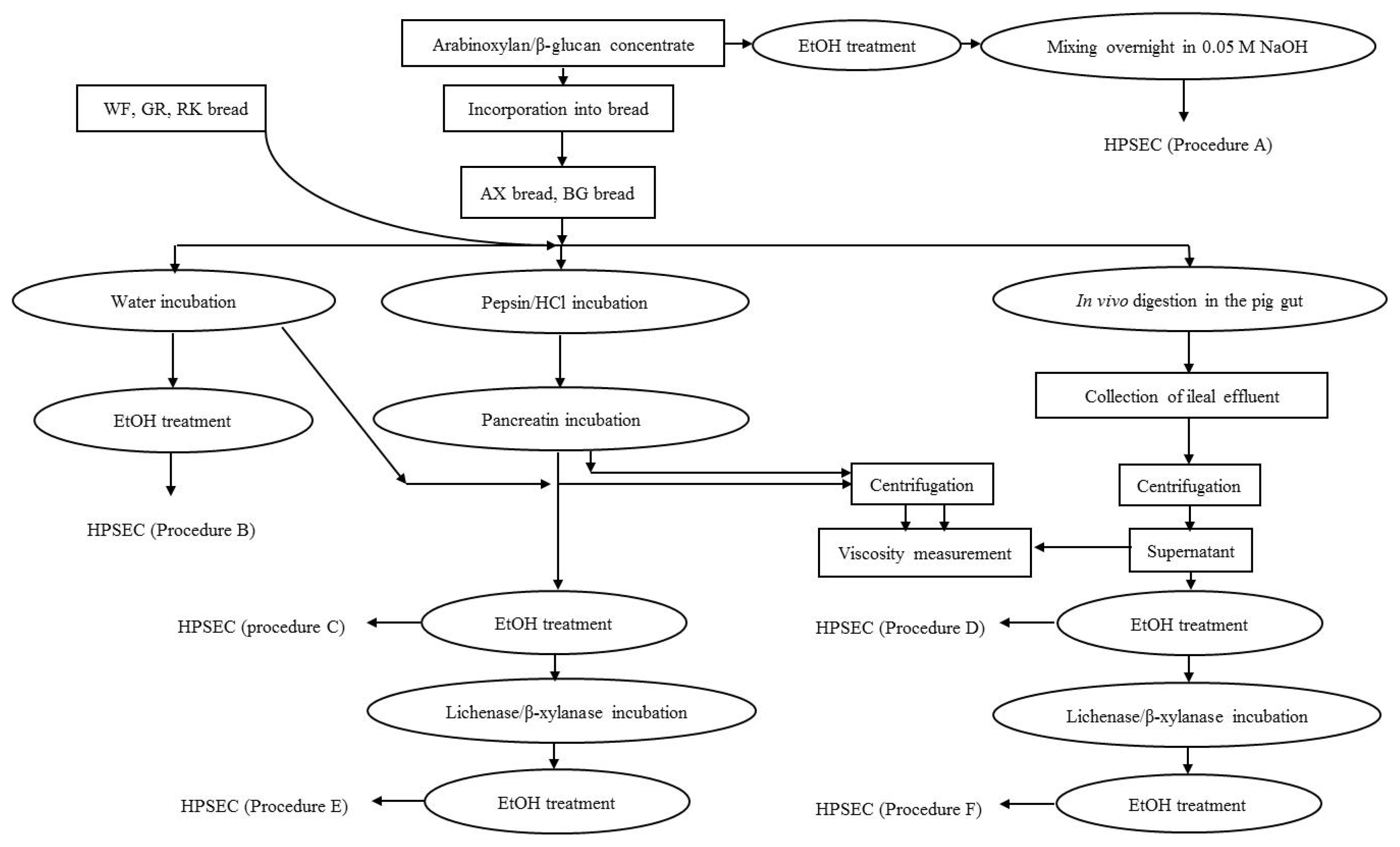
<p>During mixing, yeast fermentation and baking the DF polysaccharides provided as ingredients in the flour may change regarding molecular weight distribution and polydispersity [<xref ref-type="bibr" rid="b1-ijms-13-16833">1</xref>]. Changes in the molecular weight and concentration of soluble DF influence the extract viscosity, which may have an impact on the functional properties of the breads and thereby on the physiological responses when consumed by monogastric mammals. As the gastrointestinal tract and physiological responses of pig are very similar to humans, the pig was used as a monogastric model providing access to digestive material that is difficult to obtain from humans. The aim of this investigation was to study the fate of polysaccharides in breads with variable content and structure of fiber constituents before and after <italic>in vitro</italic> and <italic>in vivo</italic> pig small intestinal digestion using different extraction procedures as illustrated in <xref ref-type="fig" rid="f1-ijms-13-16833">Figure 1</xref>.</p></sec>
<sec sec-type="results">
<title>2. Results</title>
<sec>
<title>2.1. Content of Polysaccharides in DF Concentrates, DF Rich Breads and Ileal Supernatants</title>
<p>The soluble arabinoxylan concentrate used to produce AX bread had 31.2% total NSP and 23.4% arabinoxylan with an arabinose to xylose ratio (A/X) of 0.94. The soluble oat β-glucan incorporated into the BG bread had 40.5% total NSP and 35.2% β-glucan. The arabinoxylan and β-glucan concentrate contained 4.0% and 41.8% of starch, respectively.</p>
<p>The starch content in the fiber rich breads varied from 50.9% to 60.8% (<xref ref-type="table" rid="t1-ijms-13-16833">Table 1</xref>) compared to 71.1% in the WF bread. The NSP content of the breads varied from 11.2% to 16.7% in the fiber rich breads, whereas the low fiber bread (WF) had only 3.5% NSP. A large proportion of insoluble NSP in the BG bread consisted of cellulose, which was added in order to equilibrate the DF content among the high DF breads. Although the content of arabinoxylan practically was the same in the GR, RK and AX breads, 87% of the arabinoxylan in the AX bread was soluble compared to only 47%–48% in the GR and RK breads. The solubility of β-glucan in the BG, GR, and RK bread were 82%, 29%, 21%, respectively.</p>
<p>The concentration of starch was very low (&lt;0.9 mg/mL) in the ileal supernatant from pigs fed the arabinoxylan rich breads, while the content in ileal supernatant from the BG fed pigs was substantially higher with 2.7 mg/mL (<xref ref-type="table" rid="t1-ijms-13-16833">Table 1</xref>). The concentration of NSP in ileal supernatant ranged from 10 to 20 mg/mL in pigs fed WF, GR, RK or BG, whereas the concentration in the ileal supernatant of AX fed pigs was 56.3 mg/mL. Most of the NSP in ileal supernatants of the WF, GR, RK and AX fed pigs comprised of arabinoxylan (&gt;78%). Surprisingly 50% of the NSP in the ileal supernatant of BG fed pigs also consisted of arabinoxylan and only 26% of NCP-glucose. The A/X was the same in the ileal effluent of the AX fed pigs as in the bread, while the A/X increased slightly in the ileal supernatant of pigs fed WF, GR and RK bread. In contrast, the A/X markedly decreased from 1.37 in the BG bread to 1.04 in the ileal supernatant.</p></sec>
<sec>
<title>2.2. Molecular Properties of the Wheat Arabinoxylan and Oat β-Glucan Concentrates</title>
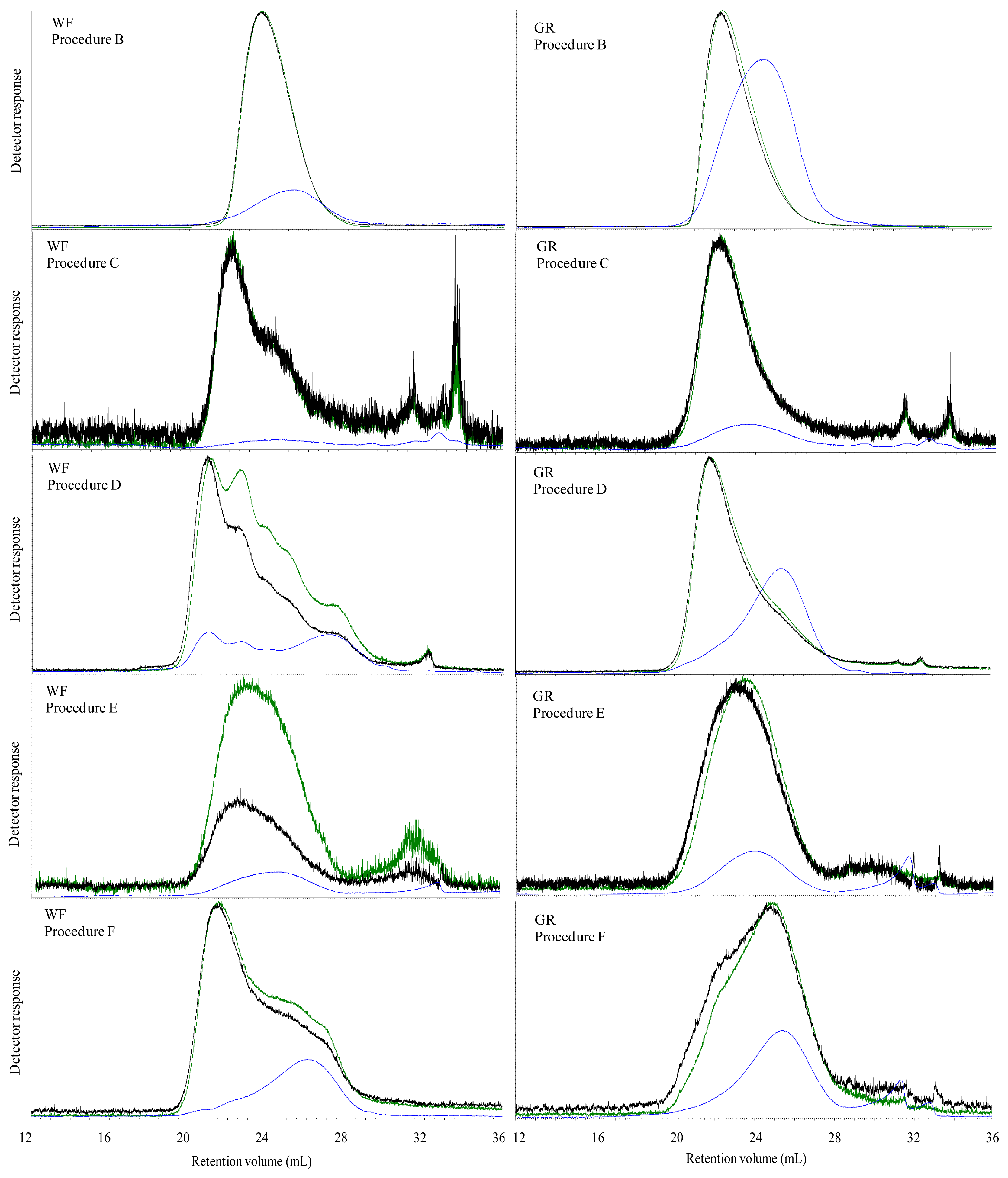
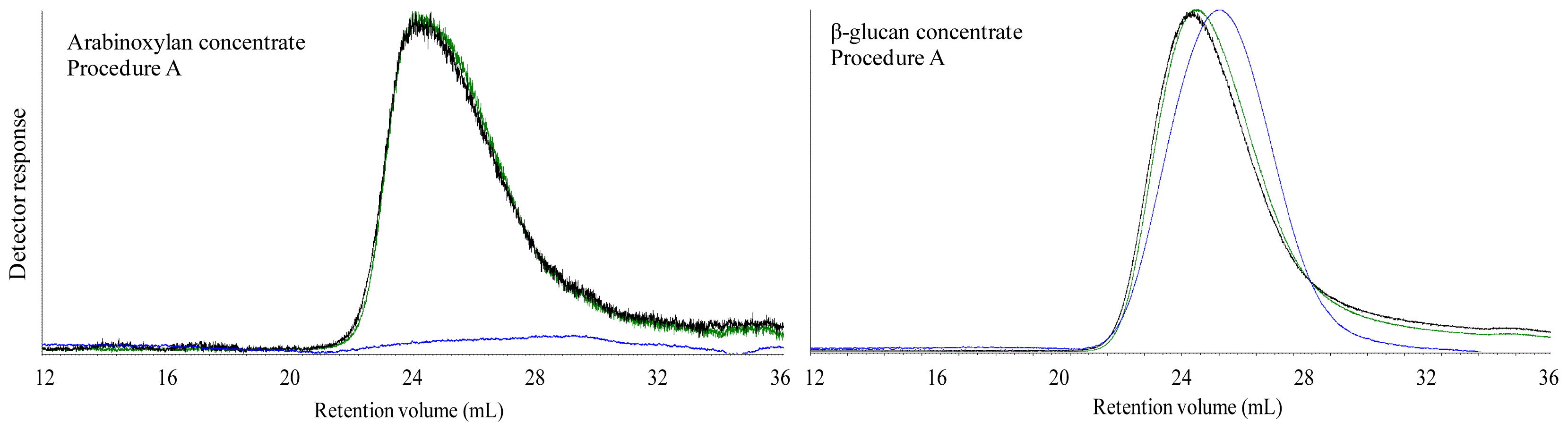
<p>The M<sub>w</sub> of the alkaline extract of the fiber concentrates (Procedure A) were 602 kDa for the arabinoxylan and 1978 kDa for the β-glucan concentrate. The signals of right angle laser light scattering (RALLS), low angle laser light scattering (LALLS) and intrinsic viscosity (IV) of β-glucan concentrate closely overlapped with a Gaussian type distribution (<xref ref-type="fig" rid="f2-ijms-13-16833">Figure 2</xref>). The alkaline extract of the arabinoxylan concentrate showed a low and flatted IV signal, whereas RALLS and LALLS signals followed each other.</p></sec>
<sec sec-type="intro">
<title>2.3. Molecular Characteristics of Water Extracted and <italic>in vitro</italic> Digested Breads</title>
<p>The M<sub>w</sub> of extractable carbohydrates in water extracts (procedure B) of all breads were significantly higher than after <italic>in vitro</italic> digestion (procedure C). After water extraction the majority (&gt;83%) of carbohydrates had an M<sub>w</sub> above 200 kDa in the WF, GR, and RK breads, while approximately half the carbohydrates was above 200 kDa in the two breads containing AX and BG concentrates (<xref ref-type="table" rid="t2-ijms-13-16833">Table 2</xref>). After <italic>in vitro</italic> digestion, in addition to a dramatic M<sub>w</sub> decrease in all breads, the fraction below 200 kDa also became dominant in the control bread and all arabinoxylan rich breads (WF, GR, RK, and AX), while the BG bread still had a similar proportion of molecules above and below 200 kDa, respectively. Simultaneously, in all cases except for BG, <italic>in vitro</italic> digestion also led to a higher polydispersity indicating a broader distribution of extracted molecules.</p>
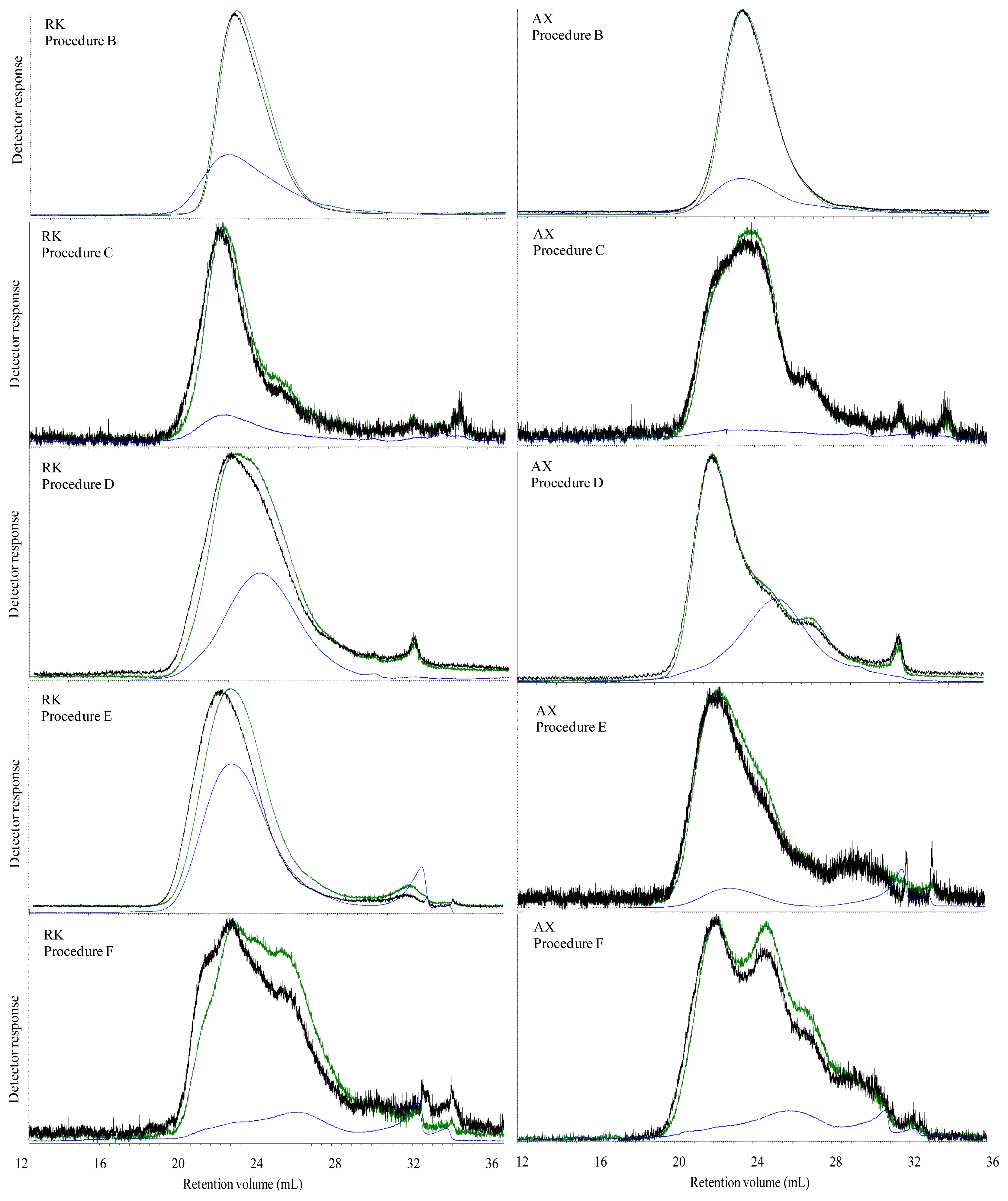
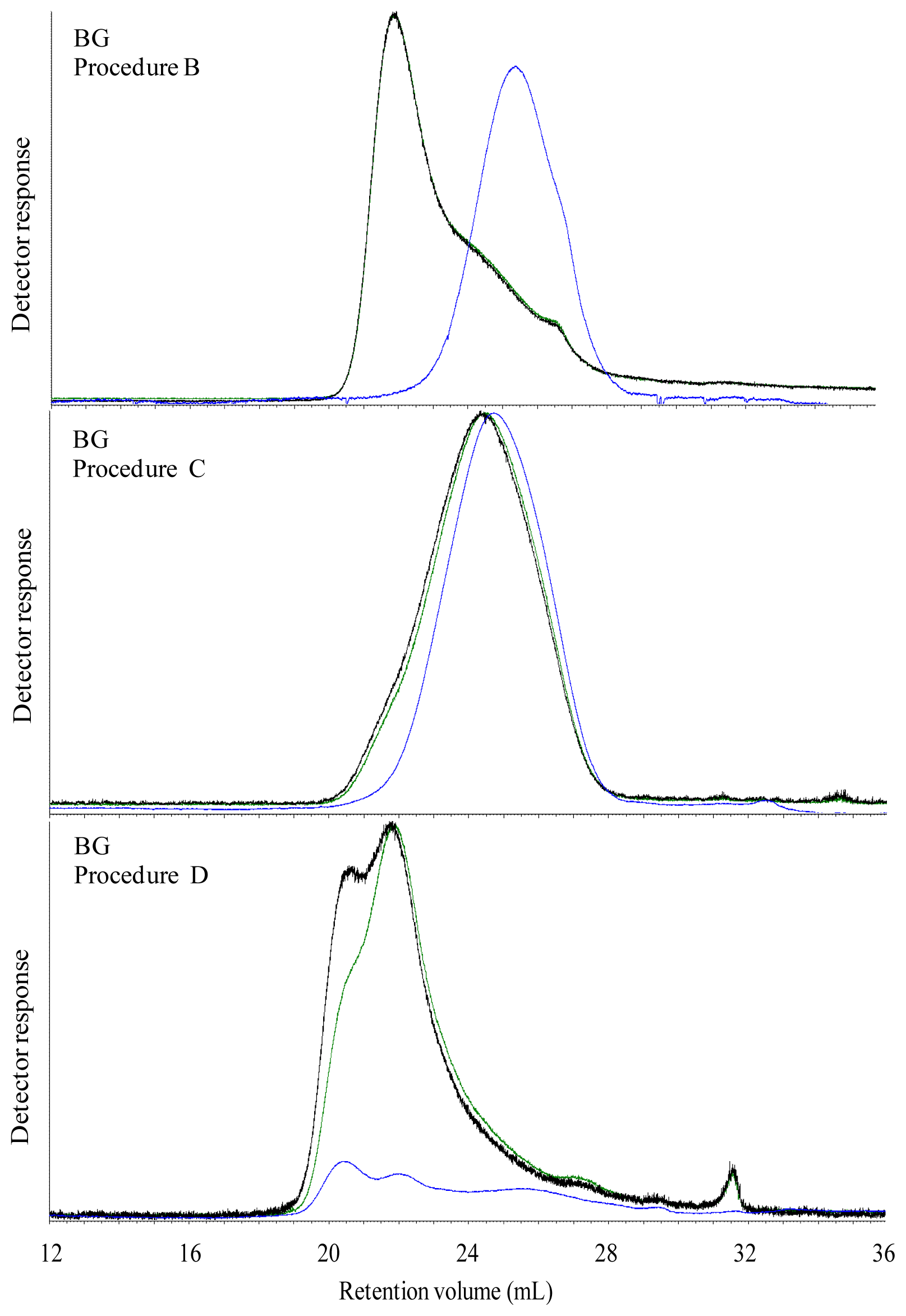
<p>The elution profile of water extractable carbohydrates in WF and GR breads (<xref ref-type="fig" rid="f3-ijms-13-16833">Figure 3</xref>), RK and AX bread (<xref ref-type="fig" rid="f4-ijms-13-16833">Figure 4</xref>) displayed a unimodal distribution of molecular weight, while the elution profile of water extracted BG (<xref ref-type="fig" rid="f5-ijms-13-16833">Figure 5</xref>) was polymodal with two-three different populations. The elution profile of water extractable carbohydrates from the GR and BG bread show a high ratio of RALLS and LALLS to IV signal of the early-eluting polymers, and a high IV response later in the chromatogram. <italic>In vitro</italic> enzymatic extracts of WF, GR, RK and AX breads showed a flatted IV signal. The RALLS and LALLS elution profile did not change markedly in GR and RK breads after <italic>in vitro</italic> digestion compared with their water incubated counterparts, although a long tail was observed in RK (<xref ref-type="table" rid="t2-ijms-13-16833">Table 2</xref>). The RALLS and LALLS elution profile of <italic>in vitro</italic> incubated AX bread showed two populations eluting at 18–25 mL and a small population eluting at 26 mL (<xref ref-type="fig" rid="f4-ijms-13-16833">Figure 4</xref>). The RALLS and LALLS elution profile of <italic>in vitro</italic> incubated WF bread showed two populations in the 18–28 mL range. The elution profile of RALLS, LALLS and IV signal of <italic>in vitro</italic> incubated BG bread overlapped, indicating unimodal distribution (<xref ref-type="fig" rid="f5-ijms-13-16833">Figure 5</xref>).</p></sec>
<sec sec-type="intro">
<title>2.4. Molecular Characteristics of Ethanol Precipitated Digesta Supernatants</title>
<p>The molecular properties of extracted carbohydrates from ileal materials without further purification (Procedure D) is shown in <xref ref-type="table" rid="t3-ijms-13-16833">Table 3</xref>. M<sub>w</sub> of ethanol treated ileal supernatant of pigs fed GR, RK, AX and BG was 335–397 kDa, whereas ethanol treated supernatant of WF had a M<sub>w</sub> of 259 kDa. The proportion of the polymer population above 200 kDa was below 21.2% among all ileal supernatants. Compared to <italic>in vitro</italic> digestion a higher IV signal was observed by <italic>in vivo</italic> digestion (<xref ref-type="fig" rid="f3-ijms-13-16833">Figures 3</xref> and <xref ref-type="fig" rid="f4-ijms-13-16833">4</xref>). The elution profile showed polymodal molecular weight distribution in WF and AX ileal supernatants, indicating approximately five and three population, respectively. The ileal supernatants of GR and RK displayed an unimodal distribution, whereas ileal supernatant of BG fed pigs was at least bimodal.</p></sec>
<sec sec-type="intro">
<title>2.5. Molecular Characteristics of Lichenase Treated <italic>in vitro</italic> and <italic>in vivo</italic> Digested Breads</title>
<p>Lichenase was used to remove β-glucan from the re-dissolved polysaccharides in order to get a more pure arabinoxylan peak. β-xylanase was also used to purify β-glucan from the digested BG breads. However, unfortunately, the β-xylanase used turned out to have β-glucanase side activity. Therefore, only results of <italic>in vitro</italic> and <italic>in vivo</italic> digested BG bread without further purification are presented here.</p>
<p>The lichenase purified extractable carbohydrates in the <italic>in vitro</italic> digestion (Procedure E) resulted in the lowest M<sub>w</sub> of 219 and 250 kDa in WF and GR bread extracts and the highest M<sub>w</sub> of 514 kDa in RK bread extract (<xref ref-type="table" rid="t4-ijms-13-16833">Table 4</xref>). Similarly, the purified extractable carbohydrates in the <italic>in vivo</italic> digested bread (Procedure F) showed the lowest M<sub>w</sub> of 265 kDa in ileal supernatant of GR fed pigs and the highest M<sub>w</sub> of 419 kDa in ileal supernatant of pigs fed RK (<xref ref-type="table" rid="t5-ijms-13-16833">Table 5</xref>). However, for M<sub>w</sub> was 360 kDa in the <italic>in vivo</italic> digested WF when samples were purified with lichenase. The M<sub>w</sub> of carbohydrates in the lichenase purified <italic>in vitro</italic> digested and <italic>in vivo</italic> digested AX bread was very similar with M<sub>w</sub> of 307 and 315 kDa, respectively.</p>
<p>The elution profile of the lichenase purified <italic>in vitro</italic> digested breads (procedure E) showed an unimodal distribution of molecules in GR and RK, whereas AX and WF displayed broadening and shoulder appearance indicating polymodal distribution of extracted polymers. In contrast, the elution profile of lichenase purified <italic>in vivo</italic> digested RK and AX ileal supernatants (procedure F) showed at least three populations, whereas the elution profile of lichenase purified ileal supernatants of WF and GR fed pigs indicated at least two populations.</p></sec>
<sec>
<title>2.6. Viscosity of Water Extracted, <italic>in vitro</italic> and <italic>in vivo</italic> Digested Breads</title>
<p>Water incubation as well as <italic>in vitro</italic> and <italic>in vivo</italic> digestion of breads led to differences in extract viscosity (<xref ref-type="table" rid="t6-ijms-13-16833">Table 6</xref>). Generally, except for BG, water extracts resulted in lower extract viscosity than <italic>in vitro</italic> digested breads, which again were lower than the viscosity of the ileal supernatant from the bread fed pigs.</p>
<p>Of the water extracts BG bread showed the highest viscosity (10.7 mPa.s), while the lowest viscosity was in water extracts of AX and WF bread (1.8 and 1.3 mPa.s). Under simulated <italic>in vitro</italic> digestion, highest extract viscosities were also obtained with BG, followed by RK and GR and the lowest in AX and WF. Viscosity of the ileal supernatant of AX fed pigs was markedly higher than with the other breads, whereas the viscosity of the ileal supernatant of the BG fed pigs was significantly lower.</p></sec></sec>
<sec sec-type="discussion">
<title>3. Discussion</title>
<p>The potential of a polymer to increase the viscosity, in our case in the gastrointestinal tract, is affected by the molecular weight, concentration, structure of polymer, and possible interaction with other molecules. Hence, not only the properties of the fiber source itself, but also changes that occur during processing and in the digestive tract may affect the physicochemical properties of the fiber. To elucidate this, we have used different procedures to extract and purify extracts of bread and studied fiber modification after baking and passage of the small intestine.</p>
<p>The M<sub>w</sub> of alkaline extract of fiber concentrates (602 kDa for arabinoxylan, 1978 kDa for β-glucan) were in line with other investigations. Saulnier <italic>et al.</italic>[<xref ref-type="bibr" rid="b3-ijms-13-16833">3</xref>] referred to M<sub>w</sub> of wheat arabinoxylan varying from 70 kDa to 655 kDa, while Åman <italic>et al.</italic>[<xref ref-type="bibr" rid="b14-ijms-13-16833">14</xref>] characterized oat β-glucan indicating Calcofluor average molecular weight 2060–2300 kDa. The studied fiber concentrates were extracted under mild alkaline conditions and showed a high M<sub>w</sub> that was caused by the extractable fiber, but possibly also some starch residues. The main reason of using an alkaline procedure was to prevent aggregation of β-glucan and arabinoxylan [<xref ref-type="bibr" rid="b16-ijms-13-16833">16</xref>] as well as β-elimination or peeling reactions (sequential elimination of the reducing end residues from the polysaccharides chain) than may occur at a high pH [<xref ref-type="bibr" rid="b17-ijms-13-16833">17</xref>]. Although the manufacture of both DF concentrates included a starch elimination step using α-amylase and amyloglucosidase [<xref ref-type="bibr" rid="b18-ijms-13-16833">18</xref>], particularly the β-glucan concentrate still contained high amounts of starch residues that might have interfered in the M<sub>w</sub> determination. On the other hand, the unimodal shape of the BG chromatogram suggests that this was not the case, probably because remaining starch was heavily degraded by the enzymatic treatment during manufacturing.</p>
<p>The M<sub>w</sub> of carbohydrates was high in all water extracted breads, which most likely was caused by dissolution of both starch and DF. However, in spite of an apparent high M<sub>w</sub> of water extractable carbohydrates, the viscosity of the water extract were low in all breads with exception of BG bread. This was possibly due to an insufficient extraction of DF from the bread matrix, indicating that polymers of gelatinized starch and DF present in the grain matrix in the bread were linked with each other or other bread components. The high viscosity of water extract of BG bread was due to the linear structure of β-glucan, which most likely favor its extraction and solubilization in water solution and thereby increasing the viscosity.</p>
<p>The aim of treating the breads with digestive enzymes was to simulate the digestive processes in the gut, but simultaneously this digestion step was expected to deplete DF fraction of the bread for starch and protein. Addition of digestive enzymes did not affect the viscosity of BG bread, whereas the viscosity of WF, GR, RK and AX bread increased after <italic>in vitro</italic> digestion compared to water extracts. This might suggest that complex structure of arabinoxylan either present in grain matrix or added as concentrate require hydrolysis of starch and protein to enhance its extractability. Moreover, <italic>in vitro</italic> digestion overall caused a marked decrease in M<sub>w</sub> compared to the water extracts in the all of breads. Since none of the enzymes used for <italic>in vitro</italic> digestion are able to degrade DF polymers, the low M<sub>w</sub> of <italic>in vitro</italic> digested bread compared to the water extracts was possibly due to removal of starch and protein from the matrix. Moreover, the very low M<sub>w</sub> of extractable carbohydrates from the AX bread after <italic>in vitro</italic> digestion (134 kDa) might be due to a low extraction efficiency of branched wheat arabinoxylan polymers (A/X 0.97) in water, resulting also in a low viscosity (2.5 mPa.s) compared to the GR and RK breads. Lichenase purification had a minor impact on the estimated average M<sub>w</sub> although it increased in the <italic>in vitro</italic> digested RK and AX breads. This was consistent with a removal of low M<sub>w</sub> components as the proportion being lower than 200 kD decreased for all breads after lichenase treatment but particularly for these two breads.</p>
<p>By inclusion of wheat arabinoxylan concentrate in wheat bread, we observed that the M<sub>w</sub> of purified extractable carbohydrates in AX bread was reduced two-fold (307 kDa) compared to the arabinoxylan concentrate (602 kDa). Andersson <italic>et al.</italic>[<xref ref-type="bibr" rid="b1-ijms-13-16833">1</xref>] reported that arabinoxylan whole rye flour had a M<sub>w</sub> of 4 × 10<sup>4</sup>–9 × 10<sup>6</sup> Da with an average of 2 × 10<sup>6</sup> Da, and arabinoxylan whole grain breads showed more narrow M<sub>w</sub> of 6 × 10<sup>5</sup>–9 × 10<sup>5</sup> Da. This is in the same range as the lichenase purified <italic>in vitro</italic> digested RK bread (514 kDa), but much higher than the M<sub>w</sub> of in the WF, GR and AX breads. The reduction in M<sub>w</sub> of rye and wheat arabinoxylan during bread making is mainly caused by microbial endoxylanases and to minor extent by endogenous endoxylanases present in wheat and rye kernels [<xref ref-type="bibr" rid="b17-ijms-13-16833">17</xref>,<xref ref-type="bibr" rid="b19-ijms-13-16833">19</xref>,<xref ref-type="bibr" rid="b20-ijms-13-16833">20</xref>]. Besides enzymatic degradation, arabinoxylan is sensitive to physical and thermal processing such as mixing and heating, which may lead to degradation of arabinoxylan at 40–70 °C [<xref ref-type="bibr" rid="b17-ijms-13-16833">17</xref>,<xref ref-type="bibr" rid="b21-ijms-13-16833">21</xref>]. Similar to arabinoxylan, β-glucan also depolymerized during bread making. Depolymerization occurs during the mixing and proofing of bread dough with help of added yeast and β-glucanases present in rye flour [<xref ref-type="bibr" rid="b22-ijms-13-16833">22</xref>]. Therefore, along with removal of starch, the M<sub>w</sub> of extractable carbohydrates in <italic>in vitro</italic> digested BG bread was reduced eight-fold compared to the M<sub>w</sub> in the β-glucan concentrate, as previously also demonstrated with barley β-glucan incorporated into wheat bread [<xref ref-type="bibr" rid="b23-ijms-13-16833">23</xref>].</p>
<p>The M<sub>w</sub> of extractable carbohydrates was higher in ileal supernatant of GR, RK, AX and BG fed pigs than of the <italic>in vitro</italic> digested breads (<xref ref-type="table" rid="t2-ijms-13-16833">Tables 2</xref> and <xref ref-type="table" rid="t3-ijms-13-16833">3</xref>). Again, this supports the view that <italic>in vitro</italic> digestion did not completely remove starch and protein digestion products from the extract. <italic>In vivo</italic>, most starch was digested [<xref ref-type="bibr" rid="b24-ijms-13-16833">24</xref>] leaving a very low concentration in the ileal supernatant except for the BG fed pigs.</p>
<p>In our study, there was a marked change in the elution profile of components after <italic>in vivo</italic> digestion compared to <italic>in vitro</italic> digestion particularly in the lichenase purified samples. This resulted in the formation of three populations in the RK and AX extracts and two populations in WF and GR extracts. In spite of the change in elution profile, the M<sub>w</sub> of the lichenase purified <italic>in vitro</italic> and <italic>in vivo</italic> digested breads remained almost unchanged (<xref ref-type="table" rid="t4-ijms-13-16833">Tables 4</xref> and <xref ref-type="table" rid="t5-ijms-13-16833">5</xref>). The upper gastrointestinal tract is inhabited by protozoa, fungi and cellulotytic and xylanolytic bacteria species, which are able to degrade a mixture of homo- and heteropolymer substrates, including xyloglucan, β-glucan, glucuronomanan, arabinoxylan and xylan [<xref ref-type="bibr" rid="b25-ijms-13-16833">25</xref>,<xref ref-type="bibr" rid="b26-ijms-13-16833">26</xref>]. A range of studies have also shown that both quantitatively and quantitatively β-glucan and arabinoxylan may be degraded in the distal small intestine of pigs and humans [<xref ref-type="bibr" rid="b27-ijms-13-16833">27</xref>–<xref ref-type="bibr" rid="b31-ijms-13-16833">31</xref>], but most studies points toward arabinoxylan being less susceptible towards degradation than β-glucan. This is due to the more complex structure of arabinoxylan, which presumably prevents disintegration by microbial enzymes, since seven different enzymes are required to cleave the arabinoxylan molecule [<xref ref-type="bibr" rid="b32-ijms-13-16833">32</xref>]. Hence, the higher concentration of arabinoxylan in ileal supernatant of the AX fed pigs compared to the GR and RK fed pigs could be brought about by two counteracting mechanisms; higher solubility of the wheat arabinoxylan concentrate added to the wheat bread than of the arabinoxylan located in the cell walls of rye in the GR and RK bread, or lower degree of degradation of the added wheat arabinoxylan compared to the two rye breads. Although we did not find significant differences in the ileal digestibility of arabinoxylan between the breads, the ileal digestibility of the AX bread was numerically lower [<xref ref-type="bibr" rid="b24-ijms-13-16833">24</xref>]. Furthermore, as the arabinoxylan in the AX bread was highly branched (A/X 0.97) compared to the arabinoxylan found in the two rye breads (A/X 0.70–0.74), we may expect that this branching pattern (<italic>i.e.</italic>, high xylose substitution by arabinose) protect the xylose chain toward extensive degradation by microbial enzymes and thereby allow a high concentration of arabinoxylan in the ileal supernatant, which also resulted in a significantly higher viscosity. In contrast to arabinoxylan, the linear structure of β-glucan was easily degraded by the microbial enzymes that led to a reduction in the ileal viscosity of BG bread. Nevertheless, the reduced M<sub>w</sub> of extractable carbohydrate in ileal supernatants was not related to the ileal viscosity among all breads.</p></sec>
<sec>
<title>4. Experimental Section</title>
<sec>
<title>4.1. Breads and Diets</title>
<p>The investigation included a control bread baked on white wheat flour (WF) and four iso-DF breads: two commercial whole grain rye breads without (GR) and with grain kernels (RK) and two experimental wheat flour based breads supplemented with arabinoxylan concentrate (AX) and β-glucan concentrate (BG), respectively. WF, GR and RK were commercial breads produced by Schulstad Lantmännen A/S (Hammerholmen, Hvidovre, Denmark) with the commercial names: Hvede Toast, Mørkt Rugbrød and Multikernerugbrød, respectively. The ingredients for WF were in decreasing order; wheat flour (68%), water, yeast, sugar, salt, vinegar, canola oil, emulsifier (E471, E472e), rye flour, barley malt flour, flour treatment agent (ascorbic acid); GR was baked on; rye whole meal, water, rye sourdough, rye bread crumps, salt, vinegar, dried sourdough rye, canola oil, yeast, barley flour, and RK was produced from: rye kernels (49%), water, rye sourdough, rye bread crumbs, wheat meal, salt, yeast, vinegar, dried sourdough rye, canola oil, rye four, barley flour. BG and AX breads were experimental breads baked at a local bakery (Konditor-Bageren, Ørum, Denmark). The ingredients for AX were; white wheat flour, arabinoxylan concentrate (wheat arabinoxylan, Manildra Group Ltd, Nowra, Australia), sugar, salt, margarine, and yeast. The BG bread was prepared from white wheat flour, β-glucan concentrate (oat β-glucan, known commercially as PromOat, BioVelop AB, Kimstad, Sweden), Vitacel WF 600 (16.9% of arabinoxylan, J. Rettenmaier &amp; Söhne GmbH, Rosenberg, Germany), wheat gluten, sugar, salt, margarine, and yeast. The breads were cut into pieces, frozen at −20 °C and following mincing partly frozen. The minced breads were mixed with digestibility markers (chromic oxide and Celite<sup>®</sup>), vitamins, minerals and in case of AX bread with whey protein concentrate (Lacprodan 87; Arla Foods Ingredients Amba, Viby J, Denmark), in order to adjust the protein content of the diets. The feed was portioned into plastic bags containing 575 g DM per meal and stored at −20 °C until consumption.</p></sec>
<sec sec-type="methods">
<title>4.2. Animal Study</title>
<p>The pigs used in the study were crossbreeds of Duroc × Danish Landrace × Yorkshire obtained from the swineherd at Aarhus University, Department of Animal Science, Denmark. The animal experiment was conducted according to protocols approved by the Danish Animal Experiments Inspectorate and complied with the guidelines of the Danish Ministry and Justice concerning animal experimentation and care of animals under study.</p>
<p>Five female pigs with average weight of 58 ± 2.8 kg were fitted surgically with a permanent simple T-cannula 15 cm anterior to the ileal-caecal junction following the procedure of Jørgensen <italic>et al.</italic>[<xref ref-type="bibr" rid="b33-ijms-13-16833">33</xref>] and allowed to recover until start of the study. The pigs were fed each experimental diet for 1 week in a Latin Square design. Prior to the feeding, the diets were thawed. Total daily feed intake was 1725 g DM/d and drinking water was provided <italic>ad libitum</italic>.</p>
<p>On day 6 and 7 ileal effluent was collected continuously for 4 h after the morning meal. Ileal effluent was collected in 6 mm × 20 mm polyamide autoclave bags (Buch and Holm, Herlev, Denmark) attached to the ileum cannula with a plastic zip fastener. Two to three drops of an aqueous solution of 0.2% NaN<sub>3</sub> (Sigma-Aldrich, St. Louis, MO, USA) was added to the collection bags to prevent microbial activity. Forty grams of material from each day of collection was centrifuged (10,000× <italic>g</italic>, 4 °C, 20 min) in 50 mL tubes. Following the supernatant from the 2 collection days was pooled into 10 mL tubes and stored at −20 °C until further analysis.</p>
<p>Results on carbohydrate digestibility and physicochemical properties of ileal effluent are described elsewhere [<xref ref-type="bibr" rid="b24-ijms-13-16833">24</xref>].</p></sec>
<sec sec-type="methods">
<title>4.3. Sample Preparation for HPSEC Analysis</title>
<p>The fiber concentrates, breads and the supernatants of ileal digesta were analyzed as illustrated in <xref ref-type="fig" rid="f1-ijms-13-16833">Figure 1</xref> and described in detail below.</p>
<sec>
<title>4.3.1. Solubilization of DF from the Fiber Concentrates</title>
<p>Extraction of DF from the fiber concentrates was done according to the procedure of Suortti [<xref ref-type="bibr" rid="b4-ijms-13-16833">4</xref>] illustrated in <xref ref-type="fig" rid="f1-ijms-13-16833">Figure 1</xref> as Procedure A. One hundred milligrams of arabinoxylan and β-glucan concentrate were weighed into 50 mL plastic tubes. Five mL of 50% ethanol was added, then the sample was mixed, placed in a boiling water bath for 15 min and cooled. Additionally, 5 mL of 50% ethanol was added, mixed, centrifuged (1000× <italic>g</italic>) and the precipitate collected. Twenty milliliters of 0.05 M aqueous NaOH solution was added to the precipitate and mixed overnight at room temperature and filtered through a 0.2 μm minisart filter (Sartorius Stedim Biotech Gmbh, Germany) prior to HPSEC analysis.</p></sec>
<sec>
<title>4.3.2. Water Extraction and <italic>in vitro</italic> Digestion of Breads</title>
<p>The breads were extracted in azid-containing water or subjected to <italic>in vitro</italic> enzymatic digestion according to Procedures B and C, as illustrated in <xref ref-type="fig" rid="f1-ijms-13-16833">Figure 1</xref>.</p>
<p>Prior to extraction, the breads were minced for 1 min using a hand blender (Braun, Kronberg, Germany) and then the material was weighed in triplicate into a tube adjusted to a DM content of 13% in the solution, in order to mirror the approximate final DM content of ileal digesta. For <italic>in vitro</italic> digestion (Procedure C), the breads were initially incubated with a 11.68 mL pepsin solution (12 mg, 3.260 U/mL, EC.3.4.2.3.1., Merck, Darmstadt, Germany) in 0.1 M HCl in a shaking water bath (150 strokes/min) at 39 °C for 2 h. Following pH was adjusted to 7.0 by addition of a 6.54 mL solution of porcine pancreatin (50 mg, 8 × USP, EC. 232-468-9, Sigma-Aldrich, St.Louis, MO, USA) in 1 M NaHCO<sub>3</sub>, and incubated in the same water bath for further 2 h. Water extraction (Procedure B) followed the same procedure except that the enzyme solutions were replaced with an aqueous solution of 0.02% NaN<sub>3</sub> (Sigma-Aldrich, St. Louis, MO, USA). After the water and <italic>in vitro</italic> incubations, the bread mixtures were centrifuged and 5 mL of supernatants were transferred to a 50 mL plastic tube and treated with ethanol: Five milliliter of 96% ethanol was added to the supernatant, mixed, and placed in a boiling water bath for 15 min, cooled and supernatant was discarded. Another 5 mL of 50% ethanol was added, the sample was mixed, centrifuged (1000× <italic>g</italic>) and the precipitate collected. Five milliliters of 0.02% NaN<sub>3</sub> was added to the precipitate and the mixture was boiled for 10 min and cooled. The samples were filtered and injected into the HPSEC system.</p>
<p>For a parallel set of samples the precipitate after <italic>in vitro</italic> digestion and subsequent ethanol treatment was further treated with either lichenase or β-xylanase in order to purify the arabinoxylan and the β-glucan, respectively (Procedure E). The precipitate of the BG bread was incubated with 50 μL of β-xylanase (from Trichoderma viride, 2300 U/mL, Megazyme International Ireland, Wicklow, Ireland) in 5 mL of 0.1 M sodium acetate buffer (pH 5) at 50 °C for 2 h, whereas precipitates of WF, GR, RK and AX breads were incubated with 100 μL of lichenase (from Bacillus subtilis, 1000 U/mL, Megazyme International Ireland) in 5 mL of 0.1 M sodium acetate and 2 mL of 0.5 M Na<sub>2</sub>HPO<sub>4</sub> (added to increase pH to 6.5–6.7) at 60 °C for 2 h in the water bath. During the incubation, the samples were occasionally stirred. Afterwards, samples from both incubations were cooled and mixed with 40 mL of 96% ethanol in an ice box for 30 min. The samples were centrifuged (1000× <italic>g</italic>), and supernatants were discarded, while precipitates were re-dissolved in 5 mL of 0.02% aqueous NaN<sub>3</sub> solution in a boiling water bath for 10 min. After cooling, the samples were filtered and analyzed by HPSEC.</p>
<p>The step of ethanol treatment in our procedures was previously described by Andersson <italic>et al.</italic>[<xref ref-type="bibr" rid="b1-ijms-13-16833">1</xref>].</p></sec>
<sec>
<title>4.3.3. Isolation and Purification of DF from Ileal Effluent</title>
<p>The ileal supernatant was thawed and 5 mL was transferred to a 50 mL plastic tube. Five milliliters of 96% ethanol and 5 mL of 50% ethanol were added to the supernatant and treated according to the ethanol treatment described in section 4.3.2. After removal of the liquid phase, 5 mL of 0.02% of NaN<sub>3</sub> was added to the precipitate and the mixture was boiled for 10 min and cooled. The sample was filtered and injected to the HPSEC (Procedure D). For a parallel set of samples, ileal supernatant after the ethanol treatment was further treated with lichenase or β-xylanase for purification of arabinoxylan and β-glucan (Procedure F) as described in section 4.3.2.</p></sec>
<sec>
<title>4.3.4. Side Activity of Lichenase and β-Xylanase</title>
<p>Lichenase and β-xylanase were tested for side activity on pure standards of arabinoxylan (wheat arabinoxylan, high viscosity 47 cSt., Megazyme International Ireland) and β-glucan (oat β-glucan, high viscosity 69 cSt., Megazyme International Ireland), respectively under conditions as described in section 4.3.2.</p></sec></sec>
<sec sec-type="methods">
<title>4.4. Analysis</title>
<sec>
<title>4.4.1. Carbohydrates of Fiber Concentrates, Breads and Ileal Supernatants</title>
<p>The starch and total content of NSP of the fiber concentrates, the breads and the corresponding digesta supernatants were measured as described by Bach Knudsen [<xref ref-type="bibr" rid="b34-ijms-13-16833">34</xref>] with the modification that the polysaccharides in starch free residue were hydrolyzed with 2 M H<sub>2</sub>SO<sub>4</sub> for 1 h instead of 1 M H<sub>2</sub>SO<sub>4</sub> for 2 h. The content of β-glucan in breads was measured by the enzymatic-colorimetric method of McCleary and Glennie-Holmes [<xref ref-type="bibr" rid="b35-ijms-13-16833">35</xref>], whereas the β-glucan in β-glucan concentrate and ileal supernatants was determined as non-cellulosic (NCP) glucose by hydrolysis without prior solubilization with 12 M H<sub>2</sub>SO<sub>4</sub>. The arabinoxylan content in fiber concentrates, breads and ileal supernatants was calculated as the sum of arabinose and xylose content obtained by the NSP method. A/X ratio of arabinoxylan was calculated as a quotient of arabinose and xylose content.</p></sec>
<sec>
<title>4.4.2. Molecular Characterization of Carbohydrates Performed on HPSEC</title>
<p>One hundred and fifty microliters of 1–5 mg/mL concentrated sample was injected for the HPSEC analysis. The high-performance size-exclusion chromatography system Viscotek TDAmax (Malvern Instruments Ltd, Worcestershire, UK) was equipped with a Viscotek automatic injector and pump (VE 2001 GPC Solvent/Sample Module). The sample was eluted at 0.5 mL/min through a series of columns; TSK gel GMPWxl (Tosoh Bioscience Gmbh, Stuttgart, Germany), OH-Pak SB-806 HQ and SB-806M HQ (Shodex, Kanagawa, Japan) using miliQ water with 0.02% NaN<sub>3</sub> as eluent. The detection system consisted of 90° RALLS and 7° angle LALLS detector with constant optical power output laser diode working at wavelength 670 nm, a four-capillary bridge viscometer (intrinsic viscosity detector) and a refractometer with conventional dual cell (RI), deflection design (Viscotek, Houston, TX, USA). The calibration was done with a pullulan standard of molecular weight 112 kDa (Shodex standard, Showa Denko K.K., Japan). The dn/dc values used were 0.146 mL/g for arabinoxylan and 0.150 mL/g for β-glucan in water solutions [<xref ref-type="bibr" rid="b36-ijms-13-16833">36</xref>,<xref ref-type="bibr" rid="b37-ijms-13-16833">37</xref>]. The M<sub>w</sub>, proportion of M<sub>w</sub> &lt;200 kDa and &gt;200 kDa were calculated directly from the chromatograms by use of OmniSEC software (Malvern Instruments Ltd., Worcestershire, UK).</p></sec>
<sec>
<title>4.4.3. Viscosity of Bread Extracts and Ileal Effluents</title>
<p>The bread after water incubation and <italic>in vitro</italic> and <italic>in vivo</italic> digestion were centrifuged (10,000× <italic>g</italic>, 4 °C, 20 min) in 50 mL tubes and the viscosity of the supernatants was measured in a Brookfield DV-II cone/plate viscometer (Brookfield Engineering Laboratories Inc., Stoughton, MA, USA) at 39 °C at shear rates between 2.25 and 450 s<sup>−1</sup>. The cone of 0.8° angle had a diameter of 4.8 cm. Values of viscosity at shear rate 45 s<sup>−1</sup> were used.</p></sec></sec>
<sec>
<title>4.5. Statistical Analyses</title>
<p>The M<sub>w</sub>, proportion of M<sub>w</sub> &lt;200 kDa and &gt;200 kDa of two different extraction methods on five breads were analyzed using a two-way analysis-of-variance model (<xref ref-type="table" rid="t2-ijms-13-16833">Table 2</xref>). The same response variables obtained from ethanol treated ileal contents were analyzed using a mixed model (<xref ref-type="table" rid="t3-ijms-13-16833">Table 3</xref>). Moreover, the response variables of the lichenase purified arabinoxylan in the <italic>in vitro</italic> digested WF, GR, RK and AX breads and their ileal supernatant counterparts were analyzed using a one-way analysis-of-variance model (<xref ref-type="table" rid="t4-ijms-13-16833">Tables 4</xref> and <xref ref-type="table" rid="t5-ijms-13-16833">5</xref>). Log values of viscosity of water extracts and <italic>in vitro</italic> digested breads were calculated by one-way analysis, and of ileal supernatants by a mixed model (<xref ref-type="table" rid="t6-ijms-13-16833">Table 6</xref>).</p>
<p>All statistical analysis was performed using Statistical Analysis Software (SAS Institute Inc., Cary, NC, USA). All data were expressed as least squares means with differences considered statistically significant at <italic>p</italic> &lt; 0.05.</p></sec></sec>
<sec sec-type="conclusions">
<title>5. Conclusions</title>
<p><italic>In vitro</italic> and <italic>in vivo</italic> digested breads had a markedly reduced M<sub>w</sub> compared to water extracted breads and the fiber sources extracted under mild alkali conditions. This was due to the degradation of DF during dough making and baking. Moreover, although the M<sub>w</sub> was almost similar in the <italic>in vitro</italic> digested GR, RK and AX breads to their ileal supernatant counterparts after the lichenase treatment, their extract viscosity varied substantially between the <italic>in vitro</italic> and <italic>in vivo</italic> digestion depending on the DF content and structure present in bread and ileal extracts. The wheat arabinoxylan present in AX bread appears to be of nutritional interest due to its high concentration in ileal supernatant that contributed to raise intestinal viscosity. This suggests a potential of wheat arabinoxylan in concentrated form for further applications in food manufacturing.</p></sec></body>
<back>
<ack>
<title>Acknowledgments</title>
<p>The authors are grateful to the Danish Strategic Research Council for a financial support of “Biofunctional Carbohydrates” project (Project No. 2101-08-0068), and BioVelop AB, Manildra Group Ltd. and Lantmännen Food R &amp; D A/S for delivery of fiber ingredients and the breads. Moreover, we thank Henry Jørgensen for help during surgery, and the technical staff at the Department of Animal Science for care of the animals and performing analysis.</p></ack>
<ref-list>
<title>References</title>
<ref id="b1-ijms-13-16833"><label>1</label><citation citation-type="journal"><person-group person-group-type="author"><name><surname>Andersson</surname><given-names>R.</given-names></name><name><surname>Fransson</surname><given-names>G.</given-names></name><name><surname>Tietjen</surname><given-names>M.</given-names></name><name><surname>Åman</surname><given-names>P.</given-names></name></person-group><article-title>Content and molecular-weight distribution of dietary fiber components in whole-grain rye flour and bread</article-title><source>J. Agric. Food Chem</source><year>2009</year><volume>57</volume><fpage>2004</fpage><lpage>2008</lpage><pub-id pub-id-type="doi">10.1021/jf801280f</pub-id><pub-id pub-id-type="pmid">19219994</pub-id></citation></ref>
<ref id="b2-ijms-13-16833"><label>2</label><citation citation-type="journal"><person-group person-group-type="author"><name><surname>Bach Knudsen</surname><given-names>K.E.</given-names></name><name><surname>Lærke</surname><given-names>H.N.</given-names></name></person-group><article-title>Rye arabinoxylans: Molecular structure, physicochemical properties and physiological effects in the gastrointestinal tract</article-title><source>Cereal Chem</source><year>2010</year><volume>87</volume><fpage>353</fpage><lpage>362</lpage><pub-id pub-id-type="doi">10.1094/CCHEM-87-4-0353</pub-id></citation></ref>
<ref id="b3-ijms-13-16833"><label>3</label><citation citation-type="journal"><person-group person-group-type="author"><name><surname>Saulnier</surname><given-names>L.</given-names></name><name><surname>Sado</surname><given-names>P.E.</given-names></name><name><surname>Branlard</surname><given-names>G.</given-names></name><name><surname>Charmet</surname><given-names>G.</given-names></name><name><surname>Guillon</surname><given-names>F.</given-names></name></person-group><article-title>Wheat arabinoxylans: Exploiting variation in amount and composition to develop enhanced varieties</article-title><source>J. Cereal Sci</source><year>2007</year><volume>46</volume><fpage>261</fpage><lpage>281</lpage><pub-id pub-id-type="doi">10.1016/j.jcs.2007.06.014</pub-id></citation></ref>
<ref id="b4-ijms-13-16833"><label>4</label><citation citation-type="journal"><person-group person-group-type="author"><name><surname>Suortti</surname><given-names>T.</given-names></name></person-group><article-title>Size-exclusion chromatographic determination of β-glucan with postcolumn reaction detection</article-title><source>J. Chromatogr</source><year>1993</year><volume>632</volume><fpage>105</fpage><lpage>110</lpage><pub-id pub-id-type="doi">10.1016/0021-9673(93)80032-4</pub-id><pub-id pub-id-type="pmid">8454712</pub-id></citation></ref>
<ref id="b5-ijms-13-16833"><label>5</label><citation citation-type="journal"><person-group person-group-type="author"><name><surname>Wood</surname><given-names>P.J.</given-names></name></person-group><article-title>Oat and rye β-glucan: Properties and function</article-title><source>Cereal Chem</source><year>2010</year><volume>87</volume><fpage>315</fpage><lpage>330</lpage><pub-id pub-id-type="doi">10.1094/CCHEM-87-4-0315</pub-id></citation></ref>
<ref id="b6-ijms-13-16833"><label>6</label><citation citation-type="journal"><person-group person-group-type="author"><name><surname>Finnie</surname><given-names>S.M.</given-names></name><name><surname>Bettge</surname><given-names>A.D.</given-names></name><name><surname>Morris</surname><given-names>C.F.</given-names></name></person-group><article-title>Influence of cultivar and environment on water-soluble and water-insoluble arabinoxylans in soft wheat</article-title><source>Cereal Chem</source><year>2006</year><volume>83</volume><fpage>617</fpage><lpage>623</lpage><pub-id pub-id-type="doi">10.1094/CC-83-0617</pub-id></citation></ref>
<ref id="b7-ijms-13-16833"><label>7</label><citation citation-type="journal"><person-group person-group-type="author"><name><surname>Grimm</surname><given-names>A.</given-names></name><name><surname>Kruger</surname><given-names>E.</given-names></name><name><surname>Burchard</surname><given-names>W.</given-names></name></person-group><article-title>Solution properties of β-d-(1,3)(1,4)-glucan isolated from beer</article-title><source>Carbohydr. Polym</source><year>1995</year><volume>27</volume><fpage>205</fpage><lpage>214</lpage><pub-id pub-id-type="doi">10.1016/0144-8617(95)00056-D</pub-id></citation></ref>
<ref id="b8-ijms-13-16833"><label>8</label><citation citation-type="journal"><person-group person-group-type="author"><name><surname>Ulmius</surname><given-names>M.</given-names></name><name><surname>Adapa</surname><given-names>S.</given-names></name><name><surname>Onning</surname><given-names>G.</given-names></name><name><surname>Nilsson</surname><given-names>L.</given-names></name></person-group><article-title>Gastrointestinal conditions influence the solution behaviour of cereal beta-glucans <italic>in vitro</italic></article-title><source>Food Chem</source><year>2012</year><volume>130</volume><fpage>536</fpage><lpage>540</lpage><pub-id pub-id-type="doi">10.1016/j.foodchem.2011.07.066</pub-id></citation></ref>
<ref id="b9-ijms-13-16833"><label>9</label><citation citation-type="journal"><person-group person-group-type="author"><name><surname>Regand</surname><given-names>A.</given-names></name><name><surname>Tosh</surname><given-names>S.M.</given-names></name><name><surname>Wolever</surname><given-names>T.M.S.</given-names></name><name><surname>Wood</surname><given-names>P.J.</given-names></name></person-group><article-title>Physicochemical properties of β-glucan in differently processed oat foods influence glycemic response</article-title><source>J. Agric. Food Chem</source><year>2009</year><volume>57</volume><fpage>8831</fpage><lpage>8838</lpage><pub-id pub-id-type="doi">10.1021/jf901271v</pub-id><pub-id pub-id-type="pmid">19728711</pub-id></citation></ref>
<ref id="b10-ijms-13-16833"><label>10</label><citation citation-type="journal"><person-group person-group-type="author"><name><surname>Nilsson</surname><given-names>M.</given-names></name><name><surname>Holst</surname><given-names>J.J.</given-names></name><name><surname>Björck</surname><given-names>I.M.E.</given-names></name></person-group><article-title>Metabolic effects of amino acid mixtures and whey protein in healthy subjects: Studies using glucose-equivalent drinks</article-title><source>Am. J. Clin. Nutr</source><year>2007</year><volume>85</volume><fpage>996</fpage><lpage>1004</lpage><pub-id pub-id-type="pmid">17413098</pub-id></citation></ref>
<ref id="b11-ijms-13-16833"><label>11</label><citation citation-type="journal"><person-group person-group-type="author"><name><surname>Krotkiewski</surname><given-names>M.</given-names></name></person-group><article-title>Effect of guar gum on body-weight, hunger ratings and metabolism in obese subjects</article-title><source>Br. J. Nutr</source><year>1984</year><volume>52</volume><fpage>97</fpage><lpage>105</lpage><pub-id pub-id-type="doi">10.1079/BJN19840075</pub-id><pub-id pub-id-type="pmid">6331498</pub-id></citation></ref>
<ref id="b12-ijms-13-16833"><label>12</label><citation citation-type="journal"><person-group person-group-type="author"><name><surname>Saltzman</surname><given-names>E.</given-names></name><name><surname>Moriguti</surname><given-names>J.C.</given-names></name><name><surname>Das</surname><given-names>S.K.</given-names></name><name><surname>Corrales</surname><given-names>A.</given-names></name><name><surname>Fuss</surname><given-names>P.</given-names></name><name><surname>Greenberg</surname><given-names>A.S.</given-names></name><name><surname>Roberts</surname><given-names>S.B.</given-names></name></person-group><article-title>Effects of a cereal rich in soluble fiber on body composition and dietary compliance during consumption of a hypocaloric diet</article-title><source>J. Am. Coll. Nutr</source><year>2001</year><volume>20</volume><fpage>50</fpage><lpage>57</lpage><pub-id pub-id-type="pmid">11293468</pub-id></citation></ref>
<ref id="b13-ijms-13-16833"><label>13</label><citation citation-type="journal"><person-group person-group-type="author"><name><surname>Izydorczyk</surname><given-names>M.S.</given-names></name><name><surname>Dexter</surname><given-names>J.E.</given-names></name></person-group><article-title>Barley β-glucans and arabinoxylans: Molecular structure, physicochemical properties, and uses in food products—A review</article-title><source>Food Res. Int</source><year>2008</year><volume>85</volume><fpage>996</fpage><lpage>1004</lpage></citation></ref>
<ref id="b14-ijms-13-16833"><label>14</label><citation citation-type="journal"><person-group person-group-type="author"><name><surname>Åman</surname><given-names>P.</given-names></name><name><surname>Rimsten</surname><given-names>L.</given-names></name><name><surname>Andersson</surname><given-names>R.</given-names></name></person-group><article-title>Molecular weight distribution of β-glucan in oat-based foods</article-title><source>Cereal Chem</source><year>2004</year><volume>81</volume><fpage>356</fpage><lpage>360</lpage><pub-id pub-id-type="doi">10.1094/CCHEM.2004.81.3.356</pub-id></citation></ref>
<ref id="b15-ijms-13-16833"><label>15</label><citation citation-type="book"><person-group person-group-type="author"><name><surname>Biliaderis</surname><given-names>C.G.</given-names></name><name><surname>Izydorczyk</surname><given-names>M.S.</given-names></name></person-group><source>Functional Food Carbohydrates</source><publisher-name>CRC Press Taylor &amp; Francis Group</publisher-name><publisher-name>Boca Raton, FL, USA</publisher-name><year>2007</year></citation></ref>
<ref id="b16-ijms-13-16833"><label>16</label><citation citation-type="journal"><person-group person-group-type="author"><name><surname>Li</surname><given-names>W.</given-names></name><name><surname>Wang</surname><given-names>Q.</given-names></name><name><surname>Cui</surname><given-names>S.W.</given-names></name><name><surname>Huang</surname><given-names>X.</given-names></name><name><surname>Kakuda</surname><given-names>Y.</given-names></name></person-group><article-title>Elimination of aggregates of (1→3)(1→4)-β-d-glucan in dilute solutions for light scattering and size exclusion chromatography study</article-title><source>Food Hydrocolloids</source><year>2003</year><volume>20</volume><fpage>361</fpage><lpage>368</lpage></citation></ref>
<ref id="b17-ijms-13-16833"><label>17</label><citation citation-type="journal"><person-group person-group-type="author"><name><surname>Rakha</surname><given-names>A.</given-names></name><name><surname>Åman</surname><given-names>P.</given-names></name><name><surname>Andersson</surname><given-names>R.</given-names></name></person-group><article-title>How does the preparation of rye porridge affect molecular weight distribution of extractable dietary fibers?</article-title><source>Int. J. Mol. Sci</source><year>2011</year><volume>12</volume><fpage>3381</fpage><lpage>3393</lpage><pub-id pub-id-type="doi">10.3390/ijms12053381</pub-id><pub-id pub-id-type="pmid">21686191</pub-id></citation></ref>
<ref id="b18-ijms-13-16833"><label>18</label><citation citation-type="patent"><person-group person-group-type="author"><name><surname>Kvist</surname><given-names>S.</given-names></name><name><surname>Lawther</surname><given-names>M.J.</given-names></name></person-group><article-title>Soluble dietary fibre from oat and barley grains, method for producing a fraction rich in β-glucan and use of the fraction in foods, pharmaceuticals and cosmetics</article-title><source>U.S. Patent</source><patent>7910143</patent><year>2011</year></citation></ref>
<ref id="b19-ijms-13-16833"><label>19</label><citation citation-type="journal"><person-group person-group-type="author"><name><surname>Dornez</surname><given-names>E.</given-names></name><name><surname>Cuyvers</surname><given-names>S.</given-names></name><name><surname>Gebruers</surname><given-names>K.</given-names></name><name><surname>Delcour</surname><given-names>J.A.</given-names></name><name><surname>Courtin</surname><given-names>C.M.</given-names></name></person-group><article-title>Contribution of wheat endogenous and wheat kernel associated microbial endoxylanases to changes in the arabinoxylan population during breadmaking</article-title><source>J. Agric. Food Chem</source><year>2008</year><volume>56</volume><fpage>2246</fpage><lpage>2253</lpage><pub-id pub-id-type="doi">10.1021/jf073097i</pub-id><pub-id pub-id-type="pmid">18303843</pub-id></citation></ref>
<ref id="b20-ijms-13-16833"><label>20</label><citation citation-type="journal"><person-group person-group-type="author"><name><surname>Andersson</surname><given-names>A.A.M.</given-names></name><name><surname>Armo</surname><given-names>E.</given-names></name><name><surname>Grangeon</surname><given-names>E.</given-names></name><name><surname>Fredriksson</surname><given-names>H.</given-names></name><name><surname>Andersson</surname><given-names>R.</given-names></name><name><surname>Åman</surname><given-names>P.</given-names></name></person-group><article-title>Molecular weight and structure units of (1–3,1–4)-β-glucans in dough and bread made from hull-less barley milling fractions</article-title><source>J. Cereal Sci</source><year>2004</year><volume>40</volume><fpage>195</fpage><lpage>204</lpage><pub-id pub-id-type="doi">10.1016/j.jcs.2004.07.001</pub-id></citation></ref>
<ref id="b21-ijms-13-16833"><label>21</label><citation citation-type="journal"><person-group person-group-type="author"><name><surname>Rasmussen</surname><given-names>C.V.</given-names></name><name><surname>Boskov Hansen</surname><given-names>H.</given-names></name><name><surname>Hansen</surname><given-names>Å.</given-names></name><name><surname>Melchior Larsen</surname><given-names>L.</given-names></name></person-group><article-title>pH-, temperature- and time-dependent activities of endogenous endo-β-d-xylanase, β-d-Xylosidase and α-l-arabinofuranosidase in extracts from ungerminated rye (<italic>Secale cereale</italic> L.) grain</article-title><source>J. Cereal Sci.</source><year>2001</year><volume>34</volume><fpage>49</fpage><lpage>60</lpage><pub-id pub-id-type="doi">10.1006/jcrs.2000.0376</pub-id></citation></ref>
<ref id="b22-ijms-13-16833"><label>22</label><citation citation-type="journal"><person-group person-group-type="author"><name><surname>Andersson</surname><given-names>A.A.M.</given-names></name><name><surname>Ruegg</surname><given-names>N.</given-names></name><name><surname>Åman</surname><given-names>P.</given-names></name></person-group><article-title>Molecular weight distribution and content of water-extractable β-glucan in rye crisp bread</article-title><source>J. Cereal Sci</source><year>2008</year><volume>47</volume><fpage>399</fpage><lpage>406</lpage><pub-id pub-id-type="doi">10.1016/j.jcs.2007.05.008</pub-id></citation></ref>
<ref id="b23-ijms-13-16833"><label>23</label><citation citation-type="journal"><person-group person-group-type="author"><name><surname>Cleary</surname><given-names>L.J.</given-names></name><name><surname>Andersson</surname><given-names>R.</given-names></name><name><surname>Brennan</surname><given-names>C.S.</given-names></name></person-group><article-title>The behaviour and susceptibility to degradation of high and low molecular weight barley beta-glucan in wheat bread during baking and <italic>in vitro</italic> digestion</article-title><source>Food Chem</source><year>2007</year><volume>102</volume><fpage>889</fpage><lpage>897</lpage><pub-id pub-id-type="doi">10.1016/j.foodchem.2006.06.027</pub-id></citation></ref>
<ref id="b24-ijms-13-16833"><label>24</label><citation citation-type="journal"><person-group person-group-type="author"><name><surname>Kasprzak</surname><given-names>M.M.</given-names></name><name><surname>Lærke</surname><given-names>H.N.</given-names></name><name><surname>Bach Knudsen</surname><given-names>K.E.</given-names></name></person-group><article-title>Effects of isolated and complex dietary fibre matrices in breads on carbohydrate digestibility and physicochemical properties of ileal effluent from pigs</article-title><source>J. Agric. Food Chem.</source><year>2012</year><pub-id pub-id-type="doi">10.1021/jf303326d</pub-id></citation></ref>
<ref id="b25-ijms-13-16833"><label>25</label><citation citation-type="journal"><person-group person-group-type="author"><name><surname>Arora</surname><given-names>T.</given-names></name><name><surname>Sharma</surname><given-names>R.K.</given-names></name></person-group><article-title>Prebiotic effectiveness of galactooligosaccharides and β-glucan in stimulation of growth of lactobacillus acidophilus ncdc 13 <italic>in vitro</italic></article-title><source>Curr. Top. Nutraceutical Res</source><year>2011</year><volume>9</volume><fpage>67</fpage><lpage>70</lpage></citation></ref>
<ref id="b26-ijms-13-16833"><label>26</label><citation citation-type="journal"><person-group person-group-type="author"><name><surname>Broekaert</surname><given-names>W.F.</given-names></name><name><surname>Courtin</surname><given-names>C.M.</given-names></name><name><surname>Verbeke</surname><given-names>K.</given-names></name><name><surname>van de Wiele</surname><given-names>T.</given-names></name><name><surname>Verstraete</surname><given-names>W.</given-names></name><name><surname>Delcour</surname><given-names>J.A.</given-names></name></person-group><article-title>Prebiotic and other health-related effects of cereal-derived arabinoxylans, arabinoxylan-oligosaccharides, and xylooligosaccharides</article-title><source>Crit. Rev. Food Sci. Nutr</source><year>2011</year><volume>51</volume><fpage>178</fpage><lpage>194</lpage><pub-id pub-id-type="doi">10.1080/10408390903044768</pub-id><pub-id pub-id-type="pmid">21328111</pub-id></citation></ref>
<ref id="b27-ijms-13-16833"><label>27</label><citation citation-type="journal"><person-group person-group-type="author"><name><surname>Johansen</surname><given-names>H.N.</given-names></name><name><surname>Wood</surname><given-names>P.J.</given-names></name><name><surname>Bach Knudsen</surname><given-names>K.E.</given-names></name></person-group><article-title>Molecular weight changes in the (1→3)(1→4)-β-d-glucan of oats incurred by the digestive processes in the upper gastrointestinal tract of pigs</article-title><source>J. Agric. Food Chem</source><year>1993</year><volume>41</volume><fpage>2347</fpage><lpage>2352</lpage><pub-id pub-id-type="doi">10.1021/jf00036a025</pub-id></citation></ref>
<ref id="b28-ijms-13-16833"><label>28</label><citation citation-type="journal"><person-group person-group-type="author"><name><surname>Glitsø</surname><given-names>L.V.</given-names></name><name><surname>Brunsgaard</surname><given-names>G.</given-names></name><name><surname>Hojsgaard</surname><given-names>S.</given-names></name><name><surname>Sandstrom</surname><given-names>B.</given-names></name><name><surname>Bach Knudsen</surname><given-names>K.E.</given-names></name></person-group><article-title>Intestinal degradation in pigs of rye dietary fibre with different structural characteristics</article-title><source>Br. J. Nutr</source><year>1998</year><volume>80</volume><fpage>457</fpage><lpage>468</lpage><pub-id pub-id-type="pmid">9924268</pub-id></citation></ref>
<ref id="b29-ijms-13-16833"><label>29</label><citation citation-type="journal"><person-group person-group-type="author"><name><surname>Le Gall</surname><given-names>M.</given-names></name><name><surname>Serena</surname><given-names>A.</given-names></name><name><surname>Jørgensen</surname><given-names>H.</given-names></name><name><surname>Theil</surname><given-names>P.K.</given-names></name><name><surname>Bach Knudsen</surname><given-names>K.E.</given-names></name></person-group><article-title>The role of whole-wheat grain and wheat and rye ingredients on the digestion and fermentation processes in the gut—A model experiment with pigs</article-title><source>Br. J. Nutr</source><year>2009</year><volume>102</volume><fpage>1590</fpage><lpage>1600</lpage><pub-id pub-id-type="doi">10.1017/S0007114509990924</pub-id><pub-id pub-id-type="pmid">19635175</pub-id></citation></ref>
<ref id="b30-ijms-13-16833"><label>30</label><citation citation-type="journal"><person-group person-group-type="author"><name><surname>Le Gall</surname><given-names>M.</given-names></name><name><surname>Eybye</surname><given-names>K.L.</given-names></name><name><surname>Bach Knudsen</surname><given-names>K.E.</given-names></name></person-group><article-title>Molecular weight changes of arabinoxylans of wheat and rye incurred by the digestion processes in the upper gastrointestinal tract of pigs</article-title><source>Livest. Sci</source><year>2010</year><volume>134</volume><fpage>72</fpage><lpage>75</lpage><pub-id pub-id-type="doi">10.1016/j.livsci.2010.06.101</pub-id></citation></ref>
<ref id="b31-ijms-13-16833"><label>31</label><citation citation-type="journal"><person-group person-group-type="author"><name><surname>Sundberg</surname><given-names>B.</given-names></name><name><surname>Wood</surname><given-names>P.</given-names></name><name><surname>Lia</surname><given-names>A.</given-names></name><name><surname>Andersson</surname><given-names>H.</given-names></name><name><surname>Sandberg</surname><given-names>A.S.</given-names></name><name><surname>Hallmans</surname><given-names>G.</given-names></name><name><surname>Åman</surname><given-names>P.</given-names></name></person-group><article-title>Mixed-linked β-glucan from breads of different cereals is partly degraded in the human ileostomy model</article-title><source>Am. J. Clin. Nutr</source><year>1996</year><volume>64</volume><fpage>878</fpage><lpage>885</lpage><pub-id pub-id-type="pmid">8942412</pub-id></citation></ref>
<ref id="b32-ijms-13-16833"><label>32</label><citation citation-type="journal"><person-group person-group-type="author"><name><surname>Chesson</surname><given-names>A.</given-names></name></person-group><article-title>Feed enzymes</article-title><source>Anim. Feed Sci. Technol</source><year>1993</year><volume>45</volume><fpage>65</fpage><lpage>79</lpage><pub-id pub-id-type="doi">10.1016/0377-8401(93)90072-R</pub-id></citation></ref>
<ref id="b33-ijms-13-16833"><label>33</label><citation citation-type="journal"><person-group person-group-type="author"><name><surname>Jørgensen</surname><given-names>H.</given-names></name><name><surname>Jakobsen</surname><given-names>K.</given-names></name><name><surname>Eggum</surname><given-names>B.O.</given-names></name></person-group><article-title>The influence of different protein, fat and mineral levels on the digestibility of fat and fatty-acids measured at the terminal ileum and in feces of growing pigs</article-title><source>Acta Agric. Scand. Sect. A</source><year>1992</year><volume>42</volume><fpage>177</fpage><lpage>184</lpage><pub-id pub-id-type="doi">10.1080/09064709209410125</pub-id></citation></ref>
<ref id="b34-ijms-13-16833"><label>34</label><citation citation-type="journal"><person-group person-group-type="author"><name><surname>Bach Knudsen</surname><given-names>K.E.</given-names></name></person-group><article-title>Carbohydrate and lignin contents of plant materials used in animal feeding</article-title><source>Anim. Feed Sci. Technol</source><year>1997</year><volume>67</volume><fpage>319</fpage><lpage>338</lpage><pub-id pub-id-type="doi">10.1016/S0377-8401(97)00009-6</pub-id></citation></ref>
<ref id="b35-ijms-13-16833"><label>35</label><citation citation-type="journal"><person-group person-group-type="author"><name><surname>McCleary</surname><given-names>B.V.</given-names></name><name><surname>Glennie-Holmes</surname><given-names>M.J.</given-names></name></person-group><article-title>Enzymatic quantification of (1–3),(1–4)-β-d-glucan in barley and malt</article-title><source>J. Inst. Brew.</source><year>1985</year><fpage>285</fpage><lpage>295</lpage></citation></ref>
<ref id="b36-ijms-13-16833"><label>36</label><citation citation-type="journal"><person-group person-group-type="author"><name><surname>Pitkanen</surname><given-names>L.</given-names></name><name><surname>Virkki</surname><given-names>L.</given-names></name><name><surname>Tenkanen</surname><given-names>M.</given-names></name><name><surname>Tuomainen</surname><given-names>P.</given-names></name></person-group><article-title>Comprehensive multidetector HPSEC study on solution properties of cereal arabinoxylans in aqueous and DMSO solutions</article-title><source>Biomacromolecules</source><year>2009</year><volume>10</volume><fpage>1962</fpage><lpage>1969</lpage><pub-id pub-id-type="doi">10.1021/bm9003767</pub-id><pub-id pub-id-type="pmid">19499890</pub-id></citation></ref>
<ref id="b37-ijms-13-16833"><label>37</label><citation citation-type="journal"><person-group person-group-type="author"><name><surname>Christensen</surname><given-names>B.E.</given-names></name><name><surname>Ulset</surname><given-names>A.-S.</given-names></name><name><surname>Beer</surname><given-names>M.U.</given-names></name><name><surname>Knuckles</surname><given-names>B.E.</given-names></name><name><surname>Williams</surname><given-names>D.L.</given-names></name><name><surname>Fishman</surname><given-names>M.L.</given-names></name><name><surname>Chau</surname><given-names>H.K.</given-names></name><name><surname>Wood</surname><given-names>P.J.</given-names></name></person-group><article-title>Macromolecular characterisation of three barley β-glucan standards by size-exclusion chromatography combined with light scattering and viscometry: An inter-laboratory study</article-title><source>Carbohydr. Polym</source><year>2001</year><volume>45</volume><fpage>11</fpage><lpage>22</lpage><pub-id pub-id-type="doi">10.1016/S0144-8617(00)00237-X</pub-id></citation></ref></ref-list>
<sec sec-type="display-objects">
<title>Figures and Tables</title>
<fig id="f1-ijms-13-16833" position="float">
<label>Figure 1</label>
<caption>
<p>Overview of extraction, purification and sampling from fiber concentrates, bread extracts, and <italic>in vitro</italic> and <italic>in vivo</italic> digested bread for molecular weight determination.</p></caption>
<graphic xlink:href="ijms-13-16833f1.gif"/></fig>
<fig id="f2-ijms-13-16833" position="float">
<label>Figure 2</label>
<caption>
<p>Size exclusion chromatography with RALLS (green), LALLS (black) and intrinsic viscosity (blue) signal of alkaline extracts of fiber concentrates (procedure A).</p></caption>
<graphic xlink:href="ijms-13-16833f2.gif"/></fig>
<fig id="f3-ijms-13-16833" position="float">
<label>Figure 3</label>
<caption>
<p>Size exclusion chromatography with RALLS (green), LALLS (black) and intrinsic viscosity (blue) signal of extracts of water extracted (procedure B), <italic>in vitro</italic> digested (procedure C), <italic>in vivo</italic> digested (procedure D) and lichenase treated <italic>in vitro</italic> digested (procedure E) and lichenase treated <italic>in vivo</italic> digested (procedure F) WF and GR breads.</p></caption>
<graphic xlink:href="ijms-13-16833f3.gif"/></fig>
<fig id="f4-ijms-13-16833" position="float">
<label>Figure 4</label>
<caption>
<p>Size exclusion chromatography with RALLS (green), LALLS (black) and intrinsic viscosity (blue) signal of extracts of water extracted (procedure B), <italic>in vitro</italic> digested (procedure C), <italic>in vivo</italic> digested (procedure D) and lichenase treated <italic>in vitro</italic> digested (procedure E) and lichenase treated <italic>in vivo</italic> digested (procedure F) RK and AX breads.</p></caption>
<graphic xlink:href="ijms-13-16833f4.gif"/></fig>
<fig id="f5-ijms-13-16833" position="float">
<label>Figure 5</label>
<caption>
<p>Size exclusion chromatography with RALLS (green), LALLS (black) and intrinsic viscosity (blue) signal of extracts of water extracted (procedure B), <italic>in vitro</italic> digested (procedure C), and <italic>in vivo</italic> digested (procedure D) BG bread.</p></caption>
<graphic xlink:href="ijms-13-16833f5.gif"/></fig>
<table-wrap id="t1-ijms-13-16833" position="float">
<label>Table 1</label>
<caption>
<p>Content of polysaccharides in the experimental breads (% of DM) and in ileal digesta supernatants (mg/mL).</p></caption>
<table frame="hsides" rules="none">
<thead>
<tr>
<th align="center" valign="bottom"/>
<th colspan="5" align="center" valign="bottom">Bread</th>
<th colspan="6" align="center" valign="bottom">Ileal Supernatant</th></tr></thead>
<tbody>
<tr>
<td colspan="12" align="left" valign="bottom">
<hr/></td></tr>
<tr>
<td align="center" valign="bottom"/>
<td align="center" valign="bottom">WF</td>
<td align="center" valign="bottom">GR</td>
<td align="center" valign="bottom">RK</td>
<td align="center" valign="bottom">AX</td>
<td align="center" valign="bottom">BG</td>
<td align="center" valign="bottom">WF</td>
<td align="center" valign="bottom">GR</td>
<td align="center" valign="bottom">RK</td>
<td align="center" valign="bottom">AX</td>
<td align="center" valign="bottom">BG</td>
<td align="center" valign="bottom">SE</td></tr>
<tr>
<td align="center" valign="top">Starch</td>
<td align="center" valign="top">71.1</td>
<td align="center" valign="top">58.8</td>
<td align="center" valign="top">60.8</td>
<td align="center" valign="top">50.9</td>
<td align="center" valign="top">60.7</td>
<td align="center" valign="top">0.4</td>
<td align="center" valign="top">0.3</td>
<td align="center" valign="top">0.4</td>
<td align="center" valign="top">2.7</td>
<td align="center" valign="top">0.28</td></tr>
<tr>
<td align="center" valign="top">Total NSP</td>
<td align="center" valign="top">3.5</td>
<td align="center" valign="top">13.4</td>
<td align="center" valign="top">13.9</td>
<td align="center" valign="top">11.2</td>
<td align="center" valign="top">16.7</td>
<td align="center" valign="top">19.4</td>
<td align="center" valign="top">15.9</td>
<td align="center" valign="top">12.6</td>
<td align="center" valign="top">56.3</td>
<td align="center" valign="top">10.6</td>
<td align="center" valign="top">1.70</td></tr>
<tr>
<td align="center" valign="top">soluble</td>
<td align="center" valign="top">1.7</td>
<td align="center" valign="top">5.3</td>
<td align="center" valign="top">5.0</td>
<td align="center" valign="top">8.4</td>
<td align="center" valign="top">5.9</td>
<td align="center" valign="top"/>
<td align="center" valign="top"/></tr>
<tr>
<td align="center" valign="top">Insoluble</td>
<td align="center" valign="top">1.7</td>
<td align="center" valign="top">8.1</td>
<td align="center" valign="top">8.9</td>
<td align="center" valign="top">2.8</td>
<td align="center" valign="top">10.8</td>
<td align="center" valign="top"/>
<td align="center" valign="top"/></tr>
<tr>
<td align="center" valign="top">Arabinoxylan</td>
<td align="center" valign="top">1.7</td>
<td align="center" valign="top">7.6</td>
<td align="center" valign="top">7.7</td>
<td align="center" valign="top">7.5</td>
<td align="center" valign="top">3.4</td>
<td align="center" valign="top">15.2</td>
<td align="center" valign="top">13.9</td>
<td align="center" valign="top">10.9</td>
<td align="center" valign="top">44.8</td>
<td align="center" valign="top">5.3</td>
<td align="center" valign="top">1.31</td></tr>
<tr>
<td align="center" valign="top">Soluble</td>
<td align="center" valign="top">1.3</td>
<td align="center" valign="top">3.6</td>
<td align="center" valign="top">3.7</td>
<td align="center" valign="top">6.5</td>
<td align="center" valign="top">1.0</td>
<td align="center" valign="top"/>
<td align="center" valign="top"/></tr>
<tr>
<td align="center" valign="top">insoluble</td>
<td align="center" valign="top">0.3</td>
<td align="center" valign="top">3.9</td>
<td align="center" valign="top">4.0</td>
<td align="center" valign="top">0.9</td>
<td align="center" valign="top">2.4</td>
<td align="center" valign="top"/>
<td align="center" valign="top"/></tr>
<tr>
<td align="center" valign="top">β-glucan <xref ref-type="table-fn" rid="tfn2-ijms-13-16833">*</xref></td>
<td align="center" valign="top">0.3</td>
<td align="center" valign="top">2.1</td>
<td align="center" valign="top">1.9</td>
<td align="center" valign="top">0.4</td>
<td align="center" valign="top">4.9</td>
<td align="center" valign="top">0.2</td>
<td align="center" valign="top">0.9</td>
<td align="center" valign="top">2.8</td>
<td align="center" valign="top">0.62</td></tr>
<tr>
<td align="center" valign="top">Soluble</td>
<td align="center" valign="top">0.2</td>
<td align="center" valign="top">0.6</td>
<td align="center" valign="top">0.4</td>
<td align="center" valign="top">0.3</td>
<td align="center" valign="top">4.0</td>
<td align="center" valign="top"/>
<td align="center" valign="top"/></tr>
<tr>
<td align="center" valign="top">insoluble</td>
<td align="center" valign="top">0.1</td>
<td align="center" valign="top">1.5</td>
<td align="center" valign="top">0.1</td>
<td align="center" valign="top">0.9</td>
<td align="center" valign="top"/>
<td align="center" valign="top"/></tr>
<tr>
<td align="center" valign="top">Cellulose</td>
<td align="center" valign="top">0.6</td>
<td align="center" valign="top">1.8</td>
<td align="center" valign="top">0.6</td>
<td align="center" valign="top">6.0</td>
<td align="center" valign="top">-</td>
<td align="center" valign="top"/></tr>
<tr>
<td align="center" valign="top">A/X of soluble NSP</td>
<td align="center" valign="top">0.70</td>
<td align="center" valign="top">0.64</td>
<td align="center" valign="top">0.70</td>
<td align="center" valign="top">0.97</td>
<td align="center" valign="top">1.37</td>
<td align="center" valign="top">0.77</td>
<td align="center" valign="top">0.70</td>
<td align="center" valign="top">0.74</td>
<td align="center" valign="top">0.97</td>
<td align="center" valign="top">1.04</td>
<td align="center" valign="top">0.06</td></tr></tbody></table>
<table-wrap-foot><fn id="tfn1-ijms-13-16833">
<p>WF, control wheat white bread; GR,dark ground rye bread; RK, kernel rye bread; AX, wheat bread with inclusion of wheat arabinoxylan concentrate; BG, wheat bread with inclusion of oat β-glucan concentrate; NSP, non-starch polysaccharides; A/X, ratio of arabinose to xylose,</p></fn><fn id="tfn2-ijms-13-16833">
<label>*</label>
<p>determined as NCP-glucose in ileal supernatant;</p></fn><fn id="tfn3-ijms-13-16833">
<p>SE, standard error.</p></fn></table-wrap-foot></table-wrap>
<table-wrap id="t2-ijms-13-16833" position="float">
<label>Table 2</label>
<caption>
<p>Molecular characteristics of water extracted and <italic>in vitro</italic> digested breads.</p></caption>
<table frame="hsides" rules="groups">
<thead>
<tr>
<th align="center" valign="bottom">Treatment</th>
<th align="center" valign="bottom">M<sub>w</sub> (kDa)</th>
<th align="center" valign="bottom"/>
<th align="center" valign="bottom">&lt;200 kDa</th>
<th align="center" valign="bottom"/>
<th align="center" valign="bottom">&gt;200 kDa</th>
<th align="center" valign="bottom"/></tr></thead>
<tbody>
<tr>
<td align="center" valign="top">WF</td>
<td align="center" valign="top"/>
<td align="center" valign="top"/></tr>
<tr>
<td align="center" valign="top">Water extraction</td>
<td align="center" valign="top">1,627</td>
<td align="center" valign="top">c</td>
<td align="center" valign="top">17.1</td>
<td align="center" valign="top">f</td>
<td align="center" valign="top">82.9</td>
<td align="center" valign="top">b</td></tr>
<tr>
<td align="center" valign="top"><italic>In vitro</italic> digestion</td>
<td align="center" valign="top">264</td>
<td align="center" valign="top">e</td>
<td align="center" valign="top">82.0</td>
<td align="center" valign="top">b</td>
<td align="center" valign="top">18.0</td>
<td align="center" valign="top">f</td></tr>
<tr>
<td align="center" valign="top">GR</td>
<td align="center" valign="top"/>
<td align="center" valign="top"/></tr>
<tr>
<td align="center" valign="top">Water extraction</td>
<td align="center" valign="top">5,479</td>
<td align="center" valign="top">a</td>
<td align="center" valign="top">2.1</td>
<td align="center" valign="top">h</td>
<td align="center" valign="top">97.9</td>
<td align="center" valign="top">a</td></tr>
<tr>
<td align="center" valign="top"><italic>In vitro</italic> digestion</td>
<td align="center" valign="top">270</td>
<td align="center" valign="top">e</td>
<td align="center" valign="top">74.8</td>
<td align="center" valign="top">c</td>
<td align="center" valign="top">25.2</td>
<td align="center" valign="top">e</td></tr>
<tr>
<td align="center" valign="top">RK</td>
<td align="center" valign="top"/>
<td align="center" valign="top"/></tr>
<tr>
<td align="center" valign="top">Water extraction</td>
<td align="center" valign="top">4,411</td>
<td align="center" valign="top">b</td>
<td align="center" valign="top">1.9</td>
<td align="center" valign="top">h</td>
<td align="center" valign="top">98.1</td>
<td align="center" valign="top">a</td></tr>
<tr>
<td align="center" valign="top"><italic>In vitro</italic> digestion</td>
<td align="center" valign="top">276</td>
<td align="center" valign="top">e</td>
<td align="center" valign="top">75.0</td>
<td align="center" valign="top">c</td>
<td align="center" valign="top">25.0</td>
<td align="center" valign="top">e</td></tr>
<tr>
<td align="center" valign="top">AX</td>
<td align="center" valign="top"/>
<td align="center" valign="top"/></tr>
<tr>
<td align="center" valign="top">Water extraction</td>
<td align="center" valign="top">1,015</td>
<td align="center" valign="top">d</td>
<td align="center" valign="top">42.1</td>
<td align="center" valign="top">e</td>
<td align="center" valign="top">57.9</td>
<td align="center" valign="top">c</td></tr>
<tr>
<td align="center" valign="top"><italic>In vitro</italic> digestion</td>
<td align="center" valign="top">134</td>
<td align="center" valign="top">e</td>
<td align="center" valign="top">93.1</td>
<td align="center" valign="top">a</td>
<td align="center" valign="top">6.9</td>
<td align="center" valign="top">g</td></tr>
<tr>
<td align="center" valign="top">BG</td>
<td align="center" valign="top"/>
<td align="center" valign="top"/></tr>
<tr>
<td align="center" valign="top">Water extraction</td>
<td align="center" valign="top">656</td>
<td align="center" valign="top">d</td>
<td align="center" valign="top">53.3</td>
<td align="center" valign="top">d</td>
<td align="center" valign="top">46.7</td>
<td align="center" valign="top">d</td></tr>
<tr>
<td align="center" valign="top"><italic>In vitro</italic> digestion</td>
<td align="center" valign="top">240</td>
<td align="center" valign="top">e</td>
<td align="center" valign="top">55.7</td>
<td align="center" valign="top">d</td>
<td align="center" valign="top">44.3</td>
<td align="center" valign="top">d</td></tr>
<tr>
<td align="center" valign="top">SE</td>
<td align="center" valign="top">126</td>
<td align="center" valign="top"/>
<td align="center" valign="top">1.79</td>
<td align="center" valign="top"/>
<td align="center" valign="top">1.79</td>
<td align="center" valign="top"/></tr>
<tr>
<td align="center" valign="top">Diet</td>
<td align="center" valign="top">&lt;0.0001</td>
<td align="center" valign="top"/>
<td align="center" valign="top">&lt;0.0001</td>
<td align="center" valign="top"/>
<td align="center" valign="top">&lt;0.0001</td>
<td align="center" valign="top"/></tr>
<tr>
<td align="center" valign="top">Method</td>
<td align="center" valign="top">&lt;0.0001</td>
<td align="center" valign="top"/>
<td align="center" valign="top">&lt;0.0001</td>
<td align="center" valign="top"/>
<td align="center" valign="top">&lt;0.0001</td>
<td align="center" valign="top"/></tr>
<tr>
<td align="center" valign="top">Diet*Method</td>
<td align="center" valign="top">&lt;0.0001</td>
<td align="center" valign="top"/>
<td align="center" valign="top">&lt;0.0001</td>
<td align="center" valign="top"/>
<td align="center" valign="top">&lt;0.0001</td>
<td align="center" valign="top"/></tr></tbody></table>
<table-wrap-foot><fn id="tfn4-ijms-13-16833">
<p>WF, control wheat white bread, GR, dark ground rye bread; RK, kernel rye bread; AX, wheat bread with inclusion of wheat arabinoxylan concentrate; BG, wheat bread with inclusion of oat β-glucan concentrate; M<sub>w</sub>, weight average molecular weight; &lt;200 kDa, proportion of molecular fraction below 200 kDa (%); &gt;200 kDa, proportion of molecular fraction above 200 kDa (%); Different letters in the same column indicate significant difference at <italic>p</italic> &lt; 0.05.</p></fn></table-wrap-foot></table-wrap>
<table-wrap id="t3-ijms-13-16833" position="float">
<label>Table 3</label>
<caption>
<p>Molecular characteristics of ethanol precipitated ileal supernatants of bread-fed pigs.</p></caption>
<table frame="hsides" rules="groups">
<thead>
<tr>
<th align="center" valign="bottom">Bread</th>
<th align="center" valign="bottom">M<sub>w</sub> (kDa)</th>
<th align="center" valign="bottom">&lt;200 kDa</th>
<th align="center" valign="bottom">&gt;200 kDa</th></tr></thead>
<tbody>
<tr>
<td align="center" valign="top">WF</td>
<td align="center" valign="top">259</td>
<td align="center" valign="top">82.4</td>
<td align="center" valign="top">17.6</td></tr>
<tr>
<td align="center" valign="top">GR</td>
<td align="center" valign="top">373</td>
<td align="center" valign="top">79.9</td>
<td align="center" valign="top">20.1</td></tr>
<tr>
<td align="center" valign="top">RK</td>
<td align="center" valign="top">366</td>
<td align="center" valign="top">78.8</td>
<td align="center" valign="top">21.2</td></tr>
<tr>
<td align="center" valign="top">AX</td>
<td align="center" valign="top">397</td>
<td align="center" valign="top">87.4</td>
<td align="center" valign="top">12.6</td></tr>
<tr>
<td align="center" valign="top">BG</td>
<td align="center" valign="top">335</td>
<td align="center" valign="top">82.9</td>
<td align="center" valign="top">17.1</td></tr>
<tr>
<td align="center" valign="top">SE</td>
<td align="center" valign="top">69</td>
<td align="center" valign="top">2.31</td>
<td align="center" valign="top">2.31</td></tr>
<tr>
<td align="center" valign="top"><italic>p value</italic></td>
<td align="center" valign="top">0.64</td>
<td align="center" valign="top">0.13</td>
<td align="center" valign="top">0.13</td></tr></tbody></table>
<table-wrap-foot><fn id="tfn5-ijms-13-16833">
<p>WF, control wheat white bread; GR, dark ground rye bread; RK, kernel rye bread; AX, wheat bread with inclusion of wheat arabinoxylan concentrate; BG, wheat bread with inclusion of oat β-glucan concentrate; M<sub>w</sub>, weight average molecular weight; &lt;200 kDa, proportion of molecular fraction below 200kDa (%); &gt;200 kDa, proportion of molecular fraction above 200kDa (%).</p></fn></table-wrap-foot></table-wrap>
<table-wrap id="t4-ijms-13-16833" position="float">
<label>Table 4</label>
<caption>
<p>Molecular characteristics of lichenase purified <italic>in vitro</italic> digested breads.</p></caption>
<table frame="hsides" rules="groups">
<thead>
<tr>
<th align="center" valign="bottom">Bread</th>
<th align="center" valign="bottom">M<sub>w</sub> (kDa)</th>
<th align="center" valign="bottom"/>
<th align="center" valign="bottom">&lt;200 kDa</th>
<th align="center" valign="bottom"/>
<th align="center" valign="bottom">&gt;200 kDa</th>
<th align="center" valign="bottom"/></tr></thead>
<tbody>
<tr>
<td align="center" valign="top">WF</td>
<td align="center" valign="top">219</td>
<td align="center" valign="top">c</td>
<td align="center" valign="top">71.3</td>
<td align="center" valign="top">a</td>
<td align="center" valign="top">28.7</td>
<td align="center" valign="top">c</td></tr>
<tr>
<td align="center" valign="top">GR</td>
<td align="center" valign="top">250</td>
<td align="center" valign="top">c</td>
<td align="center" valign="top">62.8</td>
<td align="center" valign="top">b</td>
<td align="center" valign="top">37.2</td>
<td align="center" valign="top">b</td></tr>
<tr>
<td align="center" valign="top">RK</td>
<td align="center" valign="top">514</td>
<td align="center" valign="top">a</td>
<td align="center" valign="top">41.6</td>
<td align="center" valign="top">c</td>
<td align="center" valign="top">58.4</td>
<td align="center" valign="top">a</td></tr>
<tr>
<td align="center" valign="top">AX</td>
<td align="center" valign="top">307</td>
<td align="center" valign="top">b</td>
<td align="center" valign="top">63.8</td>
<td align="center" valign="top">b</td>
<td align="center" valign="top">36.2</td>
<td align="center" valign="top">b</td></tr>
<tr>
<td align="center" valign="top">SE</td>
<td align="center" valign="top">17</td>
<td align="center" valign="top"/>
<td align="center" valign="top">2.11</td>
<td align="center" valign="top"/>
<td align="center" valign="top">2.11</td>
<td align="center" valign="top"/></tr>
<tr>
<td align="center" valign="top"><italic>p value</italic></td>
<td align="center" valign="top">&lt;0.0001</td>
<td align="center" valign="top"/>
<td align="center" valign="top">&lt;0.0001</td>
<td align="center" valign="top"/>
<td align="center" valign="top">&lt;0.0001</td>
<td align="center" valign="top"/></tr></tbody></table>
<table-wrap-foot><fn id="tfn6-ijms-13-16833">
<p>WF, control wheat white bread; GR, dark ground rye bread; RK, kernel rye bread; AX, wheat bread with inclusion of wheat arabinoxylan concentrate; BG, wheat bread with inclusion of oat β-glucan concentrate; M<sub>w</sub>, weight average molecular weight; &lt;200 kDa, proportion of molecular fraction below 200 kDa (%); &gt;200 kD, proportion of molecular fraction above 200kDa (%); Different letters in the same column indicate significant difference at <italic>p</italic> &lt; 0.05.</p></fn></table-wrap-foot></table-wrap>
<table-wrap id="t5-ijms-13-16833" position="float">
<label>Table 5</label>
<caption>
<p>Molecular characteristics of lichenase purified ileal supernatants of bread-fed pigs.</p></caption>
<table frame="hsides" rules="groups">
<thead>
<tr>
<th align="center" valign="bottom">Bread</th>
<th align="center" valign="bottom">M<sub>w</sub> (kDa)</th>
<th align="center" valign="bottom">&lt;200kDa</th>
<th align="center" valign="bottom">&gt;200kDa</th></tr></thead>
<tbody>
<tr>
<td align="center" valign="top">WF</td>
<td align="center" valign="top">360</td>
<td align="center" valign="top">79.3</td>
<td align="center" valign="top">20.7</td></tr>
<tr>
<td align="center" valign="top">GR</td>
<td align="center" valign="top">265</td>
<td align="center" valign="top">74.6</td>
<td align="center" valign="top">25.4</td></tr>
<tr>
<td align="center" valign="top">RK</td>
<td align="center" valign="top">419</td>
<td align="center" valign="top">59.8</td>
<td align="center" valign="top">40.2</td></tr>
<tr>
<td align="center" valign="top">AX</td>
<td align="center" valign="top">315</td>
<td align="center" valign="top">73.2</td>
<td align="center" valign="top">26.8</td></tr>
<tr>
<td align="center" valign="top">SE</td>
<td align="center" valign="top">74</td>
<td align="center" valign="top">4.44</td>
<td align="center" valign="top">4.44</td></tr>
<tr>
<td align="center" valign="top"><italic>p value</italic></td>
<td align="center" valign="top">0.49</td>
<td align="center" valign="top">0.061</td>
<td align="center" valign="top">0.061</td></tr></tbody></table>
<table-wrap-foot><fn id="tfn7-ijms-13-16833">
<p>WF, control wheat white bread; GR, dark ground rye bread; RK, kernel rye bread; AX, wheat bread with inclusion of wheat arabinoxylan concentrate; BG, wheat bread with inclusion of oat β-glucan concentrate; M<sub>w</sub>, weight average molecular weight, &lt;200 kDa, proportion of molecular fraction below 200kDa (%); &gt;200 kDa, proportion of molecular fraction above 200 kDa (%).</p></fn></table-wrap-foot></table-wrap>
<table-wrap id="t6-ijms-13-16833" position="float">
<label>Table 6</label>
<caption>
<p>Viscosity of extracts after water incubation and <italic>in vitro</italic> and <italic>in vivo</italic> digestion of breads (mean and 95% confidence intervals, mPa.s).</p></caption>
<table frame="hsides" rules="groups">
<thead>
<tr>
<th align="center" valign="bottom">Method of extraction</th>
<th align="center" valign="bottom">WF</th>
<th align="center" valign="bottom"/>
<th align="center" valign="bottom">GR</th>
<th align="center" valign="bottom"/>
<th align="center" valign="bottom">RK</th>
<th align="center" valign="bottom"/>
<th align="center" valign="bottom">AX</th>
<th align="center" valign="bottom"/>
<th align="center" valign="bottom">BG</th>
<th align="center" valign="bottom"/></tr></thead>
<tbody>
<tr>
<td align="center" valign="top">Water incubation (Procedure B)</td>
<td align="center" valign="top">1.3 (1.2–1.4)</td>
<td align="center" valign="top">e</td>
<td align="center" valign="top">4.1 (3.8–4.3)</td>
<td align="center" valign="top">c</td>
<td align="center" valign="top">4.7 (4.4–4.9)</td>
<td align="center" valign="top">b</td>
<td align="center" valign="top">1.8 (1.7–2.0)</td>
<td align="center" valign="top">d</td>
<td align="center" valign="top">10.7 (10.1–11.3)</td>
<td align="center" valign="top">a</td></tr>
<tr>
<td align="center" valign="top"><italic>In vitro</italic> digestion (Procedure C)</td>
<td align="center" valign="top">1.8 (1.7–1.9)</td>
<td align="center" valign="top">e</td>
<td align="center" valign="top">5.1 (4.9–5.4)</td>
<td align="center" valign="top">c</td>
<td align="center" valign="top">6.6 (6.3–6.9)</td>
<td align="center" valign="top">b</td>
<td align="center" valign="top">2.5 (2.4–2.6)</td>
<td align="center" valign="top">d</td>
<td align="center" valign="top">10.4 (10.0–10.9)</td>
<td align="center" valign="top">a</td></tr>
<tr>
<td align="center" valign="top"><italic>In vivo</italic> digestion (Procedure D)</td>
<td align="center" valign="top">5.9 (3.3–10.5)</td>
<td align="center" valign="top">b</td>
<td align="center" valign="top">8.4 (4.7–15.0)</td>
<td align="center" valign="top">b</td>
<td align="center" valign="top">7.4 (4.2–13.3)</td>
<td align="center" valign="top">b</td>
<td align="center" valign="top">15.5 (8.6–27.6)</td>
<td align="center" valign="top">a</td>
<td align="center" valign="top">2.6 (1.5–4.7)</td>
<td align="center" valign="top">c</td></tr></tbody></table>
<table-wrap-foot><fn id="tfn8-ijms-13-16833">
<p>WF, control wheat white bread; GR, dark ground rye bread; RK, kernel rye bread; AX, wheat bread with inclusion of wheat arabinoxylan concentrate; BG, wheat bread with inclusion of oat β-glucan concentrate; Different letters in the same row indicate significant difference at <italic>p</italic> &lt; 0.05.</p></fn></table-wrap-foot></table-wrap></sec></back></article>