<?xml version="1.0" encoding="UTF-8"?>
<!DOCTYPE article PUBLIC "-//NLM//DTD Journal Publishing DTD v2.3 20070202//EN" "journalpublishing.dtd">
<article xmlns:xlink="http://www.w3.org/1999/xlink" xml:lang="en" article-type="research-article">
<front>
<journal-meta>
<journal-id journal-id-type="publisher-id">ijms</journal-id>
<journal-title>International Journal of Molecular Sciences</journal-title>
<abbrev-journal-title>Int. J. Mol. Sci.</abbrev-journal-title>
<issn pub-type="epub">1422-0067</issn>
<publisher>
<publisher-name>Molecular Diversity Preservation International (MDPI)</publisher-name></publisher></journal-meta>
<article-meta>
<article-id pub-id-type="doi">10.3390/ijms131216796</article-id>
<article-id pub-id-type="publisher-id">ijms-13-16796</article-id>
<article-categories>
<subj-group>
<subject>Article</subject></subj-group></article-categories>
<title-group>
<article-title><italic>Actinopyga lecanora</italic> Hydrolysates as Natural Antibacterial Agents</article-title></title-group>
<contrib-group>
<contrib contrib-type="author">
<name><surname>Ghanbari</surname><given-names>Raheleh</given-names></name><xref ref-type="aff" rid="af1-ijms-13-16796">1</xref></contrib>
<contrib contrib-type="author">
<name><surname>Ebrahimpour</surname><given-names>Afshin</given-names></name><xref ref-type="aff" rid="af1-ijms-13-16796">1</xref></contrib>
<contrib contrib-type="author">
<name><surname>Abdul-Hamid</surname><given-names>Azizah</given-names></name><xref ref-type="aff" rid="af1-ijms-13-16796">1</xref></contrib>
<contrib contrib-type="author">
<name><surname>Ismail</surname><given-names>Amin</given-names></name><xref ref-type="aff" rid="af2-ijms-13-16796">2</xref></contrib>
<contrib contrib-type="author">
<name><surname>Saari</surname><given-names>Nazamid</given-names></name><xref ref-type="aff" rid="af1-ijms-13-16796">1</xref><xref ref-type="corresp" rid="c1-ijms-13-16796">*</xref></contrib></contrib-group>
<aff id="af1-ijms-13-16796">
<label>1</label>Faculty of Food Science and Technology, University Putra Malaysia, 43400 UPM Serdang, Selangor, Malaysia; E-Mails: <email>raheleghanbari@yahoo.com</email> (R.G.); <email>a_ebrahimpour@yahoo.com</email> (A.E.); <email>azizah@food.upm.edu.my</email> (A.A.-H.)</aff>
<aff id="af2-ijms-13-16796">
<label>2</label>Faculty of Medicine and Health Sciences, University Putra Malaysia, 43400 UPM Serdang, Selangor, Malaysia; E-Mail: <email>amin@medic.upm.edu.my</email></aff>
<author-notes>
<corresp id="c1-ijms-13-16796">
<label>*</label>Author to whom correspondence should be addressed; E-Mail: <email>nazamid@putra.upm.edu.my</email>; Tel.: +60-389-468-385; Fax: +60-389-423-552.</corresp></author-notes>
<pub-date pub-type="collection">
<year>2012</year></pub-date>
<pub-date pub-type="epub">
<day>07</day>
<month>12</month>
<year>2012</year></pub-date>
<volume>13</volume>
<issue>12</issue>
<fpage>16796</fpage>
<lpage>16811</lpage>
<history>
<date date-type="received">
<day>25</day>
<month>10</month>
<year>2012</year></date>
<date date-type="rev-recd">
<day>31</day>
<month>11</month>
<year>2012</year></date>
<date date-type="accepted">
<day>01</day>
<month>12</month>
<year>2012</year></date></history>
<permissions>
<copyright-statement>© 2012 by the authors; licensee Molecular Diversity Preservation International, Basel, Switzerland.</copyright-statement>
<copyright-year>2012</copyright-year>
<license license-type="open-access" xlink:href="http://creativecommons.org/licenses/by/3.0">
<p>This article is an open-access article distributed under the terms and conditions of the Creative Commons Attribution license (http://creativecommons.org/licenses/by/3.0/).</p></license></permissions>
<abstract>
<p><italic>Actinopyga lecanora</italic>, a type of sea cucumber commonly known as stone fish with relatively high protein content, was explored as raw material for bioactive peptides production. Six proteolytic enzymes, namely alcalase, papain, pepsin, trypsin, bromelain and flavourzyme were used to hydrolyze <italic>A. lecanora</italic> at different times and their respective degrees of hydrolysis (DH) were calculated. Subsequently, antibacterial activity of the <italic>A. lecanora</italic> hydrolysates, against some common pathogenic Gram positive bacteria (<italic>Bacillus subtilis</italic> and <italic>Staphylococcus aureus</italic>) and Gram negative bacteria (<italic>Escherichia coli</italic>, <italic>Pseudomonas aeruginosa</italic>, and <italic>Pseudomonas</italic> sp.) were evaluated. Papain hydrolysis showed the highest DH value (89.44%), followed by alcalase hydrolysis (83.35%). Bromelain hydrolysate after one and seven hours of hydrolysis exhibited the highest antibacterial activities against <italic>Pseudomonas</italic> sp., <italic>P. aeruginosa</italic> and <italic>E. coli</italic> at 51.85%, 30.07% and 30.45%, respectively compared to the other hydrolysates. Protein hydrolysate generated by papain after 8 h hydrolysis showed maximum antibacterial activity against <italic>S. aureus</italic> at 20.19%. The potent hydrolysates were further fractionated using RP-HPLC and antibacterial activity of the collected fractions from each hydrolysate were evaluated, wherein among them only three fractions from the bromelain hydrolysates exhibited inhibitory activities against <italic>Pseudomonas</italic> sp., <italic>P. aeruginosa</italic> and <italic>E. coli</italic> at 24%, 25.5% and 27.1%, respectively and one fraction of papain hydrolysate showed antibacterial activity of 33.1% against <italic>S. aureus.</italic> The evaluation of the relationship between DH and antibacterial activities of papain and bromelain hydrolysates revealed a meaningful correlation of four and six order functions.</p></abstract>
<kwd-group>
<kwd><italic>Actinopyga lecanora</italic></kwd>
<kwd>bioactive peptides</kwd>
<kwd>antibacterial activity</kwd>
<kwd>proteolytic enzyme</kwd></kwd-group></article-meta></front>
<body>
<sec sec-type="intro">
<title>1. Introduction</title>
<p>The demands for natural antimicrobial compounds that are effective and non-toxic with less environmental risk has greatly increased due to the rising bacterial resistance against the synthetic antimicrobial agents and limitation on the use of synthetic preservatives in food systems. Therefore, exploring new food grade antimicrobial compounds from natural sources is a tall order. Recently, bioactive peptides with antibacterial activity have received a great attention in food industry, due to their low toxicity and unique biological mechanisms of disrupting the membrane of the pathogens [<xref ref-type="bibr" rid="b1-ijms-13-16796">1</xref>].</p>
<p>Apart from antimicrobial activity, bioactive peptides are also known to exhibit other functional properties such as antihypertensive, immunomodulating, anti-thrombotic, antioxidative, anticancer, and antithrombotic [<xref ref-type="bibr" rid="b2-ijms-13-16796">2</xref>]. These bioactive peptides are liberated through hydrolysis from the parent protein structure where they are inactive [<xref ref-type="bibr" rid="b3-ijms-13-16796">3</xref>,<xref ref-type="bibr" rid="b4-ijms-13-16796">4</xref>]. Hydrolysates of antimicrobial peptides (AMPs) are of interest to many researchers as they can be used as a potential source of natural preservatives. AMPs found in nature basically varied in length, structure and amino acid composition [<xref ref-type="bibr" rid="b5-ijms-13-16796">5</xref>] with less than 100 amino acid residues [<xref ref-type="bibr" rid="b6-ijms-13-16796">6</xref>]. Most of them are linear with a potential to form amphipathic α-helical or β-sheet structures. In spite of these variations, they kill bacteria through similar mechanisms such as membrane disruption, metabolism interference and interacting with intracellular compounds [<xref ref-type="bibr" rid="b6-ijms-13-16796">6</xref>].</p>
<p>Several antimicrobial bioactive peptides of marine invertebrates, including American lobster [<xref ref-type="bibr" rid="b7-ijms-13-16796">7</xref>] oyster [<xref ref-type="bibr" rid="b8-ijms-13-16796">8</xref>], shrimp [<xref ref-type="bibr" rid="b9-ijms-13-16796">9</xref>] and green sea urchin [<xref ref-type="bibr" rid="b10-ijms-13-16796">10</xref>] have been produced through enzymatic hydrolysis. A novel cysteine-rich antimicrobial peptide, CgPep33, that exhibiting activity against bacteria such as <italic>E. coli</italic>, <italic>B. subtilis</italic>, <italic>P. aeruginosa</italic> and fungi was isolated from oyster (<italic>Crassostrea gigas</italic>) proteolysate [<xref ref-type="bibr" rid="b8-ijms-13-16796">8</xref>]. Mingyong <italic>et al.</italic> (2008) [<xref ref-type="bibr" rid="b11-ijms-13-16796">11</xref>] generated a peptide fraction (molecular weight 5–10 kDa) from oyster (<italic>Crassostrea gigas</italic>) by alcalase and bromelin treatment that exhibited an inhibitory activity against the herpes virus [<xref ref-type="bibr" rid="b11-ijms-13-16796">11</xref>]. Battison <italic>et al.</italic> (2008) [<xref ref-type="bibr" rid="b7-ijms-13-16796">7</xref>] produced and partially characterised two antimicrobial peptides from haemocytes of the American lobster. These antimicrobial peptides exhibited bacteriostatic activity against some Gram negative bacteria and both protozoastatic and protozoacidal activities.</p>
<p>Sea cucumber is widely used as a human food source in Asian countries such as Philippines, China, Japan, Korea and Malaysia [<xref ref-type="bibr" rid="b5-ijms-13-16796">5</xref>]. Nutritionally, it is a valuable food source due to its high protein content and low level of fat [<xref ref-type="bibr" rid="b12-ijms-13-16796">12</xref>]. It has been used in East Asian countries as the traditional remedy to treat wounds, eczema, arthritis and hypertension. Collagen and eicosapentaenoic acid (EPA) of sea cucumber are valuable nutrient supplements, which promote the formation of blood cells (hematogenesis) [<xref ref-type="bibr" rid="b13-ijms-13-16796">13</xref>], tissue repairing and wound healing [<xref ref-type="bibr" rid="b14-ijms-13-16796">14</xref>]. A number of studies have been conducted to characterize and determine the biological and medicinal activities of different sea cucumber species [<xref ref-type="bibr" rid="b15-ijms-13-16796">15</xref>]. The antioxidant, antimicrobial, antifungal, antinociceptive and wound healing properties of some sea cucumbers have been reported [<xref ref-type="bibr" rid="b14-ijms-13-16796">14</xref>,<xref ref-type="bibr" rid="b16-ijms-13-16796">16</xref>–<xref ref-type="bibr" rid="b18-ijms-13-16796">18</xref>]. These pharmacological properties are related to the presence of different bioactive compounds such as triterpene glycosides (saponins) [<xref ref-type="bibr" rid="b19-ijms-13-16796">19</xref>–<xref ref-type="bibr" rid="b21-ijms-13-16796">21</xref>], chondroitin sulfates [<xref ref-type="bibr" rid="b22-ijms-13-16796">22</xref>], glycosaminoglycan [<xref ref-type="bibr" rid="b23-ijms-13-16796">23</xref>,<xref ref-type="bibr" rid="b24-ijms-13-16796">24</xref>], sulphated polysaccharides [<xref ref-type="bibr" rid="b25-ijms-13-16796">25</xref>], sterols (glycosides and sulfates) [<xref ref-type="bibr" rid="b26-ijms-13-16796">26</xref>], phenolics [<xref ref-type="bibr" rid="b27-ijms-13-16796">27</xref>], peptides [<xref ref-type="bibr" rid="b28-ijms-13-16796">28</xref>], cerberosides [<xref ref-type="bibr" rid="b29-ijms-13-16796">29</xref>] and lectins [<xref ref-type="bibr" rid="b30-ijms-13-16796">30</xref>,<xref ref-type="bibr" rid="b31-ijms-13-16796">31</xref>]. <italic>Actinopyga lecanora</italic>, commonly known as stone fish is classified among edible species of sea cucumber [<xref ref-type="bibr" rid="b32-ijms-13-16796">32</xref>]. <italic>A. lecanora</italic> belongs to the marine invertebrate of the phylum Echinoderm and the Holothuroidea class, a by-catch of fishery industry, which it is not usually consumed as food in Malaysia. Hence, due to its relatively high protein content, <italic>A. lecanora</italic> would be a potential commercial source for bioactive peptides generation. To the best of our knowledge, there is no wellestablished scientific data reported on the properties of bioactive peptides such as antibacterial activity derived from <italic>A. lecanora</italic>. Therefore, the main objective of the present study was to explore the antibacterial activity of peptides generated from <italic>A. lecanora</italic> by enzymatic hydrolysis.</p></sec>
<sec sec-type="results|discussion">
<title>2. Results and Discussion</title>
<sec>
<title>2.1. Proximate Composition</title>
<p>The proximate composition of <italic>A. lecanora</italic> as raw material for hydrolysis was analyzed (<xref ref-type="table" rid="t1-ijms-13-16796">Table 1</xref>). The protein content of <italic>A. lecanora</italic> (7.03 g/100 g), was close to that of other sea cucumber species, namely <italic>Holothuria polii</italic> (8.66 g/100 g), <italic>Holothuria tubulosa</italic> (8.82 g/100 g) and <italic>Holothuria mammata</italic> (7.88 g/100 g), but it was higher than the protein content of <italic>Stichopus horrens</italic> (2.83 g/100 g) [<xref ref-type="bibr" rid="b33-ijms-13-16796">33</xref>]. Chang-Lee <italic>et al.</italic> (1989) [<xref ref-type="bibr" rid="b34-ijms-13-16796">34</xref>] pointed out a wide range of proximate compositional data for fresh sea cucumbers (<xref ref-type="table" rid="t1-ijms-13-16796">Table 1</xref>). The findings of the present study for moisture, protein, fat and ash contents were in agreement with the range reported.</p></sec>
<sec>
<title>2.2. Degree of Hydrolysis</title>
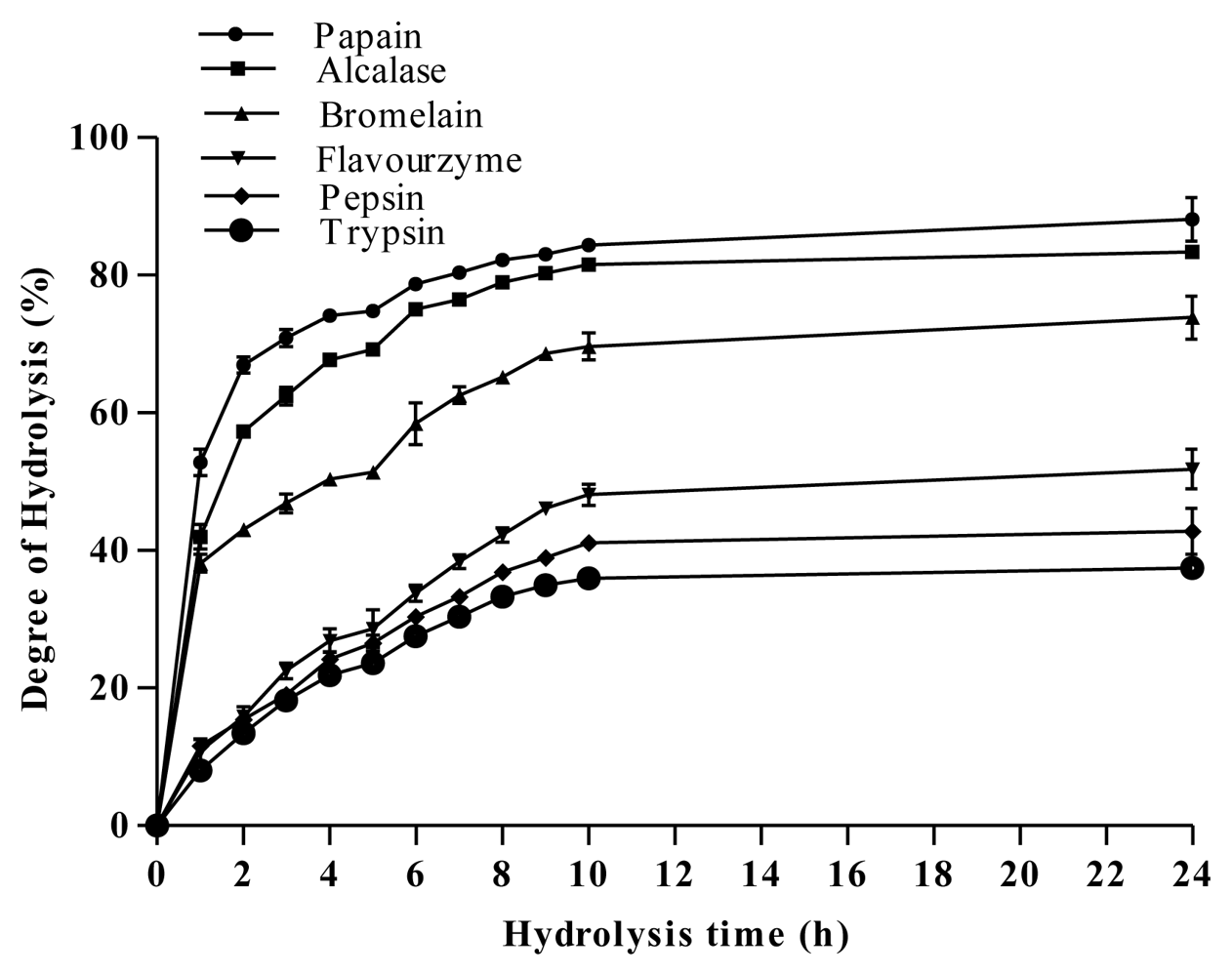
<p>In order to produce antibacterial peptides, <italic>A. lecanora</italic> was hydrolyzed using different classes of proteases namely cysteine proteases (bromelain and papain), serine proteases (trypsin and alcalase), aspartate protease (pepsin) and exopeptidase protease (flavourzyme) for 24 h. For production of peptides, the extent of protein hydrolyses with time was monitored by measuring the degree of hydrolysis (DH). DH has been defined as the percent ratio of the number of peptide bonds cleaved to the total number of peptide bonds within the substrate used [<xref ref-type="bibr" rid="b35-ijms-13-16796">35</xref>]. It is the proportion of cleaved peptide bonds in a protein hydrolysate. Therefore, DH is the most widely used indicator for comparing different protein hydrolysates. During enzymatic hydrolysis, cleavage of peptide bonds releases the α-amino groups, which are reacted with OPA in the presence of β-mercaptoethanol forming a complex compound detectable at absorbance of 340 nm. <xref ref-type="fig" rid="f1-ijms-13-16796">Figure 1</xref> depicts that the patterns of <italic>A. lecanora</italic> hydrolysis by different proteases were found to be similar, but with significant (<italic>p</italic> &lt; 0.05) differences in DH values.</p>
<p>Three different phases are observed. The first phase showed an initial rapid-digestion for 1 h after the addition of enzyme, indicating that cleavage sites were available for enzyme to act on. In the second phase, the extent of hydrolysis steadily decreased until reaching a plateau (third phase). The plateau phase could either be due to the limitation of the available enzyme cleavage sites, enzyme inactivation and/or product inhibition. This plateau state remained for the next 14 h implying that the hydrolysis was completed.</p>
<p>Among the various enzymes tested, papain was the fastest and the most efficient enzyme for hydrolysis of <italic>A. lecanora</italic>, followed by alcalase, bromelain, flavourzyme, pepsin and trypsin with DH values of 89.44%, 83.35%, 73.84%, 51.80%, 42.77%, and 37.46%, respectively (<xref ref-type="fig" rid="f1-ijms-13-16796">Figure 1</xref>). Basically, the ability of enzyme to cleave peptide bonds depends on the enzyme/substrate ratio and accessibility of the enzyme to the substrate cleavage sites [<xref ref-type="bibr" rid="b36-ijms-13-16796">36</xref>]. Furthermore, the difference in DH is a result of the difference in the total number of cleavage sites of the substrate. Therefore, it can be concluded that although <italic>A. lecanora</italic> was degradable by all six proteases, the number of available cleavage sites for papain was much higher than other proteases used. Being an endoprotesae, the efficiency of papain also is in line with its broad specificity towards a protein substrate.</p></sec>
<sec>
<title>2.3. Antibacterial Activity of Hydrolysates</title>
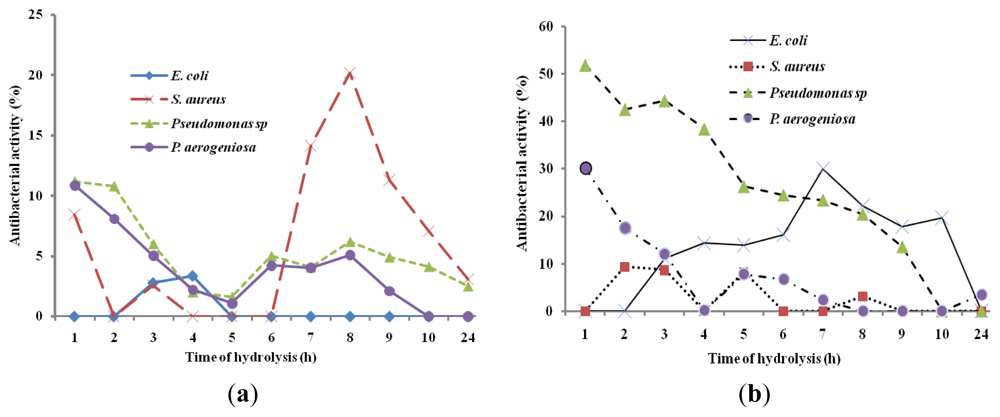
<p>In order to study the antibacterial activity of <italic>A. lecanora</italic> hydrolysates, samples were withdrawn every 1 h of hydrolysis for up to 24 h and assayed for antibacterial activities. The antibacterial abilities of different hydrolysates against <italic>E. coli</italic>, <italic>B. subtilis</italic>, <italic>S. aureus</italic>, <italic>P. aeruginosa</italic> and <italic>Pseudomonas</italic> sp. were studied. The hydrolysates produced by alcalase, flavourzyme, pepsin and trypsin did not show any antibacterial activities (data are not shown), while only hydrolysates produced by papain and bromelain exhibited antibacterial activities (<xref ref-type="fig" rid="f2-ijms-13-16796">Figure 2</xref>). In addition, the control (unhydrolyzed <italic>A. lecanora</italic>) exhibited no antibacterial effect.</p>
<p>The growth of <italic>E. coli</italic>, <italic>P. aeruginosa</italic> and <italic>Pseudomonas</italic> sp. was reduced by different bromelain hydrolysates by 30%, 30.07% and 51.85%, respectively (<xref ref-type="fig" rid="f2-ijms-13-16796">Figure 2a</xref>), whereas papain hydrolysate showed antibacterial activity of 20.19% against <italic>S. aureus</italic> (<italic>p</italic> &lt; 0.05) (<xref ref-type="fig" rid="f2-ijms-13-16796">Figure 2b</xref>). Based on the results, hydrolysis time had a significant effect on the growth inhibition percentage of each bacterium (<italic>p</italic> &lt; 0.05). Song <italic>et al.</italic> (2011) [<xref ref-type="bibr" rid="b37-ijms-13-16796">37</xref>] revealed that protein hydrolysates of halffin anchovy displayed antibacterial activities against <italic>E. coli</italic>. In addition, Salampessy <italic>et al.</italic> (2010) [<xref ref-type="bibr" rid="b38-ijms-13-16796">38</xref>] showed the antibacterial activity of leatherjacket (<italic>Meuchenia</italic> sp.) bromelain hydrolysates against <italic>S. aureus</italic> and <italic>B. cereus.</italic></p>
<p>On the other hand, this finding showed that <italic>A. lecanora</italic> hydrolysates were more active in inhibiting the growth of Gram negative bacteria (<italic>P. aeruginosa</italic>, <italic>Pseudomonas</italic> sp., and <italic>E. coli</italic>) than that of Gram positive bacterium (<italic>S. aureus</italic>). Thus, the selections of suitable protease and time of hydrolysis are crucial due to the enzyme specificity and activity, producing peptides, which vary in molecular size, amino acid sequences and consequent differences in antibacterial activity.</p>
<p>Although bromelain is commonly used to enhance the hydrolysis or fermentation processes such as preparation of soy and fish sauces, there are a few reports showing the release of antibacterial peptides by this enzyme from different protein sources [<xref ref-type="bibr" rid="b38-ijms-13-16796">38</xref>]. To the best of our knowledge, this may be the first finding of an antimicrobial peptide released through hydrolysis of <italic>A. lecanora</italic>. Thus, peptides derived from <italic>A. lecanora</italic> have the potential to be used as natural preservatives in food products as supported by the World Health Organization which emphasizes the use of natural preservatives in food [<xref ref-type="bibr" rid="b39-ijms-13-16796">39</xref>]. Although bitterness is a usual characteristic of different protein hydrolysates, microencapsulation is a useful technique to mask or reduce the unpleasant flavor and hygroscopic property of the product, in addition to increasing its stability.</p></sec>
<sec>
<title>2.4. Relationship between Degree of Hydrolysis and Antibacterial Activity</title>
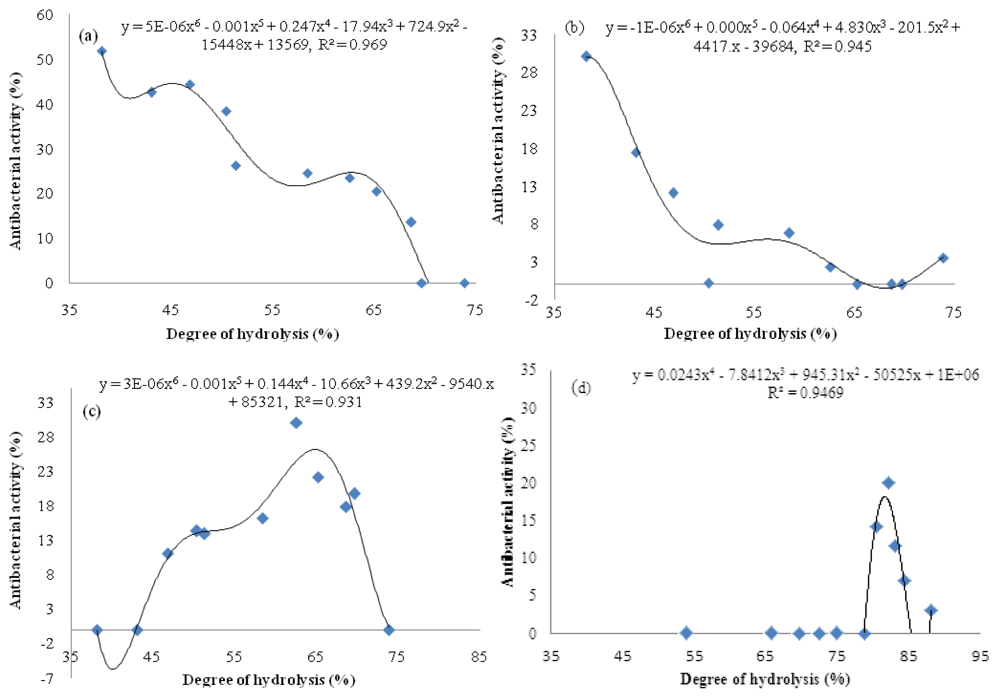
<p>The degree of hydrolysis (DH) indicates the progress of hydrolysis for generating peptides of different sizes and amino acid sequences, where antibacterial activity depends on both peptides’ properties mentioned. Thus, it is crucial to determine any relationship that might exist between DH and antibacterial activity. Plotting DH <italic>versus</italic> antibacterial activity (<xref ref-type="fig" rid="f3-ijms-13-16796">Figure 3</xref>) showed that despite an increasing DH value during the hydrolysis, different antibacterial patterns were exhibited. The bromelain hydrolysis showed a downward trend antibacterial activity (<xref ref-type="fig" rid="f3-ijms-13-16796">Figure 3a,b</xref>) whereas papain hydrolysis exhibited a mixed pattern trend of antibacterial activity with two phases (<xref ref-type="fig" rid="f3-ijms-13-16796">Figure 3d</xref>): an increase in DH value up to 82% caused an increase in antibacterial activity value, while in second phase, antibacterial activity was decreased with the further increase in DH value. On the other hand, bromelain proteolysis showed a steadily decrease in antibacterial activity against <italic>Pseudomonas</italic> sp. and <italic>P. aerogeniosa</italic> with the DH increasing (<xref ref-type="fig" rid="f3-ijms-13-16796">Figure 3a,b</xref>). Correlation coefficient of more than 0.93 shows a meaningful relationship between DH and antibacterial activities of <italic>A. lecanora</italic> hydrolysates prepared to use bromelain and papain. The relationship followed a 4- and 6- order functions (<xref ref-type="fig" rid="f3-ijms-13-16796">Figure 3</xref>). On the other hand, since antibacterial activity of a peptide is affected by its amino acid sequence, secondary structure, length, molecular weight and charge, thus DH and antibacterial activity depend on the type of the protease used and the amino acid sequence of parent protein [<xref ref-type="bibr" rid="b7-ijms-13-16796">7</xref>].</p></sec>
<sec>
<title>2.5. Antibacterial Activity of Fractionated Peptides</title>
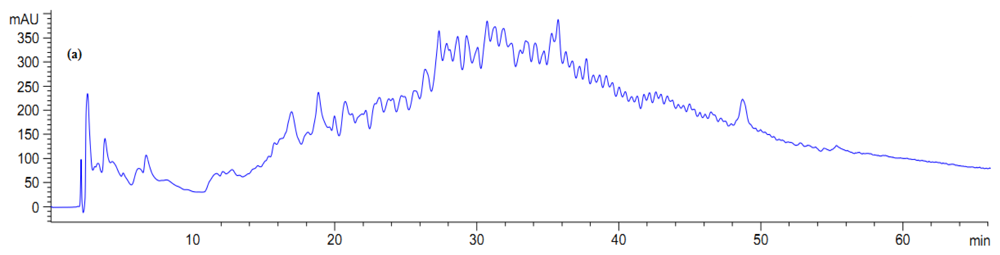
<p>In this study, papain and bromelain generating active hydrolysates were further fractionated using reversed-phase HPLC (RP-HPLC) and the collected fractions were characterized for their antibacterial properties. In RP-HPLC, compounds are separated based on their hydrophobic characteristic where more hydrophobic peptides showed longer elution times in a RP column. In this process, the molecules are partitioned between C<sub>18</sub> matrix and mobile phase, where the matrix is hydrophobic, and mobile phase consisting of a gradient mixture of solvents from relatively polar (hydrophilic) to relatively non polar (hydrophobic). Therefore, fractions (peptides) that come out in the early stage contain relatively more hydrophilic molecules and fractions come out in the later stage contain relatively more hydrophobic molecules.</p>
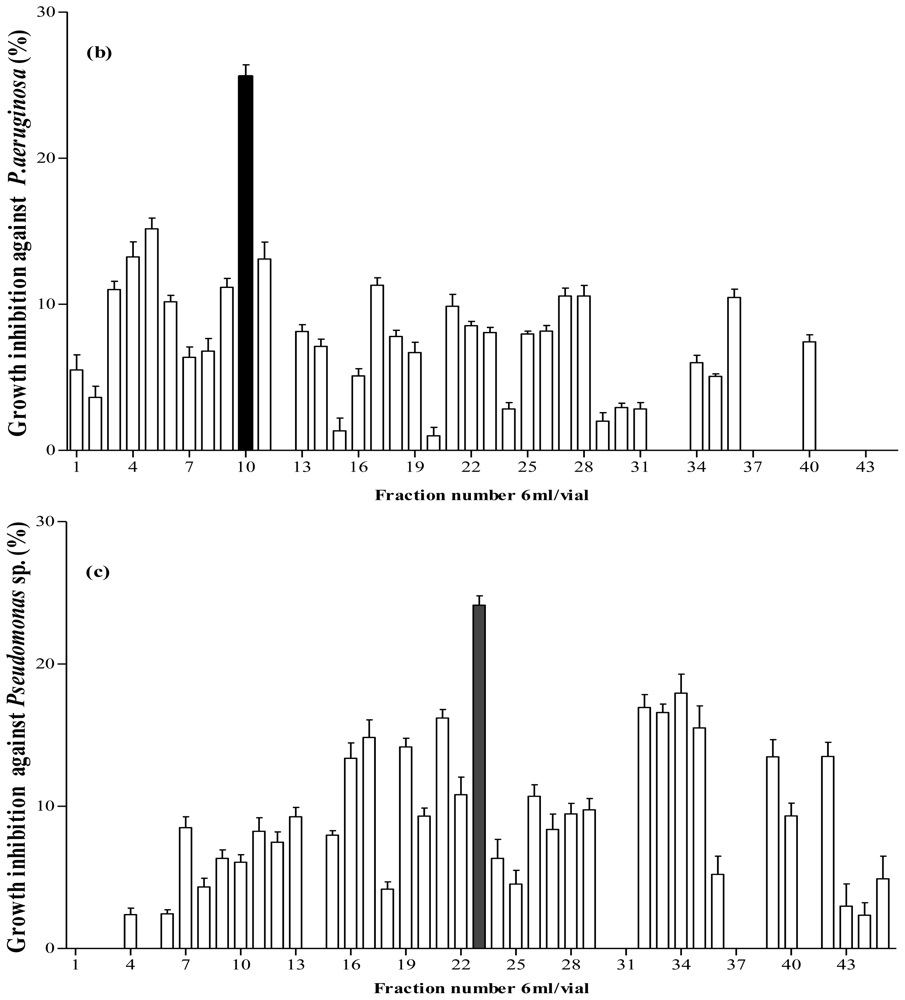
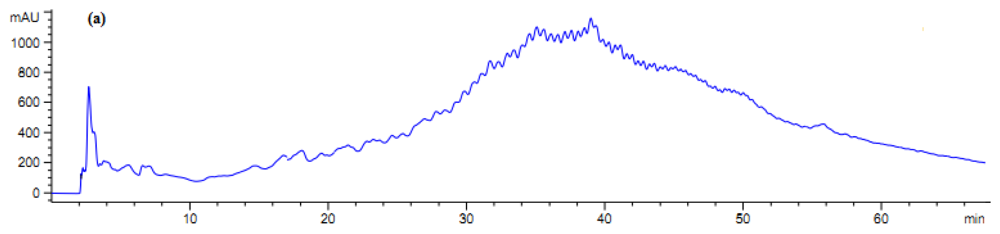
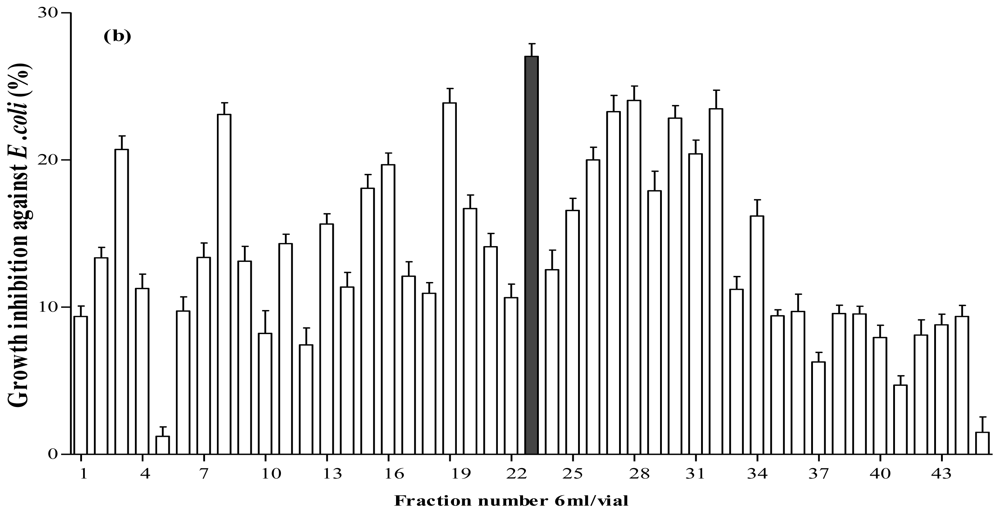
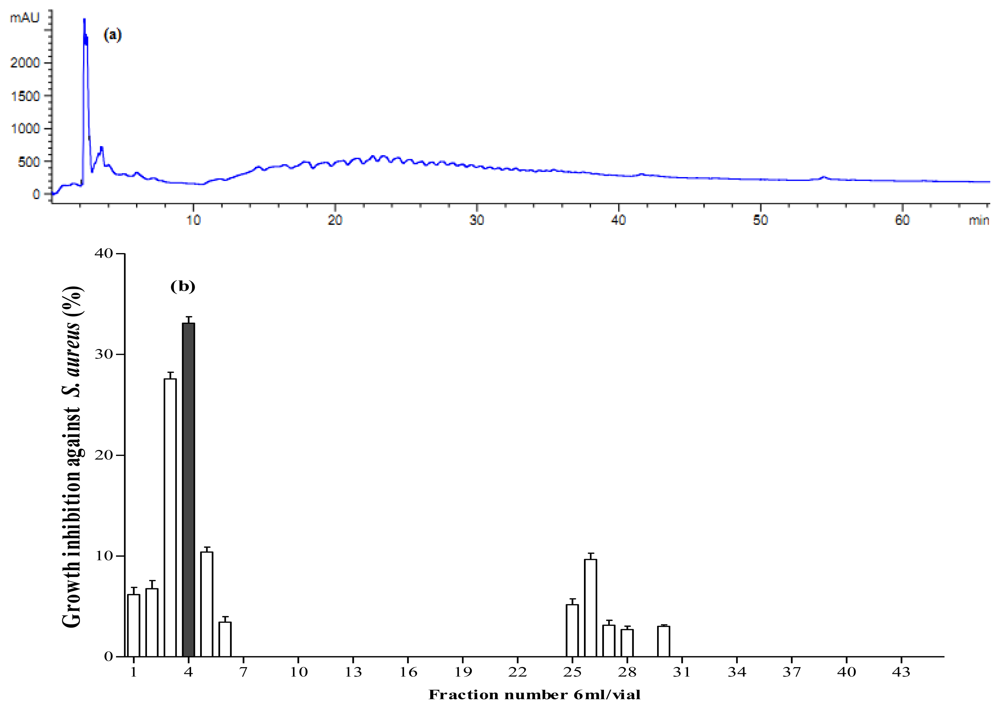
<p>The collected fractions from papain after 8 h hydrolysis and bromelain after 7 h hydrolysis effectively inhibited growth of <italic>S. aureus</italic> and <italic>E. coli</italic>, respectively, while fractions of 1 h bromelain hydrolysis effectively inhibited the growth of <italic>Pseudomonas</italic> sp. and <italic>P. aerogeniosa.</italic> All of the forty five fractions were collected after RP-HPLC fractionation and freeze dried prior to antibacterial activity determination. Among the bromelain fractions, fractions 23 and 10 inhibited the growth of <italic>Pseudomonas</italic> sp. and <italic>P. aerogenios</italic> by 24% and 25.5%, respectively (<xref ref-type="fig" rid="f4-ijms-13-16796">Figure 4</xref>). In addition, fraction 23, which was obtained from bromelain proteolysis after 7 h, inhibited the growth of <italic>E. coli</italic> by 27.1% (<xref ref-type="fig" rid="f5-ijms-13-16796">Figure 5</xref>). Furthermore, papain fraction 4, after 8 h hydrolysis had inhibitory activity of 33.1% against <italic>S. aureus</italic> (<xref ref-type="fig" rid="f6-ijms-13-16796">Figure 6</xref>).</p>
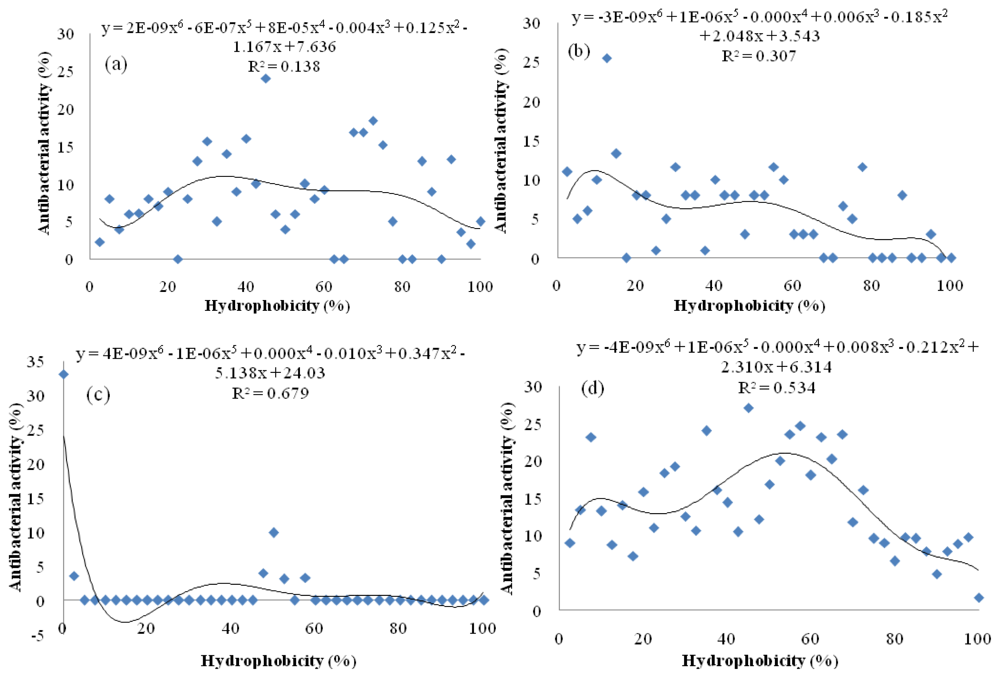
<p>Results revealed that peptides with mild hydrophobicity had strong antibacterial activity against <italic>Pseudomonas</italic> sp. and <italic>E. coli</italic> (<xref ref-type="fig" rid="f7-ijms-13-16796">Figure 7a,d</xref>) but peptides with low hydrophobicity had strong effect on <italic>Pseudomonas aeruginosa</italic> and <italic>S. aureus</italic> (<xref ref-type="fig" rid="f7-ijms-13-16796">Figure 7b,c</xref>). These findings demonstrated that antibacterial activity of <italic>A. lecanora</italic> protein hydrolysates were not correlated only to the size, molecular weight and degree of hydrolysis, but also hydrophobicity of peptides that could be attributed by the presence of hydrophobic amino acids such as leucine, isoleucine and phenylalanine [<xref ref-type="bibr" rid="b40-ijms-13-16796">40</xref>].</p></sec></sec>
<sec>
<title>3. Experimental Section</title>
<sec sec-type="materials">
<title>3.1. Materials and Chemicals</title>
<p>Alcalase and flavourzyme were obtained from Novoenzyme (Denmark). Pepsin and o-phtaldialdehyde (OPA) were purchased from Sigma-Aldrich (Munich, Germany). Papain and bromelain were obtained from Acros Organics Co. (St. Louis, MO, USA). Trypsin was purchased from Fisher Scientific (Georgia, US). Trifluoroacetic acid and all solvents used in this research were HPLC grade and obtained from Acros Organics Co. (St. Louis, MO, USA).</p></sec>
<sec>
<title>3.2. Samples</title>
<p>The fresh samples (<italic>Actinopyga lecanora</italic>) were obtained from a local supplier in Malaysia. The samples were kept in ice during transportation to the laboratory. After arrival, the internal organs were removed, and samples were washed, packed in plastic bags and kept at −80 °C, until used. Samples were freeze dried and ground with a waring blender, sieved and kept at −80 °C for further use.</p></sec>
<sec sec-type="methods">
<title>3.3. Proximate Analysis</title>
<p>The chemical composition of freeze dried <italic>A. lecanora</italic> was determined. Total lipid content was determined based on the AOAC official method 948.15 by soxhlet extraction method for 6 h. Moisture content was quantified by the oven-drying method at 105 °C by drying the sample to a constant weight based on the AOAC 952.08 method. Ash content was determined by incineration in a muffle furnace at 550 °C for 24 h according to the AOAC method 938.08. Crude protein using Kjeldahl method was quantified according to the AOAC method 981.10 [<xref ref-type="bibr" rid="b41-ijms-13-16796">41</xref>]. Carbohydrate was calculated by difference [<xref ref-type="bibr" rid="b12-ijms-13-16796">12</xref>].</p></sec>
<sec>
<title>3.4. Preparation of A. lecanora Protein Hydrolysate</title>
<p>Powdered and freeze dried sample (10 g) was dialyzed in a 12–14 kDa molecular mass cut-off dialysis tube against deionized water followed by appropriate buffer solutions, as stated in <xref ref-type="table" rid="t2-ijms-13-16796">Table 2</xref>, for 24 h. After dialysis, the sample was well mixed with enzyme and respective buffer in a test tube with the ratio of enzyme/substrate at 1/100 (<italic>w</italic>/<italic>w</italic>). Hydrolysis was performed for 24 h in a water bath shaker at the optimum condition of each enzyme (<xref ref-type="table" rid="t2-ijms-13-16796">Table 2</xref>). During the hydrolysis process, the enzyme was re-added twice after 5 and 10 h reaction at the same concentration. Samples were withdrawn at one-hour intervals, starting from time 0 (before adding enzyme) to the tenth hour and one sample at the end of hydrolysis (24 h). The reaction was terminated in a boiling-water bath for 15 min to inactive the enzyme. Each protein hydrolysate was centrifuged at 10,000× <italic>g</italic>, 4 °C for 20 min. The supernatant was collected, filtered through 0.20 μM pore size membrane and stored at −80 °C for further analysis.</p></sec>
<sec>
<title>3.5. Determination of the Degree of Hydrolysis</title>
<p>The degree of hydrolysis (DH) was determined using the o-phthaldialdehyde (OPA) spectroscopic method [<xref ref-type="bibr" rid="b42-ijms-13-16796">42</xref>] with some modifications as described by Zarei <italic>et al.</italic> (2012) [<xref ref-type="bibr" rid="b35-ijms-13-16796">35</xref>]. The fresh OPA solution was prepared daily by mixing 25 mL of 100 mM sodium tetraborate, 2.5 mL 20% (<italic>w</italic>/<italic>w</italic>) sodium dodecyl sulfate (SDS), 0.16 g of OPA reagent dissolved in 4 mL ethanol (96%) and 400 μL of β-mercaptoethanol. The final volume was adjusted to 200 mL with deionized water. Assay was performed by mixing 36 μL of each protein hydrolysate with 270 μL OPA solutions in a well of 96-well plate. The mixture was incubated at room temperature for two minutes, followed by measurement of absorbance at 340 nm [<xref ref-type="bibr" rid="b43-ijms-13-16796">43</xref>], using a 96-well plate reader (Power Wave, X340, BioTek instruments, INC. Winooski, VT, USA).</p></sec>
<sec>
<title>3.6. Cultivation and Bacterial Inoculum Perpetration</title>
<p>Antibacterial activity of peptides was evaluated against both Gram negative (<italic>Escherichia coli</italic> (ATCC 10536), <italic>Pseudomonas aeruginosa</italic> (ATCC 10145) and <italic>Pseudomonas</italic> sp.) and Gram positive (<italic>Bacillus subtilis</italic> (ATCC 11774) and <italic>Staphylococcus aureus</italic> (ATCC 25923)). Selected bacteria were cultivated aerobically at 37 °C overnight for 18 h in sterile tripton soy broth (TSB). The prepared cultures were re-cultivated for acquiring maximum growth under the same conditions, by transferring 0.5 mL of the culture into fresh medium (TSB). Bacterial inocula were prepared for antibacterial assay from the mid-logarithmic phase of their growth culture. The optical density cultures were measured at 630 nm and adjusted to around 0.5 by addition of the TSB (OD<sub>630</sub> = 0.5) which contains approximately 10<sup>8</sup> colony-forming units per milliLiter (cfu/mL) [<xref ref-type="bibr" rid="b44-ijms-13-16796">44</xref>].</p></sec>
<sec>
<title>3.7. Determination of Antibacterial Activity</title>
<p>Antibacterial activity of bioactive peptides was evaluated following the method described by Mandar <italic>et al.</italic> (2011) [<xref ref-type="bibr" rid="b44-ijms-13-16796">44</xref>] with some modifications. Each sample was prepared by mixing the bacterial inoculum (10 μL) containing 10<sup>6</sup> (cfu/mL), TSB medium (90 μL) and protein hydrolysate (90 μL) into each well of 96-well plate. Wells without peptide were considered as a control and containing medium, bacterial culture and 50 mM appropriate buffer for each hydrolysate. The plates were incubated at 37 °C overnight with shaking (90 rpm) and bacterial growth was monitored by measuring the absorbance of wells at 630 nm using 96-well plate readers (Power Wave, X340, Bio Tek instruments, INC.). The percentage of inhibition was calculated as [(OD<sub>control</sub> − OD<sub>sample</sub>)/OD<sub>control</sub>)] × 100. All experiments were performed in six replicates for each sample.</p></sec>
<sec>
<title>3.8. Fractionation of <italic>A. lecanora</italic> Peptide</title>
<p>Protein hydrolysate with antibacterial property was fractionated by semi-preparative RP-HPLC. Each active hydrolysate was filtered through 0.45 and 0.20 μM pore size membranes (Sartorius Stedim) before being loaded into a preparative HPLC system (Agilent Technologies 1200 series), coupled with a MWD detector and fraction collector. Separation was performed in a zorbax 300 SB-C18 column (5 μm, 9.4 mm × 250 mm, Agilent Technologies, USA) at a flow rate of 4 mL/min. The sample was eluted using two mobile phases; deionized water containing 0.1% trifluoroacetic acid (phase A) and acetonitrile containing 0.1% trifluoroacetic acid (phase B). Sample injection volume and concentration were 500 μL and 0.5 mg of peptide per milliliter, respectively. Elution was carried out at room temperature according to the following process: 0–5 min, 100% eluent A; 5–60 min, 0%–100% eluent B. Peptides were detected at 205 nm. The column was conditioned between two successive runs for 60 min using acetonitrile containing 0.1% trifluoroacetic acid. All fractions collected were freeze dried and dissolved in deionized water for antibacterial activity assay.</p></sec></sec>
<sec sec-type="methods">
<title>4. Statistical Analysis</title>
<p>All results were shown as means of three replicates. The one-way ANOVA was used for data analysis followed by Tukey’s test to identify significant differences between treatments (<italic>p</italic> &lt; 0.05) with Minitab version 14 (Minitab Inc., State College, PA, USA).</p></sec>
<sec>
<title>5. Conclusion</title>
<p>This study demonstrated that due to its relatively high protein content, <italic>A. lecanora</italic> can be used as a raw material for the generation of bioactive peptides. Therefore, <italic>A. lecanora</italic> was hydrolyzed by different type of proteases, namely papain, alcalase, bromelain, pepsin, flavourzyme and trypsin, in order to produce antibacterial peptides. The results revealed that the antibacterial activity and characteristics of peptides produced during the hydrolysis were strongly related to the type of enzyme employed. Of the different proteases tested, papain and bromelain were found to be the most efficient for the production of hydrolysates with antibacterial properties against the selected pathogenic bacteria. The evaluation of the relationship between DH and antibacterial activities of papin and bromelain hydrolysates revealed meaningful correlations of four and six order functions. Based on our results, mild hydrophobic peptides showed higher antibacterial activity. Although most of the antibacterial peptides generated from <italic>A. lecanora</italic> are not comparable to synthetic antibacterial agents against the pathogenic bacteria, it is worthy to note that as natural products they generally regarded as safer and devoid of side effects. Thus, <italic>A. lecanora</italic> hydrolysates can be considered as a suitable natural antibacterial source alternative to chemical food preservatives for the prevention of bacteria growth in food systems and as preservatives to improve shelf life, in addition to their food safety and nutritional value. The need for further research to identify peptides that are responsible for this biological activity and its optimized production for application in food systems is deemed necessary.</p></sec></body>
<back>
<ack>
<title>Acknowledgements</title>
<p>Financial support by Malaysian Ministry of Science, Technology and Innovation, under project no. 10-05-ABI-FB 037 is greatly acknowledged.</p></ack>
<ref-list>
<title>References</title>
<ref id="b1-ijms-13-16796"><label>1</label><citation citation-type="journal"><person-group person-group-type="author"><name><surname>Hong</surname><given-names>S.Y.</given-names></name><name><surname>Park</surname><given-names>T.G.</given-names></name><name><surname>Lee</surname><given-names>K.-H.</given-names></name></person-group><article-title>The effect of charge increase on the specificity and activity of a short antimicrobial peptide</article-title><source>Peptides</source><year>2001</year><volume>22</volume><fpage>1669</fpage><lpage>1674</lpage><pub-id pub-id-type="doi">10.1016/S0196-9781(01)00502-2</pub-id><pub-id pub-id-type="pmid">11587795</pub-id></citation></ref>
<ref id="b2-ijms-13-16796"><label>2</label><citation citation-type="journal"><person-group person-group-type="author"><name><surname>Vercruysse</surname><given-names>L.</given-names></name><name><surname>van Camp</surname><given-names>J.</given-names></name><name><surname>Smagghe</surname><given-names>G.</given-names></name></person-group><article-title>ACE inhibitory peptides derived from enzymatic hydrolysates of animal muscle protein: A review</article-title><source>J. Agric. Food Chem</source><year>2005</year><volume>53</volume><fpage>8106</fpage><lpage>8115</lpage><pub-id pub-id-type="doi">10.1021/jf0508908</pub-id><pub-id pub-id-type="pmid">16218651</pub-id></citation></ref>
<ref id="b3-ijms-13-16796"><label>3</label><citation citation-type="journal"><person-group person-group-type="author"><name><surname>Peña-Ramos</surname><given-names>E.A.</given-names></name><name><surname>Xiong</surname><given-names>Y.L.</given-names></name></person-group><article-title>Antioxidant activity of soy protein hydrolysates in a liposomal system</article-title><source>J. Food Sci</source><year>2002</year><volume>67</volume><fpage>2952</fpage><lpage>2956</lpage><pub-id pub-id-type="doi">10.1111/j.1365-2621.2002.tb08844.x</pub-id></citation></ref>
<ref id="b4-ijms-13-16796"><label>4</label><citation citation-type="journal"><person-group person-group-type="author"><name><surname>Davalos</surname><given-names>A.</given-names></name><name><surname>Miguel</surname><given-names>M.</given-names></name><name><surname>Bartolome</surname><given-names>B.</given-names></name><name><surname>Lopez-Fandino</surname><given-names>R.</given-names></name></person-group><article-title>Antioxidant activity of peptides derived from egg white proteins by enzymatic hydrolysis</article-title><source>J. Food Prot</source><year>2004</year><volume>67</volume><fpage>1939</fpage><lpage>1944</lpage><pub-id pub-id-type="pmid">15453585</pub-id></citation></ref>
<ref id="b5-ijms-13-16796"><label>5</label><citation citation-type="journal"><person-group person-group-type="author"><name><surname>Divakaramenon</surname><given-names>V.</given-names></name><name><surname>David</surname><given-names>K.</given-names></name><name><surname>Antoine</surname><given-names>H.S.</given-names></name><name><surname>Jayendra</surname><given-names>B.B.</given-names></name><name><surname>Richard</surname><given-names>B.</given-names></name><name><surname>Allen</surname><given-names>M.</given-names></name><name><surname>Amanda</surname><given-names>L.R.</given-names></name><name><surname>Brittany</surname><given-names>C.W.</given-names></name><name><surname>Rickey</surname><given-names>P.H.</given-names></name></person-group><article-title>Novel antimicrobial peptides that exhibit activity against select agents and other drug resistant bacteria</article-title><source>Bioorg. Med. Chem</source><year>2010</year><volume>18</volume><fpage>5137</fpage><lpage>5147</lpage><pub-id pub-id-type="doi">10.1016/j.bmc.2010.05.065</pub-id><pub-id pub-id-type="pmid">20558071</pub-id></citation></ref>
<ref id="b6-ijms-13-16796"><label>6</label><citation citation-type="journal"><person-group person-group-type="author"><name><surname>Arenas</surname><given-names>G.</given-names></name><name><surname>Guzman</surname><given-names>F.</given-names></name><name><surname>Cardenas</surname><given-names>C.</given-names></name><name><surname>Mercado</surname><given-names>L.</given-names></name><name><surname>Marshall</surname><given-names>S.H.</given-names></name></person-group><article-title>A novel antifungal peptide designed from the primary structure of a natural antimicrobial peptide purified from <italic>Argopecten purpuratus</italic> hemocytes</article-title><source>Peptides</source><year>2009</year><volume>30</volume><fpage>1405</fpage><lpage>1411</lpage><pub-id pub-id-type="doi">10.1016/j.peptides.2009.05.019</pub-id><pub-id pub-id-type="pmid">19481126</pub-id></citation></ref>
<ref id="b7-ijms-13-16796"><label>7</label><citation citation-type="journal"><person-group person-group-type="author"><name><surname>Battison</surname><given-names>A.L.</given-names></name><name><surname>Summerfield</surname><given-names>R.</given-names></name><name><surname>Patrzykat</surname><given-names>A.</given-names></name></person-group><article-title>Isolation and characterisation of two antimicrobial peptides from haemocytes of the American lobster <italic>Homarus americanus</italic></article-title><source>Fish Shellfish Immun</source><year>2008</year><volume>25</volume><fpage>181</fpage><lpage>187</lpage><pub-id pub-id-type="doi">10.1016/j.fsi.2008.04.005</pub-id></citation></ref>
<ref id="b8-ijms-13-16796"><label>8</label><citation citation-type="journal"><person-group person-group-type="author"><name><surname>Liu</surname><given-names>Z.</given-names></name><name><surname>Dong</surname><given-names>S.</given-names></name><name><surname>Xu</surname><given-names>J.</given-names></name><name><surname>Zeng</surname><given-names>M.</given-names></name><name><surname>Song</surname><given-names>H.</given-names></name><name><surname>Zhao</surname><given-names>Y.</given-names></name></person-group><article-title>Production of cysteine-rich antimicrobial peptide by digestion of oyster (<italic>Crassostrea gigas</italic>) with alcalase and bromelin</article-title><source>Food Control</source><year>2008</year><volume>19</volume><fpage>231</fpage><lpage>235</lpage><pub-id pub-id-type="doi">10.1016/j.foodcont.2007.03.004</pub-id></citation></ref>
<ref id="b9-ijms-13-16796"><label>9</label><citation citation-type="journal"><person-group person-group-type="author"><name><surname>Bartlett</surname><given-names>T.C.</given-names></name><name><surname>Cuthbertson</surname><given-names>B.J.</given-names></name><name><surname>Shepard</surname><given-names>E.F.</given-names></name><name><surname>Chapman</surname><given-names>R.W.</given-names></name><name><surname>Gross</surname><given-names>P.S.</given-names></name><name><surname>Warr</surname><given-names>G.W.</given-names></name></person-group><article-title>Crustins, homologues of an 11.5-kDa antibacterial peptide, from two species of penaeid shrimp, <italic>Litopenaeus vannamei</italic> and <italic>Litopenaeus setiferus</italic></article-title><source>Mar. Biol</source><year>2002</year><volume>4</volume><fpage>278</fpage><lpage>293</lpage></citation></ref>
<ref id="b10-ijms-13-16796"><label>10</label><citation citation-type="journal"><person-group person-group-type="author"><name><surname>Chun</surname><given-names>L.</given-names></name><name><surname>Tor</surname><given-names>H.</given-names></name><name><surname>Olaf</surname><given-names>B.S.</given-names></name><name><surname>Trond</surname><given-names>O.J.</given-names></name><name><surname>Klara</surname><given-names>S.</given-names></name></person-group><article-title>Strongylocins, novel antimicrobial peptides from the green sea urchin</article-title><source>Dev. Comp. Immunol</source><year>2008</year><volume>32</volume><fpage>1430</fpage><lpage>1440</lpage><pub-id pub-id-type="doi">10.1016/j.dci.2008.06.013</pub-id><pub-id pub-id-type="pmid">18656496</pub-id></citation></ref>
<ref id="b11-ijms-13-16796"><label>11</label><citation citation-type="journal"><person-group person-group-type="author"><name><surname>Mingyong</surname><given-names>Z.</given-names></name><name><surname>Wenxuan</surname><given-names>C.</given-names></name><name><surname>Yuanhui</surname><given-names>Z.</given-names></name><name><surname>Zunying</surname><given-names>L.</given-names></name><name><surname>Shiyuan</surname><given-names>D.</given-names></name><name><surname>Yao</surname><given-names>G.</given-names></name></person-group><article-title>Antiviral active peptide from oyster</article-title><source>Chin. J. Oceanol. Limnol</source><year>2008</year><volume>23</volume><fpage>307</fpage><lpage>312</lpage></citation></ref>
<ref id="b12-ijms-13-16796"><label>12</label><citation citation-type="journal"><person-group person-group-type="author"><name><surname>Zhong</surname><given-names>Y.</given-names></name><name><surname>Ahmad Khan</surname><given-names>M.</given-names></name><name><surname>Shahidi</surname><given-names>F.</given-names></name></person-group><article-title>Compositional characteristics and antioxidant properties of fresh and processed sea cucumber (<italic>Cucumaria frondosa</italic>)</article-title><source>J. Agric. Food Chem</source><year>2007</year><volume>55</volume><fpage>1188</fpage><lpage>1192</lpage><pub-id pub-id-type="doi">10.1021/jf063085h</pub-id><pub-id pub-id-type="pmid">17243707</pub-id></citation></ref>
<ref id="b13-ijms-13-16796"><label>13</label><citation citation-type="journal"><person-group person-group-type="author"><name><surname>Liu</surname><given-names>H.M.</given-names></name><name><surname>Cai</surname><given-names>C.G.</given-names></name><name><surname>Zhan</surname><given-names>J.M.</given-names></name></person-group><article-title>Using sea cucumber to treat 10 cases of anaemia</article-title><source>Guangxi Chin. Trad. Med</source><year>1984</year><volume>7</volume><fpage>18</fpage></citation></ref>
<ref id="b14-ijms-13-16796"><label>14</label><citation citation-type="journal"><person-group person-group-type="author"><name><surname>Fredalina</surname><given-names>B.D.</given-names></name><name><surname>Ridzwan</surname><given-names>B.H.</given-names></name><name><surname>Zainal Abdin</surname><given-names>A.A.</given-names></name><name><surname>Kaswandi</surname><given-names>M.A.</given-names></name><name><surname>Zaiton</surname><given-names>H.</given-names></name><name><surname>Zali</surname><given-names>I.</given-names></name><name><surname>Kittakoop</surname><given-names>P.</given-names></name><name><surname>Jais</surname><given-names>A.M.</given-names></name></person-group><article-title>Fatty acid composition in local sea cucumber, <italic>Stichopus chloronotus</italic> for wound healing</article-title><source>Gen. Pharmacol</source><year>1999</year><volume>33</volume><fpage>337</fpage><lpage>340</lpage><pub-id pub-id-type="doi">10.1016/S0306-3623(98)00253-5</pub-id><pub-id pub-id-type="pmid">10523072</pub-id></citation></ref>
<ref id="b15-ijms-13-16796"><label>15</label><citation citation-type="journal"><person-group person-group-type="author"><name><surname>Althunibat</surname><given-names>O.Y.</given-names></name><name><surname>Hashim</surname><given-names>R.</given-names></name><name><surname>Taher</surname><given-names>M.</given-names></name><name><surname>Daud</surname><given-names>J.M.</given-names></name><name><surname>Ikeda</surname><given-names>M.-A.</given-names></name><name><surname>Zali</surname><given-names>B.I.</given-names></name></person-group><article-title><italic>In vitro</italic> antioxidant and antiproliferative activities of three malaysian sea cucumber species</article-title><source>Eur. J. Sci. Res</source><year>2009</year><volume>37</volume><fpage>376</fpage><lpage>387</lpage></citation></ref>
<ref id="b16-ijms-13-16796"><label>16</label><citation citation-type="journal"><person-group person-group-type="author"><name><surname>Ridzwan</surname><given-names>B.H.</given-names></name><name><surname>Kaswandi</surname><given-names>M.A.</given-names></name><name><surname>Azman</surname><given-names>Y.</given-names></name><name><surname>Fuad</surname><given-names>M.</given-names></name></person-group><article-title>Screen for antibacterial agents in three species of sea cucumber from coastal areas of sabah</article-title><source>Gen. Pharmacol</source><year>1995</year><volume>26</volume><fpage>1539</fpage><lpage>1543</lpage><pub-id pub-id-type="doi">10.1016/0306-3623(95)00041-0</pub-id><pub-id pub-id-type="pmid">8690242</pub-id></citation></ref>
<ref id="b17-ijms-13-16796"><label>17</label><citation citation-type="journal"><person-group person-group-type="author"><name><surname>Ridzwan</surname><given-names>B.H.</given-names></name><name><surname>Zarina</surname><given-names>M.Z.</given-names></name><name><surname>Nadirah</surname><given-names>M.</given-names></name><name><surname>Kaswandi</surname><given-names>M.A.</given-names></name><name><surname>Shmsuddin</surname><given-names>A.F.</given-names></name></person-group><article-title>The antinociceptive effects of extracts from <italic>Stichopus chloronotus</italic> Brandt</article-title><source>Pakistan J. Biol. Sci</source><year>2001</year><volume>4</volume><fpage>244</fpage><lpage>246</lpage><pub-id pub-id-type="doi">10.3923/pjbs.2001.244.246</pub-id></citation></ref>
<ref id="b18-ijms-13-16796"><label>18</label><citation citation-type="journal"><person-group person-group-type="author"><name><surname>Hing</surname><given-names>H.L.</given-names></name><name><surname>Kaswandi</surname><given-names>M.A.</given-names></name><name><surname>Azraul-Mumtazah</surname><given-names>R.</given-names></name><name><surname>Hamidah</surname><given-names>S.A.</given-names></name><name><surname>Sahalan</surname><given-names>A.Z.</given-names></name><name><surname>Normalawati</surname><given-names>S.</given-names></name><name><surname>Samsudin</surname><given-names>M.W.</given-names></name><name><surname>Ridzwan</surname><given-names>B.H.</given-names></name></person-group><article-title>Effect of methanol extracts from sea cucumbers <italic>Holothuria edulis</italic> and <italic>Stichopus chloronotus</italic> on candida albicans</article-title><source>Microsc. Microanal</source><year>2007</year><volume>13</volume><fpage>270</fpage><lpage>275</lpage></citation></ref>
<ref id="b19-ijms-13-16796"><label>19</label><citation citation-type="journal"><person-group person-group-type="author"><name><surname>Kerr</surname><given-names>R.</given-names></name><name><surname>Chen</surname><given-names>Z.</given-names></name></person-group><article-title><italic>In vivo</italic> and <italic>in vitro</italic> biosynthesis of saponins in sea cucumbers (<italic>Holothuroidea</italic>)</article-title><source>J. Nat. Prod</source><year>1995</year><volume>58</volume><fpage>172</fpage><lpage>176</lpage><pub-id pub-id-type="doi">10.1021/np50116a002</pub-id><pub-id pub-id-type="pmid">7769386</pub-id></citation></ref>
<ref id="b20-ijms-13-16796"><label>20</label><citation citation-type="journal"><person-group person-group-type="author"><name><surname>Miyamoto</surname><given-names>T.</given-names></name><name><surname>Togawa</surname><given-names>K.</given-names></name><name><surname>Higuchi</surname><given-names>R.</given-names></name><name><surname>Komori</surname><given-names>T.</given-names></name><name><surname>Sasaki</surname><given-names>T.</given-names></name></person-group><article-title>Constituents of Holothuroidea, II. Six newly identified biologically active triterpenoid glycoside sulfates from the sea cucumber <italic>Cucumaria Echinata</italic></article-title><source>Eur. J. Org. Chem</source><year>1990</year><volume>1990</volume><fpage>453</fpage><lpage>460</lpage></citation></ref>
<ref id="b21-ijms-13-16796"><label>21</label><citation citation-type="journal"><person-group person-group-type="author"><name><surname>Aminin</surname><given-names>D.L.</given-names></name><name><surname>Chaykina</surname><given-names>E.L.</given-names></name><name><surname>Agafonova</surname><given-names>I.G.</given-names></name><name><surname>Avilov</surname><given-names>S.A.</given-names></name><name><surname>Kalinin</surname><given-names>V.I.</given-names></name><name><surname>Stonik</surname><given-names>V.A.</given-names></name></person-group><article-title>Antitumor activity of the immunomodulatory lead Cumaside</article-title><source>Int. Immunopharmacol</source><year>2010</year><volume>10</volume><fpage>648</fpage><lpage>654</lpage><pub-id pub-id-type="doi">10.1016/j.intimp.2010.03.003</pub-id><pub-id pub-id-type="pmid">20227525</pub-id></citation></ref>
<ref id="b22-ijms-13-16796"><label>22</label><citation citation-type="journal"><person-group person-group-type="author"><name><surname>Vieira</surname><given-names>R.P.</given-names></name><name><surname>Mulloy</surname><given-names>B.</given-names></name><name><surname>Mourão</surname><given-names>P.A.</given-names></name></person-group><article-title>Structure of a fucose-branched chondroitin sulphate from sea cucumber. Evidence for the presence of 3-<italic>O</italic>-sulfo-β-d-glucuronosyl residues</article-title><source>J. Biol. Chem</source><year>1991</year><volume>266</volume><fpage>13530</fpage><lpage>13536</lpage><pub-id pub-id-type="pmid">1906878</pub-id></citation></ref>
<ref id="b23-ijms-13-16796"><label>23</label><citation citation-type="journal"><person-group person-group-type="author"><name><surname>Nagase</surname><given-names>H.</given-names></name><name><surname>Enjyoji</surname><given-names>K.</given-names></name><name><surname>Minamiguchi</surname><given-names>K.</given-names></name><name><surname>Kitazato</surname><given-names>K.T.</given-names></name><name><surname>Kitazato</surname><given-names>K.</given-names></name><name><surname>Saito</surname><given-names>H.</given-names></name><name><surname>Kato</surname><given-names>H.</given-names></name></person-group><article-title>Depolymerized holothurian glycosaminoglycan with novel anticoagulant actions: Antithrombin III and heparin cofactor II-independent inhibition of factor X activation by factor IXa-factor VIIIa complex and heparin cofactor II-dependent inhibition of thrombin</article-title><source>Blood</source><year>1995</year><volume>85</volume><fpage>1527</fpage><lpage>1534</lpage><pub-id pub-id-type="pmid">7888673</pub-id></citation></ref>
<ref id="b24-ijms-13-16796"><label>24</label><citation citation-type="journal"><person-group person-group-type="author"><name><surname>Pacheco</surname><given-names>R.G.</given-names></name><name><surname>Vicente</surname><given-names>C.P.</given-names></name><name><surname>Zancan</surname><given-names>P.</given-names></name><name><surname>Mourão</surname><given-names>P.A.S.</given-names></name></person-group><article-title>Different antithrombotic mechanisms among glycosaminoglycans revealed with a new fucosylated chondroitin sulfate from an <italic>Echinoderm</italic></article-title><source>Blood Coagul. Fibrinolysis</source><year>2000</year><volume>11</volume><fpage>563</fpage><lpage>573</lpage><pub-id pub-id-type="doi">10.1097/00001721-200009000-00009</pub-id><pub-id pub-id-type="pmid">10997797</pub-id></citation></ref>
<ref id="b25-ijms-13-16796"><label>25</label><citation citation-type="journal"><person-group person-group-type="author"><name><surname>Mourao</surname><given-names>P.A.S.</given-names></name><name><surname>Pereira</surname><given-names>M.S.</given-names></name></person-group><article-title>Searching for alternatives to heparin: Sulfated fucans from marine invertebrates</article-title><source>Trends Cardiovasc. Med</source><year>1999</year><volume>9</volume><fpage>225</fpage><lpage>232</lpage><pub-id pub-id-type="doi">10.1016/S1050-1738(00)00032-3</pub-id><pub-id pub-id-type="pmid">11094330</pub-id></citation></ref>
<ref id="b26-ijms-13-16796"><label>26</label><citation citation-type="journal"><person-group person-group-type="author"><name><surname>Goad</surname><given-names>L.J.</given-names></name><name><surname>Garneau</surname><given-names>F.X.</given-names></name><name><surname>Simard</surname><given-names>J.L.</given-names></name><name><surname>Apsimon</surname><given-names>J.W.</given-names></name><name><surname>Girard</surname><given-names>M.</given-names></name></person-group><article-title>Isolation of Δ9(11)-sterols from the sea cucumber, Implications for holothurin biosynthesis</article-title><source>Tetrahedron Lett</source><year>1985</year><volume>26</volume><fpage>3513</fpage><lpage>3516</lpage><pub-id pub-id-type="doi">10.1016/S0040-4039(00)98678-7</pub-id></citation></ref>
<ref id="b27-ijms-13-16796"><label>27</label><citation citation-type="journal"><person-group person-group-type="author"><name><surname>Mamelona</surname><given-names>J.</given-names></name><name><surname>Pelletier</surname><given-names>E.M.</given-names></name><name><surname>Lalancette</surname><given-names>K.G.</given-names></name><name><surname>Legault</surname><given-names>J.</given-names></name><name><surname>Karboune</surname><given-names>S.</given-names></name><name><surname>Kermasha</surname><given-names>S.</given-names></name></person-group><article-title>Quantification of phenolic contents and antioxidant capacity of atlantic sea cucumber, <italic>Cucumaria frondosa</italic></article-title><source>Food Chem</source><year>2007</year><volume>104</volume><fpage>1040</fpage><lpage>1047</lpage><pub-id pub-id-type="doi">10.1016/j.foodchem.2007.01.016</pub-id></citation></ref>
<ref id="b28-ijms-13-16796"><label>28</label><citation citation-type="journal"><person-group person-group-type="author"><name><surname>Rafiuddin Ahmed</surname><given-names>M.</given-names></name><name><surname>Venkateshwarlu</surname><given-names>U.</given-names></name><name><surname>Jayakumar</surname><given-names>R.</given-names></name></person-group><article-title>Multilayered peptide incorporated collagen tubules for peripheral nerve repair</article-title><source>Biomaterials</source><year>2004</year><volume>25</volume><fpage>85</fpage><lpage>94</lpage><pub-id pub-id-type="doi">10.1016/S0142-9612(03)00476-9</pub-id><pub-id pub-id-type="pmid">14580912</pub-id></citation></ref>
<ref id="b29-ijms-13-16796"><label>29</label><citation citation-type="journal"><person-group person-group-type="author"><name><surname>Sugawara</surname><given-names>T.</given-names></name><name><surname>Zaima</surname><given-names>N.</given-names></name><name><surname>Yamamoto</surname><given-names>A.</given-names></name><name><surname>Sakai</surname><given-names>S.</given-names></name><name><surname>Noguchi</surname><given-names>R.</given-names></name><name><surname>Hirata</surname><given-names>T.</given-names></name></person-group><article-title>Isolation of sphingoid bases of sea cucumber cerberosides and their cytotoxicity against human colon cancer cells</article-title><source>Biosci. Biotechnol. Biochem</source><year>2006</year><volume>70</volume><fpage>2906</fpage><lpage>2912</lpage><pub-id pub-id-type="doi">10.1271/bbb.60318</pub-id><pub-id pub-id-type="pmid">17151482</pub-id></citation></ref>
<ref id="b30-ijms-13-16796"><label>30</label><citation citation-type="journal"><person-group person-group-type="author"><name><surname>Mojica</surname><given-names>E.R.E.</given-names></name><name><surname>Merca</surname><given-names>F.E.</given-names></name></person-group><article-title>Lectin from the body walls of black sea cucumber (<italic>Holothuria atra Jaeger</italic>)</article-title><source>Philippine J. Sci</source><year>2004</year><volume>133</volume><fpage>77</fpage><lpage>85</lpage></citation></ref>
<ref id="b31-ijms-13-16796"><label>31</label><citation citation-type="journal"><person-group person-group-type="author"><name><surname>Mojica</surname><given-names>E.R.E.</given-names></name><name><surname>Merca</surname><given-names>F.E.</given-names></name></person-group><article-title>Biological properties of lectin from sea cucumber (<italic>Holothuria scabra Jaeger</italic>)</article-title><source>J. Biol. Sci</source><year>2005</year><volume>5</volume><fpage>472</fpage><lpage>477</lpage><pub-id pub-id-type="doi">10.3923/jbs.2005.472.477</pub-id></citation></ref>
<ref id="b32-ijms-13-16796"><label>32</label><citation citation-type="journal"><person-group person-group-type="author"><name><surname>Jiaxin</surname><given-names>C.</given-names></name></person-group><article-title>Overview of sea cucumber farming and sea ranching practices in China</article-title><source>SPC Beche-de-mer Inf. Bull</source><year>2003</year><volume>18</volume><fpage>18</fpage><lpage>23</lpage></citation></ref>
<ref id="b33-ijms-13-16796"><label>33</label><citation citation-type="journal"><person-group person-group-type="author"><name><surname>Forghani</surname><given-names>B.</given-names></name><name><surname>Ebrahimpour</surname><given-names>A.</given-names></name><name><surname>Bakar</surname><given-names>J.</given-names></name><name><surname>Abdul-Hamid</surname><given-names>A.</given-names></name><name><surname>Hassan</surname><given-names>Z.</given-names></name><name><surname>Saari</surname><given-names>N</given-names></name></person-group><article-title>Enzyme hydrolysates from <italic>Stichopus horrens</italic> as a new source for angiotensin converting enzyme inhibitory peptides</article-title><source>J. Evid. Based Complement. Altern. Med.</source><year>2012</year><pub-id pub-id-type="doi">10.1155/2012/236384</pub-id></citation></ref>
<ref id="b34-ijms-13-16796"><label>34</label><citation citation-type="journal"><person-group person-group-type="author"><name><surname>Change-Lee</surname><given-names>M.V.</given-names></name><name><surname>Price</surname><given-names>R.J.</given-names></name><name><surname>Lampila</surname><given-names>L.E.</given-names></name></person-group><article-title>Effect of processing on proximate composition and mineral content of sea cucumbers (<italic>Parastichopus</italic> spp.)</article-title><source>J. Food Sci</source><year>1989</year><volume>54</volume><fpage>567</fpage><lpage>572</lpage><pub-id pub-id-type="doi">10.1111/j.1365-2621.1989.tb04653.x</pub-id></citation></ref>
<ref id="b35-ijms-13-16796"><label>35</label><citation citation-type="journal"><person-group person-group-type="author"><name><surname>Zarei</surname><given-names>M.</given-names></name><name><surname>Ebrahimpour</surname><given-names>A.</given-names></name><name><surname>Abdul-Hamid</surname><given-names>A.</given-names></name><name><surname>Anwar</surname><given-names>F.</given-names></name><name><surname>Saari</surname><given-names>N.</given-names></name></person-group><article-title>Production of defatted palm kernel cake protein hydrolysate as a valuable source of natural antioxidants</article-title><source>Int. J. Mol. Sci</source><year>2012</year><volume>13</volume><fpage>8097</fpage><lpage>8111</lpage><pub-id pub-id-type="doi">10.3390/ijms13078097</pub-id><pub-id pub-id-type="pmid">22942692</pub-id></citation></ref>
<ref id="b36-ijms-13-16796"><label>36</label><citation citation-type="journal"><person-group person-group-type="author"><name><surname>Sarita D’Avila dos</surname><given-names>S.</given-names></name><name><surname>Vilasia</surname><given-names>G.M.</given-names></name><name><surname>Myriam</surname><given-names>S.-M.</given-names></name><name><surname>Carlos</surname><given-names>P.</given-names></name></person-group><article-title>Evaluation of functional properties in protein hydrolysates from bluewing searobin (<italic>Prionotus punctatus</italic>) obtained with different microbial enzymes</article-title><source>Food Bioprocess Technol</source><year>2011</year><volume>4</volume><fpage>1399</fpage><lpage>1406</lpage><pub-id pub-id-type="doi">10.1007/s11947-009-0301-0</pub-id></citation></ref>
<ref id="b37-ijms-13-16796"><label>37</label><citation citation-type="journal"><person-group person-group-type="author"><name><surname>Song</surname><given-names>R.</given-names></name><name><surname>Wei</surname><given-names>R.</given-names></name><name><surname>Zhang</surname><given-names>B.</given-names></name><name><surname>Wang</surname><given-names>D.</given-names></name></person-group><article-title>Optimization of the antibacterial activity of Half-Fin Anchovy (<italic>Setipinna taty</italic>) hydrolysates</article-title><source>Food Bioprocess Technol</source><year>2012</year><volume>5</volume><fpage>1979</fpage><lpage>1989</lpage><pub-id pub-id-type="doi">10.1007/s11947-010-0505-3</pub-id></citation></ref>
<ref id="b38-ijms-13-16796"><label>38</label><citation citation-type="journal"><person-group person-group-type="author"><name><surname>Salampessy</surname><given-names>J.</given-names></name><name><surname>Phillips</surname><given-names>M.</given-names></name><name><surname>Seneweera</surname><given-names>S.</given-names></name><name><surname>Kailasapathy</surname><given-names>K.</given-names></name></person-group><article-title>Release of antimicrobial peptides through bromelain hydrolysis of leatherjacket (<italic>Meuchenia</italic> sp.) insoluble proteins</article-title><source>Food Chem</source><year>2010</year><volume>120</volume><fpage>556</fpage><lpage>560</lpage><pub-id pub-id-type="doi">10.1016/j.foodchem.2009.10.054</pub-id></citation></ref>
<ref id="b39-ijms-13-16796"><label>39</label><citation citation-type="journal"><person-group person-group-type="author"><name><surname>Burt</surname><given-names>S.</given-names></name></person-group><article-title>Essential oils: Their antibacterial properties and potential applications in foods—A review</article-title><source>Int. J. Food Microbiol.</source><year>2004</year><volume>94</volume><fpage>223</fpage><lpage>253</lpage><pub-id pub-id-type="doi">10.1016/j.ijfoodmicro.2004.03.022</pub-id><pub-id pub-id-type="pmid">15246235</pub-id></citation></ref>
<ref id="b40-ijms-13-16796"><label>40</label><citation citation-type="journal"><person-group person-group-type="author"><name><surname>Jang</surname><given-names>A.</given-names></name><name><surname>Cheorun</surname><given-names>J.</given-names></name><name><surname>Kyung-Sun</surname><given-names>K.</given-names></name><name><surname>Mooha</surname><given-names>L.</given-names></name></person-group><article-title>Antimicrobial and human cancer cell cytotoxic effect of synthetic angiotensin-converting enzyme (ACE) inhibitory peptides</article-title><source>Food Chem</source><year>2008</year><volume>107</volume><fpage>327</fpage><lpage>336</lpage><pub-id pub-id-type="doi">10.1016/j.foodchem.2007.08.036</pub-id></citation></ref>
<ref id="b41-ijms-13-16796"><label>41</label><citation citation-type="book"><collab>Association of Official Analytical Chemists (AOAC)</collab><source>Official Methods of Analysis</source><edition>15th ed</edition><person-group person-group-type="editor"><name><surname>Helrich</surname><given-names>K.</given-names></name></person-group><publisher-name>AOAC</publisher-name><publisher-loc>Arlington, VA, USA</publisher-loc><year>1990</year></citation></ref>
<ref id="b42-ijms-13-16796"><label>42</label><citation citation-type="journal"><person-group person-group-type="author"><name><surname>Church</surname><given-names>F.C.</given-names></name><name><surname>Swaisgood</surname><given-names>H.E.</given-names></name><name><surname>Porter</surname><given-names>D.H.</given-names></name><name><surname>Catignani</surname><given-names>G.L.</given-names></name></person-group><article-title>Spectrophotometric assay using o-phthaldialdehyde for determination of proteolysis in milk and isolated milk proteins</article-title><source>J. Dairy Sci</source><year>1983</year><volume>66</volume><fpage>1219</fpage><lpage>1227</lpage><pub-id pub-id-type="doi">10.3168/jds.S0022-0302(83)81926-2</pub-id></citation></ref>
<ref id="b43-ijms-13-16796"><label>43</label><citation citation-type="journal"><person-group person-group-type="author"><name><surname>Penasa</surname><given-names>E.</given-names></name><name><surname>Prestamoa</surname><given-names>G.</given-names></name><name><surname>Gomezb</surname><given-names>R.</given-names></name></person-group><article-title>High pressure and the enzymatic hydrolysis of soybean whey proteins</article-title><source>Food Chem</source><year>2004</year><volume>85</volume><fpage>641</fpage><lpage>648</lpage><pub-id pub-id-type="doi">10.1016/j.foodchem.2003.07.025</pub-id></citation></ref>
<ref id="b44-ijms-13-16796"><label>44</label><citation citation-type="journal"><person-group person-group-type="author"><name><surname>Patgaonkar</surname><given-names>M.</given-names></name><name><surname>Aranha</surname><given-names>C.</given-names></name><name><surname>Bhonde</surname><given-names>G.</given-names></name><name><surname>Reddy</surname><given-names>K.V.R.</given-names></name></person-group><article-title>Identification and characterization of anti-microbial peptides from rabbit vaginal fluid</article-title><source>Vet. Immunol. Immunop</source><year>2011</year><volume>139</volume><fpage>176</fpage><lpage>186</lpage><pub-id pub-id-type="doi">10.1016/j.vetimm.2010.10.012</pub-id></citation></ref></ref-list>
<sec sec-type="display-objects">
<title>Figures and Tables</title>
<fig id="f1-ijms-13-16796" position="float">
<label>Figure 1</label>
<caption>
<p>Degree of hydrolysis of <italic>A. lecanora</italic>, hydrolyzed by different proteolytic enzymes. Results are the average of triplicate determinations (mean ± SD).</p></caption>
<graphic xlink:href="ijms-13-16796f1.gif"/></fig>
<fig id="f2-ijms-13-16796" position="float">
<label>Figure 2</label>
<caption>
<p>Bacterial growth inhibitions (%) of <italic>A. Lecanora</italic> hydrolysates produced by bromelain (<bold>a</bold>) and papain (<bold>b</bold>). Results are the average of triplicate determinations (mean ± SD).</p></caption>
<graphic xlink:href="ijms-13-16796f2.gif"/></fig>
<fig id="f3-ijms-13-16796" position="float">
<label>Figure 3</label>
<caption>
<p>Relationship between DH and antibacterial activity of <italic>A. lecanora</italic> hydrolyzed by bromelain [(<bold>a</bold>) and (<bold>b</bold>)] and papain [(<bold>c</bold>) and (<bold>d</bold>)]: (<bold>a</bold>) <italic>Pseudomonas</italic> sp.; (<bold>b</bold>) <italic>P. aerogeniosa</italic>; (<bold>c</bold>) <italic>E. coli</italic>; and (<bold>d</bold>) <italic>S. aureus</italic>.</p></caption>
<graphic xlink:href="ijms-13-16796f3.gif"/></fig>
<fig id="f4-ijms-13-16796" position="float">
<label>Figure 4</label>
<caption>
<p>Fractionation of <italic>A. lecanora</italic> bromelain generated hydrolysate (after 1 h hydrolysis) by semi-preparative RP-HPLC. (<bold>a</bold>) Chromatogram of <italic>A. lecanora</italic> hydrolysate; (<bold>b</bold>) Growth inhibition (%) of collected fractions against <italic>P. aerogeniosa</italic>; and (<bold>c</bold>) Growth inhibition (%) of collected fractions against <italic>Pseudomonas</italic> sp.</p></caption>
<graphic xlink:href="ijms-13-16796f4a.gif"/>
<graphic xlink:href="ijms-13-16796f4b.gif"/></fig>
<fig id="f5-ijms-13-16796" position="float">
<label>Figure 5</label>
<caption>
<p>Fractionation of <italic>A. lecanora</italic> bromelain generated hydrolysate (after 7 h hydrolysis) by semi-preparative RP-HPLC. (<bold>a</bold>) Chromatogram of <italic>A. lecanora</italic> hydrolysate; and (<bold>b</bold>) Growth inhibition (%) of collected fractions against <italic>E. coli</italic>.</p></caption>
<graphic xlink:href="ijms-13-16796f5a.gif"/>
<graphic xlink:href="ijms-13-16796f5b.gif"/></fig>
<fig id="f6-ijms-13-16796" position="float">
<label>Figure 6</label>
<caption>
<p>Fractionation of <italic>A. lecanora</italic> papain generated hydrolysate (after 8 h hydrolysis) by semi-preparative RP-HPLC. (<bold>a</bold>) Chromatogram of <italic>A. lecanora</italic> hydrolysate; and (<bold>b</bold>) Growth inhibition (%) of collected fractions against <italic>S. aureus.</italic></p></caption>
<graphic xlink:href="ijms-13-16796f6.gif"/></fig>
<fig id="f7-ijms-13-16796" position="float">
<label>Figure 7</label>
<caption>
<p>Effect of peptide hydrophobicity (%) on its antibacterial activity (%). Function of hydrophobicity (%) <italic>versus</italic> antimicrobial activity: (<bold>a</bold>) <italic>Pseudomonas</italic> sp.; (<bold>b</bold>) <italic>P. aerogeniosa</italic>; (<bold>c</bold>) <italic>S. aureus</italic>; and (<bold>d</bold>) <italic>E. coli</italic>.</p></caption>
<graphic xlink:href="ijms-13-16796f7.gif"/></fig>
<table-wrap id="t1-ijms-13-16796" position="float">
<label>Table 1</label>
<caption>
<p>Proximate compositions of fresh <italic>A. lecanora</italic> (wet weight basis %) in comparison to other species.</p></caption>
<table frame="hsides" rules="groups">
<thead>
<tr>
<th align="center" valign="middle" rowspan="3">Components</th>
<th colspan="2" align="center" valign="middle">Amount (%)</th></tr>
<tr>
<th colspan="2" align="left" valign="middle">
<hr/></th></tr>
<tr>
<th align="center" valign="middle"><xref ref-type="table-fn" rid="tfn1-ijms-13-16796">a</xref><italic>A. lecanora</italic></th>
<th align="center" valign="middle">Other species</th></tr></thead>
<tbody>
<tr>
<td align="center" valign="top">Moisture</td>
<td align="center" valign="top">87.96 ± 0.49</td>
<td align="center" valign="top">82–92.6</td></tr>
<tr>
<td align="center" valign="top">Protein</td>
<td align="center" valign="top">7.03 ± 0.16</td>
<td align="center" valign="top">2.5–13.8</td></tr>
<tr>
<td align="center" valign="top">Fat</td>
<td align="center" valign="top">0.65 ± 0.08</td>
<td align="center" valign="top">0.l–0.9</td></tr>
<tr>
<td align="center" valign="top">Ash</td>
<td align="center" valign="top">2.93 ± 0.07</td>
<td align="center" valign="top">l.5–4.3</td></tr>
<tr>
<td align="center" valign="top">Carbohydrate</td>
<td align="center" valign="top">1.43 ± 0.09</td>
<td align="center" valign="top">0–2.2</td></tr></tbody></table>
<table-wrap-foot><fn id="tfn1-ijms-13-16796">
<label>a</label>
<p>Mean ± standard deviation of triplicates.</p></fn></table-wrap-foot></table-wrap>
<table-wrap id="t2-ijms-13-16796" position="float">
<label>Table 2</label>
<caption>
<p>Optimum conditions for enzymatic hydrolysis of <italic>A. lecanora</italic> by different proteolytic enzymes [<xref ref-type="bibr" rid="b35-ijms-13-16796">35</xref>].</p></caption>
<table frame="hsides" rules="groups">
<thead>
<tr>
<th align="center" valign="middle">Enzyme</th>
<th align="center" valign="middle">Buffer (50 mM)</th>
<th align="center" valign="middle">pH</th>
<th align="center" valign="middle">Temperature (°C )</th>
<th align="center" valign="middle">Agitation rate (rpm)</th></tr></thead>
<tbody>
<tr>
<td align="center" valign="top">Papain</td>
<td align="center" valign="top">Phosphat</td>
<td align="center" valign="top">7</td>
<td align="center" valign="top">60</td>
<td align="center" valign="top">150</td></tr>
<tr>
<td align="center" valign="top">Pepsin</td>
<td align="center" valign="top">KCl-HCl</td>
<td align="center" valign="top">1.5</td>
<td align="center" valign="top">37</td>
<td align="center" valign="top">150</td></tr>
<tr>
<td align="center" valign="top">Trypsin</td>
<td align="center" valign="top">Borate</td>
<td align="center" valign="top">8</td>
<td align="center" valign="top">37</td>
<td align="center" valign="top">150</td></tr>
<tr>
<td align="center" valign="top">Alcalase</td>
<td align="center" valign="top">Borate</td>
<td align="center" valign="top">8</td>
<td align="center" valign="top">55</td>
<td align="center" valign="top">150</td></tr>
<tr>
<td align="center" valign="top">Bromelain</td>
<td align="center" valign="top">Acetate</td>
<td align="center" valign="top">5.5</td>
<td align="center" valign="top">55</td>
<td align="center" valign="top">150</td></tr>
<tr>
<td align="center" valign="top">Flavourzyme</td>
<td align="center" valign="top">Phosphat</td>
<td align="center" valign="top">6.5</td>
<td align="center" valign="top">55</td>
<td align="center" valign="top">150</td></tr></tbody></table></table-wrap></sec></back></article>