<?xml version="1.0" encoding="UTF-8"?>
<!DOCTYPE article PUBLIC "-//NLM//DTD Journal Publishing DTD v2.3 20070202//EN" "journalpublishing.dtd">
<article xmlns:xlink="http://www.w3.org/1999/xlink" xml:lang="en" article-type="research-article">
<front>
<journal-meta>
<journal-id journal-id-type="publisher-id">ijms</journal-id>
<journal-title>International Journal of Molecular Sciences</journal-title>
<abbrev-journal-title>Int. J. Mol. Sci.</abbrev-journal-title>
<issn pub-type="epub">1422-0067</issn>
<publisher>
<publisher-name>Molecular Diversity Preservation International (MDPI)</publisher-name></publisher></journal-meta>
<article-meta>
<article-id pub-id-type="doi">10.3390/ijms13010071</article-id>
<article-id pub-id-type="publisher-id">ijms-13-00071</article-id>
<article-categories>
<subj-group>
<subject>Article</subject></subj-group></article-categories>
<title-group>
<article-title>Is <italic>Remusatia</italic> (Araceae) Monophyletic? Evidence from Three Plastid Regions</article-title></title-group>
<contrib-group>
<contrib contrib-type="author">
<name><surname>Li</surname><given-names>Rong</given-names></name><xref ref-type="aff" rid="af1-ijms-13-00071">1</xref><xref ref-type="aff" rid="af2-ijms-13-00071">2</xref></contrib>
<contrib contrib-type="author">
<name><surname>Yi</surname><given-names>Tingshuang</given-names></name><xref ref-type="aff" rid="af1-ijms-13-00071">1</xref><xref ref-type="aff" rid="af2-ijms-13-00071">2</xref></contrib>
<contrib contrib-type="author">
<name><surname>Li</surname><given-names>Heng</given-names></name><xref ref-type="aff" rid="af1-ijms-13-00071">1</xref><xref ref-type="corresp" rid="c1-ijms-13-00071">*</xref></contrib></contrib-group>
<aff id="af1-ijms-13-00071">
<label>1</label>Key Laboratory of Biodiversity and Biogeography, Kunming Institute of Botany, Chinese Academy of Sciences, Kunming 650201, China; E-Mails: <email>lirong@mail.kib.ac.cn</email> (R.L.); <email>tingshuangyi@mail.kib.ac.cn</email> (T.Y.)</aff>
<aff id="af2-ijms-13-00071">
<label>2</label>Germplasm Bank of Wild Species in Southwest China, Kunming Institute of Botany, Chinese Academy of Sciences, Kunming 650201, China</aff>
<author-notes>
<corresp id="c1-ijms-13-00071">
<label>*</label>Author to whom correspondence should be addressed; E-Mail: <email>liheng@mail.kib.ac.cn</email>; Tel./Fax: +86-871-5223533.</corresp></author-notes>
<pub-date pub-type="collection">
<year>2012</year></pub-date>
<pub-date pub-type="epub">
<day>22</day>
<month>12</month>
<year>2011</year></pub-date>
<volume>13</volume>
<issue>1</issue>
<fpage>71</fpage>
<lpage>83</lpage>
<history>
<date date-type="received">
<day>18</day>
<month>11</month>
<year>2011</year></date>
<date date-type="rev-recd">
<day>14</day>
<month>12</month>
<year>2011</year></date>
<date date-type="accepted">
<day>15</day>
<month>12</month>
<year>2011</year></date></history>
<permissions>
<copyright-statement>© 2012 by the authors; licensee Molecular Diversity Preservation International, Basel, Switzerland.</copyright-statement>
<copyright-year>2012</copyright-year>
<license license-type="open-access" xlink:href="http://creativecommons.org/licenses/by/3.0">
<p>This article is an open-access article distributed under the terms and conditions of the Creative Commons Attribution license (http://creativecommons.org/licenses/by/3.0/).</p></license></permissions>
<abstract>
<p>The genus <italic>Remusatia</italic> (Araceae) includes four species distributed in the tropical and subtropical Old World. The phylogeny of <italic>Remusatia</italic> was constructed using parsimony and Bayesian analyses of sequence data from three plastid regions (the <italic>rbcL</italic> gene, the <italic>trnL-trnF</italic> intergenic spacer, and the <italic>rps16</italic> intron). Phylogenetic analyses of the concatenated plastid data suggested that the monophyly of <italic>Remusatia</italic> was not supported because <italic>R. hookeriana</italic> did not form a clade with the other three species <italic>R. vivipara</italic>, <italic>R. yunnanensis</italic>, and <italic>R. pumila</italic>. Nevertheless, the topology of the analysis constraining <italic>Remusatia</italic> to monophyly was congruent with the topology of the unconstrained analysis. The results confirmed the inclusion of the previously separate genus <italic>Gonatanthus</italic> within <italic>Remusatia</italic> and disagreed with the current infrageneric classification of the genus.</p></abstract>
<kwd-group>
<kwd>Araceae</kwd>
<kwd>phylogeny</kwd>
<kwd><italic>Remusatia</italic></kwd>
<kwd>taxonomy</kwd></kwd-group></article-meta></front>
<body>
<sec sec-type="intro">
<title>1. Introduction</title>
<p>The herbaceous genus <italic>Remusatia</italic> Schott (Araceae) was established in 1832 and contains four species distributed in the tropical and subtropical Old World [<xref ref-type="bibr" rid="b1-ijms-13-00071">1</xref>–<xref ref-type="bibr" rid="b4-ijms-13-00071">4</xref>]. The species type <italic>Remusatia vivipara</italic> (Roxb.) Schott extends from Africa, Madagascar, southeastern Arabian Peninsula, and the Himalaya to southern China, and tropical Asia to Malesia, northern Australia, and the Pacific islands [<xref ref-type="bibr" rid="b2-ijms-13-00071">2</xref>,<xref ref-type="bibr" rid="b4-ijms-13-00071">4</xref>]. <italic>Remusatia hookeriana</italic> Schott and <italic>R. pumila</italic> (D. Don) H. Li and A. Hay are distributed in Nepal, Bhutan, Northeastern India, Southwestern China, and Northern Thailand [<xref ref-type="bibr" rid="b4-ijms-13-00071">4</xref>]. <italic>Remusatia yunnanensis</italic> (H. Li and A. Hay) H. Li and A. Hay is endemic to Western Yunnan of China [<xref ref-type="bibr" rid="b4-ijms-13-00071">4</xref>]. Species of <italic>Remusatia</italic> usually grow as epiphytes or lithophytes in a wide variety of habitats including forest, rocks and damp banks [<xref ref-type="bibr" rid="b1-ijms-13-00071">1</xref>,<xref ref-type="bibr" rid="b2-ijms-13-00071">2</xref>]. The tubers of <italic>Remusatia vivipara</italic> are used to treat mastitis, traumatic injuries, abscesses, and swellings [<xref ref-type="bibr" rid="b4-ijms-13-00071">4</xref>].</p>
<p><italic>Remusatia</italic> is characterized by a combination of characters including unbranched or branched stolons with numerous bulbils, peltate leaves, absent appendix at spadix, and entirely connate stamens [<xref ref-type="bibr" rid="b1-ijms-13-00071">1</xref>,<xref ref-type="bibr" rid="b4-ijms-13-00071">4</xref>]. Based on the position of the placenta, Li and Hay [<xref ref-type="bibr" rid="b5-ijms-13-00071">5</xref>] divided <italic>Remusatia</italic> into two sections: sect. <italic>Remusatia</italic> and sect. <italic>Gonatanthus</italic> (Klotzsh) H. Li and A. Hay. Species of sect. <italic>Remusatia</italic> have parietal placenta and the inflorescence appearing before the leaf. This section includes <italic>Remusatia vivipara</italic> and <italic>R. hookeriana</italic>. Species of section <italic>Gonatanthus</italic> (<italic>Remusatia pumila</italic> and <italic>R. yunnanensis</italic>) have basal placenta and an inflorescence that appears with the leaf [<xref ref-type="bibr" rid="b5-ijms-13-00071">5</xref>].</p>
<p>Historically, the group <italic>Gonatanthus</italic> was formally recognized as a separate genus with <italic>Gonatanthus pumilus</italic> (D. Don) Engler and Krause (=<italic>Remusatia pumila</italic>) as the type with basal placentation being the key difference [<xref ref-type="bibr" rid="b6-ijms-13-00071">6</xref>–<xref ref-type="bibr" rid="b8-ijms-13-00071">8</xref>]. However this difference was found to be inconsistent as placentation was observed to be either basal or parietal in species such as <italic>Remusatia hookeriana</italic> and <italic>Gonatanthus yunnanensis</italic> H. Li and A. Hay (=<italic>R. yunnanensis</italic>) [<xref ref-type="bibr" rid="b5-ijms-13-00071">5</xref>]. As a result, the genus <italic>Gonatanthus</italic> was merged with <italic>Remusatia</italic> by Li and Hay [<xref ref-type="bibr" rid="b5-ijms-13-00071">5</xref>]. Nevertheless, this classification needs to be further tested within a broader phylogenetic framework that includes many lineages from Araceae.</p>
<p>Previous molecular phylogenetic studies have only included a single species from <italic>Remusatia</italic> (<italic>R. vivipara</italic>). The most recent and comprehensive family-wide phylogenetic studies supported the placement of <italic>Remusatia</italic> in <italic>Colocasia</italic> clade or large <italic>Pistia</italic> clade based on coding (<italic>rbcL</italic> gene, <italic>matK</italic> gene) and non-coding (partial <italic>trnK</italic> intron, <italic>trnL</italic> intron, <italic>trnL-F</italic> spacer) plastid DNA sequences [<xref ref-type="bibr" rid="b9-ijms-13-00071">9</xref>]. <italic>Remusatia</italic> has been suggested to be closely related to <italic>Ariopsis</italic> Nimmo, <italic>Steudnera</italic> K. Koch, and <italic>Colocasia</italic> Schott [<xref ref-type="bibr" rid="b9-ijms-13-00071">9</xref>–<xref ref-type="bibr" rid="b11-ijms-13-00071">11</xref>]. However, these previous studies focused on the relationships at tribal level and only sampled <italic>Remusatia vivipara</italic>. Species from section <italic>Gonatanthus</italic> have not been included. To gain a clearer understanding of the phylogenetic position of <italic>Remusatia</italic>, it is necessary to test its monophyly by including the remaining species.</p>
<p>In this study, we employ sequences of three coding or non-coding plastid regions (the <italic>rbcL</italic> gene, the <italic>trnL-trnF</italic> intergenic spacer, and the <italic>rps16</italic> intron) to construct the phylogeny of <italic>Remusatia</italic>, because these sequences have been shown to be useful for inferring relationships at the generic and specific levels of Araceae [<xref ref-type="bibr" rid="b9-ijms-13-00071">9</xref>,<xref ref-type="bibr" rid="b11-ijms-13-00071">11</xref>–<xref ref-type="bibr" rid="b17-ijms-13-00071">17</xref>]. The objectives of this study are to (1) test the monophyly of <italic>Remusatia</italic> with all four species sampled, (2) confirm the combination of <italic>Gonatanthus</italic> with <italic>Remusatia</italic>, and (3) infer the phylogenetic relationships within the genus.</p></sec>
<sec sec-type="results|discussion">
<title>2. Results and Discussion</title>
<sec sec-type="results">
<title>2.1. Results</title>
<p>We excluded the poly A or poly T, and the ambiguous alignment from the data sets (<italic>rps16</italic>, 25 bp between 195 and 219, 505 bp between 245 and 749, 29 bp between 791 and 819, and 6 bp between 1224 and 1229; <italic>trnL-F</italic>, 6 bp between 73 and 78, 4 bp between 126 and 129, 14 bp between 523 and 536, 211 bp between 696 and 906, 3 bp between 1096 and 1098, and 6 bp between 1102 and 1107). The aligned length, the numbers of variable and parsimony informative sites, and the best-fit model determined by Modeltest for each plastid region were given (<xref ref-type="table" rid="t1-ijms-13-00071">Table 1</xref>). The variation among three regions is different and the <italic>rps16</italic> intron is the most variable region. The single-gene analysis using maximum parsimony and Bayesian methods demonstrated no significant incongruences for the phylogeny of <italic>Remusatia</italic> among the three regions (<xref ref-type="supplementary-material" rid="s1-ijms-13-00071">Figure S1–S3</xref>). Moreover, a quantitative approach using the incongruence length difference (ILD) test also indicated no conflict among the three data sets (<italic>p</italic> = 0.04). We thus concatenated the three plastid data set in our analysis.</p>
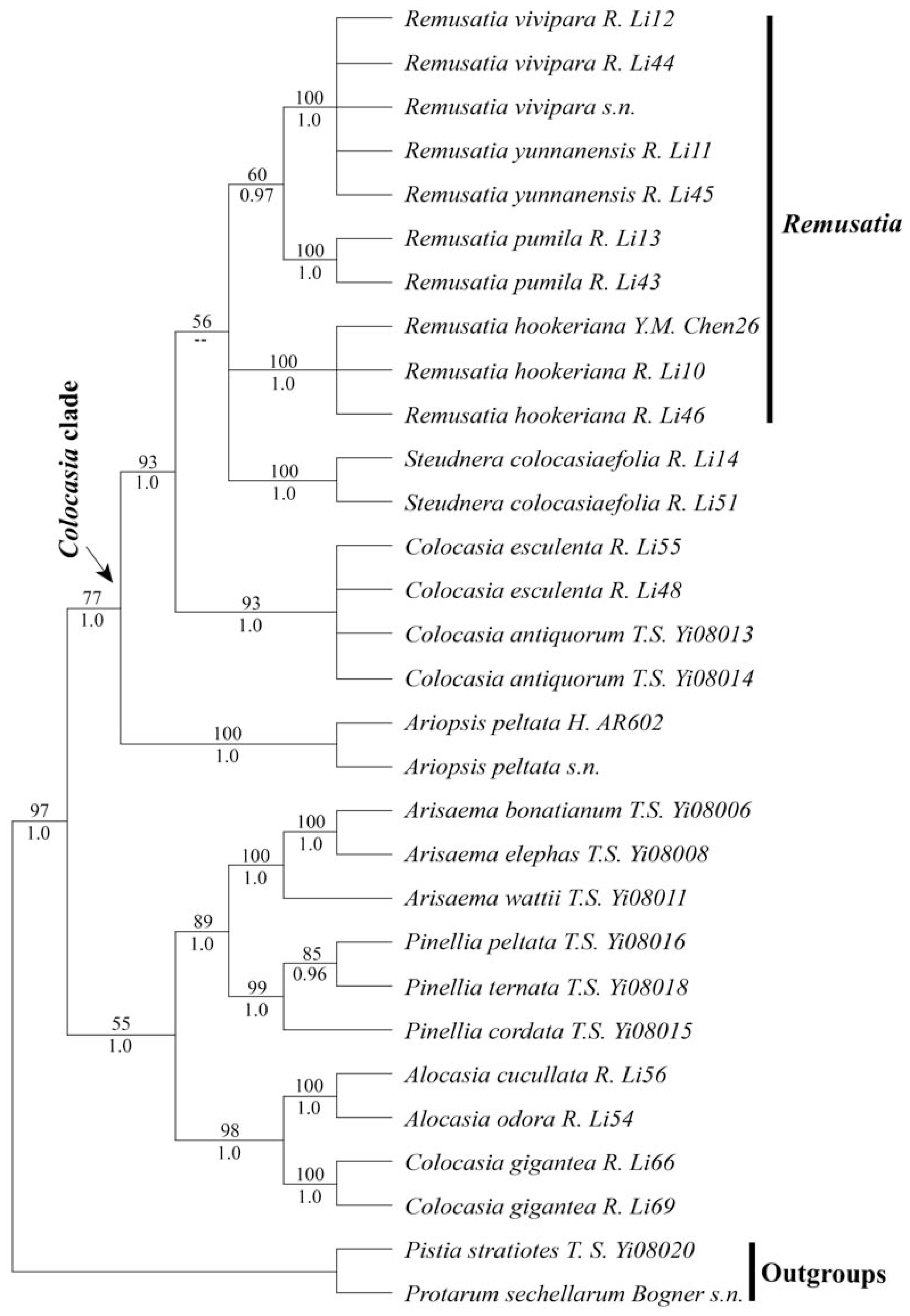
<p>The aligned length, the numbers of variable sites, and the numbers of parsimony informative sites for the concatenated plastid regions were given (<xref ref-type="table" rid="t1-ijms-13-00071">Table 1</xref>). Treating gaps as missing data, the maximum parsimony analysis produced 3 most parsimonious trees (MPTs) of 412 steps, with a consistency index (CI) of 0.83, a CI excluding uninformative characters of 0.71, a retention index (RI) of 0.84, and a rescaled consistency index (RC) of 0.70. The Bayesian tree was nearly identical to the strict consensus tree of MPTs (<xref ref-type="fig" rid="f1-ijms-13-00071">Figure 1</xref>). Treating the gaps as new characters, the parsimony strict consensus tree also did not support the monophyly of <italic>Remusatia</italic> (<xref ref-type="supplementary-material" rid="s1-ijms-13-00071">Figure S4</xref>). Moreover, the resulting tree when gaps were treated as missing data is better resolved than the tree obtained with gaps as coded characters. For this reason, we discuss all results in this paper based on the analysis treating gaps as missing data (<xref ref-type="fig" rid="f1-ijms-13-00071">Figure 1</xref>).</p>
<p>The concatenated plastid data supported the monophyly of the <italic>Colocasia</italic> clade (PB = 77%, PP = 1.0). <italic>Remusatia</italic> was part of the <italic>Colocasia</italic> clade (<xref ref-type="fig" rid="f1-ijms-13-00071">Figure 1</xref>). The monophyly of <italic>Remusatia</italic> was not supported because <italic>R. hookeriana</italic> did not form a clade with other three species <italic>R. vivipara</italic>, <italic>R. yunnanensis</italic>, and <italic>R. pumila</italic> (see <xref ref-type="fig" rid="f1-ijms-13-00071">Figure 1</xref>). Excluding <italic>Remusatia hookeriana</italic>, the remaining <italic>Remusatia</italic> species formed a supported clade (PB = 60%, PP = 0.97) (<xref ref-type="fig" rid="f1-ijms-13-00071">Figure 1</xref>). Within this clade, <italic>Remusatia pumila</italic> is sister to the clade containing <italic>R. vivipara</italic> and <italic>R. yunnanensis</italic> (<xref ref-type="fig" rid="f1-ijms-13-00071">Figure 1</xref>).</p>
<p>Analyses constraining all <italic>Remusatia</italic> species into a clade generated MPTs that were the same tree length with the unconstrained MPTs. The SH test suggests topological congruence is well supported (<italic>p</italic> &gt; 0.01) between constrained analysis and unconstrained analysis (<xref ref-type="supplementary-material" rid="s1-ijms-13-00071">Figure S5</xref>).</p></sec>
<sec sec-type="discussion">
<title>2.2. Discussion</title>
<sec>
<title>2.2.1. Is <italic>Remusatia</italic> Monophyletic?</title>
<p>With the current sampling, the monophyly of <italic>Remusatia</italic> is not supported. The species <italic>R. hookeriana</italic> does not group with the remainder of the <italic>Remusatia</italic> species sampled. However, the topology of the analysis constraining <italic>Remusatia</italic> to monophyly was congruent with the topology of unconstrained analysis (<xref ref-type="fig" rid="f1-ijms-13-00071">Figures 1</xref> and <xref ref-type="supplementary-material" rid="s1-ijms-13-00071">S5</xref>). It is likely that the non-monophyly was due to the morphological and ploidy sampling bias, because our sampling for <italic>R. hookeriana</italic> remains poor (e.g., only three accessions having stolons branched and placentae parietal were sampled from <italic>R. hookeriana</italic>). <italic>Remusatia hookeriana</italic> is morphologically or cytologically variable in several characters including stolons simple or much branched, placentae parietal or basal, and chromosome numbers diploid or triploid [<xref ref-type="bibr" rid="b5-ijms-13-00071">5</xref>,<xref ref-type="bibr" rid="b18-ijms-13-00071">18</xref>–<xref ref-type="bibr" rid="b22-ijms-13-00071">22</xref>]. These characters are shared with the remaining <italic>Remusatia</italic> species. It seems likely that <italic>Remusatia hookeriana</italic> may be more closely related to the common ancestor of the remaining <italic>Remusatia</italic> species. Thus, the monophyly of <italic>Remusatia</italic> needs to be further examined with additional <italic>R. hookeriana</italic> sampling covered the morphological or cytological diversity.</p>
<p>It is difficult to establish any morphological synapomorphies for the <italic>Remusatia</italic>, because the defining characters except the unbranched or branched stolons also occur in other genera of Araceae. These include peltate leaves, appendix absent at spadix, entirely connate stamens, and chromosome base number <italic>x</italic> = 14 [<xref ref-type="bibr" rid="b1-ijms-13-00071">1</xref>,<xref ref-type="bibr" rid="b4-ijms-13-00071">4</xref>]. At the family level, many of these morphological or cytological characters including leaf shape, spadix structure, male flowers morphology, and chromosome number have been shown to be relatively plastic [<xref ref-type="bibr" rid="b1-ijms-13-00071">1</xref>,<xref ref-type="bibr" rid="b9-ijms-13-00071">9</xref>].</p>
<p>In our phylogenetic tree, the genus <italic>Remusatia</italic> and the genus <italic>Steudnera</italic> form a weakly supported clade (PB = 56%, PP &lt; 0.95) (<xref ref-type="fig" rid="f1-ijms-13-00071">Figure 1</xref>), which share the characters of the appendix absent at the spadix and numerous ovules. They differ in that <italic>Steudnera</italic> has stout rhizomes and absent stolons, whereas <italic>Remusatia</italic> possesses subglobose tubers and produces erect or spreading, unbranched or branched stolons from the axils of deciduous cataphylls [<xref ref-type="bibr" rid="b1-ijms-13-00071">1</xref>,<xref ref-type="bibr" rid="b4-ijms-13-00071">4</xref>]. The rarely flowering <italic>Remusatia</italic> species are spread by the generous formation of tubercles from stolons [<xref ref-type="bibr" rid="b23-ijms-13-00071">23</xref>].</p></sec>
<sec>
<title>2.2.2. Infrageneric Relationships Within <italic>Remusatia</italic></title>
<p>Our phylogenetic analyses confirm the combination of previously separate genus <italic>Gonatanthus</italic> with <italic>Remusatia</italic>, because the <italic>G. pumilus</italic> (=<italic>R. pumila</italic>) (the type of <italic>Gonatanthus</italic>), <italic>G. yunnanensis</italic> (=<italic>R. yunnanensis</italic>), and <italic>R. vivipara</italic> (the type of <italic>Remusatia</italic>) formed a supported clade (<xref ref-type="fig" rid="f1-ijms-13-00071">Figure 1</xref>). Within this clade, <italic>Remusatia pumila</italic> is sister to the clade consisting of <italic>R. vivipara</italic> and <italic>R. yunnanensis</italic> (<xref ref-type="fig" rid="f1-ijms-13-00071">Figure 1</xref>). Morphologically, <italic>Remusatia pumila</italic> is distinguished from the other two species by not having a reflexed spathe with 2 constrictions (<italic>vs.</italic> reflexed spathe with only 1 constriction) [<xref ref-type="bibr" rid="b4-ijms-13-00071">4</xref>,<xref ref-type="bibr" rid="b5-ijms-13-00071">5</xref>]. <italic>Remusatia vivipara</italic> is phylogenetically close to <italic>R. yunnanensis</italic>, differing primarily in their stolon morphology and flowering time. <italic>Remusatia vivipara</italic> has erect, simple stolons and the inflorescence appearing before the leaf, whereas <italic>R. yunnanensis</italic> has creeping or pendulous, branched stolons and the inflorescence appearing together with the leaf [<xref ref-type="bibr" rid="b4-ijms-13-00071">4</xref>,<xref ref-type="bibr" rid="b5-ijms-13-00071">5</xref>].</p>
<p>In our study, the widely distributed <italic>Remusatia vivipara</italic> and narrowly endemic <italic>R. yunnanensis</italic> are represented by several accessions from Southern India and Yunnan in China. However, the monophyly of each species is not supported in the phylogenetic analyses. There may be several cryptic species in widespread <italic>Remusatia vivipara</italic> complex and in morphologically variable <italic>R. yunnanensis</italic> complex. Thus, a more thorough analysis (e.g., using genomic screening markers and additional taxon sampling) should be performed to confirm the status of <italic>Remusatia vivipara</italic> and <italic>R. yunnanensis</italic>.</p>
<p>Based on the placenta position, Li and Hay [<xref ref-type="bibr" rid="b5-ijms-13-00071">5</xref>] split <italic>Remusatia</italic> into two sections: sect. <italic>Remusatia</italic> and sect. <italic>Gonatanthus</italic> (Klotzsh) H. Li and A. Hay. Our results do not support their infrageneric classification, because species with parietal or basal placentae do not form a clade. For example, <italic>Remusatia yunnanensis</italic> grouped with <italic>R. vivipara</italic> which has parietal placentae, rather than with <italic>R. pumila</italic> having basal placentae.</p>
<p>Below we provide a taxonomic key to the species of <italic>Remusatia</italic> to facilitate the identification of the four species [<xref ref-type="bibr" rid="b4-ijms-13-00071">4</xref>]:</p>
<table-wrap id="t3-ijms-13-00071" position="anchor">
<table frame="void" rules="none">
<tbody>
<tr>
<td align="left" valign="top">1a. Spathe with two constrictions, one separating tube and limb, one separating limb into two parts</td>
<td align="right" valign="top"><italic>R. pumila</italic></td></tr>
<tr>
<td align="left" valign="top">1b. Spathe with only one constriction separating tube and limb</td>
<td align="right" valign="top"/></tr>
<tr>
<td align="left" valign="top"> 2a. Stonlons erect, simple, stout</td>
<td align="right" valign="top"><italic>R. vivipara</italic></td></tr>
<tr>
<td align="left" valign="top"> 2b. Stonlons creeping or pendulous, simple or branched, slender</td>
<td align="right" valign="top"/></tr>
<tr>
<td align="left" valign="top">  3a. Limb of spathe semispreading to erect, not reflexed</td>
<td align="right" valign="top"><italic>R. hookeriana</italic></td></tr>
<tr>
<td align="left" valign="top">  3b. Limb of spathe initially erect, later reflexed</td>
<td align="right" valign="top"><italic>R. yunnanensis</italic></td></tr></tbody></table></table-wrap></sec></sec></sec>
<sec>
<title>3. Experimental Section</title>
<sec>
<title>3.1. Taxon Sampling</title>
<p>Thirty accessions representing four species of <italic>Remusatia</italic> and 20 related taxa were included in this study (<xref ref-type="table" rid="t2-ijms-13-00071">Table 2</xref>). Based on recent phylogenetic analyses of Araceae [<xref ref-type="bibr" rid="b9-ijms-13-00071">9</xref>], the following genera were used as closely related taxa that represent major lineage within the large <italic>Pistia</italic> clade: <italic>Ariopsis</italic>, <italic>Steudnera</italic>, <italic>Colocasia</italic>, <italic>Alocasia</italic> (Schott) G. Don, <italic>Arisaema</italic> Martius, and <italic>Pinellia</italic> Tenore. Species of <italic>Pistia</italic> L. and <italic>Protarum</italic> Engl. were selected as outgroups because they have been shown to be outside the <italic>Colocasia</italic> clade within the large <italic>Pistia</italic> clade. The wide range of multiple taxa within the large <italic>Pistia</italic> clade was selected to further test the monophyly of <italic>Remusatia</italic> within a broader phylogenetic framework.</p></sec>
<sec>
<title>3.2. DNA Extractions, Amplification, and Sequencing</title>
<p>Total DNA was extracted from about 15 mg silica-gel dried leaf material using the DNeasy plant mini kits (QIAGEN, Mississauga, Ontario) following the manufacturer’s protocol or the modified CTAB extraction method [<xref ref-type="bibr" rid="b24-ijms-13-00071">24</xref>].</p>
<p>Three coding or non-coding plastid regions (the <italic>rbcL</italic> gene, the <italic>trnL-trnF</italic> intergenic spacer, and the <italic>rps16</italic> intron) markers were employed in this study. The following primers were used for both amplification and sequencing: “1F” and “1460R” for the <italic>rbcL</italic> gene [<xref ref-type="bibr" rid="b25-ijms-13-00071">25</xref>], “c” and “f” for the single <italic>trnL-F</italic> region or as two fragments with “c + d” and “e + f” [<xref ref-type="bibr" rid="b26-ijms-13-00071">26</xref>]; when this region could not be amplified successful using primer “c”, we used instead primer “c2” [<xref ref-type="bibr" rid="b27-ijms-13-00071">27</xref>], “F” and “R2” for the <italic>rps16</italic> intron [<xref ref-type="bibr" rid="b28-ijms-13-00071">28</xref>]. Polymerase chain reaction (PCR) amplifications were performed in a 25 μL volume containing 1.5 mM MgCl<sub>2</sub>, 0.2 mM of each dNTP, 0.4 mM of each primer, 1 U of <italic>Taq</italic> polymerase (Bioline), and about 10–50 ng of DNA template under the following conditions: 3 min at 95 °C, followed by 37 cycles of 20 s at 94 °C, 30 s at 50 °C, and 40 s at 72 °C, and then a final 5 min extension at 72 °C.</p>
<p>The PCR products were purified using the polyethylene glycol (PEG) precipitation procedure following the protocol of Sambrook <italic>et al.</italic> [<xref ref-type="bibr" rid="b29-ijms-13-00071">29</xref>]. Cycle sequencing was conducted using BigDye 3.1 reagents and carried out using the following profile: 35 cycles of 97 °C for 15 s, 50 °C for 5 s, and 60 °C for 4 min. The products of cycle-sequencing reactions were cleaned using the Sephadex columns (Amersham Pharmacia Biotech, Piscataway, New Jersey). The sequences were generated on an ABI prism 3730XL capillary sequencer (Applied Biosystems, Foster City, California). All sequences were newly generated in this study and have been deposited in GenBank (<xref ref-type="table" rid="t2-ijms-13-00071">Table 2</xref>).</p></sec>
<sec>
<title>3.3. Sequence Alignment and Phylogenetic Analyses</title>
<p>The program Sequencher 4.5 (Gene Codes Corporation, Ann Arbor, Michigan) was used to evaluate chromatograms for base confirmation and to edit contiguous sequences. Sequences were initially aligned with ClustalX version 1.83 [<xref ref-type="bibr" rid="b30-ijms-13-00071">30</xref>], followed by manual adjustments on Se-Al v2.0a11 [<xref ref-type="bibr" rid="b31-ijms-13-00071">31</xref>].</p>
<p>To evaluate congruence of the three plastid (<italic>rbcL</italic>, <italic>trnL-F</italic>, <italic>rps16</italic>) data sets, we employed the partition homogeneity test or the incongruence length difference (ILD) test [<xref ref-type="bibr" rid="b32-ijms-13-00071">32</xref>]. The partition homogeneity test was conducted with PAUP* version 4.0b10 [<xref ref-type="bibr" rid="b33-ijms-13-00071">33</xref>] with 100 replicates, each with 100 random addition sequence replicates, tree bisection-reconnection (TBR) branch swapping, and keeping no more than 100 trees per random addition replicate. Following Cunningham [<xref ref-type="bibr" rid="b34-ijms-13-00071">34</xref>], a significance level of <italic>p</italic> = 0.01 was adopted for this test.</p>
<p>Phylogenetic trees for each plastid region and the combined data set (concatenating the <italic>rbcL</italic>, <italic>trnL-F</italic>, and <italic>rps16</italic>) were constructed using maximum parsimony (MP) and Bayesian methods. The MP analyses was conducted using PAUP* version 4.0b10 [<xref ref-type="bibr" rid="b33-ijms-13-00071">33</xref>]. All characters were weighted equally and gaps were treated as missing data and coded as binary characters for the concatenated plastid data set using the “simple gap coding” method [<xref ref-type="bibr" rid="b35-ijms-13-00071">35</xref>]. The program GapCoder [<xref ref-type="bibr" rid="b36-ijms-13-00071">36</xref>] was employed to score the insertions and deletions (indels). The most parsimonious trees were obtained with heuristic searches of 1000 replicates with random stepwise sequence addition, tree bisection-reconnection (TBR) branch swapping, collapse of zero-length branches, multiple tree option in effect, saving 100 trees from each random sequence addition. Parsimony bootstrap values (PB) for the clades [<xref ref-type="bibr" rid="b37-ijms-13-00071">37</xref>] revealed in the most parsimonious trees (MPTs) were calculated with 500 bootstrap replicates. In each replicate, we performed 1000 random sequence addition replicates followed by tree bisection-reconnection (TBR) swapping, keeping no more than 10 trees per replicate. Tree statistics, including consistency index and the retention index, were calculated using PAUP*.</p>
<p>Modeltest 3.7 [<xref ref-type="bibr" rid="b38-ijms-13-00071">38</xref>,<xref ref-type="bibr" rid="b39-ijms-13-00071">39</xref>] was used to determine the optimal model of molecular evolution and gamma rate heterogeneity using the Akaike Information Criterion (AIC). Bayesian inference was implemented with MrBayes 3.1.2 [<xref ref-type="bibr" rid="b40-ijms-13-00071">40</xref>] using a mixed model Bayesian analysis strategy. We assigned model parameters for each gene partition identified by AIC in Modeltest (<xref ref-type="table" rid="t1-ijms-13-00071">Table 1</xref>). The Markov chain Monte Carlo (MCMC) algorithm was run for 10,000,000 generations with one cold and three heated chains, starting from random trees and sampling one out of every 1000 generations. Runs were repeated twice. The average standard deviation of split frequencies below 0.01 was examined to evaluate the convergence between the runs. The program Tracer 1.5 [<xref ref-type="bibr" rid="b41-ijms-13-00071">41</xref>] was used to ensure that plots of the two analyses were converging on the same area and the log likelihoods had stabilized. The value of the effective sample size (ESS) for each statistic was above 200 after excluding the 25% burn-in. After discarding the trees saved prior to this point as burn-in, the remaining 7500 trees were used to construct majority-rule consensus trees using PAUP*. Nodes with posterior probabilities (PP) ≥ 0.95 in the consensus trees were considered statistically significant.</p>
<p>With <italic>Remusatia</italic> shown to be non-monophyletic in our initial analysis, we performed a constraint analysis using the concatenated plastid data set. With <italic>Remusatia</italic> constrained to be monophyletic, a parsimony analysis was performed with the heuristic search option using 1000 random sequence additions, TBR, and saving 100 trees from each random sequence addition. Shimodaira-Hasegawa (SH) test [<xref ref-type="bibr" rid="b42-ijms-13-00071">42</xref>] was used to evaluate the topological congruence between gene trees produced by the likelihood method. The SH test was implemented in PAUP* with the best-fit model estimated using Modeltest 3.7 [<xref ref-type="bibr" rid="b38-ijms-13-00071">38</xref>,<xref ref-type="bibr" rid="b39-ijms-13-00071">39</xref>], RELL optimization, and 1000 bootstrap replicates to compare the difference between the RELL optimization and the computationally much more intensive full optimization. We compared the optimal trees (unconstrained) with constraint trees from the maximum likelihood analysis separately.</p></sec></sec>
<sec sec-type="conclusions">
<title>4. Conclusions</title>
<p>The present study constructed the first phylogeny of <italic>Remusatia</italic>. The monophyly of <italic>Remusatia</italic> was not supported by the concatenated plastid data (the <italic>rbcL</italic> gene, the <italic>trnL-trnF</italic> intergenic spacer, and the <italic>rps16</italic> intron). Phylogenetic analyses confirmed the combination of previous separate genus <italic>Gonatanthus</italic> with <italic>Remusatia</italic> and disagreed with the current infrageneric classification of the genus.</p></sec>
<sec sec-type="supplementary-material">
<title>Supplementary Materials</title>
<supplementary-material id="s1-ijms-13-00071" content-type="local-data">
<media xlink:href="ijms-13-00071-s001.pdf" mimetype="application" mime-subtype="pdf"/></supplementary-material></sec></body>
<back>
<ack>
<title>Acknowledgments</title>
<p>The study was supported by knowledge innovation engineering of the Chinese Academy of Sciences (2010KIBA06). Laboratory assistance was provided by Meiqing Yang and Yang Yang. We thank Yanmei Chen, Josef Bogner, and Pascal Bruggeman for collecting samples, Philip Thomas from the Royal Botanic Garden Edinburgh, and Peter Fritsch from California Academy of Sciences for revising an earlier version of this manuscript.</p></ack>
<ref-list>
<title>References</title>
<ref id="b1-ijms-13-00071"><label>1</label><citation citation-type="book"><person-group person-group-type="author"><name><surname>Mayo</surname><given-names>S.J.</given-names></name><name><surname>Bogner</surname><given-names>J.</given-names></name><name><surname>Boyce</surname><given-names>P.C.</given-names></name></person-group><source>The Genera of Araceae</source><publisher-name>Royal Botanic Gardens</publisher-name><publisher-loc>Kew, UK</publisher-loc><year>1997</year><fpage>280</fpage><lpage>281</lpage></citation></ref>
<ref id="b2-ijms-13-00071"><label>2</label><citation citation-type="book"><person-group person-group-type="author"><name><surname>Frodin</surname><given-names>D.G.</given-names></name><name><surname>Govaerts</surname><given-names>R.</given-names></name></person-group><source>World Checklist and Bibliography of Araceae</source><publisher-name>Royal Botanic Gardens</publisher-name><publisher-loc>Kew, UK</publisher-loc><year>2002</year><fpage>440</fpage><lpage>442</lpage></citation></ref>
<ref id="b3-ijms-13-00071"><label>3</label><citation citation-type="book"><person-group person-group-type="author"><name><surname>Mabberley</surname><given-names>D.J.</given-names></name></person-group><source>Mabberley’s Plant-Book: A Portable Dictionary of Plants, Their Classification and Uses</source><publisher-name>Cambridge University Press</publisher-name><publisher-loc>New York, USA</publisher-loc><year>2008</year><fpage>731</fpage></citation></ref>
<ref id="b4-ijms-13-00071"><label>4</label><citation citation-type="book"><person-group person-group-type="author"><name><surname>Li</surname><given-names>H.</given-names></name><name><surname>Boyce</surname><given-names>P.C.</given-names></name></person-group><person-group person-group-type="editor"><name><surname>Wu</surname><given-names>Z.Y.</given-names></name><name><surname>Raven</surname><given-names>P.H.</given-names></name></person-group><article-title>Remusatia</article-title><source>Flora of China</source><publisher-name>Science Press</publisher-name><publisher-loc>Beijing, China</publisher-loc><publisher-name>Missouri Botanical Garden Press</publisher-name><publisher-loc>St. Louis, MO, USA</publisher-loc><year>2010</year><volume>23</volume><fpage>71</fpage><lpage>72</lpage></citation></ref>
<ref id="b5-ijms-13-00071"><label>5</label><citation citation-type="journal"><person-group person-group-type="author"><name><surname>Li</surname><given-names>H.</given-names></name><name><surname>Hay</surname><given-names>A.</given-names></name></person-group><article-title>Notes on the classification of genera <italic>Remusatia</italic> and <italic>Gonatanthus</italic> in Araceae</article-title><source>Acta Bot. Yunnanica</source><year>1992</year><source>Suppl V</source><fpage>27</fpage><lpage>33</lpage></citation></ref>
<ref id="b6-ijms-13-00071"><label>6</label><citation citation-type="book"><person-group person-group-type="author"><name><surname>Engler</surname><given-names>A.</given-names></name><name><surname>Krause</surname><given-names>K.</given-names></name></person-group><person-group person-group-type="editor"><name><surname>Engler</surname><given-names>A.</given-names></name></person-group><article-title>Additamentum ad Araceas-Philodendroideas, Araceae-Colocasioideae</article-title><source>Das Pflanzenreich</source><publisher-name>Wilhelm Engelmann</publisher-name><publisher-loc>Leipzig, Germany</publisher-loc><year>1920</year><volume>71</volume><fpage>19</fpage></citation></ref>
<ref id="b7-ijms-13-00071"><label>7</label><citation citation-type="book"><person-group person-group-type="author"><name><surname>Li</surname><given-names>H.</given-names></name></person-group><person-group person-group-type="editor"><name><surname>Wu</surname><given-names>Z.Y.</given-names></name><name><surname>Li</surname><given-names>H.</given-names></name></person-group><article-title>Gonatanthus</article-title><source>Flora Reipublicae Popularis Sinicae</source><publisher-name>Science Press</publisher-name><publisher-loc>Beijing, China</publisher-loc><year>1979</year><volume>13</volume><fpage>62</fpage><lpage>65</lpage></citation></ref>
<ref id="b8-ijms-13-00071"><label>8</label><citation citation-type="journal"><person-group person-group-type="author"><name><surname>Li</surname><given-names>H.</given-names></name><name><surname>Hay</surname><given-names>A.</given-names></name></person-group><article-title>Classification of the genus <italic>Gonatanthus</italic></article-title><source>Acta Bot. Yunnanica</source><year>1992</year><volume>14</volume><fpage>373</fpage><lpage>378</lpage></citation></ref>
<ref id="b9-ijms-13-00071"><label>9</label><citation citation-type="journal"><person-group person-group-type="author"><name><surname>Cusimano</surname><given-names>N.</given-names></name><name><surname>Bogner</surname><given-names>J.</given-names></name><name><surname>Mayo</surname><given-names>S.J.</given-names></name><name><surname>Boyce</surname><given-names>P.C.</given-names></name><name><surname>Wong</surname><given-names>S.Y.</given-names></name><name><surname>Hesse</surname><given-names>M.</given-names></name><name><surname>Hetterscheid</surname><given-names>W.L.A.</given-names></name><name><surname>Keating</surname><given-names>R.C.</given-names></name><name><surname>French</surname><given-names>J.C.</given-names></name></person-group><article-title>Relationships within the Araceae: Comparison of morphological patterns with molecular phylogenies</article-title><source>Am. J. Bot</source><year>2011</year><volume>98</volume><fpage>654</fpage><lpage>668</lpage><pub-id pub-id-type="doi">10.3732/ajb.1000158</pub-id><pub-id pub-id-type="pmid">21613165</pub-id></citation></ref>
<ref id="b10-ijms-13-00071"><label>10</label><citation citation-type="journal"><person-group person-group-type="author"><name><surname>Renner</surname><given-names>S.S.</given-names></name><name><surname>Zhang</surname><given-names>L.B.</given-names></name></person-group><article-title>Biogeography of the <italic>Pistia</italic> clade (Araceae): Based on chloroplast and mitochondrial DNA sequences and Bayesian divergence time inference</article-title><source>Syst. Biol</source><year>2004</year><volume>53</volume><fpage>422</fpage><lpage>432</lpage><pub-id pub-id-type="doi">10.1080/10635150490445904</pub-id><pub-id pub-id-type="pmid">15503671</pub-id></citation></ref>
<ref id="b11-ijms-13-00071"><label>11</label><citation citation-type="journal"><person-group person-group-type="author"><name><surname>Cabrera</surname><given-names>L.I.</given-names></name><name><surname>Salazar</surname><given-names>G.A.</given-names></name><name><surname>Chase</surname><given-names>M.W.</given-names></name><name><surname>Mayo</surname><given-names>S.J.</given-names></name><name><surname>Bogner</surname><given-names>J.</given-names></name><name><surname>Davila</surname><given-names>P.</given-names></name></person-group><article-title>Phylogenetic relationships of aroids and duckweeds (Araceae) inferred from coding and noncoding plastid DNA</article-title><source>Am. J. Bot</source><year>2008</year><volume>95</volume><fpage>1153</fpage><lpage>1165</lpage><pub-id pub-id-type="doi">10.3732/ajb.0800073</pub-id><pub-id pub-id-type="pmid">21632433</pub-id></citation></ref>
<ref id="b12-ijms-13-00071"><label>12</label><citation citation-type="journal"><person-group person-group-type="author"><name><surname>Rothwell</surname><given-names>G.W.</given-names></name><name><surname>van Atta</surname><given-names>M.R.</given-names></name><name><surname>Ballard</surname><given-names>H.W.</given-names><suffix>Jr</suffix></name><name><surname>Stockey</surname><given-names>R.A.</given-names></name></person-group><article-title>Molecular phylogenetic relationships among Lemnaceae and Araceae using the chloroplast <italic>trnL-trnF</italic> spacer</article-title><source>Mol. Phylogenet. Evol</source><year>2004</year><volume>30</volume><fpage>378</fpage><lpage>385</lpage><pub-id pub-id-type="doi">10.1016/S1055-7903(03)00205-7</pub-id><pub-id pub-id-type="pmid">14715229</pub-id></citation></ref>
<ref id="b13-ijms-13-00071"><label>13</label><citation citation-type="journal"><person-group person-group-type="author"><name><surname>Tam</surname><given-names>S.M.</given-names></name><name><surname>Boyce</surname><given-names>P.C.</given-names></name><name><surname>Upson</surname><given-names>T.M.</given-names></name><name><surname>Barabé</surname><given-names>D.</given-names></name><name><surname>Bruneau</surname><given-names>A.</given-names></name><name><surname>Forest</surname><given-names>F.</given-names></name><name><surname>Parker</surname><given-names>J.S.</given-names></name></person-group><article-title>Intergeneric and infrafamilial phylogeny of subfamily Monsteroideae (Araceae) revealed by chloroplast <italic>trnL-F</italic> sequences</article-title><source>Am. J. Bot</source><year>2004</year><volume>91</volume><fpage>490</fpage><lpage>498</lpage><pub-id pub-id-type="doi">10.3732/ajb.91.3.490</pub-id><pub-id pub-id-type="pmid">21653404</pub-id></citation></ref>
<ref id="b14-ijms-13-00071"><label>14</label><citation citation-type="journal"><person-group person-group-type="author"><name><surname>Nie</surname><given-names>Z.L.</given-names></name><name><surname>Sun</surname><given-names>H.</given-names></name><name><surname>Li</surname><given-names>H.</given-names></name><name><surname>Wen</surname><given-names>J.</given-names></name></person-group><article-title>Intercontinental biogeography of subfamily Orontioideae (<italic>Symplocarpus</italic>, <italic>Lysichiton</italic>, and <italic>Orontium</italic>) of Araceae in eastern Asia and North America</article-title><source>Mol. Phylogenet. Evol</source><year>2006</year><volume>40</volume><fpage>155</fpage><lpage>165</lpage><pub-id pub-id-type="doi">10.1016/j.ympev.2006.03.012</pub-id><pub-id pub-id-type="pmid">16621613</pub-id></citation></ref>
<ref id="b15-ijms-13-00071"><label>15</label><citation citation-type="journal"><person-group person-group-type="author"><name><surname>Mansion</surname><given-names>G.</given-names></name><name><surname>Rosenbaum</surname><given-names>G.</given-names></name><name><surname>Schoenenberger</surname><given-names>N.</given-names></name><name><surname>Bacchetta</surname><given-names>G.</given-names></name><name><surname>Rosselló</surname><given-names>J.A.</given-names></name><name><surname>Conti</surname><given-names>E.</given-names></name></person-group><article-title>Phylogenetic analysis informed by geological history supports multiple, sequential invasions of the Mediterranean Basin by the angiosperm family Araceae</article-title><source>Syst. Biol</source><year>2008</year><volume>57</volume><fpage>269</fpage><lpage>285</lpage><pub-id pub-id-type="doi">10.1080/10635150802044029</pub-id><pub-id pub-id-type="pmid">18425714</pub-id></citation></ref>
<ref id="b16-ijms-13-00071"><label>16</label><citation citation-type="journal"><person-group person-group-type="author"><name><surname>Wong</surname><given-names>S.Y.</given-names></name><name><surname>Boyce</surname><given-names>P.C.</given-names></name><name><surname>Othman</surname><given-names>A.S.</given-names></name><name><surname>Leaw</surname><given-names>C.P.</given-names></name></person-group><article-title>Molecular phylogeny of tribe Schismatoglottideae (Araceae) based on two plastid markers and recognition of a new tribe, Philonotieae, from the Neotropics</article-title><source>Taxon</source><year>2010</year><volume>59</volume><fpage>117</fpage><lpage>124</lpage></citation></ref>
<ref id="b17-ijms-13-00071"><label>17</label><citation citation-type="journal"><person-group person-group-type="author"><name><surname>Espíndola</surname><given-names>A.</given-names></name><name><surname>Buerki</surname><given-names>S.</given-names></name><name><surname>Bedalov</surname><given-names>M.</given-names></name><name><surname>Kupfer</surname><given-names>P.</given-names></name><name><surname>Alvarez</surname><given-names>N.</given-names></name></person-group><article-title>New insights into the phylogenetics and biogeography of <italic>Arum</italic> (Araceae): Unravelling its evolutionary history</article-title><source>Bot. J. Linn. Soc</source><year>2010</year><volume>163</volume><fpage>14</fpage><lpage>32</lpage><pub-id pub-id-type="doi">10.1111/j.1095-8339.2010.01049.x</pub-id></citation></ref>
<ref id="b18-ijms-13-00071"><label>18</label><citation citation-type="journal"><person-group person-group-type="author"><name><surname>Li</surname><given-names>H.</given-names></name></person-group><article-title>What is <italic>Gonatanthus</italic> (?) <italic>ornatus</italic> Schott (Araceae)</article-title><source>Aroideana</source><year>1987</year><volume>10</volume><fpage>23</fpage><lpage>26</lpage></citation></ref>
<ref id="b19-ijms-13-00071"><label>19</label><citation citation-type="journal"><person-group person-group-type="author"><name><surname>Li</surname><given-names>H.</given-names></name></person-group><article-title>A new combination of the genus <italic>Remusatia</italic> of Araceae</article-title><source>Acta Phytotaxon. Sin</source><year>1987</year><volume>25</volume><fpage>414</fpage><lpage>416</lpage></citation></ref>
<ref id="b20-ijms-13-00071"><label>20</label><citation citation-type="journal"><person-group person-group-type="author"><name><surname>Li</surname><given-names>H.</given-names></name></person-group><article-title>On the typification of two species in the genus <italic>Remusatia</italic> (Araceae)</article-title><source>Acta Bot. Yunnanica</source><year>1991</year><volume>13</volume><fpage>113</fpage><lpage>119</lpage></citation></ref>
<ref id="b21-ijms-13-00071"><label>21</label><citation citation-type="journal"><person-group person-group-type="author"><name><surname>Li</surname><given-names>H.</given-names></name></person-group><article-title>Formation of distribution area of <italic>Remusatia</italic> (Araceae) and its disjunction</article-title><source>Acta Bot. Yunnanica</source><year>1992</year><source>Suppl V</source><fpage>71</fpage><lpage>76</lpage></citation></ref>
<ref id="b22-ijms-13-00071"><label>22</label><citation citation-type="journal"><person-group person-group-type="author"><name><surname>Long</surname><given-names>C.L.</given-names></name><name><surname>Li</surname><given-names>H.</given-names></name><name><surname>Liu</surname><given-names>X.Z.</given-names></name><name><surname>Gu</surname><given-names>Z.J.</given-names></name></person-group><article-title>A cytogeographic study of the genus <italic>Remusatia</italic> (Araceae)</article-title><source>Acta Bot. Yunnanica</source><year>1989</year><volume>11</volume><fpage>132</fpage><lpage>138</lpage></citation></ref>
<ref id="b23-ijms-13-00071"><label>23</label><citation citation-type="journal"><person-group person-group-type="author"><name><surname>Mahabalé</surname><given-names>T.S.</given-names></name><name><surname>Deshpande</surname><given-names>G.S.</given-names></name></person-group><article-title>Bulbils of <italic>Remusatia vivipara</italic> Schott</article-title><source>J. Univ. Bombay</source><year>1938</year><volume>6</volume><fpage>47</fpage><lpage>56</lpage></citation></ref>
<ref id="b24-ijms-13-00071"><label>24</label><citation citation-type="journal"><person-group person-group-type="author"><name><surname>Doyle</surname><given-names>J.J.</given-names></name><name><surname>Doyle</surname><given-names>J.L.</given-names></name></person-group><article-title>A rapid isolation procedure from small quantities of fresh leaf tissue</article-title><source>Phytochem. Bull</source><year>1987</year><volume>19</volume><fpage>11</fpage><lpage>15</lpage></citation></ref>
<ref id="b25-ijms-13-00071"><label>25</label><citation citation-type="journal"><person-group person-group-type="author"><name><surname>Asmussen</surname><given-names>C.B.</given-names></name><name><surname>Chase</surname><given-names>M.W.</given-names></name></person-group><article-title>Coding and noncoding plastid DNA in palm systematics</article-title><source>Am. J. Bot</source><year>2001</year><volume>88</volume><fpage>1103</fpage><lpage>1117</lpage><pub-id pub-id-type="doi">10.2307/2657094</pub-id><pub-id pub-id-type="pmid">11410476</pub-id></citation></ref>
<ref id="b26-ijms-13-00071"><label>26</label><citation citation-type="journal"><person-group person-group-type="author"><name><surname>Taberlet</surname><given-names>P.</given-names></name><name><surname>Gielly</surname><given-names>L.</given-names></name><name><surname>Pautou</surname><given-names>G.</given-names></name><name><surname>Bouvet</surname><given-names>J.</given-names></name></person-group><article-title>Universal primers for amplification of three non-coding regions of chloroplast DNA</article-title><source>Plant Mol. Biol</source><year>1991</year><volume>17</volume><fpage>1105</fpage><lpage>1109</lpage><pub-id pub-id-type="doi">10.1007/BF00037152</pub-id><pub-id pub-id-type="pmid">1932684</pub-id></citation></ref>
<ref id="b27-ijms-13-00071"><label>27</label><citation citation-type="journal"><person-group person-group-type="author"><name><surname>Bellstedt</surname><given-names>D.U.</given-names></name><name><surname>Linder</surname><given-names>H.P.</given-names></name><name><surname>Harley</surname><given-names>E.</given-names></name></person-group><article-title>Phylogenetic relationships in <italic>Disa</italic> based on non-coding <italic>trnL</italic>-<italic>trnF</italic> chloroplast sequences: Evidence of numerous repeat regions</article-title><source>Am. J. Bot</source><year>2001</year><volume>88</volume><fpage>2088</fpage><lpage>2100</lpage><pub-id pub-id-type="doi">10.2307/3558434</pub-id><pub-id pub-id-type="pmid">21669640</pub-id></citation></ref>
<ref id="b28-ijms-13-00071"><label>28</label><citation citation-type="journal"><person-group person-group-type="author"><name><surname>Oxelman</surname><given-names>B.</given-names></name><name><surname>Liden</surname><given-names>M.</given-names></name><name><surname>Berglund</surname><given-names>D.</given-names></name></person-group><article-title>Chloroplast <italic>rps16</italic> intron phylogeny of the tribe Sileneae (Caryophyllaceae)</article-title><source>Plant Syst. Evol</source><year>1997</year><volume>206</volume><fpage>393</fpage><lpage>410</lpage><pub-id pub-id-type="doi">10.1007/BF00987959</pub-id></citation></ref>
<ref id="b29-ijms-13-00071"><label>29</label><citation citation-type="book"><person-group person-group-type="author"><name><surname>Sambrook</surname><given-names>J.</given-names></name><name><surname>Fritsch</surname><given-names>E.F.</given-names></name><name><surname>Maniatis</surname><given-names>T.</given-names></name></person-group><source>Molecular Cloning: A Laboratory Manual</source><edition>2nd ed</edition><publisher-name>Cold Spring Harbor Laboratory Press</publisher-name><publisher-loc>New York, NY, USA</publisher-loc><year>1989</year></citation></ref>
<ref id="b30-ijms-13-00071"><label>30</label><citation citation-type="journal"><person-group person-group-type="author"><name><surname>Thompson</surname><given-names>J.D.</given-names></name><name><surname>Gibson</surname><given-names>T.J.</given-names></name><name><surname>Plewniak</surname><given-names>F.</given-names></name><name><surname>Jeanmougin</surname><given-names>F.</given-names></name><name><surname>Higgins</surname><given-names>D.G.</given-names></name></person-group><article-title>The Clustalx windows interface. Flexible strategies for multiple sequence alignment aided by quality analysis tools</article-title><source>Nucleic Acids Res</source><year>1997</year><volume>25</volume><fpage>4876</fpage><lpage>4882</lpage><pub-id pub-id-type="doi">10.1093/nar/25.24.4876</pub-id><pub-id pub-id-type="pmid">9396791</pub-id></citation></ref>
<ref id="b31-ijms-13-00071"><label>31</label><citation citation-type="web"><person-group person-group-type="author"><name><surname>Rambaut</surname><given-names>A.</given-names></name></person-group><source>Se-Al version 2.0a11</source><year>2007</year><comment>Available online: <ext-link xlink:href="http://tree.bio.ed.ac.uk/software/seal/" ext-link-type="uri">http://tree.bio.ed.ac.uk/software/seal/</ext-link></comment><access-date>(accessed on 21 December 2011)</access-date></citation></ref>
<ref id="b32-ijms-13-00071"><label>32</label><citation citation-type="journal"><person-group person-group-type="author"><name><surname>Farris</surname><given-names>J.S.</given-names></name><name><surname>Källersjö</surname><given-names>M.</given-names></name><name><surname>Kluge</surname><given-names>A.</given-names></name><name><surname>Bult</surname><given-names>G.C.</given-names></name></person-group><article-title>Constructing a significance test for incongruence</article-title><source>Syst. Biol</source><year>1995</year><volume>44</volume><fpage>570</fpage><lpage>572</lpage></citation></ref>
<ref id="b33-ijms-13-00071"><label>33</label><citation citation-type="book"><person-group person-group-type="author"><name><surname>Swofford</surname><given-names>D.L.</given-names></name></person-group><source><italic>PAUP*: Phylogenetic Analysis Using Parsimony (* and Other Methods)</italic>, Version 4.0b10</source><publisher-name>Sinauer Associates</publisher-name><publisher-loc>Sunderland, MA, USA</publisher-loc><year>2002</year></citation></ref>
<ref id="b34-ijms-13-00071"><label>34</label><citation citation-type="journal"><person-group person-group-type="author"><name><surname>Cunningham</surname><given-names>C.W.</given-names></name></person-group><article-title>Can three incongruence tests predict when data should be combined?</article-title><source>Mol. Biol. Evol</source><year>1997</year><volume>14</volume><fpage>733</fpage><lpage>740</lpage><pub-id pub-id-type="doi">10.1093/oxfordjournals.molbev.a025813</pub-id><pub-id pub-id-type="pmid">9214746</pub-id></citation></ref>
<ref id="b35-ijms-13-00071"><label>35</label><citation citation-type="journal"><person-group person-group-type="author"><name><surname>Simmons</surname><given-names>M.P.</given-names></name><name><surname>Ochoterena</surname><given-names>H.</given-names></name></person-group><article-title>Gaps as characters in sequence based phylogenetic analyses</article-title><source>Syst. Biol</source><year>2000</year><volume>49</volume><fpage>362</fpage><lpage>381</lpage></citation></ref>
<ref id="b36-ijms-13-00071"><label>36</label><citation citation-type="journal"><person-group person-group-type="author"><name><surname>Young</surname><given-names>N.D.</given-names></name><name><surname>Healy</surname><given-names>J.</given-names></name></person-group><article-title>GapCoder automates the use of indel characters in phylogenetic analysis</article-title><source>BMC Bioinforma</source><year>2003</year><volume>4</volume><fpage>1</fpage><lpage>6</lpage><pub-id pub-id-type="doi">10.1186/1471-2105-4-1</pub-id></citation></ref>
<ref id="b37-ijms-13-00071"><label>37</label><citation citation-type="journal"><person-group person-group-type="author"><name><surname>Felsenstein</surname><given-names>J.</given-names></name></person-group><article-title>Confidence intervals on phylogenies: An approach using the bootstrap</article-title><source>Evolution</source><year>1985</year><volume>39</volume><fpage>783</fpage><lpage>791</lpage><pub-id pub-id-type="doi">10.2307/2408678</pub-id></citation></ref>
<ref id="b38-ijms-13-00071"><label>38</label><citation citation-type="journal"><person-group person-group-type="author"><name><surname>Posada</surname><given-names>D.</given-names></name><name><surname>Crandall</surname><given-names>K.A.</given-names></name></person-group><article-title>Modeltest, testing the model of DNA substitution</article-title><source>Bioinformatics</source><year>1998</year><volume>14</volume><fpage>817</fpage><lpage>818</lpage><pub-id pub-id-type="doi">10.1093/bioinformatics/14.9.817</pub-id><pub-id pub-id-type="pmid">9918953</pub-id></citation></ref>
<ref id="b39-ijms-13-00071"><label>39</label><citation citation-type="journal"><person-group person-group-type="author"><name><surname>Posada</surname><given-names>D.</given-names></name><name><surname>Buckley</surname><given-names>T.R.</given-names></name></person-group><article-title>Model selection and model averaging in phylogenetics, advantages of the AIC and Bayesian approaches over likelihood ratio tests</article-title><source>Syst. Biol</source><year>2004</year><volume>53</volume><fpage>793</fpage><lpage>808</lpage><pub-id pub-id-type="doi">10.1080/10635150490522304</pub-id><pub-id pub-id-type="pmid">15545256</pub-id></citation></ref>
<ref id="b40-ijms-13-00071"><label>40</label><citation citation-type="journal"><person-group person-group-type="author"><name><surname>Ronquist</surname><given-names>F.</given-names></name><name><surname>Huelsenbeck</surname><given-names>J.P.</given-names></name></person-group><article-title>MrBayes 3: Bayesian phylogenetic inference under mixed models</article-title><source>Bioinformatics</source><year>2003</year><volume>19</volume><fpage>1572</fpage><lpage>1574</lpage><pub-id pub-id-type="doi">10.1093/bioinformatics/btg180</pub-id><pub-id pub-id-type="pmid">12912839</pub-id></citation></ref>
<ref id="b41-ijms-13-00071"><label>41</label><citation citation-type="web"><person-group person-group-type="author"><name><surname>Rambaut</surname><given-names>A.</given-names></name><name><surname>Drummond</surname><given-names>A.J.</given-names></name></person-group><source>Tracer version 1.5</source><year>2007</year><comment>Available online: <ext-link xlink:href="http://beast.bio.ed.ac.uk/Tracer" ext-link-type="uri">http://beast.bio.ed.ac.uk/Tracer</ext-link></comment><access-date>(accessed on 21 December 2011)</access-date></citation></ref>
<ref id="b42-ijms-13-00071"><label>42</label><citation citation-type="journal"><person-group person-group-type="author"><name><surname>Shimodaira</surname><given-names>H.</given-names></name><name><surname>Hasegawa</surname><given-names>M.</given-names></name></person-group><article-title>Multiple comparisons of log-likelihoods with applications to phylogenetic inference</article-title><source>Mol. Biol. Evol</source><year>1999</year><volume>16</volume><fpage>1114</fpage><lpage>1116</lpage><pub-id pub-id-type="doi">10.1093/oxfordjournals.molbev.a026201</pub-id></citation></ref></ref-list>
<sec sec-type="display-objects">
<title>Figure and Tables</title>
<fig id="f1-ijms-13-00071" position="float">
<label>Figure 1</label>
<caption>
<p>The parsimony strict consensus tree of <italic>Remusatia</italic> based on concatenated plastid data, with gaps treated as missing data (tree length = 412 steps, CI = 0.83, RI = 0.84, and RC = 0.70). Parsimony bootstrap values (PB) for maximum parsimony analysis in 500 replicates &gt; 50% are shown above the branches and Bayesian posterior probabilities (PP) ≥ 0.95 are indicated below the branches. Double dash shows that the PP value was lower than 0.95.</p></caption>
<graphic xlink:href="ijms-13-00071f1.gif"/></fig>
<table-wrap id="t1-ijms-13-00071" position="float">
<label>Table 1</label>
<caption>
<p>Characteristics of three plastid regions.</p></caption>
<table frame="hsides" rules="groups">
<thead>
<tr>
<th align="left" valign="bottom"/>
<th align="center" valign="bottom">Aligned length (bp)</th>
<th align="center" valign="bottom">Number of variable sites (%)</th>
<th align="center" valign="bottom">Number of parsimony-informative sites (%)</th>
<th align="center" valign="bottom">Model selected by AIC</th></tr></thead>
<tbody>
<tr>
<td align="left" valign="top"><italic>rbcL</italic> gene</td>
<td align="center" valign="top">1221</td>
<td align="center" valign="top">80 (6.6%)</td>
<td align="center" valign="top">35 (2.9%)</td>
<td align="center" valign="top">HKY + I + G</td></tr>
<tr>
<td align="left" valign="top"><italic>trnL-F</italic> intergenic spacer</td>
<td align="center" valign="top">936</td>
<td align="center" valign="top">85 (9.1%)</td>
<td align="center" valign="top">45 (4.8%)</td>
<td align="center" valign="top">TVM + G</td></tr>
<tr>
<td align="left" valign="top"><italic>rps16</italic> intron</td>
<td align="center" valign="top">1014</td>
<td align="center" valign="top">160 (15.8%)</td>
<td align="center" valign="top">73 (7.2%)</td>
<td align="center" valign="top">TIM + G</td></tr>
<tr>
<td align="left" valign="top">Plastid concatenated</td>
<td align="center" valign="top">3171</td>
<td align="center" valign="top">325 (10.2%)</td>
<td align="center" valign="top">153 (4.8%)</td>
<td align="center" valign="top"/></tr></tbody></table></table-wrap>
<table-wrap id="t2-ijms-13-00071" position="float">
<label>Table 2</label>
<caption>
<p>Voucher information and GenBank accession numbers for <italic>Remusatia</italic> and related taxa used in this study. All collections are deposited at the Herbarium of Kunming Institute of Botany, Chinese Academy of Sciences (KUN).</p></caption>
<table frame="hsides" rules="groups">
<thead>
<tr>
<th align="center" valign="middle" rowspan="3">Taxon</th>
<th align="center" valign="middle" rowspan="3">Voucher</th>
<th align="center" valign="middle" rowspan="3">Locality</th>
<th colspan="3" align="center" valign="middle">GenBank Accession No.</th></tr>
<tr>
<th colspan="3" align="left" valign="middle">
<hr/></th></tr>
<tr>
<th align="center" valign="middle"><italic>rbcL</italic></th>
<th align="center" valign="middle"><italic>trnL-F</italic></th>
<th align="center" valign="middle"><italic>rps16</italic></th></tr></thead>
<tbody>
<tr>
<td colspan="6" align="left" valign="top"><bold>Ingroups</bold></td></tr>
<tr>
<td align="left" valign="top"><italic>Alocasia cucullata</italic> (Loureiro) G. Don</td>
<td align="center" valign="top"><italic>R. Li 56</italic></td>
<td align="left" valign="top">China: Yunnan, Xishuangbanna</td>
<td align="center" valign="top">JQ237188</td>
<td align="center" valign="top">JQ237218</td>
<td align="center" valign="top">JQ237158</td></tr>
<tr>
<td align="left" valign="top"><italic>Alocasia odora</italic> (Roxburgh) K. Koch</td>
<td align="center" valign="top"><italic>R. Li 54</italic></td>
<td align="left" valign="top">China: Yunnan, Xishuangbanna</td>
<td align="center" valign="top">JQ237190</td>
<td align="center" valign="top">JQ237220</td>
<td align="center" valign="top">JQ237160</td></tr>
<tr>
<td align="left" valign="top"><italic>Ariopsis peltata</italic> Nimmo</td>
<td align="center" valign="top"><italic>H. AR 602</italic></td>
<td align="left" valign="top">S India</td>
<td align="center" valign="top">JQ237191</td>
<td align="center" valign="top">JQ237221</td>
<td align="center" valign="top">JQ237161</td></tr>
<tr>
<td align="left" valign="top"><italic>Ariopsis peltata</italic> Nimmo</td>
<td align="center" valign="top"><italic>s.n.</italic></td>
<td align="left" valign="top">S India</td>
<td align="center" valign="top">JQ237192</td>
<td align="center" valign="top">JQ237222</td>
<td align="center" valign="top">JQ237162</td></tr>
<tr>
<td align="left" valign="top"><italic>Arisaema bonatianum</italic> Engler</td>
<td align="center" valign="top"><italic>T.S. Yi 08006</italic></td>
<td align="left" valign="top">China: Yunnan, Gongshan</td>
<td align="center" valign="top">JQ237193</td>
<td align="center" valign="top">JQ237223</td>
<td align="center" valign="top">JQ237163</td></tr>
<tr>
<td align="left" valign="top"><italic>Arisaema elephas</italic> Buchet</td>
<td align="center" valign="top"><italic>T.S. Yi 08008</italic></td>
<td align="left" valign="top">China: Yunnan, Baoshan</td>
<td align="center" valign="top">JQ237194</td>
<td align="center" valign="top">JQ237224</td>
<td align="center" valign="top">JQ237164</td></tr>
<tr>
<td align="left" valign="top"><italic>Arisaema wattii</italic> J. D. Hooker</td>
<td align="center" valign="top"><italic>T.S. Yi 08011</italic></td>
<td align="left" valign="top">China: Yunnan, Gongshan</td>
<td align="center" valign="top">JQ237195</td>
<td align="center" valign="top">JQ237225</td>
<td align="center" valign="top">JQ237165</td></tr>
<tr>
<td align="left" valign="top"><italic>Colocasia antiquorum</italic> Schott</td>
<td align="center" valign="top"><italic>T.S. Yi 08013</italic></td>
<td align="left" valign="top">China: Yunnan, Tengchong</td>
<td align="center" valign="top">JQ237199</td>
<td align="center" valign="top">JQ237229</td>
<td align="center" valign="top">JQ237169</td></tr>
<tr>
<td align="left" valign="top"><italic>Colocasia antiquorum</italic> Schott</td>
<td align="center" valign="top"><italic>T.S. Yi 08014</italic></td>
<td align="left" valign="top">China: Yunnan, Yingjiang</td>
<td align="center" valign="top">JQ237200</td>
<td align="center" valign="top">JQ237230</td>
<td align="center" valign="top">JQ237170</td></tr>
<tr>
<td align="left" valign="top"><italic>Colocasia esculenta</italic> (L.) Schott</td>
<td align="center" valign="top"><italic>R. Li 55</italic></td>
<td align="left" valign="top">China: Yunnan, Xishuangbanna, cultivated</td>
<td align="center" valign="top">JQ237189</td>
<td align="center" valign="top">JQ237219</td>
<td align="center" valign="top">JQ237159</td></tr>
<tr>
<td align="left" valign="top"><italic>Colocasia esculenta</italic> (L.) Schott</td>
<td align="center" valign="top"><italic>R. Li 48</italic></td>
<td align="left" valign="top">China: Yunnan, Lvchun, cultivated</td>
<td align="center" valign="top">JQ237196</td>
<td align="center" valign="top">JQ237226</td>
<td align="center" valign="top">JQ237166</td></tr>
<tr>
<td align="left" valign="top"><italic>Colocasia gigantea</italic> (Blume) J. D. Hooker</td>
<td align="center" valign="top"><italic>R. Li 66</italic></td>
<td align="left" valign="top">China: Yunnan, Lvchun</td>
<td align="center" valign="top">JQ237197</td>
<td align="center" valign="top">JQ237227</td>
<td align="center" valign="top">JQ237167</td></tr>
<tr>
<td align="left" valign="top"><italic>Colocasia gigantea</italic> (Blume) J. D. Hooker</td>
<td align="center" valign="top"><italic>R. Li 69</italic></td>
<td align="left" valign="top">China: Yunnan, Jinping</td>
<td align="center" valign="top">JQ237198</td>
<td align="center" valign="top">JQ237228</td>
<td align="center" valign="top">JQ237168</td></tr>
<tr>
<td align="left" valign="top"><italic>Pinellia cordata</italic> N. E. Brown</td>
<td align="center" valign="top"><italic>T.S. Yi 08015</italic></td>
<td align="left" valign="top">China: Fujian, Wuyishan</td>
<td align="center" valign="top">JQ237201</td>
<td align="center" valign="top">JQ237231</td>
<td align="center" valign="top">JQ237171</td></tr>
<tr>
<td align="left" valign="top"><italic>Pinellia peltata</italic> C. Pei</td>
<td align="center" valign="top"><italic>T.S. Yi 08016</italic></td>
<td align="left" valign="top">China: Zhejiang, Wenzhou</td>
<td align="center" valign="top">JQ237202</td>
<td align="center" valign="top">JQ237232</td>
<td align="center" valign="top">JQ237172</td></tr>
<tr>
<td colspan="6" align="left" valign="top"><bold>Ingroups</bold></td></tr>
<tr>
<td align="left" valign="middle"><italic>Pinellia ternata</italic> (Thunb.) Tenore ex Breitenbach</td>
<td align="center" valign="middle"><italic>T.S. Yi 08018</italic></td>
<td align="left" valign="middle">China: Yunnan, Kunming</td>
<td align="center" valign="middle">JQ237203</td>
<td align="center" valign="middle">JQ237233</td>
<td align="center" valign="middle">JQ237173</td></tr>
<tr>
<td align="left" valign="top"><italic>Remusatia hookeriana</italic> Schott</td>
<td align="center" valign="top"><italic>Y.M. Chen 26</italic></td>
<td align="left" valign="top">China: Yunnan, Wuding</td>
<td align="center" valign="top">JQ237206</td>
<td align="center" valign="top">JQ237236</td>
<td align="center" valign="top">JQ237176</td></tr>
<tr>
<td align="left" valign="top"><italic>Remusatia hookeriana</italic> Schott</td>
<td align="center" valign="top"><italic>R. Li 10</italic></td>
<td align="left" valign="top">China: Yunnan, Jinping</td>
<td align="center" valign="top">JQ237207</td>
<td align="center" valign="top">JQ237237</td>
<td align="center" valign="top">JQ237177</td></tr>
<tr>
<td align="left" valign="top"><italic>Remusatia hookeriana</italic> Schott</td>
<td align="center" valign="top"><italic>R. Li 46</italic></td>
<td align="left" valign="top">China: Yunnan, Lvchun</td>
<td align="center" valign="top">JQ237208</td>
<td align="center" valign="top">JQ237238</td>
<td align="center" valign="top">JQ237178</td></tr>
<tr>
<td align="left" valign="top"><italic>Remusatia pumila</italic> (D. Don) H. Li &amp; A. Hay</td>
<td align="center" valign="top"><italic>R. Li 13</italic></td>
<td align="left" valign="top">China: Yunnan, Pingbian</td>
<td align="center" valign="top">JQ237209</td>
<td align="center" valign="top">JQ237239</td>
<td align="center" valign="top">JQ237179</td></tr>
<tr>
<td align="left" valign="top"><italic>Remusatia pumila</italic> (D. Don) H. Li &amp; A. Hay</td>
<td align="center" valign="top"><italic>R. Li 43</italic></td>
<td align="left" valign="top">China: Yunnan, Lvchun</td>
<td align="center" valign="top">JQ237210</td>
<td align="center" valign="top">JQ237240</td>
<td align="center" valign="top">JQ237180</td></tr>
<tr>
<td align="left" valign="top"><italic>Remusatia vivipara</italic> (Roxb.) Schott</td>
<td align="center" valign="top"><italic>R. Li 12</italic></td>
<td align="left" valign="top">China: Yunnan, Jinping</td>
<td align="center" valign="top">JQ237211</td>
<td align="center" valign="top">JQ237241</td>
<td align="center" valign="top">JQ237181</td></tr>
<tr>
<td align="left" valign="top"><italic>Remusatia vivipara</italic> (Roxb.) Schott</td>
<td align="center" valign="top"><italic>R. Li 44</italic></td>
<td align="left" valign="top">China: Yunnan, Lvchun</td>
<td align="center" valign="top">JQ237212</td>
<td align="center" valign="top">JQ237242</td>
<td align="center" valign="top">JQ237182</td></tr>
<tr>
<td align="left" valign="top"><italic>Remusatia vivipara</italic> (Roxb.) Schott</td>
<td align="center" valign="top"><italic>s.n.</italic></td>
<td align="left" valign="top">S India</td>
<td align="center" valign="top">JQ237213</td>
<td align="center" valign="top">JQ237243</td>
<td align="center" valign="top">JQ237183</td></tr>
<tr>
<td align="left" valign="middle"><italic>Remusatia yunnanensis</italic> (H. Li &amp; A. Hay) H. Li &amp; A. Hay</td>
<td align="center" valign="middle"><italic>R. Li 11</italic></td>
<td align="left" valign="middle">China: Yunnan, Yingjiang</td>
<td align="center" valign="middle">JQ237214</td>
<td align="center" valign="middle">JQ237244</td>
<td align="center" valign="middle">JQ237184</td></tr>
<tr>
<td align="left" valign="middle"><italic>Remusatia yunnanensis</italic> (H. Li &amp; A. Hay) H. Li &amp; A. Hay</td>
<td align="center" valign="middle"><italic>R. Li 45</italic></td>
<td align="left" valign="middle">China: Yunnan, Yingjiang</td>
<td align="center" valign="middle">JQ237215</td>
<td align="center" valign="middle">JQ237245</td>
<td align="center" valign="middle">JQ237185</td></tr>
<tr>
<td align="left" valign="top"><italic>Steudnera colocasiifolia</italic> K. Koch</td>
<td align="center" valign="top"><italic>R. Li 14</italic></td>
<td align="left" valign="top">China: Yunnan, Puer</td>
<td align="center" valign="top">JQ237216</td>
<td align="center" valign="top">JQ237246</td>
<td align="center" valign="top">JQ237186</td></tr>
<tr>
<td align="left" valign="top"><italic>Steudnera colocasiifolia</italic> K. Koch</td>
<td align="center" valign="top"><italic>R. Li 51</italic></td>
<td align="left" valign="top">China: Yunnan, Xishuangbanna</td>
<td align="center" valign="top">JQ237217</td>
<td align="center" valign="top">JQ237247</td>
<td align="center" valign="top">JQ237187</td></tr>
<tr>
<td colspan="6" align="left" valign="top"><bold>Outgroups</bold></td></tr>
<tr>
<td align="left" valign="top"><italic>Pistia stratiotes</italic> L.</td>
<td align="center" valign="top"><italic>T.S. Yi 08020</italic></td>
<td align="left" valign="top">China: Yunnan, Kunming</td>
<td align="center" valign="top">JQ237204</td>
<td align="center" valign="top">JQ237234</td>
<td align="center" valign="top">JQ237174</td></tr>
<tr>
<td align="left" valign="top"><italic>Protarum sechellarum</italic> Engl.</td>
<td align="center" valign="top"><italic>Bogner s.n.</italic></td>
<td align="left" valign="top">Germany: Munich Botanical Garden, cultivated</td>
<td align="center" valign="top">JQ237205</td>
<td align="center" valign="top">JQ237235</td>
<td align="center" valign="top">JQ237175</td></tr></tbody></table></table-wrap></sec></back></article>