
<?xml version="1.0" encoding="UTF-8"?>
<!DOCTYPE article PUBLIC "-//NLM//DTD Journal Publishing DTD v2.3 20070202//EN" "journalpublishing.dtd">
<article xmlns:mml="http://www.w3.org/1998/Math/MathML" xmlns:xlink="http://www.w3.org/1999/xlink" xml:lang="en" article-type="research-article">
<front>
<journal-meta>
<journal-id journal-id-type="publisher-id">ijms</journal-id>
<journal-title>International Journal of Molecular Sciences</journal-title>
<abbrev-journal-title>Int. J. Mol. Sci.</abbrev-journal-title>
<issn pub-type="epub">1422-0067</issn>
<publisher>
<publisher-name>Molecular Diversity Preservation International (MDPI)</publisher-name></publisher></journal-meta>
<article-meta>
<article-id pub-id-type="doi">10.3390/ijms12021146</article-id>
<article-id pub-id-type="publisher-id">ijms-12-01146</article-id>
<article-categories>
<subj-group>
<subject>Article</subject></subj-group></article-categories>
<title-group>
<article-title>Antioxidant Activities of Fractions of Polymeric Procyanidins from Stem Bark of <italic>Acacia confusa</italic></article-title></title-group>
<contrib-group>
<contrib contrib-type="author">
<name><surname>Wei</surname><given-names>Shu-Dong</given-names></name></contrib>
<contrib contrib-type="author">
<name><surname>Zhou</surname><given-names>Hai-Chao</given-names></name></contrib>
<contrib contrib-type="author">
<name><surname>Lin</surname><given-names>Yi-Ming</given-names></name><xref ref-type="corresp" rid="c1-ijms-12-01146">*</xref></contrib>
<aff id="af1-ijms-12-01146">Key Laboratory of the Ministry of Education for Coastal and Wetland Ecosystems, School of Life Sciences, Xiamen University, Xiamen 361005, China; E-Mails: <email>weishudong2005@126.com</email> (S.-D.W.); <email>seapass2004@163.com</email> (H.-C.Z.)</aff></contrib-group>
<author-notes>
<corresp id="c1-ijms-12-01146">
<label>*</label>Author to whom correspondence should be addressed; E-Mail: <email>linym1967@yahoo.com.cn</email>; Tel.: +86-592-2187657.</corresp></author-notes>
<pub-date pub-type="epub">
<day>15</day>
<month>2</month>
<year>2011</year></pub-date>
<pub-date pub-type="collection">
<year>2011</year></pub-date>
<volume>12</volume>
<issue>2</issue>
<fpage>1146</fpage>
<lpage>1160</lpage>
<history>
<date date-type="received">
<day>13</day>
<month>1</month>
<year>2011</year></date>
<date date-type="rev-recd">
<day>30</day>
<month>1</month>
<year>2011</year></date>
<date date-type="accepted">
<day>7</day>
<month>2</month>
<year>2011</year></date></history>
<permissions>
<copyright-statement>© 2011 by the authors; licensee MDPI, Basel, Switzerland.</copyright-statement>
<copyright-year>2011</copyright-year>
<license license-type="open-access" xlink:href="http://creativecommons.org/licenses/by/3.0">
<p>This article is an open-access article distributed under the terms and conditions of the Creative Commons Attribution license (http://creativecommons.org/licenses/by/3.0/).</p></license></permissions>
<abstract>
<p>The polymeric procyanidins extracted from <italic>Acacia confusa</italic> stem bark were fractionated with a step gradient of water, methanol and acetone on a Sephadex LH-20 column. The antioxidant activity of the collected fractions was investigated by the 2,2-diphenyl-1-picrylhydrazyl (DPPH) free radical scavenging and ferric reducing/antioxidant power (FRAP) assays. All fractions possessed potent antioxidant activity with the highest activity observed for fraction F9. The matrix-assisted laser desorption/ionization time-of-flight mass spectrometry (MALDI-TOF MS) and reversed-phase high performance liquid chromatography (RP-HPLC) analyses suggested that the collected fractions consisted primarily of oligomeric and polymeric procyanidins, with different polymer ranges and most abundant polymer size. For each fraction, catechin and epicatechin were present as both terminal and extension units, and epicatechin was the major component in the extended chain. The mean degree of polymerization (mDP) of each fraction differed, ranging from 1.68 (fraction F2) to 17.31 (fraction F11). There was a relationship between antioxidant activity (IC50/DPPH and FRAP) and mDP (<italic>R</italic><sup>2</sup><italic><sub>DPPH</sub></italic> = 0.861, <italic>P</italic> = 0.006 and <italic>R</italic><sup>2</sup><italic><sub>FRAP</sub></italic> = 0.608, <italic>P</italic> = 0.038), respectively. However, the highest antioxidant activity of fraction (F9) was not coincident with the maximum mDP of fraction (F11).</p></abstract>
<kwd-group>
<kwd><italic>Acacia confusa</italic></kwd>
<kwd>stem bark</kwd>
<kwd>polymeric procyanidins</kwd>
<kwd>fractionation</kwd>
<kwd>antioxidant activity</kwd>
<kwd>MALDI-TOF MS</kwd>
<kwd>RP-HPLC</kwd></kwd-group></article-meta></front>
<body>
<sec sec-type="intro">
<label>1.</label>
<title>Introduction</title>
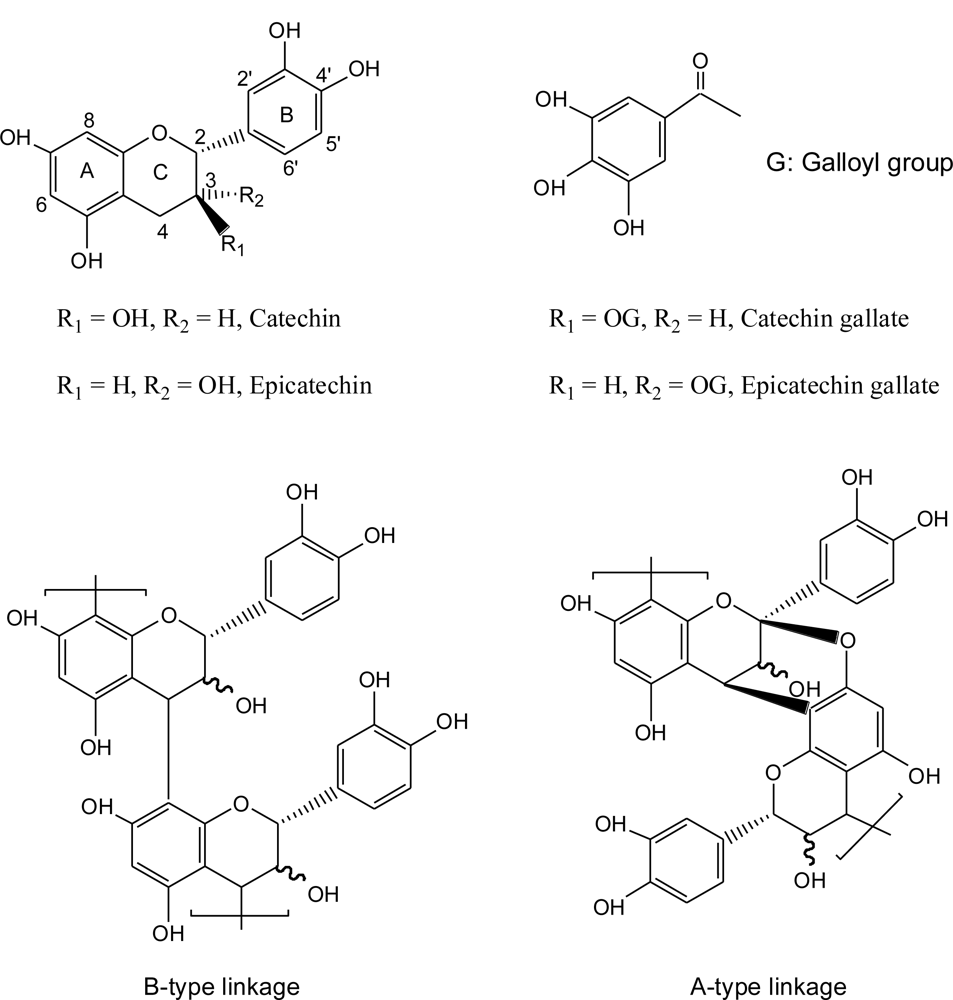
<p>Procyanidins, the major class of proanthocyanidins, yield cyanidin upon oxidation under strongly acidic conditions [<xref ref-type="bibr" rid="b1-ijms-12-01146">1</xref>,<xref ref-type="bibr" rid="b2-ijms-12-01146">2</xref>]. They consist mainly of (+)-catechin and/or (−)-epicatechin and their 3-<italic>O</italic>-gallates linked mainly through C4–C6 and/or C4–C8 bonds (B-type procyanidins) (<xref ref-type="fig" rid="f1-ijms-12-01146">Figure 1</xref>) [<xref ref-type="bibr" rid="b3-ijms-12-01146">3</xref>,<xref ref-type="bibr" rid="b4-ijms-12-01146">4</xref>]. The flavan-3-ol units can also be doubly linked by a C4–C8 bond and an additional ether bond formed between C2 and O7 (A-type procyanidins) [<xref ref-type="bibr" rid="b5-ijms-12-01146">5</xref>,<xref ref-type="bibr" rid="b6-ijms-12-01146">6</xref>].</p>
<p>Procyanidins are widely present in fruits, seeds, leaves, flowers and bark of many plants [<xref ref-type="bibr" rid="b7-ijms-12-01146">7</xref>,<xref ref-type="bibr" rid="b8-ijms-12-01146">8</xref>]. They possess a broad spectrum of biological, pharmacological and chemoprotective properties against free radicals and oxidative stress, such as antibacterial, antiviral, anti-inflammatory, anti-allergic and vasodilatory functions [<xref ref-type="bibr" rid="b9-ijms-12-01146">9</xref>–<xref ref-type="bibr" rid="b12-ijms-12-01146">12</xref>], as well as inhibiting lipid peroxidation, platelet aggregation and capillary permeability and fragility, and modulating the activity of enzyme systems, including cyclo-oxygenase and lipo-oxygenase [<xref ref-type="bibr" rid="b13-ijms-12-01146">13</xref>]. Procyanidins have been considered as functional ingredients in botanical and nutritional supplements.</p>
<p><italic>Acacia confusa</italic> is traditionally used as a medicinal plant [<xref ref-type="bibr" rid="b14-ijms-12-01146">14</xref>]. An aqueous extract of <italic>A. confusa</italic> leaves was used for wound healing and anti-blood-stasis in Taiwan [<xref ref-type="bibr" rid="b15-ijms-12-01146">15</xref>]. The stem bark of <italic>A. confusa</italic> is rich in procyanidins [<xref ref-type="bibr" rid="b16-ijms-12-01146">16</xref>], and its crude extracts showed excellent antioxidant activities [<xref ref-type="bibr" rid="b17-ijms-12-01146">17</xref>,<xref ref-type="bibr" rid="b18-ijms-12-01146">18</xref>]. The size of procyanidins, expressed as degree of polymerization (DP), is one of the most important properties [<xref ref-type="bibr" rid="b5-ijms-12-01146">5</xref>]; some previous studies showed that the DP increased the antioxidant capacity [<xref ref-type="bibr" rid="b19-ijms-12-01146">19</xref>,<xref ref-type="bibr" rid="b20-ijms-12-01146">20</xref>]. Due to the heterogeneous character of proanthocyanidins, the structural elucidation of these compounds (especially the higher polymers) is difficult and less is known regarding structure-activity relationships [<xref ref-type="bibr" rid="b21-ijms-12-01146">21</xref>,<xref ref-type="bibr" rid="b22-ijms-12-01146">22</xref>]. In order to describe the influence of the procyanidins DP on its antioxidant activity and filter out the best antioxidant performance fraction, it is necessary to establish an efficient, reliable separation method to separate the polymers according to their molecular weight.</p>
<p>Separations of procyanidins <italic>i.e</italic>., using normal phase [<xref ref-type="bibr" rid="b23-ijms-12-01146">23</xref>], reversed phase [<xref ref-type="bibr" rid="b24-ijms-12-01146">24</xref>] and size exclusion [<xref ref-type="bibr" rid="b25-ijms-12-01146">25</xref>] models of liquid chromatography only allowed good separation of oligomeric procyanidins, and became ineffective for highly polymerized procyanidins [<xref ref-type="bibr" rid="b26-ijms-12-01146">26</xref>]. Sephadex LH-20 has been widely used for proanthocyanidins chromatography since 1974 [<xref ref-type="bibr" rid="b27-ijms-12-01146">27</xref>] and the separation methods based on it are more likely to be reproducible [<xref ref-type="bibr" rid="b28-ijms-12-01146">28</xref>]. In the present study, the crude procyanidins extract from the stem bark of <italic>A. confusa</italic> was fractionated on a Sephadex LH-20 column using a gradient of water, methanol, and acetone. The obtained fractions were analyzed by MALDI-TOF MS and RPHPLC analyses. Meanwhile, the free radical scavenging capacities and ferric reducing/antioxidant powers of each fraction were also discussed.</p></sec>
<sec sec-type="results|discussion">
<label>2.</label>
<title>Results and Discussion</title>
<sec>
<label>2.1.</label>
<title>Antioxidant Activities of Fractions F1-F11</title>
<p>The antioxidant activity of each fraction (F1–F11) was evaluated by measurement of their DPPH radical scavenging activities and ferric reducing antioxidant powers.</p>
<p>DPPH is a stable radical and has been accepted as a tool for estimating free radical scavenging activities of the <italic>A. confusa</italic> leaf, bark, twig, and branch extracts [<xref ref-type="bibr" rid="b29-ijms-12-01146">29</xref>–<xref ref-type="bibr" rid="b31-ijms-12-01146">31</xref>]. This method is based on the reduction of DPPH in methanol solution in the presence of a hydrogen-donating antioxidant due to the formation of the nonradical form DPPH-H. There was a significant linear relationship (<italic>R</italic><sup>2</sup> ≥ 0.996) between the concentrations of each fraction in the DPPH solution and the inhibition percentages. Using these linear equations, each fraction concentration providing 50% inhibition (IC<sub>50</sub>) was calculated. Lower IC<sub>50</sub> value reflects better DPPH radical scavenging activity [<xref ref-type="bibr" rid="b32-ijms-12-01146">32</xref>]. By comparing the IC<sub>50</sub> value of fractions F1–F11 and the reference antioxidant compounds (BHA and ascorbic acid), F9 had the highest radical scavenging ability (81.91 ± 0.60 μg/mL) (<xref ref-type="table" rid="t1-ijms-12-01146">Table 1</xref>). The radical scavenging ability of F9 was almost six-fold that of F1. The DPPH radical scavenging abilities of F5-F8 were also higher than that of ascorbic acid and BHA. The scavenging effect on the DPPH radical followed the order: F9 &gt; F8 ≈ F7 ≈ F5 &gt; F6 &gt; F4 ≈ ascorbic acid &gt; F10 ≈ F3 ≈ BHA &gt; F11 &gt; F2 &gt; F1.</p>
<p>The ferric reducing antioxidant assay is based on the reduction of TPTZ-Fe (III) to the TPTZ-Fe (II) complex by a reductant at low pH [<xref ref-type="bibr" rid="b33-ijms-12-01146">33</xref>]. The procedure is relatively simple and easy to standardize. It has been used frequently in the assessment of antioxidant activity of various fruits, vegetables and some biological samples [<xref ref-type="bibr" rid="b34-ijms-12-01146">34</xref>–<xref ref-type="bibr" rid="b36-ijms-12-01146">36</xref>]. The antioxidant ability of each fraction was estimated by FRAP values, which is expressed in ascorbic acid equivalents. The FRAP values for fraction F1–F11 ranged from 1.33 ± 0.06 to 6.33 ± 0.04 mmol AAE/g, with the highest in F9 and the lowest in F1, respectively (<xref ref-type="table" rid="t1-ijms-12-01146">Table 1</xref>). In brief, the reducing power of the fraction and standard were found in the following order: F9 &gt; F5 ≈ F4 &gt; F8 ≈ F7 ≈ F3 &gt; F6 ≈ BHA &gt; F10 ≈ F2 &gt; F11 &gt; F1.</p>
<p>According to the results mentioned above, the antioxidants were more abundantly distributed in fractions F4–F9 than in other fractions. In addition, compared with the antioxidant activities of the total <italic>A. confusa</italic> stem bark procyanidins before separation (IC<sub>50</sub> = 87.85 ±0.52 μg/mL, FRAP = 5.89 ±0.14 mmol AAE/g) [<xref ref-type="bibr" rid="b16-ijms-12-01146">16</xref>], prior separation of the procyanidins can filter out the best antioxidant performance fraction (F9) as antioxidants. Furthermore, to identify and characterize the antioxidants in <italic>A. confusa</italic> stem bark and demonstrate the relationship between the structure of polymeric tannins and their antioxidant activity, the active fractions were analyzed by MALDI-TOF MS and acid-catalyzed degradation analyses.</p></sec>
<sec sec-type="methods">
<label>2.2.</label>
<title>MALDI-TOF MS Analysis</title>
<p>The MALDI-TOF MS is considered a sensitive and powerful tool for the analysis of both synthetic and natural polymers [<xref ref-type="bibr" rid="b37-ijms-12-01146">37</xref>–<xref ref-type="bibr" rid="b40-ijms-12-01146">40</xref>]. Because of its soft ionization energy, high ion transmission yield, highly contaminant tolerance, and because it produces only a singly charged molecular ion for each parent molecular attributes [<xref ref-type="bibr" rid="b41-ijms-12-01146">41</xref>,<xref ref-type="bibr" rid="b42-ijms-12-01146">42</xref>], the simultaneous determination of masses in complex mixtures of low and high molecular weight compounds can be achieved [<xref ref-type="bibr" rid="b43-ijms-12-01146">43</xref>].</p>
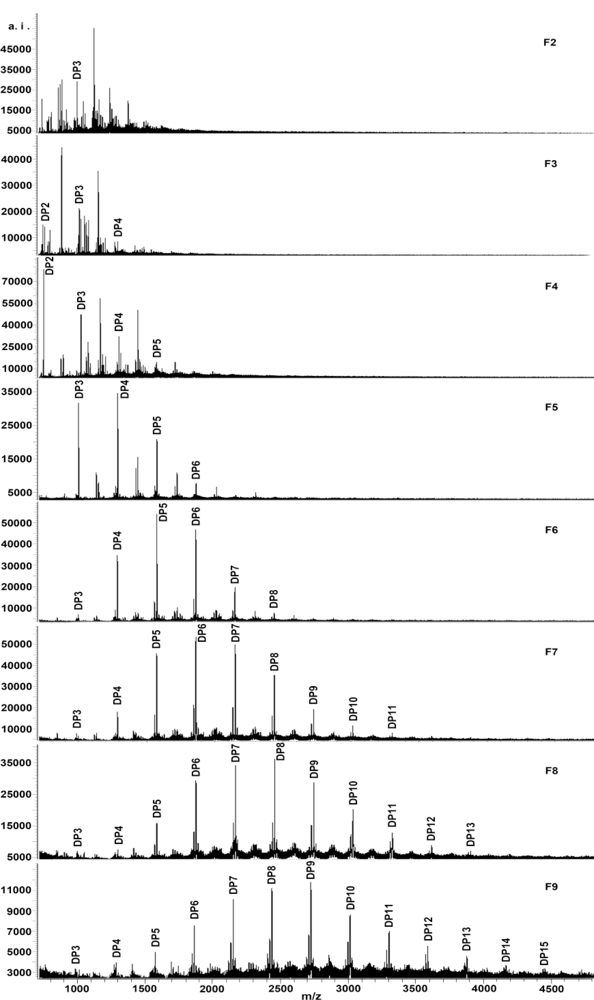
<p><xref ref-type="fig" rid="f2-ijms-12-01146">Figure 2</xref> shows the MALDI-TOF MS spectra of fractions F2–F9, recorded as Cs<sup>+</sup> adducts in the positive ion reflectron mode. Due to the compounds in fraction F1 eluting with water being mainly sugars and the signal-to-noise ratio being too weak in the spectrum, this fraction is not included in the subsequent analysis. Fractions F10 and F11 could not be ionized because of the high mDP of the polymers. Some authors [<xref ref-type="bibr" rid="b44-ijms-12-01146">44</xref>,<xref ref-type="bibr" rid="b45-ijms-12-01146">45</xref>] suggested that the detection of high molecular weight tannins is less sensitive compared with low molecular weight species. Lower masses (from the matrix) might saturate the detector, preventing the detection of polymeric tannins with higher masses [<xref ref-type="bibr" rid="b46-ijms-12-01146">46</xref>].</p>
<p>The MALDI-TOF mass spectra of fractions F2–F9 are simple in appearance, with peaks grouped at intervals corresponding to difference in DP. The results obtained in the present study indicated a series of peaks with distances of 288 Da, corresponding to a mass difference of one catechin/epicatechin between each polymer. Prolongation of polymeric tannins is due to addition of catechin/epicatechin monomers. The polymeric tannins of <italic>A. confusa</italic> stem bark consisted primarily of procyanidin. This is in accordance with the observation of Wei <italic>et al</italic>. 2010 [<xref ref-type="bibr" rid="b16-ijms-12-01146">16</xref>].</p>
<p>Procyanidin oligomers from many plants have been identified by MALDI-TOF MS [<xref ref-type="bibr" rid="b47-ijms-12-01146">47</xref>,<xref ref-type="bibr" rid="b48-ijms-12-01146">48</xref>]. An equation was formulated to calculate the expected polymeric procyanidins molecular weight. The equation is <italic>M</italic> = 290 + 288<italic>a</italic> + 133, where <italic>M</italic> represents the calculated mass, 290 is the molecular weight of the terminal catechin/epicatechin unit, <italic>a</italic> is the degree of polymerization contributed by the catechin/epicatechin extending unit, and 133 is the weight of cesium [<xref ref-type="bibr" rid="b49-ijms-12-01146">49</xref>]. A series of ions corresponding to cesium adducts of procyanidin oligomers and polymers from the DP 2 through to the DP 15 were observed in fractions F2–F9 (<xref ref-type="table" rid="t2-ijms-12-01146">Table 2</xref>).</p>
<p><xref ref-type="table" rid="t3-ijms-12-01146">Table 3</xref> summarized the range of polymers and the most abundant polymer size in the eight collected fractions F2–F9. The overall polymer range of the mass spectra was gradually increased from the fractions F2–F9. Large molecular size of polymeric procyanidins was detected in the fraction F9, up to DP 15, which was not apparent in the spectrum of <italic>A. confusa</italic> stem bark reported by Wei <italic>et al</italic>. 2010 [<xref ref-type="bibr" rid="b16-ijms-12-01146">16</xref>]. It is well demonstrated that prior size separation of <italic>A. confusa</italic> stem bark procyanidins allows more to be learned about the molecular weight distribution of polymeric procyanidins and improves the detection of large polymers.</p></sec>
<sec>
<label>2.3.</label>
<title>Thiolysis of Fractions F2–F11</title>
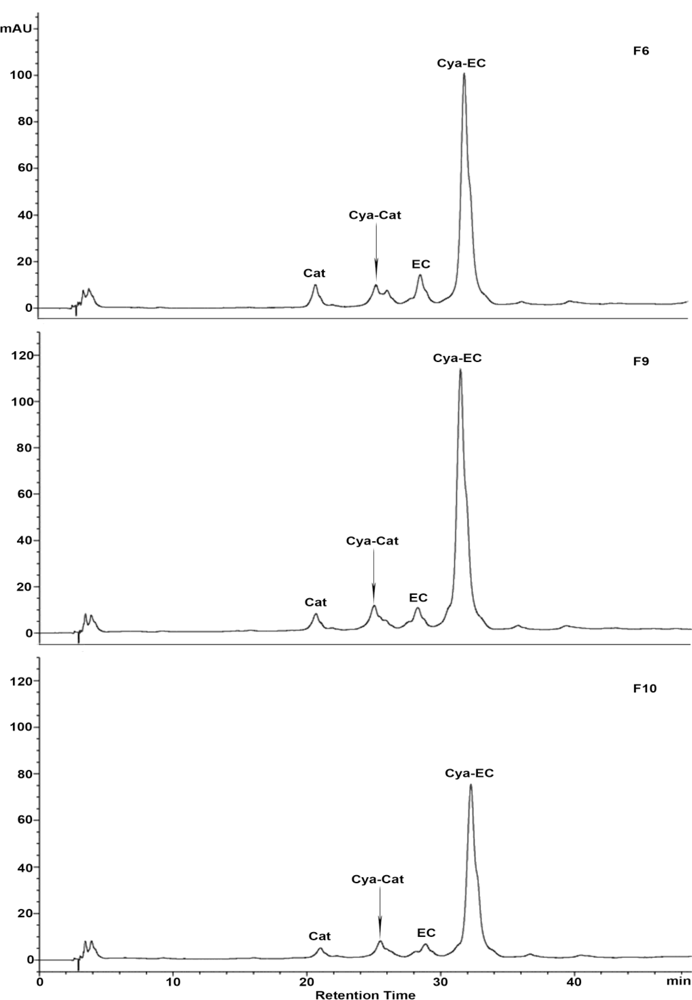
<p>Depolymerization reactions in the presence of nucleophiles have been proven to be an efficient method for the structure analysis of procyanidins [<xref ref-type="bibr" rid="b50-ijms-12-01146">50</xref>]. To determine each fraction subunit composition and mDP, the collected samples (F2–F11) were analyzed by acid catalysis in the presence of cysteamine as nucleophile, which was preferred to toluene-<italic>a</italic>-thiol due to being more user-friendly and much less toxic [<xref ref-type="bibr" rid="b51-ijms-12-01146">51</xref>]. In thiolysis reactions, all the extension subunits of procyanidins are attacked by cysteamine to form the 4-(2-aminoethylthio) flavan-3-ols. Only the terminal unit is released as the free flavan-3-ol [<xref ref-type="bibr" rid="b5-ijms-12-01146">5</xref>]. The extension units and terminal units of procyanidins can be distinguished by reversed phase HPLC analysis (<xref ref-type="fig" rid="f3-ijms-12-01146">Figure 3</xref>).</p>
<p><xref ref-type="fig" rid="f3-ijms-12-01146">Figure 3</xref> shows the chromatograms of polymeric procyanidins in fractions F6, F9, and F10. The major product observed was the 4β-(2-aminoethylthio) epicatechin (Cya-EC) along with a small amount of (+)-catechin (Cat), (−)-epicatechin (EC), and 4β-(2-aminoethylthio) catechin (Cya-Cat). The result suggested that catechin and epicatechin occur as both terminal and extension units, and that epicatechin was the major component in the extended chain of the polymeric procyanidins from <italic>A. confusa</italic> stem bark.</p>
<p>The mDP of the proacyanidin fractions was calculated by comparing the peak areas based on the following equation (<xref ref-type="table" rid="t3-ijms-12-01146">Table 3</xref>):
<disp-formula>
<mml:math display="block">
<mml:mtext>mDP</mml:mtext>
<mml:mo>=</mml:mo>
<mml:mfrac>
<mml:mrow>
<mml:mtext>total area of cystemine derivative of catechin and cysteamine derivative of epicatechin</mml:mtext></mml:mrow>
<mml:mrow>
<mml:mtext>total area of catechin and epicatechin</mml:mtext></mml:mrow></mml:mfrac>
<mml:mo>+</mml:mo>
<mml:mn>1</mml:mn></mml:math></disp-formula></p>
<p>Interestingly, the elution order was coincident with the mDP of procyanidins. The mDP of each fraction was different, ranging from 1.68 to 17.31, with the maximum in the last fraction F11 and the minimum in the fraction F2.</p>
<p>Most of the activities of procyanidins, including the antioxidant activity, are generally recognized to be largely dependent on their structure, particularly their degree of polymerization [<xref ref-type="bibr" rid="b52-ijms-12-01146">52</xref>,<xref ref-type="bibr" rid="b53-ijms-12-01146">53</xref>]. In the present study, the regression model of the relationship between antioxidant activity (IC<sub>50/DPPH</sub> and FRAP) and mDP were as follows: IC<sub>50/DPPH</sub> = −0.028 mDP<sup>3</sup> + 1.452 mDP<sup>2</sup> − 18.146 mDP + 151.518 (<italic>R</italic><sup>2</sup> = 0.861, <italic>P</italic> = 0.006) and FRAP = −0.022mDP<sup>2</sup> + 0.328 mDP + 4.629 (<italic>R</italic><sup>2</sup> = 0.608, <italic>P</italic> = 0.038), respectively. The highest antioxidant activity of fraction (F9) was not coincident with the max mDP of fraction (F11) (<xref ref-type="table" rid="t1-ijms-12-01146">Tables 1</xref> and <xref ref-type="table" rid="t3-ijms-12-01146">3</xref>). The tendency was similar to the reports by Jerez <italic>et al</italic>. [<xref ref-type="bibr" rid="b54-ijms-12-01146">54</xref>], who found an increase up to 6.5 mDP and then a fall (9.2–14.6 mDP) of the antioxidant activity of procyanidins from <italic>Pinus radiata</italic> bark.</p></sec></sec>
<sec>
<label>3.</label>
<title>Experimental Section</title>
<sec sec-type="materials">
<label>3.1.</label>
<title>Chemicals and Plant Materials</title>
<p>The solvents acetone, petroleum ether, ethyl acetate and methanol were of analytical reagent (AR) purity grade. The trifluoroacetic acid (TFA) and acetonitrile were of HPLC grade. 2,2-diphenyl-1-picrylhydrazyl (DPPH), 2,4,6-tripyridyl-S-triazine (TPTZ), cysteamine hydrochloride, ascorbic acid, butylated hydroxyanisole (BHA), and cesium chloride were purchased from Aldrich (USA). (−)-Epicatechin (EC) and (+)-catechin (Cat) were purchased from Sigma (USA). Sephadex LH-20 was purchased from Amersham (USA). The stem bark of <italic>A. confusa</italic> were collected from Xiamen Botanical Garden, Fujian province, China in December 2009 and immediately freeze dried and ground.</p></sec>
<sec>
<label>3.2.</label>
<title>Extraction and Fractionation of Procyanidin Polymers</title>
<p>Freeze-dried stem bark powder (35 g) was extracted thrice with 7:3 (v/v) acetone-water solution (3 × 250 mL) at room temperature. The extracts were centrifuged at 3000 g for 15 min and collected, and the acetone was removed under reduced pressure by use of a rotary evaporator at 38 °C. The remaining aqueous fraction was defatted with petroleum ether (3 × 150 mL), and then extracted with ethyl acetate (3 × 150 mL). Two fractions were obtained: an organic fraction and an aqueous fraction which contained mainly polymers. The solvent (water saturated with ethyl acetate) was eliminated from the aqueous fraction and lyophilized to obtain crude tannins extract.</p>
<p>The crude tannins extract (500 mg/5 mL of 50% methanol) was applied to a Sephadex LH-20 column (50 × 1 cm i.d.). The column was eluted with water (150 mL, F1), methanol-water (40:60, v/v; 100 mL, F2), methanol-water (60:40, v/v; 50 mL, F3 and 50 mL, F4), methanol-water (75:25, v/v; 100 mL, F5), methanol-water (90:10, v/v; 50 mL, F6), acetone-methanol-water (10:80:10, v/v/v; 50 mL, F7 and 50 mL, F8), acetone-methanol-water (20:65:15, v/v/v; 50 mL, F9), acetone-methanol-water (30:40:30, v/v/v; 50 mL, F10), and finally acetone-water (70:30, v/v; 200 mL, F11). The fractions were concentrated <italic>in vacuo</italic> (38 °C) and freeze-dried to give eleven powders with approximate weights of 183 mg, 11.7 mg, 16.1 mg, 22.3 mg, 47.2 mg, 23 mg, 50.3 mg, 39.5 mg, 33.7 mg, 22.3 mg, and 15.6 mg for F1–F11, respectively.</p></sec>
<sec>
<label>3.3.</label>
<title>DPPH Radical Scavenging Activity</title>
<p>The DPPH free radical scavenging activity of each fraction was determined according to the method of Braca <italic>et al</italic>. 2001 [<xref ref-type="bibr" rid="b55-ijms-12-01146">55</xref>]. 0.1 mL of various concentrations of each freeze-dried sample at different concentrations (15.63–125 μg/mL) was added to 3 mL of DPPH solution (0.1 mM in methanolic solution). An equal amount of methanol and DPPH served as control. After the mixture was shaken and allowed to stand at ambient temperature for 30 min, the absorbance at 517 nm was measured. Lower absorbance of the reaction mixture indicates higher free radical scavenging activity. The IC<sub>50</sub> value, defined as the amount of antioxidant necessary to decrease the initial DPPH concentration by 50%, was calculated from the results and used for comparison. The capability to scavenge the DPPH radical was calculated by using the following equation:
<disp-formula>
<mml:math display="block">
<mml:mtext>DPPH scavenging effect</mml:mtext>
<mml:mo stretchy="false">(</mml:mo>
<mml:mo>%</mml:mo>
<mml:mo stretchy="false">)</mml:mo>
<mml:mo>=</mml:mo>
<mml:mo stretchy="false">[</mml:mo>
<mml:mo stretchy="false">(</mml:mo>
<mml:msub>
<mml:mtext>A</mml:mtext>
<mml:mn>1</mml:mn></mml:msub>
<mml:mo>−</mml:mo>
<mml:msub>
<mml:mtext>A</mml:mtext>
<mml:mn>2</mml:mn></mml:msub>
<mml:mo stretchy="false">)</mml:mo>
<mml:mo>/</mml:mo>
<mml:msub>
<mml:mtext>A</mml:mtext>
<mml:mn>1</mml:mn></mml:msub>
<mml:mo stretchy="false">]</mml:mo>
<mml:mo>×</mml:mo>
<mml:mn>100</mml:mn></mml:math></disp-formula>where A<sub>1</sub> = the absorbance of the control reaction; A<sub>2</sub> = the absorbance in the presence of the sample. BHA and ascorbic acid were used as standards.</p></sec>
<sec>
<label>3.4.</label>
<title>Ferric Reducing/Antioxidant Power (FRAP) Assay</title>
<p>FRAP assay is a simple and reliable colorimetric method commonly used for measuring the total antioxidant capacity [<xref ref-type="bibr" rid="b56-ijms-12-01146">56</xref>]. In brief, 3 mL of prepared freshly FRAP reagent was mixed with 0.1 mL of test sample or methanol (for the reagent blank). The FRAP reagent was prepared from 300 mmol/L acetate buffer (pH 3.6), 20 mmol/L ferric chloride and 10 mmol/L TPTZ made up in 40 mmol/L hydrochloric acid. All the above three solutions were mixed together in the ratio of 25:2.5:2.5 (v/v/v). The absorbance of reaction mixture at 593 nm was measured spectrophotometrically after incubation at 25 °C for 10 min. The FRAP values, expressed in mmol ascorbic acid equivalents (AAE)/g dried tannins, were derived from a standard curve.</p></sec>
<sec sec-type="methods">
<label>3.5.</label>
<title>MALDI-TOF MS Analysis</title>
<p>The MALDI-TOF MS spectra were recorded on a Bruker Reflex III instrument (Germany). The irradiation source was a pulsed nitrogen laser with a wavelength of 337 nm, and the duration of the laser pulse was 3 ns. In the positive reflectron mode, an accelerating voltage of 20.0 kV and a reflectron voltage of 23.0 kV were used. 2,5-Dihydroxybenzoic acid (DHB, 10 mg/mL 30% acetone solution) was used as the matrix. The sample solutions (10 mg/mL 30% acetone solution) were mixed with the matrix solution at a volumetric ratio of 1:3. The mixture (1 μL) was spotted to the steel target. Amberlite IRP-64 cation-exchange resin (Sigma-Aldrich, USA), equilibrated in deionized water, was used to deionize the analyte-matrix solution thrice. Cesium chloride (1.52 mg/mL) was mixed with the analyte-matrix solution (1:3, v/v) to promote the formation of a single type of ion adduct ([M+Cs]<sup>+</sup>) [<xref ref-type="bibr" rid="b57-ijms-12-01146">57</xref>].</p></sec>
<sec sec-type="methods">
<label>3.6.</label>
<title>Thiolysis Reaction and HPLC Analysis</title>
<p>Thiolysis was carried out according to the method of Torres and Lozano 2001 [<xref ref-type="bibr" rid="b58-ijms-12-01146">58</xref>]. The chosen fraction solution (4 mg/mL in methanol) was prepared. A sub-sample (50 μL) was placed in a vial and to this hydrochloric acid in methanol (3.3%, v/v; 50 μL) and cysteamine hydrochloride in methanol (50 mg/mL, 100 μL) was added. The solution was heated at 40 °C for 30 min, and cooled to room temperature. Thiolysis reaction media (20 μL) filtrated through a membrane filter with an aperture size of 0.45 μm was analyzed by RP-HPLC.</p>
<p>The high performance liquid chromatographer was an Agilent 1200 system (USA). The thiolysis media were further analyzed using LC/MS (QTRAP 3200, USA) with a Hypersil ODS column (4.6 mm × 250 mm, 2.5 μm) (China). The mobile phase was composed of solvent A (0.5% v/v trifluoroacetic acid (TFA) in water) and solvent B (0.5% v/v TFA in acetonitrile). The gradient condition was: 0–5 min, 3% B (isocratic); 5–15 min, 3%–9% B (linear gradient); 15–45 min, 9%–16% B (linear gradient), 45–60 min, 16%–60% B (linear gradient). The column temperature was ambient and the flow-rate was set at 1 mL/min. Detection was at a wavelength of 280 nm and the UV spectra were acquired between 200–600 nm. Degradation products were identified on chromatograms according to their relative retention times and LC/MS.</p></sec>
<sec sec-type="methods">
<label>3.7.</label>
<title>Statistical Analysis</title>
<p>All data were expressed as means ± standard deviation of three independent determinations. One-way analysis of variance (ANOVA) was used, and the differences were considered to be significant at <italic>P</italic> &lt; 0.05. All statistical analyses were performed with SPSS 13.0 for windows.</p></sec></sec>
<sec sec-type="conclusions">
<label>4.</label>
<title>Conclusions</title>
<p>The use of water, methanol and acetone step gradient on Sephadex LH-20 column is a good method to fractionate the polymeric procyanidins of <italic>A. confusa</italic> stem bark according to the degree of polymerization. The collected fractions all possessed potent antioxidant activity with the best result achieved for F9. The MALDI-TOF MS and RP-HPLC analyses suggested that the fractions consisted primarily of oligomeric and polymeric procyanidins, with different polymer ranges and most abundant polymer size. For each fraction, catechin and epicatechin were present as both terminal and extension units, and epicatechin was the major component in the extended chain. The method described can easily be applied to filter out the fraction with the strongest antioxidant activity, to demonstrate well the effectiveness of prior size separation in improving mass spectra detection of the procyanidins, and also to facilitate elucidation of structure-activity relationships in assays of procyanidins.</p></sec></body>
<back>
<ack>
<p>This work was supported by the National Natural Science Foundation of China (31070522) and the Program for New Century Excellent Talents in University (NCET-07-0725).</p></ack>
<ref-list>
<title>References</title>
<ref id="b1-ijms-12-01146"><label>1.</label><citation citation-type="journal"><person-group person-group-type="author"><name><surname>Fuleki</surname><given-names>T</given-names></name><name><surname>Ricardo da Silva</surname><given-names>JM</given-names></name></person-group><article-title>Catechin and procyanidin composition of seeds from grape cultivars grown in Ontario</article-title><source>J. Agric. Food Chem</source><year>1997</year><volume>45</volume><fpage>1156</fpage><lpage>1160</lpage><pub-id pub-id-type="doi">10.1021/jf960493k</pub-id></citation></ref>
<ref id="b2-ijms-12-01146"><label>2.</label><citation citation-type="journal"><person-group person-group-type="author"><name><surname>Prieur</surname><given-names>C</given-names></name><name><surname>Rigaud</surname><given-names>J</given-names></name><name><surname>Cheynier</surname><given-names>V</given-names></name><name><surname>Moutounet</surname><given-names>M</given-names></name></person-group><article-title>Oligomeric and polymeric procyanidins from grape seeds</article-title><source>Phytochemistry</source><year>1994</year><volume>36</volume><fpage>781</fpage><lpage>784</lpage><pub-id pub-id-type="doi">10.1016/S0031-9422(00)89817-9</pub-id></citation></ref>
<ref id="b3-ijms-12-01146"><label>3.</label><citation citation-type="journal"><person-group person-group-type="author"><name><surname>de Freitas</surname><given-names>VAP</given-names></name><name><surname>Glories</surname><given-names>Y</given-names></name><name><surname>Laguerres</surname><given-names>M</given-names></name></person-group><article-title>Incidence of molecular structure in oxidation of grape seed procyanidins</article-title><source>J. Agric. Food Chem</source><year>1998</year><volume>46</volume><fpage>376</fpage><lpage>382</lpage><pub-id pub-id-type="doi">10.1021/jf970468u</pub-id><pub-id pub-id-type="pmid">10554249</pub-id></citation></ref>
<ref id="b4-ijms-12-01146"><label>4.</label><citation citation-type="journal"><person-group person-group-type="author"><name><surname>Ricardo da Silva</surname><given-names>JM</given-names></name><name><surname>Rigaud</surname><given-names>J</given-names></name><name><surname>Cheynier</surname><given-names>V</given-names></name><name><surname>Cheminat</surname><given-names>A</given-names></name><name><surname>Moutounet</surname><given-names>M</given-names></name></person-group><article-title>Procyanidin dimers and trimers from grape seeds</article-title><source>Phytochemistry</source><year>1991</year><volume>30</volume><fpage>1259</fpage><lpage>1264</lpage><pub-id pub-id-type="doi">10.1016/S0031-9422(00)95213-0</pub-id></citation></ref>
<ref id="b5-ijms-12-01146"><label>5.</label><citation citation-type="journal"><person-group person-group-type="author"><name><surname>Gu</surname><given-names>L</given-names></name><name><surname>Kelm</surname><given-names>M</given-names></name><name><surname>Hammerstone</surname><given-names>JF</given-names></name><name><surname>Beecher</surname><given-names>G</given-names></name><name><surname>Cunningham</surname><given-names>D</given-names></name><name><surname>Vannozzi</surname><given-names>S</given-names></name><name><surname>Prior</surname><given-names>RL</given-names></name></person-group><article-title>Fractionation of polymeric procyanidins from lowbush blueberry and quantification of procyanidins in selected foods with an optimized normal-phase HPLC-MS fluorescent detection method</article-title><source>J. Agric. Food Chem</source><year>2002</year><volume>50</volume><fpage>4852</fpage><lpage>4860</lpage><pub-id pub-id-type="doi">10.1021/jf020214v</pub-id><pub-id pub-id-type="pmid">12166971</pub-id></citation></ref>
<ref id="b6-ijms-12-01146"><label>6.</label><citation citation-type="journal"><person-group person-group-type="author"><name><surname>Vivas</surname><given-names>N</given-names></name><name><surname>Glories Isabelle</surname><given-names>Y</given-names></name></person-group><article-title>A complete structural and conformational investigation of procyanidin A2 dimer</article-title><source>Tetrahedron Lett</source><year>1996</year><volume>37</volume><fpage>2015</fpage><lpage>2018</lpage><pub-id pub-id-type="doi">10.1016/0040-4039(96)00187-6</pub-id></citation></ref>
<ref id="b7-ijms-12-01146"><label>7.</label><citation citation-type="journal"><person-group person-group-type="author"><name><surname>Esatbeyoglu</surname><given-names>T</given-names></name><name><surname>Wray</surname><given-names>V</given-names></name><name><surname>Winterhalter</surname><given-names>P</given-names></name></person-group><article-title>Dimeric procyanidins: Screening for B1 to B8 and semisynthetic preparation of B3, B4, B6, and B8 from a polymeric procyanidin fraction of White Willow Bark (<italic>Salix alba</italic>)</article-title><source>J. Agric. Food Chem</source><year>2010</year><volume>58</volume><fpage>7820</fpage><lpage>7830</lpage><pub-id pub-id-type="doi">10.1021/jf101023e</pub-id><pub-id pub-id-type="pmid">20533825</pub-id></citation></ref>
<ref id="b8-ijms-12-01146"><label>8.</label><citation citation-type="journal"><person-group person-group-type="author"><name><surname>Santos-Buelga</surname><given-names>C</given-names></name><name><surname>Scalbert</surname><given-names>A</given-names></name></person-group><article-title>Proanthocyanidins and tannin-like compounds-nature, occurrence, dietary intake and effects on nutrition and health</article-title><source>J. Sci. Food Agric</source><year>2000</year><volume>80</volume><fpage>1094</fpage><lpage>1117</lpage><pub-id pub-id-type="doi">10.1002/(SICI)1097-0010(20000515)80:7&lt;1094::AID-JSFA569&gt;3.0.CO;2-1</pub-id></citation></ref>
<ref id="b9-ijms-12-01146"><label>9.</label><citation citation-type="journal"><person-group person-group-type="author"><name><surname>Ariga</surname><given-names>T</given-names></name><name><surname>Koshiyama</surname><given-names>I</given-names></name><name><surname>Fukushima</surname><given-names>D</given-names></name></person-group><article-title>Antioxidative properties of procyanidins B-1 and B-3 from azuki beans in aqueous systems</article-title><source>Agric. Biol. Chem</source><year>1988</year><volume>52</volume><fpage>2717</fpage><lpage>2722</lpage><pub-id pub-id-type="doi">10.1271/bbb1961.52.2717</pub-id></citation></ref>
<ref id="b10-ijms-12-01146"><label>10.</label><citation citation-type="journal"><person-group person-group-type="author"><name><surname>Landrault</surname><given-names>N</given-names></name><name><surname>Poucheret</surname><given-names>P</given-names></name><name><surname>Ravel</surname><given-names>P</given-names></name><name><surname>Gasc</surname><given-names>F</given-names></name><name><surname>Cros</surname><given-names>G</given-names></name><name><surname>Teissedre</surname><given-names>PL</given-names></name></person-group><article-title>Antioxidant capacities and phenolics levels of French wines from different varieties and vintages</article-title><source>J. Agric. Food Chem</source><year>2001</year><volume>49</volume><fpage>3341</fpage><lpage>3348</lpage><pub-id pub-id-type="doi">10.1021/jf010128f</pub-id><pub-id pub-id-type="pmid">11453773</pub-id></citation></ref>
<ref id="b11-ijms-12-01146"><label>11.</label><citation citation-type="journal"><person-group person-group-type="author"><name><surname>Pinent</surname><given-names>M</given-names></name><name><surname>Blade</surname><given-names>C</given-names></name><name><surname>Salvadó</surname><given-names>MJ</given-names></name><name><surname>Blay</surname><given-names>M</given-names></name><name><surname>Pujadas</surname><given-names>G</given-names></name><name><surname>Fernandez-Larrea</surname><given-names>J</given-names></name><name><surname>Arola</surname><given-names>L</given-names></name><name><surname>Ardévol</surname><given-names>A</given-names></name></person-group><article-title>Procyanidin effects on adipocyte-related pathologies</article-title><source>Crit. Rev. Food Sci. Nutr</source><year>2006</year><volume>46</volume><fpage>543</fpage><lpage>550</lpage><pub-id pub-id-type="doi">10.1080/10408390500354537</pub-id><pub-id pub-id-type="pmid">16954063</pub-id></citation></ref>
<ref id="b12-ijms-12-01146"><label>12.</label><citation citation-type="journal"><person-group person-group-type="author"><name><surname>Yilmaz</surname><given-names>Y</given-names></name><name><surname>Toledo</surname><given-names>RT</given-names></name></person-group><article-title>Health aspects of functional grape seed constituents</article-title><source>Trends Food Sci. Technol</source><year>2004</year><volume>15</volume><fpage>422</fpage><lpage>433</lpage><pub-id pub-id-type="doi">10.1016/j.tifs.2004.04.006</pub-id></citation></ref>
<ref id="b13-ijms-12-01146"><label>13.</label><citation citation-type="journal"><person-group person-group-type="author"><name><surname>Kolodziej</surname><given-names>H</given-names></name><name><surname>Haberland</surname><given-names>C</given-names></name><name><surname>Woerdenbag</surname><given-names>HJ</given-names></name><name><surname>Konings</surname><given-names>AWT</given-names></name></person-group><article-title>Moderate cytotoxicity of proanthocyanidins to human tumour cell lines</article-title><source>Phytother. Res</source><year>1995</year><volume>9</volume><fpage>410</fpage><lpage>415</lpage><pub-id pub-id-type="doi">10.1002/ptr.2650090605</pub-id></citation></ref>
<ref id="b14-ijms-12-01146"><label>14.</label><citation citation-type="journal"><person-group person-group-type="author"><name><surname>Wu</surname><given-names>JH</given-names></name><name><surname>Tung</surname><given-names>YT</given-names></name><name><surname>Wang</surname><given-names>SY</given-names></name><name><surname>Shyur</surname><given-names>LF</given-names></name><name><surname>Kuo</surname><given-names>YH</given-names></name><name><surname>Chang</surname><given-names>ST</given-names></name></person-group><article-title>Phenolic antioxidants from the heartwood of <italic>Acacia confusa</italic></article-title><source>J. Agric. Food Chem</source><year>2005</year><volume>53</volume><fpage>5917</fpage><lpage>5921</lpage><pub-id pub-id-type="doi">10.1021/jf050550m</pub-id><pub-id pub-id-type="pmid">16028974</pub-id></citation></ref>
<ref id="b15-ijms-12-01146"><label>15.</label><citation citation-type="book"><person-group person-group-type="author"><name><surname>Kan</surname><given-names>WS</given-names></name></person-group><article-title>Leguminosae</article-title><source>Manual of Medicinal Plants in Taiwan</source><person-group person-group-type="editor"><name><surname>Kan</surname><given-names>WS</given-names></name></person-group><publisher-name>National Research Institute of Chinese Medicine</publisher-name><publisher-loc>Taipei, Taiwan</publisher-loc><year>1978</year><volume>2</volume><fpage>239</fpage><lpage>240</lpage></citation></ref>
<ref id="b16-ijms-12-01146"><label>16.</label><citation citation-type="journal"><person-group person-group-type="author"><name><surname>Wei</surname><given-names>SD</given-names></name><name><surname>Zhou</surname><given-names>HC</given-names></name><name><surname>Lin</surname><given-names>YM</given-names></name><name><surname>Liao</surname><given-names>MM</given-names></name><name><surname>Chai</surname><given-names>WM</given-names></name></person-group><article-title>MALDI-TOF MS analysis of condensed tannins with potent antioxidant activity from the leaf, stem bark and root bark of <italic>Acacia confusa</italic></article-title><source>Molecules</source><year>2010</year><volume>15</volume><fpage>4369</fpage><lpage>4381</lpage><pub-id pub-id-type="doi">10.3390/molecules15064369</pub-id><pub-id pub-id-type="pmid">20657447</pub-id></citation></ref>
<ref id="b17-ijms-12-01146"><label>17.</label><citation citation-type="journal"><person-group person-group-type="author"><name><surname>Chang</surname><given-names>ST</given-names></name><name><surname>Wu</surname><given-names>JH</given-names></name><name><surname>Wang</surname><given-names>SY</given-names></name><name><surname>Kang</surname><given-names>PL</given-names></name><name><surname>Yang</surname><given-names>NS</given-names></name><name><surname>Shyur</surname><given-names>LF</given-names></name></person-group><article-title>Antioxidant activity of extracts from <italic>Acacia confusa</italic> bark and heartwood</article-title><source>J. Agric. Food Chem</source><year>2001</year><volume>49</volume><fpage>3420</fpage><lpage>3424</lpage><pub-id pub-id-type="doi">10.1021/jf0100907</pub-id><pub-id pub-id-type="pmid">11453785</pub-id></citation></ref>
<ref id="b18-ijms-12-01146"><label>18.</label><citation citation-type="journal"><person-group person-group-type="author"><name><surname>Tung</surname><given-names>YT</given-names></name><name><surname>Wu</surname><given-names>JH</given-names></name><name><surname>Kuo</surname><given-names>YH</given-names></name><name><surname>Chang</surname><given-names>ST</given-names></name></person-group><article-title>Antioxidant activities of natural phenolic compounds from <italic>Acacia confusa</italic> bark</article-title><source>Bioresour. Technol</source><year>2007</year><volume>98</volume><fpage>1120</fpage><lpage>1123</lpage><pub-id pub-id-type="doi">10.1016/j.biortech.2006.04.017</pub-id><pub-id pub-id-type="pmid">16766181</pub-id></citation></ref>
<ref id="b19-ijms-12-01146"><label>19.</label><citation citation-type="journal"><person-group person-group-type="author"><name><surname>de Gaulejac</surname><given-names>NSC</given-names></name><name><surname>Provost</surname><given-names>C</given-names></name><name><surname>Vivas</surname><given-names>N</given-names></name></person-group><article-title>Comparative study of polyphenol scavenging activities assessed by different methods</article-title><source>J. Agric. Food Chem</source><year>1999</year><volume>47</volume><fpage>425</fpage><lpage>431</lpage><pub-id pub-id-type="doi">10.1021/jf980700b</pub-id><pub-id pub-id-type="pmid">10563911</pub-id></citation></ref>
<ref id="b20-ijms-12-01146"><label>20.</label><citation citation-type="journal"><person-group person-group-type="author"><name><surname>Hagerman</surname><given-names>AE</given-names></name><name><surname>Riedl</surname><given-names>KM</given-names></name><name><surname>Jones</surname><given-names>GA</given-names></name><name><surname>Sovik</surname><given-names>KN</given-names></name><name><surname>Ritchard</surname><given-names>NT</given-names></name><name><surname>Hartzfeld</surname><given-names>PW</given-names></name><name><surname>Riechel</surname><given-names>TL</given-names></name></person-group><article-title>High molecular weight plant polyphenolics (tannins) as biological antioxidants</article-title><source>J. Agric. Food Chem</source><year>1998</year><volume>46</volume><fpage>1887</fpage><lpage>1892</lpage><pub-id pub-id-type="doi">10.1021/jf970975b</pub-id></citation></ref>
<ref id="b21-ijms-12-01146"><label>21.</label><citation citation-type="journal"><person-group person-group-type="author"><name><surname>Es-Safi</surname><given-names>NE</given-names></name><name><surname>Guyot</surname><given-names>S</given-names></name><name><surname>Ducrot</surname><given-names>PH</given-names></name></person-group><article-title>NMR, ESI/MS, and MALDI-TOF/MS analysis of pear juice polymeric proanthocyanidins with potent free radical scavenging activity</article-title><source>J. Agric. Food Chem</source><year>2006</year><volume>54</volume><fpage>6969</fpage><lpage>6977</lpage><pub-id pub-id-type="doi">10.1021/jf061090f</pub-id><pub-id pub-id-type="pmid">16968050</pub-id></citation></ref>
<ref id="b22-ijms-12-01146"><label>22.</label><citation citation-type="journal"><person-group person-group-type="author"><name><surname>Hümmer</surname><given-names>W</given-names></name><name><surname>Schreier</surname><given-names>P</given-names></name></person-group><article-title>Analysis of proanthocyanidins</article-title><source>Mol. Nutr. Food Res</source><year>2008</year><volume>52</volume><fpage>1381</fpage><lpage>1398</lpage><pub-id pub-id-type="doi">10.1002/mnfr.200700463</pub-id><pub-id pub-id-type="pmid">19065593</pub-id></citation></ref>
<ref id="b23-ijms-12-01146"><label>23.</label><citation citation-type="journal"><person-group person-group-type="author"><name><surname>Rigaud</surname><given-names>J</given-names></name><name><surname>Escribano-Bailon</surname><given-names>MT</given-names></name><name><surname>Prieur</surname><given-names>C</given-names></name><name><surname>Souquet</surname><given-names>JM</given-names></name><name><surname>Cheynier</surname><given-names>V</given-names></name></person-group><article-title>Normal-phase high-performance liquid chromatographic separation of procyanidins from cacao beans and grape seeds</article-title><source>J. Chromatogr. A</source><year>1993</year><volume>654</volume><fpage>255</fpage><lpage>260</lpage><pub-id pub-id-type="doi">10.1016/0021-9673(93)83368-3</pub-id></citation></ref>
<ref id="b24-ijms-12-01146"><label>24.</label><citation citation-type="journal"><person-group person-group-type="author"><name><surname>Rohr</surname><given-names>GE</given-names></name><name><surname>Meier</surname><given-names>B</given-names></name><name><surname>Sticher</surname><given-names>O</given-names></name></person-group><article-title>Quantitative reversed-phase high-performance liquid chromatography of procyanidins in <italic>Crataegus</italic> leaves and flowers</article-title><source>J. Chromatogr. A</source><year>1999</year><volume>835</volume><fpage>59</fpage><lpage>65</lpage><pub-id pub-id-type="doi">10.1016/S0021-9673(99)00043-6</pub-id></citation></ref>
<ref id="b25-ijms-12-01146"><label>25.</label><citation citation-type="journal"><person-group person-group-type="author"><name><surname>Yanagida</surname><given-names>A</given-names></name><name><surname>Kanda</surname><given-names>T</given-names></name><name><surname>Shoji</surname><given-names>T</given-names></name><name><surname>Ohnishi-Kameyama</surname><given-names>M</given-names></name><name><surname>Nagata</surname><given-names>T</given-names></name></person-group><article-title>Fractionation of apple procyanidins by size-exclusion chromatography</article-title><source>J. Chromatogr. A</source><year>1999</year><volume>855</volume><fpage>181</fpage><lpage>190</lpage><pub-id pub-id-type="doi">10.1016/S0021-9673(99)00684-6</pub-id><pub-id pub-id-type="pmid">10514983</pub-id></citation></ref>
<ref id="b26-ijms-12-01146"><label>26.</label><citation citation-type="journal"><person-group person-group-type="author"><name><surname>Hammerstone</surname><given-names>JF</given-names></name><name><surname>Lazarus</surname><given-names>SA</given-names></name><name><surname>Mitchell</surname><given-names>AE</given-names></name><name><surname>Rucker</surname><given-names>R</given-names></name><name><surname>Schmitz</surname><given-names>HH</given-names></name></person-group><article-title>Identification of procyanidins in cocoa (<italic>Theobroma cacao</italic>) and chocolate using high-performance liquid chromatography/mass spectrometry</article-title><source>J. Agric. Food Chem</source><year>1999</year><volume>47</volume><fpage>490</fpage><lpage>496</lpage><pub-id pub-id-type="doi">10.1021/jf980760h</pub-id><pub-id pub-id-type="pmid">10563922</pub-id></citation></ref>
<ref id="b27-ijms-12-01146"><label>27.</label><citation citation-type="journal"><person-group person-group-type="author"><name><surname>Lea</surname><given-names>AGH</given-names></name><name><surname>Timberlake</surname><given-names>CF</given-names></name></person-group><article-title>The phenolics of ciders. 1. Procyanidins</article-title><source>J. Sci. Food Agric</source><year>1974</year><volume>25</volume><fpage>1537</fpage><lpage>1545</lpage><pub-id pub-id-type="doi">10.1002/jsfa.2740251215</pub-id></citation></ref>
<ref id="b28-ijms-12-01146"><label>28.</label><citation citation-type="journal"><person-group person-group-type="author"><name><surname>Taylor</surname><given-names>AW</given-names></name><name><surname>Barofsky</surname><given-names>E</given-names></name><name><surname>Kennedy</surname><given-names>JA</given-names></name><name><surname>Deinzer</surname><given-names>ML</given-names></name></person-group><article-title>Hop (<italic>Humulus lupulus</italic> L.) proanthocyanidins characterized by mass spectrometry, acid catalysis, and gel permeation chromatography</article-title><source>J. Agric. Food Chem</source><year>2003</year><volume>51</volume><fpage>4101</fpage><lpage>4110</lpage><pub-id pub-id-type="doi">10.1021/jf0340409</pub-id><pub-id pub-id-type="pmid">12822954</pub-id></citation></ref>
<ref id="b29-ijms-12-01146"><label>29.</label><citation citation-type="journal"><person-group person-group-type="author"><name><surname>Hsieh</surname><given-names>CY</given-names></name><name><surname>Chang</surname><given-names>ST</given-names></name></person-group><article-title>Antioxidant activities and xanthine oxidase inhibitory effects of phenolic phytochemicals from <italic>Acacia confusa</italic> twigs and branches</article-title><source>J. Agric. Food Chem</source><year>2010</year><volume>58</volume><fpage>1578</fpage><lpage>1583</lpage><pub-id pub-id-type="doi">10.1021/jf903569k</pub-id><pub-id pub-id-type="pmid">20030403</pub-id></citation></ref>
<ref id="b30-ijms-12-01146"><label>30.</label><citation citation-type="journal"><person-group person-group-type="author"><name><surname>Tung</surname><given-names>YT</given-names></name><name><surname>Chang</surname><given-names>ST</given-names></name></person-group><article-title>Variation in antioxidant activity of extracts of <italic>Acacia confusa</italic> of different ages</article-title><source>Nat. Prod. Commun</source><year>2010</year><volume>5</volume><fpage>73</fpage><lpage>76</lpage><pub-id pub-id-type="pmid">20184025</pub-id></citation></ref>
<ref id="b31-ijms-12-01146"><label>31.</label><citation citation-type="journal"><person-group person-group-type="author"><name><surname>Tung</surname><given-names>YT</given-names></name><name><surname>Wu</surname><given-names>JH</given-names></name><name><surname>Hsieh</surname><given-names>CY</given-names></name><name><surname>Chen</surname><given-names>PS</given-names></name><name><surname>Chang</surname><given-names>ST</given-names></name></person-group><article-title>Free radical-scavenging phytochemicals of hot water extracts of <italic>Acacia confusa</italic> leaves detected by an on-line screening method</article-title><source>Food Chem</source><year>2009</year><volume>115</volume><fpage>1019</fpage><lpage>1024</lpage><pub-id pub-id-type="doi">10.1016/j.foodchem.2009.01.026</pub-id></citation></ref>
<ref id="b32-ijms-12-01146"><label>32.</label><citation citation-type="journal"><person-group person-group-type="author"><name><surname>Molyneux</surname><given-names>P</given-names></name></person-group><article-title>The use of the stable free radical diphenylpicrylhydrazyl (DPPH) for estimating antioxidant activity</article-title><source>Songklanakarin J. Sci. Technol</source><year>2004</year><volume>26</volume><fpage>211</fpage><lpage>219</lpage></citation></ref>
<ref id="b33-ijms-12-01146"><label>33.</label><citation citation-type="journal"><person-group person-group-type="author"><name><surname>Loo</surname><given-names>AY</given-names></name><name><surname>Jain</surname><given-names>K</given-names></name><name><surname>Darah</surname><given-names>I</given-names></name></person-group><article-title>Antioxidant and radical scavenging activities of the pyroligneous acid from a mangrove plant, <italic>Rhizophora apiculata</italic></article-title><source>Food Chem</source><year>2007</year><volume>104</volume><fpage>300</fpage><lpage>307</lpage><pub-id pub-id-type="doi">10.1016/j.foodchem.2006.11.048</pub-id></citation></ref>
<ref id="b34-ijms-12-01146"><label>34.</label><citation citation-type="journal"><person-group person-group-type="author"><name><surname>Wei</surname><given-names>SD</given-names></name><name><surname>Zhou</surname><given-names>HC</given-names></name><name><surname>Lin</surname><given-names>YM</given-names></name></person-group><article-title>Antioxidant activities of extract and fractions from the hypocotyls of the mangrove plant <italic>Kandelia candel</italic></article-title><source>Int. J. Mol. Sci</source><year>2010</year><volume>11</volume><fpage>4080</fpage><lpage>4093</lpage><pub-id pub-id-type="doi">10.3390/ijms11104080</pub-id><pub-id pub-id-type="pmid">21152321</pub-id></citation></ref>
<ref id="b35-ijms-12-01146"><label>35.</label><citation citation-type="journal"><person-group person-group-type="author"><name><surname>Zhang</surname><given-names>LL</given-names></name><name><surname>Lin</surname><given-names>YM</given-names></name><name><surname>Zhou</surname><given-names>HC</given-names></name><name><surname>Wei</surname><given-names>SD</given-names></name><name><surname>Chen</surname><given-names>JH</given-names></name></person-group><article-title>Condensed tannins from mangrove species <italic>Kandelia candel</italic> and <italic>Rhizophora mangle</italic> and their antioxidant activity</article-title><source>Molecules</source><year>2010</year><volume>15</volume><fpage>420</fpage><lpage>431</lpage><pub-id pub-id-type="doi">10.3390/molecules15010420</pub-id><pub-id pub-id-type="pmid">20110901</pub-id></citation></ref>
<ref id="b36-ijms-12-01146"><label>36.</label><citation citation-type="journal"><person-group person-group-type="author"><name><surname>Zhang</surname><given-names>LL</given-names></name><name><surname>Lin</surname><given-names>YM</given-names></name></person-group><article-title>Tannins from <italic>Canarium album</italic> with potent antioxidant activity</article-title><source>J. Zhejiang Univ. Sci. B</source><year>2008</year><volume>9</volume><fpage>407</fpage><lpage>415</lpage><pub-id pub-id-type="doi">10.1631/jzus.B0820002</pub-id><pub-id pub-id-type="pmid">18500781</pub-id></citation></ref>
<ref id="b37-ijms-12-01146"><label>37.</label><citation citation-type="journal"><person-group person-group-type="author"><name><surname>Danis</surname><given-names>PO</given-names></name><name><surname>Karr</surname><given-names>DE</given-names></name></person-group><article-title>A facile sample preparation for the analysis of synthetic organic polymers by matrix-assisted laser desorption/ionization</article-title><source>Org. Mass Spectrom</source><year>1993</year><volume>28</volume><fpage>923</fpage><lpage>925</lpage><pub-id pub-id-type="doi">10.1002/oms.1210280818</pub-id></citation></ref>
<ref id="b38-ijms-12-01146"><label>38.</label><citation citation-type="journal"><person-group person-group-type="author"><name><surname>Ehring</surname><given-names>H</given-names></name><name><surname>Karas</surname><given-names>M</given-names></name><name><surname>Hillenkamp</surname><given-names>F</given-names></name></person-group><article-title>Role of photoionization and photochemistry in ionization processes of organic molecules and relevance for matrix-assisted laser desorption lonization mass spectrometry</article-title><source>Org. Mass Spectrom</source><year>1992</year><volume>27</volume><fpage>472</fpage><lpage>480</lpage><pub-id pub-id-type="doi">10.1002/oms.1210270419</pub-id></citation></ref>
<ref id="b39-ijms-12-01146"><label>39.</label><citation citation-type="journal"><person-group person-group-type="author"><name><surname>Ku</surname><given-names>CS</given-names></name><name><surname>Mun</surname><given-names>SP</given-names></name></person-group><article-title>Characterization of proanthocyanidin in hot water extract isolated from <italic>Pinus radiata</italic> bark</article-title><source>Wood Sci. Technol</source><year>2007</year><volume>41</volume><fpage>235</fpage><lpage>247</lpage><pub-id pub-id-type="doi">10.1007/s00226-006-0103-8</pub-id></citation></ref>
<ref id="b40-ijms-12-01146"><label>40.</label><citation citation-type="journal"><person-group person-group-type="author"><name><surname>Pasch</surname><given-names>H</given-names></name><name><surname>Pizzi</surname><given-names>A</given-names></name><name><surname>Rode</surname><given-names>K</given-names></name></person-group><article-title>MALDI-TOF mass spectrometry of polyflavonoid tannins</article-title><source>Polymer</source><year>2001</year><volume>42</volume><fpage>7531</fpage><lpage>7539</lpage><pub-id pub-id-type="doi">10.1016/S0032-3861(01)00216-6</pub-id></citation></ref>
<ref id="b41-ijms-12-01146"><label>41.</label><citation citation-type="book"><person-group person-group-type="author"><name><surname>Montaudo</surname><given-names>G</given-names></name><name><surname>Montaudo</surname><given-names>MS</given-names></name><name><surname>Samperi</surname><given-names>F</given-names></name></person-group><article-title>Martix-assisted laser desorption/ionization mass spectrometry of polymers (MALDI-MS)</article-title><source>Mass Spectrometry of Polymers</source><person-group person-group-type="editor"><name><surname>Montaudo</surname><given-names>G</given-names></name><name><surname>Lattimer</surname><given-names>RP</given-names></name></person-group><publisher-name>CRC Press</publisher-name><publisher-loc>Boca Raton, FL, USA</publisher-loc><year>2002</year><fpage>419</fpage><lpage>521</lpage></citation></ref>
<ref id="b42-ijms-12-01146"><label>42.</label><citation citation-type="journal"><person-group person-group-type="author"><name><surname>Yang</surname><given-names>Y</given-names></name><name><surname>Chien</surname><given-names>M</given-names></name></person-group><article-title>Characterization of grape procyanidins using high-performance liquid chromatography/mass spectrometry and matrix-assisted laser desorption/ionization time-of-flight mass spectrometry</article-title><source>J. Agric. Food Chem</source><year>2000</year><volume>48</volume><fpage>3990</fpage><lpage>3996</lpage><pub-id pub-id-type="doi">10.1021/jf000316q</pub-id><pub-id pub-id-type="pmid">10995302</pub-id></citation></ref>
<ref id="b43-ijms-12-01146"><label>43.</label><citation citation-type="journal"><person-group person-group-type="author"><name><surname>Ohnishi-Kameyama</surname><given-names>M</given-names></name><name><surname>Yanagida</surname><given-names>A</given-names></name><name><surname>Kanda</surname><given-names>T</given-names></name><name><surname>Nagata</surname><given-names>T</given-names></name></person-group><article-title>Identification of catechin oligomers from apple (<italic>Malus pumila</italic> cv. Fuji) in matrix-assisted laser desorption/ionization time-of-flight mass spectrometry and fast-atom bombardment mass spectrometry</article-title><source>Rap. Comm. Mass Spectrom</source><year>1997</year><volume>11</volume><fpage>31</fpage><lpage>36</lpage><pub-id pub-id-type="doi">10.1002/(SICI)1097-0231(19970115)11:1&lt;31::AID-RCM784&gt;3.0.CO;2-T</pub-id></citation></ref>
<ref id="b44-ijms-12-01146"><label>44.</label><citation citation-type="journal"><person-group person-group-type="author"><name><surname>Mané</surname><given-names>C</given-names></name><name><surname>Sommerer</surname><given-names>N</given-names></name><name><surname>Yalcin</surname><given-names>T</given-names></name><name><surname>Cheynier</surname><given-names>V</given-names></name><name><surname>Cole</surname><given-names>RB</given-names></name><name><surname>Fulcrand</surname><given-names>H</given-names></name></person-group><article-title>Assessment of the molecular weight distribution of tannin fractions through MALDI-TOF MS analysis of protein-tannin complexes</article-title><source>Anal. Chem</source><year>2007</year><volume>79</volume><fpage>2239</fpage><lpage>2248</lpage><pub-id pub-id-type="doi">10.1021/ac061685+</pub-id><pub-id pub-id-type="pmid">17295445</pub-id></citation></ref>
<ref id="b45-ijms-12-01146"><label>45.</label><citation citation-type="journal"><person-group person-group-type="author"><name><surname>Twerenbold</surname><given-names>D</given-names></name><name><surname>Gerber</surname><given-names>D</given-names></name><name><surname>Gritti</surname><given-names>D</given-names></name><name><surname>Gonin</surname><given-names>Y</given-names></name><name><surname>Netuschill</surname><given-names>A</given-names></name><name><surname>Rossel</surname><given-names>F</given-names></name><name><surname>Schenker</surname><given-names>D</given-names></name><name><surname>Vuilleumier</surname><given-names>JL</given-names></name></person-group><article-title>Single molecule detector for mass spectrometry with mass independent detection efficiency</article-title><source>Proteomics</source><year>2001</year><volume>1</volume><fpage>66</fpage><lpage>69</lpage><pub-id pub-id-type="doi">10.1002/1615-9861(200101)1:1&lt;66::AID-PROT66&gt;3.0.CO;2-S</pub-id><pub-id pub-id-type="pmid">11680899</pub-id></citation></ref>
<ref id="b46-ijms-12-01146"><label>46.</label><citation citation-type="journal"><person-group person-group-type="author"><name><surname>Perret</surname><given-names>C</given-names></name><name><surname>Pezet</surname><given-names>R</given-names></name><name><surname>Tabacchi</surname><given-names>R</given-names></name></person-group><article-title>Fractionation of grape tannins and analysis by matrix-assisted laser desorption/ionisation time-of-flight mass spectrometry</article-title><source>Phytochem. Anal</source><year>2003</year><volume>14</volume><fpage>202</fpage><lpage>208</lpage><pub-id pub-id-type="doi">10.1002/pca.705</pub-id><pub-id pub-id-type="pmid">12892414</pub-id></citation></ref>
<ref id="b47-ijms-12-01146"><label>47.</label><citation citation-type="journal"><person-group person-group-type="author"><name><surname>Behrens</surname><given-names>A</given-names></name><name><surname>Maie</surname><given-names>N</given-names></name><name><surname>Knicker</surname><given-names>H</given-names></name><name><surname>Kögel-Knabner</surname><given-names>I</given-names></name></person-group><article-title>MALDI-TOF mass spectrometry and PSD fragmentation as means for the analysis of condensed tannins in plant leaves and needles</article-title><source>Phytochemistry</source><year>2003</year><volume>62</volume><fpage>1159</fpage><lpage>1170</lpage><pub-id pub-id-type="doi">10.1016/S0031-9422(02)00660-X</pub-id><pub-id pub-id-type="pmid">12591272</pub-id></citation></ref>
<ref id="b48-ijms-12-01146"><label>48.</label><citation citation-type="journal"><person-group person-group-type="author"><name><surname>Foo</surname><given-names>LY</given-names></name><name><surname>Lu</surname><given-names>Y</given-names></name><name><surname>Howell</surname><given-names>AB</given-names></name><name><surname>Vorsa</surname><given-names>N</given-names></name></person-group><article-title>The structure of cranberry proanthocyanidins which inhibit adherence of uropathogenic P-fimbriated <italic>Escherichia coli in vitro</italic></article-title><source>Phytochemistry</source><year>2000</year><volume>54</volume><fpage>173</fpage><lpage>181</lpage><pub-id pub-id-type="doi">10.1016/S0031-9422(99)00573-7</pub-id><pub-id pub-id-type="pmid">10872208</pub-id></citation></ref>
<ref id="b49-ijms-12-01146"><label>49.</label><citation citation-type="journal"><person-group person-group-type="author"><name><surname>Krueger</surname><given-names>C</given-names></name><name><surname>Dopke</surname><given-names>N</given-names></name><name><surname>Treichel</surname><given-names>P</given-names></name><name><surname>Folts</surname><given-names>J</given-names></name><name><surname>Reed</surname><given-names>J</given-names></name></person-group><article-title>Matrix-assisted laser desorption/ionization time-of-flight mass spectrometry of polygalloyl polyflavan-3-ols in grape seed extract</article-title><source>J. Agric. Food Chem</source><year>2000</year><volume>48</volume><fpage>1663</fpage><lpage>1667</lpage><pub-id pub-id-type="doi">10.1021/jf990534n</pub-id><pub-id pub-id-type="pmid">10820075</pub-id></citation></ref>
<ref id="b50-ijms-12-01146"><label>50.</label><citation citation-type="journal"><person-group person-group-type="author"><name><surname>Jerez</surname><given-names>M</given-names></name><name><surname>Sineiro</surname><given-names>J</given-names></name><name><surname>Guitián</surname><given-names>E</given-names></name><name><surname>Núñez</surname><given-names>MJ</given-names></name></person-group><article-title>Identification of polymeric procyanidins from pine bark by mass spectrometry</article-title><source>Rap. Comm. Mass Spectrom</source><year>2009</year><volume>23</volume><fpage>4013</fpage><lpage>4018</lpage><pub-id pub-id-type="doi">10.1002/rcm.4342</pub-id></citation></ref>
<ref id="b51-ijms-12-01146"><label>51.</label><citation citation-type="journal"><person-group person-group-type="author"><name><surname>Torres</surname><given-names>JL</given-names></name><name><surname>Selga</surname><given-names>A</given-names></name></person-group><article-title>Procyanidin size and composition by thiolysis with cysteamine hydrochloride and chromatography</article-title><source>Chromatographia</source><year>2003</year><volume>57</volume><fpage>441</fpage><lpage>445</lpage><pub-id pub-id-type="doi">10.1007/BF02492538</pub-id></citation></ref>
<ref id="b52-ijms-12-01146"><label>52.</label><citation citation-type="journal"><person-group person-group-type="author"><name><surname>Svedström</surname><given-names>U</given-names></name><name><surname>Vuorela</surname><given-names>H</given-names></name><name><surname>Kostiainen</surname><given-names>R</given-names></name><name><surname>Huovinen</surname><given-names>K</given-names></name><name><surname>Laakso</surname><given-names>I</given-names></name><name><surname>Hiltunen</surname><given-names>R</given-names></name></person-group><article-title>High-performance liquid chromatographic determination of oligomeric procyanidins from dimers up to the hexamer in hawthorn</article-title><source>J. Chromatogr. A</source><year>2002</year><volume>968</volume><fpage>53</fpage><lpage>60</lpage><pub-id pub-id-type="doi">10.1016/S0021-9673(02)01000-2</pub-id><pub-id pub-id-type="pmid">12236514</pub-id></citation></ref>
<ref id="b53-ijms-12-01146"><label>53.</label><citation citation-type="journal"><person-group person-group-type="author"><name><surname>Touriño</surname><given-names>S</given-names></name><name><surname>Selga</surname><given-names>A</given-names></name><name><surname>Jiménez</surname><given-names>A</given-names></name><name><surname>Juliá</surname><given-names>L</given-names></name><name><surname>Lozano</surname><given-names>C</given-names></name><name><surname>Lizárraga</surname><given-names>D</given-names></name><name><surname>Cascante</surname><given-names>M</given-names></name><name><surname>Torres</surname><given-names>JL</given-names></name></person-group><article-title>Procyanidin fractions from pine (<italic>Pinus pinaster</italic>) bark: Radical scavenging power in solution, antioxidant activity in emulsion, and antiproliferative effect in melanoma cells</article-title><source>J. Agric. Food Chem</source><year>2005</year><volume>53</volume><fpage>4728</fpage><lpage>4735</lpage><pub-id pub-id-type="doi">10.1021/jf050262q</pub-id><pub-id pub-id-type="pmid">15941307</pub-id></citation></ref>
<ref id="b54-ijms-12-01146"><label>54.</label><citation citation-type="journal"><person-group person-group-type="author"><name><surname>Jerez</surname><given-names>M</given-names></name><name><surname>Touriño</surname><given-names>S</given-names></name><name><surname>Sineiro</surname><given-names>J</given-names></name><name><surname>Torres</surname><given-names>JL</given-names></name><name><surname>Núñez</surname><given-names>MJ</given-names></name></person-group><article-title>Procyanidins from pine bark: Relationships between structure, composition and antiradical activity</article-title><source>Food Chem</source><year>2007</year><volume>104</volume><fpage>518</fpage><lpage>527</lpage><pub-id pub-id-type="doi">10.1016/j.foodchem.2006.11.071</pub-id></citation></ref>
<ref id="b55-ijms-12-01146"><label>55.</label><citation citation-type="journal"><person-group person-group-type="author"><name><surname>Braca</surname><given-names>A</given-names></name><name><surname>de Tommasi</surname><given-names>N</given-names></name><name><surname>Di Bari</surname><given-names>L</given-names></name><name><surname>Pizza</surname><given-names>C</given-names></name><name><surname>Politi</surname><given-names>M</given-names></name><name><surname>Morelli</surname><given-names>I</given-names></name></person-group><article-title>Antioxidant principles from <italic>Bauhinia tarapotensis</italic></article-title><source>J. Nat. Prod</source><year>2001</year><volume>64</volume><fpage>892</fpage><lpage>895</lpage><pub-id pub-id-type="doi">10.1021/np0100845</pub-id><pub-id pub-id-type="pmid">11473417</pub-id></citation></ref>
<ref id="b56-ijms-12-01146"><label>56.</label><citation citation-type="journal"><person-group person-group-type="author"><name><surname>Benzie</surname><given-names>IFF</given-names></name><name><surname>Strain</surname><given-names>JJ</given-names></name></person-group><article-title>The ferric reducing ability of plasma (FRAP) as a measure of “antioxidant power”: The FRAP assay</article-title><source>Anal. Biochem</source><year>1996</year><volume>239</volume><fpage>70</fpage><lpage>76</lpage><pub-id pub-id-type="doi">10.1006/abio.1996.0292</pub-id><pub-id pub-id-type="pmid">8660627</pub-id></citation></ref>
<ref id="b57-ijms-12-01146"><label>57.</label><citation citation-type="journal"><person-group person-group-type="author"><name><surname>Xiang</surname><given-names>P</given-names></name><name><surname>Lin</surname><given-names>YM</given-names></name><name><surname>Lin</surname><given-names>P</given-names></name><name><surname>Xiang</surname><given-names>C</given-names></name></person-group><article-title>Effects of adduct ions on matrix-assisted laser desorption/ionization time of flight mass spectrometry of condensed tannins: A prerequisite knowledge</article-title><source>Chin. J. Anal. Chem</source><year>2006</year><volume>34</volume><fpage>1019</fpage><lpage>1022</lpage><pub-id pub-id-type="doi">10.1016/S1872-2040(06)60047-9</pub-id></citation></ref>
<ref id="b58-ijms-12-01146"><label>58.</label><citation citation-type="journal"><person-group person-group-type="author"><name><surname>Torres</surname><given-names>JL</given-names></name><name><surname>Lozano</surname><given-names>C</given-names></name></person-group><article-title>Chromatographic characterization of proanthocyanidins after thiolysis with cysteamine</article-title><source>Chromatographia</source><year>2001</year><volume>54</volume><fpage>523</fpage><lpage>526</lpage><pub-id pub-id-type="doi">10.1007/BF02491211</pub-id></citation></ref></ref-list>
<sec sec-type="display-objects">
<title>Figures and Tables</title>
<fig id="f1-ijms-12-01146" position="float">
<label>Figure 1.</label>
<caption>
<p>Chemical structures of monomeric flavan-3-ols and B-type linkage and A-type linkage procyanidins polymers.</p></caption>
<graphic xlink:href="ijms-12-01146f1.gif"/></fig>
<fig id="f2-ijms-12-01146" position="float">
<label>Figure 2.</label>
<caption>
<p>MALDI-TOF positive ion reflectron mode mass spectra of fractions F2–F9 by fractionation of the crude procyanidins extract from <italic>A. confusa</italic> stem bark.</p></caption>
<graphic xlink:href="ijms-12-01146f2.gif"/></fig>
<fig id="f3-ijms-12-01146" position="float">
<label>Figure 3.</label>
<caption>
<p>Reversed phase HPLC chromatograms of fraction F6, F9, and F10 degraded in the presence of cysteamine; Cat, (+)-catechin; EC, (−)-epicatechin; Cya-Cat, 4 β-(2-aminoethylthio) catechin; Cya-EC, 4β-(2-aminoethylthio) epicatechin.</p></caption>
<graphic xlink:href="ijms-12-01146f3.gif"/></fig>
<table-wrap id="t1-ijms-12-01146" position="float">
<label>Table 1.</label>
<caption>
<p>Antioxidant activities of each fraction eluted from the Sephadex LH-20 column using the DPPH free radical scavenging assay and the ferric reducing antioxidant power (FRAP) assay.</p></caption>
<table frame="hsides" rules="groups">
<thead>
<tr>
<th align="center" valign="middle" rowspan="2"><bold>Fractions</bold></th>
<th colspan="2" align="center" valign="middle"><bold>Antioxidant Activity</bold>
<hr/></th></tr>
<tr>
<th align="center" valign="middle"><bold>IC<sub>50/DPPH</sub> (μg/mL)</bold> <italic><xref ref-type="table-fn" rid="tfn1-ijms-12-01146"><sup>a</sup></xref></italic></th>
<th align="center" valign="middle"><bold>FRAP (mmol AAE/g)</bold> <italic><xref ref-type="table-fn" rid="tfn2-ijms-12-01146"><sup>b</sup></xref></italic></th></tr></thead>
<tbody>
<tr>
<td align="center" valign="top">F1</td>
<td align="center" valign="top">450.24 ± 5.21 <sup>a</sup></td>
<td align="center" valign="top">1.33 ± 0.06 <sup>g</sup></td></tr>
<tr>
<td align="center" valign="top">F2</td>
<td align="center" valign="top">136.38 ± 4.01 <sup>b</sup></td>
<td align="center" valign="top">4.20 ± 0.09 <sup>e</sup></td></tr>
<tr>
<td align="center" valign="top">F3</td>
<td align="center" valign="top">116.64 ± 1.83 <sup>d</sup></td>
<td align="center" valign="top">5.55 ± 0.12 <sup>c</sup></td></tr>
<tr>
<td align="center" valign="top">F4</td>
<td align="center" valign="top">99.12 ± 0.77 <sup>e</sup></td>
<td align="center" valign="top">6.09 ± 0.06 <sup>b</sup></td></tr>
<tr>
<td align="center" valign="top">F5</td>
<td align="center" valign="top">90.74 ± 0.86 <sup>g</sup></td>
<td align="center" valign="top">6.13 ± 0.02 <sup>b</sup></td></tr>
<tr>
<td align="center" valign="top">F6</td>
<td align="center" valign="top">93.88 ± 0.44 <sup>f</sup></td>
<td align="center" valign="top">5.34 ± 0.06 <sup>d</sup></td></tr>
<tr>
<td align="center" valign="top">F7</td>
<td align="center" valign="top">89.84 ± 0.74 <sup>g</sup></td>
<td align="center" valign="top">5.52 ± 0.07 <sup>c</sup></td></tr>
<tr>
<td align="center" valign="top">F8</td>
<td align="center" valign="top">87.42 ± 1.82 <sup>g</sup></td>
<td align="center" valign="top">5.50 ± 0.06 <sup>c</sup></td></tr>
<tr>
<td align="center" valign="top">F9</td>
<td align="center" valign="top">81.91 ± 0.60 <sup>h</sup></td>
<td align="center" valign="top">6.33 ± 0.04 <sup>a</sup></td></tr>
<tr>
<td align="center" valign="top">F10</td>
<td align="center" valign="top">115.23 ± 0.94 <sup>d</sup></td>
<td align="center" valign="top">4.29 ± 0.05 <sup>e</sup></td></tr>
<tr>
<td align="center" valign="top">F11</td>
<td align="center" valign="top">129.72 ± 1.77 <sup>c</sup></td>
<td align="center" valign="top">3.97 ± 0.04 <sup>f</sup></td></tr>
<tr>
<td align="center" valign="top">Ascorbic acid</td>
<td align="center" valign="top">101.96 ± 1.84 <sup>e</sup></td>
<td align="center" valign="top">-</td></tr>
<tr>
<td align="center" valign="top">BHA</td>
<td align="center" valign="top">116.91 ± 0.97 <sup>d</sup></td>
<td align="center" valign="top">5.18 ± 0.11 <sup>d</sup></td></tr></tbody></table>
<table-wrap-foot><fn id="tfn1-ijms-12-01146">
<label>a</label>
<p>The antioxidant activity was evaluated as the concentration of the test sample required to decrease the absorbance at 517 nm by 50% in comparison to the control;</p></fn><fn id="tfn2-ijms-12-01146">
<label>b</label>
<p>FRAP values was expressed in mmol ascorbic acid equivalent/g sample in dry weight; BHA: Butylated hydroxyanisole. Values are expressed as mean of duplicate determinations ± standard deviation; Different letters in the same column show significant differences from each other at <italic>P</italic> &lt; 0.05 level.</p></fn></table-wrap-foot></table-wrap>
<table-wrap id="t2-ijms-12-01146" position="float">
<label>Table 2.</label>
<caption>
<p>Summary of observed [M+Cs]<sup>+</sup> ions of polymeric procyanidin fractions from <italic>A. confusa</italic> stem bark for MALDI-TOF mass spectra.</p></caption>
<table frame="hsides" rules="groups">
<thead>
<tr>
<th align="center" valign="middle" rowspan="2"><bold>Polymer</bold></th>
<th colspan="8" align="center" valign="middle"><bold>Observed [M+Cs]<sup>+</sup></bold>
<hr/></th></tr>
<tr>
<th align="center" valign="middle"><bold>F2</bold></th>
<th align="center" valign="middle"><bold>F3</bold></th>
<th align="center" valign="middle"><bold>F4</bold></th>
<th align="center" valign="middle"><bold>F5</bold></th>
<th align="center" valign="middle"><bold>F6</bold></th>
<th align="center" valign="middle"><bold>F7</bold></th>
<th align="center" valign="middle"><bold>F8</bold></th>
<th align="center" valign="middle"><bold>F9</bold></th></tr></thead>
<tbody>
<tr>
<td align="center" valign="top">DP2</td>
<td align="center" valign="top">--</td>
<td align="center" valign="top">711.21</td>
<td align="center" valign="top">711.13</td>
<td align="center" valign="top">--</td>
<td align="center" valign="top">--</td></tr>
<tr>
<td align="center" valign="top">DP3</td>
<td align="center" valign="top">999.25</td>
<td align="center" valign="top">999.29</td>
<td align="center" valign="top">999.20</td>
<td align="center" valign="top">999.24</td>
<td align="center" valign="top">999.26</td>
<td align="center" valign="top">999.43</td>
<td align="center" valign="top">999.37</td>
<td align="center" valign="top">999.36</td></tr>
<tr>
<td align="center" valign="top">DP4</td>
<td align="center" valign="top">--</td>
<td align="center" valign="top">1287.41</td>
<td align="center" valign="top">1287.26</td>
<td align="center" valign="top">1287.30</td>
<td align="center" valign="top">1287.33</td>
<td align="center" valign="top">1287.40</td>
<td align="center" valign="top">1287.33</td>
<td align="center" valign="top">1287.38</td></tr>
<tr>
<td align="center" valign="top">DP5</td>
<td align="center" valign="top">--</td>
<td align="center" valign="top">1575.35</td>
<td align="center" valign="top">1575.36</td>
<td align="center" valign="top">1575.38</td>
<td align="center" valign="top">1575.53</td>
<td align="center" valign="top">1575.51</td>
<td align="center" valign="top">1575.62</td></tr>
<tr>
<td align="center" valign="top">DP6</td>
<td align="center" valign="top">--</td>
<td align="center" valign="top">1864.46</td>
<td align="center" valign="top">1864.45</td>
<td align="center" valign="top">1864.63</td>
<td align="center" valign="top">1863.59</td>
<td align="center" valign="top">1863.57</td></tr>
<tr>
<td align="center" valign="top">DP7</td>
<td align="center" valign="top">--</td>
<td align="center" valign="top">2152.54</td>
<td align="center" valign="top">2152.70</td>
<td align="center" valign="top">2152.60</td>
<td align="center" valign="top">2152.60</td></tr>
<tr>
<td align="center" valign="top">DP8</td>
<td align="center" valign="top">--</td>
<td align="center" valign="top">2440.63</td>
<td align="center" valign="top">2440.78</td>
<td align="center" valign="top">2440.70</td>
<td align="center" valign="top">2440.63</td></tr>
<tr>
<td align="center" valign="top">DP9</td>
<td align="center" valign="top">--</td>
<td align="center" valign="top">2728.87</td>
<td align="center" valign="top">2728.76</td>
<td align="center" valign="top">2728.71</td></tr>
<tr>
<td align="center" valign="top">DP10</td>
<td align="center" valign="top">--</td>
<td align="center" valign="top">3016.93</td>
<td align="center" valign="top">3017.69</td>
<td align="center" valign="top">3017.10</td></tr>
<tr>
<td align="center" valign="top">DP11</td>
<td align="center" valign="top">--</td>
<td align="center" valign="top">3304.86</td>
<td align="center" valign="top">3305.39</td>
<td align="center" valign="top">3305.81</td></tr>
<tr>
<td align="center" valign="top">DP12</td>
<td align="center" valign="top">--</td>
<td align="center" valign="top">3593.99</td>
<td align="center" valign="top">3593.81</td></tr>
<tr>
<td align="center" valign="top">DP13</td>
<td align="center" valign="top">--</td>
<td align="center" valign="top">3881.56</td>
<td align="center" valign="top">3881.59</td></tr>
<tr>
<td align="center" valign="top">DP14</td>
<td align="center" valign="top">--</td>
<td align="center" valign="top">4169.72</td></tr>
<tr>
<td align="center" valign="top">DP15</td>
<td align="center" valign="top">--</td>
<td align="center" valign="top">4457.63</td></tr></tbody></table></table-wrap>
<table-wrap id="t3-ijms-12-01146" position="float">
<label>Table 3.</label>
<caption>
<p>Comparison of the mean degree of polymerization (mDP) estimated by acid catalysis and MALDI-TOF mass spectrometry.</p></caption>
<table frame="hsides" rules="groups">
<thead>
<tr>
<th align="center" valign="middle"><bold>Fractions</bold></th>
<th align="center" valign="middle"><bold>mDP by Thiolysis</bold></th>
<th align="center" valign="middle"><bold>Polymer Range in MALDI</bold></th>
<th align="center" valign="middle"><bold>Most Intense Polymer in MALDI</bold></th></tr></thead>
<tbody>
<tr>
<td align="center" valign="top">F2</td>
<td align="center" valign="top">1.68 ± 0.05 <sup>j</sup></td>
<td align="center" valign="top">3</td>
<td align="center" valign="top">3</td></tr>
<tr>
<td align="center" valign="top">F3</td>
<td align="center" valign="top">2.13 ± 0.16 <sup>i</sup></td>
<td align="center" valign="top">2–4</td>
<td align="center" valign="top">3</td></tr>
<tr>
<td align="center" valign="top">F4</td>
<td align="center" valign="top">2.71 ± 0.06 <sup>h</sup></td>
<td align="center" valign="top">2–5</td>
<td align="center" valign="top">2</td></tr>
<tr>
<td align="center" valign="top">F5</td>
<td align="center" valign="top">5.46 ± 0.09 <sup>g</sup></td>
<td align="center" valign="top">3–6</td>
<td align="center" valign="top">4</td></tr>
<tr>
<td align="center" valign="top">F6</td>
<td align="center" valign="top">7.37 ± 0.08 <sup>f</sup></td>
<td align="center" valign="top">3–8</td>
<td align="center" valign="top">5</td></tr>
<tr>
<td align="center" valign="top">F7</td>
<td align="center" valign="top">9.49 ± 0.11 <sup>e</sup></td>
<td align="center" valign="top">3–11</td>
<td align="center" valign="top">6</td></tr>
<tr>
<td align="center" valign="top">F8</td>
<td align="center" valign="top">9.80 ± 0.09 <sup>d</sup></td>
<td align="center" valign="top">3–13</td>
<td align="center" valign="top">8</td></tr>
<tr>
<td align="center" valign="top">F9</td>
<td align="center" valign="top">10.65 ± 0.13 <sup>c</sup></td>
<td align="center" valign="top">3–15</td>
<td align="center" valign="top">9</td></tr>
<tr>
<td align="center" valign="top">F10</td>
<td align="center" valign="top">15.44 ± 0.06 <sup>b</sup></td>
<td align="center" valign="top">-</td>
<td align="center" valign="top">-</td></tr>
<tr>
<td align="center" valign="top">F11</td>
<td align="center" valign="top">17.31 ± 0.16 <sup>a</sup></td>
<td align="center" valign="top">-</td>
<td align="center" valign="top">-</td></tr></tbody></table>
<table-wrap-foot><fn id="tfn3-ijms-12-01146">
<p>Different letters in the same column show significant differences from each other at <italic>P</italic> &lt; 0.05 level.</p></fn></table-wrap-foot></table-wrap></sec></back></article>