<?xml version="1.0" encoding="UTF-8"?>
<!DOCTYPE article PUBLIC "-//NLM//DTD Journal Publishing DTD v2.3 20070202//EN" "journalpublishing.dtd">
<article xmlns:mml="http://www.w3.org/1998/Math/MathML" xmlns:xlink="http://www.w3.org/1999/xlink" xml:lang="en" article-type="research-article">
<front>
<journal-meta>
<journal-id journal-id-type="publisher-id">ijms</journal-id>
<journal-title>International Journal of Molecular Sciences</journal-title>
<abbrev-journal-title>Int. J. Mol. Sci.</abbrev-journal-title>
<issn pub-type="epub">1422-0067</issn>
<publisher>
<publisher-name>Molecular Diversity Preservation International (MDPI)</publisher-name></publisher></journal-meta>
<article-meta>
<article-id pub-id-type="publisher-id">ijms-12-01066</article-id>
<article-categories>
<subj-group>
<subject>Article</subject></subj-group></article-categories>
<title-group>
<article-title><italic>In Vitro</italic> Binding Capacity of Bile Acids by Defatted Corn Protein Hydrolysate</article-title></title-group>
<contrib-group>
<contrib contrib-type="author">
<name><surname>Kongo-Dia-Moukala</surname><given-names>Jauricque Ursulla</given-names></name></contrib>
<contrib contrib-type="author">
<name><surname>Zhang</surname><given-names>Hui</given-names></name><xref ref-type="corresp" rid="c1-ijms-12-01066">*</xref></contrib>
<contrib contrib-type="author">
<name><surname>Irakoze</surname><given-names>Pierre Claver</given-names></name></contrib>
<aff id="af1-ijms-12-01066">State Key Laboratory of Food Science and Technology, Jiangnan University, Lihu Road 1800, Wuxi 214122, Jiangsu, China; E-Mails: <email>kjauricque@yahoo.fr</email> (J.U.K.-D.-M.); <email>irakozefr@yahoo.fr</email> (I.P.C.)</aff></contrib-group>
<author-notes>
<corresp id="c1-ijms-12-01066">
<label>*</label>Author to whom correspondence should be addressed; E-Mail: <email>zhanghui@jiangnan.edu.cn</email>; Tel.: +86-13921177990, Fax: +86-510-85329037.</corresp></author-notes>
<pub-date pub-type="epub">
<day>8</day>
<month>2</month>
<year>2011</year></pub-date>
<pub-date pub-type="collection">
<year>2011</year></pub-date>
<volume>12</volume>
<issue>2</issue>
<fpage>1066</fpage>
<lpage>1080</lpage>
<history>
<date date-type="received">
<day>8</day>
<month>12</month>
<year>2010</year></date>
<date date-type="rev-recd">
<day>17</day>
<month>1</month>
<year>2011</year></date>
<date date-type="accepted">
<day>2</day>
<month>2</month>
<year>2011</year></date></history>
<permissions>
<copyright-statement>© 2011 by the authors; licensee MDPI, Basel, Switzerland.</copyright-statement>
<copyright-year>2011</copyright-year>
<license license-type="open-access" xlink:href="http://creativecommons.org/licenses/by/3.0">
<p>This article is an open-access article distributed under the terms and conditions of the Creative Commons Attribution license (http://creativecommons.org/licenses/by/3.0/).</p></license></permissions>
<abstract>
<p>Defatted corn protein was digested using five different proteases, Alcalase, Trypsin, Neutrase, Protamex and Flavourzyme, in order to produce bile acid binding peptides. Bile acid binding capacity was analyzed <italic>in vitro</italic> using peptides from different proteases of defatted corn hydrolysate. Some crystalline bile acids like sodium glycocholate, sodium cholate and sodium deoxycholate were individually tested using HPLC to see which enzymes can release more peptides with high bile acid binding capacity. Peptides from Flavourzyme defatted corn hydrolysate exhibited significantly (<italic>p</italic> &lt; 0.05) stronger bile acid binding capacity than all others hydrolysates tested and all crystalline bile acids tested were highly bound by cholestyramine, a positive control well known as a cholesterol-reducing agent. The bile acid binding capacity of Flavourzyme hydrolysate was almost preserved after gastrointestinal proteases digestion. The molecular weight of Flavourzyme hydrolysate was determined and most of the peptides were found between 500–180 Da. The results showed that Flavourzyme hydrolysate may be used as a potential cholesterol-reducing agent.</p></abstract>
<kwd-group>
<kwd>defatted corn protein</kwd>
<kwd>enzymatic hydrolysis</kwd>
<kwd>Flavourzyme hydrolysate</kwd>
<kwd>bile acid binding capacity</kwd></kwd-group></article-meta></front>
<body>
<sec sec-type="intro">
<label>1.</label>
<title>Introduction</title>
<p>Protein is a food substance essentially required by the body that cannot be substituted by other compounds in the whole body tissues for its nitrogen contents; hence it must be provided in food. The population in developing countries generally obtains protein from cereals and one of the cereals types used as a rice substitute is corn [<xref ref-type="bibr" rid="b1-ijms-12-01066">1</xref>]. Each corn variety contains a different amount of protein of differing quality. Protein quality is determined by the protein concentration and its amino acid patterns, and each cereal has a different amino acid composition [<xref ref-type="bibr" rid="b2-ijms-12-01066">2</xref>].</p>
<p>Defatted corn, a byproduct of the corn oil industry, is rich in proteins, minerals and B-group vitamins, and has a balanced amino acid composition, particularly the content of lysine; sulfur-containing amino acids and tryptophan are equivalent to those proposed by WHO/FAO for reference protein [<xref ref-type="bibr" rid="b3-ijms-12-01066">3</xref>–<xref ref-type="bibr" rid="b5-ijms-12-01066">5</xref>].</p>
<p>Protein is required for normal growth, production, and health, thus an ideal protein must possess an amino acid composition in line with the human and animal requirements. Peptides derived from <italic>in vivo</italic> digestion of whole proteins by hydrolyzation with bacterial proteases before ingestion have been reported to carry specific bioactivities. The identification and synthesis of these bioactive peptides has received considerable attention in recent years [<xref ref-type="bibr" rid="b6-ijms-12-01066">6</xref>–<xref ref-type="bibr" rid="b8-ijms-12-01066">8</xref>].</p>
<p>Numerous studies have demonstrated that peptides may influence bile acids and cholesterol metabolism. Bile acids are the major metabolites of cholesterol and facilitate its elimination in the feces by the formation of micelles that solubilize the cholesterol in the bile. Within the intestinal lumen, bile acids interact with lipases and assist the lipolysis and absorption of fats, including fat soluble vitamins. In healthy people, only small quantities of bile acids are found in the peripheral circulation and urine [<xref ref-type="bibr" rid="b9-ijms-12-01066">9</xref>]. Thus, depletion of bile acids from the circulation would promote cholesterol conversion into additional bile acids, thereby leading to significant reductions of liver and serum LDL cholesterol levels [<xref ref-type="bibr" rid="b10-ijms-12-01066">10</xref>].</p>
<p>Many investigations have focused on peptides with angiotensin converting enzyme (ACE) inhibitory and antioxidant effects [<xref ref-type="bibr" rid="b11-ijms-12-01066">11</xref>]. Bile acid binding by dietary fiber is well reported. Thus, various studies have been carried out on bile acid binding from different materials such as corn bran dietary fiber [<xref ref-type="bibr" rid="b12-ijms-12-01066">12</xref>], extruded potato peels [<xref ref-type="bibr" rid="b13-ijms-12-01066">13</xref>], chitosan [<xref ref-type="bibr" rid="b14-ijms-12-01066">14</xref>], soy bean, black eye bean, garbanzo and lima bean; kidney bean, black gram, bengal gram and moth bean [<xref ref-type="bibr" rid="b15-ijms-12-01066">15</xref>,<xref ref-type="bibr" rid="b16-ijms-12-01066">16</xref>].</p>
<p>However, few reports are available on peptides with bile acid binding capacity. Some researchers reported the involvement of post-digestion hydrophobic peptides in plasma cholesterol-lowering effect of dietary plant proteins [<xref ref-type="bibr" rid="b17-ijms-12-01066">17</xref>], bile acid binding activity of buckwheat protein [<xref ref-type="bibr" rid="b18-ijms-12-01066">18</xref>] and the binding of bile acids by lupin protein isolates and their hydrolysates [<xref ref-type="bibr" rid="b19-ijms-12-01066">19</xref>].</p>
<p>To date, not a single research on bile acid binding peptides from defatted corn protein has been reported. Some studies have found that protein hydrolysate has higher binding potential than the protein itself [<xref ref-type="bibr" rid="b20-ijms-12-01066">20</xref>,<xref ref-type="bibr" rid="b21-ijms-12-01066">21</xref>].</p>
<p>The present work was undertaken to determine the best enzyme for hydrolyzing defatted corn protein with the purpose of generating more peptides with higher bile acid binding capacity. In addition, the stability after gastrointestinal protease digestion as well as amino acid content and molecular weight of hydrolysate were investigated. The defatted corn protein hydrolysis by proteases could suggest its potential application as a cholesterol-reducing agent for hypercholesterolemic patients.</p></sec>
<sec sec-type="results|discussion">
<label>2.</label>
<title>Results and Discussion</title>
<sec>
<label>2.1.</label>
<title>Enzymatic Hydrolysis of Defatted Corn Protein by Five Proteases</title>
<p>In the present study, defatted corn proteins were independently hydrolyzed with Alcalase, Neutrase, Trypsin, Protamex and Flavourzyme in order to determine the most suitable enzyme for the production of bile acid binding peptide.</p>
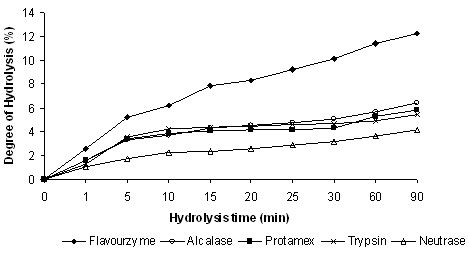
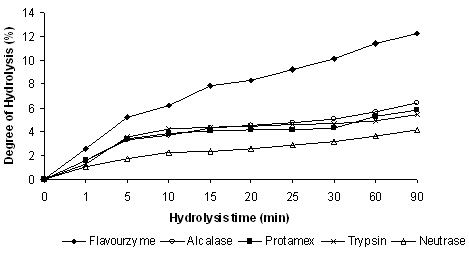
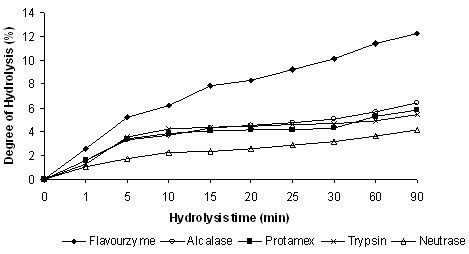
<p>The hydrolysis curves of defatted corn protein with the five enzymes after 90 min of reaction are shown in <xref ref-type="fig" rid="f1-ijms-12-01066">Figure 1</xref>. All the curves showed a high rate of enzymatic hydrolysis during the first 15 min and then the rate of hydrolysis gradually declined with time. This was similar to previous findings [<xref ref-type="bibr" rid="b22-ijms-12-01066">22</xref>,<xref ref-type="bibr" rid="b23-ijms-12-01066">23</xref>]. Adler-Nissen [<xref ref-type="bibr" rid="b24-ijms-12-01066">24</xref>] attributed the reduction in the rate of hydrolysis to the competition between unhydrolyzed protein and the peptides being constantly formed during hydrolysis.</p>
<p>The results showed that the degree of hydrolysis (DH) of defatted corn protein with Flavourzyme was 12.25% and was significantly higher than those of Alcalase, Protamex, Trypsin and Neutrase with 6.40, 5.84, 5.45, and 4.20% respectively (<xref ref-type="table" rid="t5-ijms-12-01066">Table 5</xref>). The high DH expressed by Flavourzyme produced by <italic>Aspergillus orizae</italic> may be related to the complex properties as it possess some endoproteinase and exopeptidase abilities [<xref ref-type="bibr" rid="b25-ijms-12-01066">25</xref>].</p></sec>
<sec>
<label>2.2.</label>
<title><italic>In Vitro</italic> Binding Capacity</title>
<p>Three bile acids were used to test the <italic>in vitro</italic> binding capacity of different hydrolysates comparatively to that of cholestyramine.</p>
<sec>
<label>2.2.1.</label>
<title>Binding Capacity of Sodium Glycocholate</title>
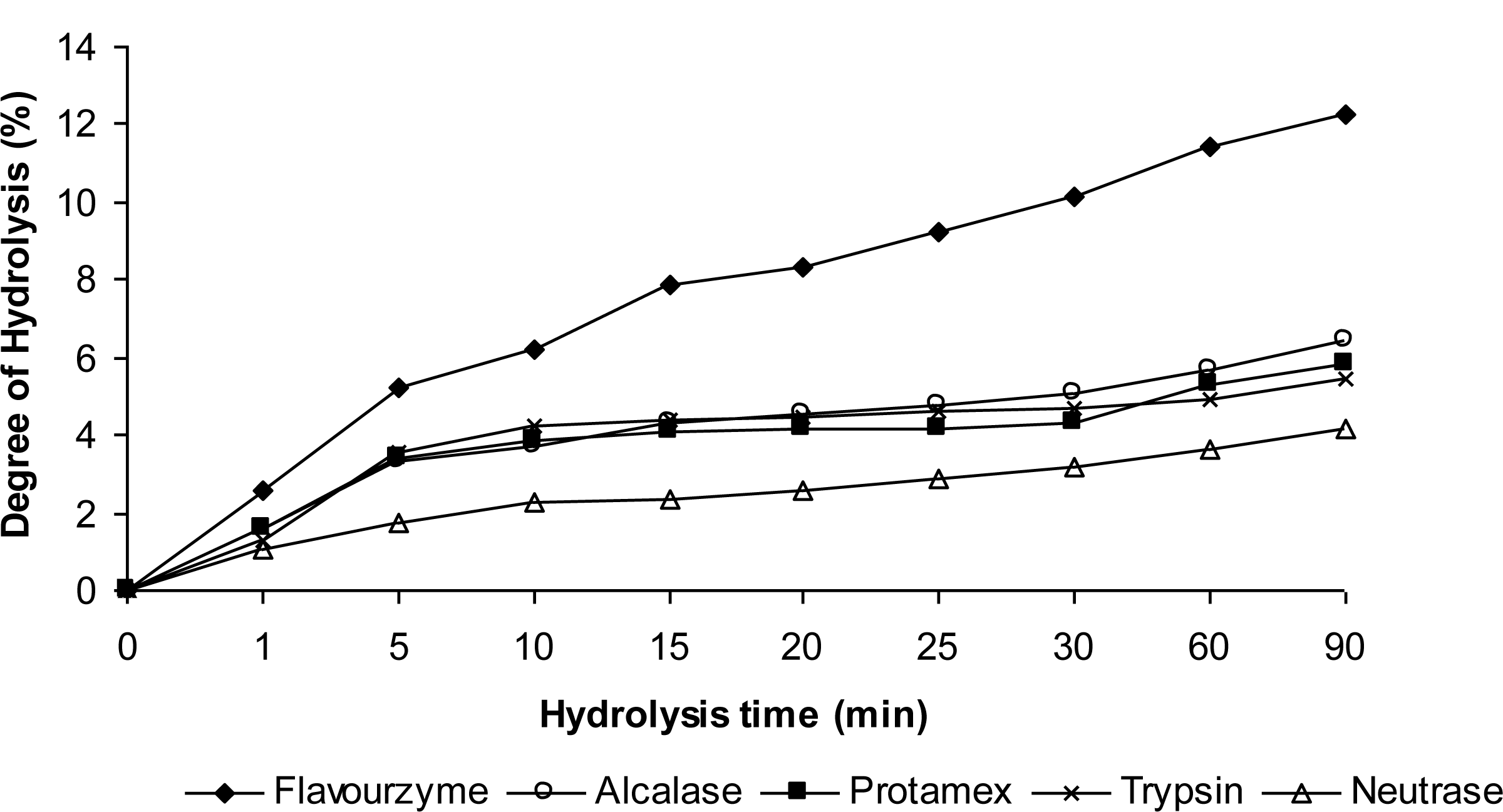
<p>As shown in <xref ref-type="fig" rid="f2-ijms-12-01066">Figure 2</xref>, all the hydrolysates resulting from the five enzymes were capable of binding sodium glycocholate. Sodium glycocholate was bound by hydrolysate from Alcalase, Trypsin, Neutrase, Protamex, and Flavourzyme to the degree of 9.53, 11.16, 16.80, 12.15 and 19.01%, respectively. Cholestyramine was used as a positive control and displayed 72.77% glycocholate binding capacity. Hydrolysate from Alcalase showed a significantly lower glycocholate binding capacity while the value for the hydrolysate from Flavourzyme was significantly higher than those of the other hydrolysates. Cholestyramine bound sodium glycocholate and taurocholate by 87% and 93%, respectively [<xref ref-type="bibr" rid="b26-ijms-12-01066">26</xref>]. Story and Krichevsky [<xref ref-type="bibr" rid="b27-ijms-12-01066">27</xref>] reported that cholestyramine bound glycocholate under various conditions to a degree of 74.2%. In our study, cholestyramine binding by glycocholate was similar to that observed by Story and Krichevsky [<xref ref-type="bibr" rid="b27-ijms-12-01066">27</xref>]. Alfalfa and wheat bran have been shown to have a glycocholate binding capacity of 11.5% [<xref ref-type="bibr" rid="b27-ijms-12-01066">27</xref>] and 100% [<xref ref-type="bibr" rid="b28-ijms-12-01066">28</xref>], respectively; and the defatted soybean hydrolysate 0.2 to 8.5% [<xref ref-type="bibr" rid="b19-ijms-12-01066">19</xref>]. Hydrolysate from Flavourzyme showed higher glycocholate binding capacity than alfalfa and defatted soybean hydrolysate.</p></sec>
<sec>
<label>2.2.2.</label>
<title>Binding Capacity of Sodium Cholate</title>
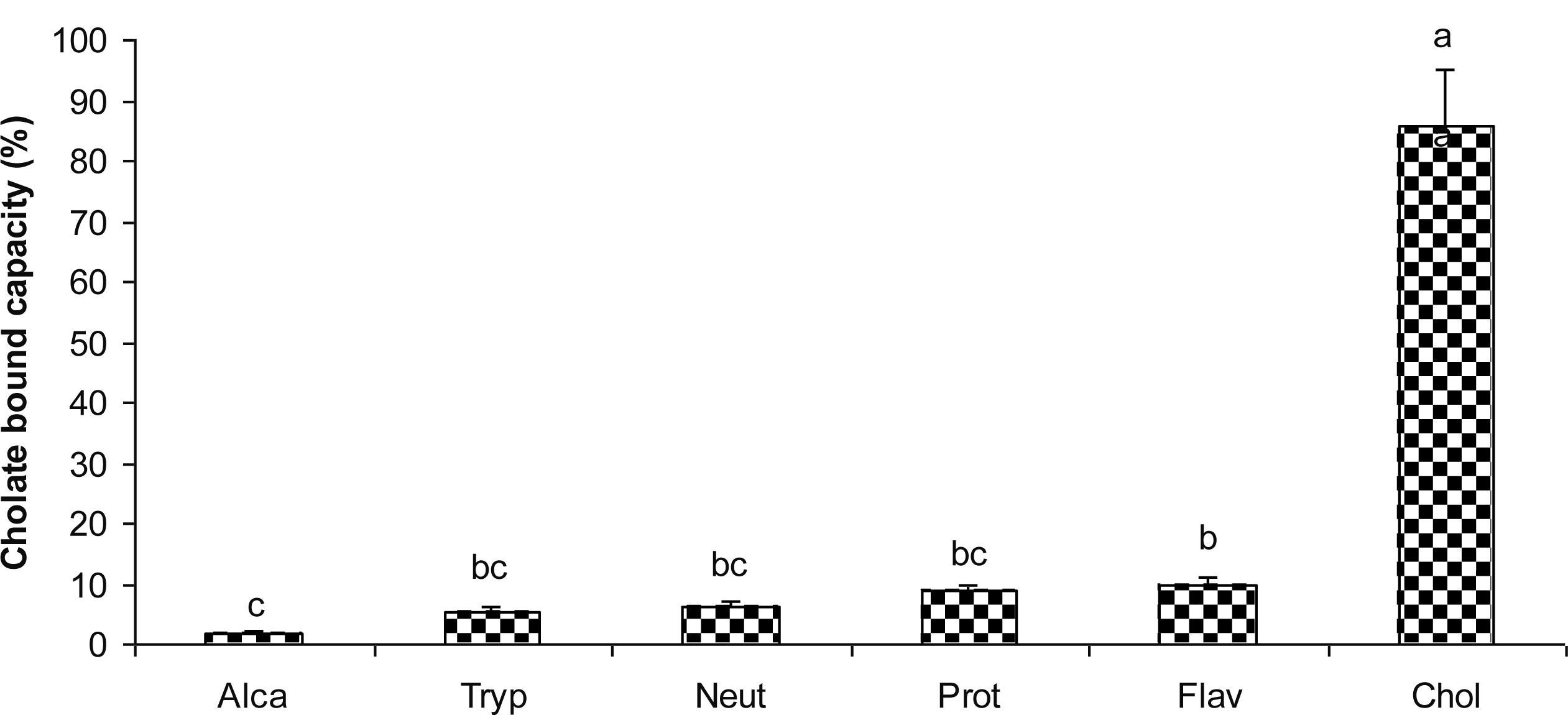
<p>Sodium cholate was bound by hydrolysate from Alcalase, Trypsin, Neutrase, Protamex, and Flavourzyme to the degree of 1.93, 5.52, 6.26, 8.82 and 9.99%, respectively, while cholestyramine, used as a positive control, had 85.78% cholate binding capacity (<xref ref-type="fig" rid="f3-ijms-12-01066">Figure 3</xref>). These values are much lower than those recorded with sodium glycocholate.</p>
<p>Hydrolysate from Alcalase showed significantly (<italic>p</italic> &lt; 0.05) lower cholate binding capacity than cholestyramine, which has been reported to bind sodium cholate to the degree of 80% [<xref ref-type="bibr" rid="b13-ijms-12-01066">13</xref>] and 60.7% [<xref ref-type="bibr" rid="b27-ijms-12-01066">27</xref>]. Camire and Camire <italic>et al.</italic> [<xref ref-type="bibr" rid="b13-ijms-12-01066">13</xref>,<xref ref-type="bibr" rid="b28-ijms-12-01066">28</xref>] reported cholate binding by cholestyramine, three types of raisins, wheat bran and various types of potato peels at a cholate concentration of 12.5 mM. Their work indicated cholate binding of 75%, 15–20%, 10% and 1.9–8.1%, respectively. Hydrolysate from Flavourzyme exhibited higher cholate binding capacity than potato peels.</p></sec>
<sec>
<label>2.2.3.</label>
<title>Binding Capacity of Sodium Deoxycholate</title>
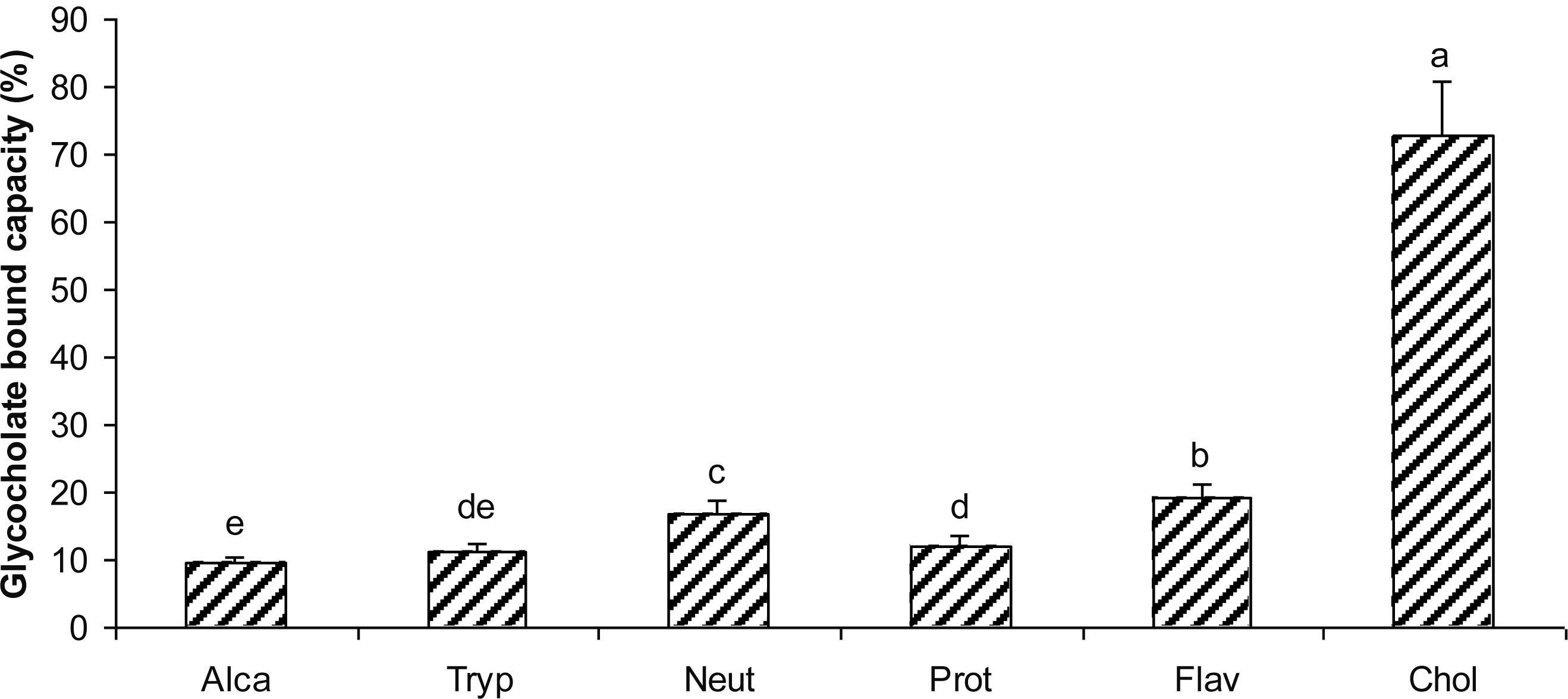
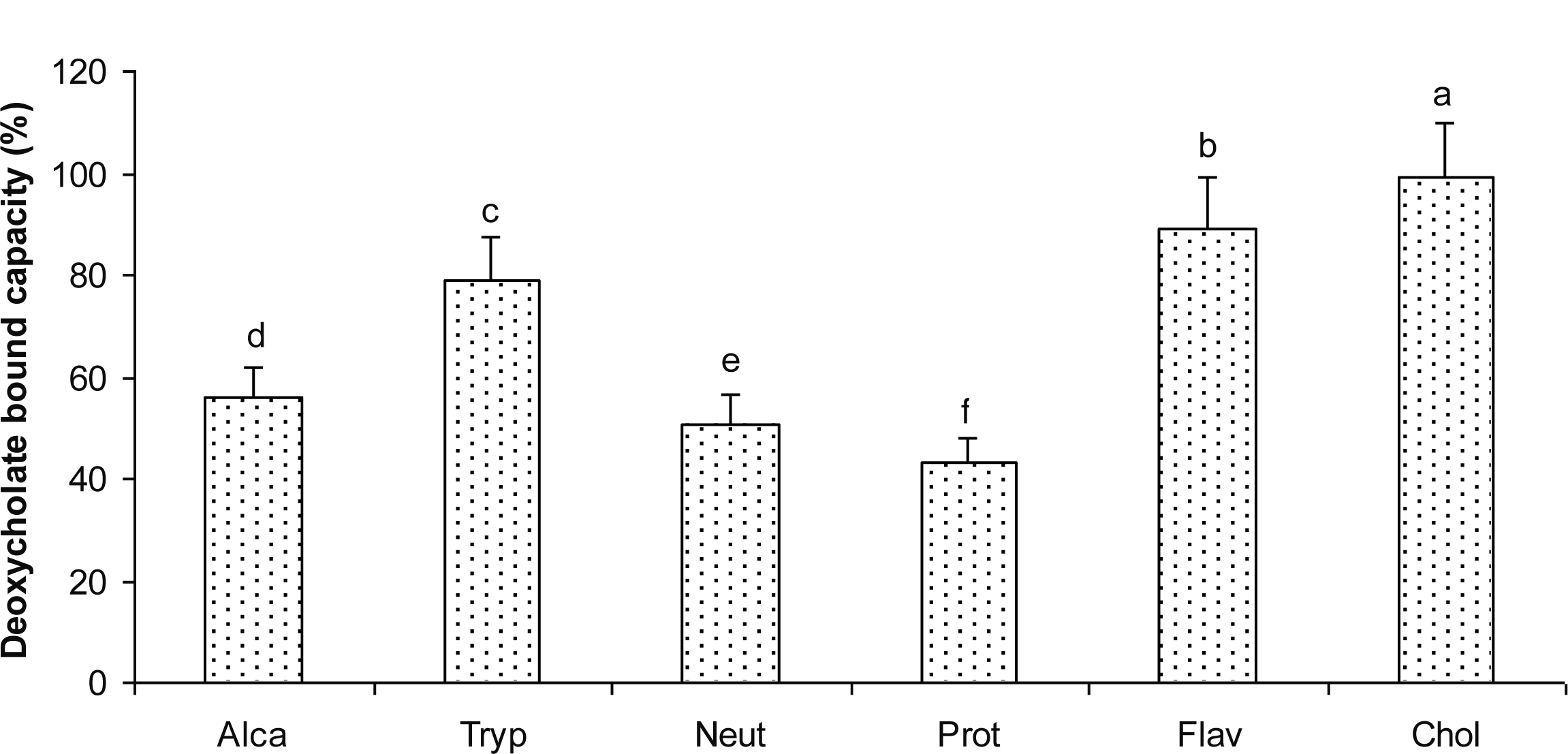
<p>Under similar condition, all hydrolysates from defatted corn protein hydrolyzed by proteases showed higher percentage of bile acid binding with sodium deoxycholate than sodium glycocholate and sodium cholate (<xref ref-type="fig" rid="f4-ijms-12-01066">Figure 4</xref>). Sodium deoxycholate was bound by hydrolysate from alcalase to a degree of 55.76%, 78.68% by hydrolysate from Trypsin, 50.77% by hydrolysate from Neutrase, 43.40% by hydrolysate from Protamex, 86.90% by hydrolysate from Flavourzyme and 99.15% by cholestyramine. The hydrolysate from Flavourzyme had the highest binding capacity as compared to the other hydrolysates. Cholestyramine has been shown by other researchers to bind sodium deoxycholate by 99% [<xref ref-type="bibr" rid="b13-ijms-12-01066">13</xref>], 92.5% [<xref ref-type="bibr" rid="b27-ijms-12-01066">27</xref>] and 85% [<xref ref-type="bibr" rid="b28-ijms-12-01066">28</xref>]. Our result was similar to that observed by Camire <italic>et al.</italic> [<xref ref-type="bibr" rid="b13-ijms-12-01066">13</xref>]. Protein isolates F and its hydrolysate [<xref ref-type="bibr" rid="b19-ijms-12-01066">19</xref>], Alfalfa [<xref ref-type="bibr" rid="b27-ijms-12-01066">27</xref>], raisins, wheat bran [<xref ref-type="bibr" rid="b28-ijms-12-01066">28</xref>], and potato peels [<xref ref-type="bibr" rid="b13-ijms-12-01066">13</xref>] showed 58.4–69.5%, 10.8%, 5–10%, 15%, and 10.6–18.9%, respectively. Compared to these samples, our hydrolysates from Flavourzyme showed a much higher deoxycholate binding capacity.</p>
<p>As demonstrated by previous works [<xref ref-type="bibr" rid="b14-ijms-12-01066">14</xref>,<xref ref-type="bibr" rid="b29-ijms-12-01066">29</xref>–<xref ref-type="bibr" rid="b32-ijms-12-01066">32</xref>], our investigations confirmed that bile acid binding degree decreases with hydroxyl group increment in steroid ring structure. In addition, we found that sodium cholate primary bile acid (three hydroxyl) was the less bound with hydrolysate from Alcalase than sodium glycocholate, a conjugation of sodium cholate with glycine; however, sodium deoxycholate secondary bile acid (two hydroxyl) was the best bound. Numerous authors [<xref ref-type="bibr" rid="b18-ijms-12-01066">18</xref>,<xref ref-type="bibr" rid="b33-ijms-12-01066">33</xref>,<xref ref-type="bibr" rid="b27-ijms-12-01066">27</xref>] have reported a greater binding capacity of sodium deoxycholate than sodium cholate. Kern <italic>et al.</italic> [<xref ref-type="bibr" rid="b34-ijms-12-01066">34</xref>] proposed that less sodium cholate, a trihydroxy bile acid, was bound than dihydroxy bile acid because hydrophobic interactions are involved with binding.</p>
<p>The method reported here appears to be a satisfactory technique for the measurement of the bile acid binding capacity of peptides. Cholestyramine, as expected, bound all the bile acids selected under the same treatment. The concentration of bile acids used and the percentage bound in the present study are in accordance with findings from previous studies. However, there is no obvious correlation between bile acid binding and the degree of hydrolysis. As the results showed, hydrolysate obtained with Flavourzyme contained effective peptides capable to bind bile acids. This could be explained by the presence of Flavourzyme acting as an endoprotease and exopeptidase, providing a broader specificity to release peptides rich in hydrophobic amino acid residues. These hydrophobic amino acids can bind bile acids strongly via hydrophobic reactions, since the hydrophobic amino acids present a strong interaction with lipids (cholesterol, bile acids, others sterols and others lipids). Moreover, higher bile acid binding by Flavourzyme hydrolysate in our studies may be due to the use of physiological pH of 6.5, which is closer to the pHi of the hydrophobic amino acids. The results given in the literature have shown that the binding of bile acid mixture, simulating the condition in the human body, occurred in a noncompetitive manner. Despite the need for bile acid mixture analysis, Flavourzyme hydrolysate could be considered as a suitable natural compound for bile acid binding.</p>
<p>Bile acids, especially deoxycholate, are thought to be involved in the etiology and development of colorectal cancer [<xref ref-type="bibr" rid="b35-ijms-12-01066">35</xref>]. The synthesis of bile acids from cholesterol is adjusted by their concentration in the liver [<xref ref-type="bibr" rid="b36-ijms-12-01066">36</xref>]. The presence of Flavourzyme hydrolysate in the intestine can decrease not only enterohepatic circulation of bile acids, but also their contact with colorectal mucosa through the binding effect. Therefore, it is possible for humans to ingest some Flavourzyme hydrolysate to prevent hypercholesterolemia and colorectal cancer at the same time.</p></sec></sec>
<sec>
<label>2.3.</label>
<title>Stability of Bile Acid Binding by Flavourzyme Hydrolysate after Digestion by Gastrointestinal Proteases</title>
<p>The stability of Flavourzyme hydrolysate against gastrointestinal proteases <italic>in vitro</italic> was tested in order to predict the bile acid binding <italic>in vivo</italic>. Some food protein derived-bioactive-peptides, for example ACE-inhibitory peptides, failed to express bioactivity after oral administration to spontaneously hypertensive rats due to the fact that they were hydrolyzed in the gastrointestinal tract to peptides or amino acids with reduced activity [<xref ref-type="bibr" rid="b37-ijms-12-01066">37</xref>]. The bile acid binding of Flavourzyme hydrolysate was almost preserved after gastrointestinal proteases treatment (<xref ref-type="table" rid="t1-ijms-12-01066">Table 1</xref>), suggesting that these hydrolysates may be resistant to digestion in the gastrointestinal tract. Previous reports have also shown that small peptides have low susceptibility to hydrolysis by gastric proteases [<xref ref-type="bibr" rid="b38-ijms-12-01066">38</xref>,<xref ref-type="bibr" rid="b39-ijms-12-01066">39</xref>].</p></sec>
<sec sec-type="methods">
<label>2.4.</label>
<title>Total Amino Acid Analysis</title>
<p>Flavourzyme hydrolysate contains all the essential amino acids in good proportion (<xref ref-type="table" rid="t2-ijms-12-01066">Table 2</xref>). The predominant amino acids amongst the essential amino acids were Leucine, Valine and Phenylalanine, while those amongst the hydrophobic amino acids were Leucine, Valine, Alanine, Proline, Glycine and Phenylalanine. Hydrophobicity of the peptides may increase interaction of such peptides with fatty acids and hence confer the peptide’s bile acid binding capacity. It was suggested that most naturally occurring hypocholesterolemic peptides contain Tryptophan, Glycine, Isoleucine, Alanine, Lysine and Proline [<xref ref-type="bibr" rid="b40-ijms-12-01066">40</xref>,<xref ref-type="bibr" rid="b41-ijms-12-01066">41</xref>], and that they are mostly hydrophobic. Therefore, the bile acid binding capacity of the Flavourzyme hydrolysate seemed to be caused by these amino acids in the peptides. Moreover, the bile acid binding capacity of the Flavourzyme hydrolysate depended upon the amino acid sequence of the peptides. Furthermore, Flavourzyme hydrolysate has a well balanced amino acid composition and its ratio of amino acids is close to that of protein quality for adults recommended by the Food and Agricultural Organization/World Health Organization reference [<xref ref-type="bibr" rid="b42-ijms-12-01066">42</xref>]. Therefore, Flavourzyme hydrolysate not only showed good bile acid binding capacity but also good nutritive value.</p></sec>
<sec>
<label>2.5.</label>
<title>Free Amino Acids Content</title>
<p>The total amount of free amino acids in the Flavourzyme hydrolysate was 5.17 g/100 g, with a predominance of hydrophobic amino acids (<xref ref-type="table" rid="t3-ijms-12-01066">Table 3</xref>). Morita <italic>et al.</italic> [<xref ref-type="bibr" rid="b43-ijms-12-01066">43</xref>] reported that Methionine in the diet plays a central role in cholesterol-lowering effects through the regulation of Apo A–I secretion from the liver into the blood circulation. The release of free amino acids is theoretically inevitable at elevated DH, and it is also a property of the enzyme and its hydrolysis properties on a substrate [<xref ref-type="bibr" rid="b44-ijms-12-01066">44</xref>]. This is in conformity with our finding and confirmed that the low free amino acids content of the Flavourzyme hydrolysate was due to Flavourzyme protease properties. High free amino acids content in hydrolysates can affect their functionality, e.g., hydrolysates produced as nutritional supplements with high free amino acids composition have been demonstrated to have low biological value [<xref ref-type="bibr" rid="b45-ijms-12-01066">45</xref>]. They are absorbed at a lower rate in the digestive tract, as the osmotic pressure of free amino acids is higher than that of peptides.</p></sec>
<sec>
<label>2.6.</label>
<title>Molecular Weight Distribution</title>
<p>The molecular weight distribution of Flavourzyme hydrolysate ranged from 133 Da to more than 10000 Da, with most of the peptides being between 500–180 Da (<xref ref-type="table" rid="t4-ijms-12-01066">Table 4</xref>). The unhydrolysed protein showed molecular weight fractions of 15,236 Da. The presence of low molecular weight fractions indicate that the hydrolysate could comprise of peptides having five or less amino acids residues. In addition, the function of protein hydrolysate was related to the molecular weight distribution as well as the amino acid present [<xref ref-type="bibr" rid="b46-ijms-12-01066">46</xref>,<xref ref-type="bibr" rid="b47-ijms-12-01066">47</xref>]. The cleavage of peptide bonds leads to an increase in the concentration of free amino and carboxyl groups, which increases solubility. Hydrolysis also disrupts the protein tertiary structure and reduces the molecular weight of the protein and, consequently, alters the functional properties of proteins [<xref ref-type="bibr" rid="b24-ijms-12-01066">24</xref>,<xref ref-type="bibr" rid="b48-ijms-12-01066">48</xref>]. However, extensive hydrolysis could have a negative impact on the functional properties [<xref ref-type="bibr" rid="b48-ijms-12-01066">48</xref>].</p></sec></sec>
<sec sec-type="materials|methods">
<label>3.</label>
<title>Materials and Methods</title>
<sec sec-type="materials">
<label>3.1.</label>
<title>Materials</title>
<p>Defatted corn meal was obtained from China Corn Oil Company Ltd., Shandong Province, P.R. China. Cholestyramine and sodium cholate were purchased from International Laboratory USA (Nanjing, P.R. China), sodium glycocholate, horse heart cytochrome C (12,400 Da), bacitracin (1450 Da), gly-gly-tyr-Arg (451 kDa) were purchased from Sigma Chemical Co. (St. Louis, USA) and gly-gly-gly (189 Da) was purchased from Fluka (Japan). Enzymes used were: Alcalase 2.4 L, Trypsin, Neutrase 2.4 L, Protamex and Flavourzyme, all provided by Novo Nordisk (Bagsvaerd, Denmark). All the chemicals used were of analytical grade and purchased from Sinopharm Chemicals Reagent Company (SCRC), Shanghai, China.</p></sec>
<sec sec-type="methods">
<label>3.2.</label>
<title>Methods</title>
<sec>
<label>3.2.1.</label>
<title>Preparation and Hydrolysis of Defatted Corn Protein</title>
<p>Defatted corn proteins isolates were prepared by alkaline extraction at pH 11.50, followed by precipitation at its isoelectric point of pH 4.50, and freeze-dried. The freeze-dried defatted corn protein was dissolved in distilled water at a concentration of 5% (w/v) before hydrolysis with five different enzymes independently. Homogenization was carried out for each enzyme for 30 min in order to adjust the pH (through addition of 0.5 M NaOH) and temperature to the appropriate values. After the optimum condition was reached, the reaction was initiated by adding each of the five different enzymes with continuous stirring. Hydrolysis was carried out for 90 min and the pH of the mixture was kept constant by adding 0.5 M NaOH solution continuously to the reaction mixture. The amount of alkali added to keep the pH constant was recorded and used to calculate the degree of hydrolysis (DH). Then, the mixture was heated at 85 °C for 10 min to inactivate the enzyme and centrifuged by freezing centrifugation (ZOPR-52D, Hitachi Koki Co., Japan) at 10,000 rpm for 25 min. The supernatant was freeze-dried and stored in a desiccator for further use.</p></sec>
<sec>
<label>3.2.2.</label>
<title>Degree of Hydrolysis (<italic>DH</italic>): pH-Stat Method</title>
<p>Degree of hydrolysis (<italic>DH</italic>) was defined as the percentage ratio between the number of peptide bonds cleaved <italic>(h</italic>) and the total number of peptide bonds in the substrate studied (<italic>h</italic><sub>tot</sub>). <italic>DH</italic> was evaluated by pH-stat method which allowed the estimation of <italic>DH</italic> based on the consumption of alkali to maintain a constant pH at the desired value. The degree of hydrolysis was calculated using the following <xref ref-type="disp-formula" rid="FD1">equation (1)</xref> [<xref ref-type="bibr" rid="b24-ijms-12-01066">24</xref>]:
<disp-formula id="FD1">
<label>(1)</label>
<mml:math display="block">
<mml:mrow>
<mml:mtext mathvariant="italic">DH</mml:mtext>
<mml:mo stretchy="false">(</mml:mo>
<mml:mo>%</mml:mo>
<mml:mo stretchy="false">)</mml:mo>
<mml:mo>=</mml:mo>
<mml:msub>
<mml:mi>V</mml:mi>
<mml:mtext>b</mml:mtext></mml:msub>
<mml:mo>×</mml:mo>
<mml:msub>
<mml:mi>N</mml:mi>
<mml:mtext>b</mml:mtext></mml:msub>
<mml:mo>×</mml:mo>
<mml:mfrac>
<mml:mn>1</mml:mn>
<mml:mi>α</mml:mi></mml:mfrac>
<mml:mo>×</mml:mo>
<mml:mfrac>
<mml:mn>1</mml:mn>
<mml:mrow>
<mml:msub>
<mml:mi>M</mml:mi>
<mml:mtext>p</mml:mtext></mml:msub></mml:mrow></mml:mfrac>
<mml:mo>×</mml:mo>
<mml:mfrac>
<mml:mn>1</mml:mn>
<mml:mrow>
<mml:msub>
<mml:mi>h</mml:mi>
<mml:mrow>
<mml:mtext>tot</mml:mtext></mml:mrow></mml:msub></mml:mrow></mml:mfrac>
<mml:mo>×</mml:mo>
<mml:mn>100</mml:mn></mml:mrow></mml:math></disp-formula>where <italic>V</italic><sub>b</sub> is the amount of alkali consumed in mL; <italic>N</italic><sub>b</sub> is the normality of the alkali; <italic>M</italic><sub>p</sub> is the mass of protein (<italic>N</italic> × 6.25) in g; <italic>h</italic><sub>tot</sub> is the total number of peptide bonds in the protein substrate (9.2 meqv/g defatted corn protein) and, α is the average degree of dissociation of the α-NH<sub>2</sub> groups released during hydrolysis. The <italic>DH</italic> of the five defatted corn protein hydrolysates can be seen in <xref ref-type="table" rid="t5-ijms-12-01066">Table 5</xref>.</p></sec>
<sec>
<label>3.2.3.</label>
<title>Bile Acid Binding Assay</title>
<p>The <italic>in vitro</italic> bile acid binding was executed through modification of the procedure previously by Hu <italic>et al.</italic> [<xref ref-type="bibr" rid="b12-ijms-12-01066">12</xref>]. Each bile acid (as substrate) was dissolved in 50 mmol/L phosphate buffer (pH 6.5) to make a 2 mM bile acid solution, which is in the same range of bile acid concentration in the human body (1.5–7 mM), and the pH was simulated to the physiological pH of the duodenum. Ten milligrams of the hydrolysate sample was added to each tube containing one milliliter of bile acid solution, and the individual substrate solution without samples was used as blank. Then tubes were incubated for one hour at 37 °C in a shaking water bath. Mixtures were centrifuged at 10 °C with 10,000 rpm for 30 min in an ultracentrifuge (Model J-26XPI, Beckman, USA). The supernatant was removed into a second set of tubes and frozen at −20 °C for bile acid analysis. Bile acids were analyzed using HPLC (Model 1525, Waters, USA) on a symmetry C18 column (3.9 × 150 mm i.d., 5 μm particle size, Waters, USA), maintained at 30 °C. The injected sample volume was 10 μL for each bile acid analysis. The bile acid was eluted with 40% acetonile + 60% of 0.05% H<sub>3</sub>PO<sub>4</sub> at a flow rate of 1 mL/min for 24 min. The absorbance of the eluate was monitored continuously at 210 nm (Model 2996 PDA detector, Waters, USA) and quantitated using standard calibration curves generated from the peak area responses of the standard solutions. Duplicate assays were conducted for each bile acid essay.</p>
<p>The percentage of bound bile acid was calculated as bound (%) = [(<italic>C</italic><sub>c</sub> − <italic>C</italic><sub>s</sub>)/<italic>C</italic><sub>c</sub>] × 100, where <italic>C</italic><sub>c</sub> and <italic>C</italic><sub>s</sub> represent bile acid concentrations in the control and in samples, respectively.</p>
<p>DH and bile acid binding capacity obtained from Flavourzyme hydrolysate were significantly higher in comparison to hydrolysate obtained from Alcalase, Trypsin, Neutrase and Protamex. Therefore, further experiments were focused on Flavourzyme hydrolysate.</p></sec>
<sec>
<label>3.2.4.</label>
<title>Stability against Gastric Protease <italic>in Vitro</italic></title>
<p>The stability against <italic>in vitro</italic> gastric proteases was assessed based on the method described by Wu and Ding [<xref ref-type="bibr" rid="b49-ijms-12-01066">49</xref>]. A 1% (w/v) hydrolysate solution in 0.1 M KCl–HCl buffer (pH 2.0) was treated with pepsin for 4 h in a rotary water bath at 37 °C. The pepsin-treated peptide was heated to boiling in a water bath for 15 min then adjusted to pH 7.0 with addition of 2 N NaOH. A 1 mL aliquot of the neutralized suspension was centrifuged at 10,000 g for 40 min and the supernatant portion was used to determine bile acid binding. The remaining portion of the suspension was further digested by 2% (w/w) pancreatin at 37 °C for 4 h, followed by enzyme inactivation by boiling for 15 min. The reaction solution was centrifuged at 10,000 g for 40 min. The supernatant portion was used for additional testing on bile acid binding capacity.</p></sec>
<sec sec-type="methods">
<label>3.2.5.</label>
<title>Total Amino Acids Analysis</title>
<p>The dried Flavourzyme hydrolysate (100 mg) was subjected to acid hydrolysis with 5 mL of 6 M HCl under nitrogen atmosphere for 24 h at 110 °C. The hydrolysate was washed into a 50 mL volumetric flask and made up to the mark with distilled water. The amino acids were subjected to RP-HPLC analysis (Agilent 1100, USA) after precolumn derivatization with <italic>o</italic>-phthaldialdehyde (OPA). Amino acid composition was expressed as g amino acid per 100 g protein.</p></sec>
<sec>
<label>3.2.6.</label>
<title>Free Amino Acids Content</title>
<p>The dried Flavourzyme hydrolysate (1 g) was dissolved in 5% (w/v) TCA (25 mL) and centrifuged at 10,000 g for 10 min. The clear supernatant containing mainly free amino acids and some short peptides were derivatized by o-phthaldialdehyde (OPA) followed by reversed phase high performance liquid chromatography (RP-HPLC) analysis, carried out in an Agilent 1100 (Agilent Technologies, Palo Alto, CA, USA). Sample (1 mL) was injected on a Zorbax 80A C18 column (4.6 i.d. × 180 mm, Agilent Technologies, Palo Alto, CA, USA) at 40 °C with detection at 338 and 262 nm. Mobile phase A was 7.35 mmol/L sodium acetate/triethylamine/tetrahydrofuran (500:0.12:2.5, v/v/v), adjusted to pH 7.2 with acetic acid, while mobile phase B (pH 7.2) was 7.35 mmol/L sodium acetate/methanol/acetonitrile (1:2:2, v/v/v). The amino acid composition was expressed as g of amino acid per 100 g of protein. The results were processed with the aid of ChemStation for LC 3D software (Agilent Technologies, Palo Alto, CA, USA).</p></sec>
<sec>
<label>3.2.7.</label>
<title>Molecular Weight Distribution</title>
<p>Molecular weight distribution was determined using a Waters<sup>TM</sup> 600E Advanced Protein Purification System (Waters Corporation, Milford, MA, USA). A TSK gel 2000SWXL (7.8 × 300 mm) column with 10% acetonitrile + 0.1% TFA in HPLC grade water as the mobile phase.</p>
<p>The calibration curve was obtained by running horse heart cytochrome C (12,400 Da), bacitracin (1450 Da), gly-gly-tyr-Arg (451 kDa) and gly-gly-gly (189 Da). The results obtained were processed with the aid of Millennium<sup>32</sup> Version 3.05 software (Waters Corporation, Milford, MA 01757, USA).</p></sec>
<sec sec-type="methods">
<label>3.2.8.</label>
<title>Statistical Analysis</title>
<p>All analyses were carried out in duplicate and data were presented as mean ± SD. Analysis of variance (ANOVA) was carried out using SAS package (SAS Institute, Cary, NC). Comparisons between means were done using a Duncan’s multiple-range test with a probability of <italic>p</italic> &lt; 0.05.</p></sec></sec></sec>
<sec>
<label>4.</label>
<title>Conclusion</title>
<p>This study demonstrated that bile acid binding peptides can be generated from defatted corn protein by enzymatic hydrolysis. Defatted corn protein is a good source of bile acid binding peptides when hydrolyzed with Flavourzyme, resulting in a large proportion of low-molecular-weight (500–180 Da) peptides. As expected, defatted corn protein hydrolysed with Flavourzyme shifted the molecular weight distribution to lower values. Moreover, the bile acid binding capacity of Flavourzyme hydrolysate was almost preserved after <italic>in vitro</italic> incubation with gastric proteases, suggesting that the Flavourzyme hydrolysate may be resistant to digestion in the gastrointestinal tract. The defatted corn hydrolysate prepared with Flavourzyme might be utilized to develop physiologically functional food with bile acids binding capacity.</p>
<p>The defatted corn protein hydrolysates thus have excellent applications for future product development by virtue of their functional properties.</p></sec></body>
<back>
<ack>
<p>The work reported in this paper is a continuation of the on-going research supported by the financial assistance of Chinese Scholarship Council.</p></ack>
<ref-list>
<title>References</title>
<ref id="b1-ijms-12-01066"><label>1.</label><citation citation-type="journal"><person-group person-group-type="author"><name><surname>Ratna</surname><given-names>WA</given-names></name></person-group><article-title>qualitative analysis of maize protein <italic>in vivo</italic> using PDCAAS method</article-title><source>Inden. J. Agric</source><year>2008</year><volume>1</volume><fpage>1</fpage><lpage>6</lpage></citation></ref>
<ref id="b2-ijms-12-01066"><label>2.</label><citation citation-type="web"><person-group person-group-type="author"><name><surname>Misner</surname><given-names>B</given-names></name></person-group><article-title>Solae Soy Protein: The Basics</article-title><year>2000</year><comment>Available online: <ext-link xlink:href="http://www.hammernutrition.com" ext-link-type="uri">http://www.hammernutrition.com</ext-link> (accessed on 1 May 2004).</comment></citation></ref>
<ref id="b3-ijms-12-01066"><label>3.</label><citation citation-type="book"><collab>Food and Agriculture Organization/World Health Organization (FAO/WHO)</collab><source>Energy and Protein Requirements</source><comment>WHO Technical Report Series No. 522, FAO Nutrition Meetings Report Series No. 52</comment><publisher-name>WHO</publisher-name><publisher-loc>Geneva, Switzerland</publisher-loc><year>1973</year></citation></ref>
<ref id="b4-ijms-12-01066"><label>4.</label><citation citation-type="journal"><person-group person-group-type="author"><name><surname>Gupta</surname><given-names>HO</given-names></name><name><surname>Eggum</surname><given-names>BO</given-names></name></person-group><article-title>Processing of maize germ oil cake into edible food grade meal and evaluation of its protein quality</article-title><source>Plant Foods Hum. Nutr</source><year>1998</year><volume>52</volume><fpage>1</fpage><lpage>8</lpage><pub-id pub-id-type="doi">10.1023/A:1008088822395</pub-id><pub-id pub-id-type="pmid">9839829</pub-id></citation></ref>
<ref id="b5-ijms-12-01066"><label>5.</label><citation citation-type="journal"><person-group person-group-type="author"><name><surname>Huang</surname><given-names>CJ</given-names></name><name><surname>Zayas</surname><given-names>JF</given-names></name></person-group><article-title>Aroma quality of corn germ protein flour determined by sensory and gas chromatographic profile</article-title><source>J. Food Qual</source><year>1991</year><volume>14</volume><fpage>377</fpage><lpage>390</lpage><pub-id pub-id-type="doi">10.1111/j.1745-4557.1991.tb00079.x</pub-id></citation></ref>
<ref id="b6-ijms-12-01066"><label>6.</label><citation citation-type="journal"><person-group person-group-type="author"><name><surname>Kodera</surname><given-names>T</given-names></name><name><surname>Nio</surname><given-names>N</given-names></name></person-group><article-title>Identification of angiotensin I-converting enzyme inhibitory peptides from protein hydrolysates by a soybean protease and the antihypertensive effects of hydrolysates in spontaneously hypertensive model rats</article-title><source>J. Food Sci</source><year>2006</year><volume>71</volume><fpage>164</fpage><lpage>173</lpage></citation></ref>
<ref id="b7-ijms-12-01066"><label>7.</label><citation citation-type="journal"><person-group person-group-type="author"><name><surname>Ranathunga</surname><given-names>S</given-names></name><name><surname>Rajapakse</surname><given-names>N</given-names></name><name><surname>Kim</surname><given-names>SK</given-names></name></person-group><article-title>Purification and characterization of antioxidative peptide derived from muscle of conger eel (<italic>Conger myriaster</italic>)</article-title><source>Eur. Food. Res. Technol</source><year>2006</year><volume>222</volume><fpage>310</fpage><lpage>315</lpage><pub-id pub-id-type="doi">10.1007/s00217-005-0079-x</pub-id></citation></ref>
<ref id="b8-ijms-12-01066"><label>8.</label><citation citation-type="journal"><person-group person-group-type="author"><name><surname>Wu</surname><given-names>J</given-names></name><name><surname>Ding</surname><given-names>X</given-names></name></person-group><article-title>Hypotensive and physiological effect of angiotensin converting enzyme inhibitory peptides derived from soy protein on spontaneously hypertensive rats</article-title><source>J. Agric. Food Chem</source><year>2001</year><volume>49</volume><fpage>501</fpage><lpage>506</lpage><pub-id pub-id-type="doi">10.1021/jf000695n</pub-id><pub-id pub-id-type="pmid">11170618</pub-id></citation></ref>
<ref id="b9-ijms-12-01066"><label>9.</label><citation citation-type="journal"><person-group person-group-type="author"><name><surname>Müllener</surname><given-names>S</given-names></name><name><surname>Saar</surname><given-names>K</given-names></name></person-group><article-title>HPLC analysis of bile acid serum pattern using a selective extraction method for serum bile acids</article-title><source>Fres. J. Anal. Chem</source><year>1992</year><volume>343</volume><fpage>3</fpage><lpage>84</lpage><pub-id pub-id-type="doi">10.1007/BF00331932</pub-id></citation></ref>
<ref id="b10-ijms-12-01066"><label>10.</label><citation citation-type="journal"><person-group person-group-type="author"><name><surname>Insull</surname><given-names>W</given-names></name></person-group><article-title>Clinical utility of bile acid sequestrants in the treatment of dyslipidemia: a scientific review</article-title><source>South. Med. J</source><year>2006</year><volume>99</volume><fpage>257</fpage><lpage>273</lpage><pub-id pub-id-type="doi">10.1097/01.smj.0000208120.73327.db</pub-id><pub-id pub-id-type="pmid">16553100</pub-id></citation></ref>
<ref id="b11-ijms-12-01066"><label>11.</label><citation citation-type="journal"><person-group person-group-type="author"><name><surname>Zhong</surname><given-names>F</given-names></name><name><surname>Liu</surname><given-names>J</given-names></name><name><surname>Ma</surname><given-names>J</given-names></name><name><surname>Shoemaker</surname><given-names>CF</given-names></name></person-group><article-title>Preparation of hypocholesterol peptides from soy protein and their hypocholesterolemic effect in mice</article-title><source>Food Res. Int</source><year>2006</year><volume>40</volume><fpage>661</fpage><lpage>667</lpage></citation></ref>
<ref id="b12-ijms-12-01066"><label>12.</label><citation citation-type="journal"><person-group person-group-type="author"><name><surname>Hu</surname><given-names>YB</given-names></name><name><surname>Wang</surname><given-names>Z</given-names></name><name><surname>Xu</surname><given-names>SY</given-names></name></person-group><article-title>Treatment of corn dietary fiber with xylanase increases its ability to bind salt, <italic>in vitro</italic></article-title><source>Food Chem</source><year>2008</year><volume>106</volume><fpage>113</fpage><lpage>121</lpage><pub-id pub-id-type="doi">10.1016/j.foodchem.2007.05.054</pub-id></citation></ref>
<ref id="b13-ijms-12-01066"><label>13.</label><citation citation-type="journal"><person-group person-group-type="author"><name><surname>Camire</surname><given-names>ME</given-names></name><name><surname>Zhao</surname><given-names>J</given-names></name><name><surname>Violette</surname><given-names>DA</given-names></name></person-group><article-title><italic>In vitro</italic> binding acids by extruded potato peels</article-title><source>J. Agric. Food Chem</source><year>1993</year><volume>41</volume><fpage>2391</fpage><lpage>2394</lpage><pub-id pub-id-type="doi">10.1021/jf00036a033</pub-id></citation></ref>
<ref id="b14-ijms-12-01066"><label>14.</label><citation citation-type="journal"><person-group person-group-type="author"><name><surname>Zhou</surname><given-names>K</given-names></name><name><surname>Xia</surname><given-names>W</given-names></name><name><surname>Zhang</surname><given-names>C</given-names></name><name><surname>Yu</surname><given-names>L</given-names></name></person-group><article-title><italic>In vitro</italic> binding of bile acids and triglycerides by selected chitosan preparations and their physico-chemical properties</article-title><source>LWT Food Sci. Technol</source><year>2006</year><volume>39</volume><fpage>1087</fpage><lpage>1092</lpage><pub-id pub-id-type="doi">10.1016/j.lwt.2005.07.009</pub-id></citation></ref>
<ref id="b15-ijms-12-01066"><label>15.</label><citation citation-type="journal"><person-group person-group-type="author"><name><surname>Kahlon</surname><given-names>TS</given-names></name><name><surname>Shao</surname><given-names>Q</given-names></name></person-group><article-title><italic>In vitro</italic> binding of bile acids by soy bean <italic>(Glycine max</italic>), black eye bean (<italic>Vigna unguiculata</italic>), garbanzo (<italic>Cicer arietinum</italic>) and lima bean (<italic>Phaseolus lunatus</italic>)</article-title><source>Food Chem</source><year>2004</year><volume>86</volume><fpage>435</fpage><lpage>440</lpage><pub-id pub-id-type="doi">10.1016/j.foodchem.2003.09.018</pub-id></citation></ref>
<ref id="b16-ijms-12-01066"><label>16.</label><citation citation-type="journal"><person-group person-group-type="author"><name><surname>Kahlon</surname><given-names>TS</given-names></name><name><surname>Smith</surname><given-names>GE</given-names></name><name><surname>Shao</surname><given-names>Q</given-names></name></person-group><article-title><italic>In vitro</italic> binding of bile acids by kidney bean (<italic>Phaseolus vulgaris</italic>), black gram (<italic>Vigna mungo</italic>), Bengal gram (<italic>Cicer arietinum</italic>) and moth bean (<italic>Phaseolus aconitifolins</italic>)</article-title><source>Food Chem</source><year>2005</year><volume>90</volume><fpage>241</fpage><lpage>246</lpage><pub-id pub-id-type="doi">10.1016/j.foodchem.2004.03.046</pub-id></citation></ref>
<ref id="b17-ijms-12-01066"><label>17.</label><citation citation-type="journal"><person-group person-group-type="author"><name><surname>Iwami</surname><given-names>K</given-names></name><name><surname>Sakakibara</surname><given-names>K</given-names></name><name><surname>Ibuki</surname><given-names>F</given-names></name></person-group><article-title>Involvement of pot-digestion “hydrophobic” peptides in plasma cholesterol-lowering effect of dietary plant proteins</article-title><source>Agric Biol Chem</source><year>1986</year><volume>50</volume><issue>5</issue><fpage>1217</fpage><lpage>1222</lpage><pub-id pub-id-type="doi">10.1271/bbb1961.50.1217</pub-id></citation></ref>
<ref id="b18-ijms-12-01066"><label>18.</label><citation citation-type="journal"><person-group person-group-type="author"><name><surname>Ma</surname><given-names>Y</given-names></name><name><surname>Xiong</surname><given-names>LY</given-names></name></person-group><article-title>Antioxidant and bile acid binding activity of buckwheat protein <italic>in vitro</italic> digests</article-title><source>J. Agric. Food Chem</source><year>2009</year><volume>57</volume><fpage>4372</fpage><lpage>4380</lpage><pub-id pub-id-type="pmid">19320435</pub-id></citation></ref>
<ref id="b19-ijms-12-01066"><label>19.</label><citation citation-type="journal"><person-group person-group-type="author"><name><surname>Yoshie-Stark</surname><given-names>Y</given-names></name><name><surname>Wäsche</surname><given-names>A</given-names></name></person-group><article-title><italic>In vitro</italic> binding of bile acids by lupin protein isolates and their hydrolysates</article-title><source>Food Chem</source><year>2004</year><volume>88</volume><fpage>179</fpage><lpage>184</lpage></citation></ref>
<ref id="b20-ijms-12-01066"><label>20.</label><citation citation-type="journal"><person-group person-group-type="author"><name><surname>Mullally</surname><given-names>MM</given-names></name><name><surname>Meisel</surname><given-names>H</given-names></name><name><surname>FitzGerald</surname><given-names>RJ</given-names></name></person-group><article-title>Angiotensin-I-converting enzyme inhibitory activities of gastric and pancreatic proteinase digests of whey proteins</article-title><source>Int. Dairy J</source><year>1997</year><volume>7</volume><fpage>299</fpage><lpage>303</lpage><pub-id pub-id-type="doi">10.1016/S0958-6946(97)00018-6</pub-id></citation></ref>
<ref id="b21-ijms-12-01066"><label>21.</label><citation citation-type="journal"><person-group person-group-type="author"><name><surname>Pihlanto-Leppälä</surname><given-names>A</given-names></name><name><surname>Rokka</surname><given-names>T</given-names></name><name><surname>Korhonen</surname><given-names>H</given-names></name></person-group><article-title>Angiotensin I converting enzyme inhibitory peptides derived from bovine milk proteins</article-title><source>Int. Dairy J</source><year>1998</year><volume>8</volume><fpage>325</fpage><lpage>331</lpage></citation></ref>
<ref id="b22-ijms-12-01066"><label>22.</label><citation citation-type="journal"><person-group person-group-type="author"><name><surname>Kong</surname><given-names>X</given-names></name><name><surname>Zhou</surname><given-names>H</given-names></name><name><surname>Qian</surname><given-names>H</given-names></name></person-group><article-title>Enzymatic hydrolysis of wheat gluten by proteases and properties of the resulting hydrolysates</article-title><source>Food Chem</source><year>2007</year><volume>102</volume><fpage>759</fpage><lpage>763</lpage></citation></ref>
<ref id="b23-ijms-12-01066"><label>23.</label><citation citation-type="journal"><person-group person-group-type="author"><name><surname>Bougatef</surname><given-names>A</given-names></name><name><surname>Hajji</surname><given-names>M</given-names></name><name><surname>Balti</surname><given-names>R</given-names></name><name><surname>Lassoued</surname><given-names>I</given-names></name><name><surname>Triki-Ellouz</surname><given-names>Y</given-names></name><name><surname>Nasri</surname><given-names>M</given-names></name></person-group><article-title>Antioxidant and free radical-scavenging activities of smooth hound (<italic>Mustelus mustelus</italic>) muscle protein hydrolysates obtained by gastrointestinal proteases</article-title><source>Food Chem</source><year>2009</year><volume>114</volume><fpage>1198</fpage><lpage>1205</lpage></citation></ref>
<ref id="b24-ijms-12-01066"><label>24.</label><citation citation-type="book"><person-group person-group-type="author"><name><surname>Adler-Nissen</surname><given-names>J</given-names></name></person-group><source>Enzymic Hydrolysis of Food Proteins</source><publisher-name>Elsevier Applied Science Publishers</publisher-name><publisher-loc>New York, NY, USA</publisher-loc><year>1986</year></citation></ref>
<ref id="b25-ijms-12-01066"><label>25.</label><citation citation-type="journal"><person-group person-group-type="author"><name><surname>Pommer</surname><given-names>K</given-names></name></person-group><article-title>New proteolytic enzymes for the production of savory ingredients</article-title><source>Cereal Foods World</source><year>1995</year><volume>40</volume><fpage>745</fpage><lpage>748</lpage></citation></ref>
<ref id="b26-ijms-12-01066"><label>26.</label><citation citation-type="journal"><person-group person-group-type="author"><name><surname>Sugano</surname><given-names>M</given-names></name><name><surname>Goto</surname><given-names>S</given-names></name></person-group><article-title>Steroid binding peptides from dietary proteins</article-title><source>J. Nutr. Sci. Vitamin</source><year>1990</year><volume>36</volume><fpage>147</fpage><lpage>150</lpage></citation></ref>
<ref id="b27-ijms-12-01066"><label>27.</label><citation citation-type="journal"><person-group person-group-type="author"><name><surname>Story</surname><given-names>JA</given-names></name><name><surname>Kritchevsky</surname><given-names>D</given-names></name></person-group><article-title>Comparisons of binding of various bile acids and bile salts <italic>in vitro</italic> by several types of fiber</article-title><source>J. Nutr</source><year>1976</year><volume>106</volume><fpage>1292</fpage><lpage>1294</lpage><pub-id pub-id-type="pmid">956912</pub-id></citation></ref>
<ref id="b28-ijms-12-01066"><label>28.</label><citation citation-type="journal"><person-group person-group-type="author"><name><surname>Camire</surname><given-names>ME</given-names></name><name><surname>Dougherty</surname><given-names>MP</given-names></name></person-group><article-title>Raisin dietary fiber composition and <italic>in vitro</italic> bile acid binding</article-title><source>J Agric Food Chem</source><year>2003</year><volume>51</volume><issue>3</issue><fpage>834</fpage><lpage>837</lpage><pub-id pub-id-type="doi">10.1021/jf025923n</pub-id><pub-id pub-id-type="pmid">12537466</pub-id></citation></ref>
<ref id="b29-ijms-12-01066"><label>29.</label><citation citation-type="journal"><person-group person-group-type="author"><name><surname>Górecka</surname><given-names>D</given-names></name><name><surname>Korczak</surname><given-names>J</given-names></name><name><surname>Konieczny</surname><given-names>P</given-names></name><name><surname>Heś</surname><given-names>M</given-names></name><name><surname>Flaczyk</surname><given-names>E</given-names></name></person-group><article-title>Adsorption of bile acids by cereal products</article-title><source>Cereal Foods World</source><year>2005</year><volume>50</volume><fpage>176</fpage><lpage>178</lpage></citation></ref>
<ref id="b30-ijms-12-01066"><label>30.</label><citation citation-type="journal"><person-group person-group-type="author"><name><surname>Dongowski</surname><given-names>G</given-names></name><name><surname>Ehwald</surname><given-names>R</given-names></name></person-group><article-title>Binding of water, oil and bile acids to dietary fibers of the cellan type</article-title><source>Biotechnol. Prog</source><year>1999</year><volume>15</volume><fpage>250</fpage><lpage>258</lpage><pub-id pub-id-type="pmid">10194401</pub-id></citation></ref>
<ref id="b31-ijms-12-01066"><label>31.</label><citation citation-type="journal"><person-group person-group-type="author"><name><surname>Drzikova</surname><given-names>B</given-names></name><name><surname>Dongowski</surname><given-names>G</given-names></name><name><surname>Gebhardt</surname><given-names>E</given-names></name><name><surname>Habel</surname><given-names>A</given-names></name></person-group><article-title>The composition of dietary fibre-rich extrudates from oat affects bile acid binding and fermentation <italic>in vitro</italic></article-title><source>Food Chem</source><year>2005</year><volume>90</volume><fpage>181</fpage><lpage>192</lpage></citation></ref>
<ref id="b32-ijms-12-01066"><label>32.</label><citation citation-type="journal"><person-group person-group-type="author"><name><surname>Huth</surname><given-names>M</given-names></name><name><surname>Dongowski</surname><given-names>G</given-names></name><name><surname>Gebhardt</surname><given-names>E</given-names></name><name><surname>Flamme</surname><given-names>W</given-names></name></person-group><article-title>Functional properties of dietary fibre enriched extrudates from barley</article-title><source>J. Cereal Sci</source><year>2000</year><volume>32</volume><fpage>115</fpage><lpage>128</lpage></citation></ref>
<ref id="b33-ijms-12-01066"><label>33.</label><citation citation-type="journal"><person-group person-group-type="author"><name><surname>Pandolf</surname><given-names>T</given-names></name><name><surname>Clydesdale</surname><given-names>FM</given-names></name></person-group><article-title>Dietary fiber binding of bile acid through mineral supplementation</article-title><source>J. Food Sci</source><year>1992</year><volume>57</volume><fpage>1242</fpage><lpage>1245</lpage></citation></ref>
<ref id="b34-ijms-12-01066"><label>34.</label><citation citation-type="journal"><person-group person-group-type="author"><name><surname>Kern</surname><given-names>F</given-names></name><name><surname>Birkner</surname><given-names>HJ</given-names></name><name><surname>Ostrower</surname><given-names>VS</given-names></name></person-group><article-title>Binding of bile acids by dietary fiber</article-title><source>Am. J. Clin. Nutr</source><year>1978</year><volume>31</volume><fpage>175</fpage><lpage>179</lpage></citation></ref>
<ref id="b35-ijms-12-01066"><label>35.</label><citation citation-type="journal"><person-group person-group-type="author"><name><surname>Liu</surname><given-names>JT</given-names></name><name><surname>Yu</surname><given-names>B</given-names></name><name><surname>Hong</surname><given-names>WB</given-names></name><name><surname>Xu</surname><given-names>SH</given-names></name></person-group><article-title>The pharmacologic effect of 5-fu and the change of the intracellular bile acid activities of colon cancer</article-title><source>Chin Pharmacol Bulletin</source><year>1993</year></citation></ref>
<ref id="b36-ijms-12-01066"><label>36.</label><citation citation-type="book"><person-group person-group-type="author"><name><surname>Zhao</surname><given-names>DL</given-names></name></person-group><article-title>Biochemistry of liver and gall bladder</article-title><source>Medical Biochemistry</source><edition>3rd ed</edition><person-group person-group-type="editor"><name><surname>Wei</surname><given-names>Y</given-names></name><name><surname>Huang</surname><given-names>YS</given-names></name><name><surname>Huang</surname><given-names>QT</given-names></name></person-group><publisher-name>Beijing World Publishing Co</publisher-name><publisher-loc>Beijing, China</publisher-loc><year>1998</year><fpage>360</fpage><lpage>375</lpage></citation></ref>
<ref id="b37-ijms-12-01066"><label>37.</label><citation citation-type="journal"><person-group person-group-type="author"><name><surname>Fujita</surname><given-names>H</given-names></name><name><surname>Yokoyama</surname><given-names>K</given-names></name><name><surname>Yoshikawa</surname><given-names>M</given-names></name></person-group><article-title>Classiffication and antihypertensive activity of angiotensin I-converting enzyme inhibitory peptides derived from food protein</article-title><source>J. Food Sci</source><year>2000</year><volume>65</volume><fpage>564</fpage><lpage>569</lpage></citation></ref>
<ref id="b38-ijms-12-01066"><label>38.</label><citation citation-type="journal"><person-group person-group-type="author"><name><surname>Grimble</surname><given-names>GK</given-names></name><name><surname>Rees</surname><given-names>RG</given-names></name><name><surname>Kohane</surname><given-names>PP</given-names></name><name><surname>Cartwright</surname><given-names>T</given-names></name><name><surname>Desreumaux</surname><given-names>M</given-names></name><name><surname>Silk</surname><given-names>DB</given-names></name></person-group><article-title>Effect of peptide chain length adsorption of egg hydrolysates in the normal human jejunum</article-title><source>Gastroenterology</source><year>1987</year><volume>92</volume><fpage>136</fpage><lpage>142</lpage><pub-id pub-id-type="pmid">3781182</pub-id></citation></ref>
<ref id="b39-ijms-12-01066"><label>39.</label><citation citation-type="journal"><person-group person-group-type="author"><name><surname>Matthews</surname><given-names>DW</given-names></name></person-group><article-title>Protein adsorption—then and now</article-title><source>Gastroenterology</source><year>1977</year><volume>73</volume><fpage>1267</fpage><lpage>1279</lpage><pub-id pub-id-type="pmid">334622</pub-id></citation></ref>
<ref id="b40-ijms-12-01066"><label>40.</label><citation citation-type="journal"><person-group person-group-type="author"><name><surname>Nagaoka</surname><given-names>S</given-names></name><name><surname>Futamura</surname><given-names>Y</given-names></name><name><surname>Miwa</surname><given-names>K</given-names></name><name><surname>Awano</surname><given-names>T</given-names></name><name><surname>Yamauchi</surname><given-names>K</given-names></name><name><surname>Kanamaru</surname><given-names>Y</given-names></name><name><surname>Tadashi</surname><given-names>K</given-names></name><name><surname>Kuwata</surname><given-names>T</given-names></name></person-group><article-title>Identification of novel hypocholesterol peptides derived from bovine milk β-lactoglobulin</article-title><source>Biochem. Biophys. Res. Commun</source><year>2001</year><volume>281</volume><fpage>11</fpage><lpage>17</lpage><pub-id pub-id-type="pmid">11178953</pub-id></citation></ref>
<ref id="b41-ijms-12-01066"><label>41.</label><citation citation-type="journal"><person-group person-group-type="author"><name><surname>Zhong</surname><given-names>F</given-names></name><name><surname>Zhan</surname><given-names>X</given-names></name><name><surname>Ma</surname><given-names>J</given-names></name><name><surname>Shoemaker</surname><given-names>CF</given-names></name></person-group><article-title>Fractionation and identification of a novel hypocholesterolemic peptide derived from soy protein Alcalase hydrolysates</article-title><source>Food Res. Int</source><year>2007</year><volume>40</volume><fpage>756</fpage><lpage>762</lpage></citation></ref>
<ref id="b42-ijms-12-01066"><label>42.</label><citation citation-type="book"><collab>The World Health Organization</collab><source>FAO Protein and Amino Acid Requirements in Human Nutrition</source><comment>Report of a Joint WHO/FAO/UNU Expert Consultation, WHO Technical Report Series No. 935</comment><publisher-name>WHO</publisher-name><publisher-loc>Geneva, Switzerland</publisher-loc><year>2007</year></citation></ref>
<ref id="b43-ijms-12-01066"><label>43.</label><citation citation-type="journal"><person-group person-group-type="author"><name><surname>Morita</surname><given-names>T</given-names></name><name><surname>Oh-hashi</surname><given-names>A</given-names></name><name><surname>Takei</surname><given-names>K</given-names></name><name><surname>Ikai</surname><given-names>M</given-names></name><name><surname>Kasaoka</surname><given-names>S</given-names></name><name><surname>Kiriyama</surname><given-names>S</given-names></name></person-group><article-title>Cholesterol-lowering effects of soybean, potato and rice proteins depend on their low methionine contents in rats fed a cholesterol-free purified diet</article-title><source>J. Nutr</source><year>1997</year><volume>127</volume><fpage>470</fpage><lpage>477</lpage><pub-id pub-id-type="pmid">9082032</pub-id></citation></ref>
<ref id="b44-ijms-12-01066"><label>44.</label><citation citation-type="journal"><person-group person-group-type="author"><name><surname>Cheison</surname><given-names>SC</given-names></name><name><surname>Wang</surname><given-names>Z</given-names></name><name><surname>Xu</surname><given-names>SY</given-names></name></person-group><article-title>Multivariate strategy in screening of enzyme to be used for whey protein hydrolysis in an enzymatic membrane reactor</article-title><source>Int. Dairy J</source><year>2007</year><volume>17</volume><fpage>393</fpage><lpage>402</lpage></citation></ref>
<ref id="b45-ijms-12-01066"><label>45.</label><citation citation-type="journal"><person-group person-group-type="author"><name><surname>Gilmartin</surname><given-names>L</given-names></name><name><surname>Jervis</surname><given-names>L</given-names></name></person-group><article-title>Production of cod (<italic>Gadus morhua</italic>) muscle hydrolysate. Influence of combinations of commercial enzyme preparations on hydrolysate peptide size range</article-title><source>J Agric Food Chem</source><year>2002</year><volume>50</volume><issue>19</issue><fpage>5417</fpage><lpage>5423</lpage><pub-id pub-id-type="doi">10.1021/jf011466j</pub-id><pub-id pub-id-type="pmid">12207485</pub-id></citation></ref>
<ref id="b46-ijms-12-01066"><label>46.</label><citation citation-type="journal"><person-group person-group-type="author"><name><surname>Grimble</surname><given-names>G</given-names></name></person-group><article-title>Nutritional antioxidant and the modulation of inflammation: Theory and practice</article-title><source>New Horiz</source><year>1994</year><volume>2</volume><fpage>175</fpage><lpage>185</lpage><pub-id pub-id-type="pmid">7922442</pub-id></citation></ref>
<ref id="b47-ijms-12-01066"><label>47.</label><citation citation-type="journal"><person-group person-group-type="author"><name><surname>Wang</surname><given-names>JS</given-names></name><name><surname>Zhao</surname><given-names>MM</given-names></name><name><surname>Zhao</surname><given-names>QZ</given-names></name><name><surname>Jiang</surname><given-names>YM</given-names></name></person-group><article-title>Antioxidant properties of papain hydrolyate of wheat gluten in different oxidation systems</article-title><source>Food Chem</source><year>2007</year><volume>101</volume><fpage>1658</fpage><lpage>1663</lpage></citation></ref>
<ref id="b48-ijms-12-01066"><label>48.</label><citation citation-type="journal"><person-group person-group-type="author"><name><surname>Kristinsson</surname><given-names>HG</given-names></name><name><surname>Rasco</surname><given-names>BA</given-names></name></person-group><article-title>Fish protein hydrolysates: production, biochemical, and functional properties</article-title><source>Crit Rev Food Sci Nutr</source><year>2000</year><volume>40</volume><issue>1</issue><fpage>43</fpage><lpage>81</lpage><pub-id pub-id-type="doi">10.1080/10408690091189266</pub-id><pub-id pub-id-type="pmid">10674201</pub-id></citation></ref>
<ref id="b49-ijms-12-01066"><label>49.</label><citation citation-type="journal"><person-group person-group-type="author"><name><surname>Wu</surname><given-names>J</given-names></name><name><surname>Ding</surname><given-names>X</given-names></name></person-group><article-title>Characterization of inhibition and stability of soy-protein-derived angiotensin I-converting enzyme inhibitory peptides</article-title><source>Food Res. Int</source><year>2002</year><volume>35</volume><fpage>367</fpage><lpage>375</lpage></citation></ref></ref-list>
<sec sec-type="display-objects">
<title>Figures and Tables</title>
<fig id="f1-ijms-12-01066" position="float">
<label>Figure 1.</label>
<caption>
<p>Hydrolysis curves of defatted corn protein with five different protease preparations.</p></caption>
<graphic xlink:href="ijms-12-01066f1.gif"/></fig>
<fig id="f2-ijms-12-01066" position="float">
<label>Figure 2.</label>
<caption>
<p>Sodium glycocholate binding by peptides from five differents hydrolysates of defatted corn protein. Alca: Alcalase; Tryp: Trypsin; Neut: Neutrase; Prot: Protamex; Flav: Flavourzyme. Cholestyramine (Chol) was used as a positive control. Different letters indicate significant differences (<italic>p</italic> &lt; 0.05).</p></caption>
<graphic xlink:href="ijms-12-01066f2.gif"/></fig>
<fig id="f3-ijms-12-01066" position="float">
<label>Figure 3.</label>
<caption>
<p>Sodium cholate binding by peptides from five differents hydrolysates of defatted corn protein. Alca: Alcalase; Tryp: Trypsin; Neut: Neutrase; Prot: Protamex; Flav: Flavourzyme. Cholestyramine (Chol) was used as a positive control. Different letters indicate significant differences (<italic>p</italic> &lt; 0.05).</p></caption>
<graphic xlink:href="ijms-12-01066f3.gif"/></fig>
<fig id="f4-ijms-12-01066" position="float">
<label>Figure 4.</label>
<caption>
<p>Sodium deoxycholate binding by peptides from five differents hydrolysates of defatted corn protein. Alca: Alcalase; Tryp: Trypsin; Neut: Neutrase; Prot: Protamex; Flav: Flavourzyme. Cholestyramine (Chol) was used as a positive control. Different letters indicate significant differences (<italic>p</italic> &lt; 0.05).</p></caption>
<graphic xlink:href="ijms-12-01066f4.gif"/></fig>
<table-wrap id="t1-ijms-12-01066" position="float">
<label>Table 1.</label>
<caption>
<p>Bile acid binding capacity after digestion by gastrointestinal proteases.</p></caption>
<table frame="hsides" rules="groups">
<thead>
<tr>
<th align="center" valign="top"><bold>Protease</bold></th>
<th align="center" valign="top"><bold>Glycocholate</bold></th>
<th align="center" valign="top"><bold>Cholate</bold></th>
<th align="center" valign="top"><bold>Deoxycholate</bold></th></tr></thead>
<tbody>
<tr>
<td align="center" valign="top">Control</td>
<td align="center" valign="top">19.01 ± 0.36 <sup>a</sup></td>
<td align="center" valign="top">9.99 ± 1.65 <sup>a</sup></td>
<td align="center" valign="top">86.90 ± 0.28 <sup>a</sup></td></tr>
<tr>
<td align="center" valign="top">Pepsin</td>
<td align="center" valign="top">17.86 ± 0.70 <sup>a</sup></td>
<td align="center" valign="top">8.10 ± 0.42 <sup>a</sup></td>
<td align="center" valign="top">79.63 ± 1.24 <sup>b</sup></td></tr>
<tr>
<td align="center" valign="top">Pepsin + pancreatin</td>
<td align="center" valign="top">18.84 ± 0.26 <sup>a</sup></td>
<td align="center" valign="top">8.74 ± 0.60 <sup>a</sup></td>
<td align="center" valign="top">83.04 ± 0.40 <sup>a</sup></td></tr></tbody></table>
<table-wrap-foot><fn id="tfn1-ijms-12-01066">
<p>Each measurement was carried out in duplicate. Values with the same letters denote no significant difference (<italic>p</italic> &lt; 0.05).</p></fn></table-wrap-foot></table-wrap>
<table-wrap id="t2-ijms-12-01066" position="float">
<label>Table 2.</label>
<caption>
<p>Amino acid composition (g/100 g) of Flavourzyme hydrolysate.</p></caption>
<table frame="hsides" rules="groups">
<thead>
<tr>
<th align="left" valign="top"><bold>Amino acid</bold></th>
<th align="center" valign="top"><bold>Amount</bold></th></tr></thead>
<tbody>
<tr>
<td align="left" valign="top">Aspartic acid</td>
<td align="center" valign="top">5.13</td></tr>
<tr>
<td align="left" valign="top">Glutamic acid</td>
<td align="center" valign="top">8.22</td></tr>
<tr>
<td align="left" valign="top">Serine</td>
<td align="center" valign="top">4.26</td></tr>
<tr>
<td align="left" valign="top">Histidine</td>
<td align="center" valign="top">2.8</td></tr>
<tr>
<td align="left" valign="top">Glycin</td>
<td align="center" valign="top">4.13</td></tr>
<tr>
<td align="left" valign="top">Threonine</td>
<td align="center" valign="top">3.63</td></tr>
<tr>
<td align="left" valign="top">Arginine</td>
<td align="center" valign="top">1.44</td></tr>
<tr>
<td align="left" valign="top">Alanine</td>
<td align="center" valign="top">5.15</td></tr>
<tr>
<td align="left" valign="top">Tyrosine</td>
<td align="center" valign="top">3.48</td></tr>
<tr>
<td align="left" valign="top">Cysteine</td>
<td align="center" valign="top">0.24</td></tr>
<tr>
<td align="left" valign="top">Valine</td>
<td align="center" valign="top">5.40</td></tr>
<tr>
<td align="left" valign="top">Methionine</td>
<td align="center" valign="top">0.64</td></tr>
<tr>
<td align="left" valign="top">Phenylalanine</td>
<td align="center" valign="top">4.12</td></tr>
<tr>
<td align="left" valign="top">Isoleucine</td>
<td align="center" valign="top">3.63</td></tr>
<tr>
<td align="left" valign="top">Leucine</td>
<td align="center" valign="top">6.12</td></tr>
<tr>
<td align="left" valign="top">Lysine</td>
<td align="center" valign="top">1.13</td></tr>
<tr>
<td align="left" valign="top">Proline</td>
<td align="center" valign="top">5.10</td></tr>
<tr>
<td align="left" valign="top">Tryptophan</td>
<td align="center" valign="top">1.72</td></tr>
<tr>
<td align="left" valign="top"><bold>Total</bold></td>
<td align="center" valign="top"><bold>66.34</bold></td></tr></tbody></table></table-wrap>
<table-wrap id="t3-ijms-12-01066" position="float">
<label>Table 3.</label>
<caption>
<p>Free amino acids content (g/100 g) of Flavourzyme hydrolysate.</p></caption>
<table frame="hsides" rules="groups">
<thead>
<tr>
<th align="left" valign="top"><bold>Free amino acids</bold></th>
<th align="center" valign="top"><bold>Amount</bold></th></tr></thead>
<tbody>
<tr>
<td align="left" valign="top">Aspartic acid</td>
<td align="center" valign="top">0.04</td></tr>
<tr>
<td align="left" valign="top">Glutamic acid</td>
<td align="center" valign="top">0.14</td></tr>
<tr>
<td align="left" valign="top">Serine</td>
<td align="center" valign="top">0.04</td></tr>
<tr>
<td align="left" valign="top">Histine</td>
<td align="center" valign="top">0.10</td></tr>
<tr>
<td align="left" valign="top">Glycin</td>
<td align="center" valign="top">0.14</td></tr>
<tr>
<td align="left" valign="top">Threonine</td>
<td align="center" valign="top">0.20</td></tr>
<tr>
<td align="left" valign="top">Arginine</td>
<td align="center" valign="top">0.06</td></tr>
<tr>
<td align="left" valign="top">Alanine</td>
<td align="center" valign="top">0.26</td></tr>
<tr>
<td align="left" valign="top">Tyrosine</td>
<td align="center" valign="top">0.40</td></tr>
<tr>
<td align="left" valign="top">Cysteine</td>
<td align="center" valign="top">0.08</td></tr>
<tr>
<td align="left" valign="top">Valine</td>
<td align="center" valign="top">0.52</td></tr>
<tr>
<td align="left" valign="top">Methionine</td>
<td align="center" valign="top">0.16</td></tr>
<tr>
<td align="left" valign="top">Phenylalanine</td>
<td align="center" valign="top">0.80</td></tr>
<tr>
<td align="left" valign="top">Isoleucine</td>
<td align="center" valign="top">0.40</td></tr>
<tr>
<td align="left" valign="top">Leucine</td>
<td align="center" valign="top">1.64</td></tr>
<tr>
<td align="left" valign="top">Lysine</td>
<td align="center" valign="top">0.16</td></tr>
<tr>
<td align="left" valign="top">Proline</td>
<td align="center" valign="top">0.028</td></tr>
<tr>
<td align="left" valign="top">Total</td>
<td align="center" valign="top">5.17</td></tr>
<tr>
<td align="left" valign="top">Hydrophobic amino acids</td>
<td align="center" valign="top">4.71</td></tr></tbody></table></table-wrap>
<table-wrap id="t4-ijms-12-01066" position="float">
<label>Table 4.</label>
<caption>
<p>The molecular weight distribution of Flavourzyme hydrolysate from defatted corn protein.</p></caption>
<table frame="hsides" rules="groups">
<thead>
<tr>
<th align="left" valign="top"><bold>Molecular Weight (Da)</bold></th>
<th align="center" valign="top"><bold>Amount (%Area)</bold></th></tr></thead>
<tbody>
<tr>
<td align="left" valign="top">&gt;10000</td>
<td align="center" valign="top">19.04</td></tr>
<tr>
<td align="left" valign="top">10000–5000</td>
<td align="center" valign="top">12.51</td></tr>
<tr>
<td align="left" valign="top">5000–3000</td>
<td align="center" valign="top">7.96</td></tr>
<tr>
<td align="left" valign="top">3000–2000</td>
<td align="center" valign="top">6.05</td></tr>
<tr>
<td align="left" valign="top">2000–1000</td>
<td align="center" valign="top">11.46</td></tr>
<tr>
<td align="left" valign="top">1000–500</td>
<td align="center" valign="top">13.69</td></tr>
<tr>
<td align="left" valign="top">500–180</td>
<td align="center" valign="top">23.24</td></tr>
<tr>
<td align="left" valign="top">&lt;180</td>
<td align="center" valign="top">6.06</td></tr></tbody></table></table-wrap>
<table-wrap id="t5-ijms-12-01066" position="float">
<label>Table 5.</label>
<caption>
<p>Optimum conditions of proteases and the degree of hydrolysis (<italic>DH</italic>) of five defatted corn protein hydrolysates.</p></caption>
<table frame="hsides" rules="groups">
<thead>
<tr>
<th align="left" valign="middle" rowspan="2"><bold>Enzyme</bold></th>
<th colspan="4" align="center" valign="middle"><bold>Conditions</bold>
<hr/></th></tr>
<tr>
<th align="center" valign="middle"><bold>Temperature (°C)</bold></th>
<th align="center" valign="middle"><bold>pH Value</bold></th>
<th align="center" valign="middle"><bold>Hydrolysis Time (min)</bold></th>
<th align="center" valign="middle"><bold>Degree of Hydrolysis (%<italic>DH</italic>)</bold></th></tr></thead>
<tbody>
<tr>
<td align="left" valign="top">Alcalase</td>
<td align="center" valign="top">60</td>
<td align="center" valign="top">8.5</td>
<td align="center" valign="top">90</td>
<td align="center" valign="top">6.40 ± 0.14 <sup>b</sup></td></tr>
<tr>
<td align="left" valign="top">Trypsin</td>
<td align="center" valign="top">50</td>
<td align="center" valign="top">7.5</td>
<td align="center" valign="top">90</td>
<td align="center" valign="top">5.45 ± 0.35 <sup>bc</sup></td></tr>
<tr>
<td align="left" valign="top">Neutrase</td>
<td align="center" valign="top">50</td>
<td align="center" valign="top">7.0</td>
<td align="center" valign="top">90</td>
<td align="center" valign="top">4.20 ± 0.43 <sup>c</sup></td></tr>
<tr>
<td align="left" valign="top">Protamex</td>
<td align="center" valign="top">55</td>
<td align="center" valign="top">7.0</td>
<td align="center" valign="top">90</td>
<td align="center" valign="top">5.84 ± 0.79 <sup>bc</sup></td></tr>
<tr>
<td align="left" valign="top">Flavourzyme</td>
<td align="center" valign="top">50</td>
<td align="center" valign="top">6.0</td>
<td align="center" valign="top">90</td>
<td align="center" valign="top">12.25 ± 1.20 <sup>a</sup></td></tr></tbody></table>
<table-wrap-foot><fn id="tfn2-ijms-12-01066">
<p>Each measurement was carried out in duplicate. Values with the same letters denote no significant difference (<italic>p</italic> &lt; 0.05).</p></fn></table-wrap-foot></table-wrap></sec></back></article>