<?xml version="1.0" encoding="UTF-8"?>
<!DOCTYPE article PUBLIC "-//NLM//DTD Journal Publishing DTD v2.3 20070202//EN" "journalpublishing.dtd">
<article xmlns:mml="http://www.w3.org/1998/Math/MathML" xmlns:xlink="http://www.w3.org/1999/xlink" xml:lang="en" article-type="research-article">
<front>
<journal-meta>
<journal-id journal-id-type="publisher-id">ijms</journal-id>
<journal-title>International Journal of Molecular Sciences</journal-title>
<abbrev-journal-title>Int. J. Mol. Sci.</abbrev-journal-title>
<issn pub-type="epub">1422-0067</issn>
<publisher>
<publisher-name>Molecular Diversity Preservation International (MDPI)</publisher-name></publisher></journal-meta>
<article-meta>
<article-id pub-id-type="doi">10.3390/ijms12128993</article-id>
<article-id pub-id-type="publisher-id">ijms-12-08993</article-id>
<article-categories>
<subj-group>
<subject>Article</subject></subj-group></article-categories>
<title-group>
<article-title>New Approaches to Clarify Antinociceptive and Anti-Inflammatory Effects of the Ethanol Extract from <italic>Vernonia condensata</italic> Leaves</article-title></title-group>
<contrib-group>
<contrib contrib-type="author">
<name><surname>Silva</surname><given-names>Jucélia Barbosa da</given-names></name><xref ref-type="aff" rid="af1-ijms-12-08993">1</xref></contrib>
<contrib contrib-type="author">
<name><surname>Temponi</surname><given-names>Vanessa dos Santos</given-names></name><xref ref-type="aff" rid="af1-ijms-12-08993">1</xref></contrib>
<contrib contrib-type="author">
<name><surname>Fernandes</surname><given-names>Felipe Valente</given-names></name><xref ref-type="aff" rid="af1-ijms-12-08993">1</xref></contrib>
<contrib contrib-type="author">
<name><surname>de Assis Dias Alves</surname><given-names>Geórgia</given-names></name><xref ref-type="aff" rid="af1-ijms-12-08993">1</xref></contrib>
<contrib contrib-type="author">
<name><surname>de Matos</surname><given-names>Dalyara Mendonça</given-names></name><xref ref-type="aff" rid="af1-ijms-12-08993">1</xref></contrib>
<contrib contrib-type="author">
<name><surname>Gasparetto</surname><given-names>Carolina Miranda</given-names></name><xref ref-type="aff" rid="af1-ijms-12-08993">1</xref></contrib>
<contrib contrib-type="author">
<name><surname>Ribeiro</surname><given-names>Antônia</given-names></name><xref ref-type="aff" rid="af2-ijms-12-08993">2</xref></contrib>
<contrib contrib-type="author">
<name><surname>de Pinho</surname><given-names>José de Jesus R. G.</given-names></name><xref ref-type="aff" rid="af1-ijms-12-08993">1</xref></contrib>
<contrib contrib-type="author">
<name><surname>Alves</surname><given-names>Maria Silvana</given-names></name><xref ref-type="aff" rid="af1-ijms-12-08993">1</xref></contrib>
<contrib contrib-type="author">
<name><surname>de Sousa</surname><given-names>Orlando Vieira</given-names></name><xref ref-type="aff" rid="af1-ijms-12-08993">1</xref><xref ref-type="corresp" rid="c1-ijms-12-08993">*</xref></contrib></contrib-group>
<aff id="af1-ijms-12-08993">
<label>1</label>Department of Pharmaceutical Sciences, Faculty of Pharmacy, Federal University of Juiz de Fora, Campus Universitário, Juiz de Fora, Minas Gerais 36036–330, Brazil; E-Mails: <email>juceliabs@yahoo.com.br</email> (J.B.S.); <email>vanessatemponi@hotmail.com</email> (V.S.T.); <email>felipevf_mg@hotmail.com</email> (F.V.F.); <email>georgia.assis@gmail.com</email> (G.A.D.A.); <email>dalyaramatos@yahoo.com.br</email> (D.M.M.); <email>carolina.gasparetto@ufjf.edu.br</email> (C.M.G.); <email>jose.pinho@ufjf.edu.br</email> (J.J.R.G.P.); <email>alves_ms2005@yahoo.com.br</email> (M.S.A.)</aff>
<aff id="af2-ijms-12-08993">
<label>2</label>Department of Biochemistry, Institute of Biological Sciences, Federal University of Juiz de Fora, Campus Universitário, Juiz de Fora, Minas Gerais 36036–330, Brazil; E-Mail: <email>antonia.ribeiro@ufjf.edu.br</email></aff>
<author-notes>
<corresp id="c1-ijms-12-08993">
<label>*</label>Author to whom correspondence should be addressed; E-Mail: <email>orlando.sousa@ufjf.edu.br</email>; Tel.: +55-32-2102-3808; Fax: +55-32-2102-3812.</corresp></author-notes>
<pub-date pub-type="collection">
<year>2011</year></pub-date>
<pub-date pub-type="epub">
<day>07</day>
<month>12</month>
<year>2011</year></pub-date>
<volume>12</volume>
<issue>12</issue>
<fpage>8993</fpage>
<lpage>9008</lpage>
<history>
<date date-type="received">
<day>14</day>
<month>10</month>
<year>2011</year></date>
<date date-type="rev-recd">
<day>08</day>
<month>11</month>
<year>2011</year></date>
<date date-type="accepted">
<day>23</day>
<month>11</month>
<year>2011</year></date></history>
<permissions>
<copyright-statement>© 2011 by the authors; licensee MDPI, Basel, Switzerland.</copyright-statement>
<copyright-year>2011</copyright-year>
<license license-type="open-access" xlink:href="http://creativecommons.org/licenses/by/3.0">
<p>This article is an open-access article distributed under the terms and conditions of the Creative Commons Attribution license (http://creativecommons.org/licenses/by/3.0/).</p></license></permissions>
<abstract>
<p>The present study was aimed at evaluating the antinociceptive and anti-inflammatory effects of the ethanol extract from <italic>Vernonia condensata</italic> leaves in animal models, in order to afford a better understanding of these properties. The extract reduced the number of abdominal contortions at doses of 100 (51.00 ± 3.00), 200 (42.00 ± 2.98) and 400 mg/kg (39.00 ± 4.00). In formalin tests, a significant reduction in the licking time (<italic>p</italic> &lt; 0.01) was observed in the first phase by 25.14 (200 mg/kg = 51.50 ± 4.44) and 31.15% (400 mg/kg = 48.00 ± 4.37). The doses of 100 (43.37 ± 5.15), 200 (34.62 ± 4.16) and 400 mg/kg (28.37 ± 3.98) inhibited (<italic>p</italic> &lt; 0.001) the second phase. After 60 and 90 min of treatment, a dose of 400 mg/kg (10.13 ± 0.39 and 11.14 ± 1.33, respectively) increased the latency time. Doses of 200 and 400 mg/kg potentiated the sleeping time induced by diazepam, pentobarbital and meprobamate. The extracts (100, 200 and 400 mg/kg) showed anti-inflammatory effects by a decrease in paw edema. The extracts also reduced the exudate volume at the doses of 200 and 400 mg/kg. The leukocyte migration had significant effect (<italic>p</italic> &lt; 0.001) at doses of 100, 200 and 400 mg/kg. The completion of additional experiments in the investigation of the antinociceptive and anti-inflammatory activities of <italic>V. condensata</italic> allowed a better understanding of the central and peripheral mechanisms involved.</p></abstract>
<kwd-group>
<kwd><italic>Vernonia condensata</italic></kwd>
<kwd>antinociceptive activity</kwd>
<kwd>sedative effect</kwd>
<kwd>anti-inflammatory activity</kwd></kwd-group></article-meta></front>
<body>
<sec sec-type="intro">
<title>1. Introduction</title>
<p>Pain is considered to be one of the most important symptoms associated with inflammatory diseases [<xref ref-type="bibr" rid="b1-ijms-12-08993">1</xref>,<xref ref-type="bibr" rid="b2-ijms-12-08993">2</xref>] and affects a large portion of the population, diminishing their quality of life [<xref ref-type="bibr" rid="b3-ijms-12-08993">3</xref>,<xref ref-type="bibr" rid="b4-ijms-12-08993">4</xref>]. The use of anti-inflammatory drugs has been required to inhibit the mediators of the inflammation, preventing the acute response and the development of the chronic process [<xref ref-type="bibr" rid="b5-ijms-12-08993">5</xref>]. Therefore, based on traditional medicine, search for new natural products from medicinal plants with analgesic and anti-inflammatory properties have been encouraged [<xref ref-type="bibr" rid="b6-ijms-12-08993">6</xref>–<xref ref-type="bibr" rid="b8-ijms-12-08993">8</xref>].</p>
<p>Plants of the genus <italic>Vernonia</italic> (Asteraceae), having approximately 1000 species, are widely distributed in most tropical and subtropical countries, and have long been popularly used to treat several types of diseases [<xref ref-type="bibr" rid="b9-ijms-12-08993">9</xref>]. <italic>Vernonia</italic> has been used to treat a number of disorders including inflammation, malaria, fever, worms, pain, diuresis, cancer, abortion, and various gastro-intestinal problems [<xref ref-type="bibr" rid="b10-ijms-12-08993">10</xref>,<xref ref-type="bibr" rid="b11-ijms-12-08993">11</xref>]. In addition, species of this genus have been studied and their pharmacological properties established. For example, <italic>V. glabra</italic> showed hypotensive effect [<xref ref-type="bibr" rid="b12-ijms-12-08993">12</xref>], <italic>V. patens</italic> demonstrated phototoxic, antibacterial and anti-inflammatory activities [<xref ref-type="bibr" rid="b13-ijms-12-08993">13</xref>] and <italic>V. kotschyana</italic> presented immunomodulatory activity [<xref ref-type="bibr" rid="b14-ijms-12-08993">14</xref>]. <italic>V. amygdalina</italic> revealed anti-histaminic effect [<xref ref-type="bibr" rid="b15-ijms-12-08993">15</xref>] but was not hepatotoxic in rats [<xref ref-type="bibr" rid="b16-ijms-12-08993">16</xref>]. These activities can be attributed to compounds such as polysaccharides from <italic>V. kotschyana</italic> [<xref ref-type="bibr" rid="b14-ijms-12-08993">14</xref>], vernolepin found in <italic>V. amygdalina</italic> [<xref ref-type="bibr" rid="b15-ijms-12-08993">15</xref>] and hesperidin, 3′-methylhesperetin, homoesperetin-7-<italic>O</italic>-rutinoside, sitosterol and stigmasterol identified in <italic>V. diffusa</italic> [<xref ref-type="bibr" rid="b17-ijms-12-08993">17</xref>].</p>
<p><italic>Vernonia condensata</italic> Baker, one Asteraceae family member, commonly known as figatil or necroton, has been traditionally used as analgesic, anti-inflammatory, anti-thermal, antianemics, antibacterial, liver tonic, liver toxicity and antiulcerogenic agents [<xref ref-type="bibr" rid="b10-ijms-12-08993">10</xref>,<xref ref-type="bibr" rid="b11-ijms-12-08993">11</xref>]. Analgesic, anti-inflammatory and antiulcerogenic activities of <italic>V. condensata</italic>, as well as toxicity have been investigated [<xref ref-type="bibr" rid="b18-ijms-12-08993">18</xref>–<xref ref-type="bibr" rid="b21-ijms-12-08993">21</xref>]. In these studies, vernonioside B2 demonstrated antinociceptive and anti-inflammatory effect [<xref ref-type="bibr" rid="b20-ijms-12-08993">20</xref>]. Furthermore, constituents such as saponins, tannins, alkaloids, phenolic compounds and flavonoids were detected in the extracts from <italic>V. condensata</italic> [<xref ref-type="bibr" rid="b21-ijms-12-08993">21</xref>].</p>
<p>Although antinociceptive and anti-inflammatory activities from <italic>V. condensata</italic> have been described, new essential investigations have been encouraged in order to confirm these evidences and to establish the involved mechanisms by methods not yet applied. In this sense, in the present study we investigated the antinociceptive, anti-inflammatory and sedative properties of the ethanol extract from <italic>V. condensata</italic> leaves, using appropriate experimental animal models.</p></sec>
<sec sec-type="results|discussion">
<title>2. Results and Discussion</title>
<sec>
<title>2.1. Phytochemistry Screening</title>
<p>The phytochemical screening results of the ethanol extract from <italic>V. condensata</italic> leaves showed the presence of different types of active constituents such as flavonoids, terpenoids, sterols, coumarins, tannins, saponins and volatile oils.</p></sec>
<sec>
<title>2.2. Acute Toxicity</title>
<p>At the doses administered per oral route (p.o.), the ethanol extract from <italic>V. condensata</italic> leaves was not toxic to animals, presenting LD<sub>50</sub> up to 3 g/kg. During this experiment, an important feature was observed that the mice presented somnolence. The dosage definition in the experiments of pharmacological activities was based on the LD<sub>50</sub> value.</p></sec>
<sec>
<title>2.3. Writhing Response Induced by Acetic Acid in Mice</title>
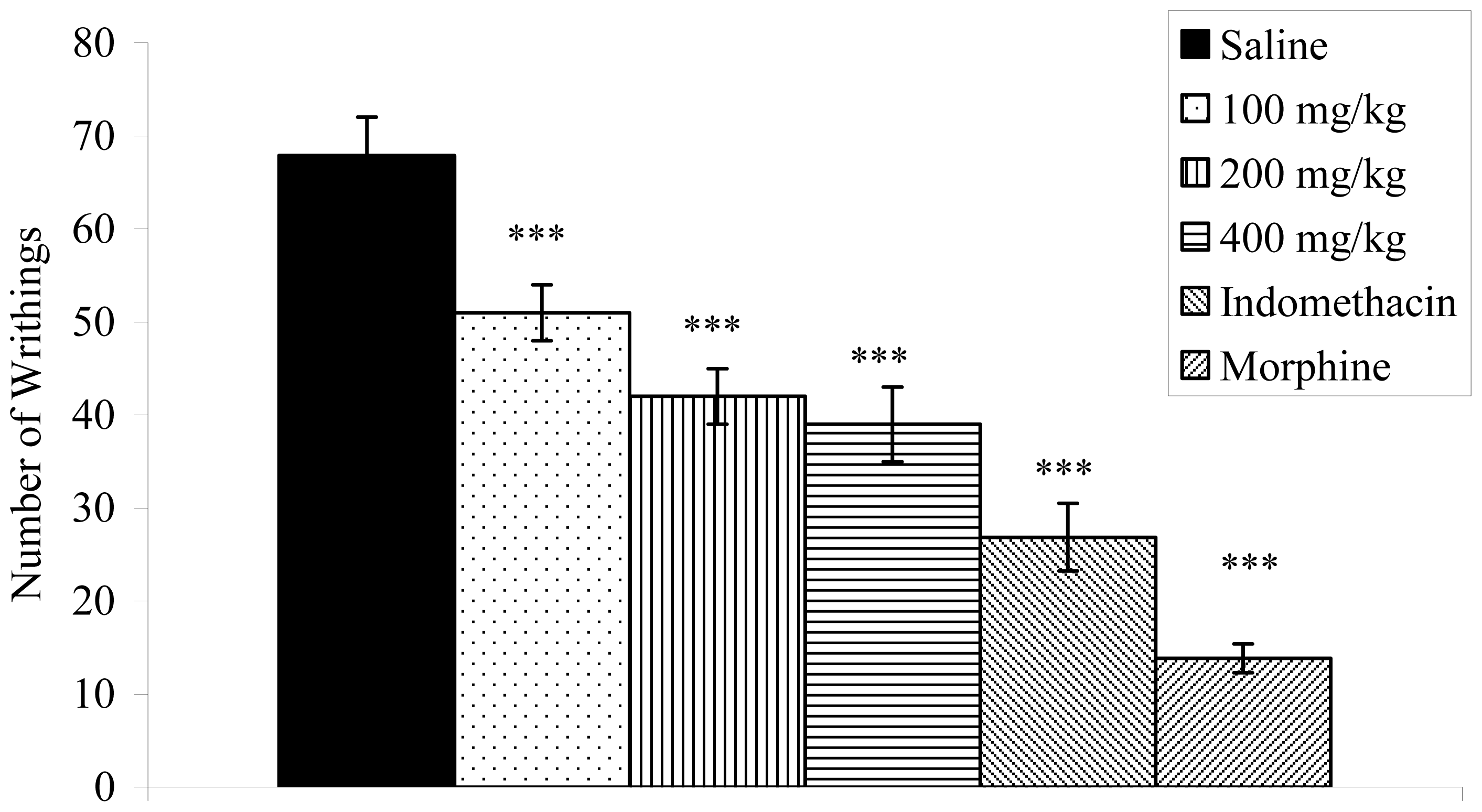
<p>Doses of 100 (51.00 ± 3.46; 24.86%), 200 (42.00 ± 2.98; 38.12%) and 400 mg/kg (39.00 ± 4.00; 42.54%) of <italic>V. condensata</italic> ethanol extract significantly (<italic>p</italic> &lt; 0.001) reduced the abdominal contortions induced by acetic acid when compared to the control group (67.87 ± 4.14) (<xref ref-type="fig" rid="f1-ijms-12-08993">Figure 1</xref>).</p></sec>
<sec>
<title>2.4. Effects on Formalin-Induced Nociception in Mice</title>
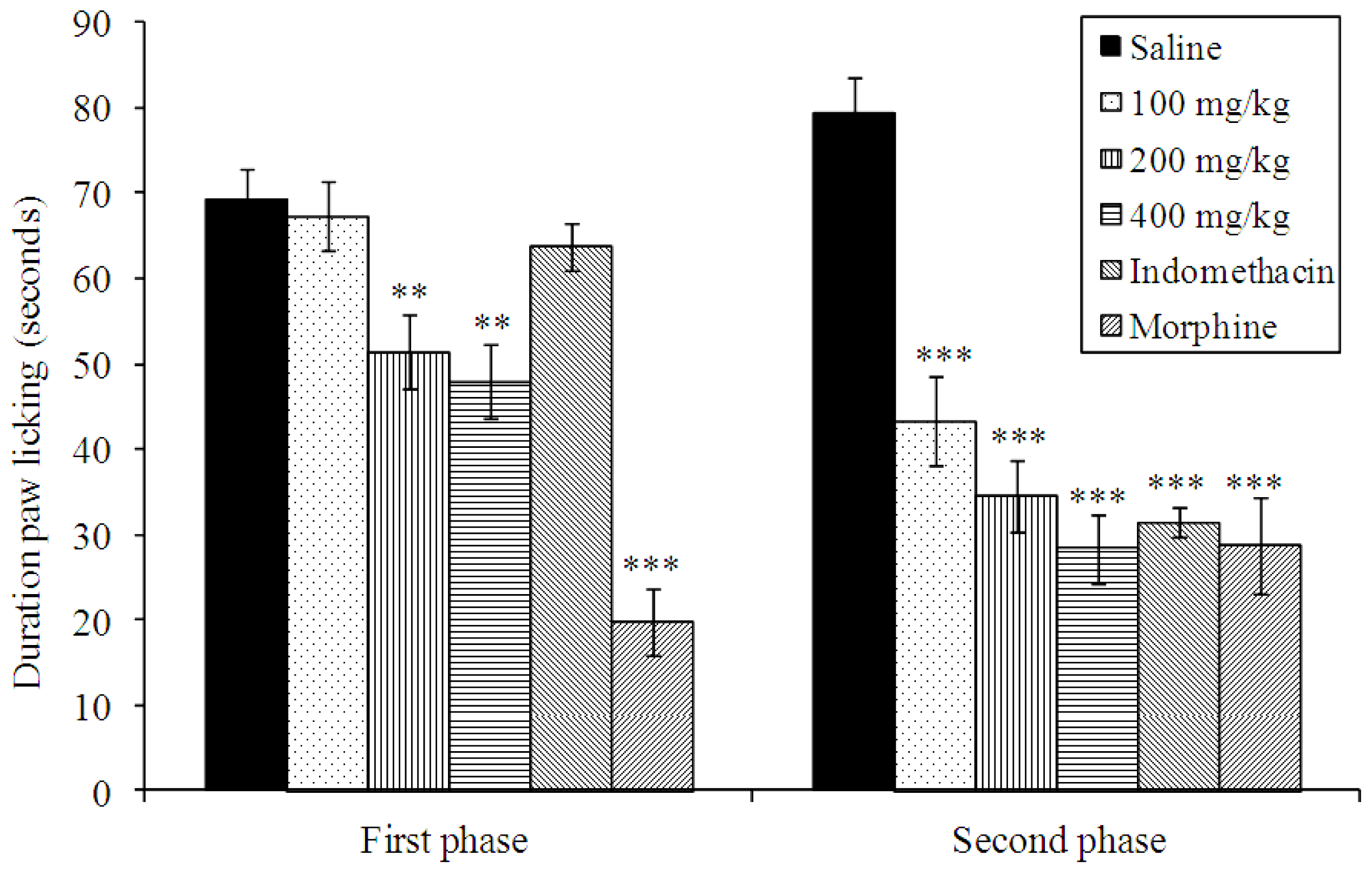
<p>The intraplantar injection of formalin promoted a biphasic characteristic response (<xref ref-type="fig" rid="f2-ijms-12-08993">Figure 2</xref>). The time spent licking in the first phase (0–5 min) was 66.62 ± 4.76 s and in the second phase (15–30 min) was 79.37 ± 4.15 s for the control group. After 60 min of treatment, a significant reduction in the licking time (<italic>p</italic> &lt; 0.01) was observed during the first phase after formalin administration (neurogenic) by 25.14 and 31.15% with 200 and 400 mg/kg of extract, respectively (<xref ref-type="fig" rid="f2-ijms-12-08993">Figure 2</xref>). In the second phase, the doses of 100, 200 and 400 mg/kg of extract inhibited significantly (<italic>p</italic> &lt; 0.001) at 45.36, 56.38 and 64.26%, respectively, when compared to the control. As expected, morphine (1 mg/kg, s.c.) significantly reduced the formalin response in both phases. The indomethacin inhibitory effect was observed in the second phase.</p></sec>
<sec>
<title>2.5. Effects on Hot-Plate Latency Assay in Mice</title>
<p>The <italic>V. condensata</italic> ethanol extract increased the latency time of mice exposed to the hot plate test (<xref ref-type="table" rid="t1-ijms-12-08993">Table 1</xref>). After 60 and 90 min of treatment, dose of 400 mg/kg (82.52 and 87.54%, respectively) increased significantly (<italic>p</italic> &lt; 0.001) the latency time in the respective control group. Morphine proved to be a potent analgesic, increasing the latency time within the evaluation periods. Naloxone, an opioid antagonist, blocked the morphine action but did not alter the antinociceptive effect of the tested extract, increasing the latency time at 102.52%. In this assay, we also observed that mice became lethargic.</p></sec>
<sec>
<title>2.6. Effect on Sleeping Time</title>
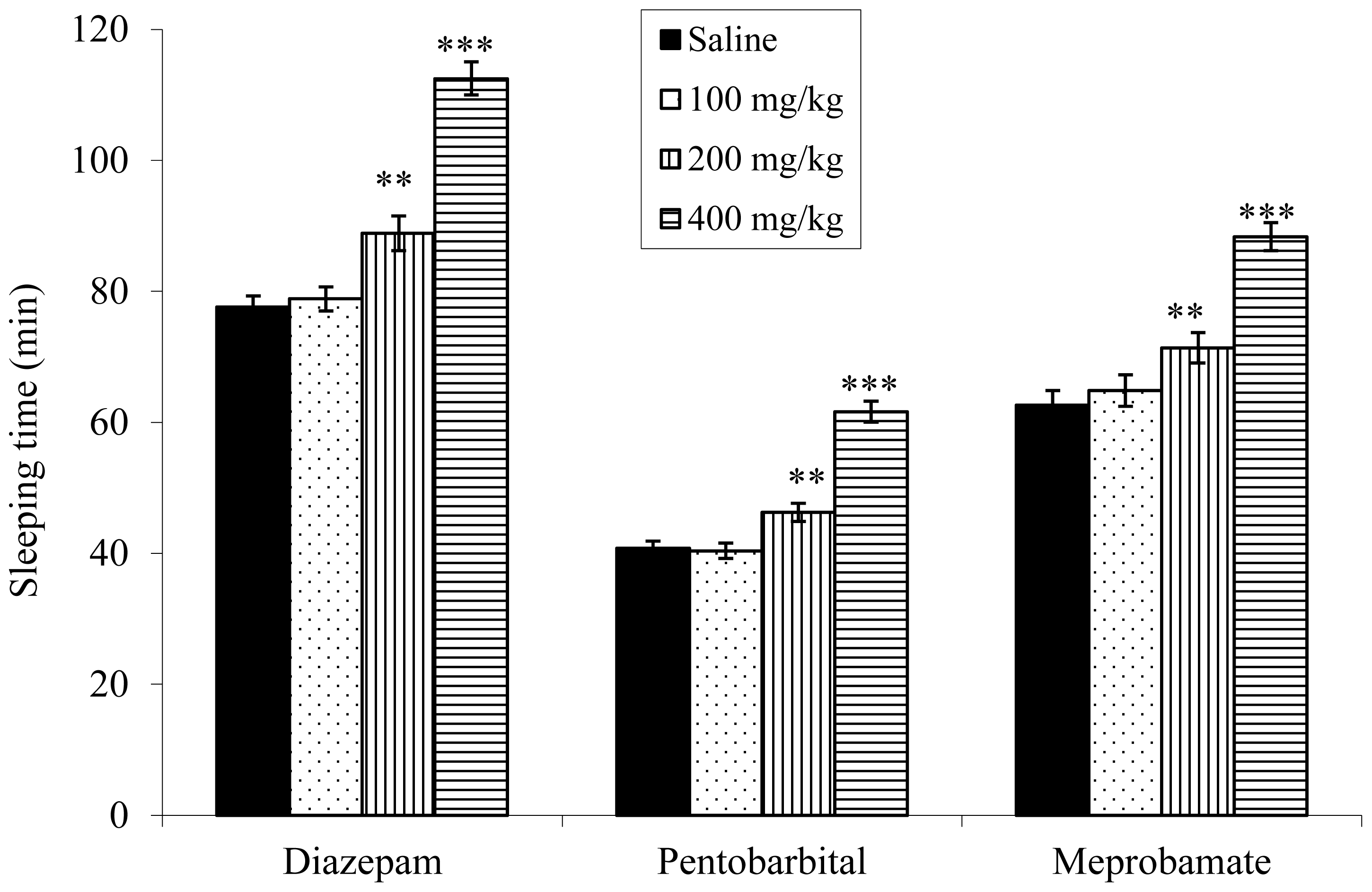
<p>The doses of 200 and 400 mg/kg of ethanol extract from <italic>V. condensata</italic> potentiated the sleeping time induced by diazepam (57.7%, 98%, and 156.4%, respectively), pentobarbital (75.4%, 122.9%, and 192.6%, respectively) and meprobamate (56.1%, 89.6%, and 124.4%, respectively) (<xref ref-type="fig" rid="f3-ijms-12-08993">Figure 3</xref>).</p></sec>
<sec>
<title>2.7. Effects on Carrageenan-Induced Edema in Rats</title>
<p>The <italic>V. condensata</italic> ethanol extract anti-inflammatory effect evaluated by the paw edema method induced by carrageenan is shown in <xref ref-type="table" rid="t2-ijms-12-08993">Table 2</xref>. Based on the presented data, the edema inhibition was observed 2 h after carrageenan application of doses of 200 (0.51 ± 0.06; 40.00%; <italic>p</italic> &lt; 0.05) and 400 mg/kg (0.59 ± 0.07; 30.59%; <italic>p</italic> &lt; 0.05). Three hours after carrageenan injections, the doses of 100 (0.73 ± 0.07; <italic>p</italic> &lt; 0.05), 200 (0.72 ± 0.03; <italic>p</italic> &lt; 0.05) and 400 mg/kg (0.63 ± 0.04; <italic>p</italic> &lt; 0.01) reduced the respective paw edema (21.50, 22.58 and 32.26%). The paw edema was also inhibited at the doses 100, 200 and 400 mg/kg 4 h after carrageenan application. In this time, indomethacin reduced the paw edema at 50.00%.</p></sec>
<sec>
<title>2.8. Effects on Carrageenan-Induced Pleurisy in Rats</title>
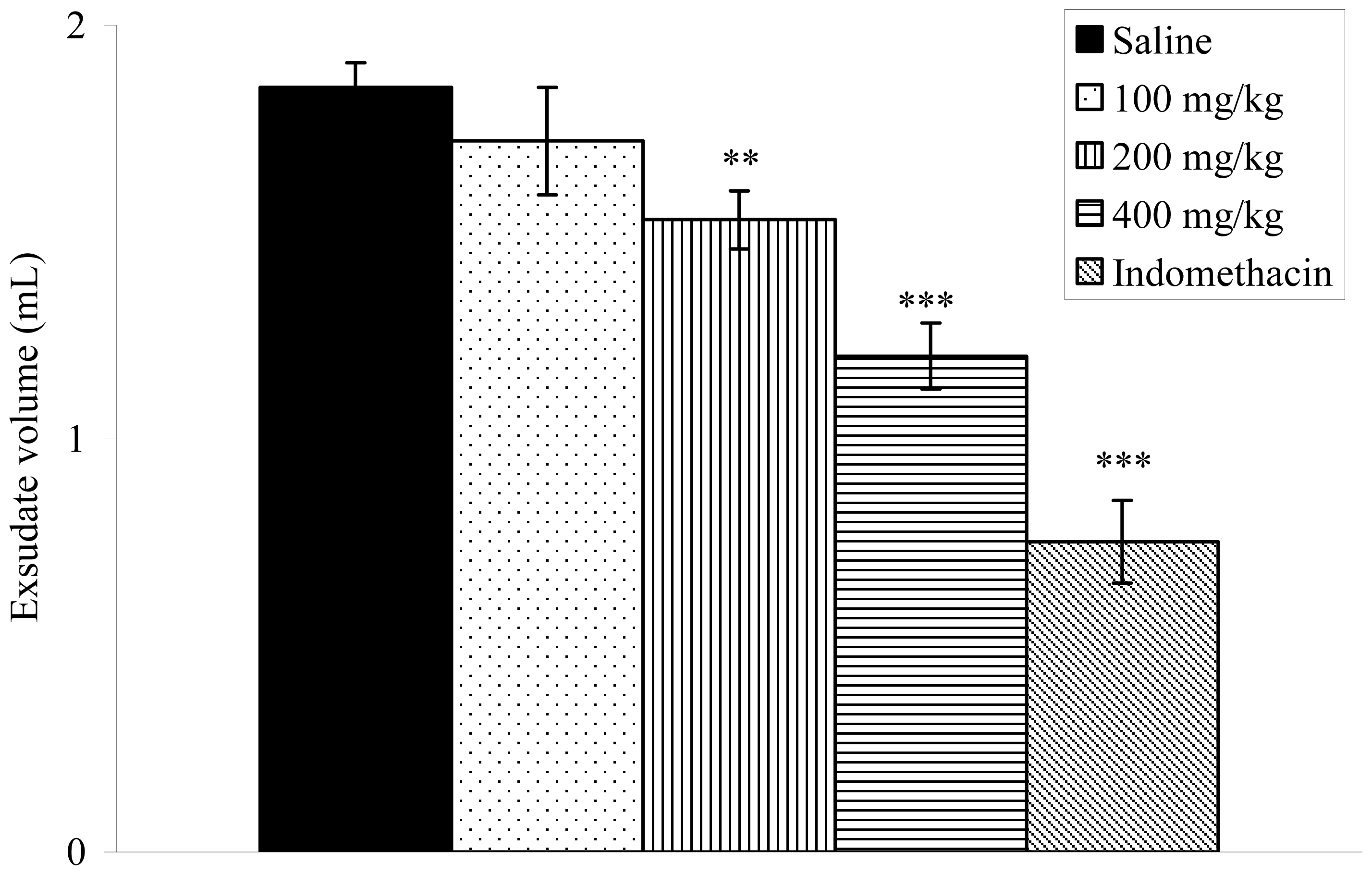
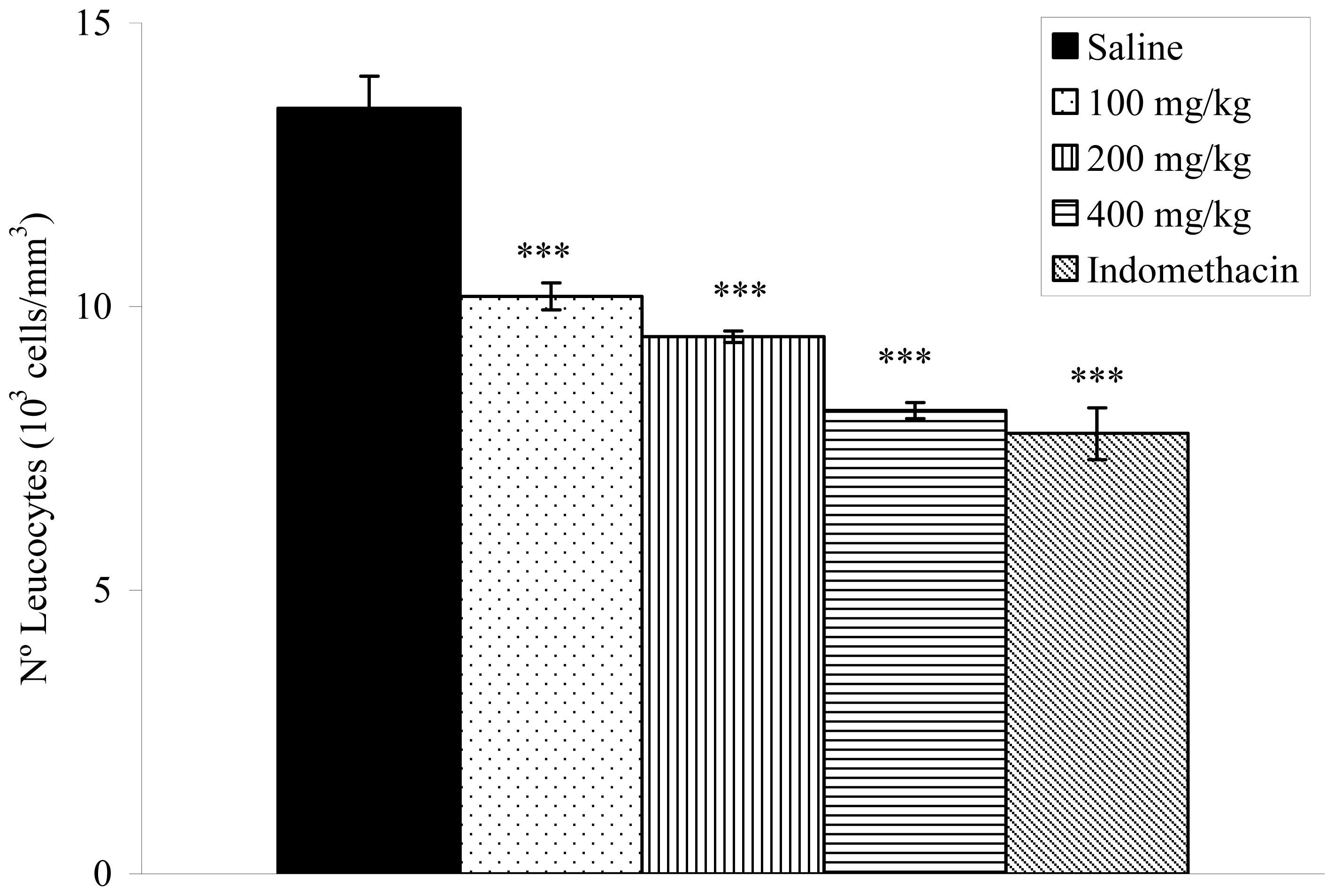
<p>The anti-inflammatory effect of the <italic>V. condensata</italic> ethanol extract was confirmed by a decrease in exudate volume and leukocyte migration to the pleural cavity of rats. The pleurisy effects demonstrated that doses of 200 (1.53 ± 0.07; <italic>p</italic> &lt; 0.01) and 400 mg/kg (1.20 ± 0.08; <italic>p</italic> &lt; 0.001) of the extract significantly reduced the exudate volume by 17.30 and 35.13%, respectively, when compared to the control group (<xref ref-type="fig" rid="f4-ijms-12-08993">Figure 4</xref>). The number of total leukocytes was inhibited significantly (<italic>p</italic> &lt; 0.001) at the doses of 100 (10.18 ± 0.24 × 10<sup>3</sup> cells/mm<sup>3</sup>), 200 (9.47 ± 0.10 × 10<sup>3</sup> cells/mm<sup>3</sup>) and 400 mg/kg (8.17 ± 0.14 × 10<sup>3</sup> cells/mm<sup>3</sup>) (<xref ref-type="fig" rid="f5-ijms-12-08993">Figure 5</xref>). Indomethacin reduced the exudate volume and the leukocyte migration.</p>
<p>Considering that the use of commercially available analgesic and anti-inflammatory drugs (opioids and non-steroidal anti-inflammatory drugs) exerts a wide range of side effects [<xref ref-type="bibr" rid="b5-ijms-12-08993">5</xref>], there is currently a strong interest in developing new therapeutic agents from natural products [<xref ref-type="bibr" rid="b6-ijms-12-08993">6</xref>–<xref ref-type="bibr" rid="b8-ijms-12-08993">8</xref>]. Agents that inhibit different mediators that are involved in the evolution of inflammatory processes, including pain, are especially relevant [<xref ref-type="bibr" rid="b2-ijms-12-08993">2</xref>,<xref ref-type="bibr" rid="b5-ijms-12-08993">5</xref>]. In this context, studies have been carried out with natural products in models of pain and inflammation in order to assess their pharmacological potential, as well as developing new therapeutic options [<xref ref-type="bibr" rid="b6-ijms-12-08993">6</xref>–<xref ref-type="bibr" rid="b8-ijms-12-08993">8</xref>,<xref ref-type="bibr" rid="b22-ijms-12-08993">22</xref>,<xref ref-type="bibr" rid="b23-ijms-12-08993">23</xref>].</p>
<p>The phytochemical analyses revealed the presence of flavonoids, tannins, coumarins, saponins, alkaloids, glycosides, tannins, triterpenoids and steroidal nucleus. Despite previous descriptions of most of these constituents [<xref ref-type="bibr" rid="b21-ijms-12-08993">21</xref>], in the present study coumarins and glycosides were detected for the first time. A variety of <italic>in vitro</italic> and <italic>in vivo</italic> experiments have shown that flavonoids, tannins, triterpenoids and other secondary plant metabolites possess analgesic and anti-inflammatory properties [<xref ref-type="bibr" rid="b23-ijms-12-08993">23</xref>–<xref ref-type="bibr" rid="b25-ijms-12-08993">25</xref>]. Vernonioside B2, for example, identified in this plant, may contribute to the observed anti-inflammatory and antinociceptive effects of <italic>V. condensata</italic> [<xref ref-type="bibr" rid="b20-ijms-12-08993">20</xref>].</p>
<p>The acute toxicity test showed that the <italic>V. condensata</italic> leaves’ ethanol extract doses determined were not toxic to mice, confirming results of earlier studies [<xref ref-type="bibr" rid="b19-ijms-12-08993">19</xref>,<xref ref-type="bibr" rid="b21-ijms-12-08993">21</xref>]. It is important to mention that the largest dose administered (400 mg/kg) is less than the lowest dose applied for determination of the LD<sub>50</sub> (0.5 g/kg or 500 mg/kg). During the experiment, it was observed that the mice presented somnolence, demonstrating a probable sedative effect.</p>
<p>In this study, we investigated an ethanol extract from <italic>V. condensata</italic> by classical nociception and acute inflammation models. This study demonstrated that ethanol extract produces antinociceptive and anti-inflammatory effects in models of nociception (acetic acid-induced abdominal writhing, formalin test and hot plate test) and inflammation (paw edema and pleurisy tests), providing a scientific basis to explain, in part, the popular use of <italic>V. condensata</italic> in Brazilian folk medicine. It also suggests that the ethanol extract contains bioactive constituents that could be responsible for the observed activities.</p>
<p>The acetic acid-induced writhing reaction has been largely used as a screening tool for the assessment of analgesic or anti-inflammatory properties. According to Collier <italic>et al.</italic> [<xref ref-type="bibr" rid="b26-ijms-12-08993">26</xref>], acetic acid acts indirectly by inducing the release of endogenous mediators sensitive to nonsteroidal anti-inflammatory drugs and opioids. This substance also promotes an increase in exudates levels of PGE<sub>2</sub> and PGF<sub>2</sub> (mediators of inflammation), bradykinin, substance P and some cytokines (IL-1β, TNF-α, and IL-8) [<xref ref-type="bibr" rid="b27-ijms-12-08993">27</xref>]. For this experiment, ethanol extract from <italic>V. condensata</italic> pretreated animals modified the nociceptive response induced by acetic acid in a dose-dependent manner. This fact suggests that probably the antinociceptive action of extract occurs peripherally, and it also inhibits the release of mediators in response to acetic acid. Therefore, the result corroborates previously studies [<xref ref-type="bibr" rid="b18-ijms-12-08993">18</xref>,<xref ref-type="bibr" rid="b20-ijms-12-08993">20</xref>,<xref ref-type="bibr" rid="b21-ijms-12-08993">21</xref>].</p>
<p>Formalin-induced nociception was another essential test employed in this study and this classical animal model was not applied in the reports made before with <italic>V. condensata</italic>. It is considered the most predictive of acute pain because it causes a local tissue injury to the paw and is also indicative of tonic and localized inflammation pain [<xref ref-type="bibr" rid="b28-ijms-12-08993">28</xref>]. This test exhibits two distinct phases of the licking response: the first phase is characterized by neurogenic pain caused by a direct chemical stimulation of nociceptors, and the second phase is characterized by inflammatory pain generated by a combination of stimuli, including inflammation of the peripheral tissues and mechanisms of central sensitization. In this last phase, different chemical mediators are involved, such as excitatory amino acids, neuropeptides, PGE2, nitric oxide, and kinins [<xref ref-type="bibr" rid="b29-ijms-12-08993">29</xref>]. We observed that when ethanol extract from <italic>V. condensata</italic> was injected 60 min prior to formalin, a significant inhibition of the formalin response was seen during the second phase (inflammatory). It is suggested that the early phase is due to a direct effect on nociceptors and prostaglandins that do not play an important role during this phase. In contrast, the late phase seems to be an inflammatory response that can be inhibited by nonsteroidal anti-inflammatory drugs and corticosteroids [<xref ref-type="bibr" rid="b28-ijms-12-08993">28</xref>,<xref ref-type="bibr" rid="b29-ijms-12-08993">29</xref>]. Taken together, these results revealed a probably similar action to the nonsteroidal anti-inflammatory drugs.</p>
<p>To distinguish between central and peripheral antinociceptive actions, we extended our studies to the hot-plate test because this technique has not been used in previous studies with <italic>V. condensata</italic>. This test is considered to be sensitive to drugs acting at the supraspinal modulation level of the pain response [<xref ref-type="bibr" rid="b27-ijms-12-08993">27</xref>], suggesting at least a modulatory effect of the extract. In this study, antinociceptive action did not depend entirely on the opioid system, because the treatment with naloxone did not completely reverse the produced effect [<xref ref-type="bibr" rid="b6-ijms-12-08993">6</xref>]. Furthermore, after thermal stimulus, mice showed lethargy, indicating a sedative effect, which could explain the analgesic activity independent of opioid action.</p>
<p>To better understand the somnolence and lethargy by observing signals in the experiments of acute toxicity and hot plate test, and to clarify the analgesic activity independent of opioid system activity, diazepam, pentobarbital and meprobamate were used to induce sleep in the animals. Benzodiazepines act at specific binding sites that are closely linked to γ-aminobutyric acid (GABA<sub>A</sub>) receptor and enhancing the GABA-ergic transmission which might be related to its sedative activity [<xref ref-type="bibr" rid="b30-ijms-12-08993">30</xref>]. Prolongation of pentobarbital-induced sleeping time might be due to the tranquilizing action as well as CNS depressant action related to GABA<sub>A</sub> receptors [<xref ref-type="bibr" rid="b31-ijms-12-08993">31</xref>]. Although the exact mechanism responsible for the sedation action of meprobamate is not fully clear, it might be due to CNS depressant action or also due to enhancement of GABA-ergic transmission [<xref ref-type="bibr" rid="b32-ijms-12-08993">32</xref>]. The ethanol extract from <italic>V. condensata</italic> significantly potentiated the duration of diazepam-, pentobarbital- and meprobamate-induced sleep in mice, suggesting probable tranquilizing action as well as CNS depressant action [<xref ref-type="bibr" rid="b30-ijms-12-08993">30</xref>–<xref ref-type="bibr" rid="b32-ijms-12-08993">32</xref>]. However, the responsible compound(s) for the hypnotic effect of <italic>V. condensata</italic> is not clearly known and could not be concluded based on the results of the present study. On the other hand, other plants containing compounds such as flavonoids, terpenes and saponins have been found to have hypnotic effects [<xref ref-type="bibr" rid="b33-ijms-12-08993">33</xref>]. Therefore, we can speculate that these constituents might be responsible for the sedative effect of <italic>V. condensata</italic> since these chemical classes were detected in the present study. Flavonoids with anxiolytic and/or antidepressant activities have also been described in numerous plant species used in folk medicine to depress the CNS. This effect has been described by their affinity for the central benzodiazepine receptors [<xref ref-type="bibr" rid="b34-ijms-12-08993">34</xref>]. It could be suggested that flavonoids of the <italic>V. condensata</italic> contribute to the sedative effect of this plant through benzodiazepine receptors.</p>
<p>The anti-inflammatory effect observed in the formalin test was confirmed in carrageenan-induced paw edema in rats, an animal model widely employed for the screening of anti-inflammatory compounds. The inflammatory response induced by carrageenan is characterized by the formation of marked edema resulting from the release of several mediators such as histamine, serotonin and bradykinin; this is subsequently sustained by release of prostaglandins produced by inducible isoforms of cyclooxygenase (COX-2) [<xref ref-type="bibr" rid="b35-ijms-12-08993">35</xref>–<xref ref-type="bibr" rid="b37-ijms-12-08993">37</xref>]. In the present study, oral treatment with the ethanol extract from <italic>V. condensata</italic> inhibited carrageenan-induced paw edema in rats. This treatment consistently attenuated the paw edema induced by carrageenan, as well as by several inflammatory mediators known to participate in the carrageenan response, such as bradykinin, histamine, substance P and platelet-activating factor [<xref ref-type="bibr" rid="b38-ijms-12-08993">38</xref>–<xref ref-type="bibr" rid="b41-ijms-12-08993">41</xref>]. This evidence suggests that the anti-inflammatory actions of the ethanol extract from <italic>V. condensata</italic> are related to the inhibition of one or more intracellular signaling pathways involved in the effects of these mediators.</p>
<p>The inflammation model of carrageenan-induced pleurisy was used to gain further insights into the anti-inflammatory effects of the ethanol extract from <italic>V. condensata</italic> [<xref ref-type="bibr" rid="b42-ijms-12-08993">42</xref>–<xref ref-type="bibr" rid="b44-ijms-12-08993">44</xref>]. Carrageenan-induced pleurisy has been used to investigate the mechanisms involved in acute inflammation and also to assess the effectiveness of anti-inflammatory drugs [<xref ref-type="bibr" rid="b42-ijms-12-08993">42</xref>,<xref ref-type="bibr" rid="b45-ijms-12-08993">45</xref>]. As expected, in our experiments intrapleural injection of carrageenan caused a marked accumulation of pleural exudate, followed by intense migration of inflammatory cells into the pleural cavity. Treatment of rats with the ethanol extract significantly reduced the volume of pleural exudate accumulated in response to carrageenan injection and also inhibited the migration of leucocytes.</p></sec></sec>
<sec>
<title>3. Experimental Section</title>
<sec>
<title>3.1. Plant Material and Extraction</title>
<p>Specimens of <italic>Vernonia condensata</italic> Baker used in this study were cultivated and collected at the Medicinal Garden of the Faculty of Pharmacy, Federal University of Juiz de Fora, in Juiz de Fora, State of Minas Gerais, Brazil, in August 2010. The species was identified by Dr. Fátima Regina Gonçalves Salimena and a voucher specimen (CESJ number 52943) was deposited in the Herbarium of the Federal University of Juiz de Fora, Brazil. Dried and powdered mature leaves (465 g) were exhaustively extracted in 95% ethanol (2.5 L) by static maceration for 3 weeks at room temperature with renewal of solvent every 2 days. The ethanol extract was filtered and evaporated under a rotary evaporator at controlled temperature (50–60 °C). This material was placed in a desiccator with silica to yield 27 g. The dried extract was dissolved using 1% DMSO in normal saline for pharmacological studies.</p></sec>
<sec>
<title>3.2. Chemicals</title>
<p>Drugs and reagents used in this study (and their sources) were as follows: acetic acid (Vetec Química Farm Ltda, Rio de Janeiro, RJ, Brazil), formaldehyde (Reagen Quimibrás Ind. Química S.A., Rio de Janeiro, RJ, Brazil), diazepam (União Química Farmacêutica Nacional S/A, Embu-Guaçu, SP, Brazil), pentobarbital (Syntec, Cotia, SP, Brazil), morphine hydrochloride (Merck Inc., Whitehouse Station, NJ, USA), meprobamate, naloxone and indomethacin (Sigma Chemical Co, St Louis, MI, USA).</p></sec>
<sec>
<title>3.3. Phytochemical Screening of the Ethanol Extract</title>
<p>The screening of chemical constituents was carried out with the ethanol extracts using chemical methods and thin-layer chromatography (TLC), according to the methodology suggested by Matos [<xref ref-type="bibr" rid="b46-ijms-12-08993">46</xref>], including flavonoids, tannins, coumarins, alkaloids, saponins, terpenoids, steroids and volatile oils.</p></sec>
<sec>
<title>3.4. Animals</title>
<p>Male Wistar rats (90–110 days) weighing 200–240 g and male Swiss albino mice (50–70 days) weighing 25–30 g were used in the experiments. The animals were provided by the Central Biotery of the Federal University of Juiz de Fora. The animals were divided into groups and kept in plastic under a 12 h light/12 h dark cycle at room temperature (22 ± 2 °C), with free cages (47 × 34 × 18 cm) access to Purina® rations and water. Animal care and the experimental protocol followed the principles and international guidelines suggested by the Brazilian College of Animal Experimentation (COBEA) and were approved by the local ethical committee (protocol number 036/2010).</p></sec>
<sec>
<title>3.5. Acute Toxicity</title>
<p>Groups of ten mice received oral doses of 0.5, 1, 1.5, 2 and 3 g/kg of ethanol extract from <italic>V. condensata</italic>, while the control group received the vehicle (saline). The groups were observed for 48 h and 50% lethal dose (LD<sub>50</sub>) was mortality at end of this period was recorded for each group [<xref ref-type="bibr" rid="b47-ijms-12-08993">47</xref>]. The LD<sub>50</sub> determined by probit test using a log plot of percentage death <italic>versus</italic> dose [<xref ref-type="bibr" rid="b48-ijms-12-08993">48</xref>].</p></sec>
<sec>
<title>3.6. Acetic Acid-Induced Writhing Test</title>
<p>The acetic-acid writhing test is used for the evaluation of analgesic activity [<xref ref-type="bibr" rid="b26-ijms-12-08993">26</xref>]. Mice (n = 8 per group) were injected (i.p.) with 0.6% acetic acid (10 mL/kg body weight), and the intensity of nociception was quantified by counting the total number of writhes that occurred between 10 and 30 min after injection. Animals received ethanol extract (100, 200 or 400 mg/kg, p.o.) or sterile saline (control group, 0.9%, w/v) 60 min before acetic acid injection. Indomethacin (10 mg/kg, p.o.) and morphine (1 mg/kg, s.c.) were administered 60 min before acetic acid as reference compounds.</p></sec>
<sec>
<title>3.7. Formalin Test</title>
<p>Twenty microliters of 1% formalin was administered i.pl. in the mouse’s right paw. The licking time was then recorded from 0 to 5 min (phase 1, neurogenic) and from 20 to 25 min (phase 2, inflammatory) after formalin administration [<xref ref-type="bibr" rid="b29-ijms-12-08993">29</xref>,<xref ref-type="bibr" rid="b49-ijms-12-08993">49</xref>]. Mice were then treated (p.o.) with extract (100, 200 or 400 mg/kg) or sterile saline (0.9%) 60 min before formalin injection. Indomethacin (10 mg/kg, p.o.) and morphine (1 mg/kg, s.c.) were also administered 60 min before the formalin injection and used as reference compounds.</p></sec>
<sec>
<title>3.8. Hot Plate Test</title>
<p>Animals were placed on a hot-plate (Model LE 7406, Letica Scientific Instruments, Barcelona, Spain) heated at 55 ± 1 °C [<xref ref-type="bibr" rid="b50-ijms-12-08993">50</xref>]. Three groups of mice (n = 8) were treated p.o. with ethanol extract (100, 200 or 400 mg/kg; 0.1 mL per 10 g body weight); the control group received sterile saline (10 mL/kg). Measurements were performed at time 0, 30, 60 and 90 min after drug administration, with a cut-off time of 40 s to avoid lesions to the animals’ paws. The effect of pretreatment with naloxone (1 mg/kg, subcutaneously) on the analgesia produced by the ethanol extract (400 mg/kg) was determined in a separate group of animals. Morphine (1 mg/kg, subcutaneously), in the absence and presence of naloxone treatment, was used as a reference.</p></sec>
<sec>
<title>3.9. Effect on Sleeping Time in Mice</title>
<p>Mice were divided into 4 groups, each group containing 8 animals. The animals of group I served as the control (normal saline, 0.9 % (w/v) NaCl, 5 mL/kg); groups II, III, and IV received ethanol extract at the doses (100 mg/kg, 200 mg/kg and 400 mg/kg, respectively). Normal saline and the extracts were applied orally 60 min prior to the administration of pentobarbital sodium (40 mg/kg, i.p.), diazepam (3 mg/kg, i.p.) and meprobamate (100 mg/kg, i.p.). The sleeping time was noted by recording the interval between the losses and regaining of righting reflex [<xref ref-type="bibr" rid="b51-ijms-12-08993">51</xref>].</p></sec>
<sec>
<title>3.10. Carrageenan-Induced Rat Paw Edema</title>
<p>Anti-inflammatory activity was assessed on the basis of inhibition of paw edema induced by the injection of 0.1 mL of 2% carrageenan (an edematogenic agent) into the subplantar region of the right hind paw of the rat [<xref ref-type="bibr" rid="b52-ijms-12-08993">52</xref>]. Male Wistar rats were divided into groups of six animals which received p.o. doses of extract (100, 200 and 400 mg/kg; 0.1 mL per 10 g body weight), saline or indomethacin (10 mg/kg) 1 h before the injection of carrageenan. In the left paw, used as a control, 0.1 mL of sterile saline was injected. 1, 2, 3 and 4 h after injection of carrageenan, the measure of edema was made by the difference between the volume displaced by the right paw and the left paw using a plethysmometer (model LE 7500, Letica Scientific Instruments, Barcelona, Spain).</p></sec>
<sec>
<title>3.11. Carrageenan-Induced Pleurisy in Rats</title>
<p>Pleurisy was induced in male Wistar rats by intrapleural administration of 0.5 mL 2% carrageenan suspension in saline solution between the third and fifth ribs on the right side of the mediastinum [<xref ref-type="bibr" rid="b42-ijms-12-08993">42</xref>]. Extract (100, 200 and 400 mg/kg), saline or indomethacin (10 mg/kg) p.o. were given 60 min before injection of the irritant. Animals were killed 4 h after carrageenan injection, and the skin and pectoral muscles were retracted. A longitudinal incision was made between the third and fifth ribs on each side of the mediastinum. The exudate was collected and transferred to a 15 mL conical centrifuge tube and the total volume determined. A 20 μL aliquot of the exudate was used to determine the total leucocyte count in Neubauer chambers.</p></sec>
<sec sec-type="methods">
<title>3.12. Calculus and Statistical Analysis</title>
<p>Data are expressed as mean ± S.E.M. Statistical significance was determined by one-way analysis of variance followed by the Student–Newman–Keuls test. <italic>P</italic> values below 0.05 were considered significant. The percentage of inhibition was calculated by using</p>
<disp-formula id="FD1">
<mml:math id="mm1" display="block">
<mml:semantics id="sm1">
<mml:mrow>
<mml:mn>100</mml:mn>
<mml:mo>-</mml:mo>
<mml:mtext>T</mml:mtext>
<mml:mo>×</mml:mo>
<mml:mn>100</mml:mn>
<mml:mo>/</mml:mo>
<mml:mtext>C</mml:mtext>
<mml:mo stretchy="false">(</mml:mo>
<mml:mo>%</mml:mo>
<mml:mo stretchy="false">)</mml:mo>
<mml:mi> </mml:mi>
<mml:mtext>or T</mml:mtext>
<mml:mo>×</mml:mo>
<mml:mn>100</mml:mn>
<mml:mo>/</mml:mo>
<mml:mtext>C</mml:mtext>
<mml:mo>-</mml:mo>
<mml:mn>100</mml:mn>
<mml:mo stretchy="false">(</mml:mo>
<mml:mo>%</mml:mo>
<mml:mo stretchy="false">)</mml:mo></mml:mrow></mml:semantics></mml:math></disp-formula>
<p>where C and T indicate non-treated (vehicle) and drug-treated, respectively.</p></sec></sec>
<sec sec-type="conclusions">
<title>4. Conclusions</title>
<p>The present study demonstrated that the completion of additional experiments in the investigation of the antinociceptive and anti-inflammatory activities of <italic>V. condensata</italic> allowed a better understanding of the central and peripheral mechanisms involved. The results support the popular use of this plant, but phytochemical studies together with pharmacological and toxicological investigations have proven essential for the complete understanding of their medicinal application.</p></sec></body>
<back>
<ack>
<title>Acknowledgments</title>
<p>This study was supported by Conselho Nacional de Desenvolvimento Científico e Tecnológico (CNPq), Coordenação de Aperfeiçoamento de Pessoal de Nível Superior (CAPES), Fundação de Amparo à Pesquisa do Estado de Minas Gerais (FAPEMIG), and Pró-Reitorias de Pesquisa and Pós-Graduação of the Federal University of Juiz de Fora. We are grateful to Fátima Maria Gonçalves Salimena for plant identification.</p></ack>
<ref-list>
<title>References</title>
<ref id="b1-ijms-12-08993"><label>1</label><citation citation-type="journal"><person-group person-group-type="author"><name><surname>White</surname><given-names>F.A.</given-names></name><name><surname>Bhangoo</surname><given-names>S.K.</given-names></name><name><surname>Miller</surname><given-names>R.J.</given-names></name></person-group><article-title>Chemokines: Integrators of pain and inflammation</article-title><source>Nat. Rev. Drug Discov</source><year>2005</year><volume>4</volume><fpage>834</fpage><lpage>844</lpage><pub-id pub-id-type="doi">10.1038/nrd1852</pub-id><pub-id pub-id-type="pmid">16224455</pub-id></citation></ref>
<ref id="b2-ijms-12-08993"><label>2</label><citation citation-type="journal"><person-group person-group-type="author"><name><surname>Cunha</surname><given-names>T.M.</given-names></name><name><surname>Verri</surname><given-names>W.A.</given-names><suffix>Jr</suffix></name><name><surname>Schivo</surname><given-names>I.R.</given-names></name><name><surname>Napimoga</surname><given-names>M.H.</given-names></name><name><surname>Parada</surname><given-names>C.A.</given-names></name><name><surname>Poole</surname><given-names>S.</given-names></name><name><surname>Teixeira</surname><given-names>M.M.</given-names></name><name><surname>Ferreira</surname><given-names>S.H.</given-names></name><name><surname>Cunha</surname><given-names>F.Q.</given-names></name></person-group><article-title>Crucial role of neutrophils in the development of mechanical inflammatory hypernociception</article-title><source>J. Leukoc. Biol.</source><year>2008</year><volume>83</volume><fpage>824</fpage><lpage>832</lpage><pub-id pub-id-type="doi">10.1189/jlb.0907654</pub-id><pub-id pub-id-type="pmid">18203872</pub-id></citation></ref>
<ref id="b3-ijms-12-08993"><label>3</label><citation citation-type="journal"><person-group person-group-type="author"><name><surname>Kaye</surname><given-names>A.D.</given-names></name><name><surname>Baluch</surname><given-names>A.</given-names></name><name><surname>Scott</surname><given-names>J.</given-names></name></person-group><article-title>Pain management in the elderly population: A review</article-title><source>Ochsner J</source><year>2010</year><volume>10</volume><fpage>179</fpage><lpage>187</lpage><pub-id pub-id-type="pmid">21603375</pub-id></citation></ref>
<ref id="b4-ijms-12-08993"><label>4</label><citation citation-type="journal"><person-group person-group-type="author"><name><surname>Macfarlane</surname><given-names>T.V.</given-names></name><name><surname>Glenny</surname><given-names>A.-M.</given-names></name><name><surname>Worthington</surname><given-names>H.V.</given-names></name></person-group><article-title>Systematic review of population-based epidemiological studies of oro-facial pain</article-title><source>J. Dentist</source><year>2001</year><volume>29</volume><fpage>451</fpage><lpage>467</lpage><pub-id pub-id-type="doi">10.1016/S0300-5712(01)00041-0</pub-id></citation></ref>
<ref id="b5-ijms-12-08993"><label>5</label><citation citation-type="journal"><person-group person-group-type="author"><name><surname>Bovill</surname><given-names>J.G.</given-names></name></person-group><article-title>Mechanisms of actions of opioids and non-steroidal anti-inflammatory drugs</article-title><source>Eur. J. Anaesthesiol</source><year>1997</year><volume>15</volume><fpage>9S</fpage><lpage>15S</lpage></citation></ref>
<ref id="b6-ijms-12-08993"><label>6</label><citation citation-type="journal"><person-group person-group-type="author"><name><surname>Sousa</surname><given-names>O.V.</given-names></name><name><surname>Del-Vechio-Vieira</surname><given-names>G.</given-names></name><name><surname>Pinho</surname><given-names>J.J.R.G.</given-names></name><name><surname>Yamamoto</surname><given-names>C.H.</given-names></name><name><surname>Alves</surname><given-names>M.S.</given-names></name></person-group><article-title>Antinociceptive and anti-inflammatory activities of the ethanol extract of <italic>Annona muricata</italic> L. leaves in animal models</article-title><source>Int. J. Mol. Sci</source><year>2010</year><volume>11</volume><fpage>2067</fpage><lpage>2078</lpage><pub-id pub-id-type="doi">10.3390/ijms11052067</pub-id><pub-id pub-id-type="pmid">20559502</pub-id></citation></ref>
<ref id="b7-ijms-12-08993"><label>7</label><citation citation-type="journal"><person-group person-group-type="author"><name><surname>Fagundes</surname><given-names>L.L.</given-names></name><name><surname>Del-Vechio-Vieira</surname><given-names>G.</given-names></name><name><surname>Pinho</surname><given-names>J.J.R.G.</given-names></name><name><surname>Yamamoto</surname><given-names>C.H.</given-names></name><name><surname>Alves</surname><given-names>M.S.</given-names></name><name><surname>Stringheta</surname><given-names>P.C.</given-names></name><name><surname>Sousa</surname><given-names>O.V.</given-names></name></person-group><article-title>Pharmacological proprieties of the ethanol extract of <italic>Muehlenbeckia platyclada</italic> (F. Muell.) Meisn. leaves</article-title><source>Int. J. Mol. Sci</source><year>2010</year><volume>11</volume><fpage>3942</fpage><lpage>3953</lpage><pub-id pub-id-type="doi">10.3390/ijms11103942</pub-id><pub-id pub-id-type="pmid">21152311</pub-id></citation></ref>
<ref id="b8-ijms-12-08993"><label>8</label><citation citation-type="journal"><person-group person-group-type="author"><name><surname>Vázquez</surname><given-names>A.I.F.</given-names></name><name><surname>Sánchez</surname><given-names>C.M.D.</given-names></name><name><surname>Delgado</surname><given-names>N.G.</given-names></name><name><surname>Alfonso</surname><given-names>A.M.S.</given-names></name><name><surname>Ortega</surname><given-names>Y.S.</given-names></name><name><surname>Sánchez</surname><given-names>H.C.</given-names></name></person-group><article-title>Anti-inflammatory and analgesic activities of red seaweed <italic>Dichotomaria obtusata</italic></article-title><source>Braz. J. Pharm. Sci</source><year>2011</year><volume>47</volume><fpage>111</fpage><lpage>118</lpage><pub-id pub-id-type="doi">10.1590/S1984-82502011000100014</pub-id></citation></ref>
<ref id="b9-ijms-12-08993"><label>9</label><citation citation-type="journal"><person-group person-group-type="author"><name><surname>King</surname><given-names>B.L.</given-names></name><name><surname>Jones</surname><given-names>S.B.</given-names></name></person-group><article-title>Chemosystematics of <italic>Vernonia</italic> series flexuosae (Vernonieae: Compositae)</article-title><source>Bull. Torrey Bot. Club</source><year>1982</year><volume>109</volume><fpage>279</fpage><lpage>286</lpage><pub-id pub-id-type="doi">10.2307/2995974</pub-id></citation></ref>
<ref id="b10-ijms-12-08993"><label>10</label><citation citation-type="book"><person-group person-group-type="author"><name><surname>Lorenzi</surname><given-names>H.</given-names></name><name><surname>Matos</surname><given-names>F.J.A.</given-names></name></person-group><source>Plantas Medicinais no Brasil: Nativas e Exóticas</source><edition>2nd ed</edition><publisher-name>Instituto Plantarum</publisher-name><publisher-loc>Nova Odessa, Brazil</publisher-loc><year>2008</year><fpage>165</fpage><lpage>166</lpage></citation></ref>
<ref id="b11-ijms-12-08993"><label>11</label><citation citation-type="journal"><person-group person-group-type="author"><name><surname>Alves</surname><given-names>V.F.G.</given-names></name><name><surname>Neves</surname><given-names>L.J.</given-names></name></person-group><article-title>Anatomia foliar de <italic>Vernonia polyanthes</italic> Less (Asteraceae)</article-title><source>Rev. Univ. Rural Sér. Ciên. da Vida</source><year>2003</year><volume>22</volume><fpage>1</fpage><lpage>8</lpage></citation></ref>
<ref id="b12-ijms-12-08993"><label>12</label><citation citation-type="journal"><person-group person-group-type="author"><name><surname>Achola</surname><given-names>K.J.</given-names></name><name><surname>Mwangi</surname><given-names>J.W.</given-names></name><name><surname>Munenge</surname><given-names>R.W.</given-names></name><name><surname>Mwaura</surname><given-names>A.M.</given-names></name></person-group><article-title>Pharmacological activities of <italic>Vernonia glabra</italic></article-title><source>Pharm. Biol</source><year>1996</year><volume>34</volume><fpage>141</fpage><lpage>144</lpage><pub-id pub-id-type="doi">10.1076/phbi.34.2.141.13190</pub-id></citation></ref>
<ref id="b13-ijms-12-08993"><label>13</label><citation citation-type="journal"><person-group person-group-type="author"><name><surname>Pérez-Amador</surname><given-names>M.C.</given-names></name><name><surname>Ocotero</surname><given-names>V.M.</given-names></name><name><surname>Benitez</surname><given-names>S.P.</given-names></name><name><surname>Jiménez</surname><given-names>F.G.</given-names></name></person-group><article-title><italic>Vernonia patens</italic> Kunth, an Asteraceae species with phototoxic and pharmacological activity</article-title><source>Phyton</source><year>2008</year><volume>77</volume><fpage>275</fpage><lpage>282</lpage></citation></ref>
<ref id="b14-ijms-12-08993"><label>14</label><citation citation-type="journal"><person-group person-group-type="author"><name><surname>Nergard</surname><given-names>C.S.</given-names></name><name><surname>Diallo</surname><given-names>D.</given-names></name><name><surname>Michaelsen</surname><given-names>T.E.</given-names></name><name><surname>Malterud</surname><given-names>K.E.</given-names></name><name><surname>Kiyohara</surname><given-names>H.</given-names></name><name><surname>Matsumoto</surname><given-names>T.</given-names></name><name><surname>Yamada</surname><given-names>H.</given-names></name><name><surname>Paulsen</surname><given-names>B.S.</given-names></name></person-group><article-title>Isolation, partial characterisation and immunomodulating activities of polysaccharides from <italic>Vernonia kotschyana</italic> Sch. Bip. ex Walp</article-title><source>J. Ethnopharmacol</source><year>2004</year><volume>91</volume><fpage>141</fpage><lpage>152</lpage><pub-id pub-id-type="doi">10.1016/j.jep.2003.12.007</pub-id><pub-id pub-id-type="pmid">15036481</pub-id></citation></ref>
<ref id="b15-ijms-12-08993"><label>15</label><citation citation-type="journal"><person-group person-group-type="author"><name><surname>Laekeman</surname><given-names>G.M.</given-names></name><name><surname>Mertens</surname><given-names>J.</given-names></name><name><surname>Totté</surname><given-names>J.</given-names></name><name><surname>Bult</surname><given-names>H.</given-names></name><name><surname>Vlietinck</surname><given-names>A.J.</given-names></name><name><surname>Herman</surname><given-names>A.G.</given-names></name></person-group><article-title>Isolation and pharmacological characterization of vernolepin</article-title><source>J. Nat. Prod</source><year>1983</year><volume>46</volume><fpage>161</fpage><lpage>169</lpage><pub-id pub-id-type="doi">10.1021/np50026a003</pub-id><pub-id pub-id-type="pmid">6410002</pub-id></citation></ref>
<ref id="b16-ijms-12-08993"><label>16</label><citation citation-type="journal"><person-group person-group-type="author"><name><surname>Ojiako</surname><given-names>O.A.</given-names></name><name><surname>Nwanjo</surname><given-names>H.U.</given-names></name></person-group><article-title>Is <italic>Vernonia amygdalina</italic> hepatotoxic or hepatoprotective? Response from biochemical and toxicity studies in rats</article-title><source>Afr. J. Biotechnol</source><year>2006</year><volume>5</volume><fpage>1648</fpage><lpage>1651</lpage></citation></ref>
<ref id="b17-ijms-12-08993"><label>17</label><citation citation-type="journal"><person-group person-group-type="author"><name><surname>Carvalho</surname><given-names>M.G.</given-names></name><name><surname>Costa</surname><given-names>P.M.</given-names></name><name><surname>Abreu</surname><given-names>H.S.</given-names></name></person-group><article-title>Flavanones from <italic>Vernonia diffusa</italic></article-title><source>J. Braz. Chem. Soc</source><year>1999</year><volume>10</volume><fpage>163</fpage><lpage>166</lpage><pub-id pub-id-type="doi">10.1590/S0103-50531999000200015</pub-id></citation></ref>
<ref id="b18-ijms-12-08993"><label>18</label><citation citation-type="journal"><person-group person-group-type="author"><name><surname>Frutuoso</surname><given-names>V.S.</given-names></name><name><surname>Gurjão</surname><given-names>M.R.R.</given-names></name><name><surname>Cordeiro</surname><given-names>R.S.B.</given-names></name><name><surname>Martins</surname><given-names>M.A.</given-names></name></person-group><article-title>Analgesic and anti-ulcerogenic effects of a polar extract from leaves of <italic>Vernonia condensata</italic></article-title><source>Planta Med</source><year>1994</year><volume>60</volume><fpage>21</fpage><lpage>25</lpage><pub-id pub-id-type="doi">10.1055/s-2006-959400</pub-id><pub-id pub-id-type="pmid">8134411</pub-id></citation></ref>
<ref id="b19-ijms-12-08993"><label>19</label><citation citation-type="journal"><person-group person-group-type="author"><name><surname>Monteiro</surname><given-names>M.H.</given-names></name><name><surname>Gomes-Carneiro</surname><given-names>M.R.</given-names></name><name><surname>Felzenszwalb</surname><given-names>I.</given-names></name><name><surname>Chahoud</surname><given-names>I.</given-names></name><name><surname>Paumgartten</surname><given-names>F.J.</given-names></name></person-group><article-title>Toxicological evaluation of a tea from leaves of <italic>Vernonia condensata</italic></article-title><source>J. Ethnopharmacol</source><year>2001</year><volume>74</volume><fpage>149</fpage><lpage>157</lpage><pub-id pub-id-type="doi">10.1016/S0378-8741(00)00363-9</pub-id><pub-id pub-id-type="pmid">11167033</pub-id></citation></ref>
<ref id="b20-ijms-12-08993"><label>20</label><citation citation-type="journal"><person-group person-group-type="author"><name><surname>Valverde</surname><given-names>A.L.</given-names></name><name><surname>Cardoso</surname><given-names>G.L.C.</given-names></name><name><surname>Pereira</surname><given-names>N.A.</given-names></name><name><surname>Silva</surname><given-names>A.J.R.</given-names></name><name><surname>Kuster</surname><given-names>R.M.</given-names></name></person-group><article-title>Analgesic and antiinflammatory activities of vernonioside B2 from <italic>Vernonia condensata</italic></article-title><source>Phytother. Res</source><year>2001</year><volume>15</volume><fpage>263</fpage><lpage>264</lpage><pub-id pub-id-type="doi">10.1002/ptr.733</pub-id><pub-id pub-id-type="pmid">11351366</pub-id></citation></ref>
<ref id="b21-ijms-12-08993"><label>21</label><citation citation-type="journal"><person-group person-group-type="author"><name><surname>Risso</surname><given-names>W.E.</given-names></name><name><surname>Scarminio</surname><given-names>I.S.</given-names></name><name><surname>Moreira</surname><given-names>E.G.</given-names></name></person-group><article-title>Antinociceptive and acute toxicity evaluation of <italic>Vernonia condensata</italic> Baker leaves extracted with different solvents and their mixtures</article-title><source>Indian J. Exp. Biol</source><year>2010</year><volume>48</volume><fpage>811</fpage><lpage>816</lpage><pub-id pub-id-type="pmid">21341539</pub-id></citation></ref>
<ref id="b22-ijms-12-08993"><label>22</label><citation citation-type="journal"><person-group person-group-type="author"><name><surname>Matta</surname><given-names>C.B.B.</given-names></name><name><surname>Souza</surname><given-names>É.T.</given-names></name><name><surname>Queiroz</surname><given-names>A.C.</given-names></name><name><surname>Lira</surname><given-names>D.P.</given-names></name><name><surname>Araújo</surname><given-names>M.V.</given-names></name><name><surname>Cavalcante-Silva</surname><given-names>L.H.A.</given-names></name><name><surname>Miranda</surname><given-names>G.E.C.</given-names></name><name><surname>Araújo-Júnior</surname><given-names>J.X.</given-names></name><name><surname>Barbosa-Filho</surname><given-names>J.M.</given-names></name><name><surname>Santos</surname><given-names>B.V.O.</given-names></name><etal/></person-group><article-title>Antinociceptive and anti-inflammatory activity from algae of the Genus <italic>Caulerpa</italic></article-title><source>Mar. Drugs</source><year>2011</year><volume>9</volume><fpage>307</fpage><lpage>318</lpage><pub-id pub-id-type="doi">10.3390/md9030307</pub-id><pub-id pub-id-type="pmid">21556161</pub-id></citation></ref>
<ref id="b23-ijms-12-08993"><label>23</label><citation citation-type="journal"><person-group person-group-type="author"><name><surname>Yuan</surname><given-names>G.</given-names></name><name><surname>Wahlgvist</surname><given-names>M.L.</given-names></name><name><surname>He</surname><given-names>G.</given-names></name><name><surname>Yang</surname><given-names>M.</given-names></name><name><surname>Li</surname><given-names>D.</given-names></name></person-group><article-title>Natural products and anti-inflammatory activity</article-title><source>Asia Pac. J. Clin. Nutr</source><year>2006</year><volume>15</volume><fpage>143</fpage><lpage>152</lpage><pub-id pub-id-type="pmid">16672197</pub-id></citation></ref>
<ref id="b24-ijms-12-08993"><label>24</label><citation citation-type="journal"><person-group person-group-type="author"><name><surname>Salminen</surname><given-names>A.</given-names></name><name><surname>Lehtonen</surname><given-names>M.</given-names></name><name><surname>Suuronena</surname><given-names>T.</given-names></name><name><surname>Kaarnirantad</surname><given-names>K.</given-names></name><name><surname>Huuskonen</surname><given-names>J.</given-names></name></person-group><article-title>Terpenoids: Natural inhibitors of NF-B signaling with anti-inflammatory and anticancer potential</article-title><source>Cell. Mol. Life Sci</source><year>2008</year><volume>65</volume><fpage>2979</fpage><lpage>2999</lpage><pub-id pub-id-type="doi">10.1007/s00018-008-8103-5</pub-id><pub-id pub-id-type="pmid">18516495</pub-id></citation></ref>
<ref id="b25-ijms-12-08993"><label>25</label><citation citation-type="journal"><person-group person-group-type="author"><name><surname>García-Lafuente</surname><given-names>A.</given-names></name><name><surname>Guillamón</surname><given-names>E.</given-names></name><name><surname>Villares</surname><given-names>A.</given-names></name><name><surname>Rostagno</surname><given-names>M.A.</given-names></name><name><surname>Martínez</surname><given-names>J.A.</given-names></name></person-group><article-title>Flavonoids as anti-inflammatory agents: Implications in cancer and cardiovascular disease</article-title><source>Inflamm. Res</source><year>2009</year><volume>58</volume><fpage>537</fpage><lpage>552</lpage><pub-id pub-id-type="doi">10.1007/s00011-009-0037-3</pub-id><pub-id pub-id-type="pmid">19381780</pub-id></citation></ref>
<ref id="b26-ijms-12-08993"><label>26</label><citation citation-type="journal"><person-group person-group-type="author"><name><surname>Collier</surname><given-names>H.D.J.</given-names></name><name><surname>Dinnin</surname><given-names>L.C.</given-names></name><name><surname>Johnson</surname><given-names>C.A.</given-names></name><name><surname>Schneider</surname><given-names>C.</given-names></name></person-group><article-title>The abdominal response and its suppression by analgesic drugs in the mouse</article-title><source>Brit. J. Pharm</source><year>1968</year><volume>32</volume><fpage>295</fpage><lpage>310</lpage></citation></ref>
<ref id="b27-ijms-12-08993"><label>27</label><citation citation-type="journal"><person-group person-group-type="author"><name><surname>Nemirovsky</surname><given-names>A.</given-names></name><name><surname>Chen</surname><given-names>L.</given-names></name><name><surname>Zelma</surname><given-names>V.</given-names></name><name><surname>Jurna</surname><given-names>I.</given-names></name></person-group><article-title>The antinociceptive effect of the combination of spinal morphine with systemic morphine or buprenorphine</article-title><source>Anesth. Analg</source><year>2001</year><volume>93</volume><fpage>197</fpage><lpage>203</lpage><pub-id pub-id-type="pmid">11429365</pub-id></citation></ref>
<ref id="b28-ijms-12-08993"><label>28</label><citation citation-type="journal"><person-group person-group-type="author"><name><surname>Dubuisson</surname><given-names>D.</given-names></name><name><surname>Dennis</surname><given-names>S.G.</given-names></name></person-group><article-title>The formalin test: A quantitative study of the analgesic affects of morphine, meperidine, and brain stem stimulation in rats and cats</article-title><source>Pain</source><year>1977</year><volume>21</volume><fpage>161</fpage><lpage>174</lpage></citation></ref>
<ref id="b29-ijms-12-08993"><label>29</label><citation citation-type="journal"><person-group person-group-type="author"><name><surname>Hunskaar</surname><given-names>S.</given-names></name><name><surname>Fasmer</surname><given-names>O.B.</given-names></name><name><surname>Hole</surname><given-names>K.</given-names></name></person-group><article-title>Formalin test in mice, a useful technique for evaluating mild analgesics</article-title><source>J. Neurosci. Meth</source><year>1985</year><volume>14</volume><fpage>69</fpage><lpage>79</lpage><pub-id pub-id-type="doi">10.1016/0165-0270(85)90116-5</pub-id></citation></ref>
<ref id="b30-ijms-12-08993"><label>30</label><citation citation-type="journal"><person-group person-group-type="author"><name><surname>Campo-Soria</surname><given-names>C.</given-names></name><name><surname>Chang</surname><given-names>Y.</given-names></name><name><surname>Weiss</surname><given-names>D.S.</given-names></name></person-group><article-title>Mechanism of action of benzodiazepines on GABA<sub>A</sub> receptors</article-title><source>Br. J. Pharmacol</source><year>2006</year><volume>148</volume><fpage>984</fpage><lpage>990</lpage><pub-id pub-id-type="pmid">16783415</pub-id></citation></ref>
<ref id="b31-ijms-12-08993"><label>31</label><citation citation-type="journal"><person-group person-group-type="author"><name><surname>Ho</surname><given-names>I.K.</given-names></name><name><surname>Harris</surname><given-names>R.A.</given-names></name></person-group><article-title>Mechanism of action of barbiturates</article-title><source>Ann. Rev. Pharmacol. Toxicol</source><year>1981</year><volume>21</volume><fpage>83</fpage><lpage>111</lpage><pub-id pub-id-type="doi">10.1146/annurev.pa.21.040181.000503</pub-id></citation></ref>
<ref id="b32-ijms-12-08993"><label>32</label><citation citation-type="journal"><person-group person-group-type="author"><name><surname>Hinton</surname><given-names>J.M.</given-names></name><name><surname>Marley</surname><given-names>E.</given-names></name></person-group><article-title>The effects of meprobamate and pentobarbitone sodium on sleep and motility during sleep: A controlled trial with psychiatric patients</article-title><source>J. Neurol. Neurosurg. Psychiatry</source><year>1959</year><volume>22</volume><fpage>137</fpage><lpage>140</lpage><pub-id pub-id-type="doi">10.1136/jnnp.22.2.137</pub-id><pub-id pub-id-type="pmid">13655104</pub-id></citation></ref>
<ref id="b33-ijms-12-08993"><label>33</label><citation citation-type="journal"><person-group person-group-type="author"><name><surname>Rakotonirina</surname><given-names>V.S.</given-names></name><name><surname>Bum</surname><given-names>E.N.</given-names></name><name><surname>Rakotonirina</surname><given-names>A.</given-names></name><name><surname>Bopelet</surname><given-names>M.</given-names></name></person-group><article-title>Sedative properties of the decoction of the rhizome of <italic>Cyperus articulatus</italic></article-title><source>Fitoterapia</source><year>2001</year><volume>72</volume><fpage>22</fpage><lpage>29</lpage><pub-id pub-id-type="doi">10.1016/S0367-326X(00)00243-4</pub-id><pub-id pub-id-type="pmid">11163936</pub-id></citation></ref>
<ref id="b34-ijms-12-08993"><label>34</label><citation citation-type="journal"><person-group person-group-type="author"><name><surname>Rocha</surname><given-names>F.F.</given-names></name><name><surname>Lapa</surname><given-names>A.J.</given-names></name><name><surname>DeLima</surname><given-names>T.C.</given-names></name></person-group><article-title>Evaluation of the anxiolytic-like effects of <italic>Cecropia glazioui</italic> Sneth in mice</article-title><source>Pharmacol. Biochem. Behav</source><year>2002</year><volume>71</volume><fpage>183</fpage><lpage>190</lpage><pub-id pub-id-type="doi">10.1016/S0091-3057(01)00695-5</pub-id><pub-id pub-id-type="pmid">11812521</pub-id></citation></ref>
<ref id="b35-ijms-12-08993"><label>35</label><citation citation-type="journal"><person-group person-group-type="author"><name><surname>Di Rosa</surname><given-names>M.</given-names></name><name><surname>Giroud</surname><given-names>P.P.</given-names></name><name><surname>Willoughby</surname><given-names>D.A.</given-names></name></person-group><article-title>Studies on the mediators of the acute inflammatory response induced in rats in different sites by carrageenan and turpentine</article-title><source>J. Pathol</source><year>1971</year><volume>104</volume><fpage>15</fpage><lpage>29</lpage><pub-id pub-id-type="doi">10.1002/path.1711040103</pub-id><pub-id pub-id-type="pmid">4398139</pub-id></citation></ref>
<ref id="b36-ijms-12-08993"><label>36</label><citation citation-type="journal"><person-group person-group-type="author"><name><surname>Seibert</surname><given-names>K.</given-names></name><name><surname>Zhang</surname><given-names>Y.</given-names></name><name><surname>Leahy</surname><given-names>K.</given-names></name><name><surname>Hauser</surname><given-names>S.</given-names></name><name><surname>Masferrer</surname><given-names>J.</given-names></name><name><surname>Perkins</surname><given-names>W.</given-names></name><name><surname>Lee</surname><given-names>L.</given-names></name><name><surname>Isakson</surname><given-names>P.</given-names></name></person-group><article-title>Pharmacological and biochemical demonstration of the role of cyclooxygenase 2 in inflammation and pain</article-title><source>Proc. Natl. Acad. Sci. USA</source><year>1994</year><volume>54</volume><fpage>7</fpage><lpage>10</lpage></citation></ref>
<ref id="b37-ijms-12-08993"><label>37</label><citation citation-type="journal"><person-group person-group-type="author"><name><surname>Nantel</surname><given-names>F.</given-names></name><name><surname>Denis</surname><given-names>D.</given-names></name><name><surname>Gordon</surname><given-names>R.</given-names></name><name><surname>Northey</surname><given-names>A.</given-names></name><name><surname>Cirino</surname><given-names>M.</given-names></name><name><surname>Metters</surname><given-names>K.M.</given-names></name><name><surname>Chan</surname><given-names>C.C.</given-names></name></person-group><article-title>Distribution and regulation of cyclooxygenase-2 in carrageenan-induced inflammation</article-title><source>Br. J. Pharmacol</source><year>1999</year><volume>128</volume><fpage>853</fpage><lpage>859</lpage><pub-id pub-id-type="doi">10.1038/sj.bjp.0702866</pub-id><pub-id pub-id-type="pmid">10556918</pub-id></citation></ref>
<ref id="b38-ijms-12-08993"><label>38</label><citation citation-type="journal"><person-group person-group-type="author"><name><surname>Stochla</surname><given-names>K.</given-names></name><name><surname>Maslinski</surname><given-names>S.</given-names></name></person-group><article-title>Carrageenan-induced oedema in the rat paw-histamine participation</article-title><source>Agents Actions</source><year>1982</year><volume>12</volume><fpage>201</fpage><lpage>202</lpage><pub-id pub-id-type="doi">10.1007/BF01965145</pub-id><pub-id pub-id-type="pmid">6123241</pub-id></citation></ref>
<ref id="b39-ijms-12-08993"><label>39</label><citation citation-type="journal"><person-group person-group-type="author"><name><surname>Hwang</surname><given-names>S.B.</given-names></name><name><surname>Lam</surname><given-names>M.H.</given-names></name><name><surname>Li</surname><given-names>C.L.</given-names></name><name><surname>Shen</surname><given-names>T.Y.</given-names></name></person-group><article-title>Release of platelet activation factor and its involvement in the first phase of carrageenin-induced rat foot edema</article-title><source>Eur. J. Pharmacol</source><year>1986</year><volume>120</volume><fpage>33</fpage><lpage>41</lpage><pub-id pub-id-type="doi">10.1016/0014-2999(86)90636-9</pub-id><pub-id pub-id-type="pmid">3948914</pub-id></citation></ref>
<ref id="b40-ijms-12-08993"><label>40</label><citation citation-type="journal"><person-group person-group-type="author"><name><surname>De Campos</surname><given-names>R.O.</given-names></name><name><surname>Alves</surname><given-names>R.V.</given-names></name><name><surname>Kyle</surname><given-names>D.J.</given-names></name><name><surname>Chakravarty</surname><given-names>S.</given-names></name><name><surname>Mavunkel</surname><given-names>B.J.</given-names></name><name><surname>Calixto</surname><given-names>J.B.</given-names></name></person-group><article-title>Antioedematogenic and antinociceptive actions of NPC 18521, a novel bradykinin B<sub>2</sub> receptor antagonist</article-title><source>Eur. J. Pharmacol</source><year>1996</year><volume>316</volume><fpage>277</fpage><lpage>286</lpage><pub-id pub-id-type="doi">10.1016/S0014-2999(96)00661-9</pub-id><pub-id pub-id-type="pmid">8982699</pub-id></citation></ref>
<ref id="b41-ijms-12-08993"><label>41</label><citation citation-type="journal"><person-group person-group-type="author"><name><surname>Gilligan</surname><given-names>J.P.</given-names></name><name><surname>Lovato</surname><given-names>S.J.</given-names></name><name><surname>Erion</surname><given-names>M.D.</given-names></name><name><surname>Jeng</surname><given-names>A.Y.</given-names></name></person-group><article-title>Modulation of carrageenan-induced hind paw edema by substance P</article-title><source>Inflammation</source><year>1994</year><volume>18</volume><fpage>285</fpage><lpage>292</lpage><pub-id pub-id-type="doi">10.1007/BF01534269</pub-id><pub-id pub-id-type="pmid">7522223</pub-id></citation></ref>
<ref id="b42-ijms-12-08993"><label>42</label><citation citation-type="journal"><person-group person-group-type="author"><name><surname>Vinegar</surname><given-names>R.</given-names></name><name><surname>Truax</surname><given-names>J.F.</given-names></name><name><surname>Selph</surname><given-names>J.L.</given-names></name></person-group><article-title>Some quantitative temporal characteristics of carrageenin-induced pleurisy in the rat</article-title><source>Proc. Soc. Exp. Biol. Med</source><year>1973</year><volume>143</volume><fpage>711</fpage><lpage>714</lpage><pub-id pub-id-type="pmid">4719457</pub-id></citation></ref>
<ref id="b43-ijms-12-08993"><label>43</label><citation citation-type="journal"><person-group person-group-type="author"><name><surname>Ammendola</surname><given-names>G.</given-names></name><name><surname>Di Rosa</surname><given-names>G.M.</given-names></name><name><surname>Sorrentino</surname><given-names>L.</given-names></name></person-group><article-title>Leucocyte migration and lysosomal enzymes release in rat carrageenin pleurisy</article-title><source>Agents Actions</source><year>1975</year><volume>5</volume><fpage>250</fpage><lpage>255</lpage><pub-id pub-id-type="doi">10.1007/BF02026439</pub-id><pub-id pub-id-type="pmid">1236640</pub-id></citation></ref>
<ref id="b44-ijms-12-08993"><label>44</label><citation citation-type="journal"><person-group person-group-type="author"><name><surname>Compasso</surname><given-names>F.</given-names></name><name><surname>Dunn</surname><given-names>C.J.</given-names></name><name><surname>Yamamoto</surname><given-names>S.</given-names></name><name><surname>Willougbby</surname><given-names>D.A.</given-names></name><name><surname>Giroud</surname><given-names>J.P.</given-names></name></person-group><article-title>Further studies on carrageenan-induced pleurisy in rats</article-title><source>J. Pathol</source><year>1975</year><volume>116</volume><fpage>117</fpage><lpage>124</lpage><pub-id pub-id-type="doi">10.1002/path.1711160208</pub-id><pub-id pub-id-type="pmid">168331</pub-id></citation></ref>
<ref id="b45-ijms-12-08993"><label>45</label><citation citation-type="journal"><person-group person-group-type="author"><name><surname>Miyasaka</surname><given-names>K.</given-names></name><name><surname>Mikami</surname><given-names>T.</given-names></name></person-group><article-title>Comparison of the anti-inflammatory effects of dexamethasone, indomethacin and BW755C on carrageenin-induced pleurisy in rats</article-title><source>Eur. J. Pharmacol</source><year>1982</year><volume>77</volume><fpage>229</fpage><lpage>236</lpage><pub-id pub-id-type="doi">10.1016/0014-2999(82)90123-6</pub-id><pub-id pub-id-type="pmid">6800832</pub-id></citation></ref>
<ref id="b46-ijms-12-08993"><label>46</label><citation citation-type="book"><person-group person-group-type="author"><name><surname>Matos</surname><given-names>F.J.A.</given-names></name></person-group><source>Introdução à Fitoquímica Experimental</source><edition>2nd ed</edition><publisher-name>Edições UFC</publisher-name><publisher-loc>Fortaleza, Brazil</publisher-loc><year>1997</year><fpage>41</fpage><lpage>75</lpage></citation></ref>
<ref id="b47-ijms-12-08993"><label>47</label><citation citation-type="journal"><person-group person-group-type="author"><name><surname>Dietrich</surname><given-names>L.</given-names></name></person-group><article-title>A new approach to practical acute toxicity testing</article-title><source>Arch. Toxicol</source><year>1983</year><volume>54</volume><fpage>275</fpage><lpage>287</lpage><pub-id pub-id-type="doi">10.1007/BF01234480</pub-id><pub-id pub-id-type="pmid">6667118</pub-id></citation></ref>
<ref id="b48-ijms-12-08993"><label>48</label><citation citation-type="journal"><person-group person-group-type="author"><name><surname>Litchfield</surname><given-names>J.T.</given-names></name><name><surname>Wilcoxon</surname><given-names>F.</given-names></name></person-group><article-title>A simplified method of evaluating dose-effect experiments</article-title><source>J. Pharmacol. Exp. Therap</source><year>1949</year><volume>96</volume><fpage>99</fpage><lpage>113</lpage></citation></ref>
<ref id="b49-ijms-12-08993"><label>49</label><citation citation-type="journal"><person-group person-group-type="author"><name><surname>Hunskaar</surname><given-names>S.</given-names></name><name><surname>Hole</surname><given-names>K.</given-names></name></person-group><article-title>The formalin test in mice: Dissociation between inflammatory and non-inflammatory pain</article-title><source>Pain</source><year>1987</year><volume>30</volume><fpage>103</fpage><lpage>114</lpage><pub-id pub-id-type="doi">10.1016/0304-3959(87)90088-1</pub-id><pub-id pub-id-type="pmid">3614974</pub-id></citation></ref>
<ref id="b50-ijms-12-08993"><label>50</label><citation citation-type="journal"><person-group person-group-type="author"><name><surname>Eddy</surname><given-names>N.B.</given-names></name><name><surname>Leimbach</surname><given-names>D.</given-names></name></person-group><article-title>Synthetic analgesics. II. Dithienylbutenyl and dithienylbutilamines</article-title><source>J. Pharmacol. Exp. Ther</source><year>1953</year><volume>107</volume><fpage>385</fpage><lpage>393</lpage><pub-id pub-id-type="pmid">13035677</pub-id></citation></ref>
<ref id="b51-ijms-12-08993"><label>51</label><citation citation-type="journal"><person-group person-group-type="author"><name><surname>Fujimori</surname><given-names>H.</given-names></name></person-group><article-title>Potentiation of barbital hypnosis as an evaluation method for central nervous system depressants</article-title><source>Psychopharmacologia</source><year>1965</year><volume>7</volume><fpage>374</fpage><lpage>378</lpage><pub-id pub-id-type="doi">10.1007/BF00403761</pub-id><pub-id pub-id-type="pmid">5837313</pub-id></citation></ref>
<ref id="b52-ijms-12-08993"><label>52</label><citation citation-type="journal"><person-group person-group-type="author"><name><surname>Winter</surname><given-names>C.A.</given-names></name><name><surname>Risley</surname><given-names>E.A.</given-names></name><name><surname>Nuss</surname><given-names>G.W.</given-names></name></person-group><article-title>Carrageenin-induced edema in hind paw of the rat as an assay for anti-inflammatory drugs</article-title><source>Proc. Soc. Exp. Biol. Med</source><year>1962</year><volume>111</volume><fpage>544</fpage><lpage>547</lpage><pub-id pub-id-type="pmid">14001233</pub-id></citation></ref></ref-list>
<sec sec-type="display-objects">
<title>Figures and Tables</title>
<fig id="f1-ijms-12-08993" position="float">
<label>Figure 1</label>
<caption>
<p>Effects of the ethanol extract from <italic>V. condensata</italic> leaves on acetic acid induced writhing in mice. Data are mean ± S.E.M. of eight mice. ***<italic>P</italic> &lt; 0.001 <italic>vs.</italic> control group.</p></caption>
<graphic xlink:href="ijms-12-08993f1.gif"/></fig>
<fig id="f2-ijms-12-08993" position="float">
<label>Figure 2</label>
<caption>
<p>Effects of the ethanol extract from <italic>V. condensata</italic> leaves on formalin-induced nociception in mice. First phase = 0–5 min after formalin injection; second phase = 15–30 min. Data are mean ± S.E.M. of eight mice. **<italic>P</italic> &lt; 0.01; ***<italic>P</italic> &lt; 0.001 <italic>vs.</italic> control group.</p></caption>
<graphic xlink:href="ijms-12-08993f2.gif"/></fig>
<fig id="f3-ijms-12-08993" position="float">
<label>Figure 3</label>
<caption>
<p>Effect of the ethanol extract from <italic>V. condensata</italic> leaves on sleeping time (min) induced by diazepam, pentobarbital and meprobamate in mice. Data are mean ± S.E.M. of eight mice. **<italic>P</italic> &lt; 0.01; ***<italic>P</italic> &lt; 0.001 <italic>vs.</italic> control group.</p></caption>
<graphic xlink:href="ijms-12-08993f3.gif"/></fig>
<fig id="f4-ijms-12-08993" position="float">
<label>Figure 4</label>
<caption>
<p>Effects of the ethanol extract from <italic>V. condensata</italic> leaves on pleural exudation in carrageenan-induced pleurisy in rats. Data are mean ± S.E.M. of six rats. ** <italic>P</italic> &lt; 0.01, *** <italic>P</italic> &lt; 0.001 <italic>vs.</italic> control group.</p></caption>
<graphic xlink:href="ijms-12-08993f4.gif"/></fig>
<fig id="f5-ijms-12-08993" position="float">
<label>Figure 5</label>
<caption>
<p>Effects of the ethanol extract from <italic>V. condensata</italic> leaves on number of leucocytes in carrageenan-induced pleurisy in rats. Data are mean ± S.E.M. of six rats. *** <italic>P</italic> &lt; 0.001 <italic>vs.</italic> control group.</p></caption>
<graphic xlink:href="ijms-12-08993f5.gif"/></fig>
<table-wrap id="t1-ijms-12-08993" position="float">
<label>Table 1</label>
<caption>
<p>Effects of the ethanol extract from <italic>V. condensata</italic> leaves on the latency time of mice exposed to the hot plate test.</p></caption>
<table frame="hsides" rules="groups">
<thead>
<tr>
<th align="center" valign="middle" rowspan="2">Group</th>
<th align="center" valign="middle" rowspan="2">Dose (mg/kg)</th>
<th colspan="4" align="center" valign="bottom">Time after drug administration (seconds)
<hr/></th></tr>
<tr>
<th align="center" valign="bottom">0 min</th>
<th align="center" valign="bottom">30 min</th>
<th align="center" valign="bottom">60 min</th>
<th align="center" valign="bottom">90 min</th></tr></thead>
<tbody>
<tr>
<td align="center" valign="top">Control</td>
<td align="center" valign="top">Saline</td>
<td align="center" valign="top">5.01 ± 0.31</td>
<td align="center" valign="top">5.56 ± 0.83</td>
<td align="center" valign="top">5.55 ± 0.47</td>
<td align="center" valign="top">5.94 ± 0.64</td></tr>
<tr>
<td align="center" valign="top"/>
<td align="center" valign="top">100</td>
<td align="center" valign="top">5.03 ± 0.46</td>
<td align="center" valign="top">4.88 ± 0.84</td>
<td align="center" valign="top">5.71 ± 0.40</td>
<td align="center" valign="top">5.94 ± 0.87</td></tr>
<tr>
<td align="center" valign="top">Ethanol extract</td>
<td align="center" valign="top">200</td>
<td align="center" valign="top">5.46 ± 0.54</td>
<td align="center" valign="top">6.01 ± 0.38</td>
<td align="center" valign="top">6.85 ± 0.45</td>
<td align="center" valign="top">7.50 ± 0.77</td></tr>
<tr>
<td align="center" valign="top"/>
<td align="center" valign="top">400</td>
<td align="center" valign="top">5.50 ± 0.67</td>
<td align="center" valign="top">7.64 ± 0.99</td>
<td align="center" valign="top">10.13 ± 0.39<xref ref-type="table-fn" rid="tfn4-ijms-12-08993">***</xref></td>
<td align="center" valign="top">11.14 ± 1.33<xref ref-type="table-fn" rid="tfn4-ijms-12-08993">***</xref></td></tr>
<tr>
<td align="center" valign="top">Morphine</td>
<td align="center" valign="top">1</td>
<td align="center" valign="top">6.24 ± 0.77</td>
<td align="center" valign="top">9.77 ± 0.44<xref ref-type="table-fn" rid="tfn4-ijms-12-08993">***</xref></td>
<td align="center" valign="top">11.82 ± 0.39<xref ref-type="table-fn" rid="tfn4-ijms-12-08993">***</xref></td>
<td align="center" valign="top">14.51 ± 0.94<xref ref-type="table-fn" rid="tfn4-ijms-12-08993">***</xref></td></tr>
<tr>
<td align="center" valign="top">Naloxone + Morphine</td>
<td align="center" valign="top">1 + 1</td>
<td align="center" valign="top">5.57 ± 0.68</td>
<td align="center" valign="top">9.99 ± 0.96<xref ref-type="table-fn" rid="tfn4-ijms-12-08993">***</xref></td>
<td align="center" valign="top">8.24 ± 0.56<xref ref-type="table-fn" rid="tfn3-ijms-12-08993">**</xref></td>
<td align="center" valign="top">7.01 ± 0.59</td></tr>
<tr>
<td align="center" valign="top">Naloxone + Extract</td>
<td align="center" valign="top">1 + 400</td>
<td align="center" valign="top">5.54 ± 0.74</td>
<td align="center" valign="top">8.39 ± 0.67<xref ref-type="table-fn" rid="tfn2-ijms-12-08993">*</xref></td>
<td align="center" valign="top">12.16 ± 0.74<xref ref-type="table-fn" rid="tfn4-ijms-12-08993">***</xref></td>
<td align="center" valign="top">12.03 ± 1.05<xref ref-type="table-fn" rid="tfn4-ijms-12-08993">***</xref></td></tr></tbody></table>
<table-wrap-foot><fn id="tfn1-ijms-12-08993">
<p>Each value represents the mean ± S.E.M. of 8 mice.</p></fn><fn id="tfn2-ijms-12-08993">
<label>*</label>
<p><italic>P</italic> &lt; 0.05;</p></fn><fn id="tfn3-ijms-12-08993">
<label>**</label>
<p><italic>P</italic> &lt; 0.01;</p></fn><fn id="tfn4-ijms-12-08993">
<label>***</label>
<p><italic>P</italic> &lt; 0.001 significantly different from the control group.</p></fn></table-wrap-foot></table-wrap>
<table-wrap id="t2-ijms-12-08993" position="float">
<label>Table 2</label>
<caption>
<p>Effects of the ethanol extract from <italic>V. condensata</italic> leaves on the rat paw edema induced by carrageenan.</p></caption>
<table frame="hsides" rules="groups">
<thead>
<tr>
<th align="center" valign="middle" rowspan="2">Group</th>
<th align="center" valign="middle" rowspan="2">Dose (mg/kg)</th>
<th colspan="4" align="center" valign="bottom">Volume of hind paw (mL)
<hr/></th></tr>
<tr>
<th align="center" valign="bottom">1 h</th>
<th align="center" valign="bottom">2 h</th>
<th align="center" valign="bottom">3 h</th>
<th align="center" valign="bottom">4 h</th></tr></thead>
<tbody>
<tr>
<td align="center" valign="top">Control</td>
<td align="center" valign="top">Saline</td>
<td align="center" valign="top">0.65 ± 0.09</td>
<td align="center" valign="top">0.85 ± 0.09</td>
<td align="center" valign="top">0.93 ± 0.06</td>
<td align="center" valign="top">1.10 ± 0.08</td></tr>
<tr>
<td align="center" valign="top"/>
<td align="center" valign="top">100</td>
<td align="center" valign="top">0.42 ± 0.02</td>
<td align="center" valign="top">0.72 ± 0.03</td>
<td align="center" valign="top">0.73 ± 0.07 <xref ref-type="table-fn" rid="tfn6-ijms-12-08993">*</xref></td>
<td align="center" valign="top">0.85 ± 0.05 <xref ref-type="table-fn" rid="tfn6-ijms-12-08993">*</xref></td></tr>
<tr>
<td align="center" valign="top">Ethanol extract</td>
<td align="center" valign="top">200</td>
<td align="center" valign="top">0.46 ± 0.04</td>
<td align="center" valign="top">0.51 ± 0.06 <xref ref-type="table-fn" rid="tfn6-ijms-12-08993">*</xref></td>
<td align="center" valign="top">0.72 ± 0.03 <xref ref-type="table-fn" rid="tfn6-ijms-12-08993">*</xref></td>
<td align="center" valign="top">0.70 ± 0.09 <xref ref-type="table-fn" rid="tfn7-ijms-12-08993">**</xref></td></tr>
<tr>
<td align="center" valign="top"/>
<td align="center" valign="top">400</td>
<td align="center" valign="top">0.45 ± 0.03</td>
<td align="center" valign="top">0.59 ± 0.07 <xref ref-type="table-fn" rid="tfn6-ijms-12-08993">*</xref></td>
<td align="center" valign="top">0.63 ± 0.04 <xref ref-type="table-fn" rid="tfn7-ijms-12-08993">**</xref></td>
<td align="center" valign="top">0.74 ± 0.06 <xref ref-type="table-fn" rid="tfn7-ijms-12-08993">**</xref></td></tr>
<tr>
<td align="center" valign="top">Indomethacin</td>
<td align="center" valign="top">10</td>
<td align="center" valign="top">0.41 ± 0.09</td>
<td align="center" valign="top">0.43 ± 0.08 <xref ref-type="table-fn" rid="tfn7-ijms-12-08993">**</xref></td>
<td align="center" valign="top">0.51 ± 0.08 <xref ref-type="table-fn" rid="tfn8-ijms-12-08993">***</xref></td>
<td align="center" valign="top">0.55 ± 0.06 <xref ref-type="table-fn" rid="tfn8-ijms-12-08993">***</xref></td></tr></tbody></table>
<table-wrap-foot><fn id="tfn5-ijms-12-08993">
<p>Each value represents the mean ± S.E.M. of 6 rats.</p></fn><fn id="tfn6-ijms-12-08993">
<label>*</label>
<p><italic>P</italic> &lt; 0.05;</p></fn><fn id="tfn7-ijms-12-08993">
<label>**</label>
<p><italic>P</italic> &lt; 0.01;</p></fn><fn id="tfn8-ijms-12-08993">
<label>***</label>
<p><italic>P</italic> &lt; 0.001 significantly different from the control group.</p></fn></table-wrap-foot></table-wrap></sec></back></article>