
Susceptibility of Mycobacterium immunogenum and Pseudomonas fluorescens to Formaldehyde and Non-Formaldehyde Biocides in Semi-Synthetic Metalworking Fluids

Abstract
:1. Introduction
2. Results and Discussion
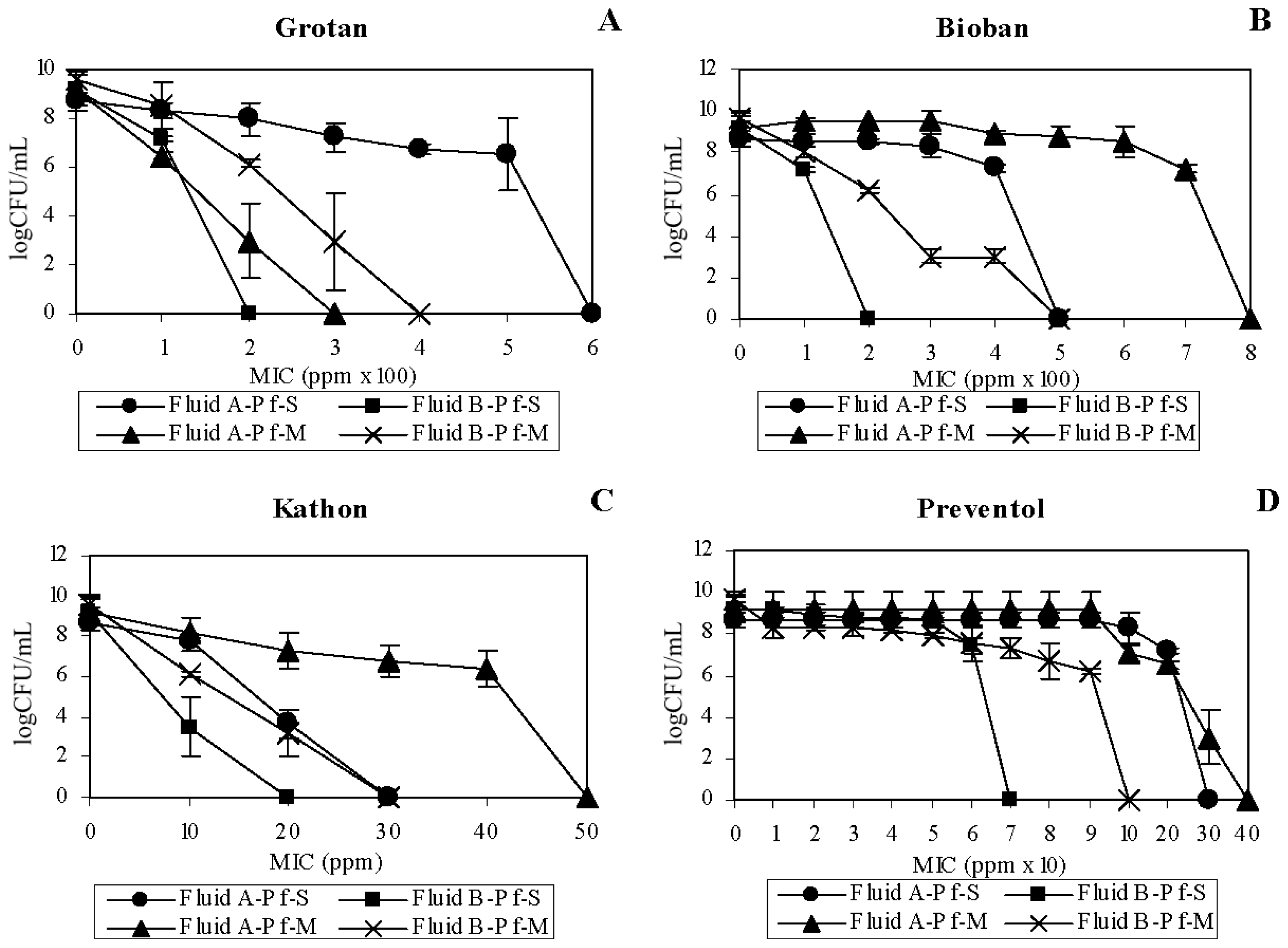
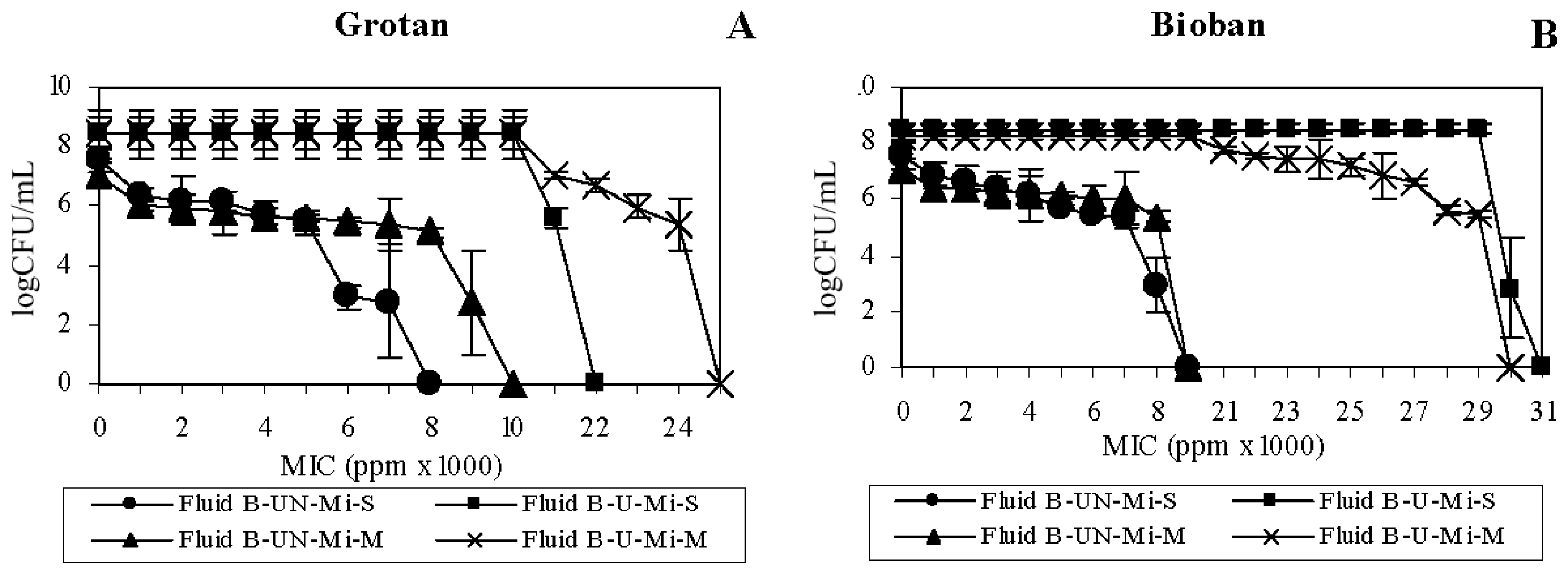
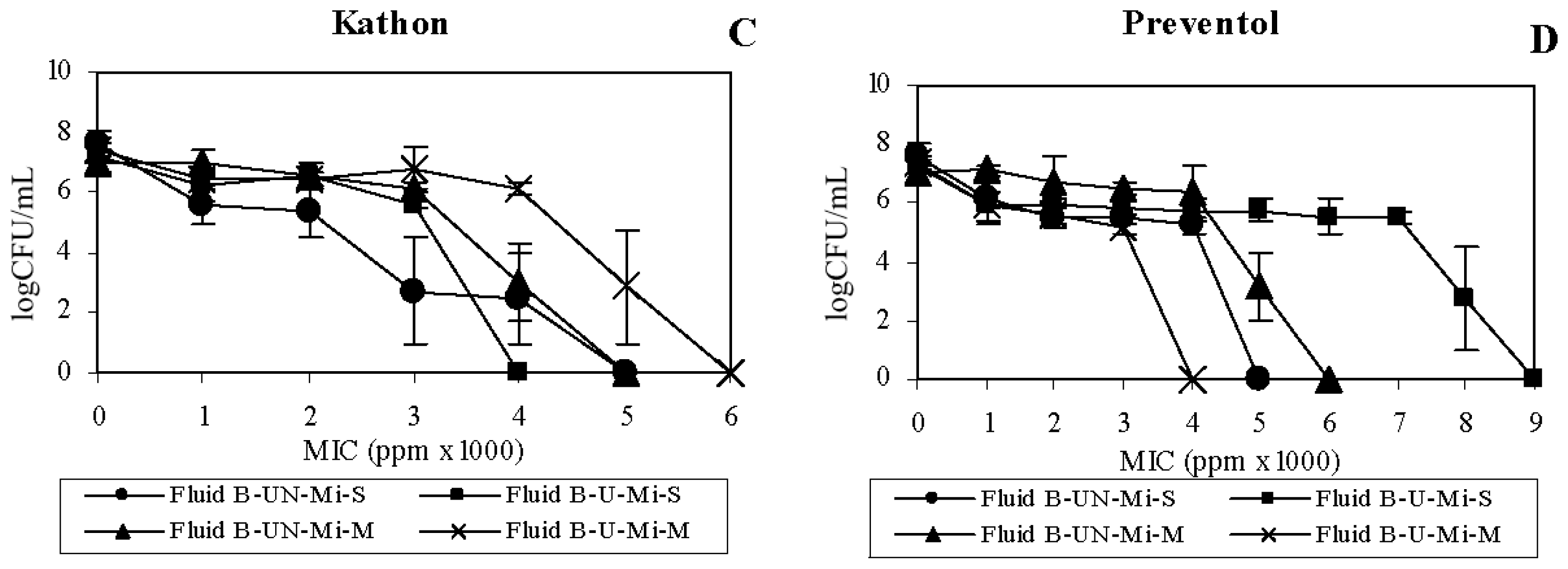
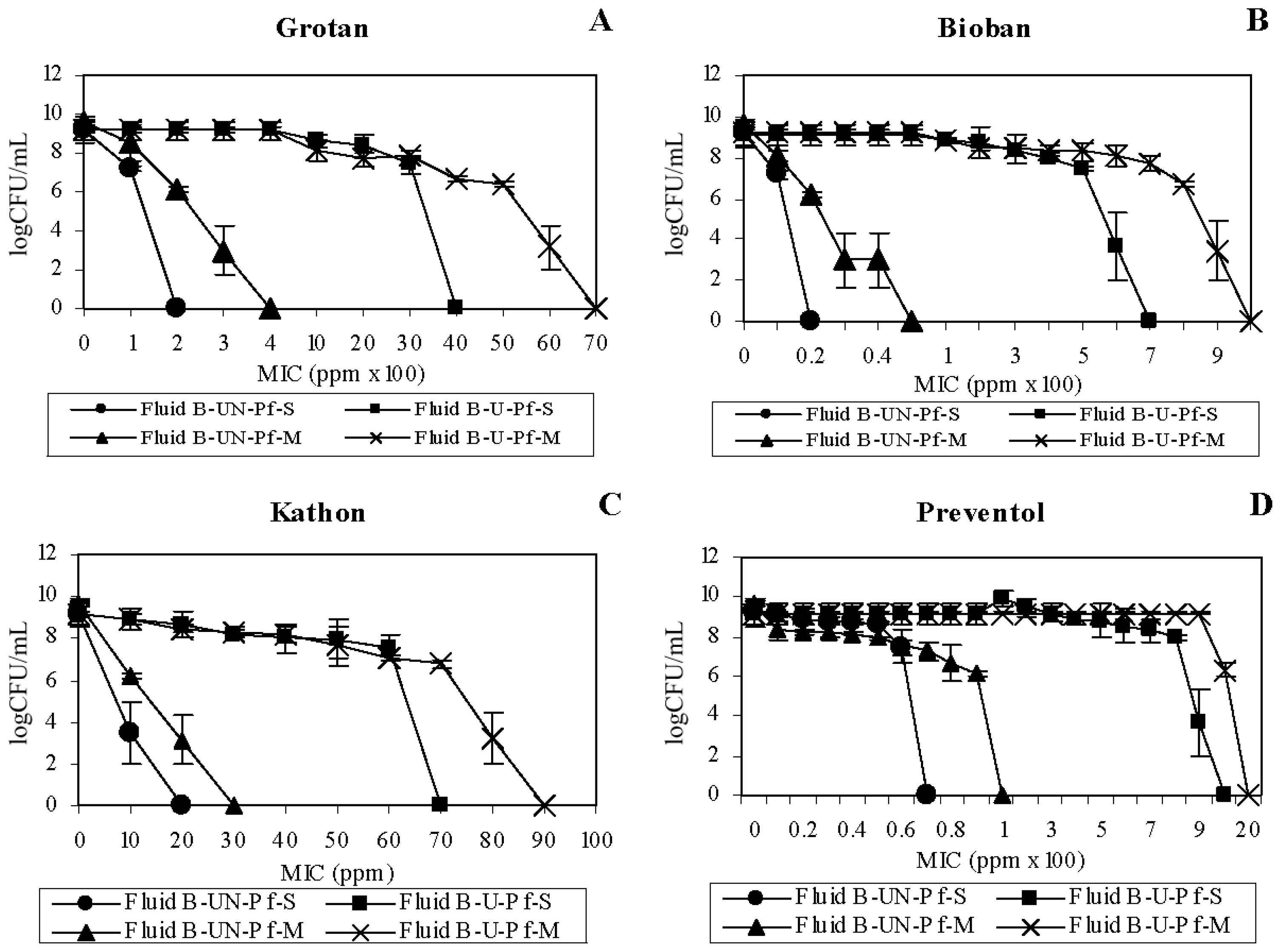
2.1. Effect of Fluid Type on Biocide Efficacy
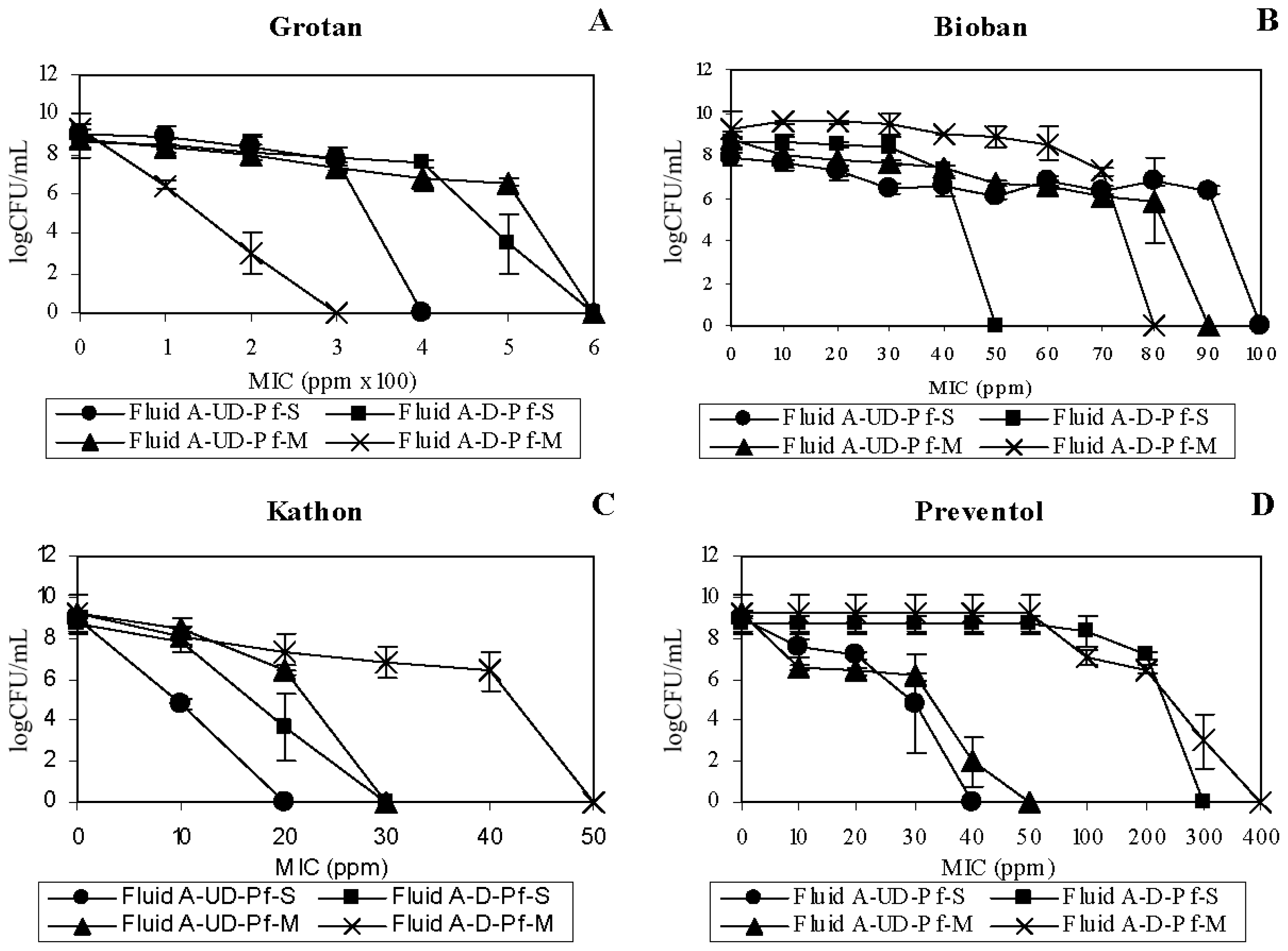
2.2. Effect of Fluid Dialysis on Biocidal Activity
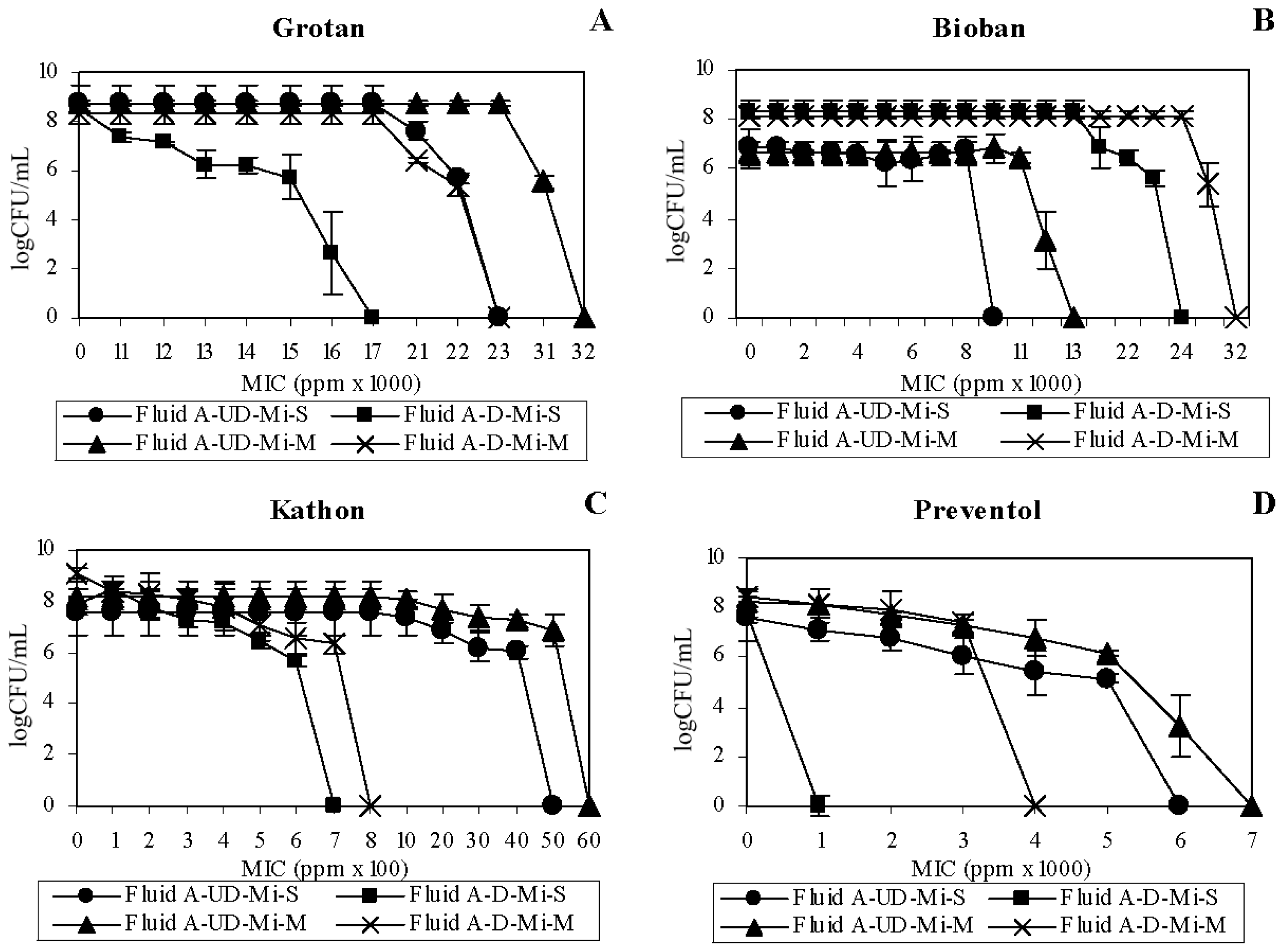
2.3. Effect of Fluid Usage on Biocidal Activity
2.4. Increased Biocide Resistance of M. Immunogenum
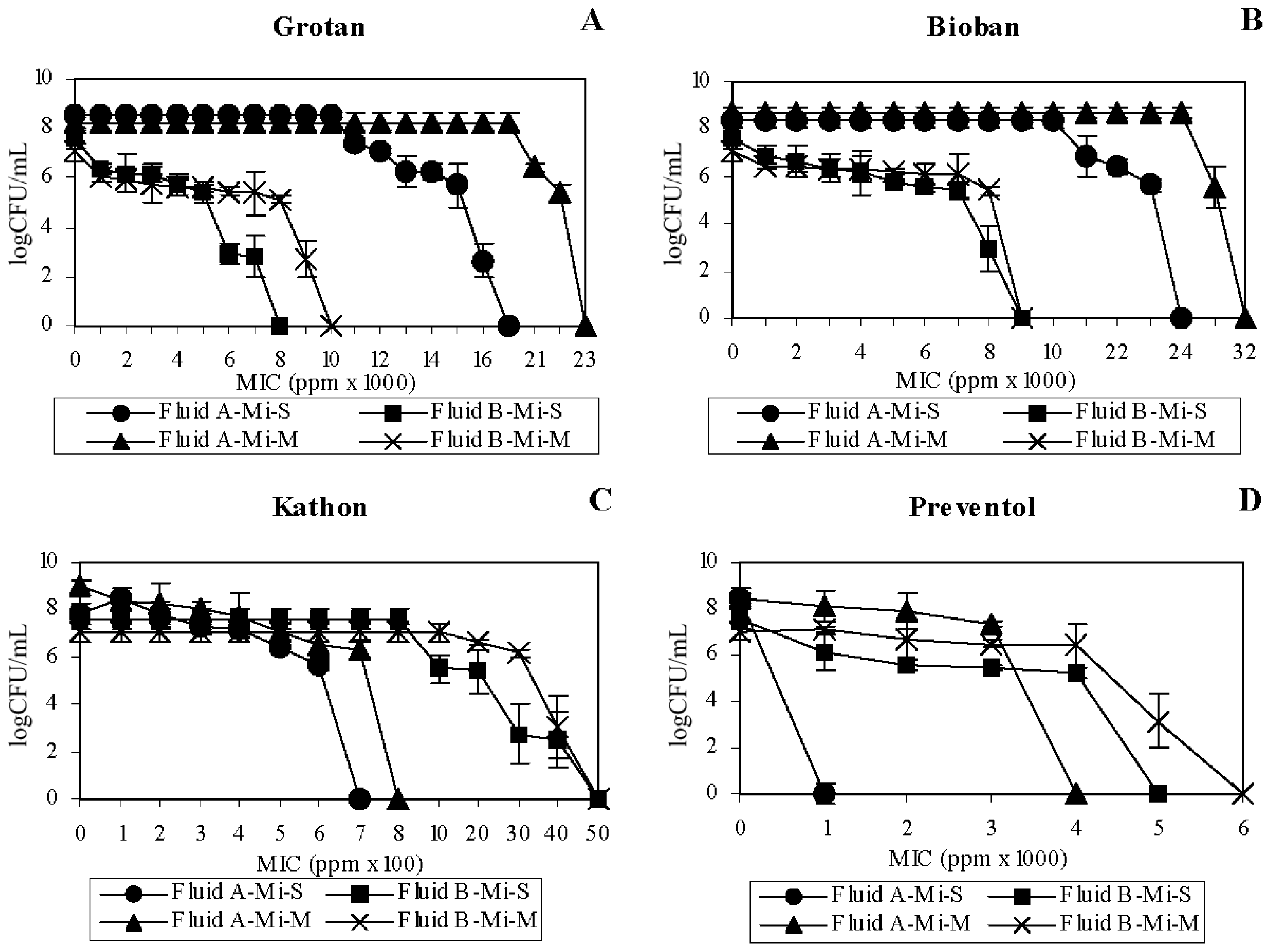
2.5. Role of Co-Contamination in Biocide Susceptibility of the Test Organisms
3. Experimental Section
3.1. Microbial Isolates and Culture Conditions
3.2. Metalworking Fluids
3.3. Biocides
3.4. Fluid Dialysis
3.5. Biocide Susceptibility Testing
4. Conclusions
Acknowledgements
Abbreviations
| HCHO-biocide | formaldehyde-releasing biocide |
| ai | active ingredient |
| MWF | metalworking fluid |
| MIC | minimum inhibitory concentration |
References
- Rossmoore, LA; Rossmoore, HW. Metalworking fluid microbiology. In Metalworking Fluids; Byers, JP, Ed.; Marcel Decker Inc.: New York, NY, USA, 1994; pp. 247–271. [Google Scholar]
- Fox, J; Anderson, H; Moen, T; Gruetzmacher, G; Hanrahan, L; Fink, J. Metal working fluid-associated hypersensitivity pneumonitis: An outbreak investigation and case-control study. Am. J. Ind. Med 1999, 35, 58–67. [Google Scholar]
- Rossmoore, H; Bassett, D. Oil mist exposures and the development of hypersensitivity pneumonitis. Presented at the American Conference of Governmental Industrial Hygienists, Cincinnati, OH, USA, October 2004.
- Olten, DK; Mensing, M; Bruning, T; Merget, R. Airways and lung disease by metal working fluids. Pneumologie 2003, 57, 212–221. [Google Scholar]
- Woskie, SR; Virji, MA; Kriebel, D. Exposure assessment for a field investigation of the acute respiratory effects of metalworking fluids. I. Summary of findings. Am. Ind. Hyg. Assoc. J 1996, 57, 1154–1162. [Google Scholar]
- Trout, D; Weissman, DN; Lewis, D; Brundage, RA; Franzblau, A; Remick, D. Evaluation of hypersensitivity pneumonitis among workers exposed to metal removal fluids. Appl. Occup. Environ. Hyg 2003, 18, 953–960. [Google Scholar]
- Rosenman, KD. Asthma, hypersensitivity pneumonitis and other respiratory diseases caused by metalworking fluids. Curr. Opin. Allergy Clin. Immunol 2009, 9, 97–102. [Google Scholar]
- Chazal, PM. Pollution of modern metalworking fluids containing biocides by pathogenic bacteria in France. Reexamination of chemical treatments accuracy. Eur. J. Epidemiol 1995, 11, 1–7. [Google Scholar]
- Bernstein, DI; Lummus, ZL; Santilli, G; Siskosky, J; Bernstein, IL. Machine operator’s lung. A hypersensitivity pneumonitis disorder associated with exposure to metalworking fluid aerosols. Chest 1995, 108, 636–641. [Google Scholar]
- Thorne, PS; DeKoster, JA; Subramanian, P. Environmental assessment of aerosols, bioaerosols and airborne endotoxin in a machining plant. Am. Ind. Hyg. Assoc. J 1996, 57, 1163–1167. [Google Scholar]
- Laitinen, S; Linnainmaa, M; Laitinen, J; Kiviranta, H; Reiman, M; Liesivuori, J. Endotoxins and IgG antibodies as indicators of occupational exposure to the microbial contaminants of metal-working fluids. Int. Arch. Occup. Environ Health 1999, 72, 443–450. [Google Scholar]
- Muilenberg, ML; Burge, HA; Sweet, T. Hypersensitivity pneumonitis and exposure to acid-fast bacilli in coolant aerosols. J. Aller. Clin. Immunol 1993, 91, 311. [Google Scholar]
- Kreiss, K; Cox-Ganser, J. Metal working fluid-associated Hypersensitivity Pneumonitis: A workshop summary. Am. J. Ind. Med 1997, 32, 423–432. [Google Scholar]
- Shelton, BG; Flanders, WD; Morris, GK. Mycobacterium sp. as a possible cause of hypersensitivity pneumonitis in machine workers. Emerg. Infect. Dis 1999, 5, 270–273. [Google Scholar]
- Moore, JS; Christensen, M; Wilson, RW; Wallace, RJ, Jr; Zhang, Y; Nash, DR; Shelton, B. Mycobacterial contamination of metalworking fluids: Involvement of a possible new taxon of rapidly growing mycobacteria. Am. Ind. Hyg. Assoc. J 2000, 61, 205–213. [Google Scholar]
- Weiss, LPC; Lewis, R; Rossmoore, H; Fink, J; Harney, J; Trout, D. Respiratory illness in workers exposed to metal working fluid contaminated with nontuberculous mycobacteria—Ohio, 2001. Morb. Mortal. Wkly. Rep 2002, 51, 349–352. [Google Scholar]
- Beckett, W; Kallay, M; Sood, A; Zuo, Z; Milton, D. Hypersensitivity pneumonitis associated with environmental mycobacteria. Environ. Health Perspect 2005, 113, 767–770. [Google Scholar]
- Wallace, RJ, Jr; Zhang, Y; Wilson, RW; Mann, L; Rossmoore, H. Presence of single genotype of the newly described species Mycobacterium immunogenum in industrial metalworking fluids associated with hypersensitivity pneumonitis. Appl. Environ. Microbiol 2002, 68, 5580–5584. [Google Scholar]
- Yadav, JS; Khan, IUH; Fakhari, F; Soellner, MB. DNA-based methodologies for rapid detection, quantification and species-or strain-level identification of respiratory pathogens (Mycobacteria and Pseudomonads) in metalworking fluids. Appl. Occup. Environ. Hyg 2003, 18, 966–975. [Google Scholar]
- Khan, IUH; Selvaraju, SB; Yadav, JS. Occurrence and characterization of multiple novel genotypes of Mycobacterium immunogenum and Mycobacterium chelonae from Metalworking Fluids. FEMS Microbiol. Ecol 2005, 54, 329–338. [Google Scholar]
- Khan, IUH; Yadav, JS. Real-time PCR assays for genus-specific detection and quantification of culturable and non-culturable mycobacteria and pseudomonads in metalworking fluids. Mol. Cell Probes 2004, 18, 67–73. [Google Scholar]
- Selvaraju, S; Khan, IUH; Yadav, JS. A new method for species identification and differentiation of Mycobacterium chelonae complex based on amplified hsp65 restriction analysis (AHSPRA). Mol. Cell Probes 2005, 19, 93–99. [Google Scholar]
- Selvaraju, S; Khan, IUH; Yadav, JS. Specific detection and quantification of culturable and non-culturable mycobacteria in metalworking fluids by fluorescence-based methods. Lett. Appl. Microbiol 2008, 47, 451–456. [Google Scholar]
- Selvaraju, S; Khan, IUH; Yadav, JS. Biocidal activity of formaldehyde and nonformaldehyde biocides toward Mycobacterium immunogenum and Pseudomonas fluorescens in pure and mixed suspensions in synthetic metalworking fluid and saline. Appl. Environ. Microbiol 2005, 71, 542–546. [Google Scholar]
- Selvaraju, S; Khan, IUH; Yadav, JS. Differential biocide susceptibility of the multiple genotypes of Mycobacterium immunogenum. J. Ind. Microbiol. Biotechnol 2008, 35, 197–203. [Google Scholar]
- Steinhauer, K; Goroncy-Bermes, P. Treatment of water-based metalworking fluids to prevent hypersensitivity pneumonitis associated with Mycobacterium spp. J. Appl. Microbiol 2008, 104, 454–464. [Google Scholar]
- Falkinham, JO, III. Effects of Biocides and Other Metal Removal Fluid Constituents on Mycobacterium immunogenum. Appl. Environ. Microbiol 2009, 75, 2057–2061. [Google Scholar]
- Rossmoore, HW. Biocides for metalworking lubricants and hydraulic fluids. In Handbook of Biocide and Preservative Use; Rossmoore, HW, Ed.; Blackie Academic & Professional: New York, NY, USA, 1995; pp. 133–156. [Google Scholar]
- Riha, VF; Sondossi, M; Rossmoore, HW. The potentiation of industrial biocide activity with Cu2+. II. Synergistic effects with 5-chloro-2-methyl-4-isothiazolin-3-one. Int. Biodeterior 1990, 26, 303–313. [Google Scholar]
- Carson, LA; Petersen, NJ; Favero, MS; Aguero, SM. Growth characteristics of atypical mycobacteria in water and their comparative resistance to disinfectants. Appl. Environ. Microbiol 1978, 36, 839–846. [Google Scholar]
- Newton, GL; Fahey, RC. Mycothiol biochemistry. Arch. Microbiol 2002, 178, 388–394. [Google Scholar]
- Gilbert, P; McBain, AJ. Potential impact of increased use of biocides in consumer products on prevalence of antibiotic resistance. Clin. Microbiol. Rev 2003, 16, 189–208. [Google Scholar]
- Maillard, JY. Bacterial target sites for biocide action. J. Appl. Microbiol 2002, 92, 16S–27S. [Google Scholar]
- Eager, RG; Leder, JJ; Theis, AB. Glutaraldehyde: Factors important for microbicidal efficacy. Proceedings of the 3rd Conference on Progress in Chemical Disinfection, Binghamton, NY, USA; 1986; pp. 32–49. [Google Scholar]



| Biocide | Matrices | Biocide Concentration (ppm) and Growth Inhibition | |||||||||||||||
|---|---|---|---|---|---|---|---|---|---|---|---|---|---|---|---|---|---|
| M. immunogenum (60 min) | P. fluorescens (15 min) | ||||||||||||||||
| 100 | 1000 | 10,000 | 100,000 | 100 | 1000 | 10,000 | 100,000 | ||||||||||
| S | M | S | M | S | M | S | M | S | M | S | M | S | M | S | M | ||
| Grotan | Fluid A(NUD) | + | + | + | + | + | + | − | − | + | + | − | − | − | − | − | − |
| Fluid A(ND) | + | + | + | + | + | + | − | − | + | + | − | − | − | − | − | − | |
| Fluid B(ND) | + | + | + | + | − | − | − | − | + | + | − | − | − | − | − | − | |
| Fluid B(UD) | + | + | + | + | + | + | − | − | + | + | + | + | − | − | − | − | |
| Bioban | Fluid A(NUD) | + | + | + | + | − | + | − | − | − | − | − | − | − | − | − | − |
| Fluid A(ND) | + | + | + | + | + | + | − | − | − | − | − | − | − | − | − | − | |
| Fluid B(ND) | + | + | + | + | − | − | − | − | − | − | − | − | − | − | − | − | |
| Fluid B(UD) | + | + | + | + | + | + | − | − | + | + | − | − | − | − | − | − | |
| Kathon | Fluid A(NUD) | + | + | + | + | − | − | − | − | − | − | − | − | − | − | − | − |
| Fluid A(ND) | + | + | − | − | − | − | − | − | − | − | − | − | − | − | − | − | |
| Fluid B(ND) | + | + | + | + | − | − | − | − | − | − | − | − | − | − | − | − | |
| Fluid B(UD) | + | + | + | + | − | − | − | − | − | − | − | − | − | − | − | − | |
| Preventol | Fluid A(NUD) | + | + | + | + | − | − | − | − | − | − | − | − | − | − | − | − |
| Fluid A(ND) | + | + | − | + | − | − | − | − | + | + | − | − | − | − | − | − | |
| Fluid B(ND) | + | + | + | + | − | − | − | − | − | − | − | − | − | − | − | − | |
| Fluid B(UD) | + | + | + | + | − | − | − | − | + | + | − | + | − | − | − | − | |
© 2011 by the authors; licensee Molecular Diversity Preservation International, Basel, Switzerland. This article is an open-access article distributed under the terms and conditions of the Creative Commons Attribution license (http://creativecommons.org/licenses/by/3.0/).
Share and Cite
Selvaraju, S.B.; Khan, I.U.H.; Yadav, J.S. Susceptibility of Mycobacterium immunogenum and Pseudomonas fluorescens to Formaldehyde and Non-Formaldehyde Biocides in Semi-Synthetic Metalworking Fluids. Int. J. Mol. Sci. 2011, 12, 725-741. https://doi.org/10.3390/ijms12010725
Selvaraju SB, Khan IUH, Yadav JS. Susceptibility of Mycobacterium immunogenum and Pseudomonas fluorescens to Formaldehyde and Non-Formaldehyde Biocides in Semi-Synthetic Metalworking Fluids. International Journal of Molecular Sciences. 2011; 12(1):725-741. https://doi.org/10.3390/ijms12010725
Chicago/Turabian StyleSelvaraju, Suresh B., Izhar U. H. Khan, and Jagjit S. Yadav. 2011. "Susceptibility of Mycobacterium immunogenum and Pseudomonas fluorescens to Formaldehyde and Non-Formaldehyde Biocides in Semi-Synthetic Metalworking Fluids" International Journal of Molecular Sciences 12, no. 1: 725-741. https://doi.org/10.3390/ijms12010725