


Abstract
The use of biocatalysts for the production of both consumer goods and building blocks for chemical synthesis is consistently gaining relevance. A significant contribution for recent advances towards further implementation of enzymes and whole cells is related to the developments in miniature reactor technology and insights into flow behavior. Due to the high level of parallelization and reduced requirements of chemicals, intensive screening of biocatalysts and process variables has become more feasible and reproducibility of the bioconversion processes has been substantially improved. The present work aims to provide an overview of the applications of miniaturized reactors in bioconversion processes, considering multi-well plates and microfluidic devices, update information on the engineering characterization of the hardware used, and present perspective developments in this area of research.
1. Introduction
Biocatalysis relies on the catalytic ability of enzymes to promote the chemical conversion of educts into given products. Biocatalysis hence differs from fermentation processes, where de novo synthesis of molecules is made from carbon and energy sources [1]. The wide plethora of biological agents used as sources for biocatalysts, combined with the use of different environments as bioconversion media and suitable engineering approaches for the characterization of the bioconversion process, allowed for an undeniable success when the implementation of biocatatytic systems at laboratory scale is considered. Enzyme technology is applied for the production of bulk and speciality chemicals; drugs and intermediates; goods for food and feed industry; soaps, cleaning and personal care products; textile, oil, wastewater and waste processing, occasionally aiming at incorporation in sustainable energy production processes; production of plastics and similar synthetics; biosensors. Enzyme technology is furthermore used in several medical, materials and bioremediation applications [2–5]. Despite of a comparatively lower start, the implementation of bioconversion processes at an industrial scale, meaning products commercialized at a scale over 100 kg on an annual basis, is almost doubling every decade. A recent study established the number of bioconversion processes at industrial scale at about 150 [1]. Alongside, the market for enzymes has increased in an almost exponential manner from the 1960s to 2000. Some shots in the arm can account for such a development pattern. Some of those significant milestones include the use of detergent proteases, the development of enzymatic methods for starch processing and the application of enzymes in synthesis. Alongside came also new approaches for the improvement or identification of more efficient biocatalysts. These include the introduction of recombinant DNA technology as well as new methodologies for assessing biodiversity (viz. metagenome approach, sequence-based discovery). The latter overcame the limitation of traditional screening methods, ascribed to the low number of microorganisms that can be cultured from those in a typical soil sample [6–8]. The introduction of recombinant DNA technology, and later, of enzyme engineering, through directed and particularly through random mutagenesis, namely using directed evolution, has actually strongly contributed to a revitalization of biocatalysis in the last 25 years [7,9–13]. This resurgence was particularly welcome, since it allowed both to further expand the potential of biocatalysis and to contribute for the rebuttal of some criticisms of biocatalysis, which were voiced in roughly the same time frame. Some key papers were also published, that suitably addressed such criticisms [11,14–16]. A common remark from these papers is the need to avoid generalizations.
One of the criticisms of biocatalytic systems that is still put forward is that they are relatively slow to implement [2,17]. The rapid and consistent emergence of microscale processing techniques that have been successfully implemented recently, based in the use of microwell plates and/or miniature/micro- bioreactors, are contributing much to speed up the development of bioconversion systems. Many of these developments take place alongside with research efforts within the same field focused in fermentation and cell culture systems [18–23]. The high level of parallelization achieved in such devices allows for the high throughput required in the different stages of development of a bioconversion process. These may include the biocatalyst screening step; the generation of libraries of recombinant biocatalysts with improved activity/selectivity/stability; the selection of suitable operational conditions, both for biocatalyst production or for performing the biocatalytic step, including strategies for enzyme immobilization [24–34]. Within the wide array of configurations and working volumes available, the present work will focus on miniature (less than 10 mL) bioreactors, multiwall plates and microchannel reactors. Alongside with the high number of variables and parameters that can be assessed simultaneously, miniaturization also allows for significant reductions in manpower, as well as in the amounts of reagents required and in waste production, with significant contributions to cost reduction in process development and well as making the process greener [35–37]. Miniaturization down to the microfluidic environment presents further advantages, namely a more rapid heat exchange and mass transfer, as compared to conventional, larger scale systems. Within the scope of process intensification, microscale processing techniques have also been developed that are dedicated to the downstream step [38], namely involving centrifugation [39], chromatography [40], liquid-liquid extraction [41,42] or microfiltration [43].
2. Miniature Systems
2.1. Multi-well Plates as Bioreactors
Multi-well plates have been intensively used for high throughput screening of enzyme activity, in assays based in the production (depletion) of a chromogenic or fluorogenic product (substrate), allowing for the simultaneous evaluation of up to 106 different variants [29,44]. Screening can be performed in liquid media or in solid media [45]. Within this scope, multi-well plate based screening has been mostly used for profiling hydrolases, and, to a minor extent, proteases [46]. Multi-well plates have also been used to evaluate the kinetics of biotransformation systems [24,47]. Dynamic pH monitoring as strategy for the determination of kinetic parameters has also been performed, using as model system the hydrolysis of 4-nitrophenol catalyzed by penicillin acylase, and based in the color change of a pH indicator [48]. A similar approach was developed recently for assessing fat quality in foods [49]. The test relied on the influence of fat composition in lipase activity and was monitored by absorbance shift. Recently, Rachinskiy and co-workers developed an experimental set-up based in multi-well plates that allows for the high throughput of enzyme performance and stability [50]. Enzymes are submitted to extreme conditions for short time periods in order to anticipate their long term stability under milder conditions. The methodology combines the high level of parallelization provided by multi-well plates, thorough temperature control, on line techniques to monitor shifts of given parameters (viz. pH) along the time course of the reaction and software for processing the raw data.
The commercialization of multi-well plates with pH (or dissolved oxygen) sensitive sensor spots embedded in each well, coupled to on-line data acquisition ( www.presens.de), favors the implementation of this approach for evaluation of kinetic data, although limited to bioconversion systems where pH (oxygen) changes are involved (Table 2).
Table 2.
Characterization of bioconversion systems using multi-well plates.
To be representative such studies require an understanding of the impact in mass transfer phenomena and flow dynamics due to operation on a microliter scale. In the particular case of multi-well plates, mixing is typically promoted by shaking rather than by stirring. Some exceptions to this pattern are the use of micro stir bars in the screening of activity for the whole cell reduction of 6-bromo-β-tetralone to 6-bromo-β-tetralol within yeast and rhodococci libraries [53] and in the assessment of mixing conditions in the production of l-erythrulose promoted by a transketolase [47]; or gas sparging through porous membranes inserted into the base of each well, used for microbial cell growth [54]. The shape of the well (viz. round well vs square well), along with the static surface area to volume ratio and shaking intensity has been shown to affect biocatalyst activity in bioconversion systems requiring oxygen, hence gas-liquid mass transfer, such as the Baeyer-Villiger oxidation of bicyclo[3.2.0]hept-2-en-6-one [24]. Such behavior has been ascribed to the pattern of oxygen transfer. Given the relevance of gas-liquid transfer in oxygen dependent reactions, particular care has been given to the identification of operational condition that favor oxygen transfer into the liquid phase, hence preventing operating in biased conditions due to oxygen limitations. This is mostly due to: (a) enhanced shaking intensity within given boundaries, a lower boundary where oxygen transfer rate is distinguishable from static cultures, and an upper boundary, corresponding to a kinetic limited regime or to liquid spillage out of the vessel; (b) increased shaking amplitude; (c) a high static surface to volume ratio where it is assumed that oxygen transfer to the liquid phase mostly occurs at the surface of the liquid rather than by entrained bubbles; (d) improved mixing in square shaped wells, which emulate baffles [24,55–59]. Operation under suitable gas-liquid volumetric mass transfer coefficient, kla, matching those observed in conventional laboratory (or higher)-scale bioreactor has been shown feasible in miniaturized systems, either based in given multi-well plates and in miniature bioreactors, and this parameter used as criterion for scale-up of fermentation systems [59,60–63]. When multi-well plates are used, a higher ratio of the gas–liquid exchange area to the volume of the bulk liquid can be made available. Miniaturization gives relevance to physical properties such as surface tension, which counters gravitational forces and bubbling, that are further enhanced alongside with size reduction. This pattern is therefore relatively unnoticed in 24-well plates, and increasingly noticeable in 48-, 96- and 384-well plates [55,64,65]. Given those two physical characteristics, a reasonable oxygen transfer rate can be obtained even under a poor degree of mixing of the bulk liquid in multiwall plates [65]. Optical methods for measuring surface tension of liquids contained in multiwall plates have hence been developed, in order to adequately cope with the high throughput nature of the process [66].
When gas-liquid transfer is not needed, the degree of mixing required is no longer related to a given demand for mass transfer between the two phases. Mixing takes place at different levels, macro-, meso- and micro-mixing. Macro-mixing relates to mixing at a macroscopic scale, hence at the scale of vessel, and leads to large-scale distribution patterns, such as residence-time distribution and concentration gradients. Meso-mixing relates to the blending of feed columns of fluid with the bulk fluid, and corresponds to the process where the reactant incoming into the reactor moves away from the plume and is reduced to turbulent eddies. Unlike macro-mixing, that relates to the whole lifetime of an element of fluid in the vessel, meso-mixing relates only to the early moments of an element of fluid that has entered the reactor. Micro-mixing promote contact of fluids at the microscopic or molecular scales. Micro-mixing comprehends a viscous-convective alteration of elements of fluid followed by diffusion [67,68]. In a relative timescale, micro-mixing and reaction times are comparable [69]. With miniaturization, micro-mixing tend to be predominant. Furthermore, and alongside with the decrease in linear dimensions, shorter mixing times are needed, hence diffusion limitation are minimized. Although this pattern is typical of microfluidic devices [20,85], the pattern is already observed at multi-well plate level. Thus, while assessing the relevance of mass transfer in miniaturized system, using as model system the production of l-erythrulose catalysed by transketolase, Matosevic and coworkers noticed that only when the 24-well reaction plate was vigorously mixed, the initial reaction rate statistically matched data obtained from non-shaking 96-well plate [47]. Multiwell plates are typically made of polypropylene or polystyrene, with the later being preferred due to the lack of leakage of toxic substances [56].
2.2. Microfluidic Systems
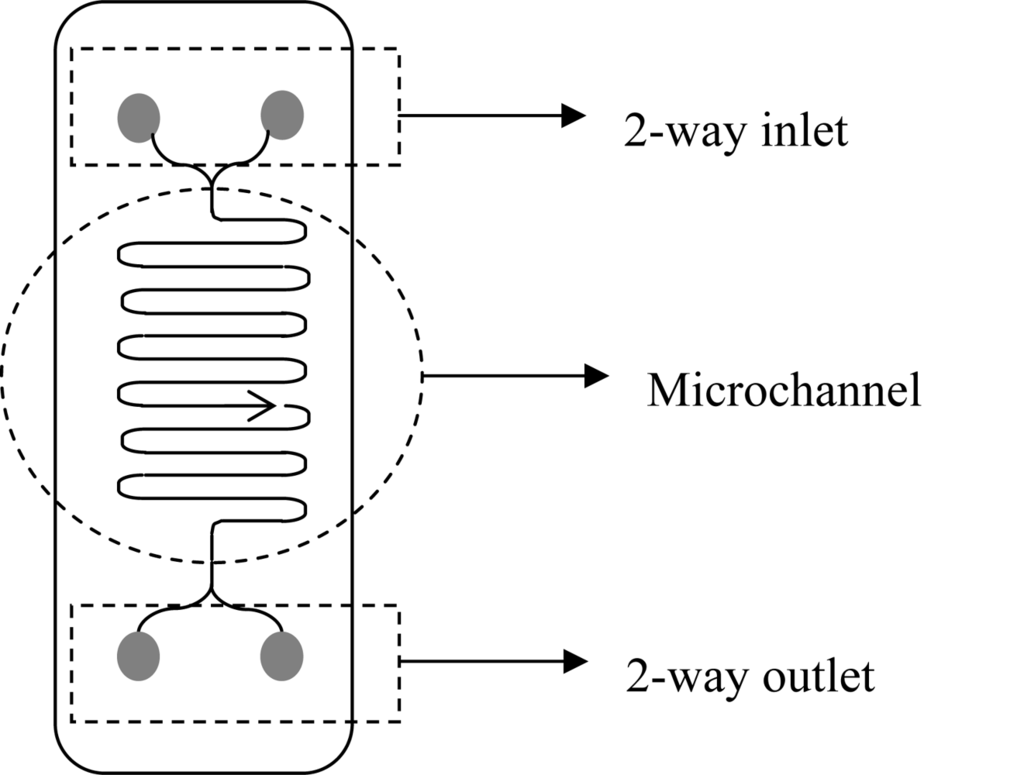
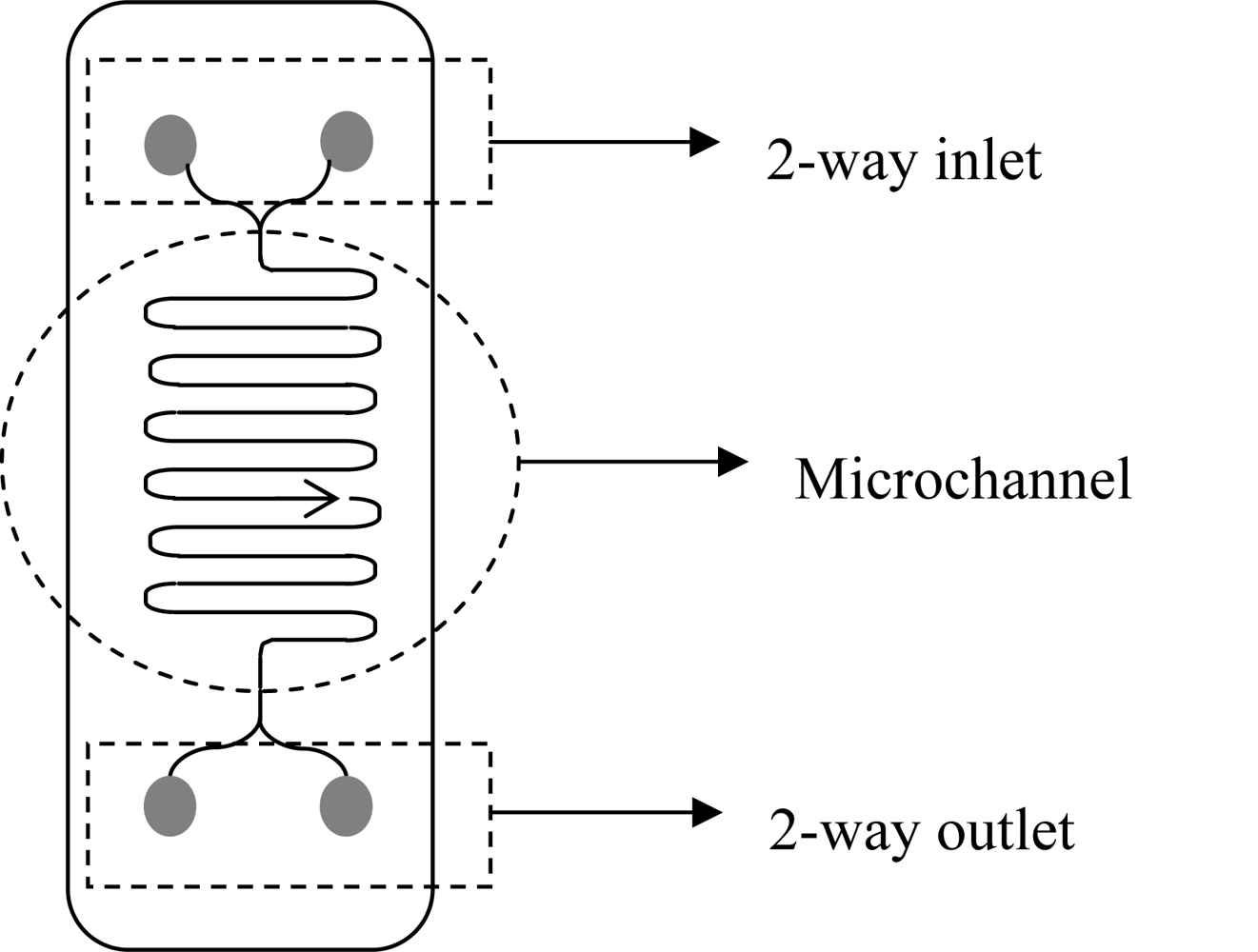
Microfluidic reactors provide another format for miniaturized bioconversion systems. Unlike micro-well plates, microfluidic reactors allow for processing small volumes (10−9 to 10−12 m3) of fluid within channels, where at least one dimension is smaller than 1 mm (typically tens to hundreds of micrometers), and are compatible with continuous flow mode of operation. Microfluidic devices themselves are concomitantly of small dimensions, from some mm to micrometers [20,70,73,85]. Microfluidic reactors consist of a network of miniaturized channels, embedded in a flat surface, comonly called “chip” [20,71,72] (Figure 1). Along with this chip type of microreactors, simpler microcapillary devices are also extensively used, where the microchannel is the reaction space, and thus no control of microfluidics is required. On the other hand, they do not allow for the integration of different processes into one reaction device, unlike chip microreactors [73].
Figure 1.
Scheme of a typical microfuidic device, with a microchannel and 2-ways inlet and outlet. Microreactors are commercially available from Chemtrix, CPC–Cellular Process Chemistry Systems GmbH Ehrfeld Mikrotechnik, Micronit/Future Chemistry, Microinnova, Mikroglas, Syrris, among others.
Scaling-up a bioconversion process for conventional bioreactors encompasses the use of a suitable engineering criterion, that is to be maintained constant throughout scales, such as the volumetric oxygen transfer coefficient (kla), volumetric power consumption, mixing time or impeller tip speed, when microreactors are considered the operational conditions can be scaled by simply operating multiple systems in parallel, a process termed numbering-up or scaling-out. This feature is particularly attractive since it takes away the technical and financial risks associated with scaling a given process in traditional manner.
2.2.1. Materials
A wide array of materials has been used to build microfluidic reactors, among them polymers, glass, metals, and ceramics. Polymer-based devices typically present low cost and allow for the easy integration of flow control systems (viz. pneumatic valves, sensors), but are often sensitive to organic solvents [74]. Poly(dimethylsiloxane), or PDMS, a soft, optically transparent elastomer, is a typical choice for building microreactors [75]. This low-cost polymer is stable in aqueous environment and due to its low interfacial free energy there is a low probability of other polymers or fluids reacting with or attaching to its surface [75–77]. PDMS is however prone to swell or even dissolve in the presence of some organic solvents, and has a relatively limited temperature stability, although the later is compatible with common biological applications. Besides, its elastic properties lead to some restrictions in the design, since a high aspect ratio of the microchannels may result in pairing, where parallel structures attach to each other, whereas low aspect ratio can result in sagging, hence making the recommended aspect ratio for PDMS structures to be within 0.2 and 2 [76,78,79]. Other polymers commonly used are SU-8, an epoxy photosensitive epoxy resin that allows for adequate aspect ratio structures to be obtained [74,80], and silicone. The later polymer is actually also widely used for microreactor building. Not only fabrication methods that are well established for semi-conductor chip production are easily amenable, but also silicone has high thermal conductivity, allowing for excellent heat transfer capability. Furthermore, when oxidized, silicone becomes chemically inert towards most chemicals and solvents [71,74]. Glass is another widely used material for building microfluidic reactors, despite its rigid, brittle nature. Glass is however chemically inert to most reagents and solvents, and since it is transparent allows for visual inspection of events inside the reactor. Besides methods for fabrication, such as photolithography, are well established [70,71,78]. Stainless steel is the preferred metal for building microreactors. A well-established material, resistant to organic solvents and a wide array of chemicals, enables operation under pressure and high temperatures. Typically these reactors are larger than those made from polymers or glass, and are mostly used for pilot-plant or production scale, although they are also available for academic research purposes [70,71]. Methods for fabrication of microfluidic chip reactors include laser ablation, micro-injection molding, surface treatment and photolithography, perhaps the most popular. A detailed description of the different methodologies can be found in [70].
2.2.2. Flow in Microfluidic Devices
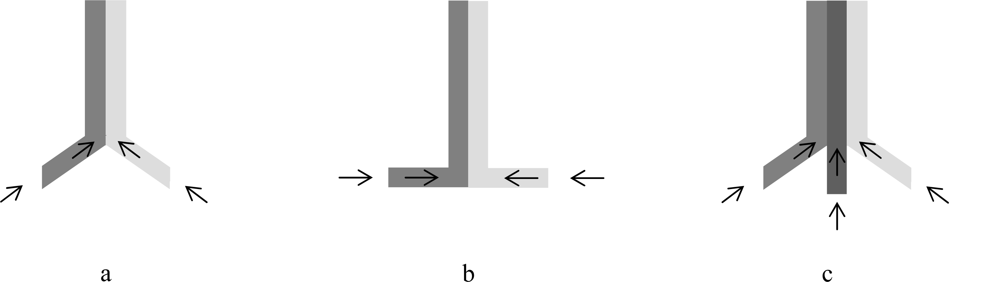
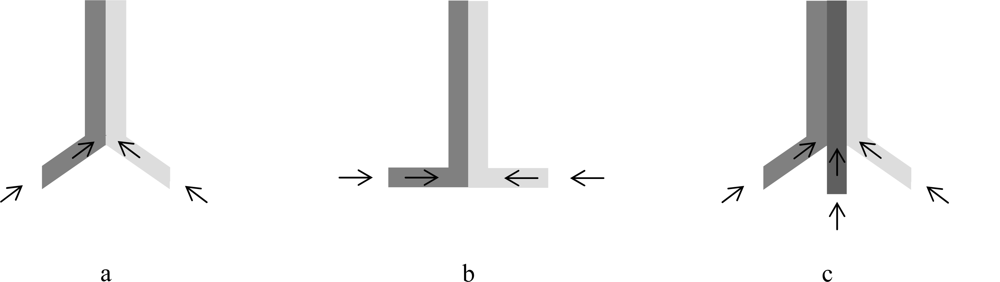
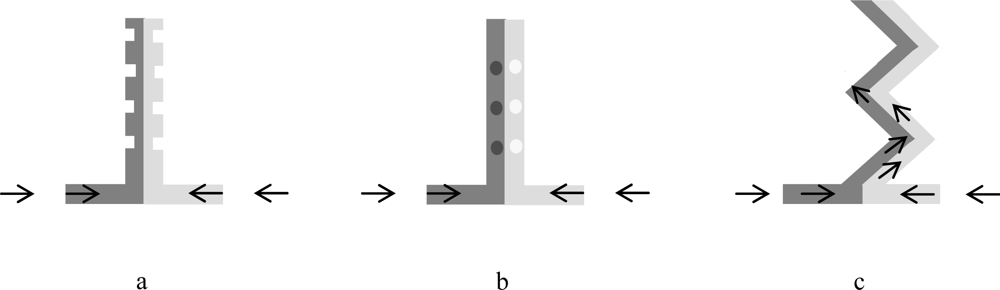
Continuous flow is by large the preferred mode of operation in large-scale processing in the chemical industry [81], so the use of microfluidic devices brings high-throughput, lab-scale process optimization closer to the large-scale processes [82–84]. Flow in microfluidic reactors can be single phase or multiphase, where in the later case two or more phases are separately added to the reactor, typically in co-current mode. Most common junctions for multiphase flow are T, cross, interdigitated multilamellar mixer, Ψ and Y junctions, the latter being widely used in two-phase bioconversion systems [70,85] (Figure 2).
Figure 2.
Examples of junctions in microfluidic devices: (a) Y junction; (b) T junction (c) Ψ junction. Arrows suggest direction of flow.
The flow dynamics and mass transfer in a microfluidic environment, however, differs from larger systems. Given the small dimensions, the flow regime is typically laminar, interfacial forces are dominant over gravitational forces and since turbulence is not present due to the high viscous forces, mixing relies on molecular diffusion [85,86]. The laminar flow favors the control and modeling of the reaction, and provide high surface area to volume ratio (>200) and interfacial areas, a feature particularly advantageous in two-liquid extractive bioconversion systems [20,73,87]. In such environment Reynolds and Bond numbers are usually small and the Peclét number is high [88,89]. The Reynolds number, Re, represents the ratio inertial to viscous force (1):
where u is the linear velocity of the fluid, L is the hydraulic diameter of the microchannel and ν is the kinematic viscosity. The Bond number, Bo, expresses the ratio of gravitational to surface tension forces (2):
where Δρ and γ are the density difference and the interfacial tension between two phases, respectively, and g is the gravitational acceleration. The Peclét number, Pe, expresses the ratio of forced convection to diffusion (3):
where D is the diffusion coefficient. Also relevant in the characterization of multiphase flow is the Weber number, We, which provides the ratio between inertial and surface tension forces, (4), and is useful in the analysis of thin film flows and formation of droplets and bubbles. Despite of the small paths involved, We in the range of some hundreds can be obtained in microfluidic devices [70]
Finally, the capillary number, Ca, (5), is also a relevant dimensionless parameter in the analysis of multiphase flow. It relates viscous (elongation) to surface tension forces acting across the interface:
where μ is the viscosity of the fluid. Tipically much lower than 1 [89], Ca allows to distinguish two-phase flow patterns and the mechanisms of break-up in T-junctions [90].
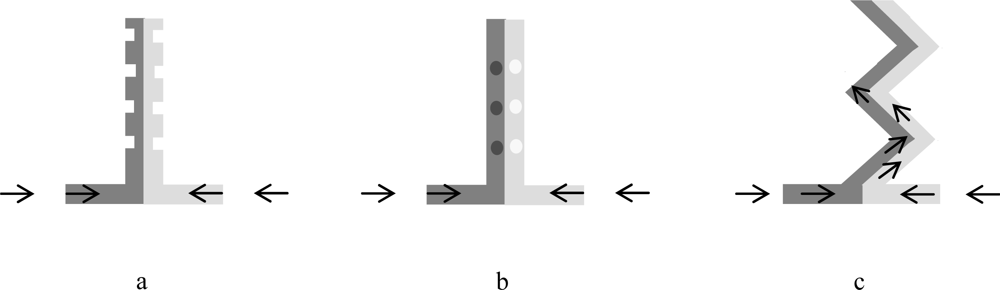
A common approach to improve diffusion-induced mixing is to use long and narrow microchannels (high aspect ratio channels) [86,91]. When channel dimensions are of tens of microns, the diffusion path is small enough for the mixture of different fluid streams to be complete in a few seconds, a time span that is considerably enlarged, to tens of seconds, when the channel dimensions are in the hundreds of microns [92]. Micro-mixers have hence been developed as to increase the interfacial surface and therefore decrease significantly the diffusion length [73,92]. Micro-mixers can be of passive or active nature. In the former case, mixing is promoted by diffusion or chaotic advection, whereas in the later, the flow is disturbed by the action of an external source. Passive mixing can be obtained by lamination, where the inlet streams are divided into several substreams, and then combined together in a single stream; or by chaotic advection, induced by special geometries in the mixing channel, such as zig-zag microchannel, and obstacles on the wall or in the microchannel [73,93] (Figure 3).
Figure 3.
Examples of typical configurations to enhance mixing in microchannels: (a) obstacles on the wall of the microchannel; (b) obstacles in the microchannel (c) zig-zag microchannel. Arrows suggest direction of flow.
Typically fluids are delivered to the microreactor through the use of either syringe or HPLC pumps, within a broad range of flow rates, from μL min−1 to L min−1 [71]. The connection between microreactors and macroscopic fluid delivering device is performed using a large array of components, such as Luer-to-Luer or Luer-to-barb connectors, common HPLC fittings and high-pressure interconnect devices to interface with standard capillary tubing [94].
2.2.3. Applications of Microreactors in Biocatalysis
The use of microreactors for the analysis and development of bioconversion systems has mostly relied in the use of enzymes or at most cell lysates as biocatalysts [73]. Irrespective of the approach used, the microreactor approach has systematically been shown to outperform conventional batch-wise operation, namely when the rate of substrate processing is considered, which could be somehow anticipated, given the favorable mass and heat transfer characteristics of the former [73,95,96]. Different configurations have been used within the scope of microreactors. The simplest form is the operation in a single liquid phase, where substrate and enzyme aqueous solution are fed separately to the microreactor and the reaction takes place along the microchannel. This was used for the hydrolysis/transgalactosylation by glycosidase [97], for the bioluminescent reaction between ATP and luciferin, promoted by luciferase to ultimately yield oxyluciferin and AMP [98], and for the oxidation of 3,4-dihydroxy-l-phenylalanine (l-DOPA) with laccase [95]. In all cases the efficiency of the approach was demonstrated, which somehow paved the way for more complex approaches. One of these is a likely extension of the former, since organic-aqueous or ionic liquid-organic solvent two-liquid phase systems were used. This allowed for the conversion of sparingly water-soluble substrates or for the enzymatic resolution of chiral compounds. The experimental set-up for these occasionally featured Ψ-shaped microreactors, allowing for three independent feeding channels. Further details are given in Table 3.
Table 3.
Examples of microfluidic systems for enzyme catalysis in liquid phase.
Enzymes can be advantageously used in immobilized form since this strategy allows for increased volumetric productivity and often improves stability. Continuous mode of operation is made possible, mostly using a packed-bed reactor (PBR) configuration, since this overcomes the continuous stirred tank reactor (CSTR) configuration, by allowing for higher conversion or space-time yields [2,104,105]. In order to retain the biocatalyst, particularly if in free form, membrane reactors operating in CSTR mode are commonly employed, where it is assumed that the contents of the reactor are perfectly mixed [2]. Other screening devices can be used if the biocatalyst is attached to a carrier or encapsulated. Ex-situ filtration or centrifugation, followed by recycling back into the reactor, is an alternative strategy for enabling continuous mode of operation [105]. Optional to PBR configuration, is the expanded or fluidized bed reactor, where the enzyme particles are retained by a hydrodynamic balance between gravity and drag forces promoted by the up-flow substrate stream [105,106]. The approaches commonly used for immobilization in conventional multiphase biocatalysis can also be used in microreactors, with particular focus on covalent methods, cross linked enzyme aggregates (CLEA) and adsorption (specific and non-specific) methods [107]. The experimental set-ups are preferably either chip-type reactors with activated channel walls where the enzyme binds, or enzyme immobilized monolith reactors, where a support is packed inside a capillary tube (Table 4).
Table 4.
Examples of microfluidic systems with immobilized enzymes.
2.2.4. Visualization and Quantification of Fluid Flow
Gaining the in-depth in fluid mechanics, mixing and heat transfer required for the engineering characterization of miniature and microreactors has required both hardware and software tools, able to collect the required data, process them and generate models representative of the system dynamics. Contribution to the visualization of fluid flow has been made possible through the use of adequate high speed cameras, often combined with (micro) particle image velocimetry, (μ)PIV, and software for image analysis [17,121–127]. Generation of detailed predictive models, representative of the dynamics of flow, which can incorporate reaction data, has been made possible with computational fluid dynamics (CFD). CFD allows therefore for the design and analysis of a given system, as well as for the simulation of fluid flow, (bio)chemical reaction, mass and heat transfer [19,62,87,128,129]. The models developed within the scope of CFD methods are typically anchored in the Navier–Stokes equations and in the convection-diffusion equation [19,130].
3. Conclusions
The introduction of miniaturized devices in biocatalysis is becoming widespread and is clearly contributing to speed up the rate of process development in a cost effective manner. The large parallelization capability allows for simultaneously evaluating a large array of possibilities, hence improving process optimization. Miniaturization encompass the use of multi-well plates and microfluidic devices, each playing preferred roles in the development, characterization and ultimately implementation of bioconversion processes to production scale. The use of microfluidic reactors is the mainstay of this later feature, since processes are easily scaled by parallelization of devices, ruling out the need for elaborate and not always fully reproducible, scale-up procedures. Furthermore, when compared to typical bioreactors, microreactors present the advantage of high surface-to-volume ratio, high heat and mass transfer rates and ease of maintenance. The level of development and the effective application of this concept to bioconversion systems strongly relies on its multidisciplinary character, combining biotechnology, (micro)electronics and (micro)mechanics, microscopy and software for image analysis and data processing. Microreactors are becoming increasingly effective with the concomitant miniaturization of monitoring and controlled fluid delivery devices. Furthermore, the commercial availability of microreactors is increasing, which clearly favors the dissemination of te concept. Given the development trends in the field, and aiming not to be pictured as a panacea for the (bio)chemical (as biocatalysis should also not be) it can be expected that the relevance of miniaturization within biocatalysis and biotransformations is to further increase, and alongside, to further establish this area as a key player within the scope of a sustainable development.
Acknowledgments
Pedro Fernandes acknowledges Fundação para a Ciência e Tecnologia (Portugal) for financial support in the form of programme Ciência 2007.
References and Notes
- Straathof, A. Quantitative analysis of industrial biotransformations. In Industrial Biotransformations, 2nd ed; Liese, A, Seebach, K, Wandrey, C, Eds.; Wiley-VCH Verlag GmbH & Co. KGaA: Weinheim, Germany, 2006; pp. 515–520. [Google Scholar]
- Bommarius, AS; Riebel, BR. Biocatalysis; Wiley-VCH Verlag GmbH & Co. KGaA: Weinheim, Germany, 2004. [Google Scholar]
- Illanes, A. Enzyme Biocatalysis—Principles and Applications; Springer: New York, NY, USA, 2008. [Google Scholar]
- Alcalde, M; Ferrer, M; Plou, F; Ballesteros, A. Environmental biocatalysis: from remediation with enzymes to novel green processes. Trends Biotechnol 2006, 24, 281–287. [Google Scholar] [Green Version]
- Kim, J; Jia, H; Wang, P. Challenges in biocatalysis for enzyme-based biofuel cells. Biotechnol. Adv 2006, 24, 296–308. [Google Scholar]
- Lorenz, P; Eck, J. Screening for Novel Industrial Biocatalysts. Eng. Life Sci 2004, 4, 501–504. [Google Scholar]
- Bornscheuer, UT; Buchholz, K. Highlights in biocatalysis–Historical landmarks and current trends. Eng Life Sci 2005, 5, 309–323. [Google Scholar]
- McNamara, CJ; Mitchell, R. Microbial deterioration of historic stone. Front. Ecol. Env 2005, 8, 445–451. [Google Scholar]
- Jaeger, KE; Eggert, T; Eipper, A; Reetz, MT. Directed evolution and the creation of enantioselective biocatalysts. Appl. Microbiol. Biotechnol 2001, 55, 519–530. [Google Scholar]
- Eijsink, VGH; Gaseidnes, S; Borchert, TV; van den Burg, B. Directed evolution of enzyme stability. Biomolecul. Eng 2005, 22, 21–30. [Google Scholar]
- Johannes, TW; Zhao, H. Directed evolution of enzymes and biosynthetic pathways. Curr. Op. Microbiol 2006, 9, 261–267. [Google Scholar]
- Dalby, P. Engineering enzymes for biocatalysis. Recent Pat Biotechnol 2007, 1, 1–9. [Google Scholar]
- Bershtein, S; Tawfik, DS. Advances in laboratory evolution of enzymes. Curr. Op. Chem. Biol 2008, 12, 151–158. [Google Scholar]
- Rozzell, JD. Commercial scale biocatalysis: Myths and realities. Bioorg. Med. Chem 1999, 7, 2253–2261. [Google Scholar]
- Rasor, JP; Voss, E. Enzyme-catalyzed processes in pharmaceutical industry. Appl. Catal. A: General 2001, 221, 145–158. [Google Scholar]
- Schoemaker, HE; Mink, D; Wubbolts, MG. Dispelling the myths–biocatalysis in industrial synthesis. Science 2003, 299, 1694–1697. [Google Scholar]
- Lye, GJ; Ayazi-Shamlou, P; Baganz, F; Dalby, PA; Woodley, JM. Accelerated design of bioconversion processes using automated microscale processing techniques. Trends Biotechnol 2003, 21, 29–37. [Google Scholar]
- Micheletti, M; Lye, GJ. Microscale bioprocess optimisation. Curr. Op. Biotechnol 2006, 17, 611–618. [Google Scholar]
- Urban, PL; Goodall, DM; Bruce, NC. Enzymatic microreactors in chemical analysis and kinetic studies. Biotechnol. Adv 2006, 24, 42–57. [Google Scholar]
- Miyazaki, M; Maeda, H. Microchannel enzyme reactors and their applications for processing. Trends Biotechnol 2006, 24, 463–470. [Google Scholar]
- Hessel, V; Knobloch, C; Löwe, H. Review on patents in microreactor and micro process engineering. Recent Pat. Chem. Eng 2008, 1, 1–16. [Google Scholar]
- Watts, P; Wiles, C. Recent advances in synthetic micro reaction technology. Chem. Commun 2007, 5, 443–467. [Google Scholar]
- Marques, MPC; Cabral, JMS; Fernandes, P. High throughput in biotechnology: From shakeflasks to fully instrumented microfermentors. Recent Pat. Biotechnol 2009, 3, 124–140. [Google Scholar]
- Doig, SD; Pickering, SCR; Lye, GJ; Woodley, J. The use of microscale processing technologies for quantification of biocatalytic Baeyer-Villiger oxidation kinetics. Biotechnol. Bioeng 2002, 80, 42–49. [Google Scholar]
- Robertson, DE; Steer, BA. Recent progress in biocatalyst discovery and optimization. Curr. Op. Chem. Biol 2004, 8, 141–149. [Google Scholar]
- Ferreira-Torres, C; Micheletti, M; Lye, GJ. Microscale process evaluation of recombinant biocatalyst libraries: application to Baeyer–Villiger monooxygenase catalysed lactone synthesis. Bioprocess Biosyst. Eng 2005, 28, 83–93. [Google Scholar]
- van Beilen, JB; Holtackers, R; Lüscher, D; Bauer, U; Witholt, B; Duetz, WA. Biocatalytic production of perillyl alcohol from limonene by using a novel Mycobacterium sp. cytochrome P450 alkane hydroxylase expressed in Pseudomonas putida. Appl. Environ. Microbiol 2005, 71, 1737–1744. [Google Scholar]
- Brandt, B; Hidalgo, A; Bornscheuer, UT. Immobilization of enzymes in microtiter plate scale. Biotechnol. J 2006, 1, 582–587. [Google Scholar]
- Konarzycka-Besslera, M; Jaeger, K-E. Select the best: novel biocatalysts for industrial applications. Trends Biotechnol 2006, 24, 248–250. [Google Scholar]
- Marques, MPC; de Carvalho, CCCR; Claudino, MJC; Cabral, JMS; Fernandes, P. On the feasibility of the microscale approach for a multi-step biotransformation: sitosterol side-chain cleavage. J. Chem. Technol. Biotechnol 2007, 82, 856–863. [Google Scholar]
- Miller, OJ; Hibbert, EG; Ingram, CU; Lye, GJ; Dalby, PA. Optimisation and evaluation of a generic microplate-based HPLC screen for transketolase activity. Biotechnol. Lett 2007, 29, 1759–1770. [Google Scholar]
- Chen, BH; Micheletti, M; Baganz, F; Woodley, JM; Lye, GJ. An efficient approach to bioconversion kinetic model generation based on automated microscale experimentation integrated with model driven experimental design. Chem. Eng. Sci 2009, 64, 403–409. [Google Scholar]
- Kliche, S; Räuchle, K; Bertau, M; Reschetilowski, W. Ganzzell-Biokatalyse mittels Saccharomyces cerevisiae im Mikroreaktor. Chem. Ing. Tech 2009, 81, 343–347. [Google Scholar]
- Laurent, N; Haddoub, R; Flitsch, S. Enzyme catalysis on solid surfaces. Trends Biotechnol 2008, 26, 328–337. [Google Scholar]
- Fernandes, P; Cabral, JMS. Microlitre/millilitre shaken bioreactors in fermentative and biotransformation processes – A review. Biocat. Biotrans 2006, 24, 237–252. [Google Scholar]
- Zhang, Z; Perozziello, G; Boccazzi, P; Sinskey, AJ; Geschke, O; Jensen, KF. Micro-bioreactors for Bioprocess Development. JALA 2007, 12, 143–151. [Google Scholar]
- Woodley, JM. New opportunities for biocatalysis: making pharmaceutical processes greener. Trends Biotechnol 2008, 26, 321–327. [Google Scholar]
- Titchener-Hooker, NJ; Dunnill, P; Hoare, M. Micro biochemical engineering to accelerate the design of industrial-scale downstream processes for biopharmaceutical proteins. Biotechnol. Bioeng 2008, 100, 473–487. [Google Scholar]
- Tustian, AD; Salte, H; Willoughby, NA; Hassan, I; Rose, MH; Baganz, F; Hoare, M; Titchener-Hooker, NJ. Adapted ultra scale-down approach for predicting the centrifugal separation behavior of high cell density cultures. Biotechnol. Prog 2007, 23, 1404–1410. [Google Scholar]
- Chhatre, S; Titchener-Hooker, NJ. Microscale methods for high-throughput chromatography development in the pharmaceutical industry. J. Chem. Technol. Biotechnol 2009, 84, 927–940. [Google Scholar]
- Bensch, M; Selbach, B; Hubbuch, J. High throughput screening techniques in downstream processing: Preparation, characterization and optimization of aqueous two-phase systems. Chem. Eng. Sci 2007, 62, 2011–2021. [Google Scholar]
- Znidarsic-Plazl, P; Plazl, I. Steroid extraction in a microchannel system—mathematical modelling and Experiments. Lab Chip 2007, 7, 883–889. [Google Scholar]
- Jackson, NB; Liddell, JM; Lye, GJ. An automated microscale technique for the quantitative and parallel analysis of microfiltration operations. J. Memb. Sci 2006, 276, 31–41. [Google Scholar]
- Tao, J; Zhao, L; Ran, N. Recent advances in developing chemoenzymatic processes for active pharmaceutical ingredients. Org. Proc. Res. Dev 2007, 11, 259–267. [Google Scholar]
- Brunati, M; Marinelli, F; Bertolini, C; Gandolfi, R; Daffonchio, D; Molinari, F. Biotransformations of cinnamic and ferulic acid with actinomycetes. Enzyme Microb. Technol 2004, 34, 3–9. [Google Scholar]
- Reymond, J-L; Fluxa, VS; Maillard, N. Enzyme assays. Chem. Commun 2009, 1, 34–46. [Google Scholar]
- Matosevic, S; Micheletti, M; Woodley, JM; Lye, GJ; Baganz, F. Quantification of kinetics for enzyme-catalysed reactions: implications for diffusional limitations at the 10 mL scale. Biotechnol. Lett 2008, 30, 995–1000. [Google Scholar]
- John, GT; Heinzle, E. Quantitative screening method for hydrolases in microplates using pH indicators: determination of kinetic parameters by dynamic pH monitoring. Biotechnol. Bioeng 2001, 72, 620–627. [Google Scholar]
- Bertram, M; Manschot-Lawrence, C; Flöter, E; Bornscheuer, UT. A microtiter plate-based assay method to determine fat quality. Eur. J. Lipid Sci. Technol 2007, 109, 180–185. [Google Scholar]
- Rachinskiy, K; Schultze, H; Boy, M; Bornscheuer, U; Büchs, J. “Enzyme Test Bench,” a high-throughput enzyme characterization technique including the long-term stability. Biotechnol. Bioeng 2009, 103, 305–322. [Google Scholar]
- Marques, MPC; Carvalho, F; Magalhães, S; Cabral, JMS; Fernandes, P. Screening for suitable solvents as substrate carriers for the microbial side-chain cleavage of sitosterol using microtitre plates. Proc. Biochem 2009, 44, 174–180. [Google Scholar]
- Brandt, B; Hidalgo, A; Bornscheuer, UT. Immobilization of enzymes in microtiter plate scale. Biotechnol. J 2006, 1, 582–587. [Google Scholar]
- Stahl, S; Greasham, R; Chartrain, M. Implementation of a rapid microbial screening procedure for biotransformation activities. J. Biosci. Bioeng 2000, 89, 367–371. [Google Scholar]
- Doig, SD; Diep, A; Baganz, F. Characterisation of a novel miniature bubble column bioreactor for high throughput cell cultivation. Biochem. Eng. J 2005, 23, 97–105. [Google Scholar]
- Hermann, R; Lehmann, M; Büchs, J. Characterization of gas-liquid mass transfer phenomena in microtiter plates. Biotechnol. Bioeng 2003, 81, 178–186. [Google Scholar]
- Duetz, WA; Witholt, B. Oxygen transfer by orbital shaking of square vessels and deepwell microtiter plates of various dimensions. Biochem. Eng. J 2004, 17, 181–185. [Google Scholar]
- Kensy, F; Zimmermann, HF; Knabben, I; Anderlei, T; Trauthwein, H; Dingerdissen, U; Büchs, J. Oxygen transfer phenomena in 48-well microtiter plates: Determination by optical monitoring of sulfite oxidation and verification by real-time measurement during microbial growth. Biotechnol. Bioeng 2005, 89, 698–708. [Google Scholar]
- Linek, V; Kordac, M; Moucha, T. Evaluation of the optical sulfite oxidation method for the determination of the interfacial mass transfer area in small-scale bioreactors. Biochem. Eng. J 2006, 26, 264–268. [Google Scholar]
- Funke, M; Diederichs, S; Kensy, F; Muller, C; Buchs, J. The baffled microtiter plate: increased oxygen transfer and improved online monitoring in small scale fermentations. Biotechnol. Bioeng 2009, 103, 1118–1128. [Google Scholar]
- Lamping, SR; Zhang, H; Allen, B; Shamlou, PA. Design of a prototype miniature bioreactor for high throughput automated bioprocessing. Chem. Eng. Sci 2003, 58, 747–758. [Google Scholar]
- Doig, SD; Ortiz-Ochoa, K; Ward, JM; Baganz, F. Characterization of Oxygen Transfer in Miniature and Lab-Scale bubble column bioreactors and comparison of microbial growth performance based on constant kLa. Biotechnol. Prog 2005, 21, 1175–1182. [Google Scholar]
- Puskeiler, R; Kusterer, A; John, GT; Weuster-Botz, D. Miniature bioreactors for automated high-throughput bioprocess design (HTBD): Reproducibility of parallel fed-batch cultivations with Escherichia coli. Biotechnol. Appl. Biochem 2005, 42, 227–235. [Google Scholar]
- Islam, RS; Tisi, D; Levy, MS; Lye, GJ. Scale-up of Escherichia coli growth and recombinant protein expression conditions from microwell to laboratory and pilot scale based on matched kLa, Biotechnol. Bioeng 2008, 99, 1128–1139. [Google Scholar]
- Fernandes, P; Cabral, JMS. Microlitre/millilitre shaken bioreactors in fermentative and biotransformation processes – A review. Biocatal. Biotrans 2006, 24, 237–252. [Google Scholar]
- Duetz, WA. Microtiter plates as mini-bioreactors: miniaturization of fermentation methods. Trends Microbiol 2007, 15, 469–475. [Google Scholar]
- Cottingham, MG; Bain, CD; Vaux, DJT. Rapid method for measurement of surface tension in multi-well plates. Lab. Invest 2004, 84, 523–529. [Google Scholar]
- Bałdyga, J; Bourne, JR; Hearn, SJ. Interaction between chemical reactions and mixing on various scales. Chem. Eng. Sci 1997, 52, 457–466. [Google Scholar]
- Rao, AR; Bimlesh, K. Scale up parameter for surface aeration systems. Int. J. Chem. Reactor Eng 2008, 66, 1–14. [Google Scholar]
- Sharma, MM. New directions in chemical engineering. J. Indian Inst. Sci 1991, 71, 457–473. [Google Scholar]
- Skurtys, O; Aguilera, JM. Applications of microfluidic devices in food engineering. Food Biophys 2008, 3, 1–15. [Google Scholar]
- Geyer, K; Codée, JDC; Seeberger, PH. Microreactors as tools for synthetic chemists – The chemists round-bottomed flask of the 21st century? Chem. Eur. J 2006, 12, 8434–8442. [Google Scholar]
- Barrow, D. Properties and use of microreactors. In Microreactors in Organic Synthesis and Catalysis; Wirth, T, Ed.; Wiley-VCH Verlag GmbH & Co. KGaA: Weinheim, Germany, 2008; pp. 43–57. [Google Scholar]
- Miyazaki, M; Honda, T; Yamaguchi, H; Briones, MPP; Maeda, H. Enzymatic processing in microfluidic reactors. Biotechnol Gen Eng Rev 2008, 25, 405–428. [Google Scholar]
- Jensen, JF. Silicon-based microchemical systems: Characteristics and applications. MRS Bull 2006, 31, 101–107. [Google Scholar]
- Whitesides, GM. The origins and the future of microfluidics. Nature 2006, 442, 368–373. [Google Scholar]
- Jensen, KF. Microreaction engineering - is small better? Chem. Eng. Sci 2001, 56, 293–303. [Google Scholar]
- Park, S; Jeong, Y; Kim, J; Choi, K; Kim, HC; Chung, DS; Chun, K. Fabricaton of poly(dimethylsiloxane) microlens for laser-induced fluorescence detection. Jpn. J. Appl. Phys 2006, 45, 5614–5617. [Google Scholar]
- Lee, JN; Park, C; Whitesides, GM. Solvent compatibility of poly(dimethylsiloxane)-based microfluidic devices. Anal. Chem 2003, 75, 6544–6554. [Google Scholar]
- Xia, Y; Whitesides, GM. Soft Lithography. 1998. Annu. Rev. Mater. Sci 1998, 28, 153–194. [Google Scholar]
- Strike, DJ; Fiaccabrino, G-C; Koudelka-Hep, M; de Rooij, NF. Enzymatic microreactor using Si, glass and EPON SU-8. Biomed. Microdev 2000, 2, 175–178. [Google Scholar]
- Chen, EJ; Lee, YM; Selikson, PL. A simulation study of logistics activities in a chemical plant. Simul. Model. Pract. Th 2002, 10, 235–245. [Google Scholar]
- Hesse, V; Löwe, H. Organic synthesis with microstructured reactors. Chem. Eng. Technol 2005, 28, 267–284. [Google Scholar]
- Kirschneck, D; Tekautz, G. Integration of a microreactor in an existing production plant. Chem. Eng. Technol 2007, 30, 305–308. [Google Scholar]
- Zhang, X; Stefanick, S; Villani, FJ. Application of microreactor technology in process development. Org. Process Res. Dev 2004, 8, 455–460. [Google Scholar]
- Hartman, RL; Jensen, KF. Microchemical systems for continuous-flow synthesis. Lab Chip 2009, 9, 2495–2507. [Google Scholar]
- Watts, P; Wiles, C. Recent advances in synthetic micro reaction technology. Chem. Commun 2007, 5, 443–467. [Google Scholar]
- Gokhale, SV; Tayal, RK; Jayaraman, VK; Kulkarni, BD. Microchannel reactors: Applications and use in process development. Int. J. Chem. React. Eng 2005, 3, 1–53. [Google Scholar]
- Mary, P; Studer, V; Tabeling, P. Microfluidic droplet-based liquid-liquid extraction. Anal. Chem 2008, 80, 2680–2687. [Google Scholar]
- Kralj, JG; Sahoo, HR; Jensen, KF. Integrated continuous microfluidic liquid–liquid extraction. Lab Chip 2007, 7, 256–263. [Google Scholar]
- Xu, JH; Li, SW; Tan, J; Luo, GS. Correlations of droplet formation in T-junction microfluidic devices: from squeezing to dripping. Microfluid. Nanofluid 2008, 5, 711–717. [Google Scholar]
- Jakeway, SC; de Mello, AJ; Russel, EL. Miniaturized total analysis systems for biological analysis Fresenius. J. Anal. Chem 2000, 366, 525–539. [Google Scholar]
- Aubin, J; Fletcher, DF; Bertrand, J; Xuereb, C. Characterization of the mixing quality in micromixers. Chem. Eng. Technol 2003, 26, 1262–1270. [Google Scholar]
- Nguyen, N-T; Wu, Z. Micromixers – A review. J. Micromech. Microeng 2005, 15, R1–R16. [Google Scholar]
- Mason, BP; Price, KE; Steinbacher, JL; Bogdan, AR; McQuade, DT. Greener approaches to organic synthesis using microreactor technology. Chem. Rev 2007, 107, 2300–2318. [Google Scholar]
- Tisma, M; Zelic, B; Vasic-Racki, D; Znidarsic-Plazl, P; Plazl, I. Modelling of laccase-catalyzed L-DOPA oxidation in a microreactor. Chem. Eng. J 2009, 149, 383–388. [Google Scholar]
- Znidarsic-Plazl, P; Plazl, I. Modelling and experimental studies on lipase-catalyzed isoamyl acetate synthesis in a microreactor. Proc. Biochem 2009, 44, 1115–1121. [Google Scholar]
- Kanno, K; Maeda, H; Izumo, S; Ikuno, M; Takeshita, K; Tashiro, A; Fujii, M. Rapid enzymatic transglycosylation and oligosaccharide synthesis in a microchip reactor. Lab Chip 2000, 2, 15–18. [Google Scholar]
- Ristenpart, WD; Wan, J; Stone, HA. Enzymatic reactions in microfluidic devices: Michaelis-menten kinetics. Anal. Chem 2008, 80, 3270–3276. [Google Scholar]
- Pohar, A; Plazl, I; Znidarsic–Plazl, P. Lipase-catalyzed synthesis of isoamyl acetate in an ionic liquid/n–heptane two-phase system at the microreactor scale. Lab Chip 2009, 9, 3385–3390. [Google Scholar]
- Koch, K; van den Ber, RJF; Nieuwland, PJ; Wijtmans, R; Wubbolts, MG; Schoemaker, HE; Rutjes, FPJT; van Hest, JCM. Enzymatic synthesis of optically pure cyanohydrins in microchannels using a crude cell lysate. Chem. Eng. J 2008, 135S, S89–S92. [Google Scholar]
- Koch, K; van den Ber, RJF; Nieuwland, PJ; Wijtmans, R; Schoemaker, HE; van Hest, JCM; Rutjes, FPJT. Enzymatic enantioselective C–C-bond formation in microreactors. Biotechnol. Bioeng 2008, 99, 1028–1033. [Google Scholar]
- Swarts, JW; Vossenberg, P; Meerman, MH; Janssen, AEM; Boom, RM. Comparison of two-phase lipase-catalyzed esterification on micro and bench scale. Biotechnol. Bioeng 2008, 99, 855–861. [Google Scholar]
- Maruyama, T; Uchida, J-I; T Ohkawa, T; Futami, T; Katayama, K; Nishizawa, K-i; Sotowa, K-i; Kubota, F; Kamiyaa, N; Goto, M. Enzymatic degradation of p-chlorophenol in a two-phase flow microchannel system. Lab Chip 2003, 3, 308–312. [Google Scholar]
- Buchholz, K; Kasche, V; Bornscheuer, UT. Biocatalysts and Enzyme Technology; Wiley-VCH Verlag GmbH & Co. KGaA: Weinheim, Germany, 2005. [Google Scholar]
- Illanes, A; Altamirano, C. Enzyme Reactors. In Enzyme Biocatalysis—Principles and Applications; Illanes, A, Ed.; Springer: New York, NY, USA, 2008; pp. 205–251. [Google Scholar]
- Gódia, F; Sola, C. Fluidized-bed bioreactors. Biotechnol. Prog 1995, 11, 479–497. [Google Scholar]
- Krenková, J; Foret, F. Immobilized microfluidic enzymatic reactors. Electrophoresis 2004, 25, 3550–3563. [Google Scholar]
- Hickey, AM; Ngamsom, B; Wiles, C; Greenway, GM; Watts, P; Littlechild, JA. A microreactor for the study of biotransformations by a cross-linked γ-lactamase enzyme. Biotechnol. J 2009, 4, 510–516. [Google Scholar]
- Hickey, AM; Marle, L; McCreedy, T; Watts, P; Greenway, GM; Littlechild, JA. Immobilization of thermophilic enzymes in miniaturized flow reactors. Biochem. Soc. Trans 2007, 35, 1621–1623. [Google Scholar]
- Wiles, C; Hammond, MJ; Watts, P. The development and evaluation of a continuous flow process for the lipase-mediated oxidation of alkenes. Beilstein J. Org. Chem 2009, 5, 27–39. [Google Scholar]
- Honda, T; Miyazaki, M; Nakamura, H; Maeda, H. Facile preparation of an enzyme-immobilized microreactor using a cross-linking enzyme membrane on a microchannel surface. Adv. Synth. Catal 2006, 348, 2163–2171. [Google Scholar]
- He, P; Greenway, G; Haswell, SJ. Development of enzyme immobilized monolith micro-reactors integrated with microfluidic electrochemical cell for the evaluation of enzyme kinetics. Microfluid Nanofluid 2009. [Google Scholar]
- Thomsen, MS; Pölt, P; Nidetzky, B. Development of a microfluidic immobilised enzyme reactor. Chem. Commun 2007, 24, 2527–2529. [Google Scholar]
- Jones, F; Lu, Z; Elmore, BB. Development of novel microscale system as immobilized enzyme bioreactor. Appl. Biochem. Biotechnol 2002, 98, 627–640. [Google Scholar]
- Schwarz, A; Thomsen, M; Nidetzky, B. Enzymatic synthesis of β-glucosylglycerol using a continuous-flow microreactor containing thermostable β-glycoside hydrolase CelB immobilized on coated microchannel walls. Biotechnol. Bioeng 2009, 103, 865–872. [Google Scholar]
- Thomsen, MS; Nidetzky, B. Coated-wall microreactor for continuous biocatalytic transformations using immobilized enzymes. Biotechnol. J 2009, 4, 98–107. [Google Scholar]
- Honda, T; Miyazaki, M; Nakamura, H; Maeda, H. Immobilization of enzymes on a microchannel surface through cross-linking polymerization. Chem. Comm 2005, 40, 5062–5064. [Google Scholar]
- Koh, W-G; Pishko, M. Immobilization of multi-enzyme microreactors inside microfluidic devices. Sensors Actuat. B 2005, 106, 335–342. [Google Scholar]
- Kawakami, K; Sera, Y; Sakai, S; Ono, T; Ijima, H. Development and Characterization of a Silica Monolith Immobilized Enzyme Micro-bioreactor. Ind. Eng. Chem. Res 2005, 44, 236–240. [Google Scholar]
- Togo, M; Takamura, A; Asai, T; Kaji, H; Nishizawa, M. Structural studies of enzyme-based microfluidic biofuel cells. J. Power Sources 2008, 178, 53–58. [Google Scholar]
- Brody, JP; Yager, P; Goldstein, RE; Austin, RH. Biotechnology at low reynolds numbers. Biophys. J 1996, 71, 3430–3441. [Google Scholar]
- Hosokawa, K; Fuji, T; Nojima, T; Shoji, S; Yotsumoto, A; Endo, I. Microbiochemical reactors for enzymatic reactions including cell-free mRNA translation. Micromechatronics 2000, 1, 85–98. [Google Scholar]
- Ulber, R; Frerichs, J-G; Beutel, S. Optical sensor systems for bioprocess monitoring. Anal. Bioanal. Chem 2003, 376, 342–348. [Google Scholar]
- King, C; Walsh, E; Grimes, R. PIV measurements of flow within plugs in a microchannel. Microfluid. Nanofluid 2007, 3, 463–472. [Google Scholar]
- Pohar, A; Plazl, I. Laminar to turbulent transition and heat transfer in a microreactor: mathematical modeling and experiments. Ind. Eng. Chem. Res 2008, 47, 7447–7455. [Google Scholar]
- Li, X; van der Steen, G; van Dedem, GWK; van der Wielen, LAM; van Leeuwen, M; van Gulik, WM; Heijnen, WM; Ottens, M; Krommenhoek, EE; Gardeniers, JGE; van den Berg, A. Application of direct fluid flow oscillations to improve mixing in microbioreactors. AIChE J 2009, 55, 2725–2736. [Google Scholar]
- Lindken, R; Rossi, M; Große, S; Westerweel, J. Micro-Particle Image Velocimetry (μPIV): Recent developments, applications, and guidelines. Lab Chip 2009, 9, 2551–2567. [Google Scholar]
- Weuster-Botz, D; Puskeiler, R; Kusterer, A; Kaufmann, K; John, GT; Arnold, M. Methods and milliliter scale devices for high-throughput bioprocess design. Bioprocess Biosyst. Eng 2005, 28, 109–119. [Google Scholar]
- Zhang, H; Williams-Dalson, W; Keshavarz-Moore, E; Shamlou, PA. Computational fluid dynamics (CFD) analysis of mixing and gas-liquid mass transfer in shake flasks. Biotechnol. Appl. Biochem 2005, 41, 1–8. [Google Scholar]
- Kashid, MN; Agar, DW; Turek, S. CFD modelling of mass transfer with and without chemical reaction in the liquid-liquid slug flow capillary microreactor. Chem. Eng. Sci 2007, 62, 5102–5109. [Google Scholar]

© 2010 by the authors; licensee Molecular Diversity Preservation International, Basel, Switzerland. This article is an open-access article distributed under the terms and conditions of the Creative Commons Attribution license (http://creativecommons.org/licenses/by/3.0/).