
<?xml version="1.0" encoding="UTF-8"?>
<!DOCTYPE article PUBLIC "-//NLM//DTD Journal Publishing DTD v2.3 20070202//EN" "journalpublishing.dtd">
<article xmlns:mml="http://www.w3.org/1998/Math/MathML" xmlns:xlink="http://www.w3.org/1999/xlink" xml:lang="en" article-type="research-article">
<front>
<journal-meta>
<journal-id journal-id-type="publisher-id">ijms</journal-id>
<journal-title>International Journal of Molecular Sciences</journal-title>
<abbrev-journal-title>Int. J. Mol. Sci.</abbrev-journal-title>
<issn pub-type="epub">1422-0067</issn>
<publisher>
<publisher-name>Molecular Diversity Preservation International (MDPI)</publisher-name></publisher></journal-meta>
<article-meta>
<article-id pub-id-type="doi">10.3390/ijms11104080</article-id>
<article-id pub-id-type="publisher-id">ijms-11-04080</article-id>
<article-categories>
<subj-group>
<subject>Article</subject></subj-group></article-categories>
<title-group>
<article-title>Antioxidant Activities of Extract and Fractions from the Hypocotyls of the Mangrove Plant <italic>Kandelia candel</italic></article-title></title-group>
<contrib-group>
<contrib contrib-type="author">
<name><surname>Wei</surname><given-names>Shu-Dong</given-names></name></contrib>
<contrib contrib-type="author">
<name><surname>Zhou</surname><given-names>Hai-Chao</given-names></name></contrib>
<contrib contrib-type="author">
<name><surname>Lin</surname><given-names>Yi-Ming</given-names></name><xref ref-type="corresp" rid="c1-ijms-11-04080">*</xref></contrib>
<aff id="af1-ijms-11-04080">Key Laboratory of the Ministry of Education for Coastal and Wetland Ecosystems, School of Life Sciences, Xiamen University, Xiamen 361005, China</aff></contrib-group>
<author-notes>
<corresp id="c1-ijms-11-04080">* Author to whom correspondence should be addressed; E-Mail: <email>linym1967@yahoo.com.cn</email>; Tel.: +86-592-2187-657.</corresp></author-notes>
<pub-date pub-type="collection">
<year>2010</year></pub-date>
<pub-date pub-type="epub">
<day>21</day>
<month>10</month>
<year>2010</year></pub-date>
<volume>11</volume>
<issue>10</issue>
<fpage>4080</fpage>
<lpage>4093</lpage>
<history>
<date date-type="received">
<day>30</day>
<month>9</month>
<year>2010</year></date>
<date date-type="rev-recd">
<day>17</day>
<month>10</month>
<year>2010</year></date>
<date date-type="accepted">
<day>19</day>
<month>10</month>
<year>2010</year></date></history>
<permissions>
<copyright-statement>© 2010 by the authors; licensee Molecular Diversity Preservation International, Basel, Switzerland.</copyright-statement>
<copyright-year>2010</copyright-year>
<license license-type="open-access" xlink:href="http://creativecommons.org/licenses/by/3.0">
<p>This article is an open-access article distributed under the terms and conditions of the Creative Commons Attribution license (http://creativecommons.org/licenses/by/3.0/).</p></license></permissions>
<abstract>
<p>The antioxidant activities of 70% acetone extract (70% AE) from the hypocotyls of the mangrove plant <italic>Kandelia candel</italic> and its fractions of petroleum ether (PF), ethyl acetate (EF), water (WF), and the LF (WF fraction further purified through a Sephadex LH-20 column), were investigated by the 1,1-diphenyl-2-picrylhydrazyl (DPPH) free radical scavenging and ferric reducing/antioxidant power (FRAP) assays. The results showed that all the extract and fractions possessed potent antioxidant activity. There was a significant linear correlation between the total phenolics concentration and the ferric reducing power or free radical scavenging activity of the extract and fractions. Among the extract and fractions, the LF fraction exhibits the best antioxidant performance. The MALDT-TOF MS and HPLC analyses revealed that the phenolic compounds associated with the antioxidant activity of the LF fraction contains a large number of procyanidins and a small amount of prodelphinidins, and the epicatechin is the main extension unit.</p></abstract>
<kwd-group>
<kwd>Kandelia candel</kwd>
<kwd>hypocotyl</kwd>
<kwd>antioxidant activity</kwd>
<kwd>MALDI-TOF MS</kwd>
<kwd>HPLC</kwd></kwd-group></article-meta></front>
<body>
<sec sec-type="intro">
<title>1. Introduction</title>
<p>Reactive oxygen species (ROS), including superoxide radicals, hydroxyl radicals, singlet oxygen and hydrogen peroxide, are often generated as by-products of biological reactions or from exogenous factors [<xref ref-type="bibr" rid="b1-ijms-11-04080">1</xref>]. Increasing evidence has suggested that many human diseases, such as cancer, cardiovascular disease, and neurodegenerative disorders, are the results of the oxidative damage by reactive oxygen species [<xref ref-type="bibr" rid="b2-ijms-11-04080">2</xref>,<xref ref-type="bibr" rid="b3-ijms-11-04080">3</xref>]. The antioxidants are molecules that mainly decelerate or prevent the oxidation reaction <italic>in vitro</italic> and <italic>in vivo</italic> by terminating the oxidation chain reaction [<xref ref-type="bibr" rid="b4-ijms-11-04080">4</xref>]. The application of antioxidants in pharmacology is valuable to improve current treatments for diseases.</p>
<p>In recent years, there has been a great interest in finding natural antioxidants from plant materials to replace synthetic antioxidants, which are being restricted due to their carcinogenicity [<xref ref-type="bibr" rid="b5-ijms-11-04080">5</xref>]. Numerous crude extracts and pure natural compounds from plants were reported to have antioxidant and radical scavenging activities [<xref ref-type="bibr" rid="b6-ijms-11-04080">6</xref>–<xref ref-type="bibr" rid="b8-ijms-11-04080">8</xref>]. Within the antioxidant compounds, flavonoids and phenolics, with a large distribution in nature, have been studied more comprehensively [<xref ref-type="bibr" rid="b9-ijms-11-04080">9</xref>–<xref ref-type="bibr" rid="b11-ijms-11-04080">11</xref>].</p>
<p>Mangroves are a diverse group of trees that grow in intertidal tropical forests. In mangrove species, phenolics are abundant components, which prevent damage from herbivores [<xref ref-type="bibr" rid="b12-ijms-11-04080">12</xref>,<xref ref-type="bibr" rid="b13-ijms-11-04080">13</xref>], but they also exhibit a diversity of other biological activities of historic and potential importance to humans [<xref ref-type="bibr" rid="b14-ijms-11-04080">14</xref>]. Mangrove extracts have been used for diverse medicinal purposes and have a variety of antibacterial, antiherpetic and antihelminthic activities [<xref ref-type="bibr" rid="b15-ijms-11-04080">15</xref>,<xref ref-type="bibr" rid="b16-ijms-11-04080">16</xref>]. The extracts of some mangrove species indicate significant antioxidant activity [<xref ref-type="bibr" rid="b17-ijms-11-04080">17</xref>,<xref ref-type="bibr" rid="b18-ijms-11-04080">18</xref>]. <italic>Kandelia candel</italic> (Rhizophoraceae) is mostly widely distributed in the tropical and subtropical coastlines of China. According to a previous study, phenolics are important components in the leaf extract of <italic>K. candel</italic> and show excellent antioxidant activities [<xref ref-type="bibr" rid="b19-ijms-11-04080">19</xref>]. The hypocotyls of <italic>K. candel</italic> also have high phenolics levels [<xref ref-type="bibr" rid="b20-ijms-11-04080">20</xref>]. Therefore, the <italic>K. candel</italic> hypocotyls may be a good candidate for further development as an antioxidant remedy. In this study, we investigated the antioxidant activities of the 70% acetone extract and its fractions of <italic>K. candel</italic> hypocotyls for the first time, and identified the active compounds by matrix-assisted laser desorption/ionization time-of-flight mass spectrometry (MALDI-TOF MS) and reversed phase high performance liquid chromatography (HPLC) analyses.</p></sec>
<sec sec-type="results|discussion">
<title>2. Results and Discussion</title>
<sec>
<title>2.1. DPPH Radical Scavenging Activity</title>
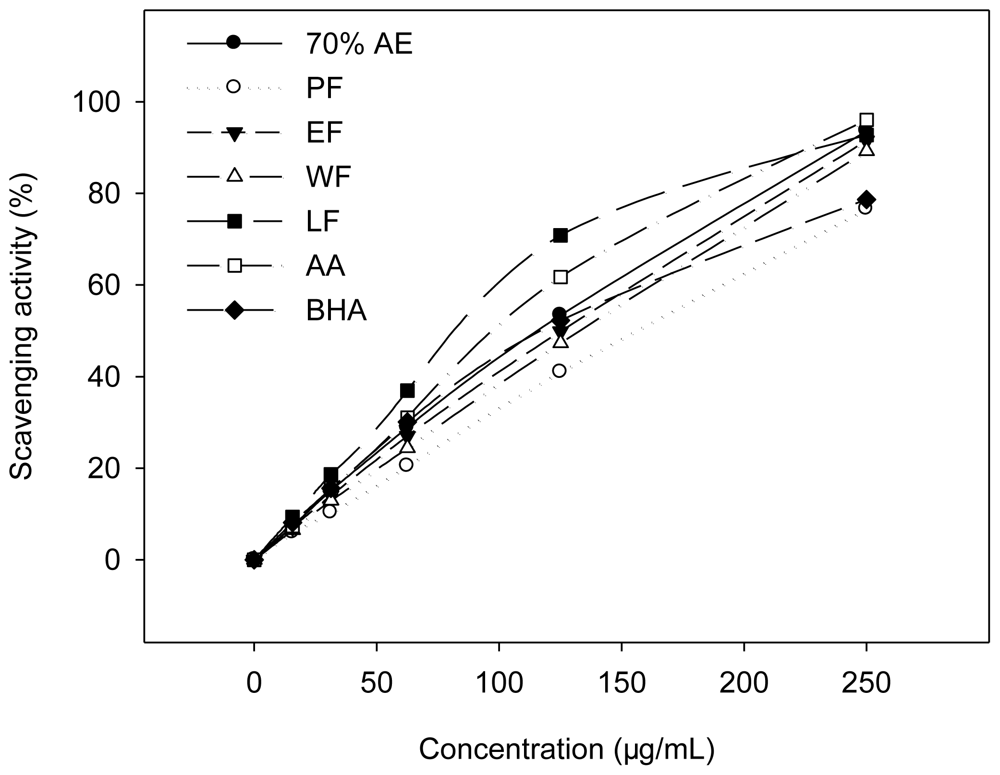
<p>DPPH is one of the compounds that has a proton free radical with a characteristic absorption, which decreases significantly on exposure to proton radical scavengers [<xref ref-type="bibr" rid="b21-ijms-11-04080">21</xref>]. The DPPH radical scavenging by antioxidants is attributable to their hydrogen donating ability [<xref ref-type="bibr" rid="b22-ijms-11-04080">22</xref>]. The DPPH assay has been widely accepted as a tool for estimating free radical scavenging activities of antioxidants [<xref ref-type="bibr" rid="b19-ijms-11-04080">19</xref>,<xref ref-type="bibr" rid="b23-ijms-11-04080">23</xref>–<xref ref-type="bibr" rid="b27-ijms-11-04080">27</xref>]. <xref ref-type="fig" rid="f1-ijms-11-04080">Figure 1</xref> illustrates a significant decrease in the concentration of DPPH radical due to the scavenging ability of the extract/fractions and standards (ascorbic acid and BHA).</p>
<p>The quality of the antioxidants in the extract/fractions was determined by the IC<sub>50</sub> values (the concentration with scavenging activity of 50%) (<xref ref-type="table" rid="t1-ijms-11-04080">Table 1</xref>). A low IC<sub>50</sub> value indicates strong antioxidant activity in a sample. The lowest IC<sub>50</sub> value of the LF (87.20 ± 1.01 μg/mL) indicated that this fraction exhibited the highest radical scavenging effect. The DPPH radical scavenging activity was found to be in the order: LF &gt; ascorbic acid &gt; BHA ≈ 70% AE &gt; EF &gt; WF &gt; PF.</p></sec>
<sec>
<title>2.2. Ferric Reducing Antioxidant Power (FRAP)</title>
<p>The reduction capacity of a compound may serve as a significant indicator of its potential antioxidant activity [<xref ref-type="bibr" rid="b28-ijms-11-04080">28</xref>]. The FRAP assay treats the antioxidants contained in the samples as reductants in a redox-linked colorimetric reaction and the value reflects the reducing power of the antioxidants [<xref ref-type="bibr" rid="b29-ijms-11-04080">29</xref>]. A higher absorbance corresponds to a higher ferric reducing power. In the present study, the BHA and extract/fractions showed increased ferric reducing power with the increased concentration (<xref ref-type="fig" rid="f2-ijms-11-04080">Figure 2</xref>).</p>
<p>The FRAP value was expressed in ascorbic acid equivalents to determine the antioxidant ability of the samples. The FRAP was found to be 4.18 ± 0.36, 2.99 ± 0.27, 4.39 ± 0.17, 3.69 ± 0.04, 5.91 ± 0.23, and 5.28 ± 0.11 mmol AAE/g for 70% AE, PF, EF, WF, LF, and BHA, respectively (<xref ref-type="table" rid="t1-ijms-11-04080">Table 1</xref>). In accordance with the findings from the DPPH assay, the LF had the highest antioxidant ability. In brief, the reducing power of extract/fractions and standard exhibited the descending order: LF &gt; BHA &gt; 70% AE ≈ EF &gt; WF &gt; PF.</p></sec>
<sec>
<title>2.3. The Total Phenolics Concentration</title>
<p>Plant phenolics possess the ability to scavenge both active oxygen species and electrophiles [<xref ref-type="bibr" rid="b30-ijms-11-04080">30</xref>]. Many plant phenolic compounds, including flavonoids, tannins and phenolic acid, exhibit a strong antioxidant activity [<xref ref-type="bibr" rid="b31-ijms-11-04080">31</xref>,<xref ref-type="bibr" rid="b32-ijms-11-04080">32</xref>]. The total phenolics concentration in the extract/fractions of the hypocotyls of <italic>K. candel</italic> is shown in <xref ref-type="table" rid="t2-ijms-11-04080">Table 2</xref>.</p>
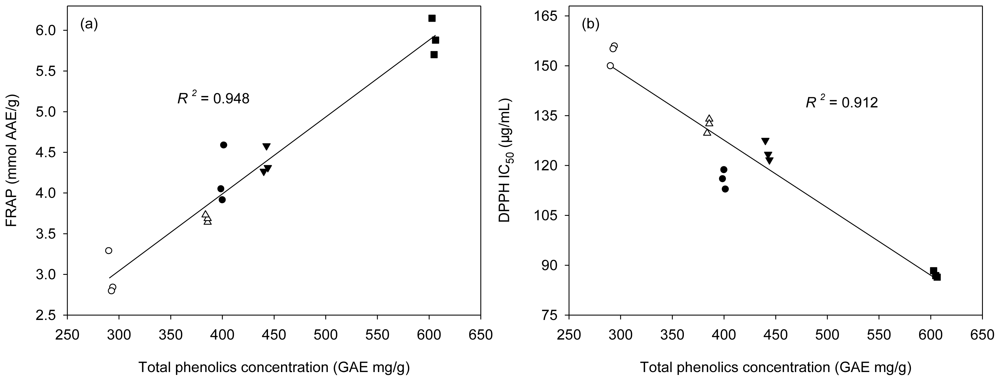
<p>LF had the highest concentration of total phenolics, followed by EF, 70% AE, WF, and then PF. A significant liner correlation was found between the total phenolics concentration and the ferric reducing power (<italic>R</italic><italic><sup>2</sup></italic> = 0.948) or the total phenolics concentration and free radical scavenging activity (<italic>R</italic><italic><sup>2</sup></italic> = 0.912) (<xref ref-type="fig" rid="f3-ijms-11-04080">Figure 3</xref>). Some previous studies also had the same results [<xref ref-type="bibr" rid="b33-ijms-11-04080">33</xref>–<xref ref-type="bibr" rid="b35-ijms-11-04080">35</xref>]. Phenolics concentration of <italic>K. candel</italic> hypocotyls was responsible for the antioxidant activity.</p></sec>
<sec sec-type="methods">
<title>2.4. MALDI-TOF MS Analysis</title>
<p>MALDI-TOF MS is ideally suited for characterizing polyflavonoid tannin oligomers [<xref ref-type="bibr" rid="b36-ijms-11-04080">36</xref>–<xref ref-type="bibr" rid="b38-ijms-11-04080">38</xref>] and is considered the mass spectrometric method of choice for analysis of tannins, which exhibit large structural heterogeneity [<xref ref-type="bibr" rid="b39-ijms-11-04080">39</xref>]. When MALDI-TOF is used to characterize tannins, the selection of the appropriate matrix and cationization reagent is very important. Flamini [<xref ref-type="bibr" rid="b40-ijms-11-04080">40</xref>] and Behrens <italic>et al</italic>. [<xref ref-type="bibr" rid="b41-ijms-11-04080">41</xref>] reported that DHB as a matrix leads to the best analytical conditions for the detection of procyanidins in reflectron mode to provide the broadest mass range with the least background noise. Xiang <italic>et al</italic>. [<xref ref-type="bibr" rid="b42-ijms-11-04080">42</xref>] found that for various cationizing agents in the presence of DHB matrix for MALDI-TOF MS analysis of condensed tannins, only Cs<sup>+</sup> affect the intensity of the signals on the MALDI-TOF mass spectrum [<xref ref-type="bibr" rid="b42-ijms-11-04080">42</xref>]. Using MALDI-TOF with deionization and selection of Cs<sup>+</sup> as the cationization reagent, higher tannin polymers were observed [<xref ref-type="bibr" rid="b43-ijms-11-04080">43</xref>].</p>
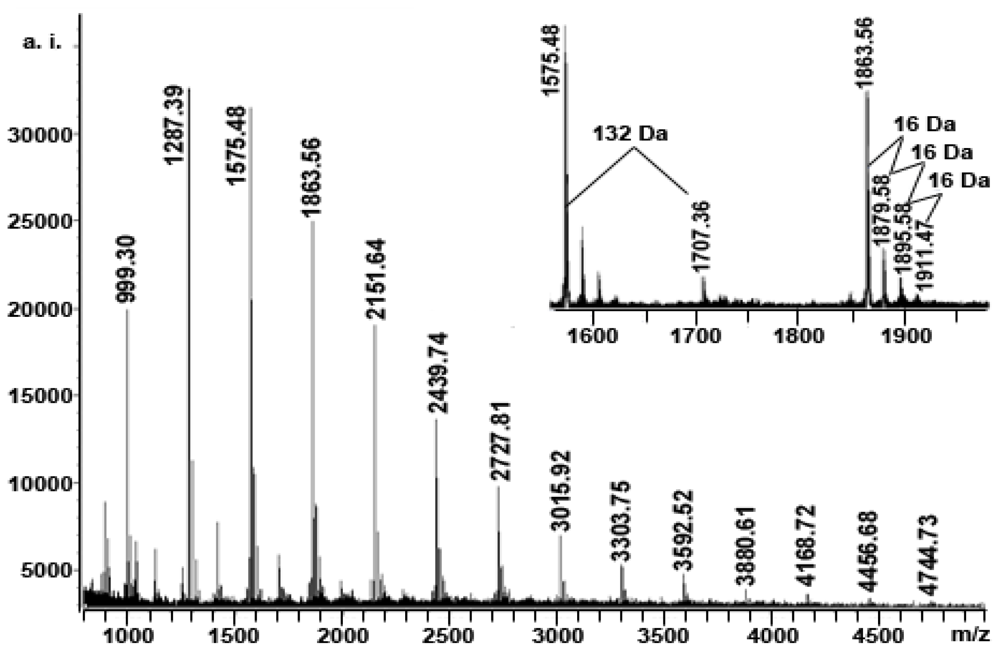
<p><xref ref-type="fig" rid="f4-ijms-11-04080">Figure 4</xref> shows the MALDI-TOF mass spectrum of the polymeric tannin mixtures from the last fraction (LF), recorded as Cs<sup>+</sup> adducts in the positive ion reflectron mode and showing a series of repeating procyanidin polymers. The displayed magnification demonstrates the good resolution of the spectrum. The results indicated that condensed tannins from the last fraction (LF) are characterized by mass spectra with a series of peaks with distances of 288 Da, corresponding to a mass difference of one catechin/epicatechin between each polymer (<xref ref-type="table" rid="t3-ijms-11-04080">Table 3</xref>). Therefore, prolongation of condensed tannins is due to addition of catechin/epicatechin monomers, extending up to hexadecamers.</p>
<p>In addition to the predicted homopolyflavan-3-ol mass series mentioned above, each DP had a subset of masses 16, 32, 48 Da higher (<xref ref-type="fig" rid="f4-ijms-11-04080">Figure 4</xref> and <xref ref-type="table" rid="t3-ijms-11-04080">Table 3</xref>). These masses can be explained by heteropolymers of repeating flavan-3-ol units containing an additional hydroxyl group (.16 Da) at the position 5′ of the B-ring. Given the absolute masses corresponding to each peak, it was further suggested that this condensed tannin contains a large number of procyanidins and a small amount of prodelphinidins.</p>
<p>On the basis of the structures described by Krueger <italic>et al</italic>. [<xref ref-type="bibr" rid="b44-ijms-11-04080">44</xref>], an equation was formulated to predict heteropolyflavan-3-ols of a higher DP (<xref ref-type="table" rid="t3-ijms-11-04080">Table 3</xref>). The equation is <italic>M</italic> = 290 + 288<italic>a</italic> + 304<italic>b</italic> + 133, where <italic>M</italic> is calculated mass, 290 is the molecular weight of the terminal catechin/epicatechin unit, <italic>a</italic> is the degree of polymerization contributed by the catechin/epicatechin extending unit, <italic>b</italic> is the degree of polymerization contributed by the gallocatechin/epigallocatechin extending unit, and 133 is the weight of cesium. Application of this equation to the experimentally obtained data revealed the presence of a series of condensed tannins consisting of well-resolved polymers. The broad peaks in this spectrum indicated, however, that there is a large structural heterogeneity within DP.</p>
<p>Each peak of the condensed tannins was also followed by mass signals at a distance of 132 Da (<xref ref-type="fig" rid="f4-ijms-11-04080">Figure 4</xref>), which was most likely added by one arabinoside group at the heterocyclic C-ring or an additional one Cs<sup>+</sup> and loss of a proton. No series of compounds that are 2 Da multiples lower than those described peaks for heteropolyflavan-3-ols were detected, so A-type interflavan ether linkage does not occur between adjacent flavan-3-ol subunits. For the first time, the structure of condensed tannins from the hypocotyls of <italic>K. candel</italic> was successfully characterized by MALDI-TOF MS.</p></sec>
<sec sec-type="methods">
<title>2.5. Thiolysis with Cysteamine Followed by RP-HPLC Analysis</title>
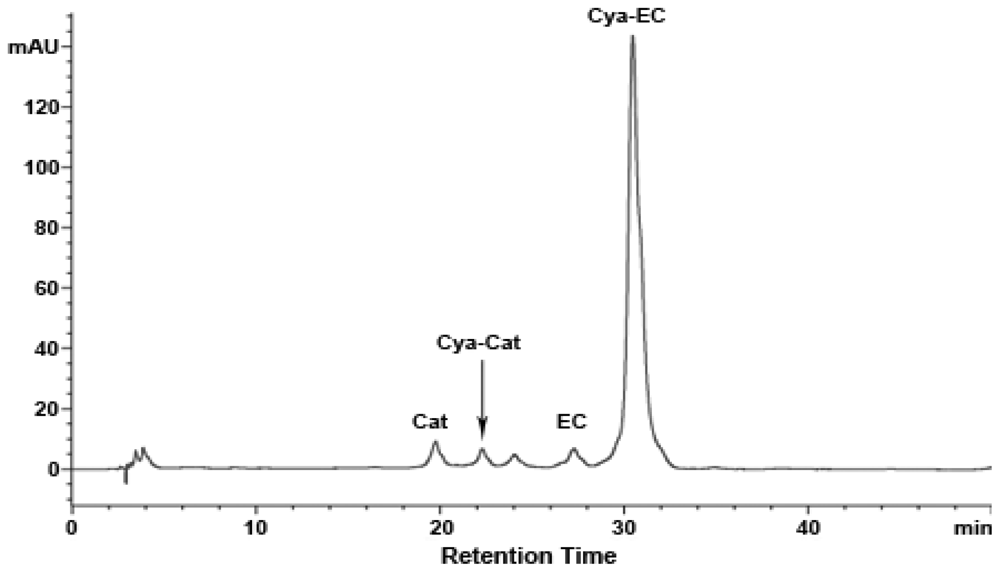
<p>Depolymerization reactions in the presence of nucleophiles are often used in the structural analysis of condensed tannins [<xref ref-type="bibr" rid="b18-ijms-11-04080">18</xref>]. To further investigate whether the condensed tannins from the last fraction (LF) are composed of catechin and epicatechin, depolymerization through thiolysis reaction was carried out by following standard procedures using cysteamine, which was preferred to toluene-<italic>a</italic>-thiol as it is more user-friendly and much less toxic [<xref ref-type="bibr" rid="b45-ijms-11-04080">45</xref>]. The reaction mixture was analyzed by HPLC (<xref ref-type="fig" rid="f5-ijms-11-04080">Figure 5</xref>). In agreement with the MALDI-TOF MS results, the last fraction (LF) consists primarily of procyanidins. The major product observed was the 4β-(2-aminoethylthio) epicatechin (Cya-EC) along with a small amount of (+)-catechin (Cat), (−)-epicatechin (EC), and 4β-(2-aminoethylthio) catechin (Cya-Cat). This result suggests that there are significant amounts of epicatechin extension units in the last fraction (LF).</p></sec></sec>
<sec>
<title>3. Experimental Section</title>
<sec sec-type="materials">
<title>3.1. Chemicals and Materials</title>
<p>The solvents acetone, petroleum ether, ethyl acetate and methanol were of analytical reagent (AR) purity grade. The trifluoroacetic acid (TFA) and acetonitrile used for the analysis were of HPLC grade. 1,1-Diphenyl-2-picrylhydrazyl (DPPH), 2,4,6-tripyridyl-S-triazine (TPTZ), cysteamine hydrochloride, ascorbic acid, butylated hydroxyanisole (BHA), cesium chloride, and gallic acid were purchased from Aldrich (U.S.). (−)-Epicatechin (EC), (+)-catechin (Cat) were purchased from Sigma (U.S.). Sephadex LH-20 was purchased from Amersham (U.S.). The hypocotyls of <italic>K. candel</italic> were collected from Zhangjiang River Estuary Mangrove National Natural Reserves (117°24′E, 23°55′N), Yunxiao, Fujian province, China, and immediately freeze dried and ground.</p></sec>
<sec>
<title>3.2. Preparation of Samples</title>
<p>Freeze-dried hypocotyls (15 g) of <italic>K. candel</italic> were extracted with 150 mL 70% acetone and kept for 24 h at room temperature. The extract was then centrifuged at 3000 g for 15 min and collected. The same procedure was repeated three times. The collected extracts were combined, concentrated in a rotary evaporator, and then lyophilized. The final yield of 70% acetone extract (70% AE) was 4.5 g. From the 4.5 g of dried extract, 3 g was fractionated successively with petroleum ether, ethyl acetate, and water to yield soluble fractions of petroleum ether (PF, 0.21 g), ethyl acetate (EF, 0.39 g), and water (WF, 2.36 g). The water fraction (2 g) containing mainly polymers was further purified through a Sephadex LH-20 column. The column was first eluted with methanol:water (1:1) until the eluent turned colorless and then with acetone:water (7:3, 500 mL). The acetone was removed under reduced pressure, and the resulting residue was lyophilized to give the last fraction containing the purified polymeric tannins (LF, 0.89 g), which was further analyzed by MALDI-TOF mass spectrometry and thiolysis.</p></sec>
<sec>
<title>3.3. DPPH Radical Scavenging Activity</title>
<p>The free radical scavenging activities of the samples on the DPPH radical were measured using the method described by Brand-Williams <italic>et al</italic>. [<xref ref-type="bibr" rid="b46-ijms-11-04080">46</xref>]. A 0.1 mL of various concentrations of each freeze-dried sample at different concentrations (15.63–250 μg/mL) was added to 3.9 mL of DPPH solution (25 mg/L in methanolic solution). An equal amount of methanol and DPPH served as control. After the mixture was shaken and left at room temperature for 30 min, the absorbance at 517 nm was measured. Lower absorbance of the reaction mixture indicates higher free radical scavenging activity. The IC<sub>50</sub> value, defined as the amount of antioxidant necessary to decrease the initial DPPH concentration by 50%, was calculated from the results and used for comparison. The capability to scavenge the DPPH radical was calculated by using the following equation:</p>
<disp-formula>
<mml:math display="block">
<mml:semantics>
<mml:mrow>
<mml:mtext>DPPH scavenging effect</mml:mtext>
<mml:mo stretchy="false">(</mml:mo>
<mml:mo>%</mml:mo>
<mml:mo stretchy="false">)</mml:mo>
<mml:mo>=</mml:mo>
<mml:mo stretchy="false">[</mml:mo>
<mml:mo stretchy="false">(</mml:mo>
<mml:msub>
<mml:mrow>
<mml:mtext>A</mml:mtext></mml:mrow>
<mml:mn>1</mml:mn></mml:msub>
<mml:mo>-</mml:mo>
<mml:msub>
<mml:mrow>
<mml:mtext>A</mml:mtext></mml:mrow>
<mml:mn>2</mml:mn></mml:msub>
<mml:mo stretchy="false">)</mml:mo>
<mml:mo>/</mml:mo>
<mml:msub>
<mml:mrow>
<mml:mtext>A</mml:mtext></mml:mrow>
<mml:mn>1</mml:mn></mml:msub>
<mml:mo stretchy="false">]</mml:mo>
<mml:mo>×</mml:mo>
<mml:mn>100</mml:mn></mml:mrow></mml:semantics></mml:math></disp-formula>
<p>where A<sub>1</sub> = the absorbance of the control reaction; A<sub>2</sub> = the absorbance in the presence of the sample. BHA and ascorbic acid were used as standards.</p></sec>
<sec>
<title>3.4. Ferric Reducing/Antioxidant Power (FRAP) Assay</title>
<p>FRAP assay is a simple and reliable colorimetric method commonly used for measuring the total antioxidant capacity [<xref ref-type="bibr" rid="b47-ijms-11-04080">47</xref>]. In brief, 3 mL of prepared freshly FRAP reagent was mixed with 0.1 mL of test sample or methanol (for the reagent blank). The FRAP reagent was prepared from 300 mmol/L acetate buffer (pH 3.6), 20 mmol/L ferric chloride and 10 mmol/L TPTZ made up in 40 mmol/L hydrochloric acid. All the above three solutions were mixed together in the ratio of 25:2.5:2.5 (v/v/v). The absorbance of reaction mixture at 593 nm was measured spectrophotometrically after incubation at 25 °C for 10 min. The FRAP values, expressed in mmol ascorbic acid equivalents (AAE)/g dried tannins, were derived from a standard curve.</p></sec>
<sec>
<title>3.5. Determination of Total Phenolics</title>
<p>The amount of total phenolics was determined using the Folin-Ciocalteu method [<xref ref-type="bibr" rid="b48-ijms-11-04080">48</xref>]. Briefly, 0.2 mL aliquot of extract was added to a test tube containing 0.3 mL of distilled H<sub>2</sub>O. 0.5 mL of Folin-Ciocalteu reagent and 2.5 mL 20% Na<sub>2</sub>CO<sub>3</sub> solution were added to the mixture and shaken. After incubation for 40 min at room temperature, the absorbance <italic>versus</italic> a blank was determined at 725 nm. Total phenolics concentrations of extracts were expressed as mg gallic acid equivalents (GAE)/g extract. All samples were analyzed in three replications.</p></sec>
<sec sec-type="methods">
<title>3.6. MALDI-TOF MS Analysis</title>
<p>The MALDI-TOF MS spectra were recorded on a Bruker Reflex III instrument (Germany). The irradiation source was a pulsed nitrogen laser with a wavelength of 337 nm, and the duration of the laser pulse was 3 ns. In the positive reflectron mode, an accelerating voltage of 20.0 kV and a reflectron voltage of 23.0 kV were used. 2,5-Dihydroxy benzoic acid (DHB, 10 mg/mL 30% acetone solution) was used as the matrix. The sample solutions (10 mg/mL 30% acetone solution) were mixed with the matrix solution at a volumetric ratio of 1:3. The mixture (1 μL) was spotted to the steel target. Amberlite IRP-64 cation-exchange resin (Sigma-Aldrich, U.S.), equilibrated in deionized water, was used to deionize the analyte-matrix solution thrice. Cesium chloride (1.52 mg/mL) was mixed with the analyte-matrix solution (1:3, v/v) to promote the formation of a single type of ion adduct ([M + Cs]<sup>+</sup>) [<xref ref-type="bibr" rid="b42-ijms-11-04080">42</xref>].</p></sec>
<sec sec-type="methods">
<title>3.7. Thiolysis of the Condensed Tannins for HPLC Analysis</title>
<p>Thiolysis was carried out according to the method of Torres and Lozano [<xref ref-type="bibr" rid="b49-ijms-11-04080">49</xref>]. A condensed tannin solution (4 mg/mL in methanol) was prepared. A sub-sample (50 μL) was placed in a vial and hydrochloric acid in methanol (3.3%, v/v; 50 μL) and cysteamine hydrochloride in methanol (50 mg/mL, 100 μL) were added. The solution was heated at 40 °C for 30 min, and cooled to room temperature. The size and composition of the condensed tannins were estimated from the RP-HPLC analysis of the depolymerised fractions [<xref ref-type="bibr" rid="b45-ijms-11-04080">45</xref>]. Briefly, the terminal flavan-3-ols units were released by acid cleavage in the presence of cysteamine, whereas the extension moieties were released as the C4 cysteamine derivatives. Thiolysis reaction media (20 μL) filtrated through a membrane filter with an aperture size of 0.45 μm was analyzed by RP-HPLC.</p>
<p>The high performance liquid chromatograph was an Agilent 1200 system (U.S.) equipped with a diode array detector and a quaternary pump. The thiolysis media were further analyzed using LC/MS (QTRAP 3200, U.S.) with a Hypersil ODS column (4.6 mm × 250 mm, 2.5 μm) (China). The mobile phase was composed of solvent A (0.5% v/v trifluoroacetic acid (TFA) in water) and solvent B (0.5% v/v TFA in acetonitrile). The gradient condition was: 0–5 min, 3% B (isocratic); 5–15 min, 3–9% B (linear gradient); 15–45 min, 9–16% B (linear gradient), 45–60 min, 16–60% B (linear gradient). The column temperature was ambient and the flow-rate was set at 1 mL/min. Detection was at 280 nm and the UV spectra were acquired between 200–600 nm. Degradation products were identified on chromatograms according to their relative retention times and their UV-visible spectra. Each sample analysis was repeated three times.</p></sec>
<sec sec-type="methods">
<title>3.8. Statistical Analysis</title>
<p>All data were expressed as means ± standard deviation of three independent determinations. One-way analysis of variance (ANOVA) was used, and the differences were considered to be significant at <italic>P</italic> &lt; 0.05. All statistical analyses were performed with SPSS 13.0 for windows.</p></sec></sec>
<sec sec-type="conclusions">
<title>4. Conclusions</title>
<p>All the extract/fractions from the hypocotyls of <italic>K. candel</italic> showed potent antioxidant activity. Phenolics concentration of <italic>K. candel</italic> hypocotyls was responsible for the antioxidant activity. Extracts from the hypocotyls of <italic>K. candel</italic> might be valuable antioxidant natural sources for both the medical and food industry. Among the extract/fractions, the LF fraction exhibits the best antioxidant performance. The MALDT-TOF MS and HPLC analyses revealed that the phenolic compounds associated with the antioxidant activity of the LF fraction, contains a large number of procyanidins and a small amount of prodelphinidins, and the epicatechin is the main extension unit.</p></sec></body>
<back>
<ack>
<title>Acknowledgements</title>
<p>This work was supported by the National Natural Science Foundation of China (31070522), the Program for New Century Excellent Talents in University (NCET-07-0725), and by the Scientific Research Foundation for the Returned Overseas Chinese Scholars, State Education Ministry.</p></ack>
<ref-list>
<title>References</title>
<ref id="b1-ijms-11-04080"><label>1</label><citation citation-type="journal"><person-group person-group-type="author"><name><surname>Cerutti</surname><given-names>PA</given-names></name></person-group><article-title>Oxidant stress and carcinogenesis</article-title><source>Eur. J. Clin. Invest</source><year>1991</year><volume>21</volume><fpage>1</fpage><lpage>11</lpage><pub-id pub-id-type="doi">10.1111/j.1365-2362.1991.tb01350.x</pub-id><pub-id pub-id-type="pmid">1677336</pub-id></citation></ref>
<ref id="b2-ijms-11-04080"><label>2</label><citation citation-type="journal"><person-group person-group-type="author"><name><surname>Lemberkovics</surname><given-names>É</given-names></name><name><surname>Czinner</surname><given-names>E</given-names></name><name><surname>Szentmihályi</surname><given-names>K</given-names></name><name><surname>Balázs</surname><given-names>A</given-names></name><name><surname>SzÖke</surname><given-names>É</given-names></name></person-group><article-title>Comparative evaluation of <italic>Helichrysi flos</italic> herbal extracts as dietary sources of plant polyphenols, and macro-and microelements</article-title><source>Food Chem</source><year>2002</year><volume>78</volume><fpage>119</fpage><lpage>127</lpage><pub-id pub-id-type="doi">10.1016/S0308-8146(02)00204-2</pub-id></citation></ref>
<ref id="b3-ijms-11-04080"><label>3</label><citation citation-type="journal"><person-group person-group-type="author"><name><surname>Shon</surname><given-names>MY</given-names></name><name><surname>Kim</surname><given-names>TH</given-names></name><name><surname>Sung</surname><given-names>NJ</given-names></name></person-group><article-title>Antioxidants and free radical scavenging activity of <italic>Phellinus baumii</italic> (<italic>Phellinus</italic> of Hymenochaetaceae) extracts</article-title><source>Food Chem</source><year>2003</year><volume>82</volume><fpage>593</fpage><lpage>597</lpage><pub-id pub-id-type="doi">10.1016/S0308-8146(03)00015-3</pub-id></citation></ref>
<ref id="b4-ijms-11-04080"><label>4</label><citation citation-type="journal"><person-group person-group-type="author"><name><surname>Yanishlieva</surname><given-names>NV</given-names></name><name><surname>Marinova</surname><given-names>E</given-names></name><name><surname>Pokorny</surname><given-names>J</given-names></name></person-group><article-title>Natural antioxidants from herbs and spices</article-title><source>Eur. J. Lipid Sci. Technol</source><year>2006</year><volume>108</volume><fpage>776</fpage><lpage>793</lpage><pub-id pub-id-type="doi">10.1002/ejlt.200600127</pub-id></citation></ref>
<ref id="b5-ijms-11-04080"><label>5</label><citation citation-type="journal"><person-group person-group-type="author"><name><surname>Sasaki</surname><given-names>Y</given-names></name><name><surname>Kawaguchi</surname><given-names>S</given-names></name><name><surname>Kamaya</surname><given-names>A</given-names></name><name><surname>Ohshita</surname><given-names>M</given-names></name><name><surname>Kabasawa</surname><given-names>K</given-names></name><name><surname>Iwama</surname><given-names>K</given-names></name><name><surname>Taniguchi</surname><given-names>K</given-names></name><name><surname>Tsuda</surname><given-names>S</given-names></name></person-group><article-title>The comet assay with 8 mouse organs: results with 39 currently used food additives</article-title><source>Mutat. Res</source><year>2002</year><volume>519</volume><fpage>103</fpage><lpage>119</lpage><pub-id pub-id-type="doi">10.1016/S1383-5718(02)00128-6</pub-id><pub-id pub-id-type="pmid">12160896</pub-id></citation></ref>
<ref id="b6-ijms-11-04080"><label>6</label><citation citation-type="journal"><person-group person-group-type="author"><name><surname>Barla</surname><given-names>AI</given-names></name><name><surname>Öztürk</surname><given-names>M</given-names></name><name><surname>Kültür</surname><given-names>S</given-names></name><name><surname>Öksüz</surname><given-names>S</given-names></name></person-group><article-title>Screening of antioxidant activity of three <italic>Euphorbia</italic> species from Turkey</article-title><source>Fitoterapia</source><year>2007</year><volume>78</volume><fpage>423</fpage><lpage>425</lpage><pub-id pub-id-type="doi">10.1016/j.fitote.2007.02.021</pub-id><pub-id pub-id-type="pmid">17582698</pub-id></citation></ref>
<ref id="b7-ijms-11-04080"><label>7</label><citation citation-type="journal"><person-group person-group-type="author"><name><surname>Chang</surname><given-names>SK</given-names></name><name><surname>Sung</surname><given-names>PM</given-names></name></person-group><article-title>Antioxidant activities of ethanol extracts from seeds in fresh Bokbunja (<italic>Rubus coreanus</italic> Miq.) and wine processing waste</article-title><source>Bioresour. Technol</source><year>2008</year><volume>99</volume><fpage>4503</fpage><lpage>4509</lpage><pub-id pub-id-type="doi">10.1016/j.biortech.2007.08.063</pub-id><pub-id pub-id-type="pmid">17931856</pub-id></citation></ref>
<ref id="b8-ijms-11-04080"><label>8</label><citation citation-type="journal"><person-group person-group-type="author"><name><surname>Chua</surname><given-names>MT</given-names></name><name><surname>Tung</surname><given-names>YT</given-names></name><name><surname>Chang</surname><given-names>ST</given-names></name></person-group><article-title>Antioxidant activities of ethanolic extracts from the twigs of <italic>Cinnamomum osmophloeum</italic></article-title><source>Bioresour. Technol</source><year>2008</year><volume>99</volume><fpage>1918</fpage><lpage>1925</lpage><pub-id pub-id-type="doi">10.1016/j.biortech.2007.03.020</pub-id><pub-id pub-id-type="pmid">17478090</pub-id></citation></ref>
<ref id="b9-ijms-11-04080"><label>9</label><citation citation-type="journal"><person-group person-group-type="author"><name><surname>Amico</surname><given-names>V</given-names></name><name><surname>Chillemi</surname><given-names>R</given-names></name><name><surname>Mangiafico</surname><given-names>S</given-names></name><name><surname>Spatafora</surname><given-names>C</given-names></name><name><surname>Tringali</surname><given-names>C</given-names></name></person-group><article-title>Polyphenol-enriched fractions from Sicilian grape pomace: HPLC-DAD analysis and antioxidant activity</article-title><source>Bioresour. Technol</source><year>2008</year><volume>99</volume><fpage>5960</fpage><lpage>5966</lpage><pub-id pub-id-type="doi">10.1016/j.biortech.2007.10.037</pub-id><pub-id pub-id-type="pmid">18054486</pub-id></citation></ref>
<ref id="b10-ijms-11-04080"><label>10</label><citation citation-type="journal"><person-group person-group-type="author"><name><surname>Tung</surname><given-names>YT</given-names></name><name><surname>Wu</surname><given-names>JH</given-names></name><name><surname>Kuo</surname><given-names>YH</given-names></name><name><surname>Chang</surname><given-names>ST</given-names></name></person-group><article-title>Antioxidant activities of natural phenolic compounds from <italic>Acacia confusa</italic> bark</article-title><source>Bioresour. Technol</source><year>2007</year><volume>98</volume><fpage>1120</fpage><lpage>1123</lpage><pub-id pub-id-type="doi">10.1016/j.biortech.2006.04.017</pub-id><pub-id pub-id-type="pmid">16766181</pub-id></citation></ref>
<ref id="b11-ijms-11-04080"><label>11</label><citation citation-type="journal"><person-group person-group-type="author"><name><surname>Maksimović</surname><given-names>Z</given-names></name><name><surname>Malenčić</surname><given-names>D</given-names></name><name><surname>Kovačević</surname><given-names>N</given-names></name></person-group><article-title>Polyphenol contents and antioxidant activity of <italic>Maydis stigma</italic> extracts</article-title><source>Bioresour. Technol</source><year>2005</year><volume>96</volume><fpage>873</fpage><lpage>877</lpage><pub-id pub-id-type="doi">10.1016/j.biortech.2004.09.006</pub-id><pub-id pub-id-type="pmid">15627557</pub-id></citation></ref>
<ref id="b12-ijms-11-04080"><label>12</label><citation citation-type="journal"><person-group person-group-type="author"><name><surname>Feller</surname><given-names>IC</given-names></name><name><surname>Whigham</surname><given-names>DF</given-names></name><name><surname>O’Neill</surname><given-names>JP</given-names></name><name><surname>McKee</surname><given-names>KL</given-names></name></person-group><article-title>Effects of nutrient enrichment on withinstand cycling in a mangrove forest</article-title><source>Ecology</source><year>1999</year><volume>80</volume><fpage>2193</fpage><lpage>2205</lpage><pub-id pub-id-type="doi">10.1890/0012-9658(1999)080[2193:EONEOW]2.0.CO;2</pub-id></citation></ref>
<ref id="b13-ijms-11-04080"><label>13</label><citation citation-type="journal"><person-group person-group-type="author"><name><surname>Hernes</surname><given-names>PJ</given-names></name><name><surname>Benner</surname><given-names>R</given-names></name><name><surname>Cowie</surname><given-names>GL</given-names></name><name><surname>Goni</surname><given-names>MA</given-names></name><name><surname>Bergamaschi</surname><given-names>BA</given-names></name><name><surname>Hedges</surname><given-names>JI</given-names></name></person-group><article-title>Tannin diagenesis in mangrove leaves from a tropical estuary: A novel molecular approach</article-title><source>Geochim. Cosmochim. Acta</source><year>2001</year><volume>65</volume><fpage>3109</fpage><lpage>3122</lpage><pub-id pub-id-type="doi">10.1016/S0016-7037(01)00641-X</pub-id></citation></ref>
<ref id="b14-ijms-11-04080"><label>14</label><citation citation-type="book"><person-group person-group-type="author"><name><surname>Mainoya</surname><given-names>J</given-names></name><name><surname>Mesaki</surname><given-names>S</given-names></name><name><surname>Banyikwa</surname><given-names>FF</given-names></name></person-group><person-group person-group-type="editor"><name><surname>Kunstadter</surname><given-names>PE</given-names></name><name><surname>Bird</surname><given-names>CF</given-names></name><name><surname>Sabhasri</surname><given-names>S</given-names></name></person-group><article-title>The distribution and socio-economic aspects of mangrove forests in Tanzania</article-title><source>Man in the Mangroves: the Socio-Economic Situation of Human Settlements in Mangrove Forests</source><publisher-name>United Nations University</publisher-name><publisher-loc>Tokyo, Japan</publisher-loc><year>1986</year><fpage>87</fpage><lpage>95</lpage></citation></ref>
<ref id="b15-ijms-11-04080"><label>15</label><citation citation-type="book"><person-group person-group-type="author"><name><surname>Pittier</surname><given-names>H</given-names></name></person-group><source>Manual de las plantas usuales de Venezuela</source><publisher-name>Fundación Eugenio Mendoza</publisher-name><publisher-loc>Caracas, Venezuela</publisher-loc><year>1978</year></citation></ref>
<ref id="b16-ijms-11-04080"><label>16</label><citation citation-type="book"><person-group person-group-type="author"><name><surname>Lemmens</surname><given-names>R</given-names></name><name><surname>Wilijarni-Soetjipto</surname><given-names>N</given-names></name></person-group><source>Dye and tannin-producing plants</source><publisher-name>Pudoc</publisher-name><publisher-loc>Wageningen, The Netherlands</publisher-loc><year>1991</year></citation></ref>
<ref id="b17-ijms-11-04080"><label>17</label><citation citation-type="journal"><person-group person-group-type="author"><name><surname>Banerjee</surname><given-names>D</given-names></name><name><surname>Chakrabarti</surname><given-names>S</given-names></name><name><surname>Hazra</surname><given-names>A</given-names></name><name><surname>Banerjee</surname><given-names>S</given-names></name><name><surname>Ray</surname><given-names>J</given-names></name><name><surname>Mukherjee</surname><given-names>B</given-names></name></person-group><article-title>Antioxidant activity and total phenolics of some mangroves in Sundarbans</article-title><source>Afr. J. Biotechnol</source><year>2008</year><volume>7</volume><fpage>805</fpage><lpage>810</lpage></citation></ref>
<ref id="b18-ijms-11-04080"><label>18</label><citation citation-type="journal"><person-group person-group-type="author"><name><surname>Rahim</surname><given-names>AA</given-names></name><name><surname>Rocca</surname><given-names>E</given-names></name><name><surname>Steinmetz</surname><given-names>J</given-names></name><name><surname>Jain Kassim</surname><given-names>M</given-names></name><name><surname>Sani Ibrahim</surname><given-names>M</given-names></name><name><surname>Osman</surname><given-names>H</given-names></name></person-group><article-title>Antioxidant activities of mangrove <italic>Rhizophora apiculata</italic> bark extracts</article-title><source>Food Chem</source><year>2008</year><volume>107</volume><fpage>200</fpage><lpage>207</lpage><pub-id pub-id-type="doi">10.1016/j.foodchem.2007.08.005</pub-id></citation></ref>
<ref id="b19-ijms-11-04080"><label>19</label><citation citation-type="journal"><person-group person-group-type="author"><name><surname>Zhang</surname><given-names>LL</given-names></name><name><surname>Lin</surname><given-names>YM</given-names></name><name><surname>Zhou</surname><given-names>HC</given-names></name><name><surname>Wei</surname><given-names>SD</given-names></name><name><surname>Chen</surname><given-names>JH</given-names></name></person-group><article-title>Condensed tannins from mangrove species <italic>Kandelia candel</italic> and <italic>Rhizophora mangle</italic> and their antioxidant activity</article-title><source>Molecules</source><year>2010</year><volume>15</volume><fpage>420</fpage><lpage>431</lpage><pub-id pub-id-type="doi">10.3390/molecules15010420</pub-id><pub-id pub-id-type="pmid">20110901</pub-id></citation></ref>
<ref id="b20-ijms-11-04080"><label>20</label><citation citation-type="journal"><person-group person-group-type="author"><name><surname>Lin</surname><given-names>YM</given-names></name><name><surname>Liu</surname><given-names>JW</given-names></name><name><surname>Xiang</surname><given-names>P</given-names></name><name><surname>Lin</surname><given-names>P</given-names></name><name><surname>Ye</surname><given-names>GF</given-names></name><name><surname>da Sternberg</surname><given-names>LSL</given-names></name></person-group><article-title>Tannin dynamics of propagules and leaves of <italic>Kandelia candel</italic> and <italic>Bruguiera gymnorrhiza</italic> in the Jiulong River Estuary, Fujian, China</article-title><source>Biogeochemistry</source><year>2006</year><volume>78</volume><fpage>343</fpage><lpage>359</lpage><pub-id pub-id-type="doi">10.1007/s10533-005-4427-5</pub-id></citation></ref>
<ref id="b21-ijms-11-04080"><label>21</label><citation citation-type="journal"><person-group person-group-type="author"><name><surname>Yamaguchi</surname><given-names>T</given-names></name><name><surname>Takamura</surname><given-names>H</given-names></name><name><surname>Matoba</surname><given-names>T</given-names></name><name><surname>Terao</surname><given-names>J</given-names></name></person-group><article-title>HPLC method for evaluation of the free radical-scavenging activity of foods by using 1, 1-diphenyl-2-picrylhydrazyl</article-title><source>Biosci. Biotechnol. Biochem</source><year>1998</year><volume>62</volume><fpage>1201</fpage><lpage>1204</lpage><pub-id pub-id-type="doi">10.1271/bbb.62.1201</pub-id><pub-id pub-id-type="pmid">9692204</pub-id></citation></ref>
<ref id="b22-ijms-11-04080"><label>22</label><citation citation-type="journal"><person-group person-group-type="author"><name><surname>Chen</surname><given-names>CW</given-names></name><name><surname>Ho</surname><given-names>CT</given-names></name></person-group><article-title>Antioxidant properties of polyphenols extracted from green and black teas</article-title><source>J. Food Lipids</source><year>1995</year><volume>2</volume><fpage>35</fpage><lpage>46</lpage><pub-id pub-id-type="doi">10.1111/j.1745-4522.1995.tb00028.x</pub-id></citation></ref>
<ref id="b23-ijms-11-04080"><label>23</label><citation citation-type="journal"><person-group person-group-type="author"><name><surname>Zhang</surname><given-names>LL</given-names></name><name><surname>Lin</surname><given-names>YM</given-names></name></person-group><article-title>HPLC, NMR and MALDI-TOF MS analysis of condensed tannins from <italic>Lithocarpus glaber</italic> leaves with potent free radical scavenging activity</article-title><source>Molecules</source><year>2008</year><volume>13</volume><fpage>2986</fpage><lpage>2997</lpage><pub-id pub-id-type="doi">10.3390/molecules13122986</pub-id><pub-id pub-id-type="pmid">19052523</pub-id></citation></ref>
<ref id="b24-ijms-11-04080"><label>24</label><citation citation-type="journal"><person-group person-group-type="author"><name><surname>Zhang</surname><given-names>LL</given-names></name><name><surname>Lin</surname><given-names>YM</given-names></name></person-group><article-title>Tannins from <italic>Canarium album</italic> with potent antioxidant activity</article-title><source>J. Zhejiang Univ. Sci. B</source><year>2008</year><volume>9</volume><fpage>407</fpage><lpage>415</lpage><pub-id pub-id-type="doi">10.1631/jzus.B0820002</pub-id><pub-id pub-id-type="pmid">18500781</pub-id></citation></ref>
<ref id="b25-ijms-11-04080"><label>25</label><citation citation-type="journal"><person-group person-group-type="author"><name><surname>Zhang</surname><given-names>LL</given-names></name><name><surname>Lin</surname><given-names>YM</given-names></name></person-group><article-title>Antioxidant tannins from <italic>Syzygium cumini</italic> fruit</article-title><source>Afr. J. Biotechnol</source><year>2009</year><volume>8</volume><fpage>2301</fpage><lpage>2309</lpage></citation></ref>
<ref id="b26-ijms-11-04080"><label>26</label><citation citation-type="journal"><person-group person-group-type="author"><name><surname>Ruan</surname><given-names>ZP</given-names></name><name><surname>Zhang</surname><given-names>LL</given-names></name><name><surname>Lin</surname><given-names>YM</given-names></name></person-group><article-title>Evaluation of the antioxidant activity of <italic>Syzygium cumini</italic> leaves</article-title><source>Molecules</source><year>2008</year><volume>13</volume><fpage>2545</fpage><lpage>2556</lpage><pub-id pub-id-type="doi">10.3390/molecules13102545</pub-id><pub-id pub-id-type="pmid">18927517</pub-id></citation></ref>
<ref id="b27-ijms-11-04080"><label>27</label><citation citation-type="journal"><person-group person-group-type="author"><name><surname>Wei</surname><given-names>SD</given-names></name><name><surname>Zhou</surname><given-names>HC</given-names></name><name><surname>Lin</surname><given-names>YM</given-names></name><name><surname>Liao</surname><given-names>MM</given-names></name><name><surname>Chai</surname><given-names>WM</given-names></name></person-group><article-title>MALDI-TOF MS analysis of condensed tannins with potent antioxidant activity from the leaf, stem bark and root bark of <italic>Acacia confusa</italic></article-title><source>Molecules</source><year>2010</year><volume>15</volume><fpage>4369</fpage><lpage>4381</lpage><pub-id pub-id-type="doi">10.3390/molecules15064369</pub-id><pub-id pub-id-type="pmid">20657447</pub-id></citation></ref>
<ref id="b28-ijms-11-04080"><label>28</label><citation citation-type="journal"><person-group person-group-type="author"><name><surname>Meir</surname><given-names>S</given-names></name><name><surname>Kanner</surname><given-names>J</given-names></name><name><surname>Akiri</surname><given-names>B</given-names></name><name><surname>Philosoph-Hadas</surname><given-names>S</given-names></name></person-group><article-title>Determination and involvement of aqueous reducing compounds in oxidative defense systems of various senescing leaves</article-title><source>J. Agric. Food Chem</source><year>1995</year><volume>43</volume><fpage>1813</fpage><lpage>1819</lpage><pub-id pub-id-type="doi">10.1021/jf00055a012</pub-id></citation></ref>
<ref id="b29-ijms-11-04080"><label>29</label><citation citation-type="journal"><person-group person-group-type="author"><name><surname>Li</surname><given-names>Y</given-names></name><name><surname>Guo</surname><given-names>C</given-names></name><name><surname>Yang</surname><given-names>J</given-names></name><name><surname>Wei</surname><given-names>J</given-names></name><name><surname>Xu</surname><given-names>J</given-names></name><name><surname>Cheng</surname><given-names>S</given-names></name></person-group><article-title>Evaluation of antioxidant properties of pomegranate peel extract in comparison with pomegranate pulp extract</article-title><source>Food Chem</source><year>2006</year><volume>96</volume><fpage>254</fpage><lpage>260</lpage><pub-id pub-id-type="doi">10.1016/j.foodchem.2005.02.033</pub-id></citation></ref>
<ref id="b30-ijms-11-04080"><label>30</label><citation citation-type="journal"><person-group person-group-type="author"><name><surname>Robards</surname><given-names>K</given-names></name><name><surname>Prenzler</surname><given-names>PD</given-names></name><name><surname>Tucker</surname><given-names>G</given-names></name><name><surname>Swatsitang</surname><given-names>P</given-names></name><name><surname>Glover</surname><given-names>W</given-names></name></person-group><article-title>Phenolic compounds and their role in oxidative processes in fruits</article-title><source>Food Chem</source><year>1999</year><volume>66</volume><fpage>401</fpage><lpage>436</lpage><pub-id pub-id-type="doi">10.1016/S0308-8146(99)00093-X</pub-id></citation></ref>
<ref id="b31-ijms-11-04080"><label>31</label><citation citation-type="journal"><person-group person-group-type="author"><name><surname>Heim</surname><given-names>KE</given-names></name><name><surname>Tagliaferro</surname><given-names>AR</given-names></name><name><surname>Bobilya</surname><given-names>DJ</given-names></name></person-group><article-title>Flavonoid antioxidants: chemistry, metabolism and structure-activity relationships</article-title><source>J. Nutr. Biochem</source><year>2002</year><volume>13</volume><fpage>572</fpage><lpage>584</lpage><pub-id pub-id-type="doi">10.1016/S0955-2863(02)00208-5</pub-id><pub-id pub-id-type="pmid">12550068</pub-id></citation></ref>
<ref id="b32-ijms-11-04080"><label>32</label><citation citation-type="journal"><person-group person-group-type="author"><name><surname>Rakić</surname><given-names>S</given-names></name><name><surname>Povrenović</surname><given-names>D</given-names></name><name><surname>Tešević</surname><given-names>V</given-names></name><name><surname>Simić</surname><given-names>M</given-names></name><name><surname>Maletić</surname><given-names>R</given-names></name></person-group><article-title>Oak acorn, polyphenols and antioxidant activity in functional food</article-title><source>J. Food Eng</source><year>2006</year><volume>74</volume><fpage>416</fpage><lpage>423</lpage><pub-id pub-id-type="doi">10.1016/j.jfoodeng.2005.03.057</pub-id></citation></ref>
<ref id="b33-ijms-11-04080"><label>33</label><citation citation-type="journal"><person-group person-group-type="author"><name><surname>Cai</surname><given-names>Y</given-names></name><name><surname>Luo</surname><given-names>Q</given-names></name><name><surname>Sun</surname><given-names>M</given-names></name><name><surname>Corke</surname><given-names>H</given-names></name></person-group><article-title>Antioxidant activity and phenolic compounds of 112 traditional Chinese medicinal plants associated with anticancer</article-title><source>Life Sci</source><year>2004</year><volume>74</volume><fpage>2157</fpage><lpage>2184</lpage><pub-id pub-id-type="doi">10.1016/j.lfs.2003.09.047</pub-id><pub-id pub-id-type="pmid">14969719</pub-id></citation></ref>
<ref id="b34-ijms-11-04080"><label>34</label><citation citation-type="journal"><person-group person-group-type="author"><name><surname>Silva</surname><given-names>EM</given-names></name><name><surname>Souza</surname><given-names>JNS</given-names></name><name><surname>Rogez</surname><given-names>H</given-names></name><name><surname>Rees</surname><given-names>JF</given-names></name><name><surname>Larondelle</surname><given-names>Y</given-names></name></person-group><article-title>Antioxidant activities and polyphenolic contents of fifteen selected plant species from the Amazonian region</article-title><source>Food Chem</source><year>2007</year><volume>101</volume><fpage>1012</fpage><lpage>1018</lpage><pub-id pub-id-type="doi">10.1016/j.foodchem.2006.02.055</pub-id></citation></ref>
<ref id="b35-ijms-11-04080"><label>35</label><citation citation-type="journal"><person-group person-group-type="author"><name><surname>Kumaran</surname><given-names>A</given-names></name><name><surname>Karunakaran</surname><given-names>J</given-names></name></person-group><article-title><italic>In vitro</italic> antioxidant activities of methanol extracts of five <italic>Phyllanthus</italic> species from India</article-title><source>LWT- Food Sci. Technol</source><year>2007</year><volume>40</volume><fpage>344</fpage><lpage>352</lpage><pub-id pub-id-type="doi">10.1016/j.lwt.2005.09.011</pub-id></citation></ref>
<ref id="b36-ijms-11-04080"><label>36</label><citation citation-type="journal"><person-group person-group-type="author"><name><surname>Hanton</surname><given-names>SD</given-names></name></person-group><article-title>Mass spectrometry of polymers and polymer surfaces</article-title><source>Chem. Rev</source><year>2001</year><volume>101</volume><fpage>527</fpage><lpage>569</lpage><pub-id pub-id-type="doi">10.1021/cr9901081</pub-id><pub-id pub-id-type="pmid">11712256</pub-id></citation></ref>
<ref id="b37-ijms-11-04080"><label>37</label><citation citation-type="journal"><person-group person-group-type="author"><name><surname>Pasch</surname><given-names>H</given-names></name><name><surname>Pizzi</surname><given-names>A</given-names></name><name><surname>Rode</surname><given-names>K</given-names></name></person-group><article-title>MALDI–TOF mass spectrometry of polyflavonoid tannins</article-title><source>Polymer</source><year>2001</year><volume>42</volume><fpage>7531</fpage><lpage>7539</lpage><pub-id pub-id-type="doi">10.1016/S0032-3861(01)00216-6</pub-id></citation></ref>
<ref id="b38-ijms-11-04080"><label>38</label><citation citation-type="journal"><person-group person-group-type="author"><name><surname>Navarrete</surname><given-names>P</given-names></name><name><surname>Pizzi</surname><given-names>A</given-names></name><name><surname>Pasch</surname><given-names>H</given-names></name><name><surname>Rode</surname><given-names>K</given-names></name><name><surname>Delmotte</surname><given-names>L</given-names></name></person-group><article-title>MALDI-TOF and <sup>13</sup>C NMR characterization of maritime pine industrial tannin extract</article-title><source>Ind. Crop. Prod</source><year>2010</year><volume>32</volume><fpage>105</fpage><lpage>110</lpage><pub-id pub-id-type="doi">10.1016/j.indcrop.2010.03.010</pub-id></citation></ref>
<ref id="b39-ijms-11-04080"><label>39</label><citation citation-type="journal"><person-group person-group-type="author"><name><surname>Reed</surname><given-names>JD</given-names></name><name><surname>Krueger</surname><given-names>CG</given-names></name><name><surname>Vestling</surname><given-names>MM</given-names></name></person-group><article-title>MALDI-TOF mass spectrometry of oligomeric food polyphenols</article-title><source>Phytochemistry</source><year>2005</year><volume>66</volume><fpage>2248</fpage><lpage>2263</lpage><pub-id pub-id-type="doi">10.1016/j.phytochem.2005.05.015</pub-id><pub-id pub-id-type="pmid">15978641</pub-id></citation></ref>
<ref id="b40-ijms-11-04080"><label>40</label><citation citation-type="journal"><person-group person-group-type="author"><name><surname>Flamini</surname><given-names>R</given-names></name></person-group><article-title>Mass spectrometry in grape and wine chemistry. Part I: Polyphenols</article-title><source>Mass Spectrom. Rev</source><year>2003</year><volume>22</volume><fpage>218</fpage><lpage>250</lpage><pub-id pub-id-type="doi">10.1002/mas.10052</pub-id><pub-id pub-id-type="pmid">12884388</pub-id></citation></ref>
<ref id="b41-ijms-11-04080"><label>41</label><citation citation-type="journal"><person-group person-group-type="author"><name><surname>Behrens</surname><given-names>A</given-names></name><name><surname>Maie</surname><given-names>N</given-names></name><name><surname>Knicker</surname><given-names>H</given-names></name><name><surname>Kögel-Knabner</surname><given-names>I</given-names></name></person-group><article-title>MALDI-TOF mass spectrometry and PSD fragmentation as means for the analysis of condensed tannins in plant leaves and needles</article-title><source>Phytochemistry</source><year>2003</year><volume>62</volume><fpage>1159</fpage><lpage>1170</lpage><pub-id pub-id-type="doi">10.1016/S0031-9422(02)00660-X</pub-id><pub-id pub-id-type="pmid">12591272</pub-id></citation></ref>
<ref id="b42-ijms-11-04080"><label>42</label><citation citation-type="journal"><person-group person-group-type="author"><name><surname>Xiang</surname><given-names>P</given-names></name><name><surname>Lin</surname><given-names>YM</given-names></name><name><surname>Lin</surname><given-names>P</given-names></name><name><surname>Xiang</surname><given-names>C</given-names></name></person-group><article-title>Effects of adduct ions on matrix-assisted laser desorption/ionization time of flight mass spectrometry of condensed tannins: a prerequisite knowledge</article-title><source>Chin. J. Anal. Chem</source><year>2006</year><volume>34</volume><fpage>1019</fpage><lpage>1022</lpage><pub-id pub-id-type="doi">10.1016/S1872-2040(06)60047-9</pub-id></citation></ref>
<ref id="b43-ijms-11-04080"><label>43</label><citation citation-type="journal"><person-group person-group-type="author"><name><surname>Xiang</surname><given-names>P</given-names></name><name><surname>Lin</surname><given-names>Y</given-names></name><name><surname>Lin</surname><given-names>P</given-names></name><name><surname>Xiang</surname><given-names>C</given-names></name><name><surname>Yang</surname><given-names>Z</given-names></name><name><surname>Lu</surname><given-names>Z</given-names></name></person-group><article-title>Effect of cationization reagents on the matrix-assisted laser desorption/ionization time-of-flight mass spectrum of Chinese gallotannins</article-title><source>J. Appl. Polym. Sci</source><year>2007</year><volume>105</volume><fpage>859</fpage><lpage>864</lpage><pub-id pub-id-type="doi">10.1002/app.26373</pub-id></citation></ref>
<ref id="b44-ijms-11-04080"><label>44</label><citation citation-type="journal"><person-group person-group-type="author"><name><surname>Krueger</surname><given-names>CG</given-names></name><name><surname>Dopke</surname><given-names>NC</given-names></name><name><surname>Treichel</surname><given-names>P</given-names></name><name><surname>Folts</surname><given-names>J</given-names></name><name><surname>Reed</surname><given-names>JD</given-names></name></person-group><article-title>Matrix-assisted laser desorption/ionization time-of-flight mass spectrometry of polygalloyl polyflavan-3-ols in grape seed extract</article-title><source>J. Agric. Food Chem</source><year>2000</year><volume>48</volume><fpage>1663</fpage><lpage>1667</lpage><pub-id pub-id-type="doi">10.1021/jf990534n</pub-id><pub-id pub-id-type="pmid">10820075</pub-id></citation></ref>
<ref id="b45-ijms-11-04080"><label>45</label><citation citation-type="journal"><person-group person-group-type="author"><name><surname>Torres</surname><given-names>JL</given-names></name><name><surname>Selga</surname><given-names>A</given-names></name></person-group><article-title>Procyanidin size and composition by thiolysis with cysteamine hydrochloride and chromatography</article-title><source>Chromatographia</source><year>2003</year><volume>57</volume><fpage>441</fpage><lpage>445</lpage><pub-id pub-id-type="doi">10.1007/BF02492538</pub-id></citation></ref>
<ref id="b46-ijms-11-04080"><label>46</label><citation citation-type="journal"><person-group person-group-type="author"><name><surname>Brand-Williams</surname><given-names>W</given-names></name><name><surname>Cuvelier</surname><given-names>ME</given-names></name><name><surname>Berset</surname><given-names>C</given-names></name></person-group><article-title>Use of a free radical method to evaluate antioxidant activity</article-title><source>LWT-Food Sci. Technol</source><year>1995</year><volume>28</volume><fpage>25</fpage><lpage>30</lpage><pub-id pub-id-type="doi">10.1016/S0023-6438(95)80008-5</pub-id></citation></ref>
<ref id="b47-ijms-11-04080"><label>47</label><citation citation-type="journal"><person-group person-group-type="author"><name><surname>Benzie</surname><given-names>IFF</given-names></name><name><surname>Strain</surname><given-names>JJ</given-names></name></person-group><article-title>The ferric reducing ability of plasma (FRAP) as a measure of antioxidant power: the FRAP assay</article-title><source>Anal. Biochem</source><year>1996</year><volume>239</volume><fpage>70</fpage><lpage>76</lpage><pub-id pub-id-type="doi">10.1006/abio.1996.0292</pub-id><pub-id pub-id-type="pmid">8660627</pub-id></citation></ref>
<ref id="b48-ijms-11-04080"><label>48</label><citation citation-type="journal"><person-group person-group-type="author"><name><surname>Makkar</surname><given-names>HPS</given-names></name><name><surname>Blümmel</surname><given-names>M</given-names></name><name><surname>Borowy</surname><given-names>NK</given-names></name><name><surname>Becker</surname><given-names>K</given-names></name></person-group><article-title>Gravimetric determination of tannins and their correlations with chemical and protein precipitation methods</article-title><source>J. Sci. Food Agric</source><year>1993</year><volume>61</volume><fpage>161</fpage><lpage>165</lpage><pub-id pub-id-type="doi">10.1002/jsfa.2740610205</pub-id></citation></ref>
<ref id="b49-ijms-11-04080"><label>49</label><citation citation-type="journal"><person-group person-group-type="author"><name><surname>Torres</surname><given-names>JL</given-names></name><name><surname>Lozano</surname><given-names>C</given-names></name></person-group><article-title>Chromatographic characterization of proanthocyanidins after thiolysis with cysteamine</article-title><source>Chromatographia</source><year>2001</year><volume>54</volume><fpage>523</fpage><lpage>526</lpage><pub-id pub-id-type="doi">10.1007/BF02491211</pub-id></citation></ref></ref-list>
<sec sec-type="display-objects">
<title>Figures and Tables</title>
<fig id="f1-ijms-11-04080" position="float">
<label>Figure 1</label>
<caption>
<p>DPPH radical scavenging activities of AA (ascorbic acid), BHA and the extract/fractions of <italic>K. candel</italic> hypocotyls at different concentrations.</p></caption><graphic xlink:href="ijms-11-04080f1.gif"/></fig>
<fig id="f2-ijms-11-04080" position="float">
<label>Figure 2</label>
<caption>
<p>Ferric reducing power of BHA and the extract/fractions of <italic>K. candel</italic> hypocotyls at different concentrations.</p></caption><graphic xlink:href="ijms-11-04080f2.gif"/></fig>
<fig id="f3-ijms-11-04080" position="float">
<label>Figure 3</label>
<caption>
<p>Correlation between the total phenolics concentration and the ferric reducing power (<bold>A</bold>); the total phenolics concentration and the free radical scavenging activity (<bold>B</bold>) of the extract/fractions of the hypocotyls of <italic>K. candel</italic>. Symbols: black circles = 70% AE, white circles = PF, black triangles = EF, white triangles = WF, and black quadrangle = LF.</p></caption><graphic xlink:href="ijms-11-04080f3.gif"/></fig>
<fig id="f4-ijms-11-04080" position="float">
<label>Figure 4</label>
<caption>
<p>MALDI-TOF positive ion reflectron mode mass spectrum of the condensed tannins from the last fraction (LF).</p></caption><graphic xlink:href="ijms-11-04080f4.gif"/></fig>
<fig id="f5-ijms-11-04080" position="float">
<label>Figure 5</label>
<caption>
<p>Reversed phase HPLC chromatograms of the tannins from the last fraction (LF) degraded in the presence of cysteamine; Cat, (+)-catechin; EC, (−)-epicatechin; Cya-Cat, 4β-(2-aminoethylthio) catechin; Cya-EC, 4β-(2-aminoethylthio) epicatechin.</p></caption><graphic xlink:href="ijms-11-04080f5.gif"/></fig>
<table-wrap id="t1-ijms-11-04080" position="float">
<label>Table 1</label>
<caption>
<p>Antioxidant activities of the 70% acetone extract (70% AE) of <italic>K. candel</italic> hypocotyls and its fractions using the DPPH free radical scavenging assay and the ferric reducing antioxidant power (FRAP) assay.</p></caption>
<table frame="hsides" rules="groups">
<thead>
<tr>
<th align="center" valign="bottom" rowspan="2">Extract/fraction/ standard antioxidants</th>
<th colspan="2" align="center" valign="bottom">Antioxidant activity<hr/></th></tr>
<tr>
<th align="center" valign="bottom">IC<sub>50/DPPH</sub> (μg/mL) <xref ref-type="table-fn" rid="tfn1-ijms-11-04080">a</xref></th>
<th align="center" valign="bottom">FRAP (mmol AAE/g) <xref ref-type="table-fn" rid="tfn2-ijms-11-04080">b</xref></th></tr></thead>
<tbody>
<tr>
<td align="center" valign="top">70% AE</td>
<td align="center" valign="top">115.67 ± 2.91d</td>
<td align="center" valign="top">4.18 ± 0.36c</td></tr>
<tr>
<td align="center" valign="top">PF</td>
<td align="center" valign="top">153.48 ± 3.22a</td>
<td align="center" valign="top">2.99 ± 0.27e</td></tr>
<tr>
<td align="center" valign="top">EF</td>
<td align="center" valign="top">124.19 ± 3.02c</td>
<td align="center" valign="top">4.39 ± 0.17c</td></tr>
<tr>
<td align="center" valign="top">WF</td>
<td align="center" valign="top">132.04 ± 2.16b</td>
<td align="center" valign="top">3.69 ± 0.04d</td></tr>
<tr>
<td align="center" valign="top">LF</td>
<td align="center" valign="top">87.20 ± 1.01f</td>
<td align="center" valign="top">5.91 ± 0.23a</td></tr>
<tr>
<td align="center" valign="top">Ascorbic acid</td>
<td align="center" valign="top">101.96 ± 1.84e</td>
<td align="center" valign="top">--</td></tr>
<tr>
<td align="center" valign="top">BHA</td>
<td align="center" valign="top">116.91 ± 0.97d</td>
<td align="center" valign="top">5.28 ± 0.11b</td></tr></tbody></table>
<table-wrap-foot><fn id="tfn1-ijms-11-04080">
<label>a</label>
<p>The antioxidant activity was evaluated as the content of the test sample required to decrease the absorbance at 517 nm by 50% in comparison to the control;</p></fn><fn id="tfn2-ijms-11-04080">
<label>b</label>
<p>FRAP values are expressed in mmol ascorbic acid equivalent/g sample in dry weight; BHA: Butylated hydroxyanisole. Values are expressed as mean of duplicate determinations ± standard deviation; Different letters in the same column show significant differences from each other at <italic>P</italic> &lt; 0.05 level.</p></fn></table-wrap-foot></table-wrap>
<table-wrap id="t2-ijms-11-04080" position="float">
<label>Table 2</label>
<caption>
<p>Total phenolics concentration in the extract/fractions of the hypocotyls of <italic>K. candel</italic>.</p></caption>
<table frame="hsides" rules="groups">
<thead>
<tr>
<th align="center" valign="bottom">Extract/fractions</th>
<th align="center" valign="bottom">Total phenolics (GAE mg/g extract or fractions)</th></tr></thead>
<tbody>
<tr>
<td align="center" valign="top">70% AE</td>
<td align="center" valign="top">400.43 ± 1.34c</td></tr>
<tr>
<td align="center" valign="top">PF</td>
<td align="center" valign="top">292.75 ± 2.05e</td></tr>
<tr>
<td align="center" valign="top">EF</td>
<td align="center" valign="top">442.21 ± 2.05b</td></tr>
<tr>
<td align="center" valign="top">WF</td>
<td align="center" valign="top">385.02 ± 1.16d</td></tr>
<tr>
<td align="center" valign="top">LF</td>
<td align="center" valign="top">604.63 ± 1.69a</td></tr></tbody></table>
<table-wrap-foot><fn id="tfn3-ijms-11-04080">
<p>Values are means ± SD of three determinations. Different letters in the same column show significant differences from each other at <italic>P</italic> &lt; 0.05 level.</p></fn></table-wrap-foot></table-wrap>
<table-wrap id="t3-ijms-11-04080" position="float">
<label>Table 3</label>
<caption>
<p>MALDI-TOF MS of the condensed tannins from the last fraction (LF).</p></caption>
<table frame="hsides" rules="groups">
<thead>
<tr>
<th align="center" valign="middle">Polymer</th>
<th align="center" valign="middle">Number of catechin units</th>
<th align="center" valign="middle">Number of Gallocatechin units</th>
<th align="center" valign="middle">Calculated [M + Cs]<sup>+</sup></th>
<th align="center" valign="middle">Observed [M + Cs]<sup>+</sup></th></tr></thead>
<tbody>
<tr>
<td align="center" valign="top" rowspan="3">Trimer</td>
<td align="center" valign="top">3</td>
<td align="center" valign="top">0</td>
<td align="center" valign="top">999</td>
<td align="center" valign="top">999.30</td></tr>
<tr>
<td align="center" valign="top">2</td>
<td align="center" valign="top">1</td>
<td align="center" valign="top">1015</td>
<td align="center" valign="top">1015.30</td></tr>
<tr>
<td align="center" valign="top">1</td>
<td align="center" valign="top">2</td>
<td align="center" valign="top">1031</td>
<td align="center" valign="top">1031.22</td></tr>
<tr>
<td colspan="5" align="center" valign="top"><hr/></td></tr>
<tr>
<td align="center" valign="top" rowspan="3">Tetramer</td>
<td align="center" valign="top">4</td>
<td align="center" valign="top">0</td>
<td align="center" valign="top">1287</td>
<td align="center" valign="top">1287.39</td></tr>
<tr>
<td align="center" valign="top">3</td>
<td align="center" valign="top">1</td>
<td align="center" valign="top">1303</td>
<td align="center" valign="top">1303.39</td></tr>
<tr>
<td align="center" valign="top">2</td>
<td align="center" valign="top">1319</td>
<td align="center" valign="top">1319.38</td></tr>
<tr>
<td colspan="5" align="center" valign="top"><hr/></td></tr>
<tr>
<td align="center" valign="top" rowspan="3">Pentamer</td>
<td align="center" valign="top">5</td>
<td align="center" valign="top">0</td>
<td align="center" valign="top">1575</td>
<td align="center" valign="top">1575.48</td></tr>
<tr>
<td align="center" valign="top">4</td>
<td align="center" valign="top">1</td>
<td align="center" valign="top">1591</td>
<td align="center" valign="top">1591.48</td></tr>
<tr>
<td align="center" valign="top">3</td>
<td align="center" valign="top">2</td>
<td align="center" valign="top">1607</td>
<td align="center" valign="top">1607.49</td></tr>
<tr>
<td colspan="5" align="center" valign="top"><hr/></td></tr>
<tr>
<td align="center" valign="top" rowspan="4">Hexamer</td>
<td align="center" valign="top">6</td>
<td align="center" valign="top">0</td>
<td align="center" valign="top">1863</td>
<td align="center" valign="top">1863.56</td></tr>
<tr>
<td align="center" valign="top">5</td>
<td align="center" valign="top">1</td>
<td align="center" valign="top">1879</td>
<td align="center" valign="top">1879.58</td></tr>
<tr>
<td align="center" valign="top">4</td>
<td align="center" valign="top">2</td>
<td align="center" valign="top">1895</td>
<td align="center" valign="top">1895.58</td></tr>
<tr>
<td align="center" valign="top">3</td>
<td align="center" valign="top">1911</td>
<td align="center" valign="top">1911.47</td></tr>
<tr>
<td colspan="5" align="center" valign="top"><hr/></td></tr>
<tr>
<td align="center" valign="top" rowspan="4">Heptamer</td>
<td align="center" valign="top">7</td>
<td align="center" valign="top">0</td>
<td align="center" valign="top">2151</td>
<td align="center" valign="top">2151.64</td></tr>
<tr>
<td align="center" valign="top">6</td>
<td align="center" valign="top">1</td>
<td align="center" valign="top">2167</td>
<td align="center" valign="top">2167.71</td></tr>
<tr>
<td align="center" valign="top">5</td>
<td align="center" valign="top">2</td>
<td align="center" valign="top">2183</td>
<td align="center" valign="top">2183.67</td></tr>
<tr>
<td align="center" valign="top">4</td>
<td align="center" valign="top">3</td>
<td align="center" valign="top">2199</td>
<td align="center" valign="top">2199.59</td></tr>
<tr>
<td colspan="5" align="center" valign="top"><hr/></td></tr>
<tr>
<td align="center" valign="top" rowspan="3">Octamer</td>
<td align="center" valign="top">8</td>
<td align="center" valign="top">0</td>
<td align="center" valign="top">2439</td>
<td align="center" valign="top">2439.74</td></tr>
<tr>
<td align="center" valign="top">7</td>
<td align="center" valign="top">1</td>
<td align="center" valign="top">2455</td>
<td align="center" valign="top">2455.75</td></tr>
<tr>
<td align="center" valign="top">6</td>
<td align="center" valign="top">2</td>
<td align="center" valign="top">2471</td>
<td align="center" valign="top">2471.62</td></tr>
<tr>
<td colspan="5" align="center" valign="top"><hr/></td></tr>
<tr>
<td align="center" valign="top" rowspan="3">Nonamer</td>
<td align="center" valign="top">9</td>
<td align="center" valign="top">0</td>
<td align="center" valign="top">2727</td>
<td align="center" valign="top">2727.81</td></tr>
<tr>
<td align="center" valign="top">8</td>
<td align="center" valign="top">1</td>
<td align="center" valign="top">2743</td>
<td align="center" valign="top">2743.48</td></tr>
<tr>
<td align="center" valign="top">7</td>
<td align="center" valign="top">2</td>
<td align="center" valign="top">2759</td>
<td align="center" valign="top">2759.67</td></tr>
<tr>
<td colspan="5" align="center" valign="top"><hr/></td></tr>
<tr>
<td align="center" valign="top" rowspan="2">Decamer</td>
<td align="center" valign="top">10</td>
<td align="center" valign="top">0</td>
<td align="center" valign="top">3015</td>
<td align="center" valign="top">3015.92</td></tr>
<tr>
<td align="center" valign="top">9</td>
<td align="center" valign="top">1</td>
<td align="center" valign="top">3031</td>
<td align="center" valign="top">3032.92</td></tr>
<tr>
<td colspan="5" align="center" valign="top"><hr/></td></tr>
<tr>
<td align="center" valign="top" rowspan="2">Undecamer</td>
<td align="center" valign="top">11</td>
<td align="center" valign="top">0</td>
<td align="center" valign="top">3303</td>
<td align="center" valign="top">3303.75</td></tr>
<tr>
<td align="center" valign="top">10</td>
<td align="center" valign="top">1</td>
<td align="center" valign="top">3319</td>
<td align="center" valign="top">3320.75</td></tr>
<tr>
<td colspan="5" align="center" valign="top"><hr/></td></tr>
<tr>
<td align="center" valign="top" rowspan="2">Dodecamer</td>
<td align="center" valign="top">12</td>
<td align="center" valign="top">0</td>
<td align="center" valign="top">3591</td>
<td align="center" valign="top">3592.52</td></tr>
<tr>
<td align="center" valign="top">11</td>
<td align="center" valign="top">1</td>
<td align="center" valign="top">3607</td>
<td align="center" valign="top">3608.53</td></tr>
<tr>
<td colspan="5" align="center" valign="top"><hr/></td></tr>
<tr>
<td align="center" valign="top" rowspan="2">Tridecamer</td>
<td align="center" valign="top">13</td>
<td align="center" valign="top">0</td>
<td align="center" valign="top">3879</td>
<td align="center" valign="top">3880.61</td></tr>
<tr>
<td align="center" valign="top">12</td>
<td align="center" valign="top">1</td>
<td align="center" valign="top">3895</td>
<td align="center" valign="top">3896.72</td></tr>
<tr>
<td colspan="5" align="center" valign="top"><hr/></td></tr>
<tr>
<td align="center" valign="top" rowspan="2">Tetradecamer</td>
<td align="center" valign="top">14</td>
<td align="center" valign="top">0</td>
<td align="center" valign="top">4167</td>
<td align="center" valign="top">4168.72</td></tr>
<tr>
<td align="center" valign="top">13</td>
<td align="center" valign="top">1</td>
<td align="center" valign="top">4183</td>
<td align="center" valign="top">4184.73</td></tr>
<tr>
<td colspan="5" align="center" valign="top"><hr/></td></tr>
<tr>
<td align="center" valign="top">Pentadecamer</td>
<td align="center" valign="top">15</td>
<td align="center" valign="top">0</td>
<td align="center" valign="top">4455</td>
<td align="center" valign="top">4456.68</td></tr>
<tr>
<td colspan="5" align="center" valign="top"><hr/></td></tr>
<tr>
<td align="center" valign="top">Hexadecamer</td>
<td align="center" valign="top">16</td>
<td align="center" valign="top">0</td>
<td align="center" valign="top">4743</td>
<td align="center" valign="top">4744.73</td></tr></tbody></table></table-wrap></sec></back></article>