
<?xml version="1.0" encoding="UTF-8"?>
<!DOCTYPE article PUBLIC "-//NLM//DTD Journal Publishing DTD v2.3 20070202//EN" "journalpublishing.dtd">
<article xmlns:mml="http://www.w3.org/1998/Math/MathML" xmlns:xlink="http://www.w3.org/1999/xlink" xml:lang="en" article-type="review-article">
<front>
<journal-meta>
<journal-id journal-id-type="publisher-id">ijms</journal-id>
<journal-title>International Journal of Molecular Sciences</journal-title>
<abbrev-journal-title>Int. J. Mol. Sci.</abbrev-journal-title>
<issn pub-type="epub">1422-0067</issn>
<publisher>
<publisher-name>Molecular Diversity Preservation International (MDPI)</publisher-name></publisher></journal-meta>
<article-meta>
<article-id pub-id-type="doi">10.3390/ijms11103803</article-id>
<article-id pub-id-type="publisher-id">ijms-11-03803</article-id>
<article-categories>
<subj-group>
<subject>Review</subject></subj-group></article-categories>
<title-group>
<article-title>Flexible Two-Dimensional Square-Grid Coordination Polymers: Structures and Functions</article-title></title-group>
<contrib-group>
<contrib contrib-type="author">
<name><surname>Kajiro</surname><given-names>Hiroshi</given-names></name><xref ref-type="aff" rid="af1-ijms-11-03803">1</xref><xref ref-type="corresp" rid="c1-ijms-11-03803">*</xref></contrib>
<contrib contrib-type="author">
<name><surname>Kondo</surname><given-names>Atsushi</given-names></name><xref ref-type="aff" rid="af2-ijms-11-03803">2</xref><xref ref-type="aff" rid="af3-ijms-11-03803">3</xref><xref ref-type="fn" rid="fn1-ijms-11-03803">†</xref></contrib>
<contrib contrib-type="author">
<name><surname>Kaneko</surname><given-names>Katsumi</given-names></name><xref ref-type="aff" rid="af4-ijms-11-03803">4</xref></contrib>
<contrib contrib-type="author">
<name><surname>Kanoh</surname><given-names>Hirofumi</given-names></name><xref ref-type="aff" rid="af2-ijms-11-03803">2</xref></contrib></contrib-group>
<aff id="af1-ijms-11-03803">
<label>1</label> Nippon Steel Corporation, 20-1Shintomi, Futtsu, Chiba 293-8511, Japan</aff>
<aff id="af2-ijms-11-03803">
<label>2</label> Department of Chemistry, Graduate School of Science, Chiba University, Yayoi, Inage, Chiba 263-8522, Japan; E-Mail: <email>kanoh@pchem2.s.chiba-u.ac.jp</email></aff>
<aff id="af3-ijms-11-03803">
<label>3</label> Collaborative Innovation Center for Nanotech FIBER (nanoFIC), Shinshu University, 3-15-1 Tokida, Ueda, Nagano 386-8567, Japan; E-Mail: <email>kondoa@cc.tuat.ac.jp</email></aff>
<aff id="af4-ijms-11-03803">
<label>4</label> Research Center for Exotic Nanocarbons, Shinshu University, Wakasato 4-17-1, Nagano-city 380-8553, Japan; E-Mail: <email>kkaneko@shinshu-u.ac.jp</email></aff>
<author-notes>
<corresp id="c1-ijms-11-03803">*Author to whom correspondence should be addressed; E-Mail: <email>kajiro.hiroshi@nsc.co.jp</email>; Tel.: +81-439-80-2709; Fax: +81-439-80-2746.</corresp><fn id="fn1-ijms-11-03803">
<label>†</label>
<p>Current address: Department of Applied Chemistry, Tokyo University of Agriculture and Technology, 2-24-16 Naka-cho, Koganei, Tokyo 184-8588, Japan.</p></fn></author-notes>
<pub-date pub-type="collection">
<year>2010</year></pub-date>
<pub-date pub-type="epub">
<day>30</day>
<month>9</month>
<year>2010</year></pub-date>
<volume>11</volume>
<issue>10</issue>
<fpage>3803</fpage>
<lpage>3845</lpage>
<history>
<date date-type="received">
<day>21</day>
<month>8</month>
<year>2010</year></date>
<date date-type="rev-recd">
<day>19</day>
<month>9</month>
<year>2010</year></date>
<date date-type="accepted">
<day>20</day>
<month>9</month>
<year>2010</year></date></history>
<permissions>
<copyright-statement>© 2010 by the authors; licensee Molecular Diversity Preservation International, Basel, Switzerland.</copyright-statement>
<copyright-year>2010</copyright-year>
<license license-type="open-access" xlink:href="http://creativecommons.org/licenses/by/3.0">
<p>This article is an open-access article distributed under the terms and conditions of the Creative Commons Attribution license (http://creativecommons.org/licenses/by/3.0/).</p></license></permissions>
<abstract>
<p>Coordination polymers (CPs) or metal-organic frameworks (MOFs) have attracted considerable attention because of the tunable diversity of structures and functions. A 4,4′-bipyridine molecule, which is a simple, linear, exobidentate, and rigid ligand molecule, can construct two-dimensional (2D) square grid type CPs. Only the 2D-CPs with appropriate metal cations and counter anions exhibit flexibility and adsorb gas with a gate mechanism and these 2D-CPs are called elastic layer-structured metal-organic frameworks (ELMs). Such a unique property can make it possible to overcome the dilemma of strong adsorption and easy desorption, which is one of the ideal properties for practical adsorbents.</p></abstract>
<kwd-group>
<kwd>porous coordination polymer (PCP)</kwd>
<kwd>metal-organic framework (MOF)</kwd>
<kwd>gas adsorption</kwd>
<kwd>gas separation</kwd>
<kwd>structural transformation</kwd>
<kwd>gate phenomena</kwd>
<kwd>elastic layer-structure</kwd>
<kwd>clathrate formation</kwd></kwd-group></article-meta></front>
<body>
<sec sec-type="intro">
<title>1. Introduction</title>
<p>Organic synthetic chemistry has enabled us to develop various kinds of elegant synthetic methods such as C-C bond formations, condensation reactions, and functional group transformations, and has realized the synthesis of extremely complicated organic functional molecules [<xref ref-type="bibr" rid="b1-ijms-11-03803">1</xref>–<xref ref-type="bibr" rid="b3-ijms-11-03803">3</xref>]. On the other hand, supramolecule chemistry shows us that the creation of complicated structures and functions may be possible even by mere mixing of components (self-organization) when we utilize weak interactions such as coordination bond, hydrogen bonding, and π-π interaction [<xref ref-type="bibr" rid="b4-ijms-11-03803">4</xref>–<xref ref-type="bibr" rid="b8-ijms-11-03803">8</xref>].</p>
<p>Coordination polymers (CPs) or metal-organic frameworks (MOFs) which are synthesized from exo-multidentate ligands and metal cations through the self-organization process have attracted considerable attention because of their diversity of structures and functions with the appropriate tunability [<xref ref-type="bibr" rid="b9-ijms-11-03803">9</xref>–<xref ref-type="bibr" rid="b23-ijms-11-03803">23</xref>]. In particular, porous coordination polymers (PCPs) or porous MOFs are considered as a promising candidate for a new class of adsorbent [<xref ref-type="bibr" rid="b24-ijms-11-03803">24</xref>–<xref ref-type="bibr" rid="b26-ijms-11-03803">26</xref>], separation material [<xref ref-type="bibr" rid="b27-ijms-11-03803">27</xref>–<xref ref-type="bibr" rid="b30-ijms-11-03803">30</xref>], catalyst [<xref ref-type="bibr" rid="b31-ijms-11-03803">31</xref>–<xref ref-type="bibr" rid="b41-ijms-11-03803">41</xref>], and sensors [<xref ref-type="bibr" rid="b42-ijms-11-03803">42</xref>], because of their high sorption capacities and molecular recognition abilities by excellent tunability of the pore structure [<xref ref-type="bibr" rid="b11-ijms-11-03803">11</xref>,<xref ref-type="bibr" rid="b43-ijms-11-03803">43</xref>,<xref ref-type="bibr" rid="b44-ijms-11-03803">44</xref>].</p>
<p>One of the characteristics of PCPs/MOFs is a softness derived from the weak interactions between counter ions and ligands, or ligands and ligands. Since traditional porous materials such as zeolite or activated carbon are ordinarily robust, adsorbed guest molecules are accommodated into the steadily constructed pores. On the other hand, some kinds of PCPs/MOFs show structural flexibility [<xref ref-type="bibr" rid="b45-ijms-11-03803">45</xref>–<xref ref-type="bibr" rid="b62-ijms-11-03803">62</xref>]. The flexible PCPs/MOFs interact with guest molecules, showing nonporous/porous structural transformations [<xref ref-type="bibr" rid="b63-ijms-11-03803">63</xref>–<xref ref-type="bibr" rid="b66-ijms-11-03803">66</xref>] or change the pore structures in response to external stimuli [<xref ref-type="bibr" rid="b67-ijms-11-03803">67</xref>–<xref ref-type="bibr" rid="b70-ijms-11-03803">70</xref>]. In the case of gas adsorption phenomena on robust traditional porous materials, the adsorbed amount tends to increase gradually with the increment of gas pressure. However, flexible PCPs/MOFs, in some cases, show non-linear responses between the adsorbed amount and the gas pressure. Although such an interesting phenomenon has been extensively studied in the case of crystals of small organic molecules or a discrete complex [<xref ref-type="bibr" rid="b71-ijms-11-03803">71</xref>–<xref ref-type="bibr" rid="b78-ijms-11-03803">78</xref>], the detailed mechanism of non-linear responses of PCPs/MOFs in gas adsorption is still unclear. In this review, we introduce the structures and functions of flexible two dimensional PCPs/MOFs, which are constructed with simple, rigid, and linear ligands, 4,4′-bipyridine (bpy), and are named “elastic layer-structured metal-organic frameworks (ELMs)”. We also discuss the advantages of flexible ELMs for practical applications.</p></sec>
<sec>
<title>2. Gas Adsorptivity of Elastic Layer-Structured Metal-Organic Frameworks (ELMs)</title>
<sec>
<title>2.1. Discovery of Gate Phenomena of Coordination Polymer</title>
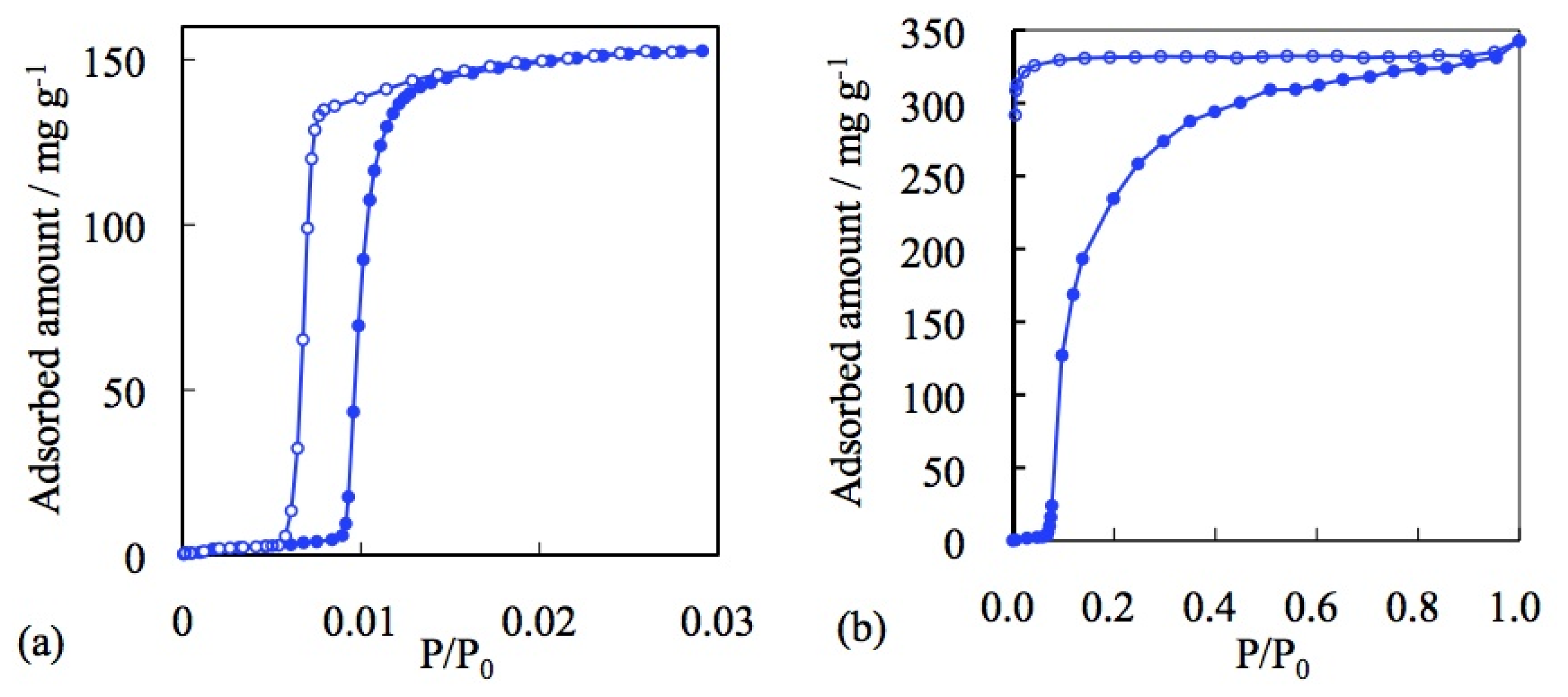
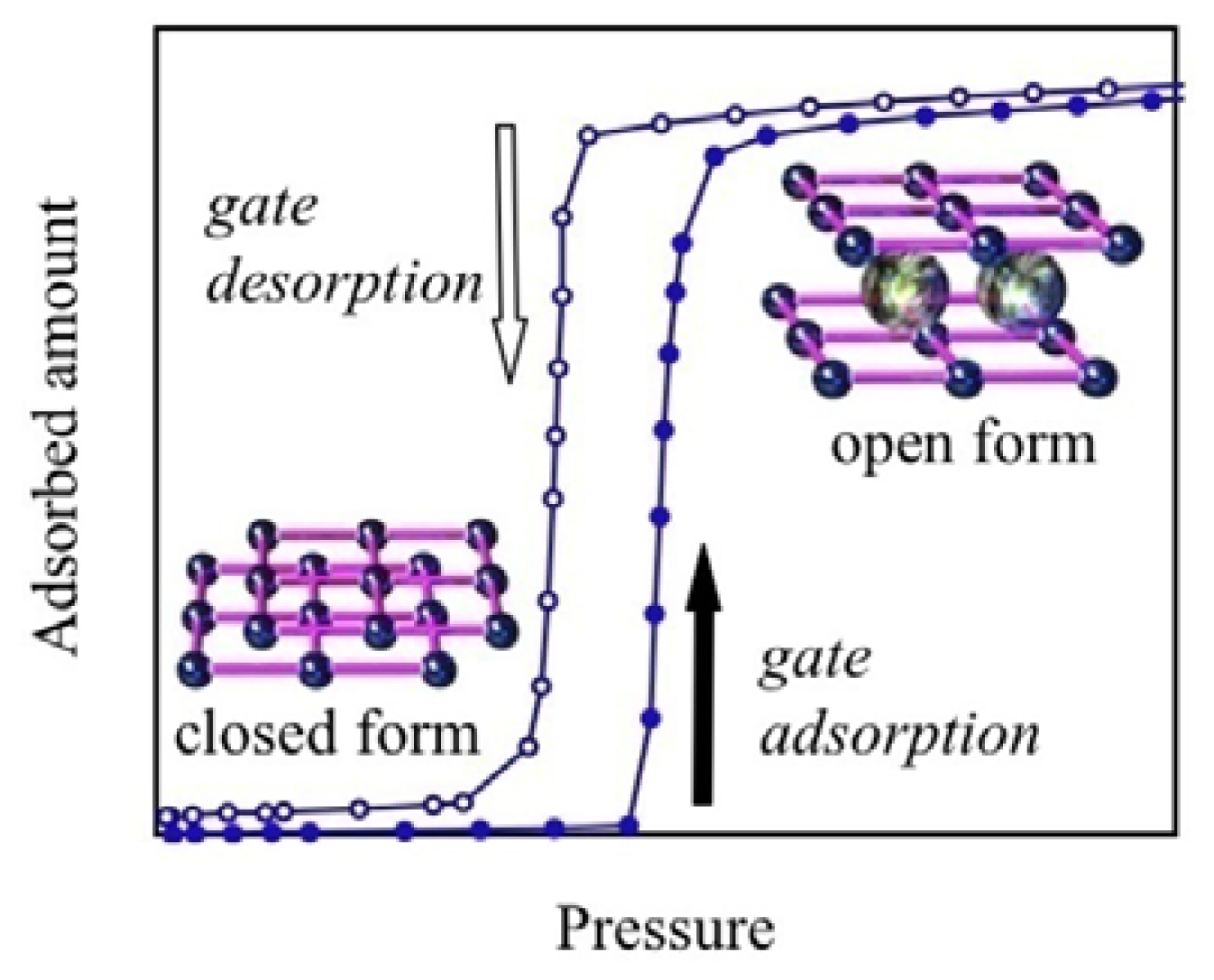
<p>In 2001, Li and Kaneko reported interesting gas adsorption phenomena on a blue crystalline coordination polymer synthesized from bpy and Cu(BF<sub>4</sub>)<sub>2</sub> showing sudden gas uptake at a definite gas pressure [<xref ref-type="bibr" rid="b63-ijms-11-03803">63</xref>]. Porous and nonporous materials show that various gas adsorption isotherms depend on the surface properties, the pore diameter, and nature of the gas molecule. The adsorption isotherms for vapors are classified into six types by the IUPAC (<xref ref-type="fig" rid="f1-ijms-11-03803">Figure 1</xref>) [<xref ref-type="bibr" rid="b79-ijms-11-03803">79</xref>].</p>
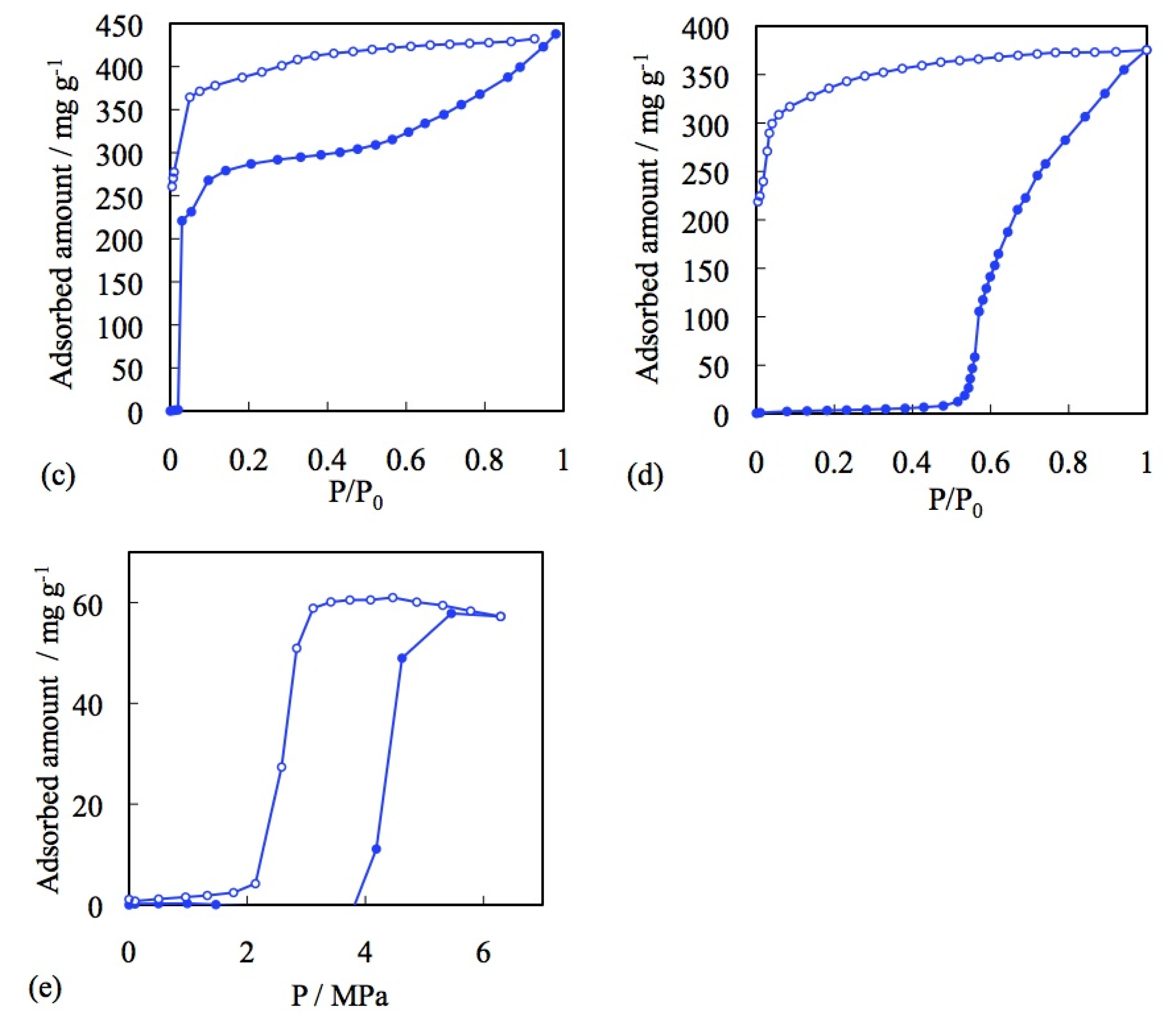
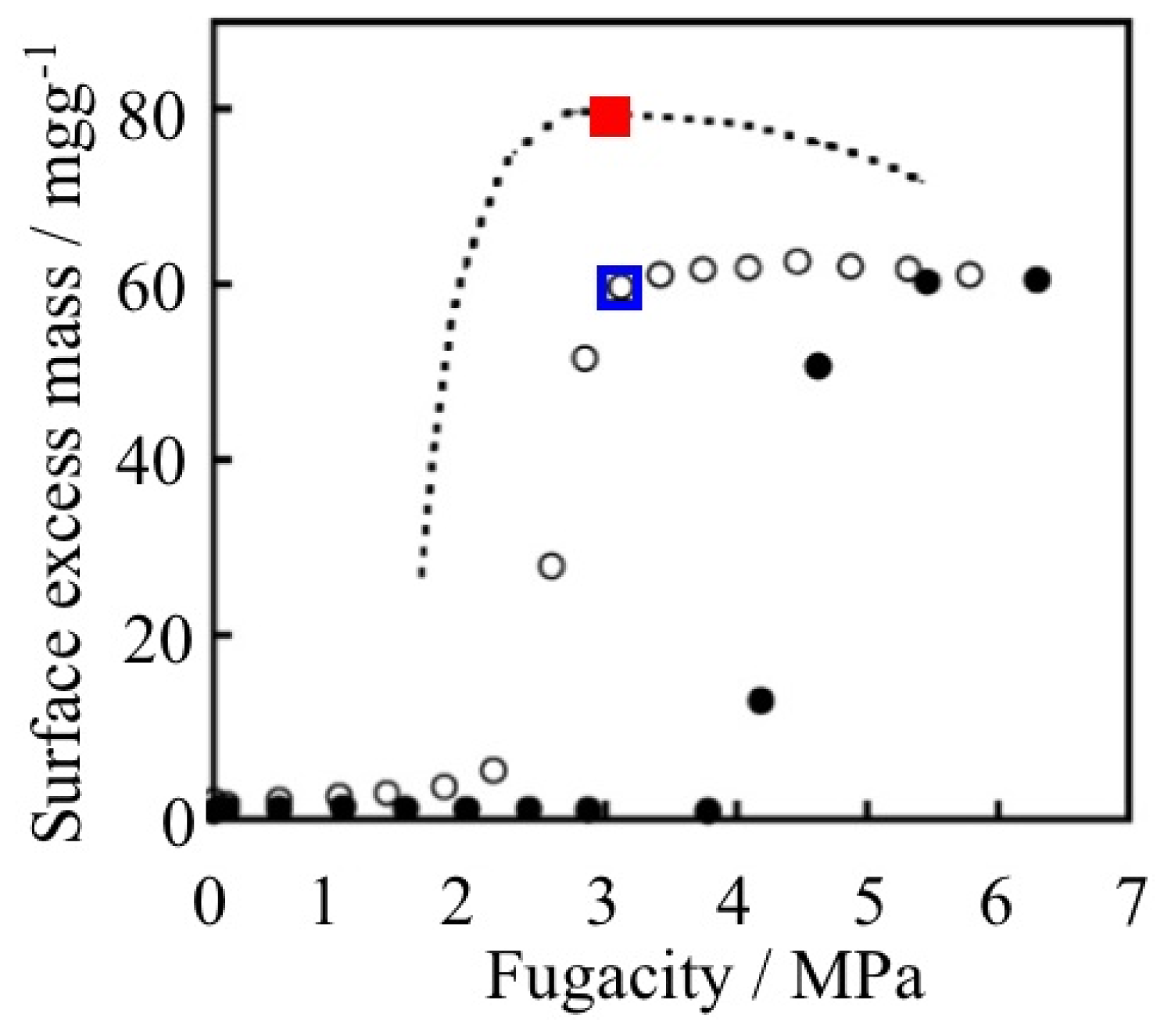
<p>Despite the difference of the detail profile, all of the six types of adsorption isotherms show a gradual increase of the amount of gas adsorption dependent on gas pressure. Therefore, the nil gas adsorption in the low-pressure region and the sudden gas uptake profile of the “blue crystalline” CP/MOF cannot be classified by IUPAC categories. There were a number of reports on gas adsorption phenomena on PCPs/MOFs before the Li-Kaneko report in 2001. In the old example, although adsorption isotherms were not disclosed, Mori and Takamizawa reported the gas adsorption phenomena on copper complexes. Nevertheless, all of the PCPs/MOFs show traditional adsorption isotherms, which are classified by the six types of adsorption isotherms [<xref ref-type="bibr" rid="b80-ijms-11-03803">80</xref>–<xref ref-type="bibr" rid="b93-ijms-11-03803">93</xref>]. In other words, before the Li-Kaneko report, all of the gas adsorption phenomena on PCPs/MOFs were classified into representative physisorption by porous materials and resembled such properties, which were shown by traditional adsorbents. In this context, gate adsorption was an unprecedented phenomenon. Subsequent studies revealed that the “blue crystalline” CP/MOF shows the gate phenomena not only to CO<sub>2</sub> but also N<sub>2</sub>, O<sub>2</sub>, and Ar [<xref ref-type="bibr" rid="b94-ijms-11-03803">94</xref>,<xref ref-type="bibr" rid="b95-ijms-11-03803">95</xref>]. It is noteworthy that the “blue crystalline” CP/MOF also shows a gate response to supercritical CH<sub>4</sub> at 303 K that usually shows very small interaction to adsorbent (<xref ref-type="fig" rid="f2-ijms-11-03803">Figure 2</xref>) [<xref ref-type="bibr" rid="b96-ijms-11-03803">96</xref>].</p></sec>
<sec>
<title>2.2. Structure of Two-Dimensional Layer-Stacking Coordination Polymer</title>
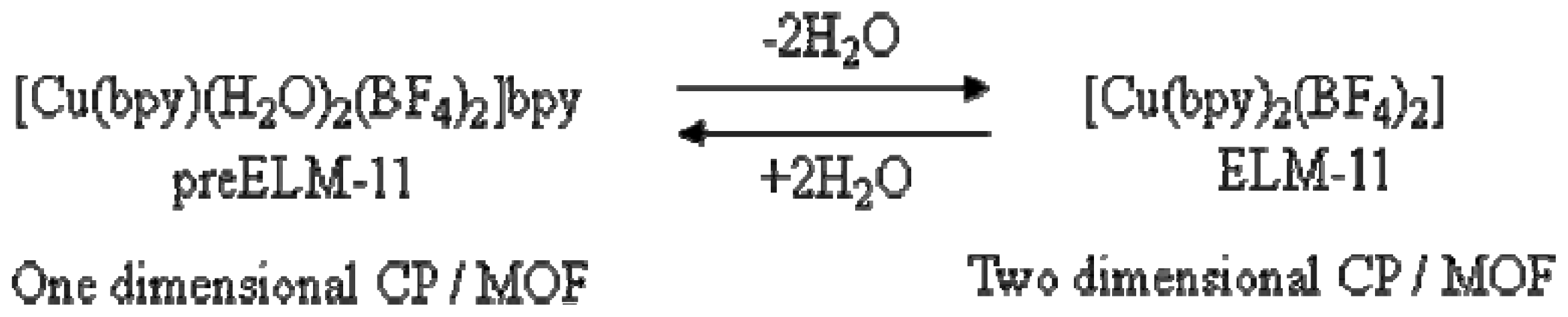
<p>The chemical formula of the “blue crystalline” CP is [Cu(bpy)(H<sub>2</sub>O)<sub>2</sub>(BF<sub>4</sub>)<sub>2</sub>]·bpy (<bold>1</bold>), and Hubberstey <italic>et al</italic>. firstly reported its structure [<xref ref-type="bibr" rid="b97-ijms-11-03803">97</xref>]; in which a one-dimensional main structure that is composed of Cu<sup>2+</sup>-bpy is integrated into a three-dimensional structure through hydrogen bondings among coordinated H<sub>2</sub>O, bridging guest bpy molecules, and BF<sub>4</sub><sup>−</sup> anions. This CP shows the gate adsorption properties after heating <italic>in vacuo</italic> treatment; hence, the characteristic hydrogen bonding network was thought to play an important role in the gate phenomenon in the early stage of the study. In a detailed study by X-ray diffraction analysis, infrared spectroscopy (IR), EXAFS, and elemental analysis, it is revealed that the CP releases water molecules in a reversible fashion and changes its structure into a two-dimensional layer stacking-type architecture, and its chemical formula is [Cu(bpy)<sub>2</sub>(BF<sub>4</sub>)<sub>2</sub>] (<xref ref-type="fig" rid="f3-ijms-11-03803">Figure 3</xref>) [<xref ref-type="bibr" rid="b98-ijms-11-03803">98</xref>]. This layered CP was revealed to be the real gate material and named an elastic layer-structured metal-organic framework (ELM-11). Therefore the hydrated complex <bold>1</bold> is named preELM-11.</p>
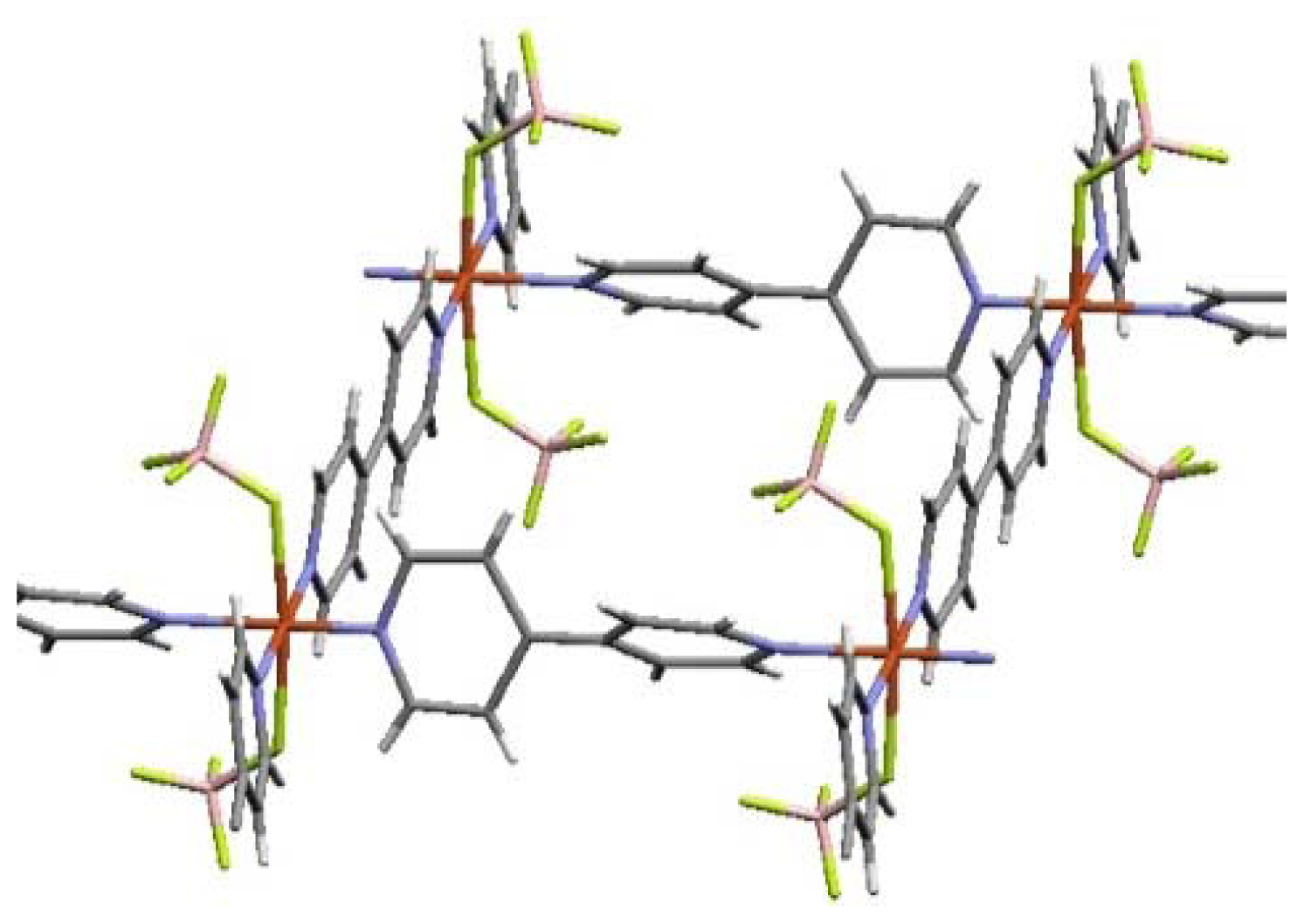
<p>The Cu<sup>2+</sup> ions are octahedrally coordinated by four bpy ligands at the equatorial positions to give two-dimensional, square grid sheets (Cu-Cu squares: 11.15 × 11.15 Å), while two BF<sub>4</sub><sup>−</sup> anions occupy the transaxial positions (<xref ref-type="fig" rid="f4-ijms-11-03803">Figure 4</xref>) [<xref ref-type="bibr" rid="b99-ijms-11-03803">99</xref>]. Although the square grid motif constructed by linear bidentate ligand and Cu<sup>2+</sup> is not uncommon, BF<sub>4</sub><sup>−</sup> anion, which has a weak coordination ability and coordinated structure, is relatively unique [<xref ref-type="bibr" rid="b100-ijms-11-03803">100</xref>–<xref ref-type="bibr" rid="b106-ijms-11-03803">106</xref>].</p>
<p>Although there are spaces for the inclusion of guest molecules in each square cavity, there is no effective pore in the stacked architecture because of the staggered stacking structure (<xref ref-type="fig" rid="f5-ijms-11-03803">Figure 5</xref>). The nil adsorption under the gate pressure can be understood from this structure, and Kaneko named this kind of CP a latent porous crystal, LPC [<xref ref-type="bibr" rid="b96-ijms-11-03803">96</xref>]. Later the name of LPC was extended into a general name which covers family compounds, as given in this review.</p>
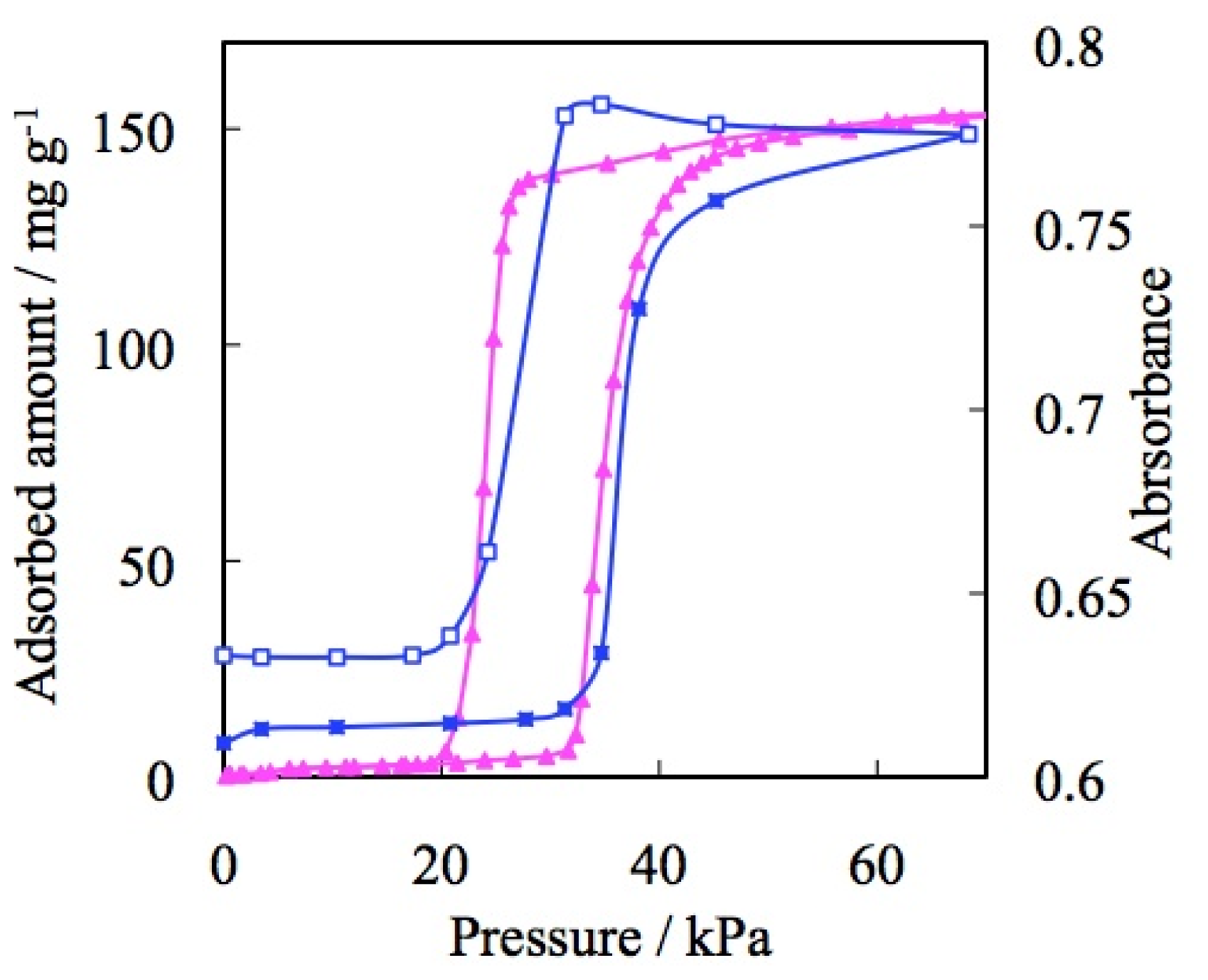
<p>The unique gate phenomenon was clarified by detailed synchrotron radiation experiments on the CO<sub>2</sub> adsorbed structure of the CP [<xref ref-type="bibr" rid="b99-ijms-11-03803">99</xref>]. After CO<sub>2</sub> adsorption, the inter-layer distance is increased by 1.20 Å (26%) from 4.58 Å to 5.78 Å, and the staggered stacking layers slide with each other, accompanying the rotation of the pyridine ring [<xref ref-type="bibr" rid="b107-ijms-11-03803">107</xref>–<xref ref-type="bibr" rid="b109-ijms-11-03803">109</xref>]. As a consequence, spaces for the accommodation of guest molecules are generated. Such structural change was also confirmed by infrared spectroscopy (IR); the peak at 1149 cm<sup>−1</sup>, which is assigned to the BF<sub>4</sub><sup>−</sup>, immediately disappeared during CO<sub>2</sub> adsorption, and a new peak appeared at 1170 cm<sup>−1</sup> by way of compensation. Two isosbestic points at 1144 and 1156 cm<sup>−1</sup> indicate that this phenomenon is a transformation between two states: The apohost and the CO<sub>2</sub>-CP clathrate (<xref ref-type="fig" rid="f6-ijms-11-03803">Figure 6</xref>) [<xref ref-type="bibr" rid="b96-ijms-11-03803">96</xref>]. The IR spectral change and CO<sub>2</sub> adsorption isotherm show relatively good correspondence (<xref ref-type="fig" rid="f7-ijms-11-03803">Figure 7</xref>). The gate gas adsorption and inter-layer expansion were accompanied with volume changes of powder crystalline ELM-11 (<xref ref-type="fig" rid="f8-ijms-11-03803">Figure 8</xref>). It is noteworthy that molecular expansion phenomena cause a macroscopic volume change irrespective of non negligible outer granular gaps.</p>
<p>In short, the gate phenomenon of ELM-11 is summarized as follows: (1) gate adsorption and desorption processes are ascribed to expansive, and shrinking modulation of the layer-stacking structure accompanied with gas molecule accommodation and effluence, respectively [<xref ref-type="bibr" rid="b55-ijms-11-03803">55</xref>,<xref ref-type="bibr" rid="b110-ijms-11-03803">110</xref>]; (2) the structural change consists of a two-state transformation between the apohost and guest-apohost clathration; (3) in a microscopic sense, the structural change is induced by the molecular movement generating the accommodation space, such as layer sliding, interlayer expansion, and pyridine ring rotation, caused by guest molecule accommodation and in the macroscopic sense, powder volume enhancement caused by external stimuli [<xref ref-type="bibr" rid="b111-ijms-11-03803">111</xref>,<xref ref-type="bibr" rid="b112-ijms-11-03803">112</xref>].</p></sec></sec>
<sec>
<title>3. Elastic Layer-Structured Metal-Organic Frameworks (ELMs)</title>
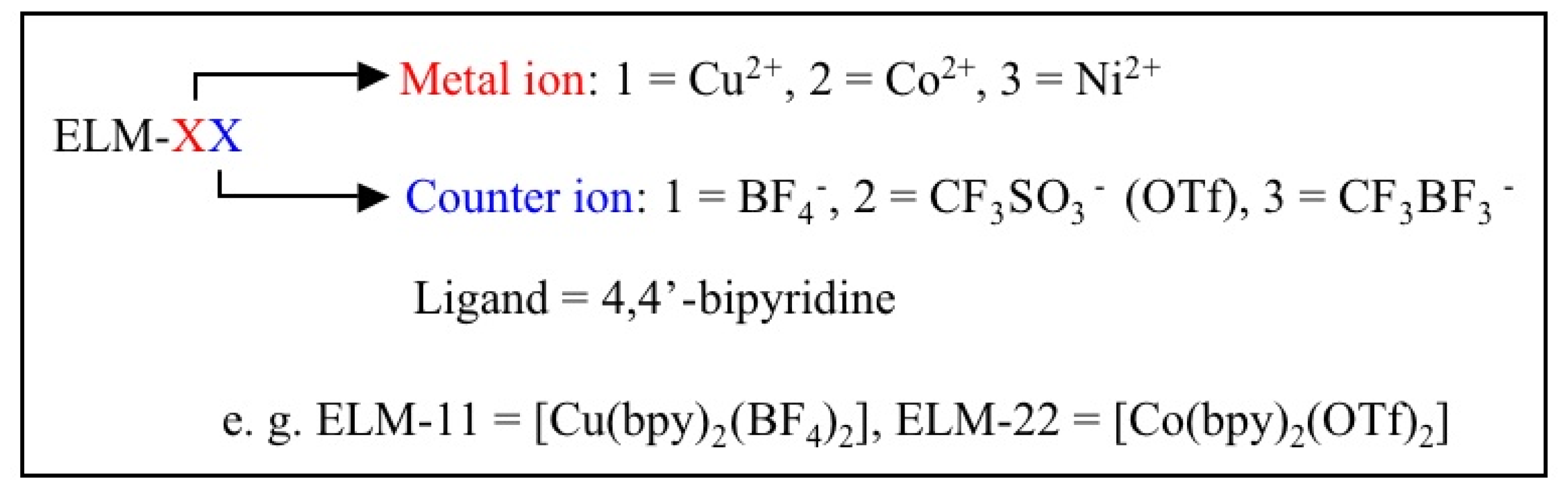
<p>Here a detailed expansion of the name of ELMs is given. We named the expansive/shrinking flexible CP/MOF as an ELM—an elastic layer-structured metal-organic framework. A series of isostructural ELMs with various metal ions, counter ions, and ligands were developed by our group. The metal and counter ions play an essential role in the structure and property and thereby the composition is added to ELMs for a specified ELM family, with the compositions of their components shown in <xref ref-type="fig" rid="f9-ijms-11-03803">Figure 9</xref>.</p>
<p>All the ELMs show gate adsorption/desorption behavior, and comparing the results of the investigation of the phenomena has revealed the roles of each component: metal ions, counter ions, and ligands.</p>
<sec>
<title>3.1. Role of the Counter Ions</title>
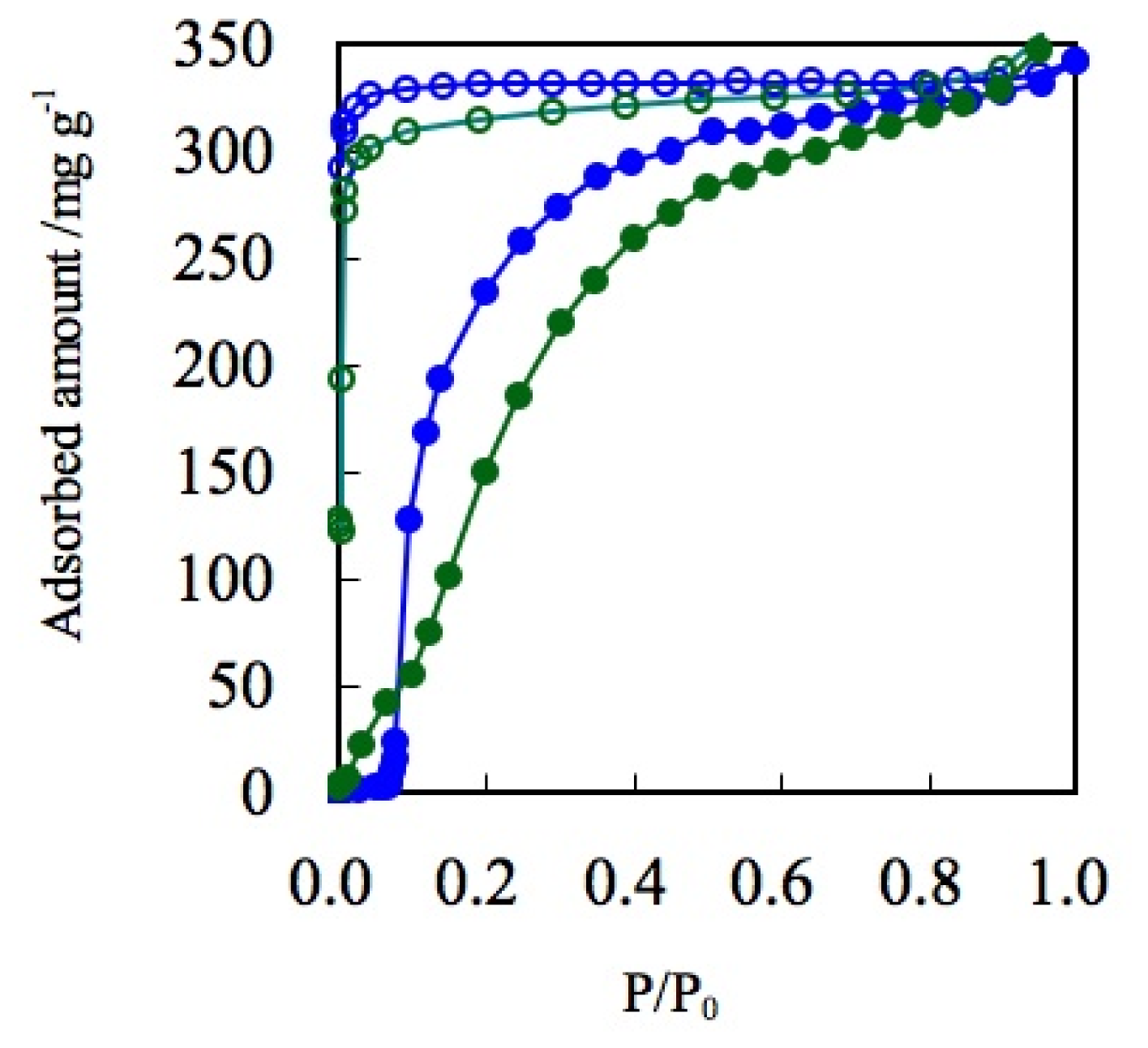
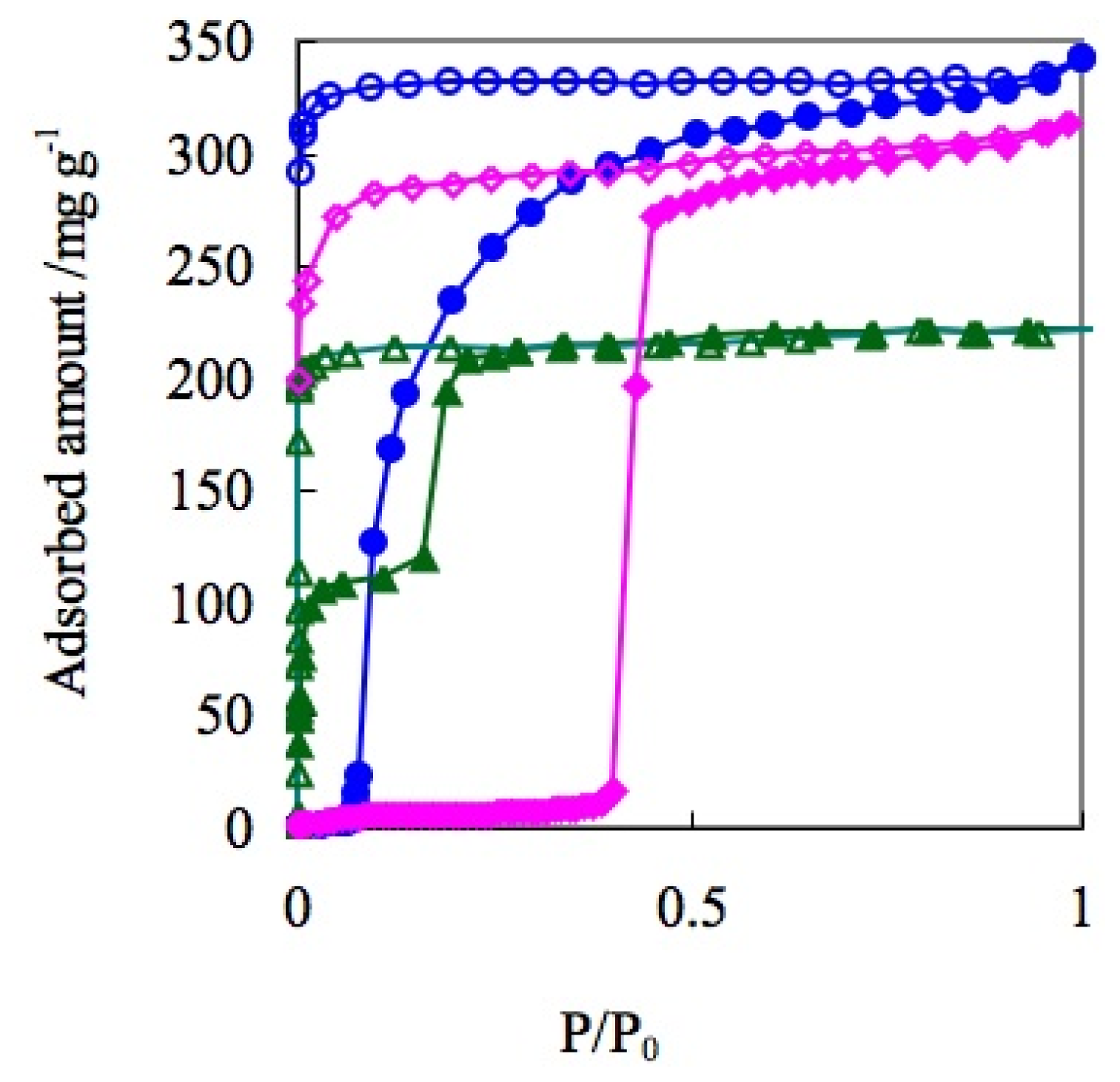
<p>In the case of nitrogen gas adsorption at 77 K, BF<sub>4</sub><sup>−</sup> containing ELM-11 ([Cu(bpy)<sub>2</sub>(BF<sub>4</sub>)<sub>2</sub>]) and ELM-31 ([Ni(bpy)<sub>2</sub>(BF<sub>4</sub>)<sub>2</sub>]), both show that the upward convex profile in the adsorption isotherm and the maximum amount of adsorption are almost similar (<xref ref-type="fig" rid="f10-ijms-11-03803">Figure 10</xref>). Although the structure of [Ni(bpy)<sub>2</sub>(BF<sub>4</sub>)<sub>2</sub>] is still unclear because of the difficulty of single crystal synthesis, the composition of the components was confirmed by elemental analysis. The similarity of ELM-11 and ELM-31 was confirmed by IR, TG, and gas adsorption experiments using several gases, such as N<sub>2</sub>, CO<sub>2</sub>, and O<sub>2</sub>. Therefore, the structure of the Ni-CP is presupposed to a two-dimensional square grid in this article.</p>
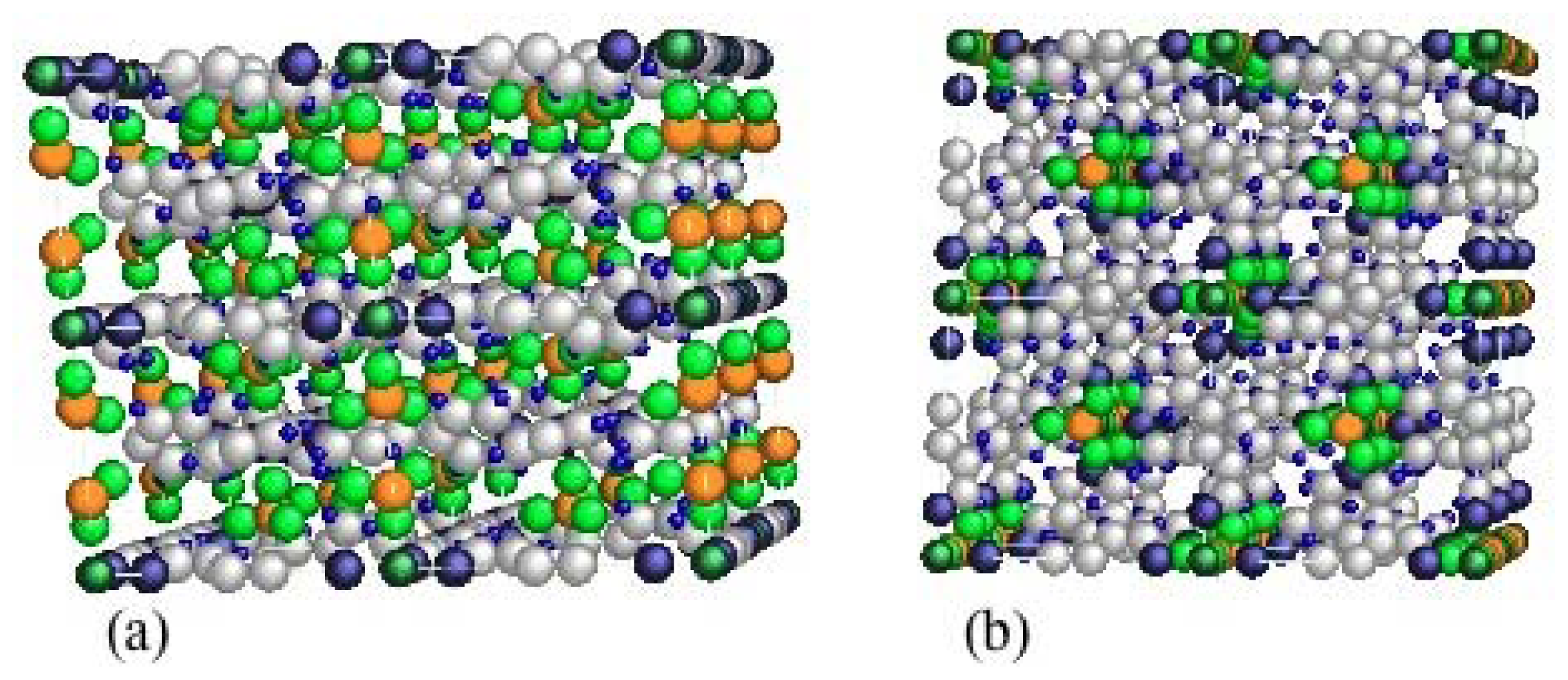
<p>On the other hand, ELM-12 (Cu), containing trifluoromethanesulfonate (OTf) as a counter ion, shows a definite double step adsorption isotherm, while the rising profile is almost vertical (<xref ref-type="fig" rid="f11-ijms-11-03803">Figure 11</xref>) [<xref ref-type="bibr" rid="b67-ijms-11-03803">67</xref>]. From the detailed structural study using synchrotron X-ray diffraction analysis, it was revealed that the ELM-12 has open micropores at the initial stage, and the first vertical adsorption step is assigned to micropore filling in the inherent micropores. This is in marked contrast to the nonporous nature of ELM-11, in spite of the common analogous fundamental two-dimensional layer structure. This difference is derived from only slight difference in stacking structure; the layers of ELM-11 are stacked in a complete staggered form, so that the bpy molecules cover the open space of metal-organic square grids in the neighboring layers. On the other hand, the layers of ELM-12 are also stacked in zigzag fashion, but the slipped degree is smaller than that of ELM-11 hence ELM-12 affords effective micropores to accommodate gases. In addition, the slightly larger inter-layer distance of ELM-12 compared to that of ELM-11 also help generate porosity at the initial stage. Furthermore, it is also revealed that the second adsorption step is derived from layer expansion phenomena accompanied with the gas-ELM clathrate generation in a way analogous to the gate phenomena of ELM-11.</p>
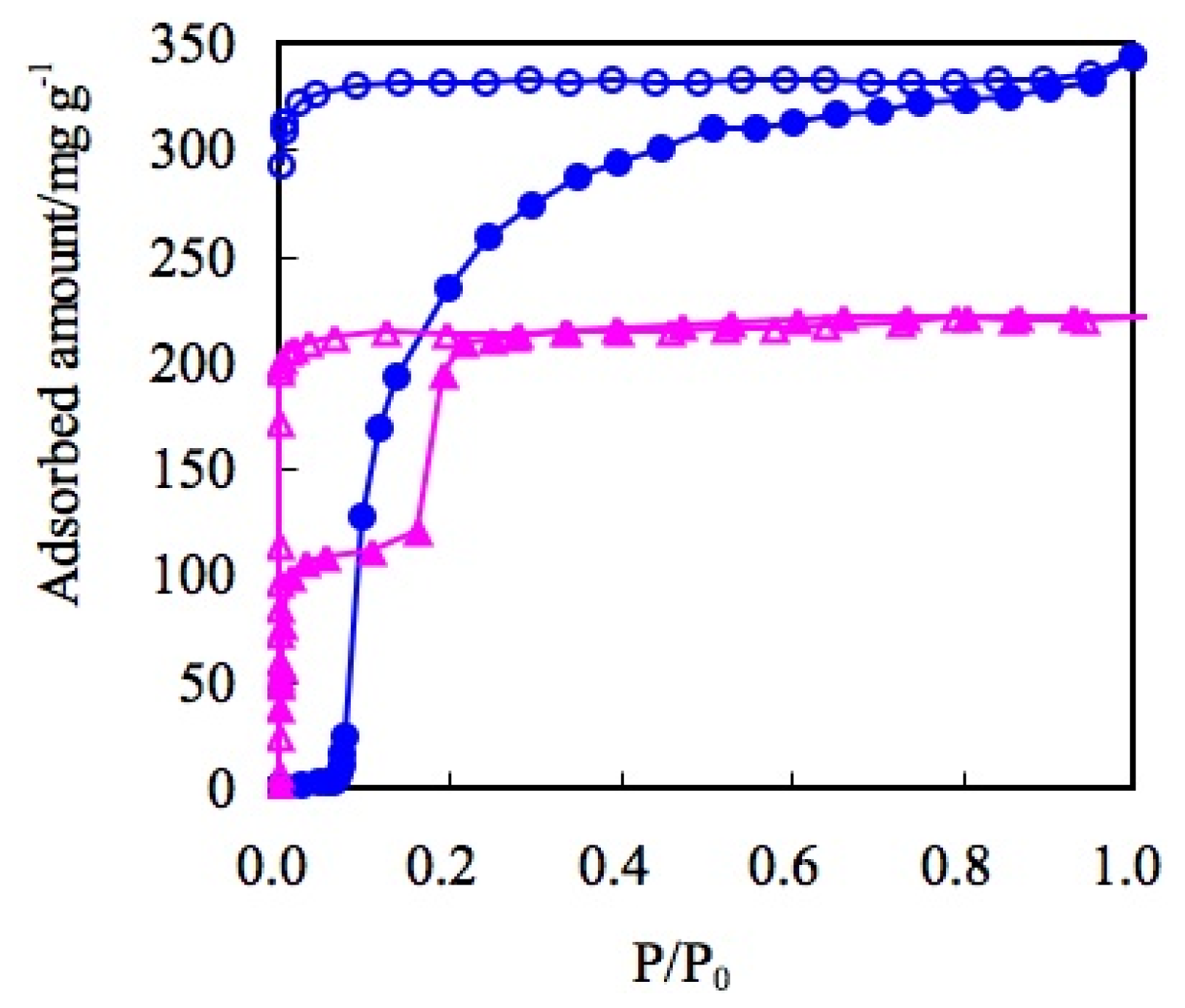
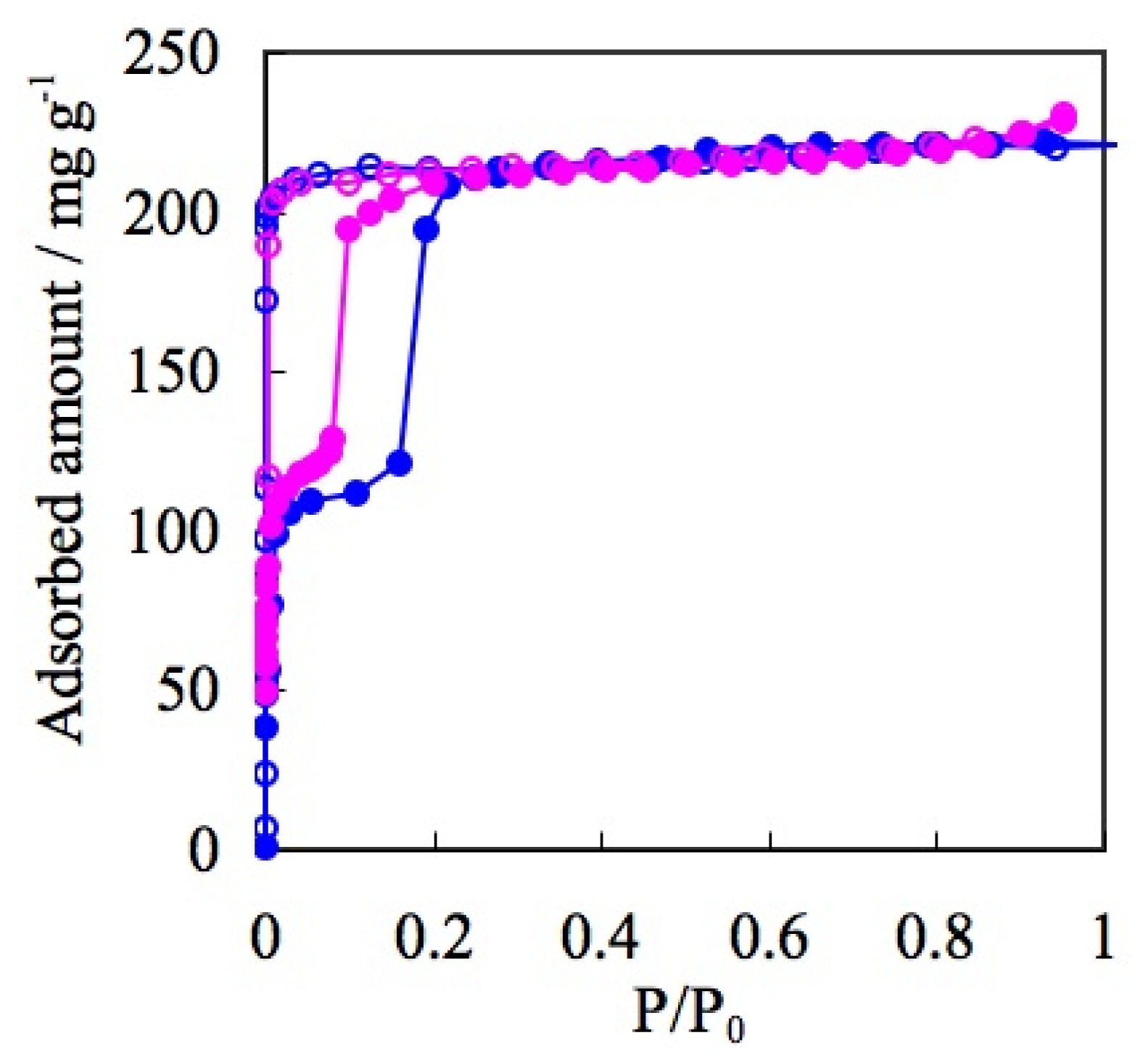
<p>Another OTf containing ELM, ELM-22 ([Co(bpy)<sub>2</sub>(OTf)<sub>2</sub>]), accentuates the characteristics of OTf anions. Despite the differences of metal ions, both OTf containing ELMs (ELM-12 and ELM-22) indicate a similar adsorption property in the case of N<sub>2</sub> at 77K [<xref ref-type="bibr" rid="b113-ijms-11-03803">113</xref>]; the maximum amount of adsorption and definite double-step adsorption profile are close to each other with a slight difference in the gate pressure (<xref ref-type="fig" rid="f12-ijms-11-03803">Figure 12</xref>). These similar adsorption properties are apparently derived from the similarities in their fundamental structure. Counter anions regulate the structure (especially through the stacking mode) and influence the adsorption profile [<xref ref-type="bibr" rid="b114-ijms-11-03803">114</xref>–<xref ref-type="bibr" rid="b120-ijms-11-03803">120</xref>].</p>
<p>Trifluoro(trifluoromethyl)borate anions, which contain a hydrophobic CF<sub>3</sub> part like that in OTf anions, and a weakly coordinating BF<sub>3</sub><sup>−</sup> part that is the same as those of BF<sub>4</sub><sup>−</sup> which is also available for the construction of the ELM structures. ELM-13 was thynthesized by layering method (Cu(BF<sub>4</sub>) <sub>2</sub> and KCF<sub>3</sub>BF<sub>3</sub>/H<sub>2</sub>O and bpy/acetone at room temperature) and the two dimensional layer strcture was analyzed by single crystal X-ray diffraction analysis. The pretreated (at 363 K under reduced pressure) CF<sub>3</sub>BF<sub>3</sub><sup>−</sup> containing ELM (ELM-13), [Cu(bpy)<sub>2</sub>(CF<sub>3</sub>BF<sub>3</sub>)<sub>2</sub>], shows unique gate gas adsorption properties. In the case of N<sub>2</sub> adsorption at 77 K, ELM-13 shows a single step adsorption profile, while the maximum amount of adsorption is similar to BF<sub>4</sub><sup>−</sup> containing ELM-11. However, the vertical rising of the adsorption isotherm at the initial stage is more marked in OTf containing ELM-12 (<xref ref-type="fig" rid="f13-ijms-11-03803">Figure 13</xref>).</p>
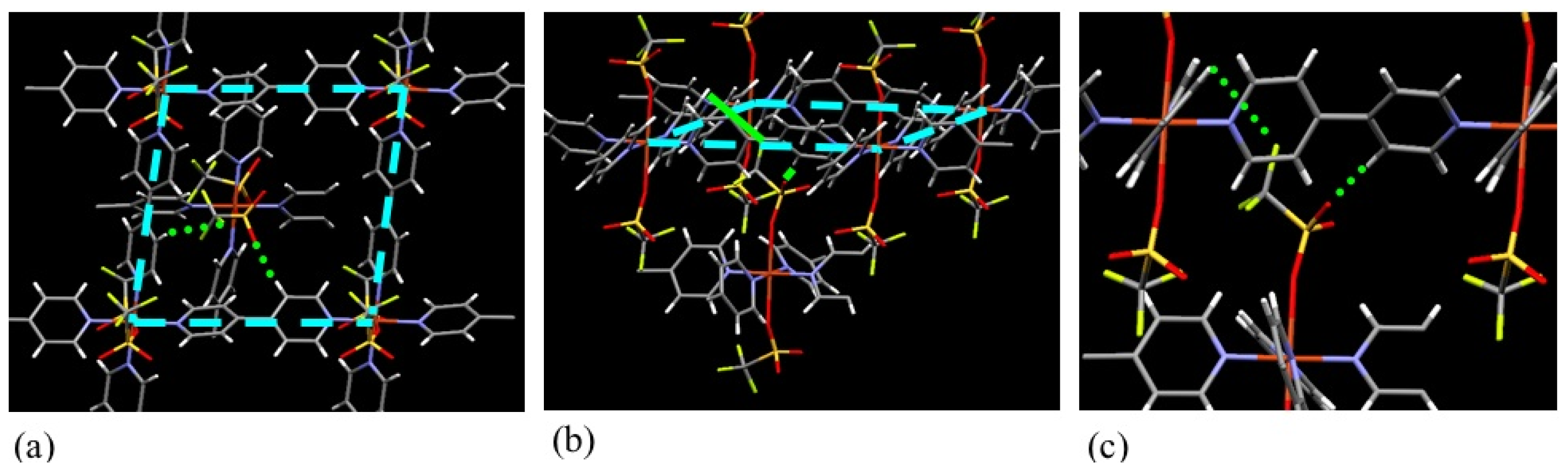
<p>In the case of ELMs, the role of counter anions is not only to charge compensation of metal cations, but also to regulate the interaction between the layers. In the case of ELM-12 (Cu-OTf), there exists the hydrogen bonding between the O atom of the OTf anion and the <italic>β</italic>-hydrogen atom of bpy in the neighboring layer, and the hydrogen bondings act as the tether line between the layers (<xref ref-type="fig" rid="f14-ijms-11-03803">Figure 14</xref>) [<xref ref-type="bibr" rid="b121-ijms-11-03803">121</xref>].</p>
<p>The counter anions, BF<sub>4</sub><sup>−</sup> and CF<sub>3</sub>BF<sub>3</sub><sup>−</sup>, have similar coordination properties (Metal-F) and both anions form the same type of hydrogen bonding (F...H). The two ELMs show a single step gate adsorption, and the maximum amount of adsorption (N<sub>2</sub>, 77 K) is almost similar. On the other hand, a double step gate-type ELM-12 contains OTf (CF<sub>3</sub>SO<sub>3</sub><sup>−</sup>) anions, which resemble the CF<sub>3</sub>BF<sub>3</sub><sup>−</sup> anion in size, but differs in its coordination property (O...Met) and type of hydrogen bonding (S=O...H). In this context, it can therefore be presumed that the regulating factor of gate steps (single step or double steps) is not the size of the counter ion but their chemical factors, such as the coordination ability and type of hydrogen bonding. On the other hand, OTf and CF<sub>3</sub>BF<sub>3</sub><sup>−</sup> anion-containing ELMs almost show a vertical adsorption isotherm profile, while BF<sub>4</sub><sup>−</sup> containing ELM shows an upper convex profile. Therefore, in the case of the gate response, an important factor may be the ion size or the chemical property, such as hydrophobicity derived from a CF<sub>3</sub> group. In any case, the ELMs, which have different counter ions but the same fundamental structure, show quite a strikingly different response to nitrogen gas, although nitrogen molecules are inert and small. Furthermore, it is also worth noting that the controlling factor for (1) gate behavior (single or double), (2) the gate profile (upper convex or vertical), and (3) the maximum amount of adsorption, are counter ions, which are just small parts attached to metal ions (<xref ref-type="table" rid="t1-ijms-11-03803">Table 1</xref>).</p>
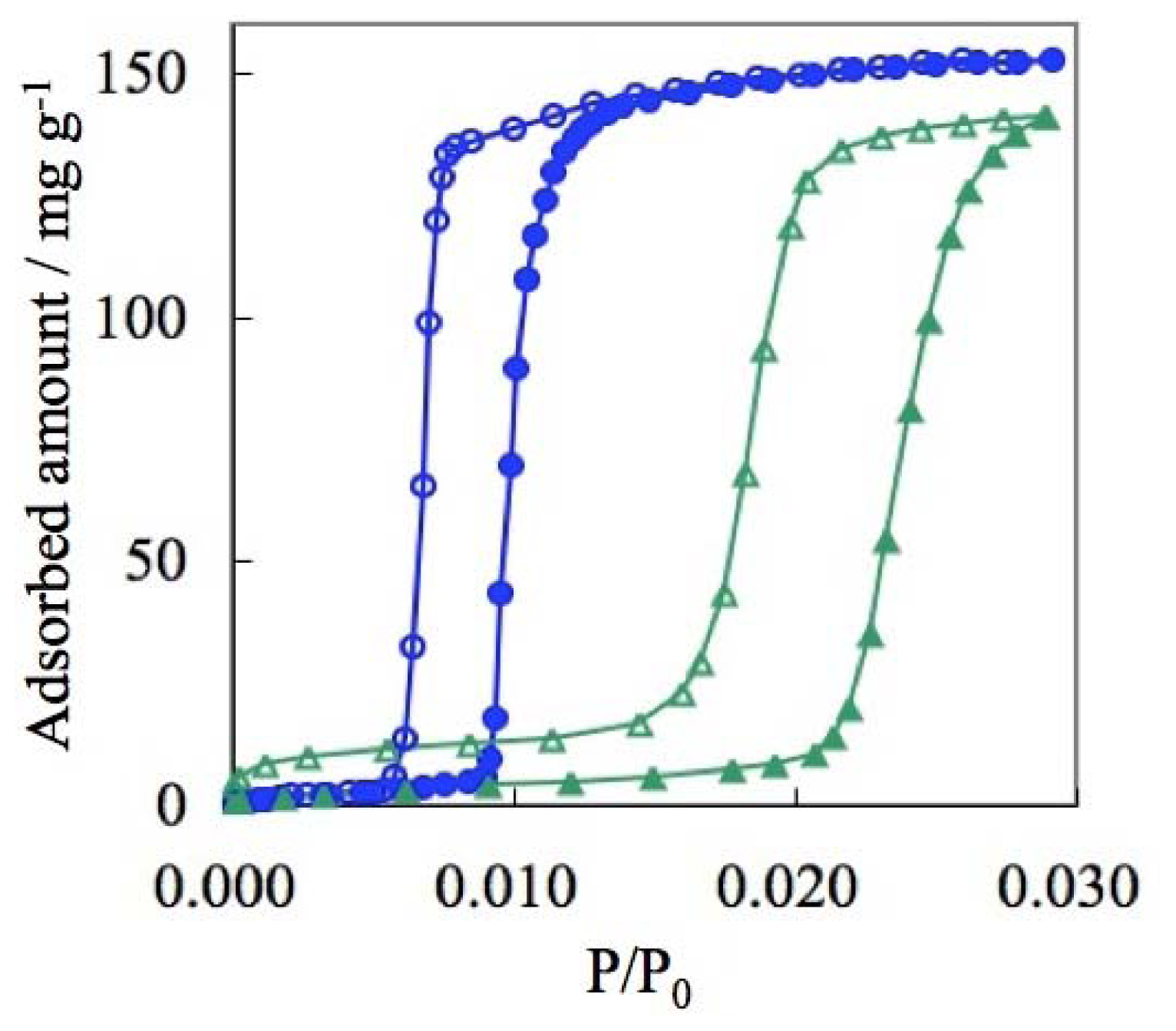
<p>As mentioned above, ELMs which contain OTf, BF<sub>4</sub><sup>−</sup>, or CF<sub>3</sub>BF<sub>3</sub><sup>−</sup> anions, show characteristic adsorption isotherm profile, respectively. Then, what adsorption profile does an ELM, containing two different anions show [<xref ref-type="bibr" rid="b102-ijms-11-03803">102</xref>,<xref ref-type="bibr" rid="b122-ijms-11-03803">122</xref>,<xref ref-type="bibr" rid="b123-ijms-11-03803">123</xref>]: ELM-12/3 bearing both OTf and CF<sub>3</sub>BF<sub>3</sub><sup>−</sup> was synthesized by layering of Cu(OTf)<sub>2</sub> and KCF<sub>3</sub>BF<sub>3</sub>/H<sub>2</sub>O and bpy/ethanol (Elemental analysis as C<sub>22</sub>H<sub>16</sub>N<sub>4</sub>O<sub>3</sub>CuBF<sub>9</sub>S, which corresponds to the Cu:bpy:CF<sub>3</sub>SO<sub>3</sub>:CF<sub>3</sub>BF<sub>3</sub> = 1:2:1:1; Calcd (%): C 39.93, H 2.44, N 8.47, Cu 9.60, B 1.63, S 4.85; found: C 41.4, H 2.30, N 8.8, Cu 9.60, B 1.20, S 4.40. The content of the two ions species are also quantitatively analyzed by ion chromatography: 1.04 equivalent of OTf for Cu<sup>2+</sup> and 1.00 equivalent of CF<sub>3</sub>BF<sub>3</sub><sup>−</sup> for Cu<sup>2+</sup> were detected.). Two dimensional layer strcture of ELM-12/3 was analyzed by single crystal X-ray diffraction analysis. This ELM-12/3 shows an adsorption isotherm quite similar to that of ELM-12 containing OTf: The similarities are shown in the vertical double step profile, the adsorption amount ratio of one-step and second-step (<italic>ca.</italic> 1/1), and the maximum amount of adsorption (220 mg/g). On the one hand, the gate pressure of ELM-12/3 decreases significantly compared to ELM-12 (OTf) and ELM-13 (CF<sub>3</sub>BF<sub>3</sub><sup>−</sup>). On the other, ELM-12/3 shows the lowest gate pressure compared to ELM-12 (Cu-OTf) and ELM-22 (Co-OTf) (<xref ref-type="fig" rid="f15-ijms-11-03803">Figure 15</xref>).</p>
<p>To date, and to the best of our knowledge, ELM-12/3 is the only example of two-dimensional flexible CPs having the mixed counter anions.</p></sec>
<sec>
<title>3.2. Effect of Metal Cations</title>
<p>As mentioned above, the influence of metal ions on the adsorption profile is slight in the case of N<sub>2</sub> adsorption at 77 K. If the counter ion is common, the slight difference of the adsorption isotherms between Cu-ELM <italic>vs</italic>. Ni-ELM and Cu-ELM <italic>vs</italic>. Co-ELM is observed only in the gate pressure. On the other hand, the kind of metal cations is quite an important factor for controlling the sorption phenomena in the case of O<sub>2</sub> and CO<sub>2</sub> adsorption [<xref ref-type="bibr" rid="b113-ijms-11-03803">113</xref>]. Trifluoromethanesulfonate anion-containing ELM-12 (Cu) and ELM-22 (Co) are basically isostructures, despite the slight difference in the coordination field of metal ions derived from the Jahn-Teller effect. Therefore, the porous character of the initial structure derived from the slight zigzag stacking mode is common in both the ELMs. However, they show quite different responses to O<sub>2</sub> and CO<sub>2</sub> molecules. In the case of O<sub>2</sub> adsorption at 77 K, the ELM-22 (Co) shows the same double step adsorption isotherms as those in the case of N<sub>2</sub> adsorption, even though Cu<sup>2+</sup> containing the ELM-12 adsorbs O<sub>2</sub> in triple steps, and the maximum amount of adsorption is 1.6 times that of the ELM-22 (Co). Carbon dioxide molecules induce a similar response in the ELMs—the adsorption isotherms (196 K) of the ELM-22 (Co) are of a double step, while ELM-12 (Cu) shows a multi step adsorption phenomenon. Furthermore, the total amount of adsorption of ELM-12 (Cu) is 1.5 times that of ELM-22 (Co). The molecular number of that adsorbed on ELM-12 (Cu) and the physical properties of the adsorbed gas are shown in <xref ref-type="table" rid="t2-ijms-11-03803">Table 2</xref>.</p>
<p>Although the molecular size of O<sub>2</sub> is comparable to N<sub>2</sub>, the adsorbed amount of O<sub>2</sub> is apparently larger compared to that of N<sub>2</sub> (1.5 times). In addition, although the molecular size of CO<sub>2</sub> is larger than N<sub>2</sub>, CO<sub>2</sub> molecules of an amount similar to N<sub>2</sub> can be accommodated in the flexible ELM-12 framework. Accordingly, it can be presumed that O<sub>2</sub> and CO<sub>2</sub> molecules have a stronger effect on the layer expansion of Cu-ELM and that such effect is less for Co-ELM. On the other hand, Ni<sup>2+</sup> containing ELM-31 (Ni-BF<sub>4</sub>) shows simple one step gate responses to CO<sub>2</sub> at 273 K, which is similar to the response of Cu<sup>2+</sup> containing ELM-11 (Cu-BF<sub>4</sub>) to CO<sub>2</sub> (<xref ref-type="fig" rid="f16-ijms-11-03803">Figure 16</xref>). In this case, the metal cation does not affect the gate profile but mainly the gate pressure.</p>
<p>It is also well known that the type of metal cation used has a strong effect on the adsorptivity of PCPs/MOFs [<xref ref-type="bibr" rid="b125-ijms-11-03803">125</xref>–<xref ref-type="bibr" rid="b128-ijms-11-03803">128</xref>]. This effect is divided into two categories: (1) direct effect—through the interaction between metal cations and adsorbed molecules, and (2) indirect effect—through the regulation of pore structures. In the case of the PCPs/MOFs having open metal sites, it is especially well studied that adsorption control by the metal ion is based on metal-adsorbate interaction [<xref ref-type="bibr" rid="b84-ijms-11-03803">84</xref>,<xref ref-type="bibr" rid="b129-ijms-11-03803">129</xref>–<xref ref-type="bibr" rid="b132-ijms-11-03803">132</xref>]. Although it is also well known that isostructural PCPs/MOFs are constructed from different metal ions, the metal effects on adsorption through structural regulation have not been well studied, especially in the case of flexible coordination polymers [<xref ref-type="bibr" rid="b133-ijms-11-03803">133</xref>–<xref ref-type="bibr" rid="b136-ijms-11-03803">136</xref>]. Férey <italic>et al</italic>. report one of a few examples discussing the effect of large quadrupole moments of CO<sub>2</sub> on the structural transformation of flexible PCPs/MOFs [<xref ref-type="bibr" rid="b135-ijms-11-03803">135</xref>]. The contribution of the quadrupole moment of CO<sub>2</sub> in the interaction is still much smaller than the dispersion attractive interaction. In the case of ELMs, an important aid with the large quadrupole moment of CO<sub>2</sub> for large amount and multi step CO<sub>2</sub> adsorption on ELM-12 (Cu) can be considered [<xref ref-type="bibr" rid="b135-ijms-11-03803">135</xref>,<xref ref-type="bibr" rid="b137-ijms-11-03803">137</xref>–<xref ref-type="bibr" rid="b140-ijms-11-03803">140</xref>]. Carbon dioxide also shows specific behavior with the adsorption phenomena on the gate opening mechanism of ELM-11 (Cu-BF<sub>4</sub>). Although both N<sub>2</sub> (77 K) and CO<sub>2</sub> (273 K) show a single step gate adsorption on ELM-11, the number of adsorbed molecules is quite different: N<sub>2</sub> is 7.0/unit cell (at P/P<sub>0</sub> = 0.99, at 77 K) and CO<sub>2</sub> is 1.9/unit cell (at P/P<sub>0</sub> = 0.99, at 273 K), because the adsorption temperature of CO<sub>2</sub> is close to the critical temperature as shown in <xref ref-type="fig" rid="f13-ijms-11-03803">Figures 13</xref> and <xref ref-type="fig" rid="f16-ijms-11-03803">16</xref>. Actually, the isosteric heat adsorption of CO<sub>2</sub> on ELM-11 was estimated at 26 kJ/mol by the van’t Hoff equation, at the range of the number of adsorbed CO<sub>2</sub> molecules from 0.5/unit cells (37.58 mg/g) to 1.5/unit cells (112.7 mg/g). This value is comparable to the sublimation enthalpy of CO<sub>2</sub> (25 kJ/mol). These results imply the specific interaction of CO<sub>2</sub> and ELM-11 at the subcritical temperature. Thus, CO<sub>2</sub> should be highly stabilized in the lattice of ELM-11. Although Baiker <italic>et al</italic>. reported interaction between Cu<sup>2+</sup> of (pre)ELM-11 and adsorbed acetnitrile molecule [<xref ref-type="bibr" rid="b141-ijms-11-03803">141</xref>], metal-guest interaction of ELMs are still unclear and under investigation.</p></sec>
<sec>
<title>3.3. Hydrogen Adsorption</title>
<p>Hydrogen molecules are not adsorbed on nonporous ELM-11 under the condition of supercritical gas above 33 K. In addition, hydrogen molecules do not cause the structural transformation because of weak interaction. As both ELM-12 (Cu) and ELM-22 (Co), which contain OTf ions, are porous even at the initial stage, they adsorb slight H<sub>2</sub> at 77 K. From the small amount of adsorbed gas and weak interaction with H<sub>2</sub>, the adsorption mechanism is considered as a quasi-micropore filling whereby super critical gas can be filled in the inherent pore sites enough to stabilize the molecules even above a critical temperature. The adsorption is not chemisorptive but reversible [<xref ref-type="bibr" rid="b142-ijms-11-03803">142</xref>]. Although the pore parameters of ELM-12 (Cu) and ELM-22 (Co) are quite similar, the adsorbed H<sub>2</sub> amounts differ from each other [<xref ref-type="bibr" rid="b113-ijms-11-03803">113</xref>]. This difference is apparent especially in low pressure regions. For example, ELM-22 (Co) adsorbed more than 1.5 times that of adsorbed ELM-12 (Cu) at a low pressure region. As the difference in the dispersion interaction of Cu<sup>2+</sup> and Co<sup>2+</sup> ions with H<sub>2</sub> molecules should be small, this difference is attributed to the more meandering pore structure of ELM-22 (Co) compared to ELM-12 (Cu), and the fine structural difference arises from a difference in metal cations (<xref ref-type="table" rid="t3-ijms-11-03803">Table 3</xref>).</p>
<p>As mentioned above, in the case of ELMs, metal cations act not only as a simple connecting node for the architecture, but also as fine tuning of pore structures.</p></sec>
<sec>
<title>3.4. Effect of Ligand</title>
<p>In general, the length of ligands is a key factor to tune the coordination space of PCPs/MOFs [<xref ref-type="bibr" rid="b143-ijms-11-03803">143</xref>–<xref ref-type="bibr" rid="b150-ijms-11-03803">150</xref>]. Yaghi’s group reported the archetype study of relationships between the length of the ligand and the amount of gas adsorption using a series of various ligands [<xref ref-type="bibr" rid="b43-ijms-11-03803">43</xref>]. According to their studies, PCP/MOF with longer ligands apparently tend to have a large coordination space—when the ligands are changed from terephthalic acid (IRMOF-1, contains one phenyl (Ph) ring), 4,4′-biphenldicarboxylic acid (IRMOF-10, two Ph ring), to 4,4′-terphenyldicarboxylic acid (IRMOF-16 three Ph ring), the calculated percentage of free volume increases from 79.2% (one Ph), 87.0 (two Ph), to 91.1% (three Ph).</p>
<p>In contrast to the Yaghi’s rigid PCPs/MOFs series, flexible ELMs show a reverse tendency. Although the extended ligand, 4,4′-bis(4-pyridyl)benzene (bpb) (11.4 Å) is 63% longer than bpy (7.0 Å) [<xref ref-type="bibr" rid="b151-ijms-11-03803">151</xref>], ELM-31b ([Ni(bpb)<sub>2</sub>(BF<sub>4</sub>)<sub>2</sub>]) shows a 40% smaller adsorbed amount (W<sub>0</sub>(N<sub>2</sub>) = 212 mg/g at 77 K) compared to that of ELM-31 ([Ni(bpy)<sub>2</sub>(BF<sub>4</sub>)<sub>2</sub>])(W<sub>0</sub>(N<sub>2</sub>) = 350 mg/g at 77 K). This reverse tendency should be understood from the unique adsorption mechanism of ELMs. In the case of “hard” PCPs/MOFs, which show type I physisorption isotherms, there is a tendency for the larger free volume to accommodate more gas. On the other hand, “flexible” ELMs adsorb gas through clathrate formation; the adsorption depends on the stability of the gas-CP/MOF clathrates. Since the clathrates of larger square grids with longer ligands (bpb ligand, 15 × 15 Å) are unstable because of the weak interaction between guests and hosts, compared to small square grids (bpy ligand, 11 × 11 Å), the amount of adsorbed gas tends to decrease for the longer ligand system. Fujita <italic>et al</italic>. reported the example of flexible two-dimensional layer stacking-type PCP/MOF with extended ligands. This PCP/MOF varies its structure with solvent exchange [<xref ref-type="bibr" rid="b152-ijms-11-03803">152</xref>]. To our best knowledge, the ELM-31b is the only example of two-dimensional stacking PCP/MOF with extended ligands, which can change its structure by gas molecules, which interact with host framework by weaker interaction.</p></sec></sec>
<sec>
<title>4. Various Two-Dimensional Square Grid Stacking-Type (2DSG) CPs/MOFs</title>
<sec>
<title>4.1. Two-Dimensional Square Grid Stacking-Type CPs/MOFs: Structure and Functions</title>
<p>An aromatic compound containing nitrogen such as pyridine is one of the most popular coordinative functional groups, and hence many CPs/MOFs have been synthesized using exobidentate ligands bearing two pyridyl groups, such as bpy [<xref ref-type="bibr" rid="b153-ijms-11-03803">153</xref>,<xref ref-type="bibr" rid="b154-ijms-11-03803">154</xref>]. There are quite a few examples of metal-organic square networks with linear bifunctional spacer ligands [<xref ref-type="bibr" rid="b155-ijms-11-03803">155</xref>]. To synthesize such kinds of CPs/MOFs, various ligands have been used: short or long [<xref ref-type="bibr" rid="b156-ijms-11-03803">156</xref>–<xref ref-type="bibr" rid="b161-ijms-11-03803">161</xref>], rigid or flexible [<xref ref-type="bibr" rid="b162-ijms-11-03803">162</xref>,<xref ref-type="bibr" rid="b163-ijms-11-03803">163</xref>], linear or inflectional [<xref ref-type="bibr" rid="b164-ijms-11-03803">164</xref>,<xref ref-type="bibr" rid="b165-ijms-11-03803">165</xref>], with functional group(s) [<xref ref-type="bibr" rid="b159-ijms-11-03803">159</xref>,<xref ref-type="bibr" rid="b166-ijms-11-03803">166</xref>–<xref ref-type="bibr" rid="b170-ijms-11-03803">170</xref>], rotaxane-type [<xref ref-type="bibr" rid="b171-ijms-11-03803">171</xref>], chiral-type [<xref ref-type="bibr" rid="b172-ijms-11-03803">172</xref>], and so on. An example of a typical linear, rigid, exobidentate ligand would be 4,4′-bipyridine. A number of two-dimensional square grid stacking-type CPs/MOFs (2DSG-CP/MOF) with this ligand has been reported [<xref ref-type="bibr" rid="b173-ijms-11-03803">173</xref>–<xref ref-type="bibr" rid="b176-ijms-11-03803">176</xref>]. Because of the neutral nature of bpy, 2DSG-CPs/MOFs necessarily contain counter anions to compensate the positive charges of metal ions, and these negatively charged counterparts increase the diversity of 2DSG-CPs/MOFs. Various 2DSG-CPs/MOFs constructed with bpy and unidentate coordination anion are listed in <xref ref-type="table" rid="t4-ijms-11-03803">Table 4</xref>.</p>
<p>Since almost all the listed 2DSG-CPs/MOFs include guest molecules, this means the 2DSG-CPs/MOFs are potentially acting as porous materials. From the standpoint of host/guest chemistry, the synthesis of hybrid-type nonlinear optical materials was attempted with the combination of 2DSG-PCPs/MOFs host and guest molecules, such as <italic>p</italic>-nitroaniline [<xref ref-type="bibr" rid="b185-ijms-11-03803">185</xref>]. On the other hand, there is no report on the gas adsorption or structural transformation of the CPs/MOFs listed in <xref ref-type="table" rid="t4-ijms-11-03803">Table 4</xref>, except for ELMs. In addition, we cannot synthesize ELMs family with any counter anions other than BF<sub>4</sub><sup>−</sup>, OTf, and CF<sub>3</sub>BF<sub>3</sub><sup>−</sup>. If the scope of ligands widens from bpy to pyrazine, 1,4-bis(4-pyridyl)benzene, and 4,4′-bis(4-pyridyl)biphenyl, to the best of our knowledge, there is no report on the gate gas adsorption of 2DSG-CPs/MOFs or the structural transformation of 2DSG-CPs/MOFs caused by gas molecules. In the case of longer ligand, it is reported that the structural transformation of 2DSG-CPs/MOFs constructed with 4,4′-bis(4-pyridil)biphenyl ligand. However, the structural change was not caused by gas molecules but by the exchange of aromatic guest molecules [<xref ref-type="bibr" rid="b160-ijms-11-03803">160</xref>]. The reason why all of the listed 2DSG-CPs/MOFs except the ELMs do not show the gas adsorption is considered to be as follows: (1) the cavity of the metal-organic square does not act as an open pore because of the close packing of the layers and the difficulty of structural transformation of the layers; (2) the cavity is already occupied by non-removable guest molecules and there is no space for gas adsorption; and (3) the 2DSG structure collapses when the guest is released. The necessary requirement for gas adsorption is conservation of the framework structure after the guest release. The collapse of the CP/MOF structure with the guest release can be seen as a common behavior, and in the case of 2D CP/MOFs [<xref ref-type="bibr" rid="b217-ijms-11-03803">217</xref>], sometimes a turbostratic disorder occurs in the case of 2DSG CP/MOFs [<xref ref-type="bibr" rid="b218-ijms-11-03803">218</xref>]. The present collapse assumption must be reconsidered, based on the fact that ELM-22 (Co) retains its 2DSG structure without any guest.</p>
<p>Hereafter, let us consider the role of counter anions. It is well known that these play a significant role in regulating the structure of CPs/MOFs [<xref ref-type="bibr" rid="b122-ijms-11-03803">122</xref>,<xref ref-type="bibr" rid="b159-ijms-11-03803">159</xref>,<xref ref-type="bibr" rid="b219-ijms-11-03803">219</xref>–<xref ref-type="bibr" rid="b221-ijms-11-03803">221</xref>]. In addition, the counter anions sometimes play a significant role in the function of CPs/MOFs. However, in the case of flexible PCPs/MOFs [<xref ref-type="bibr" rid="b222-ijms-11-03803">222</xref>], the role of counter anions in structural transformation is not necessarily clear. The common features of the counter anions of ELMs are: (1) monodentate; (2) mono-valent; (3) weak coordination ability; (4) occupation of the apical positions; and (5) participation of fluorine atoms. In the case of non-ELM 2DSG-CPs/MOFs, NCS<sup>−</sup>, which have relatively strong interaction with metal cations, tend to occupy the apical positions. Imamoto reported the synthesis of [Ni(bpy)<sub>2</sub>(NCS)<sub>2</sub>] [<xref ref-type="bibr" rid="b188-ijms-11-03803">188</xref>] of a fundamental structure is similar to ELM-22 (Co-OTf) having no guest and precise layer stacking. Therefore, the non-porous character of the Imamoto’s Ni-CP/MOF may be attributed not to structural friability but to the difficulty in the structural transformation for the generation of micropore. Jacobson reported the Co version of NCS-2DSG-CP/MOF, [Co(bpy)<sub>2</sub>(NCS)<sub>2</sub>]·2Et<sub>2</sub>O [<xref ref-type="bibr" rid="b179-ijms-11-03803">179</xref>]. Although this compound easily releases two ether molecules, the non-guest state does not induce gas adsorption. In this case, the initial porous state is supposed to transform into a non-porous form (a compact layer stacking form) with the guest release. Imamoto and Jacobson did not mention the gas adsorption ability of their CPs/MOFs. From our adsorption experiment (N<sub>2</sub> at 77 K and CO<sub>2</sub> at 273 K, after the pretreatment at 363 K for three hours under reduced pressure), Ni-CPs/MOFs did not show any gas adsorption ability. We also checked Fujita’s [Cd(bpy)<sub>2</sub>(NO<sub>3</sub>)<sub>2</sub>], but this CP did not show N<sub>2</sub> gas adsorption ability at 77 K.</p>
<p>In the case of other anions, such as NO<sub>3</sub><sup>−</sup>, ClO<sub>4</sub><sup>−</sup>, and PF<sub>6</sub><sup>−</sup>, these weak coordination anions tend to locate themselves in the square grid as guests. They occupy the apical position only if the grid accommodates aromatic guest molecules. Based on these facts, occupation of the apical positions by weak coordinating anion can be regarded as one of the key factors for the gate gas adsorption phenomena. Although the space of the grid will decrease, if the counter anion is present as a guest, there still remains room for small gas molecules, considering the small size of the counter ions compared to the size of the square grid. Therefore, the reason why the ion-accommodating 2DSG-CP/MOF does not uptake the gas molecule, may be attributed to the difficulty of interlayer sliding. In the case of ELMs, interlayer sliding is a crucial motion for the gate phenomena. Therefore, the interlayer interaction is a relatively important factor for gate adsorption. In general, ligand-ligand interaction, such as CH-π and π-π, is well known as the interlayer interaction [<xref ref-type="bibr" rid="b223-ijms-11-03803">223</xref>,<xref ref-type="bibr" rid="b224-ijms-11-03803">224</xref>], and ligand-counter ion interaction also sometimes have a significant function [<xref ref-type="bibr" rid="b156-ijms-11-03803">156</xref>,<xref ref-type="bibr" rid="b225-ijms-11-03803">225</xref>–<xref ref-type="bibr" rid="b227-ijms-11-03803">227</xref>]. In the case of ELMs, a counter ion occupies the apical positions of metal cations and acts as a terminal ligand. At the same time, the anion forms hydrogen bonds with the <italic>β</italic>-hydrogen of bpy of the neighboring layer, and the hydrogen bonding network acts as tether lines between the two-dimensional layers. These facts are strongly indicative of the key role of the counter anion in the gate phenomena.</p>
<p>The fact that the counter ions of ELMs (BF<sub>4</sub><sup>−</sup>, CF<sub>3</sub>SO<sub>3</sub><sup>−</sup>, and CF<sub>3</sub>BF<sub>3</sub><sup>−</sup>) necessarily bear a number of fluorine atoms does not seem to be a coincidence. Although fluorine atoms bound to the carbon atom rarely form hydrogen bonding, fluorinated ligands sometimes affect the structural transformation or the adsorption phenomena of CPs/MOFs through their unique physical properties [<xref ref-type="bibr" rid="b228-ijms-11-03803">228</xref>–<xref ref-type="bibr" rid="b234-ijms-11-03803">234</xref>]. Fluorine atoms bound to inorganic elements have the ability to form hydrogen bonds, which sometimes play an important role in the construction of molecular structures. In addition, the largest electronegativity of the fluorine atom should influence the coordination space. However, the effect of fluorine atoms on the structural transformation of CPs/MOFs has not been systematically studied. As mentioned above, some sorts of participation of fluorine atoms on the gate phenomena can be presumed, and further study is required to clarify the accurate role of fluorine atoms.</p></sec>
<sec>
<title>4.2. Two-Dimensional Square Grid (2DSG) CPs/MOFs with Various Ligands Other Than bpy</title>
<p>As already mentioned, various 2DSG-CPs/MOFs which have a shorter ligand than bpy have been reported. Although some of them contain coordinating BF<sub>4</sub><sup>−</sup> or OTf, to the best of our knowledge, no gate gas adsorption phenomenon or structural transformation has been reported on these CPs/MOFs. There are a few reports on CPs/MOFs with longer analogues to bpy, such as 1,4-bis(4-pyridyl)benzene and 4,4′-bis(4-pyridyl)biphenyl [<xref ref-type="bibr" rid="b235-ijms-11-03803">235</xref>]. Fujita <italic>et al</italic>. reported that the NO<sub>3</sub><sup>−</sup> coordinated 2DSG-CP/MOF with 4,4′-bis(4-pyridyl)biphenyl shows a reversible structural transformation, which was caused by guest exchange (mesitylene/<italic>o</italic>-dibromobenzene) with a very slow timescale in 22 hours [<xref ref-type="bibr" rid="b160-ijms-11-03803">160</xref>]. To the best of our knowledge, this is the only report on the structural transformation of the isostructural CP/MOF of ELMs.</p></sec>
<sec>
<title>4.3. The Gate Phenomena of ELMs</title>
<p>In the case of ELMs, gate gas adsorption/desorption suddenly occurs, accompanied with the synchronous IR change [<xref ref-type="bibr" rid="b191-ijms-11-03803">191</xref>]. From the isosbestic points of IR change, the structural transformation is understood as an equilibration between close and open forms. Strictly speaking, this phenomenon must be understood by clathrate formation through the guest molecule inclusion reaction, as already mentioned earlier [<xref ref-type="bibr" rid="b73-ijms-11-03803">73</xref>,<xref ref-type="bibr" rid="b75-ijms-11-03803">75</xref>,<xref ref-type="bibr" rid="b78-ijms-11-03803">78</xref>,<xref ref-type="bibr" rid="b96-ijms-11-03803">96</xref>]. The clathrate formation mechanism is described by a general thermodynamic expression. The application of this theory to ELM-11 is given in the following <xref rid="FD1" ref-type="disp-formula">Equations (1)</xref> and <xref rid="FD2" ref-type="disp-formula">(2)</xref>:</p>
<disp-formula id="FD1">
<label>(1)</label>
<mml:math display="block">
<mml:semantics>
<mml:mrow>
<mml:mi mathvariant="bold">ELM</mml:mi>
<mml:mo>+</mml:mo>
<mml:mi>n</mml:mi>
<mml:msub>
<mml:mrow>
<mml:mi mathvariant="bold">CO</mml:mi></mml:mrow>
<mml:mn mathvariant="bold">2</mml:mn></mml:msub>
<mml:mover>
<mml:mo>↔</mml:mo>
<mml:mrow>
<mml:msub>
<mml:mrow>
<mml:mi>K</mml:mi></mml:mrow>
<mml:mi>C</mml:mi></mml:msub></mml:mrow></mml:mover>
<mml:mi mathvariant="bold">ELM</mml:mi>
<mml:mo>-</mml:mo>
<mml:msub>
<mml:mrow>
<mml:mrow>
<mml:mo stretchy="false">(</mml:mo>
<mml:msub>
<mml:mrow>
<mml:mi mathvariant="bold">CO</mml:mi></mml:mrow>
<mml:mn mathvariant="bold">2</mml:mn></mml:msub>
<mml:mo stretchy="false">)</mml:mo></mml:mrow></mml:mrow>
<mml:mi>n</mml:mi></mml:msub></mml:mrow></mml:semantics></mml:math></disp-formula>
<disp-formula id="FD2">
<label>(2)</label>
<mml:math display="block">
<mml:semantics>
<mml:mrow>
<mml:msub>
<mml:mrow>
<mml:mi>K</mml:mi></mml:mrow>
<mml:mi>C</mml:mi></mml:msub>
<mml:mo>=</mml:mo>
<mml:mfrac>
<mml:mrow>
<mml:mo stretchy="false">[</mml:mo>
<mml:mi mathvariant="bold">ELM</mml:mi>
<mml:mo>-</mml:mo>
<mml:msub>
<mml:mrow>
<mml:mrow>
<mml:mo stretchy="false">(</mml:mo>
<mml:msub>
<mml:mrow>
<mml:mi mathvariant="bold">CO</mml:mi></mml:mrow>
<mml:mn mathvariant="bold">2</mml:mn></mml:msub>
<mml:mo stretchy="false">)</mml:mo></mml:mrow></mml:mrow>
<mml:mi>n</mml:mi></mml:msub>
<mml:mo stretchy="false">]</mml:mo></mml:mrow>
<mml:mrow>
<mml:mo stretchy="false">[</mml:mo>
<mml:mi mathvariant="bold">ELM</mml:mi>
<mml:mo stretchy="false">]</mml:mo>
<mml:msubsup>
<mml:mrow>
<mml:mi>P</mml:mi></mml:mrow>
<mml:mrow>
<mml:msub>
<mml:mrow>
<mml:mi mathvariant="bold">CO</mml:mi></mml:mrow>
<mml:mn mathvariant="bold">2</mml:mn></mml:msub></mml:mrow>
<mml:mi>n</mml:mi></mml:msubsup></mml:mrow></mml:mfrac></mml:mrow></mml:semantics></mml:math></disp-formula>
<p>n shows the number of CO<sub>2</sub> molecules accommodated in the unit cell of ELM-11 at the same time. In general, the cooperative structural transformation phenomena of oligomeric structures caused by plural effecters are well known as an allosteric effect (e.g., structural transformation of hemoglobin caused by O<sub>2</sub> molecules). In the case of ELM-11, CO<sub>2</sub> adsorption isotherms and the fitting results of the cooperative clathrate formation show relatively good accordance. This strongly indicates that the gate adsorption/desorption of ELM-11 stems from a clathrate formation reaction.</p>
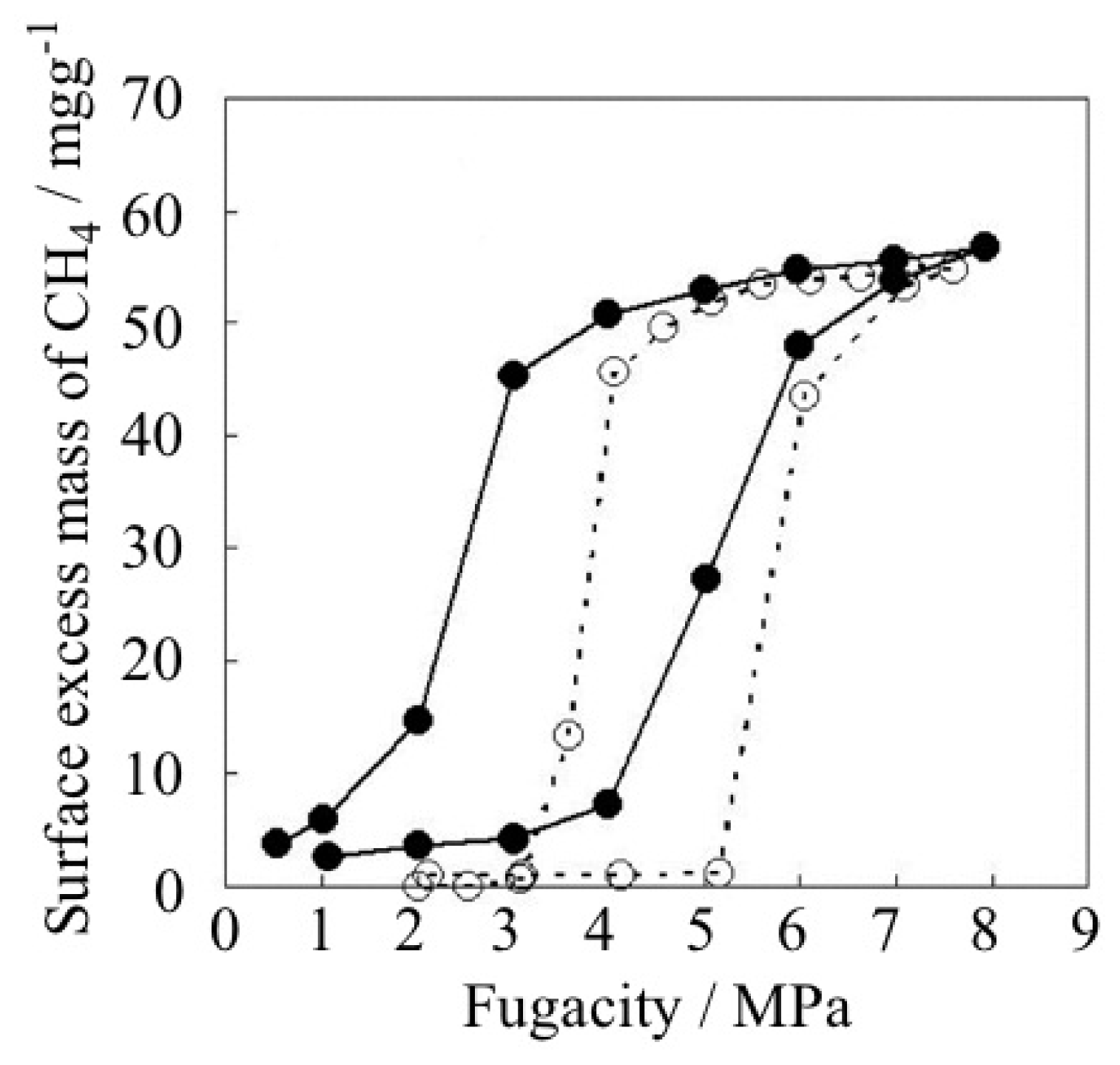
<p>The gate adsorption/desorption phenomena of CPs/MOFs have been discussed both from the viewpoint of kinetics and thermodynamics [<xref ref-type="bibr" rid="b236-ijms-11-03803">236</xref>–<xref ref-type="bibr" rid="b238-ijms-11-03803">238</xref>]. In the case of ELMs, it is confirmed that both the gate opening and closing states are in a thermal equilibrium [<xref ref-type="bibr" rid="b96-ijms-11-03803">96</xref>]. Methane gas-pressurized ELM-11 at 303 K at 2.5 MPa is in the gate-open stage. When the sample was cooled to 273 K, the adsorption amount increased and the amount was coincident with that of the desorption branch of 273 K. When the cooled sample was, in turn, warmed to 303 K, the adsorption amount was decreased and the amount was coincident with that of the desorption branch of 303 K (<xref ref-type="fig" rid="f17-ijms-11-03803">Figure 17</xref>). From these experiments, it is apparent that ELM-11 at the gate-open state is a thermodynamic product. The thermal equilibrium of the gate-closed state of ELM-11 was also confirmed by CO<sub>2</sub> adsorption experiments. Although the gas pressure was retained for 13 hours at ambient temperature at slightly under the gate opening pressure, ELM-11 did not adsorb the gas. This experiment also strongly supports the equilibrium nature of ELM-11 before the gate opening.</p>
<p>As shown in <xref ref-type="fig" rid="f14-ijms-11-03803">Figure 14</xref>, the presence of hydrogen bonding between the counter ion and bpy ligand in neighboring layer is confirmed by single crystal X-ray diffraction analysis. During the early stage of the study of ELMs, gate phenomena were considered to accompany the cleavage of the hydrogen bonding network. Although the modulation of hydrogen bonding during the expansion/shrinkage structural transformation was not clarified, it is confirmed that interlayer interactions, such as hydrogen bonding and π-π interactions, still remain after the structural transformation. The weak interactions work as tether lines between the layers and the structural transformation can be achieved not by the cleavage of weak interactions but by the rotation of the aromatic rings and conformational change of counter ions [<xref ref-type="bibr" rid="b239-ijms-11-03803">239</xref>–<xref ref-type="bibr" rid="b244-ijms-11-03803">244</xref>]. The fact that the maximum adsorbed gas amount was determined by the nature of the counter ions suggests the presence of the tether line mechanism of hydrogen bonding after the structural transformation.</p></sec></sec>
<sec>
<title>5. Evaluation of the Adsorptivity of ELM-11 from the Standpoint of Practical Application</title>
<sec>
<title>5.1. Applicability of Gate Phenomena for the Energy-Saving Pressure Swing Adsorption Process</title>
<p>Pressure swing or temperature swing adsorption systems using porous adsorbents have been practically used in gas separation, such as that for O<sub>2</sub>/N<sub>2</sub> and CO<sub>2</sub>/CH<sub>4</sub> [<xref ref-type="bibr" rid="b135-ijms-11-03803">135</xref>,<xref ref-type="bibr" rid="b245-ijms-11-03803">245</xref>,<xref ref-type="bibr" rid="b246-ijms-11-03803">246</xref>]. In both systems, the maximum adsorption amount is an important factor for efficiency. However, the desorption amount per pressure or temperature swing is also important and this factor is strongly influenced by the profile of the adsorption isotherm (<xref ref-type="fig" rid="f18-ijms-11-03803">Figure 18</xref>). An adsorbent which shows a strong affinity to an adsorbate shows a steep uprise of adsorption isotherm at the low pressure region and such kinds of adsorbent sometimes have difficulty in recovering the adsorbed gas.</p>
<p><xref ref-type="fig" rid="f19-ijms-11-03803">Figure 19</xref> and <xref ref-type="table" rid="t5-ijms-11-03803">Table 5</xref> show the CO<sub>2</sub> adsorption isotherms on various adsorbent and recovered gas amounts by the pressure swing process calculated by the adsorption isotherms. The maximum amount of adsorbed gas on ELM-11 is moderate compared to other type I isotherm adsorbents. However, the recovered gas amount from ELM-11 by the pressure swing simulation is the largest because of the specific gate profile.</p>
<p>If an adsorbate has a strong affinity to CO<sub>2</sub> molecules, type I adsorption isotherm is obtained, but the affinity is too strong for the easy release of adsorbed gas. In this way, simple type I profiles pose the dilemma of the combination of strong adsorption and easy desorption. On the other hand, living systems solve this dilemma; hemoglobin realizes the strong adsorption and easy desorption of oxygen by cooperative structural transformation and the sigmoidal oxygen association-dissociation curve [<xref ref-type="bibr" rid="b247-ijms-11-03803">247</xref>–<xref ref-type="bibr" rid="b249-ijms-11-03803">249</xref>]. As in the case of hemoglobin, the gate profile, which is achieved by cooperative structural transformation, has the possibility to overcome the dilemma of strong adsorption and easy desorption. Therefore, the gate adsorption material has excellent potential applicability for the pressure swing adsorption process.</p></sec>
<sec>
<title>5.2. Carbon Dioxide Gas Selectivity of ELM-11</title>
<p>Around an ambient temperature and pressure, CO<sub>2</sub> opens the gate of ELM-11 but N<sub>2</sub> and O<sub>2</sub> cannot open it at ambient temperature and pressure, while the gate of ELM-11 is opened by N<sub>2</sub> and O<sub>2</sub> at a much lower temperature or higher pressure. Therefore, it is anticipated that high CO<sub>2</sub> separation ability form N<sub>2</sub> and O<sub>2</sub> at ambient conditions using ELM-11. Actually, the highly pure CO<sub>2</sub> (&gt;99%) was obtained from ternary mixture gas (CO<sub>2</sub>:N<sub>2</sub>:O<sub>2</sub> = 40:47:13 mol%) using ELM-11 by the simple temperature swing operation [<xref ref-type="bibr" rid="b191-ijms-11-03803">191</xref>]. This result shows the advantage of flexible gate materials for efficient gas separation.</p></sec>
<sec>
<title>5.3. Adsorption Kinetics</title>
<p>The adsorption rate is an important factor for the industrial application of adsorbents. The adsorption rate of CO<sub>2</sub> on ELM-11 was measured by the pressure jump method. In the case of the pressure jump from 150 to 735 Torr at 273 K and from 150 to 730 Torr at 298 K, half the amount of adsorption is reached within three minutes. Further, the adsorption rate of CH<sub>4</sub> was also examined. When the pressure of CH<sub>4</sub> increases from 2.0 to 5.5 MPa at 298 K, the adsorption amount peaks within one minute (<xref ref-type="fig" rid="f20-ijms-11-03803">Figure 20</xref>). From these experiments, it is revealed that the adsorption rate of ELM-11 is sufficiently rapid for practical use.</p></sec>
<sec>
<title>5.4. Molding of the Powder of ELM-11</title>
<p>Powder adsorbents must be shape-formed for easy handling in the case of industrial application [<xref ref-type="bibr" rid="b250-ijms-11-03803">250</xref>]. Therefore, the process for making ELM-11 pellets was studied. A certain amount of pellet samples (10 mm in diameter, 3 mm in thickness, ρ = 1.3g/cm<sup>3</sup>) were made using a continuous pressing pelletizer with magnesium stearate (10 wt%) as a lubricant. The granulation of ELM-11 was also studied. Relatively hard (bead hardness = 130 cN, 1 mm diameter, 20 beads) granules with narrow particle distribution were obtained by a commonly used carbon granulation process using sugar as a binder (<xref ref-type="fig" rid="f21-ijms-11-03803">Figure 21</xref>).</p>
<p>The effect of the shape forming on the gas adsorptivity was estimated by the CH<sub>4</sub> gas adsorption on granulated ELM-11. Although there was a slight decrease of gate adsorption/desorption pressure, it retained a definite gate profile and large hysteresis, and the maximum amount of CH<sub>4</sub> adsorption was the same as that of unprocessed powder samples (<xref ref-type="fig" rid="f22-ijms-11-03803">Figure 22</xref>). Hence, easily obtainable ELM-11 powders are highly promising for real applications.</p></sec>
<sec>
<title>5.5. Temperature Elevation with the Gate Adsorption of CH<sub>4</sub> on ELM-11</title>
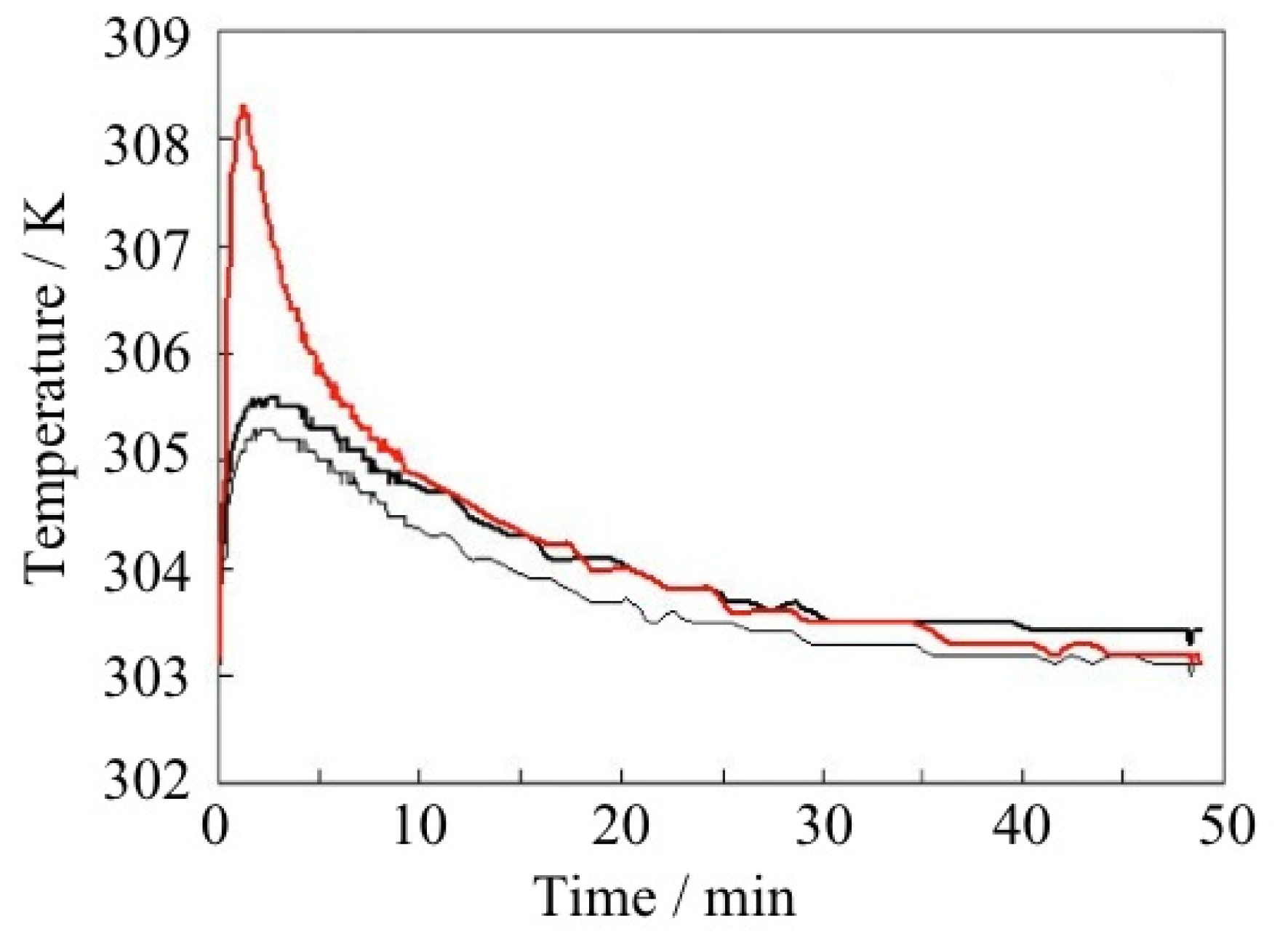
<p>Methane gas is adsorbed on ELM-11 rapidly as mentioned above and the temperature elevation of ELM-11 with the adsorption of CH<sub>4</sub> was examined. Fifty grams of preELM-11 was packed in a stainless steel column, and the column was heated to 393 K under reduced pressure to convert the preELM-11 to ELM-11. Next, CH<sub>4</sub> was introduced to the column at 5.0 MPa, the pressure was increased from 5.0 to 6.0 MPa suddenly at 298 K, and the temperature of the adsorption column was monitored. The measured temperature elevation was only 3 K at the circumference of the column and only 6 K even at the center of the column (<xref ref-type="fig" rid="f23-ijms-11-03803">Figure 23</xref>). The maximum desorption due to the temperature rise is estimated to be less than 8%. If we mix the conductive carbon fibers with ELM-11 powder, the temperature rise should be suppressed.</p></sec>
<sec>
<title>5.6. Stability of ELM-11</title>
<p>ELM-11 is hygroscopic and varies its structure to the preELM-11 when exposed to the air. Therefore, it is convenient that ELM-11 is stored in the form of preELM-11. As mentioned above, preELM-11 is easily converted to ELM-11 by heat treatment at 393 K under reduced pressure. The precursor preELM-11 is quite stable and can be stored at room temperature. No structural and adsorption performance degradation was observed when stored as the form of preELM-11 for six years in a plastic vial at room temperature.</p>
<p>The stability of ELM-11 as an adsorbent was examined by repetition of CH<sub>4</sub> adsorption-desorption experiments at 303 K. After the adsorption-desorption cycle was performed 50 times, almost no change in the maximum amount of adsorption and gate pressure (adsorption and desorption) was observed. It is noteworthy that the stacked layer architecture through weak interlayer interaction, such as hydrogen bonding and π-π interaction, shows such durability for the interlayer sliding and layer expansion/shrinkage modulation.</p>
<p>The heat stability of ELM-11 was examined by thermal gravimetry. The precursor preELM-11 released water molecules up to 420 K and changed its structure to ELM-11. No further weight loss was observed up to 420 K.</p>
<p>PreELM-11 is easily prepared according to the reported procedure [<xref ref-type="bibr" rid="b99-ijms-11-03803">99</xref>] and commercially available from Tokyo Chemical Industry Co., Ltd. Accordingly, from both the stand points of properties and availability, ELM-11 could be applicable to an industrial separation process.</p></sec></sec>
<sec>
<title>6. Catalytic Reaction of bpy Containing Two-Dimensional Layer PCPs/MOFs</title>
<p>Although there are a dozen reports on reactions catalyzed by PCPs/MOFs [<xref ref-type="bibr" rid="b35-ijms-11-03803">35</xref>,<xref ref-type="bibr" rid="b38-ijms-11-03803">38</xref>,<xref ref-type="bibr" rid="b251-ijms-11-03803">251</xref>–<xref ref-type="bibr" rid="b257-ijms-11-03803">257</xref>], there are only a few examples of catalytic reaction using bpy containing 2DSG PCPs/MOFs. Fujita <italic>et al</italic>. reported on the cyanosilylation of aldehyde catalyzed by 2DSG-PCP/MOF, [Cd(bpy)<sub>2</sub>(NO<sub>3</sub>)<sub>2</sub>] [<xref ref-type="bibr" rid="b204-ijms-11-03803">204</xref>]. Arai <italic>et al</italic>. reports the catalytic oxidation of ketones, and Baiker <italic>et al</italic>. reports the catalytic epoxide ring opening reaction using [Cu(bpy)(H<sub>2</sub>O)<sub>2</sub>(BF<sub>4</sub>)<sub>2</sub>]·bpy (preELM-11) [<xref ref-type="bibr" rid="b258-ijms-11-03803">258</xref>–<xref ref-type="bibr" rid="b260-ijms-11-03803">260</xref>]. The catalyst is not 2DSG ELM-11 but the one dimensional-CP, preELM-11. But preELM-11 changes its structure in alcoholic solvent: Transformation from preELM-11 to ELM-11 by immersion in alcohol at room temperature was confirmed by IR, powder XRD, and gas adsorptivity. Baiker <italic>et al</italic>. indicate the dehydration of preELM-11 by methanol soaking [<xref ref-type="bibr" rid="b260-ijms-11-03803">260</xref>]. Therefore there may be a possibility that the true catalytic species may be ELM-11. One of the most interesting points of ELM-11 catalysts is the effect of the flexibility on the reaction. Reports on the utilization of the flexible nature of PCPs/MOFs to improve the selectivity or reactivity of catalytic reactions will no doubt appear on the scene in the near future.</p></sec>
<sec sec-type="conclusions">
<title>7. Conclusions</title>
<p>The rigid and linear exobidentate ligand, 4,4′-bipyridine (bpy) is one of the simplest ligands for the construction of PCPs/MOFs. The square grid structure constructed with bpy is one of the most fundamental motifs of the PCPs/MOFs structure. The two-dimensional square-grid layer stacking (2DSG) PCPs/MOFs, with appropriate metal cations and counter anions, only show structural transformation with the gate gas adsorption phenomena and such special 2DSG-PCPs/MOFs are called “elastic layer-structured metal-organic frameworks (ELMs)”. In this review, we show a brief survey of general 2DSG-PCPs/MOFs with bpy and also survey the structure and function of the ELMs based on study of the author’s group.</p>
<p>Since the gate profile can put the desorption pressure close to adsorption pressure, these unique phenomena can make it possible to overcome the dilemma of strong adsorption and easy desorption, which is one of the ideal properties for a practical adsorbent. The fact that such a unique property can be achieved through the simple 2DSG-structure and the gate property can be regulated by changing the metal cation and counter ion while retaining the fundamental structure, is attractive from both academic and industrial perspectives.</p>
<p>The ultimate functional organic architecture is animate beings. They have developed dexterous biological flexible structures using weak interactions. DNA and RNA store the genetic information in the hydrogen bonding between the base pairs and the enzyme’s flexible nature derived from weak bonding improves the catalytic ability [<xref ref-type="bibr" rid="b261-ijms-11-03803">261</xref>]. The “flexible adsorbent”, hemoglobin attain the easy-adsorption and easy-desorption of oxygen. “Flexibility” should be the key factor which makes up the PCPs/MOFs as some of the ultimate artificial functional materials.</p></sec></body>
<back>
<ack>
<title>Acknowledgements</title>
<p>This work was supported by a Grant-in-Aid for Fundamental Scientific Research (B) (No. 19350100) by the Japan Science for the Promotion of Science and by Innovation Creative Center for Advanced Interdisciplinary Research Areas (Shinshu University) Project in Special Coordination Funds for Promoting Science and Technology of the Ministry of Education, Culture, Sports, Science and Technology, the Japanese Government.</p></ack>
<ref-list>
<title>References</title>
<ref id="b1-ijms-11-03803"><label>1</label><citation citation-type="book"><person-group person-group-type="author"><name><surname>Nicolaou</surname><given-names>KC</given-names></name><name><surname>Sorensen</surname><given-names>EJ</given-names></name></person-group><source>Classics in Total Synthesis: Targets, Atrategies, Methods</source><publisher-name>VCH Publishers Inc</publisher-name><publisher-loc>New York, NY, USA</publisher-loc><year>1996</year></citation></ref>
<ref id="b2-ijms-11-03803"><label>2</label><citation citation-type="book"><person-group person-group-type="author"><name><surname>Larock</surname><given-names>RC</given-names></name></person-group><source>Comprehensive Organic Transformations: A Guide to Functional Group Preparations</source><edition>2nd ed</edition><publisher-name>John Wiley &amp; Sons</publisher-name><publisher-loc>New York, NY, USA</publisher-loc><year>1999</year></citation></ref>
<ref id="b3-ijms-11-03803"><label>3</label><citation citation-type="book"><person-group person-group-type="author"><name><surname>Tsuji</surname><given-names>J</given-names></name></person-group><source>Transition Metal Reagents and Catalysts: Innovations in Organic Synthesis</source><publisher-name>John Wiley &amp; Sons</publisher-name><publisher-loc>West Sussex, UK</publisher-loc><year>2000</year></citation></ref>
<ref id="b4-ijms-11-03803"><label>4</label><citation citation-type="journal"><person-group person-group-type="author"><name><surname>Lehn</surname><given-names>J-M</given-names></name></person-group><article-title>Supramolecular chemistry-Scope and perspectives molecules, supermolecules, and molecular devices (nobel lecture)</article-title><source>Angew. Chem. Int. Ed</source><year>1988</year><volume>27</volume><fpage>89</fpage><lpage>112</lpage><pub-id pub-id-type="doi">10.1002/anie.198800891</pub-id></citation></ref>
<ref id="b5-ijms-11-03803"><label>5</label><citation citation-type="book"><person-group person-group-type="author"><name><surname>Lehn</surname><given-names>J-M</given-names></name></person-group><source>Supramolecular Chemistry: Concepts and Perspectives</source><publisher-name>VCH</publisher-name><publisher-loc>Weinheim, Germany</publisher-loc><year>1995</year></citation></ref>
<ref id="b6-ijms-11-03803"><label>6</label><citation citation-type="journal"><person-group person-group-type="author"><name><surname>Ruben</surname><given-names>M</given-names></name><name><surname>Rojo</surname><given-names>J</given-names></name><name><surname>Romero-Salguero</surname><given-names>FJ</given-names></name><name><surname>Uppadine</surname><given-names>LH</given-names></name><name><surname>Lehn</surname><given-names>J-M</given-names></name></person-group><article-title>Grid-type metal ion architectures: Functional metallosupramolecular arrays</article-title><source>Angew. Chem. Int. Ed</source><year>2004</year><volume>43</volume><fpage>3644</fpage><lpage>3662</lpage><pub-id pub-id-type="doi">10.1002/anie.200300636</pub-id></citation></ref>
<ref id="b7-ijms-11-03803"><label>7</label><citation citation-type="journal"><person-group person-group-type="author"><name><surname>Rebek</surname><given-names>JJ</given-names></name></person-group><article-title>Simultaneous encapsulation: Molecules held at close range</article-title><source>Angew. Chem. Int. Ed</source><year>2005</year><volume>44</volume><fpage>2068</fpage><lpage>2078</lpage><pub-id pub-id-type="doi">10.1002/anie.200462839</pub-id></citation></ref>
<ref id="b8-ijms-11-03803"><label>8</label><citation citation-type="book"><person-group person-group-type="author"><name><surname>Steed</surname><given-names>JW</given-names></name><name><surname>Atwood</surname><given-names>JL</given-names></name></person-group><source>Supramolecular Chemistry</source><edition>2nd ed</edition><publisher-name>Jhon Wiley &amp; Sons, Inc</publisher-name><publisher-loc>West Sussex, UK</publisher-loc><year>2009</year></citation></ref>
<ref id="b9-ijms-11-03803"><label>9</label><citation citation-type="journal"><person-group person-group-type="author"><name><surname>Roesky</surname><given-names>HW</given-names></name><name><surname>Andruh</surname><given-names>M</given-names></name></person-group><article-title>The interplay of coordinative, hydrogen bonding and π-π stacking interactions in sustaining supramolecular solid-state architectures.: A study case of bis(4- pyridyl)- and bis(4-pyridyl-<italic>N</italic>-oxide) tectons</article-title><source>Coord. Chem. Rev</source><year>2003</year><volume>236</volume><fpage>91</fpage><lpage>119</lpage><pub-id pub-id-type="doi">10.1016/S0010-8545(02)00218-7</pub-id></citation></ref>
<ref id="b10-ijms-11-03803"><label>10</label><citation citation-type="journal"><person-group person-group-type="author"><name><surname>Rao</surname><given-names>CNR</given-names></name><name><surname>Natarajan</surname><given-names>S</given-names></name><name><surname>Vaidhyanathan</surname><given-names>R</given-names></name></person-group><article-title>Metal carboxylates with open architectures</article-title><source>Angew. Chem. Int. Ed</source><year>2004</year><volume>43</volume><fpage>1466</fpage><lpage>1496</lpage><pub-id pub-id-type="doi">10.1002/anie.200300588</pub-id></citation></ref>
<ref id="b11-ijms-11-03803"><label>11</label><citation citation-type="journal"><person-group person-group-type="author"><name><surname>Kitaura</surname><given-names>R</given-names></name><name><surname>Onoyama</surname><given-names>G</given-names></name><name><surname>Sakamoto</surname><given-names>H</given-names></name><name><surname>Matsuda</surname><given-names>R</given-names></name><name><surname>Noro</surname><given-names>S-I</given-names></name><name><surname>Kitagawa</surname><given-names>S</given-names></name></person-group><article-title>Immobilization of a metallo schiff base into a microporous coordination polymer</article-title><source>Angew. Chem. Int. Ed</source><year>2004</year><volume>43</volume><fpage>2684</fpage><lpage>2687</lpage><pub-id pub-id-type="doi">10.1002/anie.200352596</pub-id></citation></ref>
<ref id="b12-ijms-11-03803"><label>12</label><citation citation-type="journal"><person-group person-group-type="author"><name><surname>Férey</surname><given-names>G</given-names></name><name><surname>Mellot-Draznieks</surname><given-names>C</given-names></name><name><surname>Serre</surname><given-names>C</given-names></name><name><surname>Millange</surname><given-names>F</given-names></name><name><surname>Dutour</surname><given-names>J</given-names></name><name><surname>Surblé</surname><given-names>S</given-names></name><name><surname>Margiolaki</surname><given-names>I</given-names></name></person-group><article-title>A chromium terephthalate-based solid with unusually large pore volumes and surface area</article-title><source>Science</source><year>2005</year><volume>309</volume><fpage>2040</fpage><lpage>2042</lpage><pub-id pub-id-type="doi">10.1126/science.1116275</pub-id><pub-id pub-id-type="pmid">16179475</pub-id></citation></ref>
<ref id="b13-ijms-11-03803"><label>13</label><citation citation-type="journal"><person-group person-group-type="author"><name><surname>Maspoch</surname><given-names>D</given-names></name><name><surname>Ruiz-Molina</surname><given-names>D</given-names></name><name><surname>Veciana</surname><given-names>J</given-names></name></person-group><article-title>Old materials with new tricks: Multifunctional open-framework materials</article-title><source>Chem. Soc. Rev</source><year>2007</year><volume>36</volume><fpage>770</fpage><lpage>818</lpage><pub-id pub-id-type="doi">10.1039/b501600m</pub-id><pub-id pub-id-type="pmid">17471401</pub-id></citation></ref>
<ref id="b14-ijms-11-03803"><label>14</label><citation citation-type="journal"><person-group person-group-type="author"><name><surname>Kitagawa</surname><given-names>S</given-names></name><name><surname>Matsuda</surname><given-names>R</given-names></name></person-group><article-title>Chemistry of coordination space of porous coordination polymers</article-title><source>Coord. Chem. Rev</source><year>2007</year><volume>251</volume><fpage>2490</fpage><lpage>2509</lpage><pub-id pub-id-type="doi">10.1016/j.ccr.2007.07.009</pub-id></citation></ref>
<ref id="b15-ijms-11-03803"><label>15</label><citation citation-type="journal"><person-group person-group-type="author"><name><surname>Banerjee</surname><given-names>R</given-names></name><name><surname>Phan</surname><given-names>A</given-names></name><name><surname>Wang</surname><given-names>B</given-names></name><name><surname>Knobler</surname><given-names>C</given-names></name><name><surname>Furukawa</surname><given-names>H</given-names></name><name><surname>O’Keeffe</surname><given-names>M</given-names></name><name><surname>Yaghi</surname><given-names>OM</given-names></name></person-group><article-title>High-throughput synthesis of zeolitic imidazolate frameworks and application to CO<sub>2</sub> capture</article-title><source>Science</source><year>2008</year><volume>319</volume><fpage>939</fpage><lpage>943</lpage><pub-id pub-id-type="doi">10.1126/science.1152516</pub-id><pub-id pub-id-type="pmid">18276887</pub-id></citation></ref>
<ref id="b16-ijms-11-03803"><label>16</label><citation citation-type="journal"><person-group person-group-type="author"><name><surname>Imaz</surname><given-names>I</given-names></name><name><surname>Hernando</surname><given-names>J</given-names></name><name><surname>Ruiz-Molina</surname><given-names>D</given-names></name><name><surname>Maspoch</surname><given-names>D</given-names></name></person-group><article-title>Metal-organic spheres as functional systems for guest encapsulation</article-title><source>Angew. Chem. Int. Ed</source><year>2009</year><volume>48</volume><fpage>2325</fpage><lpage>2329</lpage><pub-id pub-id-type="doi">10.1002/anie.200804255</pub-id></citation></ref>
<ref id="b17-ijms-11-03803"><label>17</label><citation citation-type="journal"><person-group person-group-type="author"><name><surname>Roy</surname><given-names>X</given-names></name><name><surname>MacLachlan</surname><given-names>MJ</given-names></name></person-group><article-title>Coordination chemistry: New routes to mesostructured materials</article-title><source>Chem. Eur. J</source><year>2009</year><volume>15</volume><fpage>6552</fpage><lpage>6559</lpage><pub-id pub-id-type="doi">10.1002/chem.200900482</pub-id><pub-id pub-id-type="pmid">19544335</pub-id></citation></ref>
<ref id="b18-ijms-11-03803"><label>18</label><citation citation-type="journal"><person-group person-group-type="author"><name><surname>O’Keeffe</surname><given-names>M</given-names></name></person-group><article-title>Design of MOFs and intellectual content in reticular chemistry: A personal view</article-title><source>Chem. Soc. Rev</source><year>2009</year><volume>38</volume><fpage>1215</fpage><lpage>1217</lpage><pub-id pub-id-type="doi">10.1039/b802802h</pub-id><pub-id pub-id-type="pmid">19384432</pub-id></citation></ref>
<ref id="b19-ijms-11-03803"><label>19</label><citation citation-type="journal"><person-group person-group-type="author"><name><surname>Spokoyny</surname><given-names>AM</given-names></name><name><surname>Kim</surname><given-names>D</given-names></name><name><surname>Sumrein</surname><given-names>A</given-names></name><name><surname>Mirkin</surname><given-names>CA</given-names></name></person-group><article-title>Infinite coordination polymer nano-and microparticle structures</article-title><source>Chem. Soc. Rev</source><year>2009</year><volume>38</volume><fpage>1218</fpage><lpage>1227</lpage><pub-id pub-id-type="doi">10.1039/b807085g</pub-id><pub-id pub-id-type="pmid">19384433</pub-id></citation></ref>
<ref id="b20-ijms-11-03803"><label>20</label><citation citation-type="journal"><person-group person-group-type="author"><name><surname>Wang</surname><given-names>Z</given-names></name><name><surname>Cohen</surname><given-names>SM</given-names></name></person-group><article-title>Postsynthetic modification of metal-organic frameworks</article-title><source>Chem. Soc. Rev</source><year>2009</year><volume>38</volume><fpage>1315</fpage><lpage>1329</lpage><pub-id pub-id-type="doi">10.1039/b802258p</pub-id><pub-id pub-id-type="pmid">19384440</pub-id></citation></ref>
<ref id="b21-ijms-11-03803"><label>21</label><citation citation-type="journal"><person-group person-group-type="author"><name><surname>Kurmoo</surname><given-names>M</given-names></name></person-group><article-title>Magnetic metal-organic frameworks</article-title><source>Chem. Soc. Rev</source><year>2009</year><volume>38</volume><fpage>1353</fpage><lpage>1379</lpage><pub-id pub-id-type="doi">10.1039/b804757j</pub-id><pub-id pub-id-type="pmid">19384442</pub-id></citation></ref>
<ref id="b22-ijms-11-03803"><label>22</label><citation citation-type="journal"><person-group person-group-type="author"><name><surname>Zacher</surname><given-names>D</given-names></name><name><surname>Shekhah</surname><given-names>O</given-names></name><name><surname>Wöll</surname><given-names>C</given-names></name><name><surname>Fischer</surname><given-names>RA</given-names></name></person-group><article-title>Thin films of metal-organic frameworks</article-title><source>Chem. Soc. Rev</source><year>2009</year><volume>38</volume><fpage>1418</fpage><lpage>1429</lpage><pub-id pub-id-type="doi">10.1039/b805038b</pub-id><pub-id pub-id-type="pmid">19384445</pub-id></citation></ref>
<ref id="b23-ijms-11-03803"><label>23</label><citation citation-type="journal"><person-group person-group-type="author"><name><surname>Yamada</surname><given-names>T</given-names></name><name><surname>Kitagawa</surname><given-names>H</given-names></name></person-group><article-title>Protection and deprotection approach for the introduction of functional groups into metal-organic frameworks</article-title><source>J. Am. Chem. Soc</source><year>2009</year><volume>131</volume><fpage>6312</fpage><lpage>6313</lpage><pub-id pub-id-type="doi">10.1021/ja809352y</pub-id><pub-id pub-id-type="pmid">19374355</pub-id></citation></ref>
<ref id="b24-ijms-11-03803"><label>24</label><citation citation-type="journal"><person-group person-group-type="author"><name><surname>Britt</surname><given-names>D</given-names></name><name><surname>Tranchemontagne</surname><given-names>D</given-names></name><name><surname>Yaghi</surname><given-names>OM</given-names></name></person-group><article-title>Metal-organic frameworks with high capacity and selectivity for harmful gases</article-title><source>Proc. Natl. Acad. Sci. USA</source><year>2008</year><volume>105</volume><fpage>11623</fpage><lpage>11627</lpage><pub-id pub-id-type="doi">10.1073/pnas.0804900105</pub-id><pub-id pub-id-type="pmid">18711128</pub-id></citation></ref>
<ref id="b25-ijms-11-03803"><label>25</label><citation citation-type="journal"><person-group person-group-type="author"><name><surname>Czaja</surname><given-names>AU</given-names></name><name><surname>Trukhan</surname><given-names>N</given-names></name><name><surname>Müller</surname><given-names>U</given-names></name></person-group><article-title>Industrial applications of metal-organic frameworks</article-title><source>Chem. Soc. Rev</source><year>2009</year><volume>38</volume><fpage>1284</fpage><lpage>1293</lpage><pub-id pub-id-type="doi">10.1039/b804680h</pub-id><pub-id pub-id-type="pmid">19384438</pub-id></citation></ref>
<ref id="b26-ijms-11-03803"><label>26</label><citation citation-type="journal"><person-group person-group-type="author"><name><surname>Murray</surname><given-names>LJ</given-names></name><name><surname>Dincá</surname><given-names>M</given-names></name><name><surname>Long</surname><given-names>JR</given-names></name></person-group><article-title>Hydrogen storage in metal-organic frameworks</article-title><source>Chem. Soc. Rev</source><year>2009</year><volume>38</volume><fpage>1294</fpage><lpage>1314</lpage><pub-id pub-id-type="doi">10.1039/b802256a</pub-id><pub-id pub-id-type="pmid">19384439</pub-id></citation></ref>
<ref id="b27-ijms-11-03803"><label>27</label><citation citation-type="journal"><person-group person-group-type="author"><name><surname>Uchida</surname><given-names>S</given-names></name><name><surname>Kawamoto</surname><given-names>R</given-names></name><name><surname>Tagami</surname><given-names>H</given-names></name><name><surname>Nakagawa</surname><given-names>Y</given-names></name><name><surname>Mizuno</surname><given-names>N</given-names></name></person-group><article-title>Highly selective sorption of small unsaturated hydrocarbons by nonporous flexible framework with silver ion</article-title><source>J. Am. Chem. Soc</source><year>2008</year><volume>130</volume><fpage>12370</fpage><lpage>12376</lpage><pub-id pub-id-type="doi">10.1021/ja801453c</pub-id><pub-id pub-id-type="pmid">18722424</pub-id></citation></ref>
<ref id="b28-ijms-11-03803"><label>28</label><citation citation-type="journal"><person-group person-group-type="author"><name><surname>Li</surname><given-names>JR</given-names></name><name><surname>Kuppler</surname><given-names>RJ</given-names></name><name><surname>Zhou</surname><given-names>H-C</given-names></name></person-group><article-title>Selective gas adsorption and separation in metal-organic frameworks</article-title><source>Chem. Soc. Rev</source><year>2009</year><volume>38</volume><fpage>1477</fpage><lpage>1504</lpage><pub-id pub-id-type="doi">10.1039/b802426j</pub-id><pub-id pub-id-type="pmid">19384449</pub-id></citation></ref>
<ref id="b29-ijms-11-03803"><label>29</label><citation citation-type="journal"><person-group person-group-type="author"><name><surname>Lamia</surname><given-names>N</given-names></name><name><surname>Jorge</surname><given-names>M</given-names></name><name><surname>Granato</surname><given-names>MA</given-names></name><name><surname>Almeida Paz</surname><given-names>FA</given-names></name><name><surname>Chevreau</surname><given-names>H</given-names></name><name><surname>Rodrigues</surname><given-names>AE</given-names></name></person-group><article-title>Adsorption of propane, propylene and isobutane on a metal-organic framework: Molecular simulation and experiment</article-title><source>Chem. Eng. Sci</source><year>2009</year><volume>64</volume><fpage>3246</fpage><lpage>3259</lpage><pub-id pub-id-type="doi">10.1016/j.ces.2009.04.010</pub-id></citation></ref>
<ref id="b30-ijms-11-03803"><label>30</label><citation citation-type="journal"><person-group person-group-type="author"><name><surname>Cychosz</surname><given-names>KA</given-names></name><name><surname>Wong-Foy</surname><given-names>AG</given-names></name><name><surname>Matzger</surname><given-names>AJ</given-names></name></person-group><article-title>Enabling cleaner fuels: Desulfurization by adsorption to microporous coordination polymers</article-title><source>J. Am. Chem. Soc</source><year>2009</year><volume>131</volume><fpage>14538</fpage><lpage>14543</lpage><pub-id pub-id-type="doi">10.1021/ja906034k</pub-id><pub-id pub-id-type="pmid">19757809</pub-id></citation></ref>
<ref id="b31-ijms-11-03803"><label>31</label><citation citation-type="journal"><person-group person-group-type="author"><name><surname>Ohmura</surname><given-names>T</given-names></name><name><surname>Mori</surname><given-names>W</given-names></name><name><surname>Hiraga</surname><given-names>H</given-names></name><name><surname>Ono</surname><given-names>M</given-names></name><name><surname>Nishimoto</surname><given-names>Y</given-names></name></person-group><article-title>Magnetic and gas-occasion properties and catalytic activity of microporous materials: Dinuclear ruthenium (II, III) dicarboxylates</article-title><source>Chem. Lett</source><year>2003</year><volume>32</volume><fpage>468</fpage><lpage>469</lpage><pub-id pub-id-type="doi">10.1246/cl.2003.468</pub-id></citation></ref>
<ref id="b32-ijms-11-03803"><label>32</label><citation citation-type="journal"><person-group person-group-type="author"><name><surname>Zou</surname><given-names>R-Q</given-names></name><name><surname>Sakurai</surname><given-names>H</given-names></name><name><surname>Han</surname><given-names>S</given-names></name><name><surname>Zhong</surname><given-names>R-Q</given-names></name><name><surname>Xu</surname><given-names>Q</given-names></name></person-group><article-title>Probing the lewis acid sites and co catalytic oxidation activity of the porous metal-organic polymer [Cu(5-methylisophthalate)]</article-title><source>J. Am. Chem. Soc</source><year>2007</year><volume>129</volume><fpage>8402</fpage><lpage>8403</lpage><pub-id pub-id-type="doi">10.1021/ja071662s</pub-id><pub-id pub-id-type="pmid">17579408</pub-id></citation></ref>
<ref id="b33-ijms-11-03803"><label>33</label><citation citation-type="journal"><person-group person-group-type="author"><name><surname>Stone</surname><given-names>MT</given-names></name><name><surname>Moore</surname><given-names>JS</given-names></name></person-group><article-title>Supramolecular chelation based on folding</article-title><source>J. Am. Chem. Soc</source><year>2005</year><volume>127</volume><fpage>5928</fpage><lpage>5935</lpage><pub-id pub-id-type="doi">10.1021/ja050713n</pub-id><pub-id pub-id-type="pmid">15839692</pub-id></citation></ref>
<ref id="b34-ijms-11-03803"><label>34</label><citation citation-type="journal"><person-group person-group-type="author"><name><surname>Llabrés Xamena</surname><given-names>F</given-names></name><name><surname>Abad</surname><given-names>A</given-names></name><name><surname>Corma</surname><given-names>A</given-names></name><name><surname>Garcia</surname><given-names>H</given-names></name></person-group><article-title>MOFs as catalysts: Activity, reusability and shape-selectivity of a Pd-containing MOF</article-title><source>J. Catal</source><year>2007</year><volume>250</volume><fpage>294</fpage><lpage>298</lpage><pub-id pub-id-type="doi">10.1016/j.jcat.2007.06.004</pub-id></citation></ref>
<ref id="b35-ijms-11-03803"><label>35</label><citation citation-type="journal"><person-group person-group-type="author"><name><surname>Horike</surname><given-names>S</given-names></name><name><surname>Dincá</surname><given-names>M</given-names></name><name><surname>Tamaki</surname><given-names>K</given-names></name><name><surname>Long</surname><given-names>JR</given-names></name></person-group><article-title>Size-selective lewis acid catalysis in a microporous metal-organic framework with exposed Mn<sup>2+</sup> coordination sites</article-title><source>J. Am. Chem. Soc</source><year>2008</year><volume>130</volume><fpage>5854</fpage><lpage>5855</lpage><pub-id pub-id-type="doi">10.1021/ja800669j</pub-id><pub-id pub-id-type="pmid">18399629</pub-id></citation></ref>
<ref id="b36-ijms-11-03803"><label>36</label><citation citation-type="journal"><person-group person-group-type="author"><name><surname>Gascon</surname><given-names>J</given-names></name><name><surname>Aktay</surname><given-names>U</given-names></name><name><surname>Hernandez-Alonso</surname><given-names>MD</given-names></name><name><surname>van Klink</surname><given-names>GPM</given-names></name><name><surname>Kapteijn</surname><given-names>F</given-names></name></person-group><article-title>Amino-based metal-organic frameworks as stable, highly active basic catalysts</article-title><source>J. Catal</source><year>2009</year><volume>261</volume><fpage>75</fpage><lpage>87</lpage><pub-id pub-id-type="doi">10.1016/j.jcat.2008.11.010</pub-id></citation></ref>
<ref id="b37-ijms-11-03803"><label>37</label><citation citation-type="journal"><person-group person-group-type="author"><name><surname>Qiu</surname><given-names>L-G</given-names></name><name><surname>Gu</surname><given-names>L-N</given-names></name><name><surname>Hu</surname><given-names>G</given-names></name><name><surname>Zhang</surname><given-names>L-D</given-names></name></person-group><article-title>Synthesis, structural characterization and selectively catalytic properties of metal-organic frameworks with nano-sized channels: A modular design strategy</article-title><source>J. Solid State Chem</source><year>2009</year><volume>182</volume><fpage>502</fpage><lpage>508</lpage><pub-id pub-id-type="doi">10.1016/j.jssc.2008.11.018</pub-id></citation></ref>
<ref id="b38-ijms-11-03803"><label>38</label><citation citation-type="journal"><person-group person-group-type="author"><name><surname>Ma</surname><given-names>L</given-names></name><name><surname>Abney</surname><given-names>C</given-names></name><name><surname>Lin</surname><given-names>W</given-names></name></person-group><article-title>Enantioselective catalysis with homochiral metal-organic frameworks</article-title><source>Chem. Soc. Rev</source><year>2009</year><volume>38</volume><fpage>1248</fpage><lpage>1256</lpage><pub-id pub-id-type="doi">10.1039/b807083k</pub-id><pub-id pub-id-type="pmid">19384436</pub-id></citation></ref>
<ref id="b39-ijms-11-03803"><label>39</label><citation citation-type="journal"><person-group person-group-type="author"><name><surname>Cheon</surname><given-names>YE</given-names></name><name><surname>Suh</surname><given-names>MP</given-names></name></person-group><article-title>Enhanced hydrogen storage by palladium nanoparticles fabricated in a redox-active metal-organic framework</article-title><source>Angew. Chem. Int. Ed</source><year>2009</year><volume>48</volume><fpage>2899</fpage><lpage>2903</lpage><pub-id pub-id-type="doi">10.1002/anie.200805494</pub-id></citation></ref>
<ref id="b40-ijms-11-03803"><label>40</label><citation citation-type="journal"><person-group person-group-type="author"><name><surname>Bernini</surname><given-names>MC</given-names></name><name><surname>Gándara</surname><given-names>F</given-names></name><name><surname>Iglesias</surname><given-names>M</given-names></name><name><surname>Snejko</surname><given-names>N</given-names></name><name><surname>Gutiérrez-Puebla</surname><given-names>E</given-names></name><name><surname>Brusau</surname><given-names>EV</given-names></name><name><surname>Narda</surname><given-names>GE</given-names></name><name><surname>Monge</surname><given-names>MÁ</given-names></name></person-group><article-title>Reversible breaking and forming of metal-ligand coordination bonds: Temperature-triggered single-crystal to single-crystal transformation in a metal-organic framework</article-title><source>Chem. Eur. J</source><year>2009</year><volume>15</volume><fpage>4896</fpage><lpage>4905</lpage><pub-id pub-id-type="doi">10.1002/chem.200802385</pub-id><pub-id pub-id-type="pmid">19322845</pub-id></citation></ref>
<ref id="b41-ijms-11-03803"><label>41</label><citation citation-type="journal"><person-group person-group-type="author"><name><surname>Doonan</surname><given-names>CJ</given-names></name><name><surname>Morris</surname><given-names>W</given-names></name><name><surname>Furukawa</surname><given-names>H</given-names></name><name><surname>Yaghi</surname><given-names>OM</given-names></name></person-group><article-title>Isoreticular metalation of metal-organic frameworks</article-title><source>J. Am. Chem. Soc</source><year>2009</year><volume>131</volume><fpage>9492</fpage><lpage>9493</lpage><pub-id pub-id-type="doi">10.1021/ja903251e</pub-id><pub-id pub-id-type="pmid">19534523</pub-id></citation></ref>
<ref id="b42-ijms-11-03803"><label>42</label><citation citation-type="journal"><person-group person-group-type="author"><name><surname>Allendorf</surname><given-names>MD</given-names></name><name><surname>Bauer</surname><given-names>CA</given-names></name><name><surname>Bhakta</surname><given-names>RK</given-names></name><name><surname>Houk</surname><given-names>RJT</given-names></name></person-group><article-title>Luminescent metal–organic frameworks</article-title><source>Chem. Soc. Rev</source><year>2009</year><volume>38</volume><fpage>1330</fpage><lpage>1352</lpage><pub-id pub-id-type="doi">10.1039/b802352m</pub-id><pub-id pub-id-type="pmid">19384441</pub-id></citation></ref>
<ref id="b43-ijms-11-03803"><label>43</label><citation citation-type="journal"><person-group person-group-type="author"><name><surname>Eddaoudi</surname><given-names>M</given-names></name><name><surname>Kim</surname><given-names>J</given-names></name><name><surname>Rosi</surname><given-names>N</given-names></name><name><surname>Vodak</surname><given-names>D</given-names></name><name><surname>Wachter</surname><given-names>J</given-names></name><name><surname>O’Keeffe</surname><given-names>M</given-names></name><name><surname>Yaghi</surname><given-names>OM</given-names></name></person-group><article-title>Systematic design of pore size and functionality in isoreticular MOFs and their application in methane storage</article-title><source>Science</source><year>2002</year><volume>295</volume><fpage>469</fpage><lpage>472</lpage><pub-id pub-id-type="doi">10.1126/science.1067208</pub-id><pub-id pub-id-type="pmid">11799235</pub-id></citation></ref>
<ref id="b44-ijms-11-03803"><label>44</label><citation citation-type="journal"><person-group person-group-type="author"><name><surname>Koh</surname><given-names>K</given-names></name><name><surname>Wong-Foy</surname><given-names>AG</given-names></name><name><surname>Matzger</surname><given-names>AJ</given-names></name></person-group><article-title>A crystalline mesoporous coordination copolymer with high microporosity</article-title><source>Angew. Chem. Int. Ed</source><year>2008</year><volume>47</volume><fpage>677</fpage><lpage>680</lpage><pub-id pub-id-type="doi">10.1002/anie.200705020</pub-id></citation></ref>
<ref id="b45-ijms-11-03803"><label>45</label><citation citation-type="journal"><person-group person-group-type="author"><name><surname>Mäkinen</surname><given-names>SK</given-names></name><name><surname>Melcer</surname><given-names>NJ</given-names></name><name><surname>Parvez</surname><given-names>M</given-names></name><name><surname>Shimizu</surname><given-names>GKH</given-names></name></person-group><article-title>Highly selective guest uptake in a silver sulfonate network imparted by a tetragonal to triclinic shift in the solid state</article-title><source>Chem. Eur. J</source><year>2001</year><volume>7</volume><fpage>5176</fpage><lpage>5182</lpage><pub-id pub-id-type="doi">10.1002/1521-3765(20011203)7:23&lt;5176::AID-CHEM5176&gt;3.0.CO;2-1</pub-id><pub-id pub-id-type="pmid">11775691</pub-id></citation></ref>
<ref id="b46-ijms-11-03803"><label>46</label><citation citation-type="journal"><person-group person-group-type="author"><name><surname>Takamizawa</surname><given-names>S</given-names></name><name><surname>Nakata</surname><given-names>E-I</given-names></name><name><surname>Yokoyama</surname><given-names>H</given-names></name><name><surname>Mochizuki</surname><given-names>K</given-names></name><name><surname>Mori</surname><given-names>W</given-names></name></person-group><article-title>Carbon dioxide inclusion phases of a transformable 1D coordination polymer host [Rh<sub>2</sub>(O<sub>2</sub>CPh)<sub>4</sub>(pyz)]<sub>n</sub></article-title><source>Angew. Chem. Int. Ed</source><year>2003</year><volume>42</volume><fpage>4331</fpage><lpage>4334</lpage><pub-id pub-id-type="doi">10.1002/anie.200351368</pub-id></citation></ref>
<ref id="b47-ijms-11-03803"><label>47</label><citation citation-type="journal"><person-group person-group-type="author"><name><surname>Ohmori</surname><given-names>O</given-names></name><name><surname>Kawano</surname><given-names>M</given-names></name><name><surname>Fujita</surname><given-names>M</given-names></name></person-group><article-title>Crystal-to-crystal guest exchange of large organic molecules within a 3D coordination network</article-title><source>J. Am. Chem. Soc</source><year>2004</year><volume>126</volume><fpage>16292</fpage><lpage>16293</lpage><pub-id pub-id-type="doi">10.1021/ja046478a</pub-id><pub-id pub-id-type="pmid">15600309</pub-id></citation></ref>
<ref id="b48-ijms-11-03803"><label>48</label><citation citation-type="journal"><person-group person-group-type="author"><name><surname>Barea</surname><given-names>E</given-names></name><name><surname>Navarro</surname><given-names>JAR</given-names></name><name><surname>Salas</surname><given-names>JM</given-names></name><name><surname>Masciocchi</surname><given-names>N</given-names></name><name><surname>Galli</surname><given-names>S</given-names></name><name><surname>Sironi</surname><given-names>A</given-names></name></person-group><article-title>Mineralomimetic sodalite- and muscovite-type coordination frameworks. Dynamic crystal-to-crystal interconversion processes sensitive to ion pair recognition</article-title><source>J. Am. Chem. Soc</source><year>2004</year><volume>126</volume><fpage>3014</fpage><lpage>3015</lpage><pub-id pub-id-type="doi">10.1021/ja039472e</pub-id><pub-id pub-id-type="pmid">15012107</pub-id></citation></ref>
<ref id="b49-ijms-11-03803"><label>49</label><citation citation-type="journal"><person-group person-group-type="author"><name><surname>Dybtsev</surname><given-names>DN</given-names></name><name><surname>Chun</surname><given-names>H</given-names></name><name><surname>Kim</surname><given-names>K</given-names></name></person-group><article-title>Rigid and flexible: A highly porous metal-organic framework with unusual guest-dependent dynamic behavior</article-title><source>Angew. Chem. Int. Ed</source><year>2004</year><volume>43</volume><fpage>5033</fpage><lpage>5036</lpage><pub-id pub-id-type="doi">10.1002/anie.200460712</pub-id></citation></ref>
<ref id="b50-ijms-11-03803"><label>50</label><citation citation-type="journal"><person-group person-group-type="author"><name><surname>Hu</surname><given-names>C</given-names></name><name><surname>Englert</surname><given-names>U</given-names></name></person-group><article-title>Crystal-to-crystal transformation from a chain polymer to a two-dimensional network at low temperatures</article-title><source>Angew. Chem. Int. Ed</source><year>2005</year><volume>44</volume><fpage>2281</fpage><lpage>2283</lpage><pub-id pub-id-type="doi">10.1002/anie.200462100</pub-id></citation></ref>
<ref id="b51-ijms-11-03803"><label>51</label><citation citation-type="journal"><person-group person-group-type="author"><name><surname>Kitagawa</surname><given-names>S</given-names></name><name><surname>Uemura</surname><given-names>K</given-names></name></person-group><article-title>Dynamic porous properties of coordination polymers inspired by hydrogen bonds</article-title><source>Chem. Soc. Rev</source><year>2005</year><volume>34</volume><fpage>109</fpage><lpage>119</lpage><pub-id pub-id-type="doi">10.1039/b313997m</pub-id><pub-id pub-id-type="pmid">15672175</pub-id></citation></ref>
<ref id="b52-ijms-11-03803"><label>52</label><citation citation-type="journal"><person-group person-group-type="author"><name><surname>Uemura</surname><given-names>K</given-names></name><name><surname>Matsuda</surname><given-names>R</given-names></name><name><surname>Kitagawa</surname><given-names>S</given-names></name></person-group><article-title>Flexible microporous coordination polymers</article-title><source>J. Solid State Chem</source><year>2005</year><volume>178</volume><fpage>2420</fpage><lpage>2429</lpage><pub-id pub-id-type="doi">10.1016/j.jssc.2005.05.036</pub-id></citation></ref>
<ref id="b53-ijms-11-03803"><label>53</label><citation citation-type="journal"><person-group person-group-type="author"><name><surname>Bradshaw</surname><given-names>D</given-names></name><name><surname>Claridge</surname><given-names>JB</given-names></name><name><surname>Cussen</surname><given-names>EJ</given-names></name><name><surname>Prior</surname><given-names>TJ</given-names></name><name><surname>Rosseinsky</surname><given-names>MJ</given-names></name></person-group><article-title>Design, chirality, and flexibility in nanoporous molecule-based materials</article-title><source>Acc. Chem. Res</source><year>2005</year><volume>38</volume><fpage>273</fpage><lpage>282</lpage><pub-id pub-id-type="doi">10.1021/ar0401606</pub-id><pub-id pub-id-type="pmid">15835874</pub-id></citation></ref>
<ref id="b54-ijms-11-03803"><label>54</label><citation citation-type="journal"><person-group person-group-type="author"><name><surname>Wu</surname><given-names>C-D</given-names></name><name><surname>Lin</surname><given-names>W</given-names></name></person-group><article-title>Highly porous, homochiral metal-organic frameworks: Solvent-exchange-induced single-crystal to single-crystal transformations</article-title><source>Angew. Chem. Int. Ed</source><year>2005</year><volume>44</volume><fpage>1958</fpage><lpage>1961</lpage><pub-id pub-id-type="doi">10.1002/anie.200462711</pub-id></citation></ref>
<ref id="b55-ijms-11-03803"><label>55</label><citation citation-type="journal"><person-group person-group-type="author"><name><surname>Chen</surname><given-names>C-L</given-names></name><name><surname>Goforth</surname><given-names>AM</given-names></name><name><surname>Smith</surname><given-names>MD</given-names></name><name><surname>Su</surname><given-names>C-Y</given-names></name><name><surname>zur Loye</surname><given-names>H-C</given-names></name></person-group><article-title>[Co<sub>2</sub>(ppca)<sub>2</sub>(H<sub>2</sub>O)(V<sub>4</sub>O<sub>12</sub>)<sub>0.5</sub>]: A framework material exhibiting reversible shrinkage and expansion through a single-crystal-to-single- crystal transformation involving a change in the cobalt coordination environment</article-title><source>Angew. Chem. Int. Ed</source><year>2005</year><volume>44</volume><fpage>6673</fpage><lpage>6677</lpage><pub-id pub-id-type="doi">10.1002/anie.200502309</pub-id></citation></ref>
<ref id="b56-ijms-11-03803"><label>56</label><citation citation-type="journal"><person-group person-group-type="author"><name><surname>Zhang</surname><given-names>J-P</given-names></name><name><surname>Lin</surname><given-names>Y-Y</given-names></name><name><surname>Zhang</surname><given-names>W-X</given-names></name><name><surname>Chen</surname><given-names>X-M</given-names></name></person-group><article-title>Temperature- or guest-induced drastic single-crystal-to-single-crystal transformations of a nanoporous coordination polymer</article-title><source>J. Am. Chem. Soc</source><year>2005</year><volume>127</volume><fpage>14162</fpage><lpage>14163</lpage><pub-id pub-id-type="doi">10.1021/ja054913a</pub-id><pub-id pub-id-type="pmid">16218592</pub-id></citation></ref>
<ref id="b57-ijms-11-03803"><label>57</label><citation citation-type="journal"><person-group person-group-type="author"><name><surname>Maji</surname><given-names>TK</given-names></name><name><surname>Mostafa</surname><given-names>G</given-names></name><name><surname>Matsuda</surname><given-names>R</given-names></name><name><surname>Kitagawa</surname><given-names>S</given-names></name></person-group><article-title>Guest-induced asymmetry in a metal-organic porous solid with reversible single-crystal-to-single-crystal structural transformation</article-title><source>J. Am. Chem. Soc</source><year>2005</year><volume>127</volume><fpage>17152</fpage><lpage>17153</lpage><pub-id pub-id-type="doi">10.1021/ja0561439</pub-id><pub-id pub-id-type="pmid">16332040</pub-id></citation></ref>
<ref id="b58-ijms-11-03803"><label>58</label><citation citation-type="journal"><person-group person-group-type="author"><name><surname>Culp</surname><given-names>JT</given-names></name><name><surname>Smith</surname><given-names>MR</given-names></name><name><surname>Bittner</surname><given-names>E</given-names></name><name><surname>Bockrath</surname><given-names>B</given-names></name></person-group><article-title>Hysteresis in the physisorption of CO<sub>2</sub> and N<sub>2</sub> in a flexible pillared layer nickel cyanide</article-title><source>J. Am. Chem. Soc</source><year>2008</year><volume>130</volume><fpage>12427</fpage><lpage>12434</lpage><pub-id pub-id-type="doi">10.1021/ja802474b</pub-id><pub-id pub-id-type="pmid">18717562</pub-id></citation></ref>
<ref id="b59-ijms-11-03803"><label>59</label><citation citation-type="journal"><person-group person-group-type="author"><name><surname>Horike</surname><given-names>S</given-names></name><name><surname>Shimomura</surname><given-names>S</given-names></name><name><surname>Kitagawa</surname><given-names>S</given-names></name></person-group><article-title>Soft porous crystals</article-title><source>Nat. Chem</source><year>2009</year><volume>1</volume><fpage>695</fpage><lpage>704</lpage><pub-id pub-id-type="doi">10.1038/nchem.444</pub-id><pub-id pub-id-type="pmid">21124356</pub-id></citation></ref>
<ref id="b60-ijms-11-03803"><label>60</label><citation citation-type="journal"><person-group person-group-type="author"><name><surname>Férey</surname><given-names>G</given-names></name><name><surname>Serre</surname><given-names>C</given-names></name></person-group><article-title>Large breathing effects in three-dimensional porous hybrid matter: Facts, analyses, rules and consequences</article-title><source>Chem. Soc. Rev</source><year>2009</year><volume>38</volume><fpage>1380</fpage><lpage>1399</lpage><pub-id pub-id-type="doi">10.1039/b804302g</pub-id><pub-id pub-id-type="pmid">19384443</pub-id></citation></ref>
<ref id="b61-ijms-11-03803"><label>61</label><citation citation-type="journal"><person-group person-group-type="author"><name><surname>Spencer</surname><given-names>EC</given-names></name><name><surname>Angel</surname><given-names>RJ</given-names></name><name><surname>Ross</surname><given-names>NL</given-names></name><name><surname>Hanson</surname><given-names>BE</given-names></name><name><surname>Howard</surname><given-names>JAK</given-names></name></person-group><article-title>Pressure-induced cooperative bond rearrangement in a zinc imidazolate framework: A high-pressure single-crystal X-ray diffraction study</article-title><source>J. Am. Chem. Soc</source><year>2009</year><volume>131</volume><fpage>4022</fpage><lpage>4026</lpage><pub-id pub-id-type="doi">10.1021/ja808531m</pub-id><pub-id pub-id-type="pmid">19254021</pub-id></citation></ref>
<ref id="b62-ijms-11-03803"><label>62</label><citation citation-type="journal"><person-group person-group-type="author"><name><surname>Korčok</surname><given-names>JL</given-names></name><name><surname>Katz</surname><given-names>MJ</given-names></name><name><surname>Leznoff</surname><given-names>DB</given-names></name></person-group><article-title>Impact of metallophilicity on “colossal” positive and negative thermal expansion in a series of isostructural dicyanometallate coordination polymers</article-title><source>J. Am. Chem. Soc</source><year>2009</year><volume>131</volume><fpage>4866</fpage><lpage>4871</lpage><pub-id pub-id-type="doi">10.1021/ja809631r</pub-id><pub-id pub-id-type="pmid">19290631</pub-id></citation></ref>
<ref id="b63-ijms-11-03803"><label>63</label><citation citation-type="journal"><person-group person-group-type="author"><name><surname>Li</surname><given-names>D</given-names></name><name><surname>Kaneko</surname><given-names>K</given-names></name></person-group><article-title>Hydrogen bond-regulated microporous nature of copper complex-assembled microcrystals</article-title><source>Chem. Phys. Lett</source><year>2001</year><volume>335</volume><fpage>50</fpage><lpage>56</lpage><pub-id pub-id-type="doi">10.1016/S0009-2614(00)01419-6</pub-id></citation></ref>
<ref id="b64-ijms-11-03803"><label>64</label><citation citation-type="journal"><person-group person-group-type="author"><name><surname>Kitaura</surname><given-names>R</given-names></name><name><surname>Seki</surname><given-names>K</given-names></name><name><surname>Akiyama</surname><given-names>G</given-names></name><name><surname>Kitagawa</surname><given-names>S</given-names></name></person-group><article-title>Porous coordination-polymer crystals with gated channels specific for supercritical gases</article-title><source>Angew. Chem. Int. Ed</source><year>2003</year><volume>42</volume><fpage>428</fpage><lpage>431</lpage><pub-id pub-id-type="doi">10.1002/anie.200390130</pub-id></citation></ref>
<ref id="b65-ijms-11-03803"><label>65</label><citation citation-type="journal"><person-group person-group-type="author"><name><surname>Fletcher</surname><given-names>AJ</given-names></name><name><surname>Cussen</surname><given-names>EJ</given-names></name><name><surname>Bradshaw</surname><given-names>D</given-names></name><name><surname>Rosseinsky</surname><given-names>MJ</given-names></name><name><surname>Thomas</surname><given-names>KM</given-names></name></person-group><article-title>Adsorption of gases and vapors on nanoporous Ni<sub>2</sub>(4,4′-bipyridine)<sub>3</sub>(NO<sub>3</sub>)<sub>4</sub> metal-organic framework materials templated with methanol and ethanol: Structural effects in adsorption kinetics</article-title><source>J. Am. Chem. Soc</source><year>2004</year><volume>126</volume><fpage>9750</fpage><lpage>9759</lpage><pub-id pub-id-type="doi">10.1021/ja0490267</pub-id><pub-id pub-id-type="pmid">15291578</pub-id></citation></ref>
<ref id="b66-ijms-11-03803"><label>66</label><citation citation-type="journal"><person-group person-group-type="author"><name><surname>Mukherjee</surname><given-names>PS</given-names></name><name><surname>Lopez</surname><given-names>N</given-names></name><name><surname>Arif</surname><given-names>AM</given-names></name><name><surname>Cervantes-Lee</surname><given-names>F</given-names></name><name><surname>Noveron</surname><given-names>JC</given-names></name></person-group><article-title>Single-crystal to single-crystal phase transitions of bis(<italic>N</italic>-phenylisonicotinamide)silver(I) nitrate reveal cooperativity properties in porous molecular materials</article-title><source>Chem. Commun</source><year>2007</year><fpage>1433</fpage><lpage>1435</lpage></citation></ref>
<ref id="b67-ijms-11-03803"><label>67</label><citation citation-type="journal"><person-group person-group-type="author"><name><surname>Kondo</surname><given-names>A</given-names></name><name><surname>Noguchi</surname><given-names>H</given-names></name><name><surname>Carlucci</surname><given-names>L</given-names></name><name><surname>Proserpio</surname><given-names>DM</given-names></name><name><surname>Ciani</surname><given-names>G</given-names></name><name><surname>Kajiro</surname><given-names>H</given-names></name><name><surname>Ohba</surname><given-names>T</given-names></name><name><surname>Kanoh</surname><given-names>H</given-names></name><name><surname>Kaneko</surname><given-names>K</given-names></name></person-group><article-title>Double-step gas sorption of a two-dimensional metal-organic framework</article-title><source>J. Am. Chem. Soc</source><year>2007</year><volume>129</volume><fpage>12362</fpage><lpage>12363</lpage><pub-id pub-id-type="doi">10.1021/ja073568h</pub-id><pub-id pub-id-type="pmid">17887754</pub-id></citation></ref>
<ref id="b68-ijms-11-03803"><label>68</label><citation citation-type="journal"><person-group person-group-type="author"><name><surname>Uemura</surname><given-names>K</given-names></name><name><surname>Yamasaki</surname><given-names>Y</given-names></name><name><surname>Komagawa</surname><given-names>Y</given-names></name><name><surname>Tanaka</surname><given-names>K</given-names></name><name><surname>Kita</surname><given-names>H</given-names></name></person-group><article-title>Two-step adsorption/desorption on a jungle-gym-type porous coordination polymer</article-title><source>Angew. Chem. Int. Ed</source><year>2007</year><volume>46</volume><fpage>6662</fpage><lpage>6665</lpage><pub-id pub-id-type="doi">10.1002/anie.200702390</pub-id></citation></ref>
<ref id="b69-ijms-11-03803"><label>69</label><citation citation-type="journal"><person-group person-group-type="author"><name><surname>Zhang</surname><given-names>J-P</given-names></name><name><surname>Chen</surname><given-names>X-M</given-names></name></person-group><article-title>Exceptional framework flexibility and sorption behavior of a multifunctional porous cuprous triazolate framework</article-title><source>J. Am. Chem. Soc</source><year>2008</year><volume>130</volume><fpage>6010</fpage><lpage>6017</lpage><pub-id pub-id-type="doi">10.1021/ja800550a</pub-id><pub-id pub-id-type="pmid">18386891</pub-id></citation></ref>
<ref id="b70-ijms-11-03803"><label>70</label><citation citation-type="journal"><person-group person-group-type="author"><name><surname>Ma</surname><given-names>S</given-names></name><name><surname>Sun</surname><given-names>D</given-names></name><name><surname>Yuan</surname><given-names>D</given-names></name><name><surname>Wang</surname><given-names>X-S</given-names></name><name><surname>Zhou</surname><given-names>H-C</given-names></name></person-group><article-title>Preparation and gas adsorption studies of three mesh-adjustable molecular sieves with a common structure</article-title><source>J. Am. Chem. Soc</source><year>2009</year><volume>131</volume><fpage>6445</fpage><lpage>6451</lpage><pub-id pub-id-type="doi">10.1021/ja808896f</pub-id><pub-id pub-id-type="pmid">19379001</pub-id></citation></ref>
<ref id="b71-ijms-11-03803"><label>71</label><citation citation-type="book"><person-group person-group-type="author"><name><surname>Soldatov</surname><given-names>DV</given-names></name><name><surname>Ripmeester</surname><given-names>JA</given-names></name></person-group><source>Studies in Surface Science and Catalysis: Nanoporous Materials III; Flexible Metal-Organic Frameworks with Isomerizing Building Unit</source><publisher-name>Elsevier</publisher-name><publisher-loc>Oxford, UK</publisher-loc><year>2002</year><volume>141</volume><fpage>353</fpage><lpage>362</lpage></citation></ref>
<ref id="b72-ijms-11-03803"><label>72</label><citation citation-type="journal"><person-group person-group-type="author"><name><surname>Dewa</surname><given-names>T</given-names></name><name><surname>Endo</surname><given-names>K</given-names></name><name><surname>Aoyama</surname><given-names>Y</given-names></name></person-group><article-title>Dynamic aspects of lattice inclusion complexation involving a phase change. Equilibrium, kinetics, and energetics of guest-binding to a hydrogen-bonded flexible organic network</article-title><source>J. Am. Chem. Soc</source><year>1998</year><volume>120</volume><fpage>8933</fpage><lpage>8940</lpage><pub-id pub-id-type="doi">10.1021/ja9812453</pub-id></citation></ref>
<ref id="b73-ijms-11-03803"><label>73</label><citation citation-type="journal"><person-group person-group-type="author"><name><surname>Sawaki</surname><given-names>T</given-names></name><name><surname>Aoyama</surname><given-names>Y</given-names></name></person-group><article-title>Immobilization of a soluble metal complex in an organic network. Remarkable catalytic performance of a porous dialkoxyzirconium polyphenoxide as a functional organic zeolite analogue</article-title><source>J. Am. Chem. Soc</source><year>1999</year><volume>121</volume><fpage>4793</fpage><lpage>4798</lpage><pub-id pub-id-type="doi">10.1021/ja9900407</pub-id></citation></ref>
<ref id="b74-ijms-11-03803"><label>74</label><citation citation-type="journal"><person-group person-group-type="author"><name><surname>Endo</surname><given-names>K</given-names></name><name><surname>Ezuhara</surname><given-names>T</given-names></name><name><surname>Koyanagi</surname><given-names>M</given-names></name><name><surname>Masuda</surname><given-names>H</given-names></name><name><surname>Aoyama</surname><given-names>Y</given-names></name></person-group><article-title>Functional self-assembly of hydrogen-bonded networks. Construction of aromatic stacks and columns and cavity-size control via flexible intercalation of 1D chains having orthogonal aromatic substituents</article-title><source>J. Am. Chem. Soc</source><year>1997</year><volume>119</volume><fpage>499</fpage><lpage>505</lpage><pub-id pub-id-type="doi">10.1021/ja960292x</pub-id></citation></ref>
<ref id="b75-ijms-11-03803"><label>75</label><citation citation-type="book"><person-group person-group-type="author"><name><surname>Soldatov</surname><given-names>DV</given-names></name></person-group><source>Encyclopedia of Supramolecular Chemistry 2: Soft and Smart Materials</source><publisher-name>Taylor &amp; Francis</publisher-name><publisher-loc>London, UK</publisher-loc><year>2004</year><volume>2</volume><fpage>1302</fpage><lpage>1306</lpage></citation></ref>
<ref id="b76-ijms-11-03803"><label>76</label><citation citation-type="journal"><person-group person-group-type="author"><name><surname>Gorbatchuk</surname><given-names>VV</given-names></name><name><surname>Tsifarkin</surname><given-names>AG</given-names></name><name><surname>Antipin</surname><given-names>IS</given-names></name><name><surname>Solomonov</surname><given-names>BN</given-names></name><name><surname>Konovalov</surname><given-names>AI</given-names></name><name><surname>Seidel</surname><given-names>J</given-names></name><name><surname>Baitalov</surname><given-names>F</given-names></name></person-group><article-title>Thermodynamic comparison of molecular recognition of vaporous guests by solid calixarene and diol hosts</article-title><source>J. Chem. Soc. Perkin Trans. 2</source><year>2000</year><fpage>2287</fpage><lpage>2294</lpage></citation></ref>
<ref id="b77-ijms-11-03803"><label>77</label><citation citation-type="journal"><person-group person-group-type="author"><name><surname>Soldatov</surname><given-names>DV</given-names></name></person-group><article-title>Soft supramolecular materials</article-title><source>J. Incl. Phenom. Macrocycl. Chem</source><year>2004</year><volume>48</volume><fpage>3</fpage><lpage>9</lpage><pub-id pub-id-type="doi">10.1023/B:JIPH.0000016597.92297.54</pub-id></citation></ref>
<ref id="b78-ijms-11-03803"><label>78</label><citation citation-type="journal"><person-group person-group-type="author"><name><surname>Gorbatchuk</surname><given-names>VV</given-names></name><name><surname>Savelyeva</surname><given-names>LS</given-names></name><name><surname>Ziganshin</surname><given-names>MA</given-names></name><name><surname>Antipin</surname><given-names>LS</given-names></name><name><surname>Sidoror</surname><given-names>VA</given-names></name></person-group><article-title>Molecular recognition of organic guest vapor by solid adamantylcalix[4]arene</article-title><source>Russ. Chem. Bull., Int. Ed</source><year>2004</year><volume>53</volume><fpage>60</fpage><lpage>65</lpage><pub-id pub-id-type="doi">10.1023/B:RUCB.0000024830.42480.58</pub-id></citation></ref>
<ref id="b79-ijms-11-03803"><label>79</label><citation citation-type="journal"><article-title>IUPAC Reporting physisorption data for gas/solid systems with special reference to the determination of surface area and porosity</article-title><source>Pure Appl. Chem</source><year>1985</year><volume>57</volume><fpage>603</fpage><lpage>619</lpage><pub-id pub-id-type="doi">10.1351/pac198557040603</pub-id></citation></ref>
<ref id="b80-ijms-11-03803"><label>80</label><citation citation-type="journal"><person-group person-group-type="author"><name><surname>Kondo</surname><given-names>M</given-names></name><name><surname>Yoshitomi</surname><given-names>T</given-names></name><name><surname>Seki</surname><given-names>K</given-names></name><name><surname>Matsuzaka</surname><given-names>H</given-names></name><name><surname>Kitagawa</surname><given-names>S</given-names></name></person-group><article-title>Three-dimensional framework with channeling cavities for small molecules: {[M<sub>2</sub>(4,4′-bpy)<sub>3</sub>(NO<sub>3</sub>)<sub>4</sub>]·xH<sub>2</sub>O}<sub>n</sub> (M = Co, Ni, Zn)</article-title><source>Angew. Chem., Int. Ed. Engl</source><year>1997</year><volume>36</volume><fpage>1725</fpage><lpage>1727</lpage><pub-id pub-id-type="doi">10.1002/anie.199717251</pub-id></citation></ref>
<ref id="b81-ijms-11-03803"><label>81</label><citation citation-type="journal"><person-group person-group-type="author"><name><surname>Li</surname><given-names>H</given-names></name><name><surname>Eddaoudi</surname><given-names>M</given-names></name><name><surname>Groy</surname><given-names>TL</given-names></name><name><surname>Yaghi</surname><given-names>OM</given-names></name></person-group><article-title>Establishing microporosity in open metal-organic frameworks: Gas sorption isotherms for Zn(bdc) (bdc = 1,4-benzenedicarboxylate)</article-title><source>J. Am. Chem. Soc</source><year>1998</year><volume>120</volume><fpage>8571</fpage><lpage>8572</lpage><pub-id pub-id-type="doi">10.1021/ja981669x</pub-id></citation></ref>
<ref id="b82-ijms-11-03803"><label>82</label><citation citation-type="journal"><person-group person-group-type="author"><name><surname>Li</surname><given-names>H</given-names></name><name><surname>Eddaoudi</surname><given-names>M</given-names></name><name><surname>O’Keeffe</surname><given-names>M</given-names></name><name><surname>Yaghi</surname><given-names>OM</given-names></name></person-group><article-title>Design and synthesis of an exceptionally stable and highly porous metal-organic framework</article-title><source>Nature</source><year>1999</year><volume>402</volume><fpage>276</fpage><lpage>279</lpage><pub-id pub-id-type="doi">10.1038/46248</pub-id></citation></ref>
<ref id="b83-ijms-11-03803"><label>83</label><citation citation-type="journal"><person-group person-group-type="author"><name><surname>Kondo</surname><given-names>M</given-names></name><name><surname>Okubo</surname><given-names>T</given-names></name><name><surname>Asami</surname><given-names>A</given-names></name><name><surname>Noro</surname><given-names>S-I</given-names></name><name><surname>Yoshitomi</surname><given-names>T</given-names></name><name><surname>Kitagawa</surname><given-names>S</given-names></name><name><surname>Ishii</surname><given-names>T</given-names></name><name><surname>Matsuzaka</surname><given-names>H</given-names></name><name><surname>Seki</surname><given-names>K</given-names></name></person-group><article-title>Rational synthesis of stable channel-like cavities with methane gas adsorption properties: [{Cu<sub>2</sub>(pzdc)<sub>2</sub>(L)}<sub>n</sub>] (pzdc = pyrazine-2,3-dicarboxylate; L = a pillar ligand)</article-title><source>Angew. Chem. Int. Ed</source><year>1999</year><volume>38</volume><fpage>140</fpage><lpage>143</lpage><pub-id pub-id-type="doi">10.1002/(SICI)1521-3773(19990115)38:1/2&lt;140::AID-ANIE140&gt;3.0.CO;2-9</pub-id></citation></ref>
<ref id="b84-ijms-11-03803"><label>84</label><citation citation-type="journal"><person-group person-group-type="author"><name><surname>Chui</surname><given-names>SS-Y</given-names></name><name><surname>Lo</surname><given-names>SM-F</given-names></name><name><surname>Charmant</surname><given-names>JPH</given-names></name><name><surname>Orpen</surname><given-names>AG</given-names></name><name><surname>Williams</surname><given-names>D</given-names></name></person-group><article-title>A chemically functionalizable nanopoous material [Cu<sub>3</sub>(TMA)<sub>2</sub>(H<sub>2</sub>O)<sub>3</sub>]<sub>n</sub></article-title><source>Science</source><year>1999</year><volume>283</volume><fpage>1148</fpage><lpage>1150</lpage><pub-id pub-id-type="doi">10.1126/science.283.5405.1148</pub-id><pub-id pub-id-type="pmid">10024237</pub-id></citation></ref>
<ref id="b85-ijms-11-03803"><label>85</label><citation citation-type="journal"><person-group person-group-type="author"><name><surname>Noro</surname><given-names>S-I</given-names></name><name><surname>Kitagawa</surname><given-names>S</given-names></name><name><surname>Kondo</surname><given-names>M</given-names></name><name><surname>Seki</surname><given-names>K</given-names></name></person-group><article-title>A new, methane adsorbent, porous coordination polymer [{CuSiF<sub>6</sub>(4,4′-bipyridine)<sub>2</sub>}<sub>n</sub>]</article-title><source>Angew. Chem. Int. Ed</source><year>2000</year><volume>39</volume><fpage>2081</fpage><lpage>2084</lpage><pub-id pub-id-type="doi">10.1002/1521-3773(20000616)39:12&lt;2081::AID-ANIE2081&gt;3.0.CO;2-A</pub-id></citation></ref>
<ref id="b86-ijms-11-03803"><label>86</label><citation citation-type="journal"><person-group person-group-type="author"><name><surname>Seki</surname><given-names>K</given-names></name><name><surname>Takamizawa</surname><given-names>S</given-names></name><name><surname>Mori</surname><given-names>W</given-names></name></person-group><article-title>Characterization of microporus copper(II) dicarboxylates (fumarate, terephthalate and <italic>trans</italic>-1,4-cyclohexanedicarboxylate) by gas adsorption</article-title><source>Chem. Lett</source><year>2001</year><fpage>122</fpage><lpage>123</lpage></citation></ref>
<ref id="b87-ijms-11-03803"><label>87</label><citation citation-type="journal"><person-group person-group-type="author"><name><surname>Eddaoudi</surname><given-names>M</given-names></name><name><surname>Moler</surname><given-names>DB</given-names></name><name><surname>Li</surname><given-names>H</given-names></name><name><surname>Chen</surname><given-names>B</given-names></name><name><surname>Reineke</surname><given-names>TM</given-names></name><name><surname>O’Keeffe</surname><given-names>M</given-names></name><name><surname>Yaghi</surname><given-names>OM</given-names></name></person-group><article-title>Modular chemistry: Secondary building units as a basis for the design of highly porous and robust metal-organic carboxylate frameworks</article-title><source>Acc. Chem. Res</source><year>2001</year><volume>34</volume><fpage>319</fpage><lpage>330</lpage><pub-id pub-id-type="doi">10.1021/ar000034b</pub-id><pub-id pub-id-type="pmid">11308306</pub-id></citation></ref>
<ref id="b88-ijms-11-03803"><label>88</label><citation citation-type="journal"><person-group person-group-type="author"><name><surname>Seki</surname><given-names>K</given-names></name></person-group><article-title>Design of an adsorbent with an ideal pore structure for methane adsorption using metal complexes</article-title><source>Chem. Commun</source><year>2001</year><fpage>1496</fpage><lpage>1497</lpage></citation></ref>
<ref id="b89-ijms-11-03803"><label>89</label><citation citation-type="journal"><person-group person-group-type="author"><name><surname>Fletcher</surname><given-names>AJ</given-names></name><name><surname>Cussen</surname><given-names>EJ</given-names></name><name><surname>Prior</surname><given-names>TJ</given-names></name><name><surname>Rosseinsky</surname><given-names>MJ</given-names></name><name><surname>Kepert</surname><given-names>CJ</given-names></name><name><surname>Thomas</surname><given-names>KM</given-names></name></person-group><article-title>Adsorption dynamics of gases and vapors on the nanoporous metal organic framework material Ni<sub>2</sub>(4,4′-bipyridine)<sub>3</sub>(NO<sub>3</sub>)<sub>4</sub>: Guest modification of host sorption behavior</article-title><source>J. Am. Chem. Soc</source><year>2001</year><volume>123</volume><fpage>10001</fpage><lpage>10011</lpage><pub-id pub-id-type="doi">10.1021/ja0109895</pub-id><pub-id pub-id-type="pmid">11592878</pub-id></citation></ref>
<ref id="b90-ijms-11-03803"><label>90</label><citation citation-type="confproc"><person-group person-group-type="author"><name><surname>Mori</surname><given-names>W</given-names></name></person-group><article-title>Syntheses and magnetic susceptibilities of copper(II) dicarboxylate complexes having gas occlusion properties</article-title><conf-name>30th Annual meeting of chemical society of Japan</conf-name><conf-loc>Higashiosaka, Japan</conf-loc><conf-date>April, 1974</conf-date><volume>4D05</volume><fpage>424</fpage></citation></ref>
<ref id="b91-ijms-11-03803"><label>91</label><citation citation-type="confproc"><person-group person-group-type="author"><name><surname>Mori</surname><given-names>W</given-names></name></person-group><article-title>Magnetic property of copper phthalate</article-title><conf-name>26th Annual Meeting of Chemical Society of Japan</conf-name><conf-loc>Tokyo, Japan</conf-loc><conf-date>April 1972</conf-date><volume>2D26</volume><fpage>365</fpage></citation></ref>
<ref id="b92-ijms-11-03803"><label>92</label><citation citation-type="journal"><person-group person-group-type="author"><name><surname>Mori</surname><given-names>W</given-names></name><name><surname>Kobayasih</surname><given-names>TC</given-names></name><name><surname>Kurobe</surname><given-names>J</given-names></name><name><surname>Amaya</surname><given-names>K</given-names></name><name><surname>Narumi</surname><given-names>Y</given-names></name><name><surname>Kumada</surname><given-names>T</given-names></name><name><surname>Kindo</surname><given-names>K</given-names></name><name><surname>Katori</surname><given-names>HA</given-names></name><name><surname>Goto</surname><given-names>T</given-names></name><name><surname>Miura</surname><given-names>N</given-names></name><name><surname>Takamizawa</surname><given-names>S</given-names></name><name><surname>Ayama</surname><given-names>H</given-names></name><name><surname>Yamaguchi</surname><given-names>K</given-names></name></person-group><article-title>Magnetic properties of oxygen physisorbed in Cu-<italic>trans</italic>-1,4-cyclohexanedicarboxylic acid</article-title><source>Mol. Cryst. Liq. Cryst</source><year>1997</year><volume>306</volume><fpage>1</fpage><lpage>7</lpage></citation></ref>
<ref id="b93-ijms-11-03803"><label>93</label><citation citation-type="journal"><person-group person-group-type="author"><name><surname>Mori</surname><given-names>W</given-names></name><name><surname>Inoue</surname><given-names>F</given-names></name><name><surname>Yoshida</surname><given-names>K</given-names></name><name><surname>Takamizawa SKishita</surname><given-names>M</given-names></name></person-group><article-title>Synthesis of new adsobent copper(II) terephthalate</article-title><source>Chem. Lett</source><year>1997</year><fpage>1219</fpage><lpage>1220</lpage></citation></ref>
<ref id="b94-ijms-11-03803"><label>94</label><citation citation-type="journal"><person-group person-group-type="author"><name><surname>Onishi</surname><given-names>S</given-names></name><name><surname>Ohmori</surname><given-names>T</given-names></name><name><surname>Ohkubo</surname><given-names>T</given-names></name><name><surname>Noguchi</surname><given-names>H</given-names></name><name><surname>Di</surname><given-names>L</given-names></name><name><surname>Hanzawa</surname><given-names>Y</given-names></name><name><surname>Kanoh</surname><given-names>H</given-names></name><name><surname>Kaneko</surname><given-names>K</given-names></name></person-group><article-title>Hydrogen-bond change-associated gas adsorption in inorganic-organic hybrid microporous crystals</article-title><source>Appl. Surf. Sci</source><year>2002</year><volume>196</volume><fpage>81</fpage><lpage>88</lpage><pub-id pub-id-type="doi">10.1016/S0169-4332(02)00048-X</pub-id></citation></ref>
<ref id="b95-ijms-11-03803"><label>95</label><citation citation-type="journal"><person-group person-group-type="author"><name><surname>Noguchi</surname><given-names>H</given-names></name><name><surname>Kondo</surname><given-names>A</given-names></name><name><surname>Hattori</surname><given-names>Y</given-names></name><name><surname>Kajiro</surname><given-names>H</given-names></name><name><surname>Kanoh</surname><given-names>H</given-names></name><name><surname>Kaneko</surname><given-names>K</given-names></name></person-group><article-title>Evaluation of an effective gas storage amount of latent nanoporous Cu-based metal-organic framework</article-title><source>J. Phys. Chem. C</source><year>2007</year><volume>111</volume><fpage>248</fpage><lpage>254</lpage><pub-id pub-id-type="doi">10.1021/jp064035i</pub-id></citation></ref>
<ref id="b96-ijms-11-03803"><label>96</label><citation citation-type="journal"><person-group person-group-type="author"><name><surname>Noguchi</surname><given-names>H</given-names></name><name><surname>Kondoh</surname><given-names>A</given-names></name><name><surname>Hattori</surname><given-names>Y</given-names></name><name><surname>Kanoh</surname><given-names>H</given-names></name><name><surname>Kajiro</surname><given-names>H</given-names></name><name><surname>Kaneko</surname><given-names>K</given-names></name></person-group><article-title>Clathrate-formation mediated adsorption of methane on Cu-complex crystals</article-title><source>J. Phys. Chem. B</source><year>2005</year><volume>109</volume><fpage>13851</fpage><lpage>13853</lpage><pub-id pub-id-type="doi">10.1021/jp052515o</pub-id><pub-id pub-id-type="pmid">16852737</pub-id></citation></ref>
<ref id="b97-ijms-11-03803"><label>97</label><citation citation-type="journal"><person-group person-group-type="author"><name><surname>Blake</surname><given-names>AJ</given-names></name><name><surname>Hill</surname><given-names>SJ</given-names></name><name><surname>Hubberstey</surname><given-names>P</given-names></name><name><surname>Li</surname><given-names>WS</given-names></name></person-group><article-title>Rectangular grid two-dimensional sheets of copper(II) bridged by both co-ordinated and hydrogen bonded 4,4′-bipyridine (4,4′-bipy) in [Cu(μ-4,4′-bipy)(H<sub>2</sub>O)<sub>2</sub>(FBF<sub>3</sub>)<sub>2</sub>]·4,4′-bipy</article-title><source>J. Chem. Soc. Dalton Trans</source><year>1997</year><fpage>913</fpage><lpage>914</lpage></citation></ref>
<ref id="b98-ijms-11-03803"><label>98</label><citation citation-type="journal"><person-group person-group-type="author"><name><surname>Cheng</surname><given-names>Y</given-names></name><name><surname>Kondo</surname><given-names>A</given-names></name><name><surname>Noguchi</surname><given-names>H</given-names></name><name><surname>Kajiro</surname><given-names>H</given-names></name><name><surname>Urita</surname><given-names>K</given-names></name><name><surname>Ohba</surname><given-names>T</given-names></name><name><surname>Kaneko</surname><given-names>K</given-names></name><name><surname>Kanoh</surname><given-names>H</given-names></name></person-group><article-title>Reversible structural change of Cu-MOF on exposure to water and its CO<sub>2</sub> adsorptivity</article-title><source>Langmuir</source><year>2009</year><volume>25</volume><fpage>4510</fpage><lpage>4513</lpage><pub-id pub-id-type="doi">10.1021/la803818p</pub-id><pub-id pub-id-type="pmid">19271756</pub-id></citation></ref>
<ref id="b99-ijms-11-03803"><label>99</label><citation citation-type="journal"><person-group person-group-type="author"><name><surname>Kondo</surname><given-names>A</given-names></name><name><surname>Noguchi</surname><given-names>H</given-names></name><name><surname>Ohnishi</surname><given-names>S</given-names></name><name><surname>Kajiro</surname><given-names>H</given-names></name><name><surname>Tohdoh</surname><given-names>A</given-names></name><name><surname>Hattori</surname><given-names>Y</given-names></name><name><surname>Xu</surname><given-names>W-C</given-names></name><name><surname>Tanaka</surname><given-names>H</given-names></name><name><surname>Kanoh</surname><given-names>H</given-names></name><name><surname>Kaneko</surname><given-names>K</given-names></name></person-group><article-title>Novel expansion/shrinkage modulation of 2D layered MOF triggered by clathrate formation with CO<sub>2</sub> molecules</article-title><source>Nano Lett</source><year>2006</year><volume>6</volume><fpage>2581</fpage><lpage>2584</lpage><pub-id pub-id-type="doi">10.1021/nl062032b</pub-id><pub-id pub-id-type="pmid">17090095</pub-id></citation></ref>
<ref id="b100-ijms-11-03803"><label>100</label><citation citation-type="journal"><person-group person-group-type="author"><name><surname>Rosenthal</surname><given-names>MR</given-names></name></person-group><article-title>The myth of the non-coordinating anion</article-title><source>J. Chem. Educ</source><year>1973</year><volume>50</volume><fpage>331</fpage><lpage>335</lpage><pub-id pub-id-type="doi">10.1021/ed050p331</pub-id></citation></ref>
<ref id="b101-ijms-11-03803"><label>101</label><citation citation-type="journal"><person-group person-group-type="author"><name><surname>Byington</surname><given-names>AR</given-names></name><name><surname>Bull</surname><given-names>WE</given-names></name></person-group><article-title>Trifluoromethanesulfonato complexes of nickel and cobalt</article-title><source>Inorg. Chim. Acta</source><year>1977</year><volume>21</volume><fpage>239</fpage><lpage>244</lpage><pub-id pub-id-type="doi">10.1016/S0020-1693(00)86268-4</pub-id></citation></ref>
<ref id="b102-ijms-11-03803"><label>102</label><citation citation-type="journal"><person-group person-group-type="author"><name><surname>Carlucci</surname><given-names>L</given-names></name><name><surname>Ciani</surname><given-names>G</given-names></name><name><surname>Proserpio</surname><given-names>DM</given-names></name><name><surname>Rizzato</surname><given-names>S</given-names></name></person-group><article-title>Interlinked molecular squares with [Cu(2,2′-bipy)]<sup>2+</sup> corners generating a three-dimensional network of unprecedented topological type</article-title><source>Chem. Commun</source><year>2001</year><fpage>1198</fpage><lpage>1199</lpage></citation></ref>
<ref id="b103-ijms-11-03803"><label>103</label><citation citation-type="journal"><person-group person-group-type="author"><name><surname>Bertelli</surname><given-names>M</given-names></name><name><surname>Carlucci</surname><given-names>L</given-names></name><name><surname>Ciani</surname><given-names>G</given-names></name><name><surname>Proserpio</surname><given-names>DM</given-names></name><name><surname>Sironi</surname><given-names>A</given-names></name></person-group><article-title>Structural studies of molecular-based nanoporous materials. Novel networks of silver(I) cations assembled with the polydentate <italic>N</italic>-donor bases hexamethylenetetramine and 1,3,5-triazine</article-title><source>J. Mater. Chem</source><year>1997</year><volume>7</volume><fpage>1271</fpage><lpage>1276</lpage><pub-id pub-id-type="doi">10.1039/a700020k</pub-id></citation></ref>
<ref id="b104-ijms-11-03803"><label>104</label><citation citation-type="journal"><person-group person-group-type="author"><name><surname>Wu</surname><given-names>HP</given-names></name><name><surname>Janiak</surname><given-names>C</given-names></name><name><surname>Rheinwald</surname><given-names>G</given-names></name><name><surname>Lang</surname><given-names>H</given-names></name></person-group><article-title>5,5′-Dicyano-2,2′-bipyridine silver complexes: Discrete units or co-ordination polymers through a chelating and/or bridging metal-ligand interaction</article-title><source>J. Chem. Soc. Dalton Trans</source><year>1999</year><fpage>183</fpage><lpage>190</lpage></citation></ref>
<ref id="b105-ijms-11-03803"><label>105</label><citation citation-type="journal"><person-group person-group-type="author"><name><surname>Dong</surname><given-names>Y-B</given-names></name><name><surname>Smith</surname><given-names>MD</given-names></name><name><surname>zur Loye</surname><given-names>H-C</given-names></name></person-group><article-title>Metal-containing ligands for mixed-metal polymers: Novel Cu(II)-Ag(I) Mixed-Metal Coordination Polymers Generated from [Cu(2-methylpyrazine- 5-carboxylate)<sub>2</sub>(H<sub>2</sub>O)]·3H<sub>2</sub>O and Silver(I) Salts</article-title><source>Inorg. Chem</source><year>2000</year><volume>39</volume><fpage>1943</fpage><lpage>1949</lpage><pub-id pub-id-type="doi">10.1021/ic991475y</pub-id><pub-id pub-id-type="pmid">11428114</pub-id></citation></ref>
<ref id="b106-ijms-11-03803"><label>106</label><citation citation-type="journal"><person-group person-group-type="author"><name><surname>Blake</surname><given-names>AJ</given-names></name><name><surname>Champness</surname><given-names>NR</given-names></name><name><surname>Cooke</surname><given-names>PA</given-names></name><name><surname>Nicolson</surname><given-names>JEB</given-names></name><name><surname>Wilson</surname><given-names>C</given-names></name></person-group><article-title>Multi-modal bridging ligands; effects of ligand functionality, anion and crystallisation solvent in silver(I) co-ordination polymers</article-title><source>J. Chem. Soc. Dalton Trans</source><year>2000</year><fpage>3811</fpage><lpage>3819</lpage></citation></ref>
<ref id="b107-ijms-11-03803"><label>107</label><citation citation-type="journal"><person-group person-group-type="author"><name><surname>Alberti</surname><given-names>G</given-names></name><name><surname>Murcia-Mascarós</surname><given-names>S</given-names></name><name><surname>Vivani</surname><given-names>R</given-names></name></person-group><article-title>Pillared derivatives of γ-zirconium phosphate containing nonrigid alkyl chain pillars</article-title><source>J. Am. Chem. Soc</source><year>1998</year><volume>120</volume><fpage>9291</fpage><lpage>9295</lpage><pub-id pub-id-type="doi">10.1021/ja981565m</pub-id></citation></ref>
<ref id="b108-ijms-11-03803"><label>108</label><citation citation-type="journal"><person-group person-group-type="author"><name><surname>Alberti</surname><given-names>G</given-names></name><name><surname>Brunet</surname><given-names>E</given-names></name><name><surname>Dionigi</surname><given-names>C</given-names></name><name><surname>Juanes</surname><given-names>O</given-names></name><name><surname>Mata</surname><given-names>MJDL</given-names></name><name><surname>Rodríguez-Ubis</surname><given-names>JC</given-names></name><name><surname>Vivani</surname><given-names>R</given-names></name></person-group><article-title>Shaping solid-state supramolecular cavities: Chemically induced accordionlike movement of γ-zirconium phosphate containing polyethylenoxide pillars</article-title><source>Angew. Chem. Int. Ed</source><year>1999</year><volume>38</volume><fpage>3351</fpage><lpage>3353</lpage><pub-id pub-id-type="doi">10.1002/(SICI)1521-3773(19991115)38:22&lt;3351::AID-ANIE3351&gt;3.0.CO;2-V</pub-id></citation></ref>
<ref id="b109-ijms-11-03803"><label>109</label><citation citation-type="journal"><person-group person-group-type="author"><name><surname>Tambach</surname><given-names>TJ</given-names></name><name><surname>Bolhuis</surname><given-names>PG</given-names></name><name><surname>Smit</surname><given-names>B</given-names></name></person-group><article-title>A molecular mechanism of hysteresis in clay swelling</article-title><source>Angew. Chem., Int. Ed</source><year>2004</year><volume>43</volume><fpage>2649</fpage><lpage>2652</lpage></citation></ref>
<ref id="b110-ijms-11-03803"><label>110</label><citation citation-type="journal"><person-group person-group-type="author"><name><surname>Ohba</surname><given-names>T</given-names></name><name><surname>Inaguma</surname><given-names>Y</given-names></name><name><surname>Kondo</surname><given-names>A</given-names></name><name><surname>Kanoh</surname><given-names>H</given-names></name><name><surname>Nugichi</surname><given-names>H</given-names></name><name><surname>Gubbins</surname><given-names>KE</given-names></name><name><surname>Kajiro</surname><given-names>H</given-names></name><name><surname>Kaneko</surname><given-names>K</given-names></name></person-group><article-title>GCMC simulations of dynamic structural change of Cu–organic crystals with nadsorption</article-title><source>J. Exp. Nanosci</source><year>2006</year><volume>1</volume><fpage>91</fpage><lpage>95</lpage><pub-id pub-id-type="doi">10.1080/17458080500447241</pub-id></citation></ref>
<ref id="b111-ijms-11-03803"><label>111</label><citation citation-type="journal"><person-group person-group-type="author"><name><surname>Maspoch</surname><given-names>D</given-names></name><name><surname>Ruiz-Molina</surname><given-names>D</given-names></name><name><surname>Wurst</surname><given-names>K</given-names></name><name><surname>Domingo</surname><given-names>N</given-names></name><name><surname>Cavallini</surname><given-names>M</given-names></name><name><surname>Biscarini</surname><given-names>F</given-names></name><name><surname>Tejada</surname><given-names>J</given-names></name><name><surname>Rovira</surname><given-names>C</given-names></name><name><surname>Veciana</surname><given-names>J</given-names></name></person-group><article-title>A nanoporous molecular magnet with reversible solvent-induced mechanical and magnetic properties</article-title><source>Nat. Mater</source><year>2003</year><volume>2</volume><fpage>190</fpage><lpage>195</lpage><pub-id pub-id-type="doi">10.1038/nmat834</pub-id><pub-id pub-id-type="pmid">12612678</pub-id></citation></ref>
<ref id="b112-ijms-11-03803"><label>112</label><citation citation-type="journal"><person-group person-group-type="author"><name><surname>Choi</surname><given-names>HJ</given-names></name><name><surname>Suh</surname><given-names>MP</given-names></name></person-group><article-title>Dynamic and redox active pillared bilayer open framework: Single-crystal-to- single-crystal transformations upon guest removal, guest exchange, and framework oxidation</article-title><source>J. Am. Chem. Soc</source><year>2004</year><volume>126</volume><fpage>15844</fpage><lpage>15851</lpage><pub-id pub-id-type="doi">10.1021/ja0466715</pub-id><pub-id pub-id-type="pmid">15571409</pub-id></citation></ref>
<ref id="b113-ijms-11-03803"><label>113</label><citation citation-type="journal"><person-group person-group-type="author"><name><surname>Kondo</surname><given-names>A</given-names></name><name><surname>Chinen</surname><given-names>A</given-names></name><name><surname>Kajiro</surname><given-names>H</given-names></name><name><surname>Nakagawa</surname><given-names>T</given-names></name><name><surname>Kato</surname><given-names>K</given-names></name><name><surname>Takata</surname><given-names>M</given-names></name><name><surname>Hattori</surname><given-names>Y</given-names></name><name><surname>Okino</surname><given-names>F</given-names></name><name><surname>Ohba</surname><given-names>T</given-names></name><name><surname>Kaneko</surname><given-names>K</given-names></name><name><surname>Kanoh</surname><given-names>H</given-names></name></person-group><article-title>Metal-ion-dependent gas sorptivity of elastic layer-structured MOFs</article-title><source>Chem. Eur. J</source><year>2009</year><volume>15</volume><fpage>7549</fpage><lpage>7553</lpage><pub-id pub-id-type="doi">10.1002/chem.200901208</pub-id><pub-id pub-id-type="pmid">19569143</pub-id></citation></ref>
<ref id="b114-ijms-11-03803"><label>114</label><citation citation-type="journal"><person-group person-group-type="author"><name><surname>Venkataraman</surname><given-names>D</given-names></name><name><surname>Lee</surname><given-names>S</given-names></name><name><surname>Moore</surname><given-names>JS</given-names></name><name><surname>Zhang</surname><given-names>P</given-names></name><name><surname>Hirsch</surname><given-names>KA</given-names></name><name><surname>Gardner</surname><given-names>GB</given-names></name><name><surname>Covey</surname><given-names>AC</given-names></name><name><surname>Prentice</surname><given-names>CL</given-names></name></person-group><article-title>Coordination networks based on multitopic ligands and silver(I) salts: A study of network connectivity and topology as a function of counterion</article-title><source>Chem. Mater</source><year>1996</year><volume>8</volume><fpage>2030</fpage><lpage>2040</lpage><pub-id pub-id-type="doi">10.1021/cm950594i</pub-id></citation></ref>
<ref id="b115-ijms-11-03803"><label>115</label><citation citation-type="journal"><person-group person-group-type="author"><name><surname>Munakata</surname><given-names>M</given-names></name><name><surname>Wu</surname><given-names>LP</given-names></name><name><surname>Kuroda-Sowa</surname><given-names>T</given-names></name><name><surname>Maekawa</surname><given-names>M</given-names></name><name><surname>Moriwaki</surname><given-names>K</given-names></name><name><surname>Kitagawa</surname><given-names>S</given-names></name></person-group><article-title>Two types of new polymeric copper(I) complexes of pyrazinecarboxamide having channel and helical structures</article-title><source>Inorg. Chem</source><year>1997</year><volume>36</volume><fpage>5416</fpage><lpage>5418</lpage><pub-id pub-id-type="doi">10.1021/ic970427f</pub-id></citation></ref>
<ref id="b116-ijms-11-03803"><label>116</label><citation citation-type="journal"><person-group person-group-type="author"><name><surname>Khlobystov</surname><given-names>AN</given-names></name><name><surname>Blake</surname><given-names>AJ</given-names></name><name><surname>Champness</surname><given-names>NR</given-names></name><name><surname>Lemenovskii</surname><given-names>DA</given-names></name><name><surname>Majouga</surname><given-names>AG</given-names></name><name><surname>Zyk</surname><given-names>NV</given-names></name><name><surname>Schröder</surname><given-names>M</given-names></name></person-group><article-title>Supramolecular design of one-dimensional coordination polymers based on silver(I) complexes of aromatic nitrogen-donor ligands</article-title><source>Coord. Chem. Rev</source><year>2001</year><volume>222</volume><fpage>155</fpage><lpage>192</lpage><pub-id pub-id-type="doi">10.1016/S0010-8545(01)00370-8</pub-id></citation></ref>
<ref id="b117-ijms-11-03803"><label>117</label><citation citation-type="journal"><person-group person-group-type="author"><name><surname>Suh</surname><given-names>MP</given-names></name><name><surname>Ko</surname><given-names>JW</given-names></name><name><surname>Choi</surname><given-names>HJ</given-names></name></person-group><article-title>A metal-organic bilayer open framework with a dynamic component: Single-crystal-to-single-crystal transformations</article-title><source>J. Am. Chem. Soc</source><year>2002</year><volume>124</volume><fpage>10976</fpage><lpage>10977</lpage><pub-id pub-id-type="doi">10.1021/ja017560y</pub-id><pub-id pub-id-type="pmid">12224934</pub-id></citation></ref>
<ref id="b118-ijms-11-03803"><label>118</label><citation citation-type="journal"><person-group person-group-type="author"><name><surname>Jung</surname><given-names>O-S</given-names></name><name><surname>Kim</surname><given-names>YJ</given-names></name><name><surname>Lee</surname><given-names>Y-A</given-names></name><name><surname>Park</surname><given-names>K-M</given-names></name><name><surname>Lee</surname><given-names>SS</given-names></name></person-group><article-title>Subtle role of polyatomic anions in molecular construction: Structures and properties of AgX bearing 2,4′-thiobis(pyridine) (X<sup>−</sup> = NO<sub>3</sub><sup>−</sup>, BF<sub>4</sub><sup>−</sup>, ClO<sub>4</sub><sup>−</sup>, PF<sub>6</sub><sup>−</sup>, CF<sub>3</sub>CO<sub>2</sub><sup>−</sup>, and CF<sub>3</sub>SO<sub>3</sub><sup>−</sup>)</article-title><source>Inorg. Chem</source><year>2003</year><volume>42</volume><fpage>844</fpage><lpage>850</lpage><pub-id pub-id-type="doi">10.1021/ic025935q</pub-id><pub-id pub-id-type="pmid">12562198</pub-id></citation></ref>
<ref id="b119-ijms-11-03803"><label>119</label><citation citation-type="journal"><person-group person-group-type="author"><name><surname>Maji</surname><given-names>TK</given-names></name><name><surname>Matsuda</surname><given-names>R</given-names></name><name><surname>Kitagawa</surname><given-names>S</given-names></name></person-group><article-title>A flexible interpenetrating coordination framework with a bimodal porous functionality</article-title><source>Nat. Mater</source><year>2007</year><volume>6</volume><fpage>142</fpage><lpage>148</lpage><pub-id pub-id-type="doi">10.1038/nmat1827</pub-id><pub-id pub-id-type="pmid">17259990</pub-id></citation></ref>
<ref id="b120-ijms-11-03803"><label>120</label><citation citation-type="journal"><person-group person-group-type="author"><name><surname>Dong</surname><given-names>Y-B</given-names></name><name><surname>Jiang</surname><given-names>Y-Y</given-names></name><name><surname>Li</surname><given-names>J</given-names></name><name><surname>Ma</surname><given-names>J-P</given-names></name><name><surname>Liu</surname><given-names>F-L</given-names></name><name><surname>Tang</surname><given-names>B</given-names></name><name><surname>Huang</surname><given-names>R-Q</given-names></name><name><surname>Batten</surname><given-names>SR</given-names></name></person-group><article-title>Temperature-dependent synthesis of metal-organic frameworks based on a flexible tetradentate ligand with bidirectional coordination donors</article-title><source>J. Am. Chem. Soc</source><year>2007</year><volume>129</volume><fpage>4520</fpage><lpage>4521</lpage><pub-id pub-id-type="doi">10.1021/ja0701917</pub-id><pub-id pub-id-type="pmid">17381096</pub-id></citation></ref>
<ref id="b121-ijms-11-03803"><label>121</label><citation citation-type="journal"><person-group person-group-type="author"><name><surname>Cussen</surname><given-names>EJ</given-names></name><name><surname>Claridge</surname><given-names>JB</given-names></name><name><surname>Rosseinsky</surname><given-names>MJ</given-names></name><name><surname>Kepert</surname><given-names>CJ</given-names></name></person-group><article-title>Flexible sorption and transformation behavior in a microporous metal-organic framework</article-title><source>J. Am. Chem. Soc</source><year>2002</year><volume>124</volume><fpage>9574</fpage><lpage>9581</lpage><pub-id pub-id-type="doi">10.1021/ja0262737</pub-id><pub-id pub-id-type="pmid">12167052</pub-id></citation></ref>
<ref id="b122-ijms-11-03803"><label>122</label><citation citation-type="journal"><person-group person-group-type="author"><name><surname>Noro</surname><given-names>S-I</given-names></name><name><surname>Kitaura</surname><given-names>R</given-names></name><name><surname>Kondo</surname><given-names>M</given-names></name><name><surname>Kitagawa</surname><given-names>S</given-names></name><name><surname>Ishii</surname><given-names>T</given-names></name><name><surname>Matsuzaka</surname><given-names>H</given-names></name><name><surname>Yamashita</surname><given-names>M</given-names></name></person-group><article-title>Framework engineering by anions and porous functionalities of Cu(II)/4,4′-bpy coordination polymers</article-title><source>J. Am. Chem. Soc</source><year>2002</year><volume>124</volume><fpage>2568</fpage><lpage>2583</lpage><pub-id pub-id-type="doi">10.1021/ja0113192</pub-id><pub-id pub-id-type="pmid">11890808</pub-id></citation></ref>
<ref id="b123-ijms-11-03803"><label>123</label><citation citation-type="journal"><person-group person-group-type="author"><name><surname>Huang</surname><given-names>Y-Q</given-names></name><name><surname>Ding</surname><given-names>B</given-names></name><name><surname>Song</surname><given-names>H-B</given-names></name><name><surname>Zhao</surname><given-names>B</given-names></name><name><surname>Ren</surname><given-names>P</given-names></name><name><surname>Cheng</surname><given-names>P</given-names></name><name><surname>Wang</surname><given-names>H-G</given-names></name><name><surname>Liao</surname><given-names>D-Z</given-names></name><name><surname>Yan</surname><given-names>S-P</given-names></name></person-group><article-title>A novel 3D porous metal–organic framework based on trinuclear cadmium clusters as a promising luminescent material exhibiting tunable emissions between UV and visible wavelengths</article-title><source>Chem. Commun</source><year>2006</year><volume>47</volume><fpage>4906</fpage><lpage>4908</lpage></citation></ref>
<ref id="b124-ijms-11-03803"><label>124</label><citation citation-type="book"><person-group person-group-type="author"><name><surname>Hobza</surname><given-names>P</given-names></name><name><surname>Zahradnik</surname><given-names>R</given-names></name></person-group><source>Intermolecular Complexes: The Role of van der Waals Systems in Physical Chemistry and in the Biodisciplines</source><publisher-name>Elsevier</publisher-name><publisher-loc>Oxford, UK</publisher-loc><year>1988</year></citation></ref>
<ref id="b125-ijms-11-03803"><label>125</label><citation citation-type="journal"><person-group person-group-type="author"><name><surname>Dincá</surname><given-names>M</given-names></name><name><surname>Long</surname><given-names>JR</given-names></name></person-group><article-title>Hydrogen storage in microporous metal-organic frameworks with exposed metal sites</article-title><source>Angew. Chem. Int. Ed</source><year>2008</year><volume>47</volume><fpage>6766</fpage><lpage>6779</lpage><pub-id pub-id-type="doi">10.1002/anie.200801163</pub-id></citation></ref>
<ref id="b126-ijms-11-03803"><label>126</label><citation citation-type="journal"><person-group person-group-type="author"><name><surname>Vitillo</surname><given-names>JG</given-names></name><name><surname>Regli</surname><given-names>L</given-names></name><name><surname>Chavan</surname><given-names>S</given-names></name><name><surname>Ricchiardi</surname><given-names>G</given-names></name><name><surname>Spoto</surname><given-names>G</given-names></name><name><surname>Dietzel</surname><given-names>PDC</given-names></name><name><surname>Bordiga</surname><given-names>S</given-names></name><name><surname>Zecchina</surname><given-names>A</given-names></name></person-group><article-title>Role of exposed metal sites in hydrogen storage in MOFs</article-title><source>J. Am. Chem. Soc</source><year>2008</year><volume>130</volume><fpage>8386</fpage><lpage>8396</lpage><pub-id pub-id-type="doi">10.1021/ja8007159</pub-id><pub-id pub-id-type="pmid">18533719</pub-id></citation></ref>
<ref id="b127-ijms-11-03803"><label>127</label><citation citation-type="journal"><person-group person-group-type="author"><name><surname>Nouar</surname><given-names>F</given-names></name><name><surname>Eckert</surname><given-names>J</given-names></name><name><surname>Eubank</surname><given-names>JF</given-names></name><name><surname>Forster</surname><given-names>P</given-names></name><name><surname>Eddaoudi</surname><given-names>M</given-names></name></person-group><article-title>Zeolite-like metal-organic frameworks (ZMOFs) as hydrogen storage platform: Lithium and magnesium ion-exchange and H<sub>2</sub>-(<italic>rho</italic>-ZMOF) interaction studies</article-title><source>J. Am. Chem. Soc</source><year>2009</year><volume>131</volume><fpage>2864</fpage><lpage>2870</lpage><pub-id pub-id-type="doi">10.1021/ja807229a</pub-id><pub-id pub-id-type="pmid">19206515</pub-id></citation></ref>
<ref id="b128-ijms-11-03803"><label>128</label><citation citation-type="journal"><person-group person-group-type="author"><name><surname>Hamon</surname><given-names>L</given-names></name><name><surname>Serre</surname><given-names>C</given-names></name><name><surname>Devic</surname><given-names>T</given-names></name><name><surname>Loiseau</surname><given-names>T</given-names></name><name><surname>Millange</surname><given-names>F</given-names></name><name><surname>Férey</surname><given-names>G</given-names></name><name><surname>Weireld</surname><given-names>GD</given-names></name></person-group><article-title>Comparative study of hydrogen sulfide adsorption in the MIL-53(Al, Cr, Fe), MIL-47(V), MIL-100(Cr), and MIL-101(Cr) Metal-Organic Frameworks at Room Temperature</article-title><source>J. Am. Chem. Soc</source><year>2009</year><volume>131</volume><fpage>8775</fpage><lpage>8777</lpage><pub-id pub-id-type="doi">10.1021/ja901587t</pub-id><pub-id pub-id-type="pmid">19505146</pub-id></citation></ref>
<ref id="b129-ijms-11-03803"><label>129</label><citation citation-type="journal"><person-group person-group-type="author"><name><surname>Dincá</surname><given-names>M</given-names></name><name><surname>Long</surname><given-names>JR</given-names></name></person-group><article-title>High-enthalpy hydrogen adsorption in cation-exchanged variants of the microporous metal-organic framework Mn<sub>3</sub>[(Mn<sub>4</sub>Cl)<sub>3</sub>(BTT)<sub>8</sub>(CH<sub>3</sub>OH)<sub>10</sub>]<sub>2</sub></article-title><source>J. Am. Chem. Soc</source><year>2007</year><volume>129</volume><fpage>11172</fpage><lpage>11176</lpage><pub-id pub-id-type="doi">10.1021/ja072871f</pub-id><pub-id pub-id-type="pmid">17705485</pub-id></citation></ref>
<ref id="b130-ijms-11-03803"><label>130</label><citation citation-type="journal"><person-group person-group-type="author"><name><surname>Caskey</surname><given-names>SR</given-names></name><name><surname>Wong-Foy</surname><given-names>AG</given-names></name><name><surname>Matzger</surname><given-names>AJ</given-names></name></person-group><article-title>Dramatic tuning of carbon dioxide uptake via metal substitution in a coordination polymer with cylindrical pores</article-title><source>J. Am. Chem. Soc</source><year>2008</year><volume>130</volume><fpage>10870</fpage><lpage>10871</lpage><pub-id pub-id-type="doi">10.1021/ja8036096</pub-id><pub-id pub-id-type="pmid">18661979</pub-id></citation></ref>
<ref id="b131-ijms-11-03803"><label>131</label><citation citation-type="journal"><person-group person-group-type="author"><name><surname>Zhou</surname><given-names>W</given-names></name><name><surname>Wu</surname><given-names>H</given-names></name><name><surname>Yildirim</surname><given-names>T</given-names></name></person-group><article-title>Enhanced H<sub>2</sub> adsorption in isostructural metal-organic frameworks with open metal sites: Strong dependence of the binding strength on metal ions</article-title><source>J. Am. Chem. Soc</source><year>2008</year><volume>130</volume><fpage>15268</fpage><lpage>15269</lpage><pub-id pub-id-type="doi">10.1021/ja807023q</pub-id><pub-id pub-id-type="pmid">18950163</pub-id></citation></ref>
<ref id="b132-ijms-11-03803"><label>132</label><citation citation-type="journal"><person-group person-group-type="author"><name><surname>Wu</surname><given-names>H</given-names></name><name><surname>Zhou</surname><given-names>W</given-names></name><name><surname>Yildirim</surname><given-names>T</given-names></name></person-group><article-title>High-capacity methane storage in metal-organic frameworks M(dhtp): The important role of open metal sites</article-title><source>J. Am. Chem. Soc</source><year>2009</year><volume>131</volume><fpage>4995</fpage><lpage>5000</lpage><pub-id pub-id-type="doi">10.1021/ja900258t</pub-id><pub-id pub-id-type="pmid">19275154</pub-id></citation></ref>
<ref id="b133-ijms-11-03803"><label>133</label><citation citation-type="journal"><person-group person-group-type="author"><name><surname>Serre</surname><given-names>C</given-names></name><name><surname>Millange</surname><given-names>F</given-names></name><name><surname>Thouvenot</surname><given-names>C</given-names></name><name><surname>Noguès</surname><given-names>M</given-names></name><name><surname>Marsolier</surname><given-names>G</given-names></name><name><surname>Louër</surname><given-names>D</given-names></name><name><surname>Férey</surname><given-names>G</given-names></name></person-group><article-title>Very large breathing effect in the first nanoporous cromium(III)-based solids: MIL-53 or Cr(III)(OH)·{O<sub>2</sub>C-C<sub>6</sub>H<sub>4</sub>-CO<sub>2</sub>}·{HO<sub>2</sub>C-C<sub>6</sub>H<sub>4</sub>-CO<sub>2</sub>H}<sub>x</sub>·H<sub>2</sub>O<sub>y</sub></article-title><source>J. Am. Chem. Soc</source><year>2002</year><volume>124</volume><fpage>13519</fpage><lpage>13526</lpage><pub-id pub-id-type="doi">10.1021/ja0276974</pub-id><pub-id pub-id-type="pmid">12418906</pub-id></citation></ref>
<ref id="b134-ijms-11-03803"><label>134</label><citation citation-type="journal"><person-group person-group-type="author"><name><surname>Férey</surname><given-names>G</given-names></name><name><surname>Latroche</surname><given-names>M</given-names></name><name><surname>Serre</surname><given-names>C</given-names></name><name><surname>Millange</surname><given-names>F</given-names></name><name><surname>Loiseau</surname><given-names>T</given-names></name><name><surname>Percheron-Guégan</surname><given-names>A</given-names></name></person-group><article-title>Hydrogen adsorption in the nanoporous metal-benzenedicarboxylate M(OH)(O<sub>2</sub>C-C<sub>6</sub>H<sub>4</sub>-CO<sub>2</sub>) (M = Al<sup>3+</sup>, Cr<sup>3+</sup>), MIL-53</article-title><source>Chem. Commun</source><year>2003</year><fpage>2976</fpage><lpage>2977</lpage></citation></ref>
<ref id="b135-ijms-11-03803"><label>135</label><citation citation-type="journal"><person-group person-group-type="author"><name><surname>Bourrelly</surname><given-names>S</given-names></name><name><surname>Llewellyn</surname><given-names>PL</given-names></name><name><surname>Serre</surname><given-names>C</given-names></name><name><surname>Millange</surname><given-names>F</given-names></name><name><surname>Loiseau</surname><given-names>T</given-names></name><name><surname>Férey</surname><given-names>G</given-names></name></person-group><article-title>Different adsorption behaviors of methane and carbon dioxide in the isotypic nanoporous metal terephthalates MIL-53 and MIL-47</article-title><source>J. Am. Chem. Soc</source><year>2005</year><volume>127</volume><fpage>13519</fpage><lpage>13521</lpage><pub-id pub-id-type="doi">10.1021/ja054668v</pub-id><pub-id pub-id-type="pmid">16190714</pub-id></citation></ref>
<ref id="b136-ijms-11-03803"><label>136</label><citation citation-type="journal"><person-group person-group-type="author"><name><surname>Ramsahye</surname><given-names>NA</given-names></name><name><surname>Maurin</surname><given-names>G</given-names></name><name><surname>Bourrelly</surname><given-names>S</given-names></name><name><surname>Llewellyn</surname><given-names>PL</given-names></name><name><surname>Devic</surname><given-names>T</given-names></name><name><surname>Serre</surname><given-names>C</given-names></name><name><surname>Loiseau</surname><given-names>T</given-names></name><name><surname>Férey</surname><given-names>G</given-names></name></person-group><article-title>Adsorption of CO<sub>2</sub> in metal organic frameworks of different metal centres: Grand canonical monte carlo simulations compared to experiments</article-title><source>Adsorption</source><year>2007</year><volume>13</volume><fpage>461</fpage><lpage>467</lpage><pub-id pub-id-type="doi">10.1007/s10450-007-9025-5</pub-id></citation></ref>
<ref id="b137-ijms-11-03803"><label>137</label><citation citation-type="journal"><person-group person-group-type="author"><name><surname>Buckingham</surname><given-names>AD</given-names></name><name><surname>Disch</surname><given-names>RL</given-names></name><name><surname>Dunmur</surname><given-names>DA</given-names></name></person-group><article-title>Quadrupole moments of some simple molecules</article-title><source>J. Am. Chem. Soc</source><year>1968</year><volume>90</volume><fpage>3104</fpage><lpage>3107</lpage><pub-id pub-id-type="doi">10.1021/ja01014a023</pub-id></citation></ref>
<ref id="b138-ijms-11-03803"><label>138</label><citation citation-type="journal"><person-group person-group-type="author"><name><surname>Wang</surname><given-names>K</given-names></name><name><surname>Do</surname><given-names>DD</given-names></name></person-group><article-title>Characterizing the micropore size distribution of activated carbon using equilibrium data of many adsorbates at various temperatures</article-title><source>Langmuir</source><year>1997</year><volume>13</volume><fpage>6226</fpage><lpage>6233</lpage><pub-id pub-id-type="doi">10.1021/la970474k</pub-id></citation></ref>
<ref id="b139-ijms-11-03803"><label>139</label><citation citation-type="journal"><person-group person-group-type="author"><name><surname>Bojan</surname><given-names>MJ</given-names></name><name><surname>Steele</surname><given-names>WA</given-names></name></person-group><article-title>Interactions of diatomic molecules with graphite</article-title><source>Langmuir</source><year>1987</year><volume>3</volume><fpage>1123</fpage><lpage>1127</lpage><pub-id pub-id-type="doi">10.1021/la00078a043</pub-id></citation></ref>
<ref id="b140-ijms-11-03803"><label>140</label><citation citation-type="journal"><person-group person-group-type="author"><name><surname>Garciía-Pérez</surname><given-names>E</given-names></name><name><surname>Gascón</surname><given-names>J</given-names></name><name><surname>Morales-Flórez</surname><given-names>V</given-names></name><name><surname>Castillo</surname><given-names>JM</given-names></name><name><surname>Kapteijn</surname><given-names>F</given-names></name><name><surname>Calero</surname><given-names>S</given-names></name></person-group><article-title>Identification of adsorption sites in Cu-btc by experimentation and molecular simulation</article-title><source>Langmuir</source><year>2009</year><volume>25</volume><fpage>1725</fpage><lpage>1731</lpage><pub-id pub-id-type="doi">10.1021/la803085h</pub-id><pub-id pub-id-type="pmid">19125560</pub-id></citation></ref>
<ref id="b141-ijms-11-03803"><label>141</label><citation citation-type="journal"><person-group person-group-type="author"><name><surname>Jiang</surname><given-names>Y</given-names></name><name><surname>Huang</surname><given-names>J</given-names></name><name><surname>Kasumaj</surname><given-names>B</given-names></name><name><surname>Jeschke</surname><given-names>G</given-names></name><name><surname>Hunger</surname><given-names>M</given-names></name><name><surname>Mallat</surname><given-names>T</given-names></name><name><surname>Baiker</surname><given-names>A</given-names></name></person-group><article-title>Adsorption-desorption induced structural changes of Cu-MOF evidenced by solid state NMR and EPR spectroscopy</article-title><source>J. Am. Chem. Soc</source><year>2009</year><volume>131</volume><fpage>2058</fpage><lpage>2059</lpage><pub-id pub-id-type="doi">10.1021/ja8088718</pub-id><pub-id pub-id-type="pmid">19159296</pub-id></citation></ref>
<ref id="b142-ijms-11-03803"><label>142</label><citation citation-type="journal"><person-group person-group-type="author"><name><surname>Kaneko</surname><given-names>K</given-names></name><name><surname>Shimizu</surname><given-names>K</given-names></name><name><surname>Suzuki</surname><given-names>T</given-names></name></person-group><article-title>Intrapore field-dependent micropore filling of supercritical N<sub>2</sub> in slit-shaped micropores</article-title><source>J. Chem. Phys</source><year>1992</year><volume>97</volume><fpage>8705</fpage><lpage>8711</lpage><pub-id pub-id-type="doi">10.1063/1.463389</pub-id></citation></ref>
<ref id="b143-ijms-11-03803"><label>143</label><citation citation-type="journal"><person-group person-group-type="author"><name><surname>Yaghi</surname><given-names>OM</given-names></name><name><surname>O’Keeffe</surname><given-names>M</given-names></name><name><surname>Ockwig</surname><given-names>NW</given-names></name><name><surname>Chae</surname><given-names>HK</given-names></name><name><surname>Eddaoudi</surname><given-names>M</given-names></name><name><surname>Kim</surname><given-names>J</given-names></name></person-group><article-title>Reticular synthesis and the design of new materials</article-title><source>Nature</source><year>2003</year><volume>423</volume><fpage>705</fpage><lpage>714</lpage><pub-id pub-id-type="doi">10.1038/nature01650</pub-id><pub-id pub-id-type="pmid">12802325</pub-id></citation></ref>
<ref id="b144-ijms-11-03803"><label>144</label><citation citation-type="journal"><person-group person-group-type="author"><name><surname>Lin</surname><given-names>X</given-names></name><name><surname>Jia</surname><given-names>J</given-names></name><name><surname>Zhao</surname><given-names>X</given-names></name><name><surname>Thomas</surname><given-names>KM</given-names></name><name><surname>Blake</surname><given-names>AJ</given-names></name><name><surname>Walker</surname><given-names>GS</given-names></name><name><surname>Champness</surname><given-names>NR</given-names></name><name><surname>Hubberstey</surname><given-names>P</given-names></name><name><surname>Schröder</surname><given-names>M</given-names></name></person-group><article-title>High H<sub>2</sub> adsorption by coordination-framework materials</article-title><source>Angew. Chem. Int. Ed</source><year>2006</year><volume>45</volume><fpage>7358</fpage><lpage>7364</lpage><pub-id pub-id-type="doi">10.1002/anie.200601991</pub-id></citation></ref>
<ref id="b145-ijms-11-03803"><label>145</label><citation citation-type="journal"><person-group person-group-type="author"><name><surname>Collins</surname><given-names>DJ</given-names></name><name><surname>Zhou</surname><given-names>H-C</given-names></name></person-group><article-title>Hydrogen storage in metal-organic frameworks</article-title><source>J. Mater. Chem</source><year>2007</year><volume>17</volume><fpage>3154</fpage><lpage>3160</lpage><pub-id pub-id-type="doi">10.1039/b702858j</pub-id></citation></ref>
<ref id="b146-ijms-11-03803"><label>146</label><citation citation-type="journal"><person-group person-group-type="author"><name><surname>Wang</surname><given-names>B</given-names></name><name><surname>Côte</surname><given-names>AP</given-names></name><name><surname>Furukawa</surname><given-names>H</given-names></name><name><surname>O’Keeffe</surname><given-names>M</given-names></name><name><surname>Yaghi</surname><given-names>OM</given-names></name></person-group><article-title>Colossal cages in zeolitic imidazolate frameworks as selective carbon dioxide reservoirs</article-title><source>Nature</source><year>2008</year><volume>453</volume><fpage>207</fpage><lpage>211</lpage><pub-id pub-id-type="doi">10.1038/nature06900</pub-id><pub-id pub-id-type="pmid">18464739</pub-id></citation></ref>
<ref id="b147-ijms-11-03803"><label>147</label><citation citation-type="journal"><person-group person-group-type="author"><name><surname>Wang</surname><given-names>X-S</given-names></name><name><surname>Ma</surname><given-names>S</given-names></name><name><surname>Rauch</surname><given-names>K</given-names></name><name><surname>Simmons</surname><given-names>JM</given-names></name><name><surname>Yuan</surname><given-names>D</given-names></name><name><surname>Wang</surname><given-names>X</given-names></name><name><surname>Yildirim</surname><given-names>T</given-names></name><name><surname>Cole</surname><given-names>WC</given-names></name><name><surname>López</surname><given-names>JJ</given-names></name><name><surname>Meijere</surname><given-names>AD</given-names></name><name><surname>Zhou</surname><given-names>H-C</given-names></name></person-group><article-title>Metal-organic frameworks based on double-bond-coupled di-isophthalate linkers with high hydrogen and methane uptakes</article-title><source>Chem. Mater</source><year>2008</year><volume>20</volume><fpage>3145</fpage><lpage>3152</lpage><pub-id pub-id-type="doi">10.1021/cm800403d</pub-id></citation></ref>
<ref id="b148-ijms-11-03803"><label>148</label><citation citation-type="journal"><person-group person-group-type="author"><name><surname>Cavka</surname><given-names>JH</given-names></name><name><surname>Jakobsen</surname><given-names>S</given-names></name><name><surname>Olsbye</surname><given-names>U</given-names></name><name><surname>Guillou</surname><given-names>N</given-names></name><name><surname>Lamberti</surname><given-names>C</given-names></name><name><surname>Bordiga</surname><given-names>S</given-names></name><name><surname>Lillerud</surname><given-names>KP</given-names></name></person-group><article-title>A new zirconium inorganic building brick forming metal organic frameworks with exceptional stability</article-title><source>J. Am. Chem. Soc</source><year>2008</year><volume>130</volume><fpage>13850</fpage><lpage>13851</lpage><pub-id pub-id-type="doi">10.1021/ja8057953</pub-id><pub-id pub-id-type="pmid">18817383</pub-id></citation></ref>
<ref id="b149-ijms-11-03803"><label>149</label><citation citation-type="journal"><person-group person-group-type="author"><name><surname>Banerjee</surname><given-names>R</given-names></name><name><surname>Furukawa</surname><given-names>H</given-names></name><name><surname>Britt</surname><given-names>D</given-names></name><name><surname>Knobler</surname><given-names>C</given-names></name><name><surname>O’Keeffe</surname><given-names>M</given-names></name><name><surname>Yaghi</surname><given-names>OM</given-names></name></person-group><article-title>Control of pore size and functionality in isoreticular zeolitic imidazolate frameworks and their carbon dioxide selective capture properties</article-title><source>J. Am. Chem. Soc</source><year>2009</year><volume>131</volume><fpage>3875</fpage><lpage>3877</lpage><pub-id pub-id-type="doi">10.1021/ja809459e</pub-id><pub-id pub-id-type="pmid">19292488</pub-id></citation></ref>
<ref id="b150-ijms-11-03803"><label>150</label><citation citation-type="journal"><person-group person-group-type="author"><name><surname>Yang</surname><given-names>S</given-names></name><name><surname>Lin</surname><given-names>X</given-names></name><name><surname>Dailly</surname><given-names>A</given-names></name><name><surname>Blake</surname><given-names>AJ</given-names></name><name><surname>Hubberstey</surname><given-names>P</given-names></name><name><surname>Champness</surname><given-names>NR</given-names></name><name><surname>Schröder</surname><given-names>M</given-names></name></person-group><article-title>Enhancement of H<sub>2</sub> adsorption in coordination framework materials by use of ligand curvature</article-title><source>Chem. Eur. J</source><year>2009</year><volume>15</volume><fpage>4829</fpage><lpage>4835</lpage><pub-id pub-id-type="doi">10.1002/chem.200802292</pub-id><pub-id pub-id-type="pmid">19308976</pub-id></citation></ref>
<ref id="b151-ijms-11-03803"><label>151</label><citation citation-type="journal"><person-group person-group-type="author"><name><surname>Steel</surname><given-names>PJ</given-names></name></person-group><article-title>Aromatic nitrogen heterocycles as bridging ligands; a survey</article-title><source>Coord. Chem. Rev</source><year>1990</year><volume>106</volume><fpage>227</fpage><lpage>265</lpage><pub-id pub-id-type="doi">10.1016/0010-8545(60)80005-7</pub-id></citation></ref>
<ref id="b152-ijms-11-03803"><label>152</label><citation citation-type="journal"><person-group person-group-type="author"><name><surname>Biradha</surname><given-names>K</given-names></name><name><surname>Fujita</surname><given-names>M</given-names></name></person-group><article-title>A ‘three-in-one’ crystal of coordination networks</article-title><source>Chem. Commun</source><year>2002</year><volume>8</volume><fpage>1866</fpage><lpage>1867</lpage></citation></ref>
<ref id="b153-ijms-11-03803"><label>153</label><citation citation-type="journal"><person-group person-group-type="author"><name><surname>Biradha</surname><given-names>K</given-names></name><name><surname>Sarkar</surname><given-names>M</given-names></name><name><surname>Rajput</surname><given-names>L</given-names></name></person-group><article-title>Crystal engineering of coordination polymers using 4,4- bipyridine as a bond between transition metal atoms</article-title><source>Chem. Commun</source><year>2006</year><volume>38</volume><fpage>4169</fpage><lpage>4179</lpage></citation></ref>
<ref id="b154-ijms-11-03803"><label>154</label><citation citation-type="journal"><person-group person-group-type="author"><name><surname>Noro</surname><given-names>S-I</given-names></name><name><surname>Kitagawa</surname><given-names>S</given-names></name><name><surname>Akutagawa</surname><given-names>T</given-names></name><name><surname>Nakamura</surname><given-names>T</given-names></name></person-group><article-title>Coordination polymers constructed from transition metal ions and organic <italic>N</italic>-containing heterocyclic ligands: Crystal structures and microporous properties</article-title><source>Prog. Polym. Sci</source><year>2009</year><volume>34</volume><fpage>240</fpage><lpage>279</lpage><pub-id pub-id-type="doi">10.1016/j.progpolymsci.2008.09.002</pub-id></citation></ref>
<ref id="b155-ijms-11-03803"><label>155</label><citation citation-type="journal"><person-group person-group-type="author"><name><surname>Moulton</surname><given-names>B</given-names></name><name><surname>Zaworotko</surname><given-names>MJ</given-names></name></person-group><article-title>From molecules to crystal engineering: Supramolecular isomerism and polymorphism in network solids</article-title><source>Chem. Rev</source><year>2001</year><volume>101</volume><fpage>1629</fpage><lpage>1658</lpage><pub-id pub-id-type="doi">10.1021/cr9900432</pub-id><pub-id pub-id-type="pmid">11709994</pub-id></citation></ref>
<ref id="b156-ijms-11-03803"><label>156</label><citation citation-type="journal"><person-group person-group-type="author"><name><surname>Haynes</surname><given-names>JS</given-names></name><name><surname>Rettig</surname><given-names>SJ</given-names></name><name><surname>Sams</surname><given-names>JR</given-names></name><name><surname>Thompson</surname><given-names>RC</given-names></name><name><surname>Trotter</surname><given-names>J</given-names></name></person-group><article-title>Structure and magnetic exchange in poly-bis(pyrazine)bis(methanesulfonato-<italic>o</italic>)-copper(II). One-dimensional exchange in a two-dimensional polymer</article-title><source>Can. J. Chem</source><year>1987</year><volume>65</volume><fpage>420</fpage><lpage>426</lpage></citation></ref>
<ref id="b157-ijms-11-03803"><label>157</label><citation citation-type="journal"><person-group person-group-type="author"><name><surname>Real</surname><given-names>JA</given-names></name><name><surname>De Munno</surname><given-names>G</given-names></name><name><surname>Muñoz</surname><given-names>MC</given-names></name><name><surname>Julve</surname><given-names>M</given-names></name></person-group><article-title>Crystal structure and magnetic properties of bis(isothiocyanato)bis(pyrazine)iron polymer, a 2D sheetlike polymer</article-title><source>Inorg. Chem</source><year>1991</year><volume>30</volume><fpage>2701</fpage><lpage>2704</lpage><pub-id pub-id-type="doi">10.1021/ic00012a026</pub-id></citation></ref>
<ref id="b158-ijms-11-03803"><label>158</label><citation citation-type="journal"><person-group person-group-type="author"><name><surname>Tong</surname><given-names>ML</given-names></name><name><surname>Chen</surname><given-names>XM</given-names></name><name><surname>Yu</surname><given-names>XL</given-names></name><name><surname>Mak</surname><given-names>TCW</given-names></name></person-group><article-title>A novel two-dimensional rectangular network. Synthesis and structure of {[Cu(4,4′-bpy)(pyz)(H<sub>2</sub>O)<sub>2</sub>][PF<sub>6</sub>]<sub>2</sub>}<sub>n</sub> (4,4′-bpy = 4,4′-bipyridine, pyz = pyrazine)</article-title><source>J. Chem. Soc. Dalton Trans</source><year>1998</year><volume>2</volume><fpage>5</fpage><lpage>6</lpage></citation></ref>
<ref id="b159-ijms-11-03803"><label>159</label><citation citation-type="journal"><person-group person-group-type="author"><name><surname>Kondo</surname><given-names>M</given-names></name><name><surname>Shimamura</surname><given-names>M</given-names></name><name><surname>Noro</surname><given-names>S-I</given-names></name><name><surname>Minakoshi</surname><given-names>S</given-names></name><name><surname>Asami</surname><given-names>A</given-names></name><name><surname>Seki</surname><given-names>K</given-names></name><name><surname>Kitagawa</surname><given-names>S</given-names></name></person-group><article-title>Microporous materials constructed from the interpenetrated coordination networks. Structures and methane adsorption properties</article-title><source>Chem. Mater</source><year>2000</year><volume>12</volume><fpage>1288</fpage><lpage>1299</lpage><pub-id pub-id-type="doi">10.1021/cm990612m</pub-id></citation></ref>
<ref id="b160-ijms-11-03803"><label>160</label><citation citation-type="journal"><person-group person-group-type="author"><name><surname>Biradha</surname><given-names>K</given-names></name><name><surname>Hongo</surname><given-names>Y</given-names></name><name><surname>Fujita</surname><given-names>M</given-names></name></person-group><article-title>Crystal-to-crystal sliding of 2D coordination layers triggered by guest exchange</article-title><source>Angew. Chem. Int. Ed</source><year>2002</year><volume>41</volume><fpage>3395</fpage><lpage>3398</lpage><pub-id pub-id-type="doi">10.1002/1521-3773(20020916)41:18&lt;3395::AID-ANIE3395&gt;3.0.CO;2-D</pub-id></citation></ref>
<ref id="b161-ijms-11-03803"><label>161</label><citation citation-type="journal"><person-group person-group-type="author"><name><surname>Zaman</surname><given-names>MB</given-names></name><name><surname>Udachin</surname><given-names>K</given-names></name><name><surname>Ripmeester</surname><given-names>JA</given-names></name><name><surname>Smith</surname><given-names>MD</given-names></name><name><surname>zur Loye</surname><given-names>H-C</given-names></name></person-group><article-title>Synthesis and characterization of diverse coordination polymers. Linear and zigzag chains involving their structural transformation via intermolecular hydrogen-bonded, interpenetrating ladders polycatenane, and noninterpenetrating square grid from long, rigid <italic>N</italic>,<italic>N</italic>′, -bidentate ligands: 1,4- bis[(X-pyridyl)ethynyl]benzene (X = 3 and 4)</article-title><source>Inorg. Chem</source><year>2005</year><volume>44</volume><fpage>5047</fpage><lpage>5059</lpage><pub-id pub-id-type="doi">10.1021/ic050080d</pub-id><pub-id pub-id-type="pmid">15998033</pub-id></citation></ref>
<ref id="b162-ijms-11-03803"><label>162</label><citation citation-type="journal"><person-group person-group-type="author"><name><surname>Carlucci</surname><given-names>L</given-names></name><name><surname>Ciani</surname><given-names>G</given-names></name><name><surname>Proserpio</surname><given-names>DM</given-names></name></person-group><article-title>Three-dimensional architectures of intertwined planar coordination polymers: The first case of interpenetration involving two different bidimensional polymeric motifs</article-title><source>New J. Chem</source><year>1998</year><volume>22</volume><fpage>1319</fpage><lpage>1321</lpage><pub-id pub-id-type="doi">10.1039/a807924b</pub-id></citation></ref>
<ref id="b163-ijms-11-03803"><label>163</label><citation citation-type="journal"><person-group person-group-type="author"><name><surname>Maji</surname><given-names>TK</given-names></name><name><surname>Ohba</surname><given-names>M</given-names></name><name><surname>Kitagawa</surname><given-names>S</given-names></name></person-group><article-title>Transformation from a 2D stacked layer to 3D interpenetrated framework by changing the spacer functionality: Synthesis, structure, adsorption, and magnetic properties</article-title><source>Inorg. Chem</source><year>2005</year><volume>44</volume><fpage>9225</fpage><lpage>9231</lpage><pub-id pub-id-type="doi">10.1021/ic050835g</pub-id><pub-id pub-id-type="pmid">16323903</pub-id></citation></ref>
<ref id="b164-ijms-11-03803"><label>164</label><citation citation-type="journal"><person-group person-group-type="author"><name><surname>Du</surname><given-names>M</given-names></name><name><surname>Jiang</surname><given-names>X-J</given-names></name><name><surname>Zhao</surname><given-names>X-J</given-names></name></person-group><article-title>Direction of unusual mixed-ligand metal–organic frameworks: A new type of 3-D polythreading involving 1-D and 2-D structural motifs and a 2-fold interpenetrating porous network</article-title><source>Chem. Commun</source><year>2005</year><volume>11</volume><fpage>5521</fpage><lpage>5523</lpage></citation></ref>
<ref id="b165-ijms-11-03803"><label>165</label><citation citation-type="journal"><person-group person-group-type="author"><name><surname>Domasevitch</surname><given-names>KV</given-names></name><name><surname>Gural’skiy</surname><given-names>IYA</given-names></name><name><surname>Solntsev</surname><given-names>PV</given-names></name><name><surname>Rusanov</surname><given-names>EB</given-names></name><name><surname>Krautscheid</surname><given-names>H</given-names></name><name><surname>Howard</surname><given-names>JA</given-names></name><name><surname>Chernega</surname><given-names>AN</given-names></name></person-group><article-title>4,4-Bipyridazine: A new twist for the synthesis of coordination polymers</article-title><source>Dalton Trans</source><year>2007</year><volume>29</volume><fpage>3140</fpage><lpage>3148</lpage><pub-id pub-id-type="pmid">17637989</pub-id></citation></ref>
<ref id="b166-ijms-11-03803"><label>166</label><citation citation-type="journal"><person-group person-group-type="author"><name><surname>Real</surname><given-names>JA</given-names></name><name><surname>André</surname><given-names>E</given-names></name><name><surname>Muñoz</surname><given-names>MC</given-names></name><name><surname>Julve</surname><given-names>M</given-names></name><name><surname>Granier</surname><given-names>T</given-names></name><name><surname>Bousseksou</surname><given-names>A</given-names></name><name><surname>Varret</surname><given-names>F</given-names></name></person-group><article-title>Spin crossover in a catenane supramolecular system</article-title><source>Science</source><year>1995</year><volume>268</volume><fpage>265</fpage><lpage>267</lpage><pub-id pub-id-type="doi">10.1126/science.268.5208.265</pub-id><pub-id pub-id-type="pmid">17814788</pub-id></citation></ref>
<ref id="b167-ijms-11-03803"><label>167</label><citation citation-type="journal"><person-group person-group-type="author"><name><surname>Zhou</surname><given-names>J-S</given-names></name><name><surname>Cai</surname><given-names>J</given-names></name><name><surname>Wang</surname><given-names>L</given-names></name><name><surname>Ng</surname><given-names>S-W</given-names></name></person-group><article-title>Reversible and selective amine interactions of [Cd(μ<sub>2</sub>- <italic>N</italic>,<italic>O</italic>-<italic>p</italic>-NH<sub>2</sub>C<sub>6</sub>H<sub>4</sub>SO<sub>3</sub>)<sub>2</sub>(H<sub>2</sub>O)<sub>2</sub>]<sub>n</sub></article-title><source>Dalton Trans</source><year>2004</year><volume>9</volume><fpage>1493</fpage><lpage>1497</lpage><pub-id pub-id-type="pmid">15252646</pub-id></citation></ref>
<ref id="b168-ijms-11-03803"><label>168</label><citation citation-type="journal"><person-group person-group-type="author"><name><surname>Uemura</surname><given-names>K</given-names></name><name><surname>Kitagawa</surname><given-names>S</given-names></name><name><surname>Fukui</surname><given-names>K</given-names></name><name><surname>Saito</surname><given-names>K</given-names></name></person-group><article-title>A contrivance for a dynamic porous framework: Cooperative guest adsorption based on square grids connected by amide-amide hydrogen bonds</article-title><source>J. Am. Chem. Soc</source><year>2004</year><volume>126</volume><fpage>3817</fpage><lpage>3828</lpage><pub-id pub-id-type="doi">10.1021/ja039914m</pub-id><pub-id pub-id-type="pmid">15038736</pub-id></citation></ref>
<ref id="b169-ijms-11-03803"><label>169</label><citation citation-type="journal"><person-group person-group-type="author"><name><surname>Takaoka</surname><given-names>K</given-names></name><name><surname>Kawano</surname><given-names>M</given-names></name><name><surname>Tominaga</surname><given-names>M</given-names></name><name><surname>Fujita</surname><given-names>M</given-names></name></person-group><article-title><italic>In situ</italic> observation of a reversible single-crystal- to-single-crystal apical-ligand-exchange reaction in a hydrogen-bonded 2D coordination network</article-title><source>Angew. Chem. Int. Ed</source><year>2005</year><volume>44</volume><fpage>2151</fpage><lpage>2154</lpage><pub-id pub-id-type="doi">10.1002/anie.200462214</pub-id></citation></ref>
<ref id="b170-ijms-11-03803"><label>170</label><citation citation-type="journal"><person-group person-group-type="author"><name><surname>Custelcean</surname><given-names>R</given-names></name><name><surname>Gorbunova</surname><given-names>MG</given-names></name></person-group><article-title>A metal-organic framework functionalized with free carboxylic acid sites and its selective binding of a Cl(H<sub>2</sub>O)<sub>4</sub><sup>−</sup> cluster</article-title><source>J. Am. Chem. Soc</source><year>2005</year><volume>127</volume><fpage>16362</fpage><lpage>16363</lpage><pub-id pub-id-type="doi">10.1021/ja055528o</pub-id><pub-id pub-id-type="pmid">16305200</pub-id></citation></ref>
<ref id="b171-ijms-11-03803"><label>171</label><citation citation-type="journal"><person-group person-group-type="author"><name><surname>Davidson</surname><given-names>GJE</given-names></name><name><surname>Loeb</surname><given-names>SJ</given-names></name></person-group><article-title>Channels and cavities lined with interlocked components: Metal-based polyrotaxanes that utilize pyridinium axles and crown ether wheels as ligands</article-title><source>Angew. Chem. Int. Ed</source><year>2003</year><volume>42</volume><fpage>74</fpage><lpage>77</lpage><pub-id pub-id-type="doi">10.1002/anie.200390057</pub-id></citation></ref>
<ref id="b172-ijms-11-03803"><label>172</label><citation citation-type="journal"><person-group person-group-type="author"><name><surname>Pschirer</surname><given-names>NG</given-names></name><name><surname>Ciurtin</surname><given-names>DM</given-names></name><name><surname>Smith</surname><given-names>MD</given-names></name><name><surname>Bunz</surname><given-names>UHF</given-names></name><name><surname>zur Loye</surname><given-names>H-C</given-names></name></person-group><article-title>Noninterpenetrating square-grid coordination polymers with dimensions of 25 × 25 Å<sup>2</sup> prepared by using <italic>N</italic>,<italic>N</italic>′-type ligands: The first chiral square-grid coordination polymer</article-title><source>Angew. Chem. Int. Ed</source><year>2002</year><volume>41</volume><fpage>583</fpage><lpage>585</lpage><pub-id pub-id-type="doi">10.1002/1521-3773(20020215)41:4&lt;583::AID-ANIE583&gt;3.0.CO;2-I</pub-id></citation></ref>
<ref id="b173-ijms-11-03803"><label>173</label><citation citation-type="journal"><person-group person-group-type="author"><name><surname>Hagrman</surname><given-names>D</given-names></name><name><surname>Hammond</surname><given-names>RP</given-names></name><name><surname>Haushalter</surname><given-names>R</given-names></name><name><surname>Zubieta</surname><given-names>J</given-names></name></person-group><article-title>Organic/inorganic composite materials: Hydrothermal syntheses and structures of the one-, two-, and three-dimensional copper(II) sulfate-organodiamine phases [Cu(H<sub>2</sub>O)<sub>3</sub>(4,4′-bipyridine)(SO<sub>4</sub>)]·2H<sub>2</sub>O, [Cu(bpe)<sub>2</sub>][Cu(bpe)(H<sub>2</sub>O)<sub>2</sub>(SO<sub>4</sub>)<sub>2</sub>]·2H<sub>2</sub>O, and [Cu(bpe)(H<sub>2</sub>O)(SO<sub>4</sub>)] (bpe = <italic>trans</italic>-1,2-Bis(4- pyridyl)ethylene)</article-title><source>Chem. Mater</source><year>1998</year><volume>10</volume><fpage>2091</fpage><lpage>2100</lpage><pub-id pub-id-type="doi">10.1021/cm9707566</pub-id></citation></ref>
<ref id="b174-ijms-11-03803"><label>174</label><citation citation-type="journal"><person-group person-group-type="author"><name><surname>Withersby</surname><given-names>MA</given-names></name><name><surname>Blake</surname><given-names>AJ</given-names></name><name><surname>Champness</surname><given-names>NR</given-names></name><name><surname>Cooke</surname><given-names>PA</given-names></name><name><surname>Hubberstey</surname><given-names>P</given-names></name><name><surname>Realf</surname><given-names>AL</given-names></name><name><surname>Teat</surname><given-names>SJ</given-names></name><name><surname>Schröder</surname><given-names>M</given-names></name></person-group><article-title>Engineering of co-ordination polymers of <italic>trans</italic>-4,4′-azobis(pyridine) and <italic>trans</italic>-1,2-bis(pyridin-4-yl)ethene: A range of interpenetrated network motifs</article-title><source>J. Chem. Soc., Dalton Trans</source><year>2000</year><fpage>3261</fpage><lpage>3268</lpage></citation></ref>
<ref id="b175-ijms-11-03803"><label>175</label><citation citation-type="journal"><person-group person-group-type="author"><name><surname>Zaworotko</surname><given-names>MJ</given-names></name></person-group><article-title>Superstructural diversity in two dimensions: Crystal engineering of laminated solids</article-title><source>Chem. Commun</source><year>2001</year><fpage>1</fpage><lpage>9</lpage></citation></ref>
<ref id="b176-ijms-11-03803"><label>176</label><citation citation-type="journal"><person-group person-group-type="author"><name><surname>Evans</surname><given-names>OR</given-names></name><name><surname>Lin</surname><given-names>W</given-names></name></person-group><article-title>Crystal engineering of NLO materials based on metal-organic coordination networks</article-title><source>Acc. Chem. Res</source><year>2002</year><volume>35</volume><fpage>511</fpage><lpage>522</lpage><pub-id pub-id-type="doi">10.1021/ar0001012</pub-id><pub-id pub-id-type="pmid">12118990</pub-id></citation></ref>
<ref id="b177-ijms-11-03803"><label>177</label><citation citation-type="journal"><person-group person-group-type="author"><name><surname>Pothiraja</surname><given-names>R</given-names></name><name><surname>Sathiyendiran</surname><given-names>M</given-names></name><name><surname>Butcher</surname><given-names>RJ</given-names></name><name><surname>Murugavel</surname><given-names>R</given-names></name></person-group><article-title>Cobalt and manganese nets via their wires: Facile transformation in metal-diorganophosphates</article-title><source>Inorg. Chem</source><year>2004</year><volume>43</volume><fpage>7585</fpage><lpage>7587</lpage><pub-id pub-id-type="doi">10.1021/ic048781i</pub-id><pub-id pub-id-type="pmid">15554620</pub-id></citation></ref>
<ref id="b178-ijms-11-03803"><label>178</label><citation citation-type="journal"><person-group person-group-type="author"><name><surname>Pothiraja</surname><given-names>R</given-names></name><name><surname>Sathiyendiran</surname><given-names>M</given-names></name><name><surname>Butcher</surname><given-names>RJ</given-names></name><name><surname>Murugavel</surname><given-names>R</given-names></name></person-group><article-title>Non-interpenetrating transition metal diorganophosphate 2-dimensional rectangular grids from their 1-dimensional wires: Structural transformations under mild conditions</article-title><source>Inorg. Chem</source><year>2005</year><volume>44</volume><fpage>6314</fpage><lpage>6323</lpage><pub-id pub-id-type="doi">10.1021/ic050742z</pub-id><pub-id pub-id-type="pmid">16124811</pub-id></citation></ref>
<ref id="b179-ijms-11-03803"><label>179</label><citation citation-type="journal"><person-group person-group-type="author"><name><surname>Lu</surname><given-names>J</given-names></name><name><surname>Paliwala</surname><given-names>T</given-names></name><name><surname>Lim</surname><given-names>SC</given-names></name><name><surname>Yu</surname><given-names>C</given-names></name><name><surname>Niu</surname><given-names>T</given-names></name><name><surname>Jacobson</surname><given-names>AJ</given-names></name></person-group><article-title>Coordination polymers of Co(NCS)<sub>2</sub> with pyrazine and 4,4′-bipyridine: Syntheses and structures</article-title><source>Inorg. Chem</source><year>1997</year><volume>36</volume><fpage>923</fpage><lpage>929</lpage><pub-id pub-id-type="doi">10.1021/ic961158g</pub-id></citation></ref>
<ref id="b180-ijms-11-03803"><label>180</label><citation citation-type="journal"><person-group person-group-type="author"><name><surname>Reichert</surname><given-names>WM</given-names></name><name><surname>Holbrey</surname><given-names>JD</given-names></name><name><surname>Vigour</surname><given-names>KB</given-names></name><name><surname>Morgan</surname><given-names>TD</given-names></name><name><surname>Broker</surname><given-names>GA</given-names></name><name><surname>Rogers</surname><given-names>RD</given-names></name></person-group><article-title>Approaches to crystallization from ionic liquids: Complex solvents–complex results, or, a strategy for controlled formation of new supramolecular architectures?</article-title><source>Chem. Commun</source><year>2006</year><volume>46</volume><fpage>4767</fpage><lpage>4779</lpage></citation></ref>
<ref id="b181-ijms-11-03803"><label>181</label><citation citation-type="journal"><person-group person-group-type="author"><name><surname>Lu</surname><given-names>J</given-names></name><name><surname>Li</surname><given-names>H-F</given-names></name><name><surname>Xiao</surname><given-names>F-X</given-names></name><name><surname>Cao</surname><given-names>R</given-names></name></person-group><article-title>A new lamellar solid trapping water clusters and intercalated organosulfonate guests</article-title><source>Inorg. Chem. Commun</source><year>2007</year><volume>10</volume><fpage>614</fpage><lpage>617</lpage><pub-id pub-id-type="doi">10.1016/j.inoche.2007.02.010</pub-id></citation></ref>
<ref id="b182-ijms-11-03803"><label>182</label><citation citation-type="journal"><person-group person-group-type="author"><name><surname>Felloni</surname><given-names>M</given-names></name><name><surname>Blake</surname><given-names>AJ</given-names></name><name><surname>Champness</surname><given-names>NR</given-names></name><name><surname>Hubberstey</surname><given-names>P</given-names></name><name><surname>Wilson</surname><given-names>C</given-names></name><name><surname>Schröder</surname><given-names>M</given-names></name></person-group><article-title>Supramolecular interactions in 4,4′-bipyridine cobalt(II) nitrate networks</article-title><source>J. Supramol. Chem</source><year>2002</year><volume>2</volume><fpage>163</fpage><lpage>174</lpage><pub-id pub-id-type="doi">10.1016/S1472-7862(03)00006-6</pub-id></citation></ref>
<ref id="b183-ijms-11-03803"><label>183</label><citation citation-type="journal"><person-group person-group-type="author"><name><surname>Fu</surname><given-names>R</given-names></name><name><surname>Hu</surname><given-names>S</given-names></name><name><surname>Wu</surname><given-names>X</given-names></name></person-group><article-title>Syntheses, structures, and properties of five coordination polymers containing fluorescent whitener</article-title><source>Inorg. Chem</source><year>2007</year><volume>46</volume><fpage>9630</fpage><lpage>9640</lpage><pub-id pub-id-type="doi">10.1021/ic700597k</pub-id><pub-id pub-id-type="pmid">17900181</pub-id></citation></ref>
<ref id="b184-ijms-11-03803"><label>184</label><citation citation-type="journal"><person-group person-group-type="author"><name><surname>Biradha</surname><given-names>K</given-names></name><name><surname>Domasevitch</surname><given-names>KV</given-names></name><name><surname>Hogg</surname><given-names>C</given-names></name><name><surname>Moulton</surname><given-names>B</given-names></name><name><surname>Power</surname><given-names>KN</given-names></name><name><surname>Zaworotko</surname><given-names>MJ</given-names></name></person-group><article-title>Interpenetrating covalent and noncovalent nets in the crystal structures of [M(4,4′-Bipyridine)<sub>2</sub>(NO<sub>3</sub>)<sub>2</sub>]<sub>3</sub>C<sub>10</sub>H<sub>8</sub> (M = Co, Ni)</article-title><source>Cryst. Eng</source><year>1999</year><volume>2</volume><fpage>37</fpage><lpage>45</lpage><pub-id pub-id-type="doi">10.1016/S1463-0184(99)00005-2</pub-id></citation></ref>
<ref id="b185-ijms-11-03803"><label>185</label><citation citation-type="journal"><person-group person-group-type="author"><name><surname>Moulton</surname><given-names>B</given-names></name><name><surname>Rather</surname><given-names>EB</given-names></name><name><surname>Zaworotko</surname><given-names>MJ</given-names></name></person-group><article-title>Interpenetration of covalent and noncovalent networks in the crystal structures of {[M(4,4′-bipyridine)<sub>2</sub>(NO<sub>3</sub>)<sub>2</sub>]·2<italic>p</italic>-nitroaniline}<sub>n</sub> where M=Co, 1, Ni, 2, Zn, 3</article-title><source>Cryst. Eng</source><year>2001</year><volume>4</volume><fpage>309</fpage><lpage>317</lpage><pub-id pub-id-type="doi">10.1016/S1463-0184(01)00023-5</pub-id></citation></ref>
<ref id="b186-ijms-11-03803"><label>186</label><citation citation-type="journal"><person-group person-group-type="author"><name><surname>Biradha</surname><given-names>K</given-names></name><name><surname>Mondai</surname><given-names>A</given-names></name><name><surname>Moulton</surname><given-names>B</given-names></name><name><surname>Zaworotko</surname><given-names>MJ</given-names></name></person-group><article-title>Coexisting covalent and non-covalent planar networks in the crystal structures of {[M(bipy)<sub>2</sub>(NO<sub>3</sub>)<sub>2</sub>]·arene} (M = Ni, 1; Co, 2; arene = chlorobenzene, <italic>o</italic>-dichlorobenzene, benzene, nitrobenzene, toluene or anisole)</article-title><source>J. Chem. Soc. Dalton Trans</source><year>2000</year><fpage>3837</fpage><lpage>3844</lpage></citation></ref>
<ref id="b187-ijms-11-03803"><label>187</label><citation citation-type="journal"><person-group person-group-type="author"><name><surname>Biradha</surname><given-names>K</given-names></name><name><surname>Domasevitch</surname><given-names>KV</given-names></name><name><surname>Moulton</surname><given-names>B</given-names></name><name><surname>Seward</surname><given-names>C</given-names></name><name><surname>Zaworotko</surname><given-names>MJ</given-names></name></person-group><article-title>Covalent and noncovalent interpenetrating planar networks in the crystal structure of {[Ni(4,4′-bipyridine)<sub>2</sub>(NO<sub>3</sub>)<sub>2</sub>·2pyrene}<sub>n</sub></article-title><source>Chem. Commun</source><year>1999</year><fpage>1327</fpage><lpage>1328</lpage></citation></ref>
<ref id="b188-ijms-11-03803"><label>188</label><citation citation-type="journal"><person-group person-group-type="author"><name><surname>Zhang</surname><given-names>Y</given-names></name><name><surname>Jianmin</surname><given-names>L</given-names></name><name><surname>Nishiura</surname><given-names>M</given-names></name><name><surname>Imamoto</surname><given-names>T</given-names></name></person-group><article-title>Spectral and structural properties of 2D network complex [Ni(4,4′-bipyridine)<sub>2</sub>(NCS)<sub>2</sub>]<sub>n</sub></article-title><source>J. Mol. Struct</source><year>2000</year><volume>519</volume><fpage>219</fpage><lpage>224</lpage><pub-id pub-id-type="doi">10.1016/S0022-2860(99)00306-3</pub-id></citation></ref>
<ref id="b189-ijms-11-03803"><label>189</label><citation citation-type="journal"><person-group person-group-type="author"><name><surname>Zhang</surname><given-names>Y</given-names></name><name><surname>Jianmin</surname><given-names>L</given-names></name><name><surname>Wei</surname><given-names>D</given-names></name><name><surname>Nishihara</surname><given-names>M</given-names></name><name><surname>Imamoto</surname><given-names>T</given-names></name></person-group><article-title>The most effective packing of layers: Synthesis and structure of [Ni(4,4′-bipyridine)<sub>2</sub>(NCS)<sub>2</sub>]<sub>n</sub></article-title><source>Chem. Lett</source><year>1999</year><fpage>195</fpage><lpage>196</lpage></citation></ref>
<ref id="b190-ijms-11-03803"><label>190</label><citation citation-type="journal"><person-group person-group-type="author"><name><surname>Jiang</surname><given-names>Y-C</given-names></name><name><surname>Lai</surname><given-names>Y-C</given-names></name><name><surname>Wang</surname><given-names>S-L</given-names></name><name><surname>Lii</surname><given-names>K-H</given-names></name></person-group><article-title>[Ni(4,4′-bpy)<sub>2</sub>(H<sub>2</sub>PO<sub>4</sub>)<sub>2</sub>]·C<sub>4</sub>H<sub>9</sub>OH·H<sub>2</sub>O: A novel metal phosphate that exhibits interpenetration of 2D net into 3D framework</article-title><source>Inorg. Chem</source><year>2001</year><volume>40</volume><fpage>5320</fpage><lpage>5321</lpage><pub-id pub-id-type="doi">10.1021/ic0106017</pub-id><pub-id pub-id-type="pmid">11578173</pub-id></citation></ref>
<ref id="b191-ijms-11-03803"><label>191</label><citation citation-type="journal"><person-group person-group-type="author"><name><surname>Kanoh</surname><given-names>H</given-names></name><name><surname>Kondo</surname><given-names>A</given-names></name><name><surname>Noguchi</surname><given-names>H</given-names></name><name><surname>Kajiro</surname><given-names>H</given-names></name><name><surname>Tohdoh</surname><given-names>A</given-names></name><name><surname>Hattori</surname><given-names>Y</given-names></name><name><surname>Xu</surname><given-names>W-C</given-names></name><name><surname>Inoue</surname><given-names>M</given-names></name><name><surname>Sugiura</surname><given-names>T</given-names></name><name><surname>Morita</surname><given-names>K</given-names></name><name><surname>Tanaka</surname><given-names>H</given-names></name><name><surname>Ohba</surname><given-names>T</given-names></name><name><surname>Kaneko</surname><given-names>K</given-names></name></person-group><article-title>Elastic layer-structured metal organic frameworks (ELMs)</article-title><source>J. Colloid Interface Sci</source><year>2009</year><volume>334</volume><fpage>1</fpage><lpage>7</lpage><pub-id pub-id-type="doi">10.1016/j.jcis.2009.03.020</pub-id><pub-id pub-id-type="pmid">19383559</pub-id></citation></ref>
<ref id="b192-ijms-11-03803"><label>192</label><citation citation-type="journal"><person-group person-group-type="author"><name><surname>Du</surname><given-names>M</given-names></name><name><surname>Chen</surname><given-names>S-T</given-names></name><name><surname>Bu</surname><given-names>X-H</given-names></name><name><surname>Ribas</surname><given-names>J</given-names></name></person-group><article-title>Crystal structure and properties of a Cu(II) coordination polymer with 2-D grid-like host architecture for the inclusion of organic guest molecule</article-title><source>Inorg. Chem. Commun</source><year>2002</year><volume>5</volume><fpage>1003</fpage><lpage>1006</lpage><pub-id pub-id-type="doi">10.1016/S1387-7003(02)00631-7</pub-id></citation></ref>
<ref id="b193-ijms-11-03803"><label>193</label><citation citation-type="journal"><person-group person-group-type="author"><name><surname>Jiana</surname><given-names>Z</given-names></name><name><surname>Zhao-Jia</surname><given-names>L</given-names></name><name><surname>Ye-Yana</surname><given-names>Q</given-names></name><name><surname>Yi-Hanga</surname><given-names>W</given-names></name><name><surname>Yaoa</surname><given-names>K</given-names></name><name><surname>Jian-Kaia</surname><given-names>C</given-names></name><name><surname>Yuan-Gena</surname><given-names>Y</given-names></name></person-group><article-title>Syntheses and characterizations of two copper coordination polymers constructed by 4,4′-bipyridine</article-title><source>Chin. J. Struct. Chem</source><year>2004</year><volume>23</volume><fpage>1366</fpage><lpage>1370</lpage></citation></ref>
<ref id="b194-ijms-11-03803"><label>194</label><citation citation-type="journal"><person-group person-group-type="author"><name><surname>Naumov</surname><given-names>P</given-names></name><name><surname>Jovanovski</surname><given-names>G</given-names></name><name><surname>Hanna</surname><given-names>JV</given-names></name><name><surname>Razak</surname><given-names>IA</given-names></name><name><surname>Chantrapromma</surname><given-names>S</given-names></name><name><surname>Fun</surname><given-names>H-K</given-names></name><name><surname>Ng</surname><given-names>SW</given-names></name></person-group><article-title>Diaquabis(4,4′-bipyridine)copper(II) di(<italic>o</italic>-sulfobenzimidate) dichloromethane solvate, a two-dimensional Cu<sub>4</sub>(4,4′-C<sub>5</sub>H<sub>4</sub>NC<sub>5</sub>H<sub>4</sub>N)<sub>4</sub> rhombic grid clathrating guest dichloromethane</article-title><source>Inorg. Chem. Commun</source><year>2001</year><volume>4</volume><fpage>766</fpage><lpage>768</lpage><pub-id pub-id-type="doi">10.1016/S1387-7003(01)00325-2</pub-id></citation></ref>
<ref id="b195-ijms-11-03803"><label>195</label><citation citation-type="journal"><person-group person-group-type="author"><name><surname>Thuéry</surname><given-names>P</given-names></name></person-group><article-title>Uranyl citrate dimers as guests in a copper-bipyridine framework: A novel heterometallic inorganic–organic hybrid compound</article-title><source>CrystEngComm</source><year>2007</year><volume>9</volume><fpage>358</fpage><lpage>360</lpage><pub-id pub-id-type="doi">10.1039/b703227g</pub-id></citation></ref>
<ref id="b196-ijms-11-03803"><label>196</label><citation citation-type="journal"><person-group person-group-type="author"><name><surname>Williams</surname><given-names>PAM</given-names></name><name><surname>Ferrer</surname><given-names>EG</given-names></name><name><surname>Baran</surname><given-names>EJ</given-names></name></person-group><article-title>Characterization of a novel Cu(II)/4,4′-bipyridine coordination polymer containing square grids</article-title><source>Z. Anorg. Allg. Chem</source><year>2002</year><volume>628</volume><fpage>2044</fpage><lpage>2048</lpage><pub-id pub-id-type="doi">10.1002/1521-3749(200209)628:9/10&lt;2044::AID-ZAAC2044&gt;3.0.CO;2-8</pub-id></citation></ref>
<ref id="b197-ijms-11-03803"><label>197</label><citation citation-type="journal"><person-group person-group-type="author"><name><surname>Niu</surname><given-names>C</given-names></name><name><surname>Wu</surname><given-names>B</given-names></name><name><surname>Zhang</surname><given-names>H</given-names></name><name><surname>Li</surname><given-names>Z</given-names></name><name><surname>Hou</surname><given-names>H</given-names></name></person-group><article-title>Chiral metal-organic and supramolecular interpenetrating 3-D frameworks constructed by one angular ligand and 4,4′-dipyridine</article-title><source>Inorg. Chem. Commun</source><year>2008</year><volume>11</volume><fpage>377</fpage><lpage>380</lpage><pub-id pub-id-type="doi">10.1016/j.inoche.2007.12.038</pub-id></citation></ref>
<ref id="b198-ijms-11-03803"><label>198</label><citation citation-type="journal"><person-group person-group-type="author"><name><surname>Tong</surname><given-names>M-L</given-names></name><name><surname>Ye</surname><given-names>B-H</given-names></name><name><surname>Cai</surname><given-names>J-W</given-names></name><name><surname>Chen</surname><given-names>X-M</given-names></name><name><surname>Ng</surname><given-names>SW</given-names></name></person-group><article-title>Clathration of two-dimensional coordination polymers: Synthesis and structures of [M(4,4′-bpy)<sub>2</sub>(H<sub>2</sub>O)<sub>2</sub>](ClO<sub>4</sub>)<sub>2</sub>(2,4′-bpy)<sub>2</sub>·H<sub>2</sub>O and [Cu(4,4′-bpy)<sub>2</sub>(H<sub>2</sub>O)<sub>2</sub>](ClO<sub>4</sub>)<sub>4</sub>·(4,4′-H<sub>2</sub>bpy) (M = Cd<sup>II</sup>, Zn<sup>II</sup> and bpy = bipyridine)</article-title><source>Inorg. Chem</source><year>1998</year><volume>37</volume><fpage>2645</fpage><lpage>2650</lpage><pub-id pub-id-type="doi">10.1021/ic9714293</pub-id><pub-id pub-id-type="pmid">11670398</pub-id></citation></ref>
<ref id="b199-ijms-11-03803"><label>199</label><citation citation-type="journal"><person-group person-group-type="author"><name><surname>Tong</surname><given-names>M-L</given-names></name><name><surname>Zheng</surname><given-names>S-L</given-names></name><name><surname>Chen</surname><given-names>X-M</given-names></name></person-group><article-title>Synthesis and structures of two-dimensional coordination polymers constructed by metal salts and 4,4′-bipyridine</article-title><source>Polyhedron</source><year>2000</year><volume>19</volume><fpage>1809</fpage><lpage>1814</lpage><pub-id pub-id-type="doi">10.1016/S0277-5387(00)00477-0</pub-id></citation></ref>
<ref id="b200-ijms-11-03803"><label>200</label><citation citation-type="journal"><person-group person-group-type="author"><name><surname>Lian</surname><given-names>Z-X</given-names></name><name><surname>Cai</surname><given-names>J</given-names></name><name><surname>Chen</surname><given-names>C-H</given-names></name></person-group><article-title>A series of metal-organic frameworks constructed with arenesulfonates and 4,4′-bipy ligands</article-title><source>Polyhedron</source><year>2007</year><volume>26</volume><fpage>2647</fpage><lpage>2654</lpage><pub-id pub-id-type="doi">10.1016/j.poly.2007.01.002</pub-id></citation></ref>
<ref id="b201-ijms-11-03803"><label>201</label><citation citation-type="journal"><person-group person-group-type="author"><name><surname>Mi</surname><given-names>L</given-names></name><name><surname>Hou</surname><given-names>H</given-names></name><name><surname>Song</surname><given-names>Z</given-names></name><name><surname>Han</surname><given-names>H</given-names></name><name><surname>Fan</surname><given-names>Y</given-names></name></person-group><article-title>Polymeric zinc ferrocenyl sulfonate as a molecular aspirator for the removal of toxic metal ions</article-title><source>Chem. Eur. J</source><year>2008</year><volume>14</volume><fpage>1814</fpage><lpage>1821</lpage><pub-id pub-id-type="doi">10.1002/chem.200700782</pub-id><pub-id pub-id-type="pmid">18092315</pub-id></citation></ref>
<ref id="b202-ijms-11-03803"><label>202</label><citation citation-type="journal"><person-group person-group-type="author"><name><surname>McManus</surname><given-names>GJ</given-names></name><name><surname>Perry</surname><given-names>JJ</given-names></name><name><surname>Perry</surname><given-names>M</given-names></name><name><surname>Wagner</surname><given-names>BD</given-names></name><name><surname>Zaworotko</surname><given-names>MJ</given-names></name></person-group><article-title>Exciplex fluorescence as a diagnostic probe of structure in coordination polymers of Zn<sup>2+</sup> and 4,4′-bipyridine containing intercalated pyrene and enclathrated aromatic solvent guests</article-title><source>J. Am. Chem. Soc</source><year>2007</year><volume>129</volume><fpage>9094</fpage><lpage>9101</lpage><pub-id pub-id-type="doi">10.1021/ja071271d</pub-id><pub-id pub-id-type="pmid">17602624</pub-id></citation></ref>
<ref id="b203-ijms-11-03803"><label>203</label><citation citation-type="journal"><person-group person-group-type="author"><name><surname>Gable</surname><given-names>RW</given-names></name><name><surname>Hoskins</surname><given-names>BF</given-names></name><name><surname>Robson</surname><given-names>R</given-names></name></person-group><article-title>A new type of interpenetration involving enmeshed independent square grid sheets. The structure of diaquabis-(4,4′-bipyridine)zinc hexafluorosilicate</article-title><source>J. Chem. Soc. Chem. Commun</source><year>1990</year><fpage>1677</fpage><lpage>1678</lpage></citation></ref>
<ref id="b204-ijms-11-03803"><label>204</label><citation citation-type="journal"><person-group person-group-type="author"><name><surname>Ohmori</surname><given-names>O</given-names></name><name><surname>Fujita</surname><given-names>M</given-names></name></person-group><article-title>Heterogeneous catalysis of a coordination network: Cyanosilylation of imines catalyzed by a Cd(II)-(4,4′-bipyridine) square grid complex</article-title><source>Chem. Commun</source><year>2004</year><volume>10</volume><fpage>1586</fpage><lpage>1587</lpage></citation></ref>
<ref id="b205-ijms-11-03803"><label>205</label><citation citation-type="journal"><person-group person-group-type="author"><name><surname>Aoyagi</surname><given-names>M</given-names></name><name><surname>Biradha</surname><given-names>K</given-names></name><name><surname>Fujita</surname><given-names>M</given-names></name></person-group><article-title>Formation of two, one, and zero-dimensional coordination assemblies from Cd(II) ion and 4,4′-bipyridine</article-title><source>Bull. Chem. Soc. Jpn</source><year>2000</year><volume>73</volume><fpage>1369</fpage><lpage>1373</lpage><pub-id pub-id-type="doi">10.1246/bcsj.73.1369</pub-id></citation></ref>
<ref id="b206-ijms-11-03803"><label>206</label><citation citation-type="journal"><person-group person-group-type="author"><name><surname>Fu</surname><given-names>Z-Y</given-names></name><name><surname>Lin</surname><given-names>P</given-names></name><name><surname>Du</surname><given-names>W-X</given-names></name><name><surname>Chen</surname><given-names>L</given-names></name><name><surname>Cui</surname><given-names>C-P</given-names></name><name><surname>Zhang</surname><given-names>W-J</given-names></name><name><surname>Wu</surname><given-names>X-T</given-names></name></person-group><article-title>Two new coordination host frameworks for the inclusion of 4-amino-benzophenone guest molecules</article-title><source>Polyhedron</source><year>2001</year><volume>20</volume><fpage>1925</fpage><lpage>1931</lpage><pub-id pub-id-type="doi">10.1016/S0277-5387(01)00794-X</pub-id></citation></ref>
<ref id="b207-ijms-11-03803"><label>207</label><citation citation-type="journal"><person-group person-group-type="author"><name><surname>Huang</surname><given-names>SD</given-names></name><name><surname>Lewandowski</surname><given-names>BJ</given-names></name><name><surname>Lro</surname><given-names>CC</given-names></name><name><surname>Shan</surname><given-names>Y</given-names></name></person-group><article-title>[Cd(4,4′-bipy)<sub>2</sub>(NO<sub>3</sub>)<sub>2</sub>](2-nitroaniline)<sub>2</sub>, a novel two-dimensional lattice inclusioncompound</article-title><source>Acta. Cryst</source><year>1999</year><volume>C55</volume><fpage>2016</fpage><lpage>2018</lpage></citation></ref>
<ref id="b208-ijms-11-03803"><label>208</label><citation citation-type="journal"><person-group person-group-type="author"><name><surname>Liu</surname><given-names>C-M</given-names></name><name><surname>Xiong</surname><given-names>R-G</given-names></name><name><surname>You</surname><given-names>X-Z</given-names></name><name><surname>Chen</surname><given-names>W</given-names></name></person-group><article-title>A two-dimensional square network inclusion compound incorporating guest molecules through both hydrogen bonding and nonionic electrostatic attraction. Crystal structure of [Cd(4,4′-bpy)<sub>2</sub>(H<sub>2</sub>O)<sub>2</sub>]·(ClO<sub>4</sub>)<sub>2</sub>·1.5(4,4′-bpy)·(C<sub>6</sub>H<sub>4</sub>NO<sub>3</sub>Cl)·H<sub>2</sub>O</article-title><source>Acta Chem. Scand</source><year>1998</year><volume>52</volume><fpage>1353</fpage><lpage>1358</lpage><pub-id pub-id-type="doi">10.3891/acta.chem.scand.52-1353</pub-id></citation></ref>
<ref id="b209-ijms-11-03803"><label>209</label><citation citation-type="journal"><person-group person-group-type="author"><name><surname>Huang</surname><given-names>SD</given-names></name><name><surname>Xiong</surname><given-names>R-G</given-names></name></person-group><article-title>Molecular recognition of organic chromosphores by coordination polymers: Design and construction of nonlinear optical supramolecular assemblies</article-title><source>Polyhedron</source><year>1997</year><volume>16</volume><fpage>3929</fpage><lpage>3939</lpage><pub-id pub-id-type="doi">10.1016/S0277-5387(97)00220-9</pub-id></citation></ref>
<ref id="b210-ijms-11-03803"><label>210</label><citation citation-type="book"><person-group person-group-type="author"><name><surname>Robson</surname><given-names>R</given-names></name><name><surname>Abrahams</surname><given-names>BF</given-names></name><name><surname>Batten</surname><given-names>SR</given-names></name><name><surname>Gable</surname><given-names>RW</given-names></name><name><surname>Hoskins</surname><given-names>BF</given-names></name><name><surname>Liu</surname><given-names>J</given-names></name></person-group><article-title>Crystal Engineering of Novel Materials Composed of Infinite Two- and Three-Dimensional Frameworks</article-title><source>Supramolecular Architecture</source><publisher-name>American Chemical Society</publisher-name><publisher-loc>Washington, DC, USA</publisher-loc><year>1992</year><fpage>256</fpage><lpage>273</lpage></citation></ref>
<ref id="b211-ijms-11-03803"><label>211</label><citation citation-type="journal"><person-group person-group-type="author"><name><surname>Liu</surname><given-names>C-M</given-names></name><name><surname>Xiong</surname><given-names>R-G</given-names></name><name><surname>You</surname><given-names>X-Z</given-names></name><name><surname>Chen</surname><given-names>W</given-names></name><name><surname>Lo</surname><given-names>K-M</given-names></name></person-group><article-title>Molecular recognition of an organic molecule through a two dimensional square network inclusion complex. Synthesis and crystal structure of [Cd(4,4′-bpy)<sub>2</sub>(H<sub>2</sub>O)<sub>2</sub>](BF<sub>4</sub>)<sub>2</sub>·2(4,4′-bpy)·(C<sub>6</sub>H<sub>6</sub>N<sub>2</sub>O<sub>2</sub>)·2H<sub>2</sub>O</article-title><source>J. Coord. Chem</source><year>1998</year><volume>46</volume><fpage>211</fpage><lpage>220</lpage><pub-id pub-id-type="doi">10.1080/00958979808053732</pub-id></citation></ref>
<ref id="b212-ijms-11-03803"><label>212</label><citation citation-type="journal"><person-group person-group-type="author"><name><surname>Yang</surname><given-names>E-C</given-names></name><name><surname>Dai</surname><given-names>P-X</given-names></name><name><surname>Wang</surname><given-names>X-G</given-names></name><name><surname>Ding</surname><given-names>B</given-names></name><name><surname>Zhao</surname><given-names>X-J</given-names></name></person-group><article-title>Three novel mixed-ligand cadmium(II) sulfonates with aza-aromatic skeltons as co-ligands</article-title><source>Z. Anorg. Allg. Chem</source><year>2007</year><volume>633</volume><fpage>615</fpage><lpage>620</lpage><pub-id pub-id-type="doi">10.1002/zaac.200600321</pub-id></citation></ref>
<ref id="b213-ijms-11-03803"><label>213</label><citation citation-type="journal"><person-group person-group-type="author"><name><surname>Liang</surname><given-names>FP</given-names></name><name><surname>Chen</surname><given-names>ZL</given-names></name><name><surname>Hu</surname><given-names>RX</given-names></name><name><surname>Liang</surname><given-names>H</given-names></name><name><surname>Zhou</surname><given-names>ZH</given-names></name></person-group><article-title>Infinite three-dimensional coordination polymers: Synthesis and structures of [Cd(4,4′-bpy)<sub>2</sub>(H<sub>2</sub>O)<sub>2</sub>]<sub>n</sub>·(pic)<sub>2n</sub>, [Zn(4,4′-bpy)<sub>2</sub>(H<sub>2</sub>O)<sub>2</sub>]n·(pic)<sub>2n</sub>(H<sub>2</sub>O)<sub>2n</sub>, and [Zn(4,4′-bpy)<sub>2</sub>(H<sub>2</sub>O)<sub>2</sub>]<sub>n</sub>·(4,4′-bpy)<sub>n</sub>(H<sub>2</sub>O)<sub>n</sub>(pic)<sub>2n</sub></article-title><source>Chin. Chem. Lett</source><year>2000</year><volume>11</volume><fpage>369</fpage><lpage>372</lpage></citation></ref>
<ref id="b214-ijms-11-03803"><label>214</label><citation citation-type="journal"><person-group person-group-type="author"><name><surname>Liang</surname><given-names>F-P</given-names></name><name><surname>Chen</surname><given-names>Z-L</given-names></name><name><surname>Hu</surname><given-names>RX</given-names></name><name><surname>Liang</surname><given-names>H</given-names></name><name><surname>Yu</surname><given-names>KB</given-names></name><name><surname>Zhou</surname><given-names>ZH</given-names></name></person-group><article-title>Syntheses and crystal structures of the complexes formed by zinc and 4,4′-bipyridin</article-title><source>Chin. J. Inorg. Chem</source><year>2001</year><volume>17</volume><fpage>699</fpage><lpage>703</lpage></citation></ref>
<ref id="b215-ijms-11-03803"><label>215</label><citation citation-type="journal"><person-group person-group-type="author"><name><surname>Liang</surname><given-names>F-P</given-names></name><name><surname>Chen</surname><given-names>Z-L</given-names></name><name><surname>Hu</surname><given-names>RX</given-names></name><name><surname>Liang</surname><given-names>H</given-names></name><name><surname>Yu</surname><given-names>KB</given-names></name><name><surname>Zhou</surname><given-names>ZH</given-names></name></person-group><article-title>Syntheses and crystal structures of the complexes of transition metal with 4,4′-bipyridine</article-title><source>Acta Chim. Sinica</source><year>2001</year><volume>59</volume><fpage>405</fpage><lpage>412</lpage></citation></ref>
<ref id="b216-ijms-11-03803"><label>216</label><citation citation-type="journal"><person-group person-group-type="author"><name><surname>Kwon</surname><given-names>YJ</given-names></name></person-group><article-title>Infinite framework material composed of 4,4′-bipyridine: Shapeselective clathration of aromatic guests</article-title><source>J. Korean Fiber Soc</source><year>1996</year><volume>33</volume><fpage>980</fpage><lpage>984</lpage></citation></ref>
<ref id="b217-ijms-11-03803"><label>217</label><citation citation-type="journal"><person-group person-group-type="author"><name><surname>Kitagawa</surname><given-names>S</given-names></name><name><surname>Kondo</surname><given-names>M</given-names></name></person-group><article-title>Functional micropore chemistry of crystalline metal complex-assembled compounds</article-title><source>Bull. Chem. Soc. Jpn</source><year>1998</year><volume>71</volume><fpage>1739</fpage><lpage>1753</lpage><pub-id pub-id-type="doi">10.1246/bcsj.71.1739</pub-id></citation></ref>
<ref id="b218-ijms-11-03803"><label>218</label><citation citation-type="journal"><person-group person-group-type="author"><name><surname>Fletcher</surname><given-names>AJ</given-names></name><name><surname>Thomas</surname><given-names>KM</given-names></name><name><surname>Rosseinsky</surname><given-names>MJ</given-names></name></person-group><article-title>Flexibility in metal-organic framework materials: Impact on sorption properties</article-title><source>J. Solid State Chem</source><year>2005</year><volume>178</volume><fpage>2491</fpage><lpage>2510</lpage><pub-id pub-id-type="doi">10.1016/j.jssc.2005.05.019</pub-id></citation></ref>
<ref id="b219-ijms-11-03803"><label>219</label><citation citation-type="journal"><person-group person-group-type="author"><name><surname>Hirsch</surname><given-names>KA</given-names></name><name><surname>Venkataraman</surname><given-names>D</given-names></name><name><surname>Wilson</surname><given-names>SR</given-names></name><name><surname>Moore</surname><given-names>JS</given-names></name><name><surname>Lee</surname><given-names>S</given-names></name></person-group><article-title>Crystallization of 4,4′-biphenyldicarbonitrile with silver(I) salts: A change in topology concomitant with a change in counterion leading to a ninefold diamondoid network</article-title><source>J. Chem. Soc. Chem. Commun</source><year>1995</year><fpage>2199</fpage><lpage>2200</lpage></citation></ref>
<ref id="b220-ijms-11-03803"><label>220</label><citation citation-type="journal"><person-group person-group-type="author"><name><surname>Hagrman</surname><given-names>PJ</given-names></name><name><surname>Hagrman</surname><given-names>D</given-names></name><name><surname>Zubieta</surname><given-names>J</given-names></name></person-group><article-title>Organic-inorganic hybrid materials: From “simple” coordination polymers to organodiamine-templated molybdenum oxides</article-title><source>Angew. Chem. Int. Ed</source><year>1999</year><volume>38</volume><fpage>2638</fpage><lpage>2684</lpage><pub-id pub-id-type="doi">10.1002/(SICI)1521-3773(19990917)38:18&lt;2638::AID-ANIE2638&gt;3.0.CO;2-4</pub-id></citation></ref>
<ref id="b221-ijms-11-03803"><label>221</label><citation citation-type="journal"><person-group person-group-type="author"><name><surname>Maekawa</surname><given-names>M</given-names></name><name><surname>Nabei</surname><given-names>A</given-names></name><name><surname>Tominaga</surname><given-names>T</given-names></name><name><surname>Sugimoto</surname><given-names>K</given-names></name><name><surname>Minematsu</surname><given-names>T</given-names></name><name><surname>Okubo</surname><given-names>T</given-names></name><name><surname>Kuroda-Sowa</surname><given-names>T</given-names></name><name><surname>Munakata</surname><given-names>M</given-names></name><name><surname>Kitagawa</surname><given-names>S</given-names></name></person-group><article-title>A unique chair-shaped hexanuclear Cu(I) metallamacrocyclic C<sub>2</sub>H<sub>4</sub> adduct encapsulating a BF<sub>4</sub><sup>−</sup> anion</article-title><source>Dalton Trans</source><year>2009</year><fpage>415</fpage><lpage>417</lpage></citation></ref>
<ref id="b222-ijms-11-03803"><label>222</label><citation citation-type="journal"><person-group person-group-type="author"><name><surname>Kim</surname><given-names>H-J</given-names></name><name><surname>Lee</surname><given-names>J-H</given-names></name><name><surname>Lee</surname><given-names>M</given-names></name></person-group><article-title>Stimuli-responsive gels from reversible coordination polymers</article-title><source>Angew. Chem. Int. Ed</source><year>2005</year><volume>44</volume><fpage>5810</fpage><lpage>5814</lpage><pub-id pub-id-type="doi">10.1002/anie.200501270</pub-id></citation></ref>
<ref id="b223-ijms-11-03803"><label>223</label><citation citation-type="journal"><person-group person-group-type="author"><name><surname>Kobayashi</surname><given-names>K</given-names></name><name><surname>Asakawa</surname><given-names>Y</given-names></name><name><surname>Kikuchi</surname><given-names>Y</given-names></name><name><surname>Toi</surname><given-names>H</given-names></name><name><surname>Aoyama</surname><given-names>Y</given-names></name></person-group><article-title>CH-π interaction as an important driving force of host-guest complexation in apolar organic media. Binding of monools and acetylated compounds to resorcinol cyclic tetramer as studied by proton NMR and circular dichroism spectroscopy</article-title><source>J. Am. Chem. Soc</source><year>1993</year><volume>115</volume><fpage>2648</fpage><lpage>2654</lpage><pub-id pub-id-type="doi">10.1021/ja00060a013</pub-id></citation></ref>
<ref id="b224-ijms-11-03803"><label>224</label><citation citation-type="journal"><person-group person-group-type="author"><name><surname>Janiak</surname><given-names>C</given-names></name></person-group><article-title>A critical account on π-π stacking in metal complexes with aromatic nitrogen-containing ligands</article-title><source>J. Chem. Soc. Dalton Trans</source><year>2000</year><volume>21</volume><fpage>3885</fpage><lpage>3896</lpage></citation></ref>
<ref id="b225-ijms-11-03803"><label>225</label><citation citation-type="journal"><person-group person-group-type="author"><name><surname>Tuna</surname><given-names>F</given-names></name><name><surname>Hamblin</surname><given-names>J</given-names></name><name><surname>Jackson</surname><given-names>A</given-names></name><name><surname>Clarkson</surname><given-names>G</given-names></name><name><surname>Alcock</surname><given-names>NW</given-names></name><name><surname>Hannon</surname><given-names>MJ</given-names></name></person-group><article-title>Metallo-supramolecular libraries: Triangles, polymers and double-helicates assembled by copper(I) coordination to directly linked bis-pyridylimine ligands</article-title><source>Dalton Trans</source><year>2003</year><fpage>2141</fpage><lpage>2148</lpage></citation></ref>
<ref id="b226-ijms-11-03803"><label>226</label><citation citation-type="journal"><person-group person-group-type="author"><name><surname>Black</surname><given-names>CA</given-names></name><name><surname>Hanton</surname><given-names>LR</given-names></name><name><surname>Spicer</surname><given-names>MD</given-names></name></person-group><article-title>A coordination polymer strategy for anion encapsulation: Anion-π interactions in (4,4) nets formed from Ag(I) salts and a flexible pyrimidine ligand</article-title><source>Chem. Commun</source><year>2007</year><volume>30</volume><fpage>3171</fpage><lpage>3173</lpage></citation></ref>
<ref id="b227-ijms-11-03803"><label>227</label><citation citation-type="journal"><person-group person-group-type="author"><name><surname>Uemura</surname><given-names>K</given-names></name><name><surname>Kumamoto</surname><given-names>Y</given-names></name><name><surname>Kitagawa</surname><given-names>S</given-names></name></person-group><article-title>Zipped-up chain-type coordination polymers: Unsymmetrical amide-containing ligands inducing beta-sheet or helical structures</article-title><source>Chem. Eur. J</source><year>2008</year><volume>14</volume><fpage>9565</fpage><lpage>9576</lpage><pub-id pub-id-type="doi">10.1002/chem.200800806</pub-id><pub-id pub-id-type="pmid">18780391</pub-id></citation></ref>
<ref id="b228-ijms-11-03803"><label>228</label><citation citation-type="journal"><person-group person-group-type="author"><name><surname>Shimoni</surname><given-names>L</given-names></name><name><surname>Camell</surname><given-names>HL</given-names></name><name><surname>Clusker</surname><given-names>JP</given-names></name><name><surname>Coombs</surname><given-names>MM</given-names></name></person-group><article-title>Intermolecular effects in crystals of 11-(trifluoromethy1)-15,16-dihydrocyclopenta[α]phenanthren-17-one</article-title><source>J. Am. Chem. Soc</source><year>1994</year><volume>116</volume><fpage>8162</fpage><lpage>8168</lpage><pub-id pub-id-type="doi">10.1021/ja00097a025</pub-id></citation></ref>
<ref id="b229-ijms-11-03803"><label>229</label><citation citation-type="journal"><person-group person-group-type="author"><name><surname>Soldatov</surname><given-names>DV</given-names></name><name><surname>Ripmeester</surname><given-names>JA</given-names></name><name><surname>Shergina</surname><given-names>SI</given-names></name><name><surname>Sokolov</surname><given-names>IE</given-names></name><name><surname>Zanina</surname><given-names>AS</given-names></name><name><surname>Gromilov</surname><given-names>SA</given-names></name><name><surname>Dyadin</surname><given-names>YA</given-names></name></person-group><article-title>α- and <italic>β</italic>-Bis(1,1,1-trifluoro-5,5-dimethyl-5-methoxyacetylacetonato)copper(II): Transforming the dense polymorph into a versatile new microporous framework</article-title><source>J. Am. Chem. Soc</source><year>1999</year><volume>121</volume><fpage>4179</fpage><lpage>4188</lpage><pub-id pub-id-type="doi">10.1021/ja981443u</pub-id></citation></ref>
<ref id="b230-ijms-11-03803"><label>230</label><citation citation-type="journal"><person-group person-group-type="author"><name><surname>Adams</surname><given-names>H</given-names></name><name><surname>Cockroft</surname><given-names>SL</given-names></name><name><surname>Guardigli</surname><given-names>C</given-names></name><name><surname>Hunter</surname><given-names>CA</given-names></name><name><surname>Lawson</surname><given-names>KR</given-names></name><name><surname>Perkins</surname><given-names>J</given-names></name><name><surname>Spey</surname><given-names>SE</given-names></name><name><surname>Urch</surname><given-names>CJ</given-names></name><name><surname>Ford</surname><given-names>R</given-names></name></person-group><article-title>Experimental measurement of noncovalent interactions between halogens and aromatic rings</article-title><source>ChemBioChem</source><year>2004</year><volume>5</volume><fpage>657</fpage><lpage>665</lpage><pub-id pub-id-type="doi">10.1002/cbic.200400018</pub-id><pub-id pub-id-type="pmid">15122638</pub-id></citation></ref>
<ref id="b231-ijms-11-03803"><label>231</label><citation citation-type="journal"><person-group person-group-type="author"><name><surname>Hof</surname><given-names>F</given-names></name><name><surname>Scofield</surname><given-names>DM</given-names></name><name><surname>Schweizer</surname><given-names>WB</given-names></name><name><surname>Diederich</surname><given-names>F</given-names></name></person-group><article-title>A weak attractive interaction between organic fluorine and an amide group</article-title><source>Angew. Chem. Int. Ed</source><year>2004</year><volume>43</volume><fpage>5056</fpage><lpage>5059</lpage><pub-id pub-id-type="doi">10.1002/anie.200460781</pub-id></citation></ref>
<ref id="b232-ijms-11-03803"><label>232</label><citation citation-type="journal"><person-group person-group-type="author"><name><surname>Pan</surname><given-names>L</given-names></name><name><surname>Olson</surname><given-names>DH</given-names></name><name><surname>Ciemnolonski</surname><given-names>LR</given-names></name><name><surname>Heddy</surname><given-names>R</given-names></name><name><surname>Li</surname><given-names>J</given-names></name></person-group><article-title>Separation of hydrocarbons with a microporous metal-organic framework</article-title><source>Angew. Chem. Int. Ed</source><year>2006</year><volume>45</volume><fpage>616</fpage><lpage>619</lpage><pub-id pub-id-type="doi">10.1002/anie.200503503</pub-id></citation></ref>
<ref id="b233-ijms-11-03803"><label>233</label><citation citation-type="journal"><person-group person-group-type="author"><name><surname>Sato</surname><given-names>S</given-names></name><name><surname>Iida</surname><given-names>J</given-names></name><name><surname>Suzuki</surname><given-names>K</given-names></name><name><surname>Kawano</surname><given-names>M</given-names></name><name><surname>Ozeki</surname><given-names>T</given-names></name><name><surname>Fujita</surname><given-names>M</given-names></name></person-group><article-title>Fluorous nanodroplets structurally confined in an organopalladium sphere</article-title><source>Science</source><year>2006</year><volume>313</volume><fpage>1273</fpage><lpage>1276</lpage><pub-id pub-id-type="doi">10.1126/science.1129830</pub-id><pub-id pub-id-type="pmid">16946067</pub-id></citation></ref>
<ref id="b234-ijms-11-03803"><label>234</label><citation citation-type="journal"><person-group person-group-type="author"><name><surname>Yang</surname><given-names>C</given-names></name><name><surname>Wang</surname><given-names>X</given-names></name><name><surname>Omary</surname><given-names>MA</given-names></name></person-group><article-title>Crystallographic observation of dynamic gas adsorption sites and thermal expansion in a breathable fluorous metal-organic framework</article-title><source>Angew. Chem. Int. Ed</source><year>2009</year><volume>48</volume><fpage>2500</fpage><lpage>2505</lpage><pub-id pub-id-type="doi">10.1002/anie.200804739</pub-id></citation></ref>
<ref id="b235-ijms-11-03803"><label>235</label><citation citation-type="journal"><person-group person-group-type="author"><name><surname>Biradha</surname><given-names>K</given-names></name><name><surname>Fujita</surname><given-names>M</given-names></name></person-group><article-title>Co-ordination polymers containing square grids of dimension 15 × 15 Å</article-title><source>J. Chem. Soc. Dalton Trans</source><year>2000</year><fpage>3805</fpage><lpage>3810</lpage></citation></ref>
<ref id="b236-ijms-11-03803"><label>236</label><citation citation-type="journal"><person-group person-group-type="author"><name><surname>Zhao</surname><given-names>X</given-names></name><name><surname>Xiao</surname><given-names>B</given-names></name><name><surname>Fletcher</surname><given-names>AJ</given-names></name><name><surname>Thomas</surname><given-names>KM</given-names></name><name><surname>Bradshaw</surname><given-names>D</given-names></name><name><surname>Rosseinsky</surname><given-names>MJ</given-names></name></person-group><article-title>Hysteretic adsorption and desorption of hydrogen by nanoporous metal-organic frameworks</article-title><source>Science</source><year>2004</year><volume>306</volume><fpage>1012</fpage><lpage>1015</lpage><pub-id pub-id-type="doi">10.1126/science.1101982</pub-id><pub-id pub-id-type="pmid">15486255</pub-id></citation></ref>
<ref id="b237-ijms-11-03803"><label>237</label><citation citation-type="journal"><person-group person-group-type="author"><name><surname>Uemura</surname><given-names>K</given-names></name><name><surname>Saito</surname><given-names>K</given-names></name><name><surname>Kitagawa</surname><given-names>S</given-names></name><name><surname>Kita</surname><given-names>H</given-names></name></person-group><article-title>Hydrogen-bonded porous coordination polymers: Structural transformation, sorption properties, and particle size from kinetic studies</article-title><source>J. Am. Chem. Soc</source><year>2006</year><volume>128</volume><fpage>16122</fpage><lpage>16130</lpage><pub-id pub-id-type="doi">10.1021/ja064152r</pub-id><pub-id pub-id-type="pmid">17165765</pub-id></citation></ref>
<ref id="b238-ijms-11-03803"><label>238</label><citation citation-type="journal"><person-group person-group-type="author"><name><surname>Tanaka</surname><given-names>D</given-names></name><name><surname>Nakagawa</surname><given-names>K</given-names></name><name><surname>Higuchi</surname><given-names>M</given-names></name><name><surname>Horike</surname><given-names>S</given-names></name><name><surname>Kubota</surname><given-names>Y</given-names></name><name><surname>Kobayashi</surname><given-names>TC</given-names></name><name><surname>Takata</surname><given-names>M</given-names></name><name><surname>Kitagawa</surname><given-names>S</given-names></name></person-group><article-title>Kinetic gate-opening process in a flexible porous coordination polymer</article-title><source>Angew. Chem. Int. Ed</source><year>2008</year><volume>47</volume><fpage>3914</fpage><lpage>3918</lpage><pub-id pub-id-type="doi">10.1002/anie.200705822</pub-id></citation></ref>
<ref id="b239-ijms-11-03803"><label>239</label><citation citation-type="journal"><person-group person-group-type="author"><name><surname>Wei</surname><given-names>Q</given-names></name><name><surname>Nieuwenhuyzen</surname><given-names>M</given-names></name><name><surname>Meunier</surname><given-names>F</given-names></name><name><surname>Hardacre</surname><given-names>C</given-names></name><name><surname>James</surname><given-names>SL</given-names></name></person-group><article-title>Guest sorption and desorption in the metal-organic framework [Co(ina)<sub>2</sub>] (ina = isonicotinate)-evidence of intermediate phases during desorption</article-title><source>Dalton Trans</source><year>2004</year><fpage>1807</fpage><lpage>1811</lpage></citation></ref>
<ref id="b240-ijms-11-03803"><label>240</label><citation citation-type="journal"><person-group person-group-type="author"><name><surname>Lee</surname><given-names>EY</given-names></name><name><surname>Jang</surname><given-names>SY</given-names></name><name><surname>Suh</surname><given-names>MP</given-names></name></person-group><article-title>Multifunctionality and crystal dynamics of a highly stable, porous metal-organic framework [Zn<sub>4</sub>O(ntb)<sub>2</sub>]</article-title><source>J. Am. Chem. Soc</source><year>2005</year><volume>127</volume><fpage>6374</fpage><lpage>6381</lpage><pub-id pub-id-type="doi">10.1021/ja043756x</pub-id><pub-id pub-id-type="pmid">15853345</pub-id></citation></ref>
<ref id="b241-ijms-11-03803"><label>241</label><citation citation-type="journal"><person-group person-group-type="author"><name><surname>Halder</surname><given-names>GJ</given-names></name><name><surname>Kepert</surname><given-names>CJ</given-names></name></person-group><article-title><italic>In situ</italic> single-crystal X-ray diffraction studies of desorption and sorption in a flexible nanoporous molecular framework material</article-title><source>J. Am. Chem. Soc</source><year>2005</year><volume>127</volume><fpage>7891</fpage><lpage>7900</lpage><pub-id pub-id-type="doi">10.1021/ja042420k</pub-id><pub-id pub-id-type="pmid">15913379</pub-id></citation></ref>
<ref id="b242-ijms-11-03803"><label>242</label><citation citation-type="journal"><person-group person-group-type="author"><name><surname>Horike</surname><given-names>S</given-names></name><name><surname>Matsuda</surname><given-names>R</given-names></name><name><surname>Tanaka</surname><given-names>D</given-names></name><name><surname>Matsubara</surname><given-names>S</given-names></name><name><surname>Mizuno</surname><given-names>M</given-names></name><name><surname>Endo</surname><given-names>K</given-names></name><name><surname>Kitagawa</surname><given-names>S</given-names></name></person-group><article-title>Dynamic motion of building blocks in porous coordination polymers</article-title><source>Angew. Chem. Int. Ed</source><year>2006</year><volume>45</volume><fpage>7226</fpage><lpage>7230</lpage><pub-id pub-id-type="doi">10.1002/anie.200603196</pub-id></citation></ref>
<ref id="b243-ijms-11-03803"><label>243</label><citation citation-type="journal"><person-group person-group-type="author"><name><surname>Gould</surname><given-names>SL</given-names></name><name><surname>Tranchemontagne</surname><given-names>D</given-names></name><name><surname>Yaghi</surname><given-names>OM</given-names></name><name><surname>Garcia-Garibay</surname><given-names>MA</given-names></name></person-group><article-title>Amphidynamic character of crystalline MOF-5: Rotational dynamics of terephthalate phenylenes in a free-volume, sterically unhindered environment</article-title><source>J. Am. Chem. Soc</source><year>2008</year><volume>130</volume><fpage>3246</fpage><lpage>3247</lpage><pub-id pub-id-type="doi">10.1021/ja077122c</pub-id><pub-id pub-id-type="pmid">18288839</pub-id></citation></ref>
<ref id="b244-ijms-11-03803"><label>244</label><citation citation-type="journal"><person-group person-group-type="author"><name><surname>Seo</surname><given-names>J</given-names></name><name><surname>Matsuda</surname><given-names>R</given-names></name><name><surname>Sakamoto</surname><given-names>H</given-names></name><name><surname>Bonneau</surname><given-names>C</given-names></name><name><surname>Kitagawa</surname><given-names>S</given-names></name></person-group><article-title>A pillared-layer coordination polymer with a rotatable pillar acting as a molecular gate for guest molecules</article-title><source>J. Am. Chem. Soc</source><year>2009</year><volume>131</volume><fpage>12792</fpage><lpage>12800</lpage><pub-id pub-id-type="doi">10.1021/ja904363b</pub-id><pub-id pub-id-type="pmid">19681608</pub-id></citation></ref>
<ref id="b245-ijms-11-03803"><label>245</label><citation citation-type="book"><person-group person-group-type="author"><name><surname>Ruthven</surname><given-names>DM</given-names></name><name><surname>Farooq</surname><given-names>S</given-names></name><name><surname>Knaebel</surname><given-names>KS</given-names></name></person-group><source>Pressure Swing Adsorption</source><publisher-name>John Wiley &amp; Sons, Inc</publisher-name><publisher-loc>New York, NY, USA</publisher-loc><year>1993</year></citation></ref>
<ref id="b246-ijms-11-03803"><label>246</label><citation citation-type="book"><person-group person-group-type="author"><name><surname>Kerry</surname><given-names>FG</given-names></name></person-group><source>Industrial Gas Handbook: Gas Separation and Purification</source><publisher-name>CRC Press</publisher-name><publisher-loc>New York, NY, USA</publisher-loc><year>2007</year></citation></ref>
<ref id="b247-ijms-11-03803"><label>247</label><citation citation-type="journal"><person-group person-group-type="author"><name><surname>Koshland</surname><given-names>DE</given-names></name><name><surname>Némethy</surname><given-names>G</given-names></name><name><surname>Filmer</surname><given-names>D</given-names></name></person-group><article-title>Comparison of experimental binding sata and theoretical models in proteins containing subunits</article-title><source>Biochemistry (Mosc)</source><year>1966</year><volume>5</volume><fpage>365</fpage><lpage>385</lpage><pub-id pub-id-type="doi">10.1021/bi00865a047</pub-id></citation></ref>
<ref id="b248-ijms-11-03803"><label>248</label><citation citation-type="journal"><person-group person-group-type="author"><name><surname>Perutz</surname><given-names>MF</given-names></name></person-group><article-title>Regulation of oxygen affinity of hemoglobin: Influence of structure of the globin on the heme iron</article-title><source>Annu. Rev. Biochem</source><year>1979</year><volume>48</volume><fpage>327</fpage><lpage>386</lpage><pub-id pub-id-type="doi">10.1146/annurev.bi.48.070179.001551</pub-id><pub-id pub-id-type="pmid">382987</pub-id></citation></ref>
<ref id="b249-ijms-11-03803"><label>249</label><citation citation-type="journal"><person-group person-group-type="author"><name><surname>Perutz</surname><given-names>MF</given-names></name><name><surname>Wilkinson</surname><given-names>AJ</given-names></name><name><surname>Paoli</surname><given-names>M</given-names></name><name><surname>Dodson</surname><given-names>GG</given-names></name></person-group><article-title>The stereochemical mechanism of the cooperative effects in hemoglobin revisited</article-title><source>Annu. Rev. Biophys. Biomol. Struct</source><year>1998</year><volume>27</volume><fpage>1</fpage><lpage>34</lpage><pub-id pub-id-type="doi">10.1146/annurev.biophys.27.1.1</pub-id><pub-id pub-id-type="pmid">9646860</pub-id></citation></ref>
<ref id="b250-ijms-11-03803"><label>250</label><citation citation-type="journal"><person-group person-group-type="author"><name><surname>Finsy</surname><given-names>V</given-names></name><name><surname>Ma</surname><given-names>L</given-names></name><name><surname>Alaerts</surname><given-names>L</given-names></name><name><surname>De Vos</surname><given-names>DE</given-names></name><name><surname>Baron</surname><given-names>GV</given-names></name><name><surname>Denayer</surname><given-names>JFM</given-names></name></person-group><article-title>Separation of CO<sub>2</sub>/CH<sub>4</sub> mixtures with the MIL-53(Al) metal-organic framework</article-title><source>Microporous Mesoporous Mater</source><year>2009</year><volume>120</volume><fpage>221</fpage><lpage>227</lpage><pub-id pub-id-type="doi">10.1016/j.micromeso.2008.11.007</pub-id></citation></ref>
<ref id="b251-ijms-11-03803"><label>251</label><citation citation-type="journal"><person-group person-group-type="author"><name><surname>Horike</surname><given-names>S</given-names></name><name><surname>Matsuda</surname><given-names>R</given-names></name><name><surname>Tanaka</surname><given-names>D</given-names></name><name><surname>Mizuno</surname><given-names>M</given-names></name><name><surname>Endo</surname><given-names>K</given-names></name><name><surname>Kitagawa</surname><given-names>S</given-names></name></person-group><article-title>Immobilization of sodiumions on the pore surface of a porous coordination polymer</article-title><source>J. Am. Chem. Soc</source><year>2006</year><volume>128</volume><fpage>4222</fpage><lpage>4223</lpage><pub-id pub-id-type="doi">10.1021/ja0606879</pub-id><pub-id pub-id-type="pmid">16568985</pub-id></citation></ref>
<ref id="b252-ijms-11-03803"><label>252</label><citation citation-type="journal"><person-group person-group-type="author"><name><surname>Dhakshinamoorthy</surname><given-names>A</given-names></name><name><surname>Alvaro</surname><given-names>M</given-names></name><name><surname>Garcia</surname><given-names>H</given-names></name></person-group><article-title>Metal organic frameworks as efficient heterogeneous catalysts for the oxidation of benzylic compounds with <italic>t</italic>-butylhydroperoxide</article-title><source>J. Catal</source><year>2009</year><volume>267</volume><fpage>1</fpage><lpage>4</lpage><pub-id pub-id-type="doi">10.1016/j.jcat.2009.08.001</pub-id></citation></ref>
<ref id="b253-ijms-11-03803"><label>253</label><citation citation-type="journal"><person-group person-group-type="author"><name><surname>Zhang</surname><given-names>X</given-names></name><name><surname>Llabrés i Xamena</surname><given-names>FX</given-names></name><name><surname>Corma</surname><given-names>A</given-names></name></person-group><article-title>Gold(III)-metal organic framework bridges the gap between homogeneous and heterogeneous gold catalysts</article-title><source>J. Catal</source><year>2009</year><volume>265</volume><fpage>155</fpage><lpage>160</lpage><pub-id pub-id-type="doi">10.1016/j.jcat.2009.04.021</pub-id></citation></ref>
<ref id="b254-ijms-11-03803"><label>254</label><citation citation-type="journal"><person-group person-group-type="author"><name><surname>Hwang</surname><given-names>YK</given-names></name><name><surname>Hong</surname><given-names>D-Y</given-names></name><name><surname>Chang</surname><given-names>J-S</given-names></name><name><surname>Jhung</surname><given-names>SH</given-names></name><name><surname>Seo</surname><given-names>Y-K</given-names></name><name><surname>Kim</surname><given-names>J</given-names></name><name><surname>Vimont</surname><given-names>A</given-names></name><name><surname>Daturi</surname><given-names>M</given-names></name><name><surname>Serre</surname><given-names>C</given-names></name><name><surname>Férey</surname><given-names>G</given-names></name></person-group><article-title>Amine grafting on coordinatively unsaturated metal centers of MOFs: Consequences for catalysis and metal encapsulation</article-title><source>Angew. Chem. Int. Ed</source><year>2008</year><volume>47</volume><fpage>4144</fpage><lpage>4148</lpage><pub-id pub-id-type="doi">10.1002/anie.200705998</pub-id></citation></ref>
<ref id="b255-ijms-11-03803"><label>255</label><citation citation-type="journal"><person-group person-group-type="author"><name><surname>Lee</surname><given-names>J</given-names></name><name><surname>Farha</surname><given-names>OK</given-names></name><name><surname>Roberts</surname><given-names>J</given-names></name><name><surname>Scheidt</surname><given-names>KA</given-names></name><name><surname>Nguyen</surname><given-names>ST</given-names></name><name><surname>Hupp</surname><given-names>JT</given-names></name></person-group><article-title>Metal-organic framework materials as catalysts</article-title><source>Chem. Soc. Rev</source><year>2009</year><volume>38</volume><fpage>1450</fpage><lpage>1459</lpage><pub-id pub-id-type="doi">10.1039/b807080f</pub-id><pub-id pub-id-type="pmid">19384447</pub-id></citation></ref>
<ref id="b256-ijms-11-03803"><label>256</label><citation citation-type="journal"><person-group person-group-type="author"><name><surname>Shultz</surname><given-names>AM</given-names></name><name><surname>Farha</surname><given-names>OK</given-names></name><name><surname>Hupp</surname><given-names>JT</given-names></name><name><surname>Nguyen</surname><given-names>ST</given-names></name></person-group><article-title>A catalytically active, permanently microporous MOF with metalloporphyrin struts</article-title><source>J. Am. Chem. Soc</source><year>2009</year><volume>131</volume><fpage>4204</fpage><lpage>4205</lpage><pub-id pub-id-type="doi">10.1021/ja900203f</pub-id><pub-id pub-id-type="pmid">19271705</pub-id></citation></ref>
<ref id="b257-ijms-11-03803"><label>257</label><citation citation-type="journal"><person-group person-group-type="author"><name><surname>Ravon</surname><given-names>U</given-names></name><name><surname>Savonnet</surname><given-names>M</given-names></name><name><surname>Aguado</surname><given-names>S</given-names></name><name><surname>Domine</surname><given-names>ME</given-names></name><name><surname>Janneau</surname><given-names>E</given-names></name><name><surname>Farrusseng</surname><given-names>D</given-names></name></person-group><article-title>Engineering of coordination polymers for shape selective alkylation of large aromatics and the role of defects</article-title><source>Microporous Mesoporous Mater</source><year>2010</year><volume>129</volume><fpage>319</fpage><lpage>329</lpage><pub-id pub-id-type="doi">10.1016/j.micromeso.2009.06.008</pub-id></citation></ref>
<ref id="b258-ijms-11-03803"><label>258</label><citation citation-type="journal"><person-group person-group-type="author"><name><surname>Arai</surname><given-names>T</given-names></name><name><surname>Takasugi</surname><given-names>H</given-names></name><name><surname>Sato</surname><given-names>T</given-names></name><name><surname>Noguchi</surname><given-names>H</given-names></name><name><surname>Kanoh</surname><given-names>H</given-names></name><name><surname>Kaneko</surname><given-names>K</given-names></name><name><surname>Yanagisawa</surname><given-names>A</given-names></name></person-group><article-title>Catalytic synthesis of <italic>α</italic>-hydroxy ketones using organic–inorganic hybrid polymer</article-title><source>Chem. Lett</source><year>2005</year><volume>34</volume><fpage>1590</fpage><lpage>1591</lpage><pub-id pub-id-type="doi">10.1246/cl.2005.1590</pub-id></citation></ref>
<ref id="b259-ijms-11-03803"><label>259</label><citation citation-type="journal"><person-group person-group-type="author"><name><surname>Arai</surname><given-names>T</given-names></name><name><surname>Sato</surname><given-names>T</given-names></name><name><surname>Noguchi</surname><given-names>H</given-names></name><name><surname>Kanoh</surname><given-names>H</given-names></name><name><surname>Kaneko</surname><given-names>K</given-names></name><name><surname>Yanagisawa</surname><given-names>A</given-names></name></person-group><article-title>Direct <italic>α</italic>-hydroxylation of ketones catalyzed by organic–inorganic hybrid polymer</article-title><source>Chem. Lett</source><year>2006</year><volume>35</volume><fpage>1094</fpage><lpage>10095</lpage><pub-id pub-id-type="doi">10.1246/cl.2006.1094</pub-id></citation></ref>
<ref id="b260-ijms-11-03803"><label>260</label><citation citation-type="journal"><person-group person-group-type="author"><name><surname>Jiang</surname><given-names>D</given-names></name><name><surname>Mallat</surname><given-names>T</given-names></name><name><surname>Krumeich</surname><given-names>F</given-names></name><name><surname>Baiker</surname><given-names>A</given-names></name></person-group><article-title>Copper-based metal-organic framework for the facile ring-opening of epoxides</article-title><source>J. Catal</source><year>2008</year><volume>257</volume><fpage>390</fpage><lpage>395</lpage><pub-id pub-id-type="doi">10.1016/j.jcat.2008.05.021</pub-id></citation></ref>
<ref id="b261-ijms-11-03803"><label>261</label><citation citation-type="journal"><person-group person-group-type="author"><name><surname>Mandel-Gutfreund</surname><given-names>Y</given-names></name><name><surname>Margalit</surname><given-names>H</given-names></name><name><surname>Jernigan</surname><given-names>RL</given-names></name><name><surname>Zhurkin</surname><given-names>VB</given-names></name></person-group><article-title>A role for CH...O interactions in protein-DNA recognition</article-title><source>J. Mol. Biol</source><year>1998</year><volume>277</volume><fpage>1129</fpage><lpage>1140</lpage><pub-id pub-id-type="doi">10.1006/jmbi.1998.1660</pub-id><pub-id pub-id-type="pmid">9571027</pub-id></citation></ref></ref-list>
<sec sec-type="display-objects">
<title>Figures and Tables</title>
<fig id="f1-ijms-11-03803" position="float">
<label>Figure 1</label>
<caption>
<p>Six types of IUPAC adsorption isotherms: X-axis is relative pressure and Y-axis is adsorption amount. Typical traditional nanoporous materials are ordinarily classified into type I adsorption isotherm.</p></caption><graphic xlink:href="ijms-11-03803f1.gif"/></fig>
<fig id="f2-ijms-11-03803" position="float">
<label>Figure 2</label>
<caption>
<p>Gate phenomena of the “blue crystalline” CP/MOF with various gases: (<bold>a</bold>) CO<sub>2</sub> at 273 K, (<bold>b</bold>) N<sub>2</sub> at 77 K, (<bold>c</bold>) O<sub>2</sub> at 77 K, (<bold>d</bold>) Ar at 77 K, and (<bold>e</bold>) CH<sub>4</sub> at 303 K.</p></caption><graphic xlink:href="ijms-11-03803f2a.gif"/><graphic xlink:href="ijms-11-03803f2b.gif"/></fig>
<fig id="f3-ijms-11-03803" position="float">
<label>Figure 3</label>
<caption>
<p>Interconversion of preELM-11 (<bold>1</bold>) and ELM-11.</p></caption><graphic xlink:href="ijms-11-03803f3.gif"/></fig>
<fig id="f4-ijms-11-03803" position="float">
<label>Figure 4</label>
<caption>
<p>The local structure of ELM-11 (orange, Cu; gray, C; pale purple, N; pink, B; yellow green, F; white, H).</p></caption><graphic xlink:href="ijms-11-03803f4.gif"/></fig>
<fig id="f5-ijms-11-03803" position="float">
<label>Figure 5</label>
<caption>
<p>Layer stacking structure of ELM-11: (<bold>a</bold>) side view and (<bold>b</bold>) top view.</p></caption><graphic xlink:href="ijms-11-03803f5.gif"/></fig>
<fig id="f6-ijms-11-03803" position="float">
<label>Figure 6</label>
<caption>
<p>Schematic representation of the gate adsorption and transformation of ELM-11 between the closed and the open form.</p></caption><graphic xlink:href="ijms-11-03803f6.gif"/></fig>
<fig id="f7-ijms-11-03803" position="float">
<label>Figure 7</label>
<caption>
<p>The correspondence of CO<sub>2</sub> adsorption isotherm and IR spectral data: Carbon dioxide adsorption/desorption (pink) on ELM-11 and IR spectra (absorbance change of the peak (BF<sub>4</sub><sup>−</sup>), blue) at 273 K.</p></caption><graphic xlink:href="ijms-11-03803f7.gif"/></fig>
<fig id="f8-ijms-11-03803" position="float">
<label>Figure 8</label>
<caption>
<p>Volume change of ELM-11 accompanied by CO<sub>2</sub> adsorption at 273 K: (<bold>a</bold>) before CO<sub>2</sub> adsorption and after CO<sub>2</sub> adsorption at (<bold>b</bold>) 6.66 kPa; (<bold>c</bold>) 13.3 kPa; (<bold>d</bold>) 26.7 kPa; (<bold>e</bold>) 34.7 kPa; (<bold>f</bold>) 45.3 kPa; (<bold>g</bold>) 101 kPa.</p></caption><graphic xlink:href="ijms-11-03803f8.gif"/></fig>
<fig id="f9-ijms-11-03803" position="float">
<label>Figure 9</label>
<caption>
<p>Nomenclature of ELMs.</p></caption><graphic xlink:href="ijms-11-03803f9.gif"/></fig>
<fig id="f10-ijms-11-03803" position="float">
<label>Figure 10</label>
<caption>
<p>Adsorption isotherms of N<sub>2</sub> on ELM-11 (Cu-BF<sub>4</sub>) (blue circles) and ELM-31 (Ni-BF<sub>4</sub>)(green circles) at 77 K. Solid and open symbols represent adsorption and desorption, respectively.</p></caption><graphic xlink:href="ijms-11-03803f10.gif"/></fig>
<fig id="f11-ijms-11-03803" position="float">
<label>Figure 11</label>
<caption>
<p>Adsorption isotherms of N<sub>2</sub> on ELM-11 (Cu-BF<sub>4</sub>) (blue circles) and ELM-12 (Cu-OTf)(pink triangles) at 77 K. The solid and open symbols represent adsorption and desorption, respectively.</p></caption><graphic xlink:href="ijms-11-03803f11.gif"/></fig>
<fig id="f12-ijms-11-03803" position="float">
<label>Figure 12</label>
<caption>
<p>Adsorption isotherms of N<sub>2</sub> on ELM-12 (Cu-OTf)(blue circles) and ELM-22 (Co-OTf)(pink circles) at 77 K. Solid and open symbols represent adsorption and desorption, respectively.</p></caption><graphic xlink:href="ijms-11-03803f12.gif"/></fig>
<fig id="f13-ijms-11-03803" position="float">
<label>Figure 13</label>
<caption>
<p>Adsorption isotherms of N<sub>2</sub> on ELM-11 (Cu-BF<sub>4</sub>)(blue circles), ELM-12 (Cu-OTf)(green triangles), and ELM-13 (Cu-CF<sub>3</sub>BF<sub>3</sub>)(pink diamonds) at 77 K. Solid and open symbols represent adsorption and desorption, respectively.</p></caption><graphic xlink:href="ijms-11-03803f13.gif"/></fig>
<fig id="f14-ijms-11-03803" position="float">
<label>Figure 14</label>
<caption>
<p>Hydrogen bonding between the counter anion and bpy of the neighboring layer (ELM-12): (<bold>a</bold>) square grid and OTf anions (top view), (<bold>b</bold>) square grid and OTf anions (side view), (<bold>c</bold>) hydrogen bonding between the OTf and the bpy.</p></caption><graphic xlink:href="ijms-11-03803f14.gif"/></fig>
<fig id="f15-ijms-11-03803" position="float">
<label>Figure 15</label>
<caption>
<p>(<bold>a</bold>) Adsorption isotherms of N<sub>2</sub> on ELM-12 (Cu-OTf) (blue circles), ELM-22 (Co-OTf) (pink diamonds), and ELM-12/3 (green triangles) (OTf/Cu-CF<sub>3</sub>BF<sub>3</sub>) at 77 K. (<bold>b</bold>) Close up of low-pressure region. Solid and open symbols represent adsorption and desorption, respectively.</p></caption><graphic xlink:href="ijms-11-03803f15.gif"/></fig>
<fig id="f16-ijms-11-03803" position="float">
<label>Figure 16</label>
<caption>
<p>Adsorption isotherms of CO<sub>2</sub> on ELM-11 (Cu-BF<sub>4</sub>)(blue circles) and ELM-31 (Ni-BF<sub>4</sub>)(green triangles) at 273 K. Solid and open symbols represent adsorption and desorption, respectively.</p></caption><graphic xlink:href="ijms-11-03803f16.gif"/></fig>
<fig id="f17-ijms-11-03803" position="float">
<label>Figure 17</label>
<caption>
<p>Temperature jump experiment of CH<sub>4</sub> adsorption on ELM-11. The open and closed circle show CH<sub>4</sub> adsorption and desorption on ELM-11 at 303 K, respectively. The temperature was dropped from the blue square (303 K) to the red square (273 K) and was then elevated from the red square to the blue square. The thin dashed line shows desorption branch at 273 K, which was measured by another experiment.</p></caption><graphic xlink:href="ijms-11-03803f17.gif"/></fig>
<fig id="f18-ijms-11-03803" position="float">
<label>Figure 18</label>
<caption>
<p>Representative example of two types of adsorption isotherm and the relationship between the pressure swing width and the amount of recoverable gas. The red arrow shows the pressure swing width and the green arrow shows the recovered gas amount by the pressure swing from P<sub>2</sub> to P<sub>1</sub>, respectively.</p></caption><graphic xlink:href="ijms-11-03803f18.gif"/></fig>
<fig id="f19-ijms-11-03803" position="float">
<label>Figure 19</label>
<caption>
<p>Carbon dioxide adsorption isotherms on various adsorbents at 273 K: green = zeolite 13X (13X APG); pink = Basolite™ C300 (HKUST-1); orange = Basolite™ A100 (MIL-53 (Al)); black = activated carbon fiber A-20; blue = ELM-11. Basolite™ C300 and Basolite™ A100 were purchased from Sigma-Aldrich Co. and were pretreated at 473 K, 3 h <italic>in vacuo</italic> before adsorption measurement. Zeolite 13X APG was purchased from Union Showa K.K. and was pretreated at 523 K, 3 h <italic>in vacuo</italic> before adsorption measurement.</p></caption><graphic xlink:href="ijms-11-03803f19.gif"/></fig>
<fig id="f20-ijms-11-03803" position="float">
<label>Figure 20</label>
<caption>
<p>Adsorption speed of CH<sub>4</sub> on ELM-11 at 6.0 MPa at 298 K.</p></caption><graphic xlink:href="ijms-11-03803f20.gif"/></fig>
<fig id="f21-ijms-11-03803" position="float">
<label>Figure 21</label>
<caption>
<p>Shape forming of ELM-11: (<bold>a</bold>) pellet and (<bold>b</bold>) disk.</p></caption><graphic xlink:href="ijms-11-03803f21.gif"/></fig>
<fig id="f22-ijms-11-03803" position="float">
<label>Figure 22</label>
<caption>
<p>Effect of shape forming on the gas adsorption property at 298 K: Powder sample (dashed line, open circle) and pelletized sample (0.5–1.0 mm in diameter; solid line, closed circle).</p></caption><graphic xlink:href="ijms-11-03803f22.gif"/></fig>
<fig id="f23-ijms-11-03803" position="float">
<label>Figure 23</label>
<caption>
<p>Rapid CH<sub>4</sub> adsorption on ELM-11: The temperature was measured at the center of the sample (red line) and at the circumference (two positions: rigid line and thin line).</p></caption><graphic xlink:href="ijms-11-03803f23.gif"/></fig>
<table-wrap id="t1-ijms-11-03803" position="float">
<label>Table 1</label>
<caption>
<p>Counter ions and adsorption properties of ELMs.</p></caption>
<table frame="hsides" rules="groups">
<thead>
<tr>
<th align="left" valign="middle">ELM-</th>
<th align="center" valign="middle">Counter Ion</th>
<th align="center" valign="middle">Coordination Bond</th>
<th align="center" valign="middle">Hydrogen Bond</th>
<th align="center" valign="middle">Gate Type</th>
<th align="center" valign="middle">Amount of Gas Adsorption<xref ref-type="table-fn" rid="tfn1-ijms-11-03803">a</xref>/mg g<sup>−1</sup></th></tr></thead>
<tbody>
<tr>
<td align="center" valign="top">11</td>
<td align="center" valign="top">BF<sub>4</sub><sup>−</sup></td>
<td align="center" valign="top">F-Met</td>
<td align="center" valign="top">F-H</td>
<td align="center" valign="top">one step</td>
<td align="center" valign="top">340</td></tr>
<tr>
<td align="center" valign="top">12</td>
<td align="center" valign="top">OTf</td>
<td align="center" valign="top">O-Met</td>
<td align="center" valign="top">S=O-H</td>
<td align="center" valign="top">two steps</td>
<td align="center" valign="top">220</td></tr>
<tr>
<td align="center" valign="top">13</td>
<td align="center" valign="top">CF<sub>3</sub>BF<sub>3</sub><sup>−</sup></td>
<td align="center" valign="top">F-Met</td>
<td align="center" valign="top">F-H</td>
<td align="center" valign="top">one step</td>
<td align="center" valign="top">314</td></tr></tbody></table>
<table-wrap-foot><fn id="tfn1-ijms-11-03803">
<label>a</label>
<p>Nitrogen adsorption at 77 K.</p></fn></table-wrap-foot></table-wrap>
<table-wrap id="t2-ijms-11-03803" position="float">
<label>Table 2</label>
<caption>
<p>Adsorbed molecular numbers per one copper atom of ELM-12 and parameters of gas molecules <xref ref-type="table-fn" rid="tfn2-ijms-11-03803">a</xref>,<xref ref-type="table-fn" rid="tfn3-ijms-11-03803">b</xref>.</p></caption>
<table frame="hsides" rules="groups">
<thead>
<tr>
<th align="center" valign="bottom">Parameters</th>
<th align="center" valign="bottom">N<sub>2</sub></th>
<th align="center" valign="bottom">O<sub>2</sub></th>
<th align="center" valign="bottom">CO<sub>2</sub></th></tr></thead>
<tbody>
<tr>
<td align="left" valign="top">Adsorbed molecular numbers per one copper atom of ELM-12</td>
<td align="right" valign="middle">5.3</td>
<td align="right" valign="middle">7.8</td>
<td align="right" valign="middle">5.6</td></tr>
<tr>
<td align="left" valign="top">Quadrupole moment (10<sup>−40</sup> Cm<sup>2</sup>)</td>
<td align="right" valign="middle">−4.9</td>
<td align="right" valign="middle">−1.33</td>
<td align="right" valign="middle">−14.9</td></tr>
<tr>
<td align="left" valign="top">Lennard-Jones potential (e/k<sub>B</sub>/K)</td>
<td align="right" valign="middle">104.2</td>
<td align="right" valign="middle">126.3</td>
<td align="right" valign="middle">245.3</td></tr></tbody></table>
<table-wrap-foot><fn id="tfn2-ijms-11-03803">
<label>a</label>
<p>Nitrogen and O<sub>2</sub> adsorption was measured at 77 K and CO<sub>2</sub> was at 196K.</p></fn><fn id="tfn3-ijms-11-03803">
<label>b</label>
<p>References for the parameters: [<xref ref-type="bibr" rid="b124-ijms-11-03803">124</xref>,<xref ref-type="bibr" rid="b129-ijms-11-03803">129</xref>,<xref ref-type="bibr" rid="b137-ijms-11-03803">137</xref>,<xref ref-type="bibr" rid="b138-ijms-11-03803">138</xref>].</p></fn></table-wrap-foot></table-wrap>
<table-wrap id="t3-ijms-11-03803" position="float">
<label>Table 3</label>
<caption>
<p>Adsorption amount of H<sub>2</sub> and pore parameters<xref ref-type="table-fn" rid="tfn4-ijms-11-03803">a</xref> of ELM-12 (Cu-OTf) and ELM-22 (Co-OTf).</p></caption>
<table frame="hsides" rules="groups">
<thead>
<tr><th align="left" valign="bottom"/>
<th align="center" valign="bottom">ELM-12 (Cu-OTf)</th>
<th align="center" valign="bottom">ELM-22 (Co-OTf)</th></tr></thead>
<tbody>
<tr>
<td align="left" valign="middle">H<sub>2</sub> adsorption amount [mg g<sup>−1</sup>, 1 atm at 77 K]</td>
<td align="center" valign="middle">5.9</td>
<td align="center" valign="middle">6.8</td></tr>
<tr>
<td align="left" valign="middle">surface area [m<sup>2</sup> g<sup>−1</sup>]</td>
<td align="center" valign="middle">390</td>
<td align="center" valign="middle">400</td></tr>
<tr>
<td align="left" valign="middle">micropore volume [mL g<sup>−1</sup>]</td>
<td align="center" valign="middle">0.14</td>
<td align="center" valign="middle">0.15</td></tr>
<tr>
<td align="left" valign="middle">adsorption capacity [mg g<sup>−1</sup>]</td>
<td align="center" valign="middle">118</td>
<td align="center" valign="middle">125</td></tr>
<tr>
<td align="left" valign="middle">total pore volume [mL g<sup>−1</sup>]</td>
<td align="center" valign="middle">0.27</td>
<td align="center" valign="middle">0.28</td></tr>
<tr>
<td align="left" valign="middle">isosteric heat of adsorption [kJ mol<sup>−1</sup>]</td>
<td align="center" valign="middle">12.2</td>
<td align="center" valign="middle">13.0</td></tr></tbody></table>
<table-wrap-foot><fn id="tfn4-ijms-11-03803">
<label>a</label>
<p>All pore parameters were estimated from N<sub>2</sub> adsorption isotherms measured at 77 K by using Dubinin-Radushkevich equation and/or liquid nitrogen density.</p></fn></table-wrap-foot></table-wrap>
<table-wrap id="t4-ijms-11-03803" position="float">
<label>Table 4</label>
<caption>
<p>Two-dimensional square grid stacking type CPs/MOFs constructed with bpy and unidentate coordination anion.</p></caption>
<table frame="hsides" rules="groups">
<thead>
<tr>
<th align="center" valign="bottom">Compound<xref ref-type="table-fn" rid="tfn5-ijms-11-03803">a</xref></th>
<th align="center" valign="bottom">Function<xref ref-type="table-fn" rid="tfn6-ijms-11-03803">b</xref></th>
<th align="center" valign="bottom">Apical Ligand</th>
<th align="center" valign="bottom">Counter Ion</th>
<th align="center" valign="bottom">References</th></tr></thead>
<tbody>
<tr>
<td align="left" valign="top">[M(bpy)<sub>2</sub>(dtbp)<sub>2</sub>]·2H<sub>2</sub>O (M = Mn, Co, Cd)</td>
<td align="center" valign="top">GI</td>
<td align="center" valign="top">H<sub>2</sub>O</td>
<td align="center" valign="top">dtbp</td>
<td align="center" valign="top">[<xref ref-type="bibr" rid="b177-ijms-11-03803">177</xref>,<xref ref-type="bibr" rid="b178-ijms-11-03803">178</xref>]</td></tr>
<tr>
<td align="left" valign="top">[Co(bpy)<sub>2</sub>(NCS)<sub>2</sub>]·2Et<sub>2</sub>O</td>
<td align="center" valign="top">GI</td>
<td align="center" valign="top">NCS<sup>−</sup></td>
<td align="center" valign="top">[<xref ref-type="bibr" rid="b179-ijms-11-03803">179</xref>]</td></tr>
<tr>
<td align="left" valign="top">[Co(bpy)<sub>2</sub>(H<sub>2</sub>O)<sub>2</sub>]·3NTf<sub>2</sub>·mim</td>
<td align="center" valign="top">GI</td>
<td align="center" valign="top">H<sub>2</sub>O</td>
<td align="center" valign="top">NTf<sub>2</sub></td>
<td align="center" valign="top">[<xref ref-type="bibr" rid="b180-ijms-11-03803">180</xref>]</td></tr>
<tr>
<td align="left" valign="top">[Co(bpy)<sub>2</sub>(H<sub>2</sub>O)<sub>2</sub>]·2ps·10H<sub>2</sub>O</td>
<td align="center" valign="top">GI</td>
<td align="center" valign="top">H<sub>2</sub>O</td>
<td align="center" valign="top">ps</td>
<td align="center" valign="top">[<xref ref-type="bibr" rid="b181-ijms-11-03803">181</xref>]</td></tr>
<tr>
<td align="left" valign="top">[Co(bpy)<sub>2</sub>(H<sub>2</sub>O)<sub>2</sub>]·2NO<sub>3</sub>·2bpy·2H<sub>2</sub>O</td>
<td align="center" valign="top">GI</td>
<td align="center" valign="top">H<sub>2</sub>O</td>
<td align="center" valign="top">NO<sub>3</sub><sup>−</sup></td>
<td align="center" valign="top">[<xref ref-type="bibr" rid="b182-ijms-11-03803">182</xref>]</td></tr>
<tr>
<td align="left" valign="top">[Co(bpy)<sub>2</sub>(H<sub>2</sub>O)<sub>2</sub>]·bpy·bsb</td>
<td align="center" valign="top">GI</td>
<td align="center" valign="top">H<sub>2</sub>O</td>
<td align="center" valign="top">bsb</td>
<td align="center" valign="top">[<xref ref-type="bibr" rid="b183-ijms-11-03803">183</xref>]</td></tr>
<tr>
<td align="left" valign="top">[Co(bpy)<sub>2</sub>(OTf)<sub>2</sub>] (ELM-22)</td>
<td align="center" valign="top">GA</td>
<td align="center" valign="top">OTf</td>
<td align="center" valign="top">[<xref ref-type="bibr" rid="b113-ijms-11-03803">113</xref>]</td></tr>
<tr>
<td align="left" valign="top">[M(bpy)<sub>2</sub>(NO<sub>3</sub>)<sub>2</sub>]·3np (M = Co, Ni)</td>
<td align="center" valign="top">GI</td>
<td align="center" valign="top">H<sub>2</sub>O</td>
<td align="center" valign="top">NO<sub>3</sub><sup>−</sup></td>
<td align="center" valign="top">[<xref ref-type="bibr" rid="b184-ijms-11-03803">184</xref>]</td></tr>
<tr>
<td align="left" valign="top">[M(bpy)<sub>2</sub>(NO<sub>3</sub>)<sub>2</sub>](na)<sub>2</sub> (M = Co, Ni, Zn)</td>
<td align="center" valign="top">GI</td>
<td align="center" valign="top">NO<sub>3</sub><sup>−</sup></td>
<td align="center" valign="top">[<xref ref-type="bibr" rid="b185-ijms-11-03803">185</xref>]</td></tr>
<tr>
<td align="left" valign="top">[M(bpy)<sub>2</sub>(NO<sub>3</sub>)<sub>2</sub>]·arenes (M = Co, Ni)</td>
<td align="center" valign="top">GI</td>
<td align="center" valign="top">NO<sub>3</sub><sup>−</sup></td>
<td align="center" valign="top">[<xref ref-type="bibr" rid="b186-ijms-11-03803">186</xref>]</td></tr>
<tr>
<td align="left" valign="top">[Ni(bpy)<sub>2</sub>(BF<sub>4</sub>)<sub>2</sub>] (ELM-31)</td>
<td align="center" valign="top">GA</td>
<td align="center" valign="top">BF<sub>4</sub><sup>−</sup></td>
<td align="center" valign="top">[<xref ref-type="bibr" rid="b113-ijms-11-03803">113</xref>]</td></tr>
<tr>
<td align="left" valign="top">[Ni(bpy)<sub>2</sub>(NO<sub>3</sub>)<sub>2</sub>]·2pyrene</td>
<td align="center" valign="top">GI</td>
<td align="center" valign="top">NO<sub>3</sub><sup>−</sup></td>
<td align="center" valign="top">[<xref ref-type="bibr" rid="b187-ijms-11-03803">187</xref>]</td></tr>
<tr>
<td align="left" valign="top">[Ni(bpy)<sub>2</sub>(NCS)<sub>2</sub>]</td>
<td align="center" valign="top">-</td>
<td align="center" valign="top">NCS<sup>−</sup></td>
<td align="center" valign="top">[<xref ref-type="bibr" rid="b188-ijms-11-03803">188</xref>,<xref ref-type="bibr" rid="b189-ijms-11-03803">189</xref>]</td></tr>
<tr>
<td align="left" valign="top">[Ni(bpy)<sub>2</sub>(H<sub>2</sub>PO<sub>4</sub>)<sub>2</sub>]·G G = <italic>n</italic>-BuOH·H<sub>2</sub>O, 2bpy·3H<sub>2</sub>O, or 2bpy·ethylene glycol·H<sub>2</sub>O</td>
<td align="center" valign="top">GI</td>
<td align="center" valign="top">H<sub>2</sub>PO<sub>4</sub><sup>−</sup></td>
<td align="center" valign="top">[<xref ref-type="bibr" rid="b190-ijms-11-03803">190</xref>]</td></tr>
<tr>
<td align="left" valign="top">[Cu(bpy)<sub>2</sub>(BF<sub>4</sub>)<sub>2</sub>] (ELM-11)</td>
<td align="center" valign="top">GA</td>
<td align="center" valign="top">BF<sub>4</sub><sup>−</sup></td>
<td align="center" valign="top">[<xref ref-type="bibr" rid="b99-ijms-11-03803">99</xref>]</td></tr>
<tr>
<td align="left" valign="top">[Cu(bpy)<sub>2</sub>(OTf)<sub>2</sub>] (ELM-12)</td>
<td align="center" valign="top">GA</td>
<td align="center" valign="top">OTf</td>
<td align="center" valign="top">[<xref ref-type="bibr" rid="b67-ijms-11-03803">67</xref>]</td></tr>
<tr>
<td align="left" valign="top">[Cu(bpy)<sub>2</sub>(CF<sub>3</sub>BF<sub>3</sub>)<sub>2</sub>] (ELM-13)</td>
<td align="center" valign="top">GA</td>
<td align="center" valign="top">CF<sub>3</sub>BF<sub>3</sub><sup>−</sup></td>
<td align="center" valign="top">[<xref ref-type="bibr" rid="b99-ijms-11-03803">99</xref>]</td></tr>
<tr>
<td align="left" valign="top">[Cu(bpy)<sub>2</sub>(OTf)(CF<sub>3</sub>BF<sub>3</sub>)] (ELM-12/3)</td>
<td align="center" valign="top">GA</td>
<td align="center" valign="top">CF<sub>3</sub>BF<sub>3</sub><sup>−</sup>, OTf</td>
<td align="center" valign="top">CF<sub>3</sub>BF<sub>3</sub><sup>−</sup>OTf</td>
<td align="center" valign="top">[<xref ref-type="bibr" rid="b191-ijms-11-03803">191</xref>]</td></tr>
<tr>
<td align="left" valign="top">[Cu(bpy)<sub>2</sub>(H<sub>2</sub>O)<sub>2</sub>]·2ClO<sub>4</sub>·bpo·3H<sub>2</sub>O</td>
<td align="center" valign="top">GI</td>
<td align="center" valign="top">H<sub>2</sub>O</td>
<td align="center" valign="top">ClO<sub>4</sub><sup>−</sup></td>
<td align="center" valign="top">[<xref ref-type="bibr" rid="b192-ijms-11-03803">192</xref>]</td></tr>
<tr>
<td align="left" valign="top">[Cu(bpy)<sub>2</sub>(H<sub>2</sub>O)<sub>2</sub>]·2ClO<sub>4</sub>·H<sub>2</sub>O</td>
<td align="center" valign="top">GI</td>
<td align="center" valign="top">H<sub>2</sub>O</td>
<td align="center" valign="top">ClO<sub>4</sub><sup>−</sup></td>
<td align="center" valign="top">[<xref ref-type="bibr" rid="b193-ijms-11-03803">193</xref>]</td></tr>
<tr>
<td align="left" valign="top">[Cu(bpy)<sub>2</sub>(H<sub>2</sub>O)]·2sac·CH<sub>2</sub>Cl<sub>2</sub></td>
<td align="center" valign="top">GI</td>
<td align="center" valign="top">H<sub>2</sub>O</td>
<td align="center" valign="top">sac</td>
<td align="center" valign="top">[<xref ref-type="bibr" rid="b194-ijms-11-03803">194</xref>]</td></tr>
<tr>
<td align="left" valign="top">[Cu(PF<sub>6</sub>)(bpy)<sub>2</sub>(CH<sub>3</sub>CN)]·PF<sub>6</sub>·2CH<sub>3</sub>CN</td>
<td align="center" valign="top">GI</td>
<td align="center" valign="top">PF<sub>6</sub><sup>−</sup>, CH<sub>3</sub>CN</td>
<td align="center" valign="top">PF<sub>6</sub><sup>−</sup></td>
<td align="center" valign="top">[<xref ref-type="bibr" rid="b122-ijms-11-03803">122</xref>]</td></tr>
<tr>
<td align="left" valign="top">[Cu(bpy)<sub>2</sub>(H<sub>2</sub>O)<sub>2</sub>]·PF<sub>6</sub>·BF<sub>4</sub></td>
<td align="center" valign="top">GI</td>
<td align="center" valign="top">H<sub>2</sub>O</td>
<td align="center" valign="top">PF<sub>6</sub><sup>−</sup>·BF<sub>4</sub><sup>−</sup></td>
<td align="center" valign="top">[<xref ref-type="bibr" rid="b122-ijms-11-03803">122</xref>]</td></tr>
<tr>
<td align="left" valign="top">[Cu(bpy)<sub>2</sub>(H<sub>2</sub>O)<sub>2</sub>]·2PF<sub>6</sub></td>
<td align="center" valign="top">GI</td>
<td align="center" valign="top">H<sub>2</sub>O</td>
<td align="center" valign="top">PF<sub>6</sub><sup>−</sup></td>
<td align="center" valign="top">[<xref ref-type="bibr" rid="b122-ijms-11-03803">122</xref>]</td></tr>
<tr>
<td align="left" valign="top">[Cu(bpy)<sub>2</sub>(H<sub>2</sub>O)<sub>2</sub>]·(UO<sub>2</sub>·Hcit)<sub>2</sub>·7H<sub>2</sub>O</td>
<td align="center" valign="top">GI</td>
<td align="center" valign="top">H<sub>2</sub>O</td>
<td align="center" valign="top">UO<sub>2</sub>·Hcit</td>
<td align="center" valign="top">[<xref ref-type="bibr" rid="b195-ijms-11-03803">195</xref>]</td></tr>
<tr>
<td align="left" valign="top">[Cu(bpy)<sub>2</sub>(H<sub>2</sub>O)<sub>2</sub>]·2sac·DMF</td>
<td align="center" valign="top">GI</td>
<td align="center" valign="top">H<sub>2</sub>O</td>
<td align="center" valign="top">sac</td>
<td align="center" valign="top">[<xref ref-type="bibr" rid="b196-ijms-11-03803">196</xref>]</td></tr>
<tr>
<td align="left" valign="top">[Cu(bpy)<sub>2</sub>(H<sub>2</sub>O)<sub>2</sub>]·2PF<sub>6</sub>·2H<sub>2</sub>O·2tdp</td>
<td align="center" valign="top">GI</td>
<td align="center" valign="top">H<sub>2</sub>O</td>
<td align="center" valign="top">PF<sub>6</sub><sup>−</sup></td>
<td align="center" valign="top">[<xref ref-type="bibr" rid="b197-ijms-11-03803">197</xref>]</td></tr>
<tr>
<td align="left" valign="top">[Cu(bpy)<sub>2</sub>(H<sub>2</sub>O)<sub>2</sub>]·4ClO<sub>4</sub>·H<sub>2</sub>bpy</td>
<td align="center" valign="top">GI</td>
<td align="center" valign="top">H<sub>2</sub>O</td>
<td align="center" valign="top">ClO<sub>4</sub><sup>−</sup></td>
<td align="center" valign="top">[<xref ref-type="bibr" rid="b198-ijms-11-03803">198</xref>]</td></tr>
<tr>
<td align="left" valign="top">[M(bpy)<sub>2</sub>(H<sub>2</sub>O)<sub>2</sub>]·2ClO<sub>4</sub>·(2,4′-bpy)<sub>2</sub>·H<sub>2</sub>O (M = Zn, Cd)</td>
<td align="center" valign="top">GI</td>
<td align="center" valign="top">H<sub>2</sub>O</td>
<td align="center" valign="top">ClO<sub>4</sub><sup>−</sup></td>
<td align="center" valign="top">[<xref ref-type="bibr" rid="b198-ijms-11-03803">198</xref>]</td></tr>
<tr>
<td align="left" valign="top">[Cu(bpy)<sub>2</sub>(NO<sub>3</sub>)<sub>2</sub>]·3paba</td>
<td align="center" valign="top">GI</td>
<td align="center" valign="top">NO<sub>3</sub><sup>−</sup></td>
<td align="center" valign="top">[<xref ref-type="bibr" rid="b199-ijms-11-03803">199</xref>]</td></tr>
<tr>
<td align="left" valign="top">[Cd(bpy)<sub>2</sub>(H<sub>2</sub>O)<sub>2</sub>]·2NO<sub>3</sub>·4H<sub>2</sub>O</td>
<td align="center" valign="top">GI</td>
<td align="center" valign="top">H<sub>2</sub>O</td>
<td align="center" valign="top">NO<sub>3</sub><sup>−</sup></td>
<td align="center" valign="top">[<xref ref-type="bibr" rid="b199-ijms-11-03803">199</xref>]</td></tr>
<tr>
<td align="left" valign="top">[Zn(bpy)<sub>2</sub>(H<sub>2</sub>O)<sub>2</sub>]·bpy·bs</td>
<td align="center" valign="top">GI</td>
<td align="center" valign="top">H<sub>2</sub>O</td>
<td align="center" valign="top">bs</td>
<td align="center" valign="top">[<xref ref-type="bibr" rid="b200-ijms-11-03803">200</xref>]</td></tr>
<tr>
<td align="left" valign="top">[Zn(bpy)<sub>2</sub>(fcph)<sub>2</sub>]</td>
<td align="center" valign="top">ME</td>
<td align="center" valign="top">fcph</td>
<td align="center" valign="top">[<xref ref-type="bibr" rid="b201-ijms-11-03803">201</xref>]</td></tr>
<tr>
<td align="left" valign="top">[Zn(bpy)<sub>2</sub>(NO<sub>3</sub>)<sub>2</sub>]·2dcb·pyrene</td>
<td align="center" valign="top">GI</td>
<td align="center" valign="top">NO<sub>3</sub><sup>−</sup></td>
<td align="center" valign="top">[<xref ref-type="bibr" rid="b202-ijms-11-03803">202</xref>]</td></tr>
<tr>
<td align="left" valign="top">[Cd(bpy)<sub>2</sub>]·2NO<sub>3</sub></td>
<td align="center" valign="top">Cat</td>
<td align="center" valign="top">-</td>
<td align="center" valign="top">NO<sub>3</sub><sup>−</sup></td>
<td align="center" valign="top">[<xref ref-type="bibr" rid="b203-ijms-11-03803">203</xref>]</td></tr>
<tr>
<td align="left" valign="top">[Cd(bpy)<sub>2</sub>(NO<sub>3</sub>)<sub>2</sub>]·2dbb</td>
<td align="center" valign="top">GI</td>
<td align="center" valign="top">NO<sub>3</sub><sup>−</sup></td>
<td align="center" valign="top">[<xref ref-type="bibr" rid="b203-ijms-11-03803">203</xref>]</td></tr>
<tr>
<td align="left" valign="top">[Cd(bpy)<sub>2</sub>(H<sub>2</sub>O)<sub>2</sub>]·2NO<sub>3</sub>·4H<sub>2</sub>O</td>
<td align="center" valign="top">Cat, GI</td>
<td align="center" valign="top">H<sub>2</sub>O</td>
<td align="center" valign="top">NO<sub>3</sub><sup>−</sup></td>
<td align="center" valign="top">[<xref ref-type="bibr" rid="b204-ijms-11-03803">204</xref>]</td></tr>
<tr>
<td align="left" valign="top">[Cd(bpy)<sub>2</sub>]·2NO<sub>3</sub>·2dbb</td>
<td align="center" valign="top">GI</td>
<td align="center" valign="top">-</td>
<td align="center" valign="top">NO<sub>3</sub><sup>−</sup></td>
<td align="center" valign="top">[<xref ref-type="bibr" rid="b205-ijms-11-03803">205</xref>]</td></tr>
<tr>
<td align="left" valign="top">[Cd(bpy)<sub>2</sub>(H<sub>2</sub>O)<sub>2</sub>]·2NO<sub>3</sub>·4H<sub>2</sub>O</td>
<td align="center" valign="top">GI</td>
<td align="center" valign="top">H<sub>2</sub>O</td>
<td align="center" valign="top">NO<sub>3</sub><sup>−</sup></td>
<td align="center" valign="top">[<xref ref-type="bibr" rid="b206-ijms-11-03803">206</xref>]</td></tr>
<tr>
<td align="left" valign="top">[Cd(bpy)<sub>2</sub>(NO<sub>3</sub>)(H<sub>2</sub>O)]·NO<sub>3</sub>·2abp</td>
<td align="center" valign="top">GI</td>
<td align="center" valign="top">H<sub>2</sub>O, NO<sub>3</sub><sup>−</sup></td>
<td align="center" valign="top">NO<sub>3</sub><sup>−</sup></td>
<td align="center" valign="top">[<xref ref-type="bibr" rid="b206-ijms-11-03803">206</xref>]</td></tr>
<tr>
<td align="left" valign="top">[Cd(bpy)<sub>2</sub>(NO<sub>3</sub>)<sub>2</sub>]·2na</td>
<td align="center" valign="top">GI</td>
<td align="center" valign="top">NO<sub>3</sub><sup>−</sup></td>
<td align="center" valign="top">[<xref ref-type="bibr" rid="b207-ijms-11-03803">207</xref>]</td></tr>
<tr>
<td align="left" valign="top">[Cd(bpy)<sub>2</sub>(H<sub>2</sub>O)<sub>2</sub>]·2ClO<sub>4</sub>·1.5bpy·cnp·4H<sub>2</sub>O</td>
<td align="center" valign="top">GI</td>
<td align="center" valign="top">H<sub>2</sub>O</td>
<td align="center" valign="top">ClO<sub>4</sub><sup>−</sup></td>
<td align="center" valign="top">[<xref ref-type="bibr" rid="b208-ijms-11-03803">208</xref>]</td></tr>
<tr>
<td align="left" valign="top">[Cd(bpy)<sub>2</sub>(H<sub>2</sub>O)<sub>2</sub>]·bpy·2nan·2ClO<sub>4</sub>·H<sub>2</sub>O</td>
<td align="center" valign="top">GI</td>
<td align="center" valign="top">H<sub>2</sub>O</td>
<td align="center" valign="top">ClO<sub>4</sub><sup>−</sup></td>
<td align="center" valign="top">[<xref ref-type="bibr" rid="b209-ijms-11-03803">209</xref>]</td></tr>
<tr>
<td align="left" valign="top">[Cd(bpy)<sub>2</sub>(ClO<sub>4</sub>)<sub>2</sub>]·2mna</td>
<td align="center" valign="top">GI</td>
<td align="center" valign="top">ClO<sub>4</sub><sup>−</sup></td>
<td align="center" valign="top">[<xref ref-type="bibr" rid="b209-ijms-11-03803">209</xref>]</td></tr>
<tr>
<td align="left" valign="top">[Cd(bpy)<sub>2</sub>(H<sub>2</sub>O)<sub>2</sub>]·2PF<sub>6</sub>·2bpy·4H<sub>2</sub>O</td>
<td align="center" valign="top">GI</td>
<td align="center" valign="top">H<sub>2</sub>O</td>
<td align="center" valign="top">PF<sub>6</sub><sup>−</sup></td>
<td align="center" valign="top">[<xref ref-type="bibr" rid="b210-ijms-11-03803">210</xref>]</td></tr>
<tr>
<td align="left" valign="top">[Cd(bpy)<sub>2</sub>(H<sub>2</sub>O)(OH)]·PF<sub>6</sub></td>
<td align="center" valign="top">GI</td>
<td align="center" valign="top">H<sub>2</sub>O, OH<sup>−</sup></td>
<td align="center" valign="top">PF<sub>6</sub><sup>−</sup>, OH<sup>−</sup></td>
<td align="center" valign="top">[<xref ref-type="bibr" rid="b210-ijms-11-03803">210</xref>]</td></tr>
<tr>
<td align="left" valign="top">[Cd(bpy)<sub>2</sub>(H<sub>2</sub>O)<sub>2</sub>]·2BF<sub>4</sub>·2bpy·nab·2H<sub>2</sub>O</td>
<td align="center" valign="top">GI</td>
<td align="center" valign="top">H<sub>2</sub>O</td>
<td align="center" valign="top">BF<sub>4</sub><sup>−</sup></td>
<td align="center" valign="top">[<xref ref-type="bibr" rid="b211-ijms-11-03803">211</xref>]</td></tr>
<tr>
<td align="left" valign="top">[Cd(ans)<sub>2</sub>(bpy)<sub>2</sub>]</td>
<td align="center" valign="top">GI</td>
<td align="center" valign="top">ans</td>
<td align="center" valign="top">[<xref ref-type="bibr" rid="b212-ijms-11-03803">212</xref>]</td></tr>
<tr>
<td align="left" valign="top">[Cd(bpy)<sub>2</sub>(H<sub>2</sub>O)<sub>2</sub>]·2pic</td>
<td align="center" valign="top">GI</td>
<td align="center" valign="top">H<sub>2</sub>O</td>
<td align="center" valign="top">pic</td>
<td align="center" valign="top">[<xref ref-type="bibr" rid="b213-ijms-11-03803">213</xref>]</td></tr>
<tr>
<td align="left" valign="top">[Zn(bpy)<sub>2</sub>(H<sub>2</sub>O)<sub>2</sub>]·2pic·2H<sub>2</sub>O</td>
<td align="center" valign="top">GI</td>
<td align="center" valign="top">H<sub>2</sub>O</td>
<td align="center" valign="top">pic</td>
<td align="center" valign="top">[<xref ref-type="bibr" rid="b214-ijms-11-03803">214</xref>]</td></tr>
<tr>
<td align="left" valign="top">[Zn(bpy)<sub>2</sub>(H<sub>2</sub>O)<sub>2</sub>]·bpy·2pic·H<sub>2</sub>O</td>
<td align="center" valign="top">GI</td>
<td align="center" valign="top">H<sub>2</sub>O</td>
<td align="center" valign="top">pic</td>
<td align="center" valign="top">[<xref ref-type="bibr" rid="b215-ijms-11-03803">215</xref>]</td></tr>
<tr>
<td align="left" valign="top">[Cd(bpy)<sub>2</sub>(NO<sub>3</sub>)<sub>2</sub>]·G; G = chlorobenzene, dbb, or <italic>p</italic>-chlorobenzene</td>
<td align="center" valign="top">GI</td>
<td align="center" valign="top">NO<sub>3</sub><sup>−</sup></td>
<td align="center" valign="top">[<xref ref-type="bibr" rid="b216-ijms-11-03803">216</xref>]</td></tr></tbody></table>
<table-wrap-foot><fn id="tfn5-ijms-11-03803">
<label>a</label>
<p>Abbreviations: Et<sub>2</sub>O = diethylether; dtbp = di-<italic>tert</italic>-butyl phosphate; mim = 1-butyl-3- methylimidazolium; NTf = bis(trifluoromethanesulfonyl)imide; ps = pyridine-4-sulfonic acid; bsb = 4,4′-bis(sulfonatostiryl)biphenyl; np = naphthalene; na = <italic>p</italic>-nitroaniline; arenes =chlorobenzene, <italic>o</italic>-dichlorobenzene, benzene, nitrobenzene, toluene, or anisole; bpo = 2,5-bis(3-pyridyl)-1,3,4-oxadiazole; sac = <italic>o</italic>-sulfobenzimidate; UO<sub>2</sub>·Hcit = uranyl citrate; tdp = 1,3,4-thiadiazole-2,5-di-4-pyridyl; paba = 4-aminobenzic acid; bs = benzenesulfonate; FcphSO<sub>3</sub> = <italic>m</italic>-ferrocenyl benzenesulfonate; dcb = <italic>o</italic>-dichlorobenzene; dbb = <italic>o</italic>-dibromobenzen; abp = 4-amino-benezopheone; na = 2-nitroaniline; cnp = 4-chloro-2-nitrophenol; nan = <italic>o</italic>-nitroaniline; mna = <italic>N</italic>-methyl-2-nitroaniline; nab = <italic>o</italic>-nitroaminobenzene; ans = 2-aminonaphthalene-1-sulfonate; pic = picrate</p></fn><fn id="tfn6-ijms-11-03803">
<label>b</label>
<p>GI = guest inclusion, GA = gate adsorption, ME = metal ion exchange; Cat = catalysis.</p></fn></table-wrap-foot></table-wrap>
<table-wrap id="t5-ijms-11-03803" position="float">
<label>Table 5</label>
<caption>
<p>Maximum amount of adsorbed CO<sub>2</sub> on various adsorbents and recovered gas amount by pressure swing at 273 K.</p></caption>
<table frame="hsides" rules="groups">
<thead>
<tr>
<th align="center" valign="middle">Adsorbent</th>
<th align="center" valign="middle">Maximum amount of adsorbed gas/ml g<sup>−1</sup><xref ref-type="table-fn" rid="tfn7-ijms-11-03803">a</xref></th>
<th align="center" valign="middle">Recovered gas amount by pressure swing (45→20 kPa)/ml g<sup>−1</sup><xref ref-type="table-fn" rid="tfn8-ijms-11-03803">b</xref></th></tr></thead>
<tbody>
<tr>
<td align="center" valign="top">ELM-11</td>
<td align="center" valign="top">80</td>
<td align="center" valign="top">71</td></tr>
<tr>
<td align="center" valign="top">C300</td>
<td align="center" valign="top">121</td>
<td align="center" valign="top">30</td></tr>
<tr>
<td align="center" valign="top">A100</td>
<td align="center" valign="top">88</td>
<td align="center" valign="top">22</td></tr>
<tr>
<td align="center" valign="top">13X APG</td>
<td align="center" valign="top">179</td>
<td align="center" valign="top">13</td></tr>
<tr>
<td align="center" valign="top">A20</td>
<td align="center" valign="top">110</td>
<td align="center" valign="top">17</td></tr></tbody></table>
<table-wrap-foot><fn id="tfn7-ijms-11-03803">
<label>a</label>
<p>Measured by BELSORP-miniII (BELL Japan INC).</p></fn><fn id="tfn8-ijms-11-03803">
<label>b</label>
<p>Calculated from the isotherms.</p></fn></table-wrap-foot></table-wrap></sec></back></article>