<?xml version="1.0" encoding="UTF-8"?>
<!DOCTYPE article PUBLIC "-//NLM//DTD Journal Publishing DTD v2.3 20070202//EN" "journalpublishing.dtd">
<article xmlns:xlink="http://www.w3.org/1999/xlink" xml:lang="en" article-type="research-article">
<front>
<journal-meta>
<journal-id journal-id-type="publisher-id">ijms</journal-id>
<journal-title>International Journal of Molecular Sciences</journal-title>
<abbrev-journal-title>Int. J. Mol. Sci.</abbrev-journal-title>
<issn pub-type="epub">1422-0067</issn>
<publisher>
<publisher-name>Molecular Diversity Preservation International (MDPI)</publisher-name></publisher></journal-meta>
<article-meta>
<article-id pub-id-type="doi">10.3390/ijms10093811</article-id>
<article-id pub-id-type="publisher-id">ijms-10-03811</article-id>
<article-categories>
<subj-group>
<subject>Article</subject></subj-group></article-categories>
<title-group>
<article-title>Variations in IC<sub>50</sub> Values with Purity of Mushroom Tyrosinase</article-title></title-group>
<contrib-group>
<contrib contrib-type="author">
<name><surname>Neeley</surname><given-names>Elizabeth</given-names></name></contrib>
<contrib contrib-type="author">
<name><surname>Fritch</surname><given-names>George</given-names></name></contrib>
<contrib contrib-type="author">
<name><surname>Fuller</surname><given-names>Autumn</given-names></name></contrib>
<contrib contrib-type="author">
<name><surname>Wolfe</surname><given-names>Jordan</given-names></name></contrib>
<contrib contrib-type="author">
<name><surname>Wright</surname><given-names>Jessica</given-names></name></contrib>
<contrib contrib-type="author">
<name><surname>Flurkey</surname><given-names>William</given-names></name><xref ref-type="corresp" rid="c1-ijms-10-03811">*</xref></contrib>
<aff id="af1-ijms-10-03811">Department of Chemistry and Physics, Indiana State University, Terre Haute, IN 47809, USA</aff></contrib-group>
<author-notes>
<corresp id="c1-ijms-10-03811">
<label>*</label>Author to whom correspondence should be addressed; E-Mail:<email>wflurkeyiii@isugw.indstate.edu</email> (W.F.); Tel. +1-812-237-2245; Fax: +1-812-237-2232.</corresp></author-notes>
<pub-date pub-type="collection">
<month>9</month>
<year>2009</year></pub-date>
<pub-date pub-type="epub">
<day>2</day>
<month>9</month>
<year>2009</year></pub-date>
<volume>10</volume>
<issue>9</issue>
<fpage>3811</fpage>
<lpage>3823</lpage>
<history>
<date date-type="received">
<day>5</day>
<month>8</month>
<year>2009</year></date>
<date date-type="rev-recd">
<day>19</day>
<month>8</month>
<year>2009</year></date>
<date date-type="accepted">
<day>31</day>
<month>8</month>
<year>2009</year></date></history>
<permissions>
<copyright-statement>© 2009 by the authors; licensee Molecular Diversity Preservation International, Basel, Switzerland.</copyright-statement>
<copyright-year>2009</copyright-year>
<license license-type="open-access" xlink:href="http://creativecommons.org/licenses/by/3.0">
<p>This article is an open-access article distributed under the terms and conditions of the Creative Commons Attribution license (http://creativecommons.org/licenses/by/3.0/).</p></license></permissions>
<abstract>
<p>The effects of various inhibitors on crude, commercial and partially purified commercial mushroom tyrosinase were examined by comparing IC<sub>50</sub> values. Kojic acid, salicylhydroxamic acid, tropolone, methimazole, and ammonium tetrathiomolybdate had relatively similar IC<sub>50</sub> values for the crude, commercial and partially purified enzyme. 4-Hexylresorcinol seemed to have a somewhat higher IC<sub>50</sub> value using crude extracts, compared to commercial or purified tyrosinase. Some inhibitors (NaCl, esculetin, biphenol, phloridzin) showed variations in IC<sub>50</sub> values between the enzyme samples. In contrast, hydroquinone, lysozyme, Zn<sup>2+</sup>, and anisaldehyde showed little or no inhibition in concentration ranges reported to be effective inhibitors. Organic solvents (DMSO and ethanol) had IC<sub>50</sub> values that were similar for some of the tyrosinase samples. Depending of the source of tyrosinase and choice of inhibitor, variations in IC<sub>50</sub> values were observed.</p></abstract>
<kwd-group>
<kwd>mushroom</kwd>
<kwd>tyrosinase</kwd>
<kwd>inhibitors</kwd>
<kwd>IC<sub>50</sub> values</kwd></kwd-group></article-meta></front>
<body>
<sec sec-type="intro">
<label>1.</label>
<title>Introduction</title>
<p>Tyrosinase (E.C. 1.14.18.1) is a ubiquitous enzyme involved in pigmentation. It catalyzes hydroxylation of monophenols (cresolase activity) and oxidation of diphenols (catecholase activity) in the presence of molecular oxygen. Enzymes which catalyze the latter reaction are often referred to as catechol oxidases and/or polyphenol oxidases (E.C. 1.10.3.1). The distinction between polyphenoloxidases and tyrosinases is not always clear because under the right conditions many polyphenol oxidases can hydroxylate monophenols [<xref ref-type="bibr" rid="b1-ijms-10-03811">1</xref>]. Products formed as a result of tyrosinase activity can produce precursors for skin pigmentation, defense and protective mechanisms in plants and fungi, and pigments for some flowers [<xref ref-type="bibr" rid="b2-ijms-10-03811">2</xref>–<xref ref-type="bibr" rid="b6-ijms-10-03811">6</xref>]. On the other hand, products from tyrosinase activity can also lead to deleterious effects such as those associated with browning reactions in fruits and vegetables and black spotting of shrimp and lobsters [<xref ref-type="bibr" rid="b7-ijms-10-03811">7</xref>–<xref ref-type="bibr" rid="b8-ijms-10-03811">8</xref>].</p>
<p>Commercial mushroom tyrosinase (MT) is often used to screen for anti-browning agents and skin whitening agents isolated from natural sources and made synthetically. As such, it serves as an <italic>in vitro</italic> model for the human tyrosinase in the search for decreasing skin pigmentation. Commercial MT preparations differ in tyrosinase activity, the presence of carbohydrates, organic material, and other proteins and enzymes [<xref ref-type="bibr" rid="b9-ijms-10-03811">9</xref>–<xref ref-type="bibr" rid="b10-ijms-10-03811">10</xref>]. All of these contaminants have the potential to affect tyrosinase activity <italic>in vitro</italic>, especially with regard to screening compounds for tyrosinase inhibition. Several reports have appeared that indicate commercial MT preparations contain laccase [<xref ref-type="bibr" rid="b9-ijms-10-03811">9</xref>–<xref ref-type="bibr" rid="b12-ijms-10-03811">12</xref>]. Laccase activity can interfere with estimations of tyrosinase activity since the enzyme can use many of the same substrates as tyrosinase. In addition, laccase contamination in commercial MT preparations, and not tyrosinase, was attributed to quinone methide formation [<xref ref-type="bibr" rid="b12-ijms-10-03811">12</xref>]. The effects of glycosidase activities in commercial MT preparations are just as problematical. For example, esculin, a phenolic glycoside with no tyrosinase inhibitory activity, can be converted into esculetin, a phenolic tyrosinase inhibitor, by a glucosidase present in commercial MT preparations [<xref ref-type="bibr" rid="b9-ijms-10-03811">9</xref>]. Therefore, use of tyrosinase for screening of tyrosinase inhibitors may depend on the purity of the enzyme as well as the assay conditions. It has been pointed out that MT has different enzymatic and physical properties compared to the human enzyme and extrapolation of data using MT may not be transferrable to reactions found in humans [<xref ref-type="bibr" rid="b13-ijms-10-03811">13</xref>,<xref ref-type="bibr" rid="b14-ijms-10-03811">14</xref>].</p>
<p>Over the last few years, several hundred tyrosinase inhibitors have been reported. In the majority of these examples, commercial MT was used to screen or evaluate these inhibitors. These inhibitors vary from simple compounds like NaCl and DMSO to more complex organic compounds isolated from natural sources and those compounds synthesized chemically. Reviews of MT and its inhibitors have appeared that detail properties of MT and some of the natural and synthetic inhibitors of MT [<xref ref-type="bibr" rid="b15-ijms-10-03811">15</xref>–<xref ref-type="bibr" rid="b17-ijms-10-03811">17</xref>].</p>
<p>Screening for tyrosinase inhibitors has many problems and pitfalls. If a monophenol (<italic>i.e.,</italic> tyrosine) is used as a substrate, there is often a lag period when monitoring the enzymatic activity. Steady state rates for determining tyrosinase activity may appear after a long time period. Compounds which act as inhibitors may extend this lag period and make determination of steady state rates more difficult and time consuming. Monitoring oxidation of a diphenol (<italic>i.e.,</italic> DOPA) in the presence of inhibitors is also problematical. Steady state rates are often determined from the linear portion of these curves whenever possible. The determination of steady state rates can problematical in the presence of tyrosinase inhibitors because the absorbance <italic>vs.</italic> time curve shapes can vary with the concentration of inhibitor and the type of inhibitor. This makes estimations of steady state rates more difficult since the linear portion of the curve can change in duration and when it is first observable. This also implies that end point assays, absorbance measurements at two different time points, may not be reliable indicators of steady state rates with regard to MT.</p>
<p>Because the majority of reports use commercial MT as a source of tyrosinase, we examined whether the purity of the enzyme could affect estimations of IC<sub>50</sub> values, a parameter often used to indicate the potency of a tyrosinase inhibitor. We chose 18 reported tyrosinase inhibitors to test their effect on crude, commercial, and purified MT. These inhibitors were chosen based on their availability from commercial sources and our own interest in them.</p></sec>
<sec sec-type="results|discussion">
<label>2.</label>
<title>Results and Discussion</title>
<p>IC<sub>50</sub> values for 18 inhibitors of MT were determined using a crude MT extract, commercial MT, or a purified MT sample. Commercial and purified MT isolated from commercial preparations contained no latent tyrosinase. Crude extracts of MT appeared to contain latent tyrosinase and assays were conducted in the presence of 0.1% SDS to account for latent and active enzyme present (data not shown). We arranged these inhibitors into groups based on IC<sub>50</sub> value similarities between the different tyrosinase samples and to IC<sub>50</sub> values for commercial and/or purified MT reported in the literature (<xref ref-type="table" rid="t1-ijms-10-03811">Table 1</xref> and references therein [<xref ref-type="bibr" rid="b18-ijms-10-03811">18</xref>–<xref ref-type="bibr" rid="b31-ijms-10-03811">31</xref>]).</p>
<p>The first group of inhibitors (kojic acid, SHAM, 4 HR, tropolone, methimazole, ATTM) appeared to have similar IC<sub>50</sub> values for both the commercial and purified MT (<xref ref-type="table" rid="t1-ijms-10-03811">Table 1</xref>). These IC<sub>50</sub> values closely resembled or were within ranges to those IC<sub>50</sub> values reported in the literature. Using crude MT, IC<sub>50</sub> values for these inhibitors, with perhaps the exception of 4 HR, were also similar to those obtained using commercial or purified MT. 4-Substituted resorcinols, along with tropolone, kojic acid, and mimosine referenced therein [<xref ref-type="bibr" rid="b32-ijms-10-03811">32</xref>], were reported to be slow binding competitive inhibitors of tyrosinase and showed biphasic absorbance <italic>vs.</italic> time curves. We also observed biphasic absorbance <italic>vs.</italic> time curves for these inhibitors and only used initial rates for determination of their IC<sub>50</sub> values. Some investigators use end point assays, measuring absorbencies at two different time points for rate estimations, to determine IC<sub>50</sub> values for tyrosinase inhibitors. For slow binding inhibitors, and other compounds not yet identified as slow binding inhibitors, use of end point assays may lead to IC<sub>50</sub> values that are not similar to that those measured under initial rate conditions or constant rate conditions. Park <italic>et al.</italic> [<xref ref-type="bibr" rid="b23-ijms-10-03811">23</xref>] reported inhibition of tyrosinase by ATTM. Their absorbance <italic>vs.</italic> time curves also showed a biphasic response, which suggests this compound may also be a slow binding inhibitor. We also observed these biphasic curves and inhibition by ATTM below 10–20 μM. However, at higher concentrations of ATTM we observed absorbance <italic>vs.</italic> time curves that showed an initial decrease in absorbance that eventually “leveled out” and later began a gradual increase in absorbance depending on the concentration of ATTM. Thus, it was difficult to determine rates at greater than 10 μM ATTM.</p>
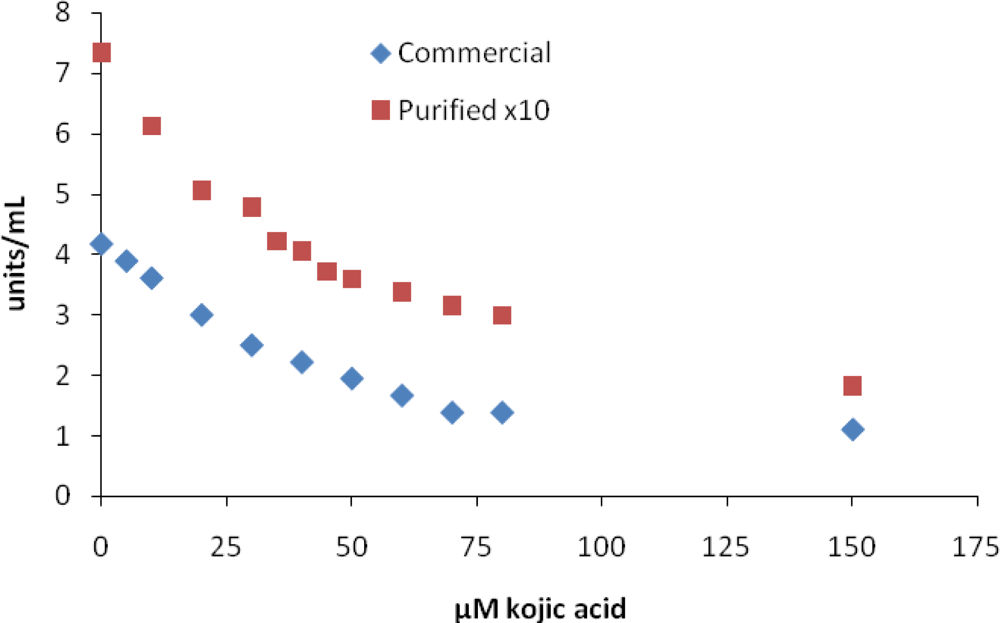
<p>Many investigators use kojic acid as a reference inhibitor, and it is surprising that IC<sub>50</sub> values for kojic acid vary over such a wide range (<xref ref-type="table" rid="t1-ijms-10-03811">Table 1</xref>, [<xref ref-type="bibr" rid="b18-ijms-10-03811">18</xref>]). Our IC<sub>50</sub> values are within the lower end of these ranges. <xref ref-type="fig" rid="f1-ijms-10-03811">Figure 1</xref> shows a plot of MT activity <italic>vs.</italic> kojic acid concentration for commercial and purified MT used to determine an IC<sub>50</sub> value. We show these two curves because most IC<sub>50</sub> values are reported using the commercial MT and sometimes using a purified MT. Even though the commercial and purified tyrosinase showed different enzyme activity in the absence of kojic acid, the IC<sub>50</sub> values and inhibition curves were similar. In general, for inhibitors in group 1 it appears that the purity of tyrosinase does not have a significant effect on IC<sub>50</sub> values.</p>
<p>The second group of inhibitors (NaCl, esculetin, biphenol, phloridzin) seemed to show a few differences in IC<sub>50</sub> values between the crude, commercial and purified enzyme (<xref ref-type="table" rid="t1-ijms-10-03811">Table 1</xref>). For the most part, this group of inhibitors also appeared to have much larger IC<sub>50</sub> values than those reported in <xref ref-type="table" rid="t1-ijms-10-03811">Table 1</xref>. For example, NaCl and esculetin seemed to show an increase in IC<sub>50</sub> values from crude to commercial to purified MT. In contrast, biphenol did not show quite as large a variation in IC<sub>50</sub> values among the tyrosinase samples, although the IC<sub>50</sub> for biphenol was much smaller for commercial MT. Except for phloridzin, the IC<sub>50</sub> values for NaCl, esculetin and biphenol seemed to be larger for the purified enzyme compared to the commercial or crude enzyme in this group of inhibitors.</p>
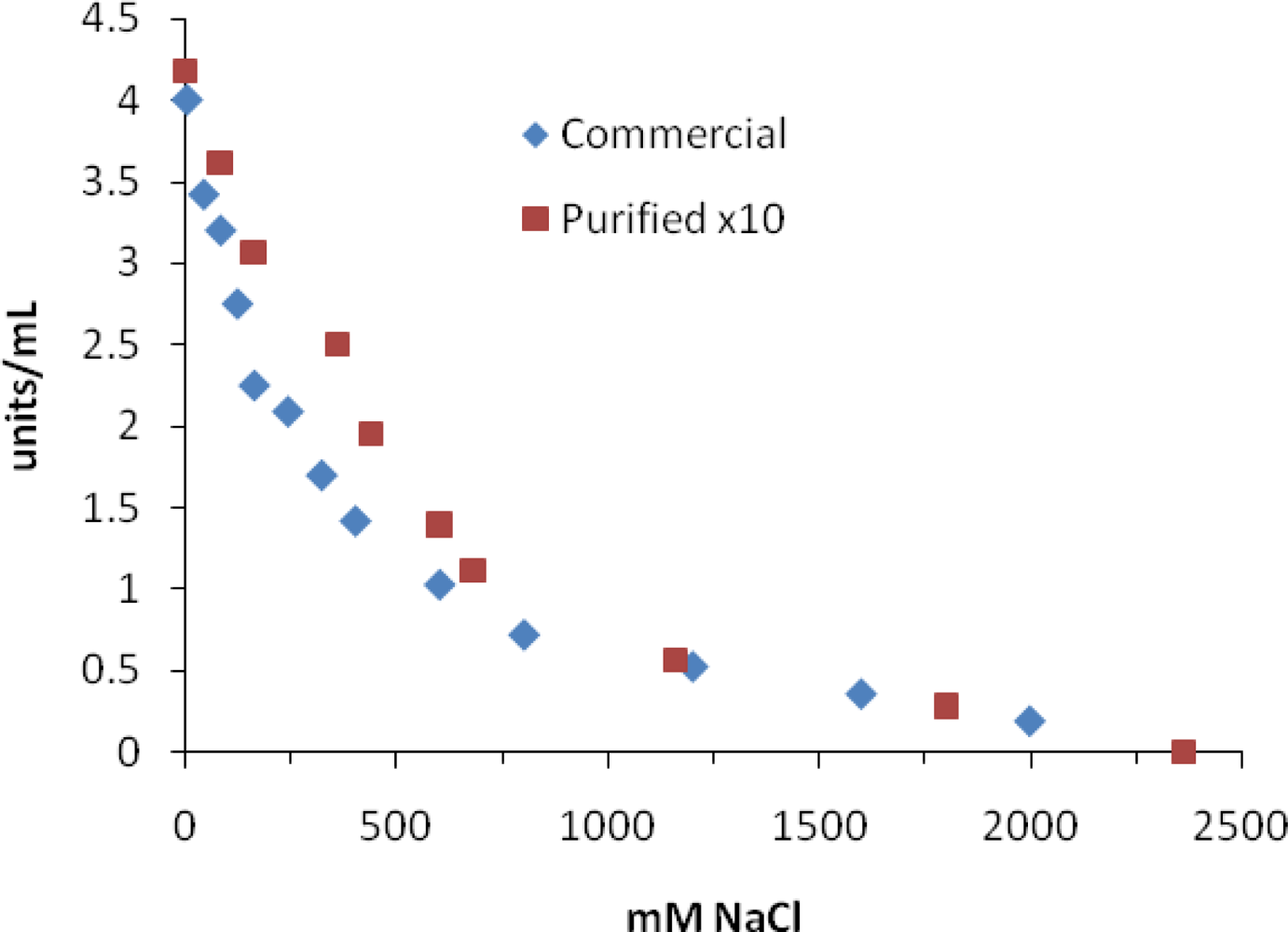
<p><xref ref-type="fig" rid="f2-ijms-10-03811">Figure 2</xref> shows the plot of MT activity <italic>vs.</italic> NaCl concentration using the commercial and purified MT. These IC<sub>50</sub> values for NaCl were much higher than that reported by Park <italic>et al.</italic> [<xref ref-type="bibr" rid="b24-ijms-10-03811">24</xref>], who suggested that Cl<sup>−</sup> was responsible for inhibition and not Na<sup>+</sup>. They also used DOPA as a substrate for tyrosinase. We have no reasonable explanation for the difference in our results <italic>vs.</italic> those by Park <italic>et al.</italic> [<xref ref-type="bibr" rid="b24-ijms-10-03811">24</xref>] except for the source of commercial tyrosinase used in the two studies. However, even our purified MT showed a much higher IC<sub>50</sub> value than the commercial MT.</p>
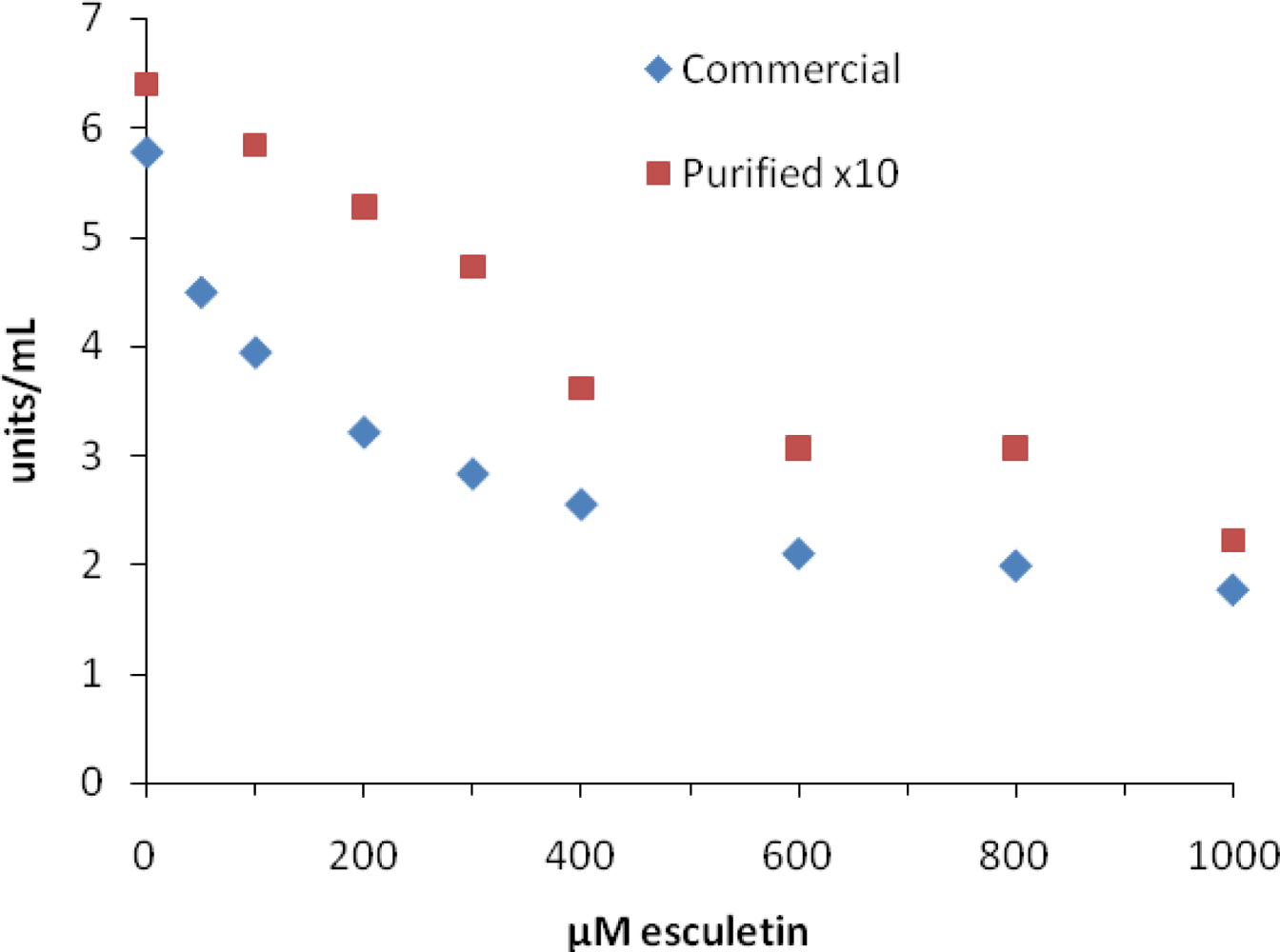
<p><xref ref-type="fig" rid="f3-ijms-10-03811">Figure 3</xref> shows a plot of activity of MT <italic>vs.</italic> esculetin concentration for commercial and purified MT. IC<sub>50</sub> values for esculetin were much higher than that reported by Masamoto [<xref ref-type="bibr" rid="b25-ijms-10-03811">25</xref>], although Flurkey <italic>et al.</italic> [<xref ref-type="bibr" rid="b10-ijms-10-03811">10</xref>] did report a comparable IC<sub>50</sub> value for esculetin using commercial MT. Even though esculetin has been reported to be an inhibitor, Munoz-Munoz <italic>et al.</italic> [<xref ref-type="bibr" rid="b33-ijms-10-03811">33</xref>] have shown that esculetin can be used as an alternative substrate for MT and peroxidase using a chronometric assay. Sollai <italic>et al.</italic> [<xref ref-type="bibr" rid="b34-ijms-10-03811">34</xref>] has also shown that esculetin can be oxidized by MT, plant polyphenol oxidases, and laccase although at slow rates. Thus, apparent inhibition by esculetin could be explained by competition for two different substrates. However, it is still hard to reconcile the differences in IC<sub>50</sub> values between the MT samples we tested, especially the 685 μM IC<sub>50</sub> value for purified MT.</p>
<p>Kim <italic>et al.</italic> [<xref ref-type="bibr" rid="b26-ijms-10-03811">26</xref>] obtained an IC<sub>50</sub> value for biphenol of approximately 2 μM using tyrosine as a substrate instead of DOPA, although they monitored dopachrome formation from tyrosine. Using DOPA as a substrate, we observed a large variation in IC<sub>50</sub> values for biphenol between crude and purified MT <italic>vs.</italic> commercial MT. In addition, we observed increases in tyrosinase activity at concentrations above 20 μM for commercial MT and 100 μM biphenol for purified MT (data not shown). Using crude tyrosinase extracts, there was a 50% decrease in enzyme activity from 0 to 50 μM biphenol but no further inhibition was observed up to 500 μM biphenol (data not shown).</p>
<p>In general, it was difficult to discern a consistent pattern in IC<sub>50</sub> values in group 2 with regard to the purity of tyrosinase. It is possible that some of these inhibitors could be affected by material in crude extracts and in commercial samples of MT differently or behaved differently with a more purified source of enzyme.</p>
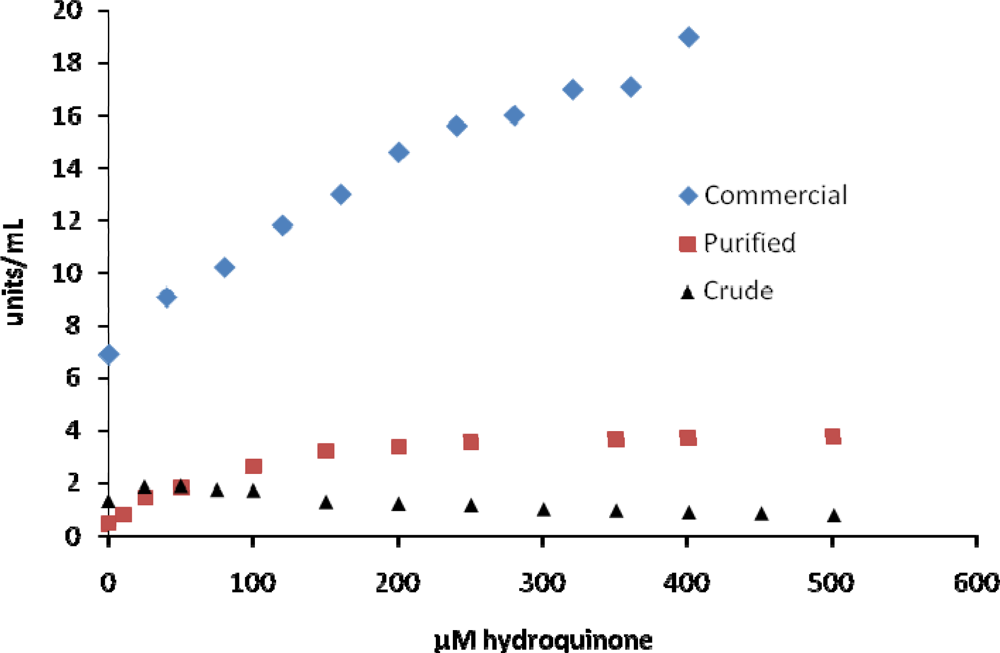
<p>The third group of inhibitors (hydroquinone, lysozyme, ZnSO<sub>4</sub>, anisaldehyde) tested seemed to show little or no inhibition of tyrosinase or required concentrations to reach 50% inhibition that were much different than those reported by other investigators (<xref ref-type="table" rid="t1-ijms-10-03811">Table 1</xref>). This was true for all of the different tyrosinase samples tested. For example, using DOPA as a substrate we found that hydroquinone increased reactions rates at lower concentrations of hydroquinone and caused inhibition at higher concentrations for some of the enzyme samples (<xref ref-type="fig" rid="f4-ijms-10-03811">Figure 4</xref>). Although hydroquinone has been reported to be an inhibitor of MT, Kasraee [<xref ref-type="bibr" rid="b35-ijms-10-03811">35</xref>] and Passi and Nazzaro-Porro [<xref ref-type="bibr" rid="b36-ijms-10-03811">36</xref>] have reported that hydroquinone can act as a substrate for MT in which the oxidation product of hydroquinone, parabenzoquinone, can oxidize DOPA. Enhancement in our observed rates at lower concentrations of hydroquinone could be a result of hydroquinone coupled oxidation of DOPA as well as enzyme catalyzed oxidation of DOPA. This apparent activation varied between 20–500 μM hydroquinone for the different MT samples (<xref ref-type="fig" rid="f4-ijms-10-03811">Figure 4</xref>). The crude tyrosinase showed a decrease in activity beyond 100 μM hydroquinone, while the commercial enzyme showed increased activity up to 400 μM hydroquinone. In contrast, the purified enzyme showed an increase in activity with increasing hydroquinone up to 200 μM and then activity seemed to remain relatively constant up to 500 μM hydroquinone.</p>
<p>For lysozyme, we could not add enough inhibitor into the assay to determine an IC<sub>50</sub> value and observed less than 50% inhibition, even with 10–20 mg/mL (700–1,400 μM) lysozyme in the assay. This is in contrast to Li <italic>et al.</italic> [<xref ref-type="bibr" rid="b28-ijms-10-03811">28</xref>], who found that lysozyme inhibited MT with an IC<sub>50</sub> value of 0.32 μM (4.6 μg/mL). They also suggested that inhibition was dependent upon the time of pre-incubation of lysozyme with tyrosinase. For example, Li <italic>et al.</italic> [<xref ref-type="bibr" rid="b28-ijms-10-03811">28</xref>] observed 8% inhibition on mixing MT with lysozyme just before assaying but found 30% inhibition if MT and lysozyme were incubated for one hour before assaying. We found 8–25% inhibition when large amounts of lysozyme (10–20 mg/mL) were mixed with MT just before assaying, but did not attempt to incubate MT and lysozyme for various times to increase the percent inhibition. We also tried three different sources of lysozyme with the similar results (data not shown).</p>
<p>Effects of Zn<sup>2+</sup> and anisaldehyde on mushroom tyrosinase were examined. In monitoring the oxidation of DOPA to dopachrome, we found no inhibition of MT by Zn<sup>2+</sup>, even at concentrations up to 1 mM (<xref ref-type="table" rid="t1-ijms-10-03811">Table 1</xref>). This is in contrast to that reported by Han <italic>et al.</italic> [<xref ref-type="bibr" rid="b29-ijms-10-03811">29</xref>]. However, they used a much different assay for tyrosinase that coupled DOPA oxidation to a change in the coloration of thymol blue as a result of protonation. Since our assays monitor DOPA oxidation directly, we can only surmise that Zn<sup>2+</sup> may cause some sort of interference in the coupled assay reported by Han <italic>et al.</italic> [<xref ref-type="bibr" rid="b29-ijms-10-03811">29</xref>]. We were able to determine IC<sub>50</sub> values for anisaldehyde using the crude, commercial and purified MT (<xref ref-type="table" rid="t1-ijms-10-03811">Table 1</xref>). These values ranged from 1 to 1.8 mM between the mushroom samples but were much larger that that reported by Ha <italic>et al.</italic> [<xref ref-type="bibr" rid="b30-ijms-10-03811">30</xref>]. Although we did not check for the presence of anisic acid in the anisaldehyde, anisic acid has been shown to be a MT inhibitor with an IC<sub>50</sub> value of 680 μM [<xref ref-type="bibr" rid="b37-ijms-10-03811">37</xref>]. In general, the IC<sub>50</sub> values in this third group of inhibitors were much different than that reported by citations listed in <xref ref-type="table" rid="t1-ijms-10-03811">Table 1</xref> even though the crude, commercial and purified MT appeared to behave in a similar manner with these inhibitors.</p>
<p>The fourth group of potential MT inhibitors (DMSO, dimethyl sulfide, dimethyl sulfone, ethanol) comprised compounds that are commonly used to dissolve MT inhibitors and/or may be potential contaminants in DMSO preparations (<xref ref-type="table" rid="t1-ijms-10-03811">Table 1</xref>). IC<sub>50</sub> values for ethanol were similar for all MT samples tested. Little to no inhibition was observed for dimethyl sulfide up to 500 μM using any of the MT samples tested. Perez-Gilabert and Garcia-Carmona reported that dimethyl sulfide is a slow binding inhibitor of tyrosinase, although they did not report IC<sub>50</sub> values [<xref ref-type="bibr" rid="b38-ijms-10-03811">38</xref>]. We also observed relatively little inhibition of tyrosinase up to 2 mM dimethyl sulfone.</p>
<p>Inhibition by DMSO did not appear to be much different for crude or commercial MT even though the IC<sub>50</sub> values were larger that using the purified MT. Our IC<sub>50</sub> values for DMSO using commercial and purified MT were somewhat lower than that reported by Chen <italic>et al.</italic> [<xref ref-type="bibr" rid="b31-ijms-10-03811">31</xref>]. We did find that inhibition by DMSO might be dependent on the source and/or purity of the DMSO used (data not shown). We also observed that high concentrations of DMSO caused a precipitate to form in the assay solution, presumably inorganic compounds that are less soluble as the DMSO increased in concentration. DMSO has also been shown to cause protein precipitation and denaturation by Arakawa <italic>et al.</italic> [<xref ref-type="bibr" rid="b39-ijms-10-03811">39</xref>] at higher DMSO concentrations. In addition, Tjernberg <italic>et al.</italic> [<xref ref-type="bibr" rid="b40-ijms-10-03811">40</xref>] reported that even low concentrations of DMSO (&lt; 5 %) can destabilize proteins. These effects may have to be considered when examining inhibitory effects of organic solvents or inhibitors dissolved in organic solvents, like DMSO, on tyrosinase activity. In general, and with the exception of DMSO, the fourth group of potential tyrosinase inhibitors displayed similar IC<sub>50</sub> values for the different sources of tyrosinase.</p></sec>
<sec>
<label>3.</label>
<title>Experimental Section</title>
<sec sec-type="materials">
<label>3.1.</label>
<title>Materials</title>
<p>Commercial mushroom tyrosinase was purchased from Worthington Biochemical Corp. (Lakewood, NJ, USA). Substrates and inhibitors were obtained from Sigma-Aldrich (St. Louis, MO, USA). Anisaldehyde was obtained form J.T. Baker Chemical Co. (Phillipsburg, NJ, USA). Dimethyl sulfoxide (DMSO) was reagent grade from Sigma-Aldrich (St. Louis, MO, USA).</p></sec>
<sec sec-type="methods">
<label>3.2.</label>
<title>Methods</title>
<sec>
<label>3.2.1.</label>
<title>Crude Extract Tyrosinase Preparation</title>
<p>White button mushrooms were purchased from local stores and blended in 100 mM sodium phosphate (pH 6.0) containing 1 mM EDTA, 1 mM PMSF, 5 mM ascorbic acid and 1 M sucrose. The homogenates were filtered and stored at −15 °C in small aliquots. Commercial mushroom tyrosinase. Mushroom tyrosinase was dissolved in the above buffer without ascorbic acid at 2 mg dry weight/mL and stored at 5 °C in small aliquots.</p></sec>
<sec>
<label>3.2.2.</label>
<title>Enzyme Purification</title>
<p>Tyrosinase was partially purified from commercial mushroom tyrosinase preparations using ammonium sulfate precipitation (35–60%), ion exchange on DEAE Sepharose CL-6B, hydrophobic interaction on Phenyl Sepharose in 1 M NaCl, and adsorption on hydroxyapatite [<xref ref-type="bibr" rid="b41-ijms-10-03811">41</xref>,<xref ref-type="bibr" rid="b42-ijms-10-03811">42</xref>].</p></sec>
<sec>
<label>3.2.3.</label>
<title>Enzyme Assays</title>
<p>Each one mL assay contained a final concentration of 100 mM sodium phosphate (pH 6.5) and 2 mM DOPA. Crude, commercial or partially purified tyrosinase was added to initiate the reaction. Oxidation of DOPA into dopachrome was monitored at 475 nm. One unit of activity was defined as 1 μmole dopachrome formed per min per ml enzyme using an extinction coefficient of 3600 M<sup>−1</sup> cm<sup>−1</sup>. Rates were determined from the linear portion of the absorbance <italic>vs.</italic> time curves. Crude enzyme was use at a concentration of 0.1 units (8.4 μg protein) per mL in the assay and assayed in the presence of 0.1% SDS. Commercial tyrosinase was used at a concentration of 0.038 units (3.3 μg protein) per mL in the assay. The purified enzyme was used at a concentration of 0.0067 units (0.58 μg protein) per mL in the assay.</p></sec>
<sec>
<label>3.2.4.</label>
<title>IC<sub>50</sub> Determinations</title>
<p>Various amounts of inhibitors were added into assays to determine a range of inhibitors needed to encompass the IC<sub>50</sub> value. Then assays were repeated within this range of inhibitor concentrations. Rates were determined as above. If any inhibitor caused a significant change in the shape of the A <italic>vs.</italic> time curve, rates were calculated from steady state rate regions (linear portions) in the curves. The concentration of inhibitor needed to inhibit 50% of the tyrosinase activity was extrapolated from % activity <italic>vs.</italic> [inhibitor] curves. For some inhibitors, we also used Statistical Data Analysis Software (SDAS, version 2008A) using an exponential equation to obtain a best fit curve and then to calculate IC<sub>50</sub> values. For the crude and commercial MT, experiments were repeated at least twice and the average IC<sub>50</sub> value reported. Because of the limited amount of purified tyrosinase, not all experiments could be repeated twice. In experiments requiring DMSO to dissolve the inhibitor, control assays contained the assay mixture with DMSO but minus inhibitor. Final DMSO concentrations were 5% or less in the assays.</p></sec></sec></sec>
<sec sec-type="conclusions">
<label>4.</label>
<title>Conclusions</title>
<p>IC<sub>50</sub> values for tyrosinase inhibitors can vary for a number of reasons, including choice of assay conditions, rate determinations, and solvent considerations. Therefore, it is sometimes difficult to reproduce data reported in the literature. Our results seem to indicate the IC<sub>50</sub> values can also vary depending on the purity of the tyrosinase. However, this observation also seems to be related to the type of inhibitor used. Crude MT extracts and commercial MT sources contain a variety of proteins, enzymes, carbohydrate, and organic compounds. Any one of these substances can interfere with IC<sub>50</sub> value estimations through chemical or enzymatic reactions. We suggest that MT preparations need to be partially purified to eliminate these potential problems in IC<sub>50</sub> value determinations.</p></sec></body>
<back>
<ack>
<p>We would like to thank Indiana State University and the John W. Anderson Foundation for providing funding for undergraduates participating in the SURE program in the Chemistry Department.</p></ack>
<glossary>
<title>Abbreviations:</title>
<def-list>
<def-item>
<term>ATTM</term>
<def>
<p>ammonium tetrathiomolybdate</p></def></def-item>
<def-item>
<term>biphenol</term>
<def>
<p>4,4’-dihydroxy-biphenyl</p></def></def-item>
<def-item>
<term>DOPA</term>
<def>
<p>dihydroxyphenylalanine</p></def></def-item>
<def-item>
<term>DMSO</term>
<def>
<p>dimethyl sulfoxide</p></def></def-item>
<def-item>
<term>EDTA</term>
<def>
<p>ethylenediaminetetraacetic acid</p></def></def-item>
<def-item>
<term>4HR</term>
<def>
<p>4-hexylresorcinol</p></def></def-item>
<def-item>
<term>MT</term>
<def>
<p>mushroom tyrosinase</p></def></def-item>
<def-item>
<term>PMSF</term>
<def>
<p>phenylmethylsulfonyl fluoride</p></def></def-item>
<def-item>
<term>SDS</term>
<def>
<p>sodium dodecylsulfate</p></def></def-item>
<def-item>
<term>SHAM</term>
<def>
<p>salicyl-hydroxamic acid</p></def></def-item></def-list></glossary>
<ref-list>
<title>References and Notes</title>
<ref id="b1-ijms-10-03811"><label>1.</label><citation citation-type="journal"><person-group person-group-type="author"><name><surname>Flurkey</surname><given-names>WH</given-names></name><name><surname>Inlow</surname><given-names>JK</given-names></name></person-group><article-title>Proteolytic processing of polyphenol oxidase from plants and fungi</article-title><source>J. Inorg. Biochem</source><year>2008</year><volume>102</volume><fpage>2160</fpage><lpage>2170</lpage><pub-id pub-id-type="doi">10.1016/j.jinorgbio.2008.08.007</pub-id><pub-id pub-id-type="pmid">18829115</pub-id></citation></ref>
<ref id="b2-ijms-10-03811"><label>2.</label><citation citation-type="journal"><person-group person-group-type="author"><name><surname>Ando</surname><given-names>H</given-names></name><name><surname>Kondoh</surname><given-names>H</given-names></name><name><surname>Ichihashi</surname><given-names>M</given-names></name><name><surname>Hearing</surname><given-names>VJ</given-names></name></person-group><article-title>Approaches to identify inhibitors of melanin biosynthesis via quality control of tyrosinase</article-title><source>J. Invest. Dermatol</source><year>2007</year><volume>127</volume><fpage>751</fpage><lpage>761</lpage><pub-id pub-id-type="doi">10.1038/sj.jid.5700683</pub-id><pub-id pub-id-type="pmid">17218941</pub-id></citation></ref>
<ref id="b3-ijms-10-03811"><label>3.</label><citation citation-type="journal"><person-group person-group-type="author"><name><surname>Mayer</surname><given-names>AM</given-names></name></person-group><article-title>Polyphenol oxidases in plants and fungi: Going places?</article-title><source>Phytochemistry</source><year>2006</year><volume>67</volume><fpage>2318</fpage><lpage>2331</lpage><pub-id pub-id-type="doi">10.1016/j.phytochem.2006.08.006</pub-id><pub-id pub-id-type="pmid">16973188</pub-id></citation></ref>
<ref id="b4-ijms-10-03811"><label>4.</label><citation citation-type="journal"><person-group person-group-type="author"><name><surname>Selinheimo</surname><given-names>E</given-names></name><name><surname>NiEidhin</surname><given-names>D</given-names></name><name><surname>Steffenson</surname><given-names>C</given-names></name><name><surname>Nielson</surname><given-names>J</given-names></name><name><surname>Lomascolo</surname><given-names>A</given-names></name><name><surname>Halaouli</surname><given-names>S</given-names></name><name><surname>Record</surname><given-names>E</given-names></name><name><surname>O’Beirne</surname><given-names>D</given-names></name><name><surname>Buchert</surname><given-names>J</given-names></name><name><surname>Kruus</surname><given-names>K</given-names></name></person-group><article-title>Comparison of the characteristics of fungal and plant tyrosinases</article-title><source>J. Biotechnol</source><year>2007</year><volume>130</volume><fpage>471</fpage><lpage>480</lpage><pub-id pub-id-type="doi">10.1016/j.jbiotec.2007.05.018</pub-id><pub-id pub-id-type="pmid">17602775</pub-id></citation></ref>
<ref id="b5-ijms-10-03811"><label>5.</label><citation citation-type="journal"><person-group person-group-type="author"><name><surname>Gandia-Herrero</surname><given-names>F</given-names></name><name><surname>Escribano</surname><given-names>J</given-names></name><name><surname>Garcia-Carmona</surname><given-names>F</given-names></name></person-group><article-title>Betaxanthins as substrates for tyrosinase. An approach to the role of tyrosinase in the biosynthetic pathway of betalains</article-title><source>Plant Physiol</source><year>2005</year><volume>138</volume><fpage>421</fpage><lpage>432</lpage><pub-id pub-id-type="doi">10.1104/pp.104.057992</pub-id><pub-id pub-id-type="pmid">15805475</pub-id></citation></ref>
<ref id="b6-ijms-10-03811"><label>6.</label><citation citation-type="journal"><person-group person-group-type="author"><name><surname>Yoruk</surname><given-names>R</given-names></name><name><surname>Marshall</surname><given-names>M</given-names></name></person-group><article-title>Physicochemical properties and function of plant polyphenol oxidase: A review</article-title><source>J. Food Biochem</source><year>2003</year><volume>27</volume><fpage>361</fpage><lpage>422</lpage><pub-id pub-id-type="doi">10.1111/j.1745-4514.2003.tb00289.x</pub-id></citation></ref>
<ref id="b7-ijms-10-03811"><label>7.</label><citation citation-type="journal"><person-group person-group-type="author"><name><surname>Walker</surname><given-names>JRL</given-names></name><name><surname>Ferrar</surname><given-names>PH</given-names></name></person-group><article-title>The control of enzymic browning in foods</article-title><source>Chem. Indust</source><year>1995</year><volume>16</volume><fpage>836</fpage><lpage>839</lpage></citation></ref>
<ref id="b8-ijms-10-03811"><label>8.</label><citation citation-type="book"><person-group person-group-type="author"><name><surname>Kim</surname><given-names>J</given-names></name><name><surname>Marshall</surname><given-names>MR</given-names></name><name><surname>Wei</surname><given-names>C</given-names></name></person-group><article-title>Polyphenoloxidase</article-title><source>Sea Food Enzymes</source><person-group person-group-type="editor"><name><surname>Haard</surname><given-names>NF</given-names></name><name><surname>Simpson</surname><given-names>BK</given-names></name></person-group><publisher-name>Marcel Dekker</publisher-name><publisher-loc>New York, NY, USA</publisher-loc><year>2000</year><fpage>271</fpage><lpage>315</lpage></citation></ref>
<ref id="b9-ijms-10-03811"><label>9.</label><citation citation-type="journal"><person-group person-group-type="author"><name><surname>Rescigno</surname><given-names>A</given-names></name><name><surname>Zucca</surname><given-names>P</given-names></name><name><surname>Flurkey</surname><given-names>A</given-names></name><name><surname>Inlow</surname><given-names>J</given-names></name><name><surname>Flurkey</surname><given-names>WH</given-names></name></person-group><article-title>Identification and discrimination between some contaminant enzyme activities in commercial preparations of mushroom tyrosinase</article-title><source>Enzyme Micro. Tech</source><year>2007</year><volume>41</volume><fpage>620</fpage><lpage>627</lpage><pub-id pub-id-type="doi">10.1016/j.enzmictec.2007.05.009</pub-id></citation></ref>
<ref id="b10-ijms-10-03811"><label>10.</label><citation citation-type="journal"><person-group person-group-type="author"><name><surname>Flurkey</surname><given-names>A</given-names></name><name><surname>Cooksey</surname><given-names>J</given-names></name><name><surname>Reddy</surname><given-names>A</given-names></name><name><surname>Spoonmore</surname><given-names>K</given-names></name><name><surname>Rescigno</surname><given-names>A</given-names></name><name><surname>Inlow</surname><given-names>J</given-names></name><name><surname>Flurkey</surname><given-names>WH</given-names></name></person-group><article-title>Enzyme, protein, carbohydrate, and phenolic contaminants in commercial tyrosinase preparations; potential problems affecting tyrosinase activity and inhibition studies</article-title><source>J. Agric. Food Chem</source><year>2008</year><volume>56</volume><fpage>4760</fpage><lpage>4768</lpage><pub-id pub-id-type="doi">10.1021/jf800109a</pub-id><pub-id pub-id-type="pmid">18500813</pub-id></citation></ref>
<ref id="b11-ijms-10-03811"><label>11.</label><citation citation-type="book"><person-group person-group-type="author"><name><surname>Flurkey</surname><given-names>WH</given-names></name><name><surname>Ratcliff</surname><given-names>B</given-names></name><name><surname>Lopez</surname><given-names>L</given-names></name><name><surname>Kuglin</surname><given-names>J</given-names></name><name><surname>Dawley</surname><given-names>RM</given-names></name></person-group><article-title>Differentiation of fungal tyrosinase and laccases using selective inhibitors and substrates</article-title><source>Enzymatic Browning and Its Prevention</source><person-group person-group-type="editor"><name><surname>Lee</surname><given-names>CY</given-names></name><name><surname>Whitaker</surname><given-names>JR</given-names></name></person-group><publisher-name>American Chemical Society</publisher-name><publisher-loc>Washington, DC, USA</publisher-loc><year>1995</year>Series 600, Chapter 6, <fpage>81</fpage><lpage>90</lpage></citation></ref>
<ref id="b12-ijms-10-03811"><label>12.</label><citation citation-type="journal"><person-group person-group-type="author"><name><surname>Sugumaran</surname><given-names>M</given-names></name><name><surname>Bolton</surname><given-names>JL</given-names></name></person-group><article-title>Laccase-and not tyrosinase- is the enzyme responsible for quinone methide production from 2,6-dimethoxy-4-allyl-phenol</article-title><source>Arch. Biochem. Biophys</source><year>1998</year><volume>353</volume><fpage>207</fpage><lpage>212</lpage><pub-id pub-id-type="doi">10.1006/abbi.1998.0653</pub-id><pub-id pub-id-type="pmid">9606954</pub-id></citation></ref>
<ref id="b13-ijms-10-03811"><label>13.</label><citation citation-type="journal"><person-group person-group-type="author"><name><surname>Jacobsohn</surname><given-names>GM</given-names></name><name><surname>Jacobsohn</surname><given-names>MK</given-names></name></person-group><article-title>Incorporation and binding of estrogens into melanin: Comparison of mushroom and mammalian tyrosinases</article-title><source>Biochim. Biophys. Acta</source><year>1992</year><volume>1116</volume><fpage>173</fpage><lpage>182</lpage><pub-id pub-id-type="doi">10.1016/0304-4165(92)90114-A</pub-id><pub-id pub-id-type="pmid">1316167</pub-id></citation></ref>
<ref id="b14-ijms-10-03811"><label>14.</label><citation citation-type="journal"><person-group person-group-type="author"><name><surname>Galindo</surname><given-names>JD</given-names></name><name><surname>Martinez</surname><given-names>JH</given-names></name><name><surname>Lopez-Ballester</surname><given-names>JA</given-names></name><name><surname>Penafiel</surname><given-names>R</given-names></name><name><surname>Solano</surname><given-names>F</given-names></name><name><surname>Lozano</surname><given-names>JA</given-names></name></person-group><article-title>The effect of polyamines on tyrosinase activity</article-title><source>Biochem. Int</source><year>1987</year><volume>15</volume><fpage>1151</fpage><lpage>1158</lpage><pub-id pub-id-type="pmid">3125836</pub-id></citation></ref>
<ref id="b15-ijms-10-03811"><label>15.</label><citation citation-type="journal"><person-group person-group-type="author"><name><surname>Rescigno</surname><given-names>A</given-names></name><name><surname>Sollai</surname><given-names>F</given-names></name><name><surname>Pisu</surname><given-names>B</given-names></name><name><surname>Rinaldi</surname><given-names>A</given-names></name><name><surname>Sanjust</surname><given-names>E</given-names></name></person-group><article-title>Tyrosinase inhibition: General and applied aspects</article-title><source>J. Enzyme. Inhib. Med. Chem</source><year>2002</year><volume>17</volume><fpage>207</fpage><lpage>218</lpage><pub-id pub-id-type="doi">10.1080/14756360210000010923</pub-id><pub-id pub-id-type="pmid">12530473</pub-id></citation></ref>
<ref id="b16-ijms-10-03811"><label>16.</label><citation citation-type="journal"><person-group person-group-type="author"><name><surname>Seo</surname><given-names>SY</given-names></name><name><surname>Sharma</surname><given-names>VK</given-names></name><name><surname>Sharma</surname><given-names>N</given-names></name></person-group><article-title>Mushroom tyrosinase: Recent prospects</article-title><source>J. Agric. Food Chem</source><year>2003</year><volume>51</volume><fpage>2837</fpage><lpage>2853</lpage><pub-id pub-id-type="doi">10.1021/jf020826f</pub-id><pub-id pub-id-type="pmid">12720364</pub-id></citation></ref>
<ref id="b17-ijms-10-03811"><label>17.</label><citation citation-type="journal"><person-group person-group-type="author"><name><surname>Kim</surname><given-names>YJ</given-names></name><name><surname>Uyama</surname><given-names>H</given-names></name></person-group><article-title>Tyrosinase inhibitors from natural and synthetic sources: Structure, inhibition mechanism and perspective for the future</article-title><source>Cell. Molec. Life Sci</source><year>2005</year><volume>62</volume><fpage>1707</fpage><lpage>1723</lpage><pub-id pub-id-type="doi">10.1007/s00018-005-5054-y</pub-id><pub-id pub-id-type="pmid">15968468</pub-id></citation></ref>
<ref id="b18-ijms-10-03811"><label>18.</label><citation citation-type="journal"><person-group person-group-type="author"><name><surname>Marrero-Ponce</surname><given-names>Y</given-names></name><name><surname>Khan</surname><given-names>MTH</given-names></name><name><surname>Martin</surname><given-names>GMC</given-names></name><name><surname>Ather</surname><given-names>A</given-names></name><name><surname>Sultankhodzhaev</surname><given-names>MN</given-names></name><name><surname>Torrens</surname><given-names>F</given-names></name><name><surname>Rotondo</surname><given-names>R</given-names></name></person-group><article-title>Prediction of tyrosinase inhibition activity using atom-based bilinear indices</article-title><source>Chem. Med. Chem</source><year>2007</year><volume>2</volume><fpage>449</fpage><lpage>478</lpage><pub-id pub-id-type="pmid">17366651</pub-id></citation></ref>
<ref id="b19-ijms-10-03811"><label>19.</label><citation citation-type="journal"><person-group person-group-type="author"><name><surname>Kahn</surname><given-names>V</given-names></name><name><surname>Zakin</surname><given-names>V</given-names></name></person-group><article-title>Effect of salicylhydroxamic acid (SHAM) on <sc>dl</sc>-DOPA oxidation by mushroom tyrosinae and by NaIO<sub>4</sub></article-title><source>J. Food Biochem</source><year>2000</year><volume>24</volume><fpage>399</fpage><lpage>415</lpage><pub-id pub-id-type="doi">10.1111/j.1745-4514.2000.tb00709.x</pub-id></citation></ref>
<ref id="b20-ijms-10-03811"><label>20.</label><citation citation-type="journal"><person-group person-group-type="author"><name><surname>Chen</surname><given-names>QX</given-names></name><name><surname>Ke</surname><given-names>LN</given-names></name><name><surname>Song</surname><given-names>KK</given-names></name><name><surname>Huang</surname><given-names>H</given-names></name><name><surname>Liu</surname><given-names>XD</given-names></name></person-group><article-title>Inhibitory effects of hexylresorcinol and dodecylresorcinaol on mushroom (<italic>Agaricus bisporus</italic>) tyrosinase</article-title><source>Prot. J</source><year>2004</year><volume>23</volume><fpage>135</fpage><lpage>141</lpage><pub-id pub-id-type="doi">10.1023/B:JOPC.0000020080.21417.ff</pub-id></citation></ref>
<ref id="b21-ijms-10-03811"><label>21.</label><citation citation-type="journal"><person-group person-group-type="author"><name><surname>Kahn</surname><given-names>V</given-names></name><name><surname>Andrawis</surname><given-names>A</given-names></name></person-group><article-title>Inhibition of mushroom tyrosinase by tropolone</article-title><source>Phytochemistry</source><year>1985</year><volume>24</volume><fpage>905</fpage><lpage>908</lpage><pub-id pub-id-type="doi">10.1016/S0031-9422(00)83150-7</pub-id></citation></ref>
<ref id="b22-ijms-10-03811"><label>22.</label><citation citation-type="journal"><person-group person-group-type="author"><name><surname>Andrawis</surname><given-names>A</given-names></name><name><surname>Kahn</surname><given-names>V</given-names></name></person-group><article-title>Effect of methimazole on the activity of mushroom tyrosinase</article-title><source>Biochem. J</source><year>1986</year><volume>235</volume><fpage>91</fpage><lpage>96</lpage><pub-id pub-id-type="pmid">3091005</pub-id></citation></ref>
<ref id="b23-ijms-10-03811"><label>23.</label><citation citation-type="journal"><person-group person-group-type="author"><name><surname>Park</surname><given-names>KH</given-names></name><name><surname>Park</surname><given-names>YD</given-names></name><name><surname>Lee</surname><given-names>JR</given-names></name><name><surname>Hahn</surname><given-names>HS</given-names></name><name><surname>Lee</surname><given-names>SJ</given-names></name><name><surname>Bae</surname><given-names>CD</given-names></name><name><surname>Yang</surname><given-names>JM</given-names></name><name><surname>Kim</surname><given-names>DE</given-names></name><name><surname>Hahn</surname><given-names>MJ</given-names></name></person-group><article-title>Inhibition kinetics of mushroom tyrosinase by copper-chelating ammonium tetrathiomolybdate</article-title><source>Biochim. Biophys. Acta</source><year>2005</year><volume>1726</volume><fpage>115</fpage><lpage>120</lpage><pub-id pub-id-type="doi">10.1016/j.bbagen.2005.06.010</pub-id><pub-id pub-id-type="pmid">16039066</pub-id></citation></ref>
<ref id="b24-ijms-10-03811"><label>24.</label><citation citation-type="journal"><person-group person-group-type="author"><name><surname>Park</surname><given-names>YD</given-names></name><name><surname>Kim</surname><given-names>SY</given-names></name><name><surname>Lyou</surname><given-names>YJ</given-names></name><name><surname>Lee</surname><given-names>JY</given-names></name><name><surname>Yang</surname><given-names>JM</given-names></name></person-group><article-title>A new type of uncompetitive inhibition of tyrosinase by Cl<sup>−</sup> binding</article-title><source>Biochimie</source><year>2005</year><volume>87</volume><fpage>931</fpage><lpage>937</lpage><pub-id pub-id-type="doi">10.1016/j.biochi.2005.06.006</pub-id><pub-id pub-id-type="pmid">16005559</pub-id></citation></ref>
<ref id="b25-ijms-10-03811"><label>25.</label><citation citation-type="journal"><person-group person-group-type="author"><name><surname>Masamoto</surname><given-names>Y</given-names></name><name><surname>Ando</surname><given-names>H</given-names></name><name><surname>Murata</surname><given-names>Y</given-names></name><name><surname>Shimoishi</surname><given-names>Y</given-names></name><name><surname>Tada</surname><given-names>M</given-names></name><name><surname>Takahata</surname><given-names>K</given-names></name></person-group><article-title>Mushroom tyrosinase inhibitory activtiy of esculetin isolated from seeds of <italic>Euphorbia lathyris, L</italic></article-title><source>Biosci. Biotechnol. Biochem</source><year>2003</year><volume>67</volume><fpage>631</fpage><lpage>634</lpage><pub-id pub-id-type="doi">10.1271/bbb.67.631</pub-id><pub-id pub-id-type="pmid">12723615</pub-id></citation></ref>
<ref id="b26-ijms-10-03811"><label>26.</label><citation citation-type="journal"><person-group person-group-type="author"><name><surname>Kim</surname><given-names>YJ</given-names></name><name><surname>No</surname><given-names>JK</given-names></name><name><surname>Lee</surname><given-names>JH</given-names></name><name><surname>Chung</surname><given-names>HY</given-names></name></person-group><article-title>4,4′-Dihydroxybiphenyl as a new potent tyrosinase inhibitor</article-title><source>Biol. Pharm. Bull</source><year>2005</year><volume>28</volume><fpage>323</fpage><lpage>327</lpage><pub-id pub-id-type="doi">10.1248/bpb.28.323</pub-id><pub-id pub-id-type="pmid">15684492</pub-id></citation></ref>
<ref id="b27-ijms-10-03811"><label>27.</label><citation citation-type="journal"><person-group person-group-type="author"><name><surname>Wang</surname><given-names>Q</given-names></name><name><surname>Qiu</surname><given-names>L</given-names></name><name><surname>Chen</surname><given-names>X</given-names></name><name><surname>Song</surname><given-names>KK</given-names></name><name><surname>Shi</surname><given-names>Y</given-names></name><name><surname>Chen</surname><given-names>QX</given-names></name></person-group><article-title>Inhibitory effects of phloridzin dehydrate on the activity of mushroom (<italic>Agaricus bisporus</italic>) tyrosinase</article-title><source>Bioorg. Med. Chem</source><year>2007</year><volume>15</volume><fpage>1568</fpage><lpage>1571</lpage><pub-id pub-id-type="doi">10.1016/j.bmc.2005.11.048</pub-id><pub-id pub-id-type="pmid">17169565</pub-id></citation></ref>
<ref id="b28-ijms-10-03811"><label>28.</label><citation citation-type="journal"><person-group person-group-type="author"><name><surname>Li</surname><given-names>B</given-names></name><name><surname>Huang</surname><given-names>Y</given-names></name><name><surname>Paskewitz</surname><given-names>SM</given-names></name></person-group><article-title>Hen egg white lysozyme as an inhibitor of mushroom tyrosinase</article-title><source>FEBS Lett</source><year>2006</year><volume>580</volume><fpage>1877</fpage><lpage>1882</lpage><pub-id pub-id-type="doi">10.1016/j.febslet.2006.02.051</pub-id><pub-id pub-id-type="pmid">16516893</pub-id></citation></ref>
<ref id="b29-ijms-10-03811"><label>29.</label><citation citation-type="journal"><person-group person-group-type="author"><name><surname>Han</surname><given-names>HY</given-names></name><name><surname>Zou</surname><given-names>HC</given-names></name><name><surname>Jeon</surname><given-names>JY</given-names></name><name><surname>Wang</surname><given-names>JY</given-names></name><name><surname>Xu</surname><given-names>WA</given-names></name><name><surname>Yang</surname><given-names>JM</given-names></name><name><surname>Park</surname><given-names>YD</given-names></name></person-group><article-title>The inhibition kinetics and thermodynamic changes of tyrosinase via zinc ion</article-title><source>Biochim. Biophys. Acta</source><year>2007</year><volume>1774</volume><fpage>822</fpage><lpage>827</lpage><pub-id pub-id-type="doi">10.1016/j.bbapap.2007.04.011</pub-id><pub-id pub-id-type="pmid">17544347</pub-id></citation></ref>
<ref id="b30-ijms-10-03811"><label>30.</label><citation citation-type="journal"><person-group person-group-type="author"><name><surname>Ha</surname><given-names>TJ</given-names></name><name><surname>Tamura</surname><given-names>S</given-names></name><name><surname>Kubo</surname><given-names>I</given-names></name></person-group><article-title>Effects of mushroom tyrosinase on anisaldehyde</article-title><source>J. Agric. Food Chem</source><year>2005</year><volume>53</volume><fpage>7024</fpage><lpage>7028</lpage><pub-id pub-id-type="doi">10.1021/jf047943q</pub-id><pub-id pub-id-type="pmid">16131106</pub-id></citation></ref>
<ref id="b31-ijms-10-03811"><label>31.</label><citation citation-type="journal"><person-group person-group-type="author"><name><surname>Chen</surname><given-names>QX</given-names></name><name><surname>Liu</surname><given-names>XD</given-names></name><name><surname>Huang</surname><given-names>H</given-names></name></person-group><article-title>Inactivation kinetics of mushroom tyrosinase in the dimethyl sulfoxide solution</article-title><source>Biochemistry (Moscow)</source><year>2003</year><volume>68</volume><fpage>644</fpage><lpage>649</lpage><pub-id pub-id-type="doi">10.1023/A:1024665709631</pub-id></citation></ref>
<ref id="b32-ijms-10-03811"><label>32.</label><citation citation-type="journal"><person-group person-group-type="author"><name><surname>Jimenez</surname><given-names>M</given-names></name><name><surname>Garcis-Carmona</surname><given-names>F</given-names></name></person-group><article-title>4-Substituted resorcinols (sulfite alternatives) as slow binding inhibitors of tyrosinase catecholase activity</article-title><source>J. Agric. Food Chem</source><year>1997</year><volume>45</volume><fpage>2061</fpage><lpage>2065</lpage><pub-id pub-id-type="doi">10.1021/jf960810n</pub-id></citation></ref>
<ref id="b33-ijms-10-03811"><label>33.</label><citation citation-type="journal"><person-group person-group-type="author"><name><surname>Munoz-Munoz</surname><given-names>JL</given-names></name><name><surname>Garcia-Molina</surname><given-names>F</given-names></name><name><surname>Varon</surname><given-names>R</given-names></name><name><surname>Rodriquez-Lopez</surname><given-names>JN</given-names></name><name><surname>Garcia-Canovas</surname><given-names>F</given-names></name><name><surname>Tudela</surname><given-names>J</given-names></name></person-group><article-title>Kinetic chara-cterization of the oxidation of esculetin by polyphenol oxidase and peroxidase</article-title><source>Biosci. Biotechnol. Biochem</source><year>2007</year><volume>71</volume><fpage>390</fpage><lpage>396</lpage><pub-id pub-id-type="doi">10.1271/bbb.60431</pub-id><pub-id pub-id-type="pmid">17284853</pub-id></citation></ref>
<ref id="b34-ijms-10-03811"><label>34.</label><citation citation-type="journal"><person-group person-group-type="author"><name><surname>Sollai</surname><given-names>F</given-names></name><name><surname>Zucca</surname><given-names>P</given-names></name><name><surname>Sanjust</surname><given-names>E</given-names></name><name><surname>Steri</surname><given-names>D</given-names></name><name><surname>Rescigno</surname><given-names>A</given-names></name></person-group><article-title>Umbelliferone and esculetin: Inhibitors or substrates for polyphenol oxidases?</article-title><source>Biol. Pharm. Bull</source><year>2008</year><volume>31</volume><fpage>2187</fpage><lpage>2193</lpage><pub-id pub-id-type="doi">10.1248/bpb.31.2187</pub-id><pub-id pub-id-type="pmid">19043197</pub-id></citation></ref>
<ref id="b35-ijms-10-03811"><label>35.</label><citation citation-type="journal"><person-group person-group-type="author"><name><surname>Kasraee</surname><given-names>B</given-names></name></person-group><article-title>Peroxidase-mediated mechanisms are involved in the melanocytotoxic and melanogenesis-inhibiting effects of chemical agents</article-title><source>Dermatology</source><year>2002</year><volume>205</volume><fpage>329</fpage><lpage>339</lpage><pub-id pub-id-type="doi">10.1159/000066439</pub-id><pub-id pub-id-type="pmid">12444326</pub-id></citation></ref>
<ref id="b36-ijms-10-03811"><label>36.</label><citation citation-type="journal"><person-group person-group-type="author"><name><surname>Passi</surname><given-names>S</given-names></name><name><surname>Nazzaro-Porro</surname><given-names>M</given-names></name></person-group><article-title>Molecular basis of substrate and inhibitory specificity of tyrosinase: Phenolic compounds</article-title><source>Br. J. Dermatol</source><year>1981</year><volume>104</volume><fpage>659</fpage><lpage>665</lpage><pub-id pub-id-type="doi">10.1111/j.1365-2133.1981.tb00752.x</pub-id><pub-id pub-id-type="pmid">6788064</pub-id></citation></ref>
<ref id="b37-ijms-10-03811"><label>37.</label><citation citation-type="journal"><person-group person-group-type="author"><name><surname>Lee</surname><given-names>HS</given-names></name></person-group><article-title>Tyrosinase inhibitors of <italic>Pulsatila cernua</italic> root-derived materials</article-title><source>J. Agric. Food Chem</source><year>2002</year><volume>50</volume><fpage>1400</fpage><lpage>1403</lpage><pub-id pub-id-type="doi">10.1021/jf011230f</pub-id><pub-id pub-id-type="pmid">11879010</pub-id></citation></ref>
<ref id="b38-ijms-10-03811"><label>38.</label><citation citation-type="journal"><person-group person-group-type="author"><name><surname>Perez-Gilabert</surname><given-names>M</given-names></name><name><surname>Garcia-Carmona</surname><given-names>F</given-names></name></person-group><article-title>Dimethyl sulfide, a volatile flavor constituent, is a slow binding inhibitor of tyrosinase</article-title><source>Biochem. Biophys. Res. Commun</source><year>2001</year><volume>285</volume><fpage>257</fpage><lpage>261</lpage><pub-id pub-id-type="doi">10.1006/bbrc.2001.5189</pub-id><pub-id pub-id-type="pmid">11444834</pub-id></citation></ref>
<ref id="b39-ijms-10-03811"><label>39.</label><citation citation-type="journal"><person-group person-group-type="author"><name><surname>Arakawa</surname><given-names>T</given-names></name><name><surname>Kita</surname><given-names>Y</given-names></name><name><surname>Timasheff</surname><given-names>SN</given-names></name></person-group><article-title>Protein precipitation and denaturation by dimethyl sulfoxide</article-title><source>Biophys. Chem</source><year>2007</year><volume>131</volume><fpage>62</fpage><lpage>70</lpage><pub-id pub-id-type="doi">10.1016/j.bpc.2007.09.004</pub-id><pub-id pub-id-type="pmid">17904724</pub-id></citation></ref>
<ref id="b40-ijms-10-03811"><label>40.</label><citation citation-type="journal"><person-group person-group-type="author"><name><surname>Tjernberg</surname><given-names>A</given-names></name><name><surname>Markova</surname><given-names>N</given-names></name><name><surname>Griffiths</surname><given-names>WJ</given-names></name><name><surname>Hallen</surname><given-names>D</given-names></name></person-group><article-title>DMSO-related effects in protein characterization</article-title><source>J. Biomolec. Screen</source><year>2006</year><volume>11</volume><fpage>131</fpage><lpage>137</lpage></citation></ref>
<ref id="b41-ijms-10-03811"><label>41.</label><citation citation-type="journal"><person-group person-group-type="author"><name><surname>Fan</surname><given-names>Y</given-names></name><name><surname>Flurkey</surname><given-names>WH</given-names></name></person-group><article-title>Purification and characterization of tyrosinase from gill tissue of Portabella mushrooms</article-title><source>Phytochemistry</source><year>2004</year><volume>65</volume><fpage>671</fpage><lpage>678</lpage><pub-id pub-id-type="doi">10.1016/j.phytochem.2004.01.008</pub-id><pub-id pub-id-type="pmid">15016563</pub-id></citation></ref>
<ref id="b42-ijms-10-03811"><label>42.</label><citation citation-type="journal"><person-group person-group-type="author"><name><surname>Ingebrigtsen</surname><given-names>J</given-names></name><name><surname>Flurkey</surname><given-names>WH</given-names></name></person-group><article-title>Affinity and hydrophobic chromatography of mushroom tyrosinase</article-title><source>Phytochemistry</source><year>1988</year><volume>27</volume><fpage>1593</fpage><lpage>1599</lpage><pub-id pub-id-type="doi">10.1016/0031-9422(88)80409-6</pub-id></citation></ref></ref-list>
<sec sec-type="display-objects">
<title>Figures and Table</title>
<fig id="f1-ijms-10-03811" position="float">
<label>Figure 1.</label>
<caption>
<p>Inhibition of mushroom tyrosinase by kojic acid. Assays were carried out as described in the Experimental section.</p></caption><graphic xlink:href="ijms-10-03811f1.gif"/></fig>
<fig id="f2-ijms-10-03811" position="float">
<label>Figure 2.</label>
<caption>
<p>Inhibition of mushroom tyrosinase by NaCl. Assays were carried out as described in the Experimental section.</p></caption><graphic xlink:href="ijms-10-03811f2.gif"/></fig>
<fig id="f3-ijms-10-03811" position="float">
<label>Figure 3.</label>
<caption>
<p>Inhibition of mushroom tyrosinase by esculetin. Assays were carried out as described in the Experimental section.</p></caption><graphic xlink:href="ijms-10-03811f3.gif"/></fig>
<fig id="f4-ijms-10-03811" position="float">
<label>Figure 4.</label>
<caption>
<p>Inhibition of mushroom tyrosinase by hydroquinone. Assays were carried out as described in the Experimental section.</p></caption><graphic xlink:href="ijms-10-03811f4.gif"/></fig>
<table-wrap id="t1-ijms-10-03811" position="float">
<label>Table 1.</label>
<caption>
<p>IC<sub>50</sub> values for mushroom tyrosinase inhibitors.</p></caption>
<table frame="hsides" rules="groups">
<thead>
<tr>
<th valign="top" align="left"><bold>Inhibitor</bold></th>
<th valign="top" align="left"><bold>Crude MT μM</bold></th>
<th valign="top" align="left"><bold>Commer. MT μM</bold></th>
<th valign="top" align="left"><bold>Purified MT μM</bold></th>
<th valign="top" align="left"><bold>Reported IC<sub>50</sub> Values μM</bold></th></tr></thead>
<tbody>
<tr>
<td valign="top" align="left">kojic acid</td>
<td valign="top" align="left">36</td>
<td valign="top" align="left">47</td>
<td valign="top" align="left">45</td>
<td valign="top" align="left">10–300 [<xref ref-type="bibr" rid="b10-ijms-10-03811">10</xref>,<xref ref-type="bibr" rid="b18-ijms-10-03811">18</xref>]</td></tr>
<tr>
<td valign="top" align="left">SHAM</td>
<td valign="top" align="left">0.24</td>
<td valign="top" align="left">0.4</td>
<td valign="top" align="left">0.45</td>
<td valign="top" align="left">0.45 [<xref ref-type="bibr" rid="b19-ijms-10-03811">19</xref>], 0.8, 1.2 [<xref ref-type="bibr" rid="b10-ijms-10-03811">10</xref>]</td></tr>
<tr>
<td valign="top" align="left">4-HR</td>
<td valign="top" align="left">5.8</td>
<td valign="top" align="left">1.5</td>
<td valign="top" align="left">1.2</td>
<td valign="top" align="left">0.85 [<xref ref-type="bibr" rid="b20-ijms-10-03811">20</xref>], 2.5, 18 [<xref ref-type="bibr" rid="b10-ijms-10-03811">10</xref>]</td></tr>
<tr>
<td valign="top" align="left">tropolone</td>
<td valign="top" align="left">0.39</td>
<td valign="top" align="left">1.2</td>
<td valign="top" align="left">0.95</td>
<td valign="top" align="left">0.4 [<xref ref-type="bibr" rid="b21-ijms-10-03811">21</xref>], 1.3, 1.7 [<xref ref-type="bibr" rid="b10-ijms-10-03811">10</xref>]</td></tr>
<tr>
<td valign="top" align="left">methimazole</td>
<td valign="top" align="left">46</td>
<td valign="top" align="left">55</td>
<td valign="top" align="left">50</td>
<td valign="top" align="left">200 [<xref ref-type="bibr" rid="b22-ijms-10-03811">22</xref>], 40, 47 [<xref ref-type="bibr" rid="b10-ijms-10-03811">10</xref>]</td></tr>
<tr>
<td valign="top" align="left">ATTM</td>
<td valign="top" align="left">3.4</td>
<td valign="top" align="left">3.3</td>
<td valign="top" align="left">2</td>
<td valign="top" align="left">2 [<xref ref-type="bibr" rid="b23-ijms-10-03811">23</xref>], 7.5, 28 [<xref ref-type="bibr" rid="b10-ijms-10-03811">10</xref>]</td></tr>
<tr>
<td valign="top" align="left">NaCl</td>
<td valign="top" align="left">65 mM</td>
<td valign="top" align="left">270 mM</td>
<td valign="top" align="left">360 mM</td>
<td valign="top" align="left">25 mM [<xref ref-type="bibr" rid="b24-ijms-10-03811">24</xref>]</td></tr>
<tr>
<td valign="top" align="left">esculetin<xref ref-type="table-fn" rid="tfn11-ijms-10-03811">*</xref></td>
<td valign="top" align="left">70</td>
<td valign="top" align="left">280</td>
<td valign="top" align="left">685</td>
<td valign="top" align="left">43 [<xref ref-type="bibr" rid="b25-ijms-10-03811">25</xref>], 210, 225 [<xref ref-type="bibr" rid="b10-ijms-10-03811">10</xref>]</td></tr>
<tr>
<td valign="top" align="left">biphenol<xref ref-type="table-fn" rid="tfn11-ijms-10-03811">*</xref></td>
<td valign="top" align="left">50<xref ref-type="table-fn" rid="tfn1-ijms-10-03811">a</xref></td>
<td valign="top" align="left">10<xref ref-type="table-fn" rid="tfn2-ijms-10-03811">b</xref></td>
<td valign="top" align="left">67<xref ref-type="table-fn" rid="tfn3-ijms-10-03811">c</xref></td>
<td valign="top" align="left">1.9 (tyrosine) [<xref ref-type="bibr" rid="b26-ijms-10-03811">26</xref>]</td></tr>
<tr>
<td valign="top" align="left">phloridzin<xref ref-type="table-fn" rid="tfn11-ijms-10-03811">*</xref></td>
<td valign="top" align="left">625</td>
<td valign="top" align="left">1740</td>
<td valign="top" align="left">1400</td>
<td valign="top" align="left">110 [<xref ref-type="bibr" rid="b27-ijms-10-03811">27</xref>]</td></tr>
<tr>
<td valign="top" align="left">hydroquinone</td>
<td valign="top" align="left">activates<xref ref-type="table-fn" rid="tfn4-ijms-10-03811">d</xref></td>
<td valign="top" align="left">activates<xref ref-type="table-fn" rid="tfn5-ijms-10-03811">e</xref></td>
<td valign="top" align="left">activates<xref ref-type="table-fn" rid="tfn6-ijms-10-03811">f</xref></td>
<td valign="top" align="left">26 [<xref ref-type="bibr" rid="b18-ijms-10-03811">18</xref>]</td></tr>
<tr>
<td valign="top" align="left">lysozyme</td>
<td valign="top" align="left">&gt;10 mg/mL<xref ref-type="table-fn" rid="tfn7-ijms-10-03811">g</xref></td>
<td valign="top" align="left">&gt;20 mg/mL<xref ref-type="table-fn" rid="tfn8-ijms-10-03811">h</xref></td>
<td valign="top" align="left">&gt;20 mg/mL<xref ref-type="table-fn" rid="tfn9-ijms-10-03811">i</xref></td>
<td valign="top" align="left">0.32 μM [<xref ref-type="bibr" rid="b28-ijms-10-03811">28</xref>]</td></tr>
<tr>
<td valign="top" align="left">ZnSO4</td>
<td valign="top" align="left">none@1 mM</td>
<td valign="top" align="left">50 [<xref ref-type="bibr" rid="b29-ijms-10-03811">29</xref>]</td></tr>
<tr>
<td valign="top" align="left">anisaldehyde<xref ref-type="table-fn" rid="tfn11-ijms-10-03811">*</xref></td>
<td valign="top" align="left">1 mM</td>
<td valign="top" align="left">1.4 mM</td>
<td valign="top" align="left">1.8 mM<xref ref-type="table-fn" rid="tfn10-ijms-10-03811">j</xref></td>
<td valign="top" align="left">160 [<xref ref-type="bibr" rid="b30-ijms-10-03811">30</xref>]</td></tr>
<tr>
<td valign="top" align="left">DMSO</td>
<td valign="top" align="left">2 M</td>
<td valign="top" align="left">1.75 M</td>
<td valign="top" align="left">1.4 M</td>
<td valign="top" align="left">2.45 M [<xref ref-type="bibr" rid="b31-ijms-10-03811">31</xref>]</td></tr>
<tr>
<td valign="top" align="left">dimethyl sulfide</td>
<td valign="top" align="left">NI to 500 μM</td>
<td valign="top" align="left">NI to 500 μM</td><td valign="top" align="left"/></tr>
<tr>
<td valign="top" align="left">dimethyl sulfone</td>
<td valign="top" align="left">NI to 2 mM</td>
<td valign="top" align="left">NI to 2 mM</td><td valign="top" align="left"/></tr>
<tr>
<td valign="top" align="left">ethanol</td>
<td valign="top" align="left">2.3 M</td>
<td valign="top" align="left">2.1 M</td>
<td valign="top" align="left">1.8 M</td><td valign="top" align="left"/></tr></tbody></table>
<table-wrap-foot><fn id="tfn20-ijms-10-03811">
<p>Assays were carried out as described in the experimental section.</p></fn><fn id="tfn1-ijms-10-03811">
<label>a</label>
<p>) 50% inhibition at 50 μM, no decrease in activity beyond 100 μM;</p></fn><fn id="tfn2-ijms-10-03811">
<label>b</label>
<p>) 50% inhibition at 10 μM, increases in activity beyond 10 μM;</p></fn><fn id="tfn3-ijms-10-03811">
<label>c</label>
<p>) 50% inhibition at 67 μM, increases in activity beyond 100 μM;</p></fn><fn id="tfn4-ijms-10-03811">
<label>d</label>
<p>) activated up to 100 μM, 50% inhibition at 800 μM;</p></fn><fn id="tfn5-ijms-10-03811">
<label>e</label>
<p>) activated up to 400 μM;</p></fn><fn id="tfn6-ijms-10-03811">
<label>f</label>
<p>) activated up to 500 μM;</p></fn><fn id="tfn7-ijms-10-03811">
<label>g</label>
<p>) 25% inhibition at 10 mg/mL;</p></fn><fn id="tfn8-ijms-10-03811">
<label>h</label>
<p>) 18% inhibition at 20 mg/mL;</p></fn><fn id="tfn9-ijms-10-03811">
<label>i</label>
<p>) 8% inhibition at 20 mg/mL;</p></fn><fn id="tfn10-ijms-10-03811">
<label>j</label>
<p>) 50% inhibition at 1.8 mM, remained at 60% from 2–5 mM;</p></fn><fn id="tfn11-ijms-10-03811">
<label>*</label>
<p>- indicates compounds dissolved in DMSO; NI-no inhibition.</p></fn></table-wrap-foot></table-wrap></sec></back></article>