
<?xml version="1.0" encoding="UTF-8"?>
<!DOCTYPE article PUBLIC "-//NLM//DTD Journal Publishing DTD v2.3 20070202//EN" "journalpublishing.dtd">
<article xmlns:xlink="http://www.w3.org/1999/xlink" xml:lang="en" article-type="research-article">
<front>
<journal-meta>
<journal-id journal-id-type="publisher-id">ijms</journal-id>
<journal-title>International Journal of Molecular Sciences</journal-title>
<abbrev-journal-title>Int. J. Mol. Sci.</abbrev-journal-title>
<issn pub-type="epub">1422-0067</issn>
<publisher>
<publisher-name>Molecular Diversity Preservation International (MDPI)</publisher-name></publisher></journal-meta>
<article-meta>
<article-id pub-id-type="doi">10.3390/ijms10072999</article-id>
<article-id pub-id-type="publisher-id">ijms-10-02999</article-id>
<article-categories>
<subj-group>
<subject>Article</subject></subj-group></article-categories>
<title-group>
<article-title>Molecular Characterization of Tb, a New Approach for an Ancient Brucellaphage</article-title></title-group>
<contrib-group>
<contrib contrib-type="author">
<name><surname>Zhu</surname><given-names>Cai-Zhong</given-names></name><xref ref-type="aff" rid="af1-ijms-10-02999">1</xref><xref ref-type="aff" rid="af2-ijms-10-02999">2</xref></contrib>
<contrib contrib-type="author">
<name><surname>Xiong</surname><given-names>Hong-Yan</given-names></name><xref ref-type="aff" rid="af1-ijms-10-02999">1</xref><xref ref-type="corresp" rid="c1-ijms-10-02999">*</xref></contrib>
<contrib contrib-type="author">
<name><surname>Han</surname><given-names>Jing</given-names></name><xref ref-type="aff" rid="af3-ijms-10-02999">3</xref></contrib>
<contrib contrib-type="author">
<name><surname>Cui</surname><given-names>Bu-Yun</given-names></name><xref ref-type="aff" rid="af2-ijms-10-02999">2</xref><xref ref-type="corresp" rid="c1-ijms-10-02999">*</xref></contrib>
<contrib contrib-type="author">
<name><surname>Piao</surname><given-names>Dong-Ri</given-names></name><xref ref-type="aff" rid="af2-ijms-10-02999">2</xref></contrib>
<contrib contrib-type="author">
<name><surname>Li</surname><given-names>Ya-Fei</given-names></name><xref ref-type="aff" rid="af1-ijms-10-02999">1</xref></contrib>
<contrib contrib-type="author">
<name><surname>Jiang</surname><given-names>Hai</given-names></name><xref ref-type="aff" rid="af2-ijms-10-02999">2</xref></contrib>
<contrib contrib-type="author">
<name><surname>Ren</surname><given-names>Qian</given-names></name><xref ref-type="aff" rid="af1-ijms-10-02999">1</xref></contrib>
<contrib contrib-type="author">
<name><surname>Ma</surname><given-names>Xiang-Yu</given-names></name><xref ref-type="aff" rid="af1-ijms-10-02999">1</xref></contrib>
<contrib contrib-type="author">
<name><surname>Chai</surname><given-names>Ya-Ming</given-names></name><xref ref-type="aff" rid="af1-ijms-10-02999">1</xref></contrib>
<contrib contrib-type="author">
<name><surname>Huang</surname><given-names>Xia</given-names></name><xref ref-type="aff" rid="af1-ijms-10-02999">1</xref></contrib>
<contrib contrib-type="author">
<name><surname>Zhao</surname><given-names>Hong-Yan</given-names></name><xref ref-type="aff" rid="af2-ijms-10-02999">2</xref></contrib>
<contrib contrib-type="author">
<name><surname>Li</surname><given-names>Lan-Yu</given-names></name><xref ref-type="aff" rid="af2-ijms-10-02999">2</xref></contrib></contrib-group>
<aff id="af1-ijms-10-02999">
<label>1</label>Department of Epidemiology, College of Preventive Medicine, Third Military Medical University / Gaotanyan road 30, Shapingba district, Chongqing 400038, China; E-Mails:
<email>zhucaizhong@tmmu.edu.cn</email> (C.-Z.Z.);
<email>liyafei1972@sina.com</email> (Y.-F.L.);
<email>renqian1973@sina.com</email> (Q.R.);
<email>maxiangyutmmu@sina.com</email> (X.-Y.M.);
<email>chaiyamingtmmu@sina.com</email> (Y.-M.C.);
<email>zlincon@sina.com.cn</email> (X.H.)</aff>
<aff id="af2-ijms-10-02999">
<label>2</label>State Key Laboratory for Infectious Disease Prevention and Control, National Institute for Communicable Diseases Control and Prevention, China CDC / Liu zi No.5, Changping district, Beijing, 102206, China; E-Mails:
<email>piaodongri2008@sina.com</email> (D.-R.P.);
<email>jianghaicdc@sina.com</email> (H.J.);
<email>caizhongzhu2004@yahoo.com.cn</email> (H.-Y.Z.);
<email>caizhongzhu2004@yahoo.com.cn</email> (L.-Y.L.)</aff>
<aff id="af3-ijms-10-02999">
<label>3</label>Institute of Combine Injury, School of Preventive Medicine, State Key Laboratory of Trauma, Burns and Combined Injury, Third Military Medical University / Gaotanyan road 30, Shapingba district, Chongqing 400038, China; E-Mail:
<email>hanjing8107@sina.com</email> (J.H.)</aff>
<author-notes>
<corresp id="c1-ijms-10-02999">
<label>*</label>Authors to whom correspondence should be addressed; E-Mail:
<email>hongyanxiong@sohu.com</email> (H.-Y. X.); Tel. +86-23-6875-2287; Fax: +86-23-6875-2287; E-Mail:
<email>cuibuyun@sina.com</email> (B.-Y.C.); Tel. +86-10-6173-9453; Fax: +86-10-6173-9453</corresp></author-notes>
<pub-date pub-type="epub">
<day>3</day>
<month>7</month>
<year>2009</year></pub-date>
<pub-date pub-type="collection">
<month>7</month>
<year>2009</year></pub-date>
<volume>10</volume>
<issue>7</issue>
<fpage>2999</fpage>
<lpage>3011</lpage>
<history>
<date date-type="received">
<day>7</day>
<month>6</month>
<year>2009</year></date>
<date date-type="accepted">
<day>25</day>
<month>6</month>
<year>2009</year></date></history>
<permissions>
<copyright-statement>© 2009 by the authors; licensee Molecular Diversity Preservation International, Basel, Switzerland.</copyright-statement>
<copyright-year>2009</copyright-year>
<license license-type="open-access" xlink:href="http://creativecommons.org/licenses/by/3.0">
<p>This article is an open-access article distributed under the terms and conditions of the Creative Commons Attribution license (http://creativecommons.org/licenses/by/3.0/).</p></license></permissions>
<abstract>
<p>Tb (<italic>Tbilisi</italic>), the reference Brucellaphage strain, was classified as a member of the Podoviridae family with icosahedral capsids (57 ± 2 nm diameter) and short tails (32 ± 3 nm long). Brucellaphage DNA was double stranded and unmethylated; its molecular size was 34.5 kilobase pairs. Some sequences were found through RAPD analysis, TA cloning technology, and structural proteins were observed by using SDS-PAGE. Thus, the results have laid the foundation for the wider use of Brucellaphage’s basic mechanisms and practical applications.</p></abstract>
<kwd-group>
<kwd>brucellaphage</kwd>
<kwd>molecular characterization</kwd>
<kwd>random amplified polymorphic DNA</kwd></kwd-group></article-meta></front>
<body>
<sec sec-type="intro">
<label>1.</label>
<title>Introduction</title>
<p>The existence of bacteriophage active against brucella was claimed in some works [<xref ref-type="bibr" rid="b1-ijms-10-02999">1</xref>–<xref ref-type="bibr" rid="b5-ijms-10-02999">5</xref>]. Other researchers were able to isolate brucellaphages such as Tb, Wb, Fi, R, Iz and Np many years ago. Since then, brucellaphages have been used in speciation and biotyping of brucellae, but little is known about the nature of the brucellaphage-host cell relationship, and neither lysogenic phages nor plasmids have been demonstrated, and Brucella phage DNA has not been further characterized. The brucellaphages that have been described differ mainly in the species of Brucella which they infect, and their activity is highly sensitive to smooth-rough variation in their host brucellae. For example <italic>Tbilisi</italic> (Tb) and <italic>Firenze</italic> (Fi) phages replicate in smooth <italic>B. abortus</italic> (and at high concentrations produce “lysis-from-without” of <italic>B. suis</italic>), while <italic>Weybridge</italic> (Wb) replicates in smooth strains of both <italic>B. suis</italic> and <italic>B. abortus. Izatnagar</italic> (Iz) replicates in smooth <italic>B. melitensis, B. suis</italic> and <italic>B. abortus</italic> and has been reported to replicate in some rough brucellae. R/C, a mutant derived from Wb, D and Mc/ 75 phages, lyses the rough species <italic>B. ovis</italic> and <italic>B. canis</italic> as well as some rough strains of other species. Np has a more restricted host range, replicating only in smooth strains of <italic>B. abortus</italic>.</p>
<p>This report describes the reference brucellaphage Tb - an ancient phage with little in-depth study compared with other species of bacteriophage. One of our objectives was to examine the morphology with advanced electronic- microscope technology, and DNA restriction endonuclease profiles of Tb. Finally, we used RAPD (random amplified polymorphic DNA)/AP-PCR (arbitrarily primed PCR) fingerprinting analysis to indicate the difference between Tb and host strain DNA. We hope to thus generate a new scientific understanding of the use of Brucellaphages.</p></sec>
<sec sec-type="results|discussion">
<label>2.</label>
<title>Results and Discussion</title>
<sec>
<label>2.1.</label>
<title>Tb morphology</title>
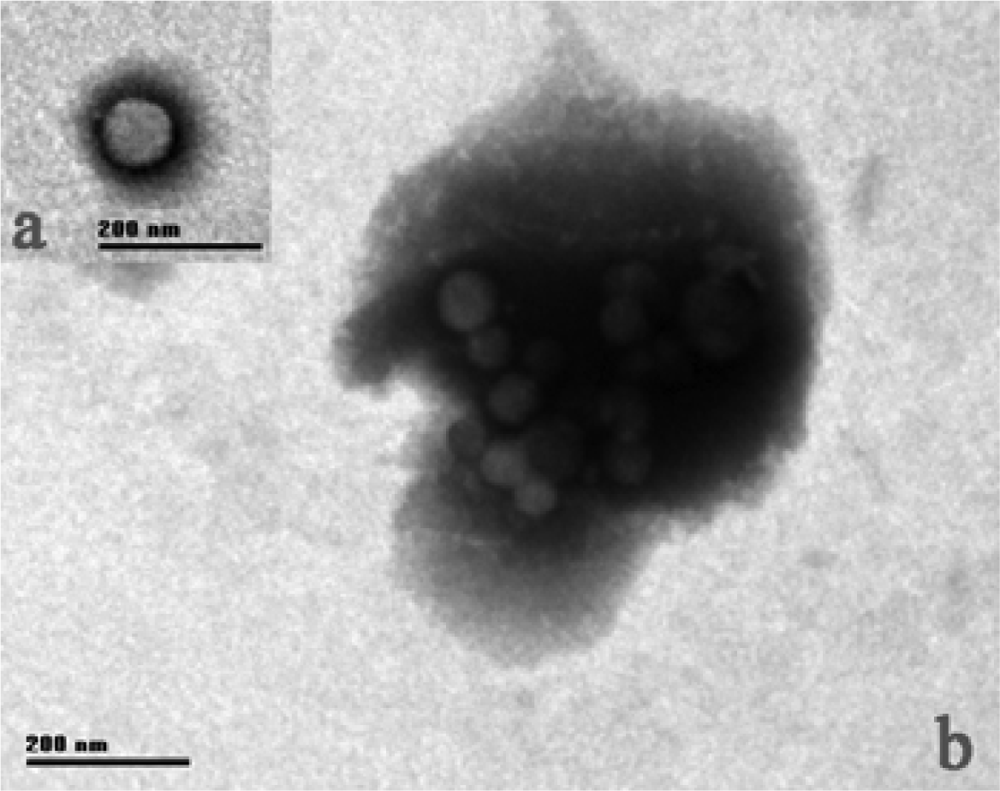
<p>The virulent phage Tb has an icosahedral capsid of 57 ± 2 nm in diameter, with a collar of 12 ± 2 nm, and a short noncontractile tail 32 ± 3 nm long. The tail has a baseplate of 15 x 3 nm to which a tail fiber of 20 x 2 nm is attached (<xref ref-type="fig" rid="f1-ijms-10-02999">Figure 1</xref>). The phage was classified as a member of the Podoviridae family and it has been observed in less than 1% of known phages [<xref ref-type="bibr" rid="b6-ijms-10-02999">6</xref>,<xref ref-type="bibr" rid="b7-ijms-10-02999">7</xref>].</p></sec>
<sec>
<label>2.2.</label>
<title>Nucleic acid characterization</title>
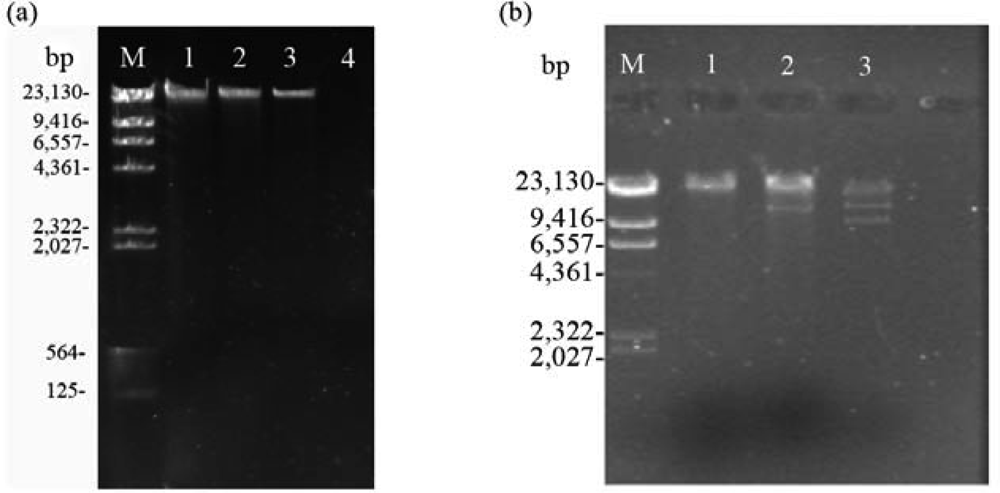
<p>All phage nucleic acid samples were sensitive to Dnase I, but were resistant to digestion by Rnase A and S1 nuclease (<xref ref-type="fig" rid="f2-ijms-10-02999">Figure 2a</xref>). It was concluded that all extracts contained phage with double-stranded linear DNA. The genome size of phage Tb was approximately 34.5 kb. The molecular mass of Tb DNA determined by the sum of the sizes is about 22.4 x 10<sup>6</sup> daltons (<xref ref-type="table" rid="t1-ijms-10-02999">Table 1</xref>). This was determined by adding the molecular sizes of <italic>Eco</italic>RI or <italic>Bam</italic>HI -digested fragments of Tb DNA (<xref ref-type="fig" rid="f2-ijms-10-02999">Figure 2b</xref>). The restriction endonuclease profiles were highly reproducible and consistent with phage Tb.</p></sec>
<sec sec-type="methods">
<label>2.3.</label>
<title>RAPD analysis for identification between phage Tb and host strain B. abortus S 19</title>
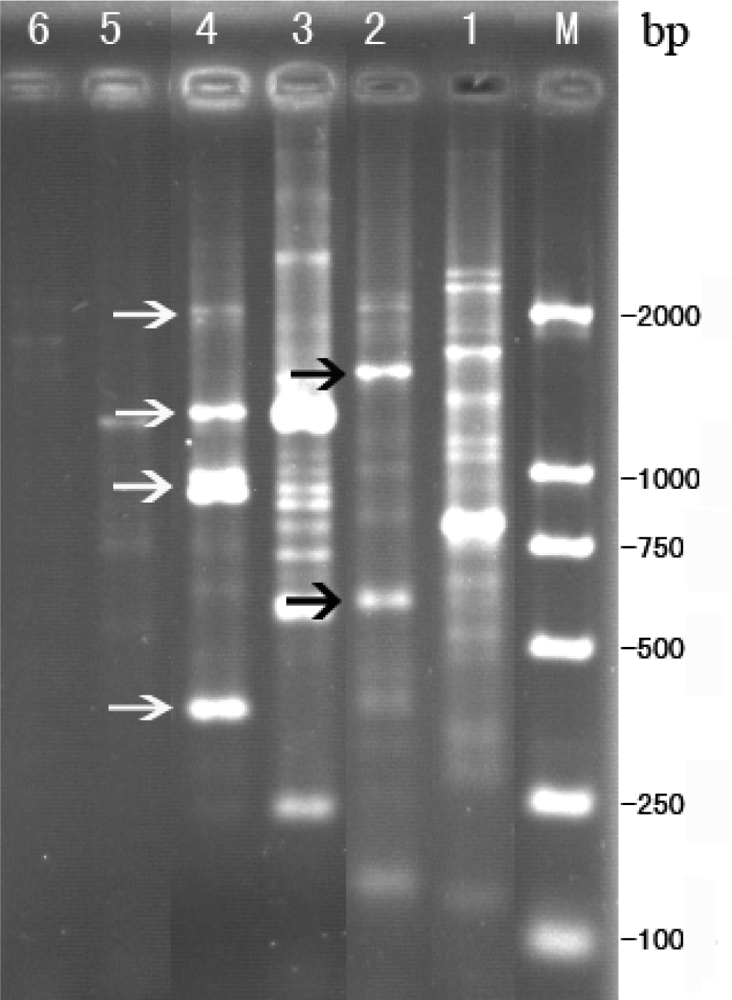
<p>Randomly amplified polymorphic DNA (RAPD) profiles were generated with three randomly designed 10-mers, each used separately as an amplification primer. Depending on the primers, the analysis of RAPD profiles resulted in different levels of discrimination between phage Tb and host strain <italic>B. abortus</italic> S 19. In the analysis of phage Tb and <italic>B. abortus</italic> S 19 isolates by RAPD using S2 primer, no obvious band was obtained (<xref ref-type="fig" rid="f3-ijms-10-02999">Figure 3</xref>), so S2 primer should not be counted as means of identification for finding the different characteristics between phage Tb and host strain S19. When using S57 and S59 primers for RAPD, respectively two and four distinct band profiles were obtained for phage Tb. The bands ranged in size from 100 to 2,000 bp. These differences suggest that S57 and S59 primers are essential for a reliable evaluation of the genetic variation between phage Tb and host strain <italic>B. abortus</italic> S 19.</p></sec>
<sec sec-type="methods">
<label>2.4.</label>
<title>Sequence analysis for RAPD products of phage Tb</title>
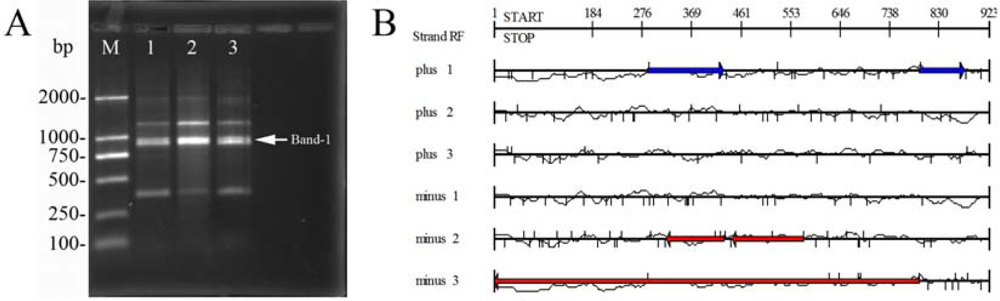
<p>The TA clone DNAs which obtained from the products of S59 primer amplified phage Tb genomic DNA were sequenced. <xref ref-type="fig" rid="f4-ijms-10-02999">Figure 4</xref> shows the DNA sequences of band-1. <xref ref-type="table" rid="t2-ijms-10-02999">Table 2</xref> summarizes the DNA amplified by S59 primer from phage Tb. DNA product of interest was successfully re-amplified and cloned. BLAST programs were used to compare each of the DNA sequence to nucleotide and amino acid sequences residing in the Basic Local Alignment Search Tool (BLAST) network service and the non-redundant nucleotide sequence database (GenBank + EMBL + DDBJ + PDB), and the nonredundant peptide sequence database (GenBank CDS translations + PDB + SwissProt + SPupdate + PIR) (NCBI) [<xref ref-type="bibr" rid="b8-ijms-10-02999">8</xref>].</p>
<p>The nucleotide sequence of the partial DNA band-1 was similar to that of Microcystin-dependent protein-like from <italic>Mesorhizobium</italic> sp. BNC1 (<xref ref-type="table" rid="t2-ijms-10-02999">Table 2</xref>) and putative phage tail Collar Domain from <italic>Bradyrhizobium</italic> sp. BTAi1. At the amino acid level, band-1 shared 79% identity with Microcystin-dependent protein-like from <italic>Mesorhizobium</italic> sp. BNC1 and 71% identity with putative phage tail Collar Domain from <italic>Bradyrhizobium</italic> sp. BTAi1. Another result from BLAST shows this sequenced band-1 was identified with phage tail sequences of some gram- negative bacterial such as phage Tail Collar Domain family of <italic>Stigmatella aurantiaca</italic> DW4/3-1 and phage Tail Collar of <italic>Kordia algicida</italic> OT-1. According to the research of conserved amino acid motif, structural feature or limited homology, the function of this sequence was speculated for prophage genes and phage related functions such as phage tail collar for host recognition mechanism [<xref ref-type="bibr" rid="b9-ijms-10-02999">9</xref>,<xref ref-type="bibr" rid="b10-ijms-10-02999">10</xref>] or lysozyme like activities [<xref ref-type="bibr" rid="b11-ijms-10-02999">11</xref>–<xref ref-type="bibr" rid="b14-ijms-10-02999">14</xref>]. We could thus get some information suggesting that the genome of Tb phage was similar to that of Gram-negative bacteria phage, and putatively determine that the taxonomic position of brucella and its phage was similar to the <italic>Mesorhizobium</italic> sp. BNC1 or <italic>Bradyrhizobium</italic> sp. BTAi1.</p></sec>
<sec>
<label>2.5.</label>
<title>Structural protein of phage Tb</title>
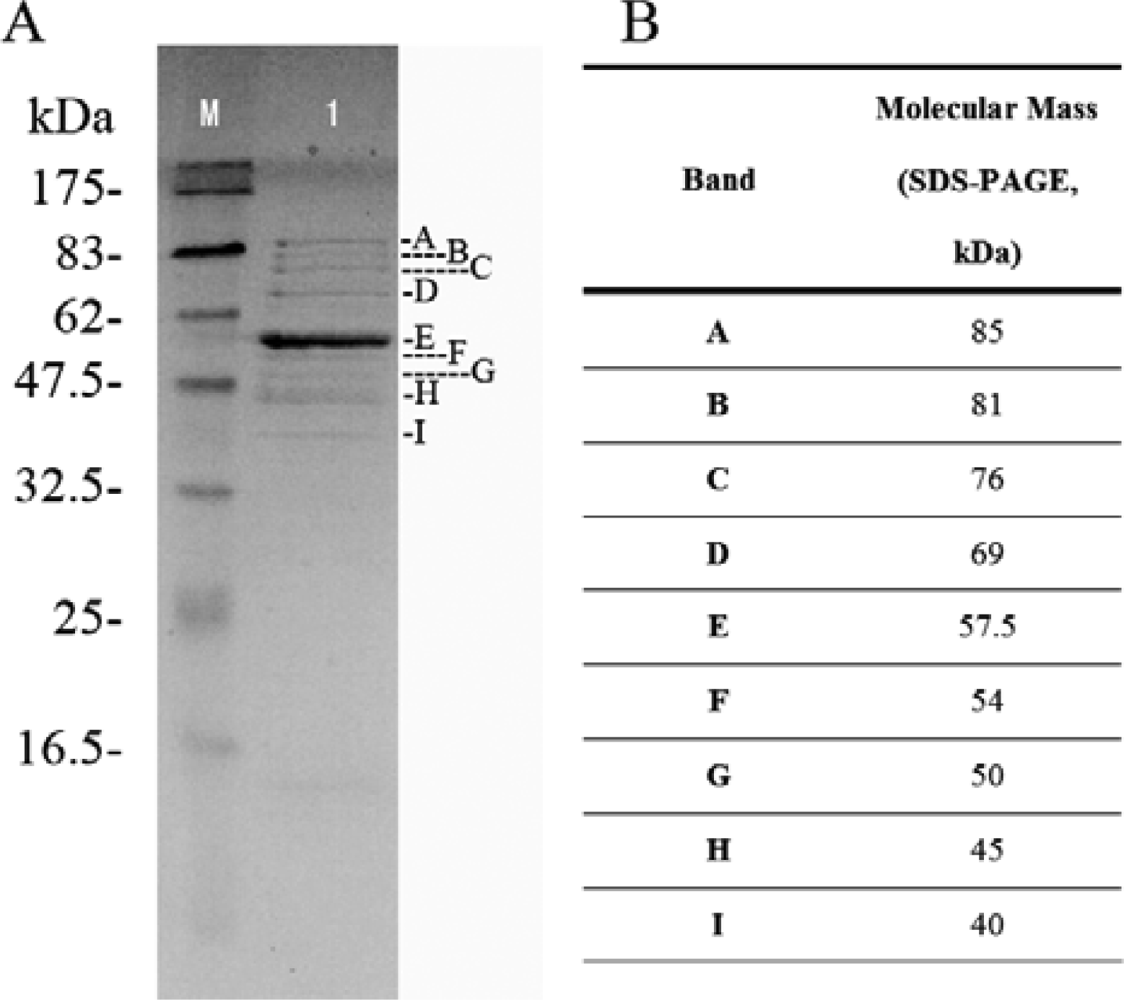
<p>The protein composition of phage Tb was characterized by SDS-PAGE, which gave rise to nine Coomassie-stained bands of structural proteins (<xref ref-type="fig" rid="f5-ijms-10-02999">Figure 5</xref>, bands A to I). Most gel bands contained more than one protein. The most prominent bands, which likely represent the major capsid proteins, were 57.5 kDa, and 45 kDa (band-E, and band-H) in phage Tb, respectively.</p></sec>
<sec sec-type="discussion">
<label>2.6.</label>
<title>Discussion</title>
<p>Phages are the most abundant organisms in the biosphere, exceeding bacteria by at least one order of magnitude [<xref ref-type="bibr" rid="b15-ijms-10-02999">15</xref>]. It is thus not surprising to find virulent Brucella phages worldwide. Since Brucellae is an intracellular pathogen, lysogeny would seem to be a possible mechanism for phage survival in nature but convincing evidence has not yet been obtained [<xref ref-type="bibr" rid="b16-ijms-10-02999">16</xref>,<xref ref-type="bibr" rid="b17-ijms-10-02999">17</xref>]. We began these studies with the expectation that DNA analytical technique would provide evidence for a lysogenic relationship of phage Tb.</p>
<p>As an international reference strain, Tbilisi is a typical brucellaphage in terms of its morphology, host range, and resistance to chemical and physical agents, differing from other brucellaphages mainly in its host specificity [<xref ref-type="bibr" rid="b18-ijms-10-02999">18</xref>]. The results of our brucellaphage characterization studies were in general agreement with those of previous studies [<xref ref-type="bibr" rid="b7-ijms-10-02999">7</xref>,<xref ref-type="bibr" rid="b18-ijms-10-02999">18</xref>–<xref ref-type="bibr" rid="b20-ijms-10-02999">20</xref>].</p>
<p>Our finding that the restriction endonuclease profiles of Tb are identical and very similar to those brucellaphages provides further support for the suggestion that all brucellaphages are members of the same species, though they come from such disparate sources as Russia (Tb), Italy (Fi), England (Wb), India (lz) and Canada (Np).</p>
<p>We describe in this report, the genomic fingerprinting of brucellaphage Tb and host strain B. <italic>abortus</italic> S 19, by amplifying the genomic DNA with single arbitrary primers. The RAPD employed low-temperature stringency to allow sampling of diverse portions of Tb genome without any apparent bias.</p>
<p>The PCR with random oligos is capable of producing unique genetic fingerprints from closely related organisms and this attribute has been previously utilized to differentiate several groups of parasites in trypanosomatid [<xref ref-type="bibr" rid="b21-ijms-10-02999">21</xref>–<xref ref-type="bibr" rid="b26-ijms-10-02999">26</xref>], coccidial [<xref ref-type="bibr" rid="b27-ijms-10-02999">27</xref>,<xref ref-type="bibr" rid="b28-ijms-10-02999">28</xref>] or schistosome parasites [<xref ref-type="bibr" rid="b29-ijms-10-02999">29</xref>]. And this method was used to increase discrimination in the epidemiological analysis of Salmonella enteritidis strains [<xref ref-type="bibr" rid="b30-ijms-10-02999">30</xref>]. We obtained distinct and reproducible pattern of amplified DNA fragments with various arbitrary primers. Phage Tb produced categorically divergent PCR profiles compared to host strain B. <italic>abortus</italic> S 19. The pattern of amplified fragments obtained maybe used to discriminate the variation of brucellaphages.</p>
<p>As RAPD analysis shows that some primers such as S57 and S59 primers are essential for a reliable evaluation of the genetic variation between phage Tb and host strain <italic>B. abortus</italic> S 19. RAPD products were sequenced by TA cloning and the nucleotide sequence of the partial DNA band-1 was similar to putative phage tail collar domain from <italic>Bradyrhizobium</italic> sp. BTAi1. As we know, these sequences were the world’s first findings on biomolecular information of Brucellaphage, and they would open a new era by using modern molecular technologies in brucellaphage research.</p>
<p>Over the course of evolution, bacteriophages, the viruses of eubacteria, have developed unique proteins that attach to and inactivate (or redirect) critical cellular proteins in bacteria, shutting off key metabolic processes to divert host’s metabolism to the production of progeny phages [<xref ref-type="bibr" rid="b31-ijms-10-02999">31</xref>]. Maybe we could find a novel mechanism of phage genome regulation of antibiotic sensitivity. And therefore, information in bacteriophage genome could be extracted and used to identify particularly susceptible proteins in their bacterial hosts and to prioritize these targets for anti-Brucella drug discovery. Of course, the conclusions derived from this study have to be corroborated in further research.</p>
<p>In fact, many of human’s deadly bacterial epidemics were and are a by-product of bacteria infecting other bacteria with their viral phages. It is when such an attack does not kill, cripple or maim that antibiotic-resistant pathogens are born for mankind to cope with [<xref ref-type="bibr" rid="b32-ijms-10-02999">32</xref>]. And the proper way to deal with this is to learn from nature, how bacteria kill one another, and to recruitrelatively benign bacteria to deliver lytic phage, thereby destroying otherwise incurable infection through lysogeny.</p>
<p>The implications of the novel technique to kill intracellular pathogenic bacteria that was presented are broad and include all classes of intracellular bacteria for both man and animals. It is intended to be used parenterally. Maybe our results suggested the possibility of the new antibiotic target in Brucella to control the spread of Brucellosis.</p></sec></sec>
<sec sec-type="materials|methods">
<label>3.</label>
<title>Materials and Methods</title>
<sec>
<label>3.1.</label>
<title>Phage and bacteria</title>
<p><italic>Brucella</italic> phage was propagated in the following bacterial host strain: <italic>B. abortus</italic> S 19 (biotype 1) for <italic>Tb</italic>. Tb phage obtained from Weybridge (Ministry of Agriculture, Fisheries and Food Central Veterinary Laboratory, Weybridge, Surrey, U.K.) had originally been prepared at our laboratory. The host propagating strain that had accompanied the phage will be referred to as strain <italic>B. abortus</italic> S 19.</p></sec>
<sec>
<label>3.2.</label>
<title>Propagation of Brucella phages</title>
<p>Phage stocks were prepared either by the agar double-layer technique [<xref ref-type="bibr" rid="b33-ijms-10-02999">33</xref>] as modified for brucella-phage by McDuff, Jones &amp; Wilson [<xref ref-type="bibr" rid="b34-ijms-10-02999">34</xref>], or in stirred brucella cultures grown in <italic>Albimi brucella</italic> broth [<xref ref-type="bibr" rid="b35-ijms-10-02999">35</xref>]. In both methods a smooth culture of <italic>B. abortus</italic> S 19 in the logarithmic phase was used as inoculum. Standard methods of species identification, as outlined by Jones [<xref ref-type="bibr" rid="b36-ijms-10-02999">36</xref>], showed the bacterial culture to be a non-CO<sub>2</sub>-requiring B. <italic>abortus</italic> of smooth-intermediate colonial morphology. As the culture was somewhat unstable, it was necessary to re-isolate smooth intermediate colonies to maintain phage susceptibility.</p>
<p>Two methods of bacteriophage concentration were assessed: polyethylene glycol (PEG) precipitation and ultracentrifugation. The former was modified from Yamamoto <italic>et al</italic>. (1970)[<xref ref-type="bibr" rid="b37-ijms-10-02999">37</xref>], where 10% (w/v) PEG 6000 was added to the filtered lysate followed by filtration through 0.22 μm membrane filters (Oxoid, London, U.K.) and gently mixed to dissolve. The lysates were incubated at 4 °C for 60 min and the precipitated particles pelleted by spinning at 8,000 <italic>g</italic> for 10 min. Pellets were resuspended in 0.01 original volume sterile SM buffer (5.8 g sodium chloride, 2 g magnesium sulphate, 100 mg gelatin, 50 mL 1 mol·L<sup>−1</sup> Tris (pH 7.5) and 945 mL distilled water). The ultracentrifugation method was modified from that of H.J. Oakey [<xref ref-type="bibr" rid="b38-ijms-10-02999">38</xref>], where filtered extracts were ultracentrifuged at 200,000 <italic>g</italic> for 4 h. Pellets were resuspended in 0.01 original volume sterile SM buffer. Aliquots of 100 μL were removed for transmission electron microscopy (TEM) and the remaining concentrates were stored at 4 °C.</p></sec>
<sec>
<label>3.3.</label>
<title>Nucleic acid extraction from the isolated bacteriophage</title>
<p>This method was based upon that described by Sambrook and Russell [<xref ref-type="bibr" rid="b39-ijms-10-02999">39</xref>]. Bacteriophage from the concentrated solutions were lysed with the addition of EDTA (final concentration 20 mmol·L<sup>−1</sup>), proteinase K (final concentration 50 μg·mL<sup>−1</sup>) and SDS (final concentration 0.5%) and incubation at 56 °C for 1 h. The nucleic acid was purified by a phenol, a phenol/chloroform and a chloroform extraction. This method was modified, whereby the phenol extractant was heated to ~60 °C, added to the lysate, mixed by inversion, incubated at 60 °C for 30 min, centrifuged at 5,000 <italic>g</italic> for 10 min to separate the phases and the aqueous phase was removed for the next extraction. The final aqueous phase was dialysed overnight against TE. In this method, nucleic acid yield was estimated through agarose gel electrophoresis and comparison of ethidium bromide stain intensity with known DNA standards (Hind <italic>III</italic> cut lambda phage DNA; New England Biolabs, Ipswich, MA, USA).</p></sec>
<sec>
<label>3.4.</label>
<title>Electron microscopy</title>
<p>All electron micrographs were obtained from phage particles purified by density-gradient centrifugation. They were diluted 1:100 in sterile water, and small drops were placed on carbon coated mica fragments. The mica carriers were dipped into a drop of 2% uranyl acetate or 2% ammonium molybdate in water, and the carbon film carefully floated. Suitable 400 mesh grids (G400Hex-C3-Grid; SCI, Munich, Germany) coated with a Colodion-Film (prepared from 2% colodion in amyl acetate) were used to absorb the carbon film fragments with phage particles to the grid. After air-drying for 10 min, grids were directly used for transmission electron microscopy (Philips CM100; acceleration voltage 100 kV). Images of negatively stained phage particles were taken using a TVIPS Fast scan CCD camera; magnification was between 20,000 and 39,000 ×.</p></sec>
<sec>
<label>3.5.</label>
<title>Nucleic acid characterization</title>
<p>The nucleic acid extracts were diluted to a standard concentration of ~20 ng·μL<sup>−1</sup>. Each extract was subjected to a digestion with DNase I (Sigma Aldrich), RNase A (Sigma Aldrich), S1 nuclease (Promega). Each digestion was carried out upon ~250 ng nucleic acid. All reactions were terminated by using EDTA (10 mmol·L<sup>−1</sup> final concentration) and analysed by using 0.8% agarose gel electrophoresis at 5 V cm<sup>−1</sup>.</p></sec>
<sec sec-type="methods">
<label>3.6.</label>
<title>Restriction endonuclease analysis</title>
<p><italic>Bam</italic>HI and <italic>Eco</italic>RI were purchased from Promega. About 1 μg of each DNA sample was incubated with approximately 10 units of enzyme for 2 h at 37 °C in the appropriate buffers. For double digestions, DNAs of the primary digests were purified by phenol-chloroform extraction and ethanol precipitation before the secondary cleavages. DNA fragments were resolved by horizontal gel electrophoresis using 0.8% agarose in Tris-borate buffer.</p></sec>
<sec>
<label>3.7.</label>
<title>RAPD</title>
<p>RAPD was performed with the genomic DNAs essentially by the method described by Okuda <italic>et al</italic>.(1997) [<xref ref-type="bibr" rid="b40-ijms-10-02999">40</xref>] using 3 randomly chosen 10-base random primers (S2, S57, S59) (<xref ref-type="table" rid="t3-ijms-10-02999">Table 3</xref>) purchased from Sangon Co. (Shanghai, China). PCR reactions were carried out in 0.2 mL thin-walled PCR tubes with a total reaction volume of 25 μL containing 10 mM of Tris–HCl (pH 8.3), 50 mM of KCl, 2 mM of MgCl<sub>2</sub>, 1.5 unit of Taq DNA polymerase, 0.2 mM each of dATP, dCTP, dGTP and dTTP (Bangalore Genei), 0.4 μM of primers and 50 µg genomic DNA. Amplification was programmed for 45 cycles in a PCR thermocycler (Eppendorf version 2.30. 31-09, Germany). Each cycle consisted of a denaturation step at 94 °C for 1 min, a primer annealing at 36 °C for 1 min, a primer extension step at 72 °C for 2 min. The amplified DNA fragments were separated by electrophoresis on 1.5% agarose (Sigma-Aldrich, USA) gel in 1×Tris borate EDTA (89 mM Tris–HCl, 89 mM boric acid and 2 mM EDTA pH 8.0) and were stained with ethidium bromide (0.75 μg/mL) to document using a UV transilluminator (Bio-Rad, Germany). The molecular size of amplified fragments was estimated using a DL2000 marker (Tiangen, Beijing, China).</p></sec>
<sec>
<label>3.8.</label>
<title>Subcloning of RAPD products</title>
<p>These purified RAPD products from the PCR with random primers was subcloned according to the Takara T Vector System I (Takara, Dalian, China) to prepare the DNA for efficient and accurate sequencing. PCR product was ligated into the pMD18-T plasmid vector at 4°C overnight. Ligations were then transformed into DH5α Escherichia coli competent cells (Tiangen, Beijing, China) and grown overnight on LB agar with 100 μg/mL ampicillin and 20 mg/mL Xgal. White colonies (indicating successful ligation) were picked and grown in LB-Amp100 μg/mL broth overnight at 37 °C. The plasmid DNA was harvested using the AxyPrep Plasmid Miniprep Kit, according to protocol (Axygen, CA, USA). The TA clone DNA was then sequenced using M13R(-48) primer(AGC GGA TAA CAA TTT CAC ACA GGA).</p></sec>
<sec sec-type="methods">
<label>3.9.</label>
<title>Computer-assisted Sequence Analysis</title>
<p>Using a plasmid-specific primer, we carried out sequencing reactions using Prism Ready Reaction Dye Deoxy terminators (Applied Biosystems, Foster City, CA, USA) according to the manufacturer’s instructions. Residual dye terminators were removed from the completed sequencing reaction using a Centri-sep spin column (Princeton Separation, Adelphia, NJ, USA). An Applied Biosystems model 373A DNA Sequencing System was used for sequence analysis. Homology searching was performed at the National Center for Biotechnology Information (NCBI), using the Basic Local Alignment Search Tool (BLAST) network service and the non-redundant nucleotide sequence database (GenBank + EMBL + DDBJ + PDB), and the non-redundant peptide sequence database (GenBank CDS translations + PDB + SwissProt + SPupdate + PIR).</p></sec>
<sec sec-type="methods">
<label>3.10.</label>
<title>Analysis of Phage Tb Structural Proteins</title>
<p>The purified phage preparation (1 × 10<sup>10</sup> PFU/mL) and the host strain S19 were then dialyzed and analyzed for structural proteins by standard Tris-glycine 12% SDS-polyacrylamide gel electrophoresis (PAGE) procedures [<xref ref-type="bibr" rid="b41-ijms-10-02999">41</xref>]. Samples were mixed with 4× sample loading buffer and boiled for 5 min before loading. A broad range of protein marker (New England Biolabs, Ipswich, MA, USA) was used to estimate molecular masses. Protein bands were stained with Coomassie Brilliant Blue R-250 (Sigma).</p></sec></sec>
<sec sec-type="conclusions">
<label>4.</label>
<title>Conclusions</title>
<p>In summary, we present a systematic approach to identify the morphology, molecular and protein characteristics of the reference strain- Tb phage. And our approach allows us to identify and prioritize bacterial proteins that, as far as we know, are not currently pursued by the industry as targets for antibiotic development.</p></sec></body>
<back>
<ack>
<p>This work was funded by “The eleventh five year plan for national defense medical science and technology”(Grant No.06MA198) and “National Natural Science Foundation of China (NSFC)”(Grant No.30571637). The authors would like to show their appreciation to Prof. Li Yuan-kai (Department of Brucellosis, National Institute for Communicable Diseases Control and Prevention, China CDC, Beijing, China) for his invaluable guidance and assistance.</p></ack>
<ref-list>
<title>References and Notes</title>
<ref id="b1-ijms-10-02999"><label>1.</label><citation citation-type="journal"><person-group person-group-type="author"><name><surname>Carrere</surname><given-names>L</given-names></name><name><surname>Roux</surname><given-names>J</given-names></name><name><surname>Mandin</surname><given-names>J</given-names></name></person-group><article-title>Obtention of lysogenic strains of Corynebacterium parvum and Brucella melitensis</article-title><source>CR Seances Soc. Biol. Fil</source><year>1956</year><volume>150</volume><fpage>1599</fpage><lpage>1600</lpage></citation></ref>
<ref id="b2-ijms-10-02999"><label>2.</label><citation citation-type="journal"><person-group person-group-type="author"><name><surname>Drozhevkina</surname><given-names>MS</given-names></name></person-group><article-title>Secondary phago-resistant cultures of Brucella</article-title><source>Zh Mikrobiol. Epidemiol. Immunobiol</source><year>1956</year><volume>27</volume><fpage>63</fpage><lpage>68</lpage><pub-id pub-id-type="pmid">13410074</pub-id></citation></ref>
<ref id="b3-ijms-10-02999"><label>3.</label><citation citation-type="journal"><person-group person-group-type="author"><name><surname>Parnas</surname><given-names>J</given-names></name><name><surname>Feltynowski</surname><given-names>A</given-names></name><name><surname>Bulikowski</surname><given-names>W</given-names></name></person-group><article-title>Anti-brucella phage</article-title><source>Nature</source><year>1958</year><volume>182</volume><fpage>1610</fpage><lpage>1611</lpage><pub-id pub-id-type="doi">10.1038/1821610a0</pub-id><pub-id pub-id-type="pmid">13613347</pub-id></citation></ref>
<ref id="b4-ijms-10-02999"><label>4.</label><citation citation-type="journal"><person-group person-group-type="author"><name><surname>Pickett</surname><given-names>MJ</given-names></name><name><surname>Nelson</surname><given-names>EL</given-names></name></person-group><article-title>Observations on the problem of Brucella blood cultures</article-title><source>J. Bacteriol</source><year>1951</year><volume>61</volume><fpage>229</fpage><lpage>237</lpage><pub-id pub-id-type="pmid">14824101</pub-id></citation></ref>
<ref id="b5-ijms-10-02999"><label>5.</label><citation citation-type="journal"><person-group person-group-type="author"><name><surname>Vershilova</surname><given-names>PA</given-names></name></person-group><article-title>Certain problems of epidemiology of brucellosis</article-title><source>Zh Mikrobiol. Epidemiol. Immunobiol</source><year>1956</year><volume>27</volume><fpage>53</fpage><lpage>57</lpage><pub-id pub-id-type="pmid">13410072</pub-id></citation></ref>
<ref id="b6-ijms-10-02999"><label>6.</label><citation citation-type="journal"><person-group person-group-type="author"><name><surname>Ackermann</surname><given-names>HW</given-names></name></person-group><article-title>Frequency of morphological phage descriptions in the year 2000. Brief review</article-title><source>Arch. Virol</source><year>2001</year><volume>146</volume><fpage>843</fpage><lpage>857</lpage><pub-id pub-id-type="doi">10.1007/s007050170120</pub-id><pub-id pub-id-type="pmid">11448025</pub-id></citation></ref>
<ref id="b7-ijms-10-02999"><label>7.</label><citation citation-type="journal"><person-group person-group-type="author"><name><surname>Ackermann</surname><given-names>HW</given-names></name><name><surname>Simon</surname><given-names>F</given-names></name><name><surname>Verger</surname><given-names>JM</given-names></name></person-group><article-title>A survey of Brucella phages and morphology of new isolates</article-title><source>Intervirology</source><year>1981</year><volume>16</volume><fpage>1</fpage><lpage>7</lpage><pub-id pub-id-type="doi">10.1159/000149240</pub-id><pub-id pub-id-type="pmid">7035397</pub-id></citation></ref>
<ref id="b8-ijms-10-02999"><label>8.</label><citation citation-type="journal"><person-group person-group-type="author"><name><surname>Altschul</surname><given-names>SF</given-names></name><name><surname>Madden</surname><given-names>TL</given-names></name><name><surname>Schaffer</surname><given-names>AA</given-names></name><name><surname>Zhang</surname><given-names>J</given-names></name><name><surname>Zhang</surname><given-names>Z</given-names></name><name><surname>Miller</surname><given-names>W</given-names></name><name><surname>Lipman</surname><given-names>DJ</given-names></name></person-group><article-title>Gapped BLAST and PSI-BLAST: A new generation of protein database search programs</article-title><source>Nucleic Acids Res</source><year>1997</year><volume>25</volume><fpage>3389</fpage><lpage>3402</lpage><pub-id pub-id-type="doi">10.1093/nar/25.17.3389</pub-id><pub-id pub-id-type="pmid">9254694</pub-id></citation></ref>
<ref id="b9-ijms-10-02999"><label>9.</label><citation citation-type="journal"><person-group person-group-type="author"><name><surname>Letellier</surname><given-names>L</given-names></name><name><surname>Boulanger</surname><given-names>P</given-names></name><name><surname>Plancon</surname><given-names>L</given-names></name><name><surname>Jacquot</surname><given-names>P</given-names></name><name><surname>Santamaria</surname><given-names>M</given-names></name></person-group><article-title>Main features on tailed phage, host recognition and DNA uptake</article-title><source>Front. Biosci</source><year>2004</year><volume>9</volume><fpage>1228</fpage><lpage>1339</lpage><pub-id pub-id-type="doi">10.2741/1333</pub-id><pub-id pub-id-type="pmid">14977540</pub-id></citation></ref>
<ref id="b10-ijms-10-02999"><label>10.</label><citation citation-type="journal"><person-group person-group-type="author"><name><surname>Scholl</surname><given-names>D</given-names></name><name><surname>Rogers</surname><given-names>S</given-names></name><name><surname>Adhya</surname><given-names>S</given-names></name><name><surname>Merril</surname><given-names>CR</given-names></name></person-group><article-title>Bacteriophage K1–5 encodes two different tail fiber proteins, allowing it to infect and replicate on both K1 and K5 strains of Escherichia coli</article-title><source>J. Virol</source><year>2001</year><volume>75</volume><fpage>2509</fpage><lpage>2515</lpage><pub-id pub-id-type="doi">10.1128/JVI.75.6.2509-2515.2001</pub-id><pub-id pub-id-type="pmid">11222673</pub-id></citation></ref>
<ref id="b11-ijms-10-02999"><label>11.</label><citation citation-type="book"><person-group person-group-type="author"><name><surname>Daniels</surname><given-names>DL</given-names></name><name><surname>Schroeder</surname><given-names>JL</given-names></name><name><surname>Szybalski</surname><given-names>W</given-names></name><name><surname>Sanger</surname><given-names>F</given-names></name><name><surname>Coulson</surname><given-names>AR</given-names></name><name><surname>Hong</surname><given-names>GF</given-names></name><name><surname>Hill</surname><given-names>DF</given-names></name><name><surname>Petersen</surname><given-names>GB</given-names></name><name><surname>Blattner</surname><given-names>FR</given-names></name></person-group><source>Appendix II Complete Annotated Lambda Sequence</source><publisher-name>Cold Spring Harbor Laboratory</publisher-name><publisher-loc>Cold Spring Harbor, NY, USA</publisher-loc><year>1983</year></citation></ref>
<ref id="b12-ijms-10-02999"><label>12.</label><citation citation-type="journal"><person-group person-group-type="author"><name><surname>Emrich</surname><given-names>J</given-names></name><name><surname>Streisinger</surname><given-names>G</given-names></name></person-group><article-title>The role of phage lysozyme in the life cycle of phage T4</article-title><source>Virology</source><year>1968</year><volume>36</volume><fpage>387</fpage><lpage>391</lpage><pub-id pub-id-type="doi">10.1016/0042-6822(68)90163-3</pub-id><pub-id pub-id-type="pmid">4881032</pub-id></citation></ref>
<ref id="b13-ijms-10-02999"><label>13.</label><citation citation-type="journal"><person-group person-group-type="author"><name><surname>Kao</surname><given-names>SH</given-names></name><name><surname>McClain</surname><given-names>WH</given-names></name></person-group><article-title>Baseplate protein of bacteriophage T4 with both structural and lytic functions</article-title><source>J. Virol</source><year>1980</year><volume>34</volume><fpage>95</fpage><lpage>103</lpage><pub-id pub-id-type="pmid">6990017</pub-id></citation></ref>
<ref id="b14-ijms-10-02999"><label>14.</label><citation citation-type="journal"><person-group person-group-type="author"><name><surname>Yamazaki</surname><given-names>Y</given-names></name></person-group><article-title>Enzymatic activities on cell walls in bacteriophage T4</article-title><source>Biochim. Biophys. Acta</source><year>1969</year><volume>178</volume><fpage>542</fpage><lpage>550</lpage><pub-id pub-id-type="doi">10.1016/0005-2744(69)90223-X</pub-id><pub-id pub-id-type="pmid">4891420</pub-id></citation></ref>
<ref id="b15-ijms-10-02999"><label>15.</label><citation citation-type="journal"><person-group person-group-type="author"><name><surname>Chibani-Chennoufi</surname><given-names>S</given-names></name><name><surname>Bruttin</surname><given-names>A</given-names></name><name><surname>Dillmann</surname><given-names>ML</given-names></name><name><surname>Brussow</surname><given-names>H</given-names></name></person-group><article-title>Phage-host interaction: An ecological perspective</article-title><source>J. Bacteriol</source><year>2004</year><volume>186</volume><fpage>3677</fpage><lpage>3686</lpage><pub-id pub-id-type="doi">10.1128/JB.186.12.3677-3686.2004</pub-id><pub-id pub-id-type="pmid">15175280</pub-id></citation></ref>
<ref id="b16-ijms-10-02999"><label>16.</label><citation citation-type="journal"><person-group person-group-type="author"><name><surname>Corbel</surname><given-names>MJ</given-names></name></person-group><article-title>Properties of Brucella-phages lytic for non-smooth Brucella strains</article-title><source>Dev. Biol. Stand</source><year>1984</year><volume>56</volume><fpage>55</fpage><lpage>62</lpage><pub-id pub-id-type="pmid">6436113</pub-id></citation></ref>
<ref id="b17-ijms-10-02999"><label>17.</label><citation citation-type="journal"><person-group person-group-type="author"><name><surname>Jones</surname><given-names>LM</given-names></name><name><surname>Mc</surname><given-names>DC</given-names></name><name><surname>Wilson</surname><given-names>JB</given-names></name></person-group><article-title>Phenotypic alterations in the colonial morphology of Brucella abortus due to a bacteriophage carrier state</article-title><source>J. Bacteriol</source><year>1962</year><volume>83</volume><fpage>860</fpage><lpage>866</lpage><pub-id pub-id-type="pmid">14452300</pub-id></citation></ref>
<ref id="b18-ijms-10-02999"><label>18.</label><citation citation-type="journal"><person-group person-group-type="author"><name><surname>Corbel</surname><given-names>MJ</given-names></name><name><surname>Morris</surname><given-names>JA</given-names></name></person-group><article-title>Investigation of the effect of brucella-phage on the course of experimental infection with Brucella abortus</article-title><source>Br. Vet. J</source><year>1980</year><volume>136</volume><fpage>278</fpage><lpage>289</lpage><pub-id pub-id-type="pmid">6770960</pub-id></citation></ref>
<ref id="b19-ijms-10-02999"><label>19.</label><citation citation-type="journal"><person-group person-group-type="author"><name><surname>Calderone</surname><given-names>JG</given-names></name><name><surname>Pickett</surname><given-names>MJ</given-names></name></person-group><article-title>Characterization of Brucellaphages</article-title><source>J. Gen. Microbiol</source><year>1965</year><volume>39</volume><fpage>1</fpage><lpage>10</lpage><pub-id pub-id-type="pmid">14330756</pub-id></citation></ref>
<ref id="b20-ijms-10-02999"><label>20.</label><citation citation-type="journal"><person-group person-group-type="author"><name><surname>Corbel</surname><given-names>MJ</given-names></name><name><surname>Tolari</surname><given-names>F</given-names></name><name><surname>Yadava</surname><given-names>VK</given-names></name></person-group><article-title>Characterisation of a new phage lytic for both smooth and non-smooth Brucella species</article-title><source>Res. Vet. Sci</source><year>1988</year><volume>44</volume><fpage>45</fpage><lpage>49</lpage><pub-id pub-id-type="pmid">3375587</pub-id></citation></ref>
<ref id="b21-ijms-10-02999"><label>21.</label><citation citation-type="journal"><person-group person-group-type="author"><name><surname>Ikram</surname><given-names>G</given-names></name><name><surname>Dellagi</surname><given-names>K</given-names></name><name><surname>Ismail</surname><given-names>RB</given-names></name></person-group><article-title>Random amplified polymorphic DNA technique for identification and differentiation of old world Leishmania species</article-title><source>Am J Trop Med Hyg</source><year>2002</year><volume>66</volume><fpage>152</fpage><lpage>156</lpage><pub-id pub-id-type="pmid">12135286</pub-id></citation></ref>
<ref id="b22-ijms-10-02999"><label>22.</label><citation citation-type="journal"><person-group person-group-type="author"><name><surname>Pogue</surname><given-names>GP</given-names></name><name><surname>Koul</surname><given-names>S</given-names></name><name><surname>Lee</surname><given-names>NS</given-names></name><name><surname>Dwyer</surname><given-names>DM</given-names></name><name><surname>Nakhasi</surname><given-names>HL</given-names></name></person-group><article-title>Identification of intra- and interspecific Leishmania genetic polymorphisms by arbitrary primed polymerase chain reactions and use of polymorphic DNA to identify differentially regulated genes</article-title><source>Parasitol. Res</source><year>1995</year><volume>81</volume><fpage>282</fpage><lpage>290</lpage><pub-id pub-id-type="doi">10.1007/BF00931531</pub-id><pub-id pub-id-type="pmid">7624284</pub-id></citation></ref>
<ref id="b23-ijms-10-02999"><label>23.</label><citation citation-type="journal"><person-group person-group-type="author"><name><surname>Pogue</surname><given-names>GP</given-names></name><name><surname>Lee</surname><given-names>NS</given-names></name><name><surname>Koul</surname><given-names>S</given-names></name><name><surname>Dwyer</surname><given-names>DM</given-names></name><name><surname>Nakhasi</surname><given-names>HL</given-names></name></person-group><article-title>Identification of differentially expressed Leishmania donovani genes using arbitrarily primed polymerase chain reactions</article-title><source>Gene</source><year>1995</year><volume>165</volume><fpage>31</fpage><lpage>38</lpage><pub-id pub-id-type="doi">10.1016/0378-1119(95)00461-E</pub-id><pub-id pub-id-type="pmid">7489912</pub-id></citation></ref>
<ref id="b24-ijms-10-02999"><label>24.</label><citation citation-type="journal"><person-group person-group-type="author"><name><surname>Schonian</surname><given-names>G</given-names></name><name><surname>Schweynoch</surname><given-names>C</given-names></name><name><surname>Zlateva</surname><given-names>K</given-names></name><name><surname>Oskam</surname><given-names>L</given-names></name><name><surname>Kroon</surname><given-names>N</given-names></name><name><surname>Graser</surname><given-names>Y</given-names></name><name><surname>Presber</surname><given-names>W</given-names></name></person-group><article-title>Identification and determination of the relationships of species and strains within the genus Leishmania using single primers in the polymerase chain reaction</article-title><source>Mol Biochem Parasitol</source><year>1996</year><volume>77</volume><fpage>19</fpage><lpage>29</lpage><pub-id pub-id-type="doi">10.1016/0166-6851(96)02572-8</pub-id><pub-id pub-id-type="pmid">8784768</pub-id></citation></ref>
<ref id="b25-ijms-10-02999"><label>25.</label><citation citation-type="journal"><person-group person-group-type="author"><name><surname>Tibayrenc</surname><given-names>M</given-names></name><name><surname>Neubauer</surname><given-names>K</given-names></name><name><surname>Barnabe</surname><given-names>C</given-names></name><name><surname>Guerrini</surname><given-names>F</given-names></name><name><surname>Skarecky</surname><given-names>D</given-names></name><name><surname>Ayala</surname><given-names>FJ</given-names></name></person-group><article-title>Genetic characterization of six parasitic protozoa: Parity between random-primer DNA typing and multilocus enzyme electrophoresis</article-title><source>Proc. Natl. Acad. Sci. USA</source><year>1993</year><volume>90</volume><fpage>1335</fpage><lpage>1339</lpage><pub-id pub-id-type="doi">10.1073/pnas.90.4.1335</pub-id><pub-id pub-id-type="pmid">8433991</pub-id></citation></ref>
<ref id="b26-ijms-10-02999"><label>26.</label><citation citation-type="journal"><person-group person-group-type="author"><name><surname>Waitumbi</surname><given-names>JN</given-names></name><name><surname>Murphy</surname><given-names>NB</given-names></name></person-group><article-title>Inter- and intra-species differentiation of trypanosomes by genomic fingerprinting with arbitrary primers</article-title><source>Mol. Biochem. Parasitol</source><year>1993</year><volume>58</volume><fpage>181</fpage><lpage>185</lpage><pub-id pub-id-type="doi">10.1016/0166-6851(93)90105-7</pub-id><pub-id pub-id-type="pmid">8459833</pub-id></citation></ref>
<ref id="b27-ijms-10-02999"><label>27.</label><citation citation-type="journal"><person-group person-group-type="author"><name><surname>Procunier</surname><given-names>JD</given-names></name><name><surname>Fernando</surname><given-names>MA</given-names></name><name><surname>Barta</surname><given-names>JR</given-names></name></person-group><article-title>Species and strain differentiation of Eimeria spp. of the domestic fowl using DNA polymorphisms amplified by arbitrary primers</article-title><source>Parasitol. Res</source><year>1993</year><volume>79</volume><fpage>98</fpage><lpage>102</lpage><pub-id pub-id-type="pmid">8475039</pub-id></citation></ref>
<ref id="b28-ijms-10-02999"><label>28.</label><citation citation-type="journal"><person-group person-group-type="author"><name><surname>Shirley</surname><given-names>MW</given-names></name><name><surname>Bumstead</surname><given-names>N</given-names></name></person-group><article-title>Intra-specific variation within Eimeria tenella detected by the random amplification of polymorphic DNA</article-title><source>Parasitol. Res</source><year>1994</year><volume>80</volume><fpage>346</fpage><lpage>351</lpage><pub-id pub-id-type="doi">10.1007/BF02351878</pub-id><pub-id pub-id-type="pmid">8073024</pub-id></citation></ref>
<ref id="b29-ijms-10-02999"><label>29.</label><citation citation-type="journal"><person-group person-group-type="author"><name><surname>Dias Neto</surname><given-names>E</given-names></name><name><surname>de Souza</surname><given-names>CP</given-names></name><name><surname>Rollinson</surname><given-names>D</given-names></name><name><surname>Katz</surname><given-names>N</given-names></name><name><surname>Pena</surname><given-names>SD</given-names></name><name><surname>Simpson</surname><given-names>AJ</given-names></name></person-group><article-title>The random amplification of polymorphic DNA allows the identification of strains and species of schistosome</article-title><source>Mol. Biochem. Parasitol</source><year>1993</year><volume>57</volume><fpage>83</fpage><lpage>88</lpage><pub-id pub-id-type="doi">10.1016/0166-6851(93)90246-T</pub-id><pub-id pub-id-type="pmid">8426617</pub-id></citation></ref>
<ref id="b30-ijms-10-02999"><label>30.</label><citation citation-type="journal"><person-group person-group-type="author"><name><surname>Laconcha</surname><given-names>I</given-names></name><name><surname>Lopez-Molina</surname><given-names>N</given-names></name><name><surname>Rementeria</surname><given-names>A</given-names></name><name><surname>Audicana</surname><given-names>A</given-names></name><name><surname>Perales</surname><given-names>I</given-names></name><name><surname>Garaizar</surname><given-names>J</given-names></name></person-group><article-title>Phage typing combined with pulsed-field gel electrophoresis and random amplified polymorphic DNA increases discrimination in the epidemiological analysis of Salmonella enteritidis strains</article-title><source>Int. J. Food Microbiol</source><year>1998</year><volume>40</volume><fpage>27</fpage><lpage>34</lpage><pub-id pub-id-type="doi">10.1016/S0168-1605(98)00007-5</pub-id><pub-id pub-id-type="pmid">9600607</pub-id></citation></ref>
<ref id="b31-ijms-10-02999"><label>31.</label><citation citation-type="journal"><person-group person-group-type="author"><name><surname>Liu</surname><given-names>J</given-names></name><name><surname>Dehbi</surname><given-names>M</given-names></name><name><surname>Moeck</surname><given-names>G</given-names></name><name><surname>Arhin</surname><given-names>F</given-names></name><name><surname>Bauda</surname><given-names>P</given-names></name><name><surname>Bergeron</surname><given-names>D</given-names></name><name><surname>Callejo</surname><given-names>M</given-names></name><name><surname>Ferretti</surname><given-names>V</given-names></name><name><surname>Ha</surname><given-names>N</given-names></name><name><surname>Kwan</surname><given-names>T</given-names></name><name><surname>McCarty</surname><given-names>J</given-names></name><name><surname>Srikumar</surname><given-names>R</given-names></name><name><surname>Williams</surname><given-names>D</given-names></name><name><surname>Wu</surname><given-names>JJ</given-names></name><name><surname>Gros</surname><given-names>P</given-names></name><name><surname>Pelletier</surname><given-names>J</given-names></name><name><surname>DuBow</surname><given-names>M</given-names></name></person-group><article-title>Antimicrobial drug discovery through bacteriophage genomics</article-title><source>Nat. Biotechnol</source><year>2004</year><volume>22</volume><fpage>185</fpage><lpage>191</lpage><pub-id pub-id-type="doi">10.1038/nbt932</pub-id><pub-id pub-id-type="pmid">14716317</pub-id></citation></ref>
<ref id="b32-ijms-10-02999"><label>32.</label><citation citation-type="journal"><person-group person-group-type="author"><name><surname>Redmond</surname><given-names>WB</given-names></name></person-group><article-title>Mycobacterial variations as influenced by phage and other genomic factors</article-title><source>Pneumonologie</source><year>1970</year><volume>142</volume><fpage>191</fpage><lpage>197</lpage><pub-id pub-id-type="doi">10.1007/BF02095215</pub-id><pub-id pub-id-type="pmid">5497303</pub-id></citation></ref>
<ref id="b33-ijms-10-02999"><label>33.</label><citation citation-type="journal"><person-group person-group-type="author"><name><surname>Adams</surname><given-names>JW</given-names></name><name><surname>McKay</surname><given-names>J</given-names></name></person-group><article-title>Brucella in government-owned livestock in Eastern Nigeria</article-title><source>Nature</source><year>1966</year><volume>212</volume><fpage>217</fpage><lpage>218</lpage><pub-id pub-id-type="doi">10.1038/212217a0</pub-id><pub-id pub-id-type="pmid">6008403</pub-id></citation></ref>
<ref id="b34-ijms-10-02999"><label>34.</label><citation citation-type="journal"><person-group person-group-type="author"><name><surname>McDuff</surname><given-names>CR</given-names></name><name><surname>Jones</surname><given-names>LM</given-names></name><name><surname>Wilson</surname><given-names>JB</given-names></name></person-group><article-title>Characteristics of Brucellaphage</article-title><source>J. Bacteriol</source><year>1962</year><volume>83</volume><fpage>324</fpage><lpage>329</lpage><pub-id pub-id-type="pmid">16561929</pub-id></citation></ref>
<ref id="b35-ijms-10-02999"><label>35.</label><citation citation-type="journal"><person-group person-group-type="author"><name><surname>van Drimmelen</surname><given-names>DG</given-names></name></person-group><article-title>Bacteriophage typing applied to strains of Brucella organisms</article-title><source>Nature</source><year>1959</year><volume>184</volume><issue>Suppl. 14</issue><fpage>1079</fpage><pub-id pub-id-type="pmid">14429381</pub-id></citation></ref>
<ref id="b36-ijms-10-02999"><label>36.</label><citation citation-type="journal"><person-group person-group-type="author"><name><surname>Jones</surname><given-names>LM</given-names></name></person-group><article-title>Comparison of phage typing with standard methods of species differentiation in brucellae</article-title><source>Bull. World Health Organ</source><year>1960</year><volume>23</volume><fpage>130</fpage><lpage>133</lpage><pub-id pub-id-type="pmid">14407742</pub-id></citation></ref>
<ref id="b37-ijms-10-02999"><label>37.</label><citation citation-type="journal"><person-group person-group-type="author"><name><surname>Yamamoto</surname><given-names>KR</given-names></name><name><surname>Alberts</surname><given-names>BM</given-names></name><name><surname>Benzinger</surname><given-names>R</given-names></name><name><surname>Lawhorne</surname><given-names>L</given-names></name><name><surname>Treiber</surname><given-names>G</given-names></name></person-group><article-title>Rapid bacteriophage sedimentation in the presence of polyethylene glycol and its application to large-scale virus purification</article-title><source>Virology</source><year>1970</year><volume>40</volume><fpage>734</fpage><lpage>744</lpage><pub-id pub-id-type="pmid">4908735</pub-id></citation></ref>
<ref id="b38-ijms-10-02999"><label>38.</label><citation citation-type="journal"><person-group person-group-type="author"><name><surname>Oakey</surname><given-names>HJ</given-names></name><name><surname>Owens</surname><given-names>L</given-names></name></person-group><article-title>A new bacteriophage, VHML, isolated from a toxin-producing strain of Vibrio harveyi in tropical Australia</article-title><source>J. Appl. Microbiol</source><year>2000</year><volume>89</volume><fpage>702</fpage><lpage>709</lpage><pub-id pub-id-type="pmid">11054176</pub-id></citation></ref>
<ref id="b39-ijms-10-02999"><label>39.</label><citation citation-type="book"><person-group person-group-type="author"><name><surname>Sambrook</surname><given-names>J</given-names></name><name><surname>Russell</surname><given-names>DW</given-names></name></person-group><source>Molecular Cloning: A Laboratory Manual</source><publisher-name>Cold Spring Harbor Laboratory Press</publisher-name><publisher-loc>New York, NY, USA</publisher-loc><year>2001</year></citation></ref>
<ref id="b40-ijms-10-02999"><label>40.</label><citation citation-type="journal"><person-group person-group-type="author"><name><surname>Okuda</surname><given-names>J</given-names></name><name><surname>Ishibashi</surname><given-names>M</given-names></name><name><surname>Abbott</surname><given-names>SL</given-names></name><name><surname>Janda</surname><given-names>JM</given-names></name><name><surname>Nishibuchi</surname><given-names>M</given-names></name></person-group><article-title>Analysis of the thermostable direct hemolysin (tdh) gene and the tdh-related hemolysin (trh) genes in urease-positive strains of Vibrio parahaemolyticus isolated on the West Coast of the United States</article-title><source>J. Clin. Microbiol</source><year>1997</year><volume>35</volume><fpage>1965</fpage><lpage>1971</lpage><pub-id pub-id-type="pmid">9230364</pub-id></citation></ref>
<ref id="b41-ijms-10-02999"><label>41.</label><citation citation-type="journal"><person-group person-group-type="author"><name><surname>Laemmli</surname><given-names>UK</given-names></name><name><surname>Quittner</surname><given-names>SF</given-names></name></person-group><article-title>Maturation of the head of bacteriophage T4. IV. The proteins of the core of the tubular polyheads and in vitro cleavage of the head proteins</article-title><source>Virology</source><year>1974</year><volume>62</volume><fpage>483</fpage><lpage>499</lpage><pub-id pub-id-type="pmid">4432376</pub-id></citation></ref></ref-list>
<sec sec-type="display-objects">
<title>Figures and Tables</title>
<fig id="f1-ijms-10-02999" position="float">
<label>Figure 1.</label>
<caption>
<p>Electron micrograph of phage Tb. (a) Electron micrograph of a phage with a short, stout tail; The polyhedral nature of the viral head is evident. (b) A number of phages which have discharged their contents are still attached to the cocco-bacillus cell.</p></caption>
<graphic xlink:href="ijms-10-02999f1.gif"/></fig>
<fig id="f2-ijms-10-02999" position="float">
<label>Figure 2.</label>
<caption>
<p>Agarose gel electrophoresis of DNA of Tb. (a) Agarose gel electrophoresis of DNA of Tb(lane 1), digested with nucleases S1 - (lane2), Rnase A - (lane 3) and Dnase I - (lane 4). Molecular size markers (kb) were HindIII-digested lambda DNA. (b) Agarose gel electrophoresis of DNA of Tb (lane 1), digested with restriction endonucleases <italic>Bam</italic>HI (lane 2), <italic>Eco</italic>RI (lane 3). Molecular size markers (kb) were HindIII-digested lambda DNA.</p></caption>
<graphic xlink:href="ijms-10-02999f2.gif"/></fig>
<fig id="f3-ijms-10-02999" position="float">
<label>Figure 3.</label>
<caption>
<p>RAPD profile amplified for phage Tb and host strain <italic>B. abortus</italic> S 19. RAPD profile amplified with primer S2, S57 and S59 for phage Tb (lanes 2, 4, 6 respectively for S57, S59 and S2) and host strain B. <italic>abortus</italic> S 19 (lanes 1, 3, 5 respectively for S57, S59 and S2). Arrows on the left indicate distinct bands. The M lane is DL2000 marker (BBI) with each fragment size showing on the right.</p></caption>
<graphic xlink:href="ijms-10-02999f3.gif"/></fig>
<fig id="f4-ijms-10-02999" position="float">
<label>Figure 4.</label>
<caption>
<p>DNA sequence of band-1 sequences. (A)Arrow on the right indicates sequenced band-1 (923bp). The M lane is DL2000 marker (BBI) with each fragment size showing on the left. (B)The blue arrows and red arrows show the putative ORFs (open reading frames).</p></caption>
<graphic xlink:href="ijms-10-02999f4.gif"/></fig>
<fig id="f5-ijms-10-02999" position="float">
<label>Figure 5.</label>
<caption>
<p>Structural proteins of phage Tb (lane 1) was resolved by SDS polyacrylamide gel electrophoresis, and stained with Coomassie blue. (A)The sizes (in kDa) of the proteins in the broad-range molecular mass standard (lane M) are indicated on the left. (B) Identification of phage Tb proteins from corresponding bands shown in panel A. Letters on the right indicate bands estimated molecular mass by SDS-PAGE.</p></caption>
<graphic xlink:href="ijms-10-02999f5.gif"/></fig>
<table-wrap id="t1-ijms-10-02999" position="float">
<label>Table 1.</label>
<caption>
<p><italic>Brucella</italic> phage DNA restriction fragment sizes (× 10<sup>6</sup> daltons).</p></caption>
<table frame="hsides" rules="groups">
<thead>
<tr>
<th valign="middle" align="center"><bold>Fragment</bold></th>
<th valign="middle" align="center"><bold><italic>Bam</italic>HI</bold></th>
<th valign="middle" align="center"><bold><italic>Eco</italic>RI</bold></th></tr></thead>
<tbody>
<tr>
<td valign="middle" align="center">A</td>
<td valign="middle" align="center">14.9</td>
<td valign="middle" align="center">9.7</td></tr>
<tr>
<td valign="middle" align="center">B</td>
<td valign="middle" align="center">7.2</td>
<td valign="middle" align="center">7.1</td></tr>
<tr>
<td valign="middle" align="center">C</td>
<td valign="middle" align="center"/>
<td valign="middle" align="center">5.89</td></tr>
<tr>
<td valign="middle" align="center">Total</td>
<td valign="middle" align="center">22.1</td>
<td valign="middle" align="center">22.69</td></tr>
<tr>
<td valign="middle" align="center">Average</td>
<td valign="middle" align="center">22.4</td>
<td valign="middle" align="center"/></tr></tbody></table></table-wrap>
<table-wrap id="t2-ijms-10-02999" position="float">
<label>Table 2.</label>
<caption>
<p>Homology search results for DNAs in response to phage Tb RAPD products amplified by S59 primer.</p></caption>
<table frame="hsides" rules="rows">
<thead>
<tr>
<th valign="middle" align="center"><bold>TA clone</bold></th>
<th valign="middle" align="center"><bold>Fragment size (bp)</bold></th>
<th valign="middle" align="center"><bold>Best hits (blastn or blastx) analysis to nr database</bold></th>
<th valign="middle" align="center"><bold>General function</bold></th>
<th valign="middle" align="center"><bold>Score(bits)</bold></th>
<th valign="middle" align="center"><bold>E Value</bold></th>
<th valign="middle" align="center"><bold>Accession no.</bold></th></tr></thead>
<tbody>
<tr>
<td valign="middle" align="left">Band-1</td>
<td valign="middle" align="center">923</td>
<td valign="middle" align="left">Microcystin-dependent protein-like from <italic>Mesorhizobium sp. BNC1</italic></td>
<td valign="middle" align="left">Microcystin-dependent protein-like</td>
<td valign="middle" align="center">157</td>
<td valign="middle" align="center">7e-37</td>
<td valign="middle" align="center">gi:110283346</td></tr>
<tr>
<td valign="middle" align="left"/>
<td valign="middle" align="center"/>
<td valign="middle" align="left"><italic>Bradyrhizobium sp. BTAi1</italic></td>
<td valign="middle" align="left">putative phage tail Collar Domain</td>
<td valign="middle" align="center">66.2</td>
<td valign="middle" align="center">3e-09</td>
<td valign="middle" align="center">gi:148251626</td></tr>
<tr>
<td valign="middle" align="left"/>
<td valign="middle" align="center"/>
<td valign="middle" align="left"><italic>Stigmatella aurantiaca DW4/3-1</italic></td>
<td valign="middle" align="left">phage Tail Collar Domain family</td>
<td valign="middle" align="center">55.8</td>
<td valign="middle" align="center">4e-06</td>
<td valign="middle" align="center">gi:115368091</td></tr>
<tr>
<td valign="middle" align="left"/>
<td valign="middle" align="center"/>
<td valign="middle" align="left"><italic>Kordia algicida OT-1</italic></td>
<td valign="middle" align="left">phage Tail Collar</td>
<td valign="middle" align="center">53.5</td>
<td valign="middle" align="center">2e-05</td>
<td valign="middle" align="center">gi:161324659</td></tr></tbody></table></table-wrap>
<table-wrap id="t3-ijms-10-02999" position="float">
<label>Table 3.</label>
<caption>
<p>List of primers used and their base sequences.</p></caption>
<table frame="hsides" rules="groups">
<thead>
<tr>
<th valign="middle" align="left"><bold>Sr. no.</bold></th>
<th valign="middle" align="left"><bold>Primer</bold></th>
<th valign="middle" align="left"><bold>Sequence</bold></th></tr></thead>
<tbody>
<tr>
<td valign="middle" align="left">1</td>
<td valign="middle" align="left">S2</td>
<td valign="middle" align="left">5′- TGATCCCTGG -3′</td></tr>
<tr>
<td valign="middle" align="left">2</td>
<td valign="middle" align="left">S57</td>
<td valign="middle" align="left">5′- TTTCCCACGG -3′</td></tr>
<tr>
<td valign="middle" align="left">3</td>
<td valign="middle" align="left">S59</td>
<td valign="middle" align="left">5′- CTGGGGACTT -3′</td></tr></tbody></table></table-wrap></sec></back></article>