<?xml version="1.0" encoding="UTF-8"?>
<!DOCTYPE article PUBLIC "-//NLM//DTD Journal Publishing DTD v2.3 20070202//EN" "journalpublishing.dtd">
<article xmlns:xlink="http://www.w3.org/1999/xlink" xml:lang="en" article-type="research-article">
<front>
<journal-meta>
<journal-id journal-id-type="publisher-id">ijms</journal-id>
<journal-title>International Journal of Molecular Sciences</journal-title>
<abbrev-journal-title>Int. J. Mol. Sci.</abbrev-journal-title>
<issn pub-type="epub">1422-0067</issn>
<publisher>
<publisher-name>Molecular Diversity Preservation International (MDPI)</publisher-name></publisher></journal-meta>
<article-meta>
<article-id pub-id-type="doi">10.3390/ijms10062501</article-id>
<article-id pub-id-type="publisher-id">ijms-10-02501</article-id>
<article-categories>
<subj-group>
<subject>Article</subject></subj-group></article-categories>
<title-group>
<article-title>Purification, Crystallization and Preliminary X-ray Crystallographic Studies of RAIDD Death-Domain (DD)</article-title></title-group>
<contrib-group>
<contrib contrib-type="author">
<name><surname>Jang</surname><given-names>Tae-ho</given-names></name></contrib>
<contrib contrib-type="author">
<name><surname>Park</surname><given-names>Hyun Ho</given-names></name><xref ref-type="corresp" rid="c1-ijms-10-02501">*</xref></contrib>
<aff id="af1-ijms-10-02501">Department of Biochemistry, School of Biotechnology at Yeungnam University, Gyeong-san, Korea</aff></contrib-group>
<author-notes>
<corresp id="c1-ijms-10-02501">
<label>*</label> Author to whom correspondence should be addressed; E-Mail:
<email>hyunho@ynu.ac.kr</email>; Tel. +1-82-53-810-3045; Fax: +1-82-53-810-4769</corresp></author-notes>
<pub-date pub-type="collection">
<month>6</month>
<year>2009</year></pub-date>
<pub-date pub-type="epub">
<day>3</day>
<month>6</month>
<year>2009</year></pub-date>
<volume>10</volume>
<issue>6</issue>
<fpage>2501</fpage>
<lpage>2509</lpage>
<history>
<date date-type="received">
<day>7</day>
<month>4</month>
<year>2009</year></date>
<date date-type="rev-recd">
<day>26</day>
<month>5</month>
<year>2009</year></date>
<date date-type="accepted">
<day>1</day>
<month>6</month>
<year>2009</year></date></history>
<permissions>
<copyright-statement>© 2009 by the authors; licensee Molecular Diversity Preservation International, Basel, Switzerland.</copyright-statement>
<copyright-year>2009</copyright-year>
<license license-type="open-access" xlink:href="http://creativecommons.org/licenses/by/3.0">
<p>This article is an open-access article distributed under the terms and conditions of the Creative Commons Attribution license (http://creativecommons.org/licenses/by/3.0/).</p></license></permissions>
<abstract>
<p>Caspase-2 activation by formation of PIDDosome is critical for genotoxic stress induced apoptosis. PIDDosome is composed of three proteins, RAIDD, PIDD, and Caspase-2. RAIDD is an adaptor protein containing an <italic>N</italic>-terminal Caspase-Recruiting-Domain (CARD) and a <italic>C</italic>-terminal Death-Domain (DD). Its interactions with Caspase-2 and PIDD through CARD and DD respectively and formation of PIDDosome are important for the activation of Caspase-2. RAIDD DD cloned into pET26b vector was expressed in <italic>E. coli</italic> cells and purified by nickel affinity chromatography and gel filtration. Although it has been known that the most DDs are not soluble in physiological condition, RAIDD DD was soluble and interacts tightly with PIDD DD in physiological condition. The purified RAIDD DD alone has been crystallized. Crystals are trigonal and belong to space group P3<sub>1</sub>21 (or its enantiomorph P3<sub>2</sub>21) with unit-cell parameters <italic>a</italic> = 56.3, <italic>b</italic> = 56.3, <italic>c</italic> = 64.9 Å and <italic>γ</italic> = 120°. The crystals were obtained at room temperature and diffracted to 2.0 Å resolution.</p></abstract>
<kwd-group>
<kwd>RAIDD</kwd>
<kwd>PIDDosome</kwd>
<kwd>crystallization</kwd>
<kwd>Death-Domain (DD)</kwd></kwd-group></article-meta></front>
<body>
<sec sec-type="intro">
<label>1.</label>
<title>Introduction</title>
<p>Death-Domains (DDs) are protein interaction modules composed of six-helix bundle. DDs, together with DEDs, CARDs, and PYDs, comprise the DD superfamily and has a pivotal role in apoptosis signaling pathway by mediating homotypic interaction [<xref ref-type="bibr" rid="b1-ijms-10-02501">1</xref>,<xref ref-type="bibr" rid="b2-ijms-10-02501">2</xref>]. Apoptosis signaling pathway is mediated by sequential activation of caspases that is cysteinyl protease. Activation of caspases is mediated by large molecular complexes in the apoptosis signaling pathway [<xref ref-type="bibr" rid="b3-ijms-10-02501">3</xref>,<xref ref-type="bibr" rid="b4-ijms-10-02501">4</xref>,<xref ref-type="bibr" rid="b5-ijms-10-02501">5</xref>,<xref ref-type="bibr" rid="b6-ijms-10-02501">6</xref>].</p>
<p>PIDDosome, caspase-2 activating large molecular complex, is composed of three different protein components including PIDD (p53-induced protein with a DD), RAIDD (RIP-associated ICH-1 homologous protein with a death domain), and caspase-2 [<xref ref-type="bibr" rid="b5-ijms-10-02501">5</xref>]. Caspase-2 activation by PIDDosome is critical for genotoxic stress induced apoptosis [<xref ref-type="bibr" rid="b7-ijms-10-02501">7</xref>]. PIDD contains 910 residues with seven leucine rich repeats (LRRs), two ZU-5 domains and a <italic>C</italic>-terminal Death Domain (DD) [<xref ref-type="bibr" rid="b8-ijms-10-02501">8</xref>]. PIDD is essential for cell death, which it facilitates by activating caspase-2. In addition, PIDD is also critical for cell survival due to its interaction with RIP1, a kinase that has been implicated in the activation of NF-κB [<xref ref-type="bibr" rid="b7-ijms-10-02501">7</xref>]. The results of several studies indicate that PIDD may be a molecular switch that controls the balance between life and death upon genotoxic stress [<xref ref-type="bibr" rid="b7-ijms-10-02501">7</xref>]. Caspase-2 is the second caspase to be identified and is the most evolutionarily conserved caspase cross the species of animal [<xref ref-type="bibr" rid="b9-ijms-10-02501">9</xref>]. RAIDD, an adaptor protein containing both an N-terminal CARD and a C-terminal DD, interacts to Caspase-2 and PIDD through CARD-CARD and DD-DD respectively [<xref ref-type="bibr" rid="b10-ijms-10-02501">10</xref>,<xref ref-type="bibr" rid="b11-ijms-10-02501">11</xref>]. Despite the fundamental importance of the Death-Domain superfamily in apoptotic and inflammatory signaling pathways, limited crystal structures are available [<xref ref-type="bibr" rid="b12-ijms-10-02501">12</xref>].</p>
<p>As the first step toward elucidating molecular structure of PIDDosome and further understanding homotypic interaction of DD in apoptosis signaling pathway, we over-expressed, purified and crystallized RAIDD DD. Although it has been known that most DDs are not soluble under physiological conditions [<xref ref-type="bibr" rid="b13-ijms-10-02501">13</xref>,<xref ref-type="bibr" rid="b14-ijms-10-02501">14</xref>], RAIDD DD was soluble and interacts tightly with PIDD DD under physiological conditions. Crystals are trigonal and belong to space group P3121 with unit-cell parameters a = 56.3, b = 56.3, c = 64.9 Å and γ= 120°. The crystals were obtained at room temperature and diffracted to 2.0 Å resolution. Details of the structure of RAIDD DD should enable us to understand the mechanism of the PIDDosome formation via DD:DD interaction.</p></sec>
<sec sec-type="results|discussion">
<label>2.</label>
<title>Results and Discussion</title>
<sec>
<label>2.1.</label>
<title>Over-expression and purification of RAIDD DD</title>
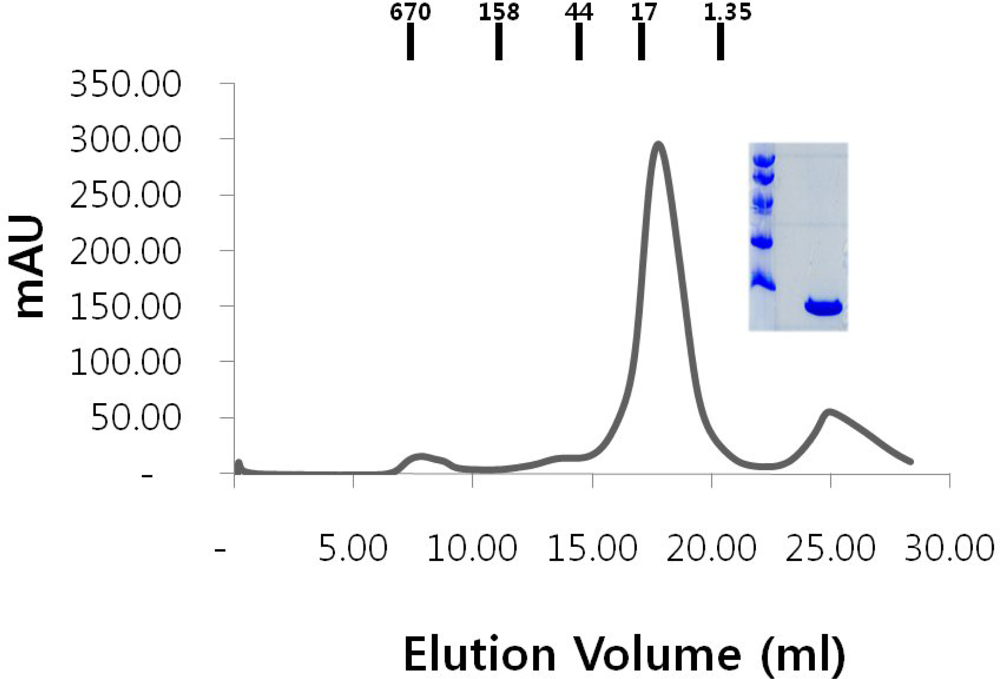
<p>As described below in the Experimental section, a DNA fragment encoding the RAIDD DD (94–199) was cloned by the polymerase chain reaction (PCR) using a plasmid DNA containing the full-length RAIDD gene as the template in order to elucidate the molecular structure of RAIDD DD by the X-ray protein crystallography. Ligation of the PCR product to the expression vector pET-26b produces plasmid pET26RAIDD-DD. This vector construction adds an eight-residue tag including C-terminal hexahistidine which has been used as efficient tag for affinity chromatography. The resulting plasmid was transformed into BL21 (DE3) <italic>E. coli</italic> competent cells and expressed by treating the bacteria with 0.5 mM isopropyl-D-thiogalactopyranoside (IPTG). After Ni-NTA affinity chromatography followed by gel-filtration chromatography, we could obtain pure RAIDD DD protein (<xref ref-type="fig" rid="f1-ijms-10-02501">Figure 1</xref>). The main peak that contains RAIDD DD eluted around 10 kDa position. It indicates RAIDD DD is existed as a monomer in solution.</p>
<p>RAIDD DD was concentrated to 4–6 mg mL<sup>−1</sup> using an Millipore concentration kit (Millipore) for crystallization trials. The selenomethionine-substituted RAIDD DD was expressed in the methionine auxotrophic strain B834 (Novagen) grown in minimal medium supplemented with seleno-<sc>l</sc>-methionine (Sigma) and other nutrients. It was purified and crystallized using the same procedure as used for the native protein.</p></sec>
<sec>
<label>2.2.</label>
<title>Crystallization of RAIDD DD</title>
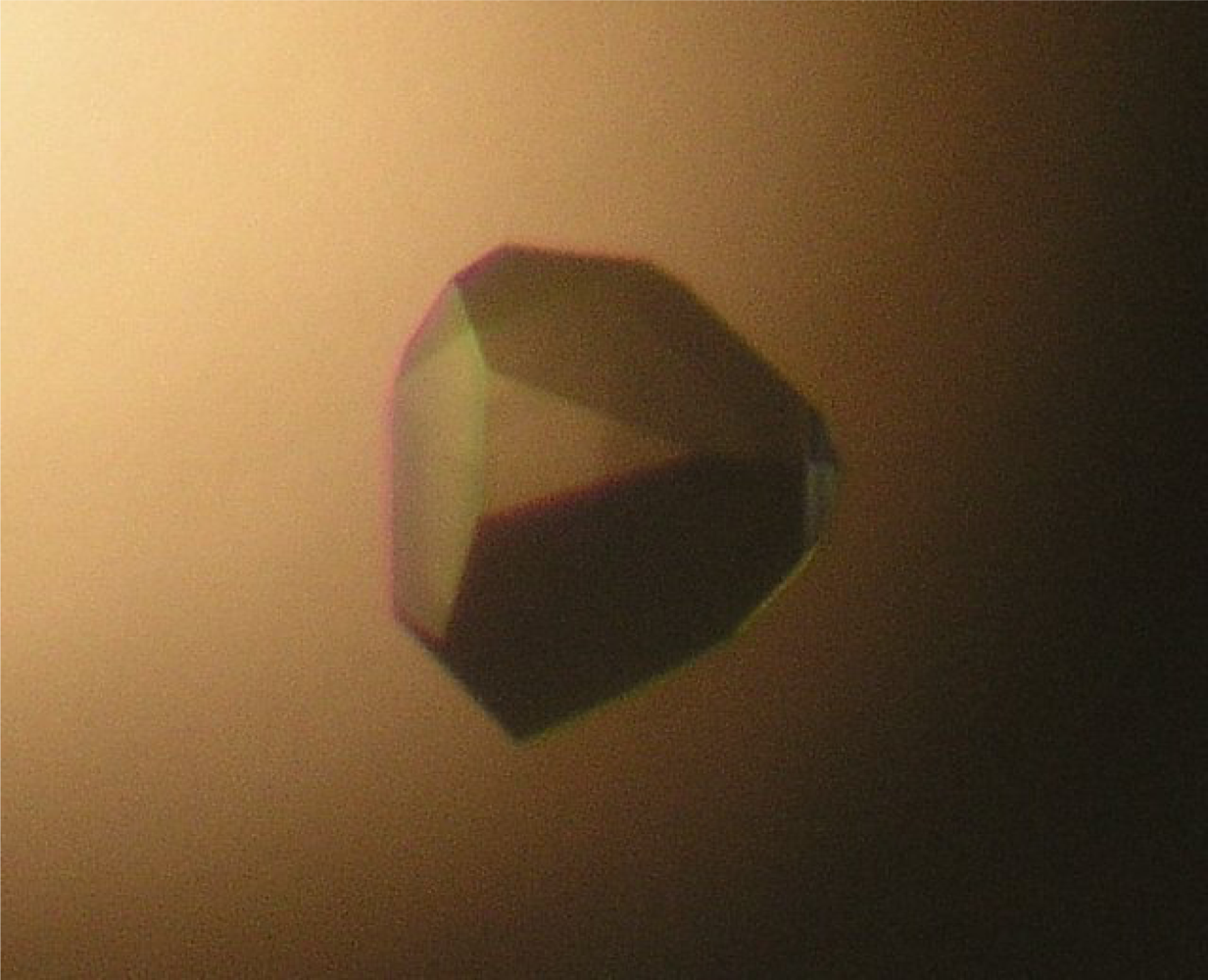
<p>Crystallization conditions were initially screened at 297K by the hanging-drop vapor-diffusion method using screening kits from Hampton Research (Crystal screening I and II, Natrix, MembFac, SaltRX) and from deCODE Biostructures Group (Wizard I and II). Crystals were grown on a siliconized cover slip by equilibrating a mixture containing 1 μL of protein solution (4–6 mg·mL<sup>−1</sup> protein in 20 mM Tris-HCl at pH 8.0, 150 mM NaCl) and 1 μL of a reservoir solution (2 M Na/K phosphate at pH 7.0) against 0.5 ml of reservoir solution. Crystals appeared in three days and grew to a maximum dimension of 0.2 × 0.2 × 0.2 mm (<xref ref-type="fig" rid="f2-ijms-10-02501">Figure 2</xref>). The selenomethionine-substituted RAIDD DD crystals were also grown under the similar condition (2.1 M Na/K phosphate at pH 7.0).</p></sec>
<sec>
<label>2.3.</label>
<title>Preliminary X-ray diffraction studies</title>
<p>For diffraction experiments, crystals were transiently soaked in a solution corresponding to the reservoir solution but supplemented with 20% (v/v) glycerol. The crystals were cryocooled at 110K. A single-wavelength anomalous diffraction (SAD) data set was collected at the selenium peak wavelength (E=12664ev, λ=0.979Å) at the X4A beamline of National Synchrotron Light Source (NSLS). Selenium labeled methionine will be found and the structure will be phased using the program SOLVE/RESOLVE [<xref ref-type="bibr" rid="b15-ijms-10-02501">15</xref>]. Data processing and scaling was carried out in the HKL2000 package [<xref ref-type="bibr" rid="b16-ijms-10-02501">16</xref>]. A native data set was collected and used for model refinement using CNS [<xref ref-type="bibr" rid="b17-ijms-10-02501">17</xref>]. The data-collection statistics are summarized in <xref ref-type="table" rid="t1-ijms-10-02501">Table 1</xref>. The structure was determined and deposited at protein data bank (PDBID: 2O71) [<xref ref-type="bibr" rid="b19-ijms-10-02501">19</xref>].</p></sec>
<sec>
<label>2.4.</label>
<title>Functional test of RAIDD DD</title>
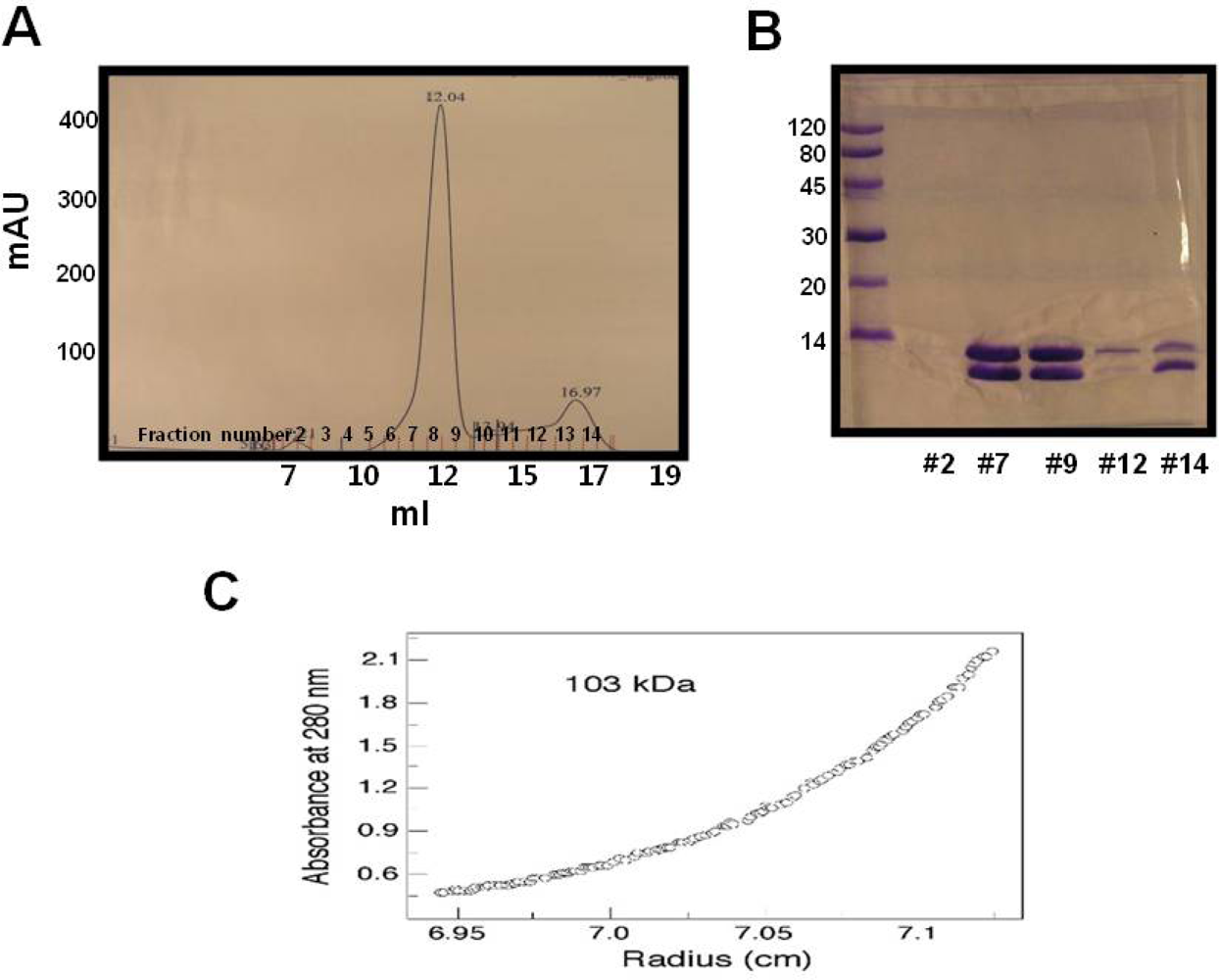
<p>DDs mediate protein-protein interaction. RAIDD DD is protein interaction module that is involved in the interaction to PIDD DD to form a PIDDosome. This homotypic interaction is critical for caspase-2 activation and genotoxic stress induced apoptosis. To test the function of purified RAIDD DD, we purified PIDD DD and analyzed binding ability of RAIDD DD to PIDD DD. Gel-filtration profile and SDS-PAGE clearly showed that RAIDD forms a tight complex with PIDD DD (<xref ref-type="fig" rid="f3-ijms-10-02501">Figure 3A</xref>, <xref ref-type="fig" rid="f3-ijms-10-02501">3B</xref>). The absolute molecular mass of 103 kDa (<xref ref-type="fig" rid="f3-ijms-10-02501">Figure 3C</xref>), determined by analytical equilibrium ultracentrifugation, indicates that the stoichiometry of the RAIDD DD: PIDD DD complex is 4:4 or 5:5.</p></sec></sec>
<sec>
<label>3.</label>
<title>Experimental Section</title>
<sec>
<label>3.1.</label>
<title>Expression and purification</title>
<p>The construct for expression of human RAIDD DD (94–199) was made as follows. The cDNA of full length RAIDD DD was used as a template for the polymerase chain reaction (PCR) and the plasmid vector pET26b (Novagen, USA) was used to add a hexahistidine tag at the carboxy-terminus of RAIDD DD for affinity purification. PCR products were digested with <italic>NdeI</italic> and <italic>XhoI</italic> (New England Biolabs, USA) restriction enzymes and ligated into pET26b. This vector construction adds an eight-residue tag including C-terminal hexahistidine (LEHHHHHH).</p>
<p>The resulting plasmid was transformed into BL21 (DE3) <italic>E. coli</italic> competent cells. The expression was induced by treating the bacteria with 0.5 mM isopropyl β-<sc>d</sc>-thiogalactopyranoside (IPTG) for overnight at 293 K. The bacteria were then collected, resuspended and lysed by sonication in 50 mL lysis buffer (20 mM Tris-HCl at pH 7.9, 500 mM NaCl, 5 mM imidazole). The bacterial lysate was then centrifuged at 14,000 g for 1 hr at 277 K. The supernatant fraction was applied to gravity-flow column (Bio-Rad, USA) packed with Ni-NTA affinity resin (Qiagen, USA). The unbound bacterial proteins were removed from the column using washing buffer (20 mM Tris-HCl at pH 7.9, 500 mM NaCl, 60 mM imidazole and 10% glycerol). The C-terminal His6-tagged RAIDD DD was eluted from the column using an elution buffer (20 mM Tris-HCl at pH 8.0, 500 mM NaCl, 250 mM imidazole). The protein purity was further improved by using a Superdex 200 gel filtration column 10/30 (Pharmacia) which was pre-equilibrated with a solution of 20 mM Tris-HCl at pH 8.0 and 150 mM KCl.</p>
<p>RAIDD DD was concentrated to 4–6 mg mL<sup>−1</sup> using a Millipore concentration kit (Millipore, USA) for crystallization trials. The selenomethionine-substituted RAIDD DD was expressed in the methionine auxotrophic strain B834 (Novagen, USA) grown in minimal medium supplemented with seleno-<sc>l</sc>-methionine (Sigma, USA) and other nutrients. It was purified and crystallized using the same procedure as used for the native protein.</p></sec>
<sec>
<label>3.2.</label>
<title>Crystallization</title>
<p>Crystallization conditions were initially screened at 297 K by the hanging-drop vapor-diffusion method using screening kits from Hampton Research (Crystal screening I and II, Natrix, MembFac, SaltRX) and from deCODE Biostructures Group (Wizard I and II). Crystals were grown on a siliconized cover slip by equilibrating a mixture containing 1 μL of protein solution (4–6 mg mL<sup>−1</sup> protein in 20 mM Tris-HCl at pH 8.0, 150 mM NaCl) and 1 μL of a reservoir solution (2M Na/K phosphate at pH 7.0) against 0.5 mL of reservoir solution. Crystals appeared in three days and grew to a maximum dimension of 0.2 × 0.2 × 0.2 mm (<xref ref-type="fig" rid="f1-ijms-10-02501">Figure 1</xref>). The selenomethionine-substituted RAIDD DD crystals were also grown under the similar condition (2.1 M Na/K phosphate at pH 7.0).</p></sec>
<sec sec-type="methods">
<label>3.3.</label>
<title>Data collection and analysis</title>
<p>For diffraction experiments, crystals were transiently soaked in a solution corresponding to the reservoir solution but supplemented with 20% (v/v) glycerol. The crystals were cryocooled at 110 K using a nitrogen stream (Cryocool, Cryo Industries, New Hampshire, USA). A single-wavelength anomalous diffraction (SAD) data set was collected at the selenium peak wavelength (E=12664ev, λ=0.979Å) at the X4A beamline of National Synchrotron Light Source (NSLS). Data processing and scaling was carried out in the HKL2000 package [<xref ref-type="bibr" rid="b16-ijms-10-02501">16</xref>]. A native data set was collected and used for model refinement. The data-collection statistics are summarized in <xref ref-type="table" rid="t1-ijms-10-02501">Table 1</xref>.</p></sec>
<sec>
<label>3.4.</label>
<title>Gel filtration chromatography</title>
<p>Purification method for PIDD DD is described at Park <italic>et al</italic>. [<xref ref-type="bibr" rid="b18-ijms-10-02501">18</xref>]. Separately purified and quantified RAIDD DD, PIDD DD were incubated for 1hr at room temperature. Following pre-incubation, the mixture was concentrated to 15 ~ 20 mg mL<sup>−1</sup> using a concentration kit (Millipore, USA). The concentrated protein mixture was then applied to a Superdex 200 gel-filtration column 10/30 (GE healthcare, USA), which was pre-equilibrated with a solution of 20 mM Tris-HCl at pH 8.0 and 50 mM NaCl. Formation of the complex was then detected by evaluating the positions of the eluted peak followed by SDS-PAGE.</p></sec>
<sec>
<label>3.5.</label>
<title>Ultracentrifugation</title>
<p>Analytical ultracentrifugation experiments were performed using a Beckman XL-1 analytical ultracentrifuge at 298 K. Absorbance was measured at the maximum wavelength as a function of radius at 25,000 rev./min.</p></sec></sec>
<sec sec-type="conclusions">
<label>4.</label>
<title>Conclusions</title>
<p>In the current study, the RAIDD DD (94–199) of human RAIDD was over-expressed and purified. The recombinant RAIDD DD was fully functional by tight binding to PIDD DD which is well known binding partner. The purified RAIDD DD alone has been crystallized. Crystals are trigonal and belong to space group P3<sub>1</sub>21 with unit-cell parameters a = 56.32, b = 56.32, c = 64.95 Å and γ = 120°. The crystals were obtained at room temperature and diffracted to 2.0 Å resolution.</p></sec></body>
<back>
<ack>
<p>We thank Randy Abramowitz and John Schwanof for use of the X4A beamline at NSLS. This study was supported by a Yeungnam University research grant in 2008.</p></ack>
<ref-list>
<title>References and Notes</title>
<ref id="b1-ijms-10-02501"><label>1.</label><citation citation-type="journal"><person-group person-group-type="author"><name><surname>Reed</surname><given-names>JC</given-names></name><name><surname>Doctor</surname><given-names>KS</given-names></name><name><surname>Godzik</surname><given-names>A</given-names></name></person-group><article-title>The domains of apoptosis: A genomics perspective</article-title><source>Sci STKE</source><year>2004</year>re9.</citation></ref>
<ref id="b2-ijms-10-02501"><label>2.</label><citation citation-type="journal"><person-group person-group-type="author"><name><surname>Park</surname><given-names>HH</given-names></name><name><surname>Lo</surname><given-names>Y</given-names></name><name><surname>Lin</surname><given-names>S</given-names></name><name><surname>Wang</surname><given-names>L</given-names></name><name><surname>Yang</surname><given-names>JK</given-names></name><name><surname>Wu</surname><given-names>H</given-names></name></person-group><article-title>The death domain superfamily in intracellular signaling of apoptosis and inflammation</article-title><source>Annu. Rev. Immunol</source><year>2007</year><volume>25</volume><fpage>561</fpage><lpage>586</lpage><pub-id pub-id-type="doi">10.1146/annurev.immunol.25.022106.141656</pub-id><pub-id pub-id-type="pmid">17201679</pub-id></citation></ref>
<ref id="b3-ijms-10-02501"><label>3.</label><citation citation-type="journal"><person-group person-group-type="author"><name><surname>Wajant</surname><given-names>H</given-names></name></person-group><article-title>The Fas signaling pathway: More than a paradigm</article-title><source>Science</source><year>2002</year><volume>296</volume><fpage>1635</fpage><lpage>1636</lpage><pub-id pub-id-type="doi">10.1126/science.1071553</pub-id><pub-id pub-id-type="pmid">12040174</pub-id></citation></ref>
<ref id="b4-ijms-10-02501"><label>4.</label><citation citation-type="journal"><person-group person-group-type="author"><name><surname>Zou</surname><given-names>H</given-names></name><name><surname>Henzel</surname><given-names>WJ</given-names></name><name><surname>Liu</surname><given-names>X</given-names></name><name><surname>Lutschg</surname><given-names>A</given-names></name><name><surname>Wang</surname><given-names>X</given-names></name></person-group><article-title>Apaf-1, a human protein homologous to C. elegans CED-4, participates in cytochrome c-dependent activation of caspase-3</article-title><source>Cell</source><year>1997</year><volume>90</volume><fpage>405</fpage><lpage>413</lpage><pub-id pub-id-type="doi">10.1016/S0092-8674(00)80501-2</pub-id><pub-id pub-id-type="pmid">9267021</pub-id></citation></ref>
<ref id="b5-ijms-10-02501"><label>5.</label><citation citation-type="journal"><person-group person-group-type="author"><name><surname>Tinel</surname><given-names>A</given-names></name><name><surname>Tschopp</surname><given-names>J</given-names></name></person-group><article-title>The PIDDosome, a protein complex implicated in activation of caspase-2 in response to genotoxic stress</article-title><source>Science</source><year>2004</year><volume>304</volume><fpage>843</fpage><lpage>846</lpage><pub-id pub-id-type="doi">10.1126/science.1095432</pub-id><pub-id pub-id-type="pmid">15073321</pub-id></citation></ref>
<ref id="b6-ijms-10-02501"><label>6.</label><citation citation-type="journal"><person-group person-group-type="author"><name><surname>Salvesen</surname><given-names>GS</given-names></name></person-group><article-title>Caspases and apoptosis</article-title><source>Essays Biochem</source><year>2002</year><volume>38</volume><fpage>9</fpage><lpage>19</lpage><pub-id pub-id-type="pmid">12463158</pub-id></citation></ref>
<ref id="b7-ijms-10-02501"><label>7.</label><citation citation-type="journal"><person-group person-group-type="author"><name><surname>Janssens</surname><given-names>S</given-names></name><name><surname>Tinel</surname><given-names>A</given-names></name><name><surname>Lippens</surname><given-names>S</given-names></name><name><surname>Tschopp</surname><given-names>J</given-names></name></person-group><article-title>PIDD mediates NF-kappaB activation in response to DNA damage</article-title><source>Cell</source><year>2005</year><volume>123</volume><fpage>1079</fpage><lpage>1092</lpage><pub-id pub-id-type="doi">10.1016/j.cell.2005.09.036</pub-id><pub-id pub-id-type="pmid">16360037</pub-id></citation></ref>
<ref id="b8-ijms-10-02501"><label>8.</label><citation citation-type="journal"><person-group person-group-type="author"><name><surname>Lin</surname><given-names>Y</given-names></name><name><surname>Ma</surname><given-names>W</given-names></name><name><surname>Benchimol</surname><given-names>S</given-names></name></person-group><article-title>Pidd, a new death-domain-containing protein, is induced by p53 and promotes apoptosis</article-title><source>Nat. Genet</source><year>2000</year><volume>26</volume><fpage>122</fpage><lpage>127</lpage><pub-id pub-id-type="doi">10.1038/79102</pub-id><pub-id pub-id-type="pmid">10973264</pub-id></citation></ref>
<ref id="b9-ijms-10-02501"><label>9.</label><citation citation-type="journal"><person-group person-group-type="author"><name><surname>Lassus</surname><given-names>P</given-names></name><name><surname>Opitz-Araya</surname><given-names>X</given-names></name><name><surname>Lazebnik</surname><given-names>Y</given-names></name></person-group><article-title>Requirement for caspase-2 in stress-induced apoptosis before mitochondrial permeabilization</article-title><source>Science</source><year>2002</year><volume>297</volume><fpage>1352</fpage><lpage>1354</lpage><pub-id pub-id-type="doi">10.1126/science.1074721</pub-id><pub-id pub-id-type="pmid">12193789</pub-id></citation></ref>
<ref id="b10-ijms-10-02501"><label>10.</label><citation citation-type="journal"><person-group person-group-type="author"><name><surname>Duan</surname><given-names>H</given-names></name><name><surname>Dixit</surname><given-names>VM</given-names></name></person-group><article-title>RAIDD is a new ‘death’ adaptor molecule</article-title><source>Nature</source><year>1997</year><volume>385</volume><fpage>86</fpage><lpage>89</lpage><pub-id pub-id-type="doi">10.1038/385086a0</pub-id><pub-id pub-id-type="pmid">8985253</pub-id></citation></ref>
<ref id="b11-ijms-10-02501"><label>11.</label><citation citation-type="journal"><person-group person-group-type="author"><name><surname>Read</surname><given-names>SH</given-names></name><name><surname>Baliga</surname><given-names>BC</given-names></name><name><surname>Ekert</surname><given-names>PG</given-names></name><name><surname>Vaux</surname><given-names>DL</given-names></name><name><surname>Kumar</surname><given-names>SJ</given-names></name></person-group><article-title>A novel Apaf-1-independent putative caspase-2 activation complex</article-title><source>Cell Biol</source><year>2002</year><volume>159</volume><fpage>739</fpage><lpage>745</lpage><pub-id pub-id-type="doi">10.1083/jcb.200209004</pub-id></citation></ref>
<ref id="b12-ijms-10-02501"><label>12.</label><citation citation-type="journal"><person-group person-group-type="author"><name><surname>Xiao</surname><given-names>T</given-names></name><name><surname>Towb</surname><given-names>P</given-names></name><name><surname>Wasserman</surname><given-names>SA</given-names></name><name><surname>Sprang</surname><given-names>SR</given-names></name></person-group><article-title>Three-dimensional structure of a complex between the death domains of pelle and tube</article-title><source>Cell</source><year>1999</year><volume>99</volume><fpage>545</fpage><lpage>555</lpage><pub-id pub-id-type="doi">10.1016/S0092-8674(00)81542-1</pub-id><pub-id pub-id-type="pmid">10589682</pub-id></citation></ref>
<ref id="b13-ijms-10-02501"><label>13.</label><citation citation-type="journal"><person-group person-group-type="author"><name><surname>Huang</surname><given-names>H</given-names></name><name><surname>Eberstadt</surname><given-names>M</given-names></name><name><surname>Olejniczak</surname><given-names>ET</given-names></name><name><surname>Meadows</surname><given-names>RP</given-names></name><name><surname>Fesik</surname><given-names>S</given-names></name></person-group><article-title>NMR structure and mutagenesis of the Fas (APO-1/CD95) death domain</article-title><source>Nature</source><year>1996</year><volume>384</volume><fpage>638</fpage><lpage>641</lpage><pub-id pub-id-type="doi">10.1038/384638a0</pub-id><pub-id pub-id-type="pmid">8967952</pub-id></citation></ref>
<ref id="b14-ijms-10-02501"><label>14.</label><citation citation-type="journal"><person-group person-group-type="author"><name><surname>Jeong</surname><given-names>EJ</given-names></name><name><surname>Bang</surname><given-names>S</given-names></name><name><surname>Lee</surname><given-names>TH</given-names></name><name><surname>Park</surname><given-names>YI</given-names></name><name><surname>Sim</surname><given-names>WS</given-names></name><name><surname>Kim</surname><given-names>KS</given-names></name></person-group><article-title>The solution structure of FADD death domain. Structural basis of death domain interactions of Fas and FADD</article-title><source>J. Biol. Chem</source><year>1999</year><volume>274</volume><fpage>16337</fpage><lpage>16342</lpage><pub-id pub-id-type="doi">10.1074/jbc.274.23.16337</pub-id><pub-id pub-id-type="pmid">10347191</pub-id></citation></ref>
<ref id="b15-ijms-10-02501"><label>15.</label><citation citation-type="journal"><person-group person-group-type="author"><name><surname>Terwilliger</surname><given-names>TC</given-names></name><name><surname>Berendzen</surname><given-names>J</given-names></name></person-group><article-title>Bayesian correlated MAD phasing</article-title><source>Acta Cryst</source><year>1997</year><volume>D53</volume><fpage>571</fpage><lpage>579</lpage></citation></ref>
<ref id="b16-ijms-10-02501"><label>16.</label><citation citation-type="journal"><person-group person-group-type="author"><name><surname>Otwinoski</surname><given-names>Z</given-names></name><name><surname>Minor</surname><given-names>W</given-names></name></person-group><article-title>Processing of x-ray diffraction data collected in oscillation mode</article-title><source>Methods Enzymol</source><year>1997</year><volume>276</volume><fpage>307</fpage><lpage>326</lpage></citation></ref>
<ref id="b17-ijms-10-02501"><label>17.</label><citation citation-type="journal"><person-group person-group-type="author"><name><surname>Brünger</surname><given-names>AT</given-names></name><name><surname>Adams</surname><given-names>PD</given-names></name><name><surname>Clore</surname><given-names>GM</given-names></name><name><surname>DeLano</surname><given-names>WL</given-names></name><name><surname>Gros</surname><given-names>P</given-names></name><name><surname>Grosse-Kunsleve</surname><given-names>RW</given-names></name><name><surname>Jiang</surname><given-names>JS</given-names></name><name><surname>Kuszewski</surname><given-names>J</given-names></name><name><surname>Nilges</surname><given-names>M</given-names></name><name><surname>Pannu</surname><given-names>NS</given-names></name><name><surname>Read</surname><given-names>RJ</given-names></name><name><surname>Rice</surname><given-names>LM</given-names></name><name><surname>Simonson</surname><given-names>T</given-names></name><name><surname>Warren</surname><given-names>GL</given-names></name></person-group><article-title>Crystallography &amp; NMR system: A new software suite for macromolecular structure determination</article-title><source>Acta Cryst</source><year>1998</year><volume>D54</volume><fpage>905</fpage><lpage>921</lpage></citation></ref>
<ref id="b18-ijms-10-02501"><label>18.</label><citation citation-type="journal"><person-group person-group-type="author"><name><surname>Park</surname><given-names>HH</given-names></name><name><surname>Emmanuelle</surname><given-names>L</given-names></name><name><surname>Stefan</surname><given-names>R</given-names></name><name><surname>Solange</surname><given-names>C</given-names></name><name><surname>Thomas</surname><given-names>W</given-names></name><name><surname>Jurg</surname><given-names>T</given-names></name><name><surname>Wu</surname><given-names>H</given-names></name></person-group><article-title>Death domain assembly mechanism revealed by crystal structure of the oligomeric PIDDosome core complex</article-title><source>Cell</source><year>2007</year><volume>128</volume><fpage>533</fpage><lpage>546</lpage><pub-id pub-id-type="doi">10.1016/j.cell.2007.01.019</pub-id><pub-id pub-id-type="pmid">17289572</pub-id></citation></ref>
<ref id="b19-ijms-10-02501"><label>19.</label><citation citation-type="journal"><person-group person-group-type="author"><name><surname>Park</surname><given-names>HH</given-names></name><name><surname>Wu</surname><given-names>H</given-names></name></person-group><article-title>Crystal structure of RAIDD death domain implicates potential mechanism of PIDDosome assembly</article-title><source>J. Mol. Biol</source><year>2006</year><volume>357</volume><fpage>358</fpage><lpage>364</lpage><pub-id pub-id-type="doi">10.1016/j.jmb.2005.12.082</pub-id><pub-id pub-id-type="pmid">16434054</pub-id></citation></ref></ref-list>
<sec sec-type="display-objects">
<title>Figures and Table</title>
<fig id="f1-ijms-10-02501" position="float">
<label>Figure 1.</label>
<caption>
<p>Purification of the RAIDD DD. The profile showing the elution of the RAIDD DD on Gel-filtration chromatography. SDS-PAGE (15% gel) of the purified RAIDD DD.</p></caption>
<graphic xlink:href="ijms-10-02501f1.gif"/></fig>
<fig id="f2-ijms-10-02501" position="float">
<label>Figure 2.</label>
<caption>
<p>Crystal of RAIDD DD. A native RAIDD DD crystal grown in three days in the condition of 2 M Na/K phosphate at pH 7.0. Its approximate dimentions are 0.2 X 0.2 X 0.2 mm.</p></caption>
<graphic xlink:href="ijms-10-02501f2.gif"/></fig>
<fig id="f3-ijms-10-02501" position="float">
<label>Figure 3.</label>
<caption>
<p>Functional test of RAIDD DD. A. Profile of Gel-filtration chromatography. Elution volume around 12 mL indicates molecular weight of 120 kDa; B. 15 % SDS-PAGE showed that the peak from profile of gel-filtration chromatography is a complex. Fraction #12 and #14 showed that uncomplexed left over proteins; C. The equilibrium radial absorbance profiles at 25,000 rev./min by analytical ultracentrifugation analysis for RAIDD DD: PIDD DD complex.</p></caption>
<graphic xlink:href="ijms-10-02501f3.gif"/></fig>
<table-wrap id="t1-ijms-10-02501" position="float">
<label>Table 1.</label>
<caption>
<p>Crystallographic statistics.</p></caption>
<table frame="hsides" rules="rows">
<thead>
<tr>
<th valign="bottom" align="left"><bold>Data collection</bold></th>
<th valign="bottom" align="left"><bold>Se-Met</bold></th>
<th valign="bottom" align="left"><bold>Native</bold></th></tr></thead>
<tbody>
<tr>
<td valign="bottom" align="left">Space group</td>
<td valign="bottom" align="left">P3<sub>1</sub>21</td>
<td valign="bottom" align="left">P3<sub>1</sub>21</td></tr>
<tr>
<td valign="bottom" align="left">Cell dimensions</td>
<td valign="bottom" align="left"/>
<td valign="bottom" align="left"/></tr>
<tr>
<td valign="bottom" align="left"><italic>a</italic>, <italic>b</italic>, <italic>c</italic></td>
<td valign="bottom" align="left">56.3Å, 56.3Å, 64.9Å</td>
<td valign="bottom" align="left">56.1Å, 56.1Å, 64.9Å</td></tr>
<tr>
<td valign="bottom" align="left">Resolution</td>
<td valign="bottom" align="left">50–2.0Å</td>
<td valign="bottom" align="left">50–2.0Å</td></tr>
<tr>
<td valign="bottom" align="left"><xref ref-type="table-fn" rid="tfn1-ijms-10-02501">†</xref><italic>R</italic><sub>sym</sub></td>
<td valign="bottom" align="left">6.2% (27.4%)</td>
<td valign="bottom" align="left">5.5% (17.9%)</td></tr>
<tr>
<td valign="bottom" align="left"><xref ref-type="table-fn" rid="tfn1-ijms-10-02501">†</xref><italic>I</italic>/σ(<italic>I)</italic></td>
<td valign="bottom" align="left">17.2 (2.8)</td>
<td valign="bottom" align="left">14.5 (2.3)</td></tr>
<tr>
<td valign="bottom" align="left"><xref ref-type="table-fn" rid="tfn1-ijms-10-02501">†</xref>Completeness</td>
<td valign="bottom" align="left">100.0% (100.0%)</td>
<td valign="bottom" align="left">99.7% (99.8%)</td></tr>
<tr>
<td valign="bottom" align="left"><xref ref-type="table-fn" rid="tfn1-ijms-10-02501">†</xref>Redundancy</td>
<td valign="bottom" align="left">11.0 (10.6)</td>
<td valign="bottom" align="left">8.9 (8.9)</td></tr></tbody></table>
<table frame="hsides" rules="rows">
<thead>
<tr>
<th valign="bottom" align="left" colspan="2"><bold>Refinement</bold></th></tr></thead>
<tbody>
<tr>
<td valign="bottom" align="left">Resolution</td>
<td valign="bottom" align="left">50–2.0Å</td></tr>
<tr>
<td valign="bottom" align="left">No. reflections used (completeness)</td>
<td valign="bottom" align="left">8063 (96.9%)</td></tr>
<tr>
<td valign="bottom" align="left"><italic>R</italic><sub>work</sub>/<italic>R</italic><sub>free</sub></td>
<td valign="bottom" align="left">23.1%/24.1%</td></tr>
<tr>
<td valign="bottom" align="left">No. atoms</td>
<td valign="bottom" align="left"/></tr>
<tr>
<td valign="bottom" align="left">Protein</td>
<td valign="bottom" align="left">704</td></tr>
<tr>
<td valign="bottom" align="left">Water and other small molecule</td>
<td valign="bottom" align="left">55</td></tr>
<tr>
<td valign="bottom" align="left">Average B-factors</td>
<td valign="bottom" align="left"/></tr>
<tr>
<td valign="bottom" align="left">Protein</td>
<td valign="bottom" align="left">32.0 Å<sup>2</sup></td></tr>
<tr>
<td valign="bottom" align="left">Water and other small molecule</td>
<td valign="bottom" align="left">40.4 Å<sup>2</sup></td></tr>
<tr>
<td valign="bottom" align="left">R.m.s deviations</td>
<td valign="bottom" align="left"/></tr>
<tr>
<td valign="bottom" align="left">Bond lengths</td>
<td valign="bottom" align="left">0.005Å</td></tr>
<tr>
<td valign="bottom" align="left">Bond angles</td>
<td valign="bottom" align="left">1.0°</td></tr>
<tr>
<td valign="bottom" align="left">Ramachandran Plot</td>
<td valign="bottom" align="left"/></tr>
<tr>
<td valign="bottom" align="left">Most favored regions</td>
<td valign="bottom" align="left">91.3%</td></tr>
<tr>
<td valign="bottom" align="left">Additional allowed regions</td>
<td valign="bottom" align="left">8.7%</td></tr></tbody></table>
<table-wrap-foot><fn id="tfn1-ijms-10-02501">
<label>†</label>
<p>Highest resolution shell is shown in parenthesis.</p></fn></table-wrap-foot></table-wrap></sec></back></article>