
<?xml version="1.0" encoding="UTF-8"?>
<!DOCTYPE article PUBLIC "-//NLM//DTD Journal Publishing DTD v2.3 20070202//EN" "journalpublishing.dtd">
<article xmlns:mml="http://www.w3.org/1998/Math/MathML" xmlns:xlink="http://www.w3.org/1999/xlink" xml:lang="en" article-type="research-article">
<front>
<journal-meta>
<journal-id journal-id-type="publisher-id">ijms</journal-id>
<journal-title>International Journal of Molecular Sciences</journal-title>
<abbrev-journal-title>Int. J. Mol. Sci.</abbrev-journal-title>
<issn pub-type="epub">1422-0067</issn>
<publisher>
<publisher-name>Molecular Diversity Preservation International (MDPI)</publisher-name></publisher></journal-meta>
<article-meta>
<article-id pub-id-type="doi">10.3390/ijms10052146</article-id>
<article-id pub-id-type="publisher-id">ijms-10-02146</article-id>
<article-categories>
<subj-group>
<subject>Article</subject></subj-group></article-categories>
<title-group>
<article-title>Stereodynamics Study of the Reaction of O(<sup>3</sup>P) with CH<sub>4</sub> (v = 0, j = 0)</article-title></title-group>
<contrib-group>
<contrib contrib-type="author">
<name><surname>Liu</surname><given-names>Yufang</given-names></name><xref ref-type="corresp" rid="c1-ijms-10-02146">*</xref></contrib>
<contrib contrib-type="author">
<name><surname>Gao</surname><given-names>Yali</given-names></name></contrib>
<contrib contrib-type="author">
<name><surname>Zhai</surname><given-names>Hongsheng</given-names></name></contrib>
<contrib contrib-type="author">
<name><surname>Shi</surname><given-names>Deheng</given-names></name></contrib>
<contrib contrib-type="author">
<name><surname>Sun</surname><given-names>Jinfeng</given-names></name></contrib>
<aff id="af1-ijms-10-02146">Department of Physics, Henan Normal University, Xinxiang 453007, China; E-Mails:
<email>hongsheng419@163.com</email> (H.Z.);
<email>scattering@sina.com</email> (D.S.);
<email>wlxyzfz@henannu.edu.cn</email> (J.S.)</aff></contrib-group>
<author-notes>
<corresp id="c1-ijms-10-02146">
<label>*</label> Author to whom correspondence should be addressed; E-Mail:
<email>yf-liu@henannu.edu.cn</email>; Tel. +86-373-3329097; Fax: +86-373-3326187</corresp></author-notes>
<pub-date pub-type="collection">
<month>5</month>
<year>2009</year></pub-date>
<pub-date pub-type="epub">
<day>14</day>
<month>5</month>
<year>2009</year></pub-date>
<volume>10</volume>
<issue>5</issue>
<fpage>2146</fpage>
<lpage>2157</lpage>
<history>
<date date-type="received">
<day>7</day>
<month>3</month>
<year>2009</year></date>
<date date-type="accepted">
<day>2</day>
<month>5</month>
<year>2009</year></date></history>
<permissions>
<copyright-statement>© 2009 by the authors; licensee Molecular Diversity Preservation International, Basel, Switzerland.</copyright-statement>
<copyright-year>2009</copyright-year>
<license license-type="open-access" xlink:href="http://creativecommons.org/licenses/by/3.0">
<p>This article is an open-access article distributed under the terms and conditions of the Creative Commons Attribution license (http://creativecommons.org/licenses/by/3.0/).</p></license></permissions>
<abstract>
<p>A new London-Eyring-Polanyi-Sato (LEPS) potential energy surface (PES) is used in the O + CH<sub>4</sub> → OH + CH<sub>3</sub> reaction via the quasiclassical trajectory method (QCT). Comparing with the experiments and the former <italic>ab initio</italic> calculations, the new LEPS PES describes the actual potential energy surface of the O + CH<sub>4</sub> reaction successfully. The four polarization dependent “generalized” differential cross sections (PDDCS) are presented in the center of mass frame. In the meantime, the distribution of dihedral angle [<italic>P</italic>(<italic>φ</italic><italic><sub>r</sub></italic>), the distribution of angle between <italic>k</italic> and <italic>j</italic>′ (<italic>P</italic>(<italic>θ</italic><italic><sub>r</sub></italic>)] and the angular distribution of product rotational vectors in the form of polar plots in <italic>θ</italic><italic><sub>r</sub></italic> and <italic>φ</italic><italic><sub>r</sub></italic> (P(<italic>θ</italic><italic><sub>r</sub></italic><italic>, φ</italic><italic><sub>r</sub></italic>) are calculated. The isotope effect for the reactions O + CD<sub>4</sub> is also calculated. These results are in good agreement with the experiments.</p></abstract>
<kwd-group>
<kwd>quasiclassical trajectory</kwd>
<kwd>potential barrier</kwd>
<kwd>polarization</kwd>
<kwd>isotope effect</kwd></kwd-group></article-meta></front>
<body>
<sec sec-type="intro">
<label>1.</label>
<title>Introduction</title>
<p>The reactions of ground-state atomic oxygen, O(<sup>3</sup>P), with hydrocarbons are the important initial steps of oxidation in combustion processes [<xref ref-type="bibr" rid="b1-ijms-10-02146">1</xref>] and in Low Earth Orbit (LEO) conditions [<xref ref-type="bibr" rid="b2-ijms-10-02146">2</xref>]. Among those reactions, the abstraction reaction O(<sup>3</sup>P) + CH<sub>4</sub> → OH + CH<sub>3</sub> has attracted considerable interest, both in experimental [<xref ref-type="bibr" rid="b3-ijms-10-02146">3</xref>–<xref ref-type="bibr" rid="b7-ijms-10-02146">7</xref>,<xref ref-type="bibr" rid="b11-ijms-10-02146">11</xref>] and theoretical [<xref ref-type="bibr" rid="b8-ijms-10-02146">8</xref>–<xref ref-type="bibr" rid="b10-ijms-10-02146">10</xref>,<xref ref-type="bibr" rid="b12-ijms-10-02146">12</xref>–<xref ref-type="bibr" rid="b20-ijms-10-02146">20</xref>] calculations over the past decades. The rate constant values have been established in experiments [<xref ref-type="bibr" rid="b3-ijms-10-02146">3</xref>,<xref ref-type="bibr" rid="b4-ijms-10-02146">4</xref>]. Experimental studies have reported the translational energy release to the umbrella mode of the CH<sub>3</sub> product [<xref ref-type="bibr" rid="b5-ijms-10-02146">5</xref>] as well as OH ro-vibrational distributions [<xref ref-type="bibr" rid="b6-ijms-10-02146">6</xref>,<xref ref-type="bibr" rid="b7-ijms-10-02146">7</xref>]. The thermal rate constants have been measured with a wide variety of methods [<xref ref-type="bibr" rid="b8-ijms-10-02146">8</xref>–<xref ref-type="bibr" rid="b10-ijms-10-02146">10</xref>]. The state distribution of the OH product was found by experiments [<xref ref-type="bibr" rid="b5-ijms-10-02146">5</xref>,<xref ref-type="bibr" rid="b6-ijms-10-02146">6</xref>,<xref ref-type="bibr" rid="b8-ijms-10-02146">8</xref>,<xref ref-type="bibr" rid="b11-ijms-10-02146">11</xref>] and theoretical [<xref ref-type="bibr" rid="b12-ijms-10-02146">12</xref>] calculations. A small amount of OH rotational excitation was found [<xref ref-type="bibr" rid="b5-ijms-10-02146">5</xref>,<xref ref-type="bibr" rid="b6-ijms-10-02146">6</xref>,<xref ref-type="bibr" rid="b11-ijms-10-02146">11</xref>], which has been interpreted as resulting from a direct abstraction mechanism with a preferentially collinear O-H-C approach of the O(<sup>3</sup>P) atom attacking to the C-H bond. Theoretical calculations [<xref ref-type="bibr" rid="b8-ijms-10-02146">8</xref>,<xref ref-type="bibr" rid="b9-ijms-10-02146">9</xref>,<xref ref-type="bibr" rid="b12-ijms-10-02146">12</xref>,<xref ref-type="bibr" rid="b13-ijms-10-02146">13</xref>] showed that this reaction has a collinear O-H-CH<sub>3</sub> transition state. The classical barrier height is around 0.4 eV [<xref ref-type="bibr" rid="b20-ijms-10-02146">20</xref>,<xref ref-type="bibr" rid="b21-ijms-10-02146">21</xref>]. Reduced-dimensionality quantum [<xref ref-type="bibr" rid="b16-ijms-10-02146">16</xref>–<xref ref-type="bibr" rid="b19-ijms-10-02146">19</xref>] models have been reported. The calculated kinetic behaviors and product state distributions are generally in good agreement with experimental findings [<xref ref-type="bibr" rid="b7-ijms-10-02146">7</xref>].</p>
<p>It has been recognized that the correlated angular distribution provides an informative three-dimensional picture of a chemical reaction [<xref ref-type="bibr" rid="b22-ijms-10-02146">22</xref>–<xref ref-type="bibr" rid="b25-ijms-10-02146">25</xref>]. The angular distribution of the reagent and product relative velocity vector (<italic>k</italic>, <italic>k</italic>′) is characterized by the differential cross-section <italic>dσ/dω</italic><italic><sub>t</sub></italic>. Furthermore, the angular distribution describing the relative orientation of vectors <italic>k</italic>, <italic>k</italic>′ and product rotational quantum number <italic>j’</italic> in space may be termed the <italic>k - k’ - j’</italic> distribution. The correlations among three vectors in the center-of-mass frame can be characterized by certain interesting double and triple vector correlations [<xref ref-type="bibr" rid="b26-ijms-10-02146">26</xref>]. To our best knowledge, there is only one experimental work [<xref ref-type="bibr" rid="b27-ijms-10-02146">27</xref>] relate to the product angular distribution (<italic>k</italic> - <italic>k</italic>′), scalar and two-vector properties of the reaction were analyzed using the QCT method [<xref ref-type="bibr" rid="b14-ijms-10-02146">14</xref>], the full-dimensional trajectory [<xref ref-type="bibr" rid="b13-ijms-10-02146">13</xref>,<xref ref-type="bibr" rid="b20-ijms-10-02146">20</xref>] calculations only relate to the <italic>k</italic> - <italic>k</italic>′ angular distributions. So the full product angular distribution of this reaction has not been reported.</p>
<p>We calculated the product rotational polarization, the scattering-angle resolved product rotational alignment, the vector correlations of the reaction O(<sup>3</sup>P) + CH<sub>4</sub> → OH + CH<sub>3</sub> and the isotope effect for the reactions O + CH<sub>4</sub>/O + CD<sub>4</sub>.</p></sec>
<sec sec-type="results|discussion">
<label>2.</label>
<title>Results and Discussion</title>
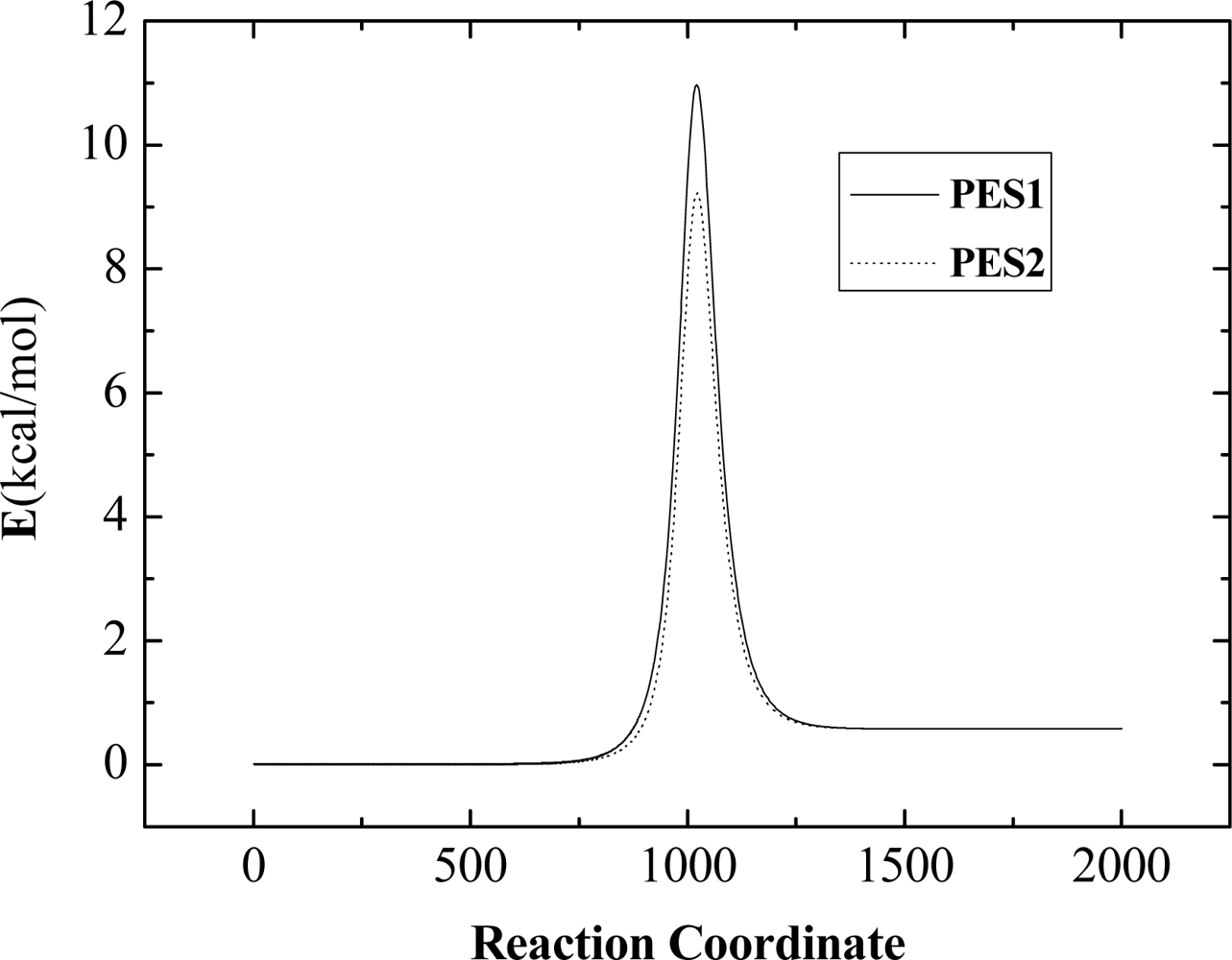
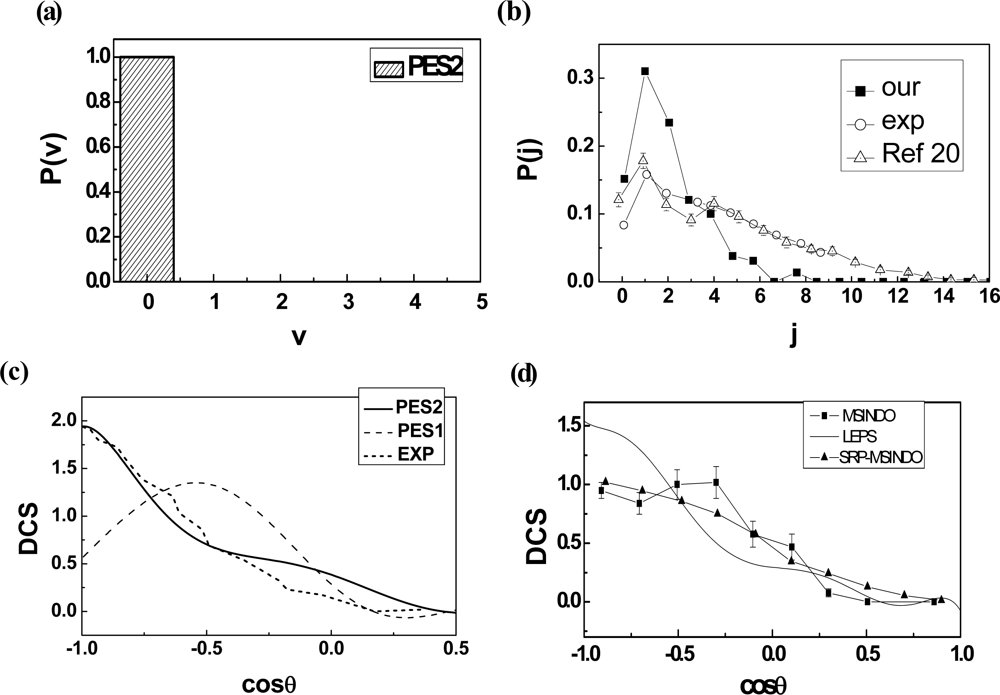
<p><xref ref-type="fig" rid="f1-ijms-10-02146">Figure 1</xref> shows the minimum energy paths of the reaction O + CH<sub>4</sub> → OH + CH<sub>3</sub> at the collision energy of 0.65 eV from reactants to products on our chosen PESs. A new LEPS PES with a different set of Sato parameters has been calculated in our work. The Sato C parameters from [<xref ref-type="bibr" rid="b33-ijms-10-02146">33</xref>] are on the PES1 and the Sato D parameters which we calculated are on the PES2. We get the Sato D parameters from the <italic>ab initio</italic> calculation carried out by Troya and García-Molina [<xref ref-type="bibr" rid="b20-ijms-10-02146">20</xref>] when the quality of the minimum energy path on the new LEPS potential energy surface accords with the experimental results. In <xref ref-type="fig" rid="f1-ijms-10-02146">Figure 1</xref>, there is a potential barrier in the reaction. The values of the potential barrier are 11 kcal/mol on PES1 and 9.23 kcal/mol on PES2. The results on PES2 are accord with the calculation [<xref ref-type="bibr" rid="b20-ijms-10-02146">20</xref>] in which the barrier is around 9.22 kal/mol. The product’s ro-vibrational distributions are shown in <xref ref-type="fig" rid="f2-ijms-10-02146">Figure 2</xref>. From <xref ref-type="fig" rid="f2-ijms-10-02146">Figure 2(a)</xref> we can see that the most probable vibrational quantum number of OH is <italic>v</italic><sup>'</sup> = 0. In <xref ref-type="fig" rid="f2-ijms-10-02146">Figure 2(b)</xref> the most probable rotational quantum number of OH is <italic>j</italic>′ = 1, which is quite close to the calculation [<xref ref-type="bibr" rid="b20-ijms-10-02146">20</xref>] and experiment [<xref ref-type="bibr" rid="b37-ijms-10-02146">37</xref>], but the product OH of our calculation is colder than the experimental results. The reason is that the collision energy changes to the product’s translational energy rather than rotational energy in the O+CH<sub>4</sub> direct abstraction reaction.</p>
<p>In the direct abstraction reaction, the rotational distribution is always in the narrow and low range of the rotational energy. The PDDCS (<italic>2π/</italic><italic>σ</italic>)(<italic>dσ</italic><italic><sub>00</sub></italic><italic>/dω</italic><italic><sub>t</sub></italic>), which is proportional to the differential cross section (DCS), predicts the angular distribution of the product molecular. In Figures <xref ref-type="fig" rid="f2-ijms-10-02146">2(c,d)</xref> the DCS distribution is quite close to the experiment [<xref ref-type="bibr" rid="b27-ijms-10-02146">27</xref>] and calculations [<xref ref-type="bibr" rid="b13-ijms-10-02146">13</xref>,<xref ref-type="bibr" rid="b20-ijms-10-02146">20</xref>]. The PES2 reflecting the real reaction process is much better than the PES1.</p>
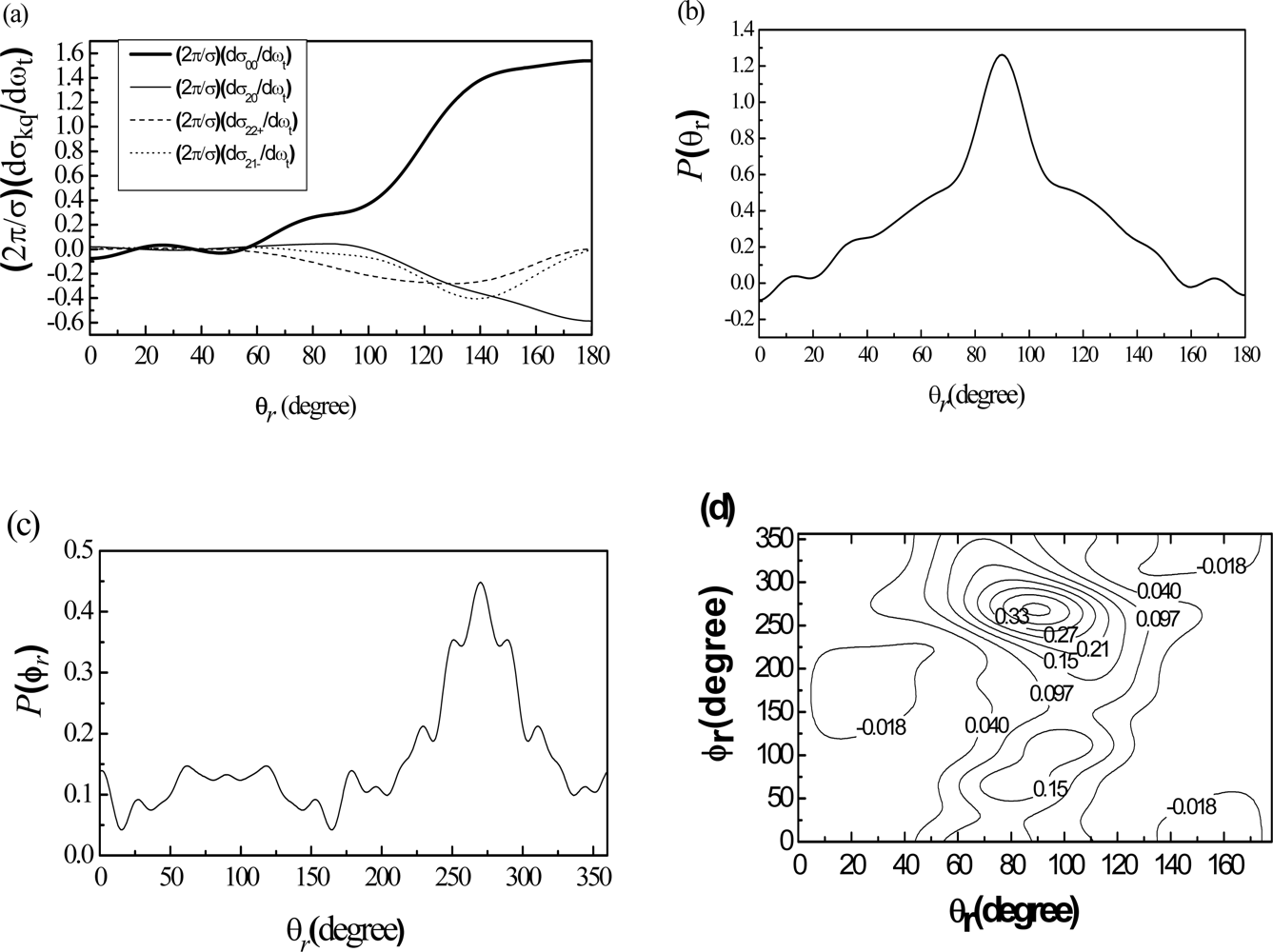
<p>The value of <italic>(2π/</italic><italic>σ)(dσ</italic><italic><sub>20</sub></italic><italic>/dω</italic><italic><sub>t</sub></italic><italic>)</italic>, which is the expectation value of the second Legendre moment, shows the trend which is opposite to that of <italic>(2π/</italic><italic>σ)(dσ</italic><italic><sub>00</sub></italic><italic>/dω</italic><italic><sub>t</sub></italic><italic>)</italic>. At the extremes of forward and backward scattering, the PDDCSs with q ≠ 0 are necessarily zero. At these limiting scattering angles, the <italic>k -k’</italic> scattering plane is not determined and the value of these PDDCSs with q ≠ 0 must be zero. The variations of the PDDCSs with k = 2 reflect changes in the rotational polarization with the scattering angles and suggest that the PDDCSs for the O+CH4 reaction contain important dynamical information. The four PDDCS of the OH product state are shown in <xref ref-type="fig" rid="f3-ijms-10-02146">Figure 3(a)</xref>.</p>
<p>It indicates that the product OH scatters backward. The angular distribution that is asymmetric with <italic>θ</italic><italic><sub>r</sub></italic> <italic>= 90</italic>° is characteristic of a direct reaction mechanism. The available energy is released as product translation energy rather than internal excitation, and the product internal excitation is quite cold. This is consistent with <xref ref-type="fig" rid="f2-ijms-10-02146">Figure 2</xref>.</p>
<p>The <italic>P(θ</italic><italic><sub>r</sub></italic><italic>)</italic> and <italic>P(φ</italic><italic><sub>r</sub></italic><italic>)</italic> distributions are shown in <xref ref-type="fig" rid="f3-ijms-10-02146">Figures 3(b,c)</xref>. We can get better graphical representation of the products polarization for the reaction O + CH<sub>4</sub>. <xref ref-type="fig" rid="f3-ijms-10-02146">Figure 3(b)</xref> clearly shows that the distributions of the <italic>k - j’</italic> correlation P(<italic>θ</italic><italic><sub>r</sub></italic>) peak at <italic>θ</italic><italic><sub>r</sub></italic> angle close to <italic>θ</italic><italic><sub>r</sub></italic> <italic>= 90</italic>° and is symmetric with <italic>θ</italic><italic><sub>r</sub></italic> <italic>= 90</italic>°. It demonstrates that <italic>j</italic><italic><sub>OH</sub></italic> is strongly aligned perpendicular to the line of centers. The distribution of the <italic>k - k’ - j’</italic> correlation <italic>P(φ</italic><italic><sub>r</sub></italic><italic>)</italic> is shown in <xref ref-type="fig" rid="f3-ijms-10-02146">Figure 3(c)</xref>. The <italic>P(φ</italic><italic><sub>r</sub></italic><italic>)</italic> tends to be asymmetric about <italic>φ</italic><italic><sub>r</sub></italic> <italic>= 180</italic>°, reflecting the strong polarization of angular momentum. There are two peaks of <italic>P(φ</italic><italic><sub>r</sub></italic><italic>)</italic>, respectively<italic>φ</italic><italic><sub>r</sub></italic> <italic>= 270</italic>°and <italic>φ</italic><italic><sub>r</sub></italic> <italic>= 90</italic>°. It implies that the angular momentum (<italic>j</italic><italic><sub>OH</sub></italic>) of the most product molecules aligns along the CM y-axis. This behavior suggests that the reaction proceeds preferentially when the reactant velocity vector lies in the plane containing all three atoms. However, for an initially random orientation of reactant molecules the probability of such planar collisions is very low; thus, we can conclude that the given PES reorients or polarizes the plane containing the three atoms into the <italic>k - k’</italic> plane during the reaction process. The distribution of <italic>P(θ</italic><italic><sub>r</sub></italic><italic>, φ</italic><italic><sub>r</sub></italic><italic>)</italic> is presented in <xref ref-type="fig" rid="f3-ijms-10-02146">Figure 3(d)</xref>; one peak appears at (<italic>90°</italic>, <italic>270</italic>°). This suggests that the OH products are preferentially polarized perpendicular to the <italic>k - k’</italic> plane. The <italic>P(θ</italic><italic><sub>r</sub></italic><italic>, φ</italic><italic><sub>r</sub></italic><italic>)</italic> distribution is not symmetric about <italic>φ</italic><italic><sub>r</sub></italic><italic>=180</italic>°, reflecting the nonzero values of the PDDCS <italic>(2π/</italic><italic>σ)(dσ</italic><italic><sub>00</sub></italic><italic>/dω</italic><italic><sub>t</sub></italic><italic>)</italic> for the O + CH4 reaction. It is in good accordance with the distribution of <italic>P(φ</italic><italic><sub>r</sub></italic><italic>)</italic> that the dihedral angle distribution tends to be asymmetric with respect to the scattering plane.</p>
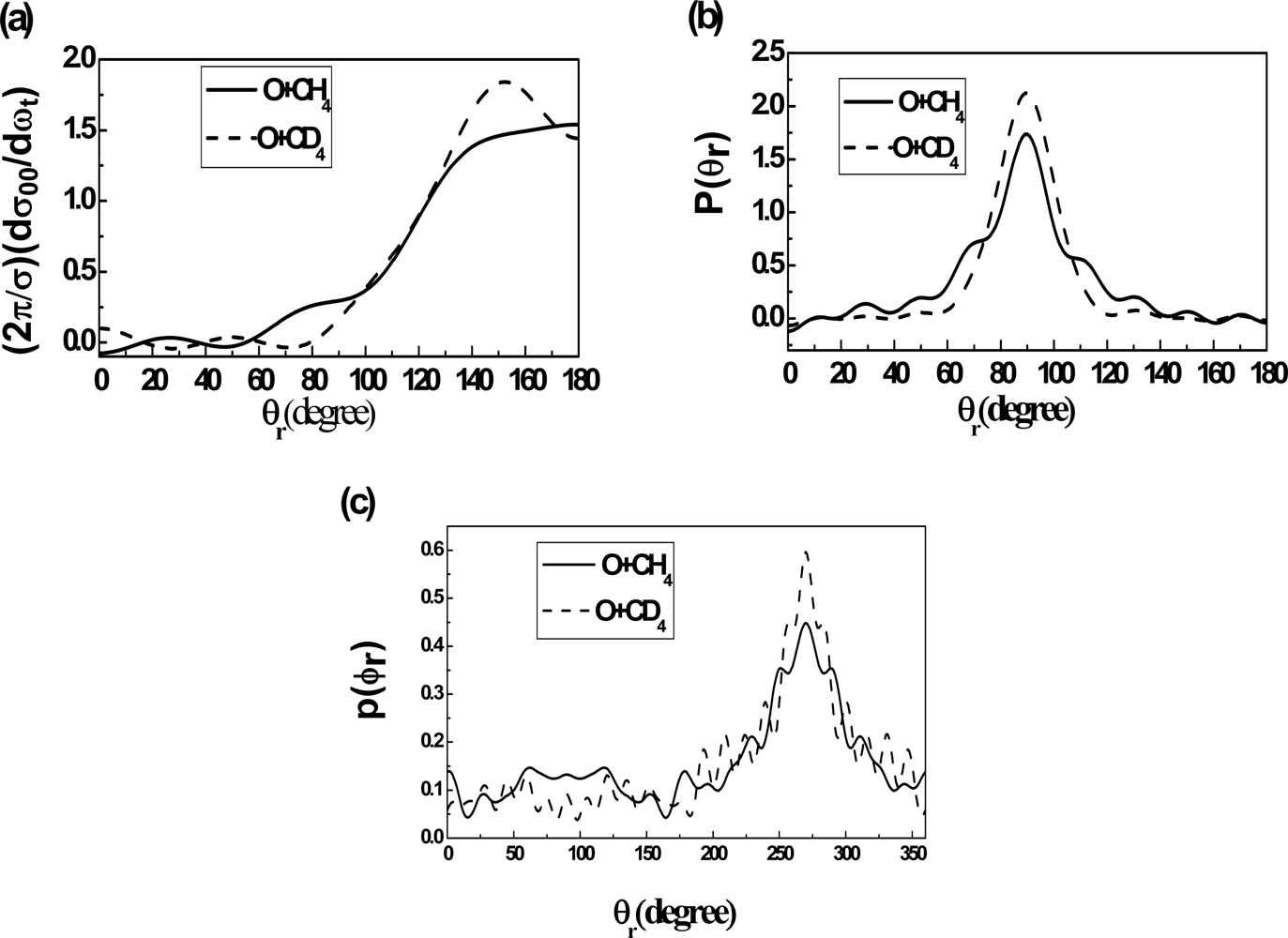
<p><xref ref-type="fig" rid="f4-ijms-10-02146">Figure 4(a)</xref> presents the PDDCSs <italic>(2π/</italic><italic>σ)(dσ</italic><italic><sub>00</sub></italic><italic>/dω</italic><italic><sub>t</sub></italic><italic>)</italic> distributions of the products OH and OD at the collision energy of 0.65eV. The distribution of the products OD is a little more backward than that of the products OH. The increase of backward scattering with the mass number indicates that the rotational angular momenta distribution of the products is sensitive to the factor of merit [the factor of merit is cos<sup>2</sup><italic>β</italic>=m<sub>A</sub>m<sub>C</sub>/(m<sub>A</sub> + m<sub>B</sub>)(m<sub>B</sub> + m<sub>C</sub>) for the reaction A + BC → AB + C] [<xref ref-type="bibr" rid="b32-ijms-10-02146">32</xref>,<xref ref-type="bibr" rid="b34-ijms-10-02146">34</xref>].</p>
<p>The product polarization distributions for the reaction O + CH<sub>4</sub> and O + CD<sub>4</sub> are shown in <xref ref-type="fig" rid="f4-ijms-10-02146">Figures 4(b,c)</xref> that describe the visible stereodynamics isotope effect. <xref ref-type="fig" rid="f4-ijms-10-02146">Figure 4(b)</xref> illustrates that the product distribution of <italic>P(θ</italic><italic><sub>r</sub></italic><italic>)</italic> for the O+ CD<sub>4</sub> reaction is a little broader than that for O + CH<sub>4</sub> reaction. This means that the rotational orientation effect of the product becomes weaker with the increase of the atomic mass. Han <italic>et al.</italic> [<xref ref-type="bibr" rid="b32-ijms-10-02146">32</xref>,<xref ref-type="bibr" rid="b34-ijms-10-02146">34</xref>]. have studied the product polarization for the reaction <italic>H</italic> + <italic>H’</italic>L (H, heavy; L, light), they found that the distribution of the product rotational angular momentum vectors is acutely sensitive to the mass factor, furthermore the increase of the mass factor can reduce the anisotropic distribution of the angular momentum <italic>j</italic>′ of the product molecule. The effect of mass factor cos<sup>2</sup><italic>β</italic> = m<sub>A</sub>m<sub>C</sub>/(m<sub>A</sub> + m<sub>B</sub>)(m<sub>B</sub> + m<sub>C</sub>) on product rotational alignment is notable for the HHL mass combination reaction. The mass factor of the O + CD<sub>4</sub> reaction is larger than that of the O + CH<sub>4</sub> reaction. So the <italic>j’</italic> tend toward a less anisotropic distribution with respect to the vector k, while the rotation of the product from the O + CH<sub>4</sub> is strongly aligned. During the reactive encounter, total angular momentum is conserved, <italic>j</italic> + <italic>L</italic> = <italic>j’</italic> + <italic>L’</italic> (here L and <italic>L’</italic> are the reagent and product orbital angular momenta). According to the impulse model and <italic>j’</italic> = <italic>L</italic>sin<sup>2</sup><italic>β</italic> + <italic>j</italic>cos<sup>2</sup>β + <italic>J</italic><sub>1</sub>m<sub>B</sub>/m<sub>AB</sub>, the larger product atom will take more angular momentum away, so the increase of the mass factor reduces the anisotropic distribution of <italic>j</italic>′.</p>
<p><xref ref-type="fig" rid="f4-ijms-10-02146">Figure 4(c)</xref> describes that the <italic>P(φ</italic><italic><sub>r</sub></italic><italic>)</italic> distribution becomes a little broader when the H atoms are displaced by the D atoms. With the increase of the atomic mass, the preference for in-plane reaction c gradually hanges to a preference for an out-of-plane mechanism. The mass effect causes the reaction O + CD4 to prefer an out-of-plane mechanism. That is to say, it is not necessary that the product molecules rotate in the scattering plane containing all the three atoms when the reaction occurs. According to the [<xref ref-type="bibr" rid="b35-ijms-10-02146">35</xref>] and [<xref ref-type="bibr" rid="b36-ijms-10-02146">36</xref>], the <italic>P</italic>(<italic>φ</italic><italic><sub>r</sub></italic>) is relevant to PES and the mass factor. We consider that the difference of the <italic>P</italic>(<italic>φ</italic><italic><sub>r</sub></italic>) distribution is probably attributed to the different mass number and to the isotope effect. The obvious variation in the dihedral distribution implies that the mass effect plays an important role in the dynamical stereochemistry.</p></sec>
<sec>
<label>3.</label>
<title>Experimental Section</title>
<sec>
<label>3.1.</label>
<title>Product rotational polarization in the center-of-mass (CM) frame</title>
<p>The center-of-mass (CM) frame is chosen; in this frame, the <italic>z</italic>-axis is parallel to the reagent relative velocity <italic>k</italic>, and the <italic>y</italic>-axis is perpendicular to the <italic>xz</italic>-plane which contains <italic>k</italic> and <italic>k</italic>′. The distribution of the angular momentum <italic>j</italic>′ of the product molecule is described by the function <italic>f</italic>(<italic>θ</italic><italic><sub>r</sub></italic>), where <italic>θ</italic><italic><sub>r</sub></italic> is the angle between <italic>j’</italic> and <italic>k. f</italic>(<italic>θ</italic>) can be represented by Legendre polynomial [<xref ref-type="bibr" rid="b26-ijms-10-02146">26</xref>]:
<disp-formula id="FD1">
<label>(1)</label>
<mml:math display="block">
<mml:mrow>
<mml:mi>f</mml:mi>
<mml:mo stretchy="false">(</mml:mo>
<mml:msub>
<mml:mi>θ</mml:mi>
<mml:mi>r</mml:mi></mml:msub>
<mml:mo stretchy="false">)</mml:mo>
<mml:mo>=</mml:mo>
<mml:mo>∑</mml:mo>
<mml:mrow>
<mml:msub>
<mml:mi>a</mml:mi>
<mml:mi>n</mml:mi></mml:msub>
<mml:msub>
<mml:mi>p</mml:mi>
<mml:mi>n</mml:mi></mml:msub>
<mml:mo stretchy="false">(</mml:mo>
<mml:mtext>cos</mml:mtext>
<mml:mi> </mml:mi>
<mml:mi> </mml:mi>
<mml:msub>
<mml:mi>θ</mml:mi>
<mml:mi>r</mml:mi></mml:msub>
<mml:mo stretchy="false">)</mml:mo></mml:mrow></mml:mrow></mml:math></disp-formula>n = 2 indicates the product rotational alignment 〈<italic>p</italic><sub>2</sub>(<italic>j</italic>′ · <italic>k</italic>)〉 = 〈3 cos<sup>2</sup> <italic>θ</italic><italic><sub>r</sub></italic> − 1〉/2, where <italic>p</italic><sub>2</sub> is the second Legendre moment, and the brackets indicate an average over the distribution of <italic>j’</italic> about <italic>k</italic>.</p>
<p>The full three-dimensional angular distribution associated with <italic>k</italic>, <italic>k</italic>′ and <italic>j</italic>′ can be represented by a set of generalized polarization-dependent differential cross-sections (PDDCSs) in the CM frame. The <italic>k - k’ - j’</italic> correlated CM angular distribution is written as the sum [<xref ref-type="bibr" rid="b26-ijms-10-02146">26</xref>,<xref ref-type="bibr" rid="b29-ijms-10-02146">29</xref>].
<disp-formula id="FD2">
<label>(2)</label>
<mml:math display="block">
<mml:mi>p</mml:mi>
<mml:mo stretchy="false">(</mml:mo>
<mml:msub>
<mml:mi>ω</mml:mi>
<mml:mi>t</mml:mi></mml:msub>
<mml:mo>,</mml:mo>
<mml:msub>
<mml:mi>ω</mml:mi>
<mml:mi>r</mml:mi></mml:msub>
<mml:mo stretchy="false">)</mml:mo>
<mml:mo>=</mml:mo>
<mml:munder>
<mml:mo>∑</mml:mo>
<mml:mrow>
<mml:mi>k</mml:mi>
<mml:mi>q</mml:mi></mml:mrow></mml:munder>
<mml:mrow>
<mml:mfrac>
<mml:mrow>
<mml:mo stretchy="false">[</mml:mo>
<mml:mi>k</mml:mi>
<mml:mo stretchy="false">]</mml:mo></mml:mrow>
<mml:mrow>
<mml:mn>4</mml:mn>
<mml:mi>π</mml:mi></mml:mrow></mml:mfrac>
<mml:mfrac>
<mml:mn>1</mml:mn>
<mml:mi>σ</mml:mi></mml:mfrac>
<mml:mfrac>
<mml:mrow>
<mml:mi>d</mml:mi>
<mml:msub>
<mml:mi>σ</mml:mi>
<mml:mrow>
<mml:mi>k</mml:mi>
<mml:mi>q</mml:mi></mml:mrow></mml:msub></mml:mrow>
<mml:mrow>
<mml:mi>d</mml:mi>
<mml:msub>
<mml:mi>ω</mml:mi>
<mml:mi>t</mml:mi></mml:msub></mml:mrow></mml:mfrac>
<mml:msub>
<mml:mi>C</mml:mi>
<mml:mrow>
<mml:mi>k</mml:mi>
<mml:mi>q</mml:mi></mml:mrow></mml:msub>
<mml:mo stretchy="false">(</mml:mo>
<mml:msub>
<mml:mi>θ</mml:mi>
<mml:mi>r</mml:mi></mml:msub>
<mml:mo>,</mml:mo>
<mml:msub>
<mml:mi>φ</mml:mi>
<mml:mi>r</mml:mi></mml:msub>
<mml:mo stretchy="false">)</mml:mo></mml:mrow>
<mml:mo>*</mml:mo></mml:math></disp-formula>where (<italic>1/σ</italic>)(<italic>dσ</italic><italic><sub>kq</sub></italic><italic>/dω</italic><italic><sub>t</sub></italic>) is a generalized polarization-dependent differential cross-section (PDDCS), and (<italic>1/σ</italic>)(<italic>dσ</italic><italic><sub>kq</sub></italic><italic>/dω</italic><italic><sub>t</sub></italic>) yields.
<disp-formula id="FD3">
<label>(3)</label>
<mml:math display="block">
<mml:mtable>
<mml:mtr>
<mml:mtd>
<mml:mrow>
<mml:mfrac>
<mml:mn>1</mml:mn>
<mml:mi>σ</mml:mi></mml:mfrac>
<mml:mfrac>
<mml:mrow>
<mml:mi>d</mml:mi>
<mml:msub>
<mml:mi>σ</mml:mi>
<mml:mrow>
<mml:mi>k</mml:mi>
<mml:mn>0</mml:mn></mml:mrow></mml:msub></mml:mrow>
<mml:mrow>
<mml:mi>d</mml:mi>
<mml:msub>
<mml:mi>ω</mml:mi>
<mml:mi>t</mml:mi></mml:msub></mml:mrow></mml:mfrac>
<mml:mo>=</mml:mo>
<mml:mn>0</mml:mn></mml:mrow></mml:mtd>
<mml:mtd>
<mml:mrow>
<mml:mi>k</mml:mi>
<mml:mi> </mml:mi>
<mml:mtext>is</mml:mtext>
<mml:mi> </mml:mi>
<mml:mtext>odd</mml:mtext>
<mml:mo>,</mml:mo></mml:mrow></mml:mtd></mml:mtr></mml:mtable></mml:math></disp-formula>
<disp-formula id="FD4">
<label>(4)</label>
<mml:math display="block">
<mml:mfrac>
<mml:mn>1</mml:mn>
<mml:mi>σ</mml:mi></mml:mfrac>
<mml:mfrac>
<mml:mrow>
<mml:mi>d</mml:mi>
<mml:msub>
<mml:mi>σ</mml:mi>
<mml:mrow>
<mml:mi>k</mml:mi>
<mml:mi>q</mml:mi>
<mml:mo>+</mml:mo></mml:mrow></mml:msub></mml:mrow>
<mml:mrow>
<mml:mi>d</mml:mi>
<mml:msub>
<mml:mi>ω</mml:mi>
<mml:mi>t</mml:mi></mml:msub></mml:mrow></mml:mfrac>
<mml:mo>=</mml:mo>
<mml:mfrac>
<mml:mn>1</mml:mn>
<mml:mi>σ</mml:mi></mml:mfrac>
<mml:mfrac>
<mml:mrow>
<mml:mi>d</mml:mi>
<mml:msub>
<mml:mi>σ</mml:mi>
<mml:mrow>
<mml:mi>k</mml:mi>
<mml:mi>q</mml:mi></mml:mrow></mml:msub></mml:mrow>
<mml:mrow>
<mml:mi>d</mml:mi>
<mml:msub>
<mml:mi>ω</mml:mi>
<mml:mi>t</mml:mi></mml:msub></mml:mrow></mml:mfrac>
<mml:mo>+</mml:mo>
<mml:mfrac>
<mml:mn>1</mml:mn>
<mml:mi>σ</mml:mi></mml:mfrac>
<mml:mfrac>
<mml:mrow>
<mml:mi>d</mml:mi>
<mml:msub>
<mml:mi>σ</mml:mi>
<mml:mrow>
<mml:mi>k</mml:mi>
<mml:mo>−</mml:mo>
<mml:mi>q</mml:mi></mml:mrow></mml:msub></mml:mrow>
<mml:mrow>
<mml:mi>d</mml:mi>
<mml:msub>
<mml:mi>ω</mml:mi>
<mml:mi>t</mml:mi></mml:msub></mml:mrow></mml:mfrac>
<mml:mo>=</mml:mo>
<mml:mn>0</mml:mn>
<mml:mo>,</mml:mo>
<mml:mi> </mml:mi>
<mml:mi> </mml:mi>
<mml:mi>k</mml:mi>
<mml:mtext> is even</mml:mtext>
<mml:mo>,</mml:mo>
<mml:mo> </mml:mo>
<mml:mi>q</mml:mi>
<mml:mtext> is odd or </mml:mtext>
<mml:mi>k</mml:mi>
<mml:mtext> is odd</mml:mtext>
<mml:mo>,</mml:mo>
<mml:mo> </mml:mo>
<mml:mi>q</mml:mi>
<mml:mtext> is even</mml:mtext>
<mml:mo>.</mml:mo>
<mml:mo>,</mml:mo></mml:math></disp-formula>
<disp-formula id="FD5">
<label>(5)</label>
<mml:math display="block">
<mml:mfrac>
<mml:mi>1</mml:mi>
<mml:mi>σ</mml:mi></mml:mfrac>
<mml:mfrac>
<mml:mrow>
<mml:mi>d</mml:mi>
<mml:msub>
<mml:mi>σ</mml:mi>
<mml:mrow>
<mml:mi>k</mml:mi>
<mml:mi>q</mml:mi>
<mml:mo>−</mml:mo></mml:mrow></mml:msub></mml:mrow>
<mml:mrow>
<mml:mi>d</mml:mi>
<mml:msub>
<mml:mi>ω</mml:mi>
<mml:mi>t</mml:mi></mml:msub></mml:mrow></mml:mfrac>
<mml:mo>=</mml:mo>
<mml:mfrac>
<mml:mi>1</mml:mi>
<mml:mi>σ</mml:mi></mml:mfrac>
<mml:mfrac>
<mml:mrow>
<mml:mi>d</mml:mi>
<mml:msub>
<mml:mi>σ</mml:mi>
<mml:mrow>
<mml:mi>k</mml:mi>
<mml:mi>q</mml:mi></mml:mrow></mml:msub></mml:mrow>
<mml:mrow>
<mml:mi>d</mml:mi>
<mml:msub>
<mml:mi>ω</mml:mi>
<mml:mi>t</mml:mi></mml:msub></mml:mrow></mml:mfrac>
<mml:mo>−</mml:mo>
<mml:mfrac>
<mml:mi>1</mml:mi>
<mml:mi>σ</mml:mi></mml:mfrac>
<mml:mfrac>
<mml:mrow>
<mml:mi>d</mml:mi>
<mml:msub>
<mml:mi>σ</mml:mi>
<mml:mrow>
<mml:mi>k</mml:mi>
<mml:mo>−</mml:mo>
<mml:mi>q</mml:mi></mml:mrow></mml:msub></mml:mrow>
<mml:mrow>
<mml:mi>d</mml:mi>
<mml:msub>
<mml:mi>ω</mml:mi>
<mml:mi>t</mml:mi></mml:msub></mml:mrow></mml:mfrac>
<mml:mo>=</mml:mo>
<mml:mi>0</mml:mi>
<mml:mo>,</mml:mo>
<mml:mi> </mml:mi>
<mml:mi> </mml:mi>
<mml:mi>k</mml:mi>
<mml:mtext> is even</mml:mtext>
<mml:mo>,</mml:mo>
<mml:mo> </mml:mo>
<mml:mi>q</mml:mi>
<mml:mtext> is odd or </mml:mtext>
<mml:mi>k</mml:mi>
<mml:mtext> is odd</mml:mtext>
<mml:mo>,</mml:mo>
<mml:mo> </mml:mo>
<mml:mi>q</mml:mi>
<mml:mtext> is odd</mml:mtext>
<mml:mo>.</mml:mo></mml:math></disp-formula>The PDDCS is written in the following form:
<disp-formula id="FD6">
<label>(6)</label>
<mml:math display="block">
<mml:mfrac>
<mml:mn>1</mml:mn>
<mml:mi>σ</mml:mi></mml:mfrac>
<mml:mfrac>
<mml:mrow>
<mml:mi>d</mml:mi>
<mml:msub>
<mml:mi>σ</mml:mi>
<mml:mrow>
<mml:mi>k</mml:mi>
<mml:mi>q</mml:mi>
<mml:mo>±</mml:mo></mml:mrow></mml:msub></mml:mrow>
<mml:mrow>
<mml:mi>d</mml:mi>
<mml:msub>
<mml:mi>ω</mml:mi>
<mml:mi>t</mml:mi></mml:msub></mml:mrow></mml:mfrac>
<mml:mo>=</mml:mo>
<mml:mfrac>
<mml:mn>1</mml:mn>
<mml:mrow>
<mml:mn>4</mml:mn>
<mml:mi>π</mml:mi></mml:mrow></mml:mfrac>
<mml:munder>
<mml:mo>∑</mml:mo>
<mml:mrow>
<mml:msub>
<mml:mi>k</mml:mi>
<mml:mn>1</mml:mn></mml:msub></mml:mrow></mml:munder>
<mml:mrow>
<mml:mo stretchy="false">[</mml:mo>
<mml:msub>
<mml:mi>k</mml:mi>
<mml:mn>1</mml:mn></mml:msub>
<mml:mo stretchy="false">]</mml:mo>
<mml:msubsup>
<mml:mi>S</mml:mi>
<mml:mrow>
<mml:mi>k</mml:mi>
<mml:mi>q</mml:mi>
<mml:mo>±</mml:mo></mml:mrow>
<mml:mrow>
<mml:msub>
<mml:mi>k</mml:mi>
<mml:mn>1</mml:mn></mml:msub></mml:mrow></mml:msubsup>
<mml:msub>
<mml:mi>C</mml:mi>
<mml:mrow>
<mml:msub>
<mml:mi>k</mml:mi>
<mml:mn>1</mml:mn></mml:msub>
<mml:mo>−</mml:mo>
<mml:mi>q</mml:mi></mml:mrow></mml:msub>
<mml:mo stretchy="false">(</mml:mo>
<mml:msub>
<mml:mi>θ</mml:mi>
<mml:mi>t</mml:mi></mml:msub>
<mml:mo>,</mml:mo>
<mml:mn>0</mml:mn>
<mml:mo stretchy="false">)</mml:mo></mml:mrow></mml:math></disp-formula>where the 
<inline-formula>
<mml:math>
<mml:msubsup>
<mml:mi>S</mml:mi>
<mml:mrow>
<mml:mi>k</mml:mi>
<mml:mi>q</mml:mi>
<mml:mo>±</mml:mo></mml:mrow>
<mml:mrow>
<mml:msub>
<mml:mi>k</mml:mi>
<mml:mn>1</mml:mn></mml:msub></mml:mrow></mml:msubsup></mml:math></inline-formula> is evaluated using the expected value expression
<disp-formula id="FD7">
<label>(7)</label>
<mml:math display="block">
<mml:msubsup>
<mml:mi>S</mml:mi>
<mml:mrow>
<mml:mi>k</mml:mi>
<mml:mi>q</mml:mi>
<mml:mo>±</mml:mo></mml:mrow>
<mml:mrow>
<mml:msub>
<mml:mi>k</mml:mi>
<mml:mn>1</mml:mn></mml:msub></mml:mrow></mml:msubsup>
<mml:mo>=</mml:mo>
<mml:mrow>
<mml:mo>〈</mml:mo>
<mml:mrow>
<mml:msub>
<mml:mi>C</mml:mi>
<mml:mrow>
<mml:msub>
<mml:mi>k</mml:mi>
<mml:mn>1</mml:mn></mml:msub>
<mml:mi>q</mml:mi></mml:mrow></mml:msub>
<mml:mo stretchy="false">(</mml:mo>
<mml:msub>
<mml:mi>θ</mml:mi>
<mml:mi>t</mml:mi></mml:msub>
<mml:mo>,</mml:mo>
<mml:mn>0</mml:mn>
<mml:mo stretchy="false">)</mml:mo>
<mml:msub>
<mml:mi>C</mml:mi>
<mml:mrow>
<mml:mi>k</mml:mi>
<mml:mi>q</mml:mi></mml:mrow></mml:msub>
<mml:mo stretchy="false">(</mml:mo>
<mml:msub>
<mml:mi>θ</mml:mi>
<mml:mi>r</mml:mi></mml:msub>
<mml:mo>,</mml:mo>
<mml:mn>0</mml:mn>
<mml:mo stretchy="false">)</mml:mo>
<mml:mo stretchy="false">[</mml:mo>
<mml:msup>
<mml:mrow>
<mml:mo stretchy="false">(</mml:mo>
<mml:mo>−</mml:mo>
<mml:mn>1</mml:mn>
<mml:mo stretchy="false">)</mml:mo></mml:mrow>
<mml:mi>q</mml:mi></mml:msup>
<mml:msup>
<mml:mi>e</mml:mi>
<mml:mrow>
<mml:mi>i</mml:mi>
<mml:mi>q</mml:mi>
<mml:msub>
<mml:mi>ϕ</mml:mi>
<mml:mi>r</mml:mi></mml:msub></mml:mrow></mml:msup>
<mml:mo>±</mml:mo>
<mml:msup>
<mml:mi>e</mml:mi>
<mml:mrow>
<mml:mo>−</mml:mo>
<mml:mi>i</mml:mi>
<mml:mi>q</mml:mi>
<mml:msub>
<mml:mi>ϕ</mml:mi>
<mml:mi>r</mml:mi></mml:msub></mml:mrow></mml:msup>
<mml:mo stretchy="false">]</mml:mo></mml:mrow>
<mml:mo>〉</mml:mo></mml:mrow></mml:math></disp-formula>where the angular brackets represent an average over all angles.</p>
<p>The PDDCS with q=0 is presented by:
<disp-formula id="FD9">
<label>(9)</label>
<mml:math display="block">
<mml:mfrac>
<mml:mn>1</mml:mn>
<mml:mi>σ</mml:mi></mml:mfrac>
<mml:mfrac>
<mml:mrow>
<mml:mi>d</mml:mi>
<mml:msub>
<mml:mi>σ</mml:mi>
<mml:mrow>
<mml:mi>k</mml:mi>
<mml:mn>0</mml:mn></mml:mrow></mml:msub></mml:mrow>
<mml:mrow>
<mml:mi>d</mml:mi>
<mml:msub>
<mml:mi>ω</mml:mi>
<mml:mi>t</mml:mi></mml:msub></mml:mrow></mml:mfrac>
<mml:mo>=</mml:mo>
<mml:mfrac>
<mml:mn>1</mml:mn>
<mml:mrow>
<mml:mn>4</mml:mn>
<mml:mi>π</mml:mi></mml:mrow></mml:mfrac>
<mml:munder>
<mml:mo>∑</mml:mo>
<mml:mrow>
<mml:msub>
<mml:mi>k</mml:mi>
<mml:mn>1</mml:mn></mml:msub></mml:mrow></mml:munder>
<mml:mrow>
<mml:mo stretchy="false">[</mml:mo>
<mml:msub>
<mml:mi>k</mml:mi>
<mml:mn>1</mml:mn></mml:msub>
<mml:mo stretchy="false">]</mml:mo></mml:mrow>
<mml:msubsup>
<mml:mi>S</mml:mi>
<mml:mrow>
<mml:mi>k</mml:mi>
<mml:mn>0</mml:mn></mml:mrow>
<mml:mrow>
<mml:msub>
<mml:mi>k</mml:mi>
<mml:mn>1</mml:mn></mml:msub></mml:mrow></mml:msubsup>
<mml:msub>
<mml:mi>p</mml:mi>
<mml:mrow>
<mml:msub>
<mml:mi>k</mml:mi>
<mml:mn>1</mml:mn></mml:msub></mml:mrow></mml:msub>
<mml:mo stretchy="false">(</mml:mo>
<mml:mtext>cos</mml:mtext>
<mml:mi> </mml:mi>
<mml:msub>
<mml:mi>θ</mml:mi>
<mml:mi>t</mml:mi></mml:msub>
<mml:mo stretchy="false">)</mml:mo></mml:math></disp-formula>where 
<inline-formula>
<mml:math>
<mml:msubsup>
<mml:mi>S</mml:mi>
<mml:mrow>
<mml:mi>k</mml:mi>
<mml:mn>0</mml:mn></mml:mrow>
<mml:mrow>
<mml:msub>
<mml:mi>k</mml:mi>
<mml:mn>1</mml:mn></mml:msub></mml:mrow></mml:msubsup></mml:math></inline-formula> is evaluated by the expected value expression:
<disp-formula id="FD10">
<label>(10)</label>
<mml:math display="block">
<mml:msubsup>
<mml:mi>S</mml:mi>
<mml:mrow>
<mml:mi>k</mml:mi>
<mml:mn>0</mml:mn></mml:mrow>
<mml:mrow>
<mml:msub>
<mml:mi>k</mml:mi>
<mml:mn>1</mml:mn></mml:msub></mml:mrow></mml:msubsup>
<mml:mo>=</mml:mo>
<mml:mrow>
<mml:mo>〈</mml:mo>
<mml:mrow>
<mml:msub>
<mml:mi>p</mml:mi>
<mml:mrow>
<mml:msub>
<mml:mi>k</mml:mi>
<mml:mn>1</mml:mn></mml:msub></mml:mrow></mml:msub>
<mml:mo stretchy="false">(</mml:mo>
<mml:mtext>cos</mml:mtext>
<mml:msub>
<mml:mi>θ</mml:mi>
<mml:mi>t</mml:mi></mml:msub>
<mml:mo stretchy="false">)</mml:mo>
<mml:msub>
<mml:mi>p</mml:mi>
<mml:mi>k</mml:mi></mml:msub>
<mml:mo stretchy="false">(</mml:mo>
<mml:mtext>cos</mml:mtext>
<mml:msub>
<mml:mi>θ</mml:mi>
<mml:mi>r</mml:mi></mml:msub>
<mml:mo stretchy="false">)</mml:mo></mml:mrow>
<mml:mo>〉</mml:mo></mml:mrow></mml:math></disp-formula></p>
<p>The differential cross-section is given by:
<disp-formula id="FD11">
<label>(11)</label>
<mml:math display="block">
<mml:mfrac>
<mml:mn>1</mml:mn>
<mml:mi>σ</mml:mi></mml:mfrac>
<mml:mfrac>
<mml:mrow>
<mml:mi>d</mml:mi>
<mml:msub>
<mml:mi>σ</mml:mi>
<mml:mrow>
<mml:mn>00</mml:mn></mml:mrow></mml:msub></mml:mrow>
<mml:mrow>
<mml:mi>d</mml:mi>
<mml:msub>
<mml:mi>ω</mml:mi>
<mml:mi>t</mml:mi></mml:msub></mml:mrow></mml:mfrac>
<mml:mo>≡</mml:mo>
<mml:mi> </mml:mi>
<mml:mi>p</mml:mi>
<mml:mo stretchy="false">(</mml:mo>
<mml:msub>
<mml:mi>ω</mml:mi>
<mml:mi>t</mml:mi></mml:msub>
<mml:mo stretchy="false">)</mml:mo>
<mml:mo>=</mml:mo>
<mml:mfrac>
<mml:mn>1</mml:mn>
<mml:mrow>
<mml:mn>4</mml:mn>
<mml:mi>π</mml:mi></mml:mrow></mml:mfrac>
<mml:munder>
<mml:mo>∑</mml:mo>
<mml:mrow>
<mml:msub>
<mml:mi>k</mml:mi>
<mml:mn>1</mml:mn></mml:msub></mml:mrow></mml:munder>
<mml:mrow>
<mml:mo stretchy="false">[</mml:mo>
<mml:msub>
<mml:mi>k</mml:mi>
<mml:mn>1</mml:mn></mml:msub>
<mml:mo stretchy="false">]</mml:mo>
<mml:msubsup>
<mml:mi>h</mml:mi>
<mml:mn>0</mml:mn>
<mml:mrow>
<mml:msub>
<mml:mi>k</mml:mi>
<mml:mn>1</mml:mn></mml:msub></mml:mrow></mml:msubsup>
<mml:mo stretchy="false">(</mml:mo>
<mml:msub>
<mml:mi>k</mml:mi>
<mml:mn>1</mml:mn></mml:msub>
<mml:mo>,</mml:mo>
<mml:mn>0</mml:mn>
<mml:mo stretchy="false">)</mml:mo>
<mml:msub>
<mml:mi>p</mml:mi>
<mml:mrow>
<mml:msub>
<mml:mi>k</mml:mi>
<mml:mn>1</mml:mn></mml:msub></mml:mrow></mml:msub>
<mml:mi> </mml:mi>
<mml:mo stretchy="false">(</mml:mo>
<mml:mtext>cos</mml:mtext>
<mml:msub>
<mml:mi>θ</mml:mi>
<mml:mi>t</mml:mi></mml:msub>
<mml:mo stretchy="false">)</mml:mo></mml:mrow></mml:math></disp-formula>the bipolar moments 
<inline-formula>
<mml:math>
<mml:msubsup>
<mml:mi>h</mml:mi>
<mml:mn>0</mml:mn>
<mml:mrow>
<mml:msub>
<mml:mi>k</mml:mi>
<mml:mn>1</mml:mn></mml:msub></mml:mrow></mml:msubsup>
<mml:mo stretchy="false">(</mml:mo>
<mml:msub>
<mml:mi>k</mml:mi>
<mml:mn>1</mml:mn></mml:msub>
<mml:mo>,</mml:mo>
<mml:mn>0</mml:mn>
<mml:mo stretchy="false">)</mml:mo></mml:math></inline-formula> are evaluated using the expectation values of the Legendre moments of the differential cross-section: 
<inline-formula>
<mml:math>
<mml:msubsup>
<mml:mi>S</mml:mi>
<mml:mrow>
<mml:mn>00</mml:mn></mml:mrow>
<mml:mrow>
<mml:msub>
<mml:mi>k</mml:mi>
<mml:mn>1</mml:mn></mml:msub></mml:mrow></mml:msubsup>
<mml:mo>=</mml:mo>
<mml:msubsup>
<mml:mi>h</mml:mi>
<mml:mn>0</mml:mn>
<mml:mrow>
<mml:msub>
<mml:mi>k</mml:mi>
<mml:mn>1</mml:mn></mml:msub></mml:mrow></mml:msubsup>
<mml:mo stretchy="false">(</mml:mo>
<mml:msub>
<mml:mi>k</mml:mi>
<mml:mn>1</mml:mn></mml:msub>
<mml:mo>,</mml:mo>
<mml:mn>0</mml:mn>
<mml:mo stretchy="false">)</mml:mo>
<mml:mo>=</mml:mo>
<mml:mrow>
<mml:mo>〈</mml:mo>
<mml:mrow>
<mml:msub>
<mml:mi>p</mml:mi>
<mml:mi>k</mml:mi></mml:msub>
<mml:mo stretchy="false">(</mml:mo>
<mml:mtext>cos</mml:mtext>
<mml:msub>
<mml:mi>θ</mml:mi>
<mml:mi>t</mml:mi></mml:msub>
<mml:mo stretchy="false">)</mml:mo></mml:mrow>
<mml:mo>〉</mml:mo></mml:mrow></mml:math></inline-formula>.</p>
<p>In many photoinitiated bimolecular reaction experiments, we will be sensitive to only those polarization moments with <italic>k</italic> = 0 and <italic>k</italic> = 2. In order to compare calculations with experiments, (<italic>2π/</italic><italic>σ</italic>)(<italic>dσ</italic><italic><sub>00</sub></italic><italic>/dω</italic><italic><sub>t</sub></italic>), (<italic>2π/</italic><italic>σ</italic>)(<italic>dσ</italic><italic><sub>20</sub></italic><italic>/dω</italic><italic><sub>t</sub></italic>), (<italic>2π/</italic><italic>σ</italic>)(<italic>dσ</italic><italic><sub>22+</sub></italic><italic>/dω</italic><italic><sub>t</sub></italic>) and (<italic>2π/</italic><italic>σ</italic>)(<italic>dσ</italic><italic><sub>21</sub></italic><italic>/dω</italic><italic><sub>t</sub></italic>) are calculated. In the computation, PDDCSs are expanded up to <italic>k</italic><sub>1</sub>=7, which is sufficient for good convergence.</p>
<p>The usual two vector correlations (<italic>k - k’</italic>, <italic>k - j’</italic>, <italic>k’ - j’</italic>) are expanded in a series of Legendre polynomials. The distribution of the <italic>k - j’</italic> correlation is characterized by <italic>P</italic>(<italic>θ</italic><italic><sub>r</sub></italic>) and the <italic>P</italic>(<italic>θ</italic><italic><sub>r</sub></italic>) can be written as [<xref ref-type="bibr" rid="b26-ijms-10-02146">26</xref>–<xref ref-type="bibr" rid="b28-ijms-10-02146">28</xref>]:
<disp-formula id="FD12">
<label>(12)</label>
<mml:math display="block">
<mml:mi>p</mml:mi>
<mml:mo stretchy="false">(</mml:mo>
<mml:msub>
<mml:mi>θ</mml:mi>
<mml:mi>r</mml:mi></mml:msub>
<mml:mo stretchy="false">)</mml:mo>
<mml:mo>=</mml:mo>
<mml:mfrac>
<mml:mn>1</mml:mn>
<mml:mn>2</mml:mn></mml:mfrac>
<mml:munder>
<mml:mo>∑</mml:mo>
<mml:mi>k</mml:mi></mml:munder>
<mml:mrow>
<mml:mo stretchy="false">[</mml:mo>
<mml:mi>k</mml:mi>
<mml:mo stretchy="false">]</mml:mo>
<mml:msubsup>
<mml:mi>a</mml:mi>
<mml:mn>0</mml:mn>
<mml:mi>k</mml:mi></mml:msubsup>
<mml:msub>
<mml:mi>p</mml:mi>
<mml:mi>k</mml:mi></mml:msub>
<mml:mo stretchy="false">(</mml:mo>
<mml:mtext>cos</mml:mtext>
<mml:mi> </mml:mi>
<mml:mi> </mml:mi>
<mml:msub>
<mml:mi>θ</mml:mi>
<mml:mi>r</mml:mi></mml:msub>
<mml:mo stretchy="false">)</mml:mo></mml:mrow></mml:math></disp-formula>where the 
<inline-formula>
<mml:math>
<mml:msubsup>
<mml:mi>a</mml:mi>
<mml:mn>0</mml:mn>
<mml:mi>k</mml:mi></mml:msubsup></mml:math></inline-formula> coefficients (polarization parameters) are given by 
<inline-formula>
<mml:math>
<mml:msubsup>
<mml:mi>a</mml:mi>
<mml:mn>0</mml:mn>
<mml:mi>k</mml:mi></mml:msubsup>
<mml:mo>=</mml:mo>
<mml:mrow>
<mml:mo>〈</mml:mo>
<mml:mrow>
<mml:msub>
<mml:mi>P</mml:mi>
<mml:mi>k</mml:mi></mml:msub>
<mml:mo stretchy="false">(</mml:mo>
<mml:mtext>cos</mml:mtext>
<mml:msub>
<mml:mi>θ</mml:mi>
<mml:mi>r</mml:mi></mml:msub>
<mml:mo stretchy="false">)</mml:mo></mml:mrow>
<mml:mo>〉</mml:mo></mml:mrow></mml:math></inline-formula> with the angular brackets stand for an average over all the reactive trajectories. In this paper, <italic>p</italic>(<italic>θ</italic><italic><sub>r</sub></italic>) is expended up to <italic>k</italic>=18, which shows good convergence.</p>
<p>The dihedral angle distribution of the <italic>k - k’ - j’</italic> three-vector-correlation is characterized by angle <italic>φ</italic><italic><sub>r</sub></italic> [<xref ref-type="bibr" rid="b28-ijms-10-02146">28</xref>,<xref ref-type="bibr" rid="b30-ijms-10-02146">30</xref>]. It has been shown that the distribution of dihedral angle <italic>φ</italic><italic><sub>r</sub></italic> may be expanded as a Fourier series:
<disp-formula id="FD13">
<label>(13)</label>
<mml:math display="block">
<mml:mi>p</mml:mi>
<mml:mo stretchy="false">(</mml:mo>
<mml:msub>
<mml:mi>φ</mml:mi>
<mml:mi>r</mml:mi></mml:msub>
<mml:mo stretchy="false">)</mml:mo>
<mml:mo>=</mml:mo>
<mml:mfrac>
<mml:mn>1</mml:mn>
<mml:mrow>
<mml:mn>2</mml:mn>
<mml:mi>π</mml:mi></mml:mrow></mml:mfrac>
<mml:mo stretchy="false">[</mml:mo>
<mml:mn>1</mml:mn>
<mml:mo>+</mml:mo>
<mml:munder>
<mml:mo>∑</mml:mo>
<mml:mrow>
<mml:mi>n</mml:mi>
<mml:mi>e</mml:mi>
<mml:mi>v</mml:mi>
<mml:mi>e</mml:mi>
<mml:mi>n</mml:mi>
<mml:mi> </mml:mi>
<mml:mo>≥</mml:mo>
<mml:mn>2</mml:mn></mml:mrow></mml:munder>
<mml:mrow>
<mml:msub>
<mml:mi>a</mml:mi>
<mml:mi>n</mml:mi></mml:msub>
<mml:mi> </mml:mi>
<mml:mtext>cos</mml:mtext>
<mml:mo>(</mml:mo>
<mml:mi>n</mml:mi>
<mml:msub>
<mml:mi>φ</mml:mi>
<mml:mi>r</mml:mi></mml:msub>
<mml:mtext>)</mml:mtext></mml:mrow>
<mml:mo>+</mml:mo>
<mml:mi> </mml:mi>
<mml:munder>
<mml:mo>∑</mml:mo>
<mml:mrow>
<mml:mi>n</mml:mi>
<mml:mi>o</mml:mi>
<mml:mi>d</mml:mi>
<mml:mi>d</mml:mi>
<mml:mi> </mml:mi>
<mml:mo>≥</mml:mo>
<mml:mn>1</mml:mn></mml:mrow></mml:munder>
<mml:mrow>
<mml:msub>
<mml:mi>b</mml:mi>
<mml:mi>n</mml:mi></mml:msub>
<mml:mi> </mml:mi>
<mml:mtext>sin</mml:mtext>
<mml:mo stretchy="false">(</mml:mo>
<mml:mi>n</mml:mi>
<mml:msub>
<mml:mi>φ</mml:mi>
<mml:mi>r</mml:mi></mml:msub>
<mml:mo stretchy="false">)</mml:mo></mml:mrow>
<mml:mo stretchy="false">]</mml:mo></mml:math></disp-formula>with <italic>a</italic><italic><sub>n</sub></italic> = 2〈cos(<italic>nφ</italic><italic><sub>r</sub></italic>)〉 and <italic>b</italic><italic><sub>n</sub></italic> = 〈2 sin(<italic>nφ</italic><italic><sub>r</sub></italic>)〉. In this computation, <italic>p</italic>(<italic>φ</italic><italic><sub>r</sub></italic>) is expanded to n=24, which shows good convergence.</p>
<p>The joint probability density function of angles <italic>θ</italic><italic><sub>r</sub></italic> and <italic>φ</italic><italic><sub>r</sub></italic>, which define the direction of <italic>j’</italic>, can be written [<xref ref-type="bibr" rid="b31-ijms-10-02146">31</xref>] as:
<disp-formula id="FD14">
<label>(14)</label>
<mml:math display="block">
<mml:mi>p</mml:mi>
<mml:mo stretchy="false">(</mml:mo>
<mml:msub>
<mml:mi>θ</mml:mi>
<mml:mi>r</mml:mi></mml:msub>
<mml:mo>,</mml:mo>
<mml:msub>
<mml:mi>φ</mml:mi>
<mml:mi>r</mml:mi></mml:msub>
<mml:mo stretchy="false">)</mml:mo>
<mml:mo>=</mml:mo>
<mml:mfrac>
<mml:mn>1</mml:mn>
<mml:mrow>
<mml:mn>4</mml:mn>
<mml:mi>π</mml:mi></mml:mrow></mml:mfrac>
<mml:munder>
<mml:mo>∑</mml:mo>
<mml:mrow>
<mml:mi>k</mml:mi>
<mml:mi>q</mml:mi></mml:mrow></mml:munder>
<mml:mrow>
<mml:mo stretchy="false">[</mml:mo>
<mml:mi>k</mml:mi>
<mml:mo stretchy="false">]</mml:mo>
<mml:msubsup>
<mml:mi>a</mml:mi>
<mml:mi>q</mml:mi>
<mml:mi>k</mml:mi></mml:msubsup>
<mml:msub>
<mml:mi>C</mml:mi>
<mml:mrow>
<mml:mi>k</mml:mi>
<mml:mi>q</mml:mi></mml:mrow></mml:msub>
<mml:msup>
<mml:mrow>
<mml:mo stretchy="false">(</mml:mo>
<mml:msub>
<mml:mi>θ</mml:mi>
<mml:mi>r</mml:mi></mml:msub>
<mml:mo>,</mml:mo>
<mml:msub>
<mml:mi>φ</mml:mi>
<mml:mi>r</mml:mi></mml:msub>
<mml:mo stretchy="false">)</mml:mo></mml:mrow>
<mml:mo>*</mml:mo></mml:msup>
<mml:mo>=</mml:mo></mml:mrow>
<mml:mfrac>
<mml:mn>1</mml:mn>
<mml:mrow>
<mml:mn>4</mml:mn>
<mml:mi>π</mml:mi></mml:mrow></mml:mfrac>
<mml:munder>
<mml:mo>∑</mml:mo>
<mml:mi>k</mml:mi></mml:munder>
<mml:mrow>
<mml:munder>
<mml:mo>∑</mml:mo>
<mml:mrow>
<mml:mi>q</mml:mi>
<mml:mo>≥</mml:mo>
<mml:mn>0</mml:mn></mml:mrow></mml:munder>
<mml:mrow>
<mml:mo stretchy="false">[</mml:mo>
<mml:msubsup>
<mml:mi>a</mml:mi>
<mml:mrow>
<mml:mi>q</mml:mi>
<mml:mo>±</mml:mo></mml:mrow>
<mml:mi>k</mml:mi></mml:msubsup>
<mml:mtext>cos</mml:mtext>
<mml:mo stretchy="false">(</mml:mo>
<mml:mi>q</mml:mi>
<mml:msub>
<mml:mi>φ</mml:mi>
<mml:mi>r</mml:mi></mml:msub>
<mml:mo stretchy="false">)</mml:mo>
<mml:mo>−</mml:mo>
<mml:msubsup>
<mml:mi>a</mml:mi>
<mml:mrow>
<mml:mi>q</mml:mi>
<mml:mo>∓</mml:mo></mml:mrow>
<mml:mi>k</mml:mi></mml:msubsup>
<mml:mi>i</mml:mi>
<mml:mtext>sin</mml:mtext>
<mml:mo stretchy="false">(</mml:mo>
<mml:mi>q</mml:mi>
<mml:msub>
<mml:mi>φ</mml:mi>
<mml:mi>r</mml:mi></mml:msub>
<mml:mo stretchy="false">)</mml:mo>
<mml:mo stretchy="false">]</mml:mo>
<mml:msub>
<mml:mi>C</mml:mi>
<mml:mrow>
<mml:mi>k</mml:mi>
<mml:mi>q</mml:mi></mml:mrow></mml:msub>
<mml:mo stretchy="false">(</mml:mo>
<mml:msub>
<mml:mi>θ</mml:mi>
<mml:mi>r</mml:mi></mml:msub>
<mml:mo>,</mml:mo>
<mml:mn>0</mml:mn>
<mml:mo stretchy="false">)</mml:mo></mml:mrow></mml:mrow></mml:math></disp-formula></p>
<p>The polarization parameter 
<inline-formula>
<mml:math>
<mml:msubsup>
<mml:mi>a</mml:mi>
<mml:mi>q</mml:mi>
<mml:mi>k</mml:mi></mml:msubsup></mml:math></inline-formula> is evaluated as:
<disp-formula id="FD15">
<label>(15)</label>
<mml:math display="block">
<mml:mtable>
<mml:mtr>
<mml:mtd>
<mml:mrow>
<mml:msubsup>
<mml:mi>a</mml:mi>
<mml:mrow>
<mml:mi>q</mml:mi>
<mml:mo>±</mml:mo></mml:mrow>
<mml:mi>k</mml:mi></mml:msubsup>
<mml:mo>=</mml:mo>
<mml:mn>2</mml:mn>
<mml:mrow>
<mml:mo>〈</mml:mo>
<mml:mrow>
<mml:msub>
<mml:mi>C</mml:mi>
<mml:mrow>
<mml:mi>k</mml:mi>
<mml:mrow>
<mml:mo>|</mml:mo>
<mml:mi>q</mml:mi>
<mml:mo>|</mml:mo></mml:mrow></mml:mrow></mml:msub>
<mml:mo stretchy="false">(</mml:mo>
<mml:msub>
<mml:mi>θ</mml:mi>
<mml:mi>r</mml:mi></mml:msub>
<mml:mo>,</mml:mo>
<mml:mn>0</mml:mn>
<mml:mo stretchy="false">)</mml:mo>
<mml:mtext>cos</mml:mtext>
<mml:mo stretchy="false">(</mml:mo>
<mml:mi>q</mml:mi>
<mml:msub>
<mml:mi>φ</mml:mi>
<mml:mi>r</mml:mi></mml:msub>
<mml:mo stretchy="false">)</mml:mo></mml:mrow>
<mml:mo>〉</mml:mo></mml:mrow></mml:mrow></mml:mtd>
<mml:mtd>
<mml:mrow>
<mml:mtext>k</mml:mtext>
<mml:mi> </mml:mi>
<mml:mtext>is</mml:mtext>
<mml:mi> </mml:mi>
<mml:mtext>even</mml:mtext>
<mml:mo>,</mml:mo></mml:mrow></mml:mtd></mml:mtr></mml:mtable></mml:math></disp-formula>
<disp-formula id="FD16">
<label>(16)</label>
<mml:math display="block">
<mml:mtable>
<mml:mtr>
<mml:mtd>
<mml:mrow>
<mml:msubsup>
<mml:mi>a</mml:mi>
<mml:mrow>
<mml:mi>q</mml:mi>
<mml:mo>∓</mml:mo></mml:mrow>
<mml:mi>k</mml:mi></mml:msubsup>
<mml:mo>=</mml:mo>
<mml:mn>2</mml:mn>
<mml:mi>i</mml:mi>
<mml:mrow>
<mml:mo>〈</mml:mo>
<mml:mrow>
<mml:msub>
<mml:mi>C</mml:mi>
<mml:mrow>
<mml:mi>k</mml:mi>
<mml:mrow>
<mml:mo>|</mml:mo>
<mml:mi>q</mml:mi>
<mml:mo>|</mml:mo></mml:mrow></mml:mrow></mml:msub>
<mml:mo stretchy="false">(</mml:mo>
<mml:msub>
<mml:mi>θ</mml:mi>
<mml:mi>r</mml:mi></mml:msub>
<mml:mo>,</mml:mo>
<mml:mn>0</mml:mn>
<mml:mo stretchy="false">)</mml:mo>
<mml:mtext>sin</mml:mtext>
<mml:mo stretchy="false">(</mml:mo>
<mml:mi>q</mml:mi>
<mml:msub>
<mml:mi>φ</mml:mi>
<mml:mi>r</mml:mi></mml:msub>
<mml:mo stretchy="false">)</mml:mo></mml:mrow>
<mml:mo>〉</mml:mo></mml:mrow></mml:mrow></mml:mtd>
<mml:mtd>
<mml:mrow>
<mml:mtext>k</mml:mtext>
<mml:mi> </mml:mi>
<mml:mtext>is</mml:mtext>
<mml:mi> </mml:mi>
<mml:mtext>odd</mml:mtext>
<mml:mtext>.</mml:mtext></mml:mrow></mml:mtd></mml:mtr></mml:mtable></mml:math></disp-formula></p>
<p>In the calculation, <italic>p</italic>(<italic>θ</italic><italic><sub>r</sub></italic>,<italic>φ</italic><italic><sub>r</sub></italic>) is expanded up to k=7, which is sufficient for good convergence.</p></sec>
<sec>
<label>3.2.</label>
<title>Potential energy surface</title>
<p>The extended-London-Eyring-Polanyi-Sato (LEPS) potential energy surface (PES) is applied in our calculation [<xref ref-type="bibr" rid="b32-ijms-10-02146">32</xref>]:
<disp-formula id="FD17">
<label>(17)</label>
<mml:math display="block">
<mml:mi>U</mml:mi>
<mml:mo stretchy="false">(</mml:mo>
<mml:msub>
<mml:mi>R</mml:mi>
<mml:mi>1</mml:mi></mml:msub>
<mml:mo>,</mml:mo>
<mml:msub>
<mml:mi>R</mml:mi>
<mml:mi>2</mml:mi></mml:msub>
<mml:mo>,</mml:mo>
<mml:msub>
<mml:mi>R</mml:mi>
<mml:mi>3</mml:mi></mml:msub>
<mml:mo>,</mml:mo>
<mml:mo stretchy="false">)</mml:mo>
<mml:mo>=</mml:mo>
<mml:msub>
<mml:mi>Q</mml:mi>
<mml:mi>1</mml:mi></mml:msub>
<mml:mo>+</mml:mo>
<mml:msub>
<mml:mi>Q</mml:mi>
<mml:mi>2</mml:mi></mml:msub>
<mml:mo>+</mml:mo>
<mml:msub>
<mml:mi>Q</mml:mi>
<mml:mi>3</mml:mi></mml:msub>
<mml:mo>−</mml:mo>
<mml:msup>
<mml:mrow>
<mml:mo>{</mml:mo>
<mml:mrow>
<mml:mfrac>
<mml:mi>1</mml:mi>
<mml:mi>2</mml:mi></mml:mfrac>
<mml:mo stretchy="false">[</mml:mo>
<mml:mo stretchy="false">(</mml:mo>
<mml:msub>
<mml:mi>J</mml:mi>
<mml:mi>1</mml:mi></mml:msub>
<mml:mo>−</mml:mo>
<mml:msub>
<mml:mi>J</mml:mi>
<mml:mi>2</mml:mi></mml:msub>
<mml:mo stretchy="false">)</mml:mo>
<mml:mo>+</mml:mo>
<mml:mo stretchy="false">(</mml:mo>
<mml:msub>
<mml:mi>J</mml:mi>
<mml:mi>2</mml:mi></mml:msub>
<mml:mo>−</mml:mo>
<mml:msub>
<mml:mi>J</mml:mi>
<mml:mi>3</mml:mi></mml:msub>
<mml:mo stretchy="false">)</mml:mo>
<mml:mo>+</mml:mo>
<mml:mo stretchy="false">(</mml:mo>
<mml:msub>
<mml:mi>J</mml:mi>
<mml:mi>3</mml:mi></mml:msub>
<mml:mo>−</mml:mo>
<mml:msub>
<mml:mi>J</mml:mi>
<mml:mi>1</mml:mi></mml:msub>
<mml:mo stretchy="false">)</mml:mo>
<mml:mo stretchy="false">]</mml:mo></mml:mrow>
<mml:mo>}</mml:mo></mml:mrow>
<mml:mrow>
<mml:mrow>
<mml:mover accent="true">
<mml:mspace height=".6"/>
<mml:mi>1</mml:mi></mml:mover>
<mml:mo>/</mml:mo>
<mml:munder accentunder="true">
<mml:mspace depth="-.8"/>
<mml:mi>2</mml:mi></mml:munder></mml:mrow></mml:mrow></mml:msup></mml:math></disp-formula>where <italic>Q</italic><italic><sub>i</sub></italic> =(<italic><sup>1</sup></italic><italic>E</italic><italic><sub>i</sub></italic> +<italic><sup>3</sup></italic><italic>E</italic><italic><sub>i</sub></italic>)/<italic>2</italic>, <italic>J</italic><italic><sub>i</sub></italic> = (<italic><sup>1</sup></italic><italic>E</italic><italic><sub>i</sub></italic> −<italic><sup>3</sup></italic><italic>E</italic><italic><sub>i</sub></italic>)/<italic>2</italic>. <italic><sup>1</sup></italic><italic>E</italic><italic><sub>i</sub></italic> is defined as the diatomic Morse potential function, and <italic><sup>3</sup></italic><italic>E</italic><italic><sub>i</sub></italic> stands for the anti-Morse function:
<disp-formula id="FD18">
<label>(18)</label>
<mml:math display="block">
<mml:msup>
<mml:mo/>
<mml:mi>1</mml:mi></mml:msup>
<mml:msub>
<mml:mi>E</mml:mi>
<mml:mi>i</mml:mi></mml:msub>
<mml:mo>=</mml:mo>
<mml:msup>
<mml:mo/>
<mml:mi>1</mml:mi></mml:msup>
<mml:msub>
<mml:mi>D</mml:mi>
<mml:mi>i</mml:mi></mml:msub>
<mml:mrow>
<mml:mo>(</mml:mo>
<mml:mrow>
<mml:msup>
<mml:mrow>
<mml:mrow>
<mml:mo>{</mml:mo>
<mml:mrow>
<mml:mi>1</mml:mi>
<mml:mo>−</mml:mo>
<mml:mtext>exp</mml:mtext>
<mml:mo stretchy="false">[</mml:mo>
<mml:mo>−</mml:mo>
<mml:msub>
<mml:mi>β</mml:mi>
<mml:mi>i</mml:mi></mml:msub>
<mml:mo stretchy="false">(</mml:mo>
<mml:mi>γ</mml:mi>
<mml:mo>−</mml:mo>
<mml:msub>
<mml:mi>γ</mml:mi>
<mml:mi>0</mml:mi></mml:msub>
<mml:mo stretchy="false">)</mml:mo>
<mml:mo stretchy="false">]</mml:mo></mml:mrow>
<mml:mo>}</mml:mo></mml:mrow></mml:mrow>
<mml:mi>2</mml:mi></mml:msup>
<mml:mo>−</mml:mo>
<mml:mi>1</mml:mi></mml:mrow>
<mml:mo>)</mml:mo></mml:mrow>
<mml:mo>,</mml:mo></mml:math></disp-formula>
<disp-formula id="FD19">
<label>(19)</label>
<mml:math display="block">
<mml:msup>
<mml:mo/>
<mml:mi>3</mml:mi></mml:msup>
<mml:msub>
<mml:mi>E</mml:mi>
<mml:mi>i</mml:mi></mml:msub>
<mml:mo>=</mml:mo>
<mml:msup>
<mml:mo/>
<mml:mi>3</mml:mi></mml:msup>
<mml:msub>
<mml:mi>D</mml:mi>
<mml:mi>i</mml:mi></mml:msub>
<mml:mrow>
<mml:mo>(</mml:mo>
<mml:mrow>
<mml:msup>
<mml:mrow>
<mml:mrow>
<mml:mo>{</mml:mo>
<mml:mrow>
<mml:mi>1</mml:mi>
<mml:mo>+</mml:mo>
<mml:mtext>exp</mml:mtext>
<mml:mo stretchy="false">[</mml:mo>
<mml:mo>−</mml:mo>
<mml:msub>
<mml:mi>β</mml:mi>
<mml:mi>i</mml:mi></mml:msub>
<mml:mo stretchy="false">(</mml:mo>
<mml:mi>γ</mml:mi>
<mml:mo>−</mml:mo>
<mml:msub>
<mml:mi>γ</mml:mi>
<mml:mi>0</mml:mi></mml:msub>
<mml:mo stretchy="false">)</mml:mo>
<mml:mo stretchy="false">]</mml:mo></mml:mrow>
<mml:mo>}</mml:mo></mml:mrow></mml:mrow>
<mml:mi>2</mml:mi></mml:msup>
<mml:mo>−</mml:mo>
<mml:mi>1</mml:mi></mml:mrow>
<mml:mo>)</mml:mo></mml:mrow>
<mml:mo>.</mml:mo></mml:math></disp-formula>where <italic><sup>3</sup></italic><italic>D</italic><italic><sub>i</sub></italic> <italic>=</italic> <italic><sup>1</sup></italic><italic>D</italic><italic><sub>i</sub></italic><italic>(1 - S</italic><italic><sub>i</sub></italic><italic>)/2(1 + S</italic><italic><sub>i</sub></italic><italic>)</italic> and <italic>S</italic><italic><sub>i</sub></italic> is an adjustable parameter. For the reaction of <italic>A + BC → AB + C</italic>, the subscript i = 1, 2, 3 indicate AB, BC and CA, respectively.</p>
<p>The experimental results and the <italic>ab initio</italic> calculations of the O + CH<sub>4</sub> → OH + CH<sub>3</sub> reaction show that the minimal barrier occurs at a collinear configuration. The alkyl radical does not possess significant internal excitation. So in this paper, the CH<sub>4</sub> is treated as a H-CH<sub>3</sub> pseudo-diatom for approximation. The classical Hamilton equations are integrated numerically for motion in three dimensions. Trajectories are initiated with the CH<sub>4</sub> molecule in v=0 and j=0 levels and the collision energy is 0.65 eV. 100,000 trajectories are sampled, and the integration step size in the trajectories is chosen to be 0.1 fs for the stability of the calculation results. The parameters of extended-LEPS PESs are presented in <xref ref-type="table" rid="t1-ijms-10-02146">Table 1</xref> [<xref ref-type="bibr" rid="b33-ijms-10-02146">33</xref>]. All the calculations performed here were done under adiabatic approximation.</p></sec></sec>
<sec sec-type="conclusions">
<label>4.</label>
<title>Conclusions</title>
<p>We have presented a quasiclassical trajectory study of the product polarization from the O + CH<sub>4</sub> → OH + CH<sub>3</sub> reaction on the new LEPS PES by using a new Sato parameter. The differential cross section <italic>(2π/</italic><italic>σ)(dσ</italic><italic><sub>kq</sub></italic><italic>/dω</italic><italic><sub>t</sub></italic><italic>)</italic> show that the scattering is predominantly in the backward hemisphere. For the vector correlation, the J<sub>OH</sub> is aligned in the plane perpendicular to the line of center and the four PDDCSs give a good explanation about the vector correlation. From the isotope effect for the reactions O + CH<sub>4</sub> and O + CD<sub>4</sub> we find that there is a backward scattering tendency with the deuterium instead of hydrogen of the <italic>(2π/</italic><italic>σ)(dσ</italic><italic><sub>00</sub></italic><italic>/dω</italic><italic><sub>t</sub></italic><italic>)</italic> distributions. And the angular momentum polarization (<italic>P</italic>(<italic>θ</italic><italic><sub>r</sub></italic>) and <italic>P</italic>(<italic>φ</italic><italic><sub>r</sub></italic>)) of OD is much stronger than that of OH.</p></sec></body>
<back>
<ack>
<title>Acknowledgments</title>
<p>This work was supported by the National Natural Science Foundation of China (Grant No. 10574039), the Key Project of Science and Technology Research of Education Ministry, China (Grant No. 206084), the Innovation Scientists and Technicians Troop Construction Projects of Henan Province, China (Grant No. 084100510011), Innovation Talents of Institution of Higher Education of Henan Province, China (Grant No. 2006KYCX002).</p></ack>
<ref-list>
<title>References and Notes</title>
<ref id="b1-ijms-10-02146"><label>1.</label><citation citation-type="book"><person-group person-group-type="author"><name><surname>Warnatz</surname><given-names>J</given-names></name></person-group><source>Combustion Chemistry</source><publisher-name>Springer-Verlag</publisher-name><publisher-loc>Berlin, Germany</publisher-loc><year>1984</year></citation></ref>
<ref id="b2-ijms-10-02146"><label>2.</label><citation citation-type="journal"><person-group person-group-type="author"><name><surname>Garton</surname><given-names>DJ</given-names></name><name><surname>Minton</surname><given-names>TK</given-names></name><name><surname>Troya</surname><given-names>D</given-names></name><name><surname>Pascual</surname><given-names>RZ</given-names></name><name><surname>Schatz</surname><given-names>GC</given-names></name></person-group><article-title>Hyperthermal reactions of O(<sup>3</sup>P) with alkanes: Observations of novel reaction pathways in crossed-beams and theoretical studies</article-title><source>J. Phys. Chem. A</source><year>2003</year><volume>107</volume><fpage>4583</fpage><lpage>4587</lpage><pub-id pub-id-type="doi">10.1021/jp0226026</pub-id></citation></ref>
<ref id="b3-ijms-10-02146"><label>3.</label><citation citation-type="journal"><person-group person-group-type="author"><name><surname>Sutherland</surname><given-names>JW</given-names></name><name><surname>Michael</surname><given-names>JV</given-names></name><name><surname>Klemm</surname><given-names>RB</given-names></name></person-group><article-title>Rate constant for the O(<sup>3</sup>P) + CH<sub>4</sub> .fwdarw. OH + CH<sub>3</sub> reaction obtained by the flash photolysis-shock tube technique over the temperature range 760 .ltoreq. T .ltoreq. 1760 K</article-title><source>J. Phys. Chem</source><year>1986</year><volume>90</volume><fpage>5941</fpage><lpage>5945</lpage><pub-id pub-id-type="doi">10.1021/j100280a097</pub-id></citation></ref>
<ref id="b4-ijms-10-02146"><label>4.</label><citation citation-type="journal"><person-group person-group-type="author"><name><surname>Cohen</surname><given-names>N</given-names></name><name><surname>Westberg</surname><given-names>KR</given-names></name></person-group><article-title>Chemical kinetic data sheets for high-temperature reactions. part II</article-title><source>J. Phys. Chem. Ref. Data</source><year>1991</year><volume>20</volume><fpage>1211</fpage><lpage>1311</lpage><pub-id pub-id-type="doi">10.1063/1.555901</pub-id></citation></ref>
<ref id="b5-ijms-10-02146"><label>5.</label><citation citation-type="journal"><person-group person-group-type="author"><name><surname>Suzuki</surname><given-names>T</given-names></name><name><surname>Hirota</surname><given-names>E</given-names></name></person-group><article-title>Vibrational distribution of CH<sub>3</sub> produced by the reaction of O(<sup>1</sup>D<sub>2</sub>) atom with CH<sub>4</sub></article-title><source>J. Chem. Phys</source><year>1993</year><volume>98</volume><fpage>2387</fpage><lpage>2398</lpage><pub-id pub-id-type="doi">10.1063/1.464166</pub-id></citation></ref>
<ref id="b6-ijms-10-02146"><label>6.</label><citation citation-type="journal"><person-group person-group-type="author"><name><surname>Sweeney</surname><given-names>GM</given-names></name><name><surname>Watson</surname><given-names>A</given-names></name><name><surname>McKendrick</surname><given-names>KG</given-names></name></person-group><article-title>Rotational and spin-orbit effects in the dynamics of O(<sup>3</sup><italic>P</italic><italic><sub>j</sub></italic>) + hydrocarbon reactions. I. Experimental results</article-title><source>J. Chem. Phys</source><year>1997</year><volume>106</volume><fpage>9172</fpage><lpage>9182</lpage><pub-id pub-id-type="doi">10.1063/1.474021</pub-id></citation></ref>
<ref id="b7-ijms-10-02146"><label>7.</label><citation citation-type="journal"><person-group person-group-type="author"><name><surname>Ausfelder</surname><given-names>F</given-names></name><name><surname>McKendrick</surname><given-names>KG</given-names></name></person-group><article-title>The dynamics of reactions of O(<sup>3</sup>P) atoms with saturated hydrocarbons and related compounds</article-title><source>Prog. Reac. Kinet. Mech</source><year>2000</year><volume>25</volume><fpage>299</fpage><lpage>370</lpage><pub-id pub-id-type="doi">10.3184/007967400103165164</pub-id></citation></ref>
<ref id="b8-ijms-10-02146"><label>8.</label><citation citation-type="journal"><person-group person-group-type="author"><name><surname>Gonzalez</surname><given-names>M</given-names></name><name><surname>Hernando</surname><given-names>J</given-names></name><name><surname>Millan</surname><given-names>J</given-names></name><name><surname>Sayos</surname><given-names>R</given-names></name></person-group><article-title><italic>Ab initio</italic> ground potential energy surface, VTST and QCT study of the O(<sup>3</sup><italic>P</italic>) + CH<sub>4</sub>(<italic>X</italic> <sup>1</sup><italic>A</italic><sub>1</sub>) → OH(X2Π) + CH3(X2A2″) reaction</article-title><source>J. Chem. Phys</source><year>1999</year><volume>110</volume><fpage>7326</fpage><lpage>7338</lpage><pub-id pub-id-type="doi">10.1063/1.478666</pub-id></citation></ref>
<ref id="b9-ijms-10-02146"><label>9.</label><citation citation-type="journal"><person-group person-group-type="author"><name><surname>Espinosa-Garcia</surname><given-names>J</given-names></name><name><surname>Garcia-Bernaldez</surname><given-names>JC</given-names></name></person-group><article-title>Analytical potential energy surface for the CH<sub>4</sub> + O(<sup>3</sup>P) → CH<sub>3</sub> + OH reaction. Thermal rate constants and kinetic isotope effects</article-title><source>Phys. Chem. Chem. Phys</source><year>2000</year><volume>2</volume><fpage>2345</fpage><lpage>2352</lpage><pub-id pub-id-type="doi">10.1039/b001038n</pub-id></citation></ref>
<ref id="b10-ijms-10-02146"><label>10.</label><citation citation-type="journal"><person-group person-group-type="author"><name><surname>Huarte-Larranaga</surname><given-names>F</given-names></name><name><surname>Manthe</surname><given-names>U</given-names></name></person-group><article-title>Accurate quantum dynamics of a combustion reaction: Thermal rate constants of O(<sup>3</sup><italic>P</italic>) + CH<sub>4</sub>(X <sup>1</sup><italic>A</italic><sub>1</sub>) → OH(X2Π) + CH3(X2A2″)</article-title><source>J. Chem. Phys</source><year>2002</year><volume>117</volume><fpage>4635</fpage><lpage>4638</lpage><pub-id pub-id-type="doi">10.1063/1.1503309</pub-id></citation></ref>
<ref id="b11-ijms-10-02146"><label>11.</label><citation citation-type="journal"><person-group person-group-type="author"><name><surname>Dutton</surname><given-names>NJ</given-names></name><name><surname>Fletcher</surname><given-names>IW</given-names></name><name><surname>Whitehead</surname><given-names>JC</given-names></name></person-group><article-title>Laser-induced fluorescence determination of the internal state distributions of OH(<italic>X</italic> <sup>2</sup>Π) produced in molecular beam reactions of O(<sup>3</sup>P) with some cyclic hydrocarbons</article-title><source>Mol. Phys</source><year>1984</year><volume>52</volume><fpage>475</fpage><lpage>483</lpage><pub-id pub-id-type="doi">10.1080/00268978400101341</pub-id></citation></ref>
<ref id="b12-ijms-10-02146"><label>12.</label><citation citation-type="journal"><person-group person-group-type="author"><name><surname>Corchado</surname><given-names>JC</given-names></name><name><surname>Espinosa-Garcia</surname><given-names>J</given-names></name><name><surname>Roberto-Neto</surname><given-names>O</given-names></name><name><surname>Chuang</surname><given-names>YY</given-names></name><name><surname>Truhlar</surname><given-names>DG</given-names></name></person-group><article-title>Dual-level direct dynamics calculations of the reaction rates for a jahn teller reaction: Hydrogen abstraction from CH<sub>4</sub> or CD<sub>4</sub> by O(<sup>3</sup>P)</article-title><source>J. Phys. Chem. A</source><year>1998</year><volume>102</volume><fpage>4899</fpage><lpage>4910</lpage><pub-id pub-id-type="doi">10.1021/jp980936i</pub-id></citation></ref>
<ref id="b13-ijms-10-02146"><label>13.</label><citation citation-type="journal"><person-group person-group-type="author"><name><surname>Troya</surname><given-names>D</given-names></name><name><surname>Pascual</surname><given-names>RZ</given-names></name><name><surname>Schatz</surname><given-names>GC</given-names></name></person-group><article-title>Theoretical studies of the O(<sup>3</sup>P) + Methane reaction</article-title><source>J. Phys. Chem. A</source><year>2003</year><volume>107</volume><fpage>10497</fpage><lpage>10506</lpage><pub-id pub-id-type="doi">10.1021/jp034027r</pub-id></citation></ref>
<ref id="b14-ijms-10-02146"><label>14.</label><citation citation-type="journal"><person-group person-group-type="author"><name><surname>Sayos</surname><given-names>R</given-names></name><name><surname>Hernando</surname><given-names>J</given-names></name><name><surname>Puyuelo</surname><given-names>MP</given-names></name><name><surname>Enriquez</surname><given-names>PA</given-names></name><name><surname>Gonzalez</surname><given-names>M</given-names></name></person-group><article-title>Collision energy effects on the dynamics of the reaction O(<sup>3</sup>P) + CH<sub>4</sub>(X1A1) → OH(X2Π) + CH<sub>3</sub>(X2A2″)</article-title><source>Chem. Phys. Lett</source><year>2001</year><volume>341</volume><fpage>608</fpage><lpage>618</lpage><pub-id pub-id-type="doi">10.1016/S0009-2614(01)00518-8</pub-id></citation></ref>
<ref id="b15-ijms-10-02146"><label>15.</label><citation citation-type="journal"><person-group person-group-type="author"><name><surname>Troya</surname><given-names>D</given-names></name><name><surname>Schatz</surname><given-names>GC</given-names></name><name><surname>Garton</surname><given-names>DJ</given-names></name><name><surname>Brunsvold</surname><given-names>AL</given-names></name><name><surname>Minton</surname><given-names>TK</given-names></name></person-group><article-title>Crossed beams and theoretical studies of the O(<sup>3</sup><italic>P</italic>) + CH<sub>4</sub>→ H + OCH<sub>3</sub> reaction excitation function</article-title><source>J. Chem. Phys</source><year>2004</year><volume>120</volume><fpage>731</fpage><lpage>739</lpage><pub-id pub-id-type="doi">10.1063/1.1631254</pub-id><pub-id pub-id-type="pmid">15267908</pub-id></citation></ref>
<ref id="b16-ijms-10-02146"><label>16.</label><citation citation-type="journal"><person-group person-group-type="author"><name><surname>Clary</surname><given-names>DC</given-names></name></person-group><article-title>Quantum dynamics of the O(<sup>3</sup>P) + CH<sub>4</sub> → CH<sub>3</sub> + OH reaction</article-title><source>Phys. Chem. Chem. Phys</source><year>1999</year><volume>1</volume><fpage>1173</fpage><lpage>1180</lpage><pub-id pub-id-type="doi">10.1039/a808184k</pub-id></citation></ref>
<ref id="b17-ijms-10-02146"><label>17.</label><citation citation-type="journal"><person-group person-group-type="author"><name><surname>Palma</surname><given-names>J</given-names></name><name><surname>Clary</surname><given-names>DC</given-names></name></person-group><article-title>The effect of the symmetric and asymmetric stretching vibrations of CH<sub>4</sub> on the O(<sup>3</sup>P) + CH<sub>4</sub> → OH + CH<sub>3</sub> reaction</article-title><source>Phys. Chem. Chem. Phys</source><year>2000</year><volume>2</volume><fpage>4105</fpage><lpage>4114</lpage><pub-id pub-id-type="doi">10.1039/b003184o</pub-id></citation></ref>
<ref id="b18-ijms-10-02146"><label>18.</label><citation citation-type="journal"><person-group person-group-type="author"><name><surname>Palma</surname><given-names>J</given-names></name><name><surname>Echave</surname><given-names>J</given-names></name><name><surname>Clary</surname><given-names>DC</given-names></name></person-group><article-title>The effect of the symmetric and asymmetric stretching vibrations on the CH<sub>3</sub>D + O(<sup>3</sup>P) → CH<sub>3</sub> + OD reaction</article-title><source>Chem. Phys. Lett</source><year>2000</year><volume>363</volume><fpage>529</fpage><lpage>533</lpage></citation></ref>
<ref id="b19-ijms-10-02146"><label>19.</label><citation citation-type="journal"><person-group person-group-type="author"><name><surname>Wang</surname><given-names>ML</given-names></name><name><surname>Li</surname><given-names>YL</given-names></name><name><surname>Zhang</surname><given-names>JZ</given-names></name></person-group><article-title>Application of semirigid vibrating rotor target model to the reaction of O(<sup>3</sup>P) + CH<sub>4</sub> → CH<sub>3</sub> + OH</article-title><source>J. Phys. Chem. A</source><year>2001</year><volume>105</volume><fpage>2530</fpage><lpage>2534</lpage><pub-id pub-id-type="doi">10.1021/jp003768e</pub-id></citation></ref>
<ref id="b20-ijms-10-02146"><label>20.</label><citation citation-type="journal"><person-group person-group-type="author"><name><surname>Troya</surname><given-names>D</given-names></name><name><surname>García-Molina</surname><given-names>E</given-names></name></person-group><article-title>Quasiclassical trajectory study of the O(<sup>3</sup>P) + CH<sub>4</sub> → OH + CH<sub>3</sub> reaction with a specific reaction parameters semiempirical hamiltonian</article-title><source>J. Phys. Chem. A</source><year>2005</year><volume>109</volume><fpage>3015</fpage><lpage>3023</lpage><pub-id pub-id-type="doi">10.1021/jp044304+</pub-id><pub-id pub-id-type="pmid">16833625</pub-id></citation></ref>
<ref id="b21-ijms-10-02146"><label>21.</label><citation citation-type="journal"><person-group person-group-type="author"><name><surname>Yan</surname><given-names>TY</given-names></name><name><surname>Hase</surname><given-names>WL</given-names></name><name><surname>Doubleday</surname><given-names>C</given-names></name></person-group><article-title>Energetics, transition states, and intrinsic reaction coordinates for reactions associated with O(<sup>3</sup><italic>P</italic>) processing of hydrocarbon materials</article-title><source>J. Chem. Phys</source><year>2004</year><volume>120</volume><fpage>9253</fpage><lpage>9265</lpage><pub-id pub-id-type="doi">10.1063/1.1705574</pub-id><pub-id pub-id-type="pmid">15267862</pub-id></citation></ref>
<ref id="b22-ijms-10-02146"><label>22.</label><citation citation-type="journal"><person-group person-group-type="author"><name><surname>Orr-Ewing</surname><given-names>AJ</given-names></name><name><surname>Simpson</surname><given-names>WR</given-names></name><name><surname>Rakitzis</surname><given-names>TP</given-names></name><name><surname>Kandel</surname><given-names>SA</given-names></name><name><surname>Zare</surname><given-names>RN</given-names></name></person-group><article-title>Scattering-angle resolved product rotational alignment for the reaction of Cl with vibrationally excited methane</article-title><source>J. Chem. Phys</source><year>1997</year><volume>106</volume><fpage>5961</fpage><lpage>5971</lpage><pub-id pub-id-type="doi">10.1063/1.473262</pub-id></citation></ref>
<ref id="b23-ijms-10-02146"><label>23.</label><citation citation-type="journal"><person-group person-group-type="author"><name><surname>Simpson</surname><given-names>WR</given-names></name><name><surname>Rakitzis</surname><given-names>TP</given-names></name><name><surname>Kandel</surname><given-names>SA</given-names></name><name><surname>Lev-On</surname><given-names>T</given-names></name><name><surname>Zare</surname><given-names>RN</given-names></name></person-group><article-title>Picturing the transition-state region and understanding vibrational enhancement for the Cl + CH<sub>4</sub> → HCl + CH<sub>3</sub> reaction</article-title><source>J. Phys. Chem</source><year>1996</year><volume>100</volume><fpage>7938</fpage><lpage>7947</lpage><pub-id pub-id-type="doi">10.1021/jp952627n</pub-id></citation></ref>
<ref id="b24-ijms-10-02146"><label>24.</label><citation citation-type="journal"><person-group person-group-type="author"><name><surname>Kandel</surname><given-names>SA</given-names></name><name><surname>Rakitzis</surname><given-names>TP</given-names></name><name><surname>Lev-On</surname><given-names>T</given-names></name><name><surname>Zare</surname><given-names>RN</given-names></name></person-group><article-title>Dynamics for the Cl + C<sub>2</sub>H<sub>6</sub> → HCl + C<sub>2</sub>H<sub>5</sub> reaction examined through state-specific angular distributions</article-title><source>J. Chem. Phys</source><year>1996</year><volume>105</volume><fpage>7550</fpage><lpage>7557</lpage><pub-id pub-id-type="doi">10.1063/1.472581</pub-id></citation></ref>
<ref id="b25-ijms-10-02146"><label>25.</label><citation citation-type="journal"><person-group person-group-type="author"><name><surname>Kandel</surname><given-names>SA</given-names></name><name><surname>Rakitzis</surname><given-names>TP</given-names></name><name><surname>Lev-On</surname><given-names>T</given-names></name><name><surname>Zare</surname><given-names>RN</given-names></name></person-group><article-title>Dynamical effects of reagent vibrational excitation in the Cl + C<sub>2</sub>H<sub>6</sub>(ν<sub>5</sub> = 1) → HCl + C<sub>2</sub>H<sub>5</sub> reaction</article-title><source>Chem. phys. Lett</source><year>1997</year><volume>265</volume><fpage>121</fpage><lpage>128</lpage><pub-id pub-id-type="doi">10.1016/S0009-2614(96)01421-2</pub-id></citation></ref>
<ref id="b26-ijms-10-02146"><label>26.</label><citation citation-type="journal"><person-group person-group-type="author"><name><surname>Orr-Ewing</surname><given-names>AJ</given-names></name><name><surname>Zare</surname><given-names>RN</given-names></name></person-group><article-title>Orientation and alignment of reaction products</article-title><source>Annu. Rev. Phys. Chem</source><year>1994</year><volume>45</volume><fpage>315</fpage><lpage>366</lpage><pub-id pub-id-type="doi">10.1146/annurev.pc.45.100194.001531</pub-id></citation></ref>
<ref id="b27-ijms-10-02146"><label>27.</label><citation citation-type="journal"><person-group person-group-type="author"><name><surname>Zhang</surname><given-names>Bl</given-names></name><name><surname>Liu</surname><given-names>K</given-names></name></person-group><article-title>How active is the bend excitation of methane in the reaction with O(<sup>3</sup>P)?</article-title><source>J. Phys. Chem. A</source><year>2005</year><volume>109</volume><fpage>6791</fpage><lpage>6795</lpage><pub-id pub-id-type="doi">10.1021/jp052963w</pub-id><pub-id pub-id-type="pmid">16834033</pub-id></citation></ref>
<ref id="b28-ijms-10-02146"><label>28.</label><citation citation-type="journal"><person-group person-group-type="author"><name><surname>Aoiz</surname><given-names>FJ</given-names></name><name><surname>Brouard</surname><given-names>M</given-names></name><name><surname>Enriquez</surname><given-names>PA</given-names></name></person-group><article-title>Product rotational polarization in photon-initiated bimolecular reactions</article-title><source>J. Chem. Phys</source><year>1996</year><volume>105</volume><fpage>4964</fpage><lpage>4982</lpage><pub-id pub-id-type="doi">10.1063/1.472346</pub-id></citation></ref>
<ref id="b29-ijms-10-02146"><label>29.</label><citation citation-type="journal"><person-group person-group-type="author"><name><surname>Brouard</surname><given-names>M</given-names></name><name><surname>Lambert</surname><given-names>HM</given-names></name><name><surname>Rayner</surname><given-names>SP</given-names></name><name><surname>Simpson</surname><given-names>JP</given-names></name></person-group><article-title>Product state resolved stereodynamics of the reaction H(<sup>2</sup>S) + CO<sub>2</sub> OH(X<sup>2</sup>Π<sub>3/2</sub>; v = 0, <italic>N</italic> = 5) CO(<sup>1</sup>Σ<sup>+</sup>)</article-title><source>Mol. Phys</source><year>1996</year><volume>89</volume><fpage>403</fpage><lpage>423</lpage></citation></ref>
<ref id="b30-ijms-10-02146"><label>30.</label><citation citation-type="journal"><person-group person-group-type="author"><name><surname>Aoiz</surname><given-names>FJ</given-names></name><name><surname>Brouard</surname><given-names>M</given-names></name><name><surname>Herrero</surname><given-names>VJ</given-names></name><name><surname>Rábanos</surname><given-names>VS</given-names></name><name><surname>Stark</surname><given-names>K</given-names></name></person-group><article-title>Product rotational polarization. The stereodynamics of the F + H<sub>2</sub> reaction</article-title><source>Chem. Phys. Lett</source><year>1997</year><volume>264</volume><fpage>487</fpage><lpage>494</lpage><pub-id pub-id-type="doi">10.1016/S0009-2614(96)01365-6</pub-id></citation></ref>
<ref id="b31-ijms-10-02146"><label>31.</label><citation citation-type="journal"><person-group person-group-type="author"><name><surname>Alexander</surname><given-names>AJ</given-names></name><name><surname>Aoiz</surname><given-names>FJ</given-names></name><name><surname>Bañareas</surname><given-names>L</given-names></name><name><surname>Brouard</surname><given-names>M</given-names></name><name><surname>Short</surname><given-names>J</given-names></name><name><surname>Simons</surname><given-names>JP</given-names></name></person-group><article-title>Stereodynamics of the reaction O(<sup>1</sup>D<sub>2</sub>) + H<sub>2</sub>(<italic>v</italic>=0) → OH(X<sup>2</sup>Π<italic><sub>i</sub></italic>;<italic>v</italic>‘=0,<italic>N</italic>‘,<italic>f</italic>) + H: State-resolved linear and rotational angular momentum distributions</article-title><source>J. Phys. Chem. A</source><year>1997</year><volume>101</volume><fpage>7544</fpage><lpage>7557</lpage><pub-id pub-id-type="doi">10.1021/jp971123h</pub-id></citation></ref>
<ref id="b32-ijms-10-02146"><label>32.</label><citation citation-type="journal"><person-group person-group-type="author"><name><surname>Han</surname><given-names>KL</given-names></name><name><surname>He</surname><given-names>DG</given-names></name><name><surname>Lou</surname><given-names>NQ</given-names></name></person-group><article-title>Effect of location of energy barrier on the product alignment of reaction</article-title><source>A + BC. J. Chem. Phys</source><year>1996</year><volume>105</volume><fpage>8699</fpage><lpage>8704</lpage><pub-id pub-id-type="doi">10.1063/1.472651</pub-id></citation></ref>
<ref id="b33-ijms-10-02146"><label>33.</label><citation citation-type="journal"><person-group person-group-type="author"><name><surname>Xu</surname><given-names>LJ</given-names></name><name><surname>Yan</surname><given-names>JM</given-names></name><name><surname>Zhen</surname><given-names>Z</given-names></name><name><surname>Kong</surname><given-names>FA</given-names></name><name><surname>Zhu</surname><given-names>QH</given-names></name></person-group><article-title>QCT for the reaction of CH<sub>4</sub> + O(<sup>3</sup>P) → CH<sub>3</sub> + OH</article-title><source>Acta. Phys. Chim. Sinica</source><year>1997</year><volume>13</volume><fpage>999</fpage><lpage>1004</lpage></citation></ref>
<ref id="b34-ijms-10-02146"><label>34.</label><citation citation-type="journal"><person-group person-group-type="author"><name><surname>Li</surname><given-names>RJ</given-names></name><name><surname>Han</surname><given-names>KL</given-names></name><name><surname>Li</surname><given-names>FE</given-names></name><name><surname>Lu</surname><given-names>RC</given-names></name><name><surname>He</surname><given-names>GZ</given-names></name><name><surname>Lou</surname><given-names>NQ</given-names></name></person-group><article-title>Rotational alignment of product molecules from the reactions Sr<sup>+</sup> CH<sub>3</sub>Br, C<sub>2</sub>H<sub>5</sub>Br, <italic>n</italic>-C<sub>3</sub>H<sub>7</sub>Br, <italic>i</italic>-C<sub>3</sub>H<sub>7</sub>Br by means of PLIF</article-title><source>Chem. Phys. Lett</source><year>1994</year><volume>220</volume><fpage>281</fpage><lpage>285</lpage><pub-id pub-id-type="doi">10.1016/0009-2614(94)00174-X</pub-id></citation></ref>
<ref id="b35-ijms-10-02146"><label>35.</label><citation citation-type="journal"><person-group person-group-type="author"><name><surname>Wang</surname><given-names>ML</given-names></name><name><surname>Han</surname><given-names>KL</given-names></name><name><surname>He</surname><given-names>GZ</given-names></name></person-group><article-title>Product rotational polarization in the photoinitiated bimolecular reaction <italic>A</italic> + <italic>BC</italic>→ <italic>AB</italic> + <italic>C</italic> on attractive, mixed and repulsive surfaces</article-title><source>J. Chem. Phys</source><year>1998</year><volume>109</volume><fpage>5446</fpage><lpage>5454</lpage><pub-id pub-id-type="doi">10.1063/1.476522</pub-id></citation></ref>
<ref id="b36-ijms-10-02146"><label>36.</label><citation citation-type="journal"><person-group person-group-type="author"><name><surname>Wang</surname><given-names>ML</given-names></name><name><surname>Han</surname><given-names>KL</given-names></name><name><surname>He</surname><given-names>GZ</given-names></name><name><surname>Lou</surname><given-names>NQ</given-names></name></person-group><article-title>Product rotational polarization in photo-initiated bimolecular reactions A + BC: Dependence on the character of the potential energy surface for different mass combinations</article-title><source>J. Phys. Chem. A</source><year>1998</year><volume>102</volume><fpage>10204</fpage><lpage>10210</lpage><pub-id pub-id-type="doi">10.1021/jp981738u</pub-id></citation></ref>
<ref id="b37-ijms-10-02146"><label>37.</label><citation citation-type="journal"><person-group person-group-type="author"><name><surname>Sweeney</surname><given-names>GM</given-names></name><name><surname>Watson</surname><given-names>A</given-names></name><name><surname>McKendrick</surname><given-names>KG</given-names></name></person-group><article-title>Rotational and spin-orbit effects in the dynamics of O(<sup>3</sup><italic>P</italic><italic><sub>j</sub></italic>) + Hydrocarbon reactions. II. Models for spin-orbit propensities</article-title><source>J. Chem. Phys</source><year>1997</year><volume>106</volume><fpage>9182</fpage><lpage>9189</lpage><pub-id pub-id-type="doi">10.1063/1.474056</pub-id></citation></ref></ref-list>
<sec sec-type="display-objects">
<title>Figures and Table</title>
<fig id="f1-ijms-10-02146" position="float">
<label>Figure 1.</label>
<caption>
<p>The reaction profile along the minimum energy paths of the O + CH<sub>4</sub> reaction on the PES1 and PES2.</p></caption>
<graphic xlink:href="ijms-10-02146f1.gif"/></fig>
<fig id="f2-ijms-10-02146" position="float">
<label>Figure 2.</label>
<caption>
<p>(a) The vibrational population of the product OH. (b) The rotational population of the products OH. The solid square symbol is our results, the circle symbol is experimental data, and the triangle symbol is taken from [<xref ref-type="bibr" rid="b20-ijms-10-02146">20</xref>]. (c) The DCS distribution of the product OH at collision energy 0.54 eV. The solid line is the result on the PES2, the dash line is the result on the PES1 and the dot line is the experimental results. (d) The DCS distribution of the product OH at collision energy 0.65 eV. The solid line is our result, the solid line and solid square symbol are taken from [<xref ref-type="bibr" rid="b16-ijms-10-02146">16</xref>], the solid line and solid triangle symbol are taken from [<xref ref-type="bibr" rid="b20-ijms-10-02146">20</xref>].</p></caption>
<graphic xlink:href="ijms-10-02146f2.gif"/></fig>
<fig id="f3-ijms-10-02146" position="float">
<label>Figure 3.</label>
<caption>
<p>The collision energy is 0.65eV (a) Four PDDCS, boldfaced solid line indicating (<italic>2π/σ</italic>)(<italic>dσ</italic><italic><sub>00</sub></italic><italic>/dω</italic><italic><sub>t</sub></italic>), thin solid line indicating (<italic>2π/σ</italic>)(<italic>dσ</italic><italic><sub>20</sub></italic><italic>/dω</italic><italic><sub>t</sub></italic>), dash dot indicating (<italic>2π/σ</italic>)(<italic>dσ</italic><italic><sub>22</sub></italic><italic>/dω</italic><italic><sub>t</sub></italic>) and short dot indicating (<italic>2π/σ</italic>)(<italic>dσ</italic><italic><sub>21-</sub></italic><italic>/dω</italic><italic><sub>t</sub></italic>).(b) The distribution of <italic>P</italic>(<italic>θ</italic><italic><sub>r</sub></italic>), reflecting the <italic>k - J’</italic> correlation.(c) The dihedral angle distribution of <italic>J’</italic>, <italic>P</italic>(<italic>φ</italic><italic><sub>r</sub></italic>) with respect to the <italic>k -k’</italic> plane.(d) Polar plots of <italic>P</italic>(<italic>θ</italic><italic><sub>r</sub></italic><italic>, φ</italic><italic><sub>r</sub></italic>) distribution averaged over all scattering angles.</p></caption>
<graphic xlink:href="ijms-10-02146f3.gif"/></fig>
<fig id="f4-ijms-10-02146" position="float">
<label>Figure 4.</label>
<caption>
<p>The collision energy is 0.65eV (a) The distribution of (<italic>2π/σ</italic>)(<italic>dσ</italic><italic><sub>00</sub></italic><italic>/dω</italic><italic><sub>t</sub></italic>), reflecting the <italic>k</italic>−<italic>k</italic>′ correlation for O + CH<sub>4</sub> and O + CD<sub>4</sub> on the PES2. (b) The distribution of <italic>P</italic>(<italic>θ</italic><italic><sub>r</sub></italic>), reflecting the <italic>k - j’</italic> correlation for O + CH<sub>4</sub> and O + CD<sub>4</sub> on the PES2. (c) The distribution of <italic>P</italic>(<italic>φ</italic><italic><sub>r</sub></italic>), reflecting the <italic>k - k’ - j’</italic> correlation for O + CH<sub>4</sub> and O + CD<sub>4</sub> on the PES2. Solid line indicating the reaction O + CH<sub>4,</sub> and short dot indicating the reaction O + CD<sub>4</sub>.</p></caption>
<graphic xlink:href="ijms-10-02146f4.gif"/></fig>
<table-wrap id="t1-ijms-10-02146" position="float">
<label>Table 1.</label>
<caption>
<p>The PES parameters for the O + CH<sub>4</sub> → OH + CH<sub>3</sub> reaction.</p></caption>
<table frame="hsides" rules="groups">
<thead>
<tr>
<th valign="bottom" align="center"><bold>Parameter</bold></th>
<th valign="bottom" align="center"><bold>O-H</bold></th>
<th valign="bottom" align="center"><bold>H-CH<sub>3</sub></bold></th>
<th valign="bottom" align="center"><bold>O-CH<sub>3</sub></bold></th></tr></thead>
<tbody>
<tr>
<td valign="top" align="center"><italic>β</italic><italic><sub>e</sub></italic> <italic>(</italic>Å<sup>−1</sup>)<xref ref-type="table-fn" rid="tfn1-ijms-10-02146">a</xref></td>
<td valign="top" align="center">2.294</td>
<td valign="top" align="center">1.83</td>
<td valign="top" align="center">1.96</td></tr>
<tr>
<td valign="top" align="center"><italic>D<sub>e</sub></italic>(kJ/mol)<xref ref-type="table-fn" rid="tfn1-ijms-10-02146">a</xref></td>
<td valign="top" align="center">445.34</td>
<td valign="top" align="center">447.26</td>
<td valign="top" align="center">384.35</td></tr>
<tr>
<td valign="top" align="center"><italic>r</italic><sub>e</sub><xref ref-type="table-fn" rid="tfn1-ijms-10-02146">a</xref></td>
<td valign="top" align="center">0.9706</td>
<td valign="top" align="center">1.093</td>
<td valign="top" align="center">1.44</td></tr>
<tr>
<td valign="top" align="center"><italic>Sato C</italic><xref ref-type="table-fn" rid="tfn1-ijms-10-02146">a</xref></td>
<td valign="top" align="center">0.30</td>
<td valign="top" align="center">0.20</td>
<td valign="top" align="center">−0.15</td></tr>
<tr>
<td valign="top" align="center"><italic>Sato D</italic><xref ref-type="table-fn" rid="tfn2-ijms-10-02146">b</xref></td>
<td valign="top" align="center">0.70</td>
<td valign="top" align="center">0.3702</td>
<td valign="top" align="center">−0.4</td></tr></tbody></table>
<table-wrap-foot><fn id="tfn1-ijms-10-02146">
<p><sup>a</sup> Taken from Reference <xref ref-type="bibr" rid="b33-ijms-10-02146">33</xref>.</p></fn><fn id="tfn2-ijms-10-02146">
<p><sup>b</sup> This work</p></fn></table-wrap-foot></table-wrap></sec></back></article>