
<?xml version="1.0" encoding="UTF-8"?>
<!DOCTYPE article PUBLIC "-//NLM//DTD Journal Publishing DTD v2.3 20070202//EN" "journalpublishing.dtd">
<article xmlns:xlink="http://www.w3.org/1999/xlink" xml:lang="en" article-type="review-article">
<front>
<journal-meta>
<journal-id journal-id-type="publisher-id">ijms</journal-id>
<journal-title>International Journal of Molecular Sciences</journal-title>
<abbrev-journal-title>Int. J. Mol. Sci.</abbrev-journal-title>
<issn pub-type="epub">1422-0067</issn>
<publisher>
<publisher-name>Molecular Diversity Preservation International (MDPI)</publisher-name></publisher></journal-meta>
<article-meta>
<article-id pub-id-type="doi">10.3390/ijms10031226</article-id>
<article-id pub-id-type="publisher-id">ijms-10-01226</article-id>
<article-categories>
<subj-group>
<subject>Review</subject></subj-group></article-categories>
<title-group>
<article-title>Physiological and Pathological Role of Alpha-synuclein in Parkinson’s Disease Through Iron Mediated Oxidative Stress; The Role of a Putative Iron-responsive Element</article-title></title-group>
<contrib-group>
<contrib contrib-type="author">
<name><surname>Olivares</surname><given-names>David</given-names></name><xref ref-type="aff" rid="af1-ijms-10-01226">1</xref><xref ref-type="corresp" rid="c1-ijms-10-01226">*</xref></contrib>
<contrib contrib-type="author">
<name><surname>Huang</surname><given-names>Xudong</given-names></name><xref ref-type="aff" rid="af1-ijms-10-01226">1</xref></contrib>
<contrib contrib-type="author">
<name><surname>Branden</surname><given-names>Lars</given-names></name><xref ref-type="aff" rid="af2-ijms-10-01226">2</xref></contrib>
<contrib contrib-type="author">
<name><surname>Greig</surname><given-names>Nigel H.</given-names></name><xref ref-type="aff" rid="af3-ijms-10-01226">3</xref></contrib>
<contrib contrib-type="author">
<name><surname>Rogers</surname><given-names>Jack T.</given-names></name><xref ref-type="aff" rid="af1-ijms-10-01226">1</xref><xref ref-type="corresp" rid="c1-ijms-10-01226">*</xref></contrib></contrib-group>
<aff id="af1-ijms-10-01226">
<label>1</label> Neurochemistry Laboratory, Department of Psychiatry-Neuroscience, Massachusetts General Hospital (East), Harvard Medical School, CNY2, Building 149, Charlestown, MA 02129, USA</aff>
<aff id="af2-ijms-10-01226">
<label>2</label> Laboratory for High Throughput Biology, Yale University School of Medicine, West Haven, CT 06516-7381, USA</aff>
<aff id="af3-ijms-10-01226">
<label>3</label> Laboratory of Neuroscience, Intramural Research Program, National Institute on Aging, Baltimore, MD 21224, USA</aff>
<author-notes>
<corresp id="c1-ijms-10-01226">
<label>*</label>Authors to whom correspondence should be addressed; E-Mails:
<email>jrogers@partners.org</email> (J.R.);
<email>david2177@hotmail.com</email> (D.O.); Tel. +1-617-724-8838; Fax: +1+617-726-4078</corresp></author-notes>
<pub-date pub-type="collection">
<month>3</month>
<year>2009</year></pub-date>
<pub-date pub-type="epub">
<day>17</day>
<month>3</month>
<year>2009</year></pub-date>
<volume>10</volume>
<issue>3</issue>
<fpage>1226</fpage>
<lpage>1260</lpage>
<history>
<date date-type="received">
<day>31</day>
<month>12</month>
<year>2008</year></date>
<date date-type="rev-recd">
<day>3</day>
<month>3</month>
<year>2009</year></date>
<date date-type="accepted">
<day>11</day>
<month>3</month>
<year>2009</year></date></history>
<permissions>
<copyright-statement>© 2009 by the authors; licensee Molecular Diversity Preservation International, Basel, Switzerland. This article is an open-access article distributed under the terms and conditions of the Creative Commons Attribution license (<ext-link xlink:href="http://creativecommons.org/licenses/by/3.0/" ext-link-type="uri">http://creativecommons.org/licenses/by/3.0/</ext-link>).</copyright-statement>
<copyright-year>2009</copyright-year>
<license license-type="open-access">
<p>This article is an open-access article distributed under the terms and conditions of the Creative Commons Attribution license (<ext-link xlink:href="http://creativecommons.org/licenses/by/3.0/" ext-link-type="uri">http://creativecommons.org/licenses/by/3.0/</ext-link>).</p></license></permissions>
<abstract>
<p>Parkinson’s disease (PD) is the second most common progressive neurodegenerative disorder after Alzheimer’s disease (AD) and represents a large health burden to society. Genetic and oxidative risk factors have been proposed as possible causes, but their relative contribution remains unclear. Dysfunction of alpha-synuclein (α-syn) has been associated with PD due to its increased presence, together with iron, in Lewy bodies. Brain oxidative damage caused by iron may be partly mediated by α-syn oligomerization during PD pathology. Also, <italic>α-syn</italic> gene dosage can cause familial PD and inhibition of its gene expression by blocking translation via a newly identified Iron Responsive Element-like RNA sequence in its 5’-untranslated region may provide a new PD drug target.</p></abstract>
<kwd-group>
<kwd>PD: Parkinson’s disease</kwd>
<kwd>AD: Alzheimer’s disease</kwd>
<kwd>α-syn: alpha-synuclein</kwd>
<kwd>PLD2: phospholipase D2</kwd>
<kwd>CNS: central nervous system</kwd>
<kwd>ER: endoplasmatic reticulum</kwd>
<kwd>PM: plasmatic membrane</kwd>
<kwd>LBs: Lewy bodies</kwd>
<kwd>LNs: Lewy neurites</kwd>
<kwd>GCIs: glial cytoplasmic inclusions</kwd>
<kwd>DLB: dementia with Lewy Bodies</kwd>
<kwd>DA: dopamine</kwd>
<kwd>DAT: dopamine transporter</kwd>
<kwd>NAC: non-amyloidogenic component</kwd>
<kwd>5-UTR: 5’-untranslated region</kwd>
<kwd>IRE: iron responsive element</kwd>
<kwd>IRPs: interacting binding proteins</kwd>
<kwd>wt: wild-type</kwd>
<kwd>ROS: reactive oxygen species</kwd>
<kwd>GSH: reduced gluthatione</kwd>
<kwd>6-OHDA: 6-hydroxydopamine</kwd>
<kwd>MPTP: 1-methyl 4-phenyl 1, 2, 3, 6 tetrapyridine</kwd>
<kwd>TfR: transferrin receptor</kwd>
<kwd>TH: tyrosine hydroxylase</kwd>
<kwd>nt: nucleotide(s)</kwd>
<kwd>aa: amino acid(s)</kwd></kwd-group></article-meta></front>
<body>
<sec>
<label>1.</label>
<title>Parkinson’s Disease: Clinical Profile, Pathophysiology and Treatments</title>
<sec>
<label>1.1.</label>
<title>Clinical profile</title>
<p>PD is a progressive neurodegenerative disorder that affects approximately 1% of the population beyond 65 years old [<xref ref-type="bibr" rid="b1-ijms-10-01226">1</xref>]. A study of mortality among PD patients showed an <italic>odds ratio</italic> of 2.5 compared with age-matched subjects [<xref ref-type="bibr" rid="b2-ijms-10-01226">2</xref>]. The diagnosis of PD continues to be based on presenting signs and symptoms. Dyskinesia is the most obvious clinical symptom and often starts in one extremity and worsens with stress, fatigue and cold. Bradykinesia is usually the most troublesome symptom. Patients refer to slowness in performing their daily activities. Rigidity of muscles on passive movement, including joints, is also a characteristic of PD [<xref ref-type="bibr" rid="b3-ijms-10-01226">3</xref>].</p></sec>
<sec>
<label>1.2.</label>
<title>Pathophysiology</title>
<p>The primary brain abnormality found in all patients is a degeneration of nigrostratial dopaminergic neurons in the <italic>substantia nigra</italic>, which leads to the depletion of dopamine (DA) with consequent loss of neuronal systems responsible of motor functions, and the formation of intracytoplasmic inclusions called Lewy bodies (LBs) in remaining neurons [<xref ref-type="bibr" rid="b4-ijms-10-01226">4</xref>].</p>
<p>It is thought that the cause of idiopathic PD may be an interaction of environmental and genetic factors [<xref ref-type="bibr" rid="b4-ijms-10-01226">4</xref>]. More typically, PD is sporadic when there is no family history of disease although a study has suggested a significant contribution of heredability to the development of late-onset PD [<xref ref-type="bibr" rid="b5-ijms-10-01226">5</xref>]. In pedigrees with autosomal-recessive early-onset parkinsonism, a wide variety of mutations to the <italic>parkin</italic> gene (Park-2 gene) were found in families in which at least one member developed the symptoms [<xref ref-type="bibr" rid="b6-ijms-10-01226">6</xref>]. Also, a number of hereditable genetic autosomal-dominant mutations have been found in the <italic>α-syn</italic> gene (also known as <italic>SNCA</italic>), besides other genes, as rare cause of PD, helping in understanding the disease [<xref ref-type="bibr" rid="b5-ijms-10-01226">5</xref>]. α-syn has received much attention because it is the major component of LBs. In addition, α-syn pathologies accumulate throughout the central nervous system (CNS) in areas that also undergo progressive neurodegeneration, leading to dementia and other behavioural impairments as well as parkinsonism [<xref ref-type="bibr" rid="b7-ijms-10-01226">7</xref>].</p></sec>
<sec>
<label>1.3.</label>
<title>Treatments (see <xref ref-type="table" rid="t1-ijms-10-01226">Table 1</xref>)</title>
<p>Although significant advances have been made in understanding the pathophysiology of this disease, there is no curative treatment and only symptoms can be controlled. The management of PD is designed to improve the patient’s quality of life. Symptomatic therapy is based totally on the requirements of the individual patient and must be re-evaluated as the condition evolves. Neuroprotective therapy is currently unavailable, in spite of the initial promising data from the DATATOP study performed with the monoamino oxidase (MAO) inhibitor selegiline, definitive neuroprotective action has yet to be demonstrated and its actions can be off set by its side effects that may include nausea, dizziness, insomnia and cognitive impairment. Actually, the American Academy of Neurology suggests that there is currently insufficient evidence to recommend selegiline as a neuroprotective treatment [<xref ref-type="bibr" rid="b8-ijms-10-01226">8</xref>].</p>
<p><sc>l</sc>-Dopa is presently the most efficacious treatment for PD [<xref ref-type="bibr" rid="b9-ijms-10-01226">9</xref>]. <sc>l</sc>-dopa is converted into DA within the nigrostratial neurons by the enzyme aromatic <sc>l</sc>-amino acid decaboxylase. This enzyme is a rate-limiting in DA synthesis in PD, but not in healthy individuals, and pyridoxal phosphate (vitamin B6) is a required cofactor for the decarboxylation which may be administered together with <sc>l</sc>-dopa as pyridoxine. Conversion of <sc>l</sc>-dopa to DA likewise occurs systemically, outside the brain, in peripheral tissues, and thereby may induce adverse effects. It is hence standard clinical practice to co-administer a peripheral DOPA decarboxylase inhibitor that is restricted from entering brain, such as carbidopa or benserazide, and often a catechol-<italic>O</italic>-methyl transferase (COMT) inhibitor, to prevent peripheral tissue synthesis of DA. Essentially, all patients require <sc>l</sc>-dopa at some stage of the disease. However, careful <sc>l</sc>-dopa titration is essential since it may induce dyskinesias and other <sc>l</sc>-dopa side effects. The most common is the “wearing-off” phenomenon or shortening of sustainable pharmacological action. This occurs when the symptoms of PD, attenuated by the treatment, become more intense before the next dose. The response usually is an increase of <sc>l</sc>-dopa dose frequency and addition of alternative therapies, such as the COMT inhibitor entacapone, DA agonists, amantadine or selegiline [<xref ref-type="bibr" rid="b10-ijms-10-01226">10</xref>] (see below). The major inconvenience of <sc>l</sc>-dopa is dyskinesias or involuntary movements related to the drug. The addition of amantadine usually attenuates dyskinesias [<xref ref-type="bibr" rid="b11-ijms-10-01226">11</xref>]. Although <sc>l</sc>-dopa is associated with motor complications, it must be acknowledged that survival has been considerably prolonged in PD since its introduction. Moreover, as in healthy animals, individuals misdiagnosed with PD and exposed to long-term <sc>l</sc>-dopa treatment did not show signs of parkinsonism [<xref ref-type="bibr" rid="b12-ijms-10-01226">12</xref>,<xref ref-type="bibr" rid="b13-ijms-10-01226">13</xref>].</p>
<p>In specific clinical situations, lower potency drugs are used. As listed in <xref ref-type="table" rid="t1-ijms-10-01226">Table 1</xref>, anticholinergics (benztropine, biperiden, diphenhydramine, ethopropazine, orphenadrine, procyclidine and trihexyphenidyl) provide mild symptomatic treatment and may be beneficial to treat tremors [<xref ref-type="bibr" rid="b14-ijms-10-01226">14</xref>]. Unfortunately, many patients experience cognitive change following anticholinergics, and therefore they are generally restricted to younger patients. Amantadine, a <italic>N</italic>-methyl-<sc>d</sc>-aspartate receptor antagonist, also provides mild symptomatic benefit in early stages of disease. This agent is relatively inexpensive, with a low incidence of adverse effects but is also associated with confusion in older patients [<xref ref-type="bibr" rid="b10-ijms-10-01226">10</xref>]. DA agonists (mainly bromocriptine, pramipexole, ropinerole and pergolide) directly stimulate DA receptors and do not need to be metabolized into an active drug. They may hence have potential advantages over <sc>l</sc>-dopa by having a longer half-life, a longer duration of symptomatic action and, most importantly, DA agonists are rarely associated with motor fluctuations and dyskinesias [<xref ref-type="bibr" rid="b15-ijms-10-01226">15</xref>]. Nevertheless, patients may succumb to other side effects, such as hallucinations, hypotension, anxiety, depression, bladder dysfunction, insomnia, edema and cognitive impairment.</p>
<p>Several clinical trials have shown a decrease of dystonia and dyskinesia, and a similar clinical benefit when patients with early stage PD were treated with the DA receptor agonist bromocriptine, or <sc>l</sc>-dopa alone [<xref ref-type="bibr" rid="b16-ijms-10-01226">16</xref>]. A similar result was obtained by using ropinirole plus <sc>l</sc>-dopa, if required [<xref ref-type="bibr" rid="b17-ijms-10-01226">17</xref>]. These data support the use of DA agonists in early PD together smaller doses of <sc>l</sc>-dopa to minimize complications related to the latter [<xref ref-type="bibr" rid="b15-ijms-10-01226">15</xref>]. In addition, several <italic>in vitro</italic> and animal studies might indicate a role for neuroprotection for DA agonists [<xref ref-type="bibr" rid="b18-ijms-10-01226">18</xref>–<xref ref-type="bibr" rid="b21-ijms-10-01226">21</xref>], although clinical benefit in humans is to prove. Other DA agonists, apomorphine, lisuride and carbegoline are also available, however, the choice of one them taking into account their effectiveness and/or non-motor symptoms remains unclear.</p>
<p>In addition, COMT is a selective and widely distributed enzyme involved in the catabolism of <sc>l</sc>-dopa. Tolcapone and entacapone are selective and potent COMT inhibitors that slow the metabolism of <sc>l</sc>-dopa, thus prolonging its effects [<xref ref-type="bibr" rid="b22-ijms-10-01226">22</xref>]. Tolcapone has been shown to be an effective adjunct in the treatment of PD in Phase II and III clinical trials, improving motor fluctuations and reducing <sc>l</sc>-dopa requirements. Rare reports of severe hepatotoxicity, however, have limited tolcapone implementation in the treatment of PD [<xref ref-type="bibr" rid="b23-ijms-10-01226">23</xref>].</p>
<p>The currently available therapies for PD, as in <xref ref-type="table" rid="t1-ijms-10-01226">Table 1</xref>, are symptomatic and become less effective over time. Therefore, in order to identify potential neuroprotective agents available for testing, the Committee to Identify Neuroprotective Agents in Parkinson’s (CINAPS), supported by the National Institute of Neurologic Disorders and Stroke (NINDS), conducted a systematic assessment of presently available pharmacologic agents. From a list of 59 potential neuroprotective agents, the Committee identified 12 agents that are currently available and should be considered priority agents for further investigation in PD [<xref ref-type="bibr" rid="b24-ijms-10-01226">24</xref>] (see <xref ref-type="table" rid="t2-ijms-10-01226">Table 2</xref>, which includes neuroprective agents).</p></sec></sec>
<sec>
<label>2.</label>
<title>alpha-Synuclein: Relationship with PD. Biochemical and Biological Properties</title>
<sec>
<label>2.1.</label>
<title>Relationship with PD</title>
<p>As mentioned above, PD neurodegeneration is accompanied by the presence of LBs and Lewy neuritic inclusions (LNs) in surviving dopaminergic neurons [<xref ref-type="bibr" rid="b25-ijms-10-01226">25</xref>], in which the main component derives from fibrillar aggregates of α-syn [<xref ref-type="bibr" rid="b26-ijms-10-01226">26</xref>,<xref ref-type="bibr" rid="b27-ijms-10-01226">27</xref>], although α-syn inclusions are also found in non-dopaminergic neurons (called neuronal cytoplasmic inclusions), in glial cells (glial cytoplasmic inclusions, GCIs) and as axonal spheroids [<xref ref-type="bibr" rid="b28-ijms-10-01226">28</xref>].</p>
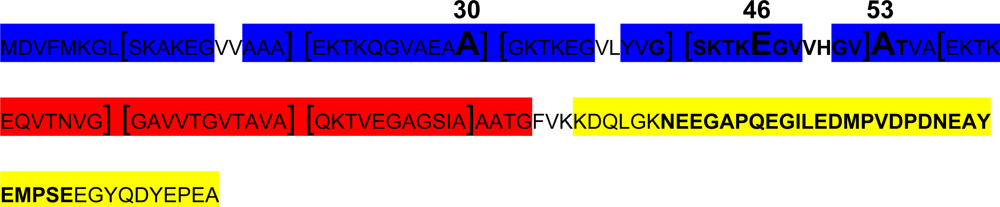
<p>The main evidence of the relevant role of α-syn in PD came from the discovery of three point mutations in the α<italic>-syn</italic> gene that can cause hereditable early-onset PD [<xref ref-type="bibr" rid="b29-ijms-10-01226">29</xref>] in rare pedigrees. These mutations are A53T (change Ala in position 53 to Thr) [<xref ref-type="bibr" rid="b30-ijms-10-01226">30</xref>], A30P (change Ala in position 30 to Pro) [<xref ref-type="bibr" rid="b31-ijms-10-01226">31</xref>] and E46K (change Glu in position 46 to Lys) [<xref ref-type="bibr" rid="b32-ijms-10-01226">32</xref>]. All three occur within the <italic>N</italic>-terminal side of the protein and are able to accelerate the α-syn <italic>oligomeric</italic> aggregation process and protofibril formation [<xref ref-type="bibr" rid="b33-ijms-10-01226">33</xref>] faster than wild-type (wt) α-syn. Therefore, the insoluble <italic>fibrillization</italic> rate was also higher (with the exception of the A30P mutation) than in wt variant [<xref ref-type="bibr" rid="b34-ijms-10-01226">34</xref>,<xref ref-type="bibr" rid="b35-ijms-10-01226">35</xref>], leading to pathologic inclusions, such as LBs and LNs.</p>
<p>Interestingly, several clinical features may be distinguished among A53T carriers <italic>vs.</italic> idiopathic PD patients, such as a slightly earlier onset, a faster disease progression, a lower tremor prevalence, and dementia [<xref ref-type="bibr" rid="b36-ijms-10-01226">36</xref>]. By contrast, patients with the A30P mutation resemble idiopathic PD. The E46K patients exhibit dementia with Lewy Bodies (DLB) and hallucinations, as well as parkinsonism. This mutation, which substitutes a dicarboxylic amino acid, glutamic acid, with a basic amino acid such as lysine in a much conserved area of the protein, is likely to produce a severe disturbance of protein function [<xref ref-type="bibr" rid="b32-ijms-10-01226">32</xref>]. On the other hand, genetic polymorphisms in the α<italic>-syn</italic> gene appear to confer risk for sporadic PD [<xref ref-type="bibr" rid="b37-ijms-10-01226">37</xref>]. In fact, in the Japanese population there are several polymorphisms in the intron 1 that may be associated with PD [<xref ref-type="bibr" rid="b38-ijms-10-01226">38</xref>]. Furthermore, duplication or triplication of the α<italic>-syn</italic> gene has been reported in familial forms of PD [<xref ref-type="bibr" rid="b39-ijms-10-01226">39</xref>], and could implicate gene dosage effects in the PD pathogenesis [<xref ref-type="bibr" rid="b40-ijms-10-01226">40</xref>].</p>
<p>In agreement with genetic and clinical findings, transgenic animal models have revealed an association between α-syn and the disease. In <italic>Drosophila,</italic> for example, when wt- α-syn, A30P or A53T mutants are overexpressed, a motor dysfunction, selective loss of DA neurons and presence of filamentous intraneuronal inclusions that contain α-syn occur [<xref ref-type="bibr" rid="b41-ijms-10-01226">41</xref>]. In contrast, α-syn knock-out mice possess an abnormal activity of DA neurons with reduced levels of DA detected in the striatum. This implies that the protein may play a role in the regulation of neurotransmitter release [<xref ref-type="bibr" rid="b42-ijms-10-01226">42</xref>].</p>
<p>The importance of the link between α-syn and PD, together with the discovery of detectable levels of α-syn in CSF and in human plasma, suggesting that α-syn is released from affected dopaminergic neurons [<xref ref-type="bibr" rid="b43-ijms-10-01226">43</xref>], indicates that α-syn could serve as a marker for early diagnosis of PD. In this regard, an Enzyme-Linked Immuno Sorbent Assay (ELISA) based method has recently been developed to detect oligomeric α-syn in CSF and plasma and could serve as a diagnostic tool for PD and related diseases [<xref ref-type="bibr" rid="b44-ijms-10-01226">44</xref>].</p></sec>
<sec>
<label>2.2.</label>
<title>Biochemical and biological properties</title>
<p>α-Syn belongs to the synuclein family, which includes β-syn and γ-syn [<xref ref-type="bibr" rid="b45-ijms-10-01226">45</xref>]. α-syn and β-syn are predominantly expressed in brain at presynaptic terminals, particularly in the neocortex, hippocampus, striatum, thalamus and cerebellum [<xref ref-type="bibr" rid="b46-ijms-10-01226">46</xref>,<xref ref-type="bibr" rid="b47-ijms-10-01226">47</xref>]. γ-syn is highly expressed in several areas in the brain, particularly in the <italic>substantia nigra,</italic> and has been found to be overexpressed in some breast and ovarian tumors [<xref ref-type="bibr" rid="b48-ijms-10-01226">48</xref>]. α-syn homologues have been found in several mammals, but not in lower organisms such as <italic>Escherichia coli,</italic> yeasts, <italic>Drosophila</italic> or <italic>Caenorhabditis elegans.</italic></p>
<p>α-Syn is a small protein (14 kDa) composed of 140 aminoacids (aa). It is a soluble, acidic, resistant to high temperatures and natively unfolded protein with an extended structure that is mainly composed of random coils [<xref ref-type="bibr" rid="b49-ijms-10-01226">49</xref>]. However, it acquires secondary structure elements upon interaction with ligands and proteins, adopting a partially folded conformation [<xref ref-type="bibr" rid="b50-ijms-10-01226">50</xref>]. A report suggests that unfolded states play a functional role in vesicle fusion in all eukaryotics, bringing membrane surfaces to facilitate fusion, and, after binding, an ordered structure is acquired [<xref ref-type="bibr" rid="b51-ijms-10-01226">51</xref>].</p>
<p>The α-syn sequence can be subdivided in three domains (<xref ref-type="fig" rid="f1-ijms-10-01226">Figure 1</xref>). The highly conserved N-terminal domain (residues 1–65) is unordered in solution and includes seven copies of an unusual 11 aa repeat that displays variations of a KTKEGV consensus sequence that may shift to an α-helical structure under certain conditions [<xref ref-type="bibr" rid="b52-ijms-10-01226">52</xref>,<xref ref-type="bibr" rid="b53-ijms-10-01226">53</xref>]. α-syn can interact with synthetic phospholipid vesicles through this domain [<xref ref-type="bibr" rid="b54-ijms-10-01226">54</xref>], suggesting that the protein may be membrane-associated [<xref ref-type="bibr" rid="b55-ijms-10-01226">55</xref>], becoming α-helix conformation after binding [<xref ref-type="bibr" rid="b56-ijms-10-01226">56</xref>].</p>
<p>The A53T and A30P mutations do not affect the overall structure of α-syn, which remains unfolded, but diminish hydrophobicity of the N-terminal domain; thereby somewhat reducing its ability to form α-helices. The predisposition to form β-sheet structures is enhanced [<xref ref-type="bibr" rid="b50-ijms-10-01226">50</xref>], which renders it more prone to aggregation. Whereas A53T does not affect vesicle binding, A30P is characterized by a decrease in lipid binding [<xref ref-type="bibr" rid="b33-ijms-10-01226">33</xref>].</p>
<p>The central hydrophobic domain of α-syn (residues 66–95) is known as NAC. This peptide portion has been implicated in AD pathogenesis and is the second major component of brain AD amyloid plaques [<xref ref-type="bibr" rid="b57-ijms-10-01226">57</xref>]. It is responsible for protein-protein interactions and confers on α-syn the ability to undergo a conformational change from a random coil to an aggregation-prone β-sheet structure [<xref ref-type="bibr" rid="b58-ijms-10-01226">58</xref>] leading to the formation of amyloid-like fibrils [<xref ref-type="bibr" rid="b59-ijms-10-01226">59</xref>]. An <italic>in vitro</italic> study demonstrated that aged NAC, dissolved in solution for seven days, is more toxic than fresh NAC, suggesting that cytotoxicity depends on prior aggregation [<xref ref-type="bibr" rid="b60-ijms-10-01226">60</xref>]. The NAC region also contains a phosphorylation site on Ser-87.</p>
<p>The acidic Glu-rich C-terminal domain (residues 96–140) has no recognized structure and a strong negative charge [<xref ref-type="bibr" rid="b52-ijms-10-01226">52</xref>]. Several phosphorylation sites have been identified within this region, on Tyr-125, −133 and −136, and Ser−129 [<xref ref-type="bibr" rid="b61-ijms-10-01226">61</xref>]. Its acidic domain (aa 125–140) appears to be critical for the chaperone activity of α-syn [<xref ref-type="bibr" rid="b62-ijms-10-01226">62</xref>]. Chaperones are proteins that prevent irreversible protein aggregation and facilitate the correct folding of proteins through binding <italic>in vivo</italic>. α-syn shares a 40% homology with a chaperone called 14-3-3 [<xref ref-type="bibr" rid="b63-ijms-10-01226">63</xref>], suggesting that both proteins may share the same function. Chaperone 14-3-3 is particularly abundant in brain and can prevent apoptosis by binding with the pro-apoptotic protein, BAD [<xref ref-type="bibr" rid="b64-ijms-10-01226">64</xref>]. α-Syn selectively interacts with 14-3-3 in <italic>substantia nigra,</italic> where it accumulates in LBs, leading to a decrease in available levels of 14-3-3 to inhibit apoptosis [<xref ref-type="bibr" rid="b65-ijms-10-01226">65</xref>]. Both α-syn and 14-3-3 interact with tyrosine hydroxylase (TH), the rate-limiting enzyme in catecholamine synthesis that is responsible for catalyzing the conversion of the amino acid <sc>l</sc>-tyrosine to <sc>l</sc>-dopa. TH activity is stimulated by 14-3-3 and inhibited by α-syn [<xref ref-type="bibr" rid="b66-ijms-10-01226">66</xref>].</p>
<sec>
<label>2.2.1.</label>
<title>Posttranslational modifications</title>
<p>All posttranslational modifications of proteins result in a change of protein size, structure or charge, leading to alterations of their original properties [<xref ref-type="bibr" rid="b67-ijms-10-01226">67</xref>]. With regard to α-syn, there are several modifications:</p></sec>
<sec>
<label>2.2.1.1.</label>
<title>Phosphorylation</title>
<p>Ser-129 was established as a major phosphorylation site, while another was identified at Ser-87. Casein kinases, CK1 and CK2, were found to be responsible for α-syn phosphorylation at Ser-129 and, probably, at Ser-87. Both are localized in the synaptosome and also phosphorylate other synaptic vesicle proteins [<xref ref-type="bibr" rid="b68-ijms-10-01226">68</xref>]. In addition, the G-protein-coupled receptor kinases can phosphorylate α-syn [<xref ref-type="bibr" rid="b69-ijms-10-01226">69</xref>].</p>
<p>It has been determined that more than 90% of insoluble α-syn in LBs is phosphorylated. By contrast, phosphorylation involves only about 4% of normal α-syn, suggesting that phosphorylation is a relevant pathogenic event [<xref ref-type="bibr" rid="b70-ijms-10-01226">70</xref>,<xref ref-type="bibr" rid="b71-ijms-10-01226">71</xref>]. In this regard, phosphorylation at Ser-129 increases fibril formation [<xref ref-type="bibr" rid="b71-ijms-10-01226">71</xref>].</p>
<p>Interestingly, cotransfection experiments of α-syn and synphilin-1, a protein that interacts with α-syn, yielded cytoplasmic inclusions that were similar to LBs. Subsequent coexpression of S129A α-syn (that is unable to be phosphorylated at Ser-129), synphilin-1 and parkin (a ubiquitin ligase responsible for α-syn and synphilin-1 ubiquitination), showed an important decrease in cytoplasmic inclusions [<xref ref-type="bibr" rid="b72-ijms-10-01226">72</xref>], indicating that phosphorylation at Ser-129 enhances the formation of inclusion bodies and is a necessary step in the development of LBs. Transgenic mouse models that overexpress α-syn have shown a neurodegeneration that is accompanied by phosphorylation at Ser-129, caspase 9 activation and apoptosis [<xref ref-type="bibr" rid="b73-ijms-10-01226">73</xref>].</p>
<sec>
<label>2.2.1.2.</label>
<title>Nitration</title>
<p>Nitration has been proposed as one of the oxidative mechanisms responsible of the formation of α-syn oligomers, through di-tyrosine crosslinking [<xref ref-type="bibr" rid="b74-ijms-10-01226">74</xref>]. Soluble nitrated α-syn is not efficiently processed by proteases, leading to partial folding, accumulation and fibril formation [<xref ref-type="bibr" rid="b75-ijms-10-01226">75</xref>]. Consequently, nitrated α-syn has been found in LBs deriving from brains with PD [<xref ref-type="bibr" rid="b76-ijms-10-01226">76</xref>]. The primary sequence of α-syn contains four sites for potential nitration: Tyr-39, −125, −133 and −136, all of which have been found nitrated in LBs [<xref ref-type="bibr" rid="b77-ijms-10-01226">77</xref>].</p></sec>
<sec>
<label>2.2.1.3.</label>
<title>Ubiquitination</title>
<p>Protein modification by ubiquitin is one of the main mechanisms of protein targeting for proteasome degradation. Specifically regarding α-syn, the specific substrate for ubiquitination by parkin is the <italic>O</italic>-glycosylated α-syn form, with glycosylation potentially occurring at Ser-129 [<xref ref-type="bibr" rid="b78-ijms-10-01226">78</xref>]. α-Syn ubiquitination occurs <italic>in vivo</italic> at Lys-6, −10 and −12. Nevertheless, it remains unclear whether monomeric α-syn requires ubiquitination, since α-syn is a natively unfolded protein and, therefore, it may not require ubiquitination and unfolding. Instead, it could enter the 20S proteasome directly [<xref ref-type="bibr" rid="b67-ijms-10-01226">67</xref>]. In contrast, ubiquitin moieties are present in LBs associated with α-syn aggregates [<xref ref-type="bibr" rid="b79-ijms-10-01226">79</xref>]. In addition, only high molecular weight α-syn fibrils, and not the monomeric protein, are substrates for oligoubiquitination in sporadic LB diseases [<xref ref-type="bibr" rid="b80-ijms-10-01226">80</xref>]. It thus appears that ubiquitination of α-syn is a pathologic event associated with LB formation. Moreover, α-syn and parkin colocalize together in LBs, and a report suggests that α-syn aggregation could precede ubiquitination [<xref ref-type="bibr" rid="b81-ijms-10-01226">81</xref>].</p>
<p>Several mutations associated to early-onset PD have been described in genes related to ubiquitination, for example, within the ubiquitin C-terminal hydrolase gene [<xref ref-type="bibr" rid="b82-ijms-10-01226">82</xref>], thereby highlighting the importance of the misfunction of this mechanism in parkinsonism.</p>
<p>Protein degradation is tightly regulated in eukaryotic cells, and unfolded proteins, like α-syn, have a reduced lifetime and undergo a fast turnover. In many cases, this turnover is mediated by sequences rich in Pro, Glu, Ser and Thr, which target the protein for proteolysis [<xref ref-type="bibr" rid="b83-ijms-10-01226">83</xref>], and are often present within a highly charged and unstructured region, preferentially in the C-terminal domain.</p></sec></sec>
<sec>
<label>2.2.2.</label>
<title>α-Synuclein alternative splicing</title>
<p>Alternative splicing is a mechanism to support the generation of multiple mRNAs from a single transcript. Each alternatively spliced transcript contains significant changes in protein secondary structure that may cause functional alterations, and shifts the protein isoform ratio. There are two types of transcripts from pre-mRNA alternative splicing: C-terminal truncated proteins generated by reading frame changes that result in the introduction of a premature stop codon, and in-frame deletions with exon loss without a frame shift. With regard to α-syn, the 140 aa isoform is the whole protein and also the major transcript, whereas alternative splicing of exons 3 or 5 gives rise to 126 or 112 aa isoforms, respectively, both from in-frame deletions [<xref ref-type="bibr" rid="b67-ijms-10-01226">67</xref>]. In addition, a 98 aa isoform of α-syn, which lacks exons 3 and 5, has been recently reported [<xref ref-type="bibr" rid="b84-ijms-10-01226">84</xref>]. The splice-out of exon 3 results in the interruption of the helical protein-membrane interacting domain by deleting most of helix 3 and part of helix 4, and thereby impairing the aggregation-prone interaction with membranes [<xref ref-type="bibr" rid="b85-ijms-10-01226">85</xref>]. Interestingly, the E46K and A53T mutations are sited in exon 3.</p>
<p>α-Syn 112 lacks exon 5 (aa 103–130) located on the C-terminal half of the protein. It shows an enhanced tendency to aggregate and fibrillize [<xref ref-type="bibr" rid="b86-ijms-10-01226">86</xref>], in spite of the lack of the main phosphorylation site located at Ser-129 (although maintaining the phosphorylation site at Ser-87). Thus, either phosphorylation or structural alterations are responsible for aggregation, but other explanations arise, such as the lack of the proteolysis signal sequence at the C-terminus, leading to accumulation and aggregation. In addition, it has been proposed that the C-terminus may act as an intramolecular chaperone, preventing α-syn fibrillization [<xref ref-type="bibr" rid="b62-ijms-10-01226">62</xref>].</p>
<p>A differential mRNA expression study [<xref ref-type="bibr" rid="b87-ijms-10-01226">87</xref>] revealed different α-syn expression levels when comparing patients with DLB to controls. α-syn 140 expression levels were diminished as result of neuronal loss and an important 5-fold decrease of α-syn 126, together with a two-fold increase of α-syn 112 and α-syn 98 were described [<xref ref-type="bibr" rid="b84-ijms-10-01226">84</xref>], suggesting an involvement of these latter isoforms in DLB pathologies that likely related to LBs formation. The decrease in α-syn 126 expression probably unbalances the ratio among the three isoforms towards the more prone to aggregate 112 aa isoform, albeit that no pathological processes related to α-syn 126 have yet been reported.</p></sec>
<sec>
<label>2.2.3.</label>
<title>Vesicle trafficking regulation</title>
<p>α-syn has the ability to bind phospholipid vesicles through its <italic>N</italic>-terminal domain, with four amphipathic α-helices that are typical of lipid-binding proteins. It is found in pre-synaptic termini, in equilibrium between free and membrane-bound states [<xref ref-type="bibr" rid="b88-ijms-10-01226">88</xref>], with approximately 15% of α-syn being membrane-bound [<xref ref-type="bibr" rid="b55-ijms-10-01226">55</xref>]. This led to the hypothesis that α-syn might regulate vesicular release and/or turnover and other synaptic functions within the CNS [<xref ref-type="bibr" rid="b59-ijms-10-01226">59</xref>]. Expression profiling in transgenic flies revealed that expression of lipid and membrane transport genes were associated with α-syn expression [<xref ref-type="bibr" rid="b89-ijms-10-01226">89</xref>]. Furthermore, overexpression of α-syn was accompanied by noticeable changes in membrane fluidity and in fatty acid uptake and metabolism [<xref ref-type="bibr" rid="b90-ijms-10-01226">90</xref>].</p>
<p>An analysis of a yeast PD model revealed that the earliest defects following α-syn overexpression were an inhibition of the endoplasmatic reticulum (ER) to Golgi vesicular trafficking and an impairment of the ER-associated degradation [<xref ref-type="bibr" rid="b91-ijms-10-01226">91</xref>]. In PC12 cells, α-syn regulates catecholamine release from synaptic vesicles, and its overexpression inhibits the vesicle priming process after secretory vesicle trafficking to docking sites [<xref ref-type="bibr" rid="b92-ijms-10-01226">92</xref>]. Finally, α-syn appears also to be involved in the regulation of certain enzymes, transporters and neurotransmitter vesicles [<xref ref-type="bibr" rid="b93-ijms-10-01226">93</xref>].</p></sec>
<sec>
<label>2.2.4.</label>
<title>Interaction with other proteins</title>
<p>α-Syn acts as a specific inhibitor of phospholipase D2 (PLD2) [<xref ref-type="bibr" rid="b94-ijms-10-01226">94</xref>], which hydrolyzes phosphatidylcholine to phosphatidic acid (PA) [<xref ref-type="bibr" rid="b95-ijms-10-01226">95</xref>]. Activation of PLD2 and generation of PA elicits a wide array of cell responses, including Ca<sup>2+</sup> mobilization, secretion, superoxide production, endocytosis, exocytosis, vesicle trafficking, recycling of membrane receptors, transport to Golgi, rearrangements of cytoskeleton, mitogenesis and cell survival. PA can serve as a protein attachment site, altering membrane curvature and vesicle fusion [<xref ref-type="bibr" rid="b94-ijms-10-01226">94</xref>].</p>
<p>Phosphorylation of α-syn by G-protein coupled receptor kinases results in a significant reduction in the α-syn affinity for phospholipids and a decrease in its binding with PLD2. Once detached from the plasmatic membrane (PM), α-syn is able to release any membrane-bound PLD2, allowing potential hydrolysis of phosphatidilcholine, the major lipidic component of cell membranes, to potentially increase membrane permeability [<xref ref-type="bibr" rid="b4-ijms-10-01226">4</xref>].</p></sec>
<sec>
<label>2.2.5.</label>
<title>Chaperone activity</title>
<p>As discussed, α-syn has chaperone functions, assisting in the folding and unfolding of many synaptic proteins. In addition, transgenic mice with the cysteine-string protein-α (CSPα, a synaptic vesicle protein that acts as a co-chaperone) gene deleted have a phenotype of neurodegeneration. However, transgenic expression of α-syn prevented the development of this pathological sign. Thus, α-syn appears to complement the chaperone activity of CSPα [<xref ref-type="bibr" rid="b96-ijms-10-01226">96</xref>].</p></sec></sec></sec>
<sec>
<label>3.</label>
<title>Pathogenic Mechanisms of Alpha-Synuclein. Factors Affecting Fibrillization. Role of Iron in Oxidative Stress</title>
<sec>
<label>3.1.</label>
<title>Conformational states of α-synuclein</title>
<p>The structural disposition of α-syn can show under a number of different conformations:
<list list-type="order">
<list-item>
<p>The intrinsic unfolded state under physiologic conditions, both <italic>in vitro</italic> and <italic>in vivo.</italic></p></list-item>
<list-item>
<p>The pre-molten globule state, a compact but incompletely folded state of proteins that contains most of the secondary structure but lacks tertiary interactions [<xref ref-type="bibr" rid="b97-ijms-10-01226">97</xref>], and is predominant under conditions such as low pH, high temperature, several metal ions [<xref ref-type="bibr" rid="b98-ijms-10-01226">98</xref>], several salts [<xref ref-type="bibr" rid="b98-ijms-10-01226">98</xref>], and several common pesticides/herbicides [<xref ref-type="bibr" rid="b99-ijms-10-01226">99</xref>]. It is stabilized as result of spontaneous oligomerization both <italic>in vivo</italic> and <italic>in vitro</italic> [<xref ref-type="bibr" rid="b100-ijms-10-01226">100</xref>]. It is thought that the negative electrostatical potential and locally low pH in the vicinity of the membrane surface induces protein conformation to molten globules. Early stages of fibrillization involve the partial folding of α-syn into the highly fibrillization-prone pre-molten globule conformation, which represents a key intermediate along the fibrillization pathway [<xref ref-type="bibr" rid="b101-ijms-10-01226">101</xref>].</p></list-item>
<list-item>
<p>The α-helical membrane-bound form in the <italic>N</italic>-terminal fragment, while the glutamate-rich <italic>C</italic>-terminal region remains unstructured.</p></list-item>
<list-item>
<p>The β-sheet state: it has been observed that under certain conditions α-syn acquires a β-pleated sheet, which is very prone to form amorphous aggregates [<xref ref-type="bibr" rid="b102-ijms-10-01226">102</xref>].</p></list-item>
<list-item>
<p>Dimers: α-syn is able to form morphologically distinct oligomers, for example under high temperature [<xref ref-type="bibr" rid="b100-ijms-10-01226">100</xref>], where dimers are formed first, and aggregates. The formation of oxidative dimers and high-order oligomers with covalent di-tyrosine cross-links under conditions of oxidative stress has also been reported [<xref ref-type="bibr" rid="b74-ijms-10-01226">74</xref>].</p></list-item>
<list-item>
<p>Oligomers: nitrated α-syn assembles into spherical oligomers [<xref ref-type="bibr" rid="b100-ijms-10-01226">100</xref>]. Incubation of α-syn with several metals gave rise to different classes of oligomers: Cu<sup>2+</sup>, Fe<sup>3+</sup> and Ni<sup>2+</sup> yielded 0.8–4 nm spherical particles, similar to those formed by incubation of α-syn alone; Mg<sup>2+</sup>, Cd<sup>2+</sup> and Zn<sup>2+</sup> yielded larger (5–8 nm) spherical oligomers; and Co<sup>2+</sup> and Ca<sup>2+</sup> produced ring oligomers with diameters between 70–90 nm for the former and 22–30 nm in the case of the latter [<xref ref-type="bibr" rid="b103-ijms-10-01226">103</xref>]. It has been observed that the earliest form of α-syn protofibrils appeared to be mainly spherical [<xref ref-type="bibr" rid="b35-ijms-10-01226">35</xref>]. The incubation of spherical α-syn oligomers with brain-derived membranes has been shown to produce pore-like ring-type protofibrils [<xref ref-type="bibr" rid="b103-ijms-10-01226">103</xref>], which may disturb ionic gradients in cells. This conjecture was supported by showing that α-syn oligomers (and not monomeric or filamentous α-syn) enhanced the membrane permeability for Ca<sup>2+</sup>, an important subcellular messenger in liposomes [<xref ref-type="bibr" rid="b104-ijms-10-01226">104</xref>]. The role for membrane permeabilization by α-syn <italic>in vivo</italic> is not clear and a large number of pores could lead to cell lysis, but even a subtle ionic disturbance could lead to neuronal dysfunction, death and degeneration.</p></list-item>
<list-item>
<p>Insoluble aggregates: finally, α-syn have been shown to assemble into large, insoluble aggregates with two distinct morphologies (amorphous aggregates and fibrils), with a high amount of β-sheet structure.</p></list-item></list></p>
<p>Because of this number of possible structural conformations, it seems reasonable to suggest that α-syn is potentially prone to misfold [<xref ref-type="bibr" rid="b105-ijms-10-01226">105</xref>]. Fibrillization is a nucleation polymerization process, in which there is an initial lag phase, during which nuclei are formed, followed by the exponential growth of the fibrils, and an equilibrium phase between the protein in solution and the protein in fibrillar form [<xref ref-type="bibr" rid="b49-ijms-10-01226">49</xref>]. The fibrillization rate increases with higher α-syn concentration, low pH, high temperature, oxidative stress-inducing compounds such as DA [<xref ref-type="bibr" rid="b106-ijms-10-01226">106</xref>], the dopaminergic neurotoxin 1-methyl-4-phenyl-1,2,3,6-tetrapyridine (MPTP) [<xref ref-type="bibr" rid="b107-ijms-10-01226">107</xref>], lipids [<xref ref-type="bibr" rid="b54-ijms-10-01226">54</xref>] and pesticides [<xref ref-type="bibr" rid="b99-ijms-10-01226">99</xref>]. The insoluble aggregates might represent the major building blocks of synucleinopathies-related inclusions, as LBs, LNs, GCIs and axonal spheroids, all of them observed in PD and related pathologies, as well as in other CNS disorders, including AD.</p></sec>
<sec>
<label>3.2.</label>
<title>Factors affecting α-syn fibrillization</title>
<p>As stated above, a number of environmental and genetic factors can induce partial folding of α-syn, and therefore these same factors are able to accelerate the fibrillization process. Other aggregation-prone factors are:
<list list-type="order">
<list-item>
<p>Oxidation: the exposure of α-syn to oxidative agents induces the formation of high-order oligomers [<xref ref-type="bibr" rid="b74-ijms-10-01226">74</xref>], and both the familial Parkininsonian A30P and A53T mutants have shown an even higher rate of self-assembly [<xref ref-type="bibr" rid="b108-ijms-10-01226">108</xref>], providing support for the hypothesis that an impairment of cellular antioxidative mechanisms and/or overproduction of reactive oxygen species (ROS) may cause the initiation and progression of neurodegenerative synucleinopathies [<xref ref-type="bibr" rid="b109-ijms-10-01226">109</xref>]. However, all amino acids are susceptible to oxidation [<xref ref-type="bibr" rid="b110-ijms-10-01226">110</xref>], methionine being one of the easiest to undergo oxidation to form methionine sulfoxide (MetO). Thus, contrary to expectations, under mild oxidative conditions, when all four Met in α-syn are oxidized to MetO, the oxidized α-syn was found to be more unfolded than the non-oxidized form and less prone to oligomerize and fibrillate. Indeed, it even proved able to inhibit the fibrillization of non-modified α-syn [<xref ref-type="bibr" rid="b111-ijms-10-01226">111</xref>].</p>
<p>DA metabolism in nigrostratial neurons can produce ROS and contribute to lipid peroxidation, DNA damage, impairment of mitochondrial function, depletion of reduced glutathione (GSH), and, finally, cell death [<xref ref-type="bibr" rid="b112-ijms-10-01226">112</xref>]. Over-expression of α-syn, and especially its mutant forms, enhances the vulnerability of neurons to DA-induced cell death through massive generation of ROS [<xref ref-type="bibr" rid="b113-ijms-10-01226">113</xref>]. It has been proved that conjugation of DA with α-syn impedes the protofibril-to-fiber transition and, therefore, potentially more cytotoxic protofibrils may accumulate [<xref ref-type="bibr" rid="b114-ijms-10-01226">114</xref>]. Transfection of wt- α-syn, A30P or A53T mutants has been reported to trigger apoptosis of cultured dopaminergic neurons, whereas there was an increase in survival of non-dopaminergic neurons [<xref ref-type="bibr" rid="b65-ijms-10-01226">65</xref>]. Inhibition of DA synthesis by blocking TH activity prevented α-syn induced apoptosis.</p>
<p>Damage caused by DA species is mediated by DA auto-oxidation catalyzed by free metals (especially Fe) [<xref ref-type="bibr" rid="b115-ijms-10-01226">115</xref>], yielding 6-hydroxydopamine (6-OHDA) or through enzymatic deamination by MAOs to form toxic DA metabolites and hydrogen peroxide (H<sub>2</sub>O<sub>2</sub>) [<xref ref-type="bibr" rid="b116-ijms-10-01226">116</xref>]. Levels of MAO-B appear to be highest in the <italic>substantia nigra</italic>. H<sub>2</sub>O<sub>2</sub> produced as a by-product of DA oxidation and as normal oxygen reduction by MAOs is highly permeable and cannot be converted to water by GSH peroxidase due the low level of available GSH as a reducer [<xref ref-type="bibr" rid="b117-ijms-10-01226">117</xref>], allowing H<sub>2</sub>O<sub>2</sub> to potentially diffuses out of dopaminergic neurons and damage the neighbouring neurons. Under normal conditions, ROS are kept under control by an efficient antioxidant cascade. This includes the cytosolic copper-zinc superoxide dismutase and the mitochondrial manganese superoxide dismutase, which convert superoxide to oxygen and H<sub>2</sub>O<sub>2</sub>. The latter, in turn, is removed by catalases and peroxidases. These enzymes are key to scavenge ROS generated by oxidative insults. For example, in a transgenic murine model that overexpressed Cu/Zn superoxide dismutase or GSH peroxidase and was treated with pesticide paraquat, which causes a PD-like profile, the transgenic animals did not show alterations as reductions in locomotor activity, levels of striatal DA and metabolites, or dopaminergic neurons in the <italic>substantia nigra</italic>, unlike non-transgenic controls in which all of these were affected [<xref ref-type="bibr" rid="b118-ijms-10-01226">118</xref>].</p>
<p>Soluble α-syn is able to interact with the DA transporter (DAT) through the NAC domain [<xref ref-type="bibr" rid="b119-ijms-10-01226">119</xref>], decreasing the amount of DAT in the PM, to allow for an optimal moderate level of synaptic DA reuptake to be accumulated into vesicles. In the event of α-syn aggregation, a decrease in the level of soluble α-syn results, and leads to the increased PM accumulation of DAT, giving rise to a massive entry of DA into the cell and consequent potential generation of ROS [<xref ref-type="bibr" rid="b116-ijms-10-01226">116</xref>]. In accordance, the much more neurotoxic A53T mutant (but not A30P) interacts very weakly with DAT and causes an impairment of vesicular DA storage and release [<xref ref-type="bibr" rid="b119-ijms-10-01226">119</xref>].</p>
<p>Interestingly, the dopaminergic neurotoxin MPTP, which causes a PD-like neurodegeneration in rodents, humans and primates, enters into the cell through the DAT as its ionic metabolite MPP<sup>+</sup>. It then targets the mitochondria, inhibits complex I of the electron transport chain, impairs ATP production, induces a loss of mitochondrial membrane potential allowing the release of cytochrome c and generation of ROS, and additionally, increases α-syn mRNA and protein levels. The A53T mutant can enhance the vulnerability of cells to MPP<sup>+</sup>, while α-syn null-mice are resistant to MPP<sup>+</sup>-induced degeneration [<xref ref-type="bibr" rid="b120-ijms-10-01226">120</xref>], signifying a fundamental role of α-syn in drug-mediated neurotoxicity.</p></list-item>
<list-item>
<p>Interactions with polyanions: different glycosaminoglycans (GAGs) are involved in the formation of amyloid plaques in a variety of neurological disorders [<xref ref-type="bibr" rid="b121-ijms-10-01226">121</xref>] and some highly sulphated GAGs (heparin and heparan-sulphate) as well as the proteoglycan agrin are able to bind to α-syn and stimulate its fibrillization <italic>in vitro</italic>. Furthermore, agrin and α-syn co-localize in LBs and LNs [<xref ref-type="bibr" rid="b122-ijms-10-01226">122</xref>,<xref ref-type="bibr" rid="b123-ijms-10-01226">123</xref>].</p></list-item>
<list-item>
<p>Interaction with polycations: polycations, such as polyamines, are cellular stabilizers of nucleic acids and membranes, and are essential for growth and differentiation. Interaction with α-syn induced the partial folding of α-syn and, consequently, its oligomerization and fibrillization [<xref ref-type="bibr" rid="b124-ijms-10-01226">124</xref>] by binding to the negatively charged C-terminus.</p></list-item>
<list-item>
<p>Interaction with histones: some animal models of PD are created by administration of the pesticide paraquat to mice where it elevates mouse brain α-syn levels [<xref ref-type="bibr" rid="b125-ijms-10-01226">125</xref>]. Additionally, paraquat promoted <italic>in vitro</italic> the overexpression and translocation of α-syn into the cell nucleus, where it can interact with highly basic histones to form complexes that trigger its aggregation, and may reflect aspects of the <italic>in vivo</italic> situation [<xref ref-type="bibr" rid="b124-ijms-10-01226">124</xref>].</p></list-item>
<list-item>
<p>α-Syn--α-syn crosslinking: tissue transglutaminase (tTG) catalyzes covalent crosslinking between reactive Lys and Glu residues [<xref ref-type="bibr" rid="b126-ijms-10-01226">126</xref>]. Substrates for tTG include Ap, tau (another hallmark of AD) and the NAC fragment of α-syn, all of them are proteins that undergo aggregation in several neurodegenerative disorders. tTG catalyzes α-syn cross-linking, leading to the formation of high molecular weight aggregates <italic>in vitro</italic> [<xref ref-type="bibr" rid="b127-ijms-10-01226">127</xref>], mainly associated with the membrane fraction. Increased levels of tTG have been reported in the <italic>substantia nigra</italic> of PD postmortem brains [<xref ref-type="bibr" rid="b128-ijms-10-01226">128</xref>].</p></list-item>
<list-item>
<p>Interaction with membranes: interaction with synaptic vesicles is one of the biological functions of α-syn. The membrane-bound fraction (about a 15% of total), was shown to have a high aggregation propensity and was able to seed aggregation of the cytosolic form of α-syn [<xref ref-type="bibr" rid="b55-ijms-10-01226">55</xref>]. Furthermore, fatty acids and anionic lipids are potent inducers of α-syn fibrillization. <italic>In vitro</italic> association of soluble α-syn with lipid bilayers resulted in the formation of amorphous aggregates and filaments [<xref ref-type="bibr" rid="b129-ijms-10-01226">129</xref>].</p></list-item>
<list-item>
<p>Interaction with other proteins: several proteins have been found to interact with α-syn and some of them were shown to stimulate α-syn aggregation <italic>in vitro,</italic> including tau [<xref ref-type="bibr" rid="b130-ijms-10-01226">130</xref>], brain-specific protein p25α [<xref ref-type="bibr" rid="b131-ijms-10-01226">131</xref>], MAP-1B [<xref ref-type="bibr" rid="b132-ijms-10-01226">132</xref>] and tubulin [<xref ref-type="bibr" rid="b133-ijms-10-01226">133</xref>], all of which are components of LBs and/or GCIs, leading to cytoskeleton impairment. The mechanism of interaction remains unknown, but all contain basic motifs, suggesting that interaction could be through ionic bonds. On the other hand, transcriptional factors, such as NF-κB or Elk-1, have been found in LBs [<xref ref-type="bibr" rid="b134-ijms-10-01226">134</xref>], suggesting that the sequestration of these factors in the cytosol may compromise the coordination of gene expression in degenerating cells. Similarly, high mobility group B-1 protein (HMGB-1), which is a nuclear DNA-binding protein that facilitates the interaction between DNA and transcriptional factors, has been demonstrated to bind directly with filamentous α-syn <italic>in vitro</italic> and it too is present in LBs [<xref ref-type="bibr" rid="b135-ijms-10-01226">135</xref>], potentially disturbing gene expression. α-syn also interacts with other important signalling proteins, epitomized by PKC or ERKs, which can affect cellular viability.</p></list-item>
<list-item>
<p>Proteins inhibiting α-synuclein aggregation:
<list list-type="roman-lower">
<list-item>
<p>Chaperones: heat shock proteins (HSPs) are a family of chaperones induced by stress conditions. These proteins suppress protein aggregation and participate in refolding and/or degradation. Hsp70 and Hsp40 are components of LBs and/or GCIs and co-localize with α-syn. Overexpression of HSPs is able to suppress α-syn aggregation <italic>in vitro</italic> [<xref ref-type="bibr" rid="b136-ijms-10-01226">136</xref>].</p></list-item>
<list-item>
<p>β- and γ-synucleins: these proteins share some features with α-syn, but lack others. The α-and β-syn have a conserved <italic>C</italic>-terminus; however β-syn is deficient of 11 aa within the NAC region [<xref ref-type="bibr" rid="b137-ijms-10-01226">137</xref>]. On the other hand, γ-syn lacks the Tyr rich C-terminal. All the three behave as typical natively unfolded proteins, but there is a little structural variability. β-syn has properties of a typical random coil, whereas α- and γ-syn are slightly more compact and structured [<xref ref-type="bibr" rid="b138-ijms-10-01226">138</xref>]. Both are able to form fibrils, while β-syn is not, when incubated under the same conditions, however even β-syn can be forced to fibrillate in the presence of specific metals (Zn<sup>2+</sup>, Pb<sup>2+</sup>, Cu<sup>2+</sup>), pesticides [<xref ref-type="bibr" rid="b139-ijms-10-01226">139</xref>] or by addition of GAGs. Interestingly, the addition of β- or γ-syn in a 1:1 ratio with α-syn increased the time duration of the lag phase and decreased the elongation phase of α-syn fibrillization [<xref ref-type="bibr" rid="b138-ijms-10-01226">138</xref>], and was completely inhibited at a 4:1 ratio of an excess of β- or γ-syn over α-syn. This suggests that β- and γ-syn may be regulators of α-syn fibrillization <italic>in vivo</italic> [<xref ref-type="bibr" rid="b140-ijms-10-01226">140</xref>], potentially acting as chaperones.</p></list-item></list></p></list-item>
<list-item>
<p>Phosphorylation: as discussed above, α-syn undergoes extensive phosphorylation at Ser-129 in synucleinopathies and in ageing brains [<xref ref-type="bibr" rid="b141-ijms-10-01226">141</xref>] and it is mostly unphosphorylated under normal conditions [<xref ref-type="bibr" rid="b71-ijms-10-01226">71</xref>]. The specific phosphorylation at Ser-129 by CK2 resulted in oligomerization and fibrillization. Furthermore, oxidative stress has been described to enhance α-syn phosphorylation [<xref ref-type="bibr" rid="b72-ijms-10-01226">72</xref>].</p></list-item>
<list-item>
<p>Ubiquitin proteasome system (UPS) malfunction: mutated, misfolded or unassembled proteins are ubiquitinated to be degraded. There is evidence that UPS is impaired in several neurodegenerative diseases, including PD. For example, proteosomal subunits and ubiquitinated proteins have been found in LBs [<xref ref-type="bibr" rid="b142-ijms-10-01226">142</xref>]. An inhibitory effect of α-syn aggregates on the hydrolytic activity of the 26S proteosome subunit <italic>in vitro</italic> has been reported [<xref ref-type="bibr" rid="b143-ijms-10-01226">143</xref>], and a direct interaction between filaments and the 20S subunit has been shown. Accordingly, in transgenic animals, the inhibition of 20/26 S proteasome in <italic>substantia nigra</italic> led to α-syn accumulation and inclusion body formation, and resulted in a relatively selective degeneration of dopaminergic neurons [<xref ref-type="bibr" rid="b144-ijms-10-01226">144</xref>]. Hsp70 expression can attenuate α-syn aggregation toxicity, by binding to α-syn filaments, abrogating its proteasomal inhibitory effect [<xref ref-type="bibr" rid="b145-ijms-10-01226">145</xref>].</p></list-item>
<list-item>
<p>Effect of A30P, A53T and E46K mutations: all these three mutants have been shown to accelerate α-syn oligomerization. While A53T and E46K increase fibril formation more rapidly than wt-α-syn and do not alter lipid-vesicle binding, suggesting that enhanced polymerization induces the disease in patients harbouring these mutations [<xref ref-type="bibr" rid="b129-ijms-10-01226">129</xref>]. On the other hand, it has been reported that A30P fibrillates slowly, retarding significantly the formation of mature fibrils [<xref ref-type="bibr" rid="b35-ijms-10-01226">35</xref>] and binds poorly to vesicles compared with the wt, maybe hindering axonal transport, leading to accumulation and aggregation, and accelerating the initial oligomerization of α-syn.</p></list-item>
<list-item>
<p><italic>C</italic>-terminal truncation: <italic>C</italic>-terminal truncated α-syn can increase α-syn-induced toxicity and aggregation ratio. Additionally, co-expression of full-length α-syn and the <italic>C</italic>-truncated form induced the formation of cytoplasmic inclusions and increased the susceptibility of cells to oxidative stress. This suggests that the <italic>C</italic>-terminus can play a role of an intramolecular chaperone by preventing α-syn from fibrillization [<xref ref-type="bibr" rid="b62-ijms-10-01226">62</xref>]. Interstingly, <italic>C</italic>-terminally truncated A53T α-syn has been shown to induce the aggregation of full-length A53T protein faster than its wt counterpart, demonstrating that the mutation increases the accelerating effect that the truncated protein has on the aggregation of full-length α-syn [<xref ref-type="bibr" rid="b146-ijms-10-01226">146</xref>].</p></list-item>
<list-item>
<p>Interaction with metals: postmortem analysis of brain tissues from patients with PD confirm the presence of considerable amounts of metals, such as Fe, Zn and Al, in the <italic>substantia nigra</italic> as well as in LBs when compared with healthy age-matched controls [<xref ref-type="bibr" rid="b147-ijms-10-01226">147</xref>,<xref ref-type="bibr" rid="b148-ijms-10-01226">148</xref>]. α-syn can interact with several polycations, including Fe<sup>2+</sup>, Al<sup>3+</sup>, Zn<sup>2+</sup>, Cu<sup>2+</sup>, Mg<sup>2+</sup> and Ca<sup>2+</sup> [<xref ref-type="bibr" rid="b149-ijms-10-01226">149</xref>], through the C-terminal domain, and this binding can catalyze protein aggregation. Additionally, some metals, such as Al [<xref ref-type="bibr" rid="b150-ijms-10-01226">150</xref>], can induce a conformational change of α-syn from an unstructured to partially folded β-sheet structure intermediates and, lately, to fibrils [<xref ref-type="bibr" rid="b98-ijms-10-01226">98</xref>]. Moreover, there is a shift in the Fe<sup>2+</sup>/Fe<sup>3+</sup> ratio in favour of Fe<sup>3+</sup>, and a significant increase in the Fe<sup>3+</sup>-binding protein ferritin, together with a decrease in GSH content. Nevertheless, the concentration of metals necessary to induce aggregation is controversial. In general, the required concentration above the physiological values of the metals [<xref ref-type="bibr" rid="b151-ijms-10-01226">151</xref>]. Hence, it is probable that metal-induced aggregation is carried out by oxidation of redox metals, rather than specific binding [<xref ref-type="bibr" rid="b152-ijms-10-01226">152</xref>].</p></list-item></list></p>
<p>As mentioned above, oxidation can lead to degeneration of dopaminergic neurons, resulting from the increased level of redox-active metals ions (Cu or Fe) within the <italic>substantia nigra</italic>, which initiates a cascade of events, such as α-syn oligomerization, mitochondrial dysfunction, cytotoxicity, and a rise of cytosolic free Ca, leading to cell death.</p></sec>
<sec>
<label>3.3.</label>
<title>Overexpression of α-synuclein</title>
<p>As commented above, duplication or triplication of the <italic>α-syn</italic> gene has been reported in early-onset PD patients, suggesting a dose-dependence association with the disease, and genetic polymorphisms in the <italic>α-syn</italic> gene are linked to idiopathic PD by increases in α-syn concentration [<xref ref-type="bibr" rid="b40-ijms-10-01226">40</xref>]. Other studies have revealed that the overexpression of α-syn can induce Fe-dependent aggregation [<xref ref-type="bibr" rid="b153-ijms-10-01226">153</xref>].</p>
<p>Under physiological conditions, there is an equilibrium between the natively unfolded and the partially folded conformation; therefore a high α-syn concentration may increase the rate of fibrillization due to an increased total concentration of the partially folded fibrillization-prone conformation [<xref ref-type="bibr" rid="b105-ijms-10-01226">105</xref>]. Several studies report an increase in α-syn mRNA levels in brains of patients with PD compared to healthy controls [<xref ref-type="bibr" rid="b154-ijms-10-01226">154</xref>]. In fact, overexpression of α-syn can generate α-syn immunopositive inclusions, together with alterations in mitochondria, increases in ROS production [<xref ref-type="bibr" rid="b155-ijms-10-01226">155</xref>], lysosomal dysfunction [<xref ref-type="bibr" rid="b156-ijms-10-01226">156</xref>] and Golgi fragmentation [<xref ref-type="bibr" rid="b157-ijms-10-01226">157</xref>], leading to cell death. Of note, all these effects could be partially attenuated by antioxidants [<xref ref-type="bibr" rid="b155-ijms-10-01226">155</xref>].</p>
<p>Accordingly, murine models transfected with recombinant viruses that overexpressed wt- α-syn or the A53T mutated form showed the typical features of PD in humans, including a loss of dopaminergic neurons in <italic>substantia nigra</italic>, α-syn inclusions similar to LBs [<xref ref-type="bibr" rid="b158-ijms-10-01226">158</xref>] and a reduction in TH levels. In fact, a correlation between the number of α-syn immunoreactive LBs and α-syn mRNA levels has been found [<xref ref-type="bibr" rid="b159-ijms-10-01226">159</xref>].</p>
<p>Another useful murine model to study PD is created by the injection of MPTP, which has been reported to enhance the production of α-syn at both mRNA and protein levels, and induce formation of α-syn-positive inclusions in neurons and abnormal locomotor function [<xref ref-type="bibr" rid="b160-ijms-10-01226">160</xref>]. Similarly, administration of the pesticide paraquat to mice caused an upregulation of α-syn and formation of α-syn aggregates. A faster PD-like model has been obtained by using an alternative pesticide, rotenone, which is highly lipophilic and readily crosses plasma membranes to allow rapid brain entry [<xref ref-type="bibr" rid="b161-ijms-10-01226">161</xref>]. Within brain, it inhibits mitochondrial complex I and increases oxidative stress by ROS production leading to degeneration of dopaminergic neurons and fibrillar α-syn inclusions [<xref ref-type="bibr" rid="b162-ijms-10-01226">162</xref>]. It has been demonstrated that at a nM range concentration, α-syn provides neurons protection against serum deprivation, oxidative stress and excitotoxicity, whereas in the μM range, cytotoxicity results [<xref ref-type="bibr" rid="b163-ijms-10-01226">163</xref>]. Thus it is clear that there is a strong correlation between α-syn levels and aggregation-derivated toxicity.</p></sec>
<sec>
<label>3.4.</label>
<title>Role of oxidative damage induced by Fe in PD</title>
<p>Both enzymatic and non-enzymatic catabolism of DA are accelerated by the presence of redox elements [<xref ref-type="bibr" rid="b164-ijms-10-01226">164</xref>]. In particular, the high concentration of Fe in <italic>substantia nigra</italic> may catalyze the conversion of H<sub>2</sub>O<sub>2</sub>, produced during breakdown of DA, to highly reactive hydroxyl radicals by the Fenton reaction, resulting in oxidative damage [<xref ref-type="bibr" rid="b165-ijms-10-01226">165</xref>]. In contrast, the superoxide radical is unreactive, but can serve as reducing agent for oxidized metal ions to produce more hydroxyl radicals from H<sub>2</sub>O<sub>2</sub>, via a cycle known as the Haber-Weiss reaction [<xref ref-type="bibr" rid="b166-ijms-10-01226">166</xref>]. Oxidative stress may enhance Fe levels by deattachment from ferritin (see below), from heme proteins like haemoglobin and cytochrome c by peroxides and from iron-sulfur proteins by ONOO<sup>.-</sup> [<xref ref-type="bibr" rid="b117-ijms-10-01226">117</xref>]. Iron also catalyzes the conversion of an excess of DA to neuromelanin, an insoluble black-brown pigment that accumulates in all aged dopaminergic neurons. Neuromelanin sequesters redox ions with high affinity for Fe<sup>3+</sup>; however, when bound to an excess of Fe<sup>3+</sup>, neuromelanin tends to become pro-oxidant, reducing Fe<sup>3+</sup> to Fe<sup>2+</sup>, which is released from neuromelanin and increase the amount of iron available to react with H<sub>2</sub>O<sub>2</sub> [<xref ref-type="bibr" rid="b167-ijms-10-01226">167</xref>].</p>
<p>In cells, the main route of Fe uptake is through the transferrin receptor (TfR) at the cell surface. Each TfR binds to a Fe-laden transferrin (Tf) molecule and internalizes it via endocytosis. The acidic pH of endosomes causes the dissociation and unloading of Fe from Tf, and is then recycled back to the cell surface. In cytoplasm, most available Fe is sequestered by the iron-storage protein ferritin and a small amount is left free. In the case of Fe deficiency, the levels of TfR in the plasma membrane are increased and ferritin synthesis is downregulated, enhancing the availability of free Fe. When there is too much free Fe, TfR levels are downregulated and ferritin synthesis becomes upregulated.</p>
<p>This homeostasis is regulated at the translational level by two cytoplasmic iron regulatory proteins (IRPs), IRP1 and IRP2 [<xref ref-type="bibr" rid="b168-ijms-10-01226">168</xref>; <xref ref-type="bibr" rid="b169-ijms-10-01226">169</xref>], based on their coordinately binding to iron-response elements (IREs) within the 5’-untranslated region (5-UTR) of mRNA ferritin and to the 3-UTR of mRNA TfR. When cellular Fe levels are low, IRPs bind to the ferritin 5-UTR, resulting in a block of ferritin translation and bind to the TfR 3-UTR, stabilizing the mRNA TfR and preventing its endonuclease cleavage [<xref ref-type="bibr" rid="b117-ijms-10-01226">117</xref>]. Therefore, there is a decrease in Fe storage, an increase in extracellular import and consequently, an enhancement in cytoplasmic Fe levels. In the presence of excess Fe, IRP2 is degraded [<xref ref-type="bibr" rid="b170-ijms-10-01226">170</xref>] and IRP1 inactivated, thereby increasing ferritin levels.</p>
<p>There are several lines of evidence that support the contention that Fe accumulation in a number of degenerative disorders may be a primary event, rather than a consequence of the disease:
<list list-type="order">
<list-item>
<p>Injection of Fe<sub>3</sub>Cl into the <italic>substantia nigra</italic> of rats has been reported to result in a selective decrease of striatal DA, which supports the assumption that Fe initiates dopaminergic neurodegeneration in PD. This decrease was prevented by infusion of the Fe chelator, desferrioxiamine [<xref ref-type="bibr" rid="b171-ijms-10-01226">171</xref>].</p></list-item>
<list-item>
<p>Neurodegeneration by 6-OHDA is selective for catecholamine neurons, and it is rapidly oxidized to yield cytotoxic catecholaminergic semiquinones and quinones with production of H<sub>2</sub>O<sub>2</sub> and hydroxyl radicals. Iron-deficient rats are resistant to 6-OHDA neurotoxicity, suggesting that Fe could be a trigger [<xref ref-type="bibr" rid="b172-ijms-10-01226">172</xref>]. Moreover, 6-OHDA-induced toxicity has been reversed by the Fe chelator, desferal [<xref ref-type="bibr" rid="b173-ijms-10-01226">173</xref>]. These studies indicate that an enhancement of Fe concentration in <italic>substantia nigra</italic> may be upstream in neurodegenerative process associated with PD.</p></list-item>
<list-item>
<p>By using MPTP injection in monkeys, a number of Fe chelators have been shown to attenuate MPTP oxidative toxicity, suggesting that Fe mediates or accentuates MPTP effects [<xref ref-type="bibr" rid="b174-ijms-10-01226">174</xref>].</p></list-item>
<list-item>
<p>Targeted deletion of the gene encoding IRP2 in mice causes a misregulation of Fe metabolism and neurodegeneration, leading to abnormal brain Fe deposition, ataxia, bradykinesia and tremors [<xref ref-type="bibr" rid="b175-ijms-10-01226">175</xref>].</p></list-item>
<list-item>
<p>Mutation in the gene that codifies for a ferritin subunit, resulted in disease similar to PD, termed neuroferritinopathy, which is characterized by Fe deposits, progressive neurodegeneration and axonal cyst formation with neurofilaments, ubiquitin and tau protein at the periphery, all of them components of LBs [<xref ref-type="bibr" rid="b176-ijms-10-01226">176</xref>].</p></list-item>
<list-item>
<p>Polymorphisms in five genes related to Fe homeostasis (<italic>Tf, TfR</italic>, <italic>frataxin, lactoferrin</italic> and haemochromatosis-related protein gene) have been linked to sporadic PD incidence, suggesting that there are variations in proteins involved in Fe metabolism that contribute to PD pathogenesis [<xref ref-type="bibr" rid="b177-ijms-10-01226">177</xref>].</p></list-item></list></p>
<p>Anther link between Fe and oxidative stress comes from the discovery of upregulation of ferritin and downregulation of TfR in response to conditions of heightened oxidative stress, leading to IRP inactivation [<xref ref-type="bibr" rid="b178-ijms-10-01226">178</xref>], and inversely, overexpression of ferritin decreased the oxidative levels [<xref ref-type="bibr" rid="b179-ijms-10-01226">179</xref>]. However, there are reports where increases of H<sub>2</sub>O<sub>2</sub> level enhanced the activation of IRPs [<xref ref-type="bibr" rid="b180-ijms-10-01226">180</xref>]. In a study, when the Fe concentration was increased, IRP2 activity disminished, as expected, but IRP1 activity decreased in the beginning and later aberrantly enhanced, indicating the presence of complex feedback loops to mitigate Fe-induced oxidative damage [<xref ref-type="bibr" rid="b181-ijms-10-01226">181</xref>]. Another study assessed that there was neither increase in ferritin levels under excess of Fe nor alteration in the IRP-IRE system in PD brains, maybe induced by the sequestering of Fe by α-syn [<xref ref-type="bibr" rid="b182-ijms-10-01226">182</xref>].</p>
<p>Another example of IRP-IRE mediated regulation is the regulation of mRNA levels of mitochondrial complex I, which is compromised in PD [<xref ref-type="bibr" rid="b183-ijms-10-01226">183</xref>]. The mitochondrial electron transport chain is the major source of free radicals <italic>in vivo</italic>, therefore dysfunction of IRP regulation of complex I or IRE-containing tricarboxilic acid cycle enzymes, that provide substrates for the electron transport chain, would impair mitochondrial function and would lead to exacerbated levels of oxidative stress. Also, an IRE motif has been located in the 5-UTR of murine and human erythroid-specific delta-aminolevulinic acid synthase (eALAS) mRNA which encodes the first, and possibly rate limiting, enzyme of the heme biosynthetic pathway [<xref ref-type="bibr" rid="b184-ijms-10-01226">184</xref>], and for which translation is controlled by IRPs.</p>
<p>Fe-oxidative stress has also been shown in several studies to promote α-syn aggregation [<xref ref-type="bibr" rid="b153-ijms-10-01226">153</xref>], maybe due to alterations in secondary structure leading to partially folded states, more susceptible to oligomerization [<xref ref-type="bibr" rid="b98-ijms-10-01226">98</xref>]. Fe has been identified as a component of LBs [<xref ref-type="bibr" rid="b185-ijms-10-01226">185</xref>], showing the tight relationship among Fe, oxidative stress, α-syn and PD. Indeed, in accordance with and adding to the described literature, an IRE has recently been discovered within the 5-UTR of the α-syn mRNA [<xref ref-type="bibr" rid="b186-ijms-10-01226">186</xref>].</p></sec></sec>
<sec>
<label>4.</label>
<title>Protein-binding Control Sequences within the 5-UTR of the Alpha Synuclein Transcript</title>
<p>RNA-protein interactions play a key role in many fundamental biological processes through their effects on RNA splicing (in the case of the α-syn mRNA, see ref [<xref ref-type="bibr" rid="b187-ijms-10-01226">187</xref>]), turnover, post-transcriptional processing such as capping or poly(A) addition [<xref ref-type="bibr" rid="b188-ijms-10-01226">188</xref>], transport, localization and translation [<xref ref-type="bibr" rid="b189-ijms-10-01226">189</xref>]. RNA binding of regulatory proteins can modulate synthesis of multiple proteins or differential expression from one mRNA, not only by alternative splicing (such is the case of α-syn), but also by the choice of a certain translation initiation codon [<xref ref-type="bibr" rid="b190-ijms-10-01226">190</xref>]. In mammals, translation repression by sequence-specific RNA-binding proteins through the 5-UTR can be robust [<xref ref-type="bibr" rid="b191-ijms-10-01226">191</xref>]. Another important regulatory element is sited at the 3’-end of the mRNA (3-UTR). This is the poly(A) tail, characteristic of all mRNAs, which can upregulate or downregulate translation depending on its length and the binding of certain regulatory proteins [<xref ref-type="bibr" rid="b188-ijms-10-01226">188</xref>].</p>
<p>The best studied example of a small structural element within the 5-UTR that affects the translation of eukaryotic mRNAs is a stem-loop of around 30 nt, termed the iron-responsive element (IRE), whose role on Fe homeostasis has already been described. The IRE RNA stem loop is usually located within 50 nt from the 5’ cap site of a given mRNA, and this distance is functionally important, because ribosomal preinitiation complex binds to this region. Iron-regulatory proteins (IRPs) are the modulators of translation of the downstream cistron through their binding to the IRE. Our laboratory recently identified a fully functional IRE within the 5-UTRs of mRNAs implicated in neurodegenerative diseases, such as that of the amyloid-precursor protein (APP), associated with AD [<xref ref-type="bibr" rid="b192-ijms-10-01226">192</xref>]. This APP IRE was found to be related to those found within 5-UTRs of the mammalian TfR and ferritin L- and H-chain mRNAs, conferring Fe-dependent regulation. Screening for drugs that interact with the 5-UTR of APP mRNA has led to the discovery of a number of metal chelators that suppress holo APP translation [<xref ref-type="bibr" rid="b193-ijms-10-01226">193</xref>,<xref ref-type="bibr" rid="b194-ijms-10-01226">194</xref>], and likely represent the mechanism via which specific experimental AD drugs lower amyloid-β peptide levels through lowering APP translation [<xref ref-type="bibr" rid="b195-ijms-10-01226">195</xref>,<xref ref-type="bibr" rid="b196-ijms-10-01226">196</xref>].</p>
<p>As <xref ref-type="fig" rid="f2-ijms-10-01226">Figure 2</xref> shows, the recent finding of a putative IRE within the 5’-UTR of α-syn mRNA [<xref ref-type="bibr" rid="b186-ijms-10-01226">186</xref>], as encoded by exons 1 and 2, is highly significant. Indeed, two different splicing sites, producing different 5-UTRs have been found by Xia, <italic>et al.</italic> 2001 [<xref ref-type="bibr" rid="b187-ijms-10-01226">187</xref>], thus generating one transcript encoding the IRE loop consensus sequence 5’CAGUGU3’ across the splice site junction where, interestingly, the longer transcript encodes the same loop region across its splice junction (<xref ref-type="fig" rid="f2-ijms-10-01226">Figure 2</xref>). The putative α-syn IRE provides a possible mechanism through which Fe can carry out its deleterious action by regulating in some way α-syn expression. In fact, our preliminary data show that the α-syn IRE from the shorter α-syn transcript, indeed, confers desferrioxamine-dependent repression of a luciferase reporter gene in response to iron chelation in SH-SY5Y neuroblastoma cell lines, whereas this sequences has not yet been tested for the longer α-syn alternatively spliced transcript (unpublished data).</p>
<p>Providing more support for a role of α-syn in iron metabolism, a recent finding showed that <italic>α-syn</italic> and the heme metabolism genes erythroid-specific 5-aminolevulinate-synthase gene (<italic>ALAS2)</italic>, ferrochelatase (<italic>FECH)</italic>, and biliverdin-IX beta reductase gene (<italic>BLVRB</italic>) form a block of tightly correlated gene expression co-induced by the transcription factor GATA-1 which is able to noticeably enhance α-syn expression [<xref ref-type="bibr" rid="b197-ijms-10-01226">197</xref>]. (Ferrochelatase catalyzes the chelation of iron into protoporphyrin, a precursor of heme group; biliverdin-IX beta reductase gene converts bilirubin from biliverdin, ALAS2 is a key enzyme in heme anabolism). The GATA family of transcription factors, which contain Zn fingers in their DNA binding domains, have emerged as candidate regulators of gene expression in hematopoietic cells. GATA-1 is a hemopoietic transcription factor that specifically occupies a conserved region within α<italic>-syn</italic> intron 1, where several polymorphisms linked to PD have been detected [<xref ref-type="bibr" rid="b38-ijms-10-01226">38</xref>]. Endogenous GATA-2 is highly expressed in <italic>substantia nigra</italic> vulnerable to PD, also occupies intron 1, and modulates α<italic>-syn</italic> expression in dopaminergic cells [<xref ref-type="bibr" rid="b197-ijms-10-01226">197</xref>].</p>
<p>Interestingly, β- and γ-syn transcripts lack this IRE. This finding suggests that the potential IRP1/-2 binding capacity of α-syn 5-UTR evolved after the divergence of these evolutionally related genes. Interestingly, the human α-syn IRE maintains the CAGUGU loop region motif that is typical of the canonical IRE stem loop, whereas rodents lack it (<xref ref-type="fig" rid="f2-ijms-10-01226">Figure 2C</xref>). This suggests that the capacity of the α-syn IRE to potentially bind IRP1 and/or IRP2 is unique to human α-syn and evolved after the divergence of humans from rodents on the evolutionary timeline.</p>
<sec sec-type="conclusions">
<label>5.</label>
<title>Conclusions</title>
<p>In PD, α-syn aggregation is the typical hallmark, and it has been demonstrated that MPTP-induction and α-syn overexpression triggers Fe-mediated α-syn oligomerization, because Fe chelation reduced the toxicity exerted by MPTP. It is known that certain neurotoxins, such as 6-OHDA, are selective for dopaminergic neurons, and cause a PD-like clinical profile and, meaningfully, this neurotoxicity only can be exerted through Fe mediation, since again Fe chelation was able to revert this effect.</p>
<p>The presence of an IRE within the 5-UTR of the α-syn gene and the importance of α-syn in PD, clearly indicates a role for Fe in the pathogenesis of the disorder. Thus, α-syn levels are critical to hold Fe homeostasis, and an impairment in the IRE-mediated regulation system of α-syn can lead to overexpression, to a misfunction in regulation of Fe storage, and consequently to Fe-mediated oxidative stress, α-syn aggregation, dopaminergic neuronal death, DA depletion, and finally to PD symptoms. Indeed, the oxidative insult is not limited to these neurons in <italic>substantia nigra,</italic> and can expand to other areas of the brain leading to massive neuronal death. For this reason, it is frequent to find dementia in patients affected by PD.</p>
<p>Duplication or triplication of the α<italic>-syn</italic> gene leads to α-syn overexpression and aggregation, perhaps by altering the equilibrium between IRE-containing α-syn and IRE-containing Fe regulatory protein system with regard to the recruitment of IRPs, although even a subtle change in α-syn concentration could have the same effect. A shift in α-syn isoform ratio towards the 112 aa isoform, that is more prone to aggregate than the full-length protein, also could occur <italic>in vivo.</italic></p>
<p>Synucleinopathies are additionally related to AD, since neurofibrillary tangles of protein tau, a hallmark of AD, are in many cases found co-localized with LBs [<xref ref-type="bibr" rid="b198-ijms-10-01226">198</xref>]. Moreover, APP mRNA also encodes an IRE, revealing the critical importance of Fe homeostasis in neurodegenerative processes and the main role of the IRE translational regulatory system in the CNS.</p>
<p>In conclusion, the search for new therapeutic agents for PD able to regulate increasing α-syn levels by binding to its IRE might retard Fe-induced neurotoxicity, as well as avoid the deleterious effects of α-syn overproduction and aggregation. Ever since the first-line of treatment of PD, with <sc>l</sc>-dopa that was developed 50 years ago, there has been no other drug that has proved to be sufficiently efficacious to substitute for it, despite its side effects and short duration of efficacy. Hence, in the future these potential new translation blocker drugs could widen the available clinical options for PD treatment by providing the opportunity for arresting and/or reversing the progression of not only this disease but also other related neurodegenerative synucleinopathies.</p></sec></sec></body>
<back>
<ack>
<p>This work was supported in part by Harvard Medical School, Yale University School of Medicine, and the Intramural Research Program, National Institute on Aging.</p></ack>
<ref-list>
<title>References</title>
<ref id="b1-ijms-10-01226"><label>1.</label><citation citation-type="journal"><person-group person-group-type="author"><name><surname>de Rijk</surname><given-names>MC</given-names></name><name><surname>Tzourio</surname><given-names>C</given-names></name><name><surname>Breteler</surname><given-names>MM</given-names></name><name><surname>Dartigues</surname><given-names>JF</given-names></name><name><surname>Amaducci</surname><given-names>L</given-names></name><name><surname>Lopez-Pousa</surname><given-names>S</given-names></name><name><surname>Manubens-Bertran</surname><given-names>JM</given-names></name><name><surname>Alperovitch</surname><given-names>A</given-names></name><name><surname>Rocca</surname><given-names>WA</given-names></name></person-group><article-title>Prevalence of parkinsonism and Parkinson’s disease in Europe: the EUROPARKINSON Collaborative Study. European Community Concerted Action on the Epidemiology of Parkinson’s disease</article-title><source>J Neurol Neurosurg Psychiat</source><year>1997</year><volume>62</volume><issue>1</issue><fpage>10</fpage><lpage>15</lpage><pub-id pub-id-type="doi">10.1136/jnnp.62.1.10</pub-id><pub-id pub-id-type="pmid">9010393</pub-id></citation></ref>
<ref id="b2-ijms-10-01226"><label>2.</label><citation citation-type="journal"><person-group person-group-type="author"><name><surname>Guttman</surname><given-names>M</given-names></name><name><surname>Slaughter</surname><given-names>PM</given-names></name><name><surname>Theriault</surname><given-names>ME</given-names></name><name><surname>DeBoer</surname><given-names>DP</given-names></name><name><surname>Naylor</surname><given-names>CD</given-names></name></person-group><article-title>Parkinsonism in Ontario: increased mortality compared with controls in a large cohort study</article-title><source>Neurology</source><year>2001</year><volume>57</volume><issue>12</issue><fpage>2278</fpage><lpage>2282</lpage><pub-id pub-id-type="doi">10.1212/WNL.57.12.2278</pub-id><pub-id pub-id-type="pmid">11756610</pub-id></citation></ref>
<ref id="b3-ijms-10-01226"><label>3.</label><citation citation-type="journal"><person-group person-group-type="author"><name><surname>Inamdar</surname><given-names>N</given-names></name><name><surname>Arulmozhi</surname><given-names>D</given-names></name><name><surname>Tandon</surname><given-names>A</given-names></name><name><surname>Bodhankar</surname><given-names>S</given-names></name></person-group><article-title>Parkinson’s disease: genetics and beyond</article-title><source>Curr Neuropharmacol</source><year>2007</year><volume>5</volume><issue>2</issue><fpage>99</fpage><lpage>113</lpage><pub-id pub-id-type="doi">10.2174/157015907780866893</pub-id><pub-id pub-id-type="pmid">18615181</pub-id></citation></ref>
<ref id="b4-ijms-10-01226"><label>4.</label><citation citation-type="journal"><person-group person-group-type="author"><name><surname>Bennett</surname><given-names>MC</given-names></name></person-group><article-title>The role of alpha-synuclein in neurodegenerative diseases</article-title><source>Pharmacol Ther</source><year>2005</year><volume>105</volume><issue>3</issue><fpage>311</fpage><lpage>331</lpage><pub-id pub-id-type="doi">10.1016/j.pharmthera.2004.10.010</pub-id><pub-id pub-id-type="pmid">15737408</pub-id></citation></ref>
<ref id="b5-ijms-10-01226"><label>5.</label><citation citation-type="journal"><person-group person-group-type="author"><name><surname>Forman</surname><given-names>MS</given-names></name><name><surname>Lee</surname><given-names>VM</given-names></name><name><surname>Trojanowski</surname><given-names>JQ</given-names></name></person-group><article-title>Nosology of Parkinson’s disease: looking for the way out of a quagmire</article-title><source>Neuron</source><year>2005</year><volume>47</volume><issue>4</issue><fpage>479</fpage><lpage>482</lpage><pub-id pub-id-type="doi">10.1016/j.neuron.2005.07.021</pub-id><pub-id pub-id-type="pmid">16102530</pub-id></citation></ref>
<ref id="b6-ijms-10-01226"><label>6.</label><citation citation-type="journal"><person-group person-group-type="author"><name><surname>Yamamura</surname><given-names>Y</given-names></name><name><surname>Hattori</surname><given-names>N</given-names></name><name><surname>Matsumine</surname><given-names>H</given-names></name><name><surname>Kuzuhara</surname><given-names>S</given-names></name><name><surname>Mizuno</surname><given-names>Y</given-names></name></person-group><article-title>Autosomal recessive early-onset parkinsonism with diurnal fluctuation: clinicopathologic characteristics and molecular genetic identification</article-title><source>Brain Dev</source><year>2000</year><volume>22</volume><issue>Suppl 1</issue><fpage>S87</fpage><lpage>S91</lpage><pub-id pub-id-type="pmid">10984666</pub-id></citation></ref>
<ref id="b7-ijms-10-01226"><label>7.</label><citation citation-type="journal"><person-group person-group-type="author"><name><surname>Lee</surname><given-names>VM</given-names></name><name><surname>Trojanowski</surname><given-names>JQ</given-names></name></person-group><article-title>Mechanisms of Parkinson’s disease linked to pathological alpha-synuclein: new targets for drug discovery</article-title><source>Neuron</source><year>2006</year><volume>52</volume><issue>1</issue><fpage>33</fpage><lpage>38</lpage><pub-id pub-id-type="doi">10.1016/j.neuron.2006.09.026</pub-id><pub-id pub-id-type="pmid">17015225</pub-id></citation></ref>
<ref id="b8-ijms-10-01226"><label>8.</label><citation citation-type="journal"><person-group person-group-type="author"><name><surname>Miyasaki</surname><given-names>JM</given-names></name><name><surname>Martin</surname><given-names>W</given-names></name><name><surname>Suchowersky</surname><given-names>O</given-names></name><name><surname>Weiner</surname><given-names>WJ</given-names></name><name><surname>Lang</surname><given-names>AE</given-names></name></person-group><article-title>Practice parameter: initiation of treatment for Parkinson’s disease: an evidence-based review: report of the Quality Standards Subcommittee of the American Academy of Neurology</article-title><source>Neurology</source><year>2002</year><volume>58</volume><issue>1</issue><fpage>11</fpage><lpage>17</lpage><pub-id pub-id-type="doi">10.1212/WNL.58.1.11</pub-id><pub-id pub-id-type="pmid">11781398</pub-id></citation></ref>
<ref id="b9-ijms-10-01226"><label>9.</label><citation citation-type="journal"><person-group person-group-type="author"><name><surname>Mercuri</surname><given-names>NB</given-names></name><name><surname>Bernardi</surname><given-names>G</given-names></name></person-group><article-title>The ‘magic’ of L-dopa: Why is it the gold standard Parkinson’s disease therapy?</article-title><source>Trends Pharmacol Sci</source><year>2005</year><volume>26</volume><issue>7</issue><fpage>341</fpage><lpage>344</lpage><pub-id pub-id-type="doi">10.1016/j.tips.2005.05.002</pub-id><pub-id pub-id-type="pmid">15936832</pub-id></citation></ref>
<ref id="b10-ijms-10-01226"><label>10.</label><citation citation-type="journal"><person-group person-group-type="author"><name><surname>Guttman</surname><given-names>M</given-names></name><name><surname>Kish</surname><given-names>SJ</given-names></name><name><surname>Furukawa</surname><given-names>Y</given-names></name></person-group><article-title>Current concepts in the diagnosis and management of Parkinson’s disease</article-title><source>CMAJ</source><year>2003</year><volume>168</volume><issue>3</issue><fpage>293</fpage><lpage>301</lpage><pub-id pub-id-type="pmid">12566335</pub-id></citation></ref>
<ref id="b11-ijms-10-01226"><label>11.</label><citation citation-type="journal"><person-group person-group-type="author"><name><surname>Verhagen Metman</surname><given-names>L</given-names></name><name><surname>Del Dotto</surname><given-names>P</given-names></name><name><surname>van den Munckhof</surname><given-names>P</given-names></name><name><surname>Fang</surname><given-names>J</given-names></name><name><surname>Mouradian</surname><given-names>MM</given-names></name><name><surname>Chase</surname><given-names>TN</given-names></name></person-group><article-title>Amantadine as treatment for dyskinesias and motor fluctuations in Parkinson’s disease</article-title><source>Neurology</source><year>1998</year><volume>50</volume><issue>5</issue><fpage>1323</fpage><lpage>1326</lpage><pub-id pub-id-type="doi">10.1212/WNL.50.5.1323</pub-id><pub-id pub-id-type="pmid">9595981</pub-id></citation></ref>
<ref id="b12-ijms-10-01226"><label>12.</label><citation citation-type="journal"><person-group person-group-type="author"><name><surname>Quinn</surname><given-names>N</given-names></name><name><surname>Parkes</surname><given-names>D</given-names></name><name><surname>Janota</surname><given-names>I</given-names></name><name><surname>Marsden</surname><given-names>CD</given-names></name></person-group><article-title>Preservation of the substantia nigra and locus coeruleus in a patient receiving levodopa (2 kg) plus decarboxylase inhibitor over a four-year period</article-title><source>Mov Disord</source><year>1986</year><volume>1</volume><issue>1</issue><fpage>65</fpage><lpage>68</lpage><pub-id pub-id-type="doi">10.1002/mds.870010109</pub-id><pub-id pub-id-type="pmid">3504233</pub-id></citation></ref>
<ref id="b13-ijms-10-01226"><label>13.</label><citation citation-type="journal"><person-group person-group-type="author"><name><surname>Rajput</surname><given-names>AH</given-names></name><name><surname>Fenton</surname><given-names>M</given-names></name><name><surname>Birdi</surname><given-names>S</given-names></name><name><surname>Macaulay</surname><given-names>R</given-names></name></person-group><article-title>Is levodopa toxic to human substantia nigra?</article-title><source>Mov Disord</source><year>1997</year><volume>12</volume><issue>5</issue><fpage>634</fpage><lpage>638</lpage><pub-id pub-id-type="doi">10.1002/mds.870120503</pub-id><pub-id pub-id-type="pmid">9380042</pub-id></citation></ref>
<ref id="b14-ijms-10-01226"><label>14.</label><citation citation-type="journal"><person-group person-group-type="author"><name><surname>Ludin</surname><given-names>HP</given-names></name></person-group><article-title>[Long-term therapy of the Parkinson syndrome]</article-title><source>Schweiz Med Wochenschr</source><year>1984</year><volume>114</volume><issue>33</issue><fpage>1131</fpage><lpage>1136</lpage><pub-id pub-id-type="pmid">6484543</pub-id></citation></ref>
<ref id="b15-ijms-10-01226"><label>15.</label><citation citation-type="journal"><person-group person-group-type="author"><name><surname>Stern</surname><given-names>MB</given-names></name></person-group><article-title>The early treatment of Parkinson’s disease: levodopa, dopamine agonists or both</article-title><source>Parkinsonism Relat Disord</source><year>2000</year><volume>7</volume><issue>1</issue><fpage>27</fpage><lpage>33</lpage><pub-id pub-id-type="doi">10.1016/S1353-8020(00)00045-6</pub-id><pub-id pub-id-type="pmid">11008193</pub-id></citation></ref>
<ref id="b16-ijms-10-01226"><label>16.</label><citation citation-type="journal"><person-group person-group-type="author"><name><surname>Weiner</surname><given-names>WJ</given-names></name><name><surname>Factor</surname><given-names>SA</given-names></name><name><surname>Sanchez-Ramos</surname><given-names>JR</given-names></name><name><surname>Singer</surname><given-names>C</given-names></name><name><surname>Sheldon</surname><given-names>C</given-names></name><name><surname>Cornelius</surname><given-names>L</given-names></name><name><surname>Ingenito</surname><given-names>A</given-names></name></person-group><article-title>Early combination therapy (bromocriptine and levodopa) does not prevent motor fluctuations in Parkinson’s disease</article-title><source>Neurology</source><year>1993</year><volume>43</volume><issue>1</issue><fpage>21</fpage><lpage>27</lpage><pub-id pub-id-type="doi">10.1212/WNL.43.1_Part_1.21</pub-id><pub-id pub-id-type="pmid">8423888</pub-id></citation></ref>
<ref id="b17-ijms-10-01226"><label>17.</label><citation citation-type="journal"><person-group person-group-type="author"><name><surname>Rascol</surname><given-names>O</given-names></name><name><surname>Brooks</surname><given-names>DJ</given-names></name><name><surname>Korczyn</surname><given-names>AD</given-names></name><name><surname>De Deyn</surname><given-names>PP</given-names></name><name><surname>Clarke</surname><given-names>CE</given-names></name><name><surname>Lang</surname><given-names>AE</given-names></name></person-group><article-title>A five-year study of the incidence of dyskinesia in patients with early Parkinson’s disease who were treated with ropinirole or levodopa. 056 Study Group</article-title><source>N Engl J Med</source><year>2000</year><volume>342</volume><issue>20</issue><fpage>1484</fpage><lpage>1491</lpage><pub-id pub-id-type="doi">10.1056/NEJM200005183422004</pub-id><pub-id pub-id-type="pmid">10816186</pub-id></citation></ref>
<ref id="b18-ijms-10-01226"><label>18.</label><citation citation-type="journal"><person-group person-group-type="author"><name><surname>Carvey</surname><given-names>PM</given-names></name><name><surname>Pieri</surname><given-names>S</given-names></name><name><surname>Ling</surname><given-names>ZD</given-names></name></person-group><article-title>Attenuation of levodopa-induced toxicity in mesencephalic cultures by pramipexole</article-title><source>J Neural Transm</source><year>1997</year><volume>104</volume><issue>2–3</issue><fpage>209</fpage><lpage>28</lpage><pub-id pub-id-type="pmid">9203083</pub-id></citation></ref>
<ref id="b19-ijms-10-01226"><label>19.</label><citation citation-type="journal"><person-group person-group-type="author"><name><surname>Clow</surname><given-names>A</given-names></name><name><surname>Freestone</surname><given-names>C</given-names></name><name><surname>Lewis</surname><given-names>E</given-names></name><name><surname>Dexter</surname><given-names>D</given-names></name><name><surname>Sandler</surname><given-names>M</given-names></name><name><surname>Glover</surname><given-names>V</given-names></name></person-group><article-title>The effect of pergolide and MDL 72974 on rat brain CuZn superoxide dismutase</article-title><source>Neurosci Lett</source><year>1993</year><volume>164</volume><issue>1–2</issue><fpage>41</fpage><lpage>43</lpage><pub-id pub-id-type="pmid">8152612</pub-id></citation></ref>
<ref id="b20-ijms-10-01226"><label>20.</label><citation citation-type="journal"><person-group person-group-type="author"><name><surname>Felten</surname><given-names>DL</given-names></name><name><surname>Felten</surname><given-names>SY</given-names></name><name><surname>Fuller</surname><given-names>RW</given-names></name><name><surname>Romano</surname><given-names>TD</given-names></name><name><surname>Smalstig</surname><given-names>EB</given-names></name><name><surname>Wong</surname><given-names>DT</given-names></name><name><surname>Clemens</surname><given-names>JA</given-names></name></person-group><article-title>Chronic dietary pergolide preserves nigrostriatal neuronal integrity in aged-Fischer-344 rats</article-title><source>Neurobiol Aging</source><year>1992</year><volume>13</volume><issue>2</issue><fpage>339</fpage><lpage>351</lpage><pub-id pub-id-type="doi">10.1016/0197-4580(92)90048-3</pub-id><pub-id pub-id-type="pmid">1381815</pub-id></citation></ref>
<ref id="b21-ijms-10-01226"><label>21.</label><citation citation-type="journal"><person-group person-group-type="author"><name><surname>Ogawa</surname><given-names>N</given-names></name><name><surname>Tanaka</surname><given-names>K</given-names></name><name><surname>Asanuma</surname><given-names>M</given-names></name><name><surname>Kawai</surname><given-names>M</given-names></name><name><surname>Masumizu</surname><given-names>T</given-names></name><name><surname>Kohno</surname><given-names>M</given-names></name><name><surname>Mori</surname><given-names>A</given-names></name></person-group><article-title>Bromocriptine protects mice against 6-hydroxydopamine and scavenges hydroxyl free radicals <italic>in vitro</italic></article-title><source>Brain Res</source><year>1994</year><volume>657</volume><issue>1–2</issue><fpage>207</fpage><lpage>213</lpage><pub-id pub-id-type="pmid">7820619</pub-id></citation></ref>
<ref id="b22-ijms-10-01226"><label>22.</label><citation citation-type="journal"><person-group person-group-type="author"><name><surname>Leegwater-Kim</surname><given-names>J</given-names></name><name><surname>Waters</surname><given-names>C</given-names></name></person-group><article-title>Role of tolcapone in the treatment of Parkinson’s disease</article-title><source>Expert Rev Neurother</source><year>2007</year><volume>7</volume><issue>12</issue><fpage>1649</fpage><lpage>1657</lpage><pub-id pub-id-type="doi">10.1586/14737175.7.12.1649</pub-id><pub-id pub-id-type="pmid">18052761</pub-id></citation></ref>
<ref id="b23-ijms-10-01226"><label>23.</label><citation citation-type="journal"><person-group person-group-type="author"><name><surname>Arnold</surname><given-names>G</given-names></name><name><surname>Kupsch</surname><given-names>A</given-names></name></person-group><article-title>[Inhibition of catechol-O-methyltransferase. Optimizing dopaminergic therapy in idiopathic Parkinson syndrome with entacapone]</article-title><source>Nervenarzt</source><year>2000</year><volume>71</volume><issue>2</issue><fpage>78</fpage><lpage>83</lpage><pub-id pub-id-type="doi">10.1007/s001150050011</pub-id><pub-id pub-id-type="pmid">10703007</pub-id></citation></ref>
<ref id="b24-ijms-10-01226"><label>24.</label><citation citation-type="journal"><person-group person-group-type="author"><name><surname>Ravina</surname><given-names>BM</given-names></name><name><surname>Fagan</surname><given-names>SC</given-names></name><name><surname>Hart</surname><given-names>RG</given-names></name><name><surname>Hovinga</surname><given-names>CA</given-names></name><name><surname>Murphy</surname><given-names>DD</given-names></name><name><surname>Dawson</surname><given-names>TM</given-names></name><name><surname>Marler</surname><given-names>JR</given-names></name></person-group><article-title>Neuroprotective agents for clinical trials in Parkinson’s disease: a systematic assessment</article-title><source>Neurology</source><year>2003</year><volume>60</volume><issue>8</issue><fpage>1234</fpage><lpage>1240</lpage><pub-id pub-id-type="doi">10.1212/01.WNL.0000058760.13152.1A</pub-id><pub-id pub-id-type="pmid">12707423</pub-id></citation></ref>
<ref id="b25-ijms-10-01226"><label>25.</label><citation citation-type="journal"><person-group person-group-type="author"><name><surname>Gomez-Tortosa</surname><given-names>E</given-names></name><name><surname>Newell</surname><given-names>K</given-names></name><name><surname>Irizarry</surname><given-names>MC</given-names></name><name><surname>Albert</surname><given-names>M</given-names></name><name><surname>Growdon</surname><given-names>JH</given-names></name><name><surname>Hyman</surname><given-names>BT</given-names></name></person-group><article-title>Clinical and quantitative pathologic correlates of dementia with Lewy bodies</article-title><source>Neurology</source><year>1999</year><volume>53</volume><issue>6</issue><fpage>1284</fpage><lpage>1291</lpage><pub-id pub-id-type="doi">10.1212/WNL.53.6.1284</pub-id><pub-id pub-id-type="pmid">10522886</pub-id></citation></ref>
<ref id="b26-ijms-10-01226"><label>26.</label><citation citation-type="journal"><person-group person-group-type="author"><name><surname>Spillantini</surname><given-names>MG</given-names></name><name><surname>Crowther</surname><given-names>RA</given-names></name><name><surname>Jakes</surname><given-names>R</given-names></name><name><surname>Hasegawa</surname><given-names>M</given-names></name><name><surname>Goedert</surname><given-names>M</given-names></name></person-group><article-title>alpha-Synuclein in filamentous inclusions of Lewy bodies from Parkinson’s disease and dementia with lewy bodies</article-title><source>Proc Natl Acad Sci USA</source><year>1998</year><volume>95</volume><issue>11</issue><fpage>6469</fpage><lpage>6473</lpage><pub-id pub-id-type="doi">10.1073/pnas.95.11.6469</pub-id><pub-id pub-id-type="pmid">9600990</pub-id></citation></ref>
<ref id="b27-ijms-10-01226"><label>27.</label><citation citation-type="journal"><person-group person-group-type="author"><name><surname>Spillantini</surname><given-names>MG</given-names></name><name><surname>Schmidt</surname><given-names>ML</given-names></name><name><surname>Lee</surname><given-names>VM</given-names></name><name><surname>Trojanowski</surname><given-names>JQ</given-names></name><name><surname>Jakes</surname><given-names>R</given-names></name><name><surname>Goedert</surname><given-names>M</given-names></name></person-group><article-title>Alpha-synuclein in Lewy bodies</article-title><source>Nature</source><year>1997</year><volume>388</volume><issue>6645</issue><fpage>839</fpage><lpage>840</lpage><pub-id pub-id-type="doi">10.1038/42166</pub-id><pub-id pub-id-type="pmid">9278044</pub-id></citation></ref>
<ref id="b28-ijms-10-01226"><label>28.</label><citation citation-type="journal"><person-group person-group-type="author"><name><surname>Duda</surname><given-names>JE</given-names></name><name><surname>Lee</surname><given-names>VM</given-names></name><name><surname>Trojanowski</surname><given-names>JQ</given-names></name></person-group><article-title>Neuropathology of synuclein aggregates</article-title><source>J Neurosci Res</source><year>2000</year><volume>61</volume><issue>2</issue><fpage>121</fpage><lpage>127</lpage><pub-id pub-id-type="doi">10.1002/1097-4547(20000715)61:2&lt;121::AID-JNR1&gt;3.0.CO;2-4</pub-id><pub-id pub-id-type="pmid">10878583</pub-id></citation></ref>
<ref id="b29-ijms-10-01226"><label>29.</label><citation citation-type="journal"><person-group person-group-type="author"><name><surname>Polymeropoulos</surname><given-names>MH</given-names></name></person-group><article-title>Autosomal dominant Parkinson’s disease and alpha-synuclein</article-title><source>Ann Neurol</source><year>1998</year><volume>44</volume><issue>Suppl 1</issue><fpage>S63</fpage><lpage>S64</lpage><pub-id pub-id-type="pmid">9749575</pub-id></citation></ref>
<ref id="b30-ijms-10-01226"><label>30.</label><citation citation-type="journal"><person-group person-group-type="author"><name><surname>Polymeropoulos</surname><given-names>MH</given-names></name><name><surname>Lavedan</surname><given-names>C</given-names></name><name><surname>Leroy</surname><given-names>E</given-names></name><name><surname>Ide</surname><given-names>SE</given-names></name><name><surname>Dehejia</surname><given-names>A</given-names></name><name><surname>Dutra</surname><given-names>A</given-names></name><name><surname>Pike</surname><given-names>B</given-names></name><name><surname>Root</surname><given-names>H</given-names></name><name><surname>Rubenstein</surname><given-names>J</given-names></name><name><surname>Boyer</surname><given-names>R</given-names></name><name><surname>Stenroos</surname><given-names>ES</given-names></name><name><surname>Chandrasekharappa</surname><given-names>S</given-names></name><name><surname>Athanassiadou</surname><given-names>A</given-names></name><name><surname>Papapetropoulos</surname><given-names>T</given-names></name><name><surname>Johnson</surname><given-names>WG</given-names></name><name><surname>Lazzarini</surname><given-names>AM</given-names></name><name><surname>Duvoisin</surname><given-names>RC</given-names></name><name><surname>Di Iorio</surname><given-names>G</given-names></name><name><surname>Golbe</surname><given-names>LI</given-names></name><name><surname>Nussbaum</surname><given-names>RL</given-names></name></person-group><article-title>Mutation in the alpha-synuclein gene identified in families with Parkinson’s disease</article-title><source>Science</source><year>1997</year><volume>276</volume><issue>5321</issue><fpage>2045</fpage><lpage>2047</lpage><pub-id pub-id-type="doi">10.1126/science.276.5321.2045</pub-id><pub-id pub-id-type="pmid">9197268</pub-id></citation></ref>
<ref id="b31-ijms-10-01226"><label>31.</label><citation citation-type="journal"><person-group person-group-type="author"><name><surname>Kruger</surname><given-names>R</given-names></name><name><surname>Kuhn</surname><given-names>W</given-names></name><name><surname>Muller</surname><given-names>T</given-names></name><name><surname>Woitalla</surname><given-names>D</given-names></name><name><surname>Graeber</surname><given-names>M</given-names></name><name><surname>Kosel</surname><given-names>S</given-names></name><name><surname>Przuntek</surname><given-names>H</given-names></name><name><surname>Epplen</surname><given-names>JT</given-names></name><name><surname>Schols</surname><given-names>L</given-names></name><name><surname>Riess</surname><given-names>O</given-names></name></person-group><article-title>Ala30Pro mutation in the gene encoding alpha-synuclein in Parkinson’s disease</article-title><source>Nat Genet</source><year>1998</year><volume>18</volume><issue>2</issue><fpage>106</fpage><lpage>108</lpage><pub-id pub-id-type="doi">10.1038/ng0298-106</pub-id><pub-id pub-id-type="pmid">9462735</pub-id></citation></ref>
<ref id="b32-ijms-10-01226"><label>32.</label><citation citation-type="journal"><person-group person-group-type="author"><name><surname>Zarranz</surname><given-names>JJ</given-names></name><name><surname>Alegre</surname><given-names>J</given-names></name><name><surname>Gomez-Esteban</surname><given-names>JC</given-names></name><name><surname>Lezcano</surname><given-names>E</given-names></name><name><surname>Ros</surname><given-names>R</given-names></name><name><surname>Ampuero</surname><given-names>I</given-names></name><name><surname>Vidal</surname><given-names>L</given-names></name><name><surname>Hoenicka</surname><given-names>J</given-names></name><name><surname>Rodriguez</surname><given-names>O</given-names></name><name><surname>Atares</surname><given-names>B</given-names></name><name><surname>Llorens</surname><given-names>V</given-names></name><name><surname>Gomez Tortosa</surname><given-names>E</given-names></name><name><surname>del Ser</surname><given-names>T</given-names></name><name><surname>Munoz</surname><given-names>DG</given-names></name><name><surname>de Yebenes</surname><given-names>JG</given-names></name></person-group><article-title>The new mutation, E46K, of alpha-synuclein causes Parkinson and Lewy body dementia</article-title><source>Ann Neurol</source><year>2004</year><volume>55</volume><issue>2</issue><fpage>164</fpage><lpage>173</lpage><pub-id pub-id-type="doi">10.1002/ana.10795</pub-id><pub-id pub-id-type="pmid">14755719</pub-id></citation></ref>
<ref id="b33-ijms-10-01226"><label>33.</label><citation citation-type="journal"><person-group person-group-type="author"><name><surname>Brandis</surname><given-names>KA</given-names></name><name><surname>Holmes</surname><given-names>IF</given-names></name><name><surname>England</surname><given-names>SJ</given-names></name><name><surname>Sharma</surname><given-names>N</given-names></name><name><surname>Kukreja</surname><given-names>L</given-names></name><name><surname>DebBurman</surname><given-names>SK</given-names></name></person-group><article-title>alpha-Synuclein fission yeast model: concentration-dependent aggregation without plasma membrane localization or toxicity</article-title><source>J Mol Neurosci</source><year>2006</year><volume>28</volume><issue>2</issue><fpage>179</fpage><lpage>191</lpage><pub-id pub-id-type="doi">10.1385/JMN:28:2:179</pub-id><pub-id pub-id-type="pmid">16679557</pub-id></citation></ref>
<ref id="b34-ijms-10-01226"><label>34.</label><citation citation-type="journal"><person-group person-group-type="author"><name><surname>Conway</surname><given-names>KA</given-names></name><name><surname>Harper</surname><given-names>JD</given-names></name><name><surname>Lansbury</surname><given-names>PT</given-names><suffix>Jr</suffix></name></person-group><article-title>Fibrils formed <italic>in vitro</italic> from alpha-synuclein and two mutant forms linked to Parkinson’s disease are typical amyloid</article-title><source>Biochemistry</source><year>2000</year><volume>39</volume><issue>10</issue><fpage>2552</fpage><lpage>2563</lpage><pub-id pub-id-type="doi">10.1021/bi991447r</pub-id><pub-id pub-id-type="pmid">10704204</pub-id></citation></ref>
<ref id="b35-ijms-10-01226"><label>35.</label><citation citation-type="journal"><person-group person-group-type="author"><name><surname>Conway</surname><given-names>KA</given-names></name><name><surname>Lee</surname><given-names>SJ</given-names></name><name><surname>Rochet</surname><given-names>JC</given-names></name><name><surname>Ding</surname><given-names>TT</given-names></name><name><surname>Williamson</surname><given-names>RE</given-names></name><name><surname>Lansbury</surname><given-names>PT</given-names><suffix>Jr</suffix></name></person-group><article-title>Acceleration of oligomerization, not fibrillization, is a shared property of both alpha-synuclein mutations linked to early-onset Parkinson’s disease: implications for pathogenesis and therapy</article-title><source>Proc Natl Acad Sci USA</source><year>2000</year><volume>97</volume><issue>2</issue><fpage>571</fpage><lpage>576</lpage><pub-id pub-id-type="doi">10.1073/pnas.97.2.571</pub-id><pub-id pub-id-type="pmid">10639120</pub-id></citation></ref>
<ref id="b36-ijms-10-01226"><label>36.</label><citation citation-type="journal"><person-group person-group-type="author"><name><surname>Kotzbauer</surname><given-names>PT</given-names></name><name><surname>Giasson</surname><given-names>BI</given-names></name><name><surname>Kravitz</surname><given-names>AV</given-names></name><name><surname>Golbe</surname><given-names>LI</given-names></name><name><surname>Mark</surname><given-names>MH</given-names></name><name><surname>Trojanowski</surname><given-names>JQ</given-names></name><name><surname>Lee</surname><given-names>VM</given-names></name></person-group><article-title>Fibrillization of alpha-synuclein and tau in familial Parkinson’s disease caused by the A53T alpha-synuclein mutation</article-title><source>Exp. Neurol</source><year>2004</year><volume>187</volume><issue>2</issue><fpage>279</fpage><lpage>288</lpage><pub-id pub-id-type="doi">10.1016/j.expneurol.2004.01.007</pub-id><pub-id pub-id-type="pmid">15144854</pub-id></citation></ref>
<ref id="b37-ijms-10-01226"><label>37.</label><citation citation-type="journal"><person-group person-group-type="author"><name><surname>Winkler</surname><given-names>S</given-names></name><name><surname>Hagenah</surname><given-names>J</given-names></name><name><surname>Lincoln</surname><given-names>S</given-names></name><name><surname>Heckman</surname><given-names>M</given-names></name><name><surname>Haugarvoll</surname><given-names>K</given-names></name><name><surname>Lohmann-Hedrich</surname><given-names>K</given-names></name><name><surname>Kostic</surname><given-names>V</given-names></name><name><surname>Farrer</surname><given-names>M</given-names></name><name><surname>Klein</surname><given-names>C</given-names></name></person-group><article-title>alpha-Synuclein and Parkinson disease susceptibility</article-title><source>Neurology</source><year>2007</year><volume>69</volume><issue>18</issue><fpage>1745</fpage><lpage>1750</lpage><pub-id pub-id-type="doi">10.1212/01.wnl.0000275524.15125.f4</pub-id><pub-id pub-id-type="pmid">17872362</pub-id></citation></ref>
<ref id="b38-ijms-10-01226"><label>38.</label><citation citation-type="journal"><person-group person-group-type="author"><name><surname>Kobayashi</surname><given-names>H</given-names></name><name><surname>Ujike</surname><given-names>H</given-names></name><name><surname>Hasegawa</surname><given-names>J</given-names></name><name><surname>Yamamoto</surname><given-names>M</given-names></name><name><surname>Kanzaki</surname><given-names>A</given-names></name><name><surname>Sora</surname><given-names>I</given-names></name></person-group><article-title>Identification of a risk haplotype of the alpha-synuclein gene in Japanese with sporadic Parkinson’s disease</article-title><source>Mov Disord</source><year>2006</year><volume>21</volume><issue>12</issue><fpage>2157</fpage><lpage>2164</lpage><pub-id pub-id-type="doi">10.1002/mds.21142</pub-id><pub-id pub-id-type="pmid">17078049</pub-id></citation></ref>
<ref id="b39-ijms-10-01226"><label>39.</label><citation citation-type="journal"><person-group person-group-type="author"><name><surname>Singleton</surname><given-names>AB</given-names></name><name><surname>Farrer</surname><given-names>M</given-names></name><name><surname>Johnson</surname><given-names>J</given-names></name><name><surname>Singleton</surname><given-names>A</given-names></name><name><surname>Hague</surname><given-names>S</given-names></name><name><surname>Kachergus</surname><given-names>J</given-names></name><name><surname>Hulihan</surname><given-names>M</given-names></name><name><surname>Peuralinna</surname><given-names>T</given-names></name><name><surname>Dutra</surname><given-names>A</given-names></name><name><surname>Nussbaum</surname><given-names>R</given-names></name><name><surname>Lincoln</surname><given-names>S</given-names></name><name><surname>Crawley</surname><given-names>A</given-names></name><name><surname>Hanson</surname><given-names>M</given-names></name><name><surname>Maraganore</surname><given-names>D</given-names></name><name><surname>Adler</surname><given-names>C</given-names></name><name><surname>Cookson</surname><given-names>MR</given-names></name><name><surname>Muenter</surname><given-names>M</given-names></name><name><surname>Baptista</surname><given-names>M</given-names></name><name><surname>Miller</surname><given-names>D</given-names></name><name><surname>Blancato</surname><given-names>J</given-names></name><name><surname>Hardy</surname><given-names>J</given-names></name><name><surname>Gwinn-Hardy</surname><given-names>K</given-names></name></person-group><article-title>alpha-Synuclein locus triplication causes Parkinson’s disease</article-title><source>Science</source><year>2003</year><volume>302</volume><issue>5646</issue><fpage>841</fpage><pub-id pub-id-type="doi">10.1126/science.1090278</pub-id><pub-id pub-id-type="pmid">14593171</pub-id></citation></ref>
<ref id="b40-ijms-10-01226"><label>40.</label><citation citation-type="journal"><person-group person-group-type="author"><name><surname>Savitt</surname><given-names>JM</given-names></name><name><surname>Dawson</surname><given-names>VL</given-names></name><name><surname>Dawson</surname><given-names>TM</given-names></name></person-group><article-title>Diagnosis and treatment of Parkinson disease: Molecules to medicine</article-title><source>J Clin Invest</source><year>2006</year><volume>116</volume><issue>7</issue><fpage>1744</fpage><lpage>1754</lpage><pub-id pub-id-type="doi">10.1172/JCI29178</pub-id><pub-id pub-id-type="pmid">16823471</pub-id></citation></ref>
<ref id="b41-ijms-10-01226"><label>41.</label><citation citation-type="journal"><person-group person-group-type="author"><name><surname>Dawson</surname><given-names>T</given-names></name><name><surname>Mandir</surname><given-names>A</given-names></name><name><surname>Lee</surname><given-names>M</given-names></name></person-group><article-title>Animal models of PD: Pieces of the same puzzle?</article-title><source>Neuron</source><year>2002</year><volume>35</volume><issue>2</issue><fpage>219</fpage><lpage>222</lpage><pub-id pub-id-type="doi">10.1016/S0896-6273(02)00780-8</pub-id><pub-id pub-id-type="pmid">12160740</pub-id></citation></ref>
<ref id="b42-ijms-10-01226"><label>42.</label><citation citation-type="journal"><person-group person-group-type="author"><name><surname>Abeliovich</surname><given-names>A</given-names></name><name><surname>Schmitz</surname><given-names>Y</given-names></name><name><surname>Farinas</surname><given-names>I</given-names></name><name><surname>Choi-Lundberg</surname><given-names>D</given-names></name><name><surname>Ho</surname><given-names>WH</given-names></name><name><surname>Castillo</surname><given-names>PE</given-names></name><name><surname>Shinsky</surname><given-names>N</given-names></name><name><surname>Verdugo</surname><given-names>JM</given-names></name><name><surname>Armanini</surname><given-names>M</given-names></name><name><surname>Ryan</surname><given-names>A</given-names></name><name><surname>Hynes</surname><given-names>M</given-names></name><name><surname>Phillips</surname><given-names>H</given-names></name><name><surname>Sulzer</surname><given-names>D</given-names></name><name><surname>Rosenthal</surname><given-names>A</given-names></name></person-group><article-title>Mice lacking alpha-synuclein display functional deficits in the nigrostriatal dopamine system</article-title><source>Neuron</source><year>2000</year><volume>25</volume><issue>1</issue><fpage>239</fpage><lpage>252</lpage><pub-id pub-id-type="doi">10.1016/S0896-6273(00)80886-7</pub-id><pub-id pub-id-type="pmid">10707987</pub-id></citation></ref>
<ref id="b43-ijms-10-01226"><label>43.</label><citation citation-type="journal"><person-group person-group-type="author"><name><surname>El-Agnaf</surname><given-names>OM</given-names></name><name><surname>Salem</surname><given-names>SA</given-names></name><name><surname>Paleologou</surname><given-names>KE</given-names></name><name><surname>Cooper</surname><given-names>LJ</given-names></name><name><surname>Fullwood</surname><given-names>NJ</given-names></name><name><surname>Gibson</surname><given-names>MJ</given-names></name><name><surname>Curran</surname><given-names>MD</given-names></name><name><surname>Court</surname><given-names>JA</given-names></name><name><surname>Mann</surname><given-names>DM</given-names></name><name><surname>Ikeda</surname><given-names>S</given-names></name><name><surname>Cookson</surname><given-names>MR</given-names></name><name><surname>Hardy</surname><given-names>J</given-names></name><name><surname>Allsop</surname><given-names>D</given-names></name></person-group><article-title>Alpha-synuclein implicated in Parkinson’s disease is present in extracellular biological fluids, including human plasma</article-title><source>FASEB J</source><year>2003</year><volume>17</volume><issue>13</issue><fpage>1945</fpage><lpage>1947</lpage><pub-id pub-id-type="pmid">14519670</pub-id></citation></ref>
<ref id="b44-ijms-10-01226"><label>44.</label><citation citation-type="journal"><person-group person-group-type="author"><name><surname>El-Agnaf</surname><given-names>OM</given-names></name><name><surname>Salem</surname><given-names>SA</given-names></name><name><surname>Paleologou</surname><given-names>KE</given-names></name><name><surname>Curran</surname><given-names>MD</given-names></name><name><surname>Gibson</surname><given-names>MJ</given-names></name><name><surname>Court</surname><given-names>JA</given-names></name><name><surname>Schlossmacher</surname><given-names>MG</given-names></name><name><surname>Allsop</surname><given-names>D</given-names></name></person-group><article-title>Detection of oligomeric forms of alpha-synuclein protein in human plasma as a potential biomarker for Parkinson’s disease</article-title><source>FASEB J</source><year>2006</year><volume>20</volume><issue>3</issue><fpage>419</fpage><lpage>425</lpage><pub-id pub-id-type="doi">10.1096/fj.03-1449com</pub-id><pub-id pub-id-type="pmid">16507759</pub-id></citation></ref>
<ref id="b45-ijms-10-01226"><label>45.</label><citation citation-type="journal"><person-group person-group-type="author"><name><surname>von Bohlen Und Halbach</surname><given-names>O</given-names></name></person-group><article-title>Synucleins and their relationship to Parkinson’s disease</article-title><source>Cell Tissue Res</source><year>2004</year><volume>318</volume><issue>1</issue><fpage>163</fpage><lpage>174</lpage><pub-id pub-id-type="doi">10.1007/s00441-004-0921-7</pub-id><pub-id pub-id-type="pmid">15503152</pub-id></citation></ref>
<ref id="b46-ijms-10-01226"><label>46.</label><citation citation-type="journal"><person-group person-group-type="author"><name><surname>Iwai</surname><given-names>A</given-names></name><name><surname>Masliah</surname><given-names>E</given-names></name><name><surname>Yoshimoto</surname><given-names>M</given-names></name><name><surname>Ge</surname><given-names>N</given-names></name><name><surname>Flanagan</surname><given-names>L</given-names></name><name><surname>de Silva</surname><given-names>HA</given-names></name><name><surname>Kittel</surname><given-names>A</given-names></name><name><surname>Saitoh</surname><given-names>T</given-names></name></person-group><article-title>The precursor protein of non-A beta component of Alzheimer’s disease amyloid is a presynaptic protein of the central nervous system</article-title><source>Neuron</source><year>1995</year><volume>14</volume><issue>2</issue><fpage>467</fpage><lpage>475</lpage><pub-id pub-id-type="doi">10.1016/0896-6273(95)90302-X</pub-id><pub-id pub-id-type="pmid">7857654</pub-id></citation></ref>
<ref id="b47-ijms-10-01226"><label>47.</label><citation citation-type="journal"><person-group person-group-type="author"><name><surname>Nakajo</surname><given-names>S</given-names></name><name><surname>Shioda</surname><given-names>S</given-names></name><name><surname>Nakai</surname><given-names>Y</given-names></name><name><surname>Nakaya</surname><given-names>K</given-names></name></person-group><article-title>Localization of phosphoneuroprotein 14 (PNP 14) and its mRNA expression in rat brain determined by immunocytochemistry and in situ hybridization</article-title><source>Brain Res Mol Brain Res</source><year>1994</year><volume>27</volume><issue>1</issue><fpage>81</fpage><lpage>86</lpage><pub-id pub-id-type="doi">10.1016/0169-328X(94)90187-2</pub-id><pub-id pub-id-type="pmid">7877458</pub-id></citation></ref>
<ref id="b48-ijms-10-01226"><label>48.</label><citation citation-type="journal"><person-group person-group-type="author"><name><surname>Lavedan</surname><given-names>C</given-names></name></person-group><article-title>The synuclein family</article-title><source>Genome Res</source><year>1998</year><volume>8</volume><issue>9</issue><fpage>871</fpage><lpage>80</lpage><pub-id pub-id-type="pmid">9750188</pub-id></citation></ref>
<ref id="b49-ijms-10-01226"><label>49.</label><citation citation-type="journal"><person-group person-group-type="author"><name><surname>Eliezer</surname><given-names>D</given-names></name><name><surname>Kutluay</surname><given-names>E</given-names></name><name><surname>Bussell</surname><given-names>R</given-names><suffix>Jr</suffix></name><name><surname>Browne</surname><given-names>G</given-names></name></person-group><article-title>Conformational properties of alpha-synuclein in its free and lipid-associated states</article-title><source>J Mol Biol</source><year>2001</year><volume>307</volume><issue>4</issue><fpage>1061</fpage><lpage>1073</lpage><pub-id pub-id-type="doi">10.1006/jmbi.2001.4538</pub-id><pub-id pub-id-type="pmid">11286556</pub-id></citation></ref>
<ref id="b50-ijms-10-01226"><label>50.</label><citation citation-type="journal"><person-group person-group-type="author"><name><surname>Li</surname><given-names>J</given-names></name><name><surname>Uversky</surname><given-names>VN</given-names></name><name><surname>Fink</surname><given-names>AL</given-names></name></person-group><article-title>Effect of familial Parkinson’s disease point mutations A30P and A53T on the structural properties, aggregation, and fibrillation of human alpha-synuclein</article-title><source>Biochemistry</source><year>2001</year><volume>40</volume><issue>38</issue><fpage>11604</fpage><lpage>11613</lpage><pub-id pub-id-type="doi">10.1021/bi010616g</pub-id><pub-id pub-id-type="pmid">11560511</pub-id></citation></ref>
<ref id="b51-ijms-10-01226"><label>51.</label><citation citation-type="journal"><person-group person-group-type="author"><name><surname>Fiebig</surname><given-names>KM</given-names></name><name><surname>Rice</surname><given-names>LM</given-names></name><name><surname>Pollock</surname><given-names>E</given-names></name><name><surname>Brunger</surname><given-names>AT</given-names></name></person-group><article-title>Folding intermediates of SNARE complex assembly</article-title><source>Nat Struct Biol</source><year>1999</year><volume>6</volume><issue>2</issue><fpage>117</fpage><lpage>123</lpage><pub-id pub-id-type="doi">10.1038/5803</pub-id><pub-id pub-id-type="pmid">10048921</pub-id></citation></ref>
<ref id="b52-ijms-10-01226"><label>52.</label><citation citation-type="journal"><person-group person-group-type="author"><name><surname>George</surname><given-names>JM</given-names></name></person-group><article-title>The synucleins</article-title><source>Genome Biol</source><year>2002</year><volume>3</volume><issue>1</issue><comment>Reviews3002</comment></citation></ref>
<ref id="b53-ijms-10-01226"><label>53.</label><citation citation-type="journal"><person-group person-group-type="author"><name><surname>Kahle</surname><given-names>PJ</given-names></name><name><surname>Haass</surname><given-names>C</given-names></name><name><surname>Kretzschmar</surname><given-names>HA</given-names></name><name><surname>Neumann</surname><given-names>M</given-names></name></person-group><article-title>Structure/function of alpha-synuclein in health and disease: Rational development of animal models for Parkinson’s and related diseases</article-title><source>J Neurochem</source><year>2002</year><volume>82</volume><issue>3</issue><fpage>449</fpage><lpage>457</lpage><pub-id pub-id-type="doi">10.1046/j.1471-4159.2002.01020.x</pub-id><pub-id pub-id-type="pmid">12153470</pub-id></citation></ref>
<ref id="b54-ijms-10-01226"><label>54.</label><citation citation-type="journal"><person-group person-group-type="author"><name><surname>Davidson</surname><given-names>WS</given-names></name><name><surname>Jonas</surname><given-names>A</given-names></name><name><surname>Clayton</surname><given-names>DF</given-names></name><name><surname>George</surname><given-names>JM</given-names></name></person-group><article-title>Stabilization of alpha-synuclein secondary structure upon binding to synthetic membranes</article-title><source>J Biol Chem</source><year>1998</year><volume>273</volume><issue>16</issue><fpage>9443</fpage><lpage>9449</lpage><pub-id pub-id-type="doi">10.1074/jbc.273.16.9443</pub-id><pub-id pub-id-type="pmid">9545270</pub-id></citation></ref>
<ref id="b55-ijms-10-01226"><label>55.</label><citation citation-type="journal"><person-group person-group-type="author"><name><surname>Lee</surname><given-names>HJ</given-names></name><name><surname>Choi</surname><given-names>C</given-names></name><name><surname>Lee</surname><given-names>SJ</given-names></name></person-group><article-title>Membrane-bound alpha-synuclein has a high aggregation propensity and the ability to seed the aggregation of the cytosolic form</article-title><source>J. Biol. Chem</source><year>2002</year><volume>277</volume><issue>1</issue><fpage>671</fpage><lpage>678</lpage><pub-id pub-id-type="pmid">11679584</pub-id></citation></ref>
<ref id="b56-ijms-10-01226"><label>56.</label><citation citation-type="journal"><person-group person-group-type="author"><name><surname>Bussell</surname><given-names>R</given-names><suffix>Jr</suffix></name><name><surname>Eliezer</surname><given-names>D</given-names></name></person-group><article-title>A structural and functional role for 11-mer repeats in alpha-synuclein and other exchangeable lipid binding proteins</article-title><source>J Mol Biol</source><year>2003</year><volume>329</volume><issue>4</issue><fpage>763</fpage><lpage>778</lpage><pub-id pub-id-type="doi">10.1016/S0022-2836(03)00520-5</pub-id><pub-id pub-id-type="pmid">12787676</pub-id></citation></ref>
<ref id="b57-ijms-10-01226"><label>57.</label><citation citation-type="journal"><person-group person-group-type="author"><name><surname>Ueda</surname><given-names>K</given-names></name><name><surname>Fukushima</surname><given-names>H</given-names></name><name><surname>Masliah</surname><given-names>E</given-names></name><name><surname>Xia</surname><given-names>Y</given-names></name><name><surname>Iwai</surname><given-names>A</given-names></name><name><surname>Yoshimoto</surname><given-names>M</given-names></name><name><surname>Otero</surname><given-names>DA</given-names></name><name><surname>Kondo</surname><given-names>J</given-names></name><name><surname>Ihara</surname><given-names>Y</given-names></name><name><surname>Saitoh</surname><given-names>T</given-names></name></person-group><article-title>Molecular cloning of cDNA encoding an unrecognized component of amyloid in Alzheimer disease</article-title><source>Proc Natl Acad Sci USA</source><year>1993</year><volume>90</volume><issue>23</issue><fpage>11282</fpage><lpage>11286</lpage><pub-id pub-id-type="doi">10.1073/pnas.90.23.11282</pub-id><pub-id pub-id-type="pmid">8248242</pub-id></citation></ref>
<ref id="b58-ijms-10-01226"><label>58.</label><citation citation-type="journal"><person-group person-group-type="author"><name><surname>el-Agnaf</surname><given-names>OM</given-names></name><name><surname>Irvine</surname><given-names>GB</given-names></name></person-group><article-title>Aggregation and neurotoxicity of alpha-synuclein and related peptides</article-title><source>Biochem Soc Trans</source><year>2002</year><volume>30</volume><issue>4</issue><fpage>559</fpage><lpage>565</lpage><pub-id pub-id-type="pmid">12196137</pub-id></citation></ref>
<ref id="b59-ijms-10-01226"><label>59.</label><citation citation-type="journal"><person-group person-group-type="author"><name><surname>Han</surname><given-names>H</given-names></name><name><surname>Weinreb</surname><given-names>PH</given-names></name><name><surname>Lansbury</surname><given-names>PT</given-names><suffix>Jr</suffix></name></person-group><article-title>The core Alzheimer’s peptide NAC forms amyloid fibrils which seed and are seeded by beta-amyloid: Is NAC a common trigger or target in neurodegenerative disease?</article-title><source>Chem Biol</source><year>1995</year><volume>2</volume><issue>3</issue><fpage>163</fpage><lpage>169</lpage><pub-id pub-id-type="doi">10.1016/1074-5521(95)90071-3</pub-id><pub-id pub-id-type="pmid">9383418</pub-id></citation></ref>
<ref id="b60-ijms-10-01226"><label>60.</label><citation citation-type="journal"><person-group person-group-type="author"><name><surname>El-Agnaf</surname><given-names>OM</given-names></name><name><surname>Jakes</surname><given-names>R</given-names></name><name><surname>Curran</surname><given-names>MD</given-names></name><name><surname>Middleton</surname><given-names>D</given-names></name><name><surname>Ingenito</surname><given-names>R</given-names></name><name><surname>Bianchi</surname><given-names>E</given-names></name><name><surname>Pessi</surname><given-names>A</given-names></name><name><surname>Neill</surname><given-names>D</given-names></name><name><surname>Wallace</surname><given-names>A</given-names></name></person-group><article-title>Aggregates from mutant and wild-type alpha-synuclein proteins and NAC peptide induce apoptotic cell death in human neuroblastoma cells by formation of beta-sheet and amyloid-like filaments</article-title><source>FEBS Lett</source><year>1998</year><volume>440</volume><issue>1–2</issue><fpage>71</fpage><lpage>75</lpage><pub-id pub-id-type="pmid">9862428</pub-id></citation></ref>
<ref id="b61-ijms-10-01226"><label>61.</label><citation citation-type="journal"><person-group person-group-type="author"><name><surname>Negro</surname><given-names>A</given-names></name><name><surname>Brunati</surname><given-names>AM</given-names></name><name><surname>Donella-Deana</surname><given-names>A</given-names></name><name><surname>Massimino</surname><given-names>ML</given-names></name><name><surname>Pinna</surname><given-names>LA</given-names></name></person-group><article-title>Multiple phosphorylation of alpha-synuclein by protein tyrosine kinase Syk prevents eosin-induced aggregation</article-title><source>FASEB J</source><year>2002</year><volume>16</volume><issue>2</issue><fpage>210</fpage><lpage>212</lpage><pub-id pub-id-type="pmid">11744621</pub-id></citation></ref>
<ref id="b62-ijms-10-01226"><label>62.</label><citation citation-type="journal"><person-group person-group-type="author"><name><surname>Kim</surname><given-names>TD</given-names></name><name><surname>Paik</surname><given-names>SR</given-names></name><name><surname>Yang</surname><given-names>CH</given-names></name></person-group><article-title>Structural and functional implications of C-terminal regions of alpha-synuclein</article-title><source>Biochemistry</source><year>2002</year><volume>41</volume><issue>46</issue><fpage>13782</fpage><lpage>13790</lpage><pub-id pub-id-type="doi">10.1021/bi026284c</pub-id><pub-id pub-id-type="pmid">12427041</pub-id></citation></ref>
<ref id="b63-ijms-10-01226"><label>63.</label><citation citation-type="journal"><person-group person-group-type="author"><name><surname>Ostrerova</surname><given-names>N</given-names></name><name><surname>Petrucelli</surname><given-names>L</given-names></name><name><surname>Farrer</surname><given-names>M</given-names></name><name><surname>Mehta</surname><given-names>N</given-names></name><name><surname>Choi</surname><given-names>P</given-names></name><name><surname>Hardy</surname><given-names>J</given-names></name><name><surname>Wolozin</surname><given-names>B</given-names></name></person-group><article-title>alpha-Synuclein shares physical and functional homology with 14–3–3 proteins</article-title><source>J Neurosci</source><year>1999</year><volume>19</volume><issue>14</issue><fpage>5782</fpage><lpage>5791</lpage><pub-id pub-id-type="pmid">10407019</pub-id></citation></ref>
<ref id="b64-ijms-10-01226"><label>64.</label><citation citation-type="journal"><person-group person-group-type="author"><name><surname>Yuan</surname><given-names>J</given-names></name><name><surname>Yankner</surname><given-names>BA</given-names></name></person-group><article-title>Apoptosis in the nervous system</article-title><source>Nature</source><year>2000</year><volume>407</volume><issue>6805</issue><fpage>802</fpage><lpage>809</lpage><pub-id pub-id-type="doi">10.1038/35037739</pub-id><pub-id pub-id-type="pmid">11048732</pub-id></citation></ref>
<ref id="b65-ijms-10-01226"><label>65.</label><citation citation-type="journal"><person-group person-group-type="author"><name><surname>Xu</surname><given-names>J</given-names></name><name><surname>Kao</surname><given-names>SY</given-names></name><name><surname>Lee</surname><given-names>FJ</given-names></name><name><surname>Song</surname><given-names>W</given-names></name><name><surname>Jin</surname><given-names>LW</given-names></name><name><surname>Yankner</surname><given-names>BA</given-names></name></person-group><article-title>Dopamine-dependent neurotoxicity of alpha-synuclein: A mechanism for selective neurodegeneration in Parkinson disease</article-title><source>Nat Med</source><year>2002</year><volume>8</volume><issue>6</issue><fpage>600</fpage><lpage>606</lpage><pub-id pub-id-type="doi">10.1038/nm0602-600</pub-id><pub-id pub-id-type="pmid">12042811</pub-id></citation></ref>
<ref id="b66-ijms-10-01226"><label>66.</label><citation citation-type="journal"><person-group person-group-type="author"><name><surname>Perez</surname><given-names>RG</given-names></name><name><surname>Waymire</surname><given-names>JC</given-names></name><name><surname>Lin</surname><given-names>E</given-names></name><name><surname>Liu</surname><given-names>JJ</given-names></name><name><surname>Guo</surname><given-names>F</given-names></name><name><surname>Zigmond</surname><given-names>MJ</given-names></name></person-group><article-title>A role for alpha-synuclein in the regulation of dopamine biosynthesis</article-title><source>J Neurosci</source><year>2002</year><volume>22</volume><issue>8</issue><fpage>3090</fpage><lpage>3099</lpage><pub-id pub-id-type="pmid">11943812</pub-id></citation></ref>
<ref id="b67-ijms-10-01226"><label>67.</label><citation citation-type="journal"><person-group person-group-type="author"><name><surname>Beyer</surname><given-names>K</given-names></name></person-group><article-title>Alpha-synuclein structure, posttranslational modification and alternative splicing as aggregation enhancers</article-title><source>Acta Neuropathol</source><year>2006</year><volume>112</volume><issue>3</issue><fpage>237</fpage><lpage>251</lpage><pub-id pub-id-type="doi">10.1007/s00401-006-0104-6</pub-id><pub-id pub-id-type="pmid">16845533</pub-id></citation></ref>
<ref id="b68-ijms-10-01226"><label>68.</label><citation citation-type="journal"><person-group person-group-type="author"><name><surname>Krantz</surname><given-names>DE</given-names></name><name><surname>Peter</surname><given-names>D</given-names></name><name><surname>Liu</surname><given-names>Y</given-names></name><name><surname>Edwards</surname><given-names>RH</given-names></name></person-group><article-title>Phosphorylation of a vesicular monoamine transporter by casein kinase II</article-title><source>J Biol Chem</source><year>1997</year><volume>272</volume><issue>10</issue><fpage>6752</fpage><lpage>6759</lpage><pub-id pub-id-type="doi">10.1074/jbc.272.10.6752</pub-id><pub-id pub-id-type="pmid">9045708</pub-id></citation></ref>
<ref id="b69-ijms-10-01226"><label>69.</label><citation citation-type="journal"><person-group person-group-type="author"><name><surname>Pronin</surname><given-names>AN</given-names></name><name><surname>Morris</surname><given-names>AJ</given-names></name><name><surname>Surguchov</surname><given-names>A</given-names></name><name><surname>Benovic</surname><given-names>JL</given-names></name></person-group><article-title>Synucleins are a novel class of substrates for G protein-coupled receptor kinases</article-title><source>J Biol Chem</source><year>2000</year><volume>275</volume><issue>34</issue><fpage>26515</fpage><lpage>26522</lpage><pub-id pub-id-type="doi">10.1074/jbc.M003542200</pub-id><pub-id pub-id-type="pmid">10852916</pub-id></citation></ref>
<ref id="b70-ijms-10-01226"><label>70.</label><citation citation-type="journal"><person-group person-group-type="author"><name><surname>Chen</surname><given-names>L</given-names></name><name><surname>Feany</surname><given-names>MB</given-names></name></person-group><article-title>Alpha-synuclein phosphorylation controls neurotoxicity and inclusion formation in a Drosophila model of Parkinson disease</article-title><source>Nat Neurosci</source><year>2005</year><volume>8</volume><issue>5</issue><fpage>657</fpage><lpage>663</lpage><pub-id pub-id-type="doi">10.1038/nn1443</pub-id><pub-id pub-id-type="pmid">15834418</pub-id></citation></ref>
<ref id="b71-ijms-10-01226"><label>71.</label><citation citation-type="journal"><person-group person-group-type="author"><name><surname>Fujiwara</surname><given-names>H</given-names></name><name><surname>Hasegawa</surname><given-names>M</given-names></name><name><surname>Dohmae</surname><given-names>N</given-names></name><name><surname>Kawashima</surname><given-names>A</given-names></name><name><surname>Masliah</surname><given-names>E</given-names></name><name><surname>Goldberg</surname><given-names>MS</given-names></name><name><surname>Shen</surname><given-names>J</given-names></name><name><surname>Takio</surname><given-names>K</given-names></name><name><surname>Iwatsubo</surname><given-names>T</given-names></name></person-group><article-title>alpha-Synuclein is phosphorylated in synucleinopathy lesions</article-title><source>Nat Cell Biol</source><year>2002</year><volume>4</volume><issue>2</issue><fpage>160</fpage><lpage>164</lpage><pub-id pub-id-type="pmid">11813001</pub-id></citation></ref>
<ref id="b72-ijms-10-01226"><label>72.</label><citation citation-type="journal"><person-group person-group-type="author"><name><surname>Smith</surname><given-names>WW</given-names></name><name><surname>Margolis</surname><given-names>RL</given-names></name><name><surname>Li</surname><given-names>X</given-names></name><name><surname>Troncoso</surname><given-names>JC</given-names></name><name><surname>Lee</surname><given-names>MK</given-names></name><name><surname>Dawson</surname><given-names>VL</given-names></name><name><surname>Dawson</surname><given-names>TM</given-names></name><name><surname>Iwatsubo</surname><given-names>T</given-names></name><name><surname>Ross</surname><given-names>CA</given-names></name></person-group><article-title>Alpha-synuclein phosphorylation enhances eosinophilic cytoplasmic inclusion formation in SH-SY5Y cells</article-title><source>J Neurosci</source><year>2005</year><volume>25</volume><issue>23</issue><fpage>5544</fpage><lpage>5552</lpage><pub-id pub-id-type="doi">10.1523/JNEUROSCI.0482-05.2005</pub-id><pub-id pub-id-type="pmid">15944382</pub-id></citation></ref>
<ref id="b73-ijms-10-01226"><label>73.</label><citation citation-type="journal"><person-group person-group-type="author"><name><surname>Yamada</surname><given-names>M</given-names></name><name><surname>Iwatsubo</surname><given-names>T</given-names></name><name><surname>Mizuno</surname><given-names>Y</given-names></name><name><surname>Mochizuki</surname><given-names>H</given-names></name></person-group><article-title>Overexpression of alpha-synuclein in rat substantia nigra results in loss of dopaminergic neurons, phosphorylation of alpha-synuclein and activation of caspase-9: Resemblance to pathogenetic changes in Parkinson’s disease</article-title><source>J Neurochem</source><year>2004</year><volume>91</volume><issue>2</issue><fpage>451</fpage><lpage>461</lpage><pub-id pub-id-type="doi">10.1111/j.1471-4159.2004.02728.x</pub-id><pub-id pub-id-type="pmid">15447678</pub-id></citation></ref>
<ref id="b74-ijms-10-01226"><label>74.</label><citation citation-type="journal"><person-group person-group-type="author"><name><surname>Souza</surname><given-names>JM</given-names></name><name><surname>Giasson</surname><given-names>BI</given-names></name><name><surname>Chen</surname><given-names>Q</given-names></name><name><surname>Lee</surname><given-names>VM</given-names></name><name><surname>Ischiropoulos</surname><given-names>H</given-names></name></person-group><article-title>Dityrosine cross-linking promotes formation of stable alpha -synuclein polymers. Implication of nitrative and oxidative stress in the pathogenesis of neurodegenerative synucleinopathies</article-title><source>J Biol Chem</source><year>2000</year><volume>275</volume><issue>24</issue><fpage>18344</fpage><lpage>18349</lpage><pub-id pub-id-type="doi">10.1074/jbc.M000206200</pub-id><pub-id pub-id-type="pmid">10747881</pub-id></citation></ref>
<ref id="b75-ijms-10-01226"><label>75.</label><citation citation-type="journal"><person-group person-group-type="author"><name><surname>Hodara</surname><given-names>R</given-names></name><name><surname>Norris</surname><given-names>EH</given-names></name><name><surname>Giasson</surname><given-names>BI</given-names></name><name><surname>Mishizen-Eberz</surname><given-names>AJ</given-names></name><name><surname>Lynch</surname><given-names>DR</given-names></name><name><surname>Lee</surname><given-names>VM</given-names></name><name><surname>Ischiropoulos</surname><given-names>H</given-names></name></person-group><article-title>Functional consequences of alpha-synuclein tyrosine nitration: Diminished binding to lipid vesicles and increased fibril formation</article-title><source>J Biol Chem</source><year>2004</year><volume>279</volume><issue>46</issue><fpage>47746</fpage><lpage>47753</lpage><pub-id pub-id-type="doi">10.1074/jbc.M408906200</pub-id><pub-id pub-id-type="pmid">15364911</pub-id></citation></ref>
<ref id="b76-ijms-10-01226"><label>76.</label><citation citation-type="journal"><person-group person-group-type="author"><name><surname>Giasson</surname><given-names>BI</given-names></name><name><surname>Duda</surname><given-names>JE</given-names></name><name><surname>Murray</surname><given-names>IV</given-names></name><name><surname>Chen</surname><given-names>Q</given-names></name><name><surname>Souza</surname><given-names>JM</given-names></name><name><surname>Hurtig</surname><given-names>HI</given-names></name><name><surname>Ischiropoulos</surname><given-names>H</given-names></name><name><surname>Trojanowski</surname><given-names>JQ</given-names></name><name><surname>Lee</surname><given-names>VM</given-names></name></person-group><article-title>Oxidative damage linked to neurodegeneration by selective alpha-synuclein nitration in synucleinopathy lesions</article-title><source>Science</source><year>2000</year><volume>290</volume><issue>5493</issue><fpage>985</fpage><lpage>989</lpage><pub-id pub-id-type="doi">10.1126/science.290.5493.985</pub-id><pub-id pub-id-type="pmid">11062131</pub-id></citation></ref>
<ref id="b77-ijms-10-01226"><label>77.</label><citation citation-type="journal"><person-group person-group-type="author"><name><surname>Takahashi</surname><given-names>T</given-names></name><name><surname>Yamashita</surname><given-names>H</given-names></name><name><surname>Nakamura</surname><given-names>T</given-names></name><name><surname>Nagano</surname><given-names>Y</given-names></name><name><surname>Nakamura</surname><given-names>S</given-names></name></person-group><article-title>Tyrosine 125 of alpha-synuclein plays a critical role for dimerization following nitrative stress</article-title><source>Brain Res</source><year>2002</year><volume>938</volume><issue>1–2</issue><fpage>73</fpage><lpage>80</lpage><pub-id pub-id-type="pmid">12031537</pub-id></citation></ref>
<ref id="b78-ijms-10-01226"><label>78.</label><citation citation-type="journal"><person-group person-group-type="author"><name><surname>Shimura</surname><given-names>H</given-names></name><name><surname>Schlossmacher</surname><given-names>MG</given-names></name><name><surname>Hattori</surname><given-names>N</given-names></name><name><surname>Frosch</surname><given-names>MP</given-names></name><name><surname>Trockenbacher</surname><given-names>A</given-names></name><name><surname>Schneider</surname><given-names>R</given-names></name><name><surname>Mizuno</surname><given-names>Y</given-names></name><name><surname>Kosik</surname><given-names>KS</given-names></name><name><surname>Selkoe</surname><given-names>DJ</given-names></name></person-group><article-title>Ubiquitination of a new form of alpha-synuclein by parkin from human brain: Implications for Parkinson’s disease</article-title><source>Science</source><year>2001</year><volume>293</volume><issue>5528</issue><fpage>263</fpage><lpage>269</lpage><pub-id pub-id-type="doi">10.1126/science.1060627</pub-id><pub-id pub-id-type="pmid">11431533</pub-id></citation></ref>
<ref id="b79-ijms-10-01226"><label>79.</label><citation citation-type="journal"><person-group person-group-type="author"><name><surname>Tofaris</surname><given-names>GK</given-names></name><name><surname>Layfield</surname><given-names>R</given-names></name><name><surname>Spillantini</surname><given-names>MG</given-names></name></person-group><article-title>alpha-synuclein metabolism and aggregation is linked to ubiquitin-independent degradation by the proteasome</article-title><source>FEBS Lett</source><year>2001</year><volume>509</volume><issue>1</issue><fpage>22</fpage><lpage>26</lpage><pub-id pub-id-type="doi">10.1016/S0014-5793(01)03115-5</pub-id><pub-id pub-id-type="pmid">11734199</pub-id></citation></ref>
<ref id="b80-ijms-10-01226"><label>80.</label><citation citation-type="journal"><person-group person-group-type="author"><name><surname>Leroy</surname><given-names>E</given-names></name><name><surname>Boyer</surname><given-names>R</given-names></name><name><surname>Auburger</surname><given-names>G</given-names></name><name><surname>Leube</surname><given-names>B</given-names></name><name><surname>Ulm</surname><given-names>G</given-names></name><name><surname>Mezey</surname><given-names>E</given-names></name><name><surname>Harta</surname><given-names>G</given-names></name><name><surname>Brownstein</surname><given-names>MJ</given-names></name><name><surname>Jonnalagada</surname><given-names>S</given-names></name><name><surname>Chernova</surname><given-names>T</given-names></name><name><surname>Dehejia</surname><given-names>A</given-names></name><name><surname>Lavedan</surname><given-names>C</given-names></name><name><surname>Gasser</surname><given-names>T</given-names></name><name><surname>Steinbach</surname><given-names>PJ</given-names></name><name><surname>Wilkinson</surname><given-names>KD</given-names></name><name><surname>Polymeropoulos</surname><given-names>MH</given-names></name></person-group><article-title>The ubiquitin pathway in Parkinson’s disease</article-title><source>Nature</source><year>1998</year><volume>395</volume><issue>6701</issue><fpage>451</fpage><lpage>452</lpage><pub-id pub-id-type="doi">10.1038/26652</pub-id><pub-id pub-id-type="pmid">9774100</pub-id></citation></ref>
<ref id="b81-ijms-10-01226"><label>81.</label><citation citation-type="journal"><person-group person-group-type="author"><name><surname>Sampathu</surname><given-names>DM</given-names></name><name><surname>Giasson</surname><given-names>BI</given-names></name><name><surname>Pawlyk</surname><given-names>AC</given-names></name><name><surname>Trojanowski</surname><given-names>JQ</given-names></name><name><surname>Lee</surname><given-names>VM</given-names></name></person-group><article-title>Ubiquitination of alpha-synuclein is not required for formation of pathological inclusions in alpha-synucleinopathies</article-title><source>Am J Pathol</source><year>2003</year><volume>163</volume><issue>1</issue><fpage>91</fpage><lpage>100</lpage><pub-id pub-id-type="doi">10.1016/S0002-9440(10)63633-4</pub-id><pub-id pub-id-type="pmid">12819014</pub-id></citation></ref>
<ref id="b82-ijms-10-01226"><label>82.</label><citation citation-type="journal"><person-group person-group-type="author"><name><surname>Lim</surname><given-names>KL</given-names></name><name><surname>Dawson</surname><given-names>VL</given-names></name><name><surname>Dawson</surname><given-names>TM</given-names></name></person-group><article-title>The cast of molecular characters in Parkinson’s disease: Felons, conspirators, and suspects</article-title><source>Ann. N. Y. Acad. Sci</source><year>2003</year><volume>99</volume><fpage>80</fpage><lpage>92</lpage></citation></ref>
<ref id="b83-ijms-10-01226"><label>83.</label><citation citation-type="journal"><person-group person-group-type="author"><name><surname>Rechsteiner</surname><given-names>M</given-names></name><name><surname>Rogers</surname><given-names>SW</given-names></name></person-group><article-title>PEST sequences and regulation by proteolysis</article-title><source>Trends Biochem Sci</source><year>1996</year><volume>21</volume><issue>7</issue><fpage>267</fpage><lpage>271</lpage><pub-id pub-id-type="pmid">8755249</pub-id></citation></ref>
<ref id="b84-ijms-10-01226"><label>84.</label><citation citation-type="journal"><person-group person-group-type="author"><name><surname>Beyer</surname><given-names>K</given-names></name><name><surname>Domingo-Sabat</surname><given-names>M</given-names></name><name><surname>Lao</surname><given-names>JI</given-names></name><name><surname>Carrato</surname><given-names>C</given-names></name><name><surname>Ferrer</surname><given-names>I</given-names></name><name><surname>Ariza</surname><given-names>A</given-names></name></person-group><article-title>Identification and characterization of a new alpha-synuclein isoform and its role in Lewy body diseases</article-title><source>Neurogenetics</source><year>2008</year><volume>9</volume><issue>1</issue><fpage>15</fpage><lpage>23</lpage><pub-id pub-id-type="doi">10.1007/s10048-007-0106-0</pub-id><pub-id pub-id-type="pmid">17955272</pub-id></citation></ref>
<ref id="b85-ijms-10-01226"><label>85.</label><citation citation-type="journal"><person-group person-group-type="author"><name><surname>Perrin</surname><given-names>RJ</given-names></name><name><surname>Woods</surname><given-names>WS</given-names></name><name><surname>Clayton</surname><given-names>DF</given-names></name><name><surname>George</surname><given-names>JM</given-names></name></person-group><article-title>Interaction of human alpha-Synuclein and Parkinson’s disease variants with phospholipids. Structural analysis using site-directed mutagenesis</article-title><source>J Biol Chem</source><year>2000</year><volume>275</volume><issue>44</issue><fpage>34393</fpage><lpage>34398</lpage><pub-id pub-id-type="doi">10.1074/jbc.M004851200</pub-id><pub-id pub-id-type="pmid">10952980</pub-id></citation></ref>
<ref id="b86-ijms-10-01226"><label>86.</label><citation citation-type="journal"><person-group person-group-type="author"><name><surname>Crowther</surname><given-names>RA</given-names></name><name><surname>Jakes</surname><given-names>R</given-names></name><name><surname>Spillantini</surname><given-names>MG</given-names></name><name><surname>Goedert</surname><given-names>M</given-names></name></person-group><article-title>Synthetic filaments assembled from C-terminally truncated alpha-synuclein</article-title><source>FEBS Lett</source><year>1998</year><volume>436</volume><issue>3</issue><fpage>309</fpage><lpage>312</lpage><pub-id pub-id-type="doi">10.1016/S0014-5793(98)01146-6</pub-id><pub-id pub-id-type="pmid">9801138</pub-id></citation></ref>
<ref id="b87-ijms-10-01226"><label>87.</label><citation citation-type="journal"><person-group person-group-type="author"><name><surname>Beyer</surname><given-names>K</given-names></name><name><surname>Lao</surname><given-names>JI</given-names></name><name><surname>Carrato</surname><given-names>C</given-names></name><name><surname>Mate</surname><given-names>JL</given-names></name><name><surname>Lopez</surname><given-names>D</given-names></name><name><surname>Ferrer</surname><given-names>I</given-names></name><name><surname>Ariza</surname><given-names>A</given-names></name></person-group><article-title>Differential expression of alpha-synuclein isoforms in dementia with Lewy bodies</article-title><source>Neuropathol Appl Neurobiol</source><year>2004</year><volume>30</volume><issue>6</issue><fpage>601</fpage><lpage>607</lpage><pub-id pub-id-type="doi">10.1111/j.1365-2990.2004.00572.x</pub-id><pub-id pub-id-type="pmid">15541000</pub-id></citation></ref>
<ref id="b88-ijms-10-01226"><label>88.</label><citation citation-type="journal"><person-group person-group-type="author"><name><surname>McLean</surname><given-names>PJ</given-names></name><name><surname>Kawamata</surname><given-names>H</given-names></name><name><surname>Ribich</surname><given-names>S</given-names></name><name><surname>Hyman</surname><given-names>BT</given-names></name></person-group><article-title>Membrane association and protein conformation of alpha-synuclein in intact neurons. Effect of Parkinson’s disease-linked mutations</article-title><source>J Biol Chem</source><year>2000</year><volume>275</volume><issue>12</issue><fpage>8812</fpage><lpage>8816</lpage><pub-id pub-id-type="doi">10.1074/jbc.275.12.8812</pub-id><pub-id pub-id-type="pmid">10722726</pub-id></citation></ref>
<ref id="b89-ijms-10-01226"><label>89.</label><citation citation-type="journal"><person-group person-group-type="author"><name><surname>Scherzer</surname><given-names>CR</given-names></name><name><surname>Jensen</surname><given-names>RV</given-names></name><name><surname>Gullans</surname><given-names>SR</given-names></name><name><surname>Feany</surname><given-names>MB</given-names></name></person-group><article-title>Gene expression changes presage neurodegeneration in a Drosophila model of Parkinson’s disease</article-title><source>Hum Mol Genet</source><year>2003</year><volume>12</volume><issue>19</issue><fpage>2457</fpage><lpage>2466</lpage><pub-id pub-id-type="doi">10.1093/hmg/ddg265</pub-id><pub-id pub-id-type="pmid">12915459</pub-id></citation></ref>
<ref id="b90-ijms-10-01226"><label>90.</label><citation citation-type="journal"><person-group person-group-type="author"><name><surname>Sharon</surname><given-names>R</given-names></name><name><surname>Bar-Joseph</surname><given-names>I</given-names></name><name><surname>Frosch</surname><given-names>MP</given-names></name><name><surname>Walsh</surname><given-names>DM</given-names></name><name><surname>Hamilton</surname><given-names>JA</given-names></name><name><surname>Selkoe</surname><given-names>DJ</given-names></name></person-group><article-title>The formation of highly soluble oligomers of alpha-synuclein is regulated by fatty acids and enhanced in Parkinson’s disease</article-title><source>Neuron</source><year>2003</year><volume>37</volume><issue>4</issue><fpage>583</fpage><lpage>595</lpage><pub-id pub-id-type="doi">10.1016/S0896-6273(03)00024-2</pub-id><pub-id pub-id-type="pmid">12597857</pub-id></citation></ref>
<ref id="b91-ijms-10-01226"><label>91.</label><citation citation-type="journal"><person-group person-group-type="author"><name><surname>Cooper</surname><given-names>AA</given-names></name><name><surname>Gitler</surname><given-names>AD</given-names></name><name><surname>Cashikar</surname><given-names>A</given-names></name><name><surname>Haynes</surname><given-names>CM</given-names></name><name><surname>Hill</surname><given-names>KJ</given-names></name><name><surname>Bhullar</surname><given-names>B</given-names></name><name><surname>Liu</surname><given-names>K</given-names></name><name><surname>Xu</surname><given-names>K</given-names></name><name><surname>Strathearn</surname><given-names>KE</given-names></name><name><surname>Liu</surname><given-names>F</given-names></name><name><surname>Cao</surname><given-names>S</given-names></name><name><surname>Caldwell</surname><given-names>KA</given-names></name><name><surname>Caldwell</surname><given-names>GA</given-names></name><name><surname>Marsischky</surname><given-names>G</given-names></name><name><surname>Kolodner</surname><given-names>RD</given-names></name><name><surname>Labaer</surname><given-names>J</given-names></name><name><surname>Rochet</surname><given-names>JC</given-names></name><name><surname>Bonini</surname><given-names>NM</given-names></name><name><surname>Lindquist</surname><given-names>S</given-names></name></person-group><article-title>Alpha-synuclein blocks ER-Golgi traffic and Rab1 rescues neuron loss in Parkinson’s models</article-title><source>Science</source><year>2006</year><volume>313</volume><issue>5785</issue><fpage>324</fpage><lpage>328</lpage><pub-id pub-id-type="doi">10.1126/science.1129462</pub-id><pub-id pub-id-type="pmid">16794039</pub-id></citation></ref>
<ref id="b92-ijms-10-01226"><label>92.</label><citation citation-type="journal"><person-group person-group-type="author"><name><surname>Larsen</surname><given-names>KE</given-names></name><name><surname>Schmitz</surname><given-names>Y</given-names></name><name><surname>Troyer</surname><given-names>MD</given-names></name><name><surname>Mosharov</surname><given-names>E</given-names></name><name><surname>Dietrich</surname><given-names>P</given-names></name><name><surname>Quazi</surname><given-names>AZ</given-names></name><name><surname>Savalle</surname><given-names>M</given-names></name><name><surname>Nemani</surname><given-names>V</given-names></name><name><surname>Chaudhry</surname><given-names>FA</given-names></name><name><surname>Edwards</surname><given-names>RH</given-names></name><name><surname>Stefanis</surname><given-names>L</given-names></name><name><surname>Sulzer</surname><given-names>D</given-names></name></person-group><article-title>Alpha-synuclein overexpression in PC12 and chromaffin cells impairs catecholamine release by interfering with a late step in exocytosis</article-title><source>J Neurosci</source><year>2006</year><volume>26</volume><issue>46</issue><fpage>11915</fpage><lpage>11922</lpage><pub-id pub-id-type="doi">10.1523/JNEUROSCI.3821-06.2006</pub-id><pub-id pub-id-type="pmid">17108165</pub-id></citation></ref>
<ref id="b93-ijms-10-01226"><label>93.</label><citation citation-type="journal"><person-group person-group-type="author"><name><surname>Dev</surname><given-names>KK</given-names></name><name><surname>Hofele</surname><given-names>K</given-names></name><name><surname>Barbieri</surname><given-names>S</given-names></name><name><surname>Buchman</surname><given-names>VL</given-names></name><name><surname>van der Putten</surname><given-names>H</given-names></name></person-group><article-title>Part II: alpha-Synuclein and its molecular pathophysiological role in neurodegenerative disease</article-title><source>Neuropharmacology</source><year>2003</year><volume>45</volume><issue>1</issue><fpage>14</fpage><lpage>44</lpage><pub-id pub-id-type="doi">10.1016/S0028-3908(03)00140-0</pub-id><pub-id pub-id-type="pmid">12814657</pub-id></citation></ref>
<ref id="b94-ijms-10-01226"><label>94.</label><citation citation-type="journal"><person-group person-group-type="author"><name><surname>Jenco</surname><given-names>JM</given-names></name><name><surname>Rawlingson</surname><given-names>A</given-names></name><name><surname>Daniels</surname><given-names>B</given-names></name><name><surname>Morris</surname><given-names>AJ</given-names></name></person-group><article-title>Regulation of phospholipase D2: Selective inhibition of mammalian phospholipase D isoenzymes by alpha- and beta-synucleins</article-title><source>Biochemistry</source><year>1998</year><volume>37</volume><issue>14</issue><fpage>4901</fpage><lpage>4909</lpage><pub-id pub-id-type="doi">10.1021/bi972776r</pub-id><pub-id pub-id-type="pmid">9538008</pub-id></citation></ref>
<ref id="b95-ijms-10-01226"><label>95.</label><citation citation-type="journal"><person-group person-group-type="author"><name><surname>Chen</surname><given-names>YG</given-names></name><name><surname>Siddhanta</surname><given-names>A</given-names></name><name><surname>Austin</surname><given-names>CD</given-names></name><name><surname>Hammond</surname><given-names>SM</given-names></name><name><surname>Sung</surname><given-names>TC</given-names></name><name><surname>Frohman</surname><given-names>MA</given-names></name><name><surname>Morris</surname><given-names>AJ</given-names></name><name><surname>Shields</surname><given-names>D</given-names></name></person-group><article-title>Phospholipase D stimulates release of nascent secretory vesicles from the trans-Golgi network</article-title><source>J Cell Biol</source><year>1997</year><volume>138</volume><issue>3</issue><fpage>495</fpage><lpage>504</lpage><pub-id pub-id-type="doi">10.1083/jcb.138.3.495</pub-id><pub-id pub-id-type="pmid">9245781</pub-id></citation></ref>
<ref id="b96-ijms-10-01226"><label>96.</label><citation citation-type="journal"><person-group person-group-type="author"><name><surname>Chandra</surname><given-names>S</given-names></name><name><surname>Gallardo</surname><given-names>G</given-names></name><name><surname>Fernandez-Chacon</surname><given-names>R</given-names></name><name><surname>Schluter</surname><given-names>OM</given-names></name><name><surname>Sudhof</surname><given-names>TC</given-names></name></person-group><article-title>Alpha-synuclein cooperates with CSPalpha in preventing neurodegeneration</article-title><source>Cell</source><year>2005</year><volume>123</volume><issue>3</issue><fpage>383</fpage><lpage>396</lpage><pub-id pub-id-type="doi">10.1016/j.cell.2005.09.028</pub-id><pub-id pub-id-type="pmid">16269331</pub-id></citation></ref>
<ref id="b97-ijms-10-01226"><label>97.</label><citation citation-type="journal"><person-group person-group-type="author"><name><surname>Dolgikh</surname><given-names>DA</given-names></name><name><surname>Gilmanshin</surname><given-names>RI</given-names></name><name><surname>Brazhnikov</surname><given-names>EV</given-names></name><name><surname>Bychkova</surname><given-names>VE</given-names></name><name><surname>Semisotnov</surname><given-names>GV</given-names></name><name><surname>Venyaminov</surname><given-names>S</given-names></name><name><surname>Ptitsyn</surname><given-names>OB</given-names></name></person-group><article-title>Alpha-Lactalbumin: Compact state with fluctuating tertiary structure?</article-title><source>FEBS Lett</source><year>1981</year><volume>136</volume><issue>2</issue><fpage>311</fpage><lpage>315</lpage><pub-id pub-id-type="doi">10.1016/0014-5793(81)80642-4</pub-id><pub-id pub-id-type="pmid">7327267</pub-id></citation></ref>
<ref id="b98-ijms-10-01226"><label>98.</label><citation citation-type="journal"><person-group person-group-type="author"><name><surname>Uversky</surname><given-names>VN</given-names></name><name><surname>Li</surname><given-names>J</given-names></name><name><surname>Fink</surname><given-names>AL</given-names></name></person-group><article-title>Metal-triggered structural transformations, aggregation, and fibrillation of human alpha-synuclein. A possible molecular NK between Parkinson’s disease and heavy metal exposure</article-title><source>J Biol Chem</source><year>2001</year><volume>276</volume><issue>47</issue><fpage>44284</fpage><lpage>44296</lpage><pub-id pub-id-type="doi">10.1074/jbc.M105343200</pub-id><pub-id pub-id-type="pmid">11553618</pub-id></citation></ref>
<ref id="b99-ijms-10-01226"><label>99.</label><citation citation-type="journal"><person-group person-group-type="author"><name><surname>Uversky</surname><given-names>VN</given-names></name><name><surname>Li</surname><given-names>J</given-names></name><name><surname>Fink</surname><given-names>AL</given-names></name></person-group><article-title>Pesticides directly accelerate the rate of alpha-synuclein fibril formation: A possible factor in Parkinson’s disease</article-title><source>FEBS Lett</source><year>2001</year><volume>500</volume><issue>3</issue><fpage>105</fpage><lpage>108</lpage><pub-id pub-id-type="doi">10.1016/S0014-5793(01)02597-2</pub-id><pub-id pub-id-type="pmid">11445065</pub-id></citation></ref>
<ref id="b100-ijms-10-01226"><label>100.</label><citation citation-type="journal"><person-group person-group-type="author"><name><surname>Uversky</surname><given-names>VN</given-names></name><name><surname>Lee</surname><given-names>HJ</given-names></name><name><surname>Li</surname><given-names>J</given-names></name><name><surname>Fink</surname><given-names>AL</given-names></name><name><surname>Lee</surname><given-names>SJ</given-names></name></person-group><article-title>Stabilization of partially folded conformation during alpha-synuclein oligomerization in both purified and cytosolic preparations</article-title><source>J Biol Chem</source><year>2001</year><volume>276</volume><issue>47</issue><fpage>43495</fpage><lpage>43498</lpage><pub-id pub-id-type="doi">10.1074/jbc.C100551200</pub-id><pub-id pub-id-type="pmid">11590163</pub-id></citation></ref>
<ref id="b101-ijms-10-01226"><label>101.</label><citation citation-type="journal"><person-group person-group-type="author"><name><surname>Uversky</surname><given-names>VN</given-names></name><name><surname>Li</surname><given-names>J</given-names></name><name><surname>Fink</surname><given-names>AL</given-names></name></person-group><article-title>Evidence for a partially folded intermediate in alpha-synuclein fibril formation</article-title><source>J Biol Chem</source><year>2001</year><volume>276</volume><issue>14</issue><fpage>10737</fpage><lpage>10744</lpage><pub-id pub-id-type="doi">10.1074/jbc.M010907200</pub-id><pub-id pub-id-type="pmid">11152691</pub-id></citation></ref>
<ref id="b102-ijms-10-01226"><label>102.</label><citation citation-type="journal"><person-group person-group-type="author"><name><surname>Munishkina</surname><given-names>LA</given-names></name><name><surname>Henriques</surname><given-names>J</given-names></name><name><surname>Uversky</surname><given-names>VN</given-names></name><name><surname>Fink</surname><given-names>AL</given-names></name></person-group><article-title>Role of protein-water interactions and electrostatics in alpha-synuclein fibril formation</article-title><source>Biochemistry</source><year>2004</year><volume>43</volume><issue>11</issue><fpage>3289</fpage><lpage>3300</lpage><pub-id pub-id-type="doi">10.1021/bi034938r</pub-id><pub-id pub-id-type="pmid">15023080</pub-id></citation></ref>
<ref id="b103-ijms-10-01226"><label>103.</label><citation citation-type="journal"><person-group person-group-type="author"><name><surname>Ding</surname><given-names>TT</given-names></name><name><surname>Lee</surname><given-names>SJ</given-names></name><name><surname>Rochet</surname><given-names>JC</given-names></name><name><surname>Lansbury</surname><given-names>PT</given-names><suffix>Jr</suffix></name></person-group><article-title>Annular alpha-synuclein protofibrils are produced when spherical protofibrils are incubated in solution or bound to brain-derived membranes</article-title><source>Biochemistry</source><year>2002</year><volume>41</volume><issue>32</issue><fpage>10209</fpage><lpage>10217</lpage><pub-id pub-id-type="doi">10.1021/bi020139h</pub-id><pub-id pub-id-type="pmid">12162735</pub-id></citation></ref>
<ref id="b104-ijms-10-01226"><label>104.</label><citation citation-type="journal"><person-group person-group-type="author"><name><surname>Volles</surname><given-names>MJ</given-names></name><name><surname>Lansbury</surname><given-names>PT</given-names><suffix>Jr</suffix></name></person-group><article-title>Vesicle permeabilization by protofibrillar alpha-synuclein is sensitive to Parkinson’s disease-linked mutations and occurs by a pore-like mechanism</article-title><source>Biochemistry</source><year>2002</year><volume>41</volume><issue>14</issue><fpage>4595</fpage><lpage>4602</lpage><pub-id pub-id-type="doi">10.1021/bi0121353</pub-id><pub-id pub-id-type="pmid">11926821</pub-id></citation></ref>
<ref id="b105-ijms-10-01226"><label>105.</label><citation citation-type="journal"><person-group person-group-type="author"><name><surname>Uversky</surname><given-names>VN</given-names></name></person-group><article-title>Neuropathology, biochemistry, and biophysics of alpha-synuclein aggregation</article-title><source>J Neurochem</source><year>2007</year><volume>103</volume><issue>1</issue><fpage>17</fpage><lpage>37</lpage><pub-id pub-id-type="pmid">17623039</pub-id></citation></ref>
<ref id="b106-ijms-10-01226"><label>106.</label><citation citation-type="journal"><person-group person-group-type="author"><name><surname>Cappai</surname><given-names>R</given-names></name><name><surname>Leck</surname><given-names>SL</given-names></name><name><surname>Tew</surname><given-names>DJ</given-names></name><name><surname>Williamson</surname><given-names>NA</given-names></name><name><surname>Smith</surname><given-names>DP</given-names></name><name><surname>Galatis</surname><given-names>D</given-names></name><name><surname>Sharples</surname><given-names>RA</given-names></name><name><surname>Curtain</surname><given-names>CC</given-names></name><name><surname>Ali</surname><given-names>FE</given-names></name><name><surname>Cherny</surname><given-names>RA</given-names></name><name><surname>Culvenor</surname><given-names>JG</given-names></name><name><surname>Bottomley</surname><given-names>SP</given-names></name><name><surname>Masters</surname><given-names>CL</given-names></name><name><surname>Barnham</surname><given-names>KJ</given-names></name><name><surname>Hill</surname><given-names>AF</given-names></name></person-group><article-title>Dopamine promotes alpha-synuclein aggregation into SDS-resistant soluble oligomers via a distinct folding pathway</article-title><source>FASEB J</source><year>2005</year><volume>19</volume><issue>10</issue><fpage>1377</fpage><lpage>1379</lpage><pub-id pub-id-type="pmid">15946991</pub-id></citation></ref>
<ref id="b107-ijms-10-01226"><label>107.</label><citation citation-type="journal"><person-group person-group-type="author"><name><surname>Kowall</surname><given-names>NW</given-names></name><name><surname>Hantraye</surname><given-names>P</given-names></name><name><surname>Brouillet</surname><given-names>E</given-names></name><name><surname>Beal</surname><given-names>MF</given-names></name><name><surname>McKee</surname><given-names>AC</given-names></name><name><surname>Ferrante</surname><given-names>RJ</given-names></name></person-group><article-title>MPTP induces alpha-synuclein aggregation in the substantia nigra of baboons</article-title><source>Neuroreport</source><year>2000</year><volume>11</volume><issue>1</issue><fpage>211</fpage><lpage>213</lpage><pub-id pub-id-type="doi">10.1097/00001756-200001170-00041</pub-id><pub-id pub-id-type="pmid">10683860</pub-id></citation></ref>
<ref id="b108-ijms-10-01226"><label>108.</label><citation citation-type="journal"><person-group person-group-type="author"><name><surname>Krishnan</surname><given-names>S</given-names></name><name><surname>Chi</surname><given-names>EY</given-names></name><name><surname>Wood</surname><given-names>SJ</given-names></name><name><surname>Kendrick</surname><given-names>BS</given-names></name><name><surname>Li</surname><given-names>C</given-names></name><name><surname>Garzon-Rodriguez</surname><given-names>W</given-names></name><name><surname>Wypych</surname><given-names>J</given-names></name><name><surname>Randolph</surname><given-names>TW</given-names></name><name><surname>Narhi</surname><given-names>LO</given-names></name><name><surname>Biere</surname><given-names>AL</given-names></name><name><surname>Citron</surname><given-names>M</given-names></name><name><surname>Carpenter</surname><given-names>JF</given-names></name></person-group><article-title>Oxidative dimer formation is the critical rate-limiting step for Parkinson’s disease alpha-synuclein fibrillogenesis</article-title><source>Biochemistry</source><year>2003</year><volume>42</volume><issue>3</issue><fpage>829</fpage><lpage>837</lpage><pub-id pub-id-type="doi">10.1021/bi026528t</pub-id><pub-id pub-id-type="pmid">12534296</pub-id></citation></ref>
<ref id="b109-ijms-10-01226"><label>109.</label><citation citation-type="journal"><person-group person-group-type="author"><name><surname>Beal</surname><given-names>MF</given-names></name></person-group><article-title>Aging, energy, and oxidative stress in neurodegenerative diseases</article-title><source>Ann Neurol</source><year>1995</year><volume>38</volume><issue>3</issue><fpage>357</fpage><lpage>366</lpage><pub-id pub-id-type="doi">10.1002/ana.410380304</pub-id><pub-id pub-id-type="pmid">7668820</pub-id></citation></ref>
<ref id="b110-ijms-10-01226"><label>110.</label><citation citation-type="journal"><person-group person-group-type="author"><name><surname>Stadtman</surname><given-names>ER</given-names></name></person-group><article-title>Oxidation of free amino acids and amino acid residues in proteins by radiolysis and by metal-catalyzed reactions</article-title><source>Annu. Rev. Biochem</source><year>1993</year><volume>62</volume><fpage>797</fpage><lpage>821</lpage><pub-id pub-id-type="pmid">8352601</pub-id></citation></ref>
<ref id="b111-ijms-10-01226"><label>111.</label><citation citation-type="journal"><person-group person-group-type="author"><name><surname>Uversky</surname><given-names>VN</given-names></name><name><surname>Yamin</surname><given-names>G</given-names></name><name><surname>Souillac</surname><given-names>PO</given-names></name><name><surname>Goers</surname><given-names>J</given-names></name><name><surname>Glaser</surname><given-names>CB</given-names></name><name><surname>Fink</surname><given-names>AL</given-names></name></person-group><article-title>Methionine oxidation inhibits fibrillation of human alpha-synuclein in vitro</article-title><source>FEBS Lett</source><year>2002</year><volume>517</volume><issue>1–3</issue><fpage>239</fpage><lpage>244</lpage><pub-id pub-id-type="pmid">12062445</pub-id></citation></ref>
<ref id="b112-ijms-10-01226"><label>112.</label><citation citation-type="journal"><person-group person-group-type="author"><name><surname>Jones</surname><given-names>DC</given-names></name><name><surname>Gunasekar</surname><given-names>PG</given-names></name><name><surname>Borowitz</surname><given-names>JL</given-names></name><name><surname>Isom</surname><given-names>GE</given-names></name></person-group><article-title>Dopamine-induced apoptosis is mediated by oxidative stress and Is enhanced by cyanide in differentiated PC12 cells</article-title><source>J Neurochem</source><year>2000</year><volume>74</volume><issue>6</issue><fpage>2296</fpage><lpage>2304</lpage><pub-id pub-id-type="pmid">10820189</pub-id></citation></ref>
<ref id="b113-ijms-10-01226"><label>113.</label><citation citation-type="journal"><person-group person-group-type="author"><name><surname>Junn</surname><given-names>E</given-names></name><name><surname>Mouradian</surname><given-names>MM</given-names></name></person-group><article-title>Human alpha-synuclein over-expression increases intracellular reactive oxygen species levels and susceptibility to dopamine</article-title><source>Neurosci Lett</source><year>2002</year><volume>320</volume><issue>3</issue><fpage>146</fpage><lpage>150</lpage><pub-id pub-id-type="doi">10.1016/S0304-3940(02)00016-2</pub-id><pub-id pub-id-type="pmid">11852183</pub-id></citation></ref>
<ref id="b114-ijms-10-01226"><label>114.</label><citation citation-type="journal"><person-group person-group-type="author"><name><surname>Conway</surname><given-names>KA</given-names></name><name><surname>Rochet</surname><given-names>JC</given-names></name><name><surname>Bieganski</surname><given-names>RM</given-names></name><name><surname>Lansbury</surname><given-names>PT</given-names><suffix>Jr</suffix></name></person-group><article-title>Kinetic stabilization of the alpha-synuclein protofibril by a dopamine-alpha-synuclein adduct</article-title><source>Science</source><year>2001</year><volume>294</volume><issue>5545</issue><fpage>1346</fpage><lpage>1349</lpage><pub-id pub-id-type="doi">10.1126/science.1063522</pub-id><pub-id pub-id-type="pmid">11701929</pub-id></citation></ref>
<ref id="b115-ijms-10-01226"><label>115.</label><citation citation-type="journal"><person-group person-group-type="author"><name><surname>Youdim</surname><given-names>MB</given-names></name></person-group><article-title>What have we learnt from CDNA microarray gene expression studies about the role of iron in MPTP induced neurodegeneration and Parkinson’s disease?</article-title><source>J. Neural. Transm. Suppl</source><year>2003</year><volume>65</volume><fpage>73</fpage><lpage>88</lpage><pub-id pub-id-type="pmid">12946050</pub-id></citation></ref>
<ref id="b116-ijms-10-01226"><label>116.</label><citation citation-type="journal"><person-group person-group-type="author"><name><surname>Sidhu</surname><given-names>A</given-names></name><name><surname>Wersinger</surname><given-names>C</given-names></name><name><surname>Vernier</surname><given-names>P</given-names></name></person-group><article-title>alpha-Synuclein regulation of the dopaminergic transporter: A possible role in the pathogenesis of Parkinson’s disease</article-title><source>FEBS Lett</source><year>2004</year><volume>565</volume><issue>1–3</issue><fpage>1</fpage><lpage>5</lpage><pub-id pub-id-type="pmid">15135042</pub-id></citation></ref>
<ref id="b117-ijms-10-01226"><label>117.</label><citation citation-type="journal"><person-group person-group-type="author"><name><surname>Kaur</surname><given-names>D</given-names></name><name><surname>Andersen</surname><given-names>J</given-names></name></person-group><article-title>Does cellular iron dysregulation play a causative role in Parkinson’s disease?</article-title><source>Ageing Res Rev</source><year>2004</year><volume>3</volume><issue>3</issue><fpage>327</fpage><lpage>343</lpage><pub-id pub-id-type="doi">10.1016/j.arr.2004.01.003</pub-id><pub-id pub-id-type="pmid">15231240</pub-id></citation></ref>
<ref id="b118-ijms-10-01226"><label>118.</label><citation citation-type="journal"><person-group person-group-type="author"><name><surname>Thiruchelvam</surname><given-names>M</given-names></name><name><surname>Prokopenko</surname><given-names>O</given-names></name><name><surname>Cory-Slechta</surname><given-names>DA</given-names></name><name><surname>Buckley</surname><given-names>B</given-names></name><name><surname>Mirochnitchenko</surname><given-names>O</given-names></name></person-group><article-title>Overexpression of superoxide dismutase or glutathione peroxidase protects against the paraquat + maneb-induced Parkinson disease phenotype</article-title><source>J Biol Chem</source><year>2005</year><volume>280</volume><issue>23</issue><fpage>22530</fpage><lpage>22539</lpage><pub-id pub-id-type="doi">10.1074/jbc.M500417200</pub-id><pub-id pub-id-type="pmid">15824117</pub-id></citation></ref>
<ref id="b119-ijms-10-01226"><label>119.</label><citation citation-type="journal"><person-group person-group-type="author"><name><surname>Wersinger</surname><given-names>C</given-names></name><name><surname>Prou</surname><given-names>D</given-names></name><name><surname>Vernier</surname><given-names>P</given-names></name><name><surname>Sidhu</surname><given-names>A</given-names></name></person-group><article-title>Modulation of dopamine transporter function by alpha-synuclein is altered by impairment of cell adhesion and by induction of oxidative stress</article-title><source>FASEB J</source><year>2003</year><volume>17</volume><issue>14</issue><fpage>2151</fpage><lpage>2153</lpage><pub-id pub-id-type="pmid">12958153</pub-id></citation></ref>
<ref id="b120-ijms-10-01226"><label>120.</label><citation citation-type="journal"><person-group person-group-type="author"><name><surname>Dauer</surname><given-names>W</given-names></name><name><surname>Kholodilov</surname><given-names>N</given-names></name><name><surname>Vila</surname><given-names>M</given-names></name><name><surname>Trillat</surname><given-names>AC</given-names></name><name><surname>Goodchild</surname><given-names>R</given-names></name><name><surname>Larsen</surname><given-names>KE</given-names></name><name><surname>Staal</surname><given-names>R</given-names></name><name><surname>Tieu</surname><given-names>K</given-names></name><name><surname>Schmitz</surname><given-names>Y</given-names></name><name><surname>Yuan</surname><given-names>CA</given-names></name><name><surname>Rocha</surname><given-names>M</given-names></name><name><surname>Jackson-Lewis</surname><given-names>V</given-names></name><name><surname>Hersch</surname><given-names>S</given-names></name><name><surname>Sulzer</surname><given-names>D</given-names></name><name><surname>Przedborski</surname><given-names>S</given-names></name><name><surname>Burke</surname><given-names>R</given-names></name><name><surname>Hen</surname><given-names>R</given-names></name></person-group><article-title>Resistance of alpha -synuclein null mice to the parkinsonian neurotoxin MPTP</article-title><source>Proc Natl Acad Sci USA</source><year>2002</year><volume>99</volume><issue>22</issue><fpage>14524</fpage><lpage>14529</lpage><pub-id pub-id-type="doi">10.1073/pnas.172514599</pub-id><pub-id pub-id-type="pmid">12376616</pub-id></citation></ref>
<ref id="b121-ijms-10-01226"><label>121.</label><citation citation-type="journal"><person-group person-group-type="author"><name><surname>Multhaup</surname><given-names>G</given-names></name></person-group><article-title>Identification and regulation of the high affinity binding site of the Alzheimer’s disease amyloid protein precursor (APP) to glycosaminoglycans</article-title><source>Biochimie</source><year>1994</year><volume>76</volume><issue>3–4</issue><fpage>304</fpage><lpage>311</lpage><pub-id pub-id-type="pmid">7819340</pub-id></citation></ref>
<ref id="b122-ijms-10-01226"><label>122.</label><citation citation-type="journal"><person-group person-group-type="author"><name><surname>Cohlberg</surname><given-names>JA</given-names></name><name><surname>Li</surname><given-names>J</given-names></name><name><surname>Uversky</surname><given-names>VN</given-names></name><name><surname>Fink</surname><given-names>AL</given-names></name></person-group><article-title>Heparin and other glycosaminoglycans stimulate the formation of amyloid fibrils from alpha-synuclein in vitro</article-title><source>Biochemistry</source><year>2002</year><volume>41</volume><issue>5</issue><fpage>1502</fpage><lpage>1511</lpage><pub-id pub-id-type="doi">10.1021/bi011711s</pub-id><pub-id pub-id-type="pmid">11814343</pub-id></citation></ref>
<ref id="b123-ijms-10-01226"><label>123.</label><citation citation-type="journal"><person-group person-group-type="author"><name><surname>Liu</surname><given-names>IH</given-names></name><name><surname>Uversky</surname><given-names>VN</given-names></name><name><surname>Munishkina</surname><given-names>LA</given-names></name><name><surname>Fink</surname><given-names>AL</given-names></name><name><surname>Halfter</surname><given-names>W</given-names></name><name><surname>Cole</surname><given-names>GJ</given-names></name></person-group><article-title>Agrin binds alpha-synuclein and modulates alpha-synuclein fibrillation</article-title><source>Glycobiology</source><year>2005</year><volume>15</volume><issue>12</issue><fpage>1320</fpage><lpage>1331</lpage><pub-id pub-id-type="doi">10.1093/glycob/cwj014</pub-id><pub-id pub-id-type="pmid">16037493</pub-id></citation></ref>
<ref id="b124-ijms-10-01226"><label>124.</label><citation citation-type="journal"><person-group person-group-type="author"><name><surname>Goers</surname><given-names>J</given-names></name><name><surname>Uversky</surname><given-names>VN</given-names></name><name><surname>Fink</surname><given-names>AL</given-names></name></person-group><article-title>Polycation-induced oligomerization and accelerated fibrillation of human alpha-synuclein <italic>in vitro</italic></article-title><source>Protein. Sci</source><year>2003</year><volume>12</volume><issue>4</issue><fpage>702</fpage><lpage>707</lpage><pub-id pub-id-type="doi">10.1110/ps.0230903</pub-id><pub-id pub-id-type="pmid">12649428</pub-id></citation></ref>
<ref id="b125-ijms-10-01226"><label>125.</label><citation citation-type="journal"><person-group person-group-type="author"><name><surname>Manning-Bog</surname><given-names>AB</given-names></name><name><surname>McCormack</surname><given-names>AL</given-names></name><name><surname>Li</surname><given-names>J</given-names></name><name><surname>Uversky</surname><given-names>VN</given-names></name><name><surname>Fink</surname><given-names>AL</given-names></name><name><surname>Di Monte</surname><given-names>DA</given-names></name></person-group><article-title>The herbicide paraquat causes up-regulation and aggregation of alpha-synuclein in mice: Paraquat and alpha-synuclein</article-title><source>J Biol Chem</source><year>2002</year><volume>277</volume><issue>3</issue><fpage>1641</fpage><lpage>1644</lpage><pub-id pub-id-type="doi">10.1074/jbc.C100560200</pub-id><pub-id pub-id-type="pmid">11707429</pub-id></citation></ref>
<ref id="b126-ijms-10-01226"><label>126.</label><citation citation-type="journal"><person-group person-group-type="author"><name><surname>Andringa</surname><given-names>G</given-names></name><name><surname>Lam</surname><given-names>KY</given-names></name><name><surname>Chegary</surname><given-names>M</given-names></name><name><surname>Wang</surname><given-names>X</given-names></name><name><surname>Chase</surname><given-names>TN</given-names></name><name><surname>Bennett</surname><given-names>MC</given-names></name></person-group><article-title>Tissue transglutaminase catalyzes the formation of alpha-synuclein crosslinks in Parkinson’s disease</article-title><source>FASEB J</source><year>2004</year><volume>18</volume><issue>7</issue><fpage>932</fpage><lpage>934</lpage><pub-id pub-id-type="pmid">15001552</pub-id></citation></ref>
<ref id="b127-ijms-10-01226"><label>127.</label><citation citation-type="journal"><person-group person-group-type="author"><name><surname>Junn</surname><given-names>E</given-names></name><name><surname>Ronchetti</surname><given-names>RD</given-names></name><name><surname>Quezado</surname><given-names>MM</given-names></name><name><surname>Kim</surname><given-names>SY</given-names></name><name><surname>Mouradian</surname><given-names>MM</given-names></name></person-group><article-title>Tissue transglutaminase-induced aggregation of alpha-synuclein: Implications for Lewy body formation in Parkinson’s disease and dementia with Lewy bodies</article-title><source>Proc Natl Acad Sci USA</source><year>2003</year><volume>100</volume><issue>4</issue><fpage>2047</fpage><lpage>2052</lpage><pub-id pub-id-type="doi">10.1073/pnas.0438021100</pub-id><pub-id pub-id-type="pmid">12576551</pub-id></citation></ref>
<ref id="b128-ijms-10-01226"><label>128.</label><citation citation-type="journal"><person-group person-group-type="author"><name><surname>Citron</surname><given-names>BA</given-names></name><name><surname>Suo</surname><given-names>Z</given-names></name><name><surname>SantaCruz</surname><given-names>K</given-names></name><name><surname>Davies</surname><given-names>PJ</given-names></name><name><surname>Qin</surname><given-names>F</given-names></name><name><surname>Festoff</surname><given-names>BW</given-names></name></person-group><article-title>Protein crosslinking, tissue transglutaminase, alternative splicing and neurodegeneration</article-title><source>Neurochem Int</source><year>2002</year><volume>40</volume><issue>1</issue><fpage>69</fpage><lpage>78</lpage><pub-id pub-id-type="doi">10.1016/S0197-0186(01)00062-6</pub-id><pub-id pub-id-type="pmid">11738473</pub-id></citation></ref>
<ref id="b129-ijms-10-01226"><label>129.</label><citation citation-type="journal"><person-group person-group-type="author"><name><surname>Jo</surname><given-names>E</given-names></name><name><surname>McLaurin</surname><given-names>J</given-names></name><name><surname>Yip</surname><given-names>CM</given-names></name><name><surname>St George-Hyslop</surname><given-names>P</given-names></name><name><surname>Fraser</surname><given-names>PE</given-names></name></person-group><article-title>alpha-Synuclein membrane interactions and lipid specificity</article-title><source>J Biol Chem</source><year>2000</year><volume>275</volume><issue>44</issue><fpage>34328</fpage><lpage>33434</lpage><pub-id pub-id-type="doi">10.1074/jbc.M004345200</pub-id><pub-id pub-id-type="pmid">10915790</pub-id></citation></ref>
<ref id="b130-ijms-10-01226"><label>130.</label><citation citation-type="journal"><person-group person-group-type="author"><name><surname>Giasson</surname><given-names>BI</given-names></name><name><surname>Uryu</surname><given-names>K</given-names></name><name><surname>Trojanowski</surname><given-names>JQ</given-names></name><name><surname>Lee</surname><given-names>VM</given-names></name></person-group><article-title>Mutant and wild type human alpha-synucleins assemble into elongated filaments with distinct morphologies <italic>in vitro</italic></article-title><source>J. Biol. Chem</source><year>1999</year><volume>274</volume><issue>12</issue><fpage>7619</fpage><lpage>7622</lpage><pub-id pub-id-type="doi">10.1074/jbc.274.12.7619</pub-id><pub-id pub-id-type="pmid">10075647</pub-id></citation></ref>
<ref id="b131-ijms-10-01226"><label>131.</label><citation citation-type="journal"><person-group person-group-type="author"><name><surname>Lindersson</surname><given-names>E</given-names></name><name><surname>Lundvig</surname><given-names>D</given-names></name><name><surname>Petersen</surname><given-names>C</given-names></name><name><surname>Madsen</surname><given-names>P</given-names></name><name><surname>Nyengaard</surname><given-names>JR</given-names></name><name><surname>Hojrup</surname><given-names>P</given-names></name><name><surname>Moos</surname><given-names>T</given-names></name><name><surname>Otzen</surname><given-names>D</given-names></name><name><surname>Gai</surname><given-names>WP</given-names></name><name><surname>Blumbergs</surname><given-names>PC</given-names></name><name><surname>Jensen</surname><given-names>PH</given-names></name></person-group><article-title>p25alpha Stimulates alpha-synuclein aggregation and is co-localized with aggregated alpha-synuclein in alpha-synucleinopathies</article-title><source>J Biol Chem</source><year>2005</year><volume>280</volume><issue>7</issue><fpage>5703</fpage><lpage>5715</lpage><pub-id pub-id-type="pmid">15590652</pub-id></citation></ref>
<ref id="b132-ijms-10-01226"><label>132.</label><citation citation-type="journal"><person-group person-group-type="author"><name><surname>Lundvig</surname><given-names>D</given-names></name><name><surname>Lindersson</surname><given-names>E</given-names></name><name><surname>Jensen</surname><given-names>PH</given-names></name></person-group><article-title>Pathogenic effects of alpha-synuclein aggregation</article-title><source>Brain Res Mol Brain Res</source><year>2005</year><volume>134</volume><issue>1</issue><fpage>3</fpage><lpage>17</lpage><pub-id pub-id-type="doi">10.1016/j.molbrainres.2004.09.001</pub-id><pub-id pub-id-type="pmid">15790525</pub-id></citation></ref>
<ref id="b133-ijms-10-01226"><label>133.</label><citation citation-type="journal"><person-group person-group-type="author"><name><surname>Alim</surname><given-names>MA</given-names></name><name><surname>Hossain</surname><given-names>MS</given-names></name><name><surname>Arima</surname><given-names>K</given-names></name><name><surname>Takeda</surname><given-names>K</given-names></name><name><surname>Izumiyama</surname><given-names>Y</given-names></name><name><surname>Nakamura</surname><given-names>M</given-names></name><name><surname>Kaji</surname><given-names>H</given-names></name><name><surname>Shinoda</surname><given-names>T</given-names></name><name><surname>Hisanaga</surname><given-names>S</given-names></name><name><surname>Ueda</surname><given-names>K</given-names></name></person-group><article-title>Tubulin seeds alpha-synuclein fibril formation</article-title><source>J Biol Chem</source><year>2002</year><volume>277</volume><issue>3</issue><fpage>2112</fpage><lpage>2117</lpage><pub-id pub-id-type="doi">10.1074/jbc.M102981200</pub-id><pub-id pub-id-type="pmid">11698390</pub-id></citation></ref>
<ref id="b134-ijms-10-01226"><label>134.</label><citation citation-type="journal"><person-group person-group-type="author"><name><surname>Iwata</surname><given-names>A</given-names></name><name><surname>Miura</surname><given-names>S</given-names></name><name><surname>Kanazawa</surname><given-names>I</given-names></name><name><surname>Sawada</surname><given-names>M</given-names></name><name><surname>Nukina</surname><given-names>N</given-names></name></person-group><article-title>alpha-Synuclein forms a complex with transcription factor Elk-1</article-title><source>J Neurochem</source><year>2001</year><volume>77</volume><issue>1</issue><fpage>239</fpage><lpage>252</lpage><pub-id pub-id-type="doi">10.1046/j.1471-4159.2001.t01-1-00232.x</pub-id><pub-id pub-id-type="pmid">11279280</pub-id></citation></ref>
<ref id="b135-ijms-10-01226"><label>135.</label><citation citation-type="journal"><person-group person-group-type="author"><name><surname>Lindersson</surname><given-names>EK</given-names></name><name><surname>Hojrup</surname><given-names>P</given-names></name><name><surname>Gai</surname><given-names>WP</given-names></name><name><surname>Locker</surname><given-names>D</given-names></name><name><surname>Martin</surname><given-names>D</given-names></name><name><surname>Jensen</surname><given-names>PH</given-names></name></person-group><article-title>alpha-Synuclein filaments bind the transcriptional regulator HMGB-1</article-title><source>Neuroreport</source><year>2004</year><volume>15</volume><issue>18</issue><fpage>2735</fpage><lpage>2739</lpage><pub-id pub-id-type="pmid">15597044</pub-id></citation></ref>
<ref id="b136-ijms-10-01226"><label>136.</label><citation citation-type="journal"><person-group person-group-type="author"><name><surname>McLean</surname><given-names>PJ</given-names></name><name><surname>Kawamata</surname><given-names>H</given-names></name><name><surname>Shariff</surname><given-names>S</given-names></name><name><surname>Hewett</surname><given-names>J</given-names></name><name><surname>Sharma</surname><given-names>N</given-names></name><name><surname>Ueda</surname><given-names>K</given-names></name><name><surname>Breakefield</surname><given-names>XO</given-names></name><name><surname>Hyman</surname><given-names>BT</given-names></name></person-group><article-title>TorsinA and heat shock proteins act as molecular chaperones: Suppression of alpha-synuclein aggregation</article-title><source>J Neurochem</source><year>2002</year><volume>83</volume><issue>4</issue><fpage>846</fpage><lpage>854</lpage><pub-id pub-id-type="doi">10.1046/j.1471-4159.2002.01190.x</pub-id><pub-id pub-id-type="pmid">12421356</pub-id></citation></ref>
<ref id="b137-ijms-10-01226"><label>137.</label><citation citation-type="journal"><person-group person-group-type="author"><name><surname>Clayton</surname><given-names>DF</given-names></name><name><surname>George</surname><given-names>JM</given-names></name></person-group><article-title>Synucleins in synaptic plasticity and neurodegenerative disorders</article-title><source>J Neurosci Res</source><year>1999</year><volume>58</volume><issue>1</issue><fpage>120</fpage><lpage>129</lpage><pub-id pub-id-type="doi">10.1002/(SICI)1097-4547(19991001)58:1&lt;120::AID-JNR12&gt;3.0.CO;2-E</pub-id><pub-id pub-id-type="pmid">10491577</pub-id></citation></ref>
<ref id="b138-ijms-10-01226"><label>138.</label><citation citation-type="journal"><person-group person-group-type="author"><name><surname>Uversky</surname><given-names>VN</given-names></name><name><surname>Li</surname><given-names>J</given-names></name><name><surname>Souillac</surname><given-names>P</given-names></name><name><surname>Millett</surname><given-names>IS</given-names></name><name><surname>Doniach</surname><given-names>S</given-names></name><name><surname>Jakes</surname><given-names>R</given-names></name><name><surname>Goedert</surname><given-names>M</given-names></name><name><surname>Fink</surname><given-names>AL</given-names></name></person-group><article-title>Biophysical properties of the synucleins and their propensities to fibrillate: Inhibition of alpha-synuclein assembly by beta- and gamma-synucleins</article-title><source>J Biol Chem</source><year>2002</year><volume>277</volume><issue>14</issue><fpage>11970</fpage><lpage>11978</lpage><pub-id pub-id-type="doi">10.1074/jbc.M109541200</pub-id><pub-id pub-id-type="pmid">11812782</pub-id></citation></ref>
<ref id="b139-ijms-10-01226"><label>139.</label><citation citation-type="journal"><person-group person-group-type="author"><name><surname>Yamin</surname><given-names>G</given-names></name><name><surname>Munishkina</surname><given-names>LA</given-names></name><name><surname>Karymov</surname><given-names>MA</given-names></name><name><surname>Lyubchenko</surname><given-names>YL</given-names></name><name><surname>Uversky</surname><given-names>VN</given-names></name><name><surname>Fink</surname><given-names>AL</given-names></name></person-group><article-title>Forcing nonamyloidogenic beta-synuclein to fibrillate</article-title><source>Biochemistry</source><year>2005</year><volume>44</volume><issue>25</issue><fpage>9096</fpage><lpage>9107</lpage><pub-id pub-id-type="doi">10.1021/bi048778a</pub-id><pub-id pub-id-type="pmid">15966733</pub-id></citation></ref>
<ref id="b140-ijms-10-01226"><label>140.</label><citation citation-type="journal"><person-group person-group-type="author"><name><surname>Hashimoto</surname><given-names>M</given-names></name><name><surname>Rockenstein</surname><given-names>E</given-names></name><name><surname>Mante</surname><given-names>M</given-names></name><name><surname>Mallory</surname><given-names>M</given-names></name><name><surname>Masliah</surname><given-names>E</given-names></name></person-group><article-title>beta-Synuclein inhibits alpha-synuclein aggregation: A possible role as an anti-parkinsonian factor</article-title><source>Neuron</source><year>2001</year><volume>32</volume><issue>2</issue><fpage>213</fpage><lpage>223</lpage><pub-id pub-id-type="doi">10.1016/S0896-6273(01)00462-7</pub-id><pub-id pub-id-type="pmid">11683992</pub-id></citation></ref>
<ref id="b141-ijms-10-01226"><label>141.</label><citation citation-type="journal"><person-group person-group-type="author"><name><surname>Saito</surname><given-names>Y</given-names></name><name><surname>Kawashima</surname><given-names>A</given-names></name><name><surname>Ruberu</surname><given-names>NN</given-names></name><name><surname>Fujiwara</surname><given-names>H</given-names></name><name><surname>Koyama</surname><given-names>S</given-names></name><name><surname>Sawabe</surname><given-names>M</given-names></name><name><surname>Arai</surname><given-names>T</given-names></name><name><surname>Nagura</surname><given-names>H</given-names></name><name><surname>Yamanouchi</surname><given-names>H</given-names></name><name><surname>Hasegawa</surname><given-names>M</given-names></name><name><surname>Iwatsubo</surname><given-names>T</given-names></name><name><surname>Murayama</surname><given-names>S</given-names></name></person-group><article-title>Accumulation of phosphorylated alpha-synuclein in aging human brain</article-title><source>J Neuropathol Exp Neurol</source><year>2003</year><volume>62</volume><issue>6</issue><fpage>644</fpage><lpage>654</lpage><pub-id pub-id-type="pmid">12834109</pub-id></citation></ref>
<ref id="b142-ijms-10-01226"><label>142.</label><citation citation-type="journal"><person-group person-group-type="author"><name><surname>Ii</surname><given-names>K</given-names></name><name><surname>Ito</surname><given-names>H</given-names></name><name><surname>Tanaka</surname><given-names>K</given-names></name><name><surname>Hirano</surname><given-names>A</given-names></name></person-group><article-title>Immunocytochemical co-localization of the proteasome in ubiquitinated structures in neurodegenerative diseases and the elderly</article-title><source>J Neuropathol Exp Neurol</source><year>1997</year><volume>56</volume><issue>2</issue><fpage>125</fpage><lpage>131</lpage><pub-id pub-id-type="doi">10.1097/00005072-199702000-00002</pub-id><pub-id pub-id-type="pmid">9034365</pub-id></citation></ref>
<ref id="b143-ijms-10-01226"><label>143.</label><citation citation-type="journal"><person-group person-group-type="author"><name><surname>Lindersson</surname><given-names>E</given-names></name><name><surname>Beedholm</surname><given-names>R</given-names></name><name><surname>Hojrup</surname><given-names>P</given-names></name><name><surname>Moos</surname><given-names>T</given-names></name><name><surname>Gai</surname><given-names>W</given-names></name><name><surname>Hendil</surname><given-names>KB</given-names></name><name><surname>Jensen</surname><given-names>PH</given-names></name></person-group><article-title>Proteasomal inhibition by alpha-synuclein filaments and oligomers</article-title><source>J Biol Chem</source><year>2004</year><volume>279</volume><issue>13</issue><fpage>12924</fpage><lpage>12934</lpage><pub-id pub-id-type="pmid">14711827</pub-id></citation></ref>
<ref id="b144-ijms-10-01226"><label>144.</label><citation citation-type="journal"><person-group person-group-type="author"><name><surname>Recchia</surname><given-names>A</given-names></name><name><surname>Debetto</surname><given-names>P</given-names></name><name><surname>Negro</surname><given-names>A</given-names></name><name><surname>Guidolin</surname><given-names>D</given-names></name><name><surname>Skaper</surname><given-names>SD</given-names></name><name><surname>Giusti</surname><given-names>P</given-names></name></person-group><article-title>Alpha-synuclein and Parkinson’s disease</article-title><source>FASEB J</source><year>2004</year><volume>18</volume><issue>6</issue><fpage>617</fpage><lpage>626</lpage><pub-id pub-id-type="doi">10.1096/fj.03-0338rev</pub-id><pub-id pub-id-type="pmid">15054084</pub-id></citation></ref>
<ref id="b145-ijms-10-01226"><label>145.</label><citation citation-type="journal"><person-group person-group-type="author"><name><surname>Klucken</surname><given-names>J</given-names></name><name><surname>Shin</surname><given-names>Y</given-names></name><name><surname>Masliah</surname><given-names>E</given-names></name><name><surname>Hyman</surname><given-names>BT</given-names></name><name><surname>McLean</surname><given-names>PJ</given-names></name></person-group><article-title>Hsp70 Reduces alpha-Synuclein Aggregation and Toxicity</article-title><source>J Biol Chem</source><year>2004</year><volume>279</volume><issue>24</issue><fpage>25497</fpage><lpage>25502</lpage><pub-id pub-id-type="doi">10.1074/jbc.M400255200</pub-id><pub-id pub-id-type="pmid">15044495</pub-id></citation></ref>
<ref id="b146-ijms-10-01226"><label>146.</label><citation citation-type="journal"><person-group person-group-type="author"><name><surname>Paleologou</surname><given-names>KE</given-names></name><name><surname>Irvine</surname><given-names>GB</given-names></name><name><surname>El-Agnaf</surname><given-names>OM</given-names></name></person-group><article-title>Alpha-synuclein aggregation in neurodegenerative diseases and its inhibition as a potential therapeutic strategy</article-title><source>Biochem Soc Trans</source><year>2005</year><volume>33</volume> (Pt 5), <fpage>1106</fpage><lpage>1110</lpage><pub-id pub-id-type="pmid">16246056</pub-id></citation></ref>
<ref id="b147-ijms-10-01226"><label>147.</label><citation citation-type="journal"><person-group person-group-type="author"><name><surname>Hirsch</surname><given-names>EC</given-names></name><name><surname>Brandel</surname><given-names>JP</given-names></name><name><surname>Galle</surname><given-names>P</given-names></name><name><surname>Javoy-Agid</surname><given-names>F</given-names></name><name><surname>Agid</surname><given-names>Y</given-names></name></person-group><article-title>Iron and aluminum increase in the substantia nigra of patients with Parkinson’s disease: An X-ray microanalysis</article-title><source>J Neurochem</source><year>1991</year><volume>56</volume><issue>2</issue><fpage>446</fpage><lpage>451</lpage><pub-id pub-id-type="doi">10.1111/j.1471-4159.1991.tb08170.x</pub-id><pub-id pub-id-type="pmid">1988548</pub-id></citation></ref>
<ref id="b148-ijms-10-01226"><label>148.</label><citation citation-type="journal"><person-group person-group-type="author"><name><surname>Sofic</surname><given-names>E</given-names></name><name><surname>Riederer</surname><given-names>P</given-names></name><name><surname>Heinsen</surname><given-names>H</given-names></name><name><surname>Beckmann</surname><given-names>H</given-names></name><name><surname>Reynolds</surname><given-names>GP</given-names></name><name><surname>Hebenstreit</surname><given-names>G</given-names></name><name><surname>Youdim</surname><given-names>MB</given-names></name></person-group><article-title>Increased iron (III) and total iron content in post mortem substantia nigra of parkinsonian brain</article-title><source>J Neural Transm</source><year>1988</year><volume>74</volume><issue>3</issue><fpage>199</fpage><lpage>205</lpage><pub-id pub-id-type="doi">10.1007/BF01244786</pub-id><pub-id pub-id-type="pmid">3210014</pub-id></citation></ref>
<ref id="b149-ijms-10-01226"><label>149.</label><citation citation-type="journal"><person-group person-group-type="author"><name><surname>Paik</surname><given-names>SR</given-names></name><name><surname>Shin</surname><given-names>HJ</given-names></name><name><surname>Lee</surname><given-names>JH</given-names></name></person-group><article-title>Metal-catalyzed oxidation of alpha-synuclein in the presence of Copper(II) and hydrogen peroxide</article-title><source>Arch Biochem Biophys</source><year>2000</year><volume>378</volume><issue>2</issue><fpage>269</fpage><lpage>277</lpage><pub-id pub-id-type="doi">10.1006/abbi.2000.1822</pub-id><pub-id pub-id-type="pmid">10860544</pub-id></citation></ref>
<ref id="b150-ijms-10-01226"><label>150.</label><citation citation-type="journal"><person-group person-group-type="author"><name><surname>Paik</surname><given-names>SR</given-names></name><name><surname>Lee</surname><given-names>JH</given-names></name><name><surname>Kim</surname><given-names>DH</given-names></name><name><surname>Chang</surname><given-names>CS</given-names></name><name><surname>Kim</surname><given-names>J</given-names></name></person-group><article-title>Aluminum-induced structural alterations of the precursor of the non-A beta component of Alzheimer’s disease amyloid</article-title><source>Arch Biochem Biophys</source><year>1997</year><volume>344</volume><issue>2</issue><fpage>325</fpage><lpage>334</lpage><pub-id pub-id-type="doi">10.1006/abbi.1997.0207</pub-id><pub-id pub-id-type="pmid">9264546</pub-id></citation></ref>
<ref id="b151-ijms-10-01226"><label>151.</label><citation citation-type="journal"><person-group person-group-type="author"><name><surname>Brown</surname><given-names>DR</given-names></name></person-group><article-title>Interactions between metals and alpha-synuclein--function or artefact?</article-title><source>FEBS J</source><year>2007</year><volume>274</volume><issue>15</issue><fpage>3766</fpage><lpage>3774</lpage><pub-id pub-id-type="doi">10.1111/j.1742-4658.2007.05917.x</pub-id><pub-id pub-id-type="pmid">17617226</pub-id></citation></ref>
<ref id="b152-ijms-10-01226"><label>152.</label><citation citation-type="journal"><person-group person-group-type="author"><name><surname>Yamin</surname><given-names>G</given-names></name><name><surname>Glaser</surname><given-names>CB</given-names></name><name><surname>Uversky</surname><given-names>VN</given-names></name><name><surname>Fink</surname><given-names>AL</given-names></name></person-group><article-title>Certain metals trigger fibrillation of methionine-oxidized alpha-synuclein</article-title><source>J Biol Chem</source><year>2003</year><volume>278</volume><issue>30</issue><fpage>27630</fpage><lpage>27635</lpage><pub-id pub-id-type="doi">10.1074/jbc.M303302200</pub-id><pub-id pub-id-type="pmid">12754258</pub-id></citation></ref>
<ref id="b153-ijms-10-01226"><label>153.</label><citation citation-type="journal"><person-group person-group-type="author"><name><surname>Ostrerova-Golts</surname><given-names>N</given-names></name><name><surname>Petrucelli</surname><given-names>L</given-names></name><name><surname>Hardy</surname><given-names>J</given-names></name><name><surname>Lee</surname><given-names>JM</given-names></name><name><surname>Farer</surname><given-names>M</given-names></name><name><surname>Wolozin</surname><given-names>B</given-names></name></person-group><article-title>The A53T alpha-synuclein mutation increases iron-dependent aggregation and toxicity</article-title><source>J Neurosci</source><year>2000</year><volume>20</volume><issue>16</issue><fpage>6048</fpage><lpage>6054</lpage><pub-id pub-id-type="pmid">10934254</pub-id></citation></ref>
<ref id="b154-ijms-10-01226"><label>154.</label><citation citation-type="journal"><person-group person-group-type="author"><name><surname>Chiba-Falek</surname><given-names>O</given-names></name><name><surname>Lopez</surname><given-names>GJ</given-names></name><name><surname>Nussbaum</surname><given-names>RL</given-names></name></person-group><article-title>Levels of alpha-synuclein mRNA in sporadic Parkinson disease patients</article-title><source>Mov Disord</source><year>2006</year><volume>21</volume><issue>10</issue><fpage>1703</fpage><lpage>1708</lpage><pub-id pub-id-type="doi">10.1002/mds.21007</pub-id><pub-id pub-id-type="pmid">16795004</pub-id></citation></ref>
<ref id="b155-ijms-10-01226"><label>155.</label><citation citation-type="journal"><person-group person-group-type="author"><name><surname>Hsu</surname><given-names>LJ</given-names></name><name><surname>Sagara</surname><given-names>Y</given-names></name><name><surname>Arroyo</surname><given-names>A</given-names></name><name><surname>Rockenstein</surname><given-names>E</given-names></name><name><surname>Sisk</surname><given-names>A</given-names></name><name><surname>Mallory</surname><given-names>M</given-names></name><name><surname>Wong</surname><given-names>J</given-names></name><name><surname>Takenouchi</surname><given-names>T</given-names></name><name><surname>Hashimoto</surname><given-names>M</given-names></name><name><surname>Masliah</surname><given-names>E</given-names></name></person-group><article-title>alpha-synuclein promotes mitochondrial deficit and oxidative stress</article-title><source>Am J Pathol</source><year>2000</year><volume>157</volume><issue>2</issue><fpage>401</fpage><lpage>410</lpage><pub-id pub-id-type="doi">10.1016/S0002-9440(10)64553-1</pub-id><pub-id pub-id-type="pmid">10934145</pub-id></citation></ref>
<ref id="b156-ijms-10-01226"><label>156.</label><citation citation-type="journal"><person-group person-group-type="author"><name><surname>Stefanis</surname><given-names>L</given-names></name><name><surname>Larsen</surname><given-names>KE</given-names></name><name><surname>Rideout</surname><given-names>HJ</given-names></name><name><surname>Sulzer</surname><given-names>D</given-names></name><name><surname>Greene</surname><given-names>LA</given-names></name></person-group><article-title>Expression of A53T mutant but not wild-type alpha-synuclein in PC12 cells induces alterations of the ubiquitin-dependent degradation system, loss of dopamine release, and autophagic cell death</article-title><source>J Neurosci</source><year>2001</year><volume>21</volume><issue>24</issue><fpage>9549</fpage><lpage>9560</lpage><pub-id pub-id-type="pmid">11739566</pub-id></citation></ref>
<ref id="b157-ijms-10-01226"><label>157.</label><citation citation-type="journal"><person-group person-group-type="author"><name><surname>Gosavi</surname><given-names>N</given-names></name><name><surname>Lee</surname><given-names>HJ</given-names></name><name><surname>Lee</surname><given-names>JS</given-names></name><name><surname>Patel</surname><given-names>S</given-names></name><name><surname>Lee</surname><given-names>SJ</given-names></name></person-group><article-title>Golgi fragmentation occurs in the cells with prefibrillar alpha-synuclein aggregates and precedes the formation of fibrillar inclusion</article-title><source>J Biol Chem</source><year>2002</year><volume>277</volume><issue>50</issue><fpage>48984</fpage><lpage>48992</lpage><pub-id pub-id-type="doi">10.1074/jbc.M208194200</pub-id><pub-id pub-id-type="pmid">12351643</pub-id></citation></ref>
<ref id="b158-ijms-10-01226"><label>158.</label><citation citation-type="journal"><person-group person-group-type="author"><name><surname>Lo Bianco</surname><given-names>C</given-names></name><name><surname>Ridet</surname><given-names>JL</given-names></name><name><surname>Schneider</surname><given-names>BL</given-names></name><name><surname>Deglon</surname><given-names>N</given-names></name><name><surname>Aebischer</surname><given-names>P</given-names></name></person-group><article-title>alpha -Synucleinopathy and selective dopaminergic neuron loss in a rat lentiviral-based model of Parkinson’s disease</article-title><source>Proc Natl Acad Sci USA</source><year>2002</year><volume>99</volume><issue>16</issue><fpage>10813</fpage><lpage>10818</lpage><pub-id pub-id-type="doi">10.1073/pnas.152339799</pub-id><pub-id pub-id-type="pmid">12122208</pub-id></citation></ref>
<ref id="b159-ijms-10-01226"><label>159.</label><citation citation-type="journal"><person-group person-group-type="author"><name><surname>Rockenstein</surname><given-names>E</given-names></name><name><surname>Hansen</surname><given-names>LA</given-names></name><name><surname>Mallory</surname><given-names>M</given-names></name><name><surname>Trojanowski</surname><given-names>JQ</given-names></name><name><surname>Galasko</surname><given-names>D</given-names></name><name><surname>Masliah</surname><given-names>E</given-names></name></person-group><article-title>Altered expression of the synuclein family mRNA in Lewy body and Alzheimer’s disease</article-title><source>Brain Res</source><year>2001</year><volume>914</volume><issue>1–2</issue><fpage>48</fpage><lpage>56</lpage><pub-id pub-id-type="pmid">11578596</pub-id></citation></ref>
<ref id="b160-ijms-10-01226"><label>160.</label><citation citation-type="journal"><person-group person-group-type="author"><name><surname>Vila</surname><given-names>M</given-names></name><name><surname>Vukosavic</surname><given-names>S</given-names></name><name><surname>Jackson-Lewis</surname><given-names>V</given-names></name><name><surname>Neystat</surname><given-names>M</given-names></name><name><surname>Jakowec</surname><given-names>M</given-names></name><name><surname>Przedborski</surname><given-names>S</given-names></name></person-group><article-title>Alpha-synuclein up-regulation in substantia nigra dopaminergic neurons following administration of the parkinsonian toxin MPTP</article-title><source>J Neurochem</source><year>2000</year><volume>74</volume><issue>2</issue><fpage>721</fpage><lpage>729</lpage><pub-id pub-id-type="pmid">10646524</pub-id></citation></ref>
<ref id="b161-ijms-10-01226"><label>161.</label><citation citation-type="journal"><person-group person-group-type="author"><name><surname>Talpade</surname><given-names>DJ</given-names></name><name><surname>Greene</surname><given-names>JG</given-names></name><name><surname>Higgins</surname><given-names>DS</given-names><suffix>Jr</suffix></name><name><surname>Greenamyre</surname><given-names>JT</given-names></name></person-group><article-title><italic>In vivo</italic> labeling of mitochondrial complex I (NADH:ubiquinone oxidoreductase) in rat brain using [(3)H]dihydrorotenone</article-title><source>J Neurochem</source><year>2000</year><volume>75</volume><issue>6</issue><fpage>2611</fpage><lpage>2621</lpage><pub-id pub-id-type="pmid">11080215</pub-id></citation></ref>
<ref id="b162-ijms-10-01226"><label>162.</label><citation citation-type="journal"><person-group person-group-type="author"><name><surname>Greenamyre</surname><given-names>JT</given-names></name><name><surname>Hastings</surname><given-names>TG</given-names></name></person-group><article-title>Biomedicine. Parkinson’s--divergent causes, convergent mechanisms</article-title><source>Science</source><year>2004</year><volume>304</volume><issue>5674</issue><fpage>1120</fpage><lpage>1122</lpage><pub-id pub-id-type="doi">10.1126/science.1098966</pub-id><pub-id pub-id-type="pmid">15155938</pub-id></citation></ref>
<ref id="b163-ijms-10-01226"><label>163.</label><citation citation-type="journal"><person-group person-group-type="author"><name><surname>Seo</surname><given-names>JH</given-names></name><name><surname>Rah</surname><given-names>JC</given-names></name><name><surname>Choi</surname><given-names>SH</given-names></name><name><surname>Shin</surname><given-names>JK</given-names></name><name><surname>Min</surname><given-names>K</given-names></name><name><surname>Kim</surname><given-names>HS</given-names></name><name><surname>Park</surname><given-names>CH</given-names></name><name><surname>Kim</surname><given-names>S</given-names></name><name><surname>Kim</surname><given-names>EM</given-names></name><name><surname>Lee</surname><given-names>SH</given-names></name><name><surname>Lee</surname><given-names>S</given-names></name><name><surname>Suh</surname><given-names>SW</given-names></name><name><surname>Suh</surname><given-names>YH</given-names></name></person-group><article-title>Alpha-synuclein regulates neuronal survival via Bcl-2 family expression and PI3/Akt kinase pathway</article-title><source>FASEB J</source><year>2002</year><volume>16</volume><issue>13</issue><fpage>1826</fpage><lpage>1828</lpage><pub-id pub-id-type="pmid">12223445</pub-id></citation></ref>
<ref id="b164-ijms-10-01226"><label>164.</label><citation citation-type="journal"><person-group person-group-type="author"><name><surname>Pezzella</surname><given-names>A</given-names></name><name><surname>d’Ischia</surname><given-names>M</given-names></name><name><surname>Napolitano</surname><given-names>A</given-names></name><name><surname>Misuraca</surname><given-names>G</given-names></name><name><surname>Prota</surname><given-names>G</given-names></name></person-group><article-title>Iron-mediated generation of the neurotoxin 6-hydroxydopamine quinone by reaction of fatty acid hydroperoxides with dopamine: A possible contributory mechanism for neuronal degeneration in Parkinson’s disease</article-title><source>J Med Chem</source><year>1997</year><volume>40</volume><issue>14</issue><fpage>2211</fpage><lpage>2216</lpage><pub-id pub-id-type="doi">10.1021/jm970099t</pub-id><pub-id pub-id-type="pmid">9216840</pub-id></citation></ref>
<ref id="b165-ijms-10-01226"><label>165.</label><citation citation-type="journal"><person-group person-group-type="author"><name><surname>Jellinger</surname><given-names>K</given-names></name><name><surname>Paulus</surname><given-names>W</given-names></name><name><surname>Grundke-Iqbal</surname><given-names>I</given-names></name><name><surname>Riederer</surname><given-names>P</given-names></name><name><surname>Youdim</surname><given-names>MB</given-names></name></person-group><article-title>Brain iron and ferritin in Parkinson’s and Alzheimer’s diseases</article-title><source>J Neural Transm Park Dis Dement Sect</source><year>1990</year><volume>2</volume><issue>4</issue><fpage>327</fpage><lpage>340</lpage><pub-id pub-id-type="doi">10.1007/BF02252926</pub-id><pub-id pub-id-type="pmid">2078310</pub-id></citation></ref>
<ref id="b166-ijms-10-01226"><label>166.</label><citation citation-type="journal"><person-group person-group-type="author"><name><surname>Sayre</surname><given-names>LM</given-names></name><name><surname>Moreira</surname><given-names>PI</given-names></name><name><surname>Smith</surname><given-names>MA</given-names></name><name><surname>Perry</surname><given-names>G</given-names></name></person-group><article-title>Metal ions and oxidative protein modification in neurological disease</article-title><source>Ann Ist Super Sanita</source><year>2005</year><volume>41</volume><issue>2</issue><fpage>143</fpage><lpage>164</lpage><pub-id pub-id-type="pmid">16244388</pub-id></citation></ref>
<ref id="b167-ijms-10-01226"><label>167.</label><citation citation-type="journal"><person-group person-group-type="author"><name><surname>Kaur</surname><given-names>D</given-names></name><name><surname>Andersen</surname><given-names>JK</given-names></name></person-group><article-title>Ironing out Parkinson’s disease: Is therapeutic treatment with iron chelators a real possibility?</article-title><source>Aging Cell</source><year>2002</year><volume>1</volume><issue>1</issue><fpage>17</fpage><lpage>21</lpage><pub-id pub-id-type="doi">10.1046/j.1474-9728.2002.00001.x</pub-id><pub-id pub-id-type="pmid">12882349</pub-id></citation></ref>
<ref id="b168-ijms-10-01226"><label>168.</label><citation citation-type="journal"><person-group person-group-type="author"><name><surname>Andersen</surname><given-names>JK</given-names></name></person-group><article-title>Iron dysregulation and Parkinson’s disease</article-title><source>J Alzheimers Dis</source><year>2004</year><volume>6</volume><issue>Suppl 6</issue><fpage>S47</fpage><lpage>S52</lpage><pub-id pub-id-type="pmid">15665414</pub-id></citation></ref>
<ref id="b169-ijms-10-01226"><label>169.</label><citation citation-type="journal"><person-group person-group-type="author"><name><surname>Theil</surname><given-names>EC</given-names></name><name><surname>Eisenstein</surname><given-names>RS</given-names></name></person-group><article-title>Combinatorial mRNA regulation: Iron regulatory proteins and iso-iron-responsive elements (Iso-IREs)</article-title><source>J Biol Chem</source><year>2000</year><volume>275</volume><issue>52</issue><fpage>40659</fpage><lpage>40662</lpage><pub-id pub-id-type="doi">10.1074/jbc.R000019200</pub-id><pub-id pub-id-type="pmid">11062250</pub-id></citation></ref>
<ref id="b170-ijms-10-01226"><label>170.</label><citation citation-type="journal"><person-group person-group-type="author"><name><surname>Cairo</surname><given-names>G</given-names></name><name><surname>Pietrangelo</surname><given-names>A</given-names></name></person-group><article-title>Iron regulatory proteins in pathobiology</article-title><source>Biochem J</source><year>2000</year><volume>352</volume> (Pt 2), <fpage>241</fpage><lpage>250</lpage><pub-id pub-id-type="pmid">11085915</pub-id></citation></ref>
<ref id="b171-ijms-10-01226"><label>171.</label><citation citation-type="journal"><person-group person-group-type="author"><name><surname>Youdim</surname><given-names>MB</given-names></name><name><surname>Ben-Shachar</surname><given-names>D</given-names></name><name><surname>Riederer</surname><given-names>P</given-names></name></person-group><article-title>Iron in brain function and dysfunction with emphasis on Parkinson’s disease</article-title><source>Eur Neurol</source><year>1991</year><volume>31</volume><issue>Suppl 1</issue><fpage>34</fpage><lpage>40</lpage><pub-id pub-id-type="pmid">1649757</pub-id></citation></ref>
<ref id="b172-ijms-10-01226"><label>172.</label><citation citation-type="journal"><person-group person-group-type="author"><name><surname>Glinka</surname><given-names>Y</given-names></name><name><surname>Tipton</surname><given-names>KF</given-names></name><name><surname>Youdim</surname><given-names>MB</given-names></name></person-group><article-title>Nature of inhibition of mitochondrial respiratory complex I by 6-Hydroxydopamine</article-title><source>J Neurochem</source><year>1996</year><volume>66</volume><issue>5</issue><fpage>2004</fpage><lpage>2010</lpage><pub-id pub-id-type="pmid">8780029</pub-id></citation></ref>
<ref id="b173-ijms-10-01226"><label>173.</label><citation citation-type="journal"><person-group person-group-type="author"><name><surname>Ben-Shachar</surname><given-names>D</given-names></name><name><surname>Eshel</surname><given-names>G</given-names></name><name><surname>Finberg</surname><given-names>JP</given-names></name><name><surname>Youdim</surname><given-names>MB</given-names></name></person-group><article-title>The iron chelator desferrioxamine (Desferal) retards 6-hydroxydopamine-induced degeneration of nigrostriatal dopamine neurons</article-title><source>J Neurochem</source><year>1991</year><volume>56</volume><issue>4</issue><fpage>1441</fpage><lpage>1444</lpage><pub-id pub-id-type="doi">10.1111/j.1471-4159.1991.tb11444.x</pub-id><pub-id pub-id-type="pmid">1900527</pub-id></citation></ref>
<ref id="b174-ijms-10-01226"><label>174.</label><citation citation-type="journal"><person-group person-group-type="author"><name><surname>Grunblatt</surname><given-names>E</given-names></name><name><surname>Mandel</surname><given-names>S</given-names></name><name><surname>Berkuzki</surname><given-names>T</given-names></name><name><surname>Youdim</surname><given-names>MB</given-names></name></person-group><article-title>Apomorphine protects against MPTP-induced neurotoxicity in mice</article-title><source>Mov Disord</source><year>1999</year><volume>14</volume><issue>4</issue><fpage>612</fpage><lpage>618</lpage><pub-id pub-id-type="doi">10.1002/1531-8257(199907)14:4&lt;612::AID-MDS1010&gt;3.0.CO;2-6</pub-id><pub-id pub-id-type="pmid">10435498</pub-id></citation></ref>
<ref id="b175-ijms-10-01226"><label>175.</label><citation citation-type="journal"><person-group person-group-type="author"><name><surname>LaVaute</surname><given-names>T</given-names></name><name><surname>Smith</surname><given-names>S</given-names></name><name><surname>Cooperman</surname><given-names>S</given-names></name><name><surname>Iwai</surname><given-names>K</given-names></name><name><surname>Land</surname><given-names>W</given-names></name><name><surname>Meyron-Holtz</surname><given-names>E</given-names></name><name><surname>Drake</surname><given-names>SK</given-names></name><name><surname>Miller</surname><given-names>G</given-names></name><name><surname>Abu-Asab</surname><given-names>M</given-names></name><name><surname>Tsokos</surname><given-names>M</given-names></name><name><surname>Switzer</surname><given-names>R</given-names><suffix>3rd</suffix></name><name><surname>Grinberg</surname><given-names>A</given-names></name><name><surname>Love</surname><given-names>P</given-names></name><name><surname>Tresser</surname><given-names>N</given-names></name><name><surname>Rouault</surname><given-names>TA</given-names></name></person-group><article-title>Targeted deletion of the gene encoding iron regulatory protein-2 causes misregulation of iron metabolism and neurodegenerative disease in mice</article-title><source>Nat Genet</source><year>2001</year><volume>27</volume><issue>2</issue><fpage>209</fpage><lpage>214</lpage><pub-id pub-id-type="doi">10.1038/84859</pub-id><pub-id pub-id-type="pmid">11175792</pub-id></citation></ref>
<ref id="b176-ijms-10-01226"><label>176.</label><citation citation-type="journal"><person-group person-group-type="author"><name><surname>Crompton</surname><given-names>DE</given-names></name><name><surname>Chinnery</surname><given-names>PF</given-names></name><name><surname>Fey</surname><given-names>C</given-names></name><name><surname>Curtis</surname><given-names>AR</given-names></name><name><surname>Morris</surname><given-names>CM</given-names></name><name><surname>Kierstan</surname><given-names>J</given-names></name><name><surname>Burt</surname><given-names>A</given-names></name><name><surname>Young</surname><given-names>F</given-names></name><name><surname>Coulthard</surname><given-names>A</given-names></name><name><surname>Curtis</surname><given-names>A</given-names></name><name><surname>Ince</surname><given-names>PG</given-names></name><name><surname>Bates</surname><given-names>D</given-names></name><name><surname>Jackson</surname><given-names>MJ</given-names></name><name><surname>Burn</surname><given-names>J</given-names></name></person-group><article-title>Neuroferritinopathy: A window on the role of iron in neurodegeneration</article-title><source>Blood Cells Mol Dis</source><year>2002</year><volume>29</volume><issue>3</issue><fpage>522</fpage><lpage>531</lpage><pub-id pub-id-type="doi">10.1006/bcmd.2002.0589</pub-id><pub-id pub-id-type="pmid">12547246</pub-id></citation></ref>
<ref id="b177-ijms-10-01226"><label>177.</label><citation citation-type="journal"><person-group person-group-type="author"><name><surname>Borie</surname><given-names>C</given-names></name><name><surname>Gasparini</surname><given-names>F</given-names></name><name><surname>Verpillat</surname><given-names>P</given-names></name><name><surname>Bonnet</surname><given-names>AM</given-names></name><name><surname>Agid</surname><given-names>Y</given-names></name><name><surname>Hetet</surname><given-names>G</given-names></name><name><surname>Brice</surname><given-names>A</given-names></name><name><surname>Durr</surname><given-names>A</given-names></name><name><surname>Grandchamp</surname><given-names>B</given-names></name></person-group><article-title>Association study between iron-related genes polymorphisms and Parkinson’s disease</article-title><source>J Neurol</source><year>2002</year><volume>249</volume><issue>7</issue><fpage>801</fpage><lpage>804</lpage><pub-id pub-id-type="doi">10.1007/s00415-002-0704-6</pub-id><pub-id pub-id-type="pmid">12140659</pub-id></citation></ref>
<ref id="b178-ijms-10-01226"><label>178.</label><citation citation-type="journal"><person-group person-group-type="author"><name><surname>Balla</surname><given-names>G</given-names></name><name><surname>Jacob</surname><given-names>HS</given-names></name><name><surname>Balla</surname><given-names>J</given-names></name><name><surname>Rosenberg</surname><given-names>M</given-names></name><name><surname>Nath</surname><given-names>K</given-names></name><name><surname>Apple</surname><given-names>F</given-names></name><name><surname>Eaton</surname><given-names>JW</given-names></name><name><surname>Vercellotti</surname><given-names>GM</given-names></name></person-group><article-title>Ferritin: A cytoprotective antioxidant strategem of endothelium</article-title><source>J Biol Chem</source><year>1992</year><volume>267</volume><issue>25</issue><fpage>18148</fpage><lpage>18153</lpage><pub-id pub-id-type="pmid">1517245</pub-id></citation></ref>
<ref id="b179-ijms-10-01226"><label>179.</label><citation citation-type="journal"><person-group person-group-type="author"><name><surname>Kwak</surname><given-names>EL</given-names></name><name><surname>Larochelle</surname><given-names>DA</given-names></name><name><surname>Beaumont</surname><given-names>C</given-names></name><name><surname>Torti</surname><given-names>SV</given-names></name><name><surname>Torti</surname><given-names>FM</given-names></name></person-group><article-title>Role for NF-kappa B in the regulation of ferritin H by tumor necrosis factor-alpha</article-title><source>J Biol Chem</source><year>1995</year><volume>270</volume><issue>25</issue><fpage>15285</fpage><lpage>15293</lpage><pub-id pub-id-type="doi">10.1074/jbc.270.25.15285</pub-id><pub-id pub-id-type="pmid">7797515</pub-id></citation></ref>
<ref id="b180-ijms-10-01226"><label>180.</label><citation citation-type="journal"><person-group person-group-type="author"><name><surname>Martins</surname><given-names>EA</given-names></name><name><surname>Robalinho</surname><given-names>RL</given-names></name><name><surname>Meneghini</surname><given-names>R</given-names></name></person-group><article-title>Oxidative stress induces activation of a cytosolic protein responsible for control of iron uptake</article-title><source>Arch Biochem Biophys</source><year>1995</year><volume>316</volume><issue>1</issue><fpage>128</fpage><lpage>134</lpage><pub-id pub-id-type="doi">10.1006/abbi.1995.1019</pub-id><pub-id pub-id-type="pmid">7840606</pub-id></citation></ref>
<ref id="b181-ijms-10-01226"><label>181.</label><citation citation-type="journal"><person-group person-group-type="author"><name><surname>Nunez</surname><given-names>MT</given-names></name><name><surname>Nunez-Millacura</surname><given-names>C</given-names></name><name><surname>Tapia</surname><given-names>V</given-names></name><name><surname>Munoz</surname><given-names>P</given-names></name><name><surname>Mazariegos</surname><given-names>D</given-names></name><name><surname>Arredondo</surname><given-names>M</given-names></name><name><surname>Mura</surname><given-names>C</given-names></name><name><surname>Maccioni</surname><given-names>RB</given-names></name></person-group><article-title>Iron-activated iron uptake: A positive feedback loop mediated by iron regulatory protein 1</article-title><source>Biometals</source><year>2003</year><volume>16</volume><issue>1</issue><fpage>83</fpage><lpage>90</lpage><pub-id pub-id-type="doi">10.1023/A:1020743405347</pub-id><pub-id pub-id-type="pmid">12572667</pub-id></citation></ref>
<ref id="b182-ijms-10-01226"><label>182.</label><citation citation-type="journal"><person-group person-group-type="author"><name><surname>Faucheux</surname><given-names>BA</given-names></name><name><surname>Martin</surname><given-names>ME</given-names></name><name><surname>Beaumont</surname><given-names>C</given-names></name><name><surname>Hunot</surname><given-names>S</given-names></name><name><surname>Hauw</surname><given-names>JJ</given-names></name><name><surname>Agid</surname><given-names>Y</given-names></name><name><surname>Hirsch</surname><given-names>EC</given-names></name></person-group><article-title>Lack of up-regulation of ferritin is associated with sustained iron regulatory protein-1 binding activity in the substantia nigra of patients with Parkinson’s disease</article-title><source>J Neurochem</source><year>2002</year><volume>83</volume><issue>2</issue><fpage>320</fpage><lpage>330</lpage><pub-id pub-id-type="doi">10.1046/j.1471-4159.2002.01118.x</pub-id><pub-id pub-id-type="pmid">12423242</pub-id></citation></ref>
<ref id="b183-ijms-10-01226"><label>183.</label><citation citation-type="journal"><person-group person-group-type="author"><name><surname>Lin</surname><given-names>E</given-names></name><name><surname>Graziano</surname><given-names>JH</given-names></name><name><surname>Freyer</surname><given-names>GA</given-names></name></person-group><article-title>Regulation of the 75-kDa subunit of mitochondrial complex I by iron</article-title><source>J Biol Chem</source><year>2001</year><volume>276</volume><issue>29</issue><fpage>27685</fpage><lpage>27692</lpage><pub-id pub-id-type="doi">10.1074/jbc.M100941200</pub-id><pub-id pub-id-type="pmid">11313346</pub-id></citation></ref>
<ref id="b184-ijms-10-01226"><label>184.</label><citation citation-type="journal"><person-group person-group-type="author"><name><surname>Dandekar</surname><given-names>T</given-names></name><name><surname>Stripecke</surname><given-names>R</given-names></name><name><surname>Gray</surname><given-names>NK</given-names></name><name><surname>Goossen</surname><given-names>B</given-names></name><name><surname>Constable</surname><given-names>A</given-names></name><name><surname>Johansson</surname><given-names>HE</given-names></name><name><surname>Hentze</surname><given-names>MW</given-names></name></person-group><article-title>Identification of a novel iron-responsive element in murine and human erythroid delta-aminolevulinic acid synthase mRNA</article-title><source>EMBO J</source><year>1991</year><volume>10</volume><issue>7</issue><fpage>1903</fpage><lpage>1909</lpage><pub-id pub-id-type="pmid">2050126</pub-id></citation></ref>
<ref id="b185-ijms-10-01226"><label>185.</label><citation citation-type="journal"><person-group person-group-type="author"><name><surname>Castellani</surname><given-names>RJ</given-names></name><name><surname>Siedlak</surname><given-names>SL</given-names></name><name><surname>Perry</surname><given-names>G</given-names></name><name><surname>Smith</surname><given-names>MA</given-names></name></person-group><article-title>Sequestration of iron by Lewy bodies in Parkinson’s disease</article-title><source>Acta Neuropathol</source><year>2000</year><volume>100</volume><issue>2</issue><fpage>111</fpage><lpage>114</lpage><pub-id pub-id-type="doi">10.1007/s004010050001</pub-id><pub-id pub-id-type="pmid">10963356</pub-id></citation></ref>
<ref id="b186-ijms-10-01226"><label>186.</label><citation citation-type="journal"><person-group person-group-type="author"><name><surname>Friedlich</surname><given-names>AL</given-names></name><name><surname>Tanzi</surname><given-names>RE</given-names></name><name><surname>Rogers</surname><given-names>JT</given-names></name></person-group><article-title>The 5’-untranslated region of Parkinson’s disease alpha-synuclein messengerRNA contains a predicted iron responsive element</article-title><source>Mol Psychiatry</source><year>2007</year><volume>12</volume><issue>3</issue><fpage>222</fpage><lpage>223</lpage><pub-id pub-id-type="doi">10.1038/sj.mp.4001937</pub-id><pub-id pub-id-type="pmid">17325711</pub-id></citation></ref>
<ref id="b187-ijms-10-01226"><label>187.</label><citation citation-type="journal"><person-group person-group-type="author"><name><surname>Xia</surname><given-names>Y</given-names></name><name><surname>Saitoh</surname><given-names>T</given-names></name><name><surname>Ueda</surname><given-names>K</given-names></name><name><surname>Tanaka</surname><given-names>S</given-names></name><name><surname>Chen</surname><given-names>X</given-names></name><name><surname>Hashimoto</surname><given-names>M</given-names></name><name><surname>Hsu</surname><given-names>L</given-names></name><name><surname>Conrad</surname><given-names>C</given-names></name><name><surname>Sundsmo</surname><given-names>M</given-names></name><name><surname>Yoshimoto</surname><given-names>M</given-names></name><name><surname>Thal</surname><given-names>L</given-names></name><name><surname>Katzman</surname><given-names>R</given-names></name><name><surname>Masliah</surname><given-names>E</given-names></name></person-group><article-title>Characterization of the human alpha-synuclein gene: Genomic structure, transcription start site, promoter region and polymorphisms</article-title><source>J Alzheimers Dis</source><year>2001</year><volume>3</volume><issue>5</issue><fpage>485</fpage><lpage>494</lpage><pub-id pub-id-type="pmid">12214035</pub-id></citation></ref>
<ref id="b188-ijms-10-01226"><label>188.</label><citation citation-type="journal"><person-group person-group-type="author"><name><surname>Preiss</surname><given-names>T</given-names></name><name><surname>Muckenthaler</surname><given-names>M</given-names></name><name><surname>Hentze</surname><given-names>MW</given-names></name></person-group><article-title>Poly(A)-tail-promoted translation in yeast: Implications for translational control</article-title><source>RNA</source><year>1998</year><volume>4</volume><issue>11</issue><fpage>1321</fpage><lpage>1331</lpage><pub-id pub-id-type="doi">10.1017/S1355838298980669</pub-id><pub-id pub-id-type="pmid">9814754</pub-id></citation></ref>
<ref id="b189-ijms-10-01226"><label>189.</label><citation citation-type="journal"><person-group person-group-type="author"><name><surname>Bordeleau</surname><given-names>ME</given-names></name><name><surname>Matthews</surname><given-names>J</given-names></name><name><surname>Wojnar</surname><given-names>JM</given-names></name><name><surname>Lindqvist</surname><given-names>L</given-names></name><name><surname>Novac</surname><given-names>O</given-names></name><name><surname>Jankowsky</surname><given-names>E</given-names></name><name><surname>Sonenberg</surname><given-names>N</given-names></name><name><surname>Northcote</surname><given-names>P</given-names></name><name><surname>Teesdale-Spittle</surname><given-names>P</given-names></name><name><surname>Pelletier</surname><given-names>J</given-names></name></person-group><article-title>Stimulation of mammalian translation initiation factor eIF4A activity by a small molecule inhibitor of eukaryotic translation</article-title><source>Proc Natl Acad Sci USA</source><year>2005</year><volume>102</volume><issue>30</issue><fpage>10460</fpage><lpage>10465</lpage><pub-id pub-id-type="doi">10.1073/pnas.0504249102</pub-id><pub-id pub-id-type="pmid">16030146</pub-id></citation></ref>
<ref id="b190-ijms-10-01226"><label>190.</label><citation citation-type="journal"><person-group person-group-type="author"><name><surname>Hundsdoerfer</surname><given-names>P</given-names></name><name><surname>Thoma</surname><given-names>C</given-names></name><name><surname>Hentze</surname><given-names>MW</given-names></name></person-group><article-title>Eukaryotic translation initiation factor 4GI and p97 promote cellular internal ribosome entry sequence-driven translation</article-title><source>Proc Natl Acad Sci USA</source><year>2005</year><volume>102</volume><issue>38</issue><fpage>13421</fpage><lpage>13426</lpage><pub-id pub-id-type="doi">10.1073/pnas.0506536102</pub-id><pub-id pub-id-type="pmid">16174738</pub-id></citation></ref>
<ref id="b191-ijms-10-01226"><label>191.</label><citation citation-type="journal"><person-group person-group-type="author"><name><surname>Nie</surname><given-names>M</given-names></name><name><surname>Htun</surname><given-names>H</given-names></name></person-group><article-title>Different modes and potencies of translational repression by sequence-specific RNA-protein interaction at the 5’-UTR</article-title><source>Nucleic Acids Res</source><year>2006</year><volume>34</volume><issue>19</issue><fpage>5528</fpage><lpage>5540</lpage><pub-id pub-id-type="doi">10.1093/nar/gkl584</pub-id><pub-id pub-id-type="pmid">17023487</pub-id></citation></ref>
<ref id="b192-ijms-10-01226"><label>192.</label><citation citation-type="journal"><person-group person-group-type="author"><name><surname>Rogers</surname><given-names>JT</given-names></name><name><surname>Randall</surname><given-names>JD</given-names></name><name><surname>Cahill</surname><given-names>CM</given-names></name><name><surname>Eder</surname><given-names>PS</given-names></name><name><surname>Huang</surname><given-names>X</given-names></name><name><surname>Gunshin</surname><given-names>H</given-names></name><name><surname>Leiter</surname><given-names>L</given-names></name><name><surname>McPhee</surname><given-names>J</given-names></name><name><surname>Sarang</surname><given-names>SS</given-names></name><name><surname>Utsuki</surname><given-names>T</given-names></name><name><surname>Greig</surname><given-names>NH</given-names></name><name><surname>Lahiri</surname><given-names>DK</given-names></name><name><surname>Tanzi</surname><given-names>RE</given-names></name><name><surname>Bush</surname><given-names>AI</given-names></name><name><surname>Giordano</surname><given-names>T</given-names></name><name><surname>Gullans</surname><given-names>SR</given-names></name></person-group><article-title>An iron-responsive element type II in the 5’-untranslated region of the Alzheimer’s amyloid precursor protein transcript</article-title><source>J Biol Chem</source><year>2002</year><volume>277</volume><issue>47</issue><fpage>45518</fpage><lpage>45528</lpage><pub-id pub-id-type="doi">10.1074/jbc.M207435200</pub-id><pub-id pub-id-type="pmid">12198135</pub-id></citation></ref>
<ref id="b193-ijms-10-01226"><label>193.</label><citation citation-type="journal"><person-group person-group-type="author"><name><surname>Payton</surname><given-names>S</given-names></name><name><surname>Cahill</surname><given-names>CM</given-names></name><name><surname>Randall</surname><given-names>JD</given-names></name><name><surname>Gullans</surname><given-names>SR</given-names></name><name><surname>Rogers</surname><given-names>JT</given-names></name></person-group><article-title>Drug discovery targeted to the Alzheimer’s APP mRNA 5’-untranslated region: The action of paroxetine and dimercaptopropanol</article-title><source>J Mol Neurosci</source><year>2003</year><volume>20</volume><issue>3</issue><fpage>267</fpage><lpage>275</lpage><pub-id pub-id-type="doi">10.1385/JMN:20:3:267</pub-id><pub-id pub-id-type="pmid">14501007</pub-id></citation></ref>
<ref id="b194-ijms-10-01226"><label>194.</label><citation citation-type="journal"><person-group person-group-type="author"><name><surname>Rogers</surname><given-names>JT</given-names></name><name><surname>Randall</surname><given-names>JD</given-names></name><name><surname>Eder</surname><given-names>PS</given-names></name><name><surname>Huang</surname><given-names>X</given-names></name><name><surname>Bush</surname><given-names>AI</given-names></name><name><surname>Tanzi</surname><given-names>RE</given-names></name><name><surname>Venti</surname><given-names>A</given-names></name><name><surname>Payton</surname><given-names>SM</given-names></name><name><surname>Giordano</surname><given-names>T</given-names></name><name><surname>Nagano</surname><given-names>S</given-names></name><name><surname>Cahill</surname><given-names>CM</given-names></name><name><surname>Moir</surname><given-names>R</given-names></name><name><surname>Lahiri</surname><given-names>DK</given-names></name><name><surname>Greig</surname><given-names>N</given-names></name><name><surname>Sarang</surname><given-names>SS</given-names></name><name><surname>Gullans</surname><given-names>SR</given-names></name></person-group><article-title>Alzheimer’s disease drug discovery targeted to the APP mRNA 5’untranslated region</article-title><source>J Mol Neurosci</source><year>2002</year><volume>19</volume><issue>1–2</issue><fpage>77</fpage><lpage>82</lpage><pub-id pub-id-type="pmid">12212798</pub-id></citation></ref>
<ref id="b195-ijms-10-01226"><label>195.</label><citation citation-type="journal"><person-group person-group-type="author"><name><surname>Lahiri</surname><given-names>DK</given-names></name><name><surname>Chen</surname><given-names>D</given-names></name><name><surname>Maloney</surname><given-names>B</given-names></name><name><surname>Holloway</surname><given-names>HW</given-names></name><name><surname>Yu</surname><given-names>QS</given-names></name><name><surname>Utsuki</surname><given-names>T</given-names></name><name><surname>Giordano</surname><given-names>T</given-names></name><name><surname>Sambamurti</surname><given-names>K</given-names></name><name><surname>Greig</surname><given-names>NH</given-names></name></person-group><article-title>The experimental Alzheimer’s disease drug posiphen [(+)-phenserine] lowers amyloid-beta peptide levels in cell culture and mice</article-title><source>J Pharmacol Exp Ther</source><year>2007</year><volume>320</volume><issue>1</issue><fpage>386</fpage><lpage>396</lpage><pub-id pub-id-type="pmid">17003227</pub-id></citation></ref>
<ref id="b196-ijms-10-01226"><label>196.</label><citation citation-type="journal"><person-group person-group-type="author"><name><surname>Shaw</surname><given-names>KT</given-names></name><name><surname>Utsuki</surname><given-names>T</given-names></name><name><surname>Rogers</surname><given-names>J</given-names></name><name><surname>Yu</surname><given-names>QS</given-names></name><name><surname>Sambamurti</surname><given-names>K</given-names></name><name><surname>Brossi</surname><given-names>A</given-names></name><name><surname>Ge</surname><given-names>YW</given-names></name><name><surname>Lahiri</surname><given-names>DK</given-names></name><name><surname>Greig</surname><given-names>NH</given-names></name></person-group><article-title>Phenserine regulates translation of beta -amyloid precursor protein mRNA by a putative interleukin-1 responsive element, a target for drug development</article-title><source>Proc Natl Acad Sci USA</source><year>2001</year><volume>98</volume><issue>13</issue><fpage>7605</fpage><lpage>7610</lpage><pub-id pub-id-type="doi">10.1073/pnas.131152998</pub-id><pub-id pub-id-type="pmid">11404470</pub-id></citation></ref>
<ref id="b197-ijms-10-01226"><label>197.</label><citation citation-type="journal"><person-group person-group-type="author"><name><surname>Scherzer</surname><given-names>CR</given-names></name><name><surname>Grass</surname><given-names>JA</given-names></name><name><surname>Liao</surname><given-names>Z</given-names></name><name><surname>Pepivani</surname><given-names>I</given-names></name><name><surname>Zheng</surname><given-names>B</given-names></name><name><surname>Eklund</surname><given-names>AC</given-names></name><name><surname>Ney</surname><given-names>PA</given-names></name><name><surname>Ng</surname><given-names>J</given-names></name><name><surname>McGoldrick</surname><given-names>M</given-names></name><name><surname>Mollenhauer</surname><given-names>B</given-names></name><name><surname>Bresnick</surname><given-names>EH</given-names></name><name><surname>Schlossmacher</surname><given-names>MG</given-names></name></person-group><article-title>GATA transcription factors directly regulate the Parkinson’s disease-linked gene alpha-synuclein</article-title><source>Proc Natl Acad Sci USA</source><year>2008</year><volume>105</volume><issue>31</issue><fpage>10907</fpage><lpage>10912</lpage><pub-id pub-id-type="doi">10.1073/pnas.0802437105</pub-id><pub-id pub-id-type="pmid">18669654</pub-id></citation></ref>
<ref id="b198-ijms-10-01226"><label>198.</label><citation citation-type="journal"><person-group person-group-type="author"><name><surname>Lippa</surname><given-names>CF</given-names></name><name><surname>Schmidt</surname><given-names>ML</given-names></name><name><surname>Lee</surname><given-names>VM</given-names></name><name><surname>Trojanowski</surname><given-names>JQ</given-names></name></person-group><article-title>Antibodies to alpha-synuclein detect Lewy bodies in many Down’s syndrome brains with Alzheimer’s disease</article-title><source>Ann Neurol</source><year>1999</year><volume>45</volume><issue>3</issue><fpage>353</fpage><lpage>357</lpage><pub-id pub-id-type="doi">10.1002/1531-8249(199903)45:3&lt;353::AID-ANA11&gt;3.0.CO;2-4</pub-id><pub-id pub-id-type="pmid">10072050</pub-id></citation></ref></ref-list>
<sec sec-type="display-objects">
<title>Figures and Tables</title>
<fig id="f1-ijms-10-01226" position="float">
<label>Figure 1.</label>
<caption>
<p>Alpha-synuclein’s sequence and domains. Blue highlighted: four α-helices responsible for protein-membrane interactions. Red highlighted: NAC or non-Aβ (amyloidogenic) component of α-syn, responsible of protein-protein interactions. Yellow highlighted: the unstructured C-terminal domain. Exons that undergo alternative splicing are indicated in bold: exon 3 from codon 41 to 54 and exon 5 from codon 103 to 130. Mutations A30P, E46K and A53T are in bold and enhanced. The seven 11 aa repeats are shown between the square brackets.</p></caption>
<graphic xlink:href="ijms-10-01226f1.gif"/></fig>
<fig id="f2-ijms-10-01226" position="float">
<label>Figure 2.</label>
<caption>
<p>An RNA Stem loop is predicted within 5’ Untranslated region (5’UTR) of the Parkinson’s disease alpha synuclein (α-syn) transcript that is homologous to the Iron-responsive element (IRE) in H-ferritin mRNA.</p>
<p>Panel A: The α-syn 5’UTR is encoded by exon-1 and exon-2 of the <italic>α-syn</italic> gene, which can be alternatively spliced to generate either a shorter exon-1/-2 transcript (Panel B upper transcript, [<xref ref-type="bibr" rid="b187-ijms-10-01226">187</xref>]), or the alternatively spliced transcript (longer by 375 bases, Panel B lower transcript). Panel B: The alternatively spliced α-syn 5’UTR mRNAs. There is a predominant transcript that encodes a CAGUGU motif at the exon-1/exon-2 splice junction. Also present is the longer alternatively spliced α-syn mRNA variant (Lower transcript) that encodes exon-1 and exon-2 but includes 375 bases of sequences from intron-1. Panel C: Alignment of the α-syn 5’UTR from human, mouse and rat demonstrating the lack of an IRE homology in rodent IREs (in bold is the CAGUGN loop sequences of canonical IREs). Similar to the boxed alignment of the α-syn 5’CAGUGU3’ motif against the IREs of ferritin H- and L- chains (iron storage), ferroportin (iron transport), erythroid eALAS (heme synthesis) mRNAs [<xref ref-type="bibr" rid="b186-ijms-10-01226">186</xref>]. Panel D: This α-syn 5’UTR stem loop (ΔG =53 kcal/mol) was predicted by the RNA/FOLD computer program. This α-syn stem loop resembles the classical IRE RNA stem loop (5’CAGUGN3’ loop motif) that controls iron-dependent L- &amp; H-ferritin translation &amp; transferrin receptor (TfR) mRNA stability.</p></caption>
<graphic xlink:href="ijms-10-01226f2.gif"/></fig>
<table-wrap id="t1-ijms-10-01226" position="float">
<label>Table 1.</label>
<caption>
<p>Drugs used to treat Parkinson’s disease.</p></caption>
<table frame="hsides" rules="groups">
<thead>
<tr>
<th align="left">Class drug</th>
<th align="left">Mechanism of action</th>
<th align="left">Side effects</th>
<th align="left">Specific drug</th></tr></thead>
<tbody>
<tr>
<td align="left" valign="top">Anticholinergics</td>
<td align="left" valign="top">Block acetylcholine receptors</td>
<td align="left" valign="top">Dry mouth, dry eyes, urinary retention, exacerbation of glaucoma, cognitive impairment</td>
<td align="left" valign="top">Trihexyphenidy
<break/>Benztropine
<break/>Ethopropazine</td></tr>
<tr>
<td align="left" valign="top">Amantadine</td>
<td align="left" valign="top">Blocks NMDA and acetylcholine receptors and promotes release of DA</td>
<td align="left" valign="top">Cognitive dysfunction, peripheral edema and skin rash</td>
<td align="left" valign="top">Amantadine</td></tr>
<tr>
<td align="left" valign="top"><sc>l</sc>-dopa</td>
<td align="left" valign="top">Metabolism to DA in cells containing dopa-decarboxylase</td>
<td align="left" valign="top">Nausea, hypotension, hallucinations, psychosis, dystonic and choreiform dyskinesias</td>
<td align="left" valign="top">L-dopa/carbidopa
<break/>Sinemet CR
<break/>L-dopa/benserazide</td></tr>
<tr>
<td align="left" valign="top">DA agonists</td>
<td align="left" valign="top">Stimulate DA receptors</td>
<td align="left" valign="top">Nausea, hypotension, hallucinations, psychosis peripheral edema, pulmonary fibrosis, insomnia</td>
<td align="left" valign="top">Bromocriptine
<break/>Pergolide
<break/>Ropinirole
<break/>Pramipexole</td></tr>
<tr>
<td align="left" valign="top">MAO inhibitors</td>
<td align="left" valign="top">Block MAO-B receptors to reduce DA metabolism</td>
<td align="left" valign="top">Nausea, dizziness, sleep disorder and impaired cognition</td>
<td align="left" valign="top">Selegiline</td></tr>
<tr>
<td align="left" valign="top">Catechol O-(COMT) inhibitors</td>
<td align="left" valign="top">Block peripheral COMT Methyltranferase to improve L-dopa pharmacokinetics</td>
<td align="left" valign="top"><sc>l</sc>-dopa related side-effect activity exacerbation, diarrhea, urine discoloration</td>
<td align="left" valign="top">Entacapone
<break/>Tolcapone</td></tr></tbody></table></table-wrap>
<table-wrap id="t2-ijms-10-01226" position="float">
<label>Table 2.</label>
<caption>
<p>Drugs accepted by CINAPS.</p></caption>
<table frame="hsides" rules="rows">
<thead>
<tr>
<th align="left">Agent</th>
<th align="left">Mechanism</th>
<th align="left">Comments</th></tr></thead>
<tbody>
<tr>
<td align="left">Caffeine</td>
<td align="left">Adenosine antagonist</td>
<td align="left">KW-6002, a specific A<sub>2A</sub> receptor antagonist in development</td></tr>
<tr>
<td align="left">Coenzyme Q10</td>
<td align="left">Antioxidant/mitochondrial stabilizer</td>
<td align="left">Dietary supplement; modest symptomatic benefit based on phase 2 studies</td></tr>
<tr>
<td align="left">Creatine</td>
<td align="left">Mitochondrial stabilizer</td>
<td align="left">Dietary supplement</td></tr>
<tr>
<td align="left">Estrogen (17 beta estradiol)</td>
<td align="left">Undetermined</td>
<td align="left"/></tr>
<tr>
<td align="left">GM-1 ganglioside</td>
<td align="left">Trophic factor</td>
<td align="left"/></tr>
<tr>
<td align="left">GPI-1485</td>
<td align="left">Trophic factor</td>
<td align="left">Neuroimmunophilin ligand</td></tr>
<tr>
<td align="left">Minocycline</td>
<td align="left">Anti-inflammatory/anti-apoptotic</td>
<td align="left">Antibiotic</td></tr>
<tr>
<td align="left">Nicotine</td>
<td align="left">Undetermined</td>
<td align="left"/></tr>
<tr>
<td align="left">Pramipexole</td>
<td align="left">Antioxidant</td>
<td align="left">Dopamine agonist; clinical neuroimaging data demonstrate a possible disease-modifying effect; exact interpretation and clinical meaning of data remain unclear</td></tr>
<tr>
<td align="left">Rasagiline</td>
<td align="left">Antioxidant/anti-apoptotic</td>
<td align="left">Selective MAO-B inhibitor; symptomatic benefit in early- and advanced-stage PD based on several phase 3 studies</td></tr>
<tr>
<td align="left">Ropinirole</td>
<td align="left">Antioxidant</td>
<td align="left">Dopamine agonist; clinical neuroimaging data demonstrate a possible disease-modifying effect; exact interpretation and clinical meaning of data remain unclear</td></tr>
<tr>
<td align="left">Selegiline</td>
<td align="left">Antioxidant/anti-apoptotic</td>
<td align="left">Selective MAO-B inhibitor; DATATOP study failed to demonstrate neuroprotective benefits</td></tr></tbody></table></table-wrap></sec></back></article>