
<?xml version="1.0" encoding="UTF-8"?>
<!DOCTYPE article PUBLIC "-//NLM//DTD Journal Publishing DTD v2.3 20070202//EN" "journalpublishing.dtd">
<article xmlns:mml="http://www.w3.org/1998/Math/MathML" xmlns:xlink="http://www.w3.org/1999/xlink" xml:lang="en" article-type="research-article">
<front>
<journal-meta>
<journal-id journal-id-type="publisher-id">ijms</journal-id>
<journal-title>International Journal of Molecular Sciences</journal-title>
<abbrev-journal-title>Int. J. Mol. Sci.</abbrev-journal-title>
<issn pub-type="epub">1422-0067</issn>
<publisher>
<publisher-name>Molecular Diversity Preservation International (MDPI)</publisher-name></publisher></journal-meta>
<article-meta>
<article-id pub-id-type="doi">10.3390/ijms10104342</article-id>
<article-id pub-id-type="publisher-id">ijms-10-04342</article-id>
<article-categories>
<subj-group>
<subject>Article</subject></subj-group></article-categories>
<title-group>
<article-title>First-Principles Molecular Dynamics Calculations of the Equation of State for Tantalum</article-title></title-group>
<contrib-group>
<contrib contrib-type="author">
<name><surname>Ono</surname><given-names>Shigeaki</given-names></name><xref ref-type="aff" rid="af1-ijms-10-04342">1</xref><xref ref-type="aff" rid="af2-ijms-10-04342">2</xref></contrib></contrib-group>
<aff id="af1-ijms-10-04342">
<label>1</label> Institute for Research on Earth Evolution, Japan Agency for Marine-Earth Science and Technology, 2-15 Natsushima-cho, Yokosuka-shi, Kanagawa 237-0061, Japan</aff>
<aff id="af2-ijms-10-04342">
<label>2</label> Earthquake Research Institute, University of Tokyo, 1-1-1 Yayoi, Bunkyo-ku, Tokyo 113-0032, Japan; E-Mail: 
<email>sono@jamstec.go.jp</email>; Tel.: +81-46-867-9631; Fax: +81-46-867-9625</aff>
<pub-date pub-type="collection">
<month>10</month>
<year>2009</year></pub-date>
<pub-date pub-type="epub">
<day>20</day>
<month>11</month>
<year>2009</year></pub-date>
<volume>10</volume>
<issue>10</issue>
<fpage>4342</fpage>
<lpage>4351</lpage>
<history>
<date date-type="received">
<day>7</day>
<month>8</month>
<year>2009</year></date>
<date date-type="rev-recd">
<day>15</day>
<month>9</month>
<year>2009</year></date>
<date date-type="accepted">
<day>28</day>
<month>9</month>
<year>2009</year></date></history>
<permissions>
<copyright-statement>© 2009 by the authors; licensee Molecular Diversity Preservation International, Basel, Switzerland.</copyright-statement>
<copyright-year>2009</copyright-year>
<license license-type="open-access" xlink:href="http://creativecommons.org/licenses/by/3.0">
<p>This article is an open-access article distributed under the terms and conditions of the Creative Commons Attribution license (http://creativecommons.org/licenses/by/3.0/).</p></license></permissions>
<abstract>
<p>The equation of state of tantalum (Ta) has been investigated to 100 GPa and 3,000 K using the first-principles molecular dynamics method. A large volume dependence of the thermal pressure of Ta was revealed from the analysis of our data. A significant temperature dependence of the calculated effective Grüneisen parameters was confirmed at high pressures. This indicates that the conventional approach to analyze thermal properties using the Mie-Grüneisen approximation is likely to have a significant uncertainty in determining the equation of state for Ta, and that an intrinsic anharmonicity should be considered to analyze the equation of state.</p></abstract>
<kwd-group>
<kwd>equation of state</kwd>
<kwd>tantalum</kwd>
<kwd>high pressure</kwd>
<kwd><italic>ab initio</italic> calculations</kwd></kwd-group></article-meta></front>
<body>
<sec sec-type="intro">
<label>1.</label>
<title>Introduction</title>
<p>Equations of state (EOS) for some elemental metals have been used as an internal pressure gauge in X-ray diffraction high-pressure studies using diamond anvil cell [<italic>e.g.</italic>, 1–3] or multi-anvil press experiments [<italic>e.g.</italic>, 4–6]. Ta is one of good materials for the internal pressure gauge, because the body-centred structure of Ta remains stable up to at least 174 GPa [<xref ref-type="bibr" rid="b7-ijms-10-04342">7</xref>], and the melting temperature is higher than most of other metals [<xref ref-type="bibr" rid="b8-ijms-10-04342">8</xref>]. The equation of state of Ta has been investigated by previous experimental studies [<italic>e.g.</italic>, 7,9–11]. However, reliable data at high temperature are still not available, because the uncertainty for temperature is non-negligible in the high-pressure experiments. Recently, theoretical studies using first-principles calculations have investigated the physical properties of materials at high pressure and high temperature. We noticed that the scatter of the experimental bulk modulus values at room temperature was much smaller than that obtained from first-principles calculations [<xref ref-type="bibr" rid="b7-ijms-10-04342">7</xref>,<xref ref-type="bibr" rid="b9-ijms-10-04342">9</xref>,<xref ref-type="bibr" rid="b12-ijms-10-04342">12</xref>–<xref ref-type="bibr" rid="b17-ijms-10-04342">17</xref>]. This indicates that experiments are more accurate than first-principles calculations for determining the bulk modulus at room temperatures. In contrast, the first-principles molecular dynamics calculations have significant advantages to investigate the physical properties of materials at high temperatures.</p>
<p>In this study, we used density functional theory to investigate the thermal pressure of Ta. We also used the experimental data to determine the room temperature EOS of Ta. The combination of the first-principles molecular dynamics calculations and the high-pressure experiments led us to determine a reliable EOS over a wide range of pressures and temperatures.</p></sec>
<sec sec-type="methods">
<label>2.</label>
<title>Methods</title>
<p>The first-principles calculations carried out in this study were based on density functional theory using the VASP package [<xref ref-type="bibr" rid="b18-ijms-10-04342">18</xref>]. We used the generalized gradient approximation (GGA) [<xref ref-type="bibr" rid="b19-ijms-10-04342">19</xref>] for the exchange-correlation functional. The electronic wave functions were expanded in a plane-wave basis set with a cut-off energy of 600 eV, and the electron-ion interactions were described using the projector augmented wave (PAW) method [<xref ref-type="bibr" rid="b20-ijms-10-04342">20</xref>,<xref ref-type="bibr" rid="b21-ijms-10-04342">21</xref>]. The 5s<sup>2</sup> and 5p<sup>6</sup>6s<sup>2</sup>5d<sup>3</sup> of the Ta atom are treated as frozen core and valence electron, respectively. We used a 128-atom supercell with Γ-point Brillouin zone sampling and a time step of 1 fs for the first-principles molecular dynamics simulation at constant volume. Simulations were run in the constant <italic>NVT</italic> ensemble with the Nosé thermostat [<xref ref-type="bibr" rid="b22-ijms-10-04342">22</xref>] 5–10 ps after equilibration. Details of our methodology have been given elsewhere [<xref ref-type="bibr" rid="b23-ijms-10-04342">23</xref>]. The computation time required to reach equilibration varied between configurations, and depended on the starting atomic positions, velocity, temperature, and pressure. The first-principles molecular dynamics calculations were performed under 50 pressure-volume conditions in this study. The pressure and temperature ranges were 0–100 GPa and 300–3,000 K, respectively. The thermal pressure was calculated at each volume. The total pressure at high temperature and high pressure condition was estimated from room-temperature EOS from experimental data and the thermal pressure from the first-principles molecular dynamics calculations.</p></sec>
<sec sec-type="results|discussion">
<label>3.</label>
<title>Results and Discussion</title>
<sec>
<label>3.1.</label>
<title>Thermal Equation of State</title>
<p>The EOS of a solid can be described in a general form as a functional relationship between the pressure, volume, and temperature as
<disp-formula id="FD1">
<label>(1)</label>
<mml:math display="block">
<mml:mrow>
<mml:msub>
<mml:mi>P</mml:mi>
<mml:mrow>
<mml:mtext mathvariant="italic">total</mml:mtext></mml:mrow></mml:msub>
<mml:mo stretchy="false">(</mml:mo>
<mml:mi>V</mml:mi>
<mml:mo>,</mml:mo>
<mml:mi>T</mml:mi>
<mml:mo stretchy="false">)</mml:mo>
<mml:mo>=</mml:mo>
<mml:msub>
<mml:mi>P</mml:mi>
<mml:mrow>
<mml:mi>s</mml:mi>
<mml:mi>t</mml:mi></mml:mrow></mml:msub>
<mml:mo stretchy="false">(</mml:mo>
<mml:mi>V</mml:mi>
<mml:mo>,</mml:mo>
<mml:mn>300</mml:mn>
<mml:mo stretchy="false">)</mml:mo>
<mml:mo>+</mml:mo>
<mml:msub>
<mml:mi>P</mml:mi>
<mml:mrow>
<mml:mi>t</mml:mi>
<mml:mi>h</mml:mi></mml:mrow></mml:msub>
<mml:mo stretchy="false">(</mml:mo>
<mml:mi>V</mml:mi>
<mml:mo>,</mml:mo>
<mml:mi>T</mml:mi>
<mml:mo stretchy="false">)</mml:mo></mml:mrow></mml:math></disp-formula>where <italic>P<sub>total</sub>(V,T)</italic> represents the total pressure at volume <italic>V</italic> and temperature <italic>T</italic>. The terms <italic>P<sub>st</sub>(V,300)</italic> and <italic>P<sub>th</sub>(V,T)</italic> represent the static pressure at volume <italic>V</italic> and 300 K and the thermal pressure at volume <italic>V</italic> and temperature <italic>T</italic>, respectively. We determined the thermoelastic parameters for Ta at ambient temperature (300 K) using the Vinet EOS [<xref ref-type="bibr" rid="b24-ijms-10-04342">24</xref>], as very high compression data (<italic>V/V<sub>0</sub></italic> = ∼0.7) was estimated in this study. It is known that the Vinet EOS is suitable for most solids under very high compression. The Vinet EOS is given by the following expression:
<disp-formula id="FD2">
<label>(2)</label>
<mml:math display="block">
<mml:msub>
<mml:mi>P</mml:mi>
<mml:mrow>
<mml:mi>s</mml:mi>
<mml:mi>t</mml:mi></mml:mrow></mml:msub>
<mml:mo>=</mml:mo>
<mml:mn>3</mml:mn>
<mml:msub>
<mml:mi>B</mml:mi>
<mml:mrow>
<mml:mi>T</mml:mi>
<mml:mn>0</mml:mn></mml:mrow></mml:msub>
<mml:msup>
<mml:mrow>
<mml:mo>(</mml:mo>
<mml:mrow>
<mml:mfrac>
<mml:mi>V</mml:mi>
<mml:mrow>
<mml:msub>
<mml:mi>V</mml:mi>
<mml:mn>0</mml:mn></mml:msub></mml:mrow></mml:mfrac></mml:mrow>
<mml:mo>)</mml:mo></mml:mrow>
<mml:mrow>
<mml:mo>−</mml:mo>
<mml:mfrac>
<mml:mn>2</mml:mn>
<mml:mn>3</mml:mn></mml:mfrac></mml:mrow></mml:msup>
<mml:mrow>
<mml:mo>[</mml:mo>
<mml:mrow>
<mml:mn>1</mml:mn>
<mml:mo>−</mml:mo>
<mml:msup>
<mml:mrow>
<mml:mrow>
<mml:mo>(</mml:mo>
<mml:mrow>
<mml:mfrac>
<mml:mi>V</mml:mi>
<mml:mrow>
<mml:msub>
<mml:mi>V</mml:mi>
<mml:mn>0</mml:mn></mml:msub></mml:mrow></mml:mfrac></mml:mrow>
<mml:mo>)</mml:mo></mml:mrow></mml:mrow>
<mml:mrow>
<mml:mfrac>
<mml:mn>1</mml:mn>
<mml:mn>3</mml:mn></mml:mfrac></mml:mrow></mml:msup></mml:mrow>
<mml:mo>]</mml:mo></mml:mrow>
<mml:mtext>exp</mml:mtext>
<mml:mrow>
<mml:mo>{</mml:mo>
<mml:mrow>
<mml:mfrac>
<mml:mn>3</mml:mn>
<mml:mn>2</mml:mn></mml:mfrac>
<mml:mo stretchy="false">(</mml:mo>
<mml:msub>
<mml:mi>B</mml:mi>
<mml:mrow>
<mml:mi>T</mml:mi>
<mml:mn>0</mml:mn></mml:mrow></mml:msub>
<mml:mo>'</mml:mo>
<mml:mo>−</mml:mo>
<mml:mn>1</mml:mn>
<mml:mo stretchy="false">)</mml:mo>
<mml:mrow>
<mml:mo>[</mml:mo>
<mml:mrow>
<mml:mn>1</mml:mn>
<mml:mo>−</mml:mo>
<mml:msup>
<mml:mrow>
<mml:mrow>
<mml:mo>(</mml:mo>
<mml:mrow>
<mml:mfrac>
<mml:mi>V</mml:mi>
<mml:mrow>
<mml:msub>
<mml:mi>V</mml:mi>
<mml:mn>0</mml:mn></mml:msub></mml:mrow></mml:mfrac></mml:mrow>
<mml:mo>)</mml:mo></mml:mrow></mml:mrow>
<mml:mrow>
<mml:mfrac>
<mml:mn>1</mml:mn>
<mml:mn>3</mml:mn></mml:mfrac></mml:mrow></mml:msup></mml:mrow>
<mml:mo>]</mml:mo></mml:mrow></mml:mrow>
<mml:mo>}</mml:mo></mml:mrow></mml:math></disp-formula>where <italic>B<sub>T0</sub></italic> is the isothermal bulk modulus at 300 K, <italic>V<sub>0</sub></italic> is the zero-pressure volume, <italic>V</italic> is the high-pressure volume, and <italic>B<sub>T0</sub>′</italic> is the pressure derivative of <italic>B<sub>T0</sub></italic>. The thermal pressure EOS [<xref ref-type="bibr" rid="b25-ijms-10-04342">25</xref>] was used to evaluate the thermal pressure, <italic>P<sub>th</sub></italic>. The thermal pressure of the thermal pressure EOS can be written as follows:
<disp-formula id="FD3">
<label>(3)</label>
<mml:math display="block">
<mml:msub>
<mml:mi>P</mml:mi>
<mml:mrow>
<mml:mi>t</mml:mi>
<mml:mi>h</mml:mi></mml:mrow></mml:msub>
<mml:mo>=</mml:mo>
<mml:mi>α</mml:mi>
<mml:msub>
<mml:mi>B</mml:mi>
<mml:mi>T</mml:mi></mml:msub>
<mml:mo stretchy="false">(</mml:mo>
<mml:mi>T</mml:mi>
<mml:mo>−</mml:mo>
<mml:msub>
<mml:mi>T</mml:mi>
<mml:mrow>
<mml:mi>T</mml:mi>
<mml:mn>0</mml:mn></mml:mrow></mml:msub>
<mml:mo stretchy="false">)</mml:mo>
<mml:mo>+</mml:mo>
<mml:msub>
<mml:mrow>
<mml:mo>(</mml:mo>
<mml:mrow>
<mml:mfrac>
<mml:mrow>
<mml:mo>∂</mml:mo>
<mml:msub>
<mml:mi>B</mml:mi>
<mml:mi>T</mml:mi></mml:msub></mml:mrow>
<mml:mrow>
<mml:mo>∂</mml:mo>
<mml:mi>T</mml:mi></mml:mrow></mml:mfrac></mml:mrow>
<mml:mo>)</mml:mo></mml:mrow>
<mml:mi>V</mml:mi></mml:msub>
<mml:mo stretchy="false">(</mml:mo>
<mml:mi>T</mml:mi>
<mml:mo>−</mml:mo>
<mml:msub>
<mml:mi>T</mml:mi>
<mml:mrow>
<mml:mi>T</mml:mi>
<mml:mn>0</mml:mn></mml:mrow></mml:msub>
<mml:mo stretchy="false">)</mml:mo>
<mml:mtext>ln</mml:mtext>
<mml:mrow>
<mml:mo>(</mml:mo>
<mml:mrow>
<mml:mfrac>
<mml:mrow>
<mml:msub>
<mml:mi>V</mml:mi>
<mml:mn>0</mml:mn></mml:msub></mml:mrow>
<mml:mi>V</mml:mi></mml:mfrac></mml:mrow>
<mml:mo>)</mml:mo></mml:mrow>
<mml:mo>+</mml:mo>
<mml:msub>
<mml:mrow>
<mml:mo>(</mml:mo>
<mml:mrow>
<mml:mfrac>
<mml:mrow>
<mml:msup>
<mml:mo>∂</mml:mo>
<mml:mn>2</mml:mn></mml:msup>
<mml:mi>P</mml:mi></mml:mrow>
<mml:mrow>
<mml:mo>∂</mml:mo>
<mml:msup>
<mml:mi>T</mml:mi>
<mml:mn>2</mml:mn></mml:msup></mml:mrow></mml:mfrac></mml:mrow>
<mml:mo>)</mml:mo></mml:mrow>
<mml:mi>V</mml:mi></mml:msub>
<mml:msup>
<mml:mrow>
<mml:mo stretchy="false">(</mml:mo>
<mml:mi>T</mml:mi>
<mml:mo>−</mml:mo>
<mml:msub>
<mml:mi>T</mml:mi>
<mml:mrow>
<mml:mi>T</mml:mi>
<mml:mn>0</mml:mn></mml:mrow></mml:msub>
<mml:mo stretchy="false">)</mml:mo></mml:mrow>
<mml:mn>2</mml:mn></mml:msup></mml:math></disp-formula></p>
<p>The value of <italic>T<sub>0</sub></italic> is <italic>T<sub>0</sub></italic> = 300 K. The parameters of the thermal pressure EOS are α<italic>B<sub>T</sub></italic>, (<italic>∂B<sub>T</sub></italic> / <italic>∂T</italic>) <italic><sub>V</sub></italic>, and (<italic>∂</italic><sup>2</sup> <italic>P</italic> / <italic>∂T</italic><sup>2</sup>)<italic><sub>V</sub></italic>. The thermal expansivity at ambient conditions can be calculated from α<italic><sub>0</sub></italic> = (α<italic>B<sub>T</sub>)/B<sub>T0</sub></italic>.</p></sec>
<sec>
<label>3.2.</label>
<title>Equation of State at Ambient Temperature</title>
<p>It is likely that the experimental uncertainty is related to the differential stress in the sample and the credibility of the pressure standard. In the case of diamond anvil cell experiments, the differential stress is accumulated as the pressure increases because the diamond anvils apply a uniaxial compression in the sample chamber. Therefore, the soft materials should be used as the pressure transmitting medium to reduce the differential stress of the sample. It is known that one of best pressure transmitting mediums is helium. Therefore, an experimental data set from Dewaele <italic>et al</italic>. [<xref ref-type="bibr" rid="b12-ijms-10-04342">12</xref>] was used to determine the room temperature compression of Ta in this study, because they used the helium pressure transmitting medium. It is known that the influence of the pressure scale on the pressure-volume data is non-negligible. The ruby pressure scale has been frequently used in room temperature compression experiments. Recently, it is known that old ruby scales have a significant uncertainty and typical error is 5%–10% at pressures above 100 GPa [<xref ref-type="bibr" rid="b12-ijms-10-04342">12</xref>,<xref ref-type="bibr" rid="b14-ijms-10-04342">14</xref>,<xref ref-type="bibr" rid="b26-ijms-10-04342">26</xref>,<xref ref-type="bibr" rid="b27-ijms-10-04342">27</xref>]. Therefore, the pressure-volume data measured by the old ruby scale in previous experiments should be corrected by the recent reliable ruby pressure scale. Experimental pressures in Dewaele <italic>et al</italic>.’s data set have been corrected by the revised ruby scale of Dorogokupets and Oganov [<xref ref-type="bibr" rid="b28-ijms-10-04342">28</xref>].</p>
<p>The bulk modulus, <italic>B<sub>T0</sub></italic>, of Ta at ambient pressure has been precisely determined by ultrasonic measurements. We used 194 GPa from previous study [<xref ref-type="bibr" rid="b9-ijms-10-04342">9</xref>] as the bulk modulus at ambient pressure. Although the bulk modulus obtained by the ultrasonic measurements is likely to be reliable, the pressure derivative of the bulk modulus, <italic>B<sub>T0</sub>′</italic>, from the ultrasonic measurements has a significant uncertainty, because these values were determined at the relatively low pressures. In order to determine the pressure derivative of the bulk modulus at room temperature, we used high-pressure data from the static compression experiments. A least squares fit of the experimental data [<xref ref-type="bibr" rid="b12-ijms-10-04342">12</xref>] at 300 K yields <italic>V<sub>0</sub></italic> = 18.016 Å<sup>3</sup>, <italic>B<sub>T0</sub></italic> = 194 GPa, and <italic>B<sub>T0</sub>′</italic> = 3.740 using the revised ruby scale of Dorogokupets and Oganov [<xref ref-type="bibr" rid="b28-ijms-10-04342">28</xref>]. The volume, <italic>V<sub>0</sub></italic>, at ambient condition was fixed in the least squares fit.</p></sec>
<sec>
<label>3.3.</label>
<title>Thermal Pressure at High Pressure Conditions</title>
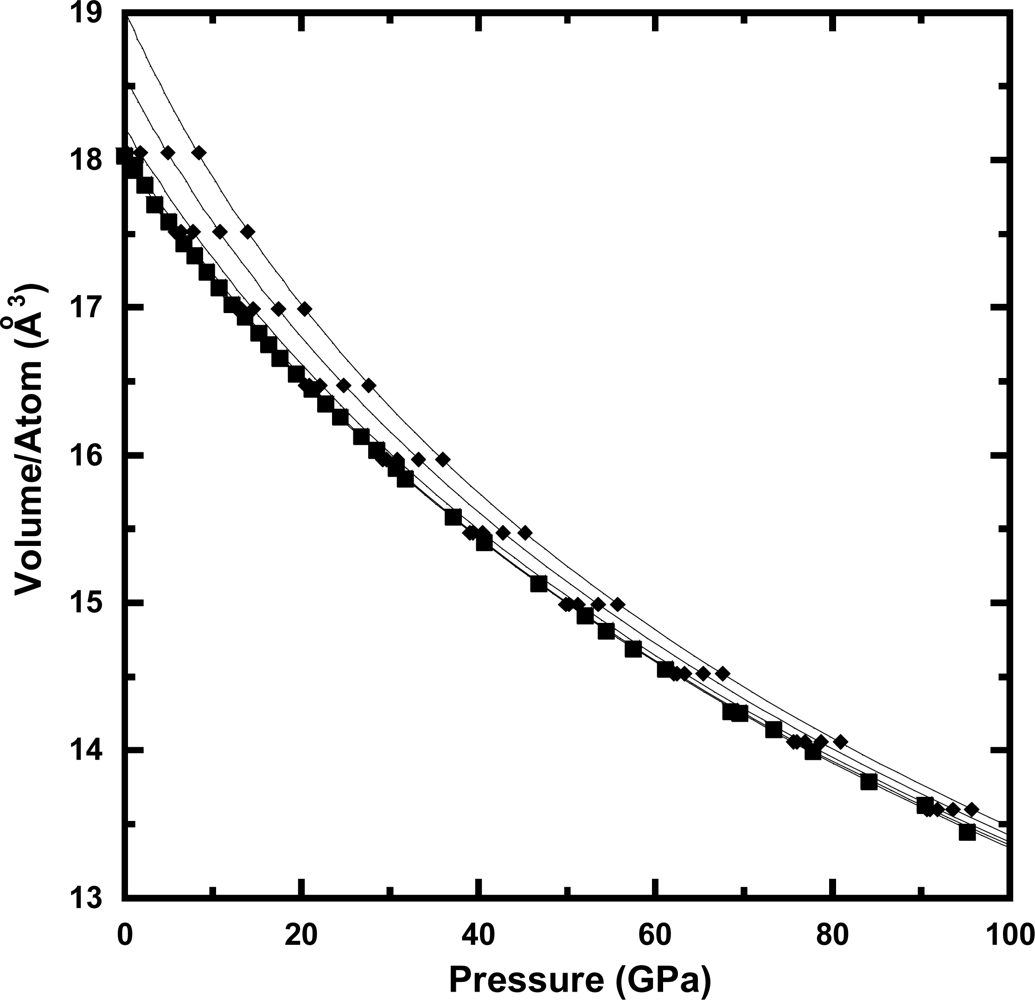
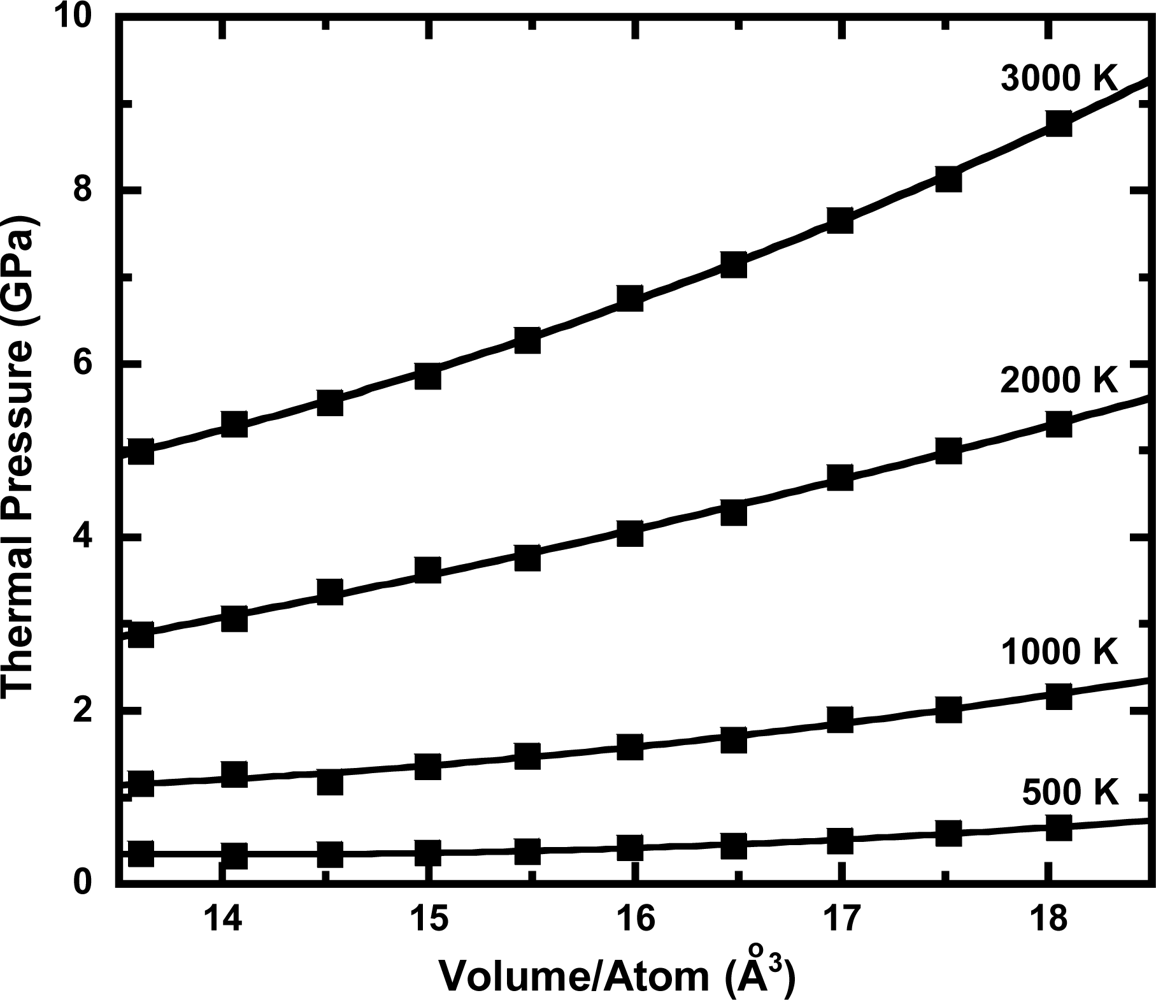
<p>The first-principle molecular dynamics method has been used to calculate the thermoelastic properties of Ta under extreme high-pressure and high-temperature conditions. <xref ref-type="fig" rid="f1-ijms-10-04342">Figure 1</xref> shows the <italic>P-V-T</italic> data from both the experiments and calculations used in our study. The results of the fit of our <italic>P</italic>-<italic>V</italic>-<italic>T</italic> data to the thermal pressure EOS are summarized in <xref ref-type="table" rid="t1-ijms-10-04342">Table 1</xref>. The values of <italic>α<sub>0</sub></italic><sub>,</sub> (<italic>∂B<sub>T</sub></italic> / <italic>∂T</italic>) <italic><sub>V</sub></italic>, and (<italic>∂</italic><sup>2</sup> <italic>P</italic> / <italic>∂T</italic><sup>2</sup>)<italic><sub>V</sub></italic> were 1.47 × 10<sup>−5</sup> (K<sup>−1</sup>), −0.0050 (GPaK<sup>−1</sup>), and 2.11 × 10<sup>−7</sup> (GPa<sup>2</sup>K<sup>−2</sup>), respectively. <xref ref-type="table" rid="t2-ijms-10-04342">Table 2</xref> lists the pressure at selected compressions and temperatures based on the equation of state obtained in this study. <xref ref-type="fig" rid="f2-ijms-10-04342">Figure 2</xref> shows the thermal pressure, <italic>P<sub>th</sub></italic>, of Ta versus cell volume. It can be seen that the thermal pressure gradual decreases up to ∼100 GPa as the cell volume decreases. Recently, Liu <italic>et al</italic>. [<xref ref-type="bibr" rid="b29-ijms-10-04342">29</xref>] reported that the thermal pressure rapidly increases at pressures higher than 100 GPa using the quasiharmonic approximation. In contrast, previous study based on experimental data [<xref ref-type="bibr" rid="b28-ijms-10-04342">28</xref>] estimated that the thermal pressure does not show a big change at wide range of pressure. The inconsistency of thermal pressure at very high compression is still unsolved issue.</p>
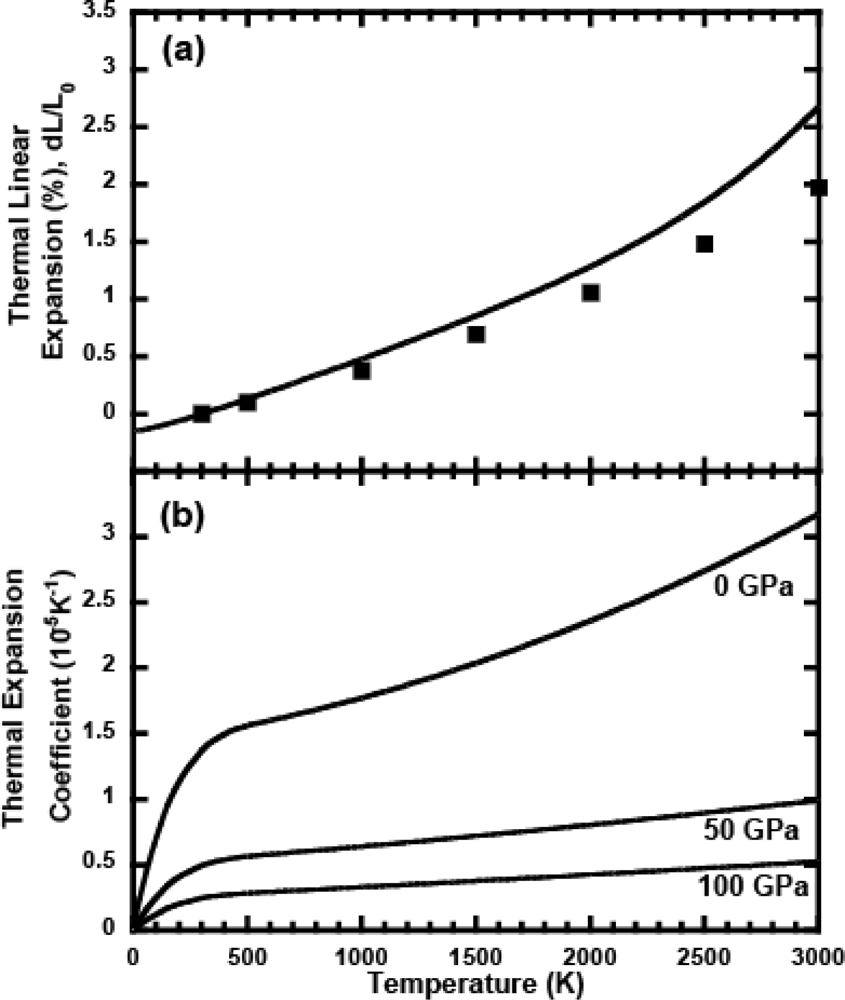
<p><xref ref-type="fig" rid="f3-ijms-10-04342">Figures 3(a)</xref> and <xref ref-type="fig" rid="f3-ijms-10-04342">3(b)</xref> show the thermal expansion properties at ambient pressure and high pressures. The thermal linear expansion at low temperatures calculated from our EOS of Ta is in good agreement with the recommended values from many experimental data [<xref ref-type="bibr" rid="b30-ijms-10-04342">30</xref>] in <xref ref-type="fig" rid="f3-ijms-10-04342">Figure 3(a)</xref>. However, a small difference between our calculations and experimental data was confirmed at temperatures above 2,000 K, although the uncertainty of experimental data is approximately ±10% above 2,100 K. Therefore, our calculations underestimate the thermal expansion properties compared with experimental data at high temperatures. It is likely that this underestimation is due to the uncertainty of the generalized gradient approximation for the exchange-correlation functional used in this study. The thermal expansion coefficients at different pressures were calculated in <xref ref-type="fig" rid="f3-ijms-10-04342">Figure 3(b)</xref>. As the pressure increases, the pressure dependence on the thermal expansion decreases. This is in good agreement with a typical property of condensed materials.</p>
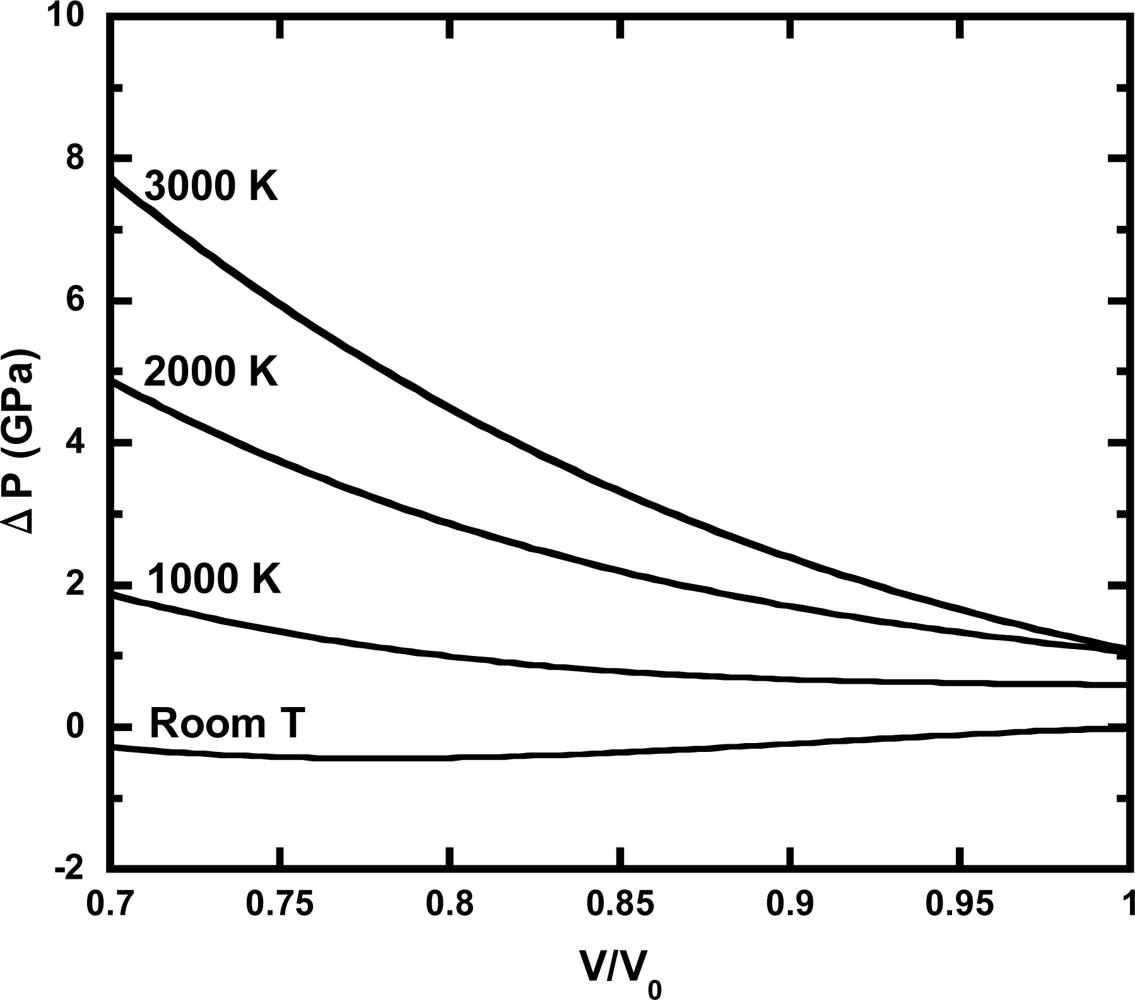
<p><xref ref-type="fig" rid="f4-ijms-10-04342">Figure 4</xref> shows the deviations of the calculated pressure on isotherms from previous EOS based on experimental data [<xref ref-type="bibr" rid="b28-ijms-10-04342">28</xref>]. The deviation of the room-temperature isotherm was very small, because our EOS used reliable experimental data at room-temperature. In contrast, the deviations of high-temperatures increased as pressure increased. Such deviations have been confirmed in other EOSs of solids (<italic>i.e.</italic>, Au, Pt, MgO) used as pressure standard [<xref ref-type="bibr" rid="b28-ijms-10-04342">28</xref>]. It is known that the experimental uncertainties increase rapidly as pressure and temperature increase. As the inconsistency among different experimental data is still an unresolved issue, the uncertainty of EOS determined by experimental data is likely to be significant at high pressures and high temperatures.</p></sec>
<sec>
<label>3.4.</label>
<title>Anharmonic Effects</title>
<p>The Mie-Grüneisen-Debye EOS has been frequently used in previous studies on the EOS of solids. The Mie-Grüneisen approximation is valid if the quasiharmonic term is dominant in the thermal pressure. However, it is known that the anharmonic term, which is not included in the Mie-Grüneisen approximation, is not negligible at high temperatures. Therefore, we assessed the effect of the anharmonicity on the EOS for Ta. We used the Grüneisen parameter to investigate the anharmonicity. The effective Grüneisen parameter can be written as follows:
<disp-formula id="FD4">
<label>(4)</label>
<mml:math display="block">
<mml:msub>
<mml:mi>γ</mml:mi>
<mml:mrow>
<mml:mtext mathvariant="italic">eff</mml:mtext></mml:mrow></mml:msub>
<mml:mo stretchy="false">(</mml:mo>
<mml:mi>V</mml:mi>
<mml:mo>,</mml:mo>
<mml:mi>T</mml:mi>
<mml:mo stretchy="false">)</mml:mo>
<mml:mo>=</mml:mo>
<mml:msub>
<mml:mi>γ</mml:mi>
<mml:mrow>
<mml:mi>q</mml:mi>
<mml:mi>h</mml:mi></mml:mrow></mml:msub>
<mml:mo stretchy="false">(</mml:mo>
<mml:mi>V</mml:mi>
<mml:mo stretchy="false">)</mml:mo>
<mml:mo>−</mml:mo>
<mml:mi>a</mml:mi>
<mml:mo stretchy="false">(</mml:mo>
<mml:mi>V</mml:mi>
<mml:mo>,</mml:mo>
<mml:mi>T</mml:mi>
<mml:mo stretchy="false">)</mml:mo></mml:math></disp-formula>where <italic>γ<sub>qh</sub>(V)</italic> and <italic>a(V,T)</italic> are the quasiharmonic Grüneisen parameter and the intrinsic anharmonicity term, respectively.</p>
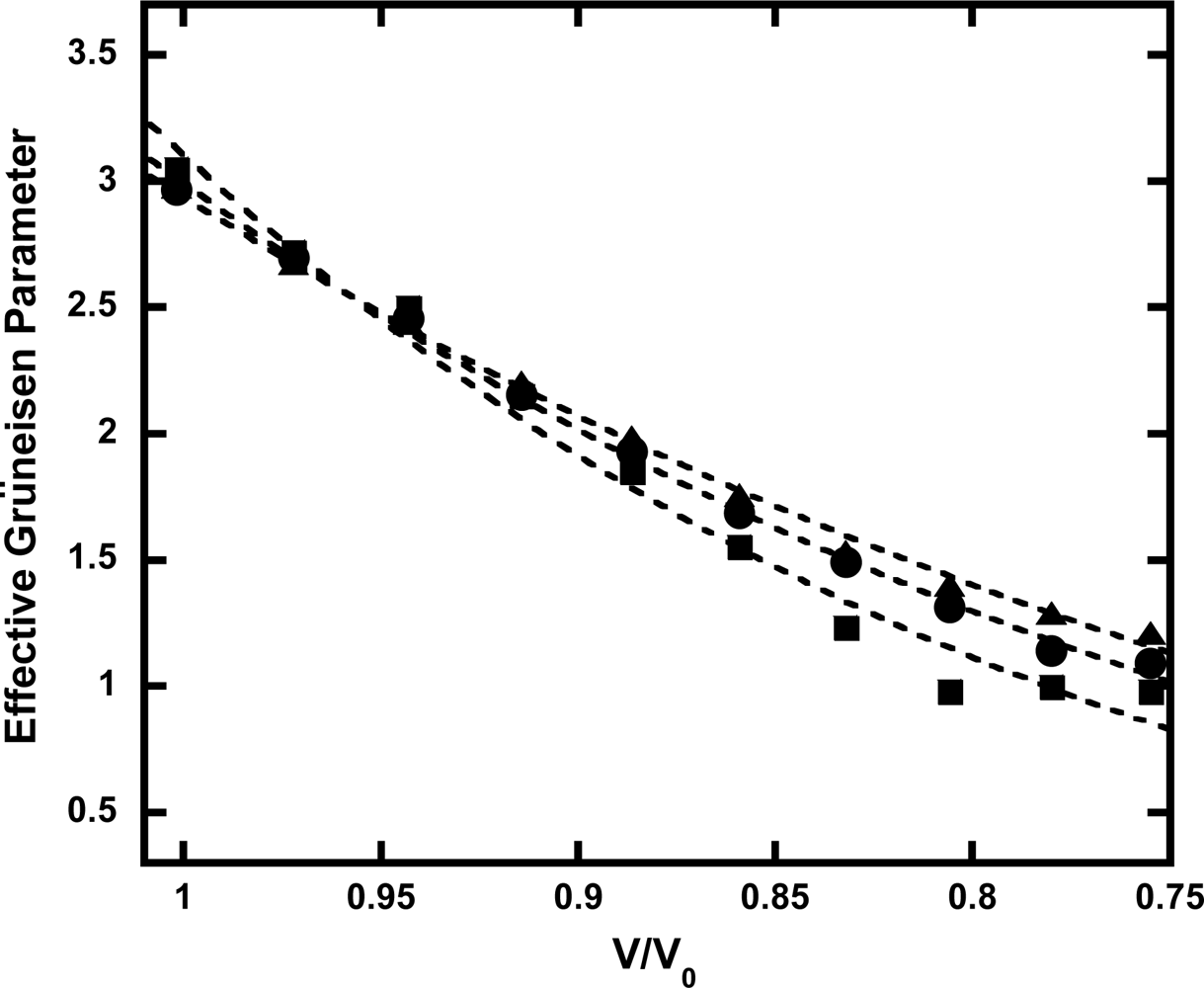
<p>If the anharmonicity is negligible, then the effective Grüneisen parameter does not change at high temperatures. Therefore, we calculated the effective Grüneisen parameter at different volumes and temperatures. The Grüneisen parameter was obtained directly in our calculations from:
<disp-formula id="FD5">
<label>(5)</label>
<mml:math display="block">
<mml:mi>γ</mml:mi>
<mml:mo>=</mml:mo>
<mml:mfrac>
<mml:mrow>
<mml:mi>V</mml:mi>
<mml:msub>
<mml:mi>P</mml:mi>
<mml:mrow>
<mml:mi>t</mml:mi>
<mml:mi>h</mml:mi></mml:mrow></mml:msub></mml:mrow>
<mml:mrow>
<mml:msub>
<mml:mi>E</mml:mi>
<mml:mrow>
<mml:mi>t</mml:mi>
<mml:mi>h</mml:mi></mml:mrow></mml:msub></mml:mrow></mml:mfrac></mml:math></disp-formula>where <italic>E<sub>th</sub></italic> is the difference of the internal energy. <xref ref-type="fig" rid="f5-ijms-10-04342">Figure 5</xref> shows the temperature dependence of the effective Grüneisen parameter due to the intrinsic anharmonic effects. The calculated effective Grüneisen parameter at ambient pressure was larger than that reported in previous calculations [<xref ref-type="bibr" rid="b29-ijms-10-04342">29</xref>]. At low pressures, a difference in the effective Grüneisen parameter at different temperatures was negligible. However, a significant difference was confirmed at pressures above 30 GPa. Our calculations indicate that the quasiharmonic approximation has a significant uncertainty in the determination of the EOS of Ta at high pressures. For example, the anharmonic thermal pressure contribution was ∼10% at 100 GPa and 3,000 K from the first-principle molecular dynamics calculations. Most of the previous experimental studies on the EOS of solids have not considered the influence of anharmonicity, and the Grüneisen parameter has been assumed to be a function of volume. As the error in the experimental data was considerable, detailed analyses could not be performed in previous studies. In our study, the combination of high-pressure experiments with first-principles molecular dynamics calculations has led to the uncovering of a temperature dependence of the Grüneisen parameter due to the anharmonicity of Ta at high temperatures.</p></sec></sec>
<sec sec-type="conclusions">
<label>4.</label>
<title>Conclusions</title>
<p>We have investigated the EOS of Ta, which has a body-centred cubic structure, using the first-principles molecular dynamics method. We used the high-pressure experimental data to determine the compressibility at room temperature, and used the generalized gradient approximation (GGA) and the projector augmented-wave method (PAW) in simulations to calculate the thermal pressure. A Vinet EOS fitted to the room temperature data yielded an isothermal bulk modulus of <italic>B<sub>T0</sub></italic> = 194 GPa and a pressure derivative of <italic>B<sub>T0</sub></italic>′ = 3.745. The high-temperature data from the first-principles calculations were fitted to the thermal pressure EOS. The resulting parameters of the thermal pressure, <italic>α<sub>0</sub></italic>, (<italic>∂B<sub>T</sub></italic> / <italic>∂T</italic>) <italic><sub>V</sub></italic>, and (<italic>∂</italic><sup>2</sup><italic>P / ∂T</italic><sup>2</sup>)<italic><sub>V</sub></italic> were 1.47 × 10<italic><sup>−</sup></italic><sup>5</sup> (K<sup>−1</sup>), −0.0050 (GPaK<sup>−1</sup>), and 2.11 × 10<sup>−7</sup> (GPa<sup>2</sup>K<sup>−2</sup>), respectively. The temperature dependence of the calculated effective Grüneisen parameters at high pressures indicates that the conventional Mie-Grüneisen approximation is not suitable for the analysis of thermoelastic properties of Ta, and that the intrinsic anharmonicity is non-negligible at high pressures.</p></sec></body>
<back>
<ack>
<p>This work made use of the super computer system of JAMSTEC and of the computer systems of the Earthquake Information Center of the Earthquake Research Institute. This work was partially supported by Grant-in-Aid for Scientific Research from JSPS and the Earthquake Research Institute cooperative research program, Japan.</p></ack>
<ref-list>
<title>References and Notes</title>
<ref id="b1-ijms-10-04342"><label>1.</label><citation citation-type="journal"><person-group person-group-type="author"><name><surname>Fei</surname><given-names>Y</given-names></name><name><surname>Mao</surname><given-names>HK</given-names></name></person-group><article-title>Static compresson of Mg(OH)<sub>2</sub> to 78 GPa at high temperature and constraints on the equation of state of fluid H<sub>2</sub>O</article-title><source>J .Geophys. Res</source><year>1993</year><volume>98</volume><fpage>11875</fpage><lpage>11884</lpage><pub-id pub-id-type="doi">10.1029/93JB00701</pub-id></citation></ref>
<ref id="b2-ijms-10-04342"><label>2.</label><citation citation-type="journal"><person-group person-group-type="author"><name><surname>Andrault</surname><given-names>D</given-names></name><name><surname>Fiquet</surname><given-names>G</given-names></name><name><surname>Guyot</surname><given-names>F</given-names></name><name><surname>Hanfland</surname><given-names>M</given-names></name></person-group><article-title>Pressure-induced Landau-type transition in stishovite</article-title><source>Science</source><year>1998</year><volume>282</volume><fpage>720</fpage><lpage>772</lpage><pub-id pub-id-type="doi">10.1126/science.282.5389.720</pub-id><pub-id pub-id-type="pmid">9784125</pub-id></citation></ref>
<ref id="b3-ijms-10-04342"><label>3.</label><citation citation-type="journal"><person-group person-group-type="author"><name><surname>Ono</surname><given-names>S</given-names></name><name><surname>Hirose</surname><given-names>K</given-names></name><name><surname>Kikegawa</surname><given-names>T</given-names></name><name><surname>Saito</surname><given-names>Y</given-names></name></person-group><article-title>The compressibility of a natural composition calcium ferrite-type aluminous phase to 70 GPa</article-title><source>Phys. Earth Planet. Inter</source><year>2002</year><volume>131</volume><fpage>311</fpage><lpage>318</lpage><pub-id pub-id-type="doi">10.1016/S0031-9201(02)00065-1</pub-id></citation></ref>
<ref id="b4-ijms-10-04342"><label>4.</label><citation citation-type="journal"><person-group person-group-type="author"><name><surname>Irifune</surname><given-names>T</given-names></name><name><surname>Nishiyama</surname><given-names>N</given-names></name><name><surname>Kuroda</surname><given-names>K</given-names></name><name><surname>Inoue</surname><given-names>T</given-names></name><name><surname>Isshiki</surname><given-names>M</given-names></name><name><surname>Utsumi</surname><given-names>W</given-names></name><name><surname>Funakoshi</surname><given-names>K</given-names></name><name><surname>Urakawa</surname><given-names>S</given-names></name><name><surname>Uchida</surname><given-names>T</given-names></name><name><surname>Katsura</surname><given-names>T</given-names></name><name><surname>Ohtaka</surname><given-names>O</given-names></name></person-group><article-title>The postspinel phase boundary in Mg<sub>2</sub>SiO<sub>4</sub> determined by <italic>in situ</italic> X-ray diffraction</article-title><source>Science</source><year>1998</year><volume>279</volume><fpage>1698</fpage><lpage>1700</lpage><pub-id pub-id-type="doi">10.1126/science.279.5357.1698</pub-id><pub-id pub-id-type="pmid">9497283</pub-id></citation></ref>
<ref id="b5-ijms-10-04342"><label>5.</label><citation citation-type="journal"><person-group person-group-type="author"><name><surname>Ono</surname><given-names>S</given-names></name><name><surname>Ito</surname><given-names>E</given-names></name><name><surname>Katsura</surname><given-names>T</given-names></name><name><surname>Yoneda</surname><given-names>A</given-names></name><name><surname>Walter</surname><given-names>MJ</given-names></name><name><surname>Urakawa</surname><given-names>S</given-names></name><name><surname>Utsumi</surname><given-names>W</given-names></name><name><surname>Funakoshi</surname><given-names>K</given-names></name></person-group><article-title>Thermoelastic properties of the high-pressure phase of SnO<sub>2</sub> determined by <italic>in situ</italic> X-ray observations up to 30 GPa and 1400 K</article-title><source>Phys. Chem. Minerals</source><year>2000</year><volume>27</volume><fpage>618</fpage><lpage>622</lpage><pub-id pub-id-type="doi">10.1007/s002690000108</pub-id></citation></ref>
<ref id="b6-ijms-10-04342"><label>6.</label><citation citation-type="journal"><person-group person-group-type="author"><name><surname>Wang</surname><given-names>Y</given-names></name><name><surname>Uchida</surname><given-names>T</given-names></name><name><surname>Zhang</surname><given-names>J</given-names></name><name><surname>Rivers</surname><given-names>ML</given-names></name><name><surname>Sutton</surname><given-names>SR</given-names></name></person-group><article-title>Thermal equation of state of akimotoite MgSiO<sub>3</sub> and effects of the akimotoite–garnet transformation on seismic structure near the 660 km discontinuity</article-title><source>Phys Earth Planet Inter</source><year>2004</year><volume>143–144</volume><fpage>57</fpage><lpage>80</lpage></citation></ref>
<ref id="b7-ijms-10-04342"><label>7.</label><citation citation-type="journal"><person-group person-group-type="author"><name><surname>Cynn</surname><given-names>H</given-names></name><name><surname>Yoo</surname><given-names>CS</given-names></name></person-group><article-title>Equation of state of tantalum to 174 GPa</article-title><source>Phys. Rev. B</source><year>1999</year><volume>59</volume><fpage>8526</fpage><lpage>8529</lpage><pub-id pub-id-type="doi">10.1103/PhysRevB.59.8526</pub-id></citation></ref>
<ref id="b8-ijms-10-04342"><label>8.</label><citation citation-type="journal"><person-group person-group-type="author"><name><surname>Ross</surname><given-names>M</given-names></name><name><surname>Errandonea</surname><given-names>D</given-names></name><name><surname>Boehler</surname><given-names>R</given-names></name></person-group><article-title>Melting of transition metals at high pressure and the influence of liquid frustration: The early metals Ta and Mo</article-title><source>Phys. Rev. B</source><year>2007</year><volume>76</volume><fpage>184118</fpage><pub-id pub-id-type="doi">10.1103/PhysRevB.76.184118</pub-id></citation></ref>
<ref id="b9-ijms-10-04342"><label>9.</label><citation citation-type="journal"><person-group person-group-type="author"><name><surname>Katahara</surname><given-names>KW</given-names></name><name><surname>Manghnani</surname><given-names>MH</given-names></name><name><surname>Fisher</surname><given-names>ES</given-names></name></person-group><article-title>Pressure derivatives of the elastic moduli of niobium and tantalum</article-title><source>J. Appl. Phys</source><year>1976</year><volume>47</volume><fpage>434</fpage><lpage>439</lpage><pub-id pub-id-type="doi">10.1063/1.322666</pub-id></citation></ref>
<ref id="b10-ijms-10-04342"><label>10.</label><citation citation-type="journal"><person-group person-group-type="author"><name><surname>Ming</surname><given-names>L</given-names></name><name><surname>Manghnani</surname><given-names>MH</given-names></name></person-group><article-title>Isothermal compression of bcc transition metals to 100 kbar</article-title><source>J. Appl. Phys</source><year>1978</year><volume>49</volume><fpage>208</fpage><lpage>212</lpage><pub-id pub-id-type="doi">10.1063/1.324325</pub-id></citation></ref>
<ref id="b11-ijms-10-04342"><label>11.</label><citation citation-type="journal"><person-group person-group-type="author"><name><surname>Mitchell</surname><given-names>AC</given-names></name><name><surname>Nellis</surname><given-names>WJ</given-names></name></person-group><article-title>Shock compression of aluminum, copper, and tantalum</article-title><source>J. Appl. Phys</source><year>1981</year><volume>52</volume><fpage>3363</fpage><lpage>3374</lpage><pub-id pub-id-type="doi">10.1063/1.329160</pub-id></citation></ref>
<ref id="b12-ijms-10-04342"><label>12.</label><citation citation-type="journal"><person-group person-group-type="author"><name><surname>Dewaele</surname><given-names>A</given-names></name><name><surname>Loubeyre</surname><given-names>P</given-names></name><name><surname>Mezouar</surname><given-names>M</given-names></name></person-group><article-title>Equations of state of six metals above 94 GPa</article-title><source>Phys. Rev. B</source><year>2004</year><volume>70</volume><fpage>094112</fpage><pub-id pub-id-type="doi">10.1103/PhysRevB.70.094112</pub-id></citation></ref>
<ref id="b13-ijms-10-04342"><label>13.</label><citation citation-type="journal"><person-group person-group-type="author"><name><surname>Bercegeay</surname><given-names>C</given-names></name><name><surname>Bernard</surname><given-names>S</given-names></name></person-group><article-title>First-principles equations of states and elastic properties of seven metals</article-title><source>Phys. Rev. B</source><year>2005</year><volume>72</volume><fpage>214101</fpage><pub-id pub-id-type="doi">10.1103/PhysRevB.72.214101</pub-id></citation></ref>
<ref id="b14-ijms-10-04342"><label>14.</label><citation citation-type="journal"><person-group person-group-type="author"><name><surname>Chijioke</surname><given-names>AD</given-names></name><name><surname>Nelis</surname><given-names>WJ</given-names></name><name><surname>Silvera</surname><given-names>IF</given-names></name></person-group><article-title>High-pressure equations of states of Al, Cu, Ta, and W</article-title><source>J. Appl. Phys</source><year>2005</year><volume>98</volume><fpage>073526</fpage><pub-id pub-id-type="doi">10.1063/1.2071449</pub-id></citation></ref>
<ref id="b15-ijms-10-04342"><label>15.</label><citation citation-type="journal"><person-group person-group-type="author"><name><surname>Orlikowski</surname><given-names>D</given-names></name><name><surname>Söderlind</surname><given-names>P</given-names></name><name><surname>Moriarty</surname><given-names>JA</given-names></name></person-group><article-title>First-principles thermoelasticity of transition metals at high pressure: Tantalum prototype in the quasiharmonic limit</article-title><source>Phys Rev B</source><year>2006</year><volume>74</volume><fpage>054109.1</fpage><lpage>054109.10</lpage></citation></ref>
<ref id="b16-ijms-10-04342"><label>16.</label><citation citation-type="journal"><person-group person-group-type="author"><name><surname>Foata-Prestavoine</surname><given-names>M</given-names></name><name><surname>Robert</surname><given-names>G</given-names></name><name><surname>Nadal</surname><given-names>M</given-names></name><name><surname>Bernard</surname><given-names>S</given-names></name></person-group><article-title>First-principles study of the relations between the elastic constants, phonon dispersion curves, and melting temperatures ob bcc Ta at pressures up to 1000 GPa</article-title><source>Phys. Rev. B</source><year>2007</year><volume>76</volume><fpage>104104</fpage><pub-id pub-id-type="doi">10.1103/PhysRevB.76.104104</pub-id></citation></ref>
<ref id="b17-ijms-10-04342"><label>17.</label><citation citation-type="journal"><person-group person-group-type="author"><name><surname>Taioli</surname><given-names>S</given-names></name><name><surname>Cazorla</surname><given-names>C</given-names></name><name><surname>Gillan</surname><given-names>MJ</given-names></name><name><surname>Alfè</surname><given-names>D</given-names></name></person-group><article-title>Melting curve of tantalum from principles</article-title><source>Phys. Rev. B</source><year>2007</year><volume>75</volume><fpage>214103</fpage><pub-id pub-id-type="doi">10.1103/PhysRevB.75.214103</pub-id></citation></ref>
<ref id="b18-ijms-10-04342"><label>18.</label><citation citation-type="journal"><person-group person-group-type="author"><name><surname>Kresse</surname><given-names>G</given-names></name><name><surname>Furthmüller</surname><given-names>J</given-names></name></person-group><article-title>Efficient iterative schemes for ab initio total-energy calculations using a plane-wave basis set</article-title><source>Phys. Rev. B</source><year>1996</year><volume>54</volume><fpage>11169</fpage><lpage>11186</lpage><pub-id pub-id-type="doi">10.1103/PhysRevB.54.11169</pub-id></citation></ref>
<ref id="b19-ijms-10-04342"><label>19.</label><citation citation-type="journal"><person-group person-group-type="author"><name><surname>Perdew</surname><given-names>JP</given-names></name><name><surname>Burke</surname><given-names>K</given-names></name><name><surname>Ernzerhof</surname><given-names>M</given-names></name></person-group><article-title>Generalized gradient approximation made simple</article-title><source>Phys. Rev. Lett</source><year>1996</year><volume>77</volume><fpage>3865</fpage><lpage>3868</lpage><pub-id pub-id-type="doi">10.1103/PhysRevLett.77.3865</pub-id><pub-id pub-id-type="pmid">10062328</pub-id></citation></ref>
<ref id="b20-ijms-10-04342"><label>20.</label><citation citation-type="journal"><person-group person-group-type="author"><name><surname>Blöchl</surname><given-names>PE</given-names></name></person-group><article-title>Projector augmented-wave method</article-title><source>Phys. Rev. B</source><year>1994</year><volume>50</volume><fpage>17953</fpage><lpage>17979</lpage><pub-id pub-id-type="doi">10.1103/PhysRevB.50.17953</pub-id></citation></ref>
<ref id="b21-ijms-10-04342"><label>21.</label><citation citation-type="journal"><person-group person-group-type="author"><name><surname>Kresse</surname><given-names>G</given-names></name><name><surname>Joubert</surname><given-names>D</given-names></name></person-group><article-title>From ultrasoft pseudopotentials to the projector augmented-wave method</article-title><source>Phys. Rev. B</source><year>1999</year><volume>59</volume><fpage>1758</fpage><lpage>1775</lpage><pub-id pub-id-type="doi">10.1103/PhysRevB.59.1758</pub-id></citation></ref>
<ref id="b22-ijms-10-04342"><label>22.</label><citation citation-type="journal"><person-group person-group-type="author"><name><surname>Nosé</surname><given-names>S</given-names></name></person-group><article-title>A molecular dynamics method for simulations in the canonical ensemble</article-title><source>Molec. Phys</source><year>1984</year><volume>52</volume><fpage>255</fpage><lpage>268</lpage><pub-id pub-id-type="doi">10.1080/00268978400101201</pub-id></citation></ref>
<ref id="b23-ijms-10-04342"><label>23.</label><citation citation-type="journal"><person-group person-group-type="author"><name><surname>Ono</surname><given-names>S</given-names></name><name><surname>Brodholt</surname><given-names>JP</given-names></name><name><surname>Alfè</surname><given-names>D</given-names></name><name><surname>Alfredsson</surname><given-names>M</given-names></name><name><surname>Price</surname><given-names>GD</given-names></name></person-group><article-title><italic>Ab initio</italic> molecular dynamics simulations for thermal equation of state of B2-type NaCl</article-title><source>J. Appl. Phys</source><year>2008</year><volume>103</volume><fpage>023510</fpage><pub-id pub-id-type="doi">10.1063/1.2832632</pub-id></citation></ref>
<ref id="b24-ijms-10-04342"><label>24.</label><citation citation-type="journal"><person-group person-group-type="author"><name><surname>Vinet</surname><given-names>P</given-names></name><name><surname>Ferrante</surname><given-names>J</given-names></name><name><surname>Rose</surname><given-names>J</given-names></name><name><surname>Smith</surname><given-names>J</given-names></name></person-group><article-title>Compressibility of solids</article-title><source>J. Geophys. Res</source><year>1987</year><volume>92</volume><fpage>9319</fpage><lpage>9325</lpage><pub-id pub-id-type="doi">10.1029/JB092iB09p09319</pub-id></citation></ref>
<ref id="b25-ijms-10-04342"><label>25.</label><citation citation-type="journal"><person-group person-group-type="author"><name><surname>Jackson</surname><given-names>I</given-names></name><name><surname>Rigden</surname><given-names>SM</given-names></name></person-group><article-title>Analysis of <italic>P-V-T</italic> data: Constraints on the thermoelastic properties of high-pressure minerals</article-title><source>Phys. Earth Planet. Inter</source><year>1996</year><volume>96</volume><fpage>85</fpage><lpage>112</lpage><pub-id pub-id-type="doi">10.1016/0031-9201(96)03143-3</pub-id></citation></ref>
<ref id="b26-ijms-10-04342"><label>26.</label><citation citation-type="journal"><person-group person-group-type="author"><name><surname>Holzapfel</surname><given-names>WB</given-names></name></person-group><article-title>Refinement of the ruby luminescence pressure scale</article-title><source>J. Appl. Phys</source><year>2003</year><volume>93</volume><fpage>1813</fpage><lpage>1818</lpage><pub-id pub-id-type="doi">10.1063/1.1525856</pub-id></citation></ref>
<ref id="b27-ijms-10-04342"><label>27.</label><citation citation-type="journal"><person-group person-group-type="author"><name><surname>Kunc</surname><given-names>K</given-names></name><name><surname>Loa</surname><given-names>I</given-names></name><name><surname>Syassen</surname><given-names>K</given-names></name></person-group><article-title>Diamond under pressure: <italic>ab initio</italic> calculations of the equation of state and optical phonon frequency revisited</article-title><source>High Press. Res</source><year>2004</year><volume>24</volume><fpage>101</fpage><lpage>110</lpage><pub-id pub-id-type="doi">10.1080/08957950310001635765</pub-id></citation></ref>
<ref id="b28-ijms-10-04342"><label>28.</label><citation citation-type="journal"><person-group person-group-type="author"><name><surname>Dorogokupets</surname><given-names>PI</given-names></name><name><surname>Oganov</surname><given-names>AR</given-names></name></person-group><article-title>Ruby, metals, and MgO as alternative pressure scales: A semienprical description of shock-wave, ultrasonic, X-ray, and thermochemical data at high temperatures and pressures</article-title><source>Phys. Rev. B</source><year>2007</year><volume>75</volume><fpage>024115</fpage><pub-id pub-id-type="doi">10.1103/PhysRevB.75.024115</pub-id></citation></ref>
<ref id="b29-ijms-10-04342"><label>29.</label><citation citation-type="journal"><person-group person-group-type="author"><name><surname>Liu</surname><given-names>ZL</given-names></name><name><surname>Cai</surname><given-names>LC</given-names></name><name><surname>Chen</surname><given-names>XR</given-names></name><name><surname>Wu</surname><given-names>Q</given-names></name><name><surname>Jing</surname><given-names>FQ</given-names></name></person-group><article-title><italic>Ab initio</italic> refinement of the thermal equation of state for bcc tantalum: The effect of bonding on anharmonicity</article-title><source>J Phys Condens Matter</source><year>2009</year><volume>21</volume><fpage>095408.1</fpage><lpage>095408.10</lpage></citation></ref>
<ref id="b30-ijms-10-04342"><label>30.</label><citation citation-type="book"><person-group person-group-type="author"><name><surname>Touloukian</surname><given-names>TS</given-names></name><name><surname>Kirby</surname><given-names>RK</given-names></name><name><surname>Taylar</surname><given-names>RE</given-names></name><name><surname>Desai</surname><given-names>PD</given-names></name></person-group><source>Thermophysical Properties of Matter</source><publisher-name>IFI/Plenum</publisher-name><publisher-loc>New York, NY, USA</publisher-loc><year>1977</year><fpage>317</fpage></citation></ref></ref-list>
<sec sec-type="display-objects">
<title>Figures and Tables</title>
<fig id="f1-ijms-10-04342" position="float">
<label>Figure 1.</label>
<caption>
<p>Pressure-volume data for Ta. The squares and diamonds denote the volume from experiments [<xref ref-type="bibr" rid="b12-ijms-10-04342">12</xref>] at 300 K and first-principle calculations at temperatures from 300 to 3,000 K. The lines denote the calcula2ted isotherms at temperatures of 300, 500, 1,000, 2,000, and 3,000 K.</p></caption><graphic xlink:href="ijms-10-04342f1.gif"/></fig>
<fig id="f2-ijms-10-04342" position="float">
<label>Figure 2.</label>
<caption>
<p>A plot of the thermal pressure (<italic>P<sub>th</sub></italic>) versus cell volume for Ta. The solid squares denote the calculated thermal pressures from 500 K to 3,000 K.</p></caption><graphic xlink:href="ijms-10-04342f2.gif"/></fig>
<fig id="f3-ijms-10-04342" position="float">
<label>Figure 3.</label>
<caption>
<p>(a) Thermal linear expansion at ambient pressure. The solid line denotes the regression fit from experimental data [<xref ref-type="bibr" rid="b30-ijms-10-04342">30</xref>]. The solid squares denote the calculated values from the EOS for Ta in this study. L<sub>0</sub> is the length at 300 K. (b) Calculated temperature dependence of the thermal expansion coefficient. The results are shown for 0, 50, and 100 GPa.</p></caption><graphic xlink:href="ijms-10-04342f3.gif"/></fig>
<fig id="f4-ijms-10-04342" position="float">
<label>Figure 4.</label>
<caption>
<p>The pressure difference between previous EOS based on experimental data and our EOS combined thermal pressure calculated by first-principles and the room-temperature compression from experimental data. The lines denote pressures of previous EOS [<xref ref-type="bibr" rid="b28-ijms-10-04342">28</xref>] minus our EOS on room-temperature, 1,000, 2,000, and 3,000 K isotherms of Ta.</p></caption><graphic xlink:href="ijms-10-04342f4.gif"/></fig>
<fig id="f5-ijms-10-04342" position="float">
<label>Figure 5.</label>
<caption>
<p>Anharmonic effects on the Grüneisen parameter. The solid squares, circles, and triangles denote the calculated Grüneisen parameter at 1,000, 2,000, and 3,000 K using first-principles molecular dynamics calculations. Errors of calculated values are ∼20%. The dashed lines denote the curve fit using the least square method.</p></caption><graphic xlink:href="ijms-10-04342f5.gif"/></fig>
<table-wrap id="t1-ijms-10-04342" position="float">
<label>Table 1.</label>
<caption>
<p>The model thermoelastic parameters of Ta. The Vinet equation of state was used to calculate the parameters of Ta. Key: <italic>B<sub>T0</sub></italic> = isothermal bulk modulus at 0 GPa and 300 K from ultrasonic experiments [<xref ref-type="bibr" rid="b9-ijms-10-04342">9</xref>], <italic>B<sub>T0</sub>′</italic> = first pressure derivative of the bulk modulus, <italic>V<sub>0</sub></italic> = volume at 0 GPa and 300 K from experiments, <italic>α<sub>0</sub></italic> = thermal expansion coefficient at 0 GPa.</p></caption>
<table frame="hsides" rules="groups">
<thead>
<tr>
<th valign="middle" align="left"><bold>Parameter</bold></th><th valign="middle" align="left"/></tr></thead>
<tbody>
<tr>
<td valign="top" align="left"><italic>V<sub>0</sub></italic> (Å<sup>3</sup>)</td>
<td valign="top" align="left">18.016</td></tr>
<tr>
<td valign="top" align="left"><italic>B<sub>T0</sub></italic> (GPa)</td>
<td valign="top" align="left">194</td></tr>
<tr>
<td valign="top" align="left"><italic>B<sub>T0</sub>′</italic></td>
<td valign="top" align="left">3.740(11)</td></tr>
<tr>
<td valign="top" align="left"><italic>α<sub>0</sub></italic> (10<sup>−5</sup> K<sup>−1</sup>)</td>
<td valign="top" align="left">1.47(2)</td></tr>
<tr>
<td valign="top" align="left"><italic>(δB<sub>T</sub>/δT)<sub>V</sub></italic> (GPaK<sup>−1</sup>)</td>
<td valign="top" align="left">−0.0050(1)</td></tr>
<tr>
<td valign="top" align="left"><italic>(δ<sup>2</sup>P/δT<sup>2)</sup>V</italic> (10<sup>−7</sup>GPa<sup>2</sup>K<sup>−2</sup>)</td>
<td valign="top" align="left">2.11(31)</td></tr></tbody></table></table-wrap>
<table-wrap id="t2-ijms-10-04342" position="float">
<label>Table 2.</label>
<caption>
<p>Pressure-Temperature-Volume table for Ta from this study. The unit of pressure is GPa.</p></caption>
<table frame="hsides" rules="groups">
<thead>
<tr>
<th valign="middle" align="center"><bold>1-<italic>V/V<sub>0</sub></italic></bold></th>
<th valign="middle" align="center"><bold>300 K</bold></th>
<th valign="middle" align="center"><bold>500 K</bold></th>
<th valign="middle" align="center"><bold>1000 K</bold></th>
<th valign="middle" align="center"><bold>1500 K</bold></th>
<th valign="middle" align="center"><bold>2000 K</bold></th>
<th valign="middle" align="center"><bold>2500 K</bold></th>
<th valign="middle" align="center"><bold>3000 K</bold></th></tr></thead>
<tbody>
<tr>
<td valign="top" align="right">0.00</td>
<td valign="top" align="right">0.58</td>
<td valign="top" align="right">2.10</td>
<td valign="top" align="right">3.73</td>
<td valign="top" align="right">5.46</td>
<td valign="top" align="right">7.30</td>
<td valign="top" align="right">9.24</td></tr>
<tr>
<td valign="top" align="right">0.02</td>
<td valign="top" align="right">4.07</td>
<td valign="top" align="right">4.63</td>
<td valign="top" align="right">6.10</td>
<td valign="top" align="right">7.67</td>
<td valign="top" align="right">9.36</td>
<td valign="top" align="right">11.14</td>
<td valign="top" align="right">13.04</td></tr>
<tr>
<td valign="top" align="right">0.04</td>
<td valign="top" align="right">8.54</td>
<td valign="top" align="right">9.08</td>
<td valign="top" align="right">10.50</td>
<td valign="top" align="right">12.03</td>
<td valign="top" align="right">13.66</td>
<td valign="top" align="right">15.39</td>
<td valign="top" align="right">17.23</td></tr>
<tr>
<td valign="top" align="right">0.06</td>
<td valign="top" align="right">13.46</td>
<td valign="top" align="right">13.98</td>
<td valign="top" align="right">15.35</td>
<td valign="top" align="right">16.82</td>
<td valign="top" align="right">18.40</td>
<td valign="top" align="right">20.08</td>
<td valign="top" align="right">21.87</td></tr>
<tr>
<td valign="top" align="right">0.08</td>
<td valign="top" align="right">18.88</td>
<td valign="top" align="right">19.37</td>
<td valign="top" align="right">20.68</td>
<td valign="top" align="right">22.10</td>
<td valign="top" align="right">23.63</td>
<td valign="top" align="right">25.25</td>
<td valign="top" align="right">26.99</td></tr>
<tr>
<td valign="top" align="right">0.10</td>
<td valign="top" align="right">24.84</td>
<td valign="top" align="right">25.30</td>
<td valign="top" align="right">26.56</td>
<td valign="top" align="right">27.92</td>
<td valign="top" align="right">29.39</td>
<td valign="top" align="right">30.97</td>
<td valign="top" align="right">32.65</td></tr>
<tr>
<td valign="top" align="right">0.12</td>
<td valign="top" align="right">31.38</td>
<td valign="top" align="right">31.83</td>
<td valign="top" align="right">33.04</td>
<td valign="top" align="right">34.34</td>
<td valign="top" align="right">35.75</td>
<td valign="top" align="right">37.27</td>
<td valign="top" align="right">38.90</td></tr>
<tr>
<td valign="top" align="right">0.14</td>
<td valign="top" align="right">38.60</td>
<td valign="top" align="right">39.03</td>
<td valign="top" align="right">40.17</td>
<td valign="top" align="right">41.42</td>
<td valign="top" align="right">42.78</td>
<td valign="top" align="right">44.24</td>
<td valign="top" align="right">45.80</td></tr>
<tr>
<td valign="top" align="right">0.16</td>
<td valign="top" align="right">46.55</td>
<td valign="top" align="right">46.96</td>
<td valign="top" align="right">48.04</td>
<td valign="top" align="right">49.23</td>
<td valign="top" align="right">50.53</td>
<td valign="top" align="right">51.93</td>
<td valign="top" align="right">53.44</td></tr>
<tr>
<td valign="top" align="right">0.18</td>
<td valign="top" align="right">55.32</td>
<td valign="top" align="right">55.70</td>
<td valign="top" align="right">56.72</td>
<td valign="top" align="right">57.86</td>
<td valign="top" align="right">59.09</td>
<td valign="top" align="right">60.43</td>
<td valign="top" align="right">61.88</td></tr>
<tr>
<td valign="top" align="right">0.20</td>
<td valign="top" align="right">65.00</td>
<td valign="top" align="right">65.35</td>
<td valign="top" align="right">66.32</td>
<td valign="top" align="right">67.38</td>
<td valign="top" align="right">68.56</td>
<td valign="top" align="right">69.84</td>
<td valign="top" align="right">71.22</td></tr>
<tr>
<td valign="top" align="right">0.22</td>
<td valign="top" align="right">75.69</td>
<td valign="top" align="right">76.02</td>
<td valign="top" align="right">76.92</td>
<td valign="top" align="right">77.92</td>
<td valign="top" align="right">79.03</td>
<td valign="top" align="right">80.25</td>
<td valign="top" align="right">81.57</td></tr>
<tr>
<td valign="top" align="right">0.24</td>
<td valign="top" align="right">87.50</td>
<td valign="top" align="right">87.81</td>
<td valign="top" align="right">88.64</td>
<td valign="top" align="right">89.58</td>
<td valign="top" align="right">90.63</td>
<td valign="top" align="right">91.78</td>
<td valign="top" align="right">93.04</td></tr>
<tr>
<td valign="top" align="right">0.26</td>
<td valign="top" align="right">100.59</td>
<td valign="top" align="right">100.86</td>
<td valign="top" align="right">101.63</td>
<td valign="top" align="right">102.51</td>
<td valign="top" align="right">103.49</td>
<td valign="top" align="right">104.57</td>
<td valign="top" align="right">105.76</td></tr></tbody></table></table-wrap></sec></back></article>