


Abstract
Synthesis and characterization of two new Schiff bases of p-tert-buthylcalix[4]arene (H2L1 and HL2) is described. The synthesis of H2L1 and HL2 has been achieved by the condensation of salicylaldehyde with the amine group of upper rim monoamine p-tert-butylcalix[4]arene in ethanol. These compounds have been characterized on the basis of elemental analysis and spectral data. Solvatochromicity and fluorescence properties were observed and measured for H2L1 and HL2. Solvatochromicity of these ligands indicates their potential for NLO applications.
Introduction
Calix[4]arenes can be easily functionalized both at the phenolic OH groups (lower rim) and, after partial removal of tert-butyl groups, at the para positions of the phenol rings (upper rim) [1,2,3]. The vast majority of these modified calixarenes exist in the cone conformation in which there is a cavity suitable for reception of different ionic and neutral species [4]. Furthermore, the most significant feature of the chemistry of these molecules is their ability to bind selectively alkali and alkaline earth cations [5,6]. Compared to the number of reports on the binding of alkali metal ions with calixarenes, reports on the binding of transition metal ions are still limited [7,8,9]. From this point of view calixarene Schiff base ligands are in the center of interest [10,11,12]. Monofunctionalized calixarenes are potentially excellent starting materials for the selective design of new materials. Reinhoudt et al. [13] reported the ipsonitration of p-tert-buthylcalix[4]arenes for the preparation of nitrocalix[4]arenes. In this work we used the selectively ipsonitrated p-tert-buthylcalix[4]arenes as starting materials for the preparation of two monoamine p-tert-butylcalix[4]arenes functionalized at the upper rim and studied their conversion to the salicylaldehyde Schiff bases, 4 and 7.
Results and Discussion
Synthesis of the Schiff Bases
Schiff bases are potentially capable of forming stable complexes with metal ions [9,14,15,16]. In the present work the synthesis of (4) and (7) according to the Scheme 1 is described.
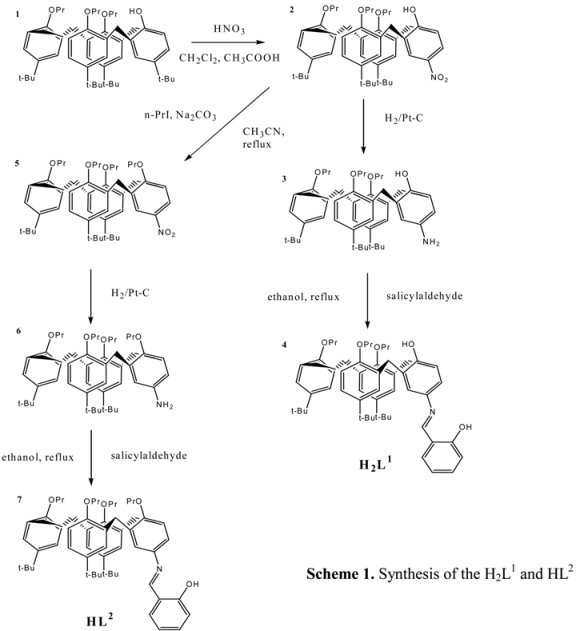
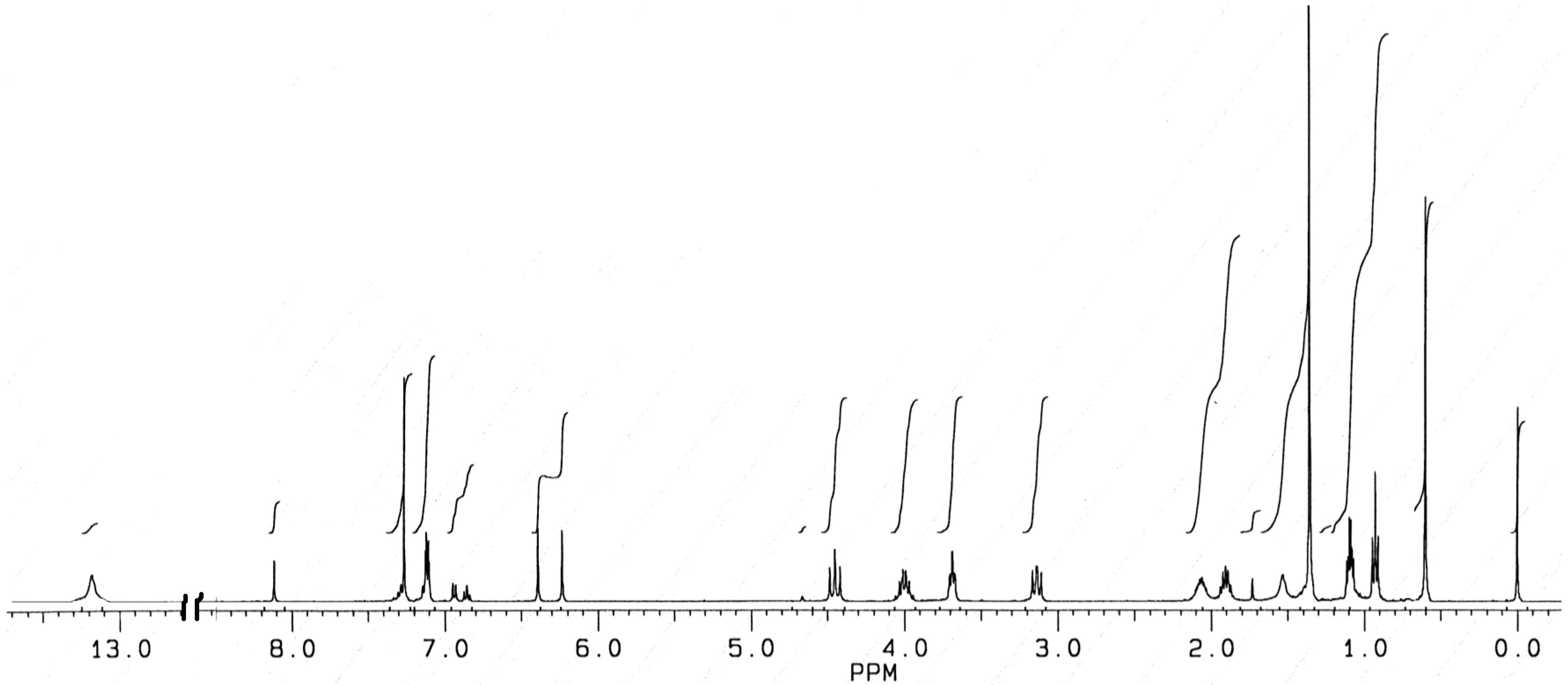
The cone mononitro-p-tert-butylcalix[4]arene 2 was obtained from the mono ipsonitration of monohydroxycalixarene using a modified method [17]. The mononitro derivatives 2 and 5 were reduced to the corresponding monoamines by hydrogenation over a palladium-charcoal catalyst. The condensation of compounds 3 and 6 with salicylaldehyde gave the Schiff base ligands H2L1 and HL2 as NO donors with a p-tert-butylcalix[4]arene moiety (Scheme 1). The 1H-NMR spectrum of the ligands indicated the calixarene to be in a cone conformation. The conclusion that H2L1 and HL2 exist in cone conformations was deduced from the presence of two sets of characteristic AB systems (figure 1 and figure 2) as described in the Experimental Section [18]. The analytical results of the isolated solid ligands with their melting points and colors are compiled in Table 1.
Table 1.
Colors, yields, melting points and analytical results of H2L1 and HL2
IR Spectra
The characteristic IR absorptions are given in Table 2. The observed microanalytical data for C, H, and N atoms shows that H2L1 contains a water molecule that is identified by broad O-H absorptions around 3547-3400 cm-1.
Table 2.
Characteristic IR bands of the H2L1 and HL2 as KBr Pellets ( cm-1 )
Electronic Spectra
The electronic spectra were recorded in chloroform and acetonitrile (Table 3). An important property for distinguishing potential NLO materials is the existence of solvatochromicity [19], i.e., the solvent dependent shift of the absorption bands in the UV/vis spectra. Both H2L1 and HL2 display strong negative solvatochromicity as shown in Table 3. Negative solvatochromicity can be attributed to the stabilization of polar ground states in polar solvents.
Table 3.
electronic spectra of H2L1 and HL2
As a result these Schiff bases are good candidates for NLO chromophores due to their strong solvatochromicity. UV/Vis fluorescence of H2L1 and HL2 was observed when they were irradiated at a wavelength of 390 nm whereby they emitted a light with a wavelength of 526 and 522 nm, respectively.
1H-NMR Spectra
1H-NMR spectra of H2L1 and HL2 are shown in Figure 1 and Figure 2, respectively. Assignments of 1H-NMR signals can be found in the Experimental Section. The downfield signal of the proton of hydroxy group of the salicylaldehide moiety, the salicylidene part of H2L1 and HL2, justifies the existence of intramolecular hydrogen bonding between the hydrogen atom of the hydroxy group and the nitrogen atom of the imine.
Fig.1.
1H-NMR Spectra of H2L1
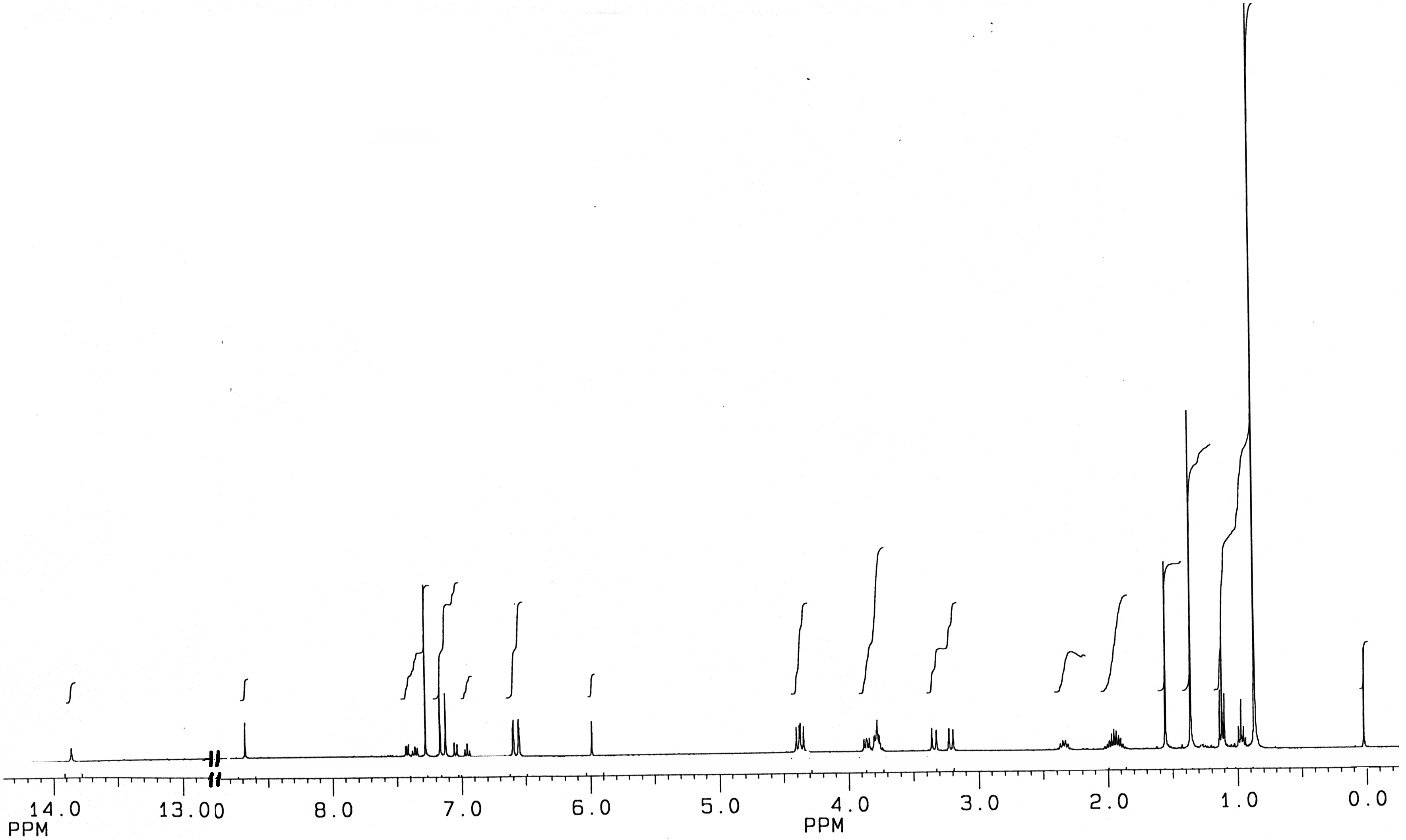
Fig. 2.
1H-NMR Spectra of HL2
Conclusions
In this paper we present the preparation of two Schiff bases of p-tert-buthylcalix[4]arene derivatives. Both these Schiff base ligands have flourescence properties which suggest their potential for analytical applications. Also the solvent dependent UV/Vis spectra and solvatochromicity of these compounds show their potential for NLO applications.
Experimental
General
Melting points are taken on a Büchi SMP-20 apparatus and are uncorrected. 1H-NMR spectra were recorded on a Bruker AM-400MHz in CDCl3 with Me4Si as an internal standard. Elemental analysis were recorded on Carlo-Erba-Analysor Model 1104. IR spectra were recorded on Bruker IFS 25. Compound 1, p-tert-buthylcalix[4]tripropoxyarene, was prepared according to a literature procedure [20].
Preparation of H2L1 and HL2
According to the Scheme 1, mononitro derivatives were reduced to the corresponding monoamines by hydrogenation over palladium-charcoal catalyst and then used for the preparation of the H2L1 and HL2 as follows: salicylaldehyde (170 mg, 1.36mmol) was added to a solution of 1.36 mmol of corresponding monoamine, 3 or 6, in ethanol (30 mL) and the mixture was refluxed for 24h. After cooling the reaction mixture, the yellow colored H2L1 product was precipitated by addition of water but HL2 was precipitated without addition of water. Both were recrystallized from ethanol, yields 86% for H2L1 and 84% for HL1.
1H-NMR spectra of H2L1: δ 13.85 (1H, s, H-O, sal.), 8.65 (1H, s, H-C=N), 7.44 (2H, dd, Ar-H) 7.35 (4H, m, Ar-H, sal), 7.13 (2H, dd, Ar-H), 6.55 (4H, dd, Ar-H), 5.95 (1H, s, O-H), 4.38 and 3.25 (4H, dd, Ar-CH2-Ar, J = 12.9 Hz), 3.85 (2H, t, OCH2), 3.75 (4H, t, OCH2), 4.33 and 3.19 (4H, dd, Ar-CH2-Ar, J = 13.8 Hz), 2.3 (2H, m, CH2), 1.95 (4H, m, CH2), 1.35 (9H, s, C(CH3)3), 1.1 (6H, t, 2CH3), 0.95 (3H, t, CH3), 0.85 (18H, s, C(CH3) 3).
1H-NMR spectra of HL2: δ 13.20 (1H, s, H-O, sal.), 8.15 (1H, s, H-C=N), 7.29 (2H, dd, Ar-H) 7.25 (4H, m, Ar-H, sal), 7.11 (2H, dd, Ar-H), 6.40 (4H, dd, Ar-H), 4.47 and 3.15 (4H, dd, Ar-CH2-Ar, J = 13.0 Hz), 4.05 (2H, t, OCH2), 4.00 (2H, t, OCH2) 3.70 (4H, t, OCH2), 4.42 and 3.12 (4H, dd, Ar-CH2-Ar, J = 13.5 Hz), 2.07 (4H, m, CH2), 1.90 (4H, m, CH2), 1.31 (18H, s, C (CH3) 3), 1.5 (6H, t, 2CH3), 0.92 (6H, t, CH3), 0.60 (9H, s, C(CH3) 3).
Acknowledgements
We are grateful to the Research Council of Tabriz University for financial support. Generous support from Prof. Dr. J. Ipaktschi, Institute of Organic Chemistry, Giessen University is highly acknowledged. The Ministry of Science, Research and Technology of Iran is acknowledged for a grant to B. Shaabani.
References
- Gutche, C. D. Calixarenes, Revisited; The Royal Society of Chemistry: Cambridge, 1998. [Google Scholar]
- Vicens, J.; Boehmer, V. Calixarenes: A Versatile Class of Macrocyclic Compounds; Kluver Academic: Boston, 1991. [Google Scholar]
- Van Loon, J. D.; Arduini, A.; Coppi, L.; Verboom, W.; Pochini, A.; Ungaro, R.; Harkema, S.; Reinhoudt, D. N. J. Org. Chem. 1990, 55, 5639. [CrossRef]
- Morzherin, Y.; Rudkevich, D. M.; Verboom, W.; Reinhoudt, D. N. J. Org. Chem. 1993, 58, 7602. [CrossRef]
- Casnati, A.; Pochini, A.; Ungaro, R.; Ugozzoli, F.; Arnaud, F.; Fanni, S.; Schwing, M. J.; Egberink, R. J. M.; Dejong, F.; Reinhoult, D. N. J. Am. Chem. Soc. 1995, 117, 2767. [CrossRef]
- Arnaud-Neu, F.; Fanni, S.; Guerra, L.; McGregor, W.; Zait, K.; Schwing-Weill, M. J.; Barrett, G.; McKervey, M. A.; Marrs, D.; Seward, E. M. J. Chem. Soc., Perkin Trans. II 1995, 113.
- Yilmaz, M. Solution State Metal Complexes of Calixarenes and Polymeric Calixarene. In Handbook of Engineering Materials; Cheremisionoff, N. P., Ed.; Marcel Dekker, Inc: New York, 1997. [Google Scholar]
- Seangprasertkij, R.; Asfari, Z.; Arnaud, F.; Vicens, J. J. Org. Chem. 1994, 59, 1741. [CrossRef]
- Johnson, C. P.; Atwood, J. L.; Steed, J. W.; Bauer, C. B.; Rogers, R. D. Inorg. Chem. 1996, 35, 2602.
- Tamburini, S.; Tomasin, P.; Vigato, P. A.; Casnati, A.; Domiano, L. Inorganica Chimica Acta 1997, 254, 209.
- Yilmaz, M. Synth. React. Inorg. Met.-Org. Chem. 1998, 28, 1759. [CrossRef]
- Guo, T. D.; Zheng, Q. Y.; Yang, L. M.; Huang, Z. T. J. Inclusion Phenom. Macrosyclic Chem. 2000, 36, 327. [CrossRef]
- Verboom, W.; Durie, A.; Egberink, R. J. M.; Asfari, Z.; Reinhoudt, D. N. J. Org. Chem. 1992, 57, 1313. [CrossRef]
- Can, S.; Bekaroglu, O. J. Chem. Soc. Perkin Trans. I 1991, 3137.
- Deligoez, H.; Yilmaz, M. Synth. React. Inorg. Met-Org. Chem. 1997, 27, 391.
- Narag, K. K.; Shing, S. K.; Mishra, G. D. Synth. React. Inorg. Met-Org. Chem. 1996, 26, 191.
- Rashidi-Ranjbar, P.; Taghvaee-Gnajali, S.; Shaabani, B.; Akbari-Dilmaghani, K. Molecules 2000, 5, 941.
- Iwamoto, K.; Araki, K.; Shinkai, S. J. Org. Chem. 1991, 56, 4955. [CrossRef]
- McRae, E. G. J. Phys. Chem. 1975, 61. Paley, M. S.; Hariss, J. M. J. Org. Chem. 1989, 54, 3774. [CrossRef]
- Iwamoto, K.; Araki, K.; Shinkai, S. Tetrahedron 1991, 47, 4325.
- Sample Availability: Samples are available from the authors
© 2001 by MDPI (http://www.mdpi.org). Reproduction is permitted for noncommercial purposes