Introduction
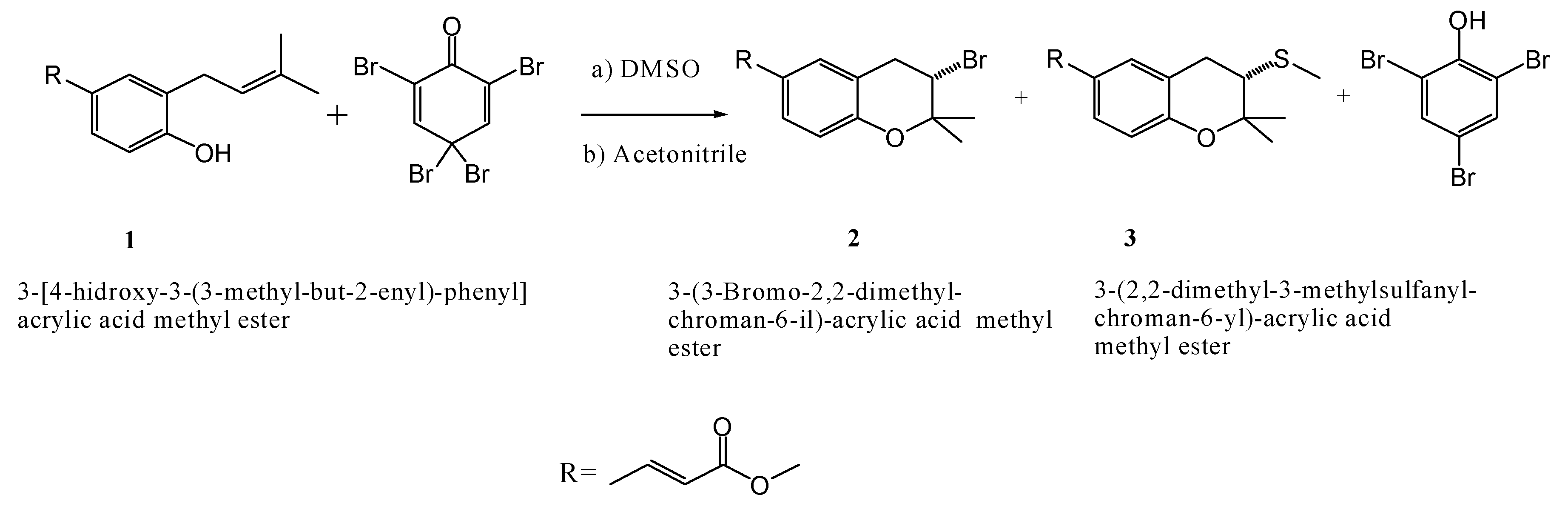
The reagents used to oxidize alcohols to ketones in DMSO are believed to form sulfoxonium intermediate species by electrophilic attack at the DMSO oxygen [1,2]. In this work we studied the reaction of 3-[γ,γ - dimethylallyl] – coumaric acid methyl ester with 2,4,4,6-tetrabromo-2,5-cyclohexadienone (TBC).
Experimental
The reaction (Scheme 1) was followed using 1H NMR and GC-EIMS. The products were isolated using TLC and HPLC. Conductimetric measurements of solutions of TBC in acetonitrile and DMSO as a function of time were carried out.
Scheme 1.
Results and Discussion
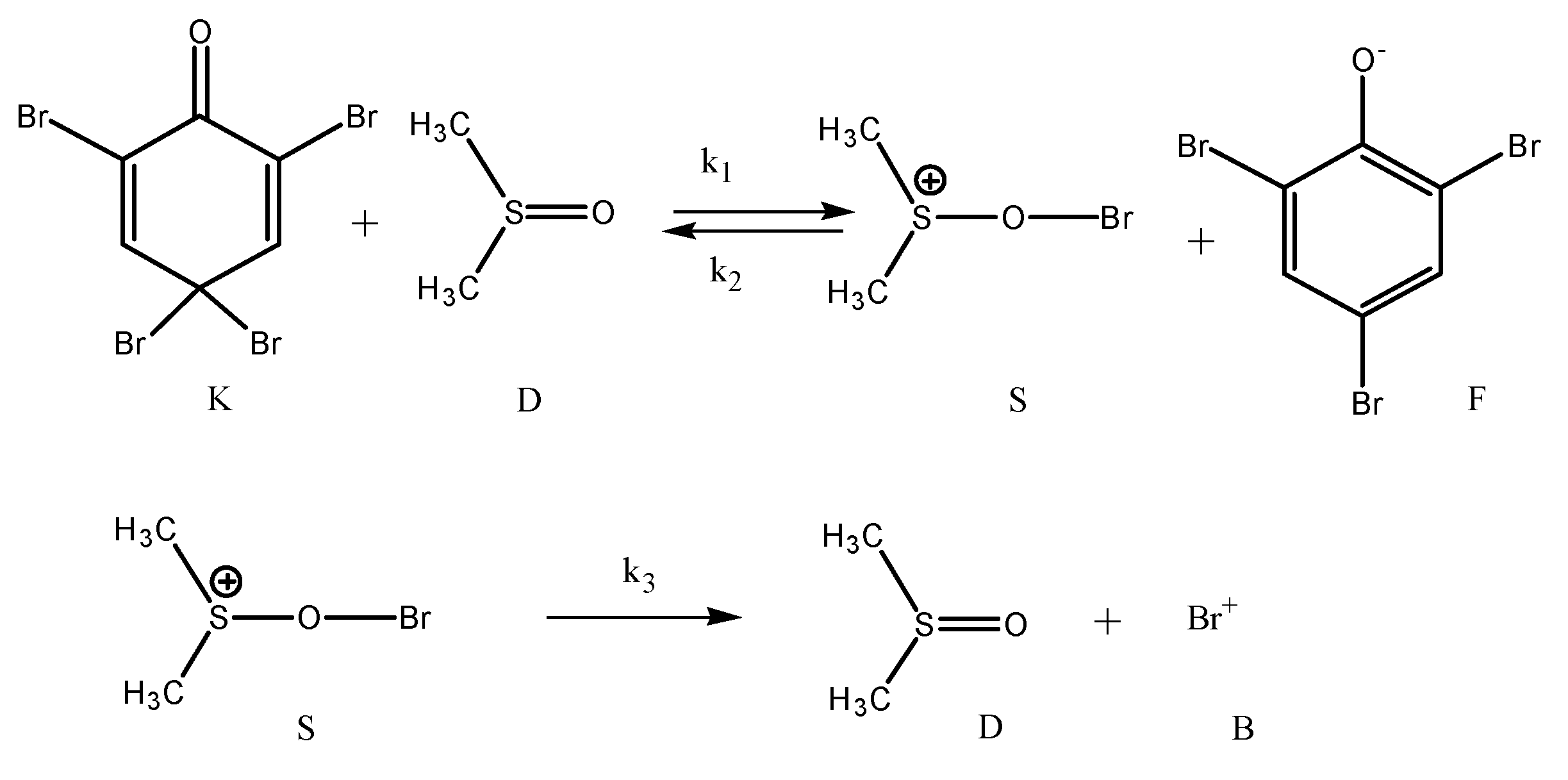
GC-EIMS experiments indicate that tribromophenol (TBF) is formed almost completely during the first minute of the reaction as long as ester slowly diminishes its concentration. This suggests the existence of an intermediate species that captures the bromonium ion. If TBF participate in this specie, significant changes should not be expected when solvent is changed. However, the reaction speed and the yield of the brominated cycle increase when the reaction is made in DMSO related to acetonitrile. Therefore, we propose the species (CH3)2S+-O-Br, which would act as a carrier of bromonium to produce the cyclization. The postulation of this species would also explain the product 3, which was characterized by 1HNMR and GC-EIMS. From this point of view the reaction can be considered as similar to a reaction of Pummerer [3].
In order to test this hypothesis, the conductance of solutions of 2, 4, 4, 6 - tetrabromo - 2, 5 - cyclohexadienone (TBC) in DMSO and acetonitrile respectively, as a function of time, was measured. Results indicate that the first step the reaction would involve the following balance:
Acknowledgements
We are thankful to CONICET (PIP 5030) and UNSL (Project 7301) for financial support. We especially thank Professor L.F.R. Cafferata (U.N. La Plata), Dra. María Virginia Mirífico (INIFTA) and Dr. Leónides Sereno (U.N. Río Cuarto) for their helpful comments.
References and Notes
- Corey, E.J.; Kim, C.U. J. Am. Chem. Soc. 1972, 94, 7586. [CrossRef]
- Corey, E.J.; Kim, C.U. Tetrahedron Letters 1973, 919. [CrossRef]
- Lucchi, O. De; Miotti, U.; Modena, G. Organic Reactions; J. Wiley & Sons, Inc, 1991; Chapter 3; p. 40. [Google Scholar] [CrossRef]