


Abstract
Different types of 3-substituted 4H-4-oxobenzopyrans were prepared by microwave irradiation as well as by a classical method. The beneficial effect of microwave irradiation on the aldol condensation of 3-formylchromones with 2-imino-1-methyl-imidazolidine-4-one (creatinine), 2-thioxoimidazolidine-4-one (thiohydantoin) and 2-ethyl-2-thioxothiazolidin-4-one (3-ethylrhodanine) in different reaction media is described. Our results show that the effect of microwave irradiation on the reactions studied was a shortening of the reaction times and a smooth increase in the yields. The subsequent reactions of the product with some nucleophiles are discussed. The structure of the products was proven by elemental analysis, IR and NMR spectra.
Introduction
This study is a continuation of our earlier publications [1,2,3,4,5,6,7], in which we described the theoretical, spectral and biological properties of newly synthesized chromone and chromanone derivatives. The aim of this work was the preparation of some new five-membered nitrogen heterocyclic derivatives of chromone as potentially useful intermediates for synthesis.
3-Formylchromones 1 were chosen as being synthetically versatile molecules with a reactive carbonyl group. They have considerable significance for their biological activities [8,9,10] and for their reactivity towards nucleophiles which allows the synthesis of a wide variety of heterocycles. A study of the influence of microwave irradiation on the condensation reactions was the next goal of this paper. Five-membered ring heterocycles 2-4 are known as precursors of α-amino acids and they can be condensed easily with aldehydes. It is known that condensations of creatinine with aldehydes [11, 12] as well as the Gränacher synthesis [13] with rhodanine under classical conditions take several hours at high temperatures (160–180°C).
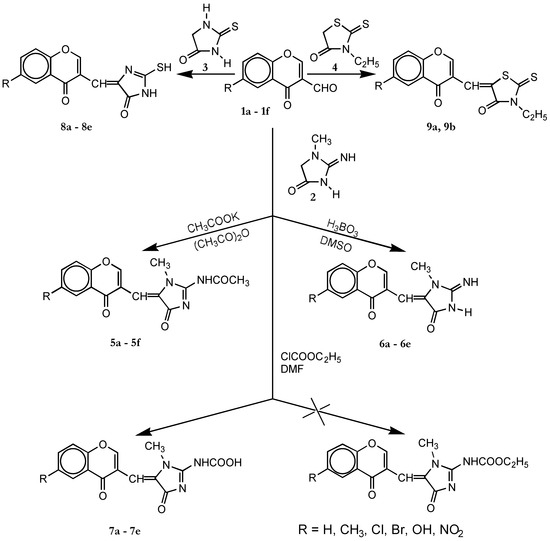
As we have shown before [14], microwave irradiation is a suitable method for shortening the duration of condensation reactions. Condensations of creatinine [15] and thiohydantoin [16] with aromatic aldehydes without a solvent under microwave irradiation and giving good yields of products were described by Villemin and al. The starting 3-formylchromones used in this work are accessible via Vilsmeier-double formylation of appropriate o-hydroxyacetophenones [17]. Commercially available nitrogen heterocycles were used for the reactions. The reactions are outlined in Scheme 1 and Scheme 2. Details of the experimental results are listed in Table 1.
Scheme 1.
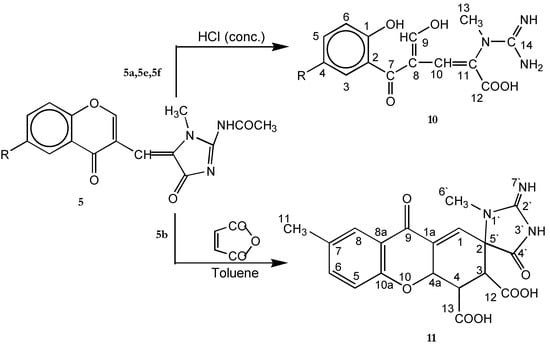
Scheme 2.
Table 1.
Characterization of the prepared compounds.
Results and Discussion
2-Acetamido-1-methyl-5-[(6-R-4-oxo-4H-benzopyran-3-yl)methylidene]-4,5-dihydroimidazol-4-ones 5a-5f were obtained by condensations of 1a-1f with creatinine 2 in acetic anhydride, both under microwave irradiation (A) and classical (B) conditions. Although the yields by both methods were almost the same (46-84%), the reactions in a microwave oven were considerably faster (Table 1). Imino derivatives 6a-6e (2-imino-1-methyl-5-[(6-R-4-oxo-4H-[1]-benzopyran-3-yl) methylidene]- imidazoli-din-4-ones) were obtained using dimethylsulfoxide as a solvent and boric acid as a catalyst by both methods A and B.
A convenient synthesis of carbamoic acid derivatives 7 (1-methyl-4-oxo-5-[(6-R-4-oxo-4H-[1]-benzopyran-3-yl)methylidene]-4,5-dihydroimidazol-2-carbamoic acids) was accomplished by reaction of creatinine with ethylchloroformate in N,N-dimethylformamide followed by the subsequent addition of aldehydes 1a-1e. The hydrolyzed products 7a-7e were obtained in 69-71% yields by both the classical and microwave irradiation condensation methods, even under anhydrous conditions. It is evident that compounds 7 resulted from the utilization of the water of condensation for the hydrolysis process. In the 1H NMR spectra of compounds 7 no signals for the ethyloxy group were observed (Table 2).
Table 2.
1H NMR spectra data of prepared compounds.
3-Formylchromone condensations with thiohydantoin 3 and 3-ethylrhodanine 4 were carried out in acetic anhydride in the presence of potassium acetate under both irradiation and classical conditions. The yields of 2-thioxo-5-[(6-R-4-oxo-4H-[1]-benzopyran-3-yl) methylidene]imidazolidin-4-ones 8a-8e and 2-thioxo-5-[(6-R-4-oxo-4H-benzopyran-3-yl)methylidene]thiazolidin-4-ones, 9a and 9b, respectively, were comparable by both methods.
Attempts to hydrolyze the condensation products with diluted mineral acids to prepare ring opened heterocycles were unsuccessful. The 5-(2-hydroxyphenyl)-4-(hydroxy-methylidene)-2-(1-methyl-guanidino)-2-pentenoic acid hydrolysis products (10) were obtained only by refluxing compounds 5 in concentrated hydrochloric acid. We propose the structure of compounds 10, which contain guanidinyl, carboxyl and enolic groups on the basis of 1H NMR, 13C NMR spectra and elemental analysis. Compounds 10 could be regarded as a mixtures of isomers with a very fast tautomeric equilibrium of both enolic and oxo groups. The assumption of this fast tautomeric equilibrium is supported by the data for the shift signals of C-9 in the 13C NMR spectra.
We next attempted to carry out Diels - Alder reactions with various dienophiles, using e.g. maleic anhydride, diethyl maleate and tetracyanoethylene, using both the classical and microwave irradiation procedures. Only heating and stirring a mixture of 5b in toluene with an excess of maleic anhydride at 40°C over 15 hr. was successful and the spiroheterocyclic adduct spiro[(1´-methyl-2´-imido-4´-oxo)-1´, 3´-diazolane-5´, 2-(7-methyl-9-oxo-2, 3, 4, 4a tetrahydroxantene)]-3, 4-dicarboxylic acid (11) was formed in 64% yield. The proposed structure was confirmed by 13C NMR. Similar Diels - Alder reactions were reported previously [18]. The use of microwave irradiation for the Diels - Alder experiments was unsuccessful.
All condensation products are stable solid compounds, rather insoluble in common solvents, with high melting points. Because of their poor solubility in DMSO we had to measure their 1H NMR spectra at elevated temperatures (Table 2). The resonance signals and their multiplicity confirmed the proposed structures. The infrared spectra of the prepared compounds 5-9 showed strong absorption bands of the C=O stretching vibrations in two very well distinguished regions 1645 - 1668 cm−1 and 1688 - 1745 cm−1 (Table 3). The absorption bands in the lower region of the spectra belong to the ν(C=O) of the γ-pyrone ring. The higher region was attributed to the azole heterocyclic part of the prepared compounds. Compounds 10 lacked the ν(C=O) band at 1640 - 1660 cm−1. Strong bands around 1740 cm−1 confirmed the presence of unsaturated aldehyde groups (Table 4).
Table 3.
IR spectral data of synthesized compounds 5-9.
Table 4.
IR spectral data of synthesized compounds 10 and 11.
Experimental
General
Products were characterized by elemental analyses (Table 1), NMR spectra (Table 2) and IR spectra (Table 3 and Table 4). The melting points were determined on a Kofler block and are uncorrected. Infrared spectra of nujol suspensions were recorded in 400 - 4000 cm−1 region on a Specord IR 75 spectrometer (Zeiss Jena). 1H and 13C NMR spectra were measured on a 300 MHz spectrometer VARIAN GEMINI 200 in deuterated DMSO at 50-80°C. All microwave assisted reactions were carried out in a Lavis - 1000 multi Quant microwave oven. The apparatus was adapted for laboratory applications with magnetic stirring and an external reflux condenser.
Synthesis of 5a-5f , 8a-8e and 9a, 9b
Method A
A mixture of 6-R-3-formylchromones 1a-1f (2.87 mmol), creatinine 2 (or thiohydantoin 3 or 3-ethylrhodanine 4) ( 2.87 mmol) in dry acetic anhydride (2 cm3) in the presence of freshly fused potassium acetate was stirred and irradiated in a microwave oven for the time given in Table 1. The solid was filtered off. The products were recrystallized from dioxane or toluene.
Method B
A mixture of the same composition as in method A was heated at 110-120°C for the time given in Table 1. Isolation of products was accomplished as described in method A.
Synthesis of 6a–6e
Method A
A mixture of 6-R-3-formylchromone 1 (2.87 mmol), creatinine 2 (2.87 mmol), a catalytic amount of H3BO3 (20 mg) in 1cm3 of dry dimethyl sulfoxide was stirred and irradiated at 270 W in a microwave oven. The solid product was filtered off and recrystallized from dioxane or toluene.
Method B
A mixture of the same composition as in method A was heated in 1cm3 of dry dimethyl sulfoxide at 120°C over 3 h. The solid product was filtered off and recrystallized from dioxane.
Synthesis of 7a, 7b
Method A
Creatinine 2 (2.87 mmol) was dissolved in 1 cm3 of dry dimethylformamide and then ethyl chloroformate was added to the solution. The mixture was stirred and irradiated in a microwave oven at 270 W. The solid product was filtered off and recrystallized from dioxane or toluene.
Method B
The mixture of creatinine 2 ( 2.87 mmol) and ethyl chloroformate ( 3.0 mmol ) in dry dimethyl-formamide ( 1 cm3) was stirred at room temperature for 3h and then 6-R-3-formylchromone 1 ( 2.87 mmol) was added to the mixture and heated at 90°C for 6 h. The isolation of products was the same as described above.
Acid hydrolysis of compounds 5a, 5e and 5f
The solution of 0.3 g (1 mmol) creatinine derivative 5a (or 5e, 5f) in 10 ml of concentrated hydro-chloride acid was heated at 90-100°C for 4 h. After cooling the resulting white crystals were filtered off, washed with cold water and recrystallized from dioxane. Thus prepared were compounds 10a, 10e and 10f
| 13C NMR spectral data for compound 10e [δ(ppm); DMSO - d6, 300 MHz] | ||||||
| C-1 | C-2 | C-3 | C-4 | C-5 | C-6 | C-7 |
| 155.45 | 123.77 | 123.65 | 154.87 | 107.95 | 120.11 | 174.53 |
| C-8 | C-9 | C-10 | C-11 | C-12 | C-13 | C-14 |
| 114.78 | 157.60 | 109.79 | 130.04 | 163.32 | 28.69 | 149.23 |
Diels - Alder reaction of compound 5b with maleic anhydride (11)
The mixture of 1g (2.51 mmol) of compound 5b and 0.52 g (5.02 mmol) of maleic anhydride in toluene (30 cm3) was heated at 40°C for 15 h. The solid adduct after cooling was filtered off, washed with 10 cm3 of toluene and dried. The product was suspended in 30 cm3 water was then stirred at 40°C for 3 h. The solid acid was removed by suction and recrystallized from ethanol. Yield 64%.
| 13C NMR spectral data for compound 11 [δ(ppm); DMSO - d6, 300 MHz] | ||||||
| C-1 | C-1a | C-2 | C-3 | C-4 | C-4a | C-5 |
| 131.1 | 131.6 | 107.8 | 39.2 | 39.2 | 135.8 | 116.0 |
| C-6 | C-7 | C-8 | C-8a | C-9 | C-10a | C-11 |
| 135.7 | 130.9 | 124.6 | 153.8 | 190.0 | 118.5 | 20.5 |
| C-12 | C-13 | C-2′ | C-4′ | C-6′ | ||
| 166.8 | 166.8 | 157.6 | 174.8 | 28.4 | ||
Analytical Data
References and Notes
- Stankovicova, H.; Fabian, W. M.; Lacova, M. Molecules 1996, 1, 223.
- Stankovicova, H.; Gasparova, R.; Lacova, M.; Chovancova, J. Collect. Czech. Chem. Commun. 1997, 62, 781.
- Lacova, M.; Stankovicova, H.; Odlerova, Z. Il Pharmaco 1995, 50, 885.
- El-Shaaer, H.M.; Perjessy, A.; Zahradnik, P.; Lacova, M.; Matulova, M. Monatsh. Chem 1993, 124, 539.
- Lacova, M.; El-Shaaer, H.M.; Loos, D.; Matulova, M.; Chovancova, J.; FurdIk, M. Molecules 1998, 3, 120.
- Gasparova, R.; Lacova, M.; El-Shaaer, H.M.; Odlerova, Z. Il Pharmaco 1997, 52, 251.
- Lacova, M.; Chovancova, J.; Veverkova, J.; Toma, S. Tetrahedron 1996, 52, 14995.
- Nohara, A.; Sugihara, H.; Ukawa, K. Japan. Kokai Tokyo Koho 1978, 78, 111,070. ; Chem. Abstr. 1979, 90, 54828z.
- Klutchko, S.; Kaminski, D.; Von Strandtmann, M. U.S. Patent 4,008,252, 1977. ; Chem. Abstr. 1977, 87, 5808a.
- Lacova, M.; El-Shaaer, H. M.; Odlerova, Z.; Furdik, M. Chem. Papers 1994, 48, 344.
- Deulofeu, V.; Guerrero, T. J. Org. Synth. Coll. 1955, 3, 586.
- Coirnwaite, W. R.; Lazarus, S.; Snelling, R. H.; Denoon, C. E. J. Am. Chem. Soc. 1936, 58, 628.
- Fitton, A. O.; Frost, J. R.; Suschitsky, H.; Houghton, P. G. Synthesis 1977, 133.
- Gasparova, R.; Lacova, M. Collect. Czech. Chem. Commun. 1995, 60, 1178.
- Villemin, D.; Martin, B. Synth. Commun. 1995, 25, 3135.
- Villemin, D.; Ricard, M. Synth. Commun. 1987, 17, 283.
- Nohara, A.; Ishiguto, T.; Sanno, Y. Tetrahedron Lett. 1974, 13, 1183.
- Silva, A. M. S.; Silva, A. M. G.; Tome, A. C.; Cavaleiro, J. A. S. J. Org. Chem. 1999, 135.
- Samples Availability: Available from the authors and MDPI.

© 2000 by MDPI (http://www.mdpi.org). Reproduction is permitted for noncommercial purposes.