

Characterization of Different Capsicum Varieties by Evaluation of Their Capsaicinoids Content by High Performance Liquid Chromatography, Determination of Pungency and Effect of High Temperature

Abstract
1. Introduction
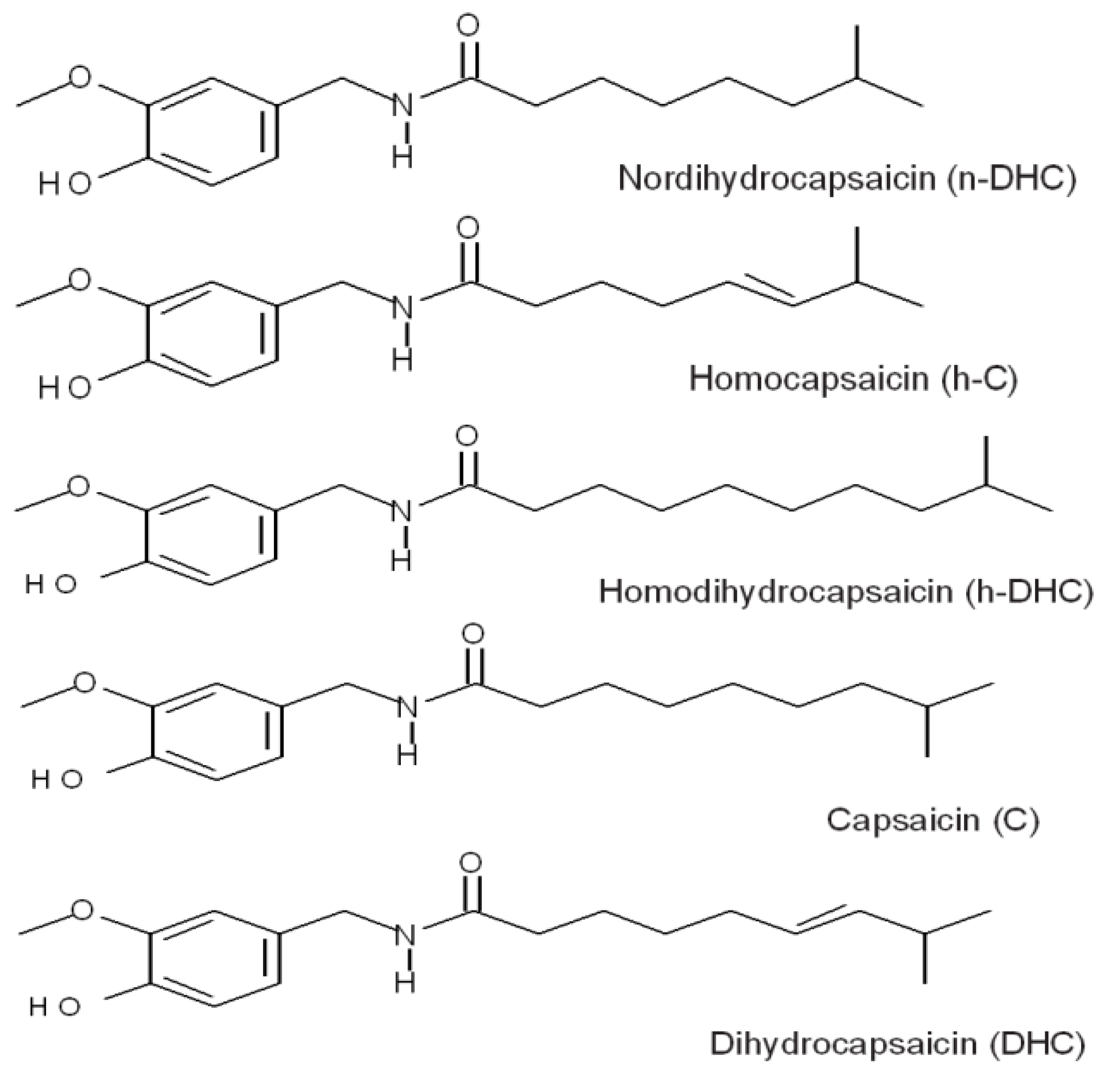
2. Results and Discussion
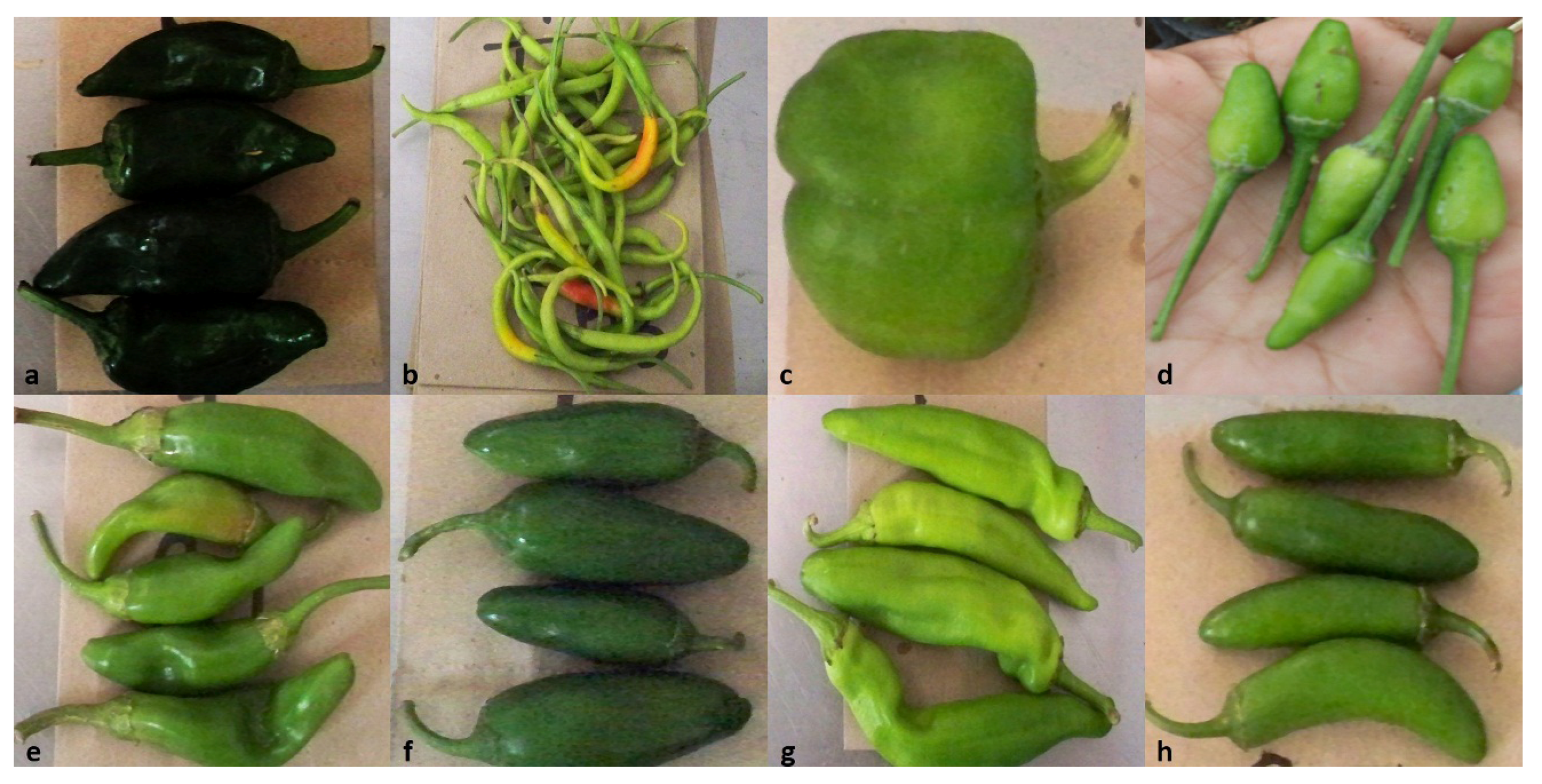
2.1. Quantification of Individual Compounds
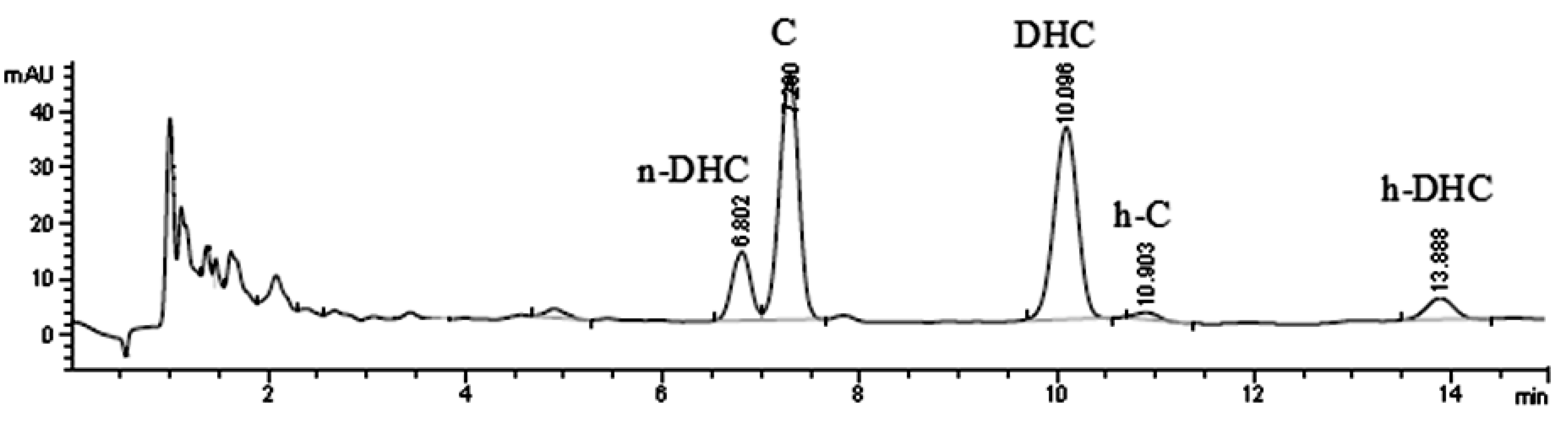
2.2. Effect of High Temperature on Capsaicinoids Content

| Sample | n-DHC | C | DHC | C:DHC ratio | h-C | h-DHC | Total capsaicinoids | SHU | |||||
|---|---|---|---|---|---|---|---|---|---|---|---|---|---|
| mg g−1 | % | mg g−1 | % | mg g−1 | % | mg g−1 | % | mg g−1 | % | mg g−1 | |||
| dry weight | dry weight | dry weight | dry weight | dry weight | dry weight | ||||||||
| Ancho cv. Don Matias | 0.25 ± 0.01 ab | 13 | 0.29 ± 0.03 a | 15 | 0.77 ± 0.04 a | 41 | 1:2.7 | ND | − | 0.58 ± 0.12 | 31 | 1.88 ± 0.05 a | 19,335.7 ± 1,133.7 a |
| De árbol | 1.07 ± 0.01 c | 8 | 5.22 ± 0.16 b | 37 | 6.25 ± 0.30 c | 45 | 1:1.2 | 0.13 ± 0.11 | 1 | 1.29 ± 0.77 | 9 | 13.96 ± 0.29 c | 194,591.9 ± 6,852.6 c |
| Bell pepper cv. Cardinal | ND | − | ND | − | ND | − | ND | ND | − | ND | − | ND | ND |
| Chiltepín | 2.17 ± 0.21 d | 7 | 15.36 ± 1.67 d | 48 | 13.39 ± 1.60 e | 42 | 1:0.9 | 0.22 ± 0.07 | 1 | 0.69 ± 0.19 | 2 | 31.84 ± 0.75 e | 483,089.3 ± 54,336.8 e |
| Guajillo cv. San Luis | 0.12 ± 0.03 a | 8 | 0.17 ± 0.01 a | 12 | 0.61 ± 0.11 a | 42 | 1:3.6 | ND | − | 0.56 ± 0.16 | 38 | 1.46 ± 0.08 a | 13,704.8 ± 2,275.7 a |
| Jalapeño cv. Don Julio | 2.48 ± 0.28 d | 12 | 8.03 ± 0.37 c | 38 | 9.39 ± 0.41 d | 45 | 1:1.2 | 0.16 ± 0.13 | 1 | 0.97 ± 0.14 | 5 | 21.03 ± 0.27 d | 303,602.5 ± 8,722.0 d |
| Puya | 0.55 ± 0.06 b | 11 | 1.18 ± 0.07 a | 25 | 2.32 ± 0.22 ab | 48 | 1:2.0 | 0.08 ± 0.01 | 2 | 0.68 ± 0.04 | 14 | 4.80 ± 0.08 ab | 61,526.0 ± 5,117.4 ab |
| Serrano cv. Don Diego | 0.53 ± 0.04 b | 8 | 1.52 ± 0.01 a | 24 | 3.54 ± 0.01 b | 57 | 1:2.3 | ND | − | 0.64 ± 0.09 | 10 | 6.25 ± 0.04 b | 86,427.2 ± 635.4 b |
| Sample | n-DHC | C | DHC | C:DHC ratio | h-C | h-DHC | Total capsaicinoids | SHU | |||||
|---|---|---|---|---|---|---|---|---|---|---|---|---|---|
| mg g−1 | % | mg g−1 | % | mg g−1 | % | mg g−1 | % | mg g−1 | % | mg g−1 | |||
| dry weight | dry weight | dry weight | dry weight | dry weight | dry weight | ||||||||
| Ancho cv. Don Matias | 0.44 ± 0.26 ab | 22 | 0.38 ± 0.05 a | 18 | 0.63 ± 0.00 a | 31 | 1:1.7 | ND | − | 0.60 ± 0.04 | 29 | 2.05 ± 0.09 a | 20,275.2 ± 2815.5 d |
| De árbol | 0.64 ± 0.05 ab | 7 | 4.20 ± 0.07 d | 44 | 4.19 ± 0.04 c | 45 | 1:1.0 | 0.04 ± 0.02 | 0.5 | 0.33 ± 0.06 | 4 | 9.40 ± 0.50 c | 141,072.7 ± 2,091.9 d |
| Bell pepper cv. Cardinal | ND | − | ND | − | ND | − | ND | ND | − | 0.41 ± 0.08 | 100 | 0.41 ± 0.08 a | ND |
| Guajillo cv. San Luis | 0.27 ± 0.02 a | 6 | 1.32 ± 0.16 b | 28 | 2.83 ± 0.27 b | 60 | 1:2.2 | ND | − | 0.33 ± 0.08 | 7 | 4.74 ± 0.13 b | 69,210.5 ± 7,228.8 b |
| Jalapeño cv. Don Julio | 1.19 ± 0.08 c | 15 | 2.35 ± 0.11 c | 29 | 4.18 ± 0.27 c | 51 | 1:1.8 | ND | − | 0.40 ± 0.13 | 5 | 8.11 ± 0.15 c | 116,158.5 ± 6,534.7 c |
| Puya | 0.90 ± 0.04 bc | 15 | 1.54 ± 0.26 b | 27 | 3.37 ± 0.82 bc | 58 | 1:2.2 | ND | − | ND | − | 5.81 ± 0.37 b | 87,440.1 ± 19,221.8 bc |
| Serrano cv. Don Diego | 2.47 ± 0.08 d | 14 | 4.76 ± 0.22 e | 26 | 10.14 ± 0.56 d | 56 | 1:2.1 | 0.36 ± 0.03 | 2 | 0.31 ± 0.14 | 2 | 18.05 ± 0.21 d | 262,916.3 ± 13,306.4 e |
3. Experimental
3.1. Chemicals
3.2. Samples and Cultivar Conditions
3.3. Capsaicinoids Extraction
3.4. Capsaicinoids analysis by HPLC-DAD
3.5. Pungency
3.6. Statistical Analysis
4. Conclusions
Acknowledgments
Conflicts of Interest
References
- Hernández, V.; Dávila, S.A.P.; Oyama, K. Síntesis del conocimiento taxonómico, origen y domesticación del género Capsicum. Bol. Soc. Bot. Mex. 1999, 64, 65–84. [Google Scholar]
- Pino, J.; Sauri-Duch, E.; Marbot, R. Change in volatile compounds of Habanero chile pepper (Capsicum chinense Jack. Cv. Habanero) at two ripening stages. Food Chem. 2006, 94, 394–398. [Google Scholar] [CrossRef]
- Marti, M.C.; Camejo, D.; Vallejo, F.; Romojaro, F.; Bacarizo, S.; Palma, J.M.; Sevilla, F.; Jiménez, A. Influence of fuit ripening stage and harvest period on the antioxidant content of sweet pepper cultivars. Plant Food Hum. Nutr. 2011, 66, 416–423. [Google Scholar] [CrossRef]
- Ben-Chaim, A.; Borovsky, Y.; Falise, M.; Mazourek, M.; Kang, B.-C.; Paran, I.; Jahn, M. QTL analysis for capsaicinoid content in Capsicum. Theor. Appl. Genet. 2006, 113, 1481–1490. [Google Scholar]
- Zewdie, Y.; Bosland, P.W. Evaluation of genotype, environment, and genotype-by-environment interaction for capsaicinoids in Capsicum annuum L. Euphytica 2000, 111, 185–190. [Google Scholar] [CrossRef]
- Kosuge, S.; Furata, M. Studies on the pungent principle of Capsicum. Part XIV. Chemical constitution of the pungent principle. Agr. Biol. Chem. Tokyo 1970, 34, 248–256. [Google Scholar] [CrossRef]
- Laskaridou-Monnerville, A. Determination of capsaicin and dihydrocapsaicin by micellar electrokinetic capillary chromatography and its application to various species of Capsicum, Solanaceae. J. Chromatogr. A 1999, 836, 293–302. [Google Scholar] [CrossRef]
- Djamgoz, M.B.A.; Isbilen, B. Dietary compounds as anti-cancer agents: A preliminary evaluation of ion channels and membrane excitability as possible target mechanisms. Turk. J. Biochem. 2006, 31, 57–68. [Google Scholar]
- Mori, A.; Lehmann, S.; O’Kelly, J.; Kumagai, T.; Desmond, J.C.; Pervan, M.; McBride, W.H.; Kizaki, M.; Koeffler, H.P. Capsaicin, a component of red peppers, inhibits the growth of androgen-independent, p53 mutant prostate cancer cells. Cancer Res. 2006, 66, 3222–3229. [Google Scholar] [CrossRef]
- Antonious, G.F.; Kochhar, T.S.; Jarret, R.L.; Snyder, J.C. Antioxidants in hot pepper: Variation among accessions. J. Environm. Sci. Heal. B 2006, 41, 1237–1243. [Google Scholar] [CrossRef]
- Cisneros-Pineda, O.; Torres-Tapia, L.W.; Gutiérrez-Pacheco, L.C.; Contreras-Martín, F.; González-Estrada, T.; Peraza-Sánchez, S.R. Capsaicinoids quantification in chili peppers cultivated in the state of Yucatan, Mexico. Food Chem. 2007, 104, 1755–1760. [Google Scholar]
- Zhang, Q.; Hu, J.; Sheng, L.; Li, Y. Simultaneous quantification of capsaicin and dihydrocapsaicin in rat plasma using HPLC coupled with tandem mass spectrometry. J. Chromatogr. B 2010, 878, 2292–2297. [Google Scholar] [CrossRef]
- Liu, L.; Chen, X.; Liu, J.; Deng, X; Duan, W; Tan, S. Determination of capsaicin and dihydrocapsaicin in Capsicum anuum and related products by capillary electrophoresis with a mixed surfactant system. Food Chem. 2010, 119, 1228–1232. [Google Scholar] [CrossRef]
- Ritota, M.; Marini, F.; Sequi, P.; Valentine, M. Metabolomic characterization of Italian sweet pepper (Capsicum annum L.) by means of HRMAS-NMR spectroscopy and multivariate analysis. J. Agric. Food Chem. 2010, 58, 9675–9684. [Google Scholar] [CrossRef]
- Orellana-Escobedo, L.; Garcia-Amezquita, L.E.; Olivas, G.I.; Ornelas-Paz, J.J.; Sepulveda, D.R. Capsaicinoids content and proximate composition of Mexican chili peppers (Capsicum spp.) cultivated in the State of Chihuahua. Cienc. Tecnol. Aliment. 2013, 11, 179–184. [Google Scholar]
- SIAP. Servicio de Información Agroalimentaria y Pesquera. Producción agrícola por cultivo. Available online: http://www.siap.gob.mx/ (accessed on 25 June 2013).
- Laborde, J.A.; Pozo, C. Presente y Pasado del Chile en México; Secretaría de Agricultura y Recursos Hidráulicos, Instituto Nacional de Investigaciones Agrícolas: DF, Mexico, 1984; p. 80. [Google Scholar]
- Jarret, R.L.; Baldwin, E.; Perkins, B.; Bushway, R.; Guthrie, K. Diversity of fruit quality characteristics in Capsicum frutescens. HortScience 2007, 42, 16–19. [Google Scholar]
- Alvarez-Parrilla, E.; de la Rosa, L.A.; Amaro wicz, R.; Shahidi, F. Antioxidant activity of fresh and processed Jalapeño and Serrano peppers. J. Agric. Food Chem. 2011, 59, 163–173. [Google Scholar]
- Weiss, E.A. Spice Crops; CABI Publishing International: New York, NY, USA, 2002; p. 411. [Google Scholar]
- Harvell, K.P.; Bosland, P.W. The environment produces a significant effect on pungency of chiles. HortScience 1997, 32, 1292. [Google Scholar]
- Wilson, D.R.; Muchow, R.C.; Murgatroyd, C.J. Model analysis of temperature and solar radiation limitations to maize potential productivity in cool climate. Field. Crop. Res. 1995, 43, 1–18. [Google Scholar] [CrossRef]
- CNA. Comisión Nacional del Agua. Available online: http://www.cna.gob.mx/ (accessed on 25 June 2013).
- López, J.D.; Vázquez, C.; Salazar, E.; Zuñiga, R.; Trejo, H.I. Use of soil water content in deciding the sowing time in dry land agriculture. J. Hortic. For. 2010, 2, 122–126. [Google Scholar]
- Morán-Bañuelos, S.H.; Aguilar-Rincón, V.H.; Corona-Torres, T.; Castillo-González, F.; Soto-Hernández, R.M.; San Miguel-Chávez, R. Capsaicinoides en chiles nativos de Puebla, México. Agrociencia-Mexico 2008, 42, 807–816. [Google Scholar]
- Orellana-Escobedo, L.; Ornelas-Paz, J.J.; Olivas, G.I.; Guerrero-Beltran, J.A.; Jimenez-Castro, J.; Sepulveda, D.R. Determination of absolute threshold and just noticeable difference in the sensory perception of pungency. J. Food Sci. 2012, 77, 5135–5139. [Google Scholar]
- International Conference on Harmonisation of Technical Requeriments for Registration of Pharmaceuticals for Human Use. Validation of Analytical Procedures: Text and Methodology Q2(R1); International Conference on Harmonisation of Technical Requeriments for Registration of Pharmaceuticals for Human Use: Geneva, Switzerland, 2005; p. 13. [Google Scholar]
- Collins, M.D.; Wasmund, L.M.; Bosland, P.W. Improved method for quantifying capsaicinoids in Capsicum using high performance liquid chromatography. HortScience 1995, 30, 137–139. [Google Scholar]
- Kurian, A.L.; Starks, A.N. HPLC analysis of capsaicinoids extracted from whole orange Habañero chili peppers. J. Food Sci. 2002, 67, 956–962. [Google Scholar] [CrossRef]
- Barbero, G.F.; Liazid, A.; Palma, M.; Barroso, C.G. Fast determination of capsaicinoids from peppers by High-Performance Liquid Chromatography using a reversed phase monolithic column. Food Chem. 2008, 107, 1276–1282. [Google Scholar] [CrossRef]
- Giuffrida, D.; Dugo, P.; Torre, G.; Bignardi, C.; Cavazza, A.; Corradini, C.; Dugo, G. Characterization of 12 Capsicum varieties by evaluation of their carotenoid profile and pungency determination. Food Chem. 2013, 140, 794–802. [Google Scholar] [CrossRef]
- Govindarajan, V.S.; Sathyanarayana, M.N. Capsicum-production, technology, chemistry, and quality. Part V. Impact on physiology, pharmacology, nutrition and metabolism; structure, pungency, pain and desensitization sequences. Crit. Rev. Food Sci. 1991, 29, 435–473. [Google Scholar] [CrossRef]
- Manirakiza, P.A.; Covaci, A.; Schepens, P. Pungency principles. In Capsicum. The genus Capsicum; de, A.K., Ed.; Taylor and Francis: London, UK, 2003; pp. 71–86. [Google Scholar]
- Garcés-Claver, A.; Arnedo-Andrés, M.S.; Abadía, J.; Gil-Ortega, R.; Alvarez-Fernández, A. Determination of capsaicin and dihydrocapsaicin in Capsicum fruits by liquid chromatography-electrospray/time of flight mass spectrometry. J. Agric. Food Chem. 2006, 54, 9303–9311. [Google Scholar] [CrossRef]
- Collins, M.; Bosland, P. Rare and novel capsaicinoid profiles in Capsicum. Capsicum Eggplant Newsl. 1994, 13, 48–51. [Google Scholar]
- Cruz-Pérez, A.B.; González-Hernández, V.A.; Soto-Hernández, R.M.; Gutiérrez-Espinoza, M.A.; Gardea-Béjar, A.A.; Pérez-Grajalez, M. Capsaicinoides, vitamina C y heterosis durante el desarrollo del fruto de chile manzano. Agrociencia-Mexico 2007, 41, 627–635. [Google Scholar]
- Alpizar-Lara., E.; Trujillo-Aguirre, J.J.G.; Herrera-Rodríguez, F.J. Determinación de capsaicinoides en chile habanero (Capsicum chinense Jaq.), colectados en Yucatán. In Proceedings 16th International Pepper Conference, Tamaulipas, México, 10–12 November 2002; p. 43.
- Cázarez-Sánchez, E.; Ramírez-Vallejo, P.; Castillo-González, F.; Soto Hernández, R.M.; Rodríguez-González, M.T.; Chávez-Servia, J.L. Capsaicinoides y preferencia de uso en diferentes morfotipos de chile (Capsicum annuum L.) del centro-Oriente de Yucatán. Agrociencia 2005, 39, 627–638. [Google Scholar]
- Casanova, C.; Gutiérrez, P.; Torres, T.; Peraza, S.; González, E. Caracterización química y molecular de la pungencia de los chiles (Capsicum spp.) de Yucatán. In Proceedings Third World Pepper Convention, Chihuahua, México, 9–11 July 2006; p. 27.
- Bosland, P.W.; Baral, J.B. “Buhut Jolokia”—The world’s hottest known chile pepper is a putative naturally occurring interspecific hybrid. Hortscience 2007, 42, 222–224. [Google Scholar]
- Canto-Flick, A.; Balam-Uc, E.; Bello-Bello, J.J.; Lecona-Guzmán, C.; Solís-Marroquín, D.; Avilés-Viñas, S.; Gómez-Uc, E.; López-Puc, G.; Santana-Buzzy, N.; Iglesias-Andreu, L.G. Capsaicinoids content in Habanero pepper (Capsicum chinense Jacq.): Hottest known cultivars. Hortscience 2008, 43, 1344–1349. [Google Scholar]
- Barbero, G.F.; Palma, M.; Barroso, C.G. Determination of capsaicinoids in peppers by microwave-assisted extraction-high-performance liquid chromatography with fluorescence detection. Anal. Chim. Acta 2006, 578, 227–233. [Google Scholar] [CrossRef]
- Wahid, A. Physiological implications of metabolites biosynthesis in net assimilation and heat stress tolerance of sugarcane (Saccharum officinarum) sprouts. J. Plant Res. 2007, 120, 219–228. [Google Scholar] [CrossRef]
- Zróbek-Sokolnik, A. Temperature Stress and Response of Plants. In Environmental Adaptations and Stress Tolerance of Plant in the Era of Climate Change; Ahmad, P., Prasad, M.N.V., Eds.; Springer: New York, NY, USA, 2012; pp. 113–134. [Google Scholar]
- Mittler, R. Abiotic stress, the field environment and stress combitation. Trends Plant Sci. 2006, 11, 15–19. [Google Scholar] [CrossRef]
- Mateos, R.M.; Jiménez, A.; Román, P.; Romojaro, F.; Bacarizo, S.; Leterrier, M.; Gómez, M.; Sevilla, F.; del Río, L.A.; Corpas, F.J.; Plama, J.M. Antioxidant systems from pepper (Capsicum annuum L.): Involvement in the response to temperature changes in ripe fruits. Int. J. Mol. Sci. 2013, 14, 9556–9580. [Google Scholar] [CrossRef]
- Rahman, M.J.; Inden, H. Effect of nutrient solution and temperature on capsaicin content and yield contributing characteristics in six sweet pepper (Capsicum annuum L.) cultivars. J. Food Agric. Environ. 2012, 10, 524–529. [Google Scholar]
- Tiwari, A.; Kaushil, M.P.; Pandey, K.S.; Dangi, R.S. Adaptability and production of hottest chilli variety under Gwalior agro-climatic conditions. Curr. Sci. 2005, 88, 1545–1546. [Google Scholar]
- Estrada, B.; Pomar, F.; Díaz, J.; Merino, F.; Bernal, M.A. Pungency level in fruits of the Padrón pepper with different water supply. Sci. Hortic. 1999, 81, 385–396. [Google Scholar] [CrossRef]
- Johnson, T.S.; Ravishankar, G.A.; Venkataraman, L.V. Biotransformation of ferulic acid and vanillylamine to capsaicin and vanillin in immobilized cell cultures of Capsicum frutescens. Plant Cell Tiss. Org. 1996, 44, 117–121. [Google Scholar] [CrossRef]
- Narasimha, B.C.; Bhaskar, H.; Kumar, V.; Giridhar, P.; Parimalan, R.; Sharma, A.; Ashwathanarayana, G. Influence of 8-Methyl-nonenoic Acid on capsaicin biosynthesis in in vivo and in-vitro cell cultures of Capsicum spp. J. Agric. Food Chem. 2006, 54, 1854–1859. [Google Scholar] [CrossRef]
- Diaz, J.; Bernal, M.A.; Merino, F. Phenolic metabolism in Capsicum annuum. Recent Res. Dev. Phytochem. 1998, 2, 155–169. [Google Scholar]
- Sukrasno, N.; Yeoman, M.M. Phenylpropanoid metabolism during growth and development of Capsicum frutescens fruits. Phytochemistry 1993, 32, 839–844. [Google Scholar] [CrossRef]
- Lee, Y.; Howard, L.R.; Villalón, B. Flavonoids and antioxidant activity of fresh pepper (Capsicum annuum) cultivars. J. Food Sci. 1995, 60, 473–476. [Google Scholar] [CrossRef]
- Stewart, C., Jr.; Kang, B.-C.; Liu, K.; Mazourek, M.; Moore, S.L.; Yoo, E.Y.; Kim, B.-D.; Paran, I.; Jahn, M.M. The Pun1 gene for pungency in pepper encodes a putative acyltransferase. Plant J. 2005, 42, 675–688. [Google Scholar] [CrossRef]
- Kirschbaum-Titze, P.; Hiepler, C.; Mueller-Seitz, E.; Petz, M. Pungency in Paprika (Capsicum annuum): 1. Decrease in capsaicinoids content following cellular disruption. J. Agric. Food Chem. 2002, 50, 1260–1263. [Google Scholar] [CrossRef]
- Bernal, M.A.; Calderón, A.A.; Pedreño, M.A.; Muñoz, R.; Barceló, A.R.; de Cáceres, F.M. Capsaicin oxidation by peroxidase from Capsicum annuum (var. annuum) fruits. J. Agric. Food Chem. 1993, 41, 1041–1044. [Google Scholar] [CrossRef]
- Contreras-Padilla, M.; Yahia, E.M. Changes in capsacinoids during development, maturation, and senescence of chilie peppers and relation with peroxidase activity. J. Agric. Food Chem. 1998, 46, 2075–2079. [Google Scholar] [CrossRef]
- Saha, S.R.; Hossain, M.M.; Rahman, M.M.; Kuo, C.G.; Abdullah, S. Effect of high temperature stress on the performance of twelve sweet pepper genotypes. Bangladesh J. Agric. Res. 2010, 35, 525–534. [Google Scholar]
- Ruiz-Lau, N.; Medina-Lara, F.; Minero-García, Y.; Zamudio-Moreno, E.; Guzmán-Antonio, A.; Echavarría-Machado, I.; Martínez-Estévez, M. Water deficit affects the accumulation of capsaicinoids in fruits of Capsicum chinense Jacq. Hortscience 2011, 46, 487–492. [Google Scholar]
- Al Othman, Z.A.; Badjah, Y.; Habila, M.A.; Ghafar, A.A. Determination of capsaicin and dihydrocapsaicin in Capsicum fruit samples using high performance liquid chromatography. Molecules 2011, 16, 8919–8929. [Google Scholar] [CrossRef]
- Parrish, M. Liquid chromatographic method of determining capsaicinoids in capsicums and their extractives: Collaborative study. J. Assoc. Off. Anal. Chem. 1996, 79, 738–745. [Google Scholar]
- Todd, P., Jr.; Bensinger, M.G.; Biftu, T. Determination of pungency due to Capsicum by Gas-Liquid Chromatography. J. Food Sci. 1977, 42, 660–665. [Google Scholar] [CrossRef]
- Sample Availability: Samples of the compounds are available from the authors.
© 2013 by the authors; licensee MDPI, Basel, Switzerland. This article is an open access article distributed under the terms and conditions of the Creative Commons Attribution license (http://creativecommons.org/licenses/by/3.0/).
Share and Cite
González-Zamora, A.; Sierra-Campos, E.; Luna-Ortega, J.G.; Pérez-Morales, R.; Ortiz, J.C.R.; García-Hernández, J.L. Characterization of Different Capsicum Varieties by Evaluation of Their Capsaicinoids Content by High Performance Liquid Chromatography, Determination of Pungency and Effect of High Temperature. Molecules 2013, 18, 13471-13486. https://doi.org/10.3390/molecules181113471
González-Zamora A, Sierra-Campos E, Luna-Ortega JG, Pérez-Morales R, Ortiz JCR, García-Hernández JL. Characterization of Different Capsicum Varieties by Evaluation of Their Capsaicinoids Content by High Performance Liquid Chromatography, Determination of Pungency and Effect of High Temperature. Molecules. 2013; 18(11):13471-13486. https://doi.org/10.3390/molecules181113471
Chicago/Turabian StyleGonzález-Zamora, Alberto, Erick Sierra-Campos, J. Guadalupe Luna-Ortega, Rebeca Pérez-Morales, Juan Carlos Rodríguez Ortiz, and José L. García-Hernández. 2013. "Characterization of Different Capsicum Varieties by Evaluation of Their Capsaicinoids Content by High Performance Liquid Chromatography, Determination of Pungency and Effect of High Temperature" Molecules 18, no. 11: 13471-13486. https://doi.org/10.3390/molecules181113471
APA StyleGonzález-Zamora, A., Sierra-Campos, E., Luna-Ortega, J. G., Pérez-Morales, R., Ortiz, J. C. R., & García-Hernández, J. L. (2013). Characterization of Different Capsicum Varieties by Evaluation of Their Capsaicinoids Content by High Performance Liquid Chromatography, Determination of Pungency and Effect of High Temperature. Molecules, 18(11), 13471-13486. https://doi.org/10.3390/molecules181113471

