
<?xml version="1.0" encoding="UTF-8"?>
<!DOCTYPE article PUBLIC "-//NLM//DTD Journal Publishing DTD v2.3 20070202//EN" "journalpublishing.dtd">
<article xmlns:mml="http://www.w3.org/1998/Math/MathML" xmlns:xlink="http://www.w3.org/1999/xlink" xml:lang="en" article-type="rapid-communication">
  <front>
    <journal-meta>
      <journal-id journal-id-type="publisher-id">molecules</journal-id>
      <journal-title>Molecules</journal-title>
      <abbrev-journal-title abbrev-type="publisher">Molecules</abbrev-journal-title>
      <abbrev-journal-title abbrev-type="pubmed">Molecules</abbrev-journal-title>
      <issn pub-type="epub">1420-3049</issn>
      <publisher>
        <publisher-name>MDPI</publisher-name>
      </publisher>
    </journal-meta>
    <article-meta>
      <article-id pub-id-type="doi">10.3390/molecules17089462</article-id>
      <article-id pub-id-type="publisher-id">molecules-17-09462</article-id>
      <article-categories>
        <subj-group>
          <subject>Communication</subject>
        </subj-group>
      </article-categories>
      <title-group>
        <article-title>Effect of Acute and Fractionated Irradiation on Hippocampal Neurogenesis</article-title>
      </title-group>
      
      <contrib-group>
        <contrib contrib-type="author">
          <name>
            <surname>Park</surname>
            <given-names>Min-Kyoung</given-names>
          </name>
          <xref rid="af1-molecules-17-09462" ref-type="aff">1</xref>
          <xref rid="af2-molecules-17-09462" ref-type="aff">2</xref>
        </contrib>
        <contrib contrib-type="author">
          <name>
            <surname>Kim</surname>
            <given-names>Seolhwa</given-names>
          </name>
          <xref rid="af1-molecules-17-09462" ref-type="aff">1</xref>
        </contrib>
        <contrib contrib-type="author">
          <name>
            <surname>Jung</surname>
            <given-names>Uhee</given-names>
          </name>
          <xref rid="af1-molecules-17-09462" ref-type="aff">1</xref>
        </contrib>
        <contrib contrib-type="author">
          <name>
            <surname>Kim</surname>
            <given-names>Insub</given-names>
          </name>
          <xref rid="af1-molecules-17-09462" ref-type="aff">1</xref>
        </contrib>
        <contrib contrib-type="author">
          <name>
            <surname>Kim</surname>
            <given-names>Jin Kyu</given-names>
          </name>
          <xref rid="af1-molecules-17-09462" ref-type="aff">1</xref>
        </contrib>
        <contrib contrib-type="author">
          <name>
            <surname>Roh</surname>
            <given-names>Changhyun</given-names>
          </name>
          <xref rid="af1-molecules-17-09462" ref-type="aff">1</xref>
          <xref rid="c1-molecules-17-09462" ref-type="corresp">*</xref>
        </contrib>
      </contrib-group>
      <aff id="af1-molecules-17-09462"><label>1 </label>Division of Biotechnology, Advanced Radiation Technology Institute (ARTI), Korea Atomic Energy Research Institute (KAERI), 1266, Sinjeong-dong, Jeongeup, Jeonbuk 580-185, Korea; Email: <email>mkpark@kaeri.re.kr</email> (M.-K.P.); <email>shkim@kaeri.re.kr</email> (S.K.); <email>uhjung@kaeri.re.kr</email> (U.J.); <email>Insub@kaeri.re.kr</email> (I.K.); <email>jkkim@kaeri.re.kr</email> (J.K.K.)</aff>
      <aff id="af2-molecules-17-09462"><label>2 </label>Department of Chemistry, Seoul National University, Gwanak-ro, Gwanak-gu, Seoul 151-747, Korea</aff>
	  <author-notes>
        <corresp id="c1-molecules-17-09462"><label>*</label> Author to whom correspondence should be addressed; Email: <email>chroh@kaeri.re.kr</email>; 
		Tel.: +82-63-570-3133; Fax: +82-63-570-3139.
		</corresp>
      </author-notes>
      <pub-date pub-type="epub">
        <day>08</day>
        <month>08</month>
        <year>2012</year>
      </pub-date>
      <pub-date pub-type="collection"> <month>08</month>
        <year>2012</year>
      </pub-date>
      <volume>17</volume>
      <issue>8</issue>
      <fpage>9462</fpage>
      <lpage>9468</lpage>
      <history>
        <date date-type="received">
          <day>27</day>
          <month>06</month>
          <year>2012</year>
        </date>
        <date date-type="rev-recd">
          <day>27</day>
          <month>07</month>
          <year>2012</year>
        </date>
        <date date-type="accepted">
          <day>06</day>
          <month>08</month>
          <year>2012</year>
        </date>
      </history>
      <permissions>
        <copyright-statement>© 2012 by the authors; licensee MDPI, Basel, Switzerland.</copyright-statement>
        <copyright-year>2012</copyright-year>
        <license xmlns:xlink="http://www.w3.org/1999/xlink" license-type="open-access" xlink:href="http://creativecommons.org/licenses/by/3.0/">
          <p>This article is an open-access article distributed under the terms and conditions of the Creative Commons Attribution license (http://creativecommons.org/licenses/by/3.0/).</p>
        </license>
      </permissions>
      <abstract>
        <p>Ionizing radiation has become an inevitable health concern emanating from natural sources like space travel and from artificial sources like medical therapies. In general, exposure to ionizing radiation such as γ-rays is one of the methods currently used to stress specific model systems. In this study, we elucidated the long-term effect of acute and fractionated irradiation on DCX-positive cells in hippocampal neurogenesis. Groups of two-month-old C57BL/6 female mice were exposed to whole-body irradiation at acute dose (5 Gy) or fractional doses (1 Gy × 5 times and 0.5 Gy × 10 times). Six months after exposure to γ-irradiation, the hippocampus was analyzed. Doublecortin (DCX) immunohistochemistry was used to measure changes of neurogenesis in the subgranular zone (SGZ) of the hippocampal dentate gyrus (DG). The number of DCX-positive cells was significantly decreased in all acute and fractionally irradiation groups. The long-term changes in DCX-positive cells triggered by radiation exposure showed a very different pattern to the short-term changes which tended to return to the control level in previous studies. Furthermore, the number of DCX-positive cells was relatively lower in the acute irradiation group than the fractional irradiation groups (approximately 3.6-fold), suggesting the biological change on hippocampal neurogenesis was more susceptible to being damaged by acute than fractional irradiation. These results suggest that the exposure to γ-irradiation as a long-term effect can trigger biological responses resulting in the inhibition of hippocampal neurogenesis.</p>
      </abstract>
      <kwd-group>
        <kwd>neurogenesis</kwd>
        <kwd>ionizing radiation</kwd>
        <kwd>immunohistochemistry</kwd>
        <kwd>doublecortin</kwd>
        <kwd>long-term effects</kwd>
      </kwd-group>
    </article-meta>
  </front>
  <body>
    <sec sec-type="intro">
      <title>1. Introduction</title>
      <p>Neurodegeneration, the progressive loss of structure or function of neurons, results in many neurodegenerative diseases such as Parkinson’s, Alzheimer’s, and Huntington’s [<xref ref-type="bibr" rid="B1-molecules-17-09462">1</xref>,<xref ref-type="bibr" rid="B2-molecules-17-09462">2</xref>,<xref ref-type="bibr" rid="B3-molecules-17-09462">3</xref>,<xref ref-type="bibr" rid="B4-molecules-17-09462">4</xref>]. The hippocampus, where neuronal circuitry ranging from molecular to systemic exists, has been recognized as a key region related to many neurological diseases [<xref ref-type="bibr" rid="B5-molecules-17-09462">5</xref>,<xref ref-type="bibr" rid="B6-molecules-17-09462">6</xref>,<xref ref-type="bibr" rid="B7-molecules-17-09462">7</xref>]. Doublecortin (DCX) as a progenitor neural cell marker, a microtubule-associated phospho-protein, has been utilized for analyzing alterations in neurogenesis in the adult dentate gyrus (DG) because it is believed to be specific to neuronal antigens expressed by newly born neurons [<xref ref-type="bibr" rid="B8-molecules-17-09462">8</xref>]. The rate of hippocampal neurodegeneration is known to be affected by age, hormonal status, growth factor, chemicals, physiologic stimuli and environmental effects. For many reasons, there is an increasing interest in models used to understand the mechanism of neurodegeneration [<xref ref-type="bibr" rid="B9-molecules-17-09462">9</xref>,<xref ref-type="bibr" rid="B10-molecules-17-09462">10</xref>,<xref ref-type="bibr" rid="B11-molecules-17-09462">11</xref>,<xref ref-type="bibr" rid="B12-molecules-17-09462">12</xref>].</p>
      <p>Ionizing radiation has been hazardous to human health due to overexposure from natural and artificial sources, such as diagnostic and therapeutic medical usage [<xref ref-type="bibr" rid="B13-molecules-17-09462">13</xref>,<xref ref-type="bibr" rid="B14-molecules-17-09462">14</xref>]. Overexposure to radiation causes damage to living tissue, and can result in mutations, radiation sickness, cancer, and death [<xref ref-type="bibr" rid="B15-molecules-17-09462">15</xref>,<xref ref-type="bibr" rid="B16-molecules-17-09462">16</xref>]. Even though the risk to radiation exposure in the brain is a big issue, the changes in the hippocampal neurodegeneration are poorly understood. However, recently, the risk of short-term neurodegeneration caused by radiation exposure has been reported [<xref ref-type="bibr" rid="B17-molecules-17-09462">17</xref>,<xref ref-type="bibr" rid="B18-molecules-17-09462">18</xref>,<xref ref-type="bibr" rid="B19-molecules-17-09462">19</xref>,<xref ref-type="bibr" rid="B20-molecules-17-09462">20</xref>,<xref ref-type="bibr" rid="B21-molecules-17-09462">21</xref>,<xref ref-type="bibr" rid="B22-molecules-17-09462">22</xref>]. Kim’s group suggested that transient impairment of the functioning of the hippocampus is linked to inhibition of hippocampal neurogenesis after acute γ-irradiation [<xref ref-type="bibr" rid="B9-molecules-17-09462">9</xref>]. The Abdallah group reported that irradiation can reversibly alter proliferation, neurogenesis, and cell death in the dentate gyrus of adult mice. The early cognitive deficits may be related to the effects of a short-term reduction of neurogenesis [<xref ref-type="bibr" rid="B17-molecules-17-09462">17</xref>]. The Acevedo group reported that older female mice deficient in apoE (Apoe<sup>−/−</sup>) are more susceptible to effects of gamma irradiation on novel location recognition [<xref ref-type="bibr" rid="B23-molecules-17-09462">23</xref>]. </p>
      <p>In this study, we addressed the long-term effect of γ-irradiation exposure on neurogenesis in a C57BL/6 female model. We were interested in determining if there is a dose response relationship in terms of radiation-induced long-term impairments in neurogenesis. We elucidated the number of DCX-positive cells on the hippocampus with altered radiation dose in immunohistochemistry. We hypothesized that the long-term changes in DCX-positive cells caused by γ-irradiation would continuously increase neurodegeneration resulting in damage to the hippocampal function as opposed to the recovering tendency of neurogenesis impairment in the short term. Understanding how irradiation affects neurogenesis may provide useful insight into potential approaches to reduce brain-related diseases.</p>
    </sec>
    <sec sec-type="results">
      <title>2. Results and Discussions</title>
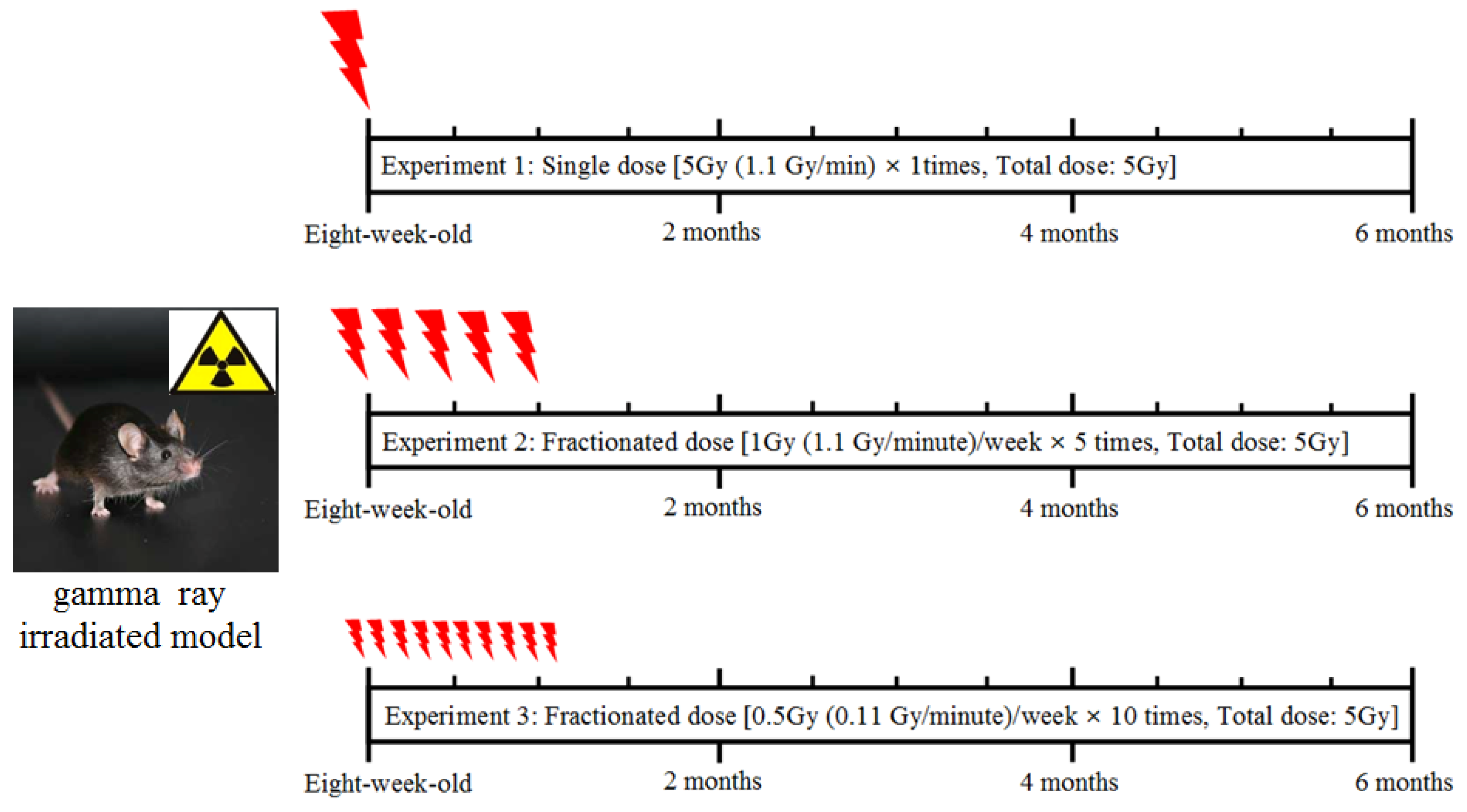
      <p><xref ref-type="fig" rid="molecules-17-09462-f001">Figure 1</xref> shows the scheme for the procedure of radiation exposure in an animal model. The mice were exposed to whole-body radiation at acute dose (5 Gy) or fractional doses (1 Gy × 5 times or 0.5 Gy × 10 times), and further sustained for 6 months.</p>
      <fig id="molecules-17-09462-f001" position="anchor">
        <label>Figure 1</label>
        <caption>
          <p>Gamma-ray irradiated models by acute or fractionated whole-body irradiation.</p>
        </caption>
        <graphic xmlns:xlink="http://www.w3.org/1999/xlink" xlink:href="molecules-17-09462-g001.tif"/>
      </fig>
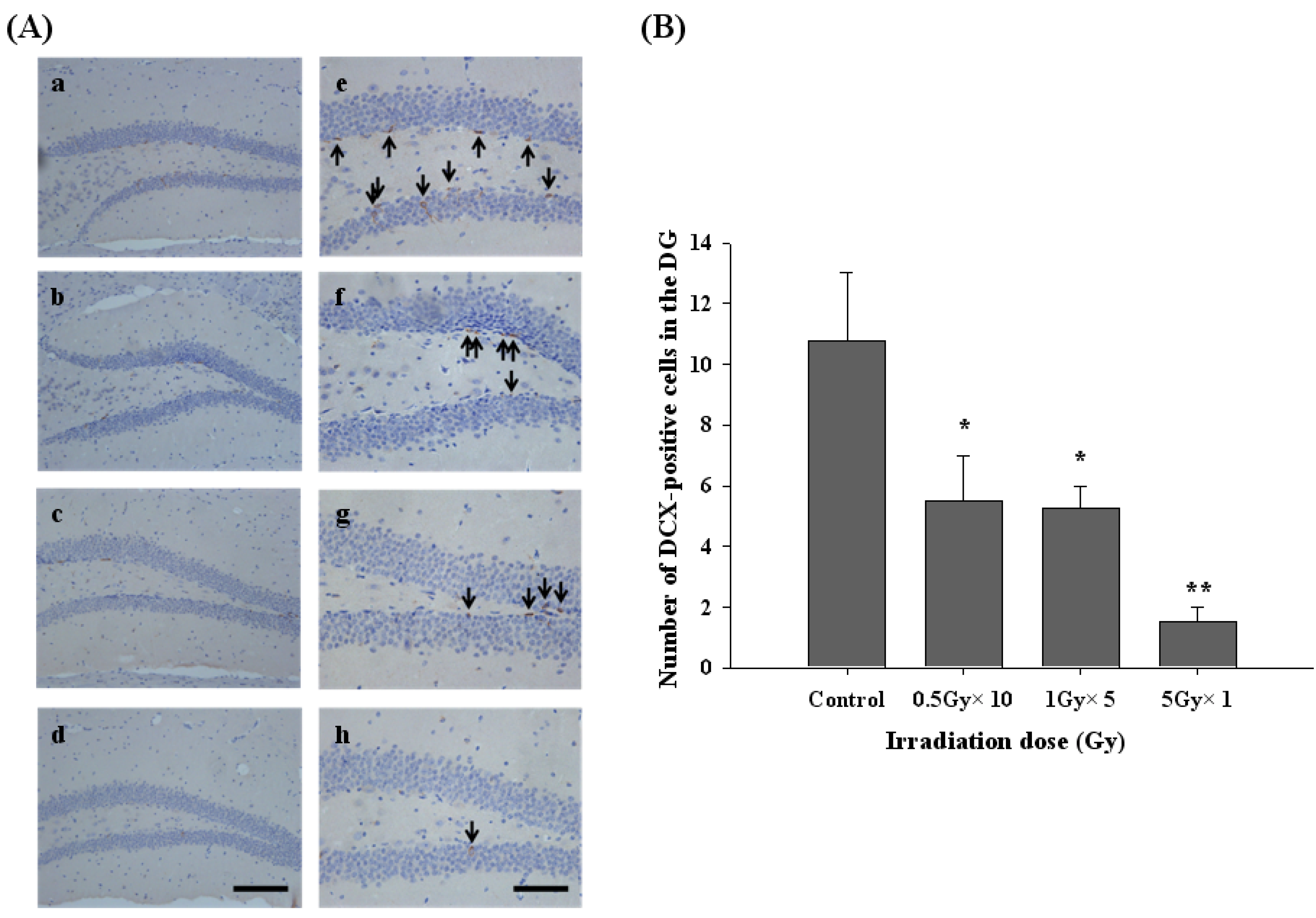
      <p>To investigate the long-term effect of radiation exposure on hippocampal neurogenesis in an adult mouse DG, the number of DCX-positive cells in the subgranular zone (SGZ) of the hippocampal DG was analyzed by using immunohistochemistry (<xref ref-type="fig" rid="molecules-17-09462-f002">Figure 2</xref>). Six months after radiation exposure, the number of DCX-positive cells in the hippocampal DG of the control group was 10.75 ± 2.25 cells/DG (<xref ref-type="fig" rid="molecules-17-09462-f002">Figure 2</xref>A, a and e). In the fractional (0.5 Gy × 10 times and 1 Gy × 5 times) and acute irradiation (5 Gy × 1 times) groups, the numbers of DCX-positive cells were 5.5 ± 1.5 cells/DG (<xref ref-type="fig" rid="molecules-17-09462-f002">Figure 2</xref>A, b and f), 5.25 ± 0.75 cells/DG (<xref ref-type="fig" rid="molecules-17-09462-f002">Figure 2</xref>A, c and g) and 1.5 ± 0.5 cells/DG (<xref ref-type="fig" rid="molecules-17-09462-f002">Figure 2</xref>A, d and h), respectively. The groups of fractionated irradiation (0.5 Gy × 10 times and 1 Gy × 5 times) showed approximately 49% and 51% reductions of DCX-positive cells in the hippocampal DG compared to the control group. Importantly, the group with acute irradiation (5 Gy × 1 times) resulted in an 86% reduction of DCX-positive cells. </p>
      
	  <p>DCX is a reliable marker of newly generated neurons because neuronal precursor cells begin to express DCX while actively dividing [<xref ref-type="bibr" rid="B8-molecules-17-09462">8</xref>,<xref ref-type="bibr" rid="B24-molecules-17-09462">24</xref>]. DCX immunoreactivity, which quantifies both the absolute number and dendritic growth of new neurons, can be useful for analyzing the modulation of hippocampal neurogenesis as a function of neurodegenerative diseases. In this study, it was shown that the number of DCX-positive cells by acute or fractionated irradiation groups tended to be significantly reduced (<xref ref-type="fig" rid="molecules-17-09462-f002">Figure 2</xref>B). Thus, the results of DCX immunoreactivity suggests that the long-term effect of γ-irradiation exposure can suppress hippocampal neurogenesis resulting in damage to the hippocampal function unlike the tendency to fully restore transient impairments through the short-term effect of irradiation in previous studies [<xref ref-type="bibr" rid="B17-molecules-17-09462">17</xref>,<xref ref-type="bibr" rid="B18-molecules-17-09462">18</xref>].</p>
      <fig id="molecules-17-09462-f002" position="anchor">
        <label>Figure 2</label>
        <caption>
          <p>Long-term effect of acute and fractionated irradiation in subgranular zone (SGZ) of the hippocampal dentate gyrus (DG). (<bold>A</bold>) Histological results in images (<bold>B</bold>). The quantitative values of DCX-positive cells. Immunohistochemistry of DCX in the DG of the hippocampus in four groups of mice. Comparison profiles of DCX expression of the control (a and e), 0.5 Gy × 10 times (b and f), 1 Gy × 5 times (c and g), 5 Gy × 1 times (d and h) groups. The bar graphs indicate the number of DCX-positive cells/DG (mean ± SD).The arrows were marked. Scale bars = 100 μm (a–d), 50 μm (e–h). <bold>*</bold> <italic>p</italic> &lt; 0.05, <bold>**</bold> <italic>p</italic> &lt; 0.005.</p>
        </caption>
        <graphic xmlns:xlink="http://www.w3.org/1999/xlink" xlink:href="molecules-17-09462-g002.tif"/>
      </fig>
      
	  <p>Radiation therapy plays a major role in the treatment of primary brain tumors and cancers. Unfortunately, however, radiation exposure can cause severe side effects including cognitive deficits. According to recent studies, irradiation effects in normal brain tissue have been principally limited to studies of acute dose irradiation [<xref ref-type="bibr" rid="B25-molecules-17-09462">25</xref>]. Our goal in this study was to characterize the long-term effects by acute and fractionated irradiation on hippocampal neurogenesis. DCX immunoreactivity was relatively lower in the acute irradiation group than in the fractionated irradiation groups, but there was no significant difference in the fractionated irradiation (<xref ref-type="fig" rid="molecules-17-09462-f002">Figure 2</xref>B). These results showed that hippocampal neurogenesis was more vulnerable to acute than fractionated irradiation.</p>
    </sec>
    <sec sec-type="methods">
      <title>3. Experimental</title>
      <sec>
        <title>3.1. Chemicals and Mice</title>
        <p>Six-week-old female C57BL/6 mice were obtained from Orient Bio Inc. (Seongnam, Gyeonggi-Do, Korea), and housed in standard conditions under a temperature of 23 ± 1 °C and humidity of 55 ± 5% with a 12-hour light-dark cycle. After two weeks of adaptation, the mice were divided into four groups with three mice in each group. All mice had free access to standard food and water. All procedures were conducted under guidelines for the use and care of laboratory animals at Korea Atomic Energy Research Institute (KAREI). All reagents were of the highest grade available.</p>
      </sec>
      <sec>
        <title>3.2. Ionizing Radiation in Mice</title>
        <p>Eight-week-old mice were exposed to whole-body γ-irradiation with γ-rays from a 137Cs source (Gammacell 40, Nordion International Inc., Ottawa, ON, Canada) without anesthesia [<xref ref-type="bibr" rid="B26-molecules-17-09462">26</xref>,<xref ref-type="bibr" rid="B27-molecules-17-09462">27</xref>]. The long term effect of γ-irradiation on neurogenesis was observed after whole-body irradiation in the mice with acute 5 Gy (1.1 Gy/min) dose or fractionated doses (1 Gy [1.1 Gy/min]/week, 5 times and 0.5 Gy [0.11 Gy/min]/week, 10 times). Fractionated irradiation was delivered to the whole-body of the mice at a 5 Gy cumulative dose for five weeks (<xref ref-type="fig" rid="molecules-17-09462-f001">Figure 1</xref>).</p>
      </sec>
      <sec>
        <title>3.3. Immunohistochemistry</title>
        <p>The mice were sacrificed and their brains were dissected (n = 3 mice/group). The brains were processed for embedding in paraffin wax after fixation in 10% neutral buffered formalin using routine protocols for immunohistologic evaluation. For the DG area in the hippocampus, the brain of each mouse was sampled approximately 2.22 mm behind the bregma. In addition, 5 μm-thick coronal sections were cut by microtome (RM2145; Leica, Nussloch, Germany). A standardized counting area, five sections from a total of one-hundred sections, or one out of twenty, serial sections, were analyzed for immunohistochemistry. As the next step, the samples were deparaffinized by routine protocols, exposed to a citrate buffer (0.01 M, pH 6.0; S2031, Dako, Hampshire, UK) and heated in an autoclave for 10 min. After heating, the slides were allowed to cool for 20 min. All subsequent steps were performed at room temperature. The sections were treated with a peroxidase block (K4003 Kit, Dako) for 30 min to block endogenous peroxidase activity. The sections were treated with a protein block (X0909, Dako) for 20 min and then incubated for 1 h with a polyclonal rabbit anti-DCX antibody (diluted 1:500; ab18723, Abcam Antibodies, Cambridge, UK). They were then reacted with goat anti-rabbit immunoglobulin conjugated with peroxidase labeled polymer (K4003 Kit, Dako) for 30 min. The peroxidase reaction was developed using a diaminobenzidine substrate buffer (K4003 Kit, Dako) according to the manufacturer’s instructions for 30 sec. After the completion of color development, the sections were counterstained with hematoxylin (S3309, Dako) for 5 min, washed in running tap water for 20 min, dehydrated through a graded ethanol series, cleared with xylene, and mounted with permount (SP15-500, Fisher Scientific, Pittsburgh, PA, USA).</p>
      </sec>
      <sec>
        <title>3.4. Statistics</title>
        <p>The number of DCX-positive cells, which are immature progenitor cell markers in the hippocampus, was scored. A statistical analysis was performed using a one-way analysis of variance (ANOVA). The values are expressed as average ± standard deviation. The <italic>p</italic> values were considered as significant. </p>
      </sec>
    </sec>
    <sec sec-type="conclusions">
      <title>4. Conclusions</title>
      <p>In conclusion, this is the first report to elucidate the long-term effects of DCX-positive cells as an immature progenitor cell marker by acute and fractionated irradiation on hippocampal neurogenesis <italic>in vivo</italic>. To the best of our knowledge, no data exist with respect to the radiation response of acute and fractionated irradiation on hippocampal neurogenesis in animal model. This is important because the effect of brain treatment in acute irradiation is higher than that seen in fractionated irradiation. The long-term effects of irradiation are important in clinic because of chronic progressive nature and significant long-term morbidity.</p>
    </sec>
    
  </body>
  <back>
    <ack>
      <title>Acknowledgments</title>
      <p>This work was supported by a grant from the Creative Research Project of National R&amp;D Projects, Korea Atomic Energy Research Institute (KAERI), Korea.</p>
    </ack>
	<ref-list>
      <title>References</title>
      <ref id="B1-molecules-17-09462">
        <label>1.</label>
        <citation citation-type="journal">
          <person-group person-group-type="author">
            <name>
              <surname>De Vos</surname>
              <given-names>K.J.</given-names>
            </name>
            <name>
              <surname>Grierson</surname>
              <given-names>A.J.</given-names>
            </name>
            <name>
              <surname>Ackerley</surname>
              <given-names>S.</given-names>
            </name>
            <name>
              <surname>Miller</surname>
              <given-names>C.C.</given-names>
            </name>
          </person-group>
          <article-title>Role of axonal transport in neurodegenerative diseases</article-title>
          <source>Annu. Rev. Neurosci.</source>
          <year>2008</year>
          <volume>31</volume>
          <fpage>151</fpage>
          <lpage>173</lpage>
          <pub-id pub-id-type="doi">10.1146/annurev.neuro.31.061307.090711</pub-id>
        </citation>
      </ref>
      <ref id="B2-molecules-17-09462">
        <label>2.</label>
        <citation citation-type="journal">
          <person-group person-group-type="author">
            <name>
              <surname>Estrada Sánchez</surname>
              <given-names>A.M.</given-names>
            </name>
            <name>
              <surname>Mejía-Toiber</surname>
              <given-names>J.</given-names>
            </name>
            <name>
              <surname>Massieu</surname>
              <given-names>L.</given-names>
            </name>
          </person-group>
          <article-title>Excitotoxic neuronal death and the pathogenesis of Huntington’s disease</article-title>
          <source>Arch. Med. Res.</source>
          <year>2008</year>
          <volume>39</volume>
          <fpage>265</fpage>
          <lpage>276</lpage>
          <pub-id pub-id-type="doi">10.1016/j.arcmed.2007.11.011</pub-id>
        </citation>
      </ref>
      <ref id="B3-molecules-17-09462">
        <label>3.</label>
        <citation citation-type="journal">
          <person-group person-group-type="author">
            <name>
              <surname>Thompson</surname>
              <given-names>L.M.</given-names>
            </name>
          </person-group>
          <article-title>Neurodegeneration: A question of balance</article-title>
          <source>Nature</source>
          <year>2008</year>
          <volume>452</volume>
          <fpage>707</fpage>
          <lpage>708</lpage>
          <pub-id pub-id-type="doi">10.1038/452707a</pub-id>
        </citation>
      </ref>
      <ref id="B4-molecules-17-09462">
        <label>4.</label>
        <citation citation-type="journal">
          <person-group person-group-type="author">
            <name>
              <surname>Wenk</surname>
              <given-names>G.L.</given-names>
            </name>
          </person-group>
          <article-title>Neuropathologic changes in Alzheimer’s disease</article-title>
          <source>J. Clin. Psychiatry</source>
          <year>2003</year>
          <volume>9</volume>
          <fpage>7</fpage>
          <lpage>10</lpage>
        </citation>
      </ref>
      <ref id="B5-molecules-17-09462">
        <label>5.</label>
        <citation citation-type="journal">
          <person-group person-group-type="author">
            <name>
              <surname>Eriksson</surname>
              <given-names>P.S.</given-names>
            </name>
            <name>
              <surname>Perfilieva</surname>
              <given-names>E.</given-names>
            </name>
            <name>
              <surname>Björk-Eriksson</surname>
              <given-names>T.</given-names>
            </name>
            <name>
              <surname>Alborn</surname>
              <given-names>A.M.</given-names>
            </name>
            <name>
              <surname>Nordborg</surname>
              <given-names>C.</given-names>
            </name>
            <name>
              <surname>Peterson</surname>
              <given-names>D.A.</given-names>
            </name>
            <name>
              <surname>Gage</surname>
              <given-names>F.H.</given-names>
            </name>
          </person-group>
          <article-title>Neurogenesis in the adult human hippocampus</article-title>
          <source>Nat. Med.</source>
          <year>1998</year>
          <volume>4</volume>
          <fpage>1313</fpage>
          <lpage>1317</lpage>
        <pub-id pub-id-type="doi">10.1038/3305</pub-id><pub-id pub-id-type="pmid">9809557</pub-id></citation>
      </ref>
      <ref id="B6-molecules-17-09462">
        <label>6.</label>
        <citation citation-type="journal">
          <person-group person-group-type="author">
            <name>
              <surname>Goldman</surname>
              <given-names>S.A.</given-names>
            </name>
            <name>
              <surname>Nottebohm</surname>
              <given-names>F.</given-names>
            </name>
          </person-group>
          <article-title>Neuronal production, migration, and differentiation in a vocal control nucleus of the adult female canary brain</article-title>
          <source>Proc. Natl. Acad. Sci. USA</source>
          <year>1983</year>
          <volume>80</volume>
          <fpage>2390</fpage>
          <lpage>2394</lpage>
        <pub-id pub-id-type="doi">10.1073/pnas.80.8.2390</pub-id><pub-id pub-id-type="pmid">6572982</pub-id></citation>
      </ref>
      <ref id="B7-molecules-17-09462">
        <label>7.</label>
        <citation citation-type="journal">
          <person-group person-group-type="author">
            <name>
              <surname>Shors</surname>
              <given-names>T.J.</given-names>
            </name>
            <name>
              <surname>Townsend</surname>
              <given-names>D.A.</given-names>
            </name>
            <name>
              <surname>Zhao</surname>
              <given-names>M.</given-names>
            </name>
            <name>
              <surname>Kozorovitskiy</surname>
              <given-names>Y.</given-names>
            </name>
            <name>
              <surname>Gould</surname>
              <given-names>E.</given-names>
            </name>
          </person-group>
          <article-title>Neurogenesis may relate to some but not all types of hippocampal-dependent learning</article-title>
          <source>Hippocampus</source>
          <year>2002</year>
          <volume>12</volume>
          <fpage>578</fpage>
          <lpage>584</lpage>
          <pub-id pub-id-type="doi">10.1002/hipo.10103</pub-id>
        </citation>
      </ref>
      <ref id="B8-molecules-17-09462">
        <label>8.</label>
        <citation citation-type="journal">
          <person-group person-group-type="author">
            <name>
              <surname>Couillard-Despres</surname>
              <given-names>S.</given-names>
            </name>
            <name>
              <surname>Winner</surname>
              <given-names>B.</given-names>
            </name>
            <name>
              <surname>Schaubeck</surname>
              <given-names>S.</given-names>
            </name>
            <name>
              <surname>Aigner</surname>
              <given-names>R.</given-names>
            </name>
            <name>
              <surname>Vroemen</surname>
              <given-names>M.</given-names>
            </name>
            <name>
              <surname>Weidner</surname>
              <given-names>N.</given-names>
            </name>
            <name>
              <surname>Bogdahn</surname>
              <given-names>U.</given-names>
            </name>
            <name>
              <surname>Winkler</surname>
              <given-names>J.</given-names>
            </name>
            <name>
              <surname>Kuhn</surname>
              <given-names>H.G.</given-names>
            </name>
            <name>
              <surname>Aigner</surname>
              <given-names>L.</given-names>
            </name>
          </person-group>
          <article-title>Doublecortin expression levels in adult brain reflect neurogenesis</article-title>
          <source>Eur. J. Neurosci.</source>
          <year>2005</year>
          <volume>21</volume>
          <fpage>1</fpage>
          <lpage>14</lpage>
        <pub-id pub-id-type="doi">10.1111/j.1460-9568.2004.03813.x</pub-id><pub-id pub-id-type="pmid">15654838</pub-id></citation>
      </ref>
      <ref id="B9-molecules-17-09462">
        <label>9.</label>
        <citation citation-type="journal">
          <person-group person-group-type="author">
            <name>
              <surname>Kuhn</surname>
              <given-names>H.G.</given-names>
            </name>
            <name>
              <surname>Dickinson-Anson</surname>
              <given-names>H.</given-names>
            </name>
            <name>
              <surname>Gage</surname>
              <given-names>F.H.</given-names>
            </name>
          </person-group>
          <article-title>Neurogenesis in the dentate gyrus of the adult rat: Age-related decrease of neuronal progenitor proliferation</article-title>
          <source>J. Neurosci.</source>
          <year>1996</year>
          <volume>16</volume>
          <fpage>2027</fpage>
          <lpage>2033</lpage>
        <pub-id pub-id-type="pmid">8604047</pub-id></citation>
      </ref>
      <ref id="B10-molecules-17-09462">
        <label>10.</label>
        <citation citation-type="journal">
          <person-group person-group-type="author">
            <name>
              <surname>Parent</surname>
              <given-names>J.M.</given-names>
            </name>
            <name>
              <surname>Yu</surname>
              <given-names>T.W.</given-names>
            </name>
            <name>
              <surname>Leibowitz</surname>
              <given-names>R.T.</given-names>
            </name>
            <name>
              <surname>Geschwind</surname>
              <given-names>D.H.</given-names>
            </name>
            <name>
              <surname>Sloviter</surname>
              <given-names>R.S.</given-names>
            </name>
            <name>
              <surname>Lowenstein</surname>
              <given-names>D.H.</given-names>
            </name>
          </person-group>
          <article-title>Dentate granule cell neurogenesis is increased by seizures and contributes to aberrant network reorganization in the adult rat hippocampus</article-title>
          <source>J. Neurosci.</source>
          <year>1997</year>
          <volume>17</volume>
          <fpage>3727</fpage>
          <lpage>3728</lpage>
        <pub-id pub-id-type="pmid">9133393</pub-id></citation>
      </ref>
      <ref id="B11-molecules-17-09462">
        <label>11.</label>
        <citation citation-type="journal">
          <person-group person-group-type="author">
            <name>
              <surname>Scott</surname>
              <given-names>B.W.</given-names>
            </name>
            <name>
              <surname>Wang</surname>
              <given-names>S.</given-names>
            </name>
            <name>
              <surname>Burnham</surname>
              <given-names>W.M.</given-names>
            </name>
            <name>
              <surname>de Boni</surname>
              <given-names>U.</given-names>
            </name>
            <name>
              <surname>Wojtowicz</surname>
              <given-names>J.M.</given-names>
            </name>
          </person-group>
          <article-title>Kindling-induced neurogenesis in the dentate gyrus of the rat</article-title>
          <source>Neurosci. Lett.</source>
          <year>1998</year>
          <volume>248</volume>
          <fpage>73</fpage>
          <lpage>76</lpage>
          <pub-id pub-id-type="doi">10.1016/S0304-3940(98)00355-3</pub-id>
        </citation>
      </ref>
      <ref id="B12-molecules-17-09462">
        <label>12.</label>
        <citation citation-type="journal">
          <person-group person-group-type="author">
            <name>
              <surname>Young</surname>
              <given-names>D.</given-names>
            </name>
            <name>
              <surname>Lawlor</surname>
              <given-names>P.A.</given-names>
            </name>
            <name>
              <surname>Leone</surname>
              <given-names>P.</given-names>
            </name>
            <name>
              <surname>Dragunow</surname>
              <given-names>M.</given-names>
            </name>
            <name>
              <surname>During</surname>
              <given-names>M.J.</given-names>
            </name>
          </person-group>
          <article-title>Environmental enrichment inhibits spontaneous apoptosis, prevents seizures and is neuroprotective</article-title>
          <source>Nat. Med.</source>
          <year>1999</year>
          <volume>5</volume>
          <fpage>448</fpage>
          <lpage>453</lpage>
          <pub-id pub-id-type="doi">10.1038/7449</pub-id>
        </citation>
      </ref>
      <ref id="B13-molecules-17-09462">
        <label>13.</label>
        <citation citation-type="journal">
          <person-group person-group-type="author">
            <name>
              <surname>Chao</surname>
              <given-names>N.J.</given-names>
            </name>
          </person-group>
          <article-title>Accidental or intentional exposure to ionizing radiation: Biodosimetry and treatment options</article-title>
          <source>Exp. Hematol.</source>
          <year>2007</year>
          <volume>35</volume>
          <fpage>24</fpage>
          <lpage>27</lpage>
          <pub-id pub-id-type="doi">10.1016/j.exphem.2007.01.008</pub-id>
        </citation>
      </ref>
      <ref id="B14-molecules-17-09462">
        <label>14.</label>
        <citation citation-type="book">
          <person-group person-group-type="author">
            <name>
              <surname>Hall</surname>
              <given-names>E.J.</given-names>
            </name>
            <name>
              <surname>Giaccia</surname>
              <given-names>A.J.</given-names>
            </name>
          </person-group>
          <source>Radiobiology for the Radiologist</source>
          <edition>6th</edition>
          <publisher-name>Lippincott Williams &amp; Wilkins</publisher-name>
          <publisher-loc>Philadelphia, PA, USA</publisher-loc>
          <year>2006</year>
        </citation>
      </ref>
      <ref id="B15-molecules-17-09462">
        <label>15.</label>
        <citation citation-type="journal">
          <person-group person-group-type="author">
            <name>
              <surname>Baker</surname>
              <given-names>J.E.</given-names>
            </name>
            <name>
              <surname>Fish</surname>
              <given-names>B.L.</given-names>
            </name>
            <name>
              <surname>Su</surname>
              <given-names>J.</given-names>
            </name>
            <name>
              <surname>Haworth</surname>
              <given-names>S.T.</given-names>
            </name>
            <name>
              <surname>Strande</surname>
              <given-names>J.L.</given-names>
            </name>
            <name>
              <surname>Komorowski</surname>
              <given-names>R.A.</given-names>
            </name>
            <name>
              <surname>Migrino</surname>
              <given-names>R.Q.</given-names>
            </name>
            <name>
              <surname>Doppalapudi</surname>
              <given-names>A.</given-names>
            </name>
            <name>
              <surname>Harmann</surname>
              <given-names>L.</given-names>
            </name>
            <name>
              <surname>Li</surname>
              <given-names>X.A.</given-names>
            </name>
            <etal/>
          </person-group>
          <article-title>10 Gy total body irradiation increases risk of coronary sclerosis, degeneration of heart structure and function in a rat model</article-title>
          <source>Int. J. Radiat. Biol.</source>
          <year>2009</year>
          <volume>85</volume>
          <fpage>1089</fpage>
          <lpage>1100</lpage>
          <pub-id pub-id-type="doi">10.3109/09553000903264473</pub-id>
        </citation>
      </ref>
      <ref id="B16-molecules-17-09462">
        <label>16.</label>
        <citation citation-type="journal">
          <person-group person-group-type="author">
            <name>
              <surname>Srinivasan</surname>
              <given-names>M.</given-names>
            </name>
            <name>
              <surname>Sudheer</surname>
              <given-names>A.R.</given-names>
            </name>
            <name>
              <surname>Pillai</surname>
              <given-names>K.R.</given-names>
            </name>
            <name>
              <surname>Kumar</surname>
              <given-names>P.R.</given-names>
            </name>
            <name>
              <surname>Sudhakaran</surname>
              <given-names>P.R.</given-names>
            </name>
            <name>
              <surname>Menon</surname>
              <given-names>V.P.</given-names>
            </name>
          </person-group>
          <article-title>Influence of ferulic acid on gamma-radiation induced DNA damage, lipid peroxidation and antioxidant status in primary culture of isolated rat hepatocytes</article-title>
          <source>Toxicology</source>
          <year>2006</year>
          <volume>228</volume>
          <fpage>249</fpage>
          <lpage>258</lpage>
          <pub-id pub-id-type="doi">10.1016/j.tox.2006.09.004</pub-id>
        </citation>
      </ref>
      <ref id="B17-molecules-17-09462">
        <label>17.</label>
        <citation citation-type="journal">
          <person-group person-group-type="author">
            <name>
              <surname>Ben Abdallah</surname>
              <given-names>N.M.B.</given-names>
            </name>
            <name>
              <surname>Slomianka</surname>
              <given-names>L.</given-names>
            </name>
            <name>
              <surname>Lipp</surname>
              <given-names>H.P.</given-names>
            </name>
          </person-group>
          <article-title>Reversible effect of X-irradiation on proliferation, neurogenesis, and cell death in the dentate gyrus of adult mice</article-title>
          <source>Hippocampus</source>
          <year>2007</year>
          <volume>17</volume>
          <fpage>1230</fpage>
          <lpage>1240</lpage>
          <pub-id pub-id-type="doi">10.1002/hipo.20358</pub-id>
        </citation>
      </ref>
      <ref id="B18-molecules-17-09462">
        <label>18.</label>
        <citation citation-type="journal">
          <person-group person-group-type="author">
            <name>
              <surname>Kim</surname>
              <given-names>J.S.</given-names>
            </name>
            <name>
              <surname>Lee</surname>
              <given-names>H.J.</given-names>
            </name>
            <name>
              <surname>Kim</surname>
              <given-names>J.C.</given-names>
            </name>
            <name>
              <surname>Kang</surname>
              <given-names>S.S.</given-names>
            </name>
            <name>
              <surname>Bae</surname>
              <given-names>C.S.</given-names>
            </name>
            <name>
              <surname>Shin</surname>
              <given-names>T.</given-names>
            </name>
            <name>
              <surname>Jin</surname>
              <given-names>J.K.</given-names>
            </name>
            <name>
              <surname>Kim</surname>
              <given-names>S.H.</given-names>
            </name>
            <name>
              <surname>Wang</surname>
              <given-names>H.</given-names>
            </name>
            <name>
              <surname>Moon</surname>
              <given-names>C.</given-names>
            </name>
          </person-group>
          <article-title>Transient impairment of hippocampus-dependent learning and memory in relatively low-dose of acute radiation syndrome is associated with inhibition of hippocampal neurogenesis</article-title>
          <source>J. Radiat. Res.</source>
          <year>2008</year>
          <fpage>517</fpage>
          <lpage>526</lpage>
        </citation>
      </ref>
      <ref id="B19-molecules-17-09462">
        <label>19.</label>
        <citation citation-type="journal">
          <person-group person-group-type="author">
            <name>
              <surname>Kim</surname>
              <given-names>S.</given-names>
            </name>
            <name>
              <surname>Jang</surname>
              <given-names>B.S.</given-names>
            </name>
            <name>
              <surname>Jung</surname>
              <given-names>U.</given-names>
            </name>
            <name>
              <surname>Jo</surname>
              <given-names>S.K.</given-names>
            </name>
          </person-group>
          <article-title>Gamma-irradiation is more efficient at depleting hippocampal neurogenesis than D-galactose/NaNO<sub>2</sub></article-title>
          <source>Neurosci. Lett.</source>
          <year>2011</year>
          <volume>498</volume>
          <fpage>47</fpage>
          <lpage>51</lpage>
          <pub-id pub-id-type="doi">10.1016/j.neulet.2011.04.059</pub-id>
        </citation>
      </ref>
      <ref id="B20-molecules-17-09462">
        <label>20.</label>
        <citation citation-type="journal">
          <person-group person-group-type="author">
            <name>
              <surname>Manda</surname>
              <given-names>K.</given-names>
            </name>
            <name>
              <surname>Reiter</surname>
              <given-names>R.J.</given-names>
            </name>
          </person-group>
          <article-title>Melatonin maintains adult hippocampal neurogenesis and cognitive functions after irradiation</article-title>
          <source>Prog. Neurobiol.</source>
          <year>2010</year>
          <volume>11</volume>
          <fpage>60</fpage>
          <lpage>68</lpage>
          <pub-id pub-id-type="doi">10.1016/j.pneurobio.2009.10.019</pub-id>
        </citation>
      </ref>
      <ref id="B21-molecules-17-09462">
        <label>21.</label>
        <citation citation-type="journal">
          <person-group person-group-type="author">
            <name>
              <surname>Manda</surname>
              <given-names>K.</given-names>
            </name>
            <name>
              <surname>Ueno</surname>
              <given-names>M.</given-names>
            </name>
            <name>
              <surname>Anzai</surname>
              <given-names>K.</given-names>
            </name>
          </person-group>
          <article-title>Cranial irradiation-induced inhibition of neurogenesis in hippocampal dentate gyrus of adult mice: Attenuation by melatonin pretreatment</article-title>
          <source>J. Pineal Res.</source>
          <year>2009</year>
          <volume>46</volume>
          <fpage>71</fpage>
          <lpage>78</lpage>
          <pub-id pub-id-type="doi">10.1111/j.1600-079X.2008.00632.x</pub-id>
        </citation>
      </ref>
      <ref id="B22-molecules-17-09462">
        <label>22.</label>
        <citation citation-type="journal">
          <person-group person-group-type="author">
            <name>
              <surname>Manda</surname>
              <given-names>K.</given-names>
            </name>
            <name>
              <surname>Ueno</surname>
              <given-names>M.</given-names>
            </name>
            <name>
              <surname>Anzai</surname>
              <given-names>K.</given-names>
            </name>
          </person-group>
          <article-title>Space radiation-induced inhibition of neurogenesis in the hippocampal dentate gyrus and memory impairment in mice: Ameliorative potential of the melatonin metabolite, AFMK</article-title>
          <source>J. Pineal Res.</source>
          <year>2008</year>
          <volume>45</volume>
          <fpage>430</fpage>
          <lpage>438</lpage>
          <pub-id pub-id-type="doi">10.1111/j.1600-079X.2008.00611.x</pub-id>
        </citation>
      </ref>
      <ref id="B23-molecules-17-09462">
        <label>23.</label>
        <citation citation-type="journal">
          <person-group person-group-type="author">
            <name>
              <surname>Acevedo</surname>
              <given-names>S.F.</given-names>
            </name>
            <name>
              <surname>McGinnis</surname>
              <given-names>G.</given-names>
            </name>
            <name>
              <surname>Raber</surname>
              <given-names>J.</given-names>
            </name>
          </person-group>
          <article-title>Effects of <sup>137</sup>Cs γ Irradiation on Cognitive Performance and Measures of Anxiety of <italic>Apoe</italic><sup>−/−</sup> and Wild-Type Female Mice</article-title>
          <source>Radiat. Res.</source>
          <year>2008</year>
          <volume>170</volume>
          <fpage>422</fpage>
          <lpage>428</lpage>
          <pub-id pub-id-type="doi">10.1667/RR1494.1</pub-id>
        </citation>
      </ref>
      <ref id="B24-molecules-17-09462">
        <label>24.</label>
        <citation citation-type="journal">
          <person-group person-group-type="author">
            <name>
              <surname>Brown</surname>
              <given-names>J.P.</given-names>
            </name>
            <name>
              <surname>Couillard-Després</surname>
              <given-names>S.</given-names>
            </name>
            <name>
              <surname>Cooper-Kuhn</surname>
              <given-names>C.M.</given-names>
            </name>
            <name>
              <surname>Winkler</surname>
              <given-names>J.</given-names>
            </name>
            <name>
              <surname>Aigner</surname>
              <given-names>L.</given-names>
            </name>
            <name>
              <surname>Kuhn</surname>
              <given-names>H.G.</given-names>
            </name>
          </person-group>
          <article-title>Transient expression of doublecortin during adult neurogenesis</article-title>
          <source>J. Comp. Neurol.</source>
          <year>2003</year>
          <volume>467</volume>
          <fpage>1</fpage>
          <lpage>10</lpage>
          <pub-id pub-id-type="doi">10.1002/cne.10874</pub-id>
        </citation>
      </ref>
      <ref id="B25-molecules-17-09462">
        <label>25.</label>
        <citation citation-type="journal">
          <person-group person-group-type="author">
            <name>
              <surname>Yuan</surname>
              <given-names>H.</given-names>
            </name>
            <name>
              <surname>Gaber</surname>
              <given-names>M.W.</given-names>
            </name>
            <name>
              <surname>Wilson</surname>
              <given-names>C.M.</given-names>
            </name>
            <name>
              <surname>Kiani</surname>
              <given-names>M.F.</given-names>
            </name>
            <name>
              <surname>Merchant</surname>
              <given-names>T.E.</given-names>
            </name>
          </person-group>
          <article-title>Effects of fractionated radiation on the brain vasculature in a murine model: Blood brain barrier permeability, astrocyte proliferation, and ultrastructural changes</article-title>
          <source>Int. J. Radiat. Oncol. Biol. Phys.</source>
          <year>2006</year>
          <volume>66</volume>
          <fpage>860</fpage>
          <lpage>866</lpage>
          <pub-id pub-id-type="doi">10.1016/j.ijrobp.2006.06.043</pub-id>
        </citation>
      </ref>
      <ref id="B26-molecules-17-09462">
        <label>26.</label>
        <citation citation-type="journal">
          <person-group person-group-type="author">
            <name>
              <surname>Park</surname>
              <given-names>H.R.</given-names>
            </name>
            <name>
              <surname>Jung</surname>
              <given-names>U.</given-names>
            </name>
            <name>
              <surname>Jo</surname>
              <given-names>S.K.</given-names>
            </name>
          </person-group>
          <article-title>Impairment of Natural Killer (NK) Cells is an Important Factor in a Weak Th1-like Response in Irradiated Mice</article-title>
          <source>Radiat. Res.</source>
          <year>2007</year>
          <volume>168</volume>
          <fpage>446</fpage>
          <lpage>452</lpage>
          <pub-id pub-id-type="doi">10.1667/RR0981.1</pub-id>
        </citation>
      </ref>
      <ref id="B27-molecules-17-09462">
        <label>27.</label>
        <citation citation-type="journal">
          <person-group person-group-type="author">
            <name>
              <surname>Roh</surname>
              <given-names>C.</given-names>
            </name>
            <name>
              <surname>Choi</surname>
              <given-names>N.H.</given-names>
            </name>
            <name>
              <surname>Park</surname>
              <given-names>H.R.</given-names>
            </name>
            <name>
              <surname>Jung</surname>
              <given-names>U.</given-names>
            </name>
            <name>
              <surname>Jo</surname>
              <given-names>S.K.</given-names>
            </name>
          </person-group>
          <article-title>Effects of Orlistat on white adipose tissue (WAT) in the g-irradiated mouse model</article-title>
          <source>Eur. J. Lipid Sci. Technol.</source>
          <year>2010</year>
          <volume>112</volume>
          <fpage>1384</fpage>
          <lpage>1388</lpage>
          <pub-id pub-id-type="doi">10.1002/ejlt.201000423</pub-id>
        </citation>
      </ref>
    </ref-list>
	<fn-group>
	<fn>
	<p><italic>Sample Availability:</italic> Not available.</p>
	</fn>
	</fn-group>
  </back>
</article>