<?xml version="1.0" encoding="UTF-8"?>
<!DOCTYPE article PUBLIC "-//NLM//DTD Journal Publishing DTD v2.3 20070202//EN" "journalpublishing.dtd">
<article xmlns:mml="http://www.w3.org/1998/Math/MathML" xmlns:xlink="http://www.w3.org/1999/xlink" xml:lang="en" article-type="research-article">
  <front>
    <journal-meta>
      <journal-id journal-id-type="publisher-id">molecules</journal-id>
      <journal-title>Molecules</journal-title>
      <abbrev-journal-title abbrev-type="publisher">Molecules</abbrev-journal-title>
      <abbrev-journal-title abbrev-type="pubmed">Molecules</abbrev-journal-title>
      <issn pub-type="epub">1420-3049</issn>
      <publisher>
        <publisher-name>MDPI</publisher-name>
      </publisher>
    </journal-meta>
    <article-meta>
      <article-id pub-id-type="doi">10.3390/molecules171213910</article-id>
      <article-id pub-id-type="publisher-id">molecules-17-13910</article-id>
      <article-categories>
        <subj-group>
          <subject>Article</subject>
        </subj-group>
      </article-categories>
      <title-group>
        <article-title>A New Prenylated Naphthoquinoid from the Aerial Parts of <italic>Clinopodium chinense</italic> (Benth.) O. Kuntze</article-title>
      </title-group>
	  <contrib-group>
        <contrib contrib-type="author">
          <name>
            <surname>Zhong</surname>
            <given-names>Mingliang</given-names>
          </name>
          <xref rid="af1-molecules-17-13910" ref-type="aff">1</xref>
          <xref rid="fn1-molecules-17-13910" ref-type="fn">†</xref>
        </contrib>
        <contrib contrib-type="author">
          <name>
            <surname>Sun</surname>
            <given-names>Guibo</given-names>
          </name>
          <xref rid="af1-molecules-17-13910" ref-type="aff">1</xref>
          <xref rid="fn1-molecules-17-13910" ref-type="fn">†</xref>
        </contrib>
        <contrib contrib-type="author">
          <name>
            <surname>Zhang</surname>
            <given-names>Xiaopo</given-names>
          </name>
          <xref rid="af1-molecules-17-13910" ref-type="aff">1</xref>
        </contrib>
        <contrib contrib-type="author">
          <name>
            <surname>Sun</surname>
            <given-names>Guangli</given-names>
          </name>
          <xref rid="af1-molecules-17-13910" ref-type="aff">1</xref>
          <xref rid="af2-molecules-17-13910" ref-type="aff">2</xref>
        </contrib>
        <contrib contrib-type="author">
          <name>
            <surname>Xu</surname>
            <given-names>Xudong</given-names>
          </name>
          <xref rid="af1-molecules-17-13910" ref-type="aff">1</xref>
          <xref rid="c1-molecules-17-13910" ref-type="corresp">*</xref>
        </contrib>
        <contrib contrib-type="author">
          <name>
            <surname>Yu</surname>
            <given-names>Shichun</given-names>
          </name>
          <xref rid="af3-molecules-17-13910" ref-type="aff">3</xref>
        </contrib>
      </contrib-group>
      
      <aff id="af1-molecules-17-13910"><label>1 </label>Key Laboratory of Bioactive Substances and Resources Utilization of Chinese Herbal Medicine, Ministry of Education, Institute of Medicinal Plant Development, Chinese Academy of Medical Sciences &amp; Peking Union Medical College, Beijing 100193, China; Email: <email>mingliangzhongsky@163.com</email> (M.Z.); <email>gbsun@implad.ac.cn</email> (G.S.); <email>xiaopozhang2011@126.com</email> (X.Z.); <email>guanglisun@126.com</email> (G.S.)</aff>
      <aff id="af2-molecules-17-13910"><label>2 </label>Department of Pharmacy, School of Pharmacy, Hebei United University, Tangshan 063000, China</aff>
      <aff id="af3-molecules-17-13910"><label>3 </label>Beijing Hong Tai Chi Chung Medical Technology Co., Ltd., Beijing 102600, China; Email: <email>shichunyu@hotmail.com</email></aff>
      <author-notes>
        <fn id="fn1-molecules-17-13910">
          <label>†</label>
          <p> These authors contributed equally to this work.</p>
        </fn>
        <corresp id="c1-molecules-17-13910"><label>*</label> Author to whom correspondence should be addressed; Email: <email>xdxu@implad.ac.cn</email>; Tel./Fax: +86-010-5783-3296.</corresp>
      </author-notes>
      <pub-date pub-type="epub">
        <day>23</day>
        <month>11</month>
        <year>2012</year>
      </pub-date>
      <pub-date pub-type="collection">
	  <month>12</month>
        <year>2012</year>
      </pub-date>
      <volume>17</volume>
      <issue>12</issue>
      <fpage>13910</fpage>
      <lpage>13916</lpage>
      <history>
        <date date-type="received">
          <day>19</day>
          <month>10</month>
          <year>2012</year>
        </date>
        <date date-type="rev-recd">
          <day>16</day>
          <month>11</month>
          <year>2012</year>
        </date>
        <date date-type="accepted">
          <day>19</day>
          <month>11</month>
          <year>2012</year>
        </date>
      </history>
      <permissions>
        <copyright-statement>© 2012 by the authors; licensee MDPI, Basel, Switzerland.</copyright-statement>
        <copyright-year>2012</copyright-year>
        <license xmlns:xlink="http://www.w3.org/1999/xlink" license-type="open-access" xlink:href="http://creativecommons.org/licenses/by/3.0/">
          <p>This article is an open-access article distributed under the terms and conditions of the Creative Commons Attribution license (<uri>http://creativecommons.org/licenses/by/3.0/</uri>).</p>
        </license>
      </permissions>
      <abstract>
        <p>A new prenylated naphthoquinoid, named (3<italic>R</italic>,4a<italic>R</italic>,10b<italic>R</italic>)-3,10-dihydroxy-2,2-dimethyl-3,4,4a,10b-tetrahydro-2<italic>H</italic>-naphtho[1,2-b]-pyran-5<italic>H</italic>-6-one (<bold>1</bold>), was isolated from the aerial parts of <italic>Clinopodium chinense</italic> (Benth.) O. Kuntze, together with six known compounds: apigenin (<bold>2</bold>), luteolin (<bold>3</bold>), neoeriocitrin (<bold>4</bold>), naringenin (<bold>5</bold>), narirutin (<bold>6</bold>), and didymin (<bold>7</bold>). Neoeriocitrin was isolated for the first time from the species <italic>C. chinense</italic>. Their structures were elucidated by spectroscopic methods, including 1D, 2D (<sup>1</sup>H-<sup>1</sup>H-COSY, HSQC, HMBC and NOESY) NMR, HR-ESI-MS. The absolute configuration of <bold>1</bold> was determinated using the CD method. We highlight that the structure of <bold>1</bold> is characterized by a rarely seen prenylated naphthoquinoid framework.</p>
      </abstract>
      <kwd-group>
        <kwd><italic>Clinopodium chinense</italic> (Benth.) O. Kuntze</kwd>
        <kwd>prenylated naphthoquinoid</kwd>
        <kwd>(3<italic>R</italic>,4a<italic>R</italic>,10b<italic>R</italic>)-3,10-dihydroxy-2,2-dimethyl-3,4,4a,10b-tetrahydro-2<italic>H</italic>-naphtho[1,2-b]-pyran-5<italic>H</italic>-6-one</kwd>
        <kwd>CD</kwd>
      </kwd-group>
    </article-meta>
  </front>
  <body>
    <sec sec-type="intro">
      <title>1. Introduction</title>
      <p><italic>Clinopodium chinense</italic> (Benth.) O. Kuntze belongs to the family Labiatae and is a perennial herb distributed in most parts of China. Its aerial parts were used as a folk medicine in China for treatment of influenza, heliosis, allergic dermatitis, dysentery, hematuria, trauma, <italic>etc.</italic> [<xref ref-type="bibr" rid="B1-molecules-17-13910">1</xref>]. Modern pharmacological studies have verified that its aqueous or ethanol extracts exhibited hemostatic, anti-inflammatory, antioxidant, antibiotic activities. In addition, anti-hyperglycemic activity and protective effects in the cardiovascular system have also been reported [<xref ref-type="bibr" rid="B2-molecules-17-13910">2</xref>]. Previous phytochemical investigations of this plant indicated the presence of flavonoids, triterpenoid saponins, and volatile oil [<xref ref-type="bibr" rid="B3-molecules-17-13910">3</xref>,<xref ref-type="bibr" rid="B4-molecules-17-13910">4</xref>]. In our research for bioactive constituents from this medicinal plant, a new prenylated naphthoquinoid, named (3<italic>R</italic>,4a<italic>R</italic>,10b<italic>R</italic>)-3,10-dihydroxy-2,2-dimethyl-3,4,4a,10b-tetrahydro-2<italic>H</italic>-naphtho[1,2-b]-pyran-5<italic>H</italic>-6-one (<bold>1</bold>), as well as six known flavonoids (compounds <bold>2</bold>–<bold>7</bold>) were obtained. Herein, we present the isolation and structure elucidation of compounds <bold>1</bold>–<bold>7</bold>, including the determination of absolute configuration of compound <bold>1</bold>by the circular dichroism method, which will provide a standard for absolute configuration determination of structures belonging to this class.</p>
    </sec>
    <sec sec-type="results">
      <title>2. Results and Discussion</title>
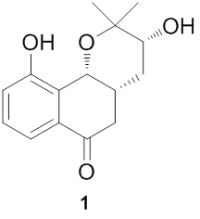
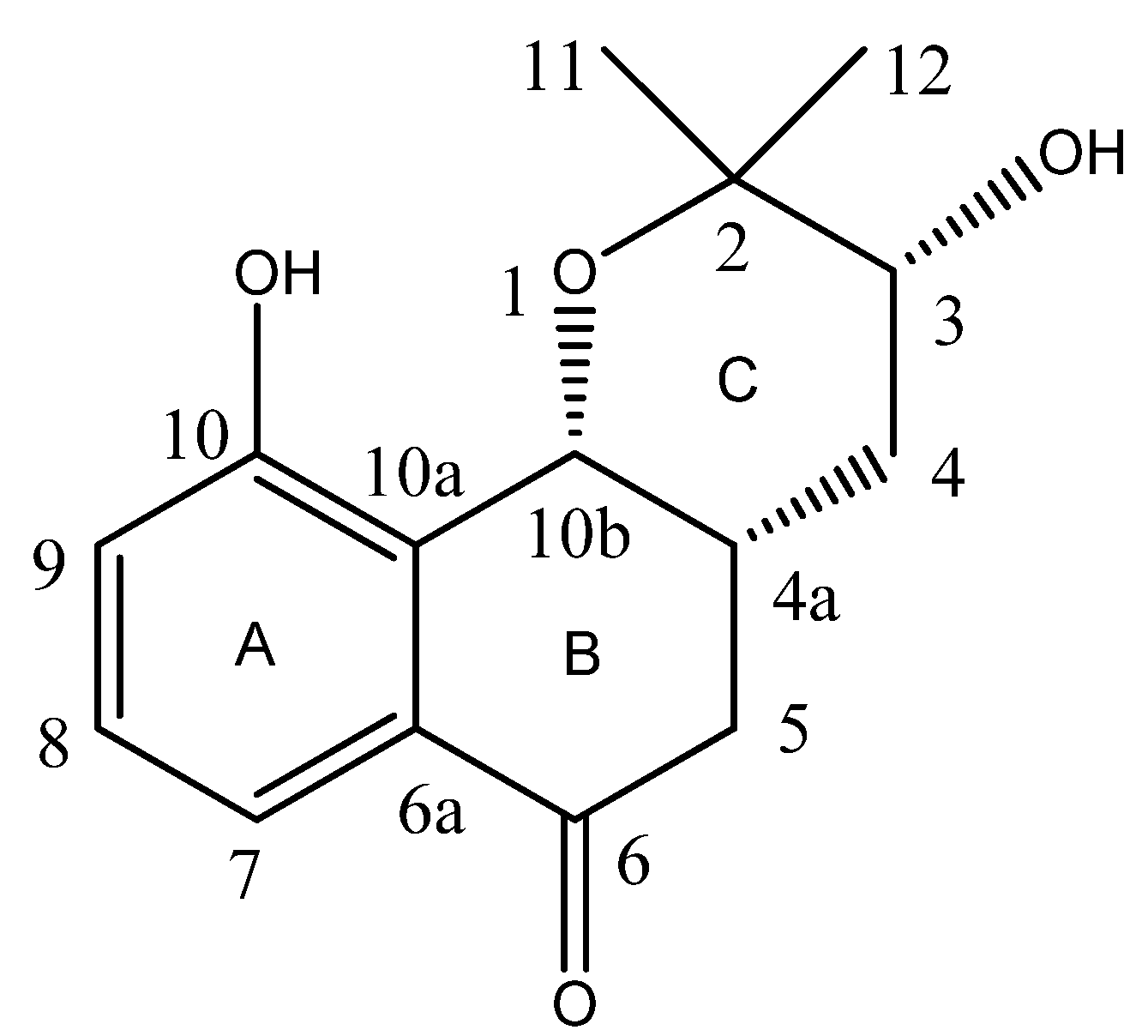
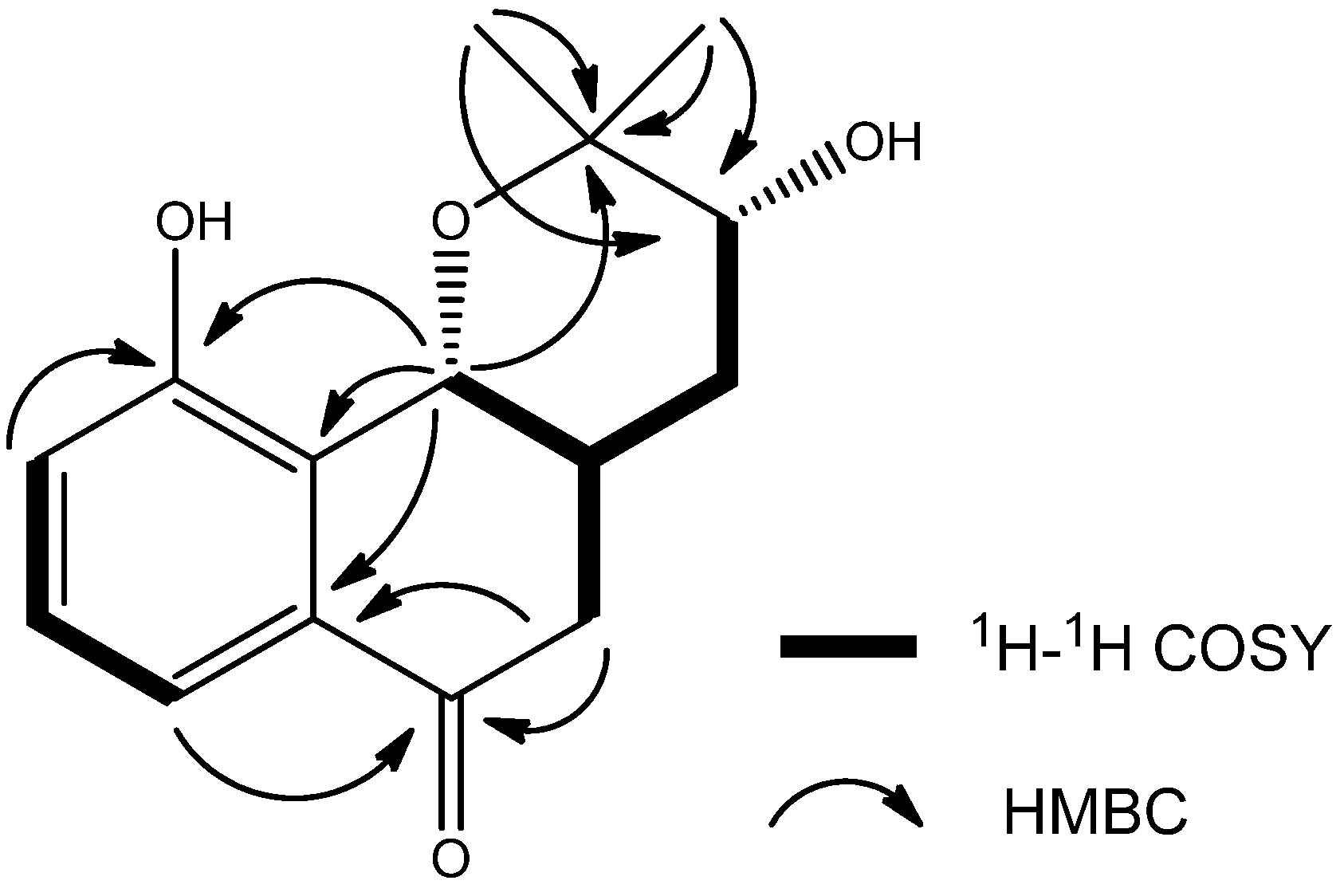
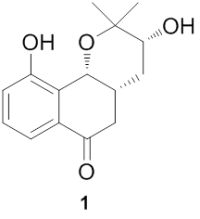
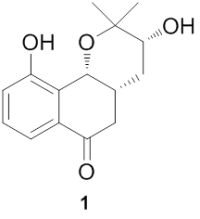
      <p>Compound <bold>1</bold> (<xref ref-type="fig" rid="molecules-17-13910-f001">Figure 1</xref>) was obtained in form of colorless crystals with m.p. 151–153 °C. Its molecular formula was determined as C<sub>15</sub>H<sub>18</sub>O<sub>4</sub> based on the result of HR-ESI-MS with a <italic>quasi</italic> molecular ion peak of [M+Na]<sup>+</sup> at <italic>m/z</italic> 285.1098 (calcd. 285.1103). The IR spectrum of <bold>1</bold> showed absorptions of hydroxyl (3446 cm<sup>−1</sup>) and conjugated carbonyl (1680 cm<sup>−1</sup>) moieties [<xref ref-type="bibr" rid="B5-molecules-17-13910">5</xref>]. The <sup>1</sup>H-NMR spectrum of <bold>1</bold> revealed the presence of three <italic>ortho</italic>-coupled aromatic protons at <italic>δ</italic><sub>H</sub> 7.41 (1H, d, <italic>J</italic> = 7.8 Hz, H-7), 7.29 (1H, ps t, <italic>J</italic> = 7.8 Hz, H-8), 7.11 (1H, d, <italic>J</italic> = 7.8 Hz, H-9) and aliphatic protons at <italic>δ</italic><sub>H</sub> 5.14 (1H, d, <italic>J</italic> = 5.4 Hz, H-10b), 3.99 (1H, t, <italic>J</italic> = 7.8 Hz, H-3), 2.94 (1H, m, H-4a), 2.86 (1H, dd, <italic>J</italic> = 15.6, 9.6 Hz, H-5β), 2.59 (1H, dd, <italic>J</italic> = 15.6, 5.4 Hz, H-5α), 2.24 (1H, dt, <italic>J</italic> = 12.6, 7.8 Hz, H-4β), 1.63 (1H, ddd, <italic>J</italic> = 12.6, 7.8, 5.4 Hz, H-4α), 1.17 (3H, s, 11-CH<sub>3</sub>), 1.09 (3H, s, 12-CH<sub>3</sub>). The <sup>13</sup>C-NMR spectrum of <bold>1</bold> exhibited 15 carbon signals, which were resolved through a APT experiment into two methyl, two methylene, six methine, and five quaternary carbons, including three oxygen-bearing sp<sup>3</sup> carbons at <italic>δ</italic><sub>C</sub> 88.2 (C-3), 74.3 (C-10b) and 72.1(C-2). <sup>1</sup>H-<sup>1</sup>H COSY correlations were observed between H-8 and H-7, H-9; H-4a and H-10b, H-4, H-5; H-4 and H-3, respectively. These correlations established the existence of two isolated proton spin-systems (<xref ref-type="fig" rid="molecules-17-13910-f002">Figure 2</xref>). HMBC correlations from 11-Me and 12-Me to C-2, C-3 indicated that 11-Me, 12-Me and C-3 were all connected with C-2, whereas correlations from H-10b to C-10, C-10a, C-6a and C-2 suggested that C-10b was connected with C-10a, and C-2 was linked to C-10b through a oxygen atom. The cross-peaks of H-5 and H-7 with C-6, H-5 with C-6a demonstrated that C-5 was connected with C-6, and C-6 with C-6a. The correlations from H-9 and H-10b to C-10 verified that the hydroxyl group was linked to C-10 (<xref ref-type="fig" rid="molecules-17-13910-f002">Figure 2</xref>). Based on the above analysis, compound <bold>1</bold> was assigned as a prenylated naphthoquinoid skeleton and was similar to that of 2,2-dimethyl-3-hydroxy-3,4,4a,10b-tetrahydro-5<italic>H</italic>-naphtho[1,2-b]-pyran-6-one [<xref ref-type="bibr" rid="B6-molecules-17-13910">6</xref>]. The only difference was an additional hydroxyl group at position 10 in compound <bold>1</bold>.</p>
      <fig id="molecules-17-13910-f001" position="float">
        <label>Figure 1</label>
        <caption>
          <p>Structure of compound <bold>1</bold>.</p>
        </caption>
        <graphic xmlns:xlink="http://www.w3.org/1999/xlink" xlink:href="molecules-17-13910-g001.tif"/>
      </fig>
      <fig id="molecules-17-13910-f002" position="float">
        <label>Figure 2</label>
        <caption>
          <p>Selected HMBC (<sup>2</sup>J and <sup>3</sup>J) correlations (<bold>H→C</bold>)and <sup>1</sup>H-<sup>1</sup>H-COSY correlations of compound <bold>1</bold>.</p>
        </caption>
        <graphic xmlns:xlink="http://www.w3.org/1999/xlink" xlink:href="molecules-17-13910-g002.tif"/>
      </fig>
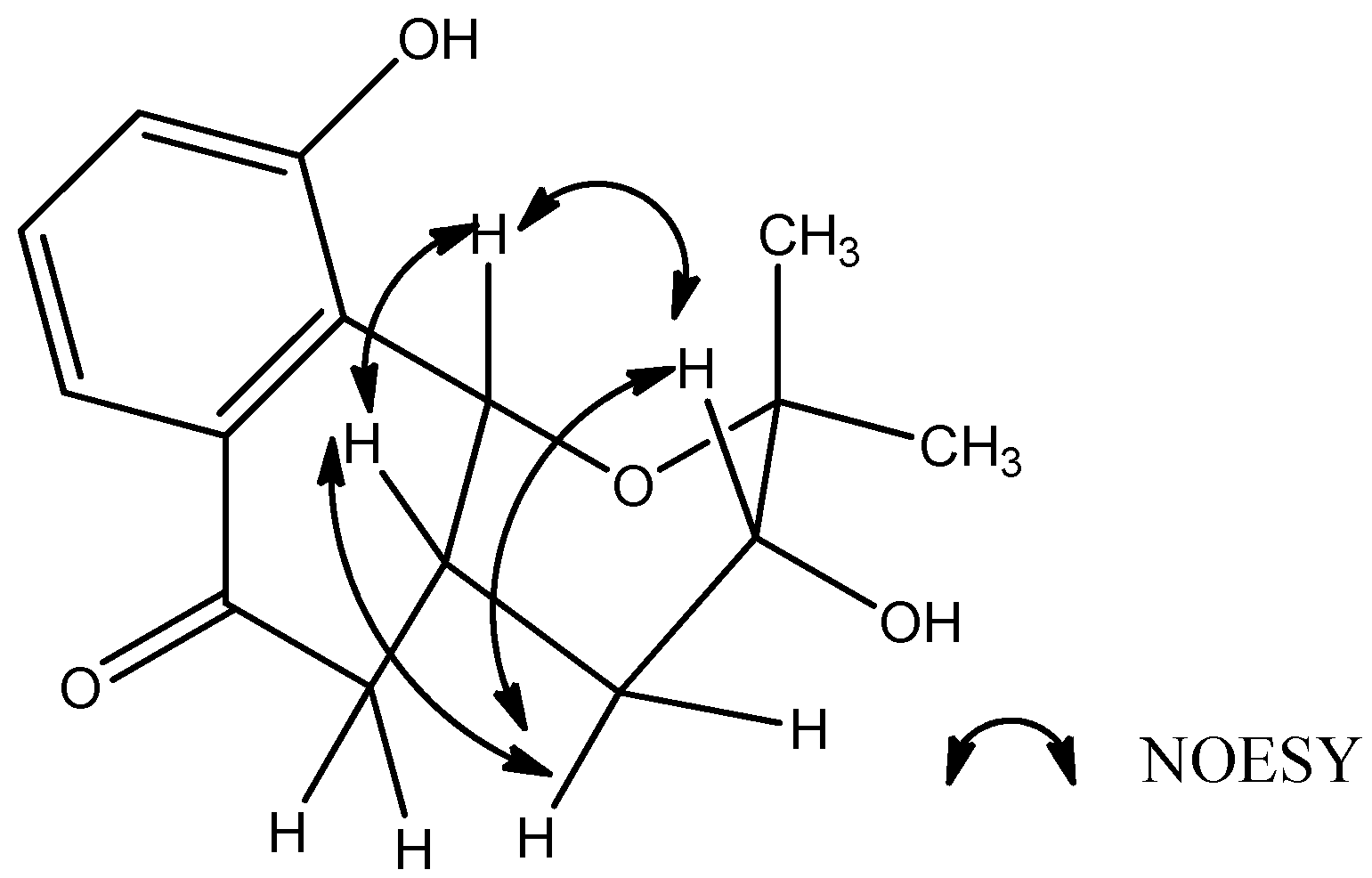
      <p>The relative stereochemistry of <bold>1</bold> was deduced from its NOESY spectrum. The NOESY correlations between H-3 and H-10b, H-10b and H-4a (<xref ref-type="fig" rid="molecules-17-13910-f003">Figure 3</xref>) indicated that the junction of B/C ring adopted a <italic>cis</italic> configuration, suggesting H-3, H-10b, H-4a were located on the same side of the ring C.</p>
      <fig id="molecules-17-13910-f003" position="float">
        <label>Figure 3</label>
        <caption>
          <p>Selected NOESY correlationsof compound <bold>1</bold>.</p>
        </caption>
        <graphic xmlns:xlink="http://www.w3.org/1999/xlink" xlink:href="molecules-17-13910-g003.tif"/>
      </fig>
      <p>In association with the observed NOESY correlation between H-3 and H-10b as well as the fact that this NOESY correlation could not be observed if the ring C accepted a chair form, suggesting a boat form for the ring C. The CD spectrum of <bold>1</bold>displayed a positive Cotton effect at 257 nm and a relatively strong negative Cotton effect at 200 nm, as well as a very weak positive Cotton effect at 343 nm, which was similar to that of <italic>cis</italic>-isoshinanolone, indicating the 10b<italic>R</italic>, 4a<italic>R</italic> configuration [<xref ref-type="bibr" rid="B7-molecules-17-13910">7</xref>]. Therefore, compound <bold>1</bold>, a rarely seen natural prenylated naphthoquinoid, was elucidated as (3<italic>R</italic>,4a<italic>R</italic>,10b<italic>R</italic>)-3,10-dihydroxy-2,2-dimethyl-3,4,4a,10b-tetrahydro-2<italic>H</italic>-naphtho[1,2-b]-pyran-5<italic>H</italic>-6-one. Moreover, the established CD method regarding determination of its absolute configuration should prove useful for the structural elucidation of its analogues.</p>
      <p>Besides the new compound, six known flavonoids, namely apigenin (<bold>2</bold>) [<xref ref-type="bibr" rid="B8-molecules-17-13910">8</xref>], luteolin (<bold>3</bold>) [<xref ref-type="bibr" rid="B9-molecules-17-13910">9</xref>], neoeriocitrin (<bold>4</bold>) [<xref ref-type="bibr" rid="B10-molecules-17-13910">10</xref>], naringenin (<bold>5</bold>) [<xref ref-type="bibr" rid="B11-molecules-17-13910">11</xref>], narirutin (<bold>6</bold>) [<xref ref-type="bibr" rid="B12-molecules-17-13910">12</xref>], and didymin (<bold>7</bold>) [<xref ref-type="bibr" rid="B13-molecules-17-13910">13</xref>], were isolated from the plant and their structures determinated by comparing their spectroscopic data with those reported in literature. To the best of our knowledge, neoeriocitrin was isolated for the first time from the species <italic>C. chinense</italic>.</p>
    </sec>
    <sec sec-type="methods">
      <title>3. Experimental</title>
      <sec>
        <title>3.1. General</title>
        <p>Melting points (uncorrected) were taken on a Fisher-Johns melting point apparatus. UV spectra were recorded on a Shimadzu UV-2550 UV/vis spectrophotometer. IR spectrum was acquired using a Shimadzu FTIR-8400S spectrophotometer. Optical rotations were measured by a Perkin-EImer 241 polarimeter. CD spectrum was measured on a JASCO J-815 spectrometer. The NMR data were recorded on a Bruker AV 600 instrument (600 MHz for <sup>1</sup>H and 150 MHz for <sup>13</sup>C) in CD<sub>3</sub>OD with TMS as internal standard. HR-ESI-MS data were obtained by LTQ-Orbitrap mass spectrophotometer (Thermo-Fisher Scientific, Bremen, Germany). Chromatography was performed on AB-8 macroporous resin (Chemical plant of NanKai University, Tianjin, China), silica gel (200–300 mesh, Qingdao Haiyang Chemical Factory, Qingdao, China), Sephadex LH-20 (Amersham Pharmacia Biotech AB, Uppsala, Sweden), MCI gel (75–150 μm, Mitsubishi Chemical Corporation, Tokyo, Japan) and ODS gel (40–60 μm, Daiso Co., Ltd., Osaka, Japan). Semipreparative HPLC was performed on a CXTH LC-3000 HPLC system with a CXTH LC-3000 UV spectrophotometric detector (Beijing Chuangxintongheng Science and Technology Co., Ltd., Beijing, China).</p>
      </sec>
      <sec>
        <title>3.2. Plant Material</title>
        <p>The plants were collected from Anhui Province in 2011, and identified by Dr. Jing Quan Yuan at the Key Laboratory of Bioactive Substances and Resources Utilization of Chinese Herbal Medicine, Ministry of Education, Institute of Medicinal Plant Development, Chinese Academy of Medical Sciences &amp; Peking Union Medical College. A voucher specimen (No. 20101132) has been deposited there.</p>
      </sec>
      <sec>
        <title>3.3. Extraction and Isolation</title>
        <p>The dried aerial parts of <italic>C. chinense</italic> (5 kg) were decocted two times with hot water (50 L, 2 h each time), and the combined solution was concentrated under reduced pressure to yield an extract (400 g). The extract was subjected to AB-8 macroporous resin column chromatography using ethanol-H<sub>2</sub>O (0:100 to 95:5, v/v) and the 50%–95% fraction afforded the total flavonoids of <italic>C. chinense</italic> (CCF). The CCF was subjected to column chromatography on silica gel with CHCl<sub>3</sub>-MeOH (20:1 to 0:1, v/v), and fractionated into eight fractions (Fr.1→8). Fr.1 was subjected to ODS column chromatography eluting with CH<sub>3</sub>OH-H<sub>2</sub>O (3:7 to 1:0, v/v) to yield three subfractions (subFr.1→3). SubFr.3 was purified by Sephadex LH-20 column chromatography eluting with CH<sub>3</sub>OH and compound <bold>1</bold> was obtained after semi-preparative HPLC (15 mg). Fr.2 and Fr.3 were subjected to Sephadex LH-20 column chromatography eluting with CH<sub>3</sub>OH to give B1-B20 and C1-C12, respectively. B14-B16 were further separated by semi-preparative HPLC to yield compounds <bold>2</bold> (26 mg) and <bold>5</bold> (23 mg). C9 was subjected to semi-preparative HPLC to afford compound <bold>3</bold> (12 mg). Fr.5 was subjected to MCI column chromatography eluting with CH<sub>3</sub>OH-H<sub>2</sub>O (4:6 to 1:0, v/v) to yield 4 subfractions (subFr.1→4). SubFr.1 was applied to a semi-preparative HPLC to yield compounds <bold>4</bold> (12 mg) and <bold>6</bold> (8 mg). Compound <bold>7</bold> (50 mg) was crystallized in the bottle when eluted with the solvent CHCl<sub>3</sub>-MeOH (15:85, v/v, Fr. 4) on silica gel and then purified with MeOH.</p>
      </sec>
      <sec>
        <title>3.4. Spectral Data</title>
        <p><italic>(3R,4aR,10bR)-3,10-Dihydroxy-2,2-dimethyl-3,4,4a,10b-tetrahydro-2H-naphtho[1,2-b]-pyran-5H-6-one</italic> (<bold>1</bold>). Colorless crystals; [α]<sup>25</sup><sub>D</sub>: −75.0 (<italic>c</italic> 0.12, MeOH); UV (MeOH) <italic>λ</italic><sub>max</sub> (log<italic>ε</italic>): 205 (2.412), 220 (2.070), 257 (0.705), 315 (0.342); IR (KBr) <italic>ν</italic><sub>max</sub> (cm<sup>−1</sup>) : 3446, 1680, 1602, 1588, 1370; CD (0.076 mmol/L, MeOH): <bold>Δ</bold>ε<sub>343</sub>, +1.3, <bold>Δ</bold>ε<sub>257</sub>, +6.6, <bold>Δ</bold>ε<sub>200</sub>, −86.5; HRESI-MS <italic>m/z</italic>: [M+Na]<sup>+</sup> 285.1098 (C<sub>15</sub>H<sub>18</sub>O<sub>4</sub>Na, calcd. 285.1103). For <sup>1</sup>H-NMR and <sup>13</sup>C-NMR (CD<sub>3</sub>OD) spectral data, see <xref ref-type="table" rid="molecules-17-13910-t001">Table 1</xref>.</p>
        <table-wrap id="molecules-17-13910-t001" position="float">
          <object-id pub-id-type="pii">molecules-17-13910-t001_Table 1</object-id>
          <label>Table 1</label>
          <caption>
            <p><sup>1</sup>H-NMR (600 MHz, CD<sub>3</sub>OD) and <sup>13</sup>C-NMR (150 MHz, CD<sub>3</sub>OD) spectral data for <bold>1</bold>.</p>
          </caption>
          <table>
<thead>
              <tr>
                <th align="center" valign="middle">Position</th>
                <th align="center" valign="middle"><sup>1</sup>H(δ)</th>
                <th align="center" valign="middle"><sup>13</sup>C(δ)</th>
                <th align="center" valign="middle">HMBC</th>
              </tr>
            </thead>
            <tbody>
              <tr>
                <td align="center" valign="top">2</td>
                <td align="center" valign="top"> </td>
                <td align="center" valign="top">72.1</td>
                <td align="center" valign="top"> </td>
              </tr>
              <tr>
                <td align="center" valign="top">3</td>
                <td align="center" valign="top">3.99 (1H, dd, 
                <italic>J</italic> = 7.8 Hz)</td>
                <td align="center" valign="top">88.2</td>
                <td align="center" valign="top">26.6(C-2-Me)</td>
              </tr>
              <tr>
                <td align="center" valign="top">4</td>
                <td align="center" valign="top">1.63 (1H, ddd, 
                <italic>J</italic> = 12.6, 7.8, 5.4 Hz, 4α)</td>
                <td align="center" valign="top">34.2</td>
                <td align="center" valign="top">38.6(C-4a), 41.6(C-5), 74.3(C-10b), 88.2(C-3)</td>
              </tr>
              <tr>
                <td align="center" valign="top"> </td>
                <td align="center" valign="top">2.24 (1H, dt, 
                <italic>J</italic> = 12.6, 7.8 Hz, 4β)</td>
                <td align="center" valign="top"> </td>
                <td align="center" valign="top">38.6(C-4a), 72.1(C-2), 74.3(C-10b), 88.2(C-3)</td>
              </tr>
              <tr>
                <td align="center" valign="top">4a</td>
                <td align="center" valign="top">2.94 (1H, m)</td>
                <td align="center" valign="top">38.6</td>
                <td align="center" valign="top">88.2(C-3)</td>
              </tr>
              <tr>
                <td align="center" valign="top">5</td>
                <td align="center" valign="top">2.59 (1H, dd, 
                <italic>J</italic> = 15.6, 5.4 Hz, 5α)</td>
                <td align="center" valign="top">41.6</td>
                <td align="center" valign="top">200.6(C-6), 34.2(C-4), 38.6(C-4a), 74.3(C-10b)</td>
              </tr>
              <tr>
                <td align="center" valign="top"> </td>
                <td align="center" valign="top">2.86 (1H, dd, 
                <italic>J</italic> = 15.6, 9.6 Hz, 5β)</td>
                <td align="center" valign="top"> </td>
                <td align="center" valign="top">134.4(C-6a), 200.6(C-6), 34.2(C-4), 38.6(C-4a), 74.3(C-10b)</td>
              </tr>
              <tr>
                <td align="center" valign="top">6</td>
                <td align="center" valign="top"> </td>
                <td align="center" valign="top">200.6</td>
                <td align="center" valign="top"> </td>
              </tr>
              <tr>
                <td align="center" valign="top">6a</td>
                <td align="center" valign="top"> </td>
                <td align="center" valign="top">134.4</td>
                <td align="center" valign="top"> </td>
              </tr>
              <tr>
                <td align="center" valign="top">7</td>
                <td align="center" valign="top">7.41 (1H, d, 
                <italic>J</italic> = 7.8 Hz)</td>
                <td align="center" valign="top">118.4</td>
                <td align="center" valign="top">128.1(C-10a), 130.7(C-8), 200.6(C-6)</td>
              </tr>
              <tr>
                <td align="center" valign="top">8</td>
                <td align="center" valign="top">7.29 (1H, ps t, 
                <italic>J</italic> = 7.8 Hz)</td>
                <td align="center" valign="top">130.7</td>
                <td align="center" valign="top">118.4(C-7), 122.4(C-9), 128.1(C-10a)</td>
              </tr>
              <tr>
                <td align="center" valign="top">9</td>
                <td align="center" valign="top">7.11 (1H, d, 
                <italic>J</italic> = 7.8 Hz)</td>
                <td align="center" valign="top">122.4</td>
                <td align="center" valign="top">128.1(C-10a), 158.5(C-10)</td>
              </tr>
              <tr>
                <td align="center" valign="top">10</td>
                <td align="center" valign="top"> </td>
                <td align="center" valign="top">158.5</td>
                <td align="center" valign="top"> </td>
              </tr>
              <tr>
                <td align="center" valign="top">10a</td>
                <td align="center" valign="top"> </td>
                <td align="center" valign="top">128.1</td>
                <td align="center" valign="top"> </td>
              </tr>
              <tr>
                <td align="center" valign="top">10b</td>
                <td align="center" valign="top">5.14 (1H, d, 
                <italic>J</italic> = 5.4 Hz)</td>
                <td align="center" valign="top">74.3</td>
                <td align="center" valign="top">128.1(C-10a), 134.4(C-6a), 158.5(C-10), 41.6(C-5), 34.2(C-4)</td>
              </tr>
              <tr>
                <td align="center" valign="top">11-Me</td>
                <td align="center" valign="top">1.17 (3H, s)</td>
                <td align="center" valign="top">26.6</td>
                <td align="center" valign="top">72.1(C-2), 88.2(C-3)</td>
              </tr>
              <tr>
                <td align="center" valign="top">12-Me</td>
                <td align="center" valign="top">1.09 (3H, s)</td>
                <td align="center" valign="top">25.7</td>
                <td align="center" valign="top">72.1(C-2), 88.2(C-3)</td>
              </tr>
            </tbody>
          </table>
        </table-wrap>
      </sec>
    </sec>
    <sec sec-type="conclusions">
      <title>4. Conclusions</title>
      <p>A new prenylated naphthoquinoid, named (3<italic>R</italic>,4a<italic>R</italic>,10b<italic>R</italic>)-3,10-dihydroxy-2,2-dimethyl-3,4,4a,10b-tetrahydro-2<italic>H</italic>-naphtho[1,2-b]-pyran-5<italic>H</italic>-6-one (<bold>1</bold>), was isolated from the aerial parts of <italic>Clinopodium chinense</italic> (Benth.) O. Kuntze. To the best of our knowledge, there were only five natural sources of this skeleton in <italic>Lippia sidoides</italic> [<xref ref-type="bibr" rid="B5-molecules-17-13910">5</xref>], and <italic>Oroxylum indicum</italic> Vent [<xref ref-type="bibr" rid="B6-molecules-17-13910">6</xref>], respectively. The rarely seen prenylated naphthoquinoid framework represents a new addition to the molecular diversity of <italic>C. chinense</italic>. Additionally, the deduced absolute configuration of <bold>1</bold> by the circular dichroism method will provide an approach applicable to determining the stereochemistry of other prenylated naphthoquinoid derivatives.</p>
    </sec>
    
  </body>
  <back><ack>
      <title>Acknowledgments</title>
      <p>This work was financially supported by the National Nature Science Foundation of China (No. 81173511), the technological large platform for comprehensive research and development of new drugs in the Twelfth Five-Year “Significant New Drugs Created” Science and Technology Major Project (No. 2012ZX09301-002-001-026), and the chemical composition of the digital library of traditional Chinese medicine of drug discovery in the Twelfth Five-Year “Significant New Drugs Created” (No. 2011ZX09307-002-01).</p>
      
    </ack>
    <ref-list>
      <title>References</title>
      <ref id="B1-molecules-17-13910">
        <label>1.</label>
        <citation citation-type="journal">
          <person-group person-group-type="author">
            <name>
              <surname>Chi</surname>
              <given-names>H.D.</given-names>
            </name>
            <name>
              <surname>Lu</surname>
              <given-names>J.C.</given-names>
            </name>
          </person-group>
          <article-title>Advances in studies on medicinal plants in <italic>Clinopodium</italic></article-title>
          <source>J. Shenyang Pharm. Univ.</source>
          <year>2007</year>
          <volume>6</volume>
          <fpage>100</fpage>
          <lpage>110</lpage>
        </citation>
      </ref>
      <ref id="B2-molecules-17-13910">
        <label>2.</label>
        <citation citation-type="journal">
          <person-group person-group-type="author">
            <name>
              <surname>Zhong</surname>
              <given-names>M.L.</given-names>
            </name>
            <name>
              <surname>Xu</surname>
              <given-names>X.D.</given-names>
            </name>
            <name>
              <surname>Yu</surname>
              <given-names>S.C.</given-names>
            </name>
            <name>
              <surname>Sun</surname>
              <given-names>G.L.</given-names>
            </name>
          </person-group>
          <article-title>Advances in studies on medicinal plants in Clinopodium Linn</article-title>
          <source>Chin. Tradit. Herbal Drugs</source>
          <year>2012</year>
          <volume>43</volume>
          <fpage>820</fpage>
          <lpage>828</lpage>
        </citation>
      </ref>
      <ref id="B3-molecules-17-13910">
        <label>3.</label>
        <citation citation-type="journal">
          <person-group person-group-type="author">
            <name>
              <surname>Miyase</surname>
              <given-names>T.</given-names>
            </name>
            <name>
              <surname>Matsushima</surname>
              <given-names>Y.</given-names>
            </name>
          </person-group>
          <article-title>Saikosaponin homologs from <italic>Clinopodium</italic> spp. The structures of clinoposaponins XII–XX</article-title>
          <source>Chem. Pharm. Bull.</source>
          <year>1997</year>
          <volume>45</volume>
          <fpage>1493</fpage>
          <lpage>1497</lpage>
          <pub-id pub-id-type="doi">10.1248/cpb.45.1493</pub-id>
        </citation>
      </ref>
      <ref id="B4-molecules-17-13910">
        <label>4.</label>
        <citation citation-type="journal">
          <person-group person-group-type="author">
            <name>
              <surname>Liu</surname>
              <given-names>Z.M.</given-names>
            </name>
            <name>
              <surname>Jia</surname>
              <given-names>Z.J.</given-names>
            </name>
            <name>
              <surname>Gates</surname>
              <given-names>R.G.</given-names>
            </name>
            <name>
              <surname>Li</surname>
              <given-names>D.</given-names>
            </name>
            <name>
              <surname>Owen</surname>
              <given-names>N.</given-names>
            </name>
          </person-group>
          <article-title>Triterpenoid saponins from <italic>Clinopodium.chinensis</italic></article-title>
          <source>J. Nat. Prod.</source>
          <year>1995</year>
          <volume>58</volume>
          <fpage>184</fpage>
          <lpage>188</lpage>
          <pub-id pub-id-type="doi">10.1021/np50116a004</pub-id>
        </citation>
      </ref>
      <ref id="B5-molecules-17-13910">
        <label>5.</label>
        <citation citation-type="journal">
          <person-group person-group-type="author">
            <name>
              <surname>Macambira</surname>
              <given-names>L.M.A.</given-names>
            </name>
            <name>
              <surname>Andrade</surname>
              <given-names>C.H.S.</given-names>
            </name>
            <name>
              <surname>Matos</surname>
              <given-names>F.J.A.</given-names>
            </name>
            <name>
              <surname>Craveiro</surname>
              <given-names>A.A.</given-names>
            </name>
            <name>
              <surname>Braz Filho</surname>
              <given-names>R.</given-names>
            </name>
          </person-group>
          <article-title>Naphthoquinoids from <italic>Lippia Sidoids</italic></article-title>
          <source>J. Nat. Prod.</source>
          <year>1986</year>
          <volume>49</volume>
          <fpage>310</fpage>
          <lpage>312</lpage>
          <pub-id pub-id-type="doi">10.1021/np50044a019</pub-id>
        </citation>
      </ref>
      <ref id="B6-molecules-17-13910">
        <label>6.</label>
        <citation citation-type="journal">
          <person-group person-group-type="author">
            <name>
              <surname>Kizu</surname>
              <given-names>H.</given-names>
            </name>
            <name>
              <surname>Habe</surname>
              <given-names>S.</given-names>
            </name>
            <name>
              <surname>Ishida</surname>
              <given-names>M.</given-names>
            </name>
            <name>
              <surname>Tomimori</surname>
              <given-names>T.</given-names>
            </name>
          </person-group>
          <article-title>Studies on the nepalese crude drugs. XVII. On the naphthalene related compounds from the root bark of <italic>Oroxylum indicum</italic> Vent</article-title>
          <source>Yakugaku Zasshi</source>
          <year>1994</year>
          <volume>114</volume>
          <fpage>492</fpage>
          <lpage>513</lpage>
        <pub-id pub-id-type="pmid">7932095</pub-id></citation>
      </ref>
      <ref id="B7-molecules-17-13910">
        <label>7.</label>
        <citation citation-type="journal">
          <person-group person-group-type="author">
            <name>
              <surname>Bringmann</surname>
              <given-names>G.</given-names>
            </name>
            <name>
              <surname>Messer</surname>
              <given-names>K.</given-names>
            </name>
            <name>
              <surname>Saeb</surname>
              <given-names>W.</given-names>
            </name>
            <name>
              <surname>Peters</surname>
              <given-names>E.M.</given-names>
            </name>
            <name>
              <surname>Peters</surname>
              <given-names>K.</given-names>
            </name>
          </person-group>
          <article-title>The absolute configuration of (+)-isoshinaolone and in situ LC-CD analysis of its stereoisomer from crude extracts</article-title>
          <source>Phytochemistry</source>
          <year>2001</year>
          <volume>56</volume>
          <fpage>387</fpage>
          <lpage>391</lpage>
        <pub-id pub-id-type="pmid">11249107</pub-id><pub-id pub-id-type="doi">10.1016/S0031-9422(00)00386-1</pub-id></citation>
      </ref>
      <ref id="B8-molecules-17-13910">
        <label>8.</label>
        <citation citation-type="journal">
          <person-group person-group-type="author">
            <name>
              <surname>Fathiazad</surname>
              <given-names>F.</given-names>
            </name>
            <name>
              <surname>Ddlazar</surname>
              <given-names>A.</given-names>
            </name>
            <name>
              <surname>Amiri</surname>
              <given-names>R.</given-names>
            </name>
            <name>
              <surname>Sarker</surname>
              <given-names>S.</given-names>
            </name>
          </person-group>
          <article-title>Extraction of flavonoids and quantification of rutin from waste tobacco leaves</article-title>
          <source>Iran. J. Pharm. Res.</source>
          <year>2006</year>
          <volume>3</volume>
          <fpage>222</fpage>
          <lpage>227</lpage>
        </citation>
      </ref>
      <ref id="B9-molecules-17-13910">
        <label>9.</label>
        <citation citation-type="journal">
          <person-group person-group-type="author">
            <name>
              <surname>Owen</surname>
              <given-names>R.W.</given-names>
            </name>
            <name>
              <surname>Haubner</surname>
              <given-names>R.</given-names>
            </name>
            <name>
              <surname>Mier</surname>
              <given-names>W.</given-names>
            </name>
            <name>
              <surname>Giacosa</surname>
              <given-names>A.</given-names>
            </name>
            <name>
              <surname>Hull</surname>
              <given-names>W.E.</given-names>
            </name>
            <name>
              <surname>Spiegelhalder</surname>
              <given-names>B.</given-names>
            </name>
            <name>
              <surname>Bartsch</surname>
              <given-names>H.</given-names>
            </name>
          </person-group>
          <article-title>Isolation, structure elucidation and antioxidant potential of the major phenolic and flavonoid compounds in brined olive drupes</article-title>
          <source>Food Chem. Toxicol.</source>
          <year>2003</year>
          <volume>41</volume>
          <fpage>703</fpage>
          <lpage>717</lpage>
          <pub-id pub-id-type="doi">10.1016/S0278-6915(03)00011-5</pub-id>
        </citation>
      </ref>
      <ref id="B10-molecules-17-13910">
        <label>10.</label>
        <citation citation-type="journal">
          <person-group person-group-type="author">
            <name>
              <surname>Li</surname>
              <given-names>F.</given-names>
            </name>
            <name>
              <surname>Meng</surname>
              <given-names>F.</given-names>
            </name>
            <name>
              <surname>Xiong</surname>
              <given-names>Z.</given-names>
            </name>
            <name>
              <surname>Li</surname>
              <given-names>Y.</given-names>
            </name>
            <name>
              <surname>Liu</surname>
              <given-names>R.</given-names>
            </name>
            <name>
              <surname>Liu</surname>
              <given-names>H.</given-names>
            </name>
          </person-group>
          <article-title>Stimulative activity of <italic>Drynaria fortunei</italic> (Kunze) J. Sm. extracts and two of its flavonoids on the proliferation of osteoblastic like cells</article-title>
          <source>Pharmazie</source>
          <year>2006</year>
          <volume>61</volume>
          <fpage>962</fpage>
          <lpage>965</lpage>
        <pub-id pub-id-type="pmid">17152991</pub-id></citation>
      </ref>
      <ref id="B11-molecules-17-13910">
        <label>11.</label>
        <citation citation-type="journal">
          <person-group person-group-type="author">
            <name>
              <surname>Yamauchi</surname>
              <given-names>K.</given-names>
            </name>
            <name>
              <surname>Mitsunaga</surname>
              <given-names>T.</given-names>
            </name>
            <name>
              <surname>Batubara</surname>
              <given-names>I.</given-names>
            </name>
          </person-group>
          <article-title>Isolation, identification and tyrosinase inhibitory avtivities of the extractives from <italic>Allamanda cathartica</italic></article-title>
          <source>Nat. Resour.</source>
          <year>2011</year>
          <volume>2</volume>
          <fpage>167</fpage>
          <lpage>172</lpage>
        </citation>
      </ref>
      <ref id="B12-molecules-17-13910">
        <label>12.</label>
        <citation citation-type="journal">
          <person-group person-group-type="author">
            <name>
              <surname>Shimoda</surname>
              <given-names>K.</given-names>
            </name>
            <name>
              <surname>Kubota</surname>
              <given-names>N.</given-names>
            </name>
            <name>
              <surname>Taniuchi</surname>
              <given-names>K.</given-names>
            </name>
            <name>
              <surname>Sato</surname>
              <given-names>D.</given-names>
            </name>
            <name>
              <surname>Nakajima</surname>
              <given-names>N.</given-names>
            </name>
            <name>
              <surname>Hamada</surname>
              <given-names>H.</given-names>
            </name>
            <name>
              <surname>Hamada</surname>
              <given-names>H.</given-names>
            </name>
          </person-group>
          <article-title>Biotransformation of naringin and naringenin by cultured <italic>Eucalyptus perriniana</italic> cells</article-title>
          <source>Phytochemistry</source>
          <year>2010</year>
          <volume>71</volume>
          <fpage>201</fpage>
          <lpage>205</lpage>
          <pub-id pub-id-type="doi">10.1016/j.phytochem.2009.09.035</pub-id>
        </citation>
      </ref>
      <ref id="B13-molecules-17-13910">
        <label>13.</label>
        <citation citation-type="journal">
          <person-group person-group-type="author">
            <name>
              <surname>Liu</surname>
              <given-names>R.M.</given-names>
            </name>
            <name>
              <surname>Kong</surname>
              <given-names>L.Y.</given-names>
            </name>
            <name>
              <surname>Li</surname>
              <given-names>A.F.</given-names>
            </name>
            <name>
              <surname>Sun</surname>
              <given-names>A.L.</given-names>
            </name>
          </person-group>
          <article-title>Preparative Isolation and Purification of Saponin and Flavone Glycoside Compounds from <italic>Clinopodium chinense</italic> (Benth) O. Kuntze by High Speed Countercurrent Chromatography</article-title>
          <source>J. Liq. Chromatogr. Relat. Technol.</source>
          <year>2007</year>
          <volume>30</volume>
          <fpage>521</fpage>
          <lpage>532</lpage>
          <pub-id pub-id-type="doi">10.1080/10826070601093846</pub-id>
        </citation>
      </ref>
    </ref-list>
	<fn-group><fn><p><italic>Sample Availability</italic>: Samples of compounds <bold>1</bold>–<bold>7</bold>are available from the authors.</p></fn></fn-group>
  </back>
</article>