<?xml version="1.0" encoding="UTF-8"?>
<!DOCTYPE article PUBLIC "-//NLM//DTD Journal Publishing DTD v2.3 20070202//EN" "journalpublishing.dtd">
<article xmlns:mml="http://www.w3.org/1998/Math/MathML" xmlns:xlink="http://www.w3.org/1999/xlink" xml:lang="en" article-type="research-article">
  <front>
    <journal-meta>
      <journal-id journal-id-type="publisher-id">molecules</journal-id>
      <journal-title>Molecules</journal-title>
      <abbrev-journal-title abbrev-type="publisher">Molecules</abbrev-journal-title>
      <abbrev-journal-title abbrev-type="pubmed">Molecules</abbrev-journal-title>
      <issn pub-type="epub">1420-3049</issn>
      <publisher>
        <publisher-name>MDPI</publisher-name>
      </publisher>
    </journal-meta>
    <article-meta>
      <article-id pub-id-type="doi">10.3390/molecules171213856</article-id>
      <article-id pub-id-type="publisher-id">molecules-17-13856</article-id>
      <article-categories>
        <subj-group>
          <subject>Article</subject>
        </subj-group>
      </article-categories>
      <title-group>
        <article-title>An Efficient One-Pot Synthesis of Pyrano[3,2-<italic>c</italic>]quinolin-2,5-dione Derivatives Catalyzed by <sc>L</sc>-Proline</article-title>
      </title-group>
      <contrib-group>
        <contrib contrib-type="author">
          <name>
            <surname>Zhu</surname>
            <given-names>Songlei</given-names>
          </name>
          <xref rid="af1-molecules-17-13856" ref-type="aff">1</xref>
          <xref rid="af2-molecules-17-13856" ref-type="aff">2</xref>
          <xref rid="fn1-molecules-17-13856" ref-type="fn">†</xref>
          <xref rid="c1-molecules-17-13856" ref-type="corresp">*</xref>
        </contrib>
        <contrib contrib-type="author">
          <name>
            <surname>Wang</surname>
            <given-names>Jing</given-names>
          </name>
          <xref rid="af2-molecules-17-13856" ref-type="aff">2</xref>
          <xref rid="fn1-molecules-17-13856" ref-type="fn">†</xref>
        </contrib>
        <contrib contrib-type="author">
          <name>
            <surname>Xu</surname>
            <given-names>Zhou</given-names>
          </name>
          <xref rid="af2-molecules-17-13856" ref-type="aff">2</xref>
        </contrib>
        <contrib contrib-type="author">
          <name>
            <surname>Li</surname>
            <given-names>Jie</given-names>
          </name>
          <xref rid="af3-molecules-17-13856" ref-type="aff">3</xref>
        </contrib>
      </contrib-group>
      <aff id="af1-molecules-17-13856"><label>1</label> Key Laboratory of Biological Cancer Therapy of Jiangsu Province, Xuzhou Medical College, Xuzhou 221004, China</aff>
      <aff id="af2-molecules-17-13856"><label>2</label> Department of Chemistry, Xuzhou Medical College, Xuzhou 221004, China</aff>
      <aff id="af3-molecules-17-13856"><label>3</label> School of Pharmacy, Xuzhou Medical College, Xuzhou 221004, China</aff>
      <author-notes>
        <fn id="fn1-molecules-17-13856">
          <label>† </label>
          <p>These authors contributed equally to this work.</p>
        </fn>
        <corresp id="c1-molecules-17-13856"><label>*</label> Author to whom correspondence should be addressed; Email: <email>songleizhu@xzmc.edu.cn</email>; Tel./Fax: +86-516-8397-9800.</corresp>
      </author-notes>
      <pub-date pub-type="epub">
        <day>22</day>
        <month>11</month>
        <year>2012</year>
      </pub-date>
      <pub-date pub-type="collection"><month>12</month>
        <year>2012</year>
      </pub-date>
      <volume>17</volume>
      <issue>12</issue>
      <fpage>13856</fpage>
      <lpage>13863</lpage>
      <history>
        <date date-type="received">
          <day>05</day>
          <month>11</month>
          <year>2012</year>
        </date>
        <date date-type="rev-recd">
          <day>17</day>
          <month>11</month>
          <year>2012</year>
        </date>
        <date date-type="accepted">
          <day>20</day>
          <month>11</month>
          <year>2012</year>
        </date>
      </history>
      <permissions>
        <copyright-statement>©  2012 by the authors; licensee MDPI, Basel, Switzerland.</copyright-statement>
        <copyright-year>2012</copyright-year>
        <license xmlns:xlink="http://www.w3.org/1999/xlink" license-type="open-access" xlink:href="http://creativecommons.org/licenses/by/3.0/">
          <p>This article is an open-access article distributed under the terms and conditions of the Creative Commons Attribution license (http://creativecommons.org/licenses/by/3.0/).</p>
        </license>
      </permissions>
      <abstract>
        <p> A series of 4-aryl-6-methyl-3,4-dihydro-2<italic>H</italic>-pyrano[3,2-<italic>c</italic>]quinolin-2,5(6<italic>H</italic>)-diones were synthesized via the three-component reactions of aromatic aldehydes, 4-hydroxy-1-methylquinolin-2(1<italic>H</italic>)-one, and Meldrum’s acid catalyzed by <sc>L</sc>-proline. The structures of the products were identified by spectroscopic analysis. A mechanism for this three-component reaction catalyzed by <sc>L</sc>-proline was proposed.</p>
      </abstract>
      <kwd-group>
        <kwd>pyrano[3,2-<italic>c</italic>]quinolin-2,5(6<italic>H</italic>)-dione</kwd>
        <kwd>multi-component reaction</kwd>
        <kwd><sc>L</sc>-proline</kwd>
      </kwd-group>
    </article-meta>
  </front>
  <body>
    <sec sec-type="intro">
      <title>1. Introduction</title>
      <p>Multicomponent reactions (MCRs) play an increasingly important role in organic and medical chemistry for their high degree of atom economy, convergence, productivity, easy execution, generally excellent yields and broad applications in combinatorial chemistry [<xref ref-type="bibr" rid="B1-molecules-17-13856">1</xref>]. MCRs are highly efficient strategies to achieve the rapid assembly of complex products, especially sequential carbon-carbon and carbon-heteroatom bond-forming reactions in the area of heterocycles and natural products [<xref ref-type="bibr" rid="B2-molecules-17-13856">2</xref>,<xref ref-type="bibr" rid="B3-molecules-17-13856">3</xref>,<xref ref-type="bibr" rid="B4-molecules-17-13856">4</xref>].</p>
      <p>Pyranoquinolines and their derivatives have been reported to possess antidiabetic activities [<xref ref-type="bibr" rid="B5-molecules-17-13856">5</xref>] and pure calcium channel blocking activities [<xref ref-type="bibr" rid="B6-molecules-17-13856">6</xref>]. A few methods have been reported for the synthesis of pyranoquinoline derivatives from 3-oxopropanoic acid [<xref ref-type="bibr" rid="B7-molecules-17-13856">7</xref>], or by a MCRs of malononitrile (or cyanoacetate) with aldehydes and 4-hydroxyl-1,2-dihydroquinolin-2-one (or 8-hydroxyquinoline) in the presence of KF-Al<sub>2</sub>O<sub>3</sub> [<xref ref-type="bibr" rid="B8-molecules-17-13856">8</xref>,<xref ref-type="bibr" rid="B9-molecules-17-13856">9</xref>,<xref ref-type="bibr" rid="B10-molecules-17-13856">10</xref>], TEA [<xref ref-type="bibr" rid="B11-molecules-17-13856">11</xref>] and NEt<sub>3</sub> [<xref ref-type="bibr" rid="B12-molecules-17-13856">12</xref>] as catalysts under reflux or microwave irradiation conditions.</p>
      <p>In recent years, the use of <sc>L</sc>-proline in different organic reactions has drawn much interest because of its experimental simplicity, ease of handing, cost effectiveness, and excellent solubility in water and organic solvents [<xref ref-type="bibr" rid="B13-molecules-17-13856">13</xref>,<xref ref-type="bibr" rid="B14-molecules-17-13856">14</xref>,<xref ref-type="bibr" rid="B15-molecules-17-13856">15</xref>,<xref ref-type="bibr" rid="B16-molecules-17-13856">16</xref>,<xref ref-type="bibr" rid="B17-molecules-17-13856">17</xref>]. <sc>L</sc>-proline is a very efficient catalyst in transformations such as enamine-based direct catalytic asymmetric aldol condensations [<xref ref-type="bibr" rid="B18-molecules-17-13856">18</xref>,<xref ref-type="bibr" rid="B19-molecules-17-13856">19</xref>], Mannich reactions [<xref ref-type="bibr" rid="B20-molecules-17-13856">20</xref>,<xref ref-type="bibr" rid="B21-molecules-17-13856">21</xref>], Diels-Alder reactions [<xref ref-type="bibr" rid="B22-molecules-17-13856">22</xref>] and Michael additions [<xref ref-type="bibr" rid="B23-molecules-17-13856">23</xref>]. Proline has also been used as a catalyst for two-carbon homologation and in various one-pot multicomponent reactions [<xref ref-type="bibr" rid="B24-molecules-17-13856">24</xref>,<xref ref-type="bibr" rid="B25-molecules-17-13856">25</xref>,<xref ref-type="bibr" rid="B26-molecules-17-13856">26</xref>]. As continuation of our interest in developing new methodologies for the preparation of heterocyclic compounds, herein we report a mild and highly efficient protocol for the synthesis of 3,4-dihydro-2<italic>H</italic>-pyrano[3,2-<italic>c</italic>]quinolin-2,5(6<italic>H</italic>)-diones catalyzed by <sc>L</sc>-proline.</p>
    </sec>
    <sec sec-type="results">
      <title>2. Results and Discussion</title>
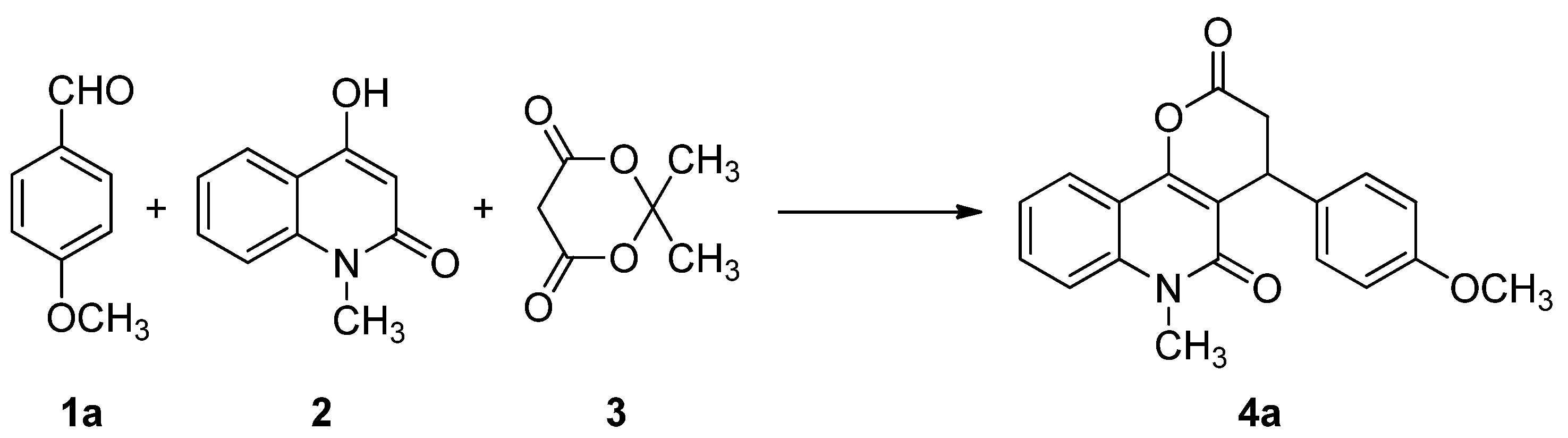
      <p>Initially, the three-component reaction of 4-methoxybenzaldehyde (<bold>1a</bold>), 4-hydroxy-1-methylquinolin-2(1<italic>H</italic>)-one (<bold>2</bold>), and Meldrum’s acid (<bold>3</bold>) was investigated as a model reaction to establish the feasibility of the strategy and to optimize the reaction conditions (<xref ref-type="scheme" rid="molecules-17-13856-scheme1">Scheme 1</xref>). The effects of solvents and catalyst loading were evaluated for this model reaction, and the results are summarized in <xref ref-type="table" rid="molecules-17-13856-t001">Table 1</xref>.</p>
      <fig id="molecules-17-13856-scheme1" position="float">
        <object-id pub-id-type="pii">molecules-17-13856-scheme1_Scheme 1</object-id>
        <label>Scheme 1</label>
        <caption>
          <p>The model reaction.</p>
        </caption>
        <graphic xmlns:xlink="http://www.w3.org/1999/xlink" xlink:href="molecules-17-13856-g001.tif"/>
      </fig>
      <table-wrap id="molecules-17-13856-t001" position="float">
        <object-id pub-id-type="pii">molecules-17-13856-t001_Table 1</object-id>
        <label>Table 1</label>
        <caption>
          <p>Optimization of reaction conditions.</p>
        </caption>
        <table>
          <thead>
            <tr>
              <th align="center" valign="middle">Entry</th>
              <th align="center" valign="middle">Solvents</th>
              <th align="center" valign="middle">Catalyst (mol%)</th>
              <th align="center" valign="middle">Temperature (°C)</th>
              <th align="center" valign="middle">Time (h)</th>
              <th align="center" valign="middle">Yield (%)</th>
            </tr>
          </thead>
          <tbody>
            <tr>
              <td align="center" valign="middle">1</td>
              <td align="center" valign="middle">EtOH</td>
              <td align="center" valign="middle">No</td>
              <td align="center" valign="middle">reflux</td>
              <td align="center" valign="middle">5</td>
              <td align="center" valign="middle">45</td>
            </tr>
            <tr>
              <td align="center" valign="middle">2</td>
              <td align="center" valign="middle">EtOH</td>
              <td align="center" valign="middle"><sc>L</sc>-proline (10%)</td>
              <td align="center" valign="middle">reflux</td>
              <td align="center" valign="middle">1</td>
              <td align="center" valign="middle">91</td>
            </tr>
            <tr>
              <td align="center" valign="middle">3</td>
              <td align="center" valign="middle">CH<sub>3</sub>CN</td>
              <td align="center" valign="middle"><sc>L</sc>-proline (10%)</td>
              <td align="center" valign="middle">reflux</td>
              <td align="center" valign="middle">2</td>
              <td align="center" valign="middle">70</td>
            </tr>
            <tr>
              <td align="center" valign="middle">4</td>
              <td align="center" valign="middle">CHCl<sub>3</sub></td>
              <td align="center" valign="middle"><sc>L</sc>-proline (10%)</td>
              <td align="center" valign="middle">reflux</td>
              <td align="center" valign="middle">2</td>
              <td align="center" valign="middle">63</td>
            </tr>
            <tr>
              <td align="center" valign="middle">5</td>
              <td align="center" valign="middle">HOAc</td>
              <td align="center" valign="middle"><sc>L</sc>-proline (10%)</td>
              <td align="center" valign="middle">100</td>
              <td align="center" valign="middle">2</td>
              <td align="center" valign="middle">80</td>
            </tr>
            <tr>
              <td align="center" valign="middle">6</td>
              <td align="center" valign="middle">DMF</td>
              <td align="center" valign="middle"><sc>L</sc>-proline (10%)</td>
              <td align="center" valign="middle">100</td>
              <td align="center" valign="middle">2</td>
              <td align="center" valign="middle">52</td>
            </tr>
            <tr>
              <td align="center" valign="middle">7</td>
              <td align="center" valign="middle">H<sub>2</sub>O</td>
              <td align="center" valign="middle"><sc>L</sc>-proline (10%)</td>
              <td align="center" valign="middle">reflux</td>
              <td align="center" valign="middle">4</td>
              <td align="center" valign="middle">45</td>
            </tr>
            <tr>
              <td align="center" valign="middle">8</td>
              <td align="center" valign="middle">EtOH</td>
              <td align="center" valign="middle"><sc>L</sc>-proline (5%)</td>
              <td align="center" valign="middle">reflux</td>
              <td align="center" valign="middle">2</td>
              <td align="center" valign="middle">75</td>
            </tr>
            <tr>
              <td align="center" valign="middle">9</td>
              <td align="center" valign="middle">EtOH</td>
              <td align="center" valign="middle"><sc>L</sc>-proline (15%)</td>
              <td align="center" valign="middle">reflux</td>
              <td align="center" valign="middle">1</td>
              <td align="center" valign="middle">90</td>
            </tr>
            <tr>
              <td align="center" valign="middle">10</td>
              <td align="center" valign="middle">EtOH</td>
              <td align="center" valign="middle"><sc>L</sc>-proline (20%)</td>
              <td align="center" valign="middle">reflux</td>
              <td align="center" valign="middle">1</td>
              <td align="center" valign="middle">91</td>
            </tr>
          </tbody>
        </table>
      </table-wrap>
      <p>It was found that when the reaction was carried out without any catalyst, only a modest amount of product was obtained, even after 5 h (<xref ref-type="table" rid="molecules-17-13856-t001">Table 1</xref>, entry 1). When the reaction was conducted in the presence of <sc>L</sc>-proline (10 mol%) in ethanol, the target compound <bold>4a</bold> was obtained in 91% yield (<xref ref-type="table" rid="molecules-17-13856-t001">Table 1</xref>, entry 2). Other solvents were also used in this reaction. The results indicated that ethanol provided much better results than acetonitrile, chloroform, acetic acid, <italic>N,N</italic>-dimethylformamide (DMF), and water (<xref ref-type="table" rid="molecules-17-13856-t001">Table 1</xref>, entries 2–7).</p>
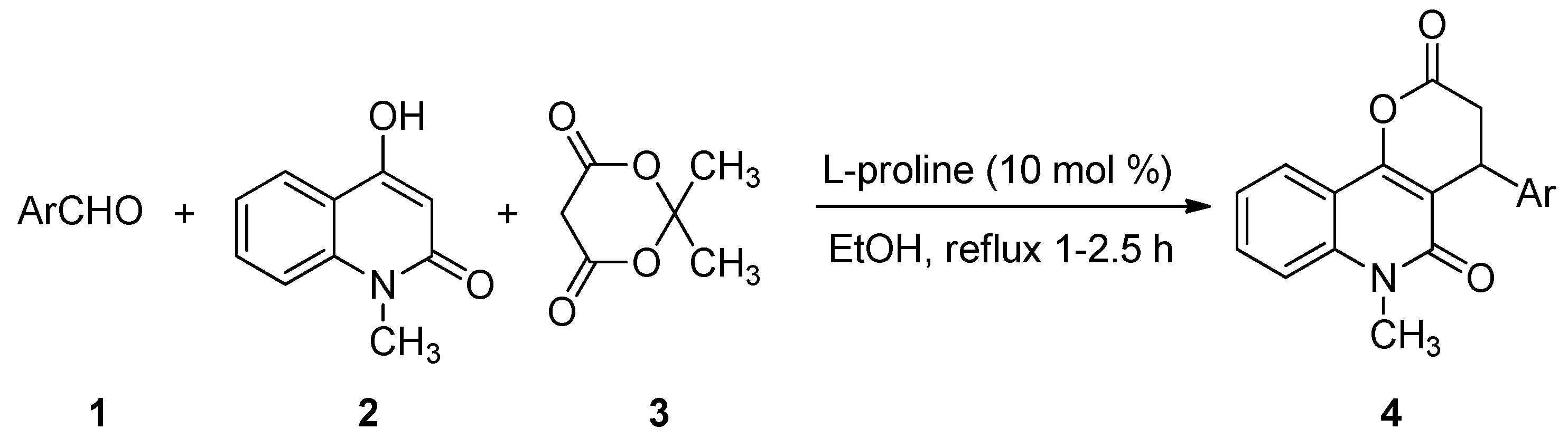
      <p>To optimize the catalyst loading, 5 mol%, 10 mol%, 15 mol%, and 20 mol% of <sc>L</sc>-proline were tested in the reactions, respectively (<xref ref-type="table" rid="molecules-17-13856-t001">Table 1</xref>, entries 2, and 8–10). A 10 mol% loading of <sc>L</sc>-proline was sufficient to efficiently push the reaction forward, while 5 mol% of <sc>L</sc>-proline was not enough. Higher amounts of <sc>L</sc>-proline did not lead to significant changes in the reaction yields. With these optimum conditions in hand, a series of 4-aryl-6-methyl-3,4-dihydro-2<italic>H</italic>-pyrano[3,2-<italic>c</italic>]quinolin-2,5(6<italic>H</italic>)-dione derivatives were synthesized via three-component reactions of aromatic aldehydes <bold>1</bold>, 4-hydroxy-1-methylquinolin-2(1<italic>H</italic>)-one (<bold>2</bold>), and Meldrum’s acid (<bold>3</bold>) in ethanol in the presence of <sc>L</sc>-proline (<xref ref-type="scheme" rid="molecules-17-13856-scheme2">Scheme 2</xref>). The results sare summarized in <xref ref-type="table" rid="molecules-17-13856-t002">Table 2</xref>.</p>
      <fig id="molecules-17-13856-scheme2" position="float">
        <object-id pub-id-type="pii">molecules-17-13856-scheme2_Scheme 2</object-id>
        <label>Scheme 2</label>
        <caption>
          <p>Synthesis of 4-aryl-6-methyl-3,4-dihydro-2<italic>H</italic>-pyrano[3,2-<italic>c</italic>]quinolin-2,5(6<italic>H</italic>)-diones <bold>4</bold>.</p>
        </caption>
        <graphic xmlns:xlink="http://www.w3.org/1999/xlink" xlink:href="molecules-17-13856-g002.tif"/>
      </fig>
      <table-wrap id="molecules-17-13856-t002" position="float">
        <object-id pub-id-type="pii">molecules-17-13856-t002_Table 2</object-id>
        <label>Table 2</label>
        <caption>
          <p>Synthesis of pyrano[3,2-<italic>c</italic>]quinoline-2,5-diones <bold>4</bold> catalyzed by <sc>L</sc>-proline</p>
        </caption>
        <table>
          <thead>
            <tr>
              <th align="center" valign="middle">Entry</th>
              <th align="center" valign="middle">Ar</th>
              <th align="center" valign="middle">Product</th>
              <th align="center" valign="middle">Time (h)</th>
              <th align="center" valign="middle">Yield (%)</th>
            </tr>
          </thead>
          <tbody>
            <tr>
              <td align="center" valign="middle">1</td>
              <td align="center" valign="middle">4-CH<sub>3</sub>OC<sub>6</sub>H<sub>4</sub></td>
              <td align="center" valign="middle">
                <bold>4a</bold>
              </td>
              <td align="center" valign="middle">2</td>
              <td align="center" valign="middle">91</td>
            </tr>
            <tr>
              <td align="center" valign="middle">2</td>
              <td align="center" valign="middle">4-BrC<sub>6</sub>H<sub>4</sub></td>
              <td align="center" valign="middle">
                <bold>4b</bold>
              </td>
              <td align="center" valign="middle">1</td>
              <td align="center" valign="middle">94</td>
            </tr>
            <tr>
              <td align="center" valign="middle">3</td>
              <td align="center" valign="middle">4-HOC<sub>6</sub>H<sub>4</sub></td>
              <td align="center" valign="middle">
                <bold>4c</bold>
              </td>
              <td align="center" valign="middle">1</td>
              <td align="center" valign="middle">95</td>
            </tr>
            <tr>
              <td align="center" valign="middle">4</td>
              <td align="center" valign="middle">4-(CH<sub>3</sub>)<sub>2</sub>NC<sub>6</sub>H<sub>4</sub></td>
              <td align="center" valign="middle">
                <bold>4d</bold>
              </td>
              <td align="center" valign="middle">1.5</td>
              <td align="center" valign="middle">93</td>
            </tr>
            <tr>
              <td align="center" valign="middle">5</td>
              <td align="center" valign="middle">Thiophen-2-yl</td>
              <td align="center" valign="middle">
                <bold>4e</bold>
              </td>
              <td align="center" valign="middle">2</td>
              <td align="center" valign="middle">92</td>
            </tr>
            <tr>
              <td align="center" valign="middle">6</td>
              <td align="center" valign="middle">3-ClC<sub>6</sub>H<sub>4</sub></td>
              <td align="center" valign="middle">
                <bold>4f</bold>
              </td>
              <td align="center" valign="middle">1.5</td>
              <td align="center" valign="middle">95</td>
            </tr>
            <tr>
              <td align="center" valign="middle">7</td>
              <td align="center" valign="middle">4-ClC<sub>6</sub>H<sub>4</sub></td>
              <td align="center" valign="middle">
                <bold>4g</bold>
              </td>
              <td align="center" valign="middle">1</td>
              <td align="center" valign="middle">92</td>
            </tr>
            <tr>
              <td align="center" valign="middle">8</td>
              <td align="center" valign="middle">4-FC<sub>6</sub>H<sub>4</sub></td>
              <td align="center" valign="middle">
                <bold>4h</bold>
              </td>
              <td align="center" valign="middle">2</td>
              <td align="center" valign="middle">90</td>
            </tr>
            <tr>
              <td align="center" valign="middle">9</td>
              <td align="center" valign="middle">3,4-(CH<sub>3</sub>)<sub>2</sub>C<sub>6</sub>H<sub>3</sub></td>
              <td align="center" valign="middle">
                <bold>4i</bold>
              </td>
              <td align="center" valign="middle">2.5</td>
              <td align="center" valign="middle">91</td>
            </tr>
          </tbody>
        </table>
      </table-wrap>
      <p>As shown in <xref ref-type="table" rid="molecules-17-13856-t002">Table 2</xref>, this protocol could be applied not only to the aromatic aldehydes with electron-withdrawing groups (such as halides), but also to the aromatic aldehydes with electron-donating groups (such as alkyl and hydroxy groups) therefore, we concluded that the electronic nature of the substituents of aromatic aldehydes has no significant effect on this reaction.</p>
      <p>The structures of the compound <bold>4</bold> were identified by their spectroscopic analysis. Thus, the infrared (IR) spectra of compound <bold>4</bold> measured in potassium bromide pellets showed two bands for the stretching vibrations of the C=O groups at 1,653–1,658 and 1,773–1,783 cm<sup>−1</sup>, respectively. In the <sup>1</sup>H-NMR spectra of compounds <bold>4</bold> measured in dimethyl sulfoxide-<italic>d</italic><sub>6</sub>, the quinoline N-CH<sub>3</sub> proton signals at 3.64–3.69 ppm, the CH<sub>2</sub> proton signals at 2.89–3.11 and 3.42–3.55 ppm, the CH proton signals at 4.44–4.81 ppm, and the aromatic proton signals at 6.64–7.95 ppm were observed.</p>
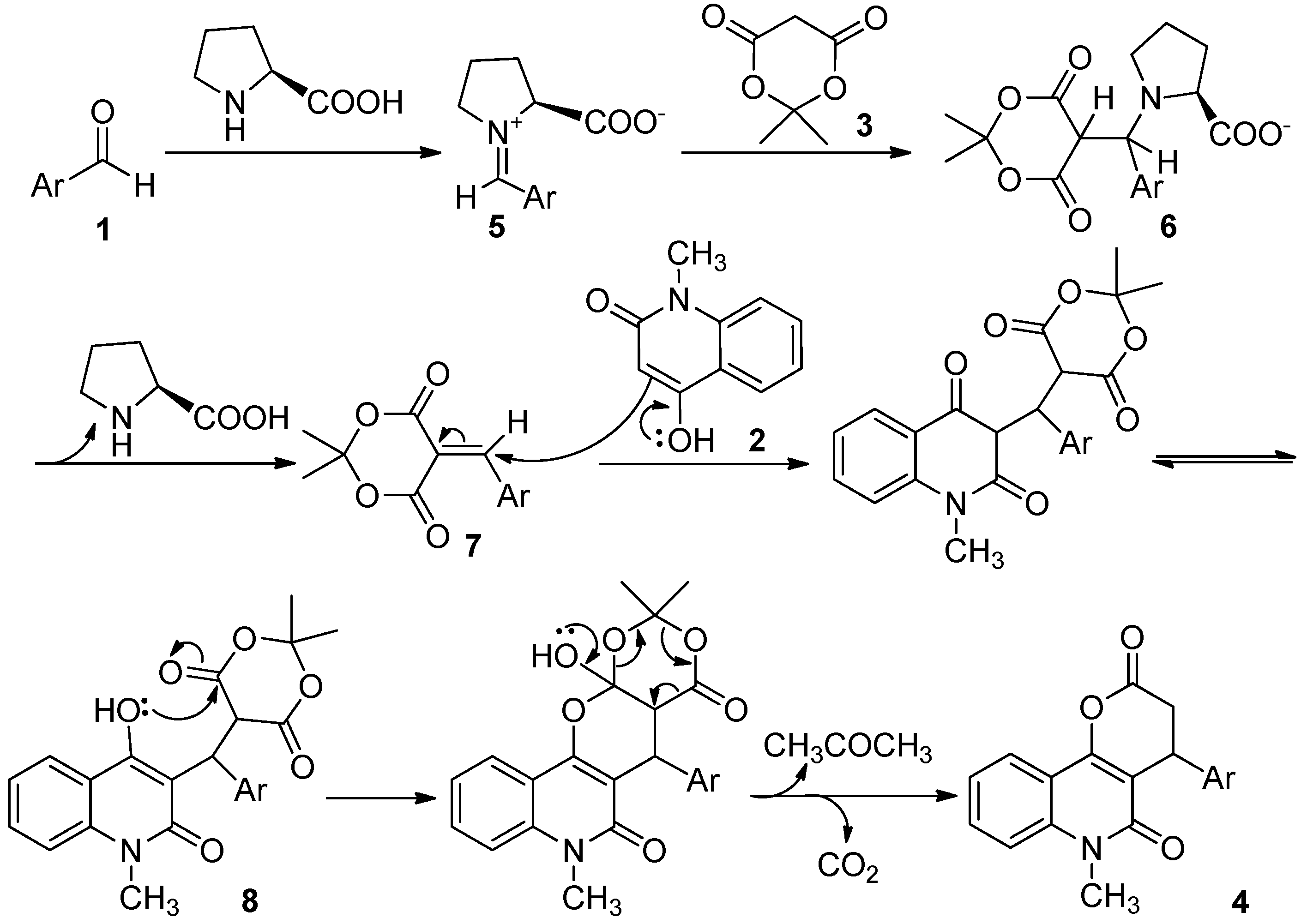
      <p>Although the detailed mechanism of above reaction remains to be fully clarified, the formation of compounds <bold>4</bold> could be explained by a reaction sequence presented in <xref ref-type="scheme" rid="molecules-17-13856-scheme3">Scheme 3</xref>. We propose that the reaction procees via a reaction sequence of condensation, addition, cyclization, and elimination. We suggest that <sc>L</sc>-proline may catalyze the formation of iminium ion <bold>5</bold> in a reversible reaction with aldehydes <bold>1</bold>. The higher reactivity of the iminium ion compared with the carbonyl species could facilitate Knovenagel condensation between aldehyde <bold>1</bold> and Meldrum’s acid (<bold>3</bold>) via intermediate <bold>6</bold>, and after elimination of <sc>L</sc>-proline, compound <bold>7</bold> might be produced as an intermediate. Then, intermediate <bold>7</bold> is attacked via Michael addition of 4-hydroxy-1-methylquinolin-2(1<italic>H</italic>)-one (<bold>2</bold>) to give the intermediate <bold>8</bold>, which is followed by the cycloaddition and loss of acetone and carbon dioxide to form the desired products <bold>4</bold>.</p>
      <fig id="molecules-17-13856-scheme3" position="float">
        <object-id pub-id-type="pii">molecules-17-13856-scheme3_Scheme 3</object-id>
        <label>Scheme 3</label>
        <caption>
          <p>Proposed mechanism for the formation of pyrano[3,2-<italic>c</italic>]quinoline-2,5-diones <bold>4</bold>.</p>
        </caption>
        <graphic xmlns:xlink="http://www.w3.org/1999/xlink" xlink:href="molecules-17-13856-g003.tif"/>
      </fig>
    </sec>
    <sec sec-type="methods">
      <title>3. Experimental</title>
      <sec>
        <title>General</title>
        <p>All reagents were purchased from commercial sources and used without further purification. Melting points were measured on an Electrothermal XT-5 apparatus. IR spectra were recorded on a Varian F-1000 spectrometer in KBr with absorptions given in cm<sup>−1</sup>. <sup>1</sup>H-NMR spectra were determined on a Varian Invoa-400 MHz spectrometer in DMSO-<italic>d</italic><sub>6</sub> solutions. <italic>J</italic> values are in Hz. Chemical shifts are expressed in ppm downfield from internal standard TMS. HRMS data were obtained using a TOF-MS instrument (Micromass Inc., Manchester, UK).</p>
        <p>General Procedure for the Synthesis of 4-Aryl-6-methyl-3,4-dihydro-2H-pyrano[3,2-c]quinolin-2,5(6<italic>H</italic>)-diones <bold>4</bold></p>
        <p>A mixture of aromatic aldehyde <bold>1</bold> (1 mmol), 4-hydroxy-1-methylquinolin-2(1<italic>H</italic>)-one (<bold>2</bold>, 0.175 g, 1 mmol), Meldrum’s acid (<bold>3</bold>, 1 mmol), <sc>L</sc>-proline (0.0115 g, 0.1 mmol) and ethanol (2 mL) in a 50 mL round bottom flask was stirred at 80 °C for 1–2.5 h. At the end of the reaction, the mixture was cooled to room temperature. The precipitate was collected by filtration and purified by recrystallization from EtOH and DMF to give products <bold>4</bold>.</p>
        <p><italic>4-(4-Methoxyphenyl)-6-methyl-3,4-dihydro-2H-pyrano[3,2-c]quinoline-2,5(6H)-dione</italic> (<bold>4a</bold>). White solid; m.p. 192–194 °C. IR: 3041 (C-H Ar), 2924 (C-H aliph), 1782 (C=O), 1654 (C=O), 1600 (C=C), 1514 (ArC=C), 1380 (C-H CH<sub>3</sub>), 1252 (C-O); <sup>1</sup>H-NMR: δ (ppm) 2.92 (d, <italic>J</italic> = 16.0 Hz, 1H, CH<sub>2</sub>), 3.46 (dd, <italic>J</italic><sub>1</sub> = 7.6 Hz, <italic>J</italic><sub>2</sub> = 16.0 Hz, 1H, CH<sub>2</sub>), 3.64 (s, 3H, CH<sub>3</sub>), 3.69 (s, 3H, OCH<sub>3</sub>), 4.51 (d, <italic>J</italic> = 7.2 Hz, 1H, CH), 6.86 (d, <italic>J</italic> = 8.4 Hz, 2H, ArH), 7.09 (d, <italic>J</italic> = 8.8 Hz, 2H, ArH), 7.40 (t, <italic>J</italic><sub>1</sub> = 8.0 Hz, <italic>J</italic><sub>2</sub> = 7.2 Hz, 1H, ArH), 7.64 (d, <italic>J</italic> = 8.8 Hz, 1H, ArH), 7.75 (t, <italic>J</italic><sub>1</sub> = 7.6 Hz, <italic>J</italic><sub>2</sub> = 7.2 Hz, 1H, ArH), 7.93 (d, <italic>J</italic> = 8.0 Hz, 1H, ArH); HRMS calculated for C<sub>20</sub>H<sub>17</sub>NO<sub>4</sub> [M]<sup>+</sup>: 335.1158, Found 335.1158.</p>
        <p><italic>4-(4-Bromophenyl)-6-methyl-3,4-dihydro-2H-pyrano[3,2-c]quinoline-2,5(6H)-dione</italic> (<bold>4</bold><bold>b</bold>). White solid; m.p. 239–241 °C. IR: 3024 (C-H Ar), 2928 (C-H aliph), 1778 (C=O), 1655 (C=O), 1596 (C=C), 1503 (ArC=C), 1384 (C-H CH<sub>3</sub>), 1209 (C-O); <sup>1</sup>H-NMR: δ (ppm) 2.96 (d, <italic>J</italic> = 16.0 Hz, 1H, CH<sub>2</sub>), 3.52 (dd, <italic>J</italic><sub>1</sub> = 7.6 Hz, <italic>J</italic><sub>2</sub> = 16.0 Hz, 1H, CH<sub>2</sub>), 3.65 (s, 3H, CH<sub>3</sub>), 4.56 (d, <italic>J</italic> = 7.2 Hz, 1H, CH), 7.16 (d, <italic>J</italic> = 8.4 Hz, 2H, ArH), 7.41 (t, <italic>J</italic><sub>1</sub> = 7.6 Hz, <italic>J</italic><sub>2</sub> = 7.2 Hz, 1H, ArH), 7.51 (d, <italic>J</italic> = 8.4 Hz, 2H, ArH), 7.66 (d, <italic>J</italic> = 8.8 Hz, 1H, ArH), 7.76 (t, <italic>J</italic><sub>1</sub> = 7.6 Hz, <italic>J</italic><sub>2</sub> = 8.4 Hz, 1H, ArH), 7.95 (d, <italic>J</italic> = 8.0 Hz, 1H, ArH); HRMS calculated for C<sub>19</sub>H<sub>14</sub>NO<sub>3</sub><sup>79</sup>Br [M]<sup>+</sup>: 383.0157, Found 383.0148.</p>
        <p><italic>4-(4-Hydroxyphenyl)-6-methyl-3,4-dihydro-2H-pyrano[3,2-c]quinoline-2,5(6H)-dione</italic> (<bold>4</bold><bold>c</bold>). White solid; m.p. &gt; 300 °C. IR: 3282 (O-H), 3013 (C-H Ar), 1781 (C=O), 1653 (C=O), 1600 (C=C), 1517 (ArC=C), 1385 (C-H CH<sub>3</sub>), 1202 (C-O); <sup>1</sup>H-NMR: δ (ppm) 2.90 (d, <italic>J</italic> = 16.0 Hz, 1H, CH<sub>2</sub>), 3.43 (dd, <italic>J</italic><sub>1</sub> = 7.2 Hz, <italic>J</italic><sub>2</sub> = 15.6 Hz, 1H, CH<sub>2</sub>), 3.65 (s, 3H, CH<sub>3</sub>), 4.56 (d, <italic>J</italic> = 6.8 Hz, 1H, CH), 6.69 (d, <italic>J</italic> = 8.4 Hz, 2H, ArH), 6.97 (d, <italic>J</italic> = 8.4 Hz, 2H, ArH), 7.40 (t, <italic>J</italic><sub>1</sub> = 7.6 Hz, <italic>J</italic><sub>2</sub> = 7.6 Hz, 1H, ArH), 7.64 (d, <italic>J</italic> = 8.8 Hz, 1H, ArH), 7.75 (t, <italic>J</italic><sub>1</sub> = 8.4 Hz, <italic>J</italic><sub>2</sub> = 7.6 Hz, 1H, ArH), 7.93 (d, <italic>J</italic> = 8.0 Hz, 1H, ArH), 9.37 (s, 1H, OH); HRMS calculated for C<sub>19</sub>H<sub>15</sub>NO<sub>4</sub> [M]<sup>+</sup>: 321.1001, Found 321.1001.</p>
        <p><italic>4-(4-Dimethylaminophenyl)-6-methyl-3,4-dihydro-2H-pyrano[3,2-c]quinoline-2,5(6H)-dione</italic> (<bold>4</bold><bold>d</bold>). White solid; m.p. 220–222 °C. IR: 2981 (C-H aliph), 2798 (C-H aliph), 1773 (C=O), 1654 (C=O), 1598 (C=C), 1519 (ArC=C), 1382 (C-H CH<sub>3</sub>), 1208 (C-O); <sup>1</sup>H-NMR: δ (ppm) 2.83 (s, 6H, 2 × CH<sub>3</sub>), 2.90 (d, <italic>J</italic> = 16.0 Hz, 1H, CH<sub>2</sub>), 3.42 (dd, <italic>J</italic><sub>1</sub> = 7.6 Hz, <italic>J</italic><sub>2</sub> = 16.0 Hz, 1H, CH<sub>2</sub>), 3.65 (s, 3H, CH<sub>3</sub>), 4.44 (d, <italic>J</italic> = 6.8 Hz, 1H, CH), 6.64 (d, <italic>J</italic> = 8.0 Hz, 2H, ArH), 6.98 (d, <italic>J</italic> = 8.4 Hz, 2H, ArH), 7.40 (t, <italic>J</italic><sub>1</sub> = 8.0 Hz, <italic>J</italic><sub>2</sub> = 7.2 Hz, 1H, ArH), 7.64 (d, <italic>J</italic> = 8.8 Hz, 1H, ArH), 7.73 (t, <italic>J</italic><sub>1</sub> = 7.6 Hz, <italic>J</italic><sub>2</sub> = 8.0 Hz, 1H, ArH), 7.93 (d, <italic>J</italic> = 8.0 Hz, 1H, ArH); HRMS calculated for C<sub>21</sub>H<sub>20</sub>N<sub>2</sub>O<sub>3</sub> [M]<sup>+</sup>: 348.1474, Found 348.1478.</p>
        <p><italic>6-Methyl-4-(thiophen-2-yl)-3,4-dihydro-2H-pyrano[3,2-c]quinoline-2,5(6H)-dione</italic> (<bold>4</bold><bold>e</bold>). White solid; m.p. 243–244 °C. IR: 3040 (C-H Ar), 2947 (C-H aliph), 1774 (C=O), 1658 (C=O), 1596 (C=C), 1587 (ArC=C), 1213 (C-O); <sup>1</sup>H-NMR: δ (ppm) 3.11 (d, <italic>J</italic> = 15.2 Hz, 1H, CH<sub>2</sub>), 3.51–3.55 (m, 1H, CH<sub>2</sub>), 3.69 (s, 3H, CH<sub>3</sub>), 4.81 (d, <italic>J</italic> = 1.2 Hz, 1H, CH), 6.93 (d, <italic>J</italic> = 18.0 Hz, 2H, ArH), 7.39 (d, <italic>J</italic> = 5.6 Hz, 2H, ArH), 7.67 (s, 1H, ArH), 7.76 (s, 1H, ArH), 7.92 (s, 1H, ArH); HRMS calculated for C<sub>17</sub>H<sub>13</sub>NO<sub>3</sub>S [M]<sup>+</sup>: 311.0616, Found 311.0612.</p>
        <p><italic>4-(3-Chlorophenyl)-6-methyl-3,4-dihydro-2H-pyrano[3,2-c]quinoline-2,5(6H)-dione </italic>(<bold>4</bold><bold>f</bold>). White solid; m.p. 232–233 °C. IR: 3054 (C-H Ar), 2939 (C-H aliph), 1783 (C=O), 1654 (C=O), 1594 (C=C), 1387 (C-H CH<sub>3</sub>), 1205 (C-O); <sup>1</sup>H-NMR: δ (ppm) 2.99 (d, <italic>J</italic> = 16.0 Hz, 1H, CH<sub>2</sub>), 3.52 (dd, <italic>J</italic><sub>1</sub> = 7.6 Hz, <italic>J</italic><sub>2</sub> = 16.4 Hz, 1H, CH<sub>2</sub>), 3.65 (s, 3H, CH<sub>3</sub>), 4.59 (d, <italic>J</italic> = 6.8 Hz, 1H, CH), 7.11 (d, <italic>J</italic> = 5.6 Hz, 1H, ArH), 7.30–7.36 (m, 3H, ArH), 7.41 (t, <italic>J</italic><sub>1</sub> = 7.6 Hz, <italic>J</italic><sub>2</sub> = 7.6 Hz, 1H, ArH), 7.65 (d, <italic>J</italic> = 8.4 Hz, 1H, ArH), 7.76 (t, <italic>J</italic><sub>1</sub> = 7.2 Hz, <italic>J</italic><sub>2</sub> = 7.6 Hz, 1H, ArH), 7.94 (d, <italic>J</italic> = 8.0 Hz, 1H, ArH); HRMS calculated for C<sub>19</sub>H<sub>14</sub>NO<sub>3</sub><sup>35</sup>Cl [M]<sup>+</sup>: 339.0662, found 339.0648.</p>
        <p><italic>4-(4-Chlorophenyl)-6-methyl-3,4-dihydro-2H-pyrano[3,2-c]quinoline-2,5(6H)-dione </italic>(<bold>4</bold><bold>g</bold>). White solid; m.p. 227–228 °C. IR: 3083 (C-H Ar), 2935 (C-H aliph), 1779 (C=O), 1657 (C=O), 1593 (C=C), 1385 (C-H CH<sub>3</sub>), 1207 (C-O); <sup>1</sup>H-NMR: δ (ppm) 2.97 (d, <italic>J</italic> = 16.0 Hz, 1H, CH<sub>2</sub>), 3.52 (dd, <italic>J</italic><sub>1</sub> = 7.6 Hz, <italic>J</italic><sub>2</sub> = 16.0 Hz, 1H, CH<sub>2</sub>), 3.65 (s, 3H, CH<sub>3</sub>), 4.58 (d, <italic>J</italic> = 7.2 Hz, 1H, CH), 7.22 (d, <italic>J</italic> = 8.4 Hz, 2H, ArH), 7.37 (d, <italic>J</italic> = 8.4 Hz, 2H, ArH), 7.42 (d, <italic>J</italic> = 7.6 Hz, 1H, ArH), 7.66 (d, <italic>J</italic> = 8.8 Hz, 1H, ArH), 7.76 (t, <italic>J</italic><sub>1</sub> = 7.2 Hz, <italic>J</italic><sub>2</sub> = 8.4 Hz, 1H, ArH), 7.95 (d, <italic>J</italic> = 8.0 Hz, 1H, ArH); HRMS calculated for C<sub>19</sub>H<sub>14</sub>NO<sub>3</sub><sup>35</sup>Cl [M]<sup>+</sup>: 339.0662, Found 339.0654.</p>
        <p><italic>4-(4-Fluorophenyl)-6-methyl-3,4-dihydro-2H-pyrano[3,2-c]quinoline-2,5(6H)-dione </italic>(<bold>4</bold><bold>h</bold>). White solid; m.p. 230–231 °C. IR: 3076 (C-H Ar), 2923 (C-H aliph), 1777 (C=O), 1656 (C=O), 1598 (C=C), 1506 (ArC=C), 1386 (C-H CH<sub>3</sub>), 1214 (C-O); <sup>1</sup>H-NMR: δ (ppm) 2.96 (d, <italic>J</italic> = 16.0 Hz, 1H, CH<sub>2</sub>), 3.50 (dd, <italic>J</italic><sub>1</sub> = 7.6 Hz, <italic>J</italic><sub>2</sub> = 16.0 Hz, 1H, CH<sub>2</sub>), 3.64 (s, 3H, CH<sub>3</sub>), 4.58 (d, <italic>J</italic> = 7.2 Hz, 1H, CH), 7.13 (t, <italic>J</italic><sub>1</sub> = 8.4 Hz, <italic>J</italic><sub>2</sub> = 8.8 Hz, 2H, ArH), 7.23 (t, <italic>J</italic><sub>1</sub> = 7.6 Hz, <italic>J</italic><sub>2</sub> = 8.4 Hz, 2H, ArH), 7.40 (t, <italic>J</italic><sub>1</sub> = 7.6 Hz, <italic>J</italic><sub>2</sub> = 7.6 Hz, 1H, ArH), 7.64 (d, <italic>J</italic> = 8.4 Hz, 1H, ArH), 7.75 (t, <italic>J</italic><sub>1</sub> = 7.2 Hz, <italic>J</italic><sub>2</sub> = 8.4 Hz, 1H, ArH), 7.93 (d, <italic>J</italic> = 8.0 Hz, 1H, ArH); HRMS calculated for C<sub>19</sub>H<sub>14</sub>NO<sub>3</sub>F [M]<sup>+</sup>: 323.0958, Found 323.0961.</p>
        <p><italic>4-(3,4-Dimethylphenyl)-6-methyl-3,4-dihydro-2H-pyrano[3,2-c]quinoline-2,5(6H)-dione</italic> (<bold>4</bold><bold>i</bold>). White solid; m.p. 170–171 °C. IR: 3010 (C-H Ar), 2939 (C-H aliph), 1777 (C=O), 1654 (C=O), 1596 (C=C), 1462 (ArC=C), 1382 (C-H CH<sub>3</sub>), 1215 (C-O); <sup>1</sup>H-NMR: δ (ppm) 2.15 (s, 6H, 2 × CH<sub>3</sub> ), 2.89 (d, <italic>J</italic> = 16.0 Hz, 1H, CH<sub>2</sub>), 3.46 (dd, <italic>J</italic><sub>1</sub> = 8.0 Hz, <italic>J</italic><sub>2</sub> = 15.6 Hz, 1H, CH<sub>2</sub>), 3.64 (s, 3H, CH<sub>3</sub>), 4.48 (d, <italic>J</italic> = 6.4 Hz, 1H, CH), 6.84 (d, <italic>J</italic> = 7.6 Hz, 1H, ArH), 6.96 (s, 1H, ArH), 7.04 (d, <italic>J</italic> = 7.6 Hz, 1H, ArH), 7.41 (t, <italic>J</italic><sub>1</sub> = 8.0 Hz, <italic>J</italic><sub>2</sub> = 7.2 Hz, 1H, ArH), 7.64 (d, <italic>J</italic> = 8.4 Hz, 1H, ArH), 7.75 (t, <italic>J</italic><sub>1</sub> = 7.2 Hz, <italic>J</italic><sub>2</sub> = 8.4 Hz, 1H, ArH), 7.94 (d, <italic>J</italic> = 8.0 Hz, 1H, ArH); HRMS calculated for C<sub>21</sub>H<sub>19</sub>NO<sub>3</sub> [M]<sup>+</sup>: 333.1365, Found 333.1367.</p>
      </sec>
    </sec>
    <sec sec-type="conclusions">
      <title>4. Conclusions</title>
      <p>In summary, we have developed an efficient synthesis of 4-aryl-6-methyl-3,4-dihydro-2<italic>H</italic>-pyrano [3,2-<italic>c</italic>]quinolin-2,5(6<italic>H</italic>)-diones via the three-component reactions of aromatic aldehydes, 4-hydroxy-1-methylquinolin-2(1<italic>H</italic>)-one, and Meldrum’s acid catalyzed by <sc>L</sc>-proline. This protocol has the advantages of easy work up, mild reaction conditions, and high yields. In view of the potential biological activities of these molecules, further biomedical screening work is in progress in our laboratories.</p>
    </sec>
  </body>
  <back>
    <ack>
      <title>Acknowledgments</title>
      <p>We gratefully acknowledge the Natural Science Foundation of Higher Education Institutions of Jiangsu Province (No.09KJB150012), the Key Laboratory of Cancer Biotherapy of Xuzhou Medical College (grant No. C0901), the Key Laboratory of Organic Synthesis of Jiangsu Province (No. KJS1010) and the Special Presidential Foundation of Xuzhou Medical College (No. 2010KJZ20) for support of this research.</p>
    </ack>
 <fn-group>
  <fn>
    <p><italic>Sample Availability</italic>: Samples of the compounds <bold>4</bold> are available from the authors.</p>
  </fn>
 </fn-group>	
    <ref-list>
      <title>References</title>
      <ref id="B1-molecules-17-13856">
        <label>1.</label>
        <citation citation-type="journal">
          <person-group person-group-type="author">
            <name>
              <surname>Nair</surname>
              <given-names>V.</given-names>
            </name>
            <name>
              <surname>Rajesh</surname>
              <given-names>C.</given-names>
            </name>
            <name>
              <surname>Vinod</surname>
              <given-names>A.U.</given-names>
            </name>
            <name>
              <surname>Bindu</surname>
              <given-names>S.</given-names>
            </name>
            <name>
              <surname>Sreekanth</surname>
              <given-names>A.R.</given-names>
            </name>
            <name>
              <surname>Mathen</surname>
              <given-names>J.S.</given-names>
            </name>
            <name>
              <surname>Balagopal</surname>
              <given-names>L.</given-names>
            </name>
          </person-group>
          <article-title>Strategies for heterocyclic construction via novel multicomponent reactions based on isocyanides and nucleophilic carbenes</article-title>
          <source>Acc. Chem. Res.</source>
          <year>2003</year>
          <volume>36</volume>
          <fpage>899</fpage>
          <lpage>907</lpage>
          <pub-id pub-id-type="doi">10.1021/ar020258p</pub-id>
        </citation>
      </ref>
      <ref id="B2-molecules-17-13856">
        <label>2.</label>
        <citation citation-type="journal">
          <person-group person-group-type="author">
            <name>
              <surname>Domling</surname>
              <given-names>A.</given-names>
            </name>
            <name>
              <surname>Ugi</surname>
              <given-names>I.</given-names>
            </name>
          </person-group>
          <article-title>Multicomponent reactions with isocyanides</article-title>
          <source>Angew. Chem. Int. Ed. Engl.</source>
          <year>2000</year>
          <volume>39</volume>
          <fpage>3168</fpage>
          <lpage>3210</lpage>
          <pub-id pub-id-type="doi">10.1002/1521-3773(20000915)39:18&lt;3168::AID-ANIE3168&gt;3.0.CO;2-U</pub-id>
        </citation>
      </ref>
      <ref id="B3-molecules-17-13856">
        <label>3.</label>
        <citation citation-type="journal">
          <person-group person-group-type="author">
            <name>
              <surname>Domling</surname>
              <given-names>A.</given-names>
            </name>
          </person-group>
          <article-title>Recent Developments in isocyanide based multicomponent reactions in applied chemistry</article-title>
          <source>Chem. Rev.</source>
          <year>2006</year>
          <volume>106</volume>
          <fpage>17</fpage>
          <lpage>89</lpage>
        <pub-id pub-id-type="pmid">16402771</pub-id><pub-id pub-id-type="doi">10.1021/cr0505728</pub-id></citation>
      </ref>
      <ref id="B4-molecules-17-13856">
        <label>4.</label>
        <citation citation-type="book">
          <person-group person-group-type="author">
            <name>
              <surname>Zhu</surname>
              <given-names>J.</given-names>
            </name>
            <name>
              <surname>Bienaymé</surname>
              <given-names>H.</given-names>
            </name>
          </person-group>
          <source>Multicomponent Reactions</source>
          <publisher-name>Wiley-VCH</publisher-name>
          <publisher-loc>Weinheim, Germany</publisher-loc>
          <year>2005</year>
          <fpage>33</fpage>
          <lpage>75</lpage>
        </citation>
      </ref>
      <ref id="B5-molecules-17-13856">
        <label>5.</label>
        <citation citation-type="patent">
          <person-group person-group-type="author">
            <name>
              <surname>Schnur</surname>
              <given-names>R.C.</given-names>
            </name>
          </person-group>
          <article-title>Spiro-quinolylhydantoins</article-title>
          <source>U.S. Patent</source>
          <patent>4,176,185</patent>
          <day>27</day>
          <month>November</month>
          <year>1979</year>
        </citation>
      </ref>
      <ref id="B6-molecules-17-13856">
        <label>6.</label>
        <citation citation-type="journal">
          <person-group person-group-type="author">
            <name>
              <surname>Atwal</surname>
              <given-names>K.S.</given-names>
            </name>
            <name>
              <surname>McCullough</surname>
              <given-names>J.R.</given-names>
            </name>
            <name>
              <surname>Hedberg</surname>
              <given-names>A.</given-names>
            </name>
            <name>
              <surname>Conder</surname>
              <given-names>M.L.</given-names>
            </name>
            <name>
              <surname>Ahmed</surname>
              <given-names>S.Z.</given-names>
            </name>
            <name>
              <surname>Cucinotta</surname>
              <given-names>G.</given-names>
            </name>
            <name>
              <surname>Normandin</surname>
              <given-names>D.E.</given-names>
            </name>
          </person-group>
          <article-title>The discovery of a novel calcium channel blocker related to the structure of potassium channel opener cromakalim</article-title>
          <source>Bioorg. Med. Chem. Lett.</source>
          <year>1992</year>
          <volume>2</volume>
          <fpage>1475</fpage>
          <lpage>1478</lpage>
          <pub-id pub-id-type="doi">10.1016/S0960-894X(00)80411-4</pub-id>
        </citation>
      </ref>
      <ref id="B7-molecules-17-13856">
        <label>7.</label>
        <citation citation-type="journal">
          <person-group person-group-type="author">
            <name>
              <surname>Magdy</surname>
              <given-names>A.I.</given-names>
            </name>
            <name>
              <surname>Hany</surname>
              <given-names>M.H.</given-names>
            </name>
            <name>
              <surname>Yassin</surname>
              <given-names>A.A.G.</given-names>
            </name>
            <name>
              <surname>Youssef</surname>
              <given-names>A.S.A.</given-names>
            </name>
          </person-group>
          <article-title>Novel heterocyclic derivatives of pyrano[3,2-<italic>c</italic>]quinolinone from 3-(1-ethy1-4-hydroxy-2-oxo-2(1H)-quinolin-3-yl)-3-oxopropanoic acid</article-title>
          <source>Eur. J. Chem.</source>
          <year>2010</year>
          <volume>1</volume>
          <fpage>195</fpage>
          <lpage>199</lpage>
          <pub-id pub-id-type="doi">10.5155/eurjchem.1.3.195-199.91</pub-id>
        </citation>
      </ref>
      <ref id="B8-molecules-17-13856">
        <label>8.</label>
        <citation citation-type="journal">
          <person-group person-group-type="author">
            <name>
              <surname>Wang</surname>
              <given-names>X.S.</given-names>
            </name>
            <name>
              <surname>Zeng</surname>
              <given-names>Z.S.</given-names>
            </name>
            <name>
              <surname>Shi</surname>
              <given-names>D.Q.</given-names>
            </name>
            <name>
              <surname>Wei</surname>
              <given-names>X.Y.</given-names>
            </name>
            <name>
              <surname>Zong</surname>
              <given-names>Z.M.</given-names>
            </name>
          </person-group>
          <article-title>One-pot synthesis of 2-amino-3-cyano-4-aryl-1,4,5,6-tetrahydropyrano[3,2-<italic>c</italic>]quinolin-5-one derivatives using KF-Al<sub>2</sub>O<sub>3</sub> as catalyst</article-title>
          <source>Synth. Commun.</source>
          <year>2004</year>
          <volume>34</volume>
          <fpage>3021</fpage>
          <lpage>3027</lpage>
          <pub-id pub-id-type="doi">10.1081/SCC-200026662</pub-id>
        </citation>
      </ref>
      <ref id="B9-molecules-17-13856">
        <label>9.</label>
        <citation citation-type="journal">
          <person-group person-group-type="author">
            <name>
              <surname>Wang</surname>
              <given-names>X.S.</given-names>
            </name>
            <name>
              <surname>Shi</surname>
              <given-names>D.Q.</given-names>
            </name>
            <name>
              <surname>Tu</surname>
              <given-names>S.J.</given-names>
            </name>
          </person-group>
          <article-title>Synthesis of 2-aminochromene derivatives catalyzed by KF/Al<sub>2</sub>O<sub>3</sub></article-title>
          <source>Chin. J. Chem.</source>
          <year>2003</year>
          <volume>21</volume>
          <fpage>1114</fpage>
          <lpage>1117</lpage>
        </citation>
      </ref>
      <ref id="B10-molecules-17-13856">
        <label>10.</label>
        <citation citation-type="journal">
          <person-group person-group-type="author">
            <name>
              <surname>Wang</surname>
              <given-names>X.S.</given-names>
            </name>
            <name>
              <surname>Zeng</surname>
              <given-names>Z.S.</given-names>
            </name>
            <name>
              <surname>Shi</surname>
              <given-names>D.Q.</given-names>
            </name>
            <name>
              <surname>Tu</surname>
              <given-names>S.J.</given-names>
            </name>
            <name>
              <surname>Wei</surname>
              <given-names>X.Y.</given-names>
            </name>
            <name>
              <surname>Zong</surname>
              <given-names>Z.M.</given-names>
            </name>
          </person-group>
          <article-title>One-pot synthesis of 2-amino-4-aryl-5,6-dihydro-4H-pyrano[3,2-<italic>c</italic>]quinolin-5-one-3-carboxylate derivatives catalyzed by KF-alumina</article-title>
          <source>Chin. J. Org. Chem.</source>
          <year>2005</year>
          <volume>25</volume>
          <fpage>579</fpage>
          <lpage>582</lpage>
        </citation>
      </ref>
      <ref id="B11-molecules-17-13856">
        <label>11.</label>
        <citation citation-type="journal">
          <person-group person-group-type="author">
            <name>
              <surname>Vetrivel</surname>
              <given-names>N.</given-names>
            </name>
            <name>
              <surname>Senniappan</surname>
              <given-names>T.S.</given-names>
            </name>
            <name>
              <surname>Helen</surname>
              <given-names>P.B.</given-names>
            </name>
            <name>
              <surname>Sellappan</surname>
              <given-names>M.</given-names>
            </name>
            <name>
              <surname>Thangaian</surname>
              <given-names>D.T.</given-names>
            </name>
          </person-group>
          <article-title>Microwave solvent-free condition synthesis and pharmacological evaluation of pyrano[3,2-<italic>c</italic>]quinolines</article-title>
          <source>Med. Chem. Res.</source>
          <year>2012</year>
          <volume>21</volume>
          <fpage>2902</fpage>
          <lpage>2910</lpage>
          <pub-id pub-id-type="doi">10.1007/s00044-011-9810-2</pub-id>
        </citation>
      </ref>
      <ref id="B12-molecules-17-13856">
        <label>12.</label>
        <citation citation-type="journal">
          <person-group person-group-type="author">
            <name>
              <surname>Igor</surname>
              <given-names>V.M.</given-names>
            </name>
            <name>
              <surname>Madhuri</surname>
              <given-names>M.</given-names>
            </name>
            <name>
              <surname>Marcia</surname>
              <given-names>A.O.</given-names>
            </name>
            <name>
              <surname>Adriana</surname>
              <given-names>S.D.</given-names>
            </name>
            <name>
              <surname>Snezna</surname>
              <given-names>R.</given-names>
            </name>
            <name>
              <surname>Severine</surname>
              <given-names>V.S.</given-names>
            </name>
            <name>
              <surname>Wim</surname>
              <given-names>F.A.S.</given-names>
            </name>
            <name>
              <surname>Nikolai</surname>
              <given-names>M.E.</given-names>
            </name>
            <name>
              <surname>Pavel</surname>
              <given-names>Y.U.</given-names>
            </name>
            <name>
              <surname>Eerik</surname>
              <given-names>M.E.</given-names>
            </name>
            <etal/>
          </person-group>
          <article-title>Structural simplification of bioactive natural products with multicomponent synthesis. 2. Antiproliferative and antitubulin activities of pyrano[3,2-<italic>c</italic>]pyridones and pyrano[3,2-<italic>c</italic>] quinolones</article-title>
          <source>J. Med. Chem.</source>
          <year>2008</year>
          <volume>51</volume>
          <fpage>2561</fpage>
          <lpage>2570</lpage>
          <pub-id pub-id-type="doi">10.1021/jm701499n</pub-id>
        </citation>
      </ref>
      <ref id="B13-molecules-17-13856">
        <label>13.</label>
        <citation citation-type="journal">
          <person-group person-group-type="author">
            <name>
              <surname>Shi</surname>
              <given-names>C.L.</given-names>
            </name>
            <name>
              <surname>Shi</surname>
              <given-names>D.Q.</given-names>
            </name>
            <name>
              <surname>Kim</surname>
              <given-names>S.H.</given-names>
            </name>
            <name>
              <surname>Huang</surname>
              <given-names>Z.B.</given-names>
            </name>
            <name>
              <surname>Ji</surname>
              <given-names>S.J.</given-names>
            </name>
            <name>
              <surname>Ji</surname>
              <given-names>M.</given-names>
            </name>
          </person-group>
          <article-title>A novel and efficient one-pot synthesis of furo[3',4':5,6]pyrido[2,3-<italic>c</italic>]pyrazole derivatives using organocatalysts</article-title>
          <source>Tetrahedron</source>
          <year>2008</year>
          <volume>64</volume>
          <fpage>2425</fpage>
          <lpage>2432</lpage>
          <pub-id pub-id-type="doi">10.1016/j.tet.2007.12.053</pub-id>
        </citation>
      </ref>
      <ref id="B14-molecules-17-13856">
        <label>14.</label>
        <citation citation-type="journal">
          <person-group person-group-type="author">
            <name>
              <surname>Shi</surname>
              <given-names>C.L.</given-names>
            </name>
            <name>
              <surname>Shi</surname>
              <given-names>D.Q.</given-names>
            </name>
            <name>
              <surname>Kim</surname>
              <given-names>S.H.</given-names>
            </name>
            <name>
              <surname>Huang</surname>
              <given-names>Z.B.</given-names>
            </name>
            <name>
              <surname>Ji</surname>
              <given-names>M.</given-names>
            </name>
          </person-group>
          <article-title>A novel and efficient synthesis of 3,3'-benzylidenebis(4-hydroxy-6-methylpyridin-2(1H)-one) derivatives through a multi-component reaction catalyzed by <sc>L</sc>-proline</article-title>
          <source>Aust. J. Chem.</source>
          <year>2008</year>
          <volume>61</volume>
          <fpage>547</fpage>
          <lpage>551</lpage>
          <pub-id pub-id-type="doi">10.1071/CH08113</pub-id>
        </citation>
      </ref>
      <ref id="B15-molecules-17-13856">
        <label>15.</label>
        <citation citation-type="journal">
          <person-group person-group-type="author">
            <name>
              <surname>Shi</surname>
              <given-names>C.L.</given-names>
            </name>
            <name>
              <surname>Wang</surname>
              <given-names>J.X.</given-names>
            </name>
            <name>
              <surname>Chen</surname>
              <given-names>H.</given-names>
            </name>
            <name>
              <surname>Shi</surname>
              <given-names>D.Q.</given-names>
            </name>
          </person-group>
          <article-title>Regioselective synthesis and <italic>in vitro</italic> anticancer activity of 4-aza-podophyllotoxin derivatives catalyzed by <sc>L</sc>-proline</article-title>
          <source>J. Comb. Chem.</source>
          <year>2010</year>
          <volume>12</volume>
          <fpage>430</fpage>
          <lpage>434</lpage>
          <pub-id pub-id-type="doi">10.1021/cc100003c</pub-id>
        </citation>
      </ref>
      <ref id="B16-molecules-17-13856">
        <label>16.</label>
        <citation citation-type="journal">
          <person-group person-group-type="author">
            <name>
              <surname>Li</surname>
              <given-names>Y.L.</given-names>
            </name>
            <name>
              <surname>Chen</surname>
              <given-names>H.</given-names>
            </name>
            <name>
              <surname>Shi</surname>
              <given-names>C.L.</given-names>
            </name>
            <name>
              <surname>Shi</surname>
              <given-names>D.Q.</given-names>
            </name>
            <name>
              <surname>Ji</surname>
              <given-names>S.J.</given-names>
            </name>
          </person-group>
          <article-title>Efficient one-pot synthesis of spirooxindole derivatives catalyzed by <sc>L</sc>-proline in aqueous medium</article-title>
          <source>J. Comb. Chem.</source>
          <year>2010</year>
          <volume>12</volume>
          <fpage>231</fpage>
          <lpage>237</lpage>
          <pub-id pub-id-type="doi">10.1021/cc9001185</pub-id>
        </citation>
      </ref>
      <ref id="B17-molecules-17-13856">
        <label>17.</label>
        <citation citation-type="journal">
          <person-group person-group-type="author">
            <name>
              <surname>Wang</surname>
              <given-names>H.Y.</given-names>
            </name>
            <name>
              <surname>Li</surname>
              <given-names>L.L.</given-names>
            </name>
            <name>
              <surname>Lin</surname>
              <given-names>W.</given-names>
            </name>
            <name>
              <surname>Xu</surname>
              <given-names>P.</given-names>
            </name>
            <name>
              <surname>Huang</surname>
              <given-names>Z.B.</given-names>
            </name>
            <name>
              <surname>Shi</surname>
              <given-names>D.Q.</given-names>
            </name>
          </person-group>
          <article-title>An efficient synthesis of pyrrolo[2,3,4-<italic>kl</italic>]acridin-1-one derivatives catalyzed by <sc>L</sc>-proline</article-title>
          <source>Org. Lett.</source>
          <year>2012</year>
          <volume>14</volume>
          <fpage>4598</fpage>
          <lpage>4601</lpage>
          <pub-id pub-id-type="doi">10.1021/ol302058g</pub-id>
        </citation>
      </ref>
      <ref id="B18-molecules-17-13856">
        <label>18.</label>
        <citation citation-type="journal">
          <person-group person-group-type="author">
            <name>
              <surname>Alcaide</surname>
              <given-names>B.</given-names>
            </name>
            <name>
              <surname>Almendros</surname>
              <given-names>P.</given-names>
            </name>
            <name>
              <surname>Luna</surname>
              <given-names>A.</given-names>
            </name>
            <name>
              <surname>Torres</surname>
              <given-names>M.S.</given-names>
            </name>
          </person-group>
          <article-title>Proline-catalyzed diastereoselective direct Aldol reaction between 4-oxoazoetidine-2-carbaldehydes and ketones</article-title>
          <source>J. Org. Chem.</source>
          <year>2006</year>
          <volume>71</volume>
          <fpage>4818</fpage>
          <lpage>4822</lpage>
          <pub-id pub-id-type="doi">10.1021/jo0604235</pub-id>
        </citation>
      </ref>
      <ref id="B19-molecules-17-13856">
        <label>19.</label>
        <citation citation-type="journal">
          <person-group person-group-type="author">
            <name>
              <surname>Zotova</surname>
              <given-names>N.</given-names>
            </name>
            <name>
              <surname>Franzke</surname>
              <given-names>A.</given-names>
            </name>
            <name>
              <surname>Armstrong</surname>
              <given-names>A.</given-names>
            </name>
            <name>
              <surname>Blackmond</surname>
              <given-names>D.G.</given-names>
            </name>
          </person-group>
          <article-title>Clarification of the role of water in proline-mediated Aldol reactions</article-title>
          <source>J. Am. Chem. Soc.</source>
          <year>2007</year>
          <volume>129</volume>
          <fpage>15100</fpage>
          <lpage>15101</lpage>
        <pub-id pub-id-type="doi">10.1021/ja0738881</pub-id><pub-id pub-id-type="pmid">18001021</pub-id></citation>
      </ref>
      <ref id="B20-molecules-17-13856">
        <label>20.</label>
        <citation citation-type="journal">
          <person-group person-group-type="author">
            <name>
              <surname>Janey</surname>
              <given-names>J.M.</given-names>
            </name>
            <name>
              <surname>Hsiao</surname>
              <given-names>Y.</given-names>
            </name>
            <name>
              <surname>Armstrong</surname>
              <given-names>J.D.</given-names>
              <suffix>III.</suffix>
            </name>
          </person-group>
          <article-title>Proline-catalyzed, Asymmetric Mannich reactions in the synthesis of a DPP-IV inhibitor</article-title>
          <source>J. Org. Chem.</source>
          <year>2006</year>
          <volume>71</volume>
          <fpage>390</fpage>
          <lpage>392</lpage>
          <pub-id pub-id-type="doi">10.1021/jo0519458</pub-id>
        </citation>
      </ref>
      <ref id="B21-molecules-17-13856">
        <label>21.</label>
        <citation citation-type="journal">
          <person-group person-group-type="author">
            <name>
              <surname>Kantam</surname>
              <given-names>M.L.</given-names>
            </name>
            <name>
              <surname>Rajasekhar</surname>
              <given-names>C.V.</given-names>
            </name>
            <name>
              <surname>Gopikrishna</surname>
              <given-names>G.</given-names>
            </name>
            <name>
              <surname>Reddy</surname>
              <given-names>K.R.</given-names>
            </name>
            <name>
              <surname>Choudary</surname>
              <given-names>B.M.</given-names>
            </name>
          </person-group>
          <article-title>Proline catalyzed two-component, three-component and self-asymmetric Mannich reactions promoted by ultrasonic conditions</article-title>
          <source>Tetrahedron Lett.</source>
          <year>2006</year>
          <volume>47</volume>
          <fpage>5965</fpage>
          <lpage>5967</lpage>
          <pub-id pub-id-type="doi">10.1016/j.tetlet.2006.06.042</pub-id>
        </citation>
      </ref>
      <ref id="B22-molecules-17-13856">
        <label>22.</label>
        <citation citation-type="journal">
          <person-group person-group-type="author">
            <name>
              <surname>Ramachary</surname>
              <given-names>D.B.</given-names>
            </name>
            <name>
              <surname>Chowdari</surname>
              <given-names>N.S.</given-names>
            </name>
            <name>
              <surname>Barbas</surname>
              <given-names>C.F.</given-names>
              <suffix>III.</suffix>
            </name>
          </person-group>
          <article-title>Organocatalytic asymmetric Domino Knoevenagel/Diels-Alder reactions: A bioorganic approach to the diastereospecific and enantioselective construction of highly substituted spiro[5,5]undecane-1,5,9-triones</article-title>
          <source>Angew. Chem. Int. Ed. Engl.</source>
          <year>2003</year>
          <volume>115</volume>
          <fpage>4365</fpage>
          <lpage>4369</lpage>
          <pub-id pub-id-type="doi">10.1002/ange.200351916</pub-id>
        </citation>
      </ref>
      <ref id="B23-molecules-17-13856">
        <label>23.</label>
        <citation citation-type="journal">
          <person-group person-group-type="author">
            <name>
              <surname>Rasalkar</surname>
              <given-names>M.S.</given-names>
            </name>
            <name>
              <surname>Potdar</surname>
              <given-names>M.K.</given-names>
            </name>
            <name>
              <surname>Mohile</surname>
              <given-names>S.S.</given-names>
            </name>
            <name>
              <surname>Salunkhe</surname>
              <given-names>M.M.</given-names>
            </name>
          </person-group>
          <article-title>An ionic liquide influenced <sc>L</sc>-proline catalyzed asymmetric Michael addition of ketones to nitrostyrene</article-title>
          <source>J. Mol. Catal. A Chem.</source>
          <year>2005</year>
          <volume>235</volume>
          <fpage>267</fpage>
          <lpage>270</lpage>
          <pub-id pub-id-type="doi">10.1016/j.molcata.2005.03.024</pub-id>
        </citation>
      </ref>
      <ref id="B24-molecules-17-13856">
        <label>24.</label>
        <citation citation-type="journal">
          <person-group person-group-type="author">
            <name>
              <surname>Ramachary</surname>
              <given-names>D.B.</given-names>
            </name>
            <name>
              <surname>Reddy</surname>
              <given-names>G.B.</given-names>
            </name>
          </person-group>
          <article-title>Towards organo-click reactions: Development of pharmaceutical ingredients by using direct organo catalytic bio-mimetic reductions</article-title>
          <source>Org. Biomol. Chem.</source>
          <year>2006</year>
          <volume>4</volume>
          <fpage>4463</fpage>
          <lpage>4468</lpage>
          <pub-id pub-id-type="doi">10.1039/b612611a</pub-id>
        </citation>
      </ref>
      <ref id="B25-molecules-17-13856">
        <label>25.</label>
        <citation citation-type="journal">
          <person-group person-group-type="author">
            <name>
              <surname>Ramachary</surname>
              <given-names>D.B.</given-names>
            </name>
            <name>
              <surname>Kishore</surname>
              <given-names>M.</given-names>
            </name>
          </person-group>
          <article-title>Organocatalytic sequential one-pot double cascade asymmetric synthesis of Wieland-Miescher ketone analogues from a Knoevenagel/hydrogenation/Robinson Annulation sequence: Scope and applications of organocatalytic biomimetic reductions</article-title>
          <source>J. Org. Chem.</source>
          <year>2007</year>
          <volume>72</volume>
          <fpage>5056</fpage>
          <lpage>5068</lpage>
          <pub-id pub-id-type="doi">10.1021/jo070277i</pub-id>
        </citation>
      </ref>
      <ref id="B26-molecules-17-13856">
        <label>26.</label>
        <citation citation-type="journal">
          <person-group person-group-type="author">
            <name>
              <surname>Ramachary</surname>
              <given-names>D.B.</given-names>
            </name>
            <name>
              <surname>Ramakumar</surname>
              <given-names>K.</given-names>
            </name>
            <name>
              <surname>Narayana</surname>
              <given-names>V.V.</given-names>
            </name>
          </person-group>
          <article-title>Organocatlytic cascade reactions based on Push-Pull dienamine platform: Synthesis of highly substituted anilines</article-title>
          <source>J. Org. Chem.</source>
          <year>2007</year>
          <volume>72</volume>
          <fpage>1458</fpage>
          <lpage>1463</lpage>
          <pub-id pub-id-type="doi">10.1021/jo0623639</pub-id>
        </citation>
      </ref>
    </ref-list>
  </back>
</article>