<?xml version="1.0" encoding="UTF-8"?>
<!DOCTYPE article PUBLIC "-//NLM//DTD Journal Publishing DTD v2.3 20070202//EN" "journalpublishing.dtd">
<article xmlns:mml="http://www.w3.org/1998/Math/MathML" xmlns:xlink="http://www.w3.org/1999/xlink" xml:lang="en" article-type="research-article">
  <front>
    <journal-meta>
      <journal-id journal-id-type="publisher-id">molecules</journal-id>
      <journal-title>Molecules</journal-title>
      <abbrev-journal-title abbrev-type="publisher">Molecules</abbrev-journal-title>
      <abbrev-journal-title abbrev-type="pubmed">Molecules</abbrev-journal-title>
      <issn pub-type="epub">1420-3049</issn>
      <publisher>
        <publisher-name>MDPI</publisher-name>
      </publisher>
    </journal-meta>
    <article-meta>
      <article-id pub-id-type="doi">10.3390/molecules171112636</article-id>
      <article-id pub-id-type="publisher-id">molecules-17-12636</article-id>
      <article-categories>
        <subj-group>
          <subject>Article</subject>
        </subj-group>
      </article-categories>
      <title-group>
        <article-title>Two Novel Phenolic Compounds from the Rhizomes of <italic>Cyperus rotundus</italic> L<italic>.</italic></article-title>
      </title-group>
	  <contrib-group>
        <contrib contrib-type="author">
          <name>
            <surname>Zhou</surname>
            <given-names>Zhongliu</given-names>
          </name>
          <xref rid="af1-molecules-17-12636" ref-type="aff">1</xref>
          <xref rid="c1-molecules-17-12636" ref-type="corresp">*</xref>
        </contrib>
        <contrib contrib-type="author">
          <name>
            <surname>Yin</surname>
            <given-names>Wenqing</given-names>
          </name>
          <xref rid="af2-molecules-17-12636" ref-type="aff">2</xref>
        </contrib>
      </contrib-group>
      
      <aff id="af1-molecules-17-12636"><label>1 </label>Chemistry Science and Technology School, Zhanjiang Normal University, 29 Cunjin Road, Zhanjiang 524048, China</aff>
      <aff id="af2-molecules-17-12636"><label>2 </label>School of Chemistry &amp; Chemical Engineering of Guangxi Normal University, Ministry of Education Key Laboratory of Chemistry and Molecular Engineering of Medicinal Resource, Guilin 541004, China; Email: <email>Yinwq0000@163.com</email></aff>
      <author-notes>
        <corresp id="c1-molecules-17-12636"><label>*</label> Author to whom correspondence should be addressed; Email: <email>zlzhou@hotmail.com</email>; Tel.: +86-137-2690-5138 or +86-075-9318-3176; Fax: +86-075-9318-3176.</corresp>
      </author-notes>
      <pub-date pub-type="epub">
        <day>25</day>
        <month>10</month>
        <year>2012</year>
      </pub-date>
      <pub-date pub-type="collection">
	  <month>11</month>
        <year>2012</year>
      </pub-date>
      <volume>17</volume>
      <issue>11</issue>
      <fpage>12636</fpage>
      <lpage>12641</lpage>
      <history>
        <date date-type="received">
          <day>20</day>
          <month>09</month>
          <year>2012</year>
        </date>
        <date date-type="rev-recd">
          <day>22</day>
          <month>10</month>
          <year>2012</year>
        </date>
        <date date-type="accepted">
          <day>22</day>
          <month>10</month>
          <year>2012</year>
        </date>
      </history>
      <permissions>
        <copyright-statement>©  2012 by the authors; licensee MDPI, Basel, Switzerland.</copyright-statement>
        <copyright-year>2012</copyright-year>
        <license xmlns:xlink="http://www.w3.org/1999/xlink" license-type="open-access" xlink:href="http://creativecommons.org/licenses/by/3.0/">
          <p>This article is an open-access article distributed under the terms and conditions of the Creative Commons Attribution license (<uri>http://creativecommons.org/licenses/by/3.0/</uri>).</p>
        </license>
      </permissions>
      <abstract>
        <p>Two novel compounds, 1<italic>α</italic>-methoxy-3<italic>β</italic>-hydroxy-4<italic>α</italic>-(3′,4′-dihydroxyphenyl)-1, 2,3,4-tetrahydronaphthalin (<bold>1</bold>) and 1<italic>α</italic>,3<italic>β</italic>-dihydroxy-4<italic>α</italic>-(3′,4′-dihydroxyphenyl)-1,2,3,4-tetrahydronaphthalin (<bold>2</bold>), were isolated along with six known compounds <bold>3</bold>–<bold>8</bold> from the rhizomes of <italic>Cyperus rotundus</italic>. This paper reports the isolation and full spectroscopic characterization of these new compounds by NMR, UV, IR and MS data.</p>
      </abstract>
      <kwd-group>
        <kwd><italic>Cyperus rotundus</italic> L.</kwd>
        <kwd>phenolic compounds</kwd>
        <kwd>isolation</kwd>
        <kwd>characterization</kwd>
      </kwd-group>
    </article-meta>
  </front>
  <body>
    <sec sec-type="intro">
      <title>1. Introduction</title>
      <p><italic>Cyperus rotundus</italic> L. is a weed which is well distributed in the temperate tropical and subtropical regions of the World. The tuber of <italic>Cyperus rotundus</italic> is a kind of Traditional Chinese Medicine named “Xiangfuzi”, which is widely used in folk medicine as an antidiarrheal, antidepressant, anti-<italic>Candida</italic>, antipyretic, analgesic, anti-inflammatory, and anti-emetic remedy for dysentery and women’s diseases [<xref ref-type="bibr" rid="B1-molecules-17-12636">1</xref>,<xref ref-type="bibr" rid="B2-molecules-17-12636">2</xref>]. Previous phytochemical studies on this plant have revealed the presence of alkaloids, flavonoids, glycosides and furochromones, and many new sesquiterpenoids [<xref ref-type="bibr" rid="B2-molecules-17-12636">2</xref>,<xref ref-type="bibr" rid="B3-molecules-17-12636">3</xref>,<xref ref-type="bibr" rid="B4-molecules-17-12636">4</xref>,<xref ref-type="bibr" rid="B5-molecules-17-12636">5</xref>,<xref ref-type="bibr" rid="B6-molecules-17-12636">6</xref>]. Recently, we reported a new flavonoid and five known compounds from the rhizomes of <italic>Cyperus rotundus</italic> [<xref ref-type="bibr" rid="B7-molecules-17-12636">7</xref>]. In continuation of our search for new biologically active compounds from Chinese medicinal plants, we have further phytochemically investigated the rhizomes of this plant, resulting in the isolation two new components, 1<italic>α</italic>-methoxy-3<italic>β</italic>-hydroxy-4<italic>α</italic>-(3′,4′-dihydroxyphenyl)-1,2,3,4-tetrahydronaphthalin (<bold>1</bold>) and 1<italic>α</italic>,3<italic>β</italic>-di-hydroxy-4<italic>α</italic>-(3′,4′-dihydroxyphenyl)-1,2,3,4-tetrahydronaphthalin (<bold>2</bold>), together with six known compounds <bold>3</bold>–<bold>8</bold>. The present paper deals with the experimental details of separation and structure elucidation of the constituents of the compounds <bold>1</bold>–<bold>8</bold>.</p>
    </sec>
    <sec sec-type="results">
      <title>2. Results and Discussion</title>
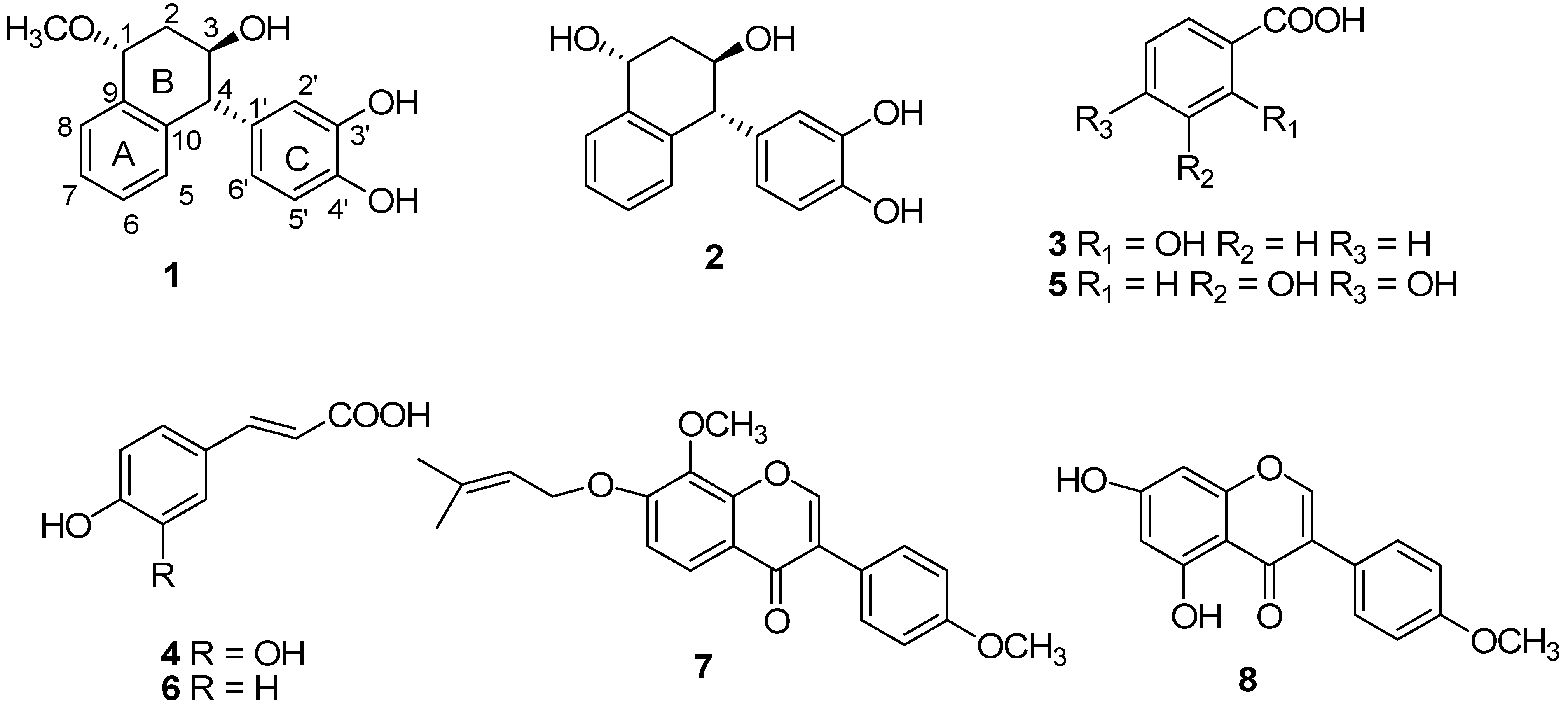
      <p>The phytochemical study of 95% ethanol extract obtained from the rhizomes of <italic>Cyperus rotundus</italic> L. afforded eight compounds, including two new constituents and six known compounds (<xref ref-type="fig" rid="molecules-17-12636-f001">Figure 1</xref>). The structures of compounds <bold>1</bold>–<bold>8</bold> were elucidated by detailed spectroscopic analysis and comparison of their spectroscopic data with those reported in the literature.</p>
      <fig id="molecules-17-12636-f001" position="float">
        <label>Figure 1</label>
        <caption>
          <p>Chemical structures of compounds <bold>1</bold>–<bold>8</bold> isolated from the rhizomes of <italic>Cyperus rotundus</italic> L.</p>
        </caption>
        <graphic xmlns:xlink="http://www.w3.org/1999/xlink" xlink:href="molecules-17-12636-g001.tif"/>
      </fig>
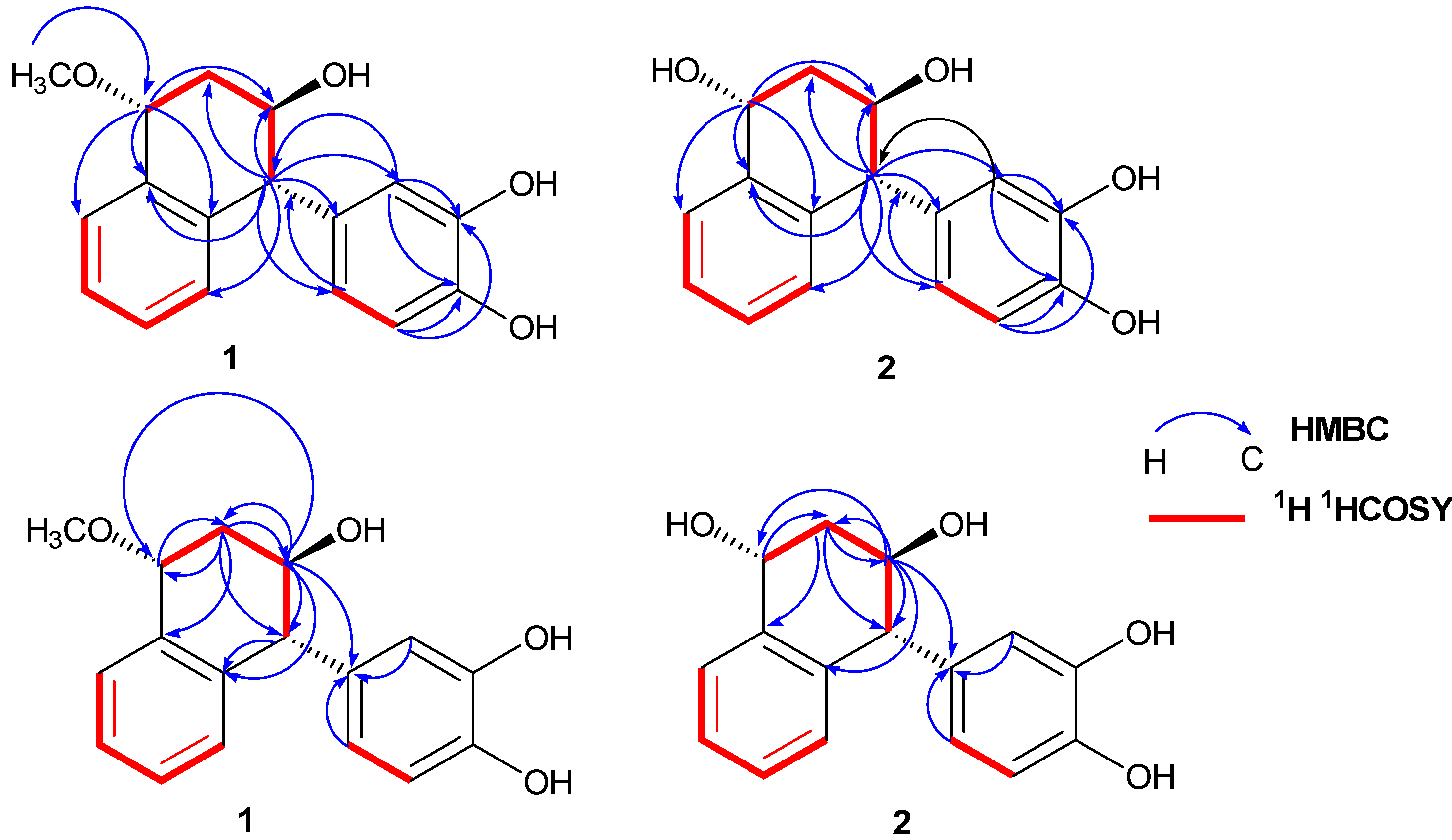
      <p>Compound <bold>1</bold>, had the molecular formula C<sub>17</sub>H<sub>18</sub>O<sub>4</sub>, as deduced from the positive-ion HR-ESI-MS (<italic>m</italic>/<italic>z</italic> 309.1107 [M+Na]<sup>+</sup>) and <sup>13</sup>C-NMR spectrum. The IR spectrum displayed absorptions at 3200–3450, 1603, and 1521 cm<sup>−1</sup>, consistent with the presence of hydroxyl and phenyl groups, respectively. The occurrence of a 1,2-disubstituted phenyl (A ring) in the molecule could be easily deduced from the <sup>1</sup>H- and <sup>13</sup>C-NMR spectra [δ 7.04 (1H, d, <italic>J</italic> = 7.8 Hz, H-5), 7.14 (1H, t, <italic>J</italic> = 7.8 Hz, H-6), 7.15 (1H, t, <italic>J</italic> = 7.8 Hz, H-7), and 7.43 (1H, d, <italic>J</italic> = 7.8 Hz, H-8); δ 139.1 (C-9), 137.9 (C-10), 128.9 (C-5), 127.6 (C-6), 126.9 (C-8) and 125.4 (C-7)] (<xref ref-type="table" rid="molecules-17-12636-t001">Table 1</xref> and <xref ref-type="table" rid="molecules-17-12636-t002">Table 2</xref>). The detailed 2D NMR analysis of <sup>1</sup>H<sup>1</sup>H COSY, HMQC, and HMBC correlations also implied that <bold>1</bold> had a 1,2-disubstituted phenyl (A ring) (<xref ref-type="fig" rid="molecules-17-12636-f002">Figure 2</xref>). Taking into account the nine degrees of unsaturation, <bold>1</bold> must include a six-membered ring (B ring). This was revealed by the HH correlations of the spin system H-1/H<sub>2</sub>-2/H-3/H-4 as well as the HMBC correlations from H-1 to C-2, C-3, C-8, C-9, and C-10, from H-4 to C-3, C-9, C-10, and C-2, from H-3 to C-2, C-4, C-10, and C-1, and from H-2 to C-1, C-3, C-9, and C-4 (<xref ref-type="fig" rid="molecules-17-12636-f002">Figure 2</xref>). Thus, the skeleton of <bold>1</bold> was believed to be a 1,2,3,4-tetrahydronaphthalin (ring A and ring B). </p>
      <table-wrap id="molecules-17-12636-t001" position="float">
        <object-id pub-id-type="pii">molecules-17-12636-t001_Table 1</object-id>
        <label>Table 1</label>
        <caption>
          <p><sup>1</sup>H-NMR (400 MHz, in CD<sub>3</sub>OD) spectroscopic data of <bold>1</bold>–<bold>2</bold>.</p>
        </caption>
        <table>
          <thead>
            <tr>
              <th align="left" valign="middle">Position</th>
              <th align="left" valign="middle">1</th>
              <th align="left" valign="middle">2</th>
            </tr>
          </thead>
          <tbody>
            <tr>
              <td align="left" valign="middle">1</td>
              <td align="left" valign="middle">4.91 (1H, m)</td>
              <td align="left" valign="middle">5.03 (1H, m)</td>
            </tr>
            <tr>
              <td align="left" valign="middle">2</td>
              <td align="left" valign="middle">1.91–2.03 (2H, m)</td>
              <td align="left" valign="middle">1.87–1.93 (2H, m)</td>
            </tr>
            <tr>
              <td align="left" valign="middle">3</td>
              <td align="left" valign="middle">3.79 (1H, m)</td>
              <td align="left" valign="middle">3.83 (1H, m)</td>
            </tr>
            <tr>
              <td align="left" valign="middle">4</td>
              <td align="left" valign="middle">4.09 (1H, d, <italic>J</italic> = 6.8 Hz)</td>
              <td align="left" valign="middle">4.11 (1H, d, <italic>J</italic> = 6.7 Hz)</td>
            </tr>
            <tr>
              <td align="left" valign="middle">5</td>
              <td align="left" valign="middle">7.04 (1H, d, <italic>J</italic> = 7.8 Hz)</td>
              <td align="left" valign="middle">7.06 (1H, d, <italic>J</italic> = 7.6 Hz)</td>
            </tr>
            <tr>
              <td align="left" valign="middle">6</td>
              <td align="left" valign="middle">7.14 (1H, t, <italic>J</italic> = 7.8 Hz)</td>
              <td align="left" valign="middle">7.16 (1H, t, <italic>J</italic> = 7.6 Hz)</td>
            </tr>
            <tr>
              <td align="left" valign="middle">7</td>
              <td align="left" valign="middle">7.15 (1H, t, <italic>J</italic> = 7.8 Hz)</td>
              <td align="left" valign="middle">7.16 (1H, t, <italic>J</italic> = 7.6 Hz)</td>
            </tr>
            <tr>
              <td align="left" valign="middle">8</td>
              <td align="left" valign="middle">7.43 (1H, d, <italic>J</italic> = 7.8 Hz)</td>
              <td align="left" valign="middle">7.39 (1H, d, <italic>J</italic> = 7.6 Hz)</td>
            </tr>
            <tr>
              <td align="left" valign="middle">2′</td>
              <td align="left" valign="middle">6.73 (1H, d, <italic>J</italic> = 2.0 Hz)</td>
              <td align="left" valign="middle">6.75 (1H, d, <italic>J</italic> = 2.0 Hz)</td>
            </tr>
            <tr>
              <td align="left" valign="middle">5′</td>
              <td align="left" valign="middle">6.79 (1H, d, <italic>J</italic> = 8.0 Hz)</td>
              <td align="left" valign="middle">6.77 (1H, d, <italic>J</italic> = 8.0 Hz)</td>
            </tr>
            <tr>
              <td align="left" valign="middle">6′</td>
              <td align="left" valign="middle">6.68 (1H, dd, <italic>J</italic> = 8.0, 2.0 Hz)</td>
              <td align="left" valign="middle">6.65 (1H, dd, <italic>J</italic> = 8.0, 2.0 Hz)</td>
            </tr>
            <tr>
              <td align="left" valign="middle">OCH<sub>3</sub></td>
              <td align="left" valign="middle">3.31 (3H, s)</td>
              <td align="left" valign="middle">-</td>
            </tr>
          </tbody>
        </table>
      </table-wrap>
      <table-wrap id="molecules-17-12636-t002" position="float">
        <object-id pub-id-type="pii">molecules-17-12636-t002_Table 2</object-id>
        <label>Table 2</label>
        <caption>
          <p><sup>13</sup>C-NMR (100 MHz, in CD<sub>3</sub>OD) spectroscopic data of <bold>1</bold>–<bold>2</bold>.</p>
        </caption>
        <table>
          <thead>
            <tr>
              <th align="left" valign="middle">Position</th>
              <th align="left" valign="middle">1</th>
              <th align="left" valign="middle">2</th>
              <th align="left" valign="middle">Position</th>
              <th align="left" valign="middle">1</th>
              <th align="left" valign="middle">2</th>
            </tr>
          </thead>
          <tbody>
            <tr>
              <td align="left" valign="middle">1</td>
              <td align="left" valign="middle">74.1</td>
              <td align="left" valign="middle">65.8</td>
              <td align="left" valign="middle">10</td>
              <td align="left" valign="middle">137.9</td>
              <td align="left" valign="middle">138.1</td>
            </tr>
            <tr>
              <td align="left" valign="middle">2</td>
              <td align="left" valign="middle">38.1</td>
              <td align="left" valign="middle">37.9</td>
              <td align="left" valign="middle">1′</td>
              <td align="left" valign="middle">134.8</td>
              <td align="left" valign="middle">134.8</td>
            </tr>
            <tr>
              <td align="left" valign="middle">3</td>
              <td align="left" valign="middle">66.3</td>
              <td align="left" valign="middle">66.1</td>
              <td align="left" valign="middle">2′</td>
              <td align="left" valign="middle">116.3</td>
              <td align="left" valign="middle">116.3</td>
            </tr>
            <tr>
              <td align="left" valign="middle">4</td>
              <td align="left" valign="middle">49.8</td>
              <td align="left" valign="middle">49.7</td>
              <td align="left" valign="middle">3′</td>
              <td align="left" valign="middle">145.6</td>
              <td align="left" valign="middle">145.7</td>
            </tr>
            <tr>
              <td align="left" valign="middle">5</td>
              <td align="left" valign="middle">128.9</td>
              <td align="left" valign="middle">128.9</td>
              <td align="left" valign="middle">4′</td>
              <td align="left" valign="middle">143.1</td>
              <td align="left" valign="middle">143.1</td>
            </tr>
            <tr>
              <td align="left" valign="middle">6</td>
              <td align="left" valign="middle">127.6</td>
              <td align="left" valign="middle">127.4</td>
              <td align="left" valign="middle">5′</td>
              <td align="left" valign="middle">116.0</td>
              <td align="left" valign="middle">115.8</td>
            </tr>
            <tr>
              <td align="left" valign="middle">7</td>
              <td align="left" valign="middle">125.4</td>
              <td align="left" valign="middle">125.3</td>
              <td align="left" valign="middle">6′</td>
              <td align="left" valign="middle">122.4</td>
              <td align="left" valign="middle">122.6</td>
            </tr>
            <tr>
              <td align="left" valign="middle">8</td>
              <td align="left" valign="middle">126.9</td>
              <td align="left" valign="middle">126.5</td>
              <td align="left" valign="middle">OMe</td>
              <td align="left" valign="middle">57.3</td>
              <td align="left" valign="middle">-</td>
            </tr>
            <tr>
              <td align="left" valign="middle">9</td>
              <td align="left" valign="middle">139.1</td>
              <td align="left" valign="middle">139.4</td>
              <td align="left" valign="middle"> </td>
              <td align="left" valign="middle"> </td>
              <td align="left" valign="middle"> </td>
            </tr>
          </tbody>
        </table>
      </table-wrap>
      <fig id="molecules-17-12636-f002" position="float">
        <label>Figure 2</label>
        <caption>
          <p>Key HMBC and <sup>1</sup>H <sup>1</sup>H-COSYcorrelations of <bold>1</bold> and <bold>2</bold>.</p>
        </caption>
        <graphic xmlns:xlink="http://www.w3.org/1999/xlink" xlink:href="molecules-17-12636-g002.tif"/>
      </fig>
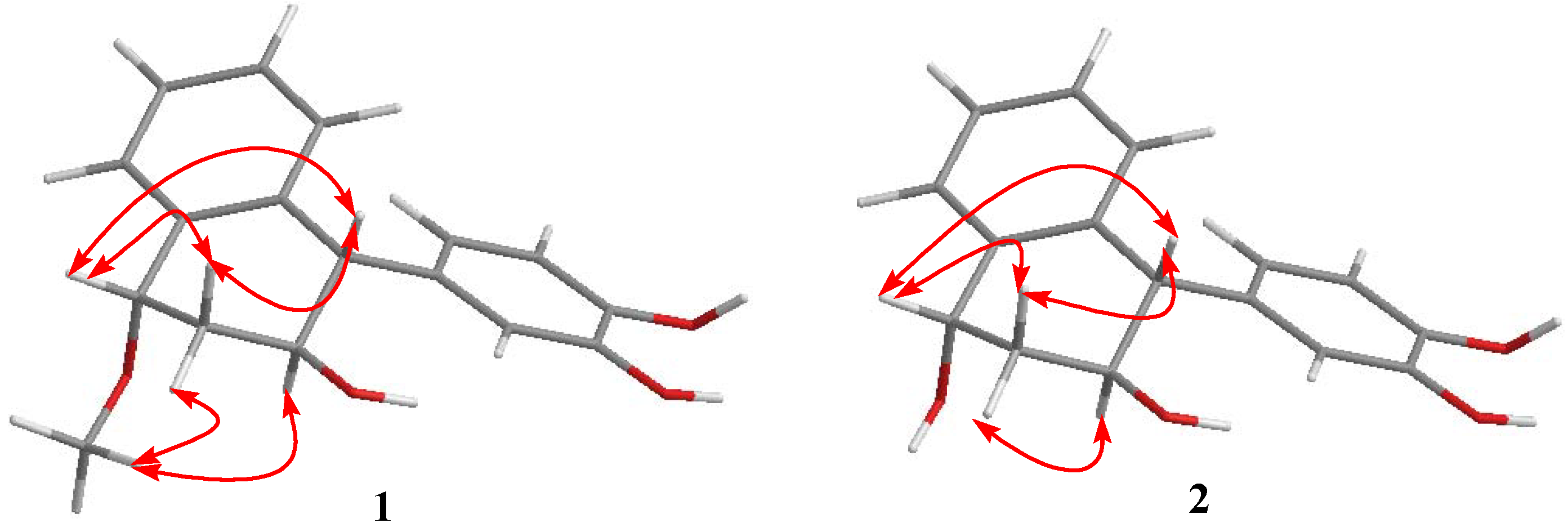
      <p>The <sup>1</sup>H and <sup>13</sup>C-NMR spectrum of <bold>1</bold> showed the presence of an aromatic ABX system [δ 6.73 (1H, d, <italic>J</italic> = 2.0 Hz, H-2′), 6.79 (1H, d, <italic>J</italic> = 8.0 Hz, H-5′), and 6.68 (1H, dd, <italic>J</italic> = 2.0, 8.0 Hz, H-6′); δ (C) 145.6 (C-3′), 143.1 (C-4′), 134.8 (C-1′), 122.4 (C-6′), 116.3 (C-2′), and 116.0 (C-5′)] (<xref ref-type="table" rid="molecules-17-12636-t001">Table 1</xref> and <xref ref-type="table" rid="molecules-17-12636-t002">Table 2</xref>), suggesting the presence of a 1′,3′,4′-trisubstituted phenyl in the molecule. Considering the molecular formula of <bold>1</bold>, two hydroxyl groups should be attached to C-3′ and C-4′, respectively. Thus, compound <bold>1</bold> contained a 3′,4′-dihydroxyphenyl group (ring C). Moreover, the 3′,4′-dihydroxyphenyl group (ring C) was attached to the C-4 position of the ring B, which was supported by the HMBC correlations between H-3 (δ 3.79) and C-4 and C-1′, H-4 (δ 4.09) and C-1′, C-2′, and C-6′, H-2′ (δ 6.73) and C-1′ and C-4, and H-6′ (δ 6.68) and C-1′ and C-4 (<xref ref-type="fig" rid="molecules-17-12636-f002">Figure 2</xref>). In the B ring, a methoxyl group was located at C-1 based on the HMBC correlations from the methoxyl protons (δ 3.31) to C-1 (δ 74.1) and a hydroxyl group was found at C-3 based on the HMBC correlations of H-3 (δ 3.79) to C-1, C-4, and C-10. The <italic>J</italic> value between the protons of H-3 and H-4 (<italic>J</italic> = 6.8 Hz) was consistent with the stereochemistry of H-3<italic>α</italic> and H-4<italic>β</italic>. The absence of a ROESY correlation between H-3 and H-4 also suggested a nearly antiperiplanar arrangement of these two protons. The ROESY correlation of H-1 to H-4 established the stereochemistry of H-1<italic>β</italic> and H-4<italic>β</italic> (<xref ref-type="fig" rid="molecules-17-12636-f003">Figure 3</xref>). Therefore, <bold>1</bold> was assigned as 1<italic>α</italic>-methoxy-3<italic>β</italic>-hydroxy-4<italic>α</italic>-(3′,4′-dihydroxyphenyl)-1,2,3,4-tetrahydronaphthalin, and named methoxycyperotundol.</p>
      <fig id="molecules-17-12636-f003" position="float">
        <label>Figure 3</label>
        <caption>
          <p>Selected ROESY correlations of <bold>1</bold> and <bold>2</bold>.</p>
        </caption>
        <graphic xmlns:xlink="http://www.w3.org/1999/xlink" xlink:href="molecules-17-12636-g003.tif"/>
      </fig>
      <p>The molecular formula of compound <bold>2</bold> was determined to be C<sub>16</sub>H<sub>16</sub>O<sub>4</sub> by the positive ion at <italic>m/z</italic> 295.0948 [M+Na]<sup>+</sup> in the HRESIMS. Its IR spectrum displayed absorptions attributable to hydroxyl (3300-3500 cm<sup>−1</sup>) and phenyl groups (1607, 1518 cm<sup>−1</sup>). The <sup>1</sup>H and <sup>13</sup>C-NMR spectroscopic data of <bold>2</bold> were similar to those of <bold>1</bold>, with the exception of a methoxyl group (δ 3.31; δ 57.3) at C-1 in <bold>1</bold>, instead of a hydroxyl in <bold>2</bold> (<xref ref-type="table" rid="molecules-17-12636-t001">Table 1</xref> and <xref ref-type="table" rid="molecules-17-12636-t002">Table 2</xref>). The suggestion was in accord with the observation of the upfield shift of C-1 signal from δ 74.1 in <bold>1</bold> to δ 65.8 in <bold>2</bold> (<xref ref-type="table" rid="molecules-17-12636-t002">Table 2</xref>). This was further established by the HMBC correlations from H-1 to C-8, C-10, C-2, and C-3 (<xref ref-type="fig" rid="molecules-17-12636-f002">Figure 2</xref>). Therefore, compound <bold>2</bold> was identified as 1<italic>α</italic>,3<italic>β</italic>-dihydroxy-4<italic>α</italic>-(3′,4′-dihydroxyphenyl)-1,2,3,4-tetrahydronaphthalin, and named cyperotundol.</p>
      <p>The structures of the other isolated components: salicylic acid (<bold>3</bold>), caffeic acid (<bold>4</bold>), protocatechuic acid (<bold>5</bold>), <italic>p</italic>-coumaric acid (<bold>6</bold>), pongamone A (<bold>7</bold>) and biochanin A (<bold>8</bold>) were determined by comparison with the <sup>1</sup>H- and <sup>13</sup>C-NMR spectral data in the literature [<xref ref-type="bibr" rid="B8-molecules-17-12636">8</xref>,<xref ref-type="bibr" rid="B9-molecules-17-12636">9</xref>,<xref ref-type="bibr" rid="B10-molecules-17-12636">10</xref>,<xref ref-type="bibr" rid="B11-molecules-17-12636">11</xref>]. To the best of our knowledge, the known compounds, pongamone A (<bold>7</bold>) and biochanin A (<bold>8</bold>) in the rhizomes of <italic>Cyperus rotundus</italic> are reported for the first time.</p>
    </sec>
    <sec sec-type="methods">
      <title>3. Experimental</title>
      <sec>
        <title>3.1. General</title>
        <p>UV spectra were recorded on a Hewlett-Packard HP-845 UV-VIS spectrophotometer. IR spectra were recorded on a Nicolet 470 spectrometer and MS on a Varian MAT-212 mass spectrometer and a Shimadzu GC-MS model QP2010 Plus spectrophotometer, respectively. NMR spectra were recorded on a Bruker AM-400 spectrameter (400 MHz for <sup>1</sup>H-NMR, 100 MHz for <sup>13</sup>C-NMR) using standard Bruker pulse programs. Chemical shifts are given as δ values with reference to tetramethylsilane (TMS) as internal standard. Column chromatography separations were carried out on silica gel (200–300 mesh, Qingdao Haiyang Chemical Co. Ltd, Qingdao, China), ODS (50 mesh, AA12S50, YMC), Diaion HP-20 (Pharmacia, Peapack, NJ, USA) and Sephadex LH-20 (Pharmacia, Peapack, NJ, USA). All other chemicals used were of biochemical reagent grade.</p>
      </sec>
      <sec>
        <title>3.2. Plant Material</title>
        <p>The rhizomes of <italic>Cyperus rotundus</italic> were collected in Zhanjiang, Guangdong Province of China in September 2009, and were identified by one of the authors (Wen-qing Yin of the School of Chemistry &amp; Chemical Engineering of Guangxi Normal University, Ministry of Education Key Laboratory of Chemistry and Molecular Engineering of Medicinal Resource, Guilin, China). A voucher specimen (No.20090903) has been deposited in the authors’ laboratory.</p>
      </sec>
      <sec>
        <title>3.3. Extraction and Isolation</title>
        <p>The dry rhizomes of <italic>Cyperus rotundus</italic> (10 kg) were extracted three times under reflux with 95% EtOH (150 L × 2 h). After removing the solvent under reduced pressure, the residue was suspended in water and then sequentially extracted with petroleum ether, CH<sub>2</sub>Cl<sub>2</sub>, EtOAc and <italic>n</italic>-BuOH. The EtOAc extract (88 g) was subjected to silica gel column chromatography (CC) using CHCl<sub>3</sub>-MeOH mixtures (1:0 to 0:1) and divided into eight main fractions by TLC detection. Fraction 5 was separated by CC over silica gel using CHCl<sub>3</sub>-MeOH (6:1) and Sephadex LH-20 CC using CHCl<sub>3</sub>-MeOH (1:1) to afford <bold>7</bold> (19 mg) and <bold>8</bold> (23 mg). Fraction 7 was chromatographed on silica gel eluting with CHCl<sub>3</sub>-MeOH-H<sub>2</sub>O (9:1:0.1 to 7:3:0.5) and ODS silica gel with MeOH-H<sub>2</sub>O (1:1 to 1:0) to furnish <bold>1</bold> (13 mg) and <bold>2</bold> (18 mg). Fraction 8 was separated by CC on Si gel using CHCl<sub>3</sub>-MeOH (10:1) to give subfraction 8-1 (6.1 g), subfraction 8-2 (10 g) and subfraction 8-3 (4 g). Subfraction 8-2 was purified by semi-preparative HPLC to afford compounds <bold>3</bold> (7 mg), <bold>4</bold> (9 mg), <bold>5</bold> (9 mg), and <bold>6</bold> (11 mg). </p>
      </sec>
      <sec>
        <title>3.4. Characterization of Methoxycyperotundol (<bold>1</bold>)</title>
        <p>Obtained as colorless needles, [α]<sup>25</sup><sub><italic>D</italic></sub>: −51.9° (<italic>c</italic> 0.5, MeOH); UV λ<sub>max</sub> (MeOH): 276 nm; IR <italic>v</italic><sub>max</sub> (KBr): 3200–3450 cm<sup>−1</sup>, 1603 cm<sup>−1</sup> and 1521 cm<sup>−1</sup>. HR-ESI-MS <italic>m</italic>/<italic>z</italic> 309.1107 (C<sub>17</sub>H<sub>18</sub>O<sub>4</sub>Na [M+Na]<sup>+</sup>, Cal. 309.1103). <sup>1</sup>H-NMR and <sup>13</sup>C-NMR (CD<sub>3</sub>OD) data see <xref ref-type="table" rid="molecules-17-12636-t001">Table 1</xref> and <xref ref-type="table" rid="molecules-17-12636-t002">Table 2</xref>.</p>
      </sec>
      <sec>
        <title>3.5. Characterization of Cyperotundol (<bold>2</bold>)</title>
        <p>Obtained as colorless needles. [α]<sup>25</sup><sub><italic>D</italic></sub>: −89.4° (<italic>c</italic> 0.1, MeOH). UV (MeOH) λ<sub>max</sub>: 279 nm. IR <italic>v</italic><sub>max</sub> (KBr): 3300–3500 cm<sup>−1</sup>, 1607 cm<sup>−1</sup>, and 1518 cm<sup>−1</sup>. HR-ESI-MS <italic>m</italic>/<italic>z</italic> 295.0948 ([M+Na]<sup>+</sup>, Calcd. for C<sub>16</sub>H<sub>16</sub>O<sub>4</sub>, 295.0946). <sup>1</sup>H-NMR and <sup>13</sup>C-NMR (CD<sub>3</sub>OD) data see <xref ref-type="table" rid="molecules-17-12636-t001">Table 1</xref> and <xref ref-type="table" rid="molecules-17-12636-t002">Table 2</xref>.</p>
      </sec>
    </sec>
    <sec sec-type="conclusions">
      <title>4. Conclusions</title>
      <p>During the phytochemical survey of the rhizomes of <italic>Cyperus rotundus</italic>, two novel constituents methoxycyperotundol (<bold>1</bold>) and cyperotundol (<bold>2</bold>) were obtained, along with six known components. Additionally, the known compounds, pongamone A (<bold>7</bold>) and biochanin A (<bold>8</bold>) in the rhizomes of <italic>Cyperus rotundus</italic> L are reported for the first time.</p>
    </sec>
  </body>
  <back>
    <ack>
      <title>Acknowledgements</title>
      <p>This study was supported by Key Science and Technology Program of Zhanjiang City (2012C3102017).</p>
      
    </ack>
    <ref-list>
      <title>References</title>
      <ref id="B1-molecules-17-12636">
        <label>1.</label>
        <citation citation-type="journal">
          <person-group person-group-type="author">
            <name>
              <surname>Oladipupo</surname>
              <given-names>A.L.</given-names>
            </name>
            <name>
              <surname>Adebola</surname>
              <given-names>O.O.</given-names>
            </name>
          </person-group>
          <article-title>Chemical composition of the essential oils of <italic>Cyperus rotundus</italic> L. from south Africa</article-title>
          <source>Molecules</source>
          <year>2009</year>
          <volume>14</volume>
          <fpage>2909</fpage>
          <lpage>2917</lpage>
          <pub-id pub-id-type="doi">10.3390/molecules14082909</pub-id>
        </citation>
      </ref>
      <ref id="B2-molecules-17-12636">
        <label>2.</label>
        <citation citation-type="journal">
          <person-group person-group-type="author">
            <name>
              <surname>Zhou</surname>
              <given-names>Z.L.</given-names>
            </name>
            <name>
              <surname>Liu</surname>
              <given-names>Y.H.</given-names>
            </name>
          </person-group>
          <article-title>Study on antidpressant effect and mechanism by <italic>Cyperus rotundus</italic> extracts</article-title>
          <source>Chin. J. Exp. Tradit. Med. Formulae</source>
          <year>2012</year>
          <volume>7</volume>
          <fpage>191</fpage>
          <lpage>193</lpage>
        </citation>
      </ref>
      <ref id="B3-molecules-17-12636">
        <label>3.</label>
        <citation citation-type="journal">
          <person-group person-group-type="author">
            <name>
              <surname>Raut</surname>
              <given-names>N.A.</given-names>
            </name>
            <name>
              <surname>Gaikwad</surname>
              <given-names>N.J.</given-names>
            </name>
          </person-group>
          <article-title>Antidiabetic activity of hydro-ethanolic extract of <italic>Cyperus rotundus</italic> in alloxan induced diabetes in rats</article-title>
          <source>Fitoterapia</source>
          <year>2006</year>
          <volume>77</volume>
          <fpage>585</fpage>
          <lpage>588</lpage>
          <pub-id pub-id-type="doi">10.1016/j.fitote.2006.09.006</pub-id>
        </citation>
      </ref>
      <ref id="B4-molecules-17-12636">
        <label>4.</label>
        <citation citation-type="journal">
          <person-group person-group-type="author">
            <name>
              <surname>Sayed</surname>
              <given-names>H.M.</given-names>
            </name>
            <name>
              <surname>Mohamed</surname>
              <given-names>M.H.</given-names>
            </name>
            <name>
              <surname>Farag</surname>
              <given-names>S.F.</given-names>
            </name>
            <name>
              <surname>Mohamed</surname>
              <given-names>G.A.</given-names>
            </name>
            <name>
              <surname>Omobuwajo</surname>
              <given-names>O.R.M.</given-names>
            </name>
            <name>
              <surname>Proksch</surname>
              <given-names>P.</given-names>
            </name>
          </person-group>
          <article-title>Fructose-amino acid conjugate and other constituents from <italic>Cyperus rotundus</italic> L</article-title>
          <source>Nat. Prod. Res.</source>
          <year>2008</year>
          <volume>17</volume>
          <fpage>343</fpage>
          <lpage>350</lpage>
        </citation>
      </ref>
      <ref id="B5-molecules-17-12636">
        <label>5.</label>
        <citation citation-type="journal">
          <person-group person-group-type="author">
            <name>
              <surname>Jeong</surname>
              <given-names>S.J.</given-names>
            </name>
            <name>
              <surname>Miyamoto</surname>
              <given-names>T.</given-names>
            </name>
            <name>
              <surname>Inagaki</surname>
              <given-names>M.</given-names>
            </name>
            <name>
              <surname>Kim</surname>
              <given-names>Y.C.</given-names>
            </name>
            <name>
              <surname>Higuchi</surname>
              <given-names>R.</given-names>
            </name>
          </person-group>
          <article-title>Rotundines A-C, three novel sesquiterpene alkaloids from <italic>Cyperus rotundus</italic></article-title>
          <source>J. Nat. Prod.</source>
          <year>2000</year>
          <volume>63</volume>
          <fpage>673</fpage>
          <lpage>675</lpage>
          <pub-id pub-id-type="doi">10.1021/np990588r</pub-id>
        </citation>
      </ref>
      <ref id="B6-molecules-17-12636">
        <label>6.</label>
        <citation citation-type="journal">
          <person-group person-group-type="author">
            <name>
              <surname>Morimoto</surname>
              <given-names>M.</given-names>
            </name>
            <name>
              <surname>Komai</surname>
              <given-names>K.</given-names>
            </name>
          </person-group>
          <article-title>Plant growth inhibitors: Patchoulane-type sesquiterpenes from <italic>Cyperus rotundus</italic> L</article-title>
          <source>Weed Biol. Manag.</source>
          <year>2005</year>
          <volume>5</volume>
          <fpage>203</fpage>
          <lpage>209</lpage>
          <pub-id pub-id-type="doi">10.1111/j.1445-6664.2005.00186.x</pub-id>
        </citation>
      </ref>
      <ref id="B7-molecules-17-12636">
        <label>7.</label>
        <citation citation-type="journal">
          <person-group person-group-type="author">
            <name>
              <surname>Zhou</surname>
              <given-names>Z.L.</given-names>
            </name>
            <name>
              <surname>Fu</surname>
              <given-names>C.Y.</given-names>
            </name>
          </person-group>
          <article-title>A new flavanone and other constituents from the rhizomes of <italic>Cyperus rotundus</italic> L. and their antioxidative activities</article-title>
          <source>Chem. Nat. Comp.</source>
          <year>2012</year>
          <volume>6</volume>
          <fpage>1</fpage>
          <lpage>3</lpage>
        </citation>
      </ref>
      <ref id="B8-molecules-17-12636">
        <label>8.</label>
        <citation citation-type="journal">
          <person-group person-group-type="author">
            <name>
              <surname>Sayed</surname>
              <given-names>H.M.</given-names>
            </name>
            <name>
              <surname>Mohamed</surname>
              <given-names>M.H.</given-names>
            </name>
            <name>
              <surname>Farag</surname>
              <given-names>S.F.</given-names>
            </name>
            <name>
              <surname>Mohamed</surname>
              <given-names>G.A.</given-names>
            </name>
            <name>
              <surname>Proksch</surname>
              <given-names>P.</given-names>
            </name>
          </person-group>
          <article-title>A new steroid glycoside and furochromones from <italic>Cyperus rotundus</italic> L</article-title>
          <source>Nat. Prod. Res.</source>
          <year>2007</year>
          <volume>21</volume>
          <fpage>4343</fpage>
          <lpage>4350</lpage>
        </citation>
      </ref>
      <ref id="B9-molecules-17-12636">
        <label>9.</label>
        <citation citation-type="journal">
          <person-group person-group-type="author">
            <name>
              <surname>Li</surname>
              <given-names>L.Y.</given-names>
            </name>
            <name>
              <surname>Li</surname>
              <given-names>X.</given-names>
            </name>
            <name>
              <surname>Shi</surname>
              <given-names>C.</given-names>
            </name>
            <name>
              <surname>Deng</surname>
              <given-names>Z.W.</given-names>
            </name>
            <name>
              <surname>Fu</surname>
              <given-names>H.Z.</given-names>
            </name>
            <name>
              <surname>Proksch</surname>
              <given-names>P.</given-names>
            </name>
            <name>
              <surname>Lin</surname>
              <given-names>W.H.</given-names>
            </name>
          </person-group>
          <article-title>Pongamone A-E, five flavonoids from the stems of a mangrove plant, <italic>Pongamia pinnata</italic></article-title>
          <source>Phytochemistry</source>
          <year>2006</year>
          <volume>67</volume>
          <fpage>1347</fpage>
          <lpage>1352</lpage>
        <pub-id pub-id-type="doi">10.1016/j.phytochem.2006.05.016</pub-id><pub-id pub-id-type="pmid">16814820</pub-id></citation>
      </ref>
      <ref id="B10-molecules-17-12636">
        <label>10.</label>
        <citation citation-type="journal">
          <person-group person-group-type="author">
            <name>
              <surname>Benavides</surname>
              <given-names>A.</given-names>
            </name>
            <name>
              <surname>Bassarello</surname>
              <given-names>C.</given-names>
            </name>
            <name>
              <surname>Montoro</surname>
              <given-names>P.</given-names>
            </name>
            <name>
              <surname>Vilegas</surname>
              <given-names>W.</given-names>
            </name>
            <name>
              <surname>Piacente</surname>
              <given-names>S.</given-names>
            </name>
            <name>
              <surname>Pizza</surname>
              <given-names>C.</given-names>
            </name>
          </person-group>
          <article-title>Flavonoids and isoflavonoids from <italic>Gynerium sagittatum</italic></article-title>
          <source>Phytochemistry</source>
          <year>2007</year>
          <volume>68</volume>
          <fpage>1277</fpage>
          <lpage>1284</lpage>
          <pub-id pub-id-type="doi">10.1016/j.phytochem.2007.03.007</pub-id>
        </citation>
      </ref>
      <ref id="B11-molecules-17-12636">
        <label>11.</label>
        <citation citation-type="journal">
          <person-group person-group-type="author">
            <name>
              <surname>Xu</surname>
              <given-names>Y.</given-names>
            </name>
            <name>
              <surname>Zhang</surname>
              <given-names>H.W.</given-names>
            </name>
            <name>
              <surname>Yu</surname>
              <given-names>C.Y.</given-names>
            </name>
            <name>
              <surname>Lu</surname>
              <given-names>Y.</given-names>
            </name>
            <name>
              <surname>Chang</surname>
              <given-names>Y.</given-names>
            </name>
            <name>
              <surname>Zou</surname>
              <given-names>Z.M.</given-names>
            </name>
          </person-group>
          <article-title>Norcyperone, a novel skeleton norsesquiterpene from <italic>Cyperus rotundus</italic> L</article-title>
          <source>Molecules</source>
          <year>2008</year>
          <volume>13</volume>
          <fpage>2474</fpage>
          <lpage>2481</lpage>
          <pub-id pub-id-type="doi">10.3390/molecules13102474</pub-id>
        </citation>
      </ref>
    </ref-list>
	<fn-group><fn><p><italic>Sample Availability</italic>: Samples of all the isolated compounds are available, please contact the corresponding author.</p></fn></fn-group>
  </back>
</article>