<?xml version="1.0" encoding="UTF-8"?>
<!DOCTYPE article PUBLIC "-//NLM//DTD Journal Publishing DTD v2.3 20070202//EN" "journalpublishing.dtd">
<article xmlns:mml="http://www.w3.org/1998/Math/MathML" xmlns:xlink="http://www.w3.org/1999/xlink" xml:lang="en" article-type="research-article">
  <front>
    <journal-meta>
      <journal-id journal-id-type="publisher-id">molecules</journal-id>
      <journal-title>Molecules</journal-title>
      <abbrev-journal-title abbrev-type="publisher">Molecules</abbrev-journal-title>
      <abbrev-journal-title abbrev-type="pubmed">Molecules</abbrev-journal-title>
      <issn pub-type="epub">1420-3049</issn>
      <publisher>
        <publisher-name>MDPI</publisher-name>
      </publisher>
    </journal-meta>
    <article-meta>
      <article-id pub-id-type="doi">10.3390/molecules171112622</article-id>
      <article-id pub-id-type="publisher-id">molecules-17-12622</article-id>
      <article-categories>
        <subj-group>
          <subject>Article</subject>
        </subj-group>
      </article-categories>
      <title-group>
        <article-title>Improved Antileishmanial Activity of Dppz through Complexation with Antimony(III) and Bismuth(III): Investigation of the Role of the Metal</article-title>
      </title-group>
	  <contrib-group>
        <contrib contrib-type="author">
          <name>
            <surname>Lizarazo-Jaimes</surname>
            <given-names>Edgar H.</given-names>
          </name>
          <xref rid="af1-molecules-17-12622" ref-type="aff">1</xref>
        </contrib>
        <contrib contrib-type="author">
          <name>
            <surname>Monte-Neto</surname>
            <given-names>Rubens L.</given-names>
          </name>
          <xref rid="af2-molecules-17-12622" ref-type="aff">2</xref>
        </contrib>
        <contrib contrib-type="author">
          <name>
            <surname>Reis</surname>
            <given-names>Priscila G.</given-names>
          </name>
          <xref rid="af2-molecules-17-12622" ref-type="aff">2</xref>
        </contrib>
        <contrib contrib-type="author">
          <name>
            <surname>Fernandes</surname>
            <given-names>Nelson G.</given-names>
          </name>
          <xref rid="af1-molecules-17-12622" ref-type="aff">1</xref>
        </contrib>
        <contrib contrib-type="author">
          <name>
            <surname>Speziali</surname>
            <given-names>Nivaldo L.</given-names>
          </name>
          <xref rid="af3-molecules-17-12622" ref-type="aff">3</xref>
        </contrib>
        <contrib contrib-type="author">
          <name>
            <surname>Melo</surname>
            <given-names>Maria N.</given-names>
          </name>
          <xref rid="af4-molecules-17-12622" ref-type="aff">4</xref>
        </contrib>
        <contrib contrib-type="author">
          <name>
            <surname>Frézard</surname>
            <given-names>Frédéric</given-names>
          </name>
          <xref rid="af2-molecules-17-12622" ref-type="aff">2</xref>
        </contrib>
        <contrib contrib-type="author">
          <name>
            <surname>Demicheli</surname>
            <given-names>Cynthia</given-names>
          </name>
          <xref rid="af1-molecules-17-12622" ref-type="aff">1</xref>
          <xref rid="c1-molecules-17-12622" ref-type="corresp">*</xref>
        </contrib>
      </contrib-group>
      
      <aff id="af1-molecules-17-12622"><label>1 </label>Department of Chemistry, Institute of Exact Sciences, Federal University of Minas Gerais (UFMG), Av. Antônio Carlos 6627, 31270-901, Belo Horizonte, MG, Brazil</aff>
      <aff id="af2-molecules-17-12622"><label>2 </label>Department of Physiology and Biophysics, Institute of Biological Sciences, Federal University of Minas Gerais (UFMG), Av. Antônio Carlos 6627, 31270-901, Belo Horizonte, MG, Brazil</aff>
      <aff id="af3-molecules-17-12622"><label>3 </label>Department of Physics, Institute of Exact Sciences, Federal University of Minas Gerais (UFMG), Av. Antônio Carlos 6627, 31270-901, Belo Horizonte, MG, Brazil</aff>
      <aff id="af4-molecules-17-12622"><label>4 </label>Department of Parasitology, Institute of Biological Sciences, Federal University of Minas Gerais (UFMG), Av. Antônio Carlos 6627, 31270-901, Belo Horizonte, MG, Brazil</aff>
      <author-notes>
        <corresp id="c1-molecules-17-12622"><label>*</label> Author to whom correspondence should be addressed; Email: <email>demichel@netuno.lcc.ufmg.br</email>; Tel.: +55-31-3409-5755; Fax: +55-31-3409-5700.</corresp>
      </author-notes>
      <pub-date pub-type="epub">
        <day>25</day>
        <month>10</month>
        <year>2012</year>
      </pub-date>
      <pub-date pub-type="collection">
	  <month>11</month>
        <year>2012</year>
      </pub-date>
      <volume>17</volume>
      <issue>11</issue>
      <fpage>12622</fpage>
      <lpage>12635</lpage>
      <history>
        <date date-type="received">
          <day>24</day>
          <month>08</month>
          <year>2012</year>
        </date>
        <date date-type="rev-recd">
          <day>21</day>
          <month>10</month>
          <year>2012</year>
        </date>
        <date date-type="accepted">
          <day>22</day>
          <month>10</month>
          <year>2012</year>
        </date>
      </history>
      <permissions>
        <copyright-statement>©  2012 by the authors; licensee MDPI, Basel, Switzerland.</copyright-statement>
        <copyright-year>2012</copyright-year>
        <license xmlns:xlink="http://www.w3.org/1999/xlink" license-type="open-access" xlink:href="http://creativecommons.org/licenses/by/3.0/">
          <p>This article is an open-access article distributed under the terms and conditions of the Creative Commons Attribution license (<uri>http://creativecommons.org/licenses/by/3.0/</uri>).</p>
        </license>
      </permissions>
      <abstract>
        <p>Two novel trivalent antimony(III) and bismuth(III) complexes with the nitrogen-donor heterocyclic ligand dipyrido[3,2-a:2',3'-c]phenazine (dppz) were synthesized and characterized as [Sb(dppz)Cl<sub>3</sub>]∙H<sub>2</sub>O∙CH<sub>3</sub>OH and [Bi(dppz)Cl<sub>3</sub>]. The crystal structure of Sb(III) complex was determined by X-ray crystallography. These complexes were evaluated for their activity against the promastigote form of Sb(III)-sensitive and -resistant <italic>Leishmania infantum chagasi</italic> and <italic>Leishmania amazonensis</italic> strains. Both complexes were more effective than dppz alone in inhibiting the growth of <italic>Leishmania</italic> promastigotes and were at least 77 and 2,400 times more active than potassium antimonyl tartrate in Sb(III)-sensitive and -resistant <italic>Leishmania</italic>, respectively. The cytotoxicity of dppz and its complexes against mouse peritoneal macrophages occurred at dppz concentrations at least 6-fold greater than those found to be active against <italic>Leishmania</italic> promastigotes.To investigate the role of the metal in the improved antileishmanial activity of dppz, the activity of the Sb(III) complex was compared between the Sb-resistant mutants and their respective parental sensitive strains. The lack of cross-resistance to the Sb(III)-dppz complex together with the much lower activity of antimonyl tartrate, SbCl<sub>3</sub> and BiCl<sub>3</sub> strongly support the model that the metal is not active by itself but improves the activity of dppz through complexation. </p>
      </abstract>
      <kwd-group>
        <kwd>crystal structure</kwd>
        <kwd>dipyrido [3,2-a:2',3'-c] phenazine</kwd>
        <kwd>antimony</kwd>
        <kwd>bismuth</kwd>
        <kwd>
          <italic>Leishmania</italic>
        </kwd>
        <kwd>drug resistance</kwd>
      </kwd-group>
    </article-meta>
  </front>
  <body>
    <sec sec-type="intro">
      <title>1. Introduction</title>
      <p>Pentavalent antimonials such as sodium stibogluconate and meglumine antimonate, have been used in the treatment of all forms of leishmaniasis for more than half a century [<xref ref-type="bibr" rid="B1-molecules-17-12622">1</xref>,<xref ref-type="bibr" rid="B2-molecules-17-12622">2</xref>]. Although the mechanism of action of pentavalent antimonial is not fully understood, it is generally accepted that the active form of the metal is the reduced form Sb(III) [<xref ref-type="bibr" rid="B3-molecules-17-12622">3</xref>,<xref ref-type="bibr" rid="B4-molecules-17-12622">4</xref>].</p>
      <p>A major problem in antimonial chemotherapy is the emergence of clinical resistance against pentavalent antimony drugs that has reached epidemic proportions in parts of India [<xref ref-type="bibr" rid="B5-molecules-17-12622">5</xref>]. The ATP binding cassette (ABC) protein MRPA plays a major role in metal resistance in <italic>Leishmania</italic> parasites [<xref ref-type="bibr" rid="B6-molecules-17-12622">6</xref>] and its localization in intracellular vesicle membranes suggests that it sequesters Sb(III)-thiol complexes into these vesicles [<xref ref-type="bibr" rid="B7-molecules-17-12622">7</xref>].</p>
      <p>Other mechanisms such as a diminished biological reduction of Sb(V) to Sb(III) [<xref ref-type="bibr" rid="B8-molecules-17-12622">8</xref>], the loss of an aquaglyceroporin (AQP1) allele or its down regulation [<xref ref-type="bibr" rid="B9-molecules-17-12622">9</xref>] and hypoxic conditions [<xref ref-type="bibr" rid="B10-molecules-17-12622">10</xref>] have been reported to cause an increase in resistance to pentavalent antimonials. In this context, there is a great need for new safe and effective drugs that do not exhibit cross-resistance with conventional antimonial drugs. </p>
      <p>Antimony(III) complexes have attracted special interest as potential antineoplastic agents since 1990, when Silvestru <italic>et al.</italic> [<xref ref-type="bibr" rid="B11-molecules-17-12622">11</xref>] reported for the first time the anti-tumor activity of Sb(III) complexes. It was suggested that the mode of action of trivalent antimonial compounds involves some pathways similar to apoptosis, as DNA fragmentation [<xref ref-type="bibr" rid="B12-molecules-17-12622">12</xref>,<xref ref-type="bibr" rid="B13-molecules-17-12622">13</xref>], which is preceded by an increase in reactive oxygen species caused by alterations of the redox potential [<xref ref-type="bibr" rid="B14-molecules-17-12622">14</xref>]. As an antileishmanial agent, Sb(III) inhibits and forms a complex with the enzyme trypanothione reductase which acts by recycling trypanotione disulphides in trypanothione, the major antioxidant thiol in <italic>Leishmania</italic>, important to maintain their intracellular redox balance [<xref ref-type="bibr" rid="B15-molecules-17-12622">15</xref>,<xref ref-type="bibr" rid="B16-molecules-17-12622">16</xref>].</p>
      <p>On the other hand, bismuth compounds have been used to treat infections caused by <italic>Helicobacter Pylori</italic> bacteria and duodenal ulcers [<xref ref-type="bibr" rid="B17-molecules-17-12622">17</xref>], as well as radio-therapeutic agents for cancer treatment [<xref ref-type="bibr" rid="B18-molecules-17-12622">18</xref>]. Despite the close periodic table relationship of antimony and bismuth, there are only few reports in the literature of bismuth-based drugs being developed and evaluated as antileishmanial agents [<xref ref-type="bibr" rid="B19-molecules-17-12622">19</xref>]. On the other hand, new bismuth complexes with DNA affinity and activity against cancer cell were reported [<xref ref-type="bibr" rid="B20-molecules-17-12622">20</xref>,<xref ref-type="bibr" rid="B21-molecules-17-12622">21</xref>].</p>
      <p>Metal complexes with polypyridyl ligands, have been extensively studied by a number of research groups over the last year due to potential application in photodynamic therapy [<xref ref-type="bibr" rid="B22-molecules-17-12622">22</xref>,<xref ref-type="bibr" rid="B23-molecules-17-12622">23</xref>] and probes for biological molecules [<xref ref-type="bibr" rid="B24-molecules-17-12622">24</xref>,<xref ref-type="bibr" rid="B25-molecules-17-12622">25</xref>].</p>
      <p>Recently, complexes of dipyrido[3,2-a:2',3'-c]phenazine (dppz) with gold (Au), copper (Cu) and vanadium (V) have shown remarkable antileishmanial or antitrypanosomal activities [<xref ref-type="bibr" rid="B26-molecules-17-12622">26</xref>,<xref ref-type="bibr" rid="B27-molecules-17-12622">27</xref>], however, the possible synergism between the metal and the ligand was not fully investigated. On the other hand, there are few reports in the literature referring to the structural characterization of Sb(III) and Bi(III) complexes with polypyridyl ligands [<xref ref-type="bibr" rid="B28-molecules-17-12622">28</xref>,<xref ref-type="bibr" rid="B29-molecules-17-12622">29</xref>], but no report on their pharmacological activities.</p>
      <p>In this work, the synthesis, the structural and physicochemical characterization of the polypyridyl ligand dppz coordinated to Sb(III) and Bi(III) are reported. The activities of dppz and its resulting complexes against both Sb(III)-sensitive and -resistant <italic>Leishmania infantum chagasi</italic> and <italic>Leishmania amazonensis</italic> promastigotes and their cytotoxicities towards peritoneal macrophages are described. The present paper reports for the first time a new experimental approach, based on tests against metal-resistant mutants and their respective parental sensitive strains, to get insight into the role of the metal in the cytotoxicity of a metal complex.</p>
    </sec>
    <sec sec-type="results">
      <title>2. Results and Discussion</title>
      <p>Antimony and bismuth complexes [Sb(dppz)Cl<sub>3</sub>] (<bold>1</bold>) and [Bi(dppz)Cl<sub>3</sub>] (<bold>2</bold>) were obtained in good yields by refluxing equimolar amounts of SbCl<sub>3</sub> or BiCl<sub>3</sub> with dppz in methanolic solutions. The complexes <bold>1</bold> and <bold>2</bold> prepared during the course of this investigation are an air-stable crystal and powder, respectively, which were characterized by spectroscopic methods including FT-IR, NMR, elemental analysis and also (in the case of complex <bold>1</bold>) by X-ray crystallography. In the case of complex <bold>2</bold>, the crystals obtained did not show sufficient quality for X-ray analysis. In FT-IR spectra of complexes <bold>1</bold> and <bold>2</bold>, bands were observed for C=N and C=C bonds stretching in aromatics in the 1640-1400 cm<sup>−1</sup> range. The dppz bands at around 1632 and 1616 cm<sup>−1</sup> are shifted considerably towards lower frequency—1616 and 1602 cm<sup>−1</sup> for [Sb(dppz)Cl<sub>3</sub>] and 1616 and 1598 cm<sup>−1</sup> for [Bi(dppz)Cl<sub>3</sub>]—confirming the coordination of N atoms to Sb and Bi. Similar results for the spectroscopic data of dppz complexes with Au and Cu have been reported previously [<xref ref-type="bibr" rid="B26-molecules-17-12622">26</xref>]. The corresponding <sup>1</sup>H-NMR spectra showed only one set of signals, shifted downfield in both complexes with respect to the free ligand (<xref ref-type="table" rid="molecules-17-12622-t001">Table 1</xref>). <sup>1</sup>H-NMR spectra of [Sb(dppz)Cl<sub>3</sub>] and [Bi(dppz)Cl<sub>3</sub>] complexes in DMSO-<italic>d<sub>6</sub></italic> exhibited the presence of the polypyridine ligand aromatic protons between δ 9.68 and 8.05 ppm. </p>
      <table-wrap id="molecules-17-12622-t001" position="float">
        <object-id pub-id-type="pii">molecules-17-12622-t001_Table 1</object-id>
        <label>Table 1</label>
        <caption>
          <p>Selected <sup>1</sup>H-NMR and IR data for free ligand and complexes <bold>1</bold> and <bold>2</bold>.</p>
        </caption>
        <table rules="rows">
          <thead>
            <tr>
              <th rowspan="2" align="left" valign="middle">Compound</th>
              <th colspan="5" align="center" valign="middle"><sup>1</sup>H-NMR data (ppm)</th>
              <th align="left" valign="middle">References</th>
            </tr>
            <tr>
              <th align="left" valign="middle">Hc</th>
              <th align="left" valign="middle">Ha</th>
              <th align="left" valign="middle">Hd</th>
              <th align="left" valign="middle">He</th>
              <th align="left" valign="middle">Hb</th>
              <th align="left" valign="middle"> </th>
            </tr>
          </thead>
          <tbody>
            <tr>
              <td align="left" valign="middle">Dppz</td>
              <td align="left" valign="middle">9.55</td>
              <td align="left" valign="middle">9.23</td>
              <td align="left" valign="middle">8.41</td>
              <td align="left" valign="middle">8.07</td>
              <td align="left" valign="middle">7.95</td>
              <td align="left" valign="middle">Navarro <italic>et al</italic>. (2006) [<xref ref-type="bibr" rid="B26-molecules-17-12622">26</xref>]</td>
            </tr>
            <tr>
              <td align="left" valign="middle">
                <italic>Sb(dppz)Cl<sub>3</sub></italic>
              </td>
              <td align="left" valign="middle">9.68</td>
              <td align="left" valign="middle">9.31</td>
              <td align="left" valign="middle">8.39</td>
              <td align="left" valign="middle">8.18</td>
              <td align="left" valign="middle">8.11</td>
              <td rowspan="2" align="left" valign="middle">This work</td>
            </tr>
            <tr>
              <td align="left" valign="middle">
                <italic>Bi(dppz)Cl<sub>3</sub></italic>
              </td>
              <td align="left" valign="middle">9.54</td>
              <td align="left" valign="middle">9.39</td>
              <td align="left" valign="middle">8.32</td>
              <td align="left" valign="middle">8.07</td>
              <td align="left" valign="middle">8.05</td>
            </tr>
          </tbody>
        </table>
      </table-wrap>
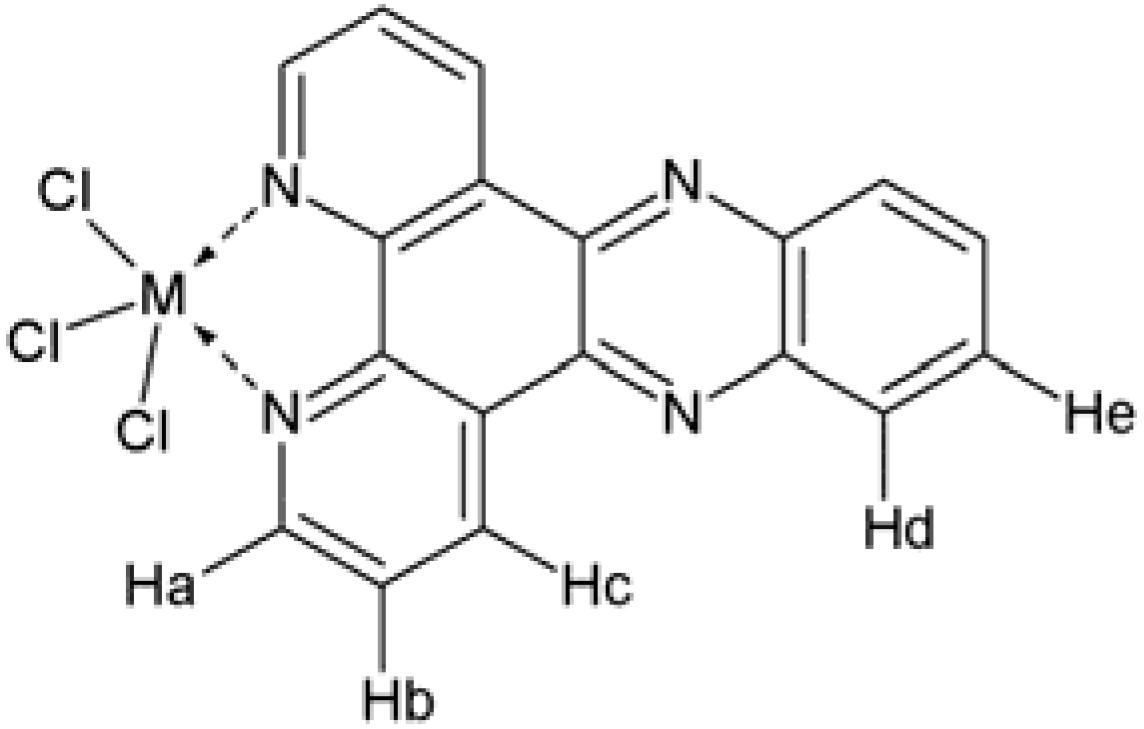
      <p>The <italic>Hc</italic> proton of dppz and both complexes showed resonances at very low field because they are also highly deshielded due to the anisotropic effect provided by the nitrogen atom of the pyrazine ring (<xref ref-type="fig" rid="molecules-17-12622-f001">Figure 1</xref>). <italic>Ha</italic> protons in proximity of the coordinating nitrogen atoms of dppz ligand experienced a downfield shift by about δ 0.08-0.16 in complexes <bold>1</bold> and <bold>2</bold>, respectively, indicating the involvement of the dppz nitrogens in coordination. The unequivocal proton NMR assignments were made by concerted analysis of 1D <sup>1</sup>H-, 1D <sup>13</sup>C-, 2D <sup>1</sup>H <sup>1</sup>H COSY and 2D <sup>1</sup>H <sup>13</sup>C-HMQC.</p>
      <fig id="molecules-17-12622-f001" position="float">
        <label>Figure 1</label>
        <caption>
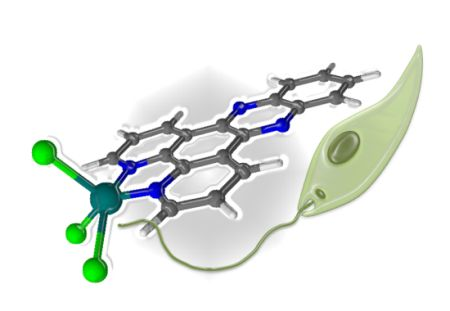
          <p>Molecular structure of [M(dppz)Cl<sub>3</sub>], with M= Sb or Bi.</p>
        </caption>
        <graphic xmlns:xlink="http://www.w3.org/1999/xlink" xlink:href="molecules-17-12622-g001.tif"/>
      </fig>
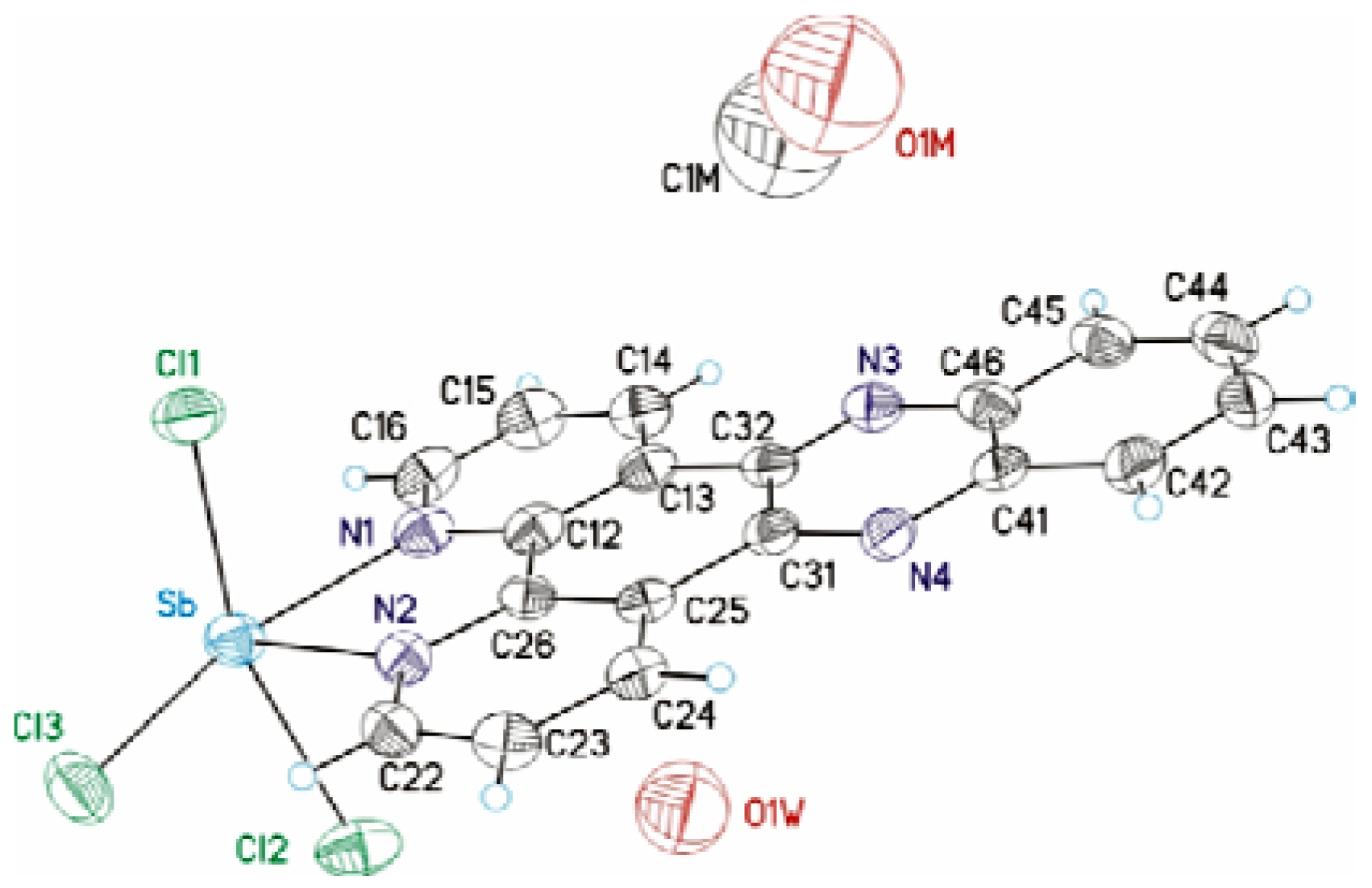
      <p>For both complexes, satisfactory elemental analyses of C, H and N were obtained. In complex <bold>1</bold> crystallization methanol and water molecules are present, as confirmed by its thermogravimetric curves which showed a weight loss of 8.26% (calc. 8.92%), nevertheless complex <bold>2</bold> did not have crystallization molecules. The asymmetric unit of complex <bold>1</bold> is shown in <xref ref-type="fig" rid="molecules-17-12622-f002">Figure 2</xref>. Crystal data and structure refinement parameter are given in <xref ref-type="table" rid="molecules-17-12622-t002">Table 2</xref> and the selected bonds length and angles are given in <xref ref-type="table" rid="molecules-17-12622-t003">Table 3</xref>.</p>
	  <fig id="molecules-17-12622-f002" position="float">
        <label>Figure 2</label>
        <caption>
          <p>Molecular structure of [Sb(dppz)Cl<sub>3</sub>].</p>
        </caption>
        <graphic xmlns:xlink="http://www.w3.org/1999/xlink" xlink:href="molecules-17-12622-g002.tif"/>
      </fig>
      
      <table-wrap id="molecules-17-12622-t002" position="float">
        <object-id pub-id-type="pii">molecules-17-12622-t002_Table 2</object-id>
        <label>Table 2</label>
        <caption>
          <p>Crystal data and structure refinement parameter for complex <bold>1</bold>.</p>
        </caption>
        <table>
          <thead>
            <tr>
              <th align="left" valign="middle"> </th>
              <th align="left" valign="middle">Sb(dppz)Cl<sub>3</sub></th>
            </tr>
          </thead>
          <tbody>
            <tr>
              <td align="left" valign="middle">Empirical formula</td>
              <td align="left" valign="middle">C<sub>19</sub>H<sub>10</sub>Cl<sub>3</sub> N<sub>4</sub>O<sub>1.25</sub>Sb</td>
            </tr>
            <tr>
              <td align="left" valign="middle">Formula weight </td>
              <td align="left" valign="middle">542.41</td>
            </tr>
            <tr>
              <td align="left" valign="middle">Temperature (K)</td>
              <td align="left" valign="middle">293(2)</td>
            </tr>
            <tr>
              <td align="left" valign="middle">Crystal system</td>
              <td align="left" valign="middle">Monoclinic</td>
            </tr>
            <tr>
              <td align="left" valign="middle">Space group</td>
              <td align="left" valign="middle">P2(1)/c</td>
            </tr>
            <tr>
              <td align="left" valign="middle">a (Å) </td>
              <td align="left" valign="middle">10.3244(2)</td>
            </tr>
            <tr>
              <td align="left" valign="middle">b (Å)</td>
              <td align="left" valign="middle">13.2760(3)</td>
            </tr>
            <tr>
              <td align="left" valign="middle">c (Å)</td>
              <td align="left" valign="middle">14.5753(3)</td>
            </tr>
            <tr>
              <td align="left" valign="middle"><italic>α</italic> (<sup>o</sup>)</td>
              <td align="left" valign="middle">90</td>
            </tr>
            <tr>
              <td align="left" valign="middle"><italic>β</italic> (<sup>o</sup>)</td>
              <td align="left" valign="middle">92.0930(19)</td>
            </tr>
            <tr>
              <td align="left" valign="middle"><italic>γ</italic> (<sup>o</sup>)</td>
              <td align="left" valign="middle">90</td>
            </tr>
            <tr>
              <td align="left" valign="middle"><italic>V</italic> (Å<sup>3</sup>)</td>
              <td align="left" valign="middle">1994.44(7)</td>
            </tr>
            <tr>
              <td align="left" valign="middle">
                <italic>Z</italic>
              </td>
              <td align="left" valign="middle">4</td>
            </tr>
            <tr>
              <td align="left" valign="middle"><italic>F</italic> (000)</td>
              <td align="left" valign="middle">1056</td>
            </tr>
            <tr>
              <td align="left" valign="middle">D<sub>calc</sub> (mg/m<sup>3</sup>)</td>
              <td align="left" valign="middle">1.805</td>
            </tr>
            <tr>
              <td align="left" valign="middle">Crystal dimensions mm<sup>3</sup></td>
              <td align="left" valign="middle">0.2 × 0.2 × 0.3</td>
            </tr>
            <tr>
              <td align="left" valign="middle"><italic>θ</italic> Range (<sup>o</sup>)</td>
              <td align="left" valign="middle">4.29-62.65</td>
            </tr>
            <tr>
              <td align="left" valign="middle">Reflections collected</td>
              <td align="left" valign="middle">9035</td>
            </tr>
            <tr>
              <td align="left" valign="middle">Independent reflection</td>
              <td align="left" valign="middle">3138</td>
            </tr>
            <tr>
              <td align="left" valign="middle">
                <italic>R<sub>int</sub></italic>
              </td>
              <td align="left" valign="middle">0.0355</td>
            </tr>
            <tr>
              <td align="left" valign="middle">Maximum/minimum transmission</td>
              <td align="left" valign="middle">1.000 / 0.30303</td>
            </tr>
            <tr>
              <td align="left" valign="middle">Data/restraints/parameters</td>
              <td align="left" valign="middle">3138 / 0 / 247</td>
            </tr>
            <tr>
              <td align="left" valign="middle">Goodness-of-fit on <italic>F<sup>2</sup></italic></td>
              <td align="left" valign="middle">1.060</td>
            </tr>
            <tr>
              <td align="left" valign="middle">Final <italic>R</italic> indices </td>
              <td align="left" valign="middle"><italic>R1</italic> = 0.0352, w<italic>R2</italic> = 0.0826</td>
            </tr>
            <tr>
              <td align="left" valign="middle">[I &gt; 2σ(I)]</td>
              <td align="left" valign="middle">2478</td>
            </tr>
            <tr>
              <td align="left" valign="middle"><italic>R</italic> indices (all data)</td>
              <td align="left" valign="middle"><italic>R1</italic> = 0.0522, w<italic>R2</italic> = 0.0886</td>
            </tr>
            <tr>
              <td align="left" valign="middle">Largest difference in peak/hole (e·A<sup>−3</sup>)</td>
              <td align="left" valign="middle">0.761 and −0.560</td>
            </tr>
          </tbody>
        </table>
      </table-wrap>
      <table-wrap id="molecules-17-12622-t003" position="float">
        <object-id pub-id-type="pii">molecules-17-12622-t003_Table 3</object-id>
        <label>Table 3</label>
        <caption>
          <p>Selected bond length (Å) and angles (°) for complex <bold>1</bold>.</p>
        </caption>
        <table>
          <tbody>
            <tr>
              <td align="left" valign="middle">Sb-N(2)</td>
              <td align="left" valign="middle">2.245(4)</td>
              <td align="left" valign="middle">N(2)-Sb-N(1)</td>
              <td align="left" valign="middle">71.44(14)</td>
            </tr>
            <tr>
              <td align="left" valign="middle">Sb-N(1)</td>
              <td align="left" valign="middle">2.345(4)</td>
              <td align="left" valign="middle">N(1)-Sb-Cl(3)</td>
              <td align="left" valign="middle">159.07(10)</td>
            </tr>
            <tr>
              <td align="left" valign="middle">Sb-Cl(3)</td>
              <td align="left" valign="middle">2.4992(15)</td>
              <td align="left" valign="middle">N(2)-Sb-Cl(3)</td>
              <td align="left" valign="middle">87.73(11)</td>
            </tr>
            <tr>
              <td align="left" valign="middle">Sb-Cl(1)</td>
              <td align="left" valign="middle">2.5126(13)</td>
              <td align="left" valign="middle">N(2)-Sb-Cl(1)</td>
              <td align="left" valign="middle">82.14(10)</td>
            </tr>
            <tr>
              <td align="left" valign="middle">Sb-Cl(2)</td>
              <td align="left" valign="middle">2.6348(14)</td>
              <td align="left" valign="middle">N(1)-Sb-Cl(1)</td>
              <td align="left" valign="middle">84.23(10)</td>
            </tr>
            <tr>
              <td align="left" valign="middle">N(1)-C(16)</td>
              <td align="left" valign="middle">1.334(6)</td>
              <td align="left" valign="middle">Cl(3)-Sb-Cl(1)</td>
              <td align="left" valign="middle">95.22(5)</td>
            </tr>
            <tr>
              <td align="left" valign="middle">N(1)-C(12)</td>
              <td align="left" valign="middle">1.351(6)</td>
              <td align="left" valign="middle">N(2)-Sb-Cl(2)</td>
              <td align="left" valign="middle">80.25(10)</td>
            </tr>
            <tr>
              <td align="left" valign="middle">N(2)-C(22)</td>
              <td align="left" valign="middle">1.336(6)</td>
              <td align="left" valign="middle">N(1)-Sb-Cl(2)</td>
              <td align="left" valign="middle">82.97(10)</td>
            </tr>
            <tr>
              <td align="left" valign="middle">N(2)-C(26)</td>
              <td align="left" valign="middle">1.368(6)</td>
              <td align="left" valign="middle">Cl(3)-Sb-Cl(2)</td>
              <td align="left" valign="middle">91.68(5)</td>
            </tr>
            <tr>
              <td align="left" valign="middle"> </td>
              <td align="left" valign="middle"> </td>
              <td align="left" valign="middle">Cl(1)-Sb-Cl(2)</td>
              <td align="left" valign="middle">160.80(5)</td>
            </tr>
          </tbody>
        </table>
      </table-wrap>
      <p>The geometry around the metal center is distorted square pyramidal (SP), with N(2) as the apex and Cl(1), Cl(2), Cl(3), N(1) occupying the equatorial plane. The four equatorial bonds are long (means 2,498 Å), while the apical donor atom form the strongest bond (Sb(1)-N(2) 2.245(4) Å). The sum of equatorial angles is 354° (Cl(3)-Sb-Cl(1) 95.22(5)°, Cl(3)-Sb-Cl(2) 91.68(5)°, N(1)-Sb(1)-Cl(1) 84.23(10)°, N(1)-Sb(1)-Cl(2) 82.97(10)°), which suggest some distortion from an ideal square pyramidal [<xref ref-type="bibr" rid="B30-molecules-17-12622">30</xref>]. As shown in <xref ref-type="fig" rid="molecules-17-12622-f002">Figure 2</xref>, the asymmetrical unit in the crystal contains one molecule of methanol and one of water besides the [Sb(dppz)Cl<sub>3</sub>] molecule.</p>
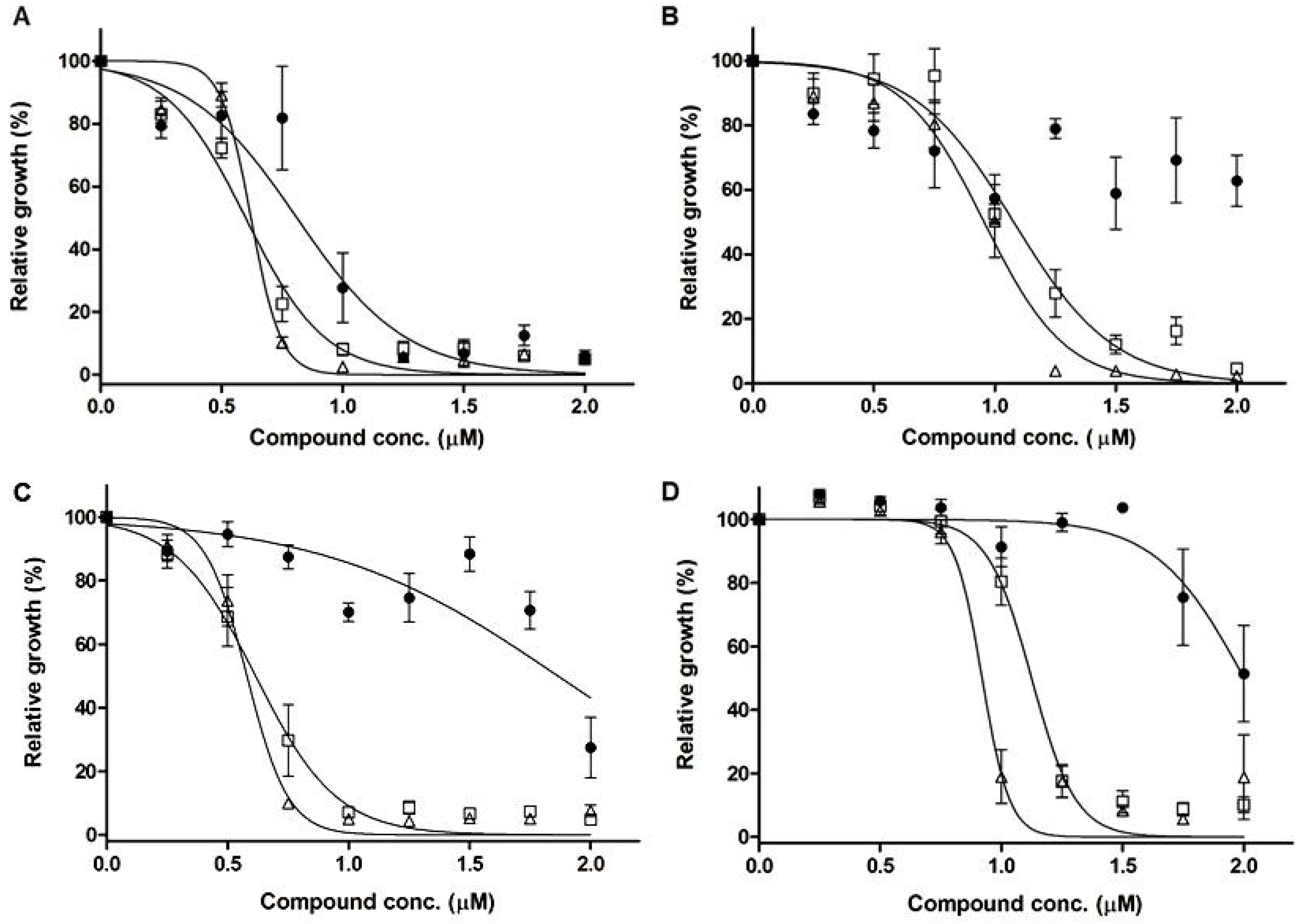
      <p>Both complexes <bold>1</bold> and <bold>2 </bold>were found to be highly active against <italic>Leishmania</italic> promastigote forms (<xref ref-type="fig" rid="molecules-17-12622-f003">Figure 3</xref>). The IC<sub>50</sub> for complexes <bold>1</bold> and <bold>2</bold> in the wild-type (WT) strains were similar, corresponding to ~0.6 and ~1 μM for <italic>L. infantum chagasi</italic> and <italic>L. amazonensis</italic>, respectively (<xref ref-type="table" rid="molecules-17-12622-t004">Table 4</xref>).</p>
	  <p>Strikingly, the IC<sub>50</sub> values for dppz complexes were similar when comparing the Sb-resistant mutants with their respective parental sensitive WT strains (<xref ref-type="table" rid="molecules-17-12622-t004">Table 4</xref>). This is in contrast with the trivalent potassium antimonyl tartrate that was much less active against Sb-resistant mutants (<xref ref-type="table" rid="molecules-17-12622-t004">Table 4</xref>).</p>
	  <fig id="molecules-17-12622-f003" position="float">
        <label>Figure 3</label>
        <caption>
          <p>Dppz-derived Sb(III) and Bi(III) complexes sensitivity profiles of antimony-sensitive and -resistant <italic>L. chagasi</italic> and <italic>L. amazonensis</italic> promastigotes. (<bold>A</bold>) <italic>L. chagasi</italic> BH400 wild-type; (<bold>B</bold>) <italic>L. amazonensis</italic> BA199 wild-type; (<bold>C</bold>) <italic>L. chagasi</italic> BH400Sb2700.2 (Sb-resistant); (<bold>D</bold>) <italic>L. amazonensis</italic> BA199Sb2700.2 (Sb-resistant). (•) dppz; (□) dppz/Bi; (∆) dppz/Sb. The <italic>Leishmania</italic> promastigotes were cultivated in 24-well cell culture plates containing 2 mL of α-MEM medium for 72 h at 25 °C. The resistant lines were previously selected <italic>in vitro</italic> by step wise drug selection. All data represent average of, at least, three independent experiments.</p>
        </caption>
        <graphic xmlns:xlink="http://www.w3.org/1999/xlink" xlink:href="molecules-17-12622-g003.tif"/>
      </fig>
      
      <table-wrap id="molecules-17-12622-t004" position="float">
        <object-id pub-id-type="pii">molecules-17-12622-t004_Table 4</object-id>
        <label>Table 4</label>
        <caption>
          <p>Inhibitory concentrations of dppz and its Sb(III) and Bi(III) complexes towards antimony-sensitive and -resistant New World <italic>Leishmania</italic> species.</p>
        </caption>
        <table>
<thead>
            <tr>
              <th rowspan="2" align="left" valign="middle">Strain</th>
              <th colspan="6" align="center" valign="middle" style="border-bottom:solid thin">IC<sub>50</sub> (μM) ± SEM (CI 95%)</th>
            </tr>
            <tr>
              <th valign="middle">Dppz</th>
              <th valign="middle">dppzBiCl<sub>3</sub></th>
              <th valign="middle">dppzSbCl<sub>3</sub></th>
              <th valign="middle">TA *</th>
              <th valign="middle">SbCl<sub>3</sub></th>
              <th valign="middle">BiCl<sub>3</sub></th>
            </tr>
          </thead>
          <tbody>
            <tr>
              <td rowspan="2" align="left" valign="top"><italic>L. infantum chagasi</italic> (WT)</td>
              <td align="center" valign="top">0.81 ± 0.04</td>
              <td align="center" valign="top">0.59 ± 0.01</td>
              <td align="center" valign="top">0.62 ± 0.01</td>
              <td rowspan="2" align="center" valign="top">100 ± 3</td>
              <td rowspan="2" align="center" valign="top">341 ± 2</td>
              <td rowspan="2" align="center" valign="top">563 ± 2</td>
            </tr>
            <tr>
              <td align="center" valign="top">(0.71–0.9)</td>
              <td align="center" valign="top">(0.56–0.63)</td>
              <td align="center" valign="top">(0.59–0.65)</td>
            </tr>
            <tr>
              <td rowspan="2" align="left" valign="top"><italic>L. infantum chagasi</italic> (SbR)</td>
              <td align="center" valign="top">1.86 ± 0.08</td>
              <td align="center" valign="top">0.61 ± 0.02</td>
              <td align="center" valign="top">0.57 ± 0.01</td>
              <td rowspan="2" align="center" valign="top">&gt;2,700</td>
              <td rowspan="2" align="center" valign="top">462 ± 3</td>
              <td rowspan="2" align="center" valign="top">&gt;500</td>
            </tr>
            <tr>
              <td align="center" valign="top">(1.69–2.03)</td>
              <td align="center" valign="top">(0.56–0.66)</td>
              <td align="center" valign="top">(0.55–0.60)</td>
            </tr>
            <tr>
              <td rowspan="2" align="left" valign="top"><italic>L. amazonensis</italic> (WT)</td>
              <td rowspan="2" align="center" valign="top">&gt;2</td>
              <td align="center" valign="top">1.07 ± 0.03</td>
              <td align="center" valign="top">0.95 ± 0.02</td>
              <td rowspan="2" align="center" valign="top">83 ± 1</td>
              <td rowspan="2" align="center" valign="top">362 ± 2</td>
              <td rowspan="2" align="center" valign="top">621 ± 2</td>
            </tr>
            <tr>
              <td align="center" valign="top">(1.01–1.14)</td>
              <td align="center" valign="top">(0.89–1.01)</td>
            </tr>
            <tr>
              <td rowspan="2" align="left" valign="top"><italic>L. amazonensis</italic> (SbR)</td>
              <td align="center" valign="top">2.00 ± 0.05</td>
              <td align="center" valign="top">1.12 ± 0.01</td>
              <td align="center" valign="top">0.92 ± 0.02</td>
              <td rowspan="2" align="center" valign="top">&gt;2,700</td>
              <td rowspan="2" align="center" valign="top">1503 ± 2</td>
              <td rowspan="2" align="center" valign="top">&gt;500</td>
            </tr>
            <tr>
              <td align="center" valign="top">(1.89–2.10)</td>
              <td align="center" valign="top">(1.08–1.16)</td>
              <td align="center" valign="top">(0.86-0.97)</td>
            </tr>
          </tbody>
        </table>
		<table-wrap-foot><fn><p><bold>*</bold> TA: potassium antimonyl tartrate as Sb(III) source; SEM:standard error of the mean; CI: confidence interval; SbR (Sb-resistant); The IC<sub>50</sub> values were calculated by non-linear regression.</p></fn></table-wrap-foot>
      </table-wrap>
      
      
      <p>When tested alone, dppz showed intrinsic activities against <italic>Leishmania</italic>, with IC<sub>50</sub> varying from 0.8 to ~2 μM for both Sb-sensitive or -resistant mutants of the two species studied (<xref ref-type="table" rid="molecules-17-12622-t004">Table 4</xref>). Interestingly, complexes <bold>1</bold> and <bold>2</bold>exhibited significantly higher antileishmanial activity than dppz itself, indicating an additional role of the metal (Sb(III) and Bi(III)) in the antileishmanial activity of the complexes (<xref ref-type="fig" rid="molecules-17-12622-f003">Figure 3</xref> and <xref ref-type="table" rid="molecules-17-12622-t004">Table 4</xref>). Since complexes <bold>1</bold> and <bold>2</bold> were at least 80-fold more active against WT <italic>Leishmania</italic> strains than trivalent potassium antimonyl tartrate, BiCl<sub>3</sub> and SbCl<sub>3</sub> (<xref ref-type="table" rid="molecules-17-12622-t004">Table 4</xref>), one can infer that the metal may not be active by itself and that the higher activity of the complexes compared to dppz may be related to the improved activity of dppz through metal complexation. The lower IC<sub>50</sub> value of antimonyl tartrate compared to SbCl<sub>3</sub> in WT <italic>L. amazonensis</italic> also illustrates that complexation of a cytotoxic metal ion may enhance its activity, presumably through improved delivery to the target. In the case of antimonyl tartrate, much greater IC<sub>50</sub> values were found in Sb-resistant mutants compared to the respective WT parental cells, demonstrating clearly that the metal ion contributes to the cytotoxicity of this Sb(III) complex. This is in contrast with the Sb(III)-dppz complex that was equally active against Sb-resistant and -sensitive <italic>Leishmania</italic> strains. Thus, the latter observation further supports the model that the metal is not directly responsible for the antileshmanial activity of Sb(III)-dppz complex. As shown in <xref ref-type="table" rid="molecules-17-12622-t005">Table 5</xref>, the cytotoxicity of dppz and its complexes against mouse peritoneal macrophages occurred at dppz concentrations at least 6-fold greater than those found to be active against <italic>Leishmania</italic> promastigotes, indicating the selectivity of the complexes towards <italic>Leishmania</italic> parasites.</p>
      <table-wrap id="molecules-17-12622-t005" position="float">
        <object-id pub-id-type="pii">molecules-17-12622-t005_Table 5</object-id>
        <label>Table 5</label>
        <caption>
          <p>Cytotoxicity of dppz and its Sb(III) and Bi(III) complexes against mouse peritoneal macrophages.</p>
        </caption>
        <table>
  <thead>
            <tr>
              <th align="left" valign="middle"> </th>
              <th align="center" valign="middle">Dppz</th>
              <th align="center" valign="middle">[Bi(dppz)Cl<sub>3</sub>]</th>
              <th align="center" valign="middle">[Sb(dppz)Cl<sub>3</sub>]</th>
            </tr>
          </thead>
          <tbody>
            <tr>
              <td align="left" valign="middle">CC<sub>50</sub> (μM) *</td>
              <td align="center" valign="middle">12.5</td>
              <td align="center" valign="middle">4.8</td>
              <td align="center" valign="middle">7.0</td>
            </tr>
            <tr>
              <td align="left" valign="middle">SI <sup>#</sup></td>
              <td align="center" valign="middle">15.4</td>
              <td align="center" valign="middle">8.1</td>
              <td align="center" valign="middle">11.3</td>
            </tr>
          </tbody>
        </table>
		<table-wrap-foot><fn><p>* CC<sub>50</sub>: concentration of dppz which is cytotoxic against 50% of macrophages; <sup>#</sup> SI: selective index, calculated as the ratio between CC<sub>50</sub> in murine macrophages and IC<sub>50</sub> in <italic>L. infantum chagasi</italic> (WT).</p></fn></table-wrap-foot>
      </table-wrap>
      
      <p>The <italic>L. infantum chagasi</italic> is the etiological agent for visceral leishmaniasis [<xref ref-type="bibr" rid="B31-molecules-17-12622">31</xref>] while <italic>L. amazonensis</italic> is related to the cutaneous form of the disease in the New World [<xref ref-type="bibr" rid="B32-molecules-17-12622">32</xref>]. Since these two species are causative agents of different clinical manifestations, they might also differ metabolically which reflect in their distinct drug sensitivity. This observation highlights the importance to use different <italic>Leishmania</italic> species for drug prospecting screening [<xref ref-type="bibr" rid="B33-molecules-17-12622">33</xref>]. In addition to the high antileishmanial activity of <bold>1</bold> and <bold>2</bold>, both complexes can bypass the Sb-resistance of <italic>Leishmania</italic> in two different species of Sb-resistant <italic>Leishmania</italic> mutants (<xref ref-type="table" rid="molecules-17-12622-t004">Table 4</xref>). The Sb-resistant selected lines of <italic>L. infantum chagasi</italic> BH400 Sb2700.2 and <italic>L. amazonensis</italic> BA199 Sb2700.2 were able to grow in the presence of Sb concentrations greater than 2700 μM, but failed to grow up in the presence of ≤1.12 μM of <bold>1</bold> and/or <bold>2</bold> (<xref ref-type="table" rid="molecules-17-12622-t004">Table 4</xref>). Thus, this data taken altogether indicates that complexes <bold>1</bold> and <bold>2</bold> are very promising drug candidates for the treatment of Sb-resistant leishmaniasis.</p>
      <p>An important physical characteristic that affects the bioavailability of a compound is its lipophilicity. Therefore a relatively optimal lipophilicity should be critical for a good drug candidate.</p>
      <p>The lipophilicity of the complexes <bold>1</bold> and <bold>2</bold> was determined by measuring their octanol/water partition coefficients (log P). The log P values of the free dppz ligand was calculated using the online program ALOGSP 2.1. The log P values for dppz and complexes <bold>1</bold> and <bold>2</bold> are respectively 2.77 ± 0.76; 0.94 ± 0.24 and 0.98 ± 0.17. More positive log P values correspond to more lipophilic compounds, whereas more negative log P values correspond to more hydrophilic ones. This data indicates that complexation with Sb(III) and Bi(III) makes dppz less lipophilic. Interestingly, the antileishmanial activity profile follows the hydrophilicity profile of the compound, <italic>i.e.</italic>, the more hydrophilic, the more active.</p>
      <p>A possible explanation for the leishmanicidal activity of dppz complexes is their interaction with parasite DNA through intercalation, a mechanism recently suggested by Navarro and co-workers [<xref ref-type="bibr" rid="B34-molecules-17-12622">34</xref>]. They described both Cu(II) and Au(III) complexes with dppz showing a potent leishmanicidal activity against both promastigotes of <italic>Leishmania</italic> (<italic>Leishmania</italic>) <italic>mexicana and Leishmania</italic> (<italic>Viannia</italic>) <italic>braziliensis</italic> [<xref ref-type="bibr" rid="B34-molecules-17-12622">34</xref>]. Although the best-known type of interaction of the polypyridyl complexes with DNA is the intercalation, highly reactive metal complexes containing reactive Cl could form the covalent bonds with DNA, as reported for [Ru(tpy)(pap)(CH<sub>3</sub>CN)](ClO<sub>4</sub>)<sub>2</sub>and [Ru(tpy)(dppz)(CH<sub>3</sub>CN)]<sup>2+</sup>[<xref ref-type="bibr" rid="B35-molecules-17-12622">35</xref>,<xref ref-type="bibr" rid="B36-molecules-17-12622">36</xref>]. In future studies, the interaction of Sb(III) and Bi(III) dppz complexes with DNA should be investigated, as a possible mechanism of cytotoxicity. In our work the differences in observed cytotoxicities of the complexes compared to dppz could be attributed to the changes in dppz lipophilicity following the coordination by SbCl<sub>3</sub> and BiCl<sub>3</sub>. The metal complexation to dppz probably leads to an increase of dppz bioavailability.</p>
    </sec>
    <sec sec-type="methods">
      <title>3. Experimental</title>
      <sec>
        <title>3.1. General</title>
        <p>Commercially available methanol was dried before use. All the preparations were done under anhydrous conditions. dppz was synthesized by a condensation of 1,10-phenanthroline-5,6-dione and <italic>ortho</italic>-phenylenediamine according to the procedure described by Liang [<xref ref-type="bibr" rid="B37-molecules-17-12622">37</xref>]. Sb(III) chloride (SbCl<sub>3</sub>) and Bi(III) chloride (BiCl<sub>3</sub>), from Sigma-Aldrich (St. Louis, MO, USA) were used without further purification. Elemental analyses for C, H and N were carried out with a Perkin Elmer PE-2400 instrument. IR spectra in the 4,000–400 cm<sup>−1</sup> region were obtained for KBr pellets, with a Perkin Elmer RX-83303. The absorption spectra were recorded on a Varian Cary 100 <italic>UV-Visible</italic> Spectrophotometer.</p>
        <p>NMR spectra were recorded at 400 MHz using Bruker DPX-400 spectrometer. <sup>1</sup>H- and <sup>13</sup>C-NMR chemical shifts were measured relative to tetramethylsilane (TMS) and dimethyl sulfoxide-d<sub>6</sub> (DMSO-<italic>d</italic><sub>6</sub>) as the solvent. Intensity data for the X-ray were collected with Xcalibru Atlas Gemini ultra. Crystallographic data and experimental details of the structure determinations are listed in <xref ref-type="table" rid="molecules-17-12622-t001">Table 1</xref>. </p>
      </sec>
      <sec>
        <title>3.2. Synthesis of the Complexes [Sb(dppz)Cl<sub>3</sub>] and [Bi(dppz)Cl<sub>3</sub>]</title>
        <sec>
          <title>3.2.1. Synthesis of [Sb(dppz)Cl<sub>3</sub>] (<bold>1</bold>)</title>
          <p>A solution of dipyrido[3,2-a:2',3'-c]phenazine (0.05 g, 0.18 mmol) in dry methanol (26 mL) was added slowly to a freshly prepared antimony trichloride (0.041 g SbCl<sub>3</sub>, 0.18 mmol in 10 mL of dry methanol) solution at room temperature. The reaction mixture was stirred for 6 hours at 40 °C. The resulting clear solution was kept in the darkness at room temperature to give yellow crystals. Yield: 82.9% (0.92 g). IR (KBr, cm<sup>−1</sup>): 1614, 1578 <italic>ν</italic>(C=C, C=N); 1,138, 818, 724 δ(Csp<sup>2</sup>-H). <sup>1</sup>H-NMR (DMSO-<italic>d</italic><sub>6</sub> 400 MHz): δ 9.68 (dd, Hc); 9.31 (dd, Ha); 8.39 (q, Hd); 8.21–8.08 (m, He and Hb). Thermogravimetric and crystal data indicated the presence of one crystallization molecule of water and methanol. Elemental analysis for C<sub>19</sub>H<sub>16</sub>Cl<sub>3</sub>N<sub>4</sub>O<sub>2</sub>Sb, calc. (found): C% 40.70 (41.21); H% 2.86 (2.73); N% 10.00 (10.25).</p>
        </sec>
        <sec>
          <title>3.2.2. Synthesis of [Bi(dppz)Cl<sub>3</sub>] (<bold>2</bold>)</title>
          <p>A solution of dipyrido[3,2-a:2',3'-c]phenazine (0.07 g, 0.25 mmol) in dry methanol (26 mL) was added slowly to a freshly prepared antimony trichloride (0.079 g BiCl<sub>3</sub>, 0.25 mmol in 10 mL of dry methanol) solution at room temperature. The reaction mixture was stirred for 3 h at 40 °C and the resulting precipitatate was filtered and dried. Yield: 82.9% (0.123 g). IR (KBr, cm<sup>−1</sup>): 1,614, 1,574 <italic>ν</italic>(C=C, C=N); 1,140, 816, 730 δ(Csp<sup>2</sup>-H). <sup>1</sup>H-NMR (DMSO-<italic>d</italic><sub>6</sub> 400 MHz): δ 9.54 (dd, Hc); 9.39 (dd, Ha); 8.32 (q, Hd); 8.04–8.08 (m, He and Hb). Elemental analysis for C<sub>18</sub>H<sub>12</sub>Cl<sub>3</sub>N<sub>4</sub>Bi, calc. (found): C% 36.15 (36.21); H% 1.67 (1.63); N% 9.37 (9.19).</p>
        </sec>
        <sec>
          <title>3.2.3. Stability of the Complexes</title>
          <p>The stability of the complexes was checked by UV absorption spectroscopy. For this purpose, UV absorption spectra were registered at different time intervals (from 0 to 4 h) for dppz and complexes <bold>1</bold> and <bold>2</bold> at 10 µmol·L<sup>−1</sup> in DMSO, DMSO-containing water and octanol. The spectra of the complexes were different from that of dppz and did not show significant changes as a function of time.</p>
        </sec>
      </sec>
      <sec>
        <title>3.3. X-ray Crystallography</title>
        <p>Single crystal X-ray diffraction data were obtained at room temperature on a Xcalibur Atlas Gemini Ultra diffractometer, using graphite monochromated MoKα radiation (λ = 0.71069 Å). Final unit cell parameters and the integration of the collected reflections were performed using the CRYSALISPRO software (Version 1.171.33.55 release 05-01-2010 CrysAlis171.NET). The structure solutions and full-matrix least-squares refinements based on <italic>F</italic><sup>2</sup> were performed with the SHELXS-97 and SHELXL-97 program package [<xref ref-type="bibr" rid="B38-molecules-17-12622">38</xref>]. All atoms except hydrogen were refined anisotropically. Although many hydrogen atoms could be identified in a Fourier difference map all of them were geometrically added to the structure and then refined by the riding model in the final stages. Details of data collection and structure refinement are given in <xref ref-type="table" rid="molecules-17-12622-t002">Table 2</xref>. Selected distances and angles are given in <xref ref-type="table" rid="molecules-17-12622-t003">Table 3</xref>. The crystallographic data were deposited at Cambridge Crystallographic Data Center on CCDC 874746.</p>
      </sec>
      <sec>
        <title>3.4. Antileishmanial and Cytotoxic Activities</title>
        <sec>
          <title>3.4.1. Parasite Culture</title>
          <p><italic>Leishmania</italic> (<italic>Leishmania</italic>) <italic>amazonensis</italic> (strain MHOM/BR/1989/BA199) and <italic>Leishmania</italic> (<italic>Leishmania</italic>)<italic>infantum chagasi</italic> (strain MCAN/BR/2002/BH400) promastigotes were maintained in minimum essential culture medium (α-MEM) (Gibco, Invitrogen, Grand Island, NY, USA) supplemented with 10% (v/v) heat inactivated fetal calf serum (Cultilab, Campinas, SP, Brazil), 100 mg/mL kanamycin, 50 mg/mL ampicillin, 2 mM L-glutamine, 5 mg/mL hemin, 5 mM biopterin, (Sigma-Aldrich), pH 7.0 and incubated at 25 °C. <italic>L. amazonensis</italic> and <italic>L. infantum chagasi</italic> were selected for Sb(III) resistance as previously decribed [<xref ref-type="bibr" rid="B39-molecules-17-12622">39</xref>,<xref ref-type="bibr" rid="B40-molecules-17-12622">40</xref>]. The Sb(III)-resistant mutants <italic>L. amazonensis</italic> BA199Sb2700.2 and <italic>L. infantum chagasi</italic> BH400Sb2700.2 were selected in 25 cm<sup>2</sup> flasks containing 5 mL of α-MEM in the presence of increasing Sb(III) concentrations up to 2,700 μM.</p>
        </sec>
        <sec>
          <title>3.4.2. Antileishmanial Activity Assay</title>
          <p>Complexes <bold>1</bold> and <bold>2</bold> were evaluated <italic>in vitro</italic> for their activity against both Sb(III)-sensitive and -resistant <italic>Leishmania</italic> parasites. Log-phase <italic>L. amazonensis</italic> and <italic>L. infantum chagasi</italic> promastigotes (1 × 10<sup>6</sup> parasites/mL) were seeded in 24-wells cell culture plates with 1.5 mL of α-MEM, incubated under shaking at 25 °C during 72 h in the presence of several concentrations of complex <bold>1</bold> or <bold>2</bold>. Controls were performed using cultures in the presence of potassium antimonyl tartrate, SbCl<sub>3</sub>, BiCl<sub>3</sub> and dppz itself. Non-treated parasites were established for growth comparison. Stock solutions of dppz, its complexes, SbCl<sub>3</sub> and BiCl<sub>3</sub> were dissolved in DMSO (5 M) and diluted in α-MEM cell culture medium to obtain the range of tested concentrations. The final DMSO concentration did not exceed 0.2%, which is known to be nontoxic to <italic>Leishmania</italic> parasites [<xref ref-type="bibr" rid="B41-molecules-17-12622">41</xref>,<xref ref-type="bibr" rid="B42-molecules-17-12622">42</xref>]. For drug susceptibility assay, <italic>Leishmania</italic> growth curves were constructed by measuring absorbance at 600 nm [<xref ref-type="bibr" rid="B43-molecules-17-12622">43</xref>]. The antileishmanial activity is expressed as IC<sub>50</sub>/72 h, which is the concentration that reduces cell growth by 50% compared to untreated control (relative growth). All experiments were done at least three times as independent experiments performed in triplicate.</p>
        </sec>
        <sec>
          <title>3.4.3. Cytotoxicity Assay against Peritoneal Macrophages</title>
          <p>The concentration of studied compounds which is cytotoxic to 50% of the macrophages (CC<sub>50</sub>) was determined by 3-(4,5-dimethylthiazol-2-yl)-2,5 diphenyltetrazolium bromide (MTT) method according to Mosmann [<xref ref-type="bibr" rid="B44-molecules-17-12622">44</xref>]. Macrophages were obtained by lavage of peritoneal cavity of mice with 10 mL cold RPMI without FBS. After washing, the cell suspension (4.0 × 10<sup>6</sup>/mL) was seeded (0.1 mL) in 96-well flat bottom plates. Macrophages were allowed to adhere for 2 h and non-adherent cells were removed by washing with RPMI. Then, the studied compounds were added to the wells at concentrations ranging from 1 to 20 μM and the cells were further cultured in RPMI-1640 supplemented with 10% FBS for 24 h at 37 °C in a humidified 5% CO<sub>2</sub> atmosphere. Thereafter, the medium was replaced with fresh RPMI containing 0.5 mg/mL of MTT and the plates were incubated for additional 4 h. Supernatants were aspirated and the formazan crystals formed were dissolved in 100 μL of DMSO. After 15 min of incubation at room temperature, absorbance of solubilized MTT formazan product was spectrophotometrically measured at 570 nm.</p>
        </sec>
      </sec>
      <sec>
        <title>3.5. Statistical Analysis</title>
        <p>The IC<sub>50</sub> and CC<sub>50</sub> values were calculated by nonlinear regression using the software GraphPad Prism 5.0. The acceptable level of significance was 95% (<italic>p</italic> &lt; 0.05).</p>
      </sec>
      <sec>
        <title>3.6. n-Octanol/Water Partition Coefficient</title>
        <p>Log P values were determined by the Shake-Flask method dissolving complexes <bold>1</bold> and <bold>2</bold> in octanol-saturated aqueous phosphate buffer (pH 6.8) to a concentration at which the solution was still unsaturated but close to saturation, 10 and 5 µmol·L<sup>−1</sup>, respectively. Then, three different partition system were prepared by adding these solutions to water-saturated octanol, in octanol/water volume ratios, 1:1, 1:2 and 2:1 in duplicate. The mixtures were vortexed for 10 min and then centrifuged for 5 min. The partition coefficients were determined using the absorbance of complexes <bold>1</bold> and <bold>2</bold>. Calculated dppz log P value was obtained from the program ALOGPS 2.143 available on line. The feasibility of ALOGPS 2.143 ability to predict partition coefficient was successfully demonstrated [<xref ref-type="bibr" rid="B45-molecules-17-12622">45</xref>].</p>
      </sec>
    </sec>
    <sec sec-type="conclusions">
      <title>4. Conclusions</title>
      <p>Two novel complexes of Sb(III) and Bi(III) with dppz were synthesized in reasonably good yields and characterized as [Sb(dppz)Cl<sub>3</sub>]∙H<sub>2</sub>O∙CH<sub>3</sub>OH and [Bi(dppz)Cl<sub>3</sub>]. These complexes were more effective than dppz alone and at least 77 and 2,400 times more active than potassium antimonyl tartrate against Sb(III)-sensitive and -resistant <italic>Leishmania</italic>, respectively. The lack of cross-resistance to the Sb(III)-dppz complex, together with the much lower activity of antimonyl tartrate, SbCl<sub>3</sub> and BiCl<sub>3</sub> strongly support the model that the metal is not active by itself but improves the activity of dppz through complexation. Complexation was found to decrease the lipophilicity of dppz, suggesting the role of this factor in the improved antileishmanial activity of the complexes. The present work successfully applied a novel approach, based on tests against metal-resistant mutants and their respective parental sensitive strains, to get insight into the role of the metal in the cytotoxicity of metal complexes.</p>
    </sec>
    
  </body>
  <back><ack>
      <title>Acknowledgments</title>
      <p>The authors are grateful to the Brazilian agencies CNPq, FAPEMIG and CAPES for financial support.</p>
      
    </ack>
    <ref-list>
      <title>References</title>
      <ref id="B1-molecules-17-12622">
        <label>1.</label>
        <citation citation-type="journal">
          <person-group person-group-type="author">
            <name>
              <surname>Marsden</surname>
              <given-names>P.D.</given-names>
            </name>
          </person-group>
          <article-title>Pentavalent antimonials: Old drugs for new diseases</article-title>
          <source>Rev. Soc. Bras. Med. Trop.</source>
          <year>1985</year>
          <volume>18</volume>
          <fpage>187</fpage>
          <lpage>198</lpage>
        </citation>
      </ref>
      <ref id="B2-molecules-17-12622">
        <label>2.</label>
        <citation citation-type="journal">
          <person-group person-group-type="author">
            <name>
              <surname>Frézard</surname>
              <given-names>F.</given-names>
            </name>
            <name>
              <surname>Demicheli</surname>
              <given-names>C.</given-names>
            </name>
            <name>
              <surname>Ribeiro</surname>
              <given-names>R.R.</given-names>
            </name>
          </person-group>
          <article-title>Pentavalent antimonials: New perspectives for old drugs</article-title>
          <source>Molecules</source>
          <year>2009</year>
          <volume>14</volume>
          <fpage>2317</fpage>
          <lpage>2336</lpage>
        <pub-id pub-id-type="doi">10.3390/molecules14072317</pub-id><pub-id pub-id-type="pmid">19633606</pub-id></citation>
      </ref>
      <ref id="B3-molecules-17-12622">
        <label>3.</label>
        <citation citation-type="journal">
          <person-group person-group-type="author">
            <name>
              <surname>Frézard</surname>
              <given-names>F.</given-names>
            </name>
            <name>
              <surname>Demicheli</surname>
              <given-names>C.</given-names>
            </name>
            <name>
              <surname>Ferreira</surname>
              <given-names>C.S.</given-names>
            </name>
            <name>
              <surname>Costa</surname>
              <given-names>M.A.P.</given-names>
            </name>
          </person-group>
          <article-title>Glutathione-induced conversion of pentavalent antimony to trivalent antimony in meglumine antimoniate</article-title>
          <source>Antimicrob. Agents Chemother.</source>
          <year>2001</year>
          <volume>45</volume>
          <fpage>913</fpage>
          <lpage>916</lpage>
        <pub-id pub-id-type="doi">10.1128/AAC.45.3.913-916.2001</pub-id><pub-id pub-id-type="pmid">11181379</pub-id></citation>
      </ref>
      <ref id="B4-molecules-17-12622">
        <label>4.</label>
        <citation citation-type="journal">
          <person-group person-group-type="author">
            <name>
              <surname>Ferreira</surname>
              <given-names>C.D.</given-names>
            </name>
            <name>
              <surname>Martins</surname>
              <given-names>P.S.</given-names>
            </name>
            <name>
              <surname>Demicheli</surname>
              <given-names>C.</given-names>
            </name>
            <name>
              <surname>Brochu</surname>
              <given-names>C.</given-names>
            </name>
            <name>
              <surname>Ouellette</surname>
              <given-names>M.</given-names>
            </name>
            <name>
              <surname>Frézard</surname>
              <given-names>F.</given-names>
            </name>
          </person-group>
          <article-title>Thiol-induced reduction of antimony(V) into antimony(III): A comparative study with trypanothione, cysteinyl-glycine, cysteine and glutathion</article-title>
          <source>Biometals</source>
          <year>2003</year>
          <volume>16</volume>
          <fpage>441</fpage>
          <lpage>446</lpage>
          <pub-id pub-id-type="doi">10.1023/A:1022823605068</pub-id>
        </citation>
      </ref>
      <ref id="B5-molecules-17-12622">
        <label>5.</label>
        <citation citation-type="journal">
          <person-group person-group-type="author">
            <name>
              <surname>Sundar</surname>
              <given-names>S.</given-names>
            </name>
            <name>
              <surname>More</surname>
              <given-names>D.K.</given-names>
            </name>
            <name>
              <surname>Singh</surname>
              <given-names>M.K.</given-names>
            </name>
            <name>
              <surname>Singh</surname>
              <given-names>V.P.</given-names>
            </name>
            <name>
              <surname>Sharma</surname>
              <given-names>S.</given-names>
            </name>
            <name>
              <surname>Makharia</surname>
              <given-names>A.</given-names>
            </name>
            <name>
              <surname>Kumar</surname>
              <given-names>P.C.K.</given-names>
            </name>
            <name>
              <surname>Murray</surname>
              <given-names>H.W.</given-names>
            </name>
          </person-group>
          <article-title>Failure of pentavalent antimony in visceral leishmaniasis in India: Report from the center of the Indian epidemic</article-title>
          <source>Clin. Infect. Dis.</source>
          <year>2000</year>
          <volume>31</volume>
          <fpage>1104</fpage>
          <lpage>1107</lpage>
        <pub-id pub-id-type="doi">10.1086/318121</pub-id><pub-id pub-id-type="pmid">11049798</pub-id></citation>
      </ref>
      <ref id="B6-molecules-17-12622">
        <label>6.</label>
        <citation citation-type="journal">
          <person-group person-group-type="author">
            <name>
              <surname>Ouellette</surname>
              <given-names>M.</given-names>
            </name>
            <name>
              <surname>Légaré</surname>
              <given-names>D.</given-names>
            </name>
            <name>
              <surname>Haimeur</surname>
              <given-names>A.</given-names>
            </name>
            <name>
              <surname>Grondin</surname>
              <given-names>K.</given-names>
            </name>
            <name>
              <surname>Roy</surname>
              <given-names>G.</given-names>
            </name>
            <name>
              <surname>Brochu</surname>
              <given-names>C.</given-names>
            </name>
            <name>
              <surname>Papadopoulou</surname>
              <given-names>B.</given-names>
            </name>
          </person-group>
          <article-title>ABC transporters in <italic>Leishmania</italic> and their role in drug resistance</article-title>
          <source>Drug Resist. Updat.</source>
          <year>1998</year>
          <volume>1</volume>
          <fpage>43</fpage>
          <lpage>48</lpage>
          <pub-id pub-id-type="doi">10.1016/S1368-7646(98)80213-6</pub-id>
        </citation>
      </ref>
      <ref id="B7-molecules-17-12622">
        <label>7.</label>
        <citation citation-type="journal">
          <person-group person-group-type="author">
            <name>
              <surname>Légaré</surname>
              <given-names>D.</given-names>
            </name>
            <name>
              <surname>Richard</surname>
              <given-names>D.</given-names>
            </name>
            <name>
              <surname>Mukhopadhyay</surname>
              <given-names>R.</given-names>
            </name>
            <name>
              <surname>Stierhof</surname>
              <given-names>Y.D.</given-names>
            </name>
            <name>
              <surname>Rosen</surname>
              <given-names>B.P.</given-names>
            </name>
            <name>
              <surname>Haimeur</surname>
              <given-names>A.</given-names>
            </name>
            <name>
              <surname>Papadopoulou</surname>
              <given-names>B.</given-names>
            </name>
            <name>
              <surname>Ouellette</surname>
              <given-names>M.</given-names>
            </name>
          </person-group>
          <article-title>The <italic>Leishmania</italic> ATP-binding cassette protein PGPA is an intracellular metal-thiol transporter ATPase</article-title>
          <source>J. Biol. Chem.</source>
          <year>2001</year>
          <volume>276</volume>
          <fpage>26301</fpage>
          <lpage>26307</lpage>
        <pub-id pub-id-type="doi">10.1074/jbc.M102351200</pub-id><pub-id pub-id-type="pmid">11306588</pub-id></citation>
      </ref>
      <ref id="B8-molecules-17-12622">
        <label>8.</label>
        <citation citation-type="journal">
          <person-group person-group-type="author">
            <name>
              <surname>Shaked-Mishan</surname>
              <given-names>P.</given-names>
            </name>
            <name>
              <surname>Ulrich</surname>
              <given-names>N.</given-names>
            </name>
            <name>
              <surname>Ephros</surname>
              <given-names>M.</given-names>
            </name>
            <name>
              <surname>Zilberstein</surname>
              <given-names>D.</given-names>
            </name>
          </person-group>
          <article-title>Novel intracellular Sb<sup>V</sup> reducing activity correlates with antimony susceptibility in <italic>Leishmania donovani</italic></article-title>
          <source>J. Biol. Chem.</source>
          <year>2001</year>
          <volume>276</volume>
          <fpage>3971</fpage>
          <lpage>3976</lpage>
        <pub-id pub-id-type="doi">10.1074/jbc.M005423200</pub-id><pub-id pub-id-type="pmid">11110784</pub-id></citation>
      </ref>
      <ref id="B9-molecules-17-12622">
        <label>9.</label>
        <citation citation-type="journal">
          <person-group person-group-type="author">
            <name>
              <surname>Gourbal</surname>
              <given-names>B.</given-names>
            </name>
            <name>
              <surname>Sonuc</surname>
              <given-names>N.</given-names>
            </name>
            <name>
              <surname>Bhattacharjee</surname>
              <given-names>H.</given-names>
            </name>
            <name>
              <surname>Légaré</surname>
              <given-names>D.</given-names>
            </name>
            <name>
              <surname>Sundar</surname>
              <given-names>S.</given-names>
            </name>
            <name>
              <surname>Ouellette</surname>
              <given-names>M.</given-names>
            </name>
            <name>
              <surname>Rosen</surname>
              <given-names>B.P.</given-names>
            </name>
            <name>
              <surname>Mukhopadhyay</surname>
              <given-names>R.</given-names>
            </name>
          </person-group>
          <article-title>Drug uptake and modulation of drug resistance in <italic>Leishmania</italic> by an aquaglyceroporin</article-title>
          <source>J. Biol. Chem.</source>
          <year>2004</year>
          <volume>279</volume>
          <fpage>31010</fpage>
          <lpage>31017</lpage>
        <pub-id pub-id-type="doi">10.1074/jbc.M403959200</pub-id><pub-id pub-id-type="pmid">15138256</pub-id></citation>
      </ref>
      <ref id="B10-molecules-17-12622">
        <label>10.</label>
        <citation citation-type="journal">
          <person-group person-group-type="author">
            <name>
              <surname>Ayres</surname>
              <given-names>D.C.</given-names>
            </name>
            <name>
              <surname>Pinto</surname>
              <given-names>L.A.</given-names>
            </name>
            <name>
              <surname>Giorgio</surname>
              <given-names>S.</given-names>
            </name>
          </person-group>
          <article-title>Efficacy of pentavalent antimony, amphotericin B, and miltefosine in <italic>Leishmania amazonensis</italic>-infected macrophages under normoxic and hypoxic conditions</article-title>
          <source>J. Parasitol.</source>
          <year>2008</year>
          <volume>94</volume>
          <fpage>1415</fpage>
          <lpage>1417</lpage>
          <pub-id pub-id-type="doi">10.1645/GE-1613.1</pub-id>
        </citation>
      </ref>
      <ref id="B11-molecules-17-12622">
        <label>11.</label>
        <citation citation-type="journal">
          <person-group person-group-type="author">
            <name>
              <surname>Silvestru</surname>
              <given-names>C.</given-names>
            </name>
            <name>
              <surname>Socaciu</surname>
              <given-names>C.</given-names>
            </name>
            <name>
              <surname>Bara</surname>
              <given-names>A.</given-names>
            </name>
            <name>
              <surname>Haiduc</surname>
              <given-names>I.</given-names>
            </name>
          </person-group>
          <article-title>The first organoantimony(III) compounds possessing antitumor properties: Diphenylantimony(III) derivatives of dithiophosphorus ligand</article-title>
          <source>Anticancer Res.</source>
          <year>1990</year>
          <volume>10</volume>
          <fpage>803</fpage>
          <lpage>804</lpage>
        <pub-id pub-id-type="pmid">2369094</pub-id></citation>
      </ref>
      <ref id="B12-molecules-17-12622">
        <label>12.</label>
        <citation citation-type="journal">
          <person-group person-group-type="author">
            <name>
              <surname>Sereno</surname>
              <given-names>D.</given-names>
            </name>
            <name>
              <surname>Holzmuller</surname>
              <given-names>P.</given-names>
            </name>
            <name>
              <surname>Mangot</surname>
              <given-names>I.</given-names>
            </name>
            <name>
              <surname>Cuny</surname>
              <given-names>G.</given-names>
            </name>
            <name>
              <surname>Ouaissi</surname>
              <given-names>A.</given-names>
            </name>
            <name>
              <surname>Lemesre</surname>
              <given-names>J.L.</given-names>
            </name>
          </person-group>
          <article-title>Antimonial-mediated DNA fragmentation in <italic>Leishmania infantum</italic> amastigotes</article-title>
          <source>Antimicrob. Agents Chemother.</source>
          <year>2001</year>
          <volume>45</volume>
          <fpage>2064</fpage>
          <lpage>2069</lpage>
          <pub-id pub-id-type="doi">10.1128/AAC.45.7.2064-2069.2001</pub-id>
        </citation>
      </ref>
      <ref id="B13-molecules-17-12622">
        <label>13.</label>
        <citation citation-type="journal">
          <person-group person-group-type="author">
            <name>
              <surname>Moreira</surname>
              <given-names>W.</given-names>
            </name>
            <name>
              <surname>Leprohon</surname>
              <given-names>P.</given-names>
            </name>
            <name>
              <surname>Ouellette</surname>
              <given-names>M.</given-names>
            </name>
          </person-group>
          <article-title>Tolerance to drug-induced cell death favours the acquisition of multidrug resistance in <italic>Leishmania</italic></article-title>
          <source>Cell Death Dis.</source>
          <year>2011</year>
          <volume>2</volume>
          <fpage>1</fpage>
          <lpage>8</lpage>
        </citation>
      </ref>
      <ref id="B14-molecules-17-12622">
        <label>14.</label>
        <citation citation-type="journal">
          <person-group person-group-type="author">
            <name>
              <surname>Wyllie</surname>
              <given-names>S.</given-names>
            </name>
            <name>
              <surname>Fairlamb</surname>
              <given-names>A.H.</given-names>
            </name>
          </person-group>
          <article-title>Differential toxicity of antimonial compounds and their effects on glutathione homeostasis in a human leukaemia monocyte cell line</article-title>
          <source>Biochem. Pharmacol.</source>
          <year>2006</year>
          <volume>71</volume>
          <fpage>257</fpage>
          <lpage>267</lpage>
        <pub-id pub-id-type="pmid">16318845</pub-id><pub-id pub-id-type="doi">10.1016/j.bcp.2005.10.043</pub-id></citation>
      </ref>
      <ref id="B15-molecules-17-12622">
        <label>15.</label>
        <citation citation-type="journal">
          <person-group person-group-type="author">
            <name>
              <surname>Cunningham</surname>
              <given-names>M.L.</given-names>
            </name>
            <name>
              <surname>Fairlamb</surname>
              <given-names>A.H.</given-names>
            </name>
          </person-group>
          <article-title>Trypanothione reductase from <italic>Leishmania donovani</italic> Purification, characterization and inhibition by trivalent antimonials</article-title>
          <source>Eur. J. Biochem.</source>
          <year>1995</year>
          <volume>230</volume>
          <fpage>460</fpage>
          <lpage>468</lpage>
          <pub-id pub-id-type="doi">10.1111/j.1432-1033.1995.tb20583.x</pub-id>
        </citation>
      </ref>
      <ref id="B16-molecules-17-12622">
        <label>16.</label>
        <citation citation-type="journal">
          <person-group person-group-type="author">
            <name>
              <surname>Baiocco</surname>
              <given-names>P.</given-names>
            </name>
            <name>
              <surname>Colotti</surname>
              <given-names>G.</given-names>
            </name>
            <name>
              <surname>Franceschini</surname>
              <given-names>S.</given-names>
            </name>
            <name>
              <surname>Ilari</surname>
              <given-names>A.</given-names>
            </name>
          </person-group>
          <article-title>Molecular basis of antimony treatment in leishmaniasis</article-title>
          <source>J. Med. Chem.</source>
          <year>2009</year>
          <volume>52</volume>
          <fpage>2603</fpage>
          <lpage>2612</lpage>
        <pub-id pub-id-type="doi">10.1021/jm900185q</pub-id><pub-id pub-id-type="pmid">19317451</pub-id></citation>
      </ref>
      <ref id="B17-molecules-17-12622">
        <label>17.</label>
        <citation citation-type="journal">
          <person-group person-group-type="author">
            <name>
              <surname>Klapotke</surname>
              <given-names>T.</given-names>
            </name>
          </person-group>
          <article-title>Biological activity of organometallic bismuth compounds</article-title>
          <source>Biol. Met.</source>
          <year>1988</year>
          <volume>1</volume>
          <fpage>69</fpage>
          <lpage>76</lpage>
        <pub-id pub-id-type="doi">10.1007/BF01138064</pub-id><pub-id pub-id-type="pmid">3079456</pub-id></citation>
      </ref>
      <ref id="B18-molecules-17-12622">
        <label>18.</label>
        <citation citation-type="journal">
          <person-group person-group-type="author">
            <name>
              <surname>Yang</surname>
              <given-names>N.</given-names>
            </name>
            <name>
              <surname>Sun</surname>
              <given-names>H.</given-names>
            </name>
          </person-group>
          <article-title>Biocoordination chemistry of bismuth: Recent advances <italic>Coord</italic></article-title>
          <source>Chem. Rev.</source>
          <year>2007</year>
          <volume>251</volume>
          <fpage>2354</fpage>
          <lpage>2366</lpage>
        </citation>
      </ref>
      <ref id="B19-molecules-17-12622">
        <label>19.</label>
        <citation citation-type="journal">
          <person-group person-group-type="author">
            <name>
              <surname>Andrews</surname>
              <given-names>P.C.</given-names>
            </name>
            <name>
              <surname>Frank</surname>
              <given-names>R.</given-names>
            </name>
            <name>
              <surname>Junk</surname>
              <given-names>P.C.</given-names>
            </name>
            <name>
              <surname>Kedzierski</surname>
              <given-names>L.</given-names>
            </name>
            <name>
              <surname>Kumar</surname>
              <given-names>I.</given-names>
            </name>
            <name>
              <surname>MacLellan</surname>
              <given-names>J.G.</given-names>
            </name>
          </person-group>
          <article-title>Anti-Leishmanial activity of homo- and heteroleptic bismuth(III) carboxylates</article-title>
          <source>J. Inorg. Biochem.</source>
          <year>2011</year>
          <volume>105</volume>
          <fpage>454</fpage>
          <lpage>461</lpage>
        <pub-id pub-id-type="doi">10.1016/j.jinorgbio.2010.08.007</pub-id><pub-id pub-id-type="pmid">20851471</pub-id></citation>
      </ref>
      <ref id="B20-molecules-17-12622">
        <label>20.</label>
        <citation citation-type="journal">
          <person-group person-group-type="author">
            <name>
              <surname>Ensafi</surname>
              <given-names>A.A.</given-names>
            </name>
            <name>
              <surname>Hajian</surname>
              <given-names>R.</given-names>
            </name>
            <name>
              <surname>Ebrahimi</surname>
              <given-names>S.</given-names>
            </name>
          </person-group>
          <article-title>Study on the interaction between Morin-Bi(III) complex and DNA with the use of methylene blue dye as a fluorophor probe</article-title>
          <source>J. Braz. Chem. Soc.</source>
          <year>2009</year>
          <volume>20</volume>
          <fpage>266</fpage>
          <lpage>276</lpage>
          <pub-id pub-id-type="doi">10.1590/S0103-50532009000200011</pub-id>
        </citation>
      </ref>
      <ref id="B21-molecules-17-12622">
        <label>21.</label>
        <citation citation-type="journal">
          <person-group person-group-type="author">
            <name>
              <surname>Oliveira</surname>
              <given-names>L.G.</given-names>
            </name>
            <name>
              <surname>Silva</surname>
              <given-names>M.M.</given-names>
            </name>
            <name>
              <surname>de Paula</surname>
              <given-names>F.C.S.</given-names>
            </name>
            <name>
              <surname>Pereira-Maia</surname>
              <given-names>E.C.</given-names>
            </name>
            <name>
              <surname>Donnici</surname>
              <given-names>C.L.</given-names>
            </name>
            <name>
              <surname>de Simone</surname>
              <given-names>C.A.</given-names>
            </name>
            <name>
              <surname>Frézard</surname>
              <given-names>F.</given-names>
            </name>
            <name>
              <surname>da Silva Junior</surname>
              <given-names>E.N.</given-names>
            </name>
            <name>
              <surname>Demicheli</surname>
              <given-names>C.</given-names>
            </name>
          </person-group>
          <article-title>Antimony(V) and bismuth(V) complexes of lapachol: Synthesis, crystal structure and cytotoxic activity</article-title>
          <source>Molecules</source>
          <year>2011</year>
          <volume>16</volume>
          <fpage>10314</fpage>
          <lpage>10323</lpage>
          <pub-id pub-id-type="doi">10.3390/molecules161210314</pub-id>
        </citation>
      </ref>
      <ref id="B22-molecules-17-12622">
        <label>22.</label>
        <citation citation-type="journal">
          <person-group person-group-type="author">
            <name>
              <surname>Sasmal</surname>
              <given-names>P.K.</given-names>
            </name>
            <name>
              <surname>Patra</surname>
              <given-names>A.K.</given-names>
            </name>
            <name>
              <surname>Nethaji</surname>
              <given-names>M.</given-names>
            </name>
            <name>
              <surname>Chakravarty</surname>
              <given-names>A.R.</given-names>
            </name>
          </person-group>
          <article-title>DNA cleavage by new oxovanadium(IV) complexes of N-salicylidene α-amino acids and phenanthroline bases in the photodynamic therapy window</article-title>
          <source>Inorg. Chem.</source>
          <year>2007</year>
          <volume>46</volume>
          <fpage>11112</fpage>
          <lpage>11121</lpage>
        <pub-id pub-id-type="doi">10.1021/ic7011793</pub-id><pub-id pub-id-type="pmid">18020327</pub-id></citation>
      </ref>
      <ref id="B23-molecules-17-12622">
        <label>23.</label>
        <citation citation-type="journal">
          <person-group person-group-type="author">
            <name>
              <surname>Toneatto</surname>
              <given-names>J.</given-names>
            </name>
            <name>
              <surname>Boero</surname>
              <given-names>R.A.</given-names>
            </name>
            <name>
              <surname>Lorenzatti</surname>
              <given-names>G.</given-names>
            </name>
            <name>
              <surname>Cabanillas</surname>
              <given-names>A.M.</given-names>
            </name>
            <name>
              <surname>Argueello</surname>
              <given-names>G.A.</given-names>
            </name>
          </person-group>
          <article-title>New insights in the DNA-[Cr(phen)<sub>2</sub>(dppz)]<sup>3+</sup> binding and photocleavage properties by the complex with an intercalating ligand</article-title>
          <source>J. Inorg. Biochem.</source>
          <year>2010</year>
          <volume>104</volume>
          <fpage>697</fpage>
          <lpage>703</lpage>
        <pub-id pub-id-type="doi">10.1016/j.jinorgbio.2010.02.010</pub-id><pub-id pub-id-type="pmid">20381153</pub-id></citation>
      </ref>
      <ref id="B24-molecules-17-12622">
        <label>24.</label>
        <citation citation-type="journal">
          <person-group person-group-type="author">
            <name>
              <surname>Friedman</surname>
              <given-names>A.E.</given-names>
            </name>
            <name>
              <surname>Chambron</surname>
              <given-names>J.C.</given-names>
            </name>
            <name>
              <surname>Sauvage</surname>
              <given-names>J.P.</given-names>
            </name>
            <name>
              <surname>Turro</surname>
              <given-names>N.J.</given-names>
            </name>
            <name>
              <surname>Barton</surname>
              <given-names>J.K.</given-names>
            </name>
          </person-group>
          <article-title>Molecular light switch for DNA: Ru(bpy)<sub>2</sub>(dppz)<sup>2+</sup></article-title>
          <source>J. Am. Chem. Soc.</source>
          <year>1990</year>
          <volume>112</volume>
          <fpage>4960</fpage>
          <lpage>4962</lpage>
          <pub-id pub-id-type="doi">10.1021/ja00168a052</pub-id>
        </citation>
      </ref>
      <ref id="B25-molecules-17-12622">
        <label>25.</label>
        <citation citation-type="journal">
          <person-group person-group-type="author">
            <name>
              <surname>Zhang</surname>
              <given-names>K.Y.</given-names>
            </name>
            <name>
              <surname>Li</surname>
              <given-names>S.P.Y.</given-names>
            </name>
            <name>
              <surname>Zhu</surname>
              <given-names>N.</given-names>
            </name>
            <name>
              <surname>Or</surname>
              <given-names>I.W.S.</given-names>
            </name>
            <name>
              <surname>Cheung</surname>
              <given-names>M.S.H.</given-names>
            </name>
            <name>
              <surname>Lam</surname>
              <given-names>Y.W.</given-names>
            </name>
            <name>
              <surname>Lo</surname>
              <given-names>K.K.W.</given-names>
            </name>
          </person-group>
          <article-title>Structure, photophysical and electrochemical properties, biomolecular interactions, and intracellular uptake of luminescent cyclometalated iridium(III) dipyridoquinoxaline complexes</article-title>
          <source>Inorg. Chem.</source>
          <year>2010</year>
          <volume>49</volume>
          <fpage>2530</fpage>
          <lpage>2540</lpage>
          <pub-id pub-id-type="doi">10.1021/ic902465b</pub-id>
        </citation>
      </ref>
      <ref id="B26-molecules-17-12622">
        <label>26.</label>
        <citation citation-type="journal">
          <person-group person-group-type="author">
            <name>
              <surname>Navarro</surname>
              <given-names>M.</given-names>
            </name>
            <name>
              <surname>Hernandez</surname>
              <given-names>C.</given-names>
            </name>
            <name>
              <surname>Colmenares</surname>
              <given-names>I.</given-names>
            </name>
            <name>
              <surname>Hernandez</surname>
              <given-names>P.</given-names>
            </name>
            <name>
              <surname>Fernandez</surname>
              <given-names>M.</given-names>
            </name>
            <name>
              <surname>Sierralta</surname>
              <given-names>A.</given-names>
            </name>
            <name>
              <surname>Marchan</surname>
              <given-names>E.</given-names>
            </name>
          </person-group>
          <article-title>Synthesis and characterization of [Au(dppz)<sub>2</sub>]Cl<sub>3</sub>: DNA Interaction studies and biological activity against <italic>Leishmania (L) mexicana</italic></article-title>
          <source>J. Inorg. Biochem.</source>
          <year>2007</year>
          <volume>101</volume>
          <fpage>111</fpage>
          <lpage>116</lpage>
          <pub-id pub-id-type="doi">10.1016/j.jinorgbio.2006.08.015</pub-id>
        </citation>
      </ref>
      <ref id="B27-molecules-17-12622">
        <label>27.</label>
        <citation citation-type="journal">
          <person-group person-group-type="author">
            <name>
              <surname>Benítez</surname>
              <given-names>J.</given-names>
            </name>
            <name>
              <surname>Guggeri</surname>
              <given-names>L.</given-names>
            </name>
            <name>
              <surname>Tomaz</surname>
              <given-names>I.</given-names>
            </name>
            <name>
              <surname>Pessoa</surname>
              <given-names>J.C.</given-names>
            </name>
            <name>
              <surname>Moreno</surname>
              <given-names>V.</given-names>
            </name>
            <name>
              <surname>Lorenzo</surname>
              <given-names>J.</given-names>
            </name>
            <name>
              <surname>Avilés</surname>
              <given-names>F.X.</given-names>
            </name>
            <name>
              <surname>Garat</surname>
              <given-names>B.</given-names>
            </name>
            <name>
              <surname>Gambino</surname>
              <given-names>D.</given-names>
            </name>
          </person-group>
          <article-title>A novel vanadyl complex with a polypyridyl DNA intercalator as ligand: A potential anti-protozoa and anti-tumor agent</article-title>
          <source>J. Inorg. Biochem.</source>
          <year>2009</year>
          <volume>103</volume>
          <fpage>1386</fpage>
          <lpage>1387</lpage>
        <pub-id pub-id-type="doi">10.1016/j.jinorgbio.2009.07.013</pub-id><pub-id pub-id-type="pmid">19695708</pub-id></citation>
      </ref>
      <ref id="B28-molecules-17-12622">
        <label>28.</label>
        <citation citation-type="journal">
          <person-group person-group-type="author">
            <name>
              <surname>Yin</surname>
              <given-names>H.D.</given-names>
            </name>
            <name>
              <surname>Zhai</surname>
              <given-names>J.</given-names>
            </name>
          </person-group>
          <article-title>Synthesis, characterizations and crystal structures of antimony(III) complexes with nitrogen-containing ligands</article-title>
          <source>Inorg. Chim. Acta</source>
          <year>2009</year>
          <volume>362</volume>
          <fpage>339</fpage>
          <lpage>345</lpage>
          <pub-id pub-id-type="doi">10.1016/j.ica.2008.04.012</pub-id>
        </citation>
      </ref>
      <ref id="B29-molecules-17-12622">
        <label>29.</label>
        <citation citation-type="journal">
          <person-group person-group-type="author">
            <name>
              <surname>Espínola</surname>
              <given-names>J.G.P.</given-names>
            </name>
            <name>
              <surname>Martins</surname>
              <given-names>E.P.S.</given-names>
            </name>
            <name>
              <surname>Aguiar</surname>
              <given-names>F.P.</given-names>
            </name>
            <name>
              <surname>Silva</surname>
              <given-names>H.R.M.</given-names>
            </name>
            <name>
              <surname>Fonseca</surname>
              <given-names>M.G.</given-names>
            </name>
            <name>
              <surname>Arakaki</surname>
              <given-names>L.N.H.</given-names>
            </name>
            <name>
              <surname>Teotôno</surname>
              <given-names>E.E.S.</given-names>
            </name>
          </person-group>
          <article-title>Thermal decomposition study of bismuth (III) trichloride complex with 1,10-phenanthroline as the ligand</article-title>
          <source>J. Therm. Anal. Calorim.</source>
          <year>2011</year>
          <volume>106</volume>
          <fpage>601</fpage>
          <lpage>606</lpage>
        <pub-id pub-id-type="doi">10.1007/s10973-011-1341-z</pub-id></citation>
      </ref>
      <ref id="B30-molecules-17-12622">
        <label>30.</label>
        <citation citation-type="journal">
          <person-group person-group-type="author">
            <name>
              <surname>Bertazzi</surname>
              <given-names>N.</given-names>
            </name>
            <name>
              <surname>Alonzo</surname>
              <given-names>G.</given-names>
            </name>
            <name>
              <surname>Gibb</surname>
              <given-names>T.C.</given-names>
            </name>
          </person-group>
          <article-title>Antimony-121 moessbauer and infrared spectral studies on 1,10-phenanthroline adducts of antimony(III) halides</article-title>
          <source>Inorg. Chim. Acta</source>
          <year>1983</year>
          <volume>73</volume>
          <fpage>121</fpage>
          <lpage>124</lpage>
          <pub-id pub-id-type="doi">10.1016/S0020-1693(00)90835-1</pub-id>
        </citation>
      </ref>
      <ref id="B31-molecules-17-12622">
        <label>31.</label>
        <citation citation-type="journal">
          <person-group person-group-type="author">
            <name>
              <surname>Shaw</surname>
              <given-names>J.J.</given-names>
            </name>
          </person-group>
          <article-title>Further thoughts on the use of the name <italic>Leishmania (Leishmania) infantum</italic> chagasi for the a etiological agent of American visceral leishmaniasis</article-title>
          <source>Mem. Inst. Oswaldo Cruz</source>
          <year>2006</year>
          <volume>101</volume>
          <fpage>577</fpage>
          <lpage>579</lpage>
          <pub-id pub-id-type="doi">10.1590/S0074-02762006000500017</pub-id>
        </citation>
      </ref>
      <ref id="B32-molecules-17-12622">
        <label>32.</label>
        <citation citation-type="journal">
          <person-group person-group-type="author">
            <name>
              <surname>Marzochi</surname>
              <given-names>M.C.D.A.</given-names>
            </name>
            <name>
              <surname>Marzochi</surname>
              <given-names>K.B.F.</given-names>
            </name>
          </person-group>
          <article-title>Tegumentary and visceral leishmaniasis in Brazil emerging anthropozoonosis and possibilities for their control</article-title>
          <source>Cad. Saúde Públ.</source>
          <year>1994</year>
          <volume>10</volume>
          <fpage>359</fpage>
          <lpage>375</lpage>
          <pub-id pub-id-type="doi">10.1590/S0102-311X1994000800014</pub-id>
        </citation>
      </ref>
      <ref id="B33-molecules-17-12622">
        <label>33.</label>
        <citation citation-type="journal">
          <person-group person-group-type="author">
            <name>
              <surname>Sinagra</surname>
              <given-names>A.</given-names>
            </name>
            <name>
              <surname>Luna</surname>
              <given-names>C.</given-names>
            </name>
            <name>
              <surname>Abraham</surname>
              <given-names>D.</given-names>
            </name>
            <name>
              <surname>Iannella</surname>
              <given-names>M.D.C.</given-names>
            </name>
            <name>
              <surname>Riarte</surname>
              <given-names>A.</given-names>
            </name>
            <name>
              <surname>Krolewiecki</surname>
              <given-names>A.J.</given-names>
            </name>
          </person-group>
          <article-title>The activity of azithromycin against <italic>Leishmania (Viannia) braziliensis</italic> and <italic>Leishmania (Leishmania) amazonensis</italic> in the golden hamster model</article-title>
          <source>Rev. Soc. Bras. Med. Trop.</source>
          <year>2007</year>
          <volume>40</volume>
          <fpage>627</fpage>
          <lpage>630</lpage>
          <pub-id pub-id-type="doi">10.1590/S0037-86822007000600005</pub-id>
        </citation>
      </ref>
      <ref id="B34-molecules-17-12622">
        <label>34.</label>
        <citation citation-type="journal">
          <person-group person-group-type="author">
            <name>
              <surname>Navarro</surname>
              <given-names>M.</given-names>
            </name>
            <name>
              <surname>Cisneros-Fajardo</surname>
              <given-names>E.J.</given-names>
            </name>
            <name>
              <surname>Sierralta</surname>
              <given-names>A.</given-names>
            </name>
            <name>
              <surname>Fernandez-Mestre</surname>
              <given-names>M.</given-names>
            </name>
            <name>
              <surname>Silva</surname>
              <given-names>P.</given-names>
            </name>
            <name>
              <surname>Arrieche</surname>
              <given-names>D.</given-names>
            </name>
            <name>
              <surname>Marchán</surname>
              <given-names>E.</given-names>
            </name>
          </person-group>
          <article-title>Design of copper DNA intercalators with leishmanicidal activity</article-title>
          <source>J. Biol. Inorg. Chem.</source>
          <year>2003</year>
          <volume>8</volume>
          <fpage>401</fpage>
          <lpage>408</lpage>
        <pub-id pub-id-type="pmid">12761661</pub-id></citation>
      </ref>
      <ref id="B35-molecules-17-12622">
        <label>35.</label>
        <citation citation-type="journal">
          <person-group person-group-type="author">
            <name>
              <surname>Pramanik</surname>
              <given-names>N.C.</given-names>
            </name>
            <name>
              <surname>Pramanik</surname>
              <given-names>K.</given-names>
            </name>
            <name>
              <surname>Ghosh</surname>
              <given-names>P.</given-names>
            </name>
            <name>
              <surname>Bhattacharya</surname>
              <given-names>S.</given-names>
            </name>
          </person-group>
          <article-title>Chemistry of [Ru(tpy)(pap)(L')<sup>n+</sup> (tpy = 2,2',6',2 ''-terpyridine; pap = 2-(phenylazo)pyridine; L' = Cl<sup>−</sup>, H<sub>2</sub>O, CH<sub>3</sub>CN, 4-picoline, N<sub>3</sub><sup>−</sup>; n = 1,2. X-ray crystal structure of [Ru(tpy)(pap)(CH<sub>3</sub>CN)](ClO<sub>4</sub>)<sub>2</sub> and catalytic oxidation of water to dioxygen by [Ru(tpy)(pap)(H<sub>2</sub>O)]<sup>2+</sup></article-title>
          <source>Polyhedron</source>
          <year>1998</year>
          <volume>17</volume>
          <fpage>1525</fpage>
          <lpage>1534</lpage>
          <pub-id pub-id-type="doi">10.1016/S0277-5387(97)00401-4</pub-id>
        </citation>
      </ref>
      <ref id="B36-molecules-17-12622">
        <label>36.</label>
        <citation citation-type="journal">
          <person-group person-group-type="author">
            <name>
              <surname>Ossipov</surname>
              <given-names>D.</given-names>
            </name>
            <name>
              <surname>Gohil</surname>
              <given-names>S.</given-names>
            </name>
            <name>
              <surname>Chattopadhyaya</surname>
              <given-names>J.</given-names>
            </name>
          </person-group>
          <article-title>Synthesis of the DNA-[Ru(tpy)(dppz)(CH<sub>3</sub>CN)]<sup>2+</sup> conjugates and their photo cross-linking studies with the complementary DNA strand</article-title>
          <source>J. Am. Chem. Soc.</source>
          <year>2002</year>
          <volume>124</volume>
          <fpage>13416</fpage>
          <lpage>13433</lpage>
        <pub-id pub-id-type="doi">10.1021/ja0269486</pub-id><pub-id pub-id-type="pmid">12418893</pub-id></citation>
      </ref>
      <ref id="B37-molecules-17-12622">
        <label>37.</label>
        <citation citation-type="journal">
          <person-group person-group-type="author">
            <name>
              <surname>Liang</surname>
              <given-names>B.</given-names>
            </name>
            <name>
              <surname>Zhu</surname>
              <given-names>M.X.</given-names>
            </name>
            <name>
              <surname>Zhu</surname>
              <given-names>W.G.</given-names>
            </name>
          </person-group>
          <article-title>Synthesis and Photoluminescence of New Europium Complex Eu(DBM)<sub>3</sub>(DPPZ) with Dipyridophenazine Ligand</article-title>
          <source>Chin. Chem. Lett.</source>
          <year>2003</year>
          <volume>14</volume>
          <fpage>43</fpage>
          <lpage>46</lpage>
        </citation>
      </ref>
      <ref id="B38-molecules-17-12622">
        <label>38.</label>
        <citation citation-type="book">
          <person-group person-group-type="author">
            <name>
              <surname>Sheldrick</surname>
              <given-names>G.M.S.</given-names>
            </name>
          </person-group>
          <source>SHELXL-97—A Program for Crystal Structure Refinement</source>
          <publisher-name>University of Goettingen</publisher-name>
          <publisher-loc>Goettingen, Germany</publisher-loc>
          <year>1997</year>
        </citation>
      </ref>
      <ref id="B39-molecules-17-12622">
        <label>39.</label>
        <citation citation-type="journal">
          <person-group person-group-type="author">
            <name>
              <surname>Ouellette</surname>
              <given-names>M.</given-names>
            </name>
            <name>
              <surname>Borst</surname>
              <given-names>P.</given-names>
            </name>
          </person-group>
          <article-title>Drug-resistance and P-glycoprotein gene amplification in the protozoan parasite <italic>Leishmania</italic></article-title>
          <source>Res. Microbiol.</source>
          <year>1991</year>
          <volume>142</volume>
          <fpage>737</fpage>
          <lpage>746</lpage>
          <pub-id pub-id-type="doi">10.1016/0923-2508(91)90089-S</pub-id>
        </citation>
      </ref>
      <ref id="B40-molecules-17-12622">
        <label>40.</label>
        <citation citation-type="journal">
          <person-group person-group-type="author">
            <name>
              <surname>Monte-Neto</surname>
              <given-names>R.L.</given-names>
            </name>
            <name>
              <surname>Coelho</surname>
              <given-names>A.C.</given-names>
            </name>
            <name>
              <surname>Raymond</surname>
              <given-names>F.</given-names>
            </name>
            <name>
              <surname>Légaré</surname>
              <given-names>D.</given-names>
            </name>
            <name>
              <surname>Corbeil</surname>
              <given-names>J.</given-names>
            </name>
            <name>
              <surname>Melo</surname>
              <given-names>M.N.</given-names>
            </name>
            <name>
              <surname>Frézard</surname>
              <given-names>F.</given-names>
            </name>
            <name>
              <surname>Ouellette</surname>
              <given-names>M.</given-names>
            </name>
          </person-group>
          <article-title>Gene Expression Profiling and Molecular Characterization of Antimony Resistance in Leishmania amazonensis</article-title>
          <source>PLoS Negl. Trop. Dis.</source>
          <year>2011</year>
          <volume>5</volume>
          <fpage>e1167</fpage>
        <pub-id pub-id-type="doi">10.1371/journal.pntd.0001167</pub-id><pub-id pub-id-type="pmid">21629719</pub-id></citation>
      </ref>
      <ref id="B41-molecules-17-12622">
        <label>41.</label>
        <citation citation-type="journal">
          <person-group person-group-type="author">
            <name>
              <surname>Ma</surname>
              <given-names>G.Y.</given-names>
            </name>
            <name>
              <surname>Khan</surname>
              <given-names>S.I.</given-names>
            </name>
            <name>
              <surname>Jacob</surname>
              <given-names>M.R.</given-names>
            </name>
            <name>
              <surname>Tekwani</surname>
              <given-names>B.L.</given-names>
            </name>
            <name>
              <surname>Li</surname>
              <given-names>Z.Q.</given-names>
            </name>
            <name>
              <surname>Pasco</surname>
              <given-names>D.S.</given-names>
            </name>
            <name>
              <surname>Walker</surname>
              <given-names>L.A.</given-names>
            </name>
            <name>
              <surname>Khan</surname>
              <given-names>L.A.</given-names>
            </name>
          </person-group>
          <article-title>Antimicrobial and antileishmanial activities of hypocrellins A and B</article-title>
          <source>Antimicrob. Agents Chemother.</source>
          <year>2004</year>
          <volume>48</volume>
          <fpage>4450</fpage>
          <lpage>4452</lpage>
        <pub-id pub-id-type="doi">10.1128/AAC.48.11.4450-4452.2004</pub-id><pub-id pub-id-type="pmid">15504880</pub-id></citation>
      </ref>
      <ref id="B42-molecules-17-12622">
        <label>42.</label>
        <citation citation-type="journal">
          <person-group person-group-type="author">
            <name>
              <surname>Habtemariam</surname>
              <given-names>S.</given-names>
            </name>
          </person-group>
          <article-title><italic>In vitro</italic> antileishmanial effects of antibacterial diterpenes from two Ethiopian Premma species: <italic>P. chimperi</italic> and <italic>P. oligotricha</italic></article-title>
          <source>BMC Pharmacol.</source>
          <year>2003</year>
          <volume>3</volume>
          <fpage>1</fpage>
          <lpage>6</lpage>
          <pub-id pub-id-type="doi">10.1186/1471-2210-3-6</pub-id>
        </citation>
      </ref>
      <ref id="B43-molecules-17-12622">
        <label>43.</label>
        <citation citation-type="journal">
          <person-group person-group-type="author">
            <name>
              <surname>Ouellette</surname>
              <given-names>M.</given-names>
            </name>
            <name>
              <surname>Fase-Fowler</surname>
              <given-names>F.</given-names>
            </name>
            <name>
              <surname>Borst</surname>
              <given-names>P.</given-names>
            </name>
          </person-group>
          <article-title>The amplified H circle of methotrexate-resistant leishmania tarentolae contains a novel P-glycoprotein gene</article-title>
          <source>EMBO J.</source>
          <year>1990</year>
          <volume>9</volume>
          <fpage>1027</fpage>
          <lpage>1033</lpage>
        <pub-id pub-id-type="pmid">1969794</pub-id></citation>
      </ref>
      <ref id="B44-molecules-17-12622">
        <label>44.</label>
        <citation citation-type="journal">
          <person-group person-group-type="author">
            <name>
              <surname>Mosmann</surname>
              <given-names>T.</given-names>
            </name>
          </person-group>
          <article-title>Rapid colorimetric assay for cellular growth and survival: Application to proliferation and cytotoxicity assays</article-title>
          <source>J. Immunol. Methods</source>
          <year>1983</year>
          <volume>65</volume>
          <fpage>55</fpage>
          <lpage>63</lpage>
          <pub-id pub-id-type="doi">10.1016/0022-1759(83)90303-4</pub-id>
        </citation>
      </ref>
      <ref id="B45-molecules-17-12622">
        <label>45.</label>
        <citation citation-type="journal">
          <person-group person-group-type="author">
            <name>
              <surname>Wilson</surname>
              <given-names>J.J.</given-names>
            </name>
            <name>
              <surname>Lippard</surname>
              <given-names>S.J.</given-names>
            </name>
          </person-group>
          <article-title><italic>In Vitro</italic> Anticancer Activity of cis-Diammineplatinum(II) Complexes with β-Diketonate Leaving Group Ligands</article-title>
          <source>J. Med. Chem.</source>
          <year>2012</year>
          <volume>55</volume>
          <fpage>5326</fpage>
          <lpage>5336</lpage>
        <pub-id pub-id-type="doi">10.1021/jm3002857</pub-id><pub-id pub-id-type="pmid">22606945</pub-id></citation>
      </ref>
    </ref-list>
	<fn-group><fn><p><italic>Sample Availability</italic>: Samples of the antimony(III) and bismuth(III) complexes of dppz are available from the authors.</p></fn></fn-group>
  </back>
</article>