<?xml version="1.0" encoding="UTF-8"?>
<!DOCTYPE article PUBLIC "-//NLM//DTD Journal Publishing DTD v2.3 20070202//EN" "journalpublishing.dtd">
<article xmlns:mml="http://www.w3.org/1998/Math/MathML" xmlns:xlink="http://www.w3.org/1999/xlink" xml:lang="en" article-type="research-article">
  <front>
    <journal-meta>
      <journal-id journal-id-type="publisher-id">molecules</journal-id>
      <journal-title>Molecules</journal-title>
      <abbrev-journal-title abbrev-type="publisher">Molecules</abbrev-journal-title>
      <abbrev-journal-title abbrev-type="pubmed">Molecules</abbrev-journal-title>
      <issn pub-type="epub">1420-3049</issn>
      <publisher>
        <publisher-name>MDPI</publisher-name>
      </publisher>
    </journal-meta>
    <article-meta>
      <article-id pub-id-type="doi">10.3390/molecules171011346</article-id>
      <article-id pub-id-type="publisher-id">molecules-17-11346</article-id>
      <article-categories>
        <subj-group>
          <subject>Article</subject>
        </subj-group>
      </article-categories>
      <title-group>
        <article-title>A Concise Synthesis of Glycolipids Based on Aspartic Acid Building Blocks</article-title>
      </title-group>     
      <contrib-group>
        <contrib contrib-type="author">
          <name>
            <surname>Velasco-Torrijos</surname>
            <given-names>Trinidad</given-names>
          </name>
          <xref rid="c1-molecules-17-11346" ref-type="corresp">*</xref>
        </contrib>
        <contrib contrib-type="author">
          <name>
            <surname>Abbey</surname>
            <given-names>Lorna</given-names>
          </name>
          <xref rid="fn1-molecules-17-11346" ref-type="fn">†</xref>
        </contrib>
        <contrib contrib-type="author">
          <name>
            <surname>O’Flaherty</surname>
            <given-names>Roisin</given-names>
          </name>
          <xref rid="fn1-molecules-17-11346" ref-type="fn">†</xref>
        </contrib>
      </contrib-group>
	  <aff id="af1-molecules-17-11346">Department of Chemistry, National University of Ireland Maynooth, Co. Kildare, Ireland</aff>
      <author-notes>
        <fn id="fn1-molecules-17-11346">
          <label>† </label> 
          <p>These authors contributed equally to this work.</p>
        </fn>
        <corresp id="c1-molecules-17-11346"><label>*</label> Author  to whom correspondence should be addressed; Email: <email>trinidad.velascotorrijos@nuim.ie</email>; Tel.: +353-01-708-3747; Fax: +353-01-708-3815.</corresp>
      </author-notes>
      <pub-date pub-type="epub">
        <day>25</day>
        <month>09</month>
        <year>2012</year>
      </pub-date>
      <pub-date pub-type="collection">
        <month>10</month>
		<year>2012</year>
      </pub-date>
      <volume>17</volume>
      <issue>10</issue>
      <fpage>11346</fpage>
      <lpage>11362</lpage>
      <history>
        <date date-type="received">
          <day>31</day>
          <month>07</month>
          <year>2012</year>
        </date>
        <date date-type="rev-recd">
          <day>15</day>
          <month>09</month>
          <year>2012</year>
        </date>
        <date date-type="accepted">
          <day>21</day>
          <month>09</month>
          <year>2012</year>
        </date>
      </history>
      <permissions>
        <copyright-statement>©  2012 by the authors; licensee MDPI, Basel, Switzerland.</copyright-statement>
        <copyright-year>2012</copyright-year>
        <license xmlns:xlink="http://www.w3.org/1999/xlink" license-type="open-access" xlink:href="http://creativecommons.org/licenses/by/3.0/">
          <p>This article is an open-access article distributed under the terms and conditions of the Creative Commons Attribution license (http://creativecommons.org/licenses/by/3.0/).</p>
        </license>
      </permissions>
      <abstract>
        <p>L-Aspartic acid building blocks bearing galactosyl moieties were used to synthesise glycolipid mimetics of variable hydrocarbon chain length. The glycolipids were readily prepared through amide bond formation using the TBTU/HOBt coupling methodology. It was observed that, under these conditions, activation of the α-carboxylic acid of the intermediates led to near complete racemisation of the chiral centre if the reaction was carried out in the presence of a base such as triethylamine. The enantiomerically pure glycolipids were obtained after careful consideration of the synthetic sequence and by performing the coupling reactions in the absence of base.</p>
      </abstract>
      <kwd-group>
        <kwd>synthetic glycolipids</kwd>
        <kwd>glycosylated amino acids</kwd>
        <kwd>glycomimetics</kwd>
        <kwd>aspartic acid</kwd>
        <kwd>racemization</kwd>
      </kwd-group>
    </article-meta>
  </front>
  <body>
    <sec sec-type="intro">
      <title>1. Introduction</title>
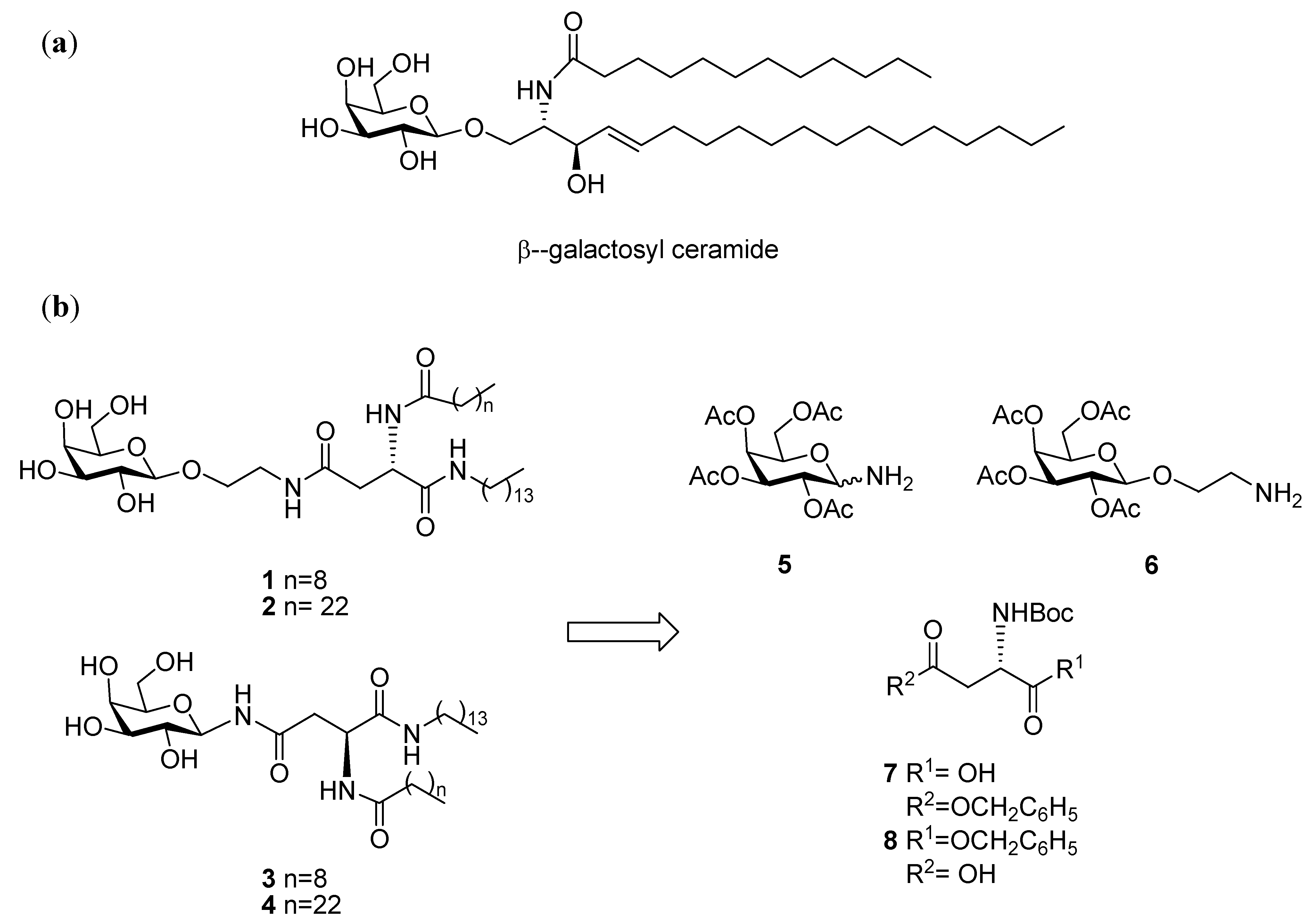
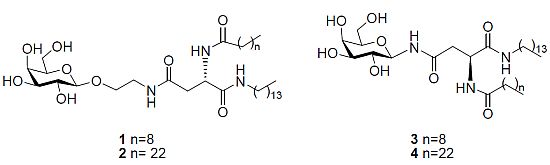
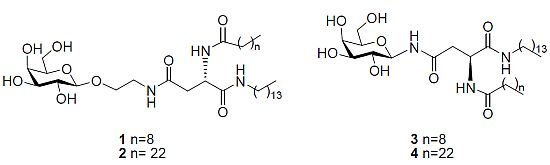
      <p>Synthetic glycomimetics have been the subject of much research activity in the field of carbohydrate chemistry. The important role of carbohydrates in biological systems has prompted the development of different types of glycomimetics intended for diverse applications, such as therapeutic leads [<xref ref-type="bibr" rid="B1-molecules-17-11346">1</xref>,<xref ref-type="bibr" rid="B2-molecules-17-11346">2</xref>], novel materials [<xref ref-type="bibr" rid="B3-molecules-17-11346">3</xref>], biosensors and diagnostic tools [<xref ref-type="bibr" rid="B4-molecules-17-11346">4</xref>,<xref ref-type="bibr" rid="B5-molecules-17-11346">5</xref>]. Glycolipid mimetics [<xref ref-type="bibr" rid="B6-molecules-17-11346">6</xref>], in particular synthetic derivatives of biologically relevant ceramides (such as galactosyl ceramides, shown in <xref ref-type="fig" rid="molecules-17-11346-f001">Figure 1</xref>a), have attracted the attention of many carbohydrate chemists over recent years [<xref ref-type="bibr" rid="B7-molecules-17-11346">7</xref>].</p>
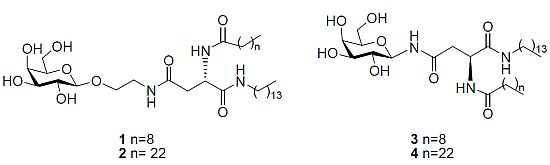
      <p>Amino acids that allow for side chain functionalization with glycosyl moieties, such as serine and aspartic acid, have been popular choices as the starting point for the preparation of glycolipid analogues [<xref ref-type="bibr" rid="B8-molecules-17-11346">8</xref>,<xref ref-type="bibr" rid="B9-molecules-17-11346">9</xref>]. The carboxylic acid present on the aspartic acid side chain offers the possibility for attachment of mono or oligosaccharides, while both the amino and carboxylic acid groups at the α-carbon allow for further functionalization. Due to the biological relevance of <italic>N</italic>-linked glycosides, this type of building blocks has been used predominantly in the synthesis of glycopeptides and glycopeptoids and hence, numerous examples of such compounds can be found in the literature [<xref ref-type="bibr" rid="B10-molecules-17-11346">10</xref>,<xref ref-type="bibr" rid="B11-molecules-17-11346">11</xref>,<xref ref-type="bibr" rid="B12-molecules-17-11346">12</xref>,<xref ref-type="bibr" rid="B13-molecules-17-11346">13</xref>]. In this study we report our investigations towards the synthesis of galactosylated building blocks based on: (i) orthogonally protected; (ii) enantiomerically pure and (iii) commercially available L-aspartic acid derivatives, as we intend to expand their application to the preparation of glycolipid mimetics. These non-natural glycolipids may be bioactive as neuroprotective agents [<xref ref-type="bibr" rid="B14-molecules-17-11346">14</xref>] and/or may be used in materials or formulation science [<xref ref-type="bibr" rid="B15-molecules-17-11346">15</xref>]. The nature of the building blocks should allow for a modular approach which could lead to the facile preparation of a small collection of glycolipids of different fatty acids chain lengths, such as <bold>1</bold>–<bold>4</bold>, shown in <xref ref-type="fig" rid="molecules-17-11346-f001">Figure 1</xref>b. This feature of the glycolipid structure affects strongly its physicochemical characteristics, as well as its potential biological activity [<xref ref-type="bibr" rid="B16-molecules-17-11346">16</xref>].</p>
      <fig id="molecules-17-11346-f001" position="float">
        <label>Figure 1</label>
        <caption>
          <p>(<bold>a</bold>) Structure of the naturally occurring glycolipid β-galactosyl ceramide. (<bold>b</bold>) Structure of the galactosyl amines <bold>5</bold> [<xref ref-type="bibr" rid="B17-molecules-17-11346">17</xref>,<xref ref-type="bibr" rid="B18-molecules-17-11346">18</xref>] and <bold>6</bold> [<xref ref-type="bibr" rid="B19-molecules-17-11346">19</xref>] and of the commercially available L-aspartic acid derivatives <bold>7</bold> and <bold>8</bold>, used for the modular synthesis of glycolipid mimetics <bold>1</bold>–<bold>4</bold>. </p>
        </caption>
        <graphic xmlns:xlink="http://www.w3.org/1999/xlink" xlink:href="molecules-17-11346-g001.tif"/>
      </fig>
	  <p>We have initially focused our attention on derivatives of decanoic acid (C-10), such as <bold>1</bold> and <bold>3</bold>, and tetracosanoic acid (C-24), such as <bold>2</bold> and <bold>4</bold>, as representative examples of medium and long fatty acid chain lengths. In glycolipids <bold>1</bold> and <bold>2</bold>, the galactosyl moiety is connected to the aspartic acid by a flexible ethylene-type linker, while glycomimetics <bold>3</bold> and <bold>4</bold> resemble the native <italic>N</italic>-linked glycosides, as the acid conjugation occurs directly at the anomeric center. It is therefore expected that both sets of compounds would have different degrees of conformational freedom, which in turn may have an effect on their potential biological activities and physical properties.</p>
    </sec>
    <sec sec-type="results">
      <title>2. Results and Discussion</title>
      <sec>
        <title>Synthesis of the Glycolipids</title>
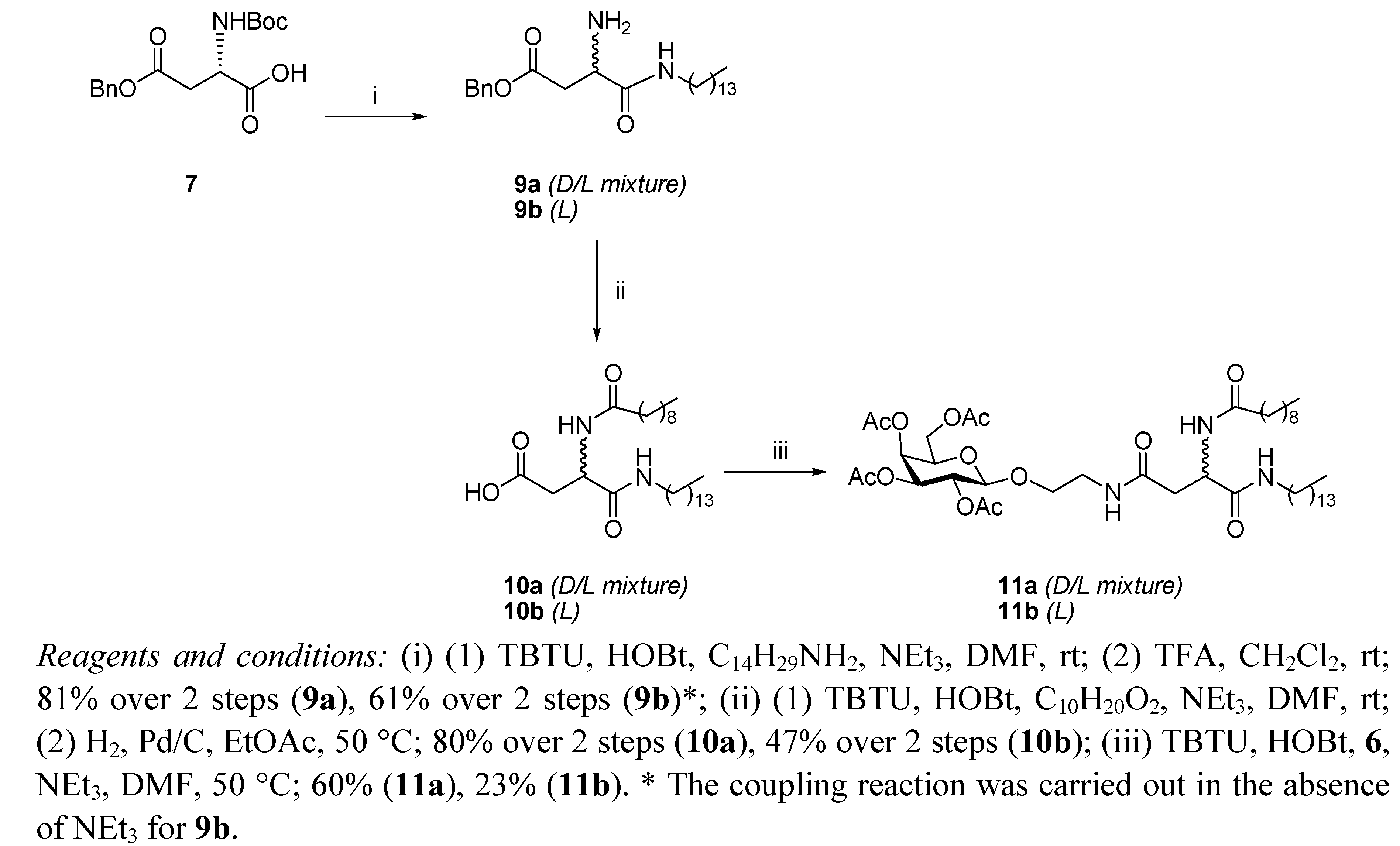
        <p>Both the galactosyl amines <bold>5</bold> [<xref ref-type="bibr" rid="B17-molecules-17-11346">17</xref>,<xref ref-type="bibr" rid="B18-molecules-17-11346">18</xref>] and <bold>6</bold> [<xref ref-type="bibr" rid="B19-molecules-17-11346">19</xref>] used in the syntheses described herein are readily prepared from D-galactose pentacetate following procedures described in literature. Our initial approach to the glycolipid mimetics <bold>1</bold>–<bold>4</bold> involved a convergent synthesis (<xref ref-type="scheme" rid="molecules-17-11346-f002">Scheme 1</xref>), whereby the <italic>N</italic>-Boc-γ-benzyl ester protected L-aspartic acid <bold>7</bold> was coupled to tetradecylamine using standard TBTU/HOBt activation conditions in the presence of triethylamine. Subsequent removal of the <italic>N</italic>-Boc protecting group with TFA afforded the amine <bold>9a</bold>, which was acylated with decanoic acid using the above mentioned TBTU/HOBt methodology. Hydrogenolysis of the side chain benzyl ester was carried out at 50 °C to enhance solubility and it afforded carboxylic acid <bold>10a</bold>, which was then coupled to the primary amine of galactosyl derivative <bold>6</bold>, to yield the acetyl protected glycolipid <bold>11a</bold>. The <sup>1</sup>H-NMR spectrum of <bold>11a</bold> showed distinct duplication of every expected signal in a 1:1 ratio. To rule out possible conformational exchange equilibrium, variable temperature <sup>1</sup>H-NMR spectra of compound <bold>11a</bold> were recorded in <italic>d</italic><sub>6</sub>-DMSO. No coalescence of the signals was observed at temperatures as high as 80 °C, which confirmed that glycolipid <bold>11a</bold> was, in fact, a mixture of diastereoisomers. </p>
        <fig id="molecules-17-11346-f002" position="float">
          <object-id pub-id-type="pii">molecules-17-11346-scheme1_Scheme 1</object-id>
          <label>Scheme 1</label>
          <caption>
            <p>Synthesis of glycolipids <bold>11a</bold> and <bold>11b</bold>.</p>
          </caption>
          <graphic xmlns:xlink="http://www.w3.org/1999/xlink" xlink:href="molecules-17-11346-g002.tif"/>
        </fig>
        <p>The unexpected racemisation of the chiral α-carbon of the L-aspartic acid derivative <bold>7</bold> takes place in the first step of the synthesis. Although the use of TBTU and HOBt as coupling reagents is a very standard procedure in peptide synthesis [<xref ref-type="bibr" rid="B20-molecules-17-11346">20</xref>], the activation of the α-carboxylic acid under these conditions is likely to increase the acidity of the α-proton in <bold>7</bold> and it may be abstracted in the presence of a base such as triethylamine. This is further supported by the disappearance of the optical activity of compound <bold>9a</bold> [[α]<sup>22</sup><sub>D</sub> = 0 (c 1.55, CHCl<sub>3</sub>)], while if the same coupling reaction is carried out in the absence of triethylamine, a specific optical rotation value is obtained for the L-enantiomer, compound <bold>9b</bold> [[α]<sup>22</sup><sub>D</sub> = +2.5 (c 1.55, CHCl<sub>3</sub>)]. The effects on reaction yields and racemisation of the products, caused by different bases and activating reagents commonly used in peptide couplings, have been extensively reviewed in the literature [<xref ref-type="bibr" rid="B21-molecules-17-11346">21</xref>]. Most of the published procedures reporting amide bond formation of <italic>N</italic>-Boc aspartic acid <bold>7</bold> involve the use of carbodiimide-type coupling reagents [<xref ref-type="bibr" rid="B22-molecules-17-11346">22</xref>], formation of activated esters, such as pentafluorophenyl derivatives [<xref ref-type="bibr" rid="B23-molecules-17-11346">23</xref>], or mixed anhydrides [<xref ref-type="bibr" rid="B24-molecules-17-11346">24</xref>]. However, no compromise of the optical purity of the resulting aspartate derivatives when using uronium-type reagents (such as TBTU or HBTU) has been explicitly reported so far, to the best of our knowledge [<xref ref-type="bibr" rid="B25-molecules-17-11346">25</xref>,<xref ref-type="bibr" rid="B26-molecules-17-11346">26</xref>]. The mixture of D and L diastereoisomers of glycolipid <bold>11a</bold> could not be separated by flash column chromatography or by recrystallization.</p>
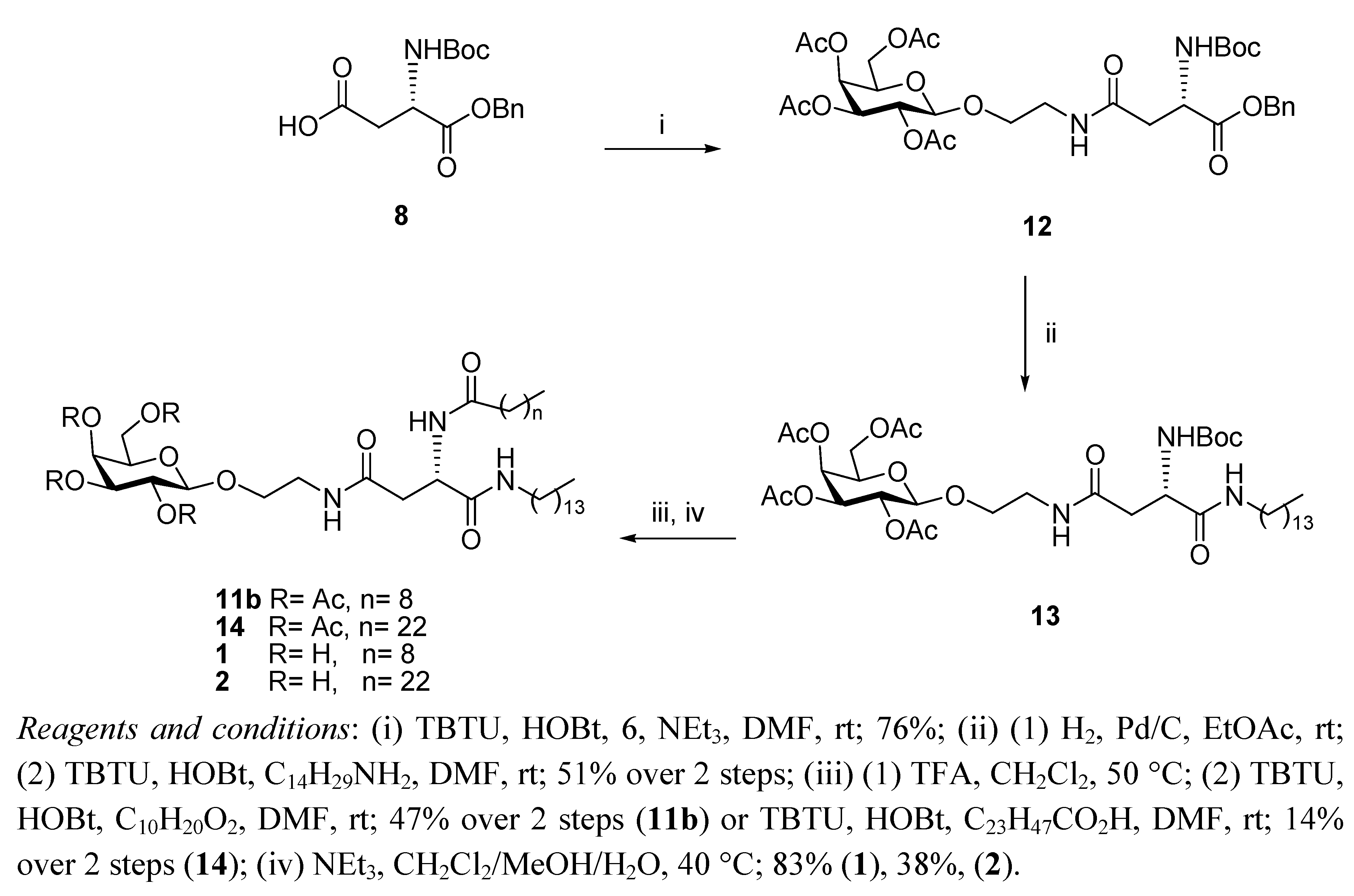
        <p>The same synthetic sequence as described above was carried out on the L-enantiomer <bold>9b</bold>. Although this route allowed access to sufficient amounts of diastereomerically pure <bold>11b</bold>, we decided to investigate a different synthetic sequence that may result in an overall higher yield for the enantiomerically pure glycolipids, as outlined in <xref ref-type="scheme" rid="molecules-17-11346-f003">Scheme 2</xref>. In the first step of the reviewed scheme, the free amino galactosyl derivative <bold>6</bold> was coupled to the <italic>N</italic>-Boc aspartic acid benzyl ester <bold>8</bold>, which bears the free carboxylic acid at the side chain, to give the orthogonally protected compound <bold>12</bold>. The benzyl ester on <bold>12</bold> was removed by hydrogenolysis and the resulting carboxylic acid at the α-carbon was then carefully reacted again with the TBTU/HOBt system, followed by the addition of tetradecylamine. To avoid racemisation of the chiral carbon in this crucial step, this reaction was carried out in the absence of base. Under these conditions, enantiomerically pure <bold>13</bold> was successfully obtained, albeit in a moderate yield (51% over two steps). This building block was then reacted with TFA to cleave the <italic>N</italic>-Boc group and the corresponding amine was acylated with pre-activated decanoic acid (stirred with TBTU/HOBt prior to addition) to lead to the protected glycolipid <bold>11b</bold>. Acylation of the amine derived from <bold>13</bold> by treatment with TBTU/HOBt and tetracosanoic acid instead gave the longer C-24 compound <bold>14</bold>.The hydrolysis of the acetyl protecting groups on the galactosyl moiety of both derivatives <bold>11a</bold> and <bold>14</bold> was initially attempted following standard procedures, such as the Zemplén deprotection or reaction with hydrazine [<xref ref-type="bibr" rid="B27-molecules-17-11346">27</xref>]. However, these conditions proved to be rather harsh, resulting in amide bond hydrolysis and degradation of the glycolipids. Enzyme catalysed acetolyisis was also considered, using both immobilized enzymes (such as CALB, <italic>Candida antarctica </italic>lipase [<xref ref-type="bibr" rid="B28-molecules-17-11346">28</xref>], immobilized as Novazym 435) and soluble lipases (such as CRL, <italic>Candida rugosa </italic>lipase) [<xref ref-type="bibr" rid="B29-molecules-17-11346">29</xref>]. These and many other lipases have been reported to chemoselectively achieve total or partial deacetylation of protected glycosides. However, the success of enzyme-catalysed reactions is often highly dependent on substrate structure, and we found that, perhaps due to the steric bulk imposed by the hydrocarbon chains, not even partial deacetylation of any of the glycolipids could be achieved. The deprotection of <bold>11b</bold> and <bold>14</bold> was most successfully carried out with mild base catalysis in a heterogenous mixture of triethylamine and dichloromethane/methanol/water at 40 °C, to give the corresponding glycolipids <bold>1</bold> and <bold>2</bold>.</p>
        <fig id="molecules-17-11346-f003" position="float">
          <object-id pub-id-type="pii">molecules-17-11346-scheme2_Scheme 2</object-id>
          <label>Scheme 2</label>
          <caption>
            <p>Synthesis of <italic>O</italic>-glycolipids <bold>1</bold> and <bold>2</bold>.</p>
          </caption>
          <graphic xmlns:xlink="http://www.w3.org/1999/xlink" xlink:href="molecules-17-11346-g003.tif"/>
        </fig>
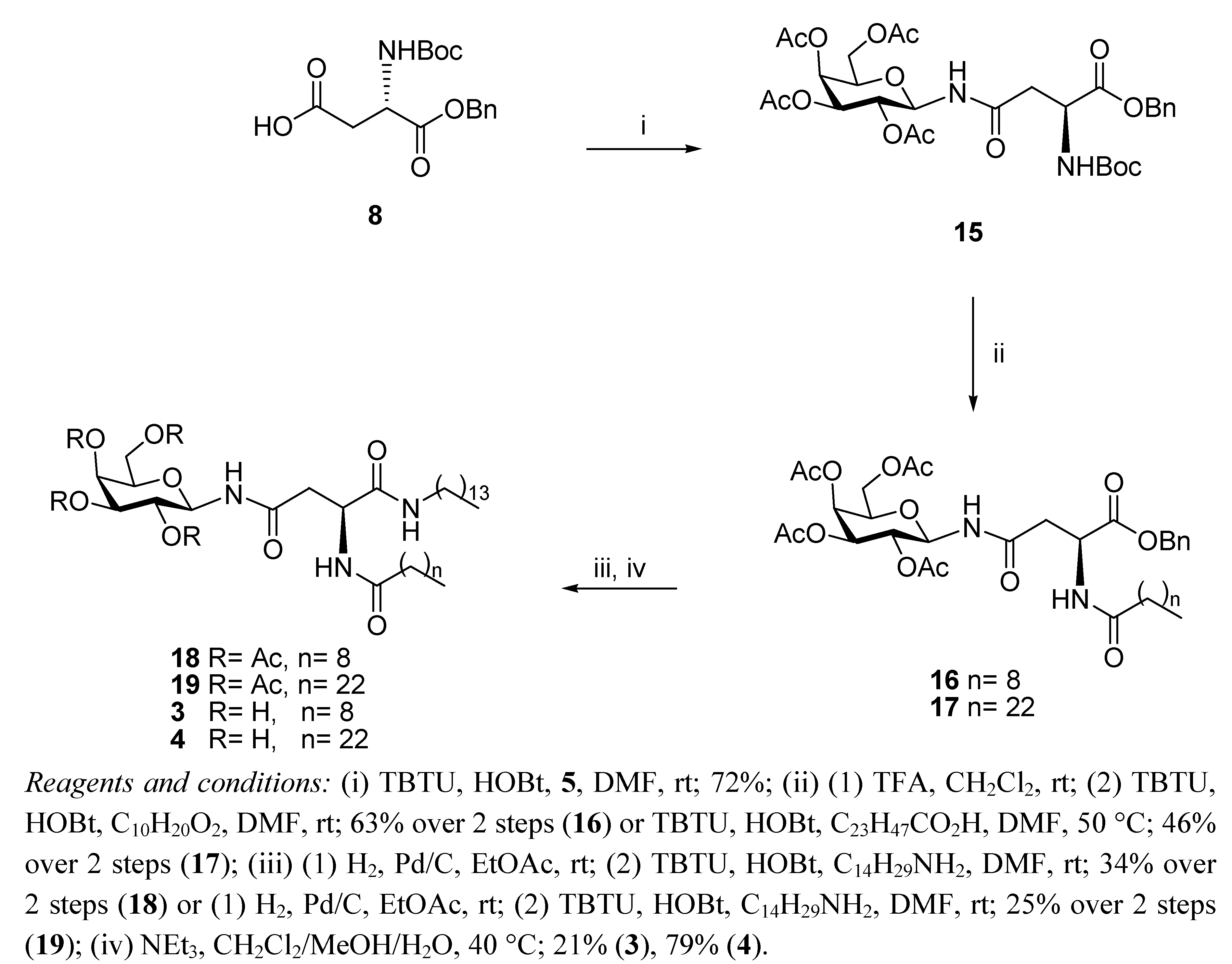
        <p>Similar considerations regarding the preservation of the chirality of the L-aspartic acid asymmetric α-carbon were observed in the reviewed syntheses of the anomeric <italic>N</italic>-linked glycolipid analogues <bold>3</bold> and <bold>4</bold> (<xref ref-type="scheme" rid="molecules-17-11346-f004">Scheme 3</xref>). In this case, the synthesis starts again with the direct coupling of galactosyl amine <bold>5 </bold>with the <italic>N</italic>-Boc aspartic acid benzyl ester <bold>8</bold> to give building block <bold>16</bold> [<xref ref-type="bibr" rid="B30-molecules-17-11346">30</xref>]. In order to avoid side reactions due to the increased acidity of the resulting anomeric amide, the reaction was carried out with TBTU/HOBt but in the absence of an added base. The next step involved the removal of the <italic>N</italic>-Boc group of <bold>15</bold> with TFA, and the corresponding amine was acylated with either pre-activated decanoic or tetracosanoic acid, to give the corresponding intermediates <bold>16</bold> and <bold>17</bold>, respectively. It was expected that the presence of the long hydrocarbon chains would introduce steric hindrance and minimize the risk of intramolecular cyclization to yield aspartimide-type by-products when attempting the coupling of the α-carboxylic acid, as this is a well known side reaction in glycopeptides and glycoprotein synthesis [<xref ref-type="bibr" rid="B31-molecules-17-11346">31</xref>,<xref ref-type="bibr" rid="B32-molecules-17-11346">32</xref>]. Indeed, after <bold>16</bold> and <bold>17</bold> underwent hydrogenolysis, the corresponding carboxylic acids were subjected to reaction with tetradecylamine mediated by TBTU/HOBt to give the enantiomerically pure glycolipids <bold>18</bold> and <bold>19</bold>, and no significant formation of cyclic products could be observed. Since Zemplén deacetylation may have involved too harsh conditions for the final deprotection of the glycolipids <bold>11b</bold> and <bold>14</bold> described earlier, we used again the mildly basic hydrolysis method described above to access derivatives <bold>3</bold> and <bold>4</bold>. It must be noted that the solubility of the C-24 tetracosanoic acid derivatives, <bold>2</bold> and <bold>4</bold> is very poor (both in water and in most common solvents), when compared to that of the C-10 decanoic glycolipids <bold>1</bold> and <bold>3</bold>. This is likely to hamper potential applications of the longer chain analogues.</p>
        <fig id="molecules-17-11346-f004" position="float">
          <object-id pub-id-type="pii">molecules-17-11346-scheme3_Scheme 3</object-id>
          <label>Scheme 3</label>
          <caption>
            <p>Synthesis of <italic>N</italic>-glycolipids <bold>3</bold> and <bold>4</bold>.</p>
          </caption>
          <graphic xmlns:xlink="http://www.w3.org/1999/xlink" xlink:href="molecules-17-11346-g004.tif"/>
        </fig>
      </sec>
    </sec>
    <sec sec-type="methods">
      <title>3. Experimental</title>
      <sec>
        <title>General Methods</title>
        <p>All chemicals purchased were reagent grade and used without further purification unless stated otherwise. Dichloromethane was freshly distilled over CaH<sub>2</sub> prior use. Anhydrous dimethylformamide (DMF) was purchased from Sigma Aldrich. Molecular sieves (MS) used for glycosylation and coupling reactions were 8–12 mesh and were flame dried prior to use. Reactions were monitored with thin layer chromatography (TLC) on Merck Silica Gel F<sub>254</sub> plates, using mixtures of hexane/ethyl acetate unless otherwise stated. Detection was effected either by visualisation in UV light and/or charring in a mixture of 5% sulphuric acid-EtOH or phosphomolybdic acid-EtOH. NMR spectra were obtained on a Bruker Avance 300 spectrometer. Proton and carbon signals were assigned with the aid of 2D-NMR experiments and DEPT experiments for novel compounds. The 2D-NMR experiments included COSY and HCCOSW, which is an HSQC type of experiment. Better resolution of the signals was observed when using the HCCOSW experiments than with conventional HSQC experiments. Chemicals shifts for <sup>1</sup>H-NMR are reported in ppm relative to residual solvent proton. Flash chromatography was performed with Merck Silica Gel 60, using adjusted mixtures of hexane/ethyl acetate unless otherwise stated. Optical rotations were obtained using an AA-100 polarimeter. [α]<sup>25</sup> values are given in 10<sup>−1</sup> cm<sup>2</sup>·g<sup>−1</sup>. The melting points were obtained using a Stuart Scientific SMP1 melting point apparatus and are uncorrected. High resolution mass spectrometry (HRMS) were performed on an Agilent-LC 1200 Series coupled to a 6210 Agilent Time-Of-Flight (TOF) mass spectrometer equipped with an electrospray source both positive and negative (ESI+/−) or in a MALDI-QTOF Premier MS SYSTEM, using an α-cyano-4-hydroxy cinnamic acid matrix. Infrared spectra were obtained as a film on NaCl plates in the region 4000–400 cm<sup>−1</sup> on a Nicolet Impact 400D spectrophotometer.</p>
        <p><italic>N<sup>4</sup>-[2-O-(2,3,4,6-Tetra-O-acetyl-β-D-galactopyranosyl)-ethyl]-N<sup>2</sup>-tert-butoxycarbonyl-</italic><italic>L</italic><italic>-asparagine</italic><italic> benzyl ester </italic>(<bold>12</bold>). HOBt (0.09 g, 0.68 mmol), followed by NEt<sub>3</sub> (0.18 mL, 1.23 mmol), were added to a stirring solution of <italic>N</italic>-Boc-L-Asp-OBn <bold>8</bold> (0.2 g, 0.61 mmol) and TBTU (0.22 g, 0.6 mmol) dissolved in anhydrous DMF (10 mL), under N<sub>2</sub> at rt. It was stirred for 30 min and <bold>6</bold> (0.29 g, 0.74 mmol) dissolved in anhydrous DMF (1.2 mL) was added dropwise. It was stirred for 18 h. The reaction mixture was concentrated under reduced pressure, diluted with ethyl acetate and washed succesively with HCl 0.1 N, aqueous sat. NaHCO<sub>3</sub> solution, and brine. Flash chromotagraphy (hexane:ethyl acetate, 1:1) afforded <bold>12</bold> as a white solid (0.33 g, 76%). [α]<sup>22</sup><sub>D</sub> +6.9 (c 1.35, CH<sub>2</sub>Cl<sub>2</sub>,); IR (NaCl film): 3374.7, 2978.0, 1750.7, 1665.8, 1499.3, 1368.8, 1224.3, 1167.9, 1124.3,1057.2 cm<sup>−1</sup>; <sup>1</sup>H-NMR (300 MHz, CDCl<sub>3</sub>): δ 7.34 (bs, 5 H, <italic>H</italic>-Ph), 6.01 (t,<italic>J</italic> = 5.1 Hz, 1 H, CH<sub>2</sub>CH<sub>2</sub>N<italic>H</italic>CO), 5.76 (d, <italic>J =</italic> 8.1 Hz, 1 H, N<italic>H</italic>COC(CH<sub>3</sub>)<sub>3</sub>), 5.39 (dd, <italic>J =</italic>0.6 Hz, <italic>J =</italic> 3.3 Hz, 1 H, <italic>H</italic>-4), 5.20–5.16 (m, 3 H, overlap of <italic>H</italic>-2, C<italic>H</italic><sub>2</sub>Ph), 5.02 (dd, <italic>J =</italic> 3.3 Hz, <italic>J =</italic> 10.2 Hz, 1 H, <italic>H</italic>-3), 4.57–4.54 (m, 1 H, H-α), 4.44 (d, <italic>J =</italic> 7.8 Hz, 1 H, <italic>H</italic>-1), 4.18–4.13 (m, 2 H, overlap of <italic>H</italic>-6, <italic>H</italic>-6'), 3.93–3.89 (m, 1 H, <italic>H</italic>-5), 3.86–3.80 (m, 1 H, 1 H of OC<italic>H</italic><sub>2</sub>CH<italic><sub>2</sub></italic>NH), 3.66–3.59 (m, 1 H, 1 H of OC<italic>H</italic><sub>2</sub>CH<italic><sub>2</sub></italic>NH), 3.46–3.38 (m, 2 H, OCH<sub>2</sub>C<italic>H<sub>2</sub></italic>NH), 2.91 (dd, <italic>J =</italic> 5.7 Hz, <italic>J =</italic> 17.4 Hz, 1 H, <italic>H</italic>-β), 2.71 (dd, <italic>J =</italic> 4.5 Hz, <italic>J =</italic> 15.9 Hz, 1 H, H-β'), 2.15 (s, 3 H, O(CO)C<italic>H</italic><sub>3</sub>), 2.05 (s, 6 H, O(CO)C<italic>H</italic><sub>3</sub> × 2), 1.99 (s, 3 H, O(CO)C<italic>H</italic><sub>3</sub>), 1.42 (s, 9 H, COC(C<italic>H</italic><sub>3</sub>)<sub>3</sub>); <sup>13</sup>C-NMR (75 Hz, CDCl<sub>3</sub>): δ 171.38, 170.37, 169.76 (each <italic>C</italic>O), 155.55 (<italic>C</italic>-Ph), 128.51, 128.09 (<italic>C</italic>H-Ph), 101.42 (<italic>C</italic>-1), 79.01 (CO<italic>C</italic>(<italic>C</italic>H<sub>3</sub>)<sub>3</sub>), 70.89 (<italic>C</italic>-5), 70.68 (<italic>C</italic>-2), 68.91 (<italic>C</italic>-3), 67.25 (<italic>C</italic>H<sub>2</sub>Ph), 66.96 (<italic>C</italic>-4), 61.35 (<italic>C</italic>-6), 50.47 (<italic>C</italic>-α), 39.18, 37.72 (each O<italic>C</italic>H<sub>2</sub><italic>C</italic>H<italic><sub>2</sub></italic>NH), 37.12 (<italic>C</italic>-β), 28.29 (COC(<italic>C</italic>H<sub>3</sub>)<sub>3</sub>), 20.82, 20.57 (overlap of O(CO)<italic>C</italic>H<sub>3</sub>); HRMS (MS-TOF): [M+H]<sup>+</sup> calcd. for C<sub>32</sub>H<sub>44</sub>N<sub>2</sub>O<sub>15</sub>: 697.2181 found 697.2800.</p>
        <p><italic>N<sup>4</sup>-[2-O-(2,3,4,6-Tetra-O-acetyl-β-D-galactopyranosyl)-ethyl]-N<sup>2</sup>-tert-butoxycarbonyl-</italic><italic>L</italic><italic>-asparagine</italic><italic> tetradecylamide </italic>(<bold>13</bold>). To a solution of <bold>12</bold> (0.120 g, 0.17 mmol) in ethyl acetate (6 mL), Pd/C 10% w/w (0.012 g, 10% w/w) was added. The resulting slurry was stirred under H<sub>2</sub> gas for 4 h. The mixture was then filtered through a Celite cake and the filtrate was concentrated under vacuum to afford the corresponding carboxylic acid as an off-white solid, which was used without further purification (0.094 g, 90%). <sup>1</sup>H-NMR (300 MHz, CDCl<sub>3</sub>): δ 6.53 (bs, 1 H, CH<sub>2</sub>CH<sub>2</sub>N<italic>H</italic>CO), 5.86 (d, <italic>J</italic> = 5.4 Hz, 1 H, N<italic>H</italic>COC(CH<sub>3</sub>)<sub>3</sub>), 5.41 (d, <italic>J </italic>= 3.3 Hz, 1 H, <italic>H</italic>-4), 5.17 (dd, <italic>J</italic> = 7.8 Hz, <italic>J</italic> = 10.2 Hz, 1 H, <italic>H</italic>-2), 5.00 (dd, <italic>J</italic> = 3.3 Hz, <italic>J</italic> = 13.8 Hz, 1 H, <italic>H</italic>-3), 4.49 (d, <italic>J</italic> = 7.8 Hz, 1 H, <italic>H</italic>-1), 4.45–4.42 (m, 1 H, H-α), 4.20–4.11 (m, 2 H, overlap of <italic>H</italic>-6, <italic>H</italic>-6'), 3.96–3.92 (m, 1 H, <italic>H</italic>-5) 3.90–3.85 (m,1 H, 1 H of OC<italic>H</italic><sub>2</sub>CH<italic><sub>2</sub></italic>NH), 3.75–3.68 (m, 1 H, 1 H of OC<italic>H</italic><sub>2</sub>CH<italic><sub>2</sub></italic>NH), 3.54–3.39 (m, 2 H, OCH<sub>2</sub>C<italic>H<sub>2</sub></italic>NH), 2.91 (d, <italic>J</italic> = 15.6 Hz, 1 H, H-β), 2.72 (dd, <italic>J</italic> = 8.49 Hz, <italic>J</italic> = 15.9 Hz, 1 H, H-β'), 2.17, 2.13, 2.05, 1.98 (each s, 3 H, O(CO)C<italic>H</italic><sub>3</sub>), 1.42 (s, 9 H, COC(C<italic>H</italic><sub>3</sub>)<sub>3</sub>); HRMS (MS-TOF): [M+K]<sup>+</sup> calcd. for C<sub>25</sub>H<sub>38</sub>N<sub>2</sub>O<sub>15</sub>: 645.1904 found 645.1899. HOBt (0.034 g, 0.25 mmol) was added to a stirring solution of the carboxylic acid obtained as described above (0.140 g, 0.23 mmol), tetradecylamine (0.06 g, 0.28 mmol), and TBTU (0.081 g, 0.25 mmol) dissolved in anhydrous DMF, (12 mL) at rt. It was stirred for 18 h. The reaction mixture was concentrated <italic>in vacuo</italic>, diluted with ethyl acetate and washed with brine. Flash chromotagraphy (ethyl acetate) afforded <bold>13</bold> as a white solid (0.120 g, 56%). [α]<sup>22</sup><sub>D</sub> = +8.8 (c 0.75, CH<sub>2</sub>Cl<sub>2</sub>,); IR (NaCl film): 3316.3, 3091.3 2919.9, 2851.3, 1748.0, 1687.1, 1646.1, 1548.9, 1524.1, 1467.4, 1434.6, 1369.2, 1368.8, 1230.2, 1171.0, 1055.3 cm<sup>−1</sup>; <sup>1</sup>H-NMR (300 MHz, CDCl<sub>3</sub>): δ 6.87 (bs, 1 H, CON<italic>H</italic>C<sub>14</sub>CH<sub>29</sub>), 6.23 (t, <italic>J</italic> = 10.5 Hz, 1 H, CH<sub>2</sub>CH<sub>2</sub>N<italic>H</italic>CO), 6.14 (d, <italic>J</italic> = 8.1 Hz, 1 H, N<italic>H</italic>COC(CH<sub>3</sub>)<sub>3</sub>), 5.38 (d, <italic>J</italic> = 2.7 Hz, 1 H, <italic>H</italic>-4), 5.15 (dd, <italic>J</italic> = 7.8 Hz, <italic>J</italic> = 10.5 Hz, 1 H, <italic>H</italic>-2), 5.01 (dd, <italic>J</italic> = 3.3 Hz, <italic>J</italic> = 10.5 Hz, 1 H, <italic>H</italic>-3), 4.49 (d, <italic>J</italic> = 7.8 Hz, 1 H, <italic>H</italic>-1), 4.40–4.39 (m, 1 H, <italic>H</italic>-α), 4.15–4.11 (m, 2 H, overlap of <italic>H</italic>-6, <italic>H</italic>-6'), 3.94–3.87 (m, 1 H, <italic>H</italic>-5), 3.86–3.81 (m, 1 H, 1 H of OC<italic>H</italic><sub>2</sub>CH<italic><sub>2</sub></italic>NH), 3.67–3.60 (m, 1 H, 1 H of OC<italic>H</italic><sub>2</sub>CH<italic><sub>2</sub></italic>NH), 3.49–3.34 (m, 2 H, OCH<sub>2</sub>C<italic>H<sub>2</sub></italic>NH), 3.22–3.15 (m, 2 H, NHC<italic>H</italic><sub>2</sub>C<sub>13</sub>H<sub>27</sub>), 2.71 (dd, <italic>J</italic> = 4.2 Hz, <italic>J</italic> = 15.6 Hz, 1 H, H-β), 2.51 (dd, <italic>J</italic> = 6.6 Hz, <italic>J</italic> = 15.6 Hz, 1 H, H-β'), 2.14, 2.07, 2.02, 1.96 (each s, 3 H, O(CO)C<italic>H</italic><sub>3</sub>), 1.42 (m, 11 H, overlap of COC(C<italic>H</italic><sub>3</sub>)<sub>3</sub>, NHCH<sub>2</sub>C<italic>H</italic><sub>2</sub>C<sub>12</sub>H<sub>25</sub>), 1.23 (bs, 22 H, NHC<sub>2</sub>H<sub>4</sub>(C<italic>H</italic><sub>2</sub>)<sub>11</sub>CH<sub>3</sub>), 0.87–0.83 (t, <italic>J</italic> = 6.6 Hz, 3 H, NHC<sub>13</sub>H<sub>26</sub>C<italic>H</italic><sub>3</sub>); <sup>13</sup>C-NMR (75 Hz, CDCl<sub>3</sub>): δ 171.17, 170.88, 170.35, 170.18, 170.05, 169.85, 155.73 (<italic>C</italic>O), 101.31 (<italic>C</italic>-1), 80.14 (CO<italic>C</italic>(CH<sub>3</sub>)<sub>3</sub>), 70.81, 70.72 (<italic>C</italic>-5, <italic>C</italic>-3), 68.91. (<italic>C</italic>-2), 68.56 (NH<italic>C</italic>H<sub>2</sub>C<sub>13</sub>H<sub>27</sub>NH), 66.98 (<italic>C</italic>-4), 61.33 (<italic>C</italic>-6), 51.08 (<italic>C</italic>-α), 39.61, 39.22 (each O<italic>C</italic>H<sub>2</sub><italic>C</italic>H<italic><sub>2</sub></italic>NH), 37.54 (<italic>C</italic>-β), 31.9, 29.67, 29.63, 29.59, 29.53, 29.41, 29.33, 29.22 (each <italic>C</italic>H<sub>2</sub>), 28.30 (COC(CH<sub>3</sub>)<sub>3</sub>), 26.83, 22.67 (each <italic>C</italic>H<sub>2</sub>), 20.82–20.57 (overlap of O(CO)<italic>C</italic>H<sub>3</sub>), 14.93 (NHC<sub>13</sub>H<sub>26</sub><italic>C</italic>H<sub>3</sub>); HRMS (MS-TOF): [M+H]<sup>+</sup> calcd. for C<sub>39</sub> H<sub>67</sub>N<sub>3</sub>O<sub>14</sub>: 801.4623 found 801.4613.</p>
        <p><italic>N<sup>4</sup>-[2-O-(2,3,4,6-Tetra-O-acetyl-β-D-galactopyranosyl)-ethyl]-N<sup>2</sup>-decanoyl-</italic><italic>L</italic><italic>-asparagine tetradecylamide </italic>(<bold>11b</bold>). A solution of <bold>13</bold> (0.11 g, 0.13mmol) in anhydrous CH<sub>2</sub>Cl<sub>2</sub>, (6 mL) was cooled in an ice bath and TFA (0.15 mL, 1.37 mmol) was added. The reaction mixture was heated to 50 °C for 1.5 h. The organic solvent was removed <italic>in vacuo</italic> and the residue obtained was diluted with ethyl acetate and washed with aqueous sat. NaHCO<sub>3</sub> solution and brine, dried (MgSO<sub>4</sub>) and concentrated to yield the corresponding deprotected amine as a brown oil, which was used without further purification (0.071 g, 74%). <sup>1</sup>H-NMR (300 MHz, CDCl<sub>3</sub>): δ 7.41 (bs, 1 H, CON<italic>H</italic>C<sub>14</sub>CH<sub>29</sub>), 6.42 (t, <italic>J =</italic> 5.1 Hz, 1 H, CH<sub>2</sub>CH<sub>2</sub>N<italic>H</italic>CO), 5.38 (d, <italic>J</italic> = 2.4 Hz, 1 H, <italic>H</italic>-4), 5.16 (dd, <italic>J = 7</italic>.8 Hz, <italic>J =</italic> 10.5 Hz, 1 H, <italic>H</italic>-2), 5.01 (dd, <italic>J =</italic> 3.3 Hz, <italic>J =</italic> 10.5 Hz, 1 H, <italic>H</italic>-3), 4.48 (d, <italic>J =</italic> 7.8 Hz, 1 H, <italic>H</italic>-1), 4.2-4.1 (m, 2 H, overlap of <italic>H</italic>-6, <italic>H</italic>-6'), 3.94-3.89 (m, 1 H, <italic>H</italic>-5) 3.87-3.82 (m,1 H, 1 H of OC<italic>H</italic><sub>2</sub>CH<italic><sub>2</sub></italic>NH), 3.67-3.64 (m, 2 H, overlap of 1 H of OC<italic>H</italic><sub>2</sub>CH<italic><sub>2</sub></italic>NH, H-α), 3.42-3.46 (bm, 2 H, OCH<sub>2</sub>C<italic>H</italic><sub>2</sub>NH), 3.20-3.22 (m, 2 H, NHC<italic>H</italic><sub>2</sub>C<sub>13</sub>H<sub>27</sub>),<italic>2</italic>.68 (dd, <italic>J =</italic> 3.9 Hz, <italic>J =</italic> 15 Hz, 1 H, H-β), 2.46 (dd, <italic>J =</italic> 7.8 Hz, <italic>J =</italic> 15 Hz, 1 H, H-β'), 2.15, 2.07, 2.03, 1.97 (each s, 3 H, O(CO)C<italic>H</italic><sub>3</sub>), 1.50-1.43 (m, 2 H, NHCH<sub>2</sub>C<italic>H</italic><sub>2</sub>C<sub>12</sub>H<sub>25</sub>), 1.23 (bs, 22 H, NHC<sub>2</sub>H<sub>4</sub>(C<italic>H</italic><sub>2</sub>)<sub>11</sub>CH<sub>3</sub>), 0.87-0.83 (t, <italic>J =</italic> 6.6 Hz, 3 H, NHC<sub>13</sub>H<sub>26</sub>C<italic>H</italic><sub>3</sub>); HRMS (MS-TOF): [M+H]<sup>+</sup> calcd. for C<sub>34</sub>H<sub>59</sub>N<sub>3</sub>O<sub>12</sub>: 701.4099 found 701.4088. HOBt (0.041 g, 0.3 mmol) was added to a stirring solution of decanoic acid (0.048 g, 0.27 mmol) and TBTU (0.098 g, 0.3 mmol) dissolved in anhydrous DMF (6 mL), under N<sub>2</sub> at rt. It was stirred for 10 min and the amine obtained from <bold>13</bold> as described above (0.06 g, 0.28 mmol) was dissolved in anhydrous DMF (8 mL) and added slowly. It was stirred for 18 h. The reaction mixture was concentrated <italic>in vacuo</italic>, diluted with ethyl acetate, washed with brine, dried (MgSO<sub>4</sub>) and concentrated . The residue obtained was purified by flash chromotagraphy (ethyl acetate) to afford <bold>11b</bold> as a white solid (0.15 g, 63%). [α]<sup>22</sup><sub>D</sub> = +5.8 (c 0.8, CH<sub>2</sub>Cl<sub>2</sub>,); IR (NaCl film): 3289.5, 3098.3, 2919.3, 2850.8, 1750.8, 168.1, 1646.5, 1542.4, 1467.4, 1370.4, 1225.5, 1174.9, 1058.5 cm<sup>−1</sup>; <sup>1</sup>H-NMR (300 MHz, CDCl<sub>3</sub>): δ 7.43 (d, <italic>J =</italic> 6.9 Hz, 1 H, N<italic>H</italic>COC<sub>9</sub>H<sub>19</sub>), 7.08 (t, <italic>J =</italic> 5.4 Hz, 1 H, CON<italic>H</italic>C<sub>14</sub>CH<sub>29</sub>), 6.26 (t, <italic>J =</italic> 5.4 Hz, 1 H, CH<sub>2</sub>CH<sub>2</sub>N<italic>H</italic>CO), 5.40 (d, <italic>J =</italic> 2.4 Hz, 1 H, <italic>H</italic>-4), 5.18 (dd, <italic>J = 7</italic>.8 Hz, <italic>J =</italic> 10.5 Hz, 1 H, <italic>H</italic>-2), 5.04 (dd, <italic>J =</italic> 3.3 Hz, <italic>J =</italic> 10.5 Hz, 1 H, <italic>H</italic>-3), 4.70–4.64 (m, 1 H, <italic>H</italic>-α), 4.54 (d, <italic>J =</italic> 7.8 Hz, 1 H, <italic>H</italic>-1), 4.22–4.11 (m, 2 H, overlap of <italic>H</italic>-6, <italic>H</italic>-6'), 3.97–3.94 (m, 1 H, <italic>H</italic>-5) 3.92–3.85 (m, 1 H, 1 H of OC<italic>H</italic><sub>2</sub>CH<italic><sub>2</sub></italic>NH), 3.69–3.64 (m, 1 H, 1 H of OC<italic>H</italic><sub>2</sub>CH<italic><sub>2</sub></italic>NH), 3.57–3.39 (m, 2 H, OCH<sub>2</sub>C<italic>H</italic><sub>2</sub>NH), 3.22–3.16 (m, 2 H, NHC<italic>H</italic><sub>2</sub>C<sub>13</sub>H<sub>27</sub>),<italic>2</italic>.81 (dd, <italic>J =</italic> 3.3 Hz, <italic>J =</italic> 15.3 Hz, 1 H, H-β), 2.46 (dd, <italic>J =</italic> 6.9, <italic>J =</italic> 15.6, 1 H, H-β'), 2.25–2.20 (t, <italic>J =</italic> 7.5 Hz, 2 H, COC<italic>H</italic><sub>2</sub>C<sub>8</sub>H<sub>17</sub>), <italic>2</italic>.16, 2.09, 2.05, 1.9 (each s, 3 H, O(CO)C<italic>H</italic><sub>3</sub>), 1.62–1.60 (m, 2 H, COCH<sub>2</sub>C<italic>H</italic><sub>2</sub>C<sub>7</sub>H<sub>15</sub>), 1.46–1.45 (m, 2 H, NHCH<sub>2</sub>C<italic>H</italic><sub>2</sub>C<sub>12</sub>H<sub>25</sub>), 1.26 (bs, 34 H, overlap of COC<sub>2</sub>H<sub>4</sub>(C<italic>H</italic><sub>2</sub>)<sub>6</sub>CH<sub>3</sub>, NHC<sub>2</sub>H<sub>4</sub>(C<italic>H</italic><sub>2</sub>)<sub>11</sub>CH<sub>3</sub>), 0.90–0.85 (t, <italic>J =</italic> 6.6 Hz, 6 H, overlap of COC<sub>8</sub>H<sub>16</sub>C<italic>H</italic><sub>3</sub>, NHC<sub>13</sub>H<sub>26</sub>C<italic>H</italic><sub>3</sub>); <sup>13</sup>C-NMR (75 Hz, CDCl<sub>3</sub>): δ 173.67, 171.68, 170.61, 170.38, 170.20, 170.06, 169.90 (each <italic>C</italic>O), 101.33 (<italic>C</italic>-1), 70.81, 70.73 (<italic>C</italic>-5, <italic>C</italic>-3), 68.97. (<italic>C</italic>-2), 68.51 (NH<italic>C</italic>H<sub>2</sub>C<sub>13</sub>H<sub>27</sub>), 66.98 (<italic>C</italic>-4), 61.30 (<italic>C</italic>-6), 49.72 (<italic>C</italic>-α), 39.67, 39.31 (each O<italic>C</italic>H<sub>2</sub><italic>C</italic>H<italic><sub>2</sub></italic>NH), 36.98 (<italic>C</italic>-β), 36.62, 31.92, 29.70, 29.65, 29.56, 29.52, 29.36, 29.29, 28.31, 26.88, 25.63, 22.62 (each <italic>C</italic>H<sub>2</sub>), 20.87–20.85 (overlap of O(CO)<italic>C</italic>H<sub>3</sub>), 14.12 (overlap of COC<sub>8</sub>H<sub>16</sub><italic>C</italic>H<sub>3</sub>, NHC<sub>13</sub>H<sub>26</sub><italic>C</italic>H<sub>3</sub>); HRMS (MS-TOF): [M+H]<sup>+</sup> calcd. for C<sub>44</sub>H<sub>77</sub>N<sub>3</sub>O<sub>13</sub>: 855.5456 found 855.5492.</p>
        <p><italic>N<sup>4</sup>-[2-O-(2,3,4,6-Tetra-O-acetyl-β-D-galactopyranosyl)-ethyl]-N<sup>2</sup>-tetracosanoyl</italic><italic>-L</italic><italic>-asparagine tetradecylamide </italic>(<bold>14</bold>). HOBt (0.022 g, 0.16 mmol) was added to a stirring solution of tetracosanoic acid (0.056 g, 0.15 mmol) and TBTU (0.056 g, 0.16 mmol) dissolved in anhydrous DMF (6 mL), under N<sub>2</sub> at rt. It was stirred for 10 min and the amine obtained from <bold>13</bold> as described above (0.128 g, 0.18 mmol) was dissolved in anhydrous DMF (8 mL) and added slowly. It was stirred for 3 h. The reaction mixture was concentrated <italic>in vacuo</italic>, diluted with ethyl acetate, washed with brine, dried (MgSO<sub>4</sub>) and concentrated. The residue obtained was purified by flash chromotagraphy (ethyl acetate) to afford <bold>14</bold> as a white solid, (0.030 g, 18%). [α]<sup>22</sup><sub>D</sub> = +3.8 (c 0.83, CH<sub>2</sub>Cl<sub>2</sub>,); IR (NaCl film): 3423.0, 2918.4, 2850.3, 1749.6, 1644.4,1543.1, 1465.6, 1369.9, 1223.4, 1058.3 cm<sup>−1</sup>; <sup>1</sup>H-NMR (300 MHz, CDCl<sub>3</sub>): δ 7.44 (d, <italic>J =</italic> 6.9 Hz, 1 H, N<italic>H</italic>COC<sub>23</sub>H<sub>47</sub>), 7.09 (t, <italic>J =</italic> 4.8 Hz, 1 H, CON<italic>H</italic>C<sub>14</sub>CH<sub>29</sub>) 6.26 (bs, 1 H, CH<sub>2</sub>CH<sub>2</sub>N<italic>H</italic>CO), 5.40 (d, <italic>J =</italic> 3 Hz, 1 H, <italic>H</italic>-4), 5.17 (dd, <italic>J = 7</italic>.8 Hz , <italic>J =</italic> 10.5 Hz, 1 H, <italic>H</italic>-2), 5.04 (dd, <italic>J =</italic> 2.7 Hz, <italic>J =</italic> 10.2 Hz, 1 H, <italic>H</italic>-3), 4.70-4.64 (m, 1 H, <italic>H</italic>-α), 4.53 (d, <italic>J =</italic> 7.8 Hz, 1 H, <italic>H</italic>-1), 4.21-4.10 (m, 2 H, overlap of <italic>H</italic>-6, <italic>H</italic>-6'), 3.97–3.92 (tm, 1 H, H-5) 3.90–3.85 (m,1 H, 1 H of OC<italic>H</italic><sub>2</sub>CH<italic><sub>2</sub></italic>NH), 3.71–3.64 (m, 1 H, 1 H of OC<italic>H</italic><sub>2</sub>CH<italic><sub>2</sub></italic>NH), 3.54–3.44 (m, 2 H, OCH<sub>2</sub>C<italic>H</italic><sub>2</sub>NH), 3.22–3.15 (m, 2 H, NHC<italic>H</italic><sub>2</sub>C<sub>13</sub>H<sub>27</sub>),2.77 (dd, <italic>J =</italic> 3.3 Hz, <italic>J =</italic> 15.3 Hz, 1 H, H-β), 2.45 (dd, <italic>J =</italic> 6.9 Hz, <italic>J =</italic> 15.6 Hz, 1 H, H-β'), 2.25–2.20 (t, <italic>J =</italic> 7.5 Hz, 2 H, COC<italic>H</italic><sub>2</sub>C<sub>22</sub> H<sub>45</sub>), <italic>2</italic>.16, 2.09, 2.04, 1.90 (each s, 3 H, O(CO)C<italic>H</italic><sub>3</sub>), 1.62–1.59 (m, 2 H, COCH<sub>2</sub>C<italic>H</italic><sub>2</sub>C<sub>21</sub>H<sub>43</sub>), 1.46–1.45 (m, 2 H, NHCH<sub>2</sub>C<italic>H</italic><sub>2</sub>C<sub>12</sub>H<sub>25</sub>), 1.25 (bs, 62 H, overlap of COC<sub>2</sub>H<sub>4</sub>(C<italic>H</italic><sub>2</sub>)<sub>20</sub>CH<sub>3</sub>, NHC<sub>2</sub>H<sub>4</sub>(C<italic>H</italic><sub>2</sub>)<sub>11</sub>CH<sub>3</sub>), 0.89–0.85 (t, <italic>J =</italic> 6.3 Hz, 6 H, overlap of COC<sub>22</sub>H<sub>44</sub>C<italic>H</italic><sub>3</sub>, NHC<sub>13</sub>H<sub>26</sub>C<italic>H</italic><sub>3</sub>); <sup>13</sup>C-NMR (75 Hz, CDCl<sub>3</sub>): δ 173.57, 171.72, 170.58, 170.38, 170.20, 170.07, 169.90 (each <italic>C</italic>O), 101.34 (<italic>C</italic>-1), 70.82, 70.73 (<italic>C</italic>-5, <italic>C</italic>-3), 68.98. (<italic>C</italic>-2), 68.54 (NH<italic>C</italic>H<sub>2</sub>C<sub>13</sub>H<sub>27</sub>), 66.98 (<italic>C</italic>-4), 61.31 (<italic>C</italic>-6), 49.72 (<italic>C</italic>-α), 39.66, 39.24 (each O<italic>C</italic>H<sub>2</sub><italic>C</italic>H<italic><sub>2</sub></italic>NH), 36.95 (<italic>C</italic>-β), 36.64 (CO<italic>C</italic>H<sub>2</sub>(CH<sub>2</sub>)<sub>20</sub>CH<sub>3</sub>), 31.92, 31.86, 29.66,29.56, 29.45, 29.36, 29.28, 26.89, 22.69, 22.66 (each <italic>C</italic>H<sub>2</sub>), 20.88 (overlap of O(CO)<italic>C</italic>H<sub>3</sub>), 14.12 (overlap of COC<sub>22</sub>H<sub>44</sub><italic>C</italic>H<sub>3</sub>, NHC<sub>13</sub>H<sub>26</sub><italic>C</italic>H<sub>3</sub>); HRMS (MS-TOF): [M+H]<sup>+</sup> calcd. for C<sub>58</sub>H<sub>105</sub>N<sub>3</sub>O<sub>13</sub>: 1052.772 found 1052.775.</p>
        <p><italic>N<sup>4</sup>-[2-O-(β-D-Galactopyranosyl)-ethyl]-N<sup>2</sup>-decanoyl-</italic><italic>L-asparagine tetradecylamide </italic>(<bold>1</bold>). Triethylamine (0.1 mL) was added to a stirring solution of <bold>11b</bold> (0.120 g, 0.14 mmol) dissolved in CH<sub>2</sub>Cl<sub>2</sub>/MeOH/H<sub>2</sub>O (3 mL/6 mL/3 mL) at 40 °C. It was stirred for 18 h. The reaction mixture was concentrated under reduced pressure to afford <bold>1</bold> as a white solid (0.080 g, 83%). [α]<sup>22</sup><sub>D</sub>= −6.0 (c 0.33, C<sub>5</sub>H<sub>5</sub>N); <sup>1</sup>H-NMR (300 MHz, <italic>d</italic><sub>5</sub>-Pyr): δ 8.95 (d, <italic>J =</italic> 8.1 Hz, 1 H, N<italic>H</italic>COC<sub>9</sub>H<sub>19</sub>), 8.87 (t, <italic>J =</italic> 5.4 Hz, 1 H, CH<sub>2</sub>CH<sub>2</sub>N<italic>H</italic>CO), 8.55 (t, <italic>J =</italic> 5.7 Hz, 1 H, CON<italic>H</italic>C<sub>14</sub>CH<sub>29</sub>), 7.05, 6.79, 6.63, 6.39 (each bs, 1 H, O<italic>H</italic>), 5.55–5.53 (m, 1 H, <italic>H</italic>-α), 4.79 (d, <italic>J =</italic> 7.5 Hz, 1 H, <italic>H</italic>-1), 4.51–4.33 (m, 4 H, overlap of <italic>H</italic>-2, <italic>H</italic>-4, <italic>H</italic>-6, <italic>H</italic>-6'), 4.18–4.07 (m, 3 H, overlap of <italic>H</italic>-3, <italic>H</italic>-5, 1 H of OC<italic>H</italic><sub>2</sub>CH<italic><sub>2</sub></italic>NH), 3.99–3.95 (m, 1 H, 1 H of OC<italic>H</italic><sub>2</sub>CH<italic><sub>2</sub></italic>NH), 3.77–3.65 (m, 2 H, OCH<sub>2</sub>C<italic>H</italic><sub>2</sub>NH), 3.22–3.16 (m, 2 H, NHC<italic>H</italic><sub>2</sub>C<sub>13</sub>H<sub>27</sub>),3.18 (td, <italic>J =</italic> 6.6 Hz, <italic>J =</italic> 1.2 Hz, 2 H, overlap of <italic>H</italic>-β, <italic>H</italic>-β'), 2.39–2.34 (t, <italic>J =</italic> 7.5 Hz, 2 H, COC<italic>H</italic><sub>2</sub>C<sub>8</sub>H<sub>17</sub>), 1.79–1.69 (m, 2 H, COCH<sub>2</sub>C<italic>H</italic><sub>2</sub>C<sub>7</sub>H<sub>15</sub>), 1.60–1.50 (m, 2 H, NHCH<sub>2</sub>C<italic>H</italic><sub>2</sub>C<sub>12</sub>H<sub>25</sub>), 1.20 (bs, 34 H, overlap of COC<sub>2</sub>H<sub>4</sub>(C<italic>H</italic><sub>2</sub>)<sub>6</sub>CH<sub>3</sub>, NHC<sub>2</sub>H<sub>4</sub>(C<italic>H</italic><sub>2</sub>)<sub>11</sub>CH<sub>3</sub>), 0.89–0.82 (m, 6 H, overlap of COC<sub>8</sub>H<sub>16</sub>C<italic>H</italic><sub>3</sub>, NHC<sub>13</sub>H<sub>26</sub>C<italic>H</italic><sub>3</sub>); <sup>13</sup>C-NMR (75 Hz, <italic>d</italic><sub>5</sub>-Pyr): δ 175.40, 173.98, 173.04 (each <italic>C</italic>O), 107.68 (<italic>C</italic>-1), 78.96, 77.22, 74.52, 72.25 (<italic>C</italic>-2, <italic>C</italic>-4, <italic>C</italic>-3, <italic>C</italic>-5), 71.68 (NH<italic>C</italic>H<sub>2</sub>C<sub>13</sub>H<sub>27</sub>), 64.53 (<italic>C</italic>-6), 53.27 (<italic>C</italic>-α), 42.50, 41.80 (each O<italic>C</italic>H<sub>2</sub><italic>C</italic>H<italic><sub>2</sub></italic>NH), 40.71 (<italic>C</italic>-β), 38.49, 38.49, 34.09, 34.01,32.04, 31.95, 31.90, 31.68, 31.66, 31.63, 31.58, 31.49, 29.22, 28.09 (each <italic>C</italic>H<sub>2</sub>), 18.63 (overlap of COC<sub>8</sub>H<sub>16</sub><italic>C</italic>H<sub>3</sub>, NHC<sub>13</sub>H<sub>26</sub><italic>C</italic>H<sub>3</sub>); HRMS (MS-TOF): [M+H]<sup>+</sup> calcd. for C<sub>36</sub>H<sub>69</sub>N<sub>3</sub>O<sub>9</sub>: 688.5107 found 688.5099.</p>
        <p><italic>N<sup>4</sup>-[2-O-(β-D-Galactopyranosyl)-ethyl]-N<sup>2</sup>-tetracosanoyl-</italic><italic>L-asparagine tetradecylamide </italic>(<bold>2</bold>). Triethylamine (0.1 mL) was added to a stirring solution of <bold>14</bold> (0.016 g, 0.015mmol) dissolved in CH<sub>2</sub>Cl<sub>2</sub>/MeOH/H<sub>2</sub>O/THF (1 mL/2 mL/1 mL/2 mL) at 40 °C. The reaction mixture was stirred and its progress was followed by <sup>1</sup>H-NMR spectra of aliquots. The reaction was deemed complete after 36 h. The reaction was concentrated under reduced pressure to afford <bold>2</bold> as a white solid (0.05 g, 38%). <sup>1</sup>H-NMR (300 MHz, <italic>d</italic><sub>5</sub>-Pyr): δ 9.02–8.96 (m, 1 H, N<italic>H</italic>COC<sub>23</sub>H<sub>47</sub>), 8.89–8.79 (m, 1 H, CH<sub>2</sub>CH<sub>2</sub>N<italic>H</italic>CO), 8.54–8.52 (m, 1 H, CON<italic>H</italic>C<sub>14</sub>CH<sub>29</sub>), 5.54 (dd, <italic>J</italic> = 6.3, 12.9 Hz, 1 H, <italic>H</italic>-α), 4.80 (d, <italic>J</italic> = 7.8 Hz, 1 H, <italic>H</italic>-1), 4.52–4.36 (m, 4 H, overlap of <italic>H</italic>-2, <italic>H</italic>-4, <italic>H</italic>-6,<italic>H</italic>-6'), 4.18–4.10 (m, 3 H, overlap of <italic>H</italic>-3, <italic>H</italic>-5, 1 H of OC<italic>H</italic><sub>2</sub>CH<italic><sub>2</sub></italic>NH), 3.99–3.95 (m, 1 H, 1 H of OC<italic>H</italic><sub>2</sub>CH<italic><sub>2</sub></italic>NH), 3.77–3.65 (m, 2 H, OCH<sub>2</sub>C<italic>H</italic><sub>2</sub>NH), 3.48–3.38 (m, 2 H, NHC<italic>H</italic><sub>2</sub>C<sub>13</sub>H<sub>27</sub>), 3.18 (m, 2 H, <italic>H</italic>-β, <italic>H</italic>-β'), 2.40–2.35 (m, 2 H, COC<italic>H</italic><sub>2</sub>C<sub>22</sub>H<sub>45</sub>), 1.79–1.69 (m, 2 H, COCH<sub>2</sub>C<italic>H</italic><sub>2</sub>C<sub>21</sub>H<sub>43</sub>), 1.60–1.50 (m, 2 H, NHCH<sub>2</sub>C<italic>H</italic><sub>2</sub>C<sub>12</sub>H<sub>25</sub>), 1.20 (bs, 62 H, overlap of COC<sub>2</sub>H<sub>4</sub>(C<italic>H</italic><sub>2</sub>)<sub>20</sub>CH<sub>3</sub>, NHC<sub>2</sub>H<sub>4</sub>(C<italic>H</italic><sub>2</sub>)<sub>11</sub>CH<sub>3</sub>), 0.89–0.82 (m, 6 H, overlap of COC<sub>22</sub>H<sub>44</sub>C<italic>H</italic><sub>3</sub>, NHC<sub>13</sub>H<sub>26</sub>C<italic>H</italic><sub>3</sub>); HRMS (MS-TOF): [M+H]<sup>+</sup> calcd. for C<sub>50</sub>H<sub>97</sub>N<sub>3</sub>O<sub>9</sub>: 883.7225 found 883.7278.</p>
        <p><italic>N<sup>4</sup>-(2,3,4,6-Tetra-O-acetyl-β-</italic><italic>D-galactopyranosyl)-N<sup>2</sup>-tert-butoxycarbonyl-</italic><italic>L-asparagine benzyl ester </italic>(<bold>15</bold>) [<xref ref-type="bibr" rid="B30-molecules-17-11346">30</xref>]. HOBt (1.30 g, 9.60 mmol) was added to a stirring solution of <italic>N</italic>-Boc-L-Asp-OBn <bold>8</bold> (1.55 g, 4.80 mmol) and TBTU (3.08 g, 0.720 mmol) in anhydrous DMF (25 mL) under N<sub>2 </sub>at rt. It was stirred for 30 min and galactosyl amine <bold>5 </bold>(2 g, 5.76 mmol) dissolved in anhydrous DMF (10 mL) was added dropwise to the solution. It was stirred for 18 h. The reaction mixture was concentrated <italic>in vacuo</italic>, diluted with ethyl acetate, washed with water, HCl 0.1 N and aqueous sat. NaHCO<sub>3</sub>solution, dried (MgSO<sub>4</sub>) and concentrated. Flash chromatography (hexane/ethyl acetate 1:1) afforded <bold>15</bold> as a white solid (1.70 g, 72%). This was used without further purification. A small sample of <bold>15</bold> was recrystallised in CHCl<sub>3</sub>/hexane to give white crystals used for characterisation. [α]<sup>22</sup><sub>D</sub> = +30 (c 1.2, CHCl<sub>3</sub>); m.p. = 148–150 °C; IR (NaCl film): 3348.7, 2965.2, 1749.6, 1499.7, 1369.0, 1221.7, 1054.5 771.3 cm<sup>−1</sup>; <sup>1</sup>H-NMR (300 MHz, CDCl<sub>3</sub>): δ 7.34–7.33 (m, 5 H, Ph-<italic>H</italic>), 6.38 (d, <italic>J</italic> = 9 Hz, N<italic>H</italic>COC(CH<sub>3</sub>)<sub>3</sub>), 5.70 (d, <italic>J</italic> = 9 Hz,1 H, N<italic>H</italic>COCH<sub>2</sub>), 5.43 (d, <italic>J</italic> = 3 Hz, 1 H, <italic>H</italic>-4), 5.21–5.04 (m, 5 H, overlap of CH<sub>2</sub>Ph, <italic>H</italic>-1, <italic>H</italic>-2, <italic>H</italic>-3), 4.58 (t, <italic>J</italic> = 6 Hz, 1 H, <italic>H</italic>-α), 4.15–3.97 (m, 3 H, overlap of <italic>H</italic>-5, <italic>H</italic>-6, <italic>H</italic>-6'), 2.95–2.84 (m, 1 H, <italic>H</italic>-β'), 2.71 (dd, <italic>J</italic> = 3 Hz, <italic>J </italic>= 15 Hz, 1 <italic>H</italic>, H-β), 2.13 , 2.03,1.99, 1.98 (each s, 3 H, O(CO)C<italic>H</italic><sub>3</sub>), 1.41 (9 H, O(CO)C<italic>H</italic><sub>3</sub>)<sub>3</sub>); <sup>13</sup>C-NMR (75 MHz, CDCl<sub>3</sub>): δ171.53, 171.12, 170.54, 170.33, 169.95, 169.74 (each <italic>C</italic>O), 135.33 (<italic>C</italic>-Ph), 128.50, 128.26, 127.88 (<italic>C</italic>H-Ph), 80.10 (<italic>C</italic>(CH<sub>3</sub>)<sub>3</sub>), 78.44 (<italic>C</italic>-1), 72.40 (<italic>C</italic>-5), 70.67 (<italic>C</italic>-3), 68.17 (<italic>C</italic>-2), 67.29 (CH<sub>2</sub>Ph), 67.06 (<italic>C</italic>-4), 61.08 (<italic>C</italic>-6), 50.09 (<italic>C</italic>-α), 37.85 (<italic>C</italic>-β), 28.25 (C(<italic>C</italic>H<sub>3</sub>)<sub>3</sub>), 20.66, 20.59, 20.57, 20.52 (each O(CO)<italic>C</italic>H<sub>3</sub>); HRMS (MS-TOF): [M+H]<sup>+</sup> calcd. for C<sub>30</sub>H<sub>41</sub>N<sub>2</sub>O<sub>14</sub>: 653.2552 found 653.2541.</p>
        <p><italic>N<sup>4</sup>-(2,3,4,6-Tetra-O-acetyl-β-</italic><italic>D-galactopyranosyl)-N<sup>2</sup>-decanoyl-</italic><italic>L-asparagine benzyl ester </italic>(<bold>16</bold>). TFA (1.34 mL, 17.93 mmol) in anhydrous CH<sub>2</sub>Cl<sub>2</sub> (1.34 mL) was added dropwise to a solution of <bold>15</bold> (1.17 g, 1.79 mmol) in anhydrous CH<sub>2</sub>Cl<sub>2</sub> (10 mL). It was stirred for 6 h. The reaction mixture was concentrated in the rotary evaporator and the residue was dissolved in CH<sub>2</sub>Cl<sub>2</sub> and washed with aqueous sat. NaHCO<sub>3</sub> solution, brine and water. The organic phase was dried (MgSO<sub>4</sub>) and concentrated <italic>in vacuo</italic> to yield the corresponding amine as a white foam (0.73 g, 74%). The compound was used without further purification. <sup>1</sup>H-NMR (300 MHz, CDCl<sub>3</sub>): δ 8.10 (d, <italic>J </italic>= 9.3 Hz, 1 H, N<italic>H</italic>COCH<sub>2</sub>), 7.51–7.31 (m, 5 H, Ph-<italic>H</italic>), 5.40 (d, <italic>J </italic>= 1.4 Hz, 1 H, <italic>H</italic>-4), 5.22 (t, <italic>J </italic>= 9.3 Hz, 1 H, <italic>H</italic>-1), 5.12–5.07 (m, 4 H, overlap of CH<sub>2</sub>Ph, <italic>H</italic>-2, <italic>H</italic>-3), 4.11–3.97 (m, 3 H, overlap of <italic>H</italic>-5, <italic>H</italic>-6, <italic>H</italic>-6'), 3.67 (bs, 1 H, <italic>H</italic>-α), 2.67–2.63 (m, 1 H, <italic>H</italic>-β), 2.39 (dd, <italic>J </italic>= 9.6 Hz, <italic>J</italic> = 5.3 Hz, 1 H, <italic>H</italic>-β'), 2.10, 2.00, 1.99, 1.95 (each s, 3 H, O(CO)C<italic>H</italic><sub>3</sub>); HRMS (MS-TOF): [M+Na]<sup>+</sup> calcd. for C<sub>25</sub>H<sub>32</sub>O<sub>12</sub>N<sub>2</sub>Na: 553.2028 found 553.2024. TBTU (56 mg, 0.18 mmol) and HOBt (24 mg, 0.18 mmol) were added to a solution of decanoic acid (27 mg, 0.16 mmol) in anhydrous DMF (2 mL) under N<sub>2</sub> at rt. It was stirred for 20 min and the free amine obtained from <bold>15</bold> as described above (88 mg, 0.16 mmol) in anhydrous DMF (1 mL) was added dropwise to the solution. It was stirred for 18 h. The reaction mixture was concentrated <italic>in vacuo</italic>, diluted with ethyl acetate, washed with water and brine, dried (MgSO<sub>4</sub>) and concentrated. The residue obtained was purified by flash chromotagraphy (hexane/ethyl acetate 1:1) to yield <bold>16</bold> as a colourless oil (94 mg, 85%). [α]<sup>22</sup><sub>D</sub> = +27.2 (c 1.76, CHCl<sub>3</sub>); IR (NaCl film): 3330.9, 2926.4, 1751.0, 1674.3, 1530.8, 1370.1, 1222.5, 1179.4, 1052.8, 698.5 cm<sup>−1</sup>; <sup>1</sup>H-NMR (300 MHz, CDCl<sub>3</sub>): δ 7.33–7.31 (m, 5 H, Ph-<italic>H</italic>), 6.73 (d, <italic>J</italic> = 8.3 Hz, 1 H, N<italic>H</italic>COC<sub>9</sub>H<sub>19</sub>), 6.50 (d, <italic>J </italic>= 8.7 Hz, 1 H, N<italic>H</italic>COCH<sub>2</sub>), 5.43 (d, <italic>J </italic>= 2.0 Hz, 1 H, <italic>H</italic>-4), 5.20–5.04 (m, 5 H, overlap of <italic>H</italic>-1, <italic>H</italic>-2, <italic>H</italic>-3, C<italic>H</italic><sub>2</sub>Ph), 4.93–4.87 (m, 1 H, <italic>H</italic>-α), 4.15–3.97 (m, 3 H, overlap of <italic>H</italic>-5, <italic>H</italic>-6, <italic>H</italic>-6'), 2.90 (dd, <italic>J</italic> = 4.1 Hz, <italic>J</italic> = 16.5 Hz, 1 H, <italic>H</italic>-β), 2.70 (dd, <italic>J</italic> = 4.4 Hz, <italic>J</italic> = 16.4 Hz, 1 H, <italic>H</italic>-β'), 2.22–2.17 (t, <italic>J </italic>= 7.3 Hz, 2 H, COC<italic>H</italic><sub>2</sub>C<sub>8</sub>H<sub>17</sub>), 2.13, 2.03, 1.99, 1.98 (each s, 3 H, O(CO)C<italic>H</italic><sub>3</sub>), 1.61–1.56 (m, 2 H, COCH<sub>2</sub>C<italic>H</italic><sub>2</sub>C<sub>7</sub>H<sub>15</sub>), 1.24 (bs, 12 H, COC<sub>2</sub>H<sub>4</sub>(C<italic>H</italic><sub>2</sub>)<sub>6</sub>CH<sub>3</sub>), 0.88–0.84 (t, <italic>J</italic> = 7.0 Hz, 3 H, COC<sub>8</sub>H<sub>16</sub>C<italic>H</italic><sub>3</sub>); <sup>13</sup>C-NMR (75 MHz, CDCl<sub>3</sub>): δ 173.06, 171.49, 170.90, 170.82, 170.28, 169.95, 169.76 (each <italic>C</italic>O), 135.23, (Ph-<italic>C</italic>), 128.53, 128.33, 127.92 (Ph-<italic>C</italic>H), 78.44 (<italic>C</italic>-1), 72.37 (<italic>C</italic>-5), 70.66 (<italic>C</italic>-3), 68.11 (<italic>C</italic>-2), 67.36 (<italic>C</italic>H<sub>2</sub>Ph), 67.00 (<italic>C</italic>-4), 61.00 (<italic>C</italic>-6), 48.42 (<italic>C</italic>-α), 37.43 (<italic>C</italic>-β), 36.49, 31.81, 29.36, 29.27, 29.22, 29.18, 25.49, 22.62 (each <italic>C</italic>H<sub>2</sub>), 20.62, 20.55, 20.53, 20.49 (each O(CO)<italic>C</italic>H<sub>3</sub>), 14.06 (COC<sub>8</sub>H<sub>16</sub><italic>C</italic>H<sub>3</sub>); HRMS (MS-TOF,): [M+Na]<sup>+</sup> calcd. for C<sub>35</sub>H<sub>50</sub>O<sub>13</sub>N<sub>2</sub>Na: 707.3386 found 707.3376.</p>
        <p><italic>N<sup>4</sup>-(2,3,4,6-Tetra-O-acetyl-β-</italic><italic>D-galactopyranosyl)-N<sup>2</sup>-tetracosanoyl-</italic><italic>L-asparagine benzyl ester </italic>(<bold>17</bold>). TBTU (59 mg, 0.183 mmol) and HOBt (25 mg, 0.183 mmol) were added to tetracosanoic acid (62 mg, 0.167 mmol) in anhydrous DMF (3 mL) containing 4 Å MS under N<sub>2</sub> at rt. It was stirred for 30 min and the free amine obtained from <bold>15</bold> as described above (88 mg, 0.16 mmol) in anhydrous DMF (2 mL) was added dropwise to the solution. It was stirred for 2 h at 50 °C. The reaction mixture was concentrated <italic>in vacuo</italic>, diluted with ethyl acetate, washed with water and brine, dried (MgSO<sub>4</sub>) and concentrated under reduced pressure. The residue obtained was purified by flash chromotagraphy (hexane/ethyl acetate 1:1) to yield <bold>17</bold> as a white solid (93 mg, 62%). [α]<sup>25</sup><sub>D</sub> = +18.9 (c 0.95, ethyl acetate); IR (NaCl film): 2918.7, 2850.5, 1750.5, 1371.1, 1231.8, 1054.9, 913.2, 743.7 cm<sup>−1</sup>; <sup>1</sup>H-NMR (300 MHz, CDCl<sub>3</sub>): δ 7.33–7.31 (m, 5 H, <italic>H</italic>-Ph), 6.73 (d, <italic>J</italic> = 8.3 Hz, 1 H, N<italic>H</italic>COC<sub>23</sub>H<sub>47</sub>), 6.48 (d, <italic>J </italic>= 8.6 Hz, 1 H, N<italic>H</italic>COCH<sub>2</sub>), 5.43 (d, <italic>J </italic>= 2.0 Hz, 1 H, <italic>H</italic>-4), 5.20–5.07 (m, 5 H, overlap of <italic>H</italic>-1, <italic>H</italic>-2, <italic>H</italic>-3, C<italic>H</italic><sub>2</sub>Ph), 4.93–4.88 (m, 1 H, <italic>H</italic>-α), 4.15–3.97 (m, 3 H, overlap of <italic>H</italic>-5, <italic>H</italic>-6, <italic>H</italic>-6'), 2.91 (dd, <italic>J</italic> = 3.9 Hz, <italic>J</italic> = 16.4 Hz, 1 H, <italic>H</italic>-β'), 2.71 (dd, <italic>J</italic> = 4.4 Hz, <italic>J</italic> = 16.4 Hz, 1 H, <italic>H</italic>-β'), 2.22–2.17 (t, <italic>J </italic>= 7.5 Hz, 2 H, COC<italic>H</italic><sub>2</sub>C<sub>22</sub>H<sub>45</sub>), 2.13, 2.04, 2.03, 1.99 (each s, 3 H, O(CO)C<italic>H</italic><sub>3</sub>), 1.61–1.56 (m, 2 H, COCH<sub>2</sub>C<italic>H</italic><sub>2</sub>C<sub>21</sub>H<sub>43</sub>), 1.25 (bs, 40 H, COC<sub>2</sub>H<sub>4</sub>(C<italic>H</italic><sub>2</sub>)<sub>20</sub>CH<sub>3</sub>, 0.89–0.85 (t, <italic>J</italic> = 7.0 Hz, 3 H, COC<sub>22</sub>H<sub>44</sub>C<italic>H</italic><sub>3</sub>); <sup>13</sup>C-NMR (75 Hz, CDCl<sub>3</sub>): δ 173.09, 171.53, 170.91, 170.82, 170.29, 169.97, 169.77 (each <italic>C</italic>O), 135.23, 128.54, 128.35 (<italic>C</italic>H-Ph), 127.93 (<italic>C</italic>-Ph), 78.46 (<italic>C</italic>-1), 72.38 (<italic>C</italic>-5), 70.66 (<italic>C</italic>-3), 68.12 (<italic>C</italic>-2), 67.39 (CH<sub>2</sub>Ph), 67.00 (<italic>C</italic>-4), 61.00 (<italic>C</italic>-6), 48.43 (<italic>C</italic>-α), 37.45 (<italic>C</italic>-β), 36.52, 31.89, 29.67, 29.62, 29.45, 29.33, 29.31, 29.21, 25.51, 22.66 (each <italic>C</italic>H<sub>2</sub>), 20.64, 20.57, 20.55, 20.51 (each O(CO)<italic>C</italic>H<sub>3</sub>), 14.09 (COC<sub>22</sub>H<sub>44</sub><italic>C</italic>H<sub>3</sub>); HRMS (MS-TOF): [M+H]<sup>+</sup> calcd. for C<sub>49 </sub>H<sub>79</sub>O<sub>13</sub>N<sub>2</sub>: 904.5610 found 904.5632.</p>
        <p><italic>N<sup>4</sup>-(2,3,4,6-Tetra-O-acetyl-β-</italic><italic>D-galactopyranosyl)-N<sup>2</sup>-decanoyl-</italic><italic>L-asparagine tetradecylamide </italic>(<bold>18</bold>). H<sub>2</sub> gas was bubbled through a suspension of <bold>16</bold> (56 mg, 0.079 mmol) in ethyl acetate (10 mL) and Pd/C 10% w/w (6 mg, 10% w/w) was added. It was left to stir for 3 h and then the reaction mixture was filtered through Celite washing with ethyl acetate and concentrated <italic>in vacuo</italic>, to yield the corresponding carboxylic acid as a colourless oil, which was used without further purification (30 mg, 61%). <sup>1</sup>H-NMR (300 MHz, CDCl<sub>3</sub>): δ 7.24 (d, <italic>J</italic> = 6.8 Hz, 1 H, N<italic>H</italic>COC<sub>9</sub>H<sub>19</sub>), 6.57 (d, <italic>J </italic>= 9.4 Hz, 1 H, N<italic>H</italic>COCH<sub>2</sub>), 5.53 (d, <italic>J </italic>= 1.7 Hz, 1 H, <italic>H</italic>-4), 5.35 (m, 1 H, <italic>H</italic>-1), 5.16–5.10 (m, 2 H, overlap of <italic>H</italic>-2, <italic>H</italic>-3), 4.74–4.71 (m, 1 H, <italic>H</italic>-α), 4.25–4.00 (m, 3 H, overlap of <italic>H</italic>-5, <italic>H</italic>-6, <italic>H</italic>-6'), 2.87 (dd, <italic>J</italic> = 3.6 Hz, <italic>J</italic> = 16.4 Hz, 1 H, <italic>H</italic>-β), 2.77 (dd, <italic>J</italic> = 4.8 Hz, <italic>J</italic> = 16.5 Hz, 1 H, <italic>H</italic>-β'), 2.32–2.27 (t, <italic>J </italic>= 8.0 Hz, 2 H, COC<italic>H</italic><sub>2</sub>C<sub>8</sub>H<sub>17</sub>), 2.15 (s, 3 H, O(CO)<italic>C</italic>H<sub>3</sub>), 2.05 (s, 6 H, O(CO)C<italic>H</italic><sub>3</sub> × 2), 2.00 (s, 3 H, O(CO)C<italic>H</italic><sub>3</sub>), 1.65–1.60 (m, 2 H, COCH<sub>2</sub>C<italic>H</italic><sub>2</sub>C<sub>7</sub>H<sub>15</sub>), 1.25 (bs, 12 H, COC<sub>2</sub>H<sub>4</sub>(C<italic>H</italic><sub>2</sub>)<sub>6</sub>CH<sub>3</sub>), 0.89–0.85 (t, <italic>J</italic> = 6.9 Hz, 3 H, COC<sub>8</sub>H<sub>16</sub>C<italic>H</italic><sub>3</sub>); HRMS (MS-TOF): [M+H]<sup>+</sup> calcd. for C<sub>28</sub>H<sub>45</sub>O<sub>13</sub>N<sub>2</sub>: 617.2916 found 617.2900. TBTU (14 mg, 0.045 mmol) and HOBt (6 mg, 0.045 mmol) were added to a solution of the carboxylic acid obtained from <bold>16</bold> as described above (25 mg, 0.041 mmol) in anhydrous DMF (3 mL) under N<sub>2</sub> at rt. It was stirred for 30 min and tetradecylamine (9 mg, 0.041 mmol) was added to the solution and it was stirred for 3 h. The reaction mixture was concentrated <italic>in vacuo</italic>, diluted with ethyl acetate, washed with brine and water, dried (MgSO<sub>4</sub>) and concentrated. The residue obtained was purified by flash chromotagraphy (hexane/ethyl acetate 1:1) to yield <bold>18</bold> as a white solid (18 mg, 55%). [α]<sup>25</sup><sub>D</sub> = +20.0 (c 0.75, CH<sub>2</sub>Cl<sub>2</sub>); IR (NaCl film): 3286.1, 2924.1, 2853.8, 1751.2, 1642.6, 1546.1, 1466.7, 1371.0, 1227.6, 1054.9 cm<sup>−1</sup>; <sup>1</sup>H-NMR (300 MHz, CDCl<sub>3</sub>): δ 7.58 (d, <italic>J</italic> = 7.6 Hz, 1 H, N<italic>H</italic>COC<sub>9</sub>H<sub>19</sub>), 6.79–6.74 (m, 2 H, overlap of N<italic>H</italic>COCH<sub>2</sub>, CON<italic>H</italic>C<sub>14</sub>CH<sub>29</sub>), 5.44 (d, <italic>J </italic>= 1.6 Hz, 1 H, <italic>H</italic>-4), 5.23–5.10 (m, 3 H, overlap of <italic>H</italic>-1, <italic>H</italic>-2, <italic>H</italic>-3), 4.71–4.67 (m, 1 H, <italic>H</italic>-α), 4.16–3.99 (m, 3 H, overlap of <italic>H</italic>-5, <italic>H</italic>-6, <italic>H</italic>-6'), 3.18–3.11 (m, 2 H, NHC<italic>H</italic><sub>2</sub>C<sub>13</sub>H<sub>27</sub>), 2.69 (dd, <italic>J</italic> = 3.4 Hz, <italic>J</italic> = 15.6 Hz, 1 H, <italic>H</italic>-β), 2.44 (dd, <italic>J</italic> = 5.6 Hz, <italic>J</italic> = 15.5 Hz, 1 H, <italic>H</italic>-β'), 2.25–2.21 (m, 2 H, COC<italic>H</italic><sub>2</sub>C<sub>8</sub>H<sub>17</sub>), 2.17, 2.14, 2.04, 2.00 (each s, 3 H, O(CO)C<italic>H</italic><sub>3</sub>), 1.65 (bs, 2 H, COCH<sub>2</sub>C<italic>H</italic><sub>2</sub>C<sub>7</sub>H<sub>15</sub>), 1.46–1.42 (m, 2 H, NHCH<sub>2</sub>C<italic>H</italic><sub>2</sub>C<sub>12</sub>H<sub>25</sub>), 1.25 (bs, 34 H, overlap of COC<sub>2</sub>H<sub>4</sub>(C<italic>H</italic><sub>2</sub>)<sub>6</sub>CH<sub>3</sub>, NHC<sub>2</sub>H<sub>4</sub>(C<italic>H</italic><sub>2</sub>)<sub>11</sub>CH<sub>3</sub>), 0.90–0.85 (t, <italic>J</italic> = 6.9 Hz, 6 H, overlap of COC<sub>8</sub>H<sub>16</sub>C<italic>H</italic><sub>3</sub>, NHC<sub>13</sub>H<sub>26</sub>C<italic>H</italic><sub>3</sub>); <sup>13</sup>C-NMR (75 MHz, CDCl<sub>3</sub>): δ 173.77, 173.03, 172.25, 170.35, 170.30, 170.01, 169.79 (each <italic>C</italic>O), 78.49 (<italic>C</italic>-1), 72.31 (<italic>C</italic>-5), 70.73 (<italic>C</italic>-3), 67.84 (<italic>C</italic>-2), 67.05 (<italic>C</italic>-4), 61.06 (<italic>C</italic>-6), 49.75 (<italic>C</italic>-α), 39.59 (NH<italic>C</italic>H<sub>2</sub>C<sub>13</sub>H<sub>27</sub>), 36.60 (<italic>C</italic>-β), 36.21, 31.91, 31.84, 29.68, 29.65, 29.61, 29.55, 29.44, 29.35, 29.31, 29.26, 26.89, 25.63, 22.68, 22.65 (each <italic>C</italic>H<sub>2</sub>), 20.89, 20.67, 20.59, 20.54, (each O(CO)<italic>C</italic>H<sub>3</sub>), 14.11 (overlap of COC<sub>8</sub>H<sub>16</sub><italic>C</italic>H<sub>3</sub>, NHC<sub>13</sub>H<sub>26</sub><italic>C</italic>H<sub>3</sub>); HRMS (MS-TOF): [M+Na]<sup>+</sup> calcd. for C<sub>42</sub> H<sub>73</sub>O<sub>12</sub>N<sub>3</sub>Na: 834.5086 found 834.5079.</p>
        <p><italic>N<sup>4</sup>-(2,3,4,6-Tetra-O-acetyl-β-</italic><italic>D-galactopyranosyl)-N<sup>2</sup>-tetracosanoyl-</italic><italic>L-asparagine tetradecylamide </italic>(<bold>19</bold>). H<sub>2</sub> gas was bubbled through a suspension of <bold>17</bold> (67 mg, 0.074 mmol) in ethyl acetate (5 mL) and Pd/C 10% w/w (7 mg, 10% w/w) was added. It was left to stir for 18 h and then the reaction mixture was filtered through Celite, washed with ethyl acetate and concentrated <italic>in vacuo</italic> to yield the corresponding carboxylic acid as a white solid, which was used without further purification (60 mg, 55%). <sup>1</sup>H-NMR (300 MHz, CDCl<sub>3</sub>): δ 7.20 (d, <italic>J</italic> = 7.0 Hz, 1 H, N<italic>H</italic>COC<sub>23</sub>H<sub>47</sub>), 6.62 (d, <italic>J </italic>= 9.2 Hz, 1 H, N<italic>H</italic>COCH<sub>2</sub>), 5.51 (d, <italic>J </italic>= 1.2 Hz, 1 H, <italic>H</italic>-4), 5.34–5.28 (m, 1 H, <italic>H</italic>-1), 5.12–5.10 (m, 2 H, overlap of <italic>H</italic>-2, <italic>H</italic>-3), 4.76–4.71 (m, 1 H, <italic>H</italic>-α), 4.22–4.02 (m, 3 H, overlap of <italic>H</italic>-5, <italic>H</italic>-6, <italic>H</italic>-6'), 2.96–2.84 (m, 1 H, <italic>H</italic>-β), 2.75 (dd, <italic>J</italic> = 5.0 Hz, <italic>J</italic> = 16.5 Hz, 1 H, <italic>H</italic>-β'), 2.37–2.26 (m, 2 H, COC<italic>H</italic><sub>2</sub>C<sub>22</sub>H<sub>45</sub>), 2.15, 2.06, 2.05, 2.00 (each s, 3 H, O(CO)C<italic>H</italic><sub>3</sub>), 1.67–1.58 (m, 2 H, COCH<sub>2</sub>C<italic>H</italic><sub>2</sub>C<sub>21</sub>H<sub>43</sub>), 1.25 (bs, 40 H, COC<sub>2</sub>H<sub>4</sub>(C<italic>H</italic><sub>2</sub>)<sub>20</sub>CH<sub>3</sub>), 0.90–0.85 (t, <italic>J</italic> = 6.9 Hz, 3 H, COC<sub>22</sub>H<sub>44</sub>C<italic>H</italic><sub>3</sub>); HRMS (MS-TOF): [M+H]<sup>+</sup> calcd. for C<sub>42</sub>H<sub>73</sub>O<sub>13</sub>N<sub>2</sub>: 813.5107 found 813.5106. TBTU (12 mg, 0.037 mmol) and HOBt (5 mg, 0.037 mmol) were added to a solution of the carboxylic acid obtained from <bold>17</bold> as described above (27 mg, 0.033 mmol) in anhydrous DMF (3 mL), containing 4 Å MS, under N<sub>2 </sub>and at rt. It was stirred for 20 min and tetradecylamine (7 mg, 0.033 mmol) was added to the solution. It was stirred for 18 h. The reaction mixture was concentrated <italic>in vacuo</italic>, diluted with ethyl acetate, washed with brine and water, dried (MgSO<sub>4</sub>) and concentrated under reduced pressure. Flash chromatography (hexane/ethyl acetate 1:1) afforded <bold>19</bold> as a white solid (15 mg, 45%). [α]<sup>25</sup><sub>D</sub> = +09.2 (c 0.65, CH<sub>2</sub>Cl<sub>2</sub>); IR (NaCl film): 3426.0, 2918.5, 2850.5, 1750.7, 1641.8, 1228.5 cm<sup>−1</sup>; <sup>1</sup>H-NMR (300 MHz, CDCl<sub>3</sub>): δ 7.58 (d, <italic>J</italic> = 7.8 Hz, 1 H, N<italic>H</italic>COC<sub>23</sub>H<sub>47</sub>), 6.78–6.73 (m, 2 H, overlap of N<italic>H</italic>COCH<sub>2</sub>, CON<italic>H</italic>C<sub>14</sub>CH<sub>29</sub>), 5.45 (d, <italic>J </italic>= 1.8 Hz, 1 H, <italic>H</italic>-4), 5.26–5.10 (m, 3 H, overlap of <italic>H</italic>-1, <italic>H</italic>-2, <italic>H</italic>-3), 4.71–4.66 (m, 1 H, <italic>H</italic>-α), 4.17–3.98 (m, 3 H, overlap of <italic>H</italic>-5, <italic>H</italic>-6, <italic>H</italic>-6'), 3.26–3.11 (m, 2 H, NHC<italic>H</italic><sub>2</sub>C<sub>13</sub>H<sub>27</sub>), 2.69 (dd, <italic>J</italic> = 3.5 Hz, <italic>J</italic> = 15.7 Hz, 1 H, <italic>H</italic>-β), 2.44 (dd, <italic>J</italic> = 5.6 Hz, <italic>J</italic> = 15.7 Hz, 1 H, <italic>H</italic>-β'), 2.24–2.21 (m, 2 H, COC<italic>H</italic><sub>2</sub>C<sub>22</sub>H<sub>45</sub>), 2.17, 2.14, 2.04, 2.00 (each s, 3 H, O(CO)C<italic>H</italic><sub>3</sub>), 1.66 (bs, 2 H, COCH<sub>2</sub>C<italic>H</italic><sub>2</sub>C<sub>21</sub>H<sub>43</sub>), 1.46–1.42 (m, 2 H, NHCH<sub>2</sub>C<italic>H</italic><sub>2</sub>C<sub>12</sub>H<sub>25</sub>), 1.25 (bs, 62 H, overlap of COC<sub>2</sub>H<sub>4</sub>(C<italic>H</italic><sub>2</sub>)<sub>20</sub>CH<sub>3</sub>, NHC<sub>2</sub>H<sub>4</sub>(C<italic>H</italic><sub>2</sub>)<sub>11</sub>CH<sub>3</sub>), 0.90–0.85 (t, <italic>J</italic> = 6.9 Hz, 6 H, overlap of COC<sub>22</sub>H<sub>44</sub>C<italic>H</italic><sub>3</sub>, NHC<sub>13</sub>H<sub>26</sub>C<italic>H</italic><sub>3</sub>); <sup>13</sup>C-NMR (75 MHz, CDCl<sub>3</sub>): δ 173.77, 173.03, 172.24, 170.35, 170.29, 170.00, 169.78 (each <italic>C</italic>O), 78.47 (<italic>C</italic>-1), 72.30 (<italic>C</italic>-5), 70.72 (<italic>C</italic>-3), 67.83 (<italic>C</italic>-2), 67.04 (<italic>C</italic>-4), 61.04 (<italic>C</italic>-6), 49.73 (<italic>C</italic>-α), 39.57 (NH<italic>C</italic>H<sub>2</sub>C<sub>13</sub>H<sub>27</sub>), 36.59 (<italic>C</italic>-β), 36.18,31.90, 29.68, 29.33, 26.87, 25.62, 22.66, (each <italic>C</italic>H<sub>2</sub>), 20.87, 20.64, 20.57, 20.51, (each O(CO)C<italic>H</italic><sub>3</sub>), 14.09 (overlap of COC<sub>22</sub>H<sub>44</sub><italic>C</italic>H<sub>3</sub>, NHC<sub>13</sub>H<sub>26</sub><italic>C</italic>H<sub>3</sub>); HRMS (MS-TOF): [M+H]<sup>+</sup> calcd. for C<sub>56</sub>H<sub>102</sub>O<sub>12</sub>N<sub>3</sub>: 1008.7458 found 1008.7429.</p>
        <p><italic>N<sup>4</sup>-β-</italic><italic>D-Galactopyranosyl-N<sup>2</sup>-decanoyl-</italic><italic>L-asparagine tetradecylamide </italic>(<bold>3</bold>). Triethylamine (0.05 mL) was added to a stirring solution of <bold>18</bold> (0.043 g, 0.053 mmol) dissolved in CH<sub>2</sub>Cl<sub>2</sub>/MeOH/H<sub>2</sub>O (1 mL/2 mL/1 mL) at 40 °C. It was stirred for 18 h. The precipitate formed was filtered through a vacuum to afford <bold>3</bold> as white crystals (7 mg, 21%). [α]<sup>22</sup><sub>D</sub> = −6.7 (c 0.6, C<sub>5</sub>H<sub>5</sub>N); <sup>1</sup>H-NMR (300 MHz, <italic>d</italic><sub>5</sub>-Pyr): δ 10.14 (d, <italic>J </italic>= 9.1 Hz, 1 H, N<italic>H</italic>COCH<sub>2</sub>), 8.94 (d, <italic>J</italic> = 7.9 Hz, 1 H, N<italic>H</italic>COC<sub>9</sub>H<sub>19</sub>), 8.53–8.48 (t, <italic>J </italic>= 5.7 Hz, 1 H, CON<italic>H</italic>C<sub>14</sub>CH<sub>29</sub>), 5.91–5.78 (t, <italic>J</italic> = 9.2 Hz, 1 H, <italic>H</italic>-1), 5.45 (dd, <italic>J</italic> = 6.8, 14.3 Hz, 1 H, <italic>H</italic>-α), 4.58 (d, <italic>J</italic> = 2.9 Hz, 1 H, <italic>H</italic>-4), 4.56–4.49 (t, <italic>J</italic> = 9.2 Hz, 1 H, <italic>H</italic>-2), 4.38 (dd, <italic>J</italic> = 2.1 Hz,<italic>J</italic> = 6.1 Hz, 2 H, <italic>H</italic>-6, <italic>H</italic>-6'), 4.17 (dd, <italic>J </italic>= 3.0 Hz, <italic>J </italic>= 9.0 Hz, 1 H, <italic>H</italic>-3), 4.13–4.09 (t, <italic>J</italic> = 5.8 Hz, 1 H, <italic>H</italic>-5), 3.45–3.34 (m, 2 H, NHC<italic>H</italic><sub>2</sub>C<sub>13</sub>H<sub>27</sub>), 3.27 (d, <italic>J</italic> = 6.5 Hz, 2 H, <italic>H</italic>-β, <italic>H</italic>-β'), 2.36–2.31 (t, <italic>J </italic>= 7.5 Hz, 2 H, COC<italic>H</italic><sub>2</sub>C<sub>8</sub>H<sub>17</sub>), 1.75–1.70 (m, 2 H, COCH<sub>2</sub>C<italic>H</italic><sub>2</sub>C<sub>7</sub>H<sub>15</sub>), 1.58–1.50 (m, 2 H, NHCH<sub>2</sub>C<italic>H</italic><sub>2</sub>C<sub>12</sub>H<sub>25</sub>), 1.24 (bs, 34 H, overlap of COC<sub>2</sub>H<sub>4</sub>(C<italic>H</italic><sub>2</sub>)<sub>6</sub>CH<sub>3</sub>, NHC<sub>2</sub>H<sub>4</sub>(C<italic>H</italic><sub>2</sub>)<sub>11</sub>CH<sub>3</sub>), 0.88–0.81 (m, 6 H, overlap of COC<sub>8</sub>H<sub>16</sub>C<italic>H</italic><sub>3, </sub>NHC<sub>13</sub>H<sub>26</sub>C<italic>H</italic><sub>3</sub>); <sup>13</sup>C NMR (<italic>d</italic><sub>5</sub>-Pyr, 75 Hz): δ 173.41, 171.98, 171.83, (each <italic>C</italic>O), 81.74 (<italic>C</italic>-1), 78.35 (<italic>C</italic>-5), 76.19 (<italic>C</italic>-3), 71.90 (<italic>C</italic>-2), 70.42 (<italic>C</italic>-4), 62.37 (<italic>C</italic>-6), 51.13 (<italic>C</italic>-α), 39.89 (NH<italic>C</italic>H<sub>2</sub>C<sub>13</sub>H<sub>27</sub>), 39.05 (<italic>C</italic>-β), 36.46, 32.08, 32.00, 29.94, 29.88, 29.67. 29.64, 29.61, 29.57, 29.48, 27.25, 26.02, 22.89, 22.85 (each <italic>C</italic>H<sub>2</sub>), 14.22 (overlap of COC<sub>8</sub>H<sub>16</sub><italic>C</italic>H<sub>3, </sub>NHC<sub>13</sub>H<sub>26</sub><italic>C</italic>H<sub>3</sub>); HRMS (MS-TOF): [M+Na]<sup>+</sup> calcd for C<sub>34</sub>H<sub>65</sub>O<sub>8</sub>N<sub>3</sub>Na: calcd: 666.4664 found 666.4689.</p>
        <p><italic>N<sup>4</sup>-β-</italic><italic>D-Galactopyranosyl-N<sup>2</sup>-tetracosanoyl-</italic><italic>L-asparagine tetradecylamide </italic>(<bold>4</bold>). Triethylamine (0.05 mL) was added to a stirring solution of <bold>19</bold> (0.035 g, 0.035mmol) dissolved in CH<sub>2</sub>Cl<sub>2</sub>/MeOH/H<sub>2</sub>O (1 mL/2 mL/1 mL) at 40 °C. It was stirred for 18 h. The precipitate formed was filtered through a vacuum to afford <bold>4</bold> as a white solid (23 mg, 79%). <sup>1</sup>H-NMR (300 MHz, <italic>d</italic><sub>5</sub>-Pyr): δ 10.20–10.14 (m, 1 H, N<italic>H</italic>COCH<sub>2</sub>), 9.02–8.90 (m, 1 H, N<italic>H</italic>COC<sub>23</sub>H<sub>47</sub>), 8.50 (t, <italic>J </italic>= 5.5 Hz, 1 H, CON<italic>H</italic>C<sub>14</sub>CH<sub>29</sub>), 5.90 (dd, <italic>J</italic> = 8.9 Hz, <italic>J </italic>= 17.9 Hz, 1 H, <italic>H</italic>-1), 5.65–5.61 (m, 1 H, <italic>H</italic>-α), 4.73 (d, <italic>J</italic> = 6.1 Hz, 1 H, <italic>H</italic>-4), 4.60 (d, <italic>J</italic> = 2.9 Hz, 1 H, <italic>H</italic>-2), 4.56–4.36 (m, 3 H, overlap of <italic>H</italic>-6, <italic>H</italic>-6', <italic>H</italic>-3), 4.20–4.13 (m, 1 H, <italic>H</italic>-5), 3.49–3.38 (m, 2 H, NHC<italic>H</italic><sub>2</sub>C<sub>13</sub>H<sub>27</sub>), 3.29–3.21 (m, 2 H, <italic>H</italic>-β, <italic>H</italic>-β'), 2.35 (t, <italic>J</italic> = 7.5 Hz, 2 H, COC<italic>H</italic><sub>2</sub>C<sub>22</sub>H<sub>45</sub>), 1.77–1.73 (m, 2 H, COCH<sub>2</sub>C<italic>H</italic><sub>2</sub>C<sub>21</sub>H<sub>43</sub>), 1.59–1.54 (m, 2 H, NHCH<sub>2</sub>C<italic>H</italic><sub>2</sub>C<sub>12</sub>H<sub>25</sub>), 1.26 (bs,62 H, overlap of COC<sub>2</sub>H<sub>4</sub>(C<italic>H</italic><sub>2</sub>)<sub>20</sub>CH<sub>3</sub>, NHC<sub>2</sub>H<sub>4</sub>(C<italic>H</italic><sub>2</sub>)<sub>11</sub>CH<sub>3</sub>), 0.89–0.85 (m, 6 H, overlap of COC<sub>8</sub>H<sub>16</sub>C<italic>H</italic><sub>3</sub>, NHC<sub>13</sub>H<sub>26</sub>C<italic>H</italic><sub>3</sub>); HRMS (MALDI MS-QTOF): [M+Na]<sup>+</sup> calcd for C<sub>48</sub>H<sub>93</sub>O<sub>8</sub>N<sub>3</sub>Na: calcd: 862.6860 found 862.6841.</p>
      </sec>
    </sec>
    <sec sec-type="conclusions">
      <title>4. Conclusions</title>
      <p>In summary, we present a short and convenient route to access glycolipid mimetics from suitably protected and commercially available L-aspartic acid building blocks and easily synthesized galactosyl amines. A small collection of compounds of diverse structural characteristics has been prepared. The design of suitably assembled building blocks and careful consideration of the synthetic sequence, to avoid undesired side reactions, will allow for the next generation of glycolipid mimetics bearing different mono or oligosaccharides, as well as fatty acid derivatives of different chain lengths and saturation patterns.</p>
    </sec>    
  </body>
  <back>
  <ack><title>Acknowledgments</title>
      <p>The authors would like to thank IRC (Irish Research Council) for Ph.D funding, Barbara Woods and Orla Fenelon for their assistance with mass spectrometry data, John O’Brien (Trinity College Dublin) for his expertise and help with NMR experiments, and Martin Feeney (Trinity College Dublin) for his assistance with MALDI mass spectrometry data.</p></ack>
    <fn-group><fn><p><italic>Sample Availability</italic>: Samples of the glycolipids <bold>1</bold>-<bold>4</bold> are available from the authors. </p></fn></fn-group>
	<ref-list>
      <title>References</title>
      <ref id="B1-molecules-17-11346">
        <label>1.</label>
        <citation citation-type="journal">
          <person-group person-group-type="author">
            <name>
              <surname>Ernst</surname>
              <given-names>B.</given-names>
            </name>
            <name>
              <surname>Magnani</surname>
              <given-names>J.L.</given-names>
            </name>
          </person-group>
          <article-title>From carbohydrate leads to glycomimetic drugs</article-title>
          <source>Nat. Rev. Drug Discov.</source>
          <year>2009</year>
          <volume>8</volume>
          <fpage>661</fpage>
          <lpage>677</lpage>
        <pub-id pub-id-type="doi">10.1038/nrd2852</pub-id><pub-id pub-id-type="pmid">19629075</pub-id></citation>
      </ref>
      <ref id="B2-molecules-17-11346">
        <label>2.</label>
        <citation citation-type="journal">
          <person-group person-group-type="author">
            <name>
              <surname>Galan</surname>
              <given-names>M.C.</given-names>
            </name>
            <name>
              <surname>Benito-Alifonso</surname>
              <given-names>D.</given-names>
            </name>
            <name>
              <surname>Watt</surname>
              <given-names>G.M.</given-names>
            </name>
          </person-group>
          <article-title>Carbohydrate Chemistry in Drug Discovery</article-title>
          <source>Org. Biomol. Chem.</source>
          <year>2011</year>
          <volume>9</volume>
          <fpage>3598</fpage>
          <lpage>3610</lpage>
        <pub-id pub-id-type="doi">10.1039/c0ob01017k</pub-id><pub-id pub-id-type="pmid">21409288</pub-id></citation>
      </ref>
      <ref id="B3-molecules-17-11346">
        <label>3.</label>
        <citation citation-type="journal">
          <person-group person-group-type="author">
            <name>
              <surname>Gorityala</surname>
              <given-names>B.K.</given-names>
            </name>
            <name>
              <surname>Ma</surname>
              <given-names>J.</given-names>
            </name>
            <name>
              <surname>Wang</surname>
              <given-names>X.</given-names>
            </name>
            <name>
              <surname>Chen</surname>
              <given-names>P.</given-names>
            </name>
            <name>
              <surname>Liu</surname>
              <given-names>X.W.</given-names>
            </name>
          </person-group>
          <article-title>Carbohydrate functionalized carbon nanotubes and their applications</article-title>
          <source>Chem. Soc. Rev.</source>
          <year>2010</year>
          <volume>39</volume>
          <fpage>2925</fpage>
          <lpage>2934</lpage>
          <pub-id pub-id-type="doi">10.1039/b919525b</pub-id>
        </citation>
      </ref>
      <ref id="B4-molecules-17-11346">
        <label>4.</label>
        <citation citation-type="journal">
          <person-group person-group-type="author">
            <name>
              <surname>Papini</surname>
              <given-names>A.M.</given-names>
            </name>
          </person-group>
          <article-title>The use of post-translationally modified peptides for detection of biomarkers of immune-mediated diseases</article-title>
          <source>J. Pept. Sci.</source>
          <year>2009</year>
          <volume>15</volume>
          <fpage>621</fpage>
          <lpage>628</lpage>
          <pub-id pub-id-type="doi">10.1002/psc.1166</pub-id>
        </citation>
      </ref>
      <ref id="B5-molecules-17-11346">
        <label>5.</label>
        <citation citation-type="journal">
          <person-group person-group-type="author">
            <name>
              <surname>Zhang</surname>
              <given-names>J.</given-names>
            </name>
            <name>
              <surname>Pourceau</surname>
              <given-names>G.</given-names>
            </name>
            <name>
              <surname>Meyer</surname>
              <given-names>A.</given-names>
            </name>
            <name>
              <surname>Vidal</surname>
              <given-names>S.</given-names>
            </name>
            <name>
              <surname>Praly</surname>
              <given-names>J.P.</given-names>
            </name>
            <name>
              <surname>Souteyrand</surname>
              <given-names>E.</given-names>
            </name>
            <name>
              <surname>Vasseur</surname>
              <given-names>J.J.</given-names>
            </name>
            <name>
              <surname>Morvan</surname>
              <given-names>F.</given-names>
            </name>
            <name>
              <surname>Chevolot</surname>
              <given-names>Y.</given-names>
            </name>
          </person-group>
          <article-title>DNA-directed immobilisation of glycomimetics for glycoarrays application: Comparison with covalent immobilisation, and development of an on-chip IC<sub>50</sub> measurement assay</article-title>
          <source>Biosens. Bioelectron.</source>
          <year>2009</year>
          <volume>24</volume>
          <fpage>2515</fpage>
          <lpage>2521</lpage>
          <pub-id pub-id-type="doi">10.1016/j.bios.2009.01.007</pub-id>
        </citation>
      </ref>
      <ref id="B6-molecules-17-11346">
        <label>6.</label>
        <citation citation-type="journal">
          <person-group person-group-type="author">
            <name>
              <surname>Queneau</surname>
              <given-names>Y.</given-names>
            </name>
            <name>
              <surname>Chambert</surname>
              <given-names>S.</given-names>
            </name>
            <name>
              <surname>Besset</surname>
              <given-names>C.</given-names>
            </name>
            <name>
              <surname>Cheaib</surname>
              <given-names>R.</given-names>
            </name>
          </person-group>
          <article-title>Recent progress in the synthesis of carbohydrate-based amphiphilic materials: The examples of sucrose and isomaltulose</article-title>
          <source>Carbohyd. Res.</source>
          <year>2008</year>
          <volume>343</volume>
          <fpage>1999</fpage>
          <lpage>2009</lpage>
          <pub-id pub-id-type="doi">10.1016/j.carres.2008.02.008</pub-id>
        </citation>
      </ref>
      <ref id="B7-molecules-17-11346">
        <label>7.</label>
        <citation citation-type="journal">
          <person-group person-group-type="author">
            <name>
              <surname>Banchet-Cadeddu</surname>
              <given-names>A.</given-names>
            </name>
            <name>
              <surname>Henon</surname>
              <given-names>E.</given-names>
            </name>
            <name>
              <surname>Dauchez</surname>
              <given-names>M.</given-names>
            </name>
            <name>
              <surname>Renault</surname>
              <given-names>J.H.</given-names>
            </name>
            <name>
              <surname>Monneaux</surname>
              <given-names>F.</given-names>
            </name>
            <name>
              <surname>Haudrechy</surname>
              <given-names>A.</given-names>
            </name>
          </person-group>
          <article-title>The stimulating adventure of KRN 7000</article-title>
          <source>Org. Biomol. Chem.</source>
          <year>2011</year>
          <volume>9</volume>
          <fpage>3080</fpage>
          <lpage>3104</lpage>
        <pub-id pub-id-type="doi">10.1039/c0ob00975j</pub-id><pub-id pub-id-type="pmid">21394364</pub-id></citation>
      </ref>
      <ref id="B8-molecules-17-11346">
        <label>8.</label>
        <citation citation-type="journal">
          <person-group person-group-type="author">
            <name>
              <surname>Huang</surname>
              <given-names>L.D</given-names>
            </name>
            <name>
              <surname>Lin</surname>
              <given-names>H.J.</given-names>
            </name>
            <name>
              <surname>Huang</surname>
              <given-names>P.H.</given-names>
            </name>
            <name>
              <surname>Hsiao</surname>
              <given-names>W.C.</given-names>
            </name>
            <name>
              <surname>Raghava Reddy</surname>
              <given-names>L.V.</given-names>
            </name>
            <name>
              <surname>Fu</surname>
              <given-names>S.L.</given-names>
            </name>
            <name>
              <surname>Lin</surname>
              <given-names>C.C.</given-names>
            </name>
          </person-group>
          <article-title>Synthesis of serine-based glycolipids as potential TLR4 activators</article-title>
          <source>Org. Biomol. Chem.</source>
          <year>2011</year>
          <volume>9</volume>
          <fpage>2492</fpage>
          <lpage>2504</lpage>
        <pub-id pub-id-type="doi">10.1039/c0ob00990c</pub-id><pub-id pub-id-type="pmid">21336404</pub-id></citation>
      </ref>
      <ref id="B9-molecules-17-11346">
        <label>9.</label>
        <citation citation-type="journal">
          <person-group person-group-type="author">
            <name>
              <surname>Polidori</surname>
              <given-names>A.</given-names>
            </name>
            <name>
              <surname>Pucci</surname>
              <given-names>B.</given-names>
            </name>
            <name>
              <surname>Riess</surname>
              <given-names>J.G.</given-names>
            </name>
            <name>
              <surname>Zarif</surname>
              <given-names>L.</given-names>
            </name>
            <name>
              <surname>Pavia</surname>
              <given-names>A.A.</given-names>
            </name>
          </person-group>
          <article-title>Synthesis of double-chain glycolipids derived from aspartic acid: Preliminary investigation of their colloidal behavior</article-title>
          <source>Tetrahedron Lett.</source>
          <year>1994</year>
          <volume>35</volume>
          <fpage>2899</fpage>
          <lpage>2902</lpage>
          <pub-id pub-id-type="doi">10.1016/S0040-4039(00)76654-8</pub-id>
        </citation>
      </ref>
      <ref id="B10-molecules-17-11346">
        <label>10.</label>
        <citation citation-type="journal">
          <person-group person-group-type="author">
            <name>
              <surname>Elizabeth</surname>
              <given-names>C.</given-names>
            </name>
            <name>
              <surname>Maljaars</surname>
              <given-names>P.</given-names>
            </name>
            <name>
              <surname>Halkes</surname>
              <given-names>K.M.</given-names>
            </name>
            <name>
              <surname>de Oude</surname>
              <given-names>W.L.</given-names>
            </name>
            <name>
              <surname>van der Poel</surname>
              <given-names>S.</given-names>
            </name>
            <name>
              <surname>Pijnenburg</surname>
              <given-names>N.J.M.</given-names>
            </name>
            <name>
              <surname>Kamerling</surname>
              <given-names>J.P.</given-names>
            </name>
          </person-group>
          <article-title>Preparation of S- and N-Linked Glycosylated Amino Acid Building Blocks for Solid-;phase Glycopeptide Library Synthesis</article-title>
          <source>J. Carbohyd. Chem.</source>
          <year>2005</year>
          <volume>24</volume>
          <fpage>353</fpage>
          <lpage>367</lpage>
        <pub-id pub-id-type="doi">10.1081/CAR-200066915</pub-id></citation>
      </ref>
      <ref id="B11-molecules-17-11346">
        <label>11.</label>
        <citation citation-type="journal">
          <person-group person-group-type="author">
            <name>
              <surname>Nuti</surname>
              <given-names>F.</given-names>
            </name>
            <name>
              <surname>Paolini</surname>
              <given-names>I.</given-names>
            </name>
            <name>
              <surname>Cardona</surname>
              <given-names>F.</given-names>
            </name>
            <name>
              <surname>Chelli</surname>
              <given-names>M.</given-names>
            </name>
            <name>
              <surname>Lolli</surname>
              <given-names>F.</given-names>
            </name>
            <name>
              <surname>Brandi</surname>
              <given-names>A.</given-names>
            </name>
            <name>
              <surname>Goti</surname>
              <given-names>A.</given-names>
            </name>
            <name>
              <surname>Rovero</surname>
              <given-names>P.</given-names>
            </name>
            <name>
              <surname>Papini</surname>
              <given-names>A.M.</given-names>
            </name>
          </person-group>
          <article-title>Fmoc-protected iminosugar modified asparagine derivatives as building blocks for glycomimetics-containing peptides</article-title>
          <source>Bioorg. Med. Chem.</source>
          <year>2007</year>
          <volume>15</volume>
          <fpage>3965</fpage>
          <lpage>3973</lpage>
        <pub-id pub-id-type="doi">10.1016/j.bmc.2007.04.007</pub-id><pub-id pub-id-type="pmid">17459712</pub-id></citation>
      </ref>
      <ref id="B12-molecules-17-11346">
        <label>12.</label>
        <citation citation-type="journal">
          <person-group person-group-type="author">
            <name>
              <surname>Schips</surname>
              <given-names>C.</given-names>
            </name>
            <name>
              <surname>Ziegler</surname>
              <given-names>T.</given-names>
            </name>
          </person-group>
          <article-title>A Practical One- Pot Synthesis of New <italic>S</italic>- Glycosyl Amino Acid Building Blocks for Combinatorial Neoglycopeptide Synthesis</article-title>
          <source>J. Carbohyd. Chem.</source>
          <year>2005</year>
          <volume>24</volume>
          <fpage>773</fpage>
          <lpage>788</lpage>
        <pub-id pub-id-type="doi">10.1080/07328300500326859</pub-id></citation>
      </ref>
      <ref id="B13-molecules-17-11346">
        <label>13.</label>
        <citation citation-type="journal">
          <person-group person-group-type="author">
            <name>
              <surname>Mezzato</surname>
              <given-names>S.</given-names>
            </name>
            <name>
              <surname>Unverzagt</surname>
              <given-names>C.</given-names>
            </name>
          </person-group>
          <article-title>Synthesis of an Fmoc-Asn-heptasaccharide building block and its application to chemoenzymatic glycopeptide synthesis</article-title>
          <source>Carbohyd. Res.</source>
          <year>2010</year>
          <volume>345</volume>
          <fpage>1306</fpage>
          <lpage>1315</lpage>
          <pub-id pub-id-type="doi">10.1016/j.carres.2010.02.022</pub-id>
        </citation>
      </ref>
      <ref id="B14-molecules-17-11346">
        <label>14.</label>
        <citation citation-type="journal">
          <person-group person-group-type="author">
            <name>
              <surname>Biraboneye</surname>
              <given-names>A.C.</given-names>
            </name>
            <name>
              <surname>Madonna</surname>
              <given-names>S.</given-names>
            </name>
            <name>
              <surname>Laras</surname>
              <given-names>Y.</given-names>
            </name>
            <name>
              <surname>Krantic</surname>
              <given-names>S.</given-names>
            </name>
            <name>
              <surname>Maher</surname>
              <given-names>P.</given-names>
            </name>
            <name>
              <surname>Kraus</surname>
              <given-names>J.L.</given-names>
            </name>
          </person-group>
          <article-title>Potential neuroprotective drugs in cerebral ischemia: New saturated and polyunsaturated lipids coupled to hydrophilic moieties: Synthesis and biological activity</article-title>
          <source>J. Med. Chem.</source>
          <year>2009</year>
          <volume>52</volume>
          <fpage>4358</fpage>
          <lpage>4369</lpage>
          <pub-id pub-id-type="doi">10.1021/jm900227u</pub-id>
        </citation>
      </ref>
      <ref id="B15-molecules-17-11346">
        <label>15.</label>
        <citation citation-type="journal">
          <person-group person-group-type="author">
            <name>
              <surname>Zerkowski</surname>
              <given-names>J.A.</given-names>
            </name>
            <name>
              <surname>Solaiman</surname>
              <given-names>D.K.Y.</given-names>
            </name>
            <name>
              <surname>Ashby</surname>
              <given-names>R.D.</given-names>
            </name>
            <name>
              <surname>Foglia</surname>
              <given-names>T.A.</given-names>
            </name>
          </person-group>
          <article-title>Head group-modified sophorolipids: Synthesis of new cationic, zwitterionic, and anionic surfactants</article-title>
          <source>J. Surfactants Deterg.</source>
          <year>2006</year>
          <volume>9</volume>
          <fpage>57</fpage>
          <lpage>62</lpage>
          <pub-id pub-id-type="doi">10.1007/s11743-006-0375-x</pub-id>
        </citation>
      </ref>
      <ref id="B16-molecules-17-11346">
        <label>16.</label>
        <citation citation-type="journal">
          <person-group person-group-type="author">
            <name>
              <surname>Lin</surname>
              <given-names>K.H.</given-names>
            </name>
            <name>
              <surname>Liang</surname>
              <given-names>J.J.</given-names>
            </name>
            <name>
              <surname>Huang</surname>
              <given-names>W.I.</given-names>
            </name>
            <name>
              <surname>Lin-Chu</surname>
              <given-names>S.Y.</given-names>
            </name>
            <name>
              <surname>Su</surname>
              <given-names>C.Y.</given-names>
            </name>
            <name>
              <surname>Lee</surname>
              <given-names>Y.L.</given-names>
            </name>
            <name>
              <surname>Jan</surname>
              <given-names>J.T.</given-names>
            </name>
            <name>
              <surname>Lin</surname>
              <given-names>Y.L.</given-names>
            </name>
            <name>
              <surname>Cheng</surname>
              <given-names>Y.S.E.</given-names>
            </name>
            <name>
              <surname>Wong</surname>
              <given-names>C.H.</given-names>
            </name>
          </person-group>
          <article-title><italic>In</italic> <italic>Vivo</italic> Protection Provided by a Synthetic New Alpha-Galactosyl Ceramide Analog against Bacterial and Viral Infections in Murine Models</article-title>
          <source>Antimicrob. Agents Chemother.</source>
          <year>2010</year>
          <volume>54</volume>
          <fpage>4129</fpage>
          <lpage>4136</lpage>
        <pub-id pub-id-type="doi">10.1128/AAC.00368-10</pub-id><pub-id pub-id-type="pmid">20660669</pub-id></citation>
      </ref>
      <ref id="B17-molecules-17-11346">
        <label>17.</label>
        <citation citation-type="journal">
          <person-group person-group-type="author">
            <name>
              <surname>Stimac</surname>
              <given-names>A.</given-names>
            </name>
            <name>
              <surname>Kobe</surname>
              <given-names>J.</given-names>
            </name>
          </person-group>
          <article-title>Studies on the origin of stereoselectivity in the synthesis of 1,2-trans glycofuranosyl azides</article-title>
          <source>Carbohyd. Res.</source>
          <year>2000</year>
          <volume>324</volume>
          <fpage>149</fpage>
          <lpage>160</lpage>
          <pub-id pub-id-type="doi">10.1016/S0008-6215(99)00293-1</pub-id>
        </citation>
      </ref>
      <ref id="B18-molecules-17-11346">
        <label>18.</label>
        <citation citation-type="journal">
          <person-group person-group-type="author">
            <name>
              <surname>Maier</surname>
              <given-names>M.A.</given-names>
            </name>
            <name>
              <surname>Yannopoulos</surname>
              <given-names>C.G.</given-names>
            </name>
            <name>
              <surname>Mohamed</surname>
              <given-names>N.</given-names>
            </name>
            <name>
              <surname>Roland</surname>
              <given-names>A.</given-names>
            </name>
            <name>
              <surname>Fritz</surname>
              <given-names>H.</given-names>
            </name>
            <name>
              <surname>Mohan</surname>
              <given-names>V.</given-names>
            </name>
            <name>
              <surname>Just</surname>
              <given-names>G.</given-names>
            </name>
            <name>
              <surname>Manoharan</surname>
              <given-names>M.</given-names>
            </name>
          </person-group>
          <article-title>Synthesis of Antisense Oligonucleotides Conjugated to a Multivalent Carbohydrate Cluster for Cellular Targeting</article-title>
          <source>Bioconjugate Chem.</source>
          <year>2003</year>
          <volume>14</volume>
          <fpage>18</fpage>
          <lpage>29</lpage>
          <pub-id pub-id-type="doi">10.1021/bc020028v</pub-id>
        </citation>
      </ref>
      <ref id="B19-molecules-17-11346">
        <label>19.</label>
        <citation citation-type="journal">
          <person-group person-group-type="author">
            <name>
              <surname>Orlandi</surname>
              <given-names>S.</given-names>
            </name>
            <name>
              <surname>Annunziata</surname>
              <given-names>R.</given-names>
            </name>
            <name>
              <surname>Benaglia</surname>
              <given-names>M.</given-names>
            </name>
            <name>
              <surname>Cozzi</surname>
              <given-names>F.</given-names>
            </name>
            <name>
              <surname>Manzoni</surname>
              <given-names>L.</given-names>
            </name>
          </person-group>
          <article-title>Synthesis of some oligopyridine-galactose conjugates and their metal complexes: A simple entry to multivalent sugar ligands</article-title>
          <source>Tetrahedron</source>
          <year>2005</year>
          <volume>61</volume>
          <fpage>10048</fpage>
          <lpage>10060</lpage>
          <pub-id pub-id-type="doi">10.1016/j.tet.2005.08.018</pub-id>
        </citation>
      </ref>
      <ref id="B20-molecules-17-11346">
        <label>20.</label>
        <citation citation-type="book">
          <person-group person-group-type="author">
            <name>
              <surname>Wipf</surname>
              <given-names>P.</given-names>
            </name>
          </person-group>
          <source>Handbook of Reagents for Organic Synthesis: Reagents for High-Throughput Solid-Phase and Solution-Phase Organic Synthesis</source>
          <publisher-name>Wiley-VCH</publisher-name>
          <publisher-loc>Berlin, Germany</publisher-loc>
          <year>2005</year>
          <fpage>40</fpage>
          <lpage>43</lpage>
        </citation>
      </ref>
      <ref id="B21-molecules-17-11346">
        <label>21.</label>
        <citation citation-type="journal">
          <person-group person-group-type="author">
            <name>
              <surname>Han</surname>
              <given-names>S.Y.</given-names>
            </name>
            <name>
              <surname>Kim</surname>
              <given-names>Y.A.</given-names>
            </name>
          </person-group>
          <article-title>Recent developments of peptide coupling reagents in organic synthesis</article-title>
          <source>Tetrahedron</source>
          <year>2004</year>
          <volume>60</volume>
          <fpage>2447</fpage>
          <lpage>2467</lpage>
          <pub-id pub-id-type="doi">10.1016/j.tet.2004.01.020</pub-id>
        </citation>
      </ref>
      <ref id="B22-molecules-17-11346">
        <label>22.</label>
        <citation citation-type="journal">
          <person-group person-group-type="author">
            <name>
              <surname>Pramanik</surname>
              <given-names>D.</given-names>
            </name>
            <name>
              <surname>Majeti</surname>
              <given-names>B.K.</given-names>
            </name>
            <name>
              <surname>Mondal</surname>
              <given-names>G.</given-names>
            </name>
            <name>
              <surname>Karmali</surname>
              <given-names>P.P.</given-names>
            </name>
            <name>
              <surname>Sistla</surname>
              <given-names>R.</given-names>
            </name>
            <name>
              <surname>Ramprasad</surname>
              <given-names>O.G.</given-names>
            </name>
            <name>
              <surname>Srinivas</surname>
              <given-names>G.</given-names>
            </name>
            <name>
              <surname>Pande</surname>
              <given-names>G.</given-names>
            </name>
            <name>
              <surname>Chaudhuri</surname>
              <given-names>A.</given-names>
            </name>
          </person-group>
          <article-title>Lipopeptide with a RGDK tetrapeptide sequence can selectively target genes to proangiogenic alpha5beta1 integrin receptor and mouse tumor vasculature</article-title>
          <source>J. Med. Chem.</source>
          <year>2008</year>
          <volume>51</volume>
          <fpage>7298</fpage>
          <lpage>7302</lpage>
          <pub-id pub-id-type="doi">10.1021/jm800915y</pub-id>
        </citation>
      </ref>
      <ref id="B23-molecules-17-11346">
        <label>23.</label>
        <citation citation-type="journal">
          <person-group person-group-type="author">
            <name>
              <surname>Ziegler</surname>
              <given-names>T.</given-names>
            </name>
            <name>
              <surname>Rosseling</surname>
              <given-names>D.</given-names>
            </name>
            <name>
              <surname>Subramanian</surname>
              <given-names>L.R.</given-names>
            </name>
          </person-group>
          <article-title>Preparation of glycosyl amino acids as building blocks for the combinatorial synthesis of neoglycoconjugates</article-title>
          <source>Tetrahedron: Asymmetry</source>
          <year>2002</year>
          <volume>13</volume>
          <fpage>991</fpage>
          <lpage>994</lpage>
        </citation>
      </ref>
      <ref id="B24-molecules-17-11346">
        <label>24.</label>
        <citation citation-type="journal">
          <person-group person-group-type="author">
            <name>
              <surname>Chaudhary</surname>
              <given-names>A.</given-names>
            </name>
            <name>
              <surname>Girgis</surname>
              <given-names>M.</given-names>
            </name>
            <name>
              <surname>Prashad</surname>
              <given-names>M.</given-names>
            </name>
            <name>
              <surname>Hu</surname>
              <given-names>B.</given-names>
            </name>
            <name>
              <surname>Har</surname>
              <given-names>D.</given-names>
            </name>
            <name>
              <surname>Repic</surname>
              <given-names>O.</given-names>
            </name>
            <name>
              <surname>Blacklock</surname>
              <given-names>T.J.</given-names>
            </name>
          </person-group>
          <article-title>Using mixed anhydrides from amino acids and isobutyl chloroformate in <italic>N</italic>-acylations: A case study on the elucidation of mechanism of urethane formation and starting amino acid liberation using carbon dioxide as the probe</article-title>
          <source>Tetrahedron Lett.</source>
          <year>2003</year>
          <volume>44</volume>
          <fpage>5543</fpage>
          <lpage>5546</lpage>
          <pub-id pub-id-type="doi">10.1016/S0040-4039(03)01329-7</pub-id>
        </citation>
      </ref>
      <ref id="B25-molecules-17-11346">
        <label>25.</label>
        <citation citation-type="journal">
          <person-group person-group-type="author">
            <name>
              <surname>Somogyi</surname>
              <given-names>L.</given-names>
            </name>
            <name>
              <surname>Haberhauer</surname>
              <given-names>G.</given-names>
            </name>
            <name>
              <surname>Rebek</surname>
              <given-names>J.</given-names>
              <suffix>Jr.</suffix>
            </name>
          </person-group>
          <article-title>Improved synthesis of functionalized molecular platforms related to marine cyclopeptides</article-title>
          <source>Tetrahedron</source>
          <year>2001</year>
          <volume>57</volume>
          <fpage>1699</fpage>
          <lpage>1708</lpage>
        <pub-id pub-id-type="doi">10.1016/S0040-4020(00)01173-X</pub-id></citation>
      </ref>
      <ref id="B26-molecules-17-11346">
        <label>26.</label>
        <citation citation-type="journal">
          <person-group person-group-type="author">
            <name>
              <surname>Muller</surname>
              <given-names>H.M.</given-names>
            </name>
            <name>
              <surname>Delgado</surname>
              <given-names>O.</given-names>
            </name>
            <name>
              <surname>Bach</surname>
              <given-names>T.</given-names>
            </name>
          </person-group>
          <article-title>Total Synthesis of the Thiazolylpeptide GE2270 A</article-title>
          <source>Angew. Chem. Int. Ed. Engl.</source>
          <year>2007</year>
          <volume>46</volume>
          <fpage>4771</fpage>
          <lpage>4774</lpage>
        <pub-id pub-id-type="doi">10.1002/anie.200700684</pub-id><pub-id pub-id-type="pmid">17503407</pub-id></citation>
      </ref>
      <ref id="B27-molecules-17-11346">
        <label>27.</label>
        <citation citation-type="journal">
          <person-group person-group-type="author">
            <name>
              <surname>Ferrari</surname>
              <given-names>B.</given-names>
            </name>
            <name>
              <surname>Pavia</surname>
              <given-names>A.A.</given-names>
            </name>
          </person-group>
          <article-title>Artificial carbohydrate antigens: The synthesis of glycopeptidic haptens with TN specificity</article-title>
          <source>Bioorg. Chem.</source>
          <year>1982</year>
          <volume>11</volume>
          <fpage>85</fpage>
          <lpage>95</lpage>
          <pub-id pub-id-type="doi">10.1016/0045-2068(82)90050-5</pub-id>
        </citation>
      </ref>
      <ref id="B28-molecules-17-11346">
        <label>28.</label>
        <citation citation-type="journal">
          <person-group person-group-type="author">
            <name>
              <surname>Nicolosi</surname>
              <given-names>G.</given-names>
            </name>
            <name>
              <surname>Spatafora</surname>
              <given-names>C.</given-names>
            </name>
            <name>
              <surname>Tringali</surname>
              <given-names>C.</given-names>
            </name>
          </person-group>
          <article-title>Enzymatic procedure catalysed by lipase from <italic>Candida antarctica</italic> for the regioprotection-deprotection of glucosamine</article-title>
          <source>Tetrahedron: Asymmetry</source>
          <year>1999</year>
          <volume>10</volume>
          <fpage>2891</fpage>
          <lpage>2697</lpage>
        <pub-id pub-id-type="doi">10.1016/S0957-4166(99)00292-X</pub-id></citation>
      </ref>
      <ref id="B29-molecules-17-11346">
        <label>29.</label>
        <citation citation-type="journal">
          <person-group person-group-type="author">
            <name>
              <surname>Esmurziev</surname>
              <given-names>A.</given-names>
            </name>
            <name>
              <surname>Sundbv</surname>
              <given-names>E.</given-names>
            </name>
            <name>
              <surname>Hoff</surname>
              <given-names>B.H.</given-names>
            </name>
          </person-group>
          <article-title>Regioselective C-6 Hydrolysis of Methyl <italic>O</italic>-Benzoyl-pyranosides Catalysed by <italic>Candida Rugosa </italic>Lipase</article-title>
          <source>Eur. J. Org. Chem.</source>
          <year>2009</year>
          <fpage>1592</fpage>
          <lpage>1597</lpage>
        </citation>
      </ref>
      <ref id="B30-molecules-17-11346">
        <label>30.</label>
        <citation citation-type="journal">
          <person-group person-group-type="author">
            <name>
              <surname>Harrison</surname>
              <given-names>A.W.</given-names>
            </name>
            <name>
              <surname>Fisher</surname>
              <given-names>J.F.</given-names>
            </name>
            <name>
              <surname>Guido</surname>
              <given-names>D.M.</given-names>
            </name>
            <name>
              <surname>Couch</surname>
              <given-names>S.J.</given-names>
            </name>
            <name>
              <surname>Lawson</surname>
              <given-names>J.A.</given-names>
            </name>
            <name>
              <surname>Sutter</surname>
              <given-names>M.C.</given-names>
            </name>
            <name>
              <surname>William</surname>
              <given-names>M.V.</given-names>
            </name>
            <name>
              <surname>DeGraaf</surname>
              <given-names>G.L.</given-names>
            </name>
            <name>
              <surname>Roger</surname>
              <given-names>J.E.</given-names>
            </name>
            <name>
              <surname>Pals</surname>
              <given-names>D.T.</given-names>
            </name>
            <etal/>
          </person-group>
          <article-title>Appraisal of a glycopeptide cloaking strategy for a therapeutic oligopeptide: Glycopeptide analogs of the renin inhibitor ditekiren</article-title>
          <source>Bioorg. Med. Chem.</source>
          <year>1994</year>
          <volume>2</volume>
          <fpage>1339</fpage>
          <lpage>1361</lpage>
          <pub-id pub-id-type="doi">10.1016/S0968-0896(00)82086-6</pub-id>
        </citation>
      </ref>
      <ref id="B31-molecules-17-11346">
        <label>31.</label>
        <citation citation-type="journal">
          <person-group person-group-type="author">
            <name>
              <surname>Seitz</surname>
              <given-names>O.</given-names>
            </name>
          </person-group>
          <article-title>Glycopeptide Synthesis and the Effects of Glycosylation on Protein Structure and Activity</article-title>
          <source>ChemBioChem</source>
          <year>2000</year>
          <volume>1</volume>
          <fpage>214</fpage>
          <lpage>246</lpage>
          <pub-id pub-id-type="doi">10.1002/1439-7633(20001117)1:4&lt;214::AID-CBIC214&gt;3.0.CO;2-B</pub-id>
        </citation>
      </ref>
      <ref id="B32-molecules-17-11346">
        <label>32.</label>
        <citation citation-type="journal">
          <person-group person-group-type="author">
            <name>
              <surname>Conroy</surname>
              <given-names>T.</given-names>
            </name>
            <name>
              <surname>Jolliffe</surname>
              <given-names>K.A.</given-names>
            </name>
            <name>
              <surname>Payne</surname>
              <given-names>R.J.</given-names>
            </name>
          </person-group>
          <article-title>Synthesis of <italic>N</italic>-linked glycopeptides via solid-phase aspartylation</article-title>
          <source>Org. Biomol. Chem.</source>
          <year>2010</year>
          <volume>8</volume>
          <fpage>3723</fpage>
          <lpage>3733</lpage>
          <pub-id pub-id-type="doi">10.1039/c003673k</pub-id>
        </citation>
      </ref>
    </ref-list>
  </back>
</article>