
Chemical, Antioxidant and Antimicrobial Investigations of Pinus cembra L. Bark and Needles


Abstract
:1. Introduction
2. Results and Discussion
2.1. Total Phenolic, Flavonoid and Proanthocyanidin Contents
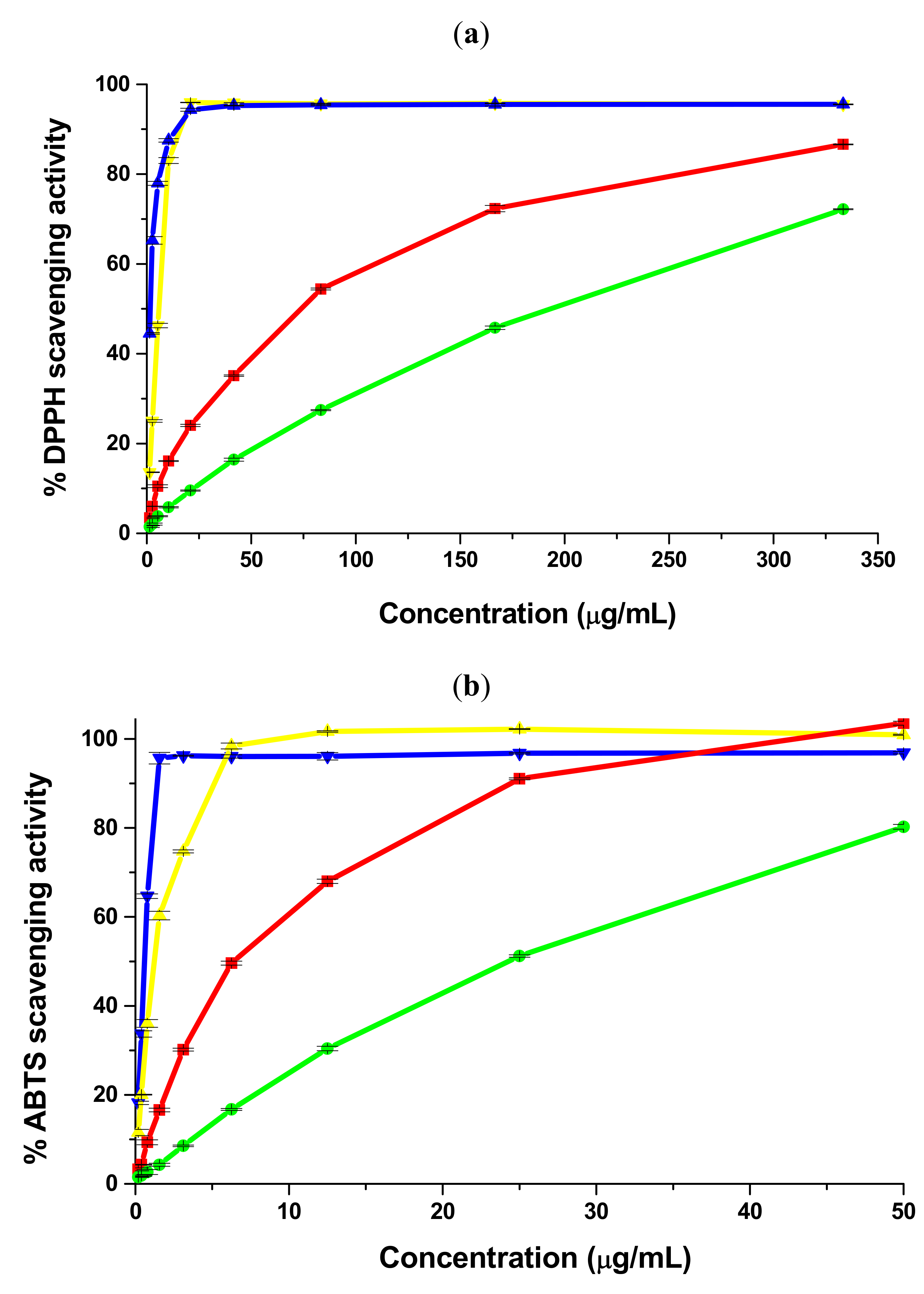
2.2. DPPH Radical Scavenging Assay
2.3. ABTS Radical Cation Scavenging Assay
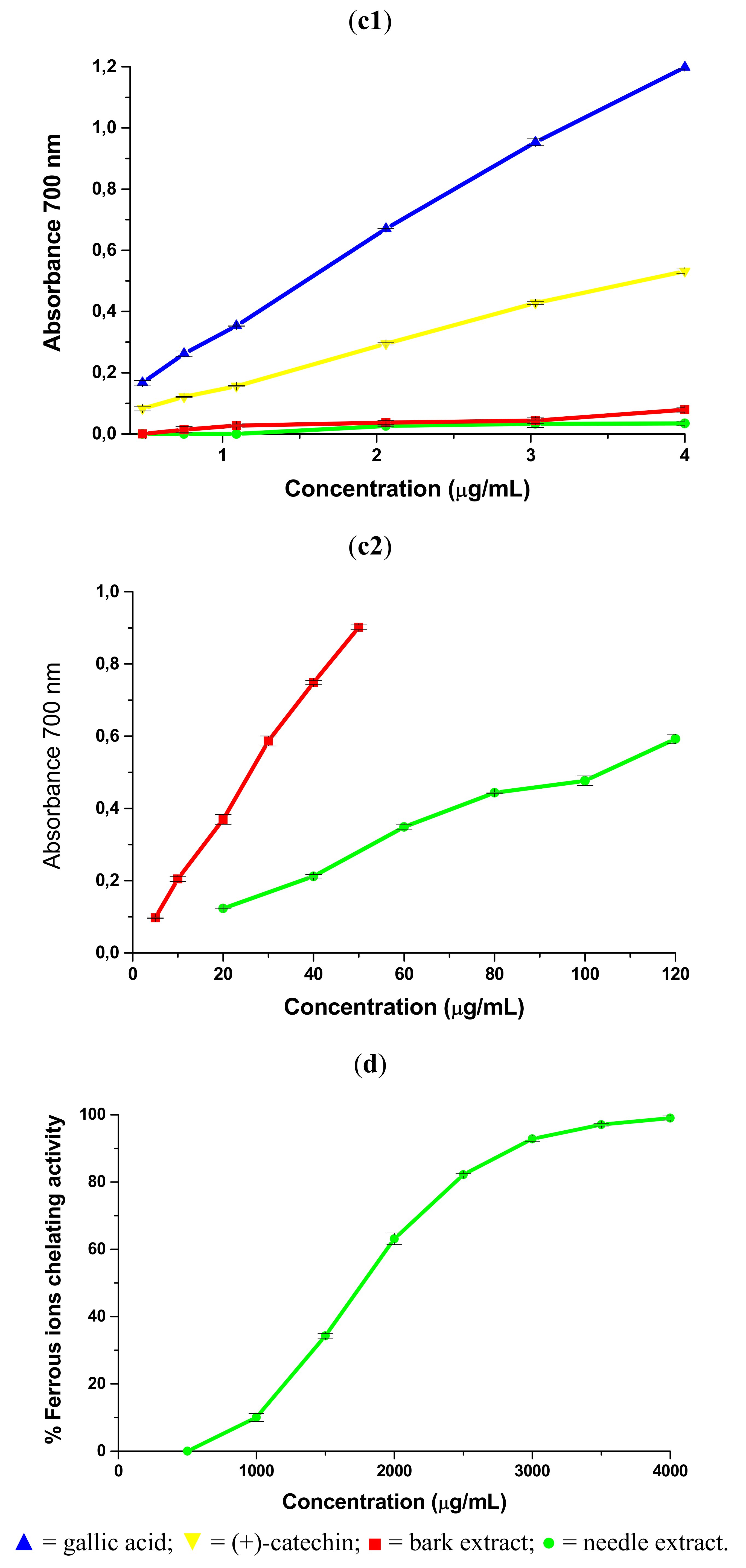
2.4. Reducing Power Assay
2.5. Ferrous Ion Chelating Ability Assay
2.6. Agar Diffusion Method
3. Experimental
3.1. Plant Material
3.2. Chemicals
3.3. Microorganisms
3.4. Extraction
3.5. Total Phenolic Content
3.6. Total Flavonoid Content
3.7. Total Proanthocyanidin Content
3.8. DPPH Radical Scavenging Assay
3.9. ABTS Radical Cation Scavenging Assay
3.10. Reducing Power Assay
3.11. Ferrous Ion Chelating Ability Assay
3.12. Agar Diffusion Method
3.13. Statistical Analysis
4. Conclusions
Acknowledgments
Conflict of Interest
References and Notes
- Wieser, G.; Manning, W.J.; Tausz, M.; Bytnerowicz, A. Evidence for potential impacts of ozone on Pinus cembra L. at mountain sites in Europe: An overview. Environ. Pollut. 2006, 139, 53–58. [Google Scholar] [CrossRef] [PubMed]
- Willför, S.M.; Ahotupa, M.O.; Hemming, J.E.; Reunanen, M.H.T.; Eklund, P.C.; Sjöholm, R.E.; Eckerman, C.E.; Pohjamo, S.P.; Holmbom, B.R. Antioxidant activity of knotwood extractives and phenolic compounds of selected tree species. J. Agric. Food Chem. 2003, 51, 7600–7606. [Google Scholar] [CrossRef] [PubMed]
- Pietarinen, S.P.; Willför, S.M.; Ahotupa, M.O.; Hemming, J.E.; Holmbom, B.R. Knotwood and bark extracts: Strong antioxidants from waste materials. J. Wood Sci. 2006, 52, 436–444. [Google Scholar] [CrossRef]
- Slimestad, R. Flavonoids in buds and young needles of Picea, Pinus and Abies. Biochem. Syst. Ecol. 2003, 31, 1247–1255. [Google Scholar] [CrossRef]
- Linder, W.; Grill, D. Acids in conifer needles. Phyton 1978, 18, 137–144. [Google Scholar]
- Griesbach, R.J.; Santamour, F.S. Anthocyanins in cones of Abies, Picea, Pinus, Pseudotsuga and Tsuga (Pinaceae). Biochem. Syst. Ecol. 2003, 31, 261–268. [Google Scholar] [CrossRef]
- Dormont, L.; Roquest, A.; Malosse, C. Cone and foliage volatiles emitted by Pinus cembra and some related conifer species. Phytochemistry 1998, 49, 1269–1277. [Google Scholar] [CrossRef]
- Wieser, G.; Tausz, M.; Wonisch, A.; Havranek, W.M. Free radical scavengers and photosynthetic pigments in Pinus cembra L. needles as affected by ozone exposure. Biol. Plantarum 2001, 44, 225–232. [Google Scholar] [CrossRef]
- Villaño, D.; Fernández-Pachón, M.S.; Moyá, M.L.; Troncoso, A.M.; García-Parrilla, M.C. Radical scavenging ability of polyphenolic compounds towards DPPH free radical. Talanta 2007, 71, 230–235. [Google Scholar] [CrossRef] [PubMed]
- Cowan, M.M. Plant products as antimicrobial agents. Clin. Microbiol. Rev. 1999, 12, 564–582. [Google Scholar] [PubMed]
- Cushnie, T.P.T.; Lamb, A.J. Antimicrobial activity of flavonoids. Int. J. Antimicrob. Agents 2005, 26, 343–356. [Google Scholar] [CrossRef] [PubMed]
- Witzell, J.; Martin, J.A. Phenolic metabolites in the resistance of northern forest trees to pathogens —Past experiences and future prospects. Can. J. For. Res. 2008, 38, 2711–2727. [Google Scholar] [CrossRef]
- Vickers, C.E.; Gershenzon, J.; Lerdau, M.T.; Loreto, F. A unified mechanism of action of volatile isoprenoids in plant abiotic stress. Nat. Chem. Biol. 2009, 5, 283–291. [Google Scholar] [CrossRef] [PubMed]
- Guo, T.; Wei, L.; Sun, J.; Hou, C.; Fan, L. Antioxidant activities of extract and fractions from Tuber indicum Cooke & Massee. Food Chem. 2011, 127, 1634–1640. [Google Scholar]
- Maimoona, A.; Naeem, I.; Saddiqe, Z.; Jameel, K. A review on biological, nutraceutical and clinical aspects of French maritime pine bark extract. J. Ethnopharmacol. 2011, 133, 261–277. [Google Scholar] [CrossRef] [PubMed]
- Heo, S.J.; Park, E.J.; Lee, K.W.; Jeon, Y.J. Antioxidant activities of enzymatic extracts from brown seaweeds. Bioresour. Technol. 2005, 96, 1613–1623. [Google Scholar] [CrossRef] [PubMed]
- Chung, Y.C.; Chen, S.J.; Hsu, C.K.; Chang, C.T.; Chou, S.T. Studies on the antioxidative activity of Graptopetalum paraguayense E. Walther. Food Chem. 2005, 91, 419–424. [Google Scholar] [CrossRef]
- Luximon-Ramma, A.; Bahorun, T.; Soobrattee, M.A.; Aruoma, O.Y. Antioxidant activities of phenolic, proanthocyanidin and flavonoid components in extracts of Cassia fistula. J. Agric. Food Chem. 2002, 50, 5042–5047. [Google Scholar] [CrossRef] [PubMed]
- Re, R.; Pellegrini, N.; Proteggente, A.; Pannala, A.; Yang, M.; Rice-Evans, C. Antioxidant activity applying an improved ABTS radical cation decolorization assay. Free Radic. Biol. Med. 1999, 26, 1231–1237. [Google Scholar] [CrossRef]
- Rice-Evans, C.A.; Miller, N.J.; Paganga, G. Structure-antioxidant activity relationships of flavonoids and phenolic acids. Free Radic. Biol. Med. 1996, 20, 933–956. [Google Scholar] [CrossRef]
- Malterud, K.E.; Farbrot, T.L.; Huse, A.E.; Sund, R.B. Antioxidant and radical scavenging effects of anthraquinones and anthrones. Pharmacology 1993, 47, 77–85. [Google Scholar] [CrossRef] [PubMed]
- Pinelo, M.; Rubilar, M.; Sineiro, J.; Núñez, M.J. Extraction of antioxidant phenolics from almond hulls (Prunus amygdalus) and pine sawdust (Pinus pinaster). Food Chem. 2004, 85, 267–273. [Google Scholar] [CrossRef]
- Wangensteen, H.; Samuelsen, A.B.; Malterud, K.E. Antioxidant activity in extracts from coriander. Food Chem. 2004, 88, 293–297. [Google Scholar] [CrossRef]
- Wangensteen, H.; Miron, A.; Alamgir, M.; Rajia, S.; Samuelsen, A.B.; Malterud, K.E. Antioxidant and 15-lipoxygenase inhibitory activity of rotenoids, isoflavones and phenolic glycosides from Sarcolobus globosus. Fitoterapia 2006, 77, 290–295. [Google Scholar] [CrossRef] [PubMed]
- Mathisen, E.; Diallo, D.; Andersen, Ø.M.; Malterud, K.E. Antioxidants from the Bark of Burkea africana, an African medicinal plant. Phytother. Res. 2002, 16, 148–153. [Google Scholar] [CrossRef] [PubMed]
- Maiga, A.; Malterud, K.E.; Diallo, D.; Paulsen, B.S. Antioxidant and 15-lipoxygenase inhibitory activities of the Malian medicinal plants Diospyros abyssinica (Hiern) F. White (Ebenaceae), Lannea velutina A. Rich (Anacardiaceae) and Crossopteryx febrifuga (Afzel) Benth. (Rubiaceae). J. Ethnopharmacol. 2006, 104, 132–137. [Google Scholar] [CrossRef] [PubMed]
- Osman, H.; Rahim, A.A.; Isa, M.M.; Bakhir, N.M. Antioxidant activity and phenolic content of Paederia foetida and Syzygium aquem. Molecules 2009, 14, 970–978. [Google Scholar] [CrossRef] [PubMed]
- Samarth, R.M.; Panwar, M.; Kumar, M.; Soni, A.; Kumar, M.; Kumar, A. Evaluation of antioxidant and radical scavenging activities of certain radioprotective plant extracts. Food Chem. 2008, 106, 868–873. [Google Scholar] [CrossRef]
- Erkan, N.; Ayranci, G.; Ayranci, E. Antioxidant activities of rosemary (Rosmarinus officinalis L.) extract, blackseed (Nigella sativa L.) essential oil, carnosic acid, rosmarinic acid and sesamol. Food Chem. 2008, 110, 76–82. [Google Scholar] [CrossRef] [PubMed]
- Furiga, A.; Lonvaud-Funel, A.; Badet, C. In vitro study of antioxidant capacity and antibacterial activity on oral anaerobes of a grape seed extract. Food Chem. 2009, 113, 1037–1040. [Google Scholar] [CrossRef]
- Li, X.; Wu, X.; Huang, L. Correlation between antioxidant activities and phenolic contents of Radix Angelicae sinensis (Danggui). Molecules 2009, 14, 5349–5361. [Google Scholar] [CrossRef] [PubMed]
- Vijaya Kumar Reddy, C.; Sreeramulu, D.; Raghunath, M. Antioxidant activity of fresh and dry fruits commonly consumed in India. Food Res. Int. 2010, 43, 285–288. [Google Scholar] [CrossRef]
- Singh, N.; Rajini, P.S. Free radical scavenging activity of an aqueous extract of potato peel. Food Chem. 2004, 85, 611–616. [Google Scholar] [CrossRef]
- Ferreira, I.C.F.R.; Baptista, P.; Vilas-Boas, M.; Barros, L. Free-radical scavenging capacity and reducing power of wild edible mushrooms from northeast Portugal: Individual cap and stipe activity. Food Chem. 2007, 100, 1511–1516. [Google Scholar] [CrossRef]
- Gülçin, I.; Elmastaş, M.; Aboul-Enein, H.Y. Determination of antioxidant and radical scavenging activity of basil (Ocimum basilicum L. Family Lamiaceae) assayed by different methodologies. Phytother. Res. 2007, 21, 354–361. [Google Scholar]
- Huang, X. Iron overload and its association with cancer risk in humans: Evidence for iron as a carcinogenic metal. Mutat. Res. 2003, 533, 153–171. [Google Scholar] [CrossRef] [PubMed]
- Dinis, T.C.P.; Madeira, V.M.C.; Almeida, L.M. Action of phenolic derivatives (acetaminophen, salicylate and 5-aminosalicylate) as inhibitors of membrane lipid peroxidation and peroxyl radical scavengers. Arch. Biochem. Biophys. 1994, 315, 161–169. [Google Scholar] [CrossRef] [PubMed]
- Tung, Y.T.; Wu, J.H.; Huang, C.Y.; Kuo, Y.H.; Chang, S.T. Antioxidant activities and phytochemical characteristics of extracts from Acacia confusa bark. Bioresour. Technol. 2009, 100, 509–514. [Google Scholar] [CrossRef] [PubMed]
- Mladěnka, P.; Macáková, K.; Filipský, T.; Zatloukalová, L.; Jahodář, L.; Bovicelli, P.; Proietti Silvestri, I.; Hrdina, R.; Saso, L. In vitro analysis of iron chelating activity of flavonoids. J. Inorg. Biochem. 2011, 105, 693–701. [Google Scholar] [CrossRef] [PubMed]
- Wang, T.; Jónsdóttir, R.; Ólafsdóttir, G. Total phenolic compounds, radical scavenging and metal chelation of extracts from Icelandic seaweeds. Food Chem. 2009, 116, 240–248. [Google Scholar] [CrossRef]
- Gülçin, I.; Mshvildadze, V.; Gepdiremen, A.; Elias, R. The antioxidant activity of a triterpenoid glycoside isolated from the berries of Hedera colchica: 3-O-(beta-d-glucopyranosyl)-hederagenin. Phytother. Res. 2006, 20, 130–134. [Google Scholar] [CrossRef] [PubMed]
- Zampini, I.C.; Vattuone, M.A.; Isla, M.I. Antibacterial activity of Zuccagnia punctata Cav. ethanolic extracts. J. Ethnopharmacol. 2005, 102, 450–456. [Google Scholar] [CrossRef] [PubMed]
- Blada, I. Diallel crossing in Pinus cembra. Silvae Genetica 1999, 48, 179–187. [Google Scholar]
- De Leon, G.P.; Elowe, N.H.; Koteva, K.P.; Valvano, M.A.; Wright, G.D. An in vitro screen of bacterial lipopolysaccharide biosynthetic enzymes identifies an inhibitor of ADP-heptose biosynthesis. Chem. Biol. 2006, 13, 437–441. [Google Scholar] [CrossRef] [PubMed]
- Singleton, V.L.; Rossi, J.A. Colorimetry of total phenolics with phosphomolybdic-phosphotungstic acid reagents. Am. J. Enol. Vitic. 1965, 37, 144–158. [Google Scholar]
- Ozsoy, N.; Can, A.; Yanardag, R.; Akev, N. Antioxidant activity of Smilax excelsa L. leaf extracts. Food Chem. 2008, 110, 571–583. [Google Scholar] [CrossRef]
- Porter, L.J.; Hrstich, L.N.; Chan, B.G. The conversion of procyanidins and prodelphinidins to cyanidin and delphinidin. Phytochemistry 1986, 25, 223–230. [Google Scholar] [CrossRef]
- Qa'dan, F.; Petereit, F.; Mansoor, K.; Nahrsted, A. Antioxidant oligomeric proanthocyanidins from Cistus salvifolius. Nat. Prod. Res. 2006, 20, 1216–1224. [Google Scholar] [CrossRef] [PubMed]
- Brown, D.F.J.; Blowers, R. Disc methods of sensitivity testing and other semiquantitative methods. In Laboratory Methods in Antimicrobial Chemotherapy; Reeves, D.S., Phillips, I., Williams, J.D., Wise, R., Eds.; Churchill Livingstone: Edinburgh, UK, 1978; pp. 8–23. [Google Scholar]
- Clinical and Laboratory Standards Institute document M02-A10. Performance Standards for Antimicrobial Disk Susceptibility Tests; Approved Standard, 10th ed.; Clinical and Laboratory Standards Institute: Wayne, Pennsylvania, PA, USA, 2009; pp. 56–58. [Google Scholar]
Sample Availability: Samples are available from the authors. |



| Extract | Total phenolic content * | Total flavonoid content ** | Total proanthocyanidin content *** |
|---|---|---|---|
| Bark extract | 299.3 ± 1.4 | 125.3 ± 1.2 | 74.3 ± 0.5 |
| Needle extract | 78.22 ± 0.44 | 19.84 ± 0.57 | 12.7 ± 0.3 |
| Extract/Positive control | DPPH radical scavenging assay EC50 * | ABTS radical cation scavenging assay | Reducing power assay EC50 * | Ferrous ion chelating ability assay EC50 * | |
|---|---|---|---|---|---|
| EC50 * | TEAC ** | ||||
| Bark extract | 71.1 ± 0.5 | 6.3 ± 0.2 | 0.90 ± 0.01 | 26.0 ± 0.3 | - |
| Needle extract | 186.1 ± 1.7 | 24.0 ± 0.2 | 0.3 ± 0.0 | 104 ± 2 | 1,755 ± 22 |
| Gallic acid | 1.56 ± 0.05 | 0.6 ± 0.0 | 18.13 ± 0.16 | 1.53 ± 0.00 | - |
| (+)-Catechin | 5.56 ± 0.05 | 1.16 ± 0.05 | 7.92 ± 0.05 | 3.70 ± 0.03 | - |
| Extract/Positive control | Diameter of inhibition zone (mm) | |||||
|---|---|---|---|---|---|---|
| S. aureus ATCC 25923 | S. lutea ATCC 9341 | B. cereus ATCC 14579 | E. coli ATCC 25922 | Ps. aeruginosa ATCC 27853 | C. albicans ATCC 10231 | |
| Bark extract (4 mg/well) | 19.33 ± 1.15 | 29.33 ± 1.15 | 16 ± 0 | 16.33 ± 0.57 | 15 ± 1 | 24.33 ± 0.57 |
| Needle extract (4 mg/well) | 14.66 ± 0.57 | 25.66 ± 0.57 | 15.33 ± 0.57 | 12.66 ± 0.57 | 12.66 ± 0.57 | 20 ± 0 |
| Ampicillin (25 μg/disc) | 29.33 ± 0.57 | 30.33 ± 0.57 | n.z. | 16.33 ± 0.57 | n.z. | n.d. |
| Chloramphenicol (30 μg/disc) | 30 ± 1 | 33 ± 0 | 27 ± 1 | 21.66 ± 1.15 | 12 ± 1 | n.d. |
| Nystatin (100 μg/disc) | n.d. | n.d. | n.d. | n.d. | n.d. | 30 ± 1 |
© 2011 by the authors; licensee MDPI, Basel, Switzerland. This article is an open access article distributed under the terms and conditions of the Creative Commons Attribution license (http://creativecommons.org/licenses/by/3.0/).
Share and Cite
Apetrei, C.L.; Tuchilus, C.; Aprotosoaie, A.C.; Oprea, A.; Malterud, K.E.; Miron, A. Chemical, Antioxidant and Antimicrobial Investigations of Pinus cembra L. Bark and Needles. Molecules 2011, 16, 7773-7788. https://doi.org/10.3390/molecules16097773
Apetrei CL, Tuchilus C, Aprotosoaie AC, Oprea A, Malterud KE, Miron A. Chemical, Antioxidant and Antimicrobial Investigations of Pinus cembra L. Bark and Needles. Molecules. 2011; 16(9):7773-7788. https://doi.org/10.3390/molecules16097773
Chicago/Turabian StyleApetrei, Cristina Lungu, Cristina Tuchilus, Ana Clara Aprotosoaie, Adrian Oprea, Karl Egil Malterud, and Anca Miron. 2011. "Chemical, Antioxidant and Antimicrobial Investigations of Pinus cembra L. Bark and Needles" Molecules 16, no. 9: 7773-7788. https://doi.org/10.3390/molecules16097773
APA StyleApetrei, C. L., Tuchilus, C., Aprotosoaie, A. C., Oprea, A., Malterud, K. E., & Miron, A. (2011). Chemical, Antioxidant and Antimicrobial Investigations of Pinus cembra L. Bark and Needles. Molecules, 16(9), 7773-7788. https://doi.org/10.3390/molecules16097773