
Seasonal Variation, Chemical Composition, and Analgesic and Antimicrobial Activities of the Essential Oil from Leaves of Tetradenia riparia (Hochst.) Codd in Southern Brazil

Abstract
:1. Introduction
2. Results and Discussion
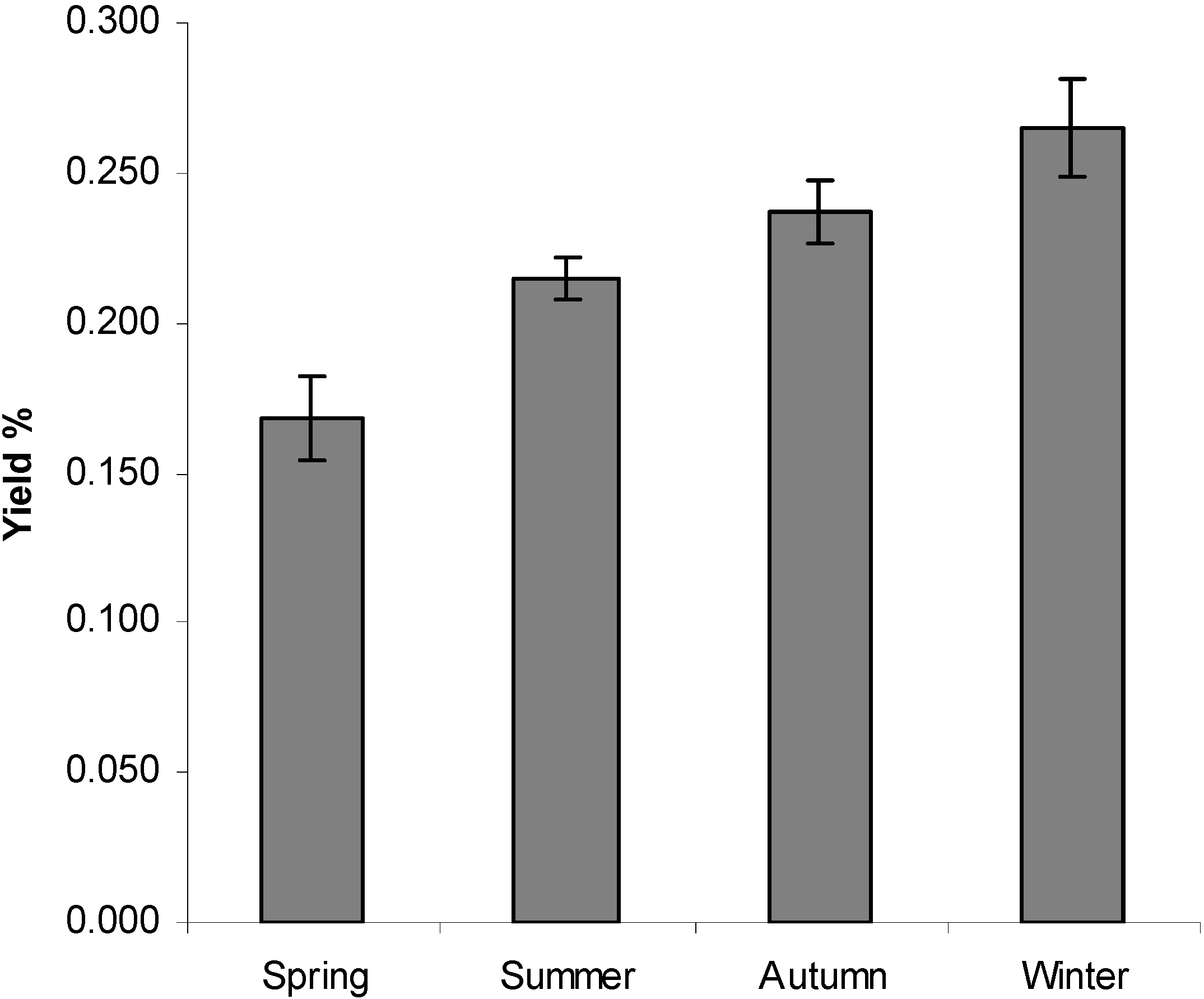
2.1. Oil yield (%)


2.2. Identification and quantification of T. riparia essential oil

| Peak | ACompounds | % Composition | Methods ofIdentification | ||||
|---|---|---|---|---|---|---|---|
| RIa | Spring | Summer | Autumn | Winter | |||
| Monoterpene Hydrocarbons | |||||||
| 1 | Limonene | 1047 | 0.90 ± 0.13c | 3.69 ± 1.06a | t | 2.32 ± 0.80b | i.j. |
| Oxygenated Monoterpenes | |||||||
| 2 | Fenchone | 1051 | 2.40 ± 0.18b | 12.67 ± 1.04a | 3.42 ± 0.46b | 5.65 ± 0.58b | i.j. |
| 3 | endo-Fenchol | 1093 | 0.77 ± 0.17b | 1.90 ± 0.65a | 0.87 ± 0.10b | 1.11 ± 0.55b | i.j. |
| 4 | Camphor | 1108 | 0.90 ± 0.20bc | 2.68 ± 0.76a | 1.15 ± 0.19bc | 1.67 ± 0.79b | i.j. |
| 5 | Borneol | 1119 | 0.73 ± 0.09b | 1.43 ± 0.32a | 0.90 ± 0.19b | 1.09 ± 0.48b | i.j. |
| 6 | α-Terpineol | 1131 | 0.57± 0.09a | 0.83 ± 0.17a | 0.73 ± 0.20a | 0.72 ± 0.24a | i.j. |
| Sesquiterpene Hydrocarbons | |||||||
| 7 | δ-Elemene | 1360 | t | 0.12 ± 0.02a | 0.15 ± 0.02a | t | i.j. |
| 8 | α-Copaene | 1377 | 0.53 ± 0.27c | 1.17 ± 0.26a | 1.32 ± 0.31a | t | i.j. |
| 9 | β-Elemene | 1395 | 0.20 ± 0.03a | 0.27 ± 0.08a | 0.40 ± 0.08a | 0.33 ± 0.00a | i.j. |
| 10 | α-Gurjunene | 1400 | 0.25 ± 0.06b | 0.46 ± 0.12b | 0.73 ± 0.16a | t | i.j. |
| 11 | β-Caryophyllene | 1425 | 0.38 ± 0.06bc | 0.63 ± 0.20b | 1.26 ± 0.26a | 0.34 ± 0.07bc | i.j. |
| 12 | α -trans-Bergamotene | 1436 | 1.57± 0.20c | 3.33 ± 0.09b | 4.78 ± 0.65a | 1.08 ± 0.10d | i.j. |
| 13 | allo-Aromadendrene | 1445 | 0.28± 0.06bc | 0.34 ± 0.08bc | 0.90 ± 0.19a | 0.45 ± 0.11b | i.j. |
| 14 | Bicyclogermacrene | 1495 | 0.51± 0.09a | 0.55 ± 0.10a | 0.80 ± 0.16a | 0.46 ± 0.28a | i.j. |
| 15 | α-( E,E)-Farnesene | 1504 | 0.22 ± 0.04b | 0.29 ± 0.08b | 0.50 ± 0.09a | t | i.j. |
| 16 | γ-cadinene | 1511 | 0.2 ± 0.03a | 0.18 ± 0.04a | 0.21 ± 0.03a | t | i.j. |
| 17 | δ-Cadinene | 1528 | 0.85 ± 0.22c | 1.48 ± 0.33b | 1.76 ± 0.27a | 0.32 ± 0.05d | i.j. |
| Oxygenated Sesquiterpenes | |||||||
| 18 | cis-Muurolol-5-en-4-α-ol | 1535 | 13.2 ± 0.18a | 11.74 ± 0.09a | 13.78 ± 0.56a | 7.06 ± 0.19b | i.j. |
| 19 | Ledol | 1541 | 7.11± 0.22a | 7.00 ± 0.24a | 8.74 ± 0.84a | 4.39 ± 2.59b | i.j. |
| 20 | Caryophyllenyl alcohol | 1544 | 0.53± 0.19a | 0.39 ± 0.02a | 0.47 ± 0.06a | 0.37 ± 0.06a | i.j. |
| 21 | Spathulenol | 1576 | 0.16 ± 0.02b | 0.10 ± 0.02b | 0.15 ± 0.03b | 0.33 ± 0.11a | i.j. |
| 22 | Globulol | 1589 | 2.81± 0.96a | 3.16 ± 0.70a | 3.97 ± 1.31a | 1.16 ± 0.32b | i.j. |
| 23 | Viridiflorol | 1592 | 0.93 ± 0.26b | 0.50 ± 0.20b | 1.11 ± 0.18b | 4.20 ± 0.99a | i.j. |
| 24 | Guaiol | 1599 | 1.54 ± 0.18b | 1.24 ± 0.19b | 1.83 ± 0.41b | 3.27 ± 0.54a | i.j |
| 25 | epi-α-Muurolol | 1656 | 0.41± 0.10a | 0.27 ± 0.07a | 0.22 ± 0.06a | 0.36 ± 0.12a | i.j |
| 26 | α-Cadinol | 1669 | 8.33 ± 1.25a | 5.36 ± 0.84b | 6.24 ± 1.35b | 7.11 ± 1.54 a | i.j. |
| 27 | 14-Hydroxy-9- epi-caryophyllene | 1688 | 24.36 ± 2.68a | 18.27 ± 0.19ab | 20.34 ± 2.59ab | t | i.j. |
| 28 | (2 Z,6E)-Farnesol | 1709 | 1.67 ± 0.41a | 1.16 ± 0.28ab | 1.28 ± 0.25ab | 0.73 ± 0.23c | i.j. |
| 29 | Guaiol acetate | 1716 | 0.69 ± 0.06b | 0.41 ± 0.03b | 0.53 ± 0.11b | 1.82 ± 0.73a | i.j. |
| 30 | iso-Longifolol | 1728 | 0.28 ± 0.11b | 0.14 ± 0.03b | 0.21 ± 0.04b | 1.50 ± 0.32a | i.j. |
| 31 | Oplopanone | 1753 | 0.16 ±0.01b | 0.15 ± 0.02b | 0.21 ± 0.06a | t | i.j. |
| 32 | 14-Hydroxy- α-muurolene | 1782 | 1.22 ± 0.01b | 0.22 ± 0.14c | 0.73 ± 0.13c | 7.44 ± 2.17a | i.j. |
| 33 | 8-Cedren-13-ol acetate | 1799 | t | t | t | 0.80 ± 0.32a | i.j. |
| 34 | n.i | 1812 | 0.28 ± 0.03b | t | t | 0.84 ± 0.36a | i.j. |
| 35 | n.i | 1831 | 0.65 ± 0.36b | 0.17 ± 0.01bc | 0.39 ± 0.00bc | 3.80 ± 1.58a | i.j. |
| Diterpene Hydrocarbons | |||||||
| 36 | Abietadiene | 2017 | 6.85 ± 0.66b | 5.51 ± 1.50b | 6.33 ± 1.07b | 13.54 ± 2.18a | i.j. |
| Oxygenated Diterpenes | |||||||
| 37 | Manoyl oxide | 2096 | 1.61 ± 1.59a | 0.41 ± 0.09b | 0.81 ± 0.25a | 0.70 ± 0.23b | i.j. |
| 38 | n.i | 2141 | 0.31 ± 0.08a | 0.21 ± 0.03b | 0.20 ± 0.05b | 0.34 ± 0.06a | i.j. |
| 39 | Calyculone | 2217 | 15.64 ± 1.11b | 11.57 ± 0.38b | 12.58 ± 1.67b | 24.70 ± 1.34a | i.j. |
| Total identified | 98.76 | 99.62 | 99.41 | 95.02 |
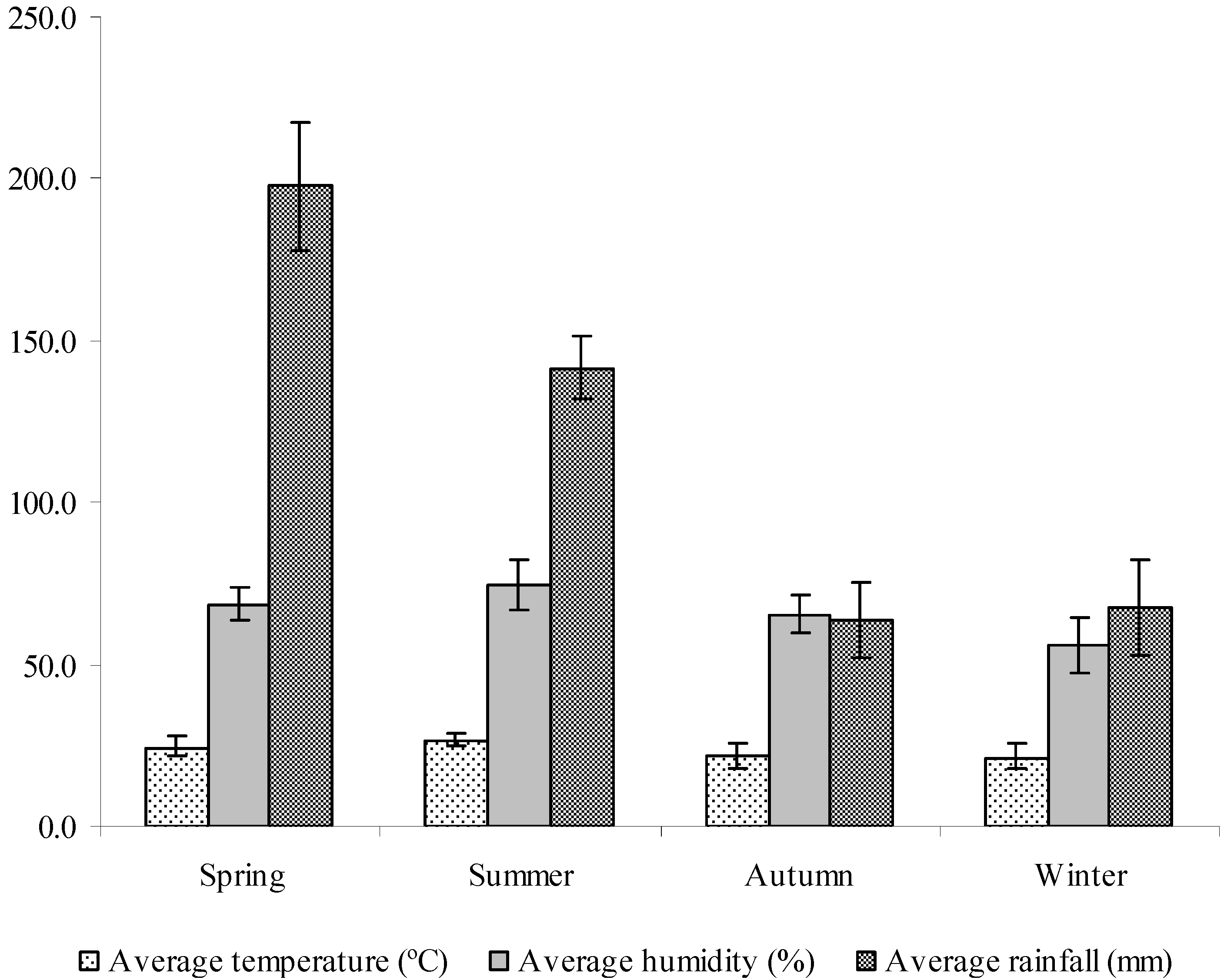
2.3. Seasonal variability
2.4. Antimicrobial activity
 |
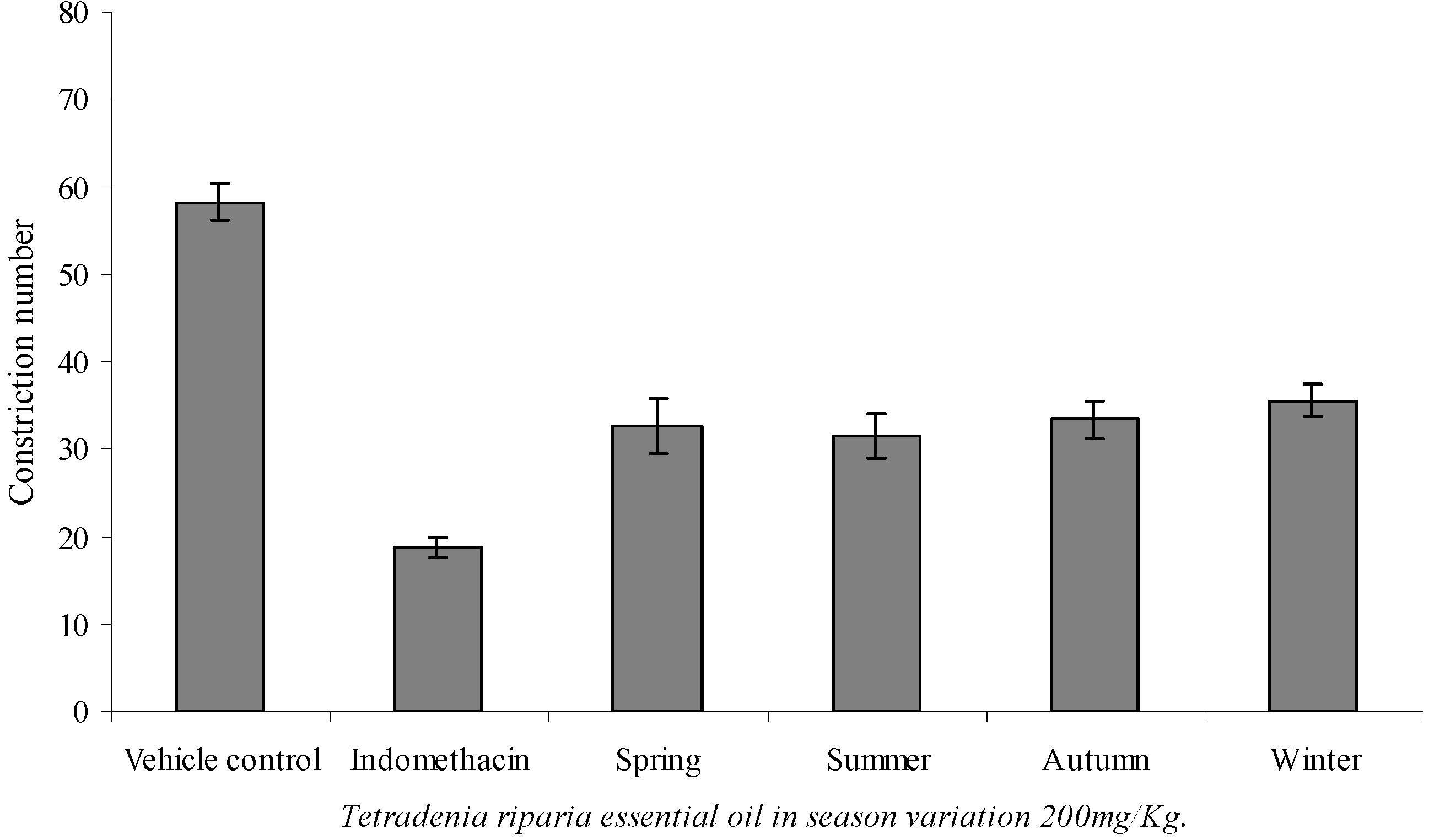
2.5. Analgesic activity

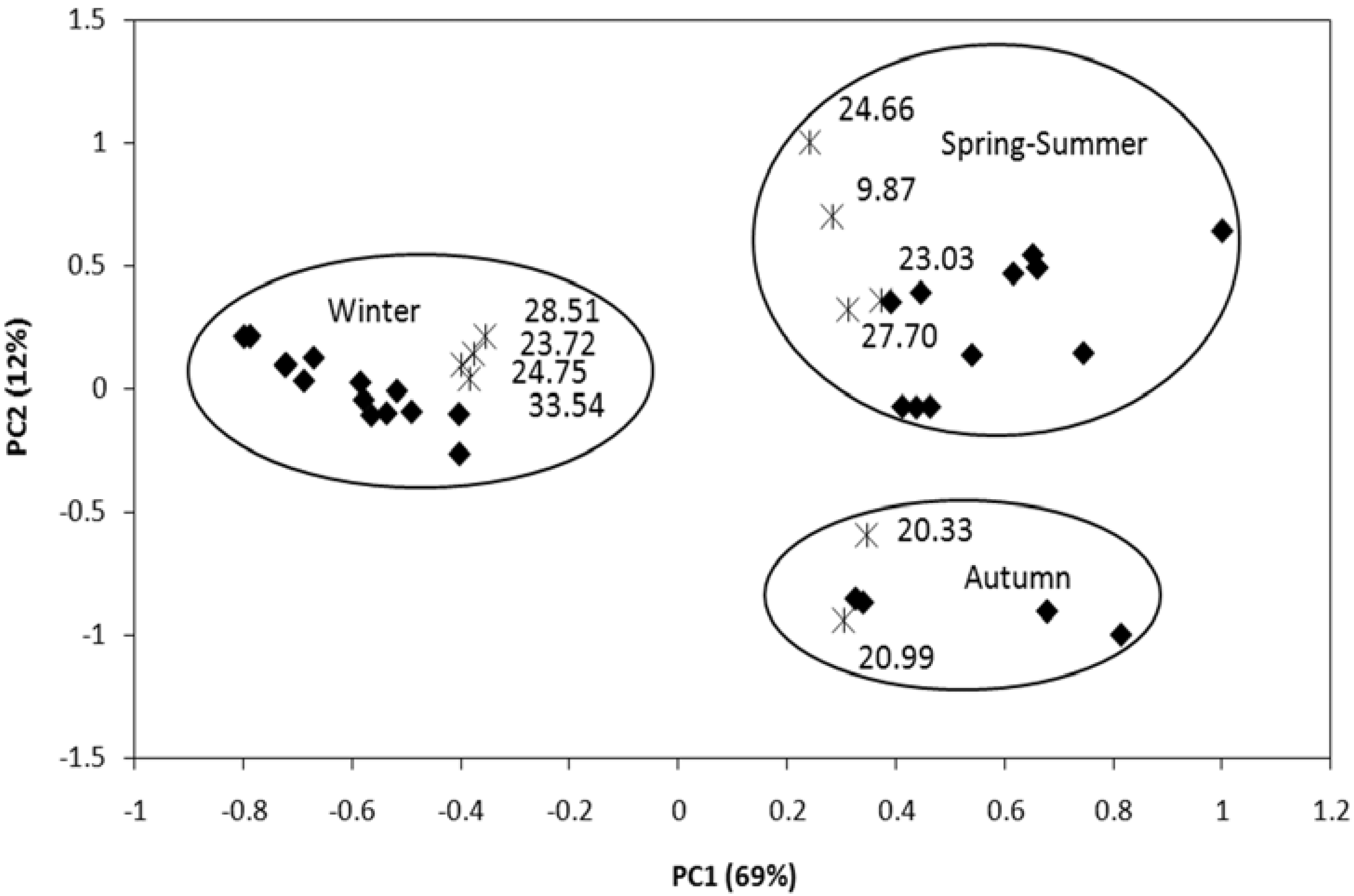
2.6. Principal components analysis (PCA)
| Season | RT (min) | Chemical Identification |
|---|---|---|
| Spring-Summer | 9.87 | L-fenchone |
| 23.03 | Caryophyllenyl alcohol | |
| 24.66 | α-Cadinol | |
| 27.70 | 14-Hydroxy-9- epi-caryophyllene | |
| Autunm | 20.33 | cis-Muurolol-5-en-4-α-ol |
| 20.99 | Ledol | |
| Winter | 23.72 | n.i |
| 24.75 | Viridiflorol | |
| 28.51 | Abietadiene | |
| 33.54 | Calyculene |

3. Experimental
3.1. Plant materials
3.2. Chemicals and reagents
3.3. Preparation of the samples
3.4. GC-MS and GC-FID analysis
3.5. Analgesic activity
3.5.1. Animals and drugs
3.5.2. Acetic acid-induced abdominal constriction in mice
3.6. Antimicrobial activity
3.6.1. Microorganisms used and growth conditions
3.6.2. Disc diffusion method
3.6.3. Microdilution MIC method
3.7. Statistical analysis
3.8. Principal components analysis (PCA)
3.9. Partial least squares-discriminant analysis (PLS-DA)
4. Conclusions
Acknowledgements
- Sample Availability: Samples of the compounds are available from the authors.
References and Notes
- Gairola, S.; Naidoo, Y.; Bhatt, A.; Nocholas, A. An investigation of the foliar trichomes of Tetradenia riparia (Hochst.) Codd [Lamiaceae]: An important medicinal plant of Southern África. Flora 2009, 204, 325–330. [Google Scholar] [CrossRef]
- Campbell, W.E.; Gammon, D.W.; Smith, P.; Abrahams, M.; Purves, T. Composition and antimalarial activity in vitro of the essential oil of Tetradenia riparia. Planta Med. 1997, 63, 270–272. [Google Scholar] [CrossRef]
- Martins, M.B.G.; Martins, R.G.; Cavalheiro, J.A. Histoquímica e atividade antibacteriana de folhas do incenso (Tetradenia riparia). Revista Biociências 2008, 14, 127–140. [Google Scholar]
- Omolo, M.O.; Okinyo, D.; Ndiege, I.O.; Lwande, W.; Hassanali, A. Repellency of essential oils of some Kenyan plants against Anopheles gambiae. Phytochemistry 2004, 65, 2797–2802. [Google Scholar] [CrossRef]
- Pieters, L.; Vlietinck, A.J. Bioguided isolation of pharmacologically active plant components, still a valuable strategy for the finding of new lead compounds? J. Ethnopharmacol. 2005, 100, 57–60. [Google Scholar] [CrossRef]
- Weaver, D.K.; Dunkel, F.V.; Van Puyvelde, L.; Richards, D.C.; Frizgerald, G.W. Toxicity and protectant potential of the essential oil of Tetradenia-riparia (lamiales, lamiaceae) against zabrotes-subfasciatus (col, bruchidae) infesting dried pinto beans (fabales, leguminosae). J. Appl. Entomol. 1994, 118, 179–196. [Google Scholar] [CrossRef]
- Van Puyvelde, L.; Nyirankuliza, S.; Panebianco, R.; Boily, Y.; Geizer, I.; Sebikali, B.; De Kimpe, N.; Schamp, N. Active principles of Tetradenia riparia. I. Antimicrobial activity of 8(14),15-sandaracopimaradiene-7α,18-diol. J. Ethnopharmacol. 1986, 17, 269–275. [Google Scholar] [CrossRef]
- Van Puyvelde, L.; Lefebvre, R.; Mugabo, P.; De Kimpe, N.; Schamp, N. Active principle of Tetradenia riparia; II. Antispasmodic activity of 8(14),15-sandaracopimaradiene-7α,18-diol. Planta Med. 1987, 53, 156–158. [Google Scholar] [CrossRef]
- Celiktas, O.Y.; Kocabas, E.E.H.; Bedir, E.; Sukan, F.V.; Ozek, T.; Baser, K.H.C. Antimicrobial activities of methanol extracts and essential oils of Rosmarinus oficinalis, depending on location and seasonal variations. Food Chem. 2007, 100, 553–559. [Google Scholar] [CrossRef]
- Đorđević, S.; Petrović, S.; Dobrić, S.; Milenković, M.; Vučićević, D.; Žižić, S.; Kukić, J. Antimicrobial, anti-inflammatory, anti-ulcer and antioxidant activities of Carlina acanthifolia root essential oil. J. Ethnopharmacol. 2007, 109, 458–463. [Google Scholar] [CrossRef]
- Vekiari, S.A.; Protopapadakis, E.E.; Papadopoulou, P.; Papanicolaou, D.; Panou, C.; Vamvakias, M. Composition and Seasonal Variation of the Essential Oil from Leaves and Peel of a Cretan Lemon Variety. J. Agr. Food Chem. 2002, 50, 147–153. [Google Scholar]
- Farmacopéia Brasileira, 4th ed; Atheneu editora São Paulo Ltda: Brasilia, Brazil, 1988.
- Sandra, P.; Bicchi, C. Capillary Gas Chromatography in Essential Oil Analysis; Huethig Heidelberg: New York, NY, USA, 1987. [Google Scholar]
- Adams, R.P. Identification of Essential Oil Components by Gas Chromatography / Mass Spectroscopy, 2nd ed; Allured Publishing Corporation: Carol Stream, IL, USA, 1995. [Google Scholar]
- Adams, R.P. Identification of Essential Oil Components by Gas Chromatography/ Mass Spectroscopy, 4nd ed; Allured Publishing Corporation: Carol Stream, IL, USA, 2007. [Google Scholar]
- Amorim, A.C.L.; Lima, C.K.F.; Hovell, A.M.; Miranda, A.L.P.; Rezende, C.M. Antinociceptive and hypothermic evalution of the leaf essential oil and isolation terpenoids from Eugenia uniflora L. (BrazilianPitanga). Phytomedicine 2009, 16, 923–928. [Google Scholar]
- Zimmermann, M. Ethical guide lines for investigations of experimental pain in conscious animals. Pain 1983, 16, 109–110. [Google Scholar]
- Ribeiro, I.G.; Silva, K.C.M.; Parrini, S.C.; Miranda, A.L.P.; Fraga, C.A.M.; Barreiro, E.J. Synthesis and anti- nociceptive properties of new structurally planned imidazo[1,2-a] pyridine 3-acylarylhydrazone derivatives. Eur. J. Med. Chem. 1998, 33, 225–235. [Google Scholar] [CrossRef]
- CLSI (NCCLS), Performance Standards for Antimicrobial Disk Susceptibility Tests; Approved Standards, 7th ed; NCCLS: Wayne, PA, USA, 2000.
- CLSI (NCCLS), Methods for Dilution Antimicrobial Susceptibility Tests for Bactéria That Grow Aerobically; Approved Standard, 7th ed; NCCLS: Wayne, PA, USA, 2006.
- Oke, F.; Aslim, B.; Ozturk, S.; Altundag, S. Essential oil composition, antimicrobial and antioxidant activities of Satureja cuneifolia Ten. Food Chem. 2009, 112, 874–879. [Google Scholar] [CrossRef]
- Silva, D.R.; Endo, E.H.; Dias Filho, B.P.; Nakamura, C.V.; Svidzinski, T.I.E.; Souza, A.; Young, M.C.M.; Nakamura, T.U.; Cortez, D.A.G. Chemical Composition and Antimicrobial Properties of Piper ovatum Vahl. Molecules 2009, 14, 1171–1182. [Google Scholar] [CrossRef]
- Duran, A.L.; Yang, J.; Wang, L.; Sumner, L.W. Metabolomics spectral formatting, alignment and conversion tools (MSFACTs). Bioinformatics 2003, 19, 2283–2293. [Google Scholar] [CrossRef]
- Brereton, R.G. Chemometrics: Data Analysis for the Laboratory and Chemical Plant; John Wiley & Sons: Chichester, UK, 2003. [Google Scholar]
- Dixon, S.J.; Xu, Y.; Brereton, R.G.; Soini, H.A.; Novotny, M.V.; Oberzaucher, E.; Grammer, K.; Penn, D.J. Pattern recognition of gas chromatography mass spectrometry of human volatiles in sweat to distinguish the sex of subjects and determine potential discriminatory marker peaks. Chemometr. Intell. Lab. Sys. 2007, 87, 161–172. [Google Scholar] [CrossRef]
- Lima, H.R.P.; Kaplan, M.A.C.; Cruz, A.V.M. Influência dos fatores abióticos na produção e variabilidade de terpenóides em plantas. Floresta e Ambiente 2003, 2, 71–77. [Google Scholar]
- Valmorbida, J.; Boaro, C.F.S.; Marques, M.O.M.; Ferri, A.F. Rendimento e composição química de óleos essenciais de Mentha piperita L. cultivada em solução nutritiva com diferentes concentrações de potássio. Rev. Bras. Pl. Med. 2006, 8, 56–61. [Google Scholar]
- Hussain, A.I.; Anwar, F.; Sherazi, S.T.H.; Przybylski, R. Chemical composition, antioxidant and antimicrobial activities of basil (Ocimum basilicum) essential oils depends on seasonal variations. Food Chem. 2008, 108, 986–995. [Google Scholar] [CrossRef]
- Cerqueira, M.D.; Marques, E.J.; Martins, D.; Roque, N.F.; Cruz, F.G. Variação sazonal da composição do óleo essencial de Myrcia salzmannii Berg. (Myrtaceae). Quím. Nova 2009, 32, 1544–1548. [Google Scholar] [CrossRef]
- Mothana, R.A.; AL-Rehaily, A.J.; Schultze, W. Chemical analysis and biological activity of the essential oils of two endemic Sogotri commiphora species. Molecules 2010, 15, 689–698. [Google Scholar] [CrossRef]
- AL-Taweel, A.M.; EL-Deeb, K.S.; AL-Muhtadi, F.J. Chemical composition and antimicrobial activity of the essential oil of kleinia odora. Saudi Pharm. J. 2004, 12, 47–50. [Google Scholar]
- Zuzarte, M.; Gonçalves, M.J.; Cavaleiro, C.; Dinis, A.M.; Canhoto, J.M.; Salgueiro, L.R. Chemical composition and antifungal activity of the essential oils of Lavandula pedunculata (MILLER) CAV. Chem. Biodivers. 2009, 6, 1283–1292. [Google Scholar] [CrossRef]
- Roller, S.; Ernest, N.; Buckle, J. The antimicrobial activity of high-necrodane and other lavender oils on methicillin-sensitive and -resistant Staphylococcus aureus (MSSA and MRSA). J. Altern. Complement. Med. 2009, 15, 275–279. [Google Scholar] [CrossRef]
- Batista, O.; Simões, M.F.; Duarte, A.; Valdeira, M.L.; de la Torre, M.C.; Rodríguez, B. Na antimicrobial abietane from the root of Plectranthus hereroensis. Phytochemistry 1995, 38, 167–169. [Google Scholar]
- Ennajar, M.; Bouajila, J.; Lebrihi, A.; Mathieu, F.; Savagnac, A.; Abderraba, M.; Raiesf, A.; Romdhaneb, M. The influence of organ, season and drying method on chemical composition and antioxidant and antimicrobial activities of Juniperus phoenicea L. essential oils. J. Sci. Food Agr. 2010, 90, 462–470. [Google Scholar]
- Morán, A.; Martín, M.L.; Montero, M.J.; Ortiz de Urbina, A.V.; Sevilla, M.A.; San Roman, L. Analgesic, antipyretic and anti-inflamatory activity of the essential oil of Artemisia caerulescens subsp. Gallica. J. Ethnopharmacol. 1989, 27, 307–317. [Google Scholar] [CrossRef]
- Chavan, M.J.; Wakte, P.S.; Shinde, D.B. Analgesic and anti-inflamatory activity of cariophyllene oxide from Annona squamosa L. bark. Phytomedicine 2010, 17, 149–151. [Google Scholar] [CrossRef]
- Correia, P.R.M.; Ferreira, M.M.C. Reconhecimento de padrões por métodos não supervisionados: Explorando procedimentos quimiométricos para tratamento de dados analíticos. Química Nova 2007, 30, 481–487. [Google Scholar] [CrossRef]
- 39. Tanaka, K.; Tamura, T.; Fukuda, S.; Batkhuu, J.; Sanchir, C.; Komatsu, K. Quality evaluation of Astragali radix using a multivariate statistical. Phytochemistry 2008, 69, 2081–2087. [Google Scholar]
- Costa, D.P.; Santos, S.C.; Seraphin, J.C.; Ferri, P.H. Seasosnal variability of essential oil of Eugenia uniflora leaves. J. Br. Chem. Soc. 2009, 20, 1287–1293. [Google Scholar] [CrossRef]
- Marchesini, A.M.; Prado, G.G.; Messiano, G.B.; Machado, M.B.; Lopes, L.M.X. Chemical constituints of Aristolochia giberti. J. Br. Chem. Soc. 2009, 20, 1598–1608. [Google Scholar] [CrossRef]
© 2010 by the authors; licensee MDPI, Basel, Switzerland. This article is an Open Access article distributed under the terms and conditions of the Creative Commons Attribution license (http://creativecommons.org/licenses/by/3.0/).
Share and Cite
Gazim, Z.C.; Amorim, A.C.L.; Hovell, A.M.C.; Rezende, C.M.; Nascimento, I.A.; Ferreira, G.A.; Cortez, D.A.G. Seasonal Variation, Chemical Composition, and Analgesic and Antimicrobial Activities of the Essential Oil from Leaves of Tetradenia riparia (Hochst.) Codd in Southern Brazil. Molecules 2010, 15, 5509-5524. https://doi.org/10.3390/molecules15085509
Gazim ZC, Amorim ACL, Hovell AMC, Rezende CM, Nascimento IA, Ferreira GA, Cortez DAG. Seasonal Variation, Chemical Composition, and Analgesic and Antimicrobial Activities of the Essential Oil from Leaves of Tetradenia riparia (Hochst.) Codd in Southern Brazil. Molecules. 2010; 15(8):5509-5524. https://doi.org/10.3390/molecules15085509
Chicago/Turabian StyleGazim, Zilda Cristiani, Ana Carolina L. Amorim, Ana Maria C. Hovell, Claudia Moraes Rezende, Izalina Ansilieiro Nascimento, Gilberto Alves Ferreira, and Diógenes Aparício Garcia Cortez. 2010. "Seasonal Variation, Chemical Composition, and Analgesic and Antimicrobial Activities of the Essential Oil from Leaves of Tetradenia riparia (Hochst.) Codd in Southern Brazil" Molecules 15, no. 8: 5509-5524. https://doi.org/10.3390/molecules15085509