
An Update on Vitamin E, Tocopherol and Tocotrienol—Perspectives

Abstract
:1. Introduction
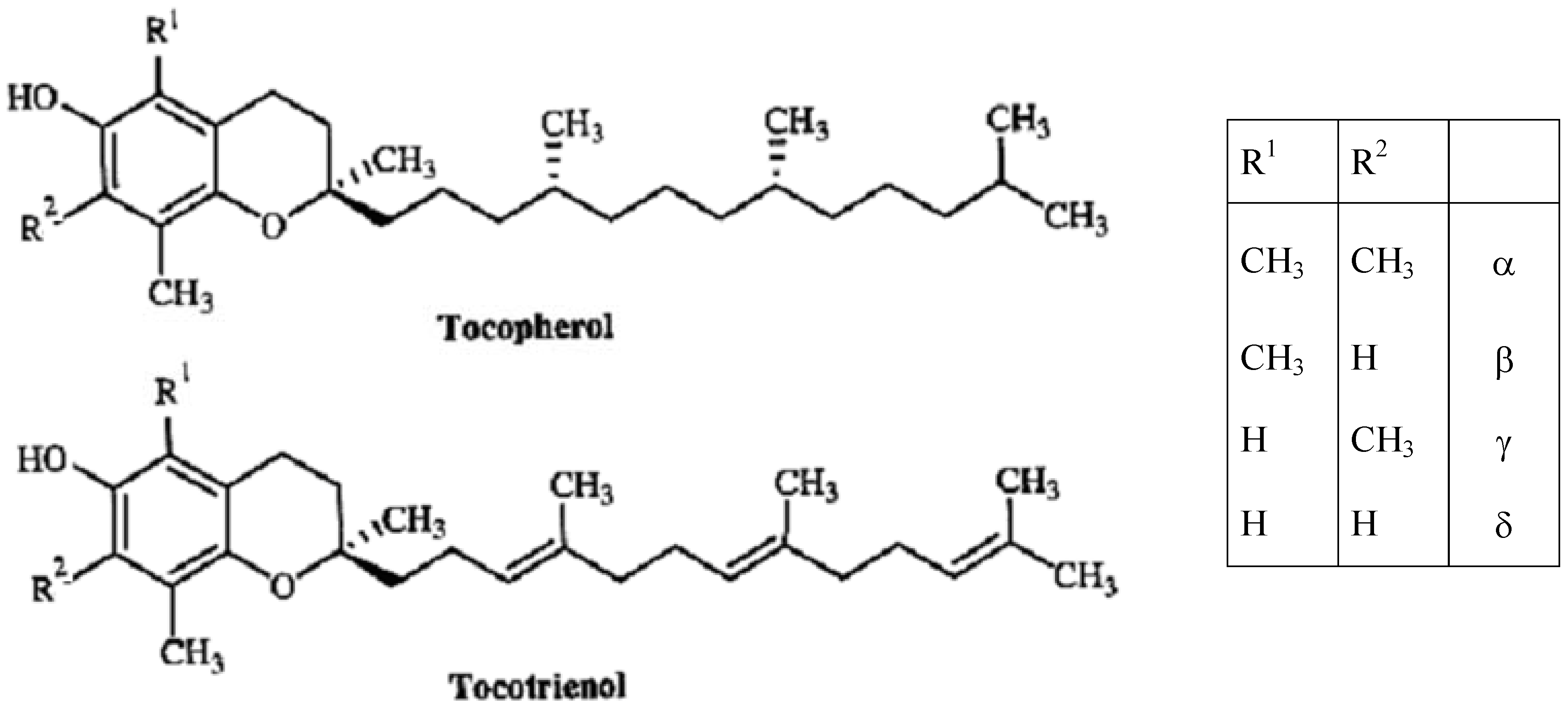
2. Vitamin E Chemistry and Biochemistry

2.1. Tocopherol and tocochromanol analysis
3. Vitamin E Biological Activities
3.1. Vitamin E in the diet and the European Community legislation
3.2. Antioxidant activity
3.3. Vitamin E and cardiovascular diseases
3.4. Vitamin E and cancer
4. Conclusions
- Sample Availability: Not available.
References and Notes
- Zingg, J.M. Vitamin E: An overview of major research directions. Mol. Aspects Med. 2007, 28, 400–422. [Google Scholar] [CrossRef]
- Vitamin, E. Available online: http://www.nlm.nih.gov/medlineplus/ency/article/002406.htm (accessed 19 March 2010).
- Wang, L.; Newman, R.K.; Newman, C.W.; Jackson, L.L.; Hofer, P.J. Tocotrienol and fatty acid composition of barley oil and their effects on lipid metabolism. Plant Foods Hum. Nutr. 1993, 43, 9–17. [Google Scholar] [CrossRef]
- Sookwong, P.; Nakagawa, K.; Murata, K.; Kojima, Y.; Miyazawa, T. Quantitation of tocotrienol in various rice brans. J. Agric. Food Chem. 2007, 55, 461–466. [Google Scholar] [CrossRef]
- Riccioni, G.; Bucciarelli, T.; Mancini, B.; Di Ilio, C.; Capra, V.; D'Orazio, N. The role of the antioxidant vitamin supplementation in the prevention of cardiovascular diseases. Expert Opin. Investig. Drugs 2007, 16, 25–32. [Google Scholar] [CrossRef]
- IUPAC-IUB Joint Commission on Biochemical Nomenclature (JCBN). Nomenclature of Tocopherols and Related Compounds Recommendations 1981. Arch. Biochem. Biophys. 1982, 218, 347–348, Eur. J. Biochem. 1982, 123, 473-475; Mol. Cell. Biochem. 1982, 49, 183-185; PureAppl. Chem. 1982, 54, 1507-1510..
- Mayer, H.; Metzger, J.; Isler, O. The stereochemistry of natural gamma-tocotrienol (plastochromanol-3), plastochromanol-8 and plastochromenol-8. Helv. Chim. Acta 1967, 50, 1376–1393. [Google Scholar] [CrossRef]
- Netscher, T. Stereoisomers of Tocopherols-syntheses and analytics. Chimia 1996, 50, 563–567. [Google Scholar]
- Munnè-Bosch, S.; Alegre, L. The function of tocopherols and tocotrienols in plants. Crit. Rev. Plant Sci. 2002, 21, 31–57. [Google Scholar]
- Hofius, D.; Sonnewald, U. Vitamin E biosynthesis: Biochemistry meets cell biology. Trends Plant Sci. 2003, 8, 6–8. [Google Scholar] [CrossRef]
- Porfirova, S.; Bergmüller, E.; Tropf, S.; Lemke, R.; Dörmann, P. Isolation of an Arabidopsis mutant lacking vitamin E and identification of a cyclase essential for all tocopherol biosynthesis. Proc. Natl. Acad. Sci. USA 2002, 99, 12495–12500. [Google Scholar] [CrossRef]
- Lodge, J.K. Vitamin E bioavailability in humans. J. Plant Physiol. 2005, 162, 790–796. [Google Scholar] [CrossRef]
- Weiser, H.; Vecchi, M. Stereoisomers of alpha-tocopheryl acetate. II. Biopotencies of all eight stereoisomers, individually or in mixtures, as determined by rat resorption-gestation tests. Int. Vitam. Nutr. Res. 1982, 52, 351–370. [Google Scholar]
- Drotleff, A.M.; Ternes, W. Determination of RS,E/Z-tocotrienols by HPLC. J. Chomatogr. A 2001, 909, 215–223. [Google Scholar] [CrossRef]
- Zingg, J.M. Molecular and cellular activities of vitamin E analogues. Mini Rev. Med. Chem. 2007, 7, 543–558. [Google Scholar]
- Ball, G.F.M. Vitamins in Foods; CRC Taylor & Francis: Boca Raton, FL, USA, 2006; pp. 119–136. [Google Scholar]
- Backasch, N.; Schulz-Friedrich, R.; Appel, J. Influences on tocopherol biosynthesis in the cyanobacterium Synechocystis sp. PCC 6803. J. Plant Physiol. 2005, 162, 758–766. [Google Scholar] [CrossRef]
- Colombo, M.L.; Corsini, A.; Mossa, A.; Sala, L.; Stanca, M. Extraction of the fat-soluble vitamin E from Hordeum vulgare L. fruits by supercritical fluid carbon dioxide. Phytochem. Anal. 1998, 9, 192–195. [Google Scholar] [CrossRef]
- Ng, M.H.; Choo, Y.M.; Ma, A.N.; Chuah, C.H.; Hashim, M.A. Separation of vitamin E (tocopherol, tocotrienol, and tocomonoenol) in palm oil. Lipids 2004, 39, 1031–1035. [Google Scholar] [CrossRef]
- Cunha, S.C.; Amaral, J.S.; Fernandes, J.O.; Oliveira, M.B. Quantification of tocopherols and tocotrienols in portuguese olive oils using HPLC with three different detection systems. J. Agric. Food Chem. 2006, 54, 3351–3356. [Google Scholar] [CrossRef]
- Panfili, G.; Fratianni, A.; Irano, M. Normal phase high-performance liquid chromatography method for the determination of tocopherols and tocotrienols in cereals. J. Agric. Food Chem. 2003, 51, 3940–3944. [Google Scholar] [CrossRef]
- Ryan, E.; Galvin, K.; O’Connor, T.P.; Maguire, A. R.; O’Brien, N.M. Phytosterol, squalene, tocopherol content and fatty acid profile of selected seeds, grains, and legumes. Plant Foods Hum. Nutr. 2007, 62, 85–91. [Google Scholar] [CrossRef]
- Roy, S.; Venojarvi, M.; Khanna, S.; Sen, C.K. Simultaneous detection of tocopherols and tocotrienols in biological samples using HPLC-coulometric electrode array. Methods Enzymol. 2002, 352, 326–332. [Google Scholar] [CrossRef]
- Colombo, M.L.; Marangon, K.; Bugatti, C. CoulArray electrochemical evaluation of tocopherol and tocotrienol isomers in barley, oat and spelt grains. Nat. Prod. Commun. 2009, 4, 251–254. [Google Scholar]
- Morrissey, P.A.; Kiely, M. Encyclopedia of Human Nutrition, 2nd; Caballero, B., Allen, L., Prentice, A., Eds.; Elsevier Academic Press: Amsterdam, The Netherlands, 2006; pp. 389–398. [Google Scholar]
- Scientific Opinion of the Panel on Food Additives, Flavourings, Processing Aids and Materials in Contact with Food on a request from the Commission on mixed tocopherols, tocotrienol tocopherol and tocotrienols as sources for vitamin E. EFSA J. 2008, 640, 1–34.
- Commission Directive EC 2008/100. OJEU 2008. L 285/9-12.
- Commission Regulation EC 1170/2009. OJEU 2009. L 314/36-42.
- Jenab, M.; Salvini, S.; van Gils, C.H.; Brustad, M.; Shakya-Shrestha, S.; Buijsse, B.; Verhagen, H.; Touvier, M.; Biessy, C.; Wallström, P.; Bouckaert, K.; Lund, E.; Waaseth, M.; Roswall, N.; Joensen, A.M.; Linseisen, J.; Boeing, H.; Vasilopoulou, E.; Dilis, V.; Sieri, S.; Sacerdote, C.; Ferrari, P.; Manjer, J.; Nilsson, S.; Welch, A.A.; Travis, R.; Boutron-Ruault, M.C.; Niravong, M.; Bueno-de-Mesquita, H.B.; van der Schouw, Y.T.; Tormo, M.J.; Barricarte, A.; Riboli, E.; Bingham, S.; Slimani, N. Dietary intakes of retinol, beta-carotene, vitamin D and vitamin E in the european prospective investigation into cancer and nutrition cohort. Eur. J. Clin. Nutr. 2009, 63, S150–S178. [Google Scholar]
- Yoshida, Y.; Niki, E.; Noguchi, N. Comparative study on the action of tocopherols and tocotrienols as antioxidant: Chemical and physical effects. Chem. Phys. Lipids 2003, 123, 63–75. [Google Scholar] [CrossRef]
- Sen, C.K.; Khanna, S.; Roy, S. Tocotrienols in health and disease: The other half of the natural vitamin E family. Mol. Aspects Med. 2007, 28, 692–728. [Google Scholar] [CrossRef]
- Parker, R.A.; Pearce, B.C.; Clark, R.W.; Gordon, D.A.; Wright, J.J. Tocotrienols regulate cholesterol production in mammalian cells by post-transcriptional suppression of 3-hydroxy-3-methylglutaryl-coenzyme A reductase. J. Biol. Chem. 1993, 268, 11230–11238. [Google Scholar]
- Sen, C.K.; Khanna, S.; Rink, C.; Roy, S. Tocotrienols: The emerging face of natural vitamin E. Vitam. Horm. 2007, 76, 203–261. [Google Scholar] [CrossRef]
- Siok-Fong, C.; Noor Aini, A.H.; Azian, A.L.; Zaiton, Z.; Musalmah, M.; Yasmin Anum, M.Y.; Aminuddin, A.K.; Johari, I.; Zalina, H.; Wan Zurinah, W.N. Reduction of DNA damage in older healthy adults by Tri E® tocotrienol supplementation. Nutrition 2008, 24, 1–10. [Google Scholar] [CrossRef]
- Hercberg, S.; Preziosi, P.; Galan, P.; Faure, H.; Arnaud, J.; Duport, N.; Malvy, D.; Roussel, A.M.; Briançon, S.; Favier, A. The SU.VI.MAX. Study: A primary prevention trial using nutritional doses of antioxidant vitamins and minerals in cardiovascular diseases and cancers. Supplementation on Vitamines et Minéraux Antioxydants. Food Chem. Toxicol. 1999, 37, 925–930. [Google Scholar] [CrossRef]
- Kesse-Guyot, E.; Bertrais, S.; Péneau, S.; Estaquio, C.; Dauchet, L.; Vergnaud, A.C.; Czernichow, S.; Galan, P.; Hercberg, S.; Bellisle, F. Dietary patterns and their sociodemographic and behavioural correlates in French middle-aged adults from the SU.VI.MAX. cohort. Eur. J. Clin. Nutr. 2009, 63, 521–528. [Google Scholar] [CrossRef]
- Hanum Ghulam Rasool, A.; Rahman, A.R.A.; Yuen, K.H.; Wong, A.R. Arterial compliance and vitamin E blood levels with a self emulsifying preparation of tocotrienol rich vitamin E. Arch. Pharm. Res. 2008, 31, 1212–1217. [Google Scholar] [CrossRef]
- McAnally, J.A.; Gupta, J.; Sodhani, S.; Bravo, L.; Mo, H. Tocotrienols potentiate lovastatin-mediated growth suppression in vitro and in vivo. Exp. Biol. Med. 2007, 232, 523–531. [Google Scholar]
- Qureshi, A.A.; Sami, S.A.; Salser, W.A.; Khan, F.A. Dose-dependent suppression of serum cholesterol by tocotrienol-rich fraction (TRF25) of rice bran in hypocholesterolemic humans. Atherosclerosis 2002, 161, 199–207. [Google Scholar] [CrossRef]
- Qureshi, A.A.; Sami, S.A.; Salser, W.A.; Khan, F.A. Synergistic effect of tocotrienol-rich fraction (TRF) of rice bran and lovastatin on lipid parameters in hypercholesterolemic humans. J. Nutr. Bioch. 2001, 12, 318–329. [Google Scholar] [CrossRef]
- Rickmann, M.; Vaquero, E.C.; Malagelada, J.R.; Molero, X. Tocotrienols induce apoptosis and autophagy in rat pancreatic stellate cells through the mitochondrial death pathway. Gastroenterology 2007, 132, 2518–2532. [Google Scholar] [CrossRef]
- Wada, S. Chemoprevention of tocotrienols: The mechanism of antiproliferative effects. Forum Nutr. 2009, 61, 204–216. [Google Scholar] [CrossRef]
- Nesaretnam, K. Multitarget therapy of cancer by tocotrienols. Cancer Lett. 2008, 269, 388–395. [Google Scholar] [CrossRef]
- The ATBC Cancer Prevention Study Group. The Alpha-Tocopherol, Beta-Carotene Lung Cancer Prevention Study: Design, Methods, Participant Characteristics, and Compliance. Ann. Epidemiol 1994, 4, 1–10.
- The ATBC Cancer Prevention Study Group. The effect of vitamin E and beta-carotene on the incidence of lung cancer and other cancers in male smokers. New Engl. J. Med. 1994, 330, 1029–1035. [CrossRef]
- The HOPE and HOPE-TOO Trial Investigators. Effects of long-term vitamin E supplementation on cardiovascular events and cancer. A randomized controlled trial. JAMA 2005, 293, 1138–1147. [CrossRef]
- Lee, I.M.; Cook, N.R.; Gaziano, J.M.; Gordon, D.; Ridker, P.M.; Manson, J.E.; Hennekens, C.H.; Buring, G.E. Vitamin E in the primary prevention of cardiovascular disease and cancer - the Women’s Health study: A randomized controlled trial. JAMA 2005, 294, 56–65. [Google Scholar]
- Kelly, K.; Kittelson, J.; Franklin, W.A.; Kennedy, T.C.; Klein, C.E.; Keith, R.L.; Dempsey, E.C.; Lewis, M.; Jackson, M.K.; Hirsch, F.R.; Bunn, P.A.; Miller, Y.E. A randomized phase II chemoprevention trial of 13-cis-retinoic acid with or without alpha-tocopherol or observation in subjects at high risk for lung cancer. Cancer Prev. Res. 2009, 2, 440–449. [Google Scholar] [CrossRef]
- Azzi, A.; Zingg, J.M. Vitamin E Textbooks require updating. Biochem. Mol. Biol. Educ. 2006, 33, 184–187. [Google Scholar] [CrossRef]
© 2010 by the authors; licensee Molecular Diversity Preservation International, Basel, Switzerland. This article is an open-access article distributed under the terms and conditions of the Creative Commons Attribution license (http://creativecommons.org/licenses/by/3.0/).
Share and Cite
Colombo, M.L. An Update on Vitamin E, Tocopherol and Tocotrienol—Perspectives. Molecules 2010, 15, 2103-2113. https://doi.org/10.3390/molecules15042103
Colombo ML. An Update on Vitamin E, Tocopherol and Tocotrienol—Perspectives. Molecules. 2010; 15(4):2103-2113. https://doi.org/10.3390/molecules15042103
Chicago/Turabian StyleColombo, Maria Laura. 2010. "An Update on Vitamin E, Tocopherol and Tocotrienol—Perspectives" Molecules 15, no. 4: 2103-2113. https://doi.org/10.3390/molecules15042103
APA StyleColombo, M. L. (2010). An Update on Vitamin E, Tocopherol and Tocotrienol—Perspectives. Molecules, 15(4), 2103-2113. https://doi.org/10.3390/molecules15042103