
Chemical Composition of Essential Oil and Leaf Anatomy of Salvia bertolonii Vis. and Salvia pratensis L. (Sect. Plethiosphace, Lamiaceae)

Abstract
:Introduction
Results and Discussion
Chemical composition of the essential oils

| Peak No. | Components | R.I.a | S. pratensis | S. bertolonii | Identification method b |
|---|---|---|---|---|---|
| Monoterpene hydrocarbons | 0.3 | 0.2 | |||
| 1 | α-Pinene | 935 | traces | 0.1 | GC-MS |
| 2 | Camphene | 956 | 0.1 | - | MS |
| 3 | Sabinene | 972 | 0.1 | - | GC-MS |
| 5 | Limonene | 1032 | 0.1 | - | GC-MS |
| 8 | γ-Terpinene | 1060 | - | 0.1 | GC-MS |
| Oxygenated Monoterpenes | 1.1 | 7.2 | |||
| 6 | 1,8-Cineole | 1034 | 0.4 | - | GC-MS |
| 7 | Benzene acetaldechyde | 1041 | 0.1 | - | MS |
| 9 | Phenol, 2-(1Z)-propenyl | 1150 | 0.2 | - | MS |
| 10 | Borneol | 1169 | - | 4.0 | GC-MS |
| 11 | 1-α-Terpineol | 1188 | 0.2 | 1.2 | GC-MS |
| 12 | Methyl chavicol | 1196 | - | 2.0 | GC-MS |
| 14 | Phenol, 2-(1E)-propenyl | 1266 | 0.2 | - | MS |
| Sesquiterpene hydrocarbons | 53.7 | 21.9 | |||
| 16 | α-Cubebene | 1348 | 0.2 | - | MS |
| 17 | Cyclosativene | 1372 | 0.1 | - | MS |
| 18 | α-Copaene | 1378 | 0.2 | - | MS |
| 19 | β-Cubebene | 1390 | 5.6 | 0.4 | MS |
| 20 | β-Elemene | 1392 | 1.4 | - | MS |
| 21 | Z-Caryophyllene | 1405 | 0.2 | 11.4 | MS |
| 22 | E-Caryophyllene | 1419 | 26.4 | 2.9 | GC-MS |
| 23 | Aromadendrene | 1441 | 0.8 | - | MS |
| 25 | α-Humulene | 1452 | 2.9 | 3.3 | GC-MS |
| 26 | γ-Gurjunene | 1476 | 0.5 | - | MS |
| 27 | epi-Bicyclo sesquiphellandrene | 1490 | 5.6 | - | MS |
| 29 | γ-Cadinene | 1514 | - | 1.2 | MS |
| 30 | δ-Cadinene | 1524 | 0.4 | - | MS |
| 31 | Z-β-Farnesene | 1526 | 6.0 | 2.7 | MS |
| 32 | Germacrene B | 1562 | 3.4 | - | MS |
| Oxygenated Sesquiterpenes | 1.4 | 35.1 | |||
| 33 | Spathulenol | 1578 | 0.8 | - | GC-MS |
| 34 | Caryophyllene-oxide | 1582 | - | 35.1 | MS |
| 37 | Vulgarone B | 1658 | 0.6 | - | MS |
| Aliphatic Components | 15.7 | 10.8 | |||
| 4 | Nonanal | 1101 | 1.3 | 3.0 | MS |
| 13 | Dodecane | 1197 | - | 1.6 | MS |
| 15 | Cyclodecane | - | 2.1 | MS | |
| 24 | 2-Pentadecanone | 4.1 | 3.7 | MS | |
| 28 | Pentadecane | 0.5 | - | MS | |
| 35 | Hexadecane | 0.5 | - | MS | |
| 36 | Tetradecanal | 0.8 | - | MS | |
| 38 | Tetradecanoic acid | 0.6 | 0.1 | MS | |
| 39 | Heptadecane | 0.9 | - | MS | |
| 40 | 1,3,6-Heptatriene, 2,5,5-trimethyl | 1.0 | - | MS | |
| 41 | Octadecane | 0.3 | - | MS | |
| 42 | Hexadecanol | 0.8 | - | MS | |
| 43 | Nonadecane | 0.3 | 0.1 | MS | |
| 44 | Hexadecanoic (palmitic) acid | 0.3 | - | MS | |
| 45 | Hexadecanoic acid, 1-methyl ethyl ester | 1.9 | - | MS | |
| 46 | Heneicosane | 0.4 | - | MS | |
| 47 | Heptacosane | 0.7 | - | MS | |
| 48 | Octacosane | 0.7 | 0.2 | MS | |
| 49 | Tetratriacontane | 0.6 | - | MS | |
| Amount of identified compounds | 72.2 | 74.3 |
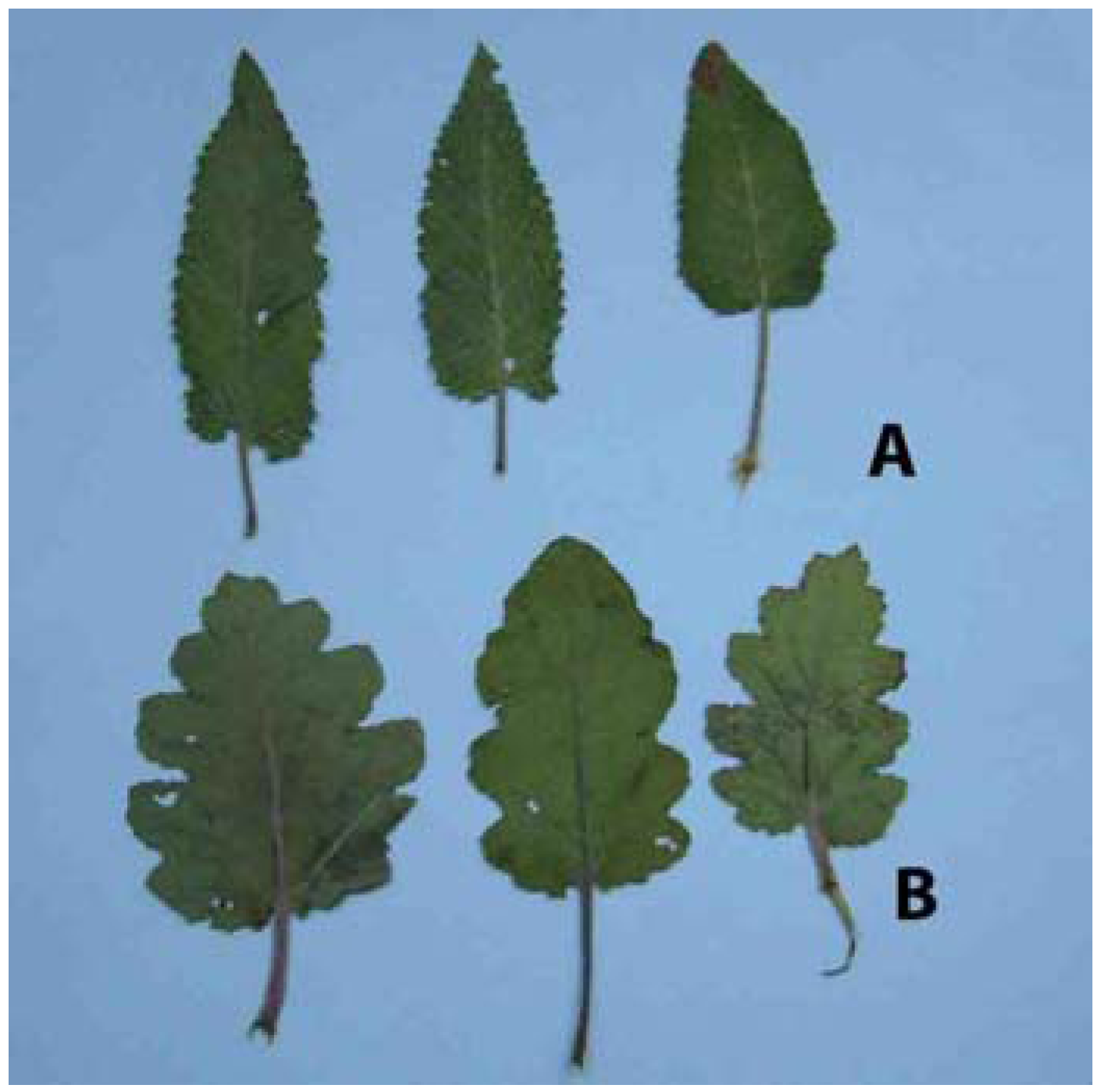
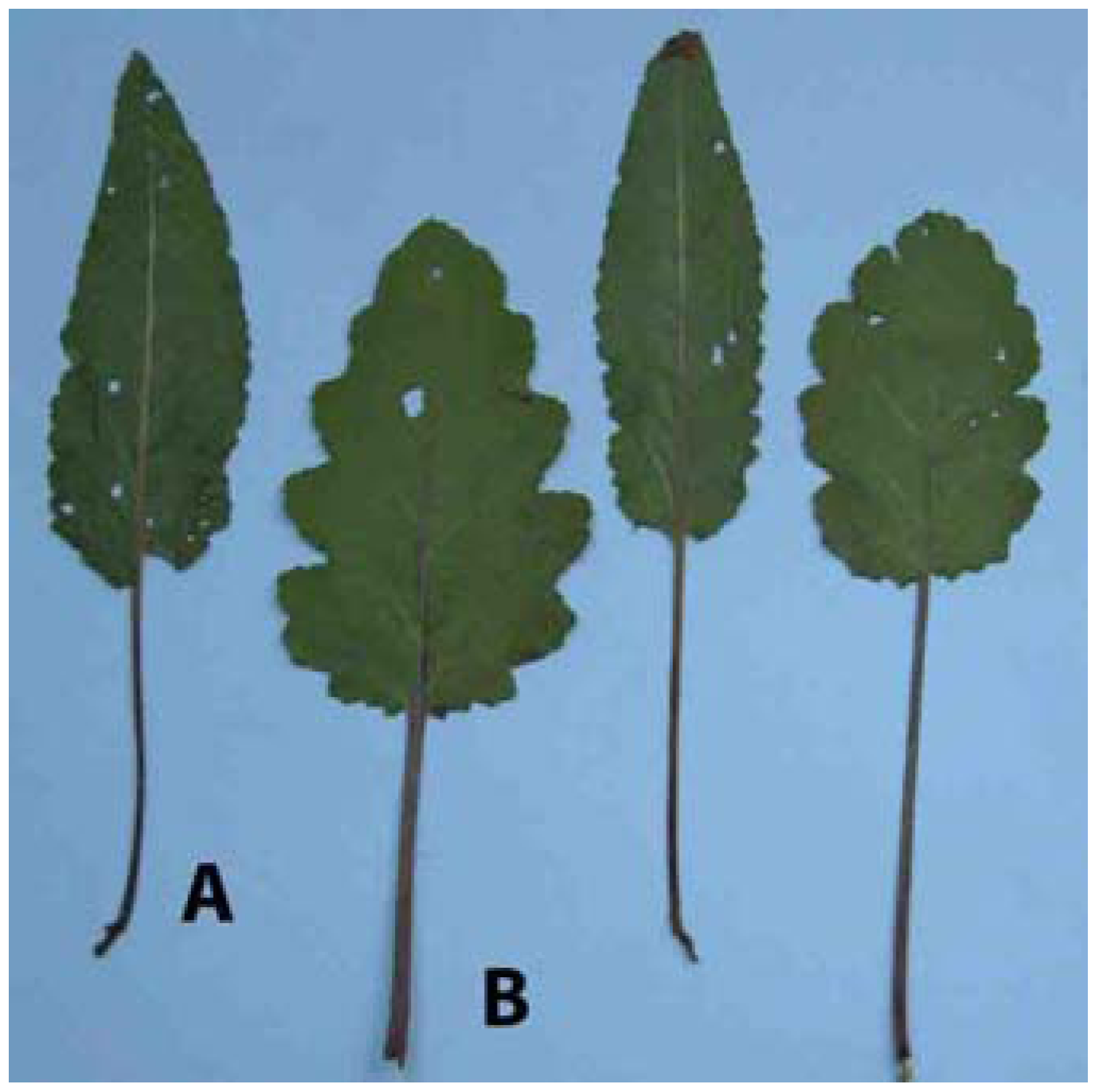
Leaf morphology and anatomy


| Characteristics | S. pratensis | S. bertolonii | ||
|---|---|---|---|---|
| Leaf thickness | 146.5 ± 17.0 | 250.0 ± 23.0* | ||
| Mesophyll thickness | 90.7 ± 8.3 | 217.1 ± 15.8* | ||
| Palisade tissue cells | Height | 26.2 ± 5.8 | 48.0 ± 11.3* | |
| Width | 13.7 ± 2.9 | 12.9 ± 2.7 | ||
| Epidermal cells | Adaxial | Height | 35.2 ± 8.7 | 39.9 ± 10.2* |
| Width | 40.8 ± 8.0 | 46.0 ± 9.4* | ||
| Cuticle | 3.8 ± 0.2 | 5.1 ± 0.3* | ||
| Abaxial | Height | 20.0 ± 3.2 | 24.5 ± 6.0* | |
| Width | 25.8 ± 4.4 | 39.0 ± 7.9* | ||
| Cuticle | 2.7 ± 0.2 | 3.6 ± 0.3* | ||
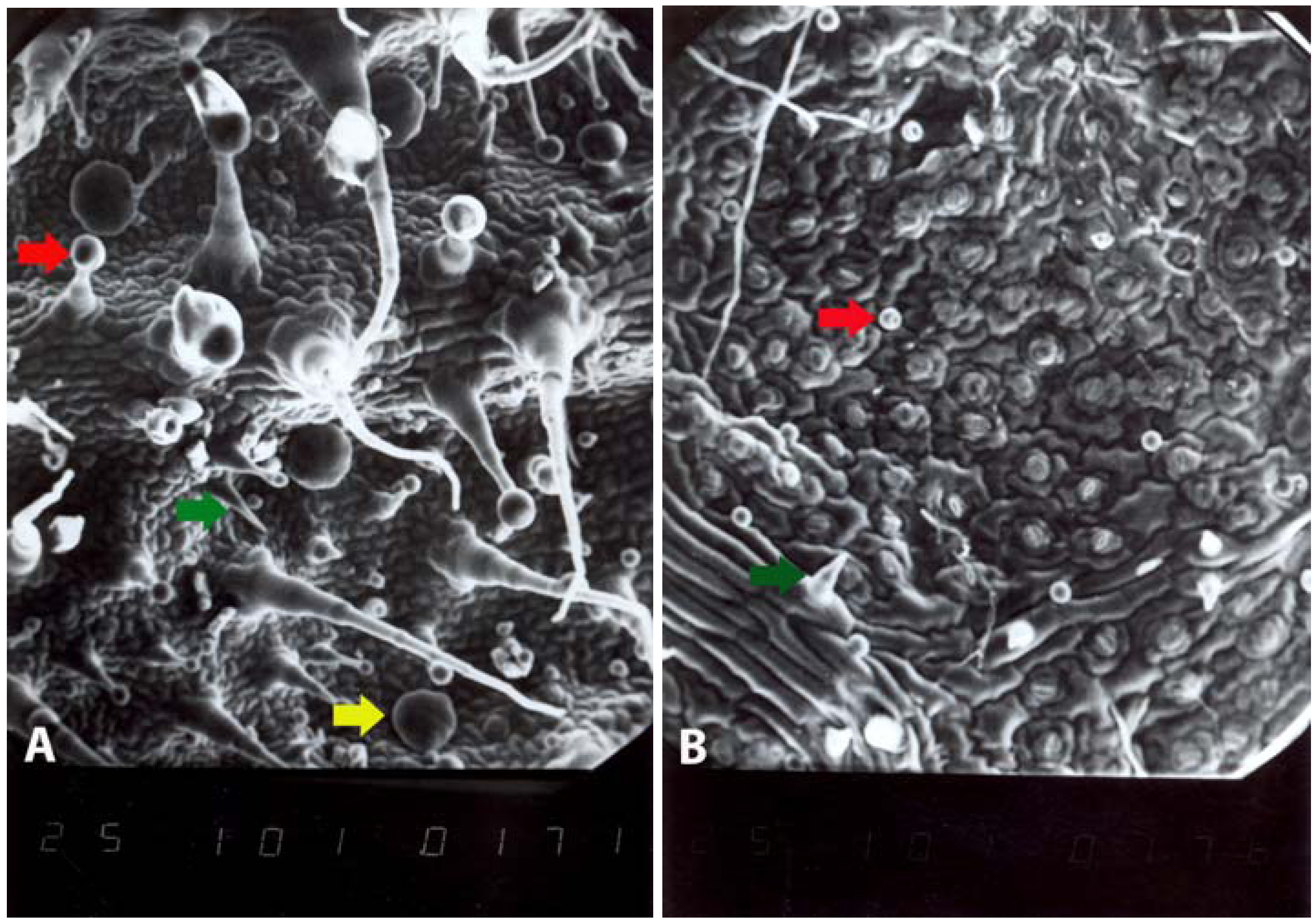
Micromorphological features
| Characteristics | S. pratensis | S. bertolonii | ||
|---|---|---|---|---|
| Number of stomata (mm2) | Adaxial epidermis | 148 ± 24.6 | 140 ± 20.2 | |
| Abaxial epidermis | 390 ± 93.6 | 270 ± 32.9* | ||
| Stomata size (mm) | Adaxial epidermis | Length | 27.4 ± 4.7 | 31.1 ± 5.7* |
| Width | 17.2 ± 1.6 | 20.5 ± 2.2* | ||
| Abaxial epidermis | Length | 24.8 ± 4.0 | 29.9 ± 5.5* | |
| Width | 17.4 ± 1.6 | 20.6 ± 1.9* | ||

Experimental Section
Plant material
Isolation and analysis of the essential oil
Morphoanatomical measurements
Micromorphological studies
Acknowledgements
References and Notes
- Hedge, I.C. Salvia L. In Flora Europaea III; Tutin T., G., Heywood V., H., Burges N., A., Moore D., M., Valentine D., H., Walters S., M., Webb D., A., Eds.; Cambridge University Press: Cambridge, UK, 1972; pp. 289–290. [Google Scholar]
- Ahmadi, L.; Mirza, M. Essantial oil of Salvia multicaulis Vahl. from Iran. J. Essent. Oil Res. 1999, 11, 289–290. [Google Scholar] [CrossRef]
- Tepe, B.; Daferara, D.; Sokmen, A.; Sokmen, M.; Polissiou, M. Antimicrobial and antioxidant activities of the essential oil and various extracts of Salvia tomentosa Miller (Lamiaceae). Food Chem. 2005, 90, 333–340. [Google Scholar] [CrossRef]
- Bozin, B.; Mimica-Dukic, N.; Samojlik, I.; Jovin, E. Antimicrobial and antioxidant properties of rosemary and sage (Rosmarinus officinalis L. and Salvia officinalis L., Lamiaceae) essential oils. J. Agric. Food Chem. 2007, 55, 7879–7885. [Google Scholar] [CrossRef]
- Skandamis, P.N.; Tsigarida, E.; Nychas, G.-J.E. Ecophysiological attributes of Salmonella typhimurium in liquid culture and within a gelatin gel with or without the addition of oregano essential oil. World J. Microbiol. Biotech. 2000, 16, 31–35. [Google Scholar] [CrossRef]
- Bisset, N.G.; Wichtl, M. Herbal Drugs and Phytopharmaceuticals; CRC Press: Boca Raton, London, New York, Washington D.C., USA, 2001. [Google Scholar]
- Bozin, B.; Mimica-Dukic, N.; Bogavac, M.; Suvajdzic, Lj.; Simin, N.; Samojlik, I.; Couladis, M. Chemical Composition, Antioxidant and Antibacterial Properties of Achillea collina Becker ex Heimerl s.l. and A. pannonica Scheele Essential Oils. Molecules 2008, 13, 2058–2068. [Google Scholar] [CrossRef]
- Del Carratore, F.; Garbari, F. Il Gen. Salvia Sect. Plethiosphace (Lamiaceae) in Italia. Arch. Geobot. 2001, 7, 41–62. [Google Scholar]
- Mathe, I.; Mathe, A.; Olah, L.; Blunden, G.; Miklossy, V.; Bernath, J.; Patel, A.V. Essential oil content as chemotaxonomic marker for the genus Salvia with references to its variation in Salvia offiicinalis L. Acta Horticult. 1993, 330, 123–132. [Google Scholar]
- Mimica-Dukić, N.; Boža, P.; Igić, R.; Spasić-Adjanski, Lj.; Štajner, D. Volatile constituents of wild growing Salvia species in Province Vojvodina in Serbia. J. Essent. Oil Bearing Plants 2002, 5, 19–29. [Google Scholar]
- European Pharmacopeia Commision. European Pharmacopeia 4thEd; Council of Europe: Strasbourg Cedex, France, 2002. [Google Scholar]
- Adams, R. P. Identification of Essential Oil Components by Gas Chromatography/Mass Spectroscopy; Allured Publishing Corp.: Carol Stream, IL, USA, 2001. [Google Scholar]
- Richardson, P.E. Morphology of the Crossosomataceae. I. Leaf, Stem and Node. Bull. Torrey Bot. Club 1970, 9, 34–39. [Google Scholar] [CrossRef]
- Sample Availability: Samples are available from authors.
© 2009 by the authors; licensee Molecular Diversity Preservation International, Basel, Switzerland. This article is an open access article distributed under the terms and conditions of the Creative Commons Attribution license ( http://creativecommons.org/licenses/by/3.0/).
Share and Cite
Anačkov, G.; Božin, B.; Zorić, L.; Vukov, D.; Mimica-Dukić, N.; Merkulov, L.; Igić, R.; Jovanović, M.; Boža, P. Chemical Composition of Essential Oil and Leaf Anatomy of Salvia bertolonii Vis. and Salvia pratensis L. (Sect. Plethiosphace, Lamiaceae). Molecules 2009, 14, 1-9. https://doi.org/10.3390/molecules14010001
Anačkov G, Božin B, Zorić L, Vukov D, Mimica-Dukić N, Merkulov L, Igić R, Jovanović M, Boža P. Chemical Composition of Essential Oil and Leaf Anatomy of Salvia bertolonii Vis. and Salvia pratensis L. (Sect. Plethiosphace, Lamiaceae). Molecules. 2009; 14(1):1-9. https://doi.org/10.3390/molecules14010001
Chicago/Turabian StyleAnačkov, Goran, Biljana Božin, Lana Zorić, Dragana Vukov, Neda Mimica-Dukić, Ljiljana Merkulov, Ružica Igić, Marina Jovanović, and Pal Boža. 2009. "Chemical Composition of Essential Oil and Leaf Anatomy of Salvia bertolonii Vis. and Salvia pratensis L. (Sect. Plethiosphace, Lamiaceae)" Molecules 14, no. 1: 1-9. https://doi.org/10.3390/molecules14010001
APA StyleAnačkov, G., Božin, B., Zorić, L., Vukov, D., Mimica-Dukić, N., Merkulov, L., Igić, R., Jovanović, M., & Boža, P. (2009). Chemical Composition of Essential Oil and Leaf Anatomy of Salvia bertolonii Vis. and Salvia pratensis L. (Sect. Plethiosphace, Lamiaceae). Molecules, 14(1), 1-9. https://doi.org/10.3390/molecules14010001