


Most of us are aware of the dangers of climate change. What appears to be harder to instill in people is a sense of urgency about the issues that will affect us all.
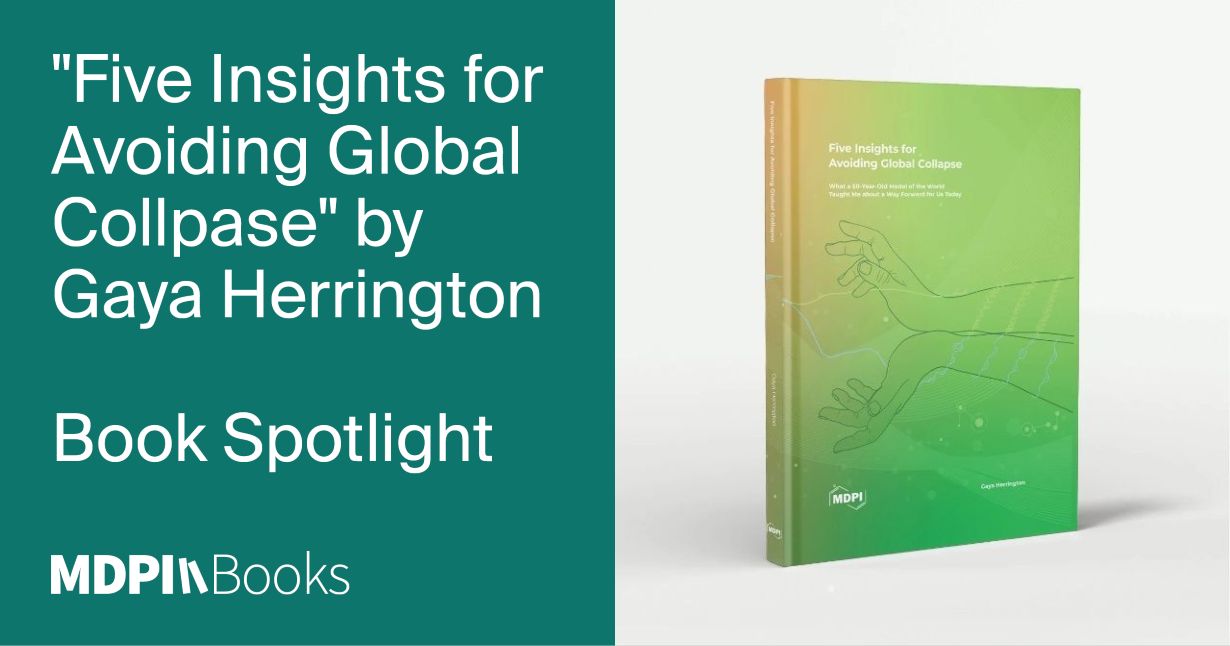
Gaya Herrington recognizes this problem perhaps more clearly than others. In her Open Access Book, “Five Insights for Avoiding Global Collapse”, she doesn’t just aim to teach us about the systemic changes we need to make to achieve a more sustainable future. Herrington also wants to inform us about how to do so in a way that is personable and accessible.
Ultimately, she wishes to connect with her readers. The more they might recognize Herrington – first as a person and second as an author – in the context of climate change, the more they may recognize themselves within that context as well. And the dangers of going about business as usual.
Climate change
The biggest threat we face as a species is climate change. The phenomenon of climate change refers to long-term shifts in temperatures. Consequently, these shifts cause the delicate connections between the Earth’s natural systems to destabilize and degrade.
Natural variations in temperatures impact the global climate. However, human activity and man-made emissions are the leading causes of climate change. These shifts are not natural, and so long as we continue this path, they won’t be reversible.
Despite this recognition, we are still heading towards climate breakdown. Indeed, 2024 was the first year on record to pass the 1.5°C warming threshold established in 2015 in the Paris Agreement.
The cultural and political changes needed to achieve a more sustainable future are significant. However, scientific research continues to progress. And with that progress, hope remains that we can face the upcoming changes with the best possible solutions and tools.
The five insights for achieving sustainability
In the book’s introduction, Herrington lays out her solutions for achieving sustainability and addressing climate change. She does so in 5 insights, or key points, for us to consider as a collective society. They are the following:
- We are fundamentally connected;
- Growth is not a sustainable goal;
- We need to change society’s priorities;
- Time is of the essence;
- The end of the growth pursuit does not mean the end of progress.
It’s clear from these insights that Herrington sees that, ultimately, we are disconnected from our environments and each other. Instead of focusing on growth, and therefore unsustainable targets and ecological depletion, we should turn our attention to fostering a healthier relationship with our environment and developing personal and communal welfare.
Herrington uses the idea of “systems thinking” to convey our interconnectedness. This is the apprehension that, just as our bodies are built from many interacting and interdependent systems, so too is society. Importantly, to understand a system’s behavior, you cannot just study its parts in isolation. We are situated in a complex network of relations. But, within the current capitalist model, some of the components of this network are holding us back.
Herrington recognizes that we are predominantly influenced by economic and political systems. Indeed, climate change is just one phenomenon that is dependent on our inability to move beyond the current dominant systems.
In a fairer world free of the limitations of dominant models, Herrington asks: how might unpaid care work be included in economic measures? How would our justice system be transformed? Would the majority of mammal biomass on the planet still be from animals we hold for consumption? In Herrington’s probing, all these concerns link back to one fundamental issue: a decentring of care within our society.
A more personable and accessible approach to addressing climate change
One of the biggest issues with addressing climate change is getting the message across to others. We are – especially in our information-saturated era – overwhelmed by facts and figures about our ecological predicament. Herrington is all too aware of this, making certain stylistic choices to keep readers engaged.
This task of keeping readers engaged is not an easy one, given the alarming nature of the research. Herrington’s research is based on “The Limits to Growth” model, a 1972 report that simulated the potential consequences of unchecked growth. It found that we were on track to experience resource depletion, extensive pollution, and, ultimately, societal collapse within the 21st century.
Herrington compared the output from this simulation against current real-world data. She concluded that we were on track with the model, meaning global collapse would set in around our present moment and worsen through the 2040s. That is if nothing changes.
Clearly the book is aware of the dangers of business as usual and climate change. But it’s also aware of encumbering readers with data and facts.
To overcome this, Herrington utilizes a writing style that is both personable and accessible. Research is contrasted by personal, self-reflective anecdotes; graphs and figures are offset by direct prose imbued with warm humility. Explaining what she hoped to achieve in writing the book, Herrington says that the task was about ‘engaging the broader base of people who are not economic or sustainability experts, yet on some level sense that something needs to change.’
A new narrative
For Herrington, the way forward is addressing the limits to growth and focusing on a new narrative for humanity, one centred on sustainability. So, what might this new narrative look like?
Well, it would prioritize value, purpose, and care. It would be about changing the current fiction and moving away from a society constituted through hierarchies and strict social scripts based on gender, class, ethnic background, and religion.
In essence, it would be a switch from the dominant model to what Herrington refers to as the partnership model. This model prioritizes egalitarian structures, democratic hierarchies that are empowering rather than disempowering; the acceptance of difference and gender equality; and a to curb abuse and violence wherever possible.
All these issues may seem unrelated to climate change. And yet these degrees of inequality arise from the same dominant model that is responsible for increasing global temperatures. Evidently, there is an underlying issue with the entire model that feeds into and exacerbates these seemingly isolated problems.
Despite these issues, Herrington remains hopeful of our potential to change. She envisages a world ‘that strives for balance among all life forms, equity between people shaped around universal needs, and hierarchies that place the needs of life strictly above requirements for inanimate entities.’
MDPI Books and Environmental and Earth Sciences
As a publisher, MDPI Books recognizes its responsibility in supporting Environmental and Earth Sciences in an era of unprecedented climate change.
That’s why we’re committed to publishing foundational works focusing on sustainability. We have a variety of Open Access Books available within the field of Environmental and Earth Sciences, in addition to our interdisciplinary “Transitioning to Sustainability” Book Series.
Are you an author working in the field of Environmental and Earth Sciences and hoping to publish your book? MDPI Books is pleased to announce a new publishing initiative supporting researchers working within this field. Through this competition, selected book proposals will receive full editorial support and a complete waiver of Book Processing Charges (BPC), enabling open access publication at no cost to the author(s).