
 Open Access
 - Article

17 Pages
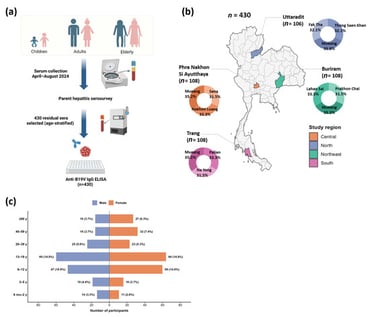
Human parvovirus B19 (B19V) usually causes self-limiting infection but can cause severe complications in pregnancy, chronic hemolytic disease, and immunocompromise. Contemporary data on B19V immunity in Southeast Asia remain limited. We conducted an age-stratified, cross-sectional serosurvey of 430 residual specimens from four Thai provinces (April to August 2024) and compared findings against published age-specific data from 13 countries. Anti-B19V IgG was measured by quantitative ELISA, with seropositivity defined as 5.5 IU/mL or higher. Overall, 87 of 430 participants (20.2%; 95% CI, 16.5 to 24.3%) were seropositive, with a non-monotonic age pattern: 31.7% among children aged 0 to 5, falling to 4.7% at 6 to 12 years, then rising to 51.2% among those 60 and older. A serocatalytic model estimated an average constant force of infection of 8.5 per 1000 person-years beyond age 6; the present data did not provide evidence for the concentrated school-age transmission peak reported in Japan and Europe. From school age onward, Thai seroprevalence was toward the lower end of published estimates, a pattern shared with other Southeast and East Asian settings, although differences in assays, sampling frames, and study periods limit direct comparison. Seroprevalence was similarly elevated among children aged 1 to 2 and 3 to 5 years, and was therefore not concentrated in infancy; most seropositive young children had IgG concentrations close to the assay cut-off, and the explanation for this pattern remains uncertain. No significant differences by sex or province were observed. These findings suggest that a substantial proportion of adolescents and adults in the populations sampled lack detectable anti-B19V IgG and may remain susceptible to infection.
Trop. Med. Infect. Dis.
13 October 2026