


Abstract
This paper explains the architectural design and development of an application for the reception, visualization and storage of inertial sensor data provided by an inertial measurement system (IMU). The application is built to run in a Raspberry Pi equipped with a small size screen that allows the visualization of the data and the control of data recording. The IMU is connected to a Raspberry Pi through a serial port (USB-TTY).
1. Introduction
Spain is the European Union country with the longest coastline, with a length of 8000 km. Its geographical location positions it as a strategic element in international shipping and a logistics platform in southern Europe. Events that could disrupt the normal operations of a port, and actions aimed to improve or optimize processes, can have a big economic impact. Port infrastructures are subject to different meteorological conditions (waves, wind, currents ...) that can produce such disruptions. The port must minimize the effect that the meteorological conditions have on ship movements, ensuring that they can operate in a safe manner [1,2].
Port operability is usually quantified based on the movements of moored ships, therefore the lower the impact the meteorological conditions have on ship movements during operations inside the port, the greater the performance of the port is. Our group is currently measuring vessel movements using Inertial Measurement Units [3] and computer vision [4]. The IMUs are also used to validate new computer vision algorithms.
2. System Development
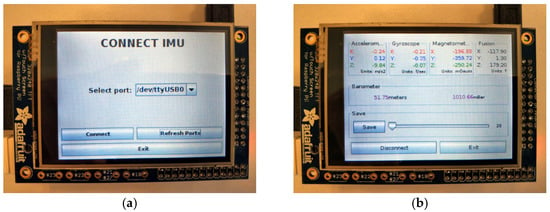
In order for an IMU to be suitable to use in a port environment it should be portable, autonomous and precise. With these characteristics in mind, we developed a system, based on Raspberry Pi and coded in Java, to visualize and record IMU data. The Raspberry Pi is equipped with a small size screen that allows the visualization of the data (see Figure 1). The IMU is connected to a Raspberry Pi through a serial port (USB-TTY).
Figure 1.
Main screens of the application: (a) IMU selection and connection; (b) Inertial sensor data visualization and data storage parameters.
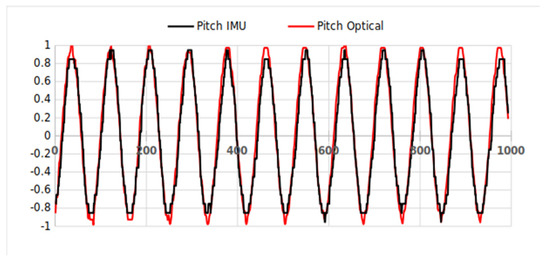
The system has been designed to be able to receive data in a precise manner, i.e., the sampling frequency of the IMU needs to be accurate and configurable. This precision is required because the system will be used not only to measure object movements, but also to calibrate and correct computer vision techniques (that allow measuring the movement of objects in a non invasive manner). In Figure 2 we can see an example where the IMU is used to test a Computer Vision based tracking system used to measure the movement of a pendulum.
Figure 2.
Results of using the IMU to test a Computer Vision tracking algorithm using a pendulum movement (in degrees).
The system is going to be assembled in a water proof case and will be powered by batteries, allowing the system to be autonomous and capable to be used in harsh environments (such as a cargo vessel).
Author Contributions
A.A. designed the system and code architecture (coded the apis and architecture) and wrote the paper; A.V. coded the low level system and tested it; J.R. conceived the system and developed the IMU, based on Arduino + inertial sensors.
Acknowledgments
This research was funded by Xunta de Galicia (Centro singular de investigación de Galicia accreditation 2016–2019) and the European Union (European Regional Development Fund—ERDF).
Conflicts of Interest
The authors declare no conflict of interest. The founding sponsors had no role in the design of the study; in the collection, analyses, or interpretation of data; in the writing of the manuscript, and in the decision to publish the results.
References
- Permanent International Association of Navigation Congresses. Criteria for Movements of Moored Ships in Harbours: Report of Working Group 24 of the Permanent Technical Committee II; PIANC: Brussels, Belgium, 1995. [Google Scholar]
- Puertos del Estado. ROM 2.0-11: Recomendaciones Para el Proyecto y Ejecución en Obras de Atraque y Amarre; Ministerio de Fomento: Madrid, Spain, 2011. [Google Scholar]
- Figuero, A.; Rodriguez, A.; Sande, J.; Peña González, E.; Rabuñal, J. Field measurements of angular motions of a vessel at berth: Inertial device application. Control Eng. Appl. Inform. 2018, 20, in press. [Google Scholar]
- Figuero, A.; Rodriguez, A.; Sande, J.; Peña, E.; Rabuñal, J.R. Dynamical Study of a Moored Vessel Using Computer Vision. J. Mar. Sci. Technol. 2018, 26, 240–250. [Google Scholar]
Publisher’s Note: MDPI stays neutral with regard to jurisdictional claims in published maps and institutional affiliations. |
© 2018 by the authors. Licensee MDPI, Basel, Switzerland. This article is an open access article distributed under the terms and conditions of the Creative Commons Attribution (CC BY) license (https://creativecommons.org/licenses/by/4.0/).