

The Role of Preference on Outcomes of People Receiving Evidence-Informed Community Wound Care in Their Home or in a Nurse-Clinic Setting: A Cohort Study (n = 230)

Abstract
1. Introduction
2. Experimental Section
2.1. Design
2.2. Setting and Sample
2.3. Procedures
2.4. Data Collection and Management
2.5. Outcome Measurement
2.6. Analyses
3. Results
3.1. Individual’s Satisfaction with Care
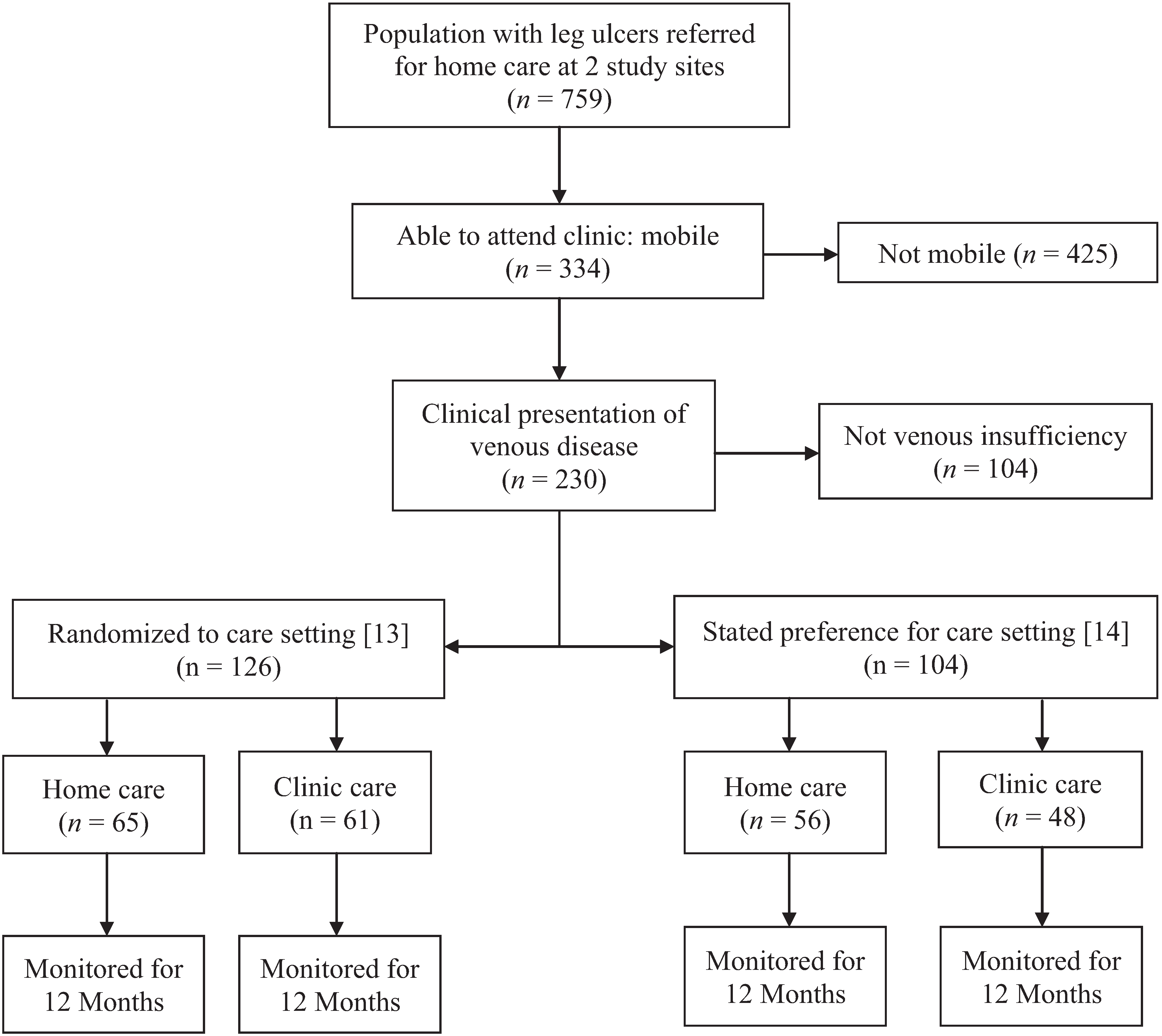
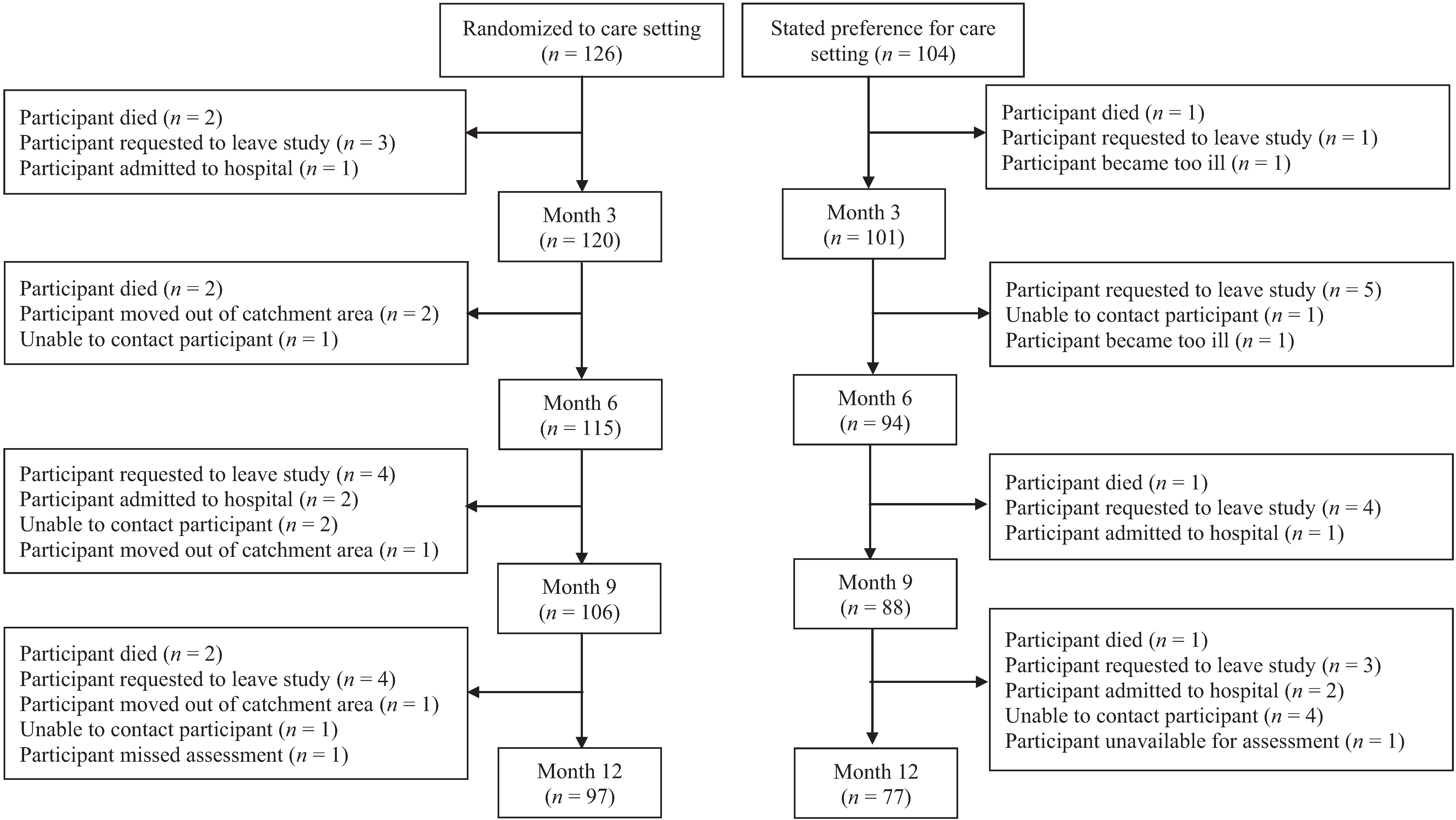

| Characteristics 1 | TOTAL (n = 230) | ALLOCATED Care Setting (n = 126) | CHOICE of Care Setting (n = 104) | p-Value |
|---|---|---|---|---|
| Setting of Care | ||||
| ○ Home | 121 (52.6) | 65 (51.6) | 56 (53.8) | 0.79 |
| ○ Clinic | 109 (47.4) | 61 (48.4) | 48 (46.2) | |
| Etiology of leg Ulcer | ||||
| ○ Venous | 154 (67.0) | 86 (68.3) | 68 (65.4) | 0.67 |
| ○ Mixed | 76 (33.0) | 40 (31.7) | 36 (34.6) | |
| Gender-Female | 118 (51.3) | 71 (56.3) | 47 (45.2) | 0.11 |
| Language-English | 193 (83.9) | 106 (84.1) | 87 (83.7) | 0.99 |
| Living Alone | 87 (37.8) | 54 (42.9) | 33 (31.7) | 0.10 |
| Independently Mobile | 167 (72.9) | 89 (71.2) | 78 (75.0) | 0.55 |
| Ulcer Duration | ||||
| ○ ≤3 Months | 129 (56.1) | 73 (57.9) | 56 (53.8) | 0.30 |
| ○ >3 to ≤12 Months | 68 (29.6) | 39 (31.0) | 29 (27.9) | |
| ○ > 12 Months | 33 (14.3) | 14 (11.1) | 19 (18.3) | |
| Ulcer Size | ||||
| ○ ≤2.5 cm² | 124 (53.9) | 69 (54.8) | 55 (52.9) | 0.66 |
| ○ 2.5 to ≤10 cm² | 61 (26.5) | 35 (27.8) | 26 (25.0) | |
| ○ >10 cm² | 45 (19.6) | 22 (17.5) | 23 (22.1) | |
| Previous Ulceration (yes) | 116 (50.4) | 62 (49.2) | 54 (51.9) | 0.69 |
| Ulcer Size (cm2) † | 2.4 [0.98/6.7] | 2.3 [1.1/5.8] | 2.4 [0.82/9.0] | 1.00 2 |
| Diathesis in years † | 7 [3/12] | 8 [3/16] | 5 [2.5/9.0] | 0.05 2 |
| Duration at initial assessment in weeks † | 11.4 [4.6/24] | 10.6 [4.7/22.7] | 12.1 [4.4/30.6] | 0.73 2 |
| ABPI † | 1.07 [0.99/1.16] | 1.06 [0.98/1.14] | 1.08 [1.00/1.20] | 0.06 2 |
| Age (years) * | 68.0 (14.2) | 68.5 (14.1) | 67.5 (14.5) | 0.62 |
| SF12 Scores * | ||||
| ○ Mental Component | 49.4 (11.1) | 49.7 (11.0) | 49.0 (11.3) | 0.64 |
| ○ Physical Component | 35.7 (10.1) | 35.1 (9.9) | 36.4 (10.4) | 0.36 |
| Clinical Care 3 | ||||
| ABPI completed | 223 (97.0) | 122 (96.8) | 101 (97.1) | 1.00 |
| Compression Therapy | ||||
| ○ All | 208 (91.2) | 118 (94.4) | 90 (87.4) | 0.10 |
| ○ Venous disease | 143 (94.1) | 82 (96.5) | 61 (91.0) | 0.18 |
| ○ Mixed disease | 65 (85.5) | 36 (90.0) | 29 (80.6) | 0.33 |
| Characteristic 1 | ALLOCATED Group (n = 102) | CHOICE Group (n = 80) | p-value |
|---|---|---|---|
| n (%) | n (%) | ||
| ISSUES (n = 182) | |||
| Some problems walking about | 54 (52.9) | 39 (48.8) | 0.65 |
| Some problems with washing, dressing self | 16 (15.7) | 14 (17.5) | 0.84 |
| Some problems performing my usual activities | 50 (49.0) | 44 (55.7) | 0.48 |
| Not anxious or depressed | 74 (72.5) | 56 (70.0) | 0.27 |
| EuroQol EQ-5D Index † | 0.77 [0.70/0.84] | 0.77 [0.71/0.84] | 0.77 2 |
| ALLOCATED Group (n = 97) | CHOICE Group (n = 80) | ||
| CARE AND SERVICE SURVEY ( n = 177) | |||
| Wait Time | |||
| ▪ Less than 30 min | 86 (88.7) | 72 (91.1) | 0.43 |
| ▪ Waiting 30 min–1 h | 9 (9.3) | 7 (8.9) | |
| ▪ Waiting 1–2 h | 2 (2.1) | 0 (0.0) | |
| Knows the name of the nurse who takes care of leg ulcer most of the time | 72 (74.2) | 69 (86.2) | 0.06 |
| Very/quite satisfied with information nurse provided for how to care for leg ulcer | 94 (96.9) | 78 (97.5) | 0.65 |
| Very/quite satisfied with information nurse provided for leg ulcer prevention | 83 (85.6) | 69 (87.3) | 0.74 |
| Very/quite Satisfied with nurses’ skill | 91 (94.8) | 78 (97.5) | 0.41 |
| Comfortable with bandages and dressings used for treatment | 55 (62.5) | 53 (69.7) | 0.41 |
| Very/quite Satisfied with treatment last 12 weeks | 88 (93.6) | 74 (96.1) | 0.67 |
| Recommend/highly recommend care you receive to others | 86 (92.5) | 75 (94.9) | 0.55 |
| Overall rating of the nursing care (1 = Poor to 10 = Excellent) † | 10 [9/10] | 10 [10/10] | 0.26 2 |
3.2. Healing
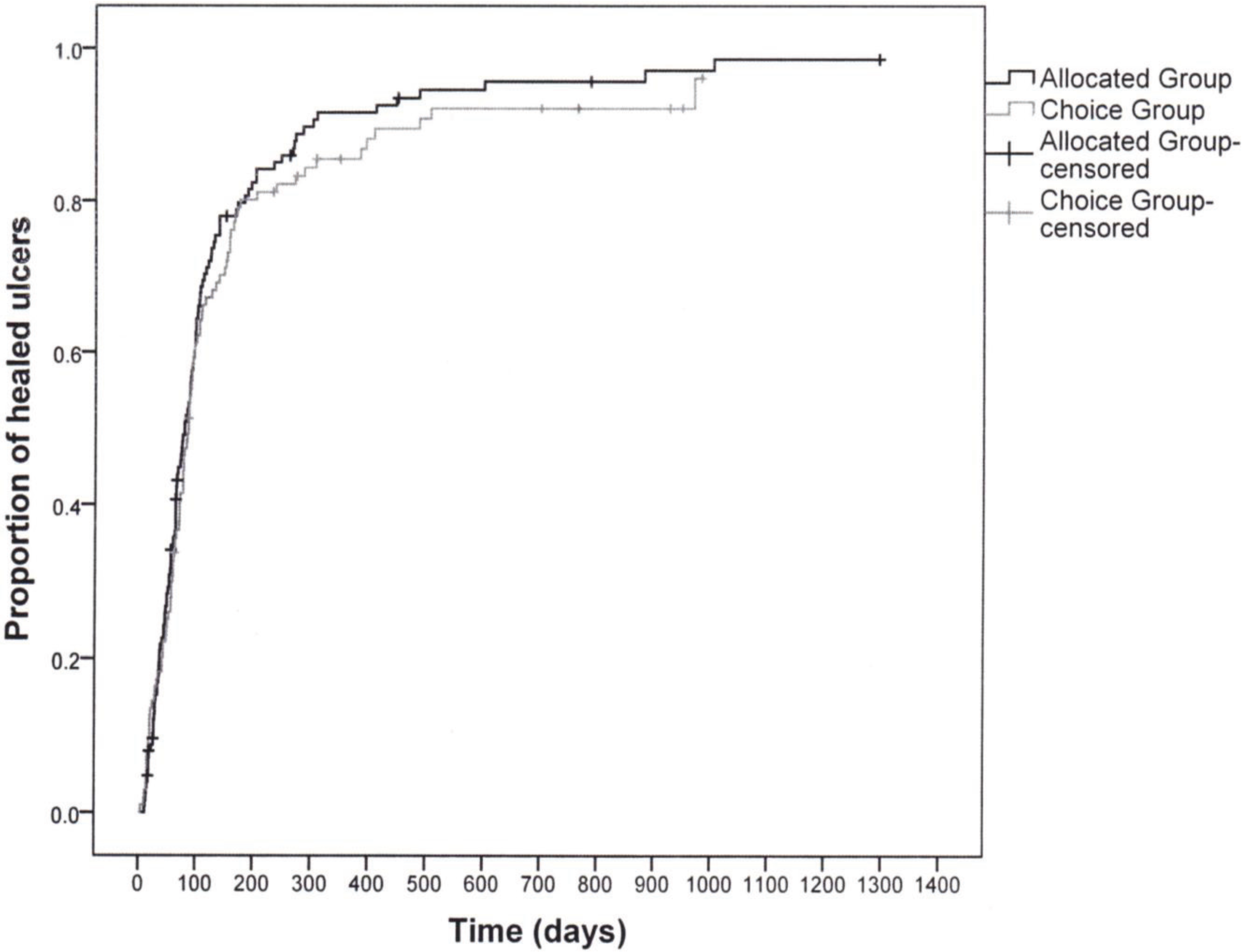
3.3. Pain and Health Related Quality of Life
| Outcome 1 | ALLOCATED Care Setting (n = 126) | CHOICE of Care Setting (n = 104) | p-Value |
|---|---|---|---|
| n (%) | n (%) | ||
| Healing 2 | |||
| ○ 3-month (≤91 days) | 69 (57.5) | 58 (56.9) | 1.00 |
| ○ Recurrence rate in one year 3 | 29 (25.2) | 18 (19.4) | 0.40 |
| Pain at 3 Months | |||
| ○ No pain | 58 (57.4) | 49 (59.8) | 0.94 |
| ○ Mild/Discomfort | 32 (31.7) | 24 (29.3) | |
| ○ Distressing/horrible/excruciating | 11 (10.9) | 9 (11.0) | |
| SF12 Scores at 3 Months * | |||
| ○ Mental Component | 52.8 (10.4) | 52.5 (11.1) | 0.85 |
| ○ Physical Component | 39.0 (11.3) | 40.1 (12.4) | 0.55 |
| General Health Assessment | |||
| ○ Excellent or Very Good | 29 (29.3) | 26 (32.5) | 0.32 |
| ○ Good | 39 (39.4) | 37 (46.2) | |
| ○ Fair or Poor | 31 (31.3) | 17 (21.2) | |
| Resource Utilization for an Episode of Leg Ulcer Care 4 | |||
| ○ Number of Nursing Visits † | 23 [12/48] | 25 [14/51] | 0.40 |
| ○ Weeks on Service † | 13 [7/24] | 14 [8/27] | 0.38 |
| ○ Visits per Week † | 2 [1.6/2.3] | 2 [1.7/2.5] | 0.34 |
| ○ Nursing Costs † | $1135 [612/2347] | $1283 [698/2556] | 0.33 |
| ○ Cost of Wound Supplies † | $531 [251/1115] | $545 [191/1163] | 0.97 |
4. Discussion
5. Limitations of the Study
6. Conclusions
Acknowledgments
Author Contributions
Conflicts of Interest
References
- Cullum, N.; Nelson, E.A.; Fletcher, A.W.; Sheldon, T.A. Compression for venous leg ulcers. Cochrane Database Syst. Rev. 2000. [Google Scholar] [CrossRef]
- Harrison, M.B.; VanDenKerkhof, E.G.; Hopman, W.M.; Graham, I.D.; Carley, M.E.; Nelson, E.A. The Canadian Bandaging Trial: Evidence-informed leg ulcer care and the effectiveness of two compression technologies. BMC Nurs. 2011, 10, e20. [Google Scholar] [CrossRef]
- National Health Services Centre for Reviews and Dissemination. Compression therapy for venous leg ulcers. Eff. Health Care Bull. 1997, 3, 1–12. [Google Scholar]
- Nelson, E.A.; Iglesias, C.P.; Cullum, N.; Torgerson, D.J. Randomized clinical trial of four-layer and short-stretch compression bandages for venous leg ulcers (VenUS I). Br. J. Surg. 2004, 91, 1292–1299. [Google Scholar] [CrossRef] [PubMed]
- Castineira, F.; Fisher, H.; Coleman, D.; Grace, P.A.; Burke, P. The limerick leg ulcer project: Early results. Ir. J. Med. Sci. 1999, 168, 17–20. [Google Scholar] [CrossRef] [PubMed]
- Lambourne, L.A.; Moffatt, C.J.; Jones, A.C.; Dorman, M.C.; Franks, P.J. Clinical audit and effective change in leg ulcer services. J. Wound Care 1996, 5, 348–351. [Google Scholar] [PubMed]
- Moffatt, C.J.; Franks, P.J.; Oldroyd, M.; Bosanquet, N.; Brown, P.; Greenhalgh, R.M.; McCollum, C.N. Community clinics for leg ulcers and impact on healing. Br. Med. J. 1992, 305, 1389–1392. [Google Scholar] [CrossRef]
- Moffatt, C.J.; Oldroyd, M.I. A pioneering service to the community. The Riverside Community Leg Ulcer Project. Prof. Nurse 1994, 9, 486, 488, 490 passim. [Google Scholar]
- Morrell, C.J.; Walters, S.J.; Dixon, S. Cost effectiveness of community leg ulcer clinics: Randomised controlled trial. Br. Med. J. 1998, 316, 1487–1491. [Google Scholar] [CrossRef]
- Scriven, J.M.; Hartshorne, T.; Bell, P.R.F.; Naylor, A.R.; London, N.J.M. Single-visit venous ulcer assessment clinic: The first year. Br. J. Surg. 1997, 84, 334–336. [Google Scholar] [CrossRef] [PubMed]
- Simon, D.A.; Freak, L.; Kinsella, A. Community leg ulcer clinics: A comparative study in two health authorities. Br. Med. J. 1996, 312, 1648–1651. [Google Scholar] [CrossRef]
- Stevens, J.; Franks, P.; Harrington, M. A community/hospital leg ulcer service. J. Wound Care 1997, 6, 62–68. [Google Scholar] [PubMed]
- Harrison, M.B.; Graham, I.D.; Lorimer, K.; VanDenKerkhof, E.; Buchanan, M.; Wells, P.; Brandys, T.; Pierscianowski, T. Nurse clinic versus home delivery of evidence-based community leg ulcer care: A randomized health services trial. BMC Health Serv. Res. 2008, 8, e243. [Google Scholar] [CrossRef]
- Harrison, M.B.; VanDenKerkhof, E.; Hopman, W.M.; Graham, I.D.; Lorimer, K.; Carley, M. Evidence-informed leg ulcer care: A cohort study comparing outcomes of individuals choosing nurse-led clinic or home care. Ostomy Wound Manage. 2011, 57, 38–45. [Google Scholar] [PubMed]
- Graham, I.D.; Harrison, M.D.; Brouwers, M. Evaluating and adapting practice guidelines for local use: A conceptual framework. In Clinical Governance in Practice; Pickering, S., Thompson, J., Eds.; Harcourt Publishers: London, UK, 2003; pp. 213–229. [Google Scholar]
- Graham, I.D.; Lorimer, K.; Harrison, M.B.; Pierscianowski, T. Evaluating the quality of international clinical practice guidelines for leg ulcers: Preparing for a Canadian adaptation. Can. Assoc. Enterostomal Ther. J. 2000, 19, 15–31. [Google Scholar]
- Graham, I.D.; Harrison, M.B. Evaluation and adaptation of clinical practice guidelines. Evid. Based Nurs. 2005, 8, 68–72. [Google Scholar] [CrossRef] [PubMed]
- Graham, I.D.; Harrison, M.B.; Shafey, M.; Keast, D. Knowledge and attitudes regarding care of leg ulcers. Survey of family physicians. Can. Fam. Physician 2003, 49, 896–902. [Google Scholar]
- Graham, I.D.; Harrison, M.B.; Moffat, C.; Franks, P. Leg ulcer care: Nursing attitudes and knowledge. Can. Nurse 2001, 97, 19–24. [Google Scholar] [PubMed]
- Graham, I.D.; Harrison, M.B.; Lorimer, K. Adapting national and international leg ulcer practice guidelines for local use: The Ontario Leg Ulcer Community Care Protocol. Adv. Skin Wound Care 2005, 18, 307–318. [Google Scholar] [CrossRef] [PubMed]
- Gilliss, C.L.; Kulkin, I.L. Monitoring nursing interventions and data collection in a randomized clinical trial. West. J. Nurs. Res. 1991, 13, 416–422. [Google Scholar] [CrossRef] [PubMed]
- Kirchhoff, K.T.; Dille, C.A. Issues in intervention research: Maintaining integrity. Appl. Nurs. Res. 1994, 7, 32–38. [Google Scholar] [CrossRef] [PubMed]
- Rabeneck, L.; Viscoli, C.M.; Horwitz, R.I. Problems in the conduct and analysis of randomized clinical trials. Are we getting the right answers to the wrong questions? Arch. Intern. Med. 1992, 152, 507–512. [Google Scholar] [CrossRef] [PubMed]
- Nemeth, K.A.; Graham, I.D.; Harrison, M.B. The measurement of leg ulcer pain: Identification and appraisal of pain assessment tools. Adv. Skin Wound Care 2003, 16, 260–267. [Google Scholar] [CrossRef] [PubMed]
- Nemeth, K.A.; Harrison, M.B.; Graham, I.D.; Burke, S. Pain in pure and mixed aetiology venous leg ulcers: A three-phase point prevalence study. J. Wound Care 2003, 12, 336–340. [Google Scholar] [CrossRef] [PubMed]
- Walters, S.J.; Morell, C.J.; Dixon, S. Measuring health-related quality of life in patients with venous leg ulcers. Qual. Life Res. 1999, 8, 327–336. [Google Scholar] [CrossRef] [PubMed]
- Melzack, R. The McGill Pain Questionnaire: Major properties and scoring methods. Pain 1975, 1, 277–299. [Google Scholar] [CrossRef] [PubMed]
- Melzack, R.; Katz, J. The McGill Pain Questionnaire: Appraisal and current status. In Handbook of Pain Assessment; Guilford Press: New York, NY, USA, 1992; pp. 152–168. [Google Scholar]
- Melzack, R. The short-form McGill Pain Questionnaire. Pain 1987, 30, 191–197. [Google Scholar] [CrossRef] [PubMed]
- Ware, J.E.; Kosinski, M.; Keller, S.D. SF-12: How to Score the SF-12 Physical and Mental Health Summary Scales, 2nd ed.; The Health Institute, New England Medical Centre: Boston, MA, USA, 1995. [Google Scholar]
- Hopman, W.M.; Towheed, T.; Anastassiades, T. Canadian normative data for the SF-36 health survey. Can. Med. Assoc. J. 2000, 163, 265–271. [Google Scholar]
- The EuroQol Group. EuroQol—A new facility for the measurement of health-related quality of life. Health Policy 1990, 16, 199–208.
- Brooks, R. EuroQol: The current state of play. Health Policy 1996, 37, 53–72. [Google Scholar] [CrossRef] [PubMed]
- Bansback, N.; Tsuchiya, A.; Brazier, J.; Anis, A. Canadian valuation of EQ-5D health states: Preliminary value set and considerations for future valuation studies. PLoS One 2012, 7, e31115. [Google Scholar] [CrossRef] [PubMed]
© 2014 by the authors; licensee MDPI, Basel, Switzerland. This article is an open access article distributed under the terms and conditions of the Creative Commons Attribution license (http://creativecommons.org/licenses/by/3.0/).
Share and Cite
Harrison, M.B.; VanDenKerkhof, E.G.; Hopman, W.M.; Carley, M.E. The Role of Preference on Outcomes of People Receiving Evidence-Informed Community Wound Care in Their Home or in a Nurse-Clinic Setting: A Cohort Study (n = 230). Healthcare 2014, 2, 401-416. https://doi.org/10.3390/healthcare2030401
Harrison MB, VanDenKerkhof EG, Hopman WM, Carley ME. The Role of Preference on Outcomes of People Receiving Evidence-Informed Community Wound Care in Their Home or in a Nurse-Clinic Setting: A Cohort Study (n = 230). Healthcare. 2014; 2(3):401-416. https://doi.org/10.3390/healthcare2030401
Chicago/Turabian StyleHarrison, Margaret B., Elizabeth G. VanDenKerkhof, Wilma M. Hopman, and Meg E. Carley. 2014. "The Role of Preference on Outcomes of People Receiving Evidence-Informed Community Wound Care in Their Home or in a Nurse-Clinic Setting: A Cohort Study (n = 230)" Healthcare 2, no. 3: 401-416. https://doi.org/10.3390/healthcare2030401
APA StyleHarrison, M. B., VanDenKerkhof, E. G., Hopman, W. M., & Carley, M. E. (2014). The Role of Preference on Outcomes of People Receiving Evidence-Informed Community Wound Care in Their Home or in a Nurse-Clinic Setting: A Cohort Study (n = 230). Healthcare, 2(3), 401-416. https://doi.org/10.3390/healthcare2030401

