
Article

The Potential for Flora–Fauna Wordlists to Contribute to Biodiversity Research: Myanmar Birds as a Case Study
Department of Linguistics, University of Cologne, 50923 Cologne, Germany
Languages 2016, 1(2), 12; https://doi.org/10.3390/languages1020012

Submission received: 10 October 2016 / Revised: 6 November 2016 / Accepted: 21 November 2016 / Published: 9 December 2016

Abstract

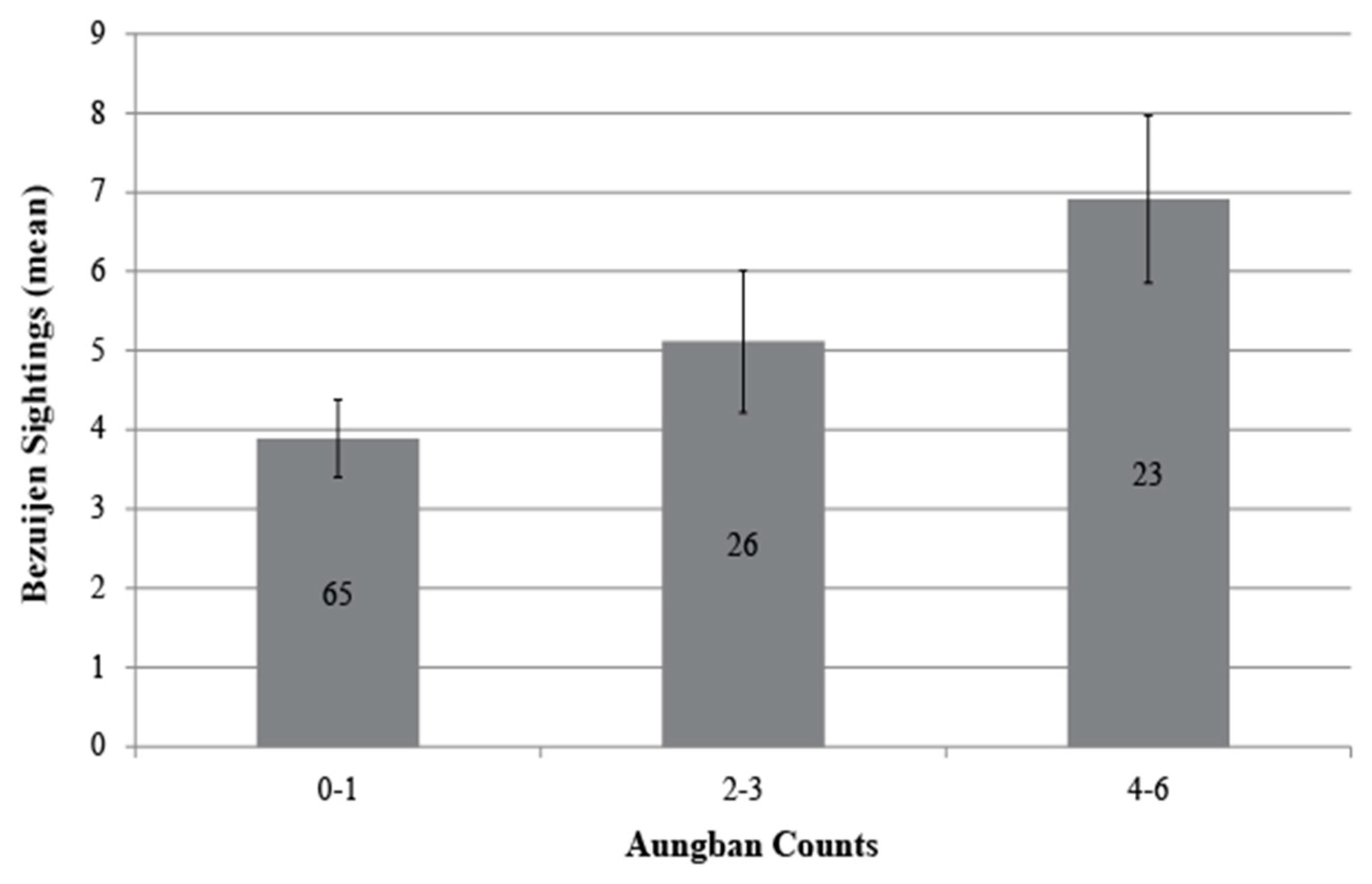
Traditional ecological knowledge recorded as part of a language documentation program can include valuable information on the presence or absence of plant and animal species in a given locality. Such data have the potential to inform biodiversity surveys at a local or landscape scale. In this study, bird names were recorded in six languages spoken around the town of Aungban in Shan State, Myanmar. A checklist of local birds was first compiled using online sources, and pictures and recordings of the calls of over 250 species were presented to native speakers to elicit bird names. A statistically significant correlation was found between the number of languages in which a bird was named, and the frequency with which it was sighted by ornithologists in a recently published study at a nearby location. Native speakers provided historical information on birds that were once present near their villages, and it was also possible to obtain indications of small-scale differences in the ranges of some birds. While there were some noteworthy mismatches between the number of sightings of some birds and the number of names recorded in the target languages, the findings indicate that overall, a language-documentation-based survey of bird species occurrence can provide valuable biodiversity information in a quick and cost-effective manner.
Keywords: ethno-ornithology; biodiversity; species richness; language documentation; elicitation; Myanmar ethno-ornithology; biodiversity; species richness; language documentation; elicitation; Myanmar