Seasonal Migration and Settlement around Lake Chad: Strategies for Control of Resources in an Increasingly Drying Lake

Abstract
1. Introduction
- Examine the nature of seasonal migration and temporary settlement in the Lake Chad basin area;
- Assess the extent to which this migration affects the access of populations to key resources supported by the lake;
- Identify relevant strategies that would support policy and practice in natural resource control/management in the context of an increasingly dry Lake.
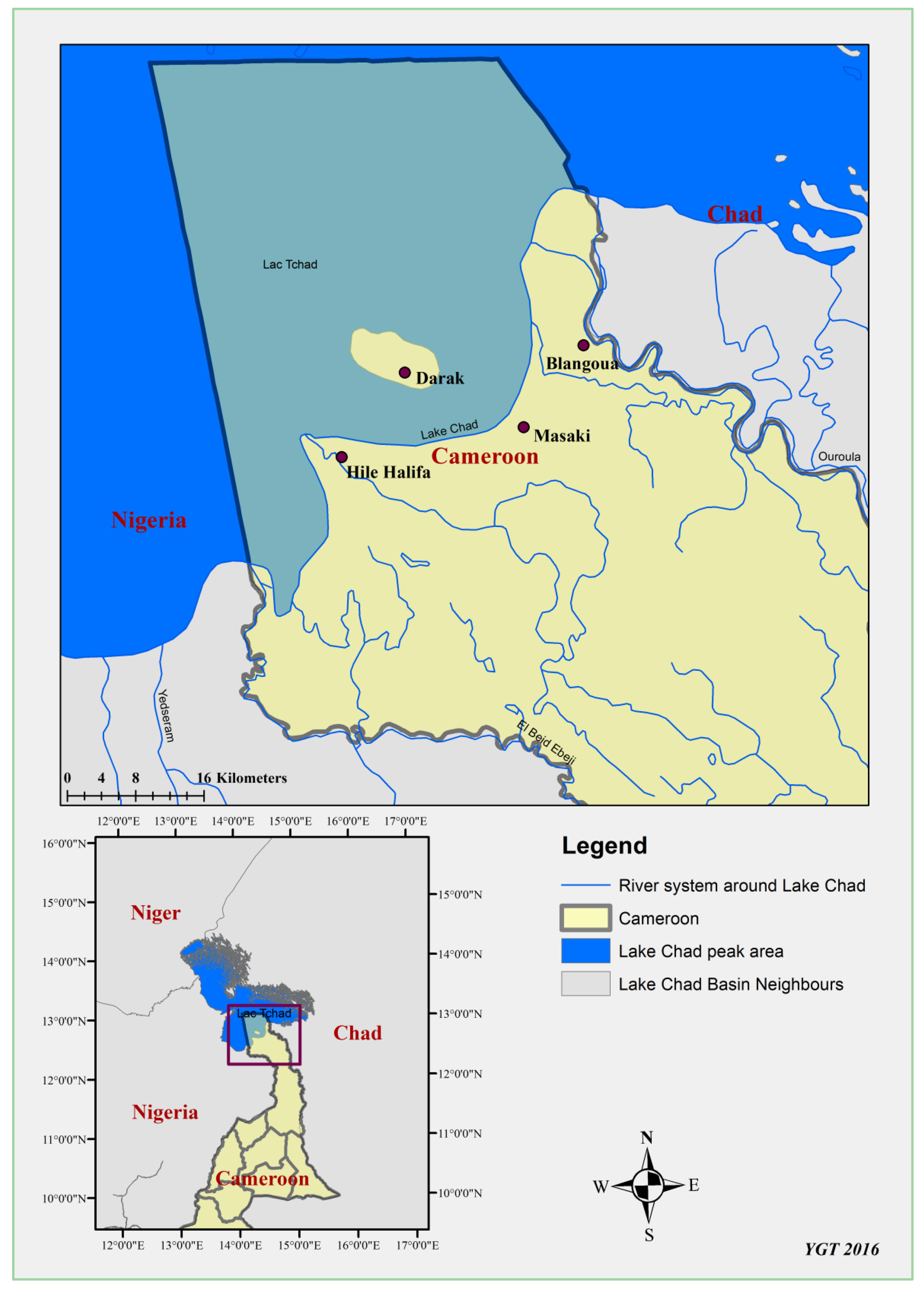
2. Study Area
3. Methods of Data Acquisition, and Analysis
3.1. Selection of the Villages and the Administration of Semi-Structured Questionnaires
- Settlement process of migrants on the shore of Lake Chad, including year of arrival, causes of displacement from community of origin, reasons for the choice of the actual site;
- Farmers access to land including methods of land acquisition, land management techniques, and ownership rules;
- Management of pastures, including type and number of livestock, processes, and timing of transhumance activities, annual destinations of transhumance, pasture availability, pasture conflicts, and aspects of conflicts associated with activities of transhumance;
- Relationship between farmers and pastoralists.
3.2. Secondary Sources of Information
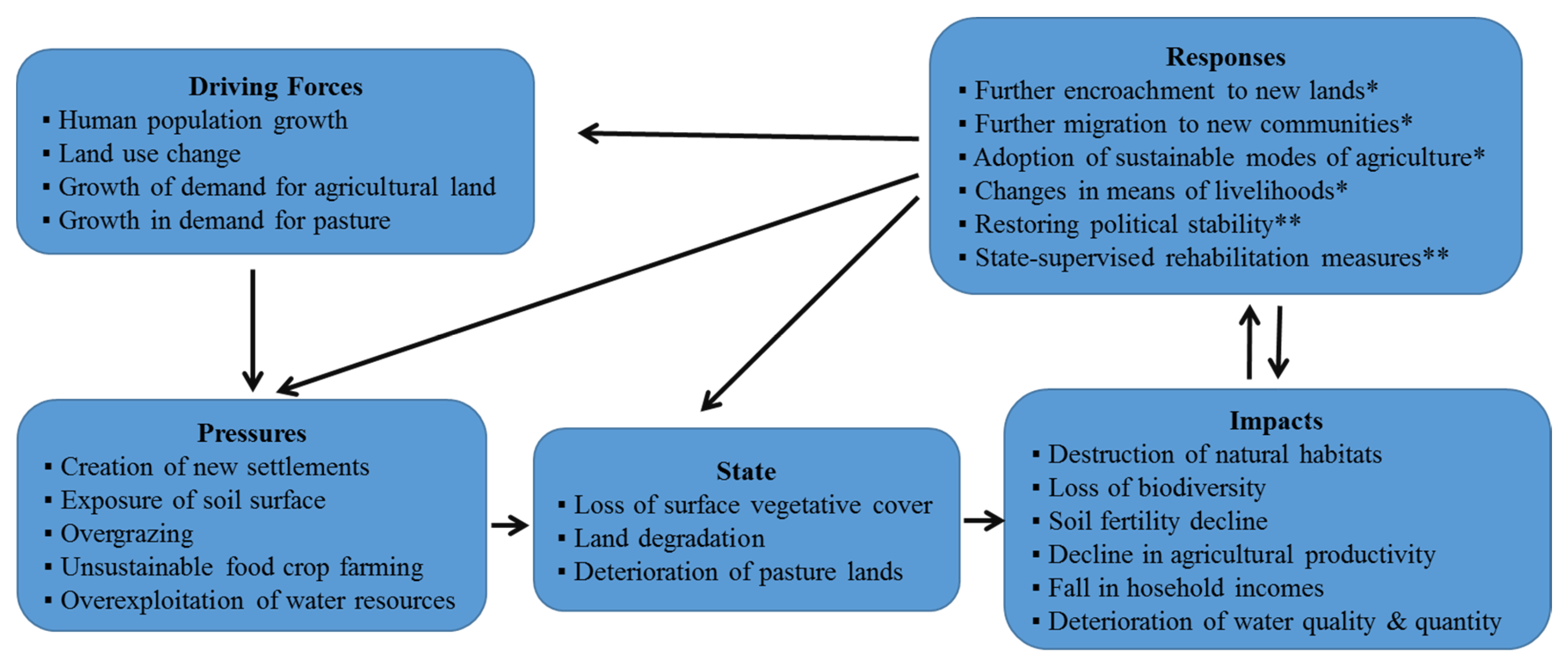
3.3. The Drivers, Pressure–State–Impact–Response, (DPSIR Framework)
4. Results and Discussion
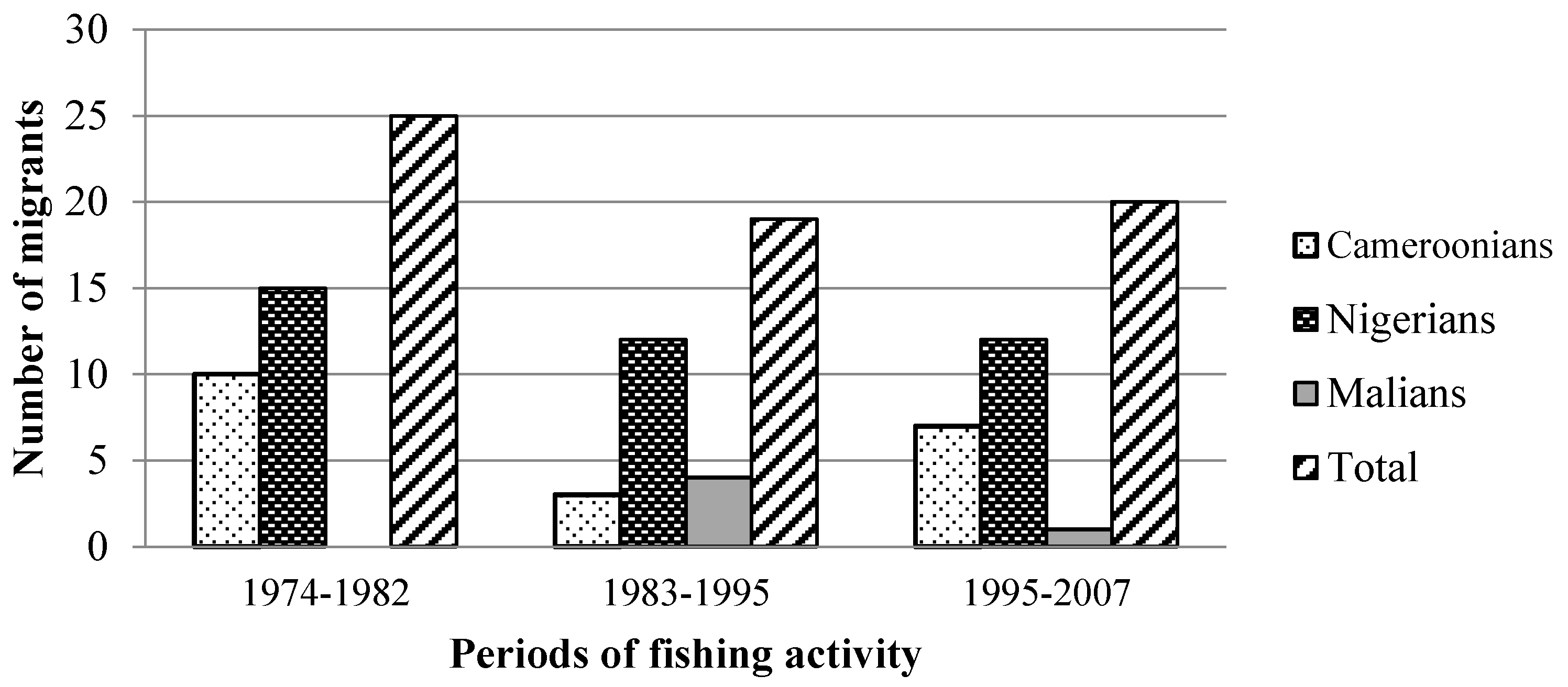
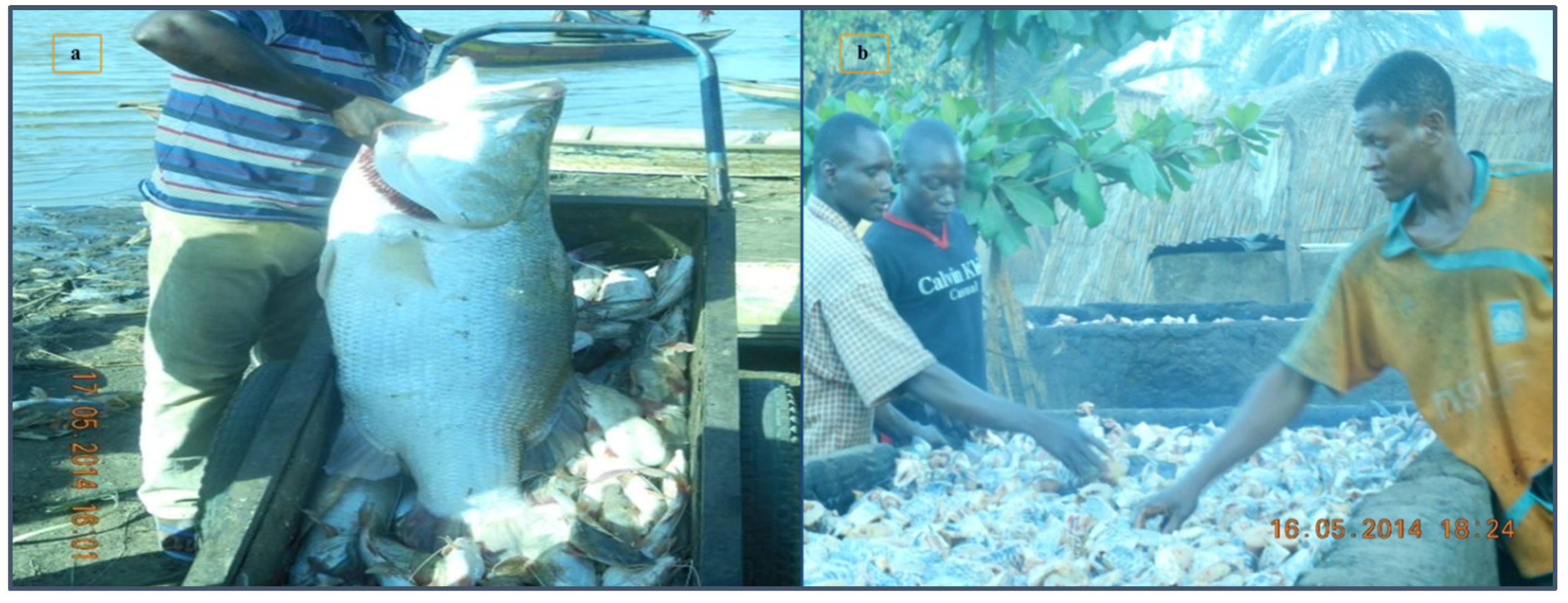
4.1. Fishing as a Significant but Declining Pull Factor to the Lake Area
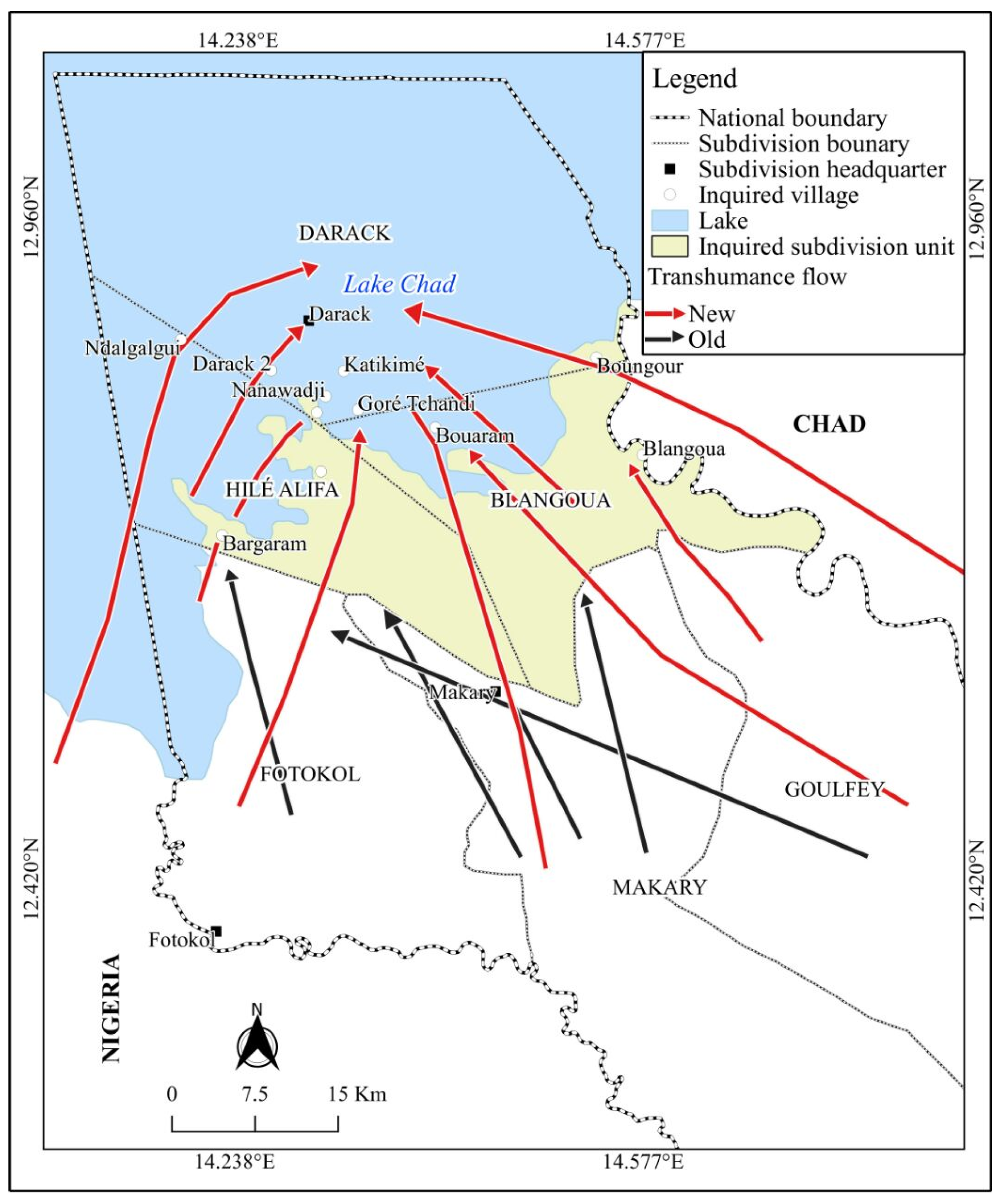
4.2. Changes in the Character of Seasonal Transhumance
4.3. Growth in the Practice of Off-Season Agriculture
4.4. New Community Tensions over Natural Resources
4.5. An Atmosphere of Violence Further Shapes Patterns of Migration and Settlement
5. Applying DPSIR Framework to Seasonal Migrations in the Case Study
6. Policy Implications
7. Conclusions
Acknowledgments
Author Contributions
Conflicts of Interest
References
- United Nations Environment Programme (UNEP). Africa’s Lakes: Atlas of Our Changing Environment; United Nations Environment Programme: Nairobi, Kenya, 2008; p. 393. [Google Scholar]
- Kafumbata, D.; Jamu, D.; Chiotha, S. Riparian ecosystem resilience and livelihood strategies under test: lessons from Lake Chilwa in Malawi and other lakes in Africa. Philos. Trans. R. Soc. Lond. B Biol. Sci. 2014, 369, 20130052. [Google Scholar] [CrossRef] [Scilit] [PubMed]
- Sarch, M.-T. Fishing and Farming in Lake Chad: Implications for Fisheries Development. Dev. Policy Rev. 1997, 15, 141–157. [Google Scholar] [CrossRef] [Scilit]
- White, P.E.; Woods, R.I. The Geographical Impact of Migration; Longman: New York, NY, USA, 1980. [Google Scholar]
- Poot, J.; Alimi, O.; Cameron, M.P.; Maré, D.C. The Gravity Model of Migration: The Successful Comeback of an Ageing Superstar in Regional Science. Investig. Region. J. Region. Res. 2016, 36, 63–86. [Google Scholar]
- Boyle, P.; Halfacree, K.H.; Robinson, V. Exploring Contemporary Migration; Routledge, Taylor and Francis Group: New York, NY, USA, 2014; p. 273. [Google Scholar]
- Bell, M.; Ward, G. Comparing temporary mobility with permanent migration. Tour. Geogr. 2000, 2, 87–107. [Google Scholar] [CrossRef] [Scilit]
- Sinclair, A.R.E.; Fryxell, J.M. The Sahel of Africa: Ecology of a disaster. Can. J. Zool. 1985, 63, 987–994. [Google Scholar] [CrossRef] [Scilit]
- Barbier, B.; Yacouba, H.; Karambiri, H.; Zoromé, M.; Somé, B. Human vulnerability to climate variability in the Sahel: Farmers’ adaptation strategies in northern Burkina Faso. Environ. Manag. 2009, 43, 790–803. [Google Scholar] [CrossRef] [Scilit] [PubMed]
- McLeman, R.A.; Hunter, L.M. Migration in the context of vulnerability and adaptation to climate change: insights from analogues. Wiley Interdiscip. Rev. Clim. Chang. 2010, 1, 450–461. [Google Scholar] [CrossRef] [Scilit] [PubMed]
- Sarch, M.T. Fishing and farming at Lake Chad: Institutions for access to natural resources. J. Environ. Manag. 2001, 62, 185–199. [Google Scholar] [CrossRef] [Scilit] [PubMed]
- Rasmussen, L.V.; Rasmussen, K.; Reenberg, A.; Proud, S. A system dynamics approach to land use changes in agro-pastoral systems on the desert margins of Sahel. Agric. Syst. 2012, 107, 56–64. [Google Scholar] [CrossRef] [Scilit]
- Scheffran, J.; Marmer, E.; Sow, P. Migration as a contribution to resilience and innovation in climate adaptation: Social networks and co-development in Northwest Africa. Appl. Geogr. 2012, 33, 119–127. [Google Scholar] [CrossRef] [Scilit]
- Yengoh, G.T. Climate and food production: understanding vulnerability from past trends in Africa’s Sudan-Sahel. Sustainability 2012, 5, 52–71. [Google Scholar] [CrossRef] [Scilit]
- Onuoha, F.C. Environmental degradation, livelihood and conflicts: A focus on the implications of the diminishing water resources of Lake Chad for north-eastern Nigeria. Afr. J. Confl. Resolut. 2008, 8, 35–61. [Google Scholar] [CrossRef] [Scilit]
- Hunter, L.M.; Nawrotzki, R. Migration and the Environment. In International Handbook of Migration and Population Distribution; Springer-Verlag: London, UK, 2016; pp. 465–484. [Google Scholar]
- Parry, M.L.; Canziani, O.F.; Palutikof, J.P.; van der Linden, P.J.; Hanson, C.E. IPCC, 2007: Climate Change 2007: Impacts, Adaptation and Vulnerability. Contribution of Working Group II to the Fourth Assessment Report of the Intergovernmental Panel on Climate Change; Cambridge University Press: Cambridge, UK, 2007. [Google Scholar]
- Lobell, D.B.; Field, C.B. Global scale climate—Crop yield relationships and the impacts of recent warming. Environ. Res. Lett. 2007, 2, 014002. [Google Scholar] [CrossRef] [Scilit]
- Adams, W.M. Indigenous Use of Wetlands and Sustainable Development in West Africa. Geogr. J. 1993, 159, 209–218. [Google Scholar] [CrossRef] [Scilit]
- Béné, C.; Neiland, A.; Jolley, T.; Ovie, S.; Sule, O.; Ladu, B.; Mindjimba, K.; Belal, E.; Tiotsop, F.; Baba, M.; et al. Inland fisheries, poverty, and rural livelihoods in the Lake Chad Basin. J. Asian Afr. Stud. 2003, 38, 17–51. [Google Scholar] [CrossRef] [Scilit]
- Béné, C.; Neiland, A.; Jolley, T.; Ladu, B.; Ovie, S.; Sule, O.; Baba, M.; Belal, E.; Mindjimba, K.; Tiotsop, F.; et al. Natural-resource institutions and property rights in inland African fisheries. Int. J. Soc. Econ. 2003, 30, 275–301. [Google Scholar] [CrossRef] [Scilit]
- Lake Chad Basin Commission (LCBC). Water Charter of the Lake Chad Basin; Lake Chad Basin Commission: N’Djamena, Chad, 2011; p. 66. [Google Scholar]
- Lemoalle, J.; Magrin, G.; Ngaressem, G.M.; Ngounou Natcha, B.; Raimond, C.; Issa, S.; Amadou, B.; Djoret, D.; Favreau, G.; Goni, I. Le développement du lac tchad: Situation actuelle et futurs possibles: Expertise collégiale réalisée par l'ird à la demande de la commission du lac tchad. Contributions intégrales des experts; 2014; Available online: http://horizon.documentation.ird.fr/exl-doc/pleins_textes/divers16-01/010063404.pdf (accessed on 26 August 2017)ISBN 978-2-7099-1836-7.
- Okonkwo, C.; Demoz, B. Identifying anthropogenic ‘hotspots’ and management of water resources in Lake Chad Basin using GIS. J. Nat. Resour. Policy Res. 2014, 6, 135–149. [Google Scholar] [CrossRef] [Scilit]
- Fokou, G. Tax Payments, Democracy and Rent-Seeking Administrators: Common-Pool Resource Management, Power Relations and Conflicts Among the Kotoko, Musgum, Fulbe and Arab Choa in the Waza-Logone Floodplain (Cameroon), in Disputing the Floodplains; Brill: Leiden, The Netherlands, 2010; pp. 121–170. [Google Scholar]
- Haller, T.; Fokou, G.; Mbeyale, G.; Meroka, P. How fit turns into misfit and back: institutional transformations of pastoral commons in African floodplains. Ecol. Soc. 2013, 18, 34. [Google Scholar] [CrossRef] [Scilit]
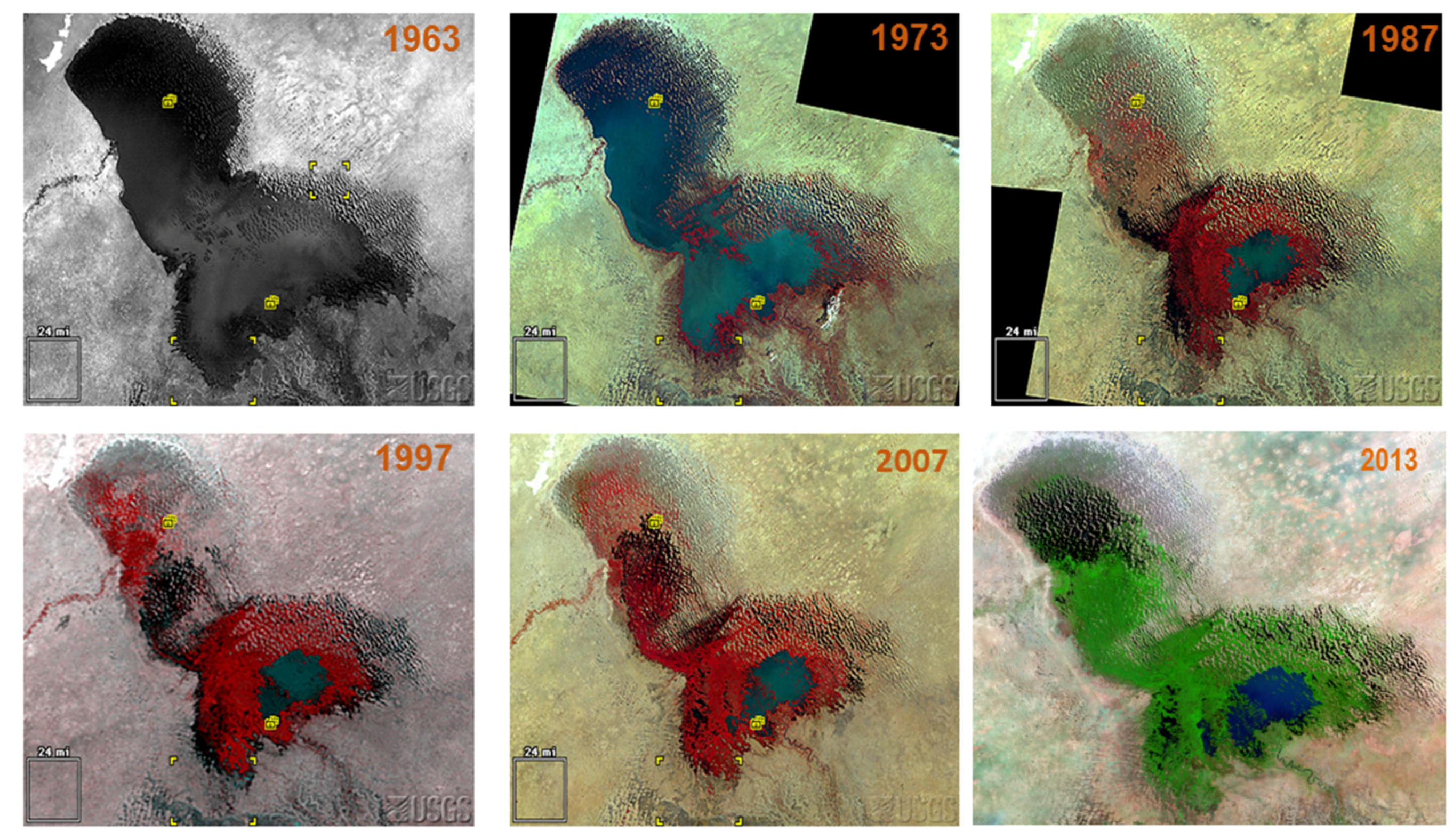
- NASA GSFC Scientific Visualization Studio: 1963, 1973, 1987, 1997, 2007. In Africa’s disappearing Lake Chad; NASA Earth Observatory, 2008. Available online: https://earthobservatory.nasa.gov/IOTD/view.php?id=1240 (accessed on 20 April 2016).
- Yusuf, A.; Goni, I.; Hassan, M. The Declining Middle Zone Aquifer of the Southwestern Chad Basin in the last Millennium. IOSR J. Appl. Geol. Geophys. 2014, 2, 67–75. [Google Scholar] [CrossRef] [Scilit]
- MacDonald, A.M.; Bonsor, H.C.; Dochartaigh, B.É.Ó.; Taylor, R.G. Quantitative maps of groundwater resources in Africa. Environ. Res. Lett. 2012, 7, 024009. [Google Scholar] [CrossRef] [Scilit]
- Lemoalle, J.; Bader, J.C.; Leblanc, M.; Sedick, A. Recent changes in Lake Chad: Observations, simulations and management options (1973–2011). Glob. Planet. Chang. 2012, 80, 247–254. [Google Scholar] [CrossRef] [Scilit]
- Coe, M.T.; Foley, J.A. Human and natural impacts on the water resources of the Lake Chad basin. J. Geophys. Res. 2001, 106, 3349–3356. [Google Scholar] [CrossRef] [Scilit]
- Gao, H.; Bohn, T.J.; Podest, E.; McDonald, K.C.; Lettenmaier, D.P. On the causes of the shrinking of Lake Chad. Environ. Res. Lett. 2011, 6, 034021. [Google Scholar] [CrossRef] [Scilit]
- The National Aeronautics and Space Administration (NASA). Africa’s Lake Chad Shrinks by 20 Times Due to Irrigation Demands, Climate Change; Release No: 01-17; Goddard Space Flight Center, 2001. Available online: https://www.sciencedaily.com/releases/2001/02/010228080245.htm (accessed on 27 February 2001).
- Gregory, A.J.; Atkins, J.P.; Burdon, D.; Elliott, M. A problem structuring method for ecosystem-based management: The DPSIR modelling process. Eur. J. Oper. Res. 2013, 227, 558–569. [Google Scholar] [CrossRef] [Scilit]
- Kristensen, P. The DPSIR Framework; National Environmental Research Institute: Roskilde, Denmark, 2004; Available online: http://wwz.ifremer.fr/dce_eng/content/download/69291/913220/file/DPSIR.pdf (accessed on 25 August 2017).
- Carr, E.R.; Wingard, P.M.; Yorty, S.C.; Thompson, M.C.; Jensen, N.K.; Roberson, J. Applying DPSIR to sustainable development. Int. J. Sustain. Dev. World Ecol. 2007, 14, 543–555. [Google Scholar] [CrossRef] [Scilit]
- MINEPIA. Rapport d’activité minepia; Ministère de l’Elévage, des Pêches et des Industries animales (MINEPIA): Yaoundé, Cameroun, 2014. [Google Scholar]
- Seignobos, C.; Iyébi-Mandjek, O. Atlas de la Province Extrême-Nord Cameroun; IRD Éditions: Marseille, France, 2000. [Google Scholar]
- Onuoha, F.C. The audacity of the Boko Haram: Background, analysis and emerging trend. Secur. J. 2012, 25, 134–151. [Google Scholar] [CrossRef] [Scilit]
- Haller, T. Rules which pay are going to stay: Indigenous institutions, sustainable resource use and land tenure among the Ouldeme and Platha, Mandara Mountains, Northern Cameroon. Bull. de l’APAD 2001. Available online: http://apad.revues.org/148#quotation (accessed on 25 August 2017).



| Sub-Division | Villages | Year of Creation | Population | Household Heads Surveyed |
|---|---|---|---|---|
| Hilé-Alifa | Naga | 1979 | 153 | 15 |
| Ndagalgui | 1979 | 575 | 25 | |
| Bargaram II | 1980 | 918 | 20 | |
| Darak | Bouaram | 1982 | 304 | 25 |
| Darak II | 1975 | 601 | 30 | |
| HiléWanzam | 1981 | 390 | 25 | |
| GoréTchandji | 1980 | 980 | 25 | |
| Katikimé | 1971 | 367 | 25 | |
| Blangoua | Boularam | 1980 | 857 | 30 |
| Total | 220 | |||
| Causes of Conflicts | Number of Conflicts |
|---|---|
| Disagreement on the boundaries of the parcels | 64 |
| Selling of one parcel of land to several persons | 34 |
| Conflicts arising from occupation of transhumance corridors | 48 |
| Subdivision | Villages | Household Heads Surveyed | Clearing of New Areas | As a Gift | Buying | Renting |
|---|---|---|---|---|---|---|
| Fotokol | Naga | 15 | 3 | 0 | 2 | 10 |
| Hilé-Alifa | Ndagalgui | 25 | 6 | 0 | 3 | 16 |
| Bargaram II | 20 | 6 | 4 | 2 | 8 | |
| Darak | Bouaram | 25 | 3 | 3 | 4 | 15 |
| Darak II | 30 | 0 | 3 | 6 | 21 | |
| HiléWanzam | 25 | 2 | 4 | 6 | 13 | |
| GoréTchandji | 25 | 4 | 0 | 5 | 16 | |
| Katikimé | 25 | 4 | 8 | 0 | 13 | |
| Blangoua | Boularam | 30 | 6 | 4 | 3 | 17 |
| Total | 220 | 34 | 26 | 31 | 129 | |
© 2017 by the authors. Licensee MDPI, Basel, Switzerland. This article is an open access article distributed under the terms and conditions of the Creative Commons Attribution (CC BY) license (http://creativecommons.org/licenses/by/4.0/).
Share and Cite
Zieba, F.W.; Yengoh, G.T.; Tom, A. Seasonal Migration and Settlement around Lake Chad: Strategies for Control of Resources in an Increasingly Drying Lake. Resources 2017, 6, 41. https://doi.org/10.3390/resources6030041
Zieba FW, Yengoh GT, Tom A. Seasonal Migration and Settlement around Lake Chad: Strategies for Control of Resources in an Increasingly Drying Lake. Resources. 2017; 6(3):41. https://doi.org/10.3390/resources6030041
Chicago/Turabian StyleZieba, Felix Watang, Genesis Tambang Yengoh, and Abdouraman Tom. 2017. "Seasonal Migration and Settlement around Lake Chad: Strategies for Control of Resources in an Increasingly Drying Lake" Resources 6, no. 3: 41. https://doi.org/10.3390/resources6030041
APA StyleZieba, F. W., Yengoh, G. T., & Tom, A. (2017). Seasonal Migration and Settlement around Lake Chad: Strategies for Control of Resources in an Increasingly Drying Lake. Resources, 6(3), 41. https://doi.org/10.3390/resources6030041