<?xml version="1.0" encoding="UTF-8"?>
<!DOCTYPE article PUBLIC "-//NLM//DTD Journal Publishing DTD v2.3 20070202//EN" "journalpublishing.dtd">
<article xmlns:mml="http://www.w3.org/1998/Math/MathML" xmlns:xlink="http://www.w3.org/1999/xlink" xml:lang="en" article-type="research-article">
  <front>
    <journal-meta>
      <journal-id journal-id-type="publisher-id">resources</journal-id>
      <journal-title>Resources</journal-title>
      <abbrev-journal-title abbrev-type="publisher">Resources</abbrev-journal-title>
      <abbrev-journal-title abbrev-type="pubmed">Resources</abbrev-journal-title>
      <issn pub-type="epub">2079-9276</issn>
      <publisher>
        <publisher-name>MDPI</publisher-name>
      </publisher>
    </journal-meta>
    <article-meta>
      <article-id pub-id-type="doi">10.3390/resources1010023</article-id>
      <article-id pub-id-type="publisher-id">resources-01-00023</article-id>
      <article-categories>
        <subj-group>
          <subject>Article</subject>
        </subj-group>
      </article-categories>
      <title-group>
        <article-title>Resource Criticality and Commodity Production Projections</article-title>
      </title-group>
     
      <contrib-group>
        <contrib contrib-type="author">
          <name>
            <surname>Giurco</surname>
            <given-names>Damien</given-names>
          </name>
          <xref rid="af1-resources-01-00023" ref-type="aff">1</xref>
          <xref rid="c1-resources-01-00023" ref-type="corresp">*</xref>
        </contrib>
        <contrib contrib-type="author">
          <name>
            <surname>Mohr</surname>
            <given-names>Steve</given-names>
          </name>
          <xref rid="af1-resources-01-00023" ref-type="aff">1</xref>
          <xref rid="af2-resources-01-00023" ref-type="aff">2</xref>
        </contrib>
        <contrib contrib-type="author">
          <name>
            <surname>Mudd</surname>
            <given-names>Gavin</given-names>
          </name>
          <xref rid="af2-resources-01-00023" ref-type="aff">2</xref>
        </contrib>
        <contrib contrib-type="author">
          <name>
            <surname>Mason</surname>
            <given-names>Leah</given-names>
          </name>
          <xref rid="af1-resources-01-00023" ref-type="aff">1</xref>
        </contrib>
        <contrib contrib-type="author">
          <name>
            <surname>Prior</surname>
            <given-names>Timothy</given-names>
          </name>
          <xref rid="af1-resources-01-00023" ref-type="aff">1</xref>
          <xref rid="af3-resources-01-00023" ref-type="aff">3</xref>
        </contrib>
      </contrib-group>
       <aff id="af1-resources-01-00023"><label>1 </label>Institute for Sustainable Futures, University of Technology, Sydney, Ultimo 2007, Australia; E-Mails: <email>steve.mohr@uts.edu.au</email> (S.M.); <email>leah.mason@uts.edu.au</email> (L.M.); <email>timothy.prior@uts.edu.au</email> (T.P.)</aff>
      <aff id="af2-resources-01-00023"><label>2 </label>Department of Civil Engineering, Monash University, Clayton 3800, Australia; E-Mail: <email>gavin.mudd@monash.edu</email></aff>
      <aff id="af3-resources-01-00023"><label>3 </label>Center for Security Studies, ETH Zürich, Zuerich 8092, Switzerland; E-Mail: <email>tim.prior@sipo.gess.ethz.ch</email></aff>
      <author-notes>
        <corresp id="c1-resources-01-00023"><label>*</label> Author  to whom correspondence should be addressed; E-Mail: <email>damien.giurco@uts.edu.au</email>;  Tel.: +61-2-9514-4978; Fax: +61-2-9514-4941.</corresp>
      </author-notes>
      <pub-date pub-type="epub">
        <day>19</day>
        <month>12</month>
        <year>2012</year>
      </pub-date>
      <pub-date pub-type="collection"><month>12</month>
        <year>2012</year>
      </pub-date>
      <volume>1</volume>
      <issue>1</issue>
      <fpage>23</fpage>
      <lpage>33</lpage>
      <history>
        <date date-type="received">
          <day>10</day>
          <month>11</month>
          <year>2012</year>
        </date>
        <date date-type="rev-recd">
          <day>10</day>
          <month>12</month>
          <year>2012</year>
        </date>
        <date date-type="accepted">
          <day>17</day>
          <month>12</month>
          <year>2012</year>
        </date>
      </history>
      <permissions>
        <copyright-statement>©  2012 by the authors; licensee MDPI, Basel, Switzerland.</copyright-statement>
        <copyright-year>2012</copyright-year>
        <license xmlns:xlink="http://www.w3.org/1999/xlink" license-type="open-access" xlink:href="http://creativecommons.org/licenses/by/3.0/">
          <p>This article is an open-access article distributed under the terms and conditions of the Creative Commons Attribution license (http://creativecommons.org/licenses/by/3.0/).</p>
        </license>
      </permissions>
      <abstract>
        <p>Resource criticality arising from peak production of primary ores is explored in this paper. We combine the Geologic Resource Supply-Demand Model of Mohr [<xref ref-type="bibr" rid="B1-resources-01-00023">1</xref>] to project future resource production for selected commodities in Australia, namely iron and coal which together represent around 50% of the value of total Australian exports as well as copper, gold and lithium. The projections (based on current estimates of ultimately recoverable reserves) indicate that peak production in Australia would occur for lithium in 2015; for gold in 2021; for copper in 2024; for iron in 2039 and for coal in 2060. The quantitative analysis is coupled with the criticality framework for peak minerals of Mason <italic>et al.</italic> [<xref ref-type="bibr" rid="B2-resources-01-00023">2</xref>] comprising (i) resource availability, (ii) societal resource addiction to commodity use, and (iii) alternatives such as dematerialization or substitution to assess the broader dimension s of peak minerals production for Australia.</p>
      </abstract>
      <kwd-group>
        <kwd>peak minerals</kwd>
        <kwd>sustainable</kwd>
        <kwd>dematerialization</kwd>
        <kwd>metals</kwd>
      </kwd-group>
    </article-meta>
  </front>
  <body>
    <sec sec-type="intro">
      <title>1. Introduction</title>
      <p>Global demand for resources has continued to increase, driven by demand from China, India and other industrializing countries. A major supplier of these resources is Australia, whose minerals and energy exports account for more than 50% of export earnings of the country [<xref ref-type="bibr" rid="B3-resources-01-00023">3</xref>]. Such exports are dominated by iron ore and coal, but Australia is also home to the largest hardrock lithium mine and is a key supplier of gold and other commodities including copper, alumina and phosphorous.</p>
      <p>The minerals industry in Australia was focused primarily on expansion whilst commodity prices were strong. However, new challenges are emerging. The quality of available remaining resources are declining, demand growth is stabilizing and social and environmental pressures are increasing as regions confront the cumulative impacts of mining, often with too little of the revenue generated being directed to supporting the long term benefit of communities and the nation [<xref ref-type="bibr" rid="B4-resources-01-00023">4</xref>]. Unlike projections of future minerals production which often adopt a two to twelve year time horizon (see for example [<xref ref-type="bibr" rid="B5-resources-01-00023">5</xref>,<xref ref-type="bibr" rid="B6-resources-01-00023">6</xref>]), this paper explores the full production trajectory of mineral production based on ultimately recoverable resources. This long term view is needed to better understand and respond to the changing economic and sustainability issues.</p>
      <sec>
        <title>Aim</title>
        <p>The aim of this paper is to model long term future production for key minerals in Australia, namely iron ore/steel, coal, gold, copper and lithium. A cross-commodity analysis is then undertaken. Using a peak minerals criticality framework, the paper then identifies challenges and potential areas where technology and policy could contribute to more sustainable resource management. The logic for the selection of case study minerals was informed by a range of factors including the preferences of the funding body as well as a motivation to study contrasting commodities with different dynamics. For example, coal and iron ore dominate the value of Australian exports; copper has had significant environmental impacts associated with historical mines (e.g., Mt Lyell, Tasmania) and the proposed expansion at Olympic Dam (South Australia); gold has had multiple boom/bust cycles and lithium is only recently increasing in global production and demand.</p>
      </sec>
    </sec>
    <sec>
      <title>2. Peak Minerals and Resource Criticality</title>
      <p>An increasing body of literature is studying peak minerals [<xref ref-type="bibr" rid="B7-resources-01-00023">7</xref>,<xref ref-type="bibr" rid="B8-resources-01-00023">8</xref>,<xref ref-type="bibr" rid="B9-resources-01-00023">9</xref>] and resource criticality to economies [<xref ref-type="bibr" rid="B2-resources-01-00023">2</xref>,<xref ref-type="bibr" rid="B10-resources-01-00023">10</xref>]; however, long term production projections for key minerals in Australia have been lacking.</p>
      <sec>
        <title>2.1. Background to Peak Minerals</title>
        <p>The “peak” concept in relation to peak minerals is a term with different interpretations amongst different groups, so for this reason it is important to be clear about how it is defined in this paper. Much of the popular media discussing peak oil and peak minerals puts focus on the question of “when will we run out?”; however this underemphasizes the early implications of peak mineral production—especially for minerals with limited scope for substitution. The year of peak mineral production reflects an inability to increase supply of terrestrial ores to meet demand, not from physical exhaustion, but from further resource development being uneconomic or inaccessible due to social or environmental pressure. The key characteristics of the peak minerals approach used in this paper are a focus on:</p>
        <list list-type="bullet">
          <list-item>
            <p>A progression from cheaper easier processing to more complex and expensive;</p>
          </list-item>
          <list-item>
            <p>The need for transition post-peak, both in terms of:
            <list list-type="simple">
             <list-item>
            <p>- finding substitutes for providing the services for which the metals were used;</p>
          </list-item>
          <list-item>
            <p>- considering alternatives to the mining industry for providing economic growth;</p>
          </list-item>
            </list>
            
            </p>
          </list-item>
         
          <list-item>
            <p>Both a regional or national scale—a global peak analysis (as is common for oil) need not be the default scale of a peak analysis.</p>
          </list-item>
        </list>
      </sec>
      <sec>
        <title>2.2. Criticality Framework: Availability, Addiction, Alternatives</title>
        <p>Mason <italic>et al.</italic> [<xref ref-type="bibr" rid="B2-resources-01-00023">2</xref>] developed three criteria for assessing the potential impact of peak minerals on society, namely:</p>
        <list list-type="order">
          <list-item>
            <p><italic>Availability of the resource</italic>: This included both geological availability and limits to accessibility which could arise through limited capital and infrastructure for developing the resource, but also limited access where prevented through land use conflict.</p>
          </list-item>
          <list-item>
            <p><italic>Addiction to resource use by society:</italic> This reflected both demand for the resource (and associated revenues) and the extent to which end uses for the metal (and monies) are pervasive and critical in society—the higher the addiction, the more difficult it could be to make a transition post-peak.</p>
          </list-item>
          <list-item>
            <p><italic>Alternatives for transition:</italic> This referred to the potential to substitute terrestrial ore reserves with alternatives—for example ocean based resources, recycled scrap, dematerialization or substitution with another metal or non-metal to fulfill the function.</p>
          </list-item>
        </list>
        <p>For the first time, this framework is used to develop comparisons across commodities based on quantitative production projections.</p>
      </sec>
      <sec>
        <title>2.3. Production Projections: Geologic Resource Supply-Demand Model</title>
        <p>The Geologic Resource Supply-Demand Model (GeRS-DeMo) has been developed to model the supply (and demand) of resources and has been successfully used for coal [<xref ref-type="bibr" rid="B11-resources-01-00023">11</xref>], natural gas [<xref ref-type="bibr" rid="B12-resources-01-00023">12</xref>], other fossil fuels [<xref ref-type="bibr" rid="B1-resources-01-00023">1</xref>] and lithium [<xref ref-type="bibr" rid="B13-resources-01-00023">13</xref>]. GeRS-DeMo has been described in detail in Mohr [<xref ref-type="bibr" rid="B1-resources-01-00023">1</xref>], with extra functionality described in Mohr [<xref ref-type="bibr" rid="B14-resources-01-00023">14</xref>]. In order to project the production of key minerals the model was limited to the “mining” component only (Static mode, no demand calculated—meaning that the model assumes a buyer for the commodities which are produced.). In the “mining” component, production is estimated by assuming that individual mines have a trapezium production profile, with a 4 year ramp up to maximum production level, and a 4 year ramp down at the end of the mine’s life. For example, the Greenbushes lithium mine is undergoing expansion plans in which production started at 292 kt Li concentrate/year in 2010 and will increase to 433 kt Li concentrate/year by 2014; thereafter maintaining this production plateau for 5 years [<xref ref-type="bibr" rid="B15-resources-01-00023">15</xref>]. The number of new mines brought online each year is determined by a rate constant linked to fractional amount of cumulative production (relative to the user inputted Ultimately Recoverable Resources estimate). The model has a technology component that allows for the mine life and maximum production level of new mines to increase over time. Disruption can be added to the model which results in mines shutting down earlier than initially planned and being brought back on stream at a later date Mohr [<xref ref-type="bibr" rid="B1-resources-01-00023">1</xref>].</p>
      </sec>
    </sec>
    <sec sec-type="results">
      <title>3. Results</title>
      <sec>
        <title>3.1. Peak Production Projections</title>
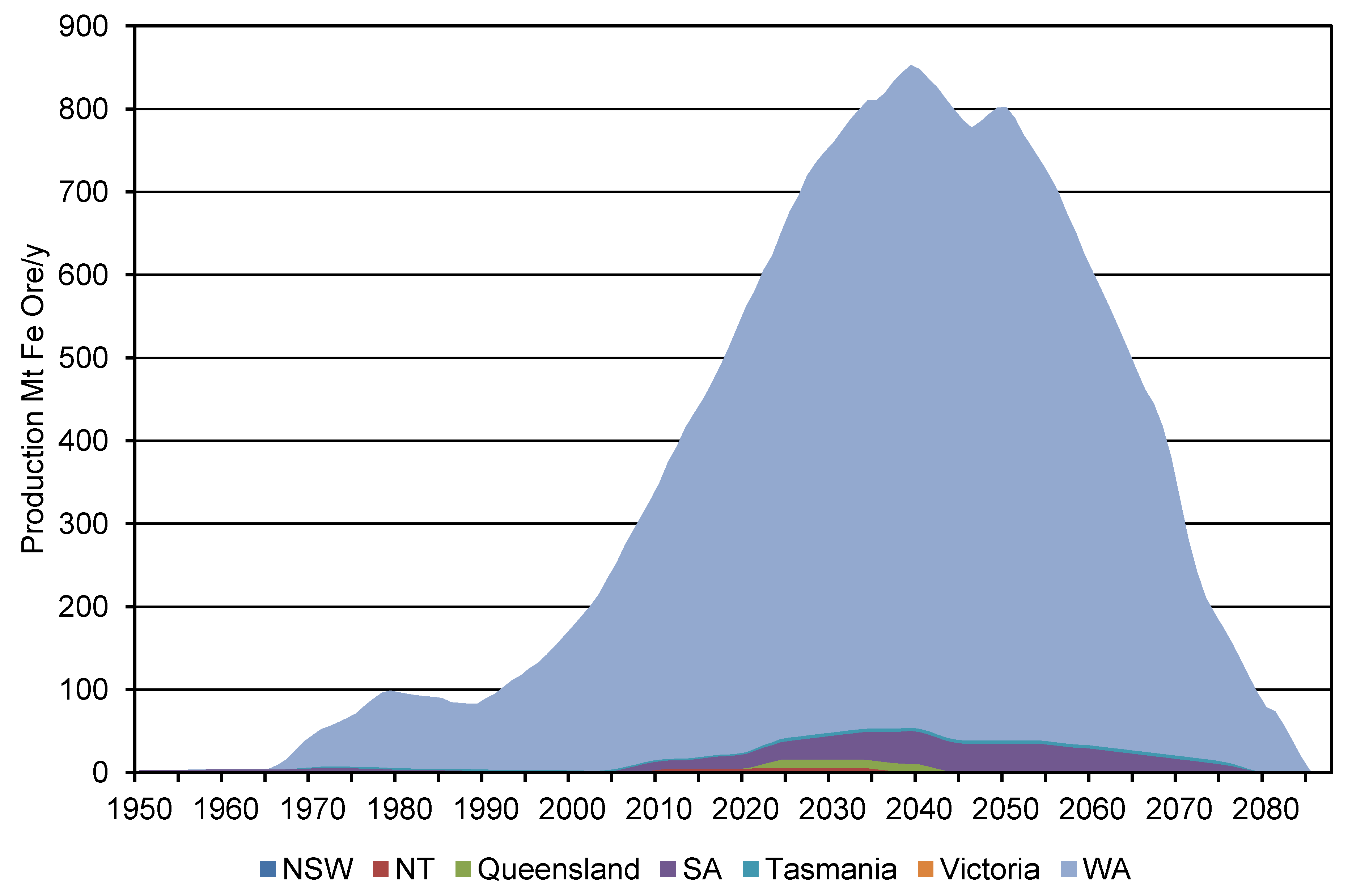
        <p>This section highlights the predicted future production of the minerals constructed using GeRS-DeMo, for Australia: in <xref ref-type="fig" rid="resources-01-00023-f001">Figure 1</xref>. The specific inputs and the model used to generate these projections are available in the electronic supplement.</p>
        
        <p><xref ref-type="fig" rid="resources-01-00023-f001">Figure 1</xref> shows projected production for iron ore which is dominated by production from Western Australia (WA) and smaller contributions from South Australia (SA) and Queensland. There are negligible contributions from New South Wales (NSW), Northern Territory (NT) and other states.</p>
        <fig id="resources-01-00023-f001" position="float">
          <label>Figure 1</label>
          <caption>
            <p>Projected peak iron ore production for Australia by state (Resource estimate from Geoscience Australia database).</p>
          </caption>
          <graphic xmlns:xlink="http://www.w3.org/1999/xlink" xlink:href="resources-01-00023-g001.tif"/>
        </fig>
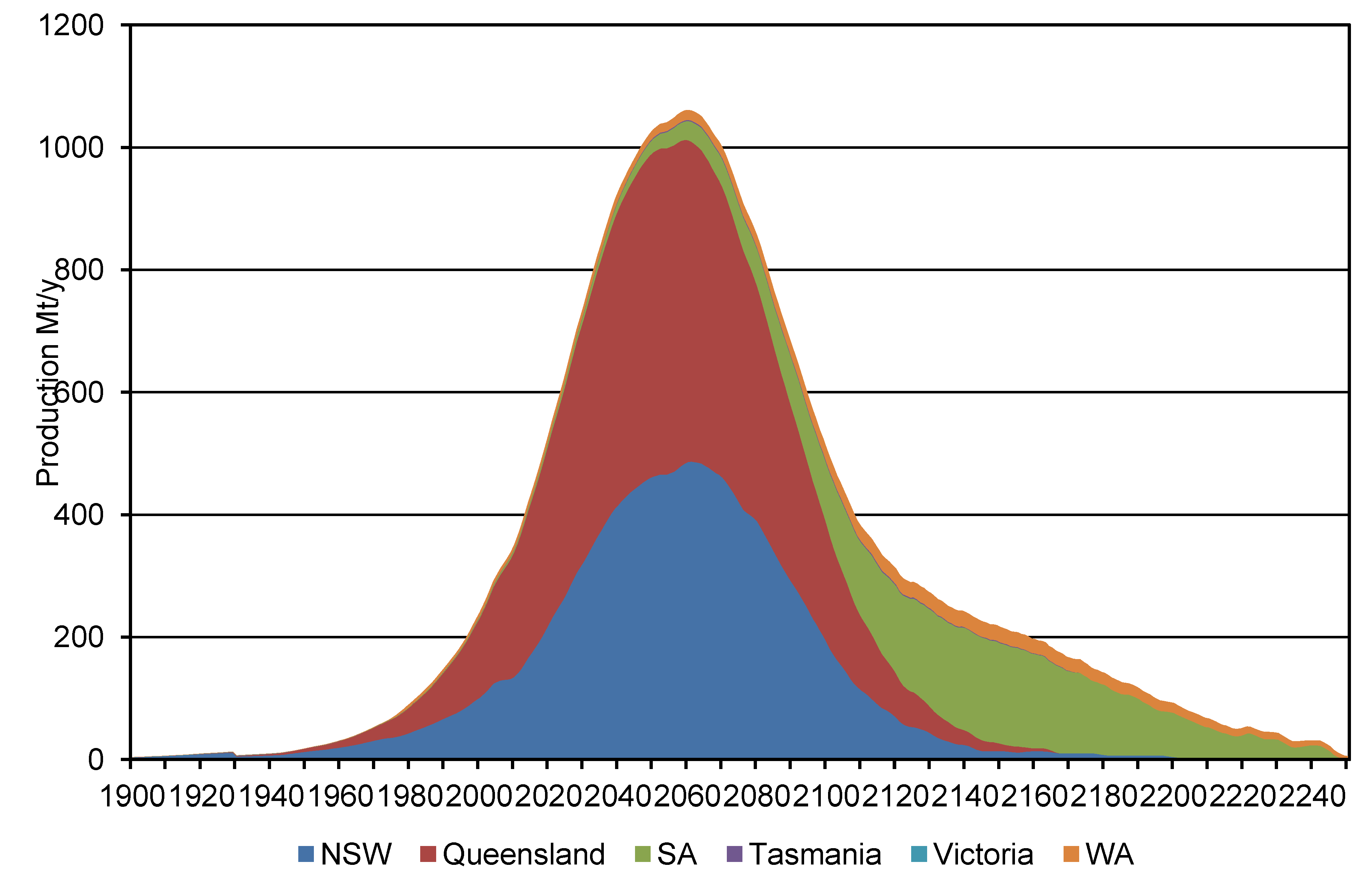
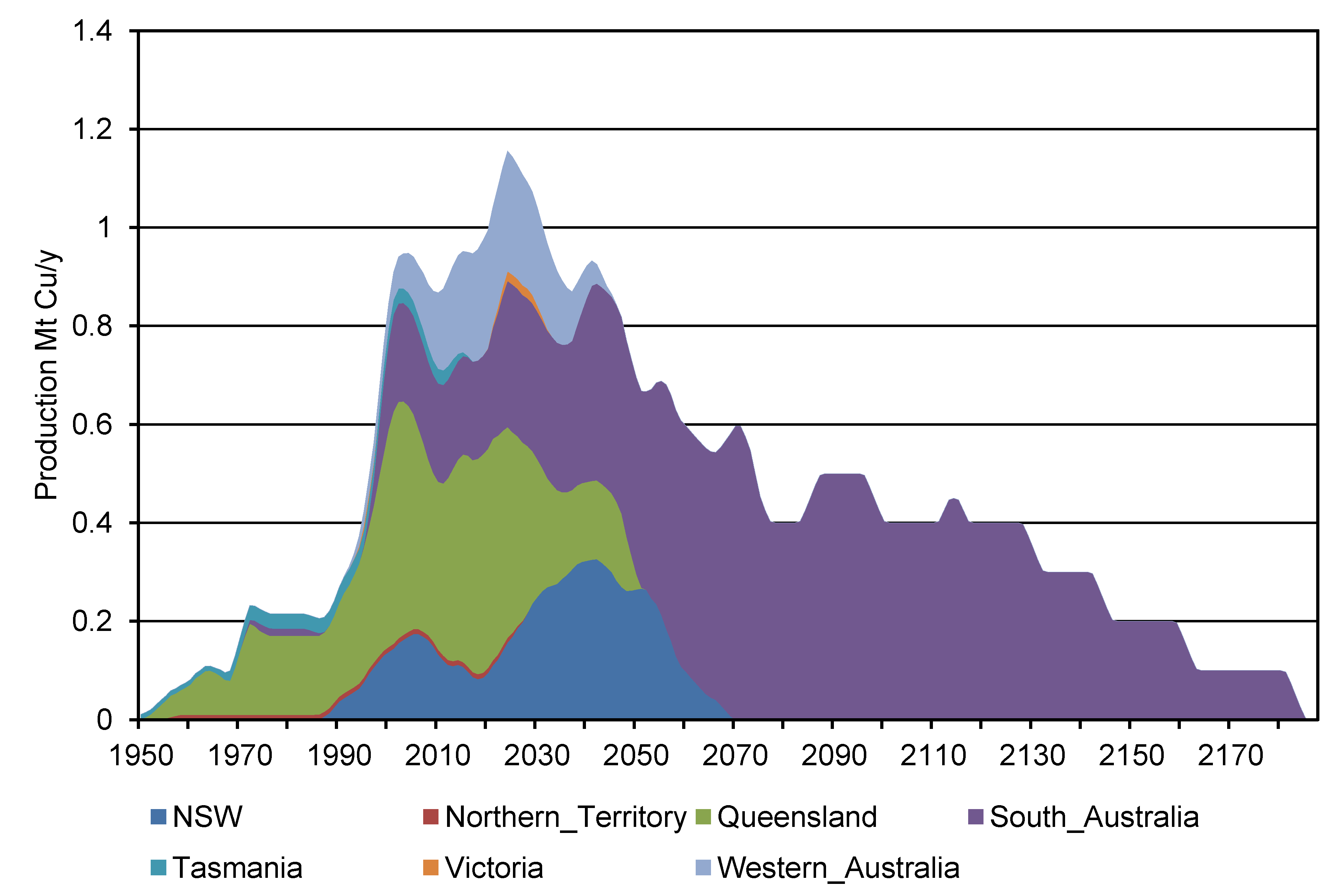
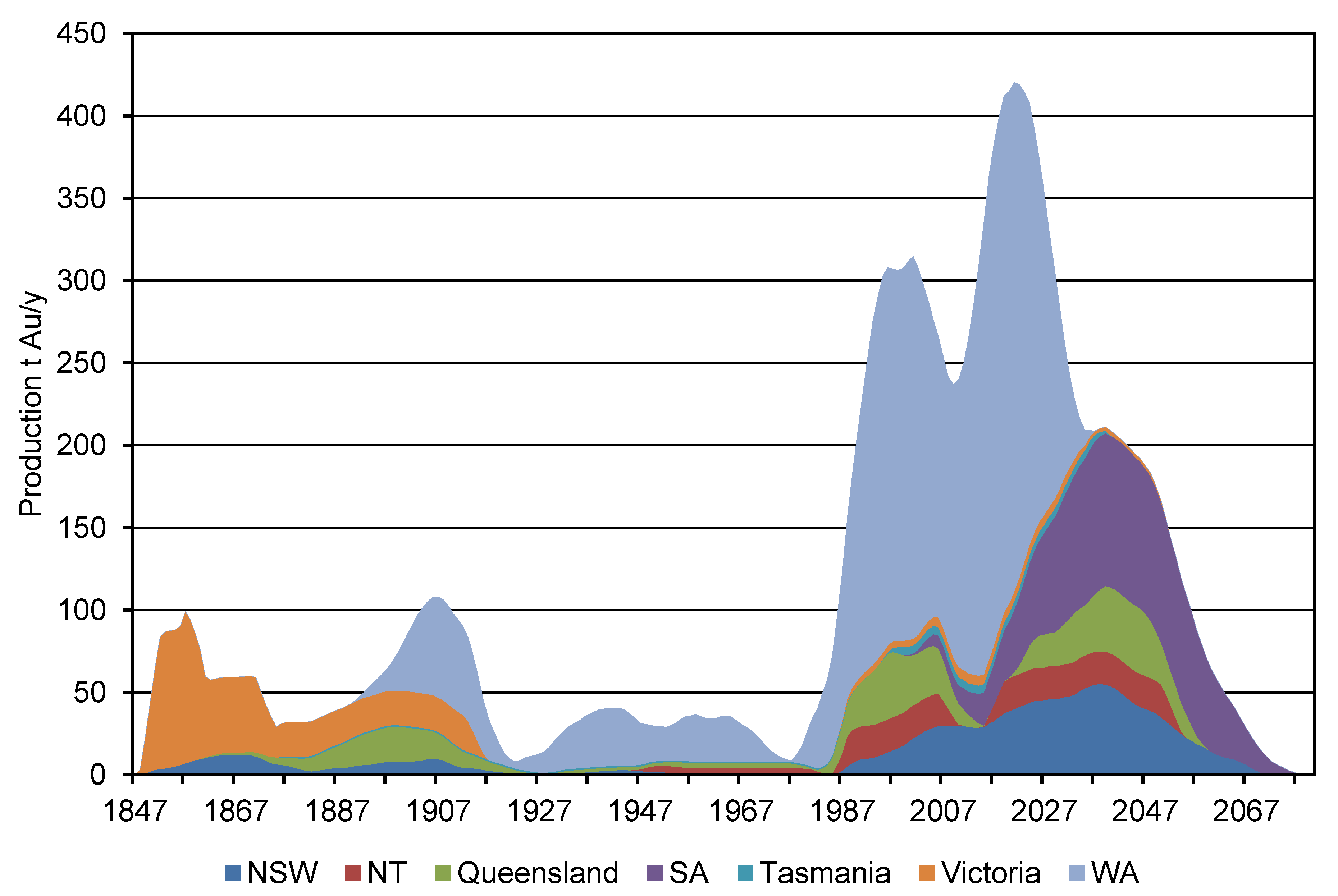
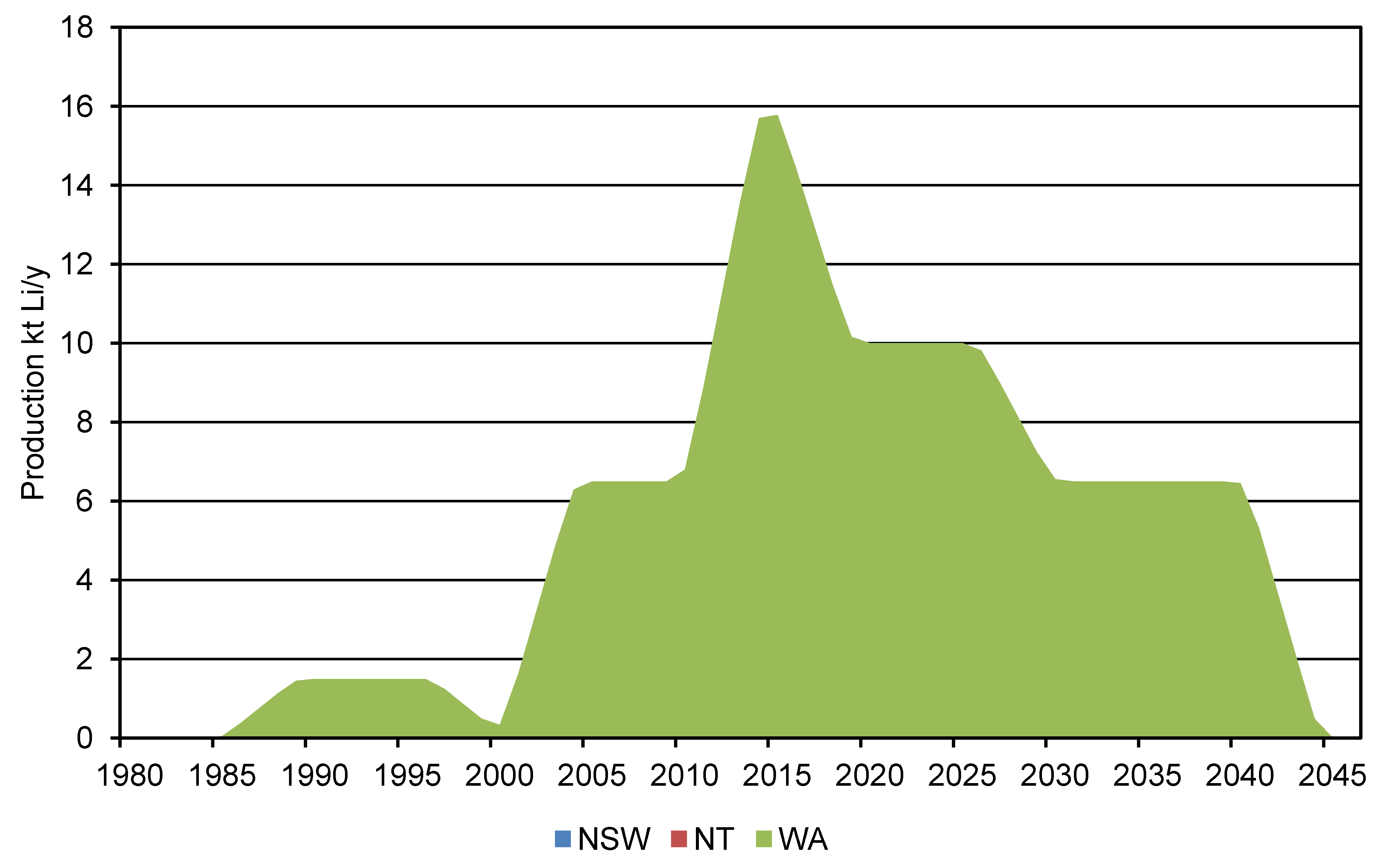
        <p>Peak production for coal is given in <xref ref-type="fig" rid="resources-01-00023-f002">Figure 2</xref>, dominated for the rest of this century by NSW and Queensland and thereafter by SA. For the case of copper, <xref ref-type="fig" rid="resources-01-00023-f003">Figure 3</xref> shows a “lumpy” curve indicating the influence of individual mines. <xref ref-type="fig" rid="resources-01-00023-f004">Figure 4</xref> shows that gold has already experienced multiple peaks, due to discovery of alluvial gold in Victoria and NSW around 1850 and then later in WA which now dominates production. Lithium production over time is modeled in <xref ref-type="fig" rid="resources-01-00023-f005">Figure 5</xref>, showing a peak in 2015 but production lasting to about 2045.</p>
        <fig id="resources-01-00023-f002" position="float">
          <label>Figure 2</label>
          <caption>
            <p>Projected peak coal production for Australia by state (data from [<xref ref-type="bibr" rid="B16-resources-01-00023">16</xref>]).</p>
          </caption>
          <graphic xmlns:xlink="http://www.w3.org/1999/xlink" xlink:href="resources-01-00023-g002.tif"/>
        </fig>
        <fig id="resources-01-00023-f003" position="float">
          <label>Figure 3</label>
          <caption>
            <p>Projected peak copper production for Australia by state (Ultimately Recoverable Resource estimate from Geoscience Australia database).</p>
          </caption>
          <graphic xmlns:xlink="http://www.w3.org/1999/xlink" xlink:href="resources-01-00023-g003.tif"/>
        </fig>
        <fig id="resources-01-00023-f004" position="float">
          <label>Figure 4</label>
          <caption>
            <p>Projected peak gold production for Australia by state (Ultimately Recoverable Resource estimate from Geoscience Australia database).</p>
          </caption>
          <graphic xmlns:xlink="http://www.w3.org/1999/xlink" xlink:href="resources-01-00023-g004.tif"/>
        </fig>
        <fig id="resources-01-00023-f005" position="float">
          <label>Figure 5</label>
          <caption>
            <p>Projected peak lithium production for Australia by state (Ultimately Recoverable Resource estimate from [<xref ref-type="bibr" rid="B17-resources-01-00023">17</xref>]).</p>
          </caption>
          <graphic xmlns:xlink="http://www.w3.org/1999/xlink" xlink:href="resources-01-00023-g005.tif"/>
        </fig>
        <p>The peak years for the various minerals are presented in <xref ref-type="table" rid="resources-01-00023-t001">Table 1</xref>, showing lithium, gold and copper as the nearest and then iron and coal. While coal production is projected to have sufficient resources to continue past 2200, the rest of the commodities have production peak within the next forty years, with significant economic and social implication s for Australia.</p>
        <table-wrap id="resources-01-00023-t001" position="float">
          <object-id pub-id-type="pii">resources-01-00023-t001_Table 1</object-id>
          <label>Table 1</label>
          <caption>
            <p>Summary of projected peak years.</p>
          </caption>
          <table>
            <thead>
              <tr>
                <th align="center" valign="middle">Type</th>
                <th align="center" valign="middle">Peak Year</th>
                <th align="center" valign="middle">Max Producation</th>
                <th align="center" valign="middle">Units</th>
              </tr>
            </thead>
            <tbody>
              <tr>
                <td align="center" valign="middle">Coal</td>
                <td align="center" valign="middle">2060</td>
                <td align="center" valign="middle">1.1</td>
                <td align="center" valign="middle">Gt/year</td>
              </tr>
              <tr>
                <td align="center" valign="middle">Copper</td>
                <td align="center" valign="middle">2024</td>
                <td align="center" valign="middle">1.2</td>
                <td align="center" valign="middle">Mt Cu/year</td>
              </tr>
              <tr>
                <td align="center" valign="middle">Gold</td>
                <td align="center" valign="middle">2021</td>
                <td align="center" valign="middle">420</td>
                <td align="center" valign="middle">t Au/year</td>
              </tr>
              <tr>
                <td align="center" valign="middle">Iron</td>
                <td align="center" valign="middle">2039</td>
                <td align="center" valign="middle">850</td>
                <td align="center" valign="middle">Mt Fe Ore/year</td>
              </tr>
              <tr>
                <td align="center" valign="middle">Lithium</td>
                <td align="center" valign="middle">2015</td>
                <td align="center" valign="middle">15.8</td>
                <td align="center" valign="middle">kt Li/year</td>
              </tr>
            </tbody>
          </table>
        </table-wrap>
      </sec>
      <sec>
        <title>3.2. Comparing Availability, Addiction, Alternatives</title>
        <p>The previous section presented the results using the GeRS-DeMo. Peak modeling has also been undertaken by other authors for copper [<xref ref-type="bibr" rid="B8-resources-01-00023">8</xref>], iron [<xref ref-type="bibr" rid="B18-resources-01-00023">18</xref>], lithium [<xref ref-type="bibr" rid="B13-resources-01-00023">13</xref>] and phosphorus [<xref ref-type="bibr" rid="B19-resources-01-00023">19</xref>]. To supplement the quantitative cross-commodity analysis, an initial qualitative analysis (also including phosphorous) of the factors affecting the impact of peak minerals for Australia in given <xref ref-type="table" rid="resources-01-00023-t002">Table 2</xref> (adapted from [<xref ref-type="bibr" rid="B20-resources-01-00023">20</xref>]).</p>
         <p>The first point to note from this cross-comparison is the varying global influence of both geological (iron), social/environmental (coal), geopolitical factors (phosphorus) and technological factors (gold) on availability. From the perspective of Australia—production is likely to be closer to a peak for gold and iron than coal. This opens the question of what resource sustainability is from several angles:</p>
        <list list-type="simple">
          <list-item>
            <p>(i) Are the resources available at an acceptable economic, social and environmental cost to meet national needs?</p>
          </list-item>
          <list-item>
            <p>(ii) Where exported to meet international demand—how are both the metals and monies derived from mining and minerals processing used?</p>
          </list-item>
          <list-item>
            <p>(iii) Are the global end-uses of metal being used within ethical supply chains to meet basic human needs or discretionary desires, and are they being used efficiently (taking account of dematerialization) in uses that help add to the stocks of natural, manufactured, financial, human and social capital?</p>
          </list-item>
          <list-item>
            <p>(iv) Are the monies derived from mining used to underpin the long term prosperity and sustainability of the nation—is such use in line with weak or strong sustainability?</p>
          </list-item>
        </list>
        <p>By analyzing the nature of the addiction and alternatives across commodities, one can gain an insight into how disruptive peak minerals could be for the commodity, and for linked sectors. For example, using current infrastructure and technology, coal is essential in both electricity and steelmaking. Uptake of alternative energy such as wind or solar could thus displace coal and also shift steel-making to focus more on the Electric Arc Furnace route instead of the coal (coke)-using blast furnace, itself precipitating and increased focus on recycling.</p>
        <table-wrap id="resources-01-00023-t002" position="float">
          <object-id pub-id-type="pii">resources-01-00023-t002_Table 2</object-id>
          <label>Table 2</label>
          <caption>
            <p>Qualitative evaluation of issues for three-criteria framework to characterize peak minerals.</p>
          </caption>
          <table>
            <thead>
              <tr>
                <th align="left" valign="middle">Commodity</th>
                <th align="left" valign="middle">Availability</th>
                <th align="left" valign="middle">Addiction</th>
                <th align="left" valign="middle">Alternatives</th>
                <th align="left" valign="middle">Issue for Australia</th>
              </tr>
            </thead>
            <tbody>
              <tr>
                <td align="left" valign="top">Coal</td>
                <td align="left" valign="top">
                <list list-type="bullet">
                <list-item><p>Worldwide, coal will peak before gas</p></list-item>
                <list-item><p>Australia: availability will be constrained not only from physical scarcity, also farm land conflict</p></list-item>
                </list>
                  </td>
                <td align="left" valign="top">
                <list list-type="bullet">
                <list-item><p>Uses link heavily with other sectors: electricity, steel, cement</p></list-item>
                <list-item><p>Future use will be affected by carbon taxes and CCS viability</p></list-item>
                </list>
                  </td>
                <td align="left" valign="top">
                <list list-type="bullet">
                <list-item><p>For electricity, energy efficiency and cleaner energy are alternatives</p></list-item>
                <list-item><p>As a reductant (e.g., steel making) biomass has potential</p></list-item>
                </list>
                  </td>
                <td align="left" valign="top">
                <list list-type="bullet">
                <list-item><p>Australia derives over 50% of export revenues from mining; Coal and Iron ore exports dominate</p></list-item>
                <list-item><p>Coal also dominates Australia’s electricity mix.</p></list-item>
                </list>
                 </td>
              </tr>
              <tr>
                <td align="left" valign="top">Copper</td>
                <td align="left" valign="top">
                <list list-type="bullet">
                <list-item><p>Cu Sulfides dominate; Cu oxides unprofitable</p></list-item>
                <list-item><p>Expansion of Olympic Dam mine dominates</p></list-item>
                </list>
                
                  </td>
                <td align="left" valign="top">
                <list list-type="bullet">
                <list-item><p>Uses are diverse (wires, pipes, electronics)</p></list-item> 
                </list>
                 </td>
                <td align="left" valign="top">
                <list list-type="bullet">
                <list-item><p>Electricity: Al can sub.</p></list-item>
                <list-item><p>Pipes: Plastic subs.</p></list-item>
                <list-item><p>Recycling an important alternative to mining</p></list-item>
                </list>
                
                    </td>
                <td align="left" valign="top">
                <list list-type="bullet">
                <list-item><p>Australia makes more money from export of mining software than export of refined copper [<xref ref-type="bibr" rid="B21-resources-01-00023">21</xref>]</p></list-item> 
                </list>
                 </td>
              </tr>
              <tr>
                <td align="left" valign="top">Gold</td>
                <td align="left" valign="top">
                <list list-type="bullet">
                <list-item><p>Volatile: Historical peaks in Australia affected by (i) ore discoveries; (ii) technology (CIP); (iii) policy/gold std.</p></list-item>
                <list-item><p>World stocks above ground (122,000 t) greater than below ground (100,000 t) [<xref ref-type="bibr" rid="B22-resources-01-00023">22</xref>].</p></list-item>
                </list>
                  </td>
                <td align="left" valign="top"> 
                <list list-type="bullet">
                <list-item><p>Uses are predominantly jewellery then bullion</p></list-item>
                <list-item><p>Getting 2 g of gold for a wedding ring requires 10 t or ore (at 0.2 g/t)<italic>versus</italic> 10 kg of mobile phone scrap at 200 g/t Au. [<xref ref-type="bibr" rid="B23-resources-01-00023">23</xref>]</p></list-item>
                </list>
                   </td>
                <td align="left" valign="top">
                <list list-type="bullet">
                <list-item><p>Are there other ways to provide the societal value or services derived from gold jewellery and bullion?</p></list-item>
                 </list>
                 </td>
                <td align="left" valign="top">
                <list list-type="bullet">
                <list-item><p>Australia is number 2 global producer of gold, what underpins future competitiveness—“Brand Australia Gold” ,<italic>i.e.</italic> being a supplier of gold with good environmental/social credentials (<italic>cf.</italic> Responsible Jewellery Council).</p></list-item>
                
                </list>
                 </td>
              </tr>
              <tr>
                <td align="left" valign="top">Iron/Steel</td>
                <td align="left" valign="top">
                <list list-type="bullet">
                <list-item><p>Australia and Brazil are dominant iron exporters</p></list-item>
                <list-item><p>Aus production increasing, decades of availability, but impurities increasing</p></list-item>
                </list>
                  </td>
                <td align="left" valign="top">
                <list list-type="bullet">
                <list-item><p>Transport distances to market are an increasing factor in costs to meet addiction</p></list-item>
                <list-item><p>Uses are rising and long lasting in structures</p></list-item>
                </list>
                  </td>
                <td align="left" valign="top"> 
                <list list-type="bullet">
                <list-item><p>Recycling is active but can be increased (for example, in China)</p></list-item>
                <list-item><p> What role may timber play in future structures</p></list-item>
                </list>
                </td>
                <td align="left" valign="top">
                <list list-type="bullet">
                <list-item><p>How can we ensure metals and monies from iron ore exports underpin long term benefit in iron-mining regions of Australia (Pilbara) and nationally?</p></list-item>
                 </list>
                </td>
              </tr>
              <tr>
                <td align="left" valign="top">Lithium</td>
                <td align="left" valign="top"> <list list-type="bullet">
                <list-item><p>Australia largest hardrock supplier of Li</p></list-item>
                <list-item><p>Global competition from South American brines</p></list-item>
                </list>
                
                 </td>
                <td align="left" valign="top">
                <list list-type="bullet">
                <list-item><p>Small but growing market in batteries—demand depends on uptake of electric vehicles and alternative battery technologies not using lithium</p></list-item>
                 </list>
                 </td>
                <td align="left" valign="top"> 
                <list list-type="bullet">
                <list-item><p>Alternatives to dig and sell business model. Is there a useful role for a product-service system leasing lithium across mines; battery suppliers and electric vehicles?</p></list-item>
                 </list>
                </td>
                <td align="left" valign="top">
                <list list-type="bullet">
                <list-item><p>Developing cost-effective technology for converting lithium from hardrock to carbonate (more readily derived from brines) for use in batteries will underpin competitiveness</p></list-item>
                 </list>
                 </td>
              </tr>
              <tr>
                <td align="left" valign="top">Phosphorous</td>
                <td align="left" valign="top">
                <list list-type="bullet">
                <list-item><p>Global peak predicted around 2030. Geopolitical issues—China; Western Sahara. Australia could expand mainland production somewhat, but Christmas Island mine closing</p></list-item>
                 </list>
                 </td>
                <td align="left" valign="top"> 
                <list list-type="bullet">
                <list-item><p>Use in fertilisers/food growing as a result of population growth and more meat and dairy in diets of emerging nations</p></list-item>
                
                </list>
                </td>
                <td align="left" valign="top">
                <list list-type="bullet">
                <list-item><p>No alternative to P needed in our diet.</p></list-item>
                <list-item><p> Potential for supply chain efficiencies and recycling urine and excreta in cities</p></list-item>
                </list>
                 </td>
                <td align="left" valign="top">
                <list list-type="bullet">
                <list-item><p>As a country with P deficient soils and intensive agriculture, Australia must work to ensure this global issue is adequately addressed</p></list-item>
                 </list>
                 </td>
              </tr>
            </tbody>
          </table>
        </table-wrap>
       
        <p>With respect to meeting demand through alternatives to terrestrial ore mining, the role of recycling should be examined closely along with strategies for dematerialization (see for example [<xref ref-type="bibr" rid="B24-resources-01-00023">24</xref>] comparing the environmental impacts associated with terrestrial copper mining, recycling and reduced demand due to dematerialization). When exploring other options such as ocean resources or substituting aluminum or plastic for copper in wires and pipes—close attention should be paid to the potential for burden shifting. For example, exploiting ocean resources for copper may open up new resources, however, there are significant local environmental impacts and stakeholder concerns about the approach [<xref ref-type="bibr" rid="B25-resources-01-00023">25</xref>] which would need to be compared against mining lower grade terrestrial ores. In the case of substituting aluminium for copper in wires, the energy source used to make aluminum which would affect its relative performance, as would the final use. Here it is imperative that life cycle thinking is included in the analysis together with new ways of understanding value along the supply chain.</p>
        <p>For example, using the case of Lithium, Australia has significant terrestrial hard rock (spodumene) resources and development of a low-cost technology for converting the lithium to carbonate for use in batteries could further open this global market. However how much money can be made only from the “dig and sell” model? How might a new business model using a linked product-service system add value by providing Brand Australia lithium to more sustainable supply chains through batteries and electric vehicles coupled to clean energy [<xref ref-type="bibr" rid="B20-resources-01-00023">20</xref>]. Such initiatives require a focus on production and use as well as the ultimate benefit provided to society through the use of the mineral and how this can be expanded, not only through new technology, but policy and practices.</p>
      </sec>
    </sec>
    <sec sec-type="conclusions">
      <title>4. Conclusions</title>
      <p>This paper has utilized the Geologic Resource Supply-Demand Model to project future production across five key commodities. It found significant heterogeneity across commodities with respect to peak production. The quantitative analysis was coupled with a qualitative analysis using the peak minerals framework of availability, addiction and alternatives to characterize criticality issues. Factors contributing to the onset of peak minerals will also be affected by social and environmental constraints (for example, coal mining—land use conflict in Australia) as well as geological, technological and demand factors. The three criteria assessment of peak minerals is an important analysis framework for understanding the potential impact of peak minerals and framing a response consistent with sustainable resource management. Future research will explore the role of technology and policy in responding to this challenge.</p>
    </sec>
    <sec>
      <title>Acknowledgments</title>
      <p>This research has been undertaken as part of the Minerals Futures Collaboration Cluster, a collaborative program between the Australian CSIRO (Commonwealth Scientific Industrial Research Organisation); The University of Queensland; University of Technology, Sydney; Curtin University; CQUniversity; and The Australian National University. The authors gratefully acknowledge the contribution of each partner and the CSIRO Flagship Collaboration Fund. The Minerals Futures Cluster is a part of the Minerals Down Under National Research Flagship. An initial version of this paper was presented at the World Resources Forum, Davos, Switzerland, 19–21 September 2011 as “Peak Minerals &amp; Resource Sustainability: A Cross Commodity Analysis”.</p>
    </sec>
  </body>
  <back>
    <ref-list>
      <title>References</title>
      <ref id="B1-resources-01-00023">
        <label>1.</label>
        <citation citation-type="thesis">
          <person-group person-group-type="author">
            <name>
              <surname>Mohr</surname>
              <given-names>S.</given-names>
            </name>
          </person-group>
          <article-title>Projection of World Fossil Fuel Production with Supply and Demand Interactions</article-title>
          <comment>Ph.D. Thesis, University of Newcastle, Callaghan, Australia, 2010.</comment>
        </citation>
      </ref>
      <ref id="B2-resources-01-00023">
        <label>2.</label>
        <citation citation-type="journal">
          <person-group person-group-type="author">
            <name>
              <surname>Mason</surname>
              <given-names>L.</given-names>
            </name>
            <name>
              <surname>Prior</surname>
              <given-names>T.</given-names>
            </name>
            <name>
              <surname>Mudd</surname>
              <given-names>G.</given-names>
            </name>
            <name>
              <surname>Giurco</surname>
              <given-names>D.</given-names>
            </name>
          </person-group>
          <article-title>Availability, addiction and alternatives: Three criteria for assessing the impact of peak minerals on society</article-title>
          <source>J. Clean. Prod.</source>
          <year>2011</year>
          <volume>19</volume>
          <fpage>958</fpage>
          <lpage>966</lpage>
          <pub-id pub-id-type="doi">10.1016/j.jclepro.2010.12.006</pub-id>
        </citation>
      </ref>
      <ref id="B3-resources-01-00023">
        <label>3.</label>
        <citation citation-type="book">
		<collab>ABARES</collab>
           
          <source>Australian Commodity Statistics</source>
          <publisher-name>Australian Bureau of Agricultural and Resource Economics and Sciences</publisher-name>
          <publisher-loc>Canberra, Australia</publisher-loc>
          <year>2010</year>
        </citation>
      </ref>
      <ref id="B4-resources-01-00023">
        <label>4.</label>
        <citation citation-type="journal">
          <person-group person-group-type="author">
            <name>
              <surname>Prior</surname>
              <given-names>T.</given-names>
            </name>
            <name>
              <surname>Giurco</surname>
              <given-names>D.</given-names>
            </name>
            <name>
              <surname>Mudd</surname>
              <given-names>G.</given-names>
            </name>
            <name>
              <surname>Mason</surname>
              <given-names>L.</given-names>
            </name>
            <name>
              <surname>Behrisch</surname>
              <given-names>J.</given-names>
            </name>
          </person-group>
          <article-title>Resource depletion, peak minerals and the implications for sustainable resource management</article-title>
          <source>Glob. Environ. Chang.</source>
          <year>2012</year>
          <volume>22</volume>
          <fpage>577</fpage>
          <lpage>587</lpage>
          <pub-id pub-id-type="doi">10.1016/j.gloenvcha.2011.08.009</pub-id>
        </citation>
      </ref>
      <ref id="B5-resources-01-00023">
        <label>5.</label>
        <citation citation-type="book">
		<collab>Access Economics</collab>
           
          <source>Global Commodity Demand Scenarios</source>
          <publisher-name>Minerals Council of Australia</publisher-name>
          <publisher-loc>Canberra, Australia</publisher-loc>
          <year>2008</year>
        </citation>
      </ref>
      <ref id="B6-resources-01-00023">
        <label>6.</label>
        <citation citation-type="book">
		<collab>BREE</collab>
          
          <source>Resources and Energy Quarterly, September Quarter 2012</source>
          <publisher-name>Bureau of Resources and Energy Economics</publisher-name>
          <publisher-loc>Canberra, Australia</publisher-loc>
          <year>2012</year>
        </citation>
      </ref>
      <ref id="B7-resources-01-00023">
        <label>7.</label>
        <citation citation-type="book">
          <person-group person-group-type="author">
            <name>
              <surname>Giurco</surname>
              <given-names>D.</given-names>
            </name>
            <name>
              <surname>Prior</surname>
              <given-names>T.</given-names>
            </name>
            <name>
              <surname>Mudd</surname>
              <given-names>G.</given-names>
            </name>
            <name>
              <surname>Mason</surname>
              <given-names>L.</given-names>
            </name>
            <name>
              <surname>Behrisch</surname>
              <given-names>J.</given-names>
            </name>
          </person-group>
          <source>Peak Minerals in Australia: A Review of Changing Impacts and Benefits</source>
          <publisher-name>Institute for Sustainable Futures, University of Technology, Sydney</publisher-name>
          <publisher-loc>Broadway, Australia</publisher-loc>
          <year>2010</year>
        </citation>
      </ref>
      <ref id="B8-resources-01-00023">
        <label>8.</label>
        <citation citation-type="confproc">
          <person-group person-group-type="author">
            <name>
              <surname>Mudd</surname>
              <given-names>G.M.</given-names>
            </name>
            <name>
              <surname>Ward</surname>
              <given-names>J.D.</given-names>
            </name>
          </person-group>
          <article-title>Will Sustainability Constraints Cause “Peak Minerals”?</article-title>
          <source>Proceedings of3rd International Conference on Sustainability Engineering and Science: Blueprints for Sustainable Infrastructure</source>
          <conf-loc>Auckland, New Zealand</conf-loc>
          <conf-date>9–12 December 2008</conf-date>
        </citation>
      </ref>
      <ref id="B9-resources-01-00023">
        <label>9.</label>
        <citation citation-type="journal">
          <person-group person-group-type="author">
            <name>
              <surname>May</surname>
              <given-names>D.</given-names>
            </name>
            <name>
              <surname>Prior</surname>
              <given-names>T.</given-names>
            </name>
            <name>
              <surname>Cordell</surname>
              <given-names>D.</given-names>
            </name>
            <name>
              <surname>Giurco</surname>
              <given-names>D.</given-names>
            </name>
          </person-group>
          <article-title>Peak minerals: Theoretical foundations and practical application</article-title>
          <source>Nat. Resour. Res.</source>
          <year>2011</year>
          <volume>21</volume>
          <fpage>43</fpage>
          <lpage>60</lpage>
        </citation>
      </ref>
      <ref id="B10-resources-01-00023">
        <label>10.</label>
        <citation citation-type="journal">
          <person-group person-group-type="author">
            <name>
              <surname>Graedel</surname>
              <given-names>T.E.</given-names>
            </name>
            <name>
              <surname>Barr</surname>
              <given-names>R.</given-names>
            </name>
            <name>
              <surname>Chandler</surname>
              <given-names>C.</given-names>
            </name>
            <name>
              <surname>Chase</surname>
              <given-names>T.</given-names>
            </name>
            <name>
              <surname>Choi</surname>
              <given-names>J.</given-names>
            </name>
            <name>
              <surname>Christoffersen</surname>
              <given-names>L.</given-names>
            </name>
            <name>
              <surname>Friedlander</surname>
              <given-names>E.</given-names>
            </name>
            <name>
              <surname>Henly</surname>
              <given-names>C.</given-names>
            </name>
            <name>
              <surname>Jun</surname>
              <given-names>C.</given-names>
            </name>
            <name>
              <surname>Nassar</surname>
              <given-names>N.T.</given-names>
            </name>
            <etal/>
          </person-group>
          <article-title>Methodology of metal criticality determination</article-title>
          <source>Environ. Sci. Technol.</source>
          <year>2011</year>
          <volume>46</volume>
          <fpage>1063</fpage>
          <lpage>1070</lpage>
        </citation>
      </ref>
      <ref id="B11-resources-01-00023">
        <label>11.</label>
        <citation citation-type="journal">
          <person-group person-group-type="author">
            <name>
              <surname>Mohr</surname>
              <given-names>S.H.</given-names>
            </name>
            <name>
              <surname>Evans</surname>
              <given-names>G.M.</given-names>
            </name>
          </person-group>
          <article-title>Forecasting coal production until 2100</article-title>
          <source>Fuel</source>
          <year>2009</year>
          <volume>88</volume>
          <fpage>2059</fpage>
          <lpage>2067</lpage>
        <pub-id pub-id-type="doi">10.1016/j.fuel.2009.01.032</pub-id></citation>
      </ref>
      <ref id="B12-resources-01-00023">
        <label>12.</label>
        <citation citation-type="journal">
          <person-group person-group-type="author">
            <name>
              <surname>Mohr</surname>
              <given-names>S.H.</given-names>
            </name>
            <name>
              <surname>Evans</surname>
              <given-names>G.M.</given-names>
            </name>
          </person-group>
          <article-title>Long term forecasting of natural gas production</article-title>
          <source>Energy Policy</source>
          <year>2011</year>
          <volume>39</volume>
          <fpage>2059</fpage>
          <lpage>2067</lpage>
        </citation>
      </ref>
      <ref id="B13-resources-01-00023">
        <label>13.</label>
        <citation citation-type="journal">
          <person-group person-group-type="author">
            <name>
              <surname>Mohr</surname>
              <given-names>S.H.</given-names>
            </name>
            <name>
              <surname>Mudd</surname>
              <given-names>G.M.</given-names>
            </name>
            <name>
              <surname>Giurco</surname>
              <given-names>D.</given-names>
            </name>
          </person-group>
          <article-title>Lithium resources and production: Critical assessment and global projections</article-title>
          <source>Minerals</source>
          <year>2012</year>
          <volume>2</volume>
          <fpage>65</fpage>
          <lpage>84</lpage>
          <pub-id pub-id-type="doi">10.3390/min2010065</pub-id>
        </citation>
      </ref>
      <ref id="B14-resources-01-00023">
        <label>14.</label>
        <citation citation-type="web">
          <person-group person-group-type="author">
            <name>
              <surname>Mohr</surname>
              <given-names>S.</given-names>
            </name>
          </person-group>
          <article-title>Geologic Resource Supply-Demand Model</article-title>
          
          <comment>Available online:<ext-link xmlns:xlink="http://www.w3.org/1999/xlink" xlink:href="http://cfsites1.uts.edu.au/isf/staff/details.cfm?StaffId=12654" ext-link-type="uri">http://cfsites1.uts.edu.au/isf/staff/details.cfm?StaffId=12654</ext-link></comment>
		  <access-date>(accessed on 17 December 2012)</access-date>
        </citation>
      </ref>
      <ref id="B15-resources-01-00023">
        <label>15.</label>
        <citation citation-type="book">
          <person-group person-group-type="author">
            <name>
              <surname>Ingham</surname>
              <given-names>P.</given-names>
            </name>
            <name>
              <surname>Brett</surname>
              <given-names>A.</given-names>
            </name>
            <name>
              <surname>White</surname>
              <given-names>I.</given-names>
            </name>
            <name>
              <surname>Jackson</surname>
              <given-names>S.</given-names>
            </name>
          </person-group>
          <source>GreenbushesLithium Operations NI 43-101 Technical Report</source>
          <publisher-name>Talison Lithium Limited by Behre Dolbear Australia</publisher-name>
          <publisher-loc>North Sydney, Australia</publisher-loc>
          <year>2011</year>
        </citation>
      </ref>
      <ref id="B16-resources-01-00023">
        <label>16.</label>
        <citation citation-type="journal">
          <person-group person-group-type="author">
            <name>
              <surname>Mohr</surname>
              <given-names>S.</given-names>
            </name>
            <name>
              <surname>Höök</surname>
              <given-names>M.</given-names>
            </name>
            <name>
              <surname>Mudd</surname>
              <given-names>G.</given-names>
            </name>
            <name>
              <surname>Evans</surname>
              <given-names>G.</given-names>
            </name>
          </person-group>
          <article-title>Projection of long-term paths for Australian coal production—Comparisons of four models</article-title>
          <source>Int. J. Coal Geol.</source>
          <year>2011</year>
          <volume>86</volume>
          <fpage>329</fpage>
          <lpage>341</lpage>
          <pub-id pub-id-type="doi">10.1016/j.coal.2011.03.006</pub-id>
        </citation>
      </ref>
      <ref id="B17-resources-01-00023">
        <label>17.</label>
        <citation citation-type="book">
          <person-group person-group-type="author">
            <name>
              <surname>Mohr</surname>
              <given-names>S.</given-names>
            </name>
            <name>
              <surname>Mudd</surname>
              <given-names>G.</given-names>
            </name>
            <name>
              <surname>Giurco</surname>
              <given-names>D.</given-names>
            </name>
          </person-group>
          <source>Lithium Resources and Production: A Critical Global Assessment, Research Report 1.4</source>
          <publisher-name>Monash University</publisher-name>
          
          <publisher-loc>Victoria, Australia</publisher-loc>
          
          <publisher-name>Institute for Sustainable Futures, University of Technology, Sydney</publisher-name>
          <publisher-loc>Broadway, Australia</publisher-loc>
          <year>2010</year>
          <comment>Prepared for CSIRO Minerals Down Under Flagship by the Department of Civil Engineering</comment>
        </citation>
      </ref>
      <ref id="B18-resources-01-00023">
        <label>18.</label>
        <citation citation-type="book">
          <person-group person-group-type="author">
            <name>
              <surname>Yellishetty</surname>
              <given-names>M.</given-names>
            </name>
            <name>
              <surname>Mudd</surname>
              <given-names>G.M.</given-names>
            </name>
            <name>
              <surname>Mason</surname>
              <given-names>L.</given-names>
            </name>
            <name>
              <surname>Mohr</surname>
              <given-names>S.</given-names>
            </name>
            <name>
              <surname>Prior</surname>
              <given-names>T.</given-names>
            </name>
            <name>
              <surname>Giurco</surname>
              <given-names>D.</given-names>
            </name>
          </person-group>
          <source>Iron Resources and Production: Technology, Sustainability and Future Prospects; Cluster Research Report 1.10</source>
          <publisher-name>Monash University</publisher-name>
          <publisher-loc>Victoria, Australia</publisher-loc>
           <publisher-name>Institute for Sustainable Futures, University of Technology, Sydney</publisher-name>
          <publisher-loc>Broadway, Australia</publisher-loc>
          <year>2012</year>
          <comment>Prepared for CSIRO Minerals Down Under Flagship by the Department of Civil Engineering</comment>
         </citation>
      </ref>
      <ref id="B19-resources-01-00023">
        <label>19.</label>
        <citation citation-type="journal">
          <person-group person-group-type="author">
            <name>
              <surname>Cordell</surname>
              <given-names>D.</given-names>
            </name>
            <name>
              <surname>Drangert</surname>
              <given-names>J.-O.</given-names>
            </name>
            <name>
              <surname>White</surname>
              <given-names>S.</given-names>
            </name>
          </person-group>
          <article-title>The story of phosphorus: Global food security and food for thought</article-title>
          <source>Glob. Environ. Chang.</source>
          <year>2009</year>
          <volume>19</volume>
          <fpage>292</fpage>
          <lpage>305</lpage>
          <pub-id pub-id-type="doi">10.1016/j.gloenvcha.2008.10.009</pub-id>
        </citation>
      </ref>
      <ref id="B20-resources-01-00023">
        <label>20.</label>
        <citation citation-type="confproc">
          <person-group person-group-type="author">
            <name>
              <surname>Giurco</surname>
              <given-names>D.</given-names>
            </name>
            <name>
              <surname>Prior</surname>
              <given-names>T.</given-names>
            </name>
            <name>
              <surname>Mason</surname>
              <given-names>L.</given-names>
            </name>
          </person-group>
          <article-title>Vision 2040—Mining Technology, Policy and Market Innovation</article-title>
          <source>Proceedings of 2nd International Future Mining Conference 2011</source>
          <conf-loc>Sydney, Australia</conf-loc>
          <conf-date>22–23 November 2011</conf-date>
          <fpage>163</fpage>
          <lpage>170</lpage>
        </citation>
      </ref>
      <ref id="B21-resources-01-00023">
        <label>21.</label>
        <citation citation-type="book">
          <person-group person-group-type="author">
            <name>
              <surname>Tedesco</surname>
              <given-names>L.</given-names>
            </name>
            <name>
              <surname>Haseltine</surname>
              <given-names>C.</given-names>
            </name>
          </person-group>
          <source>An Economic Survey of Companies in the Australian Mining Technology Services and Equipment Sector 2006-07 to 2008-09</source>
          <publisher-name>ABARE-BRS Research Report 1.10</publisher-name>
          <publisher-loc>Canberra, Australia</publisher-loc>
          <year>2010</year>
        </citation>
      </ref>
      <ref id="B22-resources-01-00023">
        <label>22.</label>
        <citation citation-type="book">
          <person-group person-group-type="author">
            <name>
              <surname>Butterman</surname>
              <given-names>W.C.</given-names>
            </name>
            <name>
              <surname>Amey</surname>
              <given-names>E.B.</given-names>
            </name>
          </person-group>
          <source>Mineral Commodity Profile—Gold; Open-File Report 02—303</source>
          <publisher-name>United States Geological Survey</publisher-name>
          <publisher-loc>Reston, VA, USA</publisher-loc>
          <year>2005</year>
        </citation>
      </ref>
      <ref id="B23-resources-01-00023">
        <label>23.</label>
        <citation citation-type="book">
		<collab>Boliden</collab>
           
          <source>Boliden Sustainability Report 2007</source>
          <publisher-name>Boliden</publisher-name>
          <publisher-loc>Stockholm, Sweden</publisher-loc>
          <year>2007</year>
        </citation>
      </ref>
      <ref id="B24-resources-01-00023">
        <label>24.</label>
        <citation citation-type="journal">
          <person-group person-group-type="author">
            <name>
              <surname>Giurco</surname>
              <given-names>D.</given-names>
            </name>
            <name>
              <surname>Petrie</surname>
              <given-names>J.G.</given-names>
            </name>
          </person-group>
          <article-title>Strategies for reducing the carbon footprint of copper: New technologies, more recycling or demand management?</article-title>
          <source>Miner. Eng.</source>
          <year>2007</year>
          <volume>20</volume>
          <fpage>842</fpage>
          <lpage>853</lpage>
          <pub-id pub-id-type="doi">10.1016/j.mineng.2007.04.014</pub-id>
        </citation>
      </ref>
      <ref id="B25-resources-01-00023">
        <label>25.</label>
        <citation citation-type="book">
          <person-group person-group-type="author">
            <name>
              <surname>Littleboy</surname>
              <given-names>A.</given-names>
            </name>
            <name>
              <surname>Boughen</surname>
              <given-names>N.</given-names>
            </name>
          </person-group>
          <source>Exploring the Social Dimensions of an Expansion to the Seafloor Exploration and Mining Industry in Australia: Synthesis Report</source>
          <publisher-name>CSIRO Wealth from Oceans Flagship</publisher-name>
          <publisher-loc>North Ryde, Australia</publisher-loc>
          <year>2007</year>
        </citation>
      </ref>
    </ref-list>
  </back>
</article>