
<?xml version="1.0" encoding="UTF-8"?>
<!DOCTYPE article PUBLIC "-//NLM//DTD Journal Publishing DTD v2.3 20070202//EN" "journalpublishing.dtd">
<article xmlns:mml="http://www.w3.org/1998/Math/MathML" xmlns:xlink="http://www.w3.org/1999/xlink" xml:lang="en" article-type="review-article">
  <front>
    <journal-meta>
      <journal-id journal-id-type="publisher-id">biology</journal-id>
      <journal-title>Biology</journal-title>
      <abbrev-journal-title abbrev-type="publisher">Biology</abbrev-journal-title>
      <abbrev-journal-title abbrev-type="pubmed">Biology</abbrev-journal-title>
      <issn pub-type="epub">2079-7737</issn>
      <publisher>
        <publisher-name>MDPI</publisher-name>
      </publisher>
    </journal-meta>
    <article-meta>
      <article-id pub-id-type="doi">10.3390/biology1030668</article-id>
      <article-id pub-id-type="publisher-id">biology-01-00668</article-id>
      <article-categories>
        <subj-group>
          <subject>Review</subject>
        </subj-group>
      </article-categories>
      <title-group>
        <article-title>Strategies to Block HIV Transcription: Focus on Small Molecule Tat Inhibitors</article-title>
      </title-group>
      <contrib-group>
        <contrib contrib-type="author">
          <name>
            <surname>Mousseau</surname>
            <given-names>Guillaume</given-names>
          </name>
        </contrib>
        <contrib contrib-type="author">
          <name>
            <surname>Valente</surname>
            <given-names>Susana</given-names>
          </name>
          <xref rid="c1-biology-01-00668" ref-type="corresp">*</xref>
        </contrib>
      </contrib-group>
      <aff id="af1-biology-01-00668">Department of Infectious Diseases, The Scripps Research Institute, Scripps Florida, 130 Scripps Way, Jupiter, FL 33458, USA; Email: <email>mousseau@scripps.edu</email></aff>
      <author-notes>
        <corresp id="c1-biology-01-00668"><label>*</label> Author to whom correspondence should be addressed; Email: <email>svalente@scripps.edu</email>; Tel.: +1-561-228-3454; Fax: +1-561-228-2916.</corresp>
      </author-notes>
      <pub-date pub-type="epub">
        <day>19</day>
        <month>11</month>
        <year>2012</year>
      </pub-date>
      <pub-date pub-type="collection">
        <month>12</month>
        <year>2012</year>
      </pub-date>
      <volume>1</volume>
      <issue>3</issue>
      <fpage>668</fpage>
      <lpage>697</lpage>
      <history>
        <date date-type="received">
          <day>11</day>
          <month>10</month>
          <year>2012</year>
        </date>
        <date date-type="rev-recd">
          <day>06</day>
          <month>11</month>
          <year>2012</year>
        </date>
        <date date-type="accepted">
          <day>07</day>
          <month>11</month>
          <year>2012</year>
        </date>
      </history>
      <permissions>
        <copyright-statement>© 2012 by the authors; licensee MDPI, Basel, Switzerland.</copyright-statement>
        <copyright-year>2012</copyright-year>
        <license xmlns:xlink="http://www.w3.org/1999/xlink" license-type="open-access" xlink:href="http://creativecommons.org/licenses/by/3.0/">
          <p>This article is an open-access article distributed under the terms and conditions of the Creative Commons Attribution license (http://creativecommons.org/licenses/by/3.0/).</p>
        </license>
      </permissions>
      <abstract>
        <p>After entry into the target cell, the human immunodeficiency virus type I (HIV) integrates into the host genome and becomes a proviral eukaryotic transcriptional unit. Transcriptional regulation of provirus gene expression is critical for HIV replication. Basal transcription from the integrated HIV promoter is very low in the absence of the HIV transactivator of transcription (Tat) protein and is solely dependent on cellular transcription factors. The 5' terminal region (+1 to +59) of all HIV mRNAs forms an identical stem-bulge-loop structure called the Transactivation Responsive (TAR) element. Once Tat is made, it binds to TAR and drastically activates transcription from the HIV LTR promoter. Mutations in either the Tat protein or TAR sequence usually affect HIV replication, indicating a strong requirement for their conservation. The necessity of the Tat-mediated transactivation cascade for robust HIV replication renders Tat one of the most desirable targets for transcriptional therapy against HIV replication. Screening based on inhibition of the Tat-TAR interaction has identified a number of potential compounds, but none of them are currently used as therapeutics, partly because these agents are not easily delivered for an efficient therapy, emphasizing the need for small molecule compounds. Here we will give an overview of the different strategies used to inhibit HIV transcription and review the current repertoire of small molecular weight compounds that target HIV transcription.</p>
      </abstract>
      <kwd-group>
        <kwd>Tat</kwd>
        <kwd>TAR</kwd>
        <kwd>inhibitors</kwd>
        <kwd>small molecule compounds</kwd>
        <kwd>transcription</kwd>
        <kwd>latency</kwd>
        <kwd>chronic cells</kwd>
        <kwd>HIV-1</kwd>
        <kwd>HIV-2</kwd>
      </kwd-group>
    </article-meta>
  </front>
  <body>
    <sec sec-type="intro">
      <title>1. Introduction</title>
      <p>Human immunodeficiency virus type I (HIV-1) is the causative agent of Acquired Immunodeficiency Syndrome (AIDS) and affects more than 30 million people worldwide. Antiretroviral therapy (ART) used to treat the virus is based on triple or quadruple combinations of antiretrovirals (ARVs); although effective and life prolonging, it does not eradicate HIV infection. An HIV RNA level of less than 50 copies/mL of plasma is frequently achieved with ART; however, residual low-level viremia has been detected using ultrasensitive assays [<xref ref-type="bibr" rid="B1-biology-01-00668">1</xref>,<xref ref-type="bibr" rid="B2-biology-01-00668">2</xref>,<xref ref-type="bibr" rid="B3-biology-01-00668">3</xref>,<xref ref-type="bibr" rid="B4-biology-01-00668">4</xref>]. HIV persists in stable reservoirs harboring an integrated form of the HIV genome, wherein continuous viral production and reactivation of transcription from these reservoirs are not affected by current ARVs [<xref ref-type="bibr" rid="B5-biology-01-00668">5</xref>,<xref ref-type="bibr" rid="B6-biology-01-00668">6</xref>]. As such, novel classes of ARVs are needed to inhibit these processes. </p>
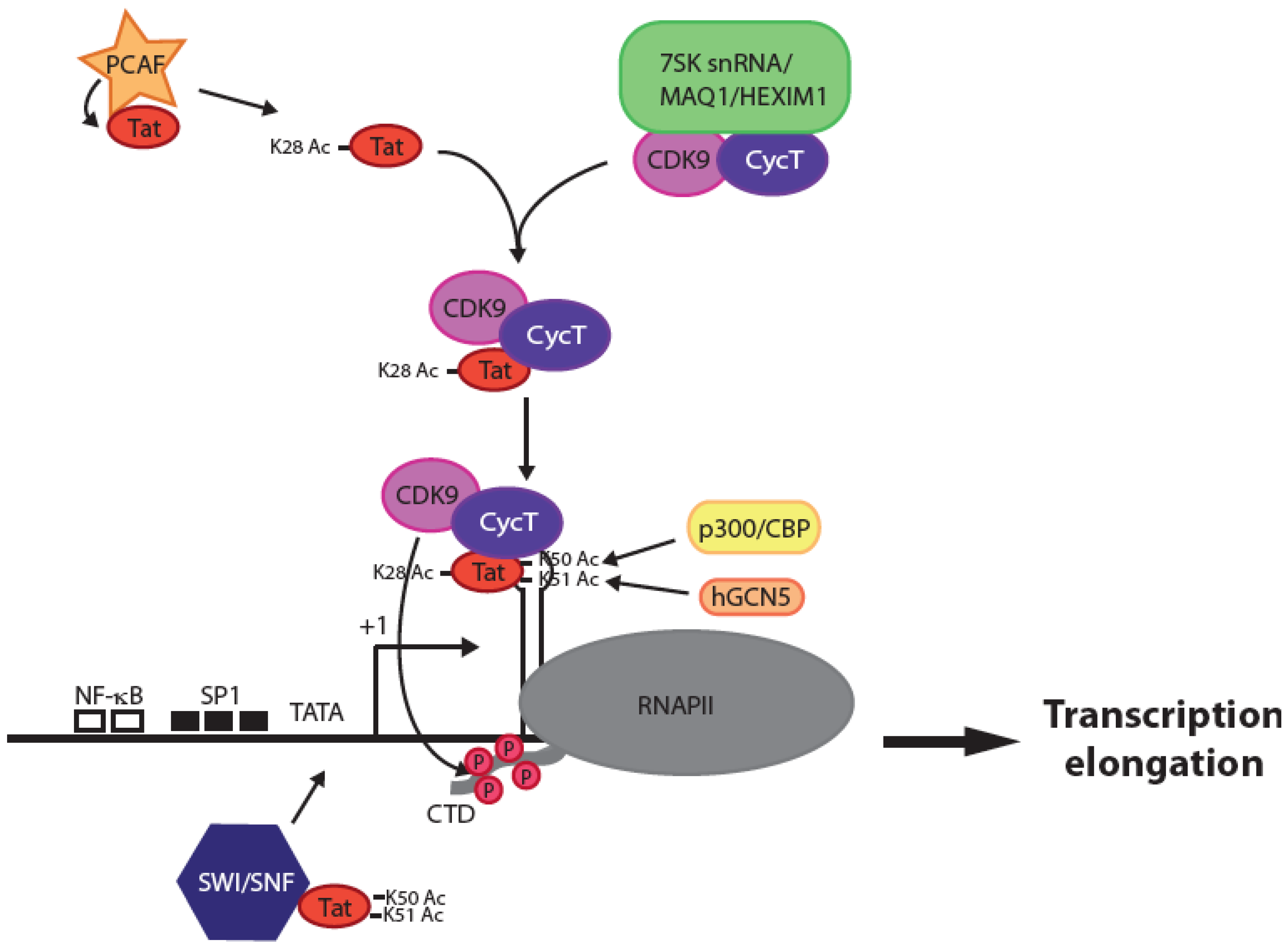
      <p>An important step in the replication of HIV-1 is the reverse transcription of the viral genomic RNA into cDNA and the integration of the proviral genome into the host chromosome. Efficient HIV-1 gene expression is dependent upon the viral protein Tat during the exponential growth of the virus and for robust transcription of the integrated proviral genome. Tat is a 14 kDa, 101-amino acid protein that is initially expressed from rare full-length transcripts that are multiply spliced. In the absence of Tat, transcription initiates normally at the 5' long terminal repeat (LTR) promoter, but results in short, abortive viral transcripts due to RNA polymerase II (RNAPII) pausing shortly after promoter clearance [<xref ref-type="bibr" rid="B7-biology-01-00668">7</xref>]. Tat controls transcription at the level of RNAPII elongation through interaction with the TAR RNA (an RNA stem loop structure that spontaneously forms within the first 59 nucleotides of each viral transcript) [<xref ref-type="bibr" rid="B8-biology-01-00668">8</xref>,<xref ref-type="bibr" rid="B9-biology-01-00668">9</xref>] and the positive transcription elongation factor b (P-TEFb), composed of Cyclin T1 and Cyclin-dependent kinase 9 (CDK9) (<xref ref-type="fig" rid="biology-01-00668-f001">Figure 1</xref>) [<xref ref-type="bibr" rid="B10-biology-01-00668">10</xref>,<xref ref-type="bibr" rid="B11-biology-01-00668">11</xref>]. In the absence of Tat, P-TEFb exists in the cell as a large inactive complex composed of 7SK snRNA and MAQ1/HEXIM1 proteins [<xref ref-type="bibr" rid="B12-biology-01-00668">12</xref>,<xref ref-type="bibr" rid="B13-biology-01-00668">13</xref>]. The recruitment of P-TEFb by Tat leads to several phosphorylation events carried out by CDK9 that convert paused elongation complex to a highly processive form. CDK9 phosphorylates Ser2 of the RNAPII C-terminal domain (CTD) heptapeptide repeat, allowing interaction with additional factors involved in productive transcription (reviewed in [<xref ref-type="bibr" rid="B14-biology-01-00668">14</xref>]). The result of these post-translational modifications is synthesis of high levels of full-length viral transcripts.</p>
      <p>Proviral promoter activity is directly governed by its chromatin environment [<xref ref-type="bibr" rid="B15-biology-01-00668">15</xref>]. Histone post-translational modifications, including phosphorylation, acetylation, methylation, and ubiquitination, contribute to transcriptional regulation by defining an “open” or “closed” state of chromatin [<xref ref-type="bibr" rid="B16-biology-01-00668">16</xref>]. Nuc-1, a nucleosome located immediately downstream from the transcription start site, directly impedes LTR activity [<xref ref-type="bibr" rid="B17-biology-01-00668">17</xref>,<xref ref-type="bibr" rid="B18-biology-01-00668">18</xref>]. Additional blocks at the level of transcription initiation are imposed by specific epigenetic chromatin modifications at nucleosomes on the 5' LTR, notably, deacetylation and methylation of histone <italic>N</italic>-terminal tails. Hallmarks of HIV-1 latency are low levels of Tat [<xref ref-type="bibr" rid="B19-biology-01-00668">19</xref>] or P-TEFb [<xref ref-type="bibr" rid="B20-biology-01-00668">20</xref>] and a sustained production of prematurely terminated RNA transcripts [<xref ref-type="bibr" rid="B21-biology-01-00668">21</xref>,<xref ref-type="bibr" rid="B22-biology-01-00668">22</xref>]. Entry into latency also requires recruitment of Histone Deacetylase 1 HDAC1 [<xref ref-type="bibr" rid="B23-biology-01-00668">23</xref>,<xref ref-type="bibr" rid="B24-biology-01-00668">24</xref>], histone methyltransferase Suv39H1 and heterochromatin protein HP1 [<xref ref-type="bibr" rid="B25-biology-01-00668">25</xref>] to the chromatin surrounding the HIV-1 LTR. Transcriptional reactivation is accompanied by changes in the local chromatin structure, which is accomplished by recruitment via Tat of chromatin remodeling factors such as SWI/SNF [<xref ref-type="bibr" rid="B26-biology-01-00668">26</xref>,<xref ref-type="bibr" rid="B27-biology-01-00668">27</xref>] and histone acetyl transferases (HATs), such as CREB binding protein CBP and p300 [<xref ref-type="bibr" rid="B28-biology-01-00668">28</xref>], p300/CBP associated factors (PCAF) and the histone acetyl transferase hGCN5 [<xref ref-type="bibr" rid="B27-biology-01-00668">27</xref>,<xref ref-type="bibr" rid="B29-biology-01-00668">29</xref>,<xref ref-type="bibr" rid="B30-biology-01-00668">30</xref>,<xref ref-type="bibr" rid="B31-biology-01-00668">31</xref>,<xref ref-type="bibr" rid="B32-biology-01-00668">32</xref>,<xref ref-type="bibr" rid="B33-biology-01-00668">33</xref>], where they can reverse the effects of histone deacetylation (<xref ref-type="fig" rid="biology-01-00668-f001">Figure 1</xref>). Lys28 and Lys50 of Tat are targets of acetylation by PCAF and p300, respectively [<xref ref-type="bibr" rid="B30-biology-01-00668">30</xref>,<xref ref-type="bibr" rid="B33-biology-01-00668">33</xref>]. Acetylation of Lys28 enhances Tat binding to P-TEFb, whereas acetylation of Lys50 dissociates Tat/P-TEFb from TAR, indicating a two-step, time-dependent mechanism for transcriptional regulation by Tat associated histone acetyltransferases (<xref ref-type="fig" rid="biology-01-00668-f001">Figure 1</xref>).</p>
      <fig id="biology-01-00668-f001" position="anchor">
        <label>Figure 1</label>
        <caption>
          <p>Upon Tat acetylation on Lys28 by PCAF, Tat recruits P-TEFb (CDK9/Cyclin T1) from its inactive complex with 7SK snRNA/MAQ1/HEXIM1. Tat/P-TEFb complex binds to TAR. CDK9 phosphorylates Ser2 of the RNAPII CTD stalled shortly after transcription initiation and promotes transcription elongation. Tat is acetylated at Lys50 and Lys51 by p300/CBP and hGCN5, resulting in the release of the complex from TAR. Tat then recruits to the initiation start site SWI/SNF, PCAF and RNAPII and other factors not depicted here to promote further transcription. </p>
        </caption>
        <graphic xmlns:xlink="http://www.w3.org/1999/xlink" xlink:href="biology-01-00668-g001.tif"/>
      </fig>
      <p>In this review, we will focus on small molecule inhibitors that inhibit Tat-dependent transcription. We will also briefly discuss the different strategies used to inhibit HIV transcription by targeting other transcription factors (CDK9, Cyclin T1, NF-kB, Sp1), as well as non-small molecule inhibitors (Tat vaccines, RNAi, ribozymes, peptides-based or oligonucleotide based inhibitors). We will discuss the screening strategies that were used to identify small molecule inhibitors targeting Tat or Tat/TAR interaction and the compounds obtained from these efforts. Finally, we will give a brief overview of a novel and recently identified analog of the natural compound Cortistatin A isolated from a marine sponge, that inhibits Tat-dependent transcription in acutely and chronically HIV infected cells at sub-nanomolar concentrations without cell associated toxicity.</p>
    </sec>
    <sec>
      <title>2. What Can We Expect from a Tat Inhibitor and What Features Make Such a Compound Different from Current ARVs?</title>
      <p>Since Tat does not have any apparent cellular homolog, it is a very attractive target to block specific HIV transcription, and as Tat is expressed early on in the replication cycle, its inhibition would also control transcription of other viral genes expressed later. </p>
      <p>Transcription of the HIV-1 provirus is regulated by both viral and cellular transcription factors. Before Tat is produced, low-level basal transcription from the viral promoter is initiated by cellular factors, such as NF-kB [<xref ref-type="bibr" rid="B34-biology-01-00668">34</xref>], Sp1 [<xref ref-type="bibr" rid="B35-biology-01-00668">35</xref>], TATA-binding protein [<xref ref-type="bibr" rid="B36-biology-01-00668">36</xref>] and RNAPII. A desirable Tat inhibitor should block Tat-mediated activation of the viral promoter without affecting its basal transcription, given the shared transcription factors of the HIV promoter and cellular genes. Therefore, a maximal expected reduction of viral replication by 80%–90% in acutely infected cells should be expected, as cellular activation during acute infection triggers promoter activation independently of Tat, and should not be compared with the usual multi-log reduction observed with protease inhibitors. However, in prolonged treatment of chronically infected cells, a total shut-off of residual transcription can be achieved. This reflects a unique feature of a Tat inhibitor, as it blocks transcription of the integrated provirus, contrary to the other anti-HIV drugs that only block <italic>de novo</italic> infection. The reduction of residual viral replication from chronically or latently infected cells may establish a perpetual latent state. Such transcriptional shut-off may reduce the pool of the latently infected cells by diminishing reservoir replenishment, which may accelerate the eradication of the latent reservoir. Furthermore, one would expect that in the presence of a Tat inhibitor, it would be very difficult for external stimuli such as antibodies (αCD3/CD28), or phorbol esters (PMA) or HDAC inhibitors to reactivate virus production from the integrated provirus, as it is known that HIV-1 lacking Tat undergoes some basal transcription; however, it does not sustain a spreading infection [<xref ref-type="bibr" rid="B37-biology-01-00668">37</xref>].</p>
      <p>HIV-1 is categorized in three main groups: M (major), O (outlier) and N (non-M/non-O), where group M is additionally subdivided into subtypes (or clades) A–D, F–H, J and K [<xref ref-type="bibr" rid="B38-biology-01-00668">38</xref>,<xref ref-type="bibr" rid="B39-biology-01-00668">39</xref>]. Variations between subclades of viruses may play an important role in their pathogenesis. Nucleotide variations within the LTR promoter region of main subtypes B, C and E include alterations in the TATA box, the NF-kB enhancer, the TAR element, as well as Sp1 binding sites [<xref ref-type="bibr" rid="B40-biology-01-00668">40</xref>,<xref ref-type="bibr" rid="B41-biology-01-00668">41</xref>]. The HIV Tat protein also exhibits amino acid divergence among the different clades, which may influence binding and transactivation functions. An ideal Tat inhibitor would be able to inhibit Tat activity irrespective of its clade.</p>
      <p>Finally, Tat can also be released from HIV-infected cells and alter several functions in uninfected cells. In the brain, Tat induces neuronal dysfunction/toxicity, even though neurons cannot be directly infected with HIV, resulting in central nervous system (CNS) pathology (reviewed in [<xref ref-type="bibr" rid="B42-biology-01-00668">42</xref>,<xref ref-type="bibr" rid="B43-biology-01-00668">43</xref>]). An ideal Tat inhibitor would also impact these other Tat mediated activities.</p>
    </sec>
    <sec>
      <title>3. Targets and Strategies: Approaches to Reduce HIV Transcription</title>
      <sec>
        <title>3.1. Targeting Cellular Factors Involved in HIV Transcription</title>
        <p>Several cellular components may serve as potential targets for antiviral chemotherapy [<xref ref-type="bibr" rid="B44-biology-01-00668">44</xref>]. The complex P-TEFb is one of them, but finding a highly selective and non-cytotoxic CDK9 inhibitor is a difficult task due to its role in cellular transcription [<xref ref-type="bibr" rid="B45-biology-01-00668">45</xref>,<xref ref-type="bibr" rid="B46-biology-01-00668">46</xref>]. Nevertheless, CDK9 has been the focus of several studies (Reviewed in [<xref ref-type="bibr" rid="B46-biology-01-00668">46</xref>,<xref ref-type="bibr" rid="B47-biology-01-00668">47</xref>,<xref ref-type="bibr" rid="B48-biology-01-00668">48</xref>]). Among the principal inhibitors known to block CDK9 kinase activity is flavopiridol [<xref ref-type="bibr" rid="B49-biology-01-00668">49</xref>,<xref ref-type="bibr" rid="B50-biology-01-00668">50</xref>] and derivatives [<xref ref-type="bibr" rid="B51-biology-01-00668">51</xref>], indirubin-3'-monoxime [<xref ref-type="bibr" rid="B52-biology-01-00668">52</xref>,<xref ref-type="bibr" rid="B53-biology-01-00668">53</xref>], a nucleotide analog DRB [<xref ref-type="bibr" rid="B54-biology-01-00668">54</xref>], and R-roscovitine (CYC202) [<xref ref-type="bibr" rid="B54-biology-01-00668">54</xref>]; however, this last one is also known to inhibit other CDKs, such as CDK2 [<xref ref-type="bibr" rid="B55-biology-01-00668">55</xref>]. Recently, iron chelators have also been shown to block HIV-1 transcription by targeting both CDK9 and CDK2 [<xref ref-type="bibr" rid="B56-biology-01-00668">56</xref>].</p>
        <p>Cyclin T1 has also been the target of several inhibitors such as anti-human Cyclin T1 intrabodies targeting the Cyclin T1/Tat interaction [<xref ref-type="bibr" rid="B57-biology-01-00668">57</xref>], microRNAs targeting Cyclin T1 expression [<xref ref-type="bibr" rid="B58-biology-01-00668">58</xref>], dominant negative mutants of Cyclin T1 that act by either specifically degrading Tat [<xref ref-type="bibr" rid="B59-biology-01-00668">59</xref>] or forming kinase inactive complexes with Tat and CDK9 [<xref ref-type="bibr" rid="B60-biology-01-00668">60</xref>]. The growth factor granulin and some of its granulin cysteine-rich motif repeats were able to inhibit Tat transactivation by either binding Tat or the histidine rich domain of Cyclin T1 [<xref ref-type="bibr" rid="B61-biology-01-00668">61</xref>,<xref ref-type="bibr" rid="B62-biology-01-00668">62</xref>]. Potent inhibition of Tat transactivation is obtained by the overexpression of HEXIM1 (which sequesters P-TEFb in an inactive form) or its paralog HEXIM2 by binding to Cyclin T1 [<xref ref-type="bibr" rid="B63-biology-01-00668">63</xref>]. Furthermore, the human I-mfa domain-containing protein (HIC), as well as its I-mfa domain alone, can act as a dominant negative repressor [<xref ref-type="bibr" rid="B64-biology-01-00668">64</xref>]. </p>
        <p>CDK2 is another possible target to block HIV transcription. Indeed, Tat interacts with both the CTD of RNAPII and CDK2/Cyclin E, and hence helps CTD phosphorylation at Ser2 by CDK2. This kinase was suggested to be required for Tat-dependent transcription <italic>in vitro </italic>[<xref ref-type="bibr" rid="B65-biology-01-00668">65</xref>,<xref ref-type="bibr" rid="B66-biology-01-00668">66</xref>]. Among CDK2 inhibitors that blocked HIV-1 transcription were CYC202 ([<xref ref-type="bibr" rid="B55-biology-01-00668">55</xref>]; reviewed in [<xref ref-type="bibr" rid="B67-biology-01-00668">67</xref>]), Alsterpaullone [<xref ref-type="bibr" rid="B68-biology-01-00668">68</xref>], a CDK2 RNAi [<xref ref-type="bibr" rid="B69-biology-01-00668">69</xref>], and small peptide inhibitors [<xref ref-type="bibr" rid="B70-biology-01-00668">70</xref>,<xref ref-type="bibr" rid="B71-biology-01-00668">71</xref>]. CDK2/Cyclin E was also suspected to be implicated in the HIV transcription inhibition by an <italic>N</italic>-aminoimidazole derivative NR-818 [<xref ref-type="bibr" rid="B72-biology-01-00668">72</xref>].</p>
        <p>Transcription factors such as Sp1 and NF-kB play a critical role in initiation of HIV transcription in newly infected cells when Tat has not yet been made [<xref ref-type="bibr" rid="B73-biology-01-00668">73</xref>]. They are potential targets to block HIV basal transcription [<xref ref-type="bibr" rid="B74-biology-01-00668">74</xref>]; however, off target effects might be observed due to the shared nature of these transcription factors with cellular genes. A plant lignan, isolated from <italic>Larrea tridentata</italic> [<xref ref-type="bibr" rid="B75-biology-01-00668">75</xref>] and derivatives [<xref ref-type="bibr" rid="B76-biology-01-00668">76</xref>,<xref ref-type="bibr" rid="B77-biology-01-00668">77</xref>], inhibited basal transcription by preventing interaction of Sp1 to its DNA binding site as well as Tat-dependent HIV replication in peripheral blood mononuclear cells (PBMCs). Some compounds have also been reported to interfere with both Sp1 and NF-kB [<xref ref-type="bibr" rid="B78-biology-01-00668">78</xref>,<xref ref-type="bibr" rid="B79-biology-01-00668">79</xref>,<xref ref-type="bibr" rid="B80-biology-01-00668">80</xref>]. Several studies have identified and characterized compounds targeting NF-kB-mediated activation of HIV-1 transcription, but none of them have reached the necessary selectivity (Reviewed in [<xref ref-type="bibr" rid="B74-biology-01-00668">74</xref>,<xref ref-type="bibr" rid="B81-biology-01-00668">81</xref>]). More recently, two inhibitors of tumor necrosis factor α (TNF-α) production, piperidylpyrimidine [<xref ref-type="bibr" rid="B82-biology-01-00668">82</xref>] and LMP-420 [<xref ref-type="bibr" rid="B83-biology-01-00668">83</xref>], have been shown to inhibit respectively HIV-1 LTR transactivation or/and HIV replication in PBMCs. Another known inhibitor of TNF-a production and HIV replication, pentoxifylline, initially found to inhibit HIV by blocking the binding of NF-kB to its motif [<xref ref-type="bibr" rid="B84-biology-01-00668">84</xref>,<xref ref-type="bibr" rid="B85-biology-01-00668">85</xref>], was shown to block HIV by inhibition of a cellular DNA damage sensing and repair protein, ATR [<xref ref-type="bibr" rid="B86-biology-01-00668">86</xref>,<xref ref-type="bibr" rid="B87-biology-01-00668">87</xref>]. Finally, noraristeromycin, a carbocyclic adenine nucleoside, inhibits IkBa phosphorylation and degradation, thus preventing phosphorylation of p65, one of the NF-kB subunits [<xref ref-type="bibr" rid="B88-biology-01-00668">88</xref>]. </p>
        <p>P300/CBP is also a potential target due to its role as co-activator of Tat transcription, as well as in transcription reactivation by acetylating Tat and by reversing effects of histone deacetylation [<xref ref-type="bibr" rid="B30-biology-01-00668">30</xref>,<xref ref-type="bibr" rid="B33-biology-01-00668">33</xref>]. A specific inhibitor of p300/CBP HAT activity, such as curcumin, blocked acetylation of Tat <italic>in vitro</italic> and the proliferation of the virus by reducing HIV transcription [<xref ref-type="bibr" rid="B89-biology-01-00668">89</xref>]. Another inhibitor, LTK-14, was shown to be more specific and less toxic than its parent garcinol by inhibiting only p300 and not PCAF, but did display some toxicity by altering global gene expression [<xref ref-type="bibr" rid="B90-biology-01-00668">90</xref>,<xref ref-type="bibr" rid="B91-biology-01-00668">91</xref>]. LTK-14 blocked histone acetylation in HIV infected cells and restricted HIV at micromolar concentrations. Another potential cellular target is PCAF, a Tat recruited HAT, which is involved in reactivation from latency. A polyclonal PCAF BRD antibody blocked Tat transactivation [<xref ref-type="bibr" rid="B92-biology-01-00668">92</xref>]. A few thousand compounds have been tested on an NMR-based chemical screen yielding one lead compound, and upon structure activity relationship (SAR), N1-aryl-propane-1,3-diamine was found to selectively bind to the BRD domain of PCAF [<xref ref-type="bibr" rid="B93-biology-01-00668">93</xref>]. Using a structure-based lead optimization of small molecule, Pan <italic>et al</italic>. found a compound able to disrupt Tat/PCAF interaction and Tat-dependent transactivation in the micromolar range [<xref ref-type="bibr" rid="B94-biology-01-00668">94</xref>].</p>
        <p>Tat activates NF-kB via oxidative stress-induced cell signaling pathways like the PI3K/Akt signaling pathway [<xref ref-type="bibr" rid="B95-biology-01-00668">95</xref>]. Epigallocatechin-3-gallate by activating both AMPK and Nrf2 antioxidant signaling pathways, leads to the inhibition of the AKT signaling pathway preventing both NF-κB activation and Tat induced HIV-1 transactivation [<xref ref-type="bibr" rid="B96-biology-01-00668">96</xref>]. Another compound targeting the Akt pathway is the coumarin derivative BPRHIV001, displaying a therapeutic index (TI) (half-maximal cytotoxic concentration (CC<sub>50</sub>)/half-maximal inhibitory concentration (IC<sub>50</sub>)) over 1,000 in acutely infected PBMCs [<xref ref-type="bibr" rid="B97-biology-01-00668">97</xref>]. This compound decreases the phosphorylation of PDPK1, a known Akt activator, which in turn blocks Akt phosphorylation, leading to a destabilization of p300 protein, thus negatively influencing Tat-dependent transcription. Alternatively, 9-aminoacridine activates the Akt pathway and phosphorylation of p21WAF1, reactivating p53 and p21WAF1 pathways, leading to HIV replication inhibition. Indeed, p21WAF1 associate with P-TEFb, which leads to a decrease of CDK9 on the HIV LTR and inhibits Tat-dependent transcription [<xref ref-type="bibr" rid="B98-biology-01-00668">98</xref>].</p>
        <p>Overexpression of NIPP1, the major nuclear inhibitor of the host Ser/Thr phosphatase-1 (PP1) [<xref ref-type="bibr" rid="B99-biology-01-00668">99</xref>], or stable expression of its central domain [<xref ref-type="bibr" rid="B100-biology-01-00668">100</xref>] increased CDK9 phosphorylation on Thr186 and the association of CDK9 with 7SK RNA, as well as decreased binding of PP1 to Tat. Compound 1H4, found by screening a library of 300,000 compounds, decreases transcription and HIV replication by its ability to bind a RVxF motif on PP1 and to disrupt PP1/Tat interaction at micromolar concentration, which are unfortunately close to being toxic [<xref ref-type="bibr" rid="B101-biology-01-00668">101</xref>]. Finally, resveratrol, a polyphenolic phytostilbene found in grapes and berries, was able to decrease Tat-induced HIV-1 LTR transactivation in a TAR-independent manner by increasing NAD<sup>+</sup> and SIRT1 production [<xref ref-type="bibr" rid="B102-biology-01-00668">102</xref>,<xref ref-type="bibr" rid="B103-biology-01-00668">103</xref>,<xref ref-type="bibr" rid="B104-biology-01-00668">104</xref>]. Indeed, SIRT1, a class III HDAC, is known to recycle Tat into an inactive form by deacetylating Lys50 [<xref ref-type="bibr" rid="B105-biology-01-00668">105</xref>]. Tat is also known to inhibit SIRT1 activity, that in turn blocks the deacetylation of the NF-κB p65 subunit, resulting in transcription hyperactivity [<xref ref-type="bibr" rid="B105-biology-01-00668">105</xref>,<xref ref-type="bibr" rid="B106-biology-01-00668">106</xref>].</p>
      </sec>
      <sec>
        <title>3.2. Non-Small Molecules Compounds Used to Inhibit Tat/TAR Mediated HIV Transcription</title>
        <p>Oligonucleotide derivatives such as TAR decoys, aptamers, ribozymes and RNA interference (RNAi) have been the focus of numerous studies to inhibit Tat-dependent HIV transcription (reviewed in [<xref ref-type="bibr" rid="B107-biology-01-00668">107</xref>,<xref ref-type="bibr" rid="B108-biology-01-00668">108</xref>]). Recently, several clinical trials have been done targeting total or partial HIV transcription using TAR decoys, aptamers, ribozymes and/or small interference RNAs (siRNAs) [<xref ref-type="bibr" rid="B109-biology-01-00668">109</xref>]. The hammerhead ribozyme (OZ1) targeting the overlapping HIV vpr and Tat coding sequence has been delivered into primary cells using a gammaretroviral vector, an approach that is currently in phase II clinical trials ([<xref ref-type="bibr" rid="B110-biology-01-00668">110</xref>,<xref ref-type="bibr" rid="B111-biology-01-00668">111</xref>]; reviewed in [<xref ref-type="bibr" rid="B112-biology-01-00668">112</xref>,<xref ref-type="bibr" rid="B113-biology-01-00668">113</xref>]). RNAs have been designed to target conserved viral sequences in order to silence gene expression at the post-transcriptional level [<xref ref-type="bibr" rid="B114-biology-01-00668">114</xref>,<xref ref-type="bibr" rid="B115-biology-01-00668">115</xref>]. One of the major difficulties is delivery of the siRNAs into the appropriate target cells. To circumvent this issue, chimeric RNAs containing a CD4 aptamer and an siRNA have been designed allowing for the specific delivery into CD4 expressing cells, and via receptor competition, inhibit HIV entry, as well as gene expression. Others, such as anti-gp120 aptamer-siRNA chimeras, also display this inhibitory behavior (reviewed in [<xref ref-type="bibr" rid="B115-biology-01-00668">115</xref>]). An alternative delivery approach is to use RNAi-based gene therapy using lentiviral vectors to transduce RNA based inhibitors into non-dividing cells and thus, permanently deliver the transgene. To avoid the selection of resistant mutants, several RNA-based inhibitors can be used together. RNA-based hematopoietic cell gene therapies for treatment of HIV infection using ribozymes, aptamers and siRNA have been reviewed [<xref ref-type="bibr" rid="B116-biology-01-00668">116</xref>]. A lentiviral vector encoding a combination of a TAR-decoy (small nucleolar RNA that binds the Tat protein), a CCR5 targeting hammerhead ribozyme and an shRNA targeting Tat-Rev mRNAs suppressed HIV replication for over 42 days in primary CD34<sup>+</sup> hematopoietic stem cells ([<xref ref-type="bibr" rid="B117-biology-01-00668">117</xref>]; reviewed in [<xref ref-type="bibr" rid="B114-biology-01-00668">114</xref>]). Preliminary proofs of safety using RNA-based hematopoietic cell gene therapy have been obtained; a study showed that transgenic T cells generated in SCID-hu-mouse have normal T-cell phenotypes [<xref ref-type="bibr" rid="B118-biology-01-00668">118</xref>]. This lentiviral vector has been used in phase I clinical trials, via <italic>ex vivo</italic> gene therapy, using hematopoietic stem cell engraftment in human patients [<xref ref-type="bibr" rid="B119-biology-01-00668">119</xref>]. Foamy virus vectors, another type of virus based vector, is also being explored. A foamy virus combinatorial anti-HIV vector that expresses three anti-HIV transgenes (HIV fusion inhibitor and two shRNAs against either Tat or Rev) was successfully transduced into CD34<sup>+</sup> cells and engrafted into SCID mice [<xref ref-type="bibr" rid="B120-biology-01-00668">120</xref>]. Despite lingering challenges in delivery and off-target toxicity, RNA-based hematopoietic cell gene therapies are promising approaches to fight HIV.</p>
        <p>Peptide-related inhibitors, such as peptoids [<xref ref-type="bibr" rid="B121-biology-01-00668">121</xref>] and Tat-mimicking peptides, have been developed to block Tat-dependent HIV transcription (reviewed in [<xref ref-type="bibr" rid="B74-biology-01-00668">74</xref>,<xref ref-type="bibr" rid="B107-biology-01-00668">107</xref>]). More recently, L50 a cyclic b-hairpin peptide was found to bind to TAR with nanomolar affinity and induce a conformational change in the bulge region that was incompatible with Tat binding [<xref ref-type="bibr" rid="B122-biology-01-00668">122</xref>,<xref ref-type="bibr" rid="B123-biology-01-00668">123</xref>,<xref ref-type="bibr" rid="B124-biology-01-00668">124</xref>]. However, L50 inhibited HIV replication in PBMCs in the high namolar range and affected reverse transcription and HIV transcription in the high micromolar range. So far, no peptide-based inhibitor has entered clinical trials. Interestingly, T-U2AF65, the fusion of a splicing factor with the Tat activation domain, showed a dominant negative effect on HIV transcription. This inhibitor binds to RNAPII CTD and to Cyclin T1, blocking the interaction of wild type Tat to the CTD in a TAR-independent fashion [<xref ref-type="bibr" rid="B125-biology-01-00668">125</xref>]. Expression of T-U2AF65 slowed down virus replication in a lymphocytary cell line, which eventually became chronic, but replicated poorly.</p>
        <p>Besides its important role in viral transactivation, extracellular Tat is an important factor in viral pathogenesis. Strategies to develop a vaccine using Tat as an epitope have been reviewed [<xref ref-type="bibr" rid="B107-biology-01-00668">107</xref>,<xref ref-type="bibr" rid="B126-biology-01-00668">126</xref>,<xref ref-type="bibr" rid="B127-biology-01-00668">127</xref>]. Several clinical trials have been done to assess therapeutic and preventive Tat-based vaccinations [<xref ref-type="bibr" rid="B128-biology-01-00668">128</xref>,<xref ref-type="bibr" rid="B129-biology-01-00668">129</xref>,<xref ref-type="bibr" rid="B130-biology-01-00668">130</xref>,<xref ref-type="bibr" rid="B131-biology-01-00668">131</xref>,<xref ref-type="bibr" rid="B132-biology-01-00668">132</xref>]. TUTI-16, a synthetic anti-Tat epitope, successfully induced high titer antibodies against Tat variants from all clades and was tested on asymptomatic HIV infected subjects in phase I/IIa clinical trials [<xref ref-type="bibr" rid="B133-biology-01-00668">133</xref>,<xref ref-type="bibr" rid="B134-biology-01-00668">134</xref>]. TUTI-16 significantly reduced viral load at low vaccine doses, but not at higher doses due to activation of cytokines by the adjuvant components. In another phase I/IIa clinical trial, HIV-infected patients were vaccinated with mRNA electroporated dendritic cells expressing Tat, Rev and Nef. This vaccine was shown to be safe and feasible, but had no significant impact on clinical parameters [<xref ref-type="bibr" rid="B135-biology-01-00668">135</xref>]. The HIV-1 Oyi strain was identified in HIV infected patients in Africa who did not progress to AIDS and, though genetically similar to common HIV-1 strains, contained mutations in the Tat gene not found in other Tat variants. Using Tat Oyi, Mediouni <italic>et al</italic>. successfully developed a monoclonal antibody named 7G12 that has the capacity to recognize heterologous Tat variants by a common 3D epitope [<xref ref-type="bibr" rid="B136-biology-01-00668">136</xref>]. This antibody was able to block the uptake of extracellular Tat, resulting in the inhibition of all Tat biological activities. Despite several trials, vaccine based therapies have been met with limited success.</p>
      </sec>
    </sec>
    <sec>
      <title>4. Small Molecules Inhibitors of HIV Transcription</title>
      <sec>
        <title>4.1. Methods Used to Discover Small Molecule Inhibitors of Tat-Dependent Transcription</title>
        <sec>
          <title>4.1.1. Biochemical Methods</title>
          <p>Several strategies have been used to find small molecule inhibitors of Tat-dependent HIV transcription. Pharmacological compounds have been tested randomly, based on some known characteristics such as DNA or RNA binding properties [<xref ref-type="bibr" rid="B137-biology-01-00668">137</xref>,<xref ref-type="bibr" rid="B138-biology-01-00668">138</xref>,<xref ref-type="bibr" rid="B139-biology-01-00668">139</xref>,<xref ref-type="bibr" rid="B140-biology-01-00668">140</xref>] or because they are known inhibitors of other viruses [<xref ref-type="bibr" rid="B141-biology-01-00668">141</xref>,<xref ref-type="bibr" rid="B142-biology-01-00668">142</xref>,<xref ref-type="bibr" rid="B143-biology-01-00668">143</xref>]. Others have been tested due to their low toxicity and good tolerance in mice or patients. For example, topotecan was able to inhibit 80% of HIV-1 p24 antigen production in chronically infected cells at low nanomolar range with a dose 200-fold lower than what is well tolerated by cancer patients [<xref ref-type="bibr" rid="B144-biology-01-00668">144</xref>]. Sometimes serendipity plays a role, e.g., a search for inhibitor compounds of a kinase implicated in inhibiting HIV mRNA 3' end processing [<xref ref-type="bibr" rid="B145-biology-01-00668">145</xref>] turned out to specifically inhibit Tat-dependent HIV transcription [<xref ref-type="bibr" rid="B146-biology-01-00668">146</xref>].</p>
          <p>Nevertheless, most of the compounds have been screened biochemically, looking at their ability to bind TAR or to disrupt Tat/TAR binding using techniques such as electrophoretic mobility shift assay (EMSA), filter binding assay, scintillation proximity assay (SPA) and ESI-MS (all described in [<xref ref-type="bibr" rid="B147-biology-01-00668">147</xref>,<xref ref-type="bibr" rid="B148-biology-01-00668">148</xref>]). EMSA or filtration assays, followed by an <italic>in vitro</italic> LTR-reporter cell-based assay identified inhibitors of Tat/TAR interaction and Tat-dependent transcription, as is the case for furimidazoline (DB60) [<xref ref-type="bibr" rid="B149-biology-01-00668">149</xref>], CGP 40336A [<xref ref-type="bibr" rid="B150-biology-01-00668">150</xref>], aromatic polyamides TAPB and TAPP (resembling the DAPI structure) [<xref ref-type="bibr" rid="B138-biology-01-00668">138</xref>], antibiotics (neomycin, streptomycin and gentamicin) [<xref ref-type="bibr" rid="B151-biology-01-00668">151</xref>] and a Tat/TAR inhibitor issued from a screen of 150,000 compounds [<xref ref-type="bibr" rid="B147-biology-01-00668">147</xref>].</p>
        </sec>
        <sec>
          <title>4.1.2. LTR Reporter Activity</title>
          <p>Numerous studies have used stable cell lines expressing the HIV promoter 5' LTR, driving a reporter gene such as luciferase (Luc), b-galactosidase (LacZ), green fluorescent protein (GFP), alkaline phosphatase (SEAP) or chloramphenicol (CAT) co-transfected with a plasmid expressing Tat to either validate inhibitors of Tat/TAR binding or to screen for new compounds for inhibition of HIV transcription. The first compound described to inhibit Tat-dependent transcription was a benzodiazepine derivative, Ro 5-3335, found during a random library screen using an LTR-gene reporter assay [<xref ref-type="bibr" rid="B152-biology-01-00668">152</xref>]. The potency of Ro 5-3335 and its less toxic derivative Ro 24-7429 [<xref ref-type="bibr" rid="B153-biology-01-00668">153</xref>] was highly dependent on the nature of the assay and the cell type used. Indeed, these compounds were effective in the micromolar range in acutely infected PBMCs and macrophages, but were less effective at inhibiting HIV replication in chronically infected macrophages, a major viral reservoir. Besides, these compounds had no effect on acutely infected MT-2 and MT-4 cells or persistently HIV-1 infected cells (HUT78/IIIB/LAI) [<xref ref-type="bibr" rid="B154-biology-01-00668">154</xref>,<xref ref-type="bibr" rid="B155-biology-01-00668">155</xref>]. Ro 24-7429 was found most likely to inhibit the activity of a TAR binding cellular factor [<xref ref-type="bibr" rid="B153-biology-01-00668">153</xref>,<xref ref-type="bibr" rid="B156-biology-01-00668">156</xref>]. Clinical trials were initiated; however, due to nervous system side effects and absence of activity in patients, these efforts were cut short. Though benzodiazepine derivatives were not successful in terms of selectivity for Tat and activity in patients, the screening of small molecule inhibitors against Tat gave the first example that they can inhibit transcription in some types of acutely, chronically and latently HIV infected cell lines. Therefore, several other studies have used LTR-reporter assays to find Tat-dependent transcription inhibitors such as keto/enol epoxy steroids [<xref ref-type="bibr" rid="B157-biology-01-00668">157</xref>], purine derivatives [<xref ref-type="bibr" rid="B158-biology-01-00668">158</xref>,<xref ref-type="bibr" rid="B159-biology-01-00668">159</xref>], tanic acids [<xref ref-type="bibr" rid="B160-biology-01-00668">160</xref>], D-penicillamin [<xref ref-type="bibr" rid="B161-biology-01-00668">161</xref>,<xref ref-type="bibr" rid="B162-biology-01-00668">162</xref>], organic thiophosphate WR-151327 [<xref ref-type="bibr" rid="B163-biology-01-00668">163</xref>], b-carbolines [<xref ref-type="bibr" rid="B139-biology-01-00668">139</xref>,<xref ref-type="bibr" rid="B140-biology-01-00668">140</xref>], camptothecin [<xref ref-type="bibr" rid="B144-biology-01-00668">144</xref>,<xref ref-type="bibr" rid="B164-biology-01-00668">164</xref>], durhamycin A [<xref ref-type="bibr" rid="B165-biology-01-00668">165</xref>], monocyclin IV [<xref ref-type="bibr" rid="B166-biology-01-00668">166</xref>], 3-phenylcoumarins and chalcones [<xref ref-type="bibr" rid="B167-biology-01-00668">167</xref>], stilbene related heterocyclic compounds [<xref ref-type="bibr" rid="B168-biology-01-00668">168</xref>], 4-phenylcoumarins and derivatives (both anti NF-kB and Tat activities) [<xref ref-type="bibr" rid="B169-biology-01-00668">169</xref>], topotecan, b-lapachome, [<xref ref-type="bibr" rid="B144-biology-01-00668">144</xref>], toco-pheryl curcumin (C3) [<xref ref-type="bibr" rid="B170-biology-01-00668">170</xref>], the cyclopentanone prostaglandin PGJ<sub>2</sub> [<xref ref-type="bibr" rid="B171-biology-01-00668">171</xref>,<xref ref-type="bibr" rid="B172-biology-01-00668">172</xref>], celasterol [<xref ref-type="bibr" rid="B173-biology-01-00668">173</xref>], bis-anthracycline antibiotics (WP 631; a DNA intercalator) [<xref ref-type="bibr" rid="B137-biology-01-00668">137</xref>], the natural product EM2487 [<xref ref-type="bibr" rid="B174-biology-01-00668">174</xref>], thiamine disulfide [<xref ref-type="bibr" rid="B175-biology-01-00668">175</xref>] and 2-glycineamide-5-chlorophenyl-2-pyril ketone [<xref ref-type="bibr" rid="B176-biology-01-00668">176</xref>]. Recently, Chande <italic>et al</italic>. have constructed a plasmid and a lentiviral vector harboring both an LTR-driven reporter cassette and a Tat gene under the control of a viral promoter to establish stable cell lines [<xref ref-type="bibr" rid="B177-biology-01-00668">177</xref>]. This updated method provided an easy one-step way to test inhibitors of Tat-dependent transcription. However, it is important to keep in mind that LTR-reporter gene assays may also lead to identification of off-target inhibitors affecting other cellular factors important to HIV transcription (for examples [<xref ref-type="bibr" rid="B153-biology-01-00668">153</xref>,<xref ref-type="bibr" rid="B178-biology-01-00668">178</xref>]).</p>
        </sec>
        <sec>
          <title>4.1.3. Alternative Methods</title>
          <p>To develop TAR-binding antiviral drugs, some groups have performed ligand-based screening by NMR using TAR as target, locked by a specific chemical probe into a conformation favorable to compound binding [<xref ref-type="bibr" rid="B179-biology-01-00668">179</xref>]. Others have used fluorescence resonance energy transfer (FRET) to look at inhibitors of Tat/TAR binding [<xref ref-type="bibr" rid="B180-biology-01-00668">180</xref>]. Hwang et al. used a bead colorimetric screening assay for TAR RNA binding ligands that enabled the discovery of compounds inhibiting HIV replication in the micromolar range [<xref ref-type="bibr" rid="B181-biology-01-00668">181</xref>]. A fluorescent high-throughput assay was aimed to select TAR binding molecules that compete a described TAR-binding peptoid/Europium-labeled TAR interaction. Screening of 200,000 compounds has identified a highly specific stilbene derivative CGA137053 that disrupts Tat/TAR binding in the nanomolar range and inhibits Tat transactivation, as well as HIV infection in macrophages and PBLs [<xref ref-type="bibr" rid="B182-biology-01-00668">182</xref>,<xref ref-type="bibr" rid="B183-biology-01-00668">183</xref>]. The interaction between TAR and a fluorescently labeled Tat peptide was used to test neamine derivatives [<xref ref-type="bibr" rid="B184-biology-01-00668">184</xref>,<xref ref-type="bibr" rid="B185-biology-01-00668">185</xref>]. Finally, to develop new transcription inhibitors, several studies have used structure activity relationship (SAR) to further optimize their best lead (for example [<xref ref-type="bibr" rid="B186-biology-01-00668">186</xref>,<xref ref-type="bibr" rid="B187-biology-01-00668">187</xref>]).</p>
        </sec>
        <sec>
          <title>4.1.4. Docking Study</title>
          <p>As an alternative to standard high-throughput screening, several groups have used docking strategies to design and/or screen <italic>in silico</italic> new compounds against Tat/TAR interaction. Lind <italic>et al</italic>. performed a computational virtual screening based on a TAR 3D structure of approximately 181,000 non-peptide/non-nucleoside compounds from the Available Chemicals Directory (ACD) and found that acetylpromazine disrupts Tat/TAR binding in the nanomolar range [<xref ref-type="bibr" rid="B188-biology-01-00668">188</xref>], an activity latter reported to be only effective in the high micromolar range [<xref ref-type="bibr" rid="B189-biology-01-00668">189</xref>,<xref ref-type="bibr" rid="B190-biology-01-00668">190</xref>]. Interestingly, <italic>in silico</italic> screening of the ACD yielded a high number of all known TAR ligands of the library (aminoglycoside antibiotics, L-Arg and spermine), as well as new potential compounds [<xref ref-type="bibr" rid="B191-biology-01-00668">191</xref>]. Alternatively, a virtual screening has been performed to compare potential ligand properties against a known potent Tat-TAR inhibitor used as reference. The best hits were validated on Tat/TAR interaction by FRET [<xref ref-type="bibr" rid="B190-biology-01-00668">190</xref>]. Schuller <italic>et al</italic>. designed compounds by assembling acetylpromazine as a template structure with unique chemical blocks to generate novel ligands of TAR RNA [<xref ref-type="bibr" rid="B192-biology-01-00668">192</xref>]. However, all the compounds from these studies inhibited, at best, the Tat/TAR interaction in the micromolar range and have not been tested on replicating HIV. More recently, to find new TAR binding small molecules, Stelzer <italic>et al</italic>. have developed software using molecular dynamic to dock compounds onto a RNA dynamic ensemble, including twenty TAR conformers. This helped solve the problem of taking into account large degrees of RNA conformational adaptation during virtual screening [<xref ref-type="bibr" rid="B193-biology-01-00668">193</xref>]. Out of 51,000 <italic>in silico</italic> structures tested, several hits were confirmed to bind TAR and inhibit its binding to Tat by fluorescence based binding assay. The highest specificity to bind TAR was achieved by netilmicin, an aminoglycoside antibiotic. This compound is able to block acute HIV-1 replication by 81% in T-cell lines and HIV replication in an HIV-1 indicator cell line with an IC<sub>50</sub> comparable to other known Tat/TAR inhibitors. However, aminoglycoside derivatives were never shown to have any specific mechanism of action against HIV, and this might also be the case for netilmicin [<xref ref-type="bibr" rid="B194-biology-01-00668">194</xref>]. Nevertheless, by finding the first experimentally validated RNA-targeting compound, these studies demonstrate that <italic>in silico</italic> screening might be a good alternative to standard high-throughput screening.</p>
        </sec>
      </sec>
      <sec>
        <title>4.2. A Selection of Transcription Inhibitors with TI &gt; 100</title>
        <p>Natural aminoglycoside antibiotics such as neomycin have been shown to interact with TAR and to inhibit HIV, but non-specifically [<xref ref-type="bibr" rid="B151-biology-01-00668">151</xref>]. To increase affinity and selectivity to TAR, derivatives have been made by adding to the aminoglycoside backbones Arg or guanidino groups [<xref ref-type="bibr" rid="B184-biology-01-00668">184</xref>,<xref ref-type="bibr" rid="B195-biology-01-00668">195</xref>,<xref ref-type="bibr" rid="B196-biology-01-00668">196</xref>,<xref ref-type="bibr" rid="B197-biology-01-00668">197</xref>]. The best compound of the family is NeoR, an aminoglycoside derivative with a TI of 125 in PBMCs (<xref ref-type="table" rid="biology-01-00668-t001">Table 1</xref>) [<xref ref-type="bibr" rid="B197-biology-01-00668">197</xref>]. However, L-Arg-aminoglycoside conjugates were not completely selective in inhibiting HIV transcription, since they also blocked the virus entry into cells by interacting with the CXCR4 coreceptor [<xref ref-type="bibr" rid="B198-biology-01-00668">198</xref>,<xref ref-type="bibr" rid="B199-biology-01-00668">199</xref>]. Mechanisms of inhibition by amino-glycoside derivatives of virus entry or HIV transcription, as well as comparison to the compounds available, have been recently reviewed [<xref ref-type="bibr" rid="B194-biology-01-00668">194</xref>]. Moreover, aminoglycoside-Arg conjugates seemed to also be general inhibitors of eukaryote and prokaryote translation [<xref ref-type="bibr" rid="B200-biology-01-00668">200</xref>].</p>
        <p>Temacrazine, a nanomolar active bis-triazoloacridone compound with low toxicity, was initially tested because of its anti-transcriptional activity in cancer and was found to inhibit HIV in acute, chronic and latent cells (<xref ref-type="table" rid="biology-01-00668-t001">Table 1</xref>) [<xref ref-type="bibr" rid="B201-biology-01-00668">201</xref>]. It is a selective inhibitor of transcription and blocked several strains of HIV and RT resistant mutants; however, it did not affect HIV-2 or SIV. Moreover, the mechanism is unknown, since it did not seem to affect Tat/TAR, Rev/RRE interactions and TNF-a pathway. It was suggested it affects a still unidentified highly specific viral target required for HIV-1 transcription. Besides this publication, no further work on HIV inhibition by temacrazine was ever reported, suggesting that this compound might present some undesirable properties to be pursued as an anti-HIV drug.</p>
        <p>Several reports show that quinolone derivatives presented anti-HIV properties (reviewed in [<xref ref-type="bibr" rid="B202-biology-01-00668">202</xref>]). One of the early reports identified fluoroquinoline, K12, as a selective inhibitor of HIV transcription in acute, chronic and latent cells [<xref ref-type="bibr" rid="B203-biology-01-00668">203</xref>,<xref ref-type="bibr" rid="B204-biology-01-00668">204</xref>]. However, its mechanism of action was TAR independent and did not seem to be mediated by TNF-a, Tat or Sp1 [<xref ref-type="bibr" rid="B205-biology-01-00668">205</xref>]. WM5, a 6-aminoquinolone, was able to inhibit Tat-dependent LTR-driven transcription at the micromolar range, as well as specifically blocking Tat/TAR interaction by binding to TAR (<xref ref-type="table" rid="biology-01-00668-t001">Table 1</xref>) [<xref ref-type="bibr" rid="B187-biology-01-00668">187</xref>,<xref ref-type="bibr" rid="B206-biology-01-00668">206</xref>,<xref ref-type="bibr" rid="B207-biology-01-00668">207</xref>]. Using WM5, a 6-aminoquinolone, as a lead compound, several derivatives have been synthesized during several successive SAR (reviewed in [<xref ref-type="bibr" rid="B202-biology-01-00668">202</xref>]). The best quinolone based inhibitors of Tat-dependent transcription described so far are HM13N and NM13 (<xref ref-type="table" rid="biology-01-00668-t001">Table 1</xref>) [<xref ref-type="bibr" rid="B186-biology-01-00668">186</xref>,<xref ref-type="bibr" rid="B208-biology-01-00668">208</xref>]. HM13N, a drug-like compound, was obtained by replacing the quinolone ring with a naphthyridone core. This naphthyridone derivative was able to inhibit both HIV-1 and HIV-2 in MT-4 cells and displayed a reasonably good TI in chronically and latently infected cell lines, but was less potent in acutely infected Jurkat cells and PBMCs. The second compound, NM13, was selective only to HIV-1 with an IC<sub>50</sub> of 80 nM and a therapeutic index ³3,707 in MT-4 cells [<xref ref-type="bibr" rid="B208-biology-01-00668">208</xref>]. However, this compound presents a low solubility as compared to HM13N. It is interesting to note that two related 6-desfluoroquinolones, HM12 and HM13, were also able to inhibit <italic>in vivo</italic> TNF-a reactivation of latently infected OM-10.1 cells engrafted in hu-SCID mice [<xref ref-type="bibr" rid="B209-biology-01-00668">209</xref>,<xref ref-type="bibr" rid="B210-biology-01-00668">210</xref>]. However, to our knowledge, after more than 10 years of quinolone derivative optimizations, none of these compounds ever reached clinical trials, due in part to either solubility or cytoxicity issues.</p>
        <p>Tat inhibitors were also screened from natural products of microbial fermentation extracts [<xref ref-type="bibr" rid="B165-biology-01-00668">165</xref>]. Durhamycin A, from the aureolic acid antibiotics family, is closely related structurally to the anti-tumor antibiotic UCH9. When tested on Jurkat cells infected with a defective HIV-1 virus needing co-transfection of Tat, the viral replication was inhibited in the low nanomolar range with a TI &gt; 5,000 (<xref ref-type="table" rid="biology-01-00668-t001">Table 1</xref>). However, this molecule, with a MW over 2,000, is quite large, limiting its utility as an anti-HIV drug.</p>
      </sec>
      <sec>
        <title>4.3. Didehydro-Cortistatin A (dCA)</title>
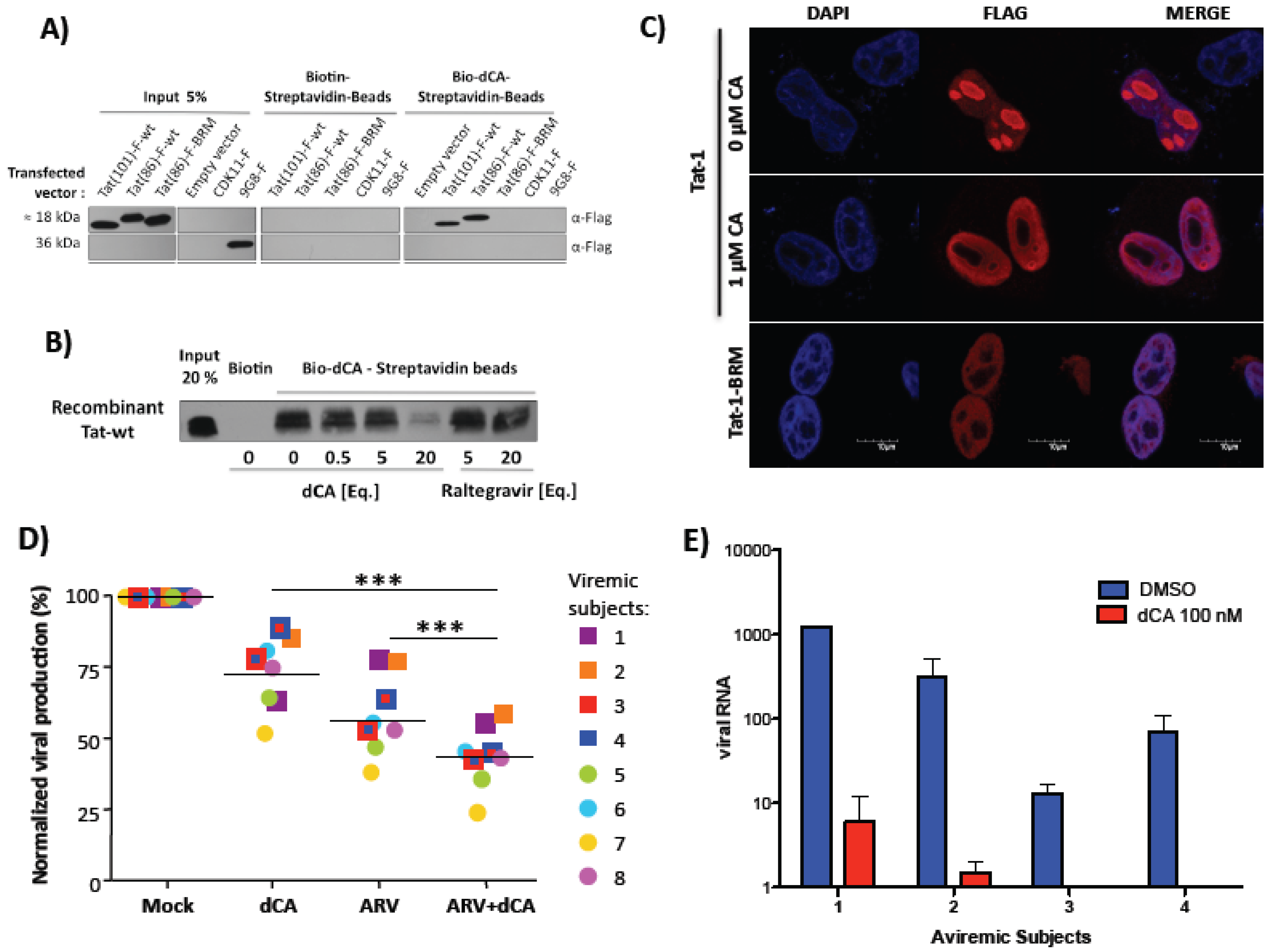
        <p>We have recently found that dCA, an analogue of a natural steroidal alkaloid from a marine sponge, inhibits Tat-mediated trans-activation of the integrated provirus by binding specifically to the TAR-binding domain of Tat (<xref ref-type="fig" rid="biology-01-00668-f002">Figure 2</xref>A,B) (<xref ref-type="table" rid="biology-01-00668-t001">Table 1</xref>) [<xref ref-type="bibr" rid="B146-biology-01-00668">146</xref>]. dCA represses transcriptional activation when transfected Tat or purified recombinant Tat is added to cells stably expressing the 5' LTR promoter driving Luciferase expression. When transfected, Tat localizes in the nucleus and specifically accumulates in the nucleolus. dCA causes redistribution of Tat to the periphery of the nucleolus, forming a distinctive ring-like structure determined by confocal fluorescence microscopy of HeLa-CD4 cells expressing HIV-1 Tat-flag (<xref ref-type="fig" rid="biology-01-00668-f002">Figure 2</xref>C). Without a TAR binding domain, the basic region-mutant Tat-1-BRM is excluded from the nucleolus, again confirming that dCA binds Tat via its TAR binding domain. By chromatin immunoprecipitation (ChIP), we demonstrate that dCA inhibits transcription initiation and elongation from the viral promoter in chronically infected cells [<xref ref-type="bibr" rid="B146-biology-01-00668">146</xref>]. </p>
        <table-wrap id="biology-01-00668-t001" position="float">
          <object-id pub-id-type="pii">biology-01-00668-t001_Table 1</object-id>
          <label>Table 1</label>
          <caption>
            <p>Activity, cytotoxicity and therapeutic index of selected HIV-1 Tat-dependent transcription inhibitors. Acute, chronic and/or latent cell lines where HIV-1 has been significantly inhibited are listed. The type of screen, when applicable, and the compound structure are indicated. (* Note: The IC<sub>50</sub> and CC<sub>50</sub> have not been determined in every cell lines listed). N.A.: not applicable.</p>
          </caption>
          <table rules="all" style="border: solid thin">
  <thead>
              <tr>
                <th align="left" valign="middle">Compound</th>
                <th align="left" valign="middle">Structure</th>
                <th align="left" valign="middle">IC<sub>50</sub> (nM)</th>
                <th align="left" valign="middle">CC<sub>50</sub> (mM)</th>
                <th align="left" valign="middle">TI</th>
                <th align="left" valign="middle">Tested in</th>
                <th align="left" valign="middle">Cell types*</th>
                <th align="left" valign="middle">Screen</th>
                <th align="left" valign="middle">References</th>
              </tr>
  </thead>
  <tbody>
              <tr>
                <td align="left" valign="top">dCA</td>
                <td align="center" valign="top">
                  <inline-graphic xmlns:xlink="http://www.w3.org/1999/xlink" xlink:href="biology-01-00668-i001.tif"/>
                </td>
                <td align="left" valign="top">0.0007-2.6</td>
                <td align="left" valign="top">20</td>
                <td align="left" valign="top">&gt;8000</td>
                <td align="left" valign="top">Acute, Chronic</td>
                <td align="left" valign="top">Hela CD4+, T cell line, PBMCs, CD4+ T cells</td>
                <td align="left" valign="top">N.A.</td>
                <td align="left" valign="top">[<xref ref-type="bibr" rid="B146-biology-01-00668">146</xref>]</td>
              </tr>
              <tr>
                <td align="left" valign="top">Durhamycin A</td>
                <td align="center" valign="top">
                  <inline-graphic xmlns:xlink="http://www.w3.org/1999/xlink" xlink:href="biology-01-00668-i002.tif"/>
                </td>
                <td align="left" valign="top">4.8-11</td>
                <td align="left" valign="top">5-25</td>
                <td align="left" valign="top">431-5208</td>
                <td align="left" valign="top">Acute</td>
                <td align="left" valign="top">Hela CD4+, T cell lines</td>
                <td align="left" valign="top">LTR-reporter assay</td>
                <td align="left" valign="top">[<xref ref-type="bibr" rid="B165-biology-01-00668">165</xref>]</td>
              </tr>
              <tr>
                <td align="left" valign="top">WM5</td>
                <td align="center" valign="top">
                  <inline-graphic xmlns:xlink="http://www.w3.org/1999/xlink" xlink:href="biology-01-00668-i003.tif"/>
                </td>
                <td align="left" valign="top">30-850</td>
                <td align="left" valign="top">2.21 to &gt; 263</td>
                <td align="left" valign="top">15-&gt;3333</td>
                <td align="left" valign="top">Acute, Chronic</td>
                <td align="left" valign="top">Hela, T-cell lines, PBMCs</td>
                <td align="left" valign="top">SAR</td>
                <td align="left" valign="top">[<xref ref-type="bibr" rid="B187-biology-01-00668">187</xref>,<xref ref-type="bibr" rid="B206-biology-01-00668">206</xref>,<xref ref-type="bibr" rid="B207-biology-01-00668">207</xref>,<xref ref-type="bibr" rid="B211-biology-01-00668">211</xref>]</td>
              </tr>
              <tr>
                <td align="left" valign="top">NM13</td>
                <td align="center" valign="top">
                  <inline-graphic xmlns:xlink="http://www.w3.org/1999/xlink" xlink:href="biology-01-00668-i004.tif"/>
                </td>
                <td align="left" valign="top">80</td>
                <td align="left" valign="top">³296</td>
                <td align="left" valign="top">³3707</td>
                <td align="left" valign="top">Acute</td>
                <td align="left" valign="top">T-cell line</td>
                <td align="left" valign="top">SAR</td>
                <td align="left" valign="top">[<xref ref-type="bibr" rid="B91-biology-01-00668">91</xref>,<xref ref-type="bibr" rid="B208-biology-01-00668">208</xref>]</td>
              </tr>
              <tr>
                <td align="left" valign="top">HM13N</td>
                <td align="center" valign="top">
                  <inline-graphic xmlns:xlink="http://www.w3.org/1999/xlink" xlink:href="biology-01-00668-i005.tif"/>
                </td>
                <td align="left" valign="top">4-1200 </td>
                <td align="left" valign="top">1.5-26.33</td>
                <td align="left" valign="top">17-1333</td>
                <td align="left" valign="top">Acute, Chronic, Latent</td>
                <td align="left" valign="top">T-cell Lines, monocytic cell lines, PBMCs</td>
                <td align="left" valign="top">SAR</td>
                <td align="left" valign="top">[<xref ref-type="bibr" rid="B186-biology-01-00668">186</xref>]</td>
              </tr>
              <tr>
                <td align="left" valign="top">Temacrazine</td>
                <td align="center" valign="top">
                  <inline-graphic xmlns:xlink="http://www.w3.org/1999/xlink" xlink:href="biology-01-00668-i006.tif"/>
                </td>
                <td align="left" valign="top">0.1-72</td>
                <td align="left" valign="top">1-10</td>
                <td align="left" valign="top">21-2518</td>
                <td align="left" valign="top">Acute, Chronic, Latent</td>
                <td align="left" valign="top">T cell line, monocytic cell lines</td>
                <td align="left" valign="top">N.A.</td>
                <td align="left" valign="top">[<xref ref-type="bibr" rid="B201-biology-01-00668">201</xref>]</td>
              </tr>
              <tr>
                <td align="left" valign="top">NeoR </td>
                <td align="center" valign="top">
                  <inline-graphic xmlns:xlink="http://www.w3.org/1999/xlink" xlink:href="biology-01-00668-i007.tif"/>
                </td>
                <td align="left" valign="top">1.7-5.3</td>
                <td align="left" valign="top">275-500</td>
                <td align="left" valign="top">33-250 </td>
                <td align="left" valign="top">Acute, Chronic</td>
                <td align="left" valign="top">T-cell line, promonocytic cell line, PBMCs</td>
                <td align="left" valign="top">SAR </td>
                <td align="left" valign="top">[<xref ref-type="bibr" rid="B197-biology-01-00668">197</xref>] </td>
              </tr>
  </tbody>
          </table>
        </table-wrap>
        <fig id="biology-01-00668-f002" position="anchor">
          <label>Figure 2</label>
          <caption>
            <p>dCA inhibits Tat-mediated trans-activation of the integrated provirus by binding specifically to the TAR-binding domain of Tat. (<bold>A</bold>) A biotinylated form of the compound (Bio-dCA) coupled to streptavidin-coated magnetic beads retained Tat-wt, but not TAR non-binding mutant of Tat. HEK293T cells were transfected with flag-tagged Tat 101 aa (Tat-F-101-wt), a shorter Tat version with 86 aa (Ta(86)-F-wt), Tat 86 aa mutated in the basic domain (Tat(86)-F-BRM), flag-tagged CDK11 (CDK11-F), flag-tagged 9G8 (9G8-F) and empty vector control. Protein extracts were incubated with Streptavidin beads coated with either Biotin or Bio-dCA. Pulled-down proteins were revealed by western bloting. (<bold>B</bold>) Pull-down experiments with recombinant Tat purified protein bound directly to Bio-dCA and was competed by dCA, but not by Raltegravir, used as negative control, demonstrating the specificity of the interaction. (<bold>C</bold>) Confocal microscopy analysis of the subcellular localization of transfected Tat(86)-F-wt and Tat(86)-F-BRM, treated or not with dCA. Magnification, 300×. (<bold>D</bold>) dCA activity on CD4<sup>+</sup> T cells from viremic and aviremic HIV-infected subjects. The potency of dCA was tested on spontaneous viral output (p24 production analyzed by ELISA) from primary CD4<sup>+</sup> T cells isolated from 8 viremic HIV-infected subjects. The inhibition of viral replication mediated by dCA alone [100 nM (circle) or 1 mM (square)] was approximately 25%. ARVs (AZT (zidovudine), EFV (Efavirenz) and RAL (Raltegravir)), which inhibit all new infections, decreased viral production by approximately 40%, while dCA and ARVs combined inhibited approximately 60%. (<bold>E</bold>) CD4<sup>+</sup> T cells isolated from four subjects who had been treated with ARVs for at least three years who spontaneously released viral particles <italic>in vitro</italic> were cultured for six days in the presence or absence of dCA and ARVs to block <italic>de novo</italic> infection. Using an ultrasensitive RT-qPCR assay, in the presence of dCA, we observed a reduction of viral production of 99.7% at day 6. Reprinted from [<xref ref-type="bibr" rid="B146-biology-01-00668">146</xref>], with permission from Elsevier.</p>
          </caption>
          <graphic xmlns:xlink="http://www.w3.org/1999/xlink" xlink:href="biology-01-00668-g002.tif"/>
        </fig>
        <p>Working at subnanomolar concentrations, dCA inhibits wild type HIV-1 and HIV-2 replication in acutely and chronically infected cells at an IC<sub>50</sub> as low as 0.7 pM. By comparison, selected compounds reported in <xref ref-type="table" rid="biology-01-00668-t001">Table 1</xref> inhibit HIV only in the low-to-high nanomolar range (<xref ref-type="table" rid="biology-01-00668-t001">Table 1</xref>). Consistent with this mode of action, dCA treatment for 10 or 60 days of chronically infected cells reduces viral RNAs to undetectable levels with an IC<sub>50</sub> of »0.1 nM and IC<sub>90</sub> of &lt;10 nM [<xref ref-type="bibr" rid="B146-biology-01-00668">146</xref>]. Moreover, dCA provides a significant additive effect with other ARVs when added to primary CD4<sup>+</sup> T cells from HIV-viremic subjects (<xref ref-type="fig" rid="biology-01-00668-f002">Figure 2</xref>D). Importantly, dCA abrogates spontaneous residual viral particle release from CD4<sup>+</sup> T cells from virally suppressed subjects on highly active antiretroviral therapy (HAART) (<xref ref-type="fig" rid="biology-01-00668-f002">Figure 2</xref>E). Finally, dCA discontinuation does not result in viral rebound [<xref ref-type="bibr" rid="B146-biology-01-00668">146</xref>]. Indeed, after terminating dCA treatment of HeLa-CD4 cells chronically infected with pNL43, no virus rebound was observed even 27 days post treatment arrest, contrary to what is observed with ARVs, suggesting that dCA promotes rapid and prolonged silencing of the promoter. Thus, dCA defines a unique class of anti-HIV drugs that may inhibit viral production from stable reservoirs and reduce residual viremia during HAART.</p>
      </sec>
    </sec>
    <sec sec-type="conclusions">
      <title>5. Conclusions</title>
      <p>Many methods have been employed to screen for Tat-dependent transcription inhibitors. Screening for Tat/TAR inhibitors using, for example, EMSA or filtration assays allowed the discovery of compounds with a good constant of inhibition and good affinity for TAR, however if tested against HIV replicating virus, most of the time they displayed activity only in the micromolar range with low TI. LTR-reporter assay with co-expression of Tat is a widely used tool to screen for transcription inhibitors. However, this type of assay may identify non-Tat specific inhibitors that affect cellular, factors often resulting in toxicity. So far, besides Ro 24-7429, no small molecule inhibitors of Tat or TAR have entered clinical trials.</p>
      <p>From the findings described herein, dCA is the most potent anti-Tat inhibitor described to date. It binds selectively to the basic domain of HIV Tat, a region also responsible for the Tat-TAR interaction. Importantly, dCA has a drug-like structure, is highly soluble in water and displays good bioavailability in mice. dCA inhibits both HIV-1 and HIV-2 replication in tissue culture-adapted cells or in primary cells when used at single digit nanomolar concentrations with no associated toxicity at the cellular level. The dose-response curve for dCA is unusual and flattens out, resulting in partial inhibition in acute infections. However, even though dCA alone fails to totally inhibit acute HIV infections, due to residual Tat-independent promoter activity, this feature is desirable as it limits off-target effects from shared transcription factors binding cellular and viral promoters, such as NF-κB.</p>
      <p>dCA treatment was extremely successful at reducing viral production by a drastic 99.7% from primary CD4<sup>+</sup> T cells isolated from aviremic patients who had been under ART treatment for a long period of time. Furthermore, by acting additively with other ARVs, dCA further reduced viral replication by 20% from CD4<sup>+</sup> T cells isolated from viremic patients. Distinct from any currently available ARVs that prevent new rounds of infection, dCA, a potential groundbreaking compound, inhibits HIV production from integrated proviral DNA, which by its mode of action may drastically reduce the low levels of persistent viremia observed in treated subjects [<xref ref-type="bibr" rid="B212-biology-01-00668">212</xref>]. With a therapeutic index of over 8,000, dCA defines a very promising Tat inhibitor endowed with the ability to decrease residual viremia during ART and should be considered as a potential drug to be included in therapeutic eradication strategies.</p>
    </sec>
  </body>
  <back>
    <ack>
      <title>Acknowledgments</title>
      <p>We thank Mark Clementz for critical reading of the manuscript.</p>
    </ack>
    <ref-list>
      <title>References</title>
      <ref id="B1-biology-01-00668">
        <label>1.</label>
        <citation citation-type="journal">
          <person-group person-group-type="author">
            <name>
              <surname>Chomont</surname>
              <given-names>N.</given-names>
            </name>
            <name>
              <surname>El-Far</surname>
              <given-names>M.</given-names>
            </name>
            <name>
              <surname>Ancuta</surname>
              <given-names>P.</given-names>
            </name>
            <name>
              <surname>Trautmann</surname>
              <given-names>L.</given-names>
            </name>
            <name>
              <surname>Procopio</surname>
              <given-names>F.A.</given-names>
            </name>
            <name>
              <surname>Yassine-Diab</surname>
              <given-names>B.</given-names>
            </name>
            <name>
              <surname>Boucher</surname>
              <given-names>G.</given-names>
            </name>
            <name>
              <surname>Boulassel</surname>
              <given-names>M.R.</given-names>
            </name>
            <name>
              <surname>Ghattas</surname>
              <given-names>G.</given-names>
            </name>
            <name>
              <surname>Brenchley</surname>
              <given-names>J.M.</given-names>
            </name>
            <etal/>
          </person-group>
          <article-title>Hiv reservoir size and persistence are driven by t cell survival and homeostatic proliferation</article-title>
          <source>Nat. Med.</source>
          <year>2009</year>
          <volume>15</volume>
          <fpage>893</fpage>
          <lpage>900</lpage>
          <pub-id pub-id-type="doi">10.1038/nm.1972</pub-id>
        </citation>
      </ref>
      <ref id="B2-biology-01-00668">
        <label>2.</label>
        <citation citation-type="journal">
          <person-group person-group-type="author">
            <name>
              <surname>Chun</surname>
              <given-names>T.W.</given-names>
            </name>
            <name>
              <surname>Stuyver</surname>
              <given-names>L.</given-names>
            </name>
            <name>
              <surname>Mizell</surname>
              <given-names>S.B.</given-names>
            </name>
            <name>
              <surname>Ehler</surname>
              <given-names>L.A.</given-names>
            </name>
            <name>
              <surname>Mican</surname>
              <given-names>J.A.</given-names>
            </name>
            <name>
              <surname>Baseler</surname>
              <given-names>M.</given-names>
            </name>
            <name>
              <surname>Lloyd</surname>
              <given-names>A.L.</given-names>
            </name>
            <name>
              <surname>Nowak</surname>
              <given-names>M.A.</given-names>
            </name>
            <name>
              <surname>Fauci</surname>
              <given-names>A.S.</given-names>
            </name>
          </person-group>
          <article-title>Presence of an inducible hiv-1 latent reservoir during highly active antiretroviral therapy</article-title>
          <source>Proc. Natl. Acad. Sci. USA</source>
          <year>1997</year>
          <volume>94</volume>
          <fpage>13193</fpage>
          <lpage>13197</lpage>
        <pub-id pub-id-type="doi">10.1073/pnas.94.24.13193</pub-id><pub-id pub-id-type="pmid">9371822</pub-id></citation>
      </ref>
      <ref id="B3-biology-01-00668">
        <label>3.</label>
        <citation citation-type="journal">
          <person-group person-group-type="author">
            <name>
              <surname>Finzi</surname>
              <given-names>D.</given-names>
            </name>
            <name>
              <surname>Hermankova</surname>
              <given-names>M.</given-names>
            </name>
            <name>
              <surname>Pierson</surname>
              <given-names>T.</given-names>
            </name>
            <name>
              <surname>Carruth</surname>
              <given-names>L.M.</given-names>
            </name>
            <name>
              <surname>Buck</surname>
              <given-names>C.</given-names>
            </name>
            <name>
              <surname>Chaisson</surname>
              <given-names>R.E.</given-names>
            </name>
            <name>
              <surname>Quinn</surname>
              <given-names>T.C.</given-names>
            </name>
            <name>
              <surname>Chadwick</surname>
              <given-names>K.</given-names>
            </name>
            <name>
              <surname>Margolick</surname>
              <given-names>J.</given-names>
            </name>
            <name>
              <surname>Brookmeyer</surname>
              <given-names>R.</given-names>
            </name>
            <etal/>
          </person-group>
          <article-title>Identification of a reservoir for hiv-1 in patients on highly active antiretroviral therapy</article-title>
          <source>Science</source>
          <year>1997</year>
          <volume>278</volume>
          <fpage>1295</fpage>
          <lpage>1300</lpage>
        <pub-id pub-id-type="doi">10.1126/science.278.5341.1295</pub-id><pub-id pub-id-type="pmid">9360927</pub-id></citation>
      </ref>
      <ref id="B4-biology-01-00668">
        <label>4.</label>
        <citation citation-type="journal">
          <person-group person-group-type="author">
            <name>
              <surname>Wong</surname>
              <given-names>J.K.</given-names>
            </name>
            <name>
              <surname>Hezareh</surname>
              <given-names>M.</given-names>
            </name>
            <name>
              <surname>Gunthard</surname>
              <given-names>H.F.</given-names>
            </name>
            <name>
              <surname>Havlir</surname>
              <given-names>D.V.</given-names>
            </name>
            <name>
              <surname>Ignacio</surname>
              <given-names>C.C.</given-names>
            </name>
            <name>
              <surname>Spina</surname>
              <given-names>C.A.</given-names>
            </name>
            <name>
              <surname>Richman</surname>
              <given-names>D.D.</given-names>
            </name>
          </person-group>
          <article-title>Recovery of replication-competent hiv despite prolonged suppression of plasma viremia</article-title>
          <source>Science</source>
          <year>1997</year>
          <volume>278</volume>
          <fpage>1291</fpage>
          <lpage>1295</lpage>
        <pub-id pub-id-type="doi">10.1126/science.278.5341.1291</pub-id><pub-id pub-id-type="pmid">9360926</pub-id></citation>
      </ref>
      <ref id="B5-biology-01-00668">
        <label>5.</label>
        <citation citation-type="journal">
          <person-group person-group-type="author">
            <name>
              <surname>Chun</surname>
              <given-names>T.W.</given-names>
            </name>
            <name>
              <surname>Carruth</surname>
              <given-names>L.</given-names>
            </name>
            <name>
              <surname>Finzi</surname>
              <given-names>D.</given-names>
            </name>
            <name>
              <surname>Shen</surname>
              <given-names>X.</given-names>
            </name>
            <name>
              <surname>DiGiuseppe</surname>
              <given-names>J.A.</given-names>
            </name>
            <name>
              <surname>Taylor</surname>
              <given-names>H.</given-names>
            </name>
            <name>
              <surname>Hermankova</surname>
              <given-names>M.</given-names>
            </name>
            <name>
              <surname>Chadwick</surname>
              <given-names>K.</given-names>
            </name>
            <name>
              <surname>Margolick</surname>
              <given-names>J.</given-names>
            </name>
            <name>
              <surname>Quinn</surname>
              <given-names>T.C.</given-names>
            </name>
            <etal/>
          </person-group>
          <article-title>Quantification of latent tissue reservoirs and total body viral load in hiv-1 infection</article-title>
          <source>Nature</source>
          <year>1997</year>
          <volume>387</volume>
          <fpage>183</fpage>
          <lpage>188</lpage>
        <pub-id pub-id-type="doi">10.1038/387183a0</pub-id><pub-id pub-id-type="pmid">9144289</pub-id></citation>
      </ref>
      <ref id="B6-biology-01-00668">
        <label>6.</label>
        <citation citation-type="journal">
          <person-group person-group-type="author">
            <name>
              <surname>Finzi</surname>
              <given-names>D.</given-names>
            </name>
            <name>
              <surname>Blankson</surname>
              <given-names>J.</given-names>
            </name>
            <name>
              <surname>Siliciano</surname>
              <given-names>J.D.</given-names>
            </name>
            <name>
              <surname>Margolick</surname>
              <given-names>J.B.</given-names>
            </name>
            <name>
              <surname>Chadwick</surname>
              <given-names>K.</given-names>
            </name>
            <name>
              <surname>Pierson</surname>
              <given-names>T.</given-names>
            </name>
            <name>
              <surname>Smith</surname>
              <given-names>K.</given-names>
            </name>
            <name>
              <surname>Lisziewicz</surname>
              <given-names>J.</given-names>
            </name>
            <name>
              <surname>Lori</surname>
              <given-names>F.</given-names>
            </name>
            <name>
              <surname>Flexner</surname>
              <given-names>C.</given-names>
            </name>
            <etal/>
          </person-group>
          <article-title>Latent infection of cd4+ t cells provides a mechanism for lifelong persistence of hiv-1, even in patients on effective combination therapy</article-title>
          <source>Nat. Med.</source>
          <year>1999</year>
          <volume>5</volume>
          <fpage>512</fpage>
          <lpage>517</lpage>
          <pub-id pub-id-type="doi">10.1038/8394</pub-id>
        </citation>
      </ref>
      <ref id="B7-biology-01-00668">
        <label>7.</label>
        <citation citation-type="journal">
          <person-group person-group-type="author">
            <name>
              <surname>Toohey</surname>
              <given-names>M.G.</given-names>
            </name>
            <name>
              <surname>Jones</surname>
              <given-names>K.A.</given-names>
            </name>
          </person-group>
          <article-title><italic>In vitro</italic> formation of short rna polymerase ii transcripts that terminate within the hiv-1 and hiv-2 promoter-proximal downstream regions</article-title>
          <source>Genes Dev.</source>
          <year>1989</year>
          <volume>3</volume>
          <fpage>265</fpage>
          <lpage>282</lpage>
          <pub-id pub-id-type="doi">10.1101/gad.3.3.265</pub-id>
        </citation>
      </ref>
      <ref id="B8-biology-01-00668">
        <label>8.</label>
        <citation citation-type="journal">
          <person-group person-group-type="author">
            <name>
              <surname>Dingwall</surname>
              <given-names>C.</given-names>
            </name>
            <name>
              <surname>Ernberg</surname>
              <given-names>I.</given-names>
            </name>
            <name>
              <surname>Gait</surname>
              <given-names>M.J.</given-names>
            </name>
            <name>
              <surname>Green</surname>
              <given-names>S.M.</given-names>
            </name>
            <name>
              <surname>Heaphy</surname>
              <given-names>S.</given-names>
            </name>
            <name>
              <surname>Karn</surname>
              <given-names>J.</given-names>
            </name>
            <name>
              <surname>Lowe</surname>
              <given-names>A.D.</given-names>
            </name>
            <name>
              <surname>Singh</surname>
              <given-names>M.</given-names>
            </name>
            <name>
              <surname>Skinner</surname>
              <given-names>M.A.</given-names>
            </name>
          </person-group>
          <article-title>Hiv-1 tat protein stimulates transcription by binding to a u-rich bulge in the stem of the tar rna structure</article-title>
          <source>EMBO J.</source>
          <year>1990</year>
          <volume>9</volume>
          <fpage>4145</fpage>
          <lpage>4153</lpage>
        <pub-id pub-id-type="pmid">2249668</pub-id></citation>
      </ref>
      <ref id="B9-biology-01-00668">
        <label>9.</label>
        <citation citation-type="journal">
          <person-group person-group-type="author">
            <name>
              <surname>Dingwall</surname>
              <given-names>C.</given-names>
            </name>
            <name>
              <surname>Ernberg</surname>
              <given-names>I.</given-names>
            </name>
            <name>
              <surname>Gait</surname>
              <given-names>M.J.</given-names>
            </name>
            <name>
              <surname>Green</surname>
              <given-names>S.M.</given-names>
            </name>
            <name>
              <surname>Heaphy</surname>
              <given-names>S.</given-names>
            </name>
            <name>
              <surname>Karn</surname>
              <given-names>J.</given-names>
            </name>
            <name>
              <surname>Lowe</surname>
              <given-names>A.D.</given-names>
            </name>
            <name>
              <surname>Singh</surname>
              <given-names>M.</given-names>
            </name>
            <name>
              <surname>Skinner</surname>
              <given-names>M.A.</given-names>
            </name>
            <name>
              <surname>Valerio</surname>
              <given-names>R.</given-names>
            </name>
          </person-group>
          <article-title>Human immunodeficiency virus 1 tat protein binds trans-activation-responsive region (tar) rna <italic>in vitro</italic></article-title>
          <source>Proc. Natl. Acad. Sci. USA</source>
          <year>1989</year>
          <volume>86</volume>
          <fpage>6925</fpage>
          <lpage>6929</lpage>
        <pub-id pub-id-type="doi">10.1073/pnas.86.18.6925</pub-id><pub-id pub-id-type="pmid">2476805</pub-id></citation>
      </ref>
      <ref id="B10-biology-01-00668">
        <label>10.</label>
        <citation citation-type="journal">
          <person-group person-group-type="author">
            <name>
              <surname>Marshall</surname>
              <given-names>N.F.</given-names>
            </name>
            <name>
              <surname>Price</surname>
              <given-names>D.H.</given-names>
            </name>
          </person-group>
          <article-title>Control of formation of two distinct classes of rna polymerase ii elongation complexes</article-title>
          <source>Mol. Cell. Biol.</source>
          <year>1992</year>
          <volume>12</volume>
          <fpage>2078</fpage>
          <lpage>2090</lpage>
        <pub-id pub-id-type="pmid">1569941</pub-id></citation>
      </ref>
      <ref id="B11-biology-01-00668">
        <label>11.</label>
        <citation citation-type="journal">
          <person-group person-group-type="author">
            <name>
              <surname>Marshall</surname>
              <given-names>N.F.</given-names>
            </name>
            <name>
              <surname>Price</surname>
              <given-names>D.H.</given-names>
            </name>
          </person-group>
          <article-title>Purification of p-tefb, a transcription factor required for the transition into productive elongation</article-title>
          <source>J. Biol. Chem.</source>
          <year>1995</year>
          <volume>270</volume>
          <fpage>12335</fpage>
          <lpage>12338</lpage>
          <pub-id pub-id-type="doi">10.1074/jbc.270.21.12335</pub-id>
        </citation>
      </ref>
      <ref id="B12-biology-01-00668">
        <label>12.</label>
        <citation citation-type="journal">
          <person-group person-group-type="author">
            <name>
              <surname>Michels</surname>
              <given-names>A.A.</given-names>
            </name>
            <name>
              <surname>Nguyen</surname>
              <given-names>V.T.</given-names>
            </name>
            <name>
              <surname>Fraldi</surname>
              <given-names>A.</given-names>
            </name>
            <name>
              <surname>Labas</surname>
              <given-names>V.</given-names>
            </name>
            <name>
              <surname>Edwards</surname>
              <given-names>M.</given-names>
            </name>
            <name>
              <surname>Bonnet</surname>
              <given-names>F.</given-names>
            </name>
            <name>
              <surname>Lania</surname>
              <given-names>L.</given-names>
            </name>
            <name>
              <surname>Bensaude</surname>
              <given-names>O.</given-names>
            </name>
          </person-group>
          <article-title>Maq1 and 7sk rna interact with cdk9/cyclin t complexes in a transcription-dependent manner</article-title>
          <source>Mol. Cell. Biol.</source>
          <year>2003</year>
          <volume>23</volume>
          <fpage>4859</fpage>
          <lpage>4869</lpage>
          <pub-id pub-id-type="doi">10.1128/MCB.23.14.4859-4869.2003</pub-id>
        </citation>
      </ref>
      <ref id="B13-biology-01-00668">
        <label>13.</label>
        <citation citation-type="journal">
          <person-group person-group-type="author">
            <name>
              <surname>Yik</surname>
              <given-names>J.H.</given-names>
            </name>
            <name>
              <surname>Chen</surname>
              <given-names>R.</given-names>
            </name>
            <name>
              <surname>Nishimura</surname>
              <given-names>R.</given-names>
            </name>
            <name>
              <surname>Jennings</surname>
              <given-names>J.L.</given-names>
            </name>
            <name>
              <surname>Link</surname>
              <given-names>A.J.</given-names>
            </name>
            <name>
              <surname>Zhou</surname>
              <given-names>Q.</given-names>
            </name>
          </person-group>
          <article-title>Inhibition of p-tefb (cdk9/cyclin t) kinase and rna polymerase ii transcription by the coordinated actions of hexim1 and 7sk snrna</article-title>
          <source>Mol. Cell.</source>
          <year>2003</year>
          <volume>12</volume>
          <fpage>971</fpage>
          <lpage>982</lpage>
          <pub-id pub-id-type="doi">10.1016/S1097-2765(03)00388-5</pub-id>
        </citation>
      </ref>
      <ref id="B14-biology-01-00668">
        <label>14.</label>
        <citation citation-type="journal">
          <person-group person-group-type="author">
            <name>
              <surname>Peterlin</surname>
              <given-names>B.M.</given-names>
            </name>
            <name>
              <surname>Price</surname>
              <given-names>D.H.</given-names>
            </name>
          </person-group>
          <article-title>Controlling the elongation phase of transcription with p-tefb</article-title>
          <source>Mol. Cell.</source>
          <year>2006</year>
          <volume>23</volume>
          <fpage>297</fpage>
          <lpage>305</lpage>
          <pub-id pub-id-type="doi">10.1016/j.molcel.2006.06.014</pub-id>
        </citation>
      </ref>
      <ref id="B15-biology-01-00668">
        <label>15.</label>
        <citation citation-type="journal">
          <person-group person-group-type="author">
            <name>
              <surname>Van Lint</surname>
              <given-names>C.</given-names>
            </name>
          </person-group>
          <article-title>Role of chromatin in hiv-1 transcriptional regulation</article-title>
          <source>Adv. Pharmacol.</source>
          <year>2000</year>
          <volume>48</volume>
          <fpage>121</fpage>
          <lpage>160</lpage>
          <pub-id pub-id-type="doi">10.1016/S1054-3589(00)48005-1</pub-id>
        </citation>
      </ref>
      <ref id="B16-biology-01-00668">
        <label>16.</label>
        <citation citation-type="journal">
          <person-group person-group-type="author">
            <name>
              <surname>Robison</surname>
              <given-names>A.J.</given-names>
            </name>
            <name>
              <surname>Nestler</surname>
              <given-names>E.J.</given-names>
            </name>
          </person-group>
          <article-title>Transcriptional and epigenetic mechanisms of addiction</article-title>
          <source>Nat. Rev. Neurosci.</source>
          <year>2011</year>
          <volume>12</volume>
          <fpage>623</fpage>
          <lpage>637</lpage>
        <pub-id pub-id-type="pmid">21989194</pub-id></citation>
      </ref>
      <ref id="B17-biology-01-00668">
        <label>17.</label>
        <citation citation-type="journal">
          <person-group person-group-type="author">
            <name>
              <surname>Van Lint</surname>
              <given-names>C.</given-names>
            </name>
            <name>
              <surname>Emiliani</surname>
              <given-names>S.</given-names>
            </name>
            <name>
              <surname>Ott</surname>
              <given-names>M.</given-names>
            </name>
            <name>
              <surname>Verdin</surname>
              <given-names>E.</given-names>
            </name>
          </person-group>
          <article-title>Transcriptional activation and chromatin remodeling of the hiv-1 promoter in response to histone acetylation</article-title>
          <source>EMBO J.</source>
          <year>1996</year>
          <volume>15</volume>
          <fpage>1112</fpage>
          <lpage>1120</lpage>
        <pub-id pub-id-type="pmid">8605881</pub-id></citation>
      </ref>
      <ref id="B18-biology-01-00668">
        <label>18.</label>
        <citation citation-type="journal">
          <person-group person-group-type="author">
            <name>
              <surname>Verdin</surname>
              <given-names>E.</given-names>
            </name>
          </person-group>
          <article-title>Dnase i-hypersensitive sites are associated with both long terminal repeats and with the intragenic enhancer of integrated human immunodeficiency virus type 1</article-title>
          <source>J. Virol.</source>
          <year>1991</year>
          <volume>65</volume>
          <fpage>6790</fpage>
          <lpage>6799</lpage>
        <pub-id pub-id-type="pmid">1942252</pub-id></citation>
      </ref>
      <ref id="B19-biology-01-00668">
        <label>19.</label>
        <citation citation-type="journal">
          <person-group person-group-type="author">
            <name>
              <surname>Kiernan</surname>
              <given-names>R.E.</given-names>
            </name>
            <name>
              <surname>Vanhulle</surname>
              <given-names>C.</given-names>
            </name>
            <name>
              <surname>Schiltz</surname>
              <given-names>L.</given-names>
            </name>
            <name>
              <surname>Adam</surname>
              <given-names>E.</given-names>
            </name>
            <name>
              <surname>Xiao</surname>
              <given-names>H.</given-names>
            </name>
            <name>
              <surname>Maudoux</surname>
              <given-names>F.</given-names>
            </name>
            <name>
              <surname>Calomme</surname>
              <given-names>C.</given-names>
            </name>
            <name>
              <surname>Burny</surname>
              <given-names>A.</given-names>
            </name>
            <name>
              <surname>Nakatani</surname>
              <given-names>Y.</given-names>
            </name>
            <name>
              <surname>Jeang</surname>
              <given-names>K.T.</given-names>
            </name>
            <etal/>
          </person-group>
          <article-title>Hiv-1 tat transcriptional activity is regulated by acetylation</article-title>
          <source>EMBO J.</source>
          <year>1999</year>
          <volume>18</volume>
          <fpage>6106</fpage>
          <lpage>6118</lpage>
          <pub-id pub-id-type="doi">10.1093/emboj/18.21.6106</pub-id>
        </citation>
      </ref>
      <ref id="B20-biology-01-00668">
        <label>20.</label>
        <citation citation-type="journal">
          <person-group person-group-type="author">
            <name>
              <surname>Ghose</surname>
              <given-names>R.</given-names>
            </name>
            <name>
              <surname>Liou</surname>
              <given-names>L.Y.</given-names>
            </name>
            <name>
              <surname>Herrmann</surname>
              <given-names>C.H.</given-names>
            </name>
            <name>
              <surname>Rice</surname>
              <given-names>A.P.</given-names>
            </name>
          </person-group>
          <article-title>Induction of tak (cyclin t1/p-tefb) in purified resting cd4(+) t lymphocytes by combination of cytokines</article-title>
          <source>J. Virol.</source>
          <year>2001</year>
          <volume>75</volume>
          <fpage>11336</fpage>
          <lpage>11343</lpage>
          <pub-id pub-id-type="doi">10.1128/JVI.75.23.11336-11343.2001</pub-id>
        </citation>
      </ref>
      <ref id="B21-biology-01-00668">
        <label>21.</label>
        <citation citation-type="journal">
          <person-group person-group-type="author">
            <name>
              <surname>Lassen</surname>
              <given-names>K.G.</given-names>
            </name>
            <name>
              <surname>Bailey</surname>
              <given-names>J.R.</given-names>
            </name>
            <name>
              <surname>Siliciano</surname>
              <given-names>R.F.</given-names>
            </name>
          </person-group>
          <article-title>Analysis of human immunodeficiency virus type 1 transcriptional elongation in resting cd4+ t cells <italic>in vivo</italic></article-title>
          <source>J. Virol.</source>
          <year>2004</year>
          <volume>78</volume>
          <fpage>9105</fpage>
          <lpage>9114</lpage>
          <pub-id pub-id-type="doi">10.1128/JVI.78.17.9105-9114.2004</pub-id>
        </citation>
      </ref>
      <ref id="B22-biology-01-00668">
        <label>22.</label>
        <citation citation-type="journal">
          <person-group person-group-type="author">
            <name>
              <surname>Lin</surname>
              <given-names>X.</given-names>
            </name>
            <name>
              <surname>Irwin</surname>
              <given-names>D.</given-names>
            </name>
            <name>
              <surname>Kanazawa</surname>
              <given-names>S.</given-names>
            </name>
            <name>
              <surname>Huang</surname>
              <given-names>L.</given-names>
            </name>
            <name>
              <surname>Romeo</surname>
              <given-names>J.</given-names>
            </name>
            <name>
              <surname>Yen</surname>
              <given-names>T.S.</given-names>
            </name>
            <name>
              <surname>Peterlin</surname>
              <given-names>B.M.</given-names>
            </name>
          </person-group>
          <article-title>Transcriptional profiles of latent human immunodeficiency virus in infected individuals: Effects of tat on the host and reservoir</article-title>
          <source>J. Virol.</source>
          <year>2003</year>
          <volume>77</volume>
          <fpage>8227</fpage>
          <lpage>8236</lpage>
          <pub-id pub-id-type="doi">10.1128/JVI.77.15.8227-8236.2003</pub-id>
        </citation>
      </ref>
      <ref id="B23-biology-01-00668">
        <label>23.</label>
        <citation citation-type="journal">
          <person-group person-group-type="author">
            <name>
              <surname>He</surname>
              <given-names>G.</given-names>
            </name>
            <name>
              <surname>Margolis</surname>
              <given-names>D.M.</given-names>
            </name>
          </person-group>
          <article-title>Counterregulation of chromatin deacetylation and histone deacetylase occupancy at the integrated promoter of human immunodeficiency virus type 1 (hiv-1) by the hiv-1 repressor yy1 and hiv-1 activator tat</article-title>
          <source>Mol. Cell. Biol.</source>
          <year>2002</year>
          <volume>22</volume>
          <fpage>2965</fpage>
          <lpage>2973</lpage>
          <pub-id pub-id-type="doi">10.1128/MCB.22.9.2965-2973.2002</pub-id>
        </citation>
      </ref>
      <ref id="B24-biology-01-00668">
        <label>24.</label>
        <citation citation-type="journal">
          <person-group person-group-type="author">
            <name>
              <surname>Tyagi</surname>
              <given-names>M.</given-names>
            </name>
            <name>
              <surname>Karn</surname>
              <given-names>J.</given-names>
            </name>
          </person-group>
          <article-title>Cbf-1 promotes transcriptional silencing during the establishment of hiv-1 latency</article-title>
          <source>EMBO J.</source>
          <year>2007</year>
          <volume>26</volume>
          <fpage>4985</fpage>
          <lpage>4995</lpage>
          <pub-id pub-id-type="doi">10.1038/sj.emboj.7601928</pub-id>
        </citation>
      </ref>
      <ref id="B25-biology-01-00668">
        <label>25.</label>
        <citation citation-type="journal">
          <person-group person-group-type="author">
            <name>
              <surname>du Chene</surname>
              <given-names>I.</given-names>
            </name>
            <name>
              <surname>Basyuk</surname>
              <given-names>E.</given-names>
            </name>
            <name>
              <surname>Lin</surname>
              <given-names>Y.L.</given-names>
            </name>
            <name>
              <surname>Triboulet</surname>
              <given-names>R.</given-names>
            </name>
            <name>
              <surname>Knezevich</surname>
              <given-names>A.</given-names>
            </name>
            <name>
              <surname>Chable-Bessia</surname>
              <given-names>C.</given-names>
            </name>
            <name>
              <surname>Mettling</surname>
              <given-names>C.</given-names>
            </name>
            <name>
              <surname>Baillat</surname>
              <given-names>V.</given-names>
            </name>
            <name>
              <surname>Reynes</surname>
              <given-names>J.</given-names>
            </name>
            <name>
              <surname>Corbeau</surname>
              <given-names>P.</given-names>
            </name>
            <etal/>
          </person-group>
          <article-title>Suv39h1 and hp1gamma are responsible for chromatin-mediated hiv-1 transcriptional silencing and post-integration latency</article-title>
          <source>EMBO J.</source>
          <year>2007</year>
          <volume>26</volume>
          <fpage>424</fpage>
          <lpage>435</lpage>
          <pub-id pub-id-type="doi">10.1038/sj.emboj.7601517</pub-id>
        </citation>
      </ref>
      <ref id="B26-biology-01-00668">
        <label>26.</label>
        <citation citation-type="journal">
          <person-group person-group-type="author">
            <name>
              <surname>Mahmoudi</surname>
              <given-names>T.</given-names>
            </name>
            <name>
              <surname>Parra</surname>
              <given-names>M.</given-names>
            </name>
            <name>
              <surname>Vries</surname>
              <given-names>R.G.</given-names>
            </name>
            <name>
              <surname>Kauder</surname>
              <given-names>S.E.</given-names>
            </name>
            <name>
              <surname>Verrijzer</surname>
              <given-names>C.P.</given-names>
            </name>
            <name>
              <surname>Ott</surname>
              <given-names>M.</given-names>
            </name>
            <name>
              <surname>Verdin</surname>
              <given-names>E.</given-names>
            </name>
          </person-group>
          <article-title>The swi/snf chromatin-remodeling complex is a cofactor for tat transactivation of the hiv promoter</article-title>
          <source>J. Biol. Chem.</source>
          <year>2006</year>
          <volume>281</volume>
          <fpage>19960</fpage>
          <lpage>19968</lpage>
        <pub-id pub-id-type="doi">10.1074/jbc.M603336200</pub-id><pub-id pub-id-type="pmid">16687403</pub-id></citation>
      </ref>
      <ref id="B27-biology-01-00668">
        <label>27.</label>
        <citation citation-type="journal">
          <person-group person-group-type="author">
            <name>
              <surname>Treand</surname>
              <given-names>C.</given-names>
            </name>
            <name>
              <surname>du Chene</surname>
              <given-names>I.</given-names>
            </name>
            <name>
              <surname>Bres</surname>
              <given-names>V.</given-names>
            </name>
            <name>
              <surname>Kiernan</surname>
              <given-names>R.</given-names>
            </name>
            <name>
              <surname>Benarous</surname>
              <given-names>R.</given-names>
            </name>
            <name>
              <surname>Benkirane</surname>
              <given-names>M.</given-names>
            </name>
            <name>
              <surname>Emiliani</surname>
              <given-names>S.</given-names>
            </name>
          </person-group>
          <article-title>Requirement for swi/snf chromatin-remodeling complex in tat-mediated activation of the hiv-1 promoter</article-title>
          <source>EMBO J.</source>
          <year>2006</year>
          <volume>25</volume>
          <fpage>1690</fpage>
          <lpage>1699</lpage>
          <pub-id pub-id-type="doi">10.1038/sj.emboj.7601074</pub-id>
        </citation>
      </ref>
      <ref id="B28-biology-01-00668">
        <label>28.</label>
        <citation citation-type="journal">
          <person-group person-group-type="author">
            <name>
              <surname>Gerritsen</surname>
              <given-names>M.E.</given-names>
            </name>
            <name>
              <surname>Williams</surname>
              <given-names>A.J.</given-names>
            </name>
            <name>
              <surname>Neish</surname>
              <given-names>A.S.</given-names>
            </name>
            <name>
              <surname>Moore</surname>
              <given-names>S.</given-names>
            </name>
            <name>
              <surname>Shi</surname>
              <given-names>Y.</given-names>
            </name>
            <name>
              <surname>Collins</surname>
              <given-names>T.</given-names>
            </name>
          </person-group>
          <article-title>Creb-binding protein/p300 are transcriptional coactivators of p65</article-title>
          <source>Proc. Natl. Acad. Sci. USA</source>
          <year>1997</year>
          <volume>94</volume>
          <fpage>2927</fpage>
          <lpage>2932</lpage>
          <pub-id pub-id-type="doi">10.1073/pnas.94.7.2927</pub-id>
        </citation>
      </ref>
      <ref id="B29-biology-01-00668">
        <label>29.</label>
        <citation citation-type="journal">
          <person-group person-group-type="author">
            <name>
              <surname>Agbottah</surname>
              <given-names>E.</given-names>
            </name>
            <name>
              <surname>Deng</surname>
              <given-names>L.</given-names>
            </name>
            <name>
              <surname>Dannenberg</surname>
              <given-names>L.O.</given-names>
            </name>
            <name>
              <surname>Pumfery</surname>
              <given-names>A.</given-names>
            </name>
            <name>
              <surname>Kashanchi</surname>
              <given-names>F.</given-names>
            </name>
          </person-group>
          <article-title>Effect of swi/snf chromatin remodeling complex on hiv-1 tat activated transcription</article-title>
          <source>Retrovirology</source>
          <year>2006</year>
          <volume>3</volume>
          <fpage>48</fpage>
          <pub-id pub-id-type="doi">10.1186/1742-4690-3-48</pub-id>
        </citation>
      </ref>
      <ref id="B30-biology-01-00668">
        <label>30.</label>
        <citation citation-type="journal">
          <person-group person-group-type="author">
            <name>
              <surname>Benkirane</surname>
              <given-names>M.</given-names>
            </name>
            <name>
              <surname>Chun</surname>
              <given-names>R.F.</given-names>
            </name>
            <name>
              <surname>Xiao</surname>
              <given-names>H.</given-names>
            </name>
            <name>
              <surname>Ogryzko</surname>
              <given-names>V.V.</given-names>
            </name>
            <name>
              <surname>Howard</surname>
              <given-names>B.H.</given-names>
            </name>
            <name>
              <surname>Nakatani</surname>
              <given-names>Y.</given-names>
            </name>
            <name>
              <surname>Jeang</surname>
              <given-names>K.T.</given-names>
            </name>
          </person-group>
          <article-title>Activation of integrated provirus requires histone acetyltransferase. P300 and p/caf are coactivators for hiv-1 tat</article-title>
          <source>J. Biol. Chem.</source>
          <year>1998</year>
          <volume>273</volume>
          <fpage>24898</fpage>
          <lpage>24905</lpage>
        <pub-id pub-id-type="doi">10.1074/jbc.273.38.24898</pub-id><pub-id pub-id-type="pmid">9733796</pub-id></citation>
      </ref>
      <ref id="B31-biology-01-00668">
        <label>31.</label>
        <citation citation-type="journal">
          <person-group person-group-type="author">
            <name>
              <surname>Col</surname>
              <given-names>E.</given-names>
            </name>
            <name>
              <surname>Caron</surname>
              <given-names>C.</given-names>
            </name>
            <name>
              <surname>Seigneurin-Berny</surname>
              <given-names>D.</given-names>
            </name>
            <name>
              <surname>Gracia</surname>
              <given-names>J.</given-names>
            </name>
            <name>
              <surname>Favier</surname>
              <given-names>A.</given-names>
            </name>
            <name>
              <surname>Khochbin</surname>
              <given-names>S.</given-names>
            </name>
          </person-group>
          <article-title>The histone acetyltransferase, hgcn5, interacts with and acetylates the hiv transactivator, tat</article-title>
          <source>J. Biol. Chem.</source>
          <year>2001</year>
          <volume>276</volume>
          <fpage>28179</fpage>
          <lpage>28184</lpage>
        <pub-id pub-id-type="doi">10.1074/jbc.M101385200</pub-id><pub-id pub-id-type="pmid">11384967</pub-id></citation>
      </ref>
      <ref id="B32-biology-01-00668">
        <label>32.</label>
        <citation citation-type="journal">
          <person-group person-group-type="author">
            <name>
              <surname>Hottiger</surname>
              <given-names>M.O.</given-names>
            </name>
            <name>
              <surname>Nabel</surname>
              <given-names>G.J.</given-names>
            </name>
          </person-group>
          <article-title>Interaction of human immunodeficiency virus type 1 tat with the transcriptional coactivators p300 and creb binding protein</article-title>
          <source>J. Virol.</source>
          <year>1998</year>
          <volume>72</volume>
          <fpage>8252</fpage>
          <lpage>8256</lpage>
        <pub-id pub-id-type="pmid">9733868</pub-id></citation>
      </ref>
      <ref id="B33-biology-01-00668">
        <label>33.</label>
        <citation citation-type="journal">
          <person-group person-group-type="author">
            <name>
              <surname>Marzio</surname>
              <given-names>G.</given-names>
            </name>
            <name>
              <surname>Tyagi</surname>
              <given-names>M.</given-names>
            </name>
            <name>
              <surname>Gutierrez</surname>
              <given-names>M.I.</given-names>
            </name>
            <name>
              <surname>Giacca</surname>
              <given-names>M.</given-names>
            </name>
          </person-group>
          <article-title>Hiv-1 tat transactivator recruits p300 and creb-binding protein histone acetyltransferases to the viral promoter</article-title>
          <source>Proc. Natl. Acad. Sci. USA</source>
          <year>1998</year>
          <volume>95</volume>
          <fpage>13519</fpage>
          <lpage>13524</lpage>
          <pub-id pub-id-type="doi">10.1073/pnas.95.23.13519</pub-id>
        </citation>
      </ref>
      <ref id="B34-biology-01-00668">
        <label>34.</label>
        <citation citation-type="journal">
          <person-group person-group-type="author">
            <name>
              <surname>Nabel</surname>
              <given-names>G.</given-names>
            </name>
            <name>
              <surname>Baltimore</surname>
              <given-names>D.</given-names>
            </name>
          </person-group>
          <article-title>An inducible transcription factor activates expression of human immunodeficiency virus in t cells</article-title>
          <source>Nature</source>
          <year>1987</year>
          <volume>326</volume>
          <fpage>711</fpage>
          <lpage>713</lpage>
          <pub-id pub-id-type="doi">10.1038/326711a0</pub-id>
        </citation>
      </ref>
      <ref id="B35-biology-01-00668">
        <label>35.</label>
        <citation citation-type="journal">
          <person-group person-group-type="author">
            <name>
              <surname>Jones</surname>
              <given-names>K.A.</given-names>
            </name>
            <name>
              <surname>Kadonaga</surname>
              <given-names>J.T.</given-names>
            </name>
            <name>
              <surname>Luciw</surname>
              <given-names>P.A.</given-names>
            </name>
            <name>
              <surname>Tjian</surname>
              <given-names>R.</given-names>
            </name>
          </person-group>
          <article-title>Activation of the aids retrovirus promoter by the cellular transcription factor, sp1</article-title>
          <source>Science</source>
          <year>1986</year>
          <volume>232</volume>
          <fpage>755</fpage>
          <lpage>759</lpage>
        <pub-id pub-id-type="doi">10.1126/science.3008338</pub-id><pub-id pub-id-type="pmid">3008338</pub-id></citation>
      </ref>
      <ref id="B36-biology-01-00668">
        <label>36.</label>
        <citation citation-type="journal">
          <person-group person-group-type="author">
            <name>
              <surname>Olsen</surname>
              <given-names>H.S.</given-names>
            </name>
            <name>
              <surname>Rosen</surname>
              <given-names>C.A.</given-names>
            </name>
          </person-group>
          <article-title>Contribution of the tata motif to tat-mediated transcriptional activation of human immunodeficiency virus gene expression</article-title>
          <source>J. Virol.</source>
          <year>1992</year>
          <volume>66</volume>
          <fpage>5594</fpage>
          <lpage>5597</lpage>
        <pub-id pub-id-type="pmid">1501293</pub-id></citation>
      </ref>
      <ref id="B37-biology-01-00668">
        <label>37.</label>
        <citation citation-type="journal">
          <person-group person-group-type="author">
            <name>
              <surname>Verhoef</surname>
              <given-names>K.</given-names>
            </name>
            <name>
              <surname>Koper</surname>
              <given-names>M.</given-names>
            </name>
            <name>
              <surname>Berkhout</surname>
              <given-names>B.</given-names>
            </name>
          </person-group>
          <article-title>Determination of the minimal amount of tat activity required for human immunodeficiency virus type 1 replication</article-title>
          <source>Virology</source>
          <year>1997</year>
          <volume>237</volume>
          <fpage>228</fpage>
          <lpage>236</lpage>
          <pub-id pub-id-type="doi">10.1006/viro.1997.8786</pub-id>
        </citation>
      </ref>
      <ref id="B38-biology-01-00668">
        <label>38.</label>
        <citation citation-type="journal">
          <person-group person-group-type="author">
            <name>
              <surname>McCutchan</surname>
              <given-names>F.E.</given-names>
            </name>
            <name>
              <surname>Salminen</surname>
              <given-names>M.O.</given-names>
            </name>
            <name>
              <surname>Carr</surname>
              <given-names>J.K.</given-names>
            </name>
            <name>
              <surname>Burke</surname>
              <given-names>D.S.</given-names>
            </name>
          </person-group>
          <article-title>Hiv-1 genetic diversity</article-title>
          <source>AIDS</source>
          <year>1996</year>
          <volume>10</volume>
          <fpage>S13</fpage>
          <lpage>S20</lpage>
          <pub-id pub-id-type="doi">10.1097/00002030-199601001-00003</pub-id>
        </citation>
      </ref>
      <ref id="B39-biology-01-00668">
        <label>39.</label>
        <citation citation-type="journal">
          <person-group person-group-type="author">
            <name>
              <surname>Simon</surname>
              <given-names>F.</given-names>
            </name>
            <name>
              <surname>Mauclere</surname>
              <given-names>P.</given-names>
            </name>
            <name>
              <surname>Roques</surname>
              <given-names>P.</given-names>
            </name>
            <name>
              <surname>Loussert-Ajaka</surname>
              <given-names>I.</given-names>
            </name>
            <name>
              <surname>Muller-Trutwin</surname>
              <given-names>M.C.</given-names>
            </name>
            <name>
              <surname>Saragosti</surname>
              <given-names>S.</given-names>
            </name>
            <name>
              <surname>Georges-Courbot</surname>
              <given-names>M.C.</given-names>
            </name>
            <name>
              <surname>Barre-Sinoussi</surname>
              <given-names>F.</given-names>
            </name>
            <name>
              <surname>Brun-Vezinet</surname>
              <given-names>F.</given-names>
            </name>
          </person-group>
          <article-title>Identification of a new human immunodeficiency virus type 1 distinct from group m and group o</article-title>
          <source>Nat. Med.</source>
          <year>1998</year>
          <volume>4</volume>
          <fpage>1032</fpage>
          <lpage>1037</lpage>
          <pub-id pub-id-type="doi">10.1038/2017</pub-id>
        </citation>
      </ref>
      <ref id="B40-biology-01-00668">
        <label>40.</label>
        <citation citation-type="journal">
          <person-group person-group-type="author">
            <name>
              <surname>Jeeninga</surname>
              <given-names>R.E.</given-names>
            </name>
            <name>
              <surname>Hoogenkamp</surname>
              <given-names>M.</given-names>
            </name>
            <name>
              <surname>Armand-Ugon</surname>
              <given-names>M.</given-names>
            </name>
            <name>
              <surname>de Baar</surname>
              <given-names>M.</given-names>
            </name>
            <name>
              <surname>Verhoef</surname>
              <given-names>K.</given-names>
            </name>
            <name>
              <surname>Berkhout</surname>
              <given-names>B.</given-names>
            </name>
          </person-group>
          <article-title>Functional differences between the long terminal repeat transcriptional promoters of human immunodeficiency virus type 1 subtypes a through g</article-title>
          <source>J. Virol.</source>
          <year>2000</year>
          <volume>74</volume>
          <fpage>3740</fpage>
          <lpage>3751</lpage>
          <pub-id pub-id-type="doi">10.1128/JVI.74.8.3740-3751.2000</pub-id>
        </citation>
      </ref>
      <ref id="B41-biology-01-00668">
        <label>41.</label>
        <citation citation-type="journal">
          <person-group person-group-type="author">
            <name>
              <surname>Montano</surname>
              <given-names>M.A.</given-names>
            </name>
            <name>
              <surname>Novitsky</surname>
              <given-names>V.A.</given-names>
            </name>
            <name>
              <surname>Blackard</surname>
              <given-names>J.T.</given-names>
            </name>
            <name>
              <surname>Cho</surname>
              <given-names>N.L.</given-names>
            </name>
            <name>
              <surname>Katzenstein</surname>
              <given-names>D.A.</given-names>
            </name>
            <name>
              <surname>Essex</surname>
              <given-names>M.</given-names>
            </name>
          </person-group>
          <article-title>Divergent transcriptional regulation among expanding human immunodeficiency virus type 1 subtypes</article-title>
          <source>J. Virol.</source>
          <year>1997</year>
          <volume>71</volume>
          <fpage>8657</fpage>
          <lpage>8665</lpage>
        <pub-id pub-id-type="pmid">9343223</pub-id></citation>
      </ref>
      <ref id="B42-biology-01-00668">
        <label>42.</label>
        <citation citation-type="journal">
          <person-group person-group-type="author">
            <name>
              <surname>Irish</surname>
              <given-names>B.P.</given-names>
            </name>
            <name>
              <surname>Khan</surname>
              <given-names>Z.K.</given-names>
            </name>
            <name>
              <surname>Jain</surname>
              <given-names>P.</given-names>
            </name>
            <name>
              <surname>Nonnemacher</surname>
              <given-names>M.R.</given-names>
            </name>
            <name>
              <surname>Pirrone</surname>
              <given-names>V.</given-names>
            </name>
            <name>
              <surname>Rahman</surname>
              <given-names>S.</given-names>
            </name>
            <name>
              <surname>Rajagopalan</surname>
              <given-names>N.</given-names>
            </name>
            <name>
              <surname>Suchitra</surname>
              <given-names>J.B.</given-names>
            </name>
            <name>
              <surname>Mostoller</surname>
              <given-names>K.</given-names>
            </name>
            <name>
              <surname>Wigdahl</surname>
              <given-names>B.</given-names>
            </name>
          </person-group>
          <article-title>Molecular mechanisms of neurodegenerative diseases induced by human retroviruses: A review</article-title>
          <source>Am. J. Infect. Dis.</source>
          <year>2009</year>
          <volume>5</volume>
          <fpage>231</fpage>
          <lpage>258</lpage>
          <pub-id pub-id-type="doi">10.3844/ajidsp.2009.231.258</pub-id>
        </citation>
      </ref>
      <ref id="B43-biology-01-00668">
        <label>43.</label>
        <citation citation-type="journal">
          <person-group person-group-type="author">
            <name>
              <surname>Rappaport</surname>
              <given-names>J.</given-names>
            </name>
            <name>
              <surname>Joseph</surname>
              <given-names>J.</given-names>
            </name>
            <name>
              <surname>Croul</surname>
              <given-names>S.</given-names>
            </name>
            <name>
              <surname>Alexander</surname>
              <given-names>G.</given-names>
            </name>
            <name>
              <surname>Del Valle</surname>
              <given-names>L.</given-names>
            </name>
            <name>
              <surname>Amini</surname>
              <given-names>S.</given-names>
            </name>
            <name>
              <surname>Khalili</surname>
              <given-names>K.</given-names>
            </name>
          </person-group>
          <article-title>Molecular pathway involved in hiv-1-induced cns pathology: Role of viral regulatory protein, tat</article-title>
          <source>J. Leukoc. Biol.</source>
          <year>1999</year>
          <volume>65</volume>
          <fpage>458</fpage>
          <lpage>465</lpage>
        <pub-id pub-id-type="pmid">10204574</pub-id></citation>
      </ref>
      <ref id="B44-biology-01-00668">
        <label>44.</label>
        <citation citation-type="journal">
          <person-group person-group-type="author">
            <name>
              <surname>Stevens</surname>
              <given-names>M.</given-names>
            </name>
            <name>
              <surname>de Clercq</surname>
              <given-names>E.</given-names>
            </name>
            <name>
              <surname>Balzarini</surname>
              <given-names>J.</given-names>
            </name>
          </person-group>
          <article-title>The regulation of hiv-1 transcription: Molecular targets for chemotherapeutic intervention</article-title>
          <source>Med. Res. Rev.</source>
          <year>2006</year>
          <volume>26</volume>
          <fpage>595</fpage>
          <lpage>625</lpage>
          <pub-id pub-id-type="doi">10.1002/med.20081</pub-id>
        </citation>
      </ref>
      <ref id="B45-biology-01-00668">
        <label>45.</label>
        <citation citation-type="journal">
          <person-group person-group-type="author">
            <name>
              <surname>Klebl</surname>
              <given-names>B.M.</given-names>
            </name>
            <name>
              <surname>Choidas</surname>
              <given-names>A.</given-names>
            </name>
          </person-group>
          <article-title>Cdk9/cyclin t1: A host cell target for antiretroviral therapy</article-title>
          <source>Future Virol.</source>
          <year>2006</year>
          <volume>1</volume>
          <fpage>317</fpage>
          <lpage>330</lpage>
          <pub-id pub-id-type="doi">10.2217/17460794.1.3.317</pub-id>
        </citation>
      </ref>
      <ref id="B46-biology-01-00668">
        <label>46.</label>
        <citation citation-type="journal">
          <person-group person-group-type="author">
            <name>
              <surname>Wang</surname>
              <given-names>S.</given-names>
            </name>
            <name>
              <surname>Fischer</surname>
              <given-names>P.M.</given-names>
            </name>
          </person-group>
          <article-title>Cyclin-dependent kinase 9: A key transcriptional regulator and potential drug target in oncology, virology and cardiology</article-title>
          <source>Trends Pharmacol. Sci.</source>
          <year>2008</year>
          <volume>29</volume>
          <fpage>302</fpage>
          <lpage>313</lpage>
          <pub-id pub-id-type="doi">10.1016/j.tips.2008.03.003</pub-id>
        </citation>
      </ref>
      <ref id="B47-biology-01-00668">
        <label>47.</label>
        <citation citation-type="journal">
          <person-group person-group-type="author">
            <name>
              <surname>Coley</surname>
              <given-names>W.</given-names>
            </name>
            <name>
              <surname>Kehn-Hall</surname>
              <given-names>K.</given-names>
            </name>
            <name>
              <surname>van Duyne</surname>
              <given-names>R.</given-names>
            </name>
            <name>
              <surname>Kashanchi</surname>
              <given-names>F.</given-names>
            </name>
          </person-group>
          <article-title>Novel hiv-1 therapeutics through targeting altered host cell pathways</article-title>
          <source>Expert Opin. Biol. Ther.</source>
          <year>2009</year>
          <volume>9</volume>
          <fpage>1369</fpage>
          <lpage>1382</lpage>
          <pub-id pub-id-type="doi">10.1517/14712590903257781</pub-id>
        </citation>
      </ref>
      <ref id="B48-biology-01-00668">
        <label>48.</label>
        <citation citation-type="journal">
          <person-group person-group-type="author">
            <name>
              <surname>Nemeth</surname>
              <given-names>G.</given-names>
            </name>
            <name>
              <surname>Varga</surname>
              <given-names>Z.</given-names>
            </name>
            <name>
              <surname>Greff</surname>
              <given-names>Z.</given-names>
            </name>
            <name>
              <surname>Bencze</surname>
              <given-names>G.</given-names>
            </name>
            <name>
              <surname>Sipos</surname>
              <given-names>A.</given-names>
            </name>
            <name>
              <surname>Szantai-Kis</surname>
              <given-names>C.</given-names>
            </name>
            <name>
              <surname>Baska</surname>
              <given-names>F.</given-names>
            </name>
            <name>
              <surname>Gyuris</surname>
              <given-names>A.</given-names>
            </name>
            <name>
              <surname>Kelemenics</surname>
              <given-names>K.</given-names>
            </name>
            <name>
              <surname>Szathmary</surname>
              <given-names>Z.</given-names>
            </name>
            <etal/>
          </person-group>
          <article-title>Novel, selective cdk9 inhibitors for the treatment of hiv infection</article-title>
          <source>Curr Med. Chem.</source>
          <year>2011</year>
          <volume>18</volume>
          <fpage>342</fpage>
          <lpage>358</lpage>
        <pub-id pub-id-type="doi">10.2174/092986711794839188</pub-id><pub-id pub-id-type="pmid">21143121</pub-id></citation>
      </ref>
      <ref id="B49-biology-01-00668">
        <label>49.</label>
        <citation citation-type="journal">
          <person-group person-group-type="author">
            <name>
              <surname>Baumli</surname>
              <given-names>S.</given-names>
            </name>
            <name>
              <surname>Lolli</surname>
              <given-names>G.</given-names>
            </name>
            <name>
              <surname>Lowe</surname>
              <given-names>E.D.</given-names>
            </name>
            <name>
              <surname>Troiani</surname>
              <given-names>S.</given-names>
            </name>
            <name>
              <surname>Rusconi</surname>
              <given-names>L.</given-names>
            </name>
            <name>
              <surname>Bullock</surname>
              <given-names>A.N.</given-names>
            </name>
            <name>
              <surname>Debreczeni</surname>
              <given-names>J.E.</given-names>
            </name>
            <name>
              <surname>Knapp</surname>
              <given-names>S.</given-names>
            </name>
            <name>
              <surname>Johnson</surname>
              <given-names>L.N.</given-names>
            </name>
          </person-group>
          <article-title>The structure of p-tefb (cdk9/cyclin t1), its complex with flavopiridol and regulation by phosphorylation</article-title>
          <source>EMBO J.</source>
          <year>2008</year>
          <volume>27</volume>
          <fpage>1907</fpage>
          <lpage>1918</lpage>
          <pub-id pub-id-type="doi">10.1038/emboj.2008.121</pub-id>
        </citation>
      </ref>
      <ref id="B50-biology-01-00668">
        <label>50.</label>
        <citation citation-type="journal">
          <person-group person-group-type="author">
            <name>
              <surname>Chao</surname>
              <given-names>S.H.</given-names>
            </name>
            <name>
              <surname>Fujinaga</surname>
              <given-names>K.</given-names>
            </name>
            <name>
              <surname>Marion</surname>
              <given-names>J.E.</given-names>
            </name>
            <name>
              <surname>Taube</surname>
              <given-names>R.</given-names>
            </name>
            <name>
              <surname>Sausville</surname>
              <given-names>E.A.</given-names>
            </name>
            <name>
              <surname>Senderowicz</surname>
              <given-names>A.M.</given-names>
            </name>
            <name>
              <surname>Peterlin</surname>
              <given-names>B.M.</given-names>
            </name>
            <name>
              <surname>Price</surname>
              <given-names>D.H.</given-names>
            </name>
          </person-group>
          <article-title>Flavopiridol inhibits p-tefb and blocks hiv-1 replication</article-title>
          <source>J. Biol. Chem.</source>
          <year>2000</year>
          <volume>275</volume>
          <fpage>28345</fpage>
          <lpage>28348</lpage>
        <pub-id pub-id-type="doi">10.1074/jbc.C000446200</pub-id><pub-id pub-id-type="pmid">10906320</pub-id></citation>
      </ref>
      <ref id="B51-biology-01-00668">
        <label>51.</label>
        <citation citation-type="journal">
          <person-group person-group-type="author">
            <name>
              <surname>Ali</surname>
              <given-names>A.</given-names>
            </name>
            <name>
              <surname>Ghosh</surname>
              <given-names>A.</given-names>
            </name>
            <name>
              <surname>Nathans</surname>
              <given-names>R.S.</given-names>
            </name>
            <name>
              <surname>Sharova</surname>
              <given-names>N.</given-names>
            </name>
            <name>
              <surname>O'Brien</surname>
              <given-names>S.</given-names>
            </name>
            <name>
              <surname>Cao</surname>
              <given-names>H.</given-names>
            </name>
            <name>
              <surname>Stevenson</surname>
              <given-names>M.</given-names>
            </name>
            <name>
              <surname>Rana</surname>
              <given-names>T.M.</given-names>
            </name>
          </person-group>
          <article-title>Identification of flavopiridol analogues that selectively inhibit positive transcription elongation factor (p-tefb) and block hiv-1 replication</article-title>
          <source>Chembiochem</source>
          <year>2009</year>
          <volume>10</volume>
          <fpage>2072</fpage>
          <lpage>2080</lpage>
          <pub-id pub-id-type="doi">10.1002/cbic.200900303</pub-id>
        </citation>
      </ref>
      <ref id="B52-biology-01-00668">
        <label>52.</label>
        <citation citation-type="journal">
          <person-group person-group-type="author">
            <name>
              <surname>Heredia</surname>
              <given-names>A.</given-names>
            </name>
            <name>
              <surname>Davis</surname>
              <given-names>C.</given-names>
            </name>
            <name>
              <surname>Bamba</surname>
              <given-names>D.</given-names>
            </name>
            <name>
              <surname>Le</surname>
              <given-names>N.</given-names>
            </name>
            <name>
              <surname>Gwarzo</surname>
              <given-names>M.Y.</given-names>
            </name>
            <name>
              <surname>Sadowska</surname>
              <given-names>M.</given-names>
            </name>
            <name>
              <surname>Gallo</surname>
              <given-names>R.C.</given-names>
            </name>
            <name>
              <surname>Redfield</surname>
              <given-names>R.R.</given-names>
            </name>
          </person-group>
          <article-title>Indirubin-3'-monoxime, a derivative of a chinese antileukemia medicine, inhibits p-tefb function and hiv-1 replication</article-title>
          <source>AIDS</source>
          <year>2005</year>
          <volume>19</volume>
          <fpage>2087</fpage>
          <lpage>2095</lpage>
          <pub-id pub-id-type="doi">10.1097/01.aids.0000194805.74293.11</pub-id>
        </citation>
      </ref>
      <ref id="B53-biology-01-00668">
        <label>53.</label>
        <citation citation-type="journal">
          <person-group person-group-type="author">
            <name>
              <surname>Toossi</surname>
              <given-names>Z.</given-names>
            </name>
            <name>
              <surname>Wu</surname>
              <given-names>M.</given-names>
            </name>
            <name>
              <surname>Hirsch</surname>
              <given-names>C.S.</given-names>
            </name>
            <name>
              <surname>Mayanja-Kizza</surname>
              <given-names>H.</given-names>
            </name>
            <name>
              <surname>Baseke</surname>
              <given-names>J.</given-names>
            </name>
            <name>
              <surname>Aung</surname>
              <given-names>H.</given-names>
            </name>
            <name>
              <surname>Canaday</surname>
              <given-names>D.H.</given-names>
            </name>
            <name>
              <surname>Fujinaga</surname>
              <given-names>K.</given-names>
            </name>
          </person-group>
          <article-title>Activation of p-tefb at sites of dual hiv/tb infection, and inhibition of mtb-induced hiv transcriptional activation by the inhibitor of cdk9, indirubin-3'-monoxime</article-title>
          <source>AIDS Res. Hum. Retroviruses</source>
          <year>2012</year>
          <volume>28</volume>
          <fpage>182</fpage>
          <lpage>187</lpage>
          <pub-id pub-id-type="doi">10.1089/aid.2010.0211</pub-id>
        </citation>
      </ref>
      <ref id="B54-biology-01-00668">
        <label>54.</label>
        <citation citation-type="journal">
          <person-group person-group-type="author">
            <name>
              <surname>Biglione</surname>
              <given-names>S.</given-names>
            </name>
            <name>
              <surname>Byers</surname>
              <given-names>S.A.</given-names>
            </name>
            <name>
              <surname>Price</surname>
              <given-names>J.P.</given-names>
            </name>
            <name>
              <surname>Nguyen</surname>
              <given-names>V.T.</given-names>
            </name>
            <name>
              <surname>Bensaude</surname>
              <given-names>O.</given-names>
            </name>
            <name>
              <surname>Price</surname>
              <given-names>D.H.</given-names>
            </name>
            <name>
              <surname>Maury</surname>
              <given-names>W.</given-names>
            </name>
          </person-group>
          <article-title>Inhibition of hiv-1 replication by p-tefb inhibitors drb, seliciclib and flavopiridol correlates with release of free p-tefb from the large, inactive form of the complex</article-title>
          <source>Retrovirology</source>
          <year>2007</year>
          <volume>4</volume>
          <fpage>47</fpage>
          <pub-id pub-id-type="doi">10.1186/1742-4690-4-47</pub-id>
        </citation>
      </ref>
      <ref id="B55-biology-01-00668">
        <label>55.</label>
        <citation citation-type="journal">
          <person-group person-group-type="author">
            <name>
              <surname>Agbottah</surname>
              <given-names>E.</given-names>
            </name>
            <name>
              <surname>de La Fuente</surname>
              <given-names>C.</given-names>
            </name>
            <name>
              <surname>Nekhai</surname>
              <given-names>S.</given-names>
            </name>
            <name>
              <surname>Barnett</surname>
              <given-names>A.</given-names>
            </name>
            <name>
              <surname>Gianella-Borradori</surname>
              <given-names>A.</given-names>
            </name>
            <name>
              <surname>Pumfery</surname>
              <given-names>A.</given-names>
            </name>
            <name>
              <surname>Kashanchi</surname>
              <given-names>F.</given-names>
            </name>
          </person-group>
          <article-title>Antiviral activity of cyc202 in hiv-1-infected cells</article-title>
          <source>J. Biol. Chem.</source>
          <year>2005</year>
          <volume>280</volume>
          <fpage>3029</fpage>
          <lpage>3042</lpage>
        <pub-id pub-id-type="pmid">15531588</pub-id></citation>
      </ref>
      <ref id="B56-biology-01-00668">
        <label>56.</label>
        <citation citation-type="journal">
          <person-group person-group-type="author">
            <name>
              <surname>Debebe</surname>
              <given-names>Z.</given-names>
            </name>
            <name>
              <surname>Ammosova</surname>
              <given-names>T.</given-names>
            </name>
            <name>
              <surname>Breuer</surname>
              <given-names>D.</given-names>
            </name>
            <name>
              <surname>Lovejoy</surname>
              <given-names>D.B.</given-names>
            </name>
            <name>
              <surname>Kalinowski</surname>
              <given-names>D.S.</given-names>
            </name>
            <name>
              <surname>Kumar</surname>
              <given-names>K.</given-names>
            </name>
            <name>
              <surname>Jerebtsova</surname>
              <given-names>M.</given-names>
            </name>
            <name>
              <surname>Ray</surname>
              <given-names>P.</given-names>
            </name>
            <name>
              <surname>Kashanchi</surname>
              <given-names>F.</given-names>
            </name>
            <name>
              <surname>Gordeuk</surname>
              <given-names>V.R.</given-names>
            </name>
            <etal/>
          </person-group>
          <article-title>Iron chelators of the di-2-pyridylketone thiosemicarbazone and 2-benzoylpyridine thiosemicarbazone series inhibit hiv-1 transcription: Identification of novel cellular targets--iron, cyclin-dependent kinase (cdk) 2, and cdk9</article-title>
          <source>Mol. Pharmacol.</source>
          <year>2011</year>
          <volume>79</volume>
          <fpage>185</fpage>
          <lpage>196</lpage>
          <pub-id pub-id-type="doi">10.1124/mol.110.069062</pub-id>
        </citation>
      </ref>
      <ref id="B57-biology-01-00668">
        <label>57.</label>
        <citation citation-type="journal">
          <person-group person-group-type="author">
            <name>
              <surname>Bai</surname>
              <given-names>J.</given-names>
            </name>
            <name>
              <surname>Sui</surname>
              <given-names>J.</given-names>
            </name>
            <name>
              <surname>Zhu</surname>
              <given-names>R.Y.</given-names>
            </name>
            <name>
              <surname>Tallarico</surname>
              <given-names>A.S.</given-names>
            </name>
            <name>
              <surname>Gennari</surname>
              <given-names>F.</given-names>
            </name>
            <name>
              <surname>Zhang</surname>
              <given-names>D.</given-names>
            </name>
            <name>
              <surname>Marasco</surname>
              <given-names>W.A.</given-names>
            </name>
          </person-group>
          <article-title>Inhibition of tat-mediated transactivation and hiv-1 replication by human anti-hcyclint1 intrabodies</article-title>
          <source>J. Biol. Chem.</source>
          <year>2003</year>
          <volume>278</volume>
          <fpage>1433</fpage>
          <lpage>1442</lpage>
        <pub-id pub-id-type="doi">10.1074/jbc.M208297200</pub-id><pub-id pub-id-type="pmid">12401780</pub-id></citation>
      </ref>
      <ref id="B58-biology-01-00668">
        <label>58.</label>
        <citation citation-type="journal">
          <person-group person-group-type="author">
            <name>
              <surname>Sung</surname>
              <given-names>T.L.</given-names>
            </name>
            <name>
              <surname>Rice</surname>
              <given-names>A.P.</given-names>
            </name>
          </person-group>
          <article-title>Mir-198 inhibits hiv-1 gene expression and replication in monocytes and its mechanism of action appears to involve repression of cyclin t1</article-title>
          <source>PLoS Pathog.</source>
          <year>2009</year>
          <volume>5</volume>
          <fpage>e1000263</fpage>
          <pub-id pub-id-type="doi">10.1371/journal.ppat.1000263</pub-id>
        </citation>
      </ref>
      <ref id="B59-biology-01-00668">
        <label>59.</label>
        <citation citation-type="journal">
          <person-group person-group-type="author">
            <name>
              <surname>Jadlowsky</surname>
              <given-names>J.K.</given-names>
            </name>
            <name>
              <surname>Nojima</surname>
              <given-names>M.</given-names>
            </name>
            <name>
              <surname>Schulte</surname>
              <given-names>A.</given-names>
            </name>
            <name>
              <surname>Geyer</surname>
              <given-names>M.</given-names>
            </name>
            <name>
              <surname>Okamoto</surname>
              <given-names>T.</given-names>
            </name>
            <name>
              <surname>Fujinaga</surname>
              <given-names>K.</given-names>
            </name>
          </person-group>
          <article-title>Dominant negative mutant cyclin t1 proteins inhibit hiv transcription by specifically degrading tat</article-title>
          <source>Retrovirology</source>
          <year>2008</year>
          <volume>5</volume>
          <fpage>63</fpage>
          <pub-id pub-id-type="doi">10.1186/1742-4690-5-63</pub-id>
        </citation>
      </ref>
      <ref id="B60-biology-01-00668">
        <label>60.</label>
        <citation citation-type="journal">
          <person-group person-group-type="author">
            <name>
              <surname>Jadlowsky</surname>
              <given-names>J.K.</given-names>
            </name>
            <name>
              <surname>Nojima</surname>
              <given-names>M.</given-names>
            </name>
            <name>
              <surname>Okamoto</surname>
              <given-names>T.</given-names>
            </name>
            <name>
              <surname>Fujinaga</surname>
              <given-names>K.</given-names>
            </name>
          </person-group>
          <article-title>Dominant negative mutant cyclin t1 proteins that inhibit hiv transcription by forming a kinase inactive complex with tat</article-title>
          <source>J. Gen. Virol.</source>
          <year>2008</year>
          <volume>89</volume>
          <fpage>2783</fpage>
          <lpage>2787</lpage>
          <pub-id pub-id-type="doi">10.1099/vir.0.2008/002857-0</pub-id>
        </citation>
      </ref>
      <ref id="B61-biology-01-00668">
        <label>61.</label>
        <citation citation-type="journal">
          <person-group person-group-type="author">
            <name>
              <surname>Hoque</surname>
              <given-names>M.</given-names>
            </name>
            <name>
              <surname>Tian</surname>
              <given-names>B.</given-names>
            </name>
            <name>
              <surname>Mathews</surname>
              <given-names>M.B.</given-names>
            </name>
            <name>
              <surname>Pe'ery</surname>
              <given-names>T.</given-names>
            </name>
          </person-group>
          <article-title>Granulin and granulin repeats interact with the tat.P-tefb complex and inhibit tat transactivation</article-title>
          <source>J. Biol. Chem.</source>
          <year>2005</year>
          <volume>280</volume>
          <fpage>13648</fpage>
          <lpage>13657</lpage>
        <pub-id pub-id-type="doi">10.1074/jbc.M409575200</pub-id><pub-id pub-id-type="pmid">15653695</pub-id></citation>
      </ref>
      <ref id="B62-biology-01-00668">
        <label>62.</label>
        <citation citation-type="journal">
          <person-group person-group-type="author">
            <name>
              <surname>Hoque</surname>
              <given-names>M.</given-names>
            </name>
            <name>
              <surname>Young</surname>
              <given-names>T.M.</given-names>
            </name>
            <name>
              <surname>Lee</surname>
              <given-names>C.G.</given-names>
            </name>
            <name>
              <surname>Serrero</surname>
              <given-names>G.</given-names>
            </name>
            <name>
              <surname>Mathews</surname>
              <given-names>M.B.</given-names>
            </name>
            <name>
              <surname>Pe'ery</surname>
              <given-names>T.</given-names>
            </name>
          </person-group>
          <article-title>The growth factor granulin interacts with cyclin t1 and modulates p-tefb-dependent transcription</article-title>
          <source>Mol. Cell. Biol.</source>
          <year>2003</year>
          <volume>23</volume>
          <fpage>1688</fpage>
          <lpage>1702</lpage>
        <pub-id pub-id-type="pmid">12588988</pub-id></citation>
      </ref>
      <ref id="B63-biology-01-00668">
        <label>63.</label>
        <citation citation-type="journal">
          <person-group person-group-type="author">
            <name>
              <surname>Fraldi</surname>
              <given-names>A.</given-names>
            </name>
            <name>
              <surname>Varrone</surname>
              <given-names>F.</given-names>
            </name>
            <name>
              <surname>Napolitano</surname>
              <given-names>G.</given-names>
            </name>
            <name>
              <surname>Michels</surname>
              <given-names>A.A.</given-names>
            </name>
            <name>
              <surname>Majello</surname>
              <given-names>B.</given-names>
            </name>
            <name>
              <surname>Bensaude</surname>
              <given-names>O.</given-names>
            </name>
            <name>
              <surname>Lania</surname>
              <given-names>L.</given-names>
            </name>
          </person-group>
          <article-title>Inhibition of tat activity by the hexim1 protein</article-title>
          <source>Retrovirology</source>
          <year>2005</year>
          <volume>2</volume>
          <fpage>42</fpage>
          <pub-id pub-id-type="doi">10.1186/1742-4690-2-42</pub-id>
        </citation>
      </ref>
      <ref id="B64-biology-01-00668">
        <label>64.</label>
        <citation citation-type="journal">
          <person-group person-group-type="author">
            <name>
              <surname>Young</surname>
              <given-names>T.M.</given-names>
            </name>
            <name>
              <surname>Wang</surname>
              <given-names>Q.</given-names>
            </name>
            <name>
              <surname>Pe'ery</surname>
              <given-names>T.</given-names>
            </name>
            <name>
              <surname>Mathews</surname>
              <given-names>M.B.</given-names>
            </name>
          </person-group>
          <article-title>The human i-mfa domain-containing protein, hic, interacts with cyclin t1 and modulates p-tefb-dependent transcription</article-title>
          <source>Mol. Cell. Biol.</source>
          <year>2003</year>
          <volume>23</volume>
          <fpage>6373</fpage>
          <lpage>6384</lpage>
          <pub-id pub-id-type="doi">10.1128/MCB.23.18.6373-6384.2003</pub-id>
        </citation>
      </ref>
      <ref id="B65-biology-01-00668">
        <label>65.</label>
        <citation citation-type="journal">
          <person-group person-group-type="author">
            <name>
              <surname>Deng</surname>
              <given-names>L.</given-names>
            </name>
            <name>
              <surname>Ammosova</surname>
              <given-names>T.</given-names>
            </name>
            <name>
              <surname>Pumfery</surname>
              <given-names>A.</given-names>
            </name>
            <name>
              <surname>Kashanchi</surname>
              <given-names>F.</given-names>
            </name>
            <name>
              <surname>Nekhai</surname>
              <given-names>S.</given-names>
            </name>
          </person-group>
          <article-title>Hiv-1 tat interaction with rna polymerase ii c-terminal domain (ctd) and a dynamic association with cdk2 induce ctd phosphorylation and transcription from hiv-1 promoter</article-title>
          <source>J. Biol. Chem.</source>
          <year>2002</year>
          <volume>277</volume>
          <fpage>33922</fpage>
          <lpage>33929</lpage>
        <pub-id pub-id-type="doi">10.1074/jbc.M111349200</pub-id><pub-id pub-id-type="pmid">12114499</pub-id></citation>
      </ref>
      <ref id="B66-biology-01-00668">
        <label>66.</label>
        <citation citation-type="journal">
          <person-group person-group-type="author">
            <name>
              <surname>Nekhai</surname>
              <given-names>S.</given-names>
            </name>
            <name>
              <surname>Zhou</surname>
              <given-names>M.</given-names>
            </name>
            <name>
              <surname>Fernandez</surname>
              <given-names>A.</given-names>
            </name>
            <name>
              <surname>Lane</surname>
              <given-names>W.S.</given-names>
            </name>
            <name>
              <surname>Lamb</surname>
              <given-names>N.J.</given-names>
            </name>
            <name>
              <surname>Brady</surname>
              <given-names>J.</given-names>
            </name>
            <name>
              <surname>Kumar</surname>
              <given-names>A.</given-names>
            </name>
          </person-group>
          <article-title>Hiv-1 tat-associated rna polymerase c-terminal domain kinase, cdk2, phosphorylates cdk7 and stimulates tat-mediated transcription</article-title>
          <source>Biochem. J.</source>
          <year>2002</year>
          <volume>364</volume>
          <fpage>649</fpage>
          <lpage>657</lpage>
          <pub-id pub-id-type="doi">10.1042/BJ20011191</pub-id>
        </citation>
      </ref>
      <ref id="B67-biology-01-00668">
        <label>67.</label>
        <citation citation-type="journal">
          <person-group person-group-type="author">
            <name>
              <surname>Pumfery</surname>
              <given-names>A.</given-names>
            </name>
            <name>
              <surname>de la Fuente</surname>
              <given-names>C.</given-names>
            </name>
            <name>
              <surname>Berro</surname>
              <given-names>R.</given-names>
            </name>
            <name>
              <surname>Nekhai</surname>
              <given-names>S.</given-names>
            </name>
            <name>
              <surname>Kashanchi</surname>
              <given-names>F.</given-names>
            </name>
            <name>
              <surname>Chao</surname>
              <given-names>S.H.</given-names>
            </name>
          </person-group>
          <article-title>Potential use of pharmacological cyclin-dependent kinase inhibitors as anti-hiv therapeutics</article-title>
          <source>Curr. Pharm. Des.</source>
          <year>2006</year>
          <volume>12</volume>
          <fpage>1949</fpage>
          <lpage>1961</lpage>
          <pub-id pub-id-type="doi">10.2174/138161206777442083</pub-id>
        </citation>
      </ref>
      <ref id="B68-biology-01-00668">
        <label>68.</label>
        <citation citation-type="journal">
          <person-group person-group-type="author">
            <name>
              <surname>Guendel</surname>
              <given-names>I.</given-names>
            </name>
            <name>
              <surname>Agbottah</surname>
              <given-names>E.T.</given-names>
            </name>
            <name>
              <surname>Kehn-Hall</surname>
              <given-names>K.</given-names>
            </name>
            <name>
              <surname>Kashanchi</surname>
              <given-names>F.</given-names>
            </name>
          </person-group>
          <article-title>Inhibition of human immunodeficiency virus type-1 by cdk inhibitors</article-title>
          <source>AIDS Res. Ther.</source>
          <year>2010</year>
          <volume>7</volume>
          <fpage>7</fpage>
          <pub-id pub-id-type="doi">10.1186/1742-6405-7-7</pub-id>
        </citation>
      </ref>
      <ref id="B69-biology-01-00668">
        <label>69.</label>
        <citation citation-type="journal">
          <person-group person-group-type="author">
            <name>
              <surname>Ammosova</surname>
              <given-names>T.</given-names>
            </name>
            <name>
              <surname>Berro</surname>
              <given-names>R.</given-names>
            </name>
            <name>
              <surname>Kashanchi</surname>
              <given-names>F.</given-names>
            </name>
            <name>
              <surname>Nekhai</surname>
              <given-names>S.</given-names>
            </name>
          </person-group>
          <article-title>Rna interference directed to cdk2 inhibits hiv-1 transcription</article-title>
          <source>Virology</source>
          <year>2005</year>
          <volume>341</volume>
          <fpage>171</fpage>
          <lpage>178</lpage>
          <pub-id pub-id-type="doi">10.1016/j.virol.2005.06.041</pub-id>
        </citation>
      </ref>
      <ref id="B70-biology-01-00668">
        <label>70.</label>
        <citation citation-type="journal">
          <person-group person-group-type="author">
            <name>
              <surname>Agbottah</surname>
              <given-names>E.</given-names>
            </name>
            <name>
              <surname>Zhang</surname>
              <given-names>N.</given-names>
            </name>
            <name>
              <surname>Dadgar</surname>
              <given-names>S.</given-names>
            </name>
            <name>
              <surname>Pumfery</surname>
              <given-names>A.</given-names>
            </name>
            <name>
              <surname>Wade</surname>
              <given-names>J.D.</given-names>
            </name>
            <name>
              <surname>Zeng</surname>
              <given-names>C.</given-names>
            </name>
            <name>
              <surname>Kashanchi</surname>
              <given-names>F.</given-names>
            </name>
          </person-group>
          <article-title>Inhibition of hiv-1 virus replication using small soluble tat peptides</article-title>
          <source>Virology</source>
          <year>2006</year>
          <volume>345</volume>
          <fpage>373</fpage>
          <lpage>389</lpage>
          <pub-id pub-id-type="doi">10.1016/j.virol.2005.09.062</pub-id>
        </citation>
      </ref>
      <ref id="B71-biology-01-00668">
        <label>71.</label>
        <citation citation-type="journal">
          <person-group person-group-type="author">
            <name>
              <surname>Van Duyne</surname>
              <given-names>R.</given-names>
            </name>
            <name>
              <surname>Cardenas</surname>
              <given-names>J.</given-names>
            </name>
            <name>
              <surname>Easley</surname>
              <given-names>R.</given-names>
            </name>
            <name>
              <surname>Wu</surname>
              <given-names>W.</given-names>
            </name>
            <name>
              <surname>Kehn-Hall</surname>
              <given-names>K.</given-names>
            </name>
            <name>
              <surname>Klase</surname>
              <given-names>Z.</given-names>
            </name>
            <name>
              <surname>Mendez</surname>
              <given-names>S.</given-names>
            </name>
            <name>
              <surname>Zeng</surname>
              <given-names>C.</given-names>
            </name>
            <name>
              <surname>Chen</surname>
              <given-names>H.</given-names>
            </name>
            <name>
              <surname>Saifuddin</surname>
              <given-names>M.</given-names>
            </name>
            <etal/>
          </person-group>
          <article-title>Effect of transcription peptide inhibitors on hiv-1 replication</article-title>
          <source>Virology</source>
          <year>2008</year>
          <volume>376</volume>
          <fpage>308</fpage>
          <lpage>322</lpage>
          <pub-id pub-id-type="doi">10.1016/j.virol.2008.02.036</pub-id>
        </citation>
      </ref>
      <ref id="B72-biology-01-00668">
        <label>72.</label>
        <citation citation-type="journal">
          <person-group person-group-type="author">
            <name>
              <surname>Stevens</surname>
              <given-names>M.</given-names>
            </name>
            <name>
              <surname>Balzarini</surname>
              <given-names>J.</given-names>
            </name>
            <name>
              <surname>Lagoja</surname>
              <given-names>I.M.</given-names>
            </name>
            <name>
              <surname>Noppen</surname>
              <given-names>B.</given-names>
            </name>
            <name>
              <surname>Francois</surname>
              <given-names>K.</given-names>
            </name>
            <name>
              <surname>van Aerschot</surname>
              <given-names>A.</given-names>
            </name>
            <name>
              <surname>Herdewijn</surname>
              <given-names>P.</given-names>
            </name>
            <name>
              <surname>de Clercq</surname>
              <given-names>E.</given-names>
            </name>
            <name>
              <surname>Pannecouque</surname>
              <given-names>C.</given-names>
            </name>
          </person-group>
          <article-title>Inhibition of human immunodeficiency virus type 1 transcription by n-aminoimidazole derivatives</article-title>
          <source>Virology</source>
          <year>2007</year>
          <volume>365</volume>
          <fpage>220</fpage>
          <lpage>237</lpage>
          <pub-id pub-id-type="doi">10.1016/j.virol.2007.03.036</pub-id>
        </citation>
      </ref>
      <ref id="B73-biology-01-00668">
        <label>73.</label>
        <citation citation-type="journal">
          <person-group person-group-type="author">
            <name>
              <surname>Karn</surname>
              <given-names>J.</given-names>
            </name>
          </person-group>
          <article-title>Tackling tat</article-title>
          <source>J. Mol. Biol.</source>
          <year>1999</year>
          <volume>293</volume>
          <fpage>235</fpage>
          <lpage>254</lpage>
          <pub-id pub-id-type="doi">10.1006/jmbi.1999.3060</pub-id>
        </citation>
      </ref>
      <ref id="B74-biology-01-00668">
        <label>74.</label>
        <citation citation-type="journal">
          <person-group person-group-type="author">
            <name>
              <surname>Baba</surname>
              <given-names>M.</given-names>
            </name>
          </person-group>
          <article-title>Recent status of hiv-1 gene expression inhibitors</article-title>
          <source>Antiviral Res.</source>
          <year>2006</year>
          <volume>71</volume>
          <fpage>301</fpage>
          <lpage>306</lpage>
          <pub-id pub-id-type="doi">10.1016/j.antiviral.2006.01.002</pub-id>
        </citation>
      </ref>
      <ref id="B75-biology-01-00668">
        <label>75.</label>
        <citation citation-type="journal">
          <person-group person-group-type="author">
            <name>
              <surname>Gnabre</surname>
              <given-names>J.N.</given-names>
            </name>
            <name>
              <surname>Brady</surname>
              <given-names>J.N.</given-names>
            </name>
            <name>
              <surname>Clanton</surname>
              <given-names>D.J.</given-names>
            </name>
            <name>
              <surname>Ito</surname>
              <given-names>Y.</given-names>
            </name>
            <name>
              <surname>Dittmer</surname>
              <given-names>J.</given-names>
            </name>
            <name>
              <surname>Bates</surname>
              <given-names>R.B.</given-names>
            </name>
            <name>
              <surname>Huang</surname>
              <given-names>R.C.</given-names>
            </name>
          </person-group>
          <article-title>Inhibition of human immunodeficiency virus type 1 transcription and replication by DNA sequence-selective plant lignans</article-title>
          <source>Proc. Natl. Acad. Sci. USA</source>
          <year>1995</year>
          <volume>92</volume>
          <fpage>11239</fpage>
          <lpage>11243</lpage>
        <pub-id pub-id-type="doi">10.1073/pnas.92.24.11239</pub-id><pub-id pub-id-type="pmid">7479972</pub-id></citation>
      </ref>
      <ref id="B76-biology-01-00668">
        <label>76.</label>
        <citation citation-type="journal">
          <person-group person-group-type="author">
            <name>
              <surname>Huang</surname>
              <given-names>R.C.</given-names>
            </name>
            <name>
              <surname>Li</surname>
              <given-names>Y.</given-names>
            </name>
            <name>
              <surname>Giza</surname>
              <given-names>P.E.</given-names>
            </name>
            <name>
              <surname>Gnabre</surname>
              <given-names>J.N.</given-names>
            </name>
            <name>
              <surname>Abd-Elazem</surname>
              <given-names>I.S.</given-names>
            </name>
            <name>
              <surname>King</surname>
              <given-names>K.Y.</given-names>
            </name>
            <name>
              <surname>Hwu</surname>
              <given-names>J.R.</given-names>
            </name>
          </person-group>
          <article-title>Novel antiviral agent tetraglycylated nordihydroguaiaretic acid hydrochloride as a host-dependent viral inhibitor</article-title>
          <source>Antiviral Res.</source>
          <year>2003</year>
          <volume>58</volume>
          <fpage>57</fpage>
          <lpage>64</lpage>
          <pub-id pub-id-type="doi">10.1016/S0166-3542(02)00189-4</pub-id>
        </citation>
      </ref>
      <ref id="B77-biology-01-00668">
        <label>77.</label>
        <citation citation-type="journal">
          <person-group person-group-type="author">
            <name>
              <surname>Hwu</surname>
              <given-names>J.R.</given-names>
            </name>
            <name>
              <surname>Tseng</surname>
              <given-names>W.N.</given-names>
            </name>
            <name>
              <surname>Gnabre</surname>
              <given-names>J.</given-names>
            </name>
            <name>
              <surname>Giza</surname>
              <given-names>P.</given-names>
            </name>
            <name>
              <surname>Huang</surname>
              <given-names>R.C.</given-names>
            </name>
          </person-group>
          <article-title>Antiviral activities of methylated nordihydroguaiaretic acids. 1. Synthesis, structure identification, and inhibition of tat-regulated hiv transactivation</article-title>
          <source>J. Med. Chem.</source>
          <year>1998</year>
          <volume>41</volume>
          <fpage>2994</fpage>
          <lpage>3000</lpage>
          <pub-id pub-id-type="doi">10.1021/jm970819w</pub-id>
        </citation>
      </ref>
      <ref id="B78-biology-01-00668">
        <label>78.</label>
        <citation citation-type="journal">
          <person-group person-group-type="author">
            <name>
              <surname>Bedoya</surname>
              <given-names>L.M.</given-names>
            </name>
            <name>
              <surname>Abad</surname>
              <given-names>M.J.</given-names>
            </name>
            <name>
              <surname>Calonge</surname>
              <given-names>E.</given-names>
            </name>
            <name>
              <surname>Saavedra</surname>
              <given-names>L.A.</given-names>
            </name>
            <name>
              <surname>Gutierrez</surname>
              <given-names>C.M.</given-names>
            </name>
            <name>
              <surname>Kouznetsov</surname>
              <given-names>V.V.</given-names>
            </name>
            <name>
              <surname>Alcami</surname>
              <given-names>J.</given-names>
            </name>
            <name>
              <surname>Bermejo</surname>
              <given-names>P.</given-names>
            </name>
          </person-group>
          <article-title>Quinoline-based compounds as modulators of hiv transcription through nf-kappab and sp1 inhibition</article-title>
          <source>Antiviral Res.</source>
          <year>2010</year>
          <volume>87</volume>
          <fpage>338</fpage>
          <lpage>344</lpage>
          <pub-id pub-id-type="doi">10.1016/j.antiviral.2010.06.006</pub-id>
        </citation>
      </ref>
      <ref id="B79-biology-01-00668">
        <label>79.</label>
        <citation citation-type="journal">
          <person-group person-group-type="author">
            <name>
              <surname>Osorio</surname>
              <given-names>A.A.</given-names>
            </name>
            <name>
              <surname>Munoz</surname>
              <given-names>A.</given-names>
            </name>
            <name>
              <surname>Torres-Romero</surname>
              <given-names>D.</given-names>
            </name>
            <name>
              <surname>Bedoya</surname>
              <given-names>L.M.</given-names>
            </name>
            <name>
              <surname>Perestelo</surname>
              <given-names>N.R.</given-names>
            </name>
            <name>
              <surname>Jimenez</surname>
              <given-names>I.A.</given-names>
            </name>
            <name>
              <surname>Alcami</surname>
              <given-names>J.</given-names>
            </name>
            <name>
              <surname>Bazzocchi</surname>
              <given-names>I.L.</given-names>
            </name>
          </person-group>
          <article-title>Olean-18-ene triterpenoids from celastraceae species inhibit hiv replication targeting nf-kb and sp1 dependent transcription</article-title>
          <source>Eur J. Med. Chem.</source>
          <year>2012</year>
          <volume>52</volume>
          <fpage>295</fpage>
          <lpage>303</lpage>
          <pub-id pub-id-type="doi">10.1016/j.ejmech.2012.03.035</pub-id>
        </citation>
      </ref>
      <ref id="B80-biology-01-00668">
        <label>80.</label>
        <citation citation-type="journal">
          <person-group person-group-type="author">
            <name>
              <surname>Takada</surname>
              <given-names>N.</given-names>
            </name>
            <name>
              <surname>Sanda</surname>
              <given-names>T.</given-names>
            </name>
            <name>
              <surname>Okamoto</surname>
              <given-names>H.</given-names>
            </name>
            <name>
              <surname>Yang</surname>
              <given-names>J.P.</given-names>
            </name>
            <name>
              <surname>Asamitsu</surname>
              <given-names>K.</given-names>
            </name>
            <name>
              <surname>Sarol</surname>
              <given-names>L.</given-names>
            </name>
            <name>
              <surname>Kimura</surname>
              <given-names>G.</given-names>
            </name>
            <name>
              <surname>Uranishi</surname>
              <given-names>H.</given-names>
            </name>
            <name>
              <surname>Tetsuka</surname>
              <given-names>T.</given-names>
            </name>
            <name>
              <surname>Okamoto</surname>
              <given-names>T.</given-names>
            </name>
          </person-group>
          <article-title>Rela-associated inhibitor blocks transcription of human immunodeficiency virus type 1 by inhibiting nf-kappab and sp1 actions</article-title>
          <source>J. Virol.</source>
          <year>2002</year>
          <volume>76</volume>
          <fpage>8019</fpage>
          <lpage>8030</lpage>
        <pub-id pub-id-type="doi">10.1128/JVI.76.16.8019-8030.2002</pub-id><pub-id pub-id-type="pmid">12134007</pub-id></citation>
      </ref>
      <ref id="B81-biology-01-00668">
        <label>81.</label>
        <citation citation-type="journal">
          <person-group person-group-type="author">
            <name>
              <surname>Pande</surname>
              <given-names>V.</given-names>
            </name>
            <name>
              <surname>Ramos</surname>
              <given-names>M.J.</given-names>
            </name>
          </person-group>
          <article-title>Nuclear factor kappa b: A potential target for anti-hiv chemotherapy</article-title>
          <source>Curr. Med. Chem.</source>
          <year>2003</year>
          <volume>10</volume>
          <fpage>1603</fpage>
          <lpage>1615</lpage>
          <pub-id pub-id-type="doi">10.2174/0929867033457250</pub-id>
        </citation>
      </ref>
      <ref id="B82-biology-01-00668">
        <label>82.</label>
        <citation citation-type="journal">
          <person-group person-group-type="author">
            <name>
              <surname>Fujiwara</surname>
              <given-names>N.</given-names>
            </name>
            <name>
              <surname>Nakajima</surname>
              <given-names>T.</given-names>
            </name>
            <name>
              <surname>Ueda</surname>
              <given-names>Y.</given-names>
            </name>
            <name>
              <surname>Fujita</surname>
              <given-names>H.</given-names>
            </name>
            <name>
              <surname>Kawakami</surname>
              <given-names>H.</given-names>
            </name>
          </person-group>
          <article-title>Novel piperidinylpyrimidine derivatives as inhibitors of hiv-1 ltr activation</article-title>
          <source>Bioorg. Med. Chem.</source>
          <year>2008</year>
          <volume>16</volume>
          <fpage>9804</fpage>
          <lpage>9816</lpage>
          <pub-id pub-id-type="doi">10.1016/j.bmc.2008.09.059</pub-id>
        </citation>
      </ref>
      <ref id="B83-biology-01-00668">
        <label>83.</label>
        <citation citation-type="journal">
          <person-group person-group-type="author">
            <name>
              <surname>Haraguchi</surname>
              <given-names>S.</given-names>
            </name>
            <name>
              <surname>Day</surname>
              <given-names>N.K.</given-names>
            </name>
            <name>
              <surname>Kamchaisatian</surname>
              <given-names>W.</given-names>
            </name>
            <name>
              <surname>Beigier-Pompadre</surname>
              <given-names>M.</given-names>
            </name>
            <name>
              <surname>Stenger</surname>
              <given-names>S.</given-names>
            </name>
            <name>
              <surname>Tangsinmankong</surname>
              <given-names>N.</given-names>
            </name>
            <name>
              <surname>Sleasman</surname>
              <given-names>J.W.</given-names>
            </name>
            <name>
              <surname>Pizzo</surname>
              <given-names>S.V.</given-names>
            </name>
            <name>
              <surname>Cianciolo</surname>
              <given-names>G.J.</given-names>
            </name>
          </person-group>
          <article-title>Lmp-420, a small-molecule inhibitor of tnf-alpha, reduces replication of hiv-1 and mycobacterium tuberculosis in human cells</article-title>
          <source>AIDS Res. Ther.</source>
          <year>2006</year>
          <volume>3</volume>
          <fpage>8</fpage>
          <pub-id pub-id-type="doi">10.1186/1742-6405-3-8</pub-id>
        </citation>
      </ref>
      <ref id="B84-biology-01-00668">
        <label>84.</label>
        <citation citation-type="journal">
          <person-group person-group-type="author">
            <name>
              <surname>Biswas</surname>
              <given-names>D.K.</given-names>
            </name>
            <name>
              <surname>Dezube</surname>
              <given-names>B.J.</given-names>
            </name>
            <name>
              <surname>Ahlers</surname>
              <given-names>C.M.</given-names>
            </name>
            <name>
              <surname>Pardee</surname>
              <given-names>A.B.</given-names>
            </name>
          </person-group>
          <article-title>Pentoxifylline inhibits hiv-1 ltr-driven gene expression by blocking nf-kappa b action</article-title>
          <source>J. Acquir. Immune. Defic. Syndr.</source>
          <year>1993</year>
          <volume>6</volume>
          <fpage>778</fpage>
          <lpage>786</lpage>
        <pub-id pub-id-type="pmid">8509980</pub-id></citation>
      </ref>
      <ref id="B85-biology-01-00668">
        <label>85.</label>
        <citation citation-type="journal">
          <person-group person-group-type="author">
            <name>
              <surname>Fazely</surname>
              <given-names>F.</given-names>
            </name>
            <name>
              <surname>Dezube</surname>
              <given-names>B.J.</given-names>
            </name>
            <name>
              <surname>Allen-Ryan</surname>
              <given-names>J.</given-names>
            </name>
            <name>
              <surname>Pardee</surname>
              <given-names>A.B.</given-names>
            </name>
            <name>
              <surname>Ruprecht</surname>
              <given-names>R.M.</given-names>
            </name>
          </person-group>
          <article-title>Pentoxifylline (trental) decreases the replication of the human immunodeficiency virus type 1 in human peripheral blood mononuclear cells and in cultured t cells</article-title>
          <source>Blood</source>
          <year>1991</year>
          <volume>77</volume>
          <fpage>1653</fpage>
          <lpage>1656</lpage>
        <pub-id pub-id-type="pmid">1707692</pub-id></citation>
      </ref>
      <ref id="B86-biology-01-00668">
        <label>86.</label>
        <citation citation-type="journal">
          <person-group person-group-type="author">
            <name>
              <surname>Navarro</surname>
              <given-names>J.</given-names>
            </name>
            <name>
              <surname>Punzon</surname>
              <given-names>M.C.</given-names>
            </name>
            <name>
              <surname>Pizarro</surname>
              <given-names>A.</given-names>
            </name>
            <name>
              <surname>Fernandez-Cruz</surname>
              <given-names>E.</given-names>
            </name>
            <name>
              <surname>Fresno</surname>
              <given-names>M.</given-names>
            </name>
            <name>
              <surname>Munoz-Fernandez</surname>
              <given-names>M.A.</given-names>
            </name>
          </person-group>
          <article-title>Pentoxifylline inhibits acute hiv-1 replication in human t cells by a mechanism not involving inhibition of tumour necrosis factor synthesis or nuclear factor-kappa b activation</article-title>
          <source>AIDS</source>
          <year>1996</year>
          <volume>10</volume>
          <fpage>469</fpage>
          <lpage>475</lpage>
          <pub-id pub-id-type="doi">10.1097/00002030-199605000-00004</pub-id>
        </citation>
      </ref>
      <ref id="B87-biology-01-00668">
        <label>87.</label>
        <citation citation-type="journal">
          <person-group person-group-type="author">
            <name>
              <surname>Smith</surname>
              <given-names>J.A.</given-names>
            </name>
            <name>
              <surname>Nunnari</surname>
              <given-names>G.</given-names>
            </name>
            <name>
              <surname>Preuss</surname>
              <given-names>M.</given-names>
            </name>
            <name>
              <surname>Pomerantz</surname>
              <given-names>R.J.</given-names>
            </name>
            <name>
              <surname>Daniel</surname>
              <given-names>R.</given-names>
            </name>
          </person-group>
          <article-title>Pentoxifylline suppresses transduction by hiv-1-based vectors</article-title>
          <source>Intervirology</source>
          <year>2007</year>
          <volume>50</volume>
          <fpage>377</fpage>
          <lpage>386</lpage>
          <pub-id pub-id-type="doi">10.1159/000109752</pub-id>
        </citation>
      </ref>
      <ref id="B88-biology-01-00668">
        <label>88.</label>
        <citation citation-type="journal">
          <person-group person-group-type="author">
            <name>
              <surname>Asamitsu</surname>
              <given-names>K.</given-names>
            </name>
            <name>
              <surname>Yamaguchi</surname>
              <given-names>T.</given-names>
            </name>
            <name>
              <surname>Nakata</surname>
              <given-names>K.</given-names>
            </name>
            <name>
              <surname>Hibi</surname>
              <given-names>Y.</given-names>
            </name>
            <name>
              <surname>Victoriano</surname>
              <given-names>A.F.</given-names>
            </name>
            <name>
              <surname>Imai</surname>
              <given-names>K.</given-names>
            </name>
            <name>
              <surname>Onozaki</surname>
              <given-names>K.</given-names>
            </name>
            <name>
              <surname>Kitade</surname>
              <given-names>Y.</given-names>
            </name>
            <name>
              <surname>Okamoto</surname>
              <given-names>T.</given-names>
            </name>
          </person-group>
          <article-title>Inhibition of human immunodeficiency virus type 1 replication by blocking ikappab kinase with noraristeromycin</article-title>
          <source>J. Biochem.</source>
          <year>2008</year>
          <volume>144</volume>
          <fpage>581</fpage>
          <lpage>589</lpage>
          <pub-id pub-id-type="doi">10.1093/jb/mvn104</pub-id>
        </citation>
      </ref>
      <ref id="B89-biology-01-00668">
        <label>89.</label>
        <citation citation-type="journal">
          <person-group person-group-type="author">
            <name>
              <surname>Balasubramanyam</surname>
              <given-names>K.</given-names>
            </name>
            <name>
              <surname>Varier</surname>
              <given-names>R.A.</given-names>
            </name>
            <name>
              <surname>Altaf</surname>
              <given-names>M.</given-names>
            </name>
            <name>
              <surname>Swaminathan</surname>
              <given-names>V.</given-names>
            </name>
            <name>
              <surname>Siddappa</surname>
              <given-names>N.B.</given-names>
            </name>
            <name>
              <surname>Ranga</surname>
              <given-names>U.</given-names>
            </name>
            <name>
              <surname>Kundu</surname>
              <given-names>T.K.</given-names>
            </name>
          </person-group>
          <article-title>Curcumin, a novel p300/creb-binding protein-specific inhibitor of acetyltransferase, represses the acetylation of histone/nonhistone proteins and histone acetyltransferase-dependent chromatin transcription</article-title>
          <source>J. Biol. Chem.</source>
          <year>2004</year>
          <volume>279</volume>
          <fpage>51163</fpage>
          <lpage>51171</lpage>
        <pub-id pub-id-type="doi">10.1074/jbc.M409024200</pub-id><pub-id pub-id-type="pmid">15383533</pub-id></citation>
      </ref>
      <ref id="B90-biology-01-00668">
        <label>90.</label>
        <citation citation-type="journal">
          <person-group person-group-type="author">
            <name>
              <surname>Mantelingu</surname>
              <given-names>K.</given-names>
            </name>
            <name>
              <surname>Reddy</surname>
              <given-names>B.A.</given-names>
            </name>
            <name>
              <surname>Swaminathan</surname>
              <given-names>V.</given-names>
            </name>
            <name>
              <surname>Kishore</surname>
              <given-names>A.H.</given-names>
            </name>
            <name>
              <surname>Siddappa</surname>
              <given-names>N.B.</given-names>
            </name>
            <name>
              <surname>Kumar</surname>
              <given-names>G.V.</given-names>
            </name>
            <name>
              <surname>Nagashankar</surname>
              <given-names>G.</given-names>
            </name>
            <name>
              <surname>Natesh</surname>
              <given-names>N.</given-names>
            </name>
            <name>
              <surname>Roy</surname>
              <given-names>S.</given-names>
            </name>
            <name>
              <surname>Sadhale</surname>
              <given-names>P.P.</given-names>
            </name>
            <etal/>
          </person-group>
          <article-title>Specific inhibition of p300-hat alters global gene expression and represses hiv replication</article-title>
          <source>Chem. Biol.</source>
          <year>2007</year>
          <volume>14</volume>
          <fpage>645</fpage>
          <lpage>657</lpage>
          <pub-id pub-id-type="doi">10.1016/j.chembiol.2007.04.011</pub-id>
        </citation>
      </ref>
      <ref id="B91-biology-01-00668">
        <label>91.</label>
        <citation citation-type="journal">
          <person-group person-group-type="author">
            <name>
              <surname>Sarli</surname>
              <given-names>V.</given-names>
            </name>
            <name>
              <surname>Giannis</surname>
              <given-names>A.</given-names>
            </name>
          </person-group>
          <article-title>Selective inhibition of cbp/p300 hat</article-title>
          <source>Chem. Biol.</source>
          <year>2007</year>
          <volume>14</volume>
          <fpage>605</fpage>
          <lpage>606</lpage>
          <pub-id pub-id-type="doi">10.1016/j.chembiol.2007.06.001</pub-id>
        </citation>
      </ref>
      <ref id="B92-biology-01-00668">
        <label>92.</label>
        <citation citation-type="journal">
          <person-group person-group-type="author">
            <name>
              <surname>Dorr</surname>
              <given-names>A.</given-names>
            </name>
            <name>
              <surname>Kiermer</surname>
              <given-names>V.</given-names>
            </name>
            <name>
              <surname>Pedal</surname>
              <given-names>A.</given-names>
            </name>
            <name>
              <surname>Rackwitz</surname>
              <given-names>H.R.</given-names>
            </name>
            <name>
              <surname>Henklein</surname>
              <given-names>P.</given-names>
            </name>
            <name>
              <surname>Schubert</surname>
              <given-names>U.</given-names>
            </name>
            <name>
              <surname>Zhou</surname>
              <given-names>M.M.</given-names>
            </name>
            <name>
              <surname>Verdin</surname>
              <given-names>E.</given-names>
            </name>
            <name>
              <surname>Ott</surname>
              <given-names>M.</given-names>
            </name>
          </person-group>
          <article-title>Transcriptional synergy between tat and pcaf is dependent on the binding of acetylated tat to the pcaf bromodomain</article-title>
          <source>EMBO J.</source>
          <year>2002</year>
          <volume>21</volume>
          <fpage>2715</fpage>
          <lpage>2723</lpage>
          <pub-id pub-id-type="doi">10.1093/emboj/21.11.2715</pub-id>
        </citation>
      </ref>
      <ref id="B93-biology-01-00668">
        <label>93.</label>
        <citation citation-type="journal">
          <person-group person-group-type="author">
            <name>
              <surname>Zeng</surname>
              <given-names>L.</given-names>
            </name>
            <name>
              <surname>Li</surname>
              <given-names>J.</given-names>
            </name>
            <name>
              <surname>Muller</surname>
              <given-names>M.</given-names>
            </name>
            <name>
              <surname>Yan</surname>
              <given-names>S.</given-names>
            </name>
            <name>
              <surname>Mujtaba</surname>
              <given-names>S.</given-names>
            </name>
            <name>
              <surname>Pan</surname>
              <given-names>C.</given-names>
            </name>
            <name>
              <surname>Wang</surname>
              <given-names>Z.</given-names>
            </name>
            <name>
              <surname>Zhou</surname>
              <given-names>M.M.</given-names>
            </name>
          </person-group>
          <article-title>Selective small molecules blocking hiv-1 tat and coactivator pcaf association</article-title>
          <source>J. Am. Chem. Soc.</source>
          <year>2005</year>
          <volume>127</volume>
          <fpage>2376</fpage>
          <lpage>2377</lpage>
        <pub-id pub-id-type="doi">10.1021/ja044885g</pub-id><pub-id pub-id-type="pmid">15724976</pub-id></citation>
      </ref>
      <ref id="B94-biology-01-00668">
        <label>94.</label>
        <citation citation-type="journal">
          <person-group person-group-type="author">
            <name>
              <surname>Pan</surname>
              <given-names>C.</given-names>
            </name>
            <name>
              <surname>Mezei</surname>
              <given-names>M.</given-names>
            </name>
            <name>
              <surname>Mujtaba</surname>
              <given-names>S.</given-names>
            </name>
            <name>
              <surname>Muller</surname>
              <given-names>M.</given-names>
            </name>
            <name>
              <surname>Zeng</surname>
              <given-names>L.</given-names>
            </name>
            <name>
              <surname>Li</surname>
              <given-names>J.</given-names>
            </name>
            <name>
              <surname>Wang</surname>
              <given-names>Z.</given-names>
            </name>
            <name>
              <surname>Zhou</surname>
              <given-names>M.M.</given-names>
            </name>
          </person-group>
          <article-title>Structure-guided optimization of small molecules inhibiting human immunodeficiency virus 1 tat association with the human coactivator p300/creb binding protein-associated factor</article-title>
          <source>J. Med. Chem.</source>
          <year>2007</year>
          <volume>50</volume>
          <fpage>2285</fpage>
          <lpage>2288</lpage>
          <pub-id pub-id-type="doi">10.1021/jm070014g</pub-id>
        </citation>
      </ref>
      <ref id="B95-biology-01-00668">
        <label>95.</label>
        <citation citation-type="journal">
          <person-group person-group-type="author">
            <name>
              <surname>Zhang</surname>
              <given-names>H.S.</given-names>
            </name>
            <name>
              <surname>Sang</surname>
              <given-names>W.W.</given-names>
            </name>
            <name>
              <surname>Ruan</surname>
              <given-names>Z.</given-names>
            </name>
            <name>
              <surname>Wang</surname>
              <given-names>Y.O.</given-names>
            </name>
          </person-group>
          <article-title>Akt/nox2/nf-kappab signaling pathway is involved in tat-induced hiv-1 long terminal repeat (ltr) transactivation</article-title>
          <source>Arch. Biochem. Biophys.</source>
          <year>2011</year>
          <volume>505</volume>
          <fpage>266</fpage>
          <lpage>272</lpage>
          <pub-id pub-id-type="doi">10.1016/j.abb.2010.10.018</pub-id>
        </citation>
      </ref>
      <ref id="B96-biology-01-00668">
        <label>96.</label>
        <citation citation-type="journal">
          <person-group person-group-type="author">
            <name>
              <surname>Zhang</surname>
              <given-names>H.S.</given-names>
            </name>
            <name>
              <surname>Wu</surname>
              <given-names>T.C.</given-names>
            </name>
            <name>
              <surname>Sang</surname>
              <given-names>W.W.</given-names>
            </name>
            <name>
              <surname>Ruan</surname>
              <given-names>Z.</given-names>
            </name>
          </person-group>
          <article-title>Egcg inhibits tat-induced ltr transactivation: Role of nrf2, akt, ampk signaling pathway</article-title>
          <source>Life Sci.</source>
          <year>2012</year>
          <volume>90</volume>
          <fpage>747</fpage>
          <lpage>754</lpage>
          <pub-id pub-id-type="doi">10.1016/j.lfs.2012.03.013</pub-id>
        </citation>
      </ref>
      <ref id="B97-biology-01-00668">
        <label>97.</label>
        <citation citation-type="journal">
          <person-group person-group-type="author">
            <name>
              <surname>Lin</surname>
              <given-names>P.H.</given-names>
            </name>
            <name>
              <surname>Ke</surname>
              <given-names>Y.Y.</given-names>
            </name>
            <name>
              <surname>Su</surname>
              <given-names>C.T.</given-names>
            </name>
            <name>
              <surname>Shiao</surname>
              <given-names>H.Y.</given-names>
            </name>
            <name>
              <surname>Hsieh</surname>
              <given-names>H.P.</given-names>
            </name>
            <name>
              <surname>Chao</surname>
              <given-names>Y.K.</given-names>
            </name>
            <name>
              <surname>Lee</surname>
              <given-names>C.N.</given-names>
            </name>
            <name>
              <surname>Kao</surname>
              <given-names>C.L.</given-names>
            </name>
            <name>
              <surname>Chao</surname>
              <given-names>Y.S.</given-names>
            </name>
            <name>
              <surname>Chang</surname>
              <given-names>S.Y.</given-names>
            </name>
          </person-group>
          <article-title>Inhibition of hiv-1 tat-mediated transcription by a coumarin derivative, bprhiv001, through the akt pathway</article-title>
          <source>J. Virol.</source>
          <year>2011</year>
          <volume>85</volume>
          <fpage>9114</fpage>
          <lpage>9126</lpage>
          <pub-id pub-id-type="doi">10.1128/JVI.00175-11</pub-id>
        </citation>
      </ref>
      <ref id="B98-biology-01-00668">
        <label>98.</label>
        <citation citation-type="journal">
          <person-group person-group-type="author">
            <name>
              <surname>Guendel</surname>
              <given-names>I.</given-names>
            </name>
            <name>
              <surname>Carpio</surname>
              <given-names>L.</given-names>
            </name>
            <name>
              <surname>Easley</surname>
              <given-names>R.</given-names>
            </name>
            <name>
              <surname>van Duyne</surname>
              <given-names>R.</given-names>
            </name>
            <name>
              <surname>Coley</surname>
              <given-names>W.</given-names>
            </name>
            <name>
              <surname>Agbottah</surname>
              <given-names>E.</given-names>
            </name>
            <name>
              <surname>Dowd</surname>
              <given-names>C.</given-names>
            </name>
            <name>
              <surname>Kashanchi</surname>
              <given-names>F.</given-names>
            </name>
            <name>
              <surname>Kehn-Hall</surname>
              <given-names>K.</given-names>
            </name>
          </person-group>
          <article-title>9-aminoacridine inhibition of hiv-1 tat dependent transcription</article-title>
          <source>Virol. J.</source>
          <year>2009</year>
          <volume>6</volume>
          <fpage>114</fpage>
          <pub-id pub-id-type="doi">10.1186/1743-422X-6-114</pub-id>
        </citation>
      </ref>
      <ref id="B99-biology-01-00668">
        <label>99.</label>
        <citation citation-type="journal">
          <person-group person-group-type="author">
            <name>
              <surname>Ammosova</surname>
              <given-names>T.</given-names>
            </name>
            <name>
              <surname>Jerebtsova</surname>
              <given-names>M.</given-names>
            </name>
            <name>
              <surname>Beullens</surname>
              <given-names>M.</given-names>
            </name>
            <name>
              <surname>Voloshin</surname>
              <given-names>Y.</given-names>
            </name>
            <name>
              <surname>Ray</surname>
              <given-names>P.E.</given-names>
            </name>
            <name>
              <surname>Kumar</surname>
              <given-names>A.</given-names>
            </name>
            <name>
              <surname>Bollen</surname>
              <given-names>M.</given-names>
            </name>
            <name>
              <surname>Nekhai</surname>
              <given-names>S.</given-names>
            </name>
          </person-group>
          <article-title>Nuclear protein phosphatase-1 regulates hiv-1 transcription</article-title>
          <source>J. Biol. Chem.</source>
          <year>2003</year>
          <volume>278</volume>
          <fpage>32189</fpage>
          <lpage>32194</lpage>
        <pub-id pub-id-type="doi">10.1074/jbc.M300521200</pub-id><pub-id pub-id-type="pmid">12788939</pub-id></citation>
      </ref>
      <ref id="B100-biology-01-00668">
        <label>100.</label>
        <citation citation-type="journal">
          <person-group person-group-type="author">
            <name>
              <surname>Ammosova</surname>
              <given-names>T.</given-names>
            </name>
            <name>
              <surname>Yedavalli</surname>
              <given-names>V.R.</given-names>
            </name>
            <name>
              <surname>Niu</surname>
              <given-names>X.</given-names>
            </name>
            <name>
              <surname>Jerebtsova</surname>
              <given-names>M.</given-names>
            </name>
            <name>
              <surname>van Eynde</surname>
              <given-names>A.</given-names>
            </name>
            <name>
              <surname>Beullens</surname>
              <given-names>M.</given-names>
            </name>
            <name>
              <surname>Bollen</surname>
              <given-names>M.</given-names>
            </name>
            <name>
              <surname>Jeang</surname>
              <given-names>K.T.</given-names>
            </name>
            <name>
              <surname>Nekhai</surname>
              <given-names>S.</given-names>
            </name>
          </person-group>
          <article-title>Expression of a protein phosphatase 1 inhibitor, cdnipp1, increases cdk9 threonine 186 phosphorylation and inhibits hiv-1 transcription</article-title>
          <source>J. Biol. Chem.</source>
          <year>2011</year>
          <volume>286</volume>
          <fpage>3798</fpage>
          <lpage>3804</lpage>
        <pub-id pub-id-type="doi">10.1074/jbc.M110.196493</pub-id><pub-id pub-id-type="pmid">21098020</pub-id></citation>
      </ref>
      <ref id="B101-biology-01-00668">
        <label>101.</label>
        <citation citation-type="journal">
          <person-group person-group-type="author">
            <name>
              <surname>Ammosova</surname>
              <given-names>T.</given-names>
            </name>
            <name>
              <surname>Platonov</surname>
              <given-names>M.</given-names>
            </name>
            <name>
              <surname>Yedavalli</surname>
              <given-names>V.R.</given-names>
            </name>
            <name>
              <surname>Obukhov</surname>
              <given-names>Y.</given-names>
            </name>
            <name>
              <surname>Gordeuk</surname>
              <given-names>V.R.</given-names>
            </name>
            <name>
              <surname>Jeang</surname>
              <given-names>K.T.</given-names>
            </name>
            <name>
              <surname>Kovalskyy</surname>
              <given-names>D.</given-names>
            </name>
            <name>
              <surname>Nekhai</surname>
              <given-names>S.</given-names>
            </name>
          </person-group>
          <article-title>Small molecules targeted to a non-catalytic "rvxf" binding site of protein phosphatase-1 inhibit hiv-1</article-title>
          <source>PLoS One</source>
          <year>2012</year>
          <volume>7</volume>
          <fpage>e39481</fpage>
        <pub-id pub-id-type="doi">10.1371/journal.pone.0039481</pub-id><pub-id pub-id-type="pmid">22768081</pub-id></citation>
      </ref>
      <ref id="B102-biology-01-00668">
        <label>102.</label>
        <citation citation-type="journal">
          <person-group person-group-type="author">
            <name>
              <surname>Campagna</surname>
              <given-names>M.</given-names>
            </name>
            <name>
              <surname>Rivas</surname>
              <given-names>C.</given-names>
            </name>
          </person-group>
          <article-title>Antiviral activity of resveratrol</article-title>
          <source>Biochem. Soc. Trans.</source>
          <year>2010</year>
          <volume>38</volume>
          <fpage>50</fpage>
          <lpage>53</lpage>
          <pub-id pub-id-type="doi">10.1042/BST0380050</pub-id>
        </citation>
      </ref>
      <ref id="B103-biology-01-00668">
        <label>103.</label>
        <citation citation-type="journal">
          <person-group person-group-type="author">
            <name>
              <surname>Lee</surname>
              <given-names>E.O.</given-names>
            </name>
            <name>
              <surname>Kim</surname>
              <given-names>S.E.</given-names>
            </name>
            <name>
              <surname>Park</surname>
              <given-names>H.K.</given-names>
            </name>
            <name>
              <surname>Kang</surname>
              <given-names>J.L.</given-names>
            </name>
            <name>
              <surname>Chong</surname>
              <given-names>Y.H.</given-names>
            </name>
          </person-group>
          <article-title>Extracellular hiv-1 tat upregulates tnf-alpha dependent mcp-1/ccl2 production via activation of erk1/2 pathway in rat hippocampal slice cultures: Inhibition by resveratrol, a polyphenolic phytostilbene</article-title>
          <source>Exp. Neurol.</source>
          <year>2011</year>
          <volume>229</volume>
          <fpage>399</fpage>
          <lpage>408</lpage>
          <pub-id pub-id-type="doi">10.1016/j.expneurol.2011.03.006</pub-id>
        </citation>
      </ref>
      <ref id="B104-biology-01-00668">
        <label>104.</label>
        <citation citation-type="journal">
          <person-group person-group-type="author">
            <name>
              <surname>Zhang</surname>
              <given-names>H.S.</given-names>
            </name>
            <name>
              <surname>Zhou</surname>
              <given-names>Y.</given-names>
            </name>
            <name>
              <surname>Wu</surname>
              <given-names>M.R.</given-names>
            </name>
            <name>
              <surname>Zhou</surname>
              <given-names>H.S.</given-names>
            </name>
            <name>
              <surname>Xu</surname>
              <given-names>F.</given-names>
            </name>
          </person-group>
          <article-title>Resveratrol inhibited tat-induced hiv-1 ltr transactivation via nad(+)-dependent sirt1 activity</article-title>
          <source>Life Sci.</source>
          <year>2009</year>
          <volume>85</volume>
          <fpage>484</fpage>
          <lpage>489</lpage>
          <pub-id pub-id-type="doi">10.1016/j.lfs.2009.07.014</pub-id>
        </citation>
      </ref>
      <ref id="B105-biology-01-00668">
        <label>105.</label>
        <citation citation-type="journal">
          <person-group person-group-type="author">
            <name>
              <surname>Pagans</surname>
              <given-names>S.</given-names>
            </name>
            <name>
              <surname>Pedal</surname>
              <given-names>A.</given-names>
            </name>
            <name>
              <surname>North</surname>
              <given-names>B.J.</given-names>
            </name>
            <name>
              <surname>Kaehlcke</surname>
              <given-names>K.</given-names>
            </name>
            <name>
              <surname>Marshall</surname>
              <given-names>B.L.</given-names>
            </name>
            <name>
              <surname>Dorr</surname>
              <given-names>A.</given-names>
            </name>
            <name>
              <surname>Hetzer-Egger</surname>
              <given-names>C.</given-names>
            </name>
            <name>
              <surname>Henklein</surname>
              <given-names>P.</given-names>
            </name>
            <name>
              <surname>Frye</surname>
              <given-names>R.</given-names>
            </name>
            <name>
              <surname>McBurney</surname>
              <given-names>M.W.</given-names>
            </name>
            <etal/>
          </person-group>
          <article-title>Sirt1 regulates hiv transcription via tat deacetylation</article-title>
          <source>PLoS Biol.</source>
          <year>2005</year>
          <volume>3</volume>
          <fpage>e41</fpage>
          <pub-id pub-id-type="doi">10.1371/journal.pbio.0030041</pub-id>
        </citation>
      </ref>
      <ref id="B106-biology-01-00668">
        <label>106.</label>
        <citation citation-type="journal">
          <person-group person-group-type="author">
            <name>
              <surname>Kwon</surname>
              <given-names>H.S.</given-names>
            </name>
            <name>
              <surname>Brent</surname>
              <given-names>M.M.</given-names>
            </name>
            <name>
              <surname>Getachew</surname>
              <given-names>R.</given-names>
            </name>
            <name>
              <surname>Jayakumar</surname>
              <given-names>P.</given-names>
            </name>
            <name>
              <surname>Chen</surname>
              <given-names>L.F.</given-names>
            </name>
            <name>
              <surname>Schnolzer</surname>
              <given-names>M.</given-names>
            </name>
            <name>
              <surname>McBurney</surname>
              <given-names>M.W.</given-names>
            </name>
            <name>
              <surname>Marmorstein</surname>
              <given-names>R.</given-names>
            </name>
            <name>
              <surname>Greene</surname>
              <given-names>W.C.</given-names>
            </name>
            <name>
              <surname>Ott</surname>
              <given-names>M.</given-names>
            </name>
          </person-group>
          <article-title>Human immunodeficiency virus type 1 tat protein inhibits the sirt1 deacetylase and induces t cell hyperactivation</article-title>
          <source>Cell. Host Microbe</source>
          <year>2008</year>
          <volume>3</volume>
          <fpage>158</fpage>
          <lpage>167</lpage>
          <pub-id pub-id-type="doi">10.1016/j.chom.2008.02.002</pub-id>
        </citation>
      </ref>
      <ref id="B107-biology-01-00668">
        <label>107.</label>
        <citation citation-type="journal">
          <person-group person-group-type="author">
            <name>
              <surname>Richter</surname>
              <given-names>S.N.</given-names>
            </name>
            <name>
              <surname>Palu</surname>
              <given-names>G.</given-names>
            </name>
          </person-group>
          <article-title>Inhibitors of hiv-1 tat-mediated transactivation</article-title>
          <source>Curr. Med. Chem.</source>
          <year>2006</year>
          <volume>13</volume>
          <fpage>1305</fpage>
          <lpage>1315</lpage>
          <pub-id pub-id-type="doi">10.2174/092986706776872989</pub-id>
        </citation>
      </ref>
      <ref id="B108-biology-01-00668">
        <label>108.</label>
        <citation citation-type="journal">
          <person-group person-group-type="author">
            <name>
              <surname>Turner</surname>
              <given-names>J.J.</given-names>
            </name>
            <name>
              <surname>Fabani</surname>
              <given-names>M.</given-names>
            </name>
            <name>
              <surname>Arzumanov</surname>
              <given-names>A.A.</given-names>
            </name>
            <name>
              <surname>Ivanova</surname>
              <given-names>G.</given-names>
            </name>
            <name>
              <surname>Gait</surname>
              <given-names>M.J.</given-names>
            </name>
          </person-group>
          <article-title>Targeting the hiv-1 rna leader sequence with synthetic oligonucleotides and sirna: Chemistry and cell delivery</article-title>
          <source>Biochim. Biophys. Acta</source>
          <year>2006</year>
          <volume>1758</volume>
          <fpage>290</fpage>
          <lpage>300</lpage>
        <pub-id pub-id-type="doi">10.1016/j.bbamem.2005.10.013</pub-id><pub-id pub-id-type="pmid">16337923</pub-id></citation>
      </ref>
      <ref id="B109-biology-01-00668">
        <label>109.</label>
        <citation citation-type="journal">
          <person-group person-group-type="author">
            <name>
              <surname>Burnett</surname>
              <given-names>J.C.</given-names>
            </name>
            <name>
              <surname>Rossi</surname>
              <given-names>J.J.</given-names>
            </name>
          </person-group>
          <article-title>Rna-based therapeutics: Current progress and future prospects</article-title>
          <source>Chem. Biol.</source>
          <year>2012</year>
          <volume>19</volume>
          <fpage>60</fpage>
          <lpage>71</lpage>
          <pub-id pub-id-type="doi">10.1016/j.chembiol.2011.12.008</pub-id>
        </citation>
      </ref>
      <ref id="B110-biology-01-00668">
        <label>110.</label>
        <citation citation-type="journal">
          <person-group person-group-type="author">
            <name>
              <surname>Burnett</surname>
              <given-names>J.C.</given-names>
            </name>
            <name>
              <surname>Rossi</surname>
              <given-names>J.J.</given-names>
            </name>
          </person-group>
          <article-title>Stem cells, ribozymes and hiv</article-title>
          <source>Gene Ther.</source>
          <year>2009</year>
          <volume>16</volume>
          <fpage>1178</fpage>
          <lpage>1179</lpage>
          <pub-id pub-id-type="doi">10.1038/gt.2009.86</pub-id>
        </citation>
      </ref>
      <ref id="B111-biology-01-00668">
        <label>111.</label>
        <citation citation-type="journal">
          <person-group person-group-type="author">
            <name>
              <surname>Mitsuyasu</surname>
              <given-names>R.T.</given-names>
            </name>
            <name>
              <surname>Merigan</surname>
              <given-names>T.C.</given-names>
            </name>
            <name>
              <surname>Carr</surname>
              <given-names>A.</given-names>
            </name>
            <name>
              <surname>Zack</surname>
              <given-names>J.A.</given-names>
            </name>
            <name>
              <surname>Winters</surname>
              <given-names>M.A.</given-names>
            </name>
            <name>
              <surname>Workman</surname>
              <given-names>C.</given-names>
            </name>
            <name>
              <surname>Bloch</surname>
              <given-names>M.</given-names>
            </name>
            <name>
              <surname>Lalezari</surname>
              <given-names>J.</given-names>
            </name>
            <name>
              <surname>Becker</surname>
              <given-names>S.</given-names>
            </name>
            <name>
              <surname>Thornton</surname>
              <given-names>L.</given-names>
            </name>
            <etal/>
          </person-group>
          <article-title>Phase 2 gene therapy trial of an anti-hiv ribozyme in autologous cd34+ cells</article-title>
          <source>Nat. Med.</source>
          <year>2009</year>
          <volume>15</volume>
          <fpage>285</fpage>
          <lpage>292</lpage>
          <pub-id pub-id-type="doi">10.1038/nm.1932</pub-id>
        </citation>
      </ref>
      <ref id="B112-biology-01-00668">
        <label>112.</label>
        <citation citation-type="journal">
          <person-group person-group-type="author">
            <name>
              <surname>Mulhbacher</surname>
              <given-names>J.</given-names>
            </name>
            <name>
              <surname>St-Pierre</surname>
              <given-names>P.</given-names>
            </name>
            <name>
              <surname>Lafontaine</surname>
              <given-names>D.A.</given-names>
            </name>
          </person-group>
          <article-title>Therapeutic applications of ribozymes and riboswitches</article-title>
          <source>Curr. Opin. Pharmacol.</source>
          <year>2010</year>
          <volume>10</volume>
          <fpage>551</fpage>
          <lpage>556</lpage>
          <pub-id pub-id-type="doi">10.1016/j.coph.2010.07.002</pub-id>
        </citation>
      </ref>
      <ref id="B113-biology-01-00668">
        <label>113.</label>
        <citation citation-type="journal">
          <person-group person-group-type="author">
            <name>
              <surname>Zeller</surname>
              <given-names>S.J.</given-names>
            </name>
            <name>
              <surname>Kumar</surname>
              <given-names>P.</given-names>
            </name>
          </person-group>
          <article-title>Rna-based gene therapy for the treatment and prevention of hiv: From bench to bedside</article-title>
          <source>Yale J. Biol. Med.</source>
          <year>2011</year>
          <volume>84</volume>
          <fpage>301</fpage>
          <lpage>309</lpage>
        <pub-id pub-id-type="pmid">21966049</pub-id></citation>
      </ref>
      <ref id="B114-biology-01-00668">
        <label>114.</label>
        <citation citation-type="journal">
          <person-group person-group-type="author">
            <name>
              <surname>Eekels</surname>
              <given-names>J.J.</given-names>
            </name>
            <name>
              <surname>Berkhout</surname>
              <given-names>B.</given-names>
            </name>
          </person-group>
          <article-title>Toward a durable treatment of hiv-1 infection using rna interference</article-title>
          <source>Prog. Mol. Biol. Transl. Sci.</source>
          <year>2011</year>
          <volume>102</volume>
          <fpage>141</fpage>
          <lpage>163</lpage>
          <pub-id pub-id-type="doi">10.1016/B978-0-12-415795-8.00001-5</pub-id>
        </citation>
      </ref>
      <ref id="B115-biology-01-00668">
        <label>115.</label>
        <citation citation-type="journal">
          <person-group person-group-type="author">
            <name>
              <surname>Zhou</surname>
              <given-names>J.</given-names>
            </name>
            <name>
              <surname>Rossi</surname>
              <given-names>J.J.</given-names>
            </name>
          </person-group>
          <article-title>Current progress in the development of rnai-based therapeutics for hiv-1</article-title>
          <source>Gene Ther.</source>
          <year>2011</year>
          <volume>18</volume>
          <fpage>1134</fpage>
          <lpage>1138</lpage>
          <pub-id pub-id-type="doi">10.1038/gt.2011.149</pub-id>
        </citation>
      </ref>
      <ref id="B116-biology-01-00668">
        <label>116.</label>
        <citation citation-type="journal">
          <person-group person-group-type="author">
            <name>
              <surname>Scherer</surname>
              <given-names>L.</given-names>
            </name>
            <name>
              <surname>Rossi</surname>
              <given-names>J.J.</given-names>
            </name>
            <name>
              <surname>Weinberg</surname>
              <given-names>M.S.</given-names>
            </name>
          </person-group>
          <article-title>Progress and prospects: Rna-based therapies for treatment of hiv infection</article-title>
          <source>Gene Ther.</source>
          <year>2007</year>
          <volume>14</volume>
          <fpage>1057</fpage>
          <lpage>1064</lpage>
          <pub-id pub-id-type="doi">10.1038/sj.gt.3302977</pub-id>
        </citation>
      </ref>
      <ref id="B117-biology-01-00668">
        <label>117.</label>
        <citation citation-type="journal">
          <person-group person-group-type="author">
            <name>
              <surname>Li</surname>
              <given-names>M.J.</given-names>
            </name>
            <name>
              <surname>Kim</surname>
              <given-names>J.</given-names>
            </name>
            <name>
              <surname>Li</surname>
              <given-names>S.</given-names>
            </name>
            <name>
              <surname>Zaia</surname>
              <given-names>J.</given-names>
            </name>
            <name>
              <surname>Yee</surname>
              <given-names>J.K.</given-names>
            </name>
            <name>
              <surname>Anderson</surname>
              <given-names>J.</given-names>
            </name>
            <name>
              <surname>Akkina</surname>
              <given-names>R.</given-names>
            </name>
            <name>
              <surname>Rossi</surname>
              <given-names>J.J.</given-names>
            </name>
          </person-group>
          <article-title>Long-term inhibition of hiv-1 infection in primary hematopoietic cells by lentiviral vector delivery of a triple combination of anti-hiv shrna, anti-ccr5 ribozyme, and a nucleolar-localizing tar decoy</article-title>
          <source>Mol. Ther.</source>
          <year>2005</year>
          <volume>12</volume>
          <fpage>900</fpage>
          <lpage>909</lpage>
          <pub-id pub-id-type="doi">10.1016/j.ymthe.2005.07.524</pub-id>
        </citation>
      </ref>
      <ref id="B118-biology-01-00668">
        <label>118.</label>
        <citation citation-type="journal">
          <person-group person-group-type="author">
            <name>
              <surname>Anderson</surname>
              <given-names>J.</given-names>
            </name>
            <name>
              <surname>Li</surname>
              <given-names>M.J.</given-names>
            </name>
            <name>
              <surname>Palmer</surname>
              <given-names>B.</given-names>
            </name>
            <name>
              <surname>Remling</surname>
              <given-names>L.</given-names>
            </name>
            <name>
              <surname>Li</surname>
              <given-names>S.</given-names>
            </name>
            <name>
              <surname>Yam</surname>
              <given-names>P.</given-names>
            </name>
            <name>
              <surname>Yee</surname>
              <given-names>J.K.</given-names>
            </name>
            <name>
              <surname>Rossi</surname>
              <given-names>J.</given-names>
            </name>
            <name>
              <surname>Zaia</surname>
              <given-names>J.</given-names>
            </name>
            <name>
              <surname>Akkina</surname>
              <given-names>R.</given-names>
            </name>
          </person-group>
          <article-title>Safety and efficacy of a lentiviral vector containing three anti-hiv genes—ccr5 ribozyme, tat-rev sirna, and tar decoy—in scid-hu mouse-derived t cells</article-title>
          <source>Mol. Ther.</source>
          <year>2007</year>
          <volume>15</volume>
          <fpage>1182</fpage>
          <lpage>1188</lpage>
        <pub-id pub-id-type="pmid">17406343</pub-id></citation>
      </ref>
      <ref id="B119-biology-01-00668">
        <label>119.</label>
        <citation citation-type="journal">
          <person-group person-group-type="author">
            <name>
              <surname>DiGiusto</surname>
              <given-names>D.L.</given-names>
            </name>
            <name>
              <surname>Krishnan</surname>
              <given-names>A.</given-names>
            </name>
            <name>
              <surname>Li</surname>
              <given-names>L.</given-names>
            </name>
            <name>
              <surname>Li</surname>
              <given-names>H.</given-names>
            </name>
            <name>
              <surname>Li</surname>
              <given-names>S.</given-names>
            </name>
            <name>
              <surname>Rao</surname>
              <given-names>A.</given-names>
            </name>
            <name>
              <surname>Mi</surname>
              <given-names>S.</given-names>
            </name>
            <name>
              <surname>Yam</surname>
              <given-names>P.</given-names>
            </name>
            <name>
              <surname>Stinson</surname>
              <given-names>S.</given-names>
            </name>
            <name>
              <surname>Kalos</surname>
              <given-names>M.</given-names>
            </name>
            <etal/>
          </person-group>
          <article-title>Rna-based gene therapy for hiv with lentiviral vector-modified cd34(+) cells in patients undergoing transplantation for aids-related lymphoma</article-title>
          <source>Sci. Transl. Med.</source>
          <year>2010</year>
          <volume>2</volume>
          <fpage>36</fpage>
          <lpage>ra43</lpage>
          <pub-id pub-id-type="doi">10.1126/scitranslmed.3000931</pub-id>
        </citation>
      </ref>
      <ref id="B120-biology-01-00668">
        <label>120.</label>
        <citation citation-type="journal">
          <person-group person-group-type="author">
            <name>
              <surname>Kiem</surname>
              <given-names>H.P.</given-names>
            </name>
            <name>
              <surname>Wu</surname>
              <given-names>R.A.</given-names>
            </name>
            <name>
              <surname>Sun</surname>
              <given-names>G.</given-names>
            </name>
            <name>
              <surname>von Laer</surname>
              <given-names>D.</given-names>
            </name>
            <name>
              <surname>Rossi</surname>
              <given-names>J.J.</given-names>
            </name>
            <name>
              <surname>Trobridge</surname>
              <given-names>G.D.</given-names>
            </name>
          </person-group>
          <article-title>Foamy combinatorial anti-hiv vectors with mgmtp140k potently inhibit hiv-1 and shiv replication and mediate selection <italic>in vivo</italic></article-title>
          <source>Gene Ther.</source>
          <year>2010</year>
          <volume>17</volume>
          <fpage>37</fpage>
          <lpage>49</lpage>
          <pub-id pub-id-type="doi">10.1038/gt.2009.118</pub-id>
        </citation>
      </ref>
      <ref id="B121-biology-01-00668">
        <label>121.</label>
        <citation citation-type="journal">
          <person-group person-group-type="author">
            <name>
              <surname>Hamy</surname>
              <given-names>F.</given-names>
            </name>
            <name>
              <surname>Felder</surname>
              <given-names>E.R.</given-names>
            </name>
            <name>
              <surname>Heizmann</surname>
              <given-names>G.</given-names>
            </name>
            <name>
              <surname>Lazdins</surname>
              <given-names>J.</given-names>
            </name>
            <name>
              <surname>Aboul-ela</surname>
              <given-names>F.</given-names>
            </name>
            <name>
              <surname>Varani</surname>
              <given-names>G.</given-names>
            </name>
            <name>
              <surname>Karn</surname>
              <given-names>J.</given-names>
            </name>
            <name>
              <surname>Klimkait</surname>
              <given-names>T.</given-names>
            </name>
          </person-group>
          <article-title>An inhibitor of the tat/tar rna interaction that effectively suppresses hiv-1 replication</article-title>
          <source>Proc. Natl. Acad. Sci. USA</source>
          <year>1997</year>
          <volume>94</volume>
          <fpage>3548</fpage>
          <lpage>3553</lpage>
        <pub-id pub-id-type="doi">10.1073/pnas.94.8.3548</pub-id><pub-id pub-id-type="pmid">9108013</pub-id></citation>
      </ref>
      <ref id="B122-biology-01-00668">
        <label>122.</label>
        <citation citation-type="journal">
          <person-group person-group-type="author">
            <name>
              <surname>Davidson</surname>
              <given-names>A.</given-names>
            </name>
            <name>
              <surname>Leeper</surname>
              <given-names>T.C.</given-names>
            </name>
            <name>
              <surname>Athanassiou</surname>
              <given-names>Z.</given-names>
            </name>
            <name>
              <surname>Patora-Komisarska</surname>
              <given-names>K.</given-names>
            </name>
            <name>
              <surname>Karn</surname>
              <given-names>J.</given-names>
            </name>
            <name>
              <surname>Robinson</surname>
              <given-names>J.A.</given-names>
            </name>
            <name>
              <surname>Varani</surname>
              <given-names>G.</given-names>
            </name>
          </person-group>
          <article-title>Simultaneous recognition of hiv-1 tar rna bulge and loop sequences by cyclic peptide mimics of tat protein</article-title>
          <source>Proc. Natl. Acad. Sci. USA</source>
          <year>2009</year>
          <volume>106</volume>
          <fpage>11931</fpage>
          <lpage>11936</lpage>
        <pub-id pub-id-type="doi">10.1073/pnas.0900629106</pub-id><pub-id pub-id-type="pmid">19584251</pub-id></citation>
      </ref>
      <ref id="B123-biology-01-00668">
        <label>123.</label>
        <citation citation-type="journal">
          <person-group person-group-type="author">
            <name>
              <surname>Davidson</surname>
              <given-names>A.</given-names>
            </name>
            <name>
              <surname>Patora-Komisarska</surname>
              <given-names>K.</given-names>
            </name>
            <name>
              <surname>Robinson</surname>
              <given-names>J.A.</given-names>
            </name>
            <name>
              <surname>Varani</surname>
              <given-names>G.</given-names>
            </name>
          </person-group>
          <article-title>Essential structural requirements for specific recognition of hiv tar rna by peptide mimetics of tat protein</article-title>
          <source>Nucleic Acids Res.</source>
          <year>2011</year>
          <volume>39</volume>
          <fpage>248</fpage>
          <lpage>256</lpage>
          <pub-id pub-id-type="doi">10.1093/nar/gkq713</pub-id>
        </citation>
      </ref>
      <ref id="B124-biology-01-00668">
        <label>124.</label>
        <citation citation-type="journal">
          <person-group person-group-type="author">
            <name>
              <surname>Lalonde</surname>
              <given-names>M.S.</given-names>
            </name>
            <name>
              <surname>Lobritz</surname>
              <given-names>M.A.</given-names>
            </name>
            <name>
              <surname>Ratcliff</surname>
              <given-names>A.</given-names>
            </name>
            <name>
              <surname>Chamanian</surname>
              <given-names>M.</given-names>
            </name>
            <name>
              <surname>Athanassiou</surname>
              <given-names>Z.</given-names>
            </name>
            <name>
              <surname>Tyagi</surname>
              <given-names>M.</given-names>
            </name>
            <name>
              <surname>Wong</surname>
              <given-names>J.</given-names>
            </name>
            <name>
              <surname>Robinson</surname>
              <given-names>J.A.</given-names>
            </name>
            <name>
              <surname>Karn</surname>
              <given-names>J.</given-names>
            </name>
            <name>
              <surname>Varani</surname>
              <given-names>G.</given-names>
            </name>
            <etal/>
          </person-group>
          <article-title>Inhibition of both hiv-1 reverse transcription and gene expression by a cyclic peptide that binds the tat-transactivating response element (tar) rna</article-title>
          <source>PLoS Pathog.</source>
          <year>2011</year>
          <volume>7</volume>
          <fpage>e1002038</fpage>
          <pub-id pub-id-type="doi">10.1371/journal.ppat.1002038</pub-id>
        </citation>
      </ref>
      <ref id="B125-biology-01-00668">
        <label>125.</label>
        <citation citation-type="journal">
          <person-group person-group-type="author">
            <name>
              <surname>D’Orso</surname>
              <given-names>I.</given-names>
            </name>
            <name>
              <surname>Grunwell</surname>
              <given-names>J.R.</given-names>
            </name>
            <name>
              <surname>Nakamura</surname>
              <given-names>R.L.</given-names>
            </name>
            <name>
              <surname>Das</surname>
              <given-names>C.</given-names>
            </name>
            <name>
              <surname>Frankel</surname>
              <given-names>A.D.</given-names>
            </name>
          </person-group>
          <article-title>Targeting tat inhibitors in the assembly of human immunodeficiency virus type 1 transcription complexes</article-title>
          <source>J. Virol.</source>
          <year>2008</year>
          <volume>82</volume>
          <fpage>9492</fpage>
          <lpage>9504</lpage>
          <pub-id pub-id-type="doi">10.1128/JVI.00763-08</pub-id>
        </citation>
      </ref>
      <ref id="B126-biology-01-00668">
        <label>126.</label>
        <citation citation-type="journal">
          <person-group person-group-type="author">
            <name>
              <surname>Campbell</surname>
              <given-names>G.R.</given-names>
            </name>
            <name>
              <surname>Loret</surname>
              <given-names>E.P.</given-names>
            </name>
          </person-group>
          <article-title>What does the structure-function relationship of the hiv-1 tat protein teach us about developing an aids vaccine?</article-title>
          <source>Retrovirology</source>
          <year>2009</year>
          <volume>6</volume>
          <fpage>50</fpage>
          <pub-id pub-id-type="doi">10.1186/1742-4690-6-50</pub-id>
        </citation>
      </ref>
      <ref id="B127-biology-01-00668">
        <label>127.</label>
        <citation citation-type="journal">
          <person-group person-group-type="author">
            <name>
              <surname>Goldstein</surname>
              <given-names>G.</given-names>
            </name>
          </person-group>
          <article-title>Hiv-1 tat protein as a potential aids vaccine</article-title>
          <source>Nat. Med.</source>
          <year>1996</year>
          <volume>2</volume>
          <fpage>960</fpage>
          <lpage>964</lpage>
          <pub-id pub-id-type="doi">10.1038/nm0996-960</pub-id>
        </citation>
      </ref>
      <ref id="B128-biology-01-00668">
        <label>128.</label>
        <citation citation-type="journal">
          <person-group person-group-type="author">
            <name>
              <surname>Bellino</surname>
              <given-names>S.</given-names>
            </name>
            <name>
              <surname>Francavilla</surname>
              <given-names>V.</given-names>
            </name>
            <name>
              <surname>Longo</surname>
              <given-names>O.</given-names>
            </name>
            <name>
              <surname>Tripiciano</surname>
              <given-names>A.</given-names>
            </name>
            <name>
              <surname>Paniccia</surname>
              <given-names>G.</given-names>
            </name>
            <name>
              <surname>Arancio</surname>
              <given-names>A.</given-names>
            </name>
            <name>
              <surname>Fiorelli</surname>
              <given-names>V.</given-names>
            </name>
            <name>
              <surname>Scoglio</surname>
              <given-names>A.</given-names>
            </name>
            <name>
              <surname>Collacchi</surname>
              <given-names>B.</given-names>
            </name>
            <name>
              <surname>Campagna</surname>
              <given-names>M.</given-names>
            </name>
            <etal/>
          </person-group>
          <article-title>Parallel conduction of the phase i preventive and therapeutic trials based on the tat vaccine candidate</article-title>
          <source>Rev. Recent Clin. Trials</source>
          <year>2009</year>
          <volume>4</volume>
          <fpage>195</fpage>
          <lpage>204</lpage>
          <pub-id pub-id-type="doi">10.2174/157488709789957529</pub-id>
        </citation>
      </ref>
      <ref id="B129-biology-01-00668">
        <label>129.</label>
        <citation citation-type="journal">
          <person-group person-group-type="author">
            <name>
              <surname>Ensoli</surname>
              <given-names>B.</given-names>
            </name>
            <name>
              <surname>Bellino</surname>
              <given-names>S.</given-names>
            </name>
            <name>
              <surname>Tripiciano</surname>
              <given-names>A.</given-names>
            </name>
            <name>
              <surname>Longo</surname>
              <given-names>O.</given-names>
            </name>
            <name>
              <surname>Francavilla</surname>
              <given-names>V.</given-names>
            </name>
            <name>
              <surname>Marcotullio</surname>
              <given-names>S.</given-names>
            </name>
            <name>
              <surname>Cafaro</surname>
              <given-names>A.</given-names>
            </name>
            <name>
              <surname>Picconi</surname>
              <given-names>O.</given-names>
            </name>
            <name>
              <surname>Paniccia</surname>
              <given-names>G.</given-names>
            </name>
            <name>
              <surname>Scoglio</surname>
              <given-names>A.</given-names>
            </name>
            <etal/>
          </person-group>
          <article-title>Therapeutic immunization with hiv-1 tat reduces immune activation and loss of regulatory t-cells and improves immune function in subjects on haart</article-title>
          <source>PLoS One</source>
          <year>2010</year>
          <volume>5</volume>
          <fpage>e13540</fpage>
        <pub-id pub-id-type="doi">10.1371/journal.pone.0013540</pub-id><pub-id pub-id-type="pmid">21085635</pub-id></citation>
      </ref>
      <ref id="B130-biology-01-00668">
        <label>130.</label>
        <citation citation-type="journal">
          <person-group person-group-type="author">
            <name>
              <surname>Ensoli</surname>
              <given-names>B.</given-names>
            </name>
            <name>
              <surname>Fiorelli</surname>
              <given-names>V.</given-names>
            </name>
            <name>
              <surname>Ensoli</surname>
              <given-names>F.</given-names>
            </name>
            <name>
              <surname>Lazzarin</surname>
              <given-names>A.</given-names>
            </name>
            <name>
              <surname>Visintini</surname>
              <given-names>R.</given-names>
            </name>
            <name>
              <surname>Narciso</surname>
              <given-names>P.</given-names>
            </name>
            <name>
              <surname>di Carlo</surname>
              <given-names>A.</given-names>
            </name>
            <name>
              <surname>Monini</surname>
              <given-names>P.</given-names>
            </name>
            <name>
              <surname>Magnani</surname>
              <given-names>M.</given-names>
            </name>
            <name>
              <surname>Garaci</surname>
              <given-names>E.</given-names>
            </name>
          </person-group>
          <article-title>The therapeutic phase i trial of the recombinant native hiv-1 tat protein</article-title>
          <source>AIDS</source>
          <year>2008</year>
          <volume>22</volume>
          <fpage>2207</fpage>
          <lpage>2209</lpage>
          <pub-id pub-id-type="doi">10.1097/QAD.0b013e32831392d4</pub-id>
        </citation>
      </ref>
      <ref id="B131-biology-01-00668">
        <label>131.</label>
        <citation citation-type="journal">
          <person-group person-group-type="author">
            <name>
              <surname>Gavioli</surname>
              <given-names>R.</given-names>
            </name>
            <name>
              <surname>Cellini</surname>
              <given-names>S.</given-names>
            </name>
            <name>
              <surname>Castaldello</surname>
              <given-names>A.</given-names>
            </name>
            <name>
              <surname>Voltan</surname>
              <given-names>R.</given-names>
            </name>
            <name>
              <surname>Gallerani</surname>
              <given-names>E.</given-names>
            </name>
            <name>
              <surname>Gagliardoni</surname>
              <given-names>F.</given-names>
            </name>
            <name>
              <surname>Fortini</surname>
              <given-names>C.</given-names>
            </name>
            <name>
              <surname>Cofano</surname>
              <given-names>E.B.</given-names>
            </name>
            <name>
              <surname>Triulzi</surname>
              <given-names>C.</given-names>
            </name>
            <name>
              <surname>Cafaro</surname>
              <given-names>A.</given-names>
            </name>
            <etal/>
          </person-group>
          <article-title>The tat protein broadens t cell responses directed to the hiv-1 antigens gag and env: Implications for the design of new vaccination strategies against aids</article-title>
          <source>Vaccine</source>
          <year>2008</year>
          <volume>26</volume>
          <fpage>727</fpage>
          <lpage>737</lpage>
          <pub-id pub-id-type="doi">10.1016/j.vaccine.2007.11.040</pub-id>
        </citation>
      </ref>
      <ref id="B132-biology-01-00668">
        <label>132.</label>
        <citation citation-type="journal">
          <person-group person-group-type="author">
            <name>
              <surname>Longo</surname>
              <given-names>O.</given-names>
            </name>
            <name>
              <surname>Tripiciano</surname>
              <given-names>A.</given-names>
            </name>
            <name>
              <surname>Fiorelli</surname>
              <given-names>V.</given-names>
            </name>
            <name>
              <surname>Bellino</surname>
              <given-names>S.</given-names>
            </name>
            <name>
              <surname>Scoglio</surname>
              <given-names>A.</given-names>
            </name>
            <name>
              <surname>Collacchi</surname>
              <given-names>B.</given-names>
            </name>
            <name>
              <surname>Alvarez</surname>
              <given-names>M.J.</given-names>
            </name>
            <name>
              <surname>Francavilla</surname>
              <given-names>V.</given-names>
            </name>
            <name>
              <surname>Arancio</surname>
              <given-names>A.</given-names>
            </name>
            <name>
              <surname>Paniccia</surname>
              <given-names>G.</given-names>
            </name>
            <etal/>
          </person-group>
          <article-title>Phase i therapeutic trial of the hiv-1 tat protein and long term follow-up</article-title>
          <source>Vaccine</source>
          <year>2009</year>
          <volume>27</volume>
          <fpage>3306</fpage>
          <lpage>3312</lpage>
          <pub-id pub-id-type="doi">10.1016/j.vaccine.2009.01.090</pub-id>
        </citation>
      </ref>
      <ref id="B133-biology-01-00668">
        <label>133.</label>
        <citation citation-type="journal">
          <person-group person-group-type="author">
            <name>
              <surname>Goldstein</surname>
              <given-names>G.</given-names>
            </name>
            <name>
              <surname>Chicca</surname>
              <given-names>J.</given-names>
            </name>
          </person-group>
          <article-title>Exploratory clinical studies of a synthetic hiv-1 tat epitope vaccine in asymptomatic treatment-naive and antiretroviral-controlled hiv-1 infected subjects plus healthy uninfected subjects</article-title>
          <source>Hum. Vaccin Immunother.</source>
          <year>2012</year>
          <volume>8</volume>
          <fpage>479</fpage>
          <lpage>485</lpage>
        <pub-id pub-id-type="pmid">22336878</pub-id></citation>
      </ref>
      <ref id="B134-biology-01-00668">
        <label>134.</label>
        <citation citation-type="journal">
          <person-group person-group-type="author">
            <name>
              <surname>Goldstein</surname>
              <given-names>G.</given-names>
            </name>
            <name>
              <surname>Chicca</surname>
              <given-names>J.J.</given-names>
              <suffix>2nd.</suffix>
            </name>
          </person-group>
          <article-title>A universal anti-hiv-1 tat epitope vaccine that is fully synthetic and self-adjuvanting</article-title>
          <source>Vaccine</source>
          <year>2010</year>
          <volume>28</volume>
          <fpage>1008</fpage>
          <lpage>1014</lpage>
          <pub-id pub-id-type="doi">10.1016/j.vaccine.2009.10.129</pub-id>
        </citation>
      </ref>
      <ref id="B135-biology-01-00668">
        <label>135.</label>
        <citation citation-type="journal">
          <person-group person-group-type="author">
            <name>
              <surname>Allard</surname>
              <given-names>S.D.</given-names>
            </name>
            <name>
              <surname>de Keersmaecker</surname>
              <given-names>B.</given-names>
            </name>
            <name>
              <surname>de Goede</surname>
              <given-names>A.L.</given-names>
            </name>
            <name>
              <surname>Verschuren</surname>
              <given-names>E.J.</given-names>
            </name>
            <name>
              <surname>Koetsveld</surname>
              <given-names>J.</given-names>
            </name>
            <name>
              <surname>Reedijk</surname>
              <given-names>M.L.</given-names>
            </name>
            <name>
              <surname>Wylock</surname>
              <given-names>C.</given-names>
            </name>
            <name>
              <surname>de Bel</surname>
              <given-names>A.V.</given-names>
            </name>
            <name>
              <surname>Vandeloo</surname>
              <given-names>J.</given-names>
            </name>
            <name>
              <surname>Pistoor</surname>
              <given-names>F.</given-names>
            </name>
            <etal/>
          </person-group>
          <article-title>A phase i/iia immunotherapy trial of hiv-1-infected patients with tat, rev and nef expressing dendritic cells followed by treatment interruption</article-title>
          <source>Clin. Immunol.</source>
          <year>2012</year>
          <volume>142</volume>
          <fpage>252</fpage>
          <lpage>268</lpage>
          <pub-id pub-id-type="doi">10.1016/j.clim.2011.10.010</pub-id>
        </citation>
      </ref>
      <ref id="B136-biology-01-00668">
        <label>136.</label>
        <citation citation-type="journal">
          <person-group person-group-type="author">
            <name>
              <surname>Mediouni</surname>
              <given-names>S.</given-names>
            </name>
            <name>
              <surname>Watkins</surname>
              <given-names>J.D.</given-names>
            </name>
            <name>
              <surname>Pierres</surname>
              <given-names>M.</given-names>
            </name>
            <name>
              <surname>Bole</surname>
              <given-names>A.</given-names>
            </name>
            <name>
              <surname>Loret</surname>
              <given-names>E.P.</given-names>
            </name>
            <name>
              <surname>Baillat</surname>
              <given-names>G.</given-names>
            </name>
          </person-group>
          <article-title>A monoclonal antibody directed against a conformational epitope of the hiv-1 trans-activator (tat) protein neutralizes cross-clade</article-title>
          <source>J. Biol. Chem.</source>
          <year>2012</year>
          <volume>287</volume>
          <fpage>11942</fpage>
          <lpage>11950</lpage>
        <pub-id pub-id-type="doi">10.1074/jbc.M111.319863</pub-id><pub-id pub-id-type="pmid">22362765</pub-id></citation>
      </ref>
      <ref id="B137-biology-01-00668">
        <label>137.</label>
        <citation citation-type="journal">
          <person-group person-group-type="author">
            <name>
              <surname>Kutsch</surname>
              <given-names>O.</given-names>
            </name>
            <name>
              <surname>Levy</surname>
              <given-names>D.N.</given-names>
            </name>
            <name>
              <surname>Bates</surname>
              <given-names>P.J.</given-names>
            </name>
            <name>
              <surname>Decker</surname>
              <given-names>J.</given-names>
            </name>
            <name>
              <surname>Kosloff</surname>
              <given-names>B.R.</given-names>
            </name>
            <name>
              <surname>Shaw</surname>
              <given-names>G.M.</given-names>
            </name>
            <name>
              <surname>Priebe</surname>
              <given-names>W.</given-names>
            </name>
            <name>
              <surname>Benveniste</surname>
              <given-names>E.N.</given-names>
            </name>
          </person-group>
          <article-title>Bis-anthracycline antibiotics inhibit human immunodeficiency virus type 1 transcription</article-title>
          <source>Antimicrob. Agents Chemother.</source>
          <year>2004</year>
          <volume>48</volume>
          <fpage>1652</fpage>
          <lpage>1663</lpage>
          <pub-id pub-id-type="doi">10.1128/AAC.48.5.1652-1663.2004</pub-id>
        </citation>
      </ref>
      <ref id="B138-biology-01-00668">
        <label>138.</label>
        <citation citation-type="journal">
          <person-group person-group-type="author">
            <name>
              <surname>Mischiati</surname>
              <given-names>C.</given-names>
            </name>
            <name>
              <surname>Jeang</surname>
              <given-names>K.T.</given-names>
            </name>
            <name>
              <surname>Feriotto</surname>
              <given-names>G.</given-names>
            </name>
            <name>
              <surname>Breda</surname>
              <given-names>L.</given-names>
            </name>
            <name>
              <surname>Borgatti</surname>
              <given-names>M.</given-names>
            </name>
            <name>
              <surname>Bianchi</surname>
              <given-names>N.</given-names>
            </name>
            <name>
              <surname>Gambari</surname>
              <given-names>R.</given-names>
            </name>
          </person-group>
          <article-title>Aromatic polyamidines inhibiting the tat-induced hiv-1 transcription recognize structured tar-rna</article-title>
          <source>Antisense Nucleic Acid Drug Dev.</source>
          <year>2001</year>
          <volume>11</volume>
          <fpage>209</fpage>
          <lpage>217</lpage>
          <pub-id pub-id-type="doi">10.1089/108729001317022214</pub-id>
        </citation>
      </ref>
      <ref id="B139-biology-01-00668">
        <label>139.</label>
        <citation citation-type="journal">
          <person-group person-group-type="author">
            <name>
              <surname>Yu</surname>
              <given-names>X.</given-names>
            </name>
            <name>
              <surname>Lin</surname>
              <given-names>W.</given-names>
            </name>
            <name>
              <surname>Li</surname>
              <given-names>J.</given-names>
            </name>
            <name>
              <surname>Yang</surname>
              <given-names>M.</given-names>
            </name>
          </person-group>
          <article-title>Synthesis and biological evaluation of novel beta-carboline derivatives as tat-tar interaction inhibitors</article-title>
          <source>Bioorg. Med. Chem. Lett.</source>
          <year>2004</year>
          <volume>14</volume>
          <fpage>3127</fpage>
          <lpage>3130</lpage>
        <pub-id pub-id-type="pmid">15149658</pub-id></citation>
      </ref>
      <ref id="B140-biology-01-00668">
        <label>140.</label>
        <citation citation-type="journal">
          <person-group person-group-type="author">
            <name>
              <surname>Yu</surname>
              <given-names>X.</given-names>
            </name>
            <name>
              <surname>Lin</surname>
              <given-names>W.</given-names>
            </name>
            <name>
              <surname>Pang</surname>
              <given-names>R.</given-names>
            </name>
            <name>
              <surname>Yang</surname>
              <given-names>M.</given-names>
            </name>
          </person-group>
          <article-title>Design, synthesis and bioactivities of tar rna targeting beta-carboline derivatives based on tat-tar interaction</article-title>
          <source>Eur. J. Med. Chem.</source>
          <year>2005</year>
          <volume>40</volume>
          <fpage>831</fpage>
          <lpage>839</lpage>
          <pub-id pub-id-type="doi">10.1016/j.ejmech.2005.01.012</pub-id>
        </citation>
      </ref>
      <ref id="B141-biology-01-00668">
        <label>141.</label>
        <citation citation-type="journal">
          <person-group person-group-type="author">
            <name>
              <surname>Ankel</surname>
              <given-names>H.</given-names>
            </name>
            <name>
              <surname>Turriziani</surname>
              <given-names>O.</given-names>
            </name>
            <name>
              <surname>Antonelli</surname>
              <given-names>G.</given-names>
            </name>
          </person-group>
          <article-title>Prostaglandin a inhibits replication of human immunodeficiency virus during acute infection</article-title>
          <source>J. Gen. Virol.</source>
          <year>1991</year>
          <volume>72</volume>
          <fpage>2797</fpage>
          <lpage>2800</lpage>
          <pub-id pub-id-type="doi">10.1099/0022-1317-72-11-2797</pub-id>
        </citation>
      </ref>
      <ref id="B142-biology-01-00668">
        <label>142.</label>
        <citation citation-type="journal">
          <person-group person-group-type="author">
            <name>
              <surname>Hughes-Fulford</surname>
              <given-names>M.</given-names>
            </name>
            <name>
              <surname>McGrath</surname>
              <given-names>M.S.</given-names>
            </name>
            <name>
              <surname>Hanks</surname>
              <given-names>D.</given-names>
            </name>
            <name>
              <surname>Erickson</surname>
              <given-names>S.</given-names>
            </name>
            <name>
              <surname>Pulliam</surname>
              <given-names>L.</given-names>
            </name>
          </person-group>
          <article-title>Effects of dimethyl prostaglandin a1 on herpes simplex virus and human immunodeficiency virus replication</article-title>
          <source>Antimicrob. Agents Chemother.</source>
          <year>1992</year>
          <volume>36</volume>
          <fpage>2253</fpage>
          <lpage>2258</lpage>
          <pub-id pub-id-type="doi">10.1128/AAC.36.10.2253</pub-id>
        </citation>
      </ref>
      <ref id="B143-biology-01-00668">
        <label>143.</label>
        <citation citation-type="journal">
          <person-group person-group-type="author">
            <name>
              <surname>Rozera</surname>
              <given-names>C.</given-names>
            </name>
            <name>
              <surname>Carattoli</surname>
              <given-names>A.</given-names>
            </name>
            <name>
              <surname>de Marco</surname>
              <given-names>A.</given-names>
            </name>
            <name>
              <surname>Amici</surname>
              <given-names>C.</given-names>
            </name>
            <name>
              <surname>Giorgi</surname>
              <given-names>C.</given-names>
            </name>
            <name>
              <surname>Santoro</surname>
              <given-names>M.G.</given-names>
            </name>
          </person-group>
          <article-title>Inhibition of hiv-1 replication by cyclopentenone prostaglandins in acutely infected human cells. Evidence for a transcriptional block</article-title>
          <source>J. Clin. Invest.</source>
          <year>1996</year>
          <volume>97</volume>
          <fpage>1795</fpage>
          <lpage>1803</lpage>
          <pub-id pub-id-type="doi">10.1172/JCI118609</pub-id>
        </citation>
      </ref>
      <ref id="B144-biology-01-00668">
        <label>144.</label>
        <citation citation-type="journal">
          <person-group person-group-type="author">
            <name>
              <surname>Li</surname>
              <given-names>C.J.</given-names>
            </name>
            <name>
              <surname>Zhang</surname>
              <given-names>L.J.</given-names>
            </name>
            <name>
              <surname>Dezube</surname>
              <given-names>B.J.</given-names>
            </name>
            <name>
              <surname>Crumpacker</surname>
              <given-names>C.S.</given-names>
            </name>
            <name>
              <surname>Pardee</surname>
              <given-names>A.B.</given-names>
            </name>
          </person-group>
          <article-title>Three inhibitors of type 1 human immunodeficiency virus long terminal repeat-directed gene expression and virus replication</article-title>
          <source>Proc. Natl. Acad. Sci. USA</source>
          <year>1993</year>
          <volume>90</volume>
          <fpage>1839</fpage>
          <lpage>1842</lpage>
          <pub-id pub-id-type="doi">10.1073/pnas.90.5.1839</pub-id>
        </citation>
      </ref>
      <ref id="B145-biology-01-00668">
        <label>145.</label>
        <citation citation-type="journal">
          <person-group person-group-type="author">
            <name>
              <surname>Valente</surname>
              <given-names>S.T.</given-names>
            </name>
            <name>
              <surname>Gilmartin</surname>
              <given-names>G.M.</given-names>
            </name>
            <name>
              <surname>Venkatarama</surname>
              <given-names>K.</given-names>
            </name>
            <name>
              <surname>Arriagada</surname>
              <given-names>G.</given-names>
            </name>
            <name>
              <surname>Goff</surname>
              <given-names>S.P.</given-names>
            </name>
          </person-group>
          <article-title>Hiv-1 mrna 3' end processing is distinctively regulated by eif3f, cdk11, and splice factor 9g8</article-title>
          <source>Mol. Cell.</source>
          <year>2009</year>
          <volume>36</volume>
          <fpage>279</fpage>
          <lpage>289</lpage>
          <pub-id pub-id-type="doi">10.1016/j.molcel.2009.10.004</pub-id>
        </citation>
      </ref>
      <ref id="B146-biology-01-00668">
        <label>146.</label>
        <citation citation-type="journal">
          <person-group person-group-type="author">
            <name>
              <surname>Mousseau</surname>
              <given-names>G.</given-names>
            </name>
            <name>
              <surname>Clementz</surname>
              <given-names>M.A.</given-names>
            </name>
            <name>
              <surname>Bakeman</surname>
              <given-names>W.N.</given-names>
            </name>
            <name>
              <surname>Nagarsheth</surname>
              <given-names>N.</given-names>
            </name>
            <name>
              <surname>Cameron</surname>
              <given-names>M.</given-names>
            </name>
            <name>
              <surname>Shi</surname>
              <given-names>J.</given-names>
            </name>
            <name>
              <surname>Baran</surname>
              <given-names>P.</given-names>
            </name>
            <name>
              <surname>Fromentin</surname>
              <given-names>R.</given-names>
            </name>
            <name>
              <surname>Chomont</surname>
              <given-names>N.</given-names>
            </name>
            <name>
              <surname>Valente</surname>
              <given-names>S.T.</given-names>
            </name>
          </person-group>
          <article-title>An analog of the natural steroidal alkaloid cortistatin a potently suppresses tat-dependent hiv transcription</article-title>
          <source>Cell. Host Microbe</source>
          <year>2012</year>
          <volume>12</volume>
          <fpage>97</fpage>
          <lpage>108</lpage>
          <pub-id pub-id-type="doi">10.1016/j.chom.2012.05.016</pub-id>
        </citation>
      </ref>
      <ref id="B147-biology-01-00668">
        <label>147.</label>
        <citation citation-type="journal">
          <person-group person-group-type="author">
            <name>
              <surname>Mei</surname>
              <given-names>H.Y.</given-names>
            </name>
            <name>
              <surname>Mack</surname>
              <given-names>D.P.</given-names>
            </name>
            <name>
              <surname>Galan</surname>
              <given-names>A.A.</given-names>
            </name>
            <name>
              <surname>Halim</surname>
              <given-names>N.S.</given-names>
            </name>
            <name>
              <surname>Heldsinger</surname>
              <given-names>A.</given-names>
            </name>
            <name>
              <surname>Loo</surname>
              <given-names>J.A.</given-names>
            </name>
            <name>
              <surname>Moreland</surname>
              <given-names>D.W.</given-names>
            </name>
            <name>
              <surname>Sannes-Lowery</surname>
              <given-names>K.A.</given-names>
            </name>
            <name>
              <surname>Sharmeen</surname>
              <given-names>L.</given-names>
            </name>
            <name>
              <surname>Truong</surname>
              <given-names>H.N.</given-names>
            </name>
            <etal/>
          </person-group>
          <article-title>Discovery of selective, small-molecule inhibitors of rna complexes—i. The tat protein/tar rna complexes required for hiv-1 transcription</article-title>
          <source>Bioorg. Med. Chem.</source>
          <year>1997</year>
          <volume>5</volume>
          <fpage>1173</fpage>
          <lpage>1184</lpage>
          <pub-id pub-id-type="doi">10.1016/S0968-0896(97)00064-3</pub-id>
        </citation>
      </ref>
      <ref id="B148-biology-01-00668">
        <label>148.</label>
        <citation citation-type="journal">
          <person-group person-group-type="author">
            <name>
              <surname>Xavier</surname>
              <given-names>K.A.</given-names>
            </name>
            <name>
              <surname>Eder</surname>
              <given-names>P.S.</given-names>
            </name>
            <name>
              <surname>Giordano</surname>
              <given-names>T.</given-names>
            </name>
          </person-group>
          <article-title>Rna as a drug target: Methods for biophysical characterization and screening</article-title>
          <source>Trends Biotechnol.</source>
          <year>2000</year>
          <volume>18</volume>
          <fpage>349</fpage>
          <lpage>356</lpage>
          <pub-id pub-id-type="doi">10.1016/S0167-7799(00)01464-5</pub-id>
        </citation>
      </ref>
      <ref id="B149-biology-01-00668">
        <label>149.</label>
        <citation citation-type="journal">
          <person-group person-group-type="author">
            <name>
              <surname>Gelus</surname>
              <given-names>N.</given-names>
            </name>
            <name>
              <surname>Bailly</surname>
              <given-names>C.</given-names>
            </name>
            <name>
              <surname>Hamy</surname>
              <given-names>F.</given-names>
            </name>
            <name>
              <surname>Klimkait</surname>
              <given-names>T.</given-names>
            </name>
            <name>
              <surname>Wilson</surname>
              <given-names>W.D.</given-names>
            </name>
            <name>
              <surname>Boykin</surname>
              <given-names>D.W.</given-names>
            </name>
          </person-group>
          <article-title>Inhibition of hiv-1 tat-tar interaction by diphenylfuran derivatives: Effects of the terminal basic side chains</article-title>
          <source>Bioorg. Med. Chem.</source>
          <year>1999</year>
          <volume>7</volume>
          <fpage>1089</fpage>
          <lpage>1096</lpage>
          <pub-id pub-id-type="doi">10.1016/S0968-0896(99)00041-3</pub-id>
        </citation>
      </ref>
      <ref id="B150-biology-01-00668">
        <label>150.</label>
        <citation citation-type="journal">
          <person-group person-group-type="author">
            <name>
              <surname>Hamy</surname>
              <given-names>F.</given-names>
            </name>
            <name>
              <surname>Brondani</surname>
              <given-names>V.</given-names>
            </name>
            <name>
              <surname>Florsheimer</surname>
              <given-names>A.</given-names>
            </name>
            <name>
              <surname>Stark</surname>
              <given-names>W.</given-names>
            </name>
            <name>
              <surname>Blommers</surname>
              <given-names>M.J.</given-names>
            </name>
            <name>
              <surname>Klimkait</surname>
              <given-names>T.</given-names>
            </name>
          </person-group>
          <article-title>A new class of hiv-1 tat antagonist acting through tat-tar inhibition</article-title>
          <source>Biochemistry</source>
          <year>1998</year>
          <volume>37</volume>
          <fpage>5086</fpage>
          <lpage>5095</lpage>
        <pub-id pub-id-type="doi">10.1021/bi972947s</pub-id><pub-id pub-id-type="pmid">9548739</pub-id></citation>
      </ref>
      <ref id="B151-biology-01-00668">
        <label>151.</label>
        <citation citation-type="journal">
          <person-group person-group-type="author">
            <name>
              <surname>Mei</surname>
              <given-names>H.-Y.</given-names>
            </name>
            <name>
              <surname>Galan</surname>
              <given-names>A.A.</given-names>
            </name>
            <name>
              <surname>Halim</surname>
              <given-names>N.S.</given-names>
            </name>
            <name>
              <surname>Mack</surname>
              <given-names>D.P.</given-names>
            </name>
            <name>
              <surname>Moreland</surname>
              <given-names>D.W.</given-names>
            </name>
            <name>
              <surname>Sanders</surname>
              <given-names>K.B.</given-names>
            </name>
            <name>
              <surname>Hoa</surname>
              <given-names>N.T.</given-names>
            </name>
            <name>
              <surname>Czarnik</surname>
              <given-names>A.W.</given-names>
            </name>
          </person-group>
          <article-title>Inhibition of an hiv-1 tat-derived peptide binding to tar rna by aminoglycoside antibiotics</article-title>
          <source>Bioorg. Med. Chem. Lett.</source>
          <year>1995</year>
          <volume>5</volume>
          <fpage>2755</fpage>
          <lpage>2760</lpage>
          <pub-id pub-id-type="doi">10.1016/0960-894X(95)00467-8</pub-id>
        </citation>
      </ref>
      <ref id="B152-biology-01-00668">
        <label>152.</label>
        <citation citation-type="journal">
          <person-group person-group-type="author">
            <name>
              <surname>Hsu</surname>
              <given-names>M.C.</given-names>
            </name>
            <name>
              <surname>Schutt</surname>
              <given-names>A.D.</given-names>
            </name>
            <name>
              <surname>Holly</surname>
              <given-names>M.</given-names>
            </name>
            <name>
              <surname>Slice</surname>
              <given-names>L.W.</given-names>
            </name>
            <name>
              <surname>Sherman</surname>
              <given-names>M.I.</given-names>
            </name>
            <name>
              <surname>Richman</surname>
              <given-names>D.D.</given-names>
            </name>
            <name>
              <surname>Potash</surname>
              <given-names>M.J.</given-names>
            </name>
            <name>
              <surname>Volsky</surname>
              <given-names>D.J.</given-names>
            </name>
          </person-group>
          <article-title>Inhibition of hiv replication in acute and chronic infections <italic>In vitro</italic> by a tat antagonist</article-title>
          <source>Science</source>
          <year>1991</year>
          <volume>254</volume>
          <fpage>1799</fpage>
          <lpage>1802</lpage>
        <pub-id pub-id-type="doi">10.1126/science.1763331</pub-id><pub-id pub-id-type="pmid">1763331</pub-id></citation>
      </ref>
      <ref id="B153-biology-01-00668">
        <label>153.</label>
        <citation citation-type="journal">
          <person-group person-group-type="author">
            <name>
              <surname>Hsu</surname>
              <given-names>M.C.</given-names>
            </name>
            <name>
              <surname>Dhingra</surname>
              <given-names>U.</given-names>
            </name>
            <name>
              <surname>Earley</surname>
              <given-names>J.V.</given-names>
            </name>
            <name>
              <surname>Holly</surname>
              <given-names>M.</given-names>
            </name>
            <name>
              <surname>Keith</surname>
              <given-names>D.</given-names>
            </name>
            <name>
              <surname>Nalin</surname>
              <given-names>C.M.</given-names>
            </name>
            <name>
              <surname>Richou</surname>
              <given-names>A.R.</given-names>
            </name>
            <name>
              <surname>Schutt</surname>
              <given-names>A.D.</given-names>
            </name>
            <name>
              <surname>Tam</surname>
              <given-names>S.Y.</given-names>
            </name>
            <name>
              <surname>Potash</surname>
              <given-names>M.J.</given-names>
            </name>
            <etal/>
          </person-group>
          <article-title>Inhibition of type 1 human immunodeficiency virus replication by a tat antagonist to which the virus remains sensitive after prolonged exposure <italic>In vitro</italic></article-title>
          <source>Proc. Natl. Acad. Sci. USA</source>
          <year>1993</year>
          <volume>90</volume>
          <fpage>6395</fpage>
          <lpage>6399</lpage>
        <pub-id pub-id-type="doi">10.1073/pnas.90.14.6395</pub-id><pub-id pub-id-type="pmid">8341644</pub-id></citation>
      </ref>
      <ref id="B154-biology-01-00668">
        <label>154.</label>
        <citation citation-type="journal">
          <person-group person-group-type="author">
            <name>
              <surname>Dunne</surname>
              <given-names>A.L.</given-names>
            </name>
            <name>
              <surname>Siregar</surname>
              <given-names>H.</given-names>
            </name>
            <name>
              <surname>Mills</surname>
              <given-names>J.</given-names>
            </name>
            <name>
              <surname>Crowe</surname>
              <given-names>S.M.</given-names>
            </name>
          </person-group>
          <article-title>Hiv replication in chronically infected macrophages is not inhibited by the tat inhibitors ro-5-3335 and ro-24-7429</article-title>
          <source>J. Leukoc. Biol.</source>
          <year>1994</year>
          <volume>56</volume>
          <fpage>369</fpage>
          <lpage>373</lpage>
        <pub-id pub-id-type="pmid">8083610</pub-id></citation>
      </ref>
      <ref id="B155-biology-01-00668">
        <label>155.</label>
        <citation citation-type="journal">
          <person-group person-group-type="author">
            <name>
              <surname>Witvrouw</surname>
              <given-names>M.</given-names>
            </name>
            <name>
              <surname>Pauwels</surname>
              <given-names>R.</given-names>
            </name>
            <name>
              <surname>Vandamme</surname>
              <given-names>A.M.</given-names>
            </name>
            <name>
              <surname>Schols</surname>
              <given-names>D.</given-names>
            </name>
            <name>
              <surname>Reymen</surname>
              <given-names>D.</given-names>
            </name>
            <name>
              <surname>Yamamoto</surname>
              <given-names>N.</given-names>
            </name>
            <name>
              <surname>Desmyter</surname>
              <given-names>J.</given-names>
            </name>
            <name>
              <surname>de Clercq</surname>
              <given-names>E.</given-names>
            </name>
          </person-group>
          <article-title>Cell type-specific anti-human immunodeficiency virus type 1 activity of the transactivation inhibitor ro5-3335</article-title>
          <source>Antimicrob. Agents Chemother.</source>
          <year>1992</year>
          <volume>36</volume>
          <fpage>2628</fpage>
          <lpage>2633</lpage>
          <pub-id pub-id-type="doi">10.1128/AAC.36.12.2628</pub-id>
        </citation>
      </ref>
      <ref id="B156-biology-01-00668">
        <label>156.</label>
        <citation citation-type="journal">
          <person-group person-group-type="author">
            <name>
              <surname>Braddock</surname>
              <given-names>M.</given-names>
            </name>
            <name>
              <surname>Cannon</surname>
              <given-names>P.</given-names>
            </name>
            <name>
              <surname>Muckenthaler</surname>
              <given-names>M.</given-names>
            </name>
            <name>
              <surname>Kingsman</surname>
              <given-names>A.J.</given-names>
            </name>
            <name>
              <surname>Kingsman</surname>
              <given-names>S.M.</given-names>
            </name>
          </person-group>
          <article-title>Inhibition of human immunodeficiency virus type 1 tat-dependent activation of translation in xenopus oocytes by the benzodiazepine ro24-7429 requires trans-activation response element loop sequences</article-title>
          <source>J. Virol.</source>
          <year>1994</year>
          <volume>68</volume>
          <fpage>25</fpage>
          <lpage>33</lpage>
        <pub-id pub-id-type="pmid">8254735</pub-id></citation>
      </ref>
      <ref id="B157-biology-01-00668">
        <label>157.</label>
        <citation citation-type="journal">
          <person-group person-group-type="author">
            <name>
              <surname>Michne</surname>
              <given-names>W.F.</given-names>
            </name>
            <name>
              <surname>Schroeder</surname>
              <given-names>J.D.</given-names>
            </name>
            <name>
              <surname>Bailey</surname>
              <given-names>T.R.</given-names>
            </name>
            <name>
              <surname>Young</surname>
              <given-names>D.C.</given-names>
            </name>
            <name>
              <surname>Hughes</surname>
              <given-names>J.V.</given-names>
            </name>
            <name>
              <surname>Dutko</surname>
              <given-names>F.J.</given-names>
            </name>
          </person-group>
          <article-title>Keto/enol epoxy steroids: A new structural class of hiv-1 tat inhibitors</article-title>
          <source>J. Med. Chem.</source>
          <year>1993</year>
          <volume>36</volume>
          <fpage>2701</fpage>
          <lpage>2702</lpage>
          <pub-id pub-id-type="doi">10.1021/jm00070a014</pub-id>
        </citation>
      </ref>
      <ref id="B158-biology-01-00668">
        <label>158.</label>
        <citation citation-type="journal">
          <person-group person-group-type="author">
            <name>
              <surname>Pang</surname>
              <given-names>R.</given-names>
            </name>
            <name>
              <surname>Zhang</surname>
              <given-names>C.</given-names>
            </name>
            <name>
              <surname>Yuan</surname>
              <given-names>D.</given-names>
            </name>
            <name>
              <surname>Yang</surname>
              <given-names>M.</given-names>
            </name>
          </person-group>
          <article-title>Design and sar of new substituted purines bearing aryl groups at n9 position as hiv-1 tat-tar interaction inhibitors</article-title>
          <source>Bioorg. Med. Chem.</source>
          <year>2008</year>
          <volume>16</volume>
          <fpage>8178</fpage>
          <lpage>8186</lpage>
          <pub-id pub-id-type="doi">10.1016/j.bmc.2008.07.043</pub-id>
        </citation>
      </ref>
      <ref id="B159-biology-01-00668">
        <label>159.</label>
        <citation citation-type="journal">
          <person-group person-group-type="author">
            <name>
              <surname>Yuan</surname>
              <given-names>D.</given-names>
            </name>
            <name>
              <surname>He</surname>
              <given-names>M.</given-names>
            </name>
            <name>
              <surname>Pang</surname>
              <given-names>R.</given-names>
            </name>
            <name>
              <surname>Lin</surname>
              <given-names>S.S.</given-names>
            </name>
            <name>
              <surname>Li</surname>
              <given-names>Z.</given-names>
            </name>
            <name>
              <surname>Yang</surname>
              <given-names>M.</given-names>
            </name>
          </person-group>
          <article-title>The design, synthesis, and biological evaluation of novel substituted purines as hiv-1 tat-tar inhibitors</article-title>
          <source>Bioorg. Med. Chem.</source>
          <year>2007</year>
          <volume>15</volume>
          <fpage>265</fpage>
          <lpage>272</lpage>
          <pub-id pub-id-type="doi">10.1016/j.bmc.2006.09.062</pub-id>
        </citation>
      </ref>
      <ref id="B160-biology-01-00668">
        <label>160.</label>
        <citation citation-type="journal">
          <person-group person-group-type="author">
            <name>
              <surname>Uchiumi</surname>
              <given-names>F.</given-names>
            </name>
            <name>
              <surname>Maruta</surname>
              <given-names>H.</given-names>
            </name>
            <name>
              <surname>Inoue</surname>
              <given-names>J.</given-names>
            </name>
            <name>
              <surname>Yamamoto</surname>
              <given-names>T.</given-names>
            </name>
            <name>
              <surname>Tanuma</surname>
              <given-names>S.</given-names>
            </name>
          </person-group>
          <article-title>Inhibitory effect of tannic acid on human immunodeficiency virus promoter activity induced by 12-o-tetra decanoylphorbol-13-acetate in jurkat t-cells</article-title>
          <source>Biochem. Biophys. Res. Commun.</source>
          <year>1996</year>
          <volume>220</volume>
          <fpage>411</fpage>
          <lpage>417</lpage>
          <pub-id pub-id-type="doi">10.1006/bbrc.1996.0419</pub-id>
        </citation>
      </ref>
      <ref id="B161-biology-01-00668">
        <label>161.</label>
        <citation citation-type="journal">
          <person-group person-group-type="author">
            <name>
              <surname>Chandra</surname>
              <given-names>A.</given-names>
            </name>
            <name>
              <surname>Demirhan</surname>
              <given-names>I.</given-names>
            </name>
            <name>
              <surname>Arya</surname>
              <given-names>S.K.</given-names>
            </name>
            <name>
              <surname>Chandra</surname>
              <given-names>P.</given-names>
            </name>
          </person-group>
          <article-title>D-penicillamine inhibits transactivation of human immunodeficiency virus type-1 (hiv-1) ltr by transactivator protein</article-title>
          <source>FEBS Lett.</source>
          <year>1988</year>
          <volume>236</volume>
          <fpage>282</fpage>
          <lpage>286</lpage>
          <pub-id pub-id-type="doi">10.1016/0014-5793(88)80038-3</pub-id>
        </citation>
      </ref>
      <ref id="B162-biology-01-00668">
        <label>162.</label>
        <citation citation-type="journal">
          <person-group person-group-type="author">
            <name>
              <surname>Chandra</surname>
              <given-names>P.</given-names>
            </name>
            <name>
              <surname>Sarin</surname>
              <given-names>P.S.</given-names>
            </name>
          </person-group>
          <article-title>Selective inhibition of replication of the aids-associated virus htlv-iii/lav by synthetic d-penicillamine</article-title>
          <source>Arzneimittelforschung</source>
          <year>1986</year>
          <volume>36</volume>
          <fpage>184</fpage>
          <lpage>186</lpage>
        <pub-id pub-id-type="pmid">3008768</pub-id></citation>
      </ref>
      <ref id="B163-biology-01-00668">
        <label>163.</label>
        <citation citation-type="journal">
          <person-group person-group-type="author">
            <name>
              <surname>Kalebic</surname>
              <given-names>T.</given-names>
            </name>
            <name>
              <surname>Schein</surname>
              <given-names>P.S.</given-names>
            </name>
          </person-group>
          <article-title>Organic thiophosphate wr-151327 suppresses expression of hiv in chronically infected cells</article-title>
          <source>AIDS Res. Hum. Retroviruses</source>
          <year>1994</year>
          <volume>10</volume>
          <fpage>727</fpage>
          <lpage>733</lpage>
          <pub-id pub-id-type="doi">10.1089/aid.1994.10.727</pub-id>
        </citation>
      </ref>
      <ref id="B164-biology-01-00668">
        <label>164.</label>
        <citation citation-type="journal">
          <person-group person-group-type="author">
            <name>
              <surname>Li</surname>
              <given-names>C.J.</given-names>
            </name>
            <name>
              <surname>Wang</surname>
              <given-names>C.</given-names>
            </name>
            <name>
              <surname>Pardee</surname>
              <given-names>A.B.</given-names>
            </name>
          </person-group>
          <article-title>Camptothecin inhibits tat-mediated transactivation of type 1 human immunodeficiency virus</article-title>
          <source>J. Biol.Chem.</source>
          <year>1994</year>
          <volume>269</volume>
          <fpage>7051</fpage>
          <lpage>7054</lpage>
        <pub-id pub-id-type="pmid">8125909</pub-id></citation>
      </ref>
      <ref id="B165-biology-01-00668">
        <label>165.</label>
        <citation citation-type="journal">
          <person-group person-group-type="author">
            <name>
              <surname>Jayasuriya</surname>
              <given-names>H.</given-names>
            </name>
            <name>
              <surname>Lingham</surname>
              <given-names>R.B.</given-names>
            </name>
            <name>
              <surname>Graham</surname>
              <given-names>P.</given-names>
            </name>
            <name>
              <surname>Quamina</surname>
              <given-names>D.</given-names>
            </name>
            <name>
              <surname>Herranz</surname>
              <given-names>L.</given-names>
            </name>
            <name>
              <surname>Genilloud</surname>
              <given-names>O.</given-names>
            </name>
            <name>
              <surname>Gagliardi</surname>
              <given-names>M.</given-names>
            </name>
            <name>
              <surname>Danzeisen</surname>
              <given-names>R.</given-names>
            </name>
            <name>
              <surname>Tomassini</surname>
              <given-names>J.E.</given-names>
            </name>
            <name>
              <surname>Zink</surname>
              <given-names>D.L.</given-names>
            </name>
            <etal/>
          </person-group>
          <article-title>Durhamycin a, a potent inhibitor of hiv tat transactivation</article-title>
          <source>J. Nat. Prod.</source>
          <year>2002</year>
          <volume>65</volume>
          <fpage>1091</fpage>
          <lpage>1095</lpage>
          <pub-id pub-id-type="doi">10.1021/np010642f</pub-id>
        </citation>
      </ref>
      <ref id="B166-biology-01-00668">
        <label>166.</label>
        <citation citation-type="journal">
          <person-group person-group-type="author">
            <name>
              <surname>Jayasuriya</surname>
              <given-names>H.</given-names>
            </name>
            <name>
              <surname>Zink</surname>
              <given-names>D.L.</given-names>
            </name>
            <name>
              <surname>Polishook</surname>
              <given-names>J.D.</given-names>
            </name>
            <name>
              <surname>Bills</surname>
              <given-names>G.F.</given-names>
            </name>
            <name>
              <surname>Dombrowski</surname>
              <given-names>A.W.</given-names>
            </name>
            <name>
              <surname>Genilloud</surname>
              <given-names>O.</given-names>
            </name>
            <name>
              <surname>Pelaez</surname>
              <given-names>F.F.</given-names>
            </name>
            <name>
              <surname>Herranz</surname>
              <given-names>L.</given-names>
            </name>
            <name>
              <surname>Quamina</surname>
              <given-names>D.</given-names>
            </name>
            <name>
              <surname>Lingham</surname>
              <given-names>R.B.</given-names>
            </name>
            <etal/>
          </person-group>
          <article-title>Identification of diverse microbial metabolites as potent inhibitors of hiv-1 tat transactivation</article-title>
          <source>Chem. Biodivers.</source>
          <year>2005</year>
          <volume>2</volume>
          <fpage>112</fpage>
          <lpage>122</lpage>
          <pub-id pub-id-type="doi">10.1002/cbdv.200490162</pub-id>
        </citation>
      </ref>
      <ref id="B167-biology-01-00668">
        <label>167.</label>
        <citation citation-type="journal">
          <person-group person-group-type="author">
            <name>
              <surname>Uchiumi</surname>
              <given-names>F.</given-names>
            </name>
            <name>
              <surname>Hatano</surname>
              <given-names>T.</given-names>
            </name>
            <name>
              <surname>Ito</surname>
              <given-names>H.</given-names>
            </name>
            <name>
              <surname>Yoshida</surname>
              <given-names>T.</given-names>
            </name>
            <name>
              <surname>Tanuma</surname>
              <given-names>S.</given-names>
            </name>
          </person-group>
          <article-title>Transcriptional suppression of the hiv promoter by natural compounds</article-title>
          <source>Antiviral Res.</source>
          <year>2003</year>
          <volume>58</volume>
          <fpage>89</fpage>
          <lpage>98</lpage>
          <pub-id pub-id-type="doi">10.1016/S0166-3542(02)00186-9</pub-id>
        </citation>
      </ref>
      <ref id="B168-biology-01-00668">
        <label>168.</label>
        <citation citation-type="journal">
          <person-group person-group-type="author">
            <name>
              <surname>Bedoya</surname>
              <given-names>L.M.</given-names>
            </name>
            <name>
              <surname>del Olmo</surname>
              <given-names>E.</given-names>
            </name>
            <name>
              <surname>Sancho</surname>
              <given-names>R.</given-names>
            </name>
            <name>
              <surname>Barboza</surname>
              <given-names>B.</given-names>
            </name>
            <name>
              <surname>Beltran</surname>
              <given-names>M.</given-names>
            </name>
            <name>
              <surname>Garcia-Cadenas</surname>
              <given-names>A.E.</given-names>
            </name>
            <name>
              <surname>Sanchez-Palomino</surname>
              <given-names>S.</given-names>
            </name>
            <name>
              <surname>Lopez-Perez</surname>
              <given-names>J.L.</given-names>
            </name>
            <name>
              <surname>Munoz</surname>
              <given-names>E.</given-names>
            </name>
            <name>
              <surname>San Feliciano</surname>
              <given-names>A.</given-names>
            </name>
            <etal/>
          </person-group>
          <article-title>Anti-hiv activity of stilbene-related heterocyclic compounds</article-title>
          <source>Bioorg. Med. Chem. Lett.</source>
          <year>2006</year>
          <volume>16</volume>
          <fpage>4075</fpage>
          <lpage>4079</lpage>
        <pub-id pub-id-type="doi">10.1016/j.bmcl.2006.04.087</pub-id><pub-id pub-id-type="pmid">16713260</pub-id></citation>
      </ref>
      <ref id="B169-biology-01-00668">
        <label>169.</label>
        <citation citation-type="journal">
          <person-group person-group-type="author">
            <name>
              <surname>Bedoya</surname>
              <given-names>L.M.</given-names>
            </name>
            <name>
              <surname>Beltran</surname>
              <given-names>M.</given-names>
            </name>
            <name>
              <surname>Sancho</surname>
              <given-names>R.</given-names>
            </name>
            <name>
              <surname>Olmedo</surname>
              <given-names>D.A.</given-names>
            </name>
            <name>
              <surname>Sanchez-Palomino</surname>
              <given-names>S.</given-names>
            </name>
            <name>
              <surname>del Olmo</surname>
              <given-names>E.</given-names>
            </name>
            <name>
              <surname>Lopez-Perez</surname>
              <given-names>J.L.</given-names>
            </name>
            <name>
              <surname>Munoz</surname>
              <given-names>E.</given-names>
            </name>
            <name>
              <surname>San Feliciano</surname>
              <given-names>A.</given-names>
            </name>
            <name>
              <surname>Alcami</surname>
              <given-names>J.</given-names>
            </name>
          </person-group>
          <article-title>4-phenylcoumarins as hiv transcription inhibitors</article-title>
          <source>Bioorg. Med. Chem. Lett.</source>
          <year>2005</year>
          <volume>15</volume>
          <fpage>4447</fpage>
          <lpage>4450</lpage>
          <pub-id pub-id-type="doi">10.1016/j.bmcl.2005.07.041</pub-id>
        </citation>
      </ref>
      <ref id="B170-biology-01-00668">
        <label>170.</label>
        <citation citation-type="journal">
          <person-group person-group-type="author">
            <name>
              <surname>Barthelemy</surname>
              <given-names>S.</given-names>
            </name>
            <name>
              <surname>Vergnes</surname>
              <given-names>L.</given-names>
            </name>
            <name>
              <surname>Moynier</surname>
              <given-names>M.</given-names>
            </name>
            <name>
              <surname>Guyot</surname>
              <given-names>D.</given-names>
            </name>
            <name>
              <surname>Labidalle</surname>
              <given-names>S.</given-names>
            </name>
            <name>
              <surname>Bahraoui</surname>
              <given-names>E.</given-names>
            </name>
          </person-group>
          <article-title>Curcumin and curcumin derivatives inhibit tat-mediated transactivation of type 1 human immunodeficiency virus long terminal repeat</article-title>
          <source>Res. Virol.</source>
          <year>1998</year>
          <volume>149</volume>
          <fpage>43</fpage>
          <lpage>52</lpage>
          <pub-id pub-id-type="doi">10.1016/S0923-2516(97)86899-9</pub-id>
        </citation>
      </ref>
      <ref id="B171-biology-01-00668">
        <label>171.</label>
        <citation citation-type="journal">
          <person-group person-group-type="author">
            <name>
              <surname>Kalantari</surname>
              <given-names>P.</given-names>
            </name>
            <name>
              <surname>Narayan</surname>
              <given-names>V.</given-names>
            </name>
            <name>
              <surname>Henderson</surname>
              <given-names>A.J.</given-names>
            </name>
            <name>
              <surname>Prabhu</surname>
              <given-names>K.S.</given-names>
            </name>
          </person-group>
          <article-title>15-deoxy-delta12,14-prostaglandin j2 inhibits hiv-1 transactivating protein, tat, through covalent modification</article-title>
          <source>FASEB J.</source>
          <year>2009</year>
          <volume>23</volume>
          <fpage>2366</fpage>
          <lpage>2373</lpage>
          <pub-id pub-id-type="doi">10.1096/fj.08-124982</pub-id>
        </citation>
      </ref>
      <ref id="B172-biology-01-00668">
        <label>172.</label>
        <citation citation-type="journal">
          <person-group person-group-type="author">
            <name>
              <surname>Kim</surname>
              <given-names>S.E.</given-names>
            </name>
            <name>
              <surname>Lee</surname>
              <given-names>E.O.</given-names>
            </name>
            <name>
              <surname>Yang</surname>
              <given-names>J.H.</given-names>
            </name>
            <name>
              <surname>Kang</surname>
              <given-names>J.H.</given-names>
            </name>
            <name>
              <surname>Suh</surname>
              <given-names>Y.H.</given-names>
            </name>
            <name>
              <surname>Chong</surname>
              <given-names>Y.H.</given-names>
            </name>
          </person-group>
          <article-title>15-deoxy-delta<sup>12,14</sup>-prostaglandin j<sub>2</sub> inhibits human immunodeficiency virus-1 tat-induced monocyte chemoattractant protein-1/ccl2 production by blocking the extracellular signal-regulated kinase-1/2 signaling pathway independently of peroxisome proliferator-activated receptor-gamma and heme oxygenase-1 in rat hippocampal slices</article-title>
          <source>J. Neurosci. Res.</source>
          <year>2012</year>
          <volume>90</volume>
          <fpage>1732</fpage>
          <lpage>1742</lpage>
          <pub-id pub-id-type="doi">10.1002/jnr.23051</pub-id>
        </citation>
      </ref>
      <ref id="B173-biology-01-00668">
        <label>173.</label>
        <citation citation-type="journal">
          <person-group person-group-type="author">
            <name>
              <surname>Narayan</surname>
              <given-names>V.</given-names>
            </name>
            <name>
              <surname>Ravindra</surname>
              <given-names>K.C.</given-names>
            </name>
            <name>
              <surname>Chiaro</surname>
              <given-names>C.</given-names>
            </name>
            <name>
              <surname>Cary</surname>
              <given-names>D.</given-names>
            </name>
            <name>
              <surname>Aggarwal</surname>
              <given-names>B.B.</given-names>
            </name>
            <name>
              <surname>Henderson</surname>
              <given-names>A.J.</given-names>
            </name>
            <name>
              <surname>Prabhu</surname>
              <given-names>K.S.</given-names>
            </name>
          </person-group>
          <article-title>Celastrol inhibits tat-mediated human immunodeficiency virus (hiv) transcription and replication</article-title>
          <source>J. Mol. Biol.</source>
          <year>2011</year>
          <volume>410</volume>
          <fpage>972</fpage>
          <lpage>983</lpage>
          <pub-id pub-id-type="doi">10.1016/j.jmb.2011.04.013</pub-id>
        </citation>
      </ref>
      <ref id="B174-biology-01-00668">
        <label>174.</label>
        <citation citation-type="journal">
          <person-group person-group-type="author">
            <name>
              <surname>Baba</surname>
              <given-names>M.</given-names>
            </name>
            <name>
              <surname>Okamoto</surname>
              <given-names>M.</given-names>
            </name>
            <name>
              <surname>Takeuchi</surname>
              <given-names>H.</given-names>
            </name>
          </person-group>
          <article-title>Inhibition of human immunodeficiency virus type 1 replication in acutely and chronically infected cells by em2487, a novel substance produced by a streptomyces species</article-title>
          <source>Antimicrob. Agents Chemother.</source>
          <year>1999</year>
          <volume>43</volume>
          <fpage>2350</fpage>
          <lpage>2355</lpage>
        <pub-id pub-id-type="pmid">10508005</pub-id></citation>
      </ref>
      <ref id="B175-biology-01-00668">
        <label>175.</label>
        <citation citation-type="journal">
          <person-group person-group-type="author">
            <name>
              <surname>Shoji</surname>
              <given-names>S.</given-names>
            </name>
            <name>
              <surname>Furuishi</surname>
              <given-names>K.</given-names>
            </name>
            <name>
              <surname>Misumi</surname>
              <given-names>S.</given-names>
            </name>
            <name>
              <surname>Miyazaki</surname>
              <given-names>T.</given-names>
            </name>
            <name>
              <surname>Kino</surname>
              <given-names>M.</given-names>
            </name>
            <name>
              <surname>Yamataka</surname>
              <given-names>K.</given-names>
            </name>
          </person-group>
          <article-title>Thiamine disulfide as a potent inhibitor of human immunodeficiency virus (type-1) production</article-title>
          <source>Biochem. Biophys. Res. Commun.</source>
          <year>1994</year>
          <volume>205</volume>
          <fpage>967</fpage>
          <lpage>975</lpage>
          <pub-id pub-id-type="doi">10.1006/bbrc.1994.2760</pub-id>
        </citation>
      </ref>
      <ref id="B176-biology-01-00668">
        <label>176.</label>
        <citation citation-type="journal">
          <person-group person-group-type="author">
            <name>
              <surname>Kira</surname>
              <given-names>T.</given-names>
            </name>
            <name>
              <surname>Hashimoto</surname>
              <given-names>K.</given-names>
            </name>
            <name>
              <surname>Baba</surname>
              <given-names>M.</given-names>
            </name>
            <name>
              <surname>Okamoto</surname>
              <given-names>T.</given-names>
            </name>
            <name>
              <surname>Shigeta</surname>
              <given-names>S.</given-names>
            </name>
          </person-group>
          <article-title>2-glycineamide-5-chlorophenyl 2-pyrryl ketone, a non-benzodiazepin tat antagonist, is effective against acute and chronic hiv-1 infections <italic>in vitro</italic></article-title>
          <source>Antiviral Res.</source>
          <year>1996</year>
          <volume>32</volume>
          <fpage>55</fpage>
          <lpage>62</lpage>
          <pub-id pub-id-type="doi">10.1016/0166-3542(95)00980-9</pub-id>
        </citation>
      </ref>
      <ref id="B177-biology-01-00668">
        <label>177.</label>
        <citation citation-type="journal">
          <person-group person-group-type="author">
            <name>
              <surname>Chande</surname>
              <given-names>A.G.</given-names>
            </name>
            <name>
              <surname>Baba</surname>
              <given-names>M.</given-names>
            </name>
            <name>
              <surname>Mukhopadhyaya</surname>
              <given-names>R.</given-names>
            </name>
          </person-group>
          <article-title>Short communication: A single step assay for rapid evaluation of inhibitors targeting hiv type 1 tat-mediated long terminal repeat transactivation</article-title>
          <source>AIDS Res. Hum. Retroviruses</source>
          <year>2012</year>
          <volume>28</volume>
          <fpage>902</fpage>
          <lpage>906</lpage>
          <pub-id pub-id-type="doi">10.1089/aid.2011.0228</pub-id>
        </citation>
      </ref>
      <ref id="B178-biology-01-00668">
        <label>178.</label>
        <citation citation-type="journal">
          <person-group person-group-type="author">
            <name>
              <surname>Wang</surname>
              <given-names>X.</given-names>
            </name>
            <name>
              <surname>Yamataka</surname>
              <given-names>K.</given-names>
            </name>
            <name>
              <surname>Okamoto</surname>
              <given-names>M.</given-names>
            </name>
            <name>
              <surname>Ikeda</surname>
              <given-names>S.</given-names>
            </name>
            <name>
              <surname>Baba</surname>
              <given-names>M.</given-names>
            </name>
          </person-group>
          <article-title>Potent and selective inhibition of tat-dependent hiv-1 replication in chronically infected cells by a novel naphthalene derivative jtk-101</article-title>
          <source>Antivir. Chem. Chemother.</source>
          <year>2007</year>
          <volume>18</volume>
          <fpage>201</fpage>
          <lpage>211</lpage>
        <pub-id pub-id-type="pmid">17907378</pub-id></citation>
      </ref>
      <ref id="B179-biology-01-00668">
        <label>179.</label>
        <citation citation-type="journal">
          <person-group person-group-type="author">
            <name>
              <surname>Davidson</surname>
              <given-names>A.</given-names>
            </name>
            <name>
              <surname>Begley</surname>
              <given-names>D.W.</given-names>
            </name>
            <name>
              <surname>Lau</surname>
              <given-names>C.</given-names>
            </name>
            <name>
              <surname>Varani</surname>
              <given-names>G.</given-names>
            </name>
          </person-group>
          <article-title>A small-molecule probe induces a conformation in hiv tar rna capable of binding drug-like fragments</article-title>
          <source>J. Mol. Biol.</source>
          <year>2011</year>
          <volume>410</volume>
          <fpage>984</fpage>
          <lpage>996</lpage>
          <pub-id pub-id-type="doi">10.1016/j.jmb.2011.03.039</pub-id>
        </citation>
      </ref>
      <ref id="B180-biology-01-00668">
        <label>180.</label>
        <citation citation-type="journal">
          <person-group person-group-type="author">
            <name>
              <surname>Murchie</surname>
              <given-names>A.I.</given-names>
            </name>
            <name>
              <surname>Davis</surname>
              <given-names>B.</given-names>
            </name>
            <name>
              <surname>Isel</surname>
              <given-names>C.</given-names>
            </name>
            <name>
              <surname>Afshar</surname>
              <given-names>M.</given-names>
            </name>
            <name>
              <surname>Drysdale</surname>
              <given-names>M.J.</given-names>
            </name>
            <name>
              <surname>Bower</surname>
              <given-names>J.</given-names>
            </name>
            <name>
              <surname>Potter</surname>
              <given-names>A.J.</given-names>
            </name>
            <name>
              <surname>Starkey</surname>
              <given-names>I.D.</given-names>
            </name>
            <name>
              <surname>Swarbrick</surname>
              <given-names>T.M.</given-names>
            </name>
            <name>
              <surname>Mirza</surname>
              <given-names>S.</given-names>
            </name>
            <etal/>
          </person-group>
          <article-title>Structure-based drug design targeting an inactive rna conformation: Exploiting the flexibility of hiv-1 tar rna</article-title>
          <source>J. Mol. Biol.</source>
          <year>2004</year>
          <volume>336</volume>
          <fpage>625</fpage>
          <lpage>638</lpage>
          <pub-id pub-id-type="doi">10.1016/j.jmb.2003.12.028</pub-id>
        </citation>
      </ref>
      <ref id="B181-biology-01-00668">
        <label>181.</label>
        <citation citation-type="journal">
          <person-group person-group-type="author">
            <name>
              <surname>Hwang</surname>
              <given-names>S.</given-names>
            </name>
            <name>
              <surname>Tamilarasu</surname>
              <given-names>N.</given-names>
            </name>
            <name>
              <surname>Kibler</surname>
              <given-names>K.</given-names>
            </name>
            <name>
              <surname>Cao</surname>
              <given-names>H.</given-names>
            </name>
            <name>
              <surname>Ali</surname>
              <given-names>A.</given-names>
            </name>
            <name>
              <surname>Ping</surname>
              <given-names>Y.H.</given-names>
            </name>
            <name>
              <surname>Jeang</surname>
              <given-names>K.T.</given-names>
            </name>
            <name>
              <surname>Rana</surname>
              <given-names>T.M.</given-names>
            </name>
          </person-group>
          <article-title>Discovery of a small molecule tat-trans-activation-responsive rna antagonist that potently inhibits human immunodeficiency virus-1 replication</article-title>
          <source>J. Biol. Chem.</source>
          <year>2003</year>
          <volume>278</volume>
          <fpage>39092</fpage>
          <lpage>39103</lpage>
        <pub-id pub-id-type="doi">10.1074/jbc.M301749200</pub-id><pub-id pub-id-type="pmid">12857725</pub-id></citation>
      </ref>
      <ref id="B182-biology-01-00668">
        <label>182.</label>
        <citation citation-type="journal">
          <person-group person-group-type="author">
            <name>
              <surname>Hamy</surname>
              <given-names>F.</given-names>
            </name>
            <name>
              <surname>Felder</surname>
              <given-names>E.</given-names>
            </name>
            <name>
              <surname>Lipson</surname>
              <given-names>K.</given-names>
            </name>
            <name>
              <surname>Klimkait</surname>
              <given-names>T.</given-names>
            </name>
          </person-group>
          <article-title>Merged screening for human immunodeficiency virus tat and rev inhibitors</article-title>
          <source>J. Biomol. Screen.</source>
          <year>2001</year>
          <volume>6</volume>
          <fpage>179</fpage>
          <lpage>187</lpage>
          <pub-id pub-id-type="doi">10.1177/108705710100600308</pub-id>
        </citation>
      </ref>
      <ref id="B183-biology-01-00668">
        <label>183.</label>
        <citation citation-type="journal">
          <person-group person-group-type="author">
            <name>
              <surname>Hamy</surname>
              <given-names>F.</given-names>
            </name>
            <name>
              <surname>Gelus</surname>
              <given-names>N.</given-names>
            </name>
            <name>
              <surname>Zeller</surname>
              <given-names>M.</given-names>
            </name>
            <name>
              <surname>Lazdins</surname>
              <given-names>J.L.</given-names>
            </name>
            <name>
              <surname>Bailly</surname>
              <given-names>C.</given-names>
            </name>
            <name>
              <surname>Klimkait</surname>
              <given-names>T.</given-names>
            </name>
          </person-group>
          <article-title>Blocking hiv replication by targeting tat protein</article-title>
          <source>Chem. Biol.</source>
          <year>2000</year>
          <volume>7</volume>
          <fpage>669</fpage>
          <lpage>676</lpage>
          <pub-id pub-id-type="doi">10.1016/S1074-5521(00)00012-0</pub-id>
        </citation>
      </ref>
      <ref id="B184-biology-01-00668">
        <label>184.</label>
        <citation citation-type="journal">
          <person-group person-group-type="author">
            <name>
              <surname>Hamasaki</surname>
              <given-names>K.</given-names>
            </name>
            <name>
              <surname>Ueno</surname>
              <given-names>A.</given-names>
            </name>
          </person-group>
          <article-title>Aminoglycoside antibiotics, neamine and its derivatives as potent inhibitors for the rna-protein interactions derived from hiv-1 activators</article-title>
          <source>Bioorg. Med. Chem. Lett.</source>
          <year>2001</year>
          <volume>11</volume>
          <fpage>591</fpage>
          <lpage>594</lpage>
          <pub-id pub-id-type="doi">10.1016/S0960-894X(01)00005-1</pub-id>
        </citation>
      </ref>
      <ref id="B185-biology-01-00668">
        <label>185.</label>
        <citation citation-type="journal">
          <person-group person-group-type="author">
            <name>
              <surname>Yajima</surname>
              <given-names>S.</given-names>
            </name>
            <name>
              <surname>Shionoya</surname>
              <given-names>H.</given-names>
            </name>
            <name>
              <surname>Akagi</surname>
              <given-names>T.</given-names>
            </name>
            <name>
              <surname>Hamasaki</surname>
              <given-names>K.</given-names>
            </name>
          </person-group>
          <article-title>Neamine derivatives having a nucleobase with a lysine or an arginine as a linker, their synthesis and evaluation as potential inhibitors for hiv tar-tat</article-title>
          <source>Bioorg. Med. Chem.</source>
          <year>2006</year>
          <volume>14</volume>
          <fpage>2799</fpage>
          <lpage>2809</lpage>
          <pub-id pub-id-type="doi">10.1016/j.bmc.2005.11.056</pub-id>
        </citation>
      </ref>
      <ref id="B186-biology-01-00668">
        <label>186.</label>
        <citation citation-type="journal">
          <person-group person-group-type="author">
            <name>
              <surname>Massari</surname>
              <given-names>S.</given-names>
            </name>
            <name>
              <surname>Daelemans</surname>
              <given-names>D.</given-names>
            </name>
            <name>
              <surname>Barreca</surname>
              <given-names>M.L.</given-names>
            </name>
            <name>
              <surname>Knezevich</surname>
              <given-names>A.</given-names>
            </name>
            <name>
              <surname>Sabatini</surname>
              <given-names>S.</given-names>
            </name>
            <name>
              <surname>Cecchetti</surname>
              <given-names>V.</given-names>
            </name>
            <name>
              <surname>Marcello</surname>
              <given-names>A.</given-names>
            </name>
            <name>
              <surname>Pannecouque</surname>
              <given-names>C.</given-names>
            </name>
            <name>
              <surname>Tabarrini</surname>
              <given-names>O.</given-names>
            </name>
          </person-group>
          <article-title>A 1,8-naphthyridone derivative targets the hiv-1 tat-mediated transcription and potently inhibits the hiv-1 replication</article-title>
          <source>J. Med. Chem.</source>
          <year>2010</year>
          <volume>53</volume>
          <fpage>641</fpage>
          <lpage>648</lpage>
          <pub-id pub-id-type="doi">10.1021/jm901211d</pub-id>
        </citation>
      </ref>
      <ref id="B187-biology-01-00668">
        <label>187.</label>
        <citation citation-type="journal">
          <person-group person-group-type="author">
            <name>
              <surname>Parolin</surname>
              <given-names>C.</given-names>
            </name>
            <name>
              <surname>Gatto</surname>
              <given-names>B.</given-names>
            </name>
            <name>
              <surname>Del Vecchio</surname>
              <given-names>C.</given-names>
            </name>
            <name>
              <surname>Pecere</surname>
              <given-names>T.</given-names>
            </name>
            <name>
              <surname>Tramontano</surname>
              <given-names>E.</given-names>
            </name>
            <name>
              <surname>Cecchetti</surname>
              <given-names>V.</given-names>
            </name>
            <name>
              <surname>Fravolini</surname>
              <given-names>A.</given-names>
            </name>
            <name>
              <surname>Masiero</surname>
              <given-names>S.</given-names>
            </name>
            <name>
              <surname>Palumbo</surname>
              <given-names>M.</given-names>
            </name>
            <name>
              <surname>Palu</surname>
              <given-names>G.</given-names>
            </name>
          </person-group>
          <article-title>New anti-human immunodeficiency virus type 1 6-aminoquinolones: Mechanism of action</article-title>
          <source>Antimicrob. Agents Chemother.</source>
          <year>2003</year>
          <volume>47</volume>
          <fpage>889</fpage>
          <lpage>896</lpage>
          <pub-id pub-id-type="doi">10.1128/AAC.47.3.889-896.2003</pub-id>
        </citation>
      </ref>
      <ref id="B188-biology-01-00668">
        <label>188.</label>
        <citation citation-type="journal">
          <person-group person-group-type="author">
            <name>
              <surname>Lind</surname>
              <given-names>K.E.</given-names>
            </name>
            <name>
              <surname>Du</surname>
              <given-names>Z.</given-names>
            </name>
            <name>
              <surname>Fujinaga</surname>
              <given-names>K.</given-names>
            </name>
            <name>
              <surname>Peterlin</surname>
              <given-names>B.M.</given-names>
            </name>
            <name>
              <surname>James</surname>
              <given-names>T.L.</given-names>
            </name>
          </person-group>
          <article-title>Structure-based computational database screening, <italic>In vitro</italic> assay, and nmr assessment of compounds that target tar rna</article-title>
          <source>Chem. Biol.</source>
          <year>2002</year>
          <volume>9</volume>
          <fpage>185</fpage>
          <lpage>193</lpage>
          <pub-id pub-id-type="doi">10.1016/S1074-5521(02)00106-0</pub-id>
        </citation>
      </ref>
      <ref id="B189-biology-01-00668">
        <label>189.</label>
        <citation citation-type="journal">
          <person-group person-group-type="author">
            <name>
              <surname>Mayer</surname>
              <given-names>M.</given-names>
            </name>
            <name>
              <surname>James</surname>
              <given-names>T.L.</given-names>
            </name>
          </person-group>
          <article-title>Nmr-based characterization of phenothiazines as a rna binding scaffold</article-title>
          <source>J. Am. Chem. Soc.</source>
          <year>2004</year>
          <volume>126</volume>
          <fpage>4453</fpage>
          <lpage>4460</lpage>
          <pub-id pub-id-type="doi">10.1021/ja0398870</pub-id>
        </citation>
      </ref>
      <ref id="B190-biology-01-00668">
        <label>190.</label>
        <citation citation-type="journal">
          <person-group person-group-type="author">
            <name>
              <surname>Renner</surname>
              <given-names>S.</given-names>
            </name>
            <name>
              <surname>Ludwig</surname>
              <given-names>V.</given-names>
            </name>
            <name>
              <surname>Boden</surname>
              <given-names>O.</given-names>
            </name>
            <name>
              <surname>Scheffer</surname>
              <given-names>U.</given-names>
            </name>
            <name>
              <surname>Gobel</surname>
              <given-names>M.</given-names>
            </name>
            <name>
              <surname>Schneider</surname>
              <given-names>G.</given-names>
            </name>
          </person-group>
          <article-title>New inhibitors of the tat-tar rna interaction found with a “fuzzy” pharmacophore model</article-title>
          <source>Chembiochem</source>
          <year>2005</year>
          <volume>6</volume>
          <fpage>1119</fpage>
          <lpage>1125</lpage>
          <pub-id pub-id-type="doi">10.1002/cbic.200400376</pub-id>
        </citation>
      </ref>
      <ref id="B191-biology-01-00668">
        <label>191.</label>
        <citation citation-type="journal">
          <person-group person-group-type="author">
            <name>
              <surname>Filikov</surname>
              <given-names>A.V.</given-names>
            </name>
            <name>
              <surname>Mohan</surname>
              <given-names>V.</given-names>
            </name>
            <name>
              <surname>Vickers</surname>
              <given-names>T.A.</given-names>
            </name>
            <name>
              <surname>Griffey</surname>
              <given-names>R.H.</given-names>
            </name>
            <name>
              <surname>Cook</surname>
              <given-names>P.D.</given-names>
            </name>
            <name>
              <surname>Abagyan</surname>
              <given-names>R.A.</given-names>
            </name>
            <name>
              <surname>James</surname>
              <given-names>T.L.</given-names>
            </name>
          </person-group>
          <article-title>Identification of ligands for rna targets via structure-based virtual screening: Hiv-1 tar</article-title>
          <source>J. Comput. Aided Mol. Des.</source>
          <year>2000</year>
          <volume>14</volume>
          <fpage>593</fpage>
          <lpage>610</lpage>
          <pub-id pub-id-type="doi">10.1023/A:1008121029716</pub-id>
        </citation>
      </ref>
      <ref id="B192-biology-01-00668">
        <label>192.</label>
        <citation citation-type="journal">
          <person-group person-group-type="author">
            <name>
              <surname>Schuller</surname>
              <given-names>A.</given-names>
            </name>
            <name>
              <surname>Suhartono</surname>
              <given-names>M.</given-names>
            </name>
            <name>
              <surname>Fechner</surname>
              <given-names>U.</given-names>
            </name>
            <name>
              <surname>Tanrikulu</surname>
              <given-names>Y.</given-names>
            </name>
            <name>
              <surname>Breitung</surname>
              <given-names>S.</given-names>
            </name>
            <name>
              <surname>Scheffer</surname>
              <given-names>U.</given-names>
            </name>
            <name>
              <surname>Gobel</surname>
              <given-names>M.W.</given-names>
            </name>
            <name>
              <surname>Schneider</surname>
              <given-names>G.</given-names>
            </name>
          </person-group>
          <article-title>The concept of template-based de novo design from drug-derived molecular fragments and its application to tar rna</article-title>
          <source>J. Comput. Aided Mol. Des.</source>
          <year>2008</year>
          <volume>22</volume>
          <fpage>59</fpage>
          <lpage>68</lpage>
          <pub-id pub-id-type="doi">10.1007/s10822-007-9157-4</pub-id>
        </citation>
      </ref>
      <ref id="B193-biology-01-00668">
        <label>193.</label>
        <citation citation-type="journal">
          <person-group person-group-type="author">
            <name>
              <surname>Stelzer</surname>
              <given-names>A.C.</given-names>
            </name>
            <name>
              <surname>Frank</surname>
              <given-names>A.T.</given-names>
            </name>
            <name>
              <surname>Kratz</surname>
              <given-names>J.D.</given-names>
            </name>
            <name>
              <surname>Swanson</surname>
              <given-names>M.D.</given-names>
            </name>
            <name>
              <surname>Gonzalez-Hernandez</surname>
              <given-names>M.J.</given-names>
            </name>
            <name>
              <surname>Lee</surname>
              <given-names>J.</given-names>
            </name>
            <name>
              <surname>Andricioaei</surname>
              <given-names>I.</given-names>
            </name>
            <name>
              <surname>Markovitz</surname>
              <given-names>D.M.</given-names>
            </name>
            <name>
              <surname>Al-Hashimi</surname>
              <given-names>H.M.</given-names>
            </name>
          </person-group>
          <article-title>Discovery of selective bioactive small molecules by targeting an rna dynamic ensemble</article-title>
          <source>Nat. Chem. Biol.</source>
          <year>2011</year>
          <volume>7</volume>
          <fpage>553</fpage>
          <lpage>559</lpage>
          <pub-id pub-id-type="doi">10.1038/nchembio.596</pub-id>
        </citation>
      </ref>
      <ref id="B194-biology-01-00668">
        <label>194.</label>
        <citation citation-type="journal">
          <person-group person-group-type="author">
            <name>
              <surname>Lapidot</surname>
              <given-names>A.</given-names>
            </name>
            <name>
              <surname>Berchanski</surname>
              <given-names>A.</given-names>
            </name>
            <name>
              <surname>Borkow</surname>
              <given-names>G.</given-names>
            </name>
          </person-group>
          <article-title>Insight into the mechanisms of aminoglycoside derivatives interaction with hiv-1 entry steps and viral gene transcription</article-title>
          <source>FEBS J.</source>
          <year>2008</year>
          <volume>275</volume>
          <fpage>5236</fpage>
          <lpage>5257</lpage>
          <pub-id pub-id-type="doi">10.1111/j.1742-4658.2008.06657.x</pub-id>
        </citation>
      </ref>
      <ref id="B195-biology-01-00668">
        <label>195.</label>
        <citation citation-type="journal">
          <person-group person-group-type="author">
            <name>
              <surname>Litovchick</surname>
              <given-names>A.</given-names>
            </name>
            <name>
              <surname>Evdokimov</surname>
              <given-names>A.G.</given-names>
            </name>
            <name>
              <surname>Lapidot</surname>
              <given-names>A.</given-names>
            </name>
          </person-group>
          <article-title>Arginine-aminoglycoside conjugates that bind to hiv transactivation responsive element rna <italic>in vitro</italic></article-title>
          <source>FEBS Lett.</source>
          <year>1999</year>
          <volume>445</volume>
          <fpage>73</fpage>
          <lpage>79</lpage>
          <pub-id pub-id-type="doi">10.1016/S0014-5793(99)00092-7</pub-id>
        </citation>
      </ref>
      <ref id="B196-biology-01-00668">
        <label>196.</label>
        <citation citation-type="journal">
          <person-group person-group-type="author">
            <name>
              <surname>Litovchick</surname>
              <given-names>A.</given-names>
            </name>
            <name>
              <surname>Evdokimov</surname>
              <given-names>A.G.</given-names>
            </name>
            <name>
              <surname>Lapidot</surname>
              <given-names>A.</given-names>
            </name>
          </person-group>
          <article-title>Aminoglycoside-arginine conjugates that bind tar rna: Synthesis, characterization, and antiviral activity</article-title>
          <source>Biochemistry</source>
          <year>2000</year>
          <volume>39</volume>
          <fpage>2838</fpage>
          <lpage>2852</lpage>
          <pub-id pub-id-type="doi">10.1021/bi9917885</pub-id>
        </citation>
      </ref>
      <ref id="B197-biology-01-00668">
        <label>197.</label>
        <citation citation-type="journal">
          <person-group person-group-type="author">
            <name>
              <surname>Litovchick</surname>
              <given-names>A.</given-names>
            </name>
            <name>
              <surname>Lapidot</surname>
              <given-names>A.</given-names>
            </name>
            <name>
              <surname>Eisenstein</surname>
              <given-names>M.</given-names>
            </name>
            <name>
              <surname>Kalinkovich</surname>
              <given-names>A.</given-names>
            </name>
            <name>
              <surname>Borkow</surname>
              <given-names>G.</given-names>
            </name>
          </person-group>
          <article-title>Neomycin b-arginine conjugate, a novel hiv-1 tat antagonist: Synthesis and anti-hiv activities</article-title>
          <source>Biochemistry</source>
          <year>2001</year>
          <volume>40</volume>
          <fpage>15612</fpage>
          <lpage>15623</lpage>
          <pub-id pub-id-type="doi">10.1021/bi0108655</pub-id>
        </citation>
      </ref>
      <ref id="B198-biology-01-00668">
        <label>198.</label>
        <citation citation-type="journal">
          <person-group person-group-type="author">
            <name>
              <surname>Cabrera</surname>
              <given-names>C.</given-names>
            </name>
            <name>
              <surname>Gutierrez</surname>
              <given-names>A.</given-names>
            </name>
            <name>
              <surname>Blanco</surname>
              <given-names>J.</given-names>
            </name>
            <name>
              <surname>Barretina</surname>
              <given-names>J.</given-names>
            </name>
            <name>
              <surname>Litovchick</surname>
              <given-names>A.</given-names>
            </name>
            <name>
              <surname>Lapidot</surname>
              <given-names>A.</given-names>
            </name>
            <name>
              <surname>Evdokimov</surname>
              <given-names>A.G.</given-names>
            </name>
            <name>
              <surname>Clotet</surname>
              <given-names>B.</given-names>
            </name>
            <name>
              <surname>Este</surname>
              <given-names>J.A.</given-names>
            </name>
          </person-group>
          <article-title>Anti-human immunodeficiency virus activity of novel aminoglycoside-arginine conjugates at early stages of infection</article-title>
          <source>AIDS Res. Hum. Retroviruses</source>
          <year>2000</year>
          <volume>16</volume>
          <fpage>627</fpage>
          <lpage>634</lpage>
          <pub-id pub-id-type="doi">10.1089/088922200308855</pub-id>
        </citation>
      </ref>
      <ref id="B199-biology-01-00668">
        <label>199.</label>
        <citation citation-type="journal">
          <person-group person-group-type="author">
            <name>
              <surname>Catani</surname>
              <given-names>M.V.</given-names>
            </name>
            <name>
              <surname>Corasaniti</surname>
              <given-names>M.T.</given-names>
            </name>
            <name>
              <surname>Ranalli</surname>
              <given-names>M.</given-names>
            </name>
            <name>
              <surname>Amantea</surname>
              <given-names>D.</given-names>
            </name>
            <name>
              <surname>Litovchick</surname>
              <given-names>A.</given-names>
            </name>
            <name>
              <surname>Lapidot</surname>
              <given-names>A.</given-names>
            </name>
            <name>
              <surname>Melino</surname>
              <given-names>G.</given-names>
            </name>
          </person-group>
          <article-title>The tat antagonist neomycin b hexa-arginine conjugate inhibits gp-120-induced death of human neuroblastoma cells</article-title>
          <source>J. Neurochem.</source>
          <year>2003</year>
          <volume>84</volume>
          <fpage>1237</fpage>
          <lpage>1245</lpage>
          <pub-id pub-id-type="doi">10.1046/j.1471-4159.2003.01620.x</pub-id>
        </citation>
      </ref>
      <ref id="B200-biology-01-00668">
        <label>200.</label>
        <citation citation-type="journal">
          <person-group person-group-type="author">
            <name>
              <surname>Carriere</surname>
              <given-names>M.</given-names>
            </name>
            <name>
              <surname>Vijayabaskar</surname>
              <given-names>V.</given-names>
            </name>
            <name>
              <surname>Applefield</surname>
              <given-names>D.</given-names>
            </name>
            <name>
              <surname>Harvey</surname>
              <given-names>I.</given-names>
            </name>
            <name>
              <surname>Garneau</surname>
              <given-names>P.</given-names>
            </name>
            <name>
              <surname>Lorsch</surname>
              <given-names>J.</given-names>
            </name>
            <name>
              <surname>Lapidot</surname>
              <given-names>A.</given-names>
            </name>
            <name>
              <surname>Pelletier</surname>
              <given-names>J.</given-names>
            </name>
          </person-group>
          <article-title>Inhibition of protein synthesis by aminoglycoside-arginine conjugates</article-title>
          <source>RNA</source>
          <year>2002</year>
          <volume>8</volume>
          <fpage>1267</fpage>
          <lpage>1279</lpage>
          <pub-id pub-id-type="doi">10.1017/S1355838202029059</pub-id>
        </citation>
      </ref>
      <ref id="B201-biology-01-00668">
        <label>201.</label>
        <citation citation-type="journal">
          <person-group person-group-type="author">
            <name>
              <surname>Turpin</surname>
              <given-names>J.A.</given-names>
            </name>
            <name>
              <surname>Buckheit</surname>
              <given-names>R.W.</given-names>
              <suffix>Jr.</suffix>
            </name>
            <name>
              <surname>Derse</surname>
              <given-names>D.</given-names>
            </name>
            <name>
              <surname>Hollingshead</surname>
              <given-names>M.</given-names>
            </name>
            <name>
              <surname>Williamson</surname>
              <given-names>K.</given-names>
            </name>
            <name>
              <surname>Palamone</surname>
              <given-names>C.</given-names>
            </name>
            <name>
              <surname>Osterling</surname>
              <given-names>M.C.</given-names>
            </name>
            <name>
              <surname>Hill</surname>
              <given-names>S.A.</given-names>
            </name>
            <name>
              <surname>Graham</surname>
              <given-names>L.</given-names>
            </name>
            <name>
              <surname>Schaeffer</surname>
              <given-names>C.A.</given-names>
            </name>
            <etal/>
          </person-group>
          <article-title>Inhibition of acute-, latent-, and chronic-phase human immunodeficiency virus type 1 (hiv-1) replication by a bistriazoloacridone analog that selectively inhibits hiv-1 transcription</article-title>
          <source>Antimicrob. Agents Chemother.</source>
          <year>1998</year>
          <volume>42</volume>
          <fpage>487</fpage>
          <lpage>494</lpage>
        <pub-id pub-id-type="pmid">9517921</pub-id></citation>
      </ref>
      <ref id="B202-biology-01-00668">
        <label>202.</label>
        <citation citation-type="journal">
          <person-group person-group-type="author">
            <name>
              <surname>Tabarrini</surname>
              <given-names>O.</given-names>
            </name>
            <name>
              <surname>Massari</surname>
              <given-names>S.</given-names>
            </name>
            <name>
              <surname>Cecchetti</surname>
              <given-names>V.</given-names>
            </name>
          </person-group>
          <article-title>6-desfluoroquinolones as hiv-1 tat-mediated transcription inhibitors</article-title>
          <source>Future Med. Chem.</source>
          <year>2010</year>
          <volume>2</volume>
          <fpage>1161</fpage>
          <lpage>1180</lpage>
          <pub-id pub-id-type="doi">10.4155/fmc.10.208</pub-id>
        </citation>
      </ref>
      <ref id="B203-biology-01-00668">
        <label>203.</label>
        <citation citation-type="journal">
          <person-group person-group-type="author">
            <name>
              <surname>Baba</surname>
              <given-names>M.</given-names>
            </name>
            <name>
              <surname>Okamoto</surname>
              <given-names>M.</given-names>
            </name>
            <name>
              <surname>Makino</surname>
              <given-names>M.</given-names>
            </name>
            <name>
              <surname>Kimura</surname>
              <given-names>Y.</given-names>
            </name>
            <name>
              <surname>Ikeuchi</surname>
              <given-names>T.</given-names>
            </name>
            <name>
              <surname>Sakaguchi</surname>
              <given-names>T.</given-names>
            </name>
            <name>
              <surname>Okamoto</surname>
              <given-names>T.</given-names>
            </name>
          </person-group>
          <article-title>Potent and selective inhibition of human immunodeficiency virus type 1 transcription by piperazinyloxoquinoline derivatives</article-title>
          <source>Antimicrob. Agents Chemother.</source>
          <year>1997</year>
          <volume>41</volume>
          <fpage>1250</fpage>
          <lpage>1255</lpage>
        <pub-id pub-id-type="pmid">9174179</pub-id></citation>
      </ref>
      <ref id="B204-biology-01-00668">
        <label>204.</label>
        <citation citation-type="journal">
          <person-group person-group-type="author">
            <name>
              <surname>Witvrouw</surname>
              <given-names>M.</given-names>
            </name>
            <name>
              <surname>Daelemans</surname>
              <given-names>D.</given-names>
            </name>
            <name>
              <surname>Pannecouque</surname>
              <given-names>C.</given-names>
            </name>
            <name>
              <surname>Neyts</surname>
              <given-names>J.</given-names>
            </name>
            <name>
              <surname>Andrei</surname>
              <given-names>G.</given-names>
            </name>
            <name>
              <surname>Snoeck</surname>
              <given-names>R.</given-names>
            </name>
            <name>
              <surname>Vandamme</surname>
              <given-names>A.M.</given-names>
            </name>
            <name>
              <surname>Balzarini</surname>
              <given-names>J.</given-names>
            </name>
            <name>
              <surname>Desmyter</surname>
              <given-names>J.</given-names>
            </name>
            <name>
              <surname>Baba</surname>
              <given-names>M.</given-names>
            </name>
            <etal/>
          </person-group>
          <article-title>Broad-spectrum antiviral activity and mechanism of antiviral action of the fluoroquinolone derivative k-12</article-title>
          <source>Antivir. Chem. Chemother.</source>
          <year>1998</year>
          <volume>9</volume>
          <fpage>403</fpage>
          <lpage>411</lpage>
        <pub-id pub-id-type="pmid">9875393</pub-id></citation>
      </ref>
      <ref id="B205-biology-01-00668">
        <label>205.</label>
        <citation citation-type="journal">
          <person-group person-group-type="author">
            <name>
              <surname>Okamoto</surname>
              <given-names>M.</given-names>
            </name>
            <name>
              <surname>Okamoto</surname>
              <given-names>T.</given-names>
            </name>
            <name>
              <surname>Baba</surname>
              <given-names>M.</given-names>
            </name>
          </person-group>
          <article-title>Inhibition of human immunodeficiency virus type 1 replication by combination of transcription inhibitor k-12 and other antiretroviral agents in acutely and chronically infected cells</article-title>
          <source>Antimicrob. Agents Chemother.</source>
          <year>1999</year>
          <volume>43</volume>
          <fpage>492</fpage>
          <lpage>497</lpage>
        <pub-id pub-id-type="pmid">10049256</pub-id></citation>
      </ref>
      <ref id="B206-biology-01-00668">
        <label>206.</label>
        <citation citation-type="journal">
          <person-group person-group-type="author">
            <name>
              <surname>Cecchetti</surname>
              <given-names>V.</given-names>
            </name>
            <name>
              <surname>Parolin</surname>
              <given-names>C.</given-names>
            </name>
            <name>
              <surname>Moro</surname>
              <given-names>S.</given-names>
            </name>
            <name>
              <surname>Pecere</surname>
              <given-names>T.</given-names>
            </name>
            <name>
              <surname>Filipponi</surname>
              <given-names>E.</given-names>
            </name>
            <name>
              <surname>Calistri</surname>
              <given-names>A.</given-names>
            </name>
            <name>
              <surname>Tabarrini</surname>
              <given-names>O.</given-names>
            </name>
            <name>
              <surname>Gatto</surname>
              <given-names>B.</given-names>
            </name>
            <name>
              <surname>Palumbo</surname>
              <given-names>M.</given-names>
            </name>
            <name>
              <surname>Fravolini</surname>
              <given-names>A.</given-names>
            </name>
            <name>
              <surname>Palu</surname>
              <given-names>G.</given-names>
            </name>
          </person-group>
          <article-title>6-aminoquinolones as new potential anti-hiv agents</article-title>
          <source>J. Med. Chem.</source>
          <year>2000</year>
          <volume>43</volume>
          <fpage>3799</fpage>
          <lpage>3802</lpage>
          <pub-id pub-id-type="doi">10.1021/jm9903390</pub-id>
        </citation>
      </ref>
      <ref id="B207-biology-01-00668">
        <label>207.</label>
        <citation citation-type="journal">
          <person-group person-group-type="author">
            <name>
              <surname>Richter</surname>
              <given-names>S.</given-names>
            </name>
            <name>
              <surname>Parolin</surname>
              <given-names>C.</given-names>
            </name>
            <name>
              <surname>Gatto</surname>
              <given-names>B.</given-names>
            </name>
            <name>
              <surname>Del Vecchio</surname>
              <given-names>C.</given-names>
            </name>
            <name>
              <surname>Brocca-Cofano</surname>
              <given-names>E.</given-names>
            </name>
            <name>
              <surname>Fravolini</surname>
              <given-names>A.</given-names>
            </name>
            <name>
              <surname>Palu</surname>
              <given-names>G.</given-names>
            </name>
            <name>
              <surname>Palumbo</surname>
              <given-names>M.</given-names>
            </name>
          </person-group>
          <article-title>Inhibition of human immunodeficiency virus type 1 tat-trans-activation-responsive region interaction by an antiviral quinolone derivative</article-title>
          <source>Antimicrob. Agents Chemother.</source>
          <year>2004</year>
          <volume>48</volume>
          <fpage>1895</fpage>
          <lpage>1899</lpage>
        <pub-id pub-id-type="doi">10.1128/AAC.48.5.1895-1899.2004</pub-id><pub-id pub-id-type="pmid">15105155</pub-id></citation>
      </ref>
      <ref id="B208-biology-01-00668">
        <label>208.</label>
        <citation citation-type="journal">
          <person-group person-group-type="author">
            <name>
              <surname>Tabarrini</surname>
              <given-names>O.</given-names>
            </name>
            <name>
              <surname>Massari</surname>
              <given-names>S.</given-names>
            </name>
            <name>
              <surname>Sancineto</surname>
              <given-names>L.</given-names>
            </name>
            <name>
              <surname>Daelemans</surname>
              <given-names>D.</given-names>
            </name>
            <name>
              <surname>Sabatini</surname>
              <given-names>S.</given-names>
            </name>
            <name>
              <surname>Manfroni</surname>
              <given-names>G.</given-names>
            </name>
            <name>
              <surname>Cecchetti</surname>
              <given-names>V.</given-names>
            </name>
            <name>
              <surname>Pannecouque</surname>
              <given-names>C.</given-names>
            </name>
          </person-group>
          <article-title>Structural investigation of the naphthyridone scaffold: Identification of a 1,6-naphthyridone derivative with potent and selective anti-hiv activity</article-title>
          <source>ChemMedChem</source>
          <year>2011</year>
          <volume>6</volume>
          <fpage>1249</fpage>
          <lpage>1257</lpage>
          <pub-id pub-id-type="doi">10.1002/cmdc.201100073</pub-id>
        </citation>
      </ref>
      <ref id="B209-biology-01-00668">
        <label>209.</label>
        <citation citation-type="journal">
          <person-group person-group-type="author">
            <name>
              <surname>Stevens</surname>
              <given-names>M.</given-names>
            </name>
            <name>
              <surname>Pollicita</surname>
              <given-names>M.</given-names>
            </name>
            <name>
              <surname>Pannecouque</surname>
              <given-names>C.</given-names>
            </name>
            <name>
              <surname>Verbeken</surname>
              <given-names>E.</given-names>
            </name>
            <name>
              <surname>Tabarrini</surname>
              <given-names>O.</given-names>
            </name>
            <name>
              <surname>Cecchetti</surname>
              <given-names>V.</given-names>
            </name>
            <name>
              <surname>Aquaro</surname>
              <given-names>S.</given-names>
            </name>
            <name>
              <surname>Perno</surname>
              <given-names>C.F.</given-names>
            </name>
            <name>
              <surname>Fravolini</surname>
              <given-names>A.</given-names>
            </name>
            <name>
              <surname>de Clercq</surname>
              <given-names>E.</given-names>
            </name>
            <name>
              <surname>Schols</surname>
              <given-names>D.</given-names>
            </name>
            <etal/>
          </person-group>
          <article-title>Novel <italic>in vivo</italic> model for the study of human immunodeficiency virus type 1 transcription inhibitors: Evaluation of new 6-desfluoroquinolone derivatives</article-title>
          <source>Antimicrob. Agents Chemother.</source>
          <year>2007</year>
          <volume>51</volume>
          <fpage>1407</fpage>
          <lpage>1413</lpage>
          <pub-id pub-id-type="doi">10.1128/AAC.01251-06</pub-id>
        </citation>
      </ref>
      <ref id="B210-biology-01-00668">
        <label>210.</label>
        <citation citation-type="journal">
          <person-group person-group-type="author">
            <name>
              <surname>Tabarrini</surname>
              <given-names>O.</given-names>
            </name>
            <name>
              <surname>Massari</surname>
              <given-names>S.</given-names>
            </name>
            <name>
              <surname>Daelemans</surname>
              <given-names>D.</given-names>
            </name>
            <name>
              <surname>Stevens</surname>
              <given-names>M.</given-names>
            </name>
            <name>
              <surname>Manfroni</surname>
              <given-names>G.</given-names>
            </name>
            <name>
              <surname>Sabatini</surname>
              <given-names>S.</given-names>
            </name>
            <name>
              <surname>Balzarini</surname>
              <given-names>J.</given-names>
            </name>
            <name>
              <surname>Cecchetti</surname>
              <given-names>V.</given-names>
            </name>
            <name>
              <surname>Pannecouque</surname>
              <given-names>C.</given-names>
            </name>
            <name>
              <surname>Fravolini</surname>
              <given-names>A.</given-names>
            </name>
          </person-group>
          <article-title>Structure-activity relationship study on anti-hiv 6-desfluoroquinolones</article-title>
          <source>J. Med. Chem.</source>
          <year>2008</year>
          <volume>51</volume>
          <fpage>5454</fpage>
          <lpage>5458</lpage>
        <pub-id pub-id-type="doi">10.1021/jm701585h</pub-id><pub-id pub-id-type="pmid">18710207</pub-id></citation>
      </ref>
      <ref id="B211-biology-01-00668">
        <label>211.</label>
        <citation citation-type="journal">
          <person-group person-group-type="author">
            <name>
              <surname>Tabarrini</surname>
              <given-names>O.</given-names>
            </name>
            <name>
              <surname>Stevens</surname>
              <given-names>M.</given-names>
            </name>
            <name>
              <surname>Cecchetti</surname>
              <given-names>V.</given-names>
            </name>
            <name>
              <surname>Sabatini</surname>
              <given-names>S.</given-names>
            </name>
            <name>
              <surname>Dell'Uomo</surname>
              <given-names>M.</given-names>
            </name>
            <name>
              <surname>Manfroni</surname>
              <given-names>G.</given-names>
            </name>
            <name>
              <surname>Palumbo</surname>
              <given-names>M.</given-names>
            </name>
            <name>
              <surname>Pannecouque</surname>
              <given-names>C.</given-names>
            </name>
            <name>
              <surname>de Clercq</surname>
              <given-names>E.</given-names>
            </name>
            <name>
              <surname>Fravolini</surname>
              <given-names>A.</given-names>
            </name>
          </person-group>
          <article-title>Structure modifications of 6-aminoquinolones with potent anti-hiv activity</article-title>
          <source>J. Med. Chem.</source>
          <year>2004</year>
          <volume>47</volume>
          <fpage>5567</fpage>
          <lpage>5578</lpage>
          <pub-id pub-id-type="doi">10.1021/jm049721p</pub-id>
        </citation>
      </ref>
      <ref id="B212-biology-01-00668">
        <label>212.</label>
        <citation citation-type="journal">
          <person-group person-group-type="author">
            <name>
              <surname>Palmer</surname>
              <given-names>S.</given-names>
            </name>
            <name>
              <surname>Maldarelli</surname>
              <given-names>F.</given-names>
            </name>
            <name>
              <surname>Wiegand</surname>
              <given-names>A.</given-names>
            </name>
            <name>
              <surname>Bernstein</surname>
              <given-names>B.</given-names>
            </name>
            <name>
              <surname>Hanna</surname>
              <given-names>G.J.</given-names>
            </name>
            <name>
              <surname>Brun</surname>
              <given-names>S.C.</given-names>
            </name>
            <name>
              <surname>Kempf</surname>
              <given-names>D.J.</given-names>
            </name>
            <name>
              <surname>Mellors</surname>
              <given-names>J.W.</given-names>
            </name>
            <name>
              <surname>Coffin</surname>
              <given-names>J.M.</given-names>
            </name>
            <name>
              <surname>King</surname>
              <given-names>M.S.</given-names>
            </name>
          </person-group>
          <article-title>Low-level viremia persists for at least 7 years in patients on suppressive antiretroviral therapy</article-title>
          <source>Proc. Natl. Acad. Sci. USA</source>
          <year>2008</year>
          <volume>105</volume>
          <fpage>3879</fpage>
          <lpage>3884</lpage>
        <pub-id pub-id-type="doi">10.1073/pnas.0800050105</pub-id><pub-id pub-id-type="pmid">18332425</pub-id></citation>
      </ref>
    </ref-list>
  </back>
</article>