Applications of Poly(indole-6-carboxylic acid-co-2,2′-bithiophene) Films in High-Contrast Electrochromic Devices



Abstract
1. Introduction
2. Materials and Methods
2.1. Materials
2.2. Electrochemical and Spectroelectrochemical Characterizations
2.3. Fabrication of ECDs
3. Results and Discussion
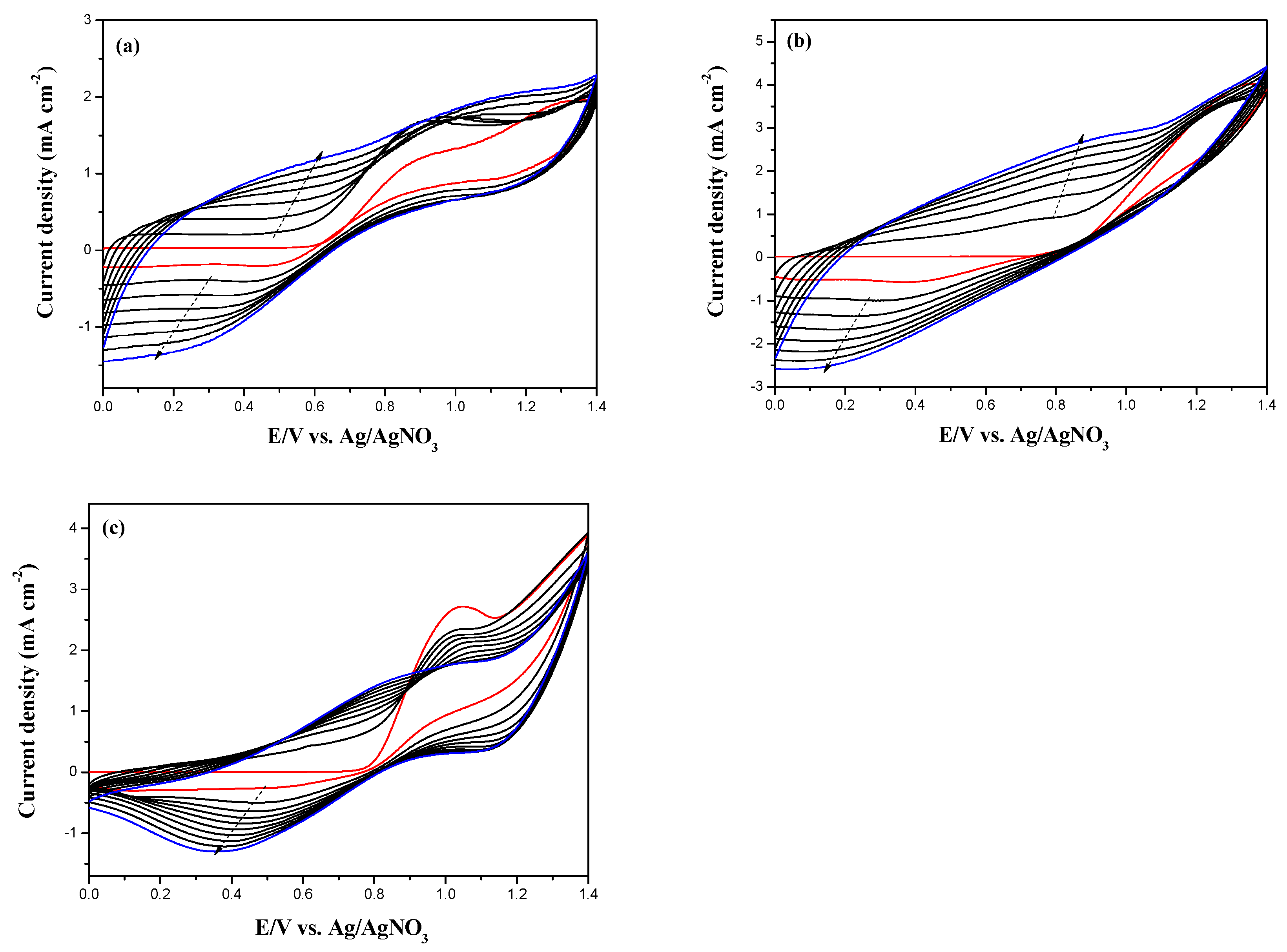
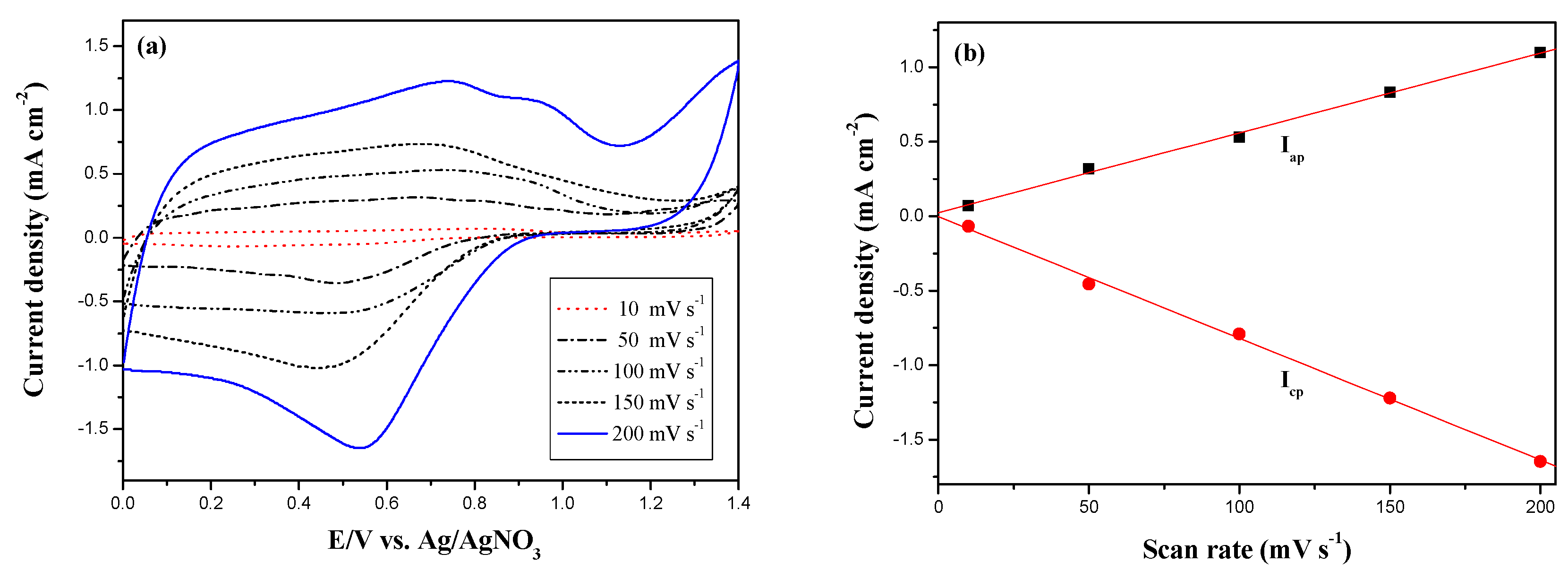
3.1. Electrochemical Polymerizations of PInc, PbT and P(Inc-co-bT) Films
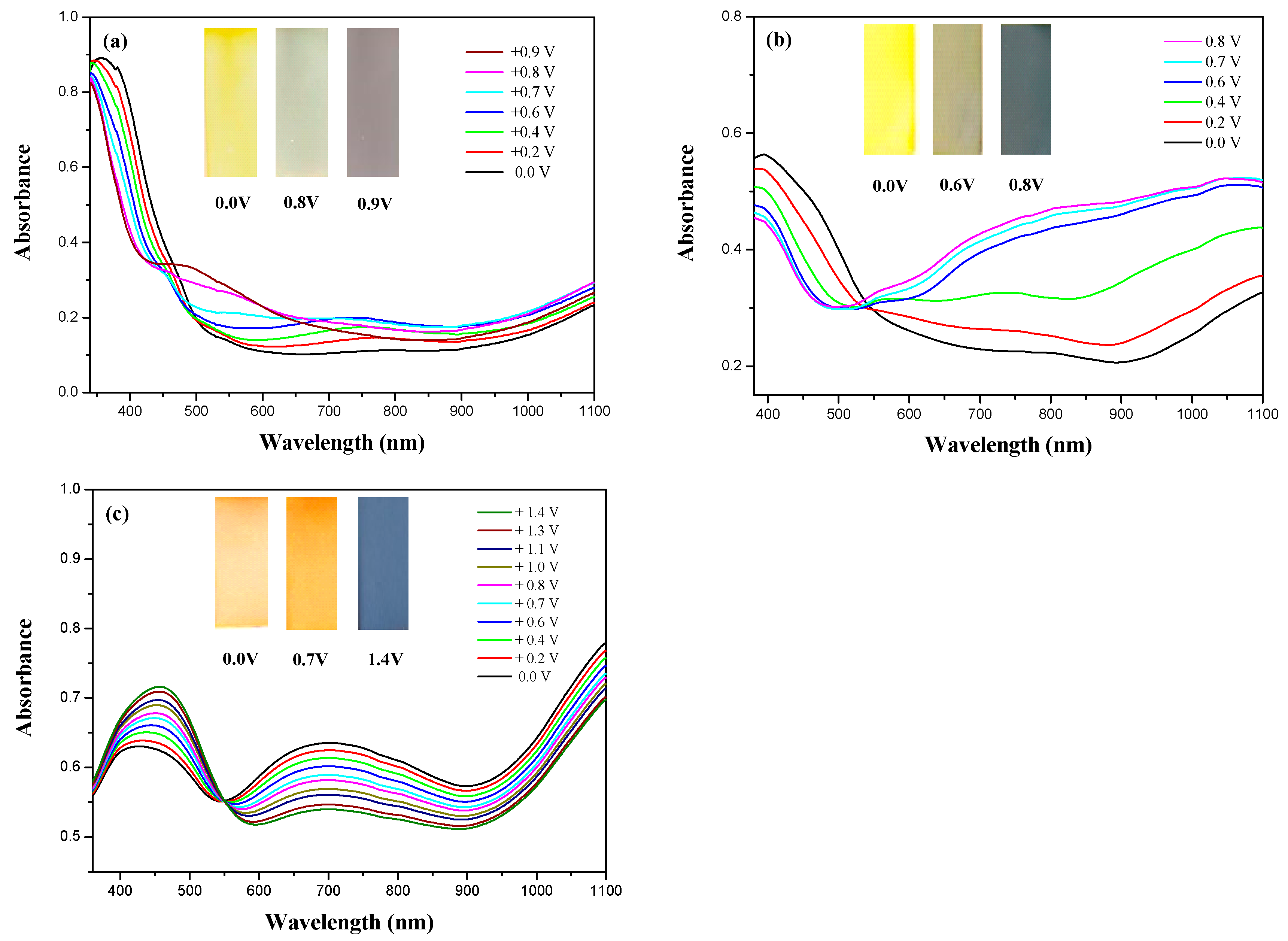
3.2. Spectroscopic Properties of PInc, P(Inc-co-bT), and PbT Films
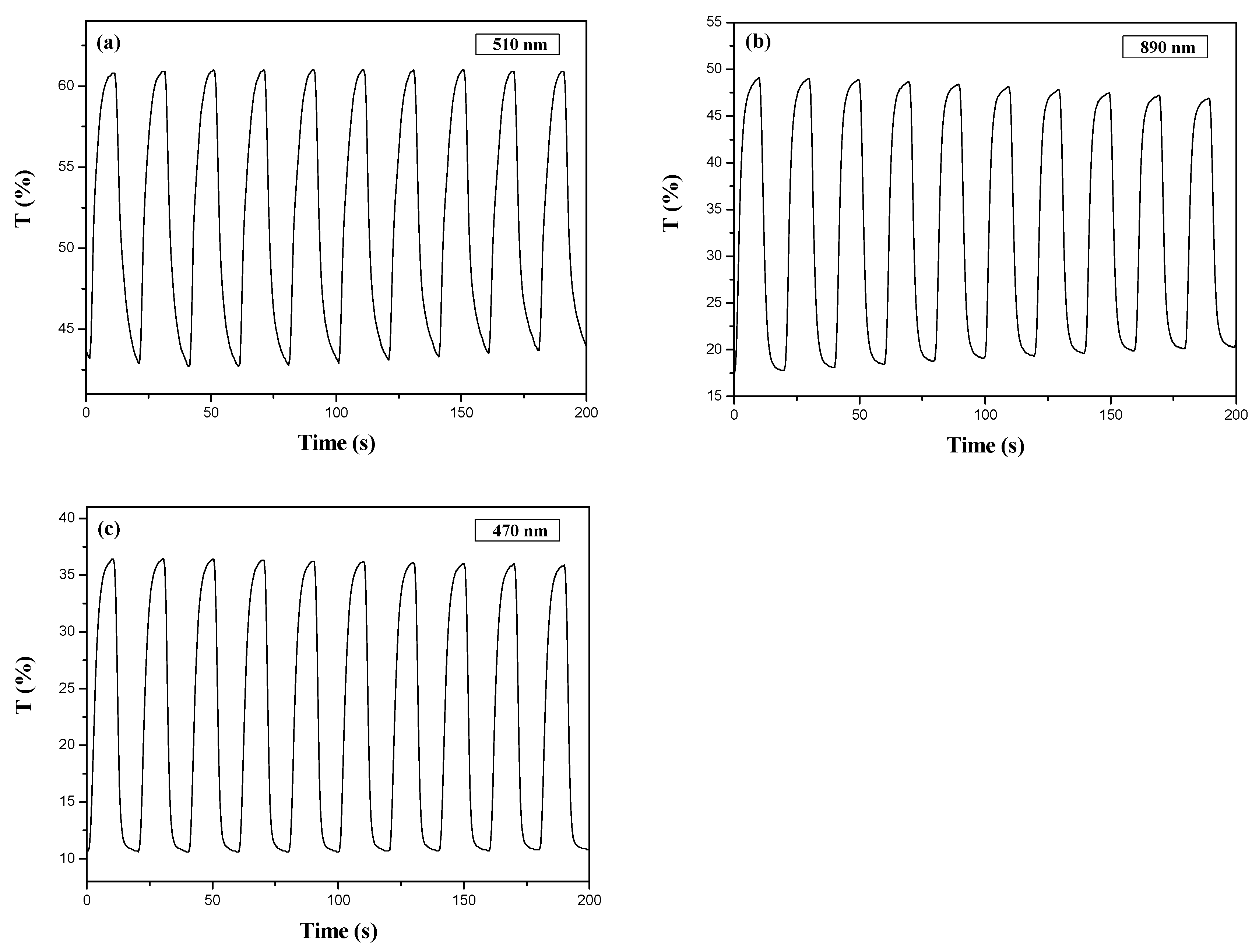
3.3. Electrochemical Switching of PInc, P(Inc-co-bT), and PbT Films
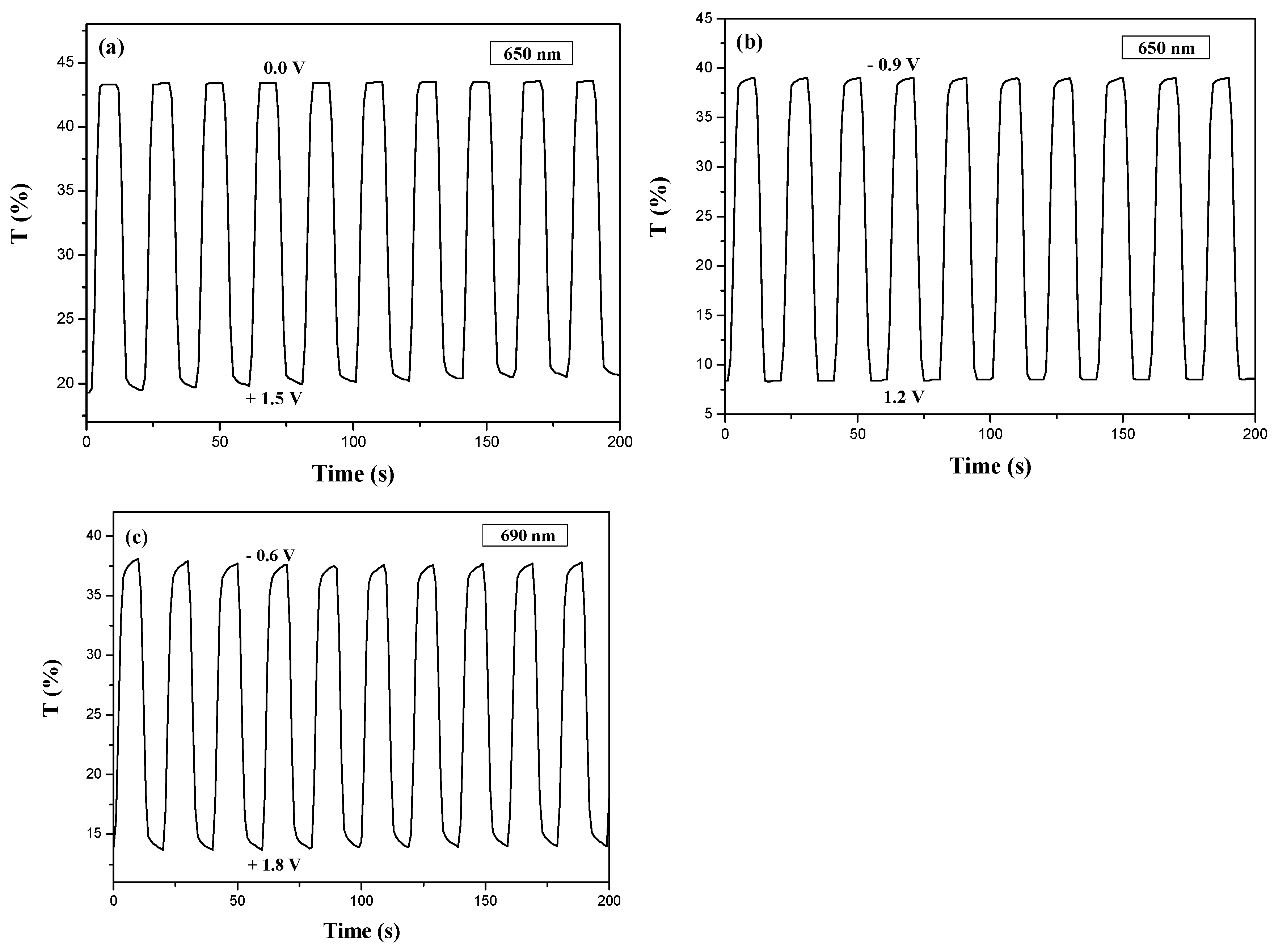
3.4. Spectroelectrochemistry of ECDs
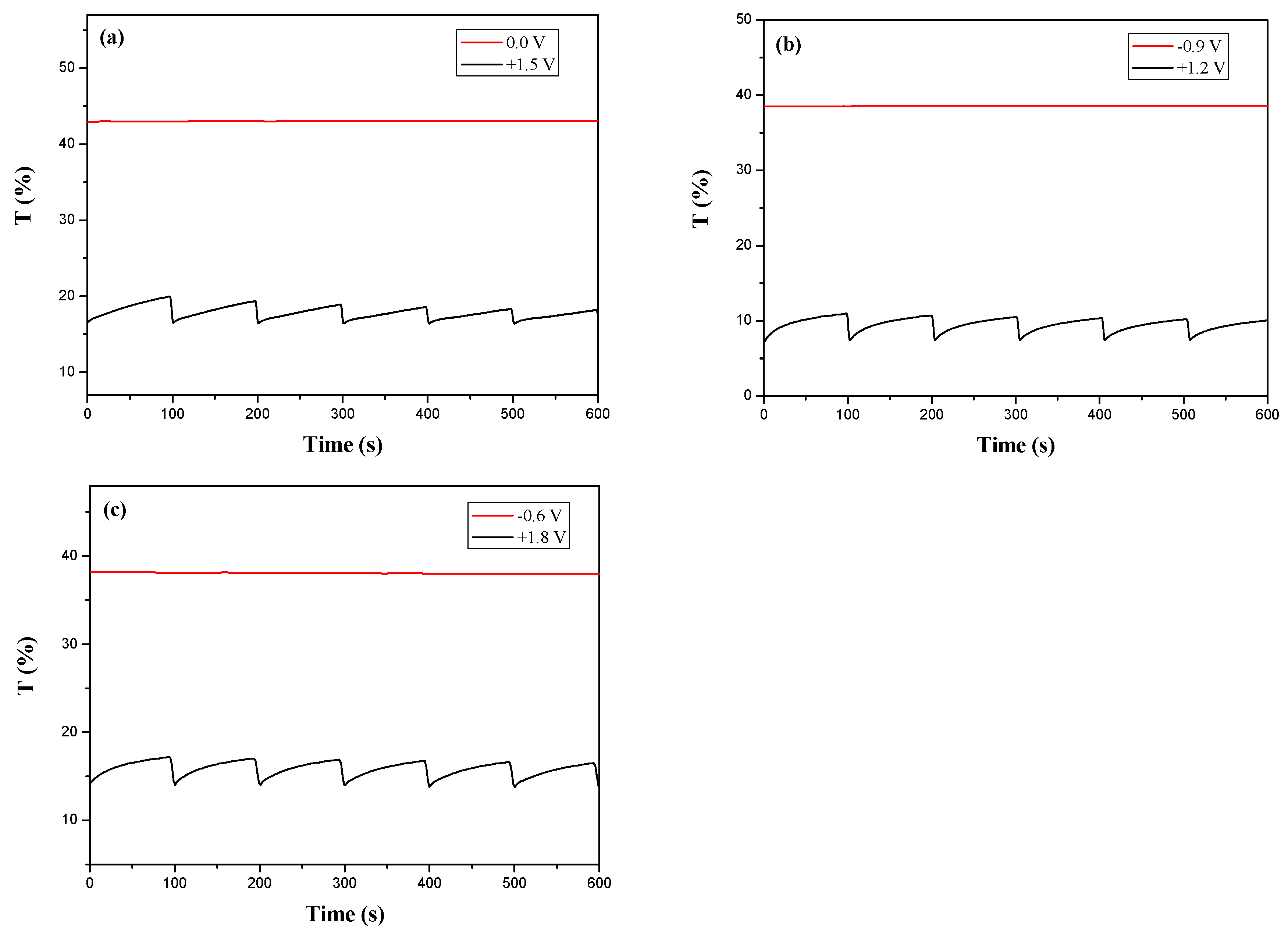
3.5. Long-Term Stability and Optical Memory Effect of ECDs
4. Conclusions
Acknowledgments
Author Contributions
Conflicts of Interest
References
- Beaujuge, P.M.; Reynolds, J.R. Color control in π-conjugated organic polymers for use in electrochromic devices. Chem. Rev. 2010, 110, 268–320. [Google Scholar] [CrossRef] [Scilit] [PubMed]
- Wang, R.; Yan, X.; Yang, X.; Wang, Y.; Li, H.; Sheng, C. Long lived photoexcitation dynamics in π-conjugated polymer/PbS quantum dot blended films for photovoltaic application. Polymers 2017, 9, 352. [Google Scholar] [CrossRef] [Scilit]
- Seshadri, V.; Padilla, J.; Bircan, H.; Radmard, B.; Draper, R.; Wood, M.; Otero, T.F.; Sotzing, G.A. Optimization, preparation, and electrical short evaluation for 30 cm2 active area dual conjugated polymer electrochromic windows. Org. Electron. 2007, 8, 367–381. [Google Scholar] [CrossRef] [Scilit]
- Kuo, C.-W.; Lee, P.-Y. Electrosynthesis of copolymers based on 1,3,5-tris(N-carbazolyl)benzene and 2,2′-bithiophene and their applications in electrochromic devices. Polymers 2017, 9, 518. [Google Scholar] [CrossRef] [Scilit]
- Hsiao, S.H.; Lin, S.W. The electrochemical fabrication of electroactive polymer films from diamide- or diimide-cored N-phenylcarbazole dendrons for electrochromic applications. J. Mater. Chem. C 2016, 4, 1271–1280. [Google Scholar] [CrossRef] [Scilit]
- Wu, T.Y.; Sheu, R.B.; Chen, Y. Synthesis, optically acid-sensory and electrochemical properties of novel polyoxadiazole derivatives. Macromolecules 2004, 37, 725–733. [Google Scholar] [CrossRef] [Scilit]
- Wu, T.Y.; Chen, Y. Poly(phenylene vinylene)-based copolymers containing 3,7-phenothiazylene and 2,6-pyridylene chromophores: Fluorescence sensors for acids, metal ions, and oxidation. J. Polym. Sci. Part A Polym. Chem. 2004, 42, 1272–1284. [Google Scholar] [CrossRef] [Scilit]
- Kuo, C.W.; Chen, S.J.; Chen, P.R.; Tsai, W.T.; Wu, T.Y. Doping process effect of polyaniline doped with poly(styrenesulfonic acid) supported platinum for methanol oxidation. J. Taiwan Inst. Chem. Eng. 2013, 44, 497–504. [Google Scholar] [CrossRef] [Scilit]
- Wu, T.Y.; Chen, P.R.; Chen, H.R.; Kuo, C.W. Preparation of Pt/poly(aniline-co-orthanilic acid)s nanocomposites and their applications for electrocatalytic oxidation of methanol. J. Taiwan Inst. Chem. Eng. 2016, 58, 458–466. [Google Scholar] [CrossRef] [Scilit]
- Wu, T.Y.; Kuo, C.W.; Chen, Y.L.; Chang, J.K. Copolymers based on indole-6-carboxylic acid and 3,4-ethylenedioxythiophene as platinum catalyst support for methanol oxidation. Catalysts 2015, 5, 1657–1672. [Google Scholar] [CrossRef] [Scilit]
- Wu, T.Y.; Chen, Y. Synthesis and characterization of novel luminescent polymers with alternate phenothiazine and divinylbenzene units. J. Polym. Sci. Part A Polym. Chem. 2002, 40, 4452–4462. [Google Scholar] [CrossRef] [Scilit]
- Al-Asbahi, B.A.; Haji Jumali, M.H.; AlSalhi, M.S. Enhanced Optoelectronic Properties of PFO/Fluorol 7GA Hybrid Light Emitting Diodes via Additions of TiO2 Nanoparticles. Polymers 2016, 8, 334. [Google Scholar] [CrossRef] [Scilit]
- Wu, T.Y.; Chen, Y. Synthesis, optical and electrochemical properties of novel copolymers containing alternate 2,3-quinoxaline and hole-transporting units. J. Polym. Sci. Part A Polym. Chem. 2002, 40, 4570–4580. [Google Scholar] [CrossRef] [Scilit]
- Lin, K.; Zhang, S.; Liu, H.; Zhao, Y.; Wang, Z.; Xu, J. Effects on the electrochemical and electrochromic properties of 3 linked polythiophene derivative by the introduction of polyacrylate. Int. J. Electrochem. Sci. 2015, 10, 7720–7731. [Google Scholar]
- Ming, S.; Zhang, S.; Liu, H.; Zhao, Y.; Mo, D.; Xu, J. Methacrylate modified polythiophene: Electrochemistry and electrochromics. Int. J. Electrochem. Sci. 2015, 10, 6598–6609. [Google Scholar]
- Soyleyici, S.; Karakus, M.; Ak, M. Transparent-blue colored dual type electrochromic device: Switchable glass application of conducting organic-inorganic hybrid carbazole polymer. J. Electrochem. Soc. 2016, 163, H679–H683. [Google Scholar] [CrossRef] [Scilit]
- Hsiao, S.-H.; Hsueh, J.-C. Electrochemical synthesis and electrochromic properties of new conjugated polycarbazoles from di(carbazol-9-yl)-substituted triphenylamine and N-phenylcarbazole derivatives. J. Electroanal. Chem. 2015, 758, 100–110. [Google Scholar] [CrossRef] [Scilit]
- Yu, W.; Chen, J.; Fu, Y.; Xu, J.; Nie, G. Electrochromic property of a copolymer based on 5-cyanoindole and 3,4-ethylenedioxythiophene and its application in electrochromic devices. J. Electroanal. Chem. 2013, 700, 17–23. [Google Scholar] [CrossRef] [Scilit]
- Wu, T.Y.; Li, W.B.; Kuo, C.W.; Chou, C.F.; Liao, J.W.; Chen, H.R.; Tseng, C.G. Study of poly(methyl methacrylate)-based gel electrolyte for electrochromic device. Int. J. Electrochem. Sci. 2013, 8, 10720–10732. [Google Scholar]
- Hsiao, S.-H.; Lu, H.-Y. Electrosynthesis of aromatic poly(amide-amine) films from triphenylamine-based electroactive compounds for electrochromic applications. Polymers 2017, 9, 708. [Google Scholar] [CrossRef] [Scilit]
- Krukiewicz, K.; Jarosz, T.; Herman, A.P.; Turczyn, R.; Boncel, S.; Zak, J.K. The effect of solvent on the synthesis and physicochemical properties of poly(3,4-ethylenedioxypyrrole). Synth. Met. 2016, 217, 231–236. [Google Scholar] [CrossRef] [Scilit]
- Wu, T.Y.; Chung, H.H. Applications of tris(4-(thiophen-2-yl)phenyl)amine- and dithienylpyrrole-based conjugated copolymers in high-contrast electrochromic devices. Polymers 2016, 8, 206. [Google Scholar] [CrossRef] [Scilit]
- Kuo, C.W.; Chen, B.K.; Li, W.B.; Tseng, L.Y.; Wu, T.Y.; Tseng, C.G.; Chen, H.R.; Huang, Y.C. Effects of supporting electrolytes on spectroelectrochemical and electrochromic properties of polyaniline-poly(styrene sulfonic acid) and poly(ethylenedioxythiophene)-poly(styrene sulfonic acid)-based electrochromic device. J. Chin. Chem. Soc. 2014, 61, 563–570. [Google Scholar] [CrossRef] [Scilit]
- Nie, G.; Zhang, Y.; Guo, Q.; Zhang, S. Label-free DNA detection based on a novel nanostructured conducting poly(indole-6-carboxylic acid) films. Sens. Actuators B Chem. 2009, 139, 592–597. [Google Scholar] [CrossRef] [Scilit]
- Yıldırım, M.; Kaya, I.; Aydın, A. Azomethine coupled fluorene–thiophene–pyrrole based copolymers: Electrochromic applications. React. Funct. Polym. 2013, 73, 1167–1174. [Google Scholar] [CrossRef] [Scilit]
- Hacioglu, S.O.; Yiğit, D.; Ermis, E.; Soylemez, S.; Güllü, M.; Toppare, L. Syntheses and electrochemical characterization of low oxidation potential nitrogen analogs of pedot as electrochromic materials. J. Electrochem. Soc. 2016, 163, E293–E299. [Google Scholar] [CrossRef] [Scilit]
- Carbas, B.B.; Kivrak, A.; Teke, E.; Zora, M.; Önal, A.M. Electrochemical polymerization of a new low-voltage oxidized thienylenepyrrole derivative and its electrochromic device application. J. Electroanal. Chem. 2014, 729, 15–20. [Google Scholar] [CrossRef] [Scilit]
- Chang, K.H.; Wang, H.P.; Wu, T.Y.; Sun, I.W. Optical and electrochromic characterizations of four 2,5-dithienylpyrrole-based conducting polymer films. Electrochim. Acta 2014, 119, 225–235. [Google Scholar] [CrossRef] [Scilit]
- Kuo, C.W.; Wu, T.Y.; Huang, M.W. Electrochromic characterizations of copolymers based on 4,4′-bis(N-carbazolyl)-1,1′-biphenyl and indole-6-carboxylic acid and their applications in electrochromic devices. J. Taiwan Inst. Chem. Eng. 2016, 68, 481–488. [Google Scholar] [CrossRef] [Scilit]
- Nie, G.; Zhou, L.; Guo, Q.; Zhang, S. A new electrochromic material from an indole derivative and its application in high-quality electrochromic devices. Electrochem. Commun. 2010, 12, 160–163. [Google Scholar] [CrossRef] [Scilit]
- Kuo, C.W.; Hsieh, T.H.; Hsieh, C.K.; Liao, J.W.; Wu, T.Y. Electrosynthesis and characterization of four electrochromic polymers based on carbazole and indole-6-carboxylic acid and their applications in high-contrast electrochromic devices. J. Electrochem. Soc. 2014, 161, D782–D790. [Google Scholar] [CrossRef] [Scilit]
- Kuo, C.W.; Wu, T.L.; Lin, Y.C.; Chang, J.K.; Chen, H.R.; Wu, T.Y. Copolymers based on 1,3-bis(carbazol-9-yl)benzene and three 3,4-ethylenedioxythiophene derivatives as potential anodically coloring copolymers in high-contrast electrochromic devices. Polymers 2016, 8, 368. [Google Scholar] [CrossRef] [Scilit]
- Wu, T.Y.; Li, J.L. Electrochemical synthesis, optical, electrochemical and electrochromic characterizations of indene and 1,2,5-thiadiazole-based poly(2,5-dithienylpyrrole) derivatives. RSC Adv. 2016, 6, 15988–15998. [Google Scholar] [CrossRef] [Scilit]
- Su, Y.S.; Chang, J.C.; Wu, T.Y. Applications of three dithienylpyrroles-based electrochromic polymers in high-contrast electrochromic devices. Polymers 2017, 9, 114. [Google Scholar] [CrossRef] [Scilit]
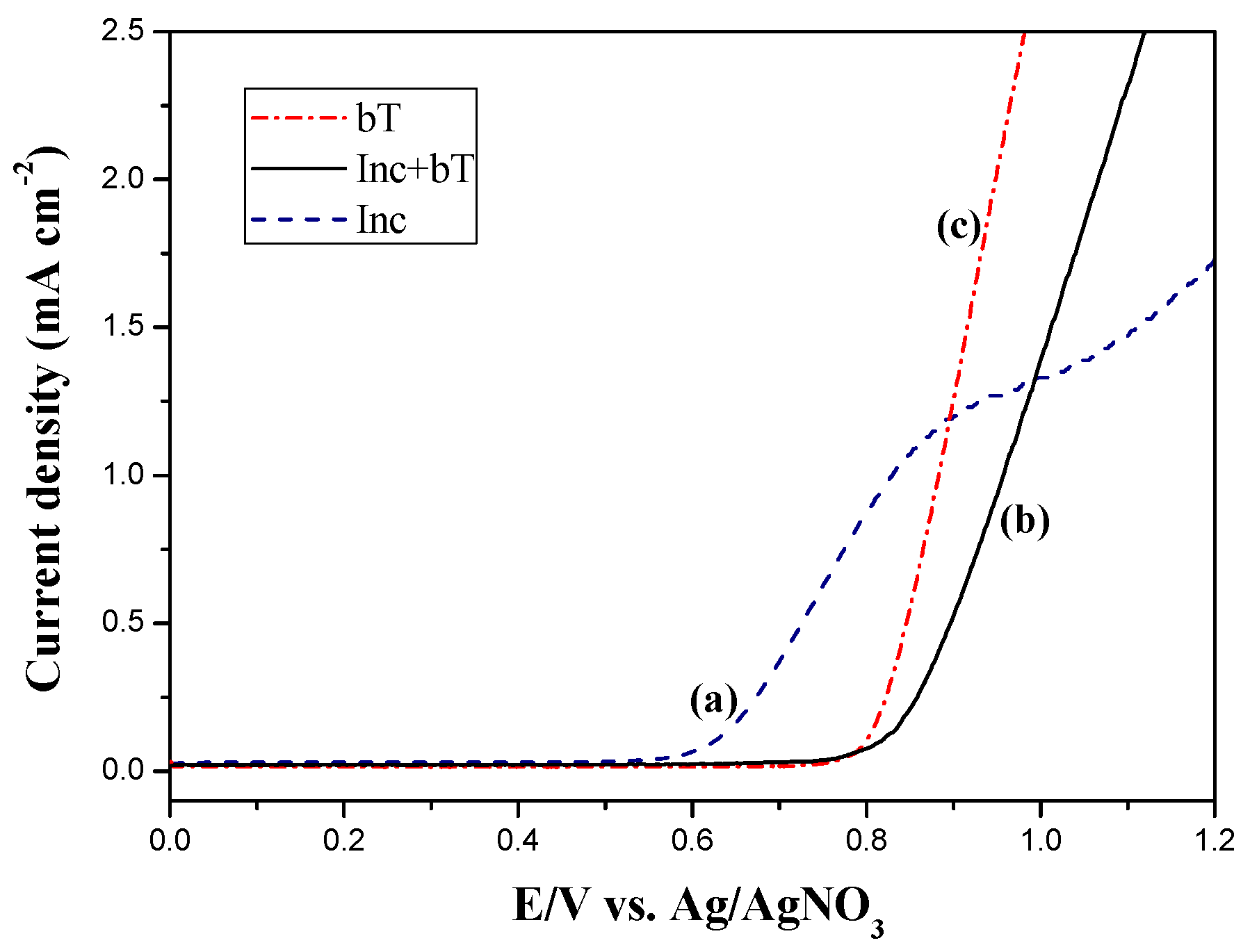


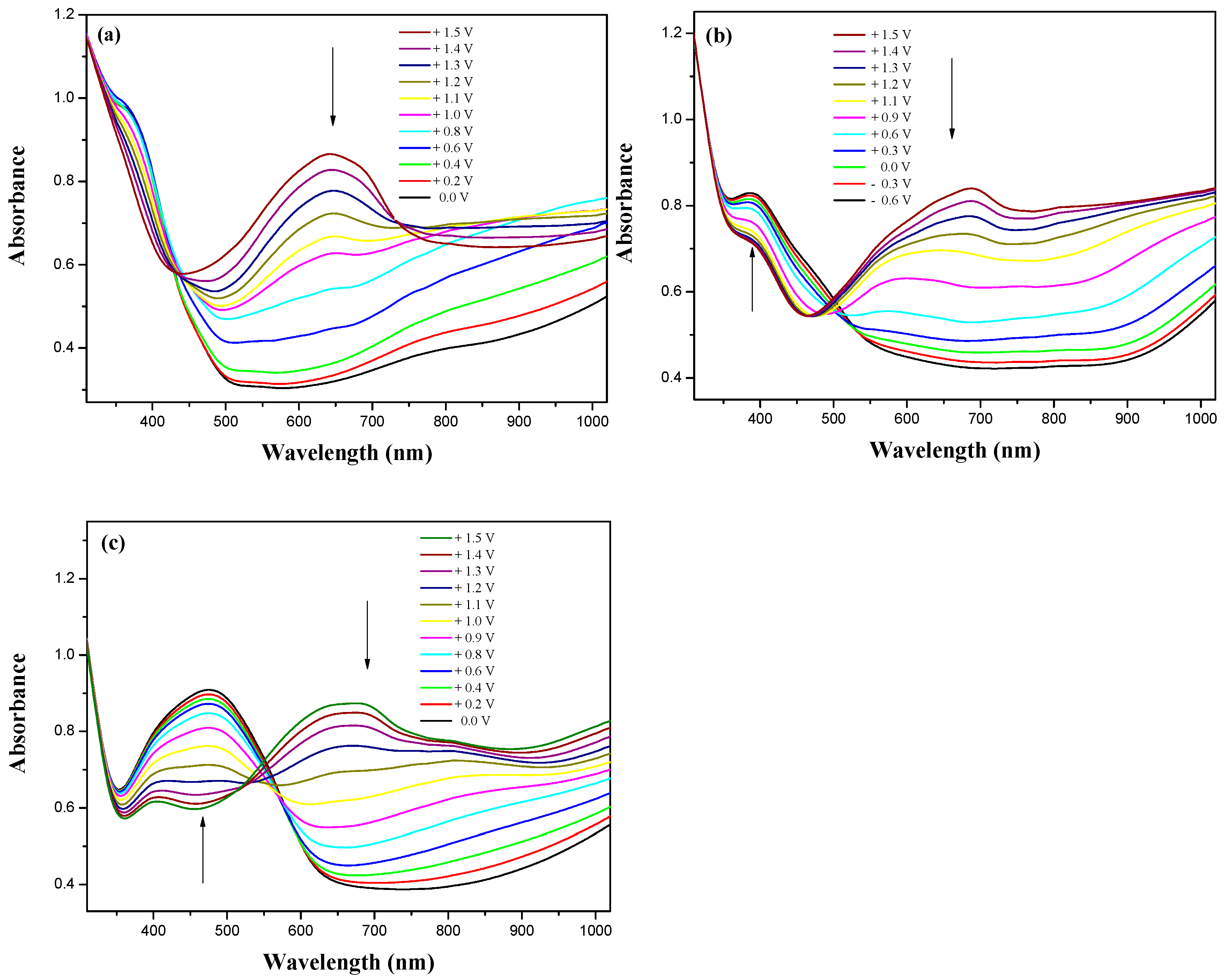


| Electrodes | Anodic Polymers | Feed Species of Anodic Polymer | Feed Molar Ratio of Anodic Polymer |
|---|---|---|---|
| (a) | PInc | 4 mM Inc. | Neat Inc. |
| (b) | P(Inc-co-bT) | 4 mM Inc. + 4 mM bT | 1:1 |
| (c) | PbT | 4 mM bT | Neat bT |
| Polymer Electrodes | λ (nm) a | Tox | Tred | ∆T | ∆OD | Qd (mC cm−2) | η (cm2 C−1) | τc (s) | τb (s) |
|---|---|---|---|---|---|---|---|---|---|
| PInc | 510 | 43.4 | 61.8 | 17.8 | 0.153 | 3.73 | 41 | 4.0 | 6.5 |
| P(Inc-co-bT) | 890 | 18.0 | 48.2 | 30.2 | 0.428 | 3.80 | 112 | 3.5 | 5.0 |
| PbT | 470 | 11.0 | 38.0 | 27.0 | 0.538 | 4.80 | 113 | 3.0 | 5.2 |
| ECDs | λ (nm) a | Tox | Tred | ∆T | ∆OD | Qd (mC cm−2) | η (cm2 C−1) | τc (s) | τb (s) |
|---|---|---|---|---|---|---|---|---|---|
| PInc/PEDOT-PSS | 650 | 18.2 | 43.2 | 25.0 | 0.375 | 0.90 | 416.7 | 2.5 | 3.5 |
| P(Inc-co-bT)/PEDOT-PSS | 650 | 8.0 | 39.0 | 31.0 | 0.688 | 2.22 | 320.0 | 0.8 | 1.4 |
| PbT/PEDOT-PSS | 690 | 14.0 | 38.5 | 24.5 | 0.439 | 1.65 | 266.1 | 1.2 | 1.5 |
| ECD Configuration | ΔTmax (%) | ηmax (cm2 C−1) | τc (s) | τb (s) | Ref. |
|---|---|---|---|---|---|
| PInc/PProDOT-Et2 | 22.0 (580 nm) | 186 | 1.4 | 5.0 | [29] |
| PIn/PEDOT | 45.0 (600 nm) | 510 | 1.0 | 1.0 | [30] |
| P(Cz-co-CIn)/PProDOT-Me2 | 32.0 (575 nm) | 372.7 | 4.3 | 4.4 | [31] |
| P(Inc-co-bT)/PEDOT-PSS | 31.0 (650 nm) | 320.0 | 0.8 | 1.4 | This work |
© 2018 by the authors. Licensee MDPI, Basel, Switzerland. This article is an open access article distributed under the terms and conditions of the Creative Commons Attribution (CC BY) license (http://creativecommons.org/licenses/by/4.0/).
Share and Cite
Kuo, C.-W.; Wu, T.-Y.; Fan, S.-C. Applications of Poly(indole-6-carboxylic acid-co-2,2′-bithiophene) Films in High-Contrast Electrochromic Devices. Coatings 2018, 8, 102. https://doi.org/10.3390/coatings8030102
Kuo C-W, Wu T-Y, Fan S-C. Applications of Poly(indole-6-carboxylic acid-co-2,2′-bithiophene) Films in High-Contrast Electrochromic Devices. Coatings. 2018; 8(3):102. https://doi.org/10.3390/coatings8030102
Chicago/Turabian StyleKuo, Chung-Wen, Tzi-Yi Wu, and Shu-Chien Fan. 2018. "Applications of Poly(indole-6-carboxylic acid-co-2,2′-bithiophene) Films in High-Contrast Electrochromic Devices" Coatings 8, no. 3: 102. https://doi.org/10.3390/coatings8030102
APA StyleKuo, C.-W., Wu, T.-Y., & Fan, S.-C. (2018). Applications of Poly(indole-6-carboxylic acid-co-2,2′-bithiophene) Films in High-Contrast Electrochromic Devices. Coatings, 8(3), 102. https://doi.org/10.3390/coatings8030102