<?xml version="1.0" encoding="UTF-8"?>
<!DOCTYPE article PUBLIC "-//NLM//DTD Journal Publishing DTD v2.3 20070202//EN" "journalpublishing.dtd">
<article xmlns:mml="http://www.w3.org/1998/Math/MathML" xmlns:xlink="http://www.w3.org/1999/xlink" xml:lang="en" article-type="research-article">
  <front>
    <journal-meta>
      <journal-id journal-id-type="publisher-id">nanomaterials</journal-id>
      <journal-title>Nanomaterials</journal-title>
      <abbrev-journal-title abbrev-type="publisher">Nanomaterials</abbrev-journal-title>
      <abbrev-journal-title abbrev-type="pubmed">Nanomaterials</abbrev-journal-title>
      <issn pub-type="epub">2079-4991</issn>
      <publisher>
        <publisher-name>MDPI</publisher-name>
      </publisher>
    </journal-meta>
    <article-meta>
      <article-id pub-id-type="doi">10.3390/nano2020134</article-id>
      <article-id pub-id-type="publisher-id">nanomaterials-02-00134</article-id>
      <article-categories>
        <subj-group>
          <subject>Article</subject>
        </subj-group>
      </article-categories>
      <title-group>
        <article-title>Iron Oxide Nanocrystals for Magnetic Hyperthermia Applications</article-title>
      </title-group>
      
      <contrib-group>
        <contrib contrib-type="author">
          <name>
            <surname>Armijo</surname>
            <given-names>Leisha M.</given-names>
          </name>
          <xref rid="af1-nanomaterials-02-00134" ref-type="aff">1</xref>
        </contrib>
        <contrib contrib-type="author">
          <name>
            <surname>Brandt</surname>
            <given-names>Yekaterina I.</given-names>
          </name>
          <xref rid="af1-nanomaterials-02-00134" ref-type="aff">1</xref>
        </contrib>
        <contrib contrib-type="author">
          <name>
            <surname>Mathew</surname>
            <given-names>Dimple</given-names>
          </name>
          <xref rid="af1-nanomaterials-02-00134" ref-type="aff">1</xref>
        </contrib>
        <contrib contrib-type="author">
          <name>
            <surname>Yadav</surname>
            <given-names>Surabhi</given-names>
          </name>
          <xref rid="af1-nanomaterials-02-00134" ref-type="aff">1</xref>
          <xref rid="fn1-nanomaterials-02-00134" ref-type="fn">†</xref>
        </contrib>
        <contrib contrib-type="author">
          <name>
            <surname>Maestas</surname>
            <given-names>Salomon</given-names>
          </name>
          <xref rid="af1-nanomaterials-02-00134" ref-type="aff">1</xref>
        </contrib>
        <contrib contrib-type="author">
          <name>
            <surname>Rivera</surname>
            <given-names>Antonio C.</given-names>
          </name>
          <xref rid="af1-nanomaterials-02-00134" ref-type="aff">1</xref>
        </contrib>
        <contrib contrib-type="author">
          <name>
            <surname>Cook</surname>
            <given-names>Nathaniel C.</given-names>
          </name>
          <xref rid="af1-nanomaterials-02-00134" ref-type="aff">1</xref>
        </contrib>
        <contrib contrib-type="author">
          <name>
            <surname>Withers</surname>
            <given-names>Nathan J.</given-names>
          </name>
          <xref rid="af1-nanomaterials-02-00134" ref-type="aff">1</xref>
        </contrib>
        <contrib contrib-type="author">
          <name>
            <surname>Smolyakov</surname>
            <given-names>Gennady A.</given-names>
          </name>
          <xref rid="af1-nanomaterials-02-00134" ref-type="aff">1</xref>
        </contrib>
        <contrib contrib-type="author">
          <name>
            <surname>Adolphi</surname>
            <given-names>Natalie</given-names>
          </name>
          <xref rid="af2-nanomaterials-02-00134" ref-type="aff">2</xref>
        </contrib>
        <contrib contrib-type="author">
          <name>
            <surname>Monson</surname>
            <given-names>Todd C.</given-names>
          </name>
          <xref rid="af3-nanomaterials-02-00134" ref-type="aff">3</xref>
        </contrib>
        <contrib contrib-type="author">
          <name>
            <surname>Huber</surname>
            <given-names>Dale L.</given-names>
          </name>
          <xref rid="af4-nanomaterials-02-00134" ref-type="aff">4</xref>
        </contrib>
        <contrib contrib-type="author">
          <name>
            <surname>Smyth</surname>
            <given-names>Hugh D. C.</given-names>
          </name>
          <xref rid="af5-nanomaterials-02-00134" ref-type="aff">5</xref>
        </contrib>
        <contrib contrib-type="author">
          <name>
            <surname>Osiński</surname>
            <given-names>Marek</given-names>
          </name>
          <xref rid="af1-nanomaterials-02-00134" ref-type="aff">1</xref>
          <xref rid="c1-nanomaterials-02-00134" ref-type="corresp">*</xref>
        </contrib>
      </contrib-group>
      <aff id="af1-nanomaterials-02-00134"><label>1 </label>Center for High Technology Materials, 1313 Goddard SE, University of New Mexico, Albuquerque, NM 87106, USA; Email: <email>leishyne@unm.edu</email> (L.M.A.); <email>ybrandt@salud.unm.edu</email> (Y.I.B.); <email>dmathew@chtm.unm.edu</email> (D.M.); <email>surabhi.iitd@gmail.com</email> (S.Y.); <email>salomon@unm.edu</email> (S.M.); <email>arivera@chtm.unm.edu</email> (A.C.R.); <email>ncook93@unm.edu</email> (N.C.C.); <email>nwithers@chtm.unm.edu</email> (N.J.W.); <email>gen@chtm.unm.edu</email> (G.A.S.)</aff>
      <aff id="af2-nanomaterials-02-00134"><label>2 </label>Department of Biochemistry and Molecular Biology, Health Sciences Center, University of New Mexico, Albuquerque, NM 87131, USA; Email: <email>nadolphi@salud.unm.edu</email></aff>
      <aff id="af3-nanomaterials-02-00134"><label>3 </label>Sandia National Laboratories, Nanomaterials Sciences, P.O. Box 5800, MS 1415, Albuquerque, NM 87185, USA; Email: <email>tmonson@sandia.gov</email></aff>
      <aff id="af4-nanomaterials-02-00134"><label>4 </label>Center for Integrated Nanotechnologies, Sandia National Laboratories, 1000 Eubank SE, Albuquerque, NM 87123, USA; Email: <email>dlhuber@sandia.gov</email></aff>
      <aff id="af5-nanomaterials-02-00134"><label>5 </label>College of Pharmacy, University of Texas at Austin, Austin, TX 78712, USA; Email: <email>hsmyth@mail.utexas.edu</email></aff>
      <author-notes>
        <fn id="fn1-nanomaterials-02-00134">
          <label>†</label>
          <p>Present address: Department of Biochemical Engineering and Biotechnology, Indian Institute of Technology, New Delhi, Delhi 28.55/77.267, India.</p>
        </fn>
        <corresp id="c1-nanomaterials-02-00134"><label>*</label> Author  to whom correspondence should be addressed; Email: <email>osinski@chtm.unm.edu</email>; Tel.: +1-505-272-7812; Fax: +1-505-272-7801.</corresp>
      </author-notes>
      <pub-date pub-type="epub">
        <day>07</day>
        <month>05</month>
        <year>2012</year>
      </pub-date>
      <pub-date pub-type="collection">
        <month>06</month>
        <year>2012</year>
      </pub-date>
      <volume>2</volume>
      <issue>2</issue>
      <fpage>134</fpage>
      <lpage>146</lpage>
      <history>
        <date date-type="received">
          <day>11</day>
          <month>03</month>
          <year>2012</year>
        </date>
        <date date-type="accepted">
          <day>25</day>
          <month>04</month>
          <year>2012</year>
        </date>
      </history>
      <permissions>
        <copyright-statement>© 2012 by the authors; licensee MDPI, Basel, Switzerland.</copyright-statement>
        <copyright-year>2012</copyright-year>
        <license xmlns:xlink="http://www.w3.org/1999/xlink" license-type="open-access" xlink:href="http://creativecommons.org/licenses/by/3.0/">
          <p>This article is an open-access article distributed under the terms and conditions of the Creative Commons Attribution license (http://creativecommons.org/licenses/by/3.0/).</p>
        </license>
      </permissions>
      <abstract>
        <p>Magnetic nanocrystals have been investigated extensively in the past several years for several potential applications, such as information technology, MRI contrast agents, and for drug conjugation and delivery. A specific property of interest in biomedicine is magnetic hyperthermia—an increase in temperature resulting from the thermal energy released by magnetic nanocrystals in an external alternating magnetic field. Iron oxide nanocrystals of various sizes and morphologies were synthesized and tested for specific losses (heating power) using frequencies of 111.1 kHz and 629.2 kHz, and corresponding magnetic field strengths of 9 and 25 mT. Polymorphous nanocrystals as well as spherical nanocrystals and nanowires in paramagnetic to ferromagnetic size range exhibited good heating power. A remarkable 30 °C temperature increase was observed in a nanowire sample at 111 kHz and magnetic field of 25 mT (19.6 kA/m), which is very close to the typical values of 100 kHz and 20 mT used in medical treatments.</p>
      </abstract>
      <kwd-group>
        <kwd>iron oxide nanocrystals</kwd>
        <kwd>hyperthermia</kwd>
        <kwd>thermotherapy</kwd>
        <kwd>ferrofluid</kwd>
      </kwd-group>
    </article-meta>
  </front>
  <body>
    <sec sec-type="intro">
      <title>1. Introduction</title>
      <p>Iron oxide nanocrystals are ideal materials for biomedical applications, due to their well-established biocompatibility [<xref ref-type="bibr" rid="B1-nanomaterials-02-00134">1</xref>] and inherent multifunctionality [<xref ref-type="bibr" rid="B2-nanomaterials-02-00134">2</xref>]. For example, iron oxide nanoparticles have received FDA approval for use in humans in magnetic resonance imaging (MRI) as contrast agents [<xref ref-type="bibr" rid="B3-nanomaterials-02-00134">3</xref>,<xref ref-type="bibr" rid="B4-nanomaterials-02-00134">4</xref>]. They have also been tested in Phase 1 and Phase 2 trials for hyperthermic antitumor therapy in Germany, and seem to exhibit no systemic toxicity [<xref ref-type="bibr" rid="B5-nanomaterials-02-00134">5</xref>,<xref ref-type="bibr" rid="B6-nanomaterials-02-00134">6</xref>]. This application exploits the ability of magnetic nanoparticles to release thermal energy upon placement in an external oscillating magnetic field (magnetic hyperthermia) [<xref ref-type="bibr" rid="B7-nanomaterials-02-00134">7</xref>,<xref ref-type="bibr" rid="B8-nanomaterials-02-00134">8</xref>]. In addition, magnetic nanoparticles hold potential as efficient drug carriers [<xref ref-type="bibr" rid="B9-nanomaterials-02-00134">9</xref>,<xref ref-type="bibr" rid="B10-nanomaterials-02-00134">10</xref>], since they may be guided by the magnetic field toward a specific area of interest, thereby reducing the required dose and eliminating systemic side effects.</p>
      <p>In the frequency range suitable for human patient treatment, three potential mechanisms are implicated in heating: Néel relaxation, Brownian motion relaxation, and hysteresis losses in the ferro-ferrimagnetic size range. This phenomenon is exploited in the application of hyperthermic tumor destruction, or thermotherapy. Furthermore, thermal energy from magnetic hyperthermia can potentially be used to trigger drug release from the nanocrystals, once the magnetic nanocrystals have reached the area of interest.</p>
      <p>In this paper, we report on the synthesis and characterization of iron oxide nanocrystals capped with polyethylene glycol (PEG) to enhance solubility of nanocrystals in water and reduce their oxidation and aggregation. Iron oxide nanocrystals of various sizes and morphologies were synthesized and characterized by transmission electron microscopy (TEM), X-ray diffraction (XRD), and energy dispersive X-ray spectroscopy (EDS), and tested for magnetic hyperthermia using the Magnetherm system manufactured by NanoTherics, Ltd.</p>
    </sec>
    <sec sec-type="results">
      <title>2. Results and Discussion</title>
      <sec>
        <title>2.1. Synthesis of Colloidal Nanocrystals</title>
        <p>Iron oxide nanocrystals were synthesized in a high boiling point solvent consisting of inert hydrocarbons and capped with PEG. For the synthesis we used a modified procedure published elsewhere [<xref ref-type="bibr" rid="B11-nanomaterials-02-00134">11</xref>]. Our modifications to it yielded nanocrystals of various sizes and morphologies. Polymorphous nanocrystals as well as spherical nanocrystals and nanowires were obtained by varying the temperature of the synthesis through the use of an appropriate solvent. For hyperthermia experiments, nanocrystals in the superparamagnetic to ferromagnetic size range of ~20 nm were chosen.</p>
      </sec>
      <sec>
        <title>2.2. Structural Characterization</title>
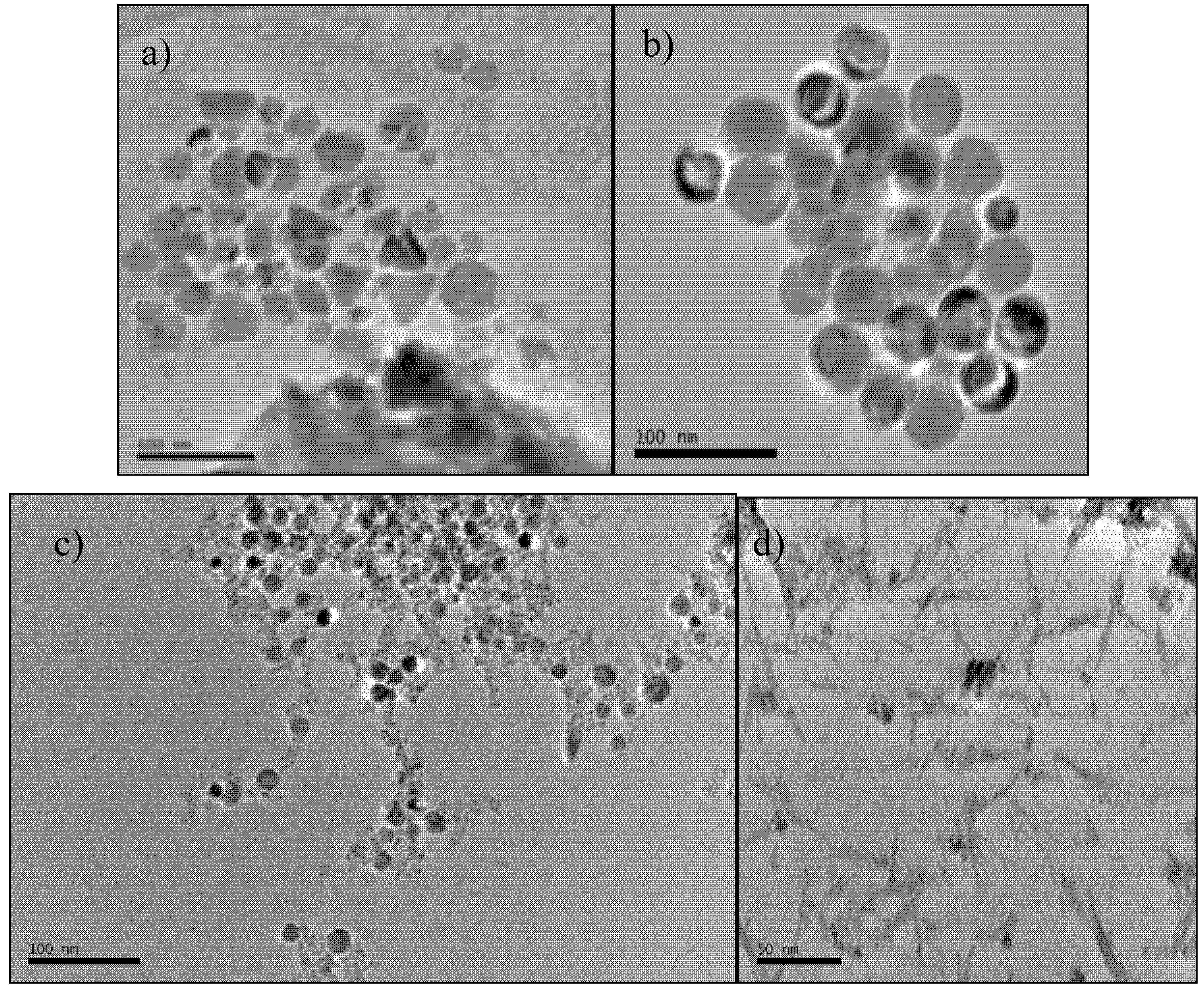
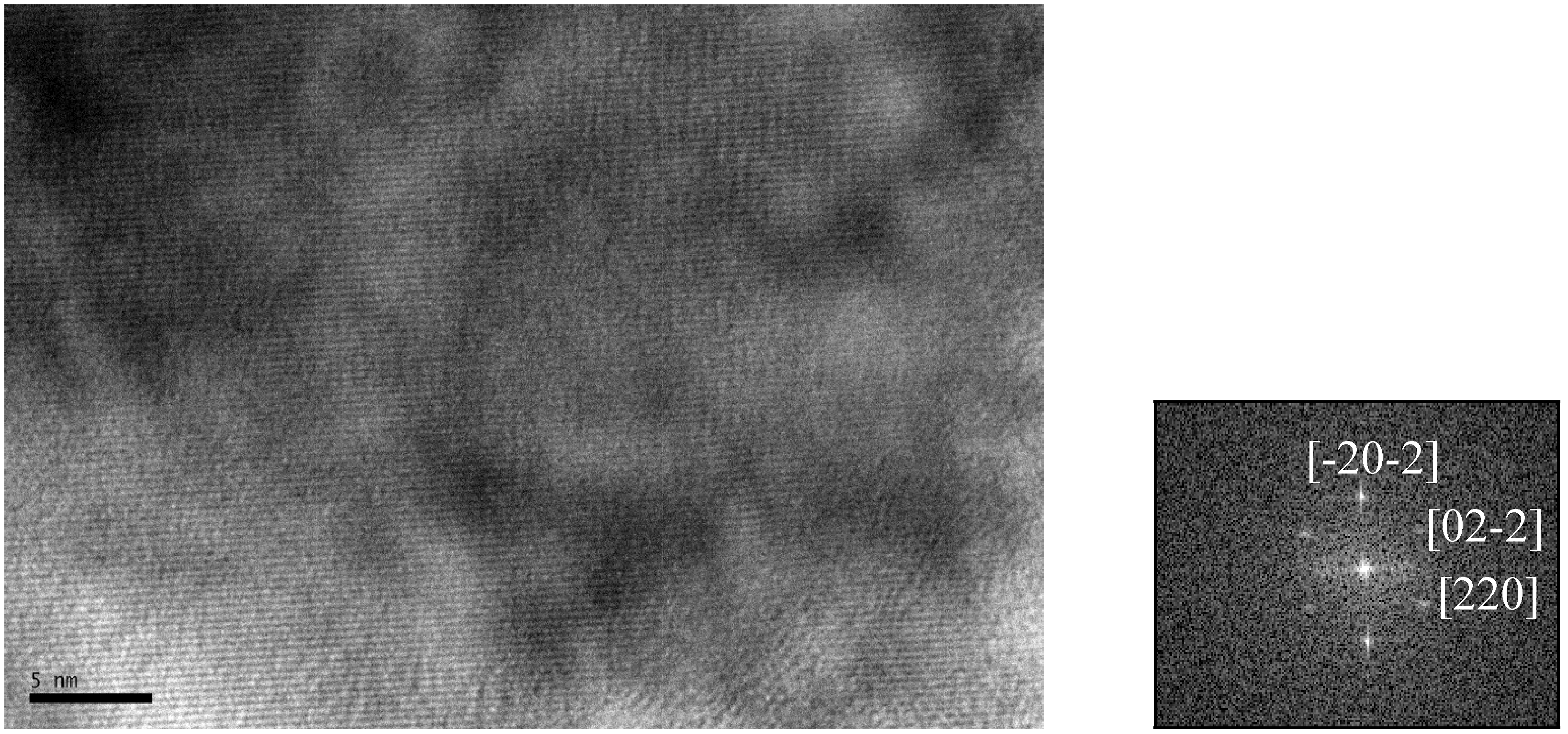
        <p>The TEM images in <xref ref-type="fig" rid="nanomaterials-02-00134-f001">Figure 1</xref>, <xref ref-type="fig" rid="nanomaterials-02-00134-f002">Figure 2</xref> show the various morphologies and sizes of Fe<sub>3</sub>O<sub>4</sub> nanocrystals we were able to obtain prior to PEG capping. Polymorphous nanocrystals shown in <xref ref-type="fig" rid="nanomaterials-02-00134-f001">Figure 1</xref>a were obtained with eicosane solvent (342.7 °C boiling point). Monodisperse spheres with a diameter of ~ 30 nm in <xref ref-type="fig" rid="nanomaterials-02-00134-f001">Figure 1</xref>b formed from polymorphous nanocrystals shown in <xref ref-type="fig" rid="nanomaterials-02-00134-f001">Figure 1</xref>a) when the reaction mixture was allowed to cool for 30 min before being refluxed again. Spheres of ~22 nm in diameter (<xref ref-type="fig" rid="nanomaterials-02-00134-f001">Figure 1</xref>c and nanowires 55 × 2 nm (<xref ref-type="fig" rid="nanomaterials-02-00134-f001">Figure 1</xref>d) were made in <italic>n</italic>-docosane (boiling point 370 °C) and <italic>n</italic>-dodecane (boiling point 216.2 °C), respectively. We performed high-resolution TEM to confirm high crystallinity of the nanocrystals. Image in <xref ref-type="fig" rid="nanomaterials-02-00134-f002">Figure 2</xref> represents fringes observed for the monodisperse spheres from <xref ref-type="fig" rid="nanomaterials-02-00134-f001">Figure 1</xref>b. </p>
        <fig id="nanomaterials-02-00134-f001" position="anchor">
          <label>Figure 1</label>
          <caption>
            <p>Transmission electron microscopy (TEM) images of Fe<sub>3</sub>O<sub>4</sub> nanocrystals prior to polyethylene glycol (PEG) capping: (<bold>a</bold>) polymorphous nanocrystals, scale bar 100 nm; (<bold>b</bold>) monodisperse spheres formed from polymorphous nanocrystals, scale bar 100 nm; (<bold>c</bold>) monodispere spheres ~22 nm in diameter, scale bar 100 nm; (<bold>d</bold>) nanowires, scale bar 50 nm.</p>
          </caption>
          <graphic xmlns:xlink="http://www.w3.org/1999/xlink" xlink:href="nanomaterials-02-00134-g001.tif"/>
        </fig>
        <fig id="nanomaterials-02-00134-f002" position="anchor">
          <label>Figure 2</label>
          <caption>
            <p>High-resolution TEM image and its Fast Fourier transform for the monodisperse spheres shown in <xref ref-type="fig" rid="nanomaterials-02-00134-f001">Figure 1</xref>b above.</p>
          </caption>
          <graphic xmlns:xlink="http://www.w3.org/1999/xlink" xlink:href="nanomaterials-02-00134-g002.tif"/>
        </fig>
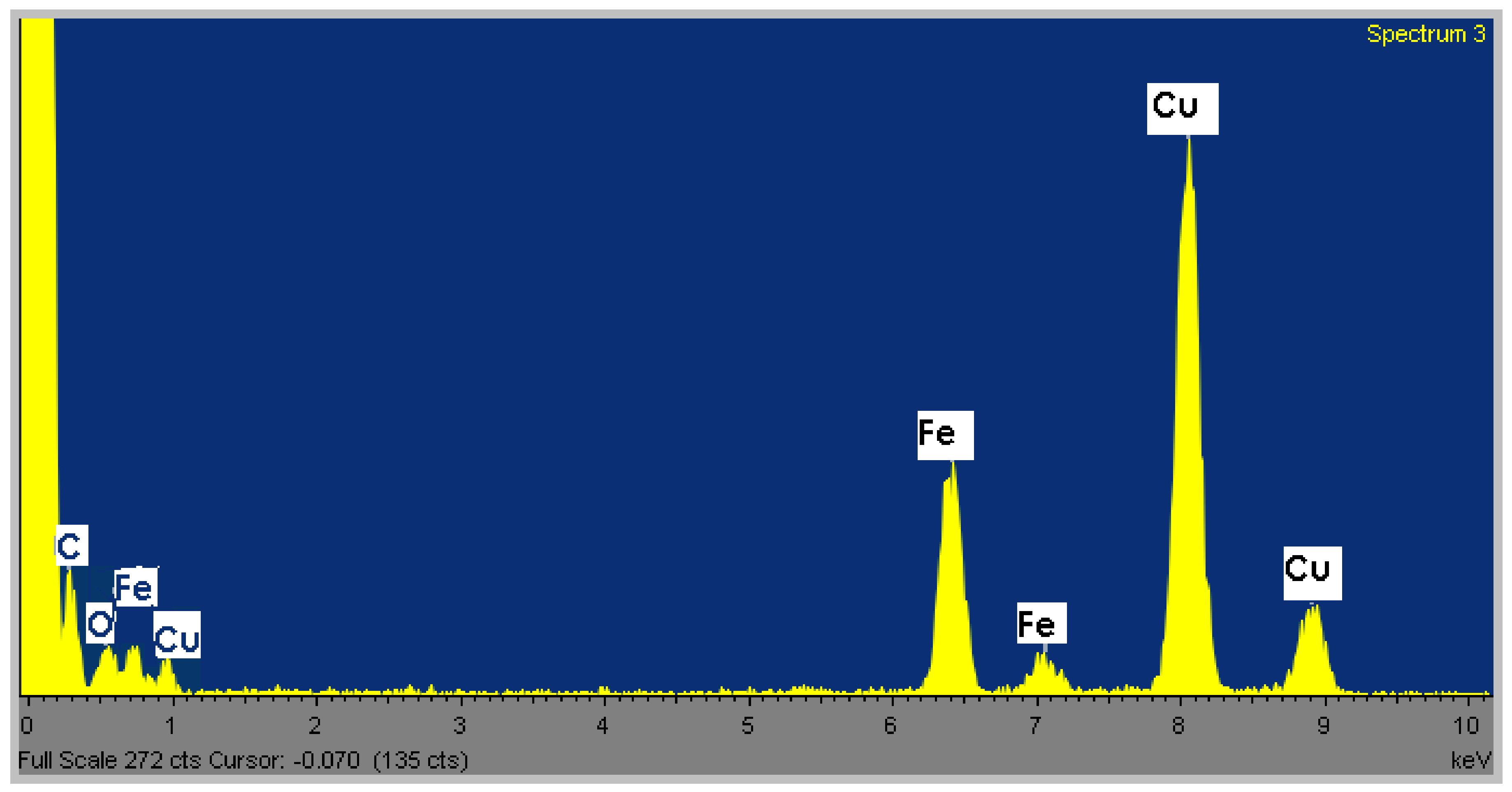
        <p>Elemental composition of the Fe<sub>3</sub>O<sub>4 </sub>nanocrystals was determined by EDS analysis. Iron and oxygen are present in monodisperse spheres from <xref ref-type="fig" rid="nanomaterials-02-00134-f001">Figure 1</xref>b, confirming their elemental composition (<xref ref-type="fig" rid="nanomaterials-02-00134-f003">Figure 3</xref>). The carbon and copper peaks are due to the carbon-coated copper grid.</p>
        <fig id="nanomaterials-02-00134-f003" position="anchor">
          <label>Figure 3</label>
          <caption>
            <p>Energy dispersive X-ray spectroscopy (EDS) analysis of the monodisperse spheres from <xref ref-type="fig" rid="nanomaterials-02-00134-f001">Figure 1</xref>b.</p>
          </caption>
          <graphic xmlns:xlink="http://www.w3.org/1999/xlink" xlink:href="nanomaterials-02-00134-g003.tif"/>
        </fig>
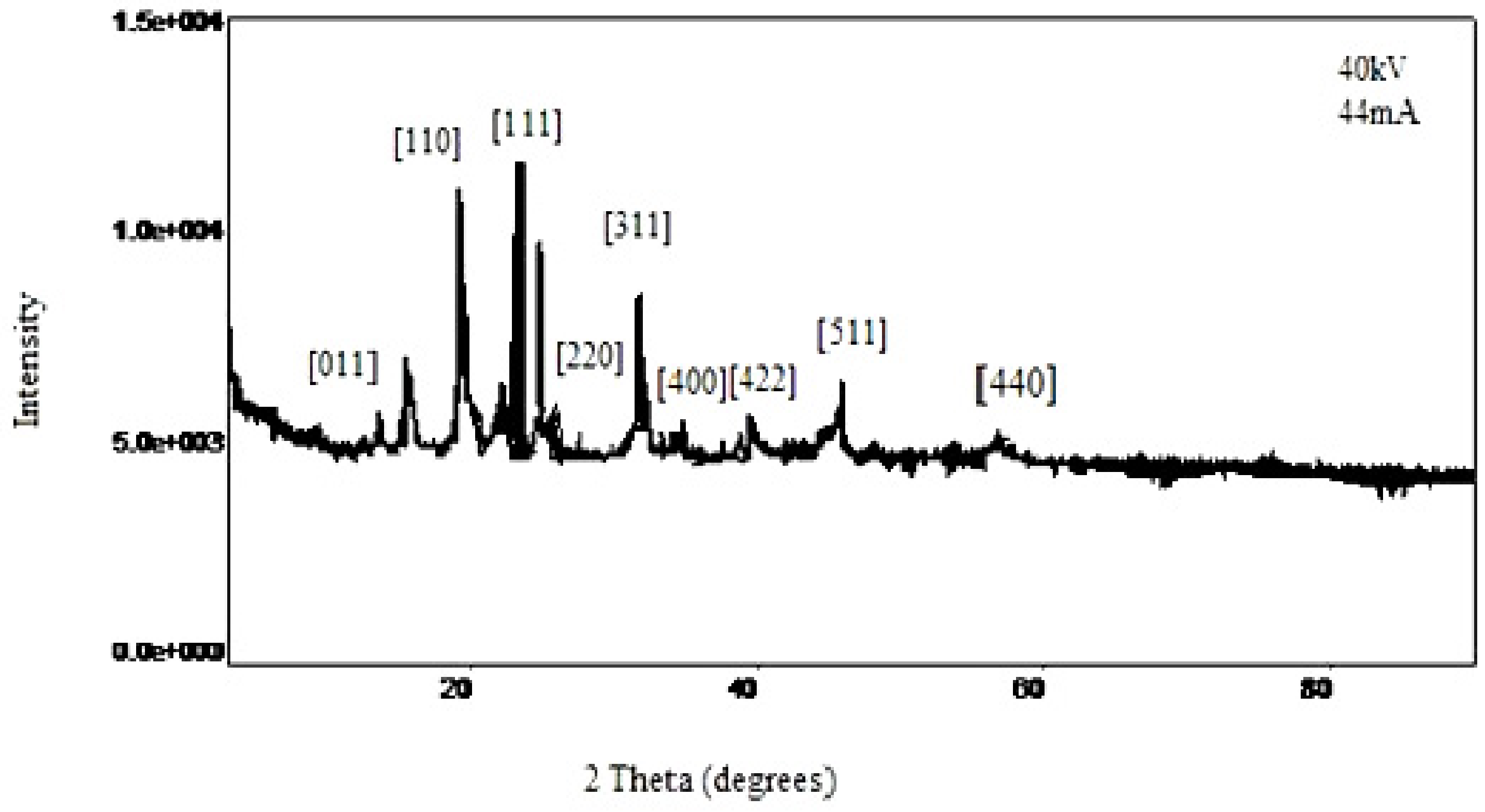
        <p>The XRD data for iron oxide polymorphous nanocrystals (<xref ref-type="fig" rid="nanomaterials-02-00134-f004">Figure 4</xref>) suggests that the composition of the nanocrystals is 70% Fe<sub>3</sub>O<sub>4</sub> with space group Fd3m {F41/d 3 2/m}. There are peaks distinctive of <italic>α</italic>-Fe<sub>2</sub>O<sub>3,</sub> which are likely the result of surface oxidation during the analysis. The remaining portions of the crystal appear to be composed of a yet unidentified phase of Fe<sub>2</sub>O<sub>3</sub> in addition to wüstite phases, as we would expect for diiron (III) oxide, although with space groups and <italic>a</italic> values being similar, the oxidation state is difficult to determine with absolute certainty.</p>
        <fig id="nanomaterials-02-00134-f004" position="anchor">
          <label>Figure 4</label>
          <caption>
            <p>X-ray diffraction (XRD) data for iron oxide polymorphous nanocrystals.</p>
          </caption>
          <graphic xmlns:xlink="http://www.w3.org/1999/xlink" xlink:href="nanomaterials-02-00134-g004.tif"/>
        </fig>
      </sec>
      <sec>
        <title>2.3. Magnetic Characterization</title>
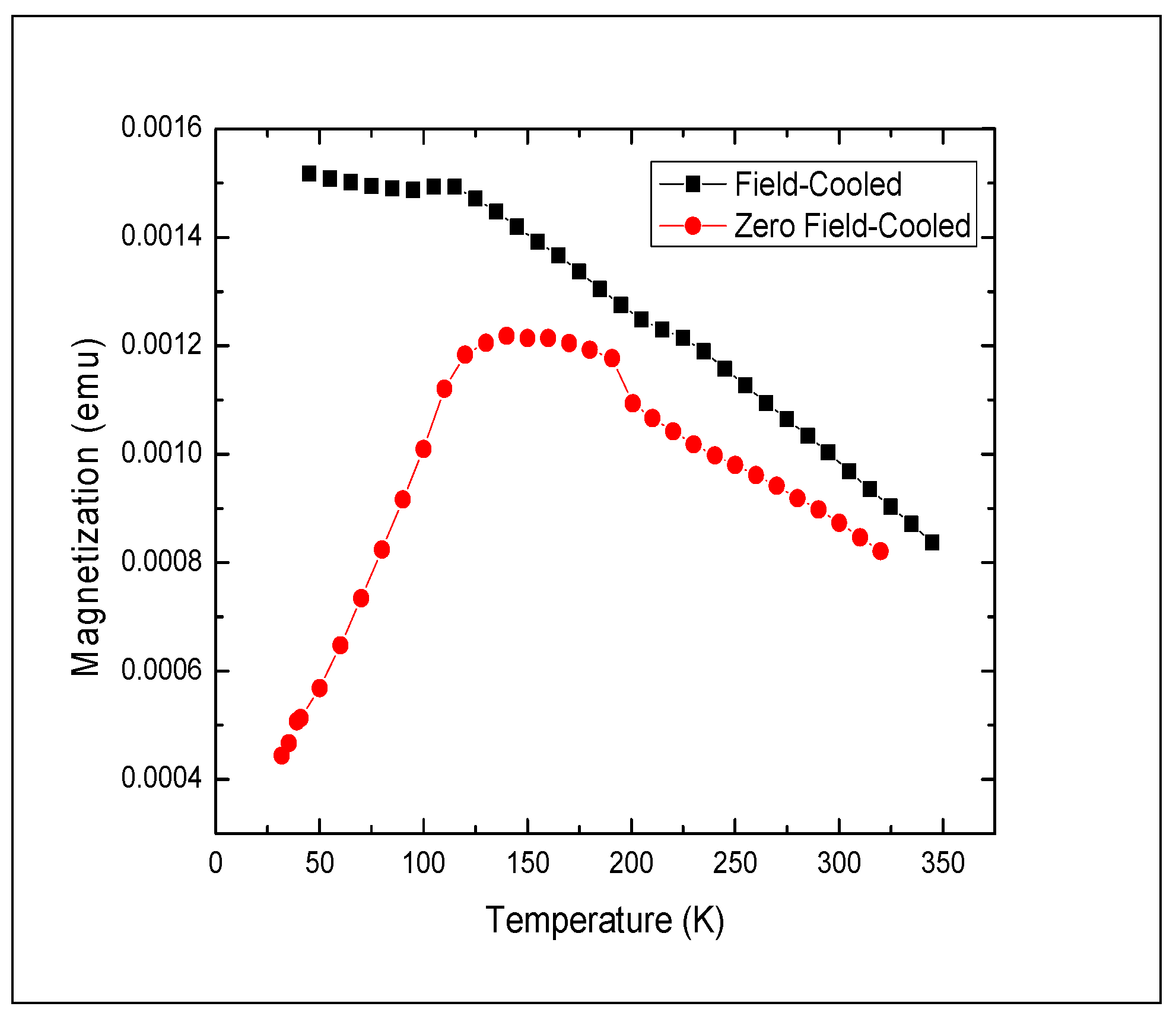
        <p>A typical feature in magnetic nanocrystals is their irreversible ferromagnetic behavior below the blocking temperature <italic>T</italic><sub>B</sub> and reversible magnetization above it, caused by superparamagnetic behavior of the nanocrystals. The blocking temperature can be found experimentally by measuring magnetization under field-cooling (FC) and zero-field cooling (ZFC) conditions. Below <italic>T</italic><sub>B</sub>, the Néel relaxation time τ<sub>N</sub> is larger than the measurement time τ<sub>m</sub> (typically 100 s), and magnetization depends strongly on the field history. Above <italic>T</italic><sub>B</sub>, magnetization is strongly affected by thermal fluctuations (τ<sub>m</sub> &gt; τ<sub>N</sub>), making FC and ZFC curves coincide. In other words, for a given measurement time τ<sub>m</sub>, hysteretic behavior observed below <italic>T</italic><sub>B</sub> would not be observed above <italic>T</italic><sub>B</sub>.</p>
        <fig id="nanomaterials-02-00134-f005" position="anchor">
          <label>Figure 5</label>
          <caption>
            <p>Zero-field cooled (circle symbols) and field cooled (square symbols) magnetization <italic>vs</italic>. temperature for polymorphous Fe<sub>3</sub>O<sub>4</sub> nanocrystals. Magnetization measured with a dc field of 100 Oe. τ<sub>m</sub> = 100 s.</p>
          </caption>
          <graphic xmlns:xlink="http://www.w3.org/1999/xlink" xlink:href="nanomaterials-02-00134-g005.tif"/>
        </fig>
        <p>We measured temperature dependence of magnetization for the Fe<sub>3</sub>O<sub>4</sub> nanocrystal samples under ZFC and FC conditions. The dc (τ<sub>m</sub> = 100 s) magnetization of the ferrofluid samples was measured with a dc field of 100 Oe in the temperature range between 9 K and 350 K.</p>
        <p>In the entire temperature range up to 350 K, the Fe<sub>3</sub>O<sub>4</sub> nanocrystal samples demonstrated strong ferromagnetic behavior as evidenced by the gap between the ZFC and FC curves persisting even at 350 K (<xref ref-type="fig" rid="nanomaterials-02-00134-f005">Figure 5</xref>). From the ZFC curve, we can loosely estimate <italic>T</italic><sub>B</sub> to be ~175 K, but even above that temperature equilibrium magnetization of the nanocrystal sample was not reached, and superparamagnetic behavior of the nanocrystals was not observed.</p>
        
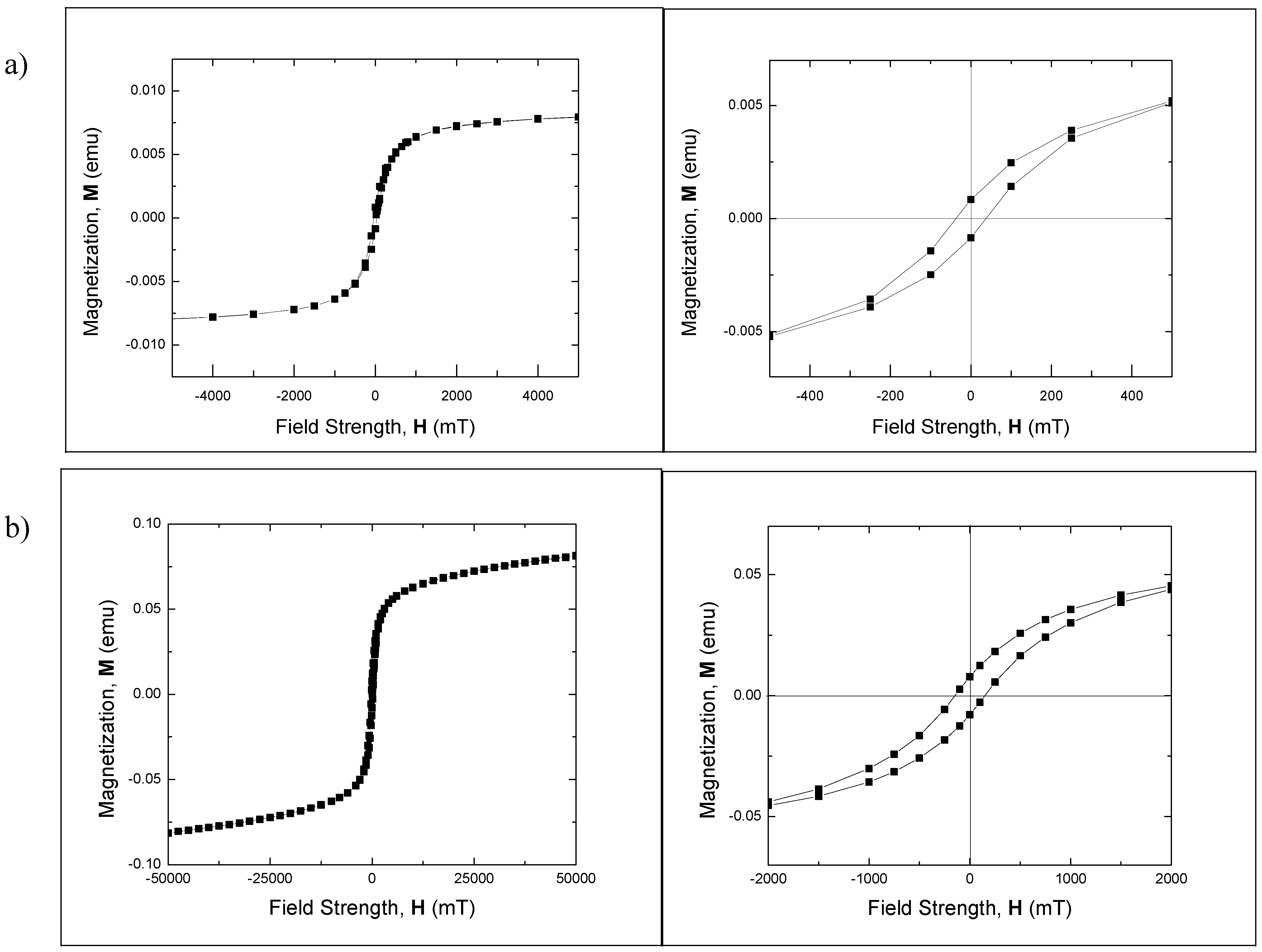
        <p>Strong ferromagnetic behavior of the Fe<sub>3</sub>O<sub>4</sub> nanocrystal samples was confirmed in magnetic hysteresis measurements. Consistent with the results of dc magnetization measurements, magnetic hysteresis measurements at 293 K performed on Fe<sub>3</sub>O<sub>4</sub> polymorphous nanocrystals (<xref ref-type="fig" rid="nanomaterials-02-00134-f006">Figure 6</xref>a) find large coercivity ~37 mT (~29 kA/m) at 100 s measurement time. Even larger coercivity of ~119 mT (~94.7 kA/m) was measured for ~22 nm Fe<sub>3</sub>O<sub>4</sub> nanospheres.</p>
        <fig id="nanomaterials-02-00134-f006" position="anchor">
          <label>Figure 6</label>
          <caption>
            <p>Hysteresis loop for (<bold>a</bold>) Fe<sub>3</sub>O<sub>4</sub>polymorphous nanocrystals and (<bold>b</bold>) ~22 nm Fe<sub>3</sub>O<sub>4</sub> nanospheres. τ<sub>m</sub> = 100 s. <bold>Left</bold>: full sweep of magnetic field measured at 293 K showing saturation. <bold>Right</bold>: enlarged loop measured at 293K at low field.</p>
          </caption>
          <graphic xmlns:xlink="http://www.w3.org/1999/xlink" xlink:href="nanomaterials-02-00134-g006.tif"/>
        </fig>
      </sec>
      <sec>
        <title>2.4. Magnetic Hyperthermia Experiments</title>
        <p>Magnetic hyperthermia for the Fe<sub>3</sub>O<sub>4</sub> nanocrystal samples was tested using a NanoTherics, Ltd. Magnetherm that operates at frequencies between 100 and 1000 kHz. Samples were prepared as described in the Experimental Section and dispersed in deionized water. All concentrations were 30 mg/mL and sample volumes were 5 mL. The nanocrystals compared in the following graphs were 22 nm spheres, polymorphous nanocrystals, and 55 × 2 nm wires. Heating of the nanocrystals was tested at frequencies of 111.1 kHz and 629.2 kHz. Data acquisition for hyperthermia was started at ambient temperature. Temperature increase was measured using an optical thermometer with an accuracy of ±0.5 °C.</p>
        <fig id="nanomaterials-02-00134-f007" position="anchor">
          <label>Figure 7</label>
          <caption>
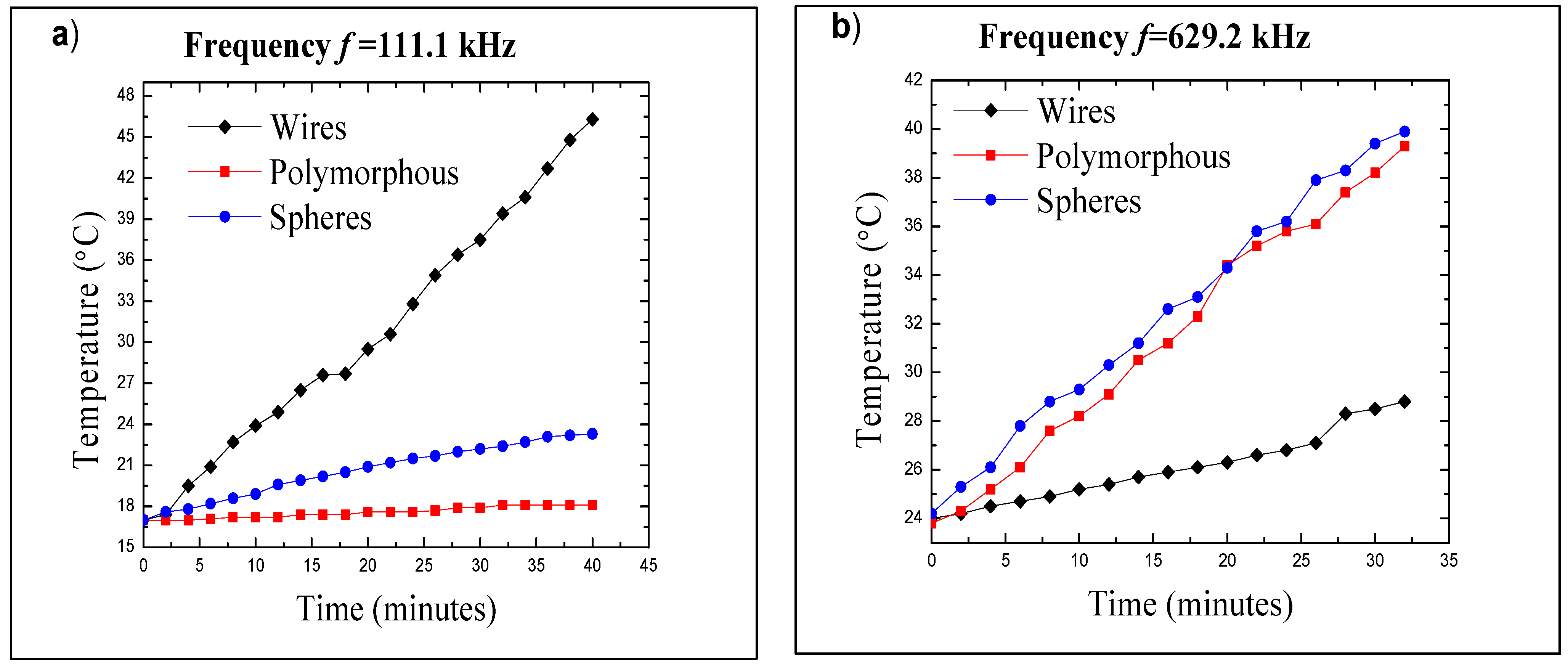
            <p>Hyperthermia data comparing the frequency dependence for different nanocrystal morphologies (22 nm spheres, polymorphous nanocrystals, and 55×2 nm wires). Taken at frequency of (<bold>a</bold>) 111.1 kHz (magnetic field 25 mT) and (<bold>b</bold>) of 629.2 kHz (magnetic field 9 mT).</p>
          </caption>
          <graphic xmlns:xlink="http://www.w3.org/1999/xlink" xlink:href="nanomaterials-02-00134-g007.tif"/>
        </fig>
        <p><xref ref-type="fig" rid="nanomaterials-02-00134-f007">Figure 7</xref>a shows the heating of nanocrystals of various morphologies (spheres, polymorphous nanocrystals, and wires) at a frequency of 111.1 kHz (magnetic field of 25 mT). <xref ref-type="fig" rid="nanomaterials-02-00134-f007">Figure 7</xref>b shows the heating of the same nanocrystals at a frequency of 629.2 kHz (magnetic field of 9 mT). The spherical and polymorphous particles follow a similar trend consistent with their similar morphology and particle volume. Although they do heat at the frequency of 111.1 kHz, the observed heating was relatively low. Interestingly, the total increase in temperature after 40 min was 6 °C for spheres, whereas, it was only 1 °C for polymorphous nanocrystals. When the frequency of the oscillating magnetic field was increased to 629.2 kHz, the spheres and polymorphous nanocrystals showed increased heating. But, unlike the data obtained at 111.1 kHz, the total temperature increase was similar for the polymorphous nanocrystals and nanocrystals of spherical shape: 16 °C for spheres and 15 °C for polymorphous nanocrystals. As for the nanowires, the observed trend was just the opposite. The total temperature increase at 111.1 kHz after 40 min was remarkable 30 °C and, notably, saturation of the temperature was not reached in this timeframe. At 629.2 kHz, however, the increase of temperature generated by the wires was much less than the one obtained by spheres and polymorphous nanocrystals, representing the total temperature increase of 4 °C.</p>
        
        <p>It has been shown that the transition from ferromagnetic to superparamagnetic behavior is associated with the change of the loss mechanism and, accordingly, of the heating effect of magnetic nanocrystals in hyperthermia experiments [<xref ref-type="bibr" rid="B12-nanomaterials-02-00134">12</xref>]. Hysteresis losses dominate in ferromagnetic nanocrystals, whereas heat production in superparamagnetic ones is due to relaxation losses. Since the blocking temperature <italic>T</italic><sub>B</sub> explicitly depends on the measurement time τ<sub>m</sub> (inversely proportional to the frequency of the oscillating magnetic field), superparamagnetic nanocrystals, as measured in dc magnetization experiments, become ferromagnetic at sufficiently high frequencies &gt; 1/τ<sub>N</sub> (or &gt; 1/τ, where τ = τ<sub>Ν</sub> τ<sub>Β</sub>/(τ<sub>Ν</sub> + τ<sub>Β</sub>), if both Néel and Brownian relaxation mechanism are present) and generate heat due to hysteresis losses. With the Fe<sub>3</sub>O<sub>4</sub> nanocrystal samples demonstrating strong ferromagnetic behavior in dc magnetization and hysteresis measurements, hysteresis losses are expected to be the main mechanism of heating in the operating frequency range of our hyperthermia experiments. We estimated the Néel relaxation time τ<sub>N</sub> at room temperature for the Fe<sub>3</sub>O<sub>4</sub> polymorphous nanocrystals (<xref ref-type="fig" rid="nanomaterials-02-00134-f005">Figure 5</xref>) as follows: τ<sub>N</sub> = τ<sub>0</sub>exp(<italic>E</italic><sub>b</sub>/<italic>k</italic><sub>B</sub><italic>T</italic>), where <italic>E</italic><sub>b</sub> is the magnetic anisotropy energy barrier, <italic>k</italic><sub>B</sub> is the Boltzmann constant, and τ<sub>0</sub> = 10<sup>−10</sup> s is the attempt time. <italic>E</italic><sub>b</sub> is related to the blocking temperature <italic>T</italic><sub>B</sub> as <italic>E</italic><sub>b</sub> = <italic>k</italic><sub>B</sub><italic>T</italic><sub>B</sub> ln(τ<sub>m</sub>/τ<sub>0</sub>) = 27.6 <italic>k</italic><sub>B</sub><italic>T</italic><sub>B</sub>, and we arrive at τ<sub>N</sub> = τ<sub>0</sub>exp(27.6 <italic>T</italic><sub>B</sub>/<italic>T</italic>) for the Néel relaxation time. At <italic>T</italic> = 300 K, τ<sub>N</sub> ≈ 0.001 s. At the frequencies of interest ω &gt;&gt; 1/τ<sub>N</sub>, that is far from the relaxation resonance, the Néel relaxation losses saturate at a level that is negligible for large enough τ<sub>N</sub> [<xref ref-type="bibr" rid="B12-nanomaterials-02-00134">12</xref>]. Therefore, we will interpret our results based on the mechanism of hysteresis losses prevailing.</p>
        <p>When hysteresis losses are the main heating factor, heating power is proportional to the area of the hysteresis loop and to the frequency of the applied magnetic field. Approximately 6-fold increase in the heating power is expected when the frequency is changed from 111.1 kHz to 629.2 kHz. The observed increase in heating power from the Fe<sub>3</sub>O<sub>4</sub> polymorphous nanocrystals and nanospheres is not that large. We note, however, that both the frequency and amplitude of the magnetic field were changed in our experiments, and the magnetic field strength was reduced from 25 mT at 111.1 kHz to 9 mT at 629.2 kHz, which can explain the heating power increase not being proportional to the frequency for the Fe<sub>3</sub>O<sub>4</sub> polymorphous nanocrystals and nanospheres. The higher temperature increase of 6 °C for the spheres compared to 1 °C for the polymorphous nanocrystals at 111.1 kHz can be explained by a significantly larger area of their hysteresis. However, the difference in the specific heat production between the spherical and polymorphous nanocrystals at 629.2 kHz is not that pronounced.</p>
        <p>We consider hyperthermia experiments with nanowires separately, as their morphology differs dramatically from that of polymorphous nanocrystals and nanospheres, and may be the decisive factor. Fine magnetite particles of needle shape with high aspect ratio have been investigated previously by Hergt <italic>et al</italic>. [<xref ref-type="bibr" rid="B12-nanomaterials-02-00134">12</xref>]. High potential for hyperthermia was noted there for such particles that possess very high shape anisotropy, and hence high-energy barrier for remagnetization, resulting in a wide hysteresis and high hysteresis losses. It was concluded, however, that strong magnetic fields, very often unacceptable for human patients, are required to fully utilize their potential. Very strong nonlinear dependence of the hysteresis loss on the strength of the applied magnetic field was reported. Comparison was made among particles of different shape, and it was found that needles were by far superior when applied magnetic field exceeded ~35 kA/m, while below that value the magnetic field was not strong enough to open the hysteresis loop in needles, and their hysteresis losses were by several orders of magnitude lower compared to particles of other shapes with low aspect ratio. We expect similar effects to be observed in nanowires that are characterized with even higher aspect ratios of their shape. We believe that our results for hyperthermia in nanowires can be explained by similar superlinear dependence of their hysteresis loss on the magnetic field strength, with that superlinear dependence being much stronger than mere proportionality of the heating power to the frequency of the applied magnetic field.</p>
        <p>We note that the remarkable 30 °C temperature increase was observed in nanowires sample at 111 kHz and magnetic field of 25 mT (19.6 kA/m), which is very close to the typical values used in medical treatments −100 kHz and 20 mT [<xref ref-type="bibr" rid="B13-nanomaterials-02-00134">13</xref>,<xref ref-type="bibr" rid="B14-nanomaterials-02-00134">14</xref>].</p>
        <p>In our analysis, we have not considered one more possible mechanism of heat generation during hyperthermia, namely, Brownian relaxation that can be significant in particles of that size. Additional experiments are needed to clarify contribution of Brownian relaxation to the observed heat production in hyperthermia experiments. </p>

      </sec>
    </sec>
    <sec>
      <title>3. Experimental Section</title>
      <p>FeCl<sub>3</sub>·6H<sub>2</sub>O (97%) was purchased from Sigma-Aldrich, <italic>n-</italic>docosane (99%) and <italic>n-</italic>eicosane (99%) were purchased from Alfa Aesar, <italic>n-</italic>dodecane (&gt;99%) was purchased from Fischer Scientific, sodium oleate (&gt;97%) was purchased from Tokyo Chemical Industry Co., PEG 3350 powder was purchased from Fisher Chemical. All chemicals were used as received, without purification.</p>
      <p>For structural characterization, TEM/EDS samples were prepared by placing a drop of the colloidal solution onto a 200-mesh carbon-coated copper grid. The solvent was allowed to evaporate away, thus fixing the sample on the grid. The JEOL-2010F transmission electron microscope was equipped with an OXFORD Link ISIS energy dispersive spectroscopy (EDS) apparatus, which determined elemental composition. The electron beam was focused on a single nanocrystal and the characteristic X-ray peaks specific to each element were identified using the OXFORD Link ISIS software. The iron oxide phase and crystal structure was determined using a Rigaku Smartlab<sup>®</sup> X-Ray Diffractometer (XRD) with a Cu K<sub>α</sub> source (0.154 nm). </p>
      <p>The dc (τ<sub>m</sub> = 100 s) magnetization of the ferrofluid samples was measured with a dc field of 100 Oe in the temperature range between 9 K and 350 K using a Quantum Design magnetic property measurement system (MPMS) superconducting quantum interference device (SQUID) magnetometer.</p>
      <sec>
        <title>3.1. Synthesis of Iron Oleate Precursor Complex</title>
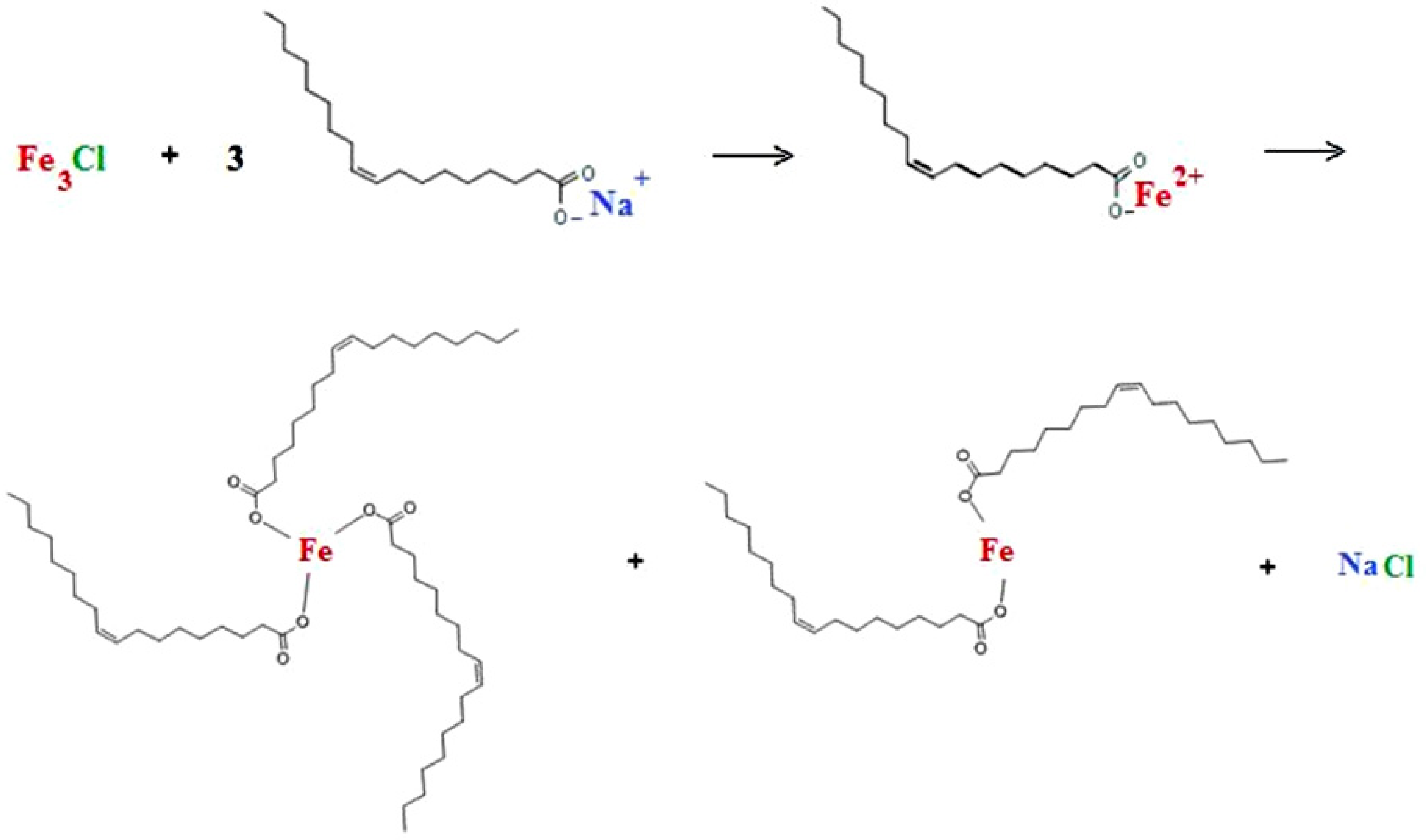
        <p>The procedure consisted of two steps: synthesis of the iron oleate precursor complex and synthesis of the iron oxide nanocrystals. The precursor was iron oleate, (iron(II,III) [(9Z)-9-octadecenoate]<sub>n</sub>) where n is the coordination number of iron, and could form a monomer, dimer, or trimer [<xref ref-type="bibr" rid="B15-nanomaterials-02-00134">15</xref>,<xref ref-type="bibr" rid="B16-nanomaterials-02-00134">16</xref>], produced in our laboratory using a modified procedure of Bronstein <italic>et al.</italic> [<xref ref-type="bibr" rid="B15-nanomaterials-02-00134">15</xref>]. The formation of the complex was verified with UV-Vis-NIR spectroscopy. The iron oleate complex was formed from the combination of sodium oleate salt (sodium (9Z)-9-octadecenoate) and iron(III)chloride hexahydrate (FeCl<sub>3</sub>·6H<sub>2</sub>O). In a standard reaction, 6.75 g of FeCl<sub>3</sub>·6H<sub>2</sub>O was combined with 25 mL of deionized water and vacuum-filtered through 0.22 μm filter paper. The mixture was then combined with 24.35 g of sodium oleate in a three-neck round bottom flask. 150 mL of a stock solution, consisting of a 2:4:6 mixture of deionized water, ethanol, and hexane, was added to the flask. Under argon flow, the mixture was vented and filled for three one-minute intervals, in order to remove all oxygen from the reaction flask. The solution was the slowly (5 °C/min) heated to 50 °C under vigorous stirring. Once the solid sodium oleate salt had completely melted and the reflux had begun (around 50–60 °C), the temperature was further increased (3 °C/min) to 70 °C and the flask was kept at this temperature for four hours, ensuring that the total reflux time was 4 hours. The mixture was then cooled to 60 °C and washed three times with a 1:1 mixture of hexane and deionized water in a separatory flask. The organic layer was placed in a rotary evaporator (Rotovap) with the water bath set at 30 °C until the hexane and ethanol were evaporated away. The resulting waxy complex was then dried in a vacuum oven for 24 hours. The overall reaction is illustrated in <xref ref-type="fig" rid="nanomaterials-02-00134-f008">Figure 8</xref>.</p>
        <fig id="nanomaterials-02-00134-f008" position="anchor">
          <label>Figure 8</label>
          <caption>
            <p>Formation of iron oleate complex from sodium oleate.</p>
          </caption>
          <graphic xmlns:xlink="http://www.w3.org/1999/xlink" xlink:href="nanomaterials-02-00134-g008.tif"/>
        </fig>
        <p>Wet iron oleate complex (the hydrate form) as obtained from the procedure described above was a reddish-brown, highly viscous liquid. It could be further purified by several methods to obtain dry iron oleate. Specifically, we purified it with ethanol, acetone, hexane, and water washes and dried in the oven at 70 °C for 24 hours. After drying, the product was a black solid. When dry iron oleate was used as a precursor, the ratio of oleic acid to iron oleate in the reaction mixture was increased as an additional stabilizing factor.</p>
      </sec>
      <sec>
        <title>3.2. Synthesis of Polymorphous Iron Oxide Nanocrystals</title>
        <p>In a standard reaction, 5 g of dry iron oleate was combined with 5.6 mL of oleic acid and 13.15 g of eicosane (boiling point 342.7 °C). The mixture was slowly heated (3 °C/min) to 50 °C under argon flow and vigorous stirring. Once the reactants had dissolved, the temperature was further increased to 342 °C at a heating rate of 3.0 °C/min. For ~20 nm polymorphous nanocrystals, the mixture was allowed to reflux for 32 min. For larger particles, the reflux time was extended, with an average growth of 2.2 nm per minute. The maximum size without adding additional reagents was 250 nm after 99 min. If the nanocrystals were allowed to cool for any amount of time before being refluxed at the same temperature again, the nanocrystal growth favored spherical morphology. After 30 min of reflux, the spheres were highly monodisperse.</p>
      </sec>
      <sec>
        <title>3.3. Synthesis of Iron Oxide Nanowires</title>
        <p>In a standard reaction, 5 g of wet iron oleate was combined with 1.6 mL of oleic acid and 13.15 g of <italic>n-</italic>dodecane (boiling point 216.2 °C). The mixture was slowly (3 °C/min) heated to 50 °C under argon flow and vigorous stirring. Once the reactants had dissolved, the temperature was further increased to 216 °C at a heating rate of 3 °C/min. For ~55 × 2 nm wires, the mixture was allowed to reflux for 60 min. </p>
      </sec>
      <sec>
        <title>3.4. Synthesis of Iron Oxide Spherical Nanocrystals</title>
        <p>In a standard reaction, 5 g of wet iron oleate was combined with 1.6 mL oleic acid and 13.15 g of <italic>n-</italic>docosane (boiling point 370 °C). The mixture was slowly (3 °C/min) heated to 50 °C under argon flow and vigorous stirring. Once the reactants had dissolved, the temperature was further increased to 370 °C at a heating rate of 3 °C/min. For ~20 nm particles, the mixture was allowed to reflux for 32 min. For larger particles, the reflux time was extended, with an average growth rate of 1.6 nm per minute. The maximum size without adding additional reagents was 150 nm after 99 min.</p>
      </sec>
      <sec>
        <title>3.5. Polyethylene Glycol (PEG) Capping of Iron Oxide Nanocrystals</title>
        <p>PEG capping was performed following a modified procedure from [<xref ref-type="bibr" rid="B17-nanomaterials-02-00134">17</xref>]. The iron oxide nanocrystals were solvated in chloroform and combined with PEG using a nanocrystal to PEG mass ratio of 1:2.</p>
      </sec>
    </sec>
    <sec sec-type="conclusions">
      <title>4. Conclusions</title>
      <p>We have synthesized and characterized PEG-capped iron oxide nanocrystals of various morphologies in paramagnetic to ferromagnetic size range that will allow further functionalization and drug conjugation. DC magnetization and ac heating power (hyperthermia characteristics) of the PEG-capped Fe<sub>3</sub>O<sub>4</sub> nanocrystals in water have been studied. The Fe<sub>3</sub>O<sub>4</sub> nanocrystal samples demonstrated strong ferromagnetic behavior and hysteresis losses were identified as the main mechanism of heating in hyperthermia experiments. Our hyperthermia data shows that all three nanocrystal morphologies, spheres, polymorphous nanocrystals, and wires are good candidates for thermotherapy. Significant heating was observed well within the limits for oscillating magnetic field parameters established for biological applications. The observed temperature increase for Fe<sub>3</sub>O<sub>4</sub> nanospheres at 111.1 kHz and 25 mT after 40 min was 6 °C. If the corresponding temperature increase took place from normal human body temperature (36.6 °C) as a starting point, it would bring the local temperature up to 42.6 °C, which is right within the desirable temperature limits for the applications of medical hyperthermia (41–45 °C) [<xref ref-type="bibr" rid="B18-nanomaterials-02-00134">18</xref>]. Of special interest for hyperthermia applications are Fe<sub>3</sub>O<sub>4</sub> nanowires that demonstrated a remarkable 30 °C temperature increase under magnetic field conditions that were very close to the typical values used in medical treatments. </p>
    </sec>

  </body>
  <back>
    <ack>
    <title>Acknowledgments</title>
      <p>This work was supported by NIH under the Grant No. 1R21HL092812-01A1 “Multifunctional Nanocrystals: Nano-Knives and Nano-Pullies for Enhanced Drug Delivery to the Lung”, by NIH under the Grant No. GM-060201 “Initiatives to Maximize Student Diversity”, and by the NSF IGERT program on “Integrating Nanotechnology with Cell Biology and Neuroscience”, Grant No. DGE-0549500. This work was performed in part at CINT/SNL under Project No. U2010B1079 “Characterization of Multifunctional Nanocrystals for Enhanced Drug Delivery to the Lung”, funded by DoE contract No. DE-AC04-94AL85000.</p>
    </ack>
    <ref-list>
      <title>References</title>
      <ref id="B1-nanomaterials-02-00134">
        <label>1.</label>
        <citation citation-type="journal">
          <person-group person-group-type="author">
            <name>
              <surname>Pradhan</surname>
              <given-names>P.</given-names>
            </name>
            <name>
              <surname>Giri</surname>
              <given-names>J.</given-names>
            </name>
            <name>
              <surname>Samanta</surname>
              <given-names>G.</given-names>
            </name>
            <name>
              <surname>Dev Sarma</surname>
              <given-names>H.</given-names>
            </name>
            <name>
              <surname>Prasad Mishra</surname>
              <given-names>K.</given-names>
            </name>
            <name>
              <surname>Bellare</surname>
              <given-names>J.</given-names>
            </name>
            <name>
              <surname>Banerjee</surname>
              <given-names>R.</given-names>
            </name>
            <name>
              <surname>Bahadur</surname>
              <given-names>D.</given-names>
            </name>
          </person-group>
          <article-title>Comparative evaluation of heating ability and biocompatibility of different ferrite-based magnetic fluids for hyperthermia application</article-title>
          <source>J. Biomed. Mater. Res. B Appl. Biomater.</source>
          <year>2007</year>
          <volume>81B</volume>
          <fpage>12</fpage>
          <lpage>22</lpage>
        <pub-id pub-id-type="doi">10.1002/jbm.b.30630</pub-id></citation>
      </ref>
      <ref id="B2-nanomaterials-02-00134">
        <label>2.</label>
        <citation citation-type="journal">
          <person-group person-group-type="author">
            <name>
              <surname>Duguet</surname>
              <given-names>E.</given-names>
            </name>
            <name>
              <surname>Vasseur</surname>
              <given-names>S.</given-names>
            </name>
            <name>
              <surname>Mornet</surname>
              <given-names>S.</given-names>
            </name>
            <name>
              <surname>Devoisselle</surname>
              <given-names>J.-M.</given-names>
            </name>
          </person-group>
          <article-title>Magnetic nanoparticles and their applications in medicine</article-title>
          <source>Nanomedicine</source>
          <year>2006</year>
          <volume>1</volume>
          <fpage>157</fpage>
          <lpage>168</lpage>
        <pub-id pub-id-type="doi">10.2217/17435889.1.2.157</pub-id><pub-id pub-id-type="pmid">17716105</pub-id></citation>
      </ref>
      <ref id="B3-nanomaterials-02-00134">
        <label>3.</label>
        <citation citation-type="journal">
          <person-group person-group-type="author">
            <name>
              <surname>Nitin</surname>
              <given-names>N.</given-names>
            </name>
            <name>
              <surname>LaConte</surname>
              <given-names>L.E.W.</given-names>
            </name>
            <name>
              <surname>Zurkiya</surname>
              <given-names>O.</given-names>
            </name>
            <name>
              <surname>Hu</surname>
              <given-names>X.</given-names>
            </name>
            <name>
              <surname>Bao</surname>
              <given-names>G.</given-names>
            </name>
          </person-group>
          <article-title>Functionalization and peptide-based delivery of magnetic nanoparticles as an intracellular MRI contrast agent</article-title>
          <source>J. Biol. Inorganic Chem.</source>
          <year>2004</year>
          <volume>9</volume>
          <fpage>706</fpage>
          <lpage>712</lpage>
        </citation>
      </ref>
      <ref id="B4-nanomaterials-02-00134">
        <label>4.</label>
        <citation citation-type="journal">
          <person-group person-group-type="author">
            <name>
              <surname>Sun</surname>
              <given-names>C.</given-names>
            </name>
            <name>
              <surname>Lee</surname>
              <given-names>J.S.H.</given-names>
            </name>
            <name>
              <surname>Zhang</surname>
              <given-names>M.</given-names>
            </name>
          </person-group>
          <article-title>Magnetic nanoparticles in MR imaging and drug delivery</article-title>
          <source>Adv. Drug Deliv. Rev.</source>
          <year>2008</year>
          <volume>60</volume>
          <fpage>1252</fpage>
          <lpage>1265</lpage>
        <pub-id pub-id-type="doi">10.1016/j.addr.2008.03.018</pub-id><pub-id pub-id-type="pmid">18558452</pub-id></citation>
      </ref>
      <ref id="B5-nanomaterials-02-00134">
        <label>5.</label>
        <citation citation-type="journal">
          <person-group person-group-type="author">
            <name>
              <surname>Johannsen</surname>
              <given-names>M.</given-names>
            </name>
            <name>
              <surname>Gneveckow</surname>
              <given-names>U.</given-names>
            </name>
            <name>
              <surname>Taymoorian</surname>
              <given-names>K.</given-names>
            </name>
            <name>
              <surname>Thiesen</surname>
              <given-names>B.</given-names>
            </name>
            <name>
              <surname>Waldöfner</surname>
              <given-names>N.</given-names>
            </name>
            <name>
              <surname>Scholz</surname>
              <given-names>R.</given-names>
            </name>
            <name>
              <surname>Jung</surname>
              <given-names>K.</given-names>
            </name>
            <name>
              <surname>Jordan</surname>
              <given-names>A.</given-names>
            </name>
            <name>
              <surname>Wust</surname>
              <given-names>P.</given-names>
            </name>
            <name>
              <surname>Loening</surname>
              <given-names>S.A.</given-names>
            </name>
          </person-group>
          <article-title>Morbidity and quality of life during thermotherapy using magnetic nanoparticles in locally recurrent prostate cancer: Results of a prospective phase I trial</article-title>
          <source>Int. J. Hyperthermia.</source>
          <year>2007</year>
          <volume>23</volume>
          <fpage>315</fpage>
          <lpage>323</lpage>
        <pub-id pub-id-type="doi">10.1080/02656730601175479</pub-id><pub-id pub-id-type="pmid">17523023</pub-id></citation>
      </ref>
      <ref id="B6-nanomaterials-02-00134">
        <label>6.</label>
        <citation citation-type="journal">
          <person-group person-group-type="author">
            <name>
              <surname>Van Landeghem</surname>
              <given-names>F.K.H.</given-names>
            </name>
            <name>
              <surname>Maier-Hauff</surname>
              <given-names>K.</given-names>
            </name>
            <name>
              <surname>Jordan</surname>
              <given-names>A.</given-names>
            </name>
            <name>
              <surname>Hoffmann</surname>
              <given-names>K.-T.</given-names>
            </name>
            <name>
              <surname>Gneveckow</surname>
              <given-names>U.</given-names>
            </name>
            <name>
              <surname>Scholz</surname>
              <given-names>R.</given-names>
            </name>
            <name>
              <surname>Thiesen</surname>
              <given-names>B.</given-names>
            </name>
            <name>
              <surname>Brück</surname>
              <given-names>W.</given-names>
            </name>
            <name>
              <surname>von Deimling</surname>
              <given-names>A.</given-names>
            </name>
          </person-group>
          <article-title>Post-mortem studies in glioblastoma patients treated with thermotherapy using magnetic nanoparticles</article-title>
          <source>Biomaterials</source>
          <year>2009</year>
          <volume>30</volume>
          <fpage>52</fpage>
          <lpage>57</lpage>
        <pub-id pub-id-type="doi">10.1016/j.biomaterials.2008.09.044</pub-id><pub-id pub-id-type="pmid">18848723</pub-id></citation>
      </ref>
      <ref id="B7-nanomaterials-02-00134">
        <label>7.</label>
        <citation citation-type="journal">
          <person-group person-group-type="author">
            <name>
              <surname>Fortin</surname>
              <given-names>J.-P.</given-names>
            </name>
            <name>
              <surname>Gazeau</surname>
              <given-names>F.</given-names>
            </name>
            <name>
              <surname>Wilhelm</surname>
              <given-names>C.</given-names>
            </name>
          </person-group>
          <article-title>Intracellular heating of living cells through Néel relaxation of magnetic nanoparticles</article-title>
          <source>Eur. Biophys. J.</source>
          <year>2008</year>
          <volume>37</volume>
          <fpage>223</fpage>
          <lpage>228</lpage>
        <pub-id pub-id-type="doi">10.1007/s00249-007-0197-4</pub-id><pub-id pub-id-type="pmid">17641885</pub-id></citation>
      </ref>
      <ref id="B8-nanomaterials-02-00134">
        <label>8.</label>
        <citation citation-type="journal">
          <person-group person-group-type="author">
            <name>
              <surname>Saniei</surname>
              <given-names>N.</given-names>
            </name>
          </person-group>
          <article-title>Hyperthermia and cancer treatment</article-title>
          <source>Heat Transf. Eng.</source>
          <year>2009</year>
          <volume>30</volume>
          <fpage>915</fpage>
          <lpage>917</lpage>
        <pub-id pub-id-type="doi">10.1080/01457630902854371</pub-id></citation>
      </ref>
      <ref id="B9-nanomaterials-02-00134">
        <label>9.</label>
        <citation citation-type="journal">
          <person-group person-group-type="author">
            <name>
              <surname>Purushotham</surname>
              <given-names>S.</given-names>
            </name>
            <name>
              <surname>Chang</surname>
              <given-names>P.E.J.</given-names>
            </name>
            <name>
              <surname>Rumpel</surname>
              <given-names>H.</given-names>
            </name>
            <name>
              <surname>Kee</surname>
              <given-names>I.H.C.</given-names>
            </name>
            <name>
              <surname>Ng</surname>
              <given-names>R.T.H.</given-names>
            </name>
            <name>
              <surname>Chow</surname>
              <given-names>P.K.H.</given-names>
            </name>
            <name>
              <surname>Tan</surname>
              <given-names>C.K.</given-names>
            </name>
            <name>
              <surname>Ramanujan</surname>
              <given-names>R.V.</given-names>
            </name>
          </person-group>
          <article-title>Thermoresponsive core–shell magnetic nanoparticles for combined modalities of cancer therapy</article-title>
          <source>Nanotechnology</source>
          <year>2009</year>
          <volume>20</volume>
          <fpage>305101</fpage>
          <lpage>305111</lpage>
        <pub-id pub-id-type="doi">10.1088/0957-4484/20/30/305101</pub-id><pub-id pub-id-type="pmid">19581698</pub-id></citation>
      </ref>
      <ref id="B10-nanomaterials-02-00134">
        <label>10.</label>
        <citation citation-type="book">
          <person-group person-group-type="author">
            <name>
              <surname>McGill</surname>
              <given-names>S.</given-names>
            </name>
            <name>
              <surname>Cuylear</surname>
              <given-names>C.</given-names>
            </name>
            <name>
              <surname>Adolphi</surname>
              <given-names>N.</given-names>
            </name>
            <name>
              <surname>Osiński</surname>
              <given-names>M.</given-names>
            </name>
            <name>
              <surname>Smyth</surname>
              <given-names>H.</given-names>
            </name>
          </person-group>
          <article-title>Enhanced drug transport through alginate biofilms using magnetic nanocrystals</article-title>
          <source>Colloidal Quantum Dots for Biomedical Applications IV</source>
          <person-group person-group-type="editor">
            <name>
              <surname>Osiński</surname>
              <given-names>M.</given-names>
            </name>
            <name>
              <surname>Jovin</surname>
              <given-names>T.M.</given-names>
            </name>
            <name>
              <surname>Yamamoto</surname>
              <given-names>K.</given-names>
            </name>
          </person-group>
          <publisher-name>SPIE</publisher-name>
          <publisher-loc>Bellingham, WA, USA</publisher-loc>
          <year>2009</year>
          <volume>7189</volume>
          <fpage>718918</fpage>
        </citation>
      </ref>
      <ref id="B11-nanomaterials-02-00134">
        <label>11.</label>
        <citation citation-type="journal">
          <person-group person-group-type="author">
            <name>
              <surname>Park</surname>
              <given-names>J.</given-names>
            </name>
            <name>
              <surname>An</surname>
              <given-names>K.</given-names>
            </name>
            <name>
              <surname>Hwang</surname>
              <given-names>Y.</given-names>
            </name>
            <name>
              <surname>Park</surname>
              <given-names>J.-G.</given-names>
            </name>
            <name>
              <surname>Noh</surname>
              <given-names>H.-J.</given-names>
            </name>
            <name>
              <surname>Kim</surname>
              <given-names>J.-Y.</given-names>
            </name>
            <name>
              <surname>Park</surname>
              <given-names>J.-H.</given-names>
            </name>
            <name>
              <surname>Hwang</surname>
              <given-names>N.-M.</given-names>
            </name>
            <name>
              <surname>Hyeon</surname>
              <given-names>T.</given-names>
            </name>
          </person-group>
          <article-title>Ultra-large-scale syntheses of monodisperse nanocrystals</article-title>
          <source>Nat. Mater.</source>
          <year>2004</year>
          <volume>3</volume>
          <fpage>891</fpage>
          <lpage>895</lpage>
        <pub-id pub-id-type="doi">10.1038/nmat1251</pub-id><pub-id pub-id-type="pmid">15568032</pub-id></citation>
      </ref>
      <ref id="B12-nanomaterials-02-00134">
        <label>12.</label>
        <citation citation-type="journal">
          <person-group person-group-type="author">
            <name>
              <surname>Hergt</surname>
              <given-names>R.</given-names>
            </name>
            <name>
              <surname>Andra</surname>
              <given-names>W.</given-names>
            </name>
            <name>
              <surname>d'Ambly</surname>
              <given-names>C.G.</given-names>
            </name>
            <name>
              <surname>Hilger</surname>
              <given-names>I.</given-names>
            </name>
            <name>
              <surname>Kaiser</surname>
              <given-names>W.A.</given-names>
            </name>
            <name>
              <surname>Richter</surname>
              <given-names>U.</given-names>
            </name>
            <name>
              <surname>Schmidt</surname>
              <given-names>H.-G.</given-names>
            </name>
          </person-group>
          <article-title>Physical limits of hyperthermia using magnetite fine particles</article-title>
          <source>IEEE Trans. Magn.</source>
          <year>1998</year>
          <volume>34</volume>
          <fpage>3745</fpage>
          <lpage>3754</lpage>
        <pub-id pub-id-type="doi">10.1109/20.718537</pub-id></citation>
      </ref>
      <ref id="B13-nanomaterials-02-00134">
        <label>13.</label>
        <citation citation-type="journal">
          <person-group person-group-type="author">
            <name>
              <surname>Wust</surname>
              <given-names>P.</given-names>
            </name>
            <name>
              <surname>Gneveckow</surname>
              <given-names>U.</given-names>
            </name>
            <name>
              <surname>Johannsen</surname>
              <given-names>M.</given-names>
            </name>
            <name>
              <surname>Boehmer</surname>
              <given-names>D.</given-names>
            </name>
            <name>
              <surname>Henkel</surname>
              <given-names>T.</given-names>
            </name>
            <name>
              <surname>Kahmann</surname>
              <given-names>F.</given-names>
            </name>
            <name>
              <surname>Sehouli</surname>
              <given-names>J.</given-names>
            </name>
            <name>
              <surname>Felix</surname>
              <given-names>R.</given-names>
            </name>
            <name>
              <surname>Ricke</surname>
              <given-names>J.</given-names>
            </name>
            <name>
              <surname>Jordan</surname>
              <given-names>A.</given-names>
            </name>
          </person-group>
          <article-title>Magnetic nanoparticles for interstitial thermotherapy-feasibility, tolerance and achieved temperatures</article-title>
          <source>Int. J. Hyperthermia</source>
          <year>2006</year>
          <volume>22</volume>
          <fpage>673</fpage>
          <lpage>685</lpage>
        <pub-id pub-id-type="doi">10.1080/02656730601106037</pub-id><pub-id pub-id-type="pmid">17390997</pub-id></citation>
      </ref>
      <ref id="B14-nanomaterials-02-00134">
        <label>14.</label>
        <citation citation-type="journal">
          <person-group person-group-type="author">
            <name>
              <surname>Mehdaoui</surname>
              <given-names>B.</given-names>
            </name>
            <name>
              <surname>Meffre</surname>
              <given-names>A.</given-names>
            </name>
            <name>
              <surname>Carrey</surname>
              <given-names>J.</given-names>
            </name>
            <name>
              <surname>Lachaize</surname>
              <given-names>S.</given-names>
            </name>
            <name>
              <surname>Lacroix</surname>
              <given-names>L.-M.</given-names>
            </name>
            <name>
              <surname>Gougeon</surname>
              <given-names>M.</given-names>
            </name>
            <name>
              <surname>Chaudret</surname>
              <given-names>B.</given-names>
            </name>
            <name>
              <surname>Respaud</surname>
              <given-names>M.</given-names>
            </name>
          </person-group>
          <article-title>Optimal size of nanoparticles for magnetic hyperthermia: A combined theoretical and experimental study</article-title>
          <source>Adv. Funct. Mater.</source>
          <year>2011</year>
          <volume>21</volume>
          <fpage>4573</fpage>
          <lpage>4581</lpage>
        <pub-id pub-id-type="doi">10.1002/adfm.201101243</pub-id></citation>
      </ref>
      <ref id="B15-nanomaterials-02-00134">
        <label>15.</label>
        <citation citation-type="journal">
          <person-group person-group-type="author">
            <name>
              <surname>Bronstein</surname>
              <given-names>L.</given-names>
            </name>
            <name>
              <surname>Huang</surname>
              <given-names>X.</given-names>
            </name>
            <name>
              <surname>Retrum</surname>
              <given-names>J.</given-names>
            </name>
            <name>
              <surname>Schumucker</surname>
              <given-names>A.</given-names>
            </name>
            <name>
              <surname>Pink</surname>
              <given-names>M.</given-names>
            </name>
            <name>
              <surname>Stein</surname>
              <given-names>B.D.</given-names>
            </name>
            <name>
              <surname>Dragnea</surname>
              <given-names>B.</given-names>
            </name>
          </person-group>
          <article-title>Influence of iron oleate complex structure on iron oxide manoparticle formation</article-title>
          <source>Chem. Mater.</source>
          <year>2007</year>
          <volume>19</volume>
          <fpage>3624</fpage>
          <lpage>3632</lpage>
        <pub-id pub-id-type="doi">10.1021/cm062948j</pub-id></citation>
      </ref>
      <ref id="B16-nanomaterials-02-00134">
        <label>16.</label>
        <citation citation-type="journal">
          <person-group person-group-type="author">
            <name>
              <surname>Palchoudhury</surname>
              <given-names>S.</given-names>
            </name>
            <name>
              <surname>An</surname>
              <given-names>W.</given-names>
            </name>
            <name>
              <surname>Xu</surname>
              <given-names>Y.</given-names>
            </name>
            <name>
              <surname>Qin</surname>
              <given-names>Y.</given-names>
            </name>
            <name>
              <surname>Zhang</surname>
              <given-names>Z.</given-names>
            </name>
            <name>
              <surname>Chopra</surname>
              <given-names>N.</given-names>
            </name>
            <name>
              <surname>Holler</surname>
              <given-names>R.A.</given-names>
            </name>
            <name>
              <surname>Turner</surname>
              <given-names>C.H.</given-names>
            </name>
            <name>
              <surname>Bao</surname>
              <given-names>Y.</given-names>
            </name>
          </person-group>
          <article-title>Synthesis and growth mechanism of iron oxide nanowhiskers</article-title>
          <source>Nano Lett.</source>
          <year>2011</year>
          <volume>11</volume>
          <fpage>1141</fpage>
          <lpage>1146</lpage>
        <pub-id pub-id-type="doi">10.1021/nl200136j</pub-id><pub-id pub-id-type="pmid">21309553</pub-id></citation>
      </ref>
      <ref id="B17-nanomaterials-02-00134">
        <label>17.</label>
        <citation citation-type="journal">
          <person-group person-group-type="author">
            <name>
              <surname>Shtykova</surname>
              <given-names>V.</given-names>
            </name>
            <name>
              <surname>Huang</surname>
              <given-names>X.</given-names>
            </name>
            <name>
              <surname>Remmes</surname>
              <given-names>N.</given-names>
            </name>
            <name>
              <surname>Baxter</surname>
              <given-names>D.</given-names>
            </name>
            <name>
              <surname>Stein</surname>
              <given-names>B.</given-names>
            </name>
            <name>
              <surname>Dragnea</surname>
              <given-names>B.</given-names>
            </name>
            <name>
              <surname>Svergun</surname>
              <given-names>D.I.</given-names>
            </name>
            <name>
              <surname>Bronstein</surname>
              <given-names>L.M.</given-names>
            </name>
          </person-group>
          <article-title>Structure and properties of iron oxide nanoparticles encapsulated by phospholipids with poly (ethylene glycol) tails</article-title>
          <source>J. Phys. Chem. C</source>
          <year>2007</year>
          <volume>111</volume>
          <fpage>18 078</fpage>
          <lpage>18 086</lpage>
        </citation>
      </ref>
      <ref id="B18-nanomaterials-02-00134">
        <label>18.</label>
        <citation citation-type="journal">
          <person-group person-group-type="author">
            <name>
              <surname>Hergt</surname>
              <given-names>R.</given-names>
            </name>
            <name>
              <surname>Dutz</surname>
              <given-names>S.</given-names>
            </name>
            <name>
              <surname>Muller</surname>
              <given-names>R.</given-names>
            </name>
            <name>
              <surname>Zeisberger</surname>
              <given-names>M.</given-names>
            </name>
          </person-group>
          <article-title>Magnetic particle hyperthermia: Nanoparticle magnetism and materials development for cancer therapy</article-title>
          <source>J. Phys. Condens. Matter</source>
          <year>2006</year>
          <volume>18</volume>
          <fpage>S2919</fpage>
          <lpage>S2934</lpage>
        <pub-id pub-id-type="doi">10.1088/0953-8984/18/38/S26</pub-id></citation>
      </ref>
    </ref-list>
  </back>
</article>