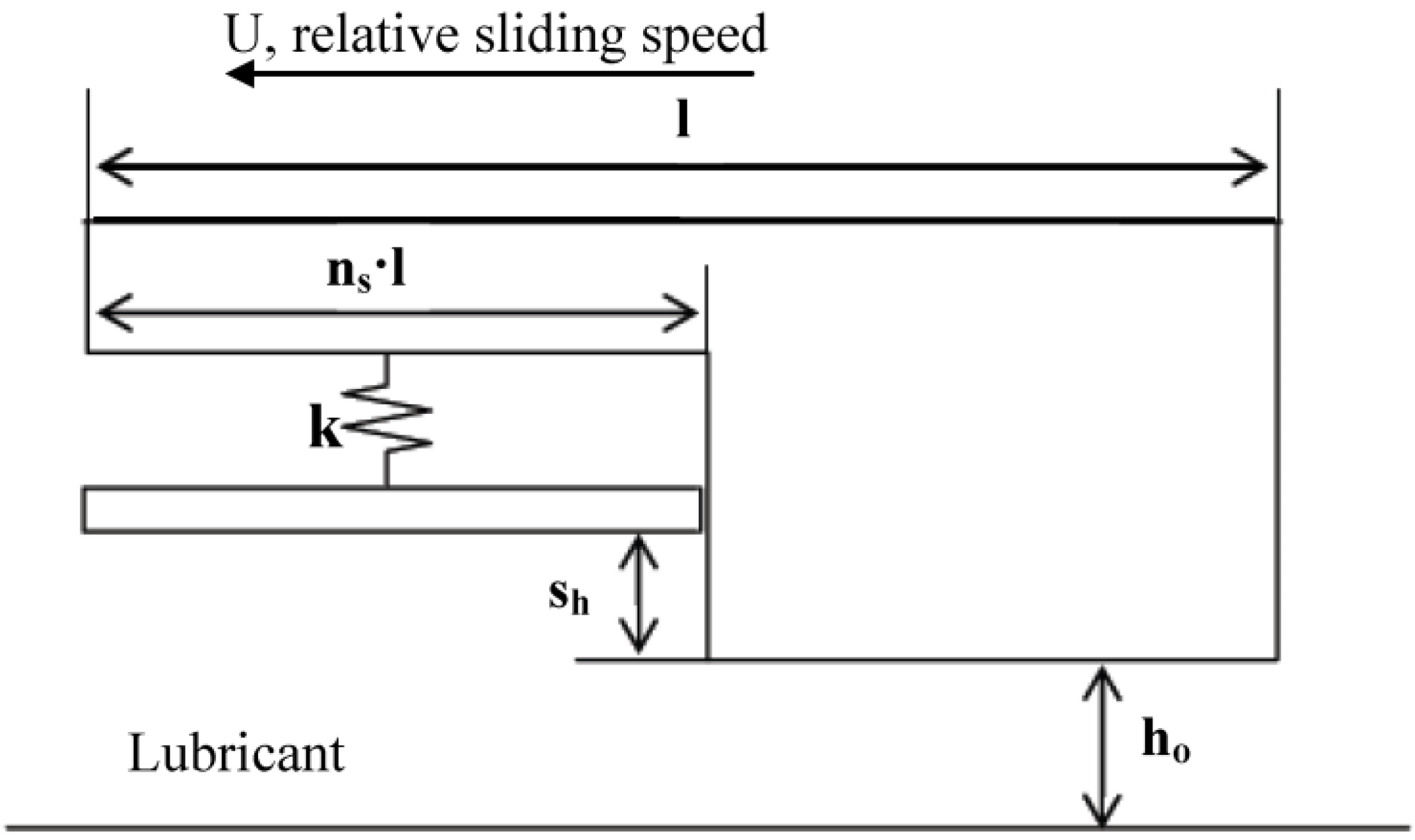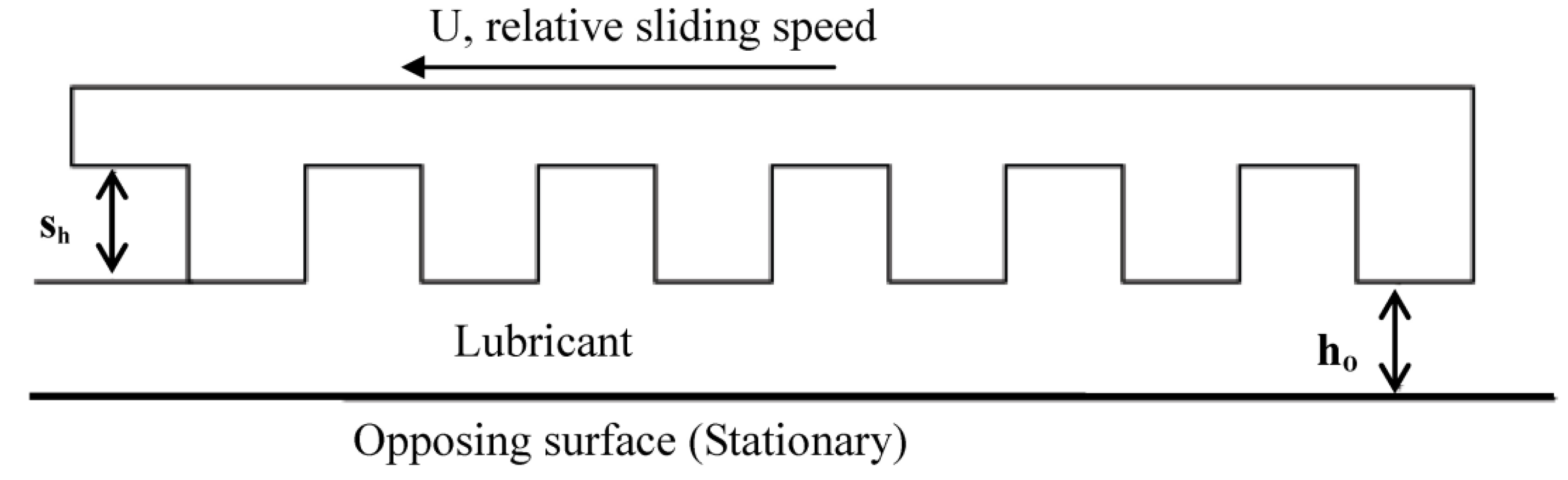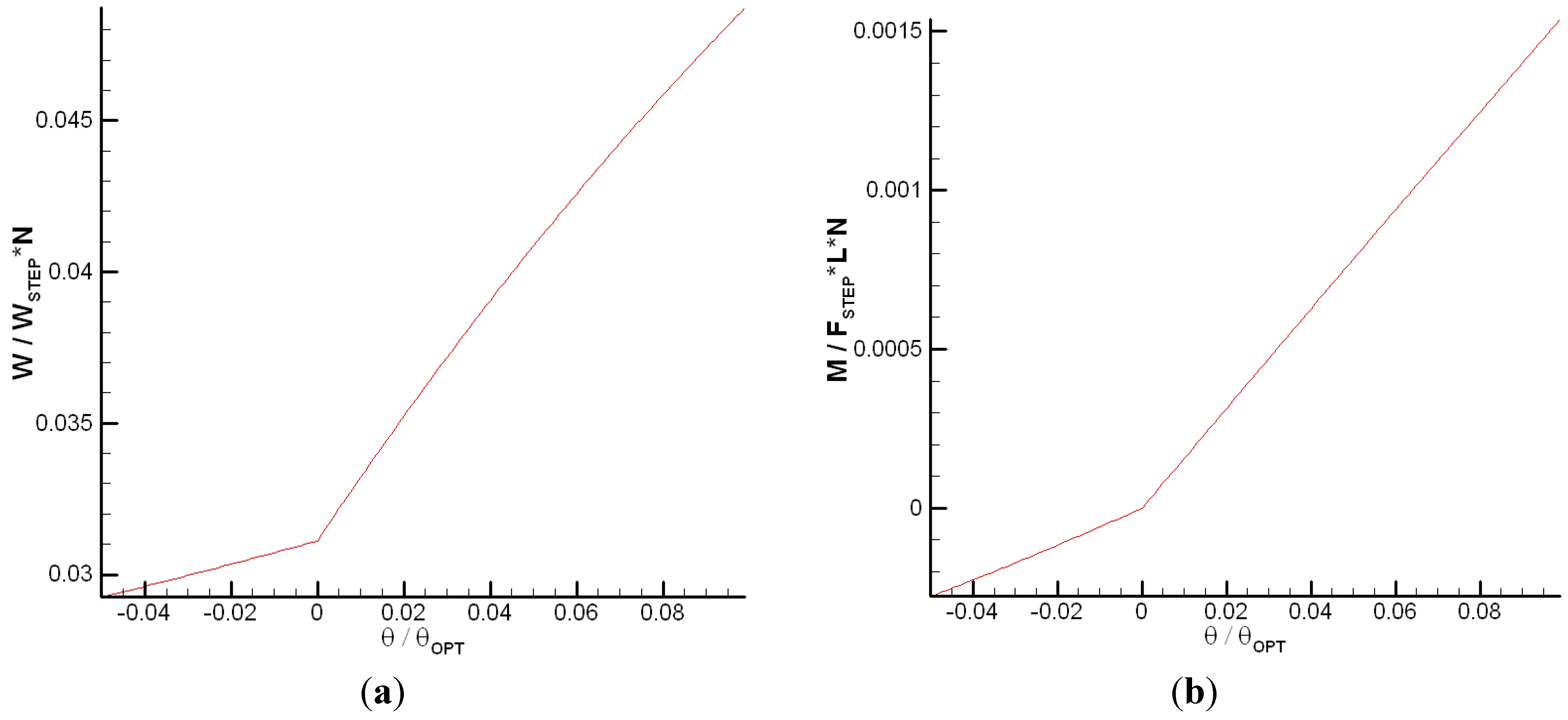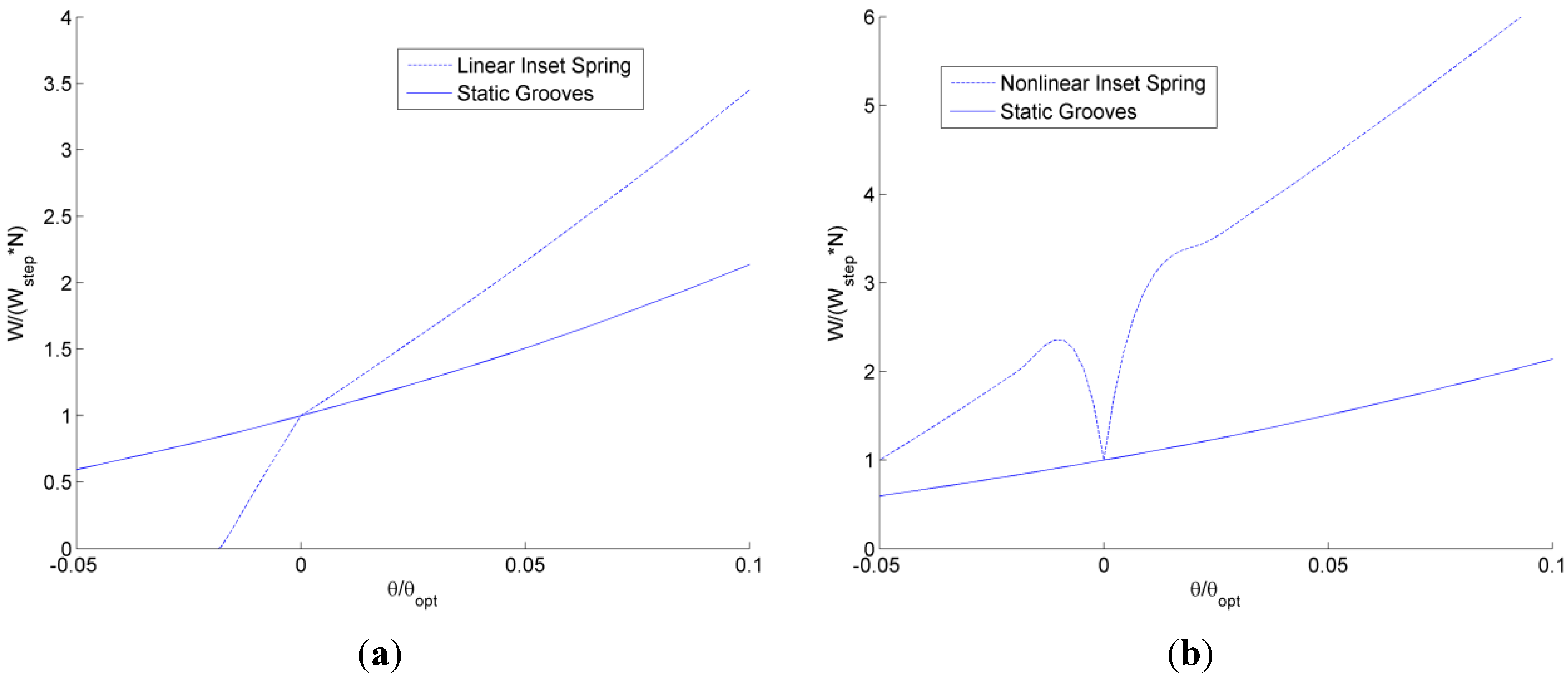
Hydrodynamically Lubricated and Grooved Biomimetic Self-Adapting Surfaces


Abstract
1. Introduction


2. Methodology
2.1. Normalization Scheme


2.2. Analytical Model
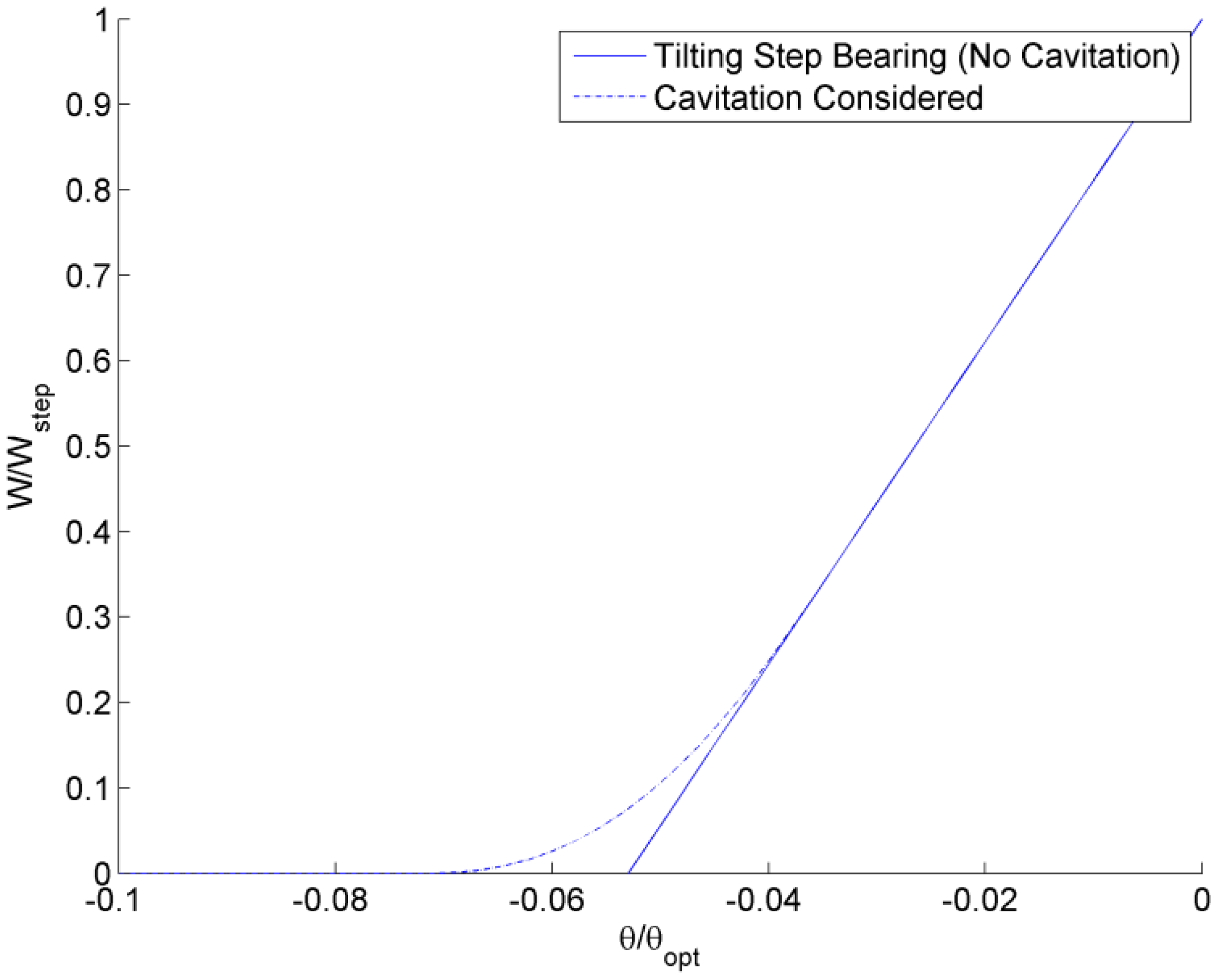
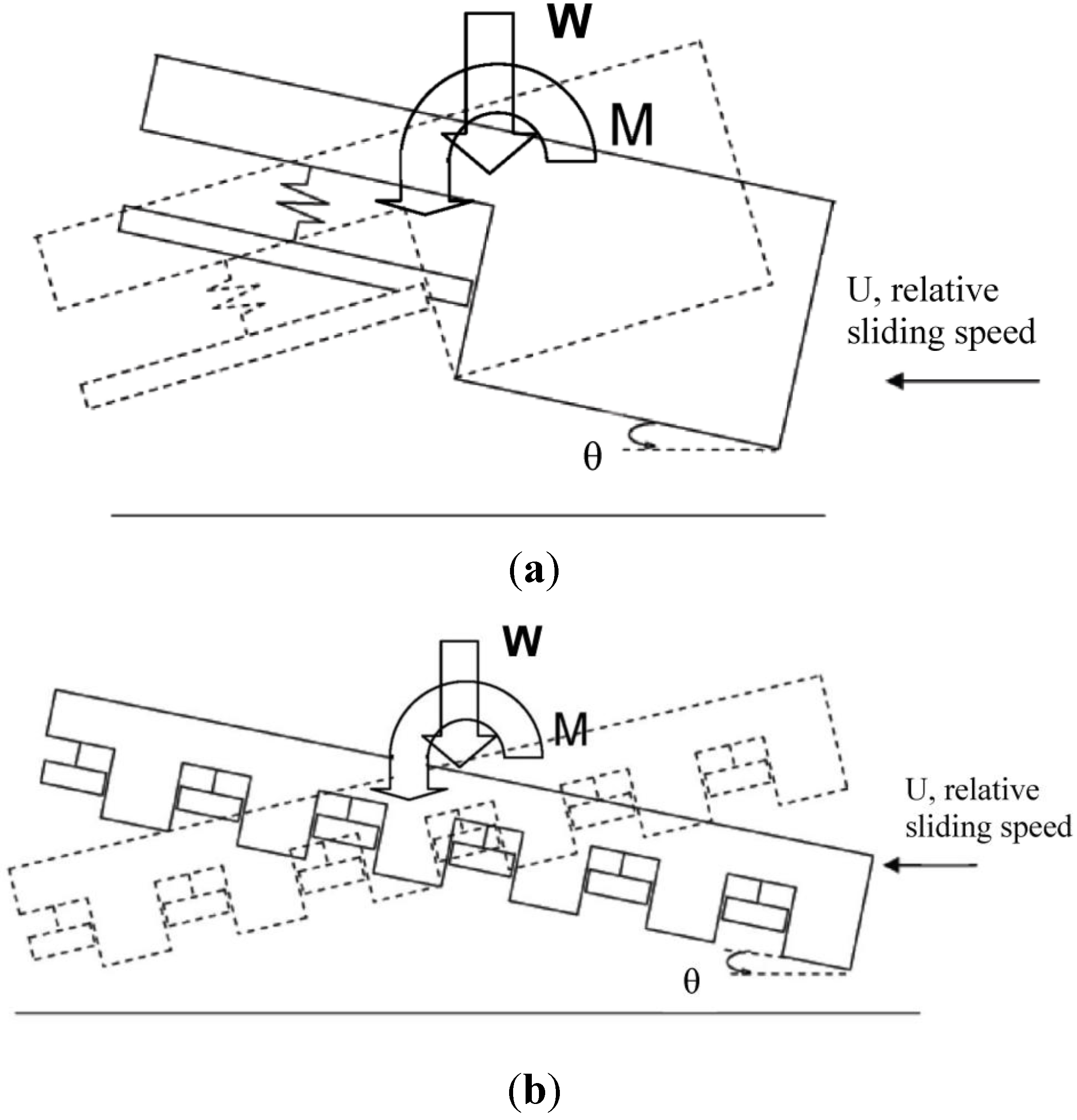

2.3. Numerical Model
3. Results
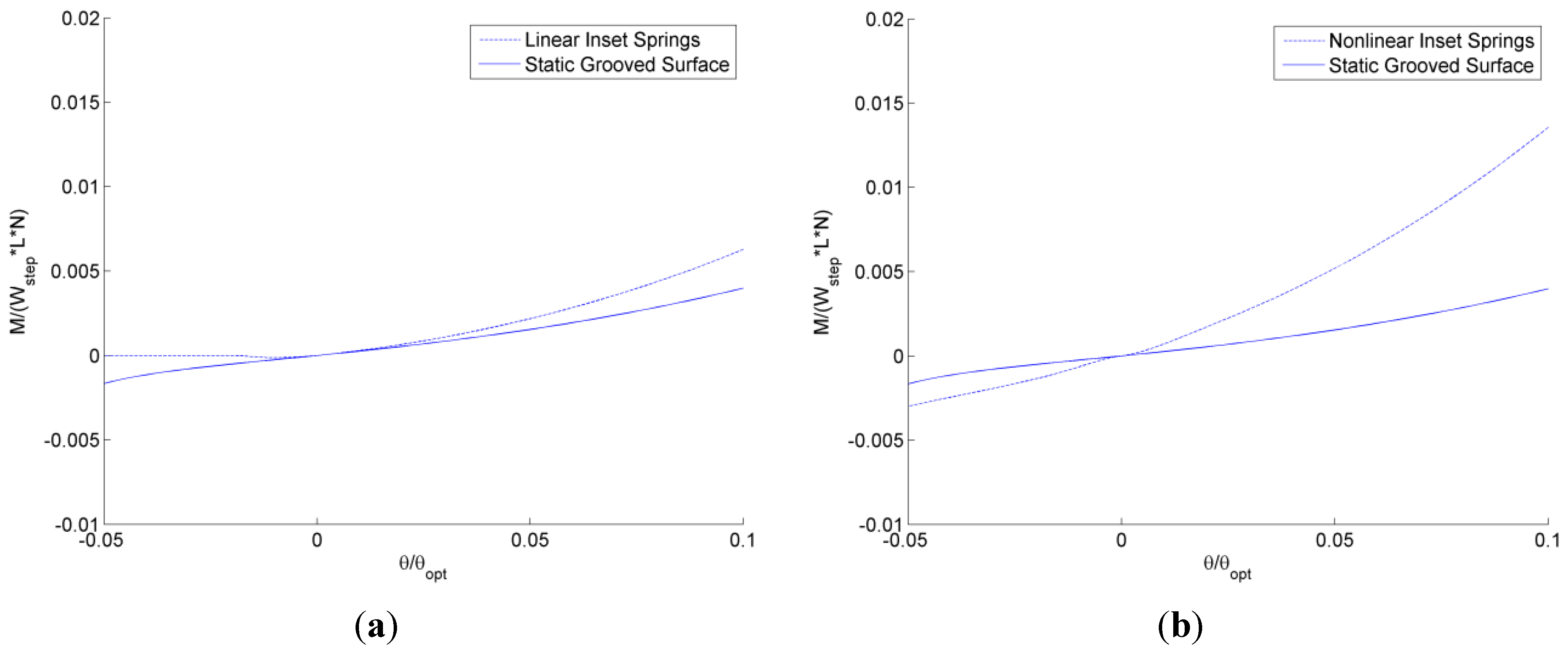
Single Groove Results
 )i. This results in the following equation for the linear spring:

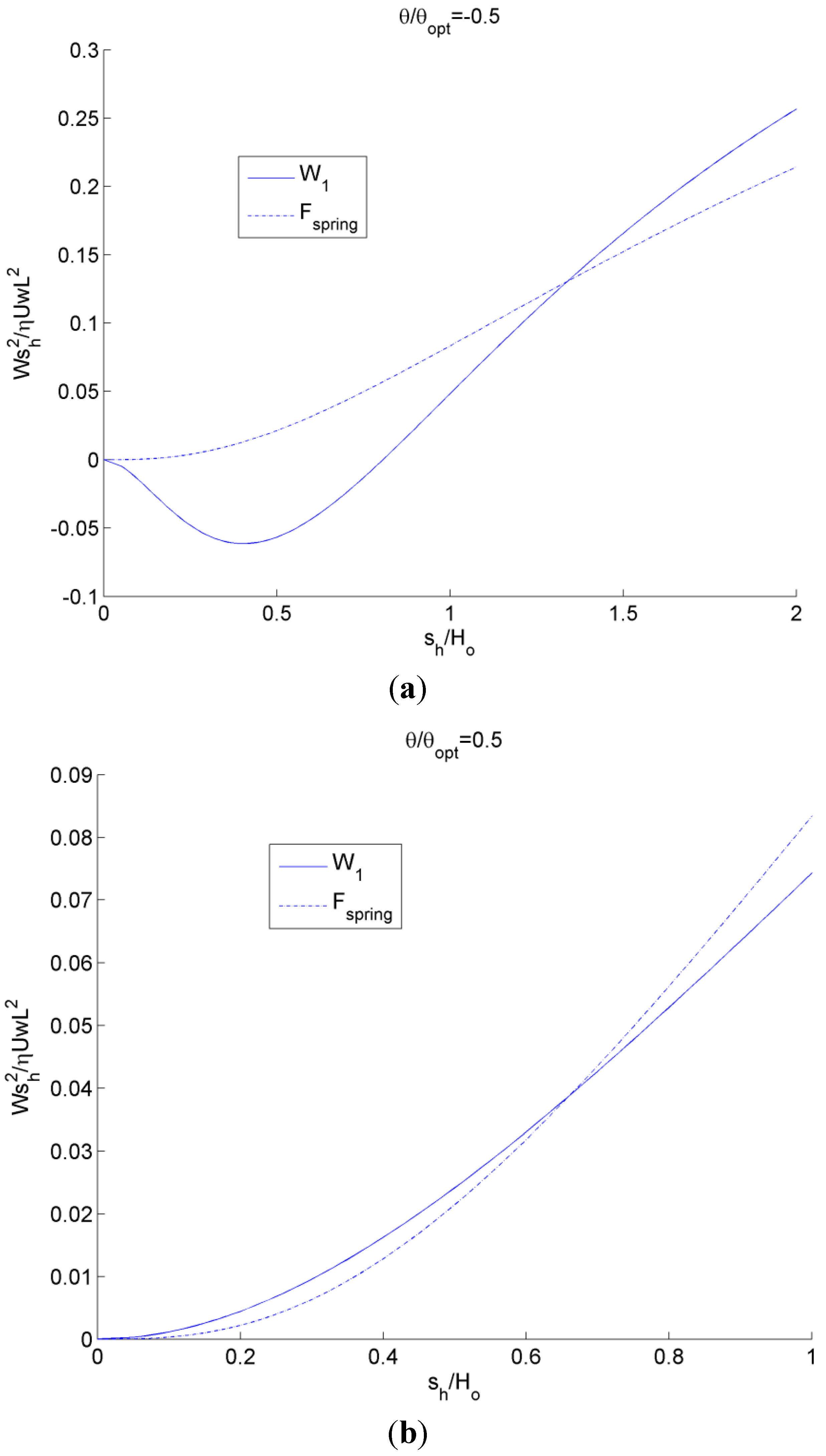
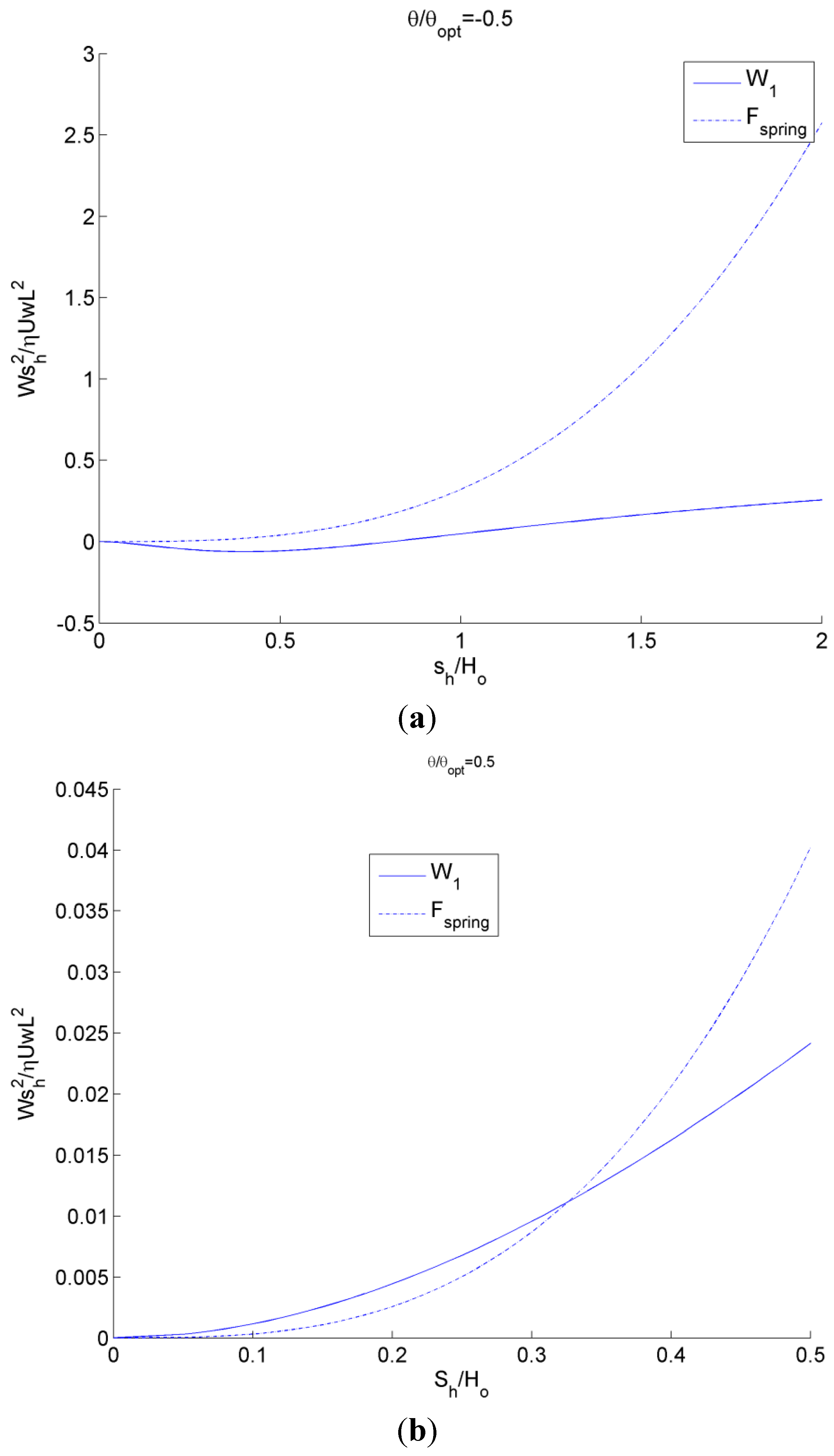
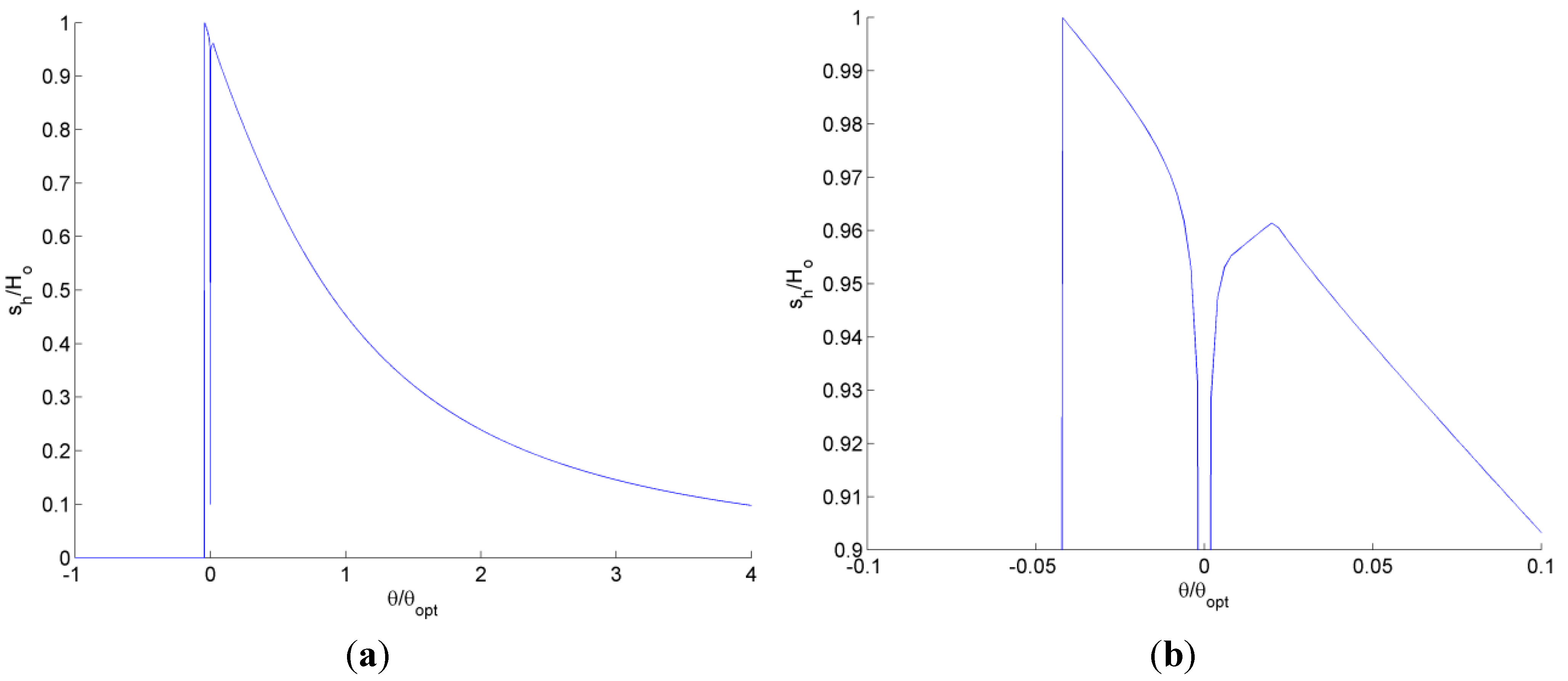
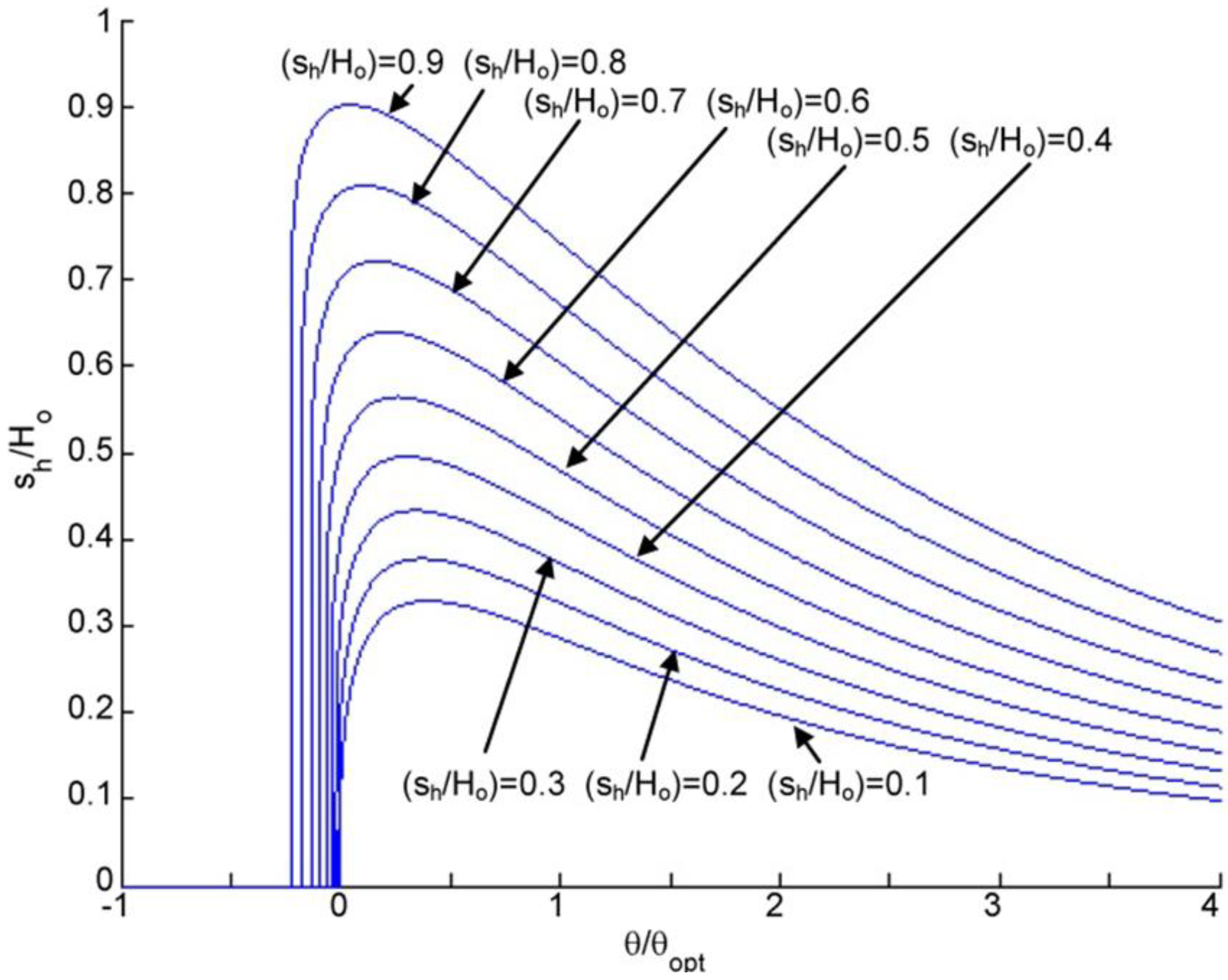
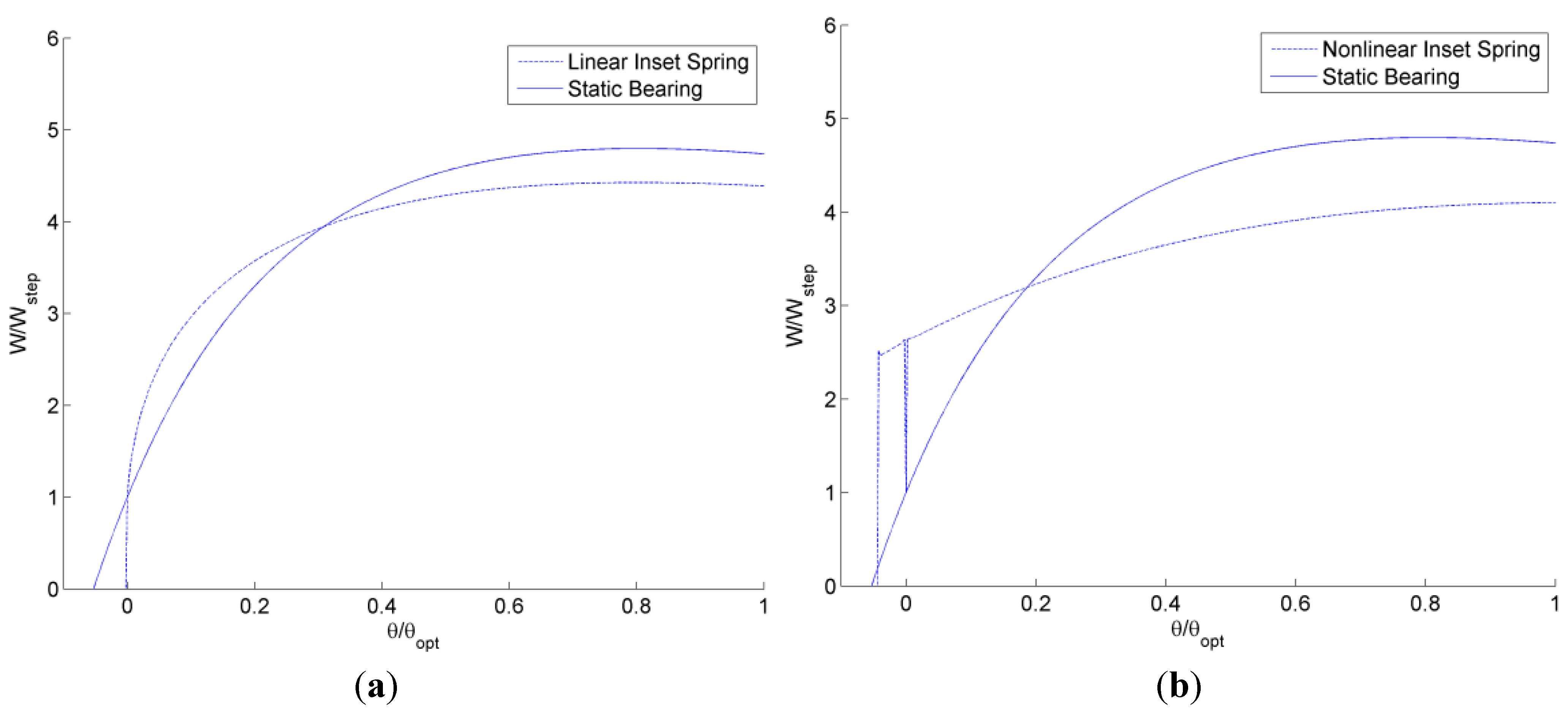
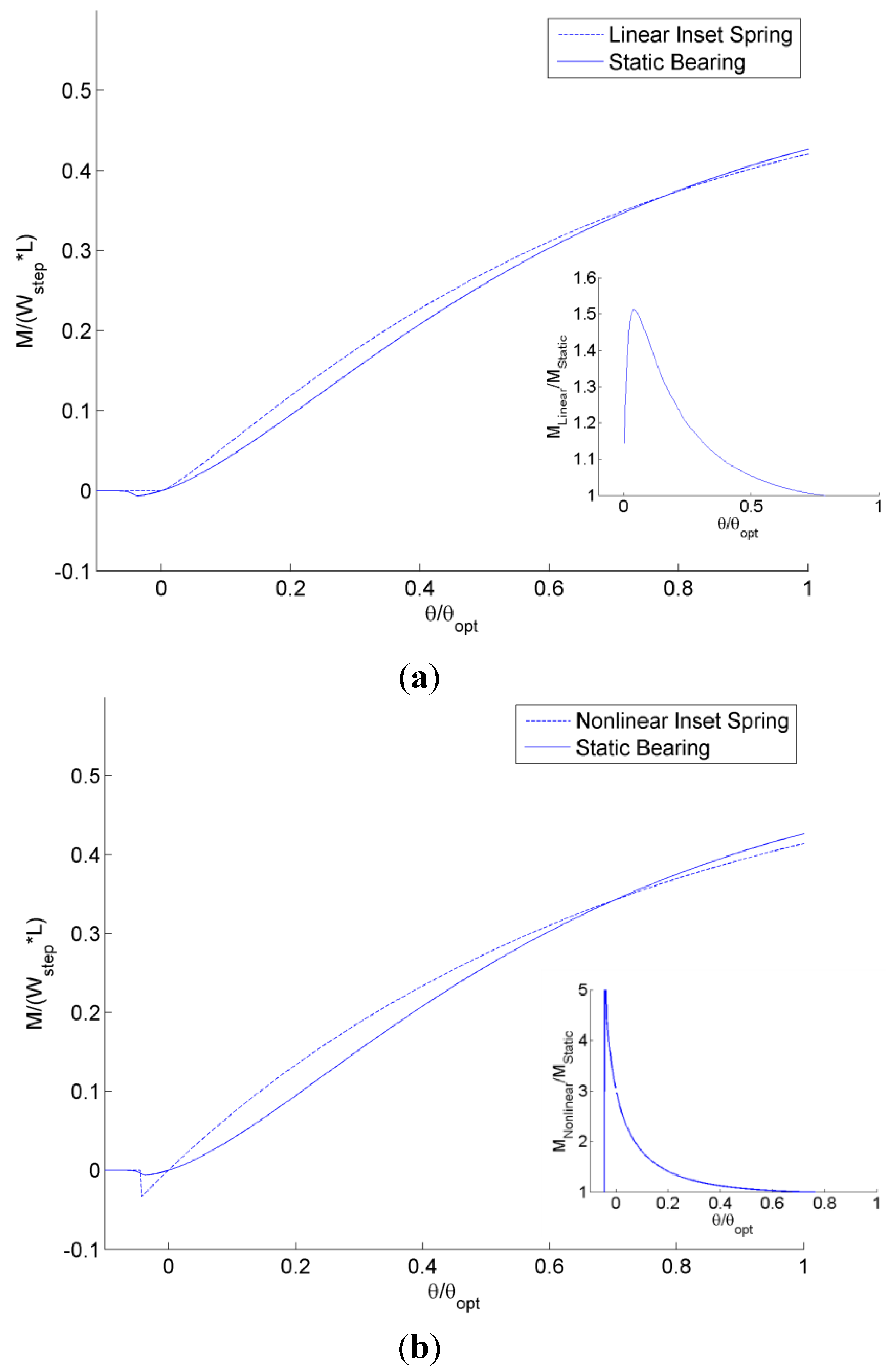
4. Multiple Groove Results


5. Conclusions
Nomenclature
| Fspring | spring force |
 | normalized spring force |
| M | restoring moment from fluid pressure |
| W | total fluid lift force |
| W1 | fluid lift force on the inset of a step bearing |
| Wstep | fluid lift force for a single groove on a grooved surface |
| Ho | desired film thickness |
| h | film thickness |
| hi | local film thickness on groove segment i |
| hmin | local minimum film thickness of one groove section |
| ho | minimum film thickness |
| k | spring stiffness coefficient |
| l | bearing length or one groove segment length |
| L | grooved surface length |
| M | restoring moment |
| M* | normalized restoring moment |
| N | number of grooves on surface |
| ns | bearing step length ratio (step length/total length) |
| p | fluid pressure |
| sh | bearing step inset height |
| , sh | normalized by ho |
| U | sliding speed |
| w | bearing width |
| x | location on a groove segment relative to the location of hmin |
| µ | dynamic viscosity |
| θ | tilt of the bearing surface |
| θopt | optimal tilt of an incline bearing |
Appendix
A.1. Tilted Static Step Bearing Solution
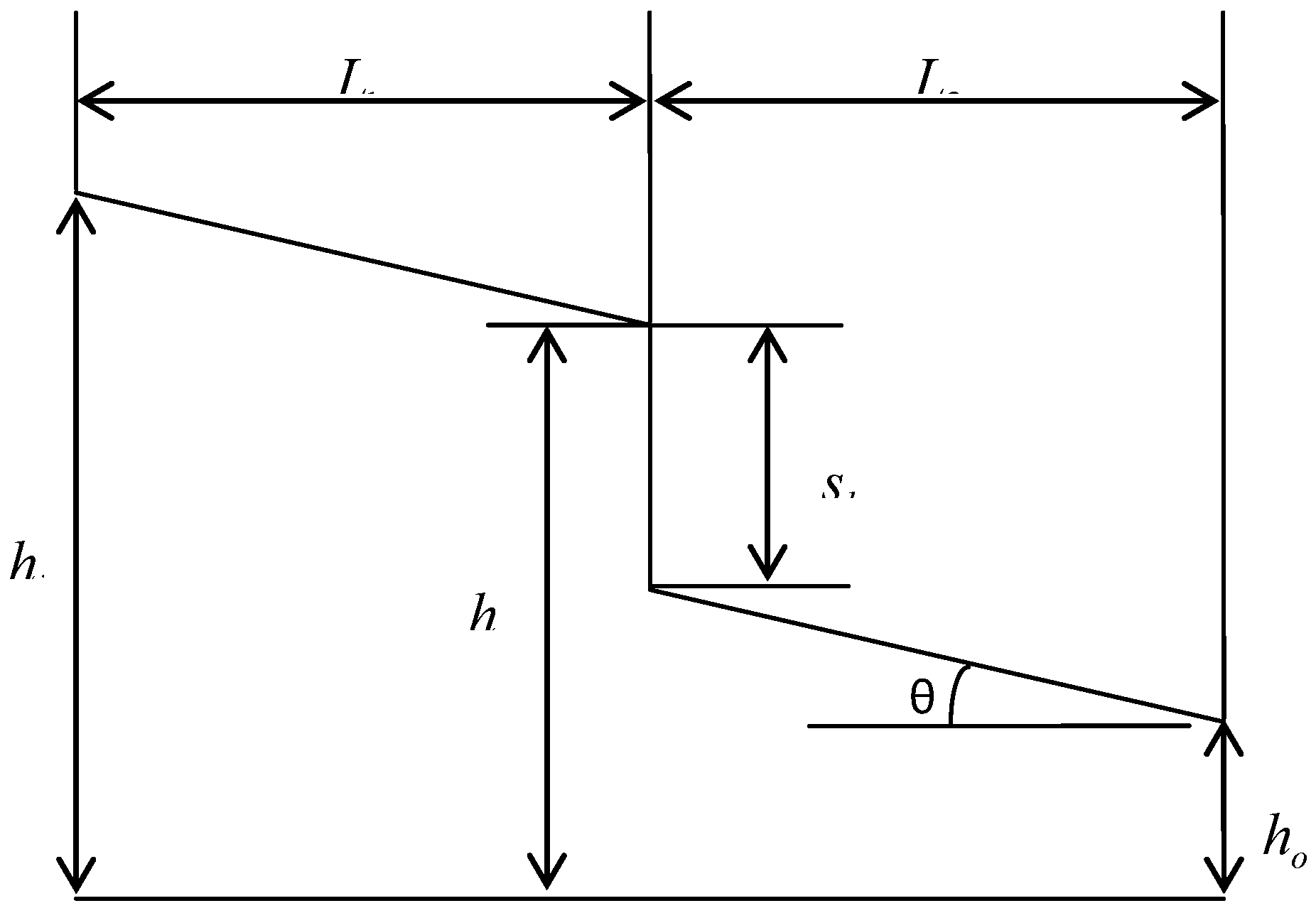


- 1)
- At the inlet, h = hi, p1 = 0;
- 2)
- At the outlet, h = ho, p2 = 0;
- 3)
- At the step, h = hs or sh, p1 = p2 and q1 = q2.


 , and substitute to give

 , and then substituting gives


A.2. Tilted Self-Adapting Step Bearing Case

Conflicts of Interest
References
- Singh, R.A.; Yoon, E.-S.; Jackson, R.L. Biomimetics: The science of imitating nature. Tribol. Lubr. Technol. 2009, 65, 40–47. [Google Scholar]
- Kligerman, Y.; Etsion, I. Analysis of the hydrodynamic effects in a surface textured circumferential gas seal. Tribol. Trans. 2001, 44, 472–478. [Google Scholar] [CrossRef]
- Etsion, I.; Kligerman, Y.; Halperin, G. Analytical and experimental investigation of laser-textured mechanical seal faces. Tribol. Trans. 1999, 42, 511–516. [Google Scholar] [CrossRef]
- Kovalchenko, A.; Ajayi, O.; Erdemir, A.; Fenske, G.; Etsion, I. The effect of laser texturing of steel surfaces and speed-load parameters on the transition of lubrication regime from boundary to hydrodynamic. Tribol. Trans. 2004, 47, 299–307. [Google Scholar] [CrossRef]
- Ryk, G.; Kligerman, Y.; Etsion, I. Experimental investigation of laser surface texturing for reciprocating automotive components. Tribol. Trans. 2002, 45, 444–449. [Google Scholar] [CrossRef]
- Ronen, A.; Etsion, I.; Kligerman, Y. Friction-reducing surface-texturing in reciprocating automotive components. Tribol. Trans. 2001, 44, 359–366. [Google Scholar] [CrossRef]
- Etsion, I. State of the art in laser surface texturing. J. Tribol. 2005, 127, 248–253. [Google Scholar] [CrossRef]
- Etsion, I.; Halperin, G. A laser surface textured hydrostatic mechanical seal. Tribol. Trans. 2002, 45, 430–434. [Google Scholar] [CrossRef]
- Brizmer, V.; Kligerman, Y.; Etsion, I. A laser surface textured parallel thrust bearing. Tribol. Trans. 2003, 46, 397–403. [Google Scholar] [CrossRef]
- Glavatskih, S.; McCarthy, D.; Sherrington, I. Hydrodynamic performance of a thrust bearing with micropatterned pads. Tribol. Trans. 2005, 48, 492–498. [Google Scholar] [CrossRef]
- Wang, X.; Kato, K.; Adachi, K.; Aizawa, K. Loads carrying capacity map for the surface texture design of SiC thrust bearing sliding in water. Tribol. Int. 2003, 36, 189–197. [Google Scholar] [CrossRef]
- Lebeck, A.O. Parallel sliding load support in the mixed friction regime. Part 1—The Experimental Data. J. Tribol. 1987, 109, 189–195. [Google Scholar] [CrossRef]
- Lebeck, A.O. Parallel sliding load support in the mixed friction regime. Part 2—Evaluation of the Mechanisms. J. Tribol. 1987, 109, 196–205. [Google Scholar] [CrossRef]
- Wang, X.; Kato, K.; Adachi, K.; Aizawa, K. The effect of laser texturing of SiC surface on the critical load for the transition of water lubrication mode from hydrodynamic to mixed. Tribol. Int. 2001, 34, 703–711. [Google Scholar] [CrossRef]
- Wang, Q.J.; Zhu, D. Virtual texturing: Modeling the performance of lubricated contacts of engineered surfaces. J. Tribol. 2005, 127, 722–728. [Google Scholar] [CrossRef]
- Harp, S.R.; Salant, R.F. Inter-asperity cavitation and global cavitation in seals: An average flow analysis. Tribol. Int. 2002, 35, 113–121. [Google Scholar] [CrossRef]
- Ruan, B.; Salant, R.F.; Green, I. Mixed lubrication model of liquid/gas mechanical face seals. Tribol. Trans. 1997, 40, 647–957. [Google Scholar] [CrossRef]
- Shen, D.; Salant, R.F. Elastohydrodynamic analysis of the effect of shaft surface finish on rotary lip seal behavior. Trib. Trans. 2003, 46, 391–396. [Google Scholar] [CrossRef]
- Shi, F.; Salant, R.F. Mixed soft elastohydrodynamic lubrication model with interasperity cavitation and surface shear deformation. J. Tribol. 2000, 122, 308–316. [Google Scholar] [CrossRef]
- Tonder, K.; Salant, R. Non-leaking lip seals: A roughness effect study. J. Tribol. 1992, 114, 595–599. [Google Scholar] [CrossRef]
- Raimondi, A.A.; Boyd, J. Applying bearing theory to the analysis and design of pad-type bearings. ASME Trans. 1955, 77, 287–309. [Google Scholar]
- Jackson, R.L. Self adapting mechanical step bearings for variations in load. Tribol. Lett. 2005, 20, 11–20. [Google Scholar] [CrossRef]
- Duvvuru, R.S.; Jackson, R.L.; Hong, J.W. Self-adapting microscale surface grooves for hydrodynamic lubrication. Tribol. Trans. 2009, 52, 1–11. [Google Scholar] [CrossRef]
- Fesanghary, M.; Khonsari, M.M. On self-adaptive surface grooves. Tribol. Trans. 2010, 53, 871–880. [Google Scholar] [CrossRef]
- Fesanghary, M.; Khonsari, M.M. On the shape optimization of self-adaptive grooves. Tribol. Trans. 2011, 54, 256. [Google Scholar] [CrossRef]
- Hamrock, B.J. Fundamentals of Fluid Film Lubrication; Mcgraw-Hill Inc.: New York, NY, USA, 1994. [Google Scholar]
© 2014 by the authors; licensee MDPI, Basel, Switzerland. This article is an open access article distributed under the terms and conditions of the Creative Commons Attribution license (http://creativecommons.org/licenses/by/3.0/).
Share and Cite
Jackson, R.L.; Lei, J. Hydrodynamically Lubricated and Grooved Biomimetic Self-Adapting Surfaces. J. Funct. Biomater. 2014, 5, 78-98. https://doi.org/10.3390/jfb5020078
Jackson RL, Lei J. Hydrodynamically Lubricated and Grooved Biomimetic Self-Adapting Surfaces. Journal of Functional Biomaterials. 2014; 5(2):78-98. https://doi.org/10.3390/jfb5020078
Chicago/Turabian StyleJackson, Robert L., and Jiang Lei. 2014. "Hydrodynamically Lubricated and Grooved Biomimetic Self-Adapting Surfaces" Journal of Functional Biomaterials 5, no. 2: 78-98. https://doi.org/10.3390/jfb5020078
APA StyleJackson, R. L., & Lei, J. (2014). Hydrodynamically Lubricated and Grooved Biomimetic Self-Adapting Surfaces. Journal of Functional Biomaterials, 5(2), 78-98. https://doi.org/10.3390/jfb5020078