<?xml version="1.0" encoding="UTF-8"?>
<!DOCTYPE article PUBLIC "-//NLM//DTD Journal Publishing DTD v2.3 20070202//EN" "journalpublishing.dtd">
<article xmlns:mml="http://www.w3.org/1998/Math/MathML" xmlns:xlink="http://www.w3.org/1999/xlink" xml:lang="en" article-type="research-article">
  <front>
    <journal-meta>
      <journal-id journal-id-type="publisher-id">information</journal-id>
      <journal-title>Information</journal-title>
      <abbrev-journal-title abbrev-type="publisher">Information</abbrev-journal-title>
      <abbrev-journal-title abbrev-type="pubmed">Information</abbrev-journal-title>
      <issn pub-type="epub">2078-2489</issn>
      <publisher>
        <publisher-name>MDPI</publisher-name>
      </publisher>
    </journal-meta>
    <article-meta>
      <article-id pub-id-type="doi">10.3390/info3040601</article-id>
      <article-id pub-id-type="publisher-id">information-03-00601</article-id>
      <article-categories>
        <subj-group>
          <subject>Article</subject>
        </subj-group>
      </article-categories>
      <title-group>
        <article-title>Fröhlich Condensate: Emergence of Synergetic Dissipative Structures in Information Processing Biological and Condensed Matter Systems</article-title>
      </title-group>
	  <contrib-group>
        <contrib contrib-type="author">
          <name>
            <surname>Vasconcellos</surname>
            <given-names>Áurea R.</given-names>
          </name>
          <xref rid="af1-information-03-00601" ref-type="aff">1</xref>
          <xref rid="fn1-information-03-00601" ref-type="fn">†</xref>
        </contrib>
        <contrib contrib-type="author">
          <name>
            <surname>Vannucchi</surname>
            <given-names>Fabio Stucchi</given-names>
          </name>
          <xref rid="af1-information-03-00601" ref-type="aff">1</xref>
          <xref rid="c1-information-03-00601" ref-type="corresp">*</xref>
        </contrib>
        <contrib contrib-type="author">
          <name>
            <surname>Mascarenhas</surname>
            <given-names>Seérgio</given-names>
          </name>
          <xref rid="af2-information-03-00601" ref-type="aff">2</xref>
        </contrib>
        <contrib contrib-type="author">
          <name>
            <surname>Luzzi</surname>
            <given-names>Roberto</given-names>
          </name>
          <xref rid="af1-information-03-00601" ref-type="aff">1</xref>
          <xref rid="c1-information-03-00601" ref-type="corresp">*</xref>
        </contrib>
      </contrib-group>
      
      <aff id="af1-information-03-00601"><label>1 </label>Institute of Physics “Gleb Wataghin”, State University of Campinas—UNICAMP, Campinas 13083-859, Brazil; Email: <email>aurea@ifi.unicamp.br</email></aff>
      <aff id="af2-information-03-00601"><label>2 </label>Institute for Advanced Studies—Sᾶo Carlos, University of Sᾶo Paulo—USP, Sᾶo Carlos 13566-590, Brazil; Email: <email>sergiomascarenhas28@gmail.com</email></aff>
      <author-notes>
        <fn id="fn1-information-03-00601">
          <label>†</label>
          <p> Deceased on 13 October 2012.</p>
        </fn>
        <corresp id="c1-information-03-00601"><label>*</label> Author to whom correspondence should be addressed; Email: <email>fabiosv@ifi.unicamp.br</email> (F.S.V.); <email>rlgmesd@ifi.unicamp.br</email> (R.L.); Tel./Fax: +55-19-3251-4146.</corresp>
      </author-notes>
      <pub-date pub-type="epub">
        <day>24</day>
        <month>10</month>
        <year>2012</year>
      </pub-date>
      <pub-date pub-type="collection">
	  <month>12</month>
        <year>2012</year>
      </pub-date>
      <volume>3</volume>
      <issue>4</issue>
      <fpage>601</fpage>
      <lpage>620</lpage>
      <history>
        <date date-type="received">
          <day>18</day>
          <month>09</month>
          <year>2012</year>
        </date>
        <date date-type="accepted">
          <day>27</day>
          <month>09</month>
          <year>2012</year>
        </date>
      </history>
      <permissions>
        <copyright-statement>©  2012 by the authors; licensee MDPI, Basel, Switzerland.</copyright-statement>
        <copyright-year>2012</copyright-year>
        <license xmlns:xlink="http://www.w3.org/1999/xlink" license-type="open-access" xlink:href="http://creativecommons.org/licenses/by/3.0/">
          <p>This article is an open-access article distributed under the terms and conditions of the Creative Commons Attribution license (<uri>http://creativecommons.org/licenses/by/3.0/</uri>).</p>
        </license>
      </permissions>
      <abstract>
        <p>We consider the case of a peculiar complex behavior in open boson systems sufficiently away from equilibrium, having relevance in the functioning of information-processing biological and condensed matter systems. This is the so-called Fröhlich-Bose-Einstein condensation, a self-organizing-synergetic dissipative structure, a phenomenon apparently working in biological processes and present in several cases of systems of boson-like quasi-particles in condensed inorganic matter. Emphasis is centered on the quantum-mechanical-statistical irreversible thermodynamics of these open systems, and the informational characteristics of the phenomena.</p>
      </abstract>
      <kwd-group>
        <kwd>Froöhlichcondensate</kwd>
        <kwd>dissipativestructures</kwd>
        <kwd>synergetics</kwd>
        <kwd>systemsbiology</kwd>
        <kwd>information-processingsystems</kwd>
      </kwd-group>
    </article-meta>
  </front>
  <body>
    <p><italic>To Herbert Fröhlich in memoriam</italic></p>
    <sec sec-type="intro" id="sec1-information-03-00601">
      <title>1. Introduction</title>
      <p>More than forty years have elapsed since the renowned late Herbert Fröhlich first presented his concept of long-range coherence in biological systems [<xref ref-type="bibr" rid="B1-information-03-00601">1</xref>,<xref ref-type="bibr" rid="B2-information-03-00601">2</xref>,<xref ref-type="bibr" rid="B3-information-03-00601">3</xref>,<xref ref-type="bibr" rid="B4-information-03-00601">4</xref>], a question presently in a process of strong revival providing an attractive and relevant field of research in Physics and Biology. According to Fröhlich,</p>
      <disp-quote><p>“... under appropriate conditions a phenomenon quite similar to a Bose condensation may occur in substances which possess longitudinal electric modes. If energy is fed into these modes and thence transferred to other degrees of freedom of the substance, then a stationary state will be reached in which the energy content of the electric modes is larger than in the thermal equilibrium. This excess energy is found to be channelled into a single mode—exactly as in Bose condensation—provided the energy supply exceeds a critical value. Under these circumstances a random supply of energy is thus not completely thermalized but partly used in maintaining a coherent electric wave in the substance." [<xref ref-type="bibr" rid="B1-information-03-00601">1</xref>]</p></disp-quote>
      <p>This Bose(like) condensation does not follow in equilibrium but in non-equilibrium conditions, displaying a complex behaviour consisting in the emergence of a dissipative structure in Prigogine’s sense [<xref ref-type="bibr" rid="B5-information-03-00601">5</xref>]. Fröhlich’s results are based on the idea that alive biological systems are open and very far from equilibrium and have considerable amounts of energy available, through metabolic processes, that cause non-linear changes in molecules and larger biological subsystems. F. Fröhlich (Herbert’s son) in “Life as a Collective Phenomena" [<xref ref-type="bibr" rid="B6-information-03-00601">6</xref>], expressed that if one thinks without preconceptions of collective phenomena in which the discrete constitutive individuals are modified in their behaviour, and indeed constituting a large collective group where the whole is more than and different from a simple addition of its parts, living organisms would seem to be the ideal example. Such hypothesis of biological explanation in terms of long-range coherence was originally suggested by Fröhlich at the first meeting of L’institute de la Vie in 1967 [<xref ref-type="bibr" rid="B2-information-03-00601">2</xref>].</p>
      <p>In Fröhlich model vibrational-polar modes are excited by a continuous supply of energy pumped by an external source, while these modes interact with the surrounding medium acting as a thermal bath. The interplay of these two effects—pumping of energy subtracting entropy from the system and dissipative internal effects adding entropy to the system—may lead to the emergence of complex behaviour in the system consisting in what can be called <italic>Fröhlich effect</italic>: Provided the energy supply is sufficiently large compared with the energy loss, the system attains a stationary state in which the energy that feeds the polar modes is channelled into the modes with the lowest frequencies. The latter largely increase their populations at the expenses of the other higher-in-frequency modes, in a way reminiscent of a Bose-Einstein condensation [<xref ref-type="bibr" rid="B7-information-03-00601">7</xref>]. This highly excited subset of modes may exhibit long-range phase correlations of an electret type [<xref ref-type="bibr" rid="B8-information-03-00601">8</xref>].</p>
      <p>Fröhlich’s synchronous large-scale collective oscillations imply inter-cellular microwave emissions which would constitute a non-chemical and non-thermal interaction between cells. These oscillations could therefore be revealed by detection of emissions of GHz or THz radiation. Such electromagnetic signals are of extremely low magnitude and the receiver technology to measure them was not available during Fröhlich’s time. It is only now that the predicted signals can be detected by adapting technology that has been developed for space and astrophysical research. Hence, a whole new area of biology is now ready for investigation.</p>
      <p>Earlier experiments looking after Fröhlich effect were not conclusive, but now as notice above a “second generation” of experiments are becoming available. They require further improvement, but already some preliminary results are encouraging [<xref ref-type="bibr" rid="B9-information-03-00601">9</xref>]: Some evidence of a non-thermal influence of coherent microwave radiation on the genome conformational state in <italic>E. coli</italic> has been reported, which may indicate that chromosomal DNA could be the target of mm microwave irradiation within this system. Also low intensity microwave irradiation of leukocytes results in a significant increase in bio-photon emission in the optical range, the origin of which is thought to involve DNA. Also it is worth noticing the possible influence of the concept of bio-coherence on the very particular dipolar system, which is water. It can be considered the possibility that biological water might itself support coherent dipolar excitations extending over mesoscopic regions; thus water, instead of passive space-filling solvent, would be raised to an important singular position whose full significance has yet to be elucidated.</p>
      <p>Non-biological implications of Fröhlich effect could also be far-reaching. It can be mentioned some connection with homoeopathy and atmospheric aerosol physics. Regarding the latter, sunlight-pumped Fröhlich-like coherent excitations may play a role in producing anomalies in the spectrum of light absorption [<xref ref-type="bibr" rid="B10-information-03-00601">10</xref>]. At this point we may mention a public safety concern, namely, the influence and eventual deleterious effects of mobile phones in close proximity to the head of the user as a result of the action of microwaves on the biological material. Moreover, we call the attention to an additional aspect of Fröhlich effect in connection with the long-range propagation of signals in biological and non-biological materials. Such signals are wave-packets consisting of Schrödinger-Davydov solitons [<xref ref-type="bibr" rid="B11-information-03-00601">11</xref>,<xref ref-type="bibr" rid="B12-information-03-00601">12</xref>], which are a dynamical consequence of the same nonlinearities responsible for Fröhlich effect. It can be shown that the solitary wave, which in biological as well as non-biological systems is strongly damped as a result of the usual dissipative effect, may propagate with weak decay travelling long distances when moving in the background provided by a steady-state Fröhlich’s condensate [<xref ref-type="bibr" rid="B13-information-03-00601">13</xref>]. There already exist cases where theory is seemingly validated by experiment. One in the medical area of diagnosis, ultrasound imaging is related not to Fröhlich effect in polar vibrational systems, but in acoustical vibrational ones. Fröhlich effect can also follow in the latter case with the pumping source being an antenna emitting ultrasound signals. A Davydov soliton, distinctly from the regular dispersive sound waves, travels long distances unaltered and nearly undamped, which can be of particular interest for improving detection in ultrasonography. An interesting additional complex behaviour follows, consisting in that when the soliton propagates with velocity larger than that of the group velocity of the normal vibrational modes, there follows a phenomenon akin to Cherenkov effect in radiation theory, namely a large emission of phonons in two symmetric cones centred on the soliton; this allows to interpret the so-called X-waves in ultrasonography as this Fröhlich-Cherenkov effect [<xref ref-type="bibr" rid="B14-information-03-00601">14</xref>,<xref ref-type="bibr" rid="B15-information-03-00601">15</xref>,<xref ref-type="bibr" rid="B16-information-03-00601">16</xref>]. In what regards non-biological materials, we first notice the case of the molecular polymer acetanilide—which is a good mimic of certain bio-polymers—where Davydov soliton is evidenced in the infrared absorption spectrum. In this case, it is open to the experimenter to look for an indirect verification of formation of Fröhlich condensate, looking for the lifetime (obtained via the Raman spectrum linewidth) when submitting the polar vibrational oscillations (the CO-stretching or Amide-I modes) to the action of an external pumping source (e.g., infrared radiation) covering the frequencies of the dispersion relation of the vibrational modes [<xref ref-type="bibr" rid="B16-information-03-00601">16</xref>].</p>
      <p>Other example where Fröhlich’s condensation and Davydov’s soliton appear to be present is the case of the so-called “excitoner”, meaning stimulated coherent emission of excitons created by random excitations, in a situation similar to the case of photons in a laser [<xref ref-type="bibr" rid="B17-information-03-00601">17</xref>,<xref ref-type="bibr" rid="B18-information-03-00601">18</xref>]. In this case excitons, created in a semiconductor by an intense pulse of laser radiation, travel through the sample as a packet and are detected on the back of the sample. A weak signal in normal conditions of thermal excitation is largely enhanced when the system is pumped by a continuous external source of infrared radiation. The theory suggests the formation of a non-thermally excited Fröhlich condensate of excitons where a weakly damped Schrödinger-Davydov soliton is created, whose shape is in very good agreement with the experimental observation [<xref ref-type="bibr" rid="B19-information-03-00601">19</xref>].</p>
      <p>In conclusion, we are facing a stimulating revival of Fröhlich effect, after a certain period of partial hibernation. This revival is a strong one in the sense that, as noticed, it may open a whole and relevant new area of research in basic biology and also in the realms of condensed matter physics. Let us consider the case of biological systems.</p>
    </sec>
    <sec>
      <title>2. Biology, Physics and Fröhlich Condensate</title>
      <p>What is biophysics? For us, life is the most important phenomenon in Nature. It is also very complex, and in order to understand life and living processes several branches of science are needed. Biophysics uses biological and physical concepts for the study of life. One of the greatest physicist of the twentieth century, Erwin Schrödinger, wrote a beautiful little book [<xref ref-type="bibr" rid="B20-information-03-00601">20</xref>] which he named “What is life?” Though this book is now outdated, it can be read with benefit by the modern scientist. Not only physics but specially biochemistry are essential to answer the question. So today, biophysics is understood as a broad interdisciplinary area encompassing biology, physics, biochemistry, mathematical and computational modelling, information theory, and others. It is thus a very rich part of modern science with tremendous opportunities for basic and applied research. Physicists occasionally used models and intuitive theories and techniques to describe biology and life sciences. But also in the past, biologists, physicians, pharmacologists and other life scientists rarely looked for physical concepts and instrumentation to help solve their problems. Until the mid-twentieth century, biology has been largely a descriptive field. It has been in the last half of the twentieth century that this gave place to a more complete, integrated approach, in which we can talk about biophysics as an independent branch of science [<xref ref-type="bibr" rid="B21-information-03-00601">21</xref>].</p>
      <p>An article in Science [<xref ref-type="bibr" rid="B22-information-03-00601">22</xref>] had the seemingly taunting title of “Physicists advance into Biology”, and a subtitle indicating that “physicists are ... hoping that their mechanistic approach will yield new insight into biological systems”. Both statements are open to questioning. For the first one, there appears not to be an “invasion”, but more precisely a “miscegenation” of sciences developing at the last decades of the second millennium and now going through the beginning of the twenty-first century. This has been foresighted and clearly stated by the renowned Nobel Prize laureate Werner Heisenberg, who in 1970, in an article on the Wednesday October 6th issue of the Süddeutsche Zeitung, wrote that “the characteristic feature of the coming development will surely consists in the unification of science, the conquest of the boundaries that have grown up historically between the different individual disciplines” [<xref ref-type="bibr" rid="B23-information-03-00601">23</xref>]. In a sense, this implies in a kind of “renaissance” in the direction of an Aristotelian global philosophy of natural sciences. Even more interesting is the statement in the subtitle in [<xref ref-type="bibr" rid="B22-information-03-00601">22</xref>], concerning the interdisciplinary aspects of physics and biology. What is most relevant to a theoretical physical approach to biology is not the usual reductionist-mechanicist-deterministic scheme of physics, but an emerging scheme at a holistic-dynamicist-stochastic level. Citing the Nobel Prize laureate Ilya Prigogine in a book in collaboration with Isabelle Stengers [<xref ref-type="bibr" rid="B24-information-03-00601">24</xref>], “science centred around the basic conviction that at some level the world is simple and is governed by time-reversible fundamental laws. Today this appears as an excessive simplification. We may compare it to reduce buildings to piles of bricks.... It is on the level of the building as a whole that we apprehend it as a creature of time, as a product of a culture, a society, a style.” Moreover, Prigogine and Nicolis [<xref ref-type="bibr" rid="B25-information-03-00601">25</xref>] wrote that “physics has emphasized stability and permanence. We now see that, at best, such qualification applies only to very limited aspects. Wherever we look, we discover evolutionary processes leading to diversification and increasing complexity.” Prigogine and the so-called Brussel’s school of thought, were among the pioneers of the nowadays referred-to as the highly interdisciplinary science of complexity. Complexity is regarded to be part of a frontier field in the particular science of physics [<xref ref-type="bibr" rid="B26-information-03-00601">26</xref>]. It is considered that the 1972 article in Science [<xref ref-type="bibr" rid="B27-information-03-00601">27</xref>] by the Nobel Prize laureate Philip W. Anderson constitutes one of the main “manifests” on the subject (see also references [<xref ref-type="bibr" rid="B5-information-03-00601">5</xref>,<xref ref-type="bibr" rid="B28-information-03-00601">28</xref>,<xref ref-type="bibr" rid="B29-information-03-00601">29</xref>,<xref ref-type="bibr" rid="B30-information-03-00601">30</xref>,<xref ref-type="bibr" rid="B31-information-03-00601">31</xref>,<xref ref-type="bibr" rid="B32-information-03-00601">32</xref>]). Complex behaviour in matter is nowadays a subject attracting an increasing interest. Complex systems are not merely complicated (even though they could), but characterized by the fact of displaying highly coherent behaviour involving the collective organization in a vast number of constituent elements. It is said that it is one of the universal miracles of Nature that huge assemblages of particles, subject only to the blind forces of nature, are nevertheless capable of organizing themselves into patterns of cooperative activity [<xref ref-type="bibr" rid="B26-information-03-00601">26</xref>]. Complex behaviour in matter can only arise in the nonlinear domain of the theory of dynamical systems (one of its founders being L. von Bertalanffy in the 1930s [<xref ref-type="bibr" rid="B28-information-03-00601">28</xref>]), since in the linear domain the principle of superposition of states cannot give rise to any unexpected behaviour of a synergetic character. For thermodynamic systems, as the biological ones, coherent behaviour is only possible in the nonlinear regime far from equilibrium. Once in the linear (also referred as Onsagerian) regime around equilibrium, synergetic organization is inhibited according to Prigogine’s theorem of minimum entropy production [<xref ref-type="bibr" rid="B25-information-03-00601">25</xref>,<xref ref-type="bibr" rid="B29-information-03-00601">29</xref>]. It is certainly a truism to say that the complicate heterogeneous spatial structure and functioning (temporal evolution) of living organisms, starting with the individual cell, set down quite difficult problems at the biophysical and biochemical levels of biology. In recent decades a good amount of effort has in particular been devoted to some physico-chemical aspects of bio-systems, like, how to increase our knowledge of the chemical composition of life forms; to determine the structure of macromolecules, proteins, <italic>etc.</italic> (as noted in [<xref ref-type="bibr" rid="B22-information-03-00601">22</xref>], understanding of structure is the first vital step, without which any further analysis runs aground); to determine the reactions that lead to processes of synthesization of multiple components; to understand the mechanisms and codes required to determine the structure of proteins; and so on. Moreover, as already noticed, to consider living systems at the biophysical level, we must be well aware of the fact that we are dealing with macroscopic open systems in non-equilibrium conditions. In other words, we observe macroscopic organization—at the spatial, temporal and functional levels—of the microscopic components of the system, namely, molecules, atoms, radicals, ions, electrons. The macroscopic behaviour is of course correlated to the details of the microscopic structure. However, it must be further emphasized that this does not mean that knowing the microscopic details and their mechanistic laws, the reductionist scheme shall reveal the interesting macroscopic properties. Not only—as it is well known—is the number of microscopic states so huge that cannot be handled out, but still more important, and fundamental, is the relevant fact that macroscopic properties are expressed in terms of concepts that do not belong in mechanics, which are collective macroscopic effects. Hence, as already pointed out above, reductionist and deterministic methods of mechanics must be superseded—or, better to say, extended—to build a macrophysics, holistic in the sense of collective, and with both deterministic and chance characteristics. Some attempts in such direction have been developed with the introduction of approaches like Prigogine’s dissipative structures [<xref ref-type="bibr" rid="B5-information-03-00601">5</xref>], Fröhlich macroconcepts [<xref ref-type="bibr" rid="B30-information-03-00601">30</xref>], Haken synergetics [<xref ref-type="bibr" rid="B31-information-03-00601">31</xref>] and computer-modelling [<xref ref-type="bibr" rid="B32-information-03-00601">32</xref>].</p>
      <p>Which may be the theoretical approach in physics to carry on a program to deal with at the microscopic as well as, at the same time, the all important, macroscopic levels of bio-systems and their synergetic aspects? During the last decades this question concerning the theoretical description of the macroscopic behaviour of dissipative open many-body systems in arbitrarily far-from-equilibrium conditions has been encompassed in a seemingly powerful, concise, and elegant formalism, established on sound basic principles. This is a non-equilibrium statistical ensemble formalism, accompanied with a nonlinear quantum kinetic theory, a response function theory for systems arbitrarily away from equilibrium, a statistical thermodynamics for dissipative systems, and a higher-order generalized hydrodynamics. This is the formalism used for the study of complex behaviour in biological systems, mainly the so-called Fröhlich’s effect and some other accompanying phenomena, as the long-distance propagation of nearly undamped and undistorted signals.</p>
      <p>Here we present a description of these ideas applied to the study of a general case of complex behaviour in open boson systems, be it in bio-systems or in condensed matter like semiconductors. Hence, and in conclusion of this section, we may state that the results to be described, resulting from a promising particularly successful marriage of nonlinear non-equilibrium statistical thermodynamics and biology, lead us to paraphrase Herbert Fröhlich saying that it is particularly auspicious to see that biological systems may display complex behaviour describable in terms of appropriate physical concepts.</p>
    </sec>
    <sec>
      <title>3. Complex Behaviour in Open Boson Systems</title>
      <p>Particular complex behaviour has been observed in the case of boson systems, as Bose-Einstein condensation (BEC) in fluids in equilibrium at very low temperature. A case is superfluidity in liquid helium evidenced by Pyotr Kapitza [<xref ref-type="bibr" rid="B33-information-03-00601">33</xref>], on which Fritz London indicated to be a manifestation of BEC [<xref ref-type="bibr" rid="B34-information-03-00601">34</xref>]. More recently, in the 1990s, BEC was produced in systems consisting of atomic alkali gases contained in traps and at very low temperatures [<xref ref-type="bibr" rid="B35-information-03-00601">35</xref>].</p>
      <p>A second type of BEC is the one of boson-like quasi-particles, that is, those associated to elementary excitations in solids (e.g., phonons, excitons, hybrid excitations, <italic>etc.</italic>), when in equilibrium at extremely low temperatures. A well studied case is the one of an exciton-polariton system confined in microcavities (a near two-dimensional sheet), exhibiting the classic hallmarks of a BEC [<xref ref-type="bibr" rid="B36-information-03-00601">36</xref>,<xref ref-type="bibr" rid="B37-information-03-00601">37</xref>,<xref ref-type="bibr" rid="B38-information-03-00601">38</xref>,<xref ref-type="bibr" rid="B39-information-03-00601">39</xref>,<xref ref-type="bibr" rid="B40-information-03-00601">40</xref>,<xref ref-type="bibr" rid="B41-information-03-00601">41</xref>,<xref ref-type="bibr" rid="B42-information-03-00601">42</xref>,<xref ref-type="bibr" rid="B43-information-03-00601">43</xref>].</p>
      <p>The third type is the case of boson-like quasi-particles (associated to elementary excitations in solids) which are driven out of equilibrium by external perturbative sources. D. Snoke [<xref ref-type="bibr" rid="B44-information-03-00601">44</xref>] has properly noticed that the name BEC can be misleading (some authors call it “resonance”, e.g., in the case of phonons [<xref ref-type="bibr" rid="B45-information-03-00601">45</xref>]), and following this author it is better not to be haggling about names, so we introduce the nomenclature <bold>NEFBEC</bold> (short for Non-Equilibrium Fröhlich-Bose-Einstein Condensation for the reasons stated below).</p>
      <p>Several cases can be listed: </p>
      <list list-type="order">
        <list-item>
          <p>A first case was evidenced by <bold>Herbert Fröhlich</bold> who considered, as already noticed, the many boson system consisting of polar vibration (LO-phonons) in bio-polymers under dark excitation (metabolic energy pumping) and embedded in a surrounding fluid [<xref ref-type="bibr" rid="B1-information-03-00601">1</xref>,<xref ref-type="bibr" rid="B2-information-03-00601">2</xref>,<xref ref-type="bibr" rid="B3-information-03-00601">3</xref>,<xref ref-type="bibr" rid="B4-information-03-00601">4</xref>,<xref ref-type="bibr" rid="B7-information-03-00601">7</xref>,<xref ref-type="bibr" rid="B46-information-03-00601">46</xref>]. From a Science, Technology and Innovation (STI) point of view, it was considered to have implications in medical diagnosis [<xref ref-type="bibr" rid="B9-information-03-00601">9</xref>]. More recently it has been considered to be related to brain functioning and artificial intelligence [<xref ref-type="bibr" rid="B47-information-03-00601">47</xref>]</p>
        </list-item>
        <list-item>
          <p>A second case is the one of acoustic vibration (ac phonons) in biological fluids, involving nonlinear anharmonic interactions and in the presence of pumping sonic waves, with eventual STI relevance in supersonic treatments and imaging in medicine [<xref ref-type="bibr" rid="B48-information-03-00601">48</xref>,<xref ref-type="bibr" rid="B49-information-03-00601">49</xref>];</p>
        </list-item>
        <list-item>
          <p>A third one is that of excitons (electron-hole pairs in semiconductors) interacting with the lattice vibrations and under the action of RF-electromagnetic fields; on an STI aspect, the phenomenon has been considered for allowing a possible exciton-laser in the THz frequency range called “Excitoner” [<xref ref-type="bibr" rid="B18-information-03-00601">18</xref>,<xref ref-type="bibr" rid="B19-information-03-00601">19</xref>];</p>
        </list-item>
        <list-item>
          <p>A fourth one is the case of magnons [<xref ref-type="bibr" rid="B50-information-03-00601">50</xref>,<xref ref-type="bibr" rid="B51-information-03-00601">51</xref>], where the thermal bath is constituted by the phonon system, with which a nonlinear interaction exists, and the magnons are driven arbitrarily out of equilibrium by a source of electromagnetic radio frequency [<xref ref-type="bibr" rid="B52-information-03-00601">52</xref>]. Technological applications are related to the construction of sources of coherent microwave radiation [<xref ref-type="bibr" rid="B53-information-03-00601">53</xref>,<xref ref-type="bibr" rid="B54-information-03-00601">54</xref>].</p>
        </list-item>
      </list>
      <p>There exist two other cases of NEBEC but where the phenomenon is associated to the action of the pumping procedure of drifting electron excitation, namely, </p>
      <list list-type="simple">
        <list-item>
          <p>5. A fifth one consists in a system of longitudinal acoustic phonons driven away from equilibrium by means of drifting electron excitation (presence of an electric field producing an electron current), which has been related to the creation of the so-called Saser, an acoustic laser device, with applications in computing and imaging [<xref ref-type="bibr" rid="B45-information-03-00601">45</xref>,<xref ref-type="bibr" rid="B55-information-03-00601">55</xref>];</p>
        </list-item>
        <list-item>
          <p>6. A sixth one involving a system of LO-phonons driven away from equilibrium by means of drifting electron excitation, which displays a condensation in an off-center small region of the Brillouin zone [<xref ref-type="bibr" rid="B56-information-03-00601">56</xref>,<xref ref-type="bibr" rid="B57-information-03-00601">57</xref>].</p>
        </list-item>
      </list>
      <p>Moreover, on the question of response of biological systems to MHz radiation, recently some creative and difficult experiments have been performed to probe a part of science that is poorly understood. In these experiments, microtubules—a key component of the cytoskeleton—grow from tubulin dimers through guanosine triphosphate (GTP) hydrolysis. It has been shown that, on application of 1-20 MHz radio-frequency pulses to a heat bath with tubulin dimers, microtubules can assemble orders of magnitude faster in time, suggesting that ultrafast microtubule growth occur through radio-frequency-induced resonant excitation and alignment of tubulin dimers into a cylindrical shape. Besides, the spontaneous emission of coherent 3.1-3.8 MHz signals has also been observed during the subsequent GTP-induced polymerization, and it was found that the resulting microtubules exhibit length-independent electronic and optical properties. Moreover, additional resonance levels were observed when small-molecule drugs bind to tubulin’s docking sites during radio-frequency-induced assembly. These findings can be interpreted in terms of the emergence of certain type of condensation phenomenon apparently distinct from a Fröhlich condensation [<xref ref-type="bibr" rid="B58-information-03-00601">58</xref>].</p>
      <p>In next section we describe the thermodynamical-statistical approach to Fröhlich condensate.</p>
    </sec>
    <sec>
      <title>4. Non-Equilibrium Thermodynamic Theory of Fröhlich Condensate</title>
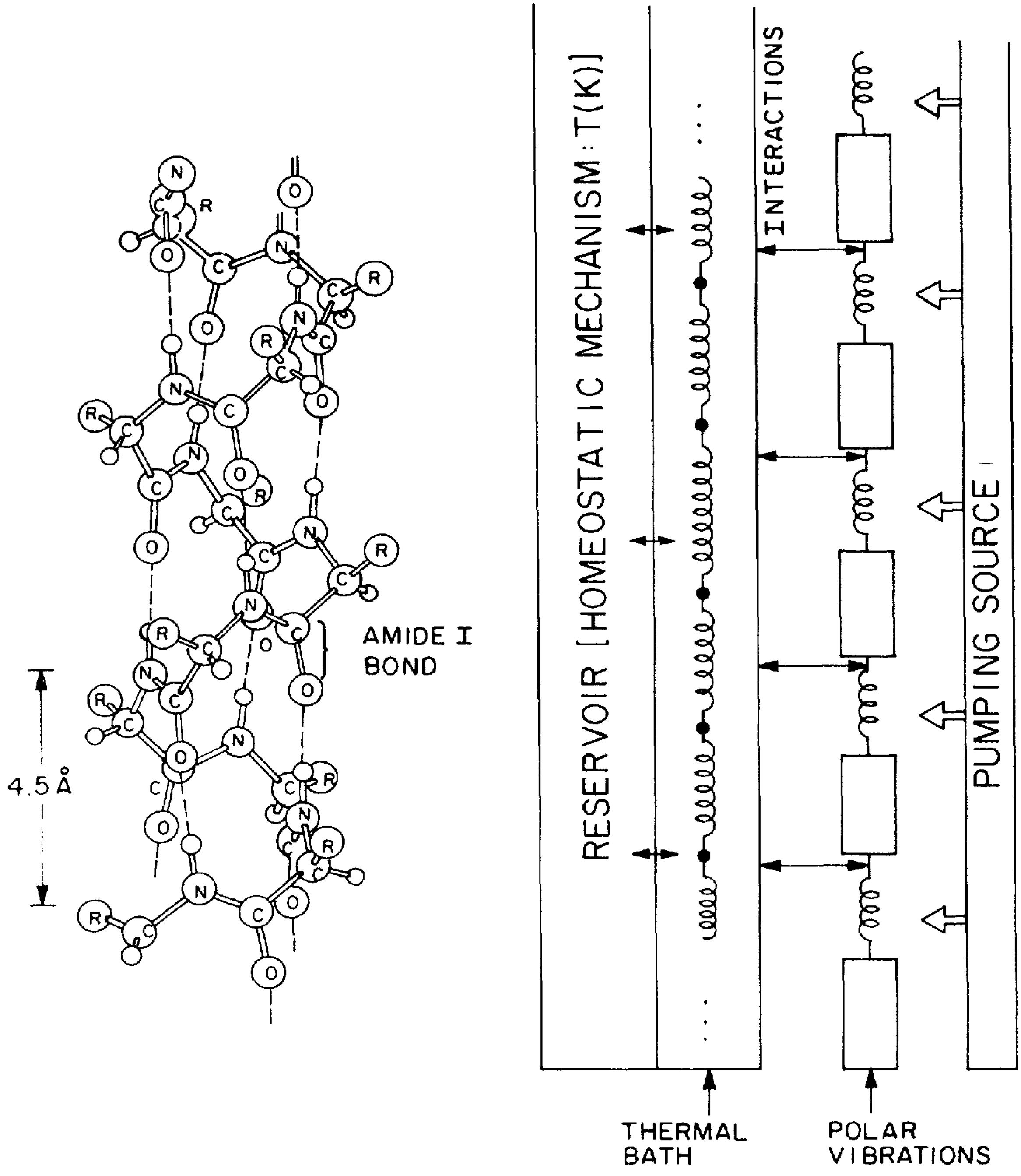
      <p>Let us consider a physical system modelling the conditions that lead to the emergence of Fröhlich effect. It is described in <xref ref-type="fig" rid="information-03-00601-f001">Figure 1</xref>, which shows a particular biological system and the mechanical analog whose quantum mechanical statistical thermodynamics has been analyzed [<xref ref-type="bibr" rid="B7-information-03-00601">7</xref>]. What we do have is a periodic chain in which the polar vibrations of interest are the CO-stretching (Amide I) modes. The system is in interaction with the surroundings, a thermal bath modelled by an elastic-continuum-like medium. The reservoirs provide a homoeostatic-like mechanism responsible for keeping the elastic continuum in equilibrium at temperature <inline-graphic xmlns:xlink="http://www.w3.org/1999/xlink" xlink:href="information-03-00601-i001.tif"/>(say 300 K). A source continuously pumps energy on the polar modes driving them out of equilibrium.</p>
      <fig id="information-03-00601-f001" position="anchor">
        <label>Figure 1</label>
        <caption>
          <p>An atomic model of the <inline-graphic xmlns:xlink="http://www.w3.org/1999/xlink" xlink:href="information-03-00601-i002.tif"/>-helix structure in a protein and a rough description of the proposed mechanical model (reproduced from [<xref ref-type="bibr" rid="B7-information-03-00601">7</xref>]). </p>
        </caption>
        <graphic xmlns:xlink="http://www.w3.org/1999/xlink" xlink:href="information-03-00601-g001.tif"/>
      </fig>
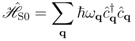
      <p>The Hamiltonian consists of the energy of the free subsystems, namely, that of the free vibrations, with <inline-graphic xmlns:xlink="http://www.w3.org/1999/xlink" xlink:href="information-03-00601-i004.tif"/> being their frequency dispersion relation (<inline-graphic xmlns:xlink="http://www.w3.org/1999/xlink" xlink:href="information-03-00601-i005.tif"/> is a wave-vector running over the reciprocal-space Brillouin zone), and that of the thermal bath composed by oscillations with frequency dispersion relation <inline-graphic xmlns:xlink="http://www.w3.org/1999/xlink" xlink:href="information-03-00601-i006.tif"/>, with a Debye cut-off frequency <inline-graphic xmlns:xlink="http://www.w3.org/1999/xlink" xlink:href="information-03-00601-i007.tif"/>. The system of polar vibrations is in interaction with an external source (that pumps energy on the system) and an anharmonic interaction is present between both systems. The latter is composed of several contributions associated with quasi-particle (phonons) collisions involving the system and the thermal bath.</p>

      <p>For the quantum-mechanical statistical thermodynamic study of Fröhlich effect, whose results are reviewed here, we have resorted to an informational statistical thermodynamics based on the Non-equilibrium Statistical Ensemble Formalism (NESEF) [<xref ref-type="bibr" rid="B59-information-03-00601">59</xref>,<xref ref-type="bibr" rid="B60-information-03-00601">60</xref>,<xref ref-type="bibr" rid="B61-information-03-00601">61</xref>,<xref ref-type="bibr" rid="B62-information-03-00601">62</xref>,<xref ref-type="bibr" rid="B63-information-03-00601">63</xref>,<xref ref-type="bibr" rid="B64-information-03-00601">64</xref>,<xref ref-type="bibr" rid="B65-information-03-00601">65</xref>]. Besides providing microscopic foundations to phenomenological irreversible thermodynamics NESEF, it also allows for the construction of a nonlinear generalized quantum transport theory—a far-reaching generalization of Chapman-Enskog’s and Mori’s methods—that describes the evolution of the system at the macroscopic level in arbitrary non-equilibrium situations [<xref ref-type="bibr" rid="B62-information-03-00601">62</xref>,<xref ref-type="bibr" rid="B63-information-03-00601">63</xref>,<xref ref-type="bibr" rid="B64-information-03-00601">64</xref>,<xref ref-type="bibr" rid="B65-information-03-00601">65</xref>,<xref ref-type="bibr" rid="B66-information-03-00601">66</xref>,<xref ref-type="bibr" rid="B67-information-03-00601">67</xref>,<xref ref-type="bibr" rid="B68-information-03-00601">68</xref>].</p>
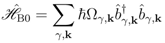
      <p>We write for the system Hamiltonian
      <disp-formula id="information-03-00601-i008"><inline-graphic xmlns:xlink="http://www.w3.org/1999/xlink" xlink:href="information-03-00601-i008.tif"/><label>(1)</label></disp-formula>
      where
      <disp-formula id="information-03-00601-i009"><inline-graphic xmlns:xlink="http://www.w3.org/1999/xlink" xlink:href="information-03-00601-i009.tif"/><label>(2)</label></disp-formula>
      consists of the energy of the free boson-like quasi-particles with frequency dispersion relation <inline-graphic xmlns:xlink="http://www.w3.org/1999/xlink" xlink:href="information-03-00601-i004.tif"/>(<inline-graphic xmlns:xlink="http://www.w3.org/1999/xlink" xlink:href="information-03-00601-i010.tif"/> and <inline-graphic xmlns:xlink="http://www.w3.org/1999/xlink" xlink:href="information-03-00601-i011.tif"/> are annihilation and creation operators in that states);
      <disp-formula id="information-03-00601-i012"><inline-graphic xmlns:xlink="http://www.w3.org/1999/xlink" xlink:href="information-03-00601-i012.tif"/><label>(3)</label></disp-formula>
      is the energy operator of the free bosons in the thermal bath (characterized by <inline-graphic xmlns:xlink="http://www.w3.org/1999/xlink" xlink:href="information-03-00601-i013.tif"/>, <inline-graphic xmlns:xlink="http://www.w3.org/1999/xlink" xlink:href="information-03-00601-i014.tif"/> and <inline-graphic xmlns:xlink="http://www.w3.org/1999/xlink" xlink:href="information-03-00601-i015.tif"/>, where <inline-graphic xmlns:xlink="http://www.w3.org/1999/xlink" xlink:href="information-03-00601-i016.tif"/> labels an eventual branch and <inline-graphic xmlns:xlink="http://www.w3.org/1999/xlink" xlink:href="information-03-00601-i017.tif"/> the mode);
      <disp-formula id="information-03-00601-i018"><inline-graphic xmlns:xlink="http://www.w3.org/1999/xlink" xlink:href="information-03-00601-i018.tif"/><label>(4)</label></disp-formula>
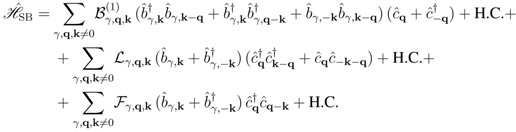
      is the energy operator of interaction with the thermal bath, which is of fundamental relevance for emergence of NEFBEC, where the term in the second line is referred to as Livshits contribution [<xref ref-type="bibr" rid="B69-information-03-00601">69</xref>], and the one in the third line as Fröhlich contribution [<xref ref-type="bibr" rid="B4-information-03-00601">4</xref>]. <inline-graphic xmlns:xlink="http://www.w3.org/1999/xlink" xlink:href="information-03-00601-i019.tif"/> stands for the interaction potential of the quasi-particles with the pumping source, which drives them out of equilibrium.</p>
      <p>Finally, <inline-graphic xmlns:xlink="http://www.w3.org/1999/xlink" xlink:href="information-03-00601-i020.tif"/> stands for the Hamiltonian of all the other degrees of freedom of the sample, and <inline-graphic xmlns:xlink="http://www.w3.org/1999/xlink" xlink:href="information-03-00601-i021.tif"/> for the interaction potential of the system of quasi-particles and these other degrees of freedom.</p>
      <p>Let us now consider the thermostatistics of the system characterized by the Hamiltonian of Equation (1). Nowadays, two main formalisms are available, namely, computer modelling [<xref ref-type="bibr" rid="B70-information-03-00601">70</xref>,<xref ref-type="bibr" rid="B71-information-03-00601">71</xref>,<xref ref-type="bibr" rid="B72-information-03-00601">72</xref>] and the non-equilibrium statistical ensemble formalism NESEF [<xref ref-type="bibr" rid="B59-information-03-00601">59</xref>,<xref ref-type="bibr" rid="B60-information-03-00601">60</xref>,<xref ref-type="bibr" rid="B61-information-03-00601">61</xref>,<xref ref-type="bibr" rid="B62-information-03-00601">62</xref>,<xref ref-type="bibr" rid="B63-information-03-00601">63</xref>,<xref ref-type="bibr" rid="B64-information-03-00601">64</xref>,<xref ref-type="bibr" rid="B65-information-03-00601">65</xref>], with an accompanying irreversible thermodynamics [<xref ref-type="bibr" rid="B65-information-03-00601">65</xref>,<xref ref-type="bibr" rid="B73-information-03-00601">73</xref>,<xref ref-type="bibr" rid="B74-information-03-00601">74</xref>,<xref ref-type="bibr" rid="B75-information-03-00601">75</xref>,<xref ref-type="bibr" rid="B76-information-03-00601">76</xref>,<xref ref-type="bibr" rid="B77-information-03-00601">77</xref>].</p>
      <p>Application of NESEF to a particular physical situation requires in the first place to define the set of microdynamical variables that are relevant for the treatment of the problem (the important questions of historicity and irreversibility are incorporated in the formalism from the onset [<xref ref-type="bibr" rid="B65-information-03-00601">65</xref>]). The average over the non-equilibrium ensemble of these microdynamical variables provide the macrovariables that define the non-equilibrium thermodynamic space of states of the associated irreversible thermodynamics, describing the evolution of the non-equilibrium macroscopic state of the system.</p>
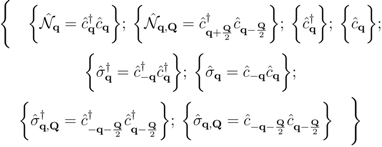
      <p>In the most general description and for any non-equilibrium system, according to NESEF we should begin introducing all the observables of the system and their variances. However, according to the fundamental Bogoliubov’s theorem of correlation weakening and accompanying hierarchy of relaxation times [<xref ref-type="bibr" rid="B78-information-03-00601">78</xref>], after a very short time (called time for microrandomization) has elapsed, fluctuations and variances die out and can be neglected. Therefore, the system being considered can be described in terms of the single-particle dynamical operator (single-particle reduced density matrix [<xref ref-type="bibr" rid="B79-information-03-00601">79</xref>,<xref ref-type="bibr" rid="B80-information-03-00601">80</xref>,<xref ref-type="bibr" rid="B81-information-03-00601">81</xref>,<xref ref-type="bibr" rid="B82-information-03-00601">82</xref>,<xref ref-type="bibr" rid="B83-information-03-00601">83</xref>]). For the problem we have in hands, we introduce the single-quasi-particle dynamical operator and, because of the boson character of the quasi-particles, the amplitudes with their coherent states eigenvalues and eigenfunctions, and the pair operators, that is, in reciprocal space,
      <disp-formula id="information-03-00601-i022"><inline-graphic xmlns:xlink="http://www.w3.org/1999/xlink" xlink:href="information-03-00601-i022.tif"/><label>(5)</label></disp-formula>
      where <inline-graphic xmlns:xlink="http://www.w3.org/1999/xlink" xlink:href="information-03-00601-i023.tif"/>. Here, <inline-graphic xmlns:xlink="http://www.w3.org/1999/xlink" xlink:href="information-03-00601-i024.tif"/> is called the population operator and <inline-graphic xmlns:xlink="http://www.w3.org/1999/xlink" xlink:href="information-03-00601-i025.tif"/>(<inline-graphic xmlns:xlink="http://www.w3.org/1999/xlink" xlink:href="information-03-00601-i023.tif"/>) is the Fourier transform of the spatial change in the populations.</p>

      <p>The average of the microdynamical variables of set (5) over the non-equilibrium ensemble, which we indicate by
      <disp-formula id="information-03-00601-i026"><inline-graphic xmlns:xlink="http://www.w3.org/1999/xlink" xlink:href="information-03-00601-i026.tif"/><label>(6)</label></disp-formula>
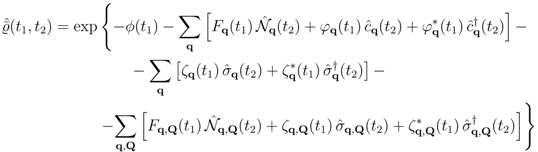
      are the macrodynamical variables that, as already noticed, characterize the non-equilibrium thermodynamic state of the system. The corresponding non-equilibrium statistical operator is given by
      <disp-formula id="information-03-00601-i027"><inline-graphic xmlns:xlink="http://www.w3.org/1999/xlink" xlink:href="information-03-00601-i027.tif"/><label>(7)</label></disp-formula>
      where
      <disp-formula id="information-03-00601-i028"><inline-graphic xmlns:xlink="http://www.w3.org/1999/xlink" xlink:href="information-03-00601-i028.tif"/><label>(8)</label></disp-formula>
      is an auxiliary statistical operator with <inline-graphic xmlns:xlink="http://www.w3.org/1999/xlink" xlink:href="information-03-00601-i029.tif"/> indicating the time evolution of the non-equilibrium thermodynamic variables

      <disp-formula id="information-03-00601-i030"><inline-graphic xmlns:xlink="http://www.w3.org/1999/xlink" xlink:href="information-03-00601-i030.tif"/><label>(9)</label></disp-formula>
      with <inline-graphic xmlns:xlink="http://www.w3.org/1999/xlink" xlink:href="information-03-00601-i023.tif"/>, and <inline-graphic xmlns:xlink="http://www.w3.org/1999/xlink" xlink:href="information-03-00601-i031.tif"/> that of the microdynamical variables, <inline-graphic xmlns:xlink="http://www.w3.org/1999/xlink" xlink:href="information-03-00601-i032.tif"/> ), <italic>etc.</italic> Moreover, <inline-graphic xmlns:xlink="http://www.w3.org/1999/xlink" xlink:href="information-03-00601-i033.tif"/> ensures the normalization of the statistical distribution, playing the role of a logarithm of a non-equilibrium partition function, say <inline-graphic xmlns:xlink="http://www.w3.org/1999/xlink" xlink:href="information-03-00601-i034.tif"/>. The second term in the exponential in Equation (7) accounts for historicity and irreversibility, where <inline-graphic xmlns:xlink="http://www.w3.org/1999/xlink" xlink:href="information-03-00601-i035.tif"/> is a positive infinitesimal that goes to <inline-graphic xmlns:xlink="http://www.w3.org/1999/xlink" xlink:href="information-03-00601-i036.tif"/> after the trace operation in the calculation of averages has been performed (introducing a Bogoliubov quasi-average that breaks the time reversal symmetry in Liouville equation [<xref ref-type="bibr" rid="B82-information-03-00601">82</xref>,<xref ref-type="bibr" rid="B83-information-03-00601">83</xref>] in a way according to Krylov’s “jolting” proposal for irreversibility [<xref ref-type="bibr" rid="B84-information-03-00601">84</xref>,<xref ref-type="bibr" rid="B85-information-03-00601">85</xref>]).</p>
      <p>The relationship between the basic macrovariables of set (6) and the non-equilibrium thermodynamic variables of set (9) are what is termed as non-equilibrium equations of state, namely,
      <disp-formula id="information-03-00601-i037"><inline-graphic xmlns:xlink="http://www.w3.org/1999/xlink" xlink:href="information-03-00601-i037.tif"/><label>(10)</label></disp-formula>
      <disp-formula id="information-03-00601-i038"><inline-graphic xmlns:xlink="http://www.w3.org/1999/xlink" xlink:href="information-03-00601-i038.tif"/><label>(11)</label></disp-formula>
      <disp-formula id="information-03-00601-i039"><inline-graphic xmlns:xlink="http://www.w3.org/1999/xlink" xlink:href="information-03-00601-i039.tif"/><label>(12)</label></disp-formula>
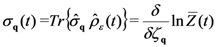
      and similarly for the others; we recall that <inline-graphic xmlns:xlink="http://www.w3.org/1999/xlink" xlink:href="information-03-00601-i040.tif"/>. From now on we disregard the contributions of the coherent states and of the states of pairs—that is, we set <inline-graphic xmlns:xlink="http://www.w3.org/1999/xlink" xlink:href="information-03-00601-i041.tif"/> and <inline-graphic xmlns:xlink="http://www.w3.org/1999/xlink" xlink:href="information-03-00601-i042.tif"/> in Equation (8)—and, since we shall be dealing with experiments without resolution in space, the contributions accounting for local effects, <inline-graphic xmlns:xlink="http://www.w3.org/1999/xlink" xlink:href="information-03-00601-i043.tif"/>, are also discarded. We retain only <inline-graphic xmlns:xlink="http://www.w3.org/1999/xlink" xlink:href="information-03-00601-i044.tif"/> for which the state equation is verified, <italic>i.e.</italic>, its relation to the associated non-equilibrium thermodynamic variable <inline-graphic xmlns:xlink="http://www.w3.org/1999/xlink" xlink:href="information-03-00601-i045.tif"/>,
      <disp-formula id="information-03-00601-i046"><inline-graphic xmlns:xlink="http://www.w3.org/1999/xlink" xlink:href="information-03-00601-i046.tif"/></disp-formula></p>
      <p>It may be noticed that the thermodynamic variable <inline-graphic xmlns:xlink="http://www.w3.org/1999/xlink" xlink:href="information-03-00601-i045.tif"/> can be redefined as
      <disp-formula id="information-03-00601-i047"><inline-graphic xmlns:xlink="http://www.w3.org/1999/xlink" xlink:href="information-03-00601-i047.tif"/><label>(13)</label></disp-formula>
      introducing a non-equilibrium temperature (better called quasi-temperature) per mode, <italic>i.e.</italic>, <inline-graphic xmlns:xlink="http://www.w3.org/1999/xlink" xlink:href="information-03-00601-i048.tif"/> as done in semiconductor physics for “hot” carriers and phonons [<xref ref-type="bibr" rid="B86-information-03-00601">86</xref>,<xref ref-type="bibr" rid="B87-information-03-00601">87</xref>], and in other contexts (see for example [<xref ref-type="bibr" rid="B88-information-03-00601">88</xref>,<xref ref-type="bibr" rid="B89-information-03-00601">89</xref>]) as done by Casimir, Uhlenbeck and others (see [<xref ref-type="bibr" rid="B65-information-03-00601">65</xref>,<xref ref-type="bibr" rid="B75-information-03-00601">75</xref>,<xref ref-type="bibr" rid="B76-information-03-00601">76</xref>,<xref ref-type="bibr" rid="B77-information-03-00601">77</xref>]). On the other hand, it can be written

      <disp-formula id="information-03-00601-i049"><inline-graphic xmlns:xlink="http://www.w3.org/1999/xlink" xlink:href="information-03-00601-i049.tif"/><label>(14)</label></disp-formula>
      introducing a quasi-chemical (or non-equilibrium) potential per mode in Landsberg [<xref ref-type="bibr" rid="B90-information-03-00601">90</xref>] and Fröhlich [<xref ref-type="bibr" rid="B2-information-03-00601">2</xref>,<xref ref-type="bibr" rid="B3-information-03-00601">3</xref>,<xref ref-type="bibr" rid="B4-information-03-00601">4</xref>,<xref ref-type="bibr" rid="B7-information-03-00601">7</xref>,<xref ref-type="bibr" rid="B46-information-03-00601">46</xref>] style, where <inline-graphic xmlns:xlink="http://www.w3.org/1999/xlink" xlink:href="information-03-00601-i050.tif"/>.</p>
      <p>The populations <inline-graphic xmlns:xlink="http://www.w3.org/1999/xlink" xlink:href="information-03-00601-i044.tif"/> shall show the “condensation” of the quasi-particles (excitations) in the states lowest in energy, thus characterizing the non-equilibrium Bose-Einstein condensation. We proceed to the derivation of its evolution equation. This is done in terms of NESEF-based nonlinear quantum kinetic theory [<xref ref-type="bibr" rid="B62-information-03-00601">62</xref>,<xref ref-type="bibr" rid="B63-information-03-00601">63</xref>,<xref ref-type="bibr" rid="B64-information-03-00601">64</xref>,<xref ref-type="bibr" rid="B65-information-03-00601">65</xref>,<xref ref-type="bibr" rid="B66-information-03-00601">66</xref>,<xref ref-type="bibr" rid="B67-information-03-00601">67</xref>,<xref ref-type="bibr" rid="B68-information-03-00601">68</xref>], in the approximation that retains the contributions up to the second order in the interaction strengths (binary collisions with memory and vertex renormalization being discarded) [<xref ref-type="bibr" rid="B64-information-03-00601">64</xref>,<xref ref-type="bibr" rid="B66-information-03-00601">66</xref>,<xref ref-type="bibr" rid="B68-information-03-00601">68</xref>]. We recall that the evolution equations consist of the quantum mechanical Heisenberg equations of motion of the corresponding microvariables, here <inline-graphic xmlns:xlink="http://www.w3.org/1999/xlink" xlink:href="information-03-00601-i051.tif"/>, averaged over the non-equilibrium ensemble.</p>

      <p>After quite lengthy calculations it results that they follow the evolution equation given by
	  <disp-formula id="information-03-00601-i052"><inline-graphic xmlns:xlink="http://www.w3.org/1999/xlink" xlink:href="information-03-00601-i052.tif"/></disp-formula></p>
      <p>The six contributions on the right of this equation (rates of change of the populations generated by the different types of interactions present in the media) are: </p>
      <list list-type="order">
        <list-item>
          <p><inline-graphic xmlns:xlink="http://www.w3.org/1999/xlink" xlink:href="information-03-00601-i053.tif"/> standing for the rate of population enhancement due to the action of the pumping source, which involves a positive feedback process that largely improves the efficiency of the pumping source;</p>
        </list-item>
        <list-item>
          <p><inline-graphic xmlns:xlink="http://www.w3.org/1999/xlink" xlink:href="information-03-00601-i054.tif"/> is the contribution arising out of the first term on the right of the interaction of the quasi-particles and the bath in Equation (4); </p>
        </list-item>
        <list-item>
          <p><inline-graphic xmlns:xlink="http://www.w3.org/1999/xlink" xlink:href="information-03-00601-i055.tif"/> is the rate of change arising out of the second term in <inline-graphic xmlns:xlink="http://www.w3.org/1999/xlink" xlink:href="information-03-00601-i056.tif"/> of Equation (4), the Livshits contribution;</p>
        </list-item>
        <list-item>
          <p><inline-graphic xmlns:xlink="http://www.w3.org/1999/xlink" xlink:href="information-03-00601-i057.tif"/> is the rate of change due to the third term in <inline-graphic xmlns:xlink="http://www.w3.org/1999/xlink" xlink:href="information-03-00601-i056.tif"/> of Equation (4), the Fröhlich one, which contains linear and bi-linear contributions in the quasi-particle populations (for simplicity we have omitted to make explicit the dependence on <inline-graphic xmlns:xlink="http://www.w3.org/1999/xlink" xlink:href="information-03-00601-i058.tif"/> in the populations <inline-graphic xmlns:xlink="http://www.w3.org/1999/xlink" xlink:href="information-03-00601-i059.tif"/> on the right):
		  <disp-formula id="information-03-00601-i060"><inline-graphic xmlns:xlink="http://www.w3.org/1999/xlink" xlink:href="information-03-00601-i060.tif"/><label>(15)</label></disp-formula>
      where
      <disp-formula id="information-03-00601-i061"><inline-graphic xmlns:xlink="http://www.w3.org/1999/xlink" xlink:href="information-03-00601-i061.tif"/><label>(16)</label></disp-formula>
      being <inline-graphic xmlns:xlink="http://www.w3.org/1999/xlink" xlink:href="information-03-00601-i062.tif"/> the population (<inline-graphic xmlns:xlink="http://www.w3.org/1999/xlink" xlink:href="information-03-00601-i016.tif"/> branch, <inline-graphic xmlns:xlink="http://www.w3.org/1999/xlink" xlink:href="information-03-00601-i017.tif"/> mode) of the bosons of the thermal bath and <inline-graphic xmlns:xlink="http://www.w3.org/1999/xlink" xlink:href="information-03-00601-i063.tif"/> indicating the intensity of the interaction of the quasi-particles with the thermal bath.</p>
        </list-item>
      </list>
      
      <p>We call Equation (15) Fröhlich contribution which is the one responsible for a super-population of the low-energy states and presence of long-lived boson coherent states in the case of items 1 to 4 above. It can be clearly noticed that the mentioned nonlinear contribution to the population of mode <inline-graphic xmlns:xlink="http://www.w3.org/1999/xlink" xlink:href="information-03-00601-i005.tif"/> behaves like a “pumping source” for the modes <inline-graphic xmlns:xlink="http://www.w3.org/1999/xlink" xlink:href="information-03-00601-i064.tif"/> for which <inline-graphic xmlns:xlink="http://www.w3.org/1999/xlink" xlink:href="information-03-00601-i065.tif"/>, populating the states of lower frequency (energy) at the expenses of those higher in frequency. On the other hand, for those modes <inline-graphic xmlns:xlink="http://www.w3.org/1999/xlink" xlink:href="information-03-00601-i064.tif"/> with <inline-graphic xmlns:xlink="http://www.w3.org/1999/xlink" xlink:href="information-03-00601-i066.tif"/>, the Fröhlich contribution transfer the excess energy of the states higher in frequency received from the external source to those lower in frequency. Moreover, <inline-graphic xmlns:xlink="http://www.w3.org/1999/xlink" xlink:href="information-03-00601-i067.tif"/> accounts for the rate of change associated to radiative decay (emission of photons from excited states).</p>
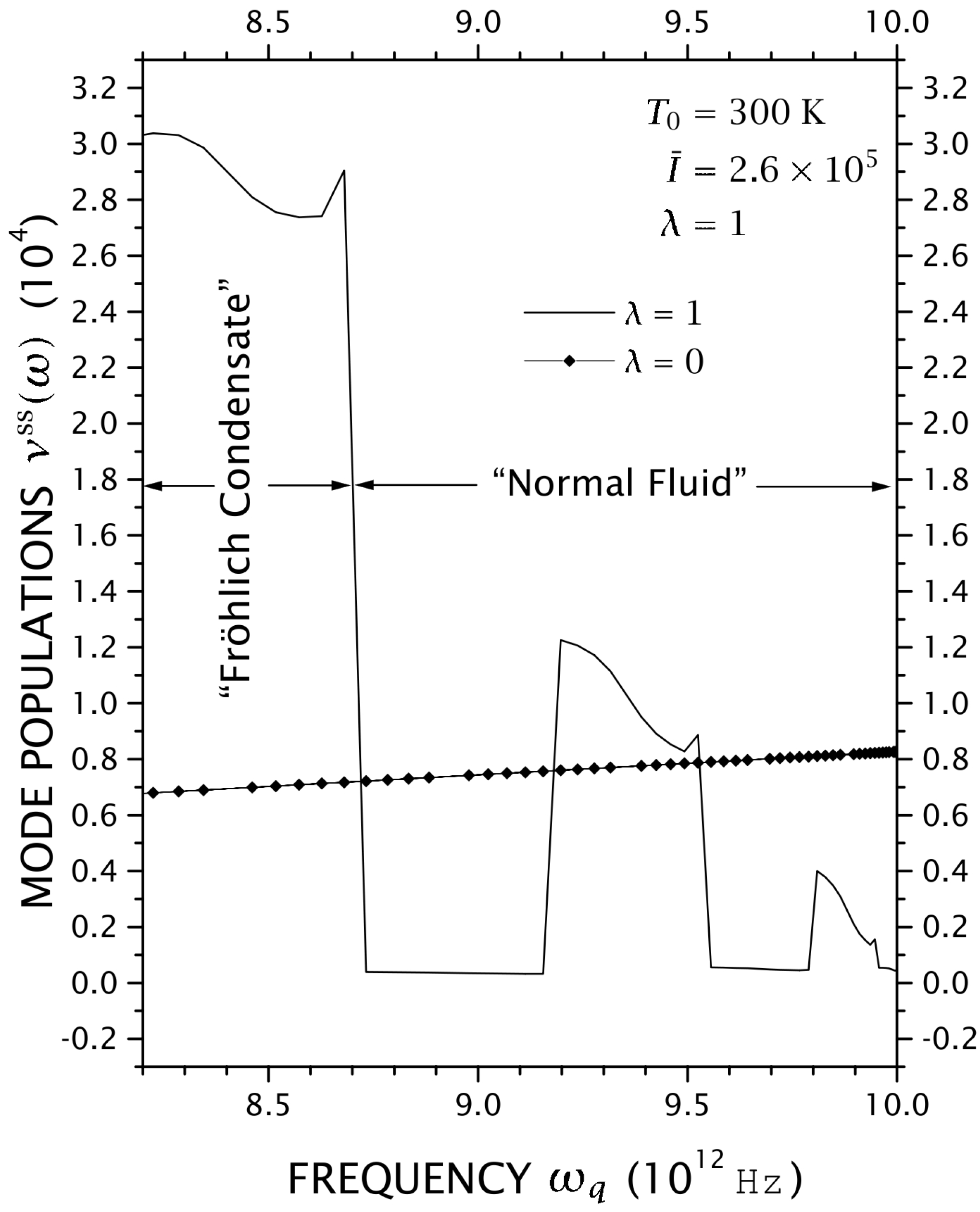
      <p>The analysis presented above, after Equations (15) and (16), clearly evidence the presence in the kinetic equations for the populations of nonlinearities which are responsible for Fröhlich condensation. Using certain set of parameters, the evolution equations for the populations are solved (see [<xref ref-type="bibr" rid="B7-information-03-00601">7</xref>]), and the corresponding results shown in <xref ref-type="fig" rid="information-03-00601-f002">Figure 2</xref>, for a scaled intensity of the pumping source of <inline-graphic xmlns:xlink="http://www.w3.org/1999/xlink" xlink:href="information-03-00601-i068.tif"/>, <italic>i.e.</italic>, above the threshold for the onset of Fröhlich’s effect as described in [<xref ref-type="bibr" rid="B7-information-03-00601">7</xref>], and also in [<xref ref-type="bibr" rid="B46-information-03-00601">46</xref>]. For comparison, we have drawn the case (diamond-line) when the nonlinear coupling is switched off and a normal behaviour of similar increase is clearly observed in all the populations.</p>
      <fig id="information-03-00601-f002" position="anchor">
        <label>Figure 2</label>
        <caption>
          <p>Populations of the modes in the steady state for <inline-graphic xmlns:xlink="http://www.w3.org/1999/xlink" xlink:href="information-03-00601-i069.tif"/>, compared with the case of absence of nonlinear interactions. <inline-graphic xmlns:xlink="http://www.w3.org/1999/xlink" xlink:href="information-03-00601-i070.tif"/> when nonlinear interaction of Equation (15) is present and <inline-graphic xmlns:xlink="http://www.w3.org/1999/xlink" xlink:href="information-03-00601-i071.tif"/> when neglected (reproduced from [<xref ref-type="bibr" rid="B7-information-03-00601">7</xref>]). </p>
        </caption>
        <graphic xmlns:xlink="http://www.w3.org/1999/xlink" xlink:href="information-03-00601-g002.tif"/>
      </fig>
      <p>An extensive analysis of the non-equilibrium statistical thermodynamics of Fröhlich condensate is reported in [<xref ref-type="bibr" rid="B46-information-03-00601">46</xref>].</p>
    </sec>
    <sec>
      <title>5. Concluding Remarks</title>
      <p>As it has been stressed in <xref ref-type="sec" rid="sec1-information-03-00601">Section 1</xref>, nowadays the idea is gaining ground that biology, physics, chemistry, information theory and complexity theory need to joint forces to deal with questions as the origin of life and its evolution, the problem of a science of consciousness, and others in the life sciences.</p>
      <p>Paul Davies [<xref ref-type="bibr" rid="B91-information-03-00601">91</xref>] has stressed that solving the mystery of bio-genesis is not just another problem on a long list of just-do scientific projects. Like the origin of the universe and the origin of consciousness, it represents something altogether deeper, because it tests the very foundations of our science and our world-view. Also, “even though life is a physico-chemical phenomenon, its distinctiveness lies not in the strict physics and chemistry. <italic>The secret of life comes instead from its informational properties; a living organism is a complex information-processing system</italic> [emphasis is ours]. Hence, the ultimate problem of bio genesis is where biological information came from. Whatever remarkable the chemistry that may have occurred on the primeval earth or some other planet, life was sparked not by a molecular maelstrom as such but—somehow!—by the organization of information” [<xref ref-type="bibr" rid="B91-information-03-00601">91</xref>].</p>
      <p>In what refers to the processes governing consciousness in the human brain, Roger Penrose appears to have argued along a similar direction, as have been noticed in previous sections, in a kind of, say, a large-scale quantum action in brain functioning [<xref ref-type="bibr" rid="B47-information-03-00601">47</xref>]. According to him, one may expect a kind of quantum coherence—we would say an organization of information—in the sense that we must not look simply to the quantum effects of single particles, atoms, or even small molecules, but to the effects of quantum systems that retain their manifest nature at a much larger scale. We must look for something different as the appropriate type of controlling “mechanism” that might have relevance to actual conscious activity. Also, such processes must be the result of some reasonably large-scale quantum-coherent phenomenon, but coupled in such subtle way to macroscopic behaviour, so that the system is able to take advantage of whatever is this particular physical process—as we have argued in the past sections involving a particular organization of information in Davies’ sense.</p>
      <p>At this point we reproduce Penrose’s statement that, “Such a feat would be a remarkable one, almost an incredible one, for Nature to achieve by biological means. Yet I believe that the indications must be that she has done so, the main evidence coming from the fact of our own mentality. There is much to be understood about biological systems and how they achieve their magic”.</p>
      <p>This question of large-scale quantum coherence and connection with macroscopic order has been, in some sense, partially anticipated by Herbert Fröhlich in his “The Connection between Macro- and Microphysics” [<xref ref-type="bibr" rid="B30-information-03-00601">30</xref>], in relation with superconductivity and superfluidity. He pointed to the need to bridge the gap between the two levels introducing appropriate concepts, bringing together the completely systematic microscopic theory with the apparently somehow unsystematic macroscopic theory. Later on—or almost contemporaneously—Fröhlich further applied the ideas to the case of functioning of membranes, and giving rise to the idea of what we have called in previous sections of Fröhlich’s effect, producing the emergence of the Fröhlich condensate.</p>
      <p>This phenomenon has been called upon by Roger Penrose and other people as possibly having a role in consciousness, in connection with its eventual presence in microtubules in neurons.</p>
      <p>In conclusion, as we have seen, Fröhlich condensate implies in the emergence of complex behaviour of bosons, as a result of exploring nonlinearities in the kinetic equations of evolution. There is a kind of auto-catalytic process leading to synergetic ordering, and as a consequence a decrease in informational entropy (uncertainty of information), following the fact of the consolidation of a long-range coherent macrostate. We see here the working of the microphysics—through the equations of quantum mechanics—with a subtle coupling to macrophysics through the resulting nonlinear kinetic equations, which are the average of the former over the non-equilibrium ensemble describing the expected behaviour of the whole assembly of degrees of freedom of the system.</p>
      <p>As closing remarks, we can now recall the proclaim of the great Ludwig Boltzmann: “Thus, the general struggle for life is neither a fight for basic material ... nor for energy ... but for entropy [we say now information] becoming available by the transition from the hot sun to the cold earth” [<xref ref-type="bibr" rid="B92-information-03-00601">92</xref>,<xref ref-type="bibr" rid="B93-information-03-00601">93</xref>].</p>
    </sec>
  </body>
  <back>
    <ref-list>
      <title>References</title>
      <ref id="B1-information-03-00601">
        <label>1.</label>
        <citation citation-type="journal">
          <person-group person-group-type="author">
            <name>
              <surname>Fröhlich</surname>
              <given-names>H.</given-names>
            </name>
          </person-group>
          <article-title>Long-range coherence and energy storage in biological systems</article-title>
          <source>Int. J. Quantum Chem.</source>
          <year>1968</year>
          <volume>2</volume>
          <fpage>641</fpage>
          <lpage>649</lpage>
          <pub-id pub-id-type="doi">10.1002/qua.560020505</pub-id>
        </citation>
      </ref>
      <ref id="B2-information-03-00601">
        <label>2.</label>
        <citation citation-type="book">
          <person-group person-group-type="author">
            <name>
              <surname>Fröhlich</surname>
              <given-names>H.</given-names>
            </name>
          </person-group>
          <article-title>Quantum mechanical concepts in biology</article-title>
          <source>From Theoretical Physics to Biology</source>
          <person-group person-group-type="editor">
            <name>
              <surname>Marois</surname>
              <given-names>M.</given-names>
            </name>
          </person-group>
          <publisher-name>North-Holland</publisher-name>
          <publisher-loc>Amsterdam, the Netherlands</publisher-loc>
          <year>1969</year>
          <fpage>13</fpage>
          <lpage>22</lpage>
        </citation>
      </ref>
      <ref id="B3-information-03-00601">
        <label>3.</label>
        <citation citation-type="journal">
          <person-group person-group-type="author">
            <name>
              <surname>Fröhlich</surname>
              <given-names>H.</given-names>
            </name>
          </person-group>
          <article-title>Long range coherence and the action of enzymes</article-title>
          <source>Nature</source>
          <year>1970</year>
        </citation>
      </ref>
      <ref id="B4-information-03-00601">
        <label>4.</label>
        <citation citation-type="book">
          <person-group person-group-type="author">
            <name>
              <surname>Fröhlich</surname>
              <given-names>H.</given-names>
            </name>
          </person-group>
          <article-title>The biological effects of microwaves and related questions</article-title>
          <source>Advances in Electronics and Electron Physics</source>
          <publisher-name>Academic Press</publisher-name>
          <publisher-loc>New York, NY, USA</publisher-loc>
          <year>1980</year>
		  <volume>17</volume>
        </citation>
      </ref>
      <ref id="B5-information-03-00601">
        <label>5.</label>
        <citation citation-type="book">
          <person-group person-group-type="author">
            <name>
              <surname>Prigogine</surname>
              <given-names>I.</given-names>
            </name>
          </person-group>
          <article-title>Structure, dissipation, and life</article-title>
          <source>From Theoretical Physics to Biology</source>
          <person-group person-group-type="editor">
            <name>
              <surname>Marois</surname>
              <given-names>M.</given-names>
            </name>
          </person-group>
          <publisher-name>North Holland</publisher-name>
          <publisher-loc>Amsterdam, the Netherlands</publisher-loc>
          <year>1969</year>
        </citation>
      </ref>
      <ref id="B6-information-03-00601">
        <label>6.</label>
        <citation citation-type="book">
          <person-group person-group-type="author">
            <name>
              <surname>Fröhlich</surname>
              <given-names>F.</given-names>
            </name>
          </person-group>
          <article-title>Notes and articles in honor of Herbert Fröhlich</article-title>
          <source>Cooperative Phenomena</source>
          <person-group person-group-type="editor">
            <name>
              <surname>Haken</surname>
              <given-names>H.</given-names>
            </name>
            <name>
              <surname>Wagner</surname>
              <given-names>M.</given-names>
            </name>
          </person-group>
          <publisher-name>Springer</publisher-name>
          <publisher-loc>Berlin, Germany</publisher-loc>
          <year>1973</year>
        </citation>
      </ref>
      <ref id="B7-information-03-00601">
        <label>7.</label>
        <citation citation-type="journal">
          <person-group person-group-type="author">
            <name>
              <surname>Mesquita</surname>
              <given-names>M.V.</given-names>
            </name>
            <name>
              <surname>Vasconcellos</surname>
              <given-names>A.R.</given-names>
            </name>
            <name>
              <surname>Luzzi</surname>
              <given-names>R.</given-names>
            </name>
          </person-group>
          <article-title>Selective amplification of coherent polar vibrations in biopolymers</article-title>
          <source>Phys. Rev. E</source>
          <year>1993</year>
          <volume>48</volume>
          <fpage>4049</fpage>
          <lpage>4059</lpage>
          <pub-id pub-id-type="doi">10.1103/PhysRevE.48.4049</pub-id>
        </citation>
      </ref>
      <ref id="B8-information-03-00601">
        <label>8.</label>
        <citation citation-type="book">
          <person-group person-group-type="author">
            <name>
              <surname>Mascarenhas</surname>
              <given-names>S.</given-names>
            </name>
          </person-group>
          <article-title>Bioelectrets: Electrets in biomaterials and biopolymers</article-title>
          <source>Electrets</source>
          <person-group person-group-type="editor">
            <name>
              <surname>Sessler</surname>
              <given-names>G.M.</given-names>
            </name>
          </person-group>
          <publisher-name>Springer</publisher-name>
          <publisher-loc>Berlin, Germany</publisher-loc>
          <year>1987</year>
        </citation>
      </ref>
      <ref id="B9-information-03-00601">
        <label>9.</label>
        <citation citation-type="confproc">
          <person-group person-group-type="author">
            <name>
              <surname>Hyland</surname>
              <given-names>G.J.</given-names>
            </name>
          </person-group>
          <article-title>Coherent GHz and THz excitations in active biosystems, and their implications</article-title>
          <source>The Future of Medical Diagnostics? Proceeding of Matra Marconi UK, Directorate of Science, Internal Report</source>
          <conf-loc>Portsmouth, UK</conf-loc>
          <conf-date>25 June 1998</conf-date>
          <fpage>14</fpage>
          <lpage>27</lpage>
        </citation>
      </ref>
      <ref id="B10-information-03-00601">
        <label>10.</label>
        <citation citation-type="journal">
          <person-group person-group-type="author">
            <name>
              <surname>Miller</surname>
              <given-names>P.F.</given-names>
            </name>
            <name>
              <surname>Gebbie</surname>
              <given-names>H.A.</given-names>
            </name>
          </person-group>
          <article-title>Laboratory millimeter wave measurements of atmospheric aerosols</article-title>
          <source>Int. J. Infrared Milli.</source>
          <year>1996</year>
          <volume>17</volume>
          <fpage>1573</fpage>
          <lpage>1591</lpage>
          <pub-id pub-id-type="doi">10.1007/BF02069574</pub-id>
        </citation>
      </ref>
      <ref id="B11-information-03-00601">
        <label>11.</label>
        <citation citation-type="book">
          <person-group person-group-type="author">
            <name>
              <surname>Davydov</surname>
              <given-names>A.S.</given-names>
            </name>
          </person-group>
          <source>Biology and Quantum Mechanics</source>
          <publisher-name>Pergamon</publisher-name>
          <publisher-loc>Oxford, UK</publisher-loc>
          <year>1982</year>
        </citation>
      </ref>
      <ref id="B12-information-03-00601">
        <label>12.</label>
        <citation citation-type="journal">
          <person-group person-group-type="author">
            <name>
              <surname>Scott</surname>
              <given-names>A.C.</given-names>
            </name>
          </person-group>
          <article-title>Davydov’s soliton</article-title>
          <source>Phys. Rep.</source>
          <year>1992</year>
          <volume>217</volume>
          <fpage>1</fpage>
          <lpage>67</lpage>
          <pub-id pub-id-type="doi">10.1016/0370-1573(92)90093-F</pub-id>
        </citation>
      </ref>
      <ref id="B13-information-03-00601">
        <label>13.</label>
        <citation citation-type="journal">
          <person-group person-group-type="author">
            <name>
              <surname>Vasconcellos</surname>
              <given-names>A.R.</given-names>
            </name>
            <name>
              <surname>Luzzi</surname>
              <given-names>R.</given-names>
            </name>
          </person-group>
          <article-title>Vanishing thermal damping of Davydov’s solitons</article-title>
          <source>Phys. Rev. E</source>
          <year>1993</year>
          <volume>48</volume>
          <fpage>2246</fpage>
          <lpage>2249</lpage>
          <pub-id pub-id-type="doi">10.1103/PhysRevE.48.2246</pub-id>
        </citation>
      </ref>
      <ref id="B14-information-03-00601">
        <label>14.</label>
        <citation citation-type="journal">
          <person-group person-group-type="author">
            <name>
              <surname>Lu</surname>
              <given-names>J.</given-names>
            </name>
            <name>
              <surname>Greenleaf</surname>
              <given-names>J.F.</given-names>
            </name>
          </person-group>
          <article-title>Nondiffracting X-waves</article-title>
          <source>IEEE Trans. Ultrason. Ferroelect. Freq. Contr.</source>
          <year>1992</year>
          <volume>39</volume>
          <fpage>19</fpage>
          <lpage>31</lpage>
          <pub-id pub-id-type="doi">10.1109/58.166806</pub-id>
        </citation>
      </ref>
      <ref id="B15-information-03-00601">
        <label>15.</label>
        <citation citation-type="journal">
          <person-group person-group-type="author">
            <name>
              <surname>Lu</surname>
              <given-names>J.</given-names>
            </name>
            <name>
              <surname>Greenleaf</surname>
              <given-names>J.F.</given-names>
            </name>
          </person-group>
          <article-title>Experimental verification of nondiffracting X waves</article-title>
          <source>IEEE Trans. Ultrason. Ferroelect. Freq. Contr.</source>
          <year>1992</year>
          <volume>39</volume>
          <fpage>441</fpage>
          <lpage>446</lpage>
        <pub-id pub-id-type="doi">10.1109/58.143178</pub-id></citation>
      </ref>
      <ref id="B16-information-03-00601">
        <label>16.</label>
        <citation citation-type="journal">
          <person-group person-group-type="author">
            <name>
              <surname>Mesquita</surname>
              <given-names>M.V.</given-names>
            </name>
            <name>
              <surname>Vasconcellos</surname>
              <given-names>A.R.</given-names>
            </name>
            <name>
              <surname>Luzzi</surname>
              <given-names>R.</given-names>
            </name>
          </person-group>
          <article-title>Solitons in highly excited matter: Dissipative-thermodynamic and supersonic effects</article-title>
          <source>Phys. Rev. E</source>
          <year>1998</year>
          <volume>58</volume>
          <fpage>7913</fpage>
          <lpage>7923</lpage>
          <pub-id pub-id-type="doi">10.1103/PhysRevE.58.7913</pub-id>
        </citation>
      </ref>
      <ref id="B17-information-03-00601">
        <label>17.</label>
        <citation citation-type="journal">
          <person-group person-group-type="author">
            <name>
              <surname>Snoke</surname>
              <given-names>D.</given-names>
            </name>
          </person-group>
          <article-title>Coherent exciton waves</article-title>
          <source>Science</source>
          <year>1996</year>
          <volume>273</volume>
          <fpage>1351</fpage>
          <lpage>1352</lpage>
          <pub-id pub-id-type="doi">10.1126/science.273.5280.1351</pub-id>
        </citation>
      </ref>
      <ref id="B18-information-03-00601">
        <label>18.</label>
        <citation citation-type="journal">
          <person-group person-group-type="author">
            <name>
              <surname>Mysyrowicz</surname>
              <given-names>A.</given-names>
            </name>
            <name>
              <surname>Benson</surname>
              <given-names>E.</given-names>
            </name>
            <name>
              <surname>Fortin</surname>
              <given-names>E.</given-names>
            </name>
          </person-group>
          <article-title>Directed beams of excitons produced by stimulated scattering</article-title>
          <source>Phys. Rev. Lett.</source>
          <year>1996</year>
          <volume>77</volume>
          <fpage>896</fpage>
          <lpage>899</lpage>
          <pub-id pub-id-type="doi">10.1103/PhysRevLett.77.896</pub-id>
        </citation>
      </ref>
      <ref id="B19-information-03-00601">
        <label>19.</label>
        <citation citation-type="journal">
          <person-group person-group-type="author">
            <name>
              <surname>Vasconcellos</surname>
              <given-names>A.R.</given-names>
            </name>
            <name>
              <surname>Mesquita</surname>
              <given-names>M.V.</given-names>
            </name>
            <name>
              <surname>Luzzi</surname>
              <given-names>R.</given-names>
            </name>
          </person-group>
          <article-title>"Excitoner”: Stimulated amplification and propagation of excitons beams</article-title>
          <source>Europhys. Lett.</source>
          <year>2000</year>
          <volume>49</volume>
          <fpage>637</fpage>
          <lpage>634</lpage>
          <pub-id pub-id-type="doi">10.1209/epl/i2000-00198-7</pub-id>
        </citation>
      </ref>
      <ref id="B20-information-03-00601">
        <label>20.</label>
        <citation citation-type="book">
          <person-group person-group-type="author">
            <name>
              <surname>Schrödinger</surname>
              <given-names>E.</given-names>
            </name>
          </person-group>
          <source>What Is Life? The Physical Aspect of the Living Cell</source>
          <publisher-name>Cambridge University</publisher-name>
          <publisher-loc>London, UK</publisher-loc>
          <year>1944</year>
        </citation>
      </ref>
      <ref id="B21-information-03-00601">
        <label>21.</label>
        <citation citation-type="book">
          <person-group person-group-type="author">
            <name>
              <surname>Mascarenhas</surname>
              <given-names>S.</given-names>
            </name>
          </person-group>
          <article-title>What is biophysics?</article-title>
          <source>MacMillan Encyclopaedia of Physics</source>
          <person-group person-group-type="editor">
            <name>
              <surname>Rigden</surname>
              <given-names>J.S.</given-names>
            </name>
          </person-group>
          <publisher-name>Simon &amp; Schuster Macmillan</publisher-name>
          <publisher-loc>New York, NY, USA</publisher-loc>
          <year>1996</year>
        </citation>
      </ref>
      <ref id="B22-information-03-00601">
        <label>22.</label>
        <citation citation-type="journal">
          <person-group person-group-type="author">
            <name>
              <surname>Glanz</surname>
              <given-names>J.</given-names>
            </name>
          </person-group>
          <article-title>Physicists advance into biology</article-title>
          <source>Science</source>
          <year>1996</year>
          <volume>272</volume>
          <fpage>646</fpage>
          <lpage>648</lpage>
          <pub-id pub-id-type="doi">10.1126/science.272.5262.646</pub-id>
        </citation>
      </ref>
      <ref id="B23-information-03-00601">
        <label>23.</label>
        <citation citation-type="book">
          <person-group person-group-type="author">
            <name>
              <surname>Heisenberg</surname>
              <given-names>W.</given-names>
            </name>
          </person-group>
          <article-title>The end of physics?</article-title>
          <source>Across the Frontiers</source>
          <person-group person-group-type="editor">
            <name>
              <surname>Anshen</surname>
              <given-names>R.N.</given-names>
            </name>
          </person-group>
          <publisher-name>Harper and Row</publisher-name>
          <publisher-loc>New York, NY, USA</publisher-loc>
          <year>1975</year>
        </citation>
      </ref>
      <ref id="B24-information-03-00601">
        <label>24.</label>
        <citation citation-type="book">
          <person-group person-group-type="author">
            <name>
              <surname>Prigogine</surname>
              <given-names>I.</given-names>
            </name>
            <name>
              <surname>Stengers</surname>
              <given-names>I.</given-names>
            </name>
          </person-group>
          <source>Order out of Chaos: Man’s New Dialogue with Nature</source>
          <publisher-name>Bantam</publisher-name>
          <publisher-loc>New York, NY, USA</publisher-loc>
          <year>1984</year>
        </citation>
      </ref>
      <ref id="B25-information-03-00601">
        <label>25.</label>
        <citation citation-type="book">
          <person-group person-group-type="author">
            <name>
              <surname>Nicolis</surname>
              <given-names>G.</given-names>
            </name>
            <name>
              <surname>Prigogine</surname>
              <given-names>I.</given-names>
            </name>
          </person-group>
          <source>Self-Organization in non-Equilibrium Systems</source>
          <publisher-name>Wiley-Interscience</publisher-name>
          <publisher-loc>New York, NY, USA</publisher-loc>
          <year>1977</year>
        </citation>
      </ref>
      <ref id="B26-information-03-00601">
        <label>26.</label>
        <citation citation-type="book">
          <person-group person-group-type="author">
            <name>
              <surname>Davies</surname>
              <given-names>P.</given-names>
            </name>
          </person-group>
          <article-title>The New Physics: A synthesis</article-title>
          <source>the New Physics</source>
          <person-group person-group-type="editor">
            <name>
              <surname>Davies</surname>
              <given-names>P.</given-names>
            </name>
          </person-group>
          <publisher-name>Cambridge University Press</publisher-name>
          <publisher-loc>Cambridge, UK</publisher-loc>
          <year>1989</year>
        </citation>
      </ref>
      <ref id="B27-information-03-00601">
        <label>27.</label>
        <citation citation-type="journal">
          <person-group person-group-type="author">
            <name>
              <surname>Anderson</surname>
              <given-names>P.W.</given-names>
            </name>
          </person-group>
          <article-title>More is different: Broken symmetry and nature of hierarchical structure of science</article-title>
          <source>Science</source>
          <year>1972</year>
          <volume>177</volume>
          <fpage>393</fpage>
          <lpage>396</lpage>
        <pub-id pub-id-type="doi">10.1126/science.177.4047.393</pub-id><pub-id pub-id-type="pmid">17796623</pub-id></citation>
      </ref>
      <ref id="B28-information-03-00601">
        <label>28.</label>
        <citation citation-type="book">
          <person-group person-group-type="author">
            <name>
              <surname>von Bertalanffy</surname>
              <given-names>L.</given-names>
            </name>
          </person-group>
          <source>General Systems Theory</source>
          <edition>3rd</edition>
          <publisher-name>Braziller</publisher-name>
          <publisher-loc>New York, NY, USA</publisher-loc>
          <year>1968</year>
        </citation>
      </ref>
      <ref id="B29-information-03-00601">
        <label>29.</label>
        <citation citation-type="book">
          <person-group person-group-type="author">
            <name>
              <surname>Glansdorff</surname>
              <given-names>P.</given-names>
            </name>
            <name>
              <surname>Prigogine</surname>
              <given-names>I.</given-names>
            </name>
          </person-group>
          <source>Thermodynamic Theory of Structure, Stability, and Fluctuations</source>
          <publisher-name>Wiley-Interscience</publisher-name>
          <publisher-loc>New York, NY, USA</publisher-loc>
          <year>1971</year>
        </citation>
      </ref>
      <ref id="B30-information-03-00601">
        <label>30.</label>
        <citation citation-type="journal">
          <person-group person-group-type="author">
            <name>
              <surname>Fröhlich</surname>
              <given-names>H.</given-names>
            </name>
          </person-group>
          <article-title>The connection between macro- and micro-physics</article-title>
          <source>Rivista del Nuovo Cimento</source>
          <year>1973</year>
          <volume>3</volume>
          <fpage>490</fpage>
          <lpage>534</lpage>
          <pub-id pub-id-type="doi">10.1007/BF02823167</pub-id>
        </citation>
      </ref>
      <ref id="B31-information-03-00601">
        <label>31.</label>
        <citation citation-type="book">
          <person-group person-group-type="author">
            <name>
              <surname>Haken</surname>
              <given-names>H.</given-names>
            </name>
          </person-group>
          <source>Synergetics</source>
          <publisher-name>Springer</publisher-name>
          <publisher-loc>Berlin, Germany</publisher-loc>
          <year>1978</year>
        </citation>
      </ref>
      <ref id="B32-information-03-00601">
        <label>32.</label>
        <citation citation-type="book">
          <person-group person-group-type="author">
            <name>
              <surname>Kauffman</surname>
              <given-names>S.</given-names>
            </name>
          </person-group>
          <source>The Origins of Order: Self-Organization and Selection in Evolution</source>
          <publisher-name>Oxford University Press</publisher-name>
          <publisher-loc>New York, NY, USA</publisher-loc>
          <year>1993</year>
        </citation>
      </ref>
      <ref id="B33-information-03-00601">
        <label>33.</label>
        <citation citation-type="journal">
          <person-group person-group-type="author">
            <name>
              <surname>Kapitza</surname>
              <given-names>P.</given-names>
            </name>
          </person-group>
          <article-title>Viscosity of liquid helium below the λ-point</article-title>
          <source>Nature</source>
          <year>1938</year>
          <volume>141</volume>
          <fpage>74</fpage>
          <pub-id pub-id-type="doi">10.1038/141074a0</pub-id>
        </citation>
      </ref>
      <ref id="B34-information-03-00601">
        <label>34.</label>
        <citation citation-type="journal">
          <person-group person-group-type="author">
            <name>
              <surname>London</surname>
              <given-names>F.</given-names>
            </name>
          </person-group>
          <article-title>The λ-phenomenon of liquid helium and the Bose-Einstein degeneracy</article-title>
          <source>Nature</source>
          <year>1938</year>
          <volume>141</volume>
          <fpage>643</fpage>
          <lpage>644</lpage>
          <pub-id pub-id-type="doi">10.1038/141643a0</pub-id>
        </citation>
      </ref>
      <ref id="B35-information-03-00601">
        <label>35.</label>
        <citation citation-type="book">
          <person-group person-group-type="author">
            <name>
              <surname>Pitaevskii</surname>
              <given-names>L.</given-names>
            </name>
            <name>
              <surname>Stringari</surname>
              <given-names>S.</given-names>
            </name>
          </person-group>
          <source>Bose-Einstein Condensation</source>
          <publisher-name>Oxford University Press</publisher-name>
          <publisher-loc>Oxford, UK</publisher-loc>
          <year>2003</year>
        </citation>
      </ref>
      <ref id="B36-information-03-00601">
        <label>36.</label>
        <citation citation-type="journal">
          <person-group person-group-type="author">
            <name>
              <surname>Snoke</surname>
              <given-names>D.</given-names>
            </name>
            <name>
              <surname>Littlewood</surname>
              <given-names>P.</given-names>
            </name>
          </person-group>
          <article-title>Polariton condensates</article-title>
          <source>Phys. Today</source>
          <year>2010</year>
          <volume>63</volume>
          <fpage>42</fpage>
        </citation>
      </ref>
      <ref id="B37-information-03-00601">
        <label>37.</label>
        <citation citation-type="journal">
          <person-group person-group-type="author">
            <name>
              <surname>Kasprzak</surname>
              <given-names>J.</given-names>
            </name>
            <name>
              <surname>Richard</surname>
              <given-names>M.</given-names>
            </name>
            <name>
              <surname>Kundermann</surname>
              <given-names>S.</given-names>
            </name>
            <name>
              <surname>Baas</surname>
              <given-names>A.</given-names>
            </name>
            <name>
              <surname>Jeambrun</surname>
              <given-names>P.</given-names>
            </name>
            <name>
              <surname>Keeling</surname>
              <given-names>J.M.J.</given-names>
            </name>
            <name>
              <surname>Marchetti</surname>
              <given-names>F.M.</given-names>
            </name>
            <name>
              <surname>Szymanska</surname>
              <given-names>M.H.</given-names>
            </name>
            <name>
              <surname>Andre</surname>
              <given-names>R.</given-names>
            </name>
            <name>
              <surname>Staehli</surname>
              <given-names>J.L.</given-names>
            </name>
            <name>
              <surname>Savona</surname>
              <given-names>V.</given-names>
            </name>
            <name>
              <surname>Littlewood</surname>
              <given-names>P.B.</given-names>
            </name>
            <name>
              <surname>Deveaud</surname>
              <given-names>B.</given-names>
            </name>
            <name>
              <surname>Dang</surname>
              <given-names>L.S.</given-names>
            </name>
          </person-group>
          <article-title>Bose-Einstein condensation of exciton polaritons</article-title>
          <source>Nature</source>
          <year>2006</year>
          <volume>443</volume>
          <fpage>409</fpage>
          <lpage>414</lpage>
        <pub-id pub-id-type="doi">10.1038/nature05131</pub-id><pub-id pub-id-type="pmid">17006506</pub-id></citation>
      </ref>
      <ref id="B38-information-03-00601">
        <label>38.</label>
        <citation citation-type="journal">
          <person-group person-group-type="author">
            <name>
              <surname>Lagoudakis</surname>
              <given-names>K.G.</given-names>
            </name>
            <name>
              <surname>Ostatnický</surname>
              <given-names>T.</given-names>
            </name>
            <name>
              <surname>Kavokin</surname>
              <given-names>A.V.</given-names>
            </name>
            <name>
              <surname>Rubo</surname>
              <given-names>Y.G.</given-names>
            </name>
            <name>
              <surname>André</surname>
              <given-names>R.</given-names>
            </name>
            <name>
              <surname>Deveaud-Plédra</surname>
              <given-names>B.</given-names>
            </name>
          </person-group>
          <article-title>Observation of half-quantum vortices in an exciton-polariton condensate</article-title>
          <source>Science</source>
          <year>2009</year>
          <volume>326</volume>
          <fpage>974</fpage>
          <lpage>976</lpage>
          <pub-id pub-id-type="doi">10.1126/science.1177980</pub-id>
        </citation>
      </ref>
      <ref id="B39-information-03-00601">
        <label>39.</label>
        <citation citation-type="journal">
          <person-group person-group-type="author">
            <name>
              <surname>Rubo</surname>
              <given-names>Y.G.</given-names>
            </name>
          </person-group>
          <article-title>Half vortices in exciton polariton condensates</article-title>
          <source>Phys. Rev. Lett.</source>
          <year>2007</year>
          <volume>99</volume>
          <fpage>106401:1</fpage>
          <lpage>106401:4</lpage>
        </citation>
      </ref>
      <ref id="B40-information-03-00601">
        <label>40.</label>
        <citation citation-type="journal">
          <person-group person-group-type="author">
            <name>
              <surname>Baumberg</surname>
              <given-names>J.J.</given-names>
            </name>
            <name>
              <surname>Kavokin</surname>
              <given-names>A.V.</given-names>
            </name>
            <name>
              <surname>Christopoulos</surname>
              <given-names>S.</given-names>
            </name>
            <name>
              <surname>Grundy</surname>
              <given-names>A.J.D.</given-names>
            </name>
            <name>
              <surname>Butté</surname>
              <given-names>R.</given-names>
            </name>
            <name>
              <surname>Christmann</surname>
              <given-names>G.</given-names>
            </name>
            <name>
              <surname>Solnyshkov</surname>
              <given-names>D.D.</given-names>
            </name>
            <name>
              <surname>Malpuech</surname>
              <given-names>G.</given-names>
            </name>
            <name>
              <surname>Baldassarri Höger von Högersthal</surname>
              <given-names>G.</given-names>
            </name>
            <name>
              <surname>Feltin</surname>
              <given-names>E.</given-names>
            </name>
            <name>
              <surname>Carlin</surname>
              <given-names>J.F.</given-names>
            </name>
            <name>
              <surname>Grandjean</surname>
              <given-names>N.</given-names>
            </name>
          </person-group>
          <article-title>Spontaneous polarization buildup in a room-temperature polariton laser</article-title>
          <source>Phys. Rev. Lett.</source>
          <year>2008</year>
          <volume>101</volume>
          <fpage>136409:1</fpage>
          <lpage>136409:4</lpage>
        </citation>
      </ref>
      <ref id="B41-information-03-00601">
        <label>41.</label>
        <citation citation-type="journal">
          <person-group person-group-type="author">
            <name>
              <surname>Love</surname>
              <given-names>A.P.D.</given-names>
            </name>
            <name>
              <surname>Krizhanovskii</surname>
              <given-names>D.N.</given-names>
            </name>
            <name>
              <surname>Whittaker</surname>
              <given-names>D.M.</given-names>
            </name>
            <name>
              <surname>Bouchekioua</surname>
              <given-names>R.</given-names>
            </name>
            <name>
              <surname>Sanvitto</surname>
              <given-names>D.</given-names>
            </name>
            <name>
              <surname>Rizeiqi</surname>
              <given-names>S.A.</given-names>
            </name>
            <name>
              <surname>Bradley</surname>
              <given-names>R.</given-names>
            </name>
            <name>
              <surname>Skolnick</surname>
              <given-names>M.S.</given-names>
            </name>
            <name>
              <surname>Eastham</surname>
              <given-names>P.R.</given-names>
            </name>
            <name>
              <surname>André</surname>
              <given-names>R.</given-names>
            </name>
            <name>
              <surname>Dang</surname>
              <given-names>L.S.</given-names>
            </name>
          </person-group>
          <article-title>Intrinsic decoherence mechanisms in the microcavity polariton condensate</article-title>
          <source>Phys. Rev. Lett.</source>
          <year>2008</year>
          <volume>101</volume>
          <fpage>067404:1</fpage>
          <lpage>067404:4</lpage>
        </citation>
      </ref>
      <ref id="B42-information-03-00601">
        <label>42.</label>
        <citation citation-type="journal">
          <person-group person-group-type="author">
            <name>
              <surname>Baas</surname>
              <given-names>A.</given-names>
            </name>
            <name>
              <surname>Lagoudakis</surname>
              <given-names>K.G.</given-names>
            </name>
            <name>
              <surname>Richard</surname>
              <given-names>M.</given-names>
            </name>
            <name>
              <surname>André</surname>
              <given-names>R.</given-names>
            </name>
            <name>
              <surname>Dang</surname>
              <given-names>L.S.</given-names>
            </name>
            <name>
              <surname>Deveaud-Plédran</surname>
              <given-names>B.</given-names>
            </name>
          </person-group>
          <article-title>Synchronized and desynchronized phases of exciton-polariton condensates in the presence of disorder</article-title>
          <source>Phys. Rev. Lett.</source>
          <year>2008</year>
          <volume>100</volume>
          <fpage>170401:1</fpage>
          <lpage>170401:4</lpage>
        </citation>
      </ref>
      <ref id="B43-information-03-00601">
        <label>43.</label>
        <citation citation-type="journal">
          <person-group person-group-type="author">
            <name>
              <surname>Amo</surname>
              <given-names>A.</given-names>
            </name>
            <name>
              <surname>Sanvitto</surname>
              <given-names>D.</given-names>
            </name>
            <name>
              <surname>Laussy</surname>
              <given-names>F.P.</given-names>
            </name>
            <name>
              <surname>Ballarini</surname>
              <given-names>D.</given-names>
            </name>
            <name>
              <surname>Valle</surname>
              <given-names>E.D.</given-names>
            </name>
            <name>
              <surname>Martin</surname>
              <given-names>M.D.</given-names>
            </name>
            <name>
              <surname>Lemaitre</surname>
              <given-names>A.</given-names>
            </name>
            <name>
              <surname>Bloch</surname>
              <given-names>J.</given-names>
            </name>
            <name>
              <surname>Krizhanovskii</surname>
              <given-names>D.N.</given-names>
            </name>
            <name>
              <surname>Skolnick</surname>
              <given-names>M.S.</given-names>
            </name>
            <name>
              <surname>Tejedor</surname>
              <given-names>C.</given-names>
            </name>
            <name>
              <surname>Vina</surname>
              <given-names>L.</given-names>
            </name>
          </person-group>
          <article-title>Collective fluid dynamics of a polariton condensate in a semiconductor microcavity</article-title>
          <source>Nature</source>
          <year>2009</year>
          <volume>457</volume>
          <fpage>291</fpage>
          <lpage>295</lpage>
        <pub-id pub-id-type="doi">10.1038/nature07640</pub-id><pub-id pub-id-type="pmid">19148095</pub-id></citation>
      </ref>
      <ref id="B44-information-03-00601">
        <label>44.</label>
        <citation citation-type="journal">
          <person-group person-group-type="author">
            <name>
              <surname>Snoke</surname>
              <given-names>D.</given-names>
            </name>
          </person-group>
          <article-title>Condensed-matter physics: Coherent questions</article-title>
          <source>Nature</source>
          <year>2006</year>
          <volume>443</volume>
          <fpage>403</fpage>
          <lpage>404</lpage>
          <pub-id pub-id-type="doi">10.1038/443403a</pub-id>
        </citation>
      </ref>
      <ref id="B45-information-03-00601">
        <label>45.</label>
        <citation citation-type="journal">
          <person-group person-group-type="author">
            <name>
              <surname>Kent</surname>
              <given-names>A.J.</given-names>
            </name>
            <name>
              <surname>Kini</surname>
              <given-names>R.N.</given-names>
            </name>
            <name>
              <surname>Stanton</surname>
              <given-names>N.M.</given-names>
            </name>
            <name>
              <surname>Henini</surname>
              <given-names>M.</given-names>
            </name>
            <name>
              <surname>Glavin</surname>
              <given-names>B.A.</given-names>
            </name>
            <name>
              <surname>Kochelap</surname>
              <given-names>V.A.</given-names>
            </name>
            <name>
              <surname>Linnik</surname>
              <given-names>T.L.</given-names>
            </name>
          </person-group>
          <article-title>Acoustic phonon emission from a weakly coupled superlattice under vertical electron transport: Observation of phonon resonance</article-title>
          <source>Phys. Rev. Lett.</source>
          <year>2006</year>
          <volume>96</volume>
          <fpage>215504:1</fpage>
          <lpage>215504:4</lpage>
        </citation>
      </ref>
      <ref id="B46-information-03-00601">
        <label>46.</label>
        <citation citation-type="journal">
          <person-group person-group-type="author">
            <name>
              <surname>Fonseca</surname>
              <given-names>A.F.</given-names>
            </name>
            <name>
              <surname>Mesquita</surname>
              <given-names>M.V.</given-names>
            </name>
            <name>
              <surname>Vasconcellos</surname>
              <given-names>A.R.</given-names>
            </name>
            <name>
              <surname>Luzzi</surname>
              <given-names>R.</given-names>
            </name>
          </person-group>
          <article-title>Informational-statistical thermodynamics of a complex system</article-title>
          <source>J. Chem. Phys.</source>
          <year>2000</year>
          <volume>112</volume>
          <fpage>3967</fpage>
          <lpage>3979</lpage>
        <pub-id pub-id-type="doi">10.1063/1.481000</pub-id></citation>
      </ref>
      <ref id="B47-information-03-00601">
        <label>47.</label>
        <citation citation-type="book">
          <person-group person-group-type="author">
            <name>
              <surname>Penrose</surname>
              <given-names>R.</given-names>
            </name>
          </person-group>
          <source>Shadows of the Mind: A Search for the Missing Science of Consciousness</source>
          <publisher-name>Oxford University Press</publisher-name>
          <publisher-loc>Oxford, UK</publisher-loc>
          <year>1994</year>
        </citation>
      </ref>
      <ref id="B48-information-03-00601">
        <label>48.</label>
        <citation citation-type="journal">
          <person-group person-group-type="author">
            <name>
              <surname>Lu</surname>
              <given-names>J.</given-names>
            </name>
            <name>
              <surname>Hehong</surname>
              <given-names>Z.</given-names>
            </name>
            <name>
              <surname>Greenleaf</surname>
              <given-names>J.F.</given-names>
            </name>
          </person-group>
          <article-title>Biomedical ultrasound beam forming</article-title>
          <source>Ultrasound Med. Biol.</source>
          <year>1994</year>
          <volume>20</volume>
          <fpage>403</fpage>
          <lpage>428</lpage>
          <pub-id pub-id-type="doi">10.1016/0301-5629(94)90097-3</pub-id>
        </citation>
      </ref>
      <ref id="B49-information-03-00601">
        <label>49.</label>
        <citation citation-type="journal">
          <person-group person-group-type="author">
            <name>
              <surname>Mesquita</surname>
              <given-names>M.V.</given-names>
            </name>
            <name>
              <surname>Vasconcellos</surname>
              <given-names>A.R.</given-names>
            </name>
            <name>
              <surname>Luzzi</surname>
              <given-names>R.</given-names>
            </name>
          </person-group>
          <article-title>Considerations on Fröhlich’s non-equilibrium Bose-Einstein-like condensation</article-title>
          <source>Phys. Lett. A</source>
          <year>1998</year>
          <volume>238</volume>
          <fpage>206</fpage>
          <lpage>211</lpage>
          <pub-id pub-id-type="doi">10.1016/S0375-9601(97)00760-3</pub-id>
        </citation>
      </ref>
      <ref id="B50-information-03-00601">
        <label>50.</label>
        <citation citation-type="journal">
          <person-group person-group-type="author">
            <name>
              <surname>Demokritov</surname>
              <given-names>S.O.</given-names>
            </name>
            <name>
              <surname>Demidov</surname>
              <given-names>V.E.</given-names>
            </name>
            <name>
              <surname>Dzyapko</surname>
              <given-names>O.</given-names>
            </name>
            <name>
              <surname>Melkov</surname>
              <given-names>G.A.</given-names>
            </name>
            <name>
              <surname>Serga</surname>
              <given-names>A.A.</given-names>
            </name>
            <name>
              <surname>Hillebrands</surname>
              <given-names>B.</given-names>
            </name>
            <name>
              <surname>Slavin</surname>
              <given-names>A.N.</given-names>
            </name>
          </person-group>
          <article-title>Bose-Einstein condensation of quasi-equilibrium magnons at room temperature under pumping</article-title>
          <source>Nature</source>
          <year>2006</year>
          <volume>443</volume>
          <fpage>430</fpage>
          <lpage>433</lpage>
        <pub-id pub-id-type="doi">10.1038/nature05117</pub-id><pub-id pub-id-type="pmid">17006509</pub-id></citation>
      </ref>
      <ref id="B51-information-03-00601">
        <label>51.</label>
        <citation citation-type="journal">
          <person-group person-group-type="author">
            <name>
              <surname>Demidov</surname>
              <given-names>V.E.</given-names>
            </name>
            <name>
              <surname>Dzyapko</surname>
              <given-names>O.</given-names>
            </name>
            <name>
              <surname>Demokritov</surname>
              <given-names>S.O.</given-names>
            </name>
            <name>
              <surname>Melkov</surname>
              <given-names>G.A.</given-names>
            </name>
            <name>
              <surname>Slavin</surname>
              <given-names>A.N.</given-names>
            </name>
          </person-group>
          <article-title>Observation of spontaneous coherence in Bose-Einstein condensate of magnons</article-title>
          <source>Phys. Rev. Lett.</source>
          <year>2008</year>
          <volume>100</volume>
          <fpage>047205:1</fpage>
          <lpage>047205:4</lpage>
        </citation>
      </ref>
      <ref id="B52-information-03-00601">
        <label>52.</label>
        <citation citation-type="journal">
          <person-group person-group-type="author">
            <name>
              <surname>Vannucchi</surname>
              <given-names>F.S.</given-names>
            </name>
            <name>
              <surname>Vasconcellos</surname>
              <given-names>A.R.</given-names>
            </name>
            <name>
              <surname>Luzzi</surname>
              <given-names>R.</given-names>
            </name>
          </person-group>
          <article-title>Nonequilibrium Bose-Einstein condensation of hot magnons</article-title>
          <source>Phys. Rev. B</source>
          <year>2009</year>
          <volume>82</volume>
          <fpage>140404:1</fpage>
          <lpage>140404:4</lpage>
        </citation>
      </ref>
      <ref id="B53-information-03-00601">
        <label>53.</label>
        <citation citation-type="journal">
          <person-group person-group-type="author">
            <name>
              <surname>Dzyapko</surname>
              <given-names>O.</given-names>
            </name>
            <name>
              <surname>Demidov</surname>
              <given-names>V.E.</given-names>
            </name>
            <name>
              <surname>Demokritov</surname>
              <given-names>S.O.</given-names>
            </name>
            <name>
              <surname>Melkov</surname>
              <given-names>G.A.</given-names>
            </name>
            <name>
              <surname>Safonov</surname>
              <given-names>V.L. </given-names>
            </name>
          </person-group>
          <article-title>Monochromatic microwave radiation from the system of strongly excited magnons</article-title>
          <source>Appl. Phys. Lett.</source>
          <year>2008</year>
          <volume>92</volume>
          <fpage>162510:1</fpage>
          <lpage>162510:3</lpage>
        </citation>
      </ref>
      <ref id="B54-information-03-00601">
        <label>54.</label>
        <citation citation-type="journal">
          <person-group person-group-type="author">
            <name>
              <surname>Ma</surname>
              <given-names>F.S.</given-names>
            </name>
            <name>
              <surname>Lim</surname>
              <given-names>H.S.</given-names>
            </name>
            <name>
              <surname>Wang</surname>
              <given-names>Z.K.</given-names>
            </name>
            <name>
              <surname>Piramanayagam</surname>
              <given-names>S.N.</given-names>
            </name>
            <name>
              <surname>Ng</surname>
              <given-names>S.C.</given-names>
            </name>
            <name>
              <surname>Kuok</surname>
              <given-names>M.H. </given-names>
            </name>
          </person-group>
          <article-title>Micromagnetic study of spin wave propagation in bicomponent magnonic component crystal waveguides</article-title>
          <source>Appl. Phys. Lett.</source>
          <year>2011</year>
          <volume>98</volume>
          <fpage>153107:1</fpage>
          <lpage>153107:3</lpage>
        </citation>
      </ref>
      <ref id="B55-information-03-00601">
        <label>55.</label>
        <citation citation-type="journal">
          <person-group person-group-type="author">
            <name>
              <surname>Rodrigues</surname>
              <given-names>C.G.</given-names>
            </name>
            <name>
              <surname>Vasconcellos</surname>
              <given-names>A.R.</given-names>
            </name>
            <name>
              <surname>Luzzi</surname>
              <given-names>R.</given-names>
            </name>
          </person-group>
          <article-title>Drifting electron excitation of acoustic phonons</article-title>
          <source>J. Appl. Phys.</source>
          <year>2012</year>
          <comment>Submitted for publication</comment>
        </citation>
      </ref>
      <ref id="B56-information-03-00601">
        <label>56.</label>
        <citation citation-type="journal">
          <person-group person-group-type="author">
            <name>
              <surname>Rodrigues</surname>
              <given-names>C.G.</given-names>
            </name>
            <name>
              <surname>Vasconcellos</surname>
              <given-names>A.R.</given-names>
            </name>
            <name>
              <surname>Luzzi</surname>
              <given-names>R.</given-names>
            </name>
          </person-group>
          <article-title>Evolution kinetics of nonequilibrium longitudinal-optical phonons generated by drifting electrons in III-nitrides: longitudinal-optical-phonon resonance</article-title>
          <source>J. Appl. Phys.</source>
          <year>2010</year>
          <volume>108</volume>
          <fpage>033716:1</fpage>
          <lpage>033716:14</lpage>
        </citation>
      </ref>
      <ref id="B57-information-03-00601">
        <label>57.</label>
        <citation citation-type="journal">
          <person-group person-group-type="author">
            <name>
              <surname>Komirenko</surname>
              <given-names>S.M.</given-names>
            </name>
            <name>
              <surname>Kim</surname>
              <given-names>K.W.</given-names>
            </name>
            <name>
              <surname>Demidenko</surname>
              <given-names>A.A.</given-names>
            </name>
            <name>
              <surname>Kochelapand</surname>
              <given-names>V.A.</given-names>
            </name>
            <name>
              <surname>Stroscio</surname>
              <given-names>M.A. </given-names>
            </name>
          </person-group>
          <article-title>Cerenkov generation of high-frequency confined acoustic phonons in quantum wells</article-title>
          <source>Appl. Phys. Lett.</source>
          <year>2000</year>
          <volume>76</volume>
          <fpage>126195:1</fpage>
          <lpage>126195:3</lpage>
        </citation>
      </ref>
      <ref id="B58-information-03-00601">
        <label>58.</label>
        <citation citation-type="commun">
          <person-group person-group-type="author">
            <name>
              <surname>Bandyopathyay</surname>
              <given-names>A.</given-names>
            </name>
          </person-group>
          <article-title>Ultrafast microtubule growth through radio-frequency-induced resonant excitation of tubulin and small molecule drugs</article-title>
          <source>Private communication</source>
          <year>2012</year>
        </citation>
      </ref>
      <ref id="B59-information-03-00601">
        <label>59.</label>
        <citation citation-type="book">
          <person-group person-group-type="author">
            <name>
              <surname>Zubarev</surname>
              <given-names>D.N.</given-names>
            </name>
          </person-group>
          <source>Non-equilibrium Statistical Thermodynamics</source>
          <publisher-name>Consultants Bureau</publisher-name>
          <publisher-loc>New York, NY, USA</publisher-loc>
          <year>1974</year>
        </citation>
      </ref>
      <ref id="B60-information-03-00601">
        <label>60.</label>
        <citation citation-type="book">
          <person-group person-group-type="author">
            <name>
              <surname>Zubarev</surname>
              <given-names>D.N.</given-names>
            </name>
            <name>
              <surname>Morozov</surname>
              <given-names>V.</given-names>
            </name>
            <name>
              <surname>Röpke</surname>
              <given-names>G.</given-names>
            </name>
          </person-group>
          <source>Statistical Mechanics of non-Equilibrium Processes: Basic Concepts, Kinetic Theory</source>
          <publisher-name>Akademie Verlag-Wiley VCH</publisher-name>
          <publisher-loc>Berlin, Germany</publisher-loc>
          <year>1996</year>
          <volume>1</volume>
        </citation>
      </ref>
      <ref id="B61-information-03-00601">
        <label>61.</label>
        <citation citation-type="journal">
          <person-group person-group-type="author">
            <name>
              <surname>Kuzemsky</surname>
              <given-names>A.L.</given-names>
            </name>
          </person-group>
          <article-title>Statistical mechanics and the physics of many-particle model systems</article-title>
          <source>Phys. Part. Nucl.</source>
          <year>2009</year>
          <volume>40</volume>
          <fpage>949</fpage>
          <lpage>997</lpage>
          <pub-id pub-id-type="doi">10.1134/S1063779609070016</pub-id>
        </citation>
      </ref>
      <ref id="B62-information-03-00601">
        <label>62.</label>
        <citation citation-type="book">
          <person-group person-group-type="author">
            <name>
              <surname>Akhiezer</surname>
              <given-names>A.</given-names>
            </name>
            <name>
              <surname>Peletminskii</surname>
              <given-names>S.</given-names>
            </name>
          </person-group>
          <source>Methods of Statistical Physics</source>
          <publisher-name>Pergamon</publisher-name>
          <publisher-loc>Oxford, UK</publisher-loc>
          <year>1981</year>
        </citation>
      </ref>
      <ref id="B63-information-03-00601">
        <label>63.</label>
        <citation citation-type="book">
          <person-group person-group-type="author">
            <name>
              <surname>McLennan</surname>
              <given-names>J.A.</given-names>
            </name>
          </person-group>
          <article-title>Statistical theory of transport processes</article-title>
          <source>Advances in Chemical Physics</source>
          <publisher-name>Academic Press</publisher-name>
          <publisher-loc>New York, NY, USA</publisher-loc>
          <year>1963</year>
          <volume>5</volume>
          <fpage>261</fpage>
          <lpage>317</lpage>
        </citation>
      </ref>
      <ref id="B64-information-03-00601">
        <label>64.</label>
        <citation citation-type="journal">
          <person-group person-group-type="author">
            <name>
              <surname>Vannucchi</surname>
              <given-names>F.S.</given-names>
            </name>
            <name>
              <surname>Vasconcellos</surname>
              <given-names>A.R.</given-names>
            </name>
            <name>
              <surname>Luzzi</surname>
              <given-names>R.</given-names>
            </name>
          </person-group>
          <article-title>Thermo-statistical theory of kinetic and relaxation processes</article-title>
          <source>Int. J. Mod. Phys. B</source>
          <year>2009</year>
          <volume>23</volume>
          <fpage>5283</fpage>
          <lpage>5305</lpage>
          <pub-id pub-id-type="doi">10.1142/S0217979209054284</pub-id>
        </citation>
      </ref>
      <ref id="B65-information-03-00601">
        <label>65.</label>
        <citation citation-type="book">
          <person-group person-group-type="author">
            <name>
              <surname>Luzzi</surname>
              <given-names>R.</given-names>
            </name>
            <name>
              <surname>Vasconcellos</surname>
              <given-names>A.R.</given-names>
            </name>
            <name>
              <surname>Ramos</surname>
              <given-names>J.G.</given-names>
            </name>
          </person-group>
          <source>Predictive Statistical Mechanics: A non-Equilibrium Ensemble Formalism</source>
          <publisher-name>Kluwer Academic</publisher-name>
          <publisher-loc>Dordrecht, the Netherlands</publisher-loc>
          <year>2002</year>
        </citation>
      </ref>
      <ref id="B66-information-03-00601">
        <label>66.</label>
        <citation citation-type="journal">
          <person-group person-group-type="author">
            <name>
              <surname>Lauck</surname>
              <given-names>L.</given-names>
            </name>
            <name>
              <surname>Vasconcellos</surname>
              <given-names>A.R.</given-names>
            </name>
            <name>
              <surname>Luzzi</surname>
              <given-names>R.</given-names>
            </name>
          </person-group>
          <article-title>A non-linear quantum transport theory</article-title>
          <source>Physica A</source>
          <year>1990</year>
          <volume>168</volume>
          <fpage>789</fpage>
          <lpage>819</lpage>
          <pub-id pub-id-type="doi">10.1016/0378-4371(90)90031-M</pub-id>
        </citation>
      </ref>
      <ref id="B67-information-03-00601">
        <label>67.</label>
        <citation citation-type="journal">
          <person-group person-group-type="author">
            <name>
              <surname>Kuzemsky</surname>
              <given-names>A.L.</given-names>
            </name>
          </person-group>
          <article-title>Theory of transport processes and the method of the nonequilibrium statistical operator</article-title>
          <source>Int. J. Mod. Phys. B</source>
          <year>2007</year>
          <volume>21</volume>
          <fpage>1</fpage>
          <lpage>129</lpage>
          <pub-id pub-id-type="doi">10.1142/S021797920703590X</pub-id>
        </citation>
      </ref>
      <ref id="B68-information-03-00601">
        <label>68.</label>
        <citation citation-type="journal">
          <person-group person-group-type="author">
            <name>
              <surname>Madureira</surname>
              <given-names>J.R.</given-names>
            </name>
            <name>
              <surname>Vasconcellos</surname>
              <given-names>A.R.</given-names>
            </name>
            <name>
              <surname>Luzzi</surname>
              <given-names>R.</given-names>
            </name>
            <name>
              <surname>Lauck</surname>
              <given-names>L.</given-names>
            </name>
          </person-group>
          <article-title>Markovian kinetic equations in a nonequilibrium statistical ensemble formalism</article-title>
          <source>Phys. Rev. E</source>
          <year>1998</year>
          <volume>57</volume>
          <fpage>3637</fpage>
          <lpage>3640</lpage>
          <pub-id pub-id-type="doi">10.1103/PhysRevE.57.3637</pub-id>
        </citation>
      </ref>
      <ref id="B69-information-03-00601">
        <label>69.</label>
        <citation citation-type="journal">
          <person-group person-group-type="author">
            <name>
              <surname>Livshits</surname>
              <given-names>A.</given-names>
            </name>
          </person-group>
          <article-title>Participation of coherent phonons in biological processes</article-title>
          <source>Biofizika</source>
          <year>1972</year>
          <volume>17</volume>
          <fpage>694</fpage>
          <lpage>695</lpage>
        <pub-id pub-id-type="pmid">4643372</pub-id></citation>
      </ref>
      <ref id="B70-information-03-00601">
        <label>70.</label>
        <citation citation-type="book">
          <person-group person-group-type="author">
            <name>
              <surname>Kalos</surname>
              <given-names>M.H.</given-names>
            </name>
            <name>
              <surname>Whitlock</surname>
              <given-names>P.A.</given-names>
            </name>
          </person-group>
          <source>Monte Carlo Methods</source>
          <publisher-name>Wiley-Interscience</publisher-name>
          <publisher-loc>New York, NY, USA</publisher-loc>
          <year>2007</year>
        </citation>
      </ref>
      <ref id="B71-information-03-00601">
        <label>71.</label>
        <citation citation-type="book">
          <person-group person-group-type="author">
            <name>
              <surname>Frenkel</surname>
              <given-names>D.</given-names>
            </name>
            <name>
              <surname>Smit</surname>
              <given-names>B.</given-names>
            </name>
          </person-group>
          <source>Understanding Molecular Simulation</source>
          <publisher-name>Academic Press</publisher-name>
          <publisher-loc>New York, NY, USA</publisher-loc>
          <year>2002</year>
        </citation>
      </ref>
      <ref id="B72-information-03-00601">
        <label>72.</label>
        <citation citation-type="book">
          <person-group person-group-type="author">
            <name>
              <surname>Adler</surname>
              <given-names>B.J.</given-names>
            </name>
            <name>
              <surname>Tildesley</surname>
              <given-names>D.J.</given-names>
            </name>
          </person-group>
          <source>Computer Simulation of Liquids</source>
          <publisher-name>Oxford University Press</publisher-name>
          <publisher-loc>Oxford, UK</publisher-loc>
          <year>1987</year>
        </citation>
      </ref>
      <ref id="B73-information-03-00601">
        <label>73.</label>
        <citation citation-type="journal">
          <person-group person-group-type="author">
            <name>
              <surname>Hobson</surname>
              <given-names>A.</given-names>
            </name>
          </person-group>
          <article-title>Irreversibility and information in mechanical systems</article-title>
          <source>J. Chem. Phys.</source>
          <year>1966</year>
          <volume>45</volume>
          <fpage>1352</fpage>
          <lpage>1357</lpage>
          <pub-id pub-id-type="doi">10.1063/1.1727760</pub-id>
        </citation>
      </ref>
      <ref id="B74-information-03-00601">
        <label>74.</label>
        <citation citation-type="journal">
          <person-group person-group-type="author">
            <name>
              <surname>Hobson</surname>
              <given-names>A.</given-names>
            </name>
          </person-group>
          <article-title>Irreversibility in simple systems</article-title>
          <source>Am. J. Phys.</source>
          <year>1966</year>
          <volume>34</volume>
          <fpage>411</fpage>
          <lpage>416</lpage>
        <pub-id pub-id-type="doi">10.1119/1.1973009</pub-id></citation>
      </ref>
      <ref id="B75-information-03-00601">
        <label>75.</label>
        <citation citation-type="journal">
          <person-group person-group-type="author">
            <name>
              <surname>Luzzi</surname>
              <given-names>R.</given-names>
            </name>
            <name>
              <surname>Vasconcellos</surname>
              <given-names>A.R.</given-names>
            </name>
            <name>
              <surname>Ramos</surname>
              <given-names>J.G.</given-names>
            </name>
          </person-group>
          <article-title>A non-equilibrium statistical ensemble formalism. MaxEnt-NESOM: Basic concepts, construction, application, open questions and criticism</article-title>
          <source>Int. J. Mod. Phys. B</source>
          <year>2000</year>
          <volume>14</volume>
          <fpage>3189</fpage>
          <lpage>3264</lpage>
          <pub-id pub-id-type="doi">10.1142/S0217979200002302</pub-id>
        </citation>
      </ref>
      <ref id="B76-information-03-00601">
        <label>76.</label>
        <citation citation-type="journal">
          <person-group person-group-type="author">
            <name>
              <surname>Luzzi</surname>
              <given-names>R.</given-names>
            </name>
            <name>
              <surname>Vasconcellos</surname>
              <given-names>A.R.</given-names>
            </name>
            <name>
              <surname>Ramos</surname>
              <given-names>J.G.</given-names>
            </name>
          </person-group>
          <article-title>Irreversible thermodynamics in a non-equilibrium statistical ensemble formalism</article-title>
          <source>La Rivista del Nuovo Cimento</source>
          <year>2001</year>
          <volume>24</volume>
          <fpage>1</fpage>
          <lpage>70</lpage>
        </citation>
      </ref>
      <ref id="B77-information-03-00601">
        <label>77.</label>
        <citation citation-type="book">
          <person-group person-group-type="author">
            <name>
              <surname>Luzzi</surname>
              <given-names>R.</given-names>
            </name>
            <name>
              <surname>Vasconcellos</surname>
              <given-names>A.R.</given-names>
            </name>
            <name>
              <surname>Ramos</surname>
              <given-names>J.G.</given-names>
            </name>
          </person-group>
          <source>Statistical Foundations of Irreversible Thermodynamics</source>
          <publisher-name>Teubner-BertelsmannSpringer</publisher-name>
          <publisher-loc>Stuttgart, Germany</publisher-loc>
          <year>2000</year>
        </citation>
      </ref>
      <ref id="B78-information-03-00601">
        <label>78.</label>
        <citation citation-type="book">
          <person-group person-group-type="author">
            <name>
              <surname>Bogoliubov</surname>
              <given-names>N.N.</given-names>
            </name>
          </person-group>
          <article-title>Problems of a dynamical theory in statistical physics</article-title>
          <source>Studies in Statistical Mechanics I</source>
          <person-group person-group-type="editor">
            <name>
              <surname>de Boer</surname>
              <given-names>J.</given-names>
            </name>
            <name>
              <surname>Uhlenbeck</surname>
              <given-names>G.E.</given-names>
            </name>
          </person-group>
          <publisher-name>North Holland</publisher-name>
          <publisher-loc>Amsterdam, the Netherlands</publisher-loc>
          <year>1962</year>
        </citation>
      </ref>
      <ref id="B79-information-03-00601">
        <label>79.</label>
        <citation citation-type="journal">
          <person-group person-group-type="author">
            <name>
              <surname>Fano</surname>
              <given-names>U.</given-names>
            </name>
          </person-group>
          <article-title>Description of states in quantum mechanics by density matrix and operator techniques</article-title>
          <source>Rev. Mod. Phys.</source>
          <year>1957</year>
          <volume>29</volume>
          <fpage>74</fpage>
          <lpage>93</lpage>
          <pub-id pub-id-type="doi">10.1103/RevModPhys.29.74</pub-id>
        </citation>
      </ref>
      <ref id="B80-information-03-00601">
        <label>80.</label>
        <citation citation-type="book">
          <person-group person-group-type="author">
            <name>
              <surname>Balescu</surname>
              <given-names>R.</given-names>
            </name>
          </person-group>
          <source>Equilibrium and non-Equilibrium Statistical Mechanics</source>
          <publisher-name>Wiley-Interscience</publisher-name>
          <publisher-loc>New York, NY, USA</publisher-loc>
          <year>1975</year>
        </citation>
      </ref>
      <ref id="B81-information-03-00601">
        <label>81.</label>
        <citation citation-type="book">
          <person-group person-group-type="author">
            <name>
              <surname>Feynman</surname>
              <given-names>R.</given-names>
            </name>
          </person-group>
          <source>Statistical Mechanics</source>
          <publisher-name>Benjamin</publisher-name>
          <publisher-loc>Reading, MA, USA</publisher-loc>
          <year>1972</year>
        </citation>
      </ref>
      <ref id="B82-information-03-00601">
        <label>82.</label>
        <citation citation-type="book">
          <person-group person-group-type="author">
            <name>
              <surname>Bogoliubov</surname>
              <given-names>N.N.</given-names>
            </name>
          </person-group>
          <source>Lectures in Quantum Statistics</source>
          <publisher-name>Gordon and Breach</publisher-name>
          <publisher-loc>New York, NY, USA</publisher-loc>
          <year>1967</year>
		  <volume>1</volume>
        </citation>
      </ref>
      <ref id="B83-information-03-00601">
        <label>83.</label>
        <citation citation-type="book">
          <person-group person-group-type="author">
            <name>
              <surname>Bogoliubov</surname>
              <given-names>N.N.</given-names>
            </name>
          </person-group>
          <source>Lectures in Quantum Statistics</source>
          <publisher-name>Gordon and Breach</publisher-name>
          <publisher-loc>New York, NY, USA</publisher-loc>
          <year>1970</year>
		  <volume>2</volume>
        </citation>
      </ref>
      <ref id="B84-information-03-00601">
        <label>84.</label>
        <citation citation-type="book">
          <person-group person-group-type="author">
            <name>
              <surname>Krylov</surname>
              <given-names>N.S.</given-names>
            </name>
          </person-group>
          <source>Works on the Foundations of Statistical Mechanics</source>
          <publisher-name>Princeton University Press</publisher-name>
          <publisher-loc>Princeton, NJ, USA</publisher-loc>
          <year>1979</year>
        </citation>
      </ref>
      <ref id="B85-information-03-00601">
        <label>85.</label>
        <citation citation-type="book">
          <person-group person-group-type="author">
            <name>
              <surname>Sklar</surname>
              <given-names>L.</given-names>
            </name>
          </person-group>
          <source>Physics and Chance: Philosophical Issues in the Foundations of Statistical Mechanics</source>
          <publisher-name>Cambridge University Press</publisher-name>
          <publisher-loc>Cambridge, UK</publisher-loc>
          <year>1993</year>
        </citation>
      </ref>
      <ref id="B86-information-03-00601">
        <label>86.</label>
        <citation citation-type="journal">
          <person-group person-group-type="author">
            <name>
              <surname>Algarte</surname>
              <given-names>A.C.</given-names>
            </name>
            <name>
              <surname>Vasconcellos</surname>
              <given-names>A.R.</given-names>
            </name>
            <name>
              <surname>Luzzi</surname>
              <given-names>R.</given-names>
            </name>
          </person-group>
          <article-title>Kinetic of hot elementary excitations in photoexcited polar semiconductors</article-title>
          <source>Phys. Stat. Sol.</source>
          <year>1992</year>
          <volume>173</volume>
          <fpage>487</fpage>
          <lpage>514</lpage>
          <pub-id pub-id-type="doi">10.1002/pssb.2221730202</pub-id>
        </citation>
      </ref>
      <ref id="B87-information-03-00601">
        <label>87.</label>
        <citation citation-type="journal">
          <person-group person-group-type="author">
            <name>
              <surname>Kim</surname>
              <given-names>D.</given-names>
            </name>
            <name>
              <surname>Yu</surname>
              <given-names>P.Y.</given-names>
            </name>
          </person-group>
          <article-title>Phonon temperature overshoot in GaAs excited by picosecond laser pulses</article-title>
          <source>Phys. Rev. Lett.</source>
          <year>1990</year>
          <volume>64</volume>
          <fpage>946</fpage>
          <lpage>949</lpage>
          <pub-id pub-id-type="doi">10.1103/PhysRevLett.64.946</pub-id>
        </citation>
      </ref>
      <ref id="B88-information-03-00601">
        <label>88.</label>
        <citation citation-type="journal">
          <person-group person-group-type="author">
            <name>
              <surname>Casas-Vazquez</surname>
              <given-names>J.</given-names>
            </name>
            <name>
              <surname>Jou</surname>
              <given-names>D.</given-names>
            </name>
          </person-group>
          <article-title>Temperature in non-equilibrium steady-sates: A critical review of open problems and proposals</article-title>
          <source>Rep. Prog. Phys.</source>
          <year>2003</year>
          <volume>66</volume>
          <fpage>1937</fpage>
          <lpage>2023</lpage>
          <pub-id pub-id-type="doi">10.1088/0034-4885/66/11/R03</pub-id>
        </citation>
      </ref>
      <ref id="B89-information-03-00601">
        <label>89.</label>
        <citation citation-type="journal">
          <person-group person-group-type="author">
            <name>
              <surname>Luzzi</surname>
              <given-names>R.</given-names>
            </name>
            <name>
              <surname>Vasconcellos</surname>
              <given-names>A.R.</given-names>
            </name>
          </person-group>
          <article-title>The basic principles of irreversible thermodynamics in the context of an informational-statistical approach</article-title>
          <source>Physica A</source>
          <year>1997</year>
          <volume>241</volume>
          <fpage>677</fpage>
          <lpage>703</lpage>
          <pub-id pub-id-type="doi">10.1016/S0378-4371(97)00123-4</pub-id>
        </citation>
      </ref>
      <ref id="B90-information-03-00601">
        <label>90.</label>
        <citation citation-type="journal">
          <person-group person-group-type="author">
            <name>
              <surname>Landsberg</surname>
              <given-names>P.T.</given-names>
            </name>
          </person-group>
          <article-title>Photons at non-zero chemical potential</article-title>
          <source>J. Phys. C</source>
          <year>1981</year>
        </citation>
      </ref>
      <ref id="B91-information-03-00601">
        <label>91.</label>
        <citation citation-type="book">
          <person-group person-group-type="author">
            <name>
              <surname>Davies</surname>
              <given-names>P.C.</given-names>
            </name>
          </person-group>
          <source>The Fifth Miracle: The Search for the Origin and Meaning of Life</source>
          <publisher-name>Simon &amp; Schuster</publisher-name>
          <publisher-loc>New York, NY, USA</publisher-loc>
          <year>1999</year>
        </citation>
      </ref>
      <ref id="B92-information-03-00601">
        <label>92.</label>
        <citation citation-type="book">
          <person-group person-group-type="author">
            <name>
              <surname>Boltzmann</surname>
              <given-names>L.</given-names>
            </name>
          </person-group>
          <source>Populare Schriften</source>
          <publisher-name>Johann Ambrosius Barth Verlag</publisher-name>
          <publisher-loc>Leipzig, Germany</publisher-loc>
          <year>1905</year>
        </citation>
      </ref>
      <ref id="B93-information-03-00601">
        <label>93.</label>
        <citation citation-type="book">
          <person-group person-group-type="author">
            <name>
              <surname>Mainzer</surname>
              <given-names>K.</given-names>
            </name>
          </person-group>
          <source>Thinking Complexity</source>
          <publisher-name>Springer</publisher-name>
          <publisher-loc>Berlin, Germany</publisher-loc>
          <year>1994</year>
        </citation>
      </ref>
    </ref-list>
  </back>
</article>