Using a Mobile Laboratory to Study Mental Health, Addictions and Violence: A Research Plan

Abstract
: This paper describes an innovative new research program, Researching Health in Ontario Communities (RHOC), designed to improve understanding, treatment and prevention of co-occurring mental health, addictions, and violence problems. RHOC brings together a multi-disciplinary team of investigators to implement an integrated series of research studies (including pilot studies and full studies). The project involves use a mobile research laboratory to collect a wide range of biological, behavioral and social data in diverse communities across Ontario, Canada, including remote and rural communities, areas experiencing poverty and social disorganization, urban areas, and Aboriginal communities. This paper describes the project background and research plan as well as the anticipated contributions of the project to participating Ontario communities and to broader scientific knowledge.1. Introduction
Mental health problems, addictions, and violence are important public health concerns that impose considerable health and social costs on individuals, families, communities, and societies [1-6]. Empirical research indicates that mental health and addiction (MHA) disorders commonly co-occur [1,3], and that these disorders, as well as their co-occurrence, are strongly associated with violence [7-15]. Mental health problems, addictions, and violence (abbreviated in the present paper as MHAV) have complex aetiologies involving both individual-level factors (including socio-demographic, biological, and psycho-social variables) as well as community/environmental-level influences (such as levels of neighborhood disorganization and unemployment rates) that may have independent and interactive effects. As of yet, however, the linkages among these factors are poorly understood. In order to better understand MHAV, a sophisticated multi-disciplinary program of research is required that addresses a wide range of biological, behavioral, and social factors operating at both the individual and community levels.
Researching Health in Ontario Communities (RHOC), recently funded by a Canadian Institutes of Health Research Emerging Team Grant (CBG-101926), is an innovative project for studying MHAV problems in communities across the province of Ontario, Canada. The project brings together a multi-disciplinary team of investigators to implement a series of research studies (including both pilot studies and full studies) on various types of MHAV problems, especially co-occurring problems, with a particular focus on mood and anxiety disorders, alcohol and drug use and abuse, and interpersonal violence. These studies employ a mobile research laboratory in the collection of a wide range of biological, behavioral and social data in communities across Ontario. All studies are coordinated and integrated through their focus on MHAV problems, the collection of common data across studies, and the development and analysis of a community indicator database. Together, these research studies produce detailed scientific knowledge on MHAV problems and inform prevention and treatment efforts in local communities and beyond.
In the present paper, we discuss the structure of the RHOC program, the mechanisms for coordinating research and preliminary plans for contributing to knowledge in the communities and to science generally. We first provide an overview of MHAV problems, especially the co-occurrence of such problems, as well as the theoretical framework guiding RHOC. Next, the project's objectives, the use of a mobile research laboratory and the integration of studies through the collection of a common set of core variables are discussed. We then address the longer-term objective of developing a community indicator database. We also describe the community-based approach employed in the project, involving ongoing consultation with community stakeholders. The paper concludes with a discussion of the anticipated output and contributions of RHOC to local communities and to the scientific literature generally.
2. Project Background
2.1. Research on the Co-Occurrence of Mental Health, Addiction and Violence Problems
Considerable health, economic and social costs are associated with mental illness, substance abuse/addiction and violence. Mental illness and addiction rank first and second, respectively, as causes of disability in both Canada and the United States. Globally, five of the ten leading causes of disability are mental health disorders [16], while alcohol consumption alone is responsible for 4% of the total global burden of disability [17]. The annual costs associated with treatment for mental illness in Canada have been estimated at $6.3 billion; in addition, indirect costs due to lost productivity associated with mental health problems (including short and long-term disability and early death) have been estimated at approximately $8.1 billion [4]. In 2002 alone, Canadian health care costs related to alcohol, tobacco and illicit drug use were estimated at $8.8 billion, while estimates for productivity losses and law enforcement costs associated with substance use were approximately $24.3 billion and $5.4 billion, respectively, amounting to a total of almost $40 billion in health and social costs [5].
The psychological distress and daily burden associated with violence also result in considerable economic costs to individuals and societies. For example, the total health care cost per year in the United States relating to intimate partner violence, including medical and mental health care services, is estimated at nearly $4.1 billion [18]. In Canada, direct annual medical costs to women as a result of intimate partner violence have been estimated at $1.1 million (USD) [19]. These estimates do not include costs associated with other often more common forms of interpersonal violence, including male-to-male violence and violence toward children.
Importantly, empirical evidence indicates that mental health problems, substance use/abuse and violence commonly co-occur. The co-morbidity of mental illness and substance use disorders in particular has been widely investigated and supported by research [20-23]. For instance, a study conducted in Ontario, Canada indicated that approximately 55% of individuals aged 15–64 with an alcohol disorder also had a mental health problem, compared with 25% of individuals with no alcohol abuse/dependence problems [23]. Similarly, the U.S. National Co-morbidity Study found that 11% of respondents who abused alcohol during a 12-month period also had at least one major depressive episode during this same period [22].
Substance use and mental health problems are both commonly associated with violence, including perpetration and victimization as well as partner violence and non-partner violence [e.g., 12,15,24-26]. A substantial proportion of violent episodes involve use of alcohol and other drugs [26]. Evidence from countries around the world indicates that alcohol use and abuse increase the likelihood and severity of violence for both non-partner [27] and partner violence [28-30], with some findings suggesting that alcohol is used by victims as a mechanism for coping with abuse [31]. In terms of links between violence and mental health, evidence indicates that victims of spousal abuse have higher levels of depression and generally exhibit poorer mental health than non-victims [32-38]. Additionally, perpetrators of physical partner violence are more likely to exhibit depressive symptoms than those who do not perpetrate partner violence [32,39-41]. Evidence also suggests that mental illness and addiction co-morbidities are associated with violence, perhaps even more so than are single disorders [7,12,42]. For instance, research suggests that heavy drinking may be more strongly associated with partner violence among men with antisocial personality disorder compared to those without this diagnosis [43].
Overall, mental health disorders, substance use/abuse, and violence are inextricably linked, although the precise nature of these linkages is not entirely clear [see 44]. Given the enormous costs associated with MHAV problems, research is needed that aims to better understand their co-occurrence.
RHOC focuses on mental health and addiction problems with particularly high prevalence rates, namely, depression, anxiety, and stress, as well as alcohol and drug abuse and dependence. RHOC also addresses various forms of aggression and violence, ranging from verbal aggression to severe physical violence between adults, including both intimate (i.e., between spouses or dating partners) and non-intimate (e.g., barroom violence) interactions. This focus allows for an assessment of problems affecting large numbers of people, imposing considerable burden and cost on individuals, families and communities, and requiring heightened attention in prevention and treatment service planning. Studying problems of higher prevalence also ensures that sample sizes will be sufficiently large for the application of statistical techniques.
2.2. The Importance of Community-Level Influences
A growing literature suggests that a better understanding of MHAV problems can be gained by considering the contribution of both community-level and individual-level factors. A number of recent studies have identified an important role of community-level factors in explaining mental health problems. For example, Dupéré and Perkins [45] found significantly higher rates of depression and anxiety in neighborhood blocks characterized by higher rates of disorder and disadvantage compared to more advantaged areas. A study of the relationship between neighborhood perceptions and adolescent mental health in Los Angeles [46] found that those who lived in neighborhoods with greater perceived environmental risks relating to crime, violence, drug use and harassment were more likely to experience symptoms of depression, anxiety and conduct disorders. Duncan et al. [47] found that lower social cohesion in high poverty neighborhoods was associated with greater perceived problems with youth alcohol and drug use, as well as elevated rates of neighborhood youth alcohol and drug arrests.
A wide range of individual factors also contribute to MHAV problems, including socio-demographic (such as age, gender, ethnicity), biological (e.g., genetics, bio-markers of stress), and psycho-social variables (e.g., personality factors, stressful life events, social support) [48-50]. Moreover, a growing body of evidence indicates that individual factors can interact with environmental factors to increase or decrease the likelihood of MHAV problems. For example, a landmark study conducted by Caspi et al. [51] found increased risk of depression in individuals with a certain genetic predisposition (i.e., a functional polymorphism on serotonin transporter gene 5-HTT) when exposed to environmental stress. Research has also demonstrated that differences in the extent to which severe childhood maltreatment leads to adult anti-social behavior (i.e., manifestations of depressive symptoms, diagnosable depression, and suicidality) among males depends in part on individuals' genetic makeup (specifically pertaining to the monoamine oxidase A gene) [52]. Another study found a high-risk genotype (GABRA2) associated with increased probability of alcohol dependence, but that this probability was reduced significantly in the context of strong familial support [53].
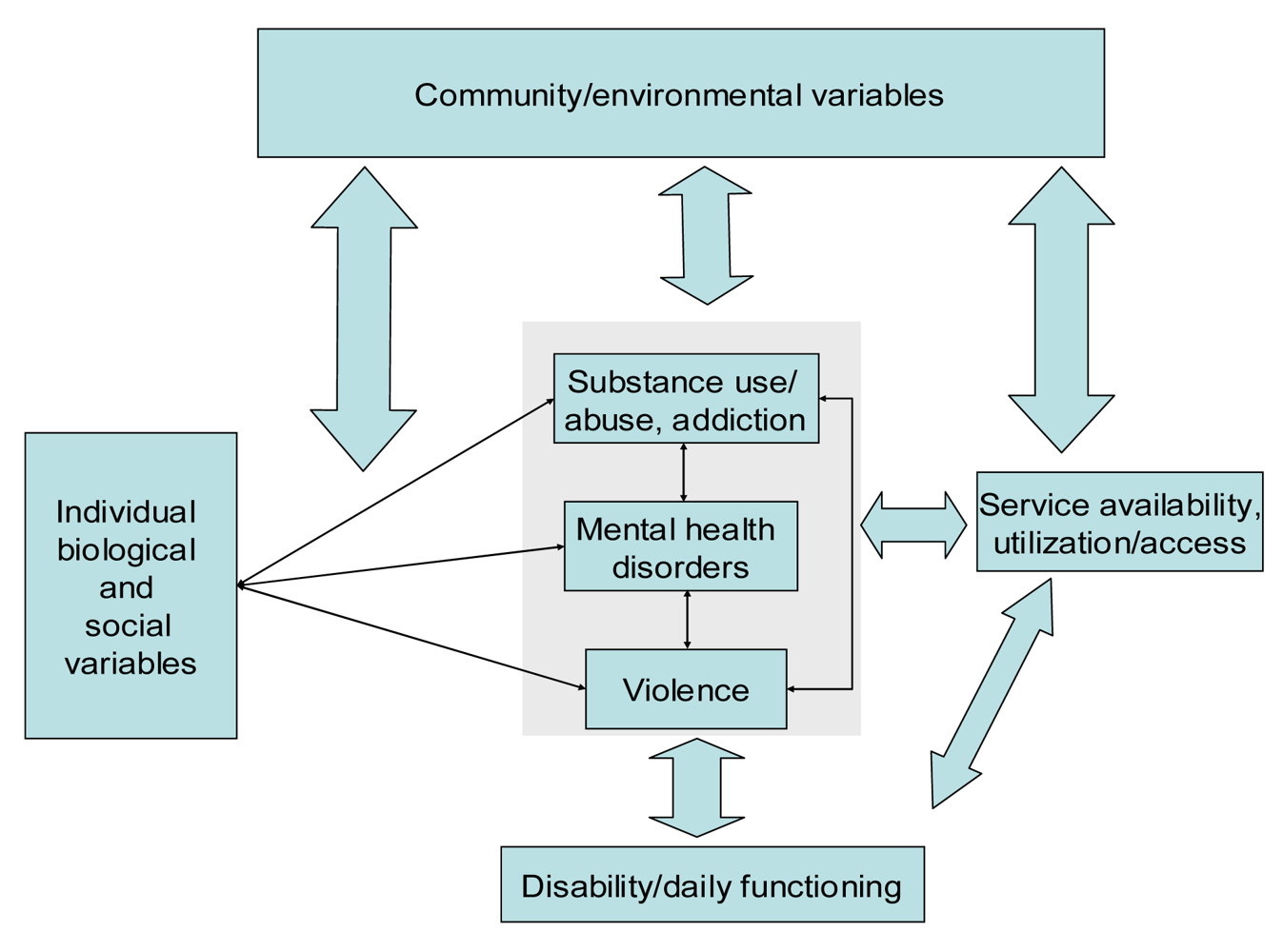
As the above literature suggests, studying the occurrence and co-occurrence of MHAV problems requires a sophisticated multi-disciplinary approach that is attuned to the diverse factors that contribute to these problems, including individual and community-level variables as well as their interactions. To this end, the RHOC project integrates biological, social, and behavioral sciences, and uses a multilevel approach in order to examine the contributing role and inter-relationships among individual-level and community-level factors affecting MHAV. The theoretical framework guiding the RHOC program, depicted in Figure 1, reflects this approach. As shown in this figure, community-level variables and individual-level variables are conceptualized as having independent and interactive influences on MHAV. In turn, MHAV problems influence the well-being of individuals (in terms of level of disability and daily functioning) and by extension, affect the functioning of communities. Additionally, community-level variables, such as economic stability, affect the quality and availability of community services, which in turn affect treatment outcomes, and thus disability and daily functioning of individuals with MHAV problems.
Overall, RHOC aims to elaborate on the nature of the inter-relationships among a myriad of possible individual and community-level factors involved in MHAV problems and their co-occurrence through coordination of research projects focused on specific aspects of MHAV. This integrative approach will help refine theoretical understandings of MHAV problems, especially the co-occurrence of such problems, generate important scientific knowledge for further empirical investigation, and inform services aimed at preventing and treating MHAV problems.
3. Project Objectives
The overall objectives of the RHOC project are to:
support and coordinate research that integrates biological, behavioral, and social science perspectives to gain a better understanding of the individual and community-level factors that play a role in the occurrence and co-occurrence of MHAV problems;
assess the independent and interactive influences of both individual and community-level factors on MHAV in a minimum of 20 communities in Ontario, Canada, including rural and high risk communities, as well as communities that are representative of the Ontario population;
develop a community indicator database that includes information on MHAV problems;
evaluate the extent of unmet need related to the occurrence and co-occurrence of MHAV problems in Ontario communities;
assess and improve the capacity of community services to respond to unmet need relating to MHAV problems; and
apply research knowledge to enhance the role of community resources in addressing the prevention and treatment of problems related to MHAV, especially the co-occurrence of these problems.
Also, an important aim of the RHOC project is to support and mentor new research trainees and provide them with valuable research experience that will enrich their academic and health research careers. As such, the project involves supporting numerous trainees from multiple disciplines (including medicine, epidemiology, psychiatry, psychology, sociology, and neurosciences), studying at both the undergraduate and graduate levels. Where possible, trainees are being hired from academic institutions residing in or close to the communities under study. RHOC therefore offers a unique opportunity for trainees residing in smaller communities of Ontario.
4. Research Plan
RHOC supports, facilitates and coordinates pilot studies focusing on MHAV, involving shared use of a mobile research laboratory for data collection. RHOC investigators funded to conduct pilot studies are expected to seek additional funding to support full-scale research projects using the mobile lab. All pilot and full studies implemented as part of RHOC focus on some aspect of mental health, addiction and/or violence co-occurring problems, and hold implications for the development and/or improvement of prevention and treatment programming. The pilot studies, led by collaborating investigators, allow for the development and testing of innovative data collection methods and measurement instruments. Although preliminary findings are generated from this work, the main goal of the pilot studies is to provide the basis for developing research protocols and corresponding grant proposals for full-scale research studies. Once funded, these larger studies provide ongoing financial support for use of the mobile laboratory and RHOC infrastructure, thus ensuring long-term sustainability of the project beyond the five-year term of funding for RHOC (2010–2015). While the pilot studies are conducted in at most one or two communities, large-scale studies are expected to include a minimum of six communities.
As described in more detail below, the research plan for RHOC pilot and full studies consists of four key components. First, a mobile research laboratory is used for all data collection, which makes it possible to conduct research in a standardized way across diverse communities, including those in remote and disadvantaged areas. Second, a common core set of variables related to key individual-level measures of MHAV are being collected in all studies. Third, RHOC studies are integrated in the long term through the development of a community indicator database comprised of available statistics and data aggregated from individual-level data (collected as part of the pilot studies and the common core variables). This database, which is accessible to all investigators, allows for multi-level and comparative analyses. A fourth key component of the RHOC project is that it employs a community-based approach by involving community stakeholders in the research process. These four components of the research plan are described in more detail below.
4.1. Using a Mobile Laboratory to Study MHAV Problems
A unique feature of RHOC is the use of a mobile research laboratory to collect a wide range of data across numerous communities. The mobile laboratory was purchased with funding from the Canadian Foundation for Innovation (CFI, grant number 16014). It is outfitted with computers and data entry equipment, monitoring devices, equipment for health examinations and for storing body fluids, as well as interview rooms and training space. While mobile research laboratories have been used to examine the physical health of community populations (e.g., the National Health and Nutrition Examination Survey, or NHANES, in the U.S.), RHOC is the first known use of a mobile research laboratory to study MHAV problems.
Using a mobile laboratory allows the RHOC team to overcome many problems that are inherent to field research. For example, the collection of data in the field is often hindered by limited research space in the community setting, and by researchers' requirement to transport expensive equipment to and from the office laboratory. Although pen and paper surveys can be easily administered in field settings, computer-administered testing and other data collection strategies require access to complex data collection instruments and environments. In addition, research conducted in multiple locales (i.e., in numerous communities with different physical resources available to researchers) can result in considerable variation in data collection instruments and procedures across settings. The mobile research laboratory overcomes these problems by allowing for biological, social and behavioral data to be collected in a standardized way across communities. Use of the mobile laboratory also permits data collection in communities that lack the resources for conducting complex research, including disadvantaged and remote communities.
An additional advantage of using the mobile laboratory for community-based research is that resources and infrastructure are shared among investigators, thereby reducing overhead costs. For example, in any given community, a number of studies can be conducted simultaneously over a period of three to four months. In each community, a site coordinator manages the day-to-day operations of the mobile laboratory and oversees participant recruitment and data collection for all pilot studies being conducted. While it is sometimes necessary for research staff with special skills to be hired for one specific study, most staff work on multiple studies. The project coordinator, located in the team's home office, oversees data collection across all studies as well as general use of the mobile laboratory, optimizing shared use of resources.
4.2. Core Variables
A core set of variables is being collected in all communities and in all pilot and full studies, allowing for community comparisons and the testing of various hypotheses related to MHAV problems and their co-occurrence. In particular, a computerized questionnaire is being used to collect self-report measures of: (1) depression and anxiety disorders (the most prevalent psychiatric problems and the leading causes of mental health-related disability) [54-56]; (2) partner and non-partner verbal aggression and physical violence; (3) alcohol, marijuana and tobacco use and problems (the most widely used substances and those which have been shown to be consistently associated with mental disorders [21,57,58, see also 59,60] and health harms generally [5]); (4) the burden of disabilities related to the occurrence and co-occurrence of MHAV problems on individuals and their families; and (5) utilization of services and barriers to accessing care for MHAV problems. Participants in all studies are also asked to provide a hair sample and a saliva sample. The hair sample serves as a biological measure of stress (i.e., hair cortisol level) and alcohol use (i.e., ethyl glucuronide level), which are analyzed alongside self-report measures obtained from the core questionnaire and instruments used in individual studies. Importantly, evidence suggests that hair cortisol and ethyl glucuronide levels are related to various health concerns requiring intervention [61,62]. In the RHOC project, these biomarkers will be evaluated for their potential use in future monitoring systems to predict health care needs. In terms of saliva, DNA will be extracted from samples in order to examine genetic vulnerabilities to MHAV problems.
The core dataset will be available to all investigators for analysis alongside individual study data, facilitating multi-disciplinary investigations. As such, the core dataset permits a number of overarching research questions to be addressed, including:
What are the associations among substance use, mood and anxiety disorders, violence, stress and burden of MHAV problems within and across communities?
To what extent are rates of substance-related problems, mood and anxiety disorders, violence, stress, and burden associated with community-level factors such as social disadvantage, unemployment and availability of services (e.g., is there a higher rate of certain types of problems in communities with higher levels of poverty or unemployment)?
Do community-level factors modify relations among substance use, mood and anxiety disorders, violence, stress and burden (e.g., is the link between substance use disorders and mental illness stronger in communities that have had a recent economic depression)?
The core questionnaire also allows for numerous other specific research questions to be addressed, allowing investigators to link core variables and individual study variables at the level of the respondent.
4.3. Development of a Community Indicator Database
An important long-term goal of the RHOC project is to develop a community indicator database that will be accessible to all collaborating investigators. Experts are increasingly recognizing that data at the local level are required to develop and allocate resources for sustainable policy, prevention and treatment programming [63]. Reflecting this trend, a number of cities across North America are developing their own community indicator systems, intended to allow for various health, socio-economic and environmental issues to be assessed, monitored, and tracked for changes over time. The rationale behind these new data systems is that information collected at the local level allows for community priorities to be identified and for collective action and planning efforts to be directed towards improving the well-being of the population. Local data provide information that is more relevant, current and reliable than data provided at the federal, state or provincial level. Moreover, with increasing emphasis being placed on health service integration, community indicators can be used by communities to identify services that may have common goals and to form cross-linkages to enhance capacity. By developing a database of community indicators for participating Ontario communities, RHOC will provide knowledge for these communities' planning efforts and, by extension, will contribute to the long-term well-being of local populations.
In the creation of the RHOC community indicator database, Census data at the enumeration level are being used to create indices of social disadvantage, including family characteristics (e.g., single-headed families), income, educational attainment, labor force activity (participation, unemployment rate, industry), and dwellings owned versus rented. Additionally, indicators of social capital (e.g., engagement in community activities, volunteering, etc.), health service utilization, access to health care and satisfaction with the health care system are being extracted from the Canadian Community Health Surveys and aggregated to the community level. As previously noted, the community indicator database will also include variables from RHOC's core questionnaire aggregated to the community level (for example, community rates of alcohol disorders, partner and non-partner violence, co-occurring MHAV problems and disability rates due to such problems, service utilization and access, etc.). Additionally, variables unique to specific projects will be aggregated to the community level wherever possible, producing, for example, prevalence estimates of heavy drinking among young adults.
The community indicator database will be developed in an iterative process, based on the implementation of pilot and full studies in communities across the province, and will therefore take at least four or five years before it is fully developed. At this time, it will allow for comprehensive multi-level analyses of relations among community-level variables and of macro-micro links.
4.4. Community Involvement
Community collaboration in public health research has increased in recent years, with investigators and funders recognizing the importance of community stakeholder participation [64,65]. Involving community stakeholders ensures that investigators are sensitive to the interests and values of the community and that the process is meaningful to community partners. Community stakeholder involvement also helps researchers to better understand issues faced by communities, allowing for improved data collection and measurement as well as more meaningful knowledge transfer [64]. To this end, a central component of the RHOC project is the involvement of community partners throughout the research process.
In each research location, community stakeholders are being invited to take an active role in the research program. For example, prior to conducting research, an advisory committee is being established in each community, consisting of representatives from local service agencies, consumers of treatment services and members of the community at large; these individuals provide a voice for the community in reference to the research being conducted. Upon completion of RHOC studies, direct transfer of relevant knowledge back to the community is ensured through collaborative development of customized reports, created by RHOC team members and community advisory committee members. These reports are to be disseminated to various community stakeholders not directly involved in RHOC, including politicians, local health professionals, and the general population. The RHOC team will also be holding community forums in each participating community upon the completion of research. In these forums, investigators and community partners can share study findings with local residents, who in turn have an opportunity to discuss research findings and determine future directions for use of this knowledge to improve services in their community.
5. Research Methods and Analyses
5.1. Selection of Communities
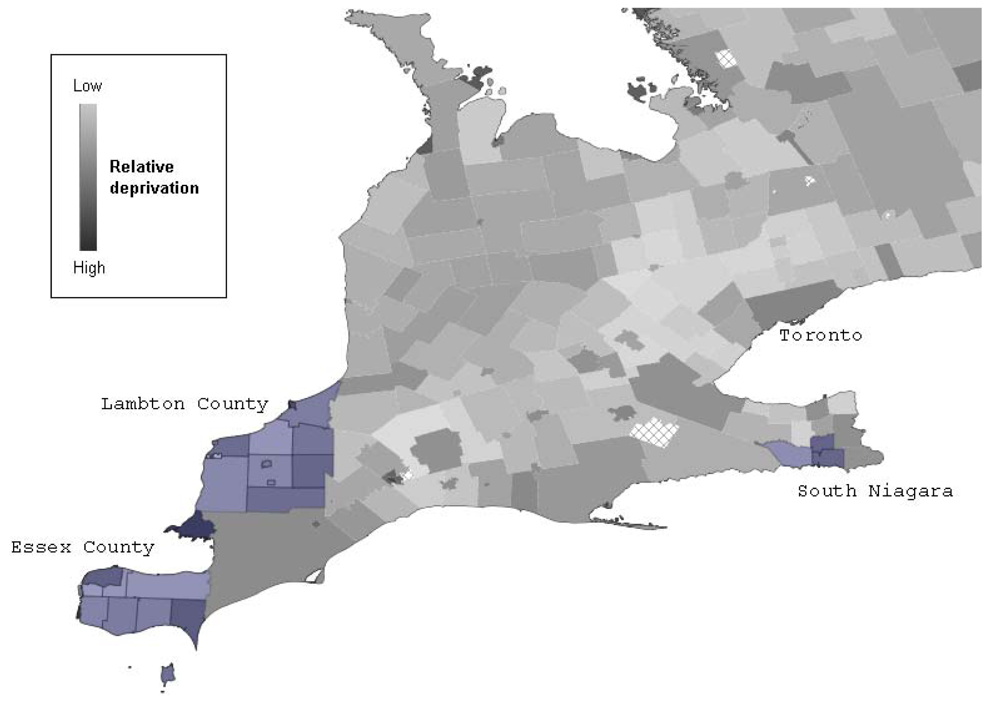
While there are various definitions of ‘community,’ the definition used in the RHOC project is geographically based, involving service planning catchment areas that are of sufficient population size so as to allow for meaningful sampling [66]. Initial communities were selected for the RHOC project based on available Canadian census data at the enumeration level, which were used to create indices of social deprivation based on the following indicators: median income, unemployment rate, proportion of dwellings rented (rather than owned), proportion of families headed by a single parent, and proportion of residents aged 25 or older with no high school diploma. Using these data and applying Geographical Information Systems, relative deprivation scores were graphed, highlighting areas high in poverty and social disorganization in Southwestern Ontario (see Figure 2). From this information and in consultation with experts (e.g., community key informants, scientists and public health officials), three high risk small to mid-sized communities in Southwestern Ontario were selected for initial pilot work.
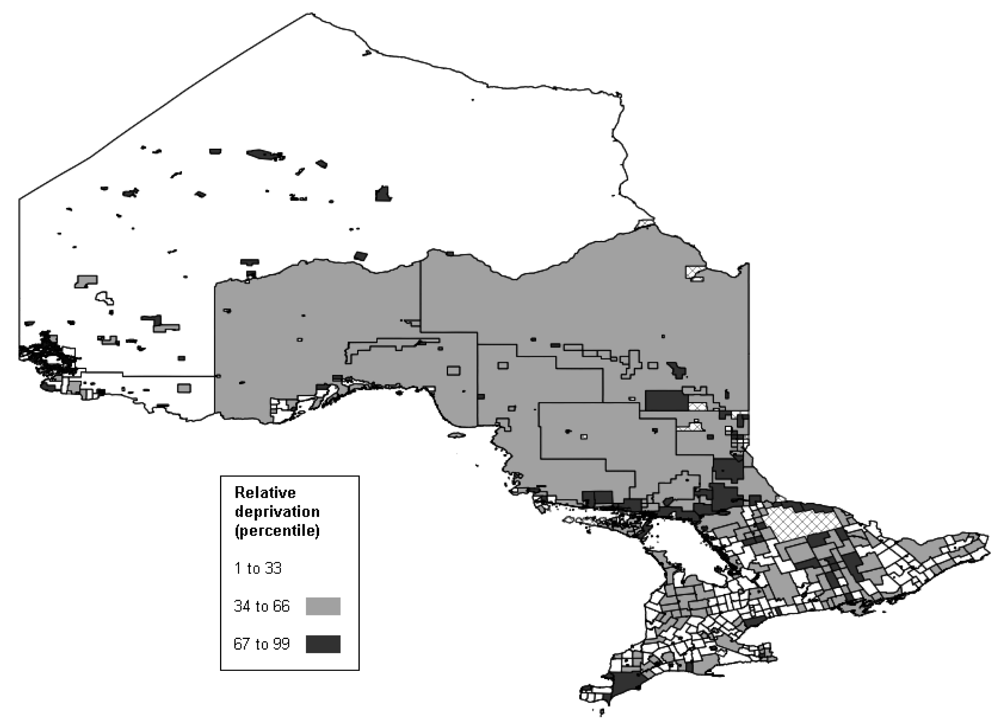
Over time, the project will move into more remote and northern communities as well as into large urban areas, in order to include additional socially disadvantaged communities (including Aboriginal communities) as well as communities that are representative of the Ontario population in terms of rates of social disadvantage. As shown in Figure 3, several areas with high relative deprivation scores (i.e., areas high in poverty and social disorganization) will be targeted in the province. A total of 20 communities will be included by the end of the fifth year of RHOC, providing sufficient community-level variability to assess the impact of community factors on MHAV problems in multi-level models.
5.2. Sampling and Analyses
The target populations and sampling methods vary from study to study and depend on the objectives of the individual study. RHOC studies include general population samples as well as samples of young adults, adolescents, clinical populations and Aboriginal populations. Notably, core data from generalizable samples are being collected in every community, allowing for the development of accurate prevalence estimates. If in a given community the studies planned do not produce generalizable research (due to the sampling techniques employed), an additional generalizable population sample will be recruited to complete the core measures.
The analytic methods employed by each investigator depend on the objectives of the individual pilot or full study. However, the multi-disciplinary and integrative work will involve conducting community comparisons and analyses assessing individual and community-level factors contributing to MHAV problems. When core data are available from multiple pilot and full studies, formal multi-level analyses will be conducted. This analytic method will be the tool by which the multidisciplinary team will combine their efforts in the analysis of inter-relationships between individual-level risk factors and community-level influences on mental health, substance use, and violence problems. Additionally, in later years, where sample sizes permit and meaningful variables can be defined at the level of the sub-community, three-level multi-level analyses will be conducted, whereby variables at the level of the larger community as well as the sub-community will be included to tease out effects at both levels. This approach will be especially important when sub-communities (e.g., small towns within a county) appear to have their own unique characteristics or problems that need to be accounted for in the analyses.
A minimum of 200 participants are being recruited in each community, with a total sample size at the end of the 5-year term of the project expected to be between 4,000 and 5,000 participants. This will result in sufficient statistical power for community comparisons as well as to detect both individual-and community-level effects in a multi-level model [67]. As noted above, RHOC supports pilot studies that are expected to lead to funding for larger-scale studies. Thus, sample sizes will likely exceed these minimum estimates.
6. Cross-Disciplinary Fertilization
The RHOC team includes researchers from many disciplines, including medicine, epidemiology, psychiatry, psychology, sociology, criminology and neurosciences. Current research by the core team spans a range of topics, including substance use and dependence, depression and other mental health disorders, acute and chronic health problems associated with substance use and mental illness, child and youth mental health and addictions, aggression and violence, and psychiatric genetics. While the current research team consists of 11 investigators, RHOC will expand its team in future years by recruiting additional investigators, thereby diversifying the expertise of the team and providing support for early career scientists.
It is expected that RHOC's integrated broad approach to studying MHAV problems and their co-occurrence, involving different levels of aetiology and different disciplinary perspectives, will contribute to a better understanding of MHAV problems than would be possible if research projects were limited to investigators' own specific areas of expertise. Integrating diverse pilot and full studies led by different investigators facilitates the development of close working relationships among team members and other partners in the development of research and the application of research findings. It enables cross-disciplinary fertilization pertaining to research on MHAV problems through shared access to the core database, common use and contribution of aggregated variables to the community indicator database, and collaborative proposals deriving from research sharing at team meetings.
Additionally, the project includes a five-member Research Advisory Committee. The members of this committee have expertise in public health, statistics, forensic psychiatry, training and delivering medical services in northern communities, research and practice in disadvantaged communities, and community health promotion. The role of the Advisory Committee is to provide substantive, organizational and operational advice on the project.
7. Summary and Conclusions
In sum, RHOC is an innovative multi-disciplinary project involving multi-faceted research into various individual and community-level factors associated with MHAV problems and their co-occurrence. The project supports, facilitates and coordinates pilot studies that use a mobile research laboratory for data collection. These studies provide investigators with the opportunity to test innovative new research methods in the study of MHAV problems and serve as the basis for the development of grant proposals to seek funding for full-scale studies. These full-scale studies, in turn, ensure the growth and sustainability of the RHOC project in the long term.
Although the pilot and full studies are led by investigators from different disciplines and with different research objectives, a common interest among all investigators is the understanding of MHAV problems and their co-occurrence, and the explanatory role of community-level and individual-level factors associated with MHAV. Additionally, an important research commonality is the collection of common data across all individual studies and the development of a community indicator database, ultimately producing generalizable scientific knowledge on MHAV problems and facilitating the integration of research across disciplines.
Overall, RHOC is expected to achieve scientific and clinical advances by: identifying linkages between social, behavioral, and biological factors associated with the occurrence and co-occurrence of MHAV problems; identifying both individual and community-level influences on MHAV and the links between these two levels of influence; estimating the burden of MHAV problems on individuals and their families and developing strategies for reducing this burden through effective use of community services and resources; gaining a better understanding of MHAV problems as these exist in individual communities, including high risk communities and those representative of the Ontario population; informing community prevention and treatment programming on how to address MHAV problems more effectively; and developing an ongoing community indicator database that will permit the assessment of unexplored linkages among multiple explanatory variables, including both individual and community-level factors. Moreover, by collecting data at the local level, RHOC provides small and remote communities with information on the occurrence and co-occurrence of MHAV problems, information that is often unavailable from large provincial and national surveys. In this way, RHOC will contribute to targeted, evidence-based health service planning in participating Ontario communities.

Acknowledgments
Preparation of this article was supported by the Canadian Institutes for Health Research (CIHR), Emerging Team Grant (CBG–101926). In addition, support to CAMH for salary of scientists and infrastructure has been provided by the Ontario Ministry of Health and Long Term Care. The views expressed here do not necessarily reflect those of the Ministry of Health and Long Term Care. We would also like to acknowledge valuable input regarding RHOC's research plan that we receive on an ongoing basis from the project's Research Advisory Committee: Julie Bernier (Statistics Canada); Gerry Cooper (Learner Affairs, Northern Ontario School of Medicine and School of Social Work, Laurentian University); Liz Janzen (Healthy Living, Toronto Public Health); David Kelly (Ontario Federation of Community Mental Health and Addiction Programs); Vernon L. Quinsey (Biology and Psychiatry, Department of Psychology, Queen's University); and Tim Stockwell (Centre for Addictions Research British Columbia (CARBC); Department of Psychology, University of Victoria; and B.C. Mental Health and Addictions Research Network).
References
- Compton, W.M.; Thomas, Y.F.; Stinson, F.S.; Grant, B.F. Prevalence, correlates, disability, and comorbidity of DSM-IV drug abuse and dependence in the United States. Arch. Gen. Psychiatry 2007, 64, 566–576. [Google Scholar]
- Dickey, B.; Azeni, H. Persons with dual diagnoses of substance abuse and major mental illness: Their excess costs of psychiatric care. Am. J. Public Health 1996, 86, 973–977. [Google Scholar]
- Mueser, K.; Bennett, M.; Kushner, M. Epidemiology of substance use disorders among persons with chronic mental illnesses. In Double Jeopardy: Chronic Mental Illness and Substance Abuse; Lehman, A.F., Dixon, L., Eds.; Harwood Academic Publishers: New York, NY, USA, 1995; pp. 9–25. [Google Scholar]
- Stephens, T.; Joubert, N. The economic burden of mental health problems in Canada. Chronic. Dis. Can. 2001, 22, 18–23. [Google Scholar]
- Rehm, J.; Baliunas, D.; Brochu, S.; Fischer, B.; Gnam, W.; Patra, J.; Popova, S.; Sarnocinska-Hart, A.; Taylor, B.; Adlaf, E.; Recenl, M.; Single, E. The Costs of Substance Abuse in Canada 2002: Highlights; Canadian Centre on Substance Abuse: Ottawa, Canada, 2006. [Google Scholar]
- Rosenberg, S.D.; Goodman, L.A.; Osher, F.C.; Swartz, M.S.; Essock, S.M.; Butterfield, M.I.; Constantine, N.T.; Wolford, G.L.; Salyers, M.P. Prevalence of HIV, Hepatitis B, and Hepatitis C in people with severe mental illness. Am. J. Public Health 2001, 91, 31–37. [Google Scholar]
- Elbogen, E.B.; Johnson, S.C. The intricate link between violence and mental disorder. Arch. Gen. Psychiatry 2009, 66, 152–161. [Google Scholar]
- King, A.C.; Bernardy, N.C.; Hauner, K. Stressful events, personality, and mood disturbance: Gender differences in alcoholics and problem drinkers. Addict. Behav. 2003, 28, 171–187. [Google Scholar]
- Scott, H.; Johnson, S.; Menezes, P.; Thornicroft, G.; Marshall, J.; Bindman, J.; Bebbington, P.; Kuipers, E. Substance misuse and risk of aggression and offending among the severely mentally ill. Br. J. Psychiatry 1998, 172, 345–350. [Google Scholar]
- Swanson, J.; Estroff, S.; Swartz, M.; Borum, R.; Lachicotte, W.; Zimmer, C.; Wagner, R. Violence and severe mental disorder in clinical and community populations: The effects of psychotic symptoms, comorbidity, and lack of treatment. Psychiatry 1997, 60, 1–22. [Google Scholar]
- Wang, J.; Patten, S.B. A prospective study of sex-specific effects of major depression on alcohol consumption. Can. J. Psychiatry 2001, 46, 422–425. [Google Scholar]
- Pulay, A.J.; Dawson, D.A.; Hasin, D.S.; Goldstein, R.B.; Ruan, W.J.; Pickering, R.P.; Huang, B.; Chou, S.P.; Grant, B.F. Violent behaviour and DSM-IV psychiatric disorders: Results from the National Epidemiologic Survey on Alcohol And Related Conditions. J. Clin. Psychiatry 2008, 69, 12–22. [Google Scholar]
- Weitzman, E.E. Poor mental health, depression, and associations with alcohol consumption, harm, and abuse in a national sample of young adults in college. J. Nerv. Ment. Dis. 2004, 192, 269–277. [Google Scholar]
- Wells, S.; Graham, K. Aggression involving alcohol: Relationship to drinking patterns and social context. Addiction 2003, 98, 33–42. [Google Scholar]
- Wells, S.; Mihic, L.; Tremblay, P.F.; Graham, K.; Demers, A. Where, with whom, and how much alcohol is consumed on drinking events involving aggression? Event-level associations in a Canadian national survey of university students. Alcohol Clin. Exp. Res. 2008, 32, 1–12. [Google Scholar]
- Kirby, M. Mental health reform for Canada in the 21st century: Getting there from here. Can. Public Policy 2005, 21, S5–S12. [Google Scholar]
- Ezzati, M.; Rodgers, A.; Lopez, A.D.; Vender Hoorn, S.; Murray, C.J.L. Mortality and burden of disease attributable to individual risk factors. In Comparative Quantification of Health Risks: Global and Regional Burden of Disease Due to Selected Major Risk Factors; Ezzati, M., Lopez, A.D., Rodgers, A., Murray, C.J.L., Eds.; World Health Organization: Geneva, Switzerland, 2004; pp. 2141–2165. [Google Scholar]
- Centers for Disease Control and Prevention. In Costs of Intimate Partner Violence against Women in the United States; CDC, National Center for Injury Prevention and Control: Atlanta, GA, USA, 2003.
- World Health Organization. Department of Injuries and Violence Prevention. Intimate Partner Violence and Alcohol Fact Sheet, Available Online: http://www.phac-aspc.gc.ca/ncfv-cnivf/pdfs/fem-whoms-alco-eng.pdf (accessed on 10 April 2010).
- Rush, B.; Urbanoski, K.; Bassani, D.; Castel, S.; Wild, C.T.; Strike, C.; Kimberley, D.; Somers, J. Prevalence of co-occurring substance use and other mental disorders in the Canadian population. Can. J. Psychiatry 2008, 53, 800–809. [Google Scholar]
- Graham, K.; Massak, A.; Demers, A.; Rehm, J. Does the association between alcohol consumption and depression depend on how they are measured? Alcohol Clin. Exp. Res. 2007, 31, 78–88. [Google Scholar]
- Kessler, R.C.; Nelson, C.B.; McGonagle, K.A.; Edlund, M.J.; Frank, R.G.; Leaf, P.J. The epidemiology of co-occurring addictive and mental disorders: Implications for prevention and service utilization. Am. J. Orthopsychiatry 1996, 66, 17–31. [Google Scholar]
- Ross, H.E. DSM-III-R alcohol abuse and dependence and psychiatric comorbidity in Ontario: Results from the Mental Health Supplement in Ontario Health Survey. Drug Alcohol Depend. 1995, 39, 111–128. [Google Scholar]
- Bushman, B.J. Effects of alcohol on human aggression: Validity of proposed explanations. In Recent Developments in Alcoholism; Galanter, M., Ed.; Plenum Press: New York, NY, USA, 1997; Volume 13, pp. 227–243. [Google Scholar]
- Giancola, P.R. Alcohol-related aggression during the college years: Theories, risk factors and policy implications. J. Stud. Alcohol 2002, 14, 129–139. [Google Scholar]
- Graham, K.; Osgood, D.W.; Wells, S.; Stockwell, T. To what extent is intoxication associated with aggression in bars? A multilevel analysis. J. Stud. Alcohol 2006, 67, 382–390. [Google Scholar]
- Murdoch, D.; Pihl, R.O.; Ross, D. Alcohol and crimes of violence: Present issues. Int. J. Addict. 1990, 25, 1065–1081. [Google Scholar]
- Graham, K.; Bernards, S.; Munné, M.; Wilsnack, S. Unhappy Hours: Alcohol and Physical Partner Aggression in the Americas; Pan American Health Organization: Washington, DC, USA, 2008. [Google Scholar]
- Jeyaseelan, L.; Sadowski, L.S.; Kumar, S.; Hassan, F.; Ramiro, L.; Vizcarra, B. World studies of abuse in the family environment—risk factors for physical intimate partner violence. Inj. Control. Saf. Promot. 2004, 11, 117–124. [Google Scholar]
- Wilsnack, R.W.; Wilsnack, S.C.; Kristjanson, A.F.; Vogeltanz-Holm, N.D.; Gmel, G. Gender and alcohol consumption: Patterns from the multinational GENACIS project. Addiction 2009, 104, 1487–1500. [Google Scholar]
- Wingood, G.M.; DiClemente, R.J.; Raj, A. Adverse consequences of intimate partner abuse among women in non-urban domestic violence shelters. Am. J. Prev. Med. 2000, 19, 270–275. [Google Scholar]
- Caetano, R.; Cunradi, C. Intimate partner violence and depression among whites, blacks, and hispanics. Ann. Epidemiol. 2003, 13, 661–665. [Google Scholar]
- Cascardi, M.; O'Leary, K.D.; Schlee, K.A. Co-occurence and correlates of posttraumatic stress disorder and major depression in physically abused women. J. Fam. Violence 1999, 14, 227–250. [Google Scholar]
- Csoboth, C.T.; Birkás, E.; Purebl, G. Living in fear of experiencing physical and sexual abuse is associated with severe depressive symptomatology among young women. J. Women's Health 2005, 14, 441–448. [Google Scholar]
- Houry, D.; Kaslow, N.J.; Thompson, M.P. Depressive symptoms in women experiencing intimate partner violence. J. Interpers. Violence 2005, 20, 1467–1477. [Google Scholar]
- Johnson, M.P.; Leone, J.M. The differential effects of intimate terrorism and situational couple violence: Findings from the National Violence Against Women survey. J. Fam. Issues 2005, 26, 322–349. [Google Scholar]
- McCauley, J.; Kern, D.E.; Kolodner, K.; Dill, L.; Schroeder, A.F.; DeChant, H.K.; Ryden, J.; Bass, E.B.; Derogatis, L.R. The “battering syndrome”: Prevalence and clinical characteristics of domestic violence in primary care internal medicine practices. Ann. Int. Med. 1995, 123, 737–746. [Google Scholar]
- Sugarman, D.B.; Aldarondo, E.; Boney-McCoy, S. Risk marker analysis of husband-to-wife violence: A continuum of aggression. J. Appl. Soc. Psychol. 1996, 26, 313–337. [Google Scholar]
- Dinwiddie, S.H. Psychiatric disorders among wife batterers. Compr. Psychiatry 1992, 33, 411–416. [Google Scholar]
- Pan, H.S.; Neidig, P.H.; O'Leary, K.D. Predicting mild and severe husband-to-wife physical aggression. J. Consult. Clin. Psychol. 1994, 62, 975–981. [Google Scholar]
- Schumacher, J.A.; Feldbau-Kohn, S.; Smith Slep, A.M.; Heyman, R.E. Risk factors for male-to-female partner physical abuse. Aggress. Violent Behav. 2001, 6, 281–352. [Google Scholar]
- Mulvey, E.P.; Odger, C.; Skeem, J.; Gardner, W.; Schubert, C.; Lidz, C. Substance use and community violence: A test of the relation at the daily level. J. Consult. Clin. Psychol. 2006, 74, 743–754. [Google Scholar]
- Fals-Stewart, W.; Leonard, K.E.; Birchler, G.R. The occurence of male-to-female intimate partner violence on days of men's drinking: The moderating effects of antisocial personality disorder. J. Consult. Clin. Psychol. 2005, 73, 239–248. [Google Scholar]
- Rice, M.E.; Harris, G.T. Psychopathy, schizophrenia, alcohol abuse, and violent recidivism. Int. J. Law Psychiatry 1995, 18, 333–342. [Google Scholar]
- Dupéré, V.; Perkins, D.D. Community types and mental health: A multilevel study of local environmental stress and coping. Am. J. Community Psychol. 2007, 39, 107–119. [Google Scholar]
- Aneshensel, C.S.; Sucoff, C.A. The neighborhood context of adolescent mental health. J. Health Soc. Behavior. 1996, 37, 293–310. [Google Scholar]
- Duncan, S.C.; Duncan, T.E.; Strycker, L.A. A multilevel analysis of neighborhood context and youth alcohol and drug problems. Prev. Sci. 2002, 3, 125–133. [Google Scholar]
- Kendler, K.S.; Kuhn, J.W.; Vittum, J.; Prescott, C.A.; Riley, B. The interaction of stressful life events and a serotonin transporter polymorphism in the prediction of episodes of major depression: a replication. Arch. Gen. Psychiatry 2005, 62, 529–535. [Google Scholar]
- Kendler, K.S.; Prescott, C.A.; Myers, J.; Neale, M.C. The structure of genetic and environmental risk factors for common psychiatric and substance use disorders in men and women. Arch. Gen. Psychiatry 2003, 60, 929–937. [Google Scholar]
- de Graaf, R.; Bijl, R.V.; Smit, F.; Vollebergh, W.A.M.; Spijker, J. Risk factors for 12-month comorbidity of mood, anxiety, and substance use disorders: Findings from the Netherlands mental health survey and incidence study. Am. J. Psychiatry 2002, 159, 620–629. [Google Scholar]
- Caspi, A.; Sugden, K.; Moffitt, T.E.; Taylor, A.; Craig, I.W.; Harrington, H.; McLay, J.; Mill, J.; Martin, J.; Braithwaite, A.; Poulton, R. Influence of life stress on depression: moderation by a polymorphism in the 5-HTT gene. Science 2003, 301, 386–389. [Google Scholar]
- Kim-Cohen, J.; Caspi, A.; Taylor, A.; Williams, B.; Newcombe, R.; Craig, I.W.; Moffitt, T.E. MAOA, maltreatment, and gene-environment interaction predicting children's mental health: new evidence and a meta-analysis. Mol. Psychiatry 2006, 11, 903–913. [Google Scholar]
- Pescosolido, B.A.; Perry, B.L.; Long, J.S.; Martin, J.K.; Nurnberger, J.I., Jr.; Hesselbrock, V. Under the influence of genetics: How transdisciplinarity leads us to rethink social pathways to illness. Amer. J. Sociol. 2008, 114, S171–S201. [Google Scholar]
- Kessler, R.C.; McGonagle, K.A.; Shanyang, Z.; Nelson, C.B.H.M.; Eshleman, S.; Wittchen, H.-U.; Kendler, K. Lifetime and 12-month prevalence of DSM-III-R psychiatric disorders in the United States: Results from the national comorbidity survey. Arch. Gen. Psychiat. 1994, 51, 8–19. [Google Scholar]
- Üstun, J.L.; Ayuso-Mateos, S.; Chatterji, S.; Mathers, C.; Murray, C.J.L. Global burden of depressive disorders in the year 2000. Brit. J. Psychiat. 2004, 184, 386–392. [Google Scholar]
- Wittchen, H.-U.; Jacobi, F. Size and burden of mental disorder in Europe: A critical review and appraisal of 27 studies. Eur. Neuropsychopharmacol. 2005, 15, 357–376. [Google Scholar]
- Gerber, G.J.; Krupa, T.; Eastabrook, S.; Gargaro, J. Substance use among persons with serious mental illness in eastern Ontario. Can. J. Community Ment. Health 2003, 22, 113–128. [Google Scholar]
- Massak, A.; Graham, K. Is the smoking-depression relationship confounded by alcohol consumption? Nicotine Tob. Res. 2008, 10, 1231–1243. [Google Scholar]
- Jané-Llopis, E.; Matytsina, I. Mental health and alcohol, drugs and tobacco: A review of the comorbidity between mental disorders and the use of alcohol, tobacco and illicit drugs. Drug Alcohol Rev. 2006, 25, 515–536. [Google Scholar]
- Moore, T.H.M.; Zammit, S.; Lingford-Hughes, A.; Barnes, T.R.E.; Jones, P.B.; Burke, M.; Lewis, G. Cannabis use and risk of psychotic or affective mental health outcomes: A systematic review. Lancet 2007, 370, 319–328. [Google Scholar]
- Pereg, D.; Gow, R.; Mosseri, M.; Lishner, M.; Rieder, M.; Van Uum, S.; Koren, G. Hair cortisol and the risk for acute myocardial infarction in adult men. Stress 2011, 14, 73–81. [Google Scholar]
- Yegles, M.; Labarthe, A.; Auwärter, V.; Hartwig, S.; Vater, H.; Wennig, R.; Pragst, F. Comparison of ethyl glucuronide and fatty acid ethyl ester concentrations in hair of alcoholics, social drinkers and teetotallers. Forensic. Sci. Int. 2004, 145, 167–173. [Google Scholar]
- Green, L.W.; Mercer, S.L. Can public health researchers and agencies reconcile the push from funding bodies and the pull from communities? Am. J. Public Health 2001, 91, 1926–1929. [Google Scholar]
- Kellam, S.G.; Koretz, D.; Moscicki, E.K. Core elements of developmental epidemiologically based prevention research. Am. J. Community Psychol. 1999, 27, 463–481. [Google Scholar]
- Nelson, G.; Lord, J.; Ochocka, J. Shifting The Paradigm in Community Mental Health. Towards Empowerment and Community; University of Toronto Press: Toronto, Canada, 2001. [Google Scholar]
- MacQueen, K.; McLellan, E.; Metzger, D.; Kegeles, S.; Strauss, R.; Scotti, R.; Blanchard, L.; Trottter, R. What is community? An evidence-based definition for participatory public health. Am. J. Public Health 2001, 91, 1929–1938. [Google Scholar]
- Raudenbush, S.W.; Bryk, A.A. Hierarchical Linear Models: Applications and Data Analysis Methods, 2nd ed.; Sage Publications: Thousand Oaks, CA, USA, 2002. [Google Scholar]
© 2011 by the authors; licensee MDPI, Basel, Switzerland. This article is an open access article distributed under the terms and conditions of the Creative Commons Attribution license(http://creativecommons.org/licenses/by/3.0/).
Share and Cite
Wells, S.; Flynn, A.; Graham, K.; Rehm, J.; Cairney, J.; Kates, N.; Kennedy, J.L.; Lobo, D.S.S.; Chaiton, M.; Menzies, P.; et al. Using a Mobile Laboratory to Study Mental Health, Addictions and Violence: A Research Plan. Challenges 2011, 2, 1-18. https://doi.org/10.3390/challe2010001
Wells S, Flynn A, Graham K, Rehm J, Cairney J, Kates N, Kennedy JL, Lobo DSS, Chaiton M, Menzies P, et al. Using a Mobile Laboratory to Study Mental Health, Addictions and Violence: A Research Plan. Challenges. 2011; 2(1):1-18. https://doi.org/10.3390/challe2010001
Chicago/Turabian StyleWells, Samantha, Andrea Flynn, Kathryn Graham, Jürgen Rehm, John Cairney, Nick Kates, James L. Kennedy, Daniela S.S. Lobo, Michael Chaiton, Peter Menzies, and et al. 2011. "Using a Mobile Laboratory to Study Mental Health, Addictions and Violence: A Research Plan" Challenges 2, no. 1: 1-18. https://doi.org/10.3390/challe2010001