<?xml version="1.0" encoding="UTF-8"?>
<!DOCTYPE article PUBLIC "-//NLM//DTD Journal Publishing DTD v2.3 20070202//EN" "journalpublishing.dtd">
<article xmlns:mml="http://www.w3.org/1998/Math/MathML" xmlns:xlink="http://www.w3.org/1999/xlink" xml:lang="en" article-type="review-article">
  <front>
    <journal-meta>
      <journal-id journal-id-type="publisher-id">membranes</journal-id>
      <journal-title>Membranes</journal-title>
      <abbrev-journal-title abbrev-type="publisher">Membranes</abbrev-journal-title>
      <abbrev-journal-title abbrev-type="pubmed">Membranes</abbrev-journal-title>
      <issn pub-type="epub">2077-0375</issn>
      <publisher>
        <publisher-name>MDPI</publisher-name>
      </publisher>
    </journal-meta>
    <article-meta>
      <article-id pub-id-type="doi">10.3390/membranes2040727</article-id>
      <article-id pub-id-type="publisher-id">membranes-02-00727</article-id>
      <article-categories>
        <subj-group>
          <subject>Review</subject>
        </subj-group>
      </article-categories>
      <title-group>
        <article-title>Investigation of Cross-Linked and Additive Containing Polymer Materials for Membranes with Improved Performance in Pervaporation and Gas Separation </article-title>

      </title-group>
      <contrib-group>
        <contrib contrib-type="author">
          <name>
            <surname>Hunger</surname>
            <given-names>Katharina</given-names>
          </name>
          <xref rid="af1-membranes-02-00727" ref-type="aff">1</xref>
        </contrib>
        <contrib contrib-type="author">
          <name>
            <surname>Schmeling</surname>
            <given-names>Nadine</given-names>
          </name>
          <xref rid="af2-membranes-02-00727" ref-type="aff">2</xref>
        </contrib>
        <contrib contrib-type="author">
          <name>
            <surname>Jeazet</surname>
            <given-names>Harold B. Tanh</given-names>
          </name>
          <xref rid="af3-membranes-02-00727" ref-type="aff">3</xref>
        </contrib>
        <contrib contrib-type="author">
          <name>
            <surname>Janiak</surname>
            <given-names>Christoph</given-names>
          </name>
          <xref rid="af3-membranes-02-00727" ref-type="aff">3</xref>
          <xref rid="c1-membranes-02-00727" ref-type="corresp">*</xref>
        </contrib>
        <contrib contrib-type="author">
          <name>
            <surname>Staudt</surname>
            <given-names>Claudia</given-names>
          </name>
          <xref rid="af2-membranes-02-00727" ref-type="aff">2</xref>
          <xref rid="af4-membranes-02-00727" ref-type="aff">4</xref>
          <xref rid="c1-membranes-02-00727" ref-type="corresp">*</xref>
        </contrib>
        <contrib contrib-type="author">
          <name>
            <surname>Kleinermanns</surname>
            <given-names>Karl</given-names>
          </name>
          <xref rid="af1-membranes-02-00727" ref-type="aff">1</xref>
          <xref rid="c1-membranes-02-00727" ref-type="corresp">*</xref>
        </contrib>
      </contrib-group>
      <aff id="af1-membranes-02-00727"><label>1 </label>Institute of Physical Chemistry, Heinrich-Heine-University, Düsseldorf 40225, Germany; Email: <email>katharina.hunger@hhu.de</email></aff>
      <aff id="af2-membranes-02-00727"><label>2 </label>Institute of Organic Chemistry and Macromolecular Chemistry, Heinrich-Heine-University, Düsseldorf 40225, Germany; Email: <email>nadine.schmeling@uni-duesseldorf.de</email></aff>
      <aff id="af3-membranes-02-00727"><label>3 </label>Institute of Inorganic and Structural Chemistry, Heinrich-Heine-University, Düsseldorf 40225, Germany; Email: <email>harold.tanh.jeazet@uni-duesseldorf.de</email></aff>
      <aff id="af4-membranes-02-00727"><label>4 </label>BASF SE, Advanced Materials and Systems Research, Carl-Bosch Str., Ludwigshafen 67056, Germany</aff>
      <author-notes>
        <corresp id="c1-membranes-02-00727"><label>*</label> Authors to whom correspondence should be addressed; Email: <email>janiak@uni-duesseldorf.de</email> (C.J.); <email>claudia.staudt@basf.com</email> (C.S.); <email>kleinermanns@uni-duesseldorf.de</email> (K.K.); Tel.: +49-211-81-122-86 (C.J.); Fax: +49-211-81-122-87 (C.J.); Tel.: +49-621-604-4189 (C.S.); Fax: +49-211-81-123-12 (C.S.); Tel.: +49-211-81-121-00 (K.K.); Fax: +49-211-81-121-79 (K.K.).</corresp>
      </author-notes>
      <pub-date pub-type="epub">
        <day>22</day>
        <month>10</month>
        <year>2012</year>
      </pub-date>
      <pub-date pub-type="collection">
        <month>12</month>
        <year>2012</year>
      </pub-date>
      <volume>2</volume>
      <issue>4</issue>
      <fpage>727</fpage>
      <lpage>763</lpage>
      <history>
        <date date-type="received">
          <day>31</day>
          <month>07</month>
          <year>2012</year>
        </date>
        <date date-type="rev-recd">
          <day>24</day>
          <month>09</month>
          <year>2012</year>
        </date>
        <date date-type="accepted">
          <day>25</day>
          <month>09</month>
          <year>2012</year>
        </date>
      </history>
      <permissions>
        <copyright-statement>© 2012 by the authors; licensee MDPI, Basel, Switzerland.</copyright-statement>
        <copyright-year>2012</copyright-year>
        <license xmlns:xlink="http://www.w3.org/1999/xlink" license-type="open-access" xlink:href="http://creativecommons.org/licenses/by/3.0/">
          <p>This article is an open-access article distributed under the terms and conditions of the Creative Commons Attribution license (http://creativecommons.org/licenses/by/3.0/).</p>
        </license>
      </permissions>
      <abstract>
        <p>Pervaporation and gas separation performances of polymer membranes can be improved by crosslinking or addition of metal-organic frameworks (MOFs). Crosslinked copolyimide membranes show higher plasticization resistance and no significant loss in selectivity compared to non-crosslinked membranes when exposed to mixtures of CO<sub>2</sub>/CH<sub>4</sub> or toluene/cyclohexane. Covalently crosslinked membranes reveal better separation performances than ionically crosslinked systems. Covalent interlacing with 3-hydroxypropyldimethylmaleimide as photocrosslinker can be investigated <italic>in situ</italic> in solution as well as in films, using transient UV/Vis and FTIR spectroscopy. The photocrosslinking yield can be determined from the FTIR-spectra. It is restricted by the stiﬀness of the copolyimide backbone, which inhibits the photoreaction due to spatial separation of the crosslinker side chains. Mixed-matrix membranes (MMMs) with MOFs as additives (fillers) have increased permeabilities and often also selectivities compared to the pure polymer. Incorporation of MOFs into polysulfone and Matrimid<sup>®</sup> polymers for MMMs gives defect-free membranes with performances similar to the best polymer membranes for gas mixtures, such as O<sub>2</sub>/N<sub>2</sub> H<sub>2</sub>/CH<sub>4</sub>, CO<sub>2</sub>/CH<sub>4</sub>, H<sub>2</sub>/CO<sub>2</sub>, CH<sub>4</sub>/N<sub>2</sub> and CO<sub>2</sub>/N<sub>2</sub> (preferentially permeating gas is named first). The MOF porosity, its particle size and content in the MMM are factors to influence the permeability and the separation performance of the membranes.</p>
      </abstract>
      <kwd-group>
        <kwd>pervaporation</kwd>
        <kwd>separation</kwd>
        <kwd>photocrosslinking</kwd>
        <kwd>membranes</kwd>
        <kwd>permeability</kwd>
        <kwd>permselectivity</kwd>
        <kwd>mixed-matrix membranes</kwd>
        <kwd>mechanism</kwd>
        <kwd>crosslinking degree</kwd>
        <kwd>photochemistry</kwd>
        <kwd>metal-organic frameworks</kwd>
        <kwd>MOFs</kwd>
        <kwd>porosity</kwd>
      </kwd-group>
    </article-meta>
  </front>
  <body>
    <sec sec-type="intro">
      <title>1. Introduction</title>
      <p>Membranes processes are very important in our every day life but also in industry, e.g., for water and waste water treatment, in medical applications or separation of petrochemicals. Classical separation methods used for purification of chemical products, notably distillation, extraction and crystallization are energy and cost intensive. Over 50% of the energy costs in the chemical industry are used for the separation of gaseous or liquid mixtures [<xref ref-type="bibr" rid="B1-membranes-02-00727">1</xref>]. With membrane technology, the costs for difficult separations, e.g., of azeotropic mixtures, can be reduced significantly [<xref ref-type="bibr" rid="B2-membranes-02-00727">2</xref>].</p>
      <p>Membranes with pore sizes of more than 2 nm made out of ceramics, zeolithes, glass, metal or polymers are frequently used in practice [<xref ref-type="bibr" rid="B3-membranes-02-00727">3</xref>,<xref ref-type="bibr" rid="B4-membranes-02-00727">4</xref>,<xref ref-type="bibr" rid="B5-membranes-02-00727">5</xref>]. Here, separation is based on size exclusion and thus these membranes are suited for separation of components with sufficient size difference, e.g., in dialysis, waste water treatment and functional clothing. For other applications, especially for separation of components with comparable sizes or the separation of ions from water, solution-diffusion membranes are used [<xref ref-type="bibr" rid="B6-membranes-02-00727">6</xref>].</p>
      <p>The solution diffusion mechanism is based on the principle that the mixture component with higher solubility and higher diffusion rate permeates preferentially through the membrane, independent on the component sizes [<xref ref-type="bibr" rid="B7-membranes-02-00727">7</xref>,<xref ref-type="bibr" rid="B8-membranes-02-00727">8</xref>]. Solution-diffusion membranes feature free volume sites which cannot be occupied by polymer chains due to restricted motion and packing density of the polymer chains. The components are transported through the membrane by successive movement between the transient free volume gaps close to the feed side to those close to the permeate side due to thermal motion of segments of the polymer chains [<xref ref-type="bibr" rid="B9-membranes-02-00727">9</xref>].</p>
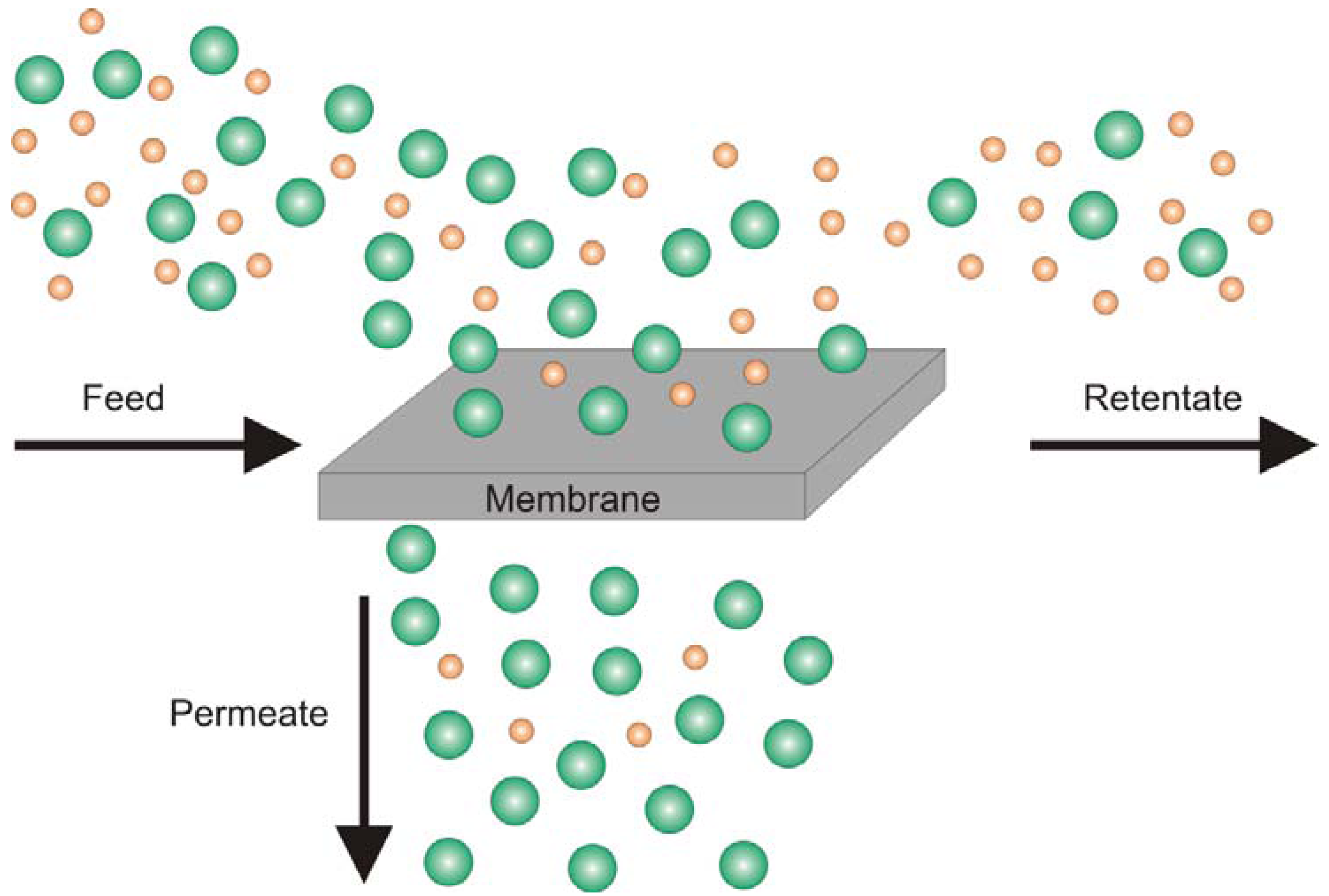
      <p>The pervaporation process, which is used for the separation of liquid mixtures, is schematically shown in <xref ref-type="fig" rid="membranes-02-00727-f001">Figure 1</xref>. The liquid mixture (feed) whose components shall be separated is led over the membrane. Before permeation a phase transition from the liquid phase to the vapour phase is induced by thermal heating. The component which permeates preferentially is concentrated in the permeate; whereas the detained component is enriched in the retentate. Which component is preferentially permeating is dependent on the solubility of the components in the polymer matrix and the diffusion rate of the components through the membrane. The driving force for permeation is given by the difference of chemical potentials of the components on feed and permeate side respectively, depending on pressure, temperature and concentration difference [<xref ref-type="bibr" rid="B8-membranes-02-00727">8</xref>,<xref ref-type="bibr" rid="B10-membranes-02-00727">10</xref>,<xref ref-type="bibr" rid="B11-membranes-02-00727">11</xref>]. In gas separation, the feed as well as retentate and permeate are gaseous and no phase transition occurs. </p>
      <fig id="membranes-02-00727-f001" position="anchor">
        <label>Figure 1</label>
        <caption>
          <p>Principles of pervaporation. The liquid feed mixture ﬂows along the membrane and the feed components diffuse into and through the membrane at different rates. The liquid retentate is depleted and the vaporous permeate enriched in the preferentially permeating component [<xref ref-type="bibr" rid="B12-membranes-02-00727">12</xref>].</p>
        </caption>
        <graphic xmlns:xlink="http://www.w3.org/1999/xlink" xlink:href="membranes-02-00727-g001.tif"/>
      </fig>
      <p>The separation characteristics of a membrane are classified in terms of permeability <italic>P</italic> and selectivity <italic>α</italic>. The permeability is a measure of the permeate's quantity while the selectivity describes its quality (mole fraction of preferentially permeating component in the permeate) [<xref ref-type="bibr" rid="B9-membranes-02-00727">9</xref>]. </p>
      <p>There are different types of materials which are suitable for membrane application. Inorganic membranes like ceramic membranes of metal oxides (γ-Al<sub>2</sub>O<sub>3</sub>, ZrO<sub>2</sub>, TiO<sub>2</sub> or ZrTiO<sub>4</sub>), perovskites or zeolites, porous carbon membranes, metal membranes or porous glass membranes [<xref ref-type="bibr" rid="B13-membranes-02-00727">13</xref>] have exceptionally high permeability and selectivity together with thermal and chemical stabilities. However, manufacturing procedures are more complicated (e.g., require support treatment, zeolite crystallization, thermal programming for pyrolysis and a controlled inert gas atmosphere in terms of flow, pressure and composition) and there is a lower reproducibility for membrane properties associated with high cost and low mechanical stability. This makes the production of inorganic membranes more difficult than for polymer membranes [<xref ref-type="bibr" rid="B13-membranes-02-00727">13</xref>,<xref ref-type="bibr" rid="B14-membranes-02-00727">14</xref>,<xref ref-type="bibr" rid="B15-membranes-02-00727">15</xref>].</p>
      <p>Therefore, most of the commercial solution-diffusion membrane units contain polymeric materials [<xref ref-type="bibr" rid="B16-membranes-02-00727">16</xref>,<xref ref-type="bibr" rid="B17-membranes-02-00727">17</xref>,<xref ref-type="bibr" rid="B18-membranes-02-00727">18</xref>,<xref ref-type="bibr" rid="B19-membranes-02-00727">19</xref>], which can be divided into rubbery and glassy polymers. While glassy polymers show very attractive separation characteristics, rubbery polymers show comparably low selectivity with high permeability for common gas pairs such as O<sub>2</sub>/N<sub>2</sub>, H<sub>2</sub>/CH<sub>4</sub>, CO<sub>2</sub>/CH<sub>4</sub>, <italic>etc.</italic> [<xref ref-type="bibr" rid="B20-membranes-02-00727">20</xref>,<xref ref-type="bibr" rid="B21-membranes-02-00727">21</xref>]. Of the glassy polymers, polyimides have been found to be very promising as membrane materials because they not only have better separation characteristics than the commonly used ones (e.g., polycarbonates) but also offer good thermal and chemical resistance and are easy to process [<xref ref-type="bibr" rid="B9-membranes-02-00727">9</xref>]. Additionally they can be easily functionalized and therefore customized for any given separation problem. </p>
      <p>Solution-diffusion membranes already find application in removal of CO<sub>2</sub> from natural gas, dehydration of organic solvents, desalination, removal of polar low molecular weight components in equilibrium reactions, oxygen or nitrogen enrichment from air as well as in vapour recovery systems and several more [<xref ref-type="bibr" rid="B22-membranes-02-00727">22</xref>,<xref ref-type="bibr" rid="B23-membranes-02-00727">23</xref>,<xref ref-type="bibr" rid="B24-membranes-02-00727">24</xref>,<xref ref-type="bibr" rid="B25-membranes-02-00727">25</xref>]. </p>
      <p>Of those applications, natural gas treatment is of the highest industrial interest [<xref ref-type="bibr" rid="B26-membranes-02-00727">26</xref>]. Currently, less than 5% of the plants processing natural gas employ membrane technology, which is mainly used for removal of carbon dioxide [<xref ref-type="bibr" rid="B27-membranes-02-00727">27</xref>]. As mentioned above, processing costs can be reduced significantly by substitution or extension of the commonly used amine absorption plants [<xref ref-type="bibr" rid="B28-membranes-02-00727">28</xref>] by membrane separation processes. Natural gas is composed of mainly methane (75%–90%) and some higher hydrocarbons. Unfortunately, a significant number of natural gas resources cannot be exploited due to the high amount of CO<sub>2</sub> (up to 30%) and other undesirable impurities (water, nitrogen, hydrogen sulfide, <italic>etc.</italic>) contained in the mixture, since they lead to corrosion of the pipelines [<xref ref-type="bibr" rid="B23-membranes-02-00727">23</xref>]. The specifications for natural gas delivery to the U.S. national pipeline grid [<xref ref-type="bibr" rid="B29-membranes-02-00727">29</xref>] demand carbon dioxide contents of less than 2%. First polymeric membranes for removal of CO<sub>2</sub> from natural gas consisted of cellulose acetate [<xref ref-type="bibr" rid="B24-membranes-02-00727">24</xref>]. Cellulose acetate membranes have a CO<sub>2</sub>/CH<sub>4</sub> selectivity of about 12–15 under normal operating conditions, which is not sufficient for industrial application [<xref ref-type="bibr" rid="B23-membranes-02-00727">23</xref>]. Today, more and more polyimides are used as membrane material instead of cellulose derivatives, since the separation properties are better (selectivities of 20–25) [<xref ref-type="bibr" rid="B9-membranes-02-00727">9</xref>,<xref ref-type="bibr" rid="B23-membranes-02-00727">23</xref>]. However, the low durability of unmodified polyimide membranes poses a problem, which can be overcome by crosslinking [<xref ref-type="bibr" rid="B9-membranes-02-00727">9</xref>,<xref ref-type="bibr" rid="B30-membranes-02-00727">30</xref>]. </p>
      <p>Besides natural gas treatment, separation of aromatics and aliphatics is a promising field for application of solution-diffusion membrane technology. In Europe, the benzene percentage in motor fuel is limited to 1 vol.% by law [<xref ref-type="bibr" rid="B31-membranes-02-00727">31</xref>]. Reduction of the benzene content of reformates is usually done by extraction with usage of a tetraethylene glycol/water mixture as the extracting solvent. Here, the separation factor for the aromatics is between 2 and 3 [<xref ref-type="bibr" rid="B32-membranes-02-00727">32</xref>]. By implementing pervaporation membranes, the cost-intensive extracting unit can be replaced. The pervaporation properties of many different polymers were studied in respect to an application as membrane material for aromatics/aliphatics separation, <italic>i.e.</italic>, polyimides, polyphosphonates, acetyl cellulose, benzoylated chitosan or polyurethane-silica hybrid membranes. The benzene/cyclohexane selectivity obtained with those polymers as membrane material typically lies between 5 and 20, with a normalized flux of 5–10 kg µm m<sup>−2</sup> h<sup>−1</sup> [<xref ref-type="bibr" rid="B33-membranes-02-00727">33</xref>,<xref ref-type="bibr" rid="B34-membranes-02-00727">34</xref>,<xref ref-type="bibr" rid="B35-membranes-02-00727">35</xref>]. It is important that the membrane material is stable and that the separation characteristics will not change drastically in dependency on the concentration of aromatics in the reformate. Although all of those polymers show promising pervaporation characteristics, the stability often recedes at high aromatic concentrations and elevated feed temperatures. Again, crosslinking of the polymer can lead to an increased durability of the membrane [<xref ref-type="bibr" rid="B32-membranes-02-00727">32</xref>]. As was shown for methyl methacrylate/methacrylic acid copolymer membranes ionically crosslinked with metal ions, the separation factor and normalized flux are not smaller than those of the non-crosslinked polymers [<xref ref-type="bibr" rid="B36-membranes-02-00727">36</xref>].</p>
      <p>The separation of olefin/paraffin mixtures is rather difficult because of the small differences in physical properties. Currently, such separations are carried out by low temperature distillation, which is rather cost intensive. Although membrane based hybrid processes would be less cost intensive they are not applied, since the separation factors of the membrane materials currently commercially available (e.g., silicone rubber, polysulfone, cellulose acetate, 1,2-polybutadiene or polyethylene) are too low [<xref ref-type="bibr" rid="B37-membranes-02-00727">37</xref>,<xref ref-type="bibr" rid="B38-membranes-02-00727">38</xref>]. Very attractive separation characteristics can be achieved with polyimides as membrane materials [<xref ref-type="bibr" rid="B39-membranes-02-00727">39</xref>,<xref ref-type="bibr" rid="B40-membranes-02-00727">40</xref>,<xref ref-type="bibr" rid="B41-membranes-02-00727">41</xref>,<xref ref-type="bibr" rid="B42-membranes-02-00727">42</xref>,<xref ref-type="bibr" rid="B43-membranes-02-00727">43</xref>], but these materials are very sensitive to plasticization. To obtain membrane materials suitable for olefin/paraffin separation on industrial scales, the problem of plasticization has to be resolved, first. Some strategies for increase of membrane durability are presented in this review.</p>
      <p>Gas separation membranes used in industrial applications are usually integrated as hollow fibers or flat sheets packaged as spiral-wound modules [<xref ref-type="bibr" rid="B27-membranes-02-00727">27</xref>]. They are composed of a thin nonporous gas-selective layer (typically less than 0.5 µm [<xref ref-type="bibr" rid="B23-membranes-02-00727">23</xref>]) deposited onto a highly porous carrier layer [<xref ref-type="bibr" rid="B8-membranes-02-00727">8</xref>,<xref ref-type="bibr" rid="B11-membranes-02-00727">11</xref>,<xref ref-type="bibr" rid="B44-membranes-02-00727">44</xref>]. The carrier material increases the mechanical stability of the membrane, without influencing the separation characteristics [<xref ref-type="bibr" rid="B17-membranes-02-00727">17</xref>]. A promising advance is the usage of composite membranes, in which different materials are used for the two different layers. This way, materials for both layers can be optimized separately and the high-cost polymer materials necessary for good separation properties can be applied more economically, since they are only needed for the very thin selective layer [<xref ref-type="bibr" rid="B27-membranes-02-00727">27</xref>].</p>
      <p>A membrane material is well suited for separation, when permeability and selectivity both are high. By modification of the polymer, these parameters can be increased. Unfortunately, improvement of the permeability often is gained in conjunction with a loss of selectivity, or the other way around [<xref ref-type="bibr" rid="B17-membranes-02-00727">17</xref>,<xref ref-type="bibr" rid="B20-membranes-02-00727">20</xref>,<xref ref-type="bibr" rid="B45-membranes-02-00727">45</xref>]. For several polycarbonates, poly(ether sulfone)s and polyimides the solubility selectivities for O<sub>2</sub>/N<sub>2</sub> and CO<sub>2</sub>/CH<sub>4</sub> were found to be very similar, independent on the polymer structure, while the selectivities varied significantly [<xref ref-type="bibr" rid="B11-membranes-02-00727">11</xref>,<xref ref-type="bibr" rid="B46-membranes-02-00727">46</xref>]. That implies, that diffusion selectivity <italic>D<sub>x</sub>/D<sub>y</sub></italic> is of higher importance in gas separation than solubility selectivity <italic>S<sub>x</sub>/S<sub>y</sub></italic>, according to Equation (1) [<xref ref-type="bibr" rid="B17-membranes-02-00727">17</xref>].</p>
      <p><disp-formula id="membranes-02-00727-i001">
          <inline-graphic xmlns:xlink="http://www.w3.org/1999/xlink" xlink:href="membranes-02-00727-i001.tif"/>
          <label>(1)</label>
          </disp-formula></p>
      <p>Therefore, to optimize both permeability and selectivity, a narrower free volume distribution in combination with a higher chain stiffness should be attempted [<xref ref-type="bibr" rid="B47-membranes-02-00727">47</xref>]. </p>
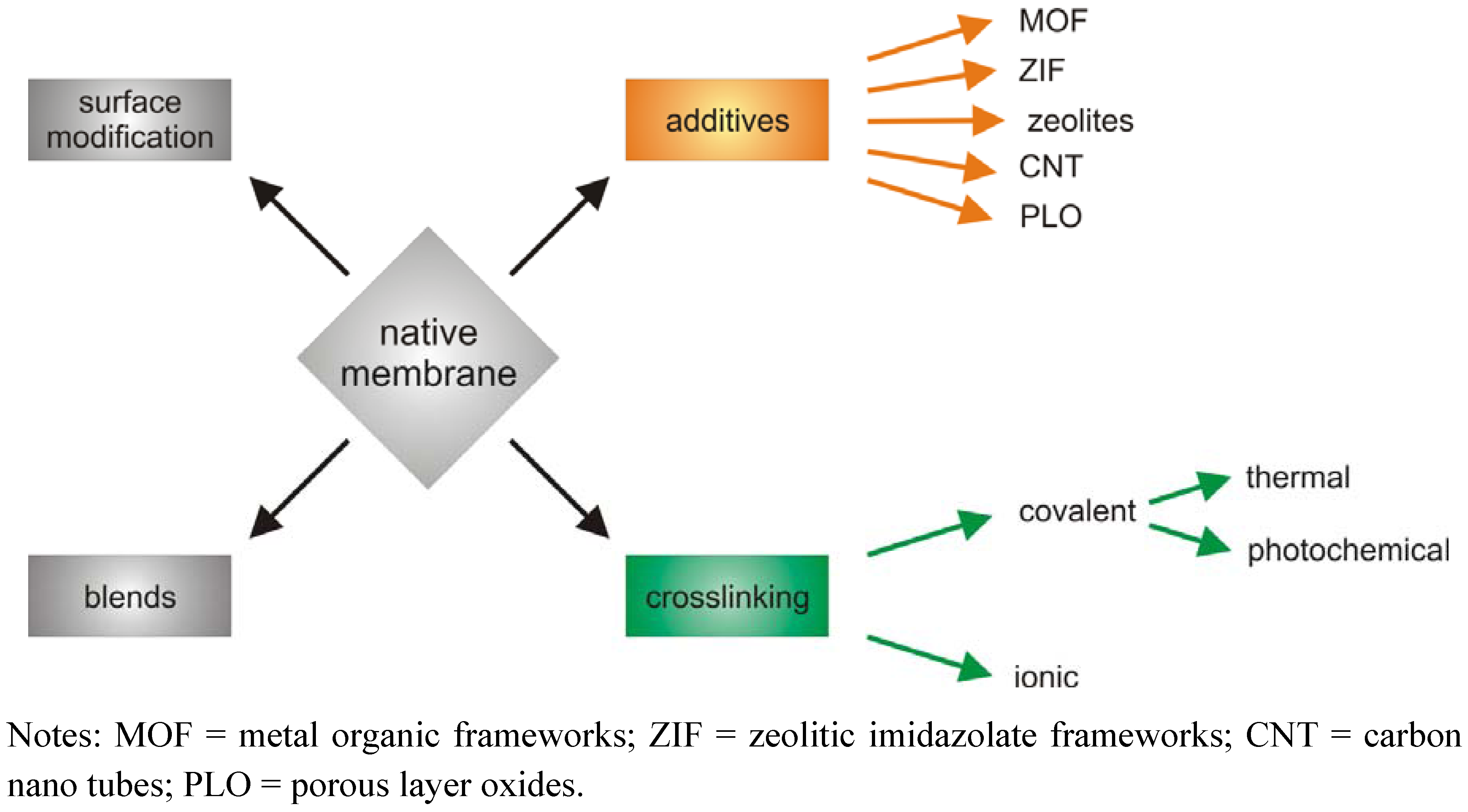
      <p>The most common approaches for membrane modification are shown in <xref ref-type="fig" rid="membranes-02-00727-f002">Figure 2</xref>. Usually at least two polymers are blended together, to take advantage of the different properties of those components. For example, it was found that monomers having bulky substituents, e.g., the 6FDA dianhydride which contains -CF<sub>3</sub> groups (see <xref ref-type="fig" rid="membranes-02-00727-f008">Figure 8</xref> for structure), restrict chain mobility and simultaneously chain packing, and lead to significantly improved selectivity as well as permeability [<xref ref-type="bibr" rid="B46-membranes-02-00727">46</xref>,<xref ref-type="bibr" rid="B48-membranes-02-00727">48</xref>]. Today, most copolymers consist of alternating bulky and flexible monomer units are used and by now a variety of monomers is available [<xref ref-type="bibr" rid="B17-membranes-02-00727">17</xref>]. </p>
      <p>Although permeability and selectivity are the main criteria for classification of the separation characteristics of a membrane, other properties of the material have to be considered as well, as already mentioned above. The membranes are required to be thin but nonetheless stable, and they are desired to be low in cost. Additionally to mechanical stability, the chemical resistance against the feed mixture is of great importance. </p>
      <p>Membrane fouling, that is adsorption of impurities on the membrane surface or into the membrane, can lead to significant decreases in permeability of the membrane. By surface modification, e.g., grafting adequate monomers on the surface or plasma treatment, the surface roughness, hydrophilicity and charge can be adjusted to the particular feed mixture and thus prevent or confine fouling [<xref ref-type="bibr" rid="B49-membranes-02-00727">49</xref>].</p>
      <fig id="membranes-02-00727-f002" position="anchor">
        <label>Figure 2</label>
        <caption>
          <p>Different approaches to improve polymeric membrane materials.</p>
        </caption>
        <graphic xmlns:xlink="http://www.w3.org/1999/xlink" xlink:href="membranes-02-00727-g002.tif"/>
      </fig>
      <p>Native, <italic>i.e.</italic>, unmodified, polymeric membranes often show strong plasticization effects when exposed to high partial pressures of CO<sub>2</sub> [<xref ref-type="bibr" rid="B50-membranes-02-00727">50</xref>,<xref ref-type="bibr" rid="B51-membranes-02-00727">51</xref>], hydrocarbons [<xref ref-type="bibr" rid="B52-membranes-02-00727">52</xref>,<xref ref-type="bibr" rid="B53-membranes-02-00727">53</xref>] or ethylene oxide [<xref ref-type="bibr" rid="B54-membranes-02-00727">54</xref>]. This leads to an increase in intermolecular distance and molecular motion of the polymer chains due to a decrease of inter- and/or intramolecular attractive forces. Consequently, the permeability for all feed components increases whereas the selectivity decreases. Strong plasticization can even lead to a partial dissolution of the membrane [<xref ref-type="bibr" rid="B32-membranes-02-00727">32</xref>]. The hydrocarbons present in natural gas can reduce the selectivity by 30%–50% [<xref ref-type="bibr" rid="B50-membranes-02-00727">50</xref>,<xref ref-type="bibr" rid="B55-membranes-02-00727">55</xref>]. The effect is larger for rubbery polymers than for glassy polymers, which implies that plasticization is a problem especially for polyimides. This can be confined by implementing either covalent or ionic crosslinks of the polymer backbone. In both cases the plasticization resistance [<xref ref-type="bibr" rid="B30-membranes-02-00727">30</xref>,<xref ref-type="bibr" rid="B53-membranes-02-00727">53</xref>,<xref ref-type="bibr" rid="B54-membranes-02-00727">54</xref>,<xref ref-type="bibr" rid="B56-membranes-02-00727">56</xref>] as well as the separation efficiency can be improved [<xref ref-type="bibr" rid="B57-membranes-02-00727">57</xref>,<xref ref-type="bibr" rid="B58-membranes-02-00727">58</xref>,<xref ref-type="bibr" rid="B59-membranes-02-00727">59</xref>,<xref ref-type="bibr" rid="B60-membranes-02-00727">60</xref>] compared to the non-crosslinked polymer for pervaporation [<xref ref-type="bibr" rid="B36-membranes-02-00727">36</xref>,<xref ref-type="bibr" rid="B61-membranes-02-00727">61</xref>] and gas separation [<xref ref-type="bibr" rid="B62-membranes-02-00727">62</xref>,<xref ref-type="bibr" rid="B63-membranes-02-00727">63</xref>,<xref ref-type="bibr" rid="B64-membranes-02-00727">64</xref>,<xref ref-type="bibr" rid="B65-membranes-02-00727">65</xref>].</p>
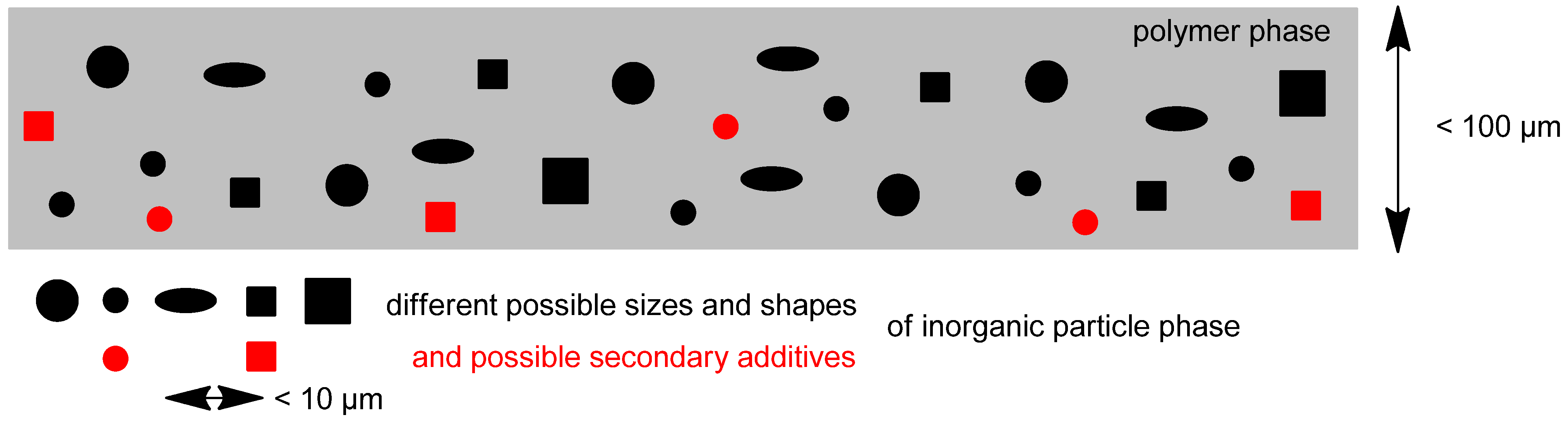
      <p>Another approach to increase the separation characteristics of a membrane is the implementation of additives. Mixed-matrix membranes (MMMs) are constructed from an inorganic material in the form of discrete micro- or nanoparticles incorporated into a polymeric matrix as the continuous phase (see <xref ref-type="fig" rid="membranes-02-00727-f003">Figure 3</xref>). The utilization of two materials with different flux and selectivity opens the possibility to improve a gas separation membrane by allowing the synergistic combination of polymers with their easy processability and the superior gas separation performance of inorganic materials. </p>
      <p>A strong improvement of permeability could be expected, if porous inorganic additives, e.g., zeolites, metal organic frameworks (MOFs) [<xref ref-type="bibr" rid="B66-membranes-02-00727">66</xref>,<xref ref-type="bibr" rid="B67-membranes-02-00727">67</xref>,<xref ref-type="bibr" rid="B68-membranes-02-00727">68</xref>,<xref ref-type="bibr" rid="B69-membranes-02-00727">69</xref>,<xref ref-type="bibr" rid="B70-membranes-02-00727">70</xref>,<xref ref-type="bibr" rid="B71-membranes-02-00727">71</xref>,<xref ref-type="bibr" rid="B72-membranes-02-00727">72</xref>], carbon nanotubes (CNTs) [<xref ref-type="bibr" rid="B73-membranes-02-00727">73</xref>,<xref ref-type="bibr" rid="B74-membranes-02-00727">74</xref>,<xref ref-type="bibr" rid="B75-membranes-02-00727">75</xref>,<xref ref-type="bibr" rid="B76-membranes-02-00727">76</xref>,<xref ref-type="bibr" rid="B77-membranes-02-00727">77</xref>,<xref ref-type="bibr" rid="B78-membranes-02-00727">78</xref>,<xref ref-type="bibr" rid="B79-membranes-02-00727">79</xref>,<xref ref-type="bibr" rid="B80-membranes-02-00727">80</xref>,<xref ref-type="bibr" rid="B81-membranes-02-00727">81</xref>] or porous layered oxides (PLOs) [<xref ref-type="bibr" rid="B82-membranes-02-00727">82</xref>,<xref ref-type="bibr" rid="B83-membranes-02-00727">83</xref>,<xref ref-type="bibr" rid="B84-membranes-02-00727">84</xref>,<xref ref-type="bibr" rid="B85-membranes-02-00727">85</xref>,<xref ref-type="bibr" rid="B86-membranes-02-00727">86</xref>,<xref ref-type="bibr" rid="B87-membranes-02-00727">87</xref>,<xref ref-type="bibr" rid="B88-membranes-02-00727">88</xref>] with a pore diameter larger than the kinetic diameter of one gas component but smaller than the other one could be applied to the organic polymer. </p>
      <fig id="membranes-02-00727-f003" position="anchor">
        <label>Figure 3</label>
        <caption>
          <p>Schematic representation of a mixed-matrix membrane indicating the different possible sizes, shapes and components for the inorganic filler materials (e.g., MOFs, ZIFs and nanotubes).</p>
        </caption>
        <graphic xmlns:xlink="http://www.w3.org/1999/xlink" xlink:href="membranes-02-00727-g003.tif"/>
      </fig>
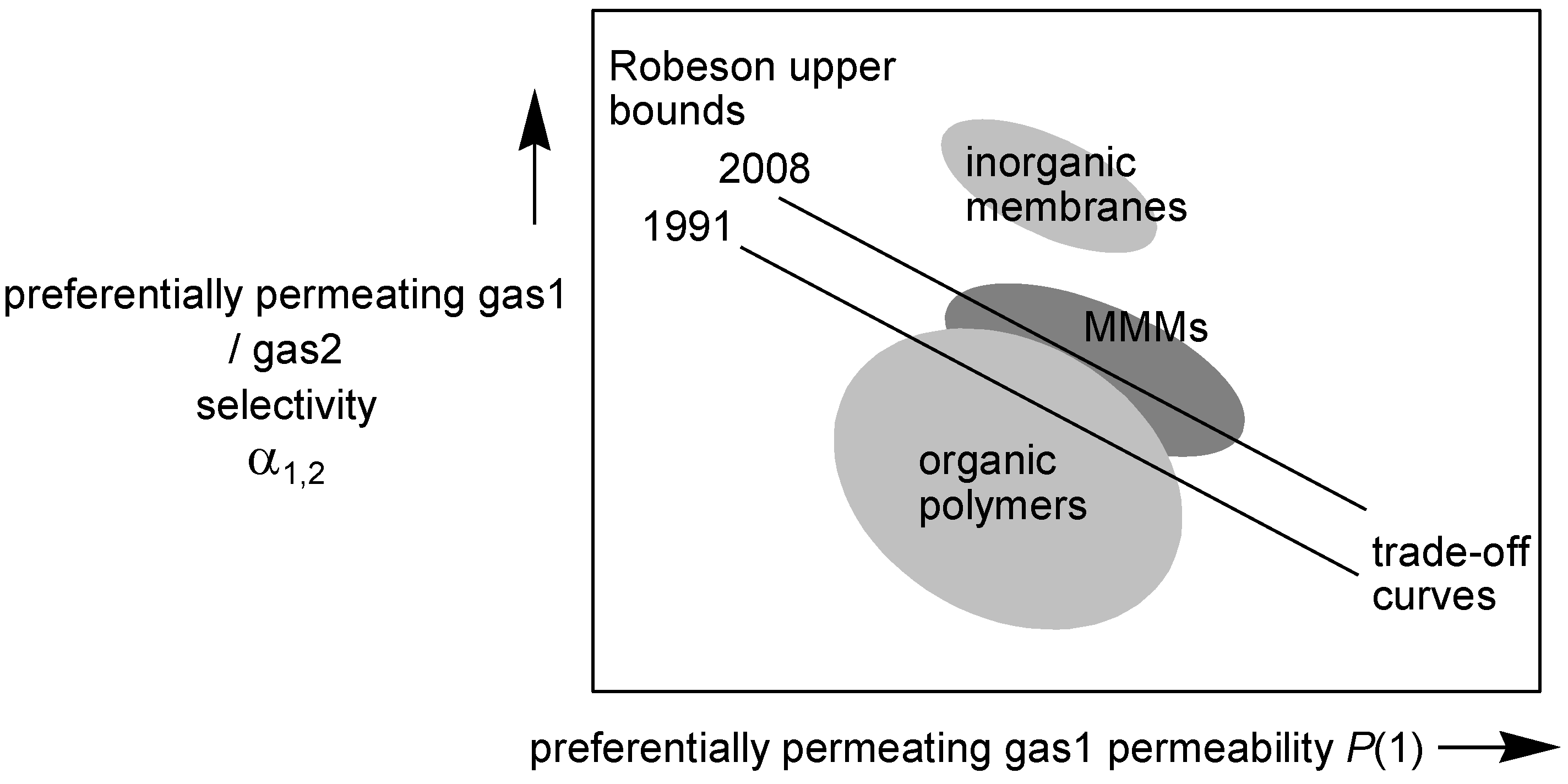
      <p>This would be economically very attractive for large scale applications if the selectivity does not change. First MMMs were studied in the 1980s and are more and more investigated in recent years [<xref ref-type="bibr" rid="B89-membranes-02-00727">89</xref>,<xref ref-type="bibr" rid="B90-membranes-02-00727">90</xref>,<xref ref-type="bibr" rid="B91-membranes-02-00727">91</xref>,<xref ref-type="bibr" rid="B92-membranes-02-00727">92</xref>,<xref ref-type="bibr" rid="B93-membranes-02-00727">93</xref>]. MMMs receive attention as a possibility to enhance the properties of pure polymer membranes [<xref ref-type="bibr" rid="B94-membranes-02-00727">94</xref>]. Separation properties with MMMs can be well above the Robeson upper bond (see <xref ref-type="fig" rid="membranes-02-00727-f004">Figure 4</xref>) [<xref ref-type="bibr" rid="B20-membranes-02-00727">20</xref>,<xref ref-type="bibr" rid="B21-membranes-02-00727">21</xref>], which is a plot of permeability <italic>versus</italic> selectivity for most industrial relevant gas mixtures. Porous inorganic fillers can overcome the tradeoff between selectivity and permeability which is typical for continuous (pure) polymer membranes.</p>
      <fig id="membranes-02-00727-f004" position="anchor">
        <label>Figure 4</label>
        <caption>
          <p>Schematic presentation of the trade-off between permeability and selectivity with the 1991 and 2008 Robeson upper bounds [<xref ref-type="bibr" rid="B20-membranes-02-00727">20</xref>,<xref ref-type="bibr" rid="B21-membranes-02-00727">21</xref>]. In most cases the technologically attractive region lies around or above the Robeson upper bound.</p>
        </caption>
        <graphic xmlns:xlink="http://www.w3.org/1999/xlink" xlink:href="membranes-02-00727-g004.tif"/>
      </fig>
      <p>Carbon nanotubes (CNTs) have been potentially suggested for their application in molecular separation by considering their hollow channels. In fact, simulations and detailed predictions demonstrated that the diffusivities of light gases inside the pores of CNTs are highly rapid compared to other porous materials [<xref ref-type="bibr" rid="B73-membranes-02-00727">73</xref>]. According to this potential application, the use of CNT/polymer nanocomposites in membrane based separation processes is growing rapidly and considerable efforts were undertaken for the development in last decade [<xref ref-type="bibr" rid="B74-membranes-02-00727">74</xref>,<xref ref-type="bibr" rid="B75-membranes-02-00727">75</xref>,<xref ref-type="bibr" rid="B76-membranes-02-00727">76</xref>,<xref ref-type="bibr" rid="B77-membranes-02-00727">77</xref>,<xref ref-type="bibr" rid="B78-membranes-02-00727">78</xref>,<xref ref-type="bibr" rid="B79-membranes-02-00727">79</xref>,<xref ref-type="bibr" rid="B80-membranes-02-00727">80</xref>] CNT particles are added as fillers to create preferential permeation pathways and thereby improve the separation performance in terms of the gas permeability [<xref ref-type="bibr" rid="B76-membranes-02-00727">76</xref>,<xref ref-type="bibr" rid="B81-membranes-02-00727">81</xref>]. The processability of polymeric membranes is combined with the higher permeability of nanotubes in order to achieve a synergistic separation performance that surpasses that of conventional polymeric and inorganic membranes.</p>
      <p>To increase the gas permeability and also enhance the selectivity behavior of polymer membranes, addition of nanoporous fillers have been intensively investigated [<xref ref-type="bibr" rid="B90-membranes-02-00727">90</xref>,<xref ref-type="bibr" rid="B93-membranes-02-00727">93</xref>,<xref ref-type="bibr" rid="B95-membranes-02-00727">95</xref>,<xref ref-type="bibr" rid="B96-membranes-02-00727">96</xref>,<xref ref-type="bibr" rid="B97-membranes-02-00727">97</xref>,<xref ref-type="bibr" rid="B98-membranes-02-00727">98</xref>]. However, zeolites particle face the problem of formation of aggregates creating defects, especially if the polymer matrix is consisting of a glassy polymer [<xref ref-type="bibr" rid="B99-membranes-02-00727">99</xref>]. Several attempts of modifying the surface of the zeolites to chemically bond them to the polymer chains and avoid macrovoid formation have been made, which often led to a considerable decrease of the gas permeability due to the rigidification of the polymer chains near the zeolite surface [<xref ref-type="bibr" rid="B100-membranes-02-00727">100</xref>,<xref ref-type="bibr" rid="B101-membranes-02-00727">101</xref>]. Also modification of the zeolite surface by using amino functionalized siloxan to induce the formation of hydrogen bonds has been used [<xref ref-type="bibr" rid="B102-membranes-02-00727">102</xref>]. </p>
      <p>Furthermore, interest has risen in sheet-shaped porous layer oxides (PLOs) such as TiO<sub>2</sub> [<xref ref-type="bibr" rid="B89-membranes-02-00727">89</xref>], SiO<sub>2</sub> [<xref ref-type="bibr" rid="B103-membranes-02-00727">103</xref>,<xref ref-type="bibr" rid="B104-membranes-02-00727">104</xref>,<xref ref-type="bibr" rid="B105-membranes-02-00727">105</xref>,<xref ref-type="bibr" rid="B106-membranes-02-00727">106</xref>] and Na<sub>4</sub>Ti<sub>2</sub>Si<sub>8</sub>O<sub>22</sub>·4H<sub>2</sub>O [<xref ref-type="bibr" rid="B87-membranes-02-00727">87</xref>,<xref ref-type="bibr" rid="B88-membranes-02-00727">88</xref>] as fillers which are also called flakes or nanosheets if one of the dimensions is in the nanometer range. The aforementioned materials in lamellar form have been used as inorganic fillers in mixed-matrix membranes [<xref ref-type="bibr" rid="B87-membranes-02-00727">87</xref>,<xref ref-type="bibr" rid="B88-membranes-02-00727">88</xref>]. Such sheet-shaped or lamellar fillers have a high aspect ratio, which allows casting of thin mixed-matrix membranes. The selectivity of the membrane can be improved by size exclusion due to their microporous structure. Such filler materials are subdivided into selective and non-selective fillers depending on the permeability of the feed components through these materials. Also, such sheet-shaped fillers can be incorporated into MMMs in random or distinct parallel orientation. It was previously shown that the orientation of non-permeable inorganic sheets in different polymers has a great influence on the permeability [<xref ref-type="bibr" rid="B82-membranes-02-00727">82</xref>,<xref ref-type="bibr" rid="B83-membranes-02-00727">83</xref>]. Similar improvement of the separation characteristics can be achieved with smaller amounts of oriented fillers as with higher loads of non-oriented filler. Predictions of the permeation properties of mixed-matrix membranes with sheet-shaped inorganic fillers like porous layered oxides have been made for oriented non-selective sheets [<xref ref-type="bibr" rid="B84-membranes-02-00727">84</xref>] as well for selective flakes [<xref ref-type="bibr" rid="B85-membranes-02-00727">85</xref>]. Another approach to oriented sheet membranes dealt with fully inorganic MCM-22/silica nanocomposite membranes [<xref ref-type="bibr" rid="B86-membranes-02-00727">86</xref>].</p>
    </sec>
    <sec>
      <title>2. Crosslinking</title>
      <p>Crosslinking of polymer membranes can be achieved by different approaches, depending on the functional groups of the polymer and the desired separation properties of the membrane. The aim is to increase the durability of the membrane by circumvention of plasticization without causing losses in selectivity and permeability. Ideally, the separation characteristics of the membrane, especially the selectivity, are enhanced by implementation of crosslinks. </p>
      <p>Often there is a variety of approaches to induce crosslinking of a polymer. For instance, a detailed review of different crosslinking methods for poly(vinyl alcohol) (PVA) membranes is provided by Bolto <italic>et al</italic>. [<xref ref-type="bibr" rid="B107-membranes-02-00727">107</xref>]. PVA membranes show high stability in highly acidic or alkaline environments [<xref ref-type="bibr" rid="B108-membranes-02-00727">108</xref>]. They are often chosen for dehydration procedures, where swelling due to adsorption of water presents a problem. </p>
      <p>By performing several freeze-thaw cycles, crystalline regions are formed that act as crosslinks [<xref ref-type="bibr" rid="B109-membranes-02-00727">109</xref>]. With increasing crystallinity the swelling is reduced. Although the physical crosslinks are not as strong or as stable as chemical ones, membranes modified this way last several months without a change of separation properties [<xref ref-type="bibr" rid="B107-membranes-02-00727">107</xref>,<xref ref-type="bibr" rid="B110-membranes-02-00727">110</xref>]. Reduction of plasticization of PVA can also be achieved by heat treatment at temperatures up to 160°, but the permeability is decreased as well. This, too, is explained by a change in crystallinity rather than the introduction of covalent crosslinks [<xref ref-type="bibr" rid="B111-membranes-02-00727">111</xref>,<xref ref-type="bibr" rid="B112-membranes-02-00727">112</xref>].</p>
      <p>Treatment of PVA with strongly oxidizing radical producers (e.g., K<sub>2</sub>S<sub>2</sub>O<sub>8</sub>) leads to formation of polymer radicals, which form crosslinks by radical coupling. This has also been shown to reduce the solubility of the polymer [<xref ref-type="bibr" rid="B113-membranes-02-00727">113</xref>]. By varying the amount of persulfate the crosslinking degree can be regulated [<xref ref-type="bibr" rid="B114-membranes-02-00727">114</xref>].</p>
      <sec>
        <title>2.1. Ionic Crosslinking</title>
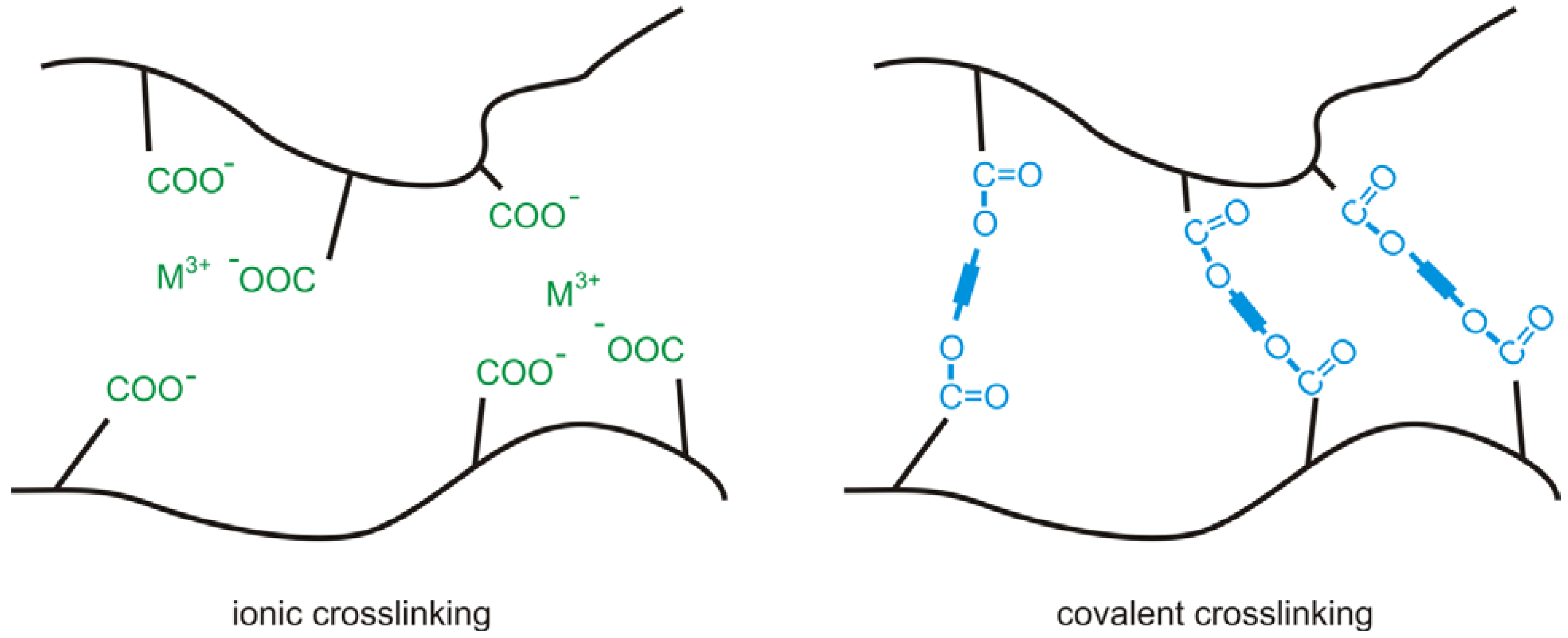
        <p>Crosslinking of copolyimides can be achieved by different ways, since they can be easily functionalized and thus modified [<xref ref-type="bibr" rid="B115-membranes-02-00727">115</xref>]. Copolyimides containing carboxyl groups can be ionically crosslinked by thermal reaction of the dissolved polymer with a stoichiometric amount of aluminium(III)-acetylacetonate or zircon(IV)-acetylacetonate (<xref ref-type="fig" rid="membranes-02-00727-f005">Figure 5</xref>). The metal ions form a complex with three (Al<sup>3+</sup>) or four (Zr<sup>4+</sup>) deprotonated carboxyl groups in a heterogeneous distribution of regions with ionic and non-ionic domains. Therefore the membrane exhibits polymer regions which are sensitive to plasticization in the presence of strong plasticizers such as CO<sub>2</sub> [<xref ref-type="bibr" rid="B9-membranes-02-00727">9</xref>,<xref ref-type="bibr" rid="B30-membranes-02-00727">30</xref>]. The acetylacetonate evaporates during the crosslinking reaction, but not necessarily to completeness. The remaining anions can cause problems in separation due to elution which leads to an undesirable change of the membrane performance and contamination of the retentate. In addition, the strong solvation by CO<sub>2</sub> is able to weaken the ionic interactions in the ionic regions. </p>
        <fig id="membranes-02-00727-f005" position="anchor">
          <label>Figure 5</label>
          <caption>
            <p>Possible crosslinking methods in polymers containing carboxyl groups. In ionic crosslinked polymers the metal ions form a complex with several deprotonated carboxyl groups. Covalent crosslinking can be achieved thermally or photochemically.</p>
          </caption>
          <graphic xmlns:xlink="http://www.w3.org/1999/xlink" xlink:href="membranes-02-00727-g005.tif"/>
        </fig>
      </sec>
      <sec>
        <title>2.2. Thermal Crosslinking</title>
        <p>In order to separate mixtures which contain high amounts of strong plasticizers, the membrane is better crosslinked covalently [<xref ref-type="bibr" rid="B30-membranes-02-00727">30</xref>,<xref ref-type="bibr" rid="B115-membranes-02-00727">115</xref>] (<xref ref-type="fig" rid="membranes-02-00727-f005">Figure 5</xref>). Covalent crosslinking can be achieved by thermal reaction of the dissolved polymer with the crosslinking agent (e.g., diols or CNTs [<xref ref-type="bibr" rid="B116-membranes-02-00727">116</xref>]). It was shown that covalent binding of fullerenes to poly(2,6-dimethyl-1,4-phenylene oxide) leads to improved separation characteristics for gas separation in respect to the native membrane, while implementation of dispersed fullerenes leads to worse separation characteristics, due to formation of fullerene agglomerates [<xref ref-type="bibr" rid="B117-membranes-02-00727">117</xref>]. </p>
        <p>Other studies, using dispersed CNTs instead of fullerenes, present more promising results [<xref ref-type="bibr" rid="B118-membranes-02-00727">118</xref>,<xref ref-type="bibr" rid="B119-membranes-02-00727">119</xref>]. However, the long term stability of those membranes has not been investigated and it is assumed that a CNT-loss due to membrane swelling occurs. This can be prevented by binding the CNTs covalently to the polymer. Copolyimides crosslinked with CNTs are for example well suited for the removal of sulfur containing aromatics from fuel. Sorption capacity tests showed that the covalent incorporation of hydroxyl-functionalized CNTs does not affect the solution selectivity of the copolyimide [<xref ref-type="bibr" rid="B88-membranes-02-00727">88</xref>], while the mechanical stability of the membranes is enhanced [<xref ref-type="bibr" rid="B120-membranes-02-00727">120</xref>].</p>
        <p>Non-crosslinked PVA membranes contain hydroxyl groups, which can form hydrogen bonds with water. By crosslinking of PVA with formaldehyde, the chemical stability of the membrane material can be significantly increased but the amount of free hydroxyl groups is reduced, which results in reduced sorption rate of water vapour in the PVA membrane [<xref ref-type="bibr" rid="B121-membranes-02-00727">121</xref>]. However, crosslinking with formaldehyde demands application of sulphuric acid catalysts, which is assumed to result in negatively charged membranes [<xref ref-type="bibr" rid="B122-membranes-02-00727">122</xref>,<xref ref-type="bibr" rid="B123-membranes-02-00727">123</xref>]. </p>
        <p>PVA membranes are also used in reverse osmosis. It was found that upon crosslinking with different dicarboxylic acids with increasing number of carbon atoms in the crosslinker the water flux increased, while the salt rejection was decreased, due to the increased flexibility of the crosslinks [<xref ref-type="bibr" rid="B124-membranes-02-00727">124</xref>]. Covalent crosslinking of PVA with maleic anhydride leads to lower water fluxes but higher separation factors than found for non-crosslinked PVA in the dehydration of benzene [<xref ref-type="bibr" rid="B121-membranes-02-00727">121</xref>]. In another study, PVA crosslinked with maleic anhydride showed not only an higher separation factor (dehydration of 2-propanol and 1-butanol) but also a higher water flux [<xref ref-type="bibr" rid="B125-membranes-02-00727">125</xref>]. Although the same crosslinker was used in both studies, the effect of crosslinking on the separation characteristics is different. This leads to the conclusion that mechanistic studies of crosslinking reactions are of great importance, since they provide vital information for the control of polymer crosslinking. </p>
        <p>For these reactions, catalysts are necessary, which remain in the membrane after the crosslinking reaction and thus can lead to the same disadvantages as the anions in ionic crosslinking. One strategy to obtain covalent crosslinks without the usage of catalysts was presented by Evonik. Here, the polyimide is formed by polycondensation of a tetracarboxylic acid anhydride and an aromatic diisocyanate and then treated with a diamine solution. The crosslinking reaction takes place at moderate temperatures (preferentially 20–50 °C) without addition of further reactants [<xref ref-type="bibr" rid="B126-membranes-02-00727">126</xref>].</p>
      </sec>
      <sec>
        <title>2.3. Photocrosslinking</title>
        <p>Another promising strategy to circumvent these problems is to achieve the covalent crosslinking by a photochemical reaction, since in this case no catalyst is needed [<xref ref-type="bibr" rid="B127-membranes-02-00727">127</xref>,<xref ref-type="bibr" rid="B128-membranes-02-00727">128</xref>,<xref ref-type="bibr" rid="B129-membranes-02-00727">129</xref>,<xref ref-type="bibr" rid="B130-membranes-02-00727">130</xref>,<xref ref-type="bibr" rid="B131-membranes-02-00727">131</xref>,<xref ref-type="bibr" rid="B132-membranes-02-00727">132</xref>]. The photochemical reaction has to be efficient without usage of sensitizers, since sensitizers would again cause the problems in separation mentioned before. First approaches based on direct crosslinking of the polymer backbone had to deal with very large permeability losses due to the increased stiffness of the polymer network and decreased free volume of the polymer [<xref ref-type="bibr" rid="B33-membranes-02-00727">33</xref>,<xref ref-type="bibr" rid="B133-membranes-02-00727">133</xref>,<xref ref-type="bibr" rid="B134-membranes-02-00727">134</xref>]. By functionalisation of polymer carboxyl groups with flexible molecules (e.g., ethylene glycol or propanediol), this disadvantage can be overcome [<xref ref-type="bibr" rid="B50-membranes-02-00727">50</xref>,<xref ref-type="bibr" rid="B135-membranes-02-00727">135</xref>,<xref ref-type="bibr" rid="B136-membranes-02-00727">136</xref>,<xref ref-type="bibr" rid="B137-membranes-02-00727">137</xref>]. Depending on stiffness and length of the crosslinker, the permeability loss of the membrane can be minimized [<xref ref-type="bibr" rid="B138-membranes-02-00727">138</xref>]. Thus, functionalization of the polymer carboxyl groups with flexible molecules capable of dimerization upon UV irradiation (e.g., maleimide derivatives) is a promising strategy to obtain membranes with a high plasticization resistance and excellent separation characteristics [<xref ref-type="bibr" rid="B127-membranes-02-00727">127</xref>,<xref ref-type="bibr" rid="B139-membranes-02-00727">139</xref>,<xref ref-type="bibr" rid="B140-membranes-02-00727">140</xref>]. A detailed summary of polymer materials and photo-crosslinkers suitable for gas separation and pervaporation was recently provided by He <italic>et al.</italic> [<xref ref-type="bibr" rid="B141-membranes-02-00727">141</xref>]. </p>
        <p>Photocrosslinking of a polyimide with benzophenone as crosslinking unit was performed by Kang <italic>et al.</italic> [<xref ref-type="bibr" rid="B142-membranes-02-00727">142</xref>]. They found that the O<sub>2</sub> permeability decreased and the O<sub>2</sub> over N<sub>2</sub> selectivity increased with increasing irradiation time. The same results were obtained for H<sub>2</sub>/CH<sub>4</sub> separation [<xref ref-type="bibr" rid="B63-membranes-02-00727">63</xref>]. Here, the selectivity increased by the factor of 50 after 30 min of irradiation, with a decrease in H<sub>2</sub> permeability by the factor of 5. With increasing irradiation time, the larger crosslinking degrees were obtained, which caused further increases in gas permselectivity and decreases in gas permeability. Thus, by varying the irradiation time, the separation characteristics can be tuned. </p>
        <p>Since most of the UV light was absorbed by the benzophenone, the irradiation intensity became smaller with increasing penetration depth. Thus an inhomogeneous distribution of crosslinks was obtained [<xref ref-type="bibr" rid="B65-membranes-02-00727">65</xref>,<xref ref-type="bibr" rid="B143-membranes-02-00727">143</xref>]. This results in lower crosslinking degrees than achievable with thermal activation and thus improvements in separation selectivity with only modest reduction in fast gas flux are obtained. In contrast, thermal activation of the same system results in larger improvements in chemical resistance, thermal stability and gas selectivity but also a more significant reduction of gas flux, as was shown for a copolyimide with crosslinkable ethynyl-terminated monomers [<xref ref-type="bibr" rid="B144-membranes-02-00727">144</xref>].</p>
        <p>Benzophenone forms radicals upon irradiation, which may lead to undesirable side reactions [<xref ref-type="bibr" rid="B145-membranes-02-00727">145</xref>]. Thus molecules like maleimide, which are capable of forming crosslinks via [2+2]-cycloaddition present an interesting alternative for application in gas separation or pervaporation membranes [<xref ref-type="bibr" rid="B127-membranes-02-00727">127</xref>,<xref ref-type="bibr" rid="B139-membranes-02-00727">139</xref>,<xref ref-type="bibr" rid="B140-membranes-02-00727">140</xref>]. Unfortunately, up to now, no detailed study of the separation characteristics of membranes crosslinked with maleimide is available.</p>
        <sec>
          <title>2.3.1. Mechanistic Studies of Photocrosslinking</title>
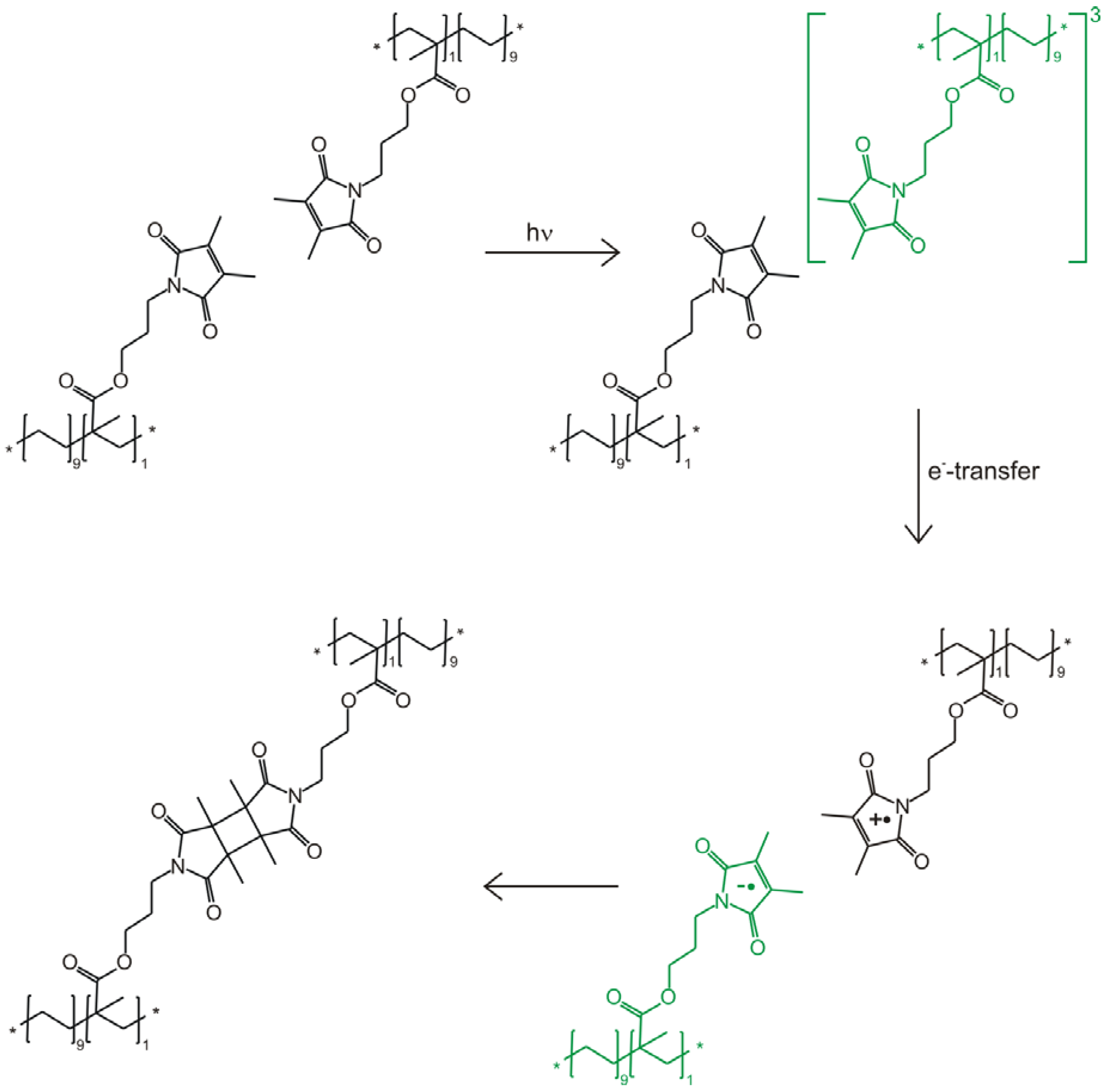
          <p>Mechanistic studies of photocrosslinking reactions can be performed using UV/Vis absorption spectroscopy. This was done for polymer membranes containing maleimide moieties as crosslinker [<xref ref-type="bibr" rid="B146-membranes-02-00727">146</xref>]. Maleimides undergo dimerization by [2+2]-photocycloaddition (see <xref ref-type="fig" rid="membranes-02-00727-f006">Figure 6</xref>) [<xref ref-type="bibr" rid="B127-membranes-02-00727">127</xref>,<xref ref-type="bibr" rid="B147-membranes-02-00727">147</xref>,<xref ref-type="bibr" rid="B148-membranes-02-00727">148</xref>]. Due to the high photoactivity of the maleimides no sensitizers are needed for this reaction. Thiomaleimides absorb better and at longer wavelengths than maleimide and thus perform photodimerization with increased efficiency [<xref ref-type="bibr" rid="B149-membranes-02-00727">149</xref>]. However, the separation properties of membranes which are crosslinked with thiomaleimides remain to be further investigated. </p>
          <fig id="membranes-02-00727-f006" position="anchor">
            <label>Figure 6</label>
            <caption>
              <p>Mechanism for photocrosslinking of PEMAA modiﬁed with 3-hydroxypropyldimethylmaleimide. Upon excitation to the bright singlet state some population is transferred to the triplet state by intersystem crossing. Electron transfer leads to quenching of the triplet population and allows spectroscopic identification of the maleimide anion. Photocrosslinking occurs by recombination of the ions to the dimer. Our spectroscopic results do not exclude a parallel reaction path via direct cross linking of favorably oriented maleimides in the excited singlet state, see text. Transient species which were detected spectroscopically (triplet state, radical anion) are marked in green.</p>
            </caption>
            <graphic xmlns:xlink="http://www.w3.org/1999/xlink" xlink:href="membranes-02-00727-g006.tif"/>
          </fig>
          <p>Copolyimides feature intense absorption in the same spectral region (210–250 nm) as maleimide. Therefore, the reaction mechanism is better studied with a polymer backbone which does not absorb UV-light. Here, poly[ethene-stat-(methacrylic acid)] (PEMAA) represents a good alternative, because the separation properties of crosslinked PEMMA membranes are comparable to those of glassy copolyimides having carboxylic acid groups. In either case, crosslinking of the polymer material results in decreased swelling without significant loss of selectivity [<xref ref-type="bibr" rid="B58-membranes-02-00727">58</xref>]. </p>
          <p>It is known that crosslinking of a polymer influences the glass transition temperature, T<sub>g</sub> [<xref ref-type="bibr" rid="B150-membranes-02-00727">150</xref>]. The glass transition temperature depends highly on the polymer chain mobility. Crosslinkers which enlarge the packing density of the polymer limit the mobility of the polymer chains, which results in higher T<sub>g</sub>. Crosslinkers which function as spacer between the polymer chains or have a high flexibility increase the polymer chain mobility and thus induce a decrease of T<sub>g</sub> [<xref ref-type="bibr" rid="B151-membranes-02-00727">151</xref>]. PEMAA with 6% MI shows a higher glass transition temperature (58 °C) compared to the non-crosslinked copolymer (48 °C) [<xref ref-type="bibr" rid="B146-membranes-02-00727">146</xref>]. Thus, by functionalization of the PEMAA with maleimide the polymer chain mobility is reduced. Analogous observations have also been made for covalently crosslinked glassy copolyimides, like 6FDA-4MPD/6FDA-DABA 4:1 (see <xref ref-type="fig" rid="membranes-02-00727-f008">Figure 8</xref> for structure) [<xref ref-type="bibr" rid="B152-membranes-02-00727">152</xref>]. </p>
          <p>The stationary UV/Vis absorption spectrum of PEMAA films esterified with 3-hydroxypropyl-dimethylmaleimide (MI) shows an absorption band at 230 nm just as maleimide solutions do [<xref ref-type="bibr" rid="B153-membranes-02-00727">153</xref>]. This absorption disappears completely after 20 min of irradiation with a mercury lamp and does not recover after the irradiation has been stopped, which indicates that photochemical crosslinking occurs efficiently and irreversible [<xref ref-type="bibr" rid="B146-membranes-02-00727">146</xref>].</p>
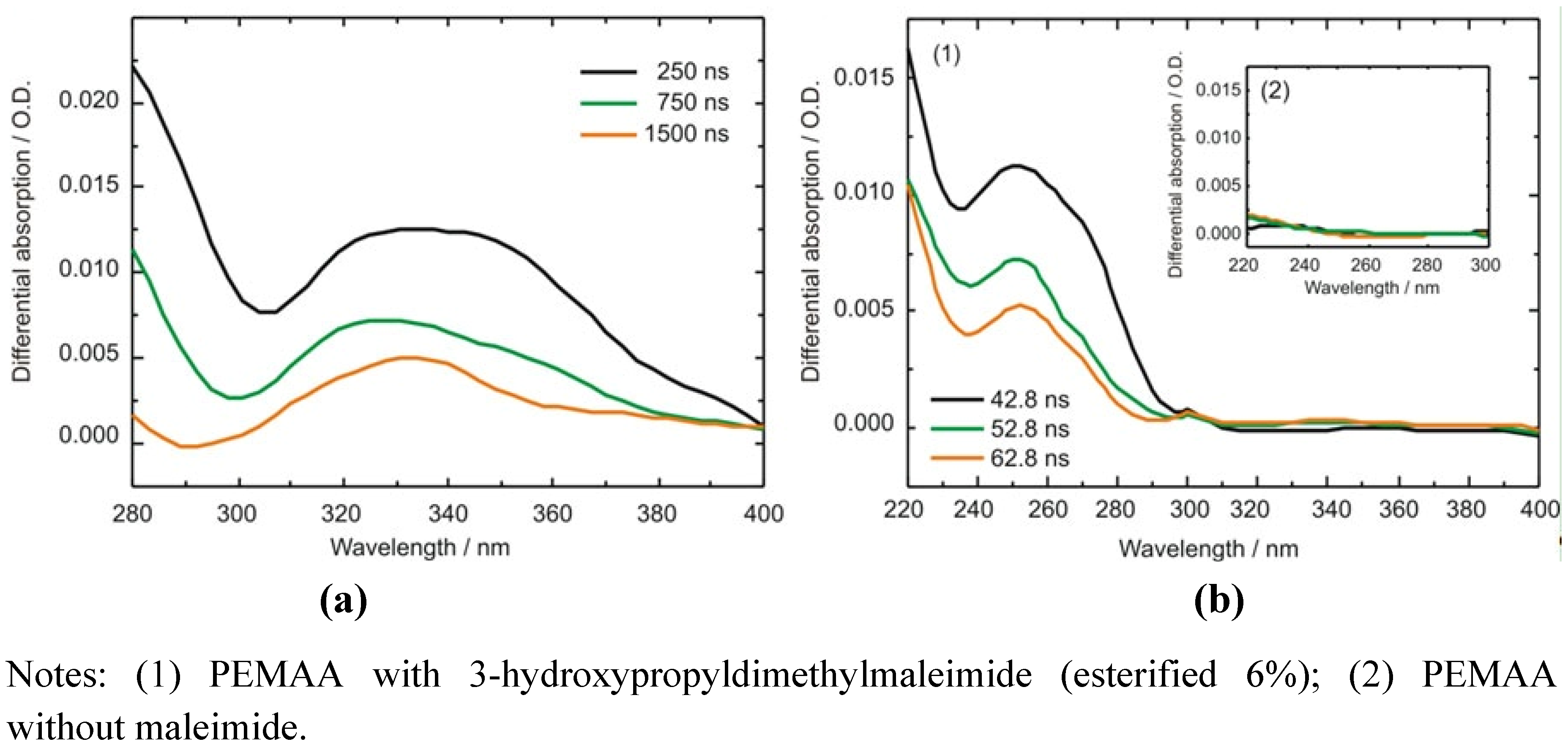
          <p>Microsecond transient UV/Vis absorption investigations of maleimide modified PEMAA in tetrahydrofuran (THF) provide evidence that, after excitation with a 266 nm laser pulse, intersystem crossing takes place and the triplet state is populated (see <xref ref-type="fig" rid="membranes-02-00727-f007">Figure 7</xref>a). The broad absorption band at around 340 nm is effectively quenched by oxygen. The decay time of the triplet state in solution was determined to be 2.58 ± 0.23 µs, see also Reference [<xref ref-type="bibr" rid="B146-membranes-02-00727">146</xref>].</p>
          <fig id="membranes-02-00727-f007" position="anchor">
            <label>Figure 7</label>
            <caption>
              <p>Transient absorption spectra obtained at different time delays to the excitation laser pulse of (<bold>a</bold>) PEMAA esterified with 3-hydroxypropyl-dimethylmaleimide (esterification degree of 6%) in THF upon excitation at 266 nm. The broad absorption at ~340 nm is due to triplet-triplet excitation in maleimide [<xref ref-type="bibr" rid="B154-membranes-02-00727">154</xref>]; (<bold>b</bold>) PEMAA films upon excitation at 266 nm. Absorption between 264 nm and 268 nm is dominated by scattered light and therefore the measured absorption in this range is omitted from the spectral average (five data points: ~8 nm). </p>
            </caption>
            <graphic xmlns:xlink="http://www.w3.org/1999/xlink" xlink:href="membranes-02-00727-g007.tif"/>
          </fig>
          <p>In films prepared from the same solution no triplet absorption is observed anymore. Nonetheless, nanosecond transient absorption spectra of the maleimide modified PEMAA films feature an absorption band with a maximum at 250 nm (see <xref ref-type="fig" rid="membranes-02-00727-f007">Figure 7</xref>b). Films which do not contain the maleimide side group show no absorption in this spectral region. This band was observed in pulse radiolysis experiments as well and was assigned to the maleimide radical anion [<xref ref-type="bibr" rid="B154-membranes-02-00727">154</xref>,<xref ref-type="bibr" rid="B155-membranes-02-00727">155</xref>]. The maleimide radical anion lifetime in the PEMAA film is determined to be 18.05 ± 0.36 ns. Our time resolution, limited to ~15 ns, does not allow exclusion of a parallel singlet reaction path via direct (concerted) cross linking of favorably oriented maleimides in the excited singlet state. In the film, crosslinking is not quenched by oxygen which indicates that dimerization occurs faster than oxygen diffusion. </p>
          <p>In the PEMAA membranes described above only 6% of all carboxylic acid groups were esterified with MI. Upon irradiation the maleimide absorption band vanishes completely, which means that nearly all maleimide groups have formed crosslinks. At higher esterification degrees PEMAA becomes insoluble and production of films is not possible. </p>
      <fig id="membranes-02-00727-f008" position="anchor">
        <label>Figure 8</label>
        <caption>
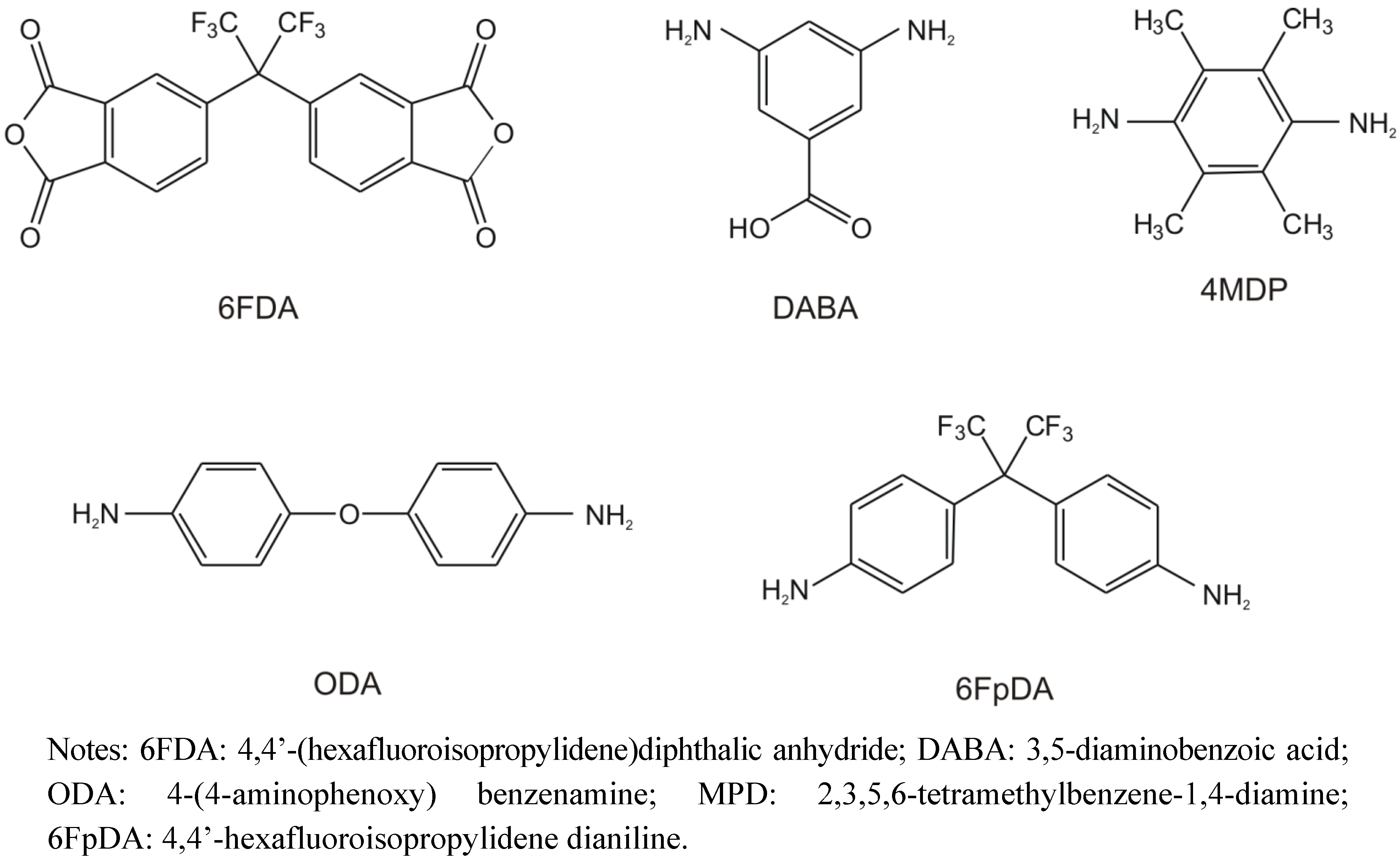
          <p>Chemical structures of the copolyimid components discussed in this review.</p>
        </caption>
        <graphic xmlns:xlink="http://www.w3.org/1999/xlink" xlink:href="membranes-02-00727-g008.tif"/>
      </fig>
          <p>As mentioned before, UV/Vis absorption spectroscopy is not suitable to investigate photocrosslinking of copolyimide membranes with maleimide as crosslinking unit. However, this can be achieved by FTIR difference spectroscopy, a method by which only bands arising from vibrations which change during the monitored reaction appear in the spectrum. Band positions of negative peaks represent the unshifted positions of the disappearing educts; positive bands can be assigned to those vibrations of the photoproducts, which exhibit different frequencies than the educts. The strong absorption of the polymer backbone is not subject to changes caused by the photoreaction [<xref ref-type="bibr" rid="B156-membranes-02-00727">156</xref>] and is thus not visible in the FTIR difference spectra. This method is non-invasively and can be performed in real time which is a great advantage over other established methods as the determination of gel fractions [<xref ref-type="bibr" rid="B157-membranes-02-00727">157</xref>], weight ratios [<xref ref-type="bibr" rid="B158-membranes-02-00727">158</xref>], swelling properties [<xref ref-type="bibr" rid="B159-membranes-02-00727">159</xref>] or rheology [<xref ref-type="bibr" rid="B160-membranes-02-00727">160</xref>,<xref ref-type="bibr" rid="B161-membranes-02-00727">161</xref>]. Additionally, structural information about the membrane and the photoproducts can be obtained.</p>
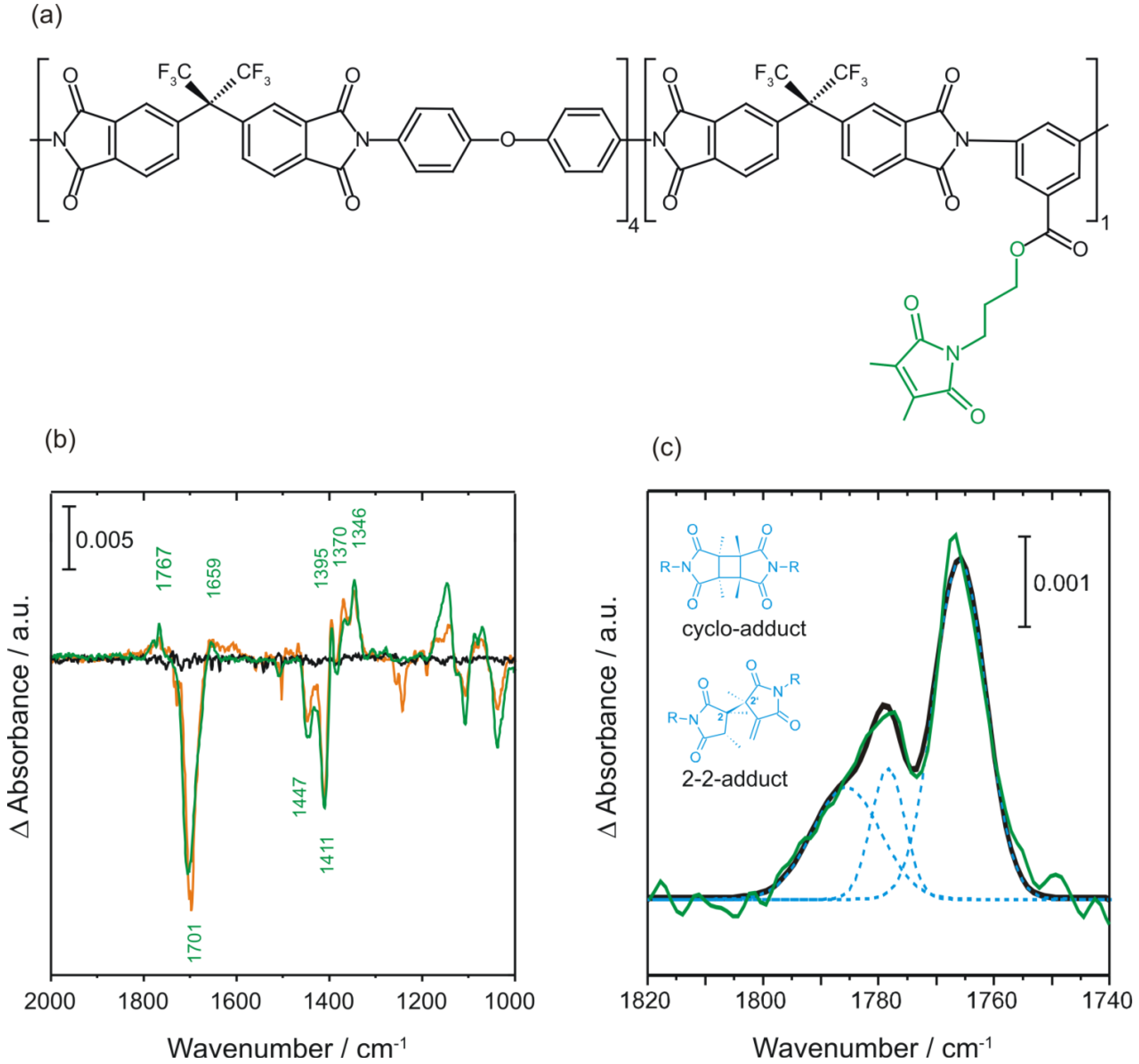
          <p>An extensive FTIR difference absorption study was performed on 6FDA-ODA/6FDA-DABA 4:1 films functionalized with MI. The structures of the different monomes used for the synthesis of the copolyimides investigated are shown in <xref ref-type="fig" rid="membranes-02-00727-f008">Figure 8</xref>. The structure of the 6FDA-ODA/6FDA-DABA 4:1 polymer is shown in <xref ref-type="fig" rid="membranes-02-00727-f009">Figure 9</xref>a. Although it was intended to obtain complete functionalization, that is each DABA moiety carries a maleimide moiety (theoretical functionalization degree: 100%), it cannot be excluded, that free carboxyl groups remain in the polymer.</p>
          <fig id="membranes-02-00727-f009" position="anchor">
            <label>Figure 9</label>
            <caption>
              <p>(<bold>a</bold>) Chemical structure of 6FDA-ODA/6FDA-DABA 4:1 copolyimide functionalized with 3-hydroxypropyldimetylmaleimide. Depicted in green is the maleimide side group; (<bold>b</bold>) Laser-induced FTIR difference spectra of 3-hydroxypropyldimethyl-maleimide (green), 6FDA-ODA/6FDA-DABA 4:1 copolyimide (black) and the copolyimide with 3-hydroxypropyldimethylmaleimide (green); (<bold>c</bold>) Difference spectrum of 3-hydroxypropyldimethylmaleimide (green) in the carbonyl region. The positive feature can be reproduced by the sum of three Gauss curves (blue).</p>
            </caption>
            <graphic xmlns:xlink="http://www.w3.org/1999/xlink" xlink:href="membranes-02-00727-g009.tif"/>
          </fig>
          <p>Comparison between films of (i) 6FDA-ODA/6FDA-DABA 4:1, (ii) 6FDA-ODA/6FDA-DABA 4:1 with MI and (iii) MI shows, that appreciable photochemistry only occurs in the presence of the crosslinker (see <xref ref-type="fig" rid="membranes-02-00727-f009">Figure 9</xref>b). The difference spectrum of the copolyimide without maleimide moiety does not exhibit any light-induced difference bands. The difference spectra of MI containing films feature a positive band in the region of 1800–1750 cm<sup>−1</sup> which is shown in detail in <xref ref-type="fig" rid="membranes-02-00727-f009">Figure 9</xref>c. It derives from a superposition of three bands which cannot be generated by the main photoproduct, the <italic>trans-</italic>cycloadduct, alone. According to DFT calculations the <italic>cis</italic>-cycloadduct (see <xref ref-type="fig" rid="membranes-02-00727-f009">Figure 9</xref>c for the structure) cannot be distinguished easily by infrared spectroscopy from the <italic>trans-</italic>cycloadduct, since there are no prominent marker bands. However, due to its drilled ring system, an additional carbonyl vibration shows significant IR activity and thus contributes to the absorption spectrum [<xref ref-type="bibr" rid="B156-membranes-02-00727">156</xref>]. </p>
          <p>Formation of a third photoproduct, the 2-2'-product (see <xref ref-type="fig" rid="membranes-02-00727-f009">Figure 9</xref>c for the structure), is assumed due to the appearance of a positive absorption band at 1659 cm<sup>−1</sup>, which corresponds to the terminal C=C double bond stretching vibration. This photoproduct was also detected in solutions of different N-alkyl-3,4-dimethylmaleimides [<xref ref-type="bibr" rid="B162-membranes-02-00727">162</xref>] and polyacrylamide hydrogels functionalized with dimethyl-maleimide [<xref ref-type="bibr" rid="B160-membranes-02-00727">160</xref>]. No evidence was found for the formation of an oxetane-like photoproduct, which would result from a Paterno-Büchi-reaction [<xref ref-type="bibr" rid="B163-membranes-02-00727">163</xref>].</p>
          <p>The time constants for photoproduct accumulation upon irradiation with laser pulses with 266 nm and 6 mJ cm<sup>−2</sup> are in the range of several minutes. Prominent bands assigned to the cycloadduct appear with τ = 2 to 5 min while the 2-2'-adduct marker band increases with τ = 75 min. This indicates that the 2-2'-adduct is formed with a lower yield than the cycloadduct. Both adduct species absorb at 266 nm better than the monomeric maleimide [<xref ref-type="bibr" rid="B162-membranes-02-00727">162</xref>], therefore it is not unlikely that the 2-2'-adduct is not only formed directly from the maleimide monomers but also by rearrangement of the cycloadduct. Photodegradation of the polymer backbone competes with photocrosslinking. Biexponential fits of the negative difference absorption bandswith time constants τ<sub>1</sub> = 5 min and τ<sub>2</sub> &gt; 120 min were obtained. The slower process is assigned to photodamage of the polymer backbone and the faster process to photocrosslinking.</p>
        </sec>
        <sec>
          <title>2.3.2. Photocrosslinking Yield</title>
          <p>The separation characteristics of a crosslinked membrane are strongly influenced by the number of crosslinks in the membrane. This value is of greater significance for pervaporation membranes than the amount of polymer chains which were crosslinked [<xref ref-type="bibr" rid="B157-membranes-02-00727">157</xref>,<xref ref-type="bibr" rid="B160-membranes-02-00727">160</xref>]. When using a photocrosslinker, the crosslinking yield can be controlled by duration and intensity of the irradiation. </p>
          <p>The yield can be determined with the help of FTIR difference absorption spectroscopy, by calculating the ratio of difference absorbance ∆A to initial absorption A. Since multiple processes compete and many absorption bands are generated by superposition of product and reactant absorption, determination of the crosslinking yield by analyzing a single prominent band may not be sufficient [<xref ref-type="bibr" rid="B127-membranes-02-00727">127</xref>,<xref ref-type="bibr" rid="B128-membranes-02-00727">128</xref>,<xref ref-type="bibr" rid="B159-membranes-02-00727">159</xref>,<xref ref-type="bibr" rid="B160-membranes-02-00727">160</xref>]. An analysis of several bands, after Gauss deconvolution to correct for the spectral overlap, is more likely to deliver significant results.</p>
          <p>For a 6FDA-ODA/6FDA-DABA 4:1 copolymer with MI it is assumed that only maleimide side chains that react within τ<sub>1</sub> = 5 min contribute to product formation. In order to avoid falsification due to overlapping product bands, the quantitative analysis is restricted to the region between 1450 cm<sup>−1</sup> and 1400 cm<sup>−1</sup> where products do not absorb significantly. After subtraction of the contribution due to photodegradation, the difference absorbances of the negative bands at υ<sub>1</sub> = 1447 cm<sup>−1</sup> and υ<sub>2</sub> = 1411 cm<sup>−1</sup> are calculated to be ∆A<sub>1</sub> = 0.010 and ∆A<sub>2</sub> = 0.018. The initial absorptions A<sub>i</sub>, derived from the absorbance spectrum of the copolyimide with MI, are A<sub>1</sub> = 0.16 and A<sub>2</sub> = 0.28. With these values, a crosslinking yield ∆A/A of 6.4% is calculated for both bands.</p>
          <p>For polyurethane-acrylate crosslinked with maleimide, crosslinking yields of 50% are reported [<xref ref-type="bibr" rid="B164-membranes-02-00727">164</xref>], while with polymethacrylate as polymer backbone crosslinking yields are even higher (up to 90%) [<xref ref-type="bibr" rid="B127-membranes-02-00727">127</xref>]. These high values are obtained when the polymer backbone is of high flexibility. The stiffness of the 6FDA-ODA/6FDA-DABA 4:1 polymer backbone prevents close vicinity of the excited maleimide moieties to a second maleimide during the lifetime of the radical anion as necessary for crosslinking. This effect is higher in films than in solution. The low crosslinking yield is not necessary a disadvantage. High crosslinking yields lead to low flow rates and can cause the membrane to be brittle, which makes the material inapplicable for separation. Thus, it is desirable to fabricate membranes with a crosslinking yield high enough to prevent plasticization but not too high so that the obtained flow rates are still high enough to qualify for industrial applications.</p>
        </sec>
      </sec>
      <sec>
        <title>2.4. Pervaporation and Gas Separation studies of Crosslinked Membranes</title>
        <p>Copolyimides show excellent separation characteristics for different gaseous and liquid mixtures. Here, aromatic/aliphatic separation and the removal of carbon dioxide from natural gas with high CO<sub>2</sub> content are discussed in detail. The crosslinking yield of the PEMAA membranes with MI discussed above was too low to prevent plasticization efficiently. The membranes of 6FDA-ODA/6FDA-DABA 4:1 with MI were very brittle and thus not suited for pervaporation experiments. However, sorption capacity measurements of the photocrosslinked 6FDA-ODA/6FDA-DABA 4:1 membrane show decreased swelling degrees and increased sorption selectivities in respect to the native membrane material [<xref ref-type="bibr" rid="B165-membranes-02-00727">165</xref>]. The best results for covalently crosslinked membranes in pervaporation performance studies were obtained with 6FDA-4MPD/6FDA-DABA 4:1 crosslinked by thermal reaction of the polymer backbone with 1,4-butanediol [<xref ref-type="bibr" rid="B165-membranes-02-00727">165</xref>]. </p>
        <sec>
          <title>2.4.1. Aromatic/Aliphatic Separation</title>
          <p>It has been shown that crosslinked membranes can be conditioned, that means treated with high aromatic feed mixtures prior to use. This leads to a more open structure and results in a higher flux also in long term experiments without a significant loss in selectivity, whereas non-crosslinked copolymides swell very strongly or even partially dissolve at high aromatic concentrations [<xref ref-type="bibr" rid="B32-membranes-02-00727">32</xref>]. </p>
          <p>For comparison of covalently, ionically and non-crosslinked 6FDA-4MPD/6FDA-DABA 4:1 membranes, pervaporation experiments using a toluene/cyclohexane mixture were performed. The ionically crosslinked membrane was prepared from the basic polymer material by addition of zircon(IV)-acetylacetonate (theoretical functionalization degree: 10%). The covalently crosslinked membrane was prepared from the basic polymer material by addition of 1,4-butanediol in a six-fold excess over the amount of carboxylic acid groups and with toluenesulfonic acid as catalyst at 150 °C (theoretical functionalization degree: 100%).</p>
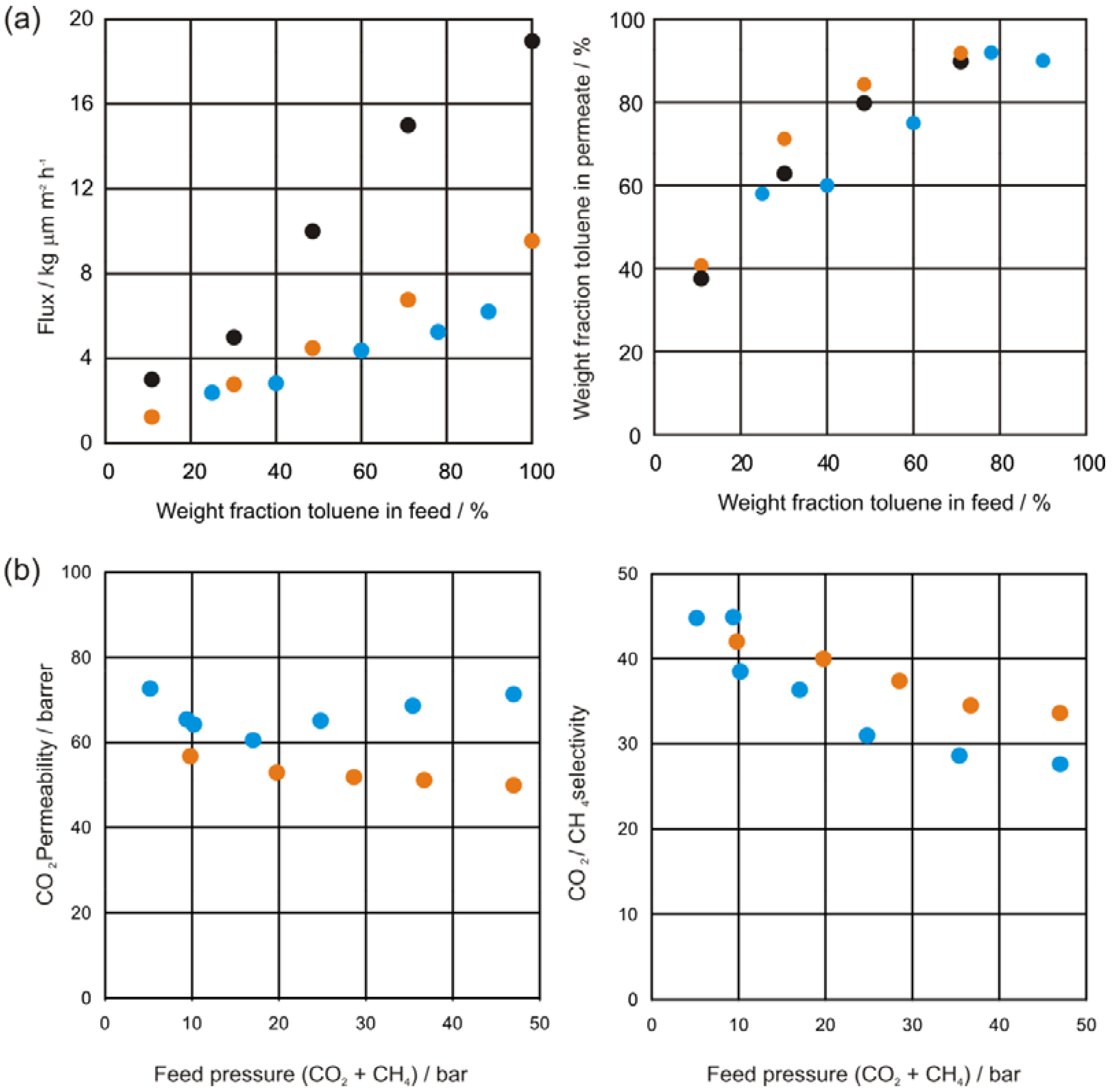
          <p>The results obtained show that the selectivity is slightly higher for covalently crosslinked membranes with respect to the non-crosslinked ones and lower for ionically crosslinked membranes (see <xref ref-type="fig" rid="membranes-02-00727-f010">Figure 10</xref>a). The flux is significantly lowered by covalent crosslinking and even more so by ionic crosslinking. This effect increases with increasing aromatic feed concentrations. Whereas usually the feed concentration for the aromatics in the reformate stream ranges between 40% and 50%, much higher concentrations occur occasionally [<xref ref-type="bibr" rid="B9-membranes-02-00727">9</xref>]. </p>
          <fig id="membranes-02-00727-f010" position="anchor">
            <label>Figure 10</label>
            <caption>
              <p>(<bold>a</bold>) Pervaporation results for conditioned 6FDA-4MPD/6FDA-DABA 4:1 copolyimide membranes, crosslinked with 1,4-butanediol (orange) and crosslinked with zircon(IV)-acetylacetonate (blue) and non-crosslinked (black) using a toluene/cyclohexane mixture at 60 °C. Permeate pressure was kept between 20 and 25 bar [<xref ref-type="bibr" rid="B9-membranes-02-00727">9</xref>]; (<bold>b</bold>) CO<sub>2</sub>/CH<sub>4</sub> separation characteristics for the 6FDA-6FpDA/6FDA-4MPD/6FDA-DABA 3:1:1 copolyimide ionically crosslinked with aluminium(III)-acetylacetonate (blue) and covalently crosslinked with ethylene glycol (orange) at 35 °C using a 50:50 CO<sub>2</sub>/CH<sub>4</sub> feed gas mixture [<xref ref-type="bibr" rid="B9-membranes-02-00727">9</xref>].</p>
            </caption>
            <graphic xmlns:xlink="http://www.w3.org/1999/xlink" xlink:href="membranes-02-00727-g010.tif"/>
          </fig>
          <p>It is obvious that in both cases of crosslinking, ionically as well as covalently, the flux is reduced compared to the non crosslinked membrane material. However the strong increase of flux with increasing aromatic content in feed is suggesting swelling of the membrane. Comparing the performance of the crosslinked membrane materials it can be seen from <xref ref-type="fig" rid="membranes-02-00727-f010">Figure 10</xref>a that the fluxes of both membrane types do not vary significantly. However, although the selectivity of ionically and covalently crosslinked membranes are comparable at high-range aromatic concentrations, covalently crosslinked membranes should be favored for this kind of separation since a better long term performance is expected.</p>
        </sec>
        <sec>
          <title>2.4.2. Natural Gas Treatment</title>
          <p>Plasticization is also a problem for separation of CO<sub>2</sub> from natural gas. For non-crosslinked copolyimides it generally occurs at 10–20 bar partial CO<sub>2</sub> pressure in the feed. Crosslinked copolyimides not only offer plasticization resistance up to much higher CO<sub>2</sub> pressures but also have a better chemical resistance.</p>
          <p>The non-crosslinked copolyimide 6FDA-4MPD and ionically crosslinked 6FDA-4MPD/6FDA-DABA 4:1 start plasticizing at a CO<sub>2</sub> pressure of approximately 15 bar whereas the covalently crosslinked 6FDA-4MPD/6FDA-DABA 4:1 membrane is resistant to plasticization up to CO<sub>2</sub> pressures of more than 30 bar [<xref ref-type="bibr" rid="B9-membranes-02-00727">9</xref>]. These results are in good agreement with those found for other copolyimides [<xref ref-type="bibr" rid="B30-membranes-02-00727">30</xref>]. With both crosslinked membranes the permeability is decreased whereas the selectivity is not changed significantly compared to the non-crosslinked systems. </p>
          <p>By substitution of 75% of the 4MPD by 6FpDA the selectivity can be increased up to commercially attractive values. 6FpDA contains bulky -CF<sub>3</sub> groups which cause restricted rotation around the main polymer chain and also provide a higher free volume. The permeability of the covalently crosslinked 6FDA-6FpDA/6FDA-4MPD/6FDA-DABA 3:1:1 membranes is nearly constant for CO<sub>2</sub> partial pressures of 5 to 50 bar, whereas the ionically crosslinked membranes plasticize approximately at 20 bar (<xref ref-type="fig" rid="membranes-02-00727-f010">Figure 10</xref>b). With covalent crosslinking, the selectivity is approximately 20% higher than with ionic crosslinking. In both cases, a decrease in selectivity was found with increasing feed pressure.</p>
          <p>Most importantly, the crosslinked membranes show good CO<sub>2</sub>/CH<sub>4</sub> selectivity even above CO<sub>2</sub> partial pressures of 40 bar, and thus qualify for commercial applications since the separation factors are much higher than those of the cellulose derivatives in current use [<xref ref-type="bibr" rid="B166-membranes-02-00727">166</xref>].</p>
        </sec>
      </sec>
    </sec>
    <sec>
      <title>3. Metal-organic Frameworks in Mixed Matrix Membranes</title>
      <p>Metal-organic frameworks (MOFs) are of increasing interest as porous filler in mixed-matrix membranes (see <xref ref-type="fig" rid="membranes-02-00727-f003">Figure 3</xref>). MOFs offer various advantages over zeolites or other porous inorganic additives [<xref ref-type="bibr" rid="B167-membranes-02-00727">167</xref>,<xref ref-type="bibr" rid="B168-membranes-02-00727">168</xref>,<xref ref-type="bibr" rid="B169-membranes-02-00727">169</xref>,<xref ref-type="bibr" rid="B170-membranes-02-00727">170</xref>,<xref ref-type="bibr" rid="B171-membranes-02-00727">171</xref>]: The organic ligands as an inherent part of MOFs allow them to interact well with the polymer material and its functionalities. This way, the formation of gaps between the “inorganic” filler and the organic polymer phase, which would cause losses in selectivity, can be avoided. Also the MOF surface properties can be easily tuned by functionalisation with various organic molecules if necessary. Moreover, MOFs also have higher pore volumes and lower density than zeolites, and therefore their effect on the membrane properties can be more pronounced for a given mass loading. For MMMs a perfect interaction between the two components is highly important in order to achieve optimized separation properties of the hybrid material.</p>
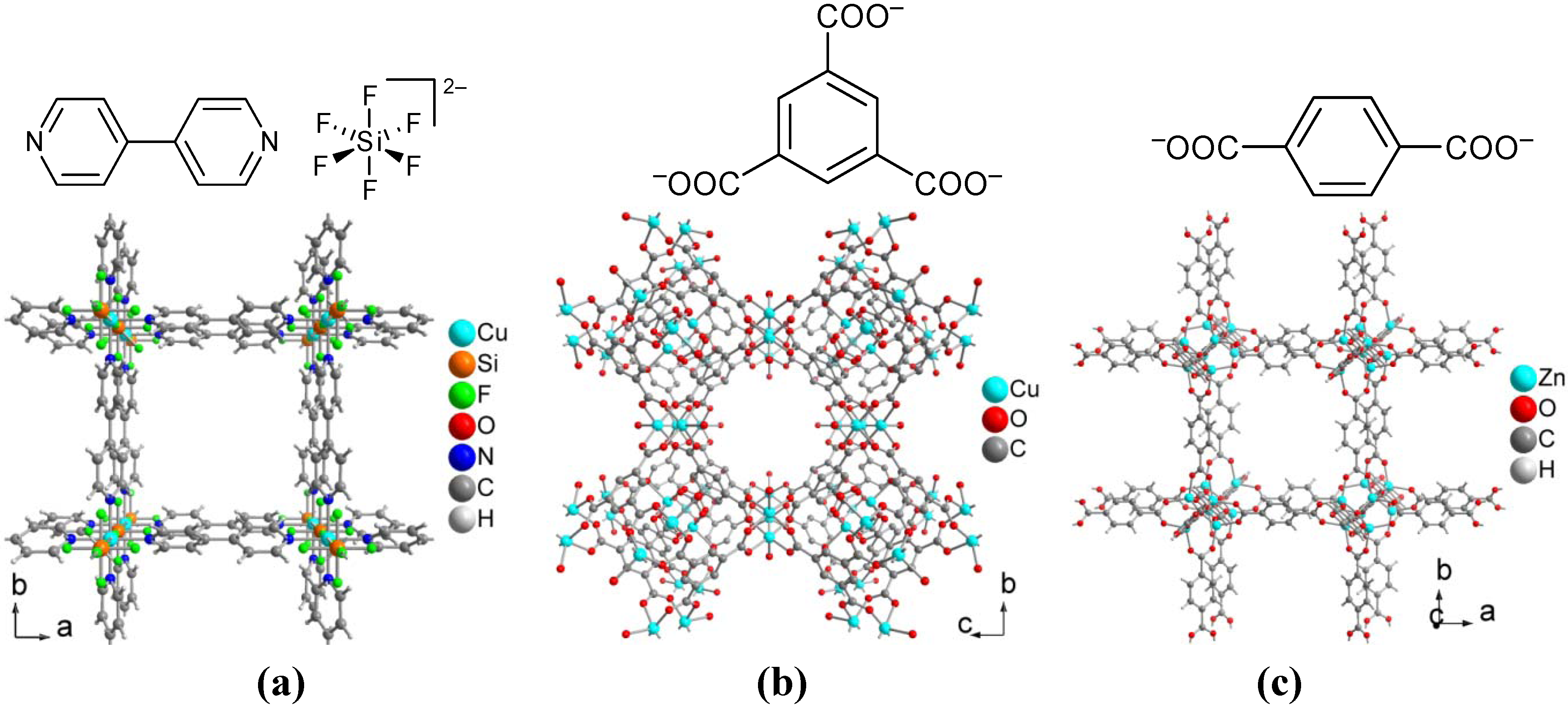
      <p>Incorporation of the MOF 4,4'-bipyridine-hexafluorosilicate-copper(II) (Cu-BPY-HFS) (see <xref ref-type="fig" rid="membranes-02-00727-f011">Figure 11</xref>a) into a dense Matrimid<sup>®</sup> 5218 membrane increased the gas permeabilities and selectivities for pure gases (from single gas experiments) and gas mixtures of CH<sub>4</sub>/N<sub>2</sub> but decreased the ideal CO<sub>2</sub>/CH<sub>4</sub> and H<sub>2</sub>/CH<sub>4</sub> selectivities [<xref ref-type="bibr" rid="B172-membranes-02-00727">172</xref>].</p>
      <p>Cu-BTC MOF (see <xref ref-type="fig" rid="membranes-02-00727-f011">Figure 11</xref>b) as additive in an asymmetric membrane of Matrimid<sup>®</sup> 9725 or of 3:1 Matrimid<sup>®</sup>/polysulfone Utrason S 6010 N blend showed a higher CO<sub>2</sub> permeance compared to the unfilled membrane in mixed gas permeation experiments [<xref ref-type="bibr" rid="B173-membranes-02-00727">173</xref>,<xref ref-type="bibr" rid="B174-membranes-02-00727">174</xref>]. The binary gas mixtures CO<sub>2</sub>/CH<sub>4</sub> and CO<sub>2</sub>/N<sub>2</sub> were studied for CO<sub>2</sub> concentrations from 10 vol.% to 75 vol.%. The permeance of the preferential permeating gas CO<sub>2</sub> and, hence, the CO<sub>2</sub> selectivity increased with the filler loading. Noteworthy, the CO<sub>2</sub>/CH<sub>4</sub> selectivity α<sub>CO<sub>2</sub>/CH<sub>4</sub></sub> dropped linearly when the CO<sub>2</sub> content increased from 10 vol.% to 75 vol.%. The slope of this selectivity drop did not depend on the [Cu<sub>3</sub>(BTC)<sub>2</sub>] additive content [<xref ref-type="bibr" rid="B173-membranes-02-00727">173</xref>,<xref ref-type="bibr" rid="B174-membranes-02-00727">174</xref>]. This could be due to plasticization phenomena with higher CO<sub>2</sub>.</p>
      <fig id="membranes-02-00727-f011" position="anchor">
        <label>Figure 11</label>
        <caption>
          <p>Linkers and sections of the packing diagrams of (<bold>a</bold>) Cu-BPY-HFS, [Cu(µ-SiF<sub>6</sub>)(µ-4,4'-bipy)<sub>2</sub>] (BPY = 4,4'-bipyridine, HFS = hexafluorosilicate), (<bold>b</bold>) Cu-BTC<bold>, </bold>[Cu<sub>3</sub>(BTC)<sub>2</sub>(H<sub>2</sub>O)<sub>3</sub>] (BTC = benzene-1,3,5-tricarboxylate) and (<bold>c</bold>) MOF-5 (IRMOF-1), [Zn<sub>4</sub>O(BDC)<sub>3</sub>] (BDC = benzene-1,4-dicarboxylate, terephthalate).</p>
        </caption>
        <graphic xmlns:xlink="http://www.w3.org/1999/xlink" xlink:href="membranes-02-00727-g011.tif"/>
      </fig>
      <p>Cu-BTC with polyimide (PI) prepared from 4,4-oxydianiline (ODA) and pyromellitic dianhydride (PMDA) was successfully spun into MMM hollow fibers by a dry/wet-spinning method. H<sub>2</sub> permeance and selectivity of H<sub>2</sub> with respect to N<sub>2</sub>, CO<sub>2</sub>, O<sub>2</sub> and CH<sub>4</sub> increased with increased Cu-BTC loading. At 6 wt.% Cu-BTC, the permeance of H<sub>2</sub> was higher by 45%, and its ideal selectivity from other gases was up by a factor of 2–3 compared to pure PI [<xref ref-type="bibr" rid="B175-membranes-02-00727">175</xref>].</p>
      <p>Cu-BTC (see <xref ref-type="fig" rid="membranes-02-00727-f011">Figure 11</xref>b) or ZIF-8 MOF (see <xref ref-type="fig" rid="membranes-02-00727-f012">Figure 12</xref>a) and the zeolite silicalite-1 (S1C) were combined in a polysulfone Udel<sup>®</sup> P-3500 MMM [<xref ref-type="bibr" rid="B176-membranes-02-00727">176</xref>] for the separation of CO<sub>2</sub>/N<sub>2</sub>, CO<sub>2</sub>/CH<sub>4</sub>, O<sub>2</sub>/N<sub>2</sub> and H<sub>2</sub>/CH<sub>4</sub> mixtures. For some of these gas mixtures, the combined-filler MMM showed a synergetic enhancement in selective gas transport when compared either to the pure polymer or to the MMM with only one filler type. All fillers, at the same loading of 16 wt.%, increase the CO<sub>2</sub> permeability when compared to that of the bare polymer in the two CO<sub>2</sub>-containing mixtures. However, the maximum separation selectivities for CO<sub>2</sub>/CH<sub>4</sub> and CO<sub>2</sub>/N<sub>2</sub> mixtures (α<sub>CO</sub><sub>2</sub><sub>/CH<sub>4</sub></sub>= 22.4 with <italic>P</italic> = 8.9 barrer for CO<sub>2</sub>, and α<sub>CO</sub><sub>2</sub><sub>/N2</sub>= 38.0 with <italic>P</italic> = 8.4 barrer for CO<sub>2</sub>) were only achieved when Cu-BTC was combined with S1C in a PSF MMM [<xref ref-type="bibr" rid="B176-membranes-02-00727">176</xref>].</p>
      <p>When the same Cu-BTC/ZIF-8/S1C single- or double-additive MMMs were applied to O<sub>2</sub>/N<sub>2</sub> and H<sub>2</sub>/CH<sub>4</sub> separations, for which mechanism is based mainly on diffusion and not on adsorption differences, the combination of Cu-BTC and S1C significantly enhanced the selectivities of O<sub>2</sub> or H<sub>2</sub>, respectively. This may be due to an improved diffusion through zeolite crystals from the synergy with Cu-BTC [<xref ref-type="bibr" rid="B176-membranes-02-00727">176</xref>].</p>
      <fig id="membranes-02-00727-f012" position="anchor">
        <label>Figure 12</label>
        <caption>
          <p>Linkers and sections of the packing diagrams emphasizing the cuboctahedral b-cage which is depicted by blue topological lines connecting the Zn atoms of (<bold>a</bold>) ZIF-8, [Zn(2-methylimidazolate)<sub>2</sub>], (<bold>b</bold>) ZIF-20, [Zn(purinate)<sub>2</sub>] and (<bold>c</bold>) ZIF-90, [Zn(2-carboxyaldehyde imidazolate)<sub>2</sub>]. </p>
        </caption>
        <graphic xmlns:xlink="http://www.w3.org/1999/xlink" xlink:href="membranes-02-00727-g012.tif"/>
      </fig>
      <p>MOF-5 as nanocrystals showed a strong affinity to the polymer matrix of Matrimid<sup>®</sup> 5218. In MOF-5, six carboxylate groups coordinate to the six edges of the tetrahedral {Zn<sub>4</sub>O} unit in octahedral geometry and the terephthalate linker then form the edges of a cube in the primitive cubic network (see <xref ref-type="fig" rid="membranes-02-00727-f011">Figure 11</xref>c). Single gas permeabilities of H<sub>2</sub>, CO<sub>2</sub>, O<sub>2</sub>, N<sub>2</sub> and CH<sub>4</sub> doubled approximately with MOF-5 loadings of 30 wt.% from those of the pure polymer. This increase was ascribed to the MOF-5 porosity. Tests with binary CH<sub>4</sub>-containing gas mixtures for the MMM with 30% MOF-5 in the polyimide revealed an increase in selectivity for CH<sub>4</sub>. The larger solubility of CO<sub>2</sub> and N<sub>2</sub> in the polymer matrix was seen as the reason to favor enhanced CH<sub>4</sub> transport [<xref ref-type="bibr" rid="B177-membranes-02-00727">177</xref>].</p>
      <p>Zeolitic imidazolate framework-8 (ZIF-8,) with Matrimid<sup>®</sup> 5218 MMMs was prepared with loadings up to 80% (w/w), which are much higher than the typical loadings achieved with selected zeolite materials [<xref ref-type="bibr" rid="B178-membranes-02-00727">178</xref>]. In ZIF-8, the 2-methylimidazolate ligands connect individual zinc atoms and form the edges of a cuboctahedral -cage in a sodalite network (see <xref ref-type="fig" rid="membranes-02-00727-f012">Figure 12</xref>a). The ZIF-8/Matrimid<sup>®</sup> MMMs permeabilities were tested for H<sub>2</sub>, CO<sub>2</sub>, O<sub>2</sub>, N<sub>2</sub>, CH<sub>4</sub>, C<sub>3</sub>H<sub>8</sub>, and gas mixtures of H<sub>2</sub>/CO<sub>2</sub> and CO<sub>2</sub>/CH<sub>4</sub> and increased as the ZIF-8 loading increased to 40% (w/w). This increase in permeability suggested that the addition of ZIF-8 nanoparticles to Matrimid<sup>®</sup> increases the distance between polymer chains creating higher free volume in the polymer matrix. For the majority of gas pairs (O<sub>2</sub>/N<sub>2</sub>, CH<sub>4</sub>/N<sub>2</sub>, H<sub>2</sub>/O<sub>2</sub>, H<sub>2</sub>/CO<sub>2</sub>, H<sub>2</sub>/N<sub>2</sub>), there was no significant change in the ideal selectivity until 40 wt.% ZIF-8 loading. However, at higher loadings of 50 wt.% and 60 wt.%, the permeability decreased for all gases, and the selectivities increased. Ideal selectivities of gas pairs containing gases of different size, such as H<sub>2</sub>/O<sub>2</sub>, H<sub>2</sub>/CO<sub>2</sub>, H<sub>2</sub>/CH<sub>4</sub>, CO<sub>2</sub>/CH<sub>4</sub>, CO<sub>2</sub>/C<sub>3</sub>H<sub>8</sub> and H<sub>2</sub>/C<sub>3</sub>H<sub>8</sub>, showed improvement with the 50 wt.% ZIF-8 loading through a shift from polymer-driven to ZIF-8-controlled gas transport process. ZIF-8 can selectively transport smaller gas molecules, such as H<sub>2</sub> and CO<sub>2</sub> [<xref ref-type="bibr" rid="B178-membranes-02-00727">178</xref>].</p>
      <p>An asymmetric MMM of Matrimid<sup>®</sup> 9725 and ZIF-8 (or MIL-53(Al), see below) exhibited a higher CO<sub>2</sub> permeance than the unfilled membrane in mixed gas permeation experiments [<xref ref-type="bibr" rid="B174-membranes-02-00727">174</xref>]. MOF fillers with 10 wt.%, 20 wt.% and 30 wt.% were loaded in Matrimid<sup>®</sup>. Binary gas mixtures CO<sub>2</sub>/CH<sub>4</sub> and CO<sub>2</sub>/N<sub>2</sub> with CO<sub>2</sub> concentrations from 10 vol.% to 75 vol.% were investigated and the results compared to Cu-BTC/Matrimid<sup>®</sup> [<xref ref-type="bibr" rid="B173-membranes-02-00727">173</xref>] or MIL-53(Al) [<xref ref-type="bibr" rid="B174-membranes-02-00727">174</xref>]. The permeance of the preferentially permeating gas CO<sub>2</sub> increased with the filler loading in the binary mixtures in all three cases but the CO<sub>2</sub> selectivity only increased slightly in the case of Cu-BTC or MIL-53(Al) and remained almost constant for ZIF-8. The CO<sub>2</sub>/CH<sub>4</sub> selectivity α<sub>CO<sub>2</sub>/CH<sub>4</sub></sub> showed a constant drop when the CO<sub>2</sub> content increased from 10 vol.% to 75 vol.% for all three additives. The selectivity drop was independent of the filler content. Increase in CO<sub>2</sub> permeance was assigned to the extra pore network of the MOF fillers. Scanning electron microscopy cross-section images showed the MOF filler well distributed and embedded in the polymer matrix even for the 30 wt.% loaded membranes [<xref ref-type="bibr" rid="B173-membranes-02-00727">173</xref>,<xref ref-type="bibr" rid="B174-membranes-02-00727">174</xref>].</p>
      <p>MMMs made of poly-(1,4-phenylene ether-ether-sulfone) (PPEES) and ZIF-8 with filler loadings of 10 wt.%, 20 wt.% and 30 wt.% were employed in CO<sub>2</sub> diffusion studies using pulsed field gradient (PFG) NMR techniques [<xref ref-type="bibr" rid="B179-membranes-02-00727">179</xref>]. The self-diffusion coefficient increased from 2.1 × 10<sup>−8</sup> cm<sup>2 </sup>s<sup>−1</sup> for the pristine PPEES membrane to 9.3 × 10<sup>−8</sup> cm<sup>2 </sup>s<sup>−1</sup> for the 30 wt.% ZIF-8/PPEES-MMM. ZIF-8 provides Langmuir adsorption sites for CO<sub>2</sub> molecules, thus, the gas adsorption in the MMM increases with the filler content. ZIF-8 contributes greatly to gas permeation by increasing the gas solubility in the composite membranes [<xref ref-type="bibr" rid="B179-membranes-02-00727">179</xref>].</p>
      <p>Combining both ZIF-8 and silicalite-1 in polysulfone Udel<sup>®</sup> P-3500 (ZIF-8/S1C-PSF MMM) did not improve the separation results from either S1C-PSF or ZIF-8-PSF MMMs in the case of CO<sub>2</sub>/CH<sub>4</sub> and CO<sub>2</sub>/N<sub>2</sub> gas mixtures. Probably the relatively large silicalite-1 crystals could not be intercalated between small ZIF-8 particles. ZIF-8 alone produced the highest increase of CO<sub>2</sub> permeability, which can be attributed to its textural properties and its small particle size, albeit giving poorly dispersed aggregates [<xref ref-type="bibr" rid="B176-membranes-02-00727">176</xref>]. For O<sub>2</sub>/N<sub>2</sub> and H<sub>2</sub>/CH<sub>4</sub> gas separation a ZIF-8-PSF MMM produced the best selectivity-permeability results compared to a Cu-BTC- or S1C-PSF MMM. This may be due to an increase in free volume (as suggested for ZIF-8-polyimide MMMs) [<xref ref-type="bibr" rid="B178-membranes-02-00727">178</xref>] together with an efficient molecular separation effect (based on diffusion differences) because of the small pore aperture window of ZIF-8 (3.4 Å, 0.34 nm) compared to Cu-BTC (6 Å, 0.6 nm) and S1C (5.5 Å, 0.55 nm) [<xref ref-type="bibr" rid="B176-membranes-02-00727">176</xref>].</p>
      <p>Different sonication powers were applied on ZIF-8 nanoparticles for the preparation of ZIF-8/Matrimid<sup>®</sup> nanocomposite membranes with the aim of investigating the effect of typical membrane processing conditions on the structure, the interfacial morphology and the gas separation performance. It was shown that ultrasonication generates significant changes in the shape, size distribution, and structure of ZIF-8 particles suspended in an organic solvent during membrane processing. Although there are significant changes in the particle morphology, there are only minor losses in crystallinity and microporosity as proven from powder X-ray diffraction, synchrotron X-ray pair distribution function analysis and nitrogen physisorption. Dynamic light scattering and electron microscopy show that ZIF-8 nanoparticles undergo substantial Ostwald ripening when subjected to high intensity ultrasonication. Composite films prepared with both direct (high-intensity) and indirect (low-intensity) sonication show good adhesion between the polymer and ZIF-8 phases. However, films prepared using indirect sonication exhibit drastic agglomeration of nanoparticles while direct sonication produced ripened nanoparticles with variable dispersion. The ripened particles give lower pore volumes and lower surface areas compared to the as-synthesized material. ZIF-8/Matrimid<sup>®</sup> composite membranes prepared from the two different sonication methods show significant differences in microstructure. Permeation measurements in membranes fabricated with high-intensity sonication show strong enhancement in permeability of CO<sub>2</sub> and increased CO<sub>2</sub>/CH<sub>4</sub> selectivity, in agreement with the Maxwell model. In contrast, composite membranes prepared with low-intensity sonication are found to be defective [<xref ref-type="bibr" rid="B180-membranes-02-00727">180</xref>].</p>
      <p>Small and less agglomerated ZIF-20 with 8 wt.% in a polysulfone Udel<sup>®</sup> P-3500 mixed matrix membrane gave a better separation of an equimolar O<sub>2</sub>/N<sub>2</sub> mixture than the pure polymer. As in ZIF-8 the imidazolate moiety in the purinate ligands connects individual zinc atoms and forms the edges of a cuboctahedral -cage but in a zeolite-A network (see <xref ref-type="fig" rid="membranes-02-00727-f012">Figure 12</xref>b). The increase in O<sub>2</sub>/N<sub>2</sub> selectivity from 4.7 (±0.4) to 6.7 (±0.5) in the MMM could be justified by the small difference in kinetic size between O<sub>2</sub> (kinetic diameter d<sub>k</sub> = 0.343 nm) and N<sub>2</sub> (d<sub>k</sub> = 0.368 nm) [<xref ref-type="bibr" rid="B181-membranes-02-00727">181</xref>].</p>
      <p>Submicrometer-sized particles of ZIF-90 (see <xref ref-type="fig" rid="membranes-02-00727-f012">Figure 12</xref>b, sodalite network again as in ZIF-8) were used to fabricate nanocomposite membranes with three different polyimides [Ultem<sup>®</sup> 1000, Matrimid<sup>®</sup> 5218 and 6FDA-DAM (6FDA: 2,2-bis(3,4-carboxyphenyl)hexafluoro-propane dianhydride, DAM: diaminomesitylene)] [<xref ref-type="bibr" rid="B171-membranes-02-00727">171</xref>]. Scanning electron microscopy revealed an excellent adhesion of ZIF-90 crystals with the polyimides with no interfacial voids and well dispersed MOF crystals. Ultem<sup>®</sup> and Matrimid<sup>®</sup> MMMs showed significantly enhanced CO<sub>2</sub> permeability without any loss of CO<sub>2</sub>/CH<sub>4</sub> selectivity. ZIF-90 with the highly permeable polymer 6FDA-DAM showed significant enhancements in both CO<sub>2</sub> permeability and CO<sub>2</sub>/CH<sub>4</sub> selectivity. Membranes containing smaller particles showed slightly better results. The performance of ZIF-90/6FDA-DAM MMM exceeded the polymer upper bound for polymeric membrane performance from 1991 [<xref ref-type="bibr" rid="B20-membranes-02-00727">20</xref>], and reaches the technologically attractive region (see <xref ref-type="fig" rid="membranes-02-00727-f004">Figure 4</xref>) [<xref ref-type="bibr" rid="B171-membranes-02-00727">171</xref>].</p>
      <p>The CO<sub>2</sub>/CH<sub>4</sub> binary mixture gas-permeation properties of pure 6FDA-DAM and 15 wt.% ZIF-90/6FDA-DAM membranes revealed an enhanced gas-separation performance of the MMM. The CO<sub>2</sub>/CH<sub>4</sub> mixed-gas selectivity of the ZIF-90 MMM was higher than the ideal selectivity measured by single-component gas permeation, presumably because of selective sorption and diffusion of CO<sub>2</sub> in the ZIF-90 crystals [<xref ref-type="bibr" rid="B171-membranes-02-00727">171</xref>]. Also, a ZIF-90/6FDA-DAM membrane showed an ideal CO<sub>2</sub>/N<sub>2</sub> selectivity of 22 compared to 14 for pure 6FDA-DAM indicating the possibility for separation of CO<sub>2</sub> from flue gases [<xref ref-type="bibr" rid="B171-membranes-02-00727">171</xref>].</p>
      <p>The MOF Mn(HCOO)<sub>2</sub>, where each formiate ligand bridges between three manganese atoms (see <xref ref-type="fig" rid="membranes-02-00727-f013">Figure 13</xref>a), has very small channels of ~2 Å diameter only, and hence, as PSF-MMM showed high adsorption affinity for H<sub>2</sub> only. Higher loadings reduced the gas solubility, but increased the permeability, indicating defective membranes with interfacial voids [<xref ref-type="bibr" rid="B182-membranes-02-00727">182</xref>].</p>
      <p>An asymmetric membrane from MIL-53(Al) (or Cu-BTC or ZIF-8, see above) and Matrimid® 9725 showed a higher CO<sub>2</sub> permeance than the unfilled membrane in mixed gas permeation experiments [<xref ref-type="bibr" rid="B174-membranes-02-00727">174</xref>]. The framework of MIL-53(Al) is a flexible, 'breathing'-type network, that is, it can assume different shapes and porosities depending on guest presence or absence. The BDC ligand bridges between four Al atoms. The hydroxo-bridging takes place along the metal chains in the b direction (see <xref ref-type="fig" rid="membranes-02-00727-f013">Figure 13</xref>b). The permeance of the preferentially permeating CO<sub>2</sub> in the binary gas mixtures CO<sub>2</sub>/CH<sub>4</sub> and CO<sub>2</sub>/N<sub>2</sub> with CO<sub>2</sub> concentrations from 10 vol.% to 75 vol.% increased with the filler loading for all three MOFs but the CO<sub>2</sub> selectivity slightly increased only in the case of Cu-BTC or MIL-53(Al) and remained almost constant for ZIF-8. Under the same conditions the CO<sub>2</sub> permeability remained invariant with the type of MOF for the CO<sub>2</sub>/N<sub>2</sub> gas mixture. The CO<sub>2</sub>/CH<sub>4</sub> selectivity α<sub>CO<sub>2</sub>/CH<sub>4</sub></sub>dropped linearly when the CO<sub>2</sub> content increased from 10 to 75 vol.% for all three MOFs. The decrease in selectivity was essentially independent of the MOF filler content [<xref ref-type="bibr" rid="B173-membranes-02-00727">173</xref>,<xref ref-type="bibr" rid="B174-membranes-02-00727">174</xref>]. </p>
      <fig id="membranes-02-00727-f013" position="anchor">
        <label>Figure 13</label>
        <caption>
          <p>Linkers and sections of the packing diagrams of (<bold>a</bold>) Mn(HCOO)<sub>2</sub>, (<bold>b</bold>) MIL-53(Al), [Al(BDC)(µ-OH)] (BDC = benzene-1,4-dicarboxylate, tere-phthalate) and (<bold>c</bold>) MIL-101, [Cr<sub>3</sub>(O)(BDC)<sub>3</sub>(F,OH)(H<sub>2</sub>O)<sub>2</sub>].</p>
        </caption>
        <graphic xmlns:xlink="http://www.w3.org/1999/xlink" xlink:href="membranes-02-00727-g013.tif"/>
      </fig>
      <p>A variant of MIL-53(Al), namely compound NH<sub>2</sub>-MIL-53(Al) with the 2-aminobenzene-1,4-dicarboxylate linker (NH<sub>2</sub>-BDC) but the same structure as MIL-53(Al) was used to fabricate nanocomposite membranes with PSF Udel<sup>®</sup> P-3500. The homogeneously distributed NH<sub>2</sub>-MIL-53(Al) particles showed excellent adhesion with the polysulfone without any additional compatibilization. </p>
      <p>In contrast to most reported membranes, CO<sub>2</sub>/CH<sub>4</sub> separation selectivity of NH<sub>2</sub>-MIL-53(Al)/PSF-MMM increased with pressure due to the flexibility of the NH<sub>2</sub>-MIL-53(Al) filler [<xref ref-type="bibr" rid="B183-membranes-02-00727">183</xref>].</p>
      <p>Mixed-matrix membranes with the water-stable MOF MIL-101 in polysulfone Ultrason S 6100 N exhibited a remarkable four-fold increase (compared to pure PSF) in the permeability of O<sub>2</sub> to technically needed values above 6 barrer and a simultaneous high selectivity for O<sub>2</sub> over N<sub>2</sub> of 5–6. The largest cage in this network with MTN zeolite topology is shown here with an inner diameter of ~34 Å and pore aperture windows up to ~16 Å. The benzene-1,4-dicarboxylate ligands bridge between trinuclear {Cr<sub>3</sub>O} building units (see <xref ref-type="fig" rid="membranes-02-00727-f013">Figure 13</xref>c). The MIL-101 particles showed very good adhesion with polysulfone and long term stability [<xref ref-type="bibr" rid="B184-membranes-02-00727">184</xref>].</p>
      <p>Single gas experiments of MIL-101/PSF membranes with CO<sub>2</sub>, CH<sub>4</sub> and N<sub>2</sub> at different MOF loadings showed increases in gas permeabilities with increasing MIL-101 weight percentage in PSF (see <xref ref-type="fig" rid="membranes-02-00727-f014">Figure 14</xref>). CO<sub>2</sub> is the preferentially permeating gas with permeability increases from about 5 to over 35 barrer from pure PSF to 20 wt.% MIL-101/PSF. The increase for CO<sub>2</sub> also raises the ideal selectivities for CO<sub>2</sub>/CH<sub>4</sub> and CO<sub>2</sub>/N<sub>2</sub> from about 20 to 25.</p>
      <p>The CO<sub>2</sub> permeability is rather invariant to the thickness of the membrane while the CH<sub>4</sub> and N<sub>2</sub> permeabilities decrease when the membrane becomes thicker for the same MIL-101 loading (see <xref ref-type="fig" rid="membranes-02-00727-f015">Figure 15</xref>). Hence, the ideal CO<sub>2</sub>/CH<sub>4</sub> and CO<sub>2</sub>/N<sub>2</sub> selectivities strongly increase with the membrane thickness, in particular for CO<sub>2</sub>/CH<sub>4</sub> (see <xref ref-type="fig" rid="membranes-02-00727-f015">Figure 15</xref>c).</p>
      <fig id="membranes-02-00727-f014" position="anchor">
        <label>Figure 14</label>
        <caption>
          <p>Single-gas CO<sub>2</sub>, CH<sub>4</sub> and N<sub>2</sub> permeabilities and ideal (<bold>a</bold>) CO<sub>2</sub>/CH<sub>4</sub> and (<bold>b</bold>) CO<sub>2</sub>/N<sub>2</sub> selectivities of pure PSF and MIL-101/PSF membranes with different MIL wt.% loadings (averaged values for different membrane thicknesses).</p>
        </caption>
        <graphic xmlns:xlink="http://www.w3.org/1999/xlink" xlink:href="membranes-02-00727-g014.tif"/>
      </fig>
      <fig id="membranes-02-00727-f015" position="anchor">
        <label>Figure 15</label>
        <caption>
          <p>(<bold>a</bold>) Single-gas CO<sub>2</sub>; (<bold>b</bold>) CH<sub>4</sub> and N<sub>2</sub> permeabilities; (<bold>c</bold>) ideal CO<sub>2</sub>/CH<sub>4</sub> and CO<sub>2</sub>/N<sub>2</sub> selectivities for MIL-101/PSF membranes at different MIL wt.% loadings and membrane thicknesses.</p>
        </caption>
        <graphic xmlns:xlink="http://www.w3.org/1999/xlink" xlink:href="membranes-02-00727-g015.tif"/>
      </fig>
    </sec>
    <sec sec-type="conclusions">
      <title>4. Conclusions</title>
      <p>Covalent crosslinking with maleimide derivatives as crosslinking unit can be investigated <italic>in situ</italic> in the liquid phase as well as in the solid phase using nanosecond transient UV/Vis absorption and FTIR measurements. Results point to maleimide anion formation via the triplet state and ionic dimerization to the cycloadduct as main reaction path upon UV irradiation. Additionally, the 2-2’-adduct is formed either from the educt or in a consecutive reaction from the cycloadduct. For 6FDA-ODA/6FDA-DABA 4:1 with MI the photocrosslinking yield was determined to be ~6%. The yield is restricted by the stiﬀness of the polymer backbone, which inhibits the photoreaction due to permanent spatial separation of the crosslinker side chains. </p>
      <p>It has been shown for the separation of high-pressure mixtures of CO<sub>2</sub>/CH<sub>4</sub> as well as for toluene/cyclohexane mixtures that the photocrosslinked copolyimide membranes are much more plasticization resistant than noncrosslinked copolyimide membranes. Generally covalent crosslinking results in much higher plasticization resistance and better selectivity than ionic crosslinking.</p>
      <p>Mixed matrix membranes with metal-organic frameworks as additives (fillers) exhibit enhanced permeabilities and possibly also selectivities when compared to the underlying pure polymer. Matrimid<sup>®</sup> and polysulfone are popular polymer matrices for MOF fillers. MOF particle adhesion to these organic polymers does not represent a problem. Permeability increases can be traced to MOF porosity. Crucial permeability-selectivity factors worth further investigations are, <italic>inter alia</italic>, filler content, filler (nano)size and dispersion, gas-binding functional groups in filler (e.g., amines for CO<sub>2</sub>), water-stability of MOF-filler [<xref ref-type="bibr" rid="B185-membranes-02-00727">185</xref>,<xref ref-type="bibr" rid="B186-membranes-02-00727">186</xref>,<xref ref-type="bibr" rid="B187-membranes-02-00727">187</xref>,<xref ref-type="bibr" rid="B188-membranes-02-00727">188</xref>] as well as mixed-gases with different volume fractions instead of single gases. Addition of MOFs to polymers in MMMs easily yields performances similar to the best polymeric membranes and selectivities 10 times higher than those reported to date for any pure MOF membrane for the respective separation. In the end MOF-polymer MMMs allow for an easier synthesis and handability compared to pure MOF membranes [<xref ref-type="bibr" rid="B189-membranes-02-00727">189</xref>,<xref ref-type="bibr" rid="B190-membranes-02-00727">190</xref>,<xref ref-type="bibr" rid="B191-membranes-02-00727">191</xref>,<xref ref-type="bibr" rid="B192-membranes-02-00727">192</xref>,<xref ref-type="bibr" rid="B193-membranes-02-00727">193</xref>].</p>
    </sec>
  </body>
  <back>
    <ack>
      <title>Acknowledgments</title>
      <p>The authors thank the German Research Foundation (KL 531/29-1) and the Anton-Betz-Stiftung (CJ) for their support.</p>
    </ack>
    <ref-list>
      <title>References</title>
      <ref id="B1-membranes-02-00727">
        <label>1.</label>
        <citation citation-type="book">
          <person-group person-group-type="author">
            <name>
              <surname>King</surname>
              <given-names>C.J.</given-names>
            </name>
          </person-group>
          <article-title>Separation Processes, Introduction</article-title>
          <source>Ullmann’s Encyclopedia of Industrial Chemistry</source>
          <publisher-name>John Wiley and Sons, Inc.</publisher-name>
          <publisher-loc>Hoboken, NJ, USA</publisher-loc>
          <year>2000</year>
        </citation>
      </ref>
      <ref id="B2-membranes-02-00727">
        <label>2.</label>
        <citation citation-type="journal">
          <person-group person-group-type="author">
            <name>
              <surname>Davis</surname>
              <given-names>J.C.</given-names>
            </name>
            <name>
              <surname>Valus</surname>
              <given-names>R.J.</given-names>
            </name>
            <name>
              <surname>Eshraghi</surname>
              <given-names>R.</given-names>
            </name>
            <name>
              <surname>Velikoff</surname>
              <given-names>A.E.</given-names>
            </name>
          </person-group>
          <article-title>Facilitated transport membrane hybrid systems for olefin purification</article-title>
          <source>Sep. Sci. Tec.</source>
          <year>1993</year>
          <volume>28</volume>
          <fpage>463</fpage>
          <lpage>476</lpage>
          <pub-id pub-id-type="doi">10.1080/01496399308019500</pub-id>
        </citation>
      </ref>
      <ref id="B3-membranes-02-00727">
        <label>3.</label>
        <citation citation-type="journal">
          <person-group person-group-type="author">
            <name>
              <surname>Kondo</surname>
              <given-names>M.</given-names>
            </name>
            <name>
              <surname>Komori</surname>
              <given-names>M.</given-names>
            </name>
            <name>
              <surname>Kita</surname>
              <given-names>H.</given-names>
            </name>
            <name>
              <surname>Okamoto</surname>
              <given-names>K.</given-names>
            </name>
          </person-group>
          <article-title>Tubular-type pervaporation module with zeolite NaA membrane</article-title>
          <source>J. Membrane Sci.</source>
          <year>1997</year>
          <volume>133</volume>
          <fpage>133</fpage>
          <lpage>141</lpage>
          <pub-id pub-id-type="doi">10.1016/S0376-7388(97)00087-2</pub-id>
        </citation>
      </ref>
      <ref id="B4-membranes-02-00727">
        <label>4.</label>
        <citation citation-type="journal">
          <person-group person-group-type="author">
            <name>
              <surname>Holmes</surname>
              <given-names>S.M.</given-names>
            </name>
            <name>
              <surname>Schmitt</surname>
              <given-names>M.</given-names>
            </name>
            <name>
              <surname>Markert</surname>
              <given-names>C.</given-names>
            </name>
            <name>
              <surname>Plaisted</surname>
              <given-names>R.J.</given-names>
            </name>
            <name>
              <surname>Forrest</surname>
              <given-names>J.O.</given-names>
            </name>
            <name>
              <surname>Sharratt</surname>
              <given-names>P.N.</given-names>
            </name>
            <name>
              <surname>Garforth</surname>
              <given-names>A.A.</given-names>
            </name>
            <name>
              <surname>Cundy</surname>
              <given-names>C.S.</given-names>
            </name>
            <name>
              <surname>Dwyer</surname>
              <given-names>J.</given-names>
            </name>
          </person-group>
          <article-title>Zeolite A membranes for use in alcohol/water separations—Part I: Experimental investigation</article-title>
          <source>Chem. Eng. Res. Des.</source>
          <year>2000</year>
          <volume>78</volume>
          <fpage>1084</fpage>
          <lpage>1088</lpage>
          <pub-id pub-id-type="doi">10.1205/026387600528355</pub-id>
        </citation>
      </ref>
      <ref id="B5-membranes-02-00727">
        <label>5.</label>
        <citation citation-type="journal">
          <person-group person-group-type="author">
            <name>
              <surname>Van den Berg</surname>
              <given-names>A.W.C.</given-names>
            </name>
            <name>
              <surname>Gora</surname>
              <given-names>L.</given-names>
            </name>
            <name>
              <surname>Jansen</surname>
              <given-names>J.C.</given-names>
            </name>
            <name>
              <surname>Makkee</surname>
              <given-names>M.</given-names>
            </name>
            <name>
              <surname>Maschmeyer</surname>
              <given-names>T.</given-names>
            </name>
          </person-group>
          <article-title>Zeolite A membranes synthesized on a UV-irradiated TiO<sub>2</sub> coated metal support: The high pervaporation performance</article-title>
          <source>J. Membrane Sci.</source>
          <year>2003</year>
          <volume>224</volume>
          <fpage>29</fpage>
          <lpage>37</lpage>
          <pub-id pub-id-type="doi">10.1016/S0376-7388(03)00345-4</pub-id>
        </citation>
      </ref>
      <ref id="B6-membranes-02-00727">
        <label>6.</label>
        <citation citation-type="journal">
          <person-group person-group-type="author">
            <name>
              <surname>Scholes</surname>
              <given-names>C.A.</given-names>
            </name>
            <name>
              <surname>Stevens</surname>
              <given-names>G.W.</given-names>
            </name>
            <name>
              <surname>Kentish</surname>
              <given-names>S.E.</given-names>
            </name>
          </person-group>
          <article-title>Membrane gas separation applications in natural gas processing</article-title>
          <source>Fuel</source>
          <year>2012</year>
          <volume>96</volume>
          <fpage>15</fpage>
          <lpage>28</lpage>
          <pub-id pub-id-type="doi">10.1016/j.fuel.2011.12.074</pub-id>
        </citation>
      </ref>
      <ref id="B7-membranes-02-00727">
        <label>7.</label>
        <citation citation-type="journal">
          <person-group person-group-type="author">
            <name>
              <surname>Graham</surname>
              <given-names>T.</given-names>
            </name>
          </person-group>
          <article-title>On the absorption and dialytic separation of gases by colloid septa</article-title>
          <source>J. Chem. Soc.</source>
          <year>1867</year>
          <volume>20</volume>
          <fpage>235</fpage>
          <lpage>288</lpage>
          <pub-id pub-id-type="doi">10.1039/js8672000235</pub-id>
        </citation>
      </ref>
      <ref id="B8-membranes-02-00727">
        <label>8.</label>
        <citation citation-type="journal">
          <person-group person-group-type="author">
            <name>
              <surname>Koros</surname>
              <given-names>W.J.</given-names>
            </name>
            <name>
              <surname>Fleming</surname>
              <given-names>G.K.</given-names>
            </name>
          </person-group>
          <article-title>Membrane-based gas separation</article-title>
          <source>J. Membrane Sci.</source>
          <year>1993</year>
          <volume>83</volume>
          <fpage>1</fpage>
          <lpage>80</lpage>
        <pub-id pub-id-type="doi">10.1016/0376-7388(93)80013-N</pub-id></citation>
      </ref>
      <ref id="B9-membranes-02-00727">
        <label>9.</label>
        <citation citation-type="journal">
          <person-group person-group-type="author">
            <name>
              <surname>Schmeling</surname>
              <given-names>N.</given-names>
            </name>
            <name>
              <surname>Konietzny</surname>
              <given-names>R.</given-names>
            </name>
            <name>
              <surname>Sieffert</surname>
              <given-names>D.</given-names>
            </name>
            <name>
              <surname>Rölling</surname>
              <given-names>P.</given-names>
            </name>
            <name>
              <surname>Staudt</surname>
              <given-names>C.</given-names>
            </name>
          </person-group>
          <article-title>Functionalized copolyimide membranes for the separation of gaseous and liquid mixtures</article-title>
          <source>Beilstein J. Org. Chem.</source>
          <year>2010</year>
          <volume>6</volume>
          <fpage>789</fpage>
          <lpage>800</lpage>
          <pub-id pub-id-type="doi">10.3762/bjoc.6.86</pub-id>
        </citation>
      </ref>
      <ref id="B10-membranes-02-00727">
        <label>10.</label>
        <citation citation-type="book">
          <person-group person-group-type="author">
            <name>
              <surname>Baker</surname>
              <given-names>R.W.</given-names>
            </name>
          </person-group>
          <source>Membrane Technology and Applications</source>
          <edition>2nd</edition>
          <publisher-name>Wiley</publisher-name>
          <publisher-loc>Chichester, UK</publisher-loc>
          <year>2004</year>
        </citation>
      </ref>
      <ref id="B11-membranes-02-00727">
        <label>11.</label>
        <citation citation-type="book">
          <person-group person-group-type="author">
            <name>
              <surname>Paul</surname>
              <given-names>D.R.</given-names>
            </name>
            <name>
              <surname>Yampol’skii</surname>
              <given-names>Y.P.</given-names>
            </name>
          </person-group>
          <source>Polymeric Gas Separation Membranes</source>
          <publisher-name>CRC Press</publisher-name>
          <publisher-loc>Boca Raton, FL, USA</publisher-loc>
          <year>1994</year>
        </citation>
      </ref>
      <ref id="B12-membranes-02-00727">
        <label>12.</label>
        <citation citation-type="journal">
          <person-group person-group-type="author">
            <name>
              <surname>Mixa</surname>
              <given-names>A.</given-names>
            </name>
            <name>
              <surname>Staudt</surname>
              <given-names>C.</given-names>
            </name>
          </person-group>
          <article-title>Membrane-based separation of phenol/water mixtures using ionically and covalently cross-linked ethylene-methacrylic acid copolymers</article-title>
          <source>Int. J. Chem. Eng.</source>
          <year>2008</year>
          <volume>2008</volume>
          <pub-id pub-id-type="doi">10.1155/2008/319392</pub-id>
        </citation>
      </ref>
      <ref id="B13-membranes-02-00727">
        <label>13.</label>
        <citation citation-type="book">
          <person-group person-group-type="author">
            <name>
              <surname>Strathmann</surname>
              <given-names>H.</given-names>
            </name>
          </person-group>
          <source>Introduction to Membrane Science and Technology</source>
          <publisher-name>Wiley-VCH</publisher-name>
          <publisher-loc>Weinheim, Germany</publisher-loc>
          <year>2011</year>
        </citation>
      </ref>
      <ref id="B14-membranes-02-00727">
        <label>14.</label>
        <citation citation-type="journal">
          <person-group person-group-type="author">
            <name>
              <surname>Saracco</surname>
              <given-names>G.</given-names>
            </name>
            <name>
              <surname>Neomagus</surname>
              <given-names>H.W.J.P.</given-names>
            </name>
            <name>
              <surname>Versteeg</surname>
              <given-names>G.F.</given-names>
            </name>
            <name>
              <surname>van Swaaij</surname>
              <given-names>W.P.M.</given-names>
            </name>
          </person-group>
          <article-title>High-temperature membrane reactors: Potential and problems</article-title>
          <source>Chem. Eng. Sci.</source>
          <year>1999</year>
          <volume>54</volume>
          <fpage>1997</fpage>
          <lpage>2017</lpage>
          <pub-id pub-id-type="doi">10.1016/S0009-2509(99)00009-3</pub-id>
        </citation>
      </ref>
      <ref id="B15-membranes-02-00727">
        <label>15.</label>
        <citation citation-type="book">
          <person-group person-group-type="author">
            <name>
              <surname>Julbe</surname>
              <given-names>A.</given-names>
            </name>
          </person-group>
          <article-title>Zeolite Membranes—Synthesis, Characterization and Application</article-title>
          <source>Introduction to Zeolite Science and Practice</source>
          <edition>3rd</edition>
          <person-group person-group-type="editor">
            <name>
              <surname>Cejka</surname>
              <given-names>J.</given-names>
            </name>
            <name>
              <surname>Bekkum</surname>
              <given-names>H.</given-names>
            </name>
            <name>
              <surname>Corma</surname>
              <given-names>A.</given-names>
            </name>
            <name>
              <surname>Schüth</surname>
              <given-names>F.</given-names>
            </name>
          </person-group>
          <publisher-name>Elsevier B.V.</publisher-name>
          <publisher-loc>Amsterdam, The Netherlands</publisher-loc>
          <year>2007</year>
          <fpage>181</fpage>
        </citation>
      </ref>
      <ref id="B16-membranes-02-00727">
        <label>16.</label>
        <citation citation-type="book">
          <person-group person-group-type="author">
            <name>
              <surname>Staude</surname>
              <given-names>E.</given-names>
            </name>
          </person-group>
          <source>Membranen und Membranprozesse</source>
          <publisher-name>Wiley-VCH</publisher-name>
          <publisher-loc>Weinheim, Germany</publisher-loc>
          <year>1992</year>
        </citation>
      </ref>
      <ref id="B17-membranes-02-00727">
        <label>17.</label>
        <citation citation-type="journal">
          <person-group person-group-type="author">
            <name>
              <surname>Maier</surname>
              <given-names>G.</given-names>
            </name>
          </person-group>
          <article-title>Gas separation with polymer membranes</article-title>
          <source>Angew. Chem. Int. Ed.</source>
          <year>1998</year>
          <volume>37</volume>
          <fpage>2961</fpage>
          <lpage>2974</lpage>
        </citation>
      </ref>
      <ref id="B18-membranes-02-00727">
        <label>18.</label>
        <citation citation-type="journal">
          <person-group person-group-type="author">
            <name>
              <surname>Lin</surname>
              <given-names>L.G.</given-names>
            </name>
            <name>
              <surname>Zhang</surname>
              <given-names>Y.Z.</given-names>
            </name>
            <name>
              <surname>Kong</surname>
              <given-names>Y.</given-names>
            </name>
          </person-group>
          <article-title>Recent advances in sulfur removal from gasoline by pervaporation</article-title>
          <source>Fuel</source>
          <year>2009</year>
          <volume>88</volume>
          <fpage>1799</fpage>
          <lpage>1809</lpage>
          <pub-id pub-id-type="doi">10.1016/j.fuel.2009.03.031</pub-id>
        </citation>
      </ref>
      <ref id="B19-membranes-02-00727">
        <label>19.</label>
        <citation citation-type="journal">
          <person-group person-group-type="author">
            <name>
              <surname>Bolto</surname>
              <given-names>B.</given-names>
            </name>
            <name>
              <surname>Hoang</surname>
              <given-names>M.</given-names>
            </name>
            <name>
              <surname>Xie</surname>
              <given-names>Z.L.</given-names>
            </name>
          </person-group>
          <article-title>A review of membrane selection for the dehydration of aqueous ethanol by pervaporation</article-title>
          <source>Chem. Eng. Process.</source>
          <year>2011</year>
          <volume>50</volume>
          <fpage>227</fpage>
          <lpage>235</lpage>
          <pub-id pub-id-type="doi">10.1016/j.cep.2011.01.003</pub-id>
        </citation>
      </ref>
      <ref id="B20-membranes-02-00727">
        <label>20.</label>
        <citation citation-type="journal">
          <person-group person-group-type="author">
            <name>
              <surname>Robeson</surname>
              <given-names>L.M.</given-names>
            </name>
          </person-group>
          <article-title>Correlation of separation factor versus permeability for polymeric membranes</article-title>
          <source>J. Membrane Sci.</source>
          <year>1991</year>
          <volume>62</volume>
          <fpage>165</fpage>
          <lpage>185</lpage>
          <pub-id pub-id-type="doi">10.1016/0376-7388(91)80060-J</pub-id>
        </citation>
      </ref>
      <ref id="B21-membranes-02-00727">
        <label>21.</label>
        <citation citation-type="journal">
          <person-group person-group-type="author">
            <name>
              <surname>Robeson</surname>
              <given-names>L.M.</given-names>
            </name>
          </person-group>
          <article-title>The upper bound revisited</article-title>
          <source>J. Membrane Sci.</source>
          <year>2008</year>
          <volume>320</volume>
          <fpage>390</fpage>
          <lpage>400</lpage>
          <pub-id pub-id-type="doi">10.1016/j.memsci.2008.04.030</pub-id>
        </citation>
      </ref>
      <ref id="B22-membranes-02-00727">
        <label>22.</label>
        <citation citation-type="book">
          <person-group person-group-type="author">
            <name>
              <surname>Ohlrogge</surname>
              <given-names>K.</given-names>
            </name>
            <name>
              <surname>Stürken</surname>
              <given-names>K.</given-names>
            </name>
          </person-group>
          <article-title>The Separation of Organic Vapors from Gas Streams by Means of Membranes</article-title>
          <source>Membrane Technology</source>
          <publisher-name>Wiley-VCH</publisher-name>
          <publisher-loc>Weinheim, Germany</publisher-loc>
          <year>2001</year>
          <fpage>69</fpage>
          <lpage>94</lpage>
        </citation>
      </ref>
      <ref id="B23-membranes-02-00727">
        <label>23.</label>
        <citation citation-type="journal">
          <person-group person-group-type="author">
            <name>
              <surname>Baker</surname>
              <given-names>R.W.</given-names>
            </name>
          </person-group>
          <article-title>Future directions of membrane gas separation technology</article-title>
          <source>Ind. Eng. Chem. Res.</source>
          <year>2002</year>
          <volume>41</volume>
          <fpage>1393</fpage>
          <lpage>1411</lpage>
          <pub-id pub-id-type="doi">10.1021/ie0108088</pub-id>
        </citation>
      </ref>
      <ref id="B24-membranes-02-00727">
        <label>24.</label>
        <citation citation-type="journal">
          <person-group person-group-type="author">
            <name>
              <surname>Spillman</surname>
              <given-names>R.W.</given-names>
            </name>
          </person-group>
          <article-title>Economics of gas separation membranes</article-title>
          <source>Chem. Eng. Prog.</source>
          <year>1989</year>
          <volume>85</volume>
          <fpage>41</fpage>
          <lpage>62</lpage>
        </citation>
      </ref>
      <ref id="B25-membranes-02-00727">
        <label>25.</label>
        <citation citation-type="book">
          <person-group person-group-type="author">
            <name>
              <surname>Ohya</surname>
              <given-names>H.</given-names>
            </name>
            <name>
              <surname>Kudryavtsev</surname>
              <given-names>V.V.</given-names>
            </name>
            <name>
              <surname>Semenova</surname>
              <given-names>S.I.</given-names>
            </name>
          </person-group>
          <source>Polyimide Membranes: Applications, Fabrications and Properties</source>
          <publisher-name>CRC Press</publisher-name>
          <publisher-loc>Boca Raton, FL, USA</publisher-loc>
          <year>1996</year>
        </citation>
      </ref>
      <ref id="B26-membranes-02-00727">
        <label>26.</label>
        <citation citation-type="journal">
          <person-group person-group-type="author">
            <name>
              <surname>Du</surname>
              <given-names>N.Y.</given-names>
            </name>
            <name>
              <surname>Park</surname>
              <given-names>H.B.</given-names>
            </name>
            <name>
              <surname>Dal-Cin</surname>
              <given-names>M.M.</given-names>
            </name>
            <name>
              <surname>Guiver</surname>
              <given-names>M.D.</given-names>
            </name>
          </person-group>
          <article-title>Advances in high permeability polymeric membrane materials for CO<sub>2</sub> separations</article-title>
          <source>Energy Environ. Sci.</source>
          <year>2012</year>
          <volume>5</volume>
          <fpage>7306</fpage>
          <lpage>7322</lpage>
          <pub-id pub-id-type="doi">10.1039/c1ee02668b</pub-id>
        </citation>
      </ref>
      <ref id="B27-membranes-02-00727">
        <label>27.</label>
        <citation citation-type="journal">
          <person-group person-group-type="author">
            <name>
              <surname>Baker</surname>
              <given-names>R.W.</given-names>
            </name>
            <name>
              <surname>Lokhandwala</surname>
              <given-names>K.</given-names>
            </name>
          </person-group>
          <article-title>Natural gas processing with membranes: An overview</article-title>
          <source>Ind. Eng. Chem. Res.</source>
          <year>2008</year>
          <volume>47</volume>
          <fpage>2109</fpage>
          <lpage>2121</lpage>
          <pub-id pub-id-type="doi">10.1021/ie071083w</pub-id>
        </citation>
      </ref>
      <ref id="B28-membranes-02-00727">
        <label>28.</label>
        <citation citation-type="book">
          <person-group person-group-type="author">
            <name>
              <surname>Kohl</surname>
              <given-names>A.L.</given-names>
            </name>
            <name>
              <surname>Nielsen</surname>
              <given-names>R.B.</given-names>
            </name>
          </person-group>
          <source>Gas Purification</source>
          <edition>5</edition>
          <publisher-name>Gulf Professional Publishing</publisher-name>
          <publisher-loc>Houston, TX, USA</publisher-loc>
          <year>1997</year>
        </citation>
      </ref>
      <ref id="B29-membranes-02-00727">
        <label>29.</label>
        <citation citation-type="gov">
          <person-group person-group-type="author">
            <name>
              <surname>Hugman</surname>
              <given-names>R.H.</given-names>
            </name>
            <name>
              <surname>Vidas</surname>
              <given-names>E.H.</given-names>
            </name>
            <name>
              <surname>Springer</surname>
              <given-names>P.S.</given-names>
            </name>
          </person-group>
          <source>Chemical Composition of Discovered and Undiscovered Natural Gas in the Lower-48 United States. Project Summary. Final report, 1 November 1988–31 March 1990; Technical Report No. PB-91-144600/XAB</source>
          <publisher-name>Energy and Environmental Analysis, Inc.</publisher-name>
          <publisher-loc>Arlington, VA, USA</publisher-loc>
          <day>1</day>
          <month>November</month>
          <year>1990</year>
        </citation>
      </ref>
      <ref id="B30-membranes-02-00727">
        <label>30.</label>
        <citation citation-type="journal">
          <person-group person-group-type="author">
            <name>
              <surname>Wind</surname>
              <given-names>J.D.</given-names>
            </name>
            <name>
              <surname>Staudt-Bickel</surname>
              <given-names>C.</given-names>
            </name>
            <name>
              <surname>Paul</surname>
              <given-names>D.R.</given-names>
            </name>
            <name>
              <surname>Koros</surname>
              <given-names>W.J.</given-names>
            </name>
          </person-group>
          <article-title>The effects of crosslinking chemistry on CO<sub>2</sub> plasticization of polyimide gas separation membranes</article-title>
          <source>Ind. Eng. Chem. Res.</source>
          <year>2002</year>
          <volume>41</volume>
          <fpage>6139</fpage>
          <lpage>6148</lpage>
          <pub-id pub-id-type="doi">10.1021/ie0204639</pub-id>
        </citation>
      </ref>
      <ref id="B31-membranes-02-00727">
        <label>31.</label>
        <citation citation-type="web">
          <article-title>Directive 98/70/EC of the European Parliament and of the Council of 13 October 1998 relating to the quality of petrol and diesel fuels and amending Council Directive 93/12/EEC In Official Journal of the European Communities EU, 1998; L 350/358-368</article-title>
          <access-date>(accessed on 18 October 2012)</access-date>
          <comment>Available online:<ext-link xmlns:xlink="http://www.w3.org/1999/xlink" xlink:href="http://eur-lex.europa.eu/LexUriServ/LexUriServ.do?uri=CONSLEG:1998L0070:20031120:EN:PDF" ext-link-type="uri">http://eur-lex.europa.eu/LexUriServ/LexUriServ.do?uri=CONSLEG:1998L0070:20031120:EN:PDF</ext-link></comment>
        </citation>
      </ref>
      <ref id="B32-membranes-02-00727">
        <label>32.</label>
        <citation citation-type="journal">
          <person-group person-group-type="author">
            <name>
              <surname>Ren</surname>
              <given-names>J.Z.</given-names>
            </name>
            <name>
              <surname>Staudt-Bickel</surname>
              <given-names>C.</given-names>
            </name>
            <name>
              <surname>Lichtenthaler</surname>
              <given-names>R.N.</given-names>
            </name>
          </person-group>
          <article-title>Separation of aromatics/aliphatics with crosslinked 6FDA-based copolyimides</article-title>
          <source>Sep. Purif. Tech.</source>
          <year>2001</year>
          <volume>22–23</volume>
          <fpage>31</fpage>
          <lpage>43</lpage>
        </citation>
      </ref>
      <ref id="B33-membranes-02-00727">
        <label>33.</label>
        <citation citation-type="journal">
          <person-group person-group-type="author">
            <name>
              <surname>Tanihara</surname>
              <given-names>N.</given-names>
            </name>
            <name>
              <surname>Tanaka</surname>
              <given-names>K.</given-names>
            </name>
            <name>
              <surname>Kita</surname>
              <given-names>H.</given-names>
            </name>
            <name>
              <surname>Okamoto</surname>
              <given-names>K.</given-names>
            </name>
          </person-group>
          <article-title>Pervaporation of organic liquid-mixtures through membranes of polyimides containing methyl-substituted phenylenediamine moieties</article-title>
          <source>J. Membrane Sci.</source>
          <year>1994</year>
          <volume>95</volume>
          <fpage>161</fpage>
          <lpage>169</lpage>
          <pub-id pub-id-type="doi">10.1016/0376-7388(94)00105-7</pub-id>
        </citation>
      </ref>
      <ref id="B34-membranes-02-00727">
        <label>34.</label>
        <citation citation-type="journal">
          <person-group person-group-type="author">
            <name>
              <surname>Terada</surname>
              <given-names>J.</given-names>
            </name>
            <name>
              <surname>Hohjoh</surname>
              <given-names>T.</given-names>
            </name>
            <name>
              <surname>Yoshimasu</surname>
              <given-names>S.</given-names>
            </name>
            <name>
              <surname>Ikemi</surname>
              <given-names>M.</given-names>
            </name>
            <name>
              <surname>Shinohara</surname>
              <given-names>I.</given-names>
            </name>
          </person-group>
          <article-title>Separation of benzene/cyclohexane azeotropic mixture through polymeric membranes with microphase separated structures</article-title>
          <source>Polym. J.</source>
          <year>1982</year>
          <volume>14</volume>
          <fpage>347</fpage>
          <lpage>353</lpage>
          <pub-id pub-id-type="doi">10.1295/polymj.14.347</pub-id>
        </citation>
      </ref>
      <ref id="B35-membranes-02-00727">
        <label>35.</label>
        <citation citation-type="journal">
          <person-group person-group-type="author">
            <name>
              <surname>Inui</surname>
              <given-names>K.</given-names>
            </name>
            <name>
              <surname>Tsukamoto</surname>
              <given-names>K.</given-names>
            </name>
            <name>
              <surname>Miyata</surname>
              <given-names>T.</given-names>
            </name>
            <name>
              <surname>Uragami</surname>
              <given-names>T.</given-names>
            </name>
          </person-group>
          <article-title>Permeation and separation of a benzene/cyclohexane mixture through benzoylchitosan membranes</article-title>
          <source>J. Membrane Sci.</source>
          <year>1998</year>
          <volume>138</volume>
          <fpage>67</fpage>
          <lpage>75</lpage>
          <pub-id pub-id-type="doi">10.1016/S0376-7388(97)00197-X</pub-id>
        </citation>
      </ref>
      <ref id="B36-membranes-02-00727">
        <label>36.</label>
        <citation citation-type="journal">
          <person-group person-group-type="author">
            <name>
              <surname>Inui</surname>
              <given-names>K.</given-names>
            </name>
            <name>
              <surname>Noguchi</surname>
              <given-names>T.</given-names>
            </name>
            <name>
              <surname>Miyata</surname>
              <given-names>T.</given-names>
            </name>
            <name>
              <surname>Uragami</surname>
              <given-names>T.</given-names>
            </name>
          </person-group>
          <article-title>Pervaporation characteristics of methyl methacrylate-methacrylic acid copolymer membranes ionically crosslinked with metal ions for a benzene/cyclohexane mixture</article-title>
          <source>J. Appl. Polym. Sci.</source>
          <year>1999</year>
          <volume>71</volume>
          <fpage>233</fpage>
          <lpage>241</lpage>
        <pub-id pub-id-type="doi">10.1002/(SICI)1097-4628(19990110)71:2&lt;233::AID-APP6&gt;3.0.CO;2-M</pub-id></citation>
      </ref>
      <ref id="B37-membranes-02-00727">
        <label>37.</label>
        <citation citation-type="journal">
          <person-group person-group-type="author">
            <name>
              <surname>Ito</surname>
              <given-names>A.</given-names>
            </name>
            <name>
              <surname>Hwang</surname>
              <given-names>S.-T.</given-names>
            </name>
          </person-group>
          <article-title>Permeation of propane and propylene thrugh cellulosic polymer membranes</article-title>
          <source>J. Appl. Polym. Sci.</source>
          <year>1989</year>
          <volume>38</volume>
          <fpage>483</fpage>
          <lpage>490</lpage>
          <pub-id pub-id-type="doi">10.1002/app.1989.070380308</pub-id>
        </citation>
      </ref>
      <ref id="B38-membranes-02-00727">
        <label>38.</label>
        <citation citation-type="patent">
          <person-group person-group-type="author">
            <name>
              <surname>Shimazu</surname>
              <given-names>A.</given-names>
            </name>
            <name>
              <surname>Ikeda</surname>
              <given-names>K.</given-names>
            </name>
            <name>
              <surname>Hachisuka</surname>
              <given-names>H.</given-names>
            </name>
          </person-group>
          <article-title>Method of Selectively Separating Unsaturated Hydrocarbon</article-title>
          <source>U.S. Patent</source>
          <patent>5,749,943,12</patent>
          <month>May</month>
          <year>1998</year>
        </citation>
      </ref>
      <ref id="B39-membranes-02-00727">
        <label>39.</label>
        <citation citation-type="journal">
          <person-group person-group-type="author">
            <name>
              <surname>Koros</surname>
              <given-names>W.J.</given-names>
            </name>
            <name>
              <surname>Mahajan</surname>
              <given-names>R.</given-names>
            </name>
          </person-group>
          <article-title>Pushing the limits on possibilities for large scale gas separation: Which strategies?</article-title>
          <source>J. Membrane Sci.</source>
          <year>2000</year>
          <volume>175</volume>
          <fpage>181</fpage>
          <lpage>196</lpage>
          <pub-id pub-id-type="doi">10.1016/S0376-7388(00)00418-X</pub-id>
        </citation>
      </ref>
      <ref id="B40-membranes-02-00727">
        <label>40.</label>
        <citation citation-type="journal">
          <person-group person-group-type="author">
            <name>
              <surname>Tanaka</surname>
              <given-names>K.</given-names>
            </name>
            <name>
              <surname>Taguchi</surname>
              <given-names>A.</given-names>
            </name>
            <name>
              <surname>Hao</surname>
              <given-names>J.</given-names>
            </name>
            <name>
              <surname>Kita</surname>
              <given-names>H.</given-names>
            </name>
            <name>
              <surname>Okamoto</surname>
              <given-names>K.</given-names>
            </name>
          </person-group>
          <article-title>Permeation and separation properties of polyimide membranes to olefins and paraffins</article-title>
          <source>J. Membrane Sci.</source>
          <year>1996</year>
          <volume>121</volume>
          <fpage>197</fpage>
          <lpage>207</lpage>
          <pub-id pub-id-type="doi">10.1016/S0376-7388(96)00182-2</pub-id>
        </citation>
      </ref>
      <ref id="B41-membranes-02-00727">
        <label>41.</label>
        <citation citation-type="journal">
          <person-group person-group-type="author">
            <name>
              <surname>Lee</surname>
              <given-names>K.-R.</given-names>
            </name>
            <name>
              <surname>Hwang</surname>
              <given-names>S.-T.</given-names>
            </name>
          </person-group>
          <article-title>Separation of propylene and propane by polyimide hollow-fiber membrane module</article-title>
          <source>J. Membrane Sci.</source>
          <year>1992</year>
          <volume>73</volume>
          <fpage>37</fpage>
          <lpage>45</lpage>
          <pub-id pub-id-type="doi">10.1016/0376-7388(92)80184-L</pub-id>
        </citation>
      </ref>
      <ref id="B42-membranes-02-00727">
        <label>42.</label>
        <citation citation-type="journal">
          <person-group person-group-type="author">
            <name>
              <surname>Krol</surname>
              <given-names>J.J.</given-names>
            </name>
            <name>
              <surname>Boerrigter</surname>
              <given-names>M.</given-names>
            </name>
            <name>
              <surname>Koops</surname>
              <given-names>G.H.</given-names>
            </name>
          </person-group>
          <article-title>Polyimide hollow fiber gas separation membranes: preparation and the suppression of plasticization in propane/propylene environments</article-title>
          <source>J. Membrane Sci.</source>
          <year>2001</year>
          <volume>184</volume>
          <fpage>275</fpage>
          <lpage>286</lpage>
          <pub-id pub-id-type="doi">10.1016/S0376-7388(00)00640-2</pub-id>
        </citation>
      </ref>
      <ref id="B43-membranes-02-00727">
        <label>43.</label>
        <citation citation-type="journal">
          <person-group person-group-type="author">
            <name>
              <surname>Shimazu</surname>
              <given-names>A.</given-names>
            </name>
            <name>
              <surname>Miyazaki</surname>
              <given-names>T.</given-names>
            </name>
            <name>
              <surname>Maeda</surname>
              <given-names>M.</given-names>
            </name>
            <name>
              <surname>Ikeda</surname>
              <given-names>K.</given-names>
            </name>
          </person-group>
          <article-title>Relationships between the chemical structures and the solubility, diffusivity, and permselectivity of propylene and propane in 6FDA-based polyimides</article-title>
          <source>J. Polym. Sci. B</source>
          <year>2000</year>
          <volume>38</volume>
          <fpage>2525</fpage>
          <lpage>2536</lpage>
          <pub-id pub-id-type="doi">10.1002/1099-0488(20001001)38:19&lt;2525::AID-POLB40&gt;3.0.CO;2-2</pub-id>
        </citation>
      </ref>
      <ref id="B44-membranes-02-00727">
        <label>44.</label>
        <citation citation-type="journal">
          <person-group person-group-type="author">
            <name>
              <surname>Koros</surname>
              <given-names>W.J.</given-names>
            </name>
            <name>
              <surname>Fleming</surname>
              <given-names>G.K.</given-names>
            </name>
            <name>
              <surname>Jordan</surname>
              <given-names>S.M.</given-names>
            </name>
            <name>
              <surname>Kim</surname>
              <given-names>T.H.</given-names>
            </name>
            <name>
              <surname>Hoehn</surname>
              <given-names>H.H.</given-names>
            </name>
          </person-group>
          <article-title>Polymeric membrane materials for solution-diffusion based permeation separations</article-title>
          <source>Prog. Polym. Sci.</source>
          <year>1988</year>
          <volume>13</volume>
          <fpage>339</fpage>
          <lpage>401</lpage>
          <pub-id pub-id-type="doi">10.1016/0079-6700(88)90002-0</pub-id>
        </citation>
      </ref>
      <ref id="B45-membranes-02-00727">
        <label>45.</label>
        <citation citation-type="journal">
          <person-group person-group-type="author">
            <name>
              <surname>Robeson</surname>
              <given-names>L.M.</given-names>
            </name>
            <name>
              <surname>Burgoyne</surname>
              <given-names>W.F.</given-names>
            </name>
            <name>
              <surname>Langsam</surname>
              <given-names>M.</given-names>
            </name>
            <name>
              <surname>Savoca</surname>
              <given-names>A.C.</given-names>
            </name>
            <name>
              <surname>Tien</surname>
              <given-names>C.F.</given-names>
            </name>
          </person-group>
          <article-title>High-performance polymers for membrane separation</article-title>
          <source>Polymer</source>
          <year>1994</year>
          <volume>35</volume>
          <fpage>4970</fpage>
          <lpage>4978</lpage>
          <pub-id pub-id-type="doi">10.1016/0032-3861(94)90651-3</pub-id>
        </citation>
      </ref>
      <ref id="B46-membranes-02-00727">
        <label>46.</label>
        <citation citation-type="journal">
          <person-group person-group-type="author">
            <name>
              <surname>Tanaka</surname>
              <given-names>K.</given-names>
            </name>
            <name>
              <surname>Kita</surname>
              <given-names>H.</given-names>
            </name>
            <name>
              <surname>Okano</surname>
              <given-names>M.</given-names>
            </name>
            <name>
              <surname>Okamoto</surname>
              <given-names>K.</given-names>
            </name>
          </person-group>
          <article-title>Permeability and permselectivity of gases in fluorinated and non-fluorinated polyimides</article-title>
          <source>Polymer</source>
          <year>1992</year>
          <volume>33</volume>
          <fpage>585</fpage>
          <lpage>592</lpage>
          <pub-id pub-id-type="doi">10.1016/0032-3861(92)90736-G</pub-id>
        </citation>
      </ref>
      <ref id="B47-membranes-02-00727">
        <label>47.</label>
        <citation citation-type="journal">
          <person-group person-group-type="author">
            <name>
              <surname>Stern</surname>
              <given-names>S.A.</given-names>
            </name>
          </person-group>
          <article-title>Polymers for gas separations: The next decade</article-title>
          <source>J. Membrane Sci.</source>
          <year>1994</year>
          <volume>94</volume>
          <fpage>1</fpage>
          <lpage>65</lpage>
          <pub-id pub-id-type="doi">10.1016/0376-7388(94)00141-3</pub-id>
        </citation>
      </ref>
      <ref id="B48-membranes-02-00727">
        <label>48.</label>
        <citation citation-type="journal">
          <person-group person-group-type="author">
            <name>
              <surname>Tanaka</surname>
              <given-names>K.</given-names>
            </name>
            <name>
              <surname>Okano</surname>
              <given-names>M.</given-names>
            </name>
            <name>
              <surname>Kita</surname>
              <given-names>H.</given-names>
            </name>
            <name>
              <surname>Okamoto</surname>
              <given-names>K.-i</given-names>
            </name>
            <name>
              <surname>Nishi</surname>
              <given-names>S.</given-names>
            </name>
          </person-group>
          <article-title>Effects of trifluoromethyl side groups on gas permeability and permselectivity in polyimides</article-title>
          <source>Polym. J.</source>
          <year>1994</year>
          <volume>26</volume>
          <fpage>1186</fpage>
          <lpage>1189</lpage>
          <pub-id pub-id-type="doi">10.1295/polymj.26.1186</pub-id>
        </citation>
      </ref>
      <ref id="B49-membranes-02-00727">
        <label>49.</label>
        <citation citation-type="journal">
          <person-group person-group-type="author">
            <name>
              <surname>Kochkodan</surname>
              <given-names>V.M.</given-names>
            </name>
            <name>
              <surname>Sharma</surname>
              <given-names>V.K.</given-names>
            </name>
          </person-group>
          <article-title>Graft polymerization and plasma treatment of polymer membranes for fouling reduction: A review</article-title>
          <source>J. Environ. Sci. Heal. A</source>
          <year>2012</year>
          <volume>47</volume>
          <fpage>1713</fpage>
          <lpage>1727</lpage>
        </citation>
      </ref>
      <ref id="B50-membranes-02-00727">
        <label>50.</label>
        <citation citation-type="journal">
          <person-group person-group-type="author">
            <name>
              <surname>Staudt-Bickel</surname>
              <given-names>C.</given-names>
            </name>
            <name>
              <surname>J. Koros</surname>
              <given-names>W.</given-names>
            </name>
          </person-group>
          <article-title>Improvement of CO<sub>2</sub>/CH<sub>4</sub> separation characteristics of polyimides by chemical crosslinking</article-title>
          <source>J. Membrane Sci.</source>
          <year>1999</year>
          <volume>155</volume>
          <fpage>145</fpage>
          <lpage>154</lpage>
          <pub-id pub-id-type="doi">10.1016/S0376-7388(98)00306-8</pub-id>
        </citation>
      </ref>
      <ref id="B51-membranes-02-00727">
        <label>51.</label>
        <citation citation-type="journal">
          <person-group person-group-type="author">
            <name>
              <surname>Wessling</surname>
              <given-names>M.</given-names>
            </name>
            <name>
              <surname>Schoeman</surname>
              <given-names>S.</given-names>
            </name>
            <name>
              <surname>van der Boomgaard</surname>
              <given-names>T.</given-names>
            </name>
            <name>
              <surname>Smolders</surname>
              <given-names>C.A.</given-names>
            </name>
          </person-group>
          <article-title>Plasticization of gas separation membranes</article-title>
          <source>Gas Sep. Pur.</source>
          <year>1991</year>
          <volume>5</volume>
          <fpage>222</fpage>
          <lpage>228</lpage>
          <pub-id pub-id-type="doi">10.1016/0950-4214(91)80028-4</pub-id>
        </citation>
      </ref>
      <ref id="B52-membranes-02-00727">
        <label>52.</label>
        <citation citation-type="journal">
          <person-group person-group-type="author">
            <name>
              <surname>Kim</surname>
              <given-names>J.H.</given-names>
            </name>
            <name>
              <surname>Koros</surname>
              <given-names>W.J.</given-names>
            </name>
            <name>
              <surname>Paul</surname>
              <given-names>D.R.</given-names>
            </name>
          </person-group>
          <article-title>Effects of CO<sub>2</sub> exposure and physical aging on the gas permeability of thin 6FDA-based polyimide membranes: Part 1. Without crosslinking</article-title>
          <source>J. Membrane Sci.</source>
          <year>2006</year>
          <volume>282</volume>
          <fpage>21</fpage>
          <lpage>31</lpage>
          <pub-id pub-id-type="doi">10.1016/j.memsci.2006.05.004</pub-id>
        </citation>
      </ref>
      <ref id="B53-membranes-02-00727">
        <label>53.</label>
        <citation citation-type="journal">
          <person-group person-group-type="author">
            <name>
              <surname>Staudt-Bickel</surname>
              <given-names>C.</given-names>
            </name>
            <name>
              <surname>Koros</surname>
              <given-names>W.J.</given-names>
            </name>
          </person-group>
          <article-title>Olefin/paraffin gas separations with 6FDA-based polyimide membranes</article-title>
          <source>J. Membrane Sci.</source>
          <year>2000</year>
          <volume>170</volume>
          <fpage>205</fpage>
          <lpage>214</lpage>
          <pub-id pub-id-type="doi">10.1016/S0376-7388(99)00351-8</pub-id>
        </citation>
      </ref>
      <ref id="B54-membranes-02-00727">
        <label>54.</label>
        <citation citation-type="journal">
          <person-group person-group-type="author">
            <name>
              <surname>Schiewe</surname>
              <given-names>B.</given-names>
            </name>
            <name>
              <surname>Staudt-Bickel</surname>
              <given-names>C.</given-names>
            </name>
            <name>
              <surname>Vuin</surname>
              <given-names>A.</given-names>
            </name>
            <name>
              <surname>Wegner</surname>
              <given-names>G.</given-names>
            </name>
          </person-group>
          <article-title>Membrane-based gas separation of ethylene/ethylene oxide mixtures for product enrichment in microreactor technology</article-title>
          <source>ChemPhysChem</source>
          <year>2001</year>
          <volume>2</volume>
          <fpage>211</fpage>
          <lpage>218</lpage>
          <pub-id pub-id-type="doi">10.1002/1439-7641(20010417)2:4&lt;211::AID-CPHC211&gt;3.0.CO;2-F</pub-id>
        </citation>
      </ref>
      <ref id="B55-membranes-02-00727">
        <label>55.</label>
        <citation citation-type="journal">
          <person-group person-group-type="author">
            <name>
              <surname>Vu</surname>
              <given-names>D.Q.</given-names>
            </name>
            <name>
              <surname>Koros</surname>
              <given-names>W.J.</given-names>
            </name>
            <name>
              <surname>Miller</surname>
              <given-names>S.J.</given-names>
            </name>
          </person-group>
          <article-title>High pressure CO<sub>2</sub>/CH<sub>4</sub> separation using carbon molecular sieve hollow fiber membranes</article-title>
          <source>Ind. Eng. Chem. Res.</source>
          <year>2001</year>
          <volume>41</volume>
          <fpage>367</fpage>
          <lpage>380</lpage>
        </citation>
      </ref>
      <ref id="B56-membranes-02-00727">
        <label>56.</label>
        <citation citation-type="journal">
          <person-group person-group-type="author">
            <name>
              <surname>Pithan</surname>
              <given-names>F.</given-names>
            </name>
            <name>
              <surname>Staudt-Bickel</surname>
              <given-names>C.</given-names>
            </name>
            <name>
              <surname>Hess</surname>
              <given-names>S.</given-names>
            </name>
            <name>
              <surname>Lichtenthaler</surname>
              <given-names>R.N.</given-names>
            </name>
          </person-group>
          <article-title>Polymeric membranes for aromatic/aliphatic separation processes</article-title>
          <source>ChemPhysChem</source>
          <year>2002</year>
          <volume>3</volume>
          <fpage>856</fpage>
          <lpage>862</lpage>
          <pub-id pub-id-type="doi">10.1002/1439-7641(20021018)3:10&lt;856::AID-CPHC856&gt;3.0.CO;2-H</pub-id>
        </citation>
      </ref>
      <ref id="B57-membranes-02-00727">
        <label>57.</label>
        <citation citation-type="journal">
          <person-group person-group-type="author">
            <name>
              <surname>Cao</surname>
              <given-names>B.</given-names>
            </name>
            <name>
              <surname>Hinode</surname>
              <given-names>H.</given-names>
            </name>
            <name>
              <surname>Kajiuchi</surname>
              <given-names>T.</given-names>
            </name>
          </person-group>
          <article-title>Permeation and separation of styrene/ethylbenzene mixtures through cross-linked poly(hexamethylene sebacate) membranes</article-title>
          <source>J. Membrane Sci.</source>
          <year>1999</year>
          <volume>156</volume>
          <fpage>43</fpage>
          <lpage>47</lpage>
          <pub-id pub-id-type="doi">10.1016/S0376-7388(98)00327-5</pub-id>
        </citation>
      </ref>
      <ref id="B58-membranes-02-00727">
        <label>58.</label>
        <citation citation-type="journal">
          <person-group person-group-type="author">
            <name>
              <surname>Matsui</surname>
              <given-names>S.</given-names>
            </name>
            <name>
              <surname>Paul</surname>
              <given-names>D.R.</given-names>
            </name>
          </person-group>
          <article-title>Pervaporation separation of aromatic/aliphatic hydrocarbons by crosslinked poly(methyl acrylate-co-acrylic acid) membranes</article-title>
          <source>J. Membrane Sci.</source>
          <year>2002</year>
          <volume>195</volume>
          <fpage>229</fpage>
          <lpage>245</lpage>
          <pub-id pub-id-type="doi">10.1016/S0376-7388(01)00560-9</pub-id>
        </citation>
      </ref>
      <ref id="B59-membranes-02-00727">
        <label>59.</label>
        <citation citation-type="journal">
          <person-group person-group-type="author">
            <name>
              <surname>McCaig</surname>
              <given-names>M.S.</given-names>
            </name>
            <name>
              <surname>Paul</surname>
              <given-names>D.R.</given-names>
            </name>
          </person-group>
          <article-title>Effect of UV crosslinking and physical aging on the gas permeability of thin glassy polyarylate films</article-title>
          <source>Polymer</source>
          <year>1999</year>
          <volume>40</volume>
          <fpage>7209</fpage>
          <lpage>7225</lpage>
          <pub-id pub-id-type="doi">10.1016/S0032-3861(99)00125-1</pub-id>
        </citation>
      </ref>
      <ref id="B60-membranes-02-00727">
        <label>60.</label>
        <citation citation-type="journal">
          <person-group person-group-type="author">
            <name>
              <surname>Rezac</surname>
              <given-names>M.E.</given-names>
            </name>
            <name>
              <surname>Schöberl</surname>
              <given-names>B.</given-names>
            </name>
          </person-group>
          <article-title>Transport and thermal properties of poly(ether imide)/acetylene-terminated monomer blends</article-title>
          <source>J. Membrane Sci.</source>
          <year>1999</year>
          <volume>156</volume>
          <fpage>211</fpage>
          <lpage>222</lpage>
          <pub-id pub-id-type="doi">10.1016/S0376-7388(98)00346-9</pub-id>
        </citation>
      </ref>
      <ref id="B61-membranes-02-00727">
        <label>61.</label>
        <citation citation-type="journal">
          <person-group person-group-type="author">
            <name>
              <surname>Bos</surname>
              <given-names>A.</given-names>
            </name>
            <name>
              <surname>Punt</surname>
              <given-names>I.G.M.</given-names>
            </name>
            <name>
              <surname>Wessling</surname>
              <given-names>M.</given-names>
            </name>
            <name>
              <surname>Strathmann</surname>
              <given-names>H.</given-names>
            </name>
          </person-group>
          <article-title>Plasticization-resistant glassy polyimide membranes for CO<sub>2</sub>/CH<sub>4</sub> separations</article-title>
          <source>Sep. Purif. Technol.</source>
          <year>1998</year>
          <volume>14</volume>
          <fpage>27</fpage>
          <lpage>39</lpage>
          <pub-id pub-id-type="doi">10.1016/S1383-5866(98)00057-4</pub-id>
        </citation>
      </ref>
      <ref id="B62-membranes-02-00727">
        <label>62.</label>
        <citation citation-type="journal">
          <person-group person-group-type="author">
            <name>
              <surname>Bos</surname>
              <given-names>A.</given-names>
            </name>
            <name>
              <surname>Punt</surname>
              <given-names>I.G.M.</given-names>
            </name>
            <name>
              <surname>Wessling</surname>
              <given-names>M.</given-names>
            </name>
            <name>
              <surname>Strathmann</surname>
              <given-names>H.</given-names>
            </name>
          </person-group>
          <article-title>Suppression of CO<sub>2</sub>-plasticization by semiinterpenetrating polymer network formation</article-title>
          <source>J. Polym. Sci. Pt. B Polym. Phys.</source>
          <year>1998</year>
          <volume>36</volume>
          <fpage>1547</fpage>
          <lpage>1556</lpage>
          <pub-id pub-id-type="doi">10.1002/(SICI)1099-0488(19980715)36:9&lt;1547::AID-POLB12&gt;3.0.CO;2-5</pub-id>
        </citation>
      </ref>
      <ref id="B63-membranes-02-00727">
        <label>63.</label>
        <citation citation-type="journal">
          <person-group person-group-type="author">
            <name>
              <surname>Kita</surname>
              <given-names>H.</given-names>
            </name>
            <name>
              <surname>Inada</surname>
              <given-names>T.</given-names>
            </name>
            <name>
              <surname>Tanaka</surname>
              <given-names>K.</given-names>
            </name>
            <name>
              <surname>Okamoto</surname>
              <given-names>K.-i.</given-names>
            </name>
          </person-group>
          <article-title>Effect of photocrosslinking on permeability and permselectivity of gases through benzophenone- containing polyimide</article-title>
          <source>J. Membrane Sci.</source>
          <year>1994</year>
          <volume>87</volume>
          <fpage>139</fpage>
          <lpage>147</lpage>
          <pub-id pub-id-type="doi">10.1016/0376-7388(93)E0098-X</pub-id>
        </citation>
      </ref>
      <ref id="B64-membranes-02-00727">
        <label>64.</label>
        <citation citation-type="journal">
          <person-group person-group-type="author">
            <name>
              <surname>Rezac</surname>
              <given-names>M.E.</given-names>
            </name>
            <name>
              <surname>Todd Sorensen</surname>
              <given-names>E.</given-names>
            </name>
            <name>
              <surname>Beckham</surname>
              <given-names>H.W.</given-names>
            </name>
          </person-group>
          <article-title>Transport properties of crosslinkable polyimide blends</article-title>
          <source>J. Membrane Sci.</source>
          <year>1997</year>
          <volume>136</volume>
          <fpage>249</fpage>
          <lpage>259</lpage>
          <pub-id pub-id-type="doi">10.1016/S0376-7388(97)00170-1</pub-id>
        </citation>
      </ref>
      <ref id="B65-membranes-02-00727">
        <label>65.</label>
        <citation citation-type="journal">
          <person-group person-group-type="author">
            <name>
              <surname>Wright</surname>
              <given-names>C.T.</given-names>
            </name>
            <name>
              <surname>Paul</surname>
              <given-names>D.R.</given-names>
            </name>
          </person-group>
          <article-title>Gas sorption and transport in UV-irradiated polyarylate copolymers based on tetramethyl bisphenol-A and dihydroxybenzophenone</article-title>
          <source>J. Membrane Sci.</source>
          <year>1997</year>
          <volume>124</volume>
          <fpage>161</fpage>
          <lpage>174</lpage>
          <pub-id pub-id-type="doi">10.1016/S0376-7388(96)00215-3</pub-id>
        </citation>
      </ref>
      <ref id="B66-membranes-02-00727">
        <label>66.</label>
        <citation citation-type="journal">
          <person-group person-group-type="author">
            <name>
              <surname>Janiak</surname>
              <given-names>C.</given-names>
            </name>
            <name>
              <surname>Vieth</surname>
              <given-names>J.K.</given-names>
            </name>
          </person-group>
          <article-title>MOFs, MILs and more: Concepts, properties and applications for porous coordination networks (PCNs)</article-title>
          <source>New J. Chem.</source>
          <year>2010</year>
          <volume>34</volume>
          <fpage>2366</fpage>
          <lpage>2388</lpage>
          <pub-id pub-id-type="doi">10.1039/c0nj00275e</pub-id>
        </citation>
      </ref>
      <ref id="B67-membranes-02-00727">
        <label>67.</label>
        <citation citation-type="journal">
          <person-group person-group-type="author">
            <name>
              <surname>Long</surname>
              <given-names>J.R.</given-names>
            </name>
            <name>
              <surname>Yaghi</surname>
              <given-names>O.M.</given-names>
            </name>
          </person-group>
          <article-title>The pervasive chemistry of metal-organic frameworks</article-title>
          <source>Chem. Soc. Rev.</source>
          <year>2009</year>
          <volume>38</volume>
          <fpage>1213</fpage>
          <lpage>1214</lpage>
          <pub-id pub-id-type="doi">10.1039/b903811f</pub-id>
        </citation>
      </ref>
      <ref id="B68-membranes-02-00727">
        <label>68.</label>
        <citation citation-type="journal">
          <person-group person-group-type="author">
            <name>
              <surname>Biradha</surname>
              <given-names>K.</given-names>
            </name>
          </person-group>
          <article-title>Introduction to the themed issue “Coordination polymers: Structure and function”</article-title>
          <source>New J. Chem.</source>
          <year>2010</year>
          <volume>34</volume>
          <fpage>2353</fpage>
          <lpage>2354</lpage>
          <pub-id pub-id-type="doi">10.1039/c005535m</pub-id>
        </citation>
      </ref>
      <ref id="B69-membranes-02-00727">
        <label>69.</label>
        <citation citation-type="journal">
          <person-group person-group-type="author">
            <name>
              <surname>Zaworotko</surname>
              <given-names>M.J.</given-names>
            </name>
          </person-group>
          <article-title>There is plenty of room in the middle: Crystal clear opportunities abound for coordination polymers</article-title>
          <source>New J. Chem.</source>
          <year>2010</year>
          <volume>34</volume>
          <fpage>2355</fpage>
          <lpage>2356</lpage>
          <pub-id pub-id-type="doi">10.1039/c005534b</pub-id>
        </citation>
      </ref>
      <ref id="B70-membranes-02-00727">
        <label>70.</label>
        <citation citation-type="journal">
          <person-group person-group-type="author">
            <name>
              <surname>Hindson</surname>
              <given-names>K.</given-names>
            </name>
          </person-group>
          <article-title>Quo vadis MOFs?</article-title>
          <source>Eur. J. Inorg. Chem.</source>
          <year>2010</year>
          <fpage>3683</fpage>
          <lpage>3683</lpage>
          <pub-id pub-id-type="doi">10.1002/ejic.201090070</pub-id>
        </citation>
      </ref>
      <ref id="B71-membranes-02-00727">
        <label>71.</label>
        <citation citation-type="journal">
          <person-group person-group-type="author">
            <name>
              <surname>Kitagawa</surname>
              <given-names>S.</given-names>
            </name>
            <name>
              <surname>Natarajan</surname>
              <given-names>S.</given-names>
            </name>
          </person-group>
          <article-title>Targeted fabrication of MOFs for hybrid functionality</article-title>
          <source>Eur. J. Inorg. Chem.</source>
          <year>2010</year>
          <fpage>3685</fpage>
          <lpage>3685</lpage>
          <pub-id pub-id-type="doi">10.1002/ejic.201090071</pub-id>
        </citation>
      </ref>
      <ref id="B72-membranes-02-00727">
        <label>72.</label>
        <citation citation-type="journal">
          <person-group person-group-type="author">
            <name>
              <surname>Zhou</surname>
              <given-names>H.C.</given-names>
            </name>
            <name>
              <surname>Long</surname>
              <given-names>J.R.</given-names>
            </name>
            <name>
              <surname>Yaghi</surname>
              <given-names>O.M.</given-names>
            </name>
          </person-group>
          <article-title>Introduction to metal-organic frameworks</article-title>
          <source>Chem. Rev.</source>
          <year>2012</year>
          <volume>112</volume>
          <fpage>673</fpage>
          <lpage>674</lpage>
          <pub-id pub-id-type="doi">10.1021/cr300014x</pub-id>
        </citation>
      </ref>
      <ref id="B73-membranes-02-00727">
        <label>73.</label>
        <citation citation-type="journal">
          <person-group person-group-type="author">
            <name>
              <surname>Skoulidas</surname>
              <given-names>A.I.</given-names>
            </name>
            <name>
              <surname>Sholl</surname>
              <given-names>D.S.</given-names>
            </name>
            <name>
              <surname>Johnson</surname>
              <given-names>J.K.</given-names>
            </name>
          </person-group>
          <article-title>Adsorption and diffusion of carbon dioxide and nitrogen through single-walled carbon nanotube membranes</article-title>
          <source>J. Chem. Phys.</source>
          <year>2006</year>
          <volume>124</volume>
          <fpage>054708</fpage>
          <lpage>1</lpage>
        <pub-id pub-id-type="doi">10.1063/1.2151173</pub-id><pub-id pub-id-type="pmid">16468902</pub-id></citation>
      </ref>
      <ref id="B74-membranes-02-00727">
        <label>74.</label>
        <citation citation-type="journal">
          <person-group person-group-type="author">
            <name>
              <surname>Kang</surname>
              <given-names>D.-Y.</given-names>
            </name>
            <name>
              <surname>Tong</surname>
              <given-names>H.M.</given-names>
            </name>
            <name>
              <surname>Zang</surname>
              <given-names>J.</given-names>
            </name>
            <name>
              <surname>Choudhury</surname>
              <given-names>R.P.</given-names>
            </name>
            <name>
              <surname>Sholl</surname>
              <given-names>D.S.</given-names>
            </name>
            <name>
              <surname>Beckham</surname>
              <given-names>H.W.</given-names>
            </name>
            <name>
              <surname>Jones</surname>
              <given-names>C.W.</given-names>
            </name>
            <name>
              <surname>Nair</surname>
              <given-names>S.</given-names>
            </name>
          </person-group>
          <article-title>Single-walled aluminosilicate nanotube/poly(vinyl alcohol) nanocomposite membranes</article-title>
          <source>ACS Appl. Mater. Interfaces</source>
          <year>2012</year>
          <volume>4</volume>
          <fpage>965</fpage>
          <lpage>976</lpage>
          <pub-id pub-id-type="doi">10.1021/am201614w</pub-id>
        </citation>
      </ref>
      <ref id="B75-membranes-02-00727">
        <label>75.</label>
        <citation citation-type="journal">
          <person-group person-group-type="author">
            <name>
              <surname>Fonseca</surname>
              <given-names>A.</given-names>
            </name>
            <name>
              <surname>Reijerkerk</surname>
              <given-names>S.</given-names>
            </name>
            <name>
              <surname>Potreck</surname>
              <given-names>J.</given-names>
            </name>
            <name>
              <surname>Nijmeijer</surname>
              <given-names>K.</given-names>
            </name>
            <name>
              <surname>Mekhalif</surname>
              <given-names>Z.</given-names>
            </name>
            <name>
              <surname>Delhalle</surname>
              <given-names>J.</given-names>
            </name>
          </person-group>
          <article-title>Very short functionalized carbon nanotubes for membrane applications</article-title>
          <source>Desalination</source>
          <year>2010</year>
          <volume>250</volume>
          <fpage>1150</fpage>
          <lpage>1154</lpage>
        <pub-id pub-id-type="doi">10.1016/j.desal.2009.09.130</pub-id></citation>
      </ref>
      <ref id="B76-membranes-02-00727">
        <label>76.</label>
        <citation citation-type="journal">
          <person-group person-group-type="author">
            <name>
              <surname>Kim</surname>
              <given-names>S.</given-names>
            </name>
            <name>
              <surname>Pechar</surname>
              <given-names>T.W.</given-names>
            </name>
            <name>
              <surname>Marand</surname>
              <given-names>E.</given-names>
            </name>
          </person-group>
          <article-title>Poly(imide siloxane) and carbon nanotube mixed matrix membranes for gas separation</article-title>
          <source>Desalination</source>
          <year>2006</year>
          <volume>192</volume>
          <fpage>330</fpage>
          <lpage>339</lpage>
          <pub-id pub-id-type="doi">10.1016/j.desal.2005.03.098</pub-id>
        </citation>
      </ref>
      <ref id="B77-membranes-02-00727">
        <label>77.</label>
        <citation citation-type="journal">
          <person-group person-group-type="author">
            <name>
              <surname>Liu</surname>
              <given-names>T.</given-names>
            </name>
            <name>
              <surname>Tong</surname>
              <given-names>Y.</given-names>
            </name>
            <name>
              <surname>Zhang</surname>
              <given-names>W.-D.</given-names>
            </name>
          </person-group>
          <article-title>Preparation and characterization of carbon nanotube/polyetherimide nanocomposite films</article-title>
          <source>Compos. Sci. Technol.</source>
          <year>2007</year>
          <volume>67</volume>
          <fpage>406</fpage>
          <lpage>412</lpage>
          <pub-id pub-id-type="doi">10.1016/j.compscitech.2006.09.007</pub-id>
        </citation>
      </ref>
      <ref id="B78-membranes-02-00727">
        <label>78.</label>
        <citation citation-type="journal">
          <person-group person-group-type="author">
            <name>
              <surname>Pantano</surname>
              <given-names>A.</given-names>
            </name>
            <name>
              <surname>Modica</surname>
              <given-names>G.</given-names>
            </name>
            <name>
              <surname>Cappello</surname>
              <given-names>F.</given-names>
            </name>
          </person-group>
          <article-title>Multiwalled carbon nanotube reinforced polymer composites</article-title>
          <source>Mater. Sci. Eng. A</source>
          <year>2008</year>
          <volume>486</volume>
          <fpage>222</fpage>
          <lpage>227</lpage>
          <pub-id pub-id-type="doi">10.1016/j.msea.2007.08.078</pub-id>
        </citation>
      </ref>
      <ref id="B79-membranes-02-00727">
        <label>79.</label>
        <citation citation-type="journal">
          <person-group person-group-type="author">
            <name>
              <surname>Goh</surname>
              <given-names>P.S.</given-names>
            </name>
            <name>
              <surname>Ng</surname>
              <given-names>B.C.</given-names>
            </name>
            <name>
              <surname>Ismail</surname>
              <given-names>A.F.</given-names>
            </name>
            <name>
              <surname>Aziz</surname>
              <given-names>M.</given-names>
            </name>
            <name>
              <surname>Hayashi</surname>
              <given-names>Y.</given-names>
            </name>
          </person-group>
          <article-title>Pre-treatment of multi-walled carbon nanotubes for polyetherimide mixed matrix hollow fiber membranes</article-title>
          <source>J. Colloid Interface Sci.</source>
          <year>2012</year>
          <volume>386</volume>
          <fpage>80</fpage>
          <lpage>87</lpage>
          <pub-id pub-id-type="doi">10.1016/j.jcis.2012.07.033</pub-id>
        </citation>
      </ref>
      <ref id="B80-membranes-02-00727">
        <label>80.</label>
        <citation citation-type="journal">
          <person-group person-group-type="author">
            <name>
              <surname>Kang</surname>
              <given-names>D.-Y.</given-names>
            </name>
            <name>
              <surname>Jones</surname>
              <given-names>C.W.</given-names>
            </name>
            <name>
              <surname>Nair</surname>
              <given-names>S.</given-names>
            </name>
          </person-group>
          <article-title>Modeling molecular transport in composite membranes with tubular fillers</article-title>
          <source>J. Membrane Sci.</source>
          <year>2011</year>
          <volume>381</volume>
          <fpage>50</fpage>
          <lpage>63</lpage>
          <pub-id pub-id-type="doi">10.1016/j.memsci.2011.07.015</pub-id>
        </citation>
      </ref>
      <ref id="B81-membranes-02-00727">
        <label>81.</label>
        <citation citation-type="journal">
          <person-group person-group-type="author">
            <name>
              <surname>Cong</surname>
              <given-names>H.</given-names>
            </name>
            <name>
              <surname>Zhang</surname>
              <given-names>J.</given-names>
            </name>
            <name>
              <surname>Radosz</surname>
              <given-names>M.</given-names>
            </name>
            <name>
              <surname>Shen</surname>
              <given-names>Y.</given-names>
            </name>
          </person-group>
          <article-title>Carbon nanotube composite membranes of brominated poly(2,6-diphenyl-1,4-phenylene oxide) for gas separation</article-title>
          <source>J. Membrane Sci.</source>
          <year>2007</year>
          <volume>294</volume>
          <fpage>178</fpage>
          <lpage>185</lpage>
          <pub-id pub-id-type="doi">10.1016/j.memsci.2007.02.035</pub-id>
        </citation>
      </ref>
      <ref id="B82-membranes-02-00727">
        <label>82.</label>
        <citation citation-type="journal">
          <person-group person-group-type="author">
            <name>
              <surname>Jeong</surname>
              <given-names>H.-K.</given-names>
            </name>
            <name>
              <surname>Krych</surname>
              <given-names>W.</given-names>
            </name>
            <name>
              <surname>Ramanan</surname>
              <given-names>H.</given-names>
            </name>
            <name>
              <surname>Nair</surname>
              <given-names>S.</given-names>
            </name>
            <name>
              <surname>Marand</surname>
              <given-names>E.</given-names>
            </name>
            <name>
              <surname>Tsapatsis</surname>
              <given-names>M.</given-names>
            </name>
          </person-group>
          <article-title>Fabrication of polymer/selective-flake nanocomposite membranes and their use in gas separation</article-title>
          <source>Chem. Mater.</source>
          <year>2004</year>
          <volume>16</volume>
          <fpage>3838</fpage>
          <lpage>3845</lpage>
          <pub-id pub-id-type="doi">10.1021/cm049154u</pub-id>
        </citation>
      </ref>
      <ref id="B83-membranes-02-00727">
        <label>83.</label>
        <citation citation-type="journal">
          <person-group person-group-type="author">
            <name>
              <surname>Johnson</surname>
              <given-names>J.R.</given-names>
            </name>
            <name>
              <surname>Koros</surname>
              <given-names>W.J.</given-names>
            </name>
          </person-group>
          <article-title>Utilization of nanoplatelets in organic-inorganic hybrid separation materials: Separation advantages and formation challenges</article-title>
          <source>Taiwan Inst. Chem. Eng</source>
          <year>2009</year>
          <volume>40</volume>
          <fpage>268</fpage>
          <lpage>275</lpage>
          <pub-id pub-id-type="doi">10.1016/j.jtice.2009.03.003</pub-id>
        </citation>
      </ref>
      <ref id="B84-membranes-02-00727">
        <label>84.</label>
        <citation citation-type="journal">
          <person-group person-group-type="author">
            <name>
              <surname>Yang</surname>
              <given-names>C.</given-names>
            </name>
            <name>
              <surname>Smyrl</surname>
              <given-names>W.H.</given-names>
            </name>
            <name>
              <surname>Cussler</surname>
              <given-names>E.L.</given-names>
            </name>
          </person-group>
          <article-title>Flake alignment in composite coatings</article-title>
          <source>J. Membrane Sci.</source>
          <year>2004</year>
          <volume>231</volume>
          <fpage>1</fpage>
          <lpage>12</lpage>
          <pub-id pub-id-type="doi">10.1016/j.memsci.2003.09.022</pub-id>
        </citation>
      </ref>
      <ref id="B85-membranes-02-00727">
        <label>85.</label>
        <citation citation-type="journal">
          <person-group person-group-type="author">
            <name>
              <surname>Sheffel</surname>
              <given-names>J.A.</given-names>
            </name>
            <name>
              <surname>Tsapatsis</surname>
              <given-names>M.</given-names>
            </name>
          </person-group>
          <article-title>A model for the performance of microporous mixed matrix membranes with oriented selective flakes</article-title>
          <source>J. Membrane Sci.</source>
          <year>2007</year>
          <volume>295</volume>
          <fpage>50</fpage>
          <lpage>70</lpage>
          <pub-id pub-id-type="doi">10.1016/j.memsci.2007.02.034</pub-id>
        </citation>
      </ref>
      <ref id="B86-membranes-02-00727">
        <label>86.</label>
        <citation citation-type="journal">
          <person-group person-group-type="author">
            <name>
              <surname>Choi</surname>
              <given-names>J.</given-names>
            </name>
            <name>
              <surname>Tsapatsis</surname>
              <given-names>M.</given-names>
            </name>
          </person-group>
          <article-title>MCM-22/silica selective flake nanocomposite membranes for hydrogen separations</article-title>
          <source>J. Am. Chem. Soc.</source>
          <year>2009</year>
          <volume>132</volume>
          <fpage>448</fpage>
          <lpage>449</lpage>
        </citation>
      </ref>
      <ref id="B87-membranes-02-00727">
        <label>87.</label>
        <citation citation-type="journal">
          <person-group person-group-type="author">
            <name>
              <surname>Rubio</surname>
              <given-names>C.</given-names>
            </name>
            <name>
              <surname>Casado</surname>
              <given-names>C.</given-names>
            </name>
            <name>
              <surname>Gorgojo</surname>
              <given-names>P.</given-names>
            </name>
            <name>
              <surname>Etayo</surname>
              <given-names>F.</given-names>
            </name>
            <name>
              <surname>Uriel</surname>
              <given-names>S.</given-names>
            </name>
            <name>
              <surname>Téllez</surname>
              <given-names>C.</given-names>
            </name>
            <name>
              <surname>Coronas</surname>
              <given-names>J.</given-names>
            </name>
          </person-group>
          <article-title>Exfoliated titanosilicate material UZAR-S1 obtained from JDF-L1</article-title>
          <source>Eur. J. Inorg. Chem.</source>
          <year>2010</year>
          <volume>2010</volume>
          <fpage>159</fpage>
          <lpage>163</lpage>
        <pub-id pub-id-type="doi">10.1002/ejic.200900915</pub-id></citation>
      </ref>
      <ref id="B88-membranes-02-00727">
        <label>88.</label>
        <citation citation-type="journal">
          <person-group person-group-type="author">
            <name>
              <surname>Galve</surname>
              <given-names>A.</given-names>
            </name>
            <name>
              <surname>Sieffert</surname>
              <given-names>D.</given-names>
            </name>
            <name>
              <surname>Vispe</surname>
              <given-names>E.</given-names>
            </name>
            <name>
              <surname>Téllez</surname>
              <given-names>C.</given-names>
            </name>
            <name>
              <surname>Coronas</surname>
              <given-names>J.</given-names>
            </name>
            <name>
              <surname>Staudt</surname>
              <given-names>C.</given-names>
            </name>
          </person-group>
          <article-title>Copolyimide mixed matrix membranes with oriented microporous titanosilicate JDF-L1 sheet particles</article-title>
          <source>J. Membrane Sci.</source>
          <year>2011</year>
          <volume>370</volume>
          <fpage>131</fpage>
          <lpage>140</lpage>
          <pub-id pub-id-type="doi">10.1016/j.memsci.2011.01.011</pub-id>
        </citation>
      </ref>
      <ref id="B89-membranes-02-00727">
        <label>89.</label>
        <citation citation-type="journal">
          <person-group person-group-type="author">
            <name>
              <surname>Hu</surname>
              <given-names>Q.</given-names>
            </name>
            <name>
              <surname>Marand</surname>
              <given-names>E.</given-names>
            </name>
            <name>
              <surname>Dhingra</surname>
              <given-names>S.</given-names>
            </name>
            <name>
              <surname>Fritsch</surname>
              <given-names>D.</given-names>
            </name>
            <name>
              <surname>Wen</surname>
              <given-names>J.</given-names>
            </name>
            <name>
              <surname>Wilkes</surname>
              <given-names>G.</given-names>
            </name>
          </person-group>
          <article-title>Poly(amide-imide)/TiO<sub>2</sub> nano-composite gas separation membranes: Fabrication and characterization</article-title>
          <source>J. Membrane Sci.</source>
          <year>1997</year>
          <volume>135</volume>
          <fpage>65</fpage>
          <lpage>79</lpage>
          <pub-id pub-id-type="doi">10.1016/S0376-7388(97)00120-8</pub-id>
        </citation>
      </ref>
      <ref id="B90-membranes-02-00727">
        <label>90.</label>
        <citation citation-type="journal">
          <person-group person-group-type="author">
            <name>
              <surname>Zimmerman</surname>
              <given-names>C.M.</given-names>
            </name>
            <name>
              <surname>Singh</surname>
              <given-names>A.</given-names>
            </name>
            <name>
              <surname>Koros</surname>
              <given-names>W.J.</given-names>
            </name>
          </person-group>
          <article-title>Tailoring mixed matrix composite membranes for gas separations</article-title>
          <source>J. Membrane Sci.</source>
          <year>1997</year>
          <volume>137</volume>
          <fpage>145</fpage>
          <lpage>154</lpage>
          <pub-id pub-id-type="doi">10.1016/S0376-7388(97)00194-4</pub-id>
        </citation>
      </ref>
      <ref id="B91-membranes-02-00727">
        <label>91.</label>
        <citation citation-type="journal">
          <person-group person-group-type="author">
            <name>
              <surname>Mahajan</surname>
              <given-names>R.</given-names>
            </name>
            <name>
              <surname>Koros</surname>
              <given-names>W.J.</given-names>
            </name>
          </person-group>
          <article-title>Factors controlling successful formation of mixed-matrix gas separation materials</article-title>
          <source>Ind. Eng. Chem. Res.</source>
          <year>2000</year>
          <volume>39</volume>
          <fpage>2692</fpage>
          <lpage>2696</lpage>
          <pub-id pub-id-type="doi">10.1021/ie990799r</pub-id>
        </citation>
      </ref>
      <ref id="B92-membranes-02-00727">
        <label>92.</label>
        <citation citation-type="journal">
          <person-group person-group-type="author">
            <name>
              <surname>Jiang</surname>
              <given-names>L.Y.</given-names>
            </name>
            <name>
              <surname>Chung</surname>
              <given-names>T.S.</given-names>
            </name>
            <name>
              <surname>Cao</surname>
              <given-names>C.</given-names>
            </name>
            <name>
              <surname>Huang</surname>
              <given-names>Z.</given-names>
            </name>
            <name>
              <surname>Kulprathipanja</surname>
              <given-names>S.</given-names>
            </name>
          </person-group>
          <article-title>Fundamental understanding of nano-sized zeolite distribution in the formation of the mixed matrix single- and dual-layer asymmetric hollow fiber membranes</article-title>
          <source>J. Membrane Sci.</source>
          <year>2005</year>
          <volume>252</volume>
          <fpage>89</fpage>
          <lpage>100</lpage>
          <pub-id pub-id-type="doi">10.1016/j.memsci.2004.12.004</pub-id>
        </citation>
      </ref>
      <ref id="B93-membranes-02-00727">
        <label>93.</label>
        <citation citation-type="journal">
          <person-group person-group-type="author">
            <name>
              <surname>Chung</surname>
              <given-names>T.S.</given-names>
            </name>
            <name>
              <surname>Jiang</surname>
              <given-names>L.Y.</given-names>
            </name>
            <name>
              <surname>Li</surname>
              <given-names>Y.</given-names>
            </name>
            <name>
              <surname>Kulprathipanja</surname>
              <given-names>S.</given-names>
            </name>
          </person-group>
          <article-title>Mixed matrix membranes (MMMs) comprising organic polymers with dispersed inorganic fillers for gas separation</article-title>
          <source>Prog. Polym. Sci.</source>
          <year>2007</year>
          <volume>32</volume>
          <fpage>483</fpage>
          <lpage>507</lpage>
          <pub-id pub-id-type="doi">10.1016/j.progpolymsci.2007.01.008</pub-id>
        </citation>
      </ref>
      <ref id="B94-membranes-02-00727">
        <label>94.</label>
        <citation citation-type="journal">
          <person-group person-group-type="author">
            <name>
              <surname>Merkel</surname>
              <given-names>T.C.</given-names>
            </name>
            <name>
              <surname>Freeman</surname>
              <given-names>B.D.</given-names>
            </name>
            <name>
              <surname>Spontak</surname>
              <given-names>R.J.</given-names>
            </name>
            <name>
              <surname>He</surname>
              <given-names>Z.</given-names>
            </name>
            <name>
              <surname>Pinnau</surname>
              <given-names>I.</given-names>
            </name>
            <name>
              <surname>Meakin</surname>
              <given-names>P.</given-names>
            </name>
            <name>
              <surname>Hill</surname>
              <given-names>A.J.</given-names>
            </name>
          </person-group>
          <article-title>Ultrapermeable, reverse-selective nanocomposite membranes</article-title>
          <source>Science</source>
          <year>2002</year>
          <volume>296</volume>
          <fpage>519</fpage>
          <lpage>522</lpage>
          <pub-id pub-id-type="doi">10.1126/science.1069580</pub-id>
        </citation>
      </ref>
      <ref id="B95-membranes-02-00727">
        <label>95.</label>
        <citation citation-type="journal">
          <person-group person-group-type="author">
            <name>
              <surname>Bernardo</surname>
              <given-names>P.</given-names>
            </name>
            <name>
              <surname>Drioli</surname>
              <given-names>E.</given-names>
            </name>
            <name>
              <surname>Golemme</surname>
              <given-names>G.</given-names>
            </name>
          </person-group>
          <article-title>Membrane gas separation: A review/state of the art</article-title>
          <source>Ind. Eng. Chem. Res.</source>
          <year>2009</year>
          <volume>48</volume>
          <fpage>4638</fpage>
          <lpage>4663</lpage>
          <pub-id pub-id-type="doi">10.1021/ie8019032</pub-id>
        </citation>
      </ref>
      <ref id="B96-membranes-02-00727">
        <label>96.</label>
        <citation citation-type="journal">
          <person-group person-group-type="author">
            <name>
              <surname>Moore</surname>
              <given-names>T.T.</given-names>
            </name>
            <name>
              <surname>Mahajan</surname>
              <given-names>R.</given-names>
            </name>
            <name>
              <surname>Vu</surname>
              <given-names>D.Q.</given-names>
            </name>
            <name>
              <surname>Koros</surname>
              <given-names>W.J.</given-names>
            </name>
          </person-group>
          <article-title>Hybrid membrane materials comprising organic polymers with rigid dispersed phases</article-title>
          <source>Angew. Chem. Int. Ed.</source>
          <year>2004</year>
          <volume>50</volume>
          <fpage>311</fpage>
          <lpage>321</lpage>
        </citation>
      </ref>
      <ref id="B97-membranes-02-00727">
        <label>97.</label>
        <citation citation-type="journal">
          <person-group person-group-type="author">
            <name>
              <surname>Langhendries</surname>
              <given-names>G.</given-names>
            </name>
            <name>
              <surname>Baron</surname>
              <given-names>G.V.</given-names>
            </name>
          </person-group>
          <article-title>Mass transfer in composite polymer zeolite catalytic membranes</article-title>
          <source>J. Membrane Sci.</source>
          <year>1998</year>
          <volume>141</volume>
          <fpage>265</fpage>
          <lpage>275</lpage>
          <pub-id pub-id-type="doi">10.1016/S0376-7388(97)00309-8</pub-id>
        </citation>
      </ref>
      <ref id="B98-membranes-02-00727">
        <label>98.</label>
        <citation citation-type="journal">
          <person-group person-group-type="author">
            <name>
              <surname>Gorgojo</surname>
              <given-names>P.</given-names>
            </name>
            <name>
              <surname>Sieffert</surname>
              <given-names>D.</given-names>
            </name>
            <name>
              <surname>Staudt</surname>
              <given-names>C.</given-names>
            </name>
            <name>
              <surname>Tellez</surname>
              <given-names>C.</given-names>
            </name>
            <name>
              <surname>Coronas</surname>
              <given-names>J.</given-names>
            </name>
          </person-group>
          <article-title>Exfoliated zeolite Nu-6(2) as filler for 6FDA-based copolyimide mixed matrix membranes</article-title>
          <source>J. Membrane Sci.</source>
          <year>2012</year>
          <volume>411</volume>
          <fpage>146</fpage>
          <lpage>152</lpage>
          <pub-id pub-id-type="doi">10.1016/j.memsci.2012.04.025</pub-id>
        </citation>
      </ref>
      <ref id="B99-membranes-02-00727">
        <label>99.</label>
        <citation citation-type="journal">
          <person-group person-group-type="author">
            <name>
              <surname>Moore</surname>
              <given-names>T.T.</given-names>
            </name>
            <name>
              <surname>Koros</surname>
              <given-names>W.J.</given-names>
            </name>
          </person-group>
          <article-title>Non-ideal effects in organic-inorganic materials for gas separation membranes</article-title>
          <source>J. Mol. Struct.</source>
          <year>2005</year>
          <volume>739</volume>
          <fpage>87</fpage>
          <lpage>98</lpage>
        <pub-id pub-id-type="doi">10.1016/j.molstruc.2004.05.043</pub-id></citation>
      </ref>
      <ref id="B100-membranes-02-00727">
        <label>100.</label>
        <citation citation-type="journal">
          <person-group person-group-type="author">
            <name>
              <surname>Mahajan</surname>
              <given-names>R.</given-names>
            </name>
            <name>
              <surname>Koros</surname>
              <given-names>W.J.</given-names>
            </name>
          </person-group>
          <article-title>Mixed matrix membrane materials with glassy polymers</article-title>
          <source>Part 1. Polym. Eng. Sci.</source>
          <year>2002</year>
          <volume>42</volume>
          <fpage>1420</fpage>
          <lpage>1431</lpage>
        <pub-id pub-id-type="doi">10.1002/pen.11041</pub-id></citation>
      </ref>
      <ref id="B101-membranes-02-00727">
        <label>101.</label>
        <citation citation-type="journal">
          <person-group person-group-type="author">
            <name>
              <surname>Duval</surname>
              <given-names>J.M.</given-names>
            </name>
            <name>
              <surname>Kemperman</surname>
              <given-names>A.J.B.</given-names>
            </name>
            <name>
              <surname>Folkers</surname>
              <given-names>B.</given-names>
            </name>
            <name>
              <surname>Mulder</surname>
              <given-names>M.H.V.</given-names>
            </name>
            <name>
              <surname>Desgrandchamps</surname>
              <given-names>G.</given-names>
            </name>
            <name>
              <surname>Smolders</surname>
              <given-names>C.A.</given-names>
            </name>
          </person-group>
          <article-title>Preparation of zeolite filled glassy polymer membranes</article-title>
          <source>J. Appl. Polym. Sci.</source>
          <year>1994</year>
          <volume>54</volume>
          <fpage>409</fpage>
          <lpage>418</lpage>
          <pub-id pub-id-type="doi">10.1002/app.1994.070540401</pub-id>
        </citation>
      </ref>
      <ref id="B102-membranes-02-00727">
        <label>102.</label>
        <citation citation-type="journal">
          <person-group person-group-type="author">
            <name>
              <surname>Pechar</surname>
              <given-names>T.W.</given-names>
            </name>
            <name>
              <surname>Kim</surname>
              <given-names>S.</given-names>
            </name>
            <name>
              <surname>Vaughan</surname>
              <given-names>B.</given-names>
            </name>
            <name>
              <surname>Marand</surname>
              <given-names>E.</given-names>
            </name>
            <name>
              <surname>Tsapatsis</surname>
              <given-names>M.</given-names>
            </name>
            <name>
              <surname>Jeong</surname>
              <given-names>H.K.</given-names>
            </name>
            <name>
              <surname>Cornelius</surname>
              <given-names>C.J.</given-names>
            </name>
          </person-group>
          <article-title>Fabrication and characterization of polyimide-zeolite L mixed matrix membranes for gas separations</article-title>
          <source>J. Membrane Sci.</source>
          <year>2006</year>
          <volume>277</volume>
          <fpage>195</fpage>
          <lpage>202</lpage>
          <pub-id pub-id-type="doi">10.1016/j.memsci.2005.10.029</pub-id>
        </citation>
      </ref>
      <ref id="B103-membranes-02-00727">
        <label>103.</label>
        <citation citation-type="journal">
          <person-group person-group-type="author">
            <name>
              <surname>Moaddeb</surname>
              <given-names>M.</given-names>
            </name>
            <name>
              <surname>Koros</surname>
              <given-names>W.J.</given-names>
            </name>
          </person-group>
          <article-title>Gas transport properties of thin polymeric membranes in the presence of silicon dioxide particles</article-title>
          <source>J. Membrane Sci.</source>
          <year>1997</year>
          <volume>125</volume>
          <fpage>143</fpage>
          <lpage>163</lpage>
          <pub-id pub-id-type="doi">10.1016/S0376-7388(96)00251-7</pub-id>
        </citation>
      </ref>
      <ref id="B104-membranes-02-00727">
        <label>104.</label>
        <citation citation-type="journal">
          <person-group person-group-type="author">
            <name>
              <surname>Ahn</surname>
              <given-names>J.</given-names>
            </name>
            <name>
              <surname>Chung</surname>
              <given-names>W.-J.</given-names>
            </name>
            <name>
              <surname>Pinnau</surname>
              <given-names>I.</given-names>
            </name>
            <name>
              <surname>Guiver</surname>
              <given-names>M.D.</given-names>
            </name>
          </person-group>
          <article-title>Poly sulfone/silica nanoparticle mixed-matrix membranes for gas separation</article-title>
          <source>J. Membrane Sci.</source>
          <year>2008</year>
          <volume>314</volume>
          <fpage>123</fpage>
          <lpage>133</lpage>
          <pub-id pub-id-type="doi">10.1016/j.memsci.2008.01.031</pub-id>
        </citation>
      </ref>
      <ref id="B105-membranes-02-00727">
        <label>105.</label>
        <citation citation-type="journal">
          <person-group person-group-type="author">
            <name>
              <surname>Merkel</surname>
              <given-names>T.C.</given-names>
            </name>
            <name>
              <surname>He</surname>
              <given-names>Z.J.</given-names>
            </name>
            <name>
              <surname>Pinnau</surname>
              <given-names>I.</given-names>
            </name>
            <name>
              <surname>Freeman</surname>
              <given-names>B.D.</given-names>
            </name>
            <name>
              <surname>Meakin</surname>
              <given-names>P.</given-names>
            </name>
            <name>
              <surname>Hill</surname>
              <given-names>A.J.</given-names>
            </name>
          </person-group>
          <article-title>Sorption and transport in poly(2,2-bis(trifluoromethyl)-4,5-difluoro-1,3-dioxole-co-tetrafluoroeth ylene) containing nanoscale fumed silica</article-title>
          <source>Macromolecules</source>
          <year>2003</year>
          <volume>36</volume>
          <fpage>8406</fpage>
          <lpage>8414</lpage>
          <pub-id pub-id-type="doi">10.1021/ma034975q</pub-id>
        </citation>
      </ref>
      <ref id="B106-membranes-02-00727">
        <label>106.</label>
        <citation citation-type="journal">
          <person-group person-group-type="author">
            <name>
              <surname>Yan</surname>
              <given-names>F.</given-names>
            </name>
            <name>
              <surname>Goedel</surname>
              <given-names>W.A.</given-names>
            </name>
          </person-group>
          <article-title>Polymer membranes with two-dimensionally arranged pores derived from monolayers of silica particles</article-title>
          <source>Chem. Mater.</source>
          <year>2004</year>
          <volume>16</volume>
          <fpage>1622</fpage>
          <lpage>1626</lpage>
          <pub-id pub-id-type="doi">10.1021/cm035044w</pub-id>
        </citation>
      </ref>
      <ref id="B107-membranes-02-00727">
        <label>107.</label>
        <citation citation-type="journal">
          <person-group person-group-type="author">
            <name>
              <surname>Bolto</surname>
              <given-names>B.</given-names>
            </name>
            <name>
              <surname>Tran</surname>
              <given-names>T.</given-names>
            </name>
            <name>
              <surname>Hoang</surname>
              <given-names>M.</given-names>
            </name>
            <name>
              <surname>Xie</surname>
              <given-names>Z.L.</given-names>
            </name>
          </person-group>
          <article-title>Crosslinked poly(vinyl alcohol) membranes</article-title>
          <source>Prog. Polym. Sci.</source>
          <year>2009</year>
          <volume>34</volume>
          <fpage>969</fpage>
          <lpage>981</lpage>
          <pub-id pub-id-type="doi">10.1016/j.progpolymsci.2009.05.003</pub-id>
        </citation>
      </ref>
      <ref id="B108-membranes-02-00727">
        <label>108.</label>
        <citation citation-type="journal">
          <person-group person-group-type="author">
            <name>
              <surname>Peter</surname>
              <given-names>S.</given-names>
            </name>
            <name>
              <surname>Hese</surname>
              <given-names>N.</given-names>
            </name>
            <name>
              <surname>Stefan</surname>
              <given-names>R.</given-names>
            </name>
          </person-group>
          <article-title>Phenol-selective, highly resistant RO-membranes made from PVA for the purification of toxic industrial wastes</article-title>
          <source>Desalination</source>
          <year>1976</year>
          <volume>19</volume>
          <fpage>161</fpage>
          <lpage>167</lpage>
          <pub-id pub-id-type="doi">10.1016/S0011-9164(00)88026-1</pub-id>
        </citation>
      </ref>
      <ref id="B109-membranes-02-00727">
        <label>109.</label>
        <citation citation-type="journal">
          <person-group person-group-type="author">
            <name>
              <surname>Hickey</surname>
              <given-names>A.S.</given-names>
            </name>
            <name>
              <surname>Peppas</surname>
              <given-names>N.A.</given-names>
            </name>
          </person-group>
          <article-title>Mesh size and diffusive characteristics of semicrystalline poly(vinyl alcohol) membranes prepared by freezing/thawing techniques</article-title>
          <source>J. Membrane Sci.</source>
          <year>1995</year>
          <volume>107</volume>
          <fpage>229</fpage>
          <lpage>237</lpage>
          <pub-id pub-id-type="doi">10.1016/0376-7388(95)00119-0</pub-id>
        </citation>
      </ref>
      <ref id="B110-membranes-02-00727">
        <label>110.</label>
        <citation citation-type="book">
          <person-group person-group-type="author">
            <name>
              <surname>Ofstead</surname>
              <given-names>R.F.</given-names>
            </name>
            <name>
              <surname>Poser</surname>
              <given-names>C.I.</given-names>
            </name>
          </person-group>
          <article-title>Semicrystalline poly (vinyl alcohol) hydrogels</article-title>
          <source>Polymers in Aqueous Media: Performance through Association</source>
          <person-group person-group-type="editor">
            <name>
              <surname>Glass</surname>
              <given-names>J.E.</given-names>
            </name>
          </person-group>
          <publisher-name>American Chemical Society</publisher-name>
          <publisher-loc>Washington, DC, USA</publisher-loc>
          <year>1989</year>
          <fpage>61</fpage>
          <lpage>72</lpage>
        </citation>
      </ref>
      <ref id="B111-membranes-02-00727">
        <label>111.</label>
        <citation citation-type="journal">
          <person-group person-group-type="author">
            <name>
              <surname>Reid</surname>
              <given-names>C.E.</given-names>
            </name>
            <name>
              <surname>Breton</surname>
              <given-names>E.J.</given-names>
            </name>
          </person-group>
          <article-title>Water and ion flow across cellulosic membranes</article-title>
          <source>J. Appl. Polym. Sci.</source>
          <year>1959</year>
          <volume>1</volume>
          <fpage>133</fpage>
          <lpage>143</lpage>
          <pub-id pub-id-type="doi">10.1002/app.1959.070010202</pub-id>
        </citation>
      </ref>
      <ref id="B112-membranes-02-00727">
        <label>112.</label>
        <citation citation-type="journal">
          <person-group person-group-type="author">
            <name>
              <surname>Xianda</surname>
              <given-names>Y.</given-names>
            </name>
            <name>
              <surname>Anlai</surname>
              <given-names>W.</given-names>
            </name>
            <name>
              <surname>Suqin</surname>
              <given-names>C.</given-names>
            </name>
          </person-group>
          <article-title>Water-vapor permeability of polyvinyl alcohol films</article-title>
          <source>Desalination</source>
          <year>1987</year>
          <volume>62</volume>
          <fpage>293</fpage>
          <lpage>297</lpage>
          <pub-id pub-id-type="doi">10.1016/0011-9164(87)87030-3</pub-id>
        </citation>
      </ref>
      <ref id="B113-membranes-02-00727">
        <label>113.</label>
        <citation citation-type="journal">
          <person-group person-group-type="author">
            <name>
              <surname>Sanderson</surname>
              <given-names>R.D.</given-names>
            </name>
            <name>
              <surname>Immelman</surname>
              <given-names>E.</given-names>
            </name>
            <name>
              <surname>Bezuidenhout</surname>
              <given-names>D.</given-names>
            </name>
            <name>
              <surname>Jacobs</surname>
              <given-names>E.P.</given-names>
            </name>
            <name>
              <surname>Vanreenen</surname>
              <given-names>A.J.</given-names>
            </name>
          </person-group>
          <article-title>Polyvinyl alcohol and modified polyvinyl alcohol reverse osmosis membranes</article-title>
          <source>Desalination</source>
          <year>1993</year>
          <volume>90</volume>
          <fpage>15</fpage>
          <lpage>29</lpage>
          <pub-id pub-id-type="doi">10.1016/0011-9164(93)80161-F</pub-id>
        </citation>
      </ref>
      <ref id="B114-membranes-02-00727">
        <label>114.</label>
        <citation citation-type="journal">
          <person-group person-group-type="author">
            <name>
              <surname>Immelman</surname>
              <given-names>E.</given-names>
            </name>
            <name>
              <surname>Bezuidenhout</surname>
              <given-names>D.</given-names>
            </name>
            <name>
              <surname>Sanderson</surname>
              <given-names>R.D.</given-names>
            </name>
            <name>
              <surname>Jacobs</surname>
              <given-names>E.P.</given-names>
            </name>
            <name>
              <surname>Vanreenen</surname>
              <given-names>A.J. </given-names>
            </name>
          </person-group>
          <article-title>Poly(vinyl alcohol) gel sublayers for reverse-osmosis membranes. III. Insolubilization by cross-linking with potassium peroxodisulfate</article-title>
          <source>Desalination</source>
          <year>1993</year>
          <volume>94</volume>
          <fpage>115</fpage>
          <lpage>132</lpage>
          <pub-id pub-id-type="doi">10.1016/0011-9164(93)EO125-H</pub-id>
        </citation>
      </ref>
      <ref id="B115-membranes-02-00727">
        <label>115.</label>
        <citation citation-type="journal">
          <person-group person-group-type="author">
            <name>
              <surname>Konietzny</surname>
              <given-names>R.</given-names>
            </name>
            <name>
              <surname>Bettermann</surname>
              <given-names>I.</given-names>
            </name>
            <name>
              <surname>Staudt</surname>
              <given-names>C.</given-names>
            </name>
          </person-group>
          <article-title>Removal of sulfur aromatics from jet fuel using membrane technology</article-title>
          <source>Annu. B. Aust. Inst. High En. Mater.</source>
          <year>2010</year>
          <volume>1</volume>
          <fpage>57</fpage>
          <lpage>62</lpage>
        </citation>
      </ref>
      <ref id="B116-membranes-02-00727">
        <label>116.</label>
        <citation citation-type="journal">
          <person-group person-group-type="author">
            <name>
              <surname>Sieffert</surname>
              <given-names>D.</given-names>
            </name>
            <name>
              <surname>Staudt</surname>
              <given-names>C.</given-names>
            </name>
          </person-group>
          <article-title>Preparation of hybrid materials containing copolyimides covalently linked with carbon nanotubes</article-title>
          <source>Sep. Pur. Technol.</source>
          <year>2011</year>
          <volume>77</volume>
          <fpage>99</fpage>
          <lpage>103</lpage>
          <pub-id pub-id-type="doi">10.1016/j.seppur.2010.11.026</pub-id>
        </citation>
      </ref>
      <ref id="B117-membranes-02-00727">
        <label>117.</label>
        <citation citation-type="journal">
          <person-group person-group-type="author">
            <name>
              <surname>Sterescu</surname>
              <given-names>D.M.</given-names>
            </name>
            <name>
              <surname>Stamatialis</surname>
              <given-names>D.F.</given-names>
            </name>
            <name>
              <surname>Mendes</surname>
              <given-names>E.</given-names>
            </name>
            <name>
              <surname>Wubbenhorst</surname>
              <given-names>M.</given-names>
            </name>
            <name>
              <surname>Wessling</surname>
              <given-names>M.</given-names>
            </name>
          </person-group>
          <article-title>Fullerene-modified poly(2,6-dimethyl-1,4-phenylene oxide) gas separation membranes: Why binding is better than dispersing</article-title>
          <source>Macromolecules</source>
          <year>2006</year>
          <volume>39</volume>
          <fpage>9234</fpage>
          <lpage>9242</lpage>
          <pub-id pub-id-type="doi">10.1021/ma061300p</pub-id>
        </citation>
      </ref>
      <ref id="B118-membranes-02-00727">
        <label>118.</label>
        <citation citation-type="journal">
          <person-group person-group-type="author">
            <name>
              <surname>Peng</surname>
              <given-names>F.</given-names>
            </name>
            <name>
              <surname>Hu</surname>
              <given-names>C.</given-names>
            </name>
            <name>
              <surname>Jiang</surname>
              <given-names>Z.</given-names>
            </name>
          </person-group>
          <article-title>Novel poly(vinyl alcohol)/carbon nanotube hybrid membranes for pervaporation separation of benzene/cyclohexane mixtures</article-title>
          <source>J. Membrane Sci.</source>
          <year>2007</year>
          <volume>297</volume>
          <fpage>236</fpage>
          <lpage>242</lpage>
          <pub-id pub-id-type="doi">10.1016/j.memsci.2007.03.048</pub-id>
        </citation>
      </ref>
      <ref id="B119-membranes-02-00727">
        <label>119.</label>
        <citation citation-type="journal">
          <person-group person-group-type="author">
            <name>
              <surname>Peng</surname>
              <given-names>F.</given-names>
            </name>
            <name>
              <surname>Pan</surname>
              <given-names>F.</given-names>
            </name>
            <name>
              <surname>Sun</surname>
              <given-names>H.</given-names>
            </name>
            <name>
              <surname>Lu</surname>
              <given-names>L.</given-names>
            </name>
            <name>
              <surname>Jiang</surname>
              <given-names>Z.</given-names>
            </name>
          </person-group>
          <article-title>Novel nanocomposite pervaporation membranes composed of poly(vinyl alcohol) and chitosan-wrapped carbon nanotube</article-title>
          <source>J. Membrane Sci.</source>
          <year>2007</year>
          <volume>300</volume>
          <fpage>13</fpage>
          <lpage>19</lpage>
          <pub-id pub-id-type="doi">10.1016/j.memsci.2007.06.008</pub-id>
        </citation>
      </ref>
      <ref id="B120-membranes-02-00727">
        <label>120.</label>
        <citation citation-type="journal">
          <person-group person-group-type="author">
            <name>
              <surname>Srivastava</surname>
              <given-names>R.</given-names>
            </name>
            <name>
              <surname>Banerjee</surname>
              <given-names>S.</given-names>
            </name>
            <name>
              <surname>Jehnichen</surname>
              <given-names>D.</given-names>
            </name>
            <name>
              <surname>Voit</surname>
              <given-names>B.</given-names>
            </name>
            <name>
              <surname>Böhme</surname>
              <given-names>F.</given-names>
            </name>
          </person-group>
          <article-title><italic>In situ</italic> Preparation of polyimide composites based on functionalized carbon nanotubes</article-title>
          <source>Macromol. Mat. Eng.</source>
          <year>2009</year>
          <volume>294</volume>
          <fpage>96</fpage>
          <lpage>102</lpage>
          <pub-id pub-id-type="doi">10.1002/mame.200800241</pub-id>
        </citation>
      </ref>
      <ref id="B121-membranes-02-00727">
        <label>121.</label>
        <citation citation-type="journal">
          <person-group person-group-type="author">
            <name>
              <surname>Han</surname>
              <given-names>B.</given-names>
            </name>
            <name>
              <surname>Li</surname>
              <given-names>J.</given-names>
            </name>
            <name>
              <surname>Chen</surname>
              <given-names>C.</given-names>
            </name>
            <name>
              <surname>Xu</surname>
              <given-names>C.</given-names>
            </name>
            <name>
              <surname>Wickramasinghe</surname>
              <given-names>S.R.</given-names>
            </name>
          </person-group>
          <article-title>Effects of degree of formaldehyde acetal treatment and maleic acid crosslinking on solubility and diffusivity of water in PVA membranes</article-title>
          <source>Chem. Eng. Res. Design</source>
          <year>2003</year>
          <volume>81</volume>
          <fpage>1385</fpage>
          <lpage>1392</lpage>
          <pub-id pub-id-type="doi">10.1205/026387603771339609</pub-id>
        </citation>
      </ref>
      <ref id="B122-membranes-02-00727">
        <label>122.</label>
        <citation citation-type="journal">
          <person-group person-group-type="author">
            <name>
              <surname>Chen</surname>
              <given-names>C.T.</given-names>
            </name>
            <name>
              <surname>Chang</surname>
              <given-names>Y.J.</given-names>
            </name>
            <name>
              <surname>Chen</surname>
              <given-names>M.C.</given-names>
            </name>
            <name>
              <surname>Tobolsky</surname>
              <given-names>A.V.</given-names>
            </name>
          </person-group>
          <article-title>Formalized poly(vinyl alcohol) membranes for reverse osmosis</article-title>
          <source>J. Appl. Polym. Sci.</source>
          <year>1973</year>
          <volume>17</volume>
          <fpage>789</fpage>
          <lpage>796</lpage>
          <pub-id pub-id-type="doi">10.1002/app.1973.070170311</pub-id>
        </citation>
      </ref>
      <ref id="B123-membranes-02-00727">
        <label>123.</label>
        <citation citation-type="journal">
          <person-group person-group-type="author">
            <name>
              <surname>Durmaz-Hilmioglu</surname>
              <given-names>N.</given-names>
            </name>
            <name>
              <surname>Yildirim</surname>
              <given-names>A.E.</given-names>
            </name>
            <name>
              <surname>Sakaoglu</surname>
              <given-names>A.S.</given-names>
            </name>
            <name>
              <surname>Tulbentci</surname>
              <given-names>S.</given-names>
            </name>
          </person-group>
          <article-title>Acetic acid dehydration by pervaporation</article-title>
          <source>Chem. Eng. Process.</source>
          <year>2001</year>
          <volume>40</volume>
          <fpage>263</fpage>
          <lpage>267</lpage>
          <pub-id pub-id-type="doi">10.1016/S0255-2701(00)00122-7</pub-id>
        </citation>
      </ref>
      <ref id="B124-membranes-02-00727">
        <label>124.</label>
        <citation citation-type="journal">
          <person-group person-group-type="author">
            <name>
              <surname>Jian</surname>
              <given-names>S.</given-names>
            </name>
            <name>
              <surname>Ming</surname>
              <given-names>S.X.</given-names>
            </name>
          </person-group>
          <article-title>Crosslinked PVA-PS thin-film composite membrane for reverse osmosis</article-title>
          <source>Desalination</source>
          <year>1987</year>
          <volume>62</volume>
          <fpage>395</fpage>
          <lpage>403</lpage>
          <pub-id pub-id-type="doi">10.1016/0011-9164(87)87040-6</pub-id>
        </citation>
      </ref>
      <ref id="B125-membranes-02-00727">
        <label>125.</label>
        <citation citation-type="journal">
          <person-group person-group-type="author">
            <name>
              <surname>Peters</surname>
              <given-names>T.A.</given-names>
            </name>
            <name>
              <surname>Poeth</surname>
              <given-names>C.H.S.</given-names>
            </name>
            <name>
              <surname>Benes</surname>
              <given-names>N.E.</given-names>
            </name>
            <name>
              <surname>Buijs</surname>
              <given-names>H.C.W.M.</given-names>
            </name>
            <name>
              <surname>Vercauteren</surname>
              <given-names>F.F.</given-names>
            </name>
            <name>
              <surname>Keurentjes</surname>
              <given-names>J.T.F.</given-names>
            </name>
          </person-group>
          <article-title>Ceramic-supported thin PVA pervaporation membranes combining high flux and high selectivity; contradicting the flux-selectivity paradigm</article-title>
          <source>J. Membrane Sci.</source>
          <year>2006</year>
          <volume>276</volume>
          <fpage>42</fpage>
          <lpage>50</lpage>
          <pub-id pub-id-type="doi">10.1016/j.memsci.2005.06.066</pub-id>
        </citation>
      </ref>
      <ref id="B126-membranes-02-00727">
        <label>126.</label>
        <citation citation-type="journal">
          <person-group person-group-type="author">
            <name>
              <surname>Ungerank</surname>
              <given-names>M.</given-names>
            </name>
            <name>
              <surname>Baumgarten</surname>
              <given-names>G.</given-names>
            </name>
          </person-group>
          <article-title>Polyimide Membranes Made of Polymerization Solutions</article-title>
          <source>U.S.2012/012079 A1</source>
		  <day>17</day>
		  <month>May</month>
          <year>2012</year>
        </citation>
      </ref>
      <ref id="B127-membranes-02-00727">
        <label>127.</label>
        <citation citation-type="journal">
          <person-group person-group-type="author">
            <name>
              <surname>Decker</surname>
              <given-names>C.</given-names>
            </name>
            <name>
              <surname>Bianchi</surname>
              <given-names>C.</given-names>
            </name>
          </person-group>
          <article-title>Photocrosslinking of a maleimide functionalized polymethacrylate</article-title>
          <source>Polym. Int.</source>
          <year>2003</year>
          <volume>52</volume>
          <fpage>722</fpage>
          <lpage>732</lpage>
          <pub-id pub-id-type="doi">10.1002/pi.1119</pub-id>
        </citation>
      </ref>
      <ref id="B128-membranes-02-00727">
        <label>128.</label>
        <citation citation-type="journal">
          <person-group person-group-type="author">
            <name>
              <surname>Decker</surname>
              <given-names>C.</given-names>
            </name>
            <name>
              <surname>Bianchi</surname>
              <given-names>C.</given-names>
            </name>
            <name>
              <surname>Jonsson</surname>
              <given-names>S.</given-names>
            </name>
          </person-group>
          <article-title>Light-induced crosslinking polymerization of a novel N-substituted bis-maleimide monomer</article-title>
          <source>Polymer</source>
          <year>2004</year>
          <volume>45</volume>
          <fpage>5803</fpage>
          <lpage>5811</lpage>
          <pub-id pub-id-type="doi">10.1016/j.polymer.2004.06.047</pub-id>
        </citation>
      </ref>
      <ref id="B129-membranes-02-00727">
        <label>129.</label>
        <citation citation-type="journal">
          <person-group person-group-type="author">
            <name>
              <surname>Mattson</surname>
              <given-names>G.</given-names>
            </name>
            <name>
              <surname>Conklin</surname>
              <given-names>E.</given-names>
            </name>
            <name>
              <surname>Desai</surname>
              <given-names>S.</given-names>
            </name>
            <name>
              <surname>Nielander</surname>
              <given-names>G.</given-names>
            </name>
            <name>
              <surname>Savage</surname>
              <given-names>M.D.</given-names>
            </name>
            <name>
              <surname>Morgensen</surname>
              <given-names>S.</given-names>
            </name>
          </person-group>
          <article-title>A practical approach to crosslinking</article-title>
          <source>Mol. Biol. Rep.</source>
          <year>1993</year>
          <volume>17</volume>
          <fpage>167</fpage>
          <lpage>183</lpage>
          <pub-id pub-id-type="doi">10.1007/BF00986726</pub-id>
        </citation>
      </ref>
      <ref id="B130-membranes-02-00727">
        <label>130.</label>
        <citation citation-type="journal">
          <person-group person-group-type="author">
            <name>
              <surname>Pfeifer</surname>
              <given-names>S.</given-names>
            </name>
            <name>
              <surname>Lutz</surname>
              <given-names>J.F.</given-names>
            </name>
          </person-group>
          <article-title>Development of a library of N-substituted maleimides for the local functionalization of linear polymer chains</article-title>
          <source>Chem. Eur. J.</source>
          <year>2008</year>
          <volume>14</volume>
          <fpage>10949</fpage>
          <lpage>10957</lpage>
          <pub-id pub-id-type="doi">10.1002/chem.200801237</pub-id>
        </citation>
      </ref>
      <ref id="B131-membranes-02-00727">
        <label>131.</label>
        <citation citation-type="journal">
          <person-group person-group-type="author">
            <name>
              <surname>Stevens</surname>
              <given-names>M.P.</given-names>
            </name>
            <name>
              <surname>Jenkins</surname>
              <given-names>A.D.</given-names>
            </name>
          </person-group>
          <article-title>Crosslinking of polystyrene via pendant maleimide groups</article-title>
          <source>J. Polym. Sci. Polym. Chem.</source>
          <year>1979</year>
          <volume>17</volume>
          <fpage>3675</fpage>
          <lpage>3685</lpage>
        <pub-id pub-id-type="doi">10.1002/pol.1979.170171123</pub-id></citation>
      </ref>
      <ref id="B132-membranes-02-00727">
        <label>132.</label>
        <citation citation-type="journal">
          <person-group person-group-type="author">
            <name>
              <surname>Nagarathinam</surname>
              <given-names>M.</given-names>
            </name>
            <name>
              <surname>Vittal</surname>
              <given-names>J.J.</given-names>
            </name>
          </person-group>
          <article-title>A rational approach to crosslinking of coordination polymers using the photochemical [2+2] cycloaddition reaction</article-title>
          <source>Macromol. Rapid Commun.</source>
          <year>2006</year>
          <volume>27</volume>
          <fpage>1091</fpage>
          <lpage>1099</lpage>
          <pub-id pub-id-type="doi">10.1002/marc.200600246</pub-id>
        </citation>
      </ref>
      <ref id="B133-membranes-02-00727">
        <label>133.</label>
        <citation citation-type="journal">
          <person-group person-group-type="author">
            <name>
              <surname>Beyer</surname>
              <given-names>U.</given-names>
            </name>
            <name>
              <surname>Krüger</surname>
              <given-names>M.</given-names>
            </name>
            <name>
              <surname>Schumacher</surname>
              <given-names>P.</given-names>
            </name>
            <name>
              <surname>Unger</surname>
              <given-names>C.</given-names>
            </name>
            <name>
              <surname>Kratz</surname>
              <given-names>F.</given-names>
            </name>
          </person-group>
          <article-title>Synthese von neuen bifunktionellen Maleinimidverbindungen zur Herstellung von Chemoimmunokonjugaten</article-title>
          <source>Monatshefte für Chemie / Chemical Monthly</source>
          <year>1997</year>
          <volume>128</volume>
          <fpage>91</fpage>
          <lpage>102</lpage>
        <pub-id pub-id-type="doi">10.1007/BF00807643</pub-id></citation>
      </ref>
      <ref id="B134-membranes-02-00727">
        <label>134.</label>
        <citation citation-type="journal">
          <person-group person-group-type="author">
            <name>
              <surname>Delzenne</surname>
              <given-names>G.A.</given-names>
            </name>
          </person-group>
          <article-title>Synthesis and photocrosslinking of light-sensitive polymers</article-title>
          <source>Eur. Polym. J.</source>
          <year>1969</year>
          <volume>5</volume>
          <fpage>55</fpage>
          <lpage>91</lpage>
          <pub-id pub-id-type="doi">10.1016/S0014-3057(69)80006-6</pub-id>
        </citation>
      </ref>
      <ref id="B135-membranes-02-00727">
        <label>135.</label>
        <citation citation-type="journal">
          <person-group person-group-type="author">
            <name>
              <surname>Wind</surname>
              <given-names>J.D.</given-names>
            </name>
            <name>
              <surname>Staudt-Bickel</surname>
              <given-names>C.</given-names>
            </name>
            <name>
              <surname>Paul</surname>
              <given-names>D.R.</given-names>
            </name>
            <name>
              <surname>Koros</surname>
              <given-names>W.J.</given-names>
            </name>
          </person-group>
          <article-title>Solid-state covalent cross-linking of polyimide membranes for carbon dioxide plasticization reduction</article-title>
          <source>Macromolecules</source>
          <year>2003</year>
          <volume>36</volume>
          <fpage>1882</fpage>
          <lpage>1888</lpage>
          <pub-id pub-id-type="doi">10.1021/ma025938m</pub-id>
        </citation>
      </ref>
      <ref id="B136-membranes-02-00727">
        <label>136.</label>
        <citation citation-type="journal">
          <person-group person-group-type="author">
            <name>
              <surname>Hillock</surname>
              <given-names>A.M.W.</given-names>
            </name>
            <name>
              <surname>Koros</surname>
              <given-names>W.J.</given-names>
            </name>
          </person-group>
          <article-title>Cross-linkable polyimide membrane for natural gas purification and carbon dioxide plasticization reduction</article-title>
          <source>Macromolecules</source>
          <year>2007</year>
          <volume>40</volume>
          <fpage>583</fpage>
          <lpage>587</lpage>
          <pub-id pub-id-type="doi">10.1021/ma062180o</pub-id>
        </citation>
      </ref>
      <ref id="B137-membranes-02-00727">
        <label>137.</label>
        <citation citation-type="journal">
          <person-group person-group-type="author">
            <name>
              <surname>Kim</surname>
              <given-names>J.H.</given-names>
            </name>
            <name>
              <surname>Koros</surname>
              <given-names>W.J.</given-names>
            </name>
            <name>
              <surname>Paul</surname>
              <given-names>D.R.</given-names>
            </name>
          </person-group>
          <article-title>Effects of CO<sub>2</sub> exposure and physical aging on the gas permeability of thin 6FDA-based polyimide membranes: Part 2. with crosslinking</article-title>
          <source>J. Membrane Sci.</source>
          <year>2006</year>
          <volume>282</volume>
          <fpage>32</fpage>
          <lpage>43</lpage>
          <pub-id pub-id-type="doi">10.1016/j.memsci.2006.05.003</pub-id>
        </citation>
      </ref>
      <ref id="B138-membranes-02-00727">
        <label>138.</label>
        <citation citation-type="journal">
          <person-group person-group-type="author">
            <name>
              <surname>Xiao</surname>
              <given-names>Y.C.</given-names>
            </name>
            <name>
              <surname>Low</surname>
              <given-names>B.T.</given-names>
            </name>
            <name>
              <surname>Hosseini</surname>
              <given-names>S.S.</given-names>
            </name>
            <name>
              <surname>Chung</surname>
              <given-names>T.S.</given-names>
            </name>
            <name>
              <surname>Paul</surname>
              <given-names>D.R.</given-names>
            </name>
          </person-group>
          <article-title>The strategies of molecular architecture and modification of polyimide-based membranes for CO<sub>2</sub> removal from natural gas—A review</article-title>
          <source>Prog. Polym. Sci.</source>
          <year>2009</year>
          <volume>34</volume>
          <fpage>561</fpage>
          <lpage>580</lpage>
          <pub-id pub-id-type="doi">10.1016/j.progpolymsci.2008.12.004</pub-id>
        </citation>
      </ref>
      <ref id="B139-membranes-02-00727">
        <label>139.</label>
        <citation citation-type="journal">
          <person-group person-group-type="author">
            <name>
              <surname>Kim</surname>
              <given-names>W.S.</given-names>
            </name>
            <name>
              <surname>Um</surname>
              <given-names>K.H.</given-names>
            </name>
            <name>
              <surname>Shin</surname>
              <given-names>S.C.</given-names>
            </name>
            <name>
              <surname>Lee</surname>
              <given-names>Y.J.</given-names>
            </name>
            <name>
              <surname>Hong</surname>
              <given-names>K.H.</given-names>
            </name>
          </person-group>
          <article-title>Synthesis and properties of photocrosslinkable polymers with maleimide moiety</article-title>
          <source>Polym.-Korea</source>
          <year>1999</year>
          <volume>23</volume>
          <fpage>502</fpage>
          <lpage>506</lpage>
        </citation>
      </ref>
      <ref id="B140-membranes-02-00727">
        <label>140.</label>
        <citation citation-type="journal">
          <person-group person-group-type="author">
            <name>
              <surname>Kim</surname>
              <given-names>W.S.</given-names>
            </name>
            <name>
              <surname>Seo</surname>
              <given-names>K.H.</given-names>
            </name>
            <name>
              <surname>Chang</surname>
              <given-names>W.S.</given-names>
            </name>
          </person-group>
          <article-title>Synthesis and photocrosslinking of maleimide-type polymers</article-title>
          <source>Macromol. Rapid Commun.</source>
          <year>1996</year>
          <volume>17</volume>
          <fpage>835</fpage>
          <lpage>841</lpage>
          <pub-id pub-id-type="doi">10.1002/marc.1996.030171111</pub-id>
        </citation>
      </ref>
      <ref id="B141-membranes-02-00727">
        <label>141.</label>
        <citation citation-type="journal">
          <person-group person-group-type="author">
            <name>
              <surname>He</surname>
              <given-names>D.M.</given-names>
            </name>
            <name>
              <surname>Susanto</surname>
              <given-names>H.</given-names>
            </name>
            <name>
              <surname>Ulbricht</surname>
              <given-names>M.</given-names>
            </name>
          </person-group>
          <article-title>Photo-irradiation for preparation, modification and stimulation of polymeric membranes</article-title>
          <source>Prog. Polym. Sci.</source>
          <year>2009</year>
          <volume>34</volume>
          <fpage>62</fpage>
          <lpage>98</lpage>
        <pub-id pub-id-type="doi">10.1016/j.progpolymsci.2008.08.004</pub-id></citation>
      </ref>
      <ref id="B142-membranes-02-00727">
        <label>142.</label>
        <citation citation-type="journal">
          <person-group person-group-type="author">
            <name>
              <surname>Kang</surname>
              <given-names>J.S.</given-names>
            </name>
            <name>
              <surname>Won</surname>
              <given-names>J.</given-names>
            </name>
            <name>
              <surname>Park</surname>
              <given-names>H.C.</given-names>
            </name>
            <name>
              <surname>Kim</surname>
              <given-names>U.Y.</given-names>
            </name>
            <name>
              <surname>Kang</surname>
              <given-names>Y.S.</given-names>
            </name>
            <name>
              <surname>Lee</surname>
              <given-names>Y.M.</given-names>
            </name>
          </person-group>
          <article-title>Morphology control of asymmetric membranes by UV irradiation on polyimide dope solution</article-title>
          <source>J. Membrane Sci.</source>
          <year>2000</year>
          <volume>169</volume>
          <fpage>229</fpage>
          <lpage>235</lpage>
          <pub-id pub-id-type="doi">10.1016/S0376-7388(99)00340-3</pub-id>
        </citation>
      </ref>
      <ref id="B143-membranes-02-00727">
        <label>143.</label>
        <citation citation-type="journal">
          <person-group person-group-type="author">
            <name>
              <surname>Guthrie</surname>
              <given-names>J.</given-names>
            </name>
            <name>
              <surname>Jeganathan</surname>
              <given-names>M.B.</given-names>
            </name>
            <name>
              <surname>Otterburn</surname>
              <given-names>M.S.</given-names>
            </name>
            <name>
              <surname>Woods</surname>
              <given-names>J.</given-names>
            </name>
          </person-group>
          <article-title>Light screening effects of photoinitiators in UV curable systems</article-title>
          <source>Polym. Bull.</source>
          <year>1986</year>
          <volume>15</volume>
          <fpage>51</fpage>
          <lpage>58</lpage>
        </citation>
      </ref>
      <ref id="B144-membranes-02-00727">
        <label>144.</label>
        <citation citation-type="journal">
          <person-group person-group-type="author">
            <name>
              <surname>Dudley</surname>
              <given-names>C.N.</given-names>
            </name>
            <name>
              <surname>Schöberl</surname>
              <given-names>B.</given-names>
            </name>
            <name>
              <surname>Sturgill</surname>
              <given-names>G.K.</given-names>
            </name>
            <name>
              <surname>Beckham</surname>
              <given-names>H.W.</given-names>
            </name>
            <name>
              <surname>Rezac</surname>
              <given-names>M.E.</given-names>
            </name>
          </person-group>
          <article-title>Influence of crosslinking technique on the physical and transport properties of ethynyl-terminated monomer/polyetherimide asymmetric membranes</article-title>
          <source>J. Membrane Sci.</source>
          <year>2001</year>
          <volume>191</volume>
          <fpage>1</fpage>
          <lpage>11</lpage>
          <pub-id pub-id-type="doi">10.1016/S0376-7388(01)00467-7</pub-id>
        </citation>
      </ref>
      <ref id="B145-membranes-02-00727">
        <label>145.</label>
        <citation citation-type="journal">
          <person-group person-group-type="author">
            <name>
              <surname>Lin</surname>
              <given-names>A.A.</given-names>
            </name>
            <name>
              <surname>Sastri</surname>
              <given-names>V.R.</given-names>
            </name>
            <name>
              <surname>Tesoro</surname>
              <given-names>G.</given-names>
            </name>
            <name>
              <surname>Reiser</surname>
              <given-names>A.</given-names>
            </name>
            <name>
              <surname>Eachus</surname>
              <given-names>R.</given-names>
            </name>
          </person-group>
          <article-title>On the cross-linking mechanism of benzophenone-containing polyimides</article-title>
          <source>Macromolecules</source>
          <year>1988</year>
          <volume>21</volume>
          <fpage>1165</fpage>
          <lpage>1169</lpage>
          <pub-id pub-id-type="doi">10.1021/ma00182a052</pub-id>
        </citation>
      </ref>
      <ref id="B146-membranes-02-00727">
        <label>146.</label>
        <citation citation-type="journal">
          <person-group person-group-type="author">
            <name>
              <surname>Schmeling</surname>
              <given-names>N.</given-names>
            </name>
            <name>
              <surname>Hunger</surname>
              <given-names>K.</given-names>
            </name>
            <name>
              <surname>Engler</surname>
              <given-names>G.</given-names>
            </name>
            <name>
              <surname>Breiten</surname>
              <given-names>B.</given-names>
            </name>
            <name>
              <surname>Rölling</surname>
              <given-names>P.</given-names>
            </name>
            <name>
              <surname>Mixa</surname>
              <given-names>A.</given-names>
            </name>
            <name>
              <surname>Staudt</surname>
              <given-names>C.</given-names>
            </name>
            <name>
              <surname>Kleinermanns</surname>
              <given-names>K.</given-names>
            </name>
          </person-group>
          <article-title>Photo-crosslinking of poly[ethene-<italic>stat</italic>-(methacrylic acid)] functionalised with maleimide side groups</article-title>
          <source>Polym. Int.</source>
          <year>2009</year>
          <volume>58</volume>
          <fpage>720</fpage>
          <lpage>727</lpage>
          <pub-id pub-id-type="doi">10.1002/pi.2583</pub-id>
        </citation>
      </ref>
      <ref id="B147-membranes-02-00727">
        <label>147.</label>
        <citation citation-type="journal">
          <person-group person-group-type="author">
            <name>
              <surname>Put</surname>
              <given-names>J.</given-names>
            </name>
            <name>
              <surname>De Schryver</surname>
              <given-names>F.C.</given-names>
            </name>
          </person-group>
          <article-title>Photochemistry of nonconjugated bichromophoric systems. intramolecular photocycloaddition of N,N'-alkylenedimaleimides in solution</article-title>
          <source>J. Am. Chem. Soc.</source>
          <year>1973</year>
          <volume>95</volume>
          <fpage>137</fpage>
          <lpage>145</lpage>
          <pub-id pub-id-type="doi">10.1021/ja00782a023</pub-id>
        </citation>
      </ref>
      <ref id="B148-membranes-02-00727">
        <label>148.</label>
        <citation citation-type="journal">
          <person-group person-group-type="author">
            <name>
              <surname>Andrzejewska</surname>
              <given-names>E.</given-names>
            </name>
          </person-group>
          <article-title>Photopolymerization kinetics of multifunctional monomers</article-title>
          <source>Prog. Polym. Sci.</source>
          <year>2001</year>
          <volume>26</volume>
          <fpage>605</fpage>
          <lpage>665</lpage>
          <pub-id pub-id-type="doi">10.1016/S0079-6700(01)00004-1</pub-id>
        </citation>
      </ref>
      <ref id="B149-membranes-02-00727">
        <label>149.</label>
        <citation citation-type="journal">
          <person-group person-group-type="author">
            <name>
              <surname>Tedaldi</surname>
              <given-names>L.M.</given-names>
            </name>
            <name>
              <surname>Aliev</surname>
              <given-names>A.E.</given-names>
            </name>
            <name>
              <surname>Baker</surname>
              <given-names>J.R.</given-names>
            </name>
          </person-group>
          <article-title>[2 + 2] Photocycloadditions of thiomaleimides</article-title>
          <source>Chem. Commun.</source>
          <year>2012</year>
          <volume>48</volume>
          <fpage>4725</fpage>
          <lpage>4727</lpage>
          <pub-id pub-id-type="doi">10.1039/c2cc31673k</pub-id>
        </citation>
      </ref>
      <ref id="B150-membranes-02-00727">
        <label>150.</label>
        <citation citation-type="book">
          <person-group person-group-type="author">
            <name>
              <surname>Braun</surname>
              <given-names>D.</given-names>
            </name>
            <name>
              <surname>Cherdron</surname>
              <given-names>H.</given-names>
            </name>
            <name>
              <surname>Ritter</surname>
              <given-names>H.</given-names>
            </name>
          </person-group>
          <source>Praktikum der Makromolekularen Stoffe</source>
          <publisher-name>John Wiley and Sons, Inc.</publisher-name>
          <publisher-loc>Hoboken, NJ, USA</publisher-loc>
          <year>1999</year>
        </citation>
      </ref>
      <ref id="B151-membranes-02-00727">
        <label>151.</label>
        <citation citation-type="book">
          <person-group person-group-type="author">
            <name>
              <surname>Tieke</surname>
              <given-names>B.</given-names>
            </name>
          </person-group>
          <source>Makromolekulare Chemie: Eine Einführung</source>
          <publisher-name>Wiley-VCH</publisher-name>
          <publisher-loc>Weinheim, Germany</publisher-loc>
          <year>1997</year>
        </citation>
      </ref>
      <ref id="B152-membranes-02-00727">
        <label>152.</label>
        <citation citation-type="thesis">
          <person-group person-group-type="author">
            <name>
              <surname>Katarzynski</surname>
              <given-names>D.</given-names>
            </name>
          </person-group>
          <article-title>Pervaporation komplexer Aromaten am Beispiel von Naphthalin/n-Decan-Mischungen</article-title>
          <source>Ph.D. Thesis</source>
          <publisher-name>Heinrich-Heine-University</publisher-name>
          <publisher-loc>Düsseldorf, Germany</publisher-loc>
          <month>July</month>
          <year>2008</year>
        </citation>
      </ref>
      <ref id="B153-membranes-02-00727">
        <label>153.</label>
        <citation citation-type="book">
          <person-group person-group-type="author">
            <name>
              <surname>Talrose</surname>
              <given-names>V.</given-names>
            </name>
            <name>
              <surname>Yermakov</surname>
              <given-names>A.N.</given-names>
            </name>
            <name>
              <surname>Usov</surname>
              <given-names>A.A.</given-names>
            </name>
            <name>
              <surname>Goncharova</surname>
              <given-names>A.A.</given-names>
            </name>
            <name>
              <surname>Leskin</surname>
              <given-names>A.N.</given-names>
            </name>
            <name>
              <surname>Messineva</surname>
              <given-names>N.A.</given-names>
            </name>
            <name>
              <surname>Trusova</surname>
              <given-names>N.V.</given-names>
            </name>
            <name>
              <surname>Efimkina</surname>
              <given-names>M.V.</given-names>
            </name>
          </person-group>
          <article-title>UV/Visible Spectra</article-title>
          <source>NIST Chemistry WebBook, NIST Standard Reference Database Number 69</source>
          <person-group person-group-type="editor">
            <name>
              <surname>Linstrom</surname>
              <given-names>P.J.</given-names>
            </name>
            <name>
              <surname>Mallard</surname>
              <given-names>W.G.</given-names>
            </name>
          </person-group>
          <publisher-name>National Institute of Standards and Technology</publisher-name>
          <publisher-loc>Gaithersburg, MD, USA</publisher-loc>
          <year>2012</year>
        </citation>
      </ref>
      <ref id="B154-membranes-02-00727">
        <label>154.</label>
        <citation citation-type="journal">
          <person-group person-group-type="author">
            <name>
              <surname>Von Sonntag</surname>
              <given-names>J.</given-names>
            </name>
            <name>
              <surname>Knolle</surname>
              <given-names>W.</given-names>
            </name>
          </person-group>
          <article-title>Maleimides as electron-transfer photoinitiators: Quantum yields of triplet states and radical-ion formation</article-title>
          <source>J. Photochem. Photobiol. A</source>
          <year>2000</year>
          <volume>136</volume>
          <fpage>133</fpage>
          <lpage>139</lpage>
          <pub-id pub-id-type="doi">10.1016/S1010-6030(00)00313-0</pub-id>
        </citation>
      </ref>
      <ref id="B155-membranes-02-00727">
        <label>155.</label>
        <citation citation-type="journal">
          <person-group person-group-type="author">
            <name>
              <surname>Von Sonntag</surname>
              <given-names>J.</given-names>
            </name>
            <name>
              <surname>Knolle</surname>
              <given-names>W.</given-names>
            </name>
            <name>
              <surname>Naumov</surname>
              <given-names>S.</given-names>
            </name>
            <name>
              <surname>Mehnert</surname>
              <given-names>R.</given-names>
            </name>
          </person-group>
          <article-title>Deprotonation and dimerization of maleimide in the triplet state: A laser flash photolysis study with optical and conductometric detection</article-title>
          <source>Chem. Eur. J.</source>
          <year>2002</year>
          <volume>8</volume>
          <fpage>4199</fpage>
          <lpage>4209</lpage>
          <pub-id pub-id-type="doi">10.1002/1521-3765(20020916)8:18&lt;4199::AID-CHEM4199&gt;3.0.CO;2-H</pub-id>
        </citation>
      </ref>
      <ref id="B156-membranes-02-00727">
        <label>156.</label>
        <citation citation-type="journal">
          <person-group person-group-type="author">
            <name>
              <surname>Hunger</surname>
              <given-names>K.</given-names>
            </name>
            <name>
              <surname>Buschhaus</surname>
              <given-names>L.</given-names>
            </name>
            <name>
              <surname>Schmeling</surname>
              <given-names>N.</given-names>
            </name>
            <name>
              <surname>Staudt</surname>
              <given-names>C.</given-names>
            </name>
            <name>
              <surname>Pfeifer</surname>
              <given-names>A.</given-names>
            </name>
            <name>
              <surname>Kleinermanns</surname>
              <given-names>K.</given-names>
            </name>
          </person-group>
          <article-title>Characterization of maleimide dimers in photo-cross-linked copolyimide films</article-title>
          <source>Phys. Chem. Chem. Phys.</source>
          <year>2012</year>
          <volume>14</volume>
          <fpage>4538</fpage>
          <lpage>4547</lpage>
        <pub-id pub-id-type="doi">10.1039/c2cp23355j</pub-id><pub-id pub-id-type="pmid">22366816</pub-id></citation>
      </ref>
      <ref id="B157-membranes-02-00727">
        <label>157.</label>
        <citation citation-type="journal">
          <person-group person-group-type="author">
            <name>
              <surname>Marks</surname>
              <given-names>M.J.</given-names>
            </name>
            <name>
              <surname>Scott</surname>
              <given-names>D.C.</given-names>
            </name>
            <name>
              <surname>Guilbeaux</surname>
              <given-names>B.R.</given-names>
            </name>
            <name>
              <surname>Bales</surname>
              <given-names>S.E.</given-names>
            </name>
          </person-group>
          <article-title>Synthesis and thermochemistry of phenylmaleimide- and phenylnadimide-terminated bisphenol A polycarbonates</article-title>
          <source>J. Polym. Sci. Polym. Chem.</source>
          <year>1997</year>
          <volume>35</volume>
          <fpage>385</fpage>
          <lpage>390</lpage>
        <pub-id pub-id-type="doi">10.1002/(SICI)1099-0518(19970130)35:2&lt;385::AID-POLA22&gt;3.0.CO;2-K</pub-id></citation>
      </ref>
      <ref id="B158-membranes-02-00727">
        <label>158.</label>
        <citation citation-type="journal">
          <person-group person-group-type="author">
            <name>
              <surname>Chen</surname>
              <given-names>Y.</given-names>
            </name>
            <name>
              <surname>Tsay</surname>
              <given-names>C.J.</given-names>
            </name>
          </person-group>
          <article-title>Preparation and photo-cross-linking behaviors of polyesters derived from trans-2,2'-dihydroxystilbene</article-title>
          <source>J. Polym. Sci. Polym. Chem.</source>
          <year>1995</year>
          <volume>33</volume>
          <fpage>1319</fpage>
          <lpage>1327</lpage>
        <pub-id pub-id-type="doi">10.1002/pola.1995.080330814</pub-id></citation>
      </ref>
      <ref id="B159-membranes-02-00727">
        <label>159.</label>
        <citation citation-type="journal">
          <person-group person-group-type="author">
            <name>
              <surname>Vlad</surname>
              <given-names>C.D.</given-names>
            </name>
            <name>
              <surname>Hulubei</surname>
              <given-names>C.</given-names>
            </name>
          </person-group>
          <article-title>Crosslinked copolymers based on N-(p-Carboxyphenyl)-maleimide</article-title>
          <source>High Perform. Polym.</source>
          <year>2002</year>
          <volume>14</volume>
          <fpage>31</fpage>
          <lpage>40</lpage>
        <pub-id pub-id-type="doi">10.1177/0954008302014001090</pub-id></citation>
      </ref>
      <ref id="B160-membranes-02-00727">
        <label>160.</label>
        <citation citation-type="journal">
          <person-group person-group-type="author">
            <name>
              <surname>Seiffert</surname>
              <given-names>S.</given-names>
            </name>
            <name>
              <surname>Oppermann</surname>
              <given-names>W.</given-names>
            </name>
            <name>
              <surname>Saalwächter</surname>
              <given-names>K.</given-names>
            </name>
          </person-group>
          <article-title>Hydrogel formation by photocrosslinking of dimethylmaleimide functionalized polyacrylamide</article-title>
          <source>Polymer</source>
          <year>2007</year>
          <volume>48</volume>
          <fpage>5599</fpage>
          <lpage>5611</lpage>
          <pub-id pub-id-type="doi">10.1016/j.polymer.2007.07.013</pub-id>
        </citation>
      </ref>
      <ref id="B161-membranes-02-00727">
        <label>161.</label>
        <citation citation-type="journal">
          <person-group person-group-type="author">
            <name>
              <surname>Schinner</surname>
              <given-names>R.</given-names>
            </name>
            <name>
              <surname>Wolff</surname>
              <given-names>T.</given-names>
            </name>
          </person-group>
          <article-title>Defined photo-cross-linking and viscometric data II. Photo-cross-linking versus coordinative cross-linking</article-title>
          <source>Colloid Polym. Sci.</source>
          <year>2001</year>
          <volume>279</volume>
          <fpage>1225</fpage>
          <lpage>1230</lpage>
          <pub-id pub-id-type="doi">10.1007/s00396-001-0593-8</pub-id>
        </citation>
      </ref>
      <ref id="B162-membranes-02-00727">
        <label>162.</label>
        <citation citation-type="journal">
          <person-group person-group-type="author">
            <name>
              <surname>Yu</surname>
              <given-names>X.</given-names>
            </name>
            <name>
              <surname>Corten</surname>
              <given-names>C.</given-names>
            </name>
            <name>
              <surname>Görner</surname>
              <given-names>H.</given-names>
            </name>
            <name>
              <surname>Wolff</surname>
              <given-names>T.</given-names>
            </name>
            <name>
              <surname>Kuckling</surname>
              <given-names>D.</given-names>
            </name>
          </person-group>
          <article-title>Photodimers of N-alkyl-3,4-dimethylmaleimides—Product ratios and reaction mechanism</article-title>
          <source>J. Photochem. Photobiol. A</source>
          <year>2008</year>
          <volume>198</volume>
          <fpage>34</fpage>
          <lpage>44</lpage>
          <pub-id pub-id-type="doi">10.1016/j.jphotochem.2008.02.013</pub-id>
        </citation>
      </ref>
      <ref id="B163-membranes-02-00727">
        <label>163.</label>
        <citation citation-type="journal">
          <person-group person-group-type="author">
            <name>
              <surname>Büchi</surname>
              <given-names>G.</given-names>
            </name>
            <name>
              <surname>Inman</surname>
              <given-names>C.G.</given-names>
            </name>
            <name>
              <surname>Lipinsky</surname>
              <given-names>E.S.</given-names>
            </name>
          </person-group>
          <article-title>Light-catalyzed organic reactions. I. The reaction of carbonyl compounds with 2-methyl-2-butene in the presence of ultraviolet light</article-title>
          <source>J. Am. Chem. Soc.</source>
          <year>1954</year>
          <volume>76</volume>
          <fpage>4327</fpage>
          <lpage>4331</lpage>
          <pub-id pub-id-type="doi">10.1021/ja01646a024</pub-id>
        </citation>
      </ref>
      <ref id="B164-membranes-02-00727">
        <label>164.</label>
        <citation citation-type="journal">
          <person-group person-group-type="author">
            <name>
              <surname>Masson</surname>
              <given-names>F.</given-names>
            </name>
            <name>
              <surname>Decker</surname>
              <given-names>C.</given-names>
            </name>
            <name>
              <surname>Jaworek</surname>
              <given-names>T.</given-names>
            </name>
            <name>
              <surname>Schwalm</surname>
              <given-names>R.</given-names>
            </name>
          </person-group>
          <article-title>UV-radiation curing of waterbased urethane-acrylate coatings</article-title>
          <source>Prog. Org. Coat.</source>
          <year>2000</year>
          <volume>39</volume>
          <fpage>115</fpage>
          <lpage>126</lpage>
        <pub-id pub-id-type="doi">10.1016/S0300-9440(00)00128-4</pub-id></citation>
      </ref>
      <ref id="B165-membranes-02-00727">
        <label>165.</label>
        <citation citation-type="thesis">
          <person-group person-group-type="author">
            <name>
              <surname>Schmeling</surname>
              <given-names>N.</given-names>
            </name>
          </person-group>
          <article-title>Vernetzbare Polymermaterialien für die Pervaporation</article-title>
          <source>Ph.D. Thesis</source>
          <publisher-name>Heinrich-Heine-University</publisher-name>
          <publisher-loc>Düsseldorf, Germany</publisher-loc>
          <month>December</month>
          <year>2012</year>
        </citation>
      </ref>
      <ref id="B166-membranes-02-00727">
        <label>166.</label>
        <citation citation-type="journal">
          <person-group person-group-type="author">
            <name>
              <surname>Lin</surname>
              <given-names>L.</given-names>
            </name>
            <name>
              <surname>Kong</surname>
              <given-names>Y.</given-names>
            </name>
            <name>
              <surname>Yang</surname>
              <given-names>J.</given-names>
            </name>
            <name>
              <surname>Shi</surname>
              <given-names>D.</given-names>
            </name>
            <name>
              <surname>Xie</surname>
              <given-names>K.</given-names>
            </name>
            <name>
              <surname>Zhang</surname>
              <given-names>Y.</given-names>
            </name>
          </person-group>
          <article-title>Scale-up of pervaporation for gasoline desulphurization: Part 1. Simulation and design</article-title>
          <source>J. Membrane Sci.</source>
          <year>2007</year>
          <volume>298</volume>
          <fpage>1</fpage>
          <lpage>13</lpage>
          <pub-id pub-id-type="doi">10.1016/j.memsci.2007.03.052</pub-id>
        </citation>
      </ref>
      <ref id="B167-membranes-02-00727">
        <label>167.</label>
        <citation citation-type="journal">
          <person-group person-group-type="author">
            <name>
              <surname>Noble</surname>
              <given-names>R.D.</given-names>
            </name>
          </person-group>
          <article-title>Perspectives on mixed matrix membranes</article-title>
          <source>J. Membrane Sci.</source>
          <year>2011</year>
          <volume>378</volume>
          <fpage>393</fpage>
          <lpage>397</lpage>
          <pub-id pub-id-type="doi">10.1016/j.memsci.2011.05.031</pub-id>
        </citation>
      </ref>
      <ref id="B168-membranes-02-00727">
        <label>168.</label>
        <citation citation-type="journal">
          <person-group person-group-type="author">
            <name>
              <surname>Li</surname>
              <given-names>J.R.</given-names>
            </name>
            <name>
              <surname>Ma</surname>
              <given-names>Y.G.</given-names>
            </name>
            <name>
              <surname>McCarthy</surname>
              <given-names>M.C.</given-names>
            </name>
            <name>
              <surname>Sculley</surname>
              <given-names>J.</given-names>
            </name>
            <name>
              <surname>Yu</surname>
              <given-names>J.M.</given-names>
            </name>
            <name>
              <surname>Jeong</surname>
              <given-names>H.K.</given-names>
            </name>
            <name>
              <surname>Balbuena</surname>
              <given-names>P.B.</given-names>
            </name>
            <name>
              <surname>Zhou</surname>
              <given-names>H.C.</given-names>
            </name>
          </person-group>
          <article-title>Carbon dioxide capture-related gas adsorption and separation in metal-organic frameworks</article-title>
          <source>Coord. Chem. Rev.</source>
          <year>2011</year>
          <volume>255</volume>
          <fpage>1791</fpage>
          <lpage>1823</lpage>
        <pub-id pub-id-type="doi">10.1016/j.ccr.2011.02.012</pub-id></citation>
      </ref>
      <ref id="B169-membranes-02-00727">
        <label>169.</label>
        <citation citation-type="journal">
          <person-group person-group-type="author">
            <name>
              <surname>Liu</surname>
              <given-names>D.H.</given-names>
            </name>
            <name>
              <surname>Zhong</surname>
              <given-names>C.L.</given-names>
            </name>
          </person-group>
          <article-title>Understanding gas separation in metal-organic frameworks using computer modeling</article-title>
          <source>J. Mater. Chem.</source>
          <year>2010</year>
          <volume>20</volume>
          <fpage>10308</fpage>
          <lpage>10318</lpage>
          <pub-id pub-id-type="doi">10.1039/c0jm01045f</pub-id>
        </citation>
      </ref>
      <ref id="B170-membranes-02-00727">
        <label>170.</label>
        <citation citation-type="journal">
          <person-group person-group-type="author">
            <name>
              <surname>Meek</surname>
              <given-names>S.T.</given-names>
            </name>
            <name>
              <surname>Greathouse</surname>
              <given-names>J.A.</given-names>
            </name>
            <name>
              <surname>Allendorf</surname>
              <given-names>M.D.</given-names>
            </name>
          </person-group>
          <article-title>Metal-organic frameworks: A rapidly growing class of versatile nanoporous materials</article-title>
          <source>Adv. Mater.</source>
          <year>2011</year>
          <volume>23</volume>
          <fpage>249</fpage>
          <lpage>267</lpage>
          <pub-id pub-id-type="doi">10.1002/adma.201002854</pub-id>
        </citation>
      </ref>
      <ref id="B171-membranes-02-00727">
        <label>171.</label>
        <citation citation-type="journal">
          <person-group person-group-type="author">
            <name>
              <surname>Bae</surname>
              <given-names>T.H.</given-names>
            </name>
            <name>
              <surname>Lee</surname>
              <given-names>J.S.</given-names>
            </name>
            <name>
              <surname>Qiu</surname>
              <given-names>W.L.</given-names>
            </name>
            <name>
              <surname>Koros</surname>
              <given-names>W.J.</given-names>
            </name>
            <name>
              <surname>Jones</surname>
              <given-names>C.W.</given-names>
            </name>
            <name>
              <surname>Nair</surname>
              <given-names>S.</given-names>
            </name>
          </person-group>
          <article-title>A high-performance gas-separation membrane containing submicrometer-sized metal-organic framework crystals</article-title>
          <source>Angew. Chem. Int. Ed.</source>
          <year>2010</year>
          <volume>49</volume>
          <fpage>9863</fpage>
          <lpage>9866</lpage>
        <pub-id pub-id-type="doi">10.1002/anie.201006141</pub-id></citation>
      </ref>
      <ref id="B172-membranes-02-00727">
        <label>172.</label>
        <citation citation-type="journal">
          <person-group person-group-type="author">
            <name>
              <surname>Zhang</surname>
              <given-names>Y.F.</given-names>
            </name>
            <name>
              <surname>Musseman</surname>
              <given-names>I.H.</given-names>
            </name>
            <name>
              <surname>Ferraris</surname>
              <given-names>J.P.</given-names>
            </name>
            <name>
              <surname>Balkus</surname>
              <given-names>K.J.</given-names>
            </name>
          </person-group>
          <article-title>Gas permeability properties of Matrimid<sup>®</sup> membranes containing the metal-organic framework Cu-BPY-HFS</article-title>
          <source>J. Membrane Sci.</source>
          <year>2008</year>
          <volume>313</volume>
          <fpage>170</fpage>
          <lpage>181</lpage>
          <pub-id pub-id-type="doi">10.1016/j.memsci.2008.01.005</pub-id>
        </citation>
      </ref>
      <ref id="B173-membranes-02-00727">
        <label>173.</label>
        <citation citation-type="journal">
          <person-group person-group-type="author">
            <name>
              <surname>Basu</surname>
              <given-names>S.</given-names>
            </name>
            <name>
              <surname>Cano-Odena</surname>
              <given-names>A.</given-names>
            </name>
            <name>
              <surname>Vankelecom</surname>
              <given-names>I.F.J.</given-names>
            </name>
          </person-group>
          <article-title>Asymmetric Matrimid<sup>®</sup>/[Cu<sub>3</sub>(BTC)<sub>2</sub>] mixed-matrix membranes for gas separations</article-title>
          <source>J. Membrane Sci.</source>
          <year>2010</year>
          <volume>362</volume>
          <fpage>478</fpage>
          <lpage>487</lpage>
          <pub-id pub-id-type="doi">10.1016/j.memsci.2010.07.005</pub-id>
        </citation>
      </ref>
      <ref id="B174-membranes-02-00727">
        <label>174.</label>
        <citation citation-type="journal">
          <person-group person-group-type="author">
            <name>
              <surname>Basu</surname>
              <given-names>S.</given-names>
            </name>
            <name>
              <surname>Cano-Odena</surname>
              <given-names>A.</given-names>
            </name>
            <name>
              <surname>Vankelecom</surname>
              <given-names>I.F.J.</given-names>
            </name>
          </person-group>
          <article-title>MOF-containing mixed-matrix membranes for CO<sub>2</sub>/CH<sub>4</sub> and CO<sub>2</sub>/N<sub>2</sub> binary gas mixture separations</article-title>
          <source>Sep. Purif. Technol.</source>
          <year>2011</year>
          <volume>81</volume>
          <fpage>31</fpage>
          <lpage>40</lpage>
          <pub-id pub-id-type="doi">10.1016/j.seppur.2011.06.037</pub-id>
        </citation>
      </ref>
      <ref id="B175-membranes-02-00727">
        <label>175.</label>
        <citation citation-type="journal">
          <person-group person-group-type="author">
            <name>
              <surname>Hu</surname>
              <given-names>J.</given-names>
            </name>
            <name>
              <surname>Cai</surname>
              <given-names>H.P.</given-names>
            </name>
            <name>
              <surname>Ren</surname>
              <given-names>H.Q.</given-names>
            </name>
            <name>
              <surname>Wei</surname>
              <given-names>Y.M.</given-names>
            </name>
            <name>
              <surname>Xu</surname>
              <given-names>Z.L.</given-names>
            </name>
            <name>
              <surname>Liu</surname>
              <given-names>H.L.</given-names>
            </name>
            <name>
              <surname>Hu</surname>
              <given-names>Y.</given-names>
            </name>
          </person-group>
          <article-title>Mixed-matrix membrane hollow fibers of Cu<sub>3</sub>(BTC)<sub>2</sub> MOF and polyimide for gas separation and adsorption</article-title>
          <source>Ind. Eng. Chem. Res.</source>
          <year>2010</year>
          <volume>49</volume>
          <fpage>12605</fpage>
          <lpage>12612</lpage>
          <pub-id pub-id-type="doi">10.1021/ie1014958</pub-id>
        </citation>
      </ref>
      <ref id="B176-membranes-02-00727">
        <label>176.</label>
        <citation citation-type="journal">
          <person-group person-group-type="author">
            <name>
              <surname>Zornoza</surname>
              <given-names>B.</given-names>
            </name>
            <name>
              <surname>Seoane</surname>
              <given-names>B.</given-names>
            </name>
            <name>
              <surname>Zamaro</surname>
              <given-names>J.M.</given-names>
            </name>
            <name>
              <surname>Tellez</surname>
              <given-names>C.</given-names>
            </name>
            <name>
              <surname>Coronas</surname>
              <given-names>J.</given-names>
            </name>
          </person-group>
          <article-title>Combination of MOFs and zeolites for mixed-matrix membranes</article-title>
          <source>ChemPhysChem</source>
          <year>2011</year>
          <volume>12</volume>
          <fpage>2781</fpage>
          <lpage>2785</lpage>
          <pub-id pub-id-type="doi">10.1002/cphc.201100583</pub-id>
        </citation>
      </ref>
      <ref id="B177-membranes-02-00727">
        <label>177.</label>
        <citation citation-type="journal">
          <person-group person-group-type="author">
            <name>
              <surname>Perez</surname>
              <given-names>E.V.</given-names>
            </name>
            <name>
              <surname>Balkus</surname>
              <given-names>K.J.</given-names>
            </name>
            <name>
              <surname>Ferraris</surname>
              <given-names>J.P.</given-names>
            </name>
            <name>
              <surname>Musselman</surname>
              <given-names>I.H.</given-names>
            </name>
          </person-group>
          <article-title>Mixed-matrix membranes containing MOF-5 for gas separations</article-title>
          <source>J. Membrane Sci.</source>
          <year>2009</year>
          <volume>328</volume>
          <fpage>165</fpage>
          <lpage>173</lpage>
          <pub-id pub-id-type="doi">10.1016/j.memsci.2008.12.006</pub-id>
        </citation>
      </ref>
      <ref id="B178-membranes-02-00727">
        <label>178.</label>
        <citation citation-type="journal">
          <person-group person-group-type="author">
            <name>
              <surname>Ordonez</surname>
              <given-names>M.J.C.</given-names>
            </name>
            <name>
              <surname>Balkus</surname>
              <given-names>K.J.</given-names>
            </name>
            <name>
              <surname>Ferraris</surname>
              <given-names>J.P.</given-names>
            </name>
            <name>
              <surname>Musselman</surname>
              <given-names>I.H.</given-names>
            </name>
          </person-group>
          <article-title>Molecular sieving realized with ZIF-8/ Matrimid<sup>®</sup> mixed-matrix membranes</article-title>
          <source>J. Membrane Sci.</source>
          <year>2010</year>
          <volume>361</volume>
          <fpage>28</fpage>
          <lpage>37</lpage>
          <pub-id pub-id-type="doi">10.1016/j.memsci.2010.06.017</pub-id>
        </citation>
      </ref>
      <ref id="B179-membranes-02-00727">
        <label>179.</label>
        <citation citation-type="journal">
          <person-group person-group-type="author">
            <name>
              <surname>Diaz</surname>
              <given-names>K.</given-names>
            </name>
            <name>
              <surname>Garrido</surname>
              <given-names>L.</given-names>
            </name>
            <name>
              <surname>Lopez-Gonzalez</surname>
              <given-names>M.</given-names>
            </name>
            <name>
              <surname>del Castillo</surname>
              <given-names>L.F.</given-names>
            </name>
            <name>
              <surname>Riande</surname>
              <given-names>E.</given-names>
            </name>
          </person-group>
          <article-title>CO<sub>2</sub> transport in polysulfone membranes containing zeolitic imidazolate frameworks as determined by permeation and PFG NMR techniques</article-title>
          <source>Macromolecules</source>
          <year>2010</year>
          <volume>43</volume>
          <fpage>316</fpage>
          <lpage>325</lpage>
          <pub-id pub-id-type="doi">10.1021/ma902303e</pub-id>
        </citation>
      </ref>
      <ref id="B180-membranes-02-00727">
        <label>180.</label>
        <citation citation-type="journal">
          <person-group person-group-type="author">
            <name>
              <surname>Thompson</surname>
              <given-names>J.A.</given-names>
            </name>
            <name>
              <surname>Chapman</surname>
              <given-names>K.W.</given-names>
            </name>
            <name>
              <surname>Koros</surname>
              <given-names>W.J.</given-names>
            </name>
            <name>
              <surname>Jones</surname>
              <given-names>C.W.</given-names>
            </name>
            <name>
              <surname>Nair</surname>
              <given-names>S.</given-names>
            </name>
          </person-group>
          <article-title>Sonication-induced Ostwald ripening of ZIF-8 nanoparticles and formation of ZIF-8/polymer composite membranes</article-title>
          <source>Micropor. Mesopor. Mater.</source>
          <year>2012</year>
          <volume>158</volume>
          <fpage>292</fpage>
          <lpage>299</lpage>
          <pub-id pub-id-type="doi">10.1016/j.micromeso.2012.03.052</pub-id>
        </citation>
      </ref>
      <ref id="B181-membranes-02-00727">
        <label>181.</label>
        <citation citation-type="journal">
          <person-group person-group-type="author">
            <name>
              <surname>Seoane</surname>
              <given-names>B.</given-names>
            </name>
            <name>
              <surname>Zamaro</surname>
              <given-names>J.M.</given-names>
            </name>
            <name>
              <surname>Tellez</surname>
              <given-names>C.</given-names>
            </name>
            <name>
              <surname>Coronas</surname>
              <given-names>J.</given-names>
            </name>
          </person-group>
          <article-title>Insight into the crystal synthesis, activation and application of ZIF-20</article-title>
          <source>RSC Adv.</source>
          <year>2011</year>
          <volume>1</volume>
          <fpage>917</fpage>
          <lpage>922</lpage>
          <pub-id pub-id-type="doi">10.1039/c1ra00164g</pub-id>
        </citation>
      </ref>
      <ref id="B182-membranes-02-00727">
        <label>182.</label>
        <citation citation-type="journal">
          <person-group person-group-type="author">
            <name>
              <surname>Car</surname>
              <given-names>A.</given-names>
            </name>
            <name>
              <surname>Stropnik</surname>
              <given-names>C.</given-names>
            </name>
            <name>
              <surname>Peinemann</surname>
              <given-names>K.-V.</given-names>
            </name>
          </person-group>
          <article-title>Hybrid membrane materials with different metal-organic frameworks (MOFs) for gas separation</article-title>
          <source>Desalination</source>
          <year>2006</year>
          <volume>200</volume>
          <fpage>424</fpage>
          <lpage>426</lpage>
          <pub-id pub-id-type="doi">10.1016/j.desal.2006.03.390</pub-id>
        </citation>
      </ref>
      <ref id="B183-membranes-02-00727">
        <label>183.</label>
        <citation citation-type="journal">
          <person-group person-group-type="author">
            <name>
              <surname>Zornoza</surname>
              <given-names>B.</given-names>
            </name>
            <name>
              <surname>Martinez-Joaristi</surname>
              <given-names>A.</given-names>
            </name>
            <name>
              <surname>Serra-Crespo</surname>
              <given-names>P.</given-names>
            </name>
            <name>
              <surname>Tellez</surname>
              <given-names>C.</given-names>
            </name>
            <name>
              <surname>Coronas</surname>
              <given-names>J.</given-names>
            </name>
            <name>
              <surname>Gascon</surname>
              <given-names>J.</given-names>
            </name>
            <name>
              <surname>Kapteijn</surname>
              <given-names>F.</given-names>
            </name>
          </person-group>
          <article-title>Functionalized flexible MOFs as fillers in mixed matrix membranes for highly selective separation of CO<sub>2</sub> from CH<sub>4</sub> at elevated pressures</article-title>
          <source>Chem. Commun.</source>
          <year>2011</year>
          <volume>47</volume>
          <fpage>9522</fpage>
          <lpage>9524</lpage>
        <pub-id pub-id-type="doi">10.1039/c1cc13431k</pub-id></citation>
      </ref>
      <ref id="B184-membranes-02-00727">
        <label>184.</label>
        <citation citation-type="journal">
          <person-group person-group-type="author">
            <name>
              <surname>Jeazet</surname>
              <given-names>H.B.T.</given-names>
            </name>
            <name>
              <surname>Staudt</surname>
              <given-names>C.</given-names>
            </name>
            <name>
              <surname>Janiak</surname>
              <given-names>C.</given-names>
            </name>
          </person-group>
          <article-title>A method for increasing permeability in O<sub>2</sub>/N<sub>2</sub> separation with mixed-matrix membranes made of water-stable MIL-101 and polysulfone</article-title>
          <source>Chem. Commun.</source>
          <year>2012</year>
          <volume>48</volume>
          <fpage>2140</fpage>
          <lpage>2142</lpage>
          <pub-id pub-id-type="doi">10.1039/c2cc16628c</pub-id>
        </citation>
      </ref>
      <ref id="B185-membranes-02-00727">
        <label>185.</label>
        <citation citation-type="journal">
          <person-group person-group-type="author">
            <name>
              <surname>Henninger</surname>
              <given-names>S.K.</given-names>
            </name>
            <name>
              <surname>Jeremias</surname>
              <given-names>F.</given-names>
            </name>
            <name>
              <surname>Kummer</surname>
              <given-names>H.</given-names>
            </name>
            <name>
              <surname>Janiak</surname>
              <given-names>C.</given-names>
            </name>
          </person-group>
          <article-title>MOFs for use in adsorption heat pump processes</article-title>
          <source>Eur. J. Inorg. Chem.</source>
          <year>2012</year>
          <fpage>2625</fpage>
          <lpage>2634</lpage>
        </citation>
      </ref>
      <ref id="B186-membranes-02-00727">
        <label>186.</label>
        <citation citation-type="journal">
          <person-group person-group-type="author">
            <name>
              <surname>Jeremias</surname>
              <given-names>F.</given-names>
            </name>
            <name>
              <surname>Khutia</surname>
              <given-names>A.</given-names>
            </name>
            <name>
              <surname>Henninger</surname>
              <given-names>S.K.</given-names>
            </name>
            <name>
              <surname>Janiak</surname>
              <given-names>C.</given-names>
            </name>
          </person-group>
          <article-title>MIL-100(Al, Fe) as water adsorbents for heat transformation purposes—A promising application</article-title>
          <source>J. Mater. Chem.</source>
          <year>2012</year>
          <volume>22</volume>
          <fpage>10148</fpage>
          <lpage>10151</lpage>
        <pub-id pub-id-type="doi">10.1039/c2jm15615f</pub-id></citation>
      </ref>
      <ref id="B187-membranes-02-00727">
        <label>187.</label>
        <citation citation-type="journal">
          <person-group person-group-type="author">
            <name>
              <surname>Ehrenmann</surname>
              <given-names>J.</given-names>
            </name>
            <name>
              <surname>Henninger</surname>
              <given-names>S.K.</given-names>
            </name>
            <name>
              <surname>Janiak</surname>
              <given-names>C.</given-names>
            </name>
          </person-group>
          <article-title>Water adsorption characteristics of MIL-101 for heat-transformation applications of MOFs</article-title>
          <source>Eur. J. Inorg. Chem.</source>
          <year>2011</year>
          <fpage>471</fpage>
          <lpage>474</lpage>
        </citation>
      </ref>
      <ref id="B188-membranes-02-00727">
        <label>188.</label>
        <citation citation-type="journal">
          <person-group person-group-type="author">
            <name>
              <surname>Low</surname>
              <given-names>J.J.</given-names>
            </name>
            <name>
              <surname>Benin</surname>
              <given-names>A.I.</given-names>
            </name>
            <name>
              <surname>Jakubczak</surname>
              <given-names>P.</given-names>
            </name>
            <name>
              <surname>Abrahamian</surname>
              <given-names>J.F.</given-names>
            </name>
            <name>
              <surname>Faheem</surname>
              <given-names>S.A.</given-names>
            </name>
            <name>
              <surname>Willis</surname>
              <given-names>R.R.</given-names>
            </name>
          </person-group>
          <article-title>Virtual high throughput screening confirmed experimentally: Porous coordination polymer hydration</article-title>
          <source>J. Am. Chem. Soc.</source>
          <year>2009</year>
          <volume>131</volume>
          <fpage>15834</fpage>
          <lpage>15842</lpage>
          <pub-id pub-id-type="doi">10.1021/ja9061344</pub-id>
        </citation>
      </ref>
      <ref id="B189-membranes-02-00727">
        <label>189.</label>
        <citation citation-type="journal">
          <person-group person-group-type="author">
            <name>
              <surname>Aguado</surname>
              <given-names>S.</given-names>
            </name>
            <name>
              <surname>Canivet</surname>
              <given-names>J.</given-names>
            </name>
            <name>
              <surname>Farrusseng</surname>
              <given-names>D.</given-names>
            </name>
          </person-group>
          <article-title>Engineering structured MOF at nano and macroscales for catalysis and separation</article-title>
          <source>J. Mat. Chem.</source>
          <year>2011</year>
          <volume>21</volume>
          <fpage>7582</fpage>
          <lpage>7588</lpage>
          <pub-id pub-id-type="doi">10.1039/c1jm10787a</pub-id>
        </citation>
      </ref>
      <ref id="B190-membranes-02-00727">
        <label>190.</label>
        <citation citation-type="journal">
          <person-group person-group-type="author">
            <name>
              <surname>Aguado</surname>
              <given-names>S.</given-names>
            </name>
            <name>
              <surname>Nicolas</surname>
              <given-names>C.-H.</given-names>
            </name>
            <name>
              <surname>Moizan-Basle</surname>
              <given-names>V.</given-names>
            </name>
            <name>
              <surname>Nieto</surname>
              <given-names>C.</given-names>
            </name>
            <name>
              <surname>Amrouche</surname>
              <given-names>H.</given-names>
            </name>
            <name>
              <surname>Bats</surname>
              <given-names>N.</given-names>
            </name>
            <name>
              <surname>Audebrand</surname>
              <given-names>N.</given-names>
            </name>
            <name>
              <surname>Farrusseng</surname>
              <given-names>D.</given-names>
            </name>
          </person-group>
          <article-title>Facile synthesis of an ultramicroporous MOF tubular membrane with selectivity towards CO<sub>2</sub></article-title>
          <source>New J. Chem.</source>
          <year>2011</year>
          <volume>35</volume>
          <fpage>41</fpage>
          <lpage>44</lpage>
          <pub-id pub-id-type="doi">10.1039/c0nj00667j</pub-id>
        </citation>
      </ref>
      <ref id="B191-membranes-02-00727">
        <label>191.</label>
        <citation citation-type="journal">
          <person-group person-group-type="author">
            <name>
              <surname>Gascon</surname>
              <given-names>J.</given-names>
            </name>
            <name>
              <surname>Kapteijn</surname>
              <given-names>F.</given-names>
            </name>
          </person-group>
          <article-title>Metal-organic framework membranes-high potential, bright future?</article-title>
          <source>Angew. Chem. Int. Ed.</source>
          <year>2010</year>
          <volume>49</volume>
          <fpage>1530</fpage>
          <lpage>1532</lpage>
          <pub-id pub-id-type="doi">10.1002/anie.200906491</pub-id>
        </citation>
      </ref>
      <ref id="B192-membranes-02-00727">
        <label>192.</label>
        <citation citation-type="journal">
          <person-group person-group-type="author">
            <name>
              <surname>Bux</surname>
              <given-names>H.</given-names>
            </name>
            <name>
              <surname>Liang</surname>
              <given-names>F.</given-names>
            </name>
            <name>
              <surname>Li</surname>
              <given-names>Y.</given-names>
            </name>
            <name>
              <surname>Cravillon</surname>
              <given-names>J.</given-names>
            </name>
            <name>
              <surname>Wiebcke</surname>
              <given-names>M.</given-names>
            </name>
            <name>
              <surname>Caro</surname>
              <given-names>J.</given-names>
            </name>
          </person-group>
          <article-title>Zeolitic imidazolate framework membrane with molecular sieving properties by microwave-assisted solvothermal synthesis</article-title>
          <source>J. Am. Chem. Soc.</source>
          <year>2009</year>
          <volume>131</volume>
          <fpage>16000</fpage>
          <lpage>16001</lpage>
          <pub-id pub-id-type="doi">10.1021/ja907359t</pub-id>
        </citation>
      </ref>
      <ref id="B193-membranes-02-00727">
        <label>193.</label>
        <citation citation-type="journal">
          <person-group person-group-type="author">
            <name>
              <surname>Li</surname>
              <given-names>Y.-S.</given-names>
            </name>
            <name>
              <surname>Liang</surname>
              <given-names>F.-Y.</given-names>
            </name>
            <name>
              <surname>Bux</surname>
              <given-names>H.</given-names>
            </name>
            <name>
              <surname>Feldhoff</surname>
              <given-names>A.</given-names>
            </name>
            <name>
              <surname>Yang</surname>
              <given-names>W.-S.</given-names>
            </name>
            <name>
              <surname>Caro</surname>
              <given-names>J.</given-names>
            </name>
          </person-group>
          <article-title>Molecular sieve membrane: supported metal-organic framework with high hydrogen selectivity</article-title>
          <source>Angew. Chem. Int. Ed.</source>
          <year>2010</year>
          <volume>49</volume>
          <fpage>548</fpage>
          <lpage>551</lpage>
          <pub-id pub-id-type="doi">10.1002/anie.200905645</pub-id>
        </citation>
      </ref>
    </ref-list>
  </back>
</article>