
<?xml version="1.0" encoding="UTF-8"?>
<!DOCTYPE article PUBLIC "-//NLM//DTD Journal Publishing DTD v2.3 20070202//EN" "journalpublishing.dtd">
<article xmlns:mml="http://www.w3.org/1998/Math/MathML" xmlns:xlink="http://www.w3.org/1999/xlink" xml:lang="en" article-type="rapid-communication">
  <front>
    <journal-meta>
      <journal-id journal-id-type="publisher-id">microarrays</journal-id>
      <journal-title>Microarrays</journal-title>
      <abbrev-journal-title abbrev-type="publisher">Microarrays</abbrev-journal-title>
      <abbrev-journal-title abbrev-type="pubmed">Microarrays</abbrev-journal-title>
      <issn pub-type="epub">2076-3905</issn>
      <publisher>
        <publisher-name>MDPI</publisher-name>
      </publisher>
    </journal-meta>
    <article-meta>
      <article-id pub-id-type="doi">10.3390/microarrays2010024</article-id>
      <article-id pub-id-type="publisher-id">microarrays-02-00024</article-id>
      <article-categories>
        <subj-group>
          <subject>Communication</subject>
        </subj-group>
      </article-categories>
      <title-group>
        <article-title>Profiling Pre-MicroRNA and Mature MicroRNA Expressions Using a Single Microarray and Avoiding Separate Sample Preparation</article-title>
      </title-group>
     
      <contrib-group>
        <contrib contrib-type="author">
          <name>
            <surname>Gan</surname>
            <given-names>Lin</given-names>
          </name>
        </contrib>
        <contrib contrib-type="author">
          <name>
            <surname>Denecke</surname>
            <given-names>Bernd</given-names>
          </name>
          <xref rid="c1-microarrays-02-00024" ref-type="corresp">*</xref>
        </contrib>
      </contrib-group>
       <aff id="af1-microarrays-02-00024">Interdisciplinary Centre for Clinical Research Aachen, RWTH Aachen University, Pauwelstr. 30, 52074 Aachen, Germany; E-Mail: <email>lgan@ukaachen.de</email></aff>
      <author-notes>
        <corresp id="c1-microarrays-02-00024"><label>*</label> Author to whom correspondence should be addressed; E-Mail: <email>bernd.denecke@rwth-aachen.de</email>; Tel.: +49-241-80-89918; Fax: +49-241-80-82124.</corresp>
      </author-notes>
      <pub-date pub-type="epub">
        <day>14</day>
        <month>03</month>
        <year>2013</year>
      </pub-date>
      <pub-date pub-type="collection"><month>03</month>
        <year>2013</year>
      </pub-date>
      <volume>2</volume>
      <issue>1</issue>
      <fpage>24</fpage>
      <lpage>33</lpage>
      <history>
        <date date-type="received">
          <day>31</day>
          <month>01</month>
          <year>2013</year>
        </date>
        <date date-type="rev-recd">
          <day>26</day>
          <month>02</month>
          <year>2013</year>
        </date>
        <date date-type="accepted">
          <day>12</day>
          <month>03</month>
          <year>2013</year>
        </date>
      </history>
      <permissions>
        <copyright-statement>©  2013 by the authors; licensee MDPI, Basel, Switzerland.</copyright-statement>
        <copyright-year>2013</copyright-year>
        <license xmlns:xlink="http://www.w3.org/1999/xlink" license-type="open-access" xlink:href="http://creativecommons.org/licenses/by/3.0/">
          <p>This article is an open access article distributed under the terms and conditions of the Creative Commons Attribution license (http://creativecommons.org/licenses/by/3.0/).</p>
        </license>
      </permissions>
      <abstract>
        <p>Mature microRNA is a crucial component in the gene expression regulation network. At the same time, microRNA gene expression and procession is regulated in a precise and collaborated way. Pre-microRNAs mediate products during the microRNA transcription process, they can provide hints of microRNA gene expression regulation or can serve as alternative biomarkers. To date, little effort has been devoted to pre-microRNA expression profiling. In this study, three human and three mouse microRNA profile data sets, based on the Affymetrix miRNA 2.0 array, have been re-analyzed for both mature and pre-microRNA signals as a primary test of parallel mature/pre-microRNA expression profiling on a single platform. The results not only demonstrated a glimpse of pre-microRNA expression in human and mouse, but also the relationship of microRNA expressions between pre- and mature forms. The study also showed a possible application of currently available microRNA microarrays in profiling pre-microRNA expression in a time and cost effective manner.</p>
      </abstract>
      <kwd-group>
        <kwd>mature microRNA</kwd>
        <kwd>pre-microRNA</kwd>
        <kwd>profiling</kwd>
        <kwd>microarray</kwd>
      </kwd-group>
    </article-meta>
  </front>
  <body>
    <sec sec-type="intro">
      <title>1. Introduction</title>
      <p>MicroRNAs (miRNA) are short conservative endogenous non-coding RNAs with a length of around 22 nucleotides, which have diverse functions [<xref ref-type="bibr" rid="B1-microarrays-02-00024">1</xref>]. Since its discovery in 1993 [<xref ref-type="bibr" rid="B2-microarrays-02-00024">2</xref>], miRNA has been recognized as one of the key players in the transcript regulatory network of eukaryotes [<xref ref-type="bibr" rid="B3-microarrays-02-00024">3</xref>]. Despite intensive scientific research, many miRNAs still need to be explored or validated in different biological or pathological contexts. </p>
      <sec>
        <title>1.1. Pre-miRNA, Mature miRNA and miRNA Biogenesis</title>
        <p>miRNA genes are transcribed by RNA polymerase II (Pol II) [<xref ref-type="bibr" rid="B4-microarrays-02-00024">4</xref>] in the nucleus. This process yields long primary transcripts of miRNA (pri-miRNAs). Nuclear RNase III Drosha cleaves pri-miRNA into a precursor of miRNA (pre-miRNA) [<xref ref-type="bibr" rid="B5-microarrays-02-00024">5</xref>]. Pre-miRNAs are then exported from the nucleus into the cytoplasm by exportin-5 (Exp5) [<xref ref-type="bibr" rid="B6-microarrays-02-00024">6</xref>]. After further processing by cytoplasmic RNase III Dicer [<xref ref-type="bibr" rid="B7-microarrays-02-00024">7</xref>,<xref ref-type="bibr" rid="B8-microarrays-02-00024">8</xref>], mature miRNA is integrated into the miRNA-containing RNA-induced silencing complex (miRISC) [<xref ref-type="bibr" rid="B9-microarrays-02-00024">9</xref>,<xref ref-type="bibr" rid="B10-microarrays-02-00024">10</xref>]. miRNA transcription and maturation is a precise controlled and collaborated process [<xref ref-type="bibr" rid="B11-microarrays-02-00024">11</xref>]. </p>
      </sec>
      <sec>
        <title>1.2. Microarray Application in miRNA Expression Profiling</title>
        <p>Diverse techniques are available for the purpose of miRNA expression profiling, e.g., Northern blotting [<xref ref-type="bibr" rid="B12-microarrays-02-00024">12</xref>], dot blotting [<xref ref-type="bibr" rid="B13-microarrays-02-00024">13</xref>], primer extension analysis [<xref ref-type="bibr" rid="B14-microarrays-02-00024">14</xref>], RT-qPCR [<xref ref-type="bibr" rid="B15-microarrays-02-00024">15</xref>] and next generation sequencing (NGS) [<xref ref-type="bibr" rid="B16-microarrays-02-00024">16</xref>]. RT-qPCR, microarray and NGS are the three most state-of-the-art methods applied in miRNA profiling [<xref ref-type="bibr" rid="B17-microarrays-02-00024">17</xref>]. RT-qPCR offers the most sensitive profiling signal with a reasonable cost. With a considerate design, RT-qPCR can also achieve high throughput miRNA profiling. The recent progress of NGS has led to rapid cost reduction, which lowered the impact of NGS application in miRNA profiling. Nonetheless, microarrays with immobilized DNA probes on solid substrate are still the choice of many laboratories with a moderate budget [<xref ref-type="bibr" rid="B18-microarrays-02-00024">18</xref>]. Hence, microarrays are widely applied also in miRNA profiling [<xref ref-type="bibr" rid="B19-microarrays-02-00024">19</xref>]. One of the challenges of miRNA expression profiling is to distinguish between mature miRNAs and their precursors and to detect the miRNA expression signal with high specificity. This problem can be solved with a precise and genuine probe design on microarray platforms.</p>
        <p>Much more attention has been dedicated to mature miRNA expression profiling, although pri-miRNA and pre-miRNA are important intermediates during miRNA biogenesis [<xref ref-type="bibr" rid="B20-microarrays-02-00024">20</xref>]. Pre-miRNAs have also been acknowledged as useful disease biomarkers [<xref ref-type="bibr" rid="B21-microarrays-02-00024">21</xref>,<xref ref-type="bibr" rid="B22-microarrays-02-00024">22</xref>]. RT-qPCR has been, so far, the gold standard for pre-miRNA expression evaluation [<xref ref-type="bibr" rid="B23-microarrays-02-00024">23</xref>]. Recently, a global pre-miRNA landscape has also been successfully provided by applying a deep sequencing technique [<xref ref-type="bibr" rid="B24-microarrays-02-00024">24</xref>]. Since pre-miRNAs and mature miRNAs can both be detected in cytoplasm, we demonstrated in this paper the possibility of exploring the expression of mature and pre-miRNAs on a single microarray platform, simultaneously. </p>
      </sec>
    </sec>
    <sec>
      <title>2. Experimental Section</title>
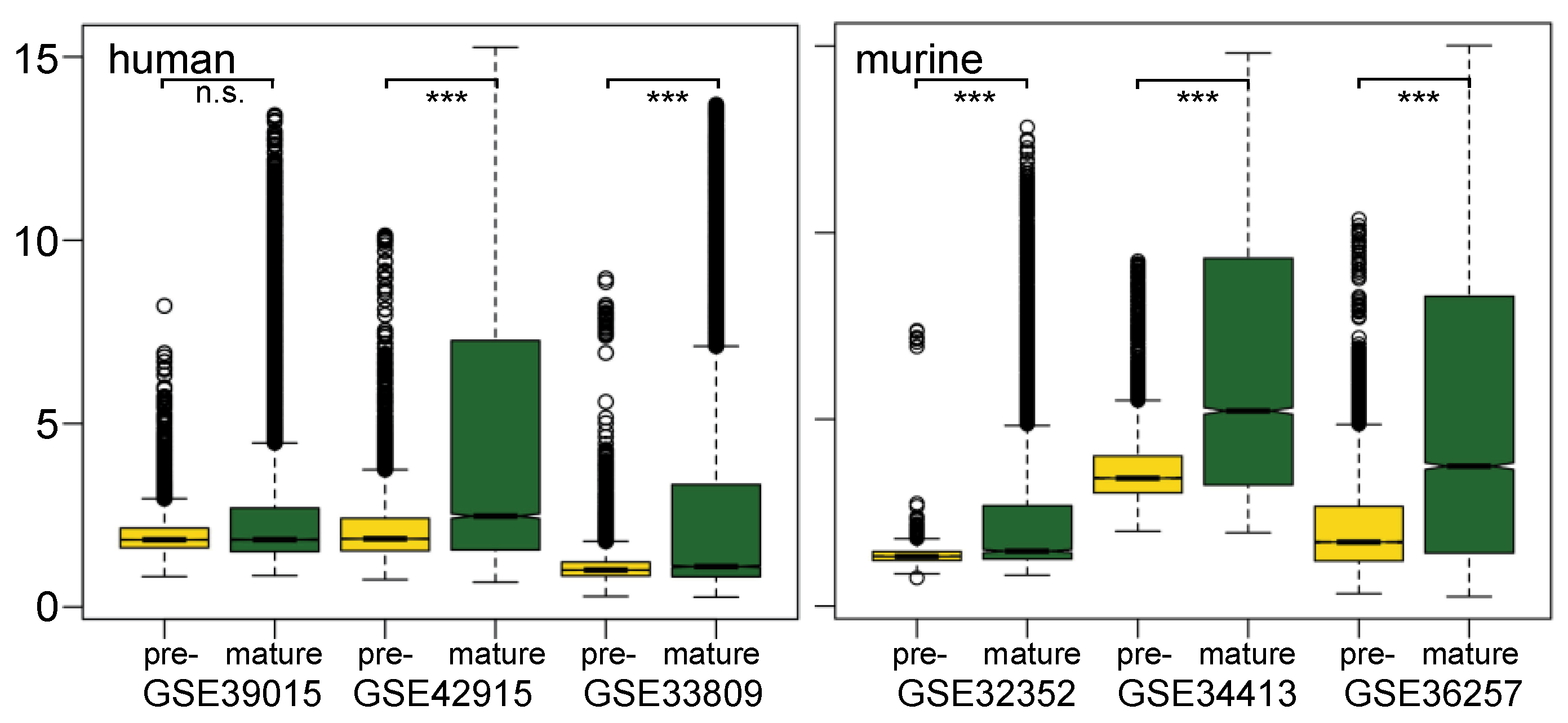
      <p>Affymetrix GeneChip<sup>®</sup> miRNA 2.0 arrays (Affymetrix, Santa Clara, California, USA) contain probes that interrogate the mature miRNA and pre-miRNA of a wide spectrum of species. In this study, profiling data of human and mouse samples (GSE39015 [<xref ref-type="bibr" rid="B25-microarrays-02-00024">25</xref>], GSE42915 and GSE33809 [<xref ref-type="bibr" rid="B26-microarrays-02-00024">26</xref>] focused on human samples; GSE33413 [<xref ref-type="bibr" rid="B27-microarrays-02-00024">27</xref>], GSE32352 [<xref ref-type="bibr" rid="B28-microarrays-02-00024">28</xref>] and GSE36257 [<xref ref-type="bibr" rid="B29-microarrays-02-00024">29</xref>] profiled mouse samples) on Affymetrix GeneChip miRNA 2.0 arrays (see <xref ref-type="table" rid="microarrays-02-00024-t001">Table 1</xref>) were retrieved from the Gene Expression Omnibus (GEO) database [<xref ref-type="bibr" rid="B30-microarrays-02-00024">30</xref>]. Raw data were normalized with the robust multi-array average (RMA). Present calls were made by using the detection above background (DABG) algorithm with a <italic>p</italic>-value cutoff of 0.05. Pre-miRNA and mature miRNA probes were identified according to annotations provided by Affymetrix. A paired <italic>t</italic>-test was applied on the median expression of miRNAs and pre-miRNAs for significancy calculations (see <xref ref-type="fig" rid="microarrays-02-00024-f001">Figure 1</xref>). </p>
      <table-wrap id="microarrays-02-00024-t001" position="float">
        <object-id pub-id-type="pii">microarrays-02-00024-t001_Table 1</object-id>
        <label>Table 1</label>
        <caption>
          <p>Information of data sets involved in this paper.</p>
        </caption>
        		<table rules="all" style="border: solid thin">
          <thead>
            <tr>
              <th align="left" valign="middle">Study</th>
              <th align="left" valign="middle">Species</th>
              <th align="center" valign="middle">No. of samples</th>
              <th align="left" valign="middle">Short Description of the Study</th>
              <th align="left" valign="middle">RNA extraction method</th>
            </tr>
          </thead>
          <tbody>
            <tr>
              <td align="left" valign="middle">GSE34413</td>
              <td align="left" valign="middle">
                <italic>M. musculus</italic>
              </td>
              <td align="center" valign="middle">18</td>
              <td align="left" valign="middle">whole brain tissue from day 70, fetal alcohol exposed males and matched controls</td>
              <td align="left" valign="middle">TRIzol (Invitrogen)</td>
            </tr>
            <tr>
              <td align="left" valign="middle">GSE32352</td>
              <td align="left" valign="middle">
                <italic>M. musculus</italic>
              </td>
              <td align="center" valign="middle">6</td>
              <td align="left" valign="middle">EC/NSPC co-cultures were incubated with FGF/VEGF receptor inhibitor and TGF-receptor inhibitor</td>
              <td align="left" valign="middle">mirVana miRNA (AB/Ambion)</td>
            </tr>
            <tr>
              <td align="left" valign="middle">GSE36257</td>
              <td align="left" valign="middle">
                <italic>M. musculus</italic>
              </td>
              <td align="center" valign="middle">24</td>
              <td align="left" valign="middle">heart, quadriceps femoris and diaphragm from 8-week-old male WT C57/B10 and male mdx C57/B10. </td>
              <td align="left" valign="middle">TRIzol (Invitrogen)</td>
            </tr>
            <tr>
              <td align="left" valign="middle">GSE39015</td>
              <td align="left" valign="middle">
                <italic>H. sapiens</italic>
              </td>
              <td align="center" valign="middle">18</td>
              <td align="left" valign="middle">2 cervix cell lines and 16 clinical tumor samples stored in FFPE</td>
              <td align="left" valign="middle">RecoverAll Total Nucleic Acid Isolation kit (Ambion)</td>
            </tr>
            <tr>
              <td align="left" valign="middle">GSE42915</td>
              <td align="left" valign="middle">
                <italic>H. sapiens</italic>
              </td>
              <td align="center" valign="middle">12</td>
              <td align="left" valign="middle">12 placentas (6 from first trimester and 6 from third trimester)</td>
              <td align="left" valign="middle">TRIzol (Invitrogen)</td>
            </tr>
            <tr>
              <td align="left" valign="middle">GSE33809</td>
              <td align="left" valign="middle">
                <italic>H. sapiens</italic>
              </td>
              <td align="center" valign="middle">24</td>
              <td align="left" valign="middle">SET2 cells were incubated with increasing concentrations of INC424/Ruxolitinib for 3-6 h</td>
              <td align="left" valign="middle">RNeasy Micro kit (Qiagen)</td>
            </tr>
          </tbody>
        </table>
        <table-wrap-foot>
        <fn>
        <p>EC, endothelial cell; NSPC, neuro stem/progenitor cell; FGF, fibroblast growth factor; VEGF, vascular endothelial growth factor; TGF, transforming growth factor; FFPE, formalin-fixed, paraffin-embedded.</p>
        </fn>
        </table-wrap-foot>
      </table-wrap>
      <fig id="microarrays-02-00024-f001" position="float">
        <label>Figure 1</label>
        <caption>
          <p>Distribution of normalized expression values of pre-miRNAs and mature miRNAs: shown are boxplots of miRNA expression values after normalization for all arrays in 3 human studies (left part) and 3 murine studies (right part). Yellow color represents pre-mature miRNA expression signals, and green color stands for mature miRNA expression signals. The ordinate shows transformed signal intensities in arbitrary units. Significance: n.s. = not significant; <bold>***</bold> = significant, with a <italic>p</italic>-value &lt; 0.001.</p>
        </caption>
        <graphic xmlns:xlink="http://www.w3.org/1999/xlink" xlink:href="microarrays-02-00024-g001.tif"/>
      </fig>
      
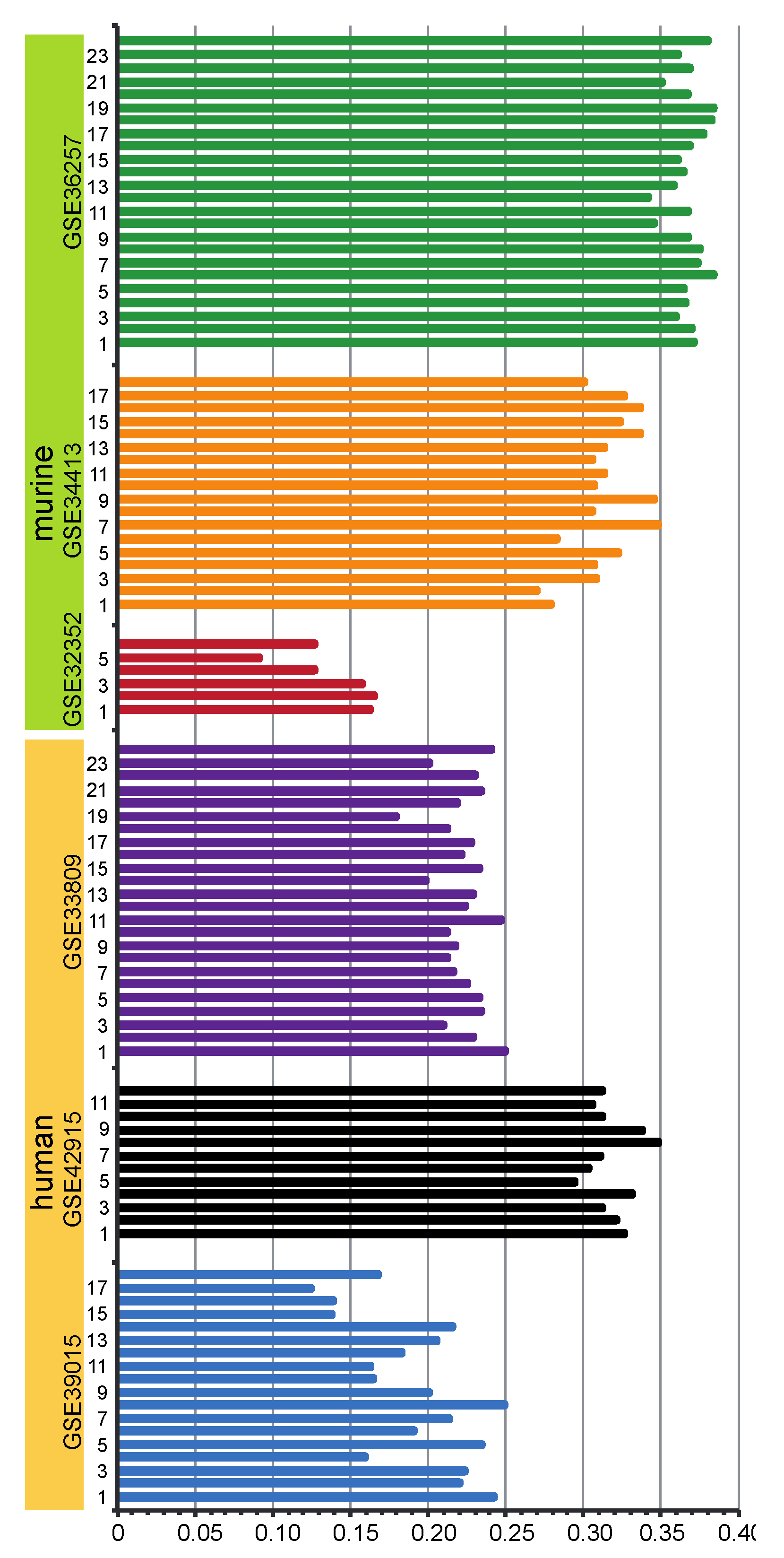
      <p>The correlation of pre- and mature miRNA expressions were studied under two different aspects: (i) for study, i, (i = a GEO study re-analyzed in this manuscript: GSE39015, GSE42915, GSE33809, GSE33413, GSE32352 and GSE36257), the expression values of pre-miRNAs can be described as <italic>V<sub>i</sub></italic><sub>,pre</sub> = {<italic>v</italic><sub>1,pre; </sub><italic>v</italic><sub>2,pre;</sub> …; <italic>v</italic><sub>j,pre</sub>|j = the array number in study i} and the expression values of mature miRNAs as <italic>V<sub>i</sub></italic><sub>,mature</sub> = {<italic>v</italic><sub>1,mature;</sub><italic> v</italic><sub>2,mature;</sub> …; <italic>v</italic><sub>j,mature</sub>|j = the array number in study i}. Pearson correlation coefficients were pairwise calculated between <italic>V<sub>i,</sub></italic><sub>pre</sub> and <italic>V<sub>i,</sub></italic><sub>mature</sub> for all arrays in studies, i, and then presented as a bar plot (see <xref ref-type="fig" rid="microarrays-02-00024-f004">Figure 4</xref>). (ii) The expression matrix, M, of pre-miRNA and mature miRNA in study, i, was defined as <italic>M</italic><sub>i,pre</sub> = {<italic>m</italic><sub>1,pre; </sub><italic>m</italic><sub>2,pre;</sub> …; <italic>m</italic><sub>k,pre</sub>|k = the number of pre-miRNAs on one array} and <italic>M</italic><sub>i,mature</sub> = {<italic>m</italic><sub>1,mature; </sub><italic>m</italic><sub>2,mature;</sub> …; <italic>m</italic><sub>k,mature</sub>|k = the number of mature miRNAs on one array}. Correlation between <italic>M</italic><sub>i,pre</sub> and <italic>M</italic><sub>i,mature</sub> was also calculated by pairwise Pearson correlation coefficients. The distribution of pairwise correlation coefficients of all miRNAs in every study were shown as a histogram (<xref ref-type="fig" rid="microarrays-02-00024-f005">Figure 5</xref>). Statistical analysis were completed with basic functions in R [<xref ref-type="bibr" rid="B31-microarrays-02-00024">31</xref>].</p>
      
    </sec>
    <sec sec-type="results">
      <title>3. Results and Discussion</title>
      <p>GeneChip<sup>®</sup> miRNA 2.0 has 4,592 probe sets for human and 1,412 probe sets for mouse. Seven hundred sixty seven pre-miRNAs and 919 mature miRNAs are annotated for human samples. For the mouse samples, 510 pre-miRNAs and 601 mature miRNAs are available on the platform. Eight hundred thirty six pre-miRNA/mature-miRNA pairs can be mapped in human miRNA annotation, while there are 579 according to the mouse annotation. </p>
      <sec>
        <title>3.1. Mature miRNAs Are More Abundantly Detected</title>
        <p>Pre-miRNAs showed lower expression in these data sets than their matured products. Boxplots of expression values of pre- and mature miRNAs in three human and three mouse studies, respectively, are shown (<xref ref-type="fig" rid="microarrays-02-00024-f001">Figure 1</xref>). In all murine studies, median expressions of pre-miRNA are significantly lower than those of mature miRNA, wherein one of the studies exhibits a minor difference (GSE32352). For human samples, the differences are not so pronounced; however, they are also significant for two of the three studies analyzed (GSE42915, GSE33809). At the same time, the upper quartiles of mature miRNAs distribution are located more in a higher expression value region. It is possible that mature miRNA is more enriched by sample preparation. Besides, the high stability observed by mature miRNAs could also contribute to their higher expression signal [<xref ref-type="bibr" rid="B32-microarrays-02-00024">32</xref>]. Moreover, the rapid processing of the intermediate product pre-miRNA might have an impact on the fewer copy number of pre-miRNA compared to the stable accumulating signal of mature miRNA. The lower expression value of pre-miRNA compared to its corresponding mature miRNA was also reported in another study using the RT-qPCR method [<xref ref-type="bibr" rid="B33-microarrays-02-00024">33</xref>]. Independent to the variety of individual samples, three data sets that used the same RNA isolation kit (GSE34413, GSE36257 and GSE42915) showed a similar pattern in expression value distribution. This observation indicates that sample preparation, especially RNA isolation, is a crucial factor for successful miRNA profiling. </p>
      </sec>
      <sec>
        <title>3.2. Much More Mature miRNAs than Pre-miRNA Were Detected as Present</title>
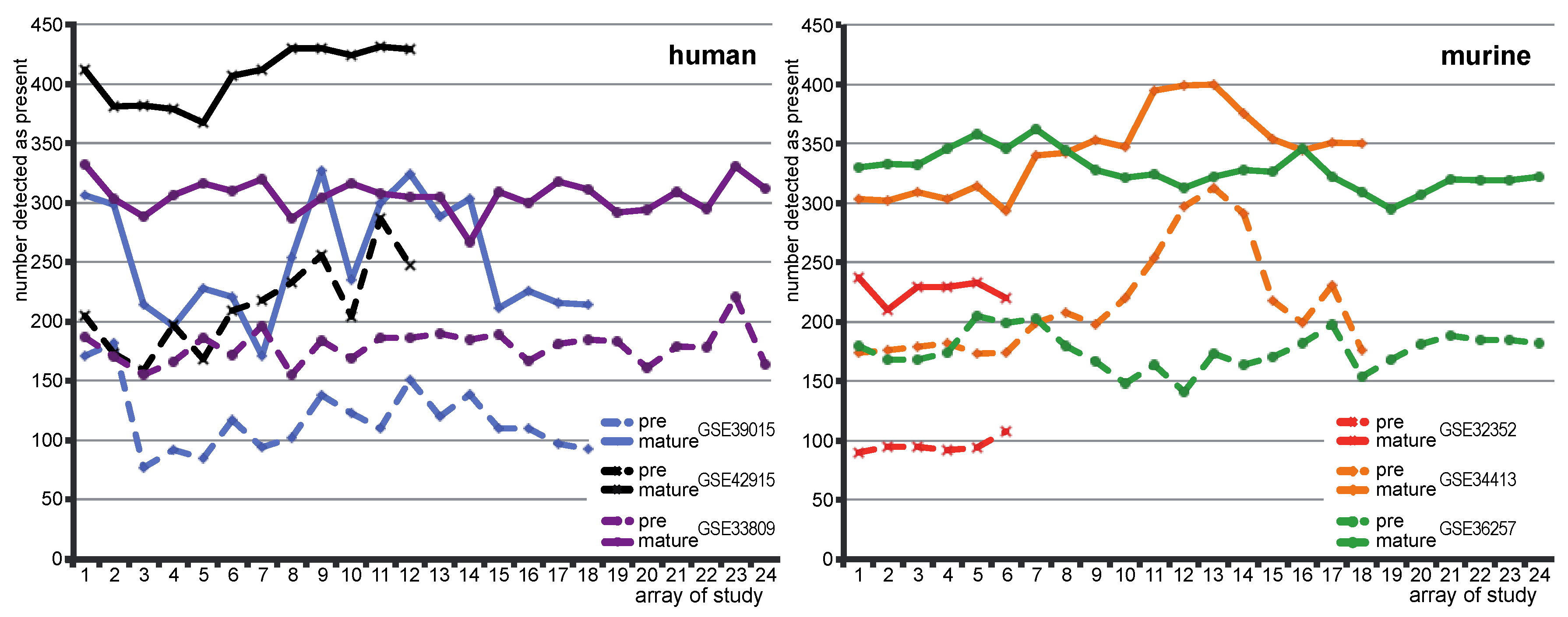
        <p>The general higher expression level of mature miRNA was also reflected in the detection call of present miRNAs. Present calls were made for pre-miRNA and mature miRNAs compared to background signals. Mature miRNAs have almost doubled present calls with respect to pre-miRNAs in all data sets (<xref ref-type="fig" rid="microarrays-02-00024-f002">Figure 2</xref>). </p>
        
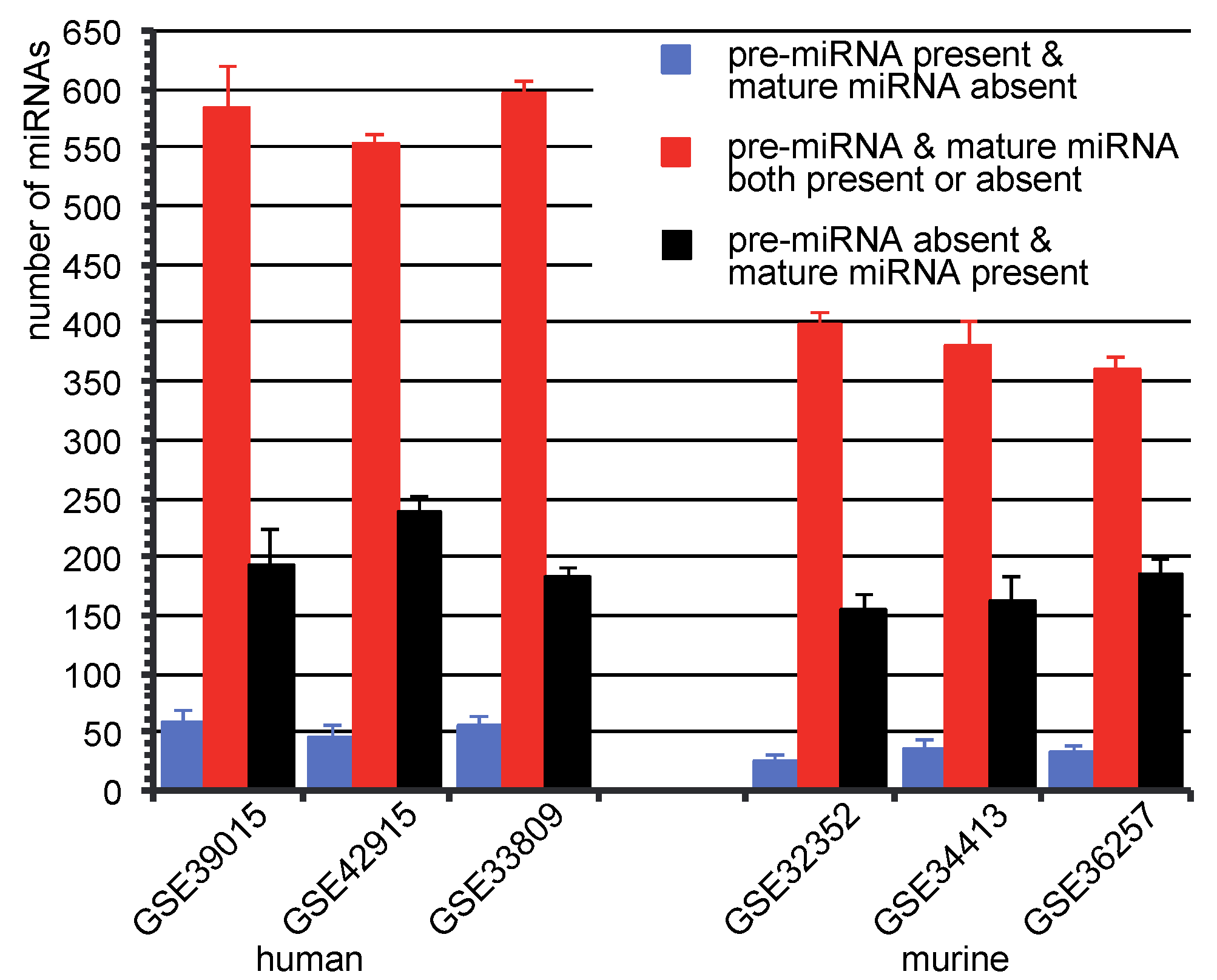
        <p>Most of the pre-miRNAs and mature miRNAs share the same present/absent calls. That means, present pre-miRNAs have present mature counterparts, and absent pre-miRNAs have also absent mature corresponding miRNAs (<xref ref-type="fig" rid="microarrays-02-00024-f003">Figure 3</xref>, red bars). However, there are also present pre-miRNAs, which have absent mature miRNA, and <italic>vice versa</italic> (<xref ref-type="fig" rid="microarrays-02-00024-f003">Figure 3</xref>, blue and black bars). miRNAs that were detected as present in mature form, but as absent in pre-miRNA form, could support the hypothesis that mature miRNAs are more stable than their precursor counterparts. As demonstrated, there was a few number of miRNAs that were present in their premature form, but absent in their mature form. This phenomenon indicates a possible miRNA transcription regulation by degrading mature miRNA [<xref ref-type="bibr" rid="B34-microarrays-02-00024">34</xref>]. The reduction of specific mature miRNAs compared to their pre-miRNAs was also reported in human colorectal neoplasia by Northern analysis [<xref ref-type="bibr" rid="B35-microarrays-02-00024">35</xref>]. </p>
        <fig id="microarrays-02-00024-f002" position="float">
          <label>Figure 2</label>
          <caption>
            <p>Number of pre-/mature miRNAs with present call in human (<bold>left</bold> panel) and murine studies (<bold>right</bold> panel): number of pre-miRNA and mature miRNA with present call on individual arrays in human and murine data sets. Dashed lines represent numbers of pre-miRNAs with a present call. Solid lines represent number of mature miRNAs with a present call. Colors of the lines distinguish different studies. Numbers on the abscissa indicate the numbers of arrays involved in corresponding data set.</p>
          </caption>
          <graphic xmlns:xlink="http://www.w3.org/1999/xlink" xlink:href="microarrays-02-00024-g002.tif"/>
        </fig>
        
        <fig id="microarrays-02-00024-f003" position="float">
          <label>Figure 3</label>
          <caption>
            <p>Number of miRNAs in three categories: average number of miRNAs with the standard deviation in the category, (i) pre-miRNA is called as present, while corresponded mature miRNA is called absent (blue bars), (ii) pre-miRNA and mature miRNA are called both present or absent (red bars) and (iii) pre-miRNA is called as absent, but mature miRNA is called present (black bars).</p>
          </caption>
          <graphic xmlns:xlink="http://www.w3.org/1999/xlink" xlink:href="microarrays-02-00024-g003.tif"/>
        </fig>
      </sec>
      <sec>
        <title>3.3. Correlation between Pre-miRNA Expression and Mature miRNA Expression</title>
        <p>The expression of mature miRNA and pre-miRNA measured on the same arrays showed a positive interdependency (<xref ref-type="fig" rid="microarrays-02-00024-f004">Figure 4</xref>). Notwithstanding different expression levels, a positive correlation did exist between expression of pre- and mature miRNAs on the same array. This is consistent with the results reported previously [<xref ref-type="bibr" rid="B36-microarrays-02-00024">36</xref>]. Correlation coefficients of pre- and mature miRNA on the same array in one data set were consistent, while the values clearly varied between different data sets. For example, GSE32352 demonstrated a much lower correlation coefficient between pre- and mature miRNA expression. GSE34413, GSE36257 and GSE42915 showed similar correlation coefficients. While in the studies, GSE34413, GSE36257 and GSE42915, the same RNA isolation kit (TRIzol from Invitrogen) was used; in the GSE32352 study, the mirVana RNA isolation kit (Ambion) was used. For this reason, we believe that the observed correlation coefficients were strongly affected by the choice of sample preparation. The influence of the kind of probe labeling can be excluded, because all probes were labeled with the same kit (FlashTag biotin HSR kit from Genisphere).</p>
        <fig id="microarrays-02-00024-f004" position="float">
        <label>Figure 4</label>
        <caption>
          <p>Correlation of pre-/mature miRNA expression: shown are the correlations of pre-miRNA and mature miRNA expression on the same arrays of murine (upper part) and human <bold>(</bold>lower part) data sets. The abscissa indicates correlation coefficients. In the ordinate axis, the number of arrays involved in the corresponding study are shown.</p>
        </caption>
        <graphic xmlns:xlink="http://www.w3.org/1999/xlink" xlink:href="microarrays-02-00024-g004.tif"/>
      </fig>
      
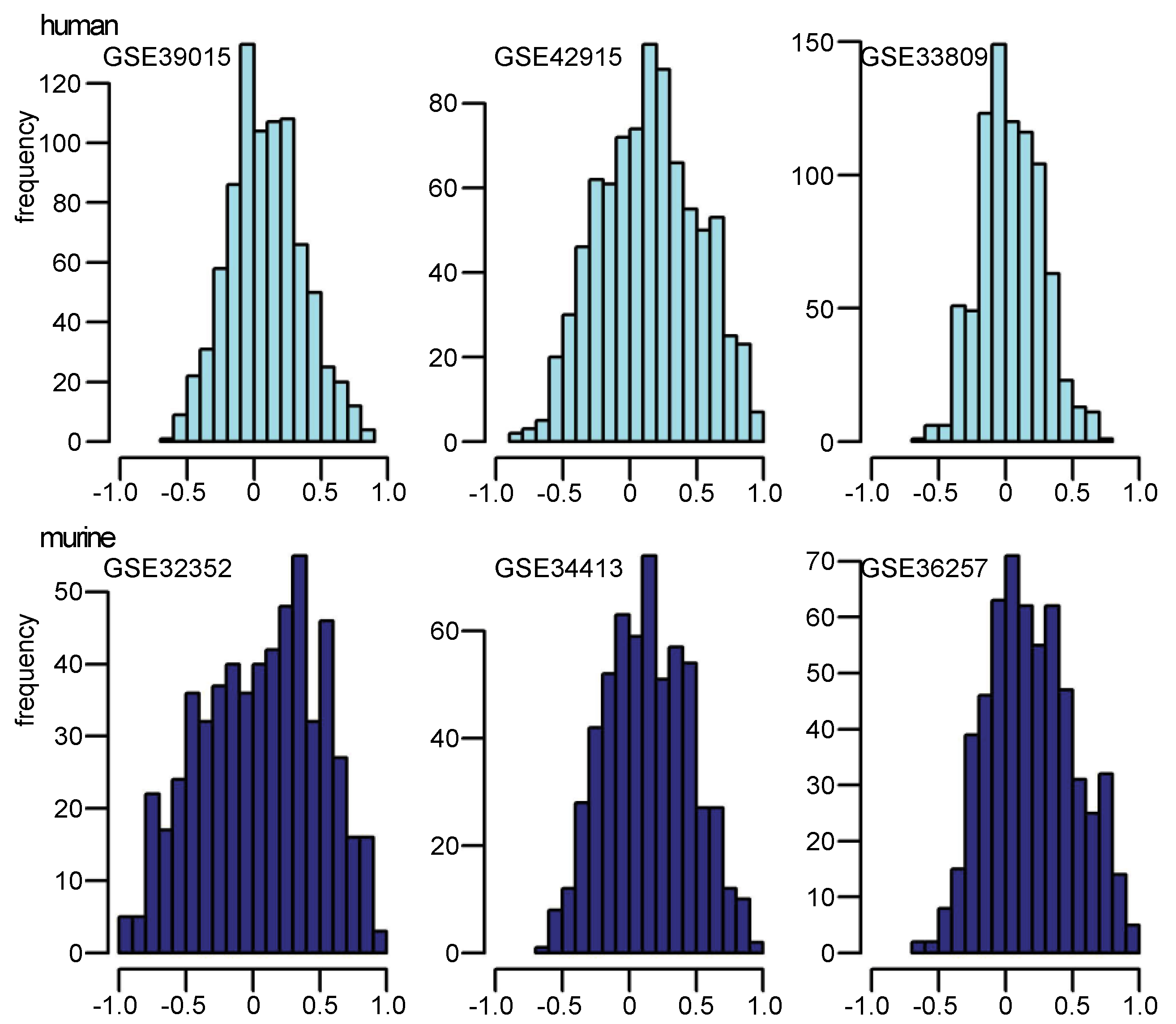
        <p>Correlation coefficients were also calculated for the expression profile of every mature miRNA to its corresponding pre-miRNA across the arrays in the data sets. These coefficients support the evidence of the dependency between pre-miRNA and mature miRNA expression regulation, which differs according to different tissue sources and/or treatments. Correlation coefficients for all miRNAs in each study have been calculated between the pre-miRNA expression pattern and the mature miRNA expression pattern (<xref ref-type="fig" rid="microarrays-02-00024-f005">Figure 5</xref>). In all data sets analyzed in this paper, correlation coefficients were widely distributed between −1 and 1. In particular, not only positive coefficients were observed, but also extreme negative ones. That means that upregulation of mature miRNA can be observed in a study even when the corresponding pre-miRNA is downregulated. This result indicates that during maturation of pre-miRNA to mature miRNA, complex factors are involved in regulation, depending on the kind of treatment, tissue-specific development or different biological/pathological contexts.</p>
        <fig id="microarrays-02-00024-f005" position="float">
        <label>Figure 5</label>
        <caption>
          <p>The correlation of pre-/mature miRNA expression according to expression pattern: histograms of correlation coefficients of all pre-miRNA and its corresponding mature miRNA expression patterns in three human (upper part with light blue bars) and three murine (lower part with blue bars) studies. Abscissae indicate correlation coefficients. </p>
        </caption>
        <graphic xmlns:xlink="http://www.w3.org/1999/xlink" xlink:href="microarrays-02-00024-g005.tif"/>
      </fig>
      </sec>
    </sec>
    <sec sec-type="conclusions">
      <title>4. Conclusions</title>
      <p>Six publicly available miRNA profiling raw data sets generated from human and mouse samples on Affymetrix GeneChip<sup>®</sup> miRNA 2.0 array platforms were re-analyzed in this study. Pre-miRNA and mature miRNA expression signals were retrieved and normalized to gain comparable signals. miRNA precursors exhibited a lower expression level in most of the analyzed data sets. Present calls of individual mature miRNAs and pre-miRNAs showed a great part consistency, with minor discrepancies. On the same array, mature miRNA expressions are positively correlated to pre-miRNA expressions. The distribution of expression values of pre-miRNA and mature miRNA, as well as the correlation coefficients between them, seem to be influenced by the RNA isolation methods applied in the studies. Because of the sample size limitation and the lack of other experimental verifications, we are not able to judge the pros and cons of RNA isolation methods for miRNA profiling at this point. </p>
      <p>The expression regulation patterns of mature miRNAs showed no clear positive correlation to the expression regulation patterns of the corresponding pre-miRNAs. Therefore, we believe in the existence of regulation factors of miRNA maturation according to treatment, tissue type and biological/pathological contexts involved in individual studies. The results presented in this paper require definitely further research and verification with more data sets and with other techniques, like RT-qPCR. Nevertheless, our study demonstrated the possibility of profiling pre-miRNA and mature miRNA simultaneously without separate sample preparation. Compared to methods like RT-qPCR, the microarray platform applied in this paper has the advantage of data normalization without the bias caused by specific reference RNA(s). At the same time, we can obtain a genome-wide overview for pre-miRNA and miRNA expression. An additional advantage of this platform is that only one simple labeling procedure is sufficient for both pre-miRNA and mature miRNA profiling. </p>
    </sec>
    
  </body>
  <back>
  
    <ack>
      <title>Acknowledgements</title>
      <p>The authors thank Arian Aryani Kashani for careful revision of the manuscript.</p>
    </ack>
    <notes>
      <title>Conflict of Interest</title>
      <p>The authors declare no conflict of interest.</p>
    </notes>
    <ref-list>
      <title>References</title>
      <ref id="B1-microarrays-02-00024">
        <label>1.</label>
        <citation citation-type="journal">
          <person-group person-group-type="author">
            <name>
              <surname>Bushati</surname>
              <given-names>N.</given-names>
            </name>
            <name>
              <surname>Cohen</surname>
              <given-names>S.M.</given-names>
            </name>
          </person-group>
          <article-title>MicroRNA functions</article-title>
          <source>Annu. Rev. Cell Dev. Biol.</source>
          <year>2007</year>
          <volume>23</volume>
          <fpage>175</fpage>
          <lpage>205</lpage>
          <pub-id pub-id-type="doi">10.1146/annurev.cellbio.23.090506.123406</pub-id>
        </citation>
      </ref>
      <ref id="B2-microarrays-02-00024">
        <label>2.</label>
        <citation citation-type="journal">
          <person-group person-group-type="author">
            <name>
              <surname>Wightman</surname>
              <given-names>B.</given-names>
            </name>
            <name>
              <surname>Ha</surname>
              <given-names>I.</given-names>
            </name>
            <name>
              <surname>Ruvkun</surname>
              <given-names>G.</given-names>
            </name>
          </person-group>
          <article-title>Posttranscriptional regulation of the heterochronic gene <italic>lin-14</italic> by <italic>lin-4</italic> mediates temporal pattern formation in C. elegans</article-title>
          <source>Cell</source>
          <year>1993</year>
          <volume>75</volume>
          <fpage>855</fpage>
          <lpage>862</lpage>
          <pub-id pub-id-type="doi">10.1016/0092-8674(93)90530-4</pub-id>
        </citation>
      </ref>
      <ref id="B3-microarrays-02-00024">
        <label>3.</label>
        <citation citation-type="journal">
          <person-group person-group-type="author">
            <name>
              <surname>He</surname>
              <given-names>L.</given-names>
            </name>
            <name>
              <surname>Hannon</surname>
              <given-names>G.J.</given-names>
            </name>
          </person-group>
          <article-title>MicroRNAs: Small RNAs with a big role in gene regulation</article-title>
          <source>Nat. Rev. Genet.</source>
          <year>2004</year>
          <volume>5</volume>
          <fpage>522</fpage>
          <lpage>531</lpage>
          <pub-id pub-id-type="doi">10.1038/nrg1379</pub-id>
        </citation>
      </ref>
      <ref id="B4-microarrays-02-00024">
        <label>4.</label>
        <citation citation-type="journal">
          <person-group person-group-type="author">
            <name>
              <surname>Lee</surname>
              <given-names>Y.</given-names>
            </name>
            <name>
              <surname>Kim</surname>
              <given-names>M.</given-names>
            </name>
            <name>
              <surname>Han</surname>
              <given-names>J.</given-names>
            </name>
            <name>
              <surname>Yeom</surname>
              <given-names>K.H.</given-names>
            </name>
            <name>
              <surname>Lee</surname>
              <given-names>S.</given-names>
            </name>
            <name>
              <surname>Baek</surname>
              <given-names>S.H.</given-names>
            </name>
            <name>
              <surname>Kim</surname>
              <given-names>V.N.</given-names>
            </name>
          </person-group>
          <article-title>MicroRNA genes are transcribed by RNA polymerase II</article-title>
          <source>Embo. J.</source>
          <year>2004</year>
          <volume>23</volume>
          <fpage>4051</fpage>
          <lpage>4060</lpage>
          <pub-id pub-id-type="doi">10.1038/sj.emboj.7600385</pub-id>
        </citation>
      </ref>
      <ref id="B5-microarrays-02-00024">
        <label>5.</label>
        <citation citation-type="journal">
          <person-group person-group-type="author">
            <name>
              <surname>Lee</surname>
              <given-names>Y.</given-names>
            </name>
            <name>
              <surname>Ahn</surname>
              <given-names>C.</given-names>
            </name>
            <name>
              <surname>Han</surname>
              <given-names>J.</given-names>
            </name>
            <name>
              <surname>Choi</surname>
              <given-names>H.</given-names>
            </name>
            <name>
              <surname>Kim</surname>
              <given-names>J.</given-names>
            </name>
            <name>
              <surname>Yim</surname>
              <given-names>J.</given-names>
            </name>
            <name>
              <surname>Lee</surname>
              <given-names>J.</given-names>
            </name>
            <name>
              <surname>Provost</surname>
              <given-names>P.</given-names>
            </name>
            <name>
              <surname>Radmark</surname>
              <given-names>O.</given-names>
            </name>
            <name>
              <surname>Kim</surname>
              <given-names>S.</given-names>
            </name>
            <name>
              <surname>Kim</surname>
              <given-names>V.N.</given-names>
            </name>
          </person-group>
          <article-title>The nuclear RNase III Drosha initiates microRNA processing</article-title>
          <source>Nature</source>
          <year>2003</year>
          <volume>425</volume>
          <fpage>415</fpage>
          <lpage>419</lpage>
          <pub-id pub-id-type="doi">10.1038/nature01957</pub-id>
        </citation>
      </ref>
      <ref id="B6-microarrays-02-00024">
        <label>6.</label>
        <citation citation-type="journal">
          <person-group person-group-type="author">
            <name>
              <surname>Murchison</surname>
              <given-names>E.P.</given-names>
            </name>
            <name>
              <surname>Hannon</surname>
              <given-names>G.J.</given-names>
            </name>
          </person-group>
          <article-title>miRNAs on the move: miRNA biogenesis and the RNAi machinery</article-title>
          <source>Curr. Opin. Cell Biol.</source>
          <year>2004</year>
          <volume>16</volume>
          <fpage>223</fpage>
          <lpage>229</lpage>
          <pub-id pub-id-type="doi">10.1016/j.ceb.2004.04.003</pub-id>
        </citation>
      </ref>
      <ref id="B7-microarrays-02-00024">
        <label>7.</label>
        <citation citation-type="journal">
          <person-group person-group-type="author">
            <name>
              <surname>Bernstein</surname>
              <given-names>E.</given-names>
            </name>
            <name>
              <surname>Caudy</surname>
              <given-names>A.A.</given-names>
            </name>
            <name>
              <surname>Hammond</surname>
              <given-names>S.M.</given-names>
            </name>
            <name>
              <surname>Hannon</surname>
              <given-names>G.J.</given-names>
            </name>
          </person-group>
          <article-title>Role for a bidentate ribonuclease in the initiation step of RNA interference</article-title>
          <source>Nature</source>
          <year>2001</year>
          <volume>409</volume>
          <fpage>363</fpage>
          <lpage>366</lpage>
        <pub-id pub-id-type="doi">10.1038/35053110</pub-id><pub-id pub-id-type="pmid">11201747</pub-id></citation>
      </ref>
      <ref id="B8-microarrays-02-00024">
        <label>8.</label>
        <citation citation-type="journal">
          <person-group person-group-type="author">
            <name>
              <surname>Hutvagner</surname>
              <given-names>G.</given-names>
            </name>
            <name>
              <surname>McLachlan</surname>
              <given-names>J.</given-names>
            </name>
            <name>
              <surname>Pasquinelli</surname>
              <given-names>A.E.</given-names>
            </name>
            <name>
              <surname>Balint</surname>
              <given-names>E.</given-names>
            </name>
            <name>
              <surname>Tuschl</surname>
              <given-names>T.</given-names>
            </name>
            <name>
              <surname>Zamore</surname>
              <given-names>P.D.</given-names>
            </name>
          </person-group>
          <article-title>A cellular function for the RNA-interference enzyme Dicer in the maturation of the <italic>let-7 </italic>small temporal RNA</article-title>
          <source>Science</source>
          <year>2001</year>
          <volume>293</volume>
          <fpage>834</fpage>
          <lpage>838</lpage>
          <pub-id pub-id-type="doi">10.1126/science.1062961</pub-id>
        </citation>
      </ref>
      <ref id="B9-microarrays-02-00024">
        <label>9.</label>
        <citation citation-type="journal">
          <person-group person-group-type="author">
            <name>
              <surname>Lelandais-Briere</surname>
              <given-names>C.</given-names>
            </name>
            <name>
              <surname>Sorin</surname>
              <given-names>C.</given-names>
            </name>
            <name>
              <surname>Declerck</surname>
              <given-names>M.</given-names>
            </name>
            <name>
              <surname>Benslimane</surname>
              <given-names>A.</given-names>
            </name>
            <name>
              <surname>Crespi</surname>
              <given-names>M.</given-names>
            </name>
            <name>
              <surname>Hartmann</surname>
              <given-names>C.</given-names>
            </name>
          </person-group>
          <article-title>Small RNA diversity in plants and its impact in development</article-title>
          <source>Curr. Genomics</source>
          <year>2010</year>
          <volume>11</volume>
          <fpage>14</fpage>
          <lpage>23</lpage>
        <pub-id pub-id-type="doi">10.2174/138920210790217918</pub-id><pub-id pub-id-type="pmid">20808519</pub-id></citation>
      </ref>
      <ref id="B10-microarrays-02-00024">
        <label>10.</label>
        <citation citation-type="journal">
          <person-group person-group-type="author">
            <name>
              <surname>Bartel</surname>
              <given-names>D.P.</given-names>
            </name>
          </person-group>
          <article-title>MicroRNAs: Target recognition and regulatory functions</article-title>
          <source>Cell</source>
          <year>2009</year>
          <volume>136</volume>
          <fpage>215</fpage>
          <lpage>233</lpage>
          <pub-id pub-id-type="doi">10.1016/j.cell.2009.01.002</pub-id>
        </citation>
      </ref>
      <ref id="B11-microarrays-02-00024">
        <label>11.</label>
        <citation citation-type="journal">
          <person-group person-group-type="author">
            <name>
              <surname>Shukla</surname>
              <given-names>G.C.</given-names>
            </name>
            <name>
              <surname>Singh</surname>
              <given-names>J.</given-names>
            </name>
            <name>
              <surname>Barik</surname>
              <given-names>S.</given-names>
            </name>
          </person-group>
          <article-title>MicroRNAs: Processing, maturation, target recognition and regulatory functions</article-title>
          <source>Mol. Cell. Pharmacol.</source>
          <year>2011</year>
          <volume>3</volume>
          <fpage>83</fpage>
          <lpage>92</lpage>
        <pub-id pub-id-type="pmid">22468167</pub-id></citation>
      </ref>
      <ref id="B12-microarrays-02-00024">
        <label>12.</label>
        <citation citation-type="journal">
          <person-group person-group-type="author">
            <name>
              <surname>Varallyay</surname>
              <given-names>E.</given-names>
            </name>
            <name>
              <surname>Burgyan</surname>
              <given-names>J.</given-names>
            </name>
            <name>
              <surname>Havelda</surname>
              <given-names>Z.</given-names>
            </name>
          </person-group>
          <article-title>MicroRNA detection by northern blotting using locked nucleic acid probes</article-title>
          <source>Nat. Protoc.</source>
          <year>2008</year>
          <volume>3</volume>
          <fpage>190</fpage>
          <lpage>196</lpage>
          <pub-id pub-id-type="doi">10.1038/nprot.2007.528</pub-id>
        </citation>
      </ref>
      <ref id="B13-microarrays-02-00024">
        <label>13.</label>
        <citation citation-type="journal">
          <person-group person-group-type="author">
            <name>
              <surname>Porkka</surname>
              <given-names>K.P.</given-names>
            </name>
            <name>
              <surname>Pfeiffer</surname>
              <given-names>M.J.</given-names>
            </name>
            <name>
              <surname>Waltering</surname>
              <given-names>K.K.</given-names>
            </name>
            <name>
              <surname>Vessella</surname>
              <given-names>R.L.</given-names>
            </name>
            <name>
              <surname>Tammela</surname>
              <given-names>T.L.</given-names>
            </name>
            <name>
              <surname>Visakorpi</surname>
              <given-names>T.</given-names>
            </name>
          </person-group>
          <article-title>MicroRNA expression profiling in prostate cancer</article-title>
          <source>Cancer Res.</source>
          <year>2007</year>
          <volume>67</volume>
          <fpage>6130</fpage>
          <lpage>6135</lpage>
          <pub-id pub-id-type="doi">10.1158/0008-5472.CAN-07-0533</pub-id>
        </citation>
      </ref>
      <ref id="B14-microarrays-02-00024">
        <label>14.</label>
        <citation citation-type="journal">
          <person-group person-group-type="author">
            <name>
              <surname>Raymond</surname>
              <given-names>C.K.</given-names>
            </name>
            <name>
              <surname>Roberts</surname>
              <given-names>B.S.</given-names>
            </name>
            <name>
              <surname>Garrett-Engele</surname>
              <given-names>P.</given-names>
            </name>
            <name>
              <surname>Lim</surname>
              <given-names>L.P.</given-names>
            </name>
            <name>
              <surname>Johnson</surname>
              <given-names>J.M.</given-names>
            </name>
          </person-group>
          <article-title>Simple, quantitative primer-extension PCR assay for direct monitoring of microRNAs and short-interfering RNAs</article-title>
          <source>RNA</source>
          <year>2005</year>
          <volume>11</volume>
          <fpage>1737</fpage>
          <lpage>1744</lpage>
          <pub-id pub-id-type="doi">10.1261/rna.2148705</pub-id>
        </citation>
      </ref>
      <ref id="B15-microarrays-02-00024">
        <label>15.</label>
        <citation citation-type="journal">
          <person-group person-group-type="author">
            <name>
              <surname>Fiedler</surname>
              <given-names>S.D.</given-names>
            </name>
            <name>
              <surname>Carletti</surname>
              <given-names>M.Z.</given-names>
            </name>
            <name>
              <surname>Christenson</surname>
              <given-names>L.K.</given-names>
            </name>
          </person-group>
          <article-title>Quantitative RT-PCR methods for mature microRNA expression analysis</article-title>
          <source>Methods Mol. Biol.</source>
          <year>2010</year>
          <volume>630</volume>
          <fpage>49</fpage>
          <lpage>64</lpage>
          <pub-id pub-id-type="doi">10.1007/978-1-60761-629-0_4</pub-id>
        </citation>
      </ref>
      <ref id="B16-microarrays-02-00024">
        <label>16.</label>
        <citation citation-type="journal">
          <person-group person-group-type="author">
            <name>
              <surname>Pritchard</surname>
              <given-names>C.C.</given-names>
            </name>
            <name>
              <surname>Cheng</surname>
              <given-names>H.H.</given-names>
            </name>
            <name>
              <surname>Tewari</surname>
              <given-names>M.</given-names>
            </name>
          </person-group>
          <article-title>MicroRNA profiling: Approaches and considerations</article-title>
          <source>Nat. Rev. Genet.</source>
          <year>2012</year>
          <volume>13</volume>
          <fpage>358</fpage>
          <lpage>369</lpage>
          <pub-id pub-id-type="doi">10.1038/nrg3198</pub-id>
        </citation>
      </ref>
      <ref id="B17-microarrays-02-00024">
        <label>17.</label>
        <citation citation-type="journal">
          <person-group person-group-type="author">
            <name>
              <surname>Baker</surname>
              <given-names>M.</given-names>
            </name>
          </person-group>
          <article-title>MicroRNA profiling: Separating signal from noise</article-title>
          <source>Nat. Methods</source>
          <year>2010</year>
          <volume>7</volume>
          <fpage>687</fpage>
          <lpage>692</lpage>
          <pub-id pub-id-type="doi">10.1038/nmeth0910-687</pub-id>
        </citation>
      </ref>
      <ref id="B18-microarrays-02-00024">
        <label>18.</label>
        <citation citation-type="journal">
          <person-group person-group-type="author">
            <name>
              <surname>Schena</surname>
              <given-names>M.</given-names>
            </name>
            <name>
              <surname>Shalon</surname>
              <given-names>D.</given-names>
            </name>
            <name>
              <surname>Davis</surname>
              <given-names>R.W.</given-names>
            </name>
            <name>
              <surname>Brown</surname>
              <given-names>P.O.</given-names>
            </name>
          </person-group>
          <article-title>Quantitative monitoring of gene expression patterns with a complementary DNA microarray</article-title>
          <source>Science</source>
          <year>1995</year>
          <volume>270</volume>
          <fpage>467</fpage>
          <lpage>470</lpage>
        <pub-id pub-id-type="doi">10.1126/science.270.5235.467</pub-id><pub-id pub-id-type="pmid">7569999</pub-id></citation>
      </ref>
      <ref id="B19-microarrays-02-00024">
        <label>19.</label>
        <citation citation-type="journal">
          <person-group person-group-type="author">
            <name>
              <surname>Liu</surname>
              <given-names>C.G.</given-names>
            </name>
            <name>
              <surname>Calin</surname>
              <given-names>G.A.</given-names>
            </name>
            <name>
              <surname>Volinia</surname>
              <given-names>S.</given-names>
            </name>
            <name>
              <surname>Croce</surname>
              <given-names>C.M.</given-names>
            </name>
          </person-group>
          <article-title>MicroRNA expression profiling using microarrays</article-title>
          <source>Nat. Protoc.</source>
          <year>2008</year>
          <volume>3</volume>
          <fpage>563</fpage>
          <lpage>578</lpage>
        <pub-id pub-id-type="pmid">18388938</pub-id></citation>
      </ref>
      <ref id="B20-microarrays-02-00024">
        <label>20.</label>
        <citation citation-type="journal">
          <person-group person-group-type="author">
            <name>
              <surname>Viswanathan</surname>
              <given-names>S.R.</given-names>
            </name>
            <name>
              <surname>Daley</surname>
              <given-names>G.Q.</given-names>
            </name>
            <name>
              <surname>Gregory</surname>
              <given-names>R.I.</given-names>
            </name>
          </person-group>
          <article-title>Selective blockade of microRNA processing by Lin28</article-title>
          <source>Science</source>
          <year>2008</year>
          <volume>320</volume>
          <fpage>97</fpage>
          <lpage>100</lpage>
          <pub-id pub-id-type="doi">10.1126/science.1154040</pub-id>
        </citation>
      </ref>
      <ref id="B21-microarrays-02-00024">
        <label>21.</label>
        <citation citation-type="journal">
          <person-group person-group-type="author">
            <name>
              <surname>O’Hara</surname>
              <given-names>A.J.</given-names>
            </name>
            <name>
              <surname>Chugh</surname>
              <given-names>P.</given-names>
            </name>
            <name>
              <surname>Wang</surname>
              <given-names>L.</given-names>
            </name>
            <name>
              <surname>Netto</surname>
              <given-names>E.M.</given-names>
            </name>
            <name>
              <surname>Luz</surname>
              <given-names>E.</given-names>
            </name>
            <name>
              <surname>Harrington</surname>
              <given-names>W.J.</given-names>
            </name>
            <name>
              <surname>Dezube</surname>
              <given-names>B.J.</given-names>
            </name>
            <name>
              <surname>Damania</surname>
              <given-names>B.</given-names>
            </name>
            <name>
              <surname>Dittmer</surname>
              <given-names>D.P.</given-names>
            </name>
          </person-group>
          <article-title>Pre-micro RNA signatures delineate stages of endothelial cell transformation in Kaposi sarcoma</article-title>
          <source>PLoS Pathog.</source>
          <year>2009</year>
          <volume>5</volume>
          <pub-id pub-id-type="doi">10.1371/journal.ppat.1000389</pub-id>
        </citation>
      </ref>
      <ref id="B22-microarrays-02-00024">
        <label>22.</label>
        <citation citation-type="journal">
          <person-group person-group-type="author">
            <name>
              <surname>O’Hara</surname>
              <given-names>A.J.</given-names>
            </name>
            <name>
              <surname>Vahrson</surname>
              <given-names>W.</given-names>
            </name>
            <name>
              <surname>Dittmer</surname>
              <given-names>D.P.</given-names>
            </name>
          </person-group>
          <article-title>Gene alteration and precursor and mature microRNA transcription changes contribute to the miRNA signature of primary effusion lymphoma</article-title>
          <source>Blood</source>
          <year>2008</year>
          <volume>111</volume>
          <fpage>2347</fpage>
          <lpage>2353</lpage>
          <pub-id pub-id-type="doi">10.1182/blood-2007-08-104463</pub-id>
        </citation>
      </ref>
      <ref id="B23-microarrays-02-00024">
        <label>23.</label>
        <citation citation-type="journal">
          <person-group person-group-type="author">
            <name>
              <surname>Chugh</surname>
              <given-names>P.</given-names>
            </name>
            <name>
              <surname>Tamburro</surname>
              <given-names>K.</given-names>
            </name>
            <name>
              <surname>Dittmer</surname>
              <given-names>D.P.</given-names>
            </name>
          </person-group>
          <article-title>Profiling of pre-micro RNAs and microRNAs using quantitative real-time PCR (qPCR) arrays</article-title>
          <source>J. Vis. Exp.</source>
          <year>2010</year>
          <pub-id pub-id-type="doi">10.3791/2210</pub-id>
        </citation>
      </ref>
      <ref id="B24-microarrays-02-00024">
        <label>24.</label>
        <citation citation-type="journal">
          <person-group person-group-type="author">
            <name>
              <surname>Burroughs</surname>
              <given-names>A.M.</given-names>
            </name>
            <name>
              <surname>Kawano</surname>
              <given-names>M.</given-names>
            </name>
            <name>
              <surname>Ando</surname>
              <given-names>Y.</given-names>
            </name>
            <name>
              <surname>Daub</surname>
              <given-names>C.O.</given-names>
            </name>
            <name>
              <surname>Hayashizaki</surname>
              <given-names>Y.</given-names>
            </name>
          </person-group>
          <article-title>Pre-miRNA profiles obtained through application of locked nucleic acids and deep sequencing reveals complex 5'/3' arm variation, including concomitant cleavage and polyuridylation patterns</article-title>
          <source>Nucleic Acids Res.</source>
          <year>2012</year>
          <volume>40</volume>
          <fpage>1424</fpage>
          <lpage>1437</lpage>
          <pub-id pub-id-type="doi">10.1093/nar/gkr903</pub-id>
        </citation>
      </ref>
      <ref id="B25-microarrays-02-00024">
        <label>25.</label>
        <citation citation-type="journal">
          <person-group person-group-type="author">
            <name>
              <surname>Hall</surname>
              <given-names>J.S.</given-names>
            </name>
            <name>
              <surname>Taylor</surname>
              <given-names>J.</given-names>
            </name>
            <name>
              <surname>Valentine</surname>
              <given-names>H.R.</given-names>
            </name>
            <name>
              <surname>Irlam</surname>
              <given-names>J.J.</given-names>
            </name>
            <name>
              <surname>Eustace</surname>
              <given-names>A.</given-names>
            </name>
            <name>
              <surname>Hoskin</surname>
              <given-names>P.J.</given-names>
            </name>
            <name>
              <surname>Miller</surname>
              <given-names>C.J.</given-names>
            </name>
            <name>
              <surname>West</surname>
              <given-names>C.M.</given-names>
            </name>
          </person-group>
          <article-title>Enhanced stability of microRNA expression facilitates classification of FFPE tumour samples exhibiting near total mRNA degradation</article-title>
          <source>Br. J. Cancer</source>
          <year>2012</year>
          <volume>107</volume>
          <fpage>684</fpage>
          <lpage>694</lpage>
          <pub-id pub-id-type="doi">10.1038/bjc.2012.294</pub-id>
        </citation>
      </ref>
      <ref id="B26-microarrays-02-00024">
        <label>26.</label>
        <citation citation-type="journal">
          <person-group person-group-type="author">
            <name>
              <surname>Bortoluzzi</surname>
              <given-names>S.</given-names>
            </name>
            <name>
              <surname>Bisognin</surname>
              <given-names>A.</given-names>
            </name>
            <name>
              <surname>Biasiolo</surname>
              <given-names>M.</given-names>
            </name>
            <name>
              <surname>Guglielmelli</surname>
              <given-names>P.</given-names>
            </name>
            <name>
              <surname>Biamonte</surname>
              <given-names>F.</given-names>
            </name>
            <name>
              <surname>Norfo</surname>
              <given-names>R.</given-names>
            </name>
            <name>
              <surname>Manfredini</surname>
              <given-names>R.</given-names>
            </name>
            <name>
              <surname>Vannucchi</surname>
              <given-names>A.M.</given-names>
            </name>
          </person-group>
          <article-title>Characterization and discovery of novel miRNAs and moRNAs in JAK2V617F-mutated SET2 cells</article-title>
          <source>Blood</source>
          <year>2012</year>
          <volume>119</volume>
          <fpage>e120</fpage>
          <lpage>e130</lpage>
          <pub-id pub-id-type="doi">10.1182/blood-2011-07-368001</pub-id>
        </citation>
      </ref>
      <ref id="B27-microarrays-02-00024">
        <label>27.</label>
        <citation citation-type="journal">
          <person-group person-group-type="author">
            <name>
              <surname>Kleiber</surname>
              <given-names>M.L.</given-names>
            </name>
            <name>
              <surname>Laufer</surname>
              <given-names>B.I.</given-names>
            </name>
            <name>
              <surname>Wright</surname>
              <given-names>E.</given-names>
            </name>
            <name>
              <surname>Diehl</surname>
              <given-names>E.J.</given-names>
            </name>
            <name>
              <surname>Singh</surname>
              <given-names>S.M.</given-names>
            </name>
          </person-group>
          <article-title>Long-term alterations to the brain transcriptome in a maternal voluntary consumption model of fetal alcohol spectrum disorders</article-title>
          <source>Brain Res.</source>
          <year>2012</year>
          <volume>1458</volume>
          <fpage>18</fpage>
          <lpage>33</lpage>
          <pub-id pub-id-type="doi">10.1016/j.brainres.2012.04.016</pub-id>
        </citation>
      </ref>
      <ref id="B28-microarrays-02-00024">
        <label>28.</label>
        <citation citation-type="journal">
          <person-group person-group-type="author">
            <name>
              <surname>Roitbak</surname>
              <given-names>T.</given-names>
            </name>
            <name>
              <surname>Bragina</surname>
              <given-names>O.</given-names>
            </name>
            <name>
              <surname>Padilla</surname>
              <given-names>J.L.</given-names>
            </name>
            <name>
              <surname>Pickett</surname>
              <given-names>G.G.</given-names>
            </name>
          </person-group>
          <article-title>The role of microRNAs in neural stem cell-supported endothelial morphogenesis</article-title>
          <source>Vasc. Cell </source>
          <year>2011</year>
          <pub-id pub-id-type="doi">10.1186/2045-824X-3-25</pub-id>
        </citation>
      </ref>
      <ref id="B29-microarrays-02-00024">
        <label>29.</label>
        <citation citation-type="journal">
          <person-group person-group-type="author">
            <name>
              <surname>Roberts</surname>
              <given-names>T.C.</given-names>
            </name>
            <name>
              <surname>Blomberg</surname>
              <given-names>K.E.</given-names>
            </name>
            <name>
              <surname>McClorey</surname>
              <given-names>G.</given-names>
            </name>
            <name>
              <surname>Andaloussi</surname>
              <given-names>S.E.</given-names>
            </name>
            <name>
              <surname>Godfrey</surname>
              <given-names>C.</given-names>
            </name>
            <name>
              <surname>Betts</surname>
              <given-names>C.</given-names>
            </name>
            <name>
              <surname>Coursindel</surname>
              <given-names>T.</given-names>
            </name>
            <name>
              <surname>Gait</surname>
              <given-names>M.J.</given-names>
            </name>
            <name>
              <surname>Edvard Smith</surname>
              <given-names>C.</given-names>
            </name>
            <name>
              <surname>Wood</surname>
              <given-names>M.J.</given-names>
            </name>
          </person-group>
          <article-title>Expression analysis in multiple muscle groups and serum reveals complexity in the microrna transcriptome of the mdx mouse with implications for therapy</article-title>
          <source>Mol. Ther. Nucleic Acids</source>
          <year>2012</year>
          <volume>1</volume>
          <pub-id pub-id-type="doi">10.1038/mtna.2012.26</pub-id>
        </citation>
      </ref>
      <ref id="B30-microarrays-02-00024">
        <label>30.</label>
        <citation citation-type="journal">
          <person-group person-group-type="author">
            <name>
              <surname>Barrett</surname>
              <given-names>T.</given-names>
            </name>
            <name>
              <surname>Wilhite</surname>
              <given-names>S.E.</given-names>
            </name>
            <name>
              <surname>Ledoux</surname>
              <given-names>P.</given-names>
            </name>
            <name>
              <surname>Evangelista</surname>
              <given-names>C.</given-names>
            </name>
            <name>
              <surname>Kim</surname>
              <given-names>I.F.</given-names>
            </name>
            <name>
              <surname>Tomashevsky</surname>
              <given-names>M.</given-names>
            </name>
            <name>
              <surname>Marshall</surname>
              <given-names>K.A.</given-names>
            </name>
            <name>
              <surname>Phillippy</surname>
              <given-names>K.H.</given-names>
            </name>
            <name>
              <surname>Sherman</surname>
              <given-names>P.M.</given-names>
            </name>
            <name>
              <surname>Holko</surname>
              <given-names>M.</given-names>
            </name>
            <name>
              <surname>Yefanov</surname>
              <given-names>A.</given-names>
            </name>
            <name>
              <surname>Lee</surname>
              <given-names>H.</given-names>
            </name>
            <name>
              <surname>Zhang</surname>
              <given-names>N.</given-names>
            </name>
            <name>
              <surname>Robertson</surname>
              <given-names>C.L.</given-names>
            </name>
            <name>
              <surname>Serova</surname>
              <given-names>N.</given-names>
            </name>
            <name>
              <surname>Davis</surname>
              <given-names>S.</given-names>
            </name>
            <name>
              <surname>Soboleva</surname>
              <given-names>A.</given-names>
            </name>
          </person-group>
          <article-title>NCBI GEO: Archive for functional genomics data sets—Update</article-title>
          <source>Nucleic Acids Res.</source>
          <year>2013</year>
          <volume>41</volume>
          <fpage>D991</fpage>
          <lpage>D995</lpage>
          <pub-id pub-id-type="doi">10.1093/nar/gks1193</pub-id>
        </citation>
      </ref>
      <ref id="B31-microarrays-02-00024">
        <label>31.</label>
        <citation citation-type="book">
          <person-group person-group-type="author">
            <name>
              <surname>Team</surname>
              <given-names>R.D.C.</given-names>
            </name>
          </person-group>
          <source>R: A Language and Enviroment for Statistical Computing</source>
          <publisher-name>R Foundation for Statistical Computing</publisher-name>
          <publisher-loc>Vienna, Austria</publisher-loc>
          <year>2010</year>
        </citation>
      </ref>
      <ref id="B32-microarrays-02-00024">
        <label>32.</label>
        <citation citation-type="journal">
          <person-group person-group-type="author">
            <name>
              <surname>Bail</surname>
              <given-names>S.</given-names>
            </name>
            <name>
              <surname>Swerdel</surname>
              <given-names>M.</given-names>
            </name>
            <name>
              <surname>Liu</surname>
              <given-names>H.</given-names>
            </name>
            <name>
              <surname>Jiao</surname>
              <given-names>X.</given-names>
            </name>
            <name>
              <surname>Goff</surname>
              <given-names>L.A.</given-names>
            </name>
            <name>
              <surname>Hart</surname>
              <given-names>R.P.</given-names>
            </name>
            <name>
              <surname>Kiledjian</surname>
              <given-names>M.</given-names>
            </name>
          </person-group>
          <article-title>Differential regulation of microRNA stability</article-title>
          <source>RNA</source>
          <year>2010</year>
          <volume>16</volume>
          <fpage>1032</fpage>
          <lpage>1039</lpage>
          <pub-id pub-id-type="doi">10.1261/rna.1851510</pub-id>
        </citation>
      </ref>
      <ref id="B33-microarrays-02-00024">
        <label>33.</label>
        <citation citation-type="journal">
          <person-group person-group-type="author">
            <name>
              <surname>Schmittgen</surname>
              <given-names>T.D.</given-names>
            </name>
            <name>
              <surname>Lee</surname>
              <given-names>E.J.</given-names>
            </name>
            <name>
              <surname>Jiang</surname>
              <given-names>J.</given-names>
            </name>
            <name>
              <surname>Sarkar</surname>
              <given-names>A.</given-names>
            </name>
            <name>
              <surname>Yang</surname>
              <given-names>L.</given-names>
            </name>
            <name>
              <surname>Elton</surname>
              <given-names>T.S.</given-names>
            </name>
            <name>
              <surname>Chen</surname>
              <given-names>C.</given-names>
            </name>
          </person-group>
          <article-title>Real-time PCR quantification of precursor and mature microRNA</article-title>
          <source>Methods</source>
          <year>2008</year>
          <volume>44</volume>
          <fpage>31</fpage>
          <lpage>38</lpage>
          <pub-id pub-id-type="doi">10.1016/j.ymeth.2007.09.006</pub-id>
        </citation>
      </ref>
      <ref id="B34-microarrays-02-00024">
        <label>34.</label>
        <citation citation-type="journal">
          <person-group person-group-type="author">
            <name>
              <surname>Kai</surname>
              <given-names>Z.S.</given-names>
            </name>
            <name>
              <surname>Pasquinelli</surname>
              <given-names>A.E.</given-names>
            </name>
          </person-group>
          <article-title>MicroRNA assassins: Factors that regulate the disappearance of miRNAs</article-title>
          <source>Nat. Struct. Mol. Biol.</source>
          <year>2010</year>
          <volume>17</volume>
          <fpage>5</fpage>
          <lpage>10</lpage>
          <pub-id pub-id-type="doi">10.1038/nsmb.1762</pub-id>
        </citation>
      </ref>
      <ref id="B35-microarrays-02-00024">
        <label>35.</label>
        <citation citation-type="journal">
          <person-group person-group-type="author">
            <name>
              <surname>Michael</surname>
              <given-names>M.Z.</given-names>
            </name>
            <name>
              <surname>SM</surname>
              <given-names>O.C.</given-names>
            </name>
            <name>
              <surname>van Holst Pellekaan</surname>
              <given-names>N.G.</given-names>
            </name>
            <name>
              <surname>Young</surname>
              <given-names>G.P.</given-names>
            </name>
            <name>
              <surname>James</surname>
              <given-names>R.J.</given-names>
            </name>
          </person-group>
          <article-title>Reduced accumulation of specific microRNAs in colorectal neoplasia</article-title>
          <source>Mol. Cancer Res.</source>
          <year>2003</year>
          <volume>1</volume>
          <fpage>882</fpage>
          <lpage>891</lpage>
        <pub-id pub-id-type="pmid">14573789</pub-id></citation>
      </ref>
      <ref id="B36-microarrays-02-00024">
        <label>36.</label>
        <citation citation-type="journal">
          <person-group person-group-type="author">
            <name>
              <surname>Jiang</surname>
              <given-names>J.</given-names>
            </name>
            <name>
              <surname>Lee</surname>
              <given-names>E.J.</given-names>
            </name>
            <name>
              <surname>Gusev</surname>
              <given-names>Y.</given-names>
            </name>
            <name>
              <surname>Schmittgen</surname>
              <given-names>T.D.</given-names>
            </name>
          </person-group>
          <article-title>Real-time expression profiling of microRNA precursors in human cancer cell lines</article-title>
          <source>Nucleic Acids Res.</source>
          <year>2005</year>
          <volume>33</volume>
          <fpage>5394</fpage>
          <lpage>5403</lpage>
          <pub-id pub-id-type="doi">10.1093/nar/gki863</pub-id>
        </citation>
      </ref>
    </ref-list>
  </back>
</article>