
<?xml version="1.0" encoding="UTF-8"?>
<!DOCTYPE article PUBLIC "-//NLM//DTD Journal Publishing DTD v2.3 20070202//EN" "journalpublishing.dtd">
<article xmlns:mml="http://www.w3.org/1998/Math/MathML" xmlns:xlink="http://www.w3.org/1999/xlink" xml:lang="en" article-type="research-article">
  <front>
    <journal-meta>
      <journal-id journal-id-type="publisher-id">geosciences</journal-id>
      <journal-title>Geosciences</journal-title>
      <abbrev-journal-title abbrev-type="publisher">Geosciences</abbrev-journal-title>
      <abbrev-journal-title abbrev-type="pubmed">Geosciences</abbrev-journal-title>
      <issn pub-type="epub">2076-3263</issn>
      <publisher>
        <publisher-name>MDPI</publisher-name>
      </publisher>
    </journal-meta>
    <article-meta>
      <article-id pub-id-type="doi">10.3390/geosciences2030147</article-id>
      <article-id pub-id-type="publisher-id">geosciences-02-00147</article-id>
      <article-categories>
        <subj-group>
          <subject>Article</subject>
        </subj-group>
      </article-categories>
      <title-group>
        <article-title><italic>Bythocythere solisdeus</italic> n. sp. and <italic>Cytheropteron eleonorae</italic> n. sp. (Crustacea, Ostracoda) from the Early Pleistocene Bathyal Sediments of Cape Milazzo (NE, Sicily)</article-title>
      </title-group>
      <contrib-group>
        <contrib contrib-type="author">
          <name>
            <surname>Sciuto</surname>
            <given-names>Francesco</given-names>
          </name>
        </contrib>
      </contrib-group>
      <aff id="af1-geosciences-02-00147">Palaeoecological Research Group, Earth Science Section, Department of Biological, Geological and Environmental Science, Catania University, Corso Italia, 55, Catania 95129, Italy; Email: <email>fsciuto@unict.it</email>; Tel.: +0039-957195761; Fax: +0039-95719737</aff>
      <pub-date pub-type="epub">
        <day>09</day>
        <month>07</month>
        <year>2012</year>
      </pub-date>
      <pub-date pub-type="collection"><month>09</month>
        <year>2012</year>
      </pub-date>
      <volume>2</volume>
      <issue>3</issue>
      <fpage>147</fpage>
      <lpage>156</lpage>
      <history>
        <date date-type="received">
          <day>21</day>
          <month>05</month>
          <year>2012</year>
        </date>
        <date date-type="rev-recd">
          <day>19</day>
          <month>06</month>
          <year>2012</year>
        </date>
        <date date-type="accepted">
          <day>29</day>
          <month>06</month>
          <year>2012</year>
        </date>
      </history>
      <permissions>
        <copyright-statement>©  2012 by the authors; licensee MDPI, Basel, Switzerland.</copyright-statement>
        <copyright-year>2012</copyright-year>
        <license xmlns:xlink="http://www.w3.org/1999/xlink" license-type="open-access" xlink:href="http://creativecommons.org/licenses/by/3.0/">
          <p>This article is an open-access article distributed under the terms and conditions of the Creative Commons Attribution license (http://creativecommons.org/licenses/by/3.0/).</p>
        </license>
      </permissions>
      <abstract>
        <p>Two new fossil species of Ostracoda belonging to the genus <italic>Bythocythere</italic> Sars, 1866, <italic>Bythocythere solisdeus</italic> n. sp. and to the genus <italic>Cytheropteron </italic> Sars, 1866, <italic>Cytheropteron eleonorae</italic> n. sp. are described. The specimens come from the upper silty sand layers of the <italic>Globorotalia truncatulinoides excelsa</italic> Zone (“Sicilian” stage), cropping out in “Cala S. Antonino” along the western side of the Cape Milazzo Peninsula (NE Sicily). Both species belong to a typical Bathyal ostracod association characterized by very low temperatures.</p>
      </abstract>
      <kwd-group>
        <kwd>marine ostracods</kwd>
        <kwd>new species</kwd>
        <kwd>Early Pleistocene</kwd>
        <kwd>bathyal</kwd>
        <kwd>Sicily</kwd>
      </kwd-group>
    </article-meta>
  </front>
  <body>
    <sec sec-type="intro">
      <title>1. Introduction</title>
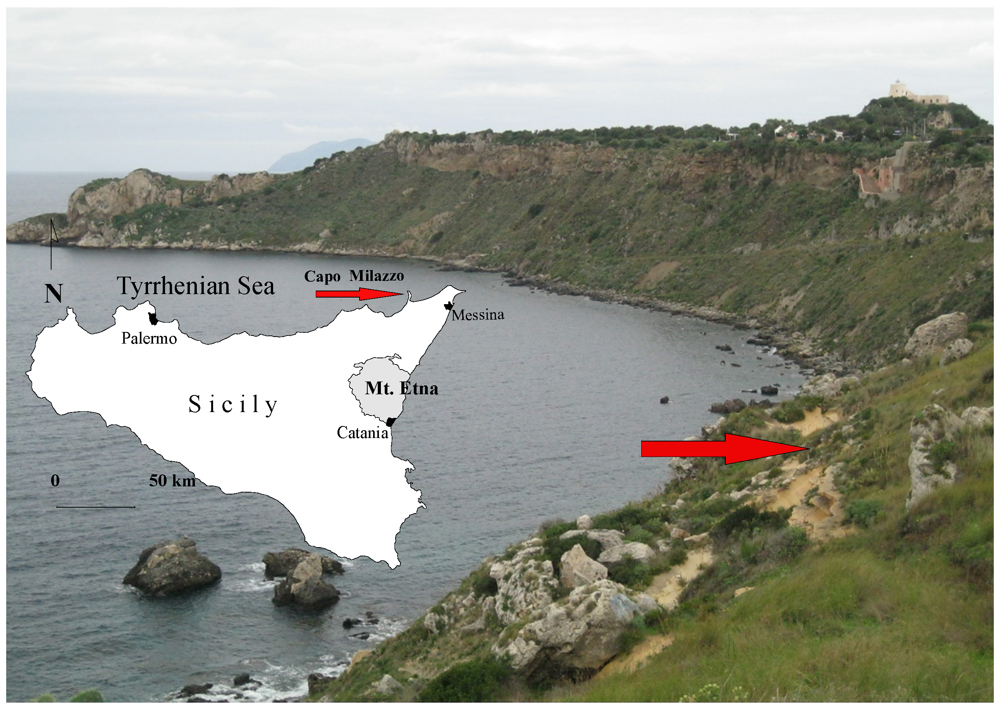
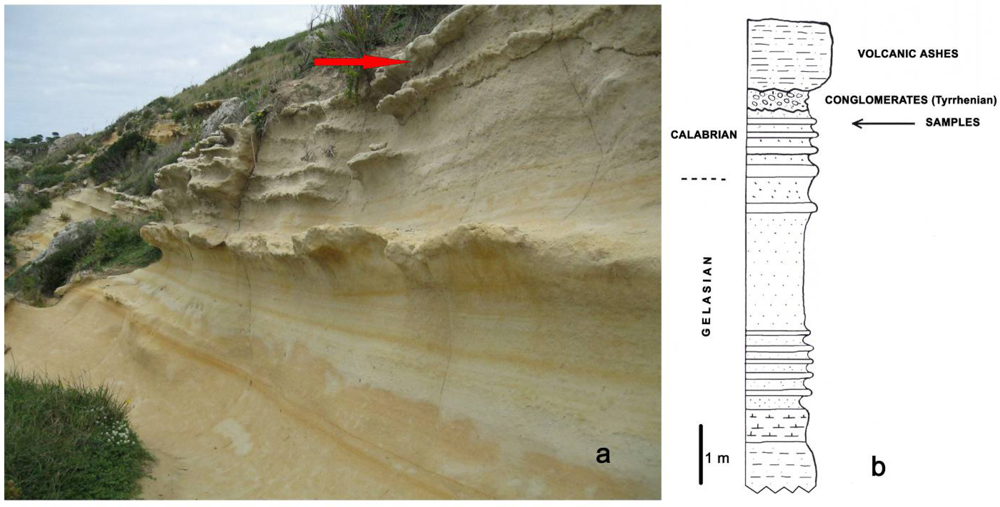
      <p>Discontinuous lenses of yellowish and greyish fine sands and silts crop out along the steep slopes of the Cape Milazzo Peninsula (NE Sicily) (<xref ref-type="fig" rid="geosciences-02-00147-f001">Figure 1</xref>). The sandy-silty sedimentary succession (<xref ref-type="fig" rid="geosciences-02-00147-f002">Figure 2</xref>) rests unconformably on shallow-water Messinian limestones or directly on the metamorphic basement of the Calabrian Complex and is truncated upwards by the Tyrrhenian erosive surface locally draped by a thin layer of polygenic conglomerates. The sedimentary sequence is capped by Aeolian volcanic ashes.</p>
      <p>The sands and silts were deposited largely during the Gelasian Stage (Early Pleistocene) and partly during the Sicilian Stage [<xref ref-type="bibr" rid="B1-geosciences-02-00147">1</xref>,<xref ref-type="bibr" rid="B2-geosciences-02-00147">2</xref>,<xref ref-type="bibr" rid="B3-geosciences-02-00147">3</xref>,<xref ref-type="bibr" rid="B4-geosciences-02-00147">4</xref>,<xref ref-type="bibr" rid="B5-geosciences-02-00147">5</xref>,<xref ref-type="bibr" rid="B6-geosciences-02-00147">6</xref>] in epibathyal environments as testified by brachiopod [<xref ref-type="bibr" rid="B7-geosciences-02-00147">7</xref>], bryozoan [<xref ref-type="bibr" rid="B8-geosciences-02-00147">8</xref>], foraminifer [<xref ref-type="bibr" rid="B1-geosciences-02-00147">1</xref>] and ostracod associations [<xref ref-type="bibr" rid="B4-geosciences-02-00147">4</xref>,<xref ref-type="bibr" rid="B5-geosciences-02-00147">5</xref>,<xref ref-type="bibr" rid="B6-geosciences-02-00147">6</xref>,<xref ref-type="bibr" rid="B9-geosciences-02-00147">9</xref>]. At Cala S. Antonino the ostracod fauna of the Lower Gelasian layers is characterized by <italic>Bythocypris obtusata, Henryhowella sarsi profunda, Bairdoppilata profunda, Costa tricostata pliocenica, </italic>and also by <italic>Quasibuntonia radiatopora</italic> and <italic>Agrenocythere pliocenica </italic>[<xref ref-type="bibr" rid="B4-geosciences-02-00147">4</xref>]. The latter two species are listed among the psychrospheric ostracods by Benson [<xref ref-type="bibr" rid="B10-geosciences-02-00147">10</xref>].</p>
      <fig id="geosciences-02-00147-f001" position="anchor">
        <label>Figure 1</label>
        <caption>
          <p>Geographical location of the Cape Milazzo Peninsula and Cala S. Antonino with the sandy-silty succession (marked by arrows).</p>
        </caption>
        <graphic xmlns:xlink="http://www.w3.org/1999/xlink" xlink:href="geosciences-02-00147-g001.tif"/>
      </fig>
      <p>The upper layers can be ascribed to the Sicilian Stage owing to the presence of <italic>Hyalinea baltica</italic> and <italic>Globorotalia truncatulinoides excelsa</italic>. Samples from these layers (<xref ref-type="fig" rid="geosciences-02-00147-f002">Figure 2</xref>) are characterised by a significant increase in ostracod specific diversity in relation to underlaying layers [<xref ref-type="bibr" rid="B5-geosciences-02-00147">5</xref>]. Few species constitute the bulk of the association whereas several species are represented by a few or a single specimen (<xref ref-type="table" rid="geosciences-02-00147-t001">Table 1</xref>).</p>
      <fig id="geosciences-02-00147-f002" position="anchor">
        <label>Figure 2</label>
        <caption>
          <p>The mid-upper part of the sandy-silty sedimentary succession cropping out at Cala S. Antonino. (<bold>a</bold>) with the “Sicilian” greyish sandy layers marked by the arrow and (<bold>b</bold>) the corresponding Log. </p>
        </caption>
        <graphic xmlns:xlink="http://www.w3.org/1999/xlink" xlink:href="geosciences-02-00147-g002.tif"/>
      </fig>
      <table-wrap id="geosciences-02-00147-t001" position="anchor">
        <object-id pub-id-type="pii">geosciences-02-00147-t001_Table 1</object-id>
        <label>Table 1</label>
        <caption>
          <p>List of the ostracod species (in order of abundance) collected in the samples from Cala S. Antonino. </p>
        </caption>
        <table>
<thead>
            <tr>
              <th align="left" valign="middle">OSTRACOD SPECIES</th>
              <th align="center" valign="middle">n. spec.</th>
              <th align="center" valign="middle">%</th>
              <th align="left" valign="middle">OSTRACOD SPECIES</th>
              <th align="center" valign="middle">n. spec.</th>
              <th align="center" valign="middle">%</th>
</tr>
          </thead>
          <tbody>
            <tr>
              <td align="left" valign="middle"><italic>Bythocypris obtusata</italic> (SARS)</td>
              <td align="center" valign="middle">45</td>
              <td align="center" valign="middle">19.31</td>
              <td align="left" valign="middle"><italic>Eucythere curta</italic> RUGGIERI </td>
              <td align="center" valign="middle">2</td>
              <td align="center" valign="middle">0.86</td>
            </tr>
            <tr>
              <td align="left" valign="middle"><italic>Bairdia conformis</italic> (TERQUEM)</td>
              <td align="center" valign="middle">25</td>
              <td align="center" valign="middle">10.73</td>
              <td align="left" valign="middle"><italic>Paracytherois</italic> spp.</td>
              <td align="center" valign="middle">2</td>
              <td align="center" valign="middle">0.86</td>
            </tr>
            <tr>
              <td align="left" valign="middle"><italic>Cytherella vulgatella </italic>AIELLO <italic>et al.</italic></td>
              <td align="center" valign="middle">20</td>
              <td align="center" valign="middle">8.58</td>
              <td align="left" valign="middle"><italic>Paradoxostoma</italic> spp.</td>
              <td align="center" valign="middle">2</td>
              <td align="center" valign="middle">0.86</td>
            </tr>
            <tr>
              <td align="left" valign="middle"><italic>Henryhowella sarsii profunda </italic>BONADUCE <italic>et al. </italic></td>
              <td align="center" valign="middle">20</td>
              <td align="center" valign="middle">8.58</td>
              <td align="left" valign="middle"><italic>Pontocypris acuminata</italic> (MUELLER)</td>
              <td align="center" valign="middle">2</td>
              <td align="center" valign="middle">0.86</td>
            </tr>
            <tr>
              <td align="left" valign="middle"><italic>Cytheropteron eleonare </italic>n. sp.</td>
              <td align="center" valign="middle">17</td>
              <td align="center" valign="middle">7.30</td>
              <td align="left" valign="middle"><italic>Pseudocythere armata</italic> BONADUCE <italic>et al.</italic></td>
              <td align="center" valign="middle">2</td>
              <td align="center" valign="middle">0.86</td>
            </tr>
            <tr>
              <td align="left" valign="middle"><italic>Bythocythere solisdeus </italic>n. sp. </td>
              <td align="center" valign="middle">8</td>
              <td align="center" valign="middle">3.43</td>
              <td align="left" valign="middle"><italic>Argilloecia acuminata</italic> MUELLER</td>
              <td align="center" valign="middle">1</td>
              <td align="center" valign="middle">0.43</td>
            </tr>
            <tr>
              <td align="left" valign="middle"><italic>Pseudocythere caudata</italic> SARS</td>
              <td align="center" valign="middle">7</td>
              <td align="center" valign="middle">3.00</td>
              <td align="left" valign="middle"><italic>Argilloecia micra</italic> BONADUCE <italic>et al.</italic></td>
              <td align="center" valign="middle">1</td>
              <td align="center" valign="middle">0.43</td>
            </tr>
            <tr>
              <td align="left" valign="middle"><italic>Krithe compressa</italic> (SEGUENZA)</td>
              <td align="center" valign="middle">7</td>
              <td align="center" valign="middle">3.00</td>
              <td align="left" valign="middle"><italic>Argilloecia robusta</italic> BONADUCE <italic>et al.</italic></td>
              <td align="center" valign="middle">1</td>
              <td align="center" valign="middle">0.43</td>
            </tr>
            <tr>
              <td align="left" valign="middle"><italic>Bythocypris bosquetiana</italic> (BRADY)</td>
              <td align="center" valign="middle">6</td>
              <td align="center" valign="middle">2.58</td>
              <td align="left" valign="middle"><italic>Aurila lanceaeformis</italic>* ULICZNY</td>
              <td align="center" valign="middle">1</td>
              <td align="center" valign="middle">0.43</td>
            </tr>
            <tr>
              <td align="left" valign="middle"><italic>Cytheropteron lancei </italic>CARBONEL</td>
              <td align="center" valign="middle">6</td>
              <td align="center" valign="middle">2.58</td>
              <td align="left" valign="middle"><italic>Cytheropteron bifidum</italic> COLALONGO &amp; PASINI</td>
              <td align="center" valign="middle">1</td>
              <td align="center" valign="middle">0.43</td>
            </tr>
            <tr>
              <td align="left" valign="middle"><italic>Krithe</italic> spp.</td>
              <td align="center" valign="middle">6</td>
              <td align="center" valign="middle">2.58</td>
              <td align="left" valign="middle"><italic>Cytheropteron pinarense gillesi</italic> AIELLO <italic>et al.</italic></td>
              <td align="center" valign="middle">1</td>
              <td align="center" valign="middle">0.43</td>
            </tr>
            <tr>
              <td align="left" valign="middle"><italic>Anchistrocheles interrupta</italic> AIELLO <italic>et al.</italic></td>
              <td align="center" valign="middle">5</td>
              <td align="center" valign="middle">2.15</td>
              <td align="left" valign="middle"><italic>Cytheropteron pseudoalatum</italic> COLALONGO &amp; PASINI</td>
              <td align="center" valign="middle">1</td>
              <td align="center" valign="middle">0.43</td>
            </tr>
            <tr>
              <td align="left" valign="middle"><italic>Cytheropteron ionicum</italic> COLALONGO &amp; PASINI</td>
              <td align="center" valign="middle">5</td>
              <td align="center" valign="middle">2.15</td>
              <td align="left" valign="middle"><italic>Cytheropteron testudo</italic> SARS</td>
              <td align="center" valign="middle">1</td>
              <td align="center" valign="middle">0.43</td>
            </tr>
            <tr>
              <td align="left" valign="middle"><italic>Sclerochilus </italic>gr.<italic>contortus</italic> (NORMAN)</td>
              <td align="center" valign="middle">5</td>
              <td align="center" valign="middle">2.15</td>
              <td align="left" valign="middle"><italic>Eucythere</italic> cf. <italic>E. triangula </italic>WHATLEY &amp; COLES</td>
              <td align="center" valign="middle">1</td>
              <td align="center" valign="middle">0.43</td>
            </tr>
            <tr>
              <td align="left" valign="middle"><italic>Aurila impressa*</italic> RUGGIERI</td>
              <td align="center" valign="middle">4</td>
              <td align="center" valign="middle">1.72</td>
              <td align="left" valign="middle"><italic>Eucytherura</italic> sp. </td>
              <td align="center" valign="middle">1</td>
              <td align="center" valign="middle">0.43</td>
            </tr>
            <tr>
              <td align="left" valign="middle"><italic>Cytheropteron pinnatum</italic> COLALONGO &amp; PASINI</td>
              <td align="center" valign="middle">3</td>
              <td align="center" valign="middle">1.29</td>
              <td align="left" valign="middle"><italic>Heterocythereis albomaculata</italic>* (BAIRD)</td>
              <td align="center" valign="middle">1</td>
              <td align="center" valign="middle">0.43</td>
            </tr>
            <tr>
              <td align="left" valign="middle"><italic>Sclerochilus</italic> spp.</td>
              <td align="center" valign="middle">3</td>
              <td align="center" valign="middle">1.29</td>
              <td align="left" valign="middle"><italic>Macrocypris</italic> sp.</td>
              <td align="center" valign="middle">1</td>
              <td align="center" valign="middle">0.43</td>
            </tr>
            <tr>
              <td align="left" valign="middle"><italic>Krithe frutex </italic>ABATE <italic>et al.</italic></td>
              <td align="center" valign="middle">3</td>
              <td align="center" valign="middle">1.29</td>
              <td align="left" valign="middle"><italic>Paijenborchella malaiensis cymbula</italic> RUGGIERI</td>
              <td align="center" valign="middle">1</td>
              <td align="center" valign="middle">0.43</td>
            </tr>
            <tr>
              <td align="left" valign="middle"><italic>Aurila</italic> spp.*</td>
              <td align="center" valign="middle">2</td>
              <td align="center" valign="middle">0.86</td>
              <td align="left" valign="middle"><italic>Pedicythere phryne</italic> BONADUCE <italic>et al.</italic></td>
              <td align="center" valign="middle">1</td>
              <td align="center" valign="middle">0.43</td>
            </tr>
            <tr>
              <td align="left" valign="middle"><italic>Bythoceratina scaberrima </italic>BENSON &amp; SILV.- BRADLEY </td>
              <td align="center" valign="middle">2</td>
              <td align="center" valign="middle">0.86</td>
              <td align="left" valign="middle"><italic>Profundobythere</italic> sp.</td>
              <td align="center" valign="middle">1</td>
              <td align="center" valign="middle">0.43</td>
            </tr>
            <tr>
              <td align="left" valign="middle"><italic>Cytheropteron</italic> cf. <italic>C. venustum </italic>BONADUCE <italic> et al. </italic></td>
              <td align="center" valign="middle">2</td>
              <td align="center" valign="middle">0.86</td>
              <td align="left" valign="middle"><italic>Quasibuntonia radiatopora</italic> (SEGUENZA)</td>
              <td align="center" valign="middle">1</td>
              <td align="center" valign="middle">0.43</td>
            </tr>
            <tr>
              <td align="left" valign="middle"><italic>Cytheropteron circumactum </italic>COLALONGO &amp; PASINI</td>
              <td align="center" valign="middle">2</td>
              <td align="center" valign="middle">0.86</td>
              <td align="left" valign="middle"><italic>Tenedocythere prava</italic>* (BAIRD)</td>
              <td align="center" valign="middle">1</td>
              <td align="center" valign="middle">0.43</td>
            </tr>
            <tr>
              <td align="left" valign="middle"><italic>Cytheropteron triangulum </italic>COLALONGO &amp; PASINI</td>
              <td align="center" valign="middle">2</td>
              <td align="center" valign="middle">0.86</td>
              <td align="left" valign="middle"><italic>Typhloeucytherura calabra</italic> COLALONGO &amp; PASINI</td>
              <td align="center" valign="middle">1</td>
              <td align="center" valign="middle">0.43</td>
            </tr>
            <tr>
              <td align="left" valign="middle"> </td>
              <td align="center" valign="middle"> </td>
              <td align="center" valign="middle"> </td>
              <td align="left" valign="middle">Total</td>
              <td align="center" valign="middle">233</td>
              <td align="center" valign="middle">100.00</td>
            </tr>
          </tbody>
        </table>
    <table-wrap-foot>
      <fn>
        <p>Note: n. spec. = number of specimens (abundance); % = percentage (dominance); * = allochthonous species.</p>
      </fn>
    </table-wrap-foot>	  
	  </table-wrap>
      <p>Some specimens found in these samples cannot be assigned to any of the already known ostracod species. The aim of this paper is to describe these new species. They belong to the genera <italic>Bythocythere</italic> Sars, 1866 and <italic>Cytheropteron </italic>Sars, 1866.</p>
      <p>Specimens were examined and measured under a LMU Tescan Vega II scanning electron microscops (SEM).</p>
      <p>Material is housed in the Paleontological Museum of the Catania University (PMC).</p>
    </sec>
    <sec>
      <title>2. Systematics</title>
      <p><bold>Class O<sc>STRACODA</sc> Latreille, 1806</bold></p>
      <p>Order P<sc>ODOCOPIDA</sc> Sars, 1866</p>
      <p>Family B<sc>YTHOCYTHERIDAE</sc> Sars, 1866</p>
      <p>Genus <italic>Bythocythere</italic> Sars, 1866</p>
      <p><italic>Bythocythere solisdeus</italic> n. sp.</p>
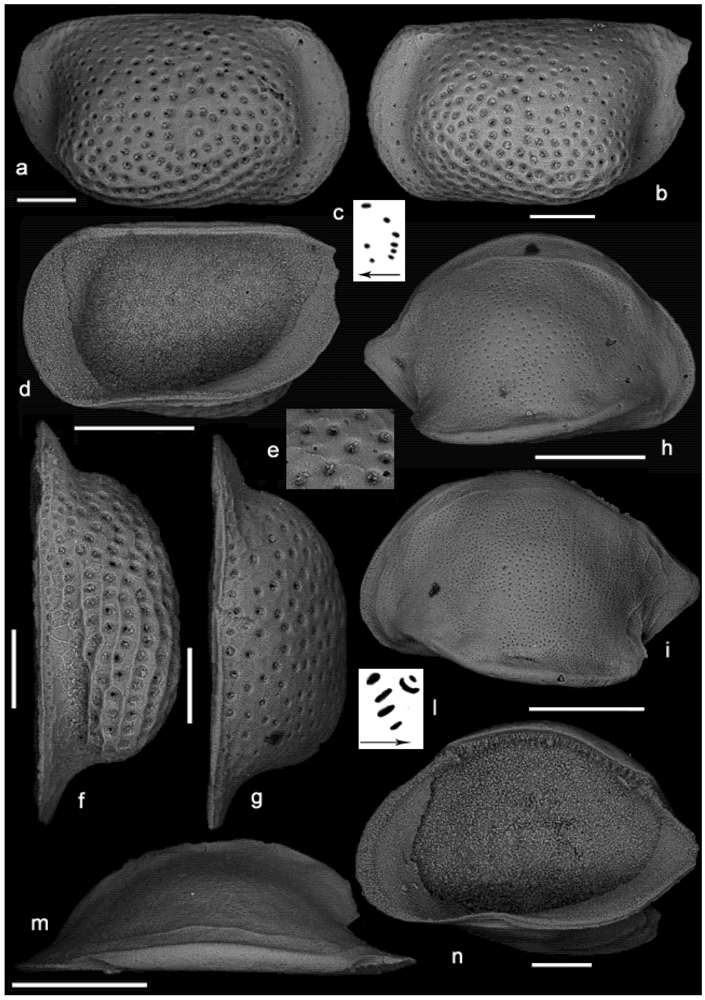
      <p><xref ref-type="fig" rid="geosciences-02-00147-f003">Figure 3</xref> (a–g)</p>
      <p><italic><bold>Derivatio nominis</bold></italic>—From “Peninsula of the sun god”, the legendary name of the Cape Milazzo Peninsula.</p>
      <p><italic><bold>Holotype</bold></italic>—A right valve (L = 560 μm; H = 355 μm; l = 215 μm) (<xref ref-type="fig" rid="geosciences-02-00147-f003">Figure 3</xref>a) (PMC.O5H.25.04.2012).</p>
      <p><italic><bold>Paratypes</bold></italic>—Two left valves and two right valves (<xref ref-type="fig" rid="geosciences-02-00147-f003">Figure 3</xref>(b,d,f,g)) (PMC.O18-21P.25.04.2012). Further six right valves and five left valves, not shown in the figure, from the same sample.</p>
      <p><italic><bold>Type locality</bold></italic>—“Cala S. Antonino” along the western side of the Cape Milazzo Peninsula (Tav. Milazzo, F.253 IV SO, 38°15'52" N, 15°14'10" E). Upper silty-sandy layers.</p>
      <p><italic><bold>Stratigraphic Range</bold></italic>—Sicilian Stage (<italic>Globorotalia truncatulinoides excelsa</italic> Zone).</p>
      <p><italic><bold>Diagnosis</bold></italic>—<italic>Bythocythere solisdeus</italic> n. sp. is characterized by a wide central area of the carapace, strongly elevated and inflated, a postero-ventrally swell; helmet-shaped carapace in dorsal view, with flat central area and wide flattened anterior and posterior marginal areas.</p>
      <p><italic><bold>Description</bold></italic>—Carapace medium-sized, subrhomboidal in lateral view.</p>
      <p>Anterior margin regularly arched. Dorsal margin long and straight. Ventral margin sinuous, with a light oral convexity anteriorly, and regularly and steeply bending posteriorly. Posterior margin asymmetrically rounded, more pronounced towards the dorsal side, lacking a caudal process, as can be observed on the holotype. Nevertheless, this part of the carapace seems to be particularly fragile as several specimens show a broken postero-dorsal area.</p>
      <p>Anterior and posterior marginal area flattened and wide.</p>
      <p>Central area of the valves strongly elevated, inflated and postero-ventrally swelled and folded down (<xref ref-type="fig" rid="geosciences-02-00147-f003">Figure 3</xref>a,b,f,g).</p>
      <p>Carapace helmet-shaped in dorsal view with somewhat flattened central area connected to the marginal areas through steep posterior and anterior areas (<xref ref-type="fig" rid="geosciences-02-00147-f003">Figure 3</xref>g).</p>
      <p>Outer surface pitted and reticulated. Circular pits numerous, large, well marked especially in the swollen part of the carapace and longitudinally aligned in the ventral area. Polygonal reticulum, barely visible through the stereomicroscope, slight in the dorsal, marginal and central areas and more marked in the postero-ventral area where longitudinal elements are particularly obvious.</p>
      <p>Few normal pore-canals, small, simple and visible in the centro-dorsal area of the carapace (<xref ref-type="fig" rid="geosciences-02-00147-f003">Figure 3</xref>e). Inner lamella anteriorly and postero-ventrally wide; vestibula narrow anteriorly, wide in the postero-dorsal area (<xref ref-type="fig" rid="geosciences-02-00147-f003">Figure 3</xref>d). Marginal pore-canals relatively numerous, simple, short and restricted to the anterior margin (<xref ref-type="fig" rid="geosciences-02-00147-f003">Figure 3</xref>d).</p>
      <p>Eye tubercles absent.</p>
      <p>Hinge lophodont: a straight groove parallel to the dorsal margin with two little simple teeth at the anterior and posterior extremities in the right valve; left valve complementary (<xref ref-type="fig" rid="geosciences-02-00147-f003">Figure 3</xref>d).</p>
      <p>Muscle scars barely visible, even under stereomicroscope with transmitted light. Five separated adductor muscle scars (<xref ref-type="fig" rid="geosciences-02-00147-f003">Figure 3</xref>c) aligned in a single arcuate row. A sixth scar higher up and away from the other ones. Two barely visible frontal scars.</p>
      <p><italic><bold>Remarks</bold></italic>—The new species has been assigned to <italic>Bythocythere </italic>Sars using the central muscle scars and the lophodont hinge.</p>
      <p><italic>Bythocythere solisdeus</italic> n. sp. is distinguishable from all other species within the genus because of the wide and strongly flattened anterior and posterior marginal area and the central part of the carapace strongly inflated and ventro-posteriorly folded down.</p>
      <p><italic>B. solisdeus</italic> n.sp. shows some affinities with <italic>Bythocythere mylaensis,</italic> described by Sciuto from the Lower Pleistocene bathyal sediments of “Punta Messinese” (Milazzo) [<xref ref-type="bibr" rid="B6-geosciences-02-00147">6</xref>]. Both species show an inflated central part of the carapace, flattened marginal areas and a comparable ornamentation. Nevertheless, some differences are obvious and justify the erection of a new species. <italic>B. solisdeus</italic> n. sp. has the inflated central area of the carapace more extensive than <italic>B. mylaensis</italic> and flattened, in spite of regularly rounded. The swollen central area is also ventro-posteriorly folded down, whereas such folds are absent in <italic>B. mylaensis</italic>. Furthermore, <italic>B. solisdeus</italic> n. sp. shows a steeper outline of the anterior and posterior ends in dorsal view. Noteworthy, <italic>B. solisdeus</italic> n. sp. completely lacks the ripples on the inner side of the postero-ventral marginal area and the acute caudal process that characterize <italic>B. myalaensis</italic>. Lastly, the new species has carapace sizes larger than <italic>B. mylaensis </italic>(<xref ref-type="table" rid="geosciences-02-00147-t002">Table 2</xref>)<italic>. </italic>Morphological affinities between <italic>B. mylaensis</italic> and <italic>B. solisdeus</italic> could suggest a case of sexual dimorphism. Nevertheless, the two species have never been found together in the same sample/site and stratigraphic level. Furthermore, a male specimen of <italic>B. mylaensis</italic> has been recently detected (specimen figured in Sciuto [<xref ref-type="bibr" rid="B9-geosciences-02-00147">9</xref>]) in addition to the female ones previously recorded [<xref ref-type="bibr" rid="B6-geosciences-02-00147">6</xref>]. Juveniles not found.</p>
      <p>Family CYTHERURIDAE Müller, 1894</p>
      <p>Genus <italic>Cytheropteron</italic> Sars, 1866</p>
      <p><italic>Cytheropteron eleonorae</italic> n. sp.</p>
      <p><xref ref-type="fig" rid="geosciences-02-00147-f003">Figure 3</xref> (h–n)</p>
      <p><italic><bold>Derivatio nominis</bold></italic>—From Lady Eleonora Baeli, a young noblewoman who lived in Milazzo during the XVII century.</p>
      <p><italic><bold>Holotype</bold></italic>—A right valve (L = 600 μm; H = 405 μm; l = 185 μm) (<xref ref-type="fig" rid="geosciences-02-00147-f003">Figure 3</xref>(h)) (PMC.O6H.25.04.2012).</p>
      <p><italic><bold>Paratypes</bold></italic>—One left valve and two right valves (<xref ref-type="fig" rid="geosciences-02-00147-f003">Figure 3</xref>i,m,n) (PMC.O22-24P.25.04.2012). Further 12 right and 17 left valves, not shown in the figure, from the same sample.</p>
      <p><italic><bold>Type locality</bold></italic>—“Cala S. Antonino” along the western side of the Cape Milazzo Peninsula (Tav. Milazzo, F.253 IV SO, 38°15'52" N, 15°14'10" E). Upper silty-sandy layers.</p>
      <p><italic><bold>Stratigraphic Range</bold></italic>—Sicilian Stage (<italic>Globorotalia truncatulinoides excelsa</italic> Zone).</p>
      <p><italic><bold>Diagnosis</bold></italic>—<italic>Cytheropteron eleonorae</italic> n. sp. is characterized by an extended and arched alar process.</p>
      <p><italic><bold>Description</bold></italic>—Carapace medium-sized, subovate in lateral view. Valves asymmetric. RV overlapping LV dorsally. Anterior margin rounded, dorsal margin arched and convex in RV, more flattened in LV. The dorsal margin passes to the caudal process, situated in the central posterior area, through a weak hump. Caudal process slightly acute and prominent. Ventral margin sinuous with a light oral convexity anteriorly. Dorsal ridge marked but not prominent, parallel to the dorsal margin.</p>
      <p>Alar process wide, flat and extended from the antero-ventral to the postero-ventral margin, with a general rounded outline in dorsal view, joined to the anterior margin through a gentle bend, and posteriorly truncated (<xref ref-type="fig" rid="geosciences-02-00147-f003">Figure 3</xref>m).</p>
      <p>Outer surface finely punctated and ornamented by slight and braided ridges, more marked in the posterior area where a clear reticulum arises, and less obvious in the anterior area. Ridges formed and/or bounded by evenly spaced, aligned puncta; further puncta, organized in nearly parallel rows, fill the in intermediate spaces, more densely spaced in the alar process and in the posterior area (<xref ref-type="fig" rid="geosciences-02-00147-f003">Figure 3</xref>h,i). Some valves show a certain variability in the distribution and density of puncta.</p>
      <p>Simple normal pore canals.</p>
      <p>Inner lamella wide anteriorly, narrow postero-ventrally. Vestibula present: the anterior one large, the posterior one narrow (<xref ref-type="fig" rid="geosciences-02-00147-f003">Figure 3</xref>n). Marginal pore canals not visible.</p>
      <p>Hinge entomodont (<xref ref-type="fig" rid="geosciences-02-00147-f003">Figure 3</xref>n).</p>
      <p>Four adductor muscle scars aligned in a single straight row; two frontal scars, one larger than the other, kidney-shaped (<xref ref-type="fig" rid="geosciences-02-00147-f003">Figure 3</xref>l).</p>
      <p><italic><bold>Remarks</bold></italic>—The new species has been assigned to the genus <italic>Cytheropteron</italic> using the type of hinge, the characteristic muscle scars and the general shape of the carapace. The braided structure of the ornamentation distinguishes it from the other species of the genus.</p>
      <p>No evidence of sexual dimorphism. Several juvenile specimens are present.</p>
      <fig id="geosciences-02-00147-f003" position="anchor">
        <label>Figure 3</label>
        <caption>
          <p>(<bold>a–g</bold>) <italic>Bythocythere solisdeus</italic> n. sp.: (<bold>a</bold>) Right valve in lateral view (scale bar 100 μm); (<bold>b</bold>) Left valve in lateral view (scale bar 100 μm); (<bold>c</bold>) Muscle scars (drawing); (<bold>d</bold>) Right valve, internal view (scale bar 200 μm); (<bold>e</bold>) Normal pores; (<bold>f</bold>) Left valve in ventral view (scale bar 100 μm); (<bold>g</bold>) Right valve in dorsal view (scale bar 100 μm); (<bold>h–n</bold>) <italic>Cytheropteron eleonorae</italic> n. sp.: (<bold>h</bold>) Right valve in lateral view (scale bar 200 μm); (<bold>i</bold>) Left valve in lateral view (scale bar 200 μm); (<bold>l</bold>) Muscle scars (drawing); (<bold>m</bold>) Right valve in dorsal view (scale bar 100 μm); (<bold>n</bold>) Right valve, internal view (scale bar 100 μm).</p>
        </caption>
        <graphic xmlns:xlink="http://www.w3.org/1999/xlink" xlink:href="geosciences-02-00147-g003.tif"/>
      </fig>
      <table-wrap id="geosciences-02-00147-t002" position="anchor">
        <object-id pub-id-type="pii">geosciences-02-00147-t002_Table 2</object-id>
        <label>Table 2</label>
        <caption>
          <p>Size of <italic>B. solisdeus</italic> and <italic>C. eleonorae</italic>.</p>
        </caption>
        <table>
<thead>
            <tr>
              <th align="center" valign="middle"> </th>
              <th colspan="3" align="center" valign="middle" style="border-bottom:solid thin"><italic>Bythocythere solisdeus</italic> n. sp.</th>
              <th align="center" valign="middle"> </th>
              <th colspan="3" align="center" valign="middle" style="border-bottom:solid thin"><italic>Cytheropteron eleonorae</italic> n. sp.</th>
            </tr>
            <tr>
              <th align="center" valign="middle"> </th>
              <th align="center" valign="middle">L</th>
              <th align="center" valign="middle">H</th>
              <th align="center" valign="middle">L/H</th>
              <th align="center" valign="middle"> </th>
              <th align="center" valign="middle">L</th>
              <th align="center" valign="middle">H</th>
              <th align="center" valign="middle">L/H</th>
            </tr>
          </thead>
          <tbody>
            <tr>
              <td align="center" valign="middle">LV</td>
              <td align="center" valign="middle">560</td>
              <td align="center" valign="middle">355</td>
              <td align="center" valign="middle">1.577465</td>
              <td align="center" valign="middle">LV</td>
              <td align="center" valign="middle">623.27</td>
              <td align="center" valign="middle">396.47</td>
              <td align="center" valign="middle">1.572048</td>
            </tr>
            <tr>
              <td align="center" valign="middle">LV</td>
              <td align="center" valign="middle">538.31</td>
              <td align="center" valign="middle">298.39</td>
              <td align="center" valign="middle">1.804048</td>
              <td align="center" valign="middle">LV</td>
              <td align="center" valign="middle">662.66</td>
              <td align="center" valign="middle">405.77</td>
              <td align="center" valign="middle">1.633093</td>
            </tr>
            <tr>
              <td align="center" valign="middle">LV</td>
              <td align="center" valign="middle">575.31</td>
              <td align="center" valign="middle">316.71</td>
              <td align="center" valign="middle">1.81652</td>
              <td align="center" valign="middle">LV</td>
              <td align="center" valign="middle">627.89</td>
              <td align="center" valign="middle">396.27</td>
              <td align="center" valign="middle">1.5845</td>
            </tr>
            <tr>
              <td align="center" valign="middle">LV</td>
              <td align="center" valign="middle">547.81</td>
              <td align="center" valign="middle">308.24</td>
              <td align="center" valign="middle">1.777219</td>
              <td align="center" valign="middle">RV</td>
              <td align="center" valign="middle">661.84</td>
              <td align="center" valign="middle">396.62</td>
              <td align="center" valign="middle">1.668701</td>
            </tr>
            <tr>
              <td align="center" valign="middle">RV</td>
              <td align="center" valign="middle">577.33</td>
              <td align="center" valign="middle">327.14</td>
              <td align="center" valign="middle">1.76478</td>
              <td align="center" valign="middle">RV</td>
              <td align="center" valign="middle">600</td>
              <td align="center" valign="middle">405</td>
              <td align="center" valign="middle">1.481481</td>
            </tr>
            <tr>
              <td align="center" valign="middle">RV</td>
              <td align="center" valign="middle">580.47</td>
              <td align="center" valign="middle">332.14</td>
              <td align="center" valign="middle">1.747667</td>
              <td align="center" valign="middle">RV</td>
              <td align="center" valign="middle">658.92</td>
              <td align="center" valign="middle">428.57</td>
              <td align="center" valign="middle">1.537485</td>
            </tr>
            <tr>
              <td align="center" valign="middle">RV</td>
              <td align="center" valign="middle">575.24</td>
              <td align="center" valign="middle">336.02</td>
              <td align="center" valign="middle">1.711922</td>
              <td align="center" valign="middle">RV</td>
              <td align="center" valign="middle">668.72</td>
              <td align="center" valign="middle">410.18</td>
              <td align="center" valign="middle">1.630309</td>
            </tr>
            <tr>
              <td align="center" valign="middle">RV</td>
              <td align="center" valign="middle">584.29</td>
              <td align="center" valign="middle">343.01</td>
              <td align="center" valign="middle">1.70342</td>
              <td align="center" valign="middle"> </td>
              <td align="center" valign="middle"> </td>
              <td align="center" valign="middle"> </td>
              <td align="center" valign="middle"> </td>
            </tr>
            <tr>
              <td align="center" valign="middle">Mean LV</td>
              <td align="center" valign="middle">555.3575</td>
              <td align="center" valign="middle">319.585</td>
              <td align="center" valign="middle"> </td>
              <td align="center" valign="middle"> </td>
              <td align="center" valign="middle">637.94</td>
              <td align="center" valign="middle">399.5033</td>
              <td align="center" valign="middle"> </td>
            </tr>
            <tr>
              <td align="center" valign="middle">Mean RV</td>
              <td align="center" valign="middle">579.3325</td>
              <td align="center" valign="middle">334.5775</td>
              <td align="center" valign="middle"> </td>
              <td align="center" valign="middle"> </td>
              <td align="center" valign="middle">647.37</td>
              <td align="center" valign="middle">410.0925</td>
              <td align="center" valign="middle"> </td>
            </tr>
            <tr>
              <td align="center" valign="middle">LV</td>
              <td align="center" valign="middle">15.99205</td>
              <td align="center" valign="middle">24.76843</td>
              <td align="center" valign="middle"> </td>
              <td align="center" valign="middle"> </td>
              <td align="center" valign="middle">21.53242</td>
              <td align="center" valign="middle">5.428014</td>
              <td align="center" valign="middle"> </td>
            </tr>
            <tr>
              <td align="center" valign="middle">RV</td>
              <td align="center" valign="middle">3.942473</td>
              <td align="center" valign="middle">6.694417</td>
              <td align="center" valign="middle"> </td>
              <td align="center" valign="middle"> </td>
              <td align="center" valign="middle">31.8461</td>
              <td align="center" valign="middle">13.52612</td>
              <td align="center" valign="middle"> </td>
            </tr>
          </tbody>
        </table>
    <table-wrap-foot>
      <fn>
        <p>Note: L (μm) = length, H (μm) = height, δ = standard deviation, LV = Left valve, RV = Right valve.</p>
      </fn>
    </table-wrap-foot>	  
	  </table-wrap>
    </sec>
    <sec sec-type="discussion">
      <title>3. Discussion and Conclusions</title>
      <p>The ostracod fauna associated to the species described here as new shows composition and structure indicative of Bathyal environments [<xref ref-type="bibr" rid="B11-geosciences-02-00147">11</xref>,<xref ref-type="bibr" rid="B12-geosciences-02-00147">12</xref>] (<italic>inter alias</italic>). Only four ostracod species (<xref ref-type="table" rid="geosciences-02-00147-t001">Table 1</xref>), namely <italic>Bythocypris obtusata</italic>, <italic>Bairdia conformis</italic>, <italic>Cytherella vulgatella</italic> and <italic>Henryhowella sarsii profunda</italic>, are dominant. The several other species, namely <italic>B. bosquetiana</italic> Brady, <italic>Bairdia conformis</italic> (Terquem), <italic>Sclerochilus contortus</italic> (Norman), <italic>Pseudocythere caudata</italic>, <italic>Cytheropteron ionicum </italic>and <italic>Anchistrocheles interrupta </italic>Aiello <italic>et al.</italic> that follow account for only 18% of the entire association. In contrast, most species (about 70%), including <italic>B. scaberrima</italic>, <italic>Q. radiatopora </italic>and <italic>C. testudo</italic>, are represented by few specimens [<xref ref-type="bibr" rid="B5-geosciences-02-00147">5</xref>]<italic>. </italic>This ostracod association, dating back to the upper part of the Sicilian Stage, presumably lived in bathyal environments located presumably deeper than 600 m [<xref ref-type="bibr" rid="B4-geosciences-02-00147">4</xref>,<xref ref-type="bibr" rid="B5-geosciences-02-00147">5</xref>,<xref ref-type="bibr" rid="B6-geosciences-02-00147">6</xref>]. This inference is congruent with the general mean uplift rate of about 1–1.1 mm/a estimated by Catalano and Di Stefano [<xref ref-type="bibr" rid="B13-geosciences-02-00147">13</xref>] and Antonioli <italic>et al.</italic> [<xref ref-type="bibr" rid="B14-geosciences-02-00147">14</xref>] for the area in the last 600 ka.</p>
      <p>Noteworty, the fossil association contains some taxa whose distribution seems to be strongly influenced by temperature rather than by other factors. These species are <italic>B. scaberrima</italic>, <italic>Q. radiatopora</italic>, <italic>C. testudo</italic>, and probably also <italic>B. obtusata and B. mylaensis </italic>[<xref ref-type="bibr" rid="B6-geosciences-02-00147">6</xref>]. The first two species are indicated as psychrospheric by Benson [<xref ref-type="bibr" rid="B10-geosciences-02-00147">10</xref>]. Analogously, <italic>C. testudo</italic> can be considered as a stenothermic species restricted to very cold waters, independently of the depth, taking into account data on both its recent (Stepanova <italic>et al.</italic> [<xref ref-type="bibr" rid="B15-geosciences-02-00147">15</xref>], Dingle and Lord [<xref ref-type="bibr" rid="B12-geosciences-02-00147">12</xref>] and Swanson and Ayress [<xref ref-type="bibr" rid="B16-geosciences-02-00147">16</xref>]) and fossil distribution (Whatley and Coles [<xref ref-type="bibr" rid="B17-geosciences-02-00147">17</xref>], Aiello <italic>et al.</italic> [<xref ref-type="bibr" rid="B18-geosciences-02-00147">18</xref>] and Montcharmont-Zei <italic>et al.</italic> [<xref ref-type="bibr" rid="B19-geosciences-02-00147">19</xref>]). Similarly, <italic>B. obtusata</italic> has been reported from Norwegian and British coasts between 145 and 165 m water depth by Sars [<xref ref-type="bibr" rid="B20-geosciences-02-00147">20</xref>] and in the recent Mediterranean Sea at depths between 150 and 2905 m by Puri <italic>et al.</italic> [<xref ref-type="bibr" rid="B21-geosciences-02-00147">21</xref>]. Finally, <italic>B. mylaensis</italic> originates from sediments sampled at 745 m depth in the Northern Ionian Sea dating from the post Würmian acme [<xref ref-type="bibr" rid="B22-geosciences-02-00147">22</xref>].</p>
      <p>Consequently, assuming that both new species became fossilized <italic>in situ</italic> (assumption best supported for <italic>C. eleonorae</italic> n. sp. exhibiting a population structure, including specimens at different life stages) and taking into account the context in which they were found and the environmental requirements pointed out by the association as a whole, it can be hypothesized that <italic>Bythocythere solisdeus</italic> n. sp. and <italic>Cytheropteron eleonorae</italic> n. sp. lived in deep bathyal environments characterized by about this statement, as presently the two new species are known from a single site in sediments of the Pleistocene (Sicilian Stage) in the central Mediterranean area.</p>
    </sec>
  </body>
  <back>
    <ack>
      <title>Acknowledgments</title>
      <p>I thank A. Rosso (University of Catania) for discussions and suggestions. Thanks are also due to David J. Horne (School of Geography Queen Mary, University of London) and to the other two anonymous referees. The SEM photos were taken by Alfio Viola (University of Catania).</p>
    </ack>
    <ref-list>
      <title>References</title>
      <ref id="B1-geosciences-02-00147">
        <label>1.</label>
        <citation citation-type="journal">
          <person-group person-group-type="author">
            <name>
              <surname>Violanti</surname>
              <given-names>D.I.</given-names>
            </name>
          </person-group>
          <article-title>Foraminiferi plio-pleistocenici di Capo Milazzo</article-title>
          <source>Boll. Mus. Reg. Sc. Nat. T.</source>
          <year>1988</year>
          <volume>6</volume>
          <fpage>359</fpage>
          <lpage>392</lpage>
        </citation>
      </ref>
      <ref id="B2-geosciences-02-00147">
        <label>2.</label>
        <citation citation-type="journal">
          <person-group person-group-type="author">
            <name>
              <surname>Fois</surname>
              <given-names>E.</given-names>
            </name>
          </person-group>
          <article-title>La successione neogenica di Capo Milazzo (Sicilia nord-orientale)</article-title>
          <source>Riv. Ital. Paleontol. S.</source>
          <year>1990</year>
          <volume>95</volume>
          <fpage>397</fpage>
          <lpage>440</lpage>
        </citation>
      </ref>
      <ref id="B3-geosciences-02-00147">
        <label>3.</label>
        <citation citation-type="journal">
          <person-group person-group-type="author">
            <name>
              <surname>Fois</surname>
              <given-names>E.</given-names>
            </name>
          </person-group>
          <article-title>Stratigraphy and palaeogeography of the Capo Milazzo area (NE Sicily, Italy): Clues to the evolution of the southern margin of the Tyrrhenian Basin during the Neogene</article-title>
          <source>Palaeogeogr Palaeoclimatol. Palaeoecol.</source>
          <year>1990</year>
          <volume>78</volume>
          <fpage>87</fpage>
          <lpage>108</lpage>
          <pub-id pub-id-type="doi">10.1016/0031-0182(90)90206-M</pub-id>
        </citation>
      </ref>
      <ref id="B4-geosciences-02-00147">
        <label>4.</label>
        <citation citation-type="journal">
          <person-group person-group-type="author">
            <name>
              <surname>Sciuto</surname>
              <given-names>F.</given-names>
            </name>
          </person-group>
          <article-title>Dati preliminari sulla ostracofauna pliocenica di Capo Milazzo (Sicilia NE)</article-title>
          <source>Boll. Soc. Paleontol. I.</source>
          <year>2003</year>
          <volume>42</volume>
          <fpage>179</fpage>
          <lpage>184</lpage>
        </citation>
      </ref>
      <ref id="B5-geosciences-02-00147">
        <label>5.</label>
        <citation citation-type="journal">
          <person-group person-group-type="author">
            <name>
              <surname>Sciuto</surname>
              <given-names>F.</given-names>
            </name>
          </person-group>
          <article-title>Ostracodi batiali pleistocenici di Capo Milazzo (Sicilia NE) ed implicazioni paleoambientali</article-title>
          <source>Rend. Soc. Paleontolol. I.</source>
          <year>2005</year>
          <volume>2</volume>
          <fpage>219</fpage>
          <lpage>227</lpage>
        </citation>
      </ref>
      <ref id="B6-geosciences-02-00147">
        <label>6.</label>
        <citation citation-type="journal">
          <person-group person-group-type="author">
            <name>
              <surname>Sciuto</surname>
              <given-names>F.</given-names>
            </name>
          </person-group>
          <article-title><italic>Bythocythere mylaensis</italic> n. sp. (Crustacea, Ostracoda) from Early Pleistocene of Capo Milazzo (NE Sicily)</article-title>
          <source>Boll. Soc. Paleontol. I.</source>
          <year>2009</year>
          <volume>48</volume>
          <fpage>183</fpage>
          <lpage>188</lpage>
        </citation>
      </ref>
      <ref id="B7-geosciences-02-00147">
        <label>7.</label>
        <citation citation-type="journal">
          <person-group person-group-type="author">
            <name>
              <surname>Gaetani</surname>
              <given-names>M.</given-names>
            </name>
            <name>
              <surname>Saccà</surname>
              <given-names>D.</given-names>
            </name>
          </person-group>
          <article-title>Brachiopodi batiali del Pliocene e del Pleistocene di Sicilia e Calabria</article-title>
          <source>Riv. Ital. Paleontol. S.</source>
          <year>1984</year>
          <volume>90</volume>
          <fpage>407</fpage>
          <lpage>458</lpage>
        </citation>
      </ref>
      <ref id="B8-geosciences-02-00147">
        <label>8.</label>
        <citation citation-type="journal">
          <person-group person-group-type="author">
            <name>
              <surname>Rosso</surname>
              <given-names>A.</given-names>
            </name>
          </person-group>
          <article-title><italic>Terataulopocella borealis</italic> gen. et sp. nov., a deep-water Pliocene Lekythoporid (Briozoa) from the Mediterranean Area</article-title>
          <source>Mem. Sc. Geol.</source>
          <year>2002</year>
          <volume>54</volume>
          <fpage>65</fpage>
          <lpage>72</lpage>
        </citation>
      </ref>
      <ref id="B9-geosciences-02-00147">
        <label>9.</label>
        <citation citation-type="journal">
          <person-group person-group-type="author">
            <name>
              <surname>Sciuto</surname>
              <given-names>F.</given-names>
            </name>
          </person-group>
          <article-title>New ostracod species from Lower Pleistocene Bathyal sediments of Capo Milazzo (NE, Sicily)</article-title>
          <source>Boll. Soc. Paleontol. I.</source>
          <year>2012</year>
          <comment>in submit</comment>
        </citation>
      </ref>
      <ref id="B10-geosciences-02-00147">
        <label>10.</label>
        <citation citation-type="book">
          <person-group person-group-type="author">
            <name>
              <surname>Benson</surname>
              <given-names>R.H.</given-names>
            </name>
          </person-group>
          <article-title>Ostracodes as indicators of threshold depth in the Mediterranean during the Pliocene</article-title>
          <source>The Mediterranean Sea: A Natural Sedimentation Laboratory</source>
          <person-group person-group-type="editor">
            <name>
              <surname>Stanley</surname>
              <given-names>D.J.</given-names>
            </name>
          </person-group>
          <publisher-loc>Stroudsburg, PA, USA</publisher-loc>
          <year>1972</year>
          <fpage>63</fpage>
          <lpage>73</lpage>
        </citation>
      </ref>
      <ref id="B11-geosciences-02-00147">
        <label>11.</label>
        <citation citation-type="journal">
          <person-group person-group-type="author">
            <name>
              <surname>Benson</surname>
              <given-names>R.H.</given-names>
            </name>
          </person-group>
          <article-title>Estimating greater paleodepths with ostracodes, especially in past thermospheric oceans</article-title>
          <source>Palaeogeogr. Palaeoclimatol. Palaeoecol.</source>
          <year>1984</year>
          <volume>48</volume>
          <fpage>107</fpage>
          <lpage>141</lpage>
          <pub-id pub-id-type="doi">10.1016/0031-0182(84)90093-2</pub-id>
        </citation>
      </ref>
      <ref id="B12-geosciences-02-00147">
        <label>12.</label>
        <citation citation-type="journal">
          <person-group person-group-type="author">
            <name>
              <surname>Dingle</surname>
              <given-names>R.V.</given-names>
            </name>
            <name>
              <surname>Lord</surname>
              <given-names>A.R.</given-names>
            </name>
          </person-group>
          <article-title>Benthic ostracods and deep water-masses in the Atlantic Ocean</article-title>
          <source>Palaeogeogr. Palaeoclimatol. Palaeoecol.</source>
          <year>1990</year>
          <volume>80</volume>
          <fpage>213</fpage>
          <lpage>235</lpage>
          <pub-id pub-id-type="doi">10.1016/0031-0182(90)90133-R</pub-id>
        </citation>
      </ref>
      <ref id="B13-geosciences-02-00147">
        <label>13.</label>
        <citation citation-type="journal">
          <person-group person-group-type="author">
            <name>
              <surname>Catalano</surname>
              <given-names>S.</given-names>
            </name>
            <name>
              <surname>Di Stefano</surname>
              <given-names>A.</given-names>
            </name>
          </person-group>
          <article-title>Sollevamenti e tettogenisu pleistocenica lungo il margine tirrenico dei Monti Peloritani: Integrazione dei dati geomorfologici, strutturali e biostratigrafici</article-title>
          <source>Il Quaternario</source>
          <year>1997</year>
          <volume>10</volume>
          <fpage>337</fpage>
          <lpage>342</lpage>
        </citation>
      </ref>
      <ref id="B14-geosciences-02-00147">
        <label>14.</label>
        <citation citation-type="journal">
          <person-group person-group-type="author">
            <name>
              <surname>Antonioli</surname>
              <given-names>F.</given-names>
            </name>
            <name>
              <surname>Kershaw</surname>
              <given-names>S.</given-names>
            </name>
            <name>
              <surname>Renda</surname>
              <given-names>P.</given-names>
            </name>
            <name>
              <surname>Rust</surname>
              <given-names>D.</given-names>
            </name>
            <name>
              <surname>Belluomini</surname>
              <given-names>G.</given-names>
            </name>
            <name>
              <surname>Cerasoli</surname>
              <given-names>M.</given-names>
            </name>
            <name>
              <surname>Radtke</surname>
              <given-names>U.</given-names>
            </name>
            <name>
              <surname>Silenzi</surname>
              <given-names>S.</given-names>
            </name>
          </person-group>
          <article-title>Elevation of the last interglacial highstand in Sicily (Italy): A benchmark of Coastal tectonic</article-title>
          <source>Quarter. Int.</source>
          <year>2006</year>
          <volume>145-146</volume>
          <fpage>3</fpage>
          <lpage>18</lpage>
          <pub-id pub-id-type="doi">10.1016/j.quaint.2005.07.002</pub-id>
        </citation>
      </ref>
      <ref id="B15-geosciences-02-00147">
        <label>15.</label>
        <citation citation-type="journal">
          <person-group person-group-type="author">
            <name>
              <surname>Stepanova</surname>
              <given-names>A.</given-names>
            </name>
            <name>
              <surname>Taldenkova</surname>
              <given-names>E.</given-names>
            </name>
            <name>
              <surname>Bauch</surname>
              <given-names>H.A.</given-names>
            </name>
          </person-group>
          <article-title>Recent ostracoda from Laptev Sea (Arctic Siberia): species assemblages and some environmental relationships</article-title>
          <source>Mar. Micropaleontol.</source>
          <year>2003</year>
          <volume>48</volume>
          <fpage>23</fpage>
          <lpage>48</lpage>
          <pub-id pub-id-type="doi">10.1016/S0377-8398(02)00136-6</pub-id>
        </citation>
      </ref>
      <ref id="B16-geosciences-02-00147">
        <label>16.</label>
        <citation citation-type="journal">
          <person-group person-group-type="author">
            <name>
              <surname>Swanson</surname>
              <given-names>K.M.</given-names>
            </name>
            <name>
              <surname>Ayress</surname>
              <given-names>M.A.</given-names>
            </name>
          </person-group>
          <article-title><italic>Cytheropteron testudo</italic> and related species from SW Pacific with analyses of their soft anatomics, relationships and distribution</article-title>
          <source>Senck. Biol.</source>
          <year>1999</year>
          <volume>79</volume>
          <fpage>151</fpage>
          <lpage>193</lpage>
        </citation>
      </ref>
      <ref id="B17-geosciences-02-00147">
        <label>17.</label>
        <citation citation-type="journal">
          <person-group person-group-type="author">
            <name>
              <surname>Whatley</surname>
              <given-names>R.</given-names>
            </name>
            <name>
              <surname>Coles</surname>
              <given-names>G.</given-names>
            </name>
          </person-group>
          <article-title>The late Miocene to Quaternary Ostracoda of Leg 94, Deep Sea Drilling Project</article-title>
          <source>Rev. Esp. Micropaleont.</source>
          <year>1987</year>
          <volume>19</volume>
          <fpage>33</fpage>
          <lpage>97</lpage>
        </citation>
      </ref>
      <ref id="B18-geosciences-02-00147">
        <label>18.</label>
        <citation citation-type="journal">
          <person-group person-group-type="author">
            <name>
              <surname>Aiello</surname>
              <given-names>G.</given-names>
            </name>
            <name>
              <surname>Barra</surname>
              <given-names>D.</given-names>
            </name>
            <name>
              <surname>Bonaduce</surname>
              <given-names>G.</given-names>
            </name>
          </person-group>
          <article-title>The genus <italic>Cytheropteron</italic> Sars, 1866 (Crustacea: Ostracoda) in the Pliocene-Early Pleistocene of the Mount San Nicola Section (Gela, Sicily</article-title>
          <source>Micropaleontology</source>
          <year>1996</year>
          <volume>42</volume>
          <fpage>167</fpage>
          <lpage>178</lpage>
          <pub-id pub-id-type="doi">10.2307/1485868</pub-id>
        </citation>
      </ref>
      <ref id="B19-geosciences-02-00147">
        <label>19.</label>
        <citation citation-type="journal">
          <person-group person-group-type="author">
            <name>
              <surname>Moncharmont-Zei</surname>
              <given-names>M.</given-names>
            </name>
            <name>
              <surname>Russo</surname>
              <given-names>B.</given-names>
            </name>
            <name>
              <surname>Sgarrella</surname>
              <given-names>F.</given-names>
            </name>
            <name>
              <surname>Bonaduce</surname>
              <given-names>G.</given-names>
            </name>
            <name>
              <surname>Mascellaro</surname>
              <given-names>P.</given-names>
            </name>
          </person-group>
          <article-title>Paleoclimatic record from 4 cores (Gulf of Taranto, Ionian Sea). Evidence from Foraminifera and Ostracoda</article-title>
          <source>Boll. Soc. Paleontol. I.</source>
          <year>1985</year>
          <volume>23</volume>
          <fpage>21</fpage>
          <lpage>51</lpage>
        </citation>
      </ref>
      <ref id="B20-geosciences-02-00147">
        <label>20.</label>
        <citation citation-type="book">
          <person-group person-group-type="author">
            <name>
              <surname>Sars</surname>
              <given-names>G.O.</given-names>
            </name>
          </person-group>
          <source>An account of the Crustacea of Norway</source>
          <publisher-name>Bergen Museum</publisher-name>
          <publisher-loc>Oslo, Norway</publisher-loc>
          <year>1928</year>
          <volume>IX</volume>
        </citation>
      </ref>
      <ref id="B21-geosciences-02-00147">
        <label>21.</label>
        <citation citation-type="book">
          <person-group person-group-type="author">
            <name>
              <surname>Puri</surname>
              <given-names>H.S.</given-names>
            </name>
            <name>
              <surname>Bonaduce</surname>
              <given-names>G.</given-names>
            </name>
            <name>
              <surname>Gervasio</surname>
              <given-names>A.M.</given-names>
            </name>
          </person-group>
          <article-title>Distribution of Ostracoda in the Mediterranean</article-title>
          <source>The Taxonomy, Morphology and Ecology of Recent Ostracoda</source>
          <person-group person-group-type="editor">
            <name>
              <surname>Neale</surname>
              <given-names>J.W.</given-names>
            </name>
          </person-group>
          <publisher-name>Lubrecht &amp; Cramer Ltd.</publisher-name>
          <publisher-loc>Edinburgh, UK</publisher-loc>
          <year>1969</year>
          <fpage>358</fpage>
          <lpage>411</lpage>
        </citation>
      </ref>
      <ref id="B22-geosciences-02-00147">
        <label>22.</label>
        <citation citation-type="journal">
          <person-group person-group-type="author">
            <name>
              <surname>Malinverno</surname>
              <given-names>E.</given-names>
            </name>
            <name>
              <surname>Taviani</surname>
              <given-names>M.</given-names>
            </name>
            <name>
              <surname>Rosso</surname>
              <given-names>A.</given-names>
            </name>
            <name>
              <surname>Violanti</surname>
              <given-names>D.</given-names>
            </name>
            <name>
              <surname>Villa</surname>
              <given-names>I.</given-names>
            </name>
            <name>
              <surname>Savini</surname>
              <given-names>A.</given-names>
            </name>
            <name>
              <surname>Vertino</surname>
              <given-names>A.</given-names>
            </name>
            <name>
              <surname>Remia</surname>
              <given-names>A</given-names>
            </name>
            <name>
              <surname>Corselli</surname>
              <given-names>C.</given-names>
            </name>
          </person-group>
          <article-title>Stratigraphic framework of the Apulian deep-water coral province, Ionian Sea</article-title>
          <source>Deep Sea Res. Pt. II Trop. Stud. Oceanogr.</source>
          <year>2010</year>
          <volume>57</volume>
          <fpage>345</fpage>
          <lpage>359</lpage>
          <pub-id pub-id-type="doi">10.1016/j.dsr2.2009.08.025</pub-id>
        </citation>
      </ref>
    </ref-list>
  </back>
</article>