<?xml version="1.0" encoding="UTF-8"?>
<!DOCTYPE article PUBLIC "-//NLM//DTD Journal Publishing DTD v2.3 20070202//EN" "journalpublishing.dtd">
<article xmlns:mml="http://www.w3.org/1998/Math/MathML" xmlns:xlink="http://www.w3.org/1999/xlink" xml:lang="en" article-type="review-article">
  <front>
    <journal-meta>
      <journal-id journal-id-type="publisher-id">geosciences</journal-id>
      <journal-title>Geosciences</journal-title>
      <abbrev-journal-title abbrev-type="publisher">Geosciences</abbrev-journal-title>
      <abbrev-journal-title abbrev-type="pubmed">Geosciences</abbrev-journal-title>
      <issn pub-type="epub">2076-3263</issn>
      <publisher>
        <publisher-name>MDPI</publisher-name>
      </publisher>
    </journal-meta>
    <article-meta>
      <article-id pub-id-type="doi">10.3390/geosciences2020011</article-id>
      <article-id pub-id-type="publisher-id">geosciences-02-00011</article-id>
      <article-categories>
        <subj-group>
          <subject>Review</subject>
        </subj-group>
      </article-categories>
      <title-group>
        <article-title>Cretaceous Ichthyosaurs: Dwindling Diversity, or the Empire Strikes Back?</article-title>
      </title-group>
      <contrib-group>
        <contrib contrib-type="author">
          <name>
            <surname>Zammit</surname>
            <given-names>Maria</given-names>
          </name>
        </contrib>
      </contrib-group>
      <aff id="af1-geosciences-02-00011">South Australian Museum, North Terrace, Adelaide, South Australia 5000, Australia; Email: <email>maria.zammit6783@gmail.com</email></aff>
      <pub-date pub-type="epub">
        <day>12</day>
        <month>04</month>
        <year>2012</year>
      </pub-date>
      <pub-date pub-type="collection">
        <month>06</month>
        <year>2012</year>
      </pub-date>
      <volume>2</volume>
      <issue>2</issue>
      <fpage>11</fpage>
      <lpage>24</lpage>
      <history>
        <date date-type="received">
          <day>05</day>
          <month>03</month>
          <year>2012</year>
        </date>
        <date date-type="rev-recd">
          <day>19</day>
          <month>03</month>
          <year>2012</year>
        </date>
        <date date-type="accepted">
          <day>30</day>
          <month>03</month>
          <year>2012</year>
        </date>
      </history>
      <permissions>
        <copyright-statement>© 2012 by the authors; licensee MDPI, Basel, Switzerland.</copyright-statement>
        <copyright-year>2012</copyright-year>
        <license xmlns:xlink="http://www.w3.org/1999/xlink" license-type="open-access" xlink:href="http://creativecommons.org/licenses/by/3.0/">
          <p>This article is an open-access article distributed under the terms and conditions of the Creative Commons Attribution license (http://creativecommons.org/licenses/by/3.0/).</p>
        </license>
      </permissions>
      <abstract>
        <p>Recent descriptions of new taxa and recognition of survivorship of Jurassic genera across the Jurassic–Cretaceous boundary bring the total number of Cretaceous ichthyosaur genera to eight. Taxa currently known from the Cretaceous include <italic>Ophthalmosaurus</italic>, <italic>Caypullisaurus</italic>, <italic>Aegirosaurus</italic>, <italic>Platypterygius</italic>, <italic>Maiaspondylus</italic>, <italic>Athabascasaurus</italic>, <italic>Sveltonectes</italic>, and <italic>Acamptonectes</italic>. This review summarizes the occurrence of all Cretaceous genera. A discussion of morphological diversity demonstrates the different, though overlapping, ecological niches occupied by the different taxa, while the comparison of phylogenetic hypotheses shows the problems inherent in understanding the evolutionary relationships between Cretaceous genera. The Late Jurassic radiation indicated in the competing phylogenetic hypotheses may correlate with the opening of the Atlantic Ocean or additional dispersal routes established by the breakup of Gondwana. Inclusion of the stratigraphically oldest <italic>Platypterygius</italic> species may aid in resolving these evolutionary relationships.</p>
      </abstract>
      <kwd-group>
        <kwd>Jurassic</kwd>
        <kwd>Cretaceous</kwd>
        <kwd>Ichthyosauria</kwd>
        <kwd>ecological niche</kwd>
        <kwd>phylogeny</kwd>
      </kwd-group>
    </article-meta>
  </front>
  <body>
    <sec sec-type="intro">
      <title>1. Introduction</title>
      <p>Ichthyosaur fossils have been found on all continents [<xref ref-type="bibr" rid="B1-geosciences-02-00011">1</xref>], and range in age from Late Triassic–early Late Cretaceous [<xref ref-type="bibr" rid="B2-geosciences-02-00011">2</xref>]. During this time, ichthyosaur diversity was thought to be greatest in the Middle Triassic, lower in the Jurassic with a peak in the Liassic, but dwindled to a single genus, <italic>Platypterygius</italic>, in the Cretaceous [<xref ref-type="bibr" rid="B3-geosciences-02-00011">3</xref>]. Low diversity in the Cretaceous was also noted by Mazin <italic>et al.</italic> [<xref ref-type="bibr" rid="B4-geosciences-02-00011">4</xref>], though Bardet [<xref ref-type="bibr" rid="B5-geosciences-02-00011">5</xref>,<xref ref-type="bibr" rid="B6-geosciences-02-00011">6</xref>] thought that additional genera were present.</p>
      <p>Recent finds have shown that <italic>Platypterygius</italic> was not the only Cretaceous genus. Five genera are now known to occur only in the Cretaceous—<italic>Platypterygius</italic> [<xref ref-type="bibr" rid="B2-geosciences-02-00011">2</xref>,<xref ref-type="bibr" rid="B7-geosciences-02-00011">7</xref>], <italic>Maiaspondylus</italic> [<xref ref-type="bibr" rid="B8-geosciences-02-00011">8</xref>], <italic>Athabascasaurus</italic> [<xref ref-type="bibr" rid="B9-geosciences-02-00011">9</xref>], <italic>Sveltonectes</italic> [<xref ref-type="bibr" rid="B10-geosciences-02-00011">10</xref>], and <italic>Acamptonectes</italic> [<xref ref-type="bibr" rid="B11-geosciences-02-00011">11</xref>]. In addition, several Jurassic genera have been shown to extend into the Cretaceous, contradicting the end-Jurassic extinction hypothesis for ichthyosaurs and further increasing ichthyosaur diversity [<xref ref-type="bibr" rid="B12-geosciences-02-00011">12</xref>]. Previous reviews on Cretaceous ichthyosaur occurrences (e.g., [<xref ref-type="bibr" rid="B6-geosciences-02-00011">6</xref>,<xref ref-type="bibr" rid="B13-geosciences-02-00011">13</xref>]) predate the recent interest generated by these new discoveries. As a result, a review of Cretaceous ichthyosaur occurrences is timely. Here, this review is combined with a discussion of ecological niches as determined by tooth morphology, and the current phylogenetic theories (and thus, evolutionary hypotheses) for the last known members of the Ichthyosauria.</p>
    </sec>
    <sec sec-type="results">
      <title>2. Results and Discussion</title>
      <sec>
        <title>2.1. Ichthyosaur Genera in the Cretaceous</title>
        <sec>
          <title>2.1.1. <italic>Platypterygius</italic></title>
          <p>The genus <italic>Platypterygius</italic> was the first (and until recently, sole) ichthyosaur known from the Cretaceous, and is a geographically widespread and geologically long-lived genus. Its status as a wastebasket taxon has been noted by many authors [<xref ref-type="bibr" rid="B11-geosciences-02-00011">11</xref>]. Previously, it was thought that all members of this group may eventually be synonymized into fewer species [<xref ref-type="bibr" rid="B14-geosciences-02-00011">14</xref>], or that they may belong to a single supraspecific taxon [<xref ref-type="bibr" rid="B5-geosciences-02-00011">5</xref>]—this is in contrast to the more recent theory that the genus may eventually be split into additional genera, supported by the morphological disparity noted by Fischer [<xref ref-type="bibr" rid="B15-geosciences-02-00011">15</xref>]. Indeed, the genus as it currently stands may be polyphyletic [<xref ref-type="bibr" rid="B9-geosciences-02-00011">9</xref>,<xref ref-type="bibr" rid="B10-geosciences-02-00011">10</xref>,<xref ref-type="bibr" rid="B11-geosciences-02-00011">11</xref>]. Pending further revision, eight species of <italic>Platypterygius</italic> are discussed here: five previously recognized by McGowan and Motani [<xref ref-type="bibr" rid="B2-geosciences-02-00011">2</xref>], <italic>Platypterygius hauthali</italic>, <italic>Platypterygius platydactylus</italic>, <italic>Platypterygius australis</italic>, <italic>Platypterygius americanus</italic>, and <italic>Platypterygius campylodon</italic>; <italic>Platypterygius hercynicus</italic>, synonymized with <italic>P. campylodon</italic> by McGowan and Motani [<xref ref-type="bibr" rid="B2-geosciences-02-00011">2</xref>], but considered a separate valid species by Kolb and Sander [<xref ref-type="bibr" rid="B16-geosciences-02-00011">16</xref>]; an additional species from South America not considered in McGowan and Motani’s [<xref ref-type="bibr" rid="B2-geosciences-02-00011">2</xref>] extensive review, <italic>Platypterygius sachicarum</italic>; and <italic>Platypterygius ochevi</italic>, a species erected subsequent to McGowan and Motani’s [<xref ref-type="bibr" rid="B2-geosciences-02-00011">2</xref>] review by Arkhangelsky <italic>et al.</italic> [<xref ref-type="bibr" rid="B17-geosciences-02-00011">17</xref>].</p>
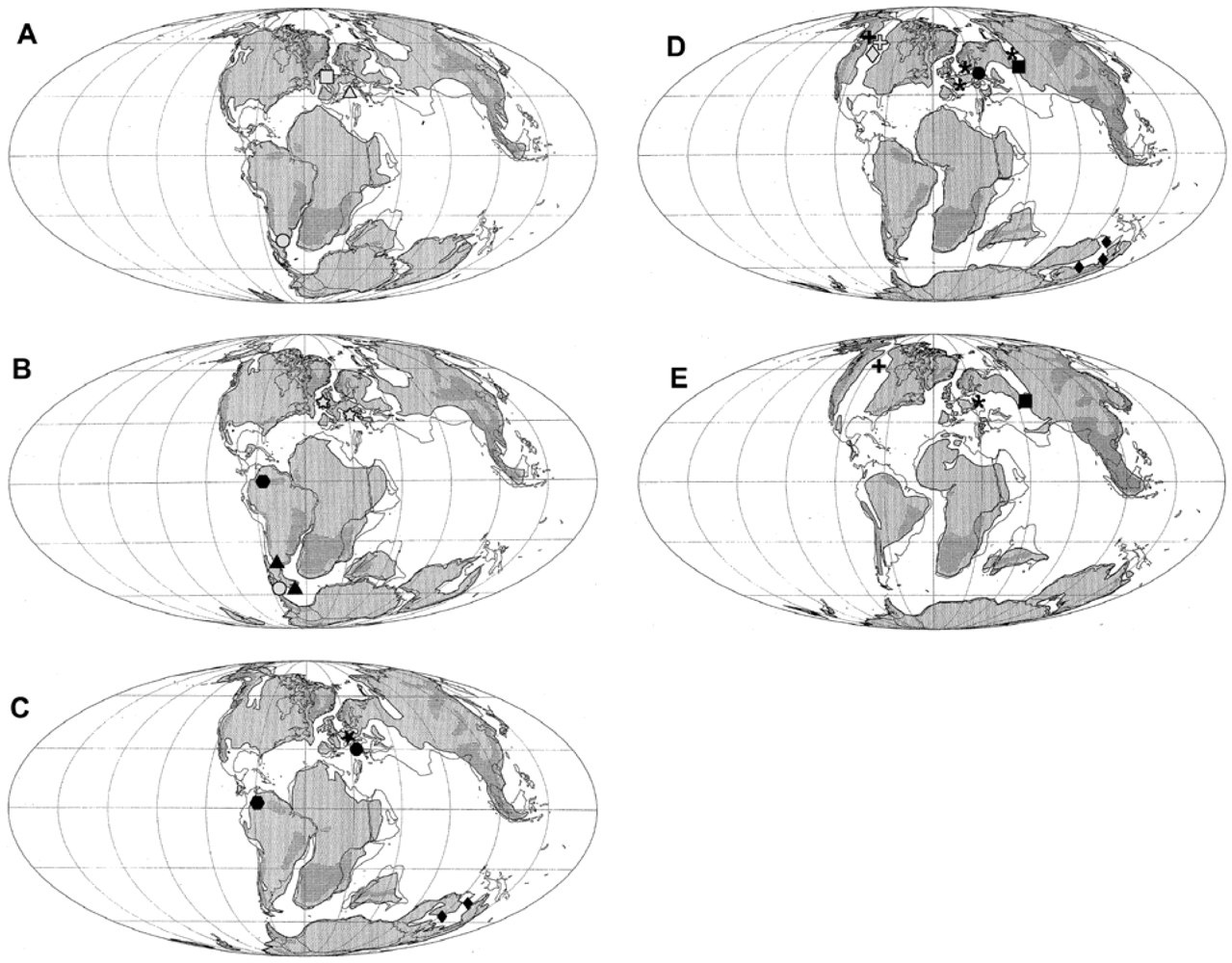
          <p><italic>Platypterygius hauthali</italic>—Originally described as <italic>Myobradypterygius hauthali</italic>, von Huene [<xref ref-type="bibr" rid="B18-geosciences-02-00011">18</xref>] erected this South American ichthyosaur on forelimb material from the Barremian [<xref ref-type="bibr" rid="B19-geosciences-02-00011">19</xref>] of Argentina (<xref ref-type="fig" rid="geosciences-02-00011-f001">Figure 1</xref>)—McGowan [<xref ref-type="bibr" rid="B13-geosciences-02-00011">13</xref>] referred the specimen to the genus <italic>Platypterygius</italic>. McGowan and Motani [<xref ref-type="bibr" rid="B2-geosciences-02-00011">2</xref>] retained the species, but thought it might prove synonymous with the contemporaneous <italic>Platypterygius platydactylus</italic>. However, Fernández and Aguirre-Urreta [<xref ref-type="bibr" rid="B19-geosciences-02-00011">19</xref>] undertook a revision of the holotype material, and considered it a valid species based on its carpal pattern. Hauterivian-Barremian occurrences of this species have been reported in southern-most Chile [<xref ref-type="bibr" rid="B20-geosciences-02-00011">20</xref>,<xref ref-type="bibr" rid="B21-geosciences-02-00011">21</xref>], but descriptions are currently limited to a single forefin considered <italic>Platypterygius</italic> sp [<xref ref-type="bibr" rid="B22-geosciences-02-00011">22</xref>]. Description of this relatively complete material may aid in distinguishing the two contemporaneous South American species, the holotypes of which do not share comparable elements.</p>
          <p><italic>Platypterygius platydactylus</italic>—<italic>Platypterygius platydactylus</italic> was first described by Broili [<xref ref-type="bibr" rid="B7-geosciences-02-00011">7</xref>] from the Aptian of Germany (<xref ref-type="fig" rid="geosciences-02-00011-f001">Figure 1</xref>), and is the type species for the genus <italic>Platypterygius</italic>. Unfortunately, the holotype was destroyed during World War II [<xref ref-type="bibr" rid="B2-geosciences-02-00011">2</xref>], and additional material for this species has not yet been reported.</p>
          <p><italic>Platypterygius australis</italic>—Australia’s species of <italic>Platypterygius</italic>, <italic>Platypterygius australis</italic>, include the best preserved, most abundant, and most complete remains of this genus [<xref ref-type="bibr" rid="B23-geosciences-02-00011">23</xref>]. Originally described in the nineteenth century from the Albian of Queensland [<xref ref-type="bibr" rid="B24-geosciences-02-00011">24</xref>,<xref ref-type="bibr" rid="B25-geosciences-02-00011">25</xref>], the erection of this species on non-diagnostic material has led to confusion surrounding the taxonomic identity of Australian specimens (as summarized—and resolved—by Zammit [<xref ref-type="bibr" rid="B26-geosciences-02-00011">26</xref>])—<italic>Platypterygius marathonensis</italic> [<xref ref-type="bibr" rid="B27-geosciences-02-00011">27</xref>] and <italic>Platypterygius longmani</italic> [<xref ref-type="bibr" rid="B28-geosciences-02-00011">28</xref>] have been synonymized with this taxon [<xref ref-type="bibr" rid="B2-geosciences-02-00011">2</xref>,<xref ref-type="bibr" rid="B13-geosciences-02-00011">13</xref>,<xref ref-type="bibr" rid="B29-geosciences-02-00011">29</xref>]. Remains attributable to this species have also been reported from the Aptian–Albian of South Australia and the Northern Territory [<xref ref-type="bibr" rid="B29-geosciences-02-00011">29</xref>] (<xref ref-type="fig" rid="geosciences-02-00011-f001">Figure 1</xref>).</p>
          <fig id="geosciences-02-00011-f001" position="anchor">
            <label>Figure 1</label>
            <caption>
              <p>Cretaceous ichthyosaur occurrences for the (<bold>A</bold>) Berriasian-Valanginian; (<bold>B</bold>) Barremian-Hauterivian; (<bold>C</bold>) Aptian; (<bold>D</bold>) Albian; and (<bold>E</bold>) Cenomanian. Base maps from Smith <italic>et al.</italic> [<xref ref-type="bibr" rid="B30-geosciences-02-00011">30</xref>]. Symbols: <italic>Acamptonectes densus</italic>, grey star; <italic>Aegirosaurus leptospondylus</italic>, grey triangle; <italic>Athabascasaurus bitumineus</italic>, grey diamond; <italic>Caypullisaurus bonapartei</italic>, grey circle; <italic>Maiaspondylus lindoei</italic>, grey ‘plus’ symbol; <italic>Ophthalmosaurus</italic> sp., grey square; <italic>Platypterygius americanus</italic>, black ‘plus’ symbol; <italic>Platypterygius australis</italic>, black diamond; <italic>Platypterygius campylodon</italic>, black asterisk; <italic>Platypterygius hauthali</italic>, black triangle; <italic>Platypterygius hercynicus</italic>, black circle; <italic>Platypterygius ochevi</italic>, black square; <italic>Platypterygius platydactylus</italic>, black star; <italic>Platypterygius sachicarum</italic>, black hexagon.</p>
            </caption>
            <graphic xmlns:xlink="http://www.w3.org/1999/xlink" xlink:href="geosciences-02-00011-g001.tif"/>
          </fig>
          <p><italic>Platypterygius campylodon</italic>—Originally referred to <italic>Ichthyosaurus</italic>, <italic>Platypterygius campylodon</italic> was first described in 1846 from Cambridge, UK [<xref ref-type="bibr" rid="B31-geosciences-02-00011">31</xref>]. The brief type description was followed by a slightly longer report later in the same year [<xref ref-type="bibr" rid="B32-geosciences-02-00011">32</xref>]. This species is now known from the Albian-Cenomanian of England [<xref ref-type="bibr" rid="B33-geosciences-02-00011">33</xref>], France [<xref ref-type="bibr" rid="B6-geosciences-02-00011">6</xref>], and Russia [<xref ref-type="bibr" rid="B2-geosciences-02-00011">2</xref>,<xref ref-type="bibr" rid="B34-geosciences-02-00011">34</xref>,<xref ref-type="bibr" rid="B35-geosciences-02-00011">35</xref>], and the Cenomanian of Germany [<xref ref-type="bibr" rid="B36-geosciences-02-00011">36</xref>] (<xref ref-type="fig" rid="geosciences-02-00011-f001">Figure 1</xref>). However, the taxonomy of several Russian species is uncertain—Storrs <italic>et al.</italic> [<xref ref-type="bibr" rid="B35-geosciences-02-00011">35</xref>] provisionally retained <italic>Platypterygius bedengensis</italic>, <italic>Platypterygius birjukovi</italic>, <italic>Platypterygius bannovkensis</italic>, and <italic>Platypterygius kiprijanoffi</italic>, while McGowan and Motani [<xref ref-type="bibr" rid="B2-geosciences-02-00011">2</xref>] considered all four taxon <italic>nomen dubium</italic> and synonymized the latter two taxa with <italic>P. campylodon</italic>. The revision of McGowan and Motani [<xref ref-type="bibr" rid="B2-geosciences-02-00011">2</xref>] is followed here as (a) Storrs <italic>et al.</italic> [<xref ref-type="bibr" rid="B35-geosciences-02-00011">35</xref>] were uncertain regarding the validity of <italic>P. bannovkensis</italic>, <italic>P. bedengensis</italic>, and <italic>P. birjukovi</italic> holotypes for taxonomic diagnosis, and (b) McGowan and Motani [<xref ref-type="bibr" rid="B2-geosciences-02-00011">2</xref>] demonstrated that the characteristic features of <italic>P. kiprijanoffi</italic> are not diagnostic.</p>
          <p><italic>Platypterygius americanus</italic>—<italic>Platypterygius americanus</italic> was first described from the upper Albian [<xref ref-type="bibr" rid="B23-geosciences-02-00011">23</xref>] of Wyoming [<xref ref-type="bibr" rid="B37-geosciences-02-00011">37</xref>]—originally described as a new genus, <italic>Myopterygius</italic>, it was later referred to <italic>Platypterygius</italic> [<xref ref-type="bibr" rid="B13-geosciences-02-00011">13</xref>]. It also occurs in the Lower Cenomanian of Wyoming [<xref ref-type="bibr" rid="B23-geosciences-02-00011">23</xref>,<xref ref-type="bibr" rid="B38-geosciences-02-00011">38</xref>] (<xref ref-type="fig" rid="geosciences-02-00011-f001">Figure 1</xref>). </p>
          <p><italic>Platypterygius hercynicus</italic>—Though <italic>Platypterygius hercynicus</italic> was originally described in 1946 [<xref ref-type="bibr" rid="B39-geosciences-02-00011">39</xref>], it was synonymized with <italic>P. platydactylus</italic> [<xref ref-type="bibr" rid="B2-geosciences-02-00011">2</xref>] before being resurrected by Kolb and Sander [<xref ref-type="bibr" rid="B16-geosciences-02-00011">16</xref>]. Resurrection of the species was further supported by Fischer [<xref ref-type="bibr" rid="B15-geosciences-02-00011">15</xref>], based on the cranial characters of a referred specimen. The species occurs in the Aptian and upper Albian sediments of Lower Saxony, Germany, and north-western France, respectively [<xref ref-type="bibr" rid="B15-geosciences-02-00011">15</xref>] (<xref ref-type="fig" rid="geosciences-02-00011-f001">Figure 1</xref>).</p>
          <p><italic>Platypterygius sachicarum</italic>—<italic>Platypterygius sachicarum</italic> is the second species of <italic>Platypterygius</italic> known from South America. The holotype, consisting of a nearly complete skull, was identified as being derived from the Barremian-Aptian Paja Formation of Colombo [<xref ref-type="bibr" rid="B40-geosciences-02-00011">40</xref>] (<xref ref-type="fig" rid="geosciences-02-00011-f001">Figure 1</xref>). Cranial features suggested a closer affinity with the North American species than the Australian or Eurasian forms [<xref ref-type="bibr" rid="B40-geosciences-02-00011">40</xref>], but this is yet to be tested in a phylogenetic analysis. Currently, the holotypes of the two South American <italic>Platypterygius</italic> do not share comparable elements, and thus, may eventually be synonymized—however, Fernández and Aguirre-Urreta [<xref ref-type="bibr" rid="B19-geosciences-02-00011">19</xref>] point out that there is a conspicuous difference in size.</p>
          <p><italic>Platypterygius ochevi</italic>—Described by Arkhangelsky <italic>et al.</italic> [<xref ref-type="bibr" rid="B17-geosciences-02-00011">17</xref>], <italic>Platypterygius ochevi</italic> was erected on features of the forelimb, specifically the large size of the humeral facet for the extra zeugopodial element anterior to the radius—however, the taxonomic utility of this character requires assessment (an opinion shared by Fischer <italic>et al.</italic> [<xref ref-type="bibr" rid="B11-geosciences-02-00011">11</xref>]). It is provisionally retained here pending re-examination of the material. The remains of this species of <italic>Platypterygius</italic> occur in the Albian-Cenomanian strata of the Voronezh Region, Russia [<xref ref-type="bibr" rid="B17-geosciences-02-00011">17</xref>] (<xref ref-type="fig" rid="geosciences-02-00011-f001">Figure 1</xref>).</p>
          <p>Additional <italic>Platypterygius</italic> remains—Several other occurrences attributed to <italic>Platypterygius</italic> also need to be considered. This includes Lydekker’s [<xref ref-type="bibr" rid="B41-geosciences-02-00011">41</xref>] <italic>Ichthyosaurus indicus</italic>, which was erected on fifteen associated vertebrae from the Cretaceous of India. This material was considered indeterminate by McGowan and Motani [<xref ref-type="bibr" rid="B2-geosciences-02-00011">2</xref>]—despite this, Underwood <italic>et al.</italic> [<xref ref-type="bibr" rid="B42-geosciences-02-00011">42</xref>] tentatively referred teeth to Lydekker’s [<xref ref-type="bibr" rid="B41-geosciences-02-00011">41</xref>] species, placing the material in <italic>Platypterygius indicus</italic>. The teeth were placed in this genus based on similarity to <italic>Platypterygius</italic>, and the proximity to Lydekker’s [<xref ref-type="bibr" rid="B41-geosciences-02-00011">41</xref>] locality. However, the tooth form in other Cretaceous ichthyosaurs, such as <italic>Brachypterygius</italic>, is similar to <italic>Platypterygius</italic> [<xref ref-type="bibr" rid="B8-geosciences-02-00011">8</xref>]—thus, a more detailed comparison is required to conclusively show the teeth can be referred to <italic>Platypterygius</italic>.</p>
          <p>Specimens from Italy [<xref ref-type="bibr" rid="B43-geosciences-02-00011">43</xref>], New Zealand [<xref ref-type="bibr" rid="B44-geosciences-02-00011">44</xref>], and Bavaria [<xref ref-type="bibr" rid="B45-geosciences-02-00011">45</xref>] have also been referred to <italic>Platypterygius</italic>. Bardet <italic>et al.</italic> [<xref ref-type="bibr" rid="B45-geosciences-02-00011">45</xref>] considered the robustness of the Bavarian remains (and the inferred large size) and tooth morphology consistent with <italic>Platypterygius</italic> sp. However, the fragmentary specimens from Italy and New Zealand were assigned to <italic>Platypterygius</italic> in part because no other Cretaceous genus was known at the time of discovery. Further examination may provide additional support for referral to this genus, particularly for the largest, well-preserved rostral fragment figured by Sirotti and Papazzoni [<xref ref-type="bibr" rid="B43-geosciences-02-00011">43</xref>].</p>
          <p>Each species of <italic>Platypterygius</italic> appears to be endemic to a given region (<xref ref-type="fig" rid="geosciences-02-00011-f001">Figure 1</xref>), though this may in part be due to geographic criteria being used in taxonomic assignment, e.g., [<xref ref-type="bibr" rid="B44-geosciences-02-00011">44</xref>]. However, <italic>Platypterygius</italic> remains have been described from both North America and Australia that appear inconsistent with the endemic species. The specimens described by Maxwell and Caldwell [<xref ref-type="bibr" rid="B46-geosciences-02-00011">46</xref>] and Adams and Fiorillo [<xref ref-type="bibr" rid="B47-geosciences-02-00011">47</xref>] appear to show more similarity with the European or Australian forms of this genus—however, while the forefin figured by Adams and Fiorillo [<xref ref-type="bibr" rid="B47-geosciences-02-00011">47</xref>] is consistent with the forelimbs of <italic>P. hercynicus</italic> and <italic>P. australis</italic>, the atlas-axis complex lacks the suture at the base of the neural canal exhibited by these two species [<xref ref-type="bibr" rid="B48-geosciences-02-00011">48</xref>,<xref ref-type="bibr" rid="B49-geosciences-02-00011">49</xref>]. Choo [<xref ref-type="bibr" rid="B50-geosciences-02-00011">50</xref>] described a fragmentary humerus that was more comparable with European rather than Australian or North American forms. Due to the incomplete nature of the material, the affinities of this humerus are uncertain—however, if this interpretation is upheld, the potential implication of this find is the possibility of two ichthyosaur dispersal events into Australia, as mentioned by Kear [<xref ref-type="bibr" rid="B51-geosciences-02-00011">51</xref>].</p>
        </sec>
        <sec>
          <title>2.1.2. <italic>Maiaspondylus</italic></title>
          <p><italic>Maiaspondylus</italic> consists of a single species, <italic>Maiaspondylus lindoei</italic>, recovered from the Albian of the Northwest Territories, Canada [<xref ref-type="bibr" rid="B8-geosciences-02-00011">8</xref>] (<xref ref-type="fig" rid="geosciences-02-00011-f001">Figure 1</xref>). The holotype of <italic>M. lindoei</italic> was found associated with ichthyosaur remains referred to <italic>Platypterygius</italic> [<xref ref-type="bibr" rid="B46-geosciences-02-00011">46</xref>], indicating that the two genera occurred together.</p>
        </sec>
        <sec>
          <title>2.1.3. <italic>Athabascasaurus</italic></title>
          <p><italic>Athabascasaurus</italic> consists of a single species, <italic>Athabascasaurus bitumineus</italic>, described from the earliest Albian of Alberta, Canada [<xref ref-type="bibr" rid="B9-geosciences-02-00011">9</xref>] (<xref ref-type="fig" rid="geosciences-02-00011-f001">Figure 1</xref>). The holotype consists of a nearly complete skull and partial postcranial skeleton that was collected in 2000 [<xref ref-type="bibr" rid="B9-geosciences-02-00011">9</xref>]. <italic>Platypterygius</italic> remains have been reported from the same formation containing <italic>Athabascasaurus</italic> [<xref ref-type="bibr" rid="B9-geosciences-02-00011">9</xref>].</p>
        </sec>
        <sec>
          <title>2.1.4. <italic>Sveltonectes</italic></title>
          <p>Described from the upper Barremian of western Russia (<xref ref-type="fig" rid="geosciences-02-00011-f001">Figure 1</xref>), the genus <italic>Sveltonectes</italic> contains a single species, <italic>Sveltonectes insolitus</italic>, erected on a nearly complete skeleton [<xref ref-type="bibr" rid="B10-geosciences-02-00011">10</xref>]. As a result, the authors have been able to identify many unique features, some of which relate to diet and swimming style that were also used to establish the generic name (see Etymology of Fischer <italic>et al.</italic> [<xref ref-type="bibr" rid="B10-geosciences-02-00011">10</xref>]).</p>
        </sec>
        <sec>
          <title>2.1.5. <italic>Acamptonectes</italic></title>
          <p>The most recently described Cretaceous genus, <italic>Acamptonectes</italic>, is monotypic, only containing the species <italic>Acamptonectes densus</italic>. It occurs in the basal Hauterivian—upper Hauterivian of north Yorkshire, UK, and Lower Saxony, Germany [<xref ref-type="bibr" rid="B11-geosciences-02-00011">11</xref>] (<xref ref-type="fig" rid="geosciences-02-00011-f001">Figure 1</xref>). Specimens attributable to the genus have also been identified from the Albian-Cenomanian of Cambridge, UK, but show features that differ from the already described species [<xref ref-type="bibr" rid="B11-geosciences-02-00011">11</xref>]. The preserved section of the snout is slender, exhibiting one of the lowest snout depth ratios in all known ophthalmosaurid ichthyosaurs, though the relative length of the rostrum is unknown [<xref ref-type="bibr" rid="B11-geosciences-02-00011">11</xref>]. Together with the tooth morphology described by Fischer <italic>et al.</italic> [<xref ref-type="bibr" rid="B11-geosciences-02-00011">11</xref>], this may indicate a different diet and thus lifestyle to previously known Cretaceous ichthyosaurs.</p>
        </sec>
        <sec>
          <title>2.1.6. Ichthyosaurs Crossing the Jurassic—Cretaceous Boundary</title>
          <p><italic>Ophthalmosaurus</italic>—<italic>Ophthalmosaurus</italic> is a well-known Jurassic ichthyosaur. The extension of this genus into the Cretaceous has been suggested by several authors [<xref ref-type="bibr" rid="B2-geosciences-02-00011">2</xref>,<xref ref-type="bibr" rid="B52-geosciences-02-00011">52</xref>,<xref ref-type="bibr" rid="B53-geosciences-02-00011">53</xref>], but a recent study [<xref ref-type="bibr" rid="B11-geosciences-02-00011">11</xref>] considers these reports to be ambiguous as the elements may belong to other genera now known from the Cretaceous. However, the same study refers a basioccipital and humerus from the Berriasian of the UK (<xref ref-type="fig" rid="geosciences-02-00011-f001">Figure 1</xref>) to cf. <italic>Ophthalmosaurus</italic>, indicating survival across the Jurassic-Cretaceous boundary.</p>
          <p><italic>Caypullisaurus</italic>—Previously thought to be limited to the Upper Jurassic [<xref ref-type="bibr" rid="B1-geosciences-02-00011">1</xref>], the monotypic genus <italic>Caypullisaurus</italic> has since been shown to extend into the Berriasian (Lower Cretaceous) of Argentina [<xref ref-type="bibr" rid="B54-geosciences-02-00011">54</xref>] (in Reference [<xref ref-type="bibr" rid="B19-geosciences-02-00011">19</xref>]) (<xref ref-type="fig" rid="geosciences-02-00011-f001">Figure 1</xref>). Additional material that may be attributed to <italic>Caypullisaurus</italic> has been recovered from the Hauterivian-Barremian of Chilean Patagonia, and occurs with <italic>P. hauthali</italic> [<xref ref-type="bibr" rid="B20-geosciences-02-00011">20</xref>,<xref ref-type="bibr" rid="B21-geosciences-02-00011">21</xref>].</p>
          <p><italic>Aegirosaurus</italic>—the anterior part of a rostrum is the only record of <italic>Aegirosaurus</italic> from the Cretaceous. Found in late Valanginian strata of southeastern France (<xref ref-type="fig" rid="geosciences-02-00011-f001">Figure 1</xref>), the snout was referred to this genus based on four characters: anterior-posterior order in which the cranial bones emerged; slenderness of the snout; tooth morphology; and tooth density [<xref ref-type="bibr" rid="B55-geosciences-02-00011">55</xref>]. This species was previously only known from the upper Jurassic [<xref ref-type="bibr" rid="B2-geosciences-02-00011">2</xref>]. Like <italic>P. platydactylus</italic>, holotype material was destroyed during World War II (though syntype material, thin sections of the teeth, survived, [<xref ref-type="bibr" rid="B56-geosciences-02-00011">56</xref>]), but comparable material was referred to the genus at the beginning of the 21st Century [<xref ref-type="bibr" rid="B57-geosciences-02-00011">57</xref>].</p>
          <p>Additional Genera—In addition to <italic>Ophthalmosaurus</italic>, <italic>Caypullisaurus</italic>, and <italic>Aegirosaurus</italic>, <italic>Brachypterygius</italic> may also have crossed the Jurassic–Cretaceous boundary. Ensom <italic>et al.</italic> [<xref ref-type="bibr" rid="B58-geosciences-02-00011">58</xref>] redescribed and dated an indeterminate ichthyosaur specimen that had affinities with <italic>Brachypterygius</italic>. Pending comparison with additional Cretaceous genera (such as <italic>Maiaspondylus</italic>), this material indicates that another Jurassic ichthyosaur may have survived into the Cretaceous.</p>
        </sec>
      </sec>
      <sec>
        <title>2.2. Diversity and Evolution of Cretaceous Ichthyosaurs</title>
        <p>The review of Cretaceous ichthyosaur occurrences demonstrates that five genera are currently known only from the Cretaceous, while at least three (and possibly four) additional Jurassic genera cross the Jurassic-Cretaceous boundary. The majority of this increased diversity has been recognized only recently (e.g., Maxwell and Caldwell [<xref ref-type="bibr" rid="B8-geosciences-02-00011">8</xref>] (p. 1043) state that “All Cretaceous ichthyosaurs are referred to a single genus, <italic>Platypterygius</italic> Huene, 1922”), and dispute the hypothesis of low taxonomic diversity within the Ichthyosauria prior to their extinction, though Cenomanian occurrences remain extremely rare. Further, some faunas include ichthyosaur fossils referred to two genera (e.g., <italic>Platypterygius</italic> and <italic>Maiaspondylus</italic>, [<xref ref-type="bibr" rid="B8-geosciences-02-00011">8</xref>])—this may have been possible through different adaptations (<italic>i.e.</italic>, morphological diversity) that allowed the ichthyosaurs to exploit different ecological niches.</p>
        <p>One feature that has been linked to diet, and thus ecological niche, is tooth form. Massare [<xref ref-type="bibr" rid="B59-geosciences-02-00011">59</xref>] proposed seven predatory guilds (condensed to six in Massare [<xref ref-type="bibr" rid="B60-geosciences-02-00011">60</xref>]) based on tooth morphology and tooth wear in Jurassic marine reptiles. However, placing some Cretaceous ichthyosaurs within this framework is difficult when (a) their teeth exhibit characters that are present in several different guilds (e.g., [<xref ref-type="bibr" rid="B55-geosciences-02-00011">55</xref>]), or (b) when inferences of diet cannot be supported by stomach contents [<xref ref-type="bibr" rid="B10-geosciences-02-00011">10</xref>]. Despite these concerns, diet has been inferred for Cretaceous ichthyosaurs with some success. Fischer <italic>et al.</italic> [<xref ref-type="bibr" rid="B10-geosciences-02-00011">10</xref>] considered the slender, pointed teeth of <italic>Sveltonectes</italic> intermediate between the ‘pierce I’ and ‘pierce II/generalist’ guilds of Massare [<xref ref-type="bibr" rid="B59-geosciences-02-00011">59</xref>], thus inferring a diet of soft to very soft prey or small bony prey. <italic>Aegirosaurus</italic> exhibits tooth morphologies that are present in both the ‘pierce I’ and ‘pierce II/generalist’ guilds of Massare [<xref ref-type="bibr" rid="B59-geosciences-02-00011">59</xref>], but was most consistent with the ‘pierce II/generalist’ guild [<xref ref-type="bibr" rid="B55-geosciences-02-00011">55</xref>], indicating a diet of fleshy prey that lacked a hard exterior. As pointed out by Fischer <italic>et al.</italic> [<xref ref-type="bibr" rid="B55-geosciences-02-00011">55</xref>], this guild was previously restricted to some pliosauroids, plesiosauroids, and thalattosuchians, and <italic>Aegirosaurus</italic> was included within this guild on the provision that it likely fed on smaller prey than the other predators. The slender tooth crown with longitudinal ridges observed in <italic>Acamptonectes</italic> [<xref ref-type="bibr" rid="B11-geosciences-02-00011">11</xref>] and <italic>Athabascasaurus</italic> [<xref ref-type="bibr" rid="B9-geosciences-02-00011">9</xref>] may also correspond to the ‘pierce II/generalist’ guild of Massare [<xref ref-type="bibr" rid="B59-geosciences-02-00011">59</xref>], though the ridges in the latter are less prominent. The four ichthyosaurs considered probably impaled prey rather than grasping it, or, for <italic>Sveltonectes</italic>, used the teeth as a sieve [<xref ref-type="bibr" rid="B59-geosciences-02-00011">59</xref>].</p>
        <p>Though previously considered edentulous [<xref ref-type="bibr" rid="B61-geosciences-02-00011">61</xref>], teeth are not firmly attached in <italic>Ophthalmosaurus</italic> and generally lost [<xref ref-type="bibr" rid="B2-geosciences-02-00011">2</xref>]. This genus has been described as having small, conical teeth [<xref ref-type="bibr" rid="B55-geosciences-02-00011">55</xref>,<xref ref-type="bibr" rid="B62-geosciences-02-00011">62</xref>] with a pointed apex bearing fine longitudinal ridges [<xref ref-type="bibr" rid="B63-geosciences-02-00011">63</xref>]. The size of the teeth suggests inclusion within Massare’s [<xref ref-type="bibr" rid="B59-geosciences-02-00011">59</xref>] ‘smash’ guild, while the crown morphology is consistent with the ‘general’ guild. This indicates a diet consisting of fleshy prey that may have contained some internal hard parts, but the method of prey capture may have been either grasping or impaling [<xref ref-type="bibr" rid="B60-geosciences-02-00011">60</xref>]. Similarly, <italic>Caypullisaurus</italic> is currently considered edentulous [<xref ref-type="bibr" rid="B64-geosciences-02-00011">64</xref>], though a single specimen figured by Fernández [<xref ref-type="bibr" rid="B65-geosciences-02-00011">65</xref>] has teeth in the anterior section of the jaws. The preserved teeth are described as having a similar shape to <italic>Ophthalmosaurus</italic>, and bear striations on the crown [<xref ref-type="bibr" rid="B65-geosciences-02-00011">65</xref>]. Apices of the teeth are not preserved. Thus, tooth morphology tentatively indicates a similar method of prey capture and diet to <italic>Ophthalmosaurus</italic>—however, the edentulous nature of most <italic>Caypullisaurus</italic> individuals suggests either ontogenetic variation in diet [<xref ref-type="bibr" rid="B65-geosciences-02-00011">65</xref>], or post-mortem loss of teeth resulting from weak attachment to the jaws (as in <italic>Ophthalmosaurus</italic>).</p>
        <p><italic>Platypterygius</italic> (and <italic>Maiaspondylus</italic>, which as a similar tooth morphology but more weakly developed enamel ornamentation, [<xref ref-type="bibr" rid="B8-geosciences-02-00011">8</xref>]) is more complex. The large robust teeth of <italic>P. campylodon</italic> were figured as an example of the ‘smash’ guild that fed on soft prey with some internal hard parts [<xref ref-type="bibr" rid="B59-geosciences-02-00011">59</xref>,<xref ref-type="bibr" rid="B60-geosciences-02-00011">60</xref>], and the tooth form described by Fischer [<xref ref-type="bibr" rid="B15-geosciences-02-00011">15</xref>] for <italic>P. hercynicus</italic> also corresponds to the morphology of this guild. However, as discussed by Fischer <italic>et al.</italic> [<xref ref-type="bibr" rid="B10-geosciences-02-00011">10</xref>], stomach contents of <italic>P. australis</italic>, which shares the ‘smash’ guild tooth morphology [<xref ref-type="bibr" rid="B66-geosciences-02-00011">66</xref>], indicated a less restricted diet that included scavenging and opportunistic feeding on vertebrates [<xref ref-type="bibr" rid="B67-geosciences-02-00011">67</xref>]. In addition, Kear and Barrett [<xref ref-type="bibr" rid="B68-geosciences-02-00011">68</xref>] hypothesized that the robust teeth of <italic>P. campylodon</italic> may have been an adaptation to feed on hard-shelled invertebrates, which would place this species within the ‘crunch’ guild of Massare [<xref ref-type="bibr" rid="B60-geosciences-02-00011">60</xref>]. Placing the genus <italic>Platypterygius</italic> in the ‘crunch’ guild would also be more consistent with the stomach contents described from <italic>P. australis</italic>. However, the slender, moderately long teeth described for <italic>P. americanus</italic> by Nace [<xref ref-type="bibr" rid="B38-geosciences-02-00011">38</xref>] are difficult to place in Massare’s [<xref ref-type="bibr" rid="B59-geosciences-02-00011">59</xref>] guilds, but may correspond to the ‘smash’ or ‘general’ guilds. This suggests that either prey preference varies between species of <italic>Platypterygius</italic>, or the teeth of <italic>Platypterygius</italic> can be adapted to several different potential diets and prey handling strategies. The tooth form in <italic>Maiaspondylus</italic> is similar to <italic>Platypterygius</italic> [<xref ref-type="bibr" rid="B8-geosciences-02-00011">8</xref>], and is thus consistent with the ‘smash’ guild of Massare [<xref ref-type="bibr" rid="B60-geosciences-02-00011">60</xref>]—however, stomach contents, if discovered, may indicate a less restricted diet, as for <italic>P. australis</italic>. Regardless of the prey consumed, all but one of the predator guilds considered for <italic>Platypterygius</italic> and <italic>Maiaspondylus</italic> use the same handling technique—grasping prey rather than impaling it (the general guild is the only one considered that was thought to incorporate impaling rather than grasping, Massare [<xref ref-type="bibr" rid="B60-geosciences-02-00011">60</xref>]). Thus, while there is some dietary overlap between Cretaceous ichthyosaurs, the differences in tooth morphology would also have likely allowed exploitation of different resources.</p>
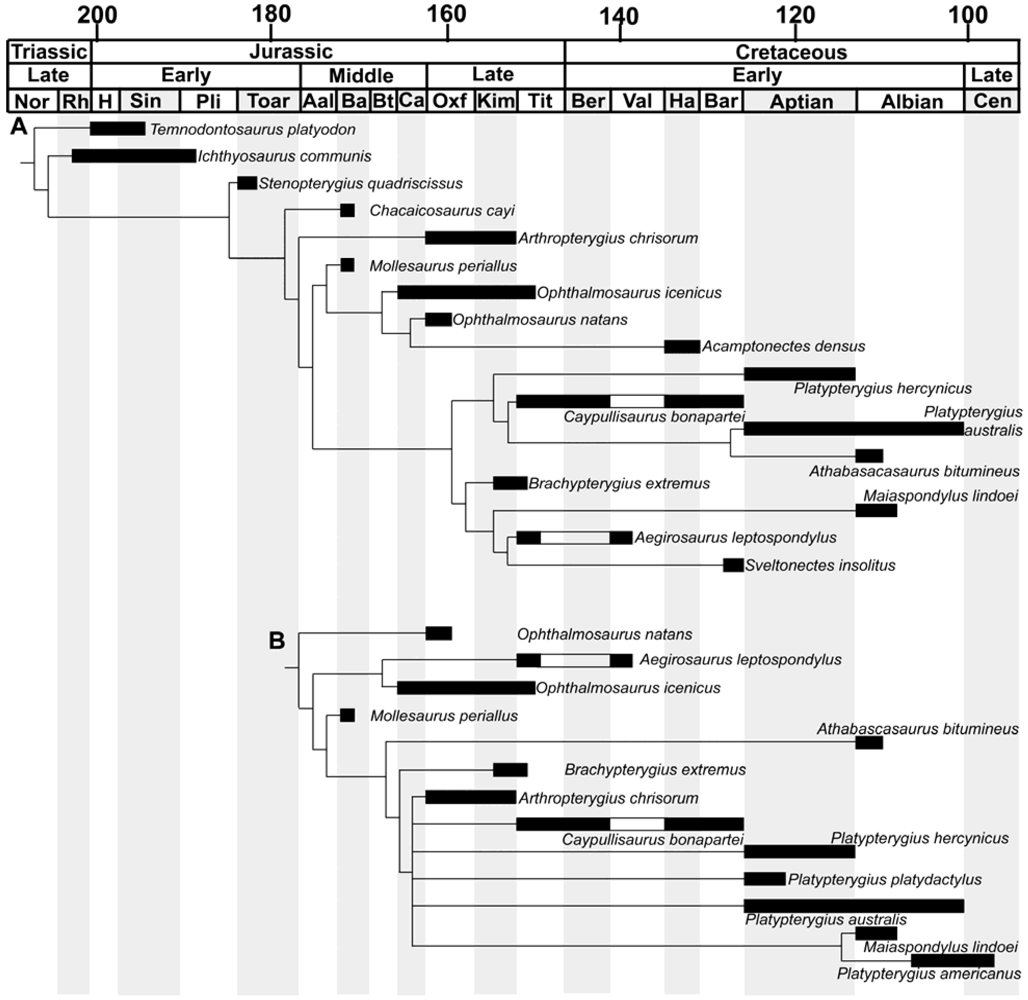
        <p>While the morphological diversity present in Cretaceous ichthyosaurs can no longer be denied, how this diversity evolved has not yet been investigated. Relationships between Cretaceous ichthyosaurs have only recently come under scrutiny [<xref ref-type="bibr" rid="B9-geosciences-02-00011">9</xref>,<xref ref-type="bibr" rid="B10-geosciences-02-00011">10</xref>,<xref ref-type="bibr" rid="B11-geosciences-02-00011">11</xref>]. Results vary between analyses, though the minor differences exhibited by Fischer <italic>et al.</italic> [<xref ref-type="bibr" rid="B10-geosciences-02-00011">10</xref>] and Fischer <italic>et al</italic>. [<xref ref-type="bibr" rid="B11-geosciences-02-00011">11</xref>] possibly result from the inclusion of additional taxa (<italic>i.e.</italic>, <italic>Ophthalmosaurus natans</italic> and <italic>Acamptonectes</italic>). The only consistent result found in these analyses is that the genera <italic>Ophthalmosaurus</italic> and <italic>Platypterygius</italic> as currently defined are polyphyletic, and thus a reanalysis of these two genera is warranted [<xref ref-type="bibr" rid="B9-geosciences-02-00011">9</xref>,<xref ref-type="bibr" rid="B11-geosciences-02-00011">11</xref>]—however, the additional taxa included within the two genera varies (<xref ref-type="fig" rid="geosciences-02-00011-f002">Figure 2</xref>). In Fischer <italic>et al.</italic> [<xref ref-type="bibr" rid="B11-geosciences-02-00011">11</xref>], the two <italic>Ophthalmosaurus</italic> species were separated by <italic>Acamptonectes</italic>, and were located at the crown of one clade. The relationship between <italic>Ophthalmosaurus natans</italic> and <italic>Ophthalmosaurus icenicus</italic> was more complicated in Druckenmiller and Maxwell [<xref ref-type="bibr" rid="B9-geosciences-02-00011">9</xref>]—<italic>O. icenicus</italic> and <italic>Aegirosaurus</italic> were recovered as sister taxa, and separated <italic>O. natans</italic> from the rest of the Ophthalmosauridae. The difference here may in part result from the inclusion of the new taxon <italic>Acamptonectes</italic>. Druckenmiller and Maxwell [<xref ref-type="bibr" rid="B9-geosciences-02-00011">9</xref>] found a polytomy containing a <italic>Maiaspondylus</italic>-<italic>P. americanus</italic> sister-group, <italic>P. australis</italic>, <italic>P. hercynicus</italic>, <italic>P. americanus</italic>, <italic>Caypullisaurus</italic>, and <italic>Arthropterygius</italic>. In contrast, Fischer <italic>et al.</italic> [<xref ref-type="bibr" rid="B11-geosciences-02-00011">11</xref>] recovered a four-taxon clade where <italic>Caypullisaurus</italic> separated a <italic>P. australis</italic>-<italic>Athabascasaurus</italic> sister-relationship and <italic>P. hercynicus</italic>. This could be related to the exclusion of <italic>P. platydactylus</italic> in the study of Fischer <italic>et al.</italic> [<xref ref-type="bibr" rid="B11-geosciences-02-00011">11</xref>].</p>
        <p>Tree topology varies greatly between the analyses (<xref ref-type="fig" rid="geosciences-02-00011-f002">Figure 2</xref>). Druckenmiller and Maxwell [<xref ref-type="bibr" rid="B9-geosciences-02-00011">9</xref>] recover a ‘classic’ branching pattern with a crownward polytomy. Fischer <italic>et al.</italic> [<xref ref-type="bibr" rid="B11-geosciences-02-00011">11</xref>], on the other hand, splits the Ophthalmosauridae into two major radiations, the Ophthalmosaurinae and the Platypterygiinae, the latter containing two branches. Both phylogenetic hypotheses indicate a ghost lineage for <italic>Platypterygius</italic> extending into the Late Jurassic—either through the origin of <italic>P. hercynicus</italic> in the Kimmeridgian prior to the first appearance of <italic>Caypullisaurus</italic> [<xref ref-type="bibr" rid="B11-geosciences-02-00011">11</xref>], or <italic>P. australis</italic>, <italic>P. platydactylus</italic>, and <italic>P. hercynicus</italic> occurring with the first appearance of <italic>Caypullisaurus</italic> in the Tithonian [<xref ref-type="bibr" rid="B9-geosciences-02-00011">9</xref>]. Inclusion of the oldest known <italic>Platypterygius</italic>, <italic>P. hauthali</italic> and <italic>P. sachicarum</italic>, may further change these results. The positions of several taxa also vary greatly between the phylogenetic analyses. Several taxa are recovered in both stem- and crown-ward positions (e.g., <italic>Athabascasaurus</italic>, <italic>Aegirosaurus</italic>, and <italic>Arthropterygius</italic>). Different taxa also separate species of the problematic genus <italic>Platypterygius</italic>—<italic>Athabascasaurus</italic> and <italic>Caypullisaurus</italic> [<xref ref-type="bibr" rid="B11-geosciences-02-00011">11</xref>], or <italic>Maiaspondylus</italic>, <italic>Arthropterygius</italic>, and <italic>Caypullisaurus</italic> [<xref ref-type="bibr" rid="B9-geosciences-02-00011">9</xref>].</p>
        <fig id="geosciences-02-00011-f002" position="anchor">
          <label>Figure 2</label>
          <caption>
            <p>Stratigraphy-related phylogenetic trees. (<bold>A</bold>) modified from Fischer <italic>et al.</italic> [<xref ref-type="bibr" rid="B11-geosciences-02-00011">11</xref>]; (<bold>B</bold>) modified from Druckenmiller and Maxwell [<xref ref-type="bibr" rid="B9-geosciences-02-00011">9</xref>]. <italic>Ichthyosaurus communis</italic> and <italic>Ophthalmosaurus icenicus</italic> now extend into the Pliensbachian [<xref ref-type="bibr" rid="B69-geosciences-02-00011">69</xref>] and Tithonian [<xref ref-type="bibr" rid="B62-geosciences-02-00011">62</xref>], respectively. Black bars indicate species occurrence within an epoch. White bars indicate a species is not known from this epoch, but occurs in surrounding epochs. Abbreviations: Aal, Aalenian; Ba, Bajocian; Bar, Barremian; Ber, Berriasian; Bt, Bathonian; Ca, Callovian; Cen, Cenomanian; H, Hettangian; Ha, Hauterivian; Kim, Kimmeridgian; Nor, Norian; Oxf, Oxfordian; Pli, Pliensbachian; Rh, Rhaetian; Sin, Sinemurian; Tit, Tithonian; Toar, Toarcian; Val, Valanginian.</p>
          </caption>
          <graphic xmlns:xlink="http://www.w3.org/1999/xlink" xlink:href="geosciences-02-00011-g002.tif"/>
        </fig>
        <p>So, what do the divergent phylogenetic hypotheses tell us about the origins and evolution of Cretaceous ichthyosaurs? The radiation of <italic>Platypterygius</italic> [<xref ref-type="bibr" rid="B9-geosciences-02-00011">9</xref>] or the emergence of the Platypterygiinae [<xref ref-type="bibr" rid="B11-geosciences-02-00011">11</xref>] during the Late Jurassic could coincide with the opening of the Atlantic Ocean [<xref ref-type="bibr" rid="B70-geosciences-02-00011">70</xref>], or new dispersal routes through the breakup of Gondwana [<xref ref-type="bibr" rid="B71-geosciences-02-00011">71</xref>]. With the exception of the <italic>Maiaspondylus</italic>-<italic>P. americanus</italic> sister relationship recovered by Druckenmiller and Maxwell [<xref ref-type="bibr" rid="B9-geosciences-02-00011">9</xref>], the phylogenetic positions of Cretaceous genera do not appear to correlate with stratigraphic position or proximity—for example, <italic>P. australis</italic> and <italic>Athabascasaurus</italic> were recovered as sister-taxa [<xref ref-type="bibr" rid="B11-geosciences-02-00011">11</xref>], yet are found in strata of the same age from different continents (<xref ref-type="fig" rid="geosciences-02-00011-f001">Figure 1</xref>). Further, sister relationships were not recovered between <italic>Platypterygius</italic> species collected from similar localities (<italic>i.e.</italic>, <italic>P. hercynicus</italic> and <italic>P. platydactylus</italic>, Druckenmiller and Maxwell [<xref ref-type="bibr" rid="B9-geosciences-02-00011">9</xref>]), suggesting the absence of phylogeographic structuring (<italic>i.e.</italic>, widespread panmixia), and possibly dispersal between non-adjacent regions—this is perhaps unsurprising given that <italic>Platypterygius</italic> material inconsistent with the endemic species (<italic>i.e.</italic>, most likely belonging to a non-endemic species) has been found in North America [<xref ref-type="bibr" rid="B46-geosciences-02-00011">46</xref>]. To more fully understand the origins and evolution of Cretaceous ichthyosaurs, the phylogenetic position of some of the stratigraphically oldest specimens (e.g., <italic>P. hauthali</italic> and <italic>P. sachicarum</italic>, the former of which contains a newly referred, complete specimen, Pardo Perez <italic>et al.</italic> [<xref ref-type="bibr" rid="B21-geosciences-02-00011">21</xref>]) needs to be investigated.</p>
      </sec>
    </sec>
    <sec sec-type="conclusions">
      <title>3. Conclusions</title>
      <p>A total of eight genera are known from the Cretaceous—<italic>Platypterygius</italic>, <italic>Maiaspondylus</italic>, <italic>Athabascasaurus</italic>, <italic>Sveltonectes</italic>, and <italic>Acamptonectes</italic> are found only in the Cretaceous, while <italic>Ophthalmosaurus</italic>, <italic>Aegirosaurus</italic>, and <italic>Caypullisaurus</italic> cross the Jurassic-Cretaceous boundary. The different genera likely occupied different, though overlapping, ecological niches. This is supported by different tooth morphologies, indicating different diets, and sympatry of two genera (e.g., <italic>Caypullisaurus</italic> and <italic>Platypterygius</italic>, and <italic>Maiaspondylus</italic> and <italic>Platypterygius</italic>). Phylogenetic relationships between Cretaceous ichthyosaurs remain problematic, with tree topology varying between analyses. As a result, little can be stated with certainty regarding the radiation and dispersal of these ichthyosaurs, though the emergence of some forms in the Late Jurassic may have coincided with the opening of the Atlantic Ocean or the breakup of Gondwana. Inclusion of the stratigraphically oldest species (e.g., <italic>Platypterygius hauthali</italic> and <italic>Platypterygius sachicarum</italic>) may shed additional light on the evolution of the group.</p>
    </sec>
  </body>
  <back>
    <ack>
      <title>Acknowledgments</title>
      <p>Many thanks to authors who provided copies of their journal articles that would otherwise have been difficult to obtain: Nathalie Bardet, Maxim Arkhangelsky, Cajus Diedrich, to name but a few. Use of the Barr Smith Library (University of Adelaide) in locating references is acknowledged. Thanks also to Ben Kear and Nicolas Rawlence for their comments on the manuscript. </p>
    </ack>
    <ref-list>
      <title>References</title>
      <ref id="B1-geosciences-02-00011">
        <label>1.</label>
        <citation citation-type="journal">
          <person-group person-group-type="author">
            <name>
              <surname>Maisch</surname>
              <given-names>M.W.</given-names>
            </name>
            <name>
              <surname>Matzke</surname>
              <given-names>A.T.</given-names>
            </name>
          </person-group>
          <article-title>The Ichthyosauria</article-title>
          <source>Stuttg. Beitr. Naturkunde Ser. B (Geolog. Paläontol.)</source>
          <year>2000</year>
          <volume>298</volume>
          <fpage>1</fpage>
          <lpage>159</lpage>
          <comment>in German</comment>
        </citation>
      </ref>
      <ref id="B2-geosciences-02-00011">
        <label>2.</label>
        <citation citation-type="book">
          <person-group person-group-type="author">
            <name>
              <surname>McGowan</surname>
              <given-names>C.</given-names>
            </name>
            <name>
              <surname>Motani</surname>
              <given-names>R.</given-names>
            </name>
          </person-group>
          <source>Ichthyopterygia. Handbook of Paleoherpetology</source>
          <person-group person-group-type="editor">
            <name>
              <surname>Sues</surname>
              <given-names>H.D.</given-names>
            </name>
          </person-group>
          <publisher-name>Verlag Dr. Friedrich Pfeil</publisher-name>
          <publisher-loc>Munich, Germany</publisher-loc>
          <year>2003</year>
          <volume>8</volume>
          <fpage>175</fpage>
        </citation>
      </ref>
      <ref id="B3-geosciences-02-00011">
        <label>3.</label>
        <citation citation-type="journal">
          <person-group person-group-type="author">
            <name>
              <surname>Sander</surname>
              <given-names>P.M.</given-names>
            </name>
          </person-group>
          <article-title>Ichthyosauria: Their diversity, distribution, and phylogeny</article-title>
          <source>Paläontol. Z.</source>
          <year>2000</year>
          <volume>74</volume>
          <fpage>1</fpage>
          <lpage>35</lpage>
        </citation>
      </ref>
      <ref id="B4-geosciences-02-00011">
        <label>4.</label>
        <citation citation-type="journal">
          <person-group person-group-type="author">
            <name>
              <surname>Mazin</surname>
              <given-names>J.M.</given-names>
            </name>
            <name>
              <surname>Bardet</surname>
              <given-names>N.</given-names>
            </name>
            <name>
              <surname>Godefroit</surname>
              <given-names>P.</given-names>
            </name>
          </person-group>
          <article-title>The European Ichthyopterygia: A re-assessment</article-title>
          <source>J. Vertebr. Paleontol.</source>
          <year>1994</year>
          <volume>14</volume>
          <fpage>36</fpage>
          <lpage>37</lpage>
        </citation>
      </ref>
      <ref id="B5-geosciences-02-00011">
        <label>5.</label>
        <citation citation-type="journal">
          <person-group person-group-type="author">
            <name>
              <surname>Bardet</surname>
              <given-names>N.</given-names>
            </name>
          </person-group>
          <article-title>Dental cross-sections in Cretaceous Ichthyopterygia: Systematic implications</article-title>
          <source>Geobios-LYON</source>
          <year>1990</year>
          <volume>23</volume>
          <fpage>169</fpage>
          <lpage>172</lpage>
          <pub-id pub-id-type="doi">10.1016/S0016-6995(06)80049-5</pub-id>
        </citation>
      </ref>
      <ref id="B6-geosciences-02-00011">
        <label>6.</label>
        <citation citation-type="journal">
          <person-group person-group-type="author">
            <name>
              <surname>Bardet</surname>
              <given-names>N.</given-names>
            </name>
          </person-group>
          <article-title>Stratigraphic evidence for the extinction of ichthyosaurs</article-title>
          <source>Terra Nova</source>
          <year>1992</year>
          <volume>4</volume>
          <fpage>649</fpage>
          <lpage>656</lpage>
          <pub-id pub-id-type="doi">10.1111/j.1365-3121.1992.tb00614.x</pub-id>
        </citation>
      </ref>
      <ref id="B7-geosciences-02-00011">
        <label>7.</label>
        <citation citation-type="journal">
          <person-group person-group-type="author">
            <name>
              <surname>Broili</surname>
              <given-names>F.</given-names>
            </name>
          </person-group>
          <article-title>Ein neuer Ichthyosaurus aus der norddeutschen Kreide</article-title>
          <source>Palaeontogr.</source>
          <year>1907</year>
          <volume>54</volume>
          <fpage>139</fpage>
          <lpage>152</lpage>
          <comment>in German</comment>
        </citation>
      </ref>
      <ref id="B8-geosciences-02-00011">
        <label>8.</label>
        <citation citation-type="journal">
          <person-group person-group-type="author">
            <name>
              <surname>Maxwell</surname>
              <given-names>E.E.</given-names>
            </name>
            <name>
              <surname>Caldwell</surname>
              <given-names>M.W.</given-names>
            </name>
          </person-group>
          <article-title>A new genus of ichthyosaur from the Lower Cretaceous of western Canada</article-title>
          <source>Palaeontology</source>
          <year>2006</year>
          <volume>49</volume>
          <fpage>1043</fpage>
          <lpage>1052</lpage>
          <pub-id pub-id-type="doi">10.1111/j.1475-4983.2006.00589.x</pub-id>
        </citation>
      </ref>
      <ref id="B9-geosciences-02-00011">
        <label>9.</label>
        <citation citation-type="journal">
          <person-group person-group-type="author">
            <name>
              <surname>Druckenmiller</surname>
              <given-names>P.S.</given-names>
            </name>
            <name>
              <surname>Maxwell</surname>
              <given-names>E.E.</given-names>
            </name>
          </person-group>
          <article-title>A new Lower Cretaceous (lower Albian) ichthyosaur genus from the Clearwater Formation, Alberta, Canada</article-title>
          <source>Can. J. Earth Sci.</source>
          <year>2010</year>
          <volume>47</volume>
          <fpage>1037</fpage>
          <lpage>1053</lpage>
          <pub-id pub-id-type="doi">10.1139/E10-028</pub-id>
        </citation>
      </ref>
      <ref id="B10-geosciences-02-00011">
        <label>10.</label>
        <citation citation-type="journal">
          <person-group person-group-type="author">
            <name>
              <surname>Fischer</surname>
              <given-names>V.</given-names>
            </name>
            <name>
              <surname>Masure</surname>
              <given-names>E.</given-names>
            </name>
            <name>
              <surname>Arkhangelsky</surname>
              <given-names>M.S.</given-names>
            </name>
            <name>
              <surname>Godefroit</surname>
              <given-names>P.</given-names>
            </name>
          </person-group>
          <article-title>A new Barremian (Early Cretaceous) ichthyosaur from western Russia</article-title>
          <source>J. Vertebr. Paleontol.</source>
          <year>2011</year>
          <volume>31</volume>
          <fpage>1010</fpage>
          <lpage>1025</lpage>
          <pub-id pub-id-type="doi">10.1080/02724634.2011.595464</pub-id>
        </citation>
      </ref>
      <ref id="B11-geosciences-02-00011">
        <label>11.</label>
        <citation citation-type="journal">
          <person-group person-group-type="author">
            <name>
              <surname>Fischer</surname>
              <given-names>V.</given-names>
            </name>
            <name>
              <surname>Maisch</surname>
              <given-names>M.W.</given-names>
            </name>
            <name>
              <surname>Naisch</surname>
              <given-names>D.</given-names>
            </name>
            <name>
              <surname>Kosma</surname>
              <given-names>R.</given-names>
            </name>
            <name>
              <surname>Liston</surname>
              <given-names>J.</given-names>
            </name>
            <name>
              <surname>Joger</surname>
              <given-names>U.</given-names>
            </name>
            <name>
              <surname>Krüger</surname>
              <given-names>F.J.</given-names>
            </name>
            <name>
              <surname>Pardo Pérez</surname>
              <given-names>J.</given-names>
            </name>
            <name>
              <surname>Tainsh</surname>
              <given-names>J.</given-names>
            </name>
            <name>
              <surname>Appleby</surname>
              <given-names>R.M.</given-names>
            </name>
          </person-group>
          <article-title>New ophthalmosaurid ichthyosaurs from the European Lower Cretaceous demonstrate extensive ichthyosaur survival across the Jurassic-Cretaceous boundary</article-title>
          <source>PloS ONE</source>
          <year>2012</year>
          <volume>7</volume>
          <fpage>1</fpage>
          <lpage>23</lpage>
        </citation>
      </ref>
      <ref id="B12-geosciences-02-00011">
        <label>12.</label>
        <citation citation-type="journal">
          <person-group person-group-type="author">
            <name>
              <surname>Fischer</surname>
              <given-names>V.</given-names>
            </name>
          </person-group>
          <article-title>New ophthalmosaurids from Europe and Russia broaden the biodiversity of Early Cretaceous ichthyosaurs</article-title>
          <source>J. Vertebr. Paleontol. Suppl.</source>
          <year>2011</year>
          <volume>31</volume>
          <fpage>110</fpage>
        </citation>
      </ref>
      <ref id="B13-geosciences-02-00011">
        <label>13.</label>
        <citation citation-type="journal">
          <person-group person-group-type="author">
            <name>
              <surname>McGowan</surname>
              <given-names>C.</given-names>
            </name>
          </person-group>
          <article-title>The systematics of Cretaceous ichthyosaurs with particular reference to the material from North America</article-title>
          <source>Contrib. Geol. Univ. Wyo.</source>
          <year>1972</year>
          <volume>11</volume>
          <fpage>9</fpage>
          <lpage>29</lpage>
        </citation>
      </ref>
      <ref id="B14-geosciences-02-00011">
        <label>14.</label>
        <citation citation-type="book">
          <person-group person-group-type="author">
            <name>
              <surname>McGowan</surname>
              <given-names>C.</given-names>
            </name>
          </person-group>
          <source>Dinosaurs, Spitfires, and Seadragons</source>
          <edition>1st</edition>
          <publisher-name>Harvard University Press</publisher-name>
          <publisher-loc>Cambridge, MA, USA</publisher-loc>
          <year>1991</year>
          <fpage>365</fpage>
        </citation>
      </ref>
      <ref id="B15-geosciences-02-00011">
        <label>15.</label>
        <citation citation-type="journal">
          <person-group person-group-type="author">
            <name>
              <surname>Fischer</surname>
              <given-names>V.</given-names>
            </name>
          </person-group>
          <article-title>New data on the ichthyosaur <italic>Platypterygius hercynicus</italic> and its implications for the validity of the genus</article-title>
          <source>Acta Palaeontol. Pol.</source>
          <year>2012</year>
          <volume>57</volume>
          <fpage>123</fpage>
          <lpage>134</lpage>
          <pub-id pub-id-type="doi">10.4202/app.2011.0007</pub-id>
        </citation>
      </ref>
      <ref id="B16-geosciences-02-00011">
        <label>16.</label>
        <citation citation-type="journal">
          <person-group person-group-type="author">
            <name>
              <surname>Kolb</surname>
              <given-names>C.</given-names>
            </name>
            <name>
              <surname>Sander</surname>
              <given-names>P.M.</given-names>
            </name>
          </person-group>
          <article-title>Redescription of the ichthyosaur <italic>Platypterygius hercynicus</italic> (Kuhn 1946) from the Lower Cretaceous of Salzgitter (Lower Saxony, Germany)</article-title>
          <source>Palaeontogr. Abt. A.</source>
          <year>2009</year>
          <volume>288</volume>
          <fpage>151</fpage>
          <lpage>192</lpage>
        </citation>
      </ref>
      <ref id="B17-geosciences-02-00011">
        <label>17.</label>
        <citation citation-type="journal">
          <person-group person-group-type="author">
            <name>
              <surname>Arkhangelsky</surname>
              <given-names>M.S.</given-names>
            </name>
            <name>
              <surname>Averianov</surname>
              <given-names>A.O.</given-names>
            </name>
            <name>
              <surname>Pervushov</surname>
              <given-names>E.M.</given-names>
            </name>
            <name>
              <surname>Tarnikow</surname>
              <given-names>V.Y.</given-names>
            </name>
            <name>
              <surname>Zozyrev</surname>
              <given-names>N.Y.</given-names>
            </name>
          </person-group>
          <article-title>On ichthyosaur remains from the Cretaceous of the Voronezh Region</article-title>
          <source>Palaeontol. J.</source>
          <year>2008</year>
          <volume>42</volume>
          <fpage>287</fpage>
          <lpage>291</lpage>
          <pub-id pub-id-type="doi">10.1134/S0031030108030106</pub-id>
        </citation>
      </ref>
      <ref id="B18-geosciences-02-00011">
        <label>18.</label>
        <citation citation-type="journal">
          <person-group person-group-type="author">
            <name>
              <surname>Von Huene</surname>
              <given-names>F.</given-names>
            </name>
          </person-group>
          <article-title>Beitrag zur Kenntnis mariner mesozoischer Wirbeltiere in Argentina</article-title>
          <source>Zent. Mineral. Geolog. Paläontol. B</source>
          <year>1927</year>
          <volume>1927</volume>
          <fpage>22</fpage>
          <lpage>29</lpage>
          <comment>in German</comment>
        </citation>
      </ref>
      <ref id="B19-geosciences-02-00011">
        <label>19.</label>
        <citation citation-type="journal">
          <person-group person-group-type="author">
            <name>
              <surname>Fernández</surname>
              <given-names>M.</given-names>
            </name>
            <name>
              <surname>Aguirre-Urreta</surname>
              <given-names>M.B.</given-names>
            </name>
          </person-group>
          <article-title>Revision of <italic>Platypterygius hauthali</italic> von Huene, 1927 (Ichthyosauria: Ophthalmosauridae) from the Early Cretaceous of Patagonia, Argentin</article-title>
          <source>J. Vertebr. Paleontol.</source>
          <year>2005</year>
          <volume>25</volume>
          <fpage>583</fpage>
          <lpage>587</lpage>
          <pub-id pub-id-type="doi">10.1671/0272-4634(2005)025[0583:ROPHVH]2.0.CO;2</pub-id>
        </citation>
      </ref>
      <ref id="B20-geosciences-02-00011">
        <label>20.</label>
        <citation citation-type="confproc">
          <person-group person-group-type="author">
            <name>
              <surname>Pardo Pérez</surname>
              <given-names>J.</given-names>
            </name>
            <name>
              <surname>Frey</surname>
              <given-names>E.</given-names>
            </name>
            <name>
              <surname>Stinnesbeck</surname>
              <given-names>W.</given-names>
            </name>
            <name>
              <surname>Salazar</surname>
              <given-names>C.</given-names>
            </name>
            <name>
              <surname>Leppe</surname>
              <given-names>M.</given-names>
            </name>
          </person-group>
          <article-title>Life and death on the Torres del Pain ichthyosaurs, southern Chile</article-title>
          <source>Proceedings of 7th Annual Meeting of the European Association of Vertebrate Palaeontologists</source>
          <conf-loc>Berlin, Germany</conf-loc>
          <conf-date>20-24 July 2009</conf-date>
          <fpage>55</fpage>
        </citation>
      </ref>
      <ref id="B21-geosciences-02-00011">
        <label>21.</label>
        <citation citation-type="journal">
          <person-group person-group-type="author">
            <name>
              <surname>Pardo Pérez</surname>
              <given-names>J.M.</given-names>
            </name>
            <name>
              <surname>Frey</surname>
              <given-names>E.</given-names>
            </name>
            <name>
              <surname>Stinnesbeck</surname>
              <given-names>W.</given-names>
            </name>
            <name>
              <surname>Rivas</surname>
              <given-names>L.</given-names>
            </name>
          </person-group>
          <article-title>Early Cretaceous ichthyosaurs from the Tyndall Glacier in Torres Del Paine National Park, southernmost Chile</article-title>
          <source>J. Vertebr. Paleontol. Suppl.</source>
          <year>2011</year>
          <volume>31</volume>
          <fpage>171</fpage>
        </citation>
      </ref>
      <ref id="B22-geosciences-02-00011">
        <label>22.</label>
        <citation citation-type="other">
          <person-group person-group-type="author">
            <name>
              <surname>Pardo-Pérez</surname>
              <given-names>J.</given-names>
            </name>
            <name>
              <surname>Frey</surname>
              <given-names>E.</given-names>
            </name>
            <name>
              <surname>Stinnesbeck</surname>
              <given-names>W.</given-names>
            </name>
            <name>
              <surname>Fernánez</surname>
              <given-names>M.S.</given-names>
            </name>
            <name>
              <surname>Rivas</surname>
              <given-names>L.</given-names>
            </name>
            <name>
              <surname>Salazar</surname>
              <given-names>C.</given-names>
            </name>
            <name>
              <surname>Leppe</surname>
              <given-names>M.</given-names>
            </name>
          </person-group>
          <article-title>An ichthyosaurian forefin from the Lower Cretaceous Zapata Formation of southern Chile: Implicaitons for morphological variability within <italic>Platypterygius</italic></article-title>
          <source>Palaeobio. Palaeoenv.</source>
          <year>2012</year>
          <comment>in submission</comment>
        </citation>
      </ref>
      <ref id="B23-geosciences-02-00011">
        <label>23.</label>
        <citation citation-type="journal">
          <person-group person-group-type="author">
            <name>
              <surname>Maxwell</surname>
              <given-names>E.E.</given-names>
            </name>
            <name>
              <surname>Kear</surname>
              <given-names>B.P.</given-names>
            </name>
          </person-group>
          <article-title>Postcranial anatomy of <italic>Platypterygius americanus</italic> (Reptilia: Ichthyosauria) from the Cretaceous of Wyoming</article-title>
          <source>J. Vertebr. Paleontol.</source>
          <year>2010</year>
          <volume>30</volume>
          <fpage>1059</fpage>
          <lpage>1068</lpage>
          <pub-id pub-id-type="doi">10.1080/02724634.2010.483546</pub-id>
        </citation>
      </ref>
      <ref id="B24-geosciences-02-00011">
        <label>24.</label>
        <citation citation-type="journal">
          <person-group person-group-type="author">
            <name>
              <surname>McCoy</surname>
              <given-names>F.</given-names>
            </name>
          </person-group>
          <article-title>On the occurrence of <italic>Ichthyosaurus</italic> and <italic>Plesiosaurus</italic> in Australia</article-title>
          <source>J. Nat. Hist. Third Ser.</source>
          <year>1867</year>
          <volume>19</volume>
          <fpage>355</fpage>
          <lpage>356</lpage>
        </citation>
      </ref>
      <ref id="B25-geosciences-02-00011">
        <label>25.</label>
        <citation citation-type="journal">
          <person-group person-group-type="author">
            <name>
              <surname>McCoy</surname>
              <given-names>F.</given-names>
            </name>
          </person-group>
          <article-title>On the discovery of Enaliosauria and other Cretaceous fossils in Australia</article-title>
          <source>Trans. Proc. Rol. Soc. Vic.</source>
          <year>1867</year>
          <volume>8</volume>
          <fpage>41</fpage>
          <lpage>42</lpage>
        </citation>
      </ref>
      <ref id="B26-geosciences-02-00011">
        <label>26.</label>
        <citation citation-type="journal">
          <person-group person-group-type="author">
            <name>
              <surname>Zammit</surname>
              <given-names>M.</given-names>
            </name>
          </person-group>
          <article-title>A review of Australasian ichthyosaurs</article-title>
          <source>Alcheringa</source>
          <year>2010</year>
          <volume>34</volume>
          <fpage>281</fpage>
          <lpage>292</lpage>
        <pub-id pub-id-type="doi">10.1080/03115511003663939</pub-id></citation>
      </ref>
      <ref id="B27-geosciences-02-00011">
        <label>27.</label>
        <citation citation-type="journal">
          <person-group person-group-type="author">
            <name>
              <surname>Etheridge</surname>
              <given-names>R.</given-names>
            </name>
          </person-group>
          <article-title>On additional evidence of the genus <italic>Ichthyosaurus</italic> in the Mesozoic rocks (“Rolling Downs Formation”) of north-eastern Australia</article-title>
          <source>P. Linn. Soc. N. S. W.</source>
          <year>1888</year>
          <volume>2</volume>
          <fpage>405</fpage>
          <lpage>409</lpage>
        </citation>
      </ref>
      <ref id="B28-geosciences-02-00011">
        <label>28.</label>
        <citation citation-type="journal">
          <person-group person-group-type="author">
            <name>
              <surname>Wade</surname>
              <given-names>M.</given-names>
            </name>
          </person-group>
          <article-title>A review of the Australian Cretaceous longipinnate ichthyosaur <italic>Platypterygius</italic> (Ichthyosauria, Ichthyopterygia)</article-title>
          <source>Mem. Qld. Mus.</source>
          <year>1990</year>
          <volume>28</volume>
          <fpage>115</fpage>
          <lpage>137</lpage>
        </citation>
      </ref>
      <ref id="B29-geosciences-02-00011">
        <label>29.</label>
        <citation citation-type="journal">
          <person-group person-group-type="author">
            <name>
              <surname>Kear</surname>
              <given-names>B.P.</given-names>
            </name>
          </person-group>
          <article-title>Cretaceous marine reptiles of Australia: A review of taxonomy and distribution</article-title>
          <source>Cretaceous Res.</source>
          <year>2003</year>
          <volume>24</volume>
          <fpage>277</fpage>
          <lpage>303</lpage>
          <pub-id pub-id-type="doi">10.1016/S0195-6671(03)00046-6</pub-id>
        </citation>
      </ref>
      <ref id="B30-geosciences-02-00011">
        <label>30.</label>
        <citation citation-type="book">
          <person-group person-group-type="author">
            <name>
              <surname>Smith</surname>
              <given-names>A.G.</given-names>
            </name>
            <name>
              <surname>Smith</surname>
              <given-names>D.G.</given-names>
            </name>
            <name>
              <surname>Funnell</surname>
              <given-names>B.M.</given-names>
            </name>
          </person-group>
          <source>Atlas of Mesozoic and Cenozoic Coastlines</source>
          <publisher-name>Cambridge University Press</publisher-name>
          <publisher-loc>Cambridge, UK</publisher-loc>
          <year>1994</year>
          <fpage>99</fpage>
        </citation>
      </ref>
      <ref id="B31-geosciences-02-00011">
        <label>31.</label>
        <citation citation-type="journal">
          <person-group person-group-type="author">
            <name>
              <surname>Carter</surname>
              <given-names>J.</given-names>
            </name>
          </person-group>
          <article-title>Notice of the jaws of an <italic>Ichthyosaurus</italic> from the chalk in the neighbourhood of Cambridge</article-title>
          <source>Rep. Br. Assoc. Advanc. Sci.</source>
          <year>1845</year>
          <volume>1845</volume>
          <fpage>60</fpage>
        </citation>
      </ref>
      <ref id="B32-geosciences-02-00011">
        <label>32.</label>
        <citation citation-type="journal">
          <person-group person-group-type="author">
            <name>
              <surname>Carter</surname>
              <given-names>J.</given-names>
            </name>
          </person-group>
          <article-title>On the occurrence of a new species of <italic>Ichthyosaurus</italic> in the chalk</article-title>
          <source>Lond. Geol. J. Rec. Discov. Br. Foreign Paleontol.</source>
          <year>1846</year>
          <volume>1</volume>
          <fpage>7</fpage>
          <lpage>9</lpage>
        </citation>
      </ref>
      <ref id="B33-geosciences-02-00011">
        <label>33.</label>
        <citation citation-type="journal">
          <person-group person-group-type="author">
            <name>
              <surname>Owen</surname>
              <given-names>R.</given-names>
            </name>
          </person-group>
          <article-title>A monograph on the fossil Reptilia of the Cretaceous formations</article-title>
          <source>Palaeontogr. Soc. Monogr.</source>
          <year>1851</year>
          <volume>5</volume>
          <fpage>1</fpage>
          <lpage>118</lpage>
        </citation>
      </ref>
      <ref id="B34-geosciences-02-00011">
        <label>34.</label>
        <citation citation-type="journal">
          <person-group person-group-type="author">
            <name>
              <surname>Kiprijanoff</surname>
              <given-names>W.</given-names>
            </name>
          </person-group>
          <article-title>Studien über die fossilen Reptilien Russlands. Theil 1. Gattung <italic>Ichthyosaurus</italic> Konig aus dem Sewerischen Sandstein oder Kreide-Gruppe</article-title>
          <source>Mém. Acad. Imp. Sci. St.-Pétersbg. 7e Sér.</source>
          <year>1881</year>
          <volume>28</volume>
          <fpage>1</fpage>
          <lpage>103</lpage>
          <comment>in German</comment>
        </citation>
      </ref>
      <ref id="B35-geosciences-02-00011">
        <label>35.</label>
        <citation citation-type="book">
          <person-group person-group-type="author">
            <name>
              <surname>Storrs</surname>
              <given-names>G.W.</given-names>
            </name>
            <name>
              <surname>Arkhangelsky</surname>
              <given-names>M.S.</given-names>
            </name>
            <name>
              <surname>Efimov</surname>
              <given-names>V.M.</given-names>
            </name>
          </person-group>
          <article-title>Mesozoic marine reptiles of Russia and other former Soviet Republics</article-title>
          <source>The Age of Dinosaurs in Russia and Mongolia</source>
          <person-group person-group-type="editor">
            <name>
              <surname>Benton</surname>
              <given-names>M.J.</given-names>
            </name>
            <name>
              <surname>Shishkin</surname>
              <given-names>M.A.</given-names>
            </name>
            <name>
              <surname>Unwin</surname>
              <given-names>D.M.</given-names>
            </name>
            <name>
              <surname>Kurochkin</surname>
              <given-names>E.N.</given-names>
            </name>
          </person-group>
          <publisher-name>Cambridge University Press</publisher-name>
          <publisher-loc>Cambridge, UK</publisher-loc>
          <year>2000</year>
          <fpage>187</fpage>
          <lpage>210</lpage>
        </citation>
      </ref>
      <ref id="B36-geosciences-02-00011">
        <label>36.</label>
        <citation citation-type="journal">
          <person-group person-group-type="author">
            <name>
              <surname>Diedrich</surname>
              <given-names>C.</given-names>
            </name>
          </person-group>
          <article-title>New ichthyosaur remains of <italic>Platypterygius</italic> cf. <italic>campylodon</italic> (Carter 1846) (Ichthyopterygia, Reptilia) from the Cenomanian of NW Germany</article-title>
          <source>Munstersche Forschungen Geol. Palaontol.</source>
          <year>2002</year>
          <volume>93</volume>
          <fpage>97</fpage>
          <lpage>108</lpage>
        </citation>
      </ref>
      <ref id="B37-geosciences-02-00011">
        <label>37.</label>
        <citation citation-type="journal">
          <person-group person-group-type="author">
            <name>
              <surname>Nace</surname>
              <given-names>R.L.</given-names>
            </name>
          </person-group>
          <article-title>A new ichthyosaur from the Upper Cretaceous Mowry formation of Wyoming</article-title>
          <source>Am. J. Sci.</source>
          <year>1939</year>
          <volume>237</volume>
          <fpage>673</fpage>
          <lpage>686</lpage>
          <pub-id pub-id-type="doi">10.2475/ajs.237.9.673</pub-id>
        </citation>
      </ref>
      <ref id="B38-geosciences-02-00011">
        <label>38.</label>
        <citation citation-type="journal">
          <person-group person-group-type="author">
            <name>
              <surname>Nace</surname>
              <given-names>R.L.</given-names>
            </name>
          </person-group>
          <article-title>A new ichthyosaur from the Late Cretaceous, Northeast Wyoming</article-title>
          <source>Am. J. Sci.</source>
          <year>1941</year>
          <volume>239</volume>
          <fpage>908</fpage>
          <lpage>914</lpage>
          <pub-id pub-id-type="doi">10.2475/ajs.239.12.908</pub-id>
        </citation>
      </ref>
      <ref id="B39-geosciences-02-00011">
        <label>39.</label>
        <citation citation-type="journal">
          <person-group person-group-type="author">
            <name>
              <surname>Kuhn</surname>
              <given-names>O.</given-names>
            </name>
          </person-group>
          <article-title>Ein Skelett von <italic>Ichthyosaurus (Platypterygius) hercynicus</italic> n. sp. aus dem Aptium von Gitter</article-title>
          <source>Ber. Naturforschenden Ges. Bamb.</source>
          <year>1946</year>
          <volume>29</volume>
          <fpage>69</fpage>
          <lpage>82</lpage>
          <comment>in German</comment>
        </citation>
      </ref>
      <ref id="B40-geosciences-02-00011">
        <label>40.</label>
        <citation citation-type="journal">
          <person-group person-group-type="author">
            <name>
              <surname>Páramo</surname>
              <given-names>M.E.</given-names>
            </name>
          </person-group>
          <article-title><italic>Platypterygius sachicarum</italic> (Reptilia, Ichthyosauria) neuva especie del Cretacico de Colombia</article-title>
          <source>Rev. Ingeominas</source>
          <year>1997</year>
          <volume>6</volume>
          <fpage>1</fpage>
          <lpage>12</lpage>
          <comment>in Spanish</comment>
        </citation>
      </ref>
      <ref id="B41-geosciences-02-00011">
        <label>41.</label>
        <citation citation-type="journal">
          <person-group person-group-type="author">
            <name>
              <surname>Lydekker</surname>
              <given-names>R.</given-names>
            </name>
          </person-group>
          <article-title>Indian Pre-Tertiary vertebrate fossil Reptilia and Batrachia</article-title>
          <source>Mem. Geolog. Surv. India</source>
          <year>1879</year>
          <volume>1</volume>
          <fpage>1</fpage>
          <lpage>36</lpage>
        </citation>
      </ref>
      <ref id="B42-geosciences-02-00011">
        <label>42.</label>
        <citation citation-type="journal">
          <person-group person-group-type="author">
            <name>
              <surname>Underwood</surname>
              <given-names>C.J.</given-names>
            </name>
            <name>
              <surname>Goswami</surname>
              <given-names>A.</given-names>
            </name>
            <name>
              <surname>Prasad</surname>
              <given-names>G.V.R.</given-names>
            </name>
            <name>
              <surname>Verma</surname>
              <given-names>O.</given-names>
            </name>
            <name>
              <surname>Flyn</surname>
              <given-names>J.J.</given-names>
            </name>
          </person-group>
          <article-title>Marine vertebrates from the ‘middle’ Cretaceous (early Cenomanian) of south India</article-title>
          <source>J. Vertebr. Paleontol.</source>
          <year>2011</year>
          <volume>31</volume>
          <fpage>539</fpage>
          <lpage>552</lpage>
          <pub-id pub-id-type="doi">10.1080/02724634.2011.574518</pub-id>
        </citation>
      </ref>
      <ref id="B43-geosciences-02-00011">
        <label>43.</label>
        <citation citation-type="journal">
          <person-group person-group-type="author">
            <name>
              <surname>Sirotti</surname>
              <given-names>A.</given-names>
            </name>
            <name>
              <surname>Papazzoni</surname>
              <given-names>C.</given-names>
            </name>
          </person-group>
          <article-title>On the Cretaceous ichthyosaur remains from the Northern Apennines (Italy)</article-title>
          <source>Boll. Soci. Paleontol. Ital.</source>
          <year>2002</year>
          <volume>41</volume>
          <fpage>237</fpage>
          <lpage>248</lpage>
        </citation>
      </ref>
      <ref id="B44-geosciences-02-00011">
        <label>44.</label>
        <citation citation-type="journal">
          <person-group person-group-type="author">
            <name>
              <surname>Sachs</surname>
              <given-names>S.</given-names>
            </name>
            <name>
              <surname>Grant-Mackie</surname>
              <given-names>J.A.</given-names>
            </name>
          </person-group>
          <article-title>An ichthyosaur fragment from the Cretaceous of Northland, New Zealand</article-title>
          <source>J. Royal Soc. New Zealand</source>
          <year>2003</year>
          <volume>33</volume>
          <fpage>307</fpage>
          <lpage>314</lpage>
          <pub-id pub-id-type="doi">10.1080/03014223.2003.9517732</pub-id>
        </citation>
      </ref>
      <ref id="B45-geosciences-02-00011">
        <label>45.</label>
        <citation citation-type="journal">
          <person-group person-group-type="author">
            <name>
              <surname>Bardet</surname>
              <given-names>N.</given-names>
            </name>
            <name>
              <surname>Wellnhofer</surname>
              <given-names>P.</given-names>
            </name>
            <name>
              <surname>Herm</surname>
              <given-names>D.</given-names>
            </name>
          </person-group>
          <article-title>Discovery of ichthyosaur remains (Reptilia) in the Upper Cenomanian of Bavaria</article-title>
          <source>Mitt. Bayer. Staatssamml. Paläontol. Hist. Geol.</source>
          <year>1994</year>
          <volume>34</volume>
          <fpage>213</fpage>
          <lpage>220</lpage>
        </citation>
      </ref>
      <ref id="B46-geosciences-02-00011">
        <label>46.</label>
        <citation citation-type="journal">
          <person-group person-group-type="author">
            <name>
              <surname>Maxwell</surname>
              <given-names>E.E.</given-names>
            </name>
            <name>
              <surname>Caldwell</surname>
              <given-names>M.W.</given-names>
            </name>
          </person-group>
          <article-title>Evidence for a second species of the ichthyosaur <italic>Platypterygius</italic> in North America: A new record from the Loon River Formation (Lower Cretaceous) of Northwestern Canada</article-title>
          <source>Can. J. Earth Sci.</source>
          <year>2006</year>
          <volume>43</volume>
          <fpage>1291</fpage>
          <lpage>1295</lpage>
          <pub-id pub-id-type="doi">10.1139/e06-029</pub-id>
        </citation>
      </ref>
      <ref id="B47-geosciences-02-00011">
        <label>47.</label>
        <citation citation-type="journal">
          <person-group person-group-type="author">
            <name>
              <surname>Adams</surname>
              <given-names>T.L.</given-names>
            </name>
            <name>
              <surname>Fiorillo</surname>
              <given-names>A.</given-names>
            </name>
          </person-group>
          <article-title><italic>Platypterygius</italic> Huene, 1922 (Ichthyosauria, Ophthalmosauridae) from the Late Cretaceous of Texas, USA</article-title>
          <source>Palaeontol. Electron.</source>
          <year>2010</year>
          <volume>14</volume>
          <fpage>12</fpage>
        </citation>
      </ref>
      <ref id="B48-geosciences-02-00011">
        <label>48.</label>
        <citation citation-type="journal">
          <person-group person-group-type="author">
            <name>
              <surname>Maxwell</surname>
              <given-names>E.E.</given-names>
            </name>
            <name>
              <surname>Kear</surname>
              <given-names>B.P.</given-names>
            </name>
          </person-group>
          <article-title>Postcranial anatomy of <italic>Platypterygius americanus</italic> (Reptilia: Ichthyosauria) from the Cretaceous of Wyoming</article-title>
          <source>J. Vertebr. Paleontol.</source>
          <year>2010</year>
          <volume>30</volume>
          <fpage>1059</fpage>
          <lpage>1068</lpage>
          <pub-id pub-id-type="doi">10.1080/02724634.2010.483546</pub-id>
        </citation>
      </ref>
      <ref id="B49-geosciences-02-00011">
        <label>49.</label>
        <citation citation-type="journal">
          <person-group person-group-type="author">
            <name>
              <surname>Zammit</surname>
              <given-names>M.</given-names>
            </name>
            <name>
              <surname>Norris</surname>
              <given-names>R.M.</given-names>
            </name>
            <name>
              <surname>Kear</surname>
              <given-names>B.P.</given-names>
            </name>
          </person-group>
          <article-title>The Australian Cretaceous ichthyosaur <italic>Platypterygius australis</italic>: A description and review of postcranial remains</article-title>
          <source>J. Vertebr. Paleontol.</source>
          <year>2010</year>
          <volume>30</volume>
          <fpage>1726</fpage>
          <lpage>1735</lpage>
          <pub-id pub-id-type="doi">10.1080/02724634.2010.521930</pub-id>
        </citation>
      </ref>
      <ref id="B50-geosciences-02-00011">
        <label>50.</label>
        <citation citation-type="journal">
          <person-group person-group-type="author">
            <name>
              <surname>Choo</surname>
              <given-names>B.</given-names>
            </name>
          </person-group>
          <article-title>Cretaceous ichthyosaurs from Western Australia</article-title>
          <source>Rec. West. Aust. Mus. Suppl.</source>
          <year>1999</year>
          <volume>57</volume>
          <fpage>207</fpage>
          <lpage>218</lpage>
        </citation>
      </ref>
      <ref id="B51-geosciences-02-00011">
        <label>51.</label>
        <citation citation-type="journal">
          <person-group person-group-type="author">
            <name>
              <surname>Kear</surname>
              <given-names>B.P.</given-names>
            </name>
          </person-group>
          <article-title>Biogeographic and biostratigraphic implications of Australian Mesozoic marine reptiles</article-title>
          <source>Aust. Biologist</source>
          <year>2004</year>
          <volume>17</volume>
          <fpage>4</fpage>
          <lpage>22</lpage>
        </citation>
      </ref>
      <ref id="B52-geosciences-02-00011">
        <label>52.</label>
        <citation citation-type="book">
          <person-group person-group-type="author">
            <name>
              <surname>Lydekker</surname>
              <given-names>R.</given-names>
            </name>
          </person-group>
          <source>Catalogue of the fossil Reptilia and Amphibia in the British Museum (Natural History). Part II. Containing the Orders Ichthyopterygia and Sauropterygia</source>
          <publisher-name>Trustees of the British Museum</publisher-name>
          <publisher-loc>London, UK</publisher-loc>
          <year>1889</year>
          <fpage>307</fpage>
        </citation>
      </ref>
      <ref id="B53-geosciences-02-00011">
        <label>53.</label>
        <citation citation-type="journal">
          <person-group person-group-type="author">
            <name>
              <surname>McGowan</surname>
              <given-names>C.</given-names>
            </name>
          </person-group>
          <article-title>Further evidence for the wide geographical distribution of ichthyosaur taxa (Reptilia: Ichthyosauria)</article-title>
          <source>J. Paleontol.</source>
          <year>1978</year>
          <volume>52</volume>
          <fpage>1155</fpage>
          <lpage>1162</lpage>
        </citation>
      </ref>
      <ref id="B54-geosciences-02-00011">
        <label>54.</label>
        <citation citation-type="journal">
          <person-group person-group-type="author">
            <name>
              <surname>Spalletti</surname>
              <given-names>L.</given-names>
            </name>
            <name>
              <surname>Gasparini</surname>
              <given-names>Z.</given-names>
            </name>
            <name>
              <surname>Veiga</surname>
              <given-names>G.</given-names>
            </name>
            <name>
              <surname>Schwarts</surname>
              <given-names>E.</given-names>
            </name>
            <name>
              <surname>Fernández</surname>
              <given-names>M.</given-names>
            </name>
            <name>
              <surname>Matheos</surname>
              <given-names>S.</given-names>
            </name>
          </person-group>
          <article-title>Facies anóxicas, procesos deposicionales y herpetofauna de la rampa marina titoniano-berriasisana en la Cuenca Neuqina (Yesera del Tromen), Neuquén, Argentina</article-title>
          <source>Rev. Geológ. Chile</source>
          <year>1999</year>
          <volume>26</volume>
          <fpage>109</fpage>
          <lpage>123</lpage>
          <comment>in Spanish</comment>
        </citation>
      </ref>
      <ref id="B55-geosciences-02-00011">
        <label>55.</label>
        <citation citation-type="journal">
          <person-group person-group-type="author">
            <name>
              <surname>Fischer</surname>
              <given-names>V.</given-names>
            </name>
            <name>
              <surname>Clément</surname>
              <given-names>A.</given-names>
            </name>
            <name>
              <surname>Guiomar</surname>
              <given-names>M.</given-names>
            </name>
            <name>
              <surname>Godefroit</surname>
              <given-names>P.</given-names>
            </name>
          </person-group>
          <article-title>The first definite record of a Valanginian ichthyosaur and its implications on the evolution of post-Liassic Ichthyosauria</article-title>
          <source>Cretaceous Res.</source>
          <year>2011</year>
          <volume>32</volume>
          <fpage>155</fpage>
          <lpage>163</lpage>
          <pub-id pub-id-type="doi">10.1016/j.cretres.2010.11.005</pub-id>
        </citation>
      </ref>
      <ref id="B56-geosciences-02-00011">
        <label>56.</label>
        <citation citation-type="journal">
          <person-group person-group-type="author">
            <name>
              <surname>Scheyer</surname>
              <given-names>T.M.</given-names>
            </name>
            <name>
              <surname>Moser</surname>
              <given-names>M.</given-names>
            </name>
          </person-group>
          <article-title>Survival of the thinnest: rediscovery of Bauer’s (1898) ichthyosaur tooth sections from Upper Jurassic lithographic limestone quarries, south Germany</article-title>
          <source>Swiss J. Geosci.</source>
          <year>2011</year>
          <volume>104</volume>
          <fpage>147</fpage>
          <lpage>157</lpage>
          <pub-id pub-id-type="doi">10.1007/s00015-011-0076-y</pub-id>
        </citation>
      </ref>
      <ref id="B57-geosciences-02-00011">
        <label>57.</label>
        <citation citation-type="journal">
          <person-group person-group-type="author">
            <name>
              <surname>Bardet</surname>
              <given-names>N.</given-names>
            </name>
            <name>
              <surname>Fernández</surname>
              <given-names>M.</given-names>
            </name>
          </person-group>
          <article-title>A new ichthyosaur from the upper Jurassic lithographic limestones of Bavaria</article-title>
          <source>J. Paleontol.</source>
          <year>2000</year>
          <volume>74</volume>
          <fpage>503</fpage>
          <lpage>511</lpage>
          <pub-id pub-id-type="doi">10.1666/0022-3360(2000)074&lt;0503:ANIFTU&gt;2.0.CO;2</pub-id>
        </citation>
      </ref>
      <ref id="B58-geosciences-02-00011">
        <label>58.</label>
        <citation citation-type="journal">
          <person-group person-group-type="author">
            <name>
              <surname>Ensom</surname>
              <given-names>P.C.</given-names>
            </name>
            <name>
              <surname>Clements</surname>
              <given-names>R.G.</given-names>
            </name>
            <name>
              <surname>Feist-Brukhardt</surname>
              <given-names>S.</given-names>
            </name>
            <name>
              <surname>Milner</surname>
              <given-names>A.R.</given-names>
            </name>
            <name>
              <surname>Chitolie</surname>
              <given-names>J.</given-names>
            </name>
            <name>
              <surname>Jeffery</surname>
              <given-names>P.A.</given-names>
            </name>
            <name>
              <surname>Jones</surname>
              <given-names>C.</given-names>
            </name>
          </person-group>
          <article-title>The age and identity of an ichthyosaur reputedly from the Purbeck Limestone Group, Lower Cretaceous, Dorset, southern England</article-title>
          <source>Cretaceous Res.</source>
          <year>2009</year>
          <volume>30</volume>
          <fpage>699</fpage>
          <lpage>709</lpage>
          <pub-id pub-id-type="doi">10.1016/j.cretres.2008.12.005</pub-id>
        </citation>
      </ref>
      <ref id="B59-geosciences-02-00011">
        <label>59.</label>
        <citation citation-type="journal">
          <person-group person-group-type="author">
            <name>
              <surname>Massare</surname>
              <given-names>J.A.</given-names>
            </name>
          </person-group>
          <article-title>Tooth morphology and prey preference of Mesozoic marine reptiles</article-title>
          <source>J. Vertebr. Paleontol.</source>
          <year>1987</year>
          <volume>7</volume>
          <fpage>121</fpage>
          <lpage>137</lpage>
          <pub-id pub-id-type="doi">10.1080/02724634.1987.10011647</pub-id>
        </citation>
      </ref>
      <ref id="B60-geosciences-02-00011">
        <label>60.</label>
        <citation citation-type="book">
          <person-group person-group-type="author">
            <name>
              <surname>Massare</surname>
              <given-names>J.A.</given-names>
            </name>
          </person-group>
          <article-title>Faunas, behavior, and evolution</article-title>
          <source>Ancient Marine Reptiles</source>
          <edition>2nd</edition>
          <person-group person-group-type="editor">
            <name>
              <surname>Callaway</surname>
              <given-names>J.M.</given-names>
            </name>
            <name>
              <surname>Nicholls</surname>
              <given-names>E.L.</given-names>
            </name>
          </person-group>
          <publisher-name>Academic Press</publisher-name>
          <publisher-loc>San Diego, CA, USA</publisher-loc>
          <year>1997</year>
          <fpage>401</fpage>
          <lpage>421</lpage>
        </citation>
      </ref>
      <ref id="B61-geosciences-02-00011">
        <label>61.</label>
        <citation citation-type="journal">
          <person-group person-group-type="author">
            <name>
              <surname>Gilmore</surname>
              <given-names>C.W.</given-names>
            </name>
          </person-group>
          <article-title>Discovery of teeth in <italic>Baptanodon</italic>, an ichthyosaurian from the Jurassic of Wyoming</article-title>
          <source>Science</source>
          <year>1902</year>
          <volume>16</volume>
          <fpage>913</fpage>
          <lpage>914</lpage>
        <pub-id pub-id-type="doi">10.1126/science.16.414.913</pub-id><pub-id pub-id-type="pmid">17756122</pub-id></citation>
      </ref>
      <ref id="B62-geosciences-02-00011">
        <label>62.</label>
        <citation citation-type="journal">
          <person-group person-group-type="author">
            <name>
              <surname>Buchy</surname>
              <given-names>M.C.</given-names>
            </name>
          </person-group>
          <article-title>First record of <italic>Ophthalmosaurus</italic> (Reptilia: Ichthyosauria) from the Tithonian (Upper Jurassic) of Mexico</article-title>
          <source>J. Paleontol.</source>
          <year>2010</year>
          <volume>84</volume>
          <fpage>149</fpage>
          <lpage>155</lpage>
          <pub-id pub-id-type="doi">10.1666/08-122.1</pub-id>
        </citation>
      </ref>
      <ref id="B63-geosciences-02-00011">
        <label>63.</label>
        <citation citation-type="thesis">
          <person-group person-group-type="author">
            <name>
              <surname>Kirton</surname>
              <given-names>A.J.</given-names>
            </name>
          </person-group>
          <article-title>A Review of British Upper Jurassic Ichthyosaurs</article-title>
          <source>Ph.D. Dissertation</source>
          <publisher-name>University of Newcastle-upon-Tyne, Newcastle-upon-Tyne, Tyne</publisher-name>
          <publisher-loc>Wear, UK</publisher-loc>
          <year>1981</year>
        </citation>
      </ref>
      <ref id="B64-geosciences-02-00011">
        <label>64.</label>
        <citation citation-type="journal">
          <person-group person-group-type="author">
            <name>
              <surname>Fernández</surname>
              <given-names>M.S.</given-names>
            </name>
          </person-group>
          <article-title>A new ichthyosaur from the Tithonian (Late Jurassic) of the Neuquén Basin, Northwestern Patagonia, Argentina</article-title>
          <source>J. Paleontol.</source>
          <year>1997</year>
          <volume>71</volume>
          <fpage>479</fpage>
          <lpage>484</lpage>
        </citation>
      </ref>
      <ref id="B65-geosciences-02-00011">
        <label>65.</label>
        <citation citation-type="journal">
          <person-group person-group-type="author">
            <name>
              <surname>Fernández</surname>
              <given-names>M.</given-names>
            </name>
          </person-group>
          <article-title>Nuevo material de <italic>Caypullisaurus bonapartei</italic> Fernández (Reptilia: Ichthyosauridae) del Jurásico superior de la Cuenca Neuquina, Argentina</article-title>
          <source>Ameghiniana</source>
          <year>1998</year>
          <volume>35</volume>
          <fpage>21</fpage>
          <lpage>24</lpage>
          <comment>in Spanish</comment>
        </citation>
      </ref>
      <ref id="B66-geosciences-02-00011">
        <label>66.</label>
        <citation citation-type="journal">
          <person-group person-group-type="author">
            <name>
              <surname>Kear</surname>
              <given-names>B.P.</given-names>
            </name>
          </person-group>
          <article-title>Cranial morphology of <italic>Platypterygius longmani</italic> Wade, 1990 (Reptilia: Ichthyosauria) from the Lower Cretaceous of Australia</article-title>
          <source>Zool. J. Linn. Soc-Lond.</source>
          <year>2005</year>
          <volume>145</volume>
          <fpage>583</fpage>
          <lpage>622</lpage>
          <pub-id pub-id-type="doi">10.1111/j.1096-3642.2005.00199.x</pub-id>
        </citation>
      </ref>
      <ref id="B67-geosciences-02-00011">
        <label>67.</label>
        <citation citation-type="journal">
          <person-group person-group-type="author">
            <name>
              <surname>Kear</surname>
              <given-names>B.P.</given-names>
            </name>
            <name>
              <surname>Boles</surname>
              <given-names>W.E.</given-names>
            </name>
            <name>
              <surname>Smith</surname>
              <given-names>E.T.</given-names>
            </name>
          </person-group>
          <article-title>Unusual gut contents in a Cretaceous ichthyosaur</article-title>
          <source>Proc. Roy. Soc. Lond. Biol. Lett. Suppl.</source>
          <year>2003</year>
          <volume>270</volume>
          <fpage>206</fpage>
          <lpage>208</lpage>
        <pub-id pub-id-type="doi">10.1098/rsbl.2003.0050</pub-id></citation>
      </ref>
      <ref id="B68-geosciences-02-00011">
        <label>68.</label>
        <citation citation-type="confproc">
          <person-group person-group-type="author">
            <name>
              <surname>Kear</surname>
              <given-names>B.P.</given-names>
            </name>
            <name>
              <surname>Barrett</surname>
              <given-names>P.</given-names>
            </name>
          </person-group>
          <article-title>Reassessment of the English Cretaceous ichthyosaur <italic>Platypterygius campylodon</italic></article-title>
          <source>Proceedings of Symposium of Vertebrate Palaeontology and Comparative Anatomy</source>
          <conf-loc>Glasgow, UK</conf-loc>
          <conf-date>August–September 2007</conf-date>
          <fpage>38</fpage>
        </citation>
      </ref>
      <ref id="B69-geosciences-02-00011">
        <label>69.</label>
        <citation citation-type="journal">
          <person-group person-group-type="author">
            <name>
              <surname>Bennett</surname>
              <given-names>S.P.</given-names>
            </name>
            <name>
              <surname>Barrett</surname>
              <given-names>P.M.</given-names>
            </name>
            <name>
              <surname>Collinson</surname>
              <given-names>M.E.</given-names>
            </name>
            <name>
              <surname>Moore-Fay</surname>
              <given-names>S.</given-names>
            </name>
            <name>
              <surname>Davis</surname>
              <given-names>P.G.</given-names>
            </name>
            <name>
              <surname>Palmer</surname>
              <given-names>C.P.</given-names>
            </name>
          </person-group>
          <article-title>A new Specimen of <italic>Ichthyosaurus communis</italic> from Dorset, UK, and its bearing on the stratigraphical range of the species</article-title>
          <source>P. Geologist. Assoc.</source>
          <year>2012</year>
          <volume>123</volume>
          <fpage>146</fpage>
          <lpage>154</lpage>
          <pub-id pub-id-type="doi">10.1016/j.pgeola.2011.07.001</pub-id>
        </citation>
      </ref>
      <ref id="B70-geosciences-02-00011">
        <label>70.</label>
        <citation citation-type="thesis">
          <person-group person-group-type="author">
            <name>
              <surname>Lawrence</surname>
              <given-names>J.D.</given-names>
            </name>
          </person-group>
          <article-title>A Total Evidence Analysis of the Evolutionary History of the Thunnosaur Ichthyosaurs</article-title>
          <source>M.Sc. Thesis</source>
          <publisher-name>Graduate College of Bowling Green State University</publisher-name>
          <publisher-loc>Bowling Green, OH, USA</publisher-loc>
          <year>2008</year>
        </citation>
      </ref>
      <ref id="B71-geosciences-02-00011">
        <label>71.</label>
        <citation citation-type="book">
          <person-group person-group-type="author">
            <name>
              <surname>Gasparini</surname>
              <given-names>Z.</given-names>
            </name>
            <name>
              <surname>Fernández</surname>
              <given-names>M.</given-names>
            </name>
          </person-group>
          <article-title>1997. Tithonian marine reptiles of the eastern Pacific</article-title>
          <source>Ancient Marine Reptiles, 2nd Edition</source>
          <person-group person-group-type="editor">
            <name>
              <surname>Calloway</surname>
              <given-names>J.M.</given-names>
            </name>
            <name>
              <surname>Nichols</surname>
              <given-names>E.L.</given-names>
            </name>
          </person-group>
          <publisher-name>Academic Press</publisher-name>
          <publisher-loc>San Diego, CA, USA</publisher-loc>
          <year>1997</year>
          <fpage>223</fpage>
          <lpage>253</lpage>
        </citation>
      </ref>
    </ref-list>
  </back>
</article>